EP3950771A1 - Polycarbonate resin - Google Patents
Polycarbonate resin Download PDFInfo
- Publication number
- EP3950771A1 EP3950771A1 EP20784776.5A EP20784776A EP3950771A1 EP 3950771 A1 EP3950771 A1 EP 3950771A1 EP 20784776 A EP20784776 A EP 20784776A EP 3950771 A1 EP3950771 A1 EP 3950771A1
- Authority
- EP
- European Patent Office
- Prior art keywords
- optionally substituted
- polycarbonate resin
- group
- bisphenol
- general formula
- Prior art date
- Legal status (The legal status is an assumption and is not a legal conclusion. Google has not performed a legal analysis and makes no representation as to the accuracy of the status listed.)
- Granted
Links
- 0 *c1cc2n[n](C3=C*C=CC(*)=C3ON)nc2cc1 Chemical compound *c1cc2n[n](C3=C*C=CC(*)=C3ON)nc2cc1 0.000 description 4
- YMTYZTXUZLQUSF-UHFFFAOYSA-N CC(C)(c(cc1C)ccc1O)c(cc1C)ccc1O Chemical compound CC(C)(c(cc1C)ccc1O)c(cc1C)ccc1O YMTYZTXUZLQUSF-UHFFFAOYSA-N 0.000 description 1
Classifications
-
- C—CHEMISTRY; METALLURGY
- C08—ORGANIC MACROMOLECULAR COMPOUNDS; THEIR PREPARATION OR CHEMICAL WORKING-UP; COMPOSITIONS BASED THEREON
- C08G—MACROMOLECULAR COMPOUNDS OBTAINED OTHERWISE THAN BY REACTIONS ONLY INVOLVING UNSATURATED CARBON-TO-CARBON BONDS
- C08G64/00—Macromolecular compounds obtained by reactions forming a carbonic ester link in the main chain of the macromolecule
- C08G64/04—Aromatic polycarbonates
- C08G64/06—Aromatic polycarbonates not containing aliphatic unsaturation
- C08G64/14—Aromatic polycarbonates not containing aliphatic unsaturation containing a chain-terminating or -crosslinking agent
-
- C—CHEMISTRY; METALLURGY
- C08—ORGANIC MACROMOLECULAR COMPOUNDS; THEIR PREPARATION OR CHEMICAL WORKING-UP; COMPOSITIONS BASED THEREON
- C08G—MACROMOLECULAR COMPOUNDS OBTAINED OTHERWISE THAN BY REACTIONS ONLY INVOLVING UNSATURATED CARBON-TO-CARBON BONDS
- C08G64/00—Macromolecular compounds obtained by reactions forming a carbonic ester link in the main chain of the macromolecule
- C08G64/04—Aromatic polycarbonates
- C08G64/045—Aromatic polycarbonates containing aliphatic unsaturation
-
- C—CHEMISTRY; METALLURGY
- C08—ORGANIC MACROMOLECULAR COMPOUNDS; THEIR PREPARATION OR CHEMICAL WORKING-UP; COMPOSITIONS BASED THEREON
- C08G—MACROMOLECULAR COMPOUNDS OBTAINED OTHERWISE THAN BY REACTIONS ONLY INVOLVING UNSATURATED CARBON-TO-CARBON BONDS
- C08G64/00—Macromolecular compounds obtained by reactions forming a carbonic ester link in the main chain of the macromolecule
- C08G64/04—Aromatic polycarbonates
- C08G64/06—Aromatic polycarbonates not containing aliphatic unsaturation
- C08G64/08—Aromatic polycarbonates not containing aliphatic unsaturation containing atoms other than carbon, hydrogen or oxygen
- C08G64/12—Aromatic polycarbonates not containing aliphatic unsaturation containing atoms other than carbon, hydrogen or oxygen containing nitrogen
-
- C—CHEMISTRY; METALLURGY
- C08—ORGANIC MACROMOLECULAR COMPOUNDS; THEIR PREPARATION OR CHEMICAL WORKING-UP; COMPOSITIONS BASED THEREON
- C08G—MACROMOLECULAR COMPOUNDS OBTAINED OTHERWISE THAN BY REACTIONS ONLY INVOLVING UNSATURATED CARBON-TO-CARBON BONDS
- C08G64/00—Macromolecular compounds obtained by reactions forming a carbonic ester link in the main chain of the macromolecule
- C08G64/20—General preparatory processes
- C08G64/22—General preparatory processes using carbonyl halides
- C08G64/24—General preparatory processes using carbonyl halides and phenols
-
- C—CHEMISTRY; METALLURGY
- C08—ORGANIC MACROMOLECULAR COMPOUNDS; THEIR PREPARATION OR CHEMICAL WORKING-UP; COMPOSITIONS BASED THEREON
- C08G—MACROMOLECULAR COMPOUNDS OBTAINED OTHERWISE THAN BY REACTIONS ONLY INVOLVING UNSATURATED CARBON-TO-CARBON BONDS
- C08G64/00—Macromolecular compounds obtained by reactions forming a carbonic ester link in the main chain of the macromolecule
- C08G64/42—Chemical after-treatment
-
- C—CHEMISTRY; METALLURGY
- C07—ORGANIC CHEMISTRY
- C07D—HETEROCYCLIC COMPOUNDS
- C07D249/00—Heterocyclic compounds containing five-membered rings having three nitrogen atoms as the only ring hetero atoms
- C07D249/16—Heterocyclic compounds containing five-membered rings having three nitrogen atoms as the only ring hetero atoms condensed with carbocyclic rings or ring systems
- C07D249/18—Benzotriazoles
- C07D249/20—Benzotriazoles with aryl radicals directly attached in position 2
-
- C—CHEMISTRY; METALLURGY
- C08—ORGANIC MACROMOLECULAR COMPOUNDS; THEIR PREPARATION OR CHEMICAL WORKING-UP; COMPOSITIONS BASED THEREON
- C08G—MACROMOLECULAR COMPOUNDS OBTAINED OTHERWISE THAN BY REACTIONS ONLY INVOLVING UNSATURATED CARBON-TO-CARBON BONDS
- C08G64/00—Macromolecular compounds obtained by reactions forming a carbonic ester link in the main chain of the macromolecule
Definitions
- the present invention relates to a novel terminally modified polycarbonate resin.
- Terminally reactive polycarbonates include polycarbonates having a vinyl end group or a conjugated double bond (Patent documents 1 and 2). These polycarbonates have an ultraviolet absorbing capacity but are highly reactive. Therefore, they have a drawback in that they are even reactive and polymerized by ultraviolet light outside, whereby they lose their activity and function as a UV absorber. Moreover, a polycarbonate having a triazole or benzophenone-based UV absorber bound to its end is known (Patent document 3). Such UV absorber shows excellent weatherability but has low activity as a reactive group and thus is not suitable to be used as a raw material for producing a block copolymer with other resin or as a reactive resin modifier.
- terminally modified polycarbonate resins As terminally modified polycarbonate resins, a terminally modified polycarbonate oligomer terminated with a chalcone derivative (Patent document 4), a polycarbonate resin having an end group with a specific structure including a benzotriazole ring (Patent document 5), and the like are known but further development of terminally modified polycarbonate resins is desired.
- the present inventors have gone through extensive studies and as a result of which developed a novel terminally modified polycarbonate resin having an excellent UV absorbing capacity, thereby accomplishing the present invention.
- the present invention comprises the following embodiments.
- the present invention can provide a novel terminally modified polycarbonate resin having an excellent UV absorbing capacity.
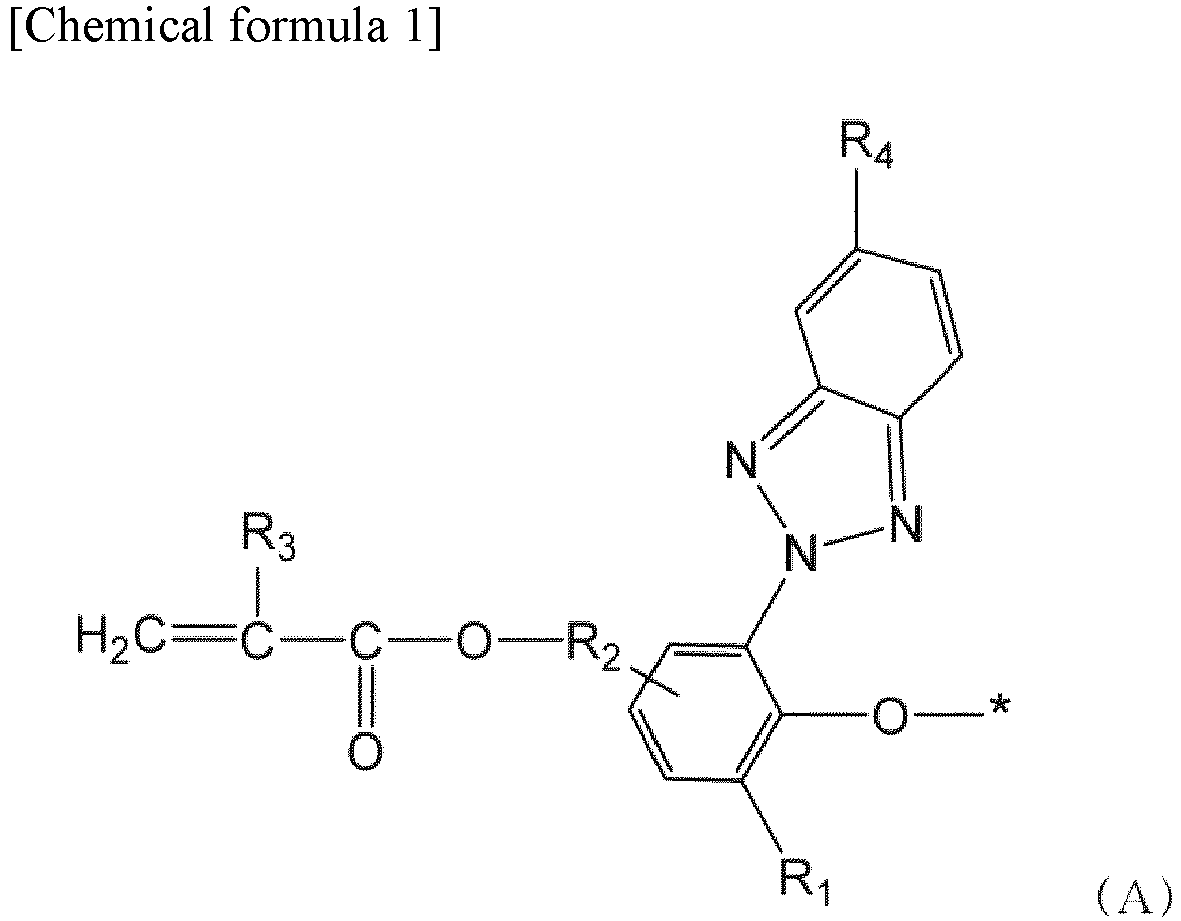
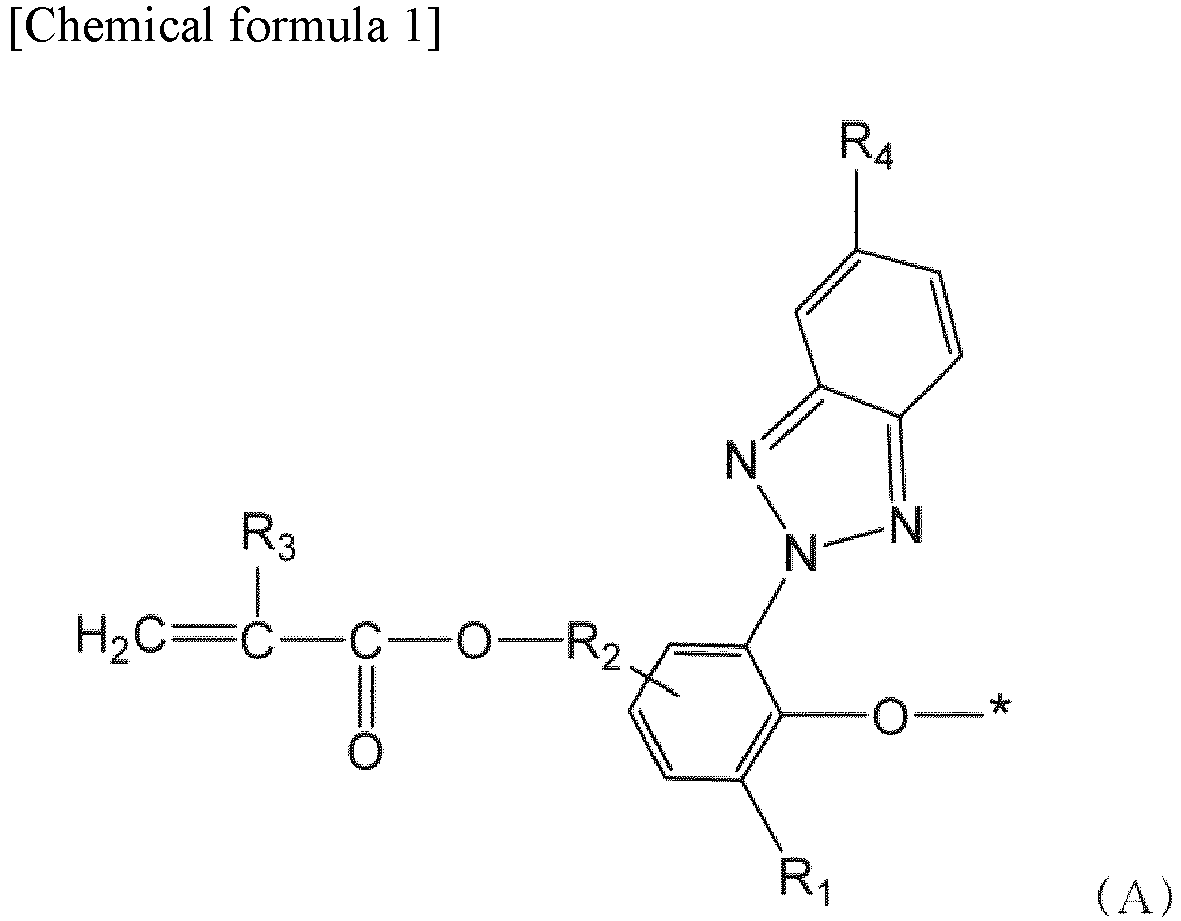
- the present invention provides a terminally modified polycarbonate resin comprising a structure represented by General formula (A) and a structural unit derived from a dihydric phenol: (in General formula (A) above, R 1 represents a hydrogen atom or a C1-C6 alkyl group, R 2 represents a C1-C6 alkylene group, R 3 represents a hydrogen atom or a methyl group, R 4 represents a hydrogen atom or a halogen atom, and ⁇ represents the position of the bond to the main chain of the polycarbonate resin.)
- the terminally modified polycarbonate resin of the present invention may be a terminally modified polycarbonate resin having a structural unit represented by General formula (1) below which has an end group represented by General formula (A).
- R 5 -R 8 each independently represent a hydrogen atom, a halogen atom, an optionally substituted C1-C20 alkyl group, an optionally substituted C1-C5 alkoxy group, an optionally substituted C6-C12 aryl group, an optionally substituted C7-C17 aralkyl group or an optionally substituted C2-C15 alkenyl group
- X represents -O-, -S-, -SO-, -SO 2 -, -CO- or a divalent group represented by any of General formulae (3) to (6) below:
- R 9 and R 10 each independently represent a hydrogen atom, a halogen atom, an optionally substituted C1-C20 alkyl group, an optionally substituted C1-C
- X of the structural unit represented by General formula (1) above may be a divalent group represented by General formula (3).
- the dihydric phenol may be a bisphenol compound.
- the bisphenol compound used as the dihydric phenol include, but not limited to, 2,2-bis(4-hydroxy-3,5-dibromophenyl)propane, 2,2-bis(4-hydroxy-3,5-dichlorophenyl)propane, 2,2-bis(4-hydroxy-3-bromophenyl)propane, 2,2-bis(4-hydroxy-3-chlorophenyl)propane, 2,2-bis(4-hydroxy-3-methylphenyl)propane, 2,2-bis(4-hydroxy-3,5-dimethylphenyl)propane, 1,1-bis(4-hydroxyphenyl)-1-phenylethane, bis(4-hydroxyphenyl)diphenylmethane, ⁇ , ⁇ -bis[3-(O-hydroxyphenyl)propyl]polydimethylsiloxane, 2,2-bis(4-hydroxyphenyl)
- the bisphenol compound may be selected from the group consisting of bisphenol A, bisphenol AP, bisphenol Z, bisphenol CD, bisphenol C, bisphenol IOTD, bisphenol IBTD and bisphenol MIBK.
- a single kind of dihydric phenol mentioned above may be used alone or two or more kinds of them may be used in combination.
- a monohydric phenol (also referred to as "Terminating agent A"), which is a precursor of the structure represented by General formula (A) above is commercially available as a UV absorber.
- a single kind of monohydric phenol mentioned above may be used alone or two or more kinds of them may be used in combination.
- the end structure represented by General formula (A) above may be a structure represented by Formula (7) below.
- ⁇ represents the position of the bond to the main chain of the polycarbonate resin.
- the end structure represented by General formula (A) above may be contained in an amount of preferably 0.5%-15% by mass relative to the above-described structural unit derived from a dihydric phenol.
- the end structure represented by General formula (A) above may be contained in an amount of more preferably 1%-10% by mass, still more preferably 2%-10% by mass, and particularly preferably 3%-7% by mass relative to the above-described structural unit derived from a dihydric phenol.
- the terminally modified polycarbonate resin may comprise any of a random copolymer structure, a block copolymer structure or an alternating copolymer structure.
- the terminally modified polycarbonate resin can be blended with other resin to give a terminally modified polycarbonate resin composition.
- other resin include, but not limited to, polyamide, polyacetal, polycarbonate, a modified polyphenylene ether, polyethylene terephthalate and polybutylene terephthalate.
- the terminally modified polycarbonate resin may be added with an antioxidant and a mold release agent as an additive to give a terminally modified polycarbonate resin composition.
- antioxidants examples include triethylene glycol-bis[3-(3-tert-butyl-5-methyl-4-hydroxyphenyl)propionate], 1,6-hexanediol-bis[3-(3,5-di-tert-butyl-4-hydroxyphenyl)propionate], pentaerythritol-tetrakis[3-(3,5-di-tert-butyl-4-hydroxyphenyl)propionate], octadecyl-3-(3,5-di-tert-butyl-4-hydroxyphenyl)propionate, 1,3,5-trimethyl-2,4,6-tris(3,5-di-tert-butyl-4-hydroxybenzyl)benzene, N,N-hexamethylenebis(3,5-di-tert-butyl-4-hydroxy-hydrocinnamide), 3,5-di-tert-butyl-4-hydroxy-benzylphosphonate-diethylester, tris(
- the content of the above-described antioxidant in the terminally modified polycarbonate resin composition is preferably 0.50% or less by mass, more preferably 0.10%-0.40% by mass, and particularly preferably 0.20%-0.40% by mass.
- the mold release agent is preferably one that contains an ester resulting from an alcohol and a fatty acid in an amount of 90% or more by mass.
- the ester resulting from an alcohol and a fatty acid specifically include an ester resulting from a monohydric alcohol and a fatty acid, and a partial or whole ester resulting from a polyhydric alcohol and a fatty acid.
- the ester resulting from a monohydric alcohol and a fatty acid described above is preferably an ester resulting from a monohydric alcohol having 1-20 carbon atoms and a saturated fatty acid having 10-30 carbon atoms.
- a partial or whole ester resulting from a polyhydric alcohol and a fatty acid is preferably a partial or whole ester resulting from a polyhydric alcohol having 1-25 carbon atoms and a saturated fatty acid having 10-30 carbon atoms.
- ester resulting from a monohydric alcohol and a saturated fatty acid specifically include stearyl stearate, palmityl palmitate, butyl stearate, methyl laurate and isopropyl palmitate.
- partial or whole ester resulting from a polyhydric alcohol and a saturated fatty acid include glycerol monostearate, glycerol monostearate, glycerol distearate, glycerol tristearate, sorbitan monostearate, glycerol monobehenate, glycerol monocaprylate, glycerol monolaurate, pentaerythritol monostearate, pentaerythritol tetrastearate, pentaerythritol tetrapelargonate, propylene glycol monostearate, biphenyl biphenate, sorbitan monostearate, 2-ethylhexyl stearate, and partial
- the content of the above-described mold release agent in the terminally modified polycarbonate resin composition is preferably 0.50% or less by mass, more preferably 0.01%-0.10% by mass, and particularly preferably 0.03%-0.05% by mass.
- terminally modified polycarbonate resin composition of the present invention may be added with other additive(s) such as a processing stabilizer, a UV absorber, a fluidity modifier, a crystal nucleating agent, a reinforcing agent, a dye, an antistatic agent, a bluing agent, an antibacterial agent or the like.
- additive(s) such as a processing stabilizer, a UV absorber, a fluidity modifier, a crystal nucleating agent, a reinforcing agent, a dye, an antistatic agent, a bluing agent, an antibacterial agent or the like.
- the terminally modified polycarbonate resin can be produced by a method employed for producing conventional polycarbonate resins except that a terminating agent is used.
- a dihydric phenol-based compound and phosgene are allowed to react with each other in the presence of an inert organic solvent and an aqueous alkaline solution, and then a terminating agent and a polymerization catalyst such as a tertiary amine or a quaternary ammonium salt are added to allow polymerization.
- a terminating agent and a polymerization catalyst such as a tertiary amine or a quaternary ammonium salt are added to allow polymerization.
- a dihydric phenol-based compound and a terminating agent are dissolved in pyridine or a mixed solution of pyridine and an inert solvent, into which phosgene is blown to directly obtain a polycarbonate oligomer.
- the above-described terminating agent may be added upon reaction between the dihydric phenol-based compound and phosgene.
- the viscosity-average molecular weight (Mv) of the terminally modified polycarbonate resin may preferably be 10,000-60,000.
- the viscosity-average molecular weight (Mv) of the terminally modified polycarbonate is more preferably 13,000-50,000, still more preferably 15,000-40,000, yet still more preferably 20,000-35,000, and particularly preferably 25,300-33,500.
- the viscosity-average molecular weight (Mv) of the polycarbonate lies within the aforementioned range, the molded body can be prevented from becoming brittle, the melt viscosity can be prevented from becoming too high so that the produced resin can be taken out easily, and the fluidity can be improved to facilitate injection molding in a molten state.
- the transmittance at 330 nm of the terminally modified polycarbonate resin may be 1% or less.
- the transmittance at 330 nm of the terminally modified polycarbonate resin of the present invention may be preferably 0.5% or less, and more preferably 0.1% or less.
- the terminally modified polycarbonate resin can be put to practical use as a polycarbonate resin excellent in both UV absorbing capacity and photostability.
- the transmittance at 330 nm was obtained by conducting zero adjustment at 330 nm with a dichloromethane solvent, and then measuring transmittance of the resin solution under the following conditions:
- the IR spectrum was obtained by conducting measurement in the measured wavenumber range of 4000-650 cm -1 by a film technique using FT/IR-400+ manufactured by JASCO Corporation.
- the film was prepared by a solution-cast film technique by dissolving the polycarbonate resin in dichloromethane.
- Terminally modified polycarbonate resins were produced by the following methods to analyze the viscosity-average molecular weight (Mv), the transmittance at 330 nm and the infrared absorption (IR) spectrum of each of the resulting resins.
- the polymerization solution was separated into an aqueous phase and an organic phase.
- the organic phase was neutralized with phosphoric acid and repeatedly washed with pure water until pH of the rinsing liquid was neutral.
- the organic solvent was evaporated and distilled away from the resulting polycarbonate resin solution, thereby obtaining polycarbonate resin powder.
- a polycarbonate resin was synthesized in the same manner as Example 1 except that BPA was changed to 87 g of bisphenol AP manufactured by Honshu Chemical Industry Co., Ltd., and the amount of Terminating agent A was changed to 3.2 g.
- a polycarbonate resin was synthesized in the same manner as Example 1 except that BPA was changed to 90 g of bisphenol Z manufactured by Honshu Chemical Industry Co., Ltd., and the amount of Terminating agent A was changed to 3.6 g.
- a polycarbonate resin was synthesized in the same manner as Example 1 except that BPA was changed to 130 g of bisphenol cyclododecane (bisphenol CD) manufactured by Honshu Chemical Industry Co., Ltd., and the amount of Terminating agent A was changed to 1.75 g.
- a polycarbonate resin was synthesized in the same manner as Example 1 except that 61.3 g of bisphenol C manufactured by Honshu Chemical Industry Co., Ltd. was used in addition to 41.2 g of BPA, and the amount of Terminating agent A was changed to 4.05 g.
- a polycarbonate resin was synthesized in the same manner as Example 1 except that BPA was changed to 90 g of bisphenol MIBK manufactured by Honshu Chemical Industry Co., Ltd., and the amount of Terminating agent A was changed to 3.58 g.
- a polycarbonate resin was synthesized in the same manner as Example 1 except that BPA was changed to 90 g of bisphenol IOTD manufactured by Honshu Chemical Industry Co., Ltd., and the amount of Terminating agent A was changed to 3.25 g.
- a polycarbonate resin was synthesized in the same manner as Example 1 except that BPA was changed to 80 g of bisphenol IBTD manufactured by Honshu Chemical Industry Co., Ltd., and the amount of Terminating agent A was changed to 3.55 g.
- a polycarbonate resin was synthesized in the same manner as Example 1 except that BPA was changed to 100 g of bisphenol CD manufactured by Honshu Chemical Industry Co., Ltd. and 19.2 g bisphenol MIBK manufactured by Honshu Chemical Industry Co., Ltd., and the amount of Terminating agent A was changed to 4.41 g.
- a polycarbonate resin was synthesized in the same manner as Example 9 except that the amount of Terminating agent A was changed to 7.17 g.
- a polycarbonate resin was synthesized in the same manner as Example 1 except that Terminating agent A was changed to 1.55 g of p-tert-butylphenol (PTBP). P-tert-butylphenol (PTBP)
- Mv was 32,500, and transmittance at 330 nm was 98.3%. Absorptions at 1640 cm -1 and 1720 cm -1 were not confirmed in the IR spectrum.
- a polycarbonate resin was synthesized in the same manner as Example 5 except that Terminating agent A was changed to 1.73 g of MILEX PM (Terminating agent B) manufactured by Mitsui Chemicals, Inc. Para-isopropenyl phenol (trade name: MILEX PM)
- Mv 24,100, and transmittance at 330 nm was 39.1%. Absorptions at 1640 cm -1 and 1720 cm -1 were not confirmed in the IR spectrum.
- a polycarbonate resin was synthesized in the same manner as Example 2 except that Terminating agent A was changed to 1.73 g of p-tert-butylphenol.
- Mv was 21,000, and transmittance at 330 nm was 89.5%. Absorptions at 1640 cm -1 and 1720 cm -1 were not confirmed in the IR spectrum.
- a polycarbonate resin was synthesized in the same manner as Example 3 except that Terminating agent A was changed to 1.65 g of p-tert-butylphenol.
- Mv was 20,000, and transmittance at 330 nm was 92.6%. Absorptions at 1640 cm -1 and 1720 cm -1 were not confirmed in the IR spectrum.
- a polycarbonate resin was synthesized in the same manner as Example 4 except that Terminating agent A was changed to 1.6 g of p-tert-butylphenol.
- Mv was 18,000, and transmittance at 330 nm was 76.7%. Absorptions at 1640 cm -1 and 1720 cm -1 were not confirmed in the IR spectrum.
- the terminally modified polycarbonate resin of the present invention has an extremely low transmittance at 330 nm and an excellent UV absorbing capacity.
Landscapes
- Chemical & Material Sciences (AREA)
- Health & Medical Sciences (AREA)
- Chemical Kinetics & Catalysis (AREA)
- Medicinal Chemistry (AREA)
- Polymers & Plastics (AREA)
- Organic Chemistry (AREA)
- General Chemical & Material Sciences (AREA)
- Polyesters Or Polycarbonates (AREA)
Abstract
Description
- The present invention relates to a novel terminally modified polycarbonate resin.
- Terminally reactive polycarbonates include polycarbonates having a vinyl end group or a conjugated double bond (Patent documents 1 and 2). These polycarbonates have an ultraviolet absorbing capacity but are highly reactive. Therefore, they have a drawback in that they are even reactive and polymerized by ultraviolet light outside, whereby they lose their activity and function as a UV absorber. Moreover, a polycarbonate having a triazole or benzophenone-based UV absorber bound to its end is known (Patent document 3). Such UV absorber shows excellent weatherability but has low activity as a reactive group and thus is not suitable to be used as a raw material for producing a block copolymer with other resin or as a reactive resin modifier.
- As terminally modified polycarbonate resins, a terminally modified polycarbonate oligomer terminated with a chalcone derivative (Patent document 4), a polycarbonate resin having an end group with a specific structure including a benzotriazole ring (Patent document 5), and the like are known but further development of terminally modified polycarbonate resins is desired.
-
- Patent document 1:
JP S55-9696 A - Patent document 2:
JP S61-141726 A - Patent document 3:
JP S49-99596 A - Patent document 4:
JP H6-256493 A - Patent document 5:
JP H9-316187 A - Development of a novel terminally modified polycarbonate resin having an excellent UV absorbing capacity is desired.
- The present inventors have gone through extensive studies and as a result of which developed a novel terminally modified polycarbonate resin having an excellent UV absorbing capacity, thereby accomplishing the present invention.
- Thus, the present invention comprises the following embodiments.
- (1) A terminally modified polycarbonate resin comprising a structure represented by General formula (A) and a structural unit derived from a dihydric phenol:
- (2) The terminally modified polycarbonate resin according to (1) above, wherein the viscosity-average molecular weight is 10,000-60,000.
- (3) The terminally modified polycarbonate resin according to either one of (1) and (2) above, comprising a structural unit represented by General formula (1) below which has an end group represented by General formula (A):


X is -O-, -S-, -SO-, -SO2-, -CO- or a divalent group represented by any of General formulae (3) to (6) below:
- R9 and R10 bind to each other to form a C3-C20 carbocyclic ring or a C1-C20 heterocyclic ring;
- c represents an integer of 0-20;
- R11 and R12 each independently represent a hydrogen atom, a halogen atom, an optionally substituted C1-C20 alkyl group, an optionally substituted C1-C5 alkoxy group, an optionally substituted C6-C12 aryl group, an optionally substituted C7-C17 aralkyl group or an optionally substituted C2-C15 alkenyl group, or
- R11 and R12 bind to each other to form a C3-C20 carbocyclic ring or a C1-C20 heterocyclic ring;
- R13-R16 each independently represent a hydrogen atom, a halogen atom, an optionally substituted C1-C20 alkyl group, an optionally substituted C1-C5 alkoxy group, an optionally substituted C6-C12 aryl group, an optionally substituted C7-C17 aralkyl group or an optionally substituted C2-C15 alkenyl group, or
- R13 and R14, and R15 and R16 bind to each other to form a C3-C20 carbocyclic ring or a C1-C20 heterocyclic ring; and
- R17-R26 each independently represent a hydrogen atom or a C1-C3 alkyl group, where at least one of R17-R26 is a C1-C3 alkyl group.))
- (4) The terminally modified polycarbonate resin according to (3) above, wherein X is a divalent group represented by General formula (3).
- (5) The terminally modified polycarbonate resin according to either one of (3) and (4) above, wherein the dihydric phenol is a bisphenol compound.
- (6) The terminally modified polycarbonate resin according to (5) above, wherein the bisphenol compound is selected from the group consisting of bisphenol A, bisphenol AP, bisphenol Z, bisphenol CD, bisphenol C, bisphenol IOTD, bisphenol IBTD and bisphenol MIBK.
- (7) The terminally modified polycarbonate resin according to any one of (3) to (6) above, wherein the end structure represented by General formula (A) above is represented by Formula (7) below:

- (8) The polycarbonate resin according to any one of (1) to (7) above, which contains the end structure represented by General formula (A) in an amount of 0.5% or more by mass relative to the structural unit derived from a dihydric phenol.
- (9) The polycarbonate resin according to any one of (1) to (8) above, wherein transmittance at 330 nm is 1% or less.
- The present invention can provide a novel terminally modified polycarbonate resin having an excellent UV absorbing capacity.
- Hereinafter, the present invention will be described in detail.
- The present invention provides a terminally modified polycarbonate resin comprising a structure represented by General formula (A) and a structural unit derived from a dihydric phenol:

- The terminally modified polycarbonate resin of the present invention may be a terminally modified polycarbonate resin having a structural unit represented by General formula (1) below which has an end group represented by General formula (A).


X represents -O-, -S-, -SO-, -SO2-, -CO- or a divalent group represented by any of General formulae (3) to (6) below:
- R9 and R10 bind to each other to form a C3-C20 carbocyclic ring or a C1-C20 heterocyclic ring;
- c represents an integer of 0-20;
- R11 and R12 each independently represent a hydrogen atom, a halogen atom, an optionally substituted C1-C20 alkyl group, an optionally substituted C1-C5 alkoxy group, an optionally substituted C6-C12 aryl group, an optionally substituted C7-C17 aralkyl group or an optionally substituted C2-C15 alkenyl group, or
- R11 and R12 bind to each other to form a C3-C20 carbocyclic ring or a C1-C20 heterocyclic ring;
- R13-R16 each independently represent a hydrogen atom, a halogen atom, an optionally substituted C1-C20 alkyl group, an optionally substituted C1-C5 alkoxy group, an optionally substituted C6-C12 aryl group, an optionally substituted C7-C17 aralkyl group or an optionally substituted C2-C15 alkenyl group, or
- R13 and R14, and R15 and R16 bind to each other to form a C3-C20 carbocyclic ring or a C1-C20 heterocyclic ring; and
- R17-R26 each independently represent a hydrogen atom or a C1-C3 alkyl group, where at least one of R17-R26 is a C1-C3 alkyl group.))
- In one embodiment of the present invention, X of the structural unit represented by General formula (1) above may be a divalent group represented by General formula (3).
- In one embodiment of the present invention, the dihydric phenol may be a bisphenol compound. According to the present invention, examples of the bisphenol compound used as the dihydric phenol include, but not limited to, 2,2-bis(4-hydroxy-3,5-dibromophenyl)propane, 2,2-bis(4-hydroxy-3,5-dichlorophenyl)propane, 2,2-bis(4-hydroxy-3-bromophenyl)propane, 2,2-bis(4-hydroxy-3-chlorophenyl)propane, 2,2-bis(4-hydroxy-3-methylphenyl)propane, 2,2-bis(4-hydroxy-3,5-dimethylphenyl)propane, 1,1-bis(4-hydroxyphenyl)-1-phenylethane, bis(4-hydroxyphenyl)diphenylmethane, α,ω-bis[3-(O-hydroxyphenyl)propyl]polydimethylsiloxane, 2,2-bis(4-hydroxyphenyl)propane (bisphenol A; BPA), 1,1-bis(4-hydroxyphenyl)-1-phenylethane (bisphenol AP), 2,2-bis(4-hydroxyphenyl)butane (bisphenol B; BPB), bis(4-hydroxyphenyl)diphenylmethane (bisphenol BP), bisphenol CD, 2,2-bis(3-methyl-4-hydroxyphenyl)propane (bisphenol C), 1,1-bis(4-hydroxyphenyl)ethane (bisphenol E), bis(4-hydroxyphenyl)methane (bisphenol F), 2,2-bis(4-hydroxy-3-isopropylphenyl)propane (bisphenol G), 1,1-bis(4-hydroxyphenyl)-2-ethylhexane (bisphenol IOTD), 1,1-bis(4-hydroxyphenyl)-2-methylpropane (bisphenol IBTD), 1,1-bis(4-hydroxyphenyl)-2-methylpentane (bisphenol MIBK), 5,5'-(1-methylethylidene)-bis[1,1'-(bisphenyl)-2-ol]propane (bisphenol PH), 1,1-bis(4-hydroxyphenyl)-3,3,5-trimethylcyclohexane (bisphenol TMC) and 1,1-bis(4-hydroxyphenyl)cyclohexane (bisphenol Z; BPZ). In a preferred embodiment of the present invention, the bisphenol compound may be selected from the group consisting of bisphenol A, bisphenol AP, bisphenol Z, bisphenol CD, bisphenol C, bisphenol IOTD, bisphenol IBTD and bisphenol MIBK. In one embodiment of the present invention, a single kind of dihydric phenol mentioned above may be used alone or two or more kinds of them may be used in combination.
- A monohydric phenol (also referred to as "Terminating agent A"), which is a precursor of the structure represented by General formula (A) above is commercially available as a UV absorber. In one embodiment of the present invention, a single kind of monohydric phenol mentioned above may be used alone or two or more kinds of them may be used in combination.
- In a preferred embodiment of the present invention, the end structure represented by General formula (A) above may be a structure represented by Formula (7) below.

- In one embodiment of the present invention, the end structure represented by General formula (A) above may be contained in an amount of preferably 0.5%-15% by mass relative to the above-described structural unit derived from a dihydric phenol. The end structure represented by General formula (A) above may be contained in an amount of more preferably 1%-10% by mass, still more preferably 2%-10% by mass, and particularly preferably 3%-7% by mass relative to the above-described structural unit derived from a dihydric phenol.
- In one embodiment of the present invention, the terminally modified polycarbonate resin may comprise any of a random copolymer structure, a block copolymer structure or an alternating copolymer structure.
- In one embodiment of the present invention, the terminally modified polycarbonate resin can be blended with other resin to give a terminally modified polycarbonate resin composition. Examples of other resin include, but not limited to, polyamide, polyacetal, polycarbonate, a modified polyphenylene ether, polyethylene terephthalate and polybutylene terephthalate.
- In one embodiment of the present invention, the terminally modified polycarbonate resin may be added with an antioxidant and a mold release agent as an additive to give a terminally modified polycarbonate resin composition.
- Examples of the antioxidant include triethylene glycol-bis[3-(3-tert-butyl-5-methyl-4-hydroxyphenyl)propionate], 1,6-hexanediol-bis[3-(3,5-di-tert-butyl-4-hydroxyphenyl)propionate], pentaerythritol-tetrakis[3-(3,5-di-tert-butyl-4-hydroxyphenyl)propionate], octadecyl-3-(3,5-di-tert-butyl-4-hydroxyphenyl)propionate, 1,3,5-trimethyl-2,4,6-tris(3,5-di-tert-butyl-4-hydroxybenzyl)benzene, N,N-hexamethylenebis(3,5-di-tert-butyl-4-hydroxy-hydrocinnamide), 3,5-di-tert-butyl-4-hydroxy-benzylphosphonate-diethylester, tris(3,5-di-tert-butyl-4-hydroxybenzyl)isocyanurate and 3,9-bis{1,1-dimethyl-2-[β-(3-tert-butyl-4-hydroxy-5-methylphenyl)propionyloxy]ethyl}-2,4,8,10-tetraoxaspiro (5,5)undecane.
- The content of the above-described antioxidant in the terminally modified polycarbonate resin composition is preferably 0.50% or less by mass, more preferably 0.10%-0.40% by mass, and particularly preferably 0.20%-0.40% by mass.
- The mold release agent is preferably one that contains an ester resulting from an alcohol and a fatty acid in an amount of 90% or more by mass. Examples of the ester resulting from an alcohol and a fatty acid specifically include an ester resulting from a monohydric alcohol and a fatty acid, and a partial or whole ester resulting from a polyhydric alcohol and a fatty acid. The ester resulting from a monohydric alcohol and a fatty acid described above is preferably an ester resulting from a monohydric alcohol having 1-20 carbon atoms and a saturated fatty acid having 10-30 carbon atoms. Moreover, a partial or whole ester resulting from a polyhydric alcohol and a fatty acid is preferably a partial or whole ester resulting from a polyhydric alcohol having 1-25 carbon atoms and a saturated fatty acid having 10-30 carbon atoms.
- Examples of the ester resulting from a monohydric alcohol and a saturated fatty acid specifically include stearyl stearate, palmityl palmitate, butyl stearate, methyl laurate and isopropyl palmitate. Examples of the partial or whole ester resulting from a polyhydric alcohol and a saturated fatty acid include glycerol monostearate, glycerol monostearate, glycerol distearate, glycerol tristearate, sorbitan monostearate, glycerol monobehenate, glycerol monocaprylate, glycerol monolaurate, pentaerythritol monostearate, pentaerythritol tetrastearate, pentaerythritol tetrapelargonate, propylene glycol monostearate, biphenyl biphenate, sorbitan monostearate, 2-ethylhexyl stearate, and partial or whole esters of dipentaerythritol such as dipentaerythritol hexastearate.
- The content of the above-described mold release agent in the terminally modified polycarbonate resin composition is preferably 0.50% or less by mass, more preferably 0.01%-0.10% by mass, and particularly preferably 0.03%-0.05% by mass.
- Furthermore, the terminally modified polycarbonate resin composition of the present invention may be added with other additive(s) such as a processing stabilizer, a UV absorber, a fluidity modifier, a crystal nucleating agent, a reinforcing agent, a dye, an antistatic agent, a bluing agent, an antibacterial agent or the like.
- In one embodiment of the present invention, the terminally modified polycarbonate resin can be produced by a method employed for producing conventional polycarbonate resins except that a terminating agent is used.
- Specifically, in a case of an interfacial polymerization method, a dihydric phenol-based compound and phosgene are allowed to react with each other in the presence of an inert organic solvent and an aqueous alkaline solution, and then a terminating agent and a polymerization catalyst such as a tertiary amine or a quaternary ammonium salt are added to allow polymerization. In a case of a pyridine method, a dihydric phenol-based compound and a terminating agent are dissolved in pyridine or a mixed solution of pyridine and an inert solvent, into which phosgene is blown to directly obtain a polycarbonate oligomer. According to the interfacial polymerization method, the above-described terminating agent may be added upon reaction between the dihydric phenol-based compound and phosgene.
- In one embodiment of the present invention, the viscosity-average molecular weight (Mv) of the terminally modified polycarbonate resin may preferably be 10,000-60,000. The viscosity-average molecular weight (Mv) of the terminally modified polycarbonate is more preferably 13,000-50,000, still more preferably 15,000-40,000, yet still more preferably 20,000-35,000, and particularly preferably 25,300-33,500. As far as the viscosity-average molecular weight (Mv) of the polycarbonate lies within the aforementioned range, the molded body can be prevented from becoming brittle, the melt viscosity can be prevented from becoming too high so that the produced resin can be taken out easily, and the fluidity can be improved to facilitate injection molding in a molten state.
- The viscosity-average molecular weight (Mv) was calculated by the following equation:

- Measurement instrument: Ubbelohde capillary viscometer
- Solvent: Dichloromethane
- Concentration of resin solution: 0.5 grams/deciliter
- Measurement temperature: 25°C
- In one embodiment of the present invention, the transmittance at 330 nm of the terminally modified polycarbonate resin may be 1% or less. The transmittance at 330 nm of the terminally modified polycarbonate resin of the present invention may be preferably 0.5% or less, and more preferably 0.1% or less. As far as the transmittance at 330 nm lies within the above-mentioned range, the terminally modified polycarbonate resin can be put to practical use as a polycarbonate resin excellent in both UV absorbing capacity and photostability.
- The transmittance at 330 nm was obtained by conducting zero adjustment at 330 nm with a dichloromethane solvent, and then measuring transmittance of the resin solution under the following conditions:
- Measurement instrument: UV-visible spectrophotometer UV-1280 manufactured by Shimadzu Corporation
- Solvent: Dichloromethane
- Concentration of resin solution: 10% (w/w)
- Cell: 1 cm quartz cell
- Photometric mode
- Absorptions of C=N stretching and N=N stretching originating from Terminating agent A were confirmed at 1640 cm-1 and 1720 cm-1 in the IR spectrum, confirming incorporation of the terminating agent at the end of the polycarbonate resin.
- The IR spectrum was obtained by conducting measurement in the measured wavenumber range of 4000-650 cm-1 by a film technique using FT/IR-400+ manufactured by JASCO Corporation. The film was prepared by a solution-cast film technique by dissolving the polycarbonate resin in dichloromethane.
- Hereinafter, the present invention will be described by way of examples. These examples are not intended to limit the present invention.
- Terminally modified polycarbonate resins were produced by the following methods to analyze the viscosity-average molecular weight (Mv), the transmittance at 330 nm and the infrared absorption (IR) spectrum of each of the resulting resins.
- To 600 ml of a 9% (w/w) aqueous sodium hydroxide solution and 200 ml of pure water, 100 g of bisphenol A (BPA) manufactured by NIPPON STEEL Chemical and Material Co., Ltd. and 0.5 g hydrosulfite were added to be dissolved therein. To this, 330 ml of dichloromethane was added, and 59.7 g of phosgene was blown into the resultant by spending 30 minutes while stirring and keeping the solution temperature within a range of 15-25°C.
- After the end of phosgene blowing, 100 ml of a 9% (w/w) aqueous sodium hydroxide solution, 200 ml of dichloromethane and 3.3 g of RUVA-93 manufactured by Otsuka Chemical Co., Ltd. (Terminating agent A) dissolved in 50 ml of dichloromethane were added and vigorously stirred to emulsify, followed by addition of 0.5 ml of triethylamine (TEA) as a polymerization catalyst to allow polymerization for about 40 minutes.


- The polymerization solution was separated into an aqueous phase and an organic phase. The organic phase was neutralized with phosphoric acid and repeatedly washed with pure water until pH of the rinsing liquid was neutral. The organic solvent was evaporated and distilled away from the resulting polycarbonate resin solution, thereby obtaining polycarbonate resin powder.
- Mv was 33,500, and transmittance at 330 nm was 0.1%. Furthermore, absorptions of C=N stretching and N=N stretching originating from Terminating agent A were confirmed at 1640 cm-1 and 1720 cm-1 in the IR spectrum, confirming incorporation of the terminating agent at the end of the polycarbonate resin.
- A polycarbonate resin was synthesized in the same manner as Example 1 except that BPA was changed to 87 g of bisphenol AP manufactured by Honshu Chemical Industry Co., Ltd., and the amount of Terminating agent A was changed to 3.2 g.

- Mv was 27,200, and transmittance at 330 nm was 0.1%. As with Example 1, incorporation of the terminating agent at the end of the polycarbonate resin was confirmed in the IR spectrum.
- A polycarbonate resin was synthesized in the same manner as Example 1 except that BPA was changed to 90 g of bisphenol Z manufactured by Honshu Chemical Industry Co., Ltd., and the amount of Terminating agent A was changed to 3.6 g.

- Mv was 22,300, and transmittance at 330 nm was 0.1%. As with Example 1, incorporation of the terminating agent at the end of the polycarbonate resin was confirmed in the IR spectrum.
- A polycarbonate resin was synthesized in the same manner as Example 1 except that BPA was changed to 130 g of bisphenol cyclododecane (bisphenol CD) manufactured by Honshu Chemical Industry Co., Ltd., and the amount of Terminating agent A was changed to 1.75 g.

- Mv was 33,500, and transmittance at 330 nm was 0.1%. As with Example 1, incorporation of the terminating agent at the end of the polycarbonate resin was confirmed in the IR spectrum.
- A polycarbonate resin was synthesized in the same manner as Example 1 except that 61.3 g of bisphenol C manufactured by Honshu Chemical Industry Co., Ltd. was used in addition to 41.2 g of BPA, and the amount of Terminating agent A was changed to 4.05 g.


- Mv was 29,200, and transmittance at 330 nm was 0.1%. As with Example 1, incorporation of the terminating agent at the end of the polycarbonate resin was confirmed in the IR spectrum.
- A polycarbonate resin was synthesized in the same manner as Example 1 except that BPA was changed to 90 g of bisphenol MIBK manufactured by Honshu Chemical Industry Co., Ltd., and the amount of Terminating agent A was changed to 3.58 g.

- Mv was 25,300, and transmittance at 330 nm was 0.1%. As with Example 1, incorporation of the terminating agent at the end of the polycarbonate resin was confirmed in the IR spectrum.
- A polycarbonate resin was synthesized in the same manner as Example 1 except that BPA was changed to 90 g of bisphenol IOTD manufactured by Honshu Chemical Industry Co., Ltd., and the amount of Terminating agent A was changed to 3.25 g.

- Mv was 26,600, and transmittance at 330 nm was 0.1%. As with Example 1, incorporation of the terminating agent at the end of the polycarbonate resin was confirmed in the IR spectrum.
- A polycarbonate resin was synthesized in the same manner as Example 1 except that BPA was changed to 80 g of bisphenol IBTD manufactured by Honshu Chemical Industry Co., Ltd., and the amount of Terminating agent A was changed to 3.55 g.


- Mv was 25,200, and transmittance at 330 nm was 0.1%. As with Example 1, incorporation of the terminating agent at the end of the polycarbonate resin was confirmed in the IR spectrum.
- A polycarbonate resin was synthesized in the same manner as Example 1 except that BPA was changed to 100 g of bisphenol CD manufactured by Honshu Chemical Industry Co., Ltd. and 19.2 g bisphenol MIBK manufactured by Honshu Chemical Industry Co., Ltd., and the amount of Terminating agent A was changed to 4.41 g.


- Mv was 18,200, and transmittance at 330 nm was 0.1%. As with Example 1, incorporation of the terminating agent at the end of the polycarbonate resin was confirmed in the IR spectrum.
- A polycarbonate resin was synthesized in the same manner as Example 9 except that the amount of Terminating agent A was changed to 7.17 g.
- Mv was 13,200, and transmittance at 330 nm was 0.1%. As with Example 1, incorporation of the terminating agent at the end of the polycarbonate resin was confirmed in the IR spectrum.
- A polycarbonate resin was synthesized in the same manner as Example 1 except that Terminating agent A was changed to 1.55 g of p-tert-butylphenol (PTBP).

- Mv was 32,500, and transmittance at 330 nm was 98.3%. Absorptions at 1640 cm-1 and 1720 cm-1 were not confirmed in the IR spectrum.
- A polycarbonate resin was synthesized in the same manner as Example 5 except that Terminating agent A was changed to 1.73 g of MILEX PM (Terminating agent B) manufactured by Mitsui Chemicals, Inc.

- Mv was 24,100, and transmittance at 330 nm was 39.1%. Absorptions at 1640 cm-1 and 1720 cm-1 were not confirmed in the IR spectrum.
- A polycarbonate resin was synthesized in the same manner as Example 2 except that Terminating agent A was changed to 1.73 g of p-tert-butylphenol.
- Mv was 21,000, and transmittance at 330 nm was 89.5%. Absorptions at 1640 cm-1 and 1720 cm-1 were not confirmed in the IR spectrum.
- A polycarbonate resin was synthesized in the same manner as Example 3 except that Terminating agent A was changed to 1.65 g of p-tert-butylphenol.
- Mv was 20,000, and transmittance at 330 nm was 92.6%. Absorptions at 1640 cm-1 and 1720 cm-1 were not confirmed in the IR spectrum.
- A polycarbonate resin was synthesized in the same manner as Example 4 except that Terminating agent A was changed to 1.6 g of p-tert-butylphenol.
- Mv was 18,000, and transmittance at 330 nm was 76.7%. Absorptions at 1640 cm-1 and 1720 cm-1 were not confirmed in the IR spectrum.
- The results of analyses described above are summarized in Table 1 below.
[Table 1] Dihydric phenol Monohydric phenol Mv transmittance at 330 nm Example 1 BPA Terminating agent A 33,500 0.1% Example 2 Bisphenol AP Terminating agent A 27,200 0.1% Example 3 Bisphenol Z Terminating agent A 22,300 0.1% Example 4 Bisphenol CD Terminating agent A 33,500 0.1% Example 5 BPA Terminating agent A 29,200 0.1% Bisphenol C Example 6 Bisphenol MIBK Terminating agent A 25,300 0.1% Example 7 Bisphenol IOTD Terminating agent A 26,600 0.1% Example 8 Bisphenol IBTD Terminating agent A 25,200 0.1% Example 9 Bisphenol CD Terminating agent A 18,200 0.1% Bisphenol MIBK Example 10 Bisphenol CD Terminating agent A 13,200 0.1% Bisphenol MIBK Comparative example 1 BPA PTBP 32,500 98.3% Comparative example 2 BPA Terminating agent B 24,100 39.1% Bisphenol C Comparative example 3 Bisphenol AP PTBP 21,000 89.5% Comparative example 4 Bisphenol Z PTBP 20,000 92.6% Comparative example 5 Bisphenol CD PTBP 20,100 76.7% - As can be appreciated from Table 1, the terminally modified polycarbonate resin of the present invention has an extremely low transmittance at 330 nm and an excellent UV absorbing capacity.
Claims (9)
- A terminally modified polycarbonate resin comprising a structure represented by General formula (A) and a structural unit derived from a dihydric phenol:
- The terminally modified polycarbonate resin according to Claim 1, wherein the viscosity-average molecular weight is 10,000-60,000.
- The terminally modified polycarbonate resin according to either one of Claims 1 and 2, comprising a structural unit represented by General formula (1) below which has an end group represented by General formula (A):

X is -O-, -S-, -SO-, -SO2-, -CO- or a divalent group represented by any of General formulae (3) to (6) below: R9 and R10 bind to each other to form a C3-C20 carbocyclic ring or a C1-C20 heterocyclic ring;c represents an integer of 0-20;R11 and R12 each independently represent a hydrogen atom, a halogen atom, an optionally substituted C1-C20 alkyl group, an optionally substituted C1-C5 alkoxy group, an optionally substituted C6-C12 aryl group, an optionally substituted C7-C17 aralkyl group or an optionally substituted C2-C15 alkenyl group, orR11 and R12 bind to each other to form a C3-C20 carbocyclic ring or a C1-C20 heterocyclic ring;R13-R16 each independently represent a hydrogen atom, a halogen atom, an optionally substituted C1-C20 alkyl group, an optionally substituted C1-C5 alkoxy group, an optionally substituted C6-C12 aryl group, an optionally substituted C7-C17 aralkyl group or an optionally substituted C2-C15 alkenyl group, orR13 and R14, and R15 and R16 bind to each other to form a C3-C20 carbocyclic ring or a C1-C20 heterocyclic ring; andR17-R26 each independently represent a hydrogen atom or a C1-C3 alkyl group, where at least one of R17-R26 is a C1-C3 alkyl group.))
 - The terminally modified polycarbonate resin according to Claim 3, wherein X is a divalent group represented by General formula (3).
- The terminally modified polycarbonate resin according to either one of Claims 3 and 4, wherein the dihydric phenol is a bisphenol compound.
- The terminally modified polycarbonate resin according to Claim 5, wherein the bisphenol compound is selected from the group consisting of bisphenol A, bisphenol AP, bisphenol Z, bisphenol CD, bisphenol C, bisphenol IOTD, bisphenol IBTD and bisphenol MIBK.
- The terminally modified polycarbonate resin according to any one of Claims 3 to 6, wherein the end structure represented by General formula (A) above is represented by Formula (7) below:

- The polycarbonate resin according to any one of Claims 1 to 7, which contains the end structure represented by General formula (A) in an amount of 0.5% or more by mass relative to the structural unit derived from a dihydric phenol.
- The polycarbonate resin according to any one of Claims 1 to 8, wherein transmittance at 330 nm is 1% or less.
Applications Claiming Priority (2)
| Application Number | Priority Date | Filing Date | Title |
|---|---|---|---|
| JP2019070650 | 2019-04-02 | ||
| PCT/JP2020/014513 WO2020203958A1 (en) | 2019-04-02 | 2020-03-30 | Polycarbonate resin |
Publications (3)
| Publication Number | Publication Date |
|---|---|
| EP3950771A1 true EP3950771A1 (en) | 2022-02-09 |
| EP3950771A4 EP3950771A4 (en) | 2022-05-11 |
| EP3950771B1 EP3950771B1 (en) | 2024-10-09 |
Family
ID=72668990
Family Applications (1)
| Application Number | Title | Priority Date | Filing Date |
|---|---|---|---|
| EP20784776.5A Active EP3950771B1 (en) | 2019-04-02 | 2020-03-30 | Polycarbonate resin |
Country Status (7)
| Country | Link |
|---|---|
| US (1) | US12006398B2 (en) |
| EP (1) | EP3950771B1 (en) |
| JP (1) | JP7509137B2 (en) |
| KR (1) | KR102834027B1 (en) |
| CN (1) | CN113646359B (en) |
| TW (1) | TWI837340B (en) |
| WO (1) | WO2020203958A1 (en) |
Families Citing this family (5)
| Publication number | Priority date | Publication date | Assignee | Title |
|---|---|---|---|---|
| KR102926600B1 (en) * | 2019-06-10 | 2026-02-11 | 미츠비시 가스 가가쿠 가부시키가이샤 | polycarbonate resin |
| JP7729030B2 (en) * | 2019-10-23 | 2025-08-26 | 三菱瓦斯化学株式会社 | Curing resin composition |
| TWI864144B (en) * | 2019-10-23 | 2024-12-01 | 日商三菱瓦斯化學股份有限公司 | Curing resin composition, curing method and molded product |
| JP7704141B2 (en) * | 2020-05-27 | 2025-07-08 | 三菱瓦斯化学株式会社 | Curable resin composition, molded article, and method for producing the same |
| WO2025037568A1 (en) * | 2023-08-15 | 2025-02-20 | 三菱瓦斯化学株式会社 | Polycarbonate resin |
Family Cites Families (14)
| Publication number | Priority date | Publication date | Assignee | Title |
|---|---|---|---|---|
| JPS4999596A (en) * | 1973-01-25 | 1974-09-20 | ||
| DE2829256A1 (en) | 1978-07-04 | 1980-01-17 | Bayer Ag | POLYCARBONATE WITH END GROUPS CONTAINING UV LIGHT CROSSLINKABLE DOUBLE BINDINGS |
| DE3445108A1 (en) | 1984-12-11 | 1986-06-12 | Bayer Ag, 5090 Leverkusen | POLYCARBONATES WITH CONJUGATED DOUBLE BINDINGS CONTAINING END GROUPS, MAY BE MIXED WITH KNOWN AROMATIC POLYCARBONATES, THEIR PRODUCTION AND THEIR USE |
| DE3737341A1 (en) * | 1987-11-04 | 1989-05-18 | Bayer Ag | NEW FLUOROMETHOXYPHENYL DIHYDROPYRIDINES, METHOD FOR THE PREPARATION THEREOF AND THEIR USE IN MEDICAMENTS |
| JP3211843B2 (en) * | 1992-11-02 | 2001-09-25 | 三菱瓦斯化学株式会社 | Polycarbonate resin composition |
| JPH06256493A (en) | 1993-03-02 | 1994-09-13 | Mitsubishi Gas Chem Co Inc | End-modified polycarbonate oligomer and method for producing the same |
| US5523379A (en) * | 1994-12-21 | 1996-06-04 | General Electric Plastics | High molecular weight stabilizer compounds for stabilizing polymers |
| JP2938368B2 (en) * | 1995-07-17 | 1999-08-23 | 川崎製鉄株式会社 | Method and apparatus for removing foreign matter from continuous hot-dip metal plating bath surface |
| JPH09316187A (en) * | 1996-05-29 | 1997-12-09 | Teijin Chem Ltd | Method for modifying polycarbonate resin |
| US6096852A (en) * | 1998-05-12 | 2000-08-01 | General Electric Company | UV-stabilized and other modified polycarbonates and method of making same |
| JP2002179902A (en) * | 2000-12-15 | 2002-06-26 | Ipposha Oil Ind Co Ltd | Polycarbonate resin composition excellent in light resistance and ultraviolet ray transmission proofness |
| JP2006256493A (en) | 2005-03-17 | 2006-09-28 | Advics:Kk | Vehicle travel support device |
| KR101607014B1 (en) * | 2013-09-30 | 2016-03-28 | 주식회사 엘지화학 | Multi-layered film |
| CN104193979B (en) | 2014-08-19 | 2016-02-24 | 万华化学集团股份有限公司 | A kind of uvioresistant polycarbonate resin and preparation method thereof |
-
2020
- 2020-03-30 EP EP20784776.5A patent/EP3950771B1/en active Active
- 2020-03-30 CN CN202080025018.0A patent/CN113646359B/en active Active
- 2020-03-30 US US17/598,531 patent/US12006398B2/en active Active
- 2020-03-30 WO PCT/JP2020/014513 patent/WO2020203958A1/en not_active Ceased
- 2020-03-30 JP JP2021512107A patent/JP7509137B2/en active Active
- 2020-03-30 KR KR1020217022235A patent/KR102834027B1/en active Active
- 2020-04-01 TW TW109111278A patent/TWI837340B/en active
Also Published As
| Publication number | Publication date |
|---|---|
| JP7509137B2 (en) | 2024-07-02 |
| US20220177644A1 (en) | 2022-06-09 |
| EP3950771A4 (en) | 2022-05-11 |
| KR20210146282A (en) | 2021-12-03 |
| CN113646359A (en) | 2021-11-12 |
| TW202043330A (en) | 2020-12-01 |
| JPWO2020203958A1 (en) | 2020-10-08 |
| CN113646359B (en) | 2023-05-02 |
| EP3950771B1 (en) | 2024-10-09 |
| WO2020203958A1 (en) | 2020-10-08 |
| US12006398B2 (en) | 2024-06-11 |
| TWI837340B (en) | 2024-04-01 |
| KR102834027B1 (en) | 2025-07-14 |
Similar Documents
| Publication | Publication Date | Title |
|---|---|---|
| EP3950771B1 (en) | Polycarbonate resin | |
| EP3150670B1 (en) | Copolycarbonate composition and article comprising same | |
| CN106883575B (en) | Polycarbonate resin composition and molded article | |
| EP3081584A1 (en) | Polycarbonate-polyorganosiloxane copolymer and method for producing same | |
| TWI567105B (en) | Copolycarbonate and composition comprising the same | |
| EP2033981A1 (en) | Polycarbonate copolymer and process for production thereof | |
| EP4071194A1 (en) | Polycarbonate/polyorganosiloxane copolymer and resin composition including said copolymer | |
| EP4071196A1 (en) | Polycarbonate/polyorganosiloxane copolymer and resin composition including said copolymer | |
| EP2752444B1 (en) | Method for producing a foam molded body | |
| KR20180044911A (en) | Method for producing polycarbonate-polyorganosiloxane copolymer | |
| JP2020189994A (en) | Polycarbonate resin composition and molding thereof | |
| KR20180044907A (en) | Polycarbonate resin composition and molded article thereof | |
| US20150141586A1 (en) | Phenyl-containing functional polysiloxanes and polycarbonate-polysiloxane copolymers made therefrom | |
| JPH0848781A (en) | Epoxidized siloxane and its mixture with polycarbonate | |
| EP3050908B1 (en) | Copolycarbonate and composition comprising same | |
| EP3957673A1 (en) | Polycarbonate-polyorganosiloxane copolymer, method for producing the same, and resin composition comprising the copolymer | |
| JP2001192544A (en) | Aromatic polycarbonate resin composition | |
| EP1097956B1 (en) | Polycarbonat resin | |
| EP3406649B1 (en) | Copolycarbonate and resin composition comprising same | |
| EP4141046A1 (en) | Polysiloxane-polycarbonate copolymer using hydroxy-terminated polysiloxane mixture, and method for producing same | |
| EP3301123B1 (en) | Novel polyorganosiloxane, and copolycarbonate prepared by using same | |
| KR20220108711A (en) | Polycarbonate and preparation method thereof | |
| WO2025037568A1 (en) | Polycarbonate resin | |
| EP4538311A1 (en) | Polycarbonate-polyorganosiloxane copolymer | |
| EP4692165A1 (en) | Polycarbonate resin and molded article |
Legal Events
| Date | Code | Title | Description |
|---|---|---|---|
| STAA | Information on the status of an ep patent application or granted ep patent |
Free format text: STATUS: THE INTERNATIONAL PUBLICATION HAS BEEN MADE |
|
| PUAI | Public reference made under article 153(3) epc to a published international application that has entered the european phase |
Free format text: ORIGINAL CODE: 0009012 |
|
| STAA | Information on the status of an ep patent application or granted ep patent |
Free format text: STATUS: REQUEST FOR EXAMINATION WAS MADE |
|
| 17P | Request for examination filed |
Effective date: 20211019 |
|
| AK | Designated contracting states |
Kind code of ref document: A1 Designated state(s): AL AT BE BG CH CY CZ DE DK EE ES FI FR GB GR HR HU IE IS IT LI LT LU LV MC MK MT NL NO PL PT RO RS SE SI SK SM TR |
|
| A4 | Supplementary search report drawn up and despatched |
Effective date: 20220412 |
|
| RIC1 | Information provided on ipc code assigned before grant |
Ipc: C08G 64/14 20060101AFI20220406BHEP |
|
| DAV | Request for validation of the european patent (deleted) | ||
| DAX | Request for extension of the european patent (deleted) | ||
| REG | Reference to a national code |
Ref country code: DE Ref legal event code: R079 Ref document number: 602020039181 Country of ref document: DE Free format text: PREVIOUS MAIN CLASS: C08G0064140000 Ipc: C08G0064040000 |
|
| GRAP | Despatch of communication of intention to grant a patent |
Free format text: ORIGINAL CODE: EPIDOSNIGR1 |
|
| STAA | Information on the status of an ep patent application or granted ep patent |
Free format text: STATUS: GRANT OF PATENT IS INTENDED |
|
| RIC1 | Information provided on ipc code assigned before grant |
Ipc: C08G 64/24 20060101ALI20240626BHEP Ipc: C08G 64/14 20060101ALI20240626BHEP Ipc: C08G 64/12 20060101ALI20240626BHEP Ipc: C08G 64/04 20060101AFI20240626BHEP |
|
| INTG | Intention to grant announced |
Effective date: 20240709 |
|
| GRAS | Grant fee paid |
Free format text: ORIGINAL CODE: EPIDOSNIGR3 |
|
| GRAA | (expected) grant |
Free format text: ORIGINAL CODE: 0009210 |
|
| STAA | Information on the status of an ep patent application or granted ep patent |
Free format text: STATUS: THE PATENT HAS BEEN GRANTED |
|
| P01 | Opt-out of the competence of the unified patent court (upc) registered |
Free format text: CASE NUMBER: APP_44984/2024 Effective date: 20240802 |
|
| AK | Designated contracting states |
Kind code of ref document: B1 Designated state(s): AL AT BE BG CH CY CZ DE DK EE ES FI FR GB GR HR HU IE IS IT LI LT LU LV MC MK MT NL NO PL PT RO RS SE SI SK SM TR |
|
| REG | Reference to a national code |
Ref country code: CH Ref legal event code: EP |
|
| REG | Reference to a national code |
Ref country code: DE Ref legal event code: R096 Ref document number: 602020039181 Country of ref document: DE |
|
| REG | Reference to a national code |
Ref country code: NL Ref legal event code: FP |
|
| REG | Reference to a national code |
Ref country code: IE Ref legal event code: FG4D |
|
| REG | Reference to a national code |
Ref country code: LT Ref legal event code: MG9D |
|
| REG | Reference to a national code |
Ref country code: AT Ref legal event code: MK05 Ref document number: 1730546 Country of ref document: AT Kind code of ref document: T Effective date: 20241009 |
|
| PG25 | Lapsed in a contracting state [announced via postgrant information from national office to epo] |
Ref country code: PT Free format text: LAPSE BECAUSE OF FAILURE TO SUBMIT A TRANSLATION OF THE DESCRIPTION OR TO PAY THE FEE WITHIN THE PRESCRIBED TIME-LIMIT Effective date: 20250210 Ref country code: IS Free format text: LAPSE BECAUSE OF FAILURE TO SUBMIT A TRANSLATION OF THE DESCRIPTION OR TO PAY THE FEE WITHIN THE PRESCRIBED TIME-LIMIT Effective date: 20250209 Ref country code: HR Free format text: LAPSE BECAUSE OF FAILURE TO SUBMIT A TRANSLATION OF THE DESCRIPTION OR TO PAY THE FEE WITHIN THE PRESCRIBED TIME-LIMIT Effective date: 20241009 |
|
| PG25 | Lapsed in a contracting state [announced via postgrant information from national office to epo] |
Ref country code: FI Free format text: LAPSE BECAUSE OF FAILURE TO SUBMIT A TRANSLATION OF THE DESCRIPTION OR TO PAY THE FEE WITHIN THE PRESCRIBED TIME-LIMIT Effective date: 20241009 |
|
| PG25 | Lapsed in a contracting state [announced via postgrant information from national office to epo] |
Ref country code: BG Free format text: LAPSE BECAUSE OF FAILURE TO SUBMIT A TRANSLATION OF THE DESCRIPTION OR TO PAY THE FEE WITHIN THE PRESCRIBED TIME-LIMIT Effective date: 20241009 |
|
| PG25 | Lapsed in a contracting state [announced via postgrant information from national office to epo] |
Ref country code: ES Free format text: LAPSE BECAUSE OF FAILURE TO SUBMIT A TRANSLATION OF THE DESCRIPTION OR TO PAY THE FEE WITHIN THE PRESCRIBED TIME-LIMIT Effective date: 20241009 |
|
| PG25 | Lapsed in a contracting state [announced via postgrant information from national office to epo] |
Ref country code: NO Free format text: LAPSE BECAUSE OF FAILURE TO SUBMIT A TRANSLATION OF THE DESCRIPTION OR TO PAY THE FEE WITHIN THE PRESCRIBED TIME-LIMIT Effective date: 20250109 |
|
| PG25 | Lapsed in a contracting state [announced via postgrant information from national office to epo] |
Ref country code: GR Free format text: LAPSE BECAUSE OF FAILURE TO SUBMIT A TRANSLATION OF THE DESCRIPTION OR TO PAY THE FEE WITHIN THE PRESCRIBED TIME-LIMIT Effective date: 20250110 Ref country code: LV Free format text: LAPSE BECAUSE OF FAILURE TO SUBMIT A TRANSLATION OF THE DESCRIPTION OR TO PAY THE FEE WITHIN THE PRESCRIBED TIME-LIMIT Effective date: 20241009 Ref country code: AT Free format text: LAPSE BECAUSE OF FAILURE TO SUBMIT A TRANSLATION OF THE DESCRIPTION OR TO PAY THE FEE WITHIN THE PRESCRIBED TIME-LIMIT Effective date: 20241009 |
|
| PG25 | Lapsed in a contracting state [announced via postgrant information from national office to epo] |
Ref country code: PL Free format text: LAPSE BECAUSE OF FAILURE TO SUBMIT A TRANSLATION OF THE DESCRIPTION OR TO PAY THE FEE WITHIN THE PRESCRIBED TIME-LIMIT Effective date: 20241009 |
|
| PG25 | Lapsed in a contracting state [announced via postgrant information from national office to epo] |
Ref country code: RS Free format text: LAPSE BECAUSE OF FAILURE TO SUBMIT A TRANSLATION OF THE DESCRIPTION OR TO PAY THE FEE WITHIN THE PRESCRIBED TIME-LIMIT Effective date: 20250109 |
|
| PG25 | Lapsed in a contracting state [announced via postgrant information from national office to epo] |
Ref country code: SM Free format text: LAPSE BECAUSE OF FAILURE TO SUBMIT A TRANSLATION OF THE DESCRIPTION OR TO PAY THE FEE WITHIN THE PRESCRIBED TIME-LIMIT Effective date: 20241009 |
|
| PG25 | Lapsed in a contracting state [announced via postgrant information from national office to epo] |
Ref country code: DK Free format text: LAPSE BECAUSE OF FAILURE TO SUBMIT A TRANSLATION OF THE DESCRIPTION OR TO PAY THE FEE WITHIN THE PRESCRIBED TIME-LIMIT Effective date: 20241009 |
|
| REG | Reference to a national code |
Ref country code: DE Ref legal event code: R097 Ref document number: 602020039181 Country of ref document: DE |
|
| PG25 | Lapsed in a contracting state [announced via postgrant information from national office to epo] |
Ref country code: EE Free format text: LAPSE BECAUSE OF FAILURE TO SUBMIT A TRANSLATION OF THE DESCRIPTION OR TO PAY THE FEE WITHIN THE PRESCRIBED TIME-LIMIT Effective date: 20241009 |
|
| PG25 | Lapsed in a contracting state [announced via postgrant information from national office to epo] |
Ref country code: RO Free format text: LAPSE BECAUSE OF FAILURE TO SUBMIT A TRANSLATION OF THE DESCRIPTION OR TO PAY THE FEE WITHIN THE PRESCRIBED TIME-LIMIT Effective date: 20241009 |
|
| PG25 | Lapsed in a contracting state [announced via postgrant information from national office to epo] |
Ref country code: SK Free format text: LAPSE BECAUSE OF FAILURE TO SUBMIT A TRANSLATION OF THE DESCRIPTION OR TO PAY THE FEE WITHIN THE PRESCRIBED TIME-LIMIT Effective date: 20241009 |
|
| PG25 | Lapsed in a contracting state [announced via postgrant information from national office to epo] |
Ref country code: CZ Free format text: LAPSE BECAUSE OF FAILURE TO SUBMIT A TRANSLATION OF THE DESCRIPTION OR TO PAY THE FEE WITHIN THE PRESCRIBED TIME-LIMIT Effective date: 20241009 |
|
| PG25 | Lapsed in a contracting state [announced via postgrant information from national office to epo] |
Ref country code: IT Free format text: LAPSE BECAUSE OF FAILURE TO SUBMIT A TRANSLATION OF THE DESCRIPTION OR TO PAY THE FEE WITHIN THE PRESCRIBED TIME-LIMIT Effective date: 20241009 |
|
| PLBE | No opposition filed within time limit |
Free format text: ORIGINAL CODE: 0009261 |
|
| STAA | Information on the status of an ep patent application or granted ep patent |
Free format text: STATUS: NO OPPOSITION FILED WITHIN TIME LIMIT |
|
| PG25 | Lapsed in a contracting state [announced via postgrant information from national office to epo] |
Ref country code: SE Free format text: LAPSE BECAUSE OF FAILURE TO SUBMIT A TRANSLATION OF THE DESCRIPTION OR TO PAY THE FEE WITHIN THE PRESCRIBED TIME-LIMIT Effective date: 20241009 |
|
| 26N | No opposition filed |
Effective date: 20250710 |
|
| PG25 | Lapsed in a contracting state [announced via postgrant information from national office to epo] |
Ref country code: MC Free format text: LAPSE BECAUSE OF FAILURE TO SUBMIT A TRANSLATION OF THE DESCRIPTION OR TO PAY THE FEE WITHIN THE PRESCRIBED TIME-LIMIT Effective date: 20241009 |
|
| REG | Reference to a national code |
Ref country code: CH Ref legal event code: H13 Free format text: ST27 STATUS EVENT CODE: U-0-0-H10-H13 (AS PROVIDED BY THE NATIONAL OFFICE) Effective date: 20251023 |
|
| PG25 | Lapsed in a contracting state [announced via postgrant information from national office to epo] |
Ref country code: LU Free format text: LAPSE BECAUSE OF NON-PAYMENT OF DUE FEES Effective date: 20250330 |
|
| GBPC | Gb: european patent ceased through non-payment of renewal fee |
Effective date: 20250330 |
|
| PG25 | Lapsed in a contracting state [announced via postgrant information from national office to epo] |
Ref country code: GB Free format text: LAPSE BECAUSE OF NON-PAYMENT OF DUE FEES Effective date: 20250330 |
|
| PG25 | Lapsed in a contracting state [announced via postgrant information from national office to epo] |
Ref country code: FR Free format text: LAPSE BECAUSE OF NON-PAYMENT OF DUE FEES Effective date: 20250331 |
|
| PG25 | Lapsed in a contracting state [announced via postgrant information from national office to epo] |
Ref country code: CH Free format text: LAPSE BECAUSE OF NON-PAYMENT OF DUE FEES Effective date: 20250331 |
|
| PG25 | Lapsed in a contracting state [announced via postgrant information from national office to epo] |
Ref country code: IE Free format text: LAPSE BECAUSE OF NON-PAYMENT OF DUE FEES Effective date: 20250330 |
|
| PGFP | Annual fee paid to national office [announced via postgrant information from national office to epo] |
Ref country code: NL Payment date: 20260213 Year of fee payment: 7 |
|
| PGFP | Annual fee paid to national office [announced via postgrant information from national office to epo] |
Ref country code: DE Payment date: 20260204 Year of fee payment: 7 |
|
| PGFP | Annual fee paid to national office [announced via postgrant information from national office to epo] |
Ref country code: BE Payment date: 20260217 Year of fee payment: 7 |
|
| PG25 | Lapsed in a contracting state [announced via postgrant information from national office to epo] |
Ref country code: CY Free format text: LAPSE BECAUSE OF FAILURE TO SUBMIT A TRANSLATION OF THE DESCRIPTION OR TO PAY THE FEE WITHIN THE PRESCRIBED TIME-LIMIT Effective date: 20241009 |
|
| PG25 | Lapsed in a contracting state [announced via postgrant information from national office to epo] |
Ref country code: LT Free format text: LAPSE BECAUSE OF FAILURE TO SUBMIT A TRANSLATION OF THE DESCRIPTION OR TO PAY THE FEE WITHIN THE PRESCRIBED TIME-LIMIT Effective date: 20241009 |
|
| PG25 | Lapsed in a contracting state [announced via postgrant information from national office to epo] |
Ref country code: TR Free format text: LAPSE BECAUSE OF FAILURE TO SUBMIT A TRANSLATION OF THE DESCRIPTION OR TO PAY THE FEE WITHIN THE PRESCRIBED TIME-LIMIT Effective date: 20241009 |