EP3950303A1 - Nonwoven laminated body and sanitary product - Google Patents
Nonwoven laminated body and sanitary product Download PDFInfo
- Publication number
- EP3950303A1 EP3950303A1 EP20779484.3A EP20779484A EP3950303A1 EP 3950303 A1 EP3950303 A1 EP 3950303A1 EP 20779484 A EP20779484 A EP 20779484A EP 3950303 A1 EP3950303 A1 EP 3950303A1
- Authority
- EP
- European Patent Office
- Prior art keywords
- laminated body
- based polymer
- olefin
- nonwoven
- fiber
- Prior art date
- Legal status (The legal status is an assumption and is not a legal conclusion. Google has not performed a legal analysis and makes no representation as to the accuracy of the status listed.)
- Pending
Links
Images


Classifications
-
- A—HUMAN NECESSITIES
- A61—MEDICAL OR VETERINARY SCIENCE; HYGIENE
- A61F—FILTERS IMPLANTABLE INTO BLOOD VESSELS; PROSTHESES; DEVICES PROVIDING PATENCY TO, OR PREVENTING COLLAPSING OF, TUBULAR STRUCTURES OF THE BODY, e.g. STENTS; ORTHOPAEDIC, NURSING OR CONTRACEPTIVE DEVICES; FOMENTATION; TREATMENT OR PROTECTION OF EYES OR EARS; BANDAGES, DRESSINGS OR ABSORBENT PADS; FIRST-AID KITS
- A61F13/00—Bandages or dressings; Absorbent pads
- A61F13/15—Absorbent pads, e.g. sanitary towels, swabs or tampons for external or internal application to the body; Supporting or fastening means therefor; Tampon applicators
- A61F13/51—Absorbent pads, e.g. sanitary towels, swabs or tampons for external or internal application to the body; Supporting or fastening means therefor; Tampon applicators characterised by the outer layers of the pads
- A61F13/511—Topsheet, i.e. the permeable cover or layer facing the skin
- A61F13/51121—Topsheet, i.e. the permeable cover or layer facing the skin characterised by the material
-
- A—HUMAN NECESSITIES
- A61—MEDICAL OR VETERINARY SCIENCE; HYGIENE
- A61F—FILTERS IMPLANTABLE INTO BLOOD VESSELS; PROSTHESES; DEVICES PROVIDING PATENCY TO, OR PREVENTING COLLAPSING OF, TUBULAR STRUCTURES OF THE BODY, e.g. STENTS; ORTHOPAEDIC, NURSING OR CONTRACEPTIVE DEVICES; FOMENTATION; TREATMENT OR PROTECTION OF EYES OR EARS; BANDAGES, DRESSINGS OR ABSORBENT PADS; FIRST-AID KITS
- A61F13/00—Bandages or dressings; Absorbent pads
- A61F13/15—Absorbent pads, e.g. sanitary towels, swabs or tampons for external or internal application to the body; Supporting or fastening means therefor; Tampon applicators
- A61F13/51—Absorbent pads, e.g. sanitary towels, swabs or tampons for external or internal application to the body; Supporting or fastening means therefor; Tampon applicators characterised by the outer layers of the pads
- A61F13/511—Topsheet, i.e. the permeable cover or layer facing the skin
- A61F13/5116—Topsheet, i.e. the permeable cover or layer facing the skin being formed of multiple layers
-
- A—HUMAN NECESSITIES
- A61—MEDICAL OR VETERINARY SCIENCE; HYGIENE
- A61F—FILTERS IMPLANTABLE INTO BLOOD VESSELS; PROSTHESES; DEVICES PROVIDING PATENCY TO, OR PREVENTING COLLAPSING OF, TUBULAR STRUCTURES OF THE BODY, e.g. STENTS; ORTHOPAEDIC, NURSING OR CONTRACEPTIVE DEVICES; FOMENTATION; TREATMENT OR PROTECTION OF EYES OR EARS; BANDAGES, DRESSINGS OR ABSORBENT PADS; FIRST-AID KITS
- A61F13/00—Bandages or dressings; Absorbent pads
- A61F13/15—Absorbent pads, e.g. sanitary towels, swabs or tampons for external or internal application to the body; Supporting or fastening means therefor; Tampon applicators
- A61F13/51—Absorbent pads, e.g. sanitary towels, swabs or tampons for external or internal application to the body; Supporting or fastening means therefor; Tampon applicators characterised by the outer layers of the pads
- A61F13/514—Backsheet, i.e. the impermeable cover or layer furthest from the skin
- A61F13/51401—Backsheet, i.e. the impermeable cover or layer furthest from the skin characterised by the material
-
- A—HUMAN NECESSITIES
- A61—MEDICAL OR VETERINARY SCIENCE; HYGIENE
- A61F—FILTERS IMPLANTABLE INTO BLOOD VESSELS; PROSTHESES; DEVICES PROVIDING PATENCY TO, OR PREVENTING COLLAPSING OF, TUBULAR STRUCTURES OF THE BODY, e.g. STENTS; ORTHOPAEDIC, NURSING OR CONTRACEPTIVE DEVICES; FOMENTATION; TREATMENT OR PROTECTION OF EYES OR EARS; BANDAGES, DRESSINGS OR ABSORBENT PADS; FIRST-AID KITS
- A61F13/00—Bandages or dressings; Absorbent pads
- A61F13/15—Absorbent pads, e.g. sanitary towels, swabs or tampons for external or internal application to the body; Supporting or fastening means therefor; Tampon applicators
- A61F13/51—Absorbent pads, e.g. sanitary towels, swabs or tampons for external or internal application to the body; Supporting or fastening means therefor; Tampon applicators characterised by the outer layers of the pads
- A61F13/514—Backsheet, i.e. the impermeable cover or layer furthest from the skin
- A61F13/51474—Backsheet, i.e. the impermeable cover or layer furthest from the skin characterised by its structure
- A61F13/51478—Backsheet, i.e. the impermeable cover or layer furthest from the skin characterised by its structure being a laminate, e.g. multi-layered or with several layers
-
- B—PERFORMING OPERATIONS; TRANSPORTING
- B32—LAYERED PRODUCTS
- B32B—LAYERED PRODUCTS, i.e. PRODUCTS BUILT-UP OF STRATA OF FLAT OR NON-FLAT, e.g. CELLULAR OR HONEYCOMB, FORM
- B32B3/00—Layered products comprising a layer with external or internal discontinuities or unevennesses, or a layer of non-planar shape; Layered products comprising a layer having particular features of form
- B32B3/02—Layered products comprising a layer with external or internal discontinuities or unevennesses, or a layer of non-planar shape; Layered products comprising a layer having particular features of form characterised by features of form at particular places, e.g. in edge regions
-
- B—PERFORMING OPERATIONS; TRANSPORTING
- B32—LAYERED PRODUCTS
- B32B—LAYERED PRODUCTS, i.e. PRODUCTS BUILT-UP OF STRATA OF FLAT OR NON-FLAT, e.g. CELLULAR OR HONEYCOMB, FORM
- B32B3/00—Layered products comprising a layer with external or internal discontinuities or unevennesses, or a layer of non-planar shape; Layered products comprising a layer having particular features of form
- B32B3/02—Layered products comprising a layer with external or internal discontinuities or unevennesses, or a layer of non-planar shape; Layered products comprising a layer having particular features of form characterised by features of form at particular places, e.g. in edge regions
- B32B3/04—Layered products comprising a layer with external or internal discontinuities or unevennesses, or a layer of non-planar shape; Layered products comprising a layer having particular features of form characterised by features of form at particular places, e.g. in edge regions characterised by at least one layer folded at the edge, e.g. over another layer ; characterised by at least one layer enveloping or enclosing a material
-
- B—PERFORMING OPERATIONS; TRANSPORTING
- B32—LAYERED PRODUCTS
- B32B—LAYERED PRODUCTS, i.e. PRODUCTS BUILT-UP OF STRATA OF FLAT OR NON-FLAT, e.g. CELLULAR OR HONEYCOMB, FORM
- B32B3/00—Layered products comprising a layer with external or internal discontinuities or unevennesses, or a layer of non-planar shape; Layered products comprising a layer having particular features of form
- B32B3/26—Layered products comprising a layer with external or internal discontinuities or unevennesses, or a layer of non-planar shape; Layered products comprising a layer having particular features of form characterised by a particular shape of the outline of the cross-section of a continuous layer; characterised by a layer with cavities or internal voids ; characterised by an apertured layer
- B32B3/28—Layered products comprising a layer with external or internal discontinuities or unevennesses, or a layer of non-planar shape; Layered products comprising a layer having particular features of form characterised by a particular shape of the outline of the cross-section of a continuous layer; characterised by a layer with cavities or internal voids ; characterised by an apertured layer characterised by a layer comprising a deformed thin sheet, i.e. the layer having its entire thickness deformed out of the plane, e.g. corrugated, crumpled
-
- B—PERFORMING OPERATIONS; TRANSPORTING
- B32—LAYERED PRODUCTS
- B32B—LAYERED PRODUCTS, i.e. PRODUCTS BUILT-UP OF STRATA OF FLAT OR NON-FLAT, e.g. CELLULAR OR HONEYCOMB, FORM
- B32B5/00—Layered products characterised by the non- homogeneity or physical structure, i.e. comprising a fibrous, filamentary, particulate or foam layer; Layered products characterised by having a layer differing constitutionally or physically in different parts
- B32B5/02—Layered products characterised by the non- homogeneity or physical structure, i.e. comprising a fibrous, filamentary, particulate or foam layer; Layered products characterised by having a layer differing constitutionally or physically in different parts characterised by structural features of a fibrous or filamentary layer
- B32B5/022—Non-woven fabric
-
- B—PERFORMING OPERATIONS; TRANSPORTING
- B32—LAYERED PRODUCTS
- B32B—LAYERED PRODUCTS, i.e. PRODUCTS BUILT-UP OF STRATA OF FLAT OR NON-FLAT, e.g. CELLULAR OR HONEYCOMB, FORM
- B32B5/00—Layered products characterised by the non- homogeneity or physical structure, i.e. comprising a fibrous, filamentary, particulate or foam layer; Layered products characterised by having a layer differing constitutionally or physically in different parts
- B32B5/02—Layered products characterised by the non- homogeneity or physical structure, i.e. comprising a fibrous, filamentary, particulate or foam layer; Layered products characterised by having a layer differing constitutionally or physically in different parts characterised by structural features of a fibrous or filamentary layer
- B32B5/08—Layered products characterised by the non- homogeneity or physical structure, i.e. comprising a fibrous, filamentary, particulate or foam layer; Layered products characterised by having a layer differing constitutionally or physically in different parts characterised by structural features of a fibrous or filamentary layer the fibres or filaments of a layer being of different substances, e.g. conjugate fibres, mixture of different fibres
-
- B—PERFORMING OPERATIONS; TRANSPORTING
- B32—LAYERED PRODUCTS
- B32B—LAYERED PRODUCTS, i.e. PRODUCTS BUILT-UP OF STRATA OF FLAT OR NON-FLAT, e.g. CELLULAR OR HONEYCOMB, FORM
- B32B5/00—Layered products characterised by the non- homogeneity or physical structure, i.e. comprising a fibrous, filamentary, particulate or foam layer; Layered products characterised by having a layer differing constitutionally or physically in different parts
- B32B5/02—Layered products characterised by the non- homogeneity or physical structure, i.e. comprising a fibrous, filamentary, particulate or foam layer; Layered products characterised by having a layer differing constitutionally or physically in different parts characterised by structural features of a fibrous or filamentary layer
- B32B5/12—Layered products characterised by the non- homogeneity or physical structure, i.e. comprising a fibrous, filamentary, particulate or foam layer; Layered products characterised by having a layer differing constitutionally or physically in different parts characterised by structural features of a fibrous or filamentary layer characterised by the relative arrangement of fibres or filaments of different layers, e.g. the fibres or filaments being parallel or perpendicular to each other
-
- B—PERFORMING OPERATIONS; TRANSPORTING
- B32—LAYERED PRODUCTS
- B32B—LAYERED PRODUCTS, i.e. PRODUCTS BUILT-UP OF STRATA OF FLAT OR NON-FLAT, e.g. CELLULAR OR HONEYCOMB, FORM
- B32B5/00—Layered products characterised by the non- homogeneity or physical structure, i.e. comprising a fibrous, filamentary, particulate or foam layer; Layered products characterised by having a layer differing constitutionally or physically in different parts
- B32B5/14—Layered products characterised by the non- homogeneity or physical structure, i.e. comprising a fibrous, filamentary, particulate or foam layer; Layered products characterised by having a layer differing constitutionally or physically in different parts characterised by a layer differing constitutionally or physically in different parts, e.g. denser near its faces
- B32B5/142—Variation across the area of the layer
-
- B—PERFORMING OPERATIONS; TRANSPORTING
- B32—LAYERED PRODUCTS
- B32B—LAYERED PRODUCTS, i.e. PRODUCTS BUILT-UP OF STRATA OF FLAT OR NON-FLAT, e.g. CELLULAR OR HONEYCOMB, FORM
- B32B5/00—Layered products characterised by the non- homogeneity or physical structure, i.e. comprising a fibrous, filamentary, particulate or foam layer; Layered products characterised by having a layer differing constitutionally or physically in different parts
- B32B5/22—Layered products characterised by the non- homogeneity or physical structure, i.e. comprising a fibrous, filamentary, particulate or foam layer; Layered products characterised by having a layer differing constitutionally or physically in different parts characterised by the presence of two or more layers which are next to each other and are fibrous, filamentary, formed of particles or foamed
- B32B5/24—Layered products characterised by the non- homogeneity or physical structure, i.e. comprising a fibrous, filamentary, particulate or foam layer; Layered products characterised by having a layer differing constitutionally or physically in different parts characterised by the presence of two or more layers which are next to each other and are fibrous, filamentary, formed of particles or foamed one layer being a fibrous or filamentary layer
- B32B5/26—Layered products characterised by the non- homogeneity or physical structure, i.e. comprising a fibrous, filamentary, particulate or foam layer; Layered products characterised by having a layer differing constitutionally or physically in different parts characterised by the presence of two or more layers which are next to each other and are fibrous, filamentary, formed of particles or foamed one layer being a fibrous or filamentary layer another layer next to it also being fibrous or filamentary
-
- B—PERFORMING OPERATIONS; TRANSPORTING
- B32—LAYERED PRODUCTS
- B32B—LAYERED PRODUCTS, i.e. PRODUCTS BUILT-UP OF STRATA OF FLAT OR NON-FLAT, e.g. CELLULAR OR HONEYCOMB, FORM
- B32B7/00—Layered products characterised by the relation between layers; Layered products characterised by the relative orientation of features between layers, or by the relative values of a measurable parameter between layers, i.e. products comprising layers having different physical, chemical or physicochemical properties; Layered products characterised by the interconnection of layers
- B32B7/04—Interconnection of layers
- B32B7/05—Interconnection of layers the layers not being connected over the whole surface, e.g. discontinuous connection or patterned connection
-
- D—TEXTILES; PAPER
- D04—BRAIDING; LACE-MAKING; KNITTING; TRIMMINGS; NON-WOVEN FABRICS
- D04H—MAKING TEXTILE FABRICS, e.g. FROM FIBRES OR FILAMENTARY MATERIAL; FABRICS MADE BY SUCH PROCESSES OR APPARATUS, e.g. FELTS, NON-WOVEN FABRICS; COTTON-WOOL; WADDING ; NON-WOVEN FABRICS FROM STAPLE FIBRES, FILAMENTS OR YARNS, BONDED WITH AT LEAST ONE WEB-LIKE MATERIAL DURING THEIR CONSOLIDATION
- D04H3/00—Non-woven fabrics formed wholly or mainly of yarns or like filamentary material of substantial length
- D04H3/005—Synthetic yarns or filaments
- D04H3/007—Addition polymers
-
- D—TEXTILES; PAPER
- D04—BRAIDING; LACE-MAKING; KNITTING; TRIMMINGS; NON-WOVEN FABRICS
- D04H—MAKING TEXTILE FABRICS, e.g. FROM FIBRES OR FILAMENTARY MATERIAL; FABRICS MADE BY SUCH PROCESSES OR APPARATUS, e.g. FELTS, NON-WOVEN FABRICS; COTTON-WOOL; WADDING ; NON-WOVEN FABRICS FROM STAPLE FIBRES, FILAMENTS OR YARNS, BONDED WITH AT LEAST ONE WEB-LIKE MATERIAL DURING THEIR CONSOLIDATION
- D04H3/00—Non-woven fabrics formed wholly or mainly of yarns or like filamentary material of substantial length
- D04H3/016—Non-woven fabrics formed wholly or mainly of yarns or like filamentary material of substantial length characterised by the fineness
-
- D—TEXTILES; PAPER
- D04—BRAIDING; LACE-MAKING; KNITTING; TRIMMINGS; NON-WOVEN FABRICS
- D04H—MAKING TEXTILE FABRICS, e.g. FROM FIBRES OR FILAMENTARY MATERIAL; FABRICS MADE BY SUCH PROCESSES OR APPARATUS, e.g. FELTS, NON-WOVEN FABRICS; COTTON-WOOL; WADDING ; NON-WOVEN FABRICS FROM STAPLE FIBRES, FILAMENTS OR YARNS, BONDED WITH AT LEAST ONE WEB-LIKE MATERIAL DURING THEIR CONSOLIDATION
- D04H3/00—Non-woven fabrics formed wholly or mainly of yarns or like filamentary material of substantial length
- D04H3/018—Non-woven fabrics formed wholly or mainly of yarns or like filamentary material of substantial length characterised by the shape
-
- D—TEXTILES; PAPER
- D04—BRAIDING; LACE-MAKING; KNITTING; TRIMMINGS; NON-WOVEN FABRICS
- D04H—MAKING TEXTILE FABRICS, e.g. FROM FIBRES OR FILAMENTARY MATERIAL; FABRICS MADE BY SUCH PROCESSES OR APPARATUS, e.g. FELTS, NON-WOVEN FABRICS; COTTON-WOOL; WADDING ; NON-WOVEN FABRICS FROM STAPLE FIBRES, FILAMENTS OR YARNS, BONDED WITH AT LEAST ONE WEB-LIKE MATERIAL DURING THEIR CONSOLIDATION
- D04H3/00—Non-woven fabrics formed wholly or mainly of yarns or like filamentary material of substantial length
- D04H3/08—Non-woven fabrics formed wholly or mainly of yarns or like filamentary material of substantial length characterised by the method of strengthening or consolidating
- D04H3/14—Non-woven fabrics formed wholly or mainly of yarns or like filamentary material of substantial length characterised by the method of strengthening or consolidating with bonds between thermoplastic yarns or filaments produced by welding
- D04H3/147—Composite yarns or filaments
-
- D—TEXTILES; PAPER
- D04—BRAIDING; LACE-MAKING; KNITTING; TRIMMINGS; NON-WOVEN FABRICS
- D04H—MAKING TEXTILE FABRICS, e.g. FROM FIBRES OR FILAMENTARY MATERIAL; FABRICS MADE BY SUCH PROCESSES OR APPARATUS, e.g. FELTS, NON-WOVEN FABRICS; COTTON-WOOL; WADDING ; NON-WOVEN FABRICS FROM STAPLE FIBRES, FILAMENTS OR YARNS, BONDED WITH AT LEAST ONE WEB-LIKE MATERIAL DURING THEIR CONSOLIDATION
- D04H3/00—Non-woven fabrics formed wholly or mainly of yarns or like filamentary material of substantial length
- D04H3/08—Non-woven fabrics formed wholly or mainly of yarns or like filamentary material of substantial length characterised by the method of strengthening or consolidating
- D04H3/16—Non-woven fabrics formed wholly or mainly of yarns or like filamentary material of substantial length characterised by the method of strengthening or consolidating with bonds between thermoplastic filaments produced in association with filament formation, e.g. immediately following extrusion
-
- A—HUMAN NECESSITIES
- A61—MEDICAL OR VETERINARY SCIENCE; HYGIENE
- A61F—FILTERS IMPLANTABLE INTO BLOOD VESSELS; PROSTHESES; DEVICES PROVIDING PATENCY TO, OR PREVENTING COLLAPSING OF, TUBULAR STRUCTURES OF THE BODY, e.g. STENTS; ORTHOPAEDIC, NURSING OR CONTRACEPTIVE DEVICES; FOMENTATION; TREATMENT OR PROTECTION OF EYES OR EARS; BANDAGES, DRESSINGS OR ABSORBENT PADS; FIRST-AID KITS
- A61F13/00—Bandages or dressings; Absorbent pads
- A61F13/02—Adhesive bandages or dressings
- A61F13/0276—Apparatus or processes for manufacturing adhesive dressings or bandages
- A61F13/0289—Apparatus or processes for manufacturing adhesive dressings or bandages manufacturing of adhesive dressings
-
- A—HUMAN NECESSITIES
- A61—MEDICAL OR VETERINARY SCIENCE; HYGIENE
- A61F—FILTERS IMPLANTABLE INTO BLOOD VESSELS; PROSTHESES; DEVICES PROVIDING PATENCY TO, OR PREVENTING COLLAPSING OF, TUBULAR STRUCTURES OF THE BODY, e.g. STENTS; ORTHOPAEDIC, NURSING OR CONTRACEPTIVE DEVICES; FOMENTATION; TREATMENT OR PROTECTION OF EYES OR EARS; BANDAGES, DRESSINGS OR ABSORBENT PADS; FIRST-AID KITS
- A61F13/00—Bandages or dressings; Absorbent pads
- A61F13/15—Absorbent pads, e.g. sanitary towels, swabs or tampons for external or internal application to the body; Supporting or fastening means therefor; Tampon applicators
- A61F13/15577—Apparatus or processes for manufacturing
- A61F2013/15821—Apparatus or processes for manufacturing characterized by the apparatus for manufacturing
- A61F2013/15934—Apparatus or processes for manufacturing characterized by the apparatus for manufacturing for making non-woven
- A61F2013/15991—Apparatus or processes for manufacturing characterized by the apparatus for manufacturing for making non-woven in making composite multi-layered product
-
- A—HUMAN NECESSITIES
- A61—MEDICAL OR VETERINARY SCIENCE; HYGIENE
- A61F—FILTERS IMPLANTABLE INTO BLOOD VESSELS; PROSTHESES; DEVICES PROVIDING PATENCY TO, OR PREVENTING COLLAPSING OF, TUBULAR STRUCTURES OF THE BODY, e.g. STENTS; ORTHOPAEDIC, NURSING OR CONTRACEPTIVE DEVICES; FOMENTATION; TREATMENT OR PROTECTION OF EYES OR EARS; BANDAGES, DRESSINGS OR ABSORBENT PADS; FIRST-AID KITS
- A61F13/00—Bandages or dressings; Absorbent pads
- A61F13/15—Absorbent pads, e.g. sanitary towels, swabs or tampons for external or internal application to the body; Supporting or fastening means therefor; Tampon applicators
- A61F13/51—Absorbent pads, e.g. sanitary towels, swabs or tampons for external or internal application to the body; Supporting or fastening means therefor; Tampon applicators characterised by the outer layers of the pads
- A61F13/511—Topsheet, i.e. the permeable cover or layer facing the skin
- A61F13/5116—Topsheet, i.e. the permeable cover or layer facing the skin being formed of multiple layers
- A61F2013/51178—Topsheet, i.e. the permeable cover or layer facing the skin being formed of multiple layers with the combination of nonwoven webs
-
- A—HUMAN NECESSITIES
- A61—MEDICAL OR VETERINARY SCIENCE; HYGIENE
- A61F—FILTERS IMPLANTABLE INTO BLOOD VESSELS; PROSTHESES; DEVICES PROVIDING PATENCY TO, OR PREVENTING COLLAPSING OF, TUBULAR STRUCTURES OF THE BODY, e.g. STENTS; ORTHOPAEDIC, NURSING OR CONTRACEPTIVE DEVICES; FOMENTATION; TREATMENT OR PROTECTION OF EYES OR EARS; BANDAGES, DRESSINGS OR ABSORBENT PADS; FIRST-AID KITS
- A61F13/00—Bandages or dressings; Absorbent pads
- A61F13/15—Absorbent pads, e.g. sanitary towels, swabs or tampons for external or internal application to the body; Supporting or fastening means therefor; Tampon applicators
- A61F13/51—Absorbent pads, e.g. sanitary towels, swabs or tampons for external or internal application to the body; Supporting or fastening means therefor; Tampon applicators characterised by the outer layers of the pads
- A61F13/514—Backsheet, i.e. the impermeable cover or layer furthest from the skin
- A61F13/51401—Backsheet, i.e. the impermeable cover or layer furthest from the skin characterised by the material
- A61F2013/51441—Backsheet, i.e. the impermeable cover or layer furthest from the skin characterised by the material being a fibrous material
- A61F2013/51452—Backsheet, i.e. the impermeable cover or layer furthest from the skin characterised by the material being a fibrous material being nonwovens
-
- B—PERFORMING OPERATIONS; TRANSPORTING
- B32—LAYERED PRODUCTS
- B32B—LAYERED PRODUCTS, i.e. PRODUCTS BUILT-UP OF STRATA OF FLAT OR NON-FLAT, e.g. CELLULAR OR HONEYCOMB, FORM
- B32B2250/00—Layers arrangement
- B32B2250/02—2 layers
-
- B—PERFORMING OPERATIONS; TRANSPORTING
- B32—LAYERED PRODUCTS
- B32B—LAYERED PRODUCTS, i.e. PRODUCTS BUILT-UP OF STRATA OF FLAT OR NON-FLAT, e.g. CELLULAR OR HONEYCOMB, FORM
- B32B2250/00—Layers arrangement
- B32B2250/20—All layers being fibrous or filamentary
-
- B—PERFORMING OPERATIONS; TRANSPORTING
- B32—LAYERED PRODUCTS
- B32B—LAYERED PRODUCTS, i.e. PRODUCTS BUILT-UP OF STRATA OF FLAT OR NON-FLAT, e.g. CELLULAR OR HONEYCOMB, FORM
- B32B2250/00—Layers arrangement
- B32B2250/40—Symmetrical or sandwich layers, e.g. ABA, ABCBA, ABCCBA
-
- B—PERFORMING OPERATIONS; TRANSPORTING
- B32—LAYERED PRODUCTS
- B32B—LAYERED PRODUCTS, i.e. PRODUCTS BUILT-UP OF STRATA OF FLAT OR NON-FLAT, e.g. CELLULAR OR HONEYCOMB, FORM
- B32B2262/00—Composition or structural features of fibres which form a fibrous or filamentary layer or are present as additives
- B32B2262/02—Synthetic macromolecular fibres
-
- B—PERFORMING OPERATIONS; TRANSPORTING
- B32—LAYERED PRODUCTS
- B32B—LAYERED PRODUCTS, i.e. PRODUCTS BUILT-UP OF STRATA OF FLAT OR NON-FLAT, e.g. CELLULAR OR HONEYCOMB, FORM
- B32B2262/00—Composition or structural features of fibres which form a fibrous or filamentary layer or are present as additives
- B32B2262/02—Synthetic macromolecular fibres
- B32B2262/0253—Polyolefin fibres
-
- B—PERFORMING OPERATIONS; TRANSPORTING
- B32—LAYERED PRODUCTS
- B32B—LAYERED PRODUCTS, i.e. PRODUCTS BUILT-UP OF STRATA OF FLAT OR NON-FLAT, e.g. CELLULAR OR HONEYCOMB, FORM
- B32B2262/00—Composition or structural features of fibres which form a fibrous or filamentary layer or are present as additives
- B32B2262/12—Conjugate fibres, e.g. core/sheath or side-by-side
-
- B—PERFORMING OPERATIONS; TRANSPORTING
- B32—LAYERED PRODUCTS
- B32B—LAYERED PRODUCTS, i.e. PRODUCTS BUILT-UP OF STRATA OF FLAT OR NON-FLAT, e.g. CELLULAR OR HONEYCOMB, FORM
- B32B2262/00—Composition or structural features of fibres which form a fibrous or filamentary layer or are present as additives
- B32B2262/14—Mixture of at least two fibres made of different materials
-
- B—PERFORMING OPERATIONS; TRANSPORTING
- B32—LAYERED PRODUCTS
- B32B—LAYERED PRODUCTS, i.e. PRODUCTS BUILT-UP OF STRATA OF FLAT OR NON-FLAT, e.g. CELLULAR OR HONEYCOMB, FORM
- B32B2307/00—Properties of the layers or laminate
- B32B2307/30—Properties of the layers or laminate having particular thermal properties
-
- B—PERFORMING OPERATIONS; TRANSPORTING
- B32—LAYERED PRODUCTS
- B32B—LAYERED PRODUCTS, i.e. PRODUCTS BUILT-UP OF STRATA OF FLAT OR NON-FLAT, e.g. CELLULAR OR HONEYCOMB, FORM
- B32B2307/00—Properties of the layers or laminate
- B32B2307/50—Properties of the layers or laminate having particular mechanical properties
- B32B2307/54—Yield strength; Tensile strength
-
- B—PERFORMING OPERATIONS; TRANSPORTING
- B32—LAYERED PRODUCTS
- B32B—LAYERED PRODUCTS, i.e. PRODUCTS BUILT-UP OF STRATA OF FLAT OR NON-FLAT, e.g. CELLULAR OR HONEYCOMB, FORM
- B32B2307/00—Properties of the layers or laminate
- B32B2307/70—Other properties
- B32B2307/718—Weight, e.g. weight per square meter
-
- B—PERFORMING OPERATIONS; TRANSPORTING
- B32—LAYERED PRODUCTS
- B32B—LAYERED PRODUCTS, i.e. PRODUCTS BUILT-UP OF STRATA OF FLAT OR NON-FLAT, e.g. CELLULAR OR HONEYCOMB, FORM
- B32B2307/00—Properties of the layers or laminate
- B32B2307/70—Other properties
- B32B2307/732—Dimensional properties
- B32B2307/734—Dimensional stability
-
- B—PERFORMING OPERATIONS; TRANSPORTING
- B32—LAYERED PRODUCTS
- B32B—LAYERED PRODUCTS, i.e. PRODUCTS BUILT-UP OF STRATA OF FLAT OR NON-FLAT, e.g. CELLULAR OR HONEYCOMB, FORM
- B32B2432/00—Cleaning articles, e.g. mops or wipes
-
- B—PERFORMING OPERATIONS; TRANSPORTING
- B32—LAYERED PRODUCTS
- B32B—LAYERED PRODUCTS, i.e. PRODUCTS BUILT-UP OF STRATA OF FLAT OR NON-FLAT, e.g. CELLULAR OR HONEYCOMB, FORM
- B32B2555/00—Personal care
Definitions
- the present disclosure relates to a nonwoven laminated body and a sanitary product.
- Nonwoven fabrics using polyolefins are demanded to be further improved in characteristics, while are excellent in air permeability and the like and thus are utilized as sanitary materials for paper diapers, hygiene products, and the like.
- nonwoven fabrics are demanded which use polypropylene further enhanced in flexibility, bulkiness, and mechanical strength.
- Patent Literature 1 describes a more highly crimped composite fiber which is a composite fiber having an eccentric core/sheath structure with two propylene-based polymers different in melting point, in which a higher-melting point propylene-based polymer higher in Mz/Mw than a lower melting point propylene-based polymer for use in a sheath part is used in a core part.
- Patent Literature 2 and Patent Literature 3 each describe a composite in which a melt blown fiber is stacked on an intermediate layer of a laminated body of a crimped composite fiber.
- Patent Literature 1 It is considered that the composite fiber described in Patent Literature 1 has a concern about an increase in neck-in during processing and is problematic in terms of stable production during high-speed formation.
- the "neck-in” in the disclosure means, for example, a phenomenon in which the length of a nonwoven fabric in the CD direction (direction perpendicular to the fiber flow direction) becomes shorter when the non-woven fabric is pulled in the MD direction (fiber flow direction).
- Patent Literature 2 and Patent Literature 3 are each large in fiber diameter and basis weight in a melt blown layer introduced as an intermediate layer, and relatively high in flexural rigidity. It is thus presumed that a nonwoven laminated body by itself can be inferior in flexibility (for example, cushioning properties and draping properties) and neck-in resistance which are important particularly in a sanitary product.
- An object to be achieved by an embodiment of the disclosure is to provide a nonwoven laminated body and a sanitary product which are each made low in flexural rigidity and thus each exhibit favorable flexibility and which are each excellent in neck-in resistance.
- a nonwoven laminated body and a sanitary product can be provided which are each made low in flexural rigidity and thus each exhibit favorable flexibility and which are each excellent in neck-in resistance.
- nonwoven laminated body and the sanitary product of the disclosure will be described in detail, but the disclosure is not intended to be limited to the following embodiments and can be appropriately modified and carried out within the scope of the object of the disclosure.
- a numerical value range represented by "(from) ... to " in the disclosure means that the range encompasses respective numerical values described before and after "to" as a lower limit and an upper limit, respectively.
- an upper limit value or a lower limit value described with respect to a certain numerical value range may be replaced with an upper limit value or a lower limit value of other numerical value range described stepwise.
- an upper limit value or a lower limit value described with respect to a certain numerical value range may be replaced with any value indicated in Examples.
- step in the disclosure encompasses not only an independent step, but also a step that can achieve an object of the relevant step even in the case of being not clearly distinguished from other steps.
- the amount of each component in a composition in the disclosure means, in a case in which a plurality of substances corresponding to such each component are present in the composition, the total amount of the plurality of substances present in the composition, unless particularly noted.
- the "MD” (Machine Direction) direction refers to a direction of movement of a nonwoven web in a nonwoven fabric production apparatus.
- the "CD” (Cross Direction) direction refers to a direction which is perpendicular to the MD direction and parallel to a main surface (a surface perpendicular to the thickness direction of a nonwoven fabric).
- the amount means, in a case in which a plurality of substances corresponding to such each component are present in the composition, the total amount of the plurality of substances present in the composition, unless particularly noted.
- layer in the disclosure encompasses, in the case of observation of a region in which the relevant layer is present, not only any layer formed in the entire region, but also any layer formed on only a portion of the region.
- the nonwoven laminated body of the disclosure includes a nonwoven fabric layer A including a crimped composite fiber and a nonwoven fabric layer B including an extra-fine fiber having an average fiber diameter of less than 1.35 ⁇ m, in which the ratio of the basis weight of the nonwoven fabric layer B with respect to the total basis weight of the nonwoven laminated body is from 2.0% to 8.0%.
- a laminated body using only a nonwoven fabric layer including a crimped composite fiber is large in width of shrinkage in neck-in and tends to be inferior in neck-in resistance.
- a nonwoven fabric layer B including an extra-fine fiber can cause an increase in flexural rigidity and deterioration in flexibility, while allows for an enhancement in neck-in resistance.
- the nonwoven laminated body of the disclosure has the above configuration, therefore is made low in flexural rigidity and thus exhibits favorable flexibility, and is excellent in neck-in resistance.
- the extra-fine fiber is a fiber finer than the crimped composite fiber.
- the extra-fine fiber is further uniformly dispersed in the nonwoven laminated body, as compared with the crimped composite fiber.
- the extra-fine fiber can also contribute to retention of the shape of the nonwoven laminated body, and thus it is presumed that the nonwoven laminated body includes the extra-fine fiber, thereby allowing for suppression of shrinkage (namely, neck-in phenomenon) of the nonwoven laminated body in vertical and horizontal directions in the case of pulling of the nonwoven laminated body in horizontal and vertical directions.
- the "flexibility” in the disclosure means flexibility of the nonwoven laminated body by itself due to flexural rigidity made low and excellent draping properties.
- the nonwoven laminated body of the disclosure includes a nonwoven fabric layer A including a crimped composite fiber.
- the nonwoven laminated body of the disclosure includes the nonwoven fabric layer A including a crimped composite fiber, whereby the nonwoven laminated body can be reduced in flexural rigidity and enhanced in flexibility.
- the crimped composite fiber is preferably a spunbond fiber produced by a spunbond method from the viewpoint that the nonwoven laminated body is reduced in flexural rigidity and thus is enhanced in flexibility.
- the nonwoven fabric layer A may include any of various known nonwoven fabrics such as a spunbond nonwoven fabric, a card-type air-through nonwoven fabric, an air laid nonwoven fabric, a needle-punched spunbond nonwoven fabric, a wet nonwoven fabric, a dry nonwoven fabric, a dry pulp nonwoven fabric, a flash spun nonwoven fabric, and an open nonwoven fabric, other than the crimped composite fiber, and preferably includes only the crimped composite fiber.
- various known nonwoven fabrics such as a spunbond nonwoven fabric, a card-type air-through nonwoven fabric, an air laid nonwoven fabric, a needle-punched spunbond nonwoven fabric, a wet nonwoven fabric, a dry nonwoven fabric, a dry pulp nonwoven fabric, a flash spun nonwoven fabric, and an open nonwoven fabric, other than the crimped composite fiber, and preferably includes only the crimped composite fiber.
- the crimped composite fiber can be formed as, for example, a composite fiber having a cross section shape that can be crimped.
- the crimped composite fiber can be formed from a plurality of polymers according to a spunbond method, and examples of such each polymer include an olefin-based polymer, a polyester-based polymer, and nylon.
- each polymer is preferably an olefin-based polymer from the viewpoint of flexibility, strength, and water resistance of the nonwoven laminated body by itself.
- the crimped composite fiber in the disclosure may have, for example, at least two regions of a part (a) formed of a specified polymer and a part (b) formed of other polymer different from the specified polymer.
- the crimped composite fiber in the nonwoven laminated body of the disclosure preferably has at least two regions of a part (a) formed of an olefin-based polymer (A) and a part (b) formed of an olefin-based polymer (B).
- the olefin-based polymer (A) examples include an ethylene-based polymer and a propylene-based polymer.
- the olefin-based polymer (A) is preferably a propylene-based polymer.
- the olefin-based polymer (A) may include one polymer, or may include two or more polymers, namely, may be a mixture of two or more polymers.
- the ethylene-based polymer is a polymer mainly containing a structure unit derived from ethylene, and the concept thereof encompasses an ethylene homopolymer and a copolymer of ethylene and any ⁇ -olefin other than ethylene.
- the ethylene-based polymer may be any of an ethylene homopolymer and a copolymer (ethylene/ ⁇ -olefin random copolymer) of ethylene and any ⁇ -olefin other than ethylene.
- the ethylene/ ⁇ -olefin random copolymer is preferably, for example, a random copolymer of ethylene and one or more ⁇ -olefins other than ethylene, each having from 2 to 10 carbon atoms.
- any ⁇ -olefin to be copolymerized with ethylene include propylene, 1-butene, 1-pentene, 1-hexene, 1-octene, 1-decene, 3-methyl-1-butene, 3-methyl-1-pentene, 3-ethyl-1-pentene, 4-methyl-1-pentene, and 4-methyl-1-hexene, from the viewpoint of excellent flexibility.
- Examples of the ethylene/ ⁇ -olefin random copolymer include an ethylene/propylene random copolymer and an ethylene/1-butene random copolymer.
- the ethylene-based polymer may include two or more different ethylene-based polymers.
- the propylene-based polymer for use as the olefin-based polymer (A) is a polymer mainly containing a structure unit derived from propylene, and the concept thereof encompasses a propylene homopolymer and a copolymer (propylene/ ⁇ -olefin random copolymer) of propylene and any ⁇ -olefin other than propylene.
- the propylene-based polymer may be a propylene homopolymer, may be a copolymer of propylene and any ⁇ -olefin other than propylene, or may include both a propylene homopolymer and a copolymer of propylene and any ⁇ -olefin other than propylene.
- the propylene/a-olefin random copolymer is preferably a random copolymer of propylene and one or more ⁇ -olefins other than propylene, each having from 2 to 10 carbon atoms.
- any ⁇ -olefin to be copolymerized with propylene preferably include ethylene, 1-butene, 1-pentene, 1-hexene, 1-octene, 1-decene, 3-methyl-1-butene, 3-methyl-1-pentene, 3-ethyl-1-pentene, 4-methyl-1-pentene, and 4-methyl-1-hexene, from the viewpoint of excellent flexibility.
- propylene/a-olefin random copolymer examples include a propylene/ethylene random copolymer and a propylene/ethylene/1-butene random copolymer.
- the content of the ⁇ -olefin in the propylene/a-olefin random copolymer is not particularly limited, and is preferably 10% by mol or less, more preferably 5% by mol or less, still more preferably 2% by mol or less, particularly preferably 1% by mol or less.
- the propylene-based polymer may include two or more different propylene-based polymers, or may include a propylene-based polymer and an ethylene-based polymer.
- the olefin-based polymer (A) is preferably a homopolymer of propylene from the viewpoint of excellent mechanical strength.
- the melt flow rate (MFR) (ASTM D-1238, 230°C, load 2,160 g) of the olefin-based polymer (A) is preferably from 20 g/10 min to 100 g/10 min, more preferably from 30 g/10 min to 80 g/10 min, from the viewpoint of spinnability.
- the MFR is 100 g/10 min or less, whereby the resulting nonwoven laminated body can be enhanced in tensile strength and the like.
- the olefin-based polymer (A) in the disclosure is preferably higher in melting point than the olefin-based polymer (B), and the difference in melting point therebetween is preferably more than 10°C, more preferably in a range of from 12°C to 40°C.
- the difference in melting point between the olefin-based polymer (A) and the olefin-based polymer (B) is larger, whereby the crimped composite fiber can be obtained from a composite fiber more excellent in crimpability.
- the melting point of the olefin-based polymer (A) in the disclosure is preferably 155°C or more, more preferably from 157°C to 165°C.
- the melting point of the olefin-based polymer (A) is 155°C or more, whereby the difference between the melting point of the olefin-based polymer (A) and the melting point of the olefin-based polymer (B) is more easily more than 10°C and thus the crimped composite fiber can be obtained from a composite fiber excellent in crimpability.
- the ratio [Mz/Mw (A)] between the Z average molecular weight (Mz) and the weight average molecular weight (Mw) of the olefin-based polymer (A) in the disclosure is preferably 2.0 or more from the viewpoint that favorable crimpability is expressed, and the Mz/Mw (A) is preferably 4.5 or less from the viewpoint of spinnability.
- the Mz/Mw (A) of the olefin-based polymer (A) is more preferably from 2.1 to 4.5, still more preferably from 2.1 to 3.0 from the same viewpoints.
- the olefin-based polymer (A) in the disclosure preferably has a Mw of from 150000 to 250000 and preferably has a Mz of from 300000 to 600000.
- the ratio [Mw/Mn (A)] between the weight average molecular weight (Mw) and the number average molecular weight (Mn) of the olefin-based polymer (A) in the disclosure, defined as a molecular weight distribution, is preferably from 2.0 to 4.0, more preferably from 2.2 to 3.5.
- the Mz, Mw, Mn, Mz/Mw (A), and Mw/Mn (A) of the olefin-based polymer (A) in the disclosure can be measured with GPC (gel permeation chromatography) according to methods described below.
- the olefin-based polymer (A) in the disclosure is usually obtained by homopolymerization of, for example, propylene, or copolymerization of, for example, propylene and a small amount of any ⁇ -olefin, according to slurry polymerization, gas-phase polymerization, or bulk polymerization by use of a so-called Ziegler-Natta catalyst as a combination of a titanium-containing solid transition metal component and an organometallic component, or a metallocene catalyst including a compound of any transition metal belonging to the Groups 4 to 6 in the periodic table, the compound having at least one cyclopentadiene backbone, and a co-catalyst component.
- a so-called Ziegler-Natta catalyst as a combination of a titanium-containing solid transition metal component and an organometallic component, or a metallocene catalyst including a compound of any transition metal belonging to the Groups 4 to 6 in the periodic table, the compound having at least one cyclopenta
- the olefin-based polymer can also be here produced by multistage polymerization or direct polymerization of propylene-based polymers different in MFR, particularly, a propylene-based polymer and a propylene-based polymer lower in MFR than the propylene-based polymer so that the Mz, Mw, and Mz/Mw are within the above ranges.
- the Mw/Mn (A) and Mz/Mw (A) of the olefin-based polymer (A) can be adjusted by, for example, a method of adjustment with a specified catalyst in polymerization conditions, a method of adjustment by polymer decomposition with peroxide or the like, or a method of adjustment by mixing two or more polymers different in molecular weight from each other.
- the olefin-based polymer (A) in the disclosure, here used, can also be a commercially available product, for example, a propylene-based polymer manufactured and sold under the trade name of NOVATEC PP SA06A from Japan Polypropylene Corporation.
- the olefin-based polymer (A) in the disclosure can be, if necessary, compounded with any additive commonly used, such as an antioxidant, a weathering stabilizer, an antistatic agent, an antifogging agent, an anti-blocking agent, a lubricant, a nucleating agent, or a pigment, or any other polymer, as long as the object of the disclosure is not impaired.
- any additive commonly used such as an antioxidant, a weathering stabilizer, an antistatic agent, an antifogging agent, an anti-blocking agent, a lubricant, a nucleating agent, or a pigment, or any other polymer, as long as the object of the disclosure is not impaired.
- Examples of the olefin-based polymer (B) include an ethylene-based polymer and a propylene-based polymer.
- ethylene-based polymer in the olefin-based polymer (B) are the same as specifics of the ethylene-based polymer described in the section regarding the olefin-based polymer (A), and much the same is also true for preferable aspects.
- the propylene-based polymer for use as the olefin-based polymer (B) may be a homopolymer of propylene, or may be a copolymer of any propylene listed in the section of the olefin-based polymer (A) and a small amount of one or more ⁇ -olefins (herein, except for propylene).
- the propylene-based polymer for use as the olefin-based polymer (B) is more preferably a copolymer of propylene and a small amount of one or more ⁇ -olefins, and in particular, still more preferably a propylene/a-olefin random copolymer such as a propylene/ethylene random copolymer or a propylene/ethylene/1-butene random copolymer, from the viewpoint of neck-in resistance and flexibility which are well-balanced.
- the melt flow rate (MFR) (ASTM D-1238, 230°C, load 2,160 g) of the olefin-based polymer (B) is preferably in the same range as that of the MFR of the olefin-based polymer (A), from the same viewpoint.
- the melting point of the olefin-based polymer (B) is preferably in a range of from 120°C to 155°C, more preferably in a range of from 125°C to 150°C.
- the melting point of the olefin-based polymer (B) is 120°C or more, whereby heat resistance can be favorably retained.
- the ratio [Mz/Mw (B)] between the Z average molecular weight (Mz) and the weight average molecular weight (Mw) of the olefin-based polymer (B) is preferably 2.5 or less, more preferably 2.3 or less.
- the olefin-based polymer (B) preferably has a Mw in a range of from 150000 to 250000, and preferably has a Mz in a range of from 300000 to 600000.
- the ratio [Mw/Mn (B)] between the weight average molecular weight (Mw) and the number average molecular weight (Mn) of the olefin-based polymer (B), defined as a molecular weight distribution, is preferably in a range of from 2.0 to 4.0, more preferably in a range of from 2.2 to 3.5.
- the Mz, Mw, Mn, Mz/Mw (B), and Mw/Mn (B) of the olefin-based polymer (B) in the disclosure can be measured with GPC (gel permeation chromatography) according to methods described below.
- the olefin-based polymer (B) in the disclosure can be produced by the same polymerization method as in the olefin-based polymer (A), and, in a case in which, for example, a propylene/a-olefin random copolymer is as the olefin-based polymer (B), the olefin-based polymer may also be produced by multistage polymerization or direct polymerization of small amounts of propylene/a-olefin random copolymers different in MFR so that the Mz, Mw, and the Mz/Mw are within the above ranges.
- Examples of the method of adjusting the Mw/Mn (B) and Mz/Mw (B) of the olefin-based polymer (B) include a method of adjustment with a specified catalyst in polymerization conditions, a method of adjustment by polymer decomposition with peroxide or the like, and a method of adjustment by mixing two or more polymers different in molecular weight from each other.
- the olefin-based polymer (B) here used can also be a commercially available product, for example, a propylene-based polymer manufactured and sold under the trade name of PRIME POLYPRO S119 from Prime Polymer Co., Ltd.
- the olefin-based polymer (B) in the disclosure can be, if necessary, compounded with any additive commonly used, such as an antioxidant, a weathering stabilizer, an antistatic agent, an antifogging agent, an anti-blocking agent, a lubricant, a nucleating agent, or a pigment, or any other polymer, as long as the object of the disclosure is not impaired.
- any additive commonly used such as an antioxidant, a weathering stabilizer, an antistatic agent, an antifogging agent, an anti-blocking agent, a lubricant, a nucleating agent, or a pigment, or any other polymer, as long as the object of the disclosure is not impaired.
- the olefin-based polymer (A) and the olefin-based polymer (B) are preferably each a propylene-based polymer, and, preferably, the olefin-based polymer (A) is a propylene homopolymer and the olefin-based polymer (B) is a propylene/a-olefin random copolymer, from the viewpoint that the resulting nonwoven laminated body has mechanical strength, neck-in resistance, and flexibility in a well-balanced manner.
- the crimped composite fiber can be improved in crimpability.
- Tm melting point
- Mz/Mw melting point
- MFR melting point with respect to each of the olefin-based polymer (A) and the olefin-based polymer (B) more preferably satisfy the following relationships. ⁇ Tm>
- the melting point of the olefin-based polymer (A) is preferably higher than the melting point of the olefin-based polymer (B) in the disclosure.
- the crimped composite fiber can be obtained from a composite fiber more excellent in crimpability.
- the difference between the melting point of the olefin-based polymer (A) forming the part (a) and the melting point of the olefin-based polymer (B) forming the part (b) in the disclosure is preferably more than 10°C, more preferably from 12°C to 40°C, from the viewpoint that the crimped composite fiber is obtained from a composite fiber more excellent in crimpability.
- the melting point of the olefin-based polymer (B) is 155°C or less, whereby the difference in melting point from the olefin-based polymer (A) is more easily more than 10°C.
- ⁇ Tm is calculated from the difference obtained by determining the melting points of the olefin-based polymer (A) and the olefin-based polymer (B) serving as the part (a) and the part (b), respectively.
- the melting point in the disclosure is measured as follows.
- the Mz/Mw of the olefin-based polymer (A) is preferably larger than the Mz/Mw of the olefin-based polymer (B) in the disclosure.
- the crimped composite fiber can be obtained from a composite fiber excellent in crimpability.
- the absolute value of the difference [Mz/Mw (A) - Mz/Mw (B): ⁇ Mz/Mw] between the Mz/Mw (A) of the olefin-based polymer (A) forming the part (a) and the Mz/Mw (B) of the olefin-based polymer (B) forming the part (b) in the disclosure is preferably from 0.01 to 2.0, more preferably from 0.03 to 1.0, still more preferably from 0.05 to 0.40.
- the ⁇ Mz/Mw is 0.01 or more, whereby the crimped composite fiber is obtained from a composite fiber excellent in crimpability.
- the ⁇ Mz/Mw is 2.0 or less, whereby spinnability can be favorably retained.
- Mz Z average molecular weight
- Formula (1) the Mz average molecular weight
- Mi is the molecular weight of the polymer [olefin-based polymer (A) and olefin-based polymer (B): hereinafter, referred to as "olefin-based polymer” in the case of a combination thereof.]
- Ni is the molar number of the polymer (olefin-based polymer).
- Mz corresponds to a molecular weight more reflecting a higher molecular weight component in the polymer. Accordingly, Mz/Mw represents a molecular weight distribution more reflecting a higher molecular weight component than Mw/Mn as an index of a common molecular weight distribution. The value thereof has an effect on crimpability of a fiber.
- the ⁇ Mz/Mw is calculated from the absolute value of the difference in Mz/Mw between the olefin-based polymer (A) forming the part (a) and the olefin-based polymer (B) forming the part (b), as determined by GPC analysis.
- GPC analysis in the disclosure is performed in the following conditions.
- the measurement instrument and measurement conditions are as follows.
- the ratio of MFR (hereinafter, also referred to as "MFR ratio") between the MFR of the olefin-based polymer (A) forming the part (a) and the MFR of the olefin-based polymer (B) forming the part (b) in the disclosure is not particularly limited, and is preferably from 0.8 to 1.2.
- the MFRs of the olefin-based polymer (A) and the olefin-based polymer (B) in the disclosure are each preferably from 20 g/10 min to 100 g/10 min.
- Such MFRs in the disclosure are each determined according to ASTM D1238 at a load of 2,160 g and a temperature of 230°C.
- the mass ratio [(a):(b)] between the part (a) and the part (b) in the crimped composite fiber in the disclosure is preferably from 10:90 to 60:40.
- the mass ratio between the part (a) and the part (b) is within the above range, whereby a composite fiber for use in formation of the crimped composite fiber can be more enhanced in crimpability and the nonwoven laminated body can be more enhanced in flexibility.
- the mass ratio [(a):(b)] between the part (a) and the part (b) is more preferably from 10:90 to 50:50, still more preferably from 20:80 to 40:60 from the same viewpoint.
- the crimped composite fiber in the disclosure has at least two regions of the part (a) formed of the olefin-based polymer (A) and the part (b) formed of the olefin-based polymer (B), the mass ratio [(a):(b)] between the part (a) and the part (b) is from 10:90 to 60:40, the olefin-based polymer (A) and the olefin-based polymer (B) are different in at least one of Mz/Mw, melting point, or MFR.
- the nonwoven laminated body of the disclosure preferably
- the crimped composite fiber in the disclosure preferably has an average fiber diameter of 8 ⁇ m or more, more preferably 10 ⁇ m or more, still more preferably 14 ⁇ m or more, from the viewpoint of yarn properties, crimpability, and excellent neck-in resistance and mechanical strength of the nonwoven laminated body in the case of formation of the nonwoven laminated body.
- the crimped composite fiber in the disclosure preferably has an average fiber diameter of 23 ⁇ m or less, more preferably 20 ⁇ m or less, still more preferably 17 ⁇ m or less, particularly preferably 16.6 ⁇ m or less, from the viewpoint of excellent flexibility of the nonwoven laminated body by itself in the case of formation of the nonwoven laminated body.
- the average fiber diameter in the disclosure is measured by a method described in the section of Examples.
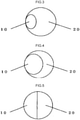
- Figure 1 is a perspective view illustrating one example of the crimped composite fiber in the disclosure.
- reference numeral 10 represents the part (a) and reference numeral 20 represents the part (b).
- the crimped composite fiber in the disclosure has at least two regions of the part (a) and the part (b) in its transverse section, and the mass ratio [(a):(b)] of the proportion of the part (a) and the proportion of the part (b) in the transverse section of the crimped composite fiber is from 10:90 to 60:40, preferably from 10:90 to 50:50, more preferably from 20:80 to 40:60, as described above.
- the crimped composite fiber having such a configuration is not particularly limited, and can have any of various known shapes. Specific examples can include a side-by-side type (parallel type) crimped composite fiber in which the part (a) and the part (b) are in contact with each other, or a core/sheath type crimped composite fiber in which the part (a) serves as a core part (a') and the part (b) serves as a sheath part (b').
- the core/sheath type crimped composite fiber refers to a fiber that includes a core part and a sheath part and that is crimped.
- the core part (a') refers to a part that is arranged so as to be at least partially surrounded by a polymer different from that of the core part (a') in the cross section of the fiber and that extends in the length direction of the fiber.
- the sheath part (b') refers to a part that is arranged so as to at least partially surround the core part (a') in the cross section of the fiber and that extends in the length direction of the fiber.
- Any core/sheath type crimped composite fiber in which the center of the core part (a') and the center of the sheath part (b'), of the fiber, in the cross section of the fiber are not identical is referred to as "crimped composite fiber having an eccentric core/sheath structure" (also referred to as "eccentric core/sheath type crimped composite fiber”.).
- the crimped composite fiber in the nonwoven laminated body of the disclosure preferably has an eccentric core/sheath structure in which the part (a) is the core part (a') and the part (b) is the sheath part (b').
- the crimped composite fiber has the eccentric core/sheath structure, whereby the composite fiber for use in formation of the crimped composite fiber can be more improved in crimpability and the nonwoven laminated body can be more enhanced in flexibility.
- the eccentric core/sheath structure may be, for example, a structure in which the part (a) formed of the olefin-based polymer (A) larger in Mz/Mw is used in the core part and the part (b) formed of the olefin-based polymer (B) smaller in Mz/Mw is used in the sheath part.
- the eccentric core/sheath type crimped composite fiber is present in the form of an "exposure type” fiber in which the side surface of the core part (a') is exposed, or in the form of a "no exposure type” fiber in which the side surface of the core part (a') is not exposed.
- the eccentric core/sheath type crimped composite fiber is preferably an exposure type eccentric core/sheath type crimped composite fiber. The reason is because an eccentric core/sheath type crimped composite fiber excellent in crimpability can be obtained.
- the cross section in which the core part (a') and the sheath part (b') is in contact with each other may be straight or curved, and the cross section of the core part may be round, or elliptic or rectangular.
- any composite fiber in which a bonded surface between the core part and the sheath part is straight and the core part is partially exposed on the surface of the crimped composite fiber is also referred to as a "side-by-side type" fiber.
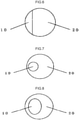
- Figure 3 to Figure 8 illustrate other examples of a cross-sectional view of the crimped composite fiber in the disclosure.
- the method of producing the crimped composite fiber can be any known method.
- a nonwoven fabric production apparatus illustrated in Figure 9 can form a mode of the crimped composite fiber, for example, the core/sheath type crimped composite fiber, in spinning of raw materials extruded from extruders 1 and 1' that extrude such raw materials.
- the crimped composite fiber in the disclosure may be a short fiber or a long fiber, and is preferably a long fiber because, in a case in which a nonwoven fabric is formed, no crimped composite fiber drops from the nonwoven fabric and fluff resistance is excellent.
- the number of crimps in the crimped composite fiber is not particularly limited, and is, for example, 5 crimps/25 mm or more.
- the number of crimps is preferably 20 crimps/25 mm or more, more preferably 25 crimps/25 mm or more from the viewpoint that a spunbond nonwoven fabric is obtained which is bulky and excellent in flexibility.
- Examples of the nonwoven fabric using the crimped composite fiber can include an actually crimped spunbond nonwoven fabric obtained by crimping with distortion of the fiber upon cooling.
- Examples of a long fiber in the actually crimped spunbond nonwoven fabric include an eccentric core/sheath type composite long fiber, a parallel type (side-by-side type) composite long fiber, and an eccentric hollow composite long fiber, each obtained by combining heterogeneous thermoplastic resins different in crystallization temperature, melting point, softening point, rate of crystallization, melt viscosity, and/or the like.
- the nonwoven laminated body of the disclosure includes a nonwoven fabric layer B including an extra-fine fiber having an average fiber diameter of less than 1.35 ⁇ m.
- the nonwoven laminated body of the disclosure includes the nonwoven fabric layer B, whereby the nonwoven laminated body can be enhanced in neck-in resistance.
- the extra-fine fiber preferably corresponds to a melt blown nonwoven fabric produced by a melt blown method from the viewpoint of a much more enhancement in neck-in properties of the nonwoven laminated body.
- the nonwoven fabric layer B may include any of various known nonwoven fabrics such as a melt blown nonwoven fabric, a card-type air-through nonwoven fabric, an air laid nonwoven fabric, a needle-punched spunbond nonwoven fabric, a wet nonwoven fabric, a dry nonwoven fabric, a dry pulp nonwoven fabric, a flash spun nonwoven fabric, and an open nonwoven fabric, other than the extra-fine fiber, and preferably includes only the extra-fine fiber.
- nonwoven fabrics such as a melt blown nonwoven fabric, a card-type air-through nonwoven fabric, an air laid nonwoven fabric, a needle-punched spunbond nonwoven fabric, a wet nonwoven fabric, a dry nonwoven fabric, a dry pulp nonwoven fabric, a flash spun nonwoven fabric, and an open nonwoven fabric, other than the extra-fine fiber, and preferably includes only the extra-fine fiber.
- the extra-fine fiber in the nonwoven laminated body of the disclosure has an average fiber diameter of less than 1.35 ⁇ m.
- the extra-fine fiber preferably has an average fiber diameter of 1.34 ⁇ m or less from the same viewpoint.
- the extra-fine fiber preferably has an average fiber diameter of 1.00 ⁇ m or more from the viewpoint that a nonwoven laminated body is obtained which is high in single yarn strength and which exhibits sufficient mechanical properties.
- the average fiber diameter is more preferably 1.20 ⁇ m or more, still more preferably 1.30 ⁇ m or more, from the viewpoint that not only a nonwoven laminated body exhibiting sufficient mechanical properties can be obtained, but also a laminated body excellent in uniformity and favorable in texture can be obtained and a nonwoven laminated body excellent in neck-in resistance can be obtained.
- the method of measuring the average fiber diameter of the extra-fine fiber is as described in the section of Examples.
- the ratio of the basis weight of the nonwoven fabric layer B with respect to the total basis weight of the nonwoven laminated body is from 2.0% to 8.0%.
- the ratio of the basis weight of the nonwoven fabric layer B with respect to the total basis weight of the nonwoven laminated body is 2.0% or more, whereby a laminated body excellent in uniformity and favorable in texture can be obtained and a nonwoven laminated body excellent in neck-in resistance can be obtained.
- the ratio of the basis weight of the nonwoven fabric layer B with respect to the total basis weight of the nonwoven laminated body is preferably 5.0% or more, more preferably 6.0% or more, still more preferably 6.3% or more, from the same viewpoint.
- the ratio of the basis weight of the nonwoven fabric layer B with respect to the total basis weight of the nonwoven laminated body is 8.0% or less, whereby a nonwoven laminated body low in flexural rigidity and excellent in flexibility of such a nonwoven laminated body by itself can be obtained.
- the ratio of the basis weight of the nonwoven fabric layer B with respect to the total basis weight of the nonwoven laminated body is preferably 8.0% or less, more preferably 7.0% or less, still more preferably 6.8% or less, from the same viewpoint.
- the “coefficient of neck-in” in the disclosure is a value calculated as "width retention rate (%)/basis weight (g/m 2 )".
- the "width retention rate (%)” and the “basis weight (g/m 2 )” are each a value calculated by a method described in the section of Examples.
- the "proportion of the basis weight of the extra-fine fiber in the total basis weight of the laminated body” in the disclosure is a value calculated as "Basis weight (g/m 2 ) of nonwoven fabric layer B/Basis weight (g/m 2 ) of nonwoven laminated body”.
- the method of measuring the width retention rate is as described in the section of Examples.
- the value of water pressure resistance and the basis weight of the extra-fine fiber are known to be positively correlated in the nonwoven laminated body of the disclosure.
- the basis weight of the extra-fine fiber can be estimated from the value of water pressure resistance.
- the basis weight of the extra-fine fiber estimated from the value of water pressure resistance, can be used to approximately calculate the proportion of the basis weight of the nonwoven fabric layer B.
- a conversion formula for estimating the basis weight of the extra-fine fiber from the value of water pressure resistance is represented by Formula 1 below.
- Formula 1 is an expression calculated based on the data of an SMS nonwoven laminated body in Experimental Examples in WO 2017/198336 and the data in Experimental Examples in the disclosure.
- Water pressure resistance mmH 2 O 55.7 ⁇ Basis weight g / m 2 of Extra-fine fiber + 97.0
- the basis weight of the extra-fine fiber estimated from the value of water pressure resistance by use of the conversion formula, can be used to calculate the ratio of the basis weight of the nonwoven fabric layer B with respect to the total basis weight of the nonwoven laminated body.
- Examples of the material included in the extra-fine fiber can include various known thermoplastic resins, for example, an olefin-based polymer such as high-pressure low-density polyethylene, linear low-density polyethylene (so-called LLDPE), high-density polyethylene, a propylene-based polymer (propylene homopolymer, polypropylene random copolymer, propylene/a-olefin copolymer, or the like), poly1-butene, poly(4-methyl-1-pentene), an ethylene/propylene random copolymer, an ethylene/1-butene random copolymer, or a propylene/1-butene random copolymer, as a homopolymer or a copolymer of any ⁇ -olefin such as ethylene, propylene, 1-butene, 1-pentene, 1-hexene, 1-octene, 1-decene, 3-methyl-1-butene, 3-methyl-1-penten
- the material included in the extra-fine fiber is preferably an olefin-based polymer, more preferably a propylene-based polymer.
- the extra-fine fiber is preferably any propylene-based polymer as the olefin-based polymer, from the viewpoint of chemical resistance.
- Such any propylene-based polymer is preferably a homopolymer of propylene, having a melting point (Tm) of 155°C or more, preferably in a range of from 157°C to 165°C, or a propylene/a-olefin copolymer of propylene and one or more ⁇ -olefins (excluding propylene) each having 2 or more carbon atoms.
- Tm melting point
- ⁇ -olefins excluding propylene
- Such one or more ⁇ -olefins (excluding propylene) each having 2 or more carbon atoms are preferably one or more ⁇ -olefins (for example, ethylene, 1-butene, 1-pentene, 1-hexene, 1-octene, 1-decene, 3-methyl-1-butene, 3-methyl-1-pentene, 3-ethyl-1-pentene, 4-methyl-1-pentene, and/or 4-methyl-1-hexene) each having from 2 to 10 carbon atoms, more preferably one or more ⁇ -olefins each having from 2 to 8 carbon atoms.
- a propylene homopolymer is more preferable.
- the content of a structural unit derived from the ⁇ -olefin of the propylene/a-olefin copolymer is preferably from 0.5% by mass to 25% by mass, more preferably from 1.0% by mass to 20% by mass with respect to the entire structural unit.
- the propylene-based polymer is not particularly limited in terms of the melt flow rate (MFR: ASTM D 1238, 230°C, load 2,160 g) as long as the polymer can be melt spun, and may be, for example, from 1 g/10 min to 3,000 g/10 min, and is preferably from 500 g/10 min to 2,000 g/10 min, still more preferably from 700 g/10 min to 1,600 g/10 min.
- MFR melt flow rate
- the basis weight of the nonwoven fabric layer B in the nonwoven laminated body of the disclosure is preferably in a range of from 0.5 g/m 2 to 1.5 g/m 2 , more preferably in a range of from 0.7 g/m 2 to 1.5 g/m 2 .
- the basis weight of the nonwoven fabric layer B is from 0.5 g/m 2 to 1.5 g/m 2 , whereby a thin crimped nonwoven fabric is obtained which exhibits neck-in resistance and flexibility in a well-balanced manner.
- the method of measuring the basis weight in the disclosure is as described in the section of Examples.
- the nonwoven laminated body of the disclosure has a coefficient of neck-in of 5.0 or more, in a case in which the nonwoven laminated body is expanded at 100 N/m.
- the nonwoven laminated body of the disclosure has a coefficient of neck-in of 5.0 or more, whereby the basis weight of the nonwoven laminated body can be suppressed and a neck-in phenomenon can be favorably suppressed.
- the nonwoven laminated body preferably has a coefficient of neck-in of 5.2 or more, more preferably 5.4 or more, from the same viewpoint, in a case in which the nonwoven laminated body is expanded at 100 N/m.
- Examples of the method of adjusting the coefficient of neck-in include the following methods.
- a method of adjusting the coefficient of neck-in by selecting a resin having an appropriate unit structure and an appropriate binding pattern of the unit structure, as each resin included in the crimped composite fiber and the extra-fine fiber.
- a method of adjusting the coefficient of neck-in by selecting a resin having appropriate physical properties (for example, molecular weight distribution and/or crystallinity), as each resin included in the crimped composite fiber and the extra-fine fiber.
- a resin having appropriate physical properties for example, molecular weight distribution and/or crystallinity
- the nonwoven fabric layer A is a spunbond nonwoven fabric layer and the nonwoven fabric layer B is a melt blown nonwoven fabric layer in the nonwoven laminated body of the disclosure.
- the nonwoven laminated body of the disclosure may include any layer including other fiber, other than the nonwoven fabric layer A and the nonwoven fabric layer B.
- any layer including other fiber can include respective layers including various known nonwoven fabrics, such as a layer including a spunbond nonwoven fabric, not corresponding to the nonwoven fabric layer A, a layer including a melt blown nonwoven fabric, not corresponding to the nonwoven fabric layer B, a layer including a wet nonwoven fabric, a layer including a dry nonwoven fabric, a layer including a dry pulp nonwoven fabric, a layer including a flash spun nonwoven fabric, and a layer including am open nonwoven fabric.
- various known nonwoven fabrics such as a layer including a spunbond nonwoven fabric, not corresponding to the nonwoven fabric layer A, a layer including a melt blown nonwoven fabric, not corresponding to the nonwoven fabric layer B, a layer including a wet nonwoven fabric, a layer including a dry nonwoven fabric, a layer including a dry pulp nonwoven fabric, a layer including a flash spun nonwoven fabric, and a layer including am open nonwoven fabric.
- any layer including other fiber is preferably a layer including a melt blown nonwoven fabric, not corresponding to the nonwoven fabric layer B, from the viewpoint that not only neck-in resistance is enhanced, but also cushioning properties and flexibility demanded for recent sanitary materials are kept at high levels.
- the basis weight (mass per unit area of the nonwoven laminated body) of the nonwoven laminated body of the disclosure is preferably from 8 g/m 2 to 25 g/m 2 , more preferably from 10 g/m 2 to 23 g/m 2 , still more preferably from 12 g/m 2 to 18 g/m 2 , particularly preferably from 12 g/m 2 to 15 g/m 2 , from the viewpoint of suppression of a neck-in phenomenon.
- the nonwoven laminated body of the disclosure is preferably heat-fused by embossing.
- the crimped composite fiber in the nonwoven laminated body is mutually heat-fused by embossing, whereby stability and strength of the fiber can be favorably maintained.
- the nonwoven laminated body of the disclosure preferably has an embossing area ratio of from 5% to 20%, by the embossing.
- the range enables both mechanical strength and flexibility demanded for a sanitary material to be achieved.
- the embossing area ratio by the embossing is more preferably from 7% to 15% from the same viewpoint.
- the method of the embossing can be any known method, and may be, for example, a method described in Japanese Patent Application Laid-Open ( JP-A) No. 2017-153901 .
- the nonwoven laminated body of the disclosure can be stacked on various layers and thus applied to various applications.
- the nonwoven laminated body is preferably applied to a sanitary product including the nonwoven laminated body of the disclosure because the nonwoven laminated body of the disclosure exhibits favorable cushioning properties, flexibility, and neck-in resistance.
- any of various known methods can be adopted, for example, embossing, a heat-fusing method such as ultrasonic wave fusion, a mechanical interlacing method such as needle punch or water jet, a method with an adhesive such as a hot melt adhesive or a urethane-based adhesive, and extrusion lamination.
- a preferable aspect of the nonwoven laminated body of the disclosure is, for example, a laminated body of a spunbond nonwoven fabric (crimped) including a crimped composite fiber produced by a spunbond method and a melt blown nonwoven fabric (extra-fine fiber) including a melt blown fiber, and any other nonwoven fabric stacked, if necessary.
- crimped spunbond nonwoven fabric
- melt blown nonwoven fabric extra-fine fiber
- the nonwoven laminated body of the disclosure is preferably a laminated body of the three-layer structure and the four-layer structure, more preferably a laminated body of the four-layer structure, from the viewpoint that the nonwoven laminated body achieves both flexibility and neck-in resistance.
- the nonwoven laminated body of the disclosure still more preferably has a structure of spunbond nonwoven fabric (crimped)/melt blown nonwoven fabric (extra-fine fiber)/spunbond nonwoven fabric (crimped)/spunbond nonwoven fabric (crimped), from the viewpoint that the nonwoven laminated body achieves both flexibility and neck-in resistance.
- the method of producing the nonwoven laminated body is not particularly limited, and any known method can be used.
- a nonwoven fabric production apparatus illustrated in Figure 9 can be used.
- the nonwoven fabric production apparatus includes respective extruders 1 and 1' that extrude the olefin-based polymer (A) and the olefin-based polymer (B), a spinneret 2 that spins such each raw material extruded, thereby forming a fiber 3, an ejector 5 that stretches the fiber 3, a collector apparatus 6 that collects the fiber stretched, thereby forming a nonwoven fabric 8, a bonding unit 9 that heat-fuses at least a portion of the nonwoven fabric 8, and a winder that winds up the nonwoven fabric heat-fused.
- the collector apparatus 6 includes a suction unit 7 that efficiently collects the fiber by suction, on the lower portion of a surface (collecting surface) for collection of the fiber.
- the fiber 3 obtained by the spinneret 2 is cooled by air (quench air) that cools the fiber, in the nonwoven fabric production apparatus.
- the basis weight (g/m 2 ) in the Examples was measured by the following method.
- test pieces of 100 mm (fiber flow direction: MD) ⁇ 100 mm (direction perpendicular to the fiber flow direction: CD) were taken from a nonwoven fabric to be measured.
- the locations at which such test pieces were taken were ten locations in the CD direction.
- the mass [g] of each of such test pieces taken was measured with an electron even balance (manufactured by KENSEI KOGYO Co., Ltd.), and the average value of the mass with respect to the test pieces was determined.
- the average value determined above was converted to the mass [g] per square meter, and the resultant was defined as the basis weight [g/m 2 ] of each nonwoven fabric.
- the average fiber diameter in Examples was measured by the following method.
- each fiber nonwoven fabric was photographed at a magnification appropriately adjusted (for example, 200x), with an electron microscope, any fifty fibers among fibers included in such each fiber nonwoven fabric were selected, and the width (diameter) of each of the fibers selected was measured. The average value of the width (diameter) with respect to the fibers measured, was calculated, and was defined as the average fiber diameter.
- the average fiber diameter of the extra-fine fiber was also determined by the above method of measuring the average fiber diameter at a magnification appropriately adjusted (for example, 1,000x), with the electron microscope.
- the width retention rate was calculated by the following method.
- the nonwoven laminated body was installed to a tensile tester and pulled at a tension of 100 N/m, and the width was then measured.
- Each nonwoven laminated body was subjected to measurement according to JIS L 1906.
- a test piece of 25 mm in width ⁇ 200 mm in length was taken from such each nonwoven laminated body, and subjected to measurement with a tensile tester at five points in MD (fiber flow direction) and at five points in CD (direction perpendicular to the fiber flow direction) at a distance between chucks of 100 mm and a head speed of 100 mm/min, and the respective average values were calculated, thereby determining the tensile strength (N/25 mm).
- the water pressure resistance was measured according to a JIS L1072A method (low water pressure method).
- Four test pieces of about 15 ⁇ 15 cm were each taken, and installed to a water resistance testing apparatus (manufactured by TESTER SANGYO CO., LTD.) so that the surface of such each test piece was touched with water, water pressure was applied to such each test piece by uplifting a level apparatus filled with water at normal temperature, at a rate of 60 ⁇ 3 cm/min or 10 ⁇ 0.5 cm/min, the water level at which water was leaked through opposite three points in such each test piece was measured, and the pressure here was used to determine the water pressure resistance.
- the flexibility was evaluated by a so-called cantilever method according to JIS L1096. Specifically, the following method was performed.
- the nonwoven laminated body was more excellent in rigidity, as the numerical value obtained by the measurement was higher, and the nonwoven laminated body was more excellent in flexibility, as the numerical value was lower.
- the coefficient of neck-in as the index of neck-in resistance, was calculated as a value calculated as width retention rate (%)/basis weight (g/m 2 ), by use of the width retention rate which was measured according to any existing method.
- the neck-in resistance was more favorable, as the coefficient of neck-in was higher.
- the number of broken yarns was measured in spinning of the polymer included in each layer in Examples or Comparative Examples, and was evaluated according to the following criteria.
- embossing roll was travelled in embossing for 5 minutes, and any attachment state occurring upon passing of each nonwoven laminated body through the embossing roll was confirmed, and was evaluated according to the following criteria.
- a first layer was produced by performing combined melt spinning according to a spunbond method by use of the following component IA and the following IB component, and depositing a nonwoven web formed from a side-by-side type crimped composite fiber (hereinafter, designated as "crimped composite fiber I") on a movement/collection plane.
- crimped composite fiber I a side-by-side type crimped composite fiber
- the mass ratio of component IA/component IB in the crimped composite fiber I was 40/60.
- Table 1 shows the average fiber diameter of the crimped composite fiber I in the first layer and the basis weight in the first layer.
- a propylene homopolymer (h-PP) having a melting point of 162°C, a Mz/Mw of 2.24, and a MFR pf 60 g/10 min (measured according to ASTM D1238 at a temperature of 230°C and a load of 2,160 g, and the same applied to the following, unless particularly specified.)
- a second layer was produced on the nonwoven web of the first layer according to the same method and components as the method and components described with respect to the first layer, and thus a nonwoven web having a stacked structure was produced.
- Table 1 shows the average fiber diameter of the crimped composite fiber I in the second layer and the basis weight in the second layer.
- a third layer was produced by feeding a propylene homopolymer having a melting point of 159°C and a MFR of 850 g/10 min, to a die of a melt blown nonwoven fabric production apparatus, discharging the homopolymer from the die heated to a molding temperature described in Table 1, by use of a nozzle for melt blowing (diameter 0.32 mm, 41 holes/inch), together with high-temperature and high-pressure air at a molding temperature described in Table 1, blown out through both ends of the nozzle, and in-line depositing a fiber (non-crimped composite fiber I) discharged at DCD (distance from the surface of a spinneret to a collector) described in Table 1, on the nonwoven web of the first layer and the second layer, and thus a nonwoven web having a stacked structure was produced.
- Table 1 shows the average fiber diameter of the non-crimped composite fiber I in the third layer and the basis weight in the third layer.
- a fourth layer was produced on the nonwoven web of the third layer according to the same method and components as the method and components described with respect to the first layer, and thus a nonwoven web having a stacked structure was produced.
- Table 1 shows the average fiber diameter of the crimped composite fiber I in the fourth layer and the basis weight in the fourth layer.
- the nonwoven web having a stacked structure was heat-fused by the following embossing roll in the following embossing conditions, and thus a SSMS nonwoven laminated body was obtained.
- the embossing area ratio of a pressure-bonded part was 11%.
- Table 1 shows the total basis weight of the entire nonwoven laminated body.
- Each SSMS nonwoven laminated body having a total basis weight described in Table 1 was obtained in the same manner as in Example 1 except that the average fiber diameter with respect to the first layer, the second layer, and the fourth layer was adjusted as described in Table 1, the average fiber diameter with respect to the third layer was adjusted as described in Table 1, and the basis weights of the first layer to the fourth layer were changed as described in Table 1.
- a first layer was produced according to the same method as the method described in the section (First Layer) in Example 1.
- Table 1 shows the average fiber diameter of the crimped composite fiber I in the first layer and the basis weight in the first layer.
- a second layer was produced by performing combined melt spinning according to a spunbond method by use of the following component IIA and the following component IIB, and in-line depositing a nonwoven web formed from a side-by-side type crimped composite fiber (hereinafter, designated as "crimped composite fiber II"), on the nonwoven web of the first layer, and thus a nonwoven web having a stacked structure was produced.
- the mass ratio of component IIA/component IIB in the crimped composite fiber II was 40/60.
- Table 1 shows the average fiber diameter of the crimped composite fiber II in the second layer and the basis weight in the second layer.
- a third layer was produced according to the same method as the method described in the section (Third layer) in Example 1 except that the molding temperature was a temperature described in Table 1 and DCD was DCD described in Table 1.
- Table 1 shows the average fiber diameter of the non-crimped composite fiber I in the third layer and the basis weight in the third layer.
- a fourth layer was produced on the nonwoven web of the third layer according to the same method and components as the method and components described with respect to the second layer, and thus a nonwoven web having a stacked structure was produced.
- Table 1 shows the average fiber diameter of the crimped composite fiber II in the fourth layer, and the basis weight in the fourth layer.
- the nonwoven web having a stacked structure was heat-fused by an embossing roll according to the same method and embossing conditions as those in Example 1, and thus an SSMS nonwoven laminated body was obtained.
- the embossing area ratio of a pressure-bonded part was 11%.
- Table 1 shows the total basis weight of the entire nonwoven laminated body.
- Each SSMS nonwoven laminated body having a total basis weight described in Table 1 was obtained in the same manner as in Comparative Example 3 except that the average fiber diameter with respect to the first layer, the second layer, and the fourth layer was adjusted as described in Table 1, the average fiber diameter with respect to the third layer was adjusted as described in Table 1, and the basis weights of the first layer to the fourth layer were changed as described in Table 1.
- Each nonwoven laminated body having a total basis weight described in Table 1 was obtained in the same manner as in Comparative Example 3 except that the average fiber diameter with respect to the first layer, the second layer, and the fourth layer was adjusted as described in Table 1, the basis weight of the first layer, the second layer, and the fourth layer were changed as described in Table 1, and no third layer was produced.
- Example 1 to Example 3 in which the nonwoven fabric layer A (each of first, second and fourth layers) including the crimped composite fiber and the nonwoven fabric layer B (third layer) including the extra-fine fiber having an average fiber diameter of less than 1.35 ⁇ m were included and the ratio of the basis weight of the nonwoven fabric layer B with respect to the total basis weight of the nonwoven laminated body was from 2.0% to 8.0%, each exhibited excellent flexibility and neck-in resistance.
- the nonwoven fabric layer A each of first, second and fourth layers
- the nonwoven fabric layer B (third layer) including the extra-fine fiber having an average fiber diameter of less than 1.35 ⁇ m were included and the ratio of the basis weight of the nonwoven fabric layer B with respect to the total basis weight of the nonwoven laminated body was from 2.0% to 8.0%, each exhibited excellent flexibility and neck-in resistance.
- Comparative Example 1 in which the ratio of the basis weight of the nonwoven fabric layer B (third layer) with respect to the total basis weight of the nonwoven laminated body was more than 8.0%, exhibited a high value of cantilever and inferior flexibility.
- Comparative Example 2 in which the ratio of the basis weight of the nonwoven fabric layer B (third layer) with respect to the total basis weight of the nonwoven laminated body was less than 2.0%, exhibited a low value of coefficient of neck-in and inferior neck-in resistance.
- Comparative Example 3 to Comparative Example 5 each had an average fiber diameter of the extra-fine fiber in the nonwoven fabric layer B, of 1.35 ⁇ m or more. Comparative Examples 3 and 5 exhibited inferior flexibility and neck-in resistance, and Comparative Example 4 exhibited inferior neck-in resistance.
- Comparative Example 6 and Comparative Example 7 did not include any nonwoven fabric layer B including an extra-fine fiber having an average fiber diameter of less than 1.35 ⁇ m. Comparative Example 6 exhibited inferior neck-in resistance and Comparative Example 7 did not enable any nonwoven laminated body to be collected.
Landscapes
- Health & Medical Sciences (AREA)
- Engineering & Computer Science (AREA)
- Textile Engineering (AREA)
- Life Sciences & Earth Sciences (AREA)
- Epidemiology (AREA)
- Biomedical Technology (AREA)
- Heart & Thoracic Surgery (AREA)
- Vascular Medicine (AREA)
- Animal Behavior & Ethology (AREA)
- General Health & Medical Sciences (AREA)
- Public Health (AREA)
- Veterinary Medicine (AREA)
- Dermatology (AREA)
- Nonwoven Fabrics (AREA)
- Laminated Bodies (AREA)
- Absorbent Articles And Supports Therefor (AREA)
Abstract
Description
- The present disclosure relates to a nonwoven laminated body and a sanitary product.
- Nonwoven fabrics using polyolefins (for example, polypropylene) are demanded to be further improved in characteristics, while are excellent in air permeability and the like and thus are utilized as sanitary materials for paper diapers, hygiene products, and the like. For example, nonwoven fabrics are demanded which use polypropylene further enhanced in flexibility, bulkiness, and mechanical strength.
- Various methods of crimping fibers using polyolefins included in nonwoven fabrics are proposed as methods of obtaining nonwoven fabrics excellent in flexibility, bulkiness, and the like.
- For example,
Patent Literature 1 describes a more highly crimped composite fiber which is a composite fiber having an eccentric core/sheath structure with two propylene-based polymers different in melting point, in which a higher-melting point propylene-based polymer higher in Mz/Mw than a lower melting point propylene-based polymer for use in a sheath part is used in a core part. -
Patent Literature 2 andPatent Literature 3 each describe a composite in which a melt blown fiber is stacked on an intermediate layer of a laminated body of a crimped composite fiber. - Patent Literature 1:
WO 2011-129211 - Patent Literature 2:
US Patent Application Laid-Open No. 2017/0335498 - Patent Literature 3:
WO 2017/198336 - It is considered that the composite fiber described in
Patent Literature 1 has a concern about an increase in neck-in during processing and is problematic in terms of stable production during high-speed formation. - The "neck-in" in the disclosure means, for example, a phenomenon in which the length of a nonwoven fabric in the CD direction (direction perpendicular to the fiber flow direction) becomes shorter when the non-woven fabric is pulled in the MD direction (fiber flow direction).
- It is considered that the composites described in
Patent Literature 2 andPatent Literature 3 are each large in fiber diameter and basis weight in a melt blown layer introduced as an intermediate layer, and relatively high in flexural rigidity. It is thus presumed that a nonwoven laminated body by itself can be inferior in flexibility (for example, cushioning properties and draping properties) and neck-in resistance which are important particularly in a sanitary product. - An object to be achieved by an embodiment of the disclosure is to provide a nonwoven laminated body and a sanitary product which are each made low in flexural rigidity and thus each exhibit favorable flexibility and which are each excellent in neck-in resistance.
- Specific means for solving the above described problems are as follows.
- <1> A nonwoven laminated body comprising:
- a nonwoven fabric layer A comprising a crimped composite fiber; and
- a nonwoven fabric layer B comprising an extra-fine fiber having an average fiber diameter of less than 1.35 µm,
- wherein a ratio of a basis weight of the nonwoven fabric layer B with respect to a total basis weight of the nonwoven laminated body is from 2.0% to 8.0%.
- <2> The nonwoven laminated body according to <1>, wherein the extra-fine fiber has an average fiber diameter of 1.00 µm or more and less than 1.35 µm.
- <3> The nonwoven laminated body according to <1> or <2>, wherein the ratio of the basis weight of the nonwoven fabric layer B with respect to the total basis weight of the nonwoven laminated body is from 5.0% to 8.0%.
- <4> The nonwoven laminated body according to any one of <1> to <3>, wherein:
- the nonwoven fabric layer A is a spunbond nonwoven fabric layer, and
- the nonwoven fabric layer B is a melt blown nonwoven fabric layer.
- <5> The nonwoven laminated body according to any one of <1> to <4>, wherein:
- the crimped composite fiber has at least two regions including a part (a) formed of an olefin-based polymer (A) and a part (b) formed of an olefin-based polymer (B),
- a mass ratio [(a):(b)] between the part (a) and the part (b) is from 10:90 to 60:40, and
- at least one of a condition in which a melting point of the olefin-based polymer (A) is higher than a melting point of the olefin-based polymer (B) or a condition in which Mz/Mw of the olefin-based polymer (A) is larger than the Mz/Mw of the olefin-based polymer (B) is satisfied.
- <6> The nonwoven laminated body according to <5>, wherein the olefin-based polymer (A) and the olefin-based polymer (B) are each a propylene-based polymer.
- <7> The nonwoven laminated body according to <5> or <6>, wherein the crimped composite fiber has an eccentric core/sheath structure in which the part (a) is a core part (a') and the part (b) is a sheath part (b').
- <8> The nonwoven laminated body according to any one of <1> to <7>, wherein the nonwoven laminated body is heat-fused by embossing.
- <9> The nonwoven laminated body according to <8>, wherein an embossing area ratio by the embossing is from 5% to 20%.
- <10> A sanitary product comprising the nonwoven laminated body according to any one of <1> to <9>.
- According to an embodiment of the disclosure, a nonwoven laminated body and a sanitary product can be provided which are each made low in flexural rigidity and thus each exhibit favorable flexibility and which are each excellent in neck-in resistance.
-
-
Figure 1 is a perspective view illustrating one example of a crimped composite fiber in the disclosure. -
Figure 2 is a view describing a flexibility test method of a nonwoven fabric. -
Figure 3 is a cross-sectional view illustrating one example of the crimped composite fiber in the disclosure. -
Figure 4 is a cross-sectional view illustrating one example of the crimped composite fiber in the disclosure. -
Figure 5 is a cross-sectional view illustrating one example of the crimped composite fiber in the disclosure. -
Figure 6 is a cross-sectional view illustrating one example of the crimped composite fiber in the disclosure. -
Figure 7 is a cross-sectional view illustrating one example of the crimped composite fiber in the disclosure. -
Figure 8 is a cross-sectional view illustrating one example of the crimped composite fiber in the disclosure. -
Figure 9 is a schematic view illustrating one example of a production apparatus of a spunbond nonwoven fabric in the disclosure. - Hereinafter, the nonwoven laminated body and the sanitary product of the disclosure will be described in detail, but the disclosure is not intended to be limited to the following embodiments and can be appropriately modified and carried out within the scope of the object of the disclosure.
- A numerical value range represented by "(from) ... to ..." in the disclosure means that the range encompasses respective numerical values described before and after "to" as a lower limit and an upper limit, respectively. In a numerical value range described stepwise in the disclosure, an upper limit value or a lower limit value described with respect to a certain numerical value range may be replaced with an upper limit value or a lower limit value of other numerical value range described stepwise. In a numerical value range described stepwise in the disclosure, an upper limit value or a lower limit value described with respect to a certain numerical value range may be replaced with any value indicated in Examples.
- The term "step" in the disclosure encompasses not only an independent step, but also a step that can achieve an object of the relevant step even in the case of being not clearly distinguished from other steps.
- The amount of each component in a composition in the disclosure means, in a case in which a plurality of substances corresponding to such each component are present in the composition, the total amount of the plurality of substances present in the composition, unless particularly noted.
- In the disclosure, the "MD" (Machine Direction) direction refers to a direction of movement of a nonwoven web in a nonwoven fabric production apparatus. The "CD" (Cross Direction) direction refers to a direction which is perpendicular to the MD direction and parallel to a main surface (a surface perpendicular to the thickness direction of a nonwoven fabric).
- In a case in which the amount of each component in a composition is mentioned in the disclosure, the amount means, in a case in which a plurality of substances corresponding to such each component are present in the composition, the total amount of the plurality of substances present in the composition, unless particularly noted.
- The term "layer" in the disclosure encompasses, in the case of observation of a region in which the relevant layer is present, not only any layer formed in the entire region, but also any layer formed on only a portion of the region.
- The nonwoven laminated body of the disclosure includes a nonwoven fabric layer A including a crimped composite fiber and a nonwoven fabric layer B including an extra-fine fiber having an average fiber diameter of less than 1.35 µm, in which the ratio of the basis weight of the nonwoven fabric layer B with respect to the total basis weight of the nonwoven laminated body is from 2.0% to 8.0%.
- A laminated body using only a nonwoven fabric layer including a crimped composite fiber is large in width of shrinkage in neck-in and tends to be inferior in neck-in resistance.
- A nonwoven fabric layer B including an extra-fine fiber can cause an increase in flexural rigidity and deterioration in flexibility, while allows for an enhancement in neck-in resistance.
- The nonwoven laminated body of the disclosure has the above configuration, therefore is made low in flexural rigidity and thus exhibits favorable flexibility, and is excellent in neck-in resistance.
- The extra-fine fiber is a fiber finer than the crimped composite fiber. Thus, the extra-fine fiber is further uniformly dispersed in the nonwoven laminated body, as compared with the crimped composite fiber.
- The extra-fine fiber can also contribute to retention of the shape of the nonwoven laminated body, and thus it is presumed that the nonwoven laminated body includes the extra-fine fiber, thereby allowing for suppression of shrinkage (namely, neck-in phenomenon) of the nonwoven laminated body in vertical and horizontal directions in the case of pulling of the nonwoven laminated body in horizontal and vertical directions.
- The "flexibility" in the disclosure means flexibility of the nonwoven laminated body by itself due to flexural rigidity made low and excellent draping properties.
- The nonwoven laminated body of the disclosure includes a nonwoven fabric layer A including a crimped composite fiber.
- The nonwoven laminated body of the disclosure includes the nonwoven fabric layer A including a crimped composite fiber, whereby the nonwoven laminated body can be reduced in flexural rigidity and enhanced in flexibility.
- The crimped composite fiber is preferably a spunbond fiber produced by a spunbond method from the viewpoint that the nonwoven laminated body is reduced in flexural rigidity and thus is enhanced in flexibility.
- The nonwoven fabric layer A may include any of various known nonwoven fabrics such as a spunbond nonwoven fabric, a card-type air-through nonwoven fabric, an air laid nonwoven fabric, a needle-punched spunbond nonwoven fabric, a wet nonwoven fabric, a dry nonwoven fabric, a dry pulp nonwoven fabric, a flash spun nonwoven fabric, and an open nonwoven fabric, other than the crimped composite fiber, and preferably includes only the crimped composite fiber.
- The crimped composite fiber can be formed as, for example, a composite fiber having a cross section shape that can be crimped.
- The crimped composite fiber can be formed from a plurality of polymers according to a spunbond method, and examples of such each polymer include an olefin-based polymer, a polyester-based polymer, and nylon.
- In particular, such each polymer is preferably an olefin-based polymer from the viewpoint of flexibility, strength, and water resistance of the nonwoven laminated body by itself.
- The crimped composite fiber in the disclosure may have, for example, at least two regions of a part (a) formed of a specified polymer and a part (b) formed of other polymer different from the specified polymer.
- The crimped composite fiber in the nonwoven laminated body of the disclosure preferably has at least two regions of a part (a) formed of an olefin-based polymer (A) and a part (b) formed of an olefin-based polymer (B).
- Examples of the olefin-based polymer (A) include an ethylene-based polymer and a propylene-based polymer. In particular, the olefin-based polymer (A) is preferably a propylene-based polymer.
- The olefin-based polymer (A) may include one polymer, or may include two or more polymers, namely, may be a mixture of two or more polymers.
- The ethylene-based polymer is a polymer mainly containing a structure unit derived from ethylene, and the concept thereof encompasses an ethylene homopolymer and a copolymer of ethylene and any α-olefin other than ethylene.
- For example, the ethylene-based polymer may be any of an ethylene homopolymer and a copolymer (ethylene/α-olefin random copolymer) of ethylene and any α-olefin other than ethylene.
- The ethylene/α-olefin random copolymer is preferably, for example, a random copolymer of ethylene and one or more α-olefins other than ethylene, each having from 2 to 10 carbon atoms.
- Specific examples of such any α-olefin to be copolymerized with ethylene include propylene, 1-butene, 1-pentene, 1-hexene, 1-octene, 1-decene, 3-methyl-1-butene, 3-methyl-1-pentene, 3-ethyl-1-pentene, 4-methyl-1-pentene, and 4-methyl-1-hexene, from the viewpoint of excellent flexibility.
- Examples of the ethylene/α-olefin random copolymer include an ethylene/propylene random copolymer and an ethylene/1-butene random copolymer.
- The ethylene-based polymer may include two or more different ethylene-based polymers.
- The propylene-based polymer for use as the olefin-based polymer (A) is a polymer mainly containing a structure unit derived from propylene, and the concept thereof encompasses a propylene homopolymer and a copolymer (propylene/α-olefin random copolymer) of propylene and any α-olefin other than propylene.
- For example, the propylene-based polymer may be a propylene homopolymer, may be a copolymer of propylene and any α-olefin other than propylene, or may include both a propylene homopolymer and a copolymer of propylene and any α-olefin other than propylene.
- The propylene/a-olefin random copolymer is preferably a random copolymer of propylene and one or more α-olefins other than propylene, each having from 2 to 10 carbon atoms.
- Specific examples of such any α-olefin to be copolymerized with propylene preferably include ethylene, 1-butene, 1-pentene, 1-hexene, 1-octene, 1-decene, 3-methyl-1-butene, 3-methyl-1-pentene, 3-ethyl-1-pentene, 4-methyl-1-pentene, and 4-methyl-1-hexene, from the viewpoint of excellent flexibility.
- Examples of the propylene/a-olefin random copolymer include a propylene/ethylene random copolymer and a propylene/ethylene/1-butene random copolymer.
- The content of the α-olefin in the propylene/a-olefin random copolymer is not particularly limited, and is preferably 10% by mol or less, more preferably 5% by mol or less, still more preferably 2% by mol or less, particularly preferably 1% by mol or less.
- The propylene-based polymer may include two or more different propylene-based polymers, or may include a propylene-based polymer and an ethylene-based polymer.
- In particular, the olefin-based polymer (A) is preferably a homopolymer of propylene from the viewpoint of excellent mechanical strength.
- The melt flow rate (MFR) (ASTM D-1238, 230°C, load 2,160 g) of the olefin-based polymer (A) is preferably from 20 g/10 min to 100 g/10 min, more preferably from 30 g/10 min to 80 g/10 min, from the viewpoint of spinnability.
- In this regard, the MFR is 100 g/10 min or less, whereby the resulting nonwoven laminated body can be enhanced in tensile strength and the like.
- The olefin-based polymer (A) in the disclosure is preferably higher in melting point than the olefin-based polymer (B), and the difference in melting point therebetween is preferably more than 10°C, more preferably in a range of from 12°C to 40°C.
- The difference in melting point between the olefin-based polymer (A) and the olefin-based polymer (B) is larger, whereby the crimped composite fiber can be obtained from a composite fiber more excellent in crimpability.
- The melting point of the olefin-based polymer (A) in the disclosure is preferably 155°C or more, more preferably from 157°C to 165°C.
- The melting point of the olefin-based polymer (A) is 155°C or more, whereby the difference between the melting point of the olefin-based polymer (A) and the melting point of the olefin-based polymer (B) is more easily more than 10°C and thus the crimped composite fiber can be obtained from a composite fiber excellent in crimpability.
- The ratio [Mz/Mw (A)] between the Z average molecular weight (Mz) and the weight average molecular weight (Mw) of the olefin-based polymer (A) in the disclosure is preferably 2.0 or more from the viewpoint that favorable crimpability is expressed, and the Mz/Mw (A) is preferably 4.5 or less from the viewpoint of spinnability.
- The Mz/Mw (A) of the olefin-based polymer (A) is more preferably from 2.1 to 4.5, still more preferably from 2.1 to 3.0 from the same viewpoints.
- The olefin-based polymer (A) in the disclosure preferably has a Mw of from 150000 to 250000 and preferably has a Mz of from 300000 to 600000.
- The ratio [Mw/Mn (A)] between the weight average molecular weight (Mw) and the number average molecular weight (Mn) of the olefin-based polymer (A) in the disclosure, defined as a molecular weight distribution, is preferably from 2.0 to 4.0, more preferably from 2.2 to 3.5.
- The Mz, Mw, Mn, Mz/Mw (A), and Mw/Mn (A) of the olefin-based polymer (A) in the disclosure can be measured with GPC (gel permeation chromatography) according to methods described below.
- The olefin-based polymer (A) in the disclosure is usually obtained by homopolymerization of, for example, propylene, or copolymerization of, for example, propylene and a small amount of any α-olefin, according to slurry polymerization, gas-phase polymerization, or bulk polymerization by use of a so-called Ziegler-Natta catalyst as a combination of a titanium-containing solid transition metal component and an organometallic component, or a metallocene catalyst including a compound of any transition metal belonging to the Groups 4 to 6 in the periodic table, the compound having at least one cyclopentadiene backbone, and a co-catalyst component. The olefin-based polymer can also be here produced by multistage polymerization or direct polymerization of propylene-based polymers different in MFR, particularly, a propylene-based polymer and a propylene-based polymer lower in MFR than the propylene-based polymer so that the Mz, Mw, and Mz/Mw are within the above ranges.
- The Mw/Mn (A) and Mz/Mw (A) of the olefin-based polymer (A) can be adjusted by, for example, a method of adjustment with a specified catalyst in polymerization conditions, a method of adjustment by polymer decomposition with peroxide or the like, or a method of adjustment by mixing two or more polymers different in molecular weight from each other.
- The olefin-based polymer (A) in the disclosure, here used, can also be a commercially available product, for example, a propylene-based polymer manufactured and sold under the trade name of NOVATEC PP SA06A from Japan Polypropylene Corporation.
- The olefin-based polymer (A) in the disclosure can be, if necessary, compounded with any additive commonly used, such as an antioxidant, a weathering stabilizer, an antistatic agent, an antifogging agent, an anti-blocking agent, a lubricant, a nucleating agent, or a pigment, or any other polymer, as long as the object of the disclosure is not impaired.
- Examples of the olefin-based polymer (B) include an ethylene-based polymer and a propylene-based polymer.
- Specifics of the ethylene-based polymer in the olefin-based polymer (B) are the same as specifics of the ethylene-based polymer described in the section regarding the olefin-based polymer (A), and much the same is also true for preferable aspects.
- Specifics of the propylene-based polymer in the olefin-based polymer (B) are the same as specifics of the propylene-based polymer described in the section regarding the olefin-based polymer (A), and much the same is also true for preferable aspects.
- The following aspect with respect to the propylene-based polymer in the olefin-based polymer (B) is also preferable.
- The propylene-based polymer for use as the olefin-based polymer (B) may be a homopolymer of propylene, or may be a copolymer of any propylene listed in the section of the olefin-based polymer (A) and a small amount of one or more α-olefins (herein, except for propylene).
- In particular, the propylene-based polymer for use as the olefin-based polymer (B) is more preferably a copolymer of propylene and a small amount of one or more α-olefins, and in particular, still more preferably a propylene/a-olefin random copolymer such as a propylene/ethylene random copolymer or a propylene/ethylene/1-butene random copolymer, from the viewpoint of neck-in resistance and flexibility which are well-balanced.
- The melt flow rate (MFR) (ASTM D-1238, 230°C, load 2,160 g) of the olefin-based polymer (B) is preferably in the same range as that of the MFR of the olefin-based polymer (A), from the same viewpoint.
- The melting point of the olefin-based polymer (B) is preferably in a range of from 120°C to 155°C, more preferably in a range of from 125°C to 150°C.
- The melting point of the olefin-based polymer (B) is 120°C or more, whereby heat resistance can be favorably retained.
- The ratio [Mz/Mw (B)] between the Z average molecular weight (Mz) and the weight average molecular weight (Mw) of the olefin-based polymer (B) is preferably 2.5 or less, more preferably 2.3 or less.
- The olefin-based polymer (B) preferably has a Mw in a range of from 150000 to 250000, and preferably has a Mz in a range of from 300000 to 600000.
- The ratio [Mw/Mn (B)] between the weight average molecular weight (Mw) and the number average molecular weight (Mn) of the olefin-based polymer (B), defined as a molecular weight distribution, is preferably in a range of from 2.0 to 4.0, more preferably in a range of from 2.2 to 3.5.
- The Mz, Mw, Mn, Mz/Mw (B), and Mw/Mn (B) of the olefin-based polymer (B) in the disclosure can be measured with GPC (gel permeation chromatography) according to methods described below.
- The olefin-based polymer (B) in the disclosure can be produced by the same polymerization method as in the olefin-based polymer (A), and, in a case in which, for example, a propylene/a-olefin random copolymer is as the olefin-based polymer (B), the olefin-based polymer may also be produced by multistage polymerization or direct polymerization of small amounts of propylene/a-olefin random copolymers different in MFR so that the Mz, Mw, and the Mz/Mw are within the above ranges.
- Examples of the method of adjusting the Mw/Mn (B) and Mz/Mw (B) of the olefin-based polymer (B) include a method of adjustment with a specified catalyst in polymerization conditions, a method of adjustment by polymer decomposition with peroxide or the like, and a method of adjustment by mixing two or more polymers different in molecular weight from each other.
- The olefin-based polymer (B) here used can also be a commercially available product, for example, a propylene-based polymer manufactured and sold under the trade name of PRIME POLYPRO S119 from Prime Polymer Co., Ltd.
- The olefin-based polymer (B) in the disclosure can be, if necessary, compounded with any additive commonly used, such as an antioxidant, a weathering stabilizer, an antistatic agent, an antifogging agent, an anti-blocking agent, a lubricant, a nucleating agent, or a pigment, or any other polymer, as long as the object of the disclosure is not impaired.
- The olefin-based polymer (A) and the olefin-based polymer (B) are preferably each a propylene-based polymer, and, preferably, the olefin-based polymer (A) is a propylene homopolymer and the olefin-based polymer (B) is a propylene/a-olefin random copolymer, from the viewpoint that the resulting nonwoven laminated body has mechanical strength, neck-in resistance, and flexibility in a well-balanced manner.
- It is preferable in the disclosure to satisfy at least one of a condition in which the melting point of the olefin-based polymer (A) is higher than the melting point of the olefin-based polymer (B) or a condition in which the Mz/Mw of the olefin-based polymer (A) is larger than the Mz/Mw of the olefin-based polymer (B). Thus, the crimped composite fiber can be improved in crimpability.
- The melting point (Tm), Mz/Mw, and MFR with respect to each of the olefin-based polymer (A) and the olefin-based polymer (B) more preferably satisfy the following relationships.
<ΔTm> - The melting point of the olefin-based polymer (A) is preferably higher than the melting point of the olefin-based polymer (B) in the disclosure.
- Thus, the crimped composite fiber can be obtained from a composite fiber more excellent in crimpability.
- The difference between the melting point of the olefin-based polymer (A) forming the part (a) and the melting point of the olefin-based polymer (B) forming the part (b) in the disclosure is preferably more than 10°C, more preferably from 12°C to 40°C, from the viewpoint that the crimped composite fiber is obtained from a composite fiber more excellent in crimpability.
- The melting point of the olefin-based polymer (B) is 155°C or less, whereby the difference in melting point from the olefin-based polymer (A) is more easily more than 10°C.
- The value of ΔTm is calculated from the difference obtained by determining the melting points of the olefin-based polymer (A) and the olefin-based polymer (B) serving as the part (a) and the part (b), respectively.
- The melting point in the disclosure is measured as follows.
- 1) The olefin-based polymers are each placed in a measurement pan of differential scanning calorimetry analysis (DSC), manufactured by PerkinElmer Co., Ltd., heated from 30°C to 200°C at 10°C/min, retained at 200°C for 10 minutes, and thereafter cooled to 30°C at 10°C/min.
- 2) Next, the olefin-based polymers are each again heated from 30°C to 200°C at 10°C/min, and the respective melting points are determined from peaks here observed.
<ΔMz/Mw> - The Mz/Mw of the olefin-based polymer (A) is preferably larger than the Mz/Mw of the olefin-based polymer (B) in the disclosure.
- Thus, the crimped composite fiber can be obtained from a composite fiber excellent in crimpability.
- The absolute value of the difference [Mz/Mw (A) - Mz/Mw (B): ΔMz/Mw] between the Mz/Mw (A) of the olefin-based polymer (A) forming the part (a) and the Mz/Mw (B) of the olefin-based polymer (B) forming the part (b) in the disclosure is preferably from 0.01 to 2.0, more preferably from 0.03 to 1.0, still more preferably from 0.05 to 0.40.
- The ΔMz/Mw is 0.01 or more, whereby the crimped composite fiber is obtained from a composite fiber excellent in crimpability. In this regard, the ΔMz/Mw is 2.0 or less, whereby spinnability can be favorably retained.
- Herein, the Mz is called Z average molecular weight, is known, and is defined by the following Formula (1).
- [Math 1]

- In Formula (1), Mi is the molecular weight of the polymer [olefin-based polymer (A) and olefin-based polymer (B): hereinafter, referred to as "olefin-based polymer" in the case of a combination thereof.], and Ni is the molar number of the polymer (olefin-based polymer).
- It is generally considered that Mz corresponds to a molecular weight more reflecting a higher molecular weight component in the polymer. Accordingly, Mz/Mw represents a molecular weight distribution more reflecting a higher molecular weight component than Mw/Mn as an index of a common molecular weight distribution. The value thereof has an effect on crimpability of a fiber.
- The ΔMz/Mw is calculated from the absolute value of the difference in Mz/Mw between the olefin-based polymer (A) forming the part (a) and the olefin-based polymer (B) forming the part (b), as determined by GPC analysis.
- GPC analysis in the disclosure is performed in the following conditions.
- 1) Thirty mg of a propylene polymer is completely dissolved in 20 mL of o-dichlorobenzene at 145°C.
- 2) The solution is filtered with a sintered filter having a pore size of 1.0 µm, thereby providing a sample.
- 3) The sample is analyzed with GPC and subjected to conversion in terms of polystyrene (PS), thereby determining the average molecular weight and the molecular weight distribution curve.
- The measurement instrument and measurement conditions are as follows.
- Analysis apparatus data processing software EMPOWER 2 (manufactured by Waters Corporation)
Columns TSKGEL GMH6-HT × 2 + TSKGEL GMH6-HTL × 2 (each having a size of 7.5 mm I.D. × 30 cm, manufactured by Tosoh Corporation) Column temperature 140°C Mobile phase o-dichlorobenzene (containing 0.025% butylated hydroxytoluene BHT) Detector differential refractometer Flow rate 1 mL/min Concentration of sample 30 mg/20 mL Amount of injection 500 µL Sampling time interval 1 s Column calibration monodispersed polystyrene (manufactured by Tosoh Corporation) Molecular weight conversion PS conversion/standard conversion method - The ratio of MFR (hereinafter, also referred to as "MFR ratio") between the MFR of the olefin-based polymer (A) forming the part (a) and the MFR of the olefin-based polymer (B) forming the part (b) in the disclosure is not particularly limited, and is preferably from 0.8 to 1.2.
- The MFRs of the olefin-based polymer (A) and the olefin-based polymer (B) in the disclosure are each preferably from 20 g/10 min to 100 g/10 min.
- Such MFRs in the disclosure are each determined according to ASTM D1238 at a load of 2,160 g and a temperature of 230°C.
- The mass ratio [(a):(b)] between the part (a) and the part (b) in the crimped composite fiber in the disclosure is preferably from 10:90 to 60:40.
- The mass ratio between the part (a) and the part (b) is within the above range, whereby a composite fiber for use in formation of the crimped composite fiber can be more enhanced in crimpability and the nonwoven laminated body can be more enhanced in flexibility.
- The mass ratio [(a):(b)] between the part (a) and the part (b) is more preferably from 10:90 to 50:50, still more preferably from 20:80 to 40:60 from the same viewpoint.
- An aspect is preferable in which the crimped composite fiber in the disclosure has at least two regions of the part (a) formed of the olefin-based polymer (A) and the part (b) formed of the olefin-based polymer (B), the mass ratio [(a):(b)] between the part (a) and the part (b) is from 10:90 to 60:40, the olefin-based polymer (A) and the olefin-based polymer (B) are different in at least one of Mz/Mw, melting point, or MFR.
- The nonwoven laminated body of the disclosure preferably
- has at least two regions of the part (a) formed of the olefin-based polymer (A) and the part (b) formed of the olefin-based polymer (B) in the crimped composite fiber,
- has a mass ratio [(a):(b)] between the part (a) and the part (b) of from 10:90 to 60:40, and
- satisfies at least one of a condition in which the melting point of the olefin-based polymer (A) is higher than the melting point of the olefin-based polymer (B) or a condition in which the Mz/Mw of the olefin-based polymer (A) is larger than the Mz/Mw of the olefin-based polymer (B).
- The crimped composite fiber in the disclosure may be a crimped composite fiber including the olefin-based polymer (A) and the olefin-based polymer (B) and having at least two regions of the part (a) and the part (b) in a transverse section, in which
the mass ratio [(a):(b)] between the part (a) and the part (b) is from 10:90 to 60:40, the part (a) formed of the olefin-based polymer (A) and the part (b) formed of the olefin-based polymer (B), the difference [Mz/Mw (A) - Mz/Mw (B): ΔMz/Mw] between the Mz/Mw (A) of the olefin-based polymer (A) and the Mz/Mw (B) of the olefin-based polymer (B) is from 0.10 to 2.2, and the difference [ΔTm = Tm (A) - Tm (B)] between the melting point [Tm (A)] of the olefin-based polymer (A) and the melting point [Tm (B)] of the olefin-based polymer (B) is more than 10°C. - The crimped composite fiber in the disclosure preferably has an average fiber diameter of 8 µm or more, more preferably 10 µm or more, still more preferably 14 µm or more, from the viewpoint of yarn properties, crimpability, and excellent neck-in resistance and mechanical strength of the nonwoven laminated body in the case of formation of the nonwoven laminated body.
- The crimped composite fiber in the disclosure preferably has an average fiber diameter of 23 µm or less, more preferably 20 µm or less, still more preferably 17 µm or less, particularly preferably 16.6 µm or less, from the viewpoint of excellent flexibility of the nonwoven laminated body by itself in the case of formation of the nonwoven laminated body.
- The average fiber diameter in the disclosure is measured by a method described in the section of Examples.
-
Figure 1 is a perspective view illustrating one example of the crimped composite fiber in the disclosure. In the Figure,reference numeral 10 represents the part (a) andreference numeral 20 represents the part (b). - The crimped composite fiber in the disclosure has at least two regions of the part (a) and the part (b) in its transverse section, and the mass ratio [(a):(b)] of the proportion of the part (a) and the proportion of the part (b) in the transverse section of the crimped composite fiber is from 10:90 to 60:40, preferably from 10:90 to 50:50, more preferably from 20:80 to 40:60, as described above.
- The crimped composite fiber having such a configuration is not particularly limited, and can have any of various known shapes. Specific examples can include a side-by-side type (parallel type) crimped composite fiber in which the part (a) and the part (b) are in contact with each other, or a core/sheath type crimped composite fiber in which the part (a) serves as a core part (a') and the part (b) serves as a sheath part (b').
- The core/sheath type crimped composite fiber refers to a fiber that includes a core part and a sheath part and that is crimped. The core part (a') refers to a part that is arranged so as to be at least partially surrounded by a polymer different from that of the core part (a') in the cross section of the fiber and that extends in the length direction of the fiber.
- The sheath part (b') refers to a part that is arranged so as to at least partially surround the core part (a') in the cross section of the fiber and that extends in the length direction of the fiber. Any core/sheath type crimped composite fiber in which the center of the core part (a') and the center of the sheath part (b'), of the fiber, in the cross section of the fiber are not identical is referred to as "crimped composite fiber having an eccentric core/sheath structure" (also referred to as "eccentric core/sheath type crimped composite fiber".).
- The crimped composite fiber in the nonwoven laminated body of the disclosure preferably has an eccentric core/sheath structure in which the part (a) is the core part (a') and the part (b) is the sheath part (b').
- The crimped composite fiber has the eccentric core/sheath structure, whereby the composite fiber for use in formation of the crimped composite fiber can be more improved in crimpability and the nonwoven laminated body can be more enhanced in flexibility.
- The eccentric core/sheath structure may be, for example, a structure in which the part (a) formed of the olefin-based polymer (A) larger in Mz/Mw is used in the core part and the part (b) formed of the olefin-based polymer (B) smaller in Mz/Mw is used in the sheath part.
- The eccentric core/sheath type crimped composite fiber is present in the form of an "exposure type" fiber in which the side surface of the core part (a') is exposed, or in the form of a "no exposure type" fiber in which the side surface of the core part (a') is not exposed.
- The eccentric core/sheath type crimped composite fiber is preferably an exposure type eccentric core/sheath type crimped composite fiber. The reason is because an eccentric core/sheath type crimped composite fiber excellent in crimpability can be obtained. The cross section in which the core part (a') and the sheath part (b') is in contact with each other may be straight or curved, and the cross section of the core part may be round, or elliptic or rectangular.
- Any composite fiber in which a bonded surface between the core part and the sheath part is straight and the core part is partially exposed on the surface of the crimped composite fiber is also referred to as a "side-by-side type" fiber.
-
Figure 3 to Figure 8 illustrate other examples of a cross-sectional view of the crimped composite fiber in the disclosure. - The method of producing the crimped composite fiber, here used, can be any known method. For example, a nonwoven fabric production apparatus illustrated in
Figure 9 can form a mode of the crimped composite fiber, for example, the core/sheath type crimped composite fiber, in spinning of raw materials extruded fromextruders 1 and 1' that extrude such raw materials. - The crimped composite fiber in the disclosure may be a short fiber or a long fiber, and is preferably a long fiber because, in a case in which a nonwoven fabric is formed, no crimped composite fiber drops from the nonwoven fabric and fluff resistance is excellent. The number of crimps in the crimped composite fiber is not particularly limited, and is, for example, 5 crimps/25 mm or more. The number of crimps is preferably 20 crimps/25 mm or more, more preferably 25 crimps/25 mm or more from the viewpoint that a spunbond nonwoven fabric is obtained which is bulky and excellent in flexibility.
- Examples of the nonwoven fabric using the crimped composite fiber can include an actually crimped spunbond nonwoven fabric obtained by crimping with distortion of the fiber upon cooling. Examples of a long fiber in the actually crimped spunbond nonwoven fabric include an eccentric core/sheath type composite long fiber, a parallel type (side-by-side type) composite long fiber, and an eccentric hollow composite long fiber, each obtained by combining heterogeneous thermoplastic resins different in crystallization temperature, melting point, softening point, rate of crystallization, melt viscosity, and/or the like.
- The nonwoven laminated body of the disclosure includes a nonwoven fabric layer B including an extra-fine fiber having an average fiber diameter of less than 1.35 µm.
- The nonwoven laminated body of the disclosure includes the nonwoven fabric layer B, whereby the nonwoven laminated body can be enhanced in neck-in resistance.
- The extra-fine fiber preferably corresponds to a melt blown nonwoven fabric produced by a melt blown method from the viewpoint of a much more enhancement in neck-in properties of the nonwoven laminated body.
- The nonwoven fabric layer B may include any of various known nonwoven fabrics such as a melt blown nonwoven fabric, a card-type air-through nonwoven fabric, an air laid nonwoven fabric, a needle-punched spunbond nonwoven fabric, a wet nonwoven fabric, a dry nonwoven fabric, a dry pulp nonwoven fabric, a flash spun nonwoven fabric, and an open nonwoven fabric, other than the extra-fine fiber, and preferably includes only the extra-fine fiber.
- The extra-fine fiber in the nonwoven laminated body of the disclosure has an average fiber diameter of less than 1.35 µm.
- Thus, a laminated body excellent in uniformity and favorable in texture can be obtained, and a nonwoven laminated body excellent in neck-in resistance can be obtained.
- The extra-fine fiber preferably has an average fiber diameter of 1.34 µm or less from the same viewpoint.
- The extra-fine fiber preferably has an average fiber diameter of 1.00 µm or more from the viewpoint that a nonwoven laminated body is obtained which is high in single yarn strength and which exhibits sufficient mechanical properties.
- The average fiber diameter is more preferably 1.20 µm or more, still more preferably 1.30 µm or more, from the viewpoint that not only a nonwoven laminated body exhibiting sufficient mechanical properties can be obtained, but also a laminated body excellent in uniformity and favorable in texture can be obtained and a nonwoven laminated body excellent in neck-in resistance can be obtained.
- The method of measuring the average fiber diameter of the extra-fine fiber is as described in the section of Examples.
- The ratio of the basis weight of the nonwoven fabric layer B with respect to the total basis weight of the nonwoven laminated body is from 2.0% to 8.0%.
- The ratio of the basis weight of the nonwoven fabric layer B with respect to the total basis weight of the nonwoven laminated body is 2.0% or more, whereby a laminated body excellent in uniformity and favorable in texture can be obtained and a nonwoven laminated body excellent in neck-in resistance can be obtained.
- The ratio of the basis weight of the nonwoven fabric layer B with respect to the total basis weight of the nonwoven laminated body is preferably 5.0% or more, more preferably 6.0% or more, still more preferably 6.3% or more, from the same viewpoint.
- The ratio of the basis weight of the nonwoven fabric layer B with respect to the total basis weight of the nonwoven laminated body is 8.0% or less, whereby a nonwoven laminated body low in flexural rigidity and excellent in flexibility of such a nonwoven laminated body by itself can be obtained.
- The ratio of the basis weight of the nonwoven fabric layer B with respect to the total basis weight of the nonwoven laminated body is preferably 8.0% or less, more preferably 7.0% or less, still more preferably 6.8% or less, from the same viewpoint.
- The "coefficient of neck-in" in the disclosure is a value calculated as "width retention rate (%)/basis weight (g/m2)".
- The "width retention rate (%)" and the "basis weight (g/m2)" are each a value calculated by a method described in the section of Examples.
- The "proportion of the basis weight of the extra-fine fiber in the total basis weight of the laminated body" in the disclosure is a value calculated as "Basis weight (g/m2) of nonwoven fabric layer B/Basis weight (g/m2) of nonwoven laminated body".
- The method of measuring the width retention rate is as described in the section of Examples.
- The value of water pressure resistance and the basis weight of the extra-fine fiber are known to be positively correlated in the nonwoven laminated body of the disclosure. Thus, the basis weight of the extra-fine fiber can be estimated from the value of water pressure resistance.
- Thus, the basis weight of the extra-fine fiber, estimated from the value of water pressure resistance, can be used to approximately calculate the proportion of the basis weight of the nonwoven fabric layer B.
- A conversion formula for estimating the basis weight of the extra-fine fiber from the value of water pressure resistance is represented by
Formula 1 below. -
Formula 1 is an expression calculated based on the data of an SMS nonwoven laminated body in Experimental Examples inWO 2017/198336 and the data in Experimental Examples in the disclosure.
- The basis weight of the extra-fine fiber, estimated from the value of water pressure resistance by use of the conversion formula, can be used to calculate the ratio of the basis weight of the nonwoven fabric layer B with respect to the total basis weight of the nonwoven laminated body.
- Examples of the material included in the extra-fine fiber can include various known thermoplastic resins, for example, an olefin-based polymer such as high-pressure low-density polyethylene, linear low-density polyethylene (so-called LLDPE), high-density polyethylene, a propylene-based polymer (propylene homopolymer, polypropylene random copolymer, propylene/a-olefin copolymer, or the like), poly1-butene, poly(4-methyl-1-pentene), an ethylene/propylene random copolymer, an ethylene/1-butene random copolymer, or a propylene/1-butene random copolymer, as a homopolymer or a copolymer of any α-olefin such as ethylene, propylene, 1-butene, 1-pentene, 1-hexene, 1-octene, 1-decene, 3-methyl-1-butene, 3-methyl-1-pentene, 3-ethyl-1-pentene, 4-methyl-1-pentene, and/or 4-methyl-1-hexene; polyester such as polyethylene terephthalate, polybutylene terephthalate, or polyethylene naphthalate; a polyamide-based polymer such as nylon-6, nylon-66, or poly(meta-xylene adipamide); polyvinyl chloride, polyimide, an ethylene/vinyl acetate copolymer, polyacrylonitrile, polycarbonate, polystyrene, an ionomer, thermoplastic polyurethane, or any mixture thereof.
- In particular, the material included in the extra-fine fiber is preferably an olefin-based polymer, more preferably a propylene-based polymer.
- The extra-fine fiber is preferably any propylene-based polymer as the olefin-based polymer, from the viewpoint of chemical resistance.
- Such any propylene-based polymer is preferably a homopolymer of propylene, having a melting point (Tm) of 155°C or more, preferably in a range of from 157°C to 165°C, or a propylene/a-olefin copolymer of propylene and one or more α-olefins (excluding propylene) each having 2 or more carbon atoms.
- Such one or more α-olefins (excluding propylene) each having 2 or more carbon atoms are preferably one or more α-olefins (for example, ethylene, 1-butene, 1-pentene, 1-hexene, 1-octene, 1-decene, 3-methyl-1-butene, 3-methyl-1-pentene, 3-ethyl-1-pentene, 4-methyl-1-pentene, and/or 4-methyl-1-hexene) each having from 2 to 10 carbon atoms, more preferably one or more α-olefins each having from 2 to 8 carbon atoms. In particular, a propylene homopolymer is more preferable. The content of a structural unit derived from the α-olefin of the propylene/a-olefin copolymer is preferably from 0.5% by mass to 25% by mass, more preferably from 1.0% by mass to 20% by mass with respect to the entire structural unit.
- The propylene-based polymer is not particularly limited in terms of the melt flow rate (MFR: ASTM D 1238, 230°C, load 2,160 g) as long as the polymer can be melt spun, and may be, for example, from 1 g/10 min to 3,000 g/10 min, and is preferably from 500 g/10 min to 2,000 g/10 min, still more preferably from 700 g/10 min to 1,600 g/10 min.
- The basis weight of the nonwoven fabric layer B in the nonwoven laminated body of the disclosure is preferably in a range of from 0.5 g/m2 to 1.5 g/m2, more preferably in a range of from 0.7 g/m2 to 1.5 g/m2. The basis weight of the nonwoven fabric layer B is from 0.5 g/m2 to 1.5 g/m2, whereby a thin crimped nonwoven fabric is obtained which exhibits neck-in resistance and flexibility in a well-balanced manner.
- The method of measuring the basis weight in the disclosure is as described in the section of Examples.
- The nonwoven laminated body of the disclosure has a coefficient of neck-in of 5.0 or more, in a case in which the nonwoven laminated body is expanded at 100 N/m.
- The nonwoven laminated body of the disclosure has a coefficient of neck-in of 5.0 or more, whereby the basis weight of the nonwoven laminated body can be suppressed and a neck-in phenomenon can be favorably suppressed.
- The nonwoven laminated body preferably has a coefficient of neck-in of 5.2 or more, more preferably 5.4 or more, from the same viewpoint, in a case in which the nonwoven laminated body is expanded at 100 N/m.
- Examples of the method of adjusting the coefficient of neck-in include the following methods.
- A method of adjusting the coefficient of neck-in by selecting a resin having an appropriate unit structure and an appropriate binding pattern of the unit structure, as each resin included in the crimped composite fiber and the extra-fine fiber.
- A method of adjusting the coefficient of neck-in by selecting a resin having appropriate physical properties (for example, molecular weight distribution and/or crystallinity), as each resin included in the crimped composite fiber and the extra-fine fiber.
- A method of adjusting the coefficient of neck-in by modifying the proportion of the basis weight of each layer in the laminated body.
- Preferably, the nonwoven fabric layer A is a spunbond nonwoven fabric layer and the nonwoven fabric layer B is a melt blown nonwoven fabric layer in the nonwoven laminated body of the disclosure.
- The nonwoven laminated body of the disclosure may include any layer including other fiber, other than the nonwoven fabric layer A and the nonwoven fabric layer B.
- Examples of such any layer including other fiber can include respective layers including various known nonwoven fabrics, such as a layer including a spunbond nonwoven fabric, not corresponding to the nonwoven fabric layer A, a layer including a melt blown nonwoven fabric, not corresponding to the nonwoven fabric layer B, a layer including a wet nonwoven fabric, a layer including a dry nonwoven fabric, a layer including a dry pulp nonwoven fabric, a layer including a flash spun nonwoven fabric, and a layer including am open nonwoven fabric.
- In particular, such any layer including other fiber is preferably a layer including a melt blown nonwoven fabric, not corresponding to the nonwoven fabric layer B, from the viewpoint that not only neck-in resistance is enhanced, but also cushioning properties and flexibility demanded for recent sanitary materials are kept at high levels.
- The basis weight (mass per unit area of the nonwoven laminated body) of the nonwoven laminated body of the disclosure is preferably from 8 g/m2 to 25 g/m2, more preferably from 10 g/m2 to 23 g/m2, still more preferably from 12 g/m2 to 18 g/m2, particularly preferably from 12 g/m2 to 15 g/m2, from the viewpoint of suppression of a neck-in phenomenon.
- The crimped composite fiber in the nonwoven laminated body is mutually heat-fused by embossing, whereby stability and strength of the fiber can be favorably maintained.
- The nonwoven laminated body of the disclosure preferably has an embossing area ratio of from 5% to 20%, by the embossing. The range enables both mechanical strength and flexibility demanded for a sanitary material to be achieved.
- The embossing area ratio by the embossing is more preferably from 7% to 15% from the same viewpoint.
- The method of the embossing, here used, can be any known method, and may be, for example, a method described in Japanese Patent Application Laid-Open (
JP-A) No. 2017-153901 - The nonwoven laminated body of the disclosure can be stacked on various layers and thus applied to various applications.
- Specific examples can include a knitted fabric, a woven fabric, a nonwoven fabric, a film, and a sanitary product. In particular, the nonwoven laminated body is preferably applied to a sanitary product including the nonwoven laminated body of the disclosure because the nonwoven laminated body of the disclosure exhibits favorable cushioning properties, flexibility, and neck-in resistance.
- In a case in which the nonwoven fabric layer A including the crimped composite fiber, the nonwoven fabric layer B including the extra-fine fiber, and, if necessary, such any layer including other fiber are stacked (attached) in the disclosure, any of various known methods can be adopted, for example, embossing, a heat-fusing method such as ultrasonic wave fusion, a mechanical interlacing method such as needle punch or water jet, a method with an adhesive such as a hot melt adhesive or a urethane-based adhesive, and extrusion lamination.
- A preferable aspect of the nonwoven laminated body of the disclosure is, for example, a laminated body of a spunbond nonwoven fabric (crimped) including a crimped composite fiber produced by a spunbond method and a melt blown nonwoven fabric (extra-fine fiber) including a melt blown fiber, and any other nonwoven fabric stacked, if necessary.
- Specific examples include
- a laminated body having a four-layer structure of spunbond nonwoven fabric (crimped)/melt blown nonwoven fabric (extra-fine fiber)/spunbond nonwoven fabric (crimped)/spunbond nonwoven fabric (crimped), spunbond nonwoven fabric (not crimped)/melt blown nonwoven fabric (extra-fine fiber)/spunbond nonwoven fabric (crimped)/spunbond nonwoven fabric (crimped), or spunbond nonwoven fabric (not crimped)/melt blown nonwoven fabric (extra-fine fiber)/spunbond nonwoven fabric (not crimped)/spunbond nonwoven fabric (crimped);
- a laminated body having a three-layer structure of spunbond nonwoven fabric (crimped)/melt blown nonwoven fabric (extra-fine fiber)/spunbond nonwoven fabric (crimped) or spunbond nonwoven fabric (not crimped)/melt blown nonwoven fabric (extra-fine fiber)/spunbond nonwoven fabric (crimped); and
- a laminated body having a two-layer structure of melt blown nonwoven fabric (extra-fine fiber)/spunbond nonwoven fabric (crimped).
- In particular, the nonwoven laminated body of the disclosure is preferably a laminated body of the three-layer structure and the four-layer structure, more preferably a laminated body of the four-layer structure, from the viewpoint that the nonwoven laminated body achieves both flexibility and neck-in resistance.
- In particular, the nonwoven laminated body of the disclosure still more preferably has a structure of spunbond nonwoven fabric (crimped)/melt blown nonwoven fabric (extra-fine fiber)/spunbond nonwoven fabric (crimped)/spunbond nonwoven fabric (crimped), from the viewpoint that the nonwoven laminated body achieves both flexibility and neck-in resistance.
- The method of producing the nonwoven laminated body is not particularly limited, and any known method can be used.
- For example, a nonwoven fabric production apparatus illustrated in
Figure 9 can be used. - The nonwoven fabric production apparatus includes
respective extruders 1 and 1' that extrude the olefin-based polymer (A) and the olefin-based polymer (B), aspinneret 2 that spins such each raw material extruded, thereby forming afiber 3, anejector 5 that stretches thefiber 3, acollector apparatus 6 that collects the fiber stretched, thereby forming anonwoven fabric 8, a bonding unit 9 that heat-fuses at least a portion of thenonwoven fabric 8, and a winder that winds up the nonwoven fabric heat-fused. Thecollector apparatus 6 includes asuction unit 7 that efficiently collects the fiber by suction, on the lower portion of a surface (collecting surface) for collection of the fiber. Thefiber 3 obtained by thespinneret 2 is cooled by air (quench air) that cools the fiber, in the nonwoven fabric production apparatus. - Hereinafter, the disclosure will be still more specifically described with reference to Examples, but the disclosure is not limited to the following Examples departing from the gist thereof. Unless particularly noted, "part(s)" is on a mass basis.
- The basis weight (g/m2) in the Examples was measured by the following method.
- Ten test pieces of 100 mm (fiber flow direction: MD) × 100 mm (direction perpendicular to the fiber flow direction: CD) were taken from a nonwoven fabric to be measured. The locations at which such test pieces were taken were ten locations in the CD direction. Next, the mass [g] of each of such test pieces taken was measured with an electron even balance (manufactured by KENSEI KOGYO Co., Ltd.), and the average value of the mass with respect to the test pieces was determined.
- The average value determined above was converted to the mass [g] per square meter, and the resultant was defined as the basis weight [g/m2] of each nonwoven fabric.
- The average fiber diameter in Examples was measured by the following method.
- First, each fiber nonwoven fabric was photographed at a magnification appropriately adjusted (for example, 200x), with an electron microscope, any fifty fibers among fibers included in such each fiber nonwoven fabric were selected, and the width (diameter) of each of the fibers selected was measured. The average value of the width (diameter) with respect to the fibers measured, was calculated, and was defined as the average fiber diameter.
- The average fiber diameter of the extra-fine fiber (including the melt blown fiber) was also determined by the above method of measuring the average fiber diameter at a magnification appropriately adjusted (for example, 1,000x), with the electron microscope.
- The width retention rate was calculated by the following method.
- First, both ends of a nonwoven laminated body of 200 mm in width × 450 mm in length, in the length direction, were clamped by respective tools at a distance between such tools used, of 350 mm. Next, the nonwoven laminated body was installed to a tensile tester and pulled at a tension of 100 N/m, and the width was then measured. The width retention rate was calculated by the following Formula.

- The following evaluations were performed with respect to each of Examples and Comparative Examples. The evaluation results are shown in Table 2.
- Each nonwoven laminated body was subjected to measurement according to JIS L 1906. A test piece of 25 mm in width × 200 mm in length was taken from such each nonwoven laminated body, and subjected to measurement with a tensile tester at five points in MD (fiber flow direction) and at five points in CD (direction perpendicular to the fiber flow direction) at a distance between chucks of 100 mm and a head speed of 100 mm/min, and the respective average values were calculated, thereby determining the tensile strength (N/25 mm).
- The water pressure resistance was measured according to a JIS L1072A method (low water pressure method). Four test pieces of about 15 × 15 cm were each taken, and installed to a water resistance testing apparatus (manufactured by TESTER SANGYO CO., LTD.) so that the surface of such each test piece was touched with water, water pressure was applied to such each test piece by uplifting a level apparatus filled with water at normal temperature, at a rate of 60 ± 3 cm/min or 10 ± 0.5 cm/min, the water level at which water was leaked through opposite three points in such each test piece was measured, and the pressure here was used to determine the water pressure resistance.
- The flexibility was evaluated by a so-called cantilever method according to JIS L1096. Specifically, the following method was performed.
- 1) A
test piece 30 of 2 cm × 15 cm was prepared, and left to still stand on atesting stand 40 illustrated inFigure 2 . - 2) The
test piece 30 was slowly extruded in a direction indicated by an arrow, and adistance 50, at which the test piece was moved until bending, was measured. - 3) Such measurement was made in a case in which the MD of the test piece was parallel to the movement direction and in a case in which the CD of the test piece was parallel to the movement direction.
- The nonwoven laminated body was more excellent in rigidity, as the numerical value obtained by the measurement was higher, and the nonwoven laminated body was more excellent in flexibility, as the numerical value was lower.
- The coefficient of neck-in, as the index of neck-in resistance, was calculated as a value calculated as width retention rate (%)/basis weight (g/m2), by use of the width retention rate which was measured according to any existing method.
- The neck-in resistance was more favorable, as the coefficient of neck-in was higher.
- The number of broken yarns was measured in spinning of the polymer included in each layer in Examples or Comparative Examples, and was evaluated according to the following criteria.
- A: no broken yarns
- B: any broken yarn was caused one or more times.
- An embossing roll was travelled in embossing for 5 minutes, and any attachment state occurring upon passing of each nonwoven laminated body through the embossing roll was confirmed, and was evaluated according to the following criteria.
- A: a state in which no attachment was visually confirmed at all.
- B: a state in which any attachment was visually confirmed or a state in which the nonwoven laminated body was wound on the embossing roll
- A first layer was produced by performing combined melt spinning according to a spunbond method by use of the following component IA and the following IB component, and depositing a nonwoven web formed from a side-by-side type crimped composite fiber (hereinafter, designated as "crimped composite fiber I") on a movement/collection plane. The mass ratio of component IA/component IB in the crimped composite fiber I was 40/60.
- Table 1 shows the average fiber diameter of the crimped composite fiber I in the first layer and the basis weight in the first layer.
- A propylene homopolymer (h-PP) having a melting point of 162°C, a Mz/Mw of 2.24, and a MFR pf 60 g/10 min (measured according to ASTM D1238 at a temperature of 230°C and a load of 2,160 g, and the same applied to the following, unless particularly specified.)
- A propylene/ethylene random copolymer (r-PP) having a melting point of 142°C, a Mz/Mw of 2.19, and a MFR of 60 g/10 min
- A second layer was produced on the nonwoven web of the first layer according to the same method and components as the method and components described with respect to the first layer, and thus a nonwoven web having a stacked structure was produced.
- Table 1 shows the average fiber diameter of the crimped composite fiber I in the second layer and the basis weight in the second layer.
- A third layer was produced by feeding a propylene homopolymer having a melting point of 159°C and a MFR of 850 g/10 min, to a die of a melt blown nonwoven fabric production apparatus, discharging the homopolymer from the die heated to a molding temperature described in Table 1, by use of a nozzle for melt blowing (diameter 0.32 mm, 41 holes/inch), together with high-temperature and high-pressure air at a molding temperature described in Table 1, blown out through both ends of the nozzle, and in-line depositing a fiber (non-crimped composite fiber I) discharged at DCD (distance from the surface of a spinneret to a collector) described in Table 1, on the nonwoven web of the first layer and the second layer, and thus a nonwoven web having a stacked structure was produced.
- Table 1 shows the average fiber diameter of the non-crimped composite fiber I in the third layer and the basis weight in the third layer.
- A fourth layer was produced on the nonwoven web of the third layer according to the same method and components as the method and components described with respect to the first layer, and thus a nonwoven web having a stacked structure was produced.
- Table 1 shows the average fiber diameter of the crimped composite fiber I in the fourth layer and the basis weight in the fourth layer.
- Next, the nonwoven web having a stacked structure was heat-fused by the following embossing roll in the following embossing conditions, and thus a SSMS nonwoven laminated body was obtained. The embossing area ratio of a pressure-bonded part was 11%. Table 1 shows the total basis weight of the entire nonwoven laminated body.
-
- Embossing area ratio: 11%
- Aspect ratio of embossing: 4.1 mm/mm2
- Rockwell hardness of embossing material: 37 HRC
-
- Embossing temperature: 142°C
- Embossing linear pressure: 784 N/cm
- Each SSMS nonwoven laminated body having a total basis weight described in Table 1 was obtained in the same manner as in Example 1 except that the average fiber diameter with respect to the first layer, the second layer, and the fourth layer was adjusted as described in Table 1, the average fiber diameter with respect to the third layer was adjusted as described in Table 1, and the basis weights of the first layer to the fourth layer were changed as described in Table 1.
- A first layer was produced according to the same method as the method described in the section (First Layer) in Example 1.
- Table 1 shows the average fiber diameter of the crimped composite fiber I in the first layer and the basis weight in the first layer.
- A second layer was produced by performing combined melt spinning according to a spunbond method by use of the following component IIA and the following component IIB, and in-line depositing a nonwoven web formed from a side-by-side type crimped composite fiber (hereinafter, designated as "crimped composite fiber II"), on the nonwoven web of the first layer, and thus a nonwoven web having a stacked structure was produced. The mass ratio of component IIA/component IIB in the crimped composite fiber II was 40/60.
- Table 1 shows the average fiber diameter of the crimped composite fiber II in the second layer and the basis weight in the second layer.
- A mixed product (Mz/Mw 2.54) of a propylene/ethylene random copolymer having a melting point of 142°C and a MFR of 60 g/10 min and a propylene homopolymer having a melting point of 162°C and a MFR of 3 g/10 min at a mass ratio (propylene/ethylene random copolymer/propylene homopolymer) of 96:4.
- A propylene/ethylene random copolymer having a melting point of 142°C, a Mz/Mw of 2.19, and a MFR of 60 g/10 min
- A third layer was produced according to the same method as the method described in the section (Third layer) in Example 1 except that the molding temperature was a temperature described in Table 1 and DCD was DCD described in Table 1.
- Table 1 shows the average fiber diameter of the non-crimped composite fiber I in the third layer and the basis weight in the third layer.
- A fourth layer was produced on the nonwoven web of the third layer according to the same method and components as the method and components described with respect to the second layer, and thus a nonwoven web having a stacked structure was produced.
- Table 1 shows the average fiber diameter of the crimped composite fiber II in the fourth layer, and the basis weight in the fourth layer.
- Next, the nonwoven web having a stacked structure was heat-fused by an embossing roll according to the same method and embossing conditions as those in Example 1, and thus an SSMS nonwoven laminated body was obtained. The embossing area ratio of a pressure-bonded part was 11%. Table 1 shows the total basis weight of the entire nonwoven laminated body.
- Each SSMS nonwoven laminated body having a total basis weight described in Table 1 was obtained in the same manner as in Comparative Example 3 except that the average fiber diameter with respect to the first layer, the second layer, and the fourth layer was adjusted as described in Table 1, the average fiber diameter with respect to the third layer was adjusted as described in Table 1, and the basis weights of the first layer to the fourth layer were changed as described in Table 1.
- Each nonwoven laminated body having a total basis weight described in Table 1 was obtained in the same manner as in Comparative Example 3 except that the average fiber diameter with respect to the first layer, the second layer, and the fourth layer was adjusted as described in Table 1, the basis weight of the first layer, the second layer, and the fourth layer were changed as described in Table 1, and no third layer was produced.
[Table 1] Example 1 Example 2 Example 3 Comparative Example 1 Comparative Example 2 Comparative Example 3 Comparative Example 4 Comparative Example 5 Comparative Example 6 Comparative Example 7 Fourth layer (SB) Raw material Crimped fiber I Crimped fiber I Crimped fiber I Crimped fiber I Crimped fiber I Crimped fiber II Crimped fiber II Crimped fiber II Crimped fiber II Crimped fiber II Third layer (MB) Raw material Non-crimped I Non-crimped I Non-crimped I Non-crimped I Non-crimped I Non-crimped I Non-crimped I Non-crimped I - - Molding temperature [°C] 285 285 285 285 285 270 270 270 - - DCD [mm] 115 115 115 115 115 130 130 130 - - Second layer (SB) Raw material Crimped fiber I Crimped fiber I Crimped fiber I Crimped fiber I Crimped fiber I Crimped fiber II Crimped fiber II Crimped fiber II Crimped fiber II Crimped fiber II First layer (SB) Raw material Crimped fiber I Crimped fiber I Crimped fiber I Crimped fiber I Crimped fiber I Crimped fiber I Crimped fiber I Crimped fiber I Crimped fiber I Crimped fiber I Average fiber diameter (µm) with respect to first, second, and fourth layers (SB) 15.8 16.5 15.1 15.5 15.9 15.3 15.3 15.3 14.8 - Average fiber diameter (µm) with respect to third layer (MB) 1.34 1.30 1.32 1.34 1.33 1.68 1.44 1.65 - - Basis weight (g/m2) Total basis weight 13 13 13 13 13 17 17 17 17 13 Fourth layer 4.05 4.00 4.10 3.83 4.27 5.43 5.33 5.27 5.67 4.33 Third layer 0.85 1.00 0.70 1.50 0.20 0.70 1.00 1.20 0.00 0.00 Second layer 4.05 4.00 4.10 3.83 4.27 5.43 5.33 5.27 5.67 4.33 First layer 4.05 4.00 4.10 3.83 4.27 5.43 5.33 5.27 5.67 4.33 Proportion (%) of basis weight of MB 6.5% 7.7% 5.4% 11.5% 1.5% 4.1% 5.9% 7.1 % - - [Table 2] Example 1 Example 2 Example 3 Comparative Example 1 Comparative Example 2 Comparative Example 3 Comparative Example 4 Comparative Example 5 Comparative Example 6 Comparative Example 7 Strength (N/25 mm) MD direction 5.5 5.6 5.4 5.8 5.2 9.5 7.9 9.5 7.7 - CD direction 1.9 2.0 1.8 2.5 1.3 4.0 3.9 4.3 3.6 - Water pressure resistance (mmH2O) 125 135 115 170 80 122 160 175 107 - Cantilever (mm) MD direction 23 25 21 32 14 29 23 29 21 - CD direction 14 14 14 16 12 18 18 18 15 - Width retention rate (%) 71.9 73.5 70.3 79 65 79.4 83.3 83.5 72 - Coefficient of neck-in 5.53 5.66 5.41 6.07 4.99 4.67 4.90 4.91 4.24 - Spinnability A A A A A A A A A A Moldability A A A A A A A A A B - As described in Table 2, Example 1 to Example 3, in which the nonwoven fabric layer A (each of first, second and fourth layers) including the crimped composite fiber and the nonwoven fabric layer B (third layer) including the extra-fine fiber having an average fiber diameter of less than 1.35 µm were included and the ratio of the basis weight of the nonwoven fabric layer B with respect to the total basis weight of the nonwoven laminated body was from 2.0% to 8.0%, each exhibited excellent flexibility and neck-in resistance.
- Comparative Example 1, in which the ratio of the basis weight of the nonwoven fabric layer B (third layer) with respect to the total basis weight of the nonwoven laminated body was more than 8.0%, exhibited a high value of cantilever and inferior flexibility.
- Comparative Example 2, in which the ratio of the basis weight of the nonwoven fabric layer B (third layer) with respect to the total basis weight of the nonwoven laminated body was less than 2.0%, exhibited a low value of coefficient of neck-in and inferior neck-in resistance.
- Comparative Example 3 to Comparative Example 5 each had an average fiber diameter of the extra-fine fiber in the nonwoven fabric layer B, of 1.35 µm or more. Comparative Examples 3 and 5 exhibited inferior flexibility and neck-in resistance, and Comparative Example 4 exhibited inferior neck-in resistance.
- Comparative Example 6 and Comparative Example 7 did not include any nonwoven fabric layer B including an extra-fine fiber having an average fiber diameter of less than 1.35 µm. Comparative Example 6 exhibited inferior neck-in resistance and Comparative Example 7 did not enable any nonwoven laminated body to be collected.
- The disclosure of
Japanese Patent Application No. 2019-061595 filed on March 27, 2019 - All documents, patent applications, and technical standards described herein are herein incorporated by reference, as if each individual document, patent application, and technical standard were specifically and individually indicated to be incorporated by reference.
Claims (10)
- A nonwoven laminated body comprising:a nonwoven fabric layer A comprising a crimped composite fiber; anda nonwoven fabric layer B comprising an extra-fine fiber having an average fiber diameter of less than 1.35 µm,wherein a ratio of a basis weight of the nonwoven fabric layer B with respect to a total basis weight of the nonwoven laminated body is from 2.0% to 8.0%.
- The nonwoven laminated body according to claim 1, wherein the extra-fine fiber has an average fiber diameter of 1.00 µm or more and less than 1.35 µm.
- The nonwoven laminated body according to claim 1 or 2, wherein the ratio of the basis weight of the nonwoven fabric layer B with respect to the total basis weight of the nonwoven laminated body is from 5.0% to 8.0%.
- The nonwoven laminated body according to any one of claims 1 to 3, wherein:the nonwoven fabric layer A is a spunbond nonwoven fabric layer, andthe nonwoven fabric layer B is a melt blown nonwoven fabric layer.
- The nonwoven laminated body according to any one of claims 1 to 4, wherein:the crimped composite fiber has at least two regions including a part (a) formed of an olefin-based polymer (A) and a part (b) formed of an olefin-based polymer (B),a mass ratio [(a):(b)] between the part (a) and the part (b) is from 10:90 to 60:40, andat least one of a condition in which a melting point of the olefin-based polymer (A) is higher than a melting point of the olefin-based polymer (B) or a condition in which Mz/Mw of the olefin-based polymer (A) is larger than the Mz/Mw of the olefin-based polymer (B) is satisfied.
- The nonwoven laminated body according to claim 5, wherein the olefin-based polymer (A) and the olefin-based polymer (B) are each a propylene-based polymer.
- The nonwoven laminated body according to claim 5 or 6, wherein the crimped composite fiber has an eccentric core/sheath structure in which the part (a) is a core part (a') and the part (b) is a sheath part (b').
- The nonwoven laminated body according to any one of claims 1 to 7, wherein the nonwoven laminated body is heat-fused by embossing.
- The nonwoven laminated body according to claim 8, wherein an embossing area ratio by the embossing is from 5% to 20%.
- A sanitary product comprising the nonwoven laminated body according to any one of claims 1 to 9.
Applications Claiming Priority (2)
| Application Number | Priority Date | Filing Date | Title |
|---|---|---|---|
| JP2019061595 | 2019-03-27 | ||
| PCT/JP2020/013446 WO2020196663A1 (en) | 2019-03-27 | 2020-03-25 | Nonwoven laminated body and sanitary product |
Publications (2)
| Publication Number | Publication Date |
|---|---|
| EP3950303A1 true EP3950303A1 (en) | 2022-02-09 |
| EP3950303A4 EP3950303A4 (en) | 2022-12-14 |
Family
ID=72612029
Family Applications (1)
| Application Number | Title | Priority Date | Filing Date |
|---|---|---|---|
| EP20779484.3A Pending EP3950303A4 (en) | 2019-03-27 | 2020-03-25 | NON-WOVEN LAMINATED BODY AND SANITARY PRODUCT |
Country Status (6)
| Country | Link |
|---|---|
| EP (1) | EP3950303A4 (en) |
| JP (1) | JP7182693B2 (en) |
| KR (1) | KR102564088B1 (en) |
| CN (1) | CN113677516B (en) |
| MY (1) | MY205391A (en) |
| WO (1) | WO2020196663A1 (en) |
Cited By (1)
| Publication number | Priority date | Publication date | Assignee | Title |
|---|---|---|---|---|
| WO2023229570A1 (en) * | 2022-05-23 | 2023-11-30 | Kimberly-Clark Worldwide, Inc. | A lofty nonwoven fabric |
Families Citing this family (3)
| Publication number | Priority date | Publication date | Assignee | Title |
|---|---|---|---|---|
| JP6557440B1 (en) * | 2019-01-25 | 2019-08-07 | 三井化学株式会社 | Spunbond nonwoven fabric, production method of spunbond nonwoven fabric, emboss roll |
| WO2023234224A1 (en) * | 2022-06-03 | 2023-12-07 | エム・エーライフマテリアルズ株式会社 | Nonwoven fabric laminate |
| WO2025115607A1 (en) * | 2023-11-29 | 2025-06-05 | 東レ株式会社 | Nonwoven fabric and method for producing same, and laminated nonwoven fabric |
Family Cites Families (18)
| Publication number | Priority date | Publication date | Assignee | Title |
|---|---|---|---|---|
| KR100497583B1 (en) * | 1998-03-24 | 2005-07-01 | 미쓰이 가가쿠 가부시키가이샤 | Flexible nonwoven fabric laminate |
| EP1039007A4 (en) * | 1998-10-09 | 2003-04-23 | Mitsui Chemicals Inc | Polyethylene nonwoven fabric and nonwoven fabric laminate containing the same |
| US20040067709A1 (en) * | 2001-01-29 | 2004-04-08 | Masahiro Kishine | Non-woven fabrics of wind-shrink fiber and laminate thereof |
| JP4245970B2 (en) * | 2002-04-26 | 2009-04-02 | 旭化成せんい株式会社 | Water resistant nonwoven fabric |
| DK1980390T4 (en) * | 2006-02-03 | 2017-01-23 | Mitsui Chemicals Inc | Nonwoven laminate, moisture permeable nonwoven laminated sheet material comprising nonwoven laminate and hygiene article using these |
| EP2022879B1 (en) * | 2006-05-31 | 2013-08-14 | Mitsui Chemicals, Inc. | Non-woven fabric laminate and method for production thereof |
| WO2011129211A1 (en) | 2010-04-16 | 2011-10-20 | 三井化学株式会社 | Composite crimp fiber, and non-woven fabric comprising the fiber |
| KR101551554B1 (en) * | 2011-02-15 | 2015-09-08 | 미쓰이 가가쿠 가부시키가이샤 | Nonwoven laminate |
| JP5717769B2 (en) * | 2011-02-15 | 2015-05-13 | 三井化学株式会社 | Spunbond nonwoven fabric |
| JP5404967B2 (en) * | 2011-05-11 | 2014-02-05 | 三井化学株式会社 | Crimped composite fiber and nonwoven fabric made of the fiber |
| JP6034022B2 (en) * | 2011-12-27 | 2016-11-30 | 旭化成株式会社 | Nonwoven laminate |
| KR101720439B1 (en) * | 2012-08-22 | 2017-03-27 | 미쓰이 가가쿠 가부시키가이샤 | Nonwoven fabric laminate |
| DK3255191T3 (en) * | 2015-03-09 | 2020-02-24 | Mitsui Chemicals Inc | NON-WOVEN STABLAMINATE, STRICTLY NON-WOVEN STABLAMINATE, FIBER PRODUCT, ABSORBING ARTICLE AND HYGIENE MASK |
| JP2017153901A (en) | 2016-03-04 | 2017-09-07 | 三井化学株式会社 | Absorber and hygiene product |
| US20190053960A1 (en) * | 2016-03-04 | 2019-02-21 | Mitsui Chemicals, Inc. | Absorber and sanitary article |
| ES2819241T3 (en) | 2016-05-18 | 2021-04-15 | Fibertex Personal Care As | Non-woven fabric comprising a layer of high elasticity |
| KR102321603B1 (en) * | 2016-05-18 | 2021-11-09 | 파이버텍스 퍼스널 케어 에이/에스 | Nonwoven Laminate Fabric Containing Meltblown and Spunbond Layers |
| JP2019061595A (en) | 2017-09-28 | 2019-04-18 | 株式会社 バイオミメティクスシンパシーズ | Notification system |
-
2020
- 2020-03-25 CN CN202080024357.7A patent/CN113677516B/en active Active
- 2020-03-25 JP JP2021509537A patent/JP7182693B2/en active Active
- 2020-03-25 WO PCT/JP2020/013446 patent/WO2020196663A1/en not_active Ceased
- 2020-03-25 EP EP20779484.3A patent/EP3950303A4/en active Pending
- 2020-03-25 MY MYPI2021005386A patent/MY205391A/en unknown
- 2020-03-25 KR KR1020217029718A patent/KR102564088B1/en active Active
Cited By (2)
| Publication number | Priority date | Publication date | Assignee | Title |
|---|---|---|---|---|
| WO2023229570A1 (en) * | 2022-05-23 | 2023-11-30 | Kimberly-Clark Worldwide, Inc. | A lofty nonwoven fabric |
| GB2633527A (en) * | 2022-05-23 | 2025-03-12 | Kimberly Clark Co | A lofty nonwoven fabric |
Also Published As
| Publication number | Publication date |
|---|---|
| CN113677516A (en) | 2021-11-19 |
| WO2020196663A1 (en) | 2020-10-01 |
| MY205391A (en) | 2024-10-19 |
| CN113677516B (en) | 2023-07-11 |
| KR102564088B1 (en) | 2023-08-07 |
| JPWO2020196663A1 (en) | 2021-11-04 |
| EP3950303A4 (en) | 2022-12-14 |
| JP7182693B2 (en) | 2022-12-02 |
| KR20210128457A (en) | 2021-10-26 |
Similar Documents
| Publication | Publication Date | Title |
|---|---|---|
| JP7787846B2 (en) | Nonwoven fabric laminate, and stretchable nonwoven fabric laminate, textile product, absorbent article and sanitary mask | |
| JP5484564B2 (en) | Crimped composite fiber and nonwoven fabric made of the fiber | |
| EP2644763B1 (en) | Spunbonded nonwoven fabric laminate | |
| JP5289459B2 (en) | Crimped composite fiber and nonwoven fabric made of the fiber | |
| EP3950303A1 (en) | Nonwoven laminated body and sanitary product | |
| EP3901346B1 (en) | Spunbonded non-woven fabric, sanitary material, and method of manufacturing spunbonded non-woven fabric | |
| EP3715519B1 (en) | Spunbond nonwoven fabric, method for manufacturing spunbond nonwoven fabric, and emboss roll | |
| EP3660091A1 (en) | Polypropylene-based resin composition, and fiber and nonwoven fabric using same | |
| EP2322703A1 (en) | Filament nonwoven fabric | |
| EP3779016B1 (en) | Non-woven fabric laminate, stretchable non-woven fabric laminate, and textile product | |
| EP4299805A1 (en) | Spun-bonded nonwoven fabric and sanitary material | |
| JP2022135776A (en) | Nonwovens, nonwoven laminates and absorbent articles | |
| WO2020095947A1 (en) | Nonwoven fabric and method for manufacturing same | |
| WO2020095948A1 (en) | Nonwoven fabric and method for manufacturing same |
Legal Events
| Date | Code | Title | Description |
|---|---|---|---|
| STAA | Information on the status of an ep patent application or granted ep patent |
Free format text: STATUS: THE INTERNATIONAL PUBLICATION HAS BEEN MADE |
|
| PUAI | Public reference made under article 153(3) epc to a published international application that has entered the european phase |
Free format text: ORIGINAL CODE: 0009012 |
|
| STAA | Information on the status of an ep patent application or granted ep patent |
Free format text: STATUS: REQUEST FOR EXAMINATION WAS MADE |
|
| 17P | Request for examination filed |
Effective date: 20210917 |
|
| AK | Designated contracting states |
Kind code of ref document: A1 Designated state(s): AL AT BE BG CH CY CZ DE DK EE ES FI FR GB GR HR HU IE IS IT LI LT LU LV MC MK MT NL NO PL PT RO RS SE SI SK SM TR |
|
| DAV | Request for validation of the european patent (deleted) | ||
| DAX | Request for extension of the european patent (deleted) | ||
| A4 | Supplementary search report drawn up and despatched |
Effective date: 20221115 |
|
| RIC1 | Information provided on ipc code assigned before grant |
Ipc: B32B 7/05 20190101ALI20221109BHEP Ipc: B32B 5/14 20060101ALI20221109BHEP Ipc: B32B 5/12 20060101ALI20221109BHEP Ipc: B32B 5/08 20060101ALI20221109BHEP Ipc: B32B 5/02 20060101ALI20221109BHEP Ipc: B32B 3/28 20060101ALI20221109BHEP Ipc: B32B 3/04 20060101ALI20221109BHEP Ipc: B32B 3/02 20060101ALI20221109BHEP Ipc: A61F 13/51 20060101ALI20221109BHEP Ipc: D04H 3/16 20060101ALI20221109BHEP Ipc: D04H 3/147 20120101ALI20221109BHEP Ipc: D04H 3/016 20120101ALI20221109BHEP Ipc: D04H 3/007 20120101ALI20221109BHEP Ipc: B32B 5/26 20060101AFI20221109BHEP |
|
| RAP3 | Party data changed (applicant data changed or rights of an application transferred) |
Owner name: MITSUI CHEMICALS, INC. |
|
| RAP1 | Party data changed (applicant data changed or rights of an application transferred) |
Owner name: MITSUI CHEMICALS ASAHI LIFE MATERIALS CO., LTD. |
|
| GRAP | Despatch of communication of intention to grant a patent |
Free format text: ORIGINAL CODE: EPIDOSNIGR1 |
|
| STAA | Information on the status of an ep patent application or granted ep patent |
Free format text: STATUS: GRANT OF PATENT IS INTENDED |