EP3948893B1 - Evaluierung von schmerzerkrankungen durch expertensystem - Google Patents
Evaluierung von schmerzerkrankungen durch expertensystem Download PDFInfo
- Publication number
- EP3948893B1 EP3948893B1 EP20784472.1A EP20784472A EP3948893B1 EP 3948893 B1 EP3948893 B1 EP 3948893B1 EP 20784472 A EP20784472 A EP 20784472A EP 3948893 B1 EP3948893 B1 EP 3948893B1
- Authority
- EP
- European Patent Office
- Prior art keywords
- features
- subject
- pain
- representing
- pain disorder
- Prior art date
- Legal status (The legal status is an assumption and is not a legal conclusion. Google has not performed a legal analysis and makes no representation as to the accuracy of the status listed.)
- Active
Links
Images
Classifications
-
- A—HUMAN NECESSITIES
- A61—MEDICAL OR VETERINARY SCIENCE; HYGIENE
- A61B—DIAGNOSIS; SURGERY; IDENTIFICATION
- A61B5/00—Measuring for diagnostic purposes; Identification of persons
- A61B5/24—Detecting, measuring or recording bioelectric or biomagnetic signals of the body or parts thereof
- A61B5/316—Modalities, i.e. specific diagnostic methods
- A61B5/369—Electroencephalography [EEG]
- A61B5/377—Electroencephalography [EEG] using evoked responses
- A61B5/383—Somatosensory stimuli, e.g. electric stimulation
-
- G—PHYSICS
- G16—INFORMATION AND COMMUNICATION TECHNOLOGY [ICT] SPECIALLY ADAPTED FOR SPECIFIC APPLICATION FIELDS
- G16H—HEALTHCARE INFORMATICS, i.e. INFORMATION AND COMMUNICATION TECHNOLOGY [ICT] SPECIALLY ADAPTED FOR THE HANDLING OR PROCESSING OF MEDICAL OR HEALTHCARE DATA
- G16H20/00—ICT specially adapted for therapies or health-improving plans, e.g. for handling prescriptions, for steering therapy or for monitoring patient compliance
- G16H20/70—ICT specially adapted for therapies or health-improving plans, e.g. for handling prescriptions, for steering therapy or for monitoring patient compliance relating to mental therapies, e.g. psychological therapy or autogenous training
-
- A—HUMAN NECESSITIES
- A61—MEDICAL OR VETERINARY SCIENCE; HYGIENE
- A61B—DIAGNOSIS; SURGERY; IDENTIFICATION
- A61B5/00—Measuring for diagnostic purposes; Identification of persons
- A61B5/48—Other medical applications
- A61B5/4824—Touch or pain perception evaluation
-
- A—HUMAN NECESSITIES
- A61—MEDICAL OR VETERINARY SCIENCE; HYGIENE
- A61B—DIAGNOSIS; SURGERY; IDENTIFICATION
- A61B5/00—Measuring for diagnostic purposes; Identification of persons
- A61B5/48—Other medical applications
- A61B5/4833—Assessment of subject's compliance to treatment
-
- A—HUMAN NECESSITIES
- A61—MEDICAL OR VETERINARY SCIENCE; HYGIENE
- A61B—DIAGNOSIS; SURGERY; IDENTIFICATION
- A61B5/00—Measuring for diagnostic purposes; Identification of persons
- A61B5/72—Signal processing specially adapted for physiological signals or for diagnostic purposes
- A61B5/7235—Details of waveform analysis
- A61B5/7253—Details of waveform analysis characterised by using transforms
- A61B5/7257—Details of waveform analysis characterised by using transforms using Fourier transforms
-
- A—HUMAN NECESSITIES
- A61—MEDICAL OR VETERINARY SCIENCE; HYGIENE
- A61B—DIAGNOSIS; SURGERY; IDENTIFICATION
- A61B5/00—Measuring for diagnostic purposes; Identification of persons
- A61B5/72—Signal processing specially adapted for physiological signals or for diagnostic purposes
- A61B5/7235—Details of waveform analysis
- A61B5/7253—Details of waveform analysis characterised by using transforms
- A61B5/726—Details of waveform analysis characterised by using transforms using Wavelet transforms
-
- G—PHYSICS
- G06—COMPUTING OR CALCULATING; COUNTING
- G06N—COMPUTING ARRANGEMENTS BASED ON SPECIFIC COMPUTATIONAL MODELS
- G06N20/00—Machine learning
-
- G—PHYSICS
- G06—COMPUTING OR CALCULATING; COUNTING
- G06N—COMPUTING ARRANGEMENTS BASED ON SPECIFIC COMPUTATIONAL MODELS
- G06N20/00—Machine learning
- G06N20/10—Machine learning using kernel methods, e.g. support vector machines [SVM]
-
- G—PHYSICS
- G06—COMPUTING OR CALCULATING; COUNTING
- G06N—COMPUTING ARRANGEMENTS BASED ON SPECIFIC COMPUTATIONAL MODELS
- G06N20/00—Machine learning
- G06N20/20—Ensemble learning
-
- G—PHYSICS
- G06—COMPUTING OR CALCULATING; COUNTING
- G06N—COMPUTING ARRANGEMENTS BASED ON SPECIFIC COMPUTATIONAL MODELS
- G06N5/00—Computing arrangements using knowledge-based models
- G06N5/01—Dynamic search techniques; Heuristics; Dynamic trees; Branch-and-bound
-
- G—PHYSICS
- G16—INFORMATION AND COMMUNICATION TECHNOLOGY [ICT] SPECIALLY ADAPTED FOR SPECIFIC APPLICATION FIELDS
- G16H—HEALTHCARE INFORMATICS, i.e. INFORMATION AND COMMUNICATION TECHNOLOGY [ICT] SPECIALLY ADAPTED FOR THE HANDLING OR PROCESSING OF MEDICAL OR HEALTHCARE DATA
- G16H20/00—ICT specially adapted for therapies or health-improving plans, e.g. for handling prescriptions, for steering therapy or for monitoring patient compliance
- G16H20/10—ICT specially adapted for therapies or health-improving plans, e.g. for handling prescriptions, for steering therapy or for monitoring patient compliance relating to drugs or medications, e.g. for ensuring correct administration to patients
-
- G—PHYSICS
- G16—INFORMATION AND COMMUNICATION TECHNOLOGY [ICT] SPECIALLY ADAPTED FOR SPECIFIC APPLICATION FIELDS
- G16H—HEALTHCARE INFORMATICS, i.e. INFORMATION AND COMMUNICATION TECHNOLOGY [ICT] SPECIALLY ADAPTED FOR THE HANDLING OR PROCESSING OF MEDICAL OR HEALTHCARE DATA
- G16H50/00—ICT specially adapted for medical diagnosis, medical simulation or medical data mining; ICT specially adapted for detecting, monitoring or modelling epidemics or pandemics
- G16H50/20—ICT specially adapted for medical diagnosis, medical simulation or medical data mining; ICT specially adapted for detecting, monitoring or modelling epidemics or pandemics for computer-aided diagnosis, e.g. based on medical expert systems
-
- G—PHYSICS
- G16—INFORMATION AND COMMUNICATION TECHNOLOGY [ICT] SPECIALLY ADAPTED FOR SPECIFIC APPLICATION FIELDS
- G16H—HEALTHCARE INFORMATICS, i.e. INFORMATION AND COMMUNICATION TECHNOLOGY [ICT] SPECIALLY ADAPTED FOR THE HANDLING OR PROCESSING OF MEDICAL OR HEALTHCARE DATA
- G16H50/00—ICT specially adapted for medical diagnosis, medical simulation or medical data mining; ICT specially adapted for detecting, monitoring or modelling epidemics or pandemics
- G16H50/70—ICT specially adapted for medical diagnosis, medical simulation or medical data mining; ICT specially adapted for detecting, monitoring or modelling epidemics or pandemics for mining of medical data, e.g. analysing previous cases of other patients
-
- A—HUMAN NECESSITIES
- A61—MEDICAL OR VETERINARY SCIENCE; HYGIENE
- A61B—DIAGNOSIS; SURGERY; IDENTIFICATION
- A61B5/00—Measuring for diagnostic purposes; Identification of persons
- A61B5/24—Detecting, measuring or recording bioelectric or biomagnetic signals of the body or parts thereof
- A61B5/316—Modalities, i.e. specific diagnostic methods
- A61B5/369—Electroencephalography [EEG]
- A61B5/372—Analysis of electroencephalograms
- A61B5/374—Detecting the frequency distribution of signals, e.g. detecting delta, theta, alpha, beta or gamma waves
-
- A—HUMAN NECESSITIES
- A61—MEDICAL OR VETERINARY SCIENCE; HYGIENE
- A61B—DIAGNOSIS; SURGERY; IDENTIFICATION
- A61B5/00—Measuring for diagnostic purposes; Identification of persons
- A61B5/48—Other medical applications
- A61B5/4836—Diagnosis combined with treatment in closed-loop systems or methods
-
- A—HUMAN NECESSITIES
- A61—MEDICAL OR VETERINARY SCIENCE; HYGIENE
- A61B—DIAGNOSIS; SURGERY; IDENTIFICATION
- A61B5/00—Measuring for diagnostic purposes; Identification of persons
- A61B5/72—Signal processing specially adapted for physiological signals or for diagnostic purposes
- A61B5/7235—Details of waveform analysis
- A61B5/7264—Classification of physiological signals or data, e.g. using neural networks, statistical classifiers, expert systems or fuzzy systems
Definitions
- This invention relates to diagnosis of pain conditions and disorders via expert systems.
- Measuring pain experienced by a subject is difficult, and is currently limited, for the most part, to observation of the subject's behavior and self-reporting.
- both observation and self-reporting are subjective, making an objective measure of experienced pain or an increase in pain in response to a stimulus difficult to measure.
- a number of disorders present with pain as a primary symptom, and therefore, the inability of caregivers to objectively measure the subject's pain levels, and in particular, a change in pain level in response to stimuli, can complicate diagnosis of these conditions and disorders.
- neuropathic pain is pain caused by damage or disease affecting the somatosensory nervous system.
- Neuropathic pain may be associated with abnormal sensations (paraesthesia and dysesthesia) and/or pain from normally non-painful stimuli (allodynia), and/or increased pain from normally painful stimuli (hyperalgesia) that may be continuous and/or appear episodically.
- Central neuropathic pain may be an outcome of spinal cord injury, multiple sclerosis, and strokes in some parts of the central nervous system.
- common causes of painful peripheral neuropathies include nutritional deficiencies, toxins, certain viral and bacterial diseases, remote manifestations of malignancies, immune mediated disorders, physical trauma to a nerve trunk trunk, or other tissues such as muscles, joints, bone, and teeth.
- Fibromyalgia is characterized by widespread chronic pain and tenderness, psychological distress, and fatigue. Fibromyalgia is considered to be one type of what are referred to as "mechanical pain disorders". Other mechanical pain disorders are believed to include: temporo-mandibular joint disorder, chronic fatigue syndrome, myofascial pain syndrome, chronic widespread pain, gulf war syndrome, complex regional pain syndrome, some types of post-traumatic stress disorder, some cases of low back pain, some types of vulvar vestibulitis/vulvodynia, and piriformis muscle syndrome. Current knowledge about the pathophysiology of FM is limited but neuro-imaging studies have revealed brain responses to experimental pain stimulations in subjects. This has led to the currently held dogma that FM, and possibly other mechanical pain disorders, may be due to central sensitization of pain processing.
- WO 2019/009420 A1 generally relates to pain determination using trend analysis, medical device incorporating machine learning, economic discriminant model, and IOT, tailormade machine learning, and novel brainwave feature quantity for pain determination.
- a method includes applying a stimulus to a subject and obtaining an evoked potential from at least one electrogram of the subject.
- a set of features is extracted from the evoked potential including features from at least two of a set of features representing connectivity between regions of the brain, a set of morphology features, a set of features representing time and frequency, a set of signal decomposition features, and a set of features representing entropy.
- a clinical parameter relating to a pain disorder is assigned to the subject from the extracted set of features with a machine learning model.
- a system in another example, includes an electrogram interface that receives a recorded evoked potential from an electrogram of a subject.
- a feature extractor extracts a set of features from the evoked potential including features from at least two of a set of features representing connectivity between regions of the brain, a set of morphology features, a set of features representing time and frequency, a set of signal decomposition features, and a set of features representing entropy.
- a machine learning model that assigns a clinical parameter relating to a pain disorder to the subject from the extracted set of features.
- a method includes applying a stimulus to a subject and obtaining an evoked potential from at least one electroencephalogram (EEG) of the subject.
- EEG electroencephalogram
- Each of a set of features representing connectivity between regions of the brain are extracted, a set of morphology features, a set of coefficients from one of a discrete Fourier transform, autoregressive methods, and a continuous wavelet transform, a set of signal decomposition features, and a set of features representing entropy are extracted from the evoked potential.
- the extracted features are then combined to provide a set of composite features. It is determined with a machine learning model if the subject is likely to benefit from a treatment to a pain disorder from the set of composite features. Treatment is provided to the subject if it is determined that the treatment is likely to be effective.
- a "pain disorder,” as used herein, refers to any condition in which pain is a primary symptom, including, but not limited to, somatoform disorders, neuropathic disorders, and chronic pain for which the cause is unknown.
- the pain disorders evaluated by the systems and methods included herein can include pain caused by: peripheral mechanisms (e.g., inflammatory, nociceptive, neurogenic, traumatic, or metabolic), or central mechanisms (e.g., without any known organic bodily trigger), as well as pain that manifests acutely, subacutely, and/or chronically (i.e., as persistent pain lasting more than 6 months) and manifests as neuropathic pain.
- a "subject”, as used herein, is a human being that is either receiving medical evaluation and care from a medical professional or a participant in a research project.
- the systems and methods described here utilize combinations of features extracted from a potential evoked in response to a stimulus to evaluate one or more of the presence, nature, cause, and severity of pain experienced by a patient. By combining features obtained through multiple, distinct analyses of the evoked potential, each of the presence, nature, cause, and severity of pain can be accurately determined, allowing for insight into the pain experienced by the patient.
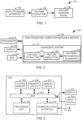
- FIG. 1 illustrates one example of a system 100 for evaluating a subject in accordance with an aspect of the present invention.
- the system is implemented as computer readable instructions, executed by a processor and stored on a non-transitory computer readable medium.
- the system 100 includes an electrogram interface 102 that receives electrogram data for the subject from a set of electrodes (not shown) and formats the data in an appropriate form for used by the system 100.
- the electrogram data is recorded after a stimulus is applied to the subject to provide an evoked potential.
- an "evoked potential" is intended to refer to either of the results of a single electrogram following introduction of a stimulus or an isolated event related potential from multiple electrograms.
- a feature extractor 104 extracts parameters from the evoked potential. Specifically, the feature extractor extracts parameters that are relevant to distinguishing between subjects with pain disorders and subjects who do not have pain disorders, referred to herein as "features". Exemplary features can include various parameters from each of five categories, a first including parameters representing the morphology of selected waveforms within the electrogram data, a second using coefficients from a signal decomposition of the electrogram data, a third including one or more entropy measures for the electrogram data, a fourth including parameters representing time and frequency characteristics of the signal, and a fifth including parameters representing connectivity between various regions of the brain. In the illustrated example, the feature extractor 104 extracts features from at least two of these categories, although it will be appreciated that, in some implementations, features from three, four, or all of the categories can be used.
- a machine learning model 106 uses the plurality of extracted features to assign a clinical parameter to the subject.
- the machine learning model 106 can utilize one or more classification or regression algorithms, each of which analyze the extracted features or a subset of the extracted features to assign a continuous or categorical parameter relating to a pain disorder and provide this information to a user via an appropriate output device, such as a display.
- the clinical parameter can represent any of: 1.) the presence of a pain disorder generally; 2.) the presence of a specific pain disorder (e.g ., fibromyalgia); 3.) a predicted or actual response to treatment for a pain disorder; 4.), a presence or absence of a given tender spot; 5.) a type of pain; 6.) a subtype of a pain disorder; 7.) a severity of pain; 8.) severity of a pain disorder; 9.)_a change in the severity of a pain disorder over time; 10.) the presence of absence of a particular pain phenomena (e.g ., central sensitization, hyperalgesia, allodynia and hypoalgesia), 11.) an intensity of a particular pain phenomena; 12.) a likelihood that the subject suffers from a pain disorder generally; 13.) a likelihood that the subject suffers from a specific pain disorder; 14.) a symptom of a pain disorder, or 15.) a finding on a physical exam.
- the machine learning model 106 includes one or both
- FIG. 2 illustrates one example of a system 200 for evaluating a subject for in accordance with an aspect of the present invention.
- An electroencephalograph (EEG) device 202 can be used to record electroencepalogram data from the subject.
- EEG electroencephalograph
- This data is provided to a pain evaluation system 210 implemented as computer readable instructions, executed by a processor 214 and stored on a non-transitory computer readable medium 230.
- the pain evaluation system 210 includes a feature extractor 232 that extracts a vector of feature values from the electroencepalogram data.
- Exemplary features can include various parameters representing morphology of selected waveforms within the electroencepalogram data, a signal decomposition of the electroencepalogram data, one or more entropy measures for the electroencepalogram data, parameters representing time and frequency characteristics of the signal, and parameters representing connectivity between various regions of the brain.
- the feature extractor 232 extracts a significant number of features from these categories and utilizes composite features generated via a feature reduction process 234 to generate a set of composite features for consideration.
- the feature extractor 232 can extract features from an individual EEG taken in response to a stimulus applied to a subject.
- the stimulus can include, for example, any of heat, cold, mechanical pressure, electrical stimulation, and laser stimulation applied to a selected location on the body of the subject.
- a mechanical force can be applied to one of the tender spots identified on the subject or one or more of a standard list of tender spots associated with fibromyalgia. This mechanical force can be applied manually or with a mechanical device to standardize the applied force.
- stimulations were applied with a force equivalent to two kilograms at a speed of two hundred millimeters per second with a rubber stopper having a surface area of one square centimeter.
- multiple EEGs can be taken after respective stimulations and features can be extracted from an average taken across the EEG signals to remove background noise and isolate an event related potential.
- stimulation is applied thirty times to the selected location with an interstitials interval of ten to fourteen seconds, and the event related potential is generated as a Woody Filter Mean.
- the intensity of the stimulus can be incrementally increased until the subject reports that they are experiencing pain, with the evoked potential obtained only after the stimulus is of sufficient intensity to evoke a pain response.
- Parameters representing morphology of a selected waveform within the EEG data can include any parameter describing a shape of a detected waveform. Extracted features can include the amplitude or width of an N1 peak, an amplitude and width of a P1 trough, a peak to peak voltage, and a duration of the event related potential.
- Parameters representing entropy that can be calculated from a waveform or an event related potential can include the Petrosian Fractal Dimension (PFD), the Higuchi Fractal Dimension (HFD), Hjorth Parameters, Spectral Entropy parameters, Spectral Entropy (SE), in which the amount of entropy in the spectral domain is calculated using relative intensity ratio (RIR) of the power spectral density (PSD) of the signal as scalar feature, and a Singular Value Decomposition (SVD) entropy, which is a dictionary type of analysis where the signal is decomposed based on a dictionary and the signal can be represented by a linear sum of the dictionary component.
- PFD Petrosian Fractal Dimension
- HFD Higuchi Fractal Dimension
- Hjorth Parameters Spectral Entropy parameters
- SE Spectral Entropy
- SE Spectral Entropy
- RIR relative intensity ratio
- PSD power spectral density
- SVD Singular Value Decom
- a connectivity feature includes a neuronal oscillatory synchronization, which refers to the presence of some type of fixed relationship among oscillatory modulations in neural activity based on different neurons or a group of neurons.
- the phase synchronization of these oscillatory neurons or group of neurons, particularly temporal and spatial frequency abnormalities in the phase synchronization, can be quantified, using frequency band phase synchronization approach to the multichannel EEG signals.
- a difference in the phase, ⁇ xy ( t ) between the two signals from two electrodes, x and y, is defined as ⁇ x ( t ) - ⁇ y ( t ).
- phase synchronization feature can be calculated for each possible pair of electrodes across each frequency band, it will be appreciated that the potential number of features is large. In a system using thirty-two electrodes, such as a standard 10-20 arrangement, nearly five-hundred pairs will be available for each frequency band. Accordingly, in one implementation, the feature set can be reduced to a number of pairs most relevant to the classification.
- the signal decomposition features can include signals derived via a principle component analysis, an Empirical Mode decomposition, a discrete wavelet transform, or similar processes. Time and frequency features can be determined as coefficients from a discrete Fourier transform, autoregressive methods, or a continuous wavelet transform. In one implementation, in which a wavelet decomposition is used, the signal decomposition features include a scale-dependent and scale-invariant feature for each electrode.
- wavelet function the scale, a, and the value for q can vary with the application.
- a Morlet function can be used.
- Autoregression features are derived via a spectral analysis model in which the voltage values of each electrode, x ( n ), are modelled as the output of a linear system characterized by a rational structure.
- PSD power spectral density
- the PSD can be computed by solving a series of linear equations whereby the data is modeled as an output of causal, allpole, discrete filters whose input is white noise.
- the autocorrelation function is determined via the Burg method, with an appropriate order, p , for the autocorrelation selected according to the Akaike information criterion (AIC).
- AIC Akaike information criterion
- six different types of features can be extracted from each of the five main frequency ranges used in EEG analysis, alpha, beta, gamma, delta, and theta.
- the features can include: 1) a mean power of each frequency range; 2) a variance power of each frequency range; 3) a mean frequency of the observed mean power in each frequency range; 4) a variance frequency of the observed mean power in each frequency range, and the ratio between; 5) a mean power for each frequency range; and 6) a variance for each frequency range. It will be appreciated, however, that other descriptive statistics representing the frequency content of the signal can also be utilized.
- the classification features can be a change in two or more of the features described above between a first EEG, taken at a first time, and a second EEG, taken at a second time. This allows for monitoring of a change in the subject's condition over time, for example, in response to treatment.
- the classification features can include a derivative of one or more of the features with respective to time to track the rate of change in the feature over time. In some implementations, higher derivatives with respect to time can also be used as features.
- the feature reduction process 234 generates composite features from the plurality of extracted features to reduce the dimensionality of the feature space for classification.
- Appropriate composite features can be generated via feature reduction algorithms, such as Lasso, ElasticNet, Randomized PCA, ISO MAP, SPECTRAL Embedding, Random Projections, Tree Based Methods, Recursive Feature Selection, and Multivariate feature reduction.
- a univariate method such as a mutual information measure, is employed to identify features that are substantially independent for use in the classifier. These features can be combined as a linear combination with weighted terms to form a composite feature, which can then be used for classification.
- a principle component analysis can be employed to generate a set of composite features for classification from the extracted features. This reduces the complexity of the classifier and reduces the likelihood of overfitting the classifier to the known training samples.
- a pattern recognition classifier 238 uses the generated composite features to classify a subject into one of a plurality of classes, each representing one of the presence of a pain disorder generally or a specific pain disorder (e.g ., fibromyalgia), a type of pain, a symptom or finding from a physical exam associated with a pain disorder, a subtype of a pain disorder, a severity of pain, a severity of a pain disorder, a presence or absence of a pain phenomenon, a response to treatment for a pain disorder, a change in the patient's condition, a presence or absence of a given tender spot, and a likelihood that the subject suffers from a pain disorder generally or a specific pain disorder, according to the composite features.
- a specific pain disorder e.g ., fibromyalgia
- the classification is binary, with "pain disorder” and "non- pain disorder” classes, although it will be appreciated that additional classes could be included, for example, classes representing ranges of likelihoods that the subject suffers from a pain disorder.
- the classes could represent a subject's change in condition, with or without treatment, for example, “improving", “no change", and “degrading” classes, or classes representing degrees of change.
- Clinical parameters can include, but are not limited to demographic parameters (e.g., age, sex), physiological parameters (blood pressure, blood glucose, heart rate, oxygen saturation, etc.), a medical history of the subject, including, for example, categorical variables representing the presence or absence of various conditions, and medications taken by the subject, as well as respective dosages for these medications.
- demographic parameters e.g., age, sex
- physiological parameters blood pressure, blood glucose, heart rate, oxygen saturation, etc.
- a medical history of the subject including, for example, categorical variables representing the presence or absence of various conditions, and medications taken by the subject, as well as respective dosages for these medications.
- the pattern recognition classifier 238 can utilize one or more pattern recognition algorithms, each of which analyze the extracted features or a subset of the extracted features to classify the subjects into one of the plurality of classes and provide this information to a display 240. Where multiple classification or regression models are used, an arbitration element can be utilized to provide a coherent result from the plurality of models.
- the training process of a given classifier will vary with its implementation, but training generally involves a statistical aggregation of training data into one or more parameters associated with the output class. The training process can be accomplished on a remote system and/or on the local device or wearable, app.
- rule-based models such as decision trees, domain knowledge, for example, as provided by one or more human experts, can be used in place of or to supplement training data in selecting rules for classifying a user using the extracted features.
- Any of a variety of techniques can be utilized for the classification algorithm, including support vector machines (SVMs), regression models, self-organized maps, fuzzy logic systems, data fusion processes, boosting and bagging methods, rule-based systems, or artificial neural networks (ANNs).
- an SVM classifier can utilize a plurality of functions, referred to as hyperplanes, to conceptually divide boundaries in the N-dimensional feature space, where each of the N dimensions represents one associated feature of the feature vector.
- the boundaries define a range of feature values associated with each class. Accordingly, an output class and an associated confidence value can be determined for a given input feature vector according to its position in feature space relative to the boundaries.
- the SVM can be implemented via a kernel method using a linear or non-linear kernel.
- An ANN classifier comprises a plurality of nodes having a plurality of interconnections.
- the values from the feature vector are provided to a plurality of input nodes.
- the input nodes each provide these input values to layers of one or more intermediate nodes.
- a given intermediate node receives one or more output values from previous nodes.
- the received values are weighted according to a series of weights established during the training of the classifier.
- An intermediate node translates its received values into a single output according to a transfer function at the node. For example, the intermediate node can sum the received values and subject the sum to a binary step function.
- a final layer of nodes provides the confidence values for the output classes of the ANN, with each node having an associated value representing a confidence for one of the associated output classes of the classifier.
- ANN classifiers are fully-connected and feedforward.
- a convolutional neural network includes convolutional layers in which nodes from a previous layer are only connected to a subset of the nodes in the convolutional layer.
- Recurrent neural networks are a class of neural networks in which connections between nodes form a directed graph along a temporal sequence. Unlike a feedforward network, recurrent neural networks can incorporate feedback from states caused by earlier inputs, such that an output of the recurrent neural network for a given input can be a function of not only the input but one or more previous inputs.
- LSTM Long Short-Term Memory
- LSTM Long Short-Term Memory
- a rule-based classifier applies a set of logical rules to the extracted features to select an output class. Generally, the rules are applied in order, with the logical result at each step influencing the analysis at later steps.
- the specific rules and their sequence can be determined from any or all of training data, analogical reasoning from previous cases, or existing domain knowledge.
- One example of a rule-based classifier is a decision tree algorithm, in which the values of features in a feature set are compared to corresponding threshold in a hierarchical tree structure to select a class for the feature vector.
- a random forest classifier is a modification of the decision tree algorithm using a bootstrap aggregating, or "bagging" approach.
- multiple decision trees are trained on random samples of the training set, and an average (e.g., mean, median, or mode) result across the plurality of decision trees is returned.
- an average e.g., mean, median, or mode
- the result from each tree would be categorical, and thus a modal outcome can be used.
- an unsupervised machine learning model can be applied using the extracted features.
- the identity and number of categories into which a subject can be assigned is not known a priori.
- unsupervised learning algorithms that could be used for this purpose include clustering algorithms, such as k-means and hierarchical clustering, self-organized maps, and anomaly detection systems.
- example methods will be better appreciated with reference to FIGS. 3 and 4 . While, for purposes of simplicity of explanation, the example method of FIGS. 3 and 4 is shown and described as executing serially, it is to be understood and appreciated that the present examples are not limited by the illustrated order, as some actions could in other examples occur in different orders, multiple times and/or concurrently from that shown and described herein. Moreover, it is not necessary that all described actions be performed to implement a method.
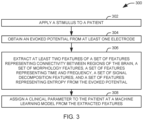
- FIG. 3 illustrates one example of a method 300 for diagnosing pain disorders.
- a stimulus is applied to the subject.
- at least one electrogram of a subject is obtained to provide an evoked potential. It will be appreciated that where multiple electrograms are taken, the stimulus of 302 can precede each electrogram.
- the electrogram includes a plurality of electrogram signals, each taken from an electrode placed on the scalp of the subject. In one example, multiple electrogram s can be taken to provide a plurality of event related potentials in response to applied stimuli, which are then averaged to isolate an event related potential.
- a set of features are extracted from the evoked potential, including features from at least two of a set of features representing connectivity between regions of the brain, a set of morphology features, a set of features representing time and frequency, as a set of signal decomposition features, and a set of features representing entropy.
- features of all five types are extracted.
- the set of morphology features can include, for example, any or all of an amplitude of an N1 peak in the evoked potential, a depth of the N1 peak in the evoked potential, an amplitude of a P1 trough in the evoked potential, a depth of the P1 trough in the evoked potential, a peak to peak voltage, and a duration of the event related potential.
- the set of features representing entropy can include any or all of a Petrosian fractal dimension, a Higuchi fractal dimension, Hjorth parameters, spectral entropy parameters, and a singular value decomposition entropy.
- the set of signal decomposition features can include values derived via one of a principle component analysis, an empirical mode decomposition, and a discrete wavelet transform.
- the set of features representing time and frequency can include coefficients from one of a discrete Fourier transform, autoregressive methods, and a continuous wavelet transform.
- the set of features representing connectivity between regions of the brain can include measures of neuronal oscillatory synchronization, as have been described previously.
- the extracted set of features can be combined, for example, in accordance with a feature reduction algorithm applied during training of a machine learning model, to provide a set of composite features as part or all of the extracted set of features.
- a clinical parameter relating to a pain disorder is assigned to the subject from the extracted set of features at a machine learning model.
- clinical parameter represents any of the presence of a pain disorder generally or a specific pain disorder; a predicted or actual change in the subject's condition a pain disorder, a presence or absence of a given tender spot, a type of pain, a subtype of a pain disorder, a severity of pain, a severity of a pain disorder, the presence of absence of a particular pain phenomena, an intensity of a particular pain phenomena, a likelihood that the subject suffers from a pain disorder generally, or a likelihood that the subject suffers from a specific pain disorder.
- the subject is classified into one of a plurality of classes according to the extracted features, for example, via a support vector machine or random forest classifier trained on known training samples taken from subjects whose associated class is known. If it is determined that the subject will benefit from treatment, treatment can be provided, such as behavioral biofeedback, psychotherapy, (e.g., cognitive behavioral therapy), focused on addressing sleep disorders, training in relaxation techniques, and pharmaceutical interventions.
- psychotherapy e.g., cognitive behavioral therapy
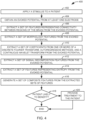
- FIG. 4 illustrates one example of a method 400 for determining if a subject is likely to respond to treatment in accordance with an aspect of the present invention.
- a stimulus is applied to the subject.
- an evoked potential is obtained from at least one electroencephalogram (EEG) of the subject.
- EEG electroencephalogram
- a plurality of event related potentials are obtained from the subject in response to respective stimuli, and the evoked potential is generated as a Woody Filter Mean across the plurality of event related potentials.
- a set of features representing connectivity between regions of the brain is extracted from the evoked potential.
- a set of morphology features is extracted from the evoked potential.
- a set of coefficients from one of a discrete Fourier transform, autoregressive methods, and a continuous wavelet transform is extracted from the evoked potential.
- a set of signal decomposition features is extracted from the evoked potential.
- a set of features representing entropy is extracted from the evoked potential.
- each of the set of features representing connectivity between regions of the brain, the set of morphology features, the set of coefficients from the one of the discrete Fourier transform, autoregressive methods, and the continuous wavelet transform, the set of signal decomposition features, and the set of features representing entropy are combined to provide a set of composite features. It will be appreciated that an appropriate feature reduction algorithm can be applied during training of a machine learning model to determine appropriate composite features for the analysis.
- the machine learning model can provide an output representing whether the subject has or likely has a pain disorder, determining if a certain treatment is likely to be successful, or if a treatment that is currently in progress is effective at treating the pain disorder. If it is determined that the treatment is unlikely to benefit the subject (N), the method terminates. Otherwise (Y), the treatment is provided to the subject at 420.
- the treatment can include behavioral biofeedback, psychotherapy, training in relaxation techniques, and/or pharmaceutical interventions.
- FIG. 5 is a schematic block diagram illustrating an exemplary system 500 of hardware components capable of implementing examples of the systems and methods disclosed herein.
- the system 500 can include various systems and subsystems.
- the system 500 can be a personal computer, a laptop computer, a workstation, a computer system, an appliance, an application-specific integrated circuit (ASIC), a server, a server BladeCenter, a server farm, etc.
- ASIC application-specific integrated circuit
- the system 500 can include a system bus 502, a processing unit 504, a system memory 506, memory devices 508 and 510, a communication interface 512 (e.g ., a network interface), a communication link 514, a display 516 ( e.g ., a video screen), and an input device 518 ( e.g ., a keyboard, touch screen, and/or a mouse).
- the system bus 502 can be in communication with the processing unit 504 and the system memory 506.
- the additional memory devices 508 and 510 such as a hard disk drive, server, standalone database, or other non-volatile memory, can also be in communication with the system bus 502.
- the system bus 502 interconnects the processing unit 504, the memory devices 506-510, the communication interface 512, the display 516, and the input device 518. In some examples, the system bus 502 also interconnects an additional port (not shown), such as a universal serial bus (USB) port.
- an additional port not shown, such as a universal serial bus (USB) port.
- USB universal serial bus
- the processing unit 504 can be a computing device and can include an application-specific integrated circuit (ASIC).
- the processing unit 504 executes a set of instructions to implement the operations of examples disclosed herein.
- the processing unit can include a processing core.
- the additional memory devices 506, 508, and 510 can store data, programs, instructions, database queries in text or compiled form, and any other information that may be needed to operate a computer.
- the memories 506, 508 and 510 can be implemented as computer-readable media (integrated or removable), such as a memory card, disk drive, compact disk (CD), or server accessible over a network.
- the memories 506, 508 and 510 can comprise text, images, video, and/or audio, portions of which can be available in formats comprehensible to human beings.
- system 500 can access an external data source or query source through the communication interface 512, which can communicate with the system bus 502 and the communication link 514.
- the system 500 can be used to implement one or more parts of a pain evaluation system in accordance with the present invention, in particular, the feature extractor 104 and the machine learning model 106.
- Computer executable logic for implementing the pain evaluation system resides on one or more of the system memory 506, and the memory devices 508 and 510 in accordance with certain examples.
- the processing unit 504 executes one or more computer executable instructions originating from the system memory 506 and the memory devices 508 and 510.
- the term "computer readable medium” as used herein refers to a medium that participates in providing instructions to the processing unit 504 for execution. This medium may be distributed across multiple discrete assemblies all operatively connected to a common processor or set of related processors.
- Implementation of the techniques, blocks, steps and means described above can be done in various ways. For example, these techniques, blocks, steps and means can be implemented in hardware, software, or a combination thereof.
- the processing units can be implemented within one or more application specific integrated circuits (ASICs), digital signal processors (DSPs), digital signal processing devices (DSPDs), programmable logic devices (PLDs), field programmable gate arrays (FPGAs), processors, controllers, microcontrollers, microprocessors, other electronic units designed to perform the functions described above, and/or a combination thereof.
- ASICs application specific integrated circuits
- DSPs digital signal processors
- DSPDs digital signal processing devices
- PLDs programmable logic devices
- FPGAs field programmable gate arrays
- processors controllers, microcontrollers, microprocessors, other electronic units designed to perform the functions described above, and/or a combination thereof.
- the embodiments can be described as a process which is depicted as a flowchart, a flow diagram, a data flow diagram, a structure diagram, or a block diagram. Although a flowchart can describe the operations as a sequential process, many of the operations can be performed in parallel or concurrently. In addition, the order of the operations can be re-arranged.
- a process is terminated when its operations are completed, but could have additional steps not included in the figure.
- a process can correspond to a method, a function, a procedure, a subroutine, a subprogram, etc. When a process corresponds to a function, its termination corresponds to a return of the function to the calling function or the main function.
- embodiments can be implemented by hardware, software, scripting languages, firmware, middleware, microcode, hardware description languages, and/or any combination thereof.
- the program code or code segments to perform the necessary tasks can be stored in a machine readable medium such as a storage medium.
- a code segment or machineexecutable instruction can represent a procedure, a function, a subprogram, a program, a routine, a subroutine, a module, a software package, a script, a class, or any combination of instructions, data structures, and/or program statements.
- a code segment can be coupled to another code segment or a hardware circuit by passing and/or receiving information, data, arguments, parameters, and/or memory contents. Information, arguments, parameters, data, etc. can be passed, forwarded, or transmitted via any suitable means including memory sharing, message passing, ticket passing, network transmission, etc.
- the methodologies can be implemented with modules (e.g ., procedures, functions, and so on) that perform the functions described herein. Any machine-readable medium tangibly embodying instructions can be used in implementing the methodologies described herein.
- software codes can be stored in a memory.
- Memory can be implemented within the processor or external to the processor.
- the term "memory" refers to any type of long term, short term, volatile, nonvolatile, or other storage medium and is not to be limited to any particular type of memory or number of memories, or type of media upon which memory is stored.
- the term “storage medium” can represent one or more memories for storing data, including read only memory (ROM), random access memory (RAM), magnetic RAM, core memory, magnetic disk storage mediums, optical storage mediums, flash memory devices and/or other machine readable mediums for storing information.
- ROM read only memory
- RAM random access memory
- magnetic RAM magnetic RAM
- core memory magnetic disk storage mediums
- optical storage mediums flash memory devices and/or other machine readable mediums for storing information.
- machine-readable medium includes, but is not limited to portable or fixed storage devices, optical storage devices, wireless channels, and/or various other storage mediums capable of storing that contain or carry instruction(s) and/or data.
Landscapes
- Health & Medical Sciences (AREA)
- Engineering & Computer Science (AREA)
- Life Sciences & Earth Sciences (AREA)
- Medical Informatics (AREA)
- Public Health (AREA)
- Physics & Mathematics (AREA)
- General Health & Medical Sciences (AREA)
- Biomedical Technology (AREA)
- Pathology (AREA)
- Theoretical Computer Science (AREA)
- Heart & Thoracic Surgery (AREA)
- Veterinary Medicine (AREA)
- Software Systems (AREA)
- Animal Behavior & Ethology (AREA)
- Surgery (AREA)
- Biophysics (AREA)
- Molecular Biology (AREA)
- Data Mining & Analysis (AREA)
- Psychiatry (AREA)
- Artificial Intelligence (AREA)
- Computer Vision & Pattern Recognition (AREA)
- Mathematical Physics (AREA)
- Evolutionary Computation (AREA)
- Computing Systems (AREA)
- General Engineering & Computer Science (AREA)
- General Physics & Mathematics (AREA)
- Epidemiology (AREA)
- Primary Health Care (AREA)
- Psychology (AREA)
- Hospice & Palliative Care (AREA)
- Pain & Pain Management (AREA)
- Physiology (AREA)
- Signal Processing (AREA)
- Databases & Information Systems (AREA)
- Computational Linguistics (AREA)
- Social Psychology (AREA)
- Developmental Disabilities (AREA)
- Child & Adolescent Psychology (AREA)
- Chemical & Material Sciences (AREA)
- Bioinformatics & Cheminformatics (AREA)
Claims (7)
- Ein System (100) zur Bewertung einer Schmerzstörung, das Folgendes umfasst:eine Elektrogrammschnittstelle (102), die ein aufgezeichnetes evoziertes Potential aus einem Elektrogramm einer Person empfängt;einen Merkmalsextraktor (104), der einen Satz von Merkmalen aus dem evozierten Potenzial extrahiert, einschließlich Merkmalen aus mindestens zwei eines Satzes von Merkmalen, die die Konnektivität zwischen Regionen des Gehirns darstellen, eines Satzes von Morphologiemerkmalen, eines Satzes von Merkmalen, die Zeit und Frequenz darstellen, eines Satzes von Signalzerlegungsmerkmalen und eines Satzes von Merkmalen, die Entropie darstellen;ein maschinelles Lernmodell (106), das so konfiguriert ist, dass es auf einem Satz von Trainingsproben trainiert wird, die jeweils Werte für den extrahierten Satz von Merkmalen und einen Wert für einen klinischen Parameter aus einem Satz von Probanden mit einem bekannten Wert für den klinischen Parameter umfassen, wobei das maschinelle Lernmodell (106) ferner so konfiguriert ist, dass es den klinischen Parameter dem Probanden aus dem extrahierten Satz von Merkmalen zuordnet, wobei der klinische Parameter eines der folgenden Merkmale darstellt: das Vorhandensein einer Schmerzstörung im Allgemeinen das Vorhandensein einer spezifischen Schmerzstörung, einen Subtyp einer Schmerzstörung, einen Schweregrad einer Schmerzstörung, eine Änderung des Schweregrads einer Schmerzstörung im Laufe der Zeit und eine Wahrscheinlichkeit, dass das Subjekt an einer spezifischen Schmerzstörung leidet, darstellt, wobei der klinische Parameter so konfiguriert ist, dass er ein kategorischer Parameter ist, der einen Wert annehmen kann, der mit einer aus einer Vielzahl von Klassen assoziiert ist, wobei jede Klasse eines von dem Vorhandensein der Schmerzstörung und der Wahrscheinlichkeit, dass das Subjekt an der Schmerzstörung leidet, darstellt; undein Ausgabegerät, das so konfiguriert ist, dass es den klinischen Parameter an einen Benutzer weitergibt.
- Das System (100) nach Anspruch 1, das ferner Folgendes umfasst:einen Satz von Elektroden, der das Elektrogramm der Testperson an die Elektrogrammschnittstelle liefert;einen Prozessor (214); undein nicht-transitorisches computerlesbares Medium (230), das betriebsfähig mit dem Prozessor (214) verbunden ist und maschinenlesbare Anweisungen speichert, die von dem Prozessor (214) ausgeführt werden, um die Elektrogrammschnittstelle (102), den Merkmalsextraktor (104) und das maschinelle Lernmodell (106) bereitzustellen.
- Das System (100) nach Anspruch 1, wobei der Satz von Merkmalen Merkmale aus dem Satz von Merkmalen, die die Konnektivität zwischen Regionen des Gehirns darstellen, dem Satz von Morphologiemerkmalen, dem Satz von Merkmalen, die die Zeit und die Frequenz darstellen, dem Satz von Signalzerlegungsmerkmalen und dem Satz von Merkmalen, die die Entropie darstellen, enthält.
- Das System (100) nach Anspruch 1, wobei der Satz von Merkmalen, die Zeit und Frequenz darstellen, Koeffizienten aus einer diskreten Fourier-Transformation, autoregressiven Methoden und einer kontinuierlichen Wavelet-Transformation umfasst.
- Das System (100) nach Anspruch 1, wobei das maschinelle Lernmodell (106) entweder eine Support-Vektor-Maschine oder einen Random-Forest-Klassifikator umfasst und das Subjekt in eine der Vielzahl von Klassen klassifiziert.
- Das System (100) nach Anspruch 1 umfasst ferner eine Merkmalsreduktionskomponente (234), die den extrahierten Satz von Merkmalen kombiniert, um einen Satz von zusammengesetzten Merkmalen bereitzustellen, wobei das maschinelle Lernmodell (106) den klinischen Parameter dem Subjekt gemäß dem Satz von zusammengesetzten Merkmalen zuordnet.
- Das System (100) nach Anspruch 1, wobei das maschinelle Lernmodell (106) so konfiguriert ist, dass es dem Subjekt den klinischen Parameter aus dem extrahierten Satz von Merkmalen und einem Satz von klinischen Daten zuordnet, wobei die klinischen Daten mindestens einen demografischen Parameter für das Subjekt, einen Parameter, der ein Element einer medizinischen Vorgeschichte des Subjekts darstellt, und einen Parameter, der eine vom Subjekt eingenommene Medikation darstellt, umfassen.
Applications Claiming Priority (2)
| Application Number | Priority Date | Filing Date | Title |
|---|---|---|---|
| US201962828013P | 2019-04-02 | 2019-04-02 | |
| PCT/IB2020/053117 WO2020202045A1 (en) | 2019-04-02 | 2020-04-02 | Evaluation of pain disorders via expert system |
Publications (3)
| Publication Number | Publication Date |
|---|---|
| EP3948893A1 EP3948893A1 (de) | 2022-02-09 |
| EP3948893A4 EP3948893A4 (de) | 2022-12-07 |
| EP3948893B1 true EP3948893B1 (de) | 2025-02-19 |
Family
ID=72666647
Family Applications (1)
| Application Number | Title | Priority Date | Filing Date |
|---|---|---|---|
| EP20784472.1A Active EP3948893B1 (de) | 2019-04-02 | 2020-04-02 | Evaluierung von schmerzerkrankungen durch expertensystem |
Country Status (6)
| Country | Link |
|---|---|
| US (1) | US20220192578A1 (de) |
| EP (1) | EP3948893B1 (de) |
| JP (1) | JP7696294B2 (de) |
| CA (1) | CA3135329A1 (de) |
| ES (1) | ES3014300T3 (de) |
| WO (1) | WO2020202045A1 (de) |
Families Citing this family (11)
| Publication number | Priority date | Publication date | Assignee | Title |
|---|---|---|---|---|
| US11538197B2 (en) * | 2020-09-15 | 2022-12-27 | Google Llc | Channel-wise autoregressive entropy models for image compression |
| WO2022112875A1 (en) | 2020-11-30 | 2022-06-02 | Innoneuro Limited | Method and system for analysing brain activity |
| CA3200223A1 (en) * | 2020-12-22 | 2022-06-30 | Regeneron Pharmaceuticals, Inc. | Systems and methods for signal based feature analysis to determine clinical outcomes |
| CN116490881A (zh) * | 2020-12-28 | 2023-07-25 | 国立大学法人大阪大学 | 用于对推定对象的主观评价进行推定的系统、方法以及程序 |
| US11636280B2 (en) * | 2021-01-27 | 2023-04-25 | International Business Machines Corporation | Updating of statistical sets for decentralized distributed training of a machine learning model |
| JP2024033833A (ja) * | 2022-08-31 | 2024-03-13 | 学校法人 芝浦工業大学 | 推論モデルの生成方法、および判別装置 |
| CN116831595B (zh) * | 2023-06-21 | 2024-04-12 | 中国人民解放军西部战区总医院 | 一种疼痛等级评估方法 |
| CN117234871A (zh) * | 2023-09-14 | 2023-12-15 | 中国银行股份有限公司 | 一种应用程序编程接口重要性的评估方法及相关设备 |
| WO2025231289A1 (en) * | 2024-05-01 | 2025-11-06 | Cornell University | Systems and methods for screening and classifying pain conditions |
| US20260179758A1 (en) * | 2024-12-22 | 2026-06-25 | Spinal Diagnostic LLC | Systems and methods for predicting diagnosis of chronic back pain of a patient and a corresponding treatment based on one or more images or infographics of the patient's back |
| CN120392103B (zh) * | 2025-05-13 | 2026-02-27 | 合肥中科厚生医疗科技有限公司 | 一种基于脑电特征的感觉神经定量检测方法及系统 |
Family Cites Families (9)
| Publication number | Priority date | Publication date | Assignee | Title |
|---|---|---|---|---|
| US5406956A (en) * | 1993-02-11 | 1995-04-18 | Francis Luca Conte | Method and apparatus for truth detection |
| US6731975B1 (en) | 2000-10-16 | 2004-05-04 | Instrumentarium Corp. | Method and apparatus for determining the cerebral state of a patient with fast response |
| US9402558B2 (en) | 2007-04-05 | 2016-08-02 | New York University | System and method for pain detection and computation of a pain quantification index |
| US20120123232A1 (en) * | 2008-12-16 | 2012-05-17 | Kayvan Najarian | Method and apparatus for determining heart rate variability using wavelet transformation |
| US10850034B2 (en) * | 2013-03-15 | 2020-12-01 | Ivan Osorio | Automatic treatment of pain |
| US9427581B2 (en) * | 2013-04-28 | 2016-08-30 | ElectroCore, LLC | Devices and methods for treating medical disorders with evoked potentials and vagus nerve stimulation |
| US11957897B2 (en) * | 2016-04-22 | 2024-04-16 | Newton Howard | Biological co-processor (BCP) |
| WO2018063912A1 (en) * | 2016-09-27 | 2018-04-05 | Boston Scientific Neuromodulation Corporation | Systems and methods for closed-loop pain management |
| US11922277B2 (en) * | 2017-07-07 | 2024-03-05 | Osaka University | Pain determination using trend analysis, medical device incorporating machine learning, economic discriminant model, and IoT, tailormade machine learning, and novel brainwave feature quantity for pain determination |
-
2020
- 2020-04-02 EP EP20784472.1A patent/EP3948893B1/de active Active
- 2020-04-02 WO PCT/IB2020/053117 patent/WO2020202045A1/en not_active Ceased
- 2020-04-02 JP JP2021560330A patent/JP7696294B2/ja active Active
- 2020-04-02 US US17/599,691 patent/US20220192578A1/en active Pending
- 2020-04-02 CA CA3135329A patent/CA3135329A1/en active Pending
- 2020-04-02 ES ES20784472T patent/ES3014300T3/es active Active
Also Published As
| Publication number | Publication date |
|---|---|
| EP3948893A1 (de) | 2022-02-09 |
| WO2020202045A4 (en) | 2020-11-19 |
| WO2020202045A1 (en) | 2020-10-08 |
| US20220192578A1 (en) | 2022-06-23 |
| ES3014300T3 (en) | 2025-04-21 |
| CA3135329A1 (en) | 2020-10-08 |
| JP2022533901A (ja) | 2022-07-27 |
| JP7696294B2 (ja) | 2025-06-20 |
| EP3948893A4 (de) | 2022-12-07 |
Similar Documents
| Publication | Publication Date | Title |
|---|---|---|
| US20220192578A1 (en) | Evaluation of pain disorders via expert system | |
| US12430573B2 (en) | Subject-aware contrastive learning for biosignals | |
| US10928472B2 (en) | System and method for brain state classification | |
| Shoeb et al. | Patient-specific seizure onset detection | |
| Tzallas et al. | Automated epileptic seizure detection methods: a review study | |
| Daud et al. | Safe-level SMOTE method for handling the class imbalanced problem in electroencephalography dataset of adult anxious state | |
| Frølich et al. | Classification of independent components of EEG into multiple artifact classes | |
| Saghafi et al. | Random eye state change detection in real-time using EEG signals | |
| Hosseini et al. | Emotional stress recognition using a new fusion link between electroencephalogram and peripheral signals | |
| Fang et al. | Survey on pain detection using machine learning models: Narrative review | |
| Murugappan et al. | Recurrent quantification analysis-based emotion classification in stroke using electroencephalogram signals | |
| Divya et al. | Classification of low-functioning and high-functioning autism using task-based EEG signals | |
| Ghonchi et al. | Assessing neural patterns of anxiety using deep learning: An EEG study | |
| Colafiglio et al. | Machine learning classification of motivational states: Insights from EEG analysis of perception and imagery | |
| Aslan et al. | Examining tongue movement intentions in EEG-based BCI with machine and deep learning: an approach for dysphagia rehabilitation | |
| Sorinas et al. | Unraveling the development of an algorithm for recognizing primary emotions through electroencephalography | |
| Szachewicz | Classification of motor imagery for brain-computer interfaces | |
| Sofia Bobby et al. | QCBO‐WSVM: Quantum chaos butterfly optimization‐based weighted support vector machine for neuropathic pain detection from EEG signal | |
| Sherwani et al. | Wavelet based feature extraction for classification of motor imagery signals | |
| Kongwudhikunakorn et al. | Psd-cnn approach for subject independent dementia recognition from eeg signals | |
| Bakheet | Complexity and synchronisation analysis of electroencephalogram signals for early prediction of neurodevelopmental disorders | |
| Geethanjali | Fundamentals of brain signals and its medical application using data analysis techniques | |
| Rani et al. | Multi-class EEG signal classification with statistical binary pattern synergic network for schizophrenia severity diagnosis. | |
| Luckett | Nonlinear methods for detection and prediction of epileptic seizures | |
| Akella et al. | Enhancing information extraction from field potentials in electrophysiology studies |
Legal Events
| Date | Code | Title | Description |
|---|---|---|---|
| STAA | Information on the status of an ep patent application or granted ep patent |
Free format text: STATUS: THE INTERNATIONAL PUBLICATION HAS BEEN MADE |
|
| PUAI | Public reference made under article 153(3) epc to a published international application that has entered the european phase |
Free format text: ORIGINAL CODE: 0009012 |
|
| STAA | Information on the status of an ep patent application or granted ep patent |
Free format text: STATUS: REQUEST FOR EXAMINATION WAS MADE |
|
| 17P | Request for examination filed |
Effective date: 20211005 |
|
| AK | Designated contracting states |
Kind code of ref document: A1 Designated state(s): AL AT BE BG CH CY CZ DE DK EE ES FI FR GB GR HR HU IE IS IT LI LT LU LV MC MK MT NL NO PL PT RO RS SE SI SK SM TR |
|
| DAV | Request for validation of the european patent (deleted) | ||
| DAX | Request for extension of the european patent (deleted) | ||
| A4 | Supplementary search report drawn up and despatched |
Effective date: 20221109 |
|
| RIC1 | Information provided on ipc code assigned before grant |
Ipc: A61B 5/377 20210101ALI20221103BHEP Ipc: A61B 5/00 20060101ALI20221103BHEP Ipc: G16H 20/00 20180101ALI20221103BHEP Ipc: G06N 20/00 20190101ALI20221103BHEP Ipc: G06K 9/62 20220101ALI20221103BHEP Ipc: G16H 50/20 20180101AFI20221103BHEP |
|
| GRAP | Despatch of communication of intention to grant a patent |
Free format text: ORIGINAL CODE: EPIDOSNIGR1 |
|
| STAA | Information on the status of an ep patent application or granted ep patent |
Free format text: STATUS: GRANT OF PATENT IS INTENDED |
|
| RIC1 | Information provided on ipc code assigned before grant |
Ipc: A61B 5/377 20210101ALI20241011BHEP Ipc: A61B 5/00 20060101ALI20241011BHEP Ipc: G16H 20/00 20180101ALI20241011BHEP Ipc: G06N 20/00 20190101ALI20241011BHEP Ipc: G16H 50/20 20180101AFI20241011BHEP |
|
| INTG | Intention to grant announced |
Effective date: 20241029 |
|
| GRAS | Grant fee paid |
Free format text: ORIGINAL CODE: EPIDOSNIGR3 |
|
| GRAA | (expected) grant |
Free format text: ORIGINAL CODE: 0009210 |
|
| STAA | Information on the status of an ep patent application or granted ep patent |
Free format text: STATUS: THE PATENT HAS BEEN GRANTED |
|
| AK | Designated contracting states |
Kind code of ref document: B1 Designated state(s): AL AT BE BG CH CY CZ DE DK EE ES FI FR GB GR HR HU IE IS IT LI LT LU LV MC MK MT NL NO PL PT RO RS SE SI SK SM TR |
|
| P01 | Opt-out of the competence of the unified patent court (upc) registered |
Free format text: CASE NUMBER: APP_2003/2025 Effective date: 20250113 |
|
| REG | Reference to a national code |
Ref country code: GB Ref legal event code: FG4D |
|
| REG | Reference to a national code |
Ref country code: CH Ref legal event code: EP |
|
| REG | Reference to a national code |
Ref country code: IE Ref legal event code: FG4D |
|
| REG | Reference to a national code |
Ref country code: DE Ref legal event code: R096 Ref document number: 602020046367 Country of ref document: DE |
|
| REG | Reference to a national code |
Ref country code: ES Ref legal event code: FG2A Ref document number: 3014300 Country of ref document: ES Kind code of ref document: T3 Effective date: 20250421 |
|
| REG | Reference to a national code |
Ref country code: NL Ref legal event code: MP Effective date: 20250219 |
|
| PG25 | Lapsed in a contracting state [announced via postgrant information from national office to epo] |
Ref country code: RS Free format text: LAPSE BECAUSE OF FAILURE TO SUBMIT A TRANSLATION OF THE DESCRIPTION OR TO PAY THE FEE WITHIN THE PRESCRIBED TIME-LIMIT Effective date: 20250519 |
|
| PG25 | Lapsed in a contracting state [announced via postgrant information from national office to epo] |
Ref country code: FI Free format text: LAPSE BECAUSE OF FAILURE TO SUBMIT A TRANSLATION OF THE DESCRIPTION OR TO PAY THE FEE WITHIN THE PRESCRIBED TIME-LIMIT Effective date: 20250219 |
|
| PG25 | Lapsed in a contracting state [announced via postgrant information from national office to epo] |
Ref country code: PL Free format text: LAPSE BECAUSE OF FAILURE TO SUBMIT A TRANSLATION OF THE DESCRIPTION OR TO PAY THE FEE WITHIN THE PRESCRIBED TIME-LIMIT Effective date: 20250219 |
|
| REG | Reference to a national code |
Ref country code: LT Ref legal event code: MG9D |
|
| PG25 | Lapsed in a contracting state [announced via postgrant information from national office to epo] |
Ref country code: NO Free format text: LAPSE BECAUSE OF FAILURE TO SUBMIT A TRANSLATION OF THE DESCRIPTION OR TO PAY THE FEE WITHIN THE PRESCRIBED TIME-LIMIT Effective date: 20250519 Ref country code: IS Free format text: LAPSE BECAUSE OF FAILURE TO SUBMIT A TRANSLATION OF THE DESCRIPTION OR TO PAY THE FEE WITHIN THE PRESCRIBED TIME-LIMIT Effective date: 20250619 |
|
| PG25 | Lapsed in a contracting state [announced via postgrant information from national office to epo] |
Ref country code: NL Free format text: LAPSE BECAUSE OF FAILURE TO SUBMIT A TRANSLATION OF THE DESCRIPTION OR TO PAY THE FEE WITHIN THE PRESCRIBED TIME-LIMIT Effective date: 20250219 |
|
| PG25 | Lapsed in a contracting state [announced via postgrant information from national office to epo] |
Ref country code: HR Free format text: LAPSE BECAUSE OF FAILURE TO SUBMIT A TRANSLATION OF THE DESCRIPTION OR TO PAY THE FEE WITHIN THE PRESCRIBED TIME-LIMIT Effective date: 20250219 |
|
| PG25 | Lapsed in a contracting state [announced via postgrant information from national office to epo] |
Ref country code: PT Free format text: LAPSE BECAUSE OF FAILURE TO SUBMIT A TRANSLATION OF THE DESCRIPTION OR TO PAY THE FEE WITHIN THE PRESCRIBED TIME-LIMIT Effective date: 20250620 Ref country code: LV Free format text: LAPSE BECAUSE OF FAILURE TO SUBMIT A TRANSLATION OF THE DESCRIPTION OR TO PAY THE FEE WITHIN THE PRESCRIBED TIME-LIMIT Effective date: 20250219 |
|
| PG25 | Lapsed in a contracting state [announced via postgrant information from national office to epo] |
Ref country code: GR Free format text: LAPSE BECAUSE OF FAILURE TO SUBMIT A TRANSLATION OF THE DESCRIPTION OR TO PAY THE FEE WITHIN THE PRESCRIBED TIME-LIMIT Effective date: 20250520 Ref country code: BG Free format text: LAPSE BECAUSE OF FAILURE TO SUBMIT A TRANSLATION OF THE DESCRIPTION OR TO PAY THE FEE WITHIN THE PRESCRIBED TIME-LIMIT Effective date: 20250219 |
|
| REG | Reference to a national code |
Ref country code: AT Ref legal event code: MK05 Ref document number: 1769150 Country of ref document: AT Kind code of ref document: T Effective date: 20250219 |
|
| PG25 | Lapsed in a contracting state [announced via postgrant information from national office to epo] |
Ref country code: SE Free format text: LAPSE BECAUSE OF FAILURE TO SUBMIT A TRANSLATION OF THE DESCRIPTION OR TO PAY THE FEE WITHIN THE PRESCRIBED TIME-LIMIT Effective date: 20250219 |
|
| PG25 | Lapsed in a contracting state [announced via postgrant information from national office to epo] |
Ref country code: SM Free format text: LAPSE BECAUSE OF FAILURE TO SUBMIT A TRANSLATION OF THE DESCRIPTION OR TO PAY THE FEE WITHIN THE PRESCRIBED TIME-LIMIT Effective date: 20250219 |
|
| PG25 | Lapsed in a contracting state [announced via postgrant information from national office to epo] |
Ref country code: DK Free format text: LAPSE BECAUSE OF FAILURE TO SUBMIT A TRANSLATION OF THE DESCRIPTION OR TO PAY THE FEE WITHIN THE PRESCRIBED TIME-LIMIT Effective date: 20250219 |
|
| PG25 | Lapsed in a contracting state [announced via postgrant information from national office to epo] |
Ref country code: AT Free format text: LAPSE BECAUSE OF FAILURE TO SUBMIT A TRANSLATION OF THE DESCRIPTION OR TO PAY THE FEE WITHIN THE PRESCRIBED TIME-LIMIT Effective date: 20250219 |
|
| PG25 | Lapsed in a contracting state [announced via postgrant information from national office to epo] |
Ref country code: EE Free format text: LAPSE BECAUSE OF FAILURE TO SUBMIT A TRANSLATION OF THE DESCRIPTION OR TO PAY THE FEE WITHIN THE PRESCRIBED TIME-LIMIT Effective date: 20250219 Ref country code: CZ Free format text: LAPSE BECAUSE OF FAILURE TO SUBMIT A TRANSLATION OF THE DESCRIPTION OR TO PAY THE FEE WITHIN THE PRESCRIBED TIME-LIMIT Effective date: 20250219 |
|
| PG25 | Lapsed in a contracting state [announced via postgrant information from national office to epo] |
Ref country code: RO Free format text: LAPSE BECAUSE OF FAILURE TO SUBMIT A TRANSLATION OF THE DESCRIPTION OR TO PAY THE FEE WITHIN THE PRESCRIBED TIME-LIMIT Effective date: 20250219 |
|
| PG25 | Lapsed in a contracting state [announced via postgrant information from national office to epo] |
Ref country code: SK Free format text: LAPSE BECAUSE OF FAILURE TO SUBMIT A TRANSLATION OF THE DESCRIPTION OR TO PAY THE FEE WITHIN THE PRESCRIBED TIME-LIMIT Effective date: 20250219 |
|
| REG | Reference to a national code |
Ref country code: DE Ref legal event code: R097 Ref document number: 602020046367 Country of ref document: DE |
|
| REG | Reference to a national code |
Ref country code: CH Ref legal event code: H13 Free format text: ST27 STATUS EVENT CODE: U-0-0-H10-H13 (AS PROVIDED BY THE NATIONAL OFFICE) Effective date: 20251125 |
|
| PG25 | Lapsed in a contracting state [announced via postgrant information from national office to epo] |
Ref country code: LU Free format text: LAPSE BECAUSE OF NON-PAYMENT OF DUE FEES Effective date: 20250402 |
|
| PG25 | Lapsed in a contracting state [announced via postgrant information from national office to epo] |
Ref country code: MC Free format text: LAPSE BECAUSE OF FAILURE TO SUBMIT A TRANSLATION OF THE DESCRIPTION OR TO PAY THE FEE WITHIN THE PRESCRIBED TIME-LIMIT Effective date: 20250219 |
|
| PLBE | No opposition filed within time limit |
Free format text: ORIGINAL CODE: 0009261 |
|
| STAA | Information on the status of an ep patent application or granted ep patent |
Free format text: STATUS: NO OPPOSITION FILED WITHIN TIME LIMIT |
|
| REG | Reference to a national code |
Ref country code: BE Ref legal event code: MM Effective date: 20250430 |
|
| PG25 | Lapsed in a contracting state [announced via postgrant information from national office to epo] |
Ref country code: BE Free format text: LAPSE BECAUSE OF NON-PAYMENT OF DUE FEES Effective date: 20250430 |
|
| PG25 | Lapsed in a contracting state [announced via postgrant information from national office to epo] |
Ref country code: CH Free format text: LAPSE BECAUSE OF NON-PAYMENT OF DUE FEES Effective date: 20250430 |
|
| 26N | No opposition filed |
Effective date: 20251120 |
|
| PG25 | Lapsed in a contracting state [announced via postgrant information from national office to epo] |
Ref country code: IE Free format text: LAPSE BECAUSE OF NON-PAYMENT OF DUE FEES Effective date: 20250402 |
|
| PG25 | Lapsed in a contracting state [announced via postgrant information from national office to epo] |
Ref country code: CY Free format text: LAPSE BECAUSE OF FAILURE TO SUBMIT A TRANSLATION OF THE DESCRIPTION OR TO PAY THE FEE WITHIN THE PRESCRIBED TIME-LIMIT Effective date: 20250219 |
|
| PG25 | Lapsed in a contracting state [announced via postgrant information from national office to epo] |
Ref country code: LT Free format text: LAPSE BECAUSE OF FAILURE TO SUBMIT A TRANSLATION OF THE DESCRIPTION OR TO PAY THE FEE WITHIN THE PRESCRIBED TIME-LIMIT Effective date: 20250219 |
|
| PGFP | Annual fee paid to national office [announced via postgrant information from national office to epo] |
Ref country code: ES Payment date: 20260504 Year of fee payment: 7 |
|
| PGFP | Annual fee paid to national office [announced via postgrant information from national office to epo] |
Ref country code: GB Payment date: 20260427 Year of fee payment: 7 |
|
| PGFP | Annual fee paid to national office [announced via postgrant information from national office to epo] |
Ref country code: IT Payment date: 20260421 Year of fee payment: 7 |
|
| PGFP | Annual fee paid to national office [announced via postgrant information from national office to epo] |
Ref country code: DE Payment date: 20260429 Year of fee payment: 7 |
|
| PGFP | Annual fee paid to national office [announced via postgrant information from national office to epo] |
Ref country code: FR Payment date: 20260427 Year of fee payment: 7 |