EP3948765B1 - Bildrekonstruktion - Google Patents
Bildrekonstruktion Download PDFInfo
- Publication number
- EP3948765B1 EP3948765B1 EP20718741.0A EP20718741A EP3948765B1 EP 3948765 B1 EP3948765 B1 EP 3948765B1 EP 20718741 A EP20718741 A EP 20718741A EP 3948765 B1 EP3948765 B1 EP 3948765B1
- Authority
- EP
- European Patent Office
- Prior art keywords
- dataset
- image
- noise
- measured
- principal
- Prior art date
- Legal status (The legal status is an assumption and is not a legal conclusion. Google has not performed a legal analysis and makes no representation as to the accuracy of the status listed.)
- Active
Links
Images


Classifications
-
- G—PHYSICS
- G06—COMPUTING OR CALCULATING; COUNTING
- G06T—IMAGE DATA PROCESSING OR GENERATION, IN GENERAL
- G06T5/00—Image enhancement or restoration
- G06T5/70—Denoising; Smoothing
-
- G—PHYSICS
- G06—COMPUTING OR CALCULATING; COUNTING
- G06T—IMAGE DATA PROCESSING OR GENERATION, IN GENERAL
- G06T5/00—Image enhancement or restoration
- G06T5/50—Image enhancement or restoration using two or more images, e.g. averaging or subtraction
-
- H—ELECTRICITY
- H04—ELECTRIC COMMUNICATION TECHNIQUE
- H04N—PICTORIAL COMMUNICATION, e.g. TELEVISION
- H04N5/00—Details of television systems
- H04N5/14—Picture signal circuitry for video frequency region
- H04N5/21—Circuitry for suppressing or minimising disturbance, e.g. moiré or halo
-
- G—PHYSICS
- G06—COMPUTING OR CALCULATING; COUNTING
- G06T—IMAGE DATA PROCESSING OR GENERATION, IN GENERAL
- G06T2207/00—Indexing scheme for image analysis or image enhancement
- G06T2207/10—Image acquisition modality
- G06T2207/10072—Tomographic images
- G06T2207/10104—Positron emission tomography [PET]
-
- G—PHYSICS
- G06—COMPUTING OR CALCULATING; COUNTING
- G06T—IMAGE DATA PROCESSING OR GENERATION, IN GENERAL
- G06T2207/00—Indexing scheme for image analysis or image enhancement
- G06T2207/30—Subject of image; Context of image processing
- G06T2207/30004—Biomedical image processing
Definitions
- aspects and embodiments relate to a method of creating an image representative of a measured dataset, a computer program product and apparatus operable to perform that method.
- an aim is to estimate one or more parameters, or a multi-dimensional density function, which represent some object of interest, often referred to as an image.
- the inverse problem of interest is typically called image reconstruction, and values of interest within 3D arrays of voxels, or 2D arrays of pixels, are estimated.
- Those values of interest may, in some examples, represent concentration, binding potential and/or rate of uptake of, for example, a radiotracer inside the human body (for example, positron emission tomography (PET) and single photon emission computed tomography (SPECT)), or proton density and tissue relaxation parameters for anatomical imaging (MRI).
- PET positron emission tomography
- SPECT single photon emission computed tomography
- MRI proton density and tissue relaxation parameters for anatomical imaging
- Such reconstructed images and density estimates have far-reaching applications.
- the functional, molecular and anatomical images have applications including understanding, diagnosing and staging of diseases and understanding how a healthy human body functions.
- the reconstructed images In the field of preclinical imaging, the reconstructed images have value in research into disease and development of new drugs. In other fields, the reconstructed images may have value in applications such as security, for example, security checks, satellite surveillance or safety, for example, non-destructive testing and seismic imaging.
- noise reduction methods can be deployed, the aim of which can be to reduce and mitigate noise in a collected data set.
- the image which is interpreted by a clinician will be dependent on the manufacturer, or the user, in accordance with a particular fixed choice of noise-compensating procedure and noise-compensating parameters and, if they are using prior information, these fixed noise-compensating parameters can control the strength of prior information to use. It will be appreciated that many possible images could have been presented to the clinician, each of which could be read differently, potentially leading to a different diagnosis, prognosis or medical assessment.
- Choice of the noise-compensating parameters, which determine a resulting image to use for interpretation purposes, is a significant issue in the imaging field. This can be particularly true in relation to multi-modal or synergistic image reconstruction. In such approaches, where information from other modalities is used (for example, magnetic resonance (MR) images to assist PET reconstruction), it is important not to misuse the information from other modalities, which can happen if inappropriate parameters are selected.
- MR magnetic resonance
- Peng Et Al "Optimal Regularization Parameter Selection for Constrained Reconstruction Using Deep Learning", International Society for Magnetic Resonance in Medicine, (20180616), pages 1 - 3 , recognises that appropriate selection of a regularisation parameter is critical when seeking to solve image reconstruction problems and obtain a resulting high-quality image.
- a method of using deep learning methods to select regularisation parameters is disclosed.
- a convolutional neural network is designed to predict the optimal parameter from an arbitrary initial parameter choice.
- an aim is to estimate a set of object representation parameters, or a multi-dimensional density function, which represents some object of interest, often referred to as an image.
- image reconstruction the inverse problem of interest is typically called image reconstruction.
- noise-compensating parameters may include: number of iterations and smoothing level.
- the chosen parameters will have a significant impact on the images reconstructed.
- the reconstructed image has an impact on how clinicians read "results" of a scan, which can influence diagnosis and decisions on patient management.
- the emission data acquired are very noisy due to the limited scan times and the limited amount of radioactivity injected into patients or research subjects, and hence the reconstructed images also suffer from noise problems.
- Post-processing and/or smoothing of the images/parametric maps after they have been reconstructed can successfully alleviate the noise.
- this post-processing comes at the cost of reduced spatial resolution: important details in the medical images are lost.
- FBP filtered back projection
- OSEM ordered subsets expectation maximisation
- Bayesian and maximum a posteriori (MAP) methods are used with iterative algorithms, which impose prior expectations on the images, such as smoothness, or smoothness within defined regions (e.g. through use of anatomical information and edge preserving priors, such as using MRI to guide regularisation of PET reconstruction).
- the problem with these methods is the need for careful selection of the parameters (called hyperparameters in the Bayesian context), which influence the level of noise and resolution, and really this parameter selection needs to be carefully tuned for each scan. In fact, it is extremely difficult to be sure that the best parameters have been selected for any given reconstruction of a given data set. Underestimating the regularisation leaves too much noise in the images, whereas overestimating the regularisation parameter compromises important image details. This is particularly problematic for multi-modal imaging, if MRI (for example) is to be used to guide the regularisation of PET or SPECT image reconstruction: how much of the prior information should be used, how "strong" should the prior be?
- These methods use spatial basis functions other than conventional pixels or voxels, such as larger regions of interest (ROIs), or kernel spatial basis functions derived from temporal similarities in the detail, or derived from similarity measures from other imaging modalities (e.g. MRI).
- ROIs regions of interest
- kernel spatial basis functions derived from temporal similarities in the detail or derived from similarity measures from other imaging modalities (e.g. MRI).
- MRI imaging modalities
- This approach requires the user to preselect a limited number of fixed sets of candidate parameters for the noise-compensation. Then a full reconstruction is conducted for each set of candidate parameters, and either an L-curve method or cross-validation method is used to pick which of these sets of reconstruction parameters to use.
- L-curve method L-curve method
- cross-validation method is used to pick which of these sets of reconstruction parameters to use.
- OSEM and/or HD-PET from Siemens which typically relies on either early termination (category 2) or post-processing (category 1) to compensate for noise; and QClear from GE which requires a user to decide upon a key regularisation parameter (category 3).
- Noise can be a key problem in imaging. Noise can particularly be a problem in applications such as image reconstruction for emission tomography, where noise is significant. As described above, image reconstruction approaches using purely maximum likelihood or least squares estimates are not useful for clinical or research tasks.
- CV cross validation
- CV approaches come with issues, for example, CV needs to partition data and early use of CV in, for example, PET reconstruction simply splits the obtained data into 2, so 'optimality' of noise-compensating parameters ends up being based on a subset of data.
- CV in known approaches is either not used to give reliable images (e.g. early stopping approach with the problems of early termination), or else involves a relatively crude selection from a limited number of fixed choices of candidate noise-compensating parameters, where for each choice an entire image reconstruction is required.
- FIG. 4 illustrates schematically the general approach used in various implementations described in detail below.
- Processing the measured data and processing the one or more generated (e.g. bootstrapped) datasets provides an indication of the noise in the measured data. From the processed generated (e.g. bootstrapped) datasets and processed measured data it is possible to compare the processed generated (e.g. bootstrapped) data and processed measured data and calculate appropriate noise compensation parameters to apply in the processing of the measured data.
- the noise-compensation procedure is the mapping required to take each processed generated (e.g. bootstrapped) dataset to match as closely as possible the processed measured data.
- the approach can be applied to one or more noise compensating procedures for a given measured dataset, each application of the approach giving an associated set of one or more noise compensating parameters for a given noise compensating procedure.
- Approaches may then be implemented to objectively "choose" an appropriate noise compensating procedure to apply to a given measured dataset.
- approaches can be implemented in such a way to identify a noise compensating procedure (of a given selection of noise compensating procedures) which is best suited to a given measured dataset.
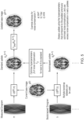
- Figure 5 illustrates schematically a conceptual overview of a general imaging approach in accordance with a data processing approach according to Figure 4 .
- Such inverse problems may comprise, for example, image reconstruction and kinetic/functional parameter estimation in PET or SPECT.
- Approaches can allow for image reconstruction without a need for a manufacturer or a user to specify hyperparameters relating to the level of noise-compensation to use.
- Approaches can offer a useful method for implementation in relation to multi-modal imaging (such as simultaneous PET-MR), where it is desired to exploit information from each modality, but it is not known how much, if any, prior information can be safely used in the reconstruction.
- Iterative image reconstruction algorithms proceed at each iteration to add on a new 'change image' to a current image, so as to progress towards an image that satisfies the requirements of an objective function (for example, maximum likelihood (ML), least squares (LS) or maximum a posteriori (MAP)).
- an objective function for example, maximum likelihood (ML), least squares (LS) or maximum a posteriori (MAP)
- MLEM maximum likelihood
- LS least squares
- MAP maximum a posteriori
- the updated image will also suffer from the noise present in b, but notably this will be different noise to that in m (as the actual measured data m are regarded by bootstrapping as a model of the mean of a large ensemble of noisy datasets like b).
- ⁇ ⁇ arg min ⁇ D ⁇ mdata k + 1 , F ⁇ ⁇ boot k + 1 in which the goal is to find an optimal noise-compensation parameter(s), for a noise-reducing operator F ⁇ ⁇ ⁇ which when applied in some way (to be detailed below) to the bootstrapped
- the cross-objective function is a measure related to the distance D between the two images, which can be measured in many ways, but for Gaussian data corresponds to a least squares fit (to maximise a Gaussian cross likelihood), and for Poisson distributed data corresponds to the Kullback-Leibler (KL) measure of distance (to maximise a Poisson cross likelihood).
- This cross-objective function can also be viewed as an "ensemble mean objective function".
- the ensemble mean objective function is a measure related to the distance D between the mean of a large ensemble of noisy update images (modelled by ⁇ mdata k + 1 ) and any one or more of the noisy updates ( ⁇ boot k + 1 ).
- the process can be repeated for the next iterative update, and so on.
- the noise-compensation parameters are selected to be increasingly close to the noise-compensation parameters found by the optimisation procedure, and that the noise-compensation parameters are selected to correspond to the greatest level of noise compensation found from all previous uses of the optimisation procedure in the continued iterative updates.
- Figure 5 illustrates schematically a conceptual overview of a general image reconstruction approach in accordance with a data processing approach according to Figure 4 .
- a base image is processed via an iterative update U using a measured dataset to give a "standard” update.
- the processing of the base image using the same iterative update function U, but using a bootstrapped dataset to give a "bootstrapped” update.
- Those updates can be considered to be “interim" images or updates.
- noise compensating parameters can be found which operate on the bootstrapped image updates to minimise a difference between the standard and bootstrapped image updates. Having found noise compensating parameters which meet the minimised difference criteria, those noise compensating parameters can be used to process the base image via an iterative update U whilst also applying noise compensation to give a new updated base image.
- ⁇ (k) (b) is the 'change image' at iteration k which is effectively added to a current image to obtain the next update.
- Approaches select a denoising procedure for the change image which can be anything from a simple Gaussian smoothing, through to a multi-modal guided filtering process, or even a machine learning based denoising such as an artificial neural network.
- a goal is set to find an "optimal" choice of the noise compensation parameter(s) ⁇ through use of the cross objective function (3).
- this distance measure arises directly from seeking the maximum Poisson log-likelihood estimate. It will be appreciated that a goal other than minimising KL distance may be selected.
- the F ⁇ ⁇ ⁇ noise-compensating procedure (e.g. simple smoothing, or multi-modal guided edge-preserving smoothing in the case of MR guidance of PET or SPECT), has one or more noise compensating parameters ⁇ .
- a user selects a noise-compensating procedure and NOT the noise compensating parameters ⁇ .
- the cross-objective fitting in accordance with approaches operates automatically to adapt to the noise level in measured data and select appropriate noise compensating parameters.
- Another implementation of the general approach is one in which it is applied to Bayesian methods, which use a MAP objective.
- Any MAP update algorithm which depends on a choice of prior and a regularisation hyperparameter, can be used to generate a processed bootstrap update.
- B and C depend on weighted combinations of neighbouring voxels from the current image ⁇ (k) , allowing, for example, multi-modal guided regularisation via a spatially-variant weighted quadratic prior (e.g. the method of Bowsher [2]).
- Such an approach permits automatic and precise optimisation of ⁇ , and a user does not need to specify any level of regularisation to achieve a convergent MAP-EM image reconstruction algorithm. That algorithm delivers a final converged estimate of the reconstructed image fulfilling a desired regularised objective function.
- more than one regularisation component can be used in the objective function, for example, ⁇ 1 for the first part, ⁇ 2 for the second part, and so on.
- This may have particular value in the context of guided image reconstruction, whereby the level of guided regularisation can be automatically and precisely found, along with the level of conventional unguided regularisation (for example, a quadratic penalty function).
- the bootstrap data will tend towards the measured data.
- no noise-compensation is needed for data with no noise (optimal ⁇ from the cross objective function, "the ensemble mean objective function", will approach zero).
- the bootstrapped data derived update will need increasing levels of noise compensation in order to fit an update derived from the measured data.
- the optimal ⁇ from the cross-objective fitting will increase with increasing noise in the measured data, as more noise-compensation will be needed to map a noisy update towards a model of the mean of an ensemble of noisy updates.
- Figure 1 comprises a low, mid- and high-count data comparison (for 1%, 10% and 100% of the measured real data).
- the first column comprises the conventional MLEM reconstruction of these three cases, the second column shows these images with typical post-smoothing with a 4 mm Gaussian kernel (as often done as standard for clinical images).
- the rightmost three columns (columns 4, 5 and 6) show standard MAPEM reconstructions for different choices of the hyperparameter ⁇ , where it can be seen that the visually better results are obtained for different choices of hyperparameter for different count levels.
- the third column outlined in the Figure, shows that the bootstrap-optimised MAPEM method automatically delivers images of good quality for all count levels, which cannot be found using the other methods unless their hyperparameters are adjusted and explored by the user.
- Figure 2 shows the MR image for the subject data from Figure 1 .
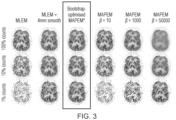
- Figure 3 comprises a similar comparison to that of Figure 1 , the general structure of columns and images is the same as that described in relation to Figure 1 , but now making using the MR image from Figure 2 , in order to provide prior structural information for MAP EM to assist in the noise compensation, using the Bowsher method [2].
- the bootstrap-optimised MAPEM method automatically picks the appropriate hyperparameters for all noise levels. It will be appreciated that the level of noise compensation applied by implementations described above is appropriate to the level of noise in the data. It is believed that a clinician would prefer images such as those shown in the third outlined column, compared to the current standard methods shown in the other columns.
- Figures 1 and 3 illustrate possible results using implementations in accordance with described approaches, with high count data and extremely low count data, and the same algorithm has been used in both cases. It can be seen that consistent good quality images are obtained by applying a method in accordance with described approaches.
- the third outlined column shows an excellent result in which a strength of smoothing, the amount of the prior which is used, is visually appropriate.
- Implementations of approaches allow for objective and precise selection of a trade-off between image detail and image noise throughout iterative updates by means of cross-objective fitting.
- Approaches remove arbitrary noise compensation parameter selection from a user and/or manufacturer, providing a robustness of reconstructed image quality. Such robustness for highly varying count levels has not previously been obtained in emission tomography.
- Approaches can be of particular use in the context of multi-modal imaging, where other images can be used to assist in noise reduction, and where it can be very subjective to decide to what strength such additional sources of information should be used.
- PET or SPECT scanners for reconstruction in clinical and preclinical imaging for cancer, heart and the brain, where limited scan times and limited injected activity lead to count-limited (noisy) data
- CT computed tomography
- MRI magnetic resonance imaging sequences: some MR images suffer from limited SNR and therefore have noisy k-space data.
- image processing and denoising e.g. photo and image denoising, video denoising
- non-destructive testing e.g. CT and impedance tomography
- remote sensing e.g. satellite imaging and seismic imaging
- astrophysics e.g. multi-spectral imaging
- security imaging e.g. CT
- Cross validation methods [3] and bootstrap filtering methods [4] are known.
- the known methods rely on cross validation as a stopping criterion - which means the results are susceptible to suffering from spatially-variant convergence (spatially-variant resolution and noise).
- More recent advanced cross validation methods [5] require preselection of a limited number of example noise-compensating parameters, specification of a subset of data to cross validate, and then an entire reconstruction to be conducted for each example set of noise-compensating parameters. That results in low precision selection of the noise compensation parameters, and depends also on the choice of subset of data for cross validation purposes.
- Other more advanced generalised cross validation methods [6] rely on fixed instances of regularisation such as total variation, and so do not offer flexibility, scope and general applicability.
- the bootstrap filtering uses a forward projection of the cross validation stopped image. The forward projection is used as a means of generating bootstrap samples.
- the known method involves reconstruction from numerous bootstrap samples and finding an expectation.
- Approaches and implementations as described here differ from those known in that: Approaches can relate to a method which can be run once only to convergence, involving no stopping criterion.
- Approaches are such that they allow any denoising procedure to be embedded directly at any or each step into any iterative reconstruction algorithm.
- Approaches are such that they can adaptively and precisely optimise parameterisation of any denoising for each update.
- Approaches are such that they can automatically and precisely optimise parameterisation of any denoising for each update.
- noise compensation approach can be as simple as a Gaussian smoothing kernel for which, at each iterative step, an optimal kernel width can be found, or as complicated as advanced guided smoothing (again, with a parameterisation specifically optimised according to the measured data) for inclusion in reconstruction.
- known methods such as those in [3] and [4] concern stopping or a single "non-linear" filtering method, which is defined by the average of the approximated multiple bootstrapped MLEM results. That provides a one off averaging process, which is further constrained by central use of a stopped image estimate, which has unknown spatially variant convergence.
- Approaches described herein may be implemented for any standard iterative image reconstruction method and provide a method in which use of, for example, just one (or more) bootstrapped resampled datasets allows powerful state-of-the-art denoising algorithms to be directly embedded into image reconstruction with relative simplicity.
- Approaches provide a mechanism for automatic data-dependent and precision optimisation of the strength of any denoising at every update.
Landscapes
- Engineering & Computer Science (AREA)
- Physics & Mathematics (AREA)
- General Physics & Mathematics (AREA)
- Theoretical Computer Science (AREA)
- Multimedia (AREA)
- Signal Processing (AREA)
- Image Processing (AREA)
- Magnetic Resonance Imaging Apparatus (AREA)
- Apparatus For Radiation Diagnosis (AREA)
Claims (7)
- Computerimplementiertes Verfahren zum Erzeugen eines Bildes, das für einen gemessenen Datensatz repräsentativ ist, durch iteratives Aktualisieren eines Basisbildes, wobei das Verfahren umfasst:Verwenden des gemessenen Datensatzes als Hauptdatensatz, oder Generieren eines Hauptdatensatzes aus dem gemessenen Datensatz durch Generieren eines Bootstrap-Datensatzes aus dem gemessenen Datensatz;Generieren mindestens eines zusätzlichen, unterschiedlichen Datensatzes aus dem gemessenen Datensatz, wobei der zusätzliche, unterschiedliche Datensatz umfasst: einen Datensatz, der aus dem gemessenen Datensatz generiert wird, sodass jeder zusätzliche, unterschiedliche Datensatz ein Rauschen auf im Wesentlichen demselben Niveau wie der gemessene Datensatz aufweist, und sodass jeder zusätzliche, unterschiedliche Datensatz nicht mit dem Hauptdatensatz identisch ist, durch Erzeugen eines oder mehrerer Bootstrap-Datensätze, die aus dem gemessenen Datensatz abgetastet werden;Verarbeiten des Basisbildes ohne Rauschkompensation unter Verwendung des Hauptdatensatzes, um ein Hauptzwischenbild zu erhalten, und Verarbeiten des Basisbildes ohne Rauschkompensation unter Verwendung jedes zusätzlichen Datensatzes, um mindestens ein zusätzliches Zwischenbild zu erhalten;Vergleichen des Hauptzwischenbildes und des mindestens einen zusätzlichen Zwischenbildes, um eine Angabe eines vorhandenen Rauschniveaus zu bestimmen; undVerwenden der bestimmten Angabe eines vorhandenen Rauschens, um Rauschkompensation auszuwählen, die angewendet werden soll, wenn das Basisbild unter Verwendung des gemessenen Datensatzes verarbeitet wird, um ein neues Basisbild zu erzeugen, das für den gemessenen Datensatz repräsentativ ist;wobei das Vergleichen des Haupt- und mindestens eines oder mehrerer zusätzlicher Zwischenbilder, um eine Angabe eines vorhandenen Rauschens zu bestimmen, umfasst:Implementieren einer Zielfunktion, dergemäß es das Ziel ist, einen oder mehrere Parameter für eine Rauschkompensationsprozedur zu finden, die, wenn siegefunden, und auf das eine oder mehrere zusätzliche Zwischenbilder angewendet wird, zu einer Aktualisierung jedes zusätzlichen Zwischenbildes führt, sodass ihre kollektive Differenz vom Hauptzwischenbild minimiert wird; undwobei Parameter der Rauschkompensation in frühen iterativen Aktualisierungen des Basisbildes modifiziert werden, um ein höheres Niveau an Rauschkompensation zu bewirken als jenes, das durch eine Optimierungsprozedur der Zielfunktion gefunden wurde, um iterative Aktualisierungen des Basisbildes zu verlangsamen und Ansammlung von Restrauschen zu vermeiden, und wobei mit fortschreitenden iterativen Aktualisierungen die Rauschkompensationsparameter ausgewählt werden, um zunehmend näher an den Parametern zu liegen, die durch die Optimierungsprozedur der Zielfunktion gefunden wurden, und dass die Parameter ausgewählt werden, um dem höchsten Niveau an Rauschkompensation zu entsprechen, das bei allen vorherigen Verwendungen der Optimierungsprozedur in den fortschreitenden iterativen Aktualisierungen gefunden wurde.
- Verfahren zum Erzeugen eines Bildes nach Anspruch 1, wobei das Verfahren umfasst: Verwenden der ausgewählten Rauschkompensation zum Produzieren einer iterativen Aktualisierung des Basisbildes basierend auf dem gemessenen Datensatz, um das neue Basisbild zu erhalten, das für den gemessenen Datensatz repräsentativ ist, und wobei die iterative Aktualisierung optional eine additive oder multiplikative Aktualisierung umfasst.
- Verfahren zum Erzeugen eines Bildes nach Anspruch 2, umfassend:
Verarbeiten des Basisbildes unter Verwendung einer anderen ausgewählten Rauschkompensationsprozedur; und Vergleichen eines erzeugten Bildes, das unter Verwendung der ausgewählten Rauschkompensationsprozedur und der unterschiedlichen ausgewählten Rauschkompensationsprozedur erhalten wurde, um auszuwählen, welche Rauschkompensationsprozedur anzuwenden ist, wenn das Basisbild unter Verwendung des gemessenen Datensatzes verarbeitet wird, um ein neues Basisbild zu erzeugen, das für den gemessenen Datensatz repräsentativ ist, und wobei das Auswählen, welche Rauschkompensationsprozedur anzuwenden ist, optional umfasst: Vergleichen eines Zwischenbildes, das unter Verwendung der Rauschkompensationsprozedur erhalten wurde, mit dem Hauptzwischenbild. - Verfahren zum Erzeugen eines Bildes nach Anspruch 1, wobei die Zielfunktion umfasst: ein Maß, das sich auf den Abstand zwischen dem einen oder mehreren zusätzlichen Zwischenbildern und dem Hauptzwischenbild bezieht, und wobei das Maß, das sich auf den Abstand bezieht, optional umfasst: eines von: einer Summe des quadrierten Abstands, ein Kullback-Leibler-Abstandsmaß, eine beliebige Norm als Abstandsmaß, oder ein anderes geeignetes Cross-Likelihood-Maß, das mit dem Abstand korreliert ist.
- Verfahren zum Erzeugen eines Bildes nach einem vorstehenden Anspruch, wobei das Verarbeiten mit Rauschkompensation einer regulierten iterativen Aktualisierung entspricht, die von einem regulierten iterativen Bildrekonstruktionsalgorithmus, der den gemessenen Datensatz verwendet, abgeleitet ist.
- Computerprogrammprodukt, das, wenn es auf einem Computer ausgeführt wird, betriebsfähig ist, um das Verfahren nach einem der Ansprüche 1 bis 5 durchzuführen.
- Bildgebungseinrichtung, die konfiguriert ist, um ein Bild, das für einen gemessenen Datensatz repräsentativ ist, aus einem Basisbild durch iteratives Aktualisieren eines Basisbildes zu erzeugen, wobei die Einrichtung umfasst:Datensatzgenerierungslogik, die konfiguriert ist, um den gemessenen Datensatz als Hauptdatensatz zu verwenden, oder einen Hauptdatensatz aus dem gemessenen Datensatz durch Generieren eines Bootstrap-Datensatzes aus dem gemessenen Datensatz zu generieren, wobei die Datensatzgenerierungslogik weiter konfiguriert ist, um mindestens einen zusätzlichen, unterschiedlichen Datensatz aus dem gemessenen Datensatz zu generieren, wobei der zusätzliche, unterschiedliche Datensatz umfasst: einen Datensatz, der aus dem gemessenen Datensatz generiert wird, sodass jeder zusätzliche, unterschiedliche Datensatz ein Rauschen auf im Wesentlichen demselben Niveau wie der gemessene Datensatz aufweist, und sodass jeder zusätzliche, unterschiedliche Datensatz nicht mit dem Hauptdatensatz identisch ist, durch Erzeugen eines oder mehrerer Bootstrap-Datensätze, die aus dem gemessenen Datensatz abgetastet werden.Verarbeitungslogik, die konfiguriert ist, um das Basisbild ohne Rauschkompensation unter Verwendung des Hauptdatensatzes zu verarbeiten, um ein Hauptzwischenbild zu erhalten, und Verarbeiten des Basisbildes ohne Rauschkompensation unter Verwendung jedes zusätzlichen Datensatzes, um mindestens ein zusätzliches Zwischenbild zu erhalten;Vergleichslogik, die konfiguriert ist, um das Hauptzwischenbild und mindestens ein zusätzliches Zwischenbild zu vergleichen, um eine Angabe eines vorhandenen Rauschniveaus zu bestimmen; und Bilderzeugungslogik, die konfiguriert ist, um die bestimmte Angabe eines Rauschens zu verwenden, um ein Niveau an Rauschkompensation auszuwählen, das anzuwenden ist, wenn das Basisbild unter Verwendung des gemessenen Datensatzes verarbeitet wird, um ein neues Basisbild zu erzeugen, das für den gemessenen Datensatz repräsentativ ist;wobei die Vergleichslogik, um das Haupt- und mindestens ein oder mehrere zusätzliche Zwischenbilder zu vergleichen, um eine Angabe eines vorhandenen Rauschens zu bestimmen, weiter konfiguriert ist, um eine Zielfunktion zu implementieren, dergemäß es das Ziel ist, einen oder mehrere Parameter für eine Rauschkompensationsprozedur zu finden, die, wenn sie gefunden, und auf das eine oder mehrere zusätzliche Zwischenbilder angewendet wird, zu einer Aktualisierung jedes zusätzlichen Zwischenbildes führt, sodass ihre kollektive Differenz vom Hauptzwischenbild minimiert wird undwobei Parameter der Rauschkompensation in frühen iterativen Aktualisierungen des Basisbildes modifiziert werden, um ein höheres Niveau an Rauschkompensation zu bewirken als jenes, das durch eine Optimierungsprozedur der Zielfunktion gefunden wurde, um iterative Aktualisierungen des Basisbildes zu verlangsamen und Ansammlung von Restrauschen zu vermeiden, und wobei mit fortschreitenden iterativen Aktualisierungen Rauschkompensationsparameter ausgewählt werden, um zunehmend näher an den Rauschkompensationsparametern zu liegen, die durch die Optimierungsprozedur der Zielfunktion gefunden wurden, und dass die Parameter ausgewählt werden, um dem höchsten Niveau an Rauschkompensation zu entsprechen, das bei allen vorherigen Verwendungen der Optimierungsprozedur in den fortschreitenden iterativen Aktualisierungen gefunden wurde.
Applications Claiming Priority (2)
| Application Number | Priority Date | Filing Date | Title |
|---|---|---|---|
| GBGB1904678.8A GB201904678D0 (en) | 2019-04-03 | 2019-04-03 | Image reconstruction |
| PCT/GB2020/050876 WO2020201755A1 (en) | 2019-04-03 | 2020-04-02 | Image reconstruction |
Publications (2)
| Publication Number | Publication Date |
|---|---|
| EP3948765A1 EP3948765A1 (de) | 2022-02-09 |
| EP3948765B1 true EP3948765B1 (de) | 2025-01-29 |
Family
ID=66442977
Family Applications (1)
| Application Number | Title | Priority Date | Filing Date |
|---|---|---|---|
| EP20718741.0A Active EP3948765B1 (de) | 2019-04-03 | 2020-04-02 | Bildrekonstruktion |
Country Status (7)
| Country | Link |
|---|---|
| US (1) | US12347073B2 (de) |
| EP (1) | EP3948765B1 (de) |
| JP (1) | JP7603994B2 (de) |
| CN (1) | CN113811917B (de) |
| CA (1) | CA3135942A1 (de) |
| GB (1) | GB201904678D0 (de) |
| WO (1) | WO2020201755A1 (de) |
Families Citing this family (2)
| Publication number | Priority date | Publication date | Assignee | Title |
|---|---|---|---|---|
| CN110070588B (zh) * | 2019-04-24 | 2023-01-31 | 上海联影医疗科技股份有限公司 | Pet图像重建方法、系统、可读存储介质和设备 |
| JP2023112818A (ja) * | 2022-02-02 | 2023-08-15 | 浜松ホトニクス株式会社 | 画像処理装置および画像処理方法 |
Family Cites Families (14)
| Publication number | Priority date | Publication date | Assignee | Title |
|---|---|---|---|---|
| US7187794B2 (en) * | 2001-10-18 | 2007-03-06 | Research Foundation Of State University Of New York | Noise treatment of low-dose computed tomography projections and images |
| FR2886433B1 (fr) * | 2005-05-30 | 2007-09-07 | Commissariat Energie Atomique | Methode de segmentation d'une sequence d'images tridimensionnelles, notamment en pharmaco-imagerie. |
| US8515171B2 (en) * | 2009-01-09 | 2013-08-20 | Rochester Institute Of Technology | Methods for adaptive and progressive gradient-based multi-resolution color image segmentation and systems thereof |
| DE102010022305A1 (de) * | 2010-06-01 | 2011-12-01 | Siemens Aktiengesellschaft | Iterative Rekonstruktion von CT-Bilern ohne Regularisierungsterm |
| DE102010022306A1 (de) | 2010-06-01 | 2011-12-01 | Siemens Aktiengesellschaft | Iterative CT-Bildrekonstruktion in Kombination mit einem vierdimensionalen Rauschfilter |
| US9076191B2 (en) | 2011-12-13 | 2015-07-07 | Koninklijke Philips N.V. | Automatic determination of regularization factor for iterative image reconstruction with regularization and/or image de-noising |
| DE102012204977B4 (de) * | 2012-03-28 | 2017-05-18 | Siemens Healthcare Gmbh | Verfahren zur iterativen Bildrekonstruktion für Bi-Modale CT-Daten sowie entsprechende Recheneinheit, Computertomographiesystem, Computerprogramm und Datenträger |
| JP6333551B2 (ja) | 2013-12-27 | 2018-05-30 | キヤノンメディカルシステムズ株式会社 | 医用画像診断装置及び画像処理装置 |
| US9569736B1 (en) * | 2015-09-16 | 2017-02-14 | Siemens Healthcare Gmbh | Intelligent medical image landmark detection |
| US9990741B2 (en) * | 2015-09-28 | 2018-06-05 | Siemens Medical Solutions Usa, Inc. | Motion correction in a projection domain in time of flight positron emission tomography |
| US11200711B2 (en) * | 2015-11-17 | 2021-12-14 | Koninklijke Philips N.V. | Smart filtering for PET imaging including automatic selection of filter parameters based on patient, imaging device, and/or medical context information |
| CN107133549B (zh) * | 2016-02-29 | 2020-11-24 | 上海联影医疗科技有限公司 | Ect运动门控信号获取方法及ect图像重建方法 |
| TWI611795B (zh) * | 2016-07-18 | 2018-01-21 | 許百靈 | 多針孔單光子spect心肌血流絕對定量方法與用途 |
| JP2019013268A (ja) * | 2017-07-03 | 2019-01-31 | キヤノン株式会社 | 画像生成装置、画像生成方法及びプログラム |
-
2019
- 2019-04-03 GB GBGB1904678.8A patent/GB201904678D0/en not_active Ceased
-
2020
- 2020-04-02 CA CA3135942A patent/CA3135942A1/en active Pending
- 2020-04-02 JP JP2021559172A patent/JP7603994B2/ja active Active
- 2020-04-02 WO PCT/GB2020/050876 patent/WO2020201755A1/en not_active Ceased
- 2020-04-02 US US17/601,135 patent/US12347073B2/en active Active
- 2020-04-02 EP EP20718741.0A patent/EP3948765B1/de active Active
- 2020-04-02 CN CN202080035176.4A patent/CN113811917B/zh active Active
Also Published As
| Publication number | Publication date |
|---|---|
| GB201904678D0 (en) | 2019-05-15 |
| JP7603994B2 (ja) | 2024-12-23 |
| JP2022528902A (ja) | 2022-06-16 |
| CN113811917A (zh) | 2021-12-17 |
| WO2020201755A1 (en) | 2020-10-08 |
| EP3948765A1 (de) | 2022-02-09 |
| CN113811917B (zh) | 2025-08-12 |
| US12347073B2 (en) | 2025-07-01 |
| CA3135942A1 (en) | 2020-10-08 |
| US20220172328A1 (en) | 2022-06-02 |
Similar Documents
| Publication | Publication Date | Title |
|---|---|---|
| Zhou et al. | Handbook of medical image computing and computer assisted intervention | |
| Dawant et al. | Correction of intensity variations in MR images for computer-aided tissue classification | |
| CN110168612B (zh) | 用于正电子发射断层摄影成像中改善的结果稳健性的标准化的摄取值指导的重建控制 | |
| US8058601B2 (en) | Determining a multimodal pixon map for tomographic-image reconstruction | |
| EP2671209B1 (de) | Verfahren und system zur ct-bildrekonstruktion mit doppelenergie | |
| EP2238571B1 (de) | System zur Bildverarbeitung unter Verwendung von Hauptkomponentenanalyse | |
| WO2020214911A1 (en) | Method and system for generating attenuation map from spect emission data based upon deep learning | |
| US20140301624A1 (en) | Method for interactive threshold segmentation of medical images | |
| JP7065830B6 (ja) | 異なる反復から抽出された特徴画像を使用する特徴ベースの画像処理 | |
| US10937208B2 (en) | PET image reconstruction and processing using lesion proxies | |
| CN108352058A (zh) | 针对低剂量和/或高分辨率pet成像的数据和扫描器规格指导的智能滤波 | |
| Reader et al. | Bootstrap-optimised regularised image reconstruction for emission tomography | |
| EP3948765B1 (de) | Bildrekonstruktion | |
| Chen et al. | Simultaneous reconstruction and segmentation of dynamic PET via low-rank and sparse matrix decomposition | |
| Mori et al. | Medical Image Computing and Computer-Assisted Intervention--MICCAI 2013: 16th International Conference, Nagoya, Japan, September 22-26, 2013, Proceedings, Part III | |
| US20200388058A1 (en) | Deep learning based image figure of merit prediction | |
| CN111968192B (zh) | 一种ct图像的构建方法、ct设备以及存储介质 | |
| US20250245820A1 (en) | Controllable no-reference denoising of medical images | |
| CN113469915A (zh) | 一种基于去噪打分匹配网络的pet重建方法 | |
| Rapisarda et al. | Optimized Bayes variational regularization prior for 3D PET images | |
| CN105488824A (zh) | 一种重建pet图像的方法和装置 | |
| US11704795B2 (en) | Quality-driven image processing | |
| Zhou et al. | A generalized diffusion based inter-iteration nonlinear bilateral filtering scheme for PET image reconstruction | |
| CN114241069B (zh) | 一种pet图像的散射校正方法 | |
| Thibault et al. | Correction of gain fluctuations in iterative tomographic image reconstruction |
Legal Events
| Date | Code | Title | Description |
|---|---|---|---|
| STAA | Information on the status of an ep patent application or granted ep patent |
Free format text: STATUS: UNKNOWN |
|
| STAA | Information on the status of an ep patent application or granted ep patent |
Free format text: STATUS: THE INTERNATIONAL PUBLICATION HAS BEEN MADE |
|
| PUAI | Public reference made under article 153(3) epc to a published international application that has entered the european phase |
Free format text: ORIGINAL CODE: 0009012 |
|
| STAA | Information on the status of an ep patent application or granted ep patent |
Free format text: STATUS: REQUEST FOR EXAMINATION WAS MADE |
|
| 17P | Request for examination filed |
Effective date: 20211101 |
|
| AK | Designated contracting states |
Kind code of ref document: A1 Designated state(s): AL AT BE BG CH CY CZ DE DK EE ES FI FR GB GR HR HU IE IS IT LI LT LU LV MC MK MT NL NO PL PT RO RS SE SI SK SM TR |
|
| DAV | Request for validation of the european patent (deleted) | ||
| DAX | Request for extension of the european patent (deleted) | ||
| STAA | Information on the status of an ep patent application or granted ep patent |
Free format text: STATUS: EXAMINATION IS IN PROGRESS |
|
| 17Q | First examination report despatched |
Effective date: 20230908 |
|
| RIC1 | Information provided on ipc code assigned before grant |
Ipc: A61B 5/03 20060101ALI20240612BHEP Ipc: G06T 5/50 20060101ALI20240612BHEP Ipc: G06T 5/70 20240101ALI20240612BHEP Ipc: G06T 5/00 20060101AFI20240612BHEP |
|
| GRAP | Despatch of communication of intention to grant a patent |
Free format text: ORIGINAL CODE: EPIDOSNIGR1 |
|
| STAA | Information on the status of an ep patent application or granted ep patent |
Free format text: STATUS: GRANT OF PATENT IS INTENDED |
|
| INTG | Intention to grant announced |
Effective date: 20240913 |
|
| GRAS | Grant fee paid |
Free format text: ORIGINAL CODE: EPIDOSNIGR3 |
|
| GRAA | (expected) grant |
Free format text: ORIGINAL CODE: 0009210 |
|
| STAA | Information on the status of an ep patent application or granted ep patent |
Free format text: STATUS: THE PATENT HAS BEEN GRANTED |
|
| AK | Designated contracting states |
Kind code of ref document: B1 Designated state(s): AL AT BE BG CH CY CZ DE DK EE ES FI FR GB GR HR HU IE IS IT LI LT LU LV MC MK MT NL NO PL PT RO RS SE SI SK SM TR |
|
| REG | Reference to a national code |
Ref country code: GB Ref legal event code: FG4D |
|
| REG | Reference to a national code |
Ref country code: CH Ref legal event code: EP |
|
| REG | Reference to a national code |
Ref country code: DE Ref legal event code: R096 Ref document number: 602020045492 Country of ref document: DE |
|
| REG | Reference to a national code |
Ref country code: IE Ref legal event code: FG4D |
|
| P01 | Opt-out of the competence of the unified patent court (upc) registered |
Free format text: CASE NUMBER: APP_4515/2025 Effective date: 20250127 |
|
| REG | Reference to a national code |
Ref country code: NL Ref legal event code: MP Effective date: 20250129 |
|
| PG25 | Lapsed in a contracting state [announced via postgrant information from national office to epo] |
Ref country code: NL Free format text: LAPSE BECAUSE OF FAILURE TO SUBMIT A TRANSLATION OF THE DESCRIPTION OR TO PAY THE FEE WITHIN THE PRESCRIBED TIME-LIMIT Effective date: 20250129 |
|
| PG25 | Lapsed in a contracting state [announced via postgrant information from national office to epo] |
Ref country code: RS Free format text: LAPSE BECAUSE OF FAILURE TO SUBMIT A TRANSLATION OF THE DESCRIPTION OR TO PAY THE FEE WITHIN THE PRESCRIBED TIME-LIMIT Effective date: 20250429 |
|
| PG25 | Lapsed in a contracting state [announced via postgrant information from national office to epo] |
Ref country code: FI Free format text: LAPSE BECAUSE OF FAILURE TO SUBMIT A TRANSLATION OF THE DESCRIPTION OR TO PAY THE FEE WITHIN THE PRESCRIBED TIME-LIMIT Effective date: 20250129 |
|
| PG25 | Lapsed in a contracting state [announced via postgrant information from national office to epo] |
Ref country code: PL Free format text: LAPSE BECAUSE OF FAILURE TO SUBMIT A TRANSLATION OF THE DESCRIPTION OR TO PAY THE FEE WITHIN THE PRESCRIBED TIME-LIMIT Effective date: 20250129 |
|
| PGFP | Annual fee paid to national office [announced via postgrant information from national office to epo] |
Ref country code: DE Payment date: 20250417 Year of fee payment: 6 |
|
| PG25 | Lapsed in a contracting state [announced via postgrant information from national office to epo] |
Ref country code: ES Free format text: LAPSE BECAUSE OF FAILURE TO SUBMIT A TRANSLATION OF THE DESCRIPTION OR TO PAY THE FEE WITHIN THE PRESCRIBED TIME-LIMIT Effective date: 20250129 |
|
| PGFP | Annual fee paid to national office [announced via postgrant information from national office to epo] |
Ref country code: GB Payment date: 20250410 Year of fee payment: 6 |
|
| REG | Reference to a national code |
Ref country code: LT Ref legal event code: MG9D |
|
| PG25 | Lapsed in a contracting state [announced via postgrant information from national office to epo] |
Ref country code: IS Free format text: LAPSE BECAUSE OF FAILURE TO SUBMIT A TRANSLATION OF THE DESCRIPTION OR TO PAY THE FEE WITHIN THE PRESCRIBED TIME-LIMIT Effective date: 20250529 Ref country code: NO Free format text: LAPSE BECAUSE OF FAILURE TO SUBMIT A TRANSLATION OF THE DESCRIPTION OR TO PAY THE FEE WITHIN THE PRESCRIBED TIME-LIMIT Effective date: 20250429 |
|
| REG | Reference to a national code |
Ref country code: AT Ref legal event code: MK05 Ref document number: 1764201 Country of ref document: AT Kind code of ref document: T Effective date: 20250129 |
|
| PG25 | Lapsed in a contracting state [announced via postgrant information from national office to epo] |
Ref country code: HR Free format text: LAPSE BECAUSE OF FAILURE TO SUBMIT A TRANSLATION OF THE DESCRIPTION OR TO PAY THE FEE WITHIN THE PRESCRIBED TIME-LIMIT Effective date: 20250129 |
|
| PG25 | Lapsed in a contracting state [announced via postgrant information from national office to epo] |
Ref country code: PT Free format text: LAPSE BECAUSE OF FAILURE TO SUBMIT A TRANSLATION OF THE DESCRIPTION OR TO PAY THE FEE WITHIN THE PRESCRIBED TIME-LIMIT Effective date: 20250529 Ref country code: LV Free format text: LAPSE BECAUSE OF FAILURE TO SUBMIT A TRANSLATION OF THE DESCRIPTION OR TO PAY THE FEE WITHIN THE PRESCRIBED TIME-LIMIT Effective date: 20250129 |
|
| PGFP | Annual fee paid to national office [announced via postgrant information from national office to epo] |
Ref country code: FR Payment date: 20250422 Year of fee payment: 6 |
|
| PG25 | Lapsed in a contracting state [announced via postgrant information from national office to epo] |
Ref country code: GR Free format text: LAPSE BECAUSE OF FAILURE TO SUBMIT A TRANSLATION OF THE DESCRIPTION OR TO PAY THE FEE WITHIN THE PRESCRIBED TIME-LIMIT Effective date: 20250430 Ref country code: BG Free format text: LAPSE BECAUSE OF FAILURE TO SUBMIT A TRANSLATION OF THE DESCRIPTION OR TO PAY THE FEE WITHIN THE PRESCRIBED TIME-LIMIT Effective date: 20250129 |
|
| PG25 | Lapsed in a contracting state [announced via postgrant information from national office to epo] |
Ref country code: AT Free format text: LAPSE BECAUSE OF FAILURE TO SUBMIT A TRANSLATION OF THE DESCRIPTION OR TO PAY THE FEE WITHIN THE PRESCRIBED TIME-LIMIT Effective date: 20250129 |
|
| PG25 | Lapsed in a contracting state [announced via postgrant information from national office to epo] |
Ref country code: SE Free format text: LAPSE BECAUSE OF FAILURE TO SUBMIT A TRANSLATION OF THE DESCRIPTION OR TO PAY THE FEE WITHIN THE PRESCRIBED TIME-LIMIT Effective date: 20250129 |
|
| PG25 | Lapsed in a contracting state [announced via postgrant information from national office to epo] |
Ref country code: SM Free format text: LAPSE BECAUSE OF FAILURE TO SUBMIT A TRANSLATION OF THE DESCRIPTION OR TO PAY THE FEE WITHIN THE PRESCRIBED TIME-LIMIT Effective date: 20250129 |
|
| PG25 | Lapsed in a contracting state [announced via postgrant information from national office to epo] |
Ref country code: DK Free format text: LAPSE BECAUSE OF FAILURE TO SUBMIT A TRANSLATION OF THE DESCRIPTION OR TO PAY THE FEE WITHIN THE PRESCRIBED TIME-LIMIT Effective date: 20250129 |
|
| PG25 | Lapsed in a contracting state [announced via postgrant information from national office to epo] |
Ref country code: IT Free format text: LAPSE BECAUSE OF FAILURE TO SUBMIT A TRANSLATION OF THE DESCRIPTION OR TO PAY THE FEE WITHIN THE PRESCRIBED TIME-LIMIT Effective date: 20250129 |
|
| PG25 | Lapsed in a contracting state [announced via postgrant information from national office to epo] |
Ref country code: CZ Free format text: LAPSE BECAUSE OF FAILURE TO SUBMIT A TRANSLATION OF THE DESCRIPTION OR TO PAY THE FEE WITHIN THE PRESCRIBED TIME-LIMIT Effective date: 20250129 Ref country code: EE Free format text: LAPSE BECAUSE OF FAILURE TO SUBMIT A TRANSLATION OF THE DESCRIPTION OR TO PAY THE FEE WITHIN THE PRESCRIBED TIME-LIMIT Effective date: 20250129 |
|
| PG25 | Lapsed in a contracting state [announced via postgrant information from national office to epo] |
Ref country code: RO Free format text: LAPSE BECAUSE OF FAILURE TO SUBMIT A TRANSLATION OF THE DESCRIPTION OR TO PAY THE FEE WITHIN THE PRESCRIBED TIME-LIMIT Effective date: 20250129 |
|
| PG25 | Lapsed in a contracting state [announced via postgrant information from national office to epo] |
Ref country code: SK Free format text: LAPSE BECAUSE OF FAILURE TO SUBMIT A TRANSLATION OF THE DESCRIPTION OR TO PAY THE FEE WITHIN THE PRESCRIBED TIME-LIMIT Effective date: 20250129 |
|
| REG | Reference to a national code |
Ref country code: DE Ref legal event code: R097 Ref document number: 602020045492 Country of ref document: DE |
|
| REG | Reference to a national code |
Ref country code: CH Ref legal event code: H13 Free format text: ST27 STATUS EVENT CODE: U-0-0-H10-H13 (AS PROVIDED BY THE NATIONAL OFFICE) Effective date: 20251125 |
|
| PLBE | No opposition filed within time limit |
Free format text: ORIGINAL CODE: 0009261 |
|
| STAA | Information on the status of an ep patent application or granted ep patent |
Free format text: STATUS: NO OPPOSITION FILED WITHIN TIME LIMIT |
|
| PG25 | Lapsed in a contracting state [announced via postgrant information from national office to epo] |
Ref country code: LU Free format text: LAPSE BECAUSE OF NON-PAYMENT OF DUE FEES Effective date: 20250402 |
|
| PG25 | Lapsed in a contracting state [announced via postgrant information from national office to epo] |
Ref country code: MC Free format text: LAPSE BECAUSE OF FAILURE TO SUBMIT A TRANSLATION OF THE DESCRIPTION OR TO PAY THE FEE WITHIN THE PRESCRIBED TIME-LIMIT Effective date: 20250129 |
|
| REG | Reference to a national code |
Ref country code: BE Ref legal event code: MM Effective date: 20250430 |
|
| 26N | No opposition filed |
Effective date: 20251030 |
|
| PG25 | Lapsed in a contracting state [announced via postgrant information from national office to epo] |
Ref country code: BE Free format text: LAPSE BECAUSE OF NON-PAYMENT OF DUE FEES Effective date: 20250430 |
|
| PG25 | Lapsed in a contracting state [announced via postgrant information from national office to epo] |
Ref country code: CH Free format text: LAPSE BECAUSE OF NON-PAYMENT OF DUE FEES Effective date: 20250430 |