EP3947948B1 - Marine outboard motor with piston cooling gallery - Google Patents
Marine outboard motor with piston cooling gallery Download PDFInfo
- Publication number
- EP3947948B1 EP3947948B1 EP20718731.1A EP20718731A EP3947948B1 EP 3947948 B1 EP3947948 B1 EP 3947948B1 EP 20718731 A EP20718731 A EP 20718731A EP 3947948 B1 EP3947948 B1 EP 3947948B1
- Authority
- EP
- European Patent Office
- Prior art keywords
- piston
- cooling gallery
- fluid
- cooling
- ring
- Prior art date
- Legal status (The legal status is an assumption and is not a legal conclusion. Google has not performed a legal analysis and makes no representation as to the accuracy of the status listed.)
- Active
Links
Images




Classifications
-
- F—MECHANICAL ENGINEERING; LIGHTING; HEATING; WEAPONS; BLASTING
- F01—MACHINES OR ENGINES IN GENERAL; ENGINE PLANTS IN GENERAL; STEAM ENGINES
- F01P—COOLING OF MACHINES OR ENGINES IN GENERAL; COOLING OF INTERNAL-COMBUSTION ENGINES
- F01P3/00—Liquid cooling
- F01P3/06—Arrangements for cooling pistons
- F01P3/10—Cooling by flow of coolant through pistons
-
- B—PERFORMING OPERATIONS; TRANSPORTING
- B63—SHIPS OR OTHER WATERBORNE VESSELS; RELATED EQUIPMENT
- B63H—MARINE PROPULSION OR STEERING
- B63H20/00—Outboard propulsion units, e.g. outboard motors or Z-drives; Arrangements thereof on vessels
-
- F—MECHANICAL ENGINEERING; LIGHTING; HEATING; WEAPONS; BLASTING
- F02—COMBUSTION ENGINES; HOT-GAS OR COMBUSTION-PRODUCT ENGINE PLANTS
- F02B—INTERNAL-COMBUSTION PISTON ENGINES; COMBUSTION ENGINES IN GENERAL
- F02B61/00—Adaptations of engines for driving vehicles or for driving propellers; Combinations of engines with gearing
- F02B61/04—Adaptations of engines for driving vehicles or for driving propellers; Combinations of engines with gearing for driving propellers
- F02B61/045—Adaptations of engines for driving vehicles or for driving propellers; Combinations of engines with gearing for driving propellers for marine engines
-
- F—MECHANICAL ENGINEERING; LIGHTING; HEATING; WEAPONS; BLASTING
- F02—COMBUSTION ENGINES; HOT-GAS OR COMBUSTION-PRODUCT ENGINE PLANTS
- F02F—CYLINDERS, PISTONS OR CASINGS, FOR COMBUSTION ENGINES; ARRANGEMENTS OF SEALINGS IN COMBUSTION ENGINES
- F02F3/00—Pistons
- F02F3/16—Pistons having cooling means
- F02F3/20—Pistons having cooling means the means being a fluid flowing through or along piston
- F02F3/22—Pistons having cooling means the means being a fluid flowing through or along piston the fluid being liquid
-
- F—MECHANICAL ENGINEERING; LIGHTING; HEATING; WEAPONS; BLASTING
- F16—ENGINEERING ELEMENTS AND UNITS; GENERAL MEASURES FOR PRODUCING AND MAINTAINING EFFECTIVE FUNCTIONING OF MACHINES OR INSTALLATIONS; THERMAL INSULATION IN GENERAL
- F16J—PISTONS; CYLINDERS; SEALINGS
- F16J1/00—Pistons; Trunk pistons; Plungers
- F16J1/09—Pistons; Trunk pistons; Plungers with means for guiding fluids
-
- F—MECHANICAL ENGINEERING; LIGHTING; HEATING; WEAPONS; BLASTING
- F16—ENGINEERING ELEMENTS AND UNITS; GENERAL MEASURES FOR PRODUCING AND MAINTAINING EFFECTIVE FUNCTIONING OF MACHINES OR INSTALLATIONS; THERMAL INSULATION IN GENERAL
- F16J—PISTONS; CYLINDERS; SEALINGS
- F16J9/00—Piston-rings, e.g. non-metallic piston-rings, seats therefor; Ring sealings of similar construction
- F16J9/12—Details
- F16J9/24—Members preventing rotation of rings in grooves
Definitions
- the present invention relates to a marine outboard motor with an internal combustion engine comprising a piston including a cooling gallery located within the piston body and an alignment pin configured to restrict circumferential displacement of a piston ring extending around the piston body.
- a cooling gallery within the piston body.
- a cooling fluid such as crankcase oil
- the cooling fluid may be supplied to gallery inlets along the piston rod, or sprayed against the underside of the piston body from an oil jet located beneath the piston body.
- Such cooling galleries are particularly effective with diesel internal combustion engines, in which the combustion surface is typically bowl shaped and the maximum temperature occurs around the rim of the combustion surface rather than at the centre. This can also be the case with direct injection petrol engines having a bowl shaped combustion surface.
- the ring belt Adjacent to the cooling gallery and on the outside of the annular side wall of the piston body, the ring belt typically includes a number of annular ring grooves within which piston rings are located.
- the piston rings are usually split rings having a ring gap between their opposed ends.
- it can be beneficial to restrict the circumferential displacement of the piston rings within the ring grooves. This enables the circumferential positions of the ring gaps to be maintained in a staggered arrangement to ensure adequate and even lubrication, and avoid excessive oil consumption and increased blow-by gases which might otherwise occur if the ring gaps were aligned. This can be particularly important with vertical axis engines, such as those often used in marine outboard motors, in which the cylinder bores are horizontally aligned and in which gravitational effects can further encourage ring gap alignment.
- the present invention seeks to provide an improved marine outboard motor which overcomes or mitigates one or more problems associated with the prior art.
- EP1198667A1 discloses a piston with an annular cooling channel through which cooling oil can flow.
- the oil flows into and out of the channel through diametrically opposed inlet and drain ports which face downwards away from the crown.
- the channel undulates in a series of wave crest and troughs.
- US 5,211,102A discloses a piston provided with a conventional alignment pin which is set in a radial bore within the top piston ring groove. The head of the pin protrudes into the ring groove to prevent piston ring rotation.
- JP 2001 164990A discloses a piston with an annular cooling cavity and an alignment pin to stop piston ring rotation.
- the alignment pin is held in a pin hole which is extends radially from the piston ring groove and opens into the cooling cavity.
- a marine outboard motor having an internal combustion engine, the internal combustion engine comprising: an engine block defining at least one cylinder; and a piston disposed in the at least one cylinder, wherein the piston comprises: a piston body including an upper combustion surface, an annular side wall with a ring belt region, and a cooling gallery located within the piston body radially inwardly from the ring belt region and having a fluid inlet through which a cooling fluid is supplied to the cooling gallery during operation; a piston ring located in a ring groove around the ring belt region; and an alignment pin secured in a hole in the piston side wall and projecting into the ring groove to restrict circumferential displacement of the piston ring, wherein the piston body further comprises a boss within the cooling gallery into which the hole and the alignment pin extend, wherein the boss projects into the cooling gallery opposite the fluid inlet and is shaped to provide a flow splitter surface configured to divide cooling fluid flowing through the fluid inlet during use into first and second fluid flows and to
- the boss forms a local increase in the thickness of the side wall of the piston body and thereby provides additional material into which the hole is provided.
- This allows the alignment pin, or "anti-rotation pin”, to be more securely retained in position and prevents any risk that the alignment pin might fall into the cooling gallery during operation and thereby cause an obstruction to cooling fluid flow around the cooling gallery.
- the boss also acts as a flow splitter to improve the circulation of cooling fluid around the cooling gallery and thereby reduce the maximum operating temperature of the piston.
- the boss serves the dual functions of both improving alignment pin retention and improving piston cooling performance.
- the cooling gallery may be part-annular.
- the cooling gallery may be arcuate.
- the cooling gallery is annular.
- the boss projects into the cooling gallery along only part of the total length of the cooling gallery. Preferably, the boss projects into the cooling gallery along less than 20 percent of the total length of the cooling gallery, more preferably less than 10 percent. Where the cooling gallery is annular, preferably the boss projects into the cooling gallery over a segment of the annular cooling gallery having an angular extent of less than 70 degrees, more preferably less than 35 degrees.
- the flow splitter surface is preferably configured to direct the first fluid flow around the annular cooling gallery in a first circumferential direction and to direct the second fluid flow around the annular cooling gallery in a second circumferential direction which is opposite to the first circumferential direction. In this manner, the combustion surface can be cooled more effectively and evenly.
- the flow splitter surface is substantially symmetrical. This can facilitate an even division of the flow of cooling fluid and consistent cooling performance on either side of the flow splitter.
- the flow splitter surface may be asymmetrical such that the flow of cooling fluid is divided unevenly. This may be beneficial where the cooling requirements of the cooling gallery differ on either side of the flow splitter surface.
- the flow splitter surface has a curved shape. That is, the flow splitter surface has a shape which has at least one curved portion. This can facilitate smooth division of the flow of cooling fluid and a smooth transition from an entry direction to a flow direction around the cooling channel.
- the boss may have a cross-sectional shape in the form of an arch.
- the flow splitter surface may have an angular shape, such as a triangular shape.
- the flow splitter surface has a curved peak, side flanks extending away from the curved peak, and curved ramps which form a transition between the side flanks and the adjacent surface of the cooling gallery.
- the side flanks may be linear.
- the side flanks may be curved.
- the flow splitter surface is aligned with the fluid inlet.
- the flow splitter surface has a central axis which is aligned with the central axis of the fluid inlet. This can facilitate an even division of the flow of cooling fluid and consistent cooling performance on either side of the flow splitter.
- the flow splitter may be radially and/or axially offset from the fluid inlet.
- the hole in the ring groove in which the alignment pin is secured is a blind hole which extends into the boss. This eliminates any possibility that the alignment pin might fall from the hole into the cooling gallery.
- the hole may be a through hole which extends through the boss.
- the hole may have a radially inner portion with a diameter less than that of the alignment pin and into which the alignment pin is prevented from moving.
- the boss projects into the cooling gallery at a location opposite the fluid inlet.
- the fluid inlet is located in a lower surface of the cooling gallery and the boss projects from an upper surface of the cooling gallery.
- the flow of cooling fluid enters the cooling gallery from underneath the piston body and is divided by the flow splitter on the opposite, upper surface.
- the fluid inlet and the boss may be located in other parts of the cooling gallery.
- the fluid inlet may be on a radially inner side surface of the cooling gallery, with the boss projecting from a radially outer side surface of the cooling gallery.
- the cooling gallery further comprises a fluid outlet through which the flow of cooling fluid leaves the cooling gallery during operation and which is separate to the fluid inlet.
- the cooling gallery may comprise a single port which acts as both a fluid inlet and fluid outlet so that cooling fluid enters into and drains from the cooling gallery at the same location.
- the fluid outlet is positioned at an opposite end of the cooling gallery to the fluid inlet such that the cooling gallery is divided into first and second cooling gallery halves by the fluid inlet and the fluid outlet.
- the fluid outlet is preferably diametrically opposed to the fluid inlet.
- the fluid outlet is located in a lower surface of the cooling gallery.
- the cooling fluid drains away from the cooling gallery from the underside of the piston body.
- both the fluid inlet and the fluid outlet are located in a lower surface of the cooling gallery.
- the cooling gallery may have a single fluid inlet or a plurality of fluid inlets.
- the cooling gallery may have a single fluid outlet or a plurality of fluid outlets.
- the piston may comprise a plurality of piston rings, each located in ring groove in the ring belt region.
- the piston may comprise a plurality of alignment pins, each projecting into a different one of the plurality of ring grooves to restrict circumferential displacement of the plurality of piston rings located in the plurality of ring grooves.
- the piston ring is a split ring with a ring gap between its opposed ends, wherein the alignment pin is received in the ring gap.
- the alignment pin may be received in a blind cavity on a radially inner surface of the piston ring, or may simply press against the radially inner surface of the piston ring.
- the piston ring is an oil control ring or a scraper ring.
- the internal combustion engine is a vertical axis internal combustion engine.
- the crankshaft is mounted vertically in the engine.
- the internal combustion engine may be a petrol engine.
- the internal combustion engine is a diesel engine.
- the internal combustion engine may be a turbocharged diesel engine.
- the cooling fluid may be any suitable cooling fluid.
- the cooling fluid may be lubricant used in the internal combustion engine.
- the cooling fluid may be oil.
- the cooling fluid may be crankcase oil drawn up from a crankcase of the internal combustion engine during operation.
- the cooling fluid may be supplied to the fluid inlet of the cooling gallery along a piston rod of the piston.
- the internal combustion engine may further comprise a cooling fluid jet configured to spray a jet of cooling fluid towards the piston body.
- the cooling fluid jet may be configured to spray a jet of cooling fluid directly into the cooling gallery through the fluid inlet.
- a cooling fluid jet may be provided in each cylinder to spray cooling fluid towards the piston body from a main cooling fluid gallery of the engine, such as a main oil gallery.
- engine block refers to a solid structure in which the at least one cylinder of the engine is provided.
- the term may refer to the combination of a cylinder block with a cylinder head and crankcase, or to the cylinder block only.
- the engine block may be formed from a single engine block casting.
- the engine block may be formed from a plurality of separate engine block castings which are connected together, for example using bolts.
- the engine block may comprise a single cylinder.
- the engine block comprises a plurality of cylinders.
- the engine block may comprise a single cylinder bank.
- the engine block may comprise a first cylinder bank and a second cylinder bank.
- the first and second cylinder banks may be arranged in a V configuration.
- the engine block may comprise three cylinder banks.
- the three cylinder banks may be arranged in a broad arrow configuration.
- the engine block may comprise four cylinder banks.
- the four cylinder banks may be arranged in a W or double-V configuration.
- the terms “upper”, “lower”, “underneath”, “below”, and similar, refer to relative positions of components of the piston when the piston is orientated such that the combustion surface is at its upper end, as shown in Figure 4 , rather than as orientated during operation, in which the piston is substantially horizontal.
- an internal combustion engine comprising: an engine block defining at least one cylinder; and a piston disposed in the at least one cylinder, wherein the piston comprises: a piston body including an upper combustion surface, an annular side wall with a ring belt region, and a cooling gallery located within the piston body radially inwardly from the ring belt region and having a fluid inlet through which a cooling fluid is supplied to the cooling gallery during operation; a piston ring located in a ring groove around the ring belt region; and an alignment pin secured in a hole in the piston side wall and projecting into the ring groove to restrict circumferential displacement of the piston ring, wherein the piston body further comprises a boss within the cooling gallery into which the hole and the alignment pin extend, wherein the boss projects into the cooling gallery opposite the fluid inlet and is shaped to provide a flow splitter surface configured to divide cooling fluid flowing through the fluid inlet during use into first and second fluid flows and to direct the first and second fluid flows in opposite directions around the
- a piston for an internal combustion engine wherein the piston comprises: a piston body including an upper combustion surface, an annular side wall with a ring belt region, and a cooling gallery located within the piston body radially inwardly from the ring belt region and having a fluid inlet through which a cooling fluid is supplied to the cooling gallery during operation; a piston ring located in a ring groove around the ring belt region; and an alignment pin secured in a hole in the piston side wall and projecting into the ring groove to restrict circumferential displacement of the piston ring, wherein the piston body further comprises a boss within the cooling gallery into which the hole and the alignment pin extend, wherein the boss projects into the cooling gallery opposite the fluid inlet and is shaped to provide a flow splitter surface configured to divide cooling fluid flowing through the fluid inlet during use into first and second fluid flows and to direct the first and second fluid flows in opposite directions around the cooling gallery.
- a marine vessel comprising a marine outboard motor according to the first aspect.
- FIG 1 shows a schematic side view of a marine vessel 1 with a marine outboard motor 2.
- the marine vessel 1 may be any kind of vessel suitable for use with a marine outboard motor, such as a tender or a scuba-diving boat.
- the marine outboard motor 2 shown in Figure 1 is attached to the stern of the vessel 1.
- the marine outboard motor 2 is connected to a fuel tank 3, usually received within the hull of the marine vessel 1.
- Fuel from the reservoir or tank 3 is provided to the marine outboard motor 2 via a fuel line 4.
- Fuel line 4 may be a representation for a collective arrangement of one or more filters, low pressure pumps and separator tanks (for preventing water from entering the marine outboard motor 2) arranged between the fuel tank 3 and the marine outboard motor 2.
- the marine outboard motor 2 is generally divided into three sections, an upper-section 21, a mid-section 22, and a lower-section 23.
- the mid-section 22 and lower-section 23 are often collectively known as the leg section, and the leg houses the exhaust system.
- a propeller 8 is rotatably arranged on a propeller shaft at the lower-section 23, also known as the gearbox, of the marine outboard motor 2.
- the propeller 8 is at least partly submerged in water and may be operated at varying rotational speeds to propel the marine vessel 1.
- the marine outboard motor 2 is pivotally connected to the stern of the marine vessel 1 by means of a pivot pin. Pivotal movement about the pivot pin enables the operator to tilt and trim the marine outboard motor 2 about a horizontal axis in a manner known in the art. Further, as is well known in the art, the marine outboard motor 2 is also pivotally mounted to the stern of the marine vessel 1 so as to be able to pivot, about a generally upright axis, to steer the marine vessel 1.
- Tilting is a movement that raises the marine outboard motor 2 far enough so that the entire marine outboard motor 2 is able to be raised completely out of the water. Tilting the marine outboard motor 2 may be performed with the marine outboard motor 2 turned off or in neutral. However, in some instances, the marine outboard motor 2 may be configured to allow limited running of the marine outboard motor 2 in the tilt range so as to enable operation in shallow waters. Marine engine assemblies are therefore predominantly operated with a longitudinal axis of the leg in a substantially vertical direction.
- a crankshaft of an engine of the marine outboard motor 2 which is substantially parallel to a longitudinal axis of the leg of the marine outboard motor 2 will be generally oriented in a vertical orientation during normal operation of the marine outboard motor 2, but may also be oriented in a nonvertical direction under certain operating conditions, in particular when operated on a vessel in shallow water.
- a crankshaft of a marine outboard motor 2 which is oriented substantially parallel to a longitudinal axis of the leg of the engine assembly can also be termed a vertical crankshaft arrangement.
- a crankshaft of a marine outboard motor 2 which is oriented substantially perpendicular to a longitudinal axis of the leg of the engine assembly can also be termed a horizontal crankshaft arrangement.
- the lower-section 23 of the marine outboard motor 2 needs to extend into the water.
- the lower-section 23 of the marine outboard motor 2 could drag on the seabed or boat ramp if in the tilted-down position. Tilting the marine outboard motor 2 into its tilted-up position, such as the position shown in Figure 2A , prevents such damage to the lower-section 23 and the propeller.
- trimming is the mechanism that moves the marine outboard motor 2 over a smaller range from a fully-down position to a few degrees upwards, as shown in the three examples of Figures 2B to 2D . Trimming helps to direct the thrust of the propeller 8 in a direction that will provide the best combination of fuel efficiency, acceleration and high speed operation of the marine vessel 1.
- a bow-up configuration results in less drag, greater stability and efficiency. This is generally the case when the keel line of the boat or marine vessel 1 is up about three to five degrees, such as shown in Figure 2B for example.
- Too much trim-out puts the bow of the vessel 1 too high in the water, such as the position shown in Figure 2C . Performance and economy, in this configuration, are decreased because the hull of the vessel 1 is pushing the water and the result is more air drag. Excessive trimming-out can also cause the propeller to ventilate, resulting in further reduced performance. In even more severe cases, the vessel 1 may hop in the water, which could throw the operator and passengers overboard.
- Trimming-in will cause the bow of the vessel 1 to be down, which will help accelerate from a standing start. Too much trim-in, shown in Figure 2D , causes the vessel 1 to "plough" through the water, decreasing fuel economy and making it hard to increase speed. At high speeds, trimming-in may even result in instability of the vessel 1.
- FIG. 3 there is shown a schematic cross-section of an outboard motor 2 according to an embodiment of the present invention.
- the outboard motor 2 comprises a tilt and trim mechanism 10 for performing the aforementioned tilting and trimming operations.
- the tilt and trim mechanism 10 includes a hydraulic actuator 11 that can be operated to tilt and trim the outboard motor 2 via an electric control system.
- a manual tilt and trim mechanism in which the operator pivots the outboard motor 2 by hand rather than using a hydraulic actuator.
- An upper-section 21 also known as the powerhead, includes an internal combustion engine 100 for powering the marine vessel 1.
- a cowling 25 is disposed around the engine 100.
- the lower-section 23 extends adjacent to and below the mid-section 22, and the mid-section 22 connects the upper-section 21 to the lower-section 23.
- the mid-section 22 houses a drive shaft 27 which extends between the combustion engine 100 and the propeller shaft 29 and is connected to a crankshaft 31 of the combustion engine via a floating connector 33 (e.g. a splined connection).
- a gear box / transmission is provided that supplies the rotational energy of the drive shaft 27 to the propeller 8 in a horizontal direction.
- the bottom end of the drive shaft 27 may include a bevel gear 35 connected to a pair of bevel gears 37, 39 that are rotationally connectable to the propeller shaft 29 of the propeller 8.
- the mid-section 22 and lower-section 23 form an exhaust system, which defines an exhaust gas flow path for transporting exhaust gases from an exhaust gas outlet 170 of the internal combustion engine 100 and out of the outboard motor 2.
- the internal combustion engine 100 is shown schematically as one bank of a four-stroke V8 diesel engine. It will be understood that any other amount of cylinders may be employed in the V-shaped cylinder banks. The skilled person will also understand that any other arrangement, such as an in-line arrangement could alternatively be utilised. The engine of the present invention could equivalently be constructed as a two-stroke-type combustion engine.
- the internal combustion engine 100 includes an engine block 110 comprising a cylinder block 120, a cylinder head 130, and a crankcase 140.
- the cylinder block defines a plurality of cylinders 122, each housing a piston 200 which reciprocates within its respective cylinder 122 and is connected to the crankshaft 31 by a piston rod 124, or "connecting rod".
- the crankshaft 31 is mounted in the crankcase 140 for rotation about a vertical crankshaft axis 32.
- the engine 100 also includes an air intake manifold 150 for delivering a flow of air to the cylinders in the engine block, an exhaust manifold 160 configured to direct a flow of exhaust gas from the cylinders.
- the engine 100 may further include an optional exhaust gas recirculation system (not shown) which is configured to recirculate a portion of the flow of exhaust gas from the exhaust manifold 160 to the air intake manifold 150 and which includes a heat exchanger, or "EGR cooler", for cooling the recirculated exhaust gas.
- an optional exhaust gas recirculation system (not shown) which is configured to recirculate a portion of the flow of exhaust gas from the exhaust manifold 160 to the air intake manifold 150 and which includes a heat exchanger, or "EGR cooler", for cooling the recirculated exhaust gas.
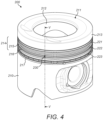
- FIG. 4 shows a perspective side view of a piston 200 according to the present invention.
- the piston 200 includes a piston body 210 with an upper combustion surface 211 having a combustion bowl 212, and an annular side wall 213 having a ring belt region 214.
- the ring belt region 214 comprises a plurality of piston rings located in a plurality of ring grooves extending circumferentially around the annular side wall 213.
- the ring belt region 214 includes three piston rings in the form of a compression ring 221 in a top ring groove 215, a scraper ring 222 in a second ring groove 216, and an oil control ring 223 in a third ring groove 217.
- any suitable number and arrangement of piston rings may be used.
- An alignment pin 230 is secured in one of the ring grooves 215-217 to restrict the circumferential displacement of the piston ring in that ring groove.
- the alignment pin 230 projects into the second ring groove 216 and so restricts rotation of the scraper ring 222.
- the alignment pin may alternatively project into the first or third ring grooves. Further alignment pins may be provided in the same manner to restrict rotation of other piston rings.
- the piston body 210 further includes an annular cooling gallery 240 which is formed within the piston body radially inward of the ring belt portion 214 and adjacent to the rim of the combustion bowl 212.
- the cooling gallery 240 has an upper surface 241 and a lower surface 242.
- a fluid inlet 243 and a fluid outlet 244 are each provided in the lower surface 242 of the cooling gallery 240 and extend in an axial direction of the piston.
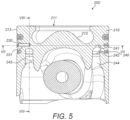
- the fluid inlet 243 and the fluid outlet 244 are open to the underside of the piston body 210, as best seen in Figures 5 and 6 .
- the cooling gallery 240 has a single fluid inlet 243 and a single fluid outlet 244 which are positioned at diametrically opposite ends of the annular cooling gallery 240 to each other.
- the fluid inlet 243 and fluid outlet 244 divide the cooling gallery 240 into a first and second cooling gallery halves 245 and 246, in which the first cooling gallery half extends from the fluid inlet 243 to the fluid outlet 244 in a first circumferential direction and the second cooling gallery half extends from the fluid inlet 243 to the fluid outlet 244 in a second circumferential direction which is opposite to the first circumferential direction.
- the alignment pin 230 is secured in a hole 231 which has an opening in the middle ring groove 216 and extends into the side wall 213 of the piston body 210.
- the hole 231 is preferably a drilled hole.
- the annular cooling gallery 240 is located close to the upper end of the piston body 210 ensure close proximity to the combustion bowl 212 for effective cooling. However, this means that the annular cooling gallery 240 is located directly radially inward of the ring belt region 214 and thus limits the radial thickness of the side wall 213 in which the alignment pin 230 may be retained.
- the piston body 210 further includes a boss 250 which projects downwards into the cooling gallery 240 from the upper surface 241.
- the boss 250 is an extension of the piston body and provides additional material into which the hole 231 can extend. This improves the degree to which the alignment pin 230 is securely retained in the hole 231.
- the hole 231 is a blind hole which extends uninterrupted from a radially outer open end in the ring groove 216 to a radially inner closed end within the boss 250. The hole 231 thus terminates in the boss 250. In this manner, the alignment pin 230 is prevented from falling into the cooling gallery 240 where it might otherwise obstruct the flow of cooling fluid and impact on the cooling performance of the piston.
- the scraper ring 222 is a split ring and the alignment pin 230 projects in the ring groove such that it is received in the ring gap 224 between opposed ends of the split ring. This prevents circumferential rotation of the scraper ring 222 relative to the piston body 210.
- the boss 250 causes a local reduction in height of the cooling gallery 240
- the inventors have used this to their advantage by positioning the boss 250 directly opposite the fluid inlet 243 and shaping it to define a flow splitter surface which improves coolant flow around the cooling gallery 240.
- the flow splitter surface has a curved shape. That is, the flow splitter surface has a shape which has at least one curved portion.
- the flow splitter surface has a curved peak 251, side flanks 252 extending away from the curved peak 251, and curved ramps 253 which form a transition between the side flanks 252 and the adjacent parts of the upper surface 241 of the cooling gallery 240.
- the flow splitter surface is symmetrical about its central axis 254.
- the central axis 254 of the flow splitter surface may be aligned with the central axis 245 of the fluid inlet 243, as shown in Figure 8 , or offset in a radial and/or circumferential direction.
- cooling fluid is directed towards the underside of the piston body 210 and enters the cooling gallery 240 in an axial direction as a flow of cooling fluid through the fluid inlet 243.
- each cylinder may comprise a fluid jet which is fed from the main oil gallery and which sprays oil towards the underside of the piston body.
- the flow of cooling fluid impacts against the flow splitter surface of the boss 250 positioned directly opposite the fluid inlet 243 by which it is divided into first and second fluid flows on either side of the flow splitter surface.
- the first fluid flow is directed by the flow splitter surface in the first circumferential direction around the first cooling gallery half 245.
- the second fluid flow is directed by the flow splitter surface in the second circumferential direction around the second cooling gallery half 246.
- the cooling fluid draws heat around from the combustion surface 211 and the combustion bowl 212 to reduce the maximum operating temperature of the piston 200.
- the first and second fluid flows then leave the cooling gallery 240 via the fluid outlet 244.
- both alignment pin retention and piston cooling performance can be improved with the piston of the present invention.
Landscapes
- Engineering & Computer Science (AREA)
- General Engineering & Computer Science (AREA)
- Mechanical Engineering (AREA)
- Chemical & Material Sciences (AREA)
- Combustion & Propulsion (AREA)
- Ocean & Marine Engineering (AREA)
- Physics & Mathematics (AREA)
- Fluid Mechanics (AREA)
- Pistons, Piston Rings, And Cylinders (AREA)
Description
- The present invention relates to a marine outboard motor with an internal combustion engine comprising a piston including a cooling gallery located within the piston body and an alignment pin configured to restrict circumferential displacement of a piston ring extending around the piston body.
- To maintain engine performance and avoid premature piston wear, it is important to avoid excessive piston temperatures during operation. In modern diesel engines, this is often achieved by incorporating a cooling gallery within the piston body. During operation, a cooling fluid, such as crankcase oil, is circulated around the cooling gallery to reduce the temperature of the upper combustion surface of the piston. The cooling fluid may be supplied to gallery inlets along the piston rod, or sprayed against the underside of the piston body from an oil jet located beneath the piston body. Such cooling galleries are particularly effective with diesel internal combustion engines, in which the combustion surface is typically bowl shaped and the maximum temperature occurs around the rim of the combustion surface rather than at the centre. This can also be the case with direct injection petrol engines having a bowl shaped combustion surface. By including a cooling gallery within the piston body inward of the ring belt, the temperature at around the rim of the combustion surface can be reduced effectively and the maximum piston temperature reduced accordingly.
- Adjacent to the cooling gallery and on the outside of the annular side wall of the piston body, the ring belt typically includes a number of annular ring grooves within which piston rings are located. The piston rings are usually split rings having a ring gap between their opposed ends. To maintain the proper function of the piston rings, it can be beneficial to restrict the circumferential displacement of the piston rings within the ring grooves. This enables the circumferential positions of the ring gaps to be maintained in a staggered arrangement to ensure adequate and even lubrication, and avoid excessive oil consumption and increased blow-by gases which might otherwise occur if the ring gaps were aligned. This can be particularly important with vertical axis engines, such as those often used in marine outboard motors, in which the cylinder bores are horizontally aligned and in which gravitational effects can further encourage ring gap alignment.
- To restrict piston ring rotation within the ring grooves, it is known to secure an alignment pin within a hole in a given ring groove so that the alignment pin projects into the ring groove and engages with the piston ring in that groove. Typically, the alignment pin is received in the ring gap so that circumferential movement of the piston ring is prevented by the alignment pin. When alignment pins are used in combination with a cooling gallery, the alignment pin is usually secured in a throughhole which extends from the ring groove into the cooling gallery. However, with this arrangement, it is possible for the alignment pin to fall into the cooling gallery during operation. This can cause an obstruction to cooling fluid flow around the cooling gallery and therefore be detrimental to cooling performance. Additionally, if the alignment pin is no longer correctly located in the hole in the ring groove, this can lead to an excessive flow of cooling fluid to the ring belt via the hole in the ring groove, resulting in poor emissions and high consumption rates of cooling fluid.
- The present invention seeks to provide an improved marine outboard motor which overcomes or mitigates one or more problems associated with the prior art.
-
EP1198667A1 discloses a piston with an annular cooling channel through which cooling oil can flow. The oil flows into and out of the channel through diametrically opposed inlet and drain ports which face downwards away from the crown. The channel undulates in a series of wave crest and troughs. -
US 5,211,102A discloses a piston provided with a conventional alignment pin which is set in a radial bore within the top piston ring groove. The head of the pin protrudes into the ring groove to prevent piston ring rotation. -
JP 2001 164990A - According to a first aspect of the present invention, there is provided a marine outboard motor having an internal combustion engine, the internal combustion engine comprising: an engine block defining at least one cylinder; and a piston disposed in the at least one cylinder, wherein the piston comprises: a piston body including an upper combustion surface, an annular side wall with a ring belt region, and a cooling gallery located within the piston body radially inwardly from the ring belt region and having a fluid inlet through which a cooling fluid is supplied to the cooling gallery during operation; a piston ring located in a ring groove around the ring belt region; and an alignment pin secured in a hole in the piston side wall and projecting into the ring groove to restrict circumferential displacement of the piston ring, wherein the piston body further comprises a boss within the cooling gallery into which the hole and
the alignment pin extend, wherein the boss projects into the cooling gallery opposite the fluid inlet and is shaped to provide a flow splitter surface configured to divide cooling fluid flowing through the fluid inlet during use into first and second fluid flows and to direct the first and second fluid flows in opposite directions around the cooling gallery. - With this arrangement, the boss forms a local increase in the thickness of the side wall of the piston body and thereby provides additional material into which the hole is provided. This allows the alignment pin, or "anti-rotation pin", to be more securely retained in position and prevents any risk that the alignment pin might fall into the cooling gallery during operation and thereby cause an obstruction to cooling fluid flow around the cooling gallery. Additionally, the boss also acts as a flow splitter to improve the circulation of cooling fluid around the cooling gallery and thereby reduce the maximum operating temperature of the piston. Thus, with the present invention, the boss serves the dual functions of both improving alignment pin retention and improving piston cooling performance.
- The cooling gallery may be part-annular. The cooling gallery may be arcuate. Preferably, the cooling gallery is annular.
- The boss projects into the cooling gallery along only part of the total length of the cooling gallery. Preferably, the boss projects into the cooling gallery along less than 20 percent of the total length of the cooling gallery, more preferably less than 10 percent. Where the cooling gallery is annular, preferably the boss projects into the cooling gallery over a segment of the annular cooling gallery having an angular extent of less than 70 degrees, more preferably less than 35 degrees.
- Where the cooling gallery is annular, the flow splitter surface is preferably configured to direct the first fluid flow around the annular cooling gallery in a first circumferential direction and to direct the second fluid flow around the annular cooling gallery in a second circumferential direction which is opposite to the first circumferential direction. In this manner, the combustion surface can be cooled more effectively and evenly.
- Preferably, the flow splitter surface is substantially symmetrical. This can facilitate an even division of the flow of cooling fluid and consistent cooling performance on either side of the flow splitter. In other examples, the flow splitter surface may be asymmetrical such that the flow of cooling fluid is divided unevenly. This may be beneficial where the cooling requirements of the cooling gallery differ on either side of the flow splitter surface.
- Preferably, the flow splitter surface has a curved shape. That is, the flow splitter surface has a shape which has at least one curved portion. This can facilitate smooth division of the flow of cooling fluid and a smooth transition from an entry direction to a flow direction around the cooling channel. For example, the boss may have a cross-sectional shape in the form of an arch. In other examples, the flow splitter surface may have an angular shape, such as a triangular shape. In certain embodiments, the flow splitter surface has a curved peak, side flanks extending away from the curved peak, and curved ramps which form a transition between the side flanks and the adjacent surface of the cooling gallery. The side flanks may be linear. The side flanks may be curved.
- Preferably, the flow splitter surface is aligned with the fluid inlet. In such an arrangement, the flow splitter surface has a central axis which is aligned with the central axis of the fluid inlet. This can facilitate an even division of the flow of cooling fluid and consistent cooling performance on either side of the flow splitter. In other examples, the flow splitter may be radially and/or axially offset from the fluid inlet.
- Preferably, the hole in the ring groove in which the alignment pin is secured is a blind hole which extends into the boss. This eliminates any possibility that the alignment pin might fall from the hole into the cooling gallery. In other examples, the hole may be a through hole which extends through the boss. For example, the hole may have a radially inner portion with a diameter less than that of the alignment pin and into which the alignment pin is prevented from moving.
- The boss projects into the cooling gallery at a location opposite the fluid inlet. Preferably, the fluid inlet is located in a lower surface of the cooling gallery and the boss projects from an upper surface of the cooling gallery. In such embodiments, the flow of cooling fluid enters the cooling gallery from underneath the piston body and is divided by the flow splitter on the opposite, upper surface. In other examples, the fluid inlet and the boss may be located in other parts of the cooling gallery. For example, the fluid inlet may be on a radially inner side surface of the cooling gallery, with the boss projecting from a radially outer side surface of the cooling gallery.
- Preferably, the cooling gallery further comprises a fluid outlet through which the flow of cooling fluid leaves the cooling gallery during operation and which is separate to the fluid inlet. In other examples, the cooling gallery may comprise a single port which acts as both a fluid inlet and fluid outlet so that cooling fluid enters into and drains from the cooling gallery at the same location.
- Preferably, the fluid outlet is positioned at an opposite end of the cooling gallery to the fluid inlet such that the cooling gallery is divided into first and second cooling gallery halves by the fluid inlet and the fluid outlet. Where the cooling gallery is annular, the fluid outlet is preferably diametrically opposed to the fluid inlet.
- Preferably, the fluid outlet is located in a lower surface of the cooling gallery. With such an arrangement, the cooling fluid drains away from the cooling gallery from the underside of the piston body. In certain embodiments, both the fluid inlet and the fluid outlet are located in a lower surface of the cooling gallery.
- The cooling gallery may have a single fluid inlet or a plurality of fluid inlets.
- The cooling gallery may have a single fluid outlet or a plurality of fluid outlets.
- The piston may comprise a plurality of piston rings, each located in ring groove in the ring belt region. The piston may comprise a plurality of alignment pins, each projecting into a different one of the plurality of ring grooves to restrict circumferential displacement of the plurality of piston rings located in the plurality of ring grooves.
- Preferably, the piston ring is a split ring with a ring gap between its opposed ends, wherein the alignment pin is received in the ring gap. In other examples, the alignment pin may be received in a blind cavity on a radially inner surface of the piston ring, or may simply press against the radially inner surface of the piston ring.
- Preferably, the piston ring is an oil control ring or a scraper ring.
- Preferably, the internal combustion engine is a vertical axis internal combustion engine. In such an engine, the crankshaft is mounted vertically in the engine. The internal combustion engine may be a petrol engine. Preferably, the internal combustion engine is a diesel engine. The internal combustion engine may be a turbocharged diesel engine.
- The cooling fluid may be any suitable cooling fluid. The cooling fluid may be lubricant used in the internal combustion engine. The cooling fluid may be oil. The cooling fluid may be crankcase oil drawn up from a crankcase of the internal combustion engine during operation. The cooling fluid may be supplied to the fluid inlet of the cooling gallery along a piston rod of the piston. The internal combustion engine may further comprise a cooling fluid jet configured to spray a jet of cooling fluid towards the piston body. The cooling fluid jet may be configured to spray a jet of cooling fluid directly into the cooling gallery through the fluid inlet. Where the engine comprises a plurality of cylinders, a cooling fluid jet may be provided in each cylinder to spray cooling fluid towards the piston body from a main cooling fluid gallery of the engine, such as a main oil gallery.
- As used herein, the term "engine block" refers to a solid structure in which the at least one cylinder of the engine is provided. The term may refer to the combination of a cylinder block with a cylinder head and crankcase, or to the cylinder block only. The engine block may be formed from a single engine block casting. The engine block may be formed from a plurality of separate engine block castings which are connected together, for example using bolts.
- The engine block may comprise a single cylinder. Preferably, the engine block comprises a plurality of cylinders.
- The engine block may comprise a single cylinder bank.
- The engine block may comprise a first cylinder bank and a second cylinder bank. The first and second cylinder banks may be arranged in a V configuration.
- The engine block may comprise three cylinder banks. The three cylinder banks may be arranged in a broad arrow configuration. The engine block may comprise four cylinder banks. The four cylinder banks may be arranged in a W or double-V configuration.
- As used herein, the terms "upper", "lower", "underneath", "below", and similar, refer to relative positions of components of the piston when the piston is orientated such that the combustion surface is at its upper end, as shown in
Figure 4 , rather than as orientated during operation, in which the piston is substantially horizontal. - According to a second aspect of the present invention, there is provided an internal combustion engine comprising: an engine block defining at least one cylinder; and a piston disposed in the at least one cylinder, wherein the piston comprises: a piston body including an upper combustion surface, an annular side wall with a ring belt region, and a cooling gallery located within the piston body radially inwardly from the ring belt region and having a fluid inlet through which a cooling fluid is supplied to the cooling gallery during operation; a piston ring located in a ring groove around the ring belt region; and an alignment pin secured in a hole in the piston side wall and projecting into the ring groove to restrict circumferential displacement of the piston ring, wherein the piston body further comprises a boss within the cooling gallery into which the hole and the alignment pin extend, wherein the boss projects into the cooling gallery opposite the fluid inlet and is shaped to provide a flow splitter surface configured to divide cooling fluid flowing through the fluid inlet during use into first and second fluid flows and to direct the first and second fluid flows in opposite directions around the cooling gallery.
- According to a third aspect of the present invention, there is provided a piston for an internal combustion engine, wherein the piston comprises: a piston body including an upper combustion surface, an annular side wall with a ring belt region, and a cooling gallery located within the piston body radially inwardly from the ring belt region and having a fluid inlet through which a cooling fluid is supplied to the cooling gallery during operation; a piston ring located in a ring groove around the ring belt region; and an alignment pin secured in a hole in the piston side wall and projecting into the ring groove to restrict circumferential displacement of the piston ring, wherein the piston body further comprises a boss within the cooling gallery into which the hole and the alignment pin extend, wherein the boss projects into the cooling gallery opposite the fluid inlet and is shaped to provide a flow splitter surface configured to divide cooling fluid flowing through the fluid inlet during use into first and second fluid flows and to direct the first and second fluid flows in opposite directions around the cooling gallery.
- According to a fourth aspect of the present invention, there is provided a marine vessel comprising a marine outboard motor according to the first aspect.
- Further features and advantages of the present invention will be further described below, by way of example only, with reference to the accompanying drawings in which:
-
FIGURE 1 is a schematic side view of a light marine vessel provided with a marine outboard motor; -
FIGURE 2A shows a schematic representation of a marine outboard motor in its tilted position; -
FIGURES 2B to 2D show various trimming positions of the marine outboard motor and the corresponding orientation of the marine vessel within a body of water; -
FIGURE 3 shows a schematic cross-section of a marine outboard motor according to the present invention; -
FIGURE 4 shows a perspective side view of the piston of the marine outboard motor ofFIGURE 3 ; -
FIGURE 5 shows an axial cross-sectional view of the piston ofFIGURE 4 taken along line V-V inFIGURE 4 ; -
FIGURE 6 shows an underside view of the piston ofFIGURE 4 ; -
FIGURE 7 shows a lateral cross-sectional view of the piston ofFIGURE 4 taken along line VII-VII inFIGURE 5 ; -
FIGURE 8 shows an axial cross-sectional view of the piston ofFIGURE 4 taken along line VIII-VIII inFIGURE 5 ; and -
FIGURE 9 shows a lateral cross-sectional view of the piston ofFIGURE 4 taken along line IX-IX inFIGURE 8 . -
Figure 1 shows a schematic side view of amarine vessel 1 with a marineoutboard motor 2. Themarine vessel 1 may be any kind of vessel suitable for use with a marine outboard motor, such as a tender or a scuba-diving boat. The marineoutboard motor 2 shown inFigure 1 is attached to the stern of thevessel 1. The marineoutboard motor 2 is connected to a fuel tank 3, usually received within the hull of themarine vessel 1. Fuel from the reservoir or tank 3 is provided to the marineoutboard motor 2 via afuel line 4.Fuel line 4 may be a representation for a collective arrangement of one or more filters, low pressure pumps and separator tanks (for preventing water from entering the marine outboard motor 2) arranged between the fuel tank 3 and the marineoutboard motor 2. - As will be described in more detail below, the marine
outboard motor 2 is generally divided into three sections, an upper-section 21, a mid-section 22, and a lower-section 23. The mid-section 22 and lower-section 23 are often collectively known as the leg section, and the leg houses the exhaust system. Apropeller 8 is rotatably arranged on a propeller shaft at the lower-section 23, also known as the gearbox, of the marineoutboard motor 2. Of course, in operation, thepropeller 8 is at least partly submerged in water and may be operated at varying rotational speeds to propel themarine vessel 1. - Typically, the marine
outboard motor 2 is pivotally connected to the stern of themarine vessel 1 by means of a pivot pin. Pivotal movement about the pivot pin enables the operator to tilt and trim the marineoutboard motor 2 about a horizontal axis in a manner known in the art. Further, as is well known in the art, the marineoutboard motor 2 is also pivotally mounted to the stern of themarine vessel 1 so as to be able to pivot, about a generally upright axis, to steer themarine vessel 1. - Tilting is a movement that raises the marine
outboard motor 2 far enough so that the entire marineoutboard motor 2 is able to be raised completely out of the water. Tilting the marineoutboard motor 2 may be performed with the marineoutboard motor 2 turned off or in neutral. However, in some instances, the marineoutboard motor 2 may be configured to allow limited running of the marineoutboard motor 2 in the tilt range so as to enable operation in shallow waters. Marine engine assemblies are therefore predominantly operated with a longitudinal axis of the leg in a substantially vertical direction. As such, a crankshaft of an engine of the marineoutboard motor 2 which is substantially parallel to a longitudinal axis of the leg of the marineoutboard motor 2 will be generally oriented in a vertical orientation during normal operation of the marineoutboard motor 2, but may also be oriented in a nonvertical direction under certain operating conditions, in particular when operated on a vessel in shallow water. A crankshaft of a marineoutboard motor 2 which is oriented substantially parallel to a longitudinal axis of the leg of the engine assembly can also be termed a vertical crankshaft arrangement. A crankshaft of a marineoutboard motor 2 which is oriented substantially perpendicular to a longitudinal axis of the leg of the engine assembly can also be termed a horizontal crankshaft arrangement. - As mentioned previously, to work properly, the lower-
section 23 of the marineoutboard motor 2 needs to extend into the water. In extremely shallow waters, however, or when launching a vessel off a trailer, the lower-section 23 of the marineoutboard motor 2 could drag on the seabed or boat ramp if in the tilted-down position. Tilting the marineoutboard motor 2 into its tilted-up position, such as the position shown inFigure 2A , prevents such damage to the lower-section 23 and the propeller. - By contrast, trimming is the mechanism that moves the marine
outboard motor 2 over a smaller range from a fully-down position to a few degrees upwards, as shown in the three examples ofFigures 2B to 2D . Trimming helps to direct the thrust of thepropeller 8 in a direction that will provide the best combination of fuel efficiency, acceleration and high speed operation of themarine vessel 1. - When the
vessel 1 is on a plane (i.e. when the weight of thevessel 1 is predominantly supported by hydrodynamic lift, rather than hydrostatic lift), a bow-up configuration results in less drag, greater stability and efficiency. This is generally the case when the keel line of the boat ormarine vessel 1 is up about three to five degrees, such as shown inFigure 2B for example. - Too much trim-out puts the bow of the
vessel 1 too high in the water, such as the position shown inFigure 2C . Performance and economy, in this configuration, are decreased because the hull of thevessel 1 is pushing the water and the result is more air drag. Excessive trimming-out can also cause the propeller to ventilate, resulting in further reduced performance. In even more severe cases, thevessel 1 may hop in the water, which could throw the operator and passengers overboard. - Trimming-in will cause the bow of the
vessel 1 to be down, which will help accelerate from a standing start. Too much trim-in, shown inFigure 2D , causes thevessel 1 to "plough" through the water, decreasing fuel economy and making it hard to increase speed. At high speeds, trimming-in may even result in instability of thevessel 1. - Turning to
Figure 3 , there is shown a schematic cross-section of anoutboard motor 2 according to an embodiment of the present invention. Theoutboard motor 2 comprises a tilt andtrim mechanism 10 for performing the aforementioned tilting and trimming operations. In this embodiment, the tilt andtrim mechanism 10 includes ahydraulic actuator 11 that can be operated to tilt and trim theoutboard motor 2 via an electric control system. Alternatively, it is also feasible to provide a manual tilt and trim mechanism, in which the operator pivots theoutboard motor 2 by hand rather than using a hydraulic actuator. - As mentioned above, the
outboard motor 2 is generally divided into three sections. An upper-section 21, also known as the powerhead, includes aninternal combustion engine 100 for powering themarine vessel 1. Acowling 25 is disposed around theengine 100. Adjacent to, and extending below, the upper-section 21 or powerhead, there is provided a mid-section 22 and alower section 23. The lower-section 23 extends adjacent to and below the mid-section 22, and the mid-section 22 connects the upper-section 21 to the lower-section 23. The mid-section 22 houses adrive shaft 27 which extends between thecombustion engine 100 and thepropeller shaft 29 and is connected to acrankshaft 31 of the combustion engine via a floating connector 33 (e.g. a splined connection). At the lower end of thedrive shaft 27, a gear box / transmission is provided that supplies the rotational energy of thedrive shaft 27 to thepropeller 8 in a horizontal direction. In more detail, the bottom end of thedrive shaft 27 may include abevel gear 35 connected to a pair ofbevel gears propeller shaft 29 of thepropeller 8. The mid-section 22 and lower-section 23 form an exhaust system, which defines an exhaust gas flow path for transporting exhaust gases from an exhaust gas outlet 170 of theinternal combustion engine 100 and out of theoutboard motor 2. - The
internal combustion engine 100 is shown schematically as one bank of a four-stroke V8 diesel engine. It will be understood that any other amount of cylinders may be employed in the V-shaped cylinder banks. The skilled person will also understand that any other arrangement, such as an in-line arrangement could alternatively be utilised. The engine of the present invention could equivalently be constructed as a two-stroke-type combustion engine. - The
internal combustion engine 100 includes anengine block 110 comprising acylinder block 120, acylinder head 130, and acrankcase 140. The cylinder block defines a plurality ofcylinders 122, each housing apiston 200 which reciprocates within itsrespective cylinder 122 and is connected to thecrankshaft 31 by apiston rod 124, or "connecting rod". Thecrankshaft 31 is mounted in thecrankcase 140 for rotation about avertical crankshaft axis 32. Theengine 100 also includes anair intake manifold 150 for delivering a flow of air to the cylinders in the engine block, an exhaust manifold 160 configured to direct a flow of exhaust gas from the cylinders. Theengine 100 may further include an optional exhaust gas recirculation system (not shown) which is configured to recirculate a portion of the flow of exhaust gas from the exhaust manifold 160 to theair intake manifold 150 and which includes a heat exchanger, or "EGR cooler", for cooling the recirculated exhaust gas. -
Figure 4 shows a perspective side view of apiston 200 according to the present invention. Thepiston 200 includes apiston body 210 with anupper combustion surface 211 having acombustion bowl 212, and anannular side wall 213 having aring belt region 214. Thering belt region 214 comprises a plurality of piston rings located in a plurality of ring grooves extending circumferentially around theannular side wall 213. In this example, thering belt region 214 includes three piston rings in the form of acompression ring 221 in atop ring groove 215, ascraper ring 222 in asecond ring groove 216, and anoil control ring 223 in athird ring groove 217. However, it will be understood that any suitable number and arrangement of piston rings may be used. Analignment pin 230 is secured in one of the ring grooves 215-217 to restrict the circumferential displacement of the piston ring in that ring groove. In this example, thealignment pin 230 projects into thesecond ring groove 216 and so restricts rotation of thescraper ring 222. The alignment pin may alternatively project into the first or third ring grooves. Further alignment pins may be provided in the same manner to restrict rotation of other piston rings. - Referring to
Figures 5 to 9 , thepiston body 210 further includes anannular cooling gallery 240 which is formed within the piston body radially inward of thering belt portion 214 and adjacent to the rim of thecombustion bowl 212. Thecooling gallery 240 has anupper surface 241 and a lower surface 242. Afluid inlet 243 and afluid outlet 244 are each provided in the lower surface 242 of thecooling gallery 240 and extend in an axial direction of the piston. Thus, thefluid inlet 243 and thefluid outlet 244 are open to the underside of thepiston body 210, as best seen inFigures 5 and6 . In this example, thecooling gallery 240 has asingle fluid inlet 243 and asingle fluid outlet 244 which are positioned at diametrically opposite ends of theannular cooling gallery 240 to each other. Thefluid inlet 243 andfluid outlet 244 divide thecooling gallery 240 into a first and second cooling gallery halves 245 and 246, in which the first cooling gallery half extends from thefluid inlet 243 to thefluid outlet 244 in a first circumferential direction and the second cooling gallery half extends from thefluid inlet 243 to thefluid outlet 244 in a second circumferential direction which is opposite to the first circumferential direction. - The
alignment pin 230 is secured in ahole 231 which has an opening in themiddle ring groove 216 and extends into theside wall 213 of thepiston body 210. Thehole 231 is preferably a drilled hole. Theannular cooling gallery 240 is located close to the upper end of thepiston body 210 ensure close proximity to thecombustion bowl 212 for effective cooling. However, this means that theannular cooling gallery 240 is located directly radially inward of thering belt region 214 and thus limits the radial thickness of theside wall 213 in which thealignment pin 230 may be retained. To address this, thepiston body 210 further includes aboss 250 which projects downwards into thecooling gallery 240 from theupper surface 241. Theboss 250 is an extension of the piston body and provides additional material into which thehole 231 can extend. This improves the degree to which thealignment pin 230 is securely retained in thehole 231. In this example, thehole 231 is a blind hole which extends uninterrupted from a radially outer open end in thering groove 216 to a radially inner closed end within theboss 250. Thehole 231 thus terminates in theboss 250. In this manner, thealignment pin 230 is prevented from falling into thecooling gallery 240 where it might otherwise obstruct the flow of cooling fluid and impact on the cooling performance of the piston. As shown inFigure 7 , thescraper ring 222 is a split ring and thealignment pin 230 projects in the ring groove such that it is received in the ring gap 224 between opposed ends of the split ring. This prevents circumferential rotation of thescraper ring 222 relative to thepiston body 210. - As best seen in
Figure 8 , although theboss 250 causes a local reduction in height of thecooling gallery 240, the inventors have used this to their advantage by positioning theboss 250 directly opposite thefluid inlet 243 and shaping it to define a flow splitter surface which improves coolant flow around thecooling gallery 240. The flow splitter surface has a curved shape. That is, the flow splitter surface has a shape which has at least one curved portion. In this example, the flow splitter surface has acurved peak 251, side flanks 252 extending away from thecurved peak 251, andcurved ramps 253 which form a transition between the side flanks 252 and the adjacent parts of theupper surface 241 of thecooling gallery 240. In this example the flow splitter surface is symmetrical about itscentral axis 254. Thecentral axis 254 of the flow splitter surface may be aligned with thecentral axis 245 of thefluid inlet 243, as shown inFigure 8 , or offset in a radial and/or circumferential direction. - During operation, cooling fluid is directed towards the underside of the
piston body 210 and enters thecooling gallery 240 in an axial direction as a flow of cooling fluid through thefluid inlet 243. For example, each cylinder may comprise a fluid jet which is fed from the main oil gallery and which sprays oil towards the underside of the piston body. Upon entry into thecooling gallery 240, the flow of cooling fluid impacts against the flow splitter surface of theboss 250 positioned directly opposite thefluid inlet 243 by which it is divided into first and second fluid flows on either side of the flow splitter surface. The first fluid flow is directed by the flow splitter surface in the first circumferential direction around the firstcooling gallery half 245. The second fluid flow is directed by the flow splitter surface in the second circumferential direction around the secondcooling gallery half 246. By passing around the cooling gallery, the cooling fluid draws heat around from thecombustion surface 211 and thecombustion bowl 212 to reduce the maximum operating temperature of thepiston 200. The first and second fluid flows then leave thecooling gallery 240 via thefluid outlet 244. - By providing a boss in the cooling gallery which provides additional side wall thickness and is configured as a flow splitter surface, both alignment pin retention and piston cooling performance can be improved with the piston of the present invention.
- Although the invention has been described above with reference to one or more preferred embodiments, it will be appreciated that various changes or modifications may be made without departing from the scope of the invention as defined in the appended claims.
Claims (15)
- A piston (200) for an internal combustion engine (100), the piston comprising:a piston body (210) including an upper combustion surface (211), an annular side wall (213) with a ring belt region (214), and a cooling gallery (240) located within the piston body radially inwardly from the ring belt region and having a fluid inlet (243) through which a cooling fluid is supplied to the cooling gallery during operation;a piston ring (222) located in a ring groove (216) around the ring belt region; andan alignment pin (230) secured in a hole (231) in the piston side wall and projecting into the ring groove to restrict circumferential displacement of the piston ring,wherein the piston body further comprises a boss (250) within the cooling gallery into which the hole and the alignment pin extend, wherein the boss projects into the cooling gallery opposite the fluid inlet and is shaped to provide a flow splitter surface (251-253) configured to divide cooling fluid flowing through the fluid inlet during use into first and second fluid flows and to direct the first and second fluid flows in opposite directions around the cooling gallery.
- The piston (200) of claim 1, wherein the cooling gallery (240) is annular.
- The piston (200) of claim 2, wherein the flow splitter surface (251-253) is configured to direct the first fluid flow around the annular cooling gallery (240) in a first circumferential direction and to direct the second fluid flow around the annular cooling gallery in a second circumferential direction which is opposite to the first circumferential direction.
- The piston (200) of any preceding claim, wherein the flow splitter surface (251-253) is substantially symmetrical.
- The piston (200) of any preceding claim, wherein the flow splitter surface (251-253) has a curved shape.
- The piston (200) of any preceding claim, wherein the flow splitter surface (251-253) is aligned with the fluid inlet (243).
- The piston (200) of any preceding claim, wherein the hole (231) is a blind hole which terminates within the boss (250).
- The piston (200) of any preceding claim, wherein the fluid inlet (243) is located in a lower surface (242) of the cooling gallery (240) and the boss (250) projects from an upper surface (241) of the cooling gallery.
- The piston (200) of any preceding claim, wherein the cooling gallery (240) further comprises a fluid outlet (244) through which the flow of cooling fluid leaves the cooling gallery during operation and which is separate to the fluid inlet (243).
- The piston (200) of claim 9, wherein the fluid outlet (244) is positioned at an opposite end of the cooling gallery (240) to the fluid inlet (243) such that the cooling gallery is divided into first and second cooling gallery halves by the fluid inlet and the fluid outlet.
- The piston (200) of claim 9 or claim 10, wherein the fluid outlet (244) is located in a lower surface (242) of the cooling gallery (240).
- A marine outboard motor (2) having an internal combustion engine (100), the internal combustion engine comprising:an engine block (110) defining at least one cylinder (122); andthe piston (200) of any preceding claim disposed in the at least one cylinder.
- The marine outboard motor (2) of claim 12, wherein the internal combustion engine (100) is a vertical axis internal combustion engine.
- An internal combustion engine (100) comprising:
an engine block (110) defining at least one cylinder (122); and
the piston (200) of any of claims 1 to 11 disposed in the at least one cylinder. - A marine vessel (1) comprising the marine outboard motor (2) of claim 12 or claim 13.
Applications Claiming Priority (2)
| Application Number | Priority Date | Filing Date | Title |
|---|---|---|---|
| GB1904779.4A GB2578803B (en) | 2019-04-04 | 2019-04-04 | Marine outboard motor with piston cooling gallery |
| PCT/GB2020/050864 WO2020201745A1 (en) | 2019-04-04 | 2020-04-01 | Marine outboard motor with piston cooling gallery |
Publications (2)
| Publication Number | Publication Date |
|---|---|
| EP3947948A1 EP3947948A1 (en) | 2022-02-09 |
| EP3947948B1 true EP3947948B1 (en) | 2023-05-24 |
Family
ID=66809536
Family Applications (1)
| Application Number | Title | Priority Date | Filing Date |
|---|---|---|---|
| EP20718731.1A Active EP3947948B1 (en) | 2019-04-04 | 2020-04-01 | Marine outboard motor with piston cooling gallery |
Country Status (10)
| Country | Link |
|---|---|
| US (1) | US11208943B2 (en) |
| EP (1) | EP3947948B1 (en) |
| JP (2) | JP7598332B2 (en) |
| KR (1) | KR20210145790A (en) |
| CN (1) | CN114041009B (en) |
| AU (1) | AU2020251315A1 (en) |
| CA (1) | CA3135930A1 (en) |
| GB (1) | GB2578803B (en) |
| IL (1) | IL286887A (en) |
| WO (1) | WO2020201745A1 (en) |
Family Cites Families (31)
| Publication number | Priority date | Publication date | Assignee | Title |
|---|---|---|---|---|
| US1605810A (en) * | 1926-11-02 | Piston and piston bllto | ||
| GB240756A (en) * | 1925-05-07 | 1925-10-08 | Julian Seymour Tritton | Improvements in pistons |
| US2606085A (en) * | 1948-10-07 | 1952-08-05 | Elmer C Kiekhaefer | Piston ring lock |
| US4367702A (en) * | 1981-01-30 | 1983-01-11 | Outboard Marine Corporation | Internal combustion engine with automatic compression release |
| JPS61160547A (en) * | 1985-01-08 | 1986-07-21 | Suzuki Motor Co Ltd | Two-cycle engine |
| JPS61187563A (en) * | 1985-02-14 | 1986-08-21 | Yamaha Motor Co Ltd | Piston of two-cycle internal-combustion engine |
| JPH01299364A (en) * | 1988-05-25 | 1989-12-04 | Mitsuhiro Kanao | Piston ring |
| JPH0480962U (en) * | 1990-11-27 | 1992-07-14 | ||
| JP3568136B2 (en) * | 1995-10-02 | 2004-09-22 | 株式会社小松製作所 | Cooling device for piston for internal combustion engine |
| DE19703001C2 (en) * | 1997-01-28 | 1998-12-03 | Alcan Gmbh | Liquid cooled piston |
| DE19708892C1 (en) * | 1997-03-05 | 1998-05-14 | Porsche Ag | Reciprocating internal combustion engine |
| DE19930630C1 (en) | 1999-07-02 | 2000-10-26 | Federal Mogul Nuernberg Gmbh | Liquid-cooled piston for I.C. engines has an annular cooling channel that runs in an undulating fashion in the direction of the piston axis |
| US6378872B1 (en) * | 1999-07-26 | 2002-04-30 | Maurice J. Moriarty | Seal assembly |
| JP2001164990A (en) | 1999-12-08 | 2001-06-19 | Unisia Jecs Corp | Piston for internal combustion engine |
| US6457721B1 (en) * | 2001-01-26 | 2002-10-01 | White Consolidated Industries, Inc. | Piston ring locator |
| DE102004043720A1 (en) * | 2004-09-09 | 2006-03-30 | Federal-Mogul Nürnberg GmbH | Piston for an internal combustion engine and internal combustion engine |
| GB0701110D0 (en) * | 2007-01-19 | 2007-02-28 | Ricardo Uk Ltd | Pistons for internal combustion engines |
| DE102007044105A1 (en) * | 2007-04-27 | 2008-10-30 | Mahle International Gmbh | Casting core for forming a cooling channel in a piston produced by casting |
| DE102007054929B4 (en) * | 2007-11-17 | 2016-12-01 | Andreas Stihl Ag & Co. Kg | Hand-held implement |
| DE102008002571A1 (en) * | 2008-06-20 | 2009-12-31 | Federal-Mogul Nürnberg GmbH | Piston for an internal combustion engine |
| US10753310B2 (en) * | 2012-02-10 | 2020-08-25 | Tenneco Inc. | Piston with enhanced cooling gallery |
| CN202789179U (en) * | 2012-05-16 | 2013-03-13 | 郑凌 | Cooling system for internal combustion engine pistons |
| CN102705101A (en) * | 2012-05-16 | 2012-10-03 | 郑凌 | Cooling system for internal combustion engine pistons |
| WO2014019945A1 (en) * | 2012-07-31 | 2014-02-06 | Brp-Powertrain Gmbh & Co. Kg | Piston for an internal combustion engine |
| WO2015031565A1 (en) * | 2013-08-29 | 2015-03-05 | Federal-Mogul Corporation | Double welded steel piston with full skirt |
| UA107541C2 (en) * | 2014-01-11 | 2015-01-12 | Serhii Hryhorovych Bondarev | PISTON of INTERNAL COMBUSTION ENGINE |
| US9228480B2 (en) * | 2014-06-06 | 2016-01-05 | Mahle Industries, Incorporated | Piston crown cooling gallery insert |
| US10184422B2 (en) * | 2014-12-30 | 2019-01-22 | Tenneco Inc. | Reduced compression height dual gallery piston, piston assembly therewith and methods of construction thereof |
| CN107454924B (en) * | 2015-01-30 | 2020-03-20 | 天纳克公司 | Piston with cooling gallery cooling insert and method of construction thereof |
| KR101934941B1 (en) * | 2016-05-02 | 2019-01-04 | 동양피스톤 주식회사 | Piston for internal combustion engine and cooling channel core |
| KR101912764B1 (en) * | 2016-05-02 | 2018-10-29 | 동양피스톤 주식회사 | Piston for internal combustion engine and cooling channel core |
-
2019
- 2019-04-04 GB GB1904779.4A patent/GB2578803B/en not_active Expired - Fee Related
-
2020
- 2020-03-24 US US16/827,965 patent/US11208943B2/en active Active
- 2020-04-01 EP EP20718731.1A patent/EP3947948B1/en active Active
- 2020-04-01 CN CN202080027254.6A patent/CN114041009B/en active Active
- 2020-04-01 AU AU2020251315A patent/AU2020251315A1/en not_active Abandoned
- 2020-04-01 JP JP2021558758A patent/JP7598332B2/en active Active
- 2020-04-01 KR KR1020217035549A patent/KR20210145790A/en active Pending
- 2020-04-01 CA CA3135930A patent/CA3135930A1/en active Pending
- 2020-04-01 WO PCT/GB2020/050864 patent/WO2020201745A1/en not_active Ceased
-
2021
- 2021-09-30 IL IL286887A patent/IL286887A/en unknown
-
2024
- 2024-09-24 JP JP2024165087A patent/JP2024180407A/en not_active Withdrawn
Also Published As
| Publication number | Publication date |
|---|---|
| US20200318526A1 (en) | 2020-10-08 |
| GB2578803B (en) | 2020-12-16 |
| EP3947948A1 (en) | 2022-02-09 |
| CN114041009B (en) | 2024-02-23 |
| JP2022528678A (en) | 2022-06-15 |
| KR20210145790A (en) | 2021-12-02 |
| CN114041009A (en) | 2022-02-11 |
| US11208943B2 (en) | 2021-12-28 |
| CA3135930A1 (en) | 2020-10-08 |
| JP2024180407A (en) | 2024-12-26 |
| WO2020201745A1 (en) | 2020-10-08 |
| GB2578803A (en) | 2020-05-27 |
| AU2020251315A1 (en) | 2021-11-25 |
| GB201904779D0 (en) | 2019-05-22 |
| IL286887A (en) | 2021-10-31 |
| JP7598332B2 (en) | 2024-12-11 |
Similar Documents
| Publication | Publication Date | Title |
|---|---|---|
| CA3132279A1 (en) | A marine outboard motor with drive shaft and cooling system | |
| US11198493B2 (en) | Marine outboard motor with crankcase ventilation | |
| EP3947948B1 (en) | Marine outboard motor with piston cooling gallery | |
| HK40067642A (en) | Marine outboard motor with piston cooling gallery | |
| US20200102879A1 (en) | Marine outboard motor with turbocharger lubrication | |
| HK40067642B (en) | Marine outboard motor with piston cooling gallery | |
| US20200102918A1 (en) | Marine outboard motor with egr cooler | |
| EP3935267B1 (en) | Marine outboard motor with valve train having adjustable lash | |
| US10392092B1 (en) | Vertical axis drive system | |
| HK40062256A (en) | Marine outboard motor with crankcase ventilation | |
| HK40062256B (en) | Marine outboard motor with crankcase ventilation |
Legal Events
| Date | Code | Title | Description |
|---|---|---|---|
| STAA | Information on the status of an ep patent application or granted ep patent |
Free format text: STATUS: UNKNOWN |
|
| STAA | Information on the status of an ep patent application or granted ep patent |
Free format text: STATUS: THE INTERNATIONAL PUBLICATION HAS BEEN MADE |
|
| PUAI | Public reference made under article 153(3) epc to a published international application that has entered the european phase |
Free format text: ORIGINAL CODE: 0009012 |
|
| STAA | Information on the status of an ep patent application or granted ep patent |
Free format text: STATUS: REQUEST FOR EXAMINATION WAS MADE |
|
| 17P | Request for examination filed |
Effective date: 20211007 |
|
| AK | Designated contracting states |
Kind code of ref document: A1 Designated state(s): AL AT BE BG CH CY CZ DE DK EE ES FI FR GB GR HR HU IE IS IT LI LT LU LV MC MK MT NL NO PL PT RO RS SE SI SK SM TR |
|
| DAV | Request for validation of the european patent (deleted) | ||
| DAX | Request for extension of the european patent (deleted) | ||
| GRAP | Despatch of communication of intention to grant a patent |
Free format text: ORIGINAL CODE: EPIDOSNIGR1 |
|
| STAA | Information on the status of an ep patent application or granted ep patent |
Free format text: STATUS: GRANT OF PATENT IS INTENDED |
|
| INTG | Intention to grant announced |
Effective date: 20221031 |
|
| GRAS | Grant fee paid |
Free format text: ORIGINAL CODE: EPIDOSNIGR3 |
|
| GRAA | (expected) grant |
Free format text: ORIGINAL CODE: 0009210 |
|
| STAA | Information on the status of an ep patent application or granted ep patent |
Free format text: STATUS: THE PATENT HAS BEEN GRANTED |
|
| AK | Designated contracting states |
Kind code of ref document: B1 Designated state(s): AL AT BE BG CH CY CZ DE DK EE ES FI FR GB GR HR HU IE IS IT LI LT LU LV MC MK MT NL NO PL PT RO RS SE SI SK SM TR |
|
| REG | Reference to a national code |
Ref country code: GB Ref legal event code: FG4D |
|
| REG | Reference to a national code |
Ref country code: CH Ref legal event code: EP |
|
| REG | Reference to a national code |
Ref country code: DE Ref legal event code: R096 Ref document number: 602020011111 Country of ref document: DE |
|
| REG | Reference to a national code |
Ref country code: AT Ref legal event code: REF Ref document number: 1569614 Country of ref document: AT Kind code of ref document: T Effective date: 20230615 |
|
| REG | Reference to a national code |
Ref country code: IE Ref legal event code: FG4D |
|
| REG | Reference to a national code |
Ref country code: LT Ref legal event code: MG9D |
|
| REG | Reference to a national code |
Ref country code: NL Ref legal event code: MP Effective date: 20230524 |
|
| REG | Reference to a national code |
Ref country code: AT Ref legal event code: MK05 Ref document number: 1569614 Country of ref document: AT Kind code of ref document: T Effective date: 20230524 |
|
| PG25 | Lapsed in a contracting state [announced via postgrant information from national office to epo] |
Ref country code: SE Free format text: LAPSE BECAUSE OF FAILURE TO SUBMIT A TRANSLATION OF THE DESCRIPTION OR TO PAY THE FEE WITHIN THE PRESCRIBED TIME-LIMIT Effective date: 20230524 Ref country code: PT Free format text: LAPSE BECAUSE OF FAILURE TO SUBMIT A TRANSLATION OF THE DESCRIPTION OR TO PAY THE FEE WITHIN THE PRESCRIBED TIME-LIMIT Effective date: 20230925 Ref country code: NO Free format text: LAPSE BECAUSE OF FAILURE TO SUBMIT A TRANSLATION OF THE DESCRIPTION OR TO PAY THE FEE WITHIN THE PRESCRIBED TIME-LIMIT Effective date: 20230824 Ref country code: NL Free format text: LAPSE BECAUSE OF FAILURE TO SUBMIT A TRANSLATION OF THE DESCRIPTION OR TO PAY THE FEE WITHIN THE PRESCRIBED TIME-LIMIT Effective date: 20230524 Ref country code: ES Free format text: LAPSE BECAUSE OF FAILURE TO SUBMIT A TRANSLATION OF THE DESCRIPTION OR TO PAY THE FEE WITHIN THE PRESCRIBED TIME-LIMIT Effective date: 20230524 Ref country code: AT Free format text: LAPSE BECAUSE OF FAILURE TO SUBMIT A TRANSLATION OF THE DESCRIPTION OR TO PAY THE FEE WITHIN THE PRESCRIBED TIME-LIMIT Effective date: 20230524 |
|
| PG25 | Lapsed in a contracting state [announced via postgrant information from national office to epo] |
Ref country code: RS Free format text: LAPSE BECAUSE OF FAILURE TO SUBMIT A TRANSLATION OF THE DESCRIPTION OR TO PAY THE FEE WITHIN THE PRESCRIBED TIME-LIMIT Effective date: 20230524 Ref country code: PL Free format text: LAPSE BECAUSE OF FAILURE TO SUBMIT A TRANSLATION OF THE DESCRIPTION OR TO PAY THE FEE WITHIN THE PRESCRIBED TIME-LIMIT Effective date: 20230524 Ref country code: LV Free format text: LAPSE BECAUSE OF FAILURE TO SUBMIT A TRANSLATION OF THE DESCRIPTION OR TO PAY THE FEE WITHIN THE PRESCRIBED TIME-LIMIT Effective date: 20230524 Ref country code: LT Free format text: LAPSE BECAUSE OF FAILURE TO SUBMIT A TRANSLATION OF THE DESCRIPTION OR TO PAY THE FEE WITHIN THE PRESCRIBED TIME-LIMIT Effective date: 20230524 Ref country code: IS Free format text: LAPSE BECAUSE OF FAILURE TO SUBMIT A TRANSLATION OF THE DESCRIPTION OR TO PAY THE FEE WITHIN THE PRESCRIBED TIME-LIMIT Effective date: 20230924 Ref country code: HR Free format text: LAPSE BECAUSE OF FAILURE TO SUBMIT A TRANSLATION OF THE DESCRIPTION OR TO PAY THE FEE WITHIN THE PRESCRIBED TIME-LIMIT Effective date: 20230524 Ref country code: GR Free format text: LAPSE BECAUSE OF FAILURE TO SUBMIT A TRANSLATION OF THE DESCRIPTION OR TO PAY THE FEE WITHIN THE PRESCRIBED TIME-LIMIT Effective date: 20230825 |
|
| PG25 | Lapsed in a contracting state [announced via postgrant information from national office to epo] |
Ref country code: FI Free format text: LAPSE BECAUSE OF FAILURE TO SUBMIT A TRANSLATION OF THE DESCRIPTION OR TO PAY THE FEE WITHIN THE PRESCRIBED TIME-LIMIT Effective date: 20230524 |
|
| PG25 | Lapsed in a contracting state [announced via postgrant information from national office to epo] |
Ref country code: SK Free format text: LAPSE BECAUSE OF FAILURE TO SUBMIT A TRANSLATION OF THE DESCRIPTION OR TO PAY THE FEE WITHIN THE PRESCRIBED TIME-LIMIT Effective date: 20230524 |
|
| PG25 | Lapsed in a contracting state [announced via postgrant information from national office to epo] |
Ref country code: SM Free format text: LAPSE BECAUSE OF FAILURE TO SUBMIT A TRANSLATION OF THE DESCRIPTION OR TO PAY THE FEE WITHIN THE PRESCRIBED TIME-LIMIT Effective date: 20230524 Ref country code: SK Free format text: LAPSE BECAUSE OF FAILURE TO SUBMIT A TRANSLATION OF THE DESCRIPTION OR TO PAY THE FEE WITHIN THE PRESCRIBED TIME-LIMIT Effective date: 20230524 Ref country code: RO Free format text: LAPSE BECAUSE OF FAILURE TO SUBMIT A TRANSLATION OF THE DESCRIPTION OR TO PAY THE FEE WITHIN THE PRESCRIBED TIME-LIMIT Effective date: 20230524 Ref country code: EE Free format text: LAPSE BECAUSE OF FAILURE TO SUBMIT A TRANSLATION OF THE DESCRIPTION OR TO PAY THE FEE WITHIN THE PRESCRIBED TIME-LIMIT Effective date: 20230524 Ref country code: DK Free format text: LAPSE BECAUSE OF FAILURE TO SUBMIT A TRANSLATION OF THE DESCRIPTION OR TO PAY THE FEE WITHIN THE PRESCRIBED TIME-LIMIT Effective date: 20230524 Ref country code: CZ Free format text: LAPSE BECAUSE OF FAILURE TO SUBMIT A TRANSLATION OF THE DESCRIPTION OR TO PAY THE FEE WITHIN THE PRESCRIBED TIME-LIMIT Effective date: 20230524 |
|
| REG | Reference to a national code |
Ref country code: DE Ref legal event code: R097 Ref document number: 602020011111 Country of ref document: DE |
|
| PLBE | No opposition filed within time limit |
Free format text: ORIGINAL CODE: 0009261 |
|
| STAA | Information on the status of an ep patent application or granted ep patent |
Free format text: STATUS: NO OPPOSITION FILED WITHIN TIME LIMIT |
|
| 26N | No opposition filed |
Effective date: 20240227 |
|
| PG25 | Lapsed in a contracting state [announced via postgrant information from national office to epo] |
Ref country code: SI Free format text: LAPSE BECAUSE OF FAILURE TO SUBMIT A TRANSLATION OF THE DESCRIPTION OR TO PAY THE FEE WITHIN THE PRESCRIBED TIME-LIMIT Effective date: 20230524 |
|
| PG25 | Lapsed in a contracting state [announced via postgrant information from national office to epo] |
Ref country code: SI Free format text: LAPSE BECAUSE OF FAILURE TO SUBMIT A TRANSLATION OF THE DESCRIPTION OR TO PAY THE FEE WITHIN THE PRESCRIBED TIME-LIMIT Effective date: 20230524 Ref country code: IT Free format text: LAPSE BECAUSE OF FAILURE TO SUBMIT A TRANSLATION OF THE DESCRIPTION OR TO PAY THE FEE WITHIN THE PRESCRIBED TIME-LIMIT Effective date: 20230524 |
|
| REG | Reference to a national code |
Ref country code: DE Ref legal event code: R119 Ref document number: 602020011111 Country of ref document: DE |
|
| PG25 | Lapsed in a contracting state [announced via postgrant information from national office to epo] |
Ref country code: BG Free format text: LAPSE BECAUSE OF FAILURE TO SUBMIT A TRANSLATION OF THE DESCRIPTION OR TO PAY THE FEE WITHIN THE PRESCRIBED TIME-LIMIT Effective date: 20230524 |
|
| PG25 | Lapsed in a contracting state [announced via postgrant information from national office to epo] |
Ref country code: MC Free format text: LAPSE BECAUSE OF FAILURE TO SUBMIT A TRANSLATION OF THE DESCRIPTION OR TO PAY THE FEE WITHIN THE PRESCRIBED TIME-LIMIT Effective date: 20230524 |
|
| PG25 | Lapsed in a contracting state [announced via postgrant information from national office to epo] |
Ref country code: MC Free format text: LAPSE BECAUSE OF FAILURE TO SUBMIT A TRANSLATION OF THE DESCRIPTION OR TO PAY THE FEE WITHIN THE PRESCRIBED TIME-LIMIT Effective date: 20230524 Ref country code: BG Free format text: LAPSE BECAUSE OF FAILURE TO SUBMIT A TRANSLATION OF THE DESCRIPTION OR TO PAY THE FEE WITHIN THE PRESCRIBED TIME-LIMIT Effective date: 20230524 |
|
| REG | Reference to a national code |
Ref country code: CH Ref legal event code: PL |
|
| PG25 | Lapsed in a contracting state [announced via postgrant information from national office to epo] |
Ref country code: LU Free format text: LAPSE BECAUSE OF NON-PAYMENT OF DUE FEES Effective date: 20240401 |
|
| REG | Reference to a national code |
Ref country code: BE Ref legal event code: MM Effective date: 20240430 |
|
| PG25 | Lapsed in a contracting state [announced via postgrant information from national office to epo] |
Ref country code: LU Free format text: LAPSE BECAUSE OF NON-PAYMENT OF DUE FEES Effective date: 20240401 |
|
| PG25 | Lapsed in a contracting state [announced via postgrant information from national office to epo] |
Ref country code: DE Free format text: LAPSE BECAUSE OF NON-PAYMENT OF DUE FEES Effective date: 20241105 |
|
| PG25 | Lapsed in a contracting state [announced via postgrant information from national office to epo] |
Ref country code: BE Free format text: LAPSE BECAUSE OF NON-PAYMENT OF DUE FEES Effective date: 20240430 |
|
| PG25 | Lapsed in a contracting state [announced via postgrant information from national office to epo] |
Ref country code: FR Free format text: LAPSE BECAUSE OF NON-PAYMENT OF DUE FEES Effective date: 20240430 |
|
| PG25 | Lapsed in a contracting state [announced via postgrant information from national office to epo] |
Ref country code: FR Free format text: LAPSE BECAUSE OF NON-PAYMENT OF DUE FEES Effective date: 20240430 Ref country code: DE Free format text: LAPSE BECAUSE OF NON-PAYMENT OF DUE FEES Effective date: 20241105 Ref country code: BE Free format text: LAPSE BECAUSE OF NON-PAYMENT OF DUE FEES Effective date: 20240430 Ref country code: CH Free format text: LAPSE BECAUSE OF NON-PAYMENT OF DUE FEES Effective date: 20240430 |
|
| PG25 | Lapsed in a contracting state [announced via postgrant information from national office to epo] |
Ref country code: IE Free format text: LAPSE BECAUSE OF NON-PAYMENT OF DUE FEES Effective date: 20240401 |
|
| PG25 | Lapsed in a contracting state [announced via postgrant information from national office to epo] |
Ref country code: CY Free format text: LAPSE BECAUSE OF FAILURE TO SUBMIT A TRANSLATION OF THE DESCRIPTION OR TO PAY THE FEE WITHIN THE PRESCRIBED TIME-LIMIT; INVALID AB INITIO Effective date: 20200401 |
|
| PG25 | Lapsed in a contracting state [announced via postgrant information from national office to epo] |
Ref country code: HU Free format text: LAPSE BECAUSE OF FAILURE TO SUBMIT A TRANSLATION OF THE DESCRIPTION OR TO PAY THE FEE WITHIN THE PRESCRIBED TIME-LIMIT; INVALID AB INITIO Effective date: 20200401 |
|
| PG25 | Lapsed in a contracting state [announced via postgrant information from national office to epo] |
Ref country code: TR Free format text: LAPSE BECAUSE OF FAILURE TO SUBMIT A TRANSLATION OF THE DESCRIPTION OR TO PAY THE FEE WITHIN THE PRESCRIBED TIME-LIMIT Effective date: 20230524 |
|
| PGFP | Annual fee paid to national office [announced via postgrant information from national office to epo] |
Ref country code: GB Payment date: 20260330 Year of fee payment: 7 |