EP3945244B1 - Method for manufacturing a controller and combustion system - Google Patents
Method for manufacturing a controller and combustion system Download PDFInfo
- Publication number
- EP3945244B1 EP3945244B1 EP20187862.6A EP20187862A EP3945244B1 EP 3945244 B1 EP3945244 B1 EP 3945244B1 EP 20187862 A EP20187862 A EP 20187862A EP 3945244 B1 EP3945244 B1 EP 3945244B1
- Authority
- EP
- European Patent Office
- Prior art keywords
- combustor
- hot gas
- gas stream
- temperature
- combustion system
- Prior art date
- Legal status (The legal status is an assumption and is not a legal conclusion. Google has not performed a legal analysis and makes no representation as to the accuracy of the status listed.)
- Active
Links
Images

Classifications
-
- F—MECHANICAL ENGINEERING; LIGHTING; HEATING; WEAPONS; BLASTING
- F23—COMBUSTION APPARATUS; COMBUSTION PROCESSES
- F23N—REGULATING OR CONTROLLING COMBUSTION
- F23N5/00—Systems for controlling combustion
- F23N5/02—Systems for controlling combustion using devices responsive to thermal changes or to thermal expansion of a medium
- F23N5/10—Systems for controlling combustion using devices responsive to thermal changes or to thermal expansion of a medium using thermocouples
- F23N5/102—Systems for controlling combustion using devices responsive to thermal changes or to thermal expansion of a medium using thermocouples using electronic means
-
- F—MECHANICAL ENGINEERING; LIGHTING; HEATING; WEAPONS; BLASTING
- F02—COMBUSTION ENGINES; HOT-GAS OR COMBUSTION-PRODUCT ENGINE PLANTS
- F02C—GAS-TURBINE PLANTS; AIR INTAKES FOR JET-PROPULSION PLANTS; CONTROLLING FUEL SUPPLY IN AIR-BREATHING JET-PROPULSION PLANTS
- F02C3/00—Gas-turbine plants characterised by the use of combustion products as the working fluid
- F02C3/04—Gas-turbine plants characterised by the use of combustion products as the working fluid having a turbine driving a compressor
-
- F—MECHANICAL ENGINEERING; LIGHTING; HEATING; WEAPONS; BLASTING
- F01—MACHINES OR ENGINES IN GENERAL; ENGINE PLANTS IN GENERAL; STEAM ENGINES
- F01D—NON-POSITIVE DISPLACEMENT MACHINES OR ENGINES, e.g. STEAM TURBINES
- F01D21/00—Shutting-down of machines or engines, e.g. in emergency; Regulating, controlling, or safety means not otherwise provided for
- F01D21/003—Arrangements for testing or measuring
-
- F—MECHANICAL ENGINEERING; LIGHTING; HEATING; WEAPONS; BLASTING
- F02—COMBUSTION ENGINES; HOT-GAS OR COMBUSTION-PRODUCT ENGINE PLANTS
- F02C—GAS-TURBINE PLANTS; AIR INTAKES FOR JET-PROPULSION PLANTS; CONTROLLING FUEL SUPPLY IN AIR-BREATHING JET-PROPULSION PLANTS
- F02C7/00—Features, components parts, details or accessories, not provided for in, or of interest apart form groups F02C1/00 - F02C6/00; Air intakes for jet-propulsion plants
- F02C7/22—Fuel supply systems
-
- F—MECHANICAL ENGINEERING; LIGHTING; HEATING; WEAPONS; BLASTING
- F02—COMBUSTION ENGINES; HOT-GAS OR COMBUSTION-PRODUCT ENGINE PLANTS
- F02C—GAS-TURBINE PLANTS; AIR INTAKES FOR JET-PROPULSION PLANTS; CONTROLLING FUEL SUPPLY IN AIR-BREATHING JET-PROPULSION PLANTS
- F02C9/00—Controlling gas-turbine plants; Controlling fuel supply in air- breathing jet-propulsion plants
- F02C9/26—Control of fuel supply
-
- F—MECHANICAL ENGINEERING; LIGHTING; HEATING; WEAPONS; BLASTING
- F02—COMBUSTION ENGINES; HOT-GAS OR COMBUSTION-PRODUCT ENGINE PLANTS
- F02C—GAS-TURBINE PLANTS; AIR INTAKES FOR JET-PROPULSION PLANTS; CONTROLLING FUEL SUPPLY IN AIR-BREATHING JET-PROPULSION PLANTS
- F02C9/00—Controlling gas-turbine plants; Controlling fuel supply in air- breathing jet-propulsion plants
- F02C9/26—Control of fuel supply
- F02C9/28—Regulating systems responsive to plant or ambient parameters, e.g. temperature, pressure, rotor speed
-
- F—MECHANICAL ENGINEERING; LIGHTING; HEATING; WEAPONS; BLASTING
- F23—COMBUSTION APPARATUS; COMBUSTION PROCESSES
- F23R—GENERATING COMBUSTION PRODUCTS OF HIGH PRESSURE OR HIGH VELOCITY, e.g. GAS-TURBINE COMBUSTION CHAMBERS
- F23R3/00—Continuous combustion chambers using liquid or gaseous fuel
- F23R3/02—Continuous combustion chambers using liquid or gaseous fuel characterised by the air-flow or gas-flow configuration
- F23R3/04—Air inlet arrangements
- F23R3/06—Arrangement of apertures along the flame tube
-
- F—MECHANICAL ENGINEERING; LIGHTING; HEATING; WEAPONS; BLASTING
- F23—COMBUSTION APPARATUS; COMBUSTION PROCESSES
- F23R—GENERATING COMBUSTION PRODUCTS OF HIGH PRESSURE OR HIGH VELOCITY, e.g. GAS-TURBINE COMBUSTION CHAMBERS
- F23R3/00—Continuous combustion chambers using liquid or gaseous fuel
- F23R3/42—Continuous combustion chambers using liquid or gaseous fuel characterised by the arrangement or form of the flame tubes or combustion chambers
- F23R3/44—Combustion chambers comprising a single tubular flame tube within a tubular casing
-
- G—PHYSICS
- G01—MEASURING; TESTING
- G01M—TESTING STATIC OR DYNAMIC BALANCE OF MACHINES OR STRUCTURES; TESTING OF STRUCTURES OR APPARATUS, NOT OTHERWISE PROVIDED FOR
- G01M15/00—Testing of engines
- G01M15/14—Testing gas-turbine engines or jet-propulsion engines
-
- F—MECHANICAL ENGINEERING; LIGHTING; HEATING; WEAPONS; BLASTING
- F01—MACHINES OR ENGINES IN GENERAL; ENGINE PLANTS IN GENERAL; STEAM ENGINES
- F01D—NON-POSITIVE DISPLACEMENT MACHINES OR ENGINES, e.g. STEAM TURBINES
- F01D25/00—Component parts, details, or accessories, not provided for in, or of interest apart from, other groups
- F01D25/28—Supporting or mounting arrangements, e.g. for turbine casing
- F01D25/285—Temporary support structures, e.g. for testing, assembling, installing, repairing; Assembly methods using such structures
-
- F—MECHANICAL ENGINEERING; LIGHTING; HEATING; WEAPONS; BLASTING
- F05—INDEXING SCHEMES RELATING TO ENGINES OR PUMPS IN VARIOUS SUBCLASSES OF CLASSES F01-F04
- F05D—INDEXING SCHEME FOR ASPECTS RELATING TO NON-POSITIVE-DISPLACEMENT MACHINES OR ENGINES, GAS-TURBINES OR JET-PROPULSION PLANTS
- F05D2270/00—Control
- F05D2270/30—Control parameters, e.g. input parameters
- F05D2270/303—Temperature
-
- F—MECHANICAL ENGINEERING; LIGHTING; HEATING; WEAPONS; BLASTING
- F23—COMBUSTION APPARATUS; COMBUSTION PROCESSES
- F23N—REGULATING OR CONTROLLING COMBUSTION
- F23N2241/00—Applications
- F23N2241/20—Gas turbines
-
- F—MECHANICAL ENGINEERING; LIGHTING; HEATING; WEAPONS; BLASTING
- F23—COMBUSTION APPARATUS; COMBUSTION PROCESSES
- F23R—GENERATING COMBUSTION PRODUCTS OF HIGH PRESSURE OR HIGH VELOCITY, e.g. GAS-TURBINE COMBUSTION CHAMBERS
- F23R2900/00—Special features of, or arrangements for continuous combustion chambers; Combustion processes therefor
- F23R2900/03341—Sequential combustion chambers or burners
Definitions
- the present invention relates to a method for manufacturing a controller and to a combustion system.
- the controller is for calculating the temperature of a hot gas stream passing through the combustion system, which is in turn part of a gas turbine.
- the temperature calculated by the controller can then be advantageously used for driving the gas turbine.
- Gas turbines which comprise a compressor where air is compressed and supplied into a first combustor, where fuel is supplied and combusted generating a hot gas stream.
- the hot gas stream is supplied to a high-pressure turbine, where it is partially expanded, and is then directed to a second combustor, where additional fuel is supplied and combusted with an oxidizer still present in the hot gas stream.
- the hot gas stream emerging from the second combustor is then expanded in a low-pressure turbine and is then released into the atmosphere.
- These gas turbines can have combustors with annular combustion chambers, such that the hot gas flow is shuffled when passing through the high-pressure turbine over the whole annular combustion chambers. For this reason, the hot gas stream has a temperature which can be reliably calculated (e.g. via a simulation software); in other words no colder or hotter areas arise, where the hot gas stream temperature is substantially different (higher or lower) than an average temperature of the hot gas stream.
- Gas turbines are driven based on the temperature of the hot gas stream passing through the combustors; for this reason the temperature of the hot gas stream is measured by temperature sensors downstream of the high pressure turbine and the temperature so measured is used to drive the gas turbine, because these temperature measurements can directly provide a correct representation of the average temperature of the hot gas stream.
- Different gas turbines have a configuration with a first combustor and a second combustor with a diluter mixer, through which air is introduced into the hot gas, in-between.
- These combustors may have a can configuration, such that the first combustor, the diluter mixer and the second combustor are all housed in a tubular housing.
- the temperature distribution over the combustors can vary according to the operating conditions.
- temperature measurements could provide results that are not representative of the actual average temperature of the hot gas stream; e.g. one temperature measurement can provide a correct hot gas stream average temperature in one operating condition, but at a different operating condition, with a different temperature distribution, the measured temperatures could be not representative of the average temperature of the hot gas stream anymore. Driving the gas turbine based on these temperature measurements is thus not possible.
- Further types of gas turbine may have a combustion chamber without a second combustion chamber fed with the hot gas stream generated in the first combustion chamber. Difficulties in measurements of the temperature of the hot gas stream generated in the combustion chamber may arise anyway, e.g. because of the way the fuel is supplied into the combustion chamber, which in general changes according to the operating conditions. E.g. the temperature distribution over the hot gas stream may depend on the supply of pilot fuel (i.e. rich fuel to sustain the flame) or staging (i.e. supply of fuel from different injection locations that are differently driven from one another) or grouping (i.e. the nozzles or burners are not driven all the same way, but a group of nozzles or burners is driven to supply fuel in accordance to a schedule and another group to a different schedule, which may also be no supply of fuel at all) .
- pilot fuel i.e. rich fuel to sustain the flame
- staging i.e. supply of fuel from different injection locations that are differently driven from one another
- grouping i.e. the nozzles or
- US 2006/0096292 A1 teaches a method for determining a temperature, mass-averaged over a flow cross-section, of a gas flow in a gas turbine at partial load operation.
- One or more sensors are used to detect a temperature value in the gas flow in the area of the flow cross-section and a correction value is applied to compensate for nonuniformities in the temperature profile of the gas flow across the flow cross-section as a function of parameters specific of the operating point.
- a control apparatus is also provided.
- EP 3 061 944 A1 Another example of a method for controlling the operation of a gas turbine is disclosed in EP 3 061 944 A1 .
- An aspect of the invention includes providing a method for manufacturing a controller and a combustion system, in which a hot gas stream average temperature can be reliably detected, independently from the particular operating conditions.
- the number of temperature sensors used for locally measuring the temperature of the hot gas stream can be limited and also kept to a minimum.
- the required average temperature is reliably obtained and in addition specific areas, which can be opportunely selected according to the requirements such as controlling hot or cold spots, can also be monitored.
- combustion system test rig 1 reproduces (i.e. it is equal to) a combustion system 15 which is part of or is going to be assembled on a gas turbine 16.
- a combustion system 15 which is part of or is going to be assembled on a gas turbine 16.
- the combustion system test rig 1 has a first combustor 2, a dilution mixer 3 and a second combustor 4.
- the first combustor 2 is of pre-mixed type (i.e. it is arranged for generating a premixed flame) and has a combustion chamber 6 with at least two burners 7 for supplying a mixture of a fuel and an oxidizer thereinto.
- the first combustor 2 has four burners 7, operatively grouped in a first group 8 of three burners 7 operating in the same conditions and a second group 9 of one burner; the burners 7 of the first group 8 and second group 9 may or may not operate in the same conditions, but the burners 7 of each group operate in the same conditions.
- the dilution mixer 3 is fluidically connected downstream of the first combustor 2 and is arranged for supplying diluting air into the hot gas stream.
- the second combustor 4 is fluidically connected downstream of the dilution mixer 3 and is arranged for supplying additional fuel into the hot gas stream and combusting it with the oxidizer still present in the hot gas stream.
- the second combustor 4 has a mixing section 10 and a second combustion chamber 11 and it is also of premixed type (i.e. it is arranged to carry out a premixed combustion of the fuel) and lighting of the mixture of fuel and oxidizer occurs by auto ignition.
- the first combustor 2, the dilution mixer 3 and the second combustor 4 have a can configuration and are housed in a tubular housing 12.
- fuel and oxidizer typically air
- the resulting mixture is then fed into the combustion chamber 6 and is combusted there, generating a hot gas stream that is then directed into the dilution mixer 3.
- dilution air is supplied into the hot gas stream.
- the hot gas stream passes through the second combustor 4, where additional fuel is injected, e.g. via elongated lances 25 provided across the section of the mixing section 10; this fuel is mixed in the hot gas stream in the mixing section 10 and is then combusted in the combustion chamber 11.
- temperature sensors 13 such as thermocouples, are provided.
- at least two temperature sensors 13 for detecting a local temperature of the hot gas stream are provided.
- the at least two temperature sensors 13 are located at an area 14 between the first combustor 2 or preferably the dilution mixer 3 and the second combustion chamber 11.
- the axial distance among the temperature sensors is short and preferably the temperature sensors are at the same axial position, where the axial position is ascertained with reference to a longitudinal axis of the combustion system, i.e. the axis parallel to the direction of the hot gas stream.
- the temperature sensors substantially lie in one plane which is perpendicular to the longitudinal axis of the combustion system.
- the relevant temperature that has to be measured is the mixer exit temperature MET, i.e. the temperature theoretically achieved by burning the fuel supplied into the test combustion rig with the oxidizer supplied into the test combustion rig at the area 14 downstream of the first combustor 2 (in the present case downstream of the mixer 3) and upstream of the combustion chamber 11; this is an average temperature of the hot gas stream that cannot be directly measured, because of the varying temperature distribution over the combustor with varying of the combustor operating parameters.
- MET the mixer exit temperature MET, i.e. the temperature theoretically achieved by burning the fuel supplied into the test combustion rig with the oxidizer supplied into the test combustion rig at the area 14 downstream of the first combustor 2 (in the present case downstream of the mixer 3) and upstream of the combustion chamber 11; this is an average temperature of the hot gas stream that cannot be directly measured, because of the varying temperature distribution over the combustor with varying of the combustor operating parameters.
- the combustion system test rig 1 is operated with different operating parameter sets and the local temperature of the hot gas stream is measured with the at least two temperature sensors 13, obtaining local temperatures-operating parameter sets.
- the theoretical mixer exit temperature MET is calculated (i.e. the heat balance is calculated).
- a correlation between the local temperatures and the theoretical mixer exit temperature MET is provided and the controller is programmed with the correlation, so that based on local temperature measurements the controller can calculate the theoretical mixer exit temperature MET.
- the different operating parameters comprise at least different fuel distribution among the burner groups 8, 9 of the first combustor 2 and/or different fuel distribution between the first combustor and the second combustor 2, 4 and/or different oxidizer mass flow supply and/or pilot fuel supply.
- the controller manufactured according to the described method can be used together with a sequential combustion system 15, in order to reliably calculate the mixer exit temperature MET.
- the combustion system 15 has a first combustor 2, a dilution mixer 3 and a second combustor 4 in a can configuration.
- the combustion system is equal to the combustion system test rig 1, it is therefore not described in detail in the following; in the attached figures same reference numbers as for the combustion system test rig are used.
- the combustion system 15 comprises a controller 17 manufactured according to the described method and two or more (but preferably two) temperature sensors 13 such as thermocouples, for locally measuring the hot gas stream temperature at an area 14 between the dilution mixer 3 and the second combustion chamber 11 (in this case reference to the dilution mixer is made, but generally the reference can be the first combustion chamber 6, e.g. if no dilution mixer is provided).
- the temperature sensors 13 are positioned at the same position where temperature sensors of the combustion system test rig 1 were positioned, when the method for manufacturing the controller was implemented.
- the controller 17 is connected to the temperature sensors 13, such that during operation the temperature sensors 13 detect local temperatures of the hot gas stream and communicate them to the controller 17, the controller 17 based on these measured local temperatures and by means of the correlation, such as the polynomial expression, calculates the mixer exit temperature MET.
- a control unit of the gas turbine on the basis of the mixer exit temperature MET, drives the gas turbine.
- the controller 17 can be a dedicated circuitry, a separate computer or can be implemented via the circuitry of the gas turbine control unit.
- At least three local temperatures are measured and then subsets of local temperatures are selected and a plurality of correlation between the local temperatures of each of the selected subset and the theoretical mixer exit temperature MET is provided.
- a subsets of local temperatures is selected; the selection can be based on the accuracy of the correlation, i.e. the correlation that better represents the mixer exit temperature can be selected; this best representation can be pursued over a defined temperature range or for all available data.
- the selection can be based on the need of providing a temperature sensor in a given position, such that the temperature at that position is measured, in order e.g. to control the local temperature where hot spots could result during the operation of the gas turbine.
- the controller is thus programmed with the correlation based on the selected subset of local temperatures from the selected temperature sensors.
- FIG 4 shows only one possible example for the cross section of the combustion system test rig and also other cross sections are possible, such as round or square or others too.
- the number of temperature sensors 13 provided on the combustion system test grid 1 can vary according to the size and shape of the combustor. For example, in case of a combustor system test rig 1 with three or four or even six (for larger combustors) temperature sensors, a subset of two temperatures can be selected.
- the temperature sensors 13 which have detected these local temperatures and their position on the combustion system test rig 1 is defined.
- the combustor system 15 is then preferably only provided with temperature sensors 13 at positions where the local temperatures of the selected subset were measured in the combustion system test rig 1, because the correlation is based only on local temperature measurements made there and can reliably calculate the mixer exit temperature based on local temperatures measured there. Therefore, with reference to figure 4 , the combustion system is only provided with the temperature sensors A and B.
- the combustion system 15 When the combustion system 15 is assembled in a gas turbine 16 and is operated, it is fed with compressed air from a compressor 20 and fuel. The combustion of the fuel in the compressed air generates the hot gas stream that is then fed to a turbine 21.
- the temperature sensors 13 measure the local temperature of the hot gas stream and send this information to the controller 17 that calculates the mixer exit temperature MET of the hot gas stream.
- the mixer exit temperature MET of the hot gas stream is thus sent to the control unit of the gas turbine, for driving the gas turbine.
Landscapes
- Engineering & Computer Science (AREA)
- Chemical & Material Sciences (AREA)
- Combustion & Propulsion (AREA)
- Mechanical Engineering (AREA)
- General Engineering & Computer Science (AREA)
- Physics & Mathematics (AREA)
- General Physics & Mathematics (AREA)
- Regulation And Control Of Combustion (AREA)
Description
- The present invention relates to a method for manufacturing a controller and to a combustion system.
- The controller is for calculating the temperature of a hot gas stream passing through the combustion system, which is in turn part of a gas turbine. The temperature calculated by the controller can then be advantageously used for driving the gas turbine.
- Gas turbines are known which comprise a compressor where air is compressed and supplied into a first combustor, where fuel is supplied and combusted generating a hot gas stream. The hot gas stream is supplied to a high-pressure turbine, where it is partially expanded, and is then directed to a second combustor, where additional fuel is supplied and combusted with an oxidizer still present in the hot gas stream. The hot gas stream emerging from the second combustor is then expanded in a low-pressure turbine and is then released into the atmosphere.
- These gas turbines can have combustors with annular combustion chambers, such that the hot gas flow is shuffled when passing through the high-pressure turbine over the whole annular combustion chambers. For this reason, the hot gas stream has a temperature which can be reliably calculated (e.g. via a simulation software); in other words no colder or hotter areas arise, where the hot gas stream temperature is substantially different (higher or lower) than an average temperature of the hot gas stream.
- Gas turbines are driven based on the temperature of the hot gas stream passing through the combustors; for this reason the temperature of the hot gas stream is measured by temperature sensors downstream of the high pressure turbine and the temperature so measured is used to drive the gas turbine, because these temperature measurements can directly provide a correct representation of the average temperature of the hot gas stream.
- Different gas turbines have a configuration with a first combustor and a second combustor with a diluter mixer, through which air is introduced into the hot gas, in-between. These combustors may have a can configuration, such that the first combustor, the diluter mixer and the second combustor are all housed in a tubular housing.
- In order to drive the gas turbine, also in these embodiments measurements of the hot gas stream temperature are required, but because of the can configuration, which prevents interaction of the hot gas stream of different cans, and the lack of the high pressure turbine shuffling the hot gas stream, the temperature distribution over the combustors can vary according to the operating conditions.
- In such a situation temperature measurements could provide results that are not representative of the actual average temperature of the hot gas stream; e.g. one temperature measurement can provide a correct hot gas stream average temperature in one operating condition, but at a different operating condition, with a different temperature distribution, the measured temperatures could be not representative of the average temperature of the hot gas stream anymore. Driving the gas turbine based on these temperature measurements is thus not possible.
- Further types of gas turbine may have a combustion chamber without a second combustion chamber fed with the hot gas stream generated in the first combustion chamber. Difficulties in measurements of the temperature of the hot gas stream generated in the combustion chamber may arise anyway, e.g. because of the way the fuel is supplied into the combustion chamber, which in general changes according to the operating conditions. E.g. the temperature distribution over the hot gas stream may depend on the supply of pilot fuel (i.e. rich fuel to sustain the flame) or staging (i.e. supply of fuel from different injection locations that are differently driven from one another) or grouping (i.e. the nozzles or burners are not driven all the same way, but a group of nozzles or burners is driven to supply fuel in accordance to a schedule and another group to a different schedule, which may also be no supply of fuel at all) .
- The provision of a large number of temperature sensors, in order to have a complete picture of the temperature distribution of the hot gas stream independently from the operating condition is technically difficult and expensive and should be avoided.
-
US 2006/0096292 A1 teaches a method for determining a temperature, mass-averaged over a flow cross-section, of a gas flow in a gas turbine at partial load operation. One or more sensors are used to detect a temperature value in the gas flow in the area of the flow cross-section and a correction value is applied to compensate for nonuniformities in the temperature profile of the gas flow across the flow cross-section as a function of parameters specific of the operating point. A control apparatus is also provided. - Another example of a method for controlling the operation of a gas turbine is disclosed in
EP 3 061 944 A1 - An aspect of the invention includes providing a method for manufacturing a controller and a combustion system, in which a hot gas stream average temperature can be reliably detected, independently from the particular operating conditions.
- In addition, the number of temperature sensors used for locally measuring the temperature of the hot gas stream can be limited and also kept to a minimum.
- Advantageously, even if a complete picture of the temperature distribution over the hot gas stream is not achieved, the required average temperature is reliably obtained and in addition specific areas, which can be opportunely selected according to the requirements such as controlling hot or cold spots, can also be monitored.
- These and further aspects are attained by providing a method and a combustion system in accordance with the accompanying claims.
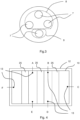
- Further characteristics and advantages will be more apparent from the description of a preferred but non-exclusive embodiment of the method and combustion system, illustrated by way of non-limiting example in the accompanying drawings, in which:
-
Figure 1 shows a combustion system test rig for implementing the method; -
Figure 2 shows a gas turbine with the combustion system of the invention; -
Figures 3 and 4 show respectively the burners connected to the first combustion chamber and a cross section of the combustion system test rig. - With reference to the figures, these show a combustion
system test rig 1. The combustion system test rig reproduces (i.e. it is equal to) acombustion system 15 which is part of or is going to be assembled on agas turbine 16. In the following specific reference to a combustion system and to a combustion system test rig with sequential combustion is made, with combustion chambers where premixed combustion occurs, it is anyhow clear that the same concepts are applicable for different types of combustion systems, e.g. without sequential combustion and with premixed or diffusion combustion. - The combustion
system test rig 1 has afirst combustor 2, adilution mixer 3 and asecond combustor 4. - The
first combustor 2 is of pre-mixed type (i.e. it is arranged for generating a premixed flame) and has acombustion chamber 6 with at least twoburners 7 for supplying a mixture of a fuel and an oxidizer thereinto. In the example shown, thefirst combustor 2 has fourburners 7, operatively grouped in afirst group 8 of threeburners 7 operating in the same conditions and asecond group 9 of one burner; theburners 7 of thefirst group 8 andsecond group 9 may or may not operate in the same conditions, but theburners 7 of each group operate in the same conditions. - The
dilution mixer 3 is fluidically connected downstream of thefirst combustor 2 and is arranged for supplying diluting air into the hot gas stream. - The
second combustor 4 is fluidically connected downstream of thedilution mixer 3 and is arranged for supplying additional fuel into the hot gas stream and combusting it with the oxidizer still present in the hot gas stream. - The
second combustor 4 has amixing section 10 and asecond combustion chamber 11 and it is also of premixed type (i.e. it is arranged to carry out a premixed combustion of the fuel) and lighting of the mixture of fuel and oxidizer occurs by auto ignition. - The
first combustor 2, thedilution mixer 3 and thesecond combustor 4 have a can configuration and are housed in atubular housing 12. - During operation, fuel and oxidizer, typically air, are supplied into the
burners 7 and mixed therein. The resulting mixture is then fed into thecombustion chamber 6 and is combusted there, generating a hot gas stream that is then directed into thedilution mixer 3. - When passing through the
dilution mixer 3, dilution air is supplied into the hot gas stream. - Then, the hot gas stream passes through the
second combustor 4, where additional fuel is injected, e.g. viaelongated lances 25 provided across the section of themixing section 10; this fuel is mixed in the hot gas stream in themixing section 10 and is then combusted in thecombustion chamber 11. - In order to measure the hot gas stream temperature,
temperature sensors 13, such as thermocouples, are provided. In particular, at least twotemperature sensors 13 for detecting a local temperature of the hot gas stream are provided. The at least twotemperature sensors 13 are located at anarea 14 between thefirst combustor 2 or preferably thedilution mixer 3 and thesecond combustion chamber 11. - Advantageously, the axial distance among the temperature sensors is short and preferably the temperature sensors are at the same axial position, where the axial position is ascertained with reference to a longitudinal axis of the combustion system, i.e. the axis parallel to the direction of the hot gas stream. In other words, the temperature sensors substantially lie in one plane which is perpendicular to the longitudinal axis of the combustion system.
- The relevant temperature that has to be measured is the mixer exit temperature MET, i.e. the temperature theoretically achieved by burning the fuel supplied into the test combustion rig with the oxidizer supplied into the test combustion rig at the
area 14 downstream of the first combustor 2 (in the present case downstream of the mixer 3) and upstream of thecombustion chamber 11; this is an average temperature of the hot gas stream that cannot be directly measured, because of the varying temperature distribution over the combustor with varying of the combustor operating parameters. - Therefore, according to the method, the combustion
system test rig 1 is operated with different operating parameter sets and the local temperature of the hot gas stream is measured with the at least twotemperature sensors 13, obtaining local temperatures-operating parameter sets. - Afterward, for each operating parameter set, based on the supplied oxidizer and fuel mass flow, the theoretical mixer exit temperature MET is calculated (i.e. the heat balance is calculated).
- Thus, a correlation between the local temperatures and the theoretical mixer exit temperature MET is provided and the controller is programmed with the correlation, so that based on local temperature measurements the controller can calculate the theoretical mixer exit temperature MET.
- Different possibilities exist for the definition of the operating parameters, but preferably the different operating parameters comprise at least different fuel distribution among the
burner groups first combustor 2 and/or different fuel distribution between the first combustor and thesecond combustor - The correlation is advantageously a polynomial expression, such as

- T1, T2, ... Tn: are the local temperatures measured by the temperature sensors,
- a1, a2, a3, ......, an, b: are coefficients that match the measured values with the mixer exit temperature MET.
- In a preferred embodiment, the polynomial expression is

system test rig 1 and combustion system of the gas turbine simpler and less expensive and likewise data collection and handling is easy and less expensive. - The controller manufactured according to the described method can be used together with a
sequential combustion system 15, in order to reliably calculate the mixer exit temperature MET. - The
combustion system 15 has afirst combustor 2, adilution mixer 3 and asecond combustor 4 in a can configuration. The combustion system is equal to the combustionsystem test rig 1, it is therefore not described in detail in the following; in the attached figures same reference numbers as for the combustion system test rig are used. - In particular, the
combustion system 15 comprises acontroller 17 manufactured according to the described method and two or more (but preferably two)temperature sensors 13 such as thermocouples, for locally measuring the hot gas stream temperature at anarea 14 between thedilution mixer 3 and the second combustion chamber 11 (in this case reference to the dilution mixer is made, but generally the reference can be thefirst combustion chamber 6, e.g. if no dilution mixer is provided). Thetemperature sensors 13 are positioned at the same position where temperature sensors of the combustionsystem test rig 1 were positioned, when the method for manufacturing the controller was implemented. - The
controller 17 is connected to thetemperature sensors 13, such that during operation thetemperature sensors 13 detect local temperatures of the hot gas stream and communicate them to thecontroller 17, thecontroller 17 based on these measured local temperatures and by means of the correlation, such as the polynomial expression, calculates the mixer exit temperature MET. A control unit of the gas turbine, on the basis of the mixer exit temperature MET, drives the gas turbine. - In different embodiments, the
controller 17 can be a dedicated circuitry, a separate computer or can be implemented via the circuitry of the gas turbine control unit. - In the following an embodiment of the method is described according to which not only the correlation, but also the position for the
temperature sensors 13 is determined. - In this embodiment, at least three local temperatures are measured and then subsets of local temperatures are selected and a plurality of correlation between the local temperatures of each of the selected subset and the theoretical mixer exit temperature MET is provided.
- Thus a subsets of local temperatures is selected; the selection can be based on the accuracy of the correlation, i.e. the correlation that better represents the mixer exit temperature can be selected; this best representation can be pursued over a defined temperature range or for all available data. In addition, the selection can be based on the need of providing a temperature sensor in a given position, such that the temperature at that position is measured, in order e.g. to control the local temperature where hot spots could result during the operation of the gas turbine.
- For example, with reference to
figure 4 that shows a combustion system test rig cross section, six local temperatures are measured, then subset of temperatures from two temperature sensors are obtained and the couple of temperature sensors providing the most accurate mixer exit temperature for different operating conditions is selected, such as temperature sensors A and C. - The controller is thus programmed with the correlation based on the selected subset of local temperatures from the selected temperature sensors.
- It is clear that the
figure 4 shows only one possible example for the cross section of the combustion system test rig and also other cross sections are possible, such as round or square or others too. - The number of
temperature sensors 13 provided on the combustionsystem test grid 1 can vary according to the size and shape of the combustor. For example, in case of a combustorsystem test rig 1 with three or four or even six (for larger combustors) temperature sensors, a subset of two temperatures can be selected. - Once the local temperature subset has been selected, the
temperature sensors 13 which have detected these local temperatures and their position on the combustionsystem test rig 1 is defined. Thecombustor system 15 is then preferably only provided withtemperature sensors 13 at positions where the local temperatures of the selected subset were measured in the combustionsystem test rig 1, because the correlation is based only on local temperature measurements made there and can reliably calculate the mixer exit temperature based on local temperatures measured there. Therefore, with reference tofigure 4 , the combustion system is only provided with the temperature sensors A and B. - When the
combustion system 15 is assembled in agas turbine 16 and is operated, it is fed with compressed air from acompressor 20 and fuel. The combustion of the fuel in the compressed air generates the hot gas stream that is then fed to aturbine 21. - The
temperature sensors 13 measure the local temperature of the hot gas stream and send this information to thecontroller 17 that calculates the mixer exit temperature MET of the hot gas stream. The mixer exit temperature MET of the hot gas stream is thus sent to the control unit of the gas turbine, for driving the gas turbine. - Naturally the features described may be independently provided from one another.
- In practice the materials used and the dimensions can be chosen at will according to requirements and to the state of the art.
Claims (14)
- A method for manufacturing a controller (17) for calculating a mixer exit temperature (MET) of a hot gas stream generated in a combustion system (15), the method comprising:- providing a combustion system test rig (1),- providing at least two temperature sensors (13) for locally detecting a temperature of a hot gas stream generated in the combustion system test rig (1);the method comprising:- operating the combustion system test rig (1) with different operating parameter sets,- measuring the local temperature of the hot gas stream with the at least two temperature sensors (13), obtaining local temperatures-operating parameter sets,- for each operating parameter set calculating, based on the supplied oxidizer and fuel mass flow, a theoretical mixer exit temperature (MET), being the temperature theoretically achieved by burning the fuel supplied into the test combustion rig with the oxidizer supplied into the test combustion rig,- providing a correlation between the local temperatures and the theoretical mixer exit temperature (MET),- providing the controller (17) and programming the controller (17) with the correlation, so that based on local temperature measurements the controller can calculate the mixer exit temperature (MET).
- The method of claim 1, characterised in that the different operating parameters comprise at least different fuel distribution among the burners (7) of the first combustor (2) and/or different fuel distribution between the first combustor (2) and the second combustor (4) and/or different oxidizer mass flow supply and/or pilot fuel supply.
- The method of claim 1 or 2, characterised in that the correlation is a polynomial expression.
- The method of claim 3, characterized in that the polynomial expression is
 T1, T2, ... Tn: are the local temperatures measured by the temperature sensors (13),a1, a2, a3, ......, an, b: are coefficient that match the measured values with the mixer exit temperature (MET).
 - The method of claim 4, characterized in that the polynomial expression is

- The method of any of claims 1 through 5, characterized bymeasuring at least three local temperatures, then selecting subsets of local temperatures, thus selecting the subsets of local temperatures which provides the most accurate mixer exit temperature (MET) correlation, thenprogramming the controller (17) with the correlation based on the selected subset of local temperatures.
- The method of claims 4 and 6 or 5 and 6, characterized by calculating the coefficients of the polynomial expression only based on the selected subset of local temperatures.
- The method of any of claims 1 through 7, characterized in that the combustion system test rig (1) has:- a first combustor (2) with at least two burners (7) connected to a first combustion chamber (6), the at least two burners (7) being arranged for supplying a mixture of a fuel and an oxidizer in the first combustion chamber (6), the first combustion chamber (6) being arranged to burn the mixture generating the hot gas stream,- a dilution mixer (3) fluidically connected downstream of the first combustor (2), the dilution mixer (3) for supplying diluting air in the hot gas stream,- a second combustor (4) is fluidically connected downstream of the dilution mixer (3), the second combustor (4) having a mixing area (10) and a second combustion chamber (11) and being arranged for supplying fuel into the hot gas stream and combusting it with oxidizer present in the hot gas stream,- the at least two temperature sensors (13) being located at an area (14) between the dilution mixer (3) and the second combustion chamber (11).
- The method of claim 8, characterized in that the first combustor (2), the dilution mixer (3) and the second combustor (4) have a can configuration.
- The method of any of claims 1 through 9, characterized in that the temperature sensors are substantially at a same axial position, where the axial position is ascertained with reference to a longitudinal axis of the combustion system, i.e. the axis parallel to the direction of flow of the hot gas stream.
- A combustion system (15) comprising- a first combustor (2) for generating a hot gas stream,- a controller (17) manufactured according to the method defined in any of claims 1-10, which method comprises a combustion system test rig (1) and at least two temperature sensors (13) for locally detecting a temperature of a hot gas stream generated in the combustion system test rig (1),wherein the combustion system is equal to the combustion system test rig (1),- at least two temperature sensors (17) for the hot gas stream,- the at least two temperature sensors being positioned at position of the combustor system where temperature sensors were positioned on the combustion system test rig (1),- the controller (17) being connected to the at least two temperature sensors (13).
- The combustion system of claim 11, characterized by comprising- a first combustor (2) with at least two burners (7) connected to a first combustion chamber (6), the at least two burners (7) being arranged for supplying a mixture of a fuel and an oxidizer in the first combustion chamber (6), the first combustion chamber (6) being arranged to burn the mixture generating the hot gas stream,- a dilution mixer (3) fluidically connected downstream of the first combustor (2), the dilution mixer (3) for supplying diluting air in the hot gas stream,- a second combustor (4) fluidically connected downstream of the dilution mixer (3), the second combustor (4) having a mixing area (10) and a second combustion chamber (11) and being arranged for supplying fuel into the hot gas stream and combusting it with oxidizer present in the hot gas stream.
- The combustion system of any of claims 11 through 12, characterized in that the first combustor (2), the dilution mixer (3) and the second combustor (4) have a can configuration.
- The combustion system of any of claims 11 through 13, characterized in that the temperature sensors are substantially at the same axial position, where the axial position is ascertained with reference to a longitudinal axis of the combustion system, i.e. the axis parallel to the direction of flow of the hot gas.
Priority Applications (2)
| Application Number | Priority Date | Filing Date | Title |
|---|---|---|---|
| EP20187862.6A EP3945244B1 (en) | 2020-07-27 | 2020-07-27 | Method for manufacturing a controller and combustion system |
| CN202110850159.2A CN113982751B (en) | 2020-07-27 | 2021-07-27 | Method for manufacturing a controller and combustion system |
Applications Claiming Priority (1)
| Application Number | Priority Date | Filing Date | Title |
|---|---|---|---|
| EP20187862.6A EP3945244B1 (en) | 2020-07-27 | 2020-07-27 | Method for manufacturing a controller and combustion system |
Publications (2)
| Publication Number | Publication Date |
|---|---|
| EP3945244A1 EP3945244A1 (en) | 2022-02-02 |
| EP3945244B1 true EP3945244B1 (en) | 2024-10-02 |
Family
ID=71833214
Family Applications (1)
| Application Number | Title | Priority Date | Filing Date |
|---|---|---|---|
| EP20187862.6A Active EP3945244B1 (en) | 2020-07-27 | 2020-07-27 | Method for manufacturing a controller and combustion system |
Country Status (2)
| Country | Link |
|---|---|
| EP (1) | EP3945244B1 (en) |
| CN (1) | CN113982751B (en) |
Family Cites Families (7)
| Publication number | Priority date | Publication date | Assignee | Title |
|---|---|---|---|---|
| US4055997A (en) * | 1976-09-15 | 1977-11-01 | United Technologies Corporation | Means for calculating turbine inlet temperature of a gas turbine engine |
| EP0646704B1 (en) * | 1993-09-06 | 1997-11-26 | Asea Brown Boveri Ag | Method for controlling a gas turbine plan equipped with two combustion chambers |
| EP1655590B1 (en) * | 2004-11-09 | 2016-02-03 | Alstom Technology Ltd | Method for determining the mass averaged temperature across a flow section of a gas stream in a gas turbine |
| EP2357339A1 (en) * | 2010-02-12 | 2011-08-17 | Siemens Aktiengesellschaft | Method of determining a combustor exit temperature and method of controlling a gas turbine |
| EP3061944A1 (en) * | 2015-02-26 | 2016-08-31 | General Electric Technology GmbH | Method for controlling the operation of a gas turbine with sequential combustion |
| EP3267107B1 (en) * | 2016-07-08 | 2021-03-17 | Ansaldo Energia IP UK Limited | Method of controlling a gas turbine assembly |
| EP3447379B1 (en) * | 2017-08-25 | 2022-01-26 | Ansaldo Energia IP UK Limited | Method for operating a gas turbine plant and gas turbine plant |
-
2020
- 2020-07-27 EP EP20187862.6A patent/EP3945244B1/en active Active
-
2021
- 2021-07-27 CN CN202110850159.2A patent/CN113982751B/en active Active
Also Published As
| Publication number | Publication date |
|---|---|
| CN113982751A (en) | 2022-01-28 |
| CN113982751B (en) | 2025-11-21 |
| EP3945244A1 (en) | 2022-02-02 |
Similar Documents
| Publication | Publication Date | Title |
|---|---|---|
| EP1521037B1 (en) | Method and system for controlling fuel supply in a combustion turbine engine | |
| US5107673A (en) | Method for detecting combustion conditions in combustors | |
| Karim et al. | Staged combustion system for improved emissions operability and flexibility for 7HA class heavy duty gas turbine engine | |
| US8474269B2 (en) | Method of detecting a partial flame failure in a gas turbine engine and a gas turbine engine | |
| US6722135B2 (en) | Performance enhanced control of DLN gas turbines | |
| EP1067338B1 (en) | Method and apparatus for optimizing nox emissions in a gas turbine | |
| EP2853720B1 (en) | An apparatus and a method of controlling the supply of fuel to a combustion chamber | |
| US7975489B2 (en) | Catalyst module overheating detection and methods of response | |
| US5551227A (en) | System and method of detecting partial flame out in a gas turbine engine combustor | |
| CN110118363A (en) | The control method of gas turbine burner, gas turbine and gas turbine burner | |
| AU2010246518B9 (en) | Method for reducing NOx emissions from a burner assembly, comprising several burners, and burner assembly for carrying out said method | |
| US6003296A (en) | Flashback event monitoring (FEM) process | |
| Therkorn et al. | CCPP operational flexibility extension below 30% load using reheat burner switch-off concept | |
| EP3945244B1 (en) | Method for manufacturing a controller and combustion system | |
| JPH05187265A (en) | Gas turbine combustion diagnostic device | |
| JP5828515B2 (en) | Operation support equipment for power generation facilities | |
| EP1847700A2 (en) | Fuel control system | |
| EP4722512A1 (en) | Combustor anomaly monitoring using emissions feedback | |
| CN104919250A (en) | Method to operate a combustor of a gas turbine | |
| Granet et al. | High Firing Temperature GT36 H-Class Low NOx Combustor Engine Validation and Performance | |
| JPH10205754A (en) | Gas turbine combustor monitoring device | |
| EP2455662B1 (en) | Method and device for ascertaining the approach of the lean blow off of a gas turbine engine | |
| Tanimura et al. | DLN Technology Update for the M701DA: Enhancing Vintage Gas Turbine Models With Latest Technology | |
| JPH07318013A (en) | Multi-stage lean premixed combustion method |
Legal Events
| Date | Code | Title | Description |
|---|---|---|---|
| PUAI | Public reference made under article 153(3) epc to a published international application that has entered the european phase |
Free format text: ORIGINAL CODE: 0009012 |
|
| STAA | Information on the status of an ep patent application or granted ep patent |
Free format text: STATUS: THE APPLICATION HAS BEEN PUBLISHED |
|
| AK | Designated contracting states |
Kind code of ref document: A1 Designated state(s): AL AT BE BG CH CY CZ DE DK EE ES FI FR GB GR HR HU IE IS IT LI LT LU LV MC MK MT NL NO PL PT RO RS SE SI SK SM TR |
|
| STAA | Information on the status of an ep patent application or granted ep patent |
Free format text: STATUS: REQUEST FOR EXAMINATION WAS MADE |
|
| 17P | Request for examination filed |
Effective date: 20220720 |
|
| RBV | Designated contracting states (corrected) |
Designated state(s): AL AT BE BG CH CY CZ DE DK EE ES FI FR GB GR HR HU IE IS IT LI LT LU LV MC MK MT NL NO PL PT RO RS SE SI SK SM TR |
|
| GRAP | Despatch of communication of intention to grant a patent |
Free format text: ORIGINAL CODE: EPIDOSNIGR1 |
|
| STAA | Information on the status of an ep patent application or granted ep patent |
Free format text: STATUS: GRANT OF PATENT IS INTENDED |
|
| INTG | Intention to grant announced |
Effective date: 20240426 |
|
| P01 | Opt-out of the competence of the unified patent court (upc) registered |
Effective date: 20240430 |
|
| GRAS | Grant fee paid |
Free format text: ORIGINAL CODE: EPIDOSNIGR3 |
|
| GRAA | (expected) grant |
Free format text: ORIGINAL CODE: 0009210 |
|
| STAA | Information on the status of an ep patent application or granted ep patent |
Free format text: STATUS: THE PATENT HAS BEEN GRANTED |
|
| AK | Designated contracting states |
Kind code of ref document: B1 Designated state(s): AL AT BE BG CH CY CZ DE DK EE ES FI FR GB GR HR HU IE IS IT LI LT LU LV MC MK MT NL NO PL PT RO RS SE SI SK SM TR |
|
| REG | Reference to a national code |
Ref country code: GB Ref legal event code: FG4D |
|
| REG | Reference to a national code |
Ref country code: CH Ref legal event code: EP |
|
| REG | Reference to a national code |
Ref country code: IE Ref legal event code: FG4D |
|
| REG | Reference to a national code |
Ref country code: DE Ref legal event code: R096 Ref document number: 602020038592 Country of ref document: DE |
|
| REG | Reference to a national code |
Ref country code: LT Ref legal event code: MG9D |
|
| REG | Reference to a national code |
Ref country code: NL Ref legal event code: MP Effective date: 20241002 |
|
| REG | Reference to a national code |
Ref country code: AT Ref legal event code: MK05 Ref document number: 1728757 Country of ref document: AT Kind code of ref document: T Effective date: 20241002 |
|
| PG25 | Lapsed in a contracting state [announced via postgrant information from national office to epo] |
Ref country code: NL Free format text: LAPSE BECAUSE OF FAILURE TO SUBMIT A TRANSLATION OF THE DESCRIPTION OR TO PAY THE FEE WITHIN THE PRESCRIBED TIME-LIMIT Effective date: 20241002 |
|
| PG25 | Lapsed in a contracting state [announced via postgrant information from national office to epo] |
Ref country code: NL Free format text: LAPSE BECAUSE OF FAILURE TO SUBMIT A TRANSLATION OF THE DESCRIPTION OR TO PAY THE FEE WITHIN THE PRESCRIBED TIME-LIMIT Effective date: 20241002 |
|
| PG25 | Lapsed in a contracting state [announced via postgrant information from national office to epo] |
Ref country code: PT Free format text: LAPSE BECAUSE OF FAILURE TO SUBMIT A TRANSLATION OF THE DESCRIPTION OR TO PAY THE FEE WITHIN THE PRESCRIBED TIME-LIMIT Effective date: 20250203 Ref country code: IS Free format text: LAPSE BECAUSE OF FAILURE TO SUBMIT A TRANSLATION OF THE DESCRIPTION OR TO PAY THE FEE WITHIN THE PRESCRIBED TIME-LIMIT Effective date: 20250202 Ref country code: HR Free format text: LAPSE BECAUSE OF FAILURE TO SUBMIT A TRANSLATION OF THE DESCRIPTION OR TO PAY THE FEE WITHIN THE PRESCRIBED TIME-LIMIT Effective date: 20241002 |
|
| PG25 | Lapsed in a contracting state [announced via postgrant information from national office to epo] |
Ref country code: FI Free format text: LAPSE BECAUSE OF FAILURE TO SUBMIT A TRANSLATION OF THE DESCRIPTION OR TO PAY THE FEE WITHIN THE PRESCRIBED TIME-LIMIT Effective date: 20241002 |
|
| PG25 | Lapsed in a contracting state [announced via postgrant information from national office to epo] |
Ref country code: BG Free format text: LAPSE BECAUSE OF FAILURE TO SUBMIT A TRANSLATION OF THE DESCRIPTION OR TO PAY THE FEE WITHIN THE PRESCRIBED TIME-LIMIT Effective date: 20241002 |
|
| PG25 | Lapsed in a contracting state [announced via postgrant information from national office to epo] |
Ref country code: ES Free format text: LAPSE BECAUSE OF FAILURE TO SUBMIT A TRANSLATION OF THE DESCRIPTION OR TO PAY THE FEE WITHIN THE PRESCRIBED TIME-LIMIT Effective date: 20241002 |
|
| PG25 | Lapsed in a contracting state [announced via postgrant information from national office to epo] |
Ref country code: NO Free format text: LAPSE BECAUSE OF FAILURE TO SUBMIT A TRANSLATION OF THE DESCRIPTION OR TO PAY THE FEE WITHIN THE PRESCRIBED TIME-LIMIT Effective date: 20250102 |
|
| PG25 | Lapsed in a contracting state [announced via postgrant information from national office to epo] |
Ref country code: LV Free format text: LAPSE BECAUSE OF FAILURE TO SUBMIT A TRANSLATION OF THE DESCRIPTION OR TO PAY THE FEE WITHIN THE PRESCRIBED TIME-LIMIT Effective date: 20241002 Ref country code: AT Free format text: LAPSE BECAUSE OF FAILURE TO SUBMIT A TRANSLATION OF THE DESCRIPTION OR TO PAY THE FEE WITHIN THE PRESCRIBED TIME-LIMIT Effective date: 20241002 Ref country code: GR Free format text: LAPSE BECAUSE OF FAILURE TO SUBMIT A TRANSLATION OF THE DESCRIPTION OR TO PAY THE FEE WITHIN THE PRESCRIBED TIME-LIMIT Effective date: 20250103 |
|
| PG25 | Lapsed in a contracting state [announced via postgrant information from national office to epo] |
Ref country code: PL Free format text: LAPSE BECAUSE OF FAILURE TO SUBMIT A TRANSLATION OF THE DESCRIPTION OR TO PAY THE FEE WITHIN THE PRESCRIBED TIME-LIMIT Effective date: 20241002 Ref country code: CZ Free format text: LAPSE BECAUSE OF FAILURE TO SUBMIT A TRANSLATION OF THE DESCRIPTION OR TO PAY THE FEE WITHIN THE PRESCRIBED TIME-LIMIT Effective date: 20241002 |
|
| PG25 | Lapsed in a contracting state [announced via postgrant information from national office to epo] |
Ref country code: RS Free format text: LAPSE BECAUSE OF FAILURE TO SUBMIT A TRANSLATION OF THE DESCRIPTION OR TO PAY THE FEE WITHIN THE PRESCRIBED TIME-LIMIT Effective date: 20250102 |
|
| PG25 | Lapsed in a contracting state [announced via postgrant information from national office to epo] |
Ref country code: SM Free format text: LAPSE BECAUSE OF FAILURE TO SUBMIT A TRANSLATION OF THE DESCRIPTION OR TO PAY THE FEE WITHIN THE PRESCRIBED TIME-LIMIT Effective date: 20241002 |
|
| REG | Reference to a national code |
Ref country code: DE Ref legal event code: R097 Ref document number: 602020038592 Country of ref document: DE |
|
| PG25 | Lapsed in a contracting state [announced via postgrant information from national office to epo] |
Ref country code: DK Free format text: LAPSE BECAUSE OF FAILURE TO SUBMIT A TRANSLATION OF THE DESCRIPTION OR TO PAY THE FEE WITHIN THE PRESCRIBED TIME-LIMIT Effective date: 20241002 |
|
| PG25 | Lapsed in a contracting state [announced via postgrant information from national office to epo] |
Ref country code: EE Free format text: LAPSE BECAUSE OF FAILURE TO SUBMIT A TRANSLATION OF THE DESCRIPTION OR TO PAY THE FEE WITHIN THE PRESCRIBED TIME-LIMIT Effective date: 20241002 |
|
| PG25 | Lapsed in a contracting state [announced via postgrant information from national office to epo] |
Ref country code: RO Free format text: LAPSE BECAUSE OF FAILURE TO SUBMIT A TRANSLATION OF THE DESCRIPTION OR TO PAY THE FEE WITHIN THE PRESCRIBED TIME-LIMIT Effective date: 20241002 |
|
| PG25 | Lapsed in a contracting state [announced via postgrant information from national office to epo] |
Ref country code: SK Free format text: LAPSE BECAUSE OF FAILURE TO SUBMIT A TRANSLATION OF THE DESCRIPTION OR TO PAY THE FEE WITHIN THE PRESCRIBED TIME-LIMIT Effective date: 20241002 |
|
| PLBE | No opposition filed within time limit |
Free format text: ORIGINAL CODE: 0009261 |
|
| STAA | Information on the status of an ep patent application or granted ep patent |
Free format text: STATUS: NO OPPOSITION FILED WITHIN TIME LIMIT |
|
| PG25 | Lapsed in a contracting state [announced via postgrant information from national office to epo] |
Ref country code: SE Free format text: LAPSE BECAUSE OF FAILURE TO SUBMIT A TRANSLATION OF THE DESCRIPTION OR TO PAY THE FEE WITHIN THE PRESCRIBED TIME-LIMIT Effective date: 20241002 |
|
| 26N | No opposition filed |
Effective date: 20250703 |
|
| PGFP | Annual fee paid to national office [announced via postgrant information from national office to epo] |
Ref country code: DE Payment date: 20250722 Year of fee payment: 6 |
|
| PGFP | Annual fee paid to national office [announced via postgrant information from national office to epo] |
Ref country code: IT Payment date: 20250731 Year of fee payment: 6 |
|
| REG | Reference to a national code |
Ref country code: CH Ref legal event code: H13 Free format text: ST27 STATUS EVENT CODE: U-0-0-H10-H13 (AS PROVIDED BY THE NATIONAL OFFICE) Effective date: 20260224 |
|
| PG25 | Lapsed in a contracting state [announced via postgrant information from national office to epo] |
Ref country code: LU Free format text: LAPSE BECAUSE OF NON-PAYMENT OF DUE FEES Effective date: 20250727 |
|
| GBPC | Gb: european patent ceased through non-payment of renewal fee |
Effective date: 20250727 |
|
| REG | Reference to a national code |
Ref country code: BE Ref legal event code: MM Effective date: 20250731 |
|
| PG25 | Lapsed in a contracting state [announced via postgrant information from national office to epo] |
Ref country code: GB Free format text: LAPSE BECAUSE OF NON-PAYMENT OF DUE FEES Effective date: 20250727 |
|
| PG25 | Lapsed in a contracting state [announced via postgrant information from national office to epo] |
Ref country code: BE Free format text: LAPSE BECAUSE OF NON-PAYMENT OF DUE FEES Effective date: 20250731 |
|
| PG25 | Lapsed in a contracting state [announced via postgrant information from national office to epo] |
Ref country code: FR Free format text: LAPSE BECAUSE OF NON-PAYMENT OF DUE FEES Effective date: 20250731 |
|
| PG25 | Lapsed in a contracting state [announced via postgrant information from national office to epo] |
Ref country code: CH Free format text: LAPSE BECAUSE OF NON-PAYMENT OF DUE FEES Effective date: 20250731 |