EP3945153A1 - A laundry dryer with improved wrinkle removal performance - Google Patents
A laundry dryer with improved wrinkle removal performance Download PDFInfo
- Publication number
- EP3945153A1 EP3945153A1 EP21187852.5A EP21187852A EP3945153A1 EP 3945153 A1 EP3945153 A1 EP 3945153A1 EP 21187852 A EP21187852 A EP 21187852A EP 3945153 A1 EP3945153 A1 EP 3945153A1
- Authority
- EP
- European Patent Office
- Prior art keywords
- laundry
- drum
- water
- humidity
- air
- Prior art date
- Legal status (The legal status is an assumption and is not a legal conclusion. Google has not performed a legal analysis and makes no representation as to the accuracy of the status listed.)
- Granted
Links
Images


Classifications
-
- D—TEXTILES; PAPER
- D06—TREATMENT OF TEXTILES OR THE LIKE; LAUNDERING; FLEXIBLE MATERIALS NOT OTHERWISE PROVIDED FOR
- D06F—LAUNDERING, DRYING, IRONING, PRESSING OR FOLDING TEXTILE ARTICLES
- D06F58/00—Domestic laundry dryers
- D06F58/32—Control of operations performed in domestic laundry dryers
- D06F58/34—Control of operations performed in domestic laundry dryers characterised by the purpose or target of the control
- D06F58/36—Control of operational steps, e.g. for optimisation or improvement of operational steps depending on the condition of the laundry
- D06F58/44—Control of operational steps, e.g. for optimisation or improvement of operational steps depending on the condition of the laundry of conditioning or finishing, e.g. for smoothing or removing creases
-
- D—TEXTILES; PAPER
- D06—TREATMENT OF TEXTILES OR THE LIKE; LAUNDERING; FLEXIBLE MATERIALS NOT OTHERWISE PROVIDED FOR
- D06F—LAUNDERING, DRYING, IRONING, PRESSING OR FOLDING TEXTILE ARTICLES
- D06F2103/00—Parameters monitored or detected for the control of domestic laundry washing machines, washer-dryers or laundry dryers
- D06F2103/02—Characteristics of laundry or load
- D06F2103/04—Quantity, e.g. weight or variation of weight
-
- D—TEXTILES; PAPER
- D06—TREATMENT OF TEXTILES OR THE LIKE; LAUNDERING; FLEXIBLE MATERIALS NOT OTHERWISE PROVIDED FOR
- D06F—LAUNDERING, DRYING, IRONING, PRESSING OR FOLDING TEXTILE ARTICLES
- D06F2103/00—Parameters monitored or detected for the control of domestic laundry washing machines, washer-dryers or laundry dryers
- D06F2103/02—Characteristics of laundry or load
- D06F2103/06—Type or material
-
- D—TEXTILES; PAPER
- D06—TREATMENT OF TEXTILES OR THE LIKE; LAUNDERING; FLEXIBLE MATERIALS NOT OTHERWISE PROVIDED FOR
- D06F—LAUNDERING, DRYING, IRONING, PRESSING OR FOLDING TEXTILE ARTICLES
- D06F2103/00—Parameters monitored or detected for the control of domestic laundry washing machines, washer-dryers or laundry dryers
- D06F2103/02—Characteristics of laundry or load
- D06F2103/08—Humidity
-
- D—TEXTILES; PAPER
- D06—TREATMENT OF TEXTILES OR THE LIKE; LAUNDERING; FLEXIBLE MATERIALS NOT OTHERWISE PROVIDED FOR
- D06F—LAUNDERING, DRYING, IRONING, PRESSING OR FOLDING TEXTILE ARTICLES
- D06F2103/00—Parameters monitored or detected for the control of domestic laundry washing machines, washer-dryers or laundry dryers
- D06F2103/28—Air properties
- D06F2103/32—Temperature
-
- D—TEXTILES; PAPER
- D06—TREATMENT OF TEXTILES OR THE LIKE; LAUNDERING; FLEXIBLE MATERIALS NOT OTHERWISE PROVIDED FOR
- D06F—LAUNDERING, DRYING, IRONING, PRESSING OR FOLDING TEXTILE ARTICLES
- D06F2103/00—Parameters monitored or detected for the control of domestic laundry washing machines, washer-dryers or laundry dryers
- D06F2103/60—Parameters monitored or detected for the control of domestic laundry washing machines, washer-dryers or laundry dryers related to auxiliary conditioning or finishing agents, e.g. filling level of perfume tanks
- D06F2103/62—Parameters monitored or detected for the control of domestic laundry washing machines, washer-dryers or laundry dryers related to auxiliary conditioning or finishing agents, e.g. filling level of perfume tanks related to systems for water or steam used for conditioning or finishing
-
- D—TEXTILES; PAPER
- D06—TREATMENT OF TEXTILES OR THE LIKE; LAUNDERING; FLEXIBLE MATERIALS NOT OTHERWISE PROVIDED FOR
- D06F—LAUNDERING, DRYING, IRONING, PRESSING OR FOLDING TEXTILE ARTICLES
- D06F2105/00—Systems or parameters controlled or affected by the control systems of washing machines, washer-dryers or laundry dryers
- D06F2105/38—Conditioning or finishing, e.g. control of perfume injection
-
- D—TEXTILES; PAPER
- D06—TREATMENT OF TEXTILES OR THE LIKE; LAUNDERING; FLEXIBLE MATERIALS NOT OTHERWISE PROVIDED FOR
- D06F—LAUNDERING, DRYING, IRONING, PRESSING OR FOLDING TEXTILE ARTICLES
- D06F58/00—Domestic laundry dryers
- D06F58/20—General details of domestic laundry dryers
- D06F58/203—Laundry conditioning arrangements
-
- D—TEXTILES; PAPER
- D06—TREATMENT OF TEXTILES OR THE LIKE; LAUNDERING; FLEXIBLE MATERIALS NOT OTHERWISE PROVIDED FOR
- D06F—LAUNDERING, DRYING, IRONING, PRESSING OR FOLDING TEXTILE ARTICLES
- D06F58/00—Domestic laundry dryers
- D06F58/32—Control of operations performed in domestic laundry dryers
- D06F58/34—Control of operations performed in domestic laundry dryers characterised by the purpose or target of the control
- D06F58/36—Control of operational steps, e.g. for optimisation or improvement of operational steps depending on the condition of the laundry
- D06F58/38—Control of operational steps, e.g. for optimisation or improvement of operational steps depending on the condition of the laundry of drying, e.g. to achieve the target humidity
Definitions
- the present invention relates to a laundry dryer with improved wrinkle removal performance.
- the laundry dryers may have wrinkle removal functions as an additional feature.
- the wrinkle depends on various structural factors which vary according to external factors especially the type of fiber.
- Many natural or artificial textile fibers are polymers and have different physical and chemical properties due to differences in the chain sequences and molecular structures thereof.
- the drying programs developed do not provide the same effect on every type of textile due to the different physical and chemical properties of textiles.
- One of the methods to reduce the wrinkles in the laundry in the drum is to spray water into the drum at certain intervals.
- a laundry dryer wherein the wrinkle removal performance is improved.
- the document discloses that the wrinkle removal performance is improved by delivering water onto the laundry in the drum during the drying process.
- the document further discloses that the water is delivered into the drum when the humidity rate of the laundry is between 10% to 20%.
- this method cannot provide an efficient wrinkle removal performance for every laundry.
- the humidity content of the textile in production varies according to the type of the textile, and in a laundry dryer having a water spraying system, the drying process is performed by delivering water twice as much as the commercial humidity contained in these textiles, thus improving wrinkle removal.
- the aim of the present invention is the realization of a laundry dryer wherein the wrinkle removal performance is improved by applying a drying process which changes depending on the fiber type and weight of the laundry.
- the laundry dryer of the present invention comprises a body; a drum which is disposed in the body and wherein the laundry is loaded; a temperature sensor which is provided in the body and which measures the temperature of the drying air in the drum; a humidity sensor which is provided in the body and which measures the humidity of the laundry; a water delivery system which sprays water into the drum; and a control unit which controls the water delivery system, which determines the weight and textile type of the laundry in the drum, and which determines the amount of water to be delivered into the drum depending on the weight of the laundry in the drum.
- the control unit operates the water delivery stem so as to deliver approximately 40 ml of water for each piece of laundry into the drum.
- the laundry dryer of the present invention further comprises the control unit which, when the data received from the temperature sensor is between 35 0 C and 45 0 C, operates the water delivery system so as to deliver the amount of water determined according to the weight of the laundry in the drum into the drum when it is determined that cotton laundry is loaded into the drum, when the data received from the humidity sensor is between 12% and 16% or when it is determined that viscose laundry is loaded into the drum, when the data received from the humidity sensor is between 30% and 35% or when it is determined that polyester laundry is loaded into the drum, and when the data received from the humidity sensor is between 4% and 8%.
- the glass transition temperature is the temperature where the fibers on the laundry start to actively move.
- the humidity-dependent glass transition temperature curves of textiles with different polymer structures are different from each other.
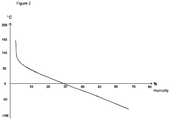
- Figure 2 shows the humidity-dependent glass transition temperature curve for a piece of 100% cotton laundry. According to this curve, when there is 30% humidity on a piece of 100% cotton laundry, the fibers on the laundry fabric tend to move at each temperature above 0 0 C. As the humidity on the laundry increases, the glass transition temperature decreases. Therefore, the humid laundry loaded into the drum to be dried is treated at a temperature above the glass transition temperature at the beginning of the drying process. As the humidity on the laundry decreases, the glass transition temperature increases.
- the glass transition temperature is approximately 45 0 C when there is 12% humidity on a piece of 100% cotton laundry, and the glass transition temperature is approximately 35 0 C when the humidity rate is 16%.
- Figure 3 shows the humidity-dependent glass transition temperature for a 100% viscose fabric. According to the graphic in Figure 3 , the glass transition temperature is approximately 45 0 C when there is 30% humidity on a piece of 100% viscose laundry, and the glass transition temperature is approximately 35 0 C when the humidity rate is 35%.
- Figure 4 shows the humidity-dependent glass transition temperature for a 100% polyester fabric.
- the glass transition temperature is approximately 45 0 C when there is 4% humidity on a piece of 100% polyester laundry, and the glass transition temperature is approximately 36 0 C when the humidity rate is 8%.
- a drying air at a temperature between 35 0 C and 45 0 C is sent into the drum.
- the humidity sensor periodically measures the humidity rate of the laundry.
- the control unit if the data received from the humidity sensor is between 12% and 16%, delivers a predetermined amount of water into the drum by means of the water delivery system.
- the control unit operates the water delivery system to deliver a predetermined amount of water into the drum.
- the laundry is enabled to be treated at a temperature above the glass transition temperature for a longer period of time.
- the laundry dryer comprises an air distribution system which sends air into the drum at a first air flow rate or at a second air flow rate lower than the first air flow rate.
- the drying air is delivered into the drum at different air flow rates at different times depending on the type of laundry.
- the control unit controls the air distribution system so as to send air into the drum at the second air flow rate after the water is delivered into the drum.
- the laundry is dried by being exposed to the air at the first air flow rate until the humidity rates predetermined for the types of fabric.
- the laundry is quickly dehumidified by sending the air thereon at the first air flow rate.
- the water is delivered into the drum and the laundry is moistened for a certain amount so as to decrease the glass transition temperature. Since the temperature of the drying air delivered into the drum is not changed, the laundry is treated with the drying air having a temperature above the glass transition temperature.
- the laundry By delivering the air at the second air flow rate onto the laundry after the water is delivered into the drum, the laundry is enabled to be delicately dried and the fibers on the fabric surface are easily flattened by means of the low air flow rate. Thus, the wrinkles in the laundry are removed without damaging the laundry.
- the air distribution system comprises a fan which delivers air at the first air flow rate while rotating in one direction and which delivers air at the second air flow rate while rotating in the other direction.
- the laundry dryer comprises the water delivery system having a water reservoir which is disposed in the body, a spraying line which extends between the water reservoir and the drum, a nozzle which is provided at the end of the spraying line and which sprays water into the drum, and a pump which provides the delivery of the water from the water reservoir to the nozzle.
- the water reservoir can be a reservoir which can be detached from the body and filled.
- the pump is positioned in the water reservoir. The pump is controlled by the control unit. When it is desired to deliver water into the drum, the control unit operates the pump so as to deliver water to the nozzle. The water reaching the nozzle is sprayed into the drum.
- the laundry dryer comprises a flowmeter which is provided in the spraying line.
- a laundry dryer is realized, wherein the wrinkle removal performance is improved by applying different drying processes depending on the type of the laundry loaded into the drum.
- the laundry dryer (1) comprises a body (2); a drum (3) which is disposed in the body (2) and wherein the laundry is loaded; a temperature sensor (4) which is provided in the body (2) and which measures the temperature of the drying air in the drum (3); a humidity sensor (5) which is provided in the body (2) and which measures the humidity of the laundry; a water delivery system which sprays water into the drum (3); and a control unit (6) which controls the water delivery system, which determines the weight and textile type of the laundry in the drum (3), and which determines the amount of water to be delivered into the drum (3) depending on the weight of the laundry in the drum (3).
- the temperature sensor (4) which measures the temperature of the drying air in the drum (3) is positioned in the vicinity of the air outlet through which the drying air leaves the drum (3) after being delivered onto the laundry.
- the humidity sensor (5) is positioned so as to face the inner volume of the drum (3).
- the humidity sensor (5) directly contacts the laundry so as to detect the humidity of the laundry.
- the control unit (6) determines the weight and fabric type of the laundry in the drum (3).
- the user selects the fabric type of the laundry loaded into the drum (3), and can send the information on the fabric type of the laundry to be dried to the control unit (6).
- the control unit (6) can determine the fabric type of the laundry loaded into the drum (3) by means of an optical sensor or other sensors to be provided in the body (2).
- the user selects the weight of the laundry loaded into the drum (3) via the control panel such that the control unit (6) determines the weight.
- the user can transmit the information on the weight of the laundry loaded into the drum (3) to the control unit (6) by means of buttons for full load, half load, quarter load or buttons for selecting the number of pieces of laundry provided on the control panel.
- the control unit (6) can determine the weight of the laundry in the drum (3) by means of the sensors which are provided in the body (2) and which are suitable for measuring the weight of the drum (3).
- the water delivery system which provides the spraying of water into the drum (3) is disposed in the body (2). By controlling the water delivery system, the control unit (6) ensures that the water is delivered into the drum (3) at certain intervals.
- the control unit (6) determines the amount of water to be delivered into the drum (3) according to the weight of the laundry in the drum (3). As the weight of the laundry in the drum (3) increases, the amount of water to be delivered into the drum (3) during the drying process also increases.
- the laundry dryer (1) of the present invention further comprises the control unit (6) which, when the data received from the temperature sensor (4) is between 35 0 C and 45 0 C, operates the water delivery system so as to deliver the amount of water determined according to the weight of the laundry in the drum (3) into the drum (3) when it is determined that cotton laundry is loaded into the drum (3) and when the data received from the humidity sensor (5) is between 12% and 16% or when it is determined that viscose laundry is loaded into the drum(3) and when the data received from the humidity sensor (5) is between 30% and 35% or when it is determined that polyester laundry is loaded into the drum (3) and when the data received from the humidity sensor (5) is between 4% and 8%.
- the temperature where the fibers on the fabrics of the laundry start to actively move is the glass transition temperature.
- the fibers on the fabric can actively move at temperatures above the glass transition temperature.
- the glass transition temperature is dependent on the humidity and has a different temperature/humidity curve for each type of fabric. As the humidity on the laundry increases, the glass transition temperature decreases.
- Figure 2 shows the humidity-dependent glass transition temperature for a 100% cotton fabric. Figure 2 shows that when there is 12% humidity on a piece of 100% cotton laundry, the fibers on the laundry can easily move at each temperature above 45 0 C. Moreover, Figure 2 shows that when there is 16% humidity on a piece of 100% cotton laundry, the fibers on the laundry can easily move at each temperature above 35 0 C.
- the control unit (6) Upon determining that the fabric type of the laundry in the drum (3) is cotton, when the temperature of the drying air during the drying process is between 35 0 C and 45 0 C and the humidity ratio on the laundry is between 12% and 16%, the control unit (6) operates the water delivery system so as to spray water into the drum (3).
- the glass transition temperature is decreased and the laundry is enabled to be treated at a temperature above the glass transition temperature for a longer period of time.
- the humidity-dependent glass transition temperature curve is a curve provided for 100% cotton laundry. However, for laundry containing more than 50% of cotton fabric, the results obtained are similar to the glass transition temperature curve given in Figure 2 .
- Figure 3 shows that when there is 35% humidity on a piece of 100% viscose laundry, the fibers on the laundry can easily move at temperatures above 35 0 C, and when there is 30% humidity, the fibers can easily move at temperatures above 45 0 C
- Figure 4 shows that when there is 8% humidity on a piece of 100% polyester laundry, the fibers on the laundry can easily move at temperatures above 35 0 C, and when there is 4% humidity, the fibers can easily move at temperatures above 45 0 C
- the control unit (6) delivers an amount of water determined according to the weight of the laundry in the drum (3) into the drum (3) when it is determined that cotton laundry is loaded into the drum (3) and when the humidity ratio on the laundry is between 12% and 16% or when it is determined that viscose laundry is loaded into the drum (3) and when the humidity ratio on the laundry is between 30% and 35% or when it is determined that polyester laundry is loaded into the drum (3) and when the humidity ratio on the laundry is between 4% and 8%.
- the laundry is enabled to be treated at a temperature above the glass transition temperature for a longer period of time so as to reduce wrinkles.
- the control unit (6) delivers water into the drum (3) only once during a single drying process. When the laundry with increased humidity after water is sprayed into the drum (3) reaches the humidity value range upon being subjected to the drying air again, water is not sprayed into the drum for a second time in the same drying cycle.
- the laundry dryer (1) comprises an air distribution system which sends air into the drum (3) at a first air flow rate or at a second air flow rate lower than the first air flow rate. While the first air flow rate is 75 l/s, the second air flow rate is 25 l/s. When the air is delivered into the drum (3) at the first air flow rate, the laundry is dried more quickly. When the air is delivered into the drum (3) at the second air flow rate, a more delicate drying is provided.
- the air distribution system is controlled by the control unit (6).
- the laundry dryer (1) comprises the control unit (6) which controls the air distribution system so as to send air into the drum (3) at the second air flow rate after the water is delivered into the drum (3).
- the humidity of the laundry increases by a certain amount.
- the laundry is treated at a temperature above the glass transition temperature for a while more.
- the control unit (6) operates the air distribution system so as to deliver air onto the laundry at the second air flow rate until the laundry is detected to be dry depending on the value measured by the humidity sensor (5).
- the laundry dryer (1) comprises the air distribution system having a fan (7) which delivers air at the first air flow rate while rotating in one direction and which delivers air at the second air flow rate while rotating in the other direction.
- a fan (7) which delivers air at the first air flow rate while rotating in one direction and which delivers air at the second air flow rate while rotating in the other direction.
- the laundry dryer (1) comprises the water delivery system having a water reservoir (8) which is disposed in the body (2), a spraying line (9) which extends between the water reservoir (8) and the drum (3), a nozzle (10) which is provided at the end of the spraying line (9) and which sprays water into the drum (3), and a pump (11) which provides the delivery of the water from the water reservoir (8) to the nozzle (10).
- the water condensed in the air distribution system is collected in the water reservoir (8).
- the control unit (6) controls the pump (11) and the nozzle (10) so as to spray water into the drum (3) at predetermined intervals.
- the control unit (6) determines the amount of water to be delivered into the drum (11) by adjusting the operation time of the pump (11).
- the laundry dryer (1) comprises a flowmeter which is provided in the spraying line (9).
- the amount of water to be delivered into the drum (3) can be easily determined.
- a laundry dryer (1) comprising a control unit (6) which, upon determining the fabric type and weight of the laundry, delivers the drying air at temperatures between 35 0 C and 45 0 C into the drum (3), which delivers an amount of water determined depending on the weight of the laundry into the drum (3) when the humidity ratio on the laundry falls into the range predetermined for the determined fabric type such that the laundry is treated at a temperature above the glass transition temperature for a while more, and which provides the removal of wrinkles on the fabric surface of the laundry.
Landscapes
- Engineering & Computer Science (AREA)
- Textile Engineering (AREA)
- Control Of Washing Machine And Dryer (AREA)
Abstract
Description
- The present invention relates to a laundry dryer with improved wrinkle removal performance.
- The laundry dryers may have wrinkle removal functions as an additional feature. The wrinkle depends on various structural factors which vary according to external factors especially the type of fiber. Many natural or artificial textile fibers are polymers and have different physical and chemical properties due to differences in the chain sequences and molecular structures thereof. The drying programs developed do not provide the same effect on every type of textile due to the different physical and chemical properties of textiles. One of the methods to reduce the wrinkles in the laundry in the drum is to spray water into the drum at certain intervals.
- In the
United States Patent Application No. US2010024243 , a laundry dryer is disclosed, wherein the wrinkle removal performance is improved. The document discloses that the wrinkle removal performance is improved by delivering water onto the laundry in the drum during the drying process. The document further discloses that the water is delivered into the drum when the humidity rate of the laundry is between 10% to 20%. However, since the wrinkle removal dynamics (yarn mobility) differ depending on the temperature and humidity value according to the yarn type of the laundry, this method cannot provide an efficient wrinkle removal performance for every laundry. - In the
European Patent No. EP2333147 , it is disclosed that the humidity content of the textile in production varies according to the type of the textile, and in a laundry dryer having a water spraying system, the drying process is performed by delivering water twice as much as the commercial humidity contained in these textiles, thus improving wrinkle removal. - The aim of the present invention is the realization of a laundry dryer wherein the wrinkle removal performance is improved by applying a drying process which changes depending on the fiber type and weight of the laundry.
- The laundry dryer of the present invention comprises a body; a drum which is disposed in the body and wherein the laundry is loaded; a temperature sensor which is provided in the body and which measures the temperature of the drying air in the drum; a humidity sensor which is provided in the body and which measures the humidity of the laundry; a water delivery system which sprays water into the drum; and a control unit which controls the water delivery system, which determines the weight and textile type of the laundry in the drum, and which determines the amount of water to be delivered into the drum depending on the weight of the laundry in the drum. In the preferred version of the present invention, the control unit operates the water delivery stem so as to deliver approximately 40 ml of water for each piece of laundry into the drum.
- The laundry dryer of the present invention further comprises the control unit which, when the data received from the temperature sensor is between 350C and 450C, operates the water delivery system so as to deliver the amount of water determined according to the weight of the laundry in the drum into the drum when it is determined that cotton laundry is loaded into the drum, when the data received from the humidity sensor is between 12% and 16% or when it is determined that viscose laundry is loaded into the drum, when the data received from the humidity sensor is between 30% and 35% or when it is determined that polyester laundry is loaded into the drum, and when the data received from the humidity sensor is between 4% and 8%. The glass transition temperature is the temperature where the fibers on the laundry start to actively move. Since the molecular structures of each polymer differ from each other, the humidity-dependent glass transition temperature curves of textiles with different polymer structures are different from each other. When a temperature above the glass transition temperature is applied to the laundry, the fibers on the laundry fabric can actively move.
Figure 2 shows the humidity-dependent glass transition temperature curve for a piece of 100% cotton laundry. According to this curve, when there is 30% humidity on a piece of 100% cotton laundry, the fibers on the laundry fabric tend to move at each temperature above 00 C. As the humidity on the laundry increases, the glass transition temperature decreases. Therefore, the humid laundry loaded into the drum to be dried is treated at a temperature above the glass transition temperature at the beginning of the drying process. As the humidity on the laundry decreases, the glass transition temperature increases. It is not possible to move the fibers on the laundry fiber at a temperature below the glass transition temperature. For example, when a wrinkled piece of laundry is treated at a temperature below the glass transition temperature, the amount of wrinkles thereon does not change. According to the graphic inFigure 2 , the glass transition temperature is approximately 450 C when there is 12% humidity on a piece of 100% cotton laundry, and the glass transition temperature is approximately 350 C when the humidity rate is 16%.Figure 3 shows the humidity-dependent glass transition temperature for a 100% viscose fabric. According to the graphic inFigure 3 , the glass transition temperature is approximately 450 C when there is 30% humidity on a piece of 100% viscose laundry, and the glass transition temperature is approximately 350 C when the humidity rate is 35%.Figure 4 shows the humidity-dependent glass transition temperature for a 100% polyester fabric. According to the graphic inFigure 4 , the glass transition temperature is approximately 450 C when there is 4% humidity on a piece of 100% polyester laundry, and the glass transition temperature is approximately 360 C when the humidity rate is 8%. After the type of laundry loaded into the drum is determined by the control unit, a drying air at a temperature between 350 C and 450 C is sent into the drum. The humidity sensor periodically measures the humidity rate of the laundry. Upon determining that the laundry loaded into the drum is cotton, the control unit, if the data received from the humidity sensor is between 12% and 16%, delivers a predetermined amount of water into the drum by means of the water delivery system. Since the humidity rate of the laundry increases after the water is delivered into the drum, the glass transition temperature decreases. Thus, the laundry is enabled to be treated at a temperature above the glass transition temperature. Thus, the wrinkles on the laundry are reduced. Upon determining that the type of laundry loaded into the drum is viscose while the data received from the humidity sensor is between 30% and 35%, and that the type of laundry loaded into the drum is polyester while the data received from the humidity sensor is between 4% and 8%, the control unit operates the water delivery system to deliver a predetermined amount of water into the drum. Thus, by spraying water into the drum at humidity ranges determined for the humidity-dependent glass transition temperature for each type of fabric, the laundry is enabled to be treated at a temperature above the glass transition temperature for a longer period of time. - In another embodiment of the present invention, the laundry dryer comprises an air distribution system which sends air into the drum at a first air flow rate or at a second air flow rate lower than the first air flow rate. The drying air is delivered into the drum at different air flow rates at different times depending on the type of laundry.
- In an embodiment of the present invention, the control unit controls the air distribution system so as to send air into the drum at the second air flow rate after the water is delivered into the drum. After the laundry is loaded into the drum, the laundry is dried by being exposed to the air at the first air flow rate until the humidity rates predetermined for the types of fabric. At this step which is the drying step, the laundry is quickly dehumidified by sending the air thereon at the first air flow rate. At the point where the temperature and humidity values intersect on the glass transition graphic, the water is delivered into the drum and the laundry is moistened for a certain amount so as to decrease the glass transition temperature. Since the temperature of the drying air delivered into the drum is not changed, the laundry is treated with the drying air having a temperature above the glass transition temperature. By delivering the air at the second air flow rate onto the laundry after the water is delivered into the drum, the laundry is enabled to be delicately dried and the fibers on the fabric surface are easily flattened by means of the low air flow rate. Thus, the wrinkles in the laundry are removed without damaging the laundry.
- In an embodiment of the present invention, the air distribution system comprises a fan which delivers air at the first air flow rate while rotating in one direction and which delivers air at the second air flow rate while rotating in the other direction.
- In an embodiment of the present invention, the laundry dryer comprises the water delivery system having a water reservoir which is disposed in the body, a spraying line which extends between the water reservoir and the drum, a nozzle which is provided at the end of the spraying line and which sprays water into the drum, and a pump which provides the delivery of the water from the water reservoir to the nozzle. The water reservoir can be a reservoir which can be detached from the body and filled. The pump is positioned in the water reservoir. The pump is controlled by the control unit. When it is desired to deliver water into the drum, the control unit operates the pump so as to deliver water to the nozzle. The water reaching the nozzle is sprayed into the drum.
- In an embodiment of the present invention, the laundry dryer comprises a flowmeter which is provided in the spraying line.
- By mans of the present invention, a laundry dryer is realized, wherein the wrinkle removal performance is improved by applying different drying processes depending on the type of the laundry loaded into the drum.
- The advantages of the laundry dryer of the present invention will be disclosed with the detailed description of the embodiments with reference to the accompanying figure, where:
-
Figure 1 - is the schematic view of the laundry dryer in an embodiment of the present invention. -
Figure 2 - is the curve of the glass transition temperature for a 100% cotton fabric dependent on the percentage of humidity thereon. -
Figure 3 - is the curve of the glass transition temperature for a 100% viscose fabric dependent on the percentage of humidity thereon. -
Figure 4 - is the curve of the glass transition temperature for a 100% polyester fabric dependent on the percentage of humidity thereon. - The following numerals are referred to in the description of the present invention:
- 1. Laundry dryer
- 2. Body
- 3. Drum
- 4. Temperature sensor
- 5. Humidity sensor
- 6. Control unit
- 7. Fan
- 8. Water reservoir
- 9. Spraying line
- 10. Nozzle
- 11. Pump
- The laundry dryer (1) comprises a body (2); a drum (3) which is disposed in the body (2) and wherein the laundry is loaded; a temperature sensor (4) which is provided in the body (2) and which measures the temperature of the drying air in the drum (3); a humidity sensor (5) which is provided in the body (2) and which measures the humidity of the laundry; a water delivery system which sprays water into the drum (3); and a control unit (6) which controls the water delivery system, which determines the weight and textile type of the laundry in the drum (3), and which determines the amount of water to be delivered into the drum (3) depending on the weight of the laundry in the drum (3). The temperature sensor (4) which measures the temperature of the drying air in the drum (3) is positioned in the vicinity of the air outlet through which the drying air leaves the drum (3) after being delivered onto the laundry. The humidity sensor (5) is positioned so as to face the inner volume of the drum (3). The humidity sensor (5) directly contacts the laundry so as to detect the humidity of the laundry. The control unit (6) determines the weight and fabric type of the laundry in the drum (3). In a version of the present invention, the user selects the fabric type of the laundry loaded into the drum (3), and can send the information on the fabric type of the laundry to be dried to the control unit (6). In another version of the present invention, the control unit (6) can determine the fabric type of the laundry loaded into the drum (3) by means of an optical sensor or other sensors to be provided in the body (2). In a version of the present invention, the user selects the weight of the laundry loaded into the drum (3) via the control panel such that the control unit (6) determines the weight. The user can transmit the information on the weight of the laundry loaded into the drum (3) to the control unit (6) by means of buttons for full load, half load, quarter load or buttons for selecting the number of pieces of laundry provided on the control panel. In another version of the present invention, the control unit (6) can determine the weight of the laundry in the drum (3) by means of the sensors which are provided in the body (2) and which are suitable for measuring the weight of the drum (3). The water delivery system which provides the spraying of water into the drum (3) is disposed in the body (2). By controlling the water delivery system, the control unit (6) ensures that the water is delivered into the drum (3) at certain intervals. Thus, the movement of the fibers on the fabrics of the laundry is facilitated. The control unit (6) determines the amount of water to be delivered into the drum (3) according to the weight of the laundry in the drum (3). As the weight of the laundry in the drum (3) increases, the amount of water to be delivered into the drum (3) during the drying process also increases.
- The laundry dryer (1) of the present invention further comprises the control unit (6) which, when the data received from the temperature sensor (4) is between 350C and 450C, operates the water delivery system so as to deliver the amount of water determined according to the weight of the laundry in the drum (3) into the drum (3) when it is determined that cotton laundry is loaded into the drum (3) and when the data received from the humidity sensor (5) is between 12% and 16% or when it is determined that viscose laundry is loaded into the drum(3) and when the data received from the humidity sensor (5) is between 30% and 35% or when it is determined that polyester laundry is loaded into the drum (3) and when the data received from the humidity sensor (5) is between 4% and 8%. The temperature where the fibers on the fabrics of the laundry start to actively move is the glass transition temperature. The fibers on the fabric can actively move at temperatures above the glass transition temperature. The glass transition temperature is dependent on the humidity and has a different temperature/humidity curve for each type of fabric. As the humidity on the laundry increases, the glass transition temperature decreases.
Figure 2 shows the humidity-dependent glass transition temperature for a 100% cotton fabric.Figure 2 shows that when there is 12% humidity on a piece of 100% cotton laundry, the fibers on the laundry can easily move at each temperature above 450 C. Moreover,Figure 2 shows that when there is 16% humidity on a piece of 100% cotton laundry, the fibers on the laundry can easily move at each temperature above 350 C. Upon determining that the fabric type of the laundry in the drum (3) is cotton, when the temperature of the drying air during the drying process is between 350 C and 450 C and the humidity ratio on the laundry is between 12% and 16%, the control unit (6) operates the water delivery system so as to spray water into the drum (3). Thus, by increasing the humidity on the laundry, the glass transition temperature is decreased and the laundry is enabled to be treated at a temperature above the glass transition temperature for a longer period of time. The humidity-dependent glass transition temperature curve is a curve provided for 100% cotton laundry. However, for laundry containing more than 50% of cotton fabric, the results obtained are similar to the glass transition temperature curve given inFigure 2 . When water is sprayed into the drum (3) within the drying air temperature and humidity ratio ranges close to the glass transition temperature curve while laundry containing more than 50% of cotton fabric by mass is treated in the laundry dryer (1), the laundry is enabled to be treated at a temperature above the glass transition temperature for a longer period of time so as to reduce wrinkles. As the fabric type changes, the humidity-dependent glass transition temperature curve also changes.Figure 3 shows the humidity-dependent glass transition temperature for a 100% viscose fabric.Figure 3 shows that when there is 35% humidity on a piece of 100% viscose laundry, the fibers on the laundry can easily move at temperatures above 350 C, and when there is 30% humidity, the fibers can easily move at temperatures above 450 CFigure 4 shows that when there is 8% humidity on a piece of 100% polyester laundry, the fibers on the laundry can easily move at temperatures above 350 C, and when there is 4% humidity, the fibers can easily move at temperatures above 450 C During a drying process performed at temperatures between 350 C and 45 0 C, the control unit (6) delivers an amount of water determined according to the weight of the laundry in the drum (3) into the drum (3) when it is determined that cotton laundry is loaded into the drum (3) and when the humidity ratio on the laundry is between 12% and 16% or when it is determined that viscose laundry is loaded into the drum (3) and when the humidity ratio on the laundry is between 30% and 35% or when it is determined that polyester laundry is loaded into the drum (3) and when the humidity ratio on the laundry is between 4% and 8%. Thus, the laundry is enabled to be treated at a temperature above the glass transition temperature for a longer period of time so as to reduce wrinkles. In a preferred embodiment of the present invention, the control unit (6) delivers water into the drum (3) only once during a single drying process. When the laundry with increased humidity after water is sprayed into the drum (3) reaches the humidity value range upon being subjected to the drying air again, water is not sprayed into the drum for a second time in the same drying cycle. - In another embodiment of the present invention, the laundry dryer (1) comprises an air distribution system which sends air into the drum (3) at a first air flow rate or at a second air flow rate lower than the first air flow rate. While the first air flow rate is 75 l/s, the second air flow rate is 25 l/s. When the air is delivered into the drum (3) at the first air flow rate, the laundry is dried more quickly. When the air is delivered into the drum (3) at the second air flow rate, a more delicate drying is provided. The air distribution system is controlled by the control unit (6).
- In another embodiment of the present invention, the laundry dryer (1) comprises the control unit (6) which controls the air distribution system so as to send air into the drum (3) at the second air flow rate after the water is delivered into the drum (3). After the water is delivered into the drum (3), the humidity of the laundry increases by a certain amount. The laundry is treated at a temperature above the glass transition temperature for a while more. By delivering the air into the drum (3) at the second air flow rate, the fabric surface of the laundry is enabled to be delicately flattened. After the water is delivered into the drum (3), the control unit (6) operates the air distribution system so as to deliver air onto the laundry at the second air flow rate until the laundry is detected to be dry depending on the value measured by the humidity sensor (5).
- In another embodiment of the present invention, the laundry dryer (1) comprises the air distribution system having a fan (7) which delivers air at the first air flow rate while rotating in one direction and which delivers air at the second air flow rate while rotating in the other direction. By means of the angled structure of the blades of the fan (7), an air flow at the first air flow rate is generated while the motor is rotated clockwise, and an air flow rate at the second air flow rate, which is lower than the first one, is delivered into the drum (3) while the fan (7) is rotated counterclockwise. Thus, two different air flow rates can be obtained by a single fan without requiring a second fan.
- In another embodiment of the present invention, the laundry dryer (1) comprises the water delivery system having a water reservoir (8) which is disposed in the body (2), a spraying line (9) which extends between the water reservoir (8) and the drum (3), a nozzle (10) which is provided at the end of the spraying line (9) and which sprays water into the drum (3), and a pump (11) which provides the delivery of the water from the water reservoir (8) to the nozzle (10). The water condensed in the air distribution system is collected in the water reservoir (8). By means of the nozzle (10) provided at the end of the spraying line (9), the water collected in the collection receptacle (8) is sprayed into the drum (3). The control unit (6) controls the pump (11) and the nozzle (10) so as to spray water into the drum (3) at predetermined intervals. The control unit (6) determines the amount of water to be delivered into the drum (11) by adjusting the operation time of the pump (11).
- In an embodiment of the present invention, the laundry dryer (1) comprises a flowmeter which is provided in the spraying line (9). Thus, the amount of water to be delivered into the drum (3) can be easily determined.
- By means of the present invention, a laundry dryer (1) is realized, comprising a control unit (6) which, upon determining the fabric type and weight of the laundry, delivers the drying air at temperatures between 350 C and 450 C into the drum (3), which delivers an amount of water determined depending on the weight of the laundry into the drum (3) when the humidity ratio on the laundry falls into the range predetermined for the determined fabric type such that the laundry is treated at a temperature above the glass transition temperature for a while more, and which provides the removal of wrinkles on the fabric surface of the laundry.
Claims (6)
- A laundry dryer (1) comprising a body (2); a drum (3) which is disposed in the body (2) and wherein the laundry is loaded; a temperature sensor (4) which is provided in the body (2) and which measures the temperature of the drying air in the drum (3); a humidity sensor (5) which is provided in the body (2) and which measures the humidity of the laundry; a water delivery system which sprays water into the drum (3); and a control unit (6) which controls the water delivery system, which determines the weight and textile type of the laundry in the drum (3), and which determines the amount of water to be delivered into the drum (3) depending on the weight of the laundry in the drum (3), characterized by the control unit (6) which, when the data received from the temperature sensor (4) is between 350 C and 450 C , operates the water delivery system so as to deliver the amount of water determined according to the weight of the laundry in the drum (3) into the drum (3)- when it is determined that cotton laundry is loaded into the drum (3) and when the data received from the humidity sensor (5) is between 12% and 16%, and/or- when it is determined that viscose laundry is loaded into the drum (3) and when the data received from the humidity sensor (5) is between 30% and 35%, and/or- when it is determined that polyester laundry is loaded into the drum (3) and when the data received from the humidity sensor (5) is between 4% and 8%.
- A laundry dryer (1) as in Claim 1, characterized by an air distribution system which sends air into the drum (3) at a first air flow rate or at a second air flow rate lower than the first air flow rate.
- A laundry dryer (1) as in Claim 2, characterized by the control unit (6) which controls the air distribution system so as to send air into the drum (3) at the second air flow rate after the water is delivered into the drum (3).
- A laundry dryer (1) as in Claim 2 or 3, characterized by the air distribution system having a fan (7) which delivers air at the first air flow rate while rotating in one direction and which delivers air at the second air flow rate while rotating in the other direction.
- A laundry dryer (1) as in any one of the above claims, characterized by the water delivery system having a water reservoir (8) which is disposed in the body (2), a spraying line (9) which extends between the water reservoir (8) and the drum (3), a nozzle (10) which is provided at the end of the spraying line (9) and which sprays water into the drum (3), and a pump (11) which provides the delivery of the water from the water reservoir (8) to the nozzle (10).
- A laundry dryer (1) as in Claim 5, characterized by a flowmeter which is disposed in the spraying line (9).
Applications Claiming Priority (1)
| Application Number | Priority Date | Filing Date | Title |
|---|---|---|---|
| TR2020/12158A TR202012158A2 (en) | 2020-07-30 | 2020-07-30 | A DRYER WITH IMPROVED WRINKLE REMOVAL PERFORMANCE |
Publications (2)
| Publication Number | Publication Date |
|---|---|
| EP3945153A1 true EP3945153A1 (en) | 2022-02-02 |
| EP3945153B1 EP3945153B1 (en) | 2023-04-12 |
Family
ID=77071325
Family Applications (1)
| Application Number | Title | Priority Date | Filing Date |
|---|---|---|---|
| EP21187852.5A Active EP3945153B1 (en) | 2020-07-30 | 2021-07-27 | A laundry dryer with improved wrinkle removal performance |
Country Status (3)
| Country | Link |
|---|---|
| EP (1) | EP3945153B1 (en) |
| PL (1) | PL3945153T3 (en) |
| TR (1) | TR202012158A2 (en) |
Cited By (1)
| Publication number | Priority date | Publication date | Assignee | Title |
|---|---|---|---|---|
| CN114892380A (en) * | 2022-06-13 | 2022-08-12 | 长虹美菱股份有限公司 | Wrinkle removing method for roller washing and drying integrated machine |
Citations (4)
| Publication number | Priority date | Publication date | Assignee | Title |
|---|---|---|---|---|
| JP2002102584A (en) * | 2000-09-29 | 2002-04-09 | Matsushita Electric Ind Co Ltd | Washing machine and washer / dryer |
| EP1852541A1 (en) * | 2006-05-02 | 2007-11-07 | Electrolux Home Products Corporation N.V. | Dryer with drying sequence using an additive |
| US20100024243A1 (en) | 2008-07-31 | 2010-02-04 | Electrolux Home Products | Laundry dryer providing moisture application during tumbling and reduced airflow |
| EP2333147A1 (en) | 2009-11-09 | 2011-06-15 | Samsung Electronics Co., Ltd. | Misting control method of clothing dryer |
-
2020
- 2020-07-30 TR TR2020/12158A patent/TR202012158A2/en unknown
-
2021
- 2021-07-27 EP EP21187852.5A patent/EP3945153B1/en active Active
- 2021-07-27 PL PL21187852.5T patent/PL3945153T3/en unknown
Patent Citations (4)
| Publication number | Priority date | Publication date | Assignee | Title |
|---|---|---|---|---|
| JP2002102584A (en) * | 2000-09-29 | 2002-04-09 | Matsushita Electric Ind Co Ltd | Washing machine and washer / dryer |
| EP1852541A1 (en) * | 2006-05-02 | 2007-11-07 | Electrolux Home Products Corporation N.V. | Dryer with drying sequence using an additive |
| US20100024243A1 (en) | 2008-07-31 | 2010-02-04 | Electrolux Home Products | Laundry dryer providing moisture application during tumbling and reduced airflow |
| EP2333147A1 (en) | 2009-11-09 | 2011-06-15 | Samsung Electronics Co., Ltd. | Misting control method of clothing dryer |
Cited By (1)
| Publication number | Priority date | Publication date | Assignee | Title |
|---|---|---|---|---|
| CN114892380A (en) * | 2022-06-13 | 2022-08-12 | 长虹美菱股份有限公司 | Wrinkle removing method for roller washing and drying integrated machine |
Also Published As
| Publication number | Publication date |
|---|---|
| TR202012158A2 (en) | 2022-02-21 |
| EP3945153B1 (en) | 2023-04-12 |
| PL3945153T3 (en) | 2023-08-14 |
Similar Documents
| Publication | Publication Date | Title |
|---|---|---|
| US8365434B2 (en) | Dispensing dryer dosing sensing | |
| EP1564325B1 (en) | Improved clothes drying machine with clothes smoothing ability | |
| US8112902B2 (en) | Method for determining the load quantity in a spin dryer and spin dryer | |
| US8549770B2 (en) | Apparatus and method of drying laundry with drying uniformity determination | |
| US8555522B2 (en) | Laundry treating appliance with inlet temperature compensation | |
| JP5443119B2 (en) | Clothes dryer and washing dryer | |
| EA019798B1 (en) | Method for treating laundry and device therefor | |
| CN102251380A (en) | Drying program with anti-crease phase and dryer | |
| CN101501266A (en) | Method and household appliance for drying wet laundry | |
| KR20090030269A (en) | Steam supply method and processing device | |
| EP3945153B1 (en) | A laundry dryer with improved wrinkle removal performance | |
| EP3269872A1 (en) | Laundry treating appliance with sensors | |
| CN101142356A (en) | Wetting process of laundry in a program-controlled washing machine | |
| EA018639B1 (en) | Method for processing laundry, and laundry treatment device suitable for carrying out the method | |
| US11125501B2 (en) | Dryer for a textile material web having a device for determining the residual moisture of a material web and method, module, and system therefor | |
| EP2458078B1 (en) | Rotatable-drum laundry drier and method of controlling a rotatable-drum laundry drier | |
| CN102051798A (en) | Control method of clothing dryer | |
| EP2389469B1 (en) | Method for scenting laundry in a laundry treating machine | |
| EP3874085B1 (en) | A hybrid laundry dryer | |
| US9593442B2 (en) | Method to control a drying cycle of a laundry treating appliance | |
| EP1852540B1 (en) | Dryer with additive-assisted drying program | |
| EP2444539B1 (en) | Laundry dryer and washing and drying machine | |
| EP3933097B1 (en) | A laundry dryer | |
| EP2055820B1 (en) | Steam supplying method and treatment apparatus | |
| EP3187652B1 (en) | Method for controlling a heat pump laundry drying machine |
Legal Events
| Date | Code | Title | Description |
|---|---|---|---|
| PUAI | Public reference made under article 153(3) epc to a published international application that has entered the european phase |
Free format text: ORIGINAL CODE: 0009012 |
|
| STAA | Information on the status of an ep patent application or granted ep patent |
Free format text: STATUS: REQUEST FOR EXAMINATION WAS MADE |
|
| 17P | Request for examination filed |
Effective date: 20210727 |
|
| AK | Designated contracting states |
Kind code of ref document: A1 Designated state(s): AL AT BE BG CH CY CZ DE DK EE ES FI FR GB GR HR HU IE IS IT LI LT LU LV MC MK MT NL NO PL PT RO RS SE SI SK SM TR |
|
| GRAP | Despatch of communication of intention to grant a patent |
Free format text: ORIGINAL CODE: EPIDOSNIGR1 |
|
| STAA | Information on the status of an ep patent application or granted ep patent |
Free format text: STATUS: GRANT OF PATENT IS INTENDED |
|
| RIC1 | Information provided on ipc code assigned before grant |
Ipc: D06F 105/38 20200101ALN20221108BHEP Ipc: D06F 103/62 20200101ALN20221108BHEP Ipc: D06F 103/32 20200101ALN20221108BHEP Ipc: D06F 103/08 20200101ALN20221108BHEP Ipc: D06F 103/06 20200101ALN20221108BHEP Ipc: D06F 103/04 20200101ALN20221108BHEP Ipc: D06F 58/20 20060101ALN20221108BHEP Ipc: D06F 58/44 20200101AFI20221108BHEP |
|
| INTG | Intention to grant announced |
Effective date: 20221214 |
|
| GRAS | Grant fee paid |
Free format text: ORIGINAL CODE: EPIDOSNIGR3 |
|
| GRAA | (expected) grant |
Free format text: ORIGINAL CODE: 0009210 |
|
| STAA | Information on the status of an ep patent application or granted ep patent |
Free format text: STATUS: THE PATENT HAS BEEN GRANTED |
|
| AK | Designated contracting states |
Kind code of ref document: B1 Designated state(s): AL AT BE BG CH CY CZ DE DK EE ES FI FR GB GR HR HU IE IS IT LI LT LU LV MC MK MT NL NO PL PT RO RS SE SI SK SM TR |
|
| REG | Reference to a national code |
Ref country code: GB Ref legal event code: FG4D |
|
| REG | Reference to a national code |
Ref country code: CH Ref legal event code: EP |
|
| REG | Reference to a national code |
Ref country code: DE Ref legal event code: R096 Ref document number: 602021001876 Country of ref document: DE |
|
| REG | Reference to a national code |
Ref country code: IE Ref legal event code: FG4D |
|
| REG | Reference to a national code |
Ref country code: AT Ref legal event code: REF Ref document number: 1559852 Country of ref document: AT Kind code of ref document: T Effective date: 20230515 |
|
| REG | Reference to a national code |
Ref country code: LT Ref legal event code: MG9D |
|
| REG | Reference to a national code |
Ref country code: NL Ref legal event code: MP Effective date: 20230412 |
|
| REG | Reference to a national code |
Ref country code: AT Ref legal event code: MK05 Ref document number: 1559852 Country of ref document: AT Kind code of ref document: T Effective date: 20230412 |
|
| PG25 | Lapsed in a contracting state [announced via postgrant information from national office to epo] |
Ref country code: NL Free format text: LAPSE BECAUSE OF FAILURE TO SUBMIT A TRANSLATION OF THE DESCRIPTION OR TO PAY THE FEE WITHIN THE PRESCRIBED TIME-LIMIT Effective date: 20230412 |
|
| PG25 | Lapsed in a contracting state [announced via postgrant information from national office to epo] |
Ref country code: SE Free format text: LAPSE BECAUSE OF FAILURE TO SUBMIT A TRANSLATION OF THE DESCRIPTION OR TO PAY THE FEE WITHIN THE PRESCRIBED TIME-LIMIT Effective date: 20230412 Ref country code: PT Free format text: LAPSE BECAUSE OF FAILURE TO SUBMIT A TRANSLATION OF THE DESCRIPTION OR TO PAY THE FEE WITHIN THE PRESCRIBED TIME-LIMIT Effective date: 20230814 Ref country code: NO Free format text: LAPSE BECAUSE OF FAILURE TO SUBMIT A TRANSLATION OF THE DESCRIPTION OR TO PAY THE FEE WITHIN THE PRESCRIBED TIME-LIMIT Effective date: 20230712 Ref country code: ES Free format text: LAPSE BECAUSE OF FAILURE TO SUBMIT A TRANSLATION OF THE DESCRIPTION OR TO PAY THE FEE WITHIN THE PRESCRIBED TIME-LIMIT Effective date: 20230412 Ref country code: AT Free format text: LAPSE BECAUSE OF FAILURE TO SUBMIT A TRANSLATION OF THE DESCRIPTION OR TO PAY THE FEE WITHIN THE PRESCRIBED TIME-LIMIT Effective date: 20230412 |
|
| PG25 | Lapsed in a contracting state [announced via postgrant information from national office to epo] |
Ref country code: RS Free format text: LAPSE BECAUSE OF FAILURE TO SUBMIT A TRANSLATION OF THE DESCRIPTION OR TO PAY THE FEE WITHIN THE PRESCRIBED TIME-LIMIT Effective date: 20230412 Ref country code: LV Free format text: LAPSE BECAUSE OF FAILURE TO SUBMIT A TRANSLATION OF THE DESCRIPTION OR TO PAY THE FEE WITHIN THE PRESCRIBED TIME-LIMIT Effective date: 20230412 Ref country code: LT Free format text: LAPSE BECAUSE OF FAILURE TO SUBMIT A TRANSLATION OF THE DESCRIPTION OR TO PAY THE FEE WITHIN THE PRESCRIBED TIME-LIMIT Effective date: 20230412 Ref country code: IS Free format text: LAPSE BECAUSE OF FAILURE TO SUBMIT A TRANSLATION OF THE DESCRIPTION OR TO PAY THE FEE WITHIN THE PRESCRIBED TIME-LIMIT Effective date: 20230812 Ref country code: HR Free format text: LAPSE BECAUSE OF FAILURE TO SUBMIT A TRANSLATION OF THE DESCRIPTION OR TO PAY THE FEE WITHIN THE PRESCRIBED TIME-LIMIT Effective date: 20230412 Ref country code: GR Free format text: LAPSE BECAUSE OF FAILURE TO SUBMIT A TRANSLATION OF THE DESCRIPTION OR TO PAY THE FEE WITHIN THE PRESCRIBED TIME-LIMIT Effective date: 20230713 Ref country code: AL Free format text: LAPSE BECAUSE OF FAILURE TO SUBMIT A TRANSLATION OF THE DESCRIPTION OR TO PAY THE FEE WITHIN THE PRESCRIBED TIME-LIMIT Effective date: 20230412 |
|
| PG25 | Lapsed in a contracting state [announced via postgrant information from national office to epo] |
Ref country code: FI Free format text: LAPSE BECAUSE OF FAILURE TO SUBMIT A TRANSLATION OF THE DESCRIPTION OR TO PAY THE FEE WITHIN THE PRESCRIBED TIME-LIMIT Effective date: 20230412 |
|
| REG | Reference to a national code |
Ref country code: DE Ref legal event code: R097 Ref document number: 602021001876 Country of ref document: DE |
|
| PG25 | Lapsed in a contracting state [announced via postgrant information from national office to epo] |
Ref country code: SK Free format text: LAPSE BECAUSE OF FAILURE TO SUBMIT A TRANSLATION OF THE DESCRIPTION OR TO PAY THE FEE WITHIN THE PRESCRIBED TIME-LIMIT Effective date: 20230412 |
|
| PG25 | Lapsed in a contracting state [announced via postgrant information from national office to epo] |
Ref country code: SM Free format text: LAPSE BECAUSE OF FAILURE TO SUBMIT A TRANSLATION OF THE DESCRIPTION OR TO PAY THE FEE WITHIN THE PRESCRIBED TIME-LIMIT Effective date: 20230412 Ref country code: SK Free format text: LAPSE BECAUSE OF FAILURE TO SUBMIT A TRANSLATION OF THE DESCRIPTION OR TO PAY THE FEE WITHIN THE PRESCRIBED TIME-LIMIT Effective date: 20230412 Ref country code: RO Free format text: LAPSE BECAUSE OF FAILURE TO SUBMIT A TRANSLATION OF THE DESCRIPTION OR TO PAY THE FEE WITHIN THE PRESCRIBED TIME-LIMIT Effective date: 20230412 Ref country code: EE Free format text: LAPSE BECAUSE OF FAILURE TO SUBMIT A TRANSLATION OF THE DESCRIPTION OR TO PAY THE FEE WITHIN THE PRESCRIBED TIME-LIMIT Effective date: 20230412 Ref country code: DK Free format text: LAPSE BECAUSE OF FAILURE TO SUBMIT A TRANSLATION OF THE DESCRIPTION OR TO PAY THE FEE WITHIN THE PRESCRIBED TIME-LIMIT Effective date: 20230412 Ref country code: CZ Free format text: LAPSE BECAUSE OF FAILURE TO SUBMIT A TRANSLATION OF THE DESCRIPTION OR TO PAY THE FEE WITHIN THE PRESCRIBED TIME-LIMIT Effective date: 20230412 |
|
| PLBE | No opposition filed within time limit |
Free format text: ORIGINAL CODE: 0009261 |
|
| STAA | Information on the status of an ep patent application or granted ep patent |
Free format text: STATUS: NO OPPOSITION FILED WITHIN TIME LIMIT |
|
| PG25 | Lapsed in a contracting state [announced via postgrant information from national office to epo] |
Ref country code: MC Free format text: LAPSE BECAUSE OF FAILURE TO SUBMIT A TRANSLATION OF THE DESCRIPTION OR TO PAY THE FEE WITHIN THE PRESCRIBED TIME-LIMIT Effective date: 20230412 |
|
| PG25 | Lapsed in a contracting state [announced via postgrant information from national office to epo] |
Ref country code: MC Free format text: LAPSE BECAUSE OF FAILURE TO SUBMIT A TRANSLATION OF THE DESCRIPTION OR TO PAY THE FEE WITHIN THE PRESCRIBED TIME-LIMIT Effective date: 20230412 |
|
| REG | Reference to a national code |
Ref country code: BE Ref legal event code: MM Effective date: 20230731 |
|
| 26N | No opposition filed |
Effective date: 20240115 |
|
| PG25 | Lapsed in a contracting state [announced via postgrant information from national office to epo] |
Ref country code: LU Free format text: LAPSE BECAUSE OF NON-PAYMENT OF DUE FEES Effective date: 20230727 |
|
| PG25 | Lapsed in a contracting state [announced via postgrant information from national office to epo] |
Ref country code: LU Free format text: LAPSE BECAUSE OF NON-PAYMENT OF DUE FEES Effective date: 20230727 |
|
| REG | Reference to a national code |
Ref country code: IE Ref legal event code: MM4A |
|
| PG25 | Lapsed in a contracting state [announced via postgrant information from national office to epo] |
Ref country code: SI Free format text: LAPSE BECAUSE OF FAILURE TO SUBMIT A TRANSLATION OF THE DESCRIPTION OR TO PAY THE FEE WITHIN THE PRESCRIBED TIME-LIMIT Effective date: 20230412 |
|
| PG25 | Lapsed in a contracting state [announced via postgrant information from national office to epo] |
Ref country code: SI Free format text: LAPSE BECAUSE OF FAILURE TO SUBMIT A TRANSLATION OF THE DESCRIPTION OR TO PAY THE FEE WITHIN THE PRESCRIBED TIME-LIMIT Effective date: 20230412 Ref country code: BE Free format text: LAPSE BECAUSE OF NON-PAYMENT OF DUE FEES Effective date: 20230731 |
|
| PG25 | Lapsed in a contracting state [announced via postgrant information from national office to epo] |
Ref country code: IE Free format text: LAPSE BECAUSE OF NON-PAYMENT OF DUE FEES Effective date: 20230727 |
|
| PG25 | Lapsed in a contracting state [announced via postgrant information from national office to epo] |
Ref country code: IE Free format text: LAPSE BECAUSE OF NON-PAYMENT OF DUE FEES Effective date: 20230727 |
|
| PG25 | Lapsed in a contracting state [announced via postgrant information from national office to epo] |
Ref country code: BG Free format text: LAPSE BECAUSE OF FAILURE TO SUBMIT A TRANSLATION OF THE DESCRIPTION OR TO PAY THE FEE WITHIN THE PRESCRIBED TIME-LIMIT Effective date: 20230412 |
|
| PG25 | Lapsed in a contracting state [announced via postgrant information from national office to epo] |
Ref country code: BG Free format text: LAPSE BECAUSE OF FAILURE TO SUBMIT A TRANSLATION OF THE DESCRIPTION OR TO PAY THE FEE WITHIN THE PRESCRIBED TIME-LIMIT Effective date: 20230412 |
|
| REG | Reference to a national code |
Ref country code: CH Ref legal event code: PL |
|
| PG25 | Lapsed in a contracting state [announced via postgrant information from national office to epo] |
Ref country code: CH Free format text: LAPSE BECAUSE OF NON-PAYMENT OF DUE FEES Effective date: 20240731 |
|
| PG25 | Lapsed in a contracting state [announced via postgrant information from national office to epo] |
Ref country code: CY Free format text: LAPSE BECAUSE OF FAILURE TO SUBMIT A TRANSLATION OF THE DESCRIPTION OR TO PAY THE FEE WITHIN THE PRESCRIBED TIME-LIMIT; INVALID AB INITIO Effective date: 20210727 |
|
| PG25 | Lapsed in a contracting state [announced via postgrant information from national office to epo] |
Ref country code: HU Free format text: LAPSE BECAUSE OF FAILURE TO SUBMIT A TRANSLATION OF THE DESCRIPTION OR TO PAY THE FEE WITHIN THE PRESCRIBED TIME-LIMIT; INVALID AB INITIO Effective date: 20210727 |
|
| PGFP | Annual fee paid to national office [announced via postgrant information from national office to epo] |
Ref country code: DE Payment date: 20250722 Year of fee payment: 5 |
|
| PGFP | Annual fee paid to national office [announced via postgrant information from national office to epo] |
Ref country code: IT Payment date: 20250724 Year of fee payment: 5 Ref country code: PL Payment date: 20250718 Year of fee payment: 5 Ref country code: TR Payment date: 20250704 Year of fee payment: 5 |
|
| PGFP | Annual fee paid to national office [announced via postgrant information from national office to epo] |
Ref country code: GB Payment date: 20250722 Year of fee payment: 5 |
|
| PGFP | Annual fee paid to national office [announced via postgrant information from national office to epo] |
Ref country code: FR Payment date: 20250725 Year of fee payment: 5 |
|
| PG25 | Lapsed in a contracting state [announced via postgrant information from national office to epo] |
Ref country code: CH Free format text: THE PATENT HAS BEEN ANNULLED BY A DECISION OF A NATIONAL AUTHORITY Effective date: 20240731 |
|
| PG25 | Lapsed in a contracting state [announced via postgrant information from national office to epo] |
Ref country code: MT Free format text: LAPSE BECAUSE OF NON-PAYMENT OF DUE FEES Effective date: 20230727 |