EP3944938B1 - Safety mechanism for manual cutting machines - Google Patents
Safety mechanism for manual cutting machines Download PDFInfo
- Publication number
- EP3944938B1 EP3944938B1 EP20382687.0A EP20382687A EP3944938B1 EP 3944938 B1 EP3944938 B1 EP 3944938B1 EP 20382687 A EP20382687 A EP 20382687A EP 3944938 B1 EP3944938 B1 EP 3944938B1
- Authority
- EP
- European Patent Office
- Prior art keywords
- throttle trigger
- safety
- locking device
- safety mechanism
- cutting element
- Prior art date
- Legal status (The legal status is an assumption and is not a legal conclusion. Google has not performed a legal analysis and makes no representation as to the accuracy of the status listed.)
- Active
Links
Images


Classifications
-
- B—PERFORMING OPERATIONS; TRANSPORTING
- B27—WORKING OR PRESERVING WOOD OR SIMILAR MATERIAL; NAILING OR STAPLING MACHINES IN GENERAL
- B27G—ACCESSORY MACHINES OR APPARATUS FOR WORKING WOOD OR SIMILAR MATERIALS; TOOLS FOR WORKING WOOD OR SIMILAR MATERIALS; SAFETY DEVICES FOR WOOD WORKING MACHINES OR TOOLS
- B27G19/00—Safety guards or devices specially adapted for wood saws; Auxiliary devices facilitating proper operation of wood saws
- B27G19/003—Safety guards or devices specially adapted for wood saws; Auxiliary devices facilitating proper operation of wood saws for chain saws
-
- B—PERFORMING OPERATIONS; TRANSPORTING
- B27—WORKING OR PRESERVING WOOD OR SIMILAR MATERIAL; NAILING OR STAPLING MACHINES IN GENERAL
- B27B—SAWS FOR WOOD OR SIMILAR MATERIAL; COMPONENTS OR ACCESSORIES THEREFOR
- B27B17/00—Chain saws; Equipment therefor
- B27B17/0008—Means for carrying the chain saw, e.g. handles
-
- B—PERFORMING OPERATIONS; TRANSPORTING
- B27—WORKING OR PRESERVING WOOD OR SIMILAR MATERIAL; NAILING OR STAPLING MACHINES IN GENERAL
- B27B—SAWS FOR WOOD OR SIMILAR MATERIAL; COMPONENTS OR ACCESSORIES THEREFOR
- B27B17/00—Chain saws; Equipment therefor
- B27B17/08—Drives or gearings; Devices for swivelling or tilting the chain saw
- B27B17/083—Devices for arresting movement of the saw chain
-
- B—PERFORMING OPERATIONS; TRANSPORTING
- B27—WORKING OR PRESERVING WOOD OR SIMILAR MATERIAL; NAILING OR STAPLING MACHINES IN GENERAL
- B27G—ACCESSORY MACHINES OR APPARATUS FOR WORKING WOOD OR SIMILAR MATERIALS; TOOLS FOR WORKING WOOD OR SIMILAR MATERIALS; SAFETY DEVICES FOR WOOD WORKING MACHINES OR TOOLS
- B27G19/00—Safety guards or devices specially adapted for wood saws; Auxiliary devices facilitating proper operation of wood saws
-
- F—MECHANICAL ENGINEERING; LIGHTING; HEATING; WEAPONS; BLASTING
- F02—COMBUSTION ENGINES; HOT-GAS OR COMBUSTION-PRODUCT ENGINE PLANTS
- F02D—CONTROLLING COMBUSTION ENGINES
- F02D11/00—Arrangements for, or adaptations to, non-automatic engine control initiation means, e.g. operator initiated
- F02D11/02—Arrangements for, or adaptations to, non-automatic engine control initiation means, e.g. operator initiated characterised by hand, foot, or like operator controlled initiation means
Definitions
- the present invention relates to a safety mechanism for manual cutting machines, such as chainsaws or mechanical saws, circular saws, jigsaws, grinders, motor grinders, etc., especially designed to act in the event of an accident from an involuntary reaction of the user, according to the preamble of claim 1.
- a safety mechanism is known from the document US 8 661 951 B2 .
- Manual cutting machines of the indicated type usually consist of a cutting element (toothed chain, disc, saw blade, etc.) actuated by a motor that makes it move (turn, rotate, advance, retreat, etc.) at a high speed.
- Said motors are usually petrol or electric motors, in the latter case being able to be powered by means of cables or batteries.
- a throttle trigger connected to the motor enables the user or operator to accelerate or decelerate the motion of the cutting element in order to increase or decrease the speed thereof respectively.
- a chainsaw having a safety mechanism which comprises a centrifugal clutch, a brake drum and a strap arranged around said brake drum.
- the centrifugal clutch is configured to intermesh with and rotate the brake drum in order to enable the advancement of the cutting chain.
- the strap is configured to contract on the brake drum, in order to immobilise it, instantaneously locking the motion of the chain.
- the activation of said safety mechanism occurs in two different ways. The first one by means of a safety lever which, actuated by the user themself in a risky situation, enables the strap to be contracted on the brake drum. The second one occurs when the user releases the throttle trigger.
- the present invention solves the aforementioned problem, thanks to a safety mechanism for manual cutting machines, specially designed to lock the cutting element when a user unconsciously reacts to a risky situation by pressing the throttle trigger to the maximum.
- Said safety mechanism results in an additional and/or complementary safety measure to those usually present in current cutting machines.
- the first path and the second path occur sequentially as the pressure exerted by the user on the throttle trigger increases, wherein the first path starts from a rest position with the throttle trigger released, while the second path ends in a final position with the throttle trigger pulled to the maximum or fully pulled.
- the throttle trigger is configured to activate the locking device during the second path by means of electrical, mechanical, electromechanical or hydraulic means, and/or possible combinations thereof.
- the deactivation of the locking device can be carried out by means of various electrical, mechanical, electromechanical or hydraulic means, and/or possible combinations thereof, starting from a manual action exerted by the user himself once the situation of risk and/or danger has been controlled.
- the locking device comprises a deactivation element configured to unlock the cutting element when manually actuated by the user once said locking device has been activated.
- Said deactivation element may adopt the form of a lever, handle, button, push button, etc.
- it can be an element and/or component incorporated in the very locking device of the machine, and/or a complementary and/or additional element thereto.
- the locking device may adopt various embodiments to the extent that they enable the cutting element to be instantaneously locked after the activation of said locking device.
- the locking device comprises:
- the locking device comprises:
- the lever of the very locking device acts directly as a deactivation element of the safety mechanism of the present invention, regardless of whether other complementary and/or additional deactivation elements are incorporated.
- this comprises an actuating rod having:
- said actuating rod is configured to activate the locking device when the throttle trigger pushes the first end once the safety position has been exceeded.
- the second end is joined to a free end of the strap, while said actuating rod is configured to contract the strap on the brake drum when pushed by the throttle trigger during the second path.
- the actuating rod comprises a helical spring on the first end.
- the function of said helical spring is mainly to keep the actuating rod in the rest state thereof when the locking device is deactivated, in other words, in the suitable place to be able to be pushed by the throttle trigger. In the event of an accident, and as an involuntary response from the operator, the latter exerts sufficient force to overcome the spring and actuate the locking device.
- the throttle trigger comprises an actuating pin configured to push the first end of the actuating rod during the second path.
- Said actuating pin makes it possible to overcome the force of the helical spring and move the actuating rod linearly, making the strap contract in order to stop the clutch and thus causing the cutting element of the machine to brake immediately.
- this comprises:
- the electromagnetic actuator is a linear motion electromagnet, which has a shaft or bolt configured to extend linearly when receiving an electrical current.
Landscapes
- Life Sciences & Earth Sciences (AREA)
- Engineering & Computer Science (AREA)
- Mechanical Engineering (AREA)
- Wood Science & Technology (AREA)
- Forests & Forestry (AREA)
- Chemical & Material Sciences (AREA)
- Combustion & Propulsion (AREA)
- General Engineering & Computer Science (AREA)
- Sawing (AREA)
- Mechanical Control Devices (AREA)
- Portable Nailing Machines And Staplers (AREA)
Description
- The present invention relates to a safety mechanism for manual cutting machines, such as chainsaws or mechanical saws, circular saws, jigsaws, grinders, motor grinders, etc., especially designed to act in the event of an accident from an involuntary reaction of the user, according to the preamble of
claim 1. Such a safety mechanism is known from the documentUS 8 661 951 B2 . - Manual cutting machines of the indicated type usually consist of a cutting element (toothed chain, disc, saw blade, etc.) actuated by a motor that makes it move (turn, rotate, advance, retreat, etc.) at a high speed. Said motors are usually petrol or electric motors, in the latter case being able to be powered by means of cables or batteries. A throttle trigger connected to the motor enables the user or operator to accelerate or decelerate the motion of the cutting element in order to increase or decrease the speed thereof respectively.
- The operation of these cutting machines requires certain practice and experience in order to reduce the risk of accidents, which can be caused by various causes (bouncing, losing control of the machine, the machine and/or the user falling, carelessness, etc.) and that, in many cases, tend to cause cuts, incisions and/or serious injuries to the user. Such that, the most expert users are not exempt from risk when using this type of machines.
- Currently, various safety mechanisms for manual cutting machines are known, aimed at protecting users against such situations. The purpose of most of these mechanisms is to stop the cutting element instantaneously, one of the most common being the use of a safety lever which, when activated by the user, causes the locking of said cutting element. However, there are other safety mechanisms of different operation, such as; throttle trigger lock to prevent the accidental actuation thereof, physical protectors to prevent contact with the movable parts of the machine, etc. On many occasions, these machines additionally incorporate more than one of these mechanisms for greater safety.
- Document
US2010218388A1 shows an example of this type of machine. Specifically, a chainsaw having a safety mechanism which comprises a centrifugal clutch, a brake drum and a strap arranged around said brake drum. The centrifugal clutch is configured to intermesh with and rotate the brake drum in order to enable the advancement of the cutting chain. The strap is configured to contract on the brake drum, in order to immobilise it, instantaneously locking the motion of the chain. The activation of said safety mechanism occurs in two different ways. The first one by means of a safety lever which, actuated by the user themself in a risky situation, enables the strap to be contracted on the brake drum. The second one occurs when the user releases the throttle trigger. - Despite these redundant safety measures, current cutting machines do not take into account the reaction of the human body in the event of an accident, which responds to external stimuli and generates an unpredictable response by means of the autonomic nervous system. This involuntary response in the event of an accident can render the safety systems so far installed on these machines ineffective.
- One of these involuntary reactions is to press the throttle trigger to the maximum, instead of releasing it, wherein this reaction is usually caused by a risk of the user falling and/or by a sudden/uncontrolled motion of the machine, among other situations. In the event of a fall, for example, the human body tends to unconsciously analyse the surroundings thereof in order to grasp something with the hands to prevent the fall, this involuntary act being the one that causes the user to hold tightly to the handle of the machine, as a reflex action to prevent the fall, pressing the throttle trigger to the maximum and, thus, accelerating the chain to the maximum. With this, the damage produced during the accident is usually much more serious. Often, these involuntary reactions prevent the user from reacting in a more rational way, for example, by pushing the safety lever with the free hand.
- The present invention solves the aforementioned problem, thanks to a safety mechanism for manual cutting machines, specially designed to lock the cutting element when a user unconsciously reacts to a risky situation by pressing the throttle trigger to the maximum. Said safety mechanism results in an additional and/or complementary safety measure to those usually present in current cutting machines.
- The safety mechanism of the present invention is especially applicable in manual cutting machines, such as chainsaws or mechanical saws, circular saws, jigsaws, grinders, motor grinders, etc., either as a serial mechanism integrated in newly manufactured machines, or for it to be assembled in existing machines.
- These cutting machines are of the type that comprise at least one cutting element and a motor configured to move said cutting element. Said cutting element can be a toothed chain, a saw blade, a grinding disc, a hacksaw blade, etc. the motion of which can be movement that is rotary or rotational, translational forwards or backwards, etc., depending on the case. In turn, the motor may be a petrol or diesel combustion motor, an electric motor powered by means of cable and/or battery, etc. These types of cutting machines usually have a portable nature, usually having a handle for the handling and transport thereof by the user.
- The safety mechanism comprises:
- a throttle trigger connected to the motor, normally arranged in the handle of the cutting machine, configured to accelerate the motion of the cutting element when pulled by a user; and
- a locking device configured to lock the cutting element.
- The safety mechanism of the present invention is characterised in that the throttle trigger has:
- a first path starting from a rest position with the throttle trigger released to a safety position, which enables the motion of the cutting element to be accelerated when the throttle trigger is pulled from the rest position to the safety position; and
- a second path that occurs after the first path, which enables the locking device to be activated in order to lock the cutting element by continuing to pull the throttle trigger once the safety position has been exceeded.
- Thus, the throttle trigger has a double path, wherein the first path performs the function of accelerating the motor, while the second path enables the locking device to be actuated in order to instantaneously brake the chain when the throttle trigger is pulled to the maximum by an involuntary reaction of the user as a consequence of a risky and/or accidental situation.
- Therefore, during the first path a connection occurs between the position of the throttle trigger and the motor, from a rest position with the throttle trigger released, in other words, without receiving any pressure from the user, to a safety position wherein the motion of the cutting element is at the maximum, said motion accelerating from the rest position to the safety position as the pressure exerted by the user on the throttle trigger increases.
- Moreover, during the second path a connection occurs between the position of the throttle trigger and the locking device wherein, once the safety position has been exceeded, the activation of the locking device occurs to instantaneously stop the motion of the cutting element when the user continues to pull the throttle trigger once the safety position has been reached.
- The first path and the second path occur sequentially as the pressure exerted by the user on the throttle trigger increases, wherein the first path starts from a rest position with the throttle trigger released, while the second path ends in a final position with the throttle trigger pulled to the maximum or fully pulled.
- Preferably, the throttle trigger is configured to activate the locking device during the second path by means of electrical, mechanical, electromechanical or hydraulic means, and/or possible combinations thereof.
- Moreover, the deactivation of the locking device can be carried out by means of various electrical, mechanical, electromechanical or hydraulic means, and/or possible combinations thereof, starting from a manual action exerted by the user himself once the situation of risk and/or danger has been controlled. Preferably, the locking device comprises a deactivation element configured to unlock the cutting element when manually actuated by the user once said locking device has been activated. Said deactivation element may adopt the form of a lever, handle, button, push button, etc. Likewise, it can be an element and/or component incorporated in the very locking device of the machine, and/or a complementary and/or additional element thereto.
- The locking device may adopt various embodiments to the extent that they enable the cutting element to be instantaneously locked after the activation of said locking device.
- According to a preferred embodiment, the locking device comprises:
- a clutch having a traction pinion configured to intermesh with the cutting element and a brake drum joined to said traction pinion; and
- a strap arranged around the brake drum, configured to contract on said brake drum and immobilise same in order to lock the cutting element.
- Preferably, the locking device comprises:
- a lever joined to the strap, preferably at a free end thereof, enabling said strap to contract on the brake drum when actuated by the user in one direction, and to expand and/or release said strap when actuated by the user in an opposite direction in order to release the brake drum.
- In this case, the lever of the very locking device acts directly as a deactivation element of the safety mechanism of the present invention, regardless of whether other complementary and/or additional deactivation elements are incorporated.
- According to an embodiment of mechanical operation of the safety mechanism of the present invention, this comprises an actuating rod having:
- a first end configured to be pushed by the throttle trigger during the second path; and
- a second end connected to the locking device.
- Wherein said actuating rod is configured to activate the locking device when the throttle trigger pushes the first end once the safety position has been exceeded.
- Preferably, the second end is joined to a free end of the strap, while said actuating rod is configured to contract the strap on the brake drum when pushed by the throttle trigger during the second path.
- Preferably, the actuating rod comprises a helical spring on the first end. The function of said helical spring is mainly to keep the actuating rod in the rest state thereof when the locking device is deactivated, in other words, in the suitable place to be able to be pushed by the throttle trigger. In the event of an accident, and as an involuntary response from the operator, the latter exerts sufficient force to overcome the spring and actuate the locking device.
- Preferably, the throttle trigger comprises an actuating pin configured to push the first end of the actuating rod during the second path. Said actuating pin makes it possible to overcome the force of the helical spring and move the actuating rod linearly, making the strap contract in order to stop the clutch and thus causing the cutting element of the machine to brake immediately.
- According to an embodiment of electromagnetic operation of the safety mechanism of the present invention, this comprises:
- an electromagnetic actuator configured to activate or deactivate the locking device when receiving an electrical current;
- a power source configured to supply said electrical current to the electromagnetic actuator; and
- a first push button and a second push button connected to the throttle trigger and interposed in the electrical circuit between the power source and the electromagnetic actuator, configured to enable said electrical current to be received by the electromagnetic actuator or to shut it off based on the position of the throttle trigger.
- Preferably, the electromagnetic actuator is a linear motion electromagnet, which has a shaft or bolt configured to extend linearly when receiving an electrical current.
- Preferably, the electromagnetic actuator is configured to contract the strap on the brake drum and immobilise same in order to lock the cutting element. This is carried out by means of the shaft or bolt that, joined to the free end of the strap, enables same to be pulled when it moves linearly when receiving the electrical current.
- Preferably, the throttle trigger comprises:
- a first leg configured to press the first push button in the rest position in order to keep the locking device activated in said rest position; and
- a second leg configured to press the second push button once the safety position is exceeded, to keep the safety mechanism activated once said safety position has been exceeded.
- With this system, two functions are achieved. The first one is the objective of preventing the operator from having an accident and, the second one, that the cutting unit or element of the cutting machine is locked whenever the operator is not using it.
- In turn, the legs are configured not to press the push buttons during the first path, in order to keep the locking device deactivated between the rest position and the safety position. Therefore, enabling the acceleration of the cutting element during said first path.
- Preferably, the safety mechanism comprises:
- a first spring arranged between the first push button and the first leg; and
- a second spring arranged between the second push button and the second leg.
- Wherein the second spring is configured to keep the throttle trigger in the rest position when it is released, in other words, when it is not being pulled by the user.
- According to an embodiment of hydraulic operation of the safety mechanism of the present invention, this comprises:
- a first hydraulic actuator configured to activate or deactivate the locking device when receiving the pressure of a hydraulic fluid;
- a hydraulic pipe configured to supply the pressure of said hydraulic fluid to the first hydraulic actuator; and
- a second hydraulic actuator connected to the throttle trigger and in hydraulic communication with the hydraulic pipe, configured to enable the pressure of said hydraulic fluid to be supplied to the first hydraulic actuator or to shut it off based on the position of the throttle trigger.
- Preferably, the hydraulic actuators are linear motion hydraulic cylinders, of the type that have a hydraulic piston configured to extend linearly when receiving the pressure of a hydraulic fluid.
- Preferably, the first hydraulic actuator is configured to contract the strap on the brake drum and immobilise same in order to lock the cutting chain. This is carried out by means of the hydraulic piston that, joined to the free end of the strap, enables the same to be pulled when it moves linearly when receiving the pressure of a hydraulic fluid.
- Preferably, the throttle trigger comprises an actuating pin configured to press the second hydraulic actuator once the safety position has been exceeded, enabling the pressure of the hydraulic fluid to be supplied to the first hydraulic actuator through the hydraulic pipe in order to keep the locking device activated once said safety position has been exceeded.
- Preferably, the safety mechanism comprises a helical spring arranged between the hydraulic piston and the throttle trigger. The function of said helical spring is mainly to keep the hydraulic piston in the rest state thereof when the locking device is deactivated, in other words, in the suitable place to be able to be pressed by the actuating pin of the throttle trigger. In the event of an accident, and as an involuntary response from the operator, the latter exerts sufficient force to overcome the spring and actuate the locking device.
- According to an embodiment of electrical operation of the safety mechanism of the present invention, it comprises two switches and/or push buttons of the limit switch type connected to the rest, work and safety positions of the throttle trigger. Such that, when said limit switches are activated in any of said positions, they act by opening or closing an electrical circuit which, in turn, powers other elements connected to the safety mechanism, the locking mechanism and/or the motor that transmits the motion to the cutting element. This enables the motion of the cutting element until the safety position is reached, or instantaneously locking same by continuing to pull the throttle trigger once the safety position has been exceeded.
- The safety mechanism of the present invention, for any of the previously described embodiments, may be part of a newly manufactured manual cutting machine, as a serial element integrated therein, or it can be assembled in existing machines by performing the necessary adjustments and/or adaptations, both structural (housing, grip, etc.) and functional (throttle trigger, mechanisms, motor, etc.).
- The present invention also relates to a manual cutting machine, such as a chainsaw or mechanical saw of the type used to cut trees and wood, a circular saw, a jigsaw, a grinder, a motor grinder, etc., comprising the previously described safety mechanism. Wherein said manual cutting machine comprises at least one cutting element (toothed chain, disc, saw blade, etc.) actuated by a motor that makes it move (turn, rotate, advance, retreat, etc.) at a high speed. Wherein said motor may be a petrol or electric motor, in the latter case being able to be powered by means of cables and/or one or more batteries. Wherein said cutting machine further has a throttle trigger connected to the motor which enables the user or operator to accelerate or decelerate the motion of the cutting element in order to increase or reduce the speed thereof respectively.
- What follows is a very brief description of a series of drawings that aid in better understanding the invention and which are expressly related to three embodiments of said invention that are presented by way of non-limiting examples of the same.
-
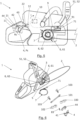
Figure 1 represents a schematic perspective view of the safety mechanism of the present invention incorporated into a chainsaw, according to a first embodiment. -
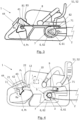
Figure 2 represents a partially cross-sectional schematic side view of the safety mechanism of the present invention incorporated into a chainsaw, according to a first embodiment, in the rest position. -
Figure 3 represents a partially cross-sectional schematic side view of the safety mechanism of the present invention incorporated into a chainsaw, according to a first embodiment, in the safety position. -
Figure 4 represents a partially cross-sectional schematic side view of the safety mechanism of the present invention incorporated into a chainsaw, according to a second embodiment, in the rest position. -
Figure 5 represents a partially cross-sectional schematic side view of the safety mechanism of the present invention incorporated into a chainsaw, according to a second embodiment, in the safety position. -
Figure 6 represents a schematic perspective view of the safety mechanism of the present invention incorporated into a chainsaw, according to a third embodiment. -
Figure 7 represents a partially cross-sectional schematic side view of the safety mechanism of the present invention incorporated into a chainsaw, according to a third embodiment, in the rest position. -
Figure 8 represents a partially cross-sectional schematic side view of the safety mechanism of the present invention incorporated into a chainsaw, according to a third embodiment, in the safety position. -
Figures 1, 2 and3 show various schematic views of the safety mechanism (1) of the present invention in a manual cutting machine, in this case a chainsaw, according to a first embodiment of mechanical operation of said safety mechanism (1). - As seen in
Figure 1 , said chainsaw comprises a cutting element (2) of the toothed chain type, and a motor (3) configured to move said cutting element (2). - The safety mechanism (1) comprises:
- a throttle trigger (4) connected to the motor (3), arranged in the handle of the cutting machine, configured to accelerate the motion of the cutting element (2) when pulled by a user; and
- a locking device (5) configured to lock the cutting element (2).
- According to the present example, optionally, the throttle trigger (4) is connected to an additional safety element in the form of an unlocking push button (44), such that in order to enable the actuation of the very throttle trigger (4), the user has to necessarily keep the unlocking push button (44) pressed at the same time. Said action is performed with the same hand with which the throttle trigger (4) is pulled, for which reason both elements (4, 44) are arranged in the handle within reach of said same hand. If the unlocking push button (44) is released, or if it is not pulled sufficiently, the throttle trigger (4) stays locked, the motion of the cutting element (2) not being able to be accelerated.
- According to the present example, the locking device (5) comprises:
- a clutch (6) having a traction pinion (61) configured to intermesh with the cutting element (2) and a brake drum (62) joined to said traction pinion (61); and
- a strap (7) arranged around the brake drum (62), configured to contract on said brake drum (62) and immobilise same in order to lock the cutting element (2).
- The locking device (5) comprises:
- a lever (52) joined to the free end (71) of the strap (7), enabling said strap (7) to contract on the brake drum (62) when actuated by the user in one direction, and to expand and/or release said strap (7) when actuated by the user in an opposite direction in order to release the brake drum (62).
- In this case, the lever (51) of the very locking device (5) acts directly as a deactivation element (51) of the safety mechanism (1) of the present invention, regardless of whether other complementary and/or additional deactivation elements (51) are incorporated.
- As seen in
Figures 2 and3 , the throttle trigger (4) has: - a first path (Ra) starting from a rest position (P0) with the throttle trigger (4) released to a safety position (Ps), which enables the motion of the cutting element (2) to be accelerated when the throttle trigger (4) is pulled from the rest position (P0) to the safety position (Ps),
Figure 2 ; and - a second path (Rs) that occurs after the first path (Ra), which enables the locking device (5) to be activated in order to lock the cutting element (2) by continuing to pull the throttle trigger (4) once the safety position (Ps) has been exceeded,
Figure 3 . - Thus, the throttle trigger (4) has a double path (Ra, Rs), wherein the first path (Ra) performs the function of accelerating the motor (3), while the second path (Rs) enables the locking device (5) to be actuated in order to instantaneously brake the chain when the throttle trigger (4) is pulled to the maximum by an involuntary reaction of the user as a consequence of a risky and/or accidental situation.
- Therefore, during the first path (Ra) a connection occurs between the position of the throttle trigger (4) and the motor (3), from a rest position (P0) with the throttle trigger (4) released, in other words, without receiving any pressure from the user, to a safety position (Ps) wherein the motion of the cutting element (2) is at the maximum, said motion accelerating from the rest position (P0) to the safety position (Ps) as the pressure exerted by the user on the throttle trigger (4) increases.
- Moreover, during the second path (Rs) a connection occurs between the position of the throttle trigger (4) and the locking device (5) wherein, once the safety position (Ps) has been exceeded, the activation of the locking device (5) occurs to instantaneously stop the motion of the cutting element (2) when the user continues to pull the throttle trigger (4) once the safety position (Ps) has been reached.
- The first path (Ra) and the second path (Rs) occur sequentially as the pressure exerted by the user on the throttle trigger (4) increases, wherein the first path (Ra) starts from a rest position (P0) with the throttle trigger (4) released, while the second path (Rs) ends in a final position with the throttle trigger (4) pulled to the maximum or fully pulled.
- According to the present example of mechanical operation of the safety mechanism (1) of the present invention, this comprises an actuating rod (8) having:
- a first end (81) configured to be pushed by the throttle trigger (4) during the second path (Rs); and
- a second end (82) connected to the locking device (5).
- Said actuating rod (8) is configured to activate the locking device (5) when the throttle trigger (4) pushes the first end (81) once the safety position (Ps) has been exceeded.
- Preferably, the second end (82) is joined to a free end (71) of the strap (7), while said actuating rod (8) is configured to contract the strap (7) on the brake drum (62) when pushed by the throttle trigger (4) during the second path (Rs). The actuating rod (8) comprises a helical spring (83) on the first end (81).
- The throttle trigger (4) comprises an actuating pin (41) configured to push the first end (81) of the actuating rod (8) during the second path (Rs). Said actuating pin (41) makes it possible to overcome the force of the helical spring (83) and move the actuating rod (8) linearly, making the strap (7) contract in order to stop the clutch (6) and thus causing the cutting element (2) of the machine to brake immediately. The actuating pin (41) may have different configurations, dimensions and/or possible positions in the very throttle trigger (4), depending on the shape/design of the housing and/or the handle of the cutting machine, as well as on the position of the first end (81) of the actuating rod (8), in order to be able to come into contact with said first end (81) in order to push same during the second path (Rs).
-
Figures 4 and5 show various schematic views of the safety mechanism (1) of the present invention in a manual cutting machine, in this case a chainsaw, according to a second embodiment of electromagnetic operation of said safety mechanism (1). - Said chainsaw comprises a cutting element (2) of the toothed chain type, and a motor (3) configured to move said cutting element (2).
- The safety mechanism (1) comprises:
- a throttle trigger (4) connected to the motor (3), arranged in the handle of the cutting machine, configured to accelerate the motion of the cutting element (2) when pulled by a user; and
- a locking device (5) configured to lock the cutting element (2).
- According to the present example, optionally, the throttle trigger (4) is connected to an additional safety element in the form of an unlocking push button (44), such that in order to enable the actuation of the very throttle trigger (4), the user has to necessarily keep the unlocking push button (44) pressed at the same time. Said action is performed with the same hand with which the throttle trigger (4) is pulled, for which reason both elements (4, 44) are arranged in the handle within reach of said same hand. If the unlocking push button (44) is released, or if it is not pulled sufficiently, the throttle trigger (4) stays locked, the motion of the cutting element (2) not being able to be accelerated.
- According to the present example, the locking device (5) comprises:
- a clutch (6) having a traction pinion (61) configured to intermesh with the cutting element (2) and a brake drum (62) joined to said traction pinion (61); and
- a strap (7) arranged around the brake drum (62), configured to contract on said brake drum (62) and immobilise same in order to lock the cutting element (2).
- The locking device (5) comprises:
- a lever (52) joined to the free end (71) of the strap (7), enabling said strap (7) to contract on the brake drum (62) when actuated by the user in one direction, and to expand and/or release said strap (7) when actuated by the user in an opposite direction in order to release the brake drum (62).
- In this case, the lever (51) of the very locking device (5) acts directly as a deactivation element (51) of the safety mechanism (1) of the present invention, regardless of whether other complementary and/or additional deactivation elements (51) are incorporated.
- As seen in
Figures 4 and5 , the throttle trigger (4) has: - a first path (Ra) starting from a rest position (P0) with the throttle trigger (4) released to a safety position (Ps), which enables the motion of the cutting element (2) to be accelerated when the throttle trigger (4) is pulled from the rest position (P0) to the safety position (Ps),
Figure 4 ; and - a second path (Rs) that occurs after the first path (Ra), which enables the locking device (5) to be activated in order to lock the cutting element (2) by continuing to pull the throttle trigger (4) once the safety position (Ps) has been exceeded,
Figure 5 . - Thus, the throttle trigger (4) has a double path (Ra, Rs), wherein the first path (Ra) performs the function of accelerating the motor (3), while the second path (Rs) enables the locking device (5) to be actuated in order to instantaneously brake the chain when the throttle trigger (4) is pulled to the maximum by an involuntary reaction of the user as a consequence of a risky and/or accidental situation.
- Therefore, during the first path (Ra) a connection occurs between the position of the throttle trigger (4) and the motor (3), from a rest position (P0) with the throttle trigger (4) released, in other words, without receiving any pressure from the user, to a safety position (Ps) wherein the motion of the cutting element (2) is at the maximum, said motion accelerating from the rest position (P0) to the safety position (Ps) as the pressure exerted by the user on the throttle trigger (4) increases.
- Moreover, during the second path (Rs) a connection occurs between the position of the throttle trigger (4) and the locking device (5) wherein, once the safety position (Ps) has been exceeded, the activation of the locking device (5) occurs to instantaneously stop the motion of the cutting element (2) when the user continues to pull the throttle trigger (4) once the safety position (Ps) has been reached.
- The first path (Ra) and the second path (Rs) occur sequentially as the pressure exerted by the user on the throttle trigger (4) increases, wherein the first path (Ra) starts from a rest position (P0) with the throttle trigger (4) released, while the second path (Rs) ends in a final position with the throttle trigger (4) pulled to the maximum or fully pulled.
- In this case, the safety mechanism (1) of the present invention comprises:
- an electromagnetic actuator (9) configured to activate the locking device (5) when receiving an electrical current (I);
- a power source (10) configured to supply said electrical current (I) to the electromagnetic actuator (9); and
- a first push button (11) and a second push button (12) connected to the throttle trigger (4) and interposed in the electrical circuit between the power source (10) and the electromagnetic actuator (10), configured to enable said electrical current (I) to be received by the electromagnetic actuator (9) or to shut it off based on the position of the throttle trigger (4).
- The electromagnetic actuator (9) is a linear motion electromagnet, which has a shaft or bolt (91) configured to extend linearly when receiving the electrical current (I).
- Preferably, the electromagnetic actuator (9) is configured to contract the strap (7) on the brake drum (62) and immobilise same in order to lock the cutting element (2). This is carried out by means of the shaft or bolt (91) that, joined to the free end (71) of the strap (7), enables same to be pulled when it moves linearly when receiving the electrical current (I),
Figure 5 . - The throttle trigger (4) comprises:
- a first leg (42) configured to press the first push button (11) in the rest position (P0), to keep the locking device (5) activated in said rest position (P0); and
- a second leg (43) configured to press the second push button (12) once the safety position (Ps) has been exceeded, to keep the safety mechanism (5) activated once said safety position (Ps) has been exceeded.
- With this system, two functions are achieved. The first one is the objective of preventing the operator from having an accident and, the second one, that the cutting unit or element (2) of the cutting machine is locked whenever the operator is not using it.
- In turn, the legs (42, 43) are configured not to press the push buttons (11, 12) during the first path (Ra), in order to keep the locking device (5) deactivated between the rest position (P0) and the safety position (Ps). Therefore, enabling the acceleration of the cutting element (2) during said first path (Ra).
- The legs (42, 43) may have different possible configurations, dimensions and/or positions in the very throttle trigger (4), depending on the shape/design of the housing and/or the handle of the cutting machine, as well as on the position of the push buttons (11, 12) in order to carry out the actions described.
- The safety mechanism (1) comprises:
- a first spring (21) arranged between the first push button (11) and the first leg (42); and
- a second spring (22) arranged between the second push button (12) and the second leg (43).
- Wherein the second spring (22) is configured to keep the throttle trigger (4) in the rest position (P0) when it is released, in other words, when it is not being pulled by the user.
-
Figures 6 ,7 and 8 show various schematic views of the safety mechanism (1) of the present invention in a manual cutting machine, in this case a chainsaw, according to a second embodiment of hydraulic operation of said safety mechanism (1). - As seen in
Figure 6 , said chainsaw comprises a cutting element (2) of the toothed chain type, and a motor (3) configured to move said cutting element (2). - The safety mechanism (1) comprises:
- a throttle trigger (4) connected to the motor (3), arranged in the handle of the cutting machine, configured to accelerate the motion of the cutting element (2) when pulled by a user; and
- a locking device (5) configured to lock the cutting element (2).
- According to the present example, optionally, the throttle trigger (4) is connected to an additional safety element in the form of an unlocking push button (44), such that in order to enable the actuation of the very throttle trigger (4), the user has to necessarily keep the unlocking push button (44) pressed at the same time. Said action is performed with the same hand with which the throttle trigger (4) is pulled, for which reason both elements (4, 44) are arranged in the handle within reach of said same hand. If the unlocking push button (44) is released, or if it is not pulled sufficiently, the throttle trigger (4) stays locked, the motion of the cutting element (2) not being able to be accelerated.
- According to the present example, the locking device (5) comprises:
- a clutch (6) having a traction pinion (61) configured to intermesh with the cutting element (2) and a brake drum (62) joined to said traction pinion (61); and
- a strap (7) arranged around the brake drum (62), configured to contract on said brake drum (62) and immobilise same in order to lock the cutting element (2).
- The locking device (5) comprises:
- a lever (52) joined to the free end (71) of the strap (7), enabling said strap (7) to contract on the brake drum (62) when actuated by the user in one direction, and to expand and/or release said strap (7) when actuated by the user in an opposite direction in order to release the brake drum (62).
- In this case, the lever (51) of the very locking device (5) acts directly as a deactivation element (51) of the safety mechanism (1) of the present invention, regardless of whether other complementary and/or additional deactivation elements (51) are incorporated.
- As seen in
Figures 7 and 8 , the throttle trigger (4) has: - a first path (Ra) starting from a rest position (P0) with the throttle trigger (4) released to a safety position (Ps), which enables the motion of the cutting element (2) to be accelerated when the throttle trigger (4) is pulled from the rest position (P0) to the safety position (Ps),
Figure 7 ; and - a second path (Rs) that occurs after the first path (Ra), which enables the locking device (5) to be activated in order to lock the cutting element (2) by continuing to pull the throttle trigger (4) once the safety position (Ps) has been exceeded,
Figure 8 . - Thus, the throttle trigger (4) has a double path (Ra, Rs), wherein the first path (Ra) performs the function of accelerating the motor (3), while the second path (Rs) enables the locking device (5) to be actuated in order to instantaneously brake the chain when the throttle trigger (4) is pulled to the maximum by an involuntary reaction of the user as a consequence of a risky and/or accidental situation.
- Therefore, during the first path (Ra) a connection occurs between the position of the throttle trigger (4) and the motor (3), from a rest position (P0) with the throttle trigger (4) released, in other words, without receiving any pressure from the user, to a safety position (Ps) wherein the motion of the cutting element (2) is at the maximum, said motion accelerating from the rest position (P0) to the safety position (Ps) as the pressure exerted by the user on the throttle trigger (4) increases.
- Moreover, during the second path (Rs) a connection occurs between the position of the throttle trigger (4) and the locking device (5) wherein, once the safety position (Ps) has been exceeded, the activation of the locking device (5) occurs to instantaneously stop the motion of the cutting element (2) when the user continues to pull the throttle trigger (4) once the safety position (Ps) has been reached.
- The first path (Ra) and the second path (Rs) occur sequentially as the pressure exerted by the user on the throttle trigger (4) increases, wherein the first path (Ra) starts from a rest position (P0) with the throttle trigger (4) released, while the second path (Rs) ends in a final position with the throttle trigger (4) pulled to the maximum or fully pulled.
- In this case, the safety mechanism (1) of the present invention comprises:
- a first hydraulic actuator (100) configured to activate the locking device (5) when receiving the pressure of a hydraulic fluid (F);
- a hydraulic pipe (101) configured to supply the pressure of said hydraulic fluid (F) to the first hydraulic actuator (100); and
- a second hydraulic actuator (102) connected to the throttle trigger (4) and in hydraulic communication with the hydraulic pipe (101), configured to enable the pressure of said hydraulic fluid (F) to be supplied to the first hydraulic actuator (100) or to shut it off based on the position of the throttle trigger (4).
- The hydraulic actuators (100, 102) are linear motion hydraulic cylinders, of the type that have a hydraulic piston (104, 105) configured to extend linearly when receiving the pressure of a hydraulic fluid (F). Two fittings (103) enable the hydraulic connection between the hydraulic pipe (101) and the hydraulic actuators (100, 102).
- The first hydraulic actuator (100) is configured to contract the strap (7) on the brake drum (62) and immobilise same in order to lock the cutting chain (2). This is carried out by means of the hydraulic piston (104) which, joined to the free end (71) of the strap (7), enables said free end (71) to be pulled when it moves linearly when receiving the pressure of a hydraulic fluid (F).
- The throttle trigger (4) comprises an actuating pin (41) configured to press the hydraulic piston (105) of the second hydraulic actuator (102) once the safety position (Ps) has been exceeded, enabling the pressure of the hydraulic fluid (F) to be supplied to the first hydraulic actuator (100) through the hydraulic pipe (101) in order to keep the locking device (5) activated once said safety position (Ps) has been exceeded. The actuating pin (41) may have different configurations, dimensions and/or possible positions on the throttle trigger (4) itself, depending on the shape/design of the housing and/or the handle of the cutting machine, as well as on the second hydraulic actuator (102), in order to be able to press the hydraulic piston (105) of said second hydraulic actuator (102) during the second path (Rs).
- The safety mechanism (1) comprises a helical spring (83) arranged between the hydraulic piston (102) and the throttle trigger (4).
- In all the previous embodiments, the throttle trigger (4) performs the double function of acceleration and safety. Newly manufactured cutting machines can be designed to directly have a single throttle trigger (4) configured to perform both functions. Moreover, in existing cutting machines, the throttle trigger of same can be adapted to perform both functions, without needing to add an additional trigger with a safety function.
Claims (17)
- A safety mechanism for manual cutting machines comprising a cutting element (2) and a motor (3) configured to move said cutting element (2); wherein said safety mechanism (1) comprises:- a throttle trigger (4) connected to the motor (3), configured to accelerate the motion of the cutting element (2) when pulled by a user; and- a locking device (5) configured to lock the cutting element (2);said mechanism (1), characterised in that the throttle trigger (4) has:- a first path (Ra) starting from a rest position (P0) to a safety position (Ps), which enables the motion of the cutting element (2) to be accelerated when the throttle trigger (4) is pulled from the rest position (P0) to the safety position (Ps), wherein the motion of the cutting element (2) is at the maximum in the safety position (Ps); and- a second path (Rs) that occurs after the first path (Ra), which activates the locking device (5) to instantaneously stop the motion of the cutting element (2) when the user continues to pull the throttle trigger (4) once the safety position (Ps) has been exceeded by an involuntary reaction of the user as a consequence of a risky and/or accidental situation;wherein the first path (Ra) and the second path (Rs) occur sequentially as the pressure exerted by the user on the throttle trigger (4) increases.
- The safety mechanism according to claim 1, characterised in that the throttle trigger (4) is configured to activate the locking device (5) during the second path (Rs) by means of electrical, mechanical, electromechanical or hydraulic means.
- The safety mechanism according to any of claims 1 to 2, characterised in that the locking device (5) comprises a deactivation element (51) with manual actuation, configured to unlock the cutting element (2) when actuated by the user once said locking device (5) has been activated.
- The safety mechanism according to any of claims 1 to 3, characterised in that the locking device (5) comprises:- a clutch (6) having a traction pinion (61) configured to intermesh with the cutting element (2) and a brake drum (62) joined to said traction pinion (61); and- a strap (7) arranged around the brake drum (62), configured to contract on said brake drum (62) and immobilise same in order to lock the cutting element (2).
- The safety mechanism according to claim 4, characterised in that the locking device (5) comprises:- a lever (52) joined to the strap (7), enabling said strap (7) to contract on the brake drum (62) when actuated by the user in one direction, and to expand said strap (7) when actuated by the user in an opposite direction in order to release the brake drum (62).
- The safety mechanism according to any of claims 1 to 5, characterised in that it comprises an actuating rod (8) having:- a first end (81) configured to be pushed by the throttle trigger (4) during the second path (Rs); and- a second end (82) connected to the locking device (5);wherein said actuating rod (8) is configured to activate the locking device (5) when the throttle trigger (4) pushes the first end (81) once the safety position (Ps) has been exceeded.
- The safety mechanism according to claims 4 and 6, characterised in that the second end (82) is joined to a free end (71) of the strap (7); and in that said actuating rod (8) is configured to contract the strap (7) on the brake drum (62) when pushed by the throttle trigger (4) during the second path (Rs).
- The safety mechanism according to any of claims 6 to 7, characterised in that the throttle trigger (4) comprises an actuating pin (41) configured to push the first end (81) of the actuating rod (8).
- The safety mechanism according to any of claims 1 to 8, characterised in that it comprises:- an electromagnetic actuator (9) configured to activate or deactivate the locking device (5) when receiving an electrical current (I);- a power source (10) configured to supply said electrical current (I) to the electromagnetic actuator (9); and- a first push button (11) and a second push button (12) connected to the throttle trigger (4) and interposed in the electrical circuit between the power source (10) and the electromagnetic actuator (9), configured to enable said electrical current (I) to be received by the electromagnetic actuator (9) or to shut it off based on the position of the throttle trigger (4).
- The safety mechanism according to claims 4 and 9, characterised in that the electromagnetic actuator (9) is configured to contract the strap (7) on the brake drum (62) and immobilise same in order to lock the cutting element (2).
- The safety mechanism according to any of claims 9 to 10, characterised in that the throttle trigger (4) comprises:- a first leg (42) configured to press the first push button (11) in the rest position (P0), to keep the locking device (5) activated in said rest position (P0); and- a second leg (43) configured to press the second push button (12) once the safety position (Ps) has been exceeded, to keep the safety mechanism (5) activated once said safety position (Ps) has been exceeded;wherein said legs (42, 43) are configured not to press the push buttons (11, 12) during the first path (Ra), in order to keep the locking device (5) deactivated between the rest position (P0) and the safety position (Ps).
- The safety mechanism according to any of claims 1 to 11, characterised in that it comprises:- a first hydraulic actuator (100) configured to activate or deactivate the locking device (5) when receiving the pressure of a hydraulic fluid (F);- a hydraulic pipe (101) configured to supply the pressure of said hydraulic fluid (F) to the first hydraulic actuator (100); and- a second hydraulic actuator (102) connected to the throttle trigger (4) and in hydraulic communication with the hydraulic pipe (101), configured to enable the pressure of said hydraulic fluid (F) to be supplied to the first hydraulic actuator (100) or to shut it off based on the position of the throttle trigger (4).
- The safety mechanism according to claims 4 and 12, characterised in that the first hydraulic actuator (100) is configured to contract the strap (7) on the brake drum (62) and immobilise same in order to lock the cutting chain (2).
- The safety mechanism according to any of claims 12 to 13, characterised in that the throttle trigger (4) comprises an actuating pin (41) configured to press the second hydraulic actuator (102) once the safety position (Ps) has been exceeded, enabling the pressure of the hydraulic fluid (F) to be supplied to the first hydraulic actuator (100) through the hydraulic pipe (101) in order to keep the locking device (5) activated once said safety position (Ps) has been exceeded.
- A manual cutting machine, characterised in that it comprises a safety mechanism (1) according to any of claims 1 to 14.
- A chainsaw, characterised in that it comprises a safety mechanism (1) according to any of claims 1 to 14.
- A method for actuating a safety mechanism according to any of claims 1 to 14, characterised in that it comprises the following steps:- enabling the motion of the cutting element (2) to be accelerated when the throttle trigger (4) is pulled from the rest position (P0) to the safety position (Ps), wherein the motion of the cutting element (2) is at the maximum in the safety position (Ps); and- activating the locking device (5) to instantaneously stop the motion of the cutting element (2) when the user continues to pull the throttle trigger (4) once the safety position (Ps) has been exceeded by an involuntary reaction of the user as a consequence of a risky and/or accidental situation.
Priority Applications (2)
| Application Number | Priority Date | Filing Date | Title |
|---|---|---|---|
| EP20382687.0A EP3944938B1 (en) | 2020-07-29 | 2020-07-29 | Safety mechanism for manual cutting machines |
| ES20382687T ES3026457T3 (en) | 2020-07-29 | 2020-07-29 | Safety mechanism for manual cutting machines |
Applications Claiming Priority (1)
| Application Number | Priority Date | Filing Date | Title |
|---|---|---|---|
| EP20382687.0A EP3944938B1 (en) | 2020-07-29 | 2020-07-29 | Safety mechanism for manual cutting machines |
Publications (3)
| Publication Number | Publication Date |
|---|---|
| EP3944938A1 EP3944938A1 (en) | 2022-02-02 |
| EP3944938C0 EP3944938C0 (en) | 2025-04-23 |
| EP3944938B1 true EP3944938B1 (en) | 2025-04-23 |
Family
ID=72178491
Family Applications (1)
| Application Number | Title | Priority Date | Filing Date |
|---|---|---|---|
| EP20382687.0A Active EP3944938B1 (en) | 2020-07-29 | 2020-07-29 | Safety mechanism for manual cutting machines |
Country Status (2)
| Country | Link |
|---|---|
| EP (1) | EP3944938B1 (en) |
| ES (1) | ES3026457T3 (en) |
Family Cites Families (5)
| Publication number | Priority date | Publication date | Assignee | Title |
|---|---|---|---|---|
| WO2007043916A1 (en) * | 2005-10-07 | 2007-04-19 | Husqvarna Ab | Carburettor choke mechanism |
| WO2008057099A1 (en) | 2006-11-10 | 2008-05-15 | Kent Myers | Chainsaw throttle and brake mechanisms |
| DE102008007786A1 (en) * | 2008-02-06 | 2009-08-13 | Andreas Stihl Ag & Co. Kg | Hand-held implement |
| JP5767791B2 (en) * | 2010-08-24 | 2015-08-19 | 株式会社マキタ | Handheld power work machine |
| DE102012025309A1 (en) * | 2012-12-22 | 2014-06-26 | Andreas Stihl Ag & Co. Kg | Hand-guided implement with a drive motor for driving at least one tool and method for its operation |
-
2020
- 2020-07-29 ES ES20382687T patent/ES3026457T3/en active Active
- 2020-07-29 EP EP20382687.0A patent/EP3944938B1/en active Active
Also Published As
| Publication number | Publication date |
|---|---|
| EP3944938A1 (en) | 2022-02-02 |
| EP3944938C0 (en) | 2025-04-23 |
| ES3026457T3 (en) | 2025-06-11 |
Similar Documents
| Publication | Publication Date | Title |
|---|---|---|
| US6957601B2 (en) | Translation stop for use in power equipment | |
| EP0664949B1 (en) | A power tool | |
| CN212978197U (en) | Tool with inclined handle | |
| JPH0219214Y2 (en) | ||
| US5076411A (en) | Two-handle arrangement for a handheld portable tool | |
| US20200182402A1 (en) | Throttle lockout with dissimilar action | |
| US20040159449A1 (en) | Machine tool, especially a hand machine tool | |
| EP1565051B1 (en) | Motordriven tool such as a pole hedge trimmer with a locking mechanism for the turnable cutting unit | |
| US8316547B2 (en) | Protection device for a hand-held power tool | |
| US20060260831A1 (en) | Portable power tool | |
| US20150258658A1 (en) | Hand-Held Tool Apparatus with a Braking Device for Braking a Machining Tool | |
| US11658549B2 (en) | Trigger lockout with dissimilar actions | |
| EP3944938B1 (en) | Safety mechanism for manual cutting machines | |
| EP2707183B1 (en) | Brake assembly for power-driven hand-held cutting device | |
| EP2992755B1 (en) | Switch and brake system for handheld gardening equipment | |
| RU2434731C2 (en) | Electrical tool like angle grinding machine | |
| WO2019152367A1 (en) | Reciprocating saw | |
| WO2012001732A1 (en) | Accelerator | |
| EP2783796B1 (en) | Safety device for actuating a nailer | |
| JP2004330379A (en) | Electric hammer drill | |
| US20090293691A1 (en) | Detent Switch for a Power Tool | |
| JP2008271830A (en) | Electric brush cutter | |
| EP2404722A1 (en) | Hand-held tool machine brake actuation device | |
| WO2015133940A1 (en) | Coast brake control system | |
| WO2012025458A1 (en) | Braking arrangement with controlled actuation for portable cutting tools and cutting tool therefor |
Legal Events
| Date | Code | Title | Description |
|---|---|---|---|
| PUAI | Public reference made under article 153(3) epc to a published international application that has entered the european phase |
Free format text: ORIGINAL CODE: 0009012 |
|
| STAA | Information on the status of an ep patent application or granted ep patent |
Free format text: STATUS: THE APPLICATION HAS BEEN PUBLISHED |
|
| AK | Designated contracting states |
Kind code of ref document: A1 Designated state(s): AL AT BE BG CH CY CZ DE DK EE ES FI FR GB GR HR HU IE IS IT LI LT LU LV MC MK MT NL NO PL PT RO RS SE SI SK SM TR |
|
| STAA | Information on the status of an ep patent application or granted ep patent |
Free format text: STATUS: REQUEST FOR EXAMINATION WAS MADE |
|
| 17P | Request for examination filed |
Effective date: 20220708 |
|
| RBV | Designated contracting states (corrected) |
Designated state(s): AL AT BE BG CH CY CZ DE DK EE ES FI FR GB GR HR HU IE IS IT LI LT LU LV MC MK MT NL NO PL PT RO RS SE SI SK SM TR |
|
| STAA | Information on the status of an ep patent application or granted ep patent |
Free format text: STATUS: EXAMINATION IS IN PROGRESS |
|
| 17Q | First examination report despatched |
Effective date: 20231027 |
|
| GRAP | Despatch of communication of intention to grant a patent |
Free format text: ORIGINAL CODE: EPIDOSNIGR1 |
|
| STAA | Information on the status of an ep patent application or granted ep patent |
Free format text: STATUS: GRANT OF PATENT IS INTENDED |
|
| GRAS | Grant fee paid |
Free format text: ORIGINAL CODE: EPIDOSNIGR3 |
|
| INTG | Intention to grant announced |
Effective date: 20250214 |
|
| GRAA | (expected) grant |
Free format text: ORIGINAL CODE: 0009210 |
|
| STAA | Information on the status of an ep patent application or granted ep patent |
Free format text: STATUS: THE PATENT HAS BEEN GRANTED |
|
| AK | Designated contracting states |
Kind code of ref document: B1 Designated state(s): AL AT BE BG CH CY CZ DE DK EE ES FI FR GB GR HR HU IE IS IT LI LT LU LV MC MK MT NL NO PL PT RO RS SE SI SK SM TR |
|
| REG | Reference to a national code |
Ref country code: GB Ref legal event code: FG4D |
|
| REG | Reference to a national code |
Ref country code: CH Ref legal event code: EP |
|
| REG | Reference to a national code |
Ref country code: IE Ref legal event code: FG4D |
|
| U01 | Request for unitary effect filed |
Effective date: 20250425 |
|
| U07 | Unitary effect registered |
Designated state(s): AT BE BG DE DK EE FI FR IT LT LU LV MT NL PT RO SE SI Effective date: 20250502 |
|
| REG | Reference to a national code |
Ref country code: ES Ref legal event code: FG2A Ref document number: 3026457 Country of ref document: ES Kind code of ref document: T3 Effective date: 20250611 |
|
| U20 | Renewal fee for the european patent with unitary effect paid |
Year of fee payment: 6 Effective date: 20250516 |
|
| PGFP | Annual fee paid to national office [announced via postgrant information from national office to epo] |
Ref country code: ES Payment date: 20250805 Year of fee payment: 6 |
|
| PG25 | Lapsed in a contracting state [announced via postgrant information from national office to epo] |
Ref country code: GR Free format text: LAPSE BECAUSE OF FAILURE TO SUBMIT A TRANSLATION OF THE DESCRIPTION OR TO PAY THE FEE WITHIN THE PRESCRIBED TIME-LIMIT Effective date: 20250724 Ref country code: NO Free format text: LAPSE BECAUSE OF FAILURE TO SUBMIT A TRANSLATION OF THE DESCRIPTION OR TO PAY THE FEE WITHIN THE PRESCRIBED TIME-LIMIT Effective date: 20250723 |
|
| PG25 | Lapsed in a contracting state [announced via postgrant information from national office to epo] |
Ref country code: PL Free format text: LAPSE BECAUSE OF FAILURE TO SUBMIT A TRANSLATION OF THE DESCRIPTION OR TO PAY THE FEE WITHIN THE PRESCRIBED TIME-LIMIT Effective date: 20250423 |
|
| PG25 | Lapsed in a contracting state [announced via postgrant information from national office to epo] |
Ref country code: HR Free format text: LAPSE BECAUSE OF FAILURE TO SUBMIT A TRANSLATION OF THE DESCRIPTION OR TO PAY THE FEE WITHIN THE PRESCRIBED TIME-LIMIT Effective date: 20250423 |
|
| PG25 | Lapsed in a contracting state [announced via postgrant information from national office to epo] |
Ref country code: RS Free format text: LAPSE BECAUSE OF FAILURE TO SUBMIT A TRANSLATION OF THE DESCRIPTION OR TO PAY THE FEE WITHIN THE PRESCRIBED TIME-LIMIT Effective date: 20250723 |
|
| PG25 | Lapsed in a contracting state [announced via postgrant information from national office to epo] |
Ref country code: IS Free format text: LAPSE BECAUSE OF FAILURE TO SUBMIT A TRANSLATION OF THE DESCRIPTION OR TO PAY THE FEE WITHIN THE PRESCRIBED TIME-LIMIT Effective date: 20250823 |
|
| PG25 | Lapsed in a contracting state [announced via postgrant information from national office to epo] |
Ref country code: SM Free format text: LAPSE BECAUSE OF FAILURE TO SUBMIT A TRANSLATION OF THE DESCRIPTION OR TO PAY THE FEE WITHIN THE PRESCRIBED TIME-LIMIT Effective date: 20250423 |
|
| PG25 | Lapsed in a contracting state [announced via postgrant information from national office to epo] |
Ref country code: CZ Free format text: LAPSE BECAUSE OF FAILURE TO SUBMIT A TRANSLATION OF THE DESCRIPTION OR TO PAY THE FEE WITHIN THE PRESCRIBED TIME-LIMIT Effective date: 20250423 |
|
| PG25 | Lapsed in a contracting state [announced via postgrant information from national office to epo] |
Ref country code: SK Free format text: LAPSE BECAUSE OF FAILURE TO SUBMIT A TRANSLATION OF THE DESCRIPTION OR TO PAY THE FEE WITHIN THE PRESCRIBED TIME-LIMIT Effective date: 20250423 |
|
| REG | Reference to a national code |
Ref country code: CH Ref legal event code: H13 Free format text: ST27 STATUS EVENT CODE: U-0-0-H10-H13 (AS PROVIDED BY THE NATIONAL OFFICE) Effective date: 20260224 |
|
| PLBE | No opposition filed within time limit |
Free format text: ORIGINAL CODE: 0009261 |
|
| STAA | Information on the status of an ep patent application or granted ep patent |
Free format text: STATUS: NO OPPOSITION FILED WITHIN TIME LIMIT |
|
| REG | Reference to a national code |
Ref country code: CH Ref legal event code: L10 Free format text: ST27 STATUS EVENT CODE: U-0-0-L10-L00 (AS PROVIDED BY THE NATIONAL OFFICE) Effective date: 20260304 |
|
| GBPC | Gb: european patent ceased through non-payment of renewal fee |
Effective date: 20250729 |
|
| 26N | No opposition filed |
Effective date: 20260126 |
|
| PG25 | Lapsed in a contracting state [announced via postgrant information from national office to epo] |
Ref country code: GB Free format text: LAPSE BECAUSE OF NON-PAYMENT OF DUE FEES Effective date: 20250729 |
|
| PG25 | Lapsed in a contracting state [announced via postgrant information from national office to epo] |
Ref country code: CH Free format text: LAPSE BECAUSE OF NON-PAYMENT OF DUE FEES Effective date: 20250731 |