EP3942912B1 - Lawn mower robot - Google Patents
Lawn mower robot Download PDFInfo
- Publication number
- EP3942912B1 EP3942912B1 EP21192049.1A EP21192049A EP3942912B1 EP 3942912 B1 EP3942912 B1 EP 3942912B1 EP 21192049 A EP21192049 A EP 21192049A EP 3942912 B1 EP3942912 B1 EP 3942912B1
- Authority
- EP
- European Patent Office
- Prior art keywords
- main body
- coil
- boundary wire
- lawn mower
- voltage values
- Prior art date
- Legal status (The legal status is an assumption and is not a legal conclusion. Google has not performed a legal analysis and makes no representation as to the accuracy of the status listed.)
- Active
Links
Images



Classifications
-
- A—HUMAN NECESSITIES
- A01—AGRICULTURE; FORESTRY; ANIMAL HUSBANDRY; HUNTING; TRAPPING; FISHING
- A01D—HARVESTING; MOWING
- A01D34/00—Mowers; Mowing apparatus of harvesters
- A01D34/006—Control or measuring arrangements
- A01D34/008—Control or measuring arrangements for automated or remotely controlled operation
-
- G—PHYSICS
- G05—CONTROLLING; REGULATING
- G05D—SYSTEMS FOR CONTROLLING OR REGULATING NON-ELECTRIC VARIABLES
- G05D1/00—Control of position, course, altitude or attitude of land, water, air or space vehicles, e.g. using automatic pilots
- G05D1/02—Control of position or course in two dimensions
- G05D1/021—Control of position or course in two dimensions specially adapted to land vehicles
- G05D1/0259—Control of position or course in two dimensions specially adapted to land vehicles using magnetic or electromagnetic means
- G05D1/0265—Control of position or course in two dimensions specially adapted to land vehicles using magnetic or electromagnetic means using buried wires
-
- A—HUMAN NECESSITIES
- A01—AGRICULTURE; FORESTRY; ANIMAL HUSBANDRY; HUNTING; TRAPPING; FISHING
- A01D—HARVESTING; MOWING
- A01D2101/00—Lawn-mowers
-
- B—PERFORMING OPERATIONS; TRANSPORTING
- B60—VEHICLES IN GENERAL
- B60L—PROPULSION OF ELECTRICALLY-PROPELLED VEHICLES; SUPPLYING ELECTRIC POWER FOR AUXILIARY EQUIPMENT OF ELECTRICALLY-PROPELLED VEHICLES; ELECTRODYNAMIC BRAKE SYSTEMS FOR VEHICLES IN GENERAL; MAGNETIC SUSPENSION OR LEVITATION FOR VEHICLES; MONITORING OPERATING VARIABLES OF ELECTRICALLY-PROPELLED VEHICLES; ELECTRIC SAFETY DEVICES FOR ELECTRICALLY-PROPELLED VEHICLES
- B60L2200/00—Type of vehicles
- B60L2200/22—Microcars, e.g. golf cars
-
- B—PERFORMING OPERATIONS; TRANSPORTING
- B60—VEHICLES IN GENERAL
- B60L—PROPULSION OF ELECTRICALLY-PROPELLED VEHICLES; SUPPLYING ELECTRIC POWER FOR AUXILIARY EQUIPMENT OF ELECTRICALLY-PROPELLED VEHICLES; ELECTRODYNAMIC BRAKE SYSTEMS FOR VEHICLES IN GENERAL; MAGNETIC SUSPENSION OR LEVITATION FOR VEHICLES; MONITORING OPERATING VARIABLES OF ELECTRICALLY-PROPELLED VEHICLES; ELECTRIC SAFETY DEVICES FOR ELECTRICALLY-PROPELLED VEHICLES
- B60L2260/00—Operating Modes
- B60L2260/20—Drive modes; Transition between modes
- B60L2260/32—Auto pilot mode
Definitions
- the present invention relates to a lawn mower robot and more particularly, to a lawn mower robot which may accurately acquire distance information of a boundary wire at the inside of the boundary wire.
- lawn mowers are apparatuses to mow a lawn planted in a yard of a home or on a playground. Such lawn mowers may be divided into lawn mowers for homes and lawn mowers for tractors used on farms.
- the present invention is directed to a lawn mower robot that substantially obviates one or more problems due to limitations and disadvantages of the related art.
- An object of the present invention is to provide a lawn mower robot.
- Another object of the present invention is to provide a lawn mower robot which may accurately measure a distance between a main body and a boundary wire.
- Another object of the present invention is to provide a lawn mower robot which may improve convenience in installation of a boundary wire.
- Yet another object of the present invention is to provide a lawn mower robot which may determine a distance between a boundary wire and a main body under the condition that the main body is located within a closed loop formed by the boundary wire.
- a lawn mower robot includes a boundary indication unit including a boundary wire defining a work area and a main body moving within the work area defined by the boundary wire, wherein the main body includes sensing units sensing voltage values induced by the boundary wire and a controller determining a distance between the main body and the boundary wire from the voltage values sensed by the sensing units, wherein each of the sensing units includes at least two coils differently installed and the two coils respectively sense voltage values within the same area defined by the boundary wire.
- the two coils may sense voltage values within a closed loop formed by the boundary wire.
- Each of the sensing units includes a first coil installed to be wound in the forward direction of the main body and a second coil installed to be wound in the sideward direction of the main body.
- the controller determines the distance by summing the voltage values sensed by the first coil and the second coil.
- the controller may maintain the distance between the main body and the boundary wire so that the sum of the voltage values sensed by the first coil and the second soil is regularly maintained.
- the winding directions of the first coil and the second coil may be perpendicular to each other.
- Each of the sensing units may further include a third coil installed to be wound in the upward direction of the main body.
- the third coil may sense whether or not the main body is present within the work area.
- Each of the sensing units may include a first vertical coil installed to be wound in the upward direction of the main body and a second vertical coil provided at a different position from the first vertical coil and installed to be wound in parallel with the first vertical coil.
- the controller may determine the distance by comparing the voltage values sensed by the first vertical coil and the second vertical coil.
- the controller may maintain the distance between the main body and the boundary wire so that the voltage values sensed by the first vertical coil and the second vertical coil are equal or similar to each other.
- the sensing units may be installed at the left and right sides of the main body, and the controller may determine the distance between the boundary wire and the main body by selecting the voltage values sensed by the sensing unit relatively close to the boundary wire among the sensing units installed at the left and right sides of the main body.
- the controller may select the voltage values sensed by the sensing unit installed at the right side of the main body when the main body moves in the counterclockwise direction, and select the voltage values sensed by the sensing unit installed at the left side of the main body when the main body moves in the clockwise direction.
- the boundary wire may be disposed at the outer wall of the work area.
- the lawn mower robot may further include a drive unit adjusting an interval between the main body and the boundary wire according to the distance determined by the controller.
- a control method of a lawn mower robot includes sensing voltage values induced by a boundary wire defining a work area through sensing units, each of which includes a plurality of coils, and determining a distance between the boundary wire and the work area using the voltage values sensed by the plurality of coils, wherein the plurality of coils respectively senses voltage values under the condition that the plurality of coils is disposed within the work area, and the plurality of coils is differently installed.
- the voltage values sensed by the plurality of coils may be summed and the distance is determined using the sum of the voltage values.
- the control method may further include maintaining the distance between the boundary wire and the main body so that the sum of the voltage values is regularly maintained.
- the distance may be determined by comparing the voltage values sensed by the plurality of coils.
- the control method may further include maintaining the distance between the boundary wire and the main body so that the two voltage values are maintained equal.
- FIG. 1 is a top view of a main body of a lawn mower robot in accordance with one embodiment of the present invention and FIG. 2 is a block diagram of FIG. 1 .
- the lawn mower robot may include a main body 10 movably provided so as to cut lawn and a boundary indication unit 100 defining a work area in which the main body 10 moves to conduct operation.
- the boundary indication unit 100 may include a boundary wire 110 forming the boundary of the work area and a station 120 supplying current to the boundary wire 110. That is, the boundary wire 110 may be connected to the station 120 and generate electromagnetic waves due to current supplied from the station 120. Further, the boundary wire 110 may be connected to the station 120 and thus, the main body 10 may be charged.
- a cutter 50 cutting lawn may be provided in the main body 10 of the lawn mower robot.
- the cutter 50 may be configured such that a sharp blade is rotatable.
- a drive unit 40 which may move and rotate the main body 10 in a desired direction is provided in the main body 10.
- the drive unit 40 may include a plurality of rotatable wheels, and the respective wheels may be individually rotated and thus, the main body 10 may be rotated in a desired direction.
- the main body 10 includes sensing units 30 sensing the boundary wire 110.
- the sensing units 30 may sense electromagnetic waves generated by current flowing in the boundary wire 110 and voltage values generated thereby and thus, acquire information regarding whether or not the main body 10 reaches the boundary wire 110, information regarding whether or not the main body 10 is present within a closed loop formed by the boundary wire 110, and information regarding whether or not the main body 10 travels along the boundary wire 110.
- the sensing units 30 may sense various pieces of information regarding the moving distance and moving velocity of the main body 10 and relative position change of the main body 10 according to movement.
- the main body 10 may drive the drive unit 40 using information sensed by the sensing units 30. That is, the controller 20 may control driving of the main body 10 using information measured by the sensing units 30 and thus, drive the drive unit 40 so that the main body 10 may be located within the work area.
- the main body 10 includes the sensing units 30 sensing voltage values induced by the boundary wire 110, and a controller 20 determining a distance between the main body 10 and the boundary wire 110 by the voltage values sensed by the sensing units 30.
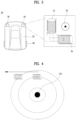
- FIG. 3 is a view illustrating sensing units in accordance with one embodiment of the present invention. Hereinafter, the sensing units in accordance with this embodiment will be described with reference to FIG. 3 .
- the sensing unit 30 includes at least two coils which are differently installed, and the two coils may respectively sense voltage values within the same area defined by the boundary wire 110. That is, the two coils may sense voltage values within a closed loop formed by the boundary wire 110.
- the sensing unit 30 includes a first coil 32 wound in the forward direction of the main body 10 and a second coil 36 wound in the sideward direction of the main body 10.
- the first coil 32 and the second coil 36 may be arranged such that they are wound in perpendicular directions to each other.
- the first coil 32 and the second coil 36 may be coplanar with each other in parallel with the ground surface of the work area when the main body 10 travels within the work area. However, the first coil 32 and the second coil 36 are arranged such that the central axes of the winding directions of the first coil 32 and the second coil 36 are perpendicular to each other.
- the controller 20 is configured to determine the distance by summing the voltage values sensed by the first coil 32 and the second coil 36.
- the sensing unit 30 may include a third coil 34 installed so as to be wound in the upward direction of the main body 10.
- the first coil 32, the second coil 36, and the third coil 34 may be arranged so that the winding directions of first coil 32, the second coil 36, and the third coil 34 are perpendicular to one another.
- the first coil 32, the second coil 36, and the third coil 34 may be arranged so that the central axes of the winding directions of first coil 32, the second coil 36, and the third coil 34 are perpendicular to one another. That is, three coils may be arranged such that three axes of the coils are perpendicular to one another.
- the first coil 32 and the second coil 36 may perform a function of acquiring information regarding the distance between the boundary wire 110 and the main body 10 when the main body 10 travels within the work area.
- the third coil 34 may perform a function of acquiring information as to whether or not the main body 10 is present at the inside or outside of the closed loop by the boundary wire 110, i.e., the work area. Since the third coil 34 is wound in the direction which is perpendicular both to the first coil 32 and the second coil 36 and is perpendicular to the lengthwise direction of the boundary wire 110 (i.e., perpendicular to the ground surface), the magnitude of voltage induced by the third coil 34 is smaller than the magnitudes of voltages induced by the first coil 32 and the second coil 36. Therefore, in accordance with one embodiment, in order to determine a distance between the main body 10 and the boundary wire 110, the third coil 34 is not used and voltage values acquired by the first coil 32 and the second coil 36 are used.
- the sensing units 30 may be installed at the left and right sides of the main body 10. That is, the first coil 32, the second coil 36, and the third coil 34 may be arranged at each of the left and right sides of the main body 10.
- the controller 20 may select one of a signal, i.e., a voltage value, acquired through the sensing unit 30 installed at the left side of the main body 10 and a signal, i.e., a voltage value, acquired through the sensing unit 30 installed at the right side of the main body 10 and uses the selected one voltage value as data to determine the distance between the boundary wire 110 and the main body 10.
- FIG. 4 is a view illustrating a sensing method using the sensing units of FIG. 3 .
- the sensing method will be described with reference to FIG. 4 .
- a coil shown in FIG. 4 is one of the first coil 32 and the second coil 36.
- the intensity of a magnetic field generated by the boundary wire 110 varies according to positions of the sensing unit 30. That is, as the sensing unit 30 is more distant from the boundary wire 110, the sensing unit 30 and the magnetic field generated by the boundary wire 110 become perpendicular to each other (the winding direction of the coil and the direction of the magnetic field generated by the boundary wire become perpendicular to each other) and thus, the size of a sensed voltage value decreases. That is to say, the voltage value acquired by the sensing unit 30 increases as the sensing unit 30 becomes closer to the boundary wire 110 and decreases as the sensing unit 30 becomes more distant from the boundary wire 110.
- the sensing unit 30 As the sensing unit 30 is closer to the boundary wire 110, the sensing unit 30 and the magnetic field generated by the boundary wire 110 become parallel with each other (the winding direction of the coil and the direction of the magnetic field generated by the boundary wire become parallel with each other) and thus, the magnitude of a sensed voltage value increases.
- a magnetic field around the boundary wire 110 is expressed by contour lines.
- FIG. 5 is a view illustrating a method of summing sensed voltage values. Hereinafter, the method will be described with reference to FIG. 5 .
- the y-axis represents a voltage value and the x-axis represents a distance between the boundary wire 110 and the main body 10.
- the voltage value increases in the upward direction.
- the distance increases in the leftward direction.
- the voltage value sensed by the first coil 32 and the voltage value sensed by the second coil 36 are different.
- the voltage values sensed by the first coil 32 and the second coil 36 may vary according to various factors, such as whether or not the front surface of the main body 10 faces the boundary wire 110 or whether or not the side surface of the main body 10 faces the boundary wire 110. That is, differently from FIG. 5 , the data sensed by the first coil 32 and the data sensed by the second coil 36 may be reversed.
- the controller 20 may adjust the distance between the main body 10 and the boundary wire 110 by summing the voltage value sensed by the first coil 32 and the voltage value sensed by the second coil 36.
- the controller 20 may adjust the distance between the main body 10 and the boundary wire 110 so that the sum of the voltage values is maintained at 4.02V.
- a reference distance may be variously adjusted by a user or an operator. If a specific voltage value, for example, the voltage value sum corresponding to 4.02V, is sensed, the controller 20 may determine that the main body 10 and the boundary wire 110 are separated by the reference distance.
- FIG. 6 is a view illustrating sensing units in accordance with another embodiment of the present invention. Hereinafter, the sensing units in accordance with this embodiment will be described with reference to FIG. 6 .
- the sensing unit 30 may include a first vertical coil 38 installed to be wound in the upward direction of the main body 10 and a second vertical coil 39 provided at a different position from the first vertical coil 38 and installed to be wound in parallel with the first vertical coil 38. That is, the winding directions of the first vertical coil 38 and the second vertical coil 39 are the same as each other and correspond to the upward direction of the main body 10 (the perpendicular direction to the ground surface).
- the sensing unit 30 may include two coils wound in the same direction, i.e., in the upward direction of the main body 10. Since the first vertical coil 38 and the second vertical coil 39 are installed at different positions, respective voltage values to the same boundary wire may be acquired.
- the sensing units 30 may be installed adjacent to the left and right corners of the main body 10.
- FIG. 7 is a view illustrating a sensing method using the sensing units of FIG. 6 .
- the sensing method will be described with reference to FIG. 7 .
- the installation type of the coils of the sensing unit 30 with respect to the boundary wire 110 is different from in the sensing method shown in FIG. 4 . Therefore, change of the voltage values acquired by the sensing unit 30 is different.
- the sensing unit 30 becomes perpendicular to a magnetic field generated by the boundary wire 110 (the winding direction of the first vertical coil 38 (or the second vertical coil 39; not shown) becomes perpendicular to the magnetic field generated by the boundary wire 110) and thus, the voltage value sensed by the first vertical coil 38 of the second vertical coil 39 decreases.
- the sensing unit 30 (the first vertical coil 38 or the second vertical coil 39; not shown) becomes distant from the magnetic field generated by the boundary wire 110 and a sensing signal of the magnetic field generated by the boundary wire 110 becomes weak and thus, the voltage value sensed by the first vertical coil 38 of the second vertical coil 39 decreases.
- the first vertical coil 38 (or the second vertical coil 39; not shown) is located at position P1, i.e. at the center between the two arrows, the first vertical coil 38 (or the second vertical coil 39; not shown) is relatively close to the magnetic field generated by the boundary wire 110 and greatly influenced by the magnetic field generated by the boundary wire 110 and thus, the voltage value sensed by the first vertical coil 38 or the second vertical coil 39 is the greatest.
- FIG. 8 is a view illustrating a method of comparing sensed voltage values. Hereinafter, the method will be described with reference to FIG. 8 .
- FIG. 8 comprises three curves (a), (b) and (c).
- the curve (a) (dashed dotted line) shows the relation between the voltage generated at the first vertical coil 38 or the second vertical coil 39 and the distance with respect to a horizontal direction to the boundary wire 110.
- the voltage at the position P1 is at maximum.
- the voltage decreases in the direction to the position P2 which corresponds to the distance zero in FIG.8 .
- the voltage also decreases in the other direction from P1 to P3.
- FIG. 8 illustrates voltage values sensed by the sensing unit 30 in a state in which the interval of the boundary wire 110 is small (curve (b); dotted line) and voltage values sensed by the sensing unit 30 in a state in which the interval of the boundary wire 110 is wide (curve (c); solid line). Since the boundary wire 110 is disposed to draw a closed loop of the work area, an interval between parts of the boundary wire 110 may be narrow or wide according to the shape of the work area.
- a distance between the main body 10 and the boundary wire 110 at which the voltage values sensed by the sensing unit 30 are the maximum may be regular. However, changes of the voltage values sensed by the sensing unit 30 are different.
- the sensing unit 30 includes two coils. That is, the first vertical coil 38 and the second vertical coil 39 have different distances from the boundary wire 110 and thus, the voltage values acquired by the first vertical coil 38 and the second vertical coil 39 are independent of each other.
- the controller 20 may determine the distance between the main body 10 and the boundary wire 110 by comparing the voltage value sensed by the first vertical coil 38 and the voltage value sensed by the second vertical coil 39.
- the distance between the main body 10 and the boundary wire 110 may be maintained so that the voltage values measured by the first vertical coil 38 and the second vertical coil 39 are equal or similar to each other.
- the distance between the main body 10 and the boundary wire 110 at a position where the voltage values measured by the first vertical coil 38 and the second vertical coil 39 become equal or similar to each other may be regularly maintained.
- the first vertical coil 38 and the second vertical coil 39 may be separated from each other by about 8 cm. That is, a distance between the central axes of the winding directions of the first vertical coil 38 and the second vertical coil 39 may be about 8 cm. This distance is only an example and can be set preferably to any value in the range of 1 cm to 20 cm more preferably 4 cm to 16 cm.
- FIGs. 9(a) and 9(b) are views illustrating driving of a lawn mower robot in accordance with one embodiment of the present invention
- FIG. 10 is a flowchart illustrating a control method of a lawn mower robot in accordance with one embodiment of the present invention.
- FIG. 9(a) is a view illustrating that the main body moves along the boundary wire
- FIG. 9(b) is a view illustrating that the main body moves so as not to deviate from the work area when the main body approaches the boundary wire.
- driving of the lawn mower robot will be described with reference to FIGs. 9(a), 9(b) , and 10 .
- the drive unit 40 may move the main body 10 while maintaining the distance between the main body 10 and the boundary wire 110 so that the voltage values sensed by the first coil 32 and the second coil 36 are regular.
- the drive unit 40 may move the main body 10 while maintaining the distance between the main body 10 and the boundary wire 110 so that the voltage values sensed by the first vertical coil 38 and the second vertical coil 39 are equal or similar to each other.
- the controller 20 may use the voltage value acquired by the sensing unit installed at the right side of the lawn mower robot. Since the sensing unit installed at the right side of the lawn mower robot has a greater voltage value than the sensing unit installed at the left side of the lawn mower robot, the controller 20 may select data of the sensing unit having a relatively large voltage value.
- the controller 20 may use the voltage value acquired by the sensing unit installed at the left side of the lawn mower robot.
- the controller 20 may determine a distance between the main body 10 and the boundary wire 110 by summing voltage values acquired by the two coils of the sensing unit 30 or comparing the sizes of voltage values acquired by the two coils of the sensing unit 30 according to embodiments (Operation S20).
- the controller 20 may determines whether or not the distance between the main body 10 and the boundary wire 110 reaches a desired distance.
- the controller 20 may drive the drive unit 30 according to the determined information and thus move the main body 10 (Operation S30).
- the controller 20 may move the main body 10 toward the boundary wire 110 or away from the boundary wire 110.
- the plural coils respectively acquire individual voltage values under the condition that plural coils are present within a closed loop formed by the boundary wire 110, although the main body 10 moves to the outer area of the boundary wire 110, the distance between the main body 10 and the boundary wire 110 may be determined.
- signals (voltage values) can be transferred from the first coil 32, the second coil 36 and the third coil 34.
- signals (voltage values) can be transferred from the first vertical coil 38 and the second vertical coil 39.
- One output terminal can be connected with two or three coils by mux (multiplex circuit) and one output terminal can be installed on one sub board.
- the controller 20 can connect to one of the coils selectively with a predetermined time period (for example, 40 msec) by sequentially switching.
- the output terminal may be connected with one of coils, electrically. Therefore, the controller 20 may receive signals from a plurality of coils sequentially.
- the main body 10 may have only two sub board since one sub board may be connected with a plurality of coils. One sub board may be installed to the left side of the main body and the right side of the main body. Therefore, a space may be saved in the main body.
- a lawn mower robot in accordance with one embodiment of the present invention may accurately acquire distance information between a main body and a boundary wire. Therefore, when the main body travels along the boundary wire, the traveling trajectory of the main body may be stably maintained.
- the boundary wire is installed along the outer wall of the work area and thus, a user may easily install the boundary wire.
- the main body determines a distance between the boundary wire and the main body under the condition that the main body is located within a closed loop formed by the boundary wire, the main body does not need to get out of the closed loop.
Landscapes
- Physics & Mathematics (AREA)
- Engineering & Computer Science (AREA)
- Life Sciences & Earth Sciences (AREA)
- Environmental Sciences (AREA)
- Electromagnetism (AREA)
- Aviation & Aerospace Engineering (AREA)
- Radar, Positioning & Navigation (AREA)
- Remote Sensing (AREA)
- General Physics & Mathematics (AREA)
- Automation & Control Theory (AREA)
- Control Of Position, Course, Altitude, Or Attitude Of Moving Bodies (AREA)
- Harvester Elements (AREA)
Description
- The present invention relates to a lawn mower robot and more particularly, to a lawn mower robot which may accurately acquire distance information of a boundary wire at the inside of the boundary wire.
- In general, lawn mowers are apparatuses to mow a lawn planted in a yard of a home or on a playground. Such lawn mowers may be divided into lawn mowers for homes and lawn mowers for tractors used on farms.
- Further, there are a walk behind type lawn mower pushed by a user behind the lawn mower to mow a lawn and a hand type lawn mower portable by a user.
- However, both types of lawn mowers are operated directly by users and thus cause inconvenience.
- Particularly, since it is difficult for modern people themselves to mow a lawn in a yard using lawn mowers, people generally hire a worker to mow the lawn and thus labor costs are inevitably generated.
- Therefore, automatic robot type lawn mowers to prevent such additional costs and reduce labor have been developed. Various research into mobility control of automatic robot type lawn mowers has been performed.
-
- Accordingly, the present invention is directed to a lawn mower robot that substantially obviates one or more problems due to limitations and disadvantages of the related art.
- An object of the present invention is to provide a lawn mower robot.
- This object is achieved with the features of
independent claim 1. The dependent claims relate to aspects of the invention. - Another object of the present invention is to provide a lawn mower robot which may accurately measure a distance between a main body and a boundary wire.
- Another object of the present invention is to provide a lawn mower robot which may improve convenience in installation of a boundary wire.
- Yet another object of the present invention is to provide a lawn mower robot which may determine a distance between a boundary wire and a main body under the condition that the main body is located within a closed loop formed by the boundary wire.
- Additional advantages, objects, and features of the invention will be set forth in part in the description which follows and in part will become apparent to those having ordinary skill in the art upon examination of the following or may be learned from practice of the invention. The objectives and other advantages of the invention may be realized and attained by the structure particularly pointed out in the written description and claims hereof as well as the appended drawings.
- To achieve these objects and other advantages and in accordance with the purpose of the invention, as embodied and broadly described herein, a lawn mower robot includes a boundary indication unit including a boundary wire defining a work area and a main body moving within the work area defined by the boundary wire, wherein the main body includes sensing units sensing voltage values induced by the boundary wire and a controller determining a distance between the main body and the boundary wire from the voltage values sensed by the sensing units, wherein each of the sensing units includes at least two coils differently installed and the two coils respectively sense voltage values within the same area defined by the boundary wire.
- The two coils may sense voltage values within a closed loop formed by the boundary wire.
- Each of the sensing units includes a first coil installed to be wound in the forward direction of the main body and a second coil installed to be wound in the sideward direction of the main body.
- The controller determines the distance by summing the voltage values sensed by the first coil and the second coil.
- The controller may maintain the distance between the main body and the boundary wire so that the sum of the voltage values sensed by the first coil and the second soil is regularly maintained.
- The winding directions of the first coil and the second coil may be perpendicular to each other.
- Each of the sensing units may further include a third coil installed to be wound in the upward direction of the main body.
- The third coil may sense whether or not the main body is present within the work area.
- Each of the sensing units may include a first vertical coil installed to be wound in the upward direction of the main body and a second vertical coil provided at a different position from the first vertical coil and installed to be wound in parallel with the first vertical coil.
- The controller may determine the distance by comparing the voltage values sensed by the first vertical coil and the second vertical coil.
- The controller may maintain the distance between the main body and the boundary wire so that the voltage values sensed by the first vertical coil and the second vertical coil are equal or similar to each other.
- The sensing units may be installed at the left and right sides of the main body, and the controller may determine the distance between the boundary wire and the main body by selecting the voltage values sensed by the sensing unit relatively close to the boundary wire among the sensing units installed at the left and right sides of the main body.
- The controller may select the voltage values sensed by the sensing unit installed at the right side of the main body when the main body moves in the counterclockwise direction, and select the voltage values sensed by the sensing unit installed at the left side of the main body when the main body moves in the clockwise direction.
- The boundary wire may be disposed at the outer wall of the work area.
- The lawn mower robot may further include a drive unit adjusting an interval between the main body and the boundary wire according to the distance determined by the controller.
- In another aspect not being part of the present invention, a control method of a lawn mower robot includes sensing voltage values induced by a boundary wire defining a work area through sensing units, each of which includes a plurality of coils, and determining a distance between the boundary wire and the work area using the voltage values sensed by the plurality of coils, wherein the plurality of coils respectively senses voltage values under the condition that the plurality of coils is disposed within the work area, and the plurality of coils is differently installed.
- In the determining the distance, the voltage values sensed by the plurality of coils may be summed and the distance is determined using the sum of the voltage values.
- The control method may further include maintaining the distance between the boundary wire and the main body so that the sum of the voltage values is regularly maintained.
- In the determining the distance, the distance may be determined by comparing the voltage values sensed by the plurality of coils.
- The control method may further include maintaining the distance between the boundary wire and the main body so that the two voltage values are maintained equal.
- It is to be understood that both the foregoing general description and the following detailed description of the present invention are exemplary and explanatory and are intended to provide further explanation of the invention as claimed.
- The accompanying drawings, which are included to provide a further understanding of the invention and are incorporated in and constitute a part of this application, illustrate embodiment(s) of the invention and together with the description serve to explain the principle of the invention. In the drawings:
-
FIG. 1 is a top view of a main body of a lawn mower robot in accordance with one embodiment of the present invention; -
FIG. 2 is a block diagram ofFIG. 1 ; -
FIG. 3 is a view illustrating sensing units in accordance with one embodiment of the present invention; -
FIG. 4 is a view illustrating a sensing method using the sensing unit ofFIG. 3 ; -
FIG. 5 is a view illustrating a method of summing sensed voltage values; -
FIG. 6 is a view illustrating sensing units in accordance with another embodiment of the present invention; -
FIG. 7 is a view illustrating a sensing method using the sensing units ofFIG. 6 ; -
FIG. 8 is a view illustrating a method of comparing sensed voltage values; -
FIGs. 9(a) and 9(b) are views, each of which illustrates driving of a lawn mower robot in accordance with one embodiment of the present invention; -
FIG. 10 is a flowchart illustrating a control method of a lawn mower robot in accordance with one embodiment of the present invention; and -
FIG. 11(a) and 11(b) are schematic diagrams, each of which illustrates connection structures of a sensing unit. - Reference will now be made in detail to the preferred embodiments of the present invention, examples of which are illustrated in the accompanying drawings.
- In the drawings, the sizes or shapes of elements may be exaggerated for clarity and convenience of description. Further, terms specially defined in the following description in consideration of the configuration and functions of the present invention may be changed according to the intention of a user or an operator or a usual practice. The definitions of these terms should be determined based on the whole content of this specification.
-
FIG. 1 is a top view of a main body of a lawn mower robot in accordance with one embodiment of the present invention andFIG. 2 is a block diagram ofFIG. 1 . - The lawn mower robot may include a
main body 10 movably provided so as to cut lawn and aboundary indication unit 100 defining a work area in which themain body 10 moves to conduct operation. - The
boundary indication unit 100 may include aboundary wire 110 forming the boundary of the work area and astation 120 supplying current to theboundary wire 110. That is, theboundary wire 110 may be connected to thestation 120 and generate electromagnetic waves due to current supplied from thestation 120. Further, theboundary wire 110 may be connected to thestation 120 and thus, themain body 10 may be charged. - A
cutter 50 cutting lawn may be provided in themain body 10 of the lawn mower robot. Thecutter 50 may be configured such that a sharp blade is rotatable. - A
drive unit 40 which may move and rotate themain body 10 in a desired direction is provided in themain body 10. Thedrive unit 40 may include a plurality of rotatable wheels, and the respective wheels may be individually rotated and thus, themain body 10 may be rotated in a desired direction. - The
main body 10 includessensing units 30 sensing theboundary wire 110. Thesensing units 30 may sense electromagnetic waves generated by current flowing in theboundary wire 110 and voltage values generated thereby and thus, acquire information regarding whether or not themain body 10 reaches theboundary wire 110, information regarding whether or not themain body 10 is present within a closed loop formed by theboundary wire 110, and information regarding whether or not themain body 10 travels along theboundary wire 110. - Further, the
sensing units 30 may sense various pieces of information regarding the moving distance and moving velocity of themain body 10 and relative position change of themain body 10 according to movement. - The
main body 10 may drive thedrive unit 40 using information sensed by thesensing units 30. That is, thecontroller 20 may control driving of themain body 10 using information measured by thesensing units 30 and thus, drive thedrive unit 40 so that themain body 10 may be located within the work area. - The
main body 10 includes thesensing units 30 sensing voltage values induced by theboundary wire 110, and acontroller 20 determining a distance between themain body 10 and theboundary wire 110 by the voltage values sensed by thesensing units 30. -
FIG. 3 is a view illustrating sensing units in accordance with one embodiment of the present invention. Hereinafter, the sensing units in accordance with this embodiment will be described with reference toFIG. 3 . - The
sensing unit 30 includes at least two coils which are differently installed, and the two coils may respectively sense voltage values within the same area defined by theboundary wire 110. That is, the two coils may sense voltage values within a closed loop formed by theboundary wire 110. - The
sensing unit 30 includes afirst coil 32 wound in the forward direction of themain body 10 and asecond coil 36 wound in the sideward direction of themain body 10. Here, thefirst coil 32 and thesecond coil 36 may be arranged such that they are wound in perpendicular directions to each other. - The
first coil 32 and thesecond coil 36 may be coplanar with each other in parallel with the ground surface of the work area when themain body 10 travels within the work area. However, thefirst coil 32 and thesecond coil 36 are arranged such that the central axes of the winding directions of thefirst coil 32 and thesecond coil 36 are perpendicular to each other. - The
controller 20 is configured to determine the distance by summing the voltage values sensed by thefirst coil 32 and thesecond coil 36. - Further, the
sensing unit 30 may include athird coil 34 installed so as to be wound in the upward direction of themain body 10. - The
first coil 32, thesecond coil 36, and thethird coil 34 may be arranged so that the winding directions offirst coil 32, thesecond coil 36, and thethird coil 34 are perpendicular to one another. In more detail, thefirst coil 32, thesecond coil 36, and thethird coil 34 may be arranged so that the central axes of the winding directions offirst coil 32, thesecond coil 36, and thethird coil 34 are perpendicular to one another. That is, three coils may be arranged such that three axes of the coils are perpendicular to one another. - The
first coil 32 and thesecond coil 36 may perform a function of acquiring information regarding the distance between theboundary wire 110 and themain body 10 when themain body 10 travels within the work area. - The
third coil 34 may perform a function of acquiring information as to whether or not themain body 10 is present at the inside or outside of the closed loop by theboundary wire 110, i.e., the work area. Since thethird coil 34 is wound in the direction which is perpendicular both to thefirst coil 32 and thesecond coil 36 and is perpendicular to the lengthwise direction of the boundary wire 110 (i.e., perpendicular to the ground surface), the magnitude of voltage induced by thethird coil 34 is smaller than the magnitudes of voltages induced by thefirst coil 32 and thesecond coil 36. Therefore, in accordance with one embodiment, in order to determine a distance between themain body 10 and theboundary wire 110, thethird coil 34 is not used and voltage values acquired by thefirst coil 32 and thesecond coil 36 are used. - The
sensing units 30 may be installed at the left and right sides of themain body 10. That is, thefirst coil 32, thesecond coil 36, and thethird coil 34 may be arranged at each of the left and right sides of themain body 10. Thecontroller 20 may select one of a signal, i.e., a voltage value, acquired through thesensing unit 30 installed at the left side of themain body 10 and a signal, i.e., a voltage value, acquired through thesensing unit 30 installed at the right side of themain body 10 and uses the selected one voltage value as data to determine the distance between theboundary wire 110 and themain body 10. -
FIG. 4 is a view illustrating a sensing method using the sensing units ofFIG. 3 . Hereinafter, the sensing method will be described with reference toFIG. 4 . - A coil shown in
FIG. 4 is one of thefirst coil 32 and thesecond coil 36. - The intensity of a magnetic field generated by the
boundary wire 110 varies according to positions of thesensing unit 30. That is, as thesensing unit 30 is more distant from theboundary wire 110, thesensing unit 30 and the magnetic field generated by theboundary wire 110 become perpendicular to each other (the winding direction of the coil and the direction of the magnetic field generated by the boundary wire become perpendicular to each other) and thus, the size of a sensed voltage value decreases. That is to say, the voltage value acquired by thesensing unit 30 increases as thesensing unit 30 becomes closer to theboundary wire 110 and decreases as thesensing unit 30 becomes more distant from theboundary wire 110. - On the other hand, as the
sensing unit 30 is closer to theboundary wire 110, thesensing unit 30 and the magnetic field generated by theboundary wire 110 become parallel with each other (the winding direction of the coil and the direction of the magnetic field generated by the boundary wire become parallel with each other) and thus, the magnitude of a sensed voltage value increases. - For reference, in
FIG. 4 , a magnetic field around theboundary wire 110 is expressed by contour lines. -
FIG. 5 is a view illustrating a method of summing sensed voltage values. Hereinafter, the method will be described with reference toFIG. 5 . - In
FIG. 5 , the y-axis represents a voltage value and the x-axis represents a distance between theboundary wire 110 and themain body 10. In the y-axis, the voltage value increases in the upward direction. On the other hand, in the x-axis, the distance increases in the leftward direction. - As the distance between the
main body 10 and theboundary wire 110 increases, voltage values sensed by thefirst coil 32 and thesecond coil 36 decrease. - That is, when the
main body 10 becomes distant from theboundary wire 110 by a designated distance or more, the voltage value sensed by thefirst coil 32 and the voltage value sensed by thesecond coil 36 become equal. - Then, when the
main body 10 becomes close to theboundary wire 110 by less than the designated distance, the voltage value sensed by thefirst coil 32 and the voltage value sensed by thesecond coil 36 are different. Here, the voltage values sensed by thefirst coil 32 and thesecond coil 36 may vary according to various factors, such as whether or not the front surface of themain body 10 faces theboundary wire 110 or whether or not the side surface of themain body 10 faces theboundary wire 110. That is, differently fromFIG. 5 , the data sensed by thefirst coil 32 and the data sensed by thesecond coil 36 may be reversed. - The
controller 20 may adjust the distance between themain body 10 and theboundary wire 110 by summing the voltage value sensed by thefirst coil 32 and the voltage value sensed by thesecond coil 36. - For example, as exemplarily shown in
FIG. 5 , by summing the voltage value, i.e., 1.77V, sensed by thesecond coil 36 and the voltage value, i.e., 2.25V, sensed by thefirst coil 32, thecontroller 20 may adjust the distance between themain body 10 and theboundary wire 110 so that the sum of the voltage values is maintained at 4.02V. - A reference distance may be variously adjusted by a user or an operator. If a specific voltage value, for example, the voltage value sum corresponding to 4.02V, is sensed, the
controller 20 may determine that themain body 10 and theboundary wire 110 are separated by the reference distance. -
FIG. 6 is a view illustrating sensing units in accordance with another embodiment of the present invention. Hereinafter, the sensing units in accordance with this embodiment will be described with reference toFIG. 6 . - Differently from the embodiment shown in
FIG. 3 , in this embodiment, thesensing unit 30 may include a firstvertical coil 38 installed to be wound in the upward direction of themain body 10 and a secondvertical coil 39 provided at a different position from the firstvertical coil 38 and installed to be wound in parallel with the firstvertical coil 38. That is, the winding directions of the firstvertical coil 38 and the secondvertical coil 39 are the same as each other and correspond to the upward direction of the main body 10 (the perpendicular direction to the ground surface). - That is, the
sensing unit 30 may include two coils wound in the same direction, i.e., in the upward direction of themain body 10. Since the firstvertical coil 38 and the secondvertical coil 39 are installed at different positions, respective voltage values to the same boundary wire may be acquired. - Here, the
sensing units 30 may be installed adjacent to the left and right corners of themain body 10. -
FIG. 7 is a view illustrating a sensing method using the sensing units ofFIG. 6 . Hereinafter, the sensing method will be described with reference toFIG. 7 . - In the sensing method shown in
FIG. 7 , the installation type of the coils of thesensing unit 30 with respect to theboundary wire 110 is different from in the sensing method shown inFIG. 4 . Therefore, change of the voltage values acquired by thesensing unit 30 is different. - As exemplarily shown by arrows in
FIG. 7 , as the first vertical coil 38 (or the secondvertical coil 39; not shown) moves in the rightward direction, as shown in the rightward arrow, from position P1 to position P2 thesensing unit 30 becomes perpendicular to a magnetic field generated by the boundary wire 110 (the winding direction of the first vertical coil 38 (or the secondvertical coil 39; not shown) becomes perpendicular to the magnetic field generated by the boundary wire 110) and thus, the voltage value sensed by the firstvertical coil 38 of the secondvertical coil 39 decreases. - On the other hand, as the first vertical coil 38 (or the second
vertical coil 39; not shown) moves in the leftward direction, as shown in the leftward arrow, from position P1 to position P3 the sensing unit 30 (the firstvertical coil 38 or the second vertical coil 39) becomes distant from the magnetic field generated by theboundary wire 110 and a sensing signal of the magnetic field generated by theboundary wire 110 becomes weak and thus, the voltage value sensed by the firstvertical coil 38 of the secondvertical coil 39 decreases. - That is, when the first vertical coil 38 (or the second
vertical coil 39; not shown) is located at position P1, i.e. at the center between the two arrows, the first vertical coil 38 (or the secondvertical coil 39; not shown) is relatively close to the magnetic field generated by theboundary wire 110 and greatly influenced by the magnetic field generated by theboundary wire 110 and thus, the voltage value sensed by the firstvertical coil 38 or the secondvertical coil 39 is the greatest. -
FIG. 8 is a view illustrating a method of comparing sensed voltage values. Hereinafter, the method will be described with reference toFIG. 8 . -
FIG. 8 comprises three curves (a), (b) and (c). The curve (a) (dashed dotted line) shows the relation between the voltage generated at the firstvertical coil 38 or the secondvertical coil 39 and the distance with respect to a horizontal direction to theboundary wire 110. As described with reference toFIG. 7 the voltage at the position P1 is at maximum. The voltage decreases in the direction to the position P2 which corresponds to the distance zero inFIG.8 . The voltage also decreases in the other direction from P1 to P3. -
FIG. 8 illustrates voltage values sensed by thesensing unit 30 in a state in which the interval of theboundary wire 110 is small (curve (b); dotted line) and voltage values sensed by thesensing unit 30 in a state in which the interval of theboundary wire 110 is wide (curve (c); solid line). Since theboundary wire 110 is disposed to draw a closed loop of the work area, an interval between parts of theboundary wire 110 may be narrow or wide according to the shape of the work area. - It may be understood that, regardless of the interval of the
boundary wire 110, a distance between themain body 10 and theboundary wire 110 at which the voltage values sensed by thesensing unit 30 are the maximum may be regular. However, changes of the voltage values sensed by thesensing unit 30 are different. - In this embodiment, the
sensing unit 30 includes two coils. That is, the firstvertical coil 38 and the secondvertical coil 39 have different distances from theboundary wire 110 and thus, the voltage values acquired by the firstvertical coil 38 and the secondvertical coil 39 are independent of each other. - The
controller 20 may determine the distance between themain body 10 and theboundary wire 110 by comparing the voltage value sensed by the firstvertical coil 38 and the voltage value sensed by the secondvertical coil 39. - As exemplarily shown in
FIG. 8 , the distance between themain body 10 and theboundary wire 110 may be maintained so that the voltage values measured by the firstvertical coil 38 and the secondvertical coil 39 are equal or similar to each other. - That is, as the
drive unit 40 moves themain body 10, the distance between themain body 10 and theboundary wire 110 at a position where the voltage values measured by the firstvertical coil 38 and the secondvertical coil 39 become equal or similar to each other may be regularly maintained. - The first
vertical coil 38 and the secondvertical coil 39 may be separated from each other by about 8 cm. That is, a distance between the central axes of the winding directions of the firstvertical coil 38 and the secondvertical coil 39 may be about 8 cm. This distance is only an example and can be set preferably to any value in the range of 1 cm to 20 cm more preferably 4 cm to 16 cm. -
FIGs. 9(a) and 9(b) are views illustrating driving of a lawn mower robot in accordance with one embodiment of the present invention, andFIG. 10 is a flowchart illustrating a control method of a lawn mower robot in accordance with one embodiment of the present invention. In more detail,FIG. 9(a) is a view illustrating that the main body moves along the boundary wire andFIG. 9(b) is a view illustrating that the main body moves so as not to deviate from the work area when the main body approaches the boundary wire. Here, driving of the lawn mower robot will be described with reference toFIGs. 9(a), 9(b) , and10 . - In
FIG. 9(a) , themain body 10 moves along theboundary wire 110. - That is, in one embodiment, the
drive unit 40 may move themain body 10 while maintaining the distance between themain body 10 and theboundary wire 110 so that the voltage values sensed by thefirst coil 32 and thesecond coil 36 are regular. - In another embodiment, the
drive unit 40 may move themain body 10 while maintaining the distance between themain body 10 and theboundary wire 110 so that the voltage values sensed by the firstvertical coil 38 and the secondvertical coil 39 are equal or similar to each other. - As exemplarily shown in
FIG. 9(a) , when themain body 10 moves in the counterclockwise direction within the work area, the sensing unit installed at the right side of the lawn mower robot is disposed closer to theboundary wire 110 than the sensing unit installed at the left side of the lawn mower robot. Therefore, thecontroller 20 may use the voltage value acquired by the sensing unit installed at the right side of the lawn mower robot. Since the sensing unit installed at the right side of the lawn mower robot has a greater voltage value than the sensing unit installed at the left side of the lawn mower robot, thecontroller 20 may select data of the sensing unit having a relatively large voltage value. - On the other hand, when the
main body 10 moves in the clockwise direction within the work area, the sensing unit installed at the left side of the lawn mower robot is disposed closer to theboundary wire 110 than the sensing unit installed at the right side of the lawn mower robot. Therefore, thecontroller 20 may use the voltage value acquired by the sensing unit installed at the left side of the lawn mower robot. - As exemplarily shown in
FIG. 10 , when themain body 10 travels within the work area, voltage values may be acquired through the sensing units 30 (Operation S10). - Here, the
controller 20 may determine a distance between themain body 10 and theboundary wire 110 by summing voltage values acquired by the two coils of thesensing unit 30 or comparing the sizes of voltage values acquired by the two coils of thesensing unit 30 according to embodiments (Operation S20). - When a corresponding condition is satisfied, the
controller 20 may determines whether or not the distance between themain body 10 and theboundary wire 110 reaches a desired distance. - The
controller 20 may drive thedrive unit 30 according to the determined information and thus move the main body 10 (Operation S30). - For example, if the
controller 20 determines that an acquired voltage value is not a desired voltage value, thecontroller 20 may move themain body 10 toward theboundary wire 110 or away from theboundary wire 110. - In the present invention, since the plural coils respectively acquire individual voltage values under the condition that plural coils are present within a closed loop formed by the
boundary wire 110, although themain body 10 moves to the outer area of theboundary wire 110, the distance between themain body 10 and theboundary wire 110 may be determined. - In
FIG. 11(a) , signals (voltage values) can be transferred from thefirst coil 32, thesecond coil 36 and thethird coil 34. InFIG. 11(b) , signals (voltage values) can be transferred from the firstvertical coil 38 and the secondvertical coil 39. One output terminal can be connected with two or three coils by mux (multiplex circuit) and one output terminal can be installed on one sub board. - The
controller 20 can connect to one of the coils selectively with a predetermined time period (for example, 40 msec) by sequentially switching. Hereat, the output terminal may be connected with one of coils, electrically. Therefore, thecontroller 20 may receive signals from a plurality of coils sequentially. In addition, themain body 10 may have only two sub board since one sub board may be connected with a plurality of coils. One sub board may be installed to the left side of the main body and the right side of the main body. Therefore, a space may be saved in the main body. - As apparent from the above description, a lawn mower robot in accordance with one embodiment of the present invention may accurately acquire distance information between a main body and a boundary wire. Therefore, when the main body travels along the boundary wire, the traveling trajectory of the main body may be stably maintained.
- Further, in the lawn mower robot in accordance with the embodiment of the present invention, the boundary wire is installed along the outer wall of the work area and thus, a user may easily install the boundary wire.
- Further, in the lawn mower robot in accordance with the embodiment of the present invention, since the main body determines a distance between the boundary wire and the main body under the condition that the main body is located within a closed loop formed by the boundary wire, the main body does not need to get out of the closed loop.
Claims (13)
- A lawn mower robot configured for being operated in a work area defined by a boundary indication unit (100) including a boundary wire (110); and comprising:a main body (10) configured to move within the work area defined by the boundary wire (110),wherein the main body (10) includes:sensing units (30) configured to sense voltage values induced by the boundary wire (110); anda controller (20) configured to determine a distance between the main body (10) and the boundary wire (110) from the voltage values sensed by the sensing units (30), wherein:each sensing unit (30) includes at least two coils differently installed;the two coils are respectively configured to sense voltage values within the same area defined by the boundary wire (110);wherein the two coils include:a first coil (32) installed to be wound in the forward direction of the main body; anda second coil (36) installed to be wound in the sideward direction of the main body, andcharacterized in thatthe controller (20) is configured to determine the distance by summing the voltage values sensed by the two coils.
- The lawn mower robot according to claim 1, wherein the two coils are configured to sense voltage values within a closed loop formed by the boundary wire (110).
- The lawn mower robot according to claim 1, wherein the controller (20) is configured to maintain the distance between the main body (10) and the boundary wire (110) so that the sum of the voltage values sensed by the first coil (32) and the second soil (36) is regularly maintained.
- The lawn mower robot according to any of claims 1 to 3, wherein the winding directions of the first coil (32) and the second coil (36) are perpendicular to each other.
- The lawn mower robot according to any of claims 1 to 4, wherein each of the sensing units (30) further includes a third coil (34) installed to be wound in the upward direction of the main body (10).
- The lawn mower robot according to claim 5, wherein the third coil (34) is configured to sense whether or not the main body (10) is present within the work area.
- The lawn mower robot according to one of claims 1 to 6, wherein each sensing unit (30) includes:a first vertical coil (38) installed to be wound in the upward direction of the main body (10); anda second vertical coil (39) provided at a different position from the first vertical coil (38) and installed to be wound in parallel with the first vertical coil (38).
- The lawn mower robot according to claim 7, wherein the controller (20) is configured to determine the distance by comparing the voltage values sensed by the first vertical coil (38) and the second vertical coil (39).
- The lawn mower robot according to claim 8, wherein the controller (20) is configured to maintain the distance between the main body (10) and the boundary wire (110) so that the voltage values sensed by the first vertical coil (38) and the second vertical coil (39) are equal or similar to each other.
- The lawn mower robot according to any of claims 1 to 9, wherein the boundary wire (110) is installed along an outer wall of the work area.
- The lawn mower robot according to any of claims 1 to 10, further comprising a drive unit (40) adjusting an interval between the main body (10) and the boundary wire (110) according to the distance determined by the controller (20).
- The lawn mower robot according to any of claims 1 to 11, wherein the controller (20) is configured to connect or disconnect to any one of said coils electrically, and is configured to receive voltage values from a plurality of coils sequentially.
- A system comprising a lawn mower robot according to any of claims 1 to 12 and a boundary indication unit (100) comprising a boundary wire (110) defining a work area.
Applications Claiming Priority (4)
| Application Number | Priority Date | Filing Date | Title |
|---|---|---|---|
| KR20140052428 | 2014-04-30 | ||
| KR1020140062494A KR101659031B1 (en) | 2014-04-30 | 2014-05-23 | Lawn mower robot and Controlling Method for the same |
| EP14177835.7A EP2939514B1 (en) | 2014-04-30 | 2014-07-21 | Lawn mower robot and control method thereof |
| EP18185040.5A EP3420792B1 (en) | 2014-04-30 | 2014-07-21 | Lawn mower robot and control method thereof |
Related Parent Applications (3)
| Application Number | Title | Priority Date | Filing Date |
|---|---|---|---|
| EP18185040.5A Division-Into EP3420792B1 (en) | 2014-04-30 | 2014-07-21 | Lawn mower robot and control method thereof |
| EP18185040.5A Division EP3420792B1 (en) | 2014-04-30 | 2014-07-21 | Lawn mower robot and control method thereof |
| EP14177835.7A Division EP2939514B1 (en) | 2014-04-30 | 2014-07-21 | Lawn mower robot and control method thereof |
Publications (2)
| Publication Number | Publication Date |
|---|---|
| EP3942912A1 EP3942912A1 (en) | 2022-01-26 |
| EP3942912B1 true EP3942912B1 (en) | 2023-11-22 |
Family
ID=51211656
Family Applications (3)
| Application Number | Title | Priority Date | Filing Date |
|---|---|---|---|
| EP21192049.1A Active EP3942912B1 (en) | 2014-04-30 | 2014-07-21 | Lawn mower robot |
| EP14177835.7A Active EP2939514B1 (en) | 2014-04-30 | 2014-07-21 | Lawn mower robot and control method thereof |
| EP18185040.5A Active EP3420792B1 (en) | 2014-04-30 | 2014-07-21 | Lawn mower robot and control method thereof |
Family Applications After (2)
| Application Number | Title | Priority Date | Filing Date |
|---|---|---|---|
| EP14177835.7A Active EP2939514B1 (en) | 2014-04-30 | 2014-07-21 | Lawn mower robot and control method thereof |
| EP18185040.5A Active EP3420792B1 (en) | 2014-04-30 | 2014-07-21 | Lawn mower robot and control method thereof |
Country Status (1)
| Country | Link |
|---|---|
| EP (3) | EP3942912B1 (en) |
Families Citing this family (12)
| Publication number | Priority date | Publication date | Assignee | Title |
|---|---|---|---|---|
| CN106909140B (en) * | 2015-12-22 | 2021-02-09 | 苏州宝时得电动工具有限公司 | Route regression method and system |
| CN108142070B (en) * | 2016-12-06 | 2020-05-22 | 苏州宝时得电动工具有限公司 | Automatic mowing system and control method thereof |
| SE1751546A1 (en) * | 2017-12-14 | 2019-05-14 | Husqvarna Ab | A robotic working tool and work area boundary sensing method |
| CN109871012B (en) * | 2019-01-29 | 2022-04-12 | 宁波大叶园林设备股份有限公司 | Steering method of intelligent mower at boundary |
| SE542886C2 (en) * | 2019-04-09 | 2020-08-11 | Husqvarna Ab | System and method for signal reception for a robotic work tool |
| SE544439C2 (en) * | 2020-07-06 | 2022-05-31 | Husqvarna Ab | Marking of features for a robotic lawnmower |
| EP4268034A4 (en) * | 2020-12-25 | 2024-06-05 | Globe (Jiangsu) Co., Ltd. | GUIDING A ROBOT MOWER ALONG A WIRE |
| CN115373375B (en) * | 2021-05-18 | 2023-08-18 | 未岚大陆(北京)科技有限公司 | Method and device for returning charging pile of robot, robot and storage medium |
| WO2022242667A1 (en) * | 2021-05-18 | 2022-11-24 | 未岚大陆(北京)科技有限公司 | Line patrol sensor, and method and device for returning robot to charging pile |
| EP4368003A1 (en) * | 2022-04-27 | 2024-05-15 | Techtronic Cordless GP | Robotic tool with boundary wire sensors |
| CN116945161A (en) * | 2022-04-27 | 2023-10-27 | 创科无线普通合伙 | Robot tool with boundary line sensor |
| WO2024221787A1 (en) * | 2023-04-28 | 2024-10-31 | 深圳乐动机器人股份有限公司 | Traveling control method and mowing robot |
Family Cites Families (7)
| Publication number | Priority date | Publication date | Assignee | Title |
|---|---|---|---|---|
| US4160488A (en) * | 1977-10-11 | 1979-07-10 | Logisticon, Inc. | Extended width sensor |
| US4919224A (en) * | 1988-05-16 | 1990-04-24 | Industrial Technology Research Institute | Automatic working vehicular system |
| KR0164733B1 (en) * | 1996-06-19 | 1999-03-20 | 김광호 | Tracking control circuit of unmanned vehicle |
| SE510524C2 (en) * | 1997-09-19 | 1999-05-31 | Electrolux Ab | Electronic demarcation system |
| US9321760B2 (en) | 2011-09-12 | 2016-04-26 | Merck Patent Gmbh | Aminopyrimidine derivatives for use as modulators of kinase activity |
| US9072218B2 (en) * | 2012-07-09 | 2015-07-07 | Deere & Company | Boundary sensor assembly for a robotic lawn mower, robotic lawn mower and robotic lawn mower system |
| KR20140052428A (en) | 2012-10-24 | 2014-05-07 | 현대모비스 주식회사 | Device and method of implementating diagnostic collision avoidance using can id detection of telematics unit |
-
2014
- 2014-07-21 EP EP21192049.1A patent/EP3942912B1/en active Active
- 2014-07-21 EP EP14177835.7A patent/EP2939514B1/en active Active
- 2014-07-21 EP EP18185040.5A patent/EP3420792B1/en active Active
Also Published As
| Publication number | Publication date |
|---|---|
| EP2939514A1 (en) | 2015-11-04 |
| EP2939514B1 (en) | 2018-09-05 |
| EP3420792A1 (en) | 2019-01-02 |
| EP3420792B1 (en) | 2021-09-22 |
| EP3942912A1 (en) | 2022-01-26 |
Similar Documents
| Publication | Publication Date | Title |
|---|---|---|
| EP3942912B1 (en) | Lawn mower robot | |
| KR101659031B1 (en) | Lawn mower robot and Controlling Method for the same | |
| EP2939513B1 (en) | Lawn mower robot and control method thereof | |
| EP2906032B1 (en) | System for enhancing a coverage distribution of a robotic garden tool | |
| EP2853975B1 (en) | Robotic mower navigation system | |
| EP2590495B1 (en) | Communication and safety device for boundary aided systems | |
| US8306659B2 (en) | Autonomous robot | |
| JP6997293B2 (en) | Autonomous traveling work equipment and control system | |
| EP3346348B1 (en) | Robotic garden tool following wires at a distance using multiple signals | |
| US11835957B2 (en) | Self-propelled device system and boundary wire break detection method thereof | |
| EP2852029A1 (en) | Robotic mower inductive charging station | |
| KR101513050B1 (en) | Lawn mower robot and Controlling Method for the same | |
| US9939812B2 (en) | Control apparatus for autonomously navigating utility vehicle | |
| EP2250866A2 (en) | Electronic directing system for a self-propelling device | |
| CN109005863A (en) | Cultivating system with multiple charging stations | |
| EP4179862B1 (en) | Robotic lawn mowers | |
| EP3158410A1 (en) | Automatic beacon position determination | |
| WO2021103803A1 (en) | Automatic walking device and automatic working system | |
| CN112859828A (en) | Automatic walking equipment and automatic working system | |
| IT201600116383A1 (en) | Automatic mower robot and associated control method | |
| CN105911981A (en) | Automatic work system, and automatic walking device and steering method thereof | |
| CN103777630A (en) | Positioning navigation system and control method thereof | |
| KR20200112063A (en) | Golf cart system capable of changing traveling mode according to whether golf course field can enter or not and golf cart control method using the system | |
| CN116407030B (en) | Methods, systems, and autonomous mobile robots for returning to base stations | |
| WO2020105101A1 (en) | Control device for autonomous movement work machine |
Legal Events
| Date | Code | Title | Description |
|---|---|---|---|
| PUAI | Public reference made under article 153(3) epc to a published international application that has entered the european phase |
Free format text: ORIGINAL CODE: 0009012 |
|
| STAA | Information on the status of an ep patent application or granted ep patent |
Free format text: STATUS: REQUEST FOR EXAMINATION WAS MADE |
|
| 17P | Request for examination filed |
Effective date: 20210919 |
|
| AC | Divisional application: reference to earlier application |
Ref document number: 2939514 Country of ref document: EP Kind code of ref document: P Ref document number: 3420792 Country of ref document: EP Kind code of ref document: P |
|
| AK | Designated contracting states |
Kind code of ref document: A1 Designated state(s): AL AT BE BG CH CY CZ DE DK EE ES FI FR GB GR HR HU IE IS IT LI LT LU LV MC MK MT NL NO PL PT RO RS SE SI SK SM TR |
|
| RBV | Designated contracting states (corrected) |
Designated state(s): AL AT BE BG CH CY CZ DE DK EE ES FI FR GB GR HR HU IE IS IT LI LT LU LV MC MK MT NL NO PL PT RO RS SE SI SK SM TR |
|
| GRAP | Despatch of communication of intention to grant a patent |
Free format text: ORIGINAL CODE: EPIDOSNIGR1 |
|
| STAA | Information on the status of an ep patent application or granted ep patent |
Free format text: STATUS: GRANT OF PATENT IS INTENDED |
|
| RIC1 | Information provided on ipc code assigned before grant |
Ipc: G05D 1/02 20200101ALI20230517BHEP Ipc: A01D 34/00 20060101AFI20230517BHEP |
|
| INTG | Intention to grant announced |
Effective date: 20230616 |
|
| GRAS | Grant fee paid |
Free format text: ORIGINAL CODE: EPIDOSNIGR3 |
|
| GRAA | (expected) grant |
Free format text: ORIGINAL CODE: 0009210 |
|
| STAA | Information on the status of an ep patent application or granted ep patent |
Free format text: STATUS: THE PATENT HAS BEEN GRANTED |
|
| AC | Divisional application: reference to earlier application |
Ref document number: 2939514 Country of ref document: EP Kind code of ref document: P Ref document number: 3420792 Country of ref document: EP Kind code of ref document: P |
|
| AK | Designated contracting states |
Kind code of ref document: B1 Designated state(s): AL AT BE BG CH CY CZ DE DK EE ES FI FR GB GR HR HU IE IS IT LI LT LU LV MC MK MT NL NO PL PT RO RS SE SI SK SM TR |
|
| REG | Reference to a national code |
Ref country code: GB Ref legal event code: FG4D |
|
| REG | Reference to a national code |
Ref country code: CH Ref legal event code: EP |
|
| REG | Reference to a national code |
Ref country code: DE Ref legal event code: R096 Ref document number: 602014088980 Country of ref document: DE |
|
| REG | Reference to a national code |
Ref country code: IE Ref legal event code: FG4D |
|
| REG | Reference to a national code |
Ref country code: LT Ref legal event code: MG9D |
|
| REG | Reference to a national code |
Ref country code: NL Ref legal event code: MP Effective date: 20231122 |
|
| PG25 | Lapsed in a contracting state [announced via postgrant information from national office to epo] |
Ref country code: GR Free format text: LAPSE BECAUSE OF FAILURE TO SUBMIT A TRANSLATION OF THE DESCRIPTION OR TO PAY THE FEE WITHIN THE PRESCRIBED TIME-LIMIT Effective date: 20240223 |
|
| PG25 | Lapsed in a contracting state [announced via postgrant information from national office to epo] |
Ref country code: IS Free format text: LAPSE BECAUSE OF FAILURE TO SUBMIT A TRANSLATION OF THE DESCRIPTION OR TO PAY THE FEE WITHIN THE PRESCRIBED TIME-LIMIT Effective date: 20240322 |
|
| PG25 | Lapsed in a contracting state [announced via postgrant information from national office to epo] |
Ref country code: LT Free format text: LAPSE BECAUSE OF FAILURE TO SUBMIT A TRANSLATION OF THE DESCRIPTION OR TO PAY THE FEE WITHIN THE PRESCRIBED TIME-LIMIT Effective date: 20231122 |
|
| REG | Reference to a national code |
Ref country code: AT Ref legal event code: MK05 Ref document number: 1632983 Country of ref document: AT Kind code of ref document: T Effective date: 20231122 |
|
| PG25 | Lapsed in a contracting state [announced via postgrant information from national office to epo] |
Ref country code: NL Free format text: LAPSE BECAUSE OF FAILURE TO SUBMIT A TRANSLATION OF THE DESCRIPTION OR TO PAY THE FEE WITHIN THE PRESCRIBED TIME-LIMIT Effective date: 20231122 |
|
| PG25 | Lapsed in a contracting state [announced via postgrant information from national office to epo] |
Ref country code: AT Free format text: LAPSE BECAUSE OF FAILURE TO SUBMIT A TRANSLATION OF THE DESCRIPTION OR TO PAY THE FEE WITHIN THE PRESCRIBED TIME-LIMIT Effective date: 20231122 |
|
| PG25 | Lapsed in a contracting state [announced via postgrant information from national office to epo] |
Ref country code: ES Free format text: LAPSE BECAUSE OF FAILURE TO SUBMIT A TRANSLATION OF THE DESCRIPTION OR TO PAY THE FEE WITHIN THE PRESCRIBED TIME-LIMIT Effective date: 20231122 |
|
| PG25 | Lapsed in a contracting state [announced via postgrant information from national office to epo] |
Ref country code: NL Free format text: LAPSE BECAUSE OF FAILURE TO SUBMIT A TRANSLATION OF THE DESCRIPTION OR TO PAY THE FEE WITHIN THE PRESCRIBED TIME-LIMIT Effective date: 20231122 Ref country code: LT Free format text: LAPSE BECAUSE OF FAILURE TO SUBMIT A TRANSLATION OF THE DESCRIPTION OR TO PAY THE FEE WITHIN THE PRESCRIBED TIME-LIMIT Effective date: 20231122 Ref country code: IS Free format text: LAPSE BECAUSE OF FAILURE TO SUBMIT A TRANSLATION OF THE DESCRIPTION OR TO PAY THE FEE WITHIN THE PRESCRIBED TIME-LIMIT Effective date: 20240322 Ref country code: GR Free format text: LAPSE BECAUSE OF FAILURE TO SUBMIT A TRANSLATION OF THE DESCRIPTION OR TO PAY THE FEE WITHIN THE PRESCRIBED TIME-LIMIT Effective date: 20240223 Ref country code: ES Free format text: LAPSE BECAUSE OF FAILURE TO SUBMIT A TRANSLATION OF THE DESCRIPTION OR TO PAY THE FEE WITHIN THE PRESCRIBED TIME-LIMIT Effective date: 20231122 Ref country code: BG Free format text: LAPSE BECAUSE OF FAILURE TO SUBMIT A TRANSLATION OF THE DESCRIPTION OR TO PAY THE FEE WITHIN THE PRESCRIBED TIME-LIMIT Effective date: 20240222 Ref country code: AT Free format text: LAPSE BECAUSE OF FAILURE TO SUBMIT A TRANSLATION OF THE DESCRIPTION OR TO PAY THE FEE WITHIN THE PRESCRIBED TIME-LIMIT Effective date: 20231122 Ref country code: PT Free format text: LAPSE BECAUSE OF FAILURE TO SUBMIT A TRANSLATION OF THE DESCRIPTION OR TO PAY THE FEE WITHIN THE PRESCRIBED TIME-LIMIT Effective date: 20240322 |
|
| PG25 | Lapsed in a contracting state [announced via postgrant information from national office to epo] |
Ref country code: SE Free format text: LAPSE BECAUSE OF FAILURE TO SUBMIT A TRANSLATION OF THE DESCRIPTION OR TO PAY THE FEE WITHIN THE PRESCRIBED TIME-LIMIT Effective date: 20231122 Ref country code: RS Free format text: LAPSE BECAUSE OF FAILURE TO SUBMIT A TRANSLATION OF THE DESCRIPTION OR TO PAY THE FEE WITHIN THE PRESCRIBED TIME-LIMIT Effective date: 20231122 Ref country code: PL Free format text: LAPSE BECAUSE OF FAILURE TO SUBMIT A TRANSLATION OF THE DESCRIPTION OR TO PAY THE FEE WITHIN THE PRESCRIBED TIME-LIMIT Effective date: 20231122 Ref country code: NO Free format text: LAPSE BECAUSE OF FAILURE TO SUBMIT A TRANSLATION OF THE DESCRIPTION OR TO PAY THE FEE WITHIN THE PRESCRIBED TIME-LIMIT Effective date: 20240222 Ref country code: LV Free format text: LAPSE BECAUSE OF FAILURE TO SUBMIT A TRANSLATION OF THE DESCRIPTION OR TO PAY THE FEE WITHIN THE PRESCRIBED TIME-LIMIT Effective date: 20231122 Ref country code: HR Free format text: LAPSE BECAUSE OF FAILURE TO SUBMIT A TRANSLATION OF THE DESCRIPTION OR TO PAY THE FEE WITHIN THE PRESCRIBED TIME-LIMIT Effective date: 20231122 |
|
| PG25 | Lapsed in a contracting state [announced via postgrant information from national office to epo] |
Ref country code: DK Free format text: LAPSE BECAUSE OF FAILURE TO SUBMIT A TRANSLATION OF THE DESCRIPTION OR TO PAY THE FEE WITHIN THE PRESCRIBED TIME-LIMIT Effective date: 20231122 |
|
| PG25 | Lapsed in a contracting state [announced via postgrant information from national office to epo] |
Ref country code: CZ Free format text: LAPSE BECAUSE OF FAILURE TO SUBMIT A TRANSLATION OF THE DESCRIPTION OR TO PAY THE FEE WITHIN THE PRESCRIBED TIME-LIMIT Effective date: 20231122 |
|
| PG25 | Lapsed in a contracting state [announced via postgrant information from national office to epo] |
Ref country code: SK Free format text: LAPSE BECAUSE OF FAILURE TO SUBMIT A TRANSLATION OF THE DESCRIPTION OR TO PAY THE FEE WITHIN THE PRESCRIBED TIME-LIMIT Effective date: 20231122 |
|
| PG25 | Lapsed in a contracting state [announced via postgrant information from national office to epo] |
Ref country code: SM Free format text: LAPSE BECAUSE OF FAILURE TO SUBMIT A TRANSLATION OF THE DESCRIPTION OR TO PAY THE FEE WITHIN THE PRESCRIBED TIME-LIMIT Effective date: 20231122 Ref country code: SK Free format text: LAPSE BECAUSE OF FAILURE TO SUBMIT A TRANSLATION OF THE DESCRIPTION OR TO PAY THE FEE WITHIN THE PRESCRIBED TIME-LIMIT Effective date: 20231122 Ref country code: RO Free format text: LAPSE BECAUSE OF FAILURE TO SUBMIT A TRANSLATION OF THE DESCRIPTION OR TO PAY THE FEE WITHIN THE PRESCRIBED TIME-LIMIT Effective date: 20231122 Ref country code: EE Free format text: LAPSE BECAUSE OF FAILURE TO SUBMIT A TRANSLATION OF THE DESCRIPTION OR TO PAY THE FEE WITHIN THE PRESCRIBED TIME-LIMIT Effective date: 20231122 Ref country code: DK Free format text: LAPSE BECAUSE OF FAILURE TO SUBMIT A TRANSLATION OF THE DESCRIPTION OR TO PAY THE FEE WITHIN THE PRESCRIBED TIME-LIMIT Effective date: 20231122 Ref country code: CZ Free format text: LAPSE BECAUSE OF FAILURE TO SUBMIT A TRANSLATION OF THE DESCRIPTION OR TO PAY THE FEE WITHIN THE PRESCRIBED TIME-LIMIT Effective date: 20231122 |
|
| REG | Reference to a national code |
Ref country code: DE Ref legal event code: R097 Ref document number: 602014088980 Country of ref document: DE |
|
| PLBE | No opposition filed within time limit |
Free format text: ORIGINAL CODE: 0009261 |
|
| STAA | Information on the status of an ep patent application or granted ep patent |
Free format text: STATUS: NO OPPOSITION FILED WITHIN TIME LIMIT |
|
| PG25 | Lapsed in a contracting state [announced via postgrant information from national office to epo] |
Ref country code: SI Free format text: LAPSE BECAUSE OF FAILURE TO SUBMIT A TRANSLATION OF THE DESCRIPTION OR TO PAY THE FEE WITHIN THE PRESCRIBED TIME-LIMIT Effective date: 20231122 |
|
| 26N | No opposition filed |
Effective date: 20240823 |
|
| PG25 | Lapsed in a contracting state [announced via postgrant information from national office to epo] |
Ref country code: SI Free format text: LAPSE BECAUSE OF FAILURE TO SUBMIT A TRANSLATION OF THE DESCRIPTION OR TO PAY THE FEE WITHIN THE PRESCRIBED TIME-LIMIT Effective date: 20231122 |
|
| PG25 | Lapsed in a contracting state [announced via postgrant information from national office to epo] |
Ref country code: MC Free format text: LAPSE BECAUSE OF FAILURE TO SUBMIT A TRANSLATION OF THE DESCRIPTION OR TO PAY THE FEE WITHIN THE PRESCRIBED TIME-LIMIT Effective date: 20231122 |
|
| REG | Reference to a national code |
Ref country code: CH Ref legal event code: PL |
|
| PG25 | Lapsed in a contracting state [announced via postgrant information from national office to epo] |
Ref country code: LU Free format text: LAPSE BECAUSE OF NON-PAYMENT OF DUE FEES Effective date: 20240721 |
|
| GBPC | Gb: european patent ceased through non-payment of renewal fee |
Effective date: 20240721 |
|
| PG25 | Lapsed in a contracting state [announced via postgrant information from national office to epo] |
Ref country code: LU Free format text: LAPSE BECAUSE OF NON-PAYMENT OF DUE FEES Effective date: 20240721 |
|
| PG25 | Lapsed in a contracting state [announced via postgrant information from national office to epo] |
Ref country code: BE Free format text: LAPSE BECAUSE OF NON-PAYMENT OF DUE FEES Effective date: 20240731 Ref country code: CH Free format text: LAPSE BECAUSE OF NON-PAYMENT OF DUE FEES Effective date: 20240731 |
|
| PG25 | Lapsed in a contracting state [announced via postgrant information from national office to epo] |
Ref country code: FR Free format text: LAPSE BECAUSE OF NON-PAYMENT OF DUE FEES Effective date: 20240731 |
|
| PG25 | Lapsed in a contracting state [announced via postgrant information from national office to epo] |
Ref country code: GB Free format text: LAPSE BECAUSE OF NON-PAYMENT OF DUE FEES Effective date: 20240721 |
|
| REG | Reference to a national code |
Ref country code: BE Ref legal event code: MM Effective date: 20240731 |
|
| PG25 | Lapsed in a contracting state [announced via postgrant information from national office to epo] |
Ref country code: IE Free format text: LAPSE BECAUSE OF NON-PAYMENT OF DUE FEES Effective date: 20240721 |
|
| PG25 | Lapsed in a contracting state [announced via postgrant information from national office to epo] |
Ref country code: FI Free format text: LAPSE BECAUSE OF FAILURE TO SUBMIT A TRANSLATION OF THE DESCRIPTION OR TO PAY THE FEE WITHIN THE PRESCRIBED TIME-LIMIT Effective date: 20231122 |
|
| PGFP | Annual fee paid to national office [announced via postgrant information from national office to epo] |
Ref country code: DE Payment date: 20250609 Year of fee payment: 12 |
|
| PGFP | Annual fee paid to national office [announced via postgrant information from national office to epo] |
Ref country code: IT Payment date: 20250610 Year of fee payment: 12 |
|
| PG25 | Lapsed in a contracting state [announced via postgrant information from national office to epo] |
Ref country code: CY Free format text: LAPSE BECAUSE OF FAILURE TO SUBMIT A TRANSLATION OF THE DESCRIPTION OR TO PAY THE FEE WITHIN THE PRESCRIBED TIME-LIMIT; INVALID AB INITIO Effective date: 20140721 |
|
| PG25 | Lapsed in a contracting state [announced via postgrant information from national office to epo] |
Ref country code: HU Free format text: LAPSE BECAUSE OF FAILURE TO SUBMIT A TRANSLATION OF THE DESCRIPTION OR TO PAY THE FEE WITHIN THE PRESCRIBED TIME-LIMIT; INVALID AB INITIO Effective date: 20140721 |