EP3942668B1 - Predictive management of battery operation - Google Patents
Predictive management of battery operation Download PDFInfo
- Publication number
- EP3942668B1 EP3942668B1 EP20718879.8A EP20718879A EP3942668B1 EP 3942668 B1 EP3942668 B1 EP 3942668B1 EP 20718879 A EP20718879 A EP 20718879A EP 3942668 B1 EP3942668 B1 EP 3942668B1
- Authority
- EP
- European Patent Office
- Prior art keywords
- battery
- predicted
- electronic device
- charge
- user
- Prior art date
- Legal status (The legal status is an assumption and is not a legal conclusion. Google has not performed a legal analysis and makes no representation as to the accuracy of the status listed.)
- Active
Links
Images


Classifications
-
- H—ELECTRICITY
- H02—GENERATION; CONVERSION OR DISTRIBUTION OF ELECTRIC POWER
- H02J—ELECTRIC POWER NETWORKS; CIRCUIT ARRANGEMENTS OR SYSTEMS FOR SUPPLYING OR DISTRIBUTING ELECTRIC POWER; SYSTEMS FOR STORING ELECTRIC ENERGY
- H02J7/00—Circuit arrangements for charging or discharging batteries or for supplying loads from batteries
- H02J7/90—Regulation of charging or discharging current or voltage
- H02J7/92—Regulation of charging or discharging current or voltage with prioritisation of loads or sources
-
- H—ELECTRICITY
- H01—ELECTRIC ELEMENTS
- H01M—PROCESSES OR MEANS, e.g. BATTERIES, FOR THE DIRECT CONVERSION OF CHEMICAL ENERGY INTO ELECTRICAL ENERGY
- H01M10/00—Secondary cells; Manufacture thereof
- H01M10/42—Methods or arrangements for servicing or maintenance of secondary cells or secondary half-cells
- H01M10/425—Structural combination with electronic components, e.g. electronic circuits integrated to the outside of the casing
-
- H—ELECTRICITY
- H01—ELECTRIC ELEMENTS
- H01M—PROCESSES OR MEANS, e.g. BATTERIES, FOR THE DIRECT CONVERSION OF CHEMICAL ENERGY INTO ELECTRICAL ENERGY
- H01M10/00—Secondary cells; Manufacture thereof
- H01M10/42—Methods or arrangements for servicing or maintenance of secondary cells or secondary half-cells
- H01M10/44—Methods for charging or discharging
-
- H—ELECTRICITY
- H01—ELECTRIC ELEMENTS
- H01M—PROCESSES OR MEANS, e.g. BATTERIES, FOR THE DIRECT CONVERSION OF CHEMICAL ENERGY INTO ELECTRICAL ENERGY
- H01M10/00—Secondary cells; Manufacture thereof
- H01M10/42—Methods or arrangements for servicing or maintenance of secondary cells or secondary half-cells
- H01M10/48—Accumulators combined with arrangements for measuring, testing or indicating the condition of cells, e.g. the level or density of the electrolyte
-
- H—ELECTRICITY
- H02—GENERATION; CONVERSION OR DISTRIBUTION OF ELECTRIC POWER
- H02J—ELECTRIC POWER NETWORKS; CIRCUIT ARRANGEMENTS OR SYSTEMS FOR SUPPLYING OR DISTRIBUTING ELECTRIC POWER; SYSTEMS FOR STORING ELECTRIC ENERGY
- H02J7/00—Circuit arrangements for charging or discharging batteries or for supplying loads from batteries
- H02J7/40—Circuit arrangements for charging or discharging batteries or for supplying loads from batteries characterised by the exchange of charge or discharge related data
- H02J7/42—Circuit arrangements for charging or discharging batteries or for supplying loads from batteries characterised by the exchange of charge or discharge related data with electronic devices having internal batteries, e.g. mobile phones
-
- H—ELECTRICITY
- H01—ELECTRIC ELEMENTS
- H01M—PROCESSES OR MEANS, e.g. BATTERIES, FOR THE DIRECT CONVERSION OF CHEMICAL ENERGY INTO ELECTRICAL ENERGY
- H01M10/00—Secondary cells; Manufacture thereof
- H01M10/42—Methods or arrangements for servicing or maintenance of secondary cells or secondary half-cells
- H01M10/425—Structural combination with electronic components, e.g. electronic circuits integrated to the outside of the casing
- H01M2010/4271—Battery management systems including electronic circuits, e.g. control of current or voltage to keep battery in healthy state, cell balancing
-
- H—ELECTRICITY
- H02—GENERATION; CONVERSION OR DISTRIBUTION OF ELECTRIC POWER
- H02J—ELECTRIC POWER NETWORKS; CIRCUIT ARRANGEMENTS OR SYSTEMS FOR SUPPLYING OR DISTRIBUTING ELECTRIC POWER; SYSTEMS FOR STORING ELECTRIC ENERGY
- H02J7/00—Circuit arrangements for charging or discharging batteries or for supplying loads from batteries
- H02J7/80—Circuit arrangements for charging or discharging batteries or for supplying loads from batteries including monitoring or indicating arrangements
- H02J7/84—Control of state of health [SOH]
-
- Y—GENERAL TAGGING OF NEW TECHNOLOGICAL DEVELOPMENTS; GENERAL TAGGING OF CROSS-SECTIONAL TECHNOLOGIES SPANNING OVER SEVERAL SECTIONS OF THE IPC; TECHNICAL SUBJECTS COVERED BY FORMER USPC CROSS-REFERENCE ART COLLECTIONS [XRACs] AND DIGESTS
- Y02—TECHNOLOGIES OR APPLICATIONS FOR MITIGATION OR ADAPTATION AGAINST CLIMATE CHANGE
- Y02E—REDUCTION OF GREENHOUSE GAS [GHG] EMISSIONS, RELATED TO ENERGY GENERATION, TRANSMISSION OR DISTRIBUTION
- Y02E60/00—Enabling technologies; Technologies with a potential or indirect contribution to GHG emissions mitigation
- Y02E60/10—Energy storage using batteries
Definitions
- WO2015/063340A1 relates to systems and methods for context-based battery charging.
- context information about usage patterns of an electronic device is used to customize charging a rechargeable battery.
- a predictive engine accesses context information and generates a predicted charge duration.
- a charging application customizes charging parameters in a battery charger based on the predicted charge duration.
- the charging application may generate suggestions to a user to improve battery charging.
- EP 2 505 418 A2 relates to an electronic device according to the preamble of claim 1.
- An electronic device includes a battery and a battery management system.
- the battery management system is configured to determine a predicted battery demand based on observed usage patterns and predictively charge the battery to healthily accommodate the predicted battery demand.
- the battery management system is further configured to determine a predicted deviating battery demand based on a contextual signal. The predicted deviating battery demand differing from the predicted battery demand.
- the battery management system is further configured to predictively charge the battery to healthily accommodate the predicted deviating battery demand.
- a conventional Battery Management System may be used to monitor and control operation of a battery to protect the battery's health.
- the BMS may dynamically control a speed at which a battery is charged.
- the BMS may control where full charge and full discharge levels are set for the battery.
- the BMS may be implemented at the integrated circuit (IC) level as a custom silicon logic chip. In this IC-based implementation, the BMS may have minimal interaction with a device and/or product that is being powered by the battery.
- the BMS may receive minimal or no information relating to the device being powered by the battery. Additionally, the BMS may receive little or no information about the user that controls the device, because the BMS is buried deep within the device hardware and has little or no interaction with, and/or awareness of, the user.
- the BMS is unable to respond to situations where the BMS may be overestimating or underestimating the damage that is being inflicted on the battery by the device and/or the user.
- Designing a BMS to include such capabilities may increase the packaging size and power consumption of the integrated circuit.
- Most conventional BMS chips are not designed for use with specific devices and are not capable of being tuned to a particular device or use-case scenario.
- this disclosure is directed to an improved BMS in which battery management is handled through the system and/or software on the device, optionally using machine learning (ML) and artificial intelligence (AI) to learn and predict user behavior for the device to increase BMS performance.
- ML machine learning
- AI artificial intelligence
- the BMS described herein is a system-smart, product-integrated, and user adaptable BMS, with significantly higher user context awareness that improves battery health and lifetime.
- such a BMS may be configured to derive a predicted battery demand based on observed user-specific usage patterns and to predictively charge the battery based on the predicted battery demand.
- the BMS is able to adapt to the user's behavior, modulating the battery charge up and down in a smart, user- and device-specific way to improve battery health and decrease degradation.
- FIG. 1 schematically shows an example electronic device 100 that may be powered by a battery 102.
- the electronic device 100 may include any suitable battery-powered electronic device.
- the electronic device 100 may be a smartphone, laptop computer, tablet computer, game console, smartwatch, health monitoring device, display device, virtual reality (VR) or augmented reality (AR) device, or an intelligent assistant speaker device.
- the battery 102 may include any suitable power technology.
- the battery 102 may be a lithium-ion battery, nickel-cadmium battery, nickel metal hydride battery, or lead-acid battery.
- the electronic device 100 includes a BMS 104 configured to monitor and predictively control operation of the battery 102 based on user behavior.
- the BMS 104 may be configured to collect context information from a plurality of smart signals 106 - e.g., information from different application programs executed by the electronic device, an operating system of the electronic device, and/or external signals from other devices.
- the context information may be used to characterize user behavior for the electronic device 100 including normal charge/discharge patterns of the battery 102 within the electronic device and the use case / operating conditions for the electronic device 100.
- the context information may characterize the user behavior for the electronic device 100 in any suitable manner. For example, the context information may provide answers to context questions, such as does the user always charge their device at night? If so, at what time?
- the context information may be used to determine previously observed user behavior for operating the electronic device 100.
- the previously observed user behavior may indicate a previous pattern of use for the electronic device 100.
- the context information may be used to determine predicted deviating user behavior for operating the electronic device 100.
- the predicted deviating user behavior may indicate future usage of the electronic device 100 that deviates from the previous pattern of use indicated by the previously observed user behavior.
- the BMS 104 may collect context information from any suitable smart signals 106 of the electronic device 100.
- Smart signals 106 may originate from different sources within the computing architecture of the electronic device 100.
- Non-limiting examples of different sources of context information include a search engine, calendar application, scheduling application, email application, map application, note-taking application, health and/or exercise monitoring application, travel application, weather application, and virtual personal assistant application.
- the battery monitoring system 104 may be configured to collect context information in the form of different parameters from one or more sensors 108 of the electronic device 100.
- a parameter may include any suitable physical parameter that characterizes power, motion, position, location, and/or other information related to the electronic device 100.
- the sensor(s) 108 may include any suitable type of sensor.
- Non-limiting examples of sensors include, but are not limited to electrical sensors for measuring the charge or discharge current flowing through the battery, the voltage across the battery terminals, the state of charge of the battery, as well as the temperature of the battery, an inertial measurement unit (IMU) configured to provide position and/or orientation information of the electronic device 100; a global positioning system (GPS) sensor configured to provide a geographical location of the electronic device 100 via communication with a GPS satellite network; a personal activity tracker configured to track different physical parameters of a user of the electronic device 100 (e.g., count a number of steps, count a number calories burned); one or more barometers; temperature sensors; visible-light sensors, ultraviolet sensors, ambient temperature sensors, physical contact sensors, and a clock/timer to trigger various temporal events. Further, various additional parameters may be derived from such sensors, such as speed, acceleration, height, and other suitable parameters. Such sensors may be in communication with one or more circuits or other machines of the electronic device configured to translate measurements of the physical parameters into machine-readable sensor data.
- IMU in
- the electronic device 100 may be configured to communicate with one or more remote electronic devices.
- the electronic device 100 may be communicatively coupled to a remote device 124 via a computer network 122, such as the Internet.
- the electronic device 100 may be configured to communicate with any suitable type and/or number of different remote devices to receive context information.
- Such remote devices may include user devices, such as a user's smart watch, smart phone, or a smart assistant device.
- such remote devices may include cloud services that collect information from various sources.
- such remote devices may include remote sensor devices, such as a GPS system or a cellular communication tower configured to communicate with the electronic device 100 to determine a position of the electronic device 100 (e.g., via signal localization).
- the remote device 124 may be configured to collect context information from a plurality of smart signals 126 - e.g., information from different application programs executed by the remote device 124, an operating system of the remote device 124, and/or external signals from other remote devices. Further, the remote device 124 may be configured to collect context information in the form of different parameters from one or more sensors 128 of the remote device 124. The remote device 124 may be configured to provide any suitable context information to the electronic device 100. The electronic device 100 may use context information received from the remote device 100 to determine either previously observed user behavior or predicted deviating user behavior for controlling operation of the battery 102.
- the electronic device 100 and/or the remote device 124 may include natural language processing componentry, such as a microphone for speech and/or voice recognition.
- the electronic device 100 and/or the remote device 124 may be configured to extract contextual signals from the recognized speech that may be used to inform predictions of user behavior (and/or deviations in user behavior).
- the electronic device 100 and/or the remote device 124 may include a virtual assistant application (e.g., Cortana, Siri, Alexa) configured to recognize contextual signals.
- a virtual assistant application e.g., Cortana, Siri, Alexa
- Non-limiting examples of contextual signals recognizable by the virtual assistant application include scheduled meetings/appointments/social gatherings, travel itineraries, and other events (either repeatedly occurring or one-time events).
- the electronic device 100 may support an opt-in/out application or process.
- the opt-in/out application or process may enable a user to specify whether or not the electronic device 100 collects context information in order to predictively control operation of the battery 102 based on the user's behavior.
- the collected context information may be provided as input to a user behavior prediction machine 110.
- the user behavior prediction machine 110 may be configured to perform pattern recognition (e.g., Artificial Intelligence and/or Machine Learning) processes using the context information to recognize previously observed user behavior for the electronic device and predict how the user will use the electronic device 100 (e.g., over the next minute, hour, and/or day) in the form of a predicted battery demand that is based on the previously observed user behavior.
- the user behavior prediction machine may be configured to recognize predicted deviating user behavior that deviates from the previously observed user behavior based on one or more context signals and determine a predicted deviating battery demand based on the one or more context signals.
- User behavior previously observed user behavior and/or predicted deviating user behavior
- adaptive power/battery control may be modeled in any suitable manner, for example using any suitable combination of state-of-the-art and/or future machine learning (ML), artificial intelligence (AI), and/or natural language processing (NLP) techniques.
- user behavior may be modeled by one or more machine learning classifiers, trained to predict a user action for a usage context (e.g., for exemplary input data drawn from scheduling applications, current battery power level, previous actions taken by the user, previous power control actions taken by the system, etc.).
- machine learning classifiers may be trained to predict the user actions based on a plurality of labelled example user actions, each labelled example user action including an exemplary usage context and a user action that was performed by a user in that context.
- machine learning classifiers may be alternately or additionally trained to predict power control actions (adjusting state of charge limits), e.g., based on a plurality of labelled example system actions, each labelled example system action including a usage context and a power control action that should be taken in that context (e.g., as indicated by historical data, ground truth labels supplied by human trainers, etc.).
- user behavior may be modeled by one or more machine learning models configured to generate, for a usage context and/or for a sequence of usage contexts, a sequence of user actions and/or power control actions.
- user behavior may be modeled by a machine learning model trained using reinforcement learning.
- the reinforcement learning model may include a decision function configured to select power control actions (adjusting state of charge limits) with regard to usage contexts (e.g., based on context information from smart signals and sensors of the electronic device and/or other remote devices), and trained with regard to reinforcement signals including power events (e.g., rate of battery drain, plugged into/unplugged from a power source), with regard to user feedback (e.g., regarding user satisfaction while using the BMS 104), etc.
- generating the sequence of user actions and/or power control actions may be based on operating machine learning classifier models, reinforcement learning models, and the like.
- the methods and processes described herein may be implemented using one or more differentiable functions, wherein a gradient of the differentiable functions may be calculated and/or estimated with regard to inputs and/or outputs of the differentiable functions (e.g., with regard to training data, and/or with regard to an objective function).
- a gradient of the differentiable functions may be calculated and/or estimated with regard to inputs and/or outputs of the differentiable functions (e.g., with regard to training data, and/or with regard to an objective function).
- Such methods and processes may be at least partially determined by a set of trainable parameters. Accordingly, the trainable parameters for a particular method or process may be adjusted through any suitable training procedure, in order to continually improve functioning of the method or process.
- Non-limiting examples of training procedures for adjusting trainable parameters include supervised training (e.g., using gradient descent or any other suitable optimization method), zero-shot, few-shot, unsupervised learning methods (e.g., classification based on classes derived from unsupervised clustering methods), reinforcement learning (e.g., deep Q learning based on feedback) and/or generative adversarial neural network training methods, belief propagation, RANSAC (random sample consensus), contextual bandit methods, maximum likelihood methods, and/or expectation maximization.
- a plurality of methods, processes, and/or components of systems described herein may be trained simultaneously with regard to an objective function measuring performance of collective functioning of the plurality of components (e.g., with regard to reinforcement feedback and/or with regard to labelled training data). Simultaneously training the plurality of methods, processes, and/or components may improve such collective functioning.
- one or more methods, processes, and/or components may be trained independently of other components (e.g., offline training on historical data).
- Language models may utilize vocabulary features to guide sampling/searching for words for recognition of speech.
- a language model may be at least partially defined by a statistical distribution of words or other vocabulary features.
- a language model may be defined by a statistical distribution of n-grams, defining transition probabilities between candidate words according to vocabulary statistics.
- the language model may be further based on any other appropriate statistical features, and/or results of processing the statistical features with one or more machine learning and/or statistical algorithms (e.g., confidence values resulting from such processing).
- a statistical model may constrain what words may be recognized for an audio signal, e.g., based on an assumption that words in the audio signal come from a particular vocabulary.
- the language model may be based on one or more neural networks previously trained to represent audio inputs and words in a shared latent space, e.g., a vector space learned by one or more audio and/or word models (e.g., wav2letter and/or word2vec).
- finding a candidate word may include searching the shared latent space based on a vector encoded by the audio model for an audio input, in order to find a candidate word vector for decoding with the word model.
- the shared latent space may be utilized to assess, for one or more candidate words, a confidence that the candidate word is featured in the speech audio.
- the language model may be used in conjunction with an acoustical model configured to assess, for a candidate word and an audio signal, a confidence that the candidate word is included in speech audio in the audio signal based on acoustical features of the word (e.g., mel-frequency cepstral coefficients, formants, etc.).
- the language model may incorporate the acoustical model (e.g., assessment and/or training of the language model may be based on the acoustical model).
- the acoustical model defines a mapping between acoustic signals and basic sound units such as phonemes, e.g., based on labelled speech audio.
- the acoustical model may be based on any suitable combination of state-of-the-art or future machine learning (ML) and/or artificial intelligence (AI) models, for example: deep neural networks (e.g., long short-term memory, temporal convolutional neural network, restricted Boltzmann machine, deep belief network), hidden Markov models (HMM), conditional random fields (CRF) and/or Markov random fields, Gaussian mixture models, and/or other graphical models (e.g., deep Bayesian network).
- Audio signals to be processed with the acoustic model may be pre-processed in any suitable manner, e.g., encoding at any suitable sampling rate, Fourier transform, bandpass filters, etc.
- the acoustical model may be trained to recognize the mapping between acoustic signals and sound units based on training with labelled audio data.
- the acoustical model may be trained based on labelled audio data comprising speech audio and corrected text, in order to learn the mapping between the speech audio signals and sound units denoted by the corrected text. Accordingly, the acoustical model may be continually improved to improve its utility for correctly recognizing speech audio.
- the language model may incorporate any suitable graphical model, e.g., a hidden Markov model (HMM) or a conditional random field (CRF).
- HMM hidden Markov model
- CRF conditional random field
- the graphical model may utilize statistical features (e.g., transition probabilities) and/or confidence values to determine a probability of recognizing a word, given the speech audio and/or other words recognized so far. Accordingly, the graphical model may utilize the statistical features, previously trained machine learning models, and/or acoustical models to define transition probabilities between states represented in the graphical model.
- the user behavior prediction machine 110 may be able to adapt to the user's behavior, and control the battery 102 (e.g., modulating the battery charge up and down) in a smart and user-specific way to increase battery health and decrease degradation.
- the BMS 104 may adjust a state of charge limit to any suitable limit, such as 100%, 90%, 80%, 70%, 60%, 50%, 40%, or another lower limit where battery degradation is considerably lower than in its fully charged state.
- the BMS 104 may be configured to determine a predicted battery demand based on observed user-specific usage patterns, and predictively charge the battery 102 to healthily accommodate the predicted battery demand.
- the BMS 104 may be configured to healthily charge the battery 102 to accommodate the predicted battery demand by purposefully undercharging the battery 102 or limiting the state of charge to less than a full state of charge (90%, 80%, 70%, 60%, 50%, etc.) based on a prediction that the full state of charge will not be needed and/or the electronic device is likely to remain connected to a power source.
- the BMS 104 may be configured to predictively charge the battery 102 to healthily accommodate the predicted battery by increasing a state of charge from a less-than-full state of charge to a full state of charge responsive to predicting the electronic device is likely to be disconnected from a power source.
- the BMS 104 may be further configured to determine a predicted deviating battery demand based on a contextual signal that indicates a deviation from a previously observed usage pattern of the electronic device such that the predicted deviating battery demand differs from the predicted battery demand.
- the BMS 104 may be configured to predictively charge the battery 102 to healthily accommodate the predicted deviating battery demand.
- the BMS 104 may be configured to healthily charge the battery 102 to accommodate the predicted deviating battery demand by purposefully undercharging the battery 102 or limiting the state of charge to less than a full state of charge based on a prediction that the full state of charge will not be needed and/or the electronic device is likely to remain connected to a power source.
- the BMS 104 may be configured to predictively charge the battery 102 to healthily accommodate the predicted deviating battery by increasing a state of charge from a less-than-full state of charge to a full state of charge responsive to predicting the electronic device is likely to be disconnected from a power source.
- the BMS 104 may be configured to predictively adjust the state of charge of the battery 102 based on a confidence level of the predicted battery demand/predicted deviating battery demand.
- the level of confidence may be determined in any suitable manner.
- the confidence level may be adjusted based at least in part on temporal considerations.
- the confidence level may increase over time as long as a usage pattern for the electronic device remains consistent. For example, a high confidence level may be determined based on a consistent history of use over the course of weeks, months, or years.
- the BMS may repeatedly assess the confidence level over time and adjust the stage of charge of the battery based on the updated confidence level.
- the confidence level may be adjusted based at least in part on one or more other signals.
- different contextual signals may indicate that a user is traveling without the electronic device (e.g., because the device is not being used and/or has a different GPS location).
- the BMS 104 may be configured to determine a confidence level based on the number of contextual signals that indicate that the electronic device is not with the user. In this case, the BMS 104 may lower the state of charge (e.g., to 60%) of the battery for the duration of the user's travels, since the BMS has a high confidence that the electronic device will not be used while the user is traveling due to the multiple contextual signals indicating that the electronic device is not with the user while the user is traveling.
- the BMS 104 may be configured to set the state of charge of the battery 102 to a charge level that is inversely proportional to a confidence level determined by the BMS.
- the BMS 104 may be configured to predictively charge the battery 102 to a 50% state of charge if the BMS is 99% certain the battery will not be needed; 60% state of charge if the BMS is 90% certain the battery will not be needed; 70% state of charge if the BMS is 80% certain the battery will not be needed; 80% state of charge if the BMS is 70% certain the battery will not be needed; 90% state of charge if the BMS is 60% certain the battery will not be needed; and 100% state of charge if the BMS is 50% certain the battery will not be needed. Note that these relationships between charge and certainty or confidence level are provided as an example.
- the BMS 104 may be configured to adjust the state of charge of the battery 104 in any suitable manner in relation to any suitable confidence level.
- Logic subsystem 112 includes one or more physical devices configured to execute instructions.
- the logic subsystem may be configured to execute instructions that are part of one or more applications, services, or other logical constructs.
- the logic subsystem may include one or more hardware processors configured to execute software instructions. Additionally or alternatively, the logic subsystem may include one or more hardware or firmware devices configured to execute hardware or firmware instructions.
- Processors of the logic subsystem may be single-core or multi-core, and the instructions executed thereon may be configured for sequential, parallel, and/or distributed processing. Individual components of the logic subsystem optionally may be distributed among two or more separate devices, which may be remotely located and/or configured for coordinated processing. Aspects of the logic subsystem may be virtualized and executed by remotely accessible, networked computing devices configured in a cloud-computing configuration.
- Storage subsystem 114 includes one or more physical devices configured to temporarily and/or permanently hold computer information such as data and instructions executable by the logic subsystem. When the storage subsystem includes two or more devices, the devices may be collocated and/or remotely located. Storage subsystem 114 may include volatile, nonvolatile, dynamic, static, read/write, read-only, random-access, sequential-access, location-addressable, file-addressable, and/or content-addressable devices. Storage subsystem 114 may include removable and/or built-in devices. When the logic subsystem 112 executes instructions, the state of storage subsystem 114 may be transformed - e.g., to hold different data.
- logic subsystem 112 and storage subsystem 114 may be integrated together into one or more hardware-logic components.
- Such hardware-logic components may include program- and application-specific integrated circuits (PASIC / ASICs), program- and application-specific standard products (PSSP / ASSPs), system-on-a-chip (SOC), and complex programmable logic devices (CPLDs), for example.
- PASIC / ASICs program- and application-specific integrated circuits
- PSSP / ASSPs program- and application-specific standard products
- SOC system-on-a-chip
- CPLDs complex programmable logic devices
- the logic subsystem and the storage subsystem may cooperate to instantiate one or more logic machines.
- the term "machine” is used to collectively refer to the combination of hardware, firmware, software, instructions, and/or any other components cooperating to provide computer functionality. In other words, "machines" are never abstract ideas and always have a tangible form.
- a machine may be instantiated by a single computing device, or a machine may include two or more sub-components instantiated by two or more different computing devices.
- a machine includes a local component (e.g., software application executed by a computer processor) cooperating with a remote component (e.g., cloud computing service provided by a network of server computers).
- the software and/or other instructions that give a particular machine its functionality may optionally be saved as one or more unexecuted modules on one or more suitable storage devices.
- display subsystem 116 may be used to present a visual representation of data held by storage subsystem 114. This visual representation may take the form of a graphical user interface (GUI).
- GUI graphical user interface
- Display subsystem 116 may include one or more display devices utilizing virtually any type of technology. In some implementations, display subsystem may include one or more virtual-, augmented-, or mixed reality displays.
- input subsystem 118 may comprise or interface with one or more input devices.
- An input device may include a sensor device or a user input device. Examples of user input devices include a keyboard, mouse, touch screen, or game controller.
- the input subsystem may comprise or interface with selected natural user input (NUI) componentry. Such componentry may be integrated or peripheral, and the transduction and/or processing of input actions may be handled on- or off-board.
- NUI componentry may include a microphone for speech and/or voice recognition; an infrared, color, stereoscopic, and/or depth camera for machine vision and/or gesture recognition; a head tracker, eye tracker, accelerometer, and/or gyroscope for motion detection and/or intent recognition.
- communication subsystem 120 may be configured to communicatively couple the electronic device 100 with one or more other computing devices.
- Communication subsystem 120 may include wired and/or wireless communication devices compatible with one or more different communication protocols.
- the communication subsystem may be configured for communication via personal-, local- and/or wide-area networks.
- the BMS 104 may control the battery 102 in any suitable manner based on predictions of the user's behavior determined by the user behavior prediction machine 110.
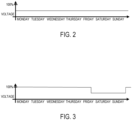
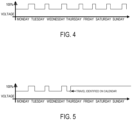
- FIGS. 2-4 show different examples where a battery of an electronic device is predictively charged to healthily accommodate a predicted battery demand based on different previously observed usage behavior for the electronic device.
- FIG. 2 shows an example scenario where an electronic device has previously been consistently plugged into a power source.
- the BMS 104 may be configured to recognize this usage pattern based on previously observed context information and set the battery state of charge limit to 60% while the electronic device is plugged in to the power source so as to do the least amount of long-term harm to the battery. If the electronic device were to be unplugged from the power source, then the battery would not have a full state of charge. However, the previously observed user behavior learned by the BMS 104 indicates that such a scenario may have a low likelihood of occurring.
- the state of charge may be dynamically set based on a relative confidence that the device will remain plugged in.
- the BMS 104 confidently predicts plugged in operation
- the state of charge may be dropped to relatively lower levels than when the BMS 104 less confidently predicts plugged in operation.
- the BMS 104 is able to balance between battery protection and user experience.
- the BMS 104 may be configured to determine a predicted battery demand for the battery based on any suitable degree of observed user-specific usage patterns having any suitable confidence level.
- FIG. 3 shows an example scenario where an electronic device has previously been observed to be consistently plugged in to a power source during weekends but has been observed to be inconsistently plugged in during the week.
- this usage scenario may be for a student that leaves their laptop at school during the week and then takes it at home over the weekend.
- the BMS 104 may be configured to recognize this usage pattern based on previously observed context information and increase the battery state of charge limit to 100% during the school week to allow for the battery to be fully charged in preparation for the device being used without being plugged in to a power source. Further, the BMS 104 decreases the battery state of charge limit to 60% during the weekend when it is anticipated that the device is going to be plugged into a power source for an extended period of time as learned from the previously observed usage behavior. In anticipation of the device transitioning back to inconsistent plug ins, the BMS 104 may be configured to fully charge the device early Monday morning before the user typically unplugs and takes the device back to school.
- FIG. 4 shows an example scenario where an electronic device has previously been observed to be consistently plugged into a power source during work hours and then unplugged from the power source at the end of the workday.
- the BMS 104 may be configured to recognize this pattern based on previously observed context information and set the battery state of charge limit to 60% while the electronic device is expected to remain plugged in during the work hours so as to do the least amount of long-term harm to the battery. Further, the BMS 104 may be configured to increase the battery state of charge limit to 100% prior to the end of the user's work day to allow the electronic device to have a fully charged battery for the predicted period where the electronic device will not be plugged into the power source (e.g., when the user leaves work).
- the BMS 104 predicts that if the user will not be using the battery for a defined period, the device commands the battery to lower its full charge state down to reduce battery degradation. If the device predicts a scenario of usage (in particular unplugged usage), the device will allow the battery to charge up to its maximum to provide the user increased unplugged runtime.
- the BMS 104 may be configured to predict when a user will deviate from a learned pattern of usage behavior based on deviating behavior context information that indicates such a deviation.
- FIG. 5 shows an example scenario where an electronic device is plugged into a power source during workdays similar to the usage pattern shown in FIG. 4 .
- a calendar application on the electronic device indicates that the user is going to be traveling and has to take a flight midday on Thursday.
- the BMS 104 may adjust the charging schedule of the electronic device based on this deviating behavior context information to predictively charge the battery differently to ensure that the battery is 100% charged by the time the user has to leave work for the flight.
- the BMS 104 may further deviate from the daily charging schedule while the user is traveling (as indicated by the dates on the calendar) to keep the state of charge limit increased to 100%. Furthermore, when the user returns from the trip, the BMS 104 may be configured to return to the normal charging schedule in accordance with the previously observed user behavior if no other schedule deviations are found on the calendar. In this example, the upcoming flight on the user's calendar may be a good predictor that the user is likely to unplug and take their device with them (and expect a full battery for the flight). As such, the BMS 104 may dynamically and predictively adjust the operation of the battery to meet the anticipated needs of the user.
- the BMS 104 may be configured to validate the return to the normal charging schedule/usage behavior pattern by checking available contextual signals for confirmation. For example, the BMS 104 may check whether the GPS signal indicating the current location of the device matches the location of the user's home/work to confirm that the user's trip has concluded. Further, this check can be cross-checked with other contextual signals, such as checking for no additional scheduled meetings in other cities or travel itineraries to other cities.
- the BMS 104 may use other smart signals (software, sensors) to predict user behavior. Such smart signals may originate from sensors on the device with the battery, an operating system or other applications on the device with the battery, sensors on remote devices, applications on remote devices, cloud services, and/or virtually any other source.
- the BMS 104 may utilize an Application Programing Interface (API) that allows various sources to communicate different smart signals and/or parameters to the BMS 104.
- API Application Programing Interface
- the BMS 104 may be trained to factor such smart signals into predictive models, e.g., via machine learning, fuzzy logic, or heuristics.
- a device with a smart assistant e.g., Cortana, Siri, Alexa
- the BMS 104 may adjust charging of the battery to be fully charged for the meeting. Similar actions may be taken by the BMS 104 based on a meeting or other deviation being identified in a text message or email.
- a health application may recognize when a user wakes up each morning, and the BMS 104 may adjust a charging state of the battery to fully charge responsive to the user waking up.
- the BMS 104 may deviate from the previously observed behavior and fully charge the battery earlier than usual so that the user's device is ready for the flight.
- a mobile phone with a GPS may communicate to a service that a user is heading home to a plugged-in device that often gets unplugged when the user gets home, and the service may remotely cooperate with the BMS 104 to fully charge the device just prior to the user's predicted arrival so that it is ready when the user arrives home.
- the same mobile phone may report that a user is on vacation in Hawaii and definitely will not be needing to unplug a device that is on the user's desk back home until the user returns from Hawaii.
- the BMS 104 recognizes that the user does not have the device and thus the future usage behavior will deviate from the previously observed usage behavior until the user returns from the trip. Signals like this may be used to deviate charge patterns from your normal predicted behavior.
- the BMS 104 may decrease the state of charge limit of the battery as elevated temperatures can decrease the health of the battery and vice versa.
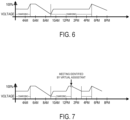
- FIG. 6 shows an example scenario of a learned usage pattern for an electronic device over the course of a day.
- the learned usage pattern may be determined based on one or more different contextual signals.
- the BMS 104 may be configured to lower the state of charge (e.g., 60%) of the battery 102 to healthily accommodate the predicted battery demand.
- the BMS 104 increases the state of charge of the battery 102 to a full state of charge in anticipation of the electronic device being unplugged from the power source and used while the user is going to work.
- the BMS 104 may learn the user's typical wakeup time based on contextual signals received from a smartwatch worn by the user and/or other contextual signals that indicate when the user typically starts using the electronic device each day.
- the user arrives at work and plugs in the electronic device to a power source. The user typically leaves the electronic device plugged into the power source during work hours and then unplugs the electronic device from the power source at the end of the workday.
- the BMS 104 may be configured to recognize this pattern based on previously observed context information and set the battery state of charge limit to 60% while the electronic device is plugged in during the work hours so as to do the least amount of long-term harm to the battery.
- the BMS 104 increases the state of charge of the battery 102 to a full state of charge in anticipation of the electronic device being unplugged from the power source and used while the user is going home from work.
- FIG. 7 shows an example scenario where an electronic device has a usage pattern similar to the usage pattern shown in FIG. 6 .
- a virtual assistant on the electronic device indicates that the user has a meeting from 1PM to 3PM.
- the BMS 104 is configured to predicatively charge the battery 102 according to the predicted battery demand based on the previously observed usage patterns for the electronic device until a time prior to the scheduled meeting (e.g., 12PM). At this time, the BMS 104 predictively charges the battery to healthily accommodate a predicted deviating battery demand that differs from the previously observed battery demand that would typically occur at this time.
- the BMS 104 determines the deviation from the previously observed usage patterns based on a contextual signal in the form of the scheduled meeting identified by the virtual assistant application executed on the electronic device.
- the BMS 104 increases the state of charge of the battery 102 to a full state of charge prior to the meeting in anticipation of the electronic device being unplugged from the power source and used while the user is attending the meeting.
- the BMS 104 returns to returning to predictively charging the battery according to the predicted battery demand by setting the battery state of charge limit to 60% while the electronic device is plugged in during the work hours.
- the BMS 104 increases the state of charge of the battery 102 to a full state of charge in anticipation of the electronic device being unplugged from the power source and used while the user is going home from work.
- the BMS 104 uses contextual signals to determine both a predicted battery demand and a predicted deviating battery demand to predictively charge the battery in a healthy manner.
- the battery may be predictively charged according to the predicted deviating battery demand for a deviation duration that is based on the contextual signal.
- the contextual signal may indicate that a user has a meeting scheduled for a set deviation duration (e.g., two hours).
- the contextual signal may indicate that a user is traveling for a set deviation duration (e.g., on a flight for five hours).
- the method 800 optionally may include determining whether or not the deviation duration has concluded. If the deviation, duration has concluded, then the method 800 moves to 814. Otherwise, the deviation duration has not concluded, and the method 800 returns to 812 while continuing to predictively charge the battery according to the predicted deviating battery demand.
- the method 800 optionally may include returning to predictively charging the battery according to the predicted battery demand at the conclusion of the deviation duration. In some implementations, the method optionally may include checking available contextual signals at the conclusion of the deviation duration to validate a return to predictively charging the battery according to the predicted battery demand.
- the methods and processes disclosed herein may be configured to give users and/or any other humans control over any private and/or potentially sensitive data.
- data Whenever data is stored, accessed, and/or processed, the data may be handled in accordance with privacy and/or security standards.
- users or other stakeholders may designate how the data is to be used and/or stored.
- user data should only be collected with the utmost respect for user privacy (e.g., user data may be collected only when the user owning the data provides affirmative consent, and/or the user owning the data may be notified whenever the user data is collected).
- the user's consent may be collected before using and/or releasing the data.
- Users may opt-in and/or opt-out of data collection at any time. After data has been collected, users may issue a command to delete the data, and/or restrict access to the data. All potentially sensitive data optionally may be encrypted and/or, when feasible anonymized, to further protect user privacy. Users may designate portions of data, metadata, or statistics/results of processing data for release to other parties, e.g., for further processing.
- Data that is private and/or confidential may be kept completely private, e.g., only decrypted temporarily for processing, or only decrypted for processing on a user device and otherwise stored in encrypted form.
- Users may hold and control encryption keys for the encrypted data.
- users may designate a trusted third party to hold and control encryption keys for the encrypted data, e.g., so as to provide access to the data to the user according to a suitable authentication protocol.
- the ML and/or AI components may make decisions based at least partially on training of the components with regard to training data. Accordingly, the ML and/or AI components can and should be trained on diverse, representative datasets that include sufficient relevant data for diverse users and/or populations of users. In particular, training data sets should be inclusive with regard to different human individuals and groups, so that as ML and/or AI components are trained, their performance is improved with regard to the user experience of the users and/or populations of users.
- ML and/or AI components may additionally be trained to make decisions so as to minimize potential bias towards human individuals and/or groups.
- AI systems when used to assess any qualitative and/or quantitative information about human individuals or groups, they may be trained so as to be invariant to differences between the individuals or groups that are not intended to be measured by the qualitative and/or quantitative assessment, e.g., so that any decisions are not influenced in an unintended fashion by differences among individuals and groups.
- ML and/or AI components may be designed to provide context as to how they operate, so that implementers of ML and/or AI systems can be accountable for decisions/assessments made by the systems.
- ML and/or AI systems may be configured for replicable behavior, e.g., when they make pseudo-random decisions, random seeds may be used and recorded to enable replicating the decisions later.
- data used for training and/or testing ML and/or AI systems may be curated and maintained to facilitate future investigation of the behavior of the ML and/or AI systems with regard to the data.
- ML and/or AI systems may be continually monitored to identify potential bias, errors, and/or unintended outcomes.
- an electronic device comprises a battery, and a battery management system configured to determine a predicted battery demand based on observed usage patterns, predictively charge the battery to healthily accommodate the predicted battery demand, determine a predicted deviating battery demand based on a contextual signal, wherein the predicted deviating battery demand differs from the predicted battery demand, and predictively charge the battery to healthily accommodate the predicted deviating battery demand.
- predictively charging the battery to healthily accommodate the predicted battery demand may include limiting the state of charge to a less-than-full state of charge responsive to the predicted battery demand predicting the electronic device is likely to remain connected to a power source.
- predictively charging the battery to healthily accommodate the predicted deviating battery demand may include increasing a state of charge from a less-than-full state of charge to a full state of charge responsive to the predicted deviating battery demand predicting the electronic device is likely to be disconnected from a power source.
- the battery management system may be configured to predictively charge the battery according to the predicted deviating battery demand for a deviation duration that is based on the contextual signal.
- the battery management system may be configured to return to predictively charging the battery according to the predicted battery demand at the conclusion of the deviation duration.
- the contextual signal may be received from a scheduling application.
- the contextual signal may be received from an email application. In this example and/or other examples, the contextual signal may be received from a text message application. In this example and/or other examples, the contextual signal may be received from a virtual assistant application. In this example and/or other examples, the contextual signal may be received from a remote device via a network.
- the battery management system may include a battery management integrated circuit. In this example and/or other examples, the battery management system may include a battery management application. In this example and/or other examples, the battery management system may include an operating system of the electronic device.
- an electronic device comprises a battery, and a battery management system configured to determine a predicted battery demand based on observed usage patterns, limit a state of charge of the battery to a less-than-full state of charge responsive to the predicted battery demand predicting the electronic device is likely to remain connected to a power source, determine a predicted deviating battery demand based on a contextual signal, and increase the state of charge from the less-than-full state of charge to a full state of charge responsive to the predicted deviating battery demand predicting the electronic device is likely to be disconnected from a power source.
Landscapes
- Engineering & Computer Science (AREA)
- Manufacturing & Machinery (AREA)
- Chemical & Material Sciences (AREA)
- Chemical Kinetics & Catalysis (AREA)
- Electrochemistry (AREA)
- General Chemical & Material Sciences (AREA)
- Power Engineering (AREA)
- Microelectronics & Electronic Packaging (AREA)
- Charge And Discharge Circuits For Batteries Or The Like (AREA)
Description
- Current consumer electronics' batteries degrade faster when in a fully charged state. Due to demand for higher energy density, chemistries used in batteries for consumer electronic devices may be pushed to higher and higher voltages. More time spent at full (or near full) charge can result in more damage being inflicted on the battery. As one example, a battery that is kept at full charge too long may expand from gas generation and cause a battery package to expand within the device housing, which could de-laminate screens, keyboards, etc. from internal pressure.
WO2015/063340A1 relates to systems and methods for context-based battery charging. In one example, context information about usage patterns of an electronic device is used to customize charging a rechargeable battery. In one example, a predictive engine accesses context information and generates a predicted charge duration. A charging application customizes charging parameters in a battery charger based on the predicted charge duration. In some examples, the charging application may generate suggestions to a user to improve battery charging. -
EP 2 505 418 A2 relates to an electronic device according to the preamble of claim 1. - The invention is set out in the appended set of claims.
- This Summary is provided to introduce a selection of concepts in a simplified form that are further described below in the Detailed Description. This Summary is not intended to identify key features or essential features of the claimed subject matter, nor is it intended to be used to limit the scope of the claimed subject matter.
- An electronic device includes a battery and a battery management system. The battery management system is configured to determine a predicted battery demand based on observed usage patterns and predictively charge the battery to healthily accommodate the predicted battery demand. The battery management system is further configured to determine a predicted deviating battery demand based on a contextual signal. The predicted deviating battery demand differing from the predicted battery demand. The battery management system is further configured to predictively charge the battery to healthily accommodate the predicted deviating battery demand.
-
-
FIG. 1 schematically shows an example battery management system for a battery powered electronic device. -
FIGS. 2-4 show different examples of predictively charging a battery of an electronic device to healthily accommodate a predicted battery demand based on different previously observed usage behavior for the electronic device. -
FIG. 5 shows an example of predictively charging a battery of an electronic device to healthily accommodate a predicted deviating battery demand based on deviating usage behavior that differs from previously observed usage behavior for the electronic device. -
FIG. 6 shows another example of predictively charging a battery of an electronic device to healthily accommodate a predicted battery demand based on previously observed usage behavior for the electronic device. -
FIG. 7 shows another example of predictively charging a battery of an electronic device to healthily accommodate a predicted deviating battery demand based on deviating usage behavior that differs from previously observed usage behavior for the electronic device. -
FIG. 8 shows a flowchart of an example method for charging a battery of an electronic device. - While battery health issues have always existed, only recently has battery chemistry been pushed to the limits where consumers are more often experiencing increasingly more severe lowered battery health effects. In order to address these issues, a conventional Battery Management System (BMS) may be used to monitor and control operation of a battery to protect the battery's health. As one example, the BMS may dynamically control a speed at which a battery is charged. As another example, the BMS may control where full charge and full discharge levels are set for the battery. The BMS may be implemented at the integrated circuit (IC) level as a custom silicon logic chip. In this IC-based implementation, the BMS may have minimal interaction with a device and/or product that is being powered by the battery. For example, only a few parameters such as battery charge percentage, state of health, and charge time may be passed from the BMS to the device. Likewise, the BMS may receive minimal or no information relating to the device being powered by the battery. Additionally, the BMS may receive little or no information about the user that controls the device, because the BMS is buried deep within the device hardware and has little or no interaction with, and/or awareness of, the user.
- As such, the BMS is unable to respond to situations where the BMS may be overestimating or underestimating the damage that is being inflicted on the battery by the device and/or the user. Designing a BMS to include such capabilities may increase the packaging size and power consumption of the integrated circuit. Most conventional BMS chips are not designed for use with specific devices and are not capable of being tuned to a particular device or use-case scenario.
- Accordingly, this disclosure is directed to an improved BMS in which battery management is handled through the system and/or software on the device, optionally using machine learning (ML) and artificial intelligence (AI) to learn and predict user behavior for the device to increase BMS performance. The BMS described herein is a system-smart, product-integrated, and user adaptable BMS, with significantly higher user context awareness that improves battery health and lifetime. In particular, such a BMS may be configured to derive a predicted battery demand based on observed user-specific usage patterns and to predictively charge the battery based on the predicted battery demand. By using pattern recognition, machine learning, integration with scheduling applications running on the device (e.g., email, calendar, notes, maps), and other smart signals (e.g., software, hardware), the BMS is able to adapt to the user's behavior, modulating the battery charge up and down in a smart, user- and device-specific way to improve battery health and decrease degradation.
-
FIG. 1 schematically shows an exampleelectronic device 100 that may be powered by abattery 102. Theelectronic device 100 may include any suitable battery-powered electronic device. For example, theelectronic device 100 may be a smartphone, laptop computer, tablet computer, game console, smartwatch, health monitoring device, display device, virtual reality (VR) or augmented reality (AR) device, or an intelligent assistant speaker device. Thebattery 102 may include any suitable power technology. For example, thebattery 102 may be a lithium-ion battery, nickel-cadmium battery, nickel metal hydride battery, or lead-acid battery. - The
electronic device 100 includes aBMS 104 configured to monitor and predictively control operation of thebattery 102 based on user behavior. The BMS 104 may be configured to collect context information from a plurality of smart signals 106 - e.g., information from different application programs executed by the electronic device, an operating system of the electronic device, and/or external signals from other devices. The context information may be used to characterize user behavior for theelectronic device 100 including normal charge/discharge patterns of thebattery 102 within the electronic device and the use case / operating conditions for theelectronic device 100. The context information may characterize the user behavior for theelectronic device 100 in any suitable manner. For example, the context information may provide answers to context questions, such as does the user always charge their device at night? If so, at what time? Is the device always plugged in at work? What are the times of the day in which the user hardly uses or does not use the electronic device? What are the times of the day that the user heavily uses the device? The context information may be used to determine previously observed user behavior for operating theelectronic device 100. The previously observed user behavior may indicate a previous pattern of use for theelectronic device 100. Furthermore, the context information may be used to determine predicted deviating user behavior for operating theelectronic device 100. The predicted deviating user behavior may indicate future usage of theelectronic device 100 that deviates from the previous pattern of use indicated by the previously observed user behavior. - The BMS 104 may collect context information from any suitable
smart signals 106 of theelectronic device 100.Smart signals 106 may originate from different sources within the computing architecture of theelectronic device 100. Non-limiting examples of different sources of context information include a search engine, calendar application, scheduling application, email application, map application, note-taking application, health and/or exercise monitoring application, travel application, weather application, and virtual personal assistant application. - In some implementations, the
battery monitoring system 104 may be configured to collect context information in the form of different parameters from one ormore sensors 108 of theelectronic device 100. A parameter may include any suitable physical parameter that characterizes power, motion, position, location, and/or other information related to theelectronic device 100. The sensor(s) 108 may include any suitable type of sensor. Non-limiting examples of sensors include, but are not limited to electrical sensors for measuring the charge or discharge current flowing through the battery, the voltage across the battery terminals, the state of charge of the battery, as well as the temperature of the battery, an inertial measurement unit (IMU) configured to provide position and/or orientation information of theelectronic device 100; a global positioning system (GPS) sensor configured to provide a geographical location of theelectronic device 100 via communication with a GPS satellite network; a personal activity tracker configured to track different physical parameters of a user of the electronic device 100 (e.g., count a number of steps, count a number calories burned); one or more barometers; temperature sensors; visible-light sensors, ultraviolet sensors, ambient temperature sensors, physical contact sensors, and a clock/timer to trigger various temporal events. Further, various additional parameters may be derived from such sensors, such as speed, acceleration, height, and other suitable parameters. Such sensors may be in communication with one or more circuits or other machines of the electronic device configured to translate measurements of the physical parameters into machine-readable sensor data. - In some implementations, the
electronic device 100 may be configured to communicate with one or more remote electronic devices. For example, theelectronic device 100 may be communicatively coupled to aremote device 124 via acomputer network 122, such as the Internet. Theelectronic device 100 may be configured to communicate with any suitable type and/or number of different remote devices to receive context information. Such remote devices may include user devices, such as a user's smart watch, smart phone, or a smart assistant device. As another example, such remote devices may include cloud services that collect information from various sources. As yet another example, such remote devices may include remote sensor devices, such as a GPS system or a cellular communication tower configured to communicate with theelectronic device 100 to determine a position of the electronic device 100 (e.g., via signal localization). - The
remote device 124 may be configured to collect context information from a plurality of smart signals 126 - e.g., information from different application programs executed by theremote device 124, an operating system of theremote device 124, and/or external signals from other remote devices. Further, theremote device 124 may be configured to collect context information in the form of different parameters from one ormore sensors 128 of theremote device 124. Theremote device 124 may be configured to provide any suitable context information to theelectronic device 100. Theelectronic device 100 may use context information received from theremote device 100 to determine either previously observed user behavior or predicted deviating user behavior for controlling operation of thebattery 102. - In some implementations, the
electronic device 100 and/or theremote device 124 may include natural language processing componentry, such as a microphone for speech and/or voice recognition. Theelectronic device 100 and/or theremote device 124 may be configured to extract contextual signals from the recognized speech that may be used to inform predictions of user behavior (and/or deviations in user behavior). In some examples, theelectronic device 100 and/or theremote device 124 may include a virtual assistant application (e.g., Cortana, Siri, Alexa) configured to recognize contextual signals. Non-limiting examples of contextual signals recognizable by the virtual assistant application include scheduled meetings/appointments/social gatherings, travel itineraries, and other events (either repeatedly occurring or one-time events). - In some implementations, the
electronic device 100 may support an opt-in/out application or process. The opt-in/out application or process may enable a user to specify whether or not theelectronic device 100 collects context information in order to predictively control operation of thebattery 102 based on the user's behavior. - The collected context information may be provided as input to a user
behavior prediction machine 110. The userbehavior prediction machine 110 may be configured to perform pattern recognition (e.g., Artificial Intelligence and/or Machine Learning) processes using the context information to recognize previously observed user behavior for the electronic device and predict how the user will use the electronic device 100 (e.g., over the next minute, hour, and/or day) in the form of a predicted battery demand that is based on the previously observed user behavior. Furthermore, the user behavior prediction machine may be configured to recognize predicted deviating user behavior that deviates from the previously observed user behavior based on one or more context signals and determine a predicted deviating battery demand based on the one or more context signals. - User behavior (previously observed user behavior and/or predicted deviating user behavior) and/or adaptive power/battery control may be modeled in any suitable manner, for example using any suitable combination of state-of-the-art and/or future machine learning (ML), artificial intelligence (AI), and/or natural language processing (NLP) techniques. In some examples, user behavior may be modeled by one or more machine learning classifiers, trained to predict a user action for a usage context (e.g., for exemplary input data drawn from scheduling applications, current battery power level, previous actions taken by the user, previous power control actions taken by the system, etc.). For example, machine learning classifiers may be trained to predict the user actions based on a plurality of labelled example user actions, each labelled example user action including an exemplary usage context and a user action that was performed by a user in that context. In some examples, machine learning classifiers may be alternately or additionally trained to predict power control actions (adjusting state of charge limits), e.g., based on a plurality of labelled example system actions, each labelled example system action including a usage context and a power control action that should be taken in that context (e.g., as indicated by historical data, ground truth labels supplied by human trainers, etc.). In some examples, user behavior may be modeled by one or more machine learning models configured to generate, for a usage context and/or for a sequence of usage contexts, a sequence of user actions and/or power control actions. In some examples, user behavior may be modeled by a machine learning model trained using reinforcement learning. For example, the reinforcement learning model may include a decision function configured to select power control actions (adjusting state of charge limits) with regard to usage contexts (e.g., based on context information from smart signals and sensors of the electronic device and/or other remote devices), and trained with regard to reinforcement signals including power events (e.g., rate of battery drain, plugged into/unplugged from a power source), with regard to user feedback (e.g., regarding user satisfaction while using the BMS 104), etc. For example, generating the sequence of user actions and/or power control actions may be based on operating machine learning classifier models, reinforcement learning models, and the like.
- Non-limiting examples of techniques that may be used to predict user behavior, and/or to adaptively select power control actions based on user behavior include support vector machines, multi-layer neural networks, convolutional neural networks (e.g., including spatial convolutional networks for processing images and/or videos, temporal convolutional neural networks for processing audio signals and/or natural language sentences, and/or any other suitable convolutional neural networks configured to convolve and pool features across one or more temporal and/or spatial dimensions), recurrent neural networks (e.g., long short-term memory networks), associative memories (e.g., lookup tables, hash tables, Bloom Filters, Neural Turing Machine and/or Neural Random Access Memory), graphical models (e.g., (hidden) Markov models, Markov random fields, (hidden) conditional random fields, and/or AI knowledge bases), and/or natural language processing techniques (e.g., tokenization, stemming, constituency and/or dependency parsing, and/or intent recognition, segmental models, and/or super-segmental models (e.g., hidden dynamic models). For example, temporal convolutional neural networks and/or recurrent neural networks may be trained to predict user actions and/or power control actions based on a sequence of usage contexts.
- In some examples, the methods and processes described herein may be implemented using one or more differentiable functions, wherein a gradient of the differentiable functions may be calculated and/or estimated with regard to inputs and/or outputs of the differentiable functions (e.g., with regard to training data, and/or with regard to an objective function). Such methods and processes may be at least partially determined by a set of trainable parameters. Accordingly, the trainable parameters for a particular method or process may be adjusted through any suitable training procedure, in order to continually improve functioning of the method or process.
- Non-limiting examples of training procedures for adjusting trainable parameters include supervised training (e.g., using gradient descent or any other suitable optimization method), zero-shot, few-shot, unsupervised learning methods (e.g., classification based on classes derived from unsupervised clustering methods), reinforcement learning (e.g., deep Q learning based on feedback) and/or generative adversarial neural network training methods, belief propagation, RANSAC (random sample consensus), contextual bandit methods, maximum likelihood methods, and/or expectation maximization. In some examples, a plurality of methods, processes, and/or components of systems described herein may be trained simultaneously with regard to an objective function measuring performance of collective functioning of the plurality of components (e.g., with regard to reinforcement feedback and/or with regard to labelled training data). Simultaneously training the plurality of methods, processes, and/or components may improve such collective functioning. In some examples, one or more methods, processes, and/or components may be trained independently of other components (e.g., offline training on historical data).
- Language models may utilize vocabulary features to guide sampling/searching for words for recognition of speech. For example, a language model may be at least partially defined by a statistical distribution of words or other vocabulary features. For example, a language model may be defined by a statistical distribution of n-grams, defining transition probabilities between candidate words according to vocabulary statistics. The language model may be further based on any other appropriate statistical features, and/or results of processing the statistical features with one or more machine learning and/or statistical algorithms (e.g., confidence values resulting from such processing). In some examples, a statistical model may constrain what words may be recognized for an audio signal, e.g., based on an assumption that words in the audio signal come from a particular vocabulary.
- Alternately or additionally, the language model may be based on one or more neural networks previously trained to represent audio inputs and words in a shared latent space, e.g., a vector space learned by one or more audio and/or word models (e.g., wav2letter and/or word2vec). Accordingly, finding a candidate word may include searching the shared latent space based on a vector encoded by the audio model for an audio input, in order to find a candidate word vector for decoding with the word model. The shared latent space may be utilized to assess, for one or more candidate words, a confidence that the candidate word is featured in the speech audio.
- The language model may be used in conjunction with an acoustical model configured to assess, for a candidate word and an audio signal, a confidence that the candidate word is included in speech audio in the audio signal based on acoustical features of the word (e.g., mel-frequency cepstral coefficients, formants, etc.). Optionally, in some examples, the language model may incorporate the acoustical model (e.g., assessment and/or training of the language model may be based on the acoustical model). The acoustical model defines a mapping between acoustic signals and basic sound units such as phonemes, e.g., based on labelled speech audio. The acoustical model may be based on any suitable combination of state-of-the-art or future machine learning (ML) and/or artificial intelligence (AI) models, for example: deep neural networks (e.g., long short-term memory, temporal convolutional neural network, restricted Boltzmann machine, deep belief network), hidden Markov models (HMM), conditional random fields (CRF) and/or Markov random fields, Gaussian mixture models, and/or other graphical models (e.g., deep Bayesian network). Audio signals to be processed with the acoustic model may be pre-processed in any suitable manner, e.g., encoding at any suitable sampling rate, Fourier transform, bandpass filters, etc. The acoustical model may be trained to recognize the mapping between acoustic signals and sound units based on training with labelled audio data. For example, the acoustical model may be trained based on labelled audio data comprising speech audio and corrected text, in order to learn the mapping between the speech audio signals and sound units denoted by the corrected text. Accordingly, the acoustical model may be continually improved to improve its utility for correctly recognizing speech audio.
- In some examples, in addition to statistical models, neural networks, and/or acoustical models, the language model may incorporate any suitable graphical model, e.g., a hidden Markov model (HMM) or a conditional random field (CRF). The graphical model may utilize statistical features (e.g., transition probabilities) and/or confidence values to determine a probability of recognizing a word, given the speech audio and/or other words recognized so far. Accordingly, the graphical model may utilize the statistical features, previously trained machine learning models, and/or acoustical models to define transition probabilities between states represented in the graphical model.
- By using pattern recognition, machine learning, integration with scheduling and other smart signals of the electronic device, and parameters from sensors of the electronic device (and/or other remote devices), the user
behavior prediction machine 110 may be able to adapt to the user's behavior, and control the battery 102 (e.g., modulating the battery charge up and down) in a smart and user-specific way to increase battery health and decrease degradation. For example, theBMS 104 may adjust a state of charge limit to any suitable limit, such as 100%, 90%, 80%, 70%, 60%, 50%, 40%, or another lower limit where battery degradation is considerably lower than in its fully charged state. TheBMS 104 may be configured to determine a predicted battery demand based on observed user-specific usage patterns, and predictively charge thebattery 102 to healthily accommodate the predicted battery demand. In some examples, theBMS 104 may be configured to healthily charge thebattery 102 to accommodate the predicted battery demand by purposefully undercharging thebattery 102 or limiting the state of charge to less than a full state of charge (90%, 80%, 70%, 60%, 50%, etc.) based on a prediction that the full state of charge will not be needed and/or the electronic device is likely to remain connected to a power source. In other examples, theBMS 104 may be configured to predictively charge thebattery 102 to healthily accommodate the predicted battery by increasing a state of charge from a less-than-full state of charge to a full state of charge responsive to predicting the electronic device is likely to be disconnected from a power source. - The
BMS 104 may be further configured to determine a predicted deviating battery demand based on a contextual signal that indicates a deviation from a previously observed usage pattern of the electronic device such that the predicted deviating battery demand differs from the predicted battery demand. TheBMS 104 may be configured to predictively charge thebattery 102 to healthily accommodate the predicted deviating battery demand. In some examples, theBMS 104 may be configured to healthily charge thebattery 102 to accommodate the predicted deviating battery demand by purposefully undercharging thebattery 102 or limiting the state of charge to less than a full state of charge based on a prediction that the full state of charge will not be needed and/or the electronic device is likely to remain connected to a power source. In other examples, theBMS 104 may be configured to predictively charge thebattery 102 to healthily accommodate the predicted deviating battery by increasing a state of charge from a less-than-full state of charge to a full state of charge responsive to predicting the electronic device is likely to be disconnected from a power source. - In some implementations, the
BMS 104 may be configured to predictively adjust the state of charge of thebattery 102 based on a confidence level of the predicted battery demand/predicted deviating battery demand. The level of confidence may be determined in any suitable manner. As one example, the confidence level may be adjusted based at least in part on temporal considerations. In one example, the confidence level may increase over time as long as a usage pattern for the electronic device remains consistent. For example, a high confidence level may be determined based on a consistent history of use over the course of weeks, months, or years. Moreover, the BMS may repeatedly assess the confidence level over time and adjust the stage of charge of the battery based on the updated confidence level. As another example, the confidence level may be adjusted based at least in part on one or more other signals. For example, different contextual signals (e.g., travel itinerary, meeting schedule, GPS signal, user utterances heard and interpreted using natural language processing) may indicate that a user is traveling without the electronic device (e.g., because the device is not being used and/or has a different GPS location). TheBMS 104 may be configured to determine a confidence level based on the number of contextual signals that indicate that the electronic device is not with the user. In this case, theBMS 104 may lower the state of charge (e.g., to 60%) of the battery for the duration of the user's travels, since the BMS has a high confidence that the electronic device will not be used while the user is traveling due to the multiple contextual signals indicating that the electronic device is not with the user while the user is traveling. - In some such implementations, the
BMS 104 may be configured to set the state of charge of thebattery 102 to a charge level that is inversely proportional to a confidence level determined by the BMS. In one example, theBMS 104 may be configured to predictively charge thebattery 102 to a 50% state of charge if the BMS is 99% certain the battery will not be needed; 60% state of charge if the BMS is 90% certain the battery will not be needed; 70% state of charge if the BMS is 80% certain the battery will not be needed; 80% state of charge if the BMS is 70% certain the battery will not be needed; 90% state of charge if the BMS is 60% certain the battery will not be needed; and 100% state of charge if the BMS is 50% certain the battery will not be needed. Note that these relationships between charge and certainty or confidence level are provided as an example. TheBMS 104 may be configured to adjust the state of charge of thebattery 104 in any suitable manner in relation to any suitable confidence level. - The
electronic device 100 includes alogic subsystem 112 and astorage subsystem 114. Theelectronic device 100 may optionally include adisplay subsystem 116,input subsystem 118,communication subsystem 120, and/or other subsystems not shown inFIG. 1 . -
Logic subsystem 112 includes one or more physical devices configured to execute instructions. For example, the logic subsystem may be configured to execute instructions that are part of one or more applications, services, or other logical constructs. The logic subsystem may include one or more hardware processors configured to execute software instructions. Additionally or alternatively, the logic subsystem may include one or more hardware or firmware devices configured to execute hardware or firmware instructions. Processors of the logic subsystem may be single-core or multi-core, and the instructions executed thereon may be configured for sequential, parallel, and/or distributed processing. Individual components of the logic subsystem optionally may be distributed among two or more separate devices, which may be remotely located and/or configured for coordinated processing. Aspects of the logic subsystem may be virtualized and executed by remotely accessible, networked computing devices configured in a cloud-computing configuration. -
Storage subsystem 114 includes one or more physical devices configured to temporarily and/or permanently hold computer information such as data and instructions executable by the logic subsystem. When the storage subsystem includes two or more devices, the devices may be collocated and/or remotely located.Storage subsystem 114 may include volatile, nonvolatile, dynamic, static, read/write, read-only, random-access, sequential-access, location-addressable, file-addressable, and/or content-addressable devices.Storage subsystem 114 may include removable and/or built-in devices. When thelogic subsystem 112 executes instructions, the state ofstorage subsystem 114 may be transformed - e.g., to hold different data. - Aspects of
logic subsystem 112 andstorage subsystem 114 may be integrated together into one or more hardware-logic components. Such hardware-logic components may include program- and application-specific integrated circuits (PASIC / ASICs), program- and application-specific standard products (PSSP / ASSPs), system-on-a-chip (SOC), and complex programmable logic devices (CPLDs), for example. - The logic subsystem and the storage subsystem may cooperate to instantiate one or more logic machines. As used herein, the term "machine" is used to collectively refer to the combination of hardware, firmware, software, instructions, and/or any other components cooperating to provide computer functionality. In other words, "machines" are never abstract ideas and always have a tangible form. A machine may be instantiated by a single computing device, or a machine may include two or more sub-components instantiated by two or more different computing devices. In some implementations a machine includes a local component (e.g., software application executed by a computer processor) cooperating with a remote component (e.g., cloud computing service provided by a network of server computers). The software and/or other instructions that give a particular machine its functionality may optionally be saved as one or more unexecuted modules on one or more suitable storage devices.
- When included,
display subsystem 116 may be used to present a visual representation of data held bystorage subsystem 114. This visual representation may take the form of a graphical user interface (GUI).Display subsystem 116 may include one or more display devices utilizing virtually any type of technology. In some implementations, display subsystem may include one or more virtual-, augmented-, or mixed reality displays. - When included,
input subsystem 118 may comprise or interface with one or more input devices. An input device may include a sensor device or a user input device. Examples of user input devices include a keyboard, mouse, touch screen, or game controller. In some embodiments, the input subsystem may comprise or interface with selected natural user input (NUI) componentry. Such componentry may be integrated or peripheral, and the transduction and/or processing of input actions may be handled on- or off-board. Example NUI componentry may include a microphone for speech and/or voice recognition; an infrared, color, stereoscopic, and/or depth camera for machine vision and/or gesture recognition; a head tracker, eye tracker, accelerometer, and/or gyroscope for motion detection and/or intent recognition. - When included,
communication subsystem 120 may be configured to communicatively couple theelectronic device 100 with one or more other computing devices.Communication subsystem 120 may include wired and/or wireless communication devices compatible with one or more different communication protocols. The communication subsystem may be configured for communication via personal-, local- and/or wide-area networks. - The
BMS 104 may control thebattery 102 in any suitable manner based on predictions of the user's behavior determined by the userbehavior prediction machine 110.FIGS. 2-4 show different examples where a battery of an electronic device is predictively charged to healthily accommodate a predicted battery demand based on different previously observed usage behavior for the electronic device. -
FIG. 2 shows an example scenario where an electronic device has previously been consistently plugged into a power source. TheBMS 104 may be configured to recognize this usage pattern based on previously observed context information and set the battery state of charge limit to 60% while the electronic device is plugged in to the power source so as to do the least amount of long-term harm to the battery. If the electronic device were to be unplugged from the power source, then the battery would not have a full state of charge. However, the previously observed user behavior learned by theBMS 104 indicates that such a scenario may have a low likelihood of occurring. - Based on current battery chemistry, battery degradation reduces significantly when state of charge drops to 80% and below, although degradation can be further reduced at even lower states of charge. Accordingly, it is desirable to decrease the state of charge as much as possible. However, low states of charge may provide an unfavorable user experience if the user unexpectedly unplugs, because the user will have less battery capacity available for unplugged usage. As such, the state of charge may be dynamically set based on a relative confidence that the device will remain plugged in. When the
BMS 104 confidently predicts plugged in operation, the state of charge may be dropped to relatively lower levels than when theBMS 104 less confidently predicts plugged in operation. As such, theBMS 104 is able to balance between battery protection and user experience. Note that theBMS 104 may be configured to determine a predicted battery demand for the battery based on any suitable degree of observed user-specific usage patterns having any suitable confidence level. -
FIG. 3 shows an example scenario where an electronic device has previously been observed to be consistently plugged in to a power source during weekends but has been observed to be inconsistently plugged in during the week. For example, this usage scenario may be for a student that leaves their laptop at school during the week and then takes it at home over the weekend. In this scenario, theBMS 104 may be configured to recognize this usage pattern based on previously observed context information and increase the battery state of charge limit to 100% during the school week to allow for the battery to be fully charged in preparation for the device being used without being plugged in to a power source. Further, theBMS 104 decreases the battery state of charge limit to 60% during the weekend when it is anticipated that the device is going to be plugged into a power source for an extended period of time as learned from the previously observed usage behavior. In anticipation of the device transitioning back to inconsistent plug ins, theBMS 104 may be configured to fully charge the device early Monday morning before the user typically unplugs and takes the device back to school. -
FIG. 4 shows an example scenario where an electronic device has previously been observed to be consistently plugged into a power source during work hours and then unplugged from the power source at the end of the workday. TheBMS 104 may be configured to recognize this pattern based on previously observed context information and set the battery state of charge limit to 60% while the electronic device is expected to remain plugged in during the work hours so as to do the least amount of long-term harm to the battery. Further, theBMS 104 may be configured to increase the battery state of charge limit to 100% prior to the end of the user's work day to allow the electronic device to have a fully charged battery for the predicted period where the electronic device will not be plugged into the power source (e.g., when the user leaves work). In this scenario, theBMS 104 predicts that if the user will not be using the battery for a defined period, the device commands the battery to lower its full charge state down to reduce battery degradation. If the device predicts a scenario of usage (in particular unplugged usage), the device will allow the battery to charge up to its maximum to provide the user increased unplugged runtime. - Furthermore, the
BMS 104 may be configured to predict when a user will deviate from a learned pattern of usage behavior based on deviating behavior context information that indicates such a deviation.FIG. 5 shows an example scenario where an electronic device is plugged into a power source during workdays similar to the usage pattern shown inFIG. 4 . However, a calendar application on the electronic device indicates that the user is going to be traveling and has to take a flight midday on Thursday. TheBMS 104 may adjust the charging schedule of the electronic device based on this deviating behavior context information to predictively charge the battery differently to ensure that the battery is 100% charged by the time the user has to leave work for the flight. TheBMS 104 may further deviate from the daily charging schedule while the user is traveling (as indicated by the dates on the calendar) to keep the state of charge limit increased to 100%. Furthermore, when the user returns from the trip, theBMS 104 may be configured to return to the normal charging schedule in accordance with the previously observed user behavior if no other schedule deviations are found on the calendar. In this example, the upcoming flight on the user's calendar may be a good predictor that the user is likely to unplug and take their device with them (and expect a full battery for the flight). As such, theBMS 104 may dynamically and predictively adjust the operation of the battery to meet the anticipated needs of the user. In some implementations, theBMS 104 may be configured to validate the return to the normal charging schedule/usage behavior pattern by checking available contextual signals for confirmation. For example, theBMS 104 may check whether the GPS signal indicating the current location of the device matches the location of the user's home/work to confirm that the user's trip has concluded. Further, this check can be cross-checked with other contextual signals, such as checking for no additional scheduled meetings in other cities or travel itineraries to other cities. - In addition to the calendar application, the
BMS 104 may use other smart signals (software, sensors) to predict user behavior. Such smart signals may originate from sensors on the device with the battery, an operating system or other applications on the device with the battery, sensors on remote devices, applications on remote devices, cloud services, and/or virtually any other source. In some embodiments, theBMS 104 may utilize an Application Programing Interface (API) that allows various sources to communicate different smart signals and/or parameters to theBMS 104. TheBMS 104 may be trained to factor such smart signals into predictive models, e.g., via machine learning, fuzzy logic, or heuristics. - The following are nonlimiting examples of how the
BMS 104 can be trained to deviate from predictive models based only on observed past behavior responsive to smart signals to predictively charge the battery to healthily accommodate a predicted deviating battery demand. In one example, a device with a smart assistant (e.g., Cortana, Siri, Alexa) may hear that a user is going to a meeting, and theBMS 104 may adjust charging of the battery to be fully charged for the meeting. Similar actions may be taken by theBMS 104 based on a meeting or other deviation being identified in a text message or email. In another example, a health application may recognize when a user wakes up each morning, and theBMS 104 may adjust a charging state of the battery to fully charge responsive to the user waking up. If the user's calendar indicates that the user is taking an early flight one morning, then theBMS 104 may deviate from the previously observed behavior and fully charge the battery earlier than usual so that the user's device is ready for the flight. In another example, a mobile phone with a GPS may communicate to a service that a user is heading home to a plugged-in device that often gets unplugged when the user gets home, and the service may remotely cooperate with theBMS 104 to fully charge the device just prior to the user's predicted arrival so that it is ready when the user arrives home. In another example, the same mobile phone may report that a user is on vacation in Hawaii and definitely will not be needing to unplug a device that is on the user's desk back home until the user returns from Hawaii. In this scenario, theBMS 104 recognizes that the user does not have the device and thus the future usage behavior will deviate from the previously observed usage behavior until the user returns from the trip. Signals like this may be used to deviate charge patterns from your normal predicted behavior. - Additional scenarios of high-temperature or high-power draw are also considered by the
BMS 104. For example, if ambient temperatures are identified as being higher than a threshold, then theBMS 104 may decrease the state of charge limit of the battery as elevated temperatures can decrease the health of the battery and vice versa. -
FIG. 6 shows an example scenario of a learned usage pattern for an electronic device over the course of a day. The learned usage pattern may be determined based on one or more different contextual signals. Early in the morning (e.g., when the user is sleeping), the electronic device has previously been observed to be consistently plugged into a power source. As such, theBMS 104 may be configured to lower the state of charge (e.g., 60%) of thebattery 102 to healthily accommodate the predicted battery demand. Further, at a time prior to when it has been previously observed that the user wakes up (e.g., 5AM), theBMS 104 increases the state of charge of thebattery 102 to a full state of charge in anticipation of the electronic device being unplugged from the power source and used while the user is going to work. For example, theBMS 104 may learn the user's typical wakeup time based on contextual signals received from a smartwatch worn by the user and/or other contextual signals that indicate when the user typically starts using the electronic device each day. At 9AM, the user arrives at work and plugs in the electronic device to a power source. The user typically leaves the electronic device plugged into the power source during work hours and then unplugs the electronic device from the power source at the end of the workday. TheBMS 104 may be configured to recognize this pattern based on previously observed context information and set the battery state of charge limit to 60% while the electronic device is plugged in during the work hours so as to do the least amount of long-term harm to the battery. At a time prior to when it has been previously observed that the user leaves work (e.g., 5PM), theBMS 104 increases the state of charge of thebattery 102 to a full state of charge in anticipation of the electronic device being unplugged from the power source and used while the user is going home from work. -
FIG. 7 shows an example scenario where an electronic device has a usage pattern similar to the usage pattern shown inFIG. 6 . However, a virtual assistant on the electronic device indicates that the user has a meeting from 1PM to 3PM. TheBMS 104 is configured to predicatively charge thebattery 102 according to the predicted battery demand based on the previously observed usage patterns for the electronic device until a time prior to the scheduled meeting (e.g., 12PM). At this time, theBMS 104 predictively charges the battery to healthily accommodate a predicted deviating battery demand that differs from the previously observed battery demand that would typically occur at this time. TheBMS 104 determines the deviation from the previously observed usage patterns based on a contextual signal in the form of the scheduled meeting identified by the virtual assistant application executed on the electronic device. TheBMS 104 increases the state of charge of thebattery 102 to a full state of charge prior to the meeting in anticipation of the electronic device being unplugged from the power source and used while the user is attending the meeting. When the meeting is over at 3PM and the electronic device is plugged back into the power source, theBMS 104 returns to returning to predictively charging the battery according to the predicted battery demand by setting the battery state of charge limit to 60% while the electronic device is plugged in during the work hours. At a time prior to when it has been previously observed that the user leaves work (e.g., 5PM), theBMS 104 increases the state of charge of thebattery 102 to a full state of charge in anticipation of the electronic device being unplugged from the power source and used while the user is going home from work. In the above described scenarios, theBMS 104 uses contextual signals to determine both a predicted battery demand and a predicted deviating battery demand to predictively charge the battery in a healthy manner. - In some examples, the
BMS 104 may be configured to vary the state of charge of the battery over time based on theBMS 104 being highly confident that a charging event will occur (or will not occur). For example, theBMS 104 may be highly confident that the electronic device will be plugged into a power source at the end of the day. In the morning, when the electronic device is plugged into a power source at work, theBMS 104 may set the state of charge to be higher (e.g., 80%), so that if the electronic device becomes unplugged from the power source, the battery is likely to have enough charge to power the electronic device until the electronic device is plugged into the power source at the end of the day. Further, in the afternoon, when the electronic device is plugged into a power source at work, theBMS 104 may set the state of charge to be lower (e.g., 40%), so that if the electronic device becomes unplugged from the power source, the battery is still likely to have enough charge to power the electronic device until the electronic device is plugged into the power source at the end of the day. - This
smart BMS 104 is able to constantly evolve and re-train to adapt to how the user changes their device use pattern over time. For example, if a user starts taking their device on more trips or starts attending school/classes where they needed more battery power (no power cord connection), the application/process identifies a behavior shift and re-learns the new usage scenario to adapt to this new use case. - By identifying events on a scheduling program/application, the system-
smart BMS 104 can charge the battery to full in preparation of a meeting/travel/etc. where the user does not have access to a power cable to be plugged in, even when such meeting/travel/etc. deviates from the user's already-learned patterns. This scheduling integration can feed context information to the pattern recognition (PR) system to improve its predictions or can override the predicted use-case of the PR system in the event that a valid full-charge scenario/event occurs which deviates from normal patterns. - Adding these additional smart, and user-facing context tools allows the existing
BMS 104 to transform into a new system-smart, useradaptable BMS 104. This new system-smart BMS 104 adapts to every specific user, morphing to their specific use case and patterns to get the most out of their battery performance and lifetime instead of the current "one-size fits all" approach. This new approach provides a seamless adaptation of the battery usage to the user, requiring no action from the user to change how they use their device/battery to improve the battery lifetime and health. - In some implementations, the
BMS 104 may be configured to maintain a user profile of predicted user behavior patterns across a plurality of electronic devices associated with a particular user. The user's interactions with each of the devices may be collected as context information in the user profile. The user profile may inform predictions of user behavior by BMSs of each of the plurality of electronic devices associated with the user. Moreover, if the user buys a new electronic device, the BMS on that electronic device can access the user profile to be immediately informed of previous usage behavior patterns of the user that may inform future predictions made by the BMS on the new electronic device. In some example, profile information may be saved on a network-accessible computer, for example as a cloud-computing profile. - The most advanced existing BMSs may use some timer-based event counting. For example, an internal timer may be used to identify how long a device is plugged in, and if it is plugged in for at least a defined period, the BMS may lower the charging voltage to prevent damage. However, these simple timer-based designs are reactionary vs. proactive. Without employing the deep pattern recognition and integration with scheduling programs/applications, the timer-based designs cannot predict future usage and adjust the battery to best accommodate a predicted future usage. Being reactionary with low integration to the system/product means that these systems are still applying a "one-size fits all" approach. Because the timer-based designs are non-predictive, a user could experience a lower charged battery when disconnecting power because the BMS is not smart enough to identify that the user needed the full battery power at that time. This would cause the user to experience a lower battery runtime which results in a degraded user experience. Because they are not adaptable, they cannot change when user behavior changes. Because existing BMS are not designed to consider rich contextual information about the user, existing BMS can over and under-correct for battery usage.
-
FIG. 8 shows anexample method 800 for charging a battery of an electronic device. For example, themethod 800 may be performed by theBMS 104 shown inFIG. 1 . At 802, themethod 800 includes determining observed user-specific usage patterns of a battery of an electronic device based on contextual signals and/or sensor signals. Such signals may be received from software applications and/or sensors of the electronic device and/or a remote device in communication with the electronic device. At 804, themethod 800 includes determining a predicted battery demand based on the observed user-specific usage patterns. At 806, themethod 800 includes predictively charging the battery to healthily accommodate the predicted battery demand. In some examples, predictively charging the battery to healthily accommodate the predicted battery demand may include limiting the state of charge to a less-than-full state of charge responsive to the predicted battery demand predicting the electronic device is likely to remain connected to a power source. For example, the state of charge might be capped at 80%. - At 808, the
method 800 includes determining a predicted deviating battery demand that differs from the predicted battery demand. The predicted deviating battery demand may be determined based on a contextual signal that indicates that predicted user behavior will likely deviate from the observed user-specific usage patterns. For example, the contextual signal may be received from a scheduling application, an email application, a text message application, a virtual assistant application, or another source from the electronic device or a remote device in communication with the electronic device. At 810, themethod 800 includes predictively charging the battery to healthily accommodate the predicted deviating battery demand. In some examples, predictively charging the battery to healthily accommodate the predicted deviating battery demand may include increasing a state of charge from the less-than-full state of charge to a full state of charge responsive to the predicted deviating battery demand predicting the electronic device is likely to be disconnected from a power source. In some such examples, the state of charge of the battery may begin increasing at a time prior to a predicted time when the electronic device will be disconnected from the power source such that the electronic device will be at the full state of charge before the electronic device is predicted to be disconnected from the power source. - In some implementations, the battery may be predictively charged according to the predicted deviating battery demand for a deviation duration that is based on the contextual signal. As one example, the contextual signal may indicate that a user has a meeting scheduled for a set deviation duration (e.g., two hours). As another example, the contextual signal may indicate that a user is traveling for a set deviation duration (e.g., on a flight for five hours). In some such implementations, at 812, the
method 800 optionally may include determining whether or not the deviation duration has concluded. If the deviation, duration has concluded, then themethod 800 moves to 814. Otherwise, the deviation duration has not concluded, and themethod 800 returns to 812 while continuing to predictively charge the battery according to the predicted deviating battery demand. In some implementations, at 814, themethod 800 optionally may include returning to predictively charging the battery according to the predicted battery demand at the conclusion of the deviation duration. In some implementations, the method optionally may include checking available contextual signals at the conclusion of the deviation duration to validate a return to predictively charging the battery according to the predicted battery demand. - The herein disclosed solution includes much higher levels of system and software integration, utilizing significantly more use-case and user-context data to improve the performance of the overall BMS system.
- The methods and processes disclosed herein may be configured to give users and/or any other humans control over any private and/or potentially sensitive data. Whenever data is stored, accessed, and/or processed, the data may be handled in accordance with privacy and/or security standards. When user data is collected, users or other stakeholders may designate how the data is to be used and/or stored. Whenever user data is collected for any purpose, the user data should only be collected with the utmost respect for user privacy (e.g., user data may be collected only when the user owning the data provides affirmative consent, and/or the user owning the data may be notified whenever the user data is collected). If the data is to be released for access by anyone other than the user or used for any decision-making process, the user's consent may be collected before using and/or releasing the data. Users may opt-in and/or opt-out of data collection at any time. After data has been collected, users may issue a command to delete the data, and/or restrict access to the data. All potentially sensitive data optionally may be encrypted and/or, when feasible anonymized, to further protect user privacy. Users may designate portions of data, metadata, or statistics/results of processing data for release to other parties, e.g., for further processing. Data that is private and/or confidential may be kept completely private, e.g., only decrypted temporarily for processing, or only decrypted for processing on a user device and otherwise stored in encrypted form. Users may hold and control encryption keys for the encrypted data. Alternately or additionally, users may designate a trusted third party to hold and control encryption keys for the encrypted data, e.g., so as to provide access to the data to the user according to a suitable authentication protocol.
- When the methods and processes described herein incorporate ML and/or AI components, the ML and/or AI components may make decisions based at least partially on training of the components with regard to training data. Accordingly, the ML and/or AI components can and should be trained on diverse, representative datasets that include sufficient relevant data for diverse users and/or populations of users. In particular, training data sets should be inclusive with regard to different human individuals and groups, so that as ML and/or AI components are trained, their performance is improved with regard to the user experience of the users and/or populations of users.
- ML and/or AI components may additionally be trained to make decisions so as to minimize potential bias towards human individuals and/or groups. For example, when AI systems are used to assess any qualitative and/or quantitative information about human individuals or groups, they may be trained so as to be invariant to differences between the individuals or groups that are not intended to be measured by the qualitative and/or quantitative assessment, e.g., so that any decisions are not influenced in an unintended fashion by differences among individuals and groups.
- ML and/or AI components may be designed to provide context as to how they operate, so that implementers of ML and/or AI systems can be accountable for decisions/assessments made by the systems. For example, ML and/or AI systems may be configured for replicable behavior, e.g., when they make pseudo-random decisions, random seeds may be used and recorded to enable replicating the decisions later. As another example, data used for training and/or testing ML and/or AI systems may be curated and maintained to facilitate future investigation of the behavior of the ML and/or AI systems with regard to the data. Furthermore, ML and/or AI systems may be continually monitored to identify potential bias, errors, and/or unintended outcomes.
- In an example, an electronic device comprises a battery, and a battery management system configured to determine a predicted battery demand based on observed usage patterns, predictively charge the battery to healthily accommodate the predicted battery demand, determine a predicted deviating battery demand based on a contextual signal, wherein the predicted deviating battery demand differs from the predicted battery demand, and predictively charge the battery to healthily accommodate the predicted deviating battery demand. In this example and/or other examples, predictively charging the battery to healthily accommodate the predicted battery demand may include limiting the state of charge to a less-than-full state of charge responsive to the predicted battery demand predicting the electronic device is likely to remain connected to a power source. In this example and/or other examples, predictively charging the battery to healthily accommodate the predicted deviating battery demand may include increasing a state of charge from a less-than-full state of charge to a full state of charge responsive to the predicted deviating battery demand predicting the electronic device is likely to be disconnected from a power source. In this example and/or other examples, the battery management system may be configured to predictively charge the battery according to the predicted deviating battery demand for a deviation duration that is based on the contextual signal. In this example and/or other examples, the battery management system may be configured to return to predictively charging the battery according to the predicted battery demand at the conclusion of the deviation duration. In this example and/or other examples, the contextual signal may be received from a scheduling application. In this example and/or other examples, the contextual signal may be received from an email application. In this example and/or other examples, the contextual signal may be received from a text message application. In this example and/or other examples, the contextual signal may be received from a virtual assistant application. In this example and/or other examples, the contextual signal may be received from a remote device via a network. In this example and/or other examples, the battery management system may include a battery management integrated circuit. In this example and/or other examples, the battery management system may include a battery management application. In this example and/or other examples, the battery management system may include an operating system of the electronic device.
- In an example, a method for charging a battery of an electronic device comprises determining a predicted battery demand based on observed usage patterns, predictively charging the battery to healthily accommodate the predicted battery demand, determining a predicted deviating battery demand based on a contextual signal, wherein the predicted deviating battery demand differs from the predicted battery demand, and predictively charging the battery to healthily accommodate the predicted deviating battery demand. In this example and/or other examples, predictively charging the battery to healthily accommodate the predicted battery demand may include limiting the state of charge to a less-than-full state of charge responsive to the predicted battery demand predicting the electronic device is likely to remain connected to a power source. In this example and/or other examples, predictively charging the battery to healthily accommodate the predicted deviating battery demand may include increasing a state of charge from a less-than-full state of charge to a full state of charge responsive to the predicted deviating battery demand predicting the electronic device is likely to be disconnected from a power source. In this example and/or other examples, the battery may be predictively charged according to the predicted deviating battery demand for a deviation duration that is based on the contextual signal. In this example and/or other examples, the method may further comprise returning to predictively charging the battery according to the predicted battery demand at the conclusion of the deviation duration. In this example and/or other examples, the contextual signal may be received from at least one of a scheduling application, an email application, a text message application, or a virtual assistant application.
- In an example, an electronic device comprises a battery, and a battery management system configured to determine a predicted battery demand based on observed usage patterns, limit a state of charge of the battery to a less-than-full state of charge responsive to the predicted battery demand predicting the electronic device is likely to remain connected to a power source, determine a predicted deviating battery demand based on a contextual signal, and increase the state of charge from the less-than-full state of charge to a full state of charge responsive to the predicted deviating battery demand predicting the electronic device is likely to be disconnected from a power source.
- It will be understood that the configurations and/or approaches described herein are exemplary in nature, and that these specific embodiments or examples are not to be considered in a limiting sense, because numerous variations are possible. The specific routines or methods described herein may represent one or more of any number of processing strategies. As such, various acts illustrated and/or described may be performed in the sequence illustrated and/or described, in other sequences, in parallel, or omitted. Likewise, the order of the above-described processes may be changed.
Claims (15)
- An electronic device (100), comprising:a battery (102); andcharacterised in that the electronic device (100) comprises:
a battery management system configured todetermine a predicted battery demand based on observed usage patterns, predictively charge the battery (102) to a less-than-full state of charge to accommodate the predicted battery demand,determine a predicted deviating battery demand based on a contextual signal, that indicates a deviation from a previously observed usage pattern of the electronic device (100), wherein the predicted deviating battery demand differs from the predicted battery demand, andcharge the battery (102) to a state of charge that is different to the less-than-full state of charge to accommodate the predicted deviating battery demand. - The electronic device of claim 1, wherein charging the battery to accommodate the predicted battery demand is responsive to the predicted battery demand predicting the electronic device is likely to remain connected to a power source.
- The electronic device of claim 1, wherein charging the battery to accommodate the predicted deviating battery demand includes increasing the less-than-full state of charge to a full state of charge responsive to the predicted deviating battery demand predicting the electronic device is likely to be disconnected from a power source.
- The electronic device of claim 1, wherein the battery management system is configured to charge the battery according to the predicted deviating battery demand for a deviation duration that is based on the contextual signal.
- The electronic device of claim 4, wherein the battery management system is configured to return to charging the battery according to the predicted battery demand at the conclusion of the deviation duration.
- The electronic device of claim 1, wherein the contextual signal is received from a scheduling application.
- The electronic device of claim 1, wherein the contextual signal is received from an email application.
- The electronic device of claim 1, wherein the contextual signal is received from a text message application.
- The electronic device of claim 1, wherein the contextual signal is received from a virtual assistant application.
- The electronic device of claim 1, wherein the contextual signal is received from a remote device via a network.
- A method for charging a battery (102) of an electronic device (100), the method comprising:determining (804) a predicted battery demand based on observed usage patterns; predictively charging (806) the battery to a less-than-full state of charge to accommodate the predicted battery demand;determining (808) a predicted deviating battery demand based on a contextual signal, that indicates a deviation from a previously observed usage pattern of the electronic device (100), wherein the predicted deviating battery demand differs from the predicted battery demand; andcharging (810) the battery to a state of charge that is different to the less-than-full state of charge to accommodate the predicted deviating battery demand.
- The method of claim 11, wherein charging the battery to accommodate the predicted battery demand is responsive to the predicted battery demand predicting the electronic device is likely to remain connected to a power source.
- The method of claim 11, wherein charging the battery to accommodate the predicted deviating battery demand includes increasing the less-than-full state of charge to a full state of charge responsive to the predicted deviating battery demand predicting the electronic device is likely to be disconnected from a power source.
- The method of claim 11, wherein the battery is charged according to the predicted deviating battery demand for a deviation duration that is based on the contextual signal.
- The method of claim 11, further comprising returning to charging the battery according to the predicted battery demand at the conclusion of the deviation duration
Applications Claiming Priority (3)
| Application Number | Priority Date | Filing Date | Title |
|---|---|---|---|
| US201962821943P | 2019-03-21 | 2019-03-21 | |
| US16/417,330 US11165270B2 (en) | 2019-03-21 | 2019-05-20 | Predictive management of battery operation |
| PCT/US2020/022506 WO2020190665A1 (en) | 2019-03-21 | 2020-03-13 | Predictive management of battery operation |
Publications (2)
| Publication Number | Publication Date |
|---|---|
| EP3942668A1 EP3942668A1 (en) | 2022-01-26 |
| EP3942668B1 true EP3942668B1 (en) | 2024-08-21 |
Family
ID=72515875
Family Applications (1)
| Application Number | Title | Priority Date | Filing Date |
|---|---|---|---|
| EP20718879.8A Active EP3942668B1 (en) | 2019-03-21 | 2020-03-13 | Predictive management of battery operation |
Country Status (4)
| Country | Link |
|---|---|
| US (1) | US11165270B2 (en) |
| EP (1) | EP3942668B1 (en) |
| CN (1) | CN113646985B (en) |
| WO (1) | WO2020190665A1 (en) |
Families Citing this family (32)
| Publication number | Priority date | Publication date | Assignee | Title |
|---|---|---|---|---|
| CN114072983A (en) * | 2019-05-16 | 2022-02-18 | 特洛斯公司 | Method and system for dual equalization battery and battery pack performance management |
| US12296714B2 (en) * | 2019-06-12 | 2025-05-13 | Mitsubishi Electric Corporation | Charge and discharge control device and charge and discharge control method including first, second, and third charge level ranges |
| CN114600093A (en) * | 2019-06-28 | 2022-06-07 | 英特尔公司 | Safe and Efficient Compute Sharing for Electric Vehicles |
| TWI709101B (en) * | 2019-07-29 | 2020-11-01 | 和碩聯合科技股份有限公司 | Battery charging method |
| US11580421B2 (en) * | 2019-10-16 | 2023-02-14 | Qualcomm Incorporated | Weakly supervised learning for improving multimodal sensing platform |
| EP3859870A4 (en) * | 2019-10-21 | 2022-06-15 | Ningde Amperex Technology Ltd. | CHARGING PROCESS, ELECTRONIC DEVICE AND STORAGE MEDIA |
| US11086382B2 (en) * | 2019-12-23 | 2021-08-10 | Dell Products L.P. | Compensating for low battery charge levels of a battery in an information handling system |
| US11489344B2 (en) * | 2020-03-10 | 2022-11-01 | International Business Machines Corporation | Altering battery charging rate based on physical activity |
| US20210336464A1 (en) * | 2020-04-28 | 2021-10-28 | Intel Corporation | Inference based fast charging |
| WO2021246816A1 (en) * | 2020-06-04 | 2021-12-09 | Samsung Electronics Co., Ltd. | Method for enhancing performance of electronic device |
| CN113839427B (en) * | 2020-06-05 | 2025-09-23 | 华为技术有限公司 | Charging management method, electronic device and system |
| CN111856299A (en) * | 2020-07-29 | 2020-10-30 | 中国联合网络通信集团有限公司 | Method, device and device for determining power status |
| CN112083736B (en) * | 2020-08-11 | 2023-07-25 | 广东电网有限责任公司电力科学研究院 | Unmanned aerial vehicle tracking method |
| EP3985827B1 (en) * | 2020-10-19 | 2024-07-17 | Vestel Elektronik Sanayi ve Ticaret A.S. | Method and device for charging a rechargeable battery |
| US11853381B2 (en) * | 2020-11-13 | 2023-12-26 | Google Llc | Hybrid fetching using a on-device cache |
| KR102790387B1 (en) * | 2020-11-26 | 2025-04-01 | 주식회사 엘지화학 | Apparatus and method for managing battery |
| US11888340B2 (en) * | 2020-12-04 | 2024-01-30 | Schneider Electric It Corporation | Method to enhance the life of a lithium battery |
| US20240154448A1 (en) * | 2021-03-26 | 2024-05-09 | Sony Group Corporation | Electronic device, charging system, and charging method |
| US20220407329A1 (en) * | 2021-06-16 | 2022-12-22 | Hewlett-Packard Development Company, L.P. | Battery charge regulation |
| US11784358B2 (en) * | 2021-07-07 | 2023-10-10 | The Aerospace Corporation | Self regulating modular battery |
| CN114448060B (en) * | 2022-03-08 | 2025-05-13 | Oppo广东移动通信有限公司 | Charging control method, charging control device, storage medium and electronic device |
| WO2023215008A1 (en) * | 2022-05-03 | 2023-11-09 | Google Llc | Battery management and optimization using voice integration systems |
| US20240078165A1 (en) | 2022-09-06 | 2024-03-07 | Apple Inc. | Multi-device context synchronization and applications thereof |
| US12580406B2 (en) * | 2022-09-06 | 2026-03-17 | Apple Inc. | Optimizing battery charging with synchronized context data |
| US12609549B2 (en) * | 2022-09-28 | 2026-04-21 | Microsoft Technology Licensing, Llc | Adaptive battery management |
| US20240217388A1 (en) * | 2022-12-29 | 2024-07-04 | Volkswagen Aktiengesellschaft | Probabilistic modelling of electric vehicle charging and driving usage behavior with hidden markov model-based clustering |
| US11966565B1 (en) * | 2023-04-17 | 2024-04-23 | International Business Machines Corporation | Mobile device task views based on contextual learning |
| CN116609668B (en) * | 2023-04-26 | 2024-03-26 | 淮阴工学院 | Lithium ion battery health state and residual life prediction method |
| KR20250006629A (en) * | 2023-07-04 | 2025-01-13 | 삼성에스디아이 주식회사 | Battery life estimate method and battery system |
| CN117458572B (en) * | 2023-12-22 | 2024-03-15 | 深圳市超思维电子股份有限公司 | Power supply management system for energy storage cabinet BMS |
| US12468369B2 (en) * | 2023-12-29 | 2025-11-11 | Volkswagen Aktiengesellschaft | Forecasting timeseries analysis for electrical vehicle battery state utilizing a hybrid transformer architecture |
| CN118191612B (en) * | 2024-03-20 | 2024-12-31 | 哈尔滨工业大学(深圳)(哈尔滨工业大学深圳科技创新研究院) | Lithium battery health diagnosis method and system based on scalable recurrent neural network |
Family Cites Families (12)
| Publication number | Priority date | Publication date | Assignee | Title |
|---|---|---|---|---|
| US7888913B1 (en) | 2009-09-08 | 2011-02-15 | Intermec Ip Corp. | Smart battery charger |
| US9714772B2 (en) * | 2010-11-19 | 2017-07-25 | Google Inc. | HVAC controller configurations that compensate for heating caused by direct sunlight |
| JP5982736B2 (en) | 2011-03-30 | 2016-08-31 | ソニー株式会社 | Power storage device, power storage method and program |
| US8719195B2 (en) | 2011-10-10 | 2014-05-06 | The Boeing Company | Battery adaptive learning management system |
| US9653759B2 (en) | 2012-03-29 | 2017-05-16 | The Boeing Company | Method and apparatus for optimized battery life cycle management |
| US20150123595A1 (en) | 2013-11-04 | 2015-05-07 | Xiam Technologies Limited | Intelligent context based battery charging |
| US9210662B1 (en) | 2014-05-29 | 2015-12-08 | Apple Inc. | Adaptive battery life extension |
| US10283964B2 (en) * | 2015-07-01 | 2019-05-07 | General Electric Company | Predictive control for energy storage on a renewable energy system |
| US10283985B2 (en) | 2016-05-25 | 2019-05-07 | Lenovo (Singapore) Pte. Ltd. | Systems and methods to determine time at which battery is to be charged |
| CN109690900B (en) | 2016-06-01 | 2021-03-23 | 华为技术有限公司 | A charging method and terminal |
| US10901476B2 (en) | 2017-07-06 | 2021-01-26 | DOOSAN Heavy Industries Construction Co., LTD | Method for predicting power demand and controlling ESS charge/discharge based on the predicted demand, and apparatus using the same |
| CN108804764A (en) | 2018-05-07 | 2018-11-13 | 电子科技大学 | A kind of aging of lithium battery trend forecasting method based on extreme learning machine |
-
2019
- 2019-05-20 US US16/417,330 patent/US11165270B2/en active Active
-
2020
- 2020-03-13 WO PCT/US2020/022506 patent/WO2020190665A1/en not_active Ceased
- 2020-03-13 CN CN202080023225.2A patent/CN113646985B/en active Active
- 2020-03-13 EP EP20718879.8A patent/EP3942668B1/en active Active
Also Published As
| Publication number | Publication date |
|---|---|
| US11165270B2 (en) | 2021-11-02 |
| CN113646985A (en) | 2021-11-12 |
| WO2020190665A1 (en) | 2020-09-24 |
| CN113646985B (en) | 2024-07-26 |
| US20200303938A1 (en) | 2020-09-24 |
| EP3942668A1 (en) | 2022-01-26 |
Similar Documents
| Publication | Publication Date | Title |
|---|---|---|
| EP3942668B1 (en) | Predictive management of battery operation | |
| US20240338612A1 (en) | Automated input-data monitoring to dynamically adapt machine-learning techniques | |
| US10691794B2 (en) | Method, apparatus, and electronic device for detecting model security | |
| US10839806B2 (en) | Voice processing method and electronic device supporting the same | |
| US10547729B2 (en) | Electronic device and method of executing function of electronic device | |
| KR102389041B1 (en) | Mobile terminal and method using machine learning for controlling mobile terminal | |
| US10909982B2 (en) | Electronic apparatus for processing user utterance and controlling method thereof | |
| CN108735204B (en) | Device for performing tasks corresponding to user utterances | |
| US11217246B2 (en) | Communication robot and method for operating the same | |
| US11042703B2 (en) | Method and device for generating natural language expression by using framework | |
| US20190019509A1 (en) | Voice data processing method and electronic device for supporting the same | |
| US20070099602A1 (en) | Multi-modal device capable of automated actions | |
| KR102930046B1 (en) | An artificial intelligence device providing voice recognition functionality, and a method of operating the artificial intelligence device. | |
| US10382907B2 (en) | Device and method for providing notification message about call request | |
| KR20180109631A (en) | Electronic device and method for executing function of electronic device | |
| US11437042B2 (en) | Communication robot and method for operating the same | |
| US11481558B2 (en) | System and method for a scene builder | |
| WO2021218423A1 (en) | Method and apparatus for charging management and control | |
| CN111797302A (en) | Model processing method, device, storage medium and electronic device | |
| KR20180116731A (en) | Device for performing a task corresponding to user utterance | |
| US20250385534A1 (en) | Methods and systems for managing battery health | |
| CN118367660B (en) | A low-battery charging warning method and system for smart watches | |
| KR102349681B1 (en) | Electronic device for acquiring and registering lacking parameter |
Legal Events
| Date | Code | Title | Description |
|---|---|---|---|
| STAA | Information on the status of an ep patent application or granted ep patent |
Free format text: STATUS: UNKNOWN |
|
| STAA | Information on the status of an ep patent application or granted ep patent |
Free format text: STATUS: THE INTERNATIONAL PUBLICATION HAS BEEN MADE |
|
| PUAI | Public reference made under article 153(3) epc to a published international application that has entered the european phase |
Free format text: ORIGINAL CODE: 0009012 |
|
| STAA | Information on the status of an ep patent application or granted ep patent |
Free format text: STATUS: REQUEST FOR EXAMINATION WAS MADE |
|
| 17P | Request for examination filed |
Effective date: 20210902 |
|
| AK | Designated contracting states |
Kind code of ref document: A1 Designated state(s): AL AT BE BG CH CY CZ DE DK EE ES FI FR GB GR HR HU IE IS IT LI LT LU LV MC MK MT NL NO PL PT RO RS SE SI SK SM TR |
|
| DAV | Request for validation of the european patent (deleted) | ||
| DAX | Request for extension of the european patent (deleted) | ||
| GRAP | Despatch of communication of intention to grant a patent |
Free format text: ORIGINAL CODE: EPIDOSNIGR1 |
|
| STAA | Information on the status of an ep patent application or granted ep patent |
Free format text: STATUS: GRANT OF PATENT IS INTENDED |
|
| RIC1 | Information provided on ipc code assigned before grant |
Ipc: H01M 10/48 20060101ALI20240214BHEP Ipc: H01M 10/44 20060101ALI20240214BHEP Ipc: H01M 10/42 20060101ALI20240214BHEP Ipc: H02J 7/00 20060101AFI20240214BHEP |
|
| INTG | Intention to grant announced |
Effective date: 20240314 |
|
| P01 | Opt-out of the competence of the unified patent court (upc) registered |
Effective date: 20240425 |
|
| GRAS | Grant fee paid |
Free format text: ORIGINAL CODE: EPIDOSNIGR3 |
|
| GRAA | (expected) grant |
Free format text: ORIGINAL CODE: 0009210 |
|
| STAA | Information on the status of an ep patent application or granted ep patent |
Free format text: STATUS: THE PATENT HAS BEEN GRANTED |
|
| AK | Designated contracting states |
Kind code of ref document: B1 Designated state(s): AL AT BE BG CH CY CZ DE DK EE ES FI FR GB GR HR HU IE IS IT LI LT LU LV MC MK MT NL NO PL PT RO RS SE SI SK SM TR |
|
| REG | Reference to a national code |
Ref country code: GB Ref legal event code: FG4D |
|
| REG | Reference to a national code |
Ref country code: CH Ref legal event code: EP |
|
| REG | Reference to a national code |
Ref country code: IE Ref legal event code: FG4D |
|
| REG | Reference to a national code |
Ref country code: DE Ref legal event code: R096 Ref document number: 602020036171 Country of ref document: DE |
|
| REG | Reference to a national code |
Ref country code: LT Ref legal event code: MG9D |
|
| REG | Reference to a national code |
Ref country code: NL Ref legal event code: MP Effective date: 20240821 |
|
| PG25 | Lapsed in a contracting state [announced via postgrant information from national office to epo] |
Ref country code: NO Free format text: LAPSE BECAUSE OF FAILURE TO SUBMIT A TRANSLATION OF THE DESCRIPTION OR TO PAY THE FEE WITHIN THE PRESCRIBED TIME-LIMIT Effective date: 20241121 |
|
| REG | Reference to a national code |
Ref country code: AT Ref legal event code: MK05 Ref document number: 1716490 Country of ref document: AT Kind code of ref document: T Effective date: 20240821 |
|
| PG25 | Lapsed in a contracting state [announced via postgrant information from national office to epo] |
Ref country code: NL Free format text: LAPSE BECAUSE OF FAILURE TO SUBMIT A TRANSLATION OF THE DESCRIPTION OR TO PAY THE FEE WITHIN THE PRESCRIBED TIME-LIMIT Effective date: 20240821 Ref country code: FI Free format text: LAPSE BECAUSE OF FAILURE TO SUBMIT A TRANSLATION OF THE DESCRIPTION OR TO PAY THE FEE WITHIN THE PRESCRIBED TIME-LIMIT Effective date: 20240821 Ref country code: PT Free format text: LAPSE BECAUSE OF FAILURE TO SUBMIT A TRANSLATION OF THE DESCRIPTION OR TO PAY THE FEE WITHIN THE PRESCRIBED TIME-LIMIT Effective date: 20241223 Ref country code: GR Free format text: LAPSE BECAUSE OF FAILURE TO SUBMIT A TRANSLATION OF THE DESCRIPTION OR TO PAY THE FEE WITHIN THE PRESCRIBED TIME-LIMIT Effective date: 20241122 Ref country code: PL Free format text: LAPSE BECAUSE OF FAILURE TO SUBMIT A TRANSLATION OF THE DESCRIPTION OR TO PAY THE FEE WITHIN THE PRESCRIBED TIME-LIMIT Effective date: 20240821 |
|
| PG25 | Lapsed in a contracting state [announced via postgrant information from national office to epo] |
Ref country code: BG Free format text: LAPSE BECAUSE OF FAILURE TO SUBMIT A TRANSLATION OF THE DESCRIPTION OR TO PAY THE FEE WITHIN THE PRESCRIBED TIME-LIMIT Effective date: 20240821 |
|
| PG25 | Lapsed in a contracting state [announced via postgrant information from national office to epo] |
Ref country code: LV Free format text: LAPSE BECAUSE OF FAILURE TO SUBMIT A TRANSLATION OF THE DESCRIPTION OR TO PAY THE FEE WITHIN THE PRESCRIBED TIME-LIMIT Effective date: 20240821 |
|
| PG25 | Lapsed in a contracting state [announced via postgrant information from national office to epo] |
Ref country code: AT Free format text: LAPSE BECAUSE OF FAILURE TO SUBMIT A TRANSLATION OF THE DESCRIPTION OR TO PAY THE FEE WITHIN THE PRESCRIBED TIME-LIMIT Effective date: 20240821 Ref country code: IS Free format text: LAPSE BECAUSE OF FAILURE TO SUBMIT A TRANSLATION OF THE DESCRIPTION OR TO PAY THE FEE WITHIN THE PRESCRIBED TIME-LIMIT Effective date: 20241221 |
|
| PG25 | Lapsed in a contracting state [announced via postgrant information from national office to epo] |
Ref country code: HR Free format text: LAPSE BECAUSE OF FAILURE TO SUBMIT A TRANSLATION OF THE DESCRIPTION OR TO PAY THE FEE WITHIN THE PRESCRIBED TIME-LIMIT Effective date: 20240821 |
|
| PG25 | Lapsed in a contracting state [announced via postgrant information from national office to epo] |
Ref country code: RS Free format text: LAPSE BECAUSE OF FAILURE TO SUBMIT A TRANSLATION OF THE DESCRIPTION OR TO PAY THE FEE WITHIN THE PRESCRIBED TIME-LIMIT Effective date: 20241121 Ref country code: ES Free format text: LAPSE BECAUSE OF FAILURE TO SUBMIT A TRANSLATION OF THE DESCRIPTION OR TO PAY THE FEE WITHIN THE PRESCRIBED TIME-LIMIT Effective date: 20240821 |
|
| PG25 | Lapsed in a contracting state [announced via postgrant information from national office to epo] |
Ref country code: RS Free format text: LAPSE BECAUSE OF FAILURE TO SUBMIT A TRANSLATION OF THE DESCRIPTION OR TO PAY THE FEE WITHIN THE PRESCRIBED TIME-LIMIT Effective date: 20241121 Ref country code: PT Free format text: LAPSE BECAUSE OF FAILURE TO SUBMIT A TRANSLATION OF THE DESCRIPTION OR TO PAY THE FEE WITHIN THE PRESCRIBED TIME-LIMIT Effective date: 20241223 Ref country code: PL Free format text: LAPSE BECAUSE OF FAILURE TO SUBMIT A TRANSLATION OF THE DESCRIPTION OR TO PAY THE FEE WITHIN THE PRESCRIBED TIME-LIMIT Effective date: 20240821 Ref country code: NO Free format text: LAPSE BECAUSE OF FAILURE TO SUBMIT A TRANSLATION OF THE DESCRIPTION OR TO PAY THE FEE WITHIN THE PRESCRIBED TIME-LIMIT Effective date: 20241121 Ref country code: NL Free format text: LAPSE BECAUSE OF FAILURE TO SUBMIT A TRANSLATION OF THE DESCRIPTION OR TO PAY THE FEE WITHIN THE PRESCRIBED TIME-LIMIT Effective date: 20240821 Ref country code: LV Free format text: LAPSE BECAUSE OF FAILURE TO SUBMIT A TRANSLATION OF THE DESCRIPTION OR TO PAY THE FEE WITHIN THE PRESCRIBED TIME-LIMIT Effective date: 20240821 Ref country code: IS Free format text: LAPSE BECAUSE OF FAILURE TO SUBMIT A TRANSLATION OF THE DESCRIPTION OR TO PAY THE FEE WITHIN THE PRESCRIBED TIME-LIMIT Effective date: 20241221 Ref country code: HR Free format text: LAPSE BECAUSE OF FAILURE TO SUBMIT A TRANSLATION OF THE DESCRIPTION OR TO PAY THE FEE WITHIN THE PRESCRIBED TIME-LIMIT Effective date: 20240821 Ref country code: GR Free format text: LAPSE BECAUSE OF FAILURE TO SUBMIT A TRANSLATION OF THE DESCRIPTION OR TO PAY THE FEE WITHIN THE PRESCRIBED TIME-LIMIT Effective date: 20241122 Ref country code: FI Free format text: LAPSE BECAUSE OF FAILURE TO SUBMIT A TRANSLATION OF THE DESCRIPTION OR TO PAY THE FEE WITHIN THE PRESCRIBED TIME-LIMIT Effective date: 20240821 Ref country code: ES Free format text: LAPSE BECAUSE OF FAILURE TO SUBMIT A TRANSLATION OF THE DESCRIPTION OR TO PAY THE FEE WITHIN THE PRESCRIBED TIME-LIMIT Effective date: 20240821 Ref country code: BG Free format text: LAPSE BECAUSE OF FAILURE TO SUBMIT A TRANSLATION OF THE DESCRIPTION OR TO PAY THE FEE WITHIN THE PRESCRIBED TIME-LIMIT Effective date: 20240821 Ref country code: AT Free format text: LAPSE BECAUSE OF FAILURE TO SUBMIT A TRANSLATION OF THE DESCRIPTION OR TO PAY THE FEE WITHIN THE PRESCRIBED TIME-LIMIT Effective date: 20240821 |
|
| PG25 | Lapsed in a contracting state [announced via postgrant information from national office to epo] |
Ref country code: DK Free format text: LAPSE BECAUSE OF FAILURE TO SUBMIT A TRANSLATION OF THE DESCRIPTION OR TO PAY THE FEE WITHIN THE PRESCRIBED TIME-LIMIT Effective date: 20240821 Ref country code: SM Free format text: LAPSE BECAUSE OF FAILURE TO SUBMIT A TRANSLATION OF THE DESCRIPTION OR TO PAY THE FEE WITHIN THE PRESCRIBED TIME-LIMIT Effective date: 20240821 Ref country code: RO Free format text: LAPSE BECAUSE OF FAILURE TO SUBMIT A TRANSLATION OF THE DESCRIPTION OR TO PAY THE FEE WITHIN THE PRESCRIBED TIME-LIMIT Effective date: 20240821 |
|
| PG25 | Lapsed in a contracting state [announced via postgrant information from national office to epo] |
Ref country code: EE Free format text: LAPSE BECAUSE OF FAILURE TO SUBMIT A TRANSLATION OF THE DESCRIPTION OR TO PAY THE FEE WITHIN THE PRESCRIBED TIME-LIMIT Effective date: 20240821 |
|
| PG25 | Lapsed in a contracting state [announced via postgrant information from national office to epo] |
Ref country code: CZ Free format text: LAPSE BECAUSE OF FAILURE TO SUBMIT A TRANSLATION OF THE DESCRIPTION OR TO PAY THE FEE WITHIN THE PRESCRIBED TIME-LIMIT Effective date: 20240821 |
|
| PG25 | Lapsed in a contracting state [announced via postgrant information from national office to epo] |
Ref country code: IT Free format text: LAPSE BECAUSE OF FAILURE TO SUBMIT A TRANSLATION OF THE DESCRIPTION OR TO PAY THE FEE WITHIN THE PRESCRIBED TIME-LIMIT Effective date: 20240821 Ref country code: SK Free format text: LAPSE BECAUSE OF FAILURE TO SUBMIT A TRANSLATION OF THE DESCRIPTION OR TO PAY THE FEE WITHIN THE PRESCRIBED TIME-LIMIT Effective date: 20240821 |
|
| REG | Reference to a national code |
Ref country code: DE Ref legal event code: R097 Ref document number: 602020036171 Country of ref document: DE |
|
| PLBE | No opposition filed within time limit |
Free format text: ORIGINAL CODE: 0009261 |
|
| STAA | Information on the status of an ep patent application or granted ep patent |
Free format text: STATUS: NO OPPOSITION FILED WITHIN TIME LIMIT |
|
| 26N | No opposition filed |
Effective date: 20250522 |
|
| PG25 | Lapsed in a contracting state [announced via postgrant information from national office to epo] |
Ref country code: SE Free format text: LAPSE BECAUSE OF FAILURE TO SUBMIT A TRANSLATION OF THE DESCRIPTION OR TO PAY THE FEE WITHIN THE PRESCRIBED TIME-LIMIT Effective date: 20240821 |
|
| PG25 | Lapsed in a contracting state [announced via postgrant information from national office to epo] |
Ref country code: MC Free format text: LAPSE BECAUSE OF FAILURE TO SUBMIT A TRANSLATION OF THE DESCRIPTION OR TO PAY THE FEE WITHIN THE PRESCRIBED TIME-LIMIT Effective date: 20240821 |
|
| REG | Reference to a national code |
Ref country code: CH Ref legal event code: H13 Free format text: ST27 STATUS EVENT CODE: U-0-0-H10-H13 (AS PROVIDED BY THE NATIONAL OFFICE) Effective date: 20251023 |
|
| PG25 | Lapsed in a contracting state [announced via postgrant information from national office to epo] |
Ref country code: LU Free format text: LAPSE BECAUSE OF NON-PAYMENT OF DUE FEES Effective date: 20250313 |
|
| REG | Reference to a national code |
Ref country code: BE Ref legal event code: MM Effective date: 20250331 |
|
| PG25 | Lapsed in a contracting state [announced via postgrant information from national office to epo] |
Ref country code: FR Free format text: LAPSE BECAUSE OF NON-PAYMENT OF DUE FEES Effective date: 20250331 |
|
| PG25 | Lapsed in a contracting state [announced via postgrant information from national office to epo] |
Ref country code: BE Free format text: LAPSE BECAUSE OF NON-PAYMENT OF DUE FEES Effective date: 20250331 |
|
| PG25 | Lapsed in a contracting state [announced via postgrant information from national office to epo] |
Ref country code: CH Free format text: LAPSE BECAUSE OF NON-PAYMENT OF DUE FEES Effective date: 20250331 |
|
| PG25 | Lapsed in a contracting state [announced via postgrant information from national office to epo] |
Ref country code: IE Free format text: LAPSE BECAUSE OF NON-PAYMENT OF DUE FEES Effective date: 20250313 |
|
| PGFP | Annual fee paid to national office [announced via postgrant information from national office to epo] |
Ref country code: GB Payment date: 20260220 Year of fee payment: 7 |
|
| PGFP | Annual fee paid to national office [announced via postgrant information from national office to epo] |
Ref country code: DE Payment date: 20260219 Year of fee payment: 7 |