EP3939820B1 - Train control device and train control method - Google Patents
Train control device and train control method Download PDFInfo
- Publication number
- EP3939820B1 EP3939820B1 EP19919558.7A EP19919558A EP3939820B1 EP 3939820 B1 EP3939820 B1 EP 3939820B1 EP 19919558 A EP19919558 A EP 19919558A EP 3939820 B1 EP3939820 B1 EP 3939820B1
- Authority
- EP
- European Patent Office
- Prior art keywords
- train
- skid
- velocity
- slip
- jerk
- Prior art date
- Legal status (The legal status is an assumption and is not a legal conclusion. Google has not performed a legal analysis and makes no representation as to the accuracy of the status listed.)
- Active
Links
Images


Classifications
-
- B—PERFORMING OPERATIONS; TRANSPORTING
- B60—VEHICLES IN GENERAL
- B60L—PROPULSION OF ELECTRICALLY-PROPELLED VEHICLES; SUPPLYING ELECTRIC POWER FOR AUXILIARY EQUIPMENT OF ELECTRICALLY-PROPELLED VEHICLES; ELECTRODYNAMIC BRAKE SYSTEMS FOR VEHICLES IN GENERAL; MAGNETIC SUSPENSION OR LEVITATION FOR VEHICLES; MONITORING OPERATING VARIABLES OF ELECTRICALLY-PROPELLED VEHICLES; ELECTRIC SAFETY DEVICES FOR ELECTRICALLY-PROPELLED VEHICLES
- B60L3/00—Electric devices on electrically-propelled vehicles for safety purposes; Monitoring operating variables, e.g. speed, deceleration or energy consumption
- B60L3/10—Indicating wheel slip ; Correction of wheel slip
-
- B—PERFORMING OPERATIONS; TRANSPORTING
- B60—VEHICLES IN GENERAL
- B60T—VEHICLE BRAKE CONTROL SYSTEMS OR PARTS THEREOF; BRAKE CONTROL SYSTEMS OR PARTS THEREOF, IN GENERAL; ARRANGEMENT OF BRAKING ELEMENTS ON VEHICLES IN GENERAL; PORTABLE DEVICES FOR PREVENTING UNWANTED MOVEMENT OF VEHICLES; VEHICLE MODIFICATIONS TO FACILITATE COOLING OF BRAKES
- B60T8/00—Arrangements for adjusting wheel-braking force to meet varying vehicular or ground-surface conditions, e.g. limiting or varying distribution of braking force
- B60T8/17—Using electrical or electronic regulation means to control braking
- B60T8/1701—Braking or traction control means specially adapted for particular types of vehicles
- B60T8/1705—Braking or traction control means specially adapted for particular types of vehicles for rail vehicles
-
- B—PERFORMING OPERATIONS; TRANSPORTING
- B60—VEHICLES IN GENERAL
- B60T—VEHICLE BRAKE CONTROL SYSTEMS OR PARTS THEREOF; BRAKE CONTROL SYSTEMS OR PARTS THEREOF, IN GENERAL; ARRANGEMENT OF BRAKING ELEMENTS ON VEHICLES IN GENERAL; PORTABLE DEVICES FOR PREVENTING UNWANTED MOVEMENT OF VEHICLES; VEHICLE MODIFICATIONS TO FACILITATE COOLING OF BRAKES
- B60T8/00—Arrangements for adjusting wheel-braking force to meet varying vehicular or ground-surface conditions, e.g. limiting or varying distribution of braking force
- B60T8/17—Using electrical or electronic regulation means to control braking
- B60T8/175—Brake regulation specially adapted to prevent excessive wheel spin during vehicle acceleration, e.g. for traction control
-
- B—PERFORMING OPERATIONS; TRANSPORTING
- B60—VEHICLES IN GENERAL
- B60L—PROPULSION OF ELECTRICALLY-PROPELLED VEHICLES; SUPPLYING ELECTRIC POWER FOR AUXILIARY EQUIPMENT OF ELECTRICALLY-PROPELLED VEHICLES; ELECTRODYNAMIC BRAKE SYSTEMS FOR VEHICLES IN GENERAL; MAGNETIC SUSPENSION OR LEVITATION FOR VEHICLES; MONITORING OPERATING VARIABLES OF ELECTRICALLY-PROPELLED VEHICLES; ELECTRIC SAFETY DEVICES FOR ELECTRICALLY-PROPELLED VEHICLES
- B60L2200/00—Type of vehicles
- B60L2200/26—Rail vehicles
-
- B—PERFORMING OPERATIONS; TRANSPORTING
- B60—VEHICLES IN GENERAL
- B60L—PROPULSION OF ELECTRICALLY-PROPELLED VEHICLES; SUPPLYING ELECTRIC POWER FOR AUXILIARY EQUIPMENT OF ELECTRICALLY-PROPELLED VEHICLES; ELECTRODYNAMIC BRAKE SYSTEMS FOR VEHICLES IN GENERAL; MAGNETIC SUSPENSION OR LEVITATION FOR VEHICLES; MONITORING OPERATING VARIABLES OF ELECTRICALLY-PROPELLED VEHICLES; ELECTRIC SAFETY DEVICES FOR ELECTRICALLY-PROPELLED VEHICLES
- B60L2240/00—Control parameters of input or output; Target parameters
- B60L2240/10—Vehicle control parameters
- B60L2240/12—Speed
-
- B—PERFORMING OPERATIONS; TRANSPORTING
- B60—VEHICLES IN GENERAL
- B60L—PROPULSION OF ELECTRICALLY-PROPELLED VEHICLES; SUPPLYING ELECTRIC POWER FOR AUXILIARY EQUIPMENT OF ELECTRICALLY-PROPELLED VEHICLES; ELECTRODYNAMIC BRAKE SYSTEMS FOR VEHICLES IN GENERAL; MAGNETIC SUSPENSION OR LEVITATION FOR VEHICLES; MONITORING OPERATING VARIABLES OF ELECTRICALLY-PROPELLED VEHICLES; ELECTRIC SAFETY DEVICES FOR ELECTRICALLY-PROPELLED VEHICLES
- B60L2240/00—Control parameters of input or output; Target parameters
- B60L2240/10—Vehicle control parameters
- B60L2240/14—Acceleration
-
- B—PERFORMING OPERATIONS; TRANSPORTING
- B60—VEHICLES IN GENERAL
- B60L—PROPULSION OF ELECTRICALLY-PROPELLED VEHICLES; SUPPLYING ELECTRIC POWER FOR AUXILIARY EQUIPMENT OF ELECTRICALLY-PROPELLED VEHICLES; ELECTRODYNAMIC BRAKE SYSTEMS FOR VEHICLES IN GENERAL; MAGNETIC SUSPENSION OR LEVITATION FOR VEHICLES; MONITORING OPERATING VARIABLES OF ELECTRICALLY-PROPELLED VEHICLES; ELECTRIC SAFETY DEVICES FOR ELECTRICALLY-PROPELLED VEHICLES
- B60L2240/00—Control parameters of input or output; Target parameters
- B60L2240/40—Drive Train control parameters
- B60L2240/46—Drive Train control parameters related to wheels
- B60L2240/461—Speed
-
- B—PERFORMING OPERATIONS; TRANSPORTING
- B60—VEHICLES IN GENERAL
- B60L—PROPULSION OF ELECTRICALLY-PROPELLED VEHICLES; SUPPLYING ELECTRIC POWER FOR AUXILIARY EQUIPMENT OF ELECTRICALLY-PROPELLED VEHICLES; ELECTRODYNAMIC BRAKE SYSTEMS FOR VEHICLES IN GENERAL; MAGNETIC SUSPENSION OR LEVITATION FOR VEHICLES; MONITORING OPERATING VARIABLES OF ELECTRICALLY-PROPELLED VEHICLES; ELECTRIC SAFETY DEVICES FOR ELECTRICALLY-PROPELLED VEHICLES
- B60L2240/00—Control parameters of input or output; Target parameters
- B60L2240/40—Drive Train control parameters
- B60L2240/46—Drive Train control parameters related to wheels
- B60L2240/465—Slip
-
- B—PERFORMING OPERATIONS; TRANSPORTING
- B60—VEHICLES IN GENERAL
- B60T—VEHICLE BRAKE CONTROL SYSTEMS OR PARTS THEREOF; BRAKE CONTROL SYSTEMS OR PARTS THEREOF, IN GENERAL; ARRANGEMENT OF BRAKING ELEMENTS ON VEHICLES IN GENERAL; PORTABLE DEVICES FOR PREVENTING UNWANTED MOVEMENT OF VEHICLES; VEHICLE MODIFICATIONS TO FACILITATE COOLING OF BRAKES
- B60T2230/00—Monitoring, detecting special vehicle behaviour; Counteracting thereof
- B60T2230/04—Jerk, soft-stop; Anti-jerk, reduction of pitch or nose-dive when braking
-
- Y—GENERAL TAGGING OF NEW TECHNOLOGICAL DEVELOPMENTS; GENERAL TAGGING OF CROSS-SECTIONAL TECHNOLOGIES SPANNING OVER SEVERAL SECTIONS OF THE IPC; TECHNICAL SUBJECTS COVERED BY FORMER USPC CROSS-REFERENCE ART COLLECTIONS [XRACs] AND DIGESTS
- Y02—TECHNOLOGIES OR APPLICATIONS FOR MITIGATION OR ADAPTATION AGAINST CLIMATE CHANGE
- Y02T—CLIMATE CHANGE MITIGATION TECHNOLOGIES RELATED TO TRANSPORTATION
- Y02T10/00—Road transport of goods or passengers
- Y02T10/60—Other road transportation technologies with climate change mitigation effect
- Y02T10/72—Electric energy management in electromobility
Definitions
- the present invention relates to a train control device and a train control system.
- Patent Literature 1 As a method for deciding occurrence of a wheel slip/skid state of a train, there is, e.g., a technology described in Patent Literature 1 (PTL 1).
- PTL 1 Patent Literature 1
- this patent literature there is a description below: "based on a difference between a first jerk value based on a rotation detection signal produced by a rotation detection device and a second jerk value in a train traveling direction based on a sensor value from an inertia sensor at the most recent backward from the timing of detecting occurrence of wheel slip/skid, correction start timing corresponding to or proximate to a start point of a slip/skid period is decided.”
- Patent Literature 2 proposes a locomotive propulsion system.
- Patent Literature 3 proposes a slip limitation control for rail vehicles.
- Patent Literature 4 proposes an electric motor control method.
- Patent Literature 5 proposes a speed detection device for detecting the speed of a train.
- Patent Literature 6 proposes a running information calculating means.
- Patent Literature 1 installation of inertia sensors is necessary for detecting the wheel slip/skid state of a train. Hence, it is required to secure installation locations for installing inertia sensors. Also, an additional cost arises in terms of maintenance.
- the present invention is intended to provide a technology for detecting the wheel slip and skid states of a train using a rotary velocity sensor to detect rotation of an axle of a train.
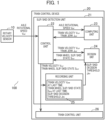
- Fig. 1 is a schematic structural diagram of a train control system which is one reference example of the present invention.
- a train control system 100 includes a train control device 20 and a rotary velocity sensor 10.
- the train control system 100 decides occurrence of a train wheel slip/skid state S cur using the rotary velocity sensor 10 and the train control device 20.
- the rotary velocity sensor 10 is connected to the train control device 20 and sends axle rotational speed V axl to the train control device 20.
- the rotary velocity sensor 10 should be installed in a position it can detect rotation of an axle (not depicted) and may be installed in, e.g., an axle box. Also, for this sensor, any type of sensor may be used, such as a dynamo sensor which converts axle rotation to voltage and a pulse generator which measures axle rotation using light.
- the train control device 20 is comprised mainly of a slip/skid detection unit 21 and a train control unit 26 and at least one train control device is mounted in one train set.
- the slip/skid detection unit 21 is comprised mainly of a control unit 22, a computing unit 23, a decision unit 24, and a recording unit 25.
- the slip/skid detection unit 21 includes at least the control unit 22, the computing unit 23, the decision unit 24, and the recording unit 25. Each of these functional units may be installed in a single computing device or located dispersedly.
- control unit 22 periodically acquires axle rotational speed V axl from the rotary velocity sensor 10 and sends it to the computing unit 23.
- control unit 22 may include an interface to acquire pulse signals that the rotary velocity sensor 10 outputs, instead of axle rotational speed V axl .
- the computing unit 23 computes train velocity V cur from the axle rotational speed V axl acquired from the control unit 22. It also computes train jerk J cal by second-order differentiating the train velocity V cur . The computing unit 23 sends the computed train velocity V cur and train jerk J cal to the control unit 22.
- train jerk J cal may, for example, be computed based on the train velocity V cur , train velocity V pre at the last time, and train velocity V pre2 at the second last time; or it may be computed from train acceleration ⁇ cal at the current time and train acceleration ⁇ pre at the last time.
- the train acceleration ⁇ cal can be calculated through first-order differentiation of the train velocity.
- a computing period of the computing unit 23 termed herein is a period between train velocity computing operations cyclically taking place within a predetermined time frame for computing jerk information.
- computing at one period before is the last computing operation (i.e., a previous computing operation) and computing at the current time is the latest computing operation.
- train velocity values for use in computing jerk information do not need to be obtained serially in a series of computing periods.
- the train velocity V cur , train velocity V pre at the last time, and train velocity V pre2 at the second last time are velocity information values computed at three time points selected within the above time frame and they are ordered in reverse chronological order.
- the control unit 22 sends the train velocity V cur and train jerk J cal received from the computing unit 23 to the decision unit 24.
- the decision unit 24 compares the train jerk J cal received from the control unit 22 against a slip/skid decision threshold J thr predefined in the recording unit 25. If an absolute value of the train jerk J cal is equal to or more than the slip/skid decision threshold J thr , the decision unit 24 compares the train velocity V cur at the current time against the train velocity V pre at the last time recorded in the recording unit 25 when a last-time slip/skid decision was made.
- the decision unit 24 sends slip state as the train wheel slip/skid state S cur to the control unit 22. Conversely, if the train velocity V cur at the current time is smaller than the train velocity V pre at the last time, the decision unit 24 sends skid state as the train wheel slip/skid state S cur to the control unit 22.
- the decision unit 24 sends a normal state as the train wheel slip/skid state S cur to the control unit 22.
- the control unit 22 sends the train velocity V cul received from the computing unit 23 and the train wheel slip/skid state S cur received from the decision unit 24 to the train control unit 26.
- the recording unit 25 holds record of train velocity V pre at the last time, train wheel slip/skid state S pre at the last time, the slip/skid decision threshold J thr , and train velocity V pre2 at the second last time. Note that, once a slip/skid decision on a train has been made, the recording unit records train velocity V cur and train wheel slip/skid state S cur at that point of time as train velocity V pre at the last time and train wheel slip/skid state S pre at the last time. Note that the recording unit 25 may be a part of a recording device that the train control system 100 has or may be provided independently.
- the train control unit 26 computes train control velocity V con based on the train velocity V cur and the train wheel slip/skid state S cur acquired from the slip/skid detection unit 21.
- the train control velocity Vcon is used for, inter alia, calculating a traveling position of the train and making a decision as to whether to output a braking command to the train. If the train is placed in a wheel slip or skid state, a correction is made of the train velocity V cur and the corrected train velocity is used for train control.
- the slip/skid detection unit 21 and the train control unit 26 appear to be different devices, as depicted in Fig. 1 , they may be installed in a single computing device.
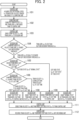
- Fig. 2 is a flowchart illustrating a procedure for deciding occurrence of a train wheel slip/skid state S cur using axle rotational speed V axl from the rotary velocity sensor 10.
- Step 101 the control unit 22 acquires axle rotational speed V axl from the rotary velocity sensor 10 and sends it to the computing unit 23.
- Step 102 the computing unit 23 computes train velocity V cur from the axle rotational speed V axl received from the control unit 22. Moreover, it computes train jerk J cal by second-order differentiating the train velocity V cur . The computing unit 23 sends the calculated train velocity V cur and train jerk J cal to the control unit 22. Note that train jerk J cal is computed based on train velocity values at three time points that are discrete to some extent from among multiple train velocity values computed within the predetermined time frame and those time points. The foregoing time frame can be adjusted depending on operational status and characteristics of the train and track surface conditions and may be changed, as appropriate.
- Step 103 the control unit 22 sends the train velocity V cur and train jerk J cal received from the computing unit 23 to the decision unit 24.
- Step 104 the decision unit 24 compares an absolute value of the train jerk J cal received from the control unit 22 against the slip/skid decision threshold J thr . If the absolute value of the train jerk J cal is equal to or more than the slip/skid decision threshold J thr , a transition is made to step 105. Otherwise, if the absolute value of the train jerk J cal is less than the slip/skid decision threshold J thr , a transition is made to step 110.
- Step 105 the decision unit 24 checks the train wheel slip/skid state S pre at the last time recorded in the recording unit 25. If the train wheel slip/skid state S pre at the last time is normal state, a transition is made to step 106. Otherwise, if the train wheel slip/skid state S pre at the last time is slip or skid state, a transition is made to step 109.
- Step 106 The decision unit 24 compares the train velocity V cur at the current time received from the control unit 22 against the train velocity V pre at the last time recorded in the recording unit 25. If the train velocity V cur at the current time is larger than the train velocity V pre at the last time, a transition is made to step 107. Otherwise, if the train velocity V cur at the current time is smaller than the train velocity V pre at the last time, a transition is made to step 108.
- Step 107 the decision unit 24 sends slip state as the train wheel slip/skid state S cur to the control unit 22.
- Step 108 the decision unit 24 sends skid state as the train wheel slip/skid state S cur to the control unit 22.
- Step 109 the decision unit 24 sends the train wheel slip/skid state S pre at the last time as the train wheel slip/skid state S cur to the control unit 22.
- Step 110 the decision unit 24 sends a normal state as the train wheel slip/skid state S cur to the control unit 22.
- Step 111 the control unit 22 sends the train velocity V cur and the train wheel slip/skid state S cur to the train control unit 26.
- Step 112 the control unit 22 records the train velocity V cur and the train wheel slip/skid state S cur into the recording unit 25 as train velocity V pre at the last time and train wheel slip/skid state S pre at the last time.
- step 101 to step 112 are executed each time the slip/skid detection unit 21 acquires axle rotational speed V axl from the rotary velocity sensor 10.
- Fig. 3 is a diagram representing a relationship between train jerk and the slip/skid decision threshold. This represents a relationship between the train jerk J cal and the slip/skid decision threshold J thr mentioned in the step 104 in Fig. 2 .
- the decision unit decides that the train is placed in a wheel slip or skid state. Note that, as for a decision of whether the wheel slip or skid state occurs, either state is determined to occur by comparing train velocity V cur at the current time against train velocity V pre at the last time immediately before detecting the wheel slip or skid state. A relationship in this respect is represented in Fig. 4 .
- Fig. 4 is a diagram representing a relationship between train velocity and train velocity at the last time. If train velocity V cur at the current time is larger, a decision is made that the slip state occurs. However, as a result of comparing train velocity V cur at the current time against train velocity V pre at the last time immediately before detecting the wheel slip or skid state, if train velocity V cur at the current time is smaller, a decision is made that the skid state occurs.
- the axle rotates at lower speed relative to the actual train velocity and, therefore, the train velocity decreases by axle rotational speed. Then, because the state of adhesion between the wheels and the track surface varies also in the skid state, the train velocity calculated from the axle rotational speed fluctuates relative to the actual train velocity. As noted above, the train velocity may increase and decrease iteratively as observed for a period when the wheel slip or skid state continues. Hence, taking this into account, it is desirable to perform velocity comparison only when deciding occurrence of the wheel slip or skid state.
- the procedure may be arranged so that a decision is always made as to whether the train velocity has changed and a logic may be adopted in which the decision result is not reflected in deciding whether the skid or slip state occurs, while the slip or skid state continues.
- the procedure may be arranged as below. After changing the order of step 105 and step 106 in Fig. 2 , processing steps depending on the decision of step 106 are placed downstream of the branches of step 105 respectively. Then, checking the train wheel slip/skid state S pre at the last time is made at each of the processing steps depending on the decision of step 106. If the above state S pre is wheel slip or skid state, a transition is made to step 109; otherwise, a transition is made to step 107 or step 108.
- the train control system 100 has an interface to acquire pulse signals from the rotary velocity sensor 10 and includes the computing unit 23 that converts the pulse signals to velocity information, the recording unit 25 to record velocity information, and the decision unit 24.
- the recording unit 25 is configured to store at least three pieces of velocity information (train velocity at the second last time, train velocity at the last time, and train velocity at the current time) obtained within the determined time frame at the step 102. Then, the computing unit 23 computes jerk information based on those pieces of velocity information and the decision unit 24 detects slip/skid occurrence based on the jerk information.
- the recording unit 25 is configured to store two pieces of acceleration information based on the pieces of velocity information (train velocity at the second last time, train velocity at the last time, and train velocity at the current time) obtained within the foregoing time frame. Then, the computing unit 23 may compute jerk information based on the two pieces of acceleration information and the decision unit 24 may detect slip/skid occurrence based on the jerk information.
- the decision unit 24 compares multiple pieces of velocity information relevant to computing jerk information; namely, by comparing train velocity at the current time against train velocity at the last time, it is also possible to discriminate between slip occurring and skid occurring.
- a technology to detect the slip state and the skid state of a train using the rotary velocity sensor to detect axle rotation of the train is provided.
- the following can be dispensed with: additional work and cost before introduction for remodeling existing hardware and installing an inertia sensor and consideration on securing an installation location among others. While installation of new sensors as mentioned tends to generate additional cost in terms of maintenance, the foregoing reference example produces an advantage in this respect as well.
- a method for detecting the wheel slip/skid of a train using a single rotary velocity sensor 10 is described in the first reference example, multiple rotary velocity sensors may be used.
- computing train jerk J cal from axle rotational speed V axl and determining occurrence of the train wheel slip/skid state S cur may be performed separately with respect to each rotary velocity sensor.
- an arrangement may be made such that the wheel slip or skid state detected by the control unit 22 is recorded, linked with position information on a traveling route and can be used for presuming a section where wheel slip/skid tends to occur on the traveling route. By presuming such a section, it would become possible to analyze traveling conditions to make the wheel slip and skid less likely to occur and seek for more effective train operation.
- This embodiment takes account of a delay time T del when deciding whether the wheel slip or skid state of a train has terminated according to the first reference example.
- the delay time T del is recorded in advance in the recording unit 25.
- the recording unit 25 stores train velocity V pre at the last time, train wheel slip/skid state S pre at the last time, slip/skid decision threshold J thr , and train jerk J cal (reference jerk values in a set) for a period of the delay time T del .
- Fig. 5 presents a flowchart illustrating a procedure for deciding occurrence of the wheel slip/skid state S cur of a train, taking account of the delay time, which is performed in a train control system which is another embodiment of the present invention.
- This flowchart takes account of the delay time Tdel when deciding whether the wheel slip or skid state of a train has terminated in addition to the flowchart in Fig. 2 .
- a step added to the flowchart in Fig. 2 is only mentioned below.
- Step 113 the decision unit 24 checks to see whether the absolute value of train jerk J cal has become equal to or more than the slip/skid decision threshold J thr during the delay time T del following the point of time when the absolute value of train jerk J cal has become less than the slip/skid decision threshold J thr . If the train jerk J cal has become equal to or more than the slip/skid decision threshold J thr during the delay time T del , a transition is made to step 109. Otherwise, if the train jerk J cal has not become equal to or more than the slip/skid decision threshold J thr , a transition is made to step 110.
- Fig. 6 is a diagram representing a relationship between train jerk and the slip/skid decision threshold. This represents a relationship between the train jerk J cal and the slip/skid decision threshold J thr mentioned in the step 104 and step 113 in Fig. 5 .
- a concept of how to decide whether the wheel slip or skid state has begun to occur is the same as described with Fig. 3 and Fig. 4 .
- a state in which the absolute value of train jerk J cal is less than the slip/skid decision threshold J thr has continued over the delay time T del (when all reference jerk values in a set also have become less than the slip/skid decision threshold J thr )
- a decision is made that the wheel slip or skid state has terminated.
- the delay time T del is 2.0 seconds
- the train jerk J cal is less than the slip/skid decision threshold J thr for a period from point A and point B in Fig. 6 , but does not remain less than the threshold J thr over the delay time T del ; therefore, a decision is made that the wheel slip or skid state continues.
- the train jerk J cal is less than the slip/skid decision threshold J thr for a period from point C and point D and remains less than the threshold J thr over the delay time T del ; therefore, a decision is made that the wheel slip or skid state has terminated at point D.
- the recording unit 25 is configured to retain a predetermined number of pieces of jerk information which are acquired for each computing period, according to a method (a queue method) that stores a latest piece of information, while removing an oldest piece of information. Note that the number of pieces of this jerk information to be retained may be determined by the number of computing periods falling within the delay time.
- the decision unit 24 is configured to check the reference jerk values in a set corresponding to those pieces of jerk information, once the absolute value of train jerk J cal has become less than the slip/skid decision threshold J thr , and decides whether or not slip/skid has terminated depending on a result of the checking.
- introducing the delay time T del as above hysteresis can be taken into account in deciding whether the wheel slip or skid state has terminated in comparison with the first reference example. Thereby, it is possible prevent decision chattering when deciding whether the wheel slip or skid state has terminated. Additionally, introducing the delay time T del as above is also effective for reducing a momentary effect of noise included in axle rotational speed V axl acquired from the rotary velocity sensor 10.
- the present embodiment makes it possible to decide whether the wheel slip or skid state has terminated under high reliability. Specifically, when deciding whether the wheel slip or skid state has terminated (step 113), by adding a step of checking the train jerk J cal status for the most recent predetermined period, it is possible to decide whether shrinkage in the absolute value of train jerk J cal occurs momentarily and, in fact, the wheel slip or skid state continues or the absolute value of train jerk J cal has shrunk, since a condition in which such state can be regarded as terminated actually has been reached.
- step 104 a decision of whether the wheel slip or skid state has terminated is made at step 104 and step 113, a yet additional different logic for the decision may be placed preceding or following the step 113 or another decision logic may be placed instead of the step 113.
- the delay time T del is taken into account only when deciding whether the wheel slip or skid state has terminated
- the delay time T del may also be taken into account when deciding whether the wheel slip or skid state has begun to occur.
- the delay time T del may be taken into account only when deciding whether the wheel slip or skid state has begun to occur.
- the second reference example uses axle rotational speed V axl from at least one or more rotary velocity sensors and train velocity V dop from a non-contact velocity sensor 30, namely, a velocity sensor that is unaffected by the wheel slip or skid state of a train and, for example, calculates train velocity using a Doppler effect.
- Fig. 7 is a schematic structural diagram of a train control system which is yet another reference example of the present invention. This depicts a schematic structure of the system that calculates train control velocity V con using three rotary velocity sensors 10, 11, and 12 and one non-contact velocity sensor 30.
- Rotary velocity sensors 11 and 12 and the non-contact velocity sensor 30 are added to the system structural diagram in Fig. 1 .
- the slip/skid detection unit 21 acquires three values of axle rotational speed V axl from the three rotary velocity sensors. From the acquired respective values of axle rotational speed V axl , respective values of train velocity V cur and respective values of train jerk J cal are computed and, based on them, respective values of train wheel slip/skid state S cur are determined.
- the train control unit 26 calculates train control velocity V con using the respective values of train velocity V cur and the respective values of train wheel slip/skid state S cur acquired from the slip/skid detection unit 21 and train velocity V dop from the non-contact velocity sensor 30.
- Fig. 8 is a flowchart illustrating a procedure for calculating train control velocity in the system depicted in Fig. 7 . This illustrates the procedure in which the train control unit 26 calculates train control velocity V con using the respective values of train velocity V cur and the respective values of train wheel slip/skid state S cur , and train velocity V dop from the non-contact velocity sensor 30.
- Step 201 the train control unit 26 acquires the respective values of train velocity V cur and the respective values of train wheel slip/skid state S cur from the slip/skid detection unit 21.
- Step 202 the train control unit 26 checks the respective values of train wheel slip/skid state S cur . If all the values of train wheel slip/skid state S cur are slip or skid state, a transition is made to step 203. If, among the respective values of train wheel slip/skid state S cur , at least one or more values are slip or skid state and at least one or more values are normal state, a transition is made to step 204. Otherwise, if all the values of train wheel slip/skid state S cur are normal state, a transition is made to step 205.
- Step 203 the train control unit 26 sets the train velocity V dop from the non-contact velocity sensor 30 as the train control velocity V con .
- Step 204 the train control unit 26 selects the greatest one of the values of train velocity V cur at which the train wheel slip/skid state S cur is normal state and sets it as the train control velocity V con .
- Step 205 the train control unit 26 selects the greatest one of the values of train velocity V cur and sets it as the train control velocity V con .
- Fig. 9 presents examples of results of calculating train control velocity according to Fig. 8 ; i.e., examples of results of calculating train control velocity V con which is performed from step 201 to step 205.
- a resultant state is slip or skid state, and train velocity V dop is adopted for the train control velocity V con .
- the train wheel slip/skid state S cur is normal state, and the highest one of the values of train velocity V cur associated with the rotary velocity sensors for which a resultant state is normal state is adopted as the train control velocity V con .
- train velocity V dop from the non-contact velocity sensor 30 for calculating train control velocity V con , it is possible to calculate train control velocity V con closer to actual train velocity in comparison with the first reference example and the embodiment.
- train velocity V dop from the non-contact velocity sensor is adopted for the train control velocity V con only if a resultant state is slip or skid state for all the rotary velocity sensors
- train velocity V dop from the non-contact velocity sensor may be adopted as the train control velocity V con also if the train wheel slip/skid state S cur is normal state for at least one or more rotary velocity sensors.
- the present invention is not limited to the embodiment described hereinbefore and various modifications are included therein.
- the foregoing embodiment is that described in detail to explain the present invention clearly and the invention is not necessarily limited to that including all components described.
- the system may be configured to detect either the wheel slip or skid state and the other state may be detected by another means.
- a subset or all of the aforementioned components, functions, processing units, processing means, etc. may be implemented by hardware; e.g., inter alia, by designing an integrated circuit to implement them.
- the aforementioned components, functions, etc. may be implemented by software in such a way that a processor interprets and executes programs implementing the respective functions.
- Information such as programs implementing the respective functions, tables, and files can be placed in a recording device such as a memory, hard disk, and SSD (Solid State Drive) or a recording medium such as an IC card, SD card, and DVD.
Landscapes
- Engineering & Computer Science (AREA)
- Transportation (AREA)
- Mechanical Engineering (AREA)
- Chemical & Material Sciences (AREA)
- Combustion & Propulsion (AREA)
- Life Sciences & Earth Sciences (AREA)
- Sustainable Development (AREA)
- Sustainable Energy (AREA)
- Power Engineering (AREA)
- Electric Propulsion And Braking For Vehicles (AREA)
- Regulating Braking Force (AREA)
Description
- The present invention relates to a train control device and a train control system.
- As a method for deciding occurrence of a wheel slip/skid state of a train, there is, e.g., a technology described in Patent Literature 1 (PTL 1). In this patent literature, there is a description below: "based on a difference between a first jerk value based on a rotation detection signal produced by a rotation detection device and a second jerk value in a train traveling direction based on a sensor value from an inertia sensor at the most recent backward from the timing of detecting occurrence of wheel slip/skid, correction start timing corresponding to or proximate to a start point of a slip/skid period is decided."
- Patent Literature 2 proposes a locomotive propulsion system. Patent Literature 3 proposes a slip limitation control for rail vehicles. Patent Literature 4 proposes an electric motor control method. Patent Literature 5 proposes a speed detection device for detecting the speed of a train. Patent Literature 6 proposes a running information calculating means.
-
- Patent Literature 1:
Japanese Unexamined Patent Application Publication No. 2016-82660 - Patent Literature 2:
US 4 896 090 A - Patent Literature 3:
EP 0 141 157 B1 - Patent Literature 4:
JP 2012 034456 A - Patent Literature 5:
JP 2013 205248 A - Patent Literature 6:
JP 6 279446 B2 - According to Patent Literature 1, installation of inertia sensors is necessary for detecting the wheel slip/skid state of a train. Hence, it is required to secure installation locations for installing inertia sensors. Also, an additional cost arises in terms of maintenance.
- Therefore, the present invention is intended to provide a technology for detecting the wheel slip and skid states of a train using a rotary velocity sensor to detect rotation of an axle of a train.
- To solve a problem noted above, a train control device and a train control system are provided according to the claims.
- According to the present invention, it is possible to detect the wheel slip/skid state of a train using a rotary velocity sensor to detect rotation of an axel of a train.
- Problems, configurations, and advantageous effects other than described above will be made apparent from the following description of reference examples and from the embodiment.
-
-
Fig. 1 is a schematic structural diagram of a train control system which is one reference example of the present invention. -
Fig. 2 is a flowchart illustrating a procedure for deciding occurrence of the wheel slip/skid state by a train control device. -
Fig. 3 is a diagram representing a relationship between train jerk and a slip/skid decision threshold. -
Fig. 4 is a diagram representing a relationship between train velocity and train velocity at the last time. -
Fig. 5 is a flowchart illustrating a procedure for deciding occurrence of the wheel slip/skid state of a train, taking account of a delay time, which is performed in a train control system which is an embodiment of the present invention. -
Fig. 6 is a diagram representing a relationship between train jerk and a slip/skid decision threshold in relation toFig. 5 -
Fig. 7 is a schematic structural diagram of a train control system which is another reference example of the present invention. -
Fig. 8 is a flowchart illustrating a procedure for calculating train control velocity in the system depicted inFig. 7 . -
Fig. 9 presents examples of results of calculating train control velocity according toFig. 8 . - In the following, an embodiment, and reference examples not covered by the claims, are described with the aid of the drawings.
-
Fig. 1 is a schematic structural diagram of a train control system which is one reference example of the present invention. Atrain control system 100 includes atrain control device 20 and arotary velocity sensor 10. Thetrain control system 100 decides occurrence of a train wheel slip/skid state Scur using therotary velocity sensor 10 and thetrain control device 20. - The
rotary velocity sensor 10 is connected to thetrain control device 20 and sends axle rotational speed Vaxl to thetrain control device 20. Therotary velocity sensor 10 should be installed in a position it can detect rotation of an axle (not depicted) and may be installed in, e.g., an axle box. Also, for this sensor, any type of sensor may be used, such as a dynamo sensor which converts axle rotation to voltage and a pulse generator which measures axle rotation using light. - The
train control device 20 is comprised mainly of a slip/skid detection unit 21 and atrain control unit 26 and at least one train control device is mounted in one train set. The slip/skid detection unit 21 is comprised mainly of acontrol unit 22, acomputing unit 23, adecision unit 24, and arecording unit 25. - First, a major internal structure of the slip/
skid detection unit 21 is described. The slip/skid detection unit 21 includes at least thecontrol unit 22, thecomputing unit 23, thedecision unit 24, and therecording unit 25. Each of these functional units may be installed in a single computing device or located dispersedly. - The
control unit 22 periodically acquires axle rotational speed Vaxl from therotary velocity sensor 10 and sends it to thecomputing unit 23. Note thatcontrol unit 22 may include an interface to acquire pulse signals that therotary velocity sensor 10 outputs, instead of axle rotational speed Vaxl. - The
computing unit 23 computes train velocity Vcur from the axle rotational speed Vaxl acquired from thecontrol unit 22. It also computes train jerk Jcal by second-order differentiating the train velocity Vcur. Thecomputing unit 23 sends the computed train velocity Vcur and train jerk Jcal to thecontrol unit 22. Note that train jerk Jcal may, for example, be computed based on the train velocity Vcur, train velocity Vpre at the last time, and train velocity Vpre2 at the second last time; or it may be computed from train acceleration αcal at the current time and train acceleration αpre at the last time. The train acceleration αcal can be calculated through first-order differentiation of the train velocity. - Note that a computing period of the
computing unit 23 termed herein is a period between train velocity computing operations cyclically taking place within a predetermined time frame for computing jerk information. In this sense, computing at one period before is the last computing operation (i.e., a previous computing operation) and computing at the current time is the latest computing operation. Note that train velocity values for use in computing jerk information do not need to be obtained serially in a series of computing periods. In that case, the train velocity Vcur, train velocity Vpre at the last time, and train velocity Vpre2 at the second last time are velocity information values computed at three time points selected within the above time frame and they are ordered in reverse chronological order. - The
control unit 22 sends the train velocity Vcur and train jerk Jcal received from thecomputing unit 23 to thedecision unit 24. Thedecision unit 24 compares the train jerk Jcal received from thecontrol unit 22 against a slip/skid decision threshold Jthr predefined in therecording unit 25. If an absolute value of the train jerk Jcal is equal to or more than the slip/skid decision threshold Jthr, thedecision unit 24 compares the train velocity Vcur at the current time against the train velocity Vpre at the last time recorded in therecording unit 25 when a last-time slip/skid decision was made. - If the train velocity Vcur at the current time is larger than the train velocity Vpre at the last time, the
decision unit 24 sends slip state as the train wheel slip/skid state Scur to thecontrol unit 22. Conversely, if the train velocity Vcur at the current time is smaller than the train velocity Vpre at the last time, thedecision unit 24 sends skid state as the train wheel slip/skid state Scur to thecontrol unit 22. - Besides, if the absolute value of the train jerk Jcal received from the
control unit 22 is less than the slip/skid decision threshold Jthr, thedecision unit 24 sends a normal state as the train wheel slip/skid state Scur to thecontrol unit 22. Thecontrol unit 22 sends the train velocity Vcul received from thecomputing unit 23 and the train wheel slip/skid state Scur received from thedecision unit 24 to thetrain control unit 26. - The
recording unit 25 holds record of train velocity Vpre at the last time, train wheel slip/skid state Spre at the last time, the slip/skid decision threshold Jthr, and train velocity Vpre2 at the second last time. Note that, once a slip/skid decision on a train has been made, the recording unit records train velocity Vcur and train wheel slip/skid state Scur at that point of time as train velocity Vpre at the last time and train wheel slip/skid state Spre at the last time. Note that therecording unit 25 may be a part of a recording device that thetrain control system 100 has or may be provided independently. - The
train control unit 26 computes train control velocity Vcon based on the train velocity Vcur and the train wheel slip/skid state Scur acquired from the slip/skid detection unit 21. The train control velocity Vcon is used for, inter alia, calculating a traveling position of the train and making a decision as to whether to output a braking command to the train. If the train is placed in a wheel slip or skid state, a correction is made of the train velocity Vcur and the corrected train velocity is used for train control. Note that, although the slip/skid detection unit 21 and thetrain control unit 26 appear to be different devices, as depicted inFig. 1 , they may be installed in a single computing device. -
Fig. 2 is a flowchart illustrating a procedure for deciding occurrence of a train wheel slip/skid state Scur using axle rotational speed Vaxl from therotary velocity sensor 10. - Operation based on the flowchart in
Fig. 2 is as described below. Note that any information that is computed in processing steps mentioned below is stored in therecording unit 25. Besides, thecontrol unit 22, thecomputing unit 23, or thedecision unit 24 acquires information directly or via another functional unit from therecording unit 24 and performs a computing operation or stores a result of the computing operation into therecording unit 25 again. For ease of understanding, reading information from therecording unit 25 and writing information to therecording unit 25 are not described as processing steps, unless otherwise mentioned. - Step 101: the
control unit 22 acquires axle rotational speed Vaxl from therotary velocity sensor 10 and sends it to thecomputing unit 23. - Step 102: the computing
unit 23 computes train velocity Vcur from the axle rotational speed Vaxl received from thecontrol unit 22. Moreover, it computes train jerk Jcal by second-order differentiating the train velocity Vcur. Thecomputing unit 23 sends the calculated train velocity Vcur and train jerk Jcal to thecontrol unit 22. Note that train jerk Jcal is computed based on train velocity values at three time points that are discrete to some extent from among multiple train velocity values computed within the predetermined time frame and those time points. The foregoing time frame can be adjusted depending on operational status and characteristics of the train and track surface conditions and may be changed, as appropriate. - Step 103: the
control unit 22 sends the train velocity Vcur and train jerk Jcal received from thecomputing unit 23 to thedecision unit 24. - Step 104: the
decision unit 24 compares an absolute value of the train jerk Jcal received from thecontrol unit 22 against the slip/skid decision threshold Jthr. If the absolute value of the train jerk Jcal is equal to or more than the slip/skid decision threshold Jthr, a transition is made to step 105. Otherwise, if the absolute value of the train jerk Jcal is less than the slip/skid decision threshold Jthr, a transition is made to step 110. - Step 105: the
decision unit 24 checks the train wheel slip/skid state Spre at the last time recorded in therecording unit 25. If the train wheel slip/skid state Spre at the last time is normal state, a transition is made to step 106. Otherwise, if the train wheel slip/skid state Spre at the last time is slip or skid state, a transition is made to step 109. - Step 106: The
decision unit 24 compares the train velocity Vcur at the current time received from thecontrol unit 22 against the train velocity Vpre at the last time recorded in therecording unit 25. If the train velocity Vcur at the current time is larger than the train velocity Vpre at the last time, a transition is made to step 107. Otherwise, if the train velocity Vcur at the current time is smaller than the train velocity Vpre at the last time, a transition is made to step 108. - Step 107: the
decision unit 24 sends slip state as the train wheel slip/skid state Scur to thecontrol unit 22. - Step 108: the
decision unit 24 sends skid state as the train wheel slip/skid state Scur to thecontrol unit 22. - Step 109: the
decision unit 24 sends the train wheel slip/skid state Spre at the last time as the train wheel slip/skid state Scur to thecontrol unit 22. - Step 110: the
decision unit 24 sends a normal state as the train wheel slip/skid state Scur to thecontrol unit 22. - Step 111: the
control unit 22 sends the train velocity Vcur and the train wheel slip/skid state Scur to thetrain control unit 26. - Step 112: the
control unit 22 records the train velocity Vcur and the train wheel slip/skid state Scur into therecording unit 25 as train velocity Vpre at the last time and train wheel slip/skid state Spre at the last time. - The above steps from
step 101 to step 112 are executed each time the slip/skid detection unit 21 acquires axle rotational speed Vaxl from therotary velocity sensor 10. -
Fig. 3 is a diagram representing a relationship between train jerk and the slip/skid decision threshold. This represents a relationship between the train jerk Jcal and the slip/skid decision threshold Jthr mentioned in thestep 104 inFig. 2 . When the absolute value of the train jerk Jcal is equal to or more than the slip/skid decision threshold Jthr, the decision unit decides that the train is placed in a wheel slip or skid state. Note that, as for a decision of whether the wheel slip or skid state occurs, either state is determined to occur by comparing train velocity Vcur at the current time against train velocity Vpre at the last time immediately before detecting the wheel slip or skid state. A relationship in this respect is represented inFig. 4 . -
Fig. 4 is a diagram representing a relationship between train velocity and train velocity at the last time. If train velocity Vcur at the current time is larger, a decision is made that the slip state occurs. However, as a result of comparing train velocity Vcur at the current time against train velocity Vpre at the last time immediately before detecting the wheel slip or skid state, if train velocity Vcur at the current time is smaller, a decision is made that the skid state occurs. - Nevertheless, comparing train velocity Vcur at the current time against train velocity Vpre at the last time is performed only when deciding whether the wheel slip or skid state has begun to occur. When the absolute value of the train jerk Jcal has become less than the slip/skid decision threshold Jthr, a decision is made that the wheel slip or skid state has terminated.
- The reason for adopting this manner of processing can be explained as below. At the moment when the slip state occurs, the axle rotates at higher speed relative to the actual train velocity and, therefore, the train velocity increases by axle rotation. Then, in the slip state, the state of adhesion between the wheels and the track surface varies. When the state of adhesion between the wheels and the track surface becomes stronger, the train velocity calculated based on the axel rotational speed decreases. As the state of adhesion weakens, the train velocity appears to increase again. This phenomenon continues until removal of the slip state.
- On the other hand, at the moment when the skid state occurs, the axle rotates at lower speed relative to the actual train velocity and, therefore, the train velocity decreases by axle rotational speed. Then, because the state of adhesion between the wheels and the track surface varies also in the skid state, the train velocity calculated from the axle rotational speed fluctuates relative to the actual train velocity. As noted above, the train velocity may increase and decrease iteratively as observed for a period when the wheel slip or skid state continues. Hence, taking this into account, it is desirable to perform velocity comparison only when deciding occurrence of the wheel slip or skid state.
- Alternatively to the foregoing processing steps, the procedure may be arranged so that a decision is always made as to whether the train velocity has changed and a logic may be adopted in which the decision result is not reflected in deciding whether the skid or slip state occurs, while the slip or skid state continues. For example, the procedure may be arranged as below. After changing the order of
step 105 and step 106 inFig. 2 , processing steps depending on the decision ofstep 106 are placed downstream of the branches ofstep 105 respectively. Then, checking the train wheel slip/skid state Spre at the last time is made at each of the processing steps depending on the decision ofstep 106. If the above state Spre is wheel slip or skid state, a transition is made to step 109; otherwise, a transition is made to step 107 orstep 108. - As described in the foregoing, based on axle rotational speed Vaxl acquired from the
rotary velocity sensor 10, a decision is made as to whether the train is placed in the train wheel slip/skid state Scur within the slip/skid detection unit 21. A result of the decision is sent to thetrain control unit 26 and used for calculating train control velocity Vcon. - Besides, the foregoing reference example can be paraphrased as below. In other words, the
train control system 100 has an interface to acquire pulse signals from therotary velocity sensor 10 and includes thecomputing unit 23 that converts the pulse signals to velocity information, therecording unit 25 to record velocity information, and thedecision unit 24. Here, therecording unit 25 is configured to store at least three pieces of velocity information (train velocity at the second last time, train velocity at the last time, and train velocity at the current time) obtained within the determined time frame at thestep 102. Then, thecomputing unit 23 computes jerk information based on those pieces of velocity information and thedecision unit 24 detects slip/skid occurrence based on the jerk information. - Besides, in a case where acceleration information is used in computing jerk information, the
recording unit 25 is configured to store two pieces of acceleration information based on the pieces of velocity information (train velocity at the second last time, train velocity at the last time, and train velocity at the current time) obtained within the foregoing time frame. Then, thecomputing unit 23 may compute jerk information based on the two pieces of acceleration information and thedecision unit 24 may detect slip/skid occurrence based on the jerk information. - Note that, in each of these examples, the
decision unit 24 compares multiple pieces of velocity information relevant to computing jerk information; namely, by comparing train velocity at the current time against train velocity at the last time, it is also possible to discriminate between slip occurring and skid occurring. - According to the foregoing reference example, a technology to detect the slip state and the skid state of a train using the rotary velocity sensor to detect axle rotation of the train is provided. In other words, it is possible to make it unnecessary to secure a space for installing a new sensor to detect the wheel slip/skid state of a train. Hence, for example, especially for an existing train, the following can be dispensed with: additional work and cost before introduction for remodeling existing hardware and installing an inertia sensor and consideration on securing an installation location among others. While installation of new sensors as mentioned tends to generate additional cost in terms of maintenance, the foregoing reference example produces an advantage in this respect as well.
- Note that, in the foregoing first reference example, although the same value of the slip/skid decision threshold Jthr is used as the condition for deciding whether the slip state occurs and whether the skid state occurs; different values of thresholds may be defined.
- Also, although a method for detecting the wheel slip/skid of a train using a single
rotary velocity sensor 10 is described in the first reference example, multiple rotary velocity sensors may be used. In a case where multiple rotary velocity sensors are used, computing train jerk Jcal from axle rotational speed Vaxl and determining occurrence of the train wheel slip/skid state Scur may be performed separately with respect to each rotary velocity sensor. - Besides, an arrangement may be made such that the wheel slip or skid state detected by the
control unit 22 is recorded, linked with position information on a traveling route and can be used for presuming a section where wheel slip/skid tends to occur on the traveling route. By presuming such a section, it would become possible to analyze traveling conditions to make the wheel slip and skid less likely to occur and seek for more effective train operation. - This embodiment takes account of a delay time Tdel when deciding whether the wheel slip or skid state of a train has terminated according to the first reference example. The delay time Tdel is recorded in advance in the
recording unit 25. Also, in the present embodiment, therecording unit 25 stores train velocity Vpre at the last time, train wheel slip/skid state Spre at the last time, slip/skid decision threshold Jthr, and train jerk Jcal (reference jerk values in a set) for a period of the delay time Tdel. -
Fig. 5 presents a flowchart illustrating a procedure for deciding occurrence of the wheel slip/skid state Scur of a train, taking account of the delay time, which is performed in a train control system which is another embodiment of the present invention. This flowchart takes account of the delay time Tdel when deciding whether the wheel slip or skid state of a train has terminated in addition to the flowchart inFig. 2 . A step added to the flowchart inFig. 2 is only mentioned below. - Step 113: the
decision unit 24 checks to see whether the absolute value of train jerk Jcal has become equal to or more than the slip/skid decision threshold Jthr during the delay time Tdel following the point of time when the absolute value of train jerk Jcal has become less than the slip/skid decision threshold Jthr. If the train jerk Jcal has become equal to or more than the slip/skid decision threshold Jthr during the delay time Tdel, a transition is made to step 109. Otherwise, if the train jerk Jcal has not become equal to or more than the slip/skid decision threshold Jthr, a transition is made to step 110. -
Fig. 6 is a diagram representing a relationship between train jerk and the slip/skid decision threshold. This represents a relationship between the train jerk Jcal and the slip/skid decision threshold Jthr mentioned in thestep 104 and step 113 inFig. 5 . - A concept of how to decide whether the wheel slip or skid state has begun to occur is the same as described with
Fig. 3 and Fig. 4 . When a state in which the absolute value of train jerk Jcal is less than the slip/skid decision threshold Jthr has continued over the delay time Tdel (when all reference jerk values in a set also have become less than the slip/skid decision threshold Jthr), a decision is made that the wheel slip or skid state has terminated. For example, when the delay time Tdel is 2.0 seconds, the train jerk Jcal is less than the slip/skid decision threshold Jthr for a period from point A and point B inFig. 6 , but does not remain less than the threshold Jthr over the delay time Tdel; therefore, a decision is made that the wheel slip or skid state continues. - However, the train jerk Jcal is less than the slip/skid decision threshold Jthr for a period from point C and point D and remains less than the threshold Jthr over the delay time Tdel; therefore, a decision is made that the wheel slip or skid state has terminated at point D.
- Specifically, in the
train control system 100 of the present embodiment, therecording unit 25 is configured to retain a predetermined number of pieces of jerk information which are acquired for each computing period, according to a method (a queue method) that stores a latest piece of information, while removing an oldest piece of information. Note that the number of pieces of this jerk information to be retained may be determined by the number of computing periods falling within the delay time. Thedecision unit 24 is configured to check the reference jerk values in a set corresponding to those pieces of jerk information, once the absolute value of train jerk Jcal has become less than the slip/skid decision threshold Jthr, and decides whether or not slip/skid has terminated depending on a result of the checking. - By introducing the delay time Tdel as above, hysteresis can be taken into account in deciding whether the wheel slip or skid state has terminated in comparison with the first reference example. Thereby, it is possible prevent decision chattering when deciding whether the wheel slip or skid state has terminated. Additionally, introducing the delay time Tdel as above is also effective for reducing a momentary effect of noise included in axle rotational speed Vaxl acquired from the
rotary velocity sensor 10. - In other words, the present embodiment makes it possible to decide whether the wheel slip or skid state has terminated under high reliability. Specifically, when deciding whether the wheel slip or skid state has terminated (step 113), by adding a step of checking the train jerk Jcal status for the most recent predetermined period, it is possible to decide whether shrinkage in the absolute value of train jerk Jcal occurs momentarily and, in fact, the wheel slip or skid state continues or the absolute value of train jerk Jcal has shrunk, since a condition in which such state can be regarded as terminated actually has been reached.
- Note that, although multiple train jerk Jcal values obtained during the delay time are to be retained in the foregoing example, instead, a maximum absolute value of multiple train jerk Jcal values obtained during the delay time may be retained. In this case, each time the delay time is reset, a maximum absolute value of train jerk for the time frame of the newly set delay time is retained. By comparing that value against the slip/skid decision threshold Jthr, the same operation can be implemented.
- As above, by introducing an additional logic to decide whether the wheel slip or skid state has terminated, it would be easy to prevent such an event (chattering) that a decision is made that the train is in a normal state only from the train jerk Jcal at the current time, whereas, in fact, either of the wheel slip and skid states continues, and the decision alternates and oscillates between that the train is in a normal state and that the train is in either of the wheel slip and skid states.
- Note that, in the flowchart presented in
Fig. 5 , although a decision of whether the wheel slip or skid state has terminated is made atstep 104 and step 113, a yet additional different logic for the decision may be placed preceding or following thestep 113 or another decision logic may be placed instead of thestep 113. - In the foregoing embodiment, although the delay time Tdel is taken into account only when deciding whether the wheel slip or skid state has terminated, the delay time Tdel may also be taken into account when deciding whether the wheel slip or skid state has begun to occur. Alternatively, the delay time Tdel may be taken into account only when deciding whether the wheel slip or skid state has begun to occur.
- Furthermore, a method is adopted in which switching of whether or not to introduce the delay time Tdel in deciding whether the wheel slip or skid state has begun to occur and whether the wheel slip or skid state has terminated is performed depending on a speed zone of axle rotational speed Vaxl acquired from the
rotary velocity sensor 10. - In order to calculate train control velocity Vcon, which is performed by the train control unit according to the first reference example and the embodiment, the second reference example uses axle rotational speed Vaxl from at least one or more rotary velocity sensors and train velocity Vdop from a
non-contact velocity sensor 30, namely, a velocity sensor that is unaffected by the wheel slip or skid state of a train and, for example, calculates train velocity using a Doppler effect. -
Fig. 7 is a schematic structural diagram of a train control system which is yet another reference example of the present invention. This depicts a schematic structure of the system that calculates train control velocity Vcon using threerotary velocity sensors non-contact velocity sensor 30. -
Rotary velocity sensors non-contact velocity sensor 30 are added to the system structural diagram inFig. 1 . The slip/skid detection unit 21 acquires three values of axle rotational speed Vaxl from the three rotary velocity sensors. From the acquired respective values of axle rotational speed Vaxl, respective values of train velocity Vcur and respective values of train jerk Jcal are computed and, based on them, respective values of train wheel slip/skid state Scur are determined. Thetrain control unit 26 calculates train control velocity Vcon using the respective values of train velocity Vcur and the respective values of train wheel slip/skid state Scur acquired from the slip/skid detection unit 21 and train velocity Vdop from thenon-contact velocity sensor 30. -
Fig. 8 is a flowchart illustrating a procedure for calculating train control velocity in the system depicted inFig. 7 . This illustrates the procedure in which thetrain control unit 26 calculates train control velocity Vcon using the respective values of train velocity Vcur and the respective values of train wheel slip/skid state Scur, and train velocity Vdop from thenon-contact velocity sensor 30. - Operation based on the flowchart in
Fig. 8 is as described below. - Step 201: the
train control unit 26 acquires the respective values of train velocity Vcur and the respective values of train wheel slip/skid state Scur from the slip/skid detection unit 21. - Step 202: the
train control unit 26 checks the respective values of train wheel slip/skid state Scur. If all the values of train wheel slip/skid state Scur are slip or skid state, a transition is made to step 203. If, among the respective values of train wheel slip/skid state Scur, at least one or more values are slip or skid state and at least one or more values are normal state, a transition is made to step 204. Otherwise, if all the values of train wheel slip/skid state Scur are normal state, a transition is made to step 205. - Step 203: the
train control unit 26 sets the train velocity Vdop from thenon-contact velocity sensor 30 as the train control velocity Vcon. - Step 204: the
train control unit 26 selects the greatest one of the values of train velocity Vcur at which the train wheel slip/skid state Scur is normal state and sets it as the train control velocity Vcon. - Step 205: the
train control unit 26 selects the greatest one of the values of train velocity Vcur and sets it as the train control velocity Vcon. -
Fig. 9 presents examples of results of calculating train control velocity according toFig. 8 ; i.e., examples of results of calculating train control velocity Vcon which is performed fromstep 201 to step 205. In a table (a), for all the rotary velocity sensors, a resultant state is slip or skid state, and train velocity Vdop is adopted for the train control velocity Vcon. However, in tables (b) and (c), for at least one or more rotary velocity sensors, the train wheel slip/skid state Scur is normal state, and the highest one of the values of train velocity Vcur associated with the rotary velocity sensors for which a resultant state is normal state is adopted as the train control velocity Vcon. - As above, by using train velocity Vdop from the
non-contact velocity sensor 30 for calculating train control velocity Vcon, it is possible to calculate train control velocity Vcon closer to actual train velocity in comparison with the first reference example and the embodiment. - In the foregoing second reference example, although train velocity Vdop from the non-contact velocity sensor is adopted for the train control velocity Vcon only if a resultant state is slip or skid state for all the rotary velocity sensors, train velocity Vdop from the non-contact velocity sensor may be adopted as the train control velocity Vcon also if the train wheel slip/skid state Scur is normal state for at least one or more rotary velocity sensors.
- Note that the present invention is not limited to the embodiment described hereinbefore and various modifications are included therein. For example, the foregoing embodiment is that described in detail to explain the present invention clearly and the invention is not necessarily limited to that including all components described. For example, the system may be configured to detect either the wheel slip or skid state and the other state may be detected by another means.
- A subset or all of the aforementioned components, functions, processing units, processing means, etc. may be implemented by hardware; e.g., inter alia, by designing an integrated circuit to implement them. Besides, the aforementioned components, functions, etc. may be implemented by software in such a way that a processor interprets and executes programs implementing the respective functions. Information such as programs implementing the respective functions, tables, and files can be placed in a recording device such as a memory, hard disk, and SSD (Solid State Drive) or a recording medium such as an IC card, SD card, and DVD.
- 10, 11, 12: rotary velocity sensor, 20: train control device, 21: slip/skid detection unit, 22: control unit, 23: computing unit, 24: decision unit, 25: recording unit, 26: train control unit, 30: non-contact velocity sensor, 100: train control system
Claims (10)
- A train control device (20) comprising:a slip/skid detection unit (21) that computes train jerk based on axle rotational speed from a rotary velocity sensor (10) and decides that a train is placed in a wheel slip or skid state if an absolute value of the train jerk is equal to or more than a slip/skid decision threshold; anda train control unit (22) that is connected with the slip/skid detection unit and calculates train control velocity for use in processing to control the train,characterized by,unless the train is placed in a wheel slip or skid state, the slip/skid detection unit (21) is configured to decide that a wheel slip or skid state of the train has begun to occur upon elapse of a certain period of time after an absolute value of the train jerk has become equal to or more than the slip/skid decision threshold, and the absolute value of the train jerk stayed equal to or more than the slip/skid decision threshold for this certain period of time, andwherein switching of whether or not to apply the elapse of the certain period of time to deciding whether the wheel slip or skid state of the train has begun to occur or has terminated is performed depending on magnitude of axle rotational speed from the rotary velocity sensor.
- A train control device (20) comprising:a slip/skid detection unit (21) that computes train jerk based on axle rotational speed from a rotary velocity sensor (10) and decides that a train is placed in a wheel slip or skid state if an absolute value of the train jerk is equal to or more than a slip/skid decision threshold; anda train control unit (22) that is connected with the slip/skid detection unit and calculates train control velocity for use in processing to control the train,characterized by,if the train is placed in a wheel slip or skid state, the slip/skid detection unit (21) is configured to decide that the wheel slip or skid state of the train has terminated upon elapse of a certain period of time after an absolute value of the train jerk has become less than the slip/skid decision threshold, and the absolute value of the train jerk stayed less than the slip/skid decision threshold for this certain period of time, andwherein switching of whether or not to apply the elapse of the certain period of time to deciding whether the wheel slip or skid state of the train has begun to occur or has terminated is performed depending on magnitude of axle rotational speed from the rotary velocity sensor.
- The train control device (20) according to any of the previous claims,
wherein the train control velocity is calculated, depending on the wheel slip or skid state of the train. - The train control device (20) according to claim 3,
wherein, if the train is placed in the wheel slip or skid state, train velocity from a non-contact velocity sensor (30) is selected for the train control velocity. - A train control system (100) comprising at least one or more rotary velocity sensors (10, 11, 12) and the train control device according to claim 1.
- A train control system (100) comprising at least one or more rotary velocity sensors (10, 11, 12) and the train control device according to claim 2.
- The train control system (100) according to claim 5 or 6,
wherein the slip/skid detection unit (21) comprises:an interface to acquire pulse signals from the rotary velocity sensors (10, 11, 12);a computing unit (23) that converts the pulse signals to velocity information;a recording unit (25) that holds record of the velocity information; anda decision unit (24),wherein:the recording unit is configured to store at least three pieces of the velocity information obtained for a predetermined time width;the computing unit computes jerk information based on the at least three pieces of the velocity information; andthe decision unit detects occurrence of wheel slip or skid based on the jerk information. - The train control system (100) according to claim 5 or 6,
wherein the slip/skid detection unit (21) comprises:an interface to acquire pulse signals from the rotary velocity sensors (10, 11, 12);a computing unit (23) that converts the pulse signals to velocity information;a recording unit (25) that holds record of the velocity information; anda decision unit (24),wherein:the recording unit is configured to store two pieces of jerk information based on at least three pieces of the velocity information obtained for a predetermined time width;the computing unit computes jerk information based on the two pieces of jerk information; andthe decision unit detects occurrence of wheel slip or skid based on the jerk information. - The train control system (100) according to claim 7 or 8,
wherein the decision unit (24) discriminates slip occurring and skid occurring by comparing multiple pieces of the velocity information relevant to computing the jerk information. - The train control system (100) according to claim 7 or 8,
wherein the recording unit (25) retains the obtained jerk information for a certain period of time.
Applications Claiming Priority (2)
| Application Number | Priority Date | Filing Date | Title |
|---|---|---|---|
| JP2019047904 | 2019-03-15 | ||
| PCT/JP2019/042482 WO2020188870A1 (en) | 2019-03-15 | 2019-10-30 | Train control device and train control method |
Publications (3)
| Publication Number | Publication Date |
|---|---|
| EP3939820A1 EP3939820A1 (en) | 2022-01-19 |
| EP3939820A4 EP3939820A4 (en) | 2022-11-16 |
| EP3939820B1 true EP3939820B1 (en) | 2024-10-09 |
Family
ID=72520736
Family Applications (1)
| Application Number | Title | Priority Date | Filing Date |
|---|---|---|---|
| EP19919558.7A Active EP3939820B1 (en) | 2019-03-15 | 2019-10-30 | Train control device and train control method |
Country Status (3)
| Country | Link |
|---|---|
| EP (1) | EP3939820B1 (en) |
| JP (1) | JP7166432B2 (en) |
| WO (1) | WO2020188870A1 (en) |
Families Citing this family (2)
| Publication number | Priority date | Publication date | Assignee | Title |
|---|---|---|---|---|
| US12491769B2 (en) | 2021-05-25 | 2025-12-09 | Mitsubishi Electric Corporation | Spinning and sliding detection device and spinning and sliding detection method |
| KR102831162B1 (en) * | 2022-12-08 | 2025-07-09 | 한국철도기술연구원 | State estimation method of self-driving tram and system using the same |
Family Cites Families (9)
| Publication number | Priority date | Publication date | Assignee | Title |
|---|---|---|---|---|
| DE3465579D1 (en) * | 1983-09-28 | 1987-10-01 | Bbc Brown Boveri & Cie | Slip limitation control for rail vehicles |
| US4896090A (en) * | 1988-10-31 | 1990-01-23 | General Electric Company | Locomotive wheelslip control system |
| JPH0382301A (en) * | 1989-08-23 | 1991-04-08 | Toshiba Corp | Drive controller of electric car |
| JP3138086B2 (en) * | 1992-10-12 | 2001-02-26 | 財団法人鉄道総合技術研究所 | Brake control device |
| JP4374559B2 (en) * | 2000-03-30 | 2009-12-02 | 西日本旅客鉄道株式会社 | Automatic train control device |
| JP5443294B2 (en) * | 2010-07-29 | 2014-03-19 | 公益財団法人鉄道総合技術研究所 | Electric motor control method and electric motor control device |
| JP5752633B2 (en) * | 2012-03-28 | 2015-07-22 | 公益財団法人鉄道総合技術研究所 | Speed detection device, travel position calculation device, and speed calculation method |
| JP6279446B2 (en) | 2014-10-15 | 2018-02-14 | 公益財団法人鉄道総合技術研究所 | On-vehicle device and travel information correction method |
| JP6621369B2 (en) * | 2016-05-12 | 2019-12-18 | 東洋電機製造株式会社 | Idling sliding re-adhesion control method and idling sliding re-adhesion control device |
-
2019
- 2019-10-30 WO PCT/JP2019/042482 patent/WO2020188870A1/en not_active Ceased
- 2019-10-30 EP EP19919558.7A patent/EP3939820B1/en active Active
- 2019-10-30 JP JP2021506143A patent/JP7166432B2/en active Active
Also Published As
| Publication number | Publication date |
|---|---|
| JP7166432B2 (en) | 2022-11-07 |
| WO2020188870A1 (en) | 2020-09-24 |
| EP3939820A4 (en) | 2022-11-16 |
| JPWO2020188870A1 (en) | 2020-09-24 |
| EP3939820A1 (en) | 2022-01-19 |
Similar Documents
| Publication | Publication Date | Title |
|---|---|---|
| JP4286904B2 (en) | Electric vehicle control device | |
| JP7045476B2 (en) | Vehicle sensor devices and how to monitor sensors | |
| KR100403228B1 (en) | Error recognition method in rotation speed sensor | |
| EP3848210B1 (en) | Wheel speed sensor interface circuit, operation method thereof, and electronic control system | |
| EP3939820B1 (en) | Train control device and train control method | |
| JP6814658B2 (en) | Vehicle control device, vehicle control method, program | |
| CN112519592A (en) | Vehicle wheel speed control method and device and electric vehicle | |
| JP5391456B2 (en) | Electric motor control method and electric motor control device | |
| WO2020255511A1 (en) | Train safety system, train safety control method, and onboard train device | |
| KR102049338B1 (en) | Apparatus and method for controlling velocity of vehicle considering slope of road | |
| CN103781680B (en) | Method for monitoring rail vehicle wheels | |
| JP7332794B2 (en) | Train speed control system and train speed control method | |
| US20190066405A1 (en) | Method and system for detecting a road impact event and for diagnosing abnormalities in chassis components | |
| JP7349271B2 (en) | Train security system, train security control method, and onboard train equipment | |
| JP6730057B2 (en) | Electric vehicle control device | |
| EP3778290B1 (en) | Train control system and train control method | |
| US20030149540A1 (en) | Method and device for monitoring wheel speeds | |
| JP5717469B2 (en) | Brake control device and brake control method | |
| JP2000221207A (en) | Travel speed detector | |
| JP2008148445A (en) | Railway vehicle drive control device | |
| JP5640127B1 (en) | On-vehicle equipment | |
| KR101179105B1 (en) | method to detect creep noise in wheel speed sensor | |
| JP5439676B2 (en) | Electric drive vehicle control system, speed control device, speed control method, and speed control program | |
| JP2014176280A (en) | Correction method and correction circuit | |
| KR20200113974A (en) | Apparatus for detecting failure of yaw rate sensor and control method thereof |
Legal Events
| Date | Code | Title | Description |
|---|---|---|---|
| STAA | Information on the status of an ep patent application or granted ep patent |
Free format text: STATUS: UNKNOWN |
|
| STAA | Information on the status of an ep patent application or granted ep patent |
Free format text: STATUS: THE INTERNATIONAL PUBLICATION HAS BEEN MADE |
|
| PUAI | Public reference made under article 153(3) epc to a published international application that has entered the european phase |
Free format text: ORIGINAL CODE: 0009012 |
|
| STAA | Information on the status of an ep patent application or granted ep patent |
Free format text: STATUS: REQUEST FOR EXAMINATION WAS MADE |
|
| 17P | Request for examination filed |
Effective date: 20210901 |
|
| AK | Designated contracting states |
Kind code of ref document: A1 Designated state(s): AL AT BE BG CH CY CZ DE DK EE ES FI FR GB GR HR HU IE IS IT LI LT LU LV MC MK MT NL NO PL PT RO RS SE SI SK SM TR |
|
| DAV | Request for validation of the european patent (deleted) | ||
| DAX | Request for extension of the european patent (deleted) | ||
| A4 | Supplementary search report drawn up and despatched |
Effective date: 20221013 |
|
| RIC1 | Information provided on ipc code assigned before grant |
Ipc: B60T 8/17 20060101ALI20221007BHEP Ipc: B60L 3/10 20060101ALI20221007BHEP Ipc: B60T 8/176 20060101ALI20221007BHEP Ipc: B60T 8/175 20060101ALI20221007BHEP Ipc: B60W 30/18 20120101ALI20221007BHEP Ipc: B60L 3/00 20190101AFI20221007BHEP |
|
| RIC1 | Information provided on ipc code assigned before grant |
Ipc: B60T 8/17 20060101ALI20240315BHEP Ipc: B60L 3/10 20060101ALI20240315BHEP Ipc: B60T 8/176 20060101ALI20240315BHEP Ipc: B60T 8/175 20060101ALI20240315BHEP Ipc: B60W 30/18 20120101ALI20240315BHEP Ipc: B60L 3/00 20190101AFI20240315BHEP |
|
| GRAP | Despatch of communication of intention to grant a patent |
Free format text: ORIGINAL CODE: EPIDOSNIGR1 |
|
| STAA | Information on the status of an ep patent application or granted ep patent |
Free format text: STATUS: GRANT OF PATENT IS INTENDED |
|
| INTG | Intention to grant announced |
Effective date: 20240516 |
|
| GRAS | Grant fee paid |
Free format text: ORIGINAL CODE: EPIDOSNIGR3 |
|
| GRAA | (expected) grant |
Free format text: ORIGINAL CODE: 0009210 |
|
| STAA | Information on the status of an ep patent application or granted ep patent |
Free format text: STATUS: THE PATENT HAS BEEN GRANTED |
|
| AK | Designated contracting states |
Kind code of ref document: B1 Designated state(s): AL AT BE BG CH CY CZ DE DK EE ES FI FR GB GR HR HU IE IS IT LI LT LU LV MC MK MT NL NO PL PT RO RS SE SI SK SM TR |
|
| REG | Reference to a national code |
Ref country code: CH Ref legal event code: EP |
|
| REG | Reference to a national code |
Ref country code: DE Ref legal event code: R096 Ref document number: 602019060332 Country of ref document: DE |
|
| REG | Reference to a national code |
Ref country code: IE Ref legal event code: FG4D |
|
| REG | Reference to a national code |
Ref country code: LT Ref legal event code: MG9D |
|
| REG | Reference to a national code |
Ref country code: NL Ref legal event code: MP Effective date: 20241009 |
|
| REG | Reference to a national code |
Ref country code: AT Ref legal event code: MK05 Ref document number: 1730239 Country of ref document: AT Kind code of ref document: T Effective date: 20241009 |
|
| PG25 | Lapsed in a contracting state [announced via postgrant information from national office to epo] |
Ref country code: NL Free format text: LAPSE BECAUSE OF FAILURE TO SUBMIT A TRANSLATION OF THE DESCRIPTION OR TO PAY THE FEE WITHIN THE PRESCRIBED TIME-LIMIT Effective date: 20241009 |
|
| PG25 | Lapsed in a contracting state [announced via postgrant information from national office to epo] |
Ref country code: NL Free format text: LAPSE BECAUSE OF FAILURE TO SUBMIT A TRANSLATION OF THE DESCRIPTION OR TO PAY THE FEE WITHIN THE PRESCRIBED TIME-LIMIT Effective date: 20241009 |
|
| PG25 | Lapsed in a contracting state [announced via postgrant information from national office to epo] |
Ref country code: IS Free format text: LAPSE BECAUSE OF FAILURE TO SUBMIT A TRANSLATION OF THE DESCRIPTION OR TO PAY THE FEE WITHIN THE PRESCRIBED TIME-LIMIT Effective date: 20250209 Ref country code: HR Free format text: LAPSE BECAUSE OF FAILURE TO SUBMIT A TRANSLATION OF THE DESCRIPTION OR TO PAY THE FEE WITHIN THE PRESCRIBED TIME-LIMIT Effective date: 20241009 Ref country code: PT Free format text: LAPSE BECAUSE OF FAILURE TO SUBMIT A TRANSLATION OF THE DESCRIPTION OR TO PAY THE FEE WITHIN THE PRESCRIBED TIME-LIMIT Effective date: 20250210 |
|
| PG25 | Lapsed in a contracting state [announced via postgrant information from national office to epo] |
Ref country code: FI Free format text: LAPSE BECAUSE OF FAILURE TO SUBMIT A TRANSLATION OF THE DESCRIPTION OR TO PAY THE FEE WITHIN THE PRESCRIBED TIME-LIMIT Effective date: 20241009 |
|
| PG25 | Lapsed in a contracting state [announced via postgrant information from national office to epo] |
Ref country code: BG Free format text: LAPSE BECAUSE OF FAILURE TO SUBMIT A TRANSLATION OF THE DESCRIPTION OR TO PAY THE FEE WITHIN THE PRESCRIBED TIME-LIMIT Effective date: 20241009 |
|
| PG25 | Lapsed in a contracting state [announced via postgrant information from national office to epo] |
Ref country code: ES Free format text: LAPSE BECAUSE OF FAILURE TO SUBMIT A TRANSLATION OF THE DESCRIPTION OR TO PAY THE FEE WITHIN THE PRESCRIBED TIME-LIMIT Effective date: 20241009 |
|
| PG25 | Lapsed in a contracting state [announced via postgrant information from national office to epo] |
Ref country code: NO Free format text: LAPSE BECAUSE OF FAILURE TO SUBMIT A TRANSLATION OF THE DESCRIPTION OR TO PAY THE FEE WITHIN THE PRESCRIBED TIME-LIMIT Effective date: 20250109 |
|
| PG25 | Lapsed in a contracting state [announced via postgrant information from national office to epo] |
Ref country code: LV Free format text: LAPSE BECAUSE OF FAILURE TO SUBMIT A TRANSLATION OF THE DESCRIPTION OR TO PAY THE FEE WITHIN THE PRESCRIBED TIME-LIMIT Effective date: 20241009 Ref country code: GR Free format text: LAPSE BECAUSE OF FAILURE TO SUBMIT A TRANSLATION OF THE DESCRIPTION OR TO PAY THE FEE WITHIN THE PRESCRIBED TIME-LIMIT Effective date: 20250110 Ref country code: AT Free format text: LAPSE BECAUSE OF FAILURE TO SUBMIT A TRANSLATION OF THE DESCRIPTION OR TO PAY THE FEE WITHIN THE PRESCRIBED TIME-LIMIT Effective date: 20241009 |
|
| PG25 | Lapsed in a contracting state [announced via postgrant information from national office to epo] |
Ref country code: PL Free format text: LAPSE BECAUSE OF FAILURE TO SUBMIT A TRANSLATION OF THE DESCRIPTION OR TO PAY THE FEE WITHIN THE PRESCRIBED TIME-LIMIT Effective date: 20241009 |
|
| PG25 | Lapsed in a contracting state [announced via postgrant information from national office to epo] |
Ref country code: RS Free format text: LAPSE BECAUSE OF FAILURE TO SUBMIT A TRANSLATION OF THE DESCRIPTION OR TO PAY THE FEE WITHIN THE PRESCRIBED TIME-LIMIT Effective date: 20250109 |
|
| REG | Reference to a national code |
Ref country code: DE Ref legal event code: R119 Ref document number: 602019060332 Country of ref document: DE |
|
| REG | Reference to a national code |
Ref country code: CH Ref legal event code: PL |
|
| PG25 | Lapsed in a contracting state [announced via postgrant information from national office to epo] |
Ref country code: SM Free format text: LAPSE BECAUSE OF FAILURE TO SUBMIT A TRANSLATION OF THE DESCRIPTION OR TO PAY THE FEE WITHIN THE PRESCRIBED TIME-LIMIT Effective date: 20241009 |
|
| PG25 | Lapsed in a contracting state [announced via postgrant information from national office to epo] |
Ref country code: MC Free format text: LAPSE BECAUSE OF FAILURE TO SUBMIT A TRANSLATION OF THE DESCRIPTION OR TO PAY THE FEE WITHIN THE PRESCRIBED TIME-LIMIT Effective date: 20241009 |
|
| PG25 | Lapsed in a contracting state [announced via postgrant information from national office to epo] |
Ref country code: DE Free format text: LAPSE BECAUSE OF NON-PAYMENT OF DUE FEES Effective date: 20250501 |
|
| PG25 | Lapsed in a contracting state [announced via postgrant information from national office to epo] |
Ref country code: DK Free format text: LAPSE BECAUSE OF FAILURE TO SUBMIT A TRANSLATION OF THE DESCRIPTION OR TO PAY THE FEE WITHIN THE PRESCRIBED TIME-LIMIT Effective date: 20241009 |
|
| PG25 | Lapsed in a contracting state [announced via postgrant information from national office to epo] |
Ref country code: LU Free format text: LAPSE BECAUSE OF NON-PAYMENT OF DUE FEES Effective date: 20241030 Ref country code: BE Free format text: LAPSE BECAUSE OF NON-PAYMENT OF DUE FEES Effective date: 20241031 |
|
| PG25 | Lapsed in a contracting state [announced via postgrant information from national office to epo] |
Ref country code: EE Free format text: LAPSE BECAUSE OF FAILURE TO SUBMIT A TRANSLATION OF THE DESCRIPTION OR TO PAY THE FEE WITHIN THE PRESCRIBED TIME-LIMIT Effective date: 20241009 |
|
| PG25 | Lapsed in a contracting state [announced via postgrant information from national office to epo] |
Ref country code: CH Free format text: LAPSE BECAUSE OF NON-PAYMENT OF DUE FEES Effective date: 20241031 |
|
| PG25 | Lapsed in a contracting state [announced via postgrant information from national office to epo] |
Ref country code: RO Free format text: LAPSE BECAUSE OF FAILURE TO SUBMIT A TRANSLATION OF THE DESCRIPTION OR TO PAY THE FEE WITHIN THE PRESCRIBED TIME-LIMIT Effective date: 20241009 |
|
| PG25 | Lapsed in a contracting state [announced via postgrant information from national office to epo] |
Ref country code: SK Free format text: LAPSE BECAUSE OF FAILURE TO SUBMIT A TRANSLATION OF THE DESCRIPTION OR TO PAY THE FEE WITHIN THE PRESCRIBED TIME-LIMIT Effective date: 20241009 |
|
| PG25 | Lapsed in a contracting state [announced via postgrant information from national office to epo] |
Ref country code: CZ Free format text: LAPSE BECAUSE OF FAILURE TO SUBMIT A TRANSLATION OF THE DESCRIPTION OR TO PAY THE FEE WITHIN THE PRESCRIBED TIME-LIMIT Effective date: 20241009 |
|
| REG | Reference to a national code |
Ref country code: BE Ref legal event code: MM Effective date: 20241031 |
|
| PLBE | No opposition filed within time limit |
Free format text: ORIGINAL CODE: 0009261 |
|
| STAA | Information on the status of an ep patent application or granted ep patent |
Free format text: STATUS: NO OPPOSITION FILED WITHIN TIME LIMIT |
|
| PG25 | Lapsed in a contracting state [announced via postgrant information from national office to epo] |
Ref country code: SE Free format text: LAPSE BECAUSE OF FAILURE TO SUBMIT A TRANSLATION OF THE DESCRIPTION OR TO PAY THE FEE WITHIN THE PRESCRIBED TIME-LIMIT Effective date: 20241009 |
|
| 26N | No opposition filed |
Effective date: 20250710 |
|
| PGFP | Annual fee paid to national office [announced via postgrant information from national office to epo] |
Ref country code: IT Payment date: 20250721 Year of fee payment: 7 |
|
| PG25 | Lapsed in a contracting state [announced via postgrant information from national office to epo] |
Ref country code: FR Free format text: LAPSE BECAUSE OF NON-PAYMENT OF DUE FEES Effective date: 20241209 |
|
| PG25 | Lapsed in a contracting state [announced via postgrant information from national office to epo] |
Ref country code: IE Free format text: LAPSE BECAUSE OF NON-PAYMENT OF DUE FEES Effective date: 20241030 |
|
| PGFP | Annual fee paid to national office [announced via postgrant information from national office to epo] |
Ref country code: GB Payment date: 20251020 Year of fee payment: 7 |
|
| PG25 | Lapsed in a contracting state [announced via postgrant information from national office to epo] |
Ref country code: HU Free format text: LAPSE BECAUSE OF FAILURE TO SUBMIT A TRANSLATION OF THE DESCRIPTION OR TO PAY THE FEE WITHIN THE PRESCRIBED TIME-LIMIT; INVALID AB INITIO Effective date: 20191030 |
|
| PG25 | Lapsed in a contracting state [announced via postgrant information from national office to epo] |
Ref country code: CY Free format text: LAPSE BECAUSE OF FAILURE TO SUBMIT A TRANSLATION OF THE DESCRIPTION OR TO PAY THE FEE WITHIN THE PRESCRIBED TIME-LIMIT; INVALID AB INITIO Effective date: 20191030 |