EP3939739B1 - Welding jig device and production method for component - Google Patents
Welding jig device and production method for component Download PDFInfo
- Publication number
- EP3939739B1 EP3939739B1 EP20769416.7A EP20769416A EP3939739B1 EP 3939739 B1 EP3939739 B1 EP 3939739B1 EP 20769416 A EP20769416 A EP 20769416A EP 3939739 B1 EP3939739 B1 EP 3939739B1
- Authority
- EP
- European Patent Office
- Prior art keywords
- jig
- opening
- welding
- members
- portions
- Prior art date
- Legal status (The legal status is an assumption and is not a legal conclusion. Google has not performed a legal analysis and makes no representation as to the accuracy of the status listed.)
- Active
Links
Images




Classifications
-
- B—PERFORMING OPERATIONS; TRANSPORTING
- B23—MACHINE TOOLS; METAL-WORKING NOT OTHERWISE PROVIDED FOR
- B23K—SOLDERING OR UNSOLDERING; WELDING; CLADDING OR PLATING BY SOLDERING OR WELDING; CUTTING BY APPLYING HEAT LOCALLY, e.g. FLAME CUTTING; WORKING BY LASER BEAM
- B23K26/00—Working by laser beam, e.g. welding, cutting or boring
- B23K26/02—Positioning or observing the workpiece, e.g. with respect to the point of impact; Aligning, aiming or focusing the laser beam
- B23K26/06—Shaping the laser beam, e.g. by masks or multi-focusing
- B23K26/064—Shaping the laser beam, e.g. by masks or multi-focusing by means of optical elements, e.g. lenses, mirrors or prisms
- B23K26/066—Shaping the laser beam, e.g. by masks or multi-focusing by means of optical elements, e.g. lenses, mirrors or prisms by using masks
- B23K26/0661—Shaping the laser beam, e.g. by masks or multi-focusing by means of optical elements, e.g. lenses, mirrors or prisms by using masks disposed on the workpiece
-
- B—PERFORMING OPERATIONS; TRANSPORTING
- B23—MACHINE TOOLS; METAL-WORKING NOT OTHERWISE PROVIDED FOR
- B23K—SOLDERING OR UNSOLDERING; WELDING; CLADDING OR PLATING BY SOLDERING OR WELDING; CUTTING BY APPLYING HEAT LOCALLY, e.g. FLAME CUTTING; WORKING BY LASER BEAM
- B23K26/00—Working by laser beam, e.g. welding, cutting or boring
- B23K26/08—Devices involving relative movement between laser beam and workpiece
- B23K26/082—Scanning systems, i.e. devices involving movement of the laser beam relative to the laser head
-
- B—PERFORMING OPERATIONS; TRANSPORTING
- B23—MACHINE TOOLS; METAL-WORKING NOT OTHERWISE PROVIDED FOR
- B23K—SOLDERING OR UNSOLDERING; WELDING; CLADDING OR PLATING BY SOLDERING OR WELDING; CUTTING BY APPLYING HEAT LOCALLY, e.g. FLAME CUTTING; WORKING BY LASER BEAM
- B23K26/00—Working by laser beam, e.g. welding, cutting or boring
- B23K26/20—Bonding
- B23K26/21—Bonding by welding
- B23K26/24—Seam welding
- B23K26/244—Overlap seam welding
-
- B—PERFORMING OPERATIONS; TRANSPORTING
- B23—MACHINE TOOLS; METAL-WORKING NOT OTHERWISE PROVIDED FOR
- B23K—SOLDERING OR UNSOLDERING; WELDING; CLADDING OR PLATING BY SOLDERING OR WELDING; CUTTING BY APPLYING HEAT LOCALLY, e.g. FLAME CUTTING; WORKING BY LASER BEAM
- B23K26/00—Working by laser beam, e.g. welding, cutting or boring
- B23K26/20—Bonding
- B23K26/21—Bonding by welding
- B23K26/24—Seam welding
- B23K26/28—Seam welding of curved planar seams
-
- B—PERFORMING OPERATIONS; TRANSPORTING
- B23—MACHINE TOOLS; METAL-WORKING NOT OTHERWISE PROVIDED FOR
- B23K—SOLDERING OR UNSOLDERING; WELDING; CLADDING OR PLATING BY SOLDERING OR WELDING; CUTTING BY APPLYING HEAT LOCALLY, e.g. FLAME CUTTING; WORKING BY LASER BEAM
- B23K26/00—Working by laser beam, e.g. welding, cutting or boring
- B23K26/70—Auxiliary operations or equipment
-
- B—PERFORMING OPERATIONS; TRANSPORTING
- B23—MACHINE TOOLS; METAL-WORKING NOT OTHERWISE PROVIDED FOR
- B23K—SOLDERING OR UNSOLDERING; WELDING; CLADDING OR PLATING BY SOLDERING OR WELDING; CUTTING BY APPLYING HEAT LOCALLY, e.g. FLAME CUTTING; WORKING BY LASER BEAM
- B23K26/00—Working by laser beam, e.g. welding, cutting or boring
- B23K26/70—Auxiliary operations or equipment
- B23K26/702—Auxiliary equipment
-
- B—PERFORMING OPERATIONS; TRANSPORTING
- B23—MACHINE TOOLS; METAL-WORKING NOT OTHERWISE PROVIDED FOR
- B23K—SOLDERING OR UNSOLDERING; WELDING; CLADDING OR PLATING BY SOLDERING OR WELDING; CUTTING BY APPLYING HEAT LOCALLY, e.g. FLAME CUTTING; WORKING BY LASER BEAM
- B23K37/00—Auxiliary devices or processes, not specially adapted for a procedure covered by only one of the other main groups of this subclass
- B23K37/04—Auxiliary devices or processes, not specially adapted for a procedure covered by only one of the other main groups of this subclass for holding or positioning work
- B23K37/0426—Fixtures for other work
- B23K37/0435—Clamps
- B23K37/0443—Jigs
-
- H—ELECTRICITY
- H01—ELECTRIC ELEMENTS
- H01M—PROCESSES OR MEANS, e.g. BATTERIES, FOR THE DIRECT CONVERSION OF CHEMICAL ENERGY INTO ELECTRICAL ENERGY
- H01M8/00—Fuel cells; Manufacture thereof
- H01M8/02—Details
- H01M8/0202—Collectors; Separators, e.g. bipolar separators; Interconnectors
- H01M8/0204—Non-porous and characterised by the material
- H01M8/0206—Metals or alloys
-
- H—ELECTRICITY
- H01—ELECTRIC ELEMENTS
- H01M—PROCESSES OR MEANS, e.g. BATTERIES, FOR THE DIRECT CONVERSION OF CHEMICAL ENERGY INTO ELECTRICAL ENERGY
- H01M8/00—Fuel cells; Manufacture thereof
- H01M8/02—Details
- H01M8/0297—Arrangements for joining electrodes, reservoir layers, heat exchange units or bipolar separators to each other
-
- B—PERFORMING OPERATIONS; TRANSPORTING
- B23—MACHINE TOOLS; METAL-WORKING NOT OTHERWISE PROVIDED FOR
- B23K—SOLDERING OR UNSOLDERING; WELDING; CLADDING OR PLATING BY SOLDERING OR WELDING; CUTTING BY APPLYING HEAT LOCALLY, e.g. FLAME CUTTING; WORKING BY LASER BEAM
- B23K2101/00—Articles made by soldering, welding or cutting
- B23K2101/18—Sheet panels
-
- B—PERFORMING OPERATIONS; TRANSPORTING
- B23—MACHINE TOOLS; METAL-WORKING NOT OTHERWISE PROVIDED FOR
- B23K—SOLDERING OR UNSOLDERING; WELDING; CLADDING OR PLATING BY SOLDERING OR WELDING; CUTTING BY APPLYING HEAT LOCALLY, e.g. FLAME CUTTING; WORKING BY LASER BEAM
- B23K2101/00—Articles made by soldering, welding or cutting
- B23K2101/36—Electric or electronic devices
-
- Y—GENERAL TAGGING OF NEW TECHNOLOGICAL DEVELOPMENTS; GENERAL TAGGING OF CROSS-SECTIONAL TECHNOLOGIES SPANNING OVER SEVERAL SECTIONS OF THE IPC; TECHNICAL SUBJECTS COVERED BY FORMER USPC CROSS-REFERENCE ART COLLECTIONS [XRACs] AND DIGESTS
- Y02—TECHNOLOGIES OR APPLICATIONS FOR MITIGATION OR ADAPTATION AGAINST CLIMATE CHANGE
- Y02E—REDUCTION OF GREENHOUSE GAS [GHG] EMISSIONS, RELATED TO ENERGY GENERATION, TRANSMISSION OR DISTRIBUTION
- Y02E60/00—Enabling technologies; Technologies with a potential or indirect contribution to GHG emissions mitigation
- Y02E60/30—Hydrogen technology
- Y02E60/50—Fuel cells
Definitions
- the present invention relates to a welding jig device and a method for producing a part.
- a part formed by joining a plurality of plate-like metal members by welding (hereinafter also simply referred to as a "part"), such as a fuel cell that is a part for a fuel cell device.
- a part such as a fuel cell
- a circulation path for a reactant gas within the part is formed by welding.
- the circulation path is formed in a closed circuit form by welding around through-holes that are provided in the members so that airtightness is secured.
- Patent Literatures 1 and 2 each disclose a welding jig device with openings that are provided corresponding to the portions to be welded, for specifying the portions to be welded.
- the CN107900517A describes a battery laser welding clamp, a battery welding method of the battery laser welding clamp and a welding system.
- the welding system comprises the welding clamp.
- the welding clamp comprises a first clamping block and a second clamping block, wherein the first clamping block and the second clamping block are hinged, one side of the first clamping block is provided with a first welding operation hole, one side of the second clamping block is provided with a battery containing station, a first clamping groove, a second clamping groove and a second welding operation hole, the battery containing station communicates with the first clamping groove and the second clamping groove, the second welding operation hole is formed below the battery containing station and communicates with the battery containing station, the second welding operation hole is right opposite to the battery containing station, and the first welding operation hole is right opposite to the battery containing station.
- US2004099642A1 describes a laser welding device comprising: a first laser beam emitting head directed to a layered base material composed of two or more layers in a superimposed direction; a first skirting roller rotatably supported by means of a first supporting member on which the first laser beam emitting head is fixed and provided with a peripheral surface which protrudes more at a base material side than a base material opposing end of the first laser beam emitting head; a second laser beam emitting head directed to the layered base material from the opposite side of the first laser beam emitting head in the superimposed direction; a second skirting roller rotatably supported by means of a second supporting member 14 on which the second laser beam emitting head is fixed and provided with a peripheral surface which protrudes more at a base material side than a base material opposing end of the second laser beam emitting head; and a first pressing means for pressing the first supporting member with respect to a supporting base holder in the superimposed direction.
- GB2401814A describes that overlapping ends of at least three sheets are laser welded by positioning and holding the sheets with a holding mechanism, and applying at least two laser beams to the at least two interfaces between the sheets substantially simultaneously.
- the amount of heat applied by each laser beam, and the position of each laser beam may be controlled and changed according to the material and/or thickness of the sheets to be welded.
- Also described is an arrangement for welding two overlapping sheets by heating the sheets with a first laser beam, without causing melting of the sheets, to deform and space the sheets a predetermined distance apart, and then welding the sheets using a second laser beam.
- US2017282266A1 a method for producing a primary material for a cutting tool, for example a primary material for a saw blade or a saw band, in which a band-shaped carrier of a metal carrier material and a wire of highspeed steel are continuously brought together along a lateral edge of the band-shaped carrier and transported into a welding device and the band-shaped carrier is welded to the wire along the lateral edge of the carrier to produce a bimetal band.
- the band-shaped carrier and the edge wire are welded to one another by at least a first welding device, which is arranged on one side of the band-shaped carrier, and at least a second welding device, which is arranged on the opposite side of the band-shaped carrier.
- a welded part may have welded portions with a complex shape, such as welded portions forming an annular closed path or welded portions located in proximity to each other, for example.
- a jig for welding annular portions to be welded together should have an opening corresponding to the portions to be welded, and thus inevitably includes two separate jigs on the inner side and outer side of the annular portions.
- the portions to be welded When the portions to be welded are located in proximity to each other, the dimensions of a jig attached between them should be small, resulting in a lower strength of the jig. Consequently, holding of the to-be-welded part around the portions to be welded with the jig has been insufficient. Further, when the portions to be welded are located in extreme proximity to each other, it may be impossible to dispose a jig between them. In such a case, holding of the to-be-welded part around the portions to be welded has become further insufficient.
- a conventional welding jig device includes a jig for the entire members, which is configured to fix the entire members and has an opening corresponding to a portion of the portions to be welded, and another jig for some of the members, which is configured to be detachable from the jig for the entire members and corresponds to another portion of the portions to be welded, for example.
- welding of the portions to be welded with a complex shape involves both the operation of fixing the jig for the entire members and the operation of fixing the jig for some of the members.
- welding operation performed with the conventional welding jig device to weld the aforementioned portions to be welded with a complex shape together, it has been sometimes necessary to replace or move the jig for some of the members corresponding to the portions to be welded.
- the conventional welding jig device and the conventional method for producing a part when the jig for some of the members is attached or detached to perform a welding operation for forming a part, the resulting part sometimes has strain generated therein due to the welding.
- the conventional welding jig device and the method for producing a part using the conventional welding jig device involve a large number of steps regarding the operation of fixing the jigs for a welding operation.
- the present invention has been made in view of the foregoing problems, and it is an object of the present invention to provide a welding jig device and a method for producing a part that can facilitate a welding operation.
- a welding jig device is a welding jig device as defined in independent claim 1, and a preferred embodiment of the present invention is defined in dependent claim 2.
- the present invention provides a welding jig device used for forming a part by welding a plurality of members together, and includes a jig on one side including a joint face on the one side and an opening on the one side, the joint face on the one side being adapted to contact one of faces exposed on outer surface sides of the plurality of members that are overlaid one on top of the other, the opening on the one side corresponding to a portion of desired welded portions of the part; a jig on another side including a joint face on the other side and an opening on the other side, the joint face on the other side being adapted to contact another face of the faces exposed on the outer surface sides of the plurality of members, the opening on the other side corresponding to another portion the desired welded portions of the part and not corresponding to the opening on the one
- the laser welding machine on the one side is provided on an outer side of a lateral face on the one side, the lateral face on the one side being opposite to the joint face on the one side, and the laser welding machine on the other side is provided on an outer side of a lateral face on the other side, the lateral face on the other side being opposite to the joint face on the other side.
- a method for producing a part according to the present invention is a method as defined in independent claim 3.
- the present invention provides a method for producing a part by overlaying a plurality of members one on top of the other and welding the members together, including a step of overlaying the plurality of members one on top of the other and holding the members with a jig on one side and a jig on another side, the jig on the one side including a joint face on the one side and an opening on the one side, the joint face on the one side being adapted to contact one of faces exposed on outer surface sides of the plurality of members overlaid one on top of the other, the opening on the one side corresponding to a portion of desired welded portions of the part, the jig on the other side including a joint face on the other side and an opening on the other side, the joint face on the other side being adapted to contact another face of the faces exposed on the outer surface sides of the plurality of members, the opening on the other side
- the welding jig device and the method for producing a part according to the present invention can facilitate a welding operation.
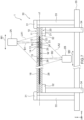
- Fig. 1 is a front view for illustrating the schematic configuration of a welding jig device 1 according to an embodiment of the present invention.
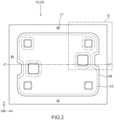
- Fig. 2 is a plan view for illustrating the schematic configuration of a jig 10 on one side and a jig 20 on another side of the welding jig device 1.
- Fig. 3 is a partial plan view of the jig 10 on one side of the welding jig device 1.
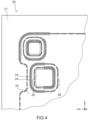
- Fig. 4 is a partial bottom view of the jig 20 on the other side of the welding jig device 1.
- Fig. 5 is an A-A cross-sectional view of the jig 10 on one side and the jig 20 on the other side of the welding jig device 1.
- Fig. 6 is a plan view for illustrating the schematic configuration of a part 5 produced with the welding jig device 1.
- the welding jig device 1 is used for forming a part 5 by welding a plurality of members W together, and includes the jig 10 on one side that has a joint face 12 on one side to be in contact with one face W11 out of faces exposed on the outer surface sides of the plurality of members W that are overlaid one on top of the other, and also has an opening 13 on one side corresponding to a portion of desired welded portions 53 of the part 5; the jig 20 on the other side that has a joint face 22 on the other side to be in contact with another face W21 of the faces exposed on the outer surface sides of the plurality of members W, and also has an opening 23 on the other side corresponding to another portion of the desired welded portions 53 of the part 5 and not corresponding to the opening 13 on one side; a laser welding machine 2A on one side that is provided on the outer side of a lateral face 18 on one side and emits a laser beam toward the opening 13
- a direction parallel with the direction of the axis x1, which lies along the faces of the jig 10 on one side and the jig 20 on the other side of the welding jig device 1 illustrated in Figs. 1 to 6 (hereinafter also referred to as an "axis direction"), is assumed as the "x-axis direction" for convenience sake.
- the x-axis direction is also referred to as the right-left direction.
- one of directions (i.e., y-axis direction) perpendicular to the axis x1 of the welding jig device 1 in Figs. 1 to 6 is assumed as the front-rear direction.
- the other direction (i.e., z-axis direction) of the directions perpendicular to the axis x1 of the welding jig device 1 in Figs. 1 to 6 is assumed as the vertical direction.
- the positional relationship or direction of each component expressed as the "right side,” “left side,” “front side,” rear side,” “upper side,” or “lower side” only illustrates the positional relationship or direction on the drawings, and does not limit the positional relationship or direction in the actual welding jig device.
- the welding jig device 1 is used for producing the part 5 by joining a plurality of metal members W by welding.
- the part 5 produced by joining the members W using the welding jig device 1 includes a part body 51, which has been obtained by joining the members W illustrated in Fig. 1 and the like, and an opening 52 penetrating the part body 51 in its thickness direction.
- the part 5 also includes the welded portions 53 that are the portions of the plurality of members W joined by welding.
- the welded portions 53 form annular closed paths, for example.
- the laser welding machine 2A on one side and the laser welding machine 2B on the other side irradiate members (i.e., workpieces) that are the targets to be joined, such as the members W, with laser beams, thereby joining the members.
- the laser welding machine 2A on one side and the laser welding machine 2B on the other side each include a YAG laser source that uses YAG (Yttrium Aluminum Garnet) as a medium.
- the laser welding machine 2A on one side and the laser welding machine 2B on the other side each emit a laser beam with an output of about 500 W and a wavelength of about 1070 nm (i.e., infrared region), for example, toward the members W.
- the laser welding machine 2A on one side and the laser welding machine 2B on the other side each include a laser reflecting mirror, such as a galvanometer mirror (not illustrated), as a scanning optical component for scanning the surfaces of the members W with a laser beam.
- the scanning range of the galvanometer mirror of each of the laser welding machine 2A on one side and the laser welding machine 2B on the other side is a range of 180 mm ⁇ 180 mm square on the xy plane, for example.
- the laser welding machine 2A on one side and the laser welding machine 2B on the other side are each configured to be movable on the xy plane along the faces of the members W by means of a drive mechanism (not illustrated) so as to be capable of irradiating the entire members W with a laser beam.
- each of the laser welding machine 2A on one side and the laser welding machine 2B on the other side is not limited to that of the laser welding machine 2 described above, and can be used for methods for producing parts by welding using various welding machines.
- the welding machine may be a carbon dioxide laser welding machine.
- the welding jig device 1 includes the jig 10 on one side and the jig 20 on the other side as described above, and also includes a jig mount portion 30.
- the jig 10 on one side and the jig 20 on the other side are formed of metal or resin with excellent durability and heat resistance against infrared laser beams. As illustrated in Fig. 1 , the jig 10 on one side and the jig 20 on the other side are joined such that the joint face 12 on one side and the joint face 22 on the other side face each other, and are disposed across the jig mount portion 30.
- the jig 10 on one side and the jig 20 on the other side in the usage state hold the plurality of members W, which are overlaid one on top of the other, as the targets to be welded together, between the joint face 12 on one side and the joint face 22 on the other side.
- the position of the virtual outline of the members W, which are held between the jig 10 on one side and the jig 20 on the other side is indicated by the solid line.
- the portions 53 to be welded of the members W are indicated by the dashed and double-dotted lines.
- the jig 10 on one side and the jig 20 on the other side in the usage state are provided with positioning pins 17 for engaging the jig 10 on one side with the jig 20 on the other side so as to prevent positional deviations thereof in the right-left direction and the front-rear direction.
- Fig. 3 illustrates a state in which a region S of a portion of the jig 10 on one side indicated by the dashed and single-dotted line in Fig. 2 is seen from above.
- Fig. 4 illustrates a state in which the region S of the jig 20 on the other side is seen from below.
- Fig. 5 is a cross-sectional view of the region S seen from the front side in a state in which the jig 10 on one side and the jig 20 on the other side are joined.
- the jig 10 on one side has a shape that can cover portions other than the portions 53 to be welded of the plate-like members W, together with the jig 20 on the other side.
- the jig 10 on one side includes a jig body 11, the joint face 12 on one side, the opening 13 on one side, an inclined plane 14 of the opening, a transmissive hole portion 15, and a transmissive portion 16.
- the jig body 11 determines the approximate shape of the jig 10 on one side.
- the jig body 11 has an approximately plate-like shape corresponding to the shapes of the members W to be welded using the jig 10 on one side.
- the joint face 12 on one side is formed on the jig body 11 so as to be capable of contacting the face W11 exposed on an outer surface side of the members W.
- the joint face 12 on one side is formed on the jig body 11 so as to be capable of facing the jig 20 on the other side.
- the joint face 12 on one side has an irregular shape corresponding to the shapes of the members W, for example.
- the opening 13 on one side is an elongated hole penetrating the jig body 11 in its thickness direction, that is, a region between the joint face 12 on one side (i.e., inner side) and its opposite lateral face 18 on one side (i.e., outer side).
- the opening 13 on one side is provided corresponding to a portion of the desired welded portions 53 of the part 5 that is to be produced by allowing the welding jig device 1 to hold the members W.
- the opening 13 on one side is open with its diameter increasing toward the lateral face 18 on one side.
- the inclined plane 14 of the opening is provided around the opening 13 on one side.
- the inclined plane 14 of the opening is formed along a cross-section of the jig body 11 in its thickness direction as a plane with a predetermined inclination angle with respect to the z-axis.
- the slope of the inclined plane 14 of the opening is provided to allow a laser beam emitted from the laser welding machine 2A on one side to easily become incident on the members W via the opening 13 on one side.
- the transmissive hole portion 15 and the transmissive portion 16 are provided in the jig body 11 at positions where the opening 13 on one side is not provided. That is, the transmissive hole portion 15 and the transmissive portion 16 are provided corresponding to the position of the opening 23 on the other side of the jig 20 on the other side described below among the desired welded portions 53 of a fuel cell that is to be produced by allowing the welding jig device 1 to hold the members W.
- the transmissive hole portion 15 is an elongated hole penetrating a region between the joint face 12 on one side (i.e., inner side) and its opposite lateral face 18 on one side (i.e., outer side) in the thickness direction of the jig body 11.
- the transmissive portion 16 is a groove-like elongated hole with a predetermined depth from the joint face 12 on one side (i.e., inner side) to the lateral face 18 on one side along the thickness direction of the jig body 11.
- the transmissive hole portion 15 and the transmissive portion 16 are provided in appropriate places of the jig body 11 where the opening 13 on one side is not provided such that the transmissive hole portions 15 and the transmissive portions 16 are alternately provided.
- the positions of the transmissive hole portion 15 and the transmissive portion 16 are not limited to particular positions, nor is the area ratio between the transmissive hole portion 15 and the transmissive portion 16 limited to a particular ratio, for example. It is also possible to provide only one of the transmissive hole portion 15 or the transmissive portion 16 in the jig 10 on one side.
- the jig 20 on the other side has a shape capable of covering portions other than the portions 53 to be welded of the plate-like members W, together with the jig 10 on one side.
- the jig 20 on the other side includes a jig body 21, the joint face 22 on the other side, the opening 23 on the other side, an inclined plane 24 of the opening, a transmissive hole portion 25, and a transmissive portion 26.
- the jig body 21 determines the approximate shape of the jig 20 on the other side.
- the jig body 21 has an approximately plate-like shape corresponding to the shapes of the members W to be welded using the jig 20 on the other side.
- the joint face 22 on the other side is formed on the jig body 21 so as to be capable of contacting the face W21 exposed on an outer surface side of the members W.
- the joint face 22 on the other side is formed on the jig body 21 so as to be capable of facing the jig 10 on one side.
- the jig 20 on the other side has an irregular shape corresponding to the shapes of the members W, for example.
- the opening 23 on the other side is an elongated hole penetrating the jig body 21 in its thickness direction, that is, a region between the joint face 22 on the other side (i.e., inner side) and its opposite lateral face 28 on the other side (i.e., outer side).
- the opening 23 on the other side is provided corresponding to a portion (which is different from the opening 13 on one side of the jig 10 on one side) of the desired welded portions 53 of the part 5 that is to be produced by allowing the welding jig device 1 to hold the member W.
- the opening 23 on the other side is provided corresponding to the positions where the transmissive hole portion 15 and the transmissive portion 16 of the jig 10 on one side are provided among the desired welded portions 53 of a fuel cell that is to be produced by allowing the welding jig device 1 to hold the members W.
- the opening 23 on the other side is open with its diameter increasing toward the lateral face 28 on the other side.
- the inclined plane 24 of the opening is provided around the opening 23 on the other side.
- the inclined plane 24 of the opening is formed along a cross-section of the jig body 21 in its thickness direction as a plane with a predetermined inclination angle with respect to the z-axis.
- the slope of the inclined plane 24 of the opening is provided to allow a laser beam emitted from the laser welding machine 2B on the other side to easily become incident on the members W via the opening 23 on the other side.
- openings corresponding to the entire welded portions 53 of the part 5 are formed by the opening 13 on one side of the jig 10 on one side and the opening 23 on the other side of the jig 20 on the other side.
- each of the opening 13 on one side and the opening 23 on the other side is formed such that it has half the perimeter of the annular welded portion 53 as illustrated in Figs. 3 and 4 .
- Performing welding through the opening 13 on one side and the opening 23 on the other side using the laser welding machines 2 allows the portions 53 to be welded, which have a complex shape such as an annular shape, to be appropriately welded to form the part 5.
- the transmissive hole portion 25 and the transmissive portion 26 are provided in the jig body 21 at positions where the opening 23 on the other side is not provided. That is, the transmissive hole portion 25 and the transmissive portion 26 are provided corresponding to the position of the opening 13 on one side of the jig 10 on one side among the desired welded portions 53 of the part 5 that is to be produced by allowing the welding jig device 1 to hold the members W.
- the transmissive hole portion 25 is an elongated hole penetrating a region between the joint face 22 on the other side (i.e., inner side) and its opposite lateral face 28 on the other side (i.e., outer side) in the thickness direction of the jig body 21.
- the transmissive portion 26 is a groove-like elongated hole with a predetermined depth from the joint face 22 on the other side (i.e., inner side) to the lateral face 28 on the other side along the thickness direction of the jig body 21.
- the transmissive hole portion 25 and the transmissive portion 26 are provided in appropriate places of the jig body 21 where the opening 23 on the other side is not provided such that the transmissive hole portions 25 and the transmissive portions 26 are alternately provided.
- the positions of the transmissive hole portion 25 and the transmissive portion 26 are not limited to particular positions, nor is the area ratio between the transmissive hole portion 25 and the transmissive portion 26 limited to a particular ratio, for example. It is also possible to provide only one of the transmissive hole portion 25 or the transmissive portion 26 in the jig 20 on the other side.
- the jig mount portion 30 includes support portions 31 on one side, support portions 32 on the other side, columns 33 on one side, columns 34 on the other side, and a support base 35.
- the support portions 31 on one side are provided on one side across the axis x1.
- the support portions 31 on one side are provided in pairs around one end (i.e., the left side in Fig. 1 ) and another end (i.e., the right side in Fig. 1 ) of the jig 10 on one side.
- the support portions 32 on the other side are provided on the other side of the support portions 31 on one side across the axis x1.
- the support portions 32 on the other side are provided in pairs around one end (i.e., the left side in Fig. 1 ) and another end (i.e., the right side in Fig. 1 ) of the jig 20 on the other side.
- the support portions 31 on one side and the support portions 32 on the other side are provided so as to face each other across the axis x1.
- the support portions 31 on one side contact the lateral face 18 on one side of the jig 10 on one side, thus supporting the jig 10 on one side.
- the support portions 32 on the other side contact the lateral face 28 on the other side of the jig 20 on the other side, thus supporting the jig 20 on the other side.
- the jig 10 on one side and the jig 20 on the other side each exert a fastening force acting in the direction of the axis x1 like a clamp, for example.
- the support portions 31 on one side and the support portions 32 on the other side support the jig 10 on one side and the jig 20 on the other side in a state in which the jig 10 on one side and the jig 20 on the other side are joined.
- the columns 33 on one side are provided at opposite ends of the welding jig device 1 in the right-left direction.
- Each column 33 on one side has one end disposed on the support base 35, and has another end supporting the corresponding support portion 31 on one side.
- the jig 10 on one side is supported by the support portions 31 on one side, the columns 33 on one side, and the support base 35.
- the columns 34 on the other side are provided at opposite ends of the welding jig device 1 in the right-left direction.
- Each column 34 on the other side has one end in contact with the installation plane, and has another end supporting the corresponding support portion 32 on the other side.
- the jig 20 on the other side is supported by the support portions 32 on the other side and the columns 34 on the other side.
- Fig. 7 is a schematic diagram for illustrating a step of welding the members W together through both the opening 13 on one side and the opening 23 on the other side in a method for producing a part according to an embodiment of the present invention.
- the following steps are executed: a step of overlaying the plurality of members W one on top of the other and holding them with the jig 10 on one side and the jig 20 on the other side of the welding jig device 1 (hereinafter referred to as "step 1"), and a step of welding the plurality of members W together with a laser beam B1 that has been emitted from the laser welding machine 2A on one side and passed through opening 13 on one side and a laser beam B2 that has been emitted from the laser welding machine 2B on the other side and passed through the opening 23 on the other side (hereinafter referred to as "step 2").
- step 1 a step of overlaying the plurality of members W one on top of the other and holding them with the jig 10 on one side and
- step 1 the plurality of members W, which are the targets to be welded together, are held between the joint face 12 on one side of the jig 10 on one side and the joint face 22 on the other side of the jig 20 on the other side of the welding jig device 1.
- step 1 the plate-like members W are fixed in place between the jig 10 on one side and the jig 20 on the other side with a fastening force exerted by both the right and left support portions 31 on one side and the right and left support portions 32 on the other side.
- the jig 10 on one side and the jig 20 on the other side are prevented from positional deviations in the right-left direction and the front-rear direction by the positioning pins 17 illustrated in Fig.
- the part 5 can be formed by joining through high-quality welding.
- step 2 the laser beam B1 is emitted from the laser welding machine 2A on one side provided above the welding jig device 1 that is holding the members W between the jig 10 on one side and the jig 20 on the other side.
- the lateral face 18 on one side, which is opposite to the joint face 12 on one side, of the jig 10 on one side faces the laser welding machine 2A on one side.
- the laser beam B1 is transmitted through the opening 13 on one side of the jig 10 on one side in the scanning range LA1 of the aforementioned galvanometer mirror, and then irradiates a portion of the portions 53 to be welded of the members W that are held on the inner side of the joint face 12 on one side of the jig 10 on one side.
- the laser welding machine 2A on one side is configured to be movable on the xy plane along the faces of the members W within a predetermined movable region M1 by a drive mechanism (not illustrated). Therefore, the laser welding machine 2A on one side can irradiate the portions 53 to be welded, which correspond to the opening 13 on one side, provided across the entire members W with the laser beam B1.
- step 2 the laser beam B2 is also emitted from the laser welding machine 2B on the other side provided below the welding jig device 1 that is holding the members W between the jig 10 on one side and the jig 20 on the other side.
- the lateral face 28 on the other side, which is opposite to the joint face 22 on the other side, of the jig 20 on the other side faces the laser welding machine 2B on the other side.
- the laser beam B2 is transmitted through the opening 23 on the other side of the jig 20 on the other side in the scanning range LA2 of the aforementioned galvanometer mirror, and then reaches the members W held on the inner side of the joint face 22 on the other side of the jig 20 on the other side. Specifically, the laser beam B2 irradiates another portion of the portions 53 to be welded of the members W that has not been welded by the laser beam B1 transmitted through the opening 13 on one side.
- the laser welding machine 2B on the other side is configured to be movable on the xy plane along the faces of the members W within a predetermined movable region M2 by a drive mechanism (not illustrated).
- the laser welding machine 2B on the other side can irradiate the portions 53 to be welded, which correspond to the opening 23 on the other side, provided across the entire members W with the laser beam B2.
- the timing of emission of the laser beam B1 from the laser welding machine 2A on one side and the timing of emission of the laser beam B2 from the laser welding machine 2B on the other side may be either the same or different.
- step 2 is executed that includes welding a portion of the desired portions 53 to be welded with the laser beam B1 from the laser welding machine 2A on one side through the opening 13 on one side provided in the jig 10 on one side, and welding the remaining portion of the portions 53 to be welded with the laser beam B2 from the laser welding machine 2B on the other side through the opening 23 on the other side provided in the jig 20 on the other side.
- welding jig device 1 welding can be performed through both the opening 13 on one side and the opening 23 on the other side.
- the portions 53 to be welded with a complex shape can be welded together without the need for a jig replacement operation or the like.
- the part 5 to be produced with the welding jig device 1 it is possible to easily form the desired welded portions 53 with high precision by performing welding through both the opening 13 on one side and the opening 23 on the other side even when the portions 53 to be welded are located in proximity to each other or the shapes of the portions 53 to be welded are complex such as an annular closed path, for example.
- the part 5 to be produced with the welding jig device 1 it is possible to weld the portions 53 to be welded together through both the opening 13 on one side and the opening 23 on the other side while holding the portions 53 to be welded for the part 5 with the jig 10 on one side and the jig 20 on the other side such that the portions 53 to be welded are sufficiently tightly attached together.
- the portions 53 to be welded with a complex shape can be welded together with high precision easily.
- the portions 53 to be welded are welded together, part by part, from the opposite sides (i.e., the face W11 and the face W21 illustrated in Figs. 1 and 7 ) exposed on the outer surface sides of the members W.
- the jig 10 on one side and the jig 20 on the other side respectively have the transmissive hole portions 15 and 25 and the transmissive portions 16 and 26.
- the transmissive hole portions 15 and 25 and the transmissive portions 16 and 26 are provided to allow the laser beams B1 and B2, which have been respectively emitted from the laser welding machine 2A on one side toward the opening 13 on one side and from the laser welding machine 2B on the other side toward the opening 23 on the other side, to be transmitted therethrough.
- the welding jig device 1 since the welding jig device 1 has the transmissive hole portions 15 and 25 and the transmissive portions 16 and 26, even if the members W partially melt, the melted portions will fall inside the transmissive hole portions 15 and 25 and the transmissive portions 16 and 26. Therefore, according to the welding jig device 1, the partially melted members W can be prevented from sticking to the part 5, which would otherwise degrade the product quality.
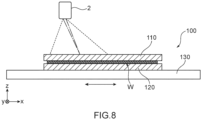
- Fig. 8 is a front view for illustrating the schematic configuration of a welding jig device 100 as a reference example.
- Fig. 9 is a plan view for illustrating the schematic configuration of the welding jig device 100.
- Fig. 10 is a B-B cross-sectional view for illustrating the schematic configuration of the welding jig device 100.
- the welding jig device 100 illustrated as a reference example in Figs. 8 to 10 is used for forming the part 5, such as a fuel cell, by welding a plurality of members W together as with the welding jig device 1.
- the welding jig device 100 differs from the aforementioned welding jig device in that although a jig 110 on one side having a joint face 12 on one side faces a laser welding machine 2, a jig 120 on the other side has no opening and does not face the laser welding machine 2. That is, the welding jig device 100 is configured such that a laser beam is emitted only from above the jig 110 on one side.
- the jig 110 on one side includes two members: a first jig body 111A and a second jig body 111B that has a second opening 113 corresponding to the annular portions to be welded, which do not correspond to the opening 13 on one side, among the desired welded portions 53 of the part 5.
- the jig 110 on one side which has a combination of the first jig body 111A and the second jig body 111B, forms the second opening 113 as well as inclined planes 114A and 114B of the opening corresponding to the annular portions to be welded.
- the second jig body 111B and the jig 120 on the other side are fixed together by a combination of pin holes 115 and 125 and positioning pins 116 and a combination of a bolt 118 and a bolt hole 128.
- the use of the jig 110 on one side which includes the separate first jig body 111A and second jig body 111B, results in a long time for the operation of fixing the first jig body 111A and the second jig body 111B to the jig 120 on the other side.
- the first jig body 111A and the second jig body 111B of the welding jig device 100 are separate members, it has been necessary to adequately position the first jig body 111A and the second jig body 111B with respect to the jig 120 on the other side.
- the welding jig device 100 requires a number of steps regarding the operation of fixing the jigs.
- the jig 10 on one side and the jig 20 on the other side respectively have the opening 13 on one side and the opening 23 on the other side corresponding to the portions 53 to be welded. Therefore, according to the welding jig device 1, since the production of the part 5 only involves holding the plurality of members W between the jig 10 on one side and the jig 20 on the other side and welding the members W together through both the opening 13 on one side and the opening 23 on the other side, it is possible to reduce the number of steps regarding the operation of fixing the jigs and improve the precision of the welded portions along with the fixed positions of the jigs.
- the present invention is not limited to the welding jig device 1 according to the embodiment of the present invention described above or the method for producing the part 5 using the welding jig device 1, and the scope of the invention is defined by the appended claims.
- the aforementioned configurations may be selectively combined as appropriate so as to achieve at least a part of the aforementioned object and effects.
- the shape, material, arrangement, size, and the like of each configuration can be changed as appropriate depending on a specific usage pattern of the present invention.
- the members W welded together with the welding jig device 1 may be members other than metal.
Landscapes
- Engineering & Computer Science (AREA)
- Physics & Mathematics (AREA)
- Optics & Photonics (AREA)
- Mechanical Engineering (AREA)
- Plasma & Fusion (AREA)
- Manufacturing & Machinery (AREA)
- Life Sciences & Earth Sciences (AREA)
- Sustainable Development (AREA)
- Sustainable Energy (AREA)
- Chemical & Material Sciences (AREA)
- Chemical Kinetics & Catalysis (AREA)
- Electrochemistry (AREA)
- General Chemical & Material Sciences (AREA)
- Laser Beam Processing (AREA)
Description
- The present invention relates to a welding jig device and a method for producing a part.
- Conventionally, there is known a part formed by joining a plurality of plate-like metal members by welding (hereinafter also simply referred to as a "part"), such as a fuel cell that is a part for a fuel cell device. For a part such as a fuel cell, not only the members to be joined, but also a circulation path for a reactant gas within the part is formed by welding. The circulation path is formed in a closed circuit form by welding around through-holes that are provided in the members so that airtightness is secured.
- As a technique for forming a part, which has a closed circuit formed therein, by welding a plurality of metal members together as described above, there is known a welding jig device or a method for producing fuel cell-related parts, for example (see
Patent Literatures Patent Literatures -
CN107900517A describes a battery laser welding clamp, a battery welding method of the battery laser welding clamp and a welding system. The welding system comprises the welding clamp. The welding clamp comprises a first clamping block and a second clamping block, wherein the first clamping block and the second clamping block are hinged, one side of the first clamping block is provided with a first welding operation hole, one side of the second clamping block is provided with a battery containing station, a first clamping groove, a second clamping groove and a second welding operation hole, the battery containing station communicates with the first clamping groove and the second clamping groove, the second welding operation hole is formed below the battery containing station and communicates with the battery containing station, the second welding operation hole is right opposite to the battery containing station, and the first welding operation hole is right opposite to the battery containing station. -
US2004099642A1 describes a laser welding device comprising: a first laser beam emitting head directed to a layered base material composed of two or more layers in a superimposed direction; a first skirting roller rotatably supported by means of a first supporting member on which the first laser beam emitting head is fixed and provided with a peripheral surface which protrudes more at a base material side than a base material opposing end of the first laser beam emitting head; a second laser beam emitting head directed to the layered base material from the opposite side of the first laser beam emitting head in the superimposed direction; a second skirting roller rotatably supported by means of a second supportingmember 14 on which the second laser beam emitting head is fixed and provided with a peripheral surface which protrudes more at a base material side than a base material opposing end of the second laser beam emitting head; and a first pressing means for pressing the first supporting member with respect to a supporting base holder in the superimposed direction. -
GB2401814A -
US2017282266A1 a method for producing a primary material for a cutting tool, for example a primary material for a saw blade or a saw band, in which a band-shaped carrier of a metal carrier material and a wire of highspeed steel are continuously brought together along a lateral edge of the band-shaped carrier and transported into a welding device and the band-shaped carrier is welded to the wire along the lateral edge of the carrier to produce a bimetal band. The band-shaped carrier and the edge wire are welded to one another by at least a first welding device, which is arranged on one side of the band-shaped carrier, and at least a second welding device, which is arranged on the opposite side of the band-shaped carrier. -
- Patent Literature 1:
Japanese Patent Application Publication No. 2014-194876 - Patent Literature 2:
Japanese Patent Application Publication No. 2011-161450 - By the way, a welded part may have welded portions with a complex shape, such as welded portions forming an annular closed path or welded portions located in proximity to each other, for example.
- A jig for welding annular portions to be welded together should have an opening corresponding to the portions to be welded, and thus inevitably includes two separate jigs on the inner side and outer side of the annular portions.
- When the portions to be welded are located in proximity to each other, the dimensions of a jig attached between them should be small, resulting in a lower strength of the jig. Consequently, holding of the to-be-welded part around the portions to be welded with the jig has been insufficient. Further, when the portions to be welded are located in extreme proximity to each other, it may be impossible to dispose a jig between them. In such a case, holding of the to-be-welded part around the portions to be welded has become further insufficient.
- When the portions to be welded have a complex shape as described above, in order to securely hold the to-be-welded part around the portions to be welded that are located in proximity to each other, and adequately specify the portions to be welded, a conventional welding jig device includes a jig for the entire members, which is configured to fix the entire members and has an opening corresponding to a portion of the portions to be welded, and another jig for some of the members, which is configured to be detachable from the jig for the entire members and corresponds to another portion of the portions to be welded, for example. However, in a welding operation performed with such a conventional welding jig device, welding of the portions to be welded with a complex shape involves both the operation of fixing the jig for the entire members and the operation of fixing the jig for some of the members. In addition, in a welding operation performed with the conventional welding jig device, to weld the aforementioned portions to be welded with a complex shape together, it has been sometimes necessary to replace or move the jig for some of the members corresponding to the portions to be welded. Further, in the conventional welding jig device and the conventional method for producing a part, when the jig for some of the members is attached or detached to perform a welding operation for forming a part, the resulting part sometimes has strain generated therein due to the welding. As described above, the conventional welding jig device and the method for producing a part using the conventional welding jig device involve a large number of steps regarding the operation of fixing the jigs for a welding operation.
- The present invention has been made in view of the foregoing problems, and it is an object of the present invention to provide a welding jig device and a method for producing a part that can facilitate a welding operation.
- To achieve the aforementioned object, a welding jig device according to the present invention is a welding jig device as defined in
independent claim 1, and a preferred embodiment of the present invention is defined independent claim 2. Namely, the present invention provides a welding jig device used for forming a part by welding a plurality of members together, and includes a jig on one side including a joint face on the one side and an opening on the one side, the joint face on the one side being adapted to contact one of faces exposed on outer surface sides of the plurality of members that are overlaid one on top of the other, the opening on the one side corresponding to a portion of desired welded portions of the part; a jig on another side including a joint face on the other side and an opening on the other side, the joint face on the other side being adapted to contact another face of the faces exposed on the outer surface sides of the plurality of members, the opening on the other side corresponding to another portion the desired welded portions of the part and not corresponding to the opening on the one side; a laser welding machine on the one side that is configured to emit a laser beam toward the opening on the one side; and a laser welding machine on the other side that is configured to emit a laser beam toward the opening on the other side; wherein the opening on the one side and the opening on the other side combine to form an opening corresponding to the entire desired welded portions; and the desired welded portions that are formed through the opening on the one side and the opening on the other side form annular closed paths. - In the welding jig device according to an aspect of the present invention, the laser welding machine on the one side is provided on an outer side of a lateral face on the one side, the lateral face on the one side being opposite to the joint face on the one side, and the laser welding machine on the other side is provided on an outer side of a lateral face on the other side, the lateral face on the other side being opposite to the joint face on the other side.
- To achieve the aforementioned object, a method for producing a part according to the present invention is a method as defined in independent claim 3. Namely, the present invention provides a method for producing a part by overlaying a plurality of members one on top of the other and welding the members together, including a step of overlaying the plurality of members one on top of the other and holding the members with a jig on one side and a jig on another side, the jig on the one side including a joint face on the one side and an opening on the one side, the joint face on the one side being adapted to contact one of faces exposed on outer surface sides of the plurality of members overlaid one on top of the other, the opening on the one side corresponding to a portion of desired welded portions of the part, the jig on the other side including a joint face on the other side and an opening on the other side, the joint face on the other side being adapted to contact another face of the faces exposed on the outer surface sides of the plurality of members, the opening on the other side corresponding to another portion of the desired welded portions of the part and not corresponding to the opening on the one side; and a step of welding the plurality of members together through the opening on the one side and the opening on the other side, in which the step of welding the plurality of members together through the opening on the one side and the opening on the other side includes emitting a laser beam from a laser welding machine on the one side toward the opening on the one side, and emitting a laser beam from a laser welding machine on the other side toward the opening on the other side, the laser welding machine on the one side being provided on an outer side of the lateral face on the one side, the laser welding machine on the other side being provided on an outer side of the lateral face on the other side; wherein the opening on the one side and the opening on the other side combine to form an opening corresponding to the entire desired welded portions; and the desired welded portions that are formed through the opening on the one side and the opening on the other side form annular closed paths.
- The welding jig device and the method for producing a part according to the present invention can facilitate a welding operation.
-
- [
Fig. 1 ] A front view for illustrating the schematic configuration of a welding jig device according to an embodiment of the present invention. - [
Fig. 2 ] A schematic diagram for illustrating the schematic configuration of a jig on one side and a jig on another side of the welding jig device illustrated inFig. 1 . - [
Fig. 3 ] A partial schematic diagram of the jig on one side of the welding jig device illustrated inFig. 2 . - [
Fig. 4 ] A partial schematic diagram of the jig on the other side of the welding jig device illustrated inFig. 2 . - [
Fig. 5 ] An A-A cross-sectional view of the jig on one side and the jig on the other side of the welding jig device illustrated inFig. 2 . - [
Fig. 6 ] A plan view for illustrating the schematic configuration of a part produced with the welding jig device illustrated inFig. 1 . - [
Fig. 7 ] A schematic diagram for illustrating a step of welding members together through both an opening on one side and an opening on the other side in a method for producing a part according to an embodiment of the present invention. - [
Fig. 8 ] A front view for illustrating the schematic configuration of a welding jig device as a reference example. - [
Fig. 9 ] A plan view for illustrating the schematic configuration of the welding jig device illustrated inFig. 8 . - [
Fig. 10 ] A B-B cross-sectional view for illustrating the schematic configuration of the welding jig device illustrated inFig. 8 . - Hereinafter, an embodiment of the present invention will be described with reference to the drawings. The following embodiment will describe an example in which a welding jig device according to the present invention is used for a method for producing a fuel cell as an example of a part produced by overlaying a plurality of metal members one on top of the other and joining them.
- First, an embodiment of a welding jig device of the present invention will be described.
-
Fig. 1 is a front view for illustrating the schematic configuration of awelding jig device 1 according to an embodiment of the present invention.Fig. 2 is a plan view for illustrating the schematic configuration of ajig 10 on one side and ajig 20 on another side of thewelding jig device 1.Fig. 3 is a partial plan view of thejig 10 on one side of thewelding jig device 1.Fig. 4 is a partial bottom view of thejig 20 on the other side of thewelding jig device 1.Fig. 5 is an A-A cross-sectional view of thejig 10 on one side and thejig 20 on the other side of thewelding jig device 1.Fig. 6 is a plan view for illustrating the schematic configuration of apart 5 produced with thewelding jig device 1. - As illustrated in
Figs. 1 to 6 , thewelding jig device 1 according to an embodiment of the present invention is used for forming apart 5 by welding a plurality of members W together, and includes thejig 10 on one side that has ajoint face 12 on one side to be in contact with one face W11 out of faces exposed on the outer surface sides of the plurality of members W that are overlaid one on top of the other, and also has anopening 13 on one side corresponding to a portion of desiredwelded portions 53 of thepart 5; thejig 20 on the other side that has ajoint face 22 on the other side to be in contact with another face W21 of the faces exposed on the outer surface sides of the plurality of members W, and also has anopening 23 on the other side corresponding to another portion of the desiredwelded portions 53 of thepart 5 and not corresponding to theopening 13 on one side; alaser welding machine 2A on one side that is provided on the outer side of alateral face 18 on one side and emits a laser beam toward theopening 13 on one side; and alaser welding machine 2B on the other side that is provided on the outer side of alateral face 28 on the other side and emits a laser beam toward theopening 23 on the other side. Hereinafter, the structure of thewelding jig device 1 will be specifically described. - Hereinafter, a direction parallel with the direction of the axis x1, which lies along the faces of the
jig 10 on one side and thejig 20 on the other side of thewelding jig device 1 illustrated inFigs. 1 to 6 (hereinafter also referred to as an "axis direction"), is assumed as the "x-axis direction" for convenience sake. The x-axis direction is also referred to as the right-left direction. In addition, one of directions (i.e., y-axis direction) perpendicular to the axis x1 of thewelding jig device 1 inFigs. 1 to 6 is assumed as the front-rear direction. Further, the other direction (i.e., z-axis direction) of the directions perpendicular to the axis x1 of thewelding jig device 1 inFigs. 1 to 6 is assumed as the vertical direction. In the following description, the positional relationship or direction of each component expressed as the "right side," "left side," "front side," rear side," "upper side," or "lower side" only illustrates the positional relationship or direction on the drawings, and does not limit the positional relationship or direction in the actual welding jig device. - As illustrated in
Fig. 1 , thewelding jig device 1 is used for producing thepart 5 by joining a plurality of metal members W by welding. As illustrated inFig. 6 , thepart 5 produced by joining the members W using thewelding jig device 1 includes apart body 51, which has been obtained by joining the members W illustrated inFig. 1 and the like, and anopening 52 penetrating thepart body 51 in its thickness direction. Thepart 5 also includes the weldedportions 53 that are the portions of the plurality of members W joined by welding. The weldedportions 53 form annular closed paths, for example. - The
laser welding machine 2A on one side and thelaser welding machine 2B on the other side irradiate members (i.e., workpieces) that are the targets to be joined, such as the members W, with laser beams, thereby joining the members. Thelaser welding machine 2A on one side and thelaser welding machine 2B on the other side each include a YAG laser source that uses YAG (Yttrium Aluminum Garnet) as a medium. Thelaser welding machine 2A on one side and thelaser welding machine 2B on the other side each emit a laser beam with an output of about 500 W and a wavelength of about 1070 nm (i.e., infrared region), for example, toward the members W. Thelaser welding machine 2A on one side and thelaser welding machine 2B on the other side each include a laser reflecting mirror, such as a galvanometer mirror (not illustrated), as a scanning optical component for scanning the surfaces of the members W with a laser beam. The scanning range of the galvanometer mirror of each of thelaser welding machine 2A on one side and thelaser welding machine 2B on the other side is a range of 180 mm × 180 mm square on the xy plane, for example. Thelaser welding machine 2A on one side and thelaser welding machine 2B on the other side are each configured to be movable on the xy plane along the faces of the members W by means of a drive mechanism (not illustrated) so as to be capable of irradiating the entire members W with a laser beam. - It should be noted that the configuration of each of the
laser welding machine 2A on one side and thelaser welding machine 2B on the other side is not limited to that of thelaser welding machine 2 described above, and can be used for methods for producing parts by welding using various welding machines. For example, the welding machine may be a carbon dioxide laser welding machine. - The
welding jig device 1 includes thejig 10 on one side and thejig 20 on the other side as described above, and also includes ajig mount portion 30. Thejig 10 on one side and thejig 20 on the other side are formed of metal or resin with excellent durability and heat resistance against infrared laser beams. As illustrated inFig. 1 , thejig 10 on one side and thejig 20 on the other side are joined such that thejoint face 12 on one side and thejoint face 22 on the other side face each other, and are disposed across thejig mount portion 30. Thejig 10 on one side and thejig 20 on the other side in the usage state hold the plurality of members W, which are overlaid one on top of the other, as the targets to be welded together, between thejoint face 12 on one side and thejoint face 22 on the other side. InFig. 2 , the position of the virtual outline of the members W, which are held between thejig 10 on one side and thejig 20 on the other side, is indicated by the solid line. In addition, inFig. 2 , theportions 53 to be welded of the members W are indicated by the dashed and double-dotted lines. Thejig 10 on one side and thejig 20 on the other side in the usage state are provided withpositioning pins 17 for engaging thejig 10 on one side with thejig 20 on the other side so as to prevent positional deviations thereof in the right-left direction and the front-rear direction. - Next, the specific structures of the
jig 10 on one side and thejig 20 on the other side will be described with reference toFigs. 3 to 5 .Fig. 3 illustrates a state in which a region S of a portion of thejig 10 on one side indicated by the dashed and single-dotted line inFig. 2 is seen from above.Fig. 4 illustrates a state in which the region S of thejig 20 on the other side is seen from below.Fig. 5 is a cross-sectional view of the region S seen from the front side in a state in which thejig 10 on one side and thejig 20 on the other side are joined. - As illustrated in
Figs. 3 and5 , thejig 10 on one side has a shape that can cover portions other than theportions 53 to be welded of the plate-like members W, together with thejig 20 on the other side. Thejig 10 on one side includes ajig body 11, thejoint face 12 on one side, theopening 13 on one side, aninclined plane 14 of the opening, atransmissive hole portion 15, and atransmissive portion 16. - The
jig body 11 determines the approximate shape of thejig 10 on one side. Thejig body 11 has an approximately plate-like shape corresponding to the shapes of the members W to be welded using thejig 10 on one side. Thejoint face 12 on one side is formed on thejig body 11 so as to be capable of contacting the face W11 exposed on an outer surface side of the members W. Thejoint face 12 on one side is formed on thejig body 11 so as to be capable of facing thejig 20 on the other side. Thejoint face 12 on one side has an irregular shape corresponding to the shapes of the members W, for example. - The
opening 13 on one side is an elongated hole penetrating thejig body 11 in its thickness direction, that is, a region between thejoint face 12 on one side (i.e., inner side) and its oppositelateral face 18 on one side (i.e., outer side). Theopening 13 on one side is provided corresponding to a portion of the desired weldedportions 53 of thepart 5 that is to be produced by allowing thewelding jig device 1 to hold the members W. Theopening 13 on one side is open with its diameter increasing toward thelateral face 18 on one side. In thejig body 11, theinclined plane 14 of the opening is provided around theopening 13 on one side. Theinclined plane 14 of the opening is formed along a cross-section of thejig body 11 in its thickness direction as a plane with a predetermined inclination angle with respect to the z-axis. The slope of theinclined plane 14 of the opening is provided to allow a laser beam emitted from thelaser welding machine 2A on one side to easily become incident on the members W via theopening 13 on one side. - The
transmissive hole portion 15 and thetransmissive portion 16 are provided in thejig body 11 at positions where theopening 13 on one side is not provided. That is, thetransmissive hole portion 15 and thetransmissive portion 16 are provided corresponding to the position of theopening 23 on the other side of thejig 20 on the other side described below among the desired weldedportions 53 of a fuel cell that is to be produced by allowing thewelding jig device 1 to hold the members W. Thetransmissive hole portion 15 is an elongated hole penetrating a region between thejoint face 12 on one side (i.e., inner side) and its oppositelateral face 18 on one side (i.e., outer side) in the thickness direction of thejig body 11. Thetransmissive portion 16 is a groove-like elongated hole with a predetermined depth from thejoint face 12 on one side (i.e., inner side) to thelateral face 18 on one side along the thickness direction of thejig body 11. Thetransmissive hole portion 15 and thetransmissive portion 16 are provided in appropriate places of thejig body 11 where theopening 13 on one side is not provided such that thetransmissive hole portions 15 and thetransmissive portions 16 are alternately provided. That is, as long as thetransmissive hole portion 15 and thetransmissive portion 16 are provided in thejig body 11 at positions where theopening 13 on one side is not provided, the positions of thetransmissive hole portion 15 and thetransmissive portion 16 are not limited to particular positions, nor is the area ratio between thetransmissive hole portion 15 and thetransmissive portion 16 limited to a particular ratio, for example. It is also possible to provide only one of thetransmissive hole portion 15 or thetransmissive portion 16 in thejig 10 on one side. - Next, as illustrated in
Figs. 4 and5 , thejig 20 on the other side has a shape capable of covering portions other than theportions 53 to be welded of the plate-like members W, together with thejig 10 on one side. Thejig 20 on the other side includes ajig body 21, thejoint face 22 on the other side, theopening 23 on the other side, aninclined plane 24 of the opening, atransmissive hole portion 25, and atransmissive portion 26. - The
jig body 21 determines the approximate shape of thejig 20 on the other side. As with thejig body 11, thejig body 21 has an approximately plate-like shape corresponding to the shapes of the members W to be welded using thejig 20 on the other side. Thejoint face 22 on the other side is formed on thejig body 21 so as to be capable of contacting the face W21 exposed on an outer surface side of the members W. Thejoint face 22 on the other side is formed on thejig body 21 so as to be capable of facing thejig 10 on one side. Thejig 20 on the other side has an irregular shape corresponding to the shapes of the members W, for example. - The
opening 23 on the other side is an elongated hole penetrating thejig body 21 in its thickness direction, that is, a region between thejoint face 22 on the other side (i.e., inner side) and its oppositelateral face 28 on the other side (i.e., outer side). Theopening 23 on the other side is provided corresponding to a portion (which is different from theopening 13 on one side of thejig 10 on one side) of the desired weldedportions 53 of thepart 5 that is to be produced by allowing thewelding jig device 1 to hold the member W. That is, theopening 23 on the other side is provided corresponding to the positions where thetransmissive hole portion 15 and thetransmissive portion 16 of thejig 10 on one side are provided among the desired weldedportions 53 of a fuel cell that is to be produced by allowing thewelding jig device 1 to hold the members W. Theopening 23 on the other side is open with its diameter increasing toward thelateral face 28 on the other side. In thejig body 21, theinclined plane 24 of the opening is provided around theopening 23 on the other side. Theinclined plane 24 of the opening is formed along a cross-section of thejig body 21 in its thickness direction as a plane with a predetermined inclination angle with respect to the z-axis. The slope of theinclined plane 24 of the opening is provided to allow a laser beam emitted from thelaser welding machine 2B on the other side to easily become incident on the members W via theopening 23 on the other side. - In the
welding jig device 1, openings corresponding to the entire weldedportions 53 of thepart 5 are formed by theopening 13 on one side of thejig 10 on one side and theopening 23 on the other side of thejig 20 on the other side. Specifically, as illustrated inFig. 6 , for example, to form each annular weldedportion 53, each of theopening 13 on one side and theopening 23 on the other side is formed such that it has half the perimeter of the annular weldedportion 53 as illustrated inFigs. 3 and4 . Performing welding through theopening 13 on one side and theopening 23 on the other side using thelaser welding machines 2 allows theportions 53 to be welded, which have a complex shape such as an annular shape, to be appropriately welded to form thepart 5. - The
transmissive hole portion 25 and thetransmissive portion 26 are provided in thejig body 21 at positions where theopening 23 on the other side is not provided. That is, thetransmissive hole portion 25 and thetransmissive portion 26 are provided corresponding to the position of theopening 13 on one side of thejig 10 on one side among the desired weldedportions 53 of thepart 5 that is to be produced by allowing thewelding jig device 1 to hold the members W. Thetransmissive hole portion 25 is an elongated hole penetrating a region between thejoint face 22 on the other side (i.e., inner side) and its oppositelateral face 28 on the other side (i.e., outer side) in the thickness direction of thejig body 21. Thetransmissive portion 26 is a groove-like elongated hole with a predetermined depth from thejoint face 22 on the other side (i.e., inner side) to thelateral face 28 on the other side along the thickness direction of thejig body 21. Thetransmissive hole portion 25 and thetransmissive portion 26 are provided in appropriate places of thejig body 21 where theopening 23 on the other side is not provided such that thetransmissive hole portions 25 and thetransmissive portions 26 are alternately provided. That is, as long as thetransmissive hole portion 25 and thetransmissive portion 26 are provided in thejig body 21 at positions where theopening 23 on the other side is not provided, the positions of thetransmissive hole portion 25 and thetransmissive portion 26 are not limited to particular positions, nor is the area ratio between thetransmissive hole portion 25 and thetransmissive portion 26 limited to a particular ratio, for example. It is also possible to provide only one of thetransmissive hole portion 25 or thetransmissive portion 26 in thejig 20 on the other side. - Next, the configuration of the
jig mount portion 30 of thewelding jig device 1 will be described. Thejig mount portion 30 includessupport portions 31 on one side,support portions 32 on the other side,columns 33 on one side,columns 34 on the other side, and asupport base 35. - The
support portions 31 on one side are provided on one side across the axis x1. Thesupport portions 31 on one side are provided in pairs around one end (i.e., the left side inFig. 1 ) and another end (i.e., the right side inFig. 1 ) of thejig 10 on one side. Thesupport portions 32 on the other side are provided on the other side of thesupport portions 31 on one side across the axis x1. Thesupport portions 32 on the other side are provided in pairs around one end (i.e., the left side inFig. 1 ) and another end (i.e., the right side inFig. 1 ) of thejig 20 on the other side. Thesupport portions 31 on one side and thesupport portions 32 on the other side are provided so as to face each other across the axis x1. - The
support portions 31 on one side contact thelateral face 18 on one side of thejig 10 on one side, thus supporting thejig 10 on one side. Meanwhile, thesupport portions 32 on the other side contact thelateral face 28 on the other side of thejig 20 on the other side, thus supporting thejig 20 on the other side. Thejig 10 on one side and thejig 20 on the other side each exert a fastening force acting in the direction of the axis x1 like a clamp, for example. With the fastening force, thesupport portions 31 on one side and thesupport portions 32 on the other side support thejig 10 on one side and thejig 20 on the other side in a state in which thejig 10 on one side and thejig 20 on the other side are joined. - The
columns 33 on one side are provided at opposite ends of thewelding jig device 1 in the right-left direction. Eachcolumn 33 on one side has one end disposed on thesupport base 35, and has another end supporting thecorresponding support portion 31 on one side. Thejig 10 on one side is supported by thesupport portions 31 on one side, thecolumns 33 on one side, and thesupport base 35. Thecolumns 34 on the other side are provided at opposite ends of thewelding jig device 1 in the right-left direction. Eachcolumn 34 on the other side has one end in contact with the installation plane, and has another end supporting thecorresponding support portion 32 on the other side. Thejig 20 on the other side is supported by thesupport portions 32 on the other side and thecolumns 34 on the other side. - Described next is an embodiment of a method for producing a part of the present invention that is executed with the
welding jig device 1 with the aforementioned configuration. -
Fig. 7 is a schematic diagram for illustrating a step of welding the members W together through both theopening 13 on one side and theopening 23 on the other side in a method for producing a part according to an embodiment of the present invention. As illustrated inFig. 7 , in the method for producing thepart 5 by overlaying the plurality of members W one on top of the other and welding them together, the following steps are executed: a step of overlaying the plurality of members W one on top of the other and holding them with thejig 10 on one side and thejig 20 on the other side of the welding jig device 1 (hereinafter referred to as "step 1"), and a step of welding the plurality of members W together with a laser beam B1 that has been emitted from thelaser welding machine 2A on one side and passed throughopening 13 on one side and a laser beam B2 that has been emitted from thelaser welding machine 2B on the other side and passed through theopening 23 on the other side (hereinafter referred to as "step 2"). Hereinafter, a method for producing a part using thewelding jig device 1 will be specifically described. - In
step 1, the plurality of members W, which are the targets to be welded together, are held between thejoint face 12 on one side of thejig 10 on one side and thejoint face 22 on the other side of thejig 20 on the other side of thewelding jig device 1. Instep 1, the plate-like members W are fixed in place between thejig 10 on one side and thejig 20 on the other side with a fastening force exerted by both the right and leftsupport portions 31 on one side and the right and leftsupport portions 32 on the other side. Thejig 10 on one side and thejig 20 on the other side are prevented from positional deviations in the right-left direction and the front-rear direction by the positioning pins 17 illustrated inFig. 2 that engage thejig 10 on one side with thejig 20 on the other side. In addition, since the members W to be welded are fixed between thejig 10 on one side and thejig 20 on the other side in thewelding jig device 1 by thejig 10 on one side and thejig 20 on the other side, strain of the members W due to heat during welding is suppressed. Therefore, according to thewelding jig device 1, thepart 5 can be formed by joining through high-quality welding. - As illustrated in
Fig. 7 , instep 2, the laser beam B1 is emitted from thelaser welding machine 2A on one side provided above thewelding jig device 1 that is holding the members W between thejig 10 on one side and thejig 20 on the other side. At this time, in thewelding jig device 1, thelateral face 18 on one side, which is opposite to thejoint face 12 on one side, of thejig 10 on one side faces thelaser welding machine 2A on one side. Therefore, the laser beam B1 is transmitted through theopening 13 on one side of thejig 10 on one side in the scanning range LA1 of the aforementioned galvanometer mirror, and then irradiates a portion of theportions 53 to be welded of the members W that are held on the inner side of thejoint face 12 on one side of thejig 10 on one side. Thelaser welding machine 2A on one side is configured to be movable on the xy plane along the faces of the members W within a predetermined movable region M1 by a drive mechanism (not illustrated). Therefore, thelaser welding machine 2A on one side can irradiate theportions 53 to be welded, which correspond to theopening 13 on one side, provided across the entire members W with the laser beam B1. - In
step 2, the laser beam B2 is also emitted from thelaser welding machine 2B on the other side provided below thewelding jig device 1 that is holding the members W between thejig 10 on one side and thejig 20 on the other side. At this time, in thewelding jig device 1, thelateral face 28 on the other side, which is opposite to thejoint face 22 on the other side, of thejig 20 on the other side faces thelaser welding machine 2B on the other side. Therefore, the laser beam B2 is transmitted through theopening 23 on the other side of thejig 20 on the other side in the scanning range LA2 of the aforementioned galvanometer mirror, and then reaches the members W held on the inner side of thejoint face 22 on the other side of thejig 20 on the other side. Specifically, the laser beam B2 irradiates another portion of theportions 53 to be welded of the members W that has not been welded by the laser beam B1 transmitted through theopening 13 on one side. Thelaser welding machine 2B on the other side is configured to be movable on the xy plane along the faces of the members W within a predetermined movable region M2 by a drive mechanism (not illustrated). Therefore, thelaser welding machine 2B on the other side can irradiate theportions 53 to be welded, which correspond to theopening 23 on the other side, provided across the entire members W with the laser beam B2. Herein, the timing of emission of the laser beam B1 from thelaser welding machine 2A on one side and the timing of emission of the laser beam B2 from thelaser welding machine 2B on the other side may be either the same or different. - As described above, in the method for producing the
part 5 using thewelding jig device 1,step 2 is executed that includes welding a portion of the desiredportions 53 to be welded with the laser beam B1 from thelaser welding machine 2A on one side through theopening 13 on one side provided in thejig 10 on one side, and welding the remaining portion of theportions 53 to be welded with the laser beam B2 from thelaser welding machine 2B on the other side through theopening 23 on the other side provided in thejig 20 on the other side. With thewelding jig device 1, welding can be performed through both theopening 13 on one side and theopening 23 on the other side. Thus, theportions 53 to be welded with a complex shape can be welded together without the need for a jig replacement operation or the like. - Accordingly, for the
part 5 to be produced with thewelding jig device 1, it is possible to easily form the desired weldedportions 53 with high precision by performing welding through both theopening 13 on one side and theopening 23 on the other side even when theportions 53 to be welded are located in proximity to each other or the shapes of theportions 53 to be welded are complex such as an annular closed path, for example. Specifically, for thepart 5 to be produced with thewelding jig device 1, it is possible to weld theportions 53 to be welded together through both theopening 13 on one side and theopening 23 on the other side while holding theportions 53 to be welded for thepart 5 with thejig 10 on one side and thejig 20 on the other side such that theportions 53 to be welded are sufficiently tightly attached together. Thus, even theportions 53 to be welded with a complex shape can be welded together with high precision easily. In addition, for thepart 5 to be produced with thewelding jig device 1, theportions 53 to be welded are welded together, part by part, from the opposite sides (i.e., the face W11 and the face W21 illustrated inFigs. 1 and7 ) exposed on the outer surface sides of the members W. Thus, a high-quality part can be produced with the welding strain cancelled out. - In the
welding jig device 1, thejig 10 on one side and thejig 20 on the other side respectively have thetransmissive hole portions transmissive portions transmissive hole portions transmissive portions laser welding machine 2A on one side toward theopening 13 on one side and from thelaser welding machine 2B on the other side toward theopening 23 on the other side, to be transmitted therethrough. Herein, since thewelding jig device 1 has thetransmissive hole portions transmissive portions transmissive hole portions transmissive portions welding jig device 1, the partially melted members W can be prevented from sticking to thepart 5, which would otherwise degrade the product quality. -
Fig. 8 is a front view for illustrating the schematic configuration of awelding jig device 100 as a reference example. In addition,Fig. 9 is a plan view for illustrating the schematic configuration of thewelding jig device 100. Further,Fig. 10 is a B-B cross-sectional view for illustrating the schematic configuration of thewelding jig device 100. - The
welding jig device 100 illustrated as a reference example inFigs. 8 to 10 is used for forming thepart 5, such as a fuel cell, by welding a plurality of members W together as with thewelding jig device 1. As illustrated inFig. 10 , thewelding jig device 100 differs from the aforementioned welding jig device in that although ajig 110 on one side having ajoint face 12 on one side faces alaser welding machine 2, ajig 120 on the other side has no opening and does not face thelaser welding machine 2. That is, thewelding jig device 100 is configured such that a laser beam is emitted only from above thejig 110 on one side. - In addition, as illustrated in
Figs. 9 and 10 , to weld annular portions together with thewelding jig device 100, thejig 110 on one side includes two members: afirst jig body 111A and asecond jig body 111B that has asecond opening 113 corresponding to the annular portions to be welded, which do not correspond to theopening 13 on one side, among the desired weldedportions 53 of thepart 5. Thejig 110 on one side, which has a combination of thefirst jig body 111A and thesecond jig body 111B, forms thesecond opening 113 as well asinclined planes second jig body 111B and thejig 120 on the other side are fixed together by a combination of pin holes 115 and 125 andpositioning pins 116 and a combination of abolt 118 and abolt hole 128. - In a welding operation performed with the
welding jig device 100, the use of thejig 110 on one side, which includes the separatefirst jig body 111A andsecond jig body 111B, results in a long time for the operation of fixing thefirst jig body 111A and thesecond jig body 111B to thejig 120 on the other side. In addition, since thefirst jig body 111A and thesecond jig body 111B of thewelding jig device 100 are separate members, it has been necessary to adequately position thefirst jig body 111A and thesecond jig body 111B with respect to thejig 120 on the other side. As described above, thewelding jig device 100 requires a number of steps regarding the operation of fixing the jigs. - Meanwhile, in the
welding jig device 1 according to the present embodiment, thejig 10 on one side and thejig 20 on the other side respectively have theopening 13 on one side and theopening 23 on the other side corresponding to theportions 53 to be welded. Therefore, according to thewelding jig device 1, since the production of thepart 5 only involves holding the plurality of members W between thejig 10 on one side and thejig 20 on the other side and welding the members W together through both theopening 13 on one side and theopening 23 on the other side, it is possible to reduce the number of steps regarding the operation of fixing the jigs and improve the precision of the welded portions along with the fixed positions of the jigs. - Although the embodiment of the present invention has been described above, the present invention is not limited to the
welding jig device 1 according to the embodiment of the present invention described above or the method for producing thepart 5 using thewelding jig device 1, and the scope of the invention is defined by the appended claims. In addition, the aforementioned configurations may be selectively combined as appropriate so as to achieve at least a part of the aforementioned object and effects. For example, the shape, material, arrangement, size, and the like of each configuration can be changed as appropriate depending on a specific usage pattern of the present invention. For example, the members W welded together with thewelding jig device 1 may be members other than metal. -
- 1 welding jig device
- 2 laser welding machine
- 2A laser welding machine on one side
- 2B laser welding machine on the other side
- 5 part
- 10 jig on one side
- 11 jig body
- 12 joint face on one side
- 13 opening on one side
- 14 inclined plane of the opening
- 15 transmissive hole portion
- 16 transmissive portion
- 17 positioning pins
- 18 lateral face on one side
- 20 jig on the other side
- 21 jig body
- 22 joint face on the other side
- 23 opening on the other side
- 24 inclined plane of the opening
- 25 transmissive hole portion
- 26 transmissive portion
- 28 lateral face on the other side
- 30 jig mount portion
- 31 support portions on one side
- 32 support portions on the other side
- 33 columns on one side
- 34 columns on the other side
- 35 support base
- 51 part body
- 52 opening
- 53 portions to be welded/welded portions
Claims (3)
- A welding jig device (1) used for forming a part (5) comprising desired welded portions (53) that form annular closed paths by welding a plurality of members together, comprising:a jig on one side (10) including a joint face on the one side (12) and an opening on the one side (13), the joint face on the one side (12) being adapted to contact one of faces exposed on outer surface sides of the plurality of members that are overlaid one on top of the other, the opening on the one side (13) corresponding to a portion of the desired welded portions (53) of the part (5);a jig on another side (20) including a joint face on the other side (22) and an opening on the other side (23), the joint face on the other side (22) being adapted to contact another face of the faces exposed on the outer surface sides of the plurality of members, the opening on the other side (23) corresponding to another portion of the desired welded portions (53) of the part (5) and not corresponding to the opening on the one side (13);a laser welding machine on the one side (2A) that is configured to emit a laser beam (B1) toward the opening on the one side (13); characterized in that it includesa laser welding machine on the other side (2B) that is configured to emit a laser beam (B2) toward the opening on the other side (23);and in that the opening on the one side (13) and the opening on the other side (23) combine to form an opening corresponding to the entire desired welded portions (53); and the desired welded portions (53) that are formed through the opening on the one side (13) and the opening on the other side (23) form the annular closed paths.
- The welding jig device (1) according to claim 1,
wherein:the laser welding machine on the one side is provided on an outer side of a lateral face on the one side (18), the lateral face on the one side being opposite to the joint face on the one side (12), andthe laser welding machine on the other side is provided on an outer side of a lateral face on the other side (28), the lateral face on the other side being opposite to the joint face on the other side (22). - A method for producing a part (5) comprising desired welded portions (53) that form annular closed paths by overlaying a plurality of members one on top of the other and welding the members together, comprising:A step of overlaying the plurality of members one on top of the other and holding the members with a jig on one side (10) and a jig on another side (20), the jig on the one side (10) including a joint face on the one side (12) and an opening on the one side (13), the joint face on the one side (12) being adapted to contact one of faces exposed on outer surface sides of the plurality of members overlaid one on top of the other, the opening on the one side (13) corresponding to a portion of the desired welded portions (53) of the part (5), the jig on the other side (20) including a joint face on the other side (22) and an opening on the other side (23), the joint face on the other side (22) being adapted to contact another face of the faces exposed on the outer surface sides of the plurality of members, the opening on the other side (23) corresponding to another portion of the desired welded portions (53) of the part (5) and not corresponding to the opening on the one side (13); anda step of welding the plurality of members together through the opening on the one side (13) and the opening on the other side (23),wherein:the step of welding the plurality of members together through the opening on the one side (13) and the opening on the other side (23) includes emitting a laser beam (B1) from a laser welding machine on the one side (2A) toward the opening on the one side (13), and characterized in that it further includes emitting a laser beam (B2) from a laser welding machine on the other side (2B) toward the opening on the other side (23), the laser welding machine on the one side being provided on an outer side of a lateral face on the one side (18) of the jig on the one side (10), the laser welding machine on the other side being provided on an outer side of a lateral face on the other side (28) of the jig on the other side (20);and in that the opening on the one side (13) and the opening on the other side (23) combine to form an opening corresponding to the entire desired welded portions (53); and the desired welded portions (53) that are formed through the opening on the one side (13) and the opening on the other side (23) form the annular closed paths.
Applications Claiming Priority (2)
| Application Number | Priority Date | Filing Date | Title |
|---|---|---|---|
| JP2019044469 | 2019-03-12 | ||
| PCT/JP2020/008828 WO2020184276A1 (en) | 2019-03-12 | 2020-03-03 | Welding jig device and production method for component |
Publications (4)
| Publication Number | Publication Date |
|---|---|
| EP3939739A1 EP3939739A1 (en) | 2022-01-19 |
| EP3939739A4 EP3939739A4 (en) | 2022-12-14 |
| EP3939739B1 true EP3939739B1 (en) | 2024-12-04 |
| EP3939739C0 EP3939739C0 (en) | 2024-12-04 |
Family
ID=72426424
Family Applications (1)
| Application Number | Title | Priority Date | Filing Date |
|---|---|---|---|
| EP20769416.7A Active EP3939739B1 (en) | 2019-03-12 | 2020-03-03 | Welding jig device and production method for component |
Country Status (7)
| Country | Link |
|---|---|
| US (1) | US12311477B2 (en) |
| EP (1) | EP3939739B1 (en) |
| JP (1) | JP6964820B2 (en) |
| KR (1) | KR102627253B1 (en) |
| CN (1) | CN113329840B (en) |
| CA (1) | CA3128354C (en) |
| WO (1) | WO2020184276A1 (en) |
Families Citing this family (10)
| Publication number | Priority date | Publication date | Assignee | Title |
|---|---|---|---|---|
| JP7483046B2 (en) * | 2020-11-18 | 2024-05-14 | Nok株式会社 | Welding fixture equipment |
| CN112264710B (en) * | 2020-12-23 | 2021-03-16 | 广东技术师范大学 | A lithium battery laser welding equipment for new energy vehicles |
| DE102021115495B4 (en) | 2021-06-15 | 2023-04-06 | Weil Technology GmbH | Device for the production of bipolar plates |
| DE102021210166A1 (en) | 2021-09-14 | 2023-03-16 | Robert Bosch Gesellschaft mit beschränkter Haftung | Welding device, processing device and method for producing a weld seam on an object to be welded |
| US12569944B2 (en) | 2023-01-27 | 2026-03-10 | Bae Systems Controls Inc. | Laser welding tooling and laser welding systems |
| EP4431224A4 (en) * | 2023-01-31 | 2025-01-29 | Contemporary Amperex Technology (Hong Kong) Limited | WELDING METHOD, WELDING APPARATUS, WELDING DEVICE AND BATTERY CELL |
| DE102023114073A1 (en) * | 2023-05-30 | 2024-12-05 | Ekpo Fuel Cell Technologies Gmbh | Manufacturing process for a bipolar plate and bipolar plate |
| KR102857543B1 (en) * | 2023-06-12 | 2025-09-10 | 디와이피엔에프 주식회사 | Welding jig for Sandwich panel of silo and sandwich panel manufacturing device using the same |
| KR20250066160A (en) | 2023-11-06 | 2025-05-13 | 주식회사 옵토리브 | Jig assembly for laser welding |
| DE102024114277A1 (en) * | 2024-05-22 | 2025-11-27 | TRUMPF Laser- und Systemtechnik SE | Welding mask for a laser welding device for producing a weld joint, laser welding device for producing a weld joint and method for producing a weld joint |
Family Cites Families (17)
| Publication number | Priority date | Publication date | Assignee | Title |
|---|---|---|---|---|
| JPH01186277A (en) | 1988-01-18 | 1989-07-25 | Origin Electric Co Ltd | Arc welding method |
| US5187345A (en) * | 1991-11-22 | 1993-02-16 | The Torrington Company | Method of welding retainer rings |
| GB2401814B (en) | 2001-04-27 | 2005-03-02 | Honda Motor Co Ltd | Laser beam welding method and apparatus |
| JP4107639B2 (en) * | 2002-04-15 | 2008-06-25 | 本田技研工業株式会社 | Laser welding apparatus and laser welding method |
| KR20090040011A (en) * | 2007-10-19 | 2009-04-23 | 기아자동차주식회사 | Jig Device for Panel Welding |
| JP4612076B2 (en) * | 2008-04-24 | 2011-01-12 | 東亜工業株式会社 | Laser welding method for metal plated plate |
| JP5574730B2 (en) | 2010-02-04 | 2014-08-20 | 本田技研工業株式会社 | Welding jig apparatus and welding method |
| DE202011110469U1 (en) | 2010-09-23 | 2014-04-17 | Shape Corp. | Tubular bar with central single carrier |
| JP6193597B2 (en) * | 2013-03-28 | 2017-09-06 | 日本特殊陶業株式会社 | Manufacturing method of fuel cell related parts, fuel cell related parts, welding jig apparatus |
| WO2016001992A1 (en) | 2014-06-30 | 2016-01-07 | 日産自動車株式会社 | Device for bonding thin board-like member and method for bonding thin board-like member |
| EP2992990A1 (en) | 2014-09-05 | 2016-03-09 | Böhler-Uddeholm Precision Strip GmbH | Method for manufacturing a base material for a cutting tool |
| CN105081588B (en) * | 2015-06-26 | 2017-01-25 | 浙江时空能源技术有限公司 | Multi-point laser welding clamping device for battery pack busbar |
| KR101703599B1 (en) | 2015-07-31 | 2017-02-07 | 현대자동차 주식회사 | Roof laser brazing system |
| CN105458572A (en) * | 2015-11-14 | 2016-04-06 | 安徽合叉叉车有限公司 | Forklift portal double-face welding device |
| CN205600183U (en) * | 2016-04-12 | 2016-09-28 | 东莞市沃德精密机械有限公司 | Welding jig |
| JP6762430B2 (en) | 2017-07-19 | 2020-09-30 | Nok株式会社 | Laser welding method and jig equipment for laser welding |
| CN107900517B (en) | 2017-12-29 | 2023-12-08 | 三威实业(珠海)有限公司 | Battery laser welding fixture, battery welding method thereof and battery laser welding system |
-
2020
- 2020-03-03 CN CN202080010417.XA patent/CN113329840B/en active Active
- 2020-03-03 JP JP2021504946A patent/JP6964820B2/en active Active
- 2020-03-03 CA CA3128354A patent/CA3128354C/en active Active
- 2020-03-03 WO PCT/JP2020/008828 patent/WO2020184276A1/en not_active Ceased
- 2020-03-03 KR KR1020217023690A patent/KR102627253B1/en active Active
- 2020-03-03 EP EP20769416.7A patent/EP3939739B1/en active Active
- 2020-03-03 US US17/426,790 patent/US12311477B2/en active Active
Also Published As
| Publication number | Publication date |
|---|---|
| CN113329840B (en) | 2022-06-03 |
| CA3128354A1 (en) | 2020-09-17 |
| EP3939739C0 (en) | 2024-12-04 |
| EP3939739A1 (en) | 2022-01-19 |
| JPWO2020184276A1 (en) | 2021-10-28 |
| CN113329840A (en) | 2021-08-31 |
| WO2020184276A1 (en) | 2020-09-17 |
| EP3939739A4 (en) | 2022-12-14 |
| CA3128354C (en) | 2023-06-06 |
| US20220134491A1 (en) | 2022-05-05 |
| JP6964820B2 (en) | 2021-11-10 |
| KR102627253B1 (en) | 2024-01-23 |
| US12311477B2 (en) | 2025-05-27 |
| KR20210105987A (en) | 2021-08-27 |
Similar Documents
| Publication | Publication Date | Title |
|---|---|---|
| EP3939739B1 (en) | Welding jig device and production method for component | |
| US8759712B2 (en) | Method of manufacturing a stiffened plate by hybrid laser arc welding | |
| EP3939741B1 (en) | Welding jig device and production method for component | |
| JP5248344B2 (en) | Laser welding method | |
| KR20190133619A (en) | Method for welding workpieces together and one application of the method | |
| JP5366499B2 (en) | Welding method | |
| EP2047935B1 (en) | Method of producing a stiffened plate | |
| US20230415279A1 (en) | Welding jig device | |
| JP2011156573A (en) | Welding equipment and welding method | |
| JP2020146701A (en) | Welding jig device, and manufacturing method of component | |
| JP7846071B2 (en) | Manufacturing method for welded components | |
| JP2008000764A (en) | Laser welding method, apparatus and equipment | |
| JPH0780689A (en) | Multiple spot wellding equipment by laser beam | |
| JPH09141468A (en) | Laser welding method | |
| JP2001340982A (en) | Laser welding method | |
| KR20140081979A (en) | Welding method for plating steel sheets | |
| JPS61154782A (en) | Laser welding method |
Legal Events
| Date | Code | Title | Description |
|---|---|---|---|
| STAA | Information on the status of an ep patent application or granted ep patent |
Free format text: STATUS: THE INTERNATIONAL PUBLICATION HAS BEEN MADE |
|
| PUAI | Public reference made under article 153(3) epc to a published international application that has entered the european phase |
Free format text: ORIGINAL CODE: 0009012 |
|
| STAA | Information on the status of an ep patent application or granted ep patent |
Free format text: STATUS: REQUEST FOR EXAMINATION WAS MADE |
|
| 17P | Request for examination filed |
Effective date: 20210727 |
|
| AK | Designated contracting states |
Kind code of ref document: A1 Designated state(s): AL AT BE BG CH CY CZ DE DK EE ES FI FR GB GR HR HU IE IS IT LI LT LU LV MC MK MT NL NO PL PT RO RS SE SI SK SM TR |
|
| DAV | Request for validation of the european patent (deleted) | ||
| DAX | Request for extension of the european patent (deleted) | ||
| A4 | Supplementary search report drawn up and despatched |
Effective date: 20221116 |
|
| RIC1 | Information provided on ipc code assigned before grant |
Ipc: B23K 101/36 20060101ALN20221110BHEP Ipc: B23K 101/18 20060101ALN20221110BHEP Ipc: H01M 8/0206 20160101ALI20221110BHEP Ipc: H01M 8/0297 20160101ALI20221110BHEP Ipc: B23K 26/28 20140101ALI20221110BHEP Ipc: B23K 26/244 20140101ALI20221110BHEP Ipc: B23K 26/082 20140101ALI20221110BHEP Ipc: B23K 26/06 20140101ALI20221110BHEP Ipc: B23K 37/04 20060101ALI20221110BHEP Ipc: B23K 26/70 20140101AFI20221110BHEP |
|
| STAA | Information on the status of an ep patent application or granted ep patent |
Free format text: STATUS: EXAMINATION IS IN PROGRESS |
|
| 17Q | First examination report despatched |
Effective date: 20231106 |
|
| RIC1 | Information provided on ipc code assigned before grant |
Ipc: B23K 101/36 20060101ALN20240521BHEP Ipc: B23K 101/18 20060101ALN20240521BHEP Ipc: H01M 8/0206 20160101ALI20240521BHEP Ipc: H01M 8/0297 20160101ALI20240521BHEP Ipc: B23K 26/28 20140101ALI20240521BHEP Ipc: B23K 26/244 20140101ALI20240521BHEP Ipc: B23K 26/082 20140101ALI20240521BHEP Ipc: B23K 26/06 20140101ALI20240521BHEP Ipc: B23K 37/04 20060101ALI20240521BHEP Ipc: B23K 26/70 20140101AFI20240521BHEP |
|
| GRAP | Despatch of communication of intention to grant a patent |
Free format text: ORIGINAL CODE: EPIDOSNIGR1 |
|
| STAA | Information on the status of an ep patent application or granted ep patent |
Free format text: STATUS: GRANT OF PATENT IS INTENDED |
|
| RIC1 | Information provided on ipc code assigned before grant |
Ipc: B23K 101/36 20060101ALN20240531BHEP Ipc: B23K 101/18 20060101ALN20240531BHEP Ipc: H01M 8/0206 20160101ALI20240531BHEP Ipc: H01M 8/0297 20160101ALI20240531BHEP Ipc: B23K 26/28 20140101ALI20240531BHEP Ipc: B23K 26/244 20140101ALI20240531BHEP Ipc: B23K 26/082 20140101ALI20240531BHEP Ipc: B23K 26/06 20140101ALI20240531BHEP Ipc: B23K 37/04 20060101ALI20240531BHEP Ipc: B23K 26/70 20140101AFI20240531BHEP |
|
| INTG | Intention to grant announced |
Effective date: 20240705 |
|
| GRAS | Grant fee paid |
Free format text: ORIGINAL CODE: EPIDOSNIGR3 |
|
| GRAA | (expected) grant |
Free format text: ORIGINAL CODE: 0009210 |
|
| STAA | Information on the status of an ep patent application or granted ep patent |
Free format text: STATUS: THE PATENT HAS BEEN GRANTED |
|
| AK | Designated contracting states |
Kind code of ref document: B1 Designated state(s): AL AT BE BG CH CY CZ DE DK EE ES FI FR GB GR HR HU IE IS IT LI LT LU LV MC MK MT NL NO PL PT RO RS SE SI SK SM TR |
|
| REG | Reference to a national code |
Ref country code: CH Ref legal event code: EP |
|
| REG | Reference to a national code |
Ref country code: DE Ref legal event code: R096 Ref document number: 602020042552 Country of ref document: DE |
|
| REG | Reference to a national code |
Ref country code: IE Ref legal event code: FG4D |
|
| U01 | Request for unitary effect filed |
Effective date: 20241210 |
|
| U07 | Unitary effect registered |
Designated state(s): AT BE BG DE DK EE FI FR IT LT LU LV MT NL PT RO SE SI Effective date: 20241220 |
|
| PG25 | Lapsed in a contracting state [announced via postgrant information from national office to epo] |
Ref country code: HR Free format text: LAPSE BECAUSE OF FAILURE TO SUBMIT A TRANSLATION OF THE DESCRIPTION OR TO PAY THE FEE WITHIN THE PRESCRIBED TIME-LIMIT Effective date: 20241204 |
|
| PG25 | Lapsed in a contracting state [announced via postgrant information from national office to epo] |
Ref country code: ES Free format text: LAPSE BECAUSE OF FAILURE TO SUBMIT A TRANSLATION OF THE DESCRIPTION OR TO PAY THE FEE WITHIN THE PRESCRIBED TIME-LIMIT Effective date: 20241204 |
|
| PG25 | Lapsed in a contracting state [announced via postgrant information from national office to epo] |
Ref country code: NO Free format text: LAPSE BECAUSE OF FAILURE TO SUBMIT A TRANSLATION OF THE DESCRIPTION OR TO PAY THE FEE WITHIN THE PRESCRIBED TIME-LIMIT Effective date: 20250304 |
|
| PG25 | Lapsed in a contracting state [announced via postgrant information from national office to epo] |
Ref country code: GR Free format text: LAPSE BECAUSE OF FAILURE TO SUBMIT A TRANSLATION OF THE DESCRIPTION OR TO PAY THE FEE WITHIN THE PRESCRIBED TIME-LIMIT Effective date: 20250305 |
|
| PG25 | Lapsed in a contracting state [announced via postgrant information from national office to epo] |
Ref country code: RS Free format text: LAPSE BECAUSE OF FAILURE TO SUBMIT A TRANSLATION OF THE DESCRIPTION OR TO PAY THE FEE WITHIN THE PRESCRIBED TIME-LIMIT Effective date: 20250304 |
|
| U20 | Renewal fee for the european patent with unitary effect paid |
Year of fee payment: 6 Effective date: 20250325 |
|
| PG25 | Lapsed in a contracting state [announced via postgrant information from national office to epo] |
Ref country code: SM Free format text: LAPSE BECAUSE OF FAILURE TO SUBMIT A TRANSLATION OF THE DESCRIPTION OR TO PAY THE FEE WITHIN THE PRESCRIBED TIME-LIMIT Effective date: 20241204 |
|
| PG25 | Lapsed in a contracting state [announced via postgrant information from national office to epo] |
Ref country code: PL Free format text: LAPSE BECAUSE OF FAILURE TO SUBMIT A TRANSLATION OF THE DESCRIPTION OR TO PAY THE FEE WITHIN THE PRESCRIBED TIME-LIMIT Effective date: 20241204 |
|
| PG25 | Lapsed in a contracting state [announced via postgrant information from national office to epo] |
Ref country code: IS Free format text: LAPSE BECAUSE OF FAILURE TO SUBMIT A TRANSLATION OF THE DESCRIPTION OR TO PAY THE FEE WITHIN THE PRESCRIBED TIME-LIMIT Effective date: 20250404 |
|
| PG25 | Lapsed in a contracting state [announced via postgrant information from national office to epo] |
Ref country code: SK Free format text: LAPSE BECAUSE OF FAILURE TO SUBMIT A TRANSLATION OF THE DESCRIPTION OR TO PAY THE FEE WITHIN THE PRESCRIBED TIME-LIMIT Effective date: 20241204 |
|
| PG25 | Lapsed in a contracting state [announced via postgrant information from national office to epo] |
Ref country code: CZ Free format text: LAPSE BECAUSE OF FAILURE TO SUBMIT A TRANSLATION OF THE DESCRIPTION OR TO PAY THE FEE WITHIN THE PRESCRIBED TIME-LIMIT Effective date: 20241204 |
|
| PLBE | No opposition filed within time limit |
Free format text: ORIGINAL CODE: 0009261 |
|
| STAA | Information on the status of an ep patent application or granted ep patent |
Free format text: STATUS: NO OPPOSITION FILED WITHIN TIME LIMIT |
|
| PG25 | Lapsed in a contracting state [announced via postgrant information from national office to epo] |
Ref country code: MC Free format text: LAPSE BECAUSE OF FAILURE TO SUBMIT A TRANSLATION OF THE DESCRIPTION OR TO PAY THE FEE WITHIN THE PRESCRIBED TIME-LIMIT Effective date: 20241204 |
|
| REG | Reference to a national code |
Ref country code: CH Ref legal event code: L10 Free format text: ST27 STATUS EVENT CODE: U-0-0-L10-L00 (AS PROVIDED BY THE NATIONAL OFFICE) Effective date: 20251015 |
|
| REG | Reference to a national code |
Ref country code: CH Ref legal event code: H13 Free format text: ST27 STATUS EVENT CODE: U-0-0-H10-H13 (AS PROVIDED BY THE NATIONAL OFFICE) Effective date: 20251023 |
|
| 26N | No opposition filed |
Effective date: 20250905 |
|
| PG25 | Lapsed in a contracting state [announced via postgrant information from national office to epo] |
Ref country code: CH Free format text: LAPSE BECAUSE OF NON-PAYMENT OF DUE FEES Effective date: 20250331 |
|
| PG25 | Lapsed in a contracting state [announced via postgrant information from national office to epo] |
Ref country code: IE Free format text: LAPSE BECAUSE OF NON-PAYMENT OF DUE FEES Effective date: 20250303 |
|
| U20 | Renewal fee for the european patent with unitary effect paid |
Year of fee payment: 7 Effective date: 20260209 |
|
| PGFP | Annual fee paid to national office [announced via postgrant information from national office to epo] |
Ref country code: GB Payment date: 20260202 Year of fee payment: 7 |