EP3938680B1 - Transmission assembly and method of using same - Google Patents
Transmission assembly and method of using same Download PDFInfo
- Publication number
- EP3938680B1 EP3938680B1 EP20770770.4A EP20770770A EP3938680B1 EP 3938680 B1 EP3938680 B1 EP 3938680B1 EP 20770770 A EP20770770 A EP 20770770A EP 3938680 B1 EP3938680 B1 EP 3938680B1
- Authority
- EP
- European Patent Office
- Prior art keywords
- carrier
- ring
- motor
- gearset
- transmission
- Prior art date
- Legal status (The legal status is an assumption and is not a legal conclusion. Google has not performed a legal analysis and makes no representation as to the accuracy of the status listed.)
- Active
Links
Images














Classifications
-
- F—MECHANICAL ENGINEERING; LIGHTING; HEATING; WEAPONS; BLASTING
- F16—ENGINEERING ELEMENTS AND UNITS; GENERAL MEASURES FOR PRODUCING AND MAINTAINING EFFECTIVE FUNCTIONING OF MACHINES OR INSTALLATIONS; THERMAL INSULATION IN GENERAL
- F16H—GEARING
- F16H3/00—Toothed gearings for conveying rotary motion with variable gear ratio or for reversing rotary motion
- F16H3/44—Toothed gearings for conveying rotary motion with variable gear ratio or for reversing rotary motion using gears having orbital motion
- F16H3/62—Gearings having three or more central gears
- F16H3/66—Gearings having three or more central gears composed of a number of gear trains without drive passing from one train to another
-
- B—PERFORMING OPERATIONS; TRANSPORTING
- B60—VEHICLES IN GENERAL
- B60K—ARRANGEMENT OR MOUNTING OF PROPULSION UNITS OR OF TRANSMISSIONS IN VEHICLES; ARRANGEMENT OR MOUNTING OF PLURAL DIVERSE PRIME-MOVERS IN VEHICLES; AUXILIARY DRIVES FOR VEHICLES; INSTRUMENTATION OR DASHBOARDS FOR VEHICLES; ARRANGEMENTS IN CONNECTION WITH COOLING, AIR INTAKE, GAS EXHAUST OR FUEL SUPPLY OF PROPULSION UNITS IN VEHICLES
- B60K1/00—Arrangement or mounting of electrical propulsion units
- B60K1/02—Arrangement or mounting of electrical propulsion units comprising more than one electric motor
-
- B—PERFORMING OPERATIONS; TRANSPORTING
- B60—VEHICLES IN GENERAL
- B60K—ARRANGEMENT OR MOUNTING OF PROPULSION UNITS OR OF TRANSMISSIONS IN VEHICLES; ARRANGEMENT OR MOUNTING OF PLURAL DIVERSE PRIME-MOVERS IN VEHICLES; AUXILIARY DRIVES FOR VEHICLES; INSTRUMENTATION OR DASHBOARDS FOR VEHICLES; ARRANGEMENTS IN CONNECTION WITH COOLING, AIR INTAKE, GAS EXHAUST OR FUEL SUPPLY OF PROPULSION UNITS IN VEHICLES
- B60K6/00—Arrangement or mounting of plural diverse prime-movers for mutual or common propulsion, e.g. hybrid propulsion systems comprising electric motors and internal combustion engines
- B60K6/20—Arrangement or mounting of plural diverse prime-movers for mutual or common propulsion, e.g. hybrid propulsion systems comprising electric motors and internal combustion engines the prime-movers consisting of electric motors and internal combustion engines, e.g. HEVs
- B60K6/22—Arrangement or mounting of plural diverse prime-movers for mutual or common propulsion, e.g. hybrid propulsion systems comprising electric motors and internal combustion engines the prime-movers consisting of electric motors and internal combustion engines, e.g. HEVs characterised by apparatus, components or means specially adapted for HEVs
- B60K6/36—Arrangement or mounting of plural diverse prime-movers for mutual or common propulsion, e.g. hybrid propulsion systems comprising electric motors and internal combustion engines the prime-movers consisting of electric motors and internal combustion engines, e.g. HEVs characterised by apparatus, components or means specially adapted for HEVs characterised by the transmission gearings
- B60K6/365—Arrangement or mounting of plural diverse prime-movers for mutual or common propulsion, e.g. hybrid propulsion systems comprising electric motors and internal combustion engines the prime-movers consisting of electric motors and internal combustion engines, e.g. HEVs characterised by apparatus, components or means specially adapted for HEVs characterised by the transmission gearings with the gears having orbital motion
-
- B—PERFORMING OPERATIONS; TRANSPORTING
- B60—VEHICLES IN GENERAL
- B60K—ARRANGEMENT OR MOUNTING OF PROPULSION UNITS OR OF TRANSMISSIONS IN VEHICLES; ARRANGEMENT OR MOUNTING OF PLURAL DIVERSE PRIME-MOVERS IN VEHICLES; AUXILIARY DRIVES FOR VEHICLES; INSTRUMENTATION OR DASHBOARDS FOR VEHICLES; ARRANGEMENTS IN CONNECTION WITH COOLING, AIR INTAKE, GAS EXHAUST OR FUEL SUPPLY OF PROPULSION UNITS IN VEHICLES
- B60K6/00—Arrangement or mounting of plural diverse prime-movers for mutual or common propulsion, e.g. hybrid propulsion systems comprising electric motors and internal combustion engines
- B60K6/20—Arrangement or mounting of plural diverse prime-movers for mutual or common propulsion, e.g. hybrid propulsion systems comprising electric motors and internal combustion engines the prime-movers consisting of electric motors and internal combustion engines, e.g. HEVs
- B60K6/22—Arrangement or mounting of plural diverse prime-movers for mutual or common propulsion, e.g. hybrid propulsion systems comprising electric motors and internal combustion engines the prime-movers consisting of electric motors and internal combustion engines, e.g. HEVs characterised by apparatus, components or means specially adapted for HEVs
- B60K6/38—Arrangement or mounting of plural diverse prime-movers for mutual or common propulsion, e.g. hybrid propulsion systems comprising electric motors and internal combustion engines the prime-movers consisting of electric motors and internal combustion engines, e.g. HEVs characterised by apparatus, components or means specially adapted for HEVs characterised by the driveline clutches
- B60K6/387—Actuated clutches, i.e. clutches engaged or disengaged by electric, hydraulic or mechanical actuating means
-
- B—PERFORMING OPERATIONS; TRANSPORTING
- B60—VEHICLES IN GENERAL
- B60K—ARRANGEMENT OR MOUNTING OF PROPULSION UNITS OR OF TRANSMISSIONS IN VEHICLES; ARRANGEMENT OR MOUNTING OF PLURAL DIVERSE PRIME-MOVERS IN VEHICLES; AUXILIARY DRIVES FOR VEHICLES; INSTRUMENTATION OR DASHBOARDS FOR VEHICLES; ARRANGEMENTS IN CONNECTION WITH COOLING, AIR INTAKE, GAS EXHAUST OR FUEL SUPPLY OF PROPULSION UNITS IN VEHICLES
- B60K6/00—Arrangement or mounting of plural diverse prime-movers for mutual or common propulsion, e.g. hybrid propulsion systems comprising electric motors and internal combustion engines
- B60K6/20—Arrangement or mounting of plural diverse prime-movers for mutual or common propulsion, e.g. hybrid propulsion systems comprising electric motors and internal combustion engines the prime-movers consisting of electric motors and internal combustion engines, e.g. HEVs
- B60K6/42—Arrangement or mounting of plural diverse prime-movers for mutual or common propulsion, e.g. hybrid propulsion systems comprising electric motors and internal combustion engines the prime-movers consisting of electric motors and internal combustion engines, e.g. HEVs characterised by the architecture of the hybrid electric vehicle
- B60K6/44—Series-parallel type
- B60K6/445—Differential gearing distribution type
-
- B—PERFORMING OPERATIONS; TRANSPORTING
- B60—VEHICLES IN GENERAL
- B60K—ARRANGEMENT OR MOUNTING OF PROPULSION UNITS OR OF TRANSMISSIONS IN VEHICLES; ARRANGEMENT OR MOUNTING OF PLURAL DIVERSE PRIME-MOVERS IN VEHICLES; AUXILIARY DRIVES FOR VEHICLES; INSTRUMENTATION OR DASHBOARDS FOR VEHICLES; ARRANGEMENTS IN CONNECTION WITH COOLING, AIR INTAKE, GAS EXHAUST OR FUEL SUPPLY OF PROPULSION UNITS IN VEHICLES
- B60K6/00—Arrangement or mounting of plural diverse prime-movers for mutual or common propulsion, e.g. hybrid propulsion systems comprising electric motors and internal combustion engines
- B60K6/20—Arrangement or mounting of plural diverse prime-movers for mutual or common propulsion, e.g. hybrid propulsion systems comprising electric motors and internal combustion engines the prime-movers consisting of electric motors and internal combustion engines, e.g. HEVs
- B60K6/50—Architecture of the driveline characterised by arrangement or kind of transmission units
- B60K6/54—Transmission for changing ratio
- B60K6/547—Transmission for changing ratio the transmission being a stepped gearing
-
- F—MECHANICAL ENGINEERING; LIGHTING; HEATING; WEAPONS; BLASTING
- F16—ENGINEERING ELEMENTS AND UNITS; GENERAL MEASURES FOR PRODUCING AND MAINTAINING EFFECTIVE FUNCTIONING OF MACHINES OR INSTALLATIONS; THERMAL INSULATION IN GENERAL
- F16H—GEARING
- F16H3/00—Toothed gearings for conveying rotary motion with variable gear ratio or for reversing rotary motion
- F16H3/44—Toothed gearings for conveying rotary motion with variable gear ratio or for reversing rotary motion using gears having orbital motion
- F16H3/62—Gearings having three or more central gears
- F16H3/66—Gearings having three or more central gears composed of a number of gear trains without drive passing from one train to another
- F16H3/663—Gearings having three or more central gears composed of a number of gear trains without drive passing from one train to another with conveying rotary motion between axially spaced orbital gears, e.g. a stepped orbital gear or Ravigneaux
-
- F—MECHANICAL ENGINEERING; LIGHTING; HEATING; WEAPONS; BLASTING
- F16—ENGINEERING ELEMENTS AND UNITS; GENERAL MEASURES FOR PRODUCING AND MAINTAINING EFFECTIVE FUNCTIONING OF MACHINES OR INSTALLATIONS; THERMAL INSULATION IN GENERAL
- F16H—GEARING
- F16H3/00—Toothed gearings for conveying rotary motion with variable gear ratio or for reversing rotary motion
- F16H3/44—Toothed gearings for conveying rotary motion with variable gear ratio or for reversing rotary motion using gears having orbital motion
- F16H3/72—Toothed gearings for conveying rotary motion with variable gear ratio or for reversing rotary motion using gears having orbital motion with a secondary drive, e.g. regulating motor, in order to vary speed continuously
- F16H3/724—Toothed gearings for conveying rotary motion with variable gear ratio or for reversing rotary motion using gears having orbital motion with a secondary drive, e.g. regulating motor, in order to vary speed continuously using externally powered electric machines
- F16H3/725—Toothed gearings for conveying rotary motion with variable gear ratio or for reversing rotary motion using gears having orbital motion with a secondary drive, e.g. regulating motor, in order to vary speed continuously using externally powered electric machines with means to change ratio in the mechanical gearing
-
- B—PERFORMING OPERATIONS; TRANSPORTING
- B60—VEHICLES IN GENERAL
- B60K—ARRANGEMENT OR MOUNTING OF PROPULSION UNITS OR OF TRANSMISSIONS IN VEHICLES; ARRANGEMENT OR MOUNTING OF PLURAL DIVERSE PRIME-MOVERS IN VEHICLES; AUXILIARY DRIVES FOR VEHICLES; INSTRUMENTATION OR DASHBOARDS FOR VEHICLES; ARRANGEMENTS IN CONNECTION WITH COOLING, AIR INTAKE, GAS EXHAUST OR FUEL SUPPLY OF PROPULSION UNITS IN VEHICLES
- B60K1/00—Arrangement or mounting of electrical propulsion units
- B60K2001/001—Arrangement or mounting of electrical propulsion units one motor mounted on a propulsion axle for rotating right and left wheels of this axle
-
- B—PERFORMING OPERATIONS; TRANSPORTING
- B60—VEHICLES IN GENERAL
- B60K—ARRANGEMENT OR MOUNTING OF PROPULSION UNITS OR OF TRANSMISSIONS IN VEHICLES; ARRANGEMENT OR MOUNTING OF PLURAL DIVERSE PRIME-MOVERS IN VEHICLES; AUXILIARY DRIVES FOR VEHICLES; INSTRUMENTATION OR DASHBOARDS FOR VEHICLES; ARRANGEMENTS IN CONNECTION WITH COOLING, AIR INTAKE, GAS EXHAUST OR FUEL SUPPLY OF PROPULSION UNITS IN VEHICLES
- B60K6/00—Arrangement or mounting of plural diverse prime-movers for mutual or common propulsion, e.g. hybrid propulsion systems comprising electric motors and internal combustion engines
- B60K6/20—Arrangement or mounting of plural diverse prime-movers for mutual or common propulsion, e.g. hybrid propulsion systems comprising electric motors and internal combustion engines the prime-movers consisting of electric motors and internal combustion engines, e.g. HEVs
- B60K6/22—Arrangement or mounting of plural diverse prime-movers for mutual or common propulsion, e.g. hybrid propulsion systems comprising electric motors and internal combustion engines the prime-movers consisting of electric motors and internal combustion engines, e.g. HEVs characterised by apparatus, components or means specially adapted for HEVs
- B60K6/38—Arrangement or mounting of plural diverse prime-movers for mutual or common propulsion, e.g. hybrid propulsion systems comprising electric motors and internal combustion engines the prime-movers consisting of electric motors and internal combustion engines, e.g. HEVs characterised by apparatus, components or means specially adapted for HEVs characterised by the driveline clutches
- B60K2006/381—Arrangement or mounting of plural diverse prime-movers for mutual or common propulsion, e.g. hybrid propulsion systems comprising electric motors and internal combustion engines the prime-movers consisting of electric motors and internal combustion engines, e.g. HEVs characterised by apparatus, components or means specially adapted for HEVs characterised by the driveline clutches characterized by driveline brakes
-
- B—PERFORMING OPERATIONS; TRANSPORTING
- B60—VEHICLES IN GENERAL
- B60Y—INDEXING SCHEME RELATING TO ASPECTS CROSS-CUTTING VEHICLE TECHNOLOGY
- B60Y2200/00—Type of vehicle
- B60Y2200/90—Vehicles comprising electric prime movers
- B60Y2200/91—Electric vehicles
-
- B—PERFORMING OPERATIONS; TRANSPORTING
- B60—VEHICLES IN GENERAL
- B60Y—INDEXING SCHEME RELATING TO ASPECTS CROSS-CUTTING VEHICLE TECHNOLOGY
- B60Y2200/00—Type of vehicle
- B60Y2200/90—Vehicles comprising electric prime movers
- B60Y2200/92—Hybrid vehicles
-
- F—MECHANICAL ENGINEERING; LIGHTING; HEATING; WEAPONS; BLASTING
- F16—ENGINEERING ELEMENTS AND UNITS; GENERAL MEASURES FOR PRODUCING AND MAINTAINING EFFECTIVE FUNCTIONING OF MACHINES OR INSTALLATIONS; THERMAL INSULATION IN GENERAL
- F16H—GEARING
- F16H2200/00—Transmissions for multiple ratios
- F16H2200/0021—Transmissions for multiple ratios specially adapted for electric vehicles
-
- F—MECHANICAL ENGINEERING; LIGHTING; HEATING; WEAPONS; BLASTING
- F16—ENGINEERING ELEMENTS AND UNITS; GENERAL MEASURES FOR PRODUCING AND MAINTAINING EFFECTIVE FUNCTIONING OF MACHINES OR INSTALLATIONS; THERMAL INSULATION IN GENERAL
- F16H—GEARING
- F16H2200/00—Transmissions for multiple ratios
- F16H2200/003—Transmissions for multiple ratios characterised by the number of forward speeds
- F16H2200/0034—Transmissions for multiple ratios characterised by the number of forward speeds the gear ratios comprising two forward speeds
-
- F—MECHANICAL ENGINEERING; LIGHTING; HEATING; WEAPONS; BLASTING
- F16—ENGINEERING ELEMENTS AND UNITS; GENERAL MEASURES FOR PRODUCING AND MAINTAINING EFFECTIVE FUNCTIONING OF MACHINES OR INSTALLATIONS; THERMAL INSULATION IN GENERAL
- F16H—GEARING
- F16H2200/00—Transmissions for multiple ratios
- F16H2200/003—Transmissions for multiple ratios characterised by the number of forward speeds
- F16H2200/0043—Transmissions for multiple ratios characterised by the number of forward speeds the gear ratios comprising four forward speeds
-
- F—MECHANICAL ENGINEERING; LIGHTING; HEATING; WEAPONS; BLASTING
- F16—ENGINEERING ELEMENTS AND UNITS; GENERAL MEASURES FOR PRODUCING AND MAINTAINING EFFECTIVE FUNCTIONING OF MACHINES OR INSTALLATIONS; THERMAL INSULATION IN GENERAL
- F16H—GEARING
- F16H2200/00—Transmissions for multiple ratios
- F16H2200/20—Transmissions using gears with orbital motion
- F16H2200/2002—Transmissions using gears with orbital motion characterised by the number of sets of orbital gears
- F16H2200/2005—Transmissions using gears with orbital motion characterised by the number of sets of orbital gears with one sets of orbital gears
-
- F—MECHANICAL ENGINEERING; LIGHTING; HEATING; WEAPONS; BLASTING
- F16—ENGINEERING ELEMENTS AND UNITS; GENERAL MEASURES FOR PRODUCING AND MAINTAINING EFFECTIVE FUNCTIONING OF MACHINES OR INSTALLATIONS; THERMAL INSULATION IN GENERAL
- F16H—GEARING
- F16H2200/00—Transmissions for multiple ratios
- F16H2200/20—Transmissions using gears with orbital motion
- F16H2200/2002—Transmissions using gears with orbital motion characterised by the number of sets of orbital gears
- F16H2200/2007—Transmissions using gears with orbital motion characterised by the number of sets of orbital gears with two sets of orbital gears
-
- F—MECHANICAL ENGINEERING; LIGHTING; HEATING; WEAPONS; BLASTING
- F16—ENGINEERING ELEMENTS AND UNITS; GENERAL MEASURES FOR PRODUCING AND MAINTAINING EFFECTIVE FUNCTIONING OF MACHINES OR INSTALLATIONS; THERMAL INSULATION IN GENERAL
- F16H—GEARING
- F16H2200/00—Transmissions for multiple ratios
- F16H2200/20—Transmissions using gears with orbital motion
- F16H2200/2002—Transmissions using gears with orbital motion characterised by the number of sets of orbital gears
- F16H2200/201—Transmissions using gears with orbital motion characterised by the number of sets of orbital gears with three sets of orbital gears
-
- F—MECHANICAL ENGINEERING; LIGHTING; HEATING; WEAPONS; BLASTING
- F16—ENGINEERING ELEMENTS AND UNITS; GENERAL MEASURES FOR PRODUCING AND MAINTAINING EFFECTIVE FUNCTIONING OF MACHINES OR INSTALLATIONS; THERMAL INSULATION IN GENERAL
- F16H—GEARING
- F16H2200/00—Transmissions for multiple ratios
- F16H2200/20—Transmissions using gears with orbital motion
- F16H2200/202—Transmissions using gears with orbital motion characterised by the type of Ravigneaux set
- F16H2200/2023—Transmissions using gears with orbital motion characterised by the type of Ravigneaux set using a Ravigneaux set with 4 connections
-
- F—MECHANICAL ENGINEERING; LIGHTING; HEATING; WEAPONS; BLASTING
- F16—ENGINEERING ELEMENTS AND UNITS; GENERAL MEASURES FOR PRODUCING AND MAINTAINING EFFECTIVE FUNCTIONING OF MACHINES OR INSTALLATIONS; THERMAL INSULATION IN GENERAL
- F16H—GEARING
- F16H2200/00—Transmissions for multiple ratios
- F16H2200/20—Transmissions using gears with orbital motion
- F16H2200/203—Transmissions using gears with orbital motion characterised by the engaging friction means not of the freewheel type, e.g. friction clutches or brakes
- F16H2200/2033—Transmissions using gears with orbital motion characterised by the engaging friction means not of the freewheel type, e.g. friction clutches or brakes with one engaging means
-
- F—MECHANICAL ENGINEERING; LIGHTING; HEATING; WEAPONS; BLASTING
- F16—ENGINEERING ELEMENTS AND UNITS; GENERAL MEASURES FOR PRODUCING AND MAINTAINING EFFECTIVE FUNCTIONING OF MACHINES OR INSTALLATIONS; THERMAL INSULATION IN GENERAL
- F16H—GEARING
- F16H2200/00—Transmissions for multiple ratios
- F16H2200/20—Transmissions using gears with orbital motion
- F16H2200/203—Transmissions using gears with orbital motion characterised by the engaging friction means not of the freewheel type, e.g. friction clutches or brakes
- F16H2200/2035—Transmissions using gears with orbital motion characterised by the engaging friction means not of the freewheel type, e.g. friction clutches or brakes with two engaging means
-
- F—MECHANICAL ENGINEERING; LIGHTING; HEATING; WEAPONS; BLASTING
- F16—ENGINEERING ELEMENTS AND UNITS; GENERAL MEASURES FOR PRODUCING AND MAINTAINING EFFECTIVE FUNCTIONING OF MACHINES OR INSTALLATIONS; THERMAL INSULATION IN GENERAL
- F16H—GEARING
- F16H2200/00—Transmissions for multiple ratios
- F16H2200/20—Transmissions using gears with orbital motion
- F16H2200/203—Transmissions using gears with orbital motion characterised by the engaging friction means not of the freewheel type, e.g. friction clutches or brakes
- F16H2200/2038—Transmissions using gears with orbital motion characterised by the engaging friction means not of the freewheel type, e.g. friction clutches or brakes with three engaging means
-
- F—MECHANICAL ENGINEERING; LIGHTING; HEATING; WEAPONS; BLASTING
- F16—ENGINEERING ELEMENTS AND UNITS; GENERAL MEASURES FOR PRODUCING AND MAINTAINING EFFECTIVE FUNCTIONING OF MACHINES OR INSTALLATIONS; THERMAL INSULATION IN GENERAL
- F16H—GEARING
- F16H2200/00—Transmissions for multiple ratios
- F16H2200/20—Transmissions using gears with orbital motion
- F16H2200/203—Transmissions using gears with orbital motion characterised by the engaging friction means not of the freewheel type, e.g. friction clutches or brakes
- F16H2200/2041—Transmissions using gears with orbital motion characterised by the engaging friction means not of the freewheel type, e.g. friction clutches or brakes with four engaging means
-
- F—MECHANICAL ENGINEERING; LIGHTING; HEATING; WEAPONS; BLASTING
- F16—ENGINEERING ELEMENTS AND UNITS; GENERAL MEASURES FOR PRODUCING AND MAINTAINING EFFECTIVE FUNCTIONING OF MACHINES OR INSTALLATIONS; THERMAL INSULATION IN GENERAL
- F16H—GEARING
- F16H2200/00—Transmissions for multiple ratios
- F16H2200/20—Transmissions using gears with orbital motion
- F16H2200/203—Transmissions using gears with orbital motion characterised by the engaging friction means not of the freewheel type, e.g. friction clutches or brakes
- F16H2200/2046—Transmissions using gears with orbital motion characterised by the engaging friction means not of the freewheel type, e.g. friction clutches or brakes with six engaging means
-
- F—MECHANICAL ENGINEERING; LIGHTING; HEATING; WEAPONS; BLASTING
- F16—ENGINEERING ELEMENTS AND UNITS; GENERAL MEASURES FOR PRODUCING AND MAINTAINING EFFECTIVE FUNCTIONING OF MACHINES OR INSTALLATIONS; THERMAL INSULATION IN GENERAL
- F16H—GEARING
- F16H2200/00—Transmissions for multiple ratios
- F16H2200/20—Transmissions using gears with orbital motion
- F16H2200/203—Transmissions using gears with orbital motion characterised by the engaging friction means not of the freewheel type, e.g. friction clutches or brakes
- F16H2200/2048—Transmissions using gears with orbital motion characterised by the engaging friction means not of the freewheel type, e.g. friction clutches or brakes with seven engaging means
-
- F—MECHANICAL ENGINEERING; LIGHTING; HEATING; WEAPONS; BLASTING
- F16—ENGINEERING ELEMENTS AND UNITS; GENERAL MEASURES FOR PRODUCING AND MAINTAINING EFFECTIVE FUNCTIONING OF MACHINES OR INSTALLATIONS; THERMAL INSULATION IN GENERAL
- F16H—GEARING
- F16H2200/00—Transmissions for multiple ratios
- F16H2200/20—Transmissions using gears with orbital motion
- F16H2200/203—Transmissions using gears with orbital motion characterised by the engaging friction means not of the freewheel type, e.g. friction clutches or brakes
- F16H2200/2066—Transmissions using gears with orbital motion characterised by the engaging friction means not of the freewheel type, e.g. friction clutches or brakes using one freewheel mechanism
-
- F—MECHANICAL ENGINEERING; LIGHTING; HEATING; WEAPONS; BLASTING
- F16—ENGINEERING ELEMENTS AND UNITS; GENERAL MEASURES FOR PRODUCING AND MAINTAINING EFFECTIVE FUNCTIONING OF MACHINES OR INSTALLATIONS; THERMAL INSULATION IN GENERAL
- F16H—GEARING
- F16H2200/00—Transmissions for multiple ratios
- F16H2200/20—Transmissions using gears with orbital motion
- F16H2200/203—Transmissions using gears with orbital motion characterised by the engaging friction means not of the freewheel type, e.g. friction clutches or brakes
- F16H2200/2069—Transmissions using gears with orbital motion characterised by the engaging friction means not of the freewheel type, e.g. friction clutches or brakes using two freewheel mechanism
-
- F—MECHANICAL ENGINEERING; LIGHTING; HEATING; WEAPONS; BLASTING
- F16—ENGINEERING ELEMENTS AND UNITS; GENERAL MEASURES FOR PRODUCING AND MAINTAINING EFFECTIVE FUNCTIONING OF MACHINES OR INSTALLATIONS; THERMAL INSULATION IN GENERAL
- F16H—GEARING
- F16H2200/00—Transmissions for multiple ratios
- F16H2200/20—Transmissions using gears with orbital motion
- F16H2200/203—Transmissions using gears with orbital motion characterised by the engaging friction means not of the freewheel type, e.g. friction clutches or brakes
- F16H2200/2071—Transmissions using gears with orbital motion characterised by the engaging friction means not of the freewheel type, e.g. friction clutches or brakes using three freewheel mechanism
-
- F—MECHANICAL ENGINEERING; LIGHTING; HEATING; WEAPONS; BLASTING
- F16—ENGINEERING ELEMENTS AND UNITS; GENERAL MEASURES FOR PRODUCING AND MAINTAINING EFFECTIVE FUNCTIONING OF MACHINES OR INSTALLATIONS; THERMAL INSULATION IN GENERAL
- F16H—GEARING
- F16H2200/00—Transmissions for multiple ratios
- F16H2200/20—Transmissions using gears with orbital motion
- F16H2200/203—Transmissions using gears with orbital motion characterised by the engaging friction means not of the freewheel type, e.g. friction clutches or brakes
- F16H2200/2076—Transmissions using gears with orbital motion characterised by the engaging friction means not of the freewheel type, e.g. friction clutches or brakes using at least five freewheel mechanism
-
- F—MECHANICAL ENGINEERING; LIGHTING; HEATING; WEAPONS; BLASTING
- F16—ENGINEERING ELEMENTS AND UNITS; GENERAL MEASURES FOR PRODUCING AND MAINTAINING EFFECTIVE FUNCTIONING OF MACHINES OR INSTALLATIONS; THERMAL INSULATION IN GENERAL
- F16H—GEARING
- F16H2200/00—Transmissions for multiple ratios
- F16H2200/20—Transmissions using gears with orbital motion
- F16H2200/2079—Transmissions using gears with orbital motion using freewheel type mechanisms, e.g. freewheel clutches
- F16H2200/2082—Transmissions using gears with orbital motion using freewheel type mechanisms, e.g. freewheel clutches one freewheel mechanisms
-
- F—MECHANICAL ENGINEERING; LIGHTING; HEATING; WEAPONS; BLASTING
- F16—ENGINEERING ELEMENTS AND UNITS; GENERAL MEASURES FOR PRODUCING AND MAINTAINING EFFECTIVE FUNCTIONING OF MACHINES OR INSTALLATIONS; THERMAL INSULATION IN GENERAL
- F16H—GEARING
- F16H2200/00—Transmissions for multiple ratios
- F16H2200/20—Transmissions using gears with orbital motion
- F16H2200/2079—Transmissions using gears with orbital motion using freewheel type mechanisms, e.g. freewheel clutches
- F16H2200/2084—Transmissions using gears with orbital motion using freewheel type mechanisms, e.g. freewheel clutches two freewheel mechanisms
-
- F—MECHANICAL ENGINEERING; LIGHTING; HEATING; WEAPONS; BLASTING
- F16—ENGINEERING ELEMENTS AND UNITS; GENERAL MEASURES FOR PRODUCING AND MAINTAINING EFFECTIVE FUNCTIONING OF MACHINES OR INSTALLATIONS; THERMAL INSULATION IN GENERAL
- F16H—GEARING
- F16H2200/00—Transmissions for multiple ratios
- F16H2200/20—Transmissions using gears with orbital motion
- F16H2200/2079—Transmissions using gears with orbital motion using freewheel type mechanisms, e.g. freewheel clutches
- F16H2200/2087—Transmissions using gears with orbital motion using freewheel type mechanisms, e.g. freewheel clutches three freewheel mechanisms
-
- F—MECHANICAL ENGINEERING; LIGHTING; HEATING; WEAPONS; BLASTING
- F16—ENGINEERING ELEMENTS AND UNITS; GENERAL MEASURES FOR PRODUCING AND MAINTAINING EFFECTIVE FUNCTIONING OF MACHINES OR INSTALLATIONS; THERMAL INSULATION IN GENERAL
- F16H—GEARING
- F16H2200/00—Transmissions for multiple ratios
- F16H2200/20—Transmissions using gears with orbital motion
- F16H2200/2079—Transmissions using gears with orbital motion using freewheel type mechanisms, e.g. freewheel clutches
- F16H2200/2092—Transmissions using gears with orbital motion using freewheel type mechanisms, e.g. freewheel clutches at least five freewheel mechanisms
-
- Y—GENERAL TAGGING OF NEW TECHNOLOGICAL DEVELOPMENTS; GENERAL TAGGING OF CROSS-SECTIONAL TECHNOLOGIES SPANNING OVER SEVERAL SECTIONS OF THE IPC; TECHNICAL SUBJECTS COVERED BY FORMER USPC CROSS-REFERENCE ART COLLECTIONS [XRACs] AND DIGESTS
- Y02—TECHNOLOGIES OR APPLICATIONS FOR MITIGATION OR ADAPTATION AGAINST CLIMATE CHANGE
- Y02T—CLIMATE CHANGE MITIGATION TECHNOLOGIES RELATED TO TRANSPORTATION
- Y02T10/00—Road transport of goods or passengers
- Y02T10/60—Other road transportation technologies with climate change mitigation effect
- Y02T10/62—Hybrid vehicles
Definitions
- the invention relates to transmission assemblies used to control torque received from a power source and to provide an output torque to driven wheels of a vehicle. More particularly, the invention relates to transmission assemblies used to control torque received from a power source and to provide an output torque to driven wheels of a vehicle without the use of friction, hydraulics, or pneumatics.
- EVs All electric, hybrid electric, and plug-in hybrid electric vehicles (collectively referred to as EVs) have a powertrain to transfer power from various power generators to the driven wheels of the vehicle.
- Traditional transmissions utilize hydraulics and friction to operate. These two performance principles work well in the traditional transmission when powered by an internal combustion engine. The physics of these traditional transmission result in extreme amounts of energy waste, preventing their incorporation into EVs due to the limitations on range these losses create.
- US Patent 8,241,166 B2 discloses a powertrain for a hybrid vehicle. While the powertrain utilizes a transmission that incorporates input torques from three different sources (an internal combustion engine and two motors), the transmission is incapable of performing such actions as hill-hold and park because it incorporates traditional hydraulically activated friction clutches.
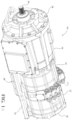
- a perspective view of one embodiment of a transmission is generally shown at 10.
- the transmission 10 is operatively connected to a first motor 12 and a second motor 14.
- the second motor 14 is mounted to the transmission 10 between the transmission 10 and the first motor 12.
- the first motor 12 has an output (discussed subsequently) that extends through the second motor 14 and to the transmission 10.
- the transmission 10 includes a transmission housing 16 having a housing cap 20.
- Figures 1A and 1B show the second motor 14 (B-Motor) secured to the transmission housing 16 and the first motor 12 (A-Motor) secured to the second motor 14 (B-Motor).
- a first motor output shaft 18 of the first motor 12 (A-Motor) defines a length 15 that is longer than a length 17 of the first motor 12.
- the first motor output shaft 18 also defines an outer diameter 19 at its distal end 21.
- the second motor 14 (B-Motor) includes a second motor output shaft 21.
- the second motor output shaft 21 defines an inner diameter 23 that is larger than the outer diameter 19 of the first motor output shaft 18.
- the first motor output shaft 18 extends through and is coaxial with the second motor output shaft 21. It should be appreciated by those skilled in the art that the first motor output shaft 18 may not extend all the way through the second motor output shaft 21.
- the first 12 and second 14 motors may be mounted on either side of the transmission 10. Oil used to cool the transmission 10, the first motor 12 and the second motor 14 is collected by a catch basin 22 and recirculated using a sump 24. Because the catch basin 22 extends along the entire length of the transmission 10, the first motor 12 and the second motor 14, only one sump 24 is necessary.
- the transmission 10 has an output shaft 26 that extends out through the center of the housing cap 20. Electrical ports 28 provide electrical access (power and communications) inside the first 12 and second 14 motors.
- the transmission 10, first motor 12, second motor 14, and sump 24 may be referred to as a powertrain, generally shown at 30.
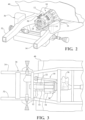
- the powertrain 30 is shown mounted between two rails 32, 34 of a vehicular frame, generally shown at 36.
- a body 40 including a passenger compartment (not shown), is shown fixedly secured to the vehicular frame 36.
- the transmission 10 is shown connected to a drive line 38 that drives four wheels (none shown).
- the input shaft 44 is also designated as shaft "1" in the power flow shown in Figure 5 .
- the transmission 10 also includes a first gearset, generally shown at 46, and a second gearset, generally shown at 50.
- the first gearset 46 includes first 52, second 54 and third 56 rotating members.
- the second gearset 50 includes a fourth 60, fifth 62, and sixth 64 rotating members.
- These gearsets 46, 50 may be any gearset that has three rotating members.
- Types of gearsets contemplated include, but are not limited to, Ravigneaux gearsets, Simpson gearsets and ring-carrier/ring-carrier gearsets.
- the gearsets 46, 50 shown in Figures 4 and 5 are ring-carrier/ring-carrier gearsets.
- a third configuration for the transmission 10 is shown wherein the transmission 10 receives inputs from the first motor 12 (A-Motor) and the second motor 14 (B-Motor).
- the gearset 112 used to direct the torques provided by the output shaft 26 is mirrored so that the torques provided by the output shaft 26 may be directed in two directions to drive two axle differentials 114 to, in turn, drive the driven axles 110.
- the first motor 12 can be powered independently of second motor 14.
- the three operating states of the powertrain 10 in SRM include power the first motor 12 only; power the second motor 14 only; and power the two motors 12, 14 together at the same time.
- the variables X, Y, and Z are determined by the sun and ring gear tooth counts in a ring-carrier/ring-carrier gearset.
- the variables are the same for all gearsets that can be defined by a four-node relationship. How X, Y and Z are calculated is dependent on the type of four-node lever relationship employed.
- FIG 13 illustrates a lever diagram showing the transmission 10 of figure 12 in transition from a speed ratio mode (as shown in Figure 12 ) into a torque ratio mode.
- the lever 132 represents the output in SRM
- the lever 134 represents the transmission 10 operating in a torque ratio mode (TRM).
- TRM torque ratio mode
- the torque ratio mode is a CVT mode.
- the second motor 14 provides the reaction torque for the first motor 12 and vice versa. Since the ratios of the first motor 12 (A-Motor) are typically numerically larger than the numeric ratio of the second motor 14 (B-Motor), the torque provided by the second motor 14 will be the limiting torque.
- M S1 and M S2 are defined as the moments about the first sun gear S1 and the second sun gear S2, respectively.
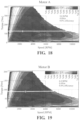
- Figures 18 and 19 show the first motor 12 and the second motor 14 operating at a defined torque, as represented by the horizontal lines showing constant torque and how the speed of the motors 12, 14 varies to maximize efficiency.
- the most efficient portion of the operation of the motors 12, 14 is in the darkest portion of the graph which is the center portion. It is ideal to operate in this range of speeds to maximize the efficiency of the motors 12, 14.
- FIG 20 a lever diagram showing the transmission 10 having two inputs ( Figures 1 and 11 ) according to the invention is shown.
- the lever diagram is substantially similar to lever diagram for the single-input transmission shown in Figure 5 .
- One difference between the two configurations is the transmission 10 has two input shafts 44, 126, wherein the first input shaft 44 receives torque from the first motor 12 (A-Motor) and the second input shaft 126 receives torque from the second motor 14 (B-Motor).
- Another difference between the two configurations is the use of two controllable clutches 140 (K23), 142 (K24) instead of the single controllable clutch 66 (K13).
- the output of the first motor 12 is received by the first input shaft 44 (shaft 1), which is fixedly secured to the fourth rotating member 60 (sun gear S2) of the second gearset 50.
- the output of the second motor 14 is received by the second input shaft 126 (shaft 2).
- the second input shaft 126 (shaft 2) is connected to the first controllable clutch 140 (K23) and the second controllable clutch 142 (K24).
- the first controllable clutch 140 (K23) operates in both directions as is indicated by the diodes 144, 146, which are oriented in opposite directions.
- a switch 150 illustrates that the clutch 140 (K23) is controllable and may be locked or allowed to rotate in both directions.
- the second controllable clutch 142 (K24) operates in both directions, as is indicated by the diodes 152, 154, which are oriented in opposite directions.
- a switch 156 illustrates that the controllable clutch 142 (K24) is controllable and may be locked or allowed to rotate in both directions.
- the first controllable clutch 140 couples the second input shaft 126 (shaft 2) and the output shaft 26 (shaft 3).
- the second controllable clutch 142 (K24) couples the second input shaft 126 (shaft 2) with the fourth shaft 80 (shaft 4).
- the output shaft 26 is fixedly secured to both the third rotating member 56 (ring R1) of the first gearset 46 and the fifth rotating member 62 (carrier C2) of the second gearset 50.
- the transmission 10 also includes a first controllable brake 76 (B04) that couples the first rotating member 52 (sun gear S1) of the first gearset 46 to the transmission housing 16.
- the first controllable brake 76 also has the symbol B04 because it is a brake that connects the transmission housing 16 (shaft 0) with a fourth shaft 80 (shaft 4).
- the first controllable brake 76 is similar to the controllable clutches 140, 142 in that it is represented by two diodes 82, 84 representing operation in either direction.
- the first controllable brake 76 is different from the controllable clutches 140, 142in that each direction of operation can be controlled independently of the other, as represented by the two switches 86, 90. Operation of the first controllable brake 76 will be discussed in greater detail subsequently.
- This transmission 10 also includes a second controllable brake 92 (B05) which couples the second rotating member 54 (carrier C1) of the first gearset 46 and the sixth rotating member 64 (ring R2) of the second gearset 50 to the transmission housing 16.
- the second controllable brake 92 differs from the first controllable brake 76 in that it only can control whether a notch plate 94 (shaft 5) is rotating, or if it is tied to the transmission housing 16 and prevented from rotating.
- the second controllable brake 92 only includes a single switch 96 representing the two states of the second controllable clutch 92 (B05) as being either on or off, and two diodes 100, 102 indicate that the second controllable brake 92 (B05) can lock in both directions or it can move freely in both directions.
- the second motor 14 (B-Motor) is able to drive the output shaft 26 (shaft 3) directly.
- the number of modes of operation increase due to this capability.
- the first motor output shaft 18 extends through the second motor output shaft 19.
- the second motor output shaft 19 is hollow providing a space through which the first motor output shaft 18 extends.
- the steady-state lever 104 represent when the host vehicle is not in motion.
- the operational lever 106 represents when the vehicle is moving through the operation of the first motor 12 (A Motor) and/or the second motor 14 (B Motor).
- the first controllable clutch 140 (K23) is open as represented by the switch 150 being open.
- the second controllable clutch 142 (K24) is closed. Therefore, the second motor 14 (B Motor) is coupled to the first rotating member 52 (sun gear S1) of the first gearset 46.
- the first rotating member 52 (sun gear S1) is not grounded to the transmission housing 16 because the first controllable brake 76 (B04) is open.
- the second controllable brake 92 (B05) is closed tying the second rotating member 54 (carrier C1) of the first gearset 46 and the sixth rotating member 64 (ring gear R2) of the second gearset 50 are ground to the transmission housing 16 through the notch plat 94 (shaft 5).
- first motor 12 is operating in the forward direction, indicated by arrow 160
- second motor 14 is operating in the reverse direction, indicated by arrow 162.
- exemplary torques are provided based on the designs of the gearsets 46, 50 and the motors 12, 14.
- first motor 12 (A Motor) provides a torque of 1000 NM on the second sun gear 60 (sun gear S2) and the output of the second motor 14 provides a torque of 1000 NM in the opposite direction on the first rotating member 52 (sun gear S1) results in a torque of 4272 NM on the second rotating member 54 (carrier C1) of the first gearset 46 and the sixth rotating member 64 (ring gear R2) of the second gearset 50 and an output torque of 6272 NM at the output shaft 26.
- first gear This is "first gear.”
- the transmission 10 is now in "third gear.” This is done by unlocking the second controllable brake 92 (B05), as represented by the open switch 96, and locking both directions of the first controllable brake 76, as represented by closing the two switches 86, 90 of the first controllable brake 76.
- the output shaft 26 (shaft 3) only receives 2725 NM of force in third gear.
- both controllable clutches 140, 142 (K23, K24) are closed allowing the second motor 14 (B-Motor) to apply torque to the first rotating member 52 (sun gear S1) as well as the output shaft 26 (shaft 3) via the combination of the third rotating member 56 (ring gear R1) and the fifth rotating member 62 (carrier C2).
- both controllable brakes 76, 92 (B04, B05) are opened such that none of the rotating members 52, 54, 56, 60, 62, 64 are ground to the transmission housing 16.
- the transmission 10 is now in "reverse.”
- the first motor 12 (A-Motor) is run in the opposite direction, as is indicated by arrow 166.
- the first controllable clutch 140 (K23) is open removing the second motor 14 (B-Motor) from being connected to the output shaft 26 (shaft 3).
- the second controllable clutch 142 (K24) is closed providing a path for the torque generated by the second motor 14 (B-Motor) in the forward direction 164, which is received by the first rotating member 52 (sun gear S1).
- the first controllable brake 76 (B04) is open so the first rotating member 52 (sun gear S1) is not ground to the transmission housing 16.
- the second controllable brake 92 (B05) is closed tying the second rotating member 54 (carrier C1) and the sixth rotating member 64 (ring gear R2) to ground (transmission housing 16).
- 1000 NM of reverse torque provided by the first motor 12 (A-Motor) and 1000 NM of forward torque provided by the second motor 14 (B-Motor) will result in 6273 NM of torque in the reverse direction at the output shaft 26 (shaft 3).
- Figures 25A through 25E are simplified representations of how the first motor 12 (A-Motor) and the second motor 14 (B-Motor) act on the lever that extends through the four nodes created by the first 46 and second 50 gearsets.
- the first motor 12 is effectively asserting a torque in the forward direction against the top node of the lever 104 and the second motor 14 is asserting a torque in the reverse direction against the bottom node of the lever 104.
- the first motor 12 maintains this configuration through Figure 25D , which represents the first motor 12 (A-Motor) has the same output starting at "first gear” through “fourth gear.” This results in the output shaft 26 (shaft 3) having a large torque in the forward direction commensurate with "first gear.”
- the second motor 14 (B-Motor) is applying a forwardly directed torque against the second node from the top, which also represents the output shaft 26 (shaft 3) and the second node of the four-node linkage (representing the second rotating member 54 (carrier C1) and the sixth rotating member 64 (ring gear R2)) is locked in place because the second controllable brake (B05) is grounding that node to the transmission housing 16.
- the second motor 14 (B-Motor) is again coupled to the first rotating member 52 (sun gear S1) and the first motor 12 (A-Motor) is running in reverse, resulting in the output shaft 26 (shaft 3) having a torque in the reverse direction, such that the transmission 10 is in "reverse.”
- Figures 27, 28 and 29 are block diagrams of three types of four-node linkage relationships for transmissions having two sets of gears.
- Figure 27 illustrates a Ravigneaux gearset and the respective four-node linkage representation thereof.
- Figure 28 represents a ring-carrier/ring-carrier gearset and the respective four-node linkage representation thereof.
- Figure 29 illustrates a Simpson gearset and the respective four-node linkage representation thereof.
- the transmission 10 is shown in a configuration that includes three inputs, which is not a part of the present invention.
- the three inputs include the first motor 12 (A-Motor), the second motor 14 (B-Motor) and an internal combustion engine 170 (ICE).
- A-Motor the first motor 12
- B-Motor the second motor 14
- ICE internal combustion engine 170
- the elements described above will have the same reference characters in when described in this section. While some of the parenthetic nomenclature changes (additional shafts require different connections), the reference characters will remain unchanged from above.
- the first controllable clutch 140 (K23), the second controllable clutch (K36), the first controllable brake 76 (B06), the second controllable brake (B07) and the four-node linkage representing first 46 and second 50 gearsets are all connected in the same configuration as was discussed above.
- the addition of the internal combustion engine 170 requires the addition of a third gearset 172 having a seventh rotating member 174 (sun gear S0), an eighth rotating member 176 (ring gear R0) and a ninth rotating member 180 (annulus A0).
- the output of the internal combustion engine 170 (ICE) is coupled to the eighth rotating member 176 (ring gear R0).
- the ninth rotating member 180 (annulus A0) is coupled to the first input shaft 44 (shaft 1), which is coupled to the fourth rotating member 60 (sun gear S2).
- the seventh rotating member 174 (sun gear S0) is operatively connected to the second motor 14 (B-Motor) through a third controllable clutch 182 (K45).
- the second motor 14 (B-Motor) is also coupled to the second controllable clutch 142 (K36) through a fourth controllable clutch 184 (K34). Finally, the second motor 14 (B-Motor) is also coupled to the transmission housing 16 (ground) through a third controllable brake 186 B04).
- the modes of operation include the use of the transmission 10 without the use of the internal combustion engine 170 (ICE).
- Hybrid Mode is shown in the next four rows wherein the first motor 12 (A-Motor), the second motor 14 (B-Motor) and the internal combustion engine 170 (ICE) all provide torques during certain defined conditions in the operation of the vehicle.
- the transmission 10 may operate in gas only mode, as is indicated in the next two rows identified by "ICE.” These modes rely exclusively on the torque provided by the internal combustion engine 170 (ICE).
- "Park” Mode is the next row, which identifies when the vehicle has a zero speed and is not engaged to move.
- "Hill Hold” Mode is a mode that allows the vehicle to maintain a position on a hill while being ready to move in a direction opposite the direction of the hill.
- the last mode is “Generator” Mode whereby the vehicle can use the second motor 14 (B-Motor) as a generator to power or charge a device or circuit (neither shown) that is electrically connectable to an electrical port/outlet (not shown) that is electrically connected to the second motor 14 (B-Motor).
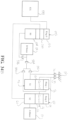
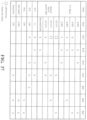
- the controllable clutches 140, 142, 182, 184 and the controllable brakes 76, 92, 186 are identified in the table in Figure 37 to show which of these devices are active to facilitate any one of the modes identified above and in Figure 37 .
- FIG. 32 another example embodiment of the three-input configuration is shown.
- the difference between the example embodiment shown in Figure 30 and that which is shown in Figure 32 is the type of clutches used.
- the third controllable clutch 182 (K45), the fourth controllable clutch 184 (K34) and the third controllable brake 186 (B04) are all binary devices.
- These devices 182, 184, 186 are all replaced with a single three-position clutch 190, wherein the three-position clutch 190 couples shaft 2 to shaft 4 connecting the second motor 14 (B-Motor) to the seventh rotating member 174 (sun gear S0) in one position; it couples the second motor 14 (B-Motor) to the second controllable clutch 142 (K36); or, it leaves the second motor 14 (B-Motor) detached from the rest of the transmission 10.
- a brake 192 (B04) is added between the three-position clutch 190 and the seventh rotating member 174 (sun gear S0).
- This brake 192 (B04) grounds the seventh rotating member 174 (sun gear S0) to allow the internal combustion engine 170 (ICE) to operate in an overdrive mode.
- FIGS 34A through 36 block diagrams of the example embodiments shown in Figures 30 , 32 and 33 are shown. These drawings represent how a transmission 10 would be laid out in design.
- the block diagram represents the transmission 10 shown in the lever diagram of Figure 30 .
- the block diagram represents the transmission 10 shown in the lever diagram of Figure 33 but with two two-way clutches instead of a three-way clutch.
- the block diagram represents the transmission 10 shown in the lever diagram of Figure 32 .
- Figure 36 the block diagram represents the transmission 10 shown in the lever diagram of Figure 33 .
- the transmission 10 is modular in that it can be configured differently while maintaining almost all of the content inside the transmission housing 16 the same.
- the design of the transmission 10 allows it to be scaled up to handle larger ranges of torques based on the host vehicle into which the transmission 10 will be installed.
- the first input shaft 44 is the only input shaft.
- This embodiment only uses one input from the first motor 12 (A-Motor). In a sense, this is the most basic configuration of the transmission 10.
- the transmission has two input shafts 44, 126.
- the first input shaft 44 has an outer diameter 194 and the second input shaft 126 has inner diameter 196, with the outer diameter 194 of the first input shaft 44 being less than the inner diameter 196 of the second input shaft 126.
- the first input shaft 44 extends through the second input shaft 126.
- the second input shaft 126 is a pocket plate.
- the second controllable clutch 142 K24
- the housing cap 20 can be one of several housing caps 20 to be used. Each housing cap 20 is configured to be mounted to the transmission housing 16 whereby the housing cap 20 provides for a different operational configuration. Referring to Figure 39 , the housing cap 20 is extends out further away from the transmission housing 16 more than the housing cap 20 of Figure 38 . This is because the housing cap 20 of Figure 39 houses a gearset 200 to be used as a torque multiplier. Because the transmission 10 is modular, the additional torque multiplier 200 can be added to the transmission 10 and the transmission 10 can be interchangeable between a version that has a torque multiplying gearset 200 ( Figure 39 ) and a version that is supplied without a torque multiplying gearset 200 ( Figure 38 ).
Landscapes
- Engineering & Computer Science (AREA)
- Mechanical Engineering (AREA)
- General Engineering & Computer Science (AREA)
- Chemical & Material Sciences (AREA)
- Combustion & Propulsion (AREA)
- Transportation (AREA)
- Structure Of Transmissions (AREA)
- Hybrid Electric Vehicles (AREA)
Description
- The invention relates to transmission assemblies used to control torque received from a power source and to provide an output torque to driven wheels of a vehicle. More particularly, the invention relates to transmission assemblies used to control torque received from a power source and to provide an output torque to driven wheels of a vehicle without the use of friction, hydraulics, or pneumatics.
- All electric, hybrid electric, and plug-in hybrid electric vehicles (collectively referred to as EVs) have a powertrain to transfer power from various power generators to the driven wheels of the vehicle. Traditional transmissions utilize hydraulics and friction to operate. These two performance principles work well in the traditional transmission when powered by an internal combustion engine. The physics of these traditional transmission result in extreme amounts of energy waste, preventing their incorporation into EVs due to the limitations on range these losses create.
US Patent 8,241,166 B2 discloses a powertrain for a hybrid vehicle. While the powertrain utilizes a transmission that incorporates input torques from three different sources (an internal combustion engine and two motors), the transmission is incapable of performing such actions as hill-hold and park because it incorporates traditional hydraulically activated friction clutches. - According to the invention, this object is solved by the combination of features of
claim 1. The dependent claims show further advantageous embodiments of the invention. - Advantages of the invention will be readily appreciated as the same becomes better understood by reference to the following detailed description when considered in connection with the accompanying drawings, wherein:
-
Figure 1A is a perspective view of one embodiment of a vehicular powertrain; -
Figure 1B is a schematic drawing of a cross-section of the embodiment shown inFigure 1A ; -
Figure 2 is a perspective view of the powertrain embodiment shown inFigure 1 mounted to a vehicle; -
Figure 3 is a bottom view of a vehicle with the powertrain embodiment shown inFigure 1 mounted thereto; -
Figure 4 is a cross-sectional side view of a first example embodiment of a transmission having one input, which is not a part of the present invention; -
Figure 5 is a lever diagram for the transmission shown inFigure 4 ; -
Figure 6 is a schematic view of the transmission ofFigure 4 operatively secured to a differential of a driven axle; -
Figure 7 is a schematic view of a transmission having two inputs wherein the transmission is operatively secured to a differential of a driven axle; -
Figure 8 is a schematic view of the transmission having two inputs wherein the transmission is operatively secured to two different differentials of two different axles; -
Figure 9 is a top view of the transmission shown inFigure 8 with exemplary gearing showing the connections to two axles; -
Figure 10 is a side view taken along lines 10-10 ofFigure 9 ; -
Figure 11 is a bisected cross-sectional side view of the transmission having two inputs according to the present invention; -
Figures 12 through 15 are lever diagrams of a second example embodiment of a transmission having two inputs, which is not a part of the present invention; -
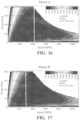
Figures 16 and 17 are graphs showing the output torque of two motors as a function of rotational speed wherein the rotational speed is maintained constant; -
Figures 18 and 19 are the same two graphs as shown inFigures 16 and 17 , respectively, wherein the torque is maintained constant; -
Figures 20 through 24 are lever diagrams of an embodiment of a transmission having two inputs according to the present invention; -
Figures 25A through 25E are simplified lever diagrams showing the connections between the two input motors and the transmission shown inFigures 20 through 24 ; -
Figure 26 is a table showing which clutches are on in the different modes of the embodiment of the transmission having two inputs according to the present invention; -
Figure 27 is a block diagram of a Ravigneaux gearset and a representative lever diagram thereof, which is not a part of the present invention; -
Figure 28 is a block diagram of a ring-carrier/ring-carrier gearset and a representative lever diagram thereof according to the present invention; -
Figure 29 is a block diagram of a Simpson gearset and a representative lever diagram thereof, which is not a part of the present invention; -
Figure 30 is a lever diagram of third example embodiment of a transmission having three inputs, which is not a part of the present invention; -
Figure 31 is a table showing which clutches of the third example embodiment of the transmission shown inFigure 33 are on based on the state of the inputs; -
Figures 32 through 36 are lever diagrams of differing example embodiments a transmission having three inputs; -
Figure 37 is a table showing which clutches of the third example embodiment of the transmission shown inFigure 30 are on based on the state of the inputs; and -
Figures 38 and39 are cross-sectional side views of two embodiments of the transmission according to the invention having two inputs with each having a different end cap for the housing. - For purposes of this discussion, elements will be identified by reference characters, typically reference numerals. There are several embodiments shown in the Figures that will be described in detail below. For purposes of simplicity, these elements will retain their reference characters throughout the discussion. If an element has characteristics that are different from one embodiment to another, those differences will be discussed when introducing the same element for the new embodiment.
- Referring to
Figure 1A , a perspective view of one embodiment of a transmission is generally shown at 10. In this Figure, thetransmission 10 is operatively connected to afirst motor 12 and asecond motor 14. Physically, thesecond motor 14 is mounted to thetransmission 10 between thetransmission 10 and thefirst motor 12. Thefirst motor 12 has an output (discussed subsequently) that extends through thesecond motor 14 and to thetransmission 10. - The
transmission 10 includes atransmission housing 16 having ahousing cap 20.Figures 1A and1B show the second motor 14 (B-Motor) secured to thetransmission housing 16 and the first motor 12 (A-Motor) secured to the second motor 14 (B-Motor). A firstmotor output shaft 18 of the first motor 12 (A-Motor) defines alength 15 that is longer than a length 17 of thefirst motor 12. The firstmotor output shaft 18 also defines anouter diameter 19 at its distal end 21. - The second motor 14 (B-Motor) includes a second motor output shaft 21. The second motor output shaft 21 defines an inner diameter 23 that is larger than the
outer diameter 19 of the firstmotor output shaft 18. The firstmotor output shaft 18 extends through and is coaxial with the second motor output shaft 21. It should be appreciated by those skilled in the art that the firstmotor output shaft 18 may not extend all the way through the second motor output shaft 21. - In alternative embodiments that will be discussed in greater detail below, the first 12 and second 14 motors may be mounted on either side of the
transmission 10. Oil used to cool thetransmission 10, thefirst motor 12 and thesecond motor 14 is collected by acatch basin 22 and recirculated using asump 24. Because thecatch basin 22 extends along the entire length of thetransmission 10, thefirst motor 12 and thesecond motor 14, only onesump 24 is necessary. Thetransmission 10 has anoutput shaft 26 that extends out through the center of thehousing cap 20.Electrical ports 28 provide electrical access (power and communications) inside the first 12 and second 14 motors. Thetransmission 10,first motor 12,second motor 14, andsump 24 may be referred to as a powertrain, generally shown at 30. - Referring to
Figures 2 and 3 , thepowertrain 30 is shown mounted between tworails body 40, including a passenger compartment (not shown), is shown fixedly secured to thevehicular frame 36. Referring specifically toFigure 3 , thetransmission 10 is shown connected to adrive line 38 that drives four wheels (none shown). - Referring to
Figures 4 through 6 , thetransmission 10 is shown in a configuration for operating with a single input. In this configuration, which is not a part of the present invention, the single input is thefirst motor 12 fixedly secured directly to thetransmission housing 16 in the absence of thesecond motor 14. Thefirst motor 12 is not shown inFigure 4 , but the firstmotor output shaft 18 would be received by theinput shaft 44. - The
input shaft 44 is also designated as shaft "1" in the power flow shown inFigure 5 . Thetransmission 10 also includes a first gearset, generally shown at 46, and a second gearset, generally shown at 50. Thefirst gearset 46 includes first 52, second 54 and third 56 rotating members. Thesecond gearset 50 includes a fourth 60, fifth 62, and sixth 64 rotating members. Thesegearsets gearsets Figures 4 and5 are ring-carrier/ring-carrier gearsets. Because these gearsets are ring-carrier/ring-carrier gearsets, the first, second and third rotating members are a sun gear, a carrier and a ring gear, respectively. These are indicated as S1, C1, and R1 for thefirst gearset 46 and S2, C2, and R2 for thesecond gearset 50. Two rotating members from thefirst gearset 46 and two rotating members from thesecond gearset 50 are fixedly secured to each other. These connections create a four-node linkage for thetransmission 10. As such, each pair of rotating members is represented by a single circle inFigure 5 . Therefore, the third rotating member 56 (ring gear R1) and the fifth rotating member 62 (carrier C2) are fixedly secured to each other and represented by bothreference numerals Figure 5 , whereas the second rotating member 54 (carrier C1) and the sixth rotating member 64 (ring gear R2) are fixedly secured to each other and represented by bothreference numerals Figure 5 . - The
output shaft 26 of thetransmission 10 is also fixedly secured to two rotating members, one from eachgearset Figures 4 and5 , theoutput shaft 26 is fixedly secured to the third rotating member 56 (the ring gear R1of thefirst gearset 46 and the fifth rotatingmember 62 of the second gearset 50 (the carrier C2 of the second gearset 50). Themotor 12 is connected directly to the fourth rotatingmember 60 of thesecond gearset 50 using the input shaft 44 (shaft 1). - A controllable clutch 66 is connected between the input shaft 44 (shaft 1) at one end and the output shaft 26 (shaft 3) at the other end. The controllable clutch 66 is also represented by the nomenclature K13 because it couples
shafts Figure 5 , the controllable clutch 66 is represented by aswitch 70 and two diodes 72, 74. These threeelements 70, 72, 74 represent the attributes of the controllable clutch 66. More specifically, theswitch 70 signifies that the controllable clutch 66 may be turned on and off. The diodes 72, 74 represent the fact that the controllable clutch 66 may either bidirectionally lock the third rotating member 56 (ring gear R1), the fifth rotating member 62 (second carrier C2) and the output shaft 26 (shaft 3), or allow thoseelements switch 70 is closed, representing the active state for the controllable clutch 66, theoutput shaft 26 rotates with the rotation of theinput shaft 44. When theswitch 70 is open, representing an inactive state for the controllable clutch 66, theoutput shaft 26 does not rotate or, alternatively, rotates based on the torques it receives from the otherrotating elements - The
transmission 10 also includes a first controllable brake 76 (B04) that couples the first rotating member 52 (sun gear S1) of thefirst gearset 46 to thetransmission housing 16. The first controllable brake 76 also has the symbol B04 because it is a brake that connects shaft 0 (which is just the transmission housing 16) with a fourth shaft 80 (shaft 4). The first controllable brake 76 (B04) is similar to the controllable clutch 66 in that it is represented by twodiodes 82, 84 representing that it will lock and allow rotation in either direction. The first controllable brake 76 (B04) is different from the controllable clutch 66 in that each direction of operation can be controlled independently of the other, as represented byswitches - This
transmission 10 also includes a secondcontrollable brake 92 which couples the second rotating member 54 (carrier C1) of thefirst gearset 46 and the sixth rotating member 64 (ring R2) of thesecond gearset 50 to thetransmission housing 16. The secondcontrollable brake 92 differs from the first controllable brake 76 in that it only has the ability to control whether a notch plate 94 (shaft 5) is rotating or if it is tied to thetransmission housing 16 and prevented from rotating. As such, the secondcontrollable brake 92 only includes a single switch 96 representing the two states of the second controllable clutch 92 (B05) as being either on or off, and twodiodes -
Figure 5 also includes twolevers levers transmission 10 affect the torque provided at the output shaft 26 (shaft 3). Thefirst lever 104 represents when no speed is applied to the output shaft 26 (shaft 3) and/or when thetransmission 10 is at rest. Thesecond lever 106 represents atransmission 10 in a state of operation that will be discussed in greater detail subsequently. - Referring to
Figure 6 , thetransmission 10 is shown with themotor 12 secured transverse to a drivenaxle 110. The torque at the output shaft 26 (not shown inFigure 6 ) is redirected using agearset 112 that connects theoutput shaft 26 to an axle differential 114. As is well known in the art, theaxle 110drives wheels 116 andtires 120. - Referring to
Figure 7 , an embodiment of thetransmission 10 according to the invention is shown attached transversely to an axle differential 114 via thegearset 112 in a manner similar to that which was shown in the first embodiment inFigure 6 . The difference between thistransmission 10 in the transmission of the prior Figure is that thistransmission 10 receives two inputs, one from the first motor 12 (A-Motor) and one from a second motor 14 (B-Motor). It may be appreciated by those skilled in the art that thetransmission 10 with inputs from a first motor 12 (A-Motor) and a second motor 14 (B-Motor) will provide a wider range of torque at theoutput shaft 26. - Referring to
Figure 8 , a third configuration for thetransmission 10 is shown wherein thetransmission 10 receives inputs from the first motor 12 (A-Motor) and the second motor 14 (B-Motor). Thegearset 112 used to direct the torques provided by theoutput shaft 26 is mirrored so that the torques provided by theoutput shaft 26 may be directed in two directions to drive two axle differentials 114 to, in turn, drive the drivenaxles 110. - Referring to
Figures 9 and 10 , the third configuration of thetransmission 10 is shown with anexample gearset 112 shown directing output torque in two different directions to drive the twoaxles 110. Thisgearset 112 is shown to be in line with theoutput shaft 26, thetransmission 10 and themotors - Referring to
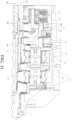
Figure 11 , the cross-sectional side view illustrates the two-input configuration of thetransmission 10 shown inFigures 7 through 10 and discussed above (as stated above, elements discussed above will retain the same reference characters in this and any subsequent embodiment). In this embodiment, theinput shaft 44 becomes thefirst input shaft 44. While thefirst input shaft 44 is identical to theinput shaft 44 in the one-input embodiment discussed above, acoupling end 124 of thefirst input shaft 44 has the same outer diameter and a much larger inner diameter. In other words, thecoupling end 124 of thefirst input shaft 44 is thinner than that of theinput shaft 44 in the one-input example embodiment shown inFigure 4 . - A second input shaft is a
pocket plate 126. Thesecond input shaft 126 is coaxial with thefirst input shaft 44. Thesecond input shaft 126 receives torque from the secondmotor output shaft 19, whereas thecoupling end 124 of thefirst input shaft 44 receives torque from a firstmotor output shaft 18 of thefirst motor 12. The first 12 (A-Motor) and second 14 (B-Motor) motors provide independent inputs into thetransmission 10 to provide multiple modes of operation for the overall powertrain. The inputs of the first 12 and second 14 motors are torques that are transferred to thetransmission 10 through the first 44 and second 126 input shafts. - Both first 12 and second 14 input motors are electric. These
motors powertrain 10 is operating. In the power flow Figures that follow, thefirst input motor 12 and thesecond input motor 14 are designated as "A-Motor" and "B-Motor," respectively. - Referring to
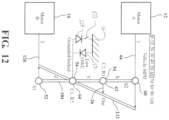
Figure 12 , thetransmission 10, which is not a part of the present invention, is shown to be operating from launch through mid-range vehicle speeds (0-60 MPH). A low one-way clutch 131, represented by a diode is used to ground/lock (transmission housing 16) the second rotating member 54 (carrier C1) and the sixth rotating member 64 (ring gear R2). Another clutch 129 is switchable viaswitch 133 to allow the second rotating member 54 (carrier C1) and the sixth rotating member 64 (ring gear R2) to rotate. - At these speeds, the
transmission 10 is in Speed Ratio Mode (SRM). Alever 132 represents the output in SRM. In SRM, the speeds of the first 12 and second 14 motors are a fixed ratio relative to output speed. Thefirst motor 12 has a ratio A to output and thesecond motor 14 has a ratio B to output. So, in SRM for a given vehicle speed, the speed of themotors Figures 16 and 17 , where the vertical line represents a particular speed at which the first 10 and second 12 motors are operating. The goal is to provide the proper torque output at that speed to maximize the efficiency of themotors Figure 16 and 17 , the center portions of the shaded graphed area are the ranges in which themotors - In SRM, the
first motor 12 can be powered independently ofsecond motor 14. The three operating states of thepowertrain 10 in SRM include power thefirst motor 12 only; power thesecond motor 14 only; and power the twomotors - While the speed of the
motors motor

where: - TA = torque of the
first motor 12; - TB = torque of the
second motor 14; - ((X+Y)/Y) is the ratio for the
first motor 12; and - (Z/Y) is the ratio for the
second motor 14. - The variables X, Y, and Z are determined by the sun and ring gear tooth counts in a ring-carrier/ring-carrier gearset. The variables are the same for all gearsets that can be defined by a four-node relationship. How X, Y and Z are calculated is dependent on the type of four-node lever relationship employed.
-
Figure 13 illustrates a lever diagram showing thetransmission 10 offigure 12 in transition from a speed ratio mode (as shown inFigure 12 ) into a torque ratio mode. Again, thelever 132 represents the output in SRM, whereas thelever 134 represents thetransmission 10 operating in a torque ratio mode (TRM). The benefit of operating in TRM is that it allows the efficient operation of the powertrain at higher vehicle speeds, as is shown inFigure 14 . The torque ratio mode is a CVT mode. Thesecond motor 14 provides the reaction torque for thefirst motor 12 and vice versa. Since the ratios of the first motor 12 (A-Motor) are typically numerically larger than the numeric ratio of the second motor 14 (B-Motor), the torque provided by thesecond motor 14 will be the limiting torque. There are three formulas that must be adhered to in torque ratio mode. They include:


wherein MS1 and MS2 are defined as the moments about the first sun gear S1 and the second sun gear S2, respectively. -
Figures 18 and 19 show thefirst motor 12 and thesecond motor 14 operating at a defined torque, as represented by the horizontal lines showing constant torque and how the speed of themotors motors motors - Referring to
Figure 20 , a lever diagram showing thetransmission 10 having two inputs (Figures 1 and11 ) according to the invention is shown. The lever diagram is substantially similar to lever diagram for the single-input transmission shown inFigure 5 . One difference between the two configurations is thetransmission 10 has twoinput shafts first input shaft 44 receives torque from the first motor 12 (A-Motor) and thesecond input shaft 126 receives torque from the second motor 14 (B-Motor). Another difference between the two configurations is the use of two controllable clutches 140 (K23), 142 (K24) instead of the single controllable clutch 66 (K13). - The output of the first motor 12 (A-Motor) is received by the first input shaft 44 (shaft 1), which is fixedly secured to the fourth rotating member 60 (sun gear S2) of the
second gearset 50. The output of the second motor 14 (B-Motor) is received by the second input shaft 126 (shaft 2). The second input shaft 126 (shaft 2) is connected to the first controllable clutch 140 (K23) and the second controllable clutch 142 (K24). The first controllable clutch 140 (K23) operates in both directions as is indicated by thediodes 144, 146, which are oriented in opposite directions. Aswitch 150 illustrates that the clutch 140 (K23) is controllable and may be locked or allowed to rotate in both directions. The second controllable clutch 142 (K24) operates in both directions, as is indicated by thediodes 152, 154, which are oriented in opposite directions. A switch 156 illustrates that the controllable clutch 142 (K24) is controllable and may be locked or allowed to rotate in both directions. - The first controllable clutch 140 (K23) couples the second input shaft 126 (shaft 2) and the output shaft 26 (shaft 3). The second controllable clutch 142 (K24) couples the second input shaft 126 (shaft 2) with the fourth shaft 80 (shaft 4). As discussed above, the
output shaft 26 is fixedly secured to both the third rotating member 56 (ring R1) of thefirst gearset 46 and the fifth rotating member 62 (carrier C2) of thesecond gearset 50. - The
transmission 10 also includes a first controllable brake 76 (B04) that couples the first rotating member 52 (sun gear S1) of thefirst gearset 46 to thetransmission housing 16. The first controllable brake 76 also has the symbol B04 because it is a brake that connects the transmission housing 16 (shaft 0) with a fourth shaft 80 (shaft 4). The first controllable brake 76 is similar to thecontrollable clutches diodes 82, 84 representing operation in either direction. The first controllable brake 76 is different from thecontrollable clutches 140, 142in that each direction of operation can be controlled independently of the other, as represented by the twoswitches - This
transmission 10 also includes a second controllable brake 92 (B05) which couples the second rotating member 54 (carrier C1) of thefirst gearset 46 and the sixth rotating member 64 (ring R2) of thesecond gearset 50 to thetransmission housing 16. The secondcontrollable brake 92 differs from the first controllable brake 76 in that it only can control whether a notch plate 94 (shaft 5) is rotating, or if it is tied to thetransmission housing 16 and prevented from rotating. As such, the secondcontrollable brake 92 only includes a single switch 96 representing the two states of the second controllable clutch 92 (B05) as being either on or off, and twodiodes - Because the first 46 and second 50 gearsets are ring-carrier/ring-carrier gearsets, the connections described in the power flow in
Figure 20 , and the first 18 and second 19 motor output shafts are coaxial, the second motor 14 (B-Motor) is able to drive the output shaft 26 (shaft 3) directly. The number of modes of operation increase due to this capability. In the embodiments shown in the Figures, the firstmotor output shaft 18 extends through the secondmotor output shaft 19. As such, the secondmotor output shaft 19 is hollow providing a space through which the firstmotor output shaft 18 extends. - In
Figure 20 , the steady-state lever 104 represent when the host vehicle is not in motion. Theoperational lever 106 represents when the vehicle is moving through the operation of the first motor 12 (A Motor) and/or the second motor 14 (B Motor). The first controllable clutch 140 (K23) is open as represented by theswitch 150 being open. In addition, the second controllable clutch 142 (K24) is closed. Therefore, the second motor 14 (B Motor) is coupled to the first rotating member 52 (sun gear S1) of thefirst gearset 46. The first rotating member 52 (sun gear S1) is not grounded to thetransmission housing 16 because the first controllable brake 76 (B04) is open. Finally, the second controllable brake 92 (B05) is closed tying the second rotating member 54 (carrier C1) of thefirst gearset 46 and the sixth rotating member 64 (ring gear R2) of thesecond gearset 50 are ground to thetransmission housing 16 through the notch plat 94 (shaft 5). - In this configuration, the
first motor 12 is operating in the forward direction, indicated byarrow 160, and thesecond motor 14 is operating in the reverse direction, indicated by arrow 162. By way of example, and in not to be limiting, exemplary torques are provided based on the designs of thegearsets motors second motor 14 provides a torque of 1000 NM in the opposite direction on the first rotating member 52 (sun gear S1) results in a torque of 4272 NM on the second rotating member 54 (carrier C1) of thefirst gearset 46 and the sixth rotating member 64 (ring gear R2) of thesecond gearset 50 and an output torque of 6272 NM at theoutput shaft 26. This is "first gear." - Referring to
Figure 21 , this is the same embodiment as that ofFigure 20 with thetransmission 10 in a different state. More specifically, the second motor 14 (B Motor) as an output of 1000 NM in the forward direction as is indicated byarrow 164. The first motor 12 (A Motor) continues to output a torque of 1000 NM in the forward direction as is indicated by theforward arrow 160. The first controllable clutch 140 (K23) is now closed and the secondcontrollable clutch 142 is now open. With the first 76 and second 92 controllable brakes (B04 and B05) unchanged from the state they were in inFigure 26 , thetransmission 10 is in "second gear" with an output torque at theoutput shaft 26 of 4636 NM. - Referring to
Figure 22 , thetransmission 10 is now in "third gear." This is done by unlocking the second controllable brake 92 (B05), as represented by the open switch 96, and locking both directions of the first controllable brake 76, as represented by closing the twoswitches - Referring to
Figure 23 , thetransmission 10 is shown in "fourth gear." Bothcontrollable clutches 140, 142 (K23, K24) are closed allowing the second motor 14 (B-Motor) to apply torque to the first rotating member 52 (sun gear S1) as well as the output shaft 26 (shaft 3) via the combination of the third rotating member 56 (ring gear R1) and the fifth rotating member 62 (carrier C2). In addition, both controllable brakes 76, 92 (B04, B05) are opened such that none of therotating members transmission housing 16. - Referring to
Figure 24 , thetransmission 10 is now in "reverse." The first motor 12 (A-Motor) is run in the opposite direction, as is indicated byarrow 166. The first controllable clutch 140 (K23) is open removing the second motor 14 (B-Motor) from being connected to the output shaft 26 (shaft 3). The second controllable clutch 142 (K24) is closed providing a path for the torque generated by the second motor 14 (B-Motor) in theforward direction 164, which is received by the first rotating member 52 (sun gear S1). The first controllable brake 76 (B04) is open so the first rotating member 52 (sun gear S1) is not ground to thetransmission housing 16. The second controllable brake 92 (B05) is closed tying the second rotating member 54 (carrier C1) and the sixth rotating member 64 (ring gear R2) to ground (transmission housing 16). Continuing with the numerical example started above, 1000 NM of reverse torque provided by the first motor 12 (A-Motor) and 1000 NM of forward torque provided by the second motor 14 (B-Motor) will result in 6273 NM of torque in the reverse direction at the output shaft 26 (shaft 3). -
Figures 25A through 25E are simplified representations of how the first motor 12 (A-Motor) and the second motor 14 (B-Motor) act on the lever that extends through the four nodes created by the first 46 and second 50 gearsets. InFigure 25A , thefirst motor 12 is effectively asserting a torque in the forward direction against the top node of thelever 104 and thesecond motor 14 is asserting a torque in the reverse direction against the bottom node of thelever 104. The first motor 12 (A-Motor) maintains this configuration throughFigure 25D , which represents the first motor 12 (A-Motor) has the same output starting at "first gear" through "fourth gear." This results in the output shaft 26 (shaft 3) having a large torque in the forward direction commensurate with "first gear." InFigure 25B , the second motor 14 (B-Motor) is applying a forwardly directed torque against the second node from the top, which also represents the output shaft 26 (shaft 3) and the second node of the four-node linkage (representing the second rotating member 54 (carrier C1) and the sixth rotating member 64 (ring gear R2)) is locked in place because the second controllable brake (B05) is grounding that node to thetransmission housing 16. InFigure 25C , themotors member 52 to the transmission housing 16 (ground). InFigure 25D , themotors lever 104 representing the vehicle existing at 0 mph (at zero speed). InFigure 25E , the second node is again locked to ground. In this configuration, the second motor 14 (B-Motor) is again coupled to the first rotating member 52 (sun gear S1) and the first motor 12 (A-Motor) is running in reverse, resulting in the output shaft 26 (shaft 3) having a torque in the reverse direction, such that thetransmission 10 is in "reverse." - Referring to
Figure 26 , a table of the different modes in which the transmission operates based on the clutch activation is shown. For the varying modes, "A1B1" is "first gear," "A1B2" is "second gear," "A2B2" is "third gear, "A3B2" is fourth gear and "Rev" is "reverse." Thetransmission 10 in the configuration shown inFigures 11 and20 through 24 also can operate in two additional modes, "Park" and "Hill Hold." By turning both of thecontrollable brakes 76, 92 on, the bottom two nodes of the four-node linkage are coupled to thetransmission housing 16, resulting in no movement of thetransmission 10. This is a "park" state preventing movement of the vehicle. In "Hill Hold" mode, only one of thediodes 82, 84 is turned on, preventing the vehicle from rolling down a hill. This is useful when stopped on a hill. The direction the vehicle is in when it is on the hill will dictate which of the twoswitches -
Figures 27, 28 and29 are block diagrams of three types of four-node linkage relationships for transmissions having two sets of gears.Figure 27 illustrates a Ravigneaux gearset and the respective four-node linkage representation thereof.Figure 28 represents a ring-carrier/ring-carrier gearset and the respective four-node linkage representation thereof. AndFigure 29 illustrates a Simpson gearset and the respective four-node linkage representation thereof. - Referring to
Figure 30 , thetransmission 10 is shown in a configuration that includes three inputs, which is not a part of the present invention. In the example embodiment shown, the three inputs include the first motor 12 (A-Motor), the second motor 14 (B-Motor) and an internal combustion engine 170 (ICE). As stated above, the elements described above will have the same reference characters in when described in this section. While some of the parenthetic nomenclature changes (additional shafts require different connections), the reference characters will remain unchanged from above. - The first controllable clutch 140 (K23), the second controllable clutch (K36), the first controllable brake 76 (B06), the second controllable brake (B07) and the four-node linkage representing first 46 and second 50 gearsets are all connected in the same configuration as was discussed above.
- The addition of the internal combustion engine 170 (ICE) requires the addition of a
third gearset 172 having a seventh rotating member 174 (sun gear S0), an eighth rotating member 176 (ring gear R0) and a ninth rotating member 180 (annulus A0). The output of the internal combustion engine 170 (ICE) is coupled to the eighth rotating member 176 (ring gear R0). The ninth rotating member 180 (annulus A0) is coupled to the first input shaft 44 (shaft 1), which is coupled to the fourth rotating member 60 (sun gear S2). The seventh rotating member 174 (sun gear S0) is operatively connected to the second motor 14 (B-Motor) through a third controllable clutch 182 (K45). - The second motor 14 (B-Motor) is also coupled to the second controllable clutch 142 (K36) through a fourth controllable clutch 184 (K34). Finally, the second motor 14 (B-Motor) is also coupled to the transmission housing 16 (ground) through a third controllable brake 186 B04).
- The operation of the
transmission 10, when it incorporates the use of the internal combustion engine 170 (ICE) as depicted inFigure 30 , the modes of operation include the use of thetransmission 10 without the use of the internal combustion engine 170 (ICE). This is the EV Mode (the first four rows of the table shown inFigure 37 ). Hybrid Mode is shown in the next four rows wherein the first motor 12 (A-Motor), the second motor 14 (B-Motor) and the internal combustion engine 170 (ICE) all provide torques during certain defined conditions in the operation of the vehicle. Thetransmission 10 may operate in gas only mode, as is indicated in the next two rows identified by "ICE." These modes rely exclusively on the torque provided by the internal combustion engine 170 (ICE). "Park" Mode is the next row, which identifies when the vehicle has a zero speed and is not engaged to move. "Hill Hold" Mode is a mode that allows the vehicle to maintain a position on a hill while being ready to move in a direction opposite the direction of the hill. The last mode is "Generator" Mode whereby the vehicle can use the second motor 14 (B-Motor) as a generator to power or charge a device or circuit (neither shown) that is electrically connectable to an electrical port/outlet (not shown) that is electrically connected to the second motor 14 (B-Motor). Thecontrollable clutches controllable brakes 76, 92, 186 are identified in the table inFigure 37 to show which of these devices are active to facilitate any one of the modes identified above and inFigure 37 . - Referring to
Figure 32 , another example embodiment of the three-input configuration is shown. The difference between the example embodiment shown inFigure 30 and that which is shown inFigure 32 is the type of clutches used. In the example embodiment shown inFigure 30 , the third controllable clutch 182 (K45), the fourth controllable clutch 184 (K34) and the third controllable brake 186 (B04) are all binary devices. These devices 182, 184, 186 are all replaced with a single three-position clutch 190, wherein the three-position clutch 190couples shaft 2 toshaft 4 connecting the second motor 14 (B-Motor) to the seventh rotating member 174 (sun gear S0) in one position; it couples the second motor 14 (B-Motor) to the second controllable clutch 142 (K36); or, it leaves the second motor 14 (B-Motor) detached from the rest of thetransmission 10. - Referring to
Figure 33 , the example embodiment shown is similar to that which is shown inFigure 32 . In addition to the three-position clutch 190, a brake 192 (B04) is added between the three-position clutch 190 and the seventh rotating member 174 (sun gear S0). This brake 192 (B04) grounds the seventh rotating member 174 (sun gear S0) to allow the internal combustion engine 170 (ICE) to operate in an overdrive mode. - Referring to
Figures 34A through 36 , block diagrams of the example embodiments shown inFigures 30 ,32 and33 are shown. These drawings represent how atransmission 10 would be laid out in design. InFigure 34A , the block diagram represents thetransmission 10 shown in the lever diagram ofFigure 30 . InFigure 34B , the block diagram represents thetransmission 10 shown in the lever diagram ofFigure 33 but with two two-way clutches instead of a three-way clutch. InFigure 35 , the block diagram represents thetransmission 10 shown in the lever diagram ofFigure 32 . Finally, inFigure 36 , the block diagram represents thetransmission 10 shown in the lever diagram ofFigure 33 . - Referring to
Figures 4 ,38 and39 , different embodiments of thetransmission 10 are shown in cross-section. Thetransmission 10 is modular in that it can be configured differently while maintaining almost all of the content inside thetransmission housing 16 the same. The design of thetransmission 10 allows it to be scaled up to handle larger ranges of torques based on the host vehicle into which thetransmission 10 will be installed. InFigure 4 , thefirst input shaft 44 is the only input shaft. This embodiment only uses one input from the first motor 12 (A-Motor). In a sense, this is the most basic configuration of thetransmission 10. - In the next iteration, shown in
Figure 38 , the transmission has twoinput shafts first input shaft 44 has an outer diameter 194 and thesecond input shaft 126 hasinner diameter 196, with the outer diameter 194 of thefirst input shaft 44 being less than theinner diameter 196 of thesecond input shaft 126. Thefirst input shaft 44 extends through thesecond input shaft 126. In the embodiment shown, thesecond input shaft 126 is a pocket plate. In order to accommodate thesecond input shaft 126, the second controllable clutch 142 (K24), and little else, is added. - Taking the modularity to the next level, the
housing cap 20 can be one ofseveral housing caps 20 to be used. Eachhousing cap 20 is configured to be mounted to thetransmission housing 16 whereby thehousing cap 20 provides for a different operational configuration. Referring toFigure 39 , thehousing cap 20 is extends out further away from thetransmission housing 16 more than thehousing cap 20 ofFigure 38 . This is because thehousing cap 20 ofFigure 39 houses agearset 200 to be used as a torque multiplier. Because thetransmission 10 is modular, theadditional torque multiplier 200 can be added to thetransmission 10 and thetransmission 10 can be interchangeable between a version that has a torque multiplying gearset 200 (Figure 39 ) and a version that is supplied without a torque multiplying gearset 200 (Figure 38 ). - The invention has been described in an illustrative manner. It is to be understood that the terminology, which has been used, is intended to be in the nature of words of description rather than of limitation.
Claims (9)
- A transmission assembly (10) comprising:a transmission housing (16);a first ring-carrier/ring-carrier gearset (46) including a first sun gear (52), a first carrier (54), and a first ring gear (56) disposed within said transmission housing (16);a second ring-carrier/ring-carrier gearset (50) including a second sun gear (60), a second carrier (62) and a second ring gear (64) disposed within said transmission housing (16) adjacent said first ring-carrier/ring-carrier gearset (46);an output shaft (26) connected to said first ring gear (56) of said first ring-carrier/ring-carrier gearset (46) and said second carrier (62) of said second ring-carrier/ring-carrier gearset (50);a first input shaft (44) connected to said second sun gear (60) of said second ring-carrier/ring-carrier gearset (50);a first controllable clutch (140) connected to said first sun gear (52) of said first ring-carrier/ring-carrier gearset (46);a second input shaft (126) connected to said first controllable clutch (140) such that said first controllable clutch (140) selectively couples said second input shaft (126) to said first sun gear (52) of said first ring-carrier/ring-carrier gearset (46);a second controllable clutch (142) selectively coupling said second input shaft (126) with said output shaft (26) through said first ring gear (56) of said first ring-carrier/ring-carrier gearset (46) and said second carrier (62) of said second ring-carrier/ring-carrier gearset (50);a first controllable brake (76) selectively coupling said first sun gear (52) to said transmission housing (16); anda second controllable brake (92)selectively coupling said first carrier (54) of said first ring-carrier/ring-carrier gearset (46) and said second ring gear (64) of said second ring-carrier/ring-carrier gearset (50) to said transmission housing (16), such that said first and second controllable clutches (140, 142) and said first and second controllable brakes (76, 92) control the torque of said output shaft (26) as a function of forces driving said first and second input shafts (44, 126).
- A transmission assembly (10) as set forth in claim 1 wherein said first ring gear (56) of said first ring-carrier/ring-carrier gearset (46) is connected to said second carrier (62) of said second ring-carrier/ring-carrier gearset (50) and said first carrier (54) of said first ring-carrier/ring-carrier gearset (46) is connected to said second ring gear (64) of said second ring-carrier/ring-carrier gearset (50) to form a linkage defined by four nodes.
- A transmission assembly (10) as set forth in claim 2 wherein said first controllable brake (76) is lockingly controlled to change state to maintain a desired transmission ratio for said transmission assembly (10).
- A transmission assembly (10) as set forth in claim 3 wherein said first controllable brake (76) is independently controllable in two directions.
- A transmission assembly (10) as set forth in claim 1 wherein said first input shaft (44) defines an outer diameter (194) and said second input shaft (126) defines an inner diameter (196) greater than said outer diameter (194) of said first input shaft (44).
- A transmission assembly (10) as set forth in claim 5 wherein said first input shaft (44) extends through said second input shaft (126).
- A transmission assembly (10) as set forth in claim 1 wherein said first and second ring-carrier/ring-carrier gearsets (46, 50) are coupled together forming a ring-carrier/ring-carrier gearset configuration that can be defined by a four-node linkage.
- A transmission assembly (10) as set forth in claim 7 wherein said ring-carrier/ring-carrier gearset configuration includes said first carrier (54) coupled to said second ring gear (64) and and said first ring gear (56) coupled to said second carrier (62).
- A transmission assembly (10) as set forth in claim 1 wherein said first controllable clutch (140) couples said second input shaft (126) to said output shaft (26).
Applications Claiming Priority (4)
| Application Number | Priority Date | Filing Date | Title |
|---|---|---|---|
| US201962817549P | 2019-03-12 | 2019-03-12 | |
| US201962875034P | 2019-07-17 | 2019-07-17 | |
| US202062982419P | 2020-02-27 | 2020-02-27 | |
| PCT/US2020/022328 WO2020186023A1 (en) | 2019-03-12 | 2020-03-12 | Transmission assembly and method of using same |
Publications (4)
| Publication Number | Publication Date |
|---|---|
| EP3938680A1 EP3938680A1 (en) | 2022-01-19 |
| EP3938680A4 EP3938680A4 (en) | 2023-04-05 |
| EP3938680B1 true EP3938680B1 (en) | 2025-07-02 |
| EP3938680C0 EP3938680C0 (en) | 2025-07-02 |
Family
ID=72427663
Family Applications (1)
| Application Number | Title | Priority Date | Filing Date |
|---|---|---|---|
| EP20770770.4A Active EP3938680B1 (en) | 2019-03-12 | 2020-03-12 | Transmission assembly and method of using same |
Country Status (3)
| Country | Link |
|---|---|
| EP (1) | EP3938680B1 (en) |
| CN (1) | CN113474578B (en) |
| WO (1) | WO2020186023A1 (en) |
Families Citing this family (1)
| Publication number | Priority date | Publication date | Assignee | Title |
|---|---|---|---|---|
| WO2022118212A1 (en) * | 2020-12-02 | 2022-06-09 | Involution Technologies Limited | Motor-gearbox arrangement |
Family Cites Families (23)
| Publication number | Priority date | Publication date | Assignee | Title |
|---|---|---|---|---|
| US7427252B2 (en) * | 2005-10-31 | 2008-09-23 | Gm Global Technology Operations, Inc. | Electrically variable transmission with input split mode and compound split modes |
| DE102006006645A1 (en) * | 2006-02-14 | 2007-08-23 | Zf Friedrichshafen Ag | Automatic transmission with three planetary stages and six shafts to provide seven forward gears and one reverse gear |
| DE102006006641A1 (en) * | 2006-02-14 | 2007-08-30 | Zf Friedrichshafen Ag | Multi-step gear for planetary gear e.g. automatic gearbox for motor vehicle, has four planetary trains, seven rotational shafts and six shift elements, comprising brakes and clutches |
| CN101265958B (en) * | 2007-06-07 | 2010-11-17 | 黄庆培 | Multi-speed transmission |
| US7914414B2 (en) * | 2007-11-06 | 2011-03-29 | GM Global Technology Operations LLC | Multi-speed transmission |
| KR100892804B1 (en) * | 2007-11-30 | 2009-04-10 | 현대 파워텍 주식회사 | Power train of automatic transmission |
| KR101199103B1 (en) * | 2009-04-02 | 2012-11-08 | 현대자동차주식회사 | Power Train for Hybrid Vehicle |
| CN101649889A (en) * | 2009-06-23 | 2010-02-17 | 奇瑞汽车股份有限公司 | Six-gear gearbox for vehicle and transmission system thereof |
| KR101106232B1 (en) * | 2010-06-29 | 2012-01-20 | 현대 파워텍 주식회사 | Automatic transmission |
| KR101234655B1 (en) * | 2010-11-24 | 2013-02-19 | 기아자동차주식회사 | continuous variable transmission for use a vehicle |
| DE102011003264A1 (en) * | 2011-01-27 | 2012-08-02 | Zf Friedrichshafen Ag | Transmission device of a drive train for distributing the drive torque between two drive shafts |
| KR101283039B1 (en) * | 2011-06-09 | 2013-07-05 | 현대자동차주식회사 | Power transmission system of hybrid electric vehicle |
| US8562480B1 (en) * | 2012-06-01 | 2013-10-22 | GM Global Technology Operations LLC | Vehicle drivetrain with an electric torque converter |
| AT512915B1 (en) * | 2012-11-08 | 2013-12-15 | Avl List Gmbh | Multi-speed transmission for motor vehicles |
| JP2017537285A (en) * | 2014-12-08 | 2017-12-14 | ダナ リミテッド | Three-mode planetary mechanism continuously variable transmission for front wheel drive and rear wheel drive |
| US9643481B2 (en) * | 2015-05-20 | 2017-05-09 | Ford Global Technologies, Llc | Multi-mode powersplit hybrid transmission |
| KR20170062313A (en) * | 2015-11-27 | 2017-06-07 | 현대자동차주식회사 | Power transmission system of vehicle |
| KR101846897B1 (en) * | 2016-03-18 | 2018-04-09 | 현대자동차 주식회사 | Planetary gear train of automatic transmission for vehicles |
| JP6512160B2 (en) * | 2016-04-19 | 2019-05-15 | トヨタ自動車株式会社 | Control device of power transmission device for vehicle |
| CN105840749B (en) * | 2016-05-29 | 2018-01-02 | 无锡商业职业技术学院 | A kind of single speed automatic transmission of double pinions combined type four |
| CN106939929A (en) * | 2017-05-19 | 2017-07-11 | 福建万润新能源科技有限公司 | A kind of shift transmission of mono-tooth ring dry friction external control three |
| CN109185404B (en) * | 2018-11-20 | 2020-12-11 | 北京航空航天大学 | Multi-speed automatic transmission for electric vehicles |
| CN109340328B (en) * | 2018-12-10 | 2023-01-10 | 肇庆学院 | Multi-speed transmission |
-
2020
- 2020-03-12 WO PCT/US2020/022328 patent/WO2020186023A1/en not_active Ceased
- 2020-03-12 EP EP20770770.4A patent/EP3938680B1/en active Active
- 2020-03-12 CN CN202080016074.8A patent/CN113474578B/en active Active
Also Published As
| Publication number | Publication date |
|---|---|
| CN113474578A (en) | 2021-10-01 |
| EP3938680A4 (en) | 2023-04-05 |
| CN113474578B (en) | 2024-07-19 |
| EP3938680A1 (en) | 2022-01-19 |
| WO2020186023A1 (en) | 2020-09-17 |
| EP3938680C0 (en) | 2025-07-02 |
Similar Documents
| Publication | Publication Date | Title |
|---|---|---|
| US10711867B1 (en) | Transmission assembly and method of using same | |
| US7699735B2 (en) | Electrically-variable transmission having two forward low range electrically-variable modes and a reverse electrically-variable mode | |
| US7256510B2 (en) | Hybrid electro-mechanical transmission with single motor/generator and method of control | |
| US7416501B2 (en) | Single range electrically variable transmission with lockup clutch and method of operation | |
| CN101273217B (en) | Multi-mode electrically variable transmissions having two planetary gear sets with two fixed interconnections and clutched input | |
| AU2004265350B2 (en) | Electro-mechanical continuously variable transmission | |
| CN101283200B (en) | Electrically variable transmission having two or three planetary gear sets with two or three fixed interconnections | |
| KR100926059B1 (en) | Electrically variable transmission having three planetary gear sets and three fixed interconnections | |
| US7179187B2 (en) | Electrically variable transmission having three interconnected planetary gear sets, two clutches and two brakes | |
| EP3057818B1 (en) | Electrically variable transmission | |
| US6540631B2 (en) | Electrically variable transmission with variable input power split and independent shifting | |
| KR20070110552A (en) | Electrically variable transmission with two planetary gear sets and two fixed interconnects | |
| WO2007061511A2 (en) | Multi-mode electrically variable transmissions having two planetary gear sets with one fixed interconnection | |
| WO2006073677A2 (en) | Electrically variable transmission having three interconnected planetary gear sets two clutches and at least two brakes | |
| CN101258337B (en) | Electric transmission with two planetary gear sets and a fixed interconnecting member | |
| WO2006115613A2 (en) | Electrically variable transmission having two planetary gearsets | |
| CN101321971A (en) | Electric stepless speed variator | |
| CN101356388B (en) | Electrically variable transmissions with three interconnected gearsets | |
| CN103402804A (en) | Gearbox unit | |
| CN112428813A (en) | Series-parallel hybrid power transmission device | |
| US20190105980A1 (en) | Dual electric machine co-drive system with selective booster of electric machine | |
| US7261657B2 (en) | Electrically variable transmission having three interconnected planetary gear sets and fixed input | |
| US7690459B2 (en) | Hybrid electric vehicle and powertrain | |
| EP3938680B1 (en) | Transmission assembly and method of using same | |
| CN108656937B (en) | Hybrid electric driving device |
Legal Events
| Date | Code | Title | Description |
|---|---|---|---|
| STAA | Information on the status of an ep patent application or granted ep patent |
Free format text: STATUS: THE INTERNATIONAL PUBLICATION HAS BEEN MADE |
|
| PUAI | Public reference made under article 153(3) epc to a published international application that has entered the european phase |
Free format text: ORIGINAL CODE: 0009012 |
|
| STAA | Information on the status of an ep patent application or granted ep patent |
Free format text: STATUS: REQUEST FOR EXAMINATION WAS MADE |
|
| 17P | Request for examination filed |
Effective date: 20211008 |
|
| AK | Designated contracting states |
Kind code of ref document: A1 Designated state(s): AL AT BE BG CH CY CZ DE DK EE ES FI FR GB GR HR HU IE IS IT LI LT LU LV MC MK MT NL NO PL PT RO RS SE SI SK SM TR |
|
| DAV | Request for validation of the european patent (deleted) | ||
| DAX | Request for extension of the european patent (deleted) | ||
| A4 | Supplementary search report drawn up and despatched |
Effective date: 20230309 |
|
| RIC1 | Information provided on ipc code assigned before grant |
Ipc: F16H 3/66 20060101ALI20230302BHEP Ipc: B60K 6/38 20071001ALI20230302BHEP Ipc: B60K 6/365 20071001ALI20230302BHEP Ipc: B60K 1/02 20060101ALI20230302BHEP Ipc: F16H 3/72 20060101ALI20230302BHEP Ipc: F16H 1/28 20060101ALI20230302BHEP Ipc: F16H 55/32 20060101ALI20230302BHEP Ipc: F16H 3/58 20060101AFI20230302BHEP |
|
| GRAP | Despatch of communication of intention to grant a patent |
Free format text: ORIGINAL CODE: EPIDOSNIGR1 |
|
| STAA | Information on the status of an ep patent application or granted ep patent |
Free format text: STATUS: GRANT OF PATENT IS INTENDED |
|
| INTG | Intention to grant announced |
Effective date: 20250124 |
|
| GRAS | Grant fee paid |
Free format text: ORIGINAL CODE: EPIDOSNIGR3 |
|
| GRAA | (expected) grant |
Free format text: ORIGINAL CODE: 0009210 |
|
| STAA | Information on the status of an ep patent application or granted ep patent |
Free format text: STATUS: THE PATENT HAS BEEN GRANTED |
|
| AK | Designated contracting states |
Kind code of ref document: B1 Designated state(s): AL AT BE BG CH CY CZ DE DK EE ES FI FR GB GR HR HU IE IS IT LI LT LU LV MC MK MT NL NO PL PT RO RS SE SI SK SM TR |
|
| REG | Reference to a national code |
Ref country code: GB Ref legal event code: FG4D |
|
| REG | Reference to a national code |
Ref country code: CH Ref legal event code: EP |
|
| REG | Reference to a national code |
Ref country code: DE Ref legal event code: R096 Ref document number: 602020053844 Country of ref document: DE |
|
| REG | Reference to a national code |
Ref country code: IE Ref legal event code: FG4D |
|
| U01 | Request for unitary effect filed |
Effective date: 20250722 |
|
| U07 | Unitary effect registered |
Designated state(s): AT BE BG DE DK EE FI FR IT LT LU LV MT NL PT RO SE SI Effective date: 20250728 |
|
| PG25 | Lapsed in a contracting state [announced via postgrant information from national office to epo] |
Ref country code: IS Free format text: LAPSE BECAUSE OF FAILURE TO SUBMIT A TRANSLATION OF THE DESCRIPTION OR TO PAY THE FEE WITHIN THE PRESCRIBED TIME-LIMIT Effective date: 20251102 |
|
| PG25 | Lapsed in a contracting state [announced via postgrant information from national office to epo] |
Ref country code: NO Free format text: LAPSE BECAUSE OF FAILURE TO SUBMIT A TRANSLATION OF THE DESCRIPTION OR TO PAY THE FEE WITHIN THE PRESCRIBED TIME-LIMIT Effective date: 20251002 |
|
| PG25 | Lapsed in a contracting state [announced via postgrant information from national office to epo] |
Ref country code: HR Free format text: LAPSE BECAUSE OF FAILURE TO SUBMIT A TRANSLATION OF THE DESCRIPTION OR TO PAY THE FEE WITHIN THE PRESCRIBED TIME-LIMIT Effective date: 20250702 |
|
| PG25 | Lapsed in a contracting state [announced via postgrant information from national office to epo] |
Ref country code: GR Free format text: LAPSE BECAUSE OF FAILURE TO SUBMIT A TRANSLATION OF THE DESCRIPTION OR TO PAY THE FEE WITHIN THE PRESCRIBED TIME-LIMIT Effective date: 20251003 |
|
| PG25 | Lapsed in a contracting state [announced via postgrant information from national office to epo] |
Ref country code: CZ Free format text: LAPSE BECAUSE OF FAILURE TO SUBMIT A TRANSLATION OF THE DESCRIPTION OR TO PAY THE FEE WITHIN THE PRESCRIBED TIME-LIMIT Effective date: 20250702 |
|
| PG25 | Lapsed in a contracting state [announced via postgrant information from national office to epo] |
Ref country code: PL Free format text: LAPSE BECAUSE OF FAILURE TO SUBMIT A TRANSLATION OF THE DESCRIPTION OR TO PAY THE FEE WITHIN THE PRESCRIBED TIME-LIMIT Effective date: 20250702 |
|
| PG25 | Lapsed in a contracting state [announced via postgrant information from national office to epo] |
Ref country code: RS Free format text: LAPSE BECAUSE OF FAILURE TO SUBMIT A TRANSLATION OF THE DESCRIPTION OR TO PAY THE FEE WITHIN THE PRESCRIBED TIME-LIMIT Effective date: 20251002 |
|
| PG25 | Lapsed in a contracting state [announced via postgrant information from national office to epo] |
Ref country code: ES Free format text: LAPSE BECAUSE OF FAILURE TO SUBMIT A TRANSLATION OF THE DESCRIPTION OR TO PAY THE FEE WITHIN THE PRESCRIBED TIME-LIMIT Effective date: 20250702 |
|
| PG25 | Lapsed in a contracting state [announced via postgrant information from national office to epo] |
Ref country code: SM Free format text: LAPSE BECAUSE OF FAILURE TO SUBMIT A TRANSLATION OF THE DESCRIPTION OR TO PAY THE FEE WITHIN THE PRESCRIBED TIME-LIMIT Effective date: 20250702 |
|
| PGFP | Annual fee paid to national office [announced via postgrant information from national office to epo] |
Ref country code: GB Payment date: 20260327 Year of fee payment: 7 |
|
| PG25 | Lapsed in a contracting state [announced via postgrant information from national office to epo] |
Ref country code: SK Free format text: LAPSE BECAUSE OF FAILURE TO SUBMIT A TRANSLATION OF THE DESCRIPTION OR TO PAY THE FEE WITHIN THE PRESCRIBED TIME-LIMIT Effective date: 20250702 |