EP3936657A1 - Base fabric for airbag, method for manufacturing base fabric for airbag, and airbag - Google Patents
Base fabric for airbag, method for manufacturing base fabric for airbag, and airbag Download PDFInfo
- Publication number
- EP3936657A1 EP3936657A1 EP20766713.0A EP20766713A EP3936657A1 EP 3936657 A1 EP3936657 A1 EP 3936657A1 EP 20766713 A EP20766713 A EP 20766713A EP 3936657 A1 EP3936657 A1 EP 3936657A1
- Authority
- EP
- European Patent Office
- Prior art keywords
- airbag
- resin
- base fabric
- layer
- fabric
- Prior art date
- Legal status (The legal status is an assumption and is not a legal conclusion. Google has not performed a legal analysis and makes no representation as to the accuracy of the status listed.)
- Pending
Links
Classifications
-
- D—TEXTILES; PAPER
- D03—WEAVING
- D03D—WOVEN FABRICS; METHODS OF WEAVING; LOOMS
- D03D13/00—Woven fabrics characterised by the special disposition of the warp or weft threads, e.g. with curved weft threads, with discontinuous warp threads, with diagonal warp or weft
- D03D13/008—Woven fabrics characterised by the special disposition of the warp or weft threads, e.g. with curved weft threads, with discontinuous warp threads, with diagonal warp or weft characterised by weave density or surface weight
-
- D—TEXTILES; PAPER
- D06—TREATMENT OF TEXTILES OR THE LIKE; LAUNDERING; FLEXIBLE MATERIALS NOT OTHERWISE PROVIDED FOR
- D06M—TREATMENT, NOT PROVIDED FOR ELSEWHERE IN CLASS D06, OF FIBRES, THREADS, YARNS, FABRICS, FEATHERS OR FIBROUS GOODS MADE FROM SUCH MATERIALS
- D06M15/00—Treating fibres, threads, yarns, fabrics, or fibrous goods made from such materials, with macromolecular compounds; Such treatment combined with mechanical treatment
- D06M15/19—Treating fibres, threads, yarns, fabrics, or fibrous goods made from such materials, with macromolecular compounds; Such treatment combined with mechanical treatment with synthetic macromolecular compounds
- D06M15/37—Macromolecular compounds obtained otherwise than by reactions only involving carbon-to-carbon unsaturated bonds
- D06M15/643—Macromolecular compounds obtained otherwise than by reactions only involving carbon-to-carbon unsaturated bonds containing silicon in the main chain
-
- B—PERFORMING OPERATIONS; TRANSPORTING
- B60—VEHICLES IN GENERAL
- B60R—VEHICLES, VEHICLE FITTINGS, OR VEHICLE PARTS, NOT OTHERWISE PROVIDED FOR
- B60R21/00—Arrangements or fittings on vehicles for protecting or preventing injuries to occupants or pedestrians in case of accidents or other traffic risks
- B60R21/02—Occupant safety arrangements or fittings, e.g. crash pads
- B60R21/16—Inflatable occupant restraints or confinements designed to inflate upon impact or impending impact, e.g. air bags
- B60R21/23—Inflatable members
- B60R21/235—Inflatable members characterised by their material
-
- B—PERFORMING OPERATIONS; TRANSPORTING
- B32—LAYERED PRODUCTS
- B32B—LAYERED PRODUCTS, i.e. PRODUCTS BUILT-UP OF STRATA OF FLAT OR NON-FLAT, e.g. CELLULAR OR HONEYCOMB, FORM
- B32B27/00—Layered products comprising a layer of synthetic resin
- B32B27/12—Layered products comprising a layer of synthetic resin next to a fibrous or filamentary layer
-
- B—PERFORMING OPERATIONS; TRANSPORTING
- B32—LAYERED PRODUCTS
- B32B—LAYERED PRODUCTS, i.e. PRODUCTS BUILT-UP OF STRATA OF FLAT OR NON-FLAT, e.g. CELLULAR OR HONEYCOMB, FORM
- B32B5/00—Layered products characterised by the non- homogeneity or physical structure, i.e. comprising a fibrous, filamentary, particulate or foam layer; Layered products characterised by having a layer differing constitutionally or physically in different parts
- B32B5/02—Layered products characterised by the non- homogeneity or physical structure, i.e. comprising a fibrous, filamentary, particulate or foam layer; Layered products characterised by having a layer differing constitutionally or physically in different parts characterised by structural features of a fibrous or filamentary layer
-
- B—PERFORMING OPERATIONS; TRANSPORTING
- B32—LAYERED PRODUCTS
- B32B—LAYERED PRODUCTS, i.e. PRODUCTS BUILT-UP OF STRATA OF FLAT OR NON-FLAT, e.g. CELLULAR OR HONEYCOMB, FORM
- B32B5/00—Layered products characterised by the non- homogeneity or physical structure, i.e. comprising a fibrous, filamentary, particulate or foam layer; Layered products characterised by having a layer differing constitutionally or physically in different parts
- B32B5/02—Layered products characterised by the non- homogeneity or physical structure, i.e. comprising a fibrous, filamentary, particulate or foam layer; Layered products characterised by having a layer differing constitutionally or physically in different parts characterised by structural features of a fibrous or filamentary layer
- B32B5/024—Woven fabric
-
- D—TEXTILES; PAPER
- D03—WEAVING
- D03D—WOVEN FABRICS; METHODS OF WEAVING; LOOMS
- D03D1/00—Woven fabrics designed to make specified articles
- D03D1/02—Inflatable articles
-
- D—TEXTILES; PAPER
- D03—WEAVING
- D03D—WOVEN FABRICS; METHODS OF WEAVING; LOOMS
- D03D15/00—Woven fabrics characterised by the material, structure or properties of the fibres, filaments, yarns, threads or other warp or weft elements used
- D03D15/20—Woven fabrics characterised by the material, structure or properties of the fibres, filaments, yarns, threads or other warp or weft elements used characterised by the material of the fibres or filaments constituting the yarns or threads
- D03D15/283—Woven fabrics characterised by the material, structure or properties of the fibres, filaments, yarns, threads or other warp or weft elements used characterised by the material of the fibres or filaments constituting the yarns or threads synthetic polymer-based, e.g. polyamide or polyester fibres
-
- D—TEXTILES; PAPER
- D03—WEAVING
- D03D—WOVEN FABRICS; METHODS OF WEAVING; LOOMS
- D03D15/00—Woven fabrics characterised by the material, structure or properties of the fibres, filaments, yarns, threads or other warp or weft elements used
- D03D15/40—Woven fabrics characterised by the material, structure or properties of the fibres, filaments, yarns, threads or other warp or weft elements used characterised by the structure of the yarns or threads
- D03D15/44—Woven fabrics characterised by the material, structure or properties of the fibres, filaments, yarns, threads or other warp or weft elements used characterised by the structure of the yarns or threads with specific cross-section or surface shape
-
- D—TEXTILES; PAPER
- D03—WEAVING
- D03D—WOVEN FABRICS; METHODS OF WEAVING; LOOMS
- D03D15/00—Woven fabrics characterised by the material, structure or properties of the fibres, filaments, yarns, threads or other warp or weft elements used
- D03D15/50—Woven fabrics characterised by the material, structure or properties of the fibres, filaments, yarns, threads or other warp or weft elements used characterised by the properties of the yarns or threads
- D03D15/573—Tensile strength
-
- D—TEXTILES; PAPER
- D06—TREATMENT OF TEXTILES OR THE LIKE; LAUNDERING; FLEXIBLE MATERIALS NOT OTHERWISE PROVIDED FOR
- D06N—WALL, FLOOR, OR LIKE COVERING MATERIALS, e.g. LINOLEUM, OILCLOTH, ARTIFICIAL LEATHER, ROOFING FELT, CONSISTING OF A FIBROUS WEB COATED WITH A LAYER OF MACROMOLECULAR MATERIAL; FLEXIBLE SHEET MATERIAL NOT OTHERWISE PROVIDED FOR
- D06N3/00—Artificial leather, oilcloth or other material obtained by covering fibrous webs with macromolecular material, e.g. resins, rubber or derivatives thereof
- D06N3/0002—Artificial leather, oilcloth or other material obtained by covering fibrous webs with macromolecular material, e.g. resins, rubber or derivatives thereof characterised by the substrate
- D06N3/0006—Artificial leather, oilcloth or other material obtained by covering fibrous webs with macromolecular material, e.g. resins, rubber or derivatives thereof characterised by the substrate using woven fabrics
-
- D—TEXTILES; PAPER
- D06—TREATMENT OF TEXTILES OR THE LIKE; LAUNDERING; FLEXIBLE MATERIALS NOT OTHERWISE PROVIDED FOR
- D06N—WALL, FLOOR, OR LIKE COVERING MATERIALS, e.g. LINOLEUM, OILCLOTH, ARTIFICIAL LEATHER, ROOFING FELT, CONSISTING OF A FIBROUS WEB COATED WITH A LAYER OF MACROMOLECULAR MATERIAL; FLEXIBLE SHEET MATERIAL NOT OTHERWISE PROVIDED FOR
- D06N3/00—Artificial leather, oilcloth or other material obtained by covering fibrous webs with macromolecular material, e.g. resins, rubber or derivatives thereof
- D06N3/0002—Artificial leather, oilcloth or other material obtained by covering fibrous webs with macromolecular material, e.g. resins, rubber or derivatives thereof characterised by the substrate
- D06N3/0015—Artificial leather, oilcloth or other material obtained by covering fibrous webs with macromolecular material, e.g. resins, rubber or derivatives thereof characterised by the substrate using fibres of specified chemical or physical nature, e.g. natural silk
- D06N3/0034—Polyamide fibres
-
- D—TEXTILES; PAPER
- D06—TREATMENT OF TEXTILES OR THE LIKE; LAUNDERING; FLEXIBLE MATERIALS NOT OTHERWISE PROVIDED FOR
- D06N—WALL, FLOOR, OR LIKE COVERING MATERIALS, e.g. LINOLEUM, OILCLOTH, ARTIFICIAL LEATHER, ROOFING FELT, CONSISTING OF A FIBROUS WEB COATED WITH A LAYER OF MACROMOLECULAR MATERIAL; FLEXIBLE SHEET MATERIAL NOT OTHERWISE PROVIDED FOR
- D06N3/00—Artificial leather, oilcloth or other material obtained by covering fibrous webs with macromolecular material, e.g. resins, rubber or derivatives thereof
- D06N3/0086—Artificial leather, oilcloth or other material obtained by covering fibrous webs with macromolecular material, e.g. resins, rubber or derivatives thereof characterised by the application technique
- D06N3/0088—Artificial leather, oilcloth or other material obtained by covering fibrous webs with macromolecular material, e.g. resins, rubber or derivatives thereof characterised by the application technique by directly applying the resin
-
- D—TEXTILES; PAPER
- D06—TREATMENT OF TEXTILES OR THE LIKE; LAUNDERING; FLEXIBLE MATERIALS NOT OTHERWISE PROVIDED FOR
- D06N—WALL, FLOOR, OR LIKE COVERING MATERIALS, e.g. LINOLEUM, OILCLOTH, ARTIFICIAL LEATHER, ROOFING FELT, CONSISTING OF A FIBROUS WEB COATED WITH A LAYER OF MACROMOLECULAR MATERIAL; FLEXIBLE SHEET MATERIAL NOT OTHERWISE PROVIDED FOR
- D06N3/00—Artificial leather, oilcloth or other material obtained by covering fibrous webs with macromolecular material, e.g. resins, rubber or derivatives thereof
- D06N3/12—Artificial leather, oilcloth or other material obtained by covering fibrous webs with macromolecular material, e.g. resins, rubber or derivatives thereof with macromolecular compounds obtained otherwise than by reactions only involving carbon-to-carbon unsaturated bonds, e.g. gelatine proteins
- D06N3/128—Artificial leather, oilcloth or other material obtained by covering fibrous webs with macromolecular material, e.g. resins, rubber or derivatives thereof with macromolecular compounds obtained otherwise than by reactions only involving carbon-to-carbon unsaturated bonds, e.g. gelatine proteins with silicon polymers
-
- D—TEXTILES; PAPER
- D06—TREATMENT OF TEXTILES OR THE LIKE; LAUNDERING; FLEXIBLE MATERIALS NOT OTHERWISE PROVIDED FOR
- D06N—WALL, FLOOR, OR LIKE COVERING MATERIALS, e.g. LINOLEUM, OILCLOTH, ARTIFICIAL LEATHER, ROOFING FELT, CONSISTING OF A FIBROUS WEB COATED WITH A LAYER OF MACROMOLECULAR MATERIAL; FLEXIBLE SHEET MATERIAL NOT OTHERWISE PROVIDED FOR
- D06N3/00—Artificial leather, oilcloth or other material obtained by covering fibrous webs with macromolecular material, e.g. resins, rubber or derivatives thereof
- D06N3/18—Artificial leather, oilcloth or other material obtained by covering fibrous webs with macromolecular material, e.g. resins, rubber or derivatives thereof with two layers of different macromolecular materials
- D06N3/183—Artificial leather, oilcloth or other material obtained by covering fibrous webs with macromolecular material, e.g. resins, rubber or derivatives thereof with two layers of different macromolecular materials the layers are one next to the other
-
- B—PERFORMING OPERATIONS; TRANSPORTING
- B32—LAYERED PRODUCTS
- B32B—LAYERED PRODUCTS, i.e. PRODUCTS BUILT-UP OF STRATA OF FLAT OR NON-FLAT, e.g. CELLULAR OR HONEYCOMB, FORM
- B32B2307/00—Properties of the layers or laminate
- B32B2307/50—Properties of the layers or laminate having particular mechanical properties
- B32B2307/51—Elastic
-
- B—PERFORMING OPERATIONS; TRANSPORTING
- B32—LAYERED PRODUCTS
- B32B—LAYERED PRODUCTS, i.e. PRODUCTS BUILT-UP OF STRATA OF FLAT OR NON-FLAT, e.g. CELLULAR OR HONEYCOMB, FORM
- B32B2605/00—Vehicles
-
- B—PERFORMING OPERATIONS; TRANSPORTING
- B60—VEHICLES IN GENERAL
- B60R—VEHICLES, VEHICLE FITTINGS, OR VEHICLE PARTS, NOT OTHERWISE PROVIDED FOR
- B60R21/00—Arrangements or fittings on vehicles for protecting or preventing injuries to occupants or pedestrians in case of accidents or other traffic risks
- B60R21/02—Occupant safety arrangements or fittings, e.g. crash pads
- B60R21/16—Inflatable occupant restraints or confinements designed to inflate upon impact or impending impact, e.g. air bags
- B60R21/23—Inflatable members
- B60R21/235—Inflatable members characterised by their material
- B60R2021/23504—Inflatable members characterised by their material characterised by material
- B60R2021/23509—Fabric
- B60R2021/23514—Fabric coated fabric
-
- B—PERFORMING OPERATIONS; TRANSPORTING
- B60—VEHICLES IN GENERAL
- B60R—VEHICLES, VEHICLE FITTINGS, OR VEHICLE PARTS, NOT OTHERWISE PROVIDED FOR
- B60R21/00—Arrangements or fittings on vehicles for protecting or preventing injuries to occupants or pedestrians in case of accidents or other traffic risks
- B60R21/02—Occupant safety arrangements or fittings, e.g. crash pads
- B60R21/16—Inflatable occupant restraints or confinements designed to inflate upon impact or impending impact, e.g. air bags
- B60R21/23—Inflatable members
- B60R21/235—Inflatable members characterised by their material
- B60R2021/23533—Inflatable members characterised by their material characterised by the manufacturing process
- B60R2021/23542—Weaving
-
- D—TEXTILES; PAPER
- D06—TREATMENT OF TEXTILES OR THE LIKE; LAUNDERING; FLEXIBLE MATERIALS NOT OTHERWISE PROVIDED FOR
- D06N—WALL, FLOOR, OR LIKE COVERING MATERIALS, e.g. LINOLEUM, OILCLOTH, ARTIFICIAL LEATHER, ROOFING FELT, CONSISTING OF A FIBROUS WEB COATED WITH A LAYER OF MACROMOLECULAR MATERIAL; FLEXIBLE SHEET MATERIAL NOT OTHERWISE PROVIDED FOR
- D06N2209/00—Properties of the materials
- D06N2209/10—Properties of the materials having mechanical properties
-
- D—TEXTILES; PAPER
- D06—TREATMENT OF TEXTILES OR THE LIKE; LAUNDERING; FLEXIBLE MATERIALS NOT OTHERWISE PROVIDED FOR
- D06N—WALL, FLOOR, OR LIKE COVERING MATERIALS, e.g. LINOLEUM, OILCLOTH, ARTIFICIAL LEATHER, ROOFING FELT, CONSISTING OF A FIBROUS WEB COATED WITH A LAYER OF MACROMOLECULAR MATERIAL; FLEXIBLE SHEET MATERIAL NOT OTHERWISE PROVIDED FOR
- D06N2209/00—Properties of the materials
- D06N2209/10—Properties of the materials having mechanical properties
- D06N2209/103—Resistant to mechanical forces, e.g. shock, impact, puncture, flexion, shear, compression, tear
-
- D—TEXTILES; PAPER
- D06—TREATMENT OF TEXTILES OR THE LIKE; LAUNDERING; FLEXIBLE MATERIALS NOT OTHERWISE PROVIDED FOR
- D06N—WALL, FLOOR, OR LIKE COVERING MATERIALS, e.g. LINOLEUM, OILCLOTH, ARTIFICIAL LEATHER, ROOFING FELT, CONSISTING OF A FIBROUS WEB COATED WITH A LAYER OF MACROMOLECULAR MATERIAL; FLEXIBLE SHEET MATERIAL NOT OTHERWISE PROVIDED FOR
- D06N2209/00—Properties of the materials
- D06N2209/12—Permeability or impermeability properties
- D06N2209/121—Permeability to gases, adsorption
- D06N2209/125—Non-permeable
-
- D—TEXTILES; PAPER
- D10—INDEXING SCHEME ASSOCIATED WITH SUBLASSES OF SECTION D, RELATING TO TEXTILES
- D10B—INDEXING SCHEME ASSOCIATED WITH SUBLASSES OF SECTION D, RELATING TO TEXTILES
- D10B2331/00—Fibres made from polymers obtained otherwise than by reactions only involving carbon-to-carbon unsaturated bonds, e.g. polycondensation products
- D10B2331/02—Fibres made from polymers obtained otherwise than by reactions only involving carbon-to-carbon unsaturated bonds, e.g. polycondensation products polyamides
-
- D—TEXTILES; PAPER
- D10—INDEXING SCHEME ASSOCIATED WITH SUBLASSES OF SECTION D, RELATING TO TEXTILES
- D10B—INDEXING SCHEME ASSOCIATED WITH SUBLASSES OF SECTION D, RELATING TO TEXTILES
- D10B2505/00—Industrial
- D10B2505/12—Vehicles
- D10B2505/124—Air bags
Definitions
- the present invention relates to a base fabric for an airbag, a manufacturing method for a base fabric for an airbag, and an airbag.
- airbags are widely used as safety devices for protecting a passenger of a vehicle.
- airbags include an airbag for protecting a driver and an airbag for protecting a passenger seat occupant as well as an airbag for protecting knees, an airbag built in a seat for protecting a chest, and an airbag mounted behind a ceiling above an upper part of a window for protecting a head.
- Airbags are increased in mounting parts, extended in protection area, and improved in protection performance.
- a use amount of the base fabric is increasing. Meanwhile, in view of extending a cabin space for comfortability of a passenger, downsizing of an airbag module is required.
- a base fabric for an airbag to be further improved in storability. That is, there has been a demand for a base fabric for an airbag which occupies a large volume among components of an airbag module to be improved in storability after being folded.
- Patent Document 1 As a method for obtaining a base fabric for an airbag having high durability, for example, in Patent Document 1, there is disclosed a method of using a base fabric having a covering material (such as polyurethane), a film, and cloth on a surface thereof to exhibit favorable wear resistance and breakage resistance.
- a covering material such as polyurethane
- Patent Document 2 it is proposed that use of a base fabric obtained by sewing a covering material containing a cut-resistant material (such as aromatic polyamide or PBO fiber) enables protection of an airbag from being cut by a contact object.
- a cut-resistant material such as aromatic polyamide or PBO fiber
- Patent Documents relate to a base fabric combined with fiber, a film, or cloth having cut resistance. Thus, even though the cut resistance is improved, a demand for improvement in storability is not satisfied.
- the present invention has an object to provide an airbag that has the cut resistance required for ensuring airbag expansion performance even in an environment in which broken interior/exterior components and broken pieces of glass are given at the time of collision and that is excellent in storability for achieving capability to secure a cabin space owing to downsizing of an airbag module, and to provide a base fabric for an airbag.
- a base fabric for an airbag formed of a fabric which has a puncture load (JIS T 8051(2005)5) of equal to or more than 6.0 N and in which values obtained by dividing a bending stiffness (method A of JIS L 1096(2010)8.21) in each of a warp direction and a weft direction by a cover factor are equal to or less than 0.030 mm.
- a manufacturing method for a base fabric for an airbag which is a method of manufacturing the above-mentioned base fabric for an airbag, the manufacturing method for a base fabric comprising an application step of applying two layers of resins having different elongations in superposition, wherein the application step includes: a first-layer forming step of arranging, as a first layer in contact with a fabric, a resin having an elongation of equal to or more than 500%; and a second-layer forming step of arranging, as a second layer, a resin having an elongation of equal to or less than 300% on the first layer.
- an airbag according to the present invention which solves the above-mentioned problems is an airbag using the above-mentioned base fabric for an airbag.
- a base fabric for an airbag is formed of a fabric which has a puncture load (JIS T 8051(2005)5) of equal to or more than 6.0 N and in which values obtained by dividing a bending stiffness (method A of JIS L 1096(2010)8.21) in each of a warp direction and a weft direction by a cover factor are equal to or less than 0.030 mm.
- the base fabric for an airbag is, for example, a coated fabric obtained by coating a fabric fabricated by weaving polyamide fiber or polyester fiber with a thermoplastic resin coated thereon and, preferably, subjecting the resultant to a thermal curing setting step.
- polyamide fiber examples include fibers formed of nylon 6, nylon 6,6, nylon 12, nylon 46, copolyamide of nylon 6 and nylon 6,6, and copolyamide obtained through copolymerization of nylon 6 with polyalkylene glycol, dicarboxylate, or amine.
- polyester fiber examples include fibers formed of polyethylene terephthalate or polybutylene terephthalate.
- the base fabric for an airbag be a fabric fabricated by weaving polyamide fiber, and it is preferred that the polyamide fiber be fiber formed of nylon 6 or nylon 6,6, which provide excellent impact resistance for an airbag to be obtained.
- a total fineness of the fiber is not particularly determined.
- the total fineness of the fiber be equal to or more than 235 dtex, more preferably equal to or more than 280 dtex.
- the total fineness of the fiber be equal to or less than 940 dtex, more preferably equal to or less than 700 dtex.
- an airbag to be obtained is likely to have required mechanical characteristics (such as tensile strength and tear strength) and is excellent in lightness and compactness.
- the total fineness of the fiber is calculated based on the method A of JIS L 1013(2010)8.3.1.
- a single fiber fineness of the fiber is not particularly limited.
- the single fiber fineness of the fiber be equal to or more than 1 dtex, more preferably equal to or more than 1.5 dtex, further preferably equal to or more than 2 dtex.
- the single fiber fineness of the fiber be equal to or less than 8 dtex, more preferably equal to or less than 7 dtex.
- the single fiber fineness of the fiber is equal to or less than 8 dtex, the flexibility of the warp and the weft to be obtained is improved.
- the single fiber fineness of the fiber can be calculated by dividing the total fineness by the number of filaments.
- the number of filaments is calculated based on the method of JIS L 1013(2010)8.4.
- the number of filaments of the polyamide fiber is not particularly limited. For example, in order to improve the strength and storability of the fabric in a well-balanced manner, it is preferred that the number of filaments of the polyamide fiber be from 12 to 192, more preferably from 24 to 154.
- a sectional shape of the single fiber of the fiber is not particularly limited.
- the sectional shape of the single fiber may be a circular shape, a shape among various non-circular shapes such as an X-shape, a C-shape, a Y-shape, a V-shape, and a flat shape, or a shape having a hollow part.
- the sectional shape of the single fiber be the circular shape.
- a tenacity of the fiber of this embodiment be equal to or more than 8.0 cN/dtex, more preferably equal to or more than 8.4 cN/dtex.
- a base fabric to be obtained is likely to obtain sufficient mechanical characteristics (such as tensile strength and tear strength).
- An upper limit of the tenacity is not particularly limited. The tenacity of the fiber is calculated through measurement under the constant rate extension conditions specified in the JIS L 1013(2010)8.5.1 standard test.
- the elongation of the fiber of this embodiment be equal to or less than 25%, more preferably equal to or less than 24%.
- a fabric to be obtained is excellent in toughness and breaking work quantity.
- the fiber exhibiting the elongation that falls within the above-mentioned range may be improved in ease of spinning and ease of weaving.
- the elongation of the fiber is calculated based on the extension given at a point indicating the maximum strength on an S-S curve obtained at the time of calculating the above-mentioned tenacity.
- additives such as a heat stabilizer, an antioxidant, a light stabilizer, a lubricating agent, an antistatic agent, a plasticizer, a thickener, a pigment, and a fire retardant may suitably be blended.
- a tensile strength of the base fabric for an airbag be equal to or more than 600 N/cm in both the warp direction and the weft direction, more preferably equal to or more than 625 N/cm, further preferably equal to or more than 650 N/cm.
- An upper limit of the tensile strength is not particularly limited. When the tensile strength falls within the above-mentioned range, an airbag to be obtained is likely to have a sufficient mechanical strength required at the time of expansion.
- a basis weight of the base fabric for an airbag be equal to or less than 220 g/m 2 , more preferably equal to or less than 215 g/m 2 .
- an airbag to be obtained has an appropriate weight.
- reduction in weight of the base fabric also directly affects fuel consumption of an automobile. Therefore, it is better to set a lower limit of the basis weight as low as possible.
- the lower limit of the basis weight be equal to or more than 150 g/m 2 .
- the basis weight is calculated based on JIS L 1096(2010)8.3.2.
- a thickness of the base fabric for an airbag according to this embodiment including a coating layer be equal to or less than 0.35 mm, more preferably equal to or less than 0.33 mm.
- the base fabric is excellent in compactness and is excellent in storability.
- a vehicle to which the airbag is mounted is likely to provide a sufficient space for passengers. Further, the vehicle is likely to be enhanced in the degree of freedom in design of a cabin.
- a cover factor of the base fabric for an airbag be from 1600 to 2300, more preferably from 1700 to 2000.
- the cover factor falls within the above-mentioned range, a base fabric for an airbag which is excellent in flexibility, thinness, and lightness can be obtained.
- cover factor is defined by the following expression.
- the "warp density” corresponds to a thread count of the warp per 1 inch (2.54 cm)
- the "weft number” corresponds to a thread count of the weft per 1 inch (2.54 cm).
- Cover factor warp density ⁇ ⁇ total fineness of warp + weft number + ⁇ total fineness of weft
- the base fabric for an airbag according to this embodiment be a coated fabric in which at least two kinds of resins having different elongations are arranged on a fabric.
- those resins are coating resins.
- the two kinds of coating resins are arranged as a first layer and a second layer, respectively. It is preferred that a high-elongation resin be arranged in a first layer in contact with the fabric and that a low-elongation resin be arranged in a second layer laminated on the first layer.
- the high-elongation resin in the first layer is a resin having a breaking elongation of equal to or more than 500%. It is preferred that the breaking elongation of the high-elongation resin be equal to or more than 600%.
- the breaking elongation of the first-layer resin falls within the above-mentioned range, a base fabric to be obtained has a sufficient tear resistance so that, even when a cut is made in the base fabric, the cut is less liable to extend. Further, in the base fabric, when the first-layer resin in contact with the base fabric has a high elongation, the resin layer follows bending of the base fabric to extend. Thus, the storability at the time of folding is improved.
- the low-elongation resin of the second layer is a resin having a breaking elongation equal to or less than 300%. It is preferred that a breaking elongation of the low-elongation resin be equal to or less than 200%.
- a breaking elongation of the second-layer resin falls within the above-mentioned range, a base fabric to be obtained has a low hardness so that sharp edges (such as broken pieces of glass) are less liable to stick through the base fabric.
- the above-mentioned breaking elongation of the resin is a value measured using a type-3 dumb-bell test piece based on JIS K 6251(2010)3.2.
- a film strength (tenacity) of each of the two kinds of coating resins be equal to or more than 3.0 MPa.
- a film strength is a value measured by the method described in Example.
- the coating resin is not particularly limited.
- the coating resin include a silicone resin, a polyamide-based resin, a polyurethane resin, and a fluorine resin.
- the coating resin be a silicone resin, more preferably, a dimethyl-based silicone, a methylvinyl-based silicone, a methylphenyl-based silicone, or a fluoro-based silicone.
- the coating resin it is only required that a combination of resins to be used for the first layer and the second layer be selected in consideration of the breaking elongation of the resin.
- a total lamination amount of the coating resin be equal to or more than 10 g/m 2 , more preferably equal to or more than 15 g/m 2 .
- the total lamination amount of the coating resin be equal to or less than 45 g/m 2 , more preferably equal to or less than 30 g/m 2 .
- a coating amount ratio (weight ratio) of the first layer and the second layer is not particularly limited. It is preferred that the coating amount ratio of the first layer to the second layer be about 1:1 or 1:2.
- a puncture load (JIS T 8051(2005)5) is equal to or more than 6.0 N, and values obtained by dividing a bending stiffness (method A of JIS L 1096(2010)8.21) in each of a warp direction and a weft direction by a cover factor are equal to or less than 0.030 mm.
- the puncture load is measured by, with use of a sewing-machine needle DB ⁇ 1#21 manufactured by ORGAN (or a sewing-machine needle equivalent to it), perpendicularly puncturing a base fabric fixed in the manner specified in JIS T 8051(2005)5, measuring maximum loads at three positions given at the time of puncturing, and calculating an average value thereof.
- the bending stiffness is a value calculated by, based on the method A of JIS L 1096(2010)8.21, performing measurement with use of a test piece having a length of 150 mm and a width of 20 mm in each of the warp direction and the weft direction.
- a puncture load of equal to or more than 6.0 N is required. Accordingly, the base fabric can prevent breakage of the base fabric by, for example, corner portions of scattered pieces of glass.
- the puncture resistance is less than 6.0 N, the base fabric is liable to be broken by scattered pieces of glass, and the expansion performance may be lost.
- the bending stiffness of the base fabric tends to be higher as a cover factor is higher.
- the base fabric having a high bending stiffness tends to be high in bending repellency at the time of folding and be lowered in storability after folding.
- the elongation of the resin to be applied may be increased, or the application amount of the resin may be increased.
- any of the methods may result in reduction in the puncture resistance.
- the base fabric for an airbag it is required that values obtained by dividing a bending stiffness in each of the warp direction and the weft direction by the cover factor (the values are also referred to as a bending stiffness (warp)/CF and a bending stiffness (weft)/CF) each be equal to or less than 0.030 mm. Accordingly, the base fabric to be obtained is excellent in storability.
- the airbag according to one embodiment of the present invention is an airbag obtained by sewing the above-mentioned base fabric for an airbag.
- the airbag according to this embodiment may be manufactured by a method having hitherto been publicly known.
- the airbag can be obtained by sewing the base fabric for an airbag into a publicly known bag-like shape by a sewing method that is publicly known.
- the airbag module to be obtained by this embodiment is an airbag module including the above-mentioned airbag, and may be manufactured by a method having hitherto been publicly known. That is, the airbag module is manufactured by, for example, mounting an attachment device such as an inflator to an airbag.
- a manufacturing method for a base fabric for an airbag according to one embodiment of the present invention is a method for manufacturing the above-mentioned base fabric for an airbag.
- the manufacturing method for a base fabric according to this embodiment includes an application step of applying two layers of resins having different elongations in superposition.
- the application step includes a first-layer forming step of arranging a resin having an elongation of equal to or more than 500% as a first layer in contact with the fabric and a second-layer forming step of arranging a resin having an elongation of equal to or less than 300% as a second layer on the first layer.
- two layers of resins having different elongations are coated in superposition.
- other steps described below are mere examples, and may be suitably replaced with other publicly known steps.
- the warp is placed on a loom after warping, and then the weft is placed on the loom.
- the loom is not particularly limited.
- examples of the loom include a water jet loom, an air jet loom, and a rapier loom.
- the loom be the water jet loom because high-speed weaving is relatively easy and the productivity can easily be enhanced.
- the warp and the weft be the polyamide fiber of the same kind. Further, it is preferred that the warp and the weft be woven in such a manner as to have the same weaving density.
- the polyamide fiber of the same kind means that the fibers are the same in kind of polymer, single fiber fineness, total fineness, the number of filaments, and physical property.
- the same weaving density means that a difference in weaving density between the warp and weft after weaving is within 1.5 threads/2.54 cm. The weaving density is calculated based on JIS L 1096(2010)8.6.1.
- the manufacturing method for a base fabric at least two kinds of coating resins are arranged on the fabric having been woven (application step). Specifically, in the application step, the high-elongation resin is arranged on the first layer in contact with the fabric obtained by weaving (first-layer forming step). Then, on the second layer to be laminated, the low-elongation resin is arranged (second-layer forming step).
- the high-elongation resin on the first layer (resin having a breaking elongation of equal to or more than 500%) and the low-elongation resin on the second layer (resin having a breaking elongation elongation of equal to or less than 300%) are as described above in the embodiment of the base fabric.
- the resin coated on the fabric is as described above.
- a method and an apparatus for forming a resin on a fabric a method and an apparatus for coating which are publicly known may be employed. It is preferred that the resin be applied by floating knife coating. In such a manner, in the first layer, the resin forming the resin layer can easily be permeated into the fabric. Thus, the adhesion is improved, and the surface of the resin layer can easily be formed smooth.
- the second layer is formed on the first layer.
- a method of forming the second layer may be the same as or different from the method of forming the first layer.
- the resin layers are formed (coated) with the lamination amounts and the weight ratio (first layer : second layer) described above. After the resin layers are formed, it is preferred that heating be performed (thermal curing setting step be performed) at a temperature of from a room temperature to 220°C for curing and thermal stabilization process for the resin.
- the total fineness was calculated by measuring a fineness based on corrected mass at a predetermined load of 0.045 cN/dtex based on the method A of JIS L 1013(2010)8.3.1.
- the tenacity of the resin was calculated through measurement with a type-3 dumb-bell test piece based on JIS K 6251(2010)3.1.
- the breaking elongation of the resin was calculated through measurement with a type-3 dumb-bell test piece based on JIS K 6251(2010)3.2.
- a sewing-machine needle DB ⁇ 1#21 manufactured by ORGAN was mounted to a tension/compression tester, and a base fabric fixed in the manner specified in JIS T 8051(2005)5 was perpendicularly punctured at 100 mm/min. Then, maximum loads given at the time of puncturing was measured three times, and an average value thereof was calculated.
- the bending stiffness was calculated by, based on the method A of JIS L 1096(2010)8.21, performing measurement with use of a test piece having a length of 150 mm and a width of 20 mm in each of the warp direction and the weft direction.
- test method B strip method
- five test pieces were collected, and yarns were removed from both sides in the width to have a width of 30 mm. Then, on a tester of a constant-rate tension type, the test piece was pulled with a grab distance of 150 mm and a tension rate of 200 mm/min until the test piece was broken. A maximum load given at the time of breakage was measured, and an average value was calculated for each of the warp direction and the weft direction.
- a non-twist synthetic fiber multi-filament being formed of nylon 6,6, having a circular sectional shape, being formed of a filament having 136 single fibers with a single fiber fineness of 3.45 dtex, having a total fineness of 470 dtex, having a tenacity of 8.4 cN/dtex, and having an elongation of 23.5% was prepared.
- the multi-filament described above was used as the warp and the weft, and a plain fabric was woven, in which the weaving densities of the warp and the weft were both 46 threads/2.54 cm with use of a water jet loom.
- the obtained fabric was suitably scoured and dried by a conventional method.
- a high-elongation silicone resin (A) described below was applied to the first layer by floating knife coating, and heat setting processing was performed with a pin stenter drier at 200°C for 1 minute, thereby obtaining a base fabric with a coating amount of 12.5 g/m 2 .
- a low-elongation silicone resin (B) described below being the second layer was applied by the floating knife coating again, and heat setting processing was performed with a pin stenter drier at 200°C for 1 minute, thereby obtaining a coated fabric with a coating amount of 12.5 g/m 2 and a total coating amount of 25.0 g/m 2 for the first layer and the second layer.
- a high-elongation silicone resin (C) with a coating amount of 10.0 g/m 2 was fabricated on a first layer of the obtained resin, and a low-elongation silicone resin (D) with a coating amount of 16.0 g/m 2 was fabricated as a second-layer resin. Then, scouring, coating, and heat setting were performed in the same manner as those of Example 1.
- a base fabric having a density of 50 threads/2.54 cm was prepared using the nylon 6,6 original yarn similar to that of Example 1.
- a high-elongation silicone resin (A) with a coating amount of 12.6 g/m 2 was fabricated on a first layer of the obtained resin, and a low-elongation silicone resin (B) with a coating amount of 12.3 g/m 2 was fabricated as a second-layer resin. Then, scouring, coating, and heat setting were performed in the same manner as those of Example 1.
- a non-twist synthetic fiber multi-filament being formed of nylon 6,6, having a circular sectional shape, being formed of a filament having 136 single fibers with a single fiber fineness of 2.57 dtex, having a total fineness of 350 dtex, having a tenacity of 8.4 cN/dtex, and having an elongation of 24.5% was prepared.
- a high-elongation silicone resin (A) with a coating amount of 13.5 g/m 2 was fabricated on a first layer of the obtained resin, and a low-elongation silicone resin (B) with a coating amount of 12.1 g/m 2 was fabricated as a second-layer resin. Then, scouring, coating, and heat setting were performed in the same manner as those of Example 1.
- a non-twist synthetic fiber multi-filament being formed of nylon 6,6, having a circular sectional shape, being formed of a filament having 108 single fibers with a single fiber fineness of 6.48 dtex, having a total fineness of 700 dtex, having a tenacity of 8.4 cN/dtex, and having an elongation of 24.0% was prepared.
- a high-elongation silicone resin (C) with a coating amount of 12.5 g/m 2 was fabricated on a first layer of the obtained resin, and a low-elongation silicone resin (D) with a coating amount of 14.0 g/m 2 was fabricated as a second-layer resin. Then, scouring, coating, and heat setting were performed in the same manner as those of Example 1.
- Example 2 a low-elongation silicone resin (B) was used for the first layer of the obtained fabric, and a high-elongation silicone resin (A) was used for the second layer. Then, scouring, coating with the coating amount shown in Table 1, and heat setting were performed in the same manner as those of Example 1.
- Example 2 a low-elongation silicone resin (D) was used for the first layer of the obtained fabric, and a high-elongation silicone resin (C) was used for the second layer. Then, scouring, coating with the coating amount shown in Table 1, and heat setting were performed in the same manner as those of Example 1.
- Example 3 a low-elongation silicone resin (B) was used for the first layer of the obtained fabric, and a high-elongation silicone resin (A) was used for the second layer. Then, scouring, coating with the coating amount shown in Table 1, and heat setting were performed in the same manner as those of Example 3.
- Example 4 a low-elongation silicone resin (B) was used for the first layer of the obtained fabric, and a high-elongation silicone resin (A) was used for the second layer. Then, scouring, coating with the coating amount shown in Table 1, and heat setting were performed in the same manner as those of Example 4.
- Example 5 a low-elongation silicone resin (D) was used for the first layer of the obtained fabric, and a high-elongation silicone resin (C) was used for the second layer. Then, scouring, coating with the coating amount shown in Table 1, and heat setting were performed in the same manner as those of Example 5.
- the base fabrics fabricated in Examples 1 to 5 had a high puncture resistance and were excellent in cut resistance. Further, the base fabrics also had low bending stiffness and were excellent in storability. Meanwhile, the base fabrics fabricated in Comparative examples 1 to 3 had low puncture load, and were considered to be low in cut resistance. Further, the base fabrics fabricated in Comparative examples 4, 5, and 8 had high bending stiffness, and were considered to be low in storability. Moreover, the base fabrics fabricated in Comparative examples 6 and 7 had low puncture load and were considered to be low in cut resistance, and also had low puncture load and were considered to be low in storability.
Landscapes
- Engineering & Computer Science (AREA)
- Textile Engineering (AREA)
- Mechanical Engineering (AREA)
- Chemical & Material Sciences (AREA)
- Chemical Kinetics & Catalysis (AREA)
- Dispersion Chemistry (AREA)
- Air Bags (AREA)
- Woven Fabrics (AREA)
- Treatments For Attaching Organic Compounds To Fibrous Goods (AREA)
Abstract
Description
- The present invention relates to a base fabric for an airbag, a manufacturing method for a base fabric for an airbag, and an airbag.
- Various types of airbags are widely used as safety devices for protecting a passenger of a vehicle. Examples of airbags include an airbag for protecting a driver and an airbag for protecting a passenger seat occupant as well as an airbag for protecting knees, an airbag built in a seat for protecting a chest, and an airbag mounted behind a ceiling above an upper part of a window for protecting a head. Airbags are increased in mounting parts, extended in protection area, and improved in protection performance.
- In recent years, there has been a demand for airbags to be improved in protection performance in terms of shock absorption and, in addition, have durability for ensuring expansion performance, such as wear resistance, scratch resistance, and cut resistance of a fiber material forming the airbags. In particular, when corner portions and the like of pieces of glass scattered at the time of vehicle collision cause damage on a base fabric surface of an airbag after expansion, it is conceivable that the airbag involves outflow of gas from the damaged portion, degradation in internal pressure retention performance, and degradation in shock absorption performance. Therefore, there has been a demand for a base fabric used for an airbag to have cut resistance against various broken parts present inside and outside the vehicle after vehicle collision.
- Further, along with the extension in protection area of an airbag, a use amount of the base fabric is increasing. Meanwhile, in view of extending a cabin space for comfortability of a passenger, downsizing of an airbag module is required. There has been a demand for a base fabric for an airbag to be further improved in storability. That is, there has been a demand for a base fabric for an airbag which occupies a large volume among components of an airbag module to be improved in storability after being folded.
- Thus, in recent years, there has been a demand for a base fabric for an airbag which is excellent in cut resistance and excellent also in storability.
- As a method for obtaining a base fabric for an airbag having high durability, for example, in Patent Document 1, there is disclosed a method of using a base fabric having a covering material (such as polyurethane), a film, and cloth on a surface thereof to exhibit favorable wear resistance and breakage resistance.
- Further, in Patent Document 2, it is proposed that use of a base fabric obtained by sewing a covering material containing a cut-resistant material (such as aromatic polyamide or PBO fiber) enables protection of an airbag from being cut by a contact object.
-
- Patent Document 1:
JP 2004-522003 A - Patent Document 2:
JP 2006-62590 A - However, all of Patent Documents relate to a base fabric combined with fiber, a film, or cloth having cut resistance. Thus, even though the cut resistance is improved, a demand for improvement in storability is not satisfied.
- The present invention has an object to provide an airbag that has the cut resistance required for ensuring airbag expansion performance even in an environment in which broken interior/exterior components and broken pieces of glass are given at the time of collision and that is excellent in storability for achieving capability to secure a cabin space owing to downsizing of an airbag module, and to provide a base fabric for an airbag.
- According to the present invention which solves the above-mentioned problems, there is provided a base fabric for an airbag formed of a fabric which has a puncture load (JIS T 8051(2005)5) of equal to or more than 6.0 N and in which values obtained by dividing a bending stiffness (method A of JIS L 1096(2010)8.21) in each of a warp direction and a weft direction by a cover factor are equal to or less than 0.030 mm.
- Further, according to the present invention which solves the above-mentioned problems, there is provided a manufacturing method for a base fabric for an airbag, which is a method of manufacturing the above-mentioned base fabric for an airbag, the manufacturing method for a base fabric comprising an application step of applying two layers of resins having different elongations in superposition, wherein the application step includes: a first-layer forming step of arranging, as a first layer in contact with a fabric, a resin having an elongation of equal to or more than 500%; and a second-layer forming step of arranging, as a second layer, a resin having an elongation of equal to or less than 300% on the first layer.
- Further, an airbag according to the present invention which solves the above-mentioned problems is an airbag using the above-mentioned base fabric for an airbag.
- According to one embodiment of the present invention, a base fabric for an airbag is formed of a fabric which has a puncture load (JIS T 8051(2005)5) of equal to or more than 6.0 N and in which values obtained by dividing a bending stiffness (method A of JIS L 1096(2010)8.21) in each of a warp direction and a weft direction by a cover factor are equal to or less than 0.030 mm. Specifically, the base fabric for an airbag is, for example, a coated fabric obtained by coating a fabric fabricated by weaving polyamide fiber or polyester fiber with a thermoplastic resin coated thereon and, preferably, subjecting the resultant to a thermal curing setting step.
- Examples of the polyamide fiber include fibers formed of nylon 6, nylon 6,6, nylon 12, nylon 46, copolyamide of nylon 6 and nylon 6,6, and copolyamide obtained through copolymerization of nylon 6 with polyalkylene glycol, dicarboxylate, or amine. Examples of the polyester fiber include fibers formed of polyethylene terephthalate or polybutylene terephthalate.
- It is more preferred that the base fabric for an airbag according to this embodiment be a fabric fabricated by weaving polyamide fiber, and it is preferred that the polyamide fiber be fiber formed of nylon 6 or nylon 6,6, which provide excellent impact resistance for an airbag to be obtained.
- In this embodiment, a total fineness of the fiber is not particularly determined. For example, it is preferred that the total fineness of the fiber be equal to or more than 235 dtex, more preferably equal to or more than 280 dtex. Further, it is preferred that the total fineness of the fiber be equal to or less than 940 dtex, more preferably equal to or less than 700 dtex. When the total fineness falls within the above-mentioned range, an airbag to be obtained is likely to have required mechanical characteristics (such as tensile strength and tear strength) and is excellent in lightness and compactness. The total fineness of the fiber is calculated based on the method A of JIS L 1013(2010)8.3.1.
- Further, in this embodiment, a single fiber fineness of the fiber is not particularly limited. For example, it is preferred that the single fiber fineness of the fiber be equal to or more than 1 dtex, more preferably equal to or more than 1.5 dtex, further preferably equal to or more than 2 dtex. Further, it is preferred that the single fiber fineness of the fiber be equal to or less than 8 dtex, more preferably equal to or less than 7 dtex. When the single fiber fineness of the fiber is equal to or more than 1 dtex, single fiber breakage at the time of manufacture can be suppressed, and hence the fiber can easily be manufactured. Further, when the single fiber fineness of the fiber is equal to or less than 8 dtex, the flexibility of the warp and the weft to be obtained is improved. The single fiber fineness of the fiber can be calculated by dividing the total fineness by the number of filaments. The number of filaments is calculated based on the method of JIS L 1013(2010)8.4. In this embodiment, the number of filaments of the polyamide fiber is not particularly limited. For example, in order to improve the strength and storability of the fabric in a well-balanced manner, it is preferred that the number of filaments of the polyamide fiber be from 12 to 192, more preferably from 24 to 154.
- A sectional shape of the single fiber of the fiber is not particularly limited. For example, the sectional shape of the single fiber may be a circular shape, a shape among various non-circular shapes such as an X-shape, a C-shape, a Y-shape, a V-shape, and a flat shape, or a shape having a hollow part. Among those shapes, in view of ease of spinning, it is preferred that the sectional shape of the single fiber be the circular shape.
- It is preferred that a tenacity of the fiber of this embodiment be equal to or more than 8.0 cN/dtex, more preferably equal to or more than 8.4 cN/dtex. When the tenacity of the fiber falls within the above-mentioned range, a base fabric to be obtained is likely to obtain sufficient mechanical characteristics (such as tensile strength and tear strength). An upper limit of the tenacity is not particularly limited. The tenacity of the fiber is calculated through measurement under the constant rate extension conditions specified in the JIS L 1013(2010)8.5.1 standard test.
- It is preferred that the elongation of the fiber of this embodiment be equal to or less than 25%, more preferably equal to or less than 24%. When the elongation of the fiber falls within the above-mentioned range, a fabric to be obtained is excellent in toughness and breaking work quantity. Further, the fiber exhibiting the elongation that falls within the above-mentioned range may be improved in ease of spinning and ease of weaving. The elongation of the fiber is calculated based on the extension given at a point indicating the maximum strength on an S-S curve obtained at the time of calculating the above-mentioned tenacity.
- For the fiber of this embodiment, in order to improve the productivity of a spinning step, a elongation step, and a processing step or characteristics of a fabric to be obtained, additives such as a heat stabilizer, an antioxidant, a light stabilizer, a lubricating agent, an antistatic agent, a plasticizer, a thickener, a pigment, and a fire retardant may suitably be blended.
- It is preferred that a tensile strength of the base fabric for an airbag according to this embodiment be equal to or more than 600 N/cm in both the warp direction and the weft direction, more preferably equal to or more than 625 N/cm, further preferably equal to or more than 650 N/cm. An upper limit of the tensile strength is not particularly limited. When the tensile strength falls within the above-mentioned range, an airbag to be obtained is likely to have a sufficient mechanical strength required at the time of expansion.
- It is preferred that a basis weight of the base fabric for an airbag according to this embodiment be equal to or less than 220 g/m2, more preferably equal to or less than 215 g/m2. When the basis weight falls within the above-mentioned range, an airbag to be obtained has an appropriate weight. Incidentally, reduction in weight of the base fabric also directly affects fuel consumption of an automobile. Therefore, it is better to set a lower limit of the basis weight as low as possible. Meanwhile, in view of a required heat resistance capacity, it is preferred that the lower limit of the basis weight be equal to or more than 150 g/m2. The basis weight is calculated based on JIS L 1096(2010)8.3.2.
- It is preferred that a thickness of the base fabric for an airbag according to this embodiment including a coating layer be equal to or less than 0.35 mm, more preferably equal to or less than 0.33 mm. When the thickness of the base fabric falls within the above-mentioned range, the base fabric is excellent in compactness and is excellent in storability. Moreover, a vehicle to which the airbag is mounted is likely to provide a sufficient space for passengers. Further, the vehicle is likely to be enhanced in the degree of freedom in design of a cabin.
- It is preferred that a cover factor of the base fabric for an airbag according to this embodiment be from 1600 to 2300, more preferably from 1700 to 2000. When the cover factor falls within the above-mentioned range, a base fabric for an airbag which is excellent in flexibility, thinness, and lightness can be obtained.
- Here, the cover factor is defined by the following expression. In the expression, the "warp density" corresponds to a thread count of the warp per 1 inch (2.54 cm), and the "weft number" corresponds to a thread count of the weft per 1 inch (2.54 cm).

- It is preferred that the base fabric for an airbag according to this embodiment be a coated fabric in which at least two kinds of resins having different elongations are arranged on a fabric. In this case, those resins are coating resins. The two kinds of coating resins are arranged as a first layer and a second layer, respectively. It is preferred that a high-elongation resin be arranged in a first layer in contact with the fabric and that a low-elongation resin be arranged in a second layer laminated on the first layer.
- Here, the high-elongation resin in the first layer is a resin having a breaking elongation of equal to or more than 500%. It is preferred that the breaking elongation of the high-elongation resin be equal to or more than 600%. When the breaking elongation of the first-layer resin falls within the above-mentioned range, a base fabric to be obtained has a sufficient tear resistance so that, even when a cut is made in the base fabric, the cut is less liable to extend. Further, in the base fabric, when the first-layer resin in contact with the base fabric has a high elongation, the resin layer follows bending of the base fabric to extend. Thus, the storability at the time of folding is improved.
- Further, the low-elongation resin of the second layer is a resin having a breaking elongation equal to or less than 300%. It is preferred that a breaking elongation of the low-elongation resin be equal to or less than 200%. When the breaking elongation of the second-layer resin falls within the above-mentioned range, a base fabric to be obtained has a low hardness so that sharp edges (such as broken pieces of glass) are less liable to stick through the base fabric.
- The above-mentioned breaking elongation of the resin is a value measured using a type-3 dumb-bell test piece based on JIS K 6251(2010)3.2.
- It is preferred that a film strength (tenacity) of each of the two kinds of coating resins be equal to or more than 3.0 MPa. When the film strength falls within the above-mentioned range, an airbag to be obtained can sufficiently tolerate an impact of gas discharged from an inflator at the time of expansion of the airbag. Further, a cover film is less liable to be torn, and a desired air permeability is more likely to be maintained. The film strength is a value measured by the method described in Example.
- The coating resin is not particularly limited. Examples of the coating resin include a silicone resin, a polyamide-based resin, a polyurethane resin, and a fluorine resin. Among those, it is preferred that the coating resin be a silicone resin, more preferably, a dimethyl-based silicone, a methylvinyl-based silicone, a methylphenyl-based silicone, or a fluoro-based silicone. With regard to the coating resin, it is only required that a combination of resins to be used for the first layer and the second layer be selected in consideration of the breaking elongation of the resin.
- In view of excellence in the smoothness, the passenger restraining performance, the flexibility, and the storability, it is preferred that a total lamination amount of the coating resin be equal to or more than 10 g/m2, more preferably equal to or more than 15 g/m2. Similarly, it is preferred that the total lamination amount of the coating resin be equal to or less than 45 g/m2, more preferably equal to or less than 30 g/m2. When the total lamination amount of the coating resin is equal to or more than 10 g/m2, resin layers having an even and smooth surface are formed, and hence the base fabric to be obtained may have an excellent low air permeability.
- A coating amount ratio (weight ratio) of the first layer and the second layer is not particularly limited. It is preferred that the coating amount ratio of the first layer to the second layer be about 1:1 or 1:2.
- In the base fabric for an airbag according to this embodiment, a puncture load (JIS T 8051(2005)5) is equal to or more than 6.0 N, and values obtained by dividing a bending stiffness (method A of JIS L 1096(2010)8.21) in each of a warp direction and a weft direction by a cover factor are equal to or less than 0.030 mm. The puncture load is measured by, with use of a sewing-machine needle DB× 1#21 manufactured by ORGAN (or a sewing-machine needle equivalent to it), perpendicularly puncturing a base fabric fixed in the manner specified in JIS T 8051(2005)5, measuring maximum loads at three positions given at the time of puncturing, and calculating an average value thereof. Further, the bending stiffness is a value calculated by, based on the method A of JIS L 1096(2010)8.21, performing measurement with use of a test piece having a length of 150 mm and a width of 20 mm in each of the warp direction and the weft direction.
- In the base fabric according to this embodiment, a puncture load of equal to or more than 6.0 N is required. Accordingly, the base fabric can prevent breakage of the base fabric by, for example, corner portions of scattered pieces of glass. When the puncture resistance is less than 6.0 N, the base fabric is liable to be broken by scattered pieces of glass, and the expansion performance may be lost.
- In general, the bending stiffness of the base fabric tends to be higher as a cover factor is higher. The base fabric having a high bending stiffness tends to be high in bending repellency at the time of folding and be lowered in storability after folding. As a method for improving the bending stiffness of the coated fabric, for example, the elongation of the resin to be applied may be increased, or the application amount of the resin may be increased. However, any of the methods may result in reduction in the puncture resistance.
- For the base fabric for an airbag according to this embodiment, it is required that values obtained by dividing a bending stiffness in each of the warp direction and the weft direction by the cover factor (the values are also referred to as a bending stiffness (warp)/CF and a bending stiffness (weft)/CF) each be equal to or less than 0.030 mm. Accordingly, the base fabric to be obtained is excellent in storability.
- The airbag according to one embodiment of the present invention is an airbag obtained by sewing the above-mentioned base fabric for an airbag. The airbag according to this embodiment may be manufactured by a method having hitherto been publicly known. For example, the airbag can be obtained by sewing the base fabric for an airbag into a publicly known bag-like shape by a sewing method that is publicly known.
- The airbag module to be obtained by this embodiment is an airbag module including the above-mentioned airbag, and may be manufactured by a method having hitherto been publicly known. That is, the airbag module is manufactured by, for example, mounting an attachment device such as an inflator to an airbag.
- A manufacturing method for a base fabric for an airbag according to one embodiment of the present invention (hereinafter also simply referred to as "manufacturing method for a base fabric") is a method for manufacturing the above-mentioned base fabric for an airbag. Specifically, the manufacturing method for a base fabric according to this embodiment includes an application step of applying two layers of resins having different elongations in superposition. The application step includes a first-layer forming step of arranging a resin having an elongation of equal to or more than 500% as a first layer in contact with the fabric and a second-layer forming step of arranging a resin having an elongation of equal to or less than 300% as a second layer on the first layer. As described above, according to the manufacturing method for a base fabric, two layers of resins having different elongations are coated in superposition. Thus, other steps described below are mere examples, and may be suitably replaced with other publicly known steps.
- According to this embodiment, first, the warp is placed on a loom after warping, and then the weft is placed on the loom. The loom is not particularly limited. Specifically, examples of the loom include a water jet loom, an air jet loom, and a rapier loom. Among those looms, it is preferred that the loom be the water jet loom because high-speed weaving is relatively easy and the productivity can easily be enhanced. It is preferred that the warp and the weft be the polyamide fiber of the same kind. Further, it is preferred that the warp and the weft be woven in such a manner as to have the same weaving density. In this embodiment, "the polyamide fiber of the same kind" means that the fibers are the same in kind of polymer, single fiber fineness, total fineness, the number of filaments, and physical property. Further, "the same weaving density" means that a difference in weaving density between the warp and weft after weaving is within 1.5 threads/2.54 cm. The weaving density is calculated based on JIS L 1096(2010)8.6.1.
- In the manufacturing method for a base fabric according to this embodiment, at least two kinds of coating resins are arranged on the fabric having been woven (application step). Specifically, in the application step, the high-elongation resin is arranged on the first layer in contact with the fabric obtained by weaving (first-layer forming step). Then, on the second layer to be laminated, the low-elongation resin is arranged (second-layer forming step). The high-elongation resin on the first layer (resin having a breaking elongation of equal to or more than 500%) and the low-elongation resin on the second layer (resin having a breaking elongation elongation of equal to or less than 300%) are as described above in the embodiment of the base fabric.
- The resin coated on the fabric is as described above. As a method and an apparatus for forming a resin on a fabric, a method and an apparatus for coating which are publicly known may be employed. It is preferred that the resin be applied by floating knife coating. In such a manner, in the first layer, the resin forming the resin layer can easily be permeated into the fabric. Thus, the adhesion is improved, and the surface of the resin layer can easily be formed smooth. After the first layer is formed, the second layer is formed on the first layer. A method of forming the second layer may be the same as or different from the method of forming the first layer. The resin layers are formed (coated) with the lamination amounts and the weight ratio (first layer : second layer) described above. After the resin layers are formed, it is preferred that heating be performed (thermal curing setting step be performed) at a temperature of from a room temperature to 220°C for curing and thermal stabilization process for the resin.
- In the above, one embodiment of the present invention is described. The present invention is not especially limited to the above-mentioned embodiment. The embodiment described above mainly describes the invention having the following configuration.
- The base fabric for an airbag, the manufacturing method for a base fabric for an airbag, and the airbag according to the present invention that solves the above-mentioned problems mainly include the following configurations.
- (1) A base fabric for an airbag, wherein a puncture load (JIS T 8051(2005)5) is equal to or more than 6.0 N, and wherein values obtained by dividing a bending stiffness (method A of JIS L 1096(2010)8.21) in each of a warp direction and a weft direction by a cover factor are equal to or less than 0.030 mm.
- (2) The base fabric for an airbag according to Item (1), wherein at least two kinds of resins having different elongations are arranged, wherein a resin having an elongation of equal to or more than 500% is arranged on a first layer in contact with the fabric, and wherein a resin having an elongation of equal to or less than 300% is arranged on a second layer which is laminated on the first layer.
- (3) A manufacturing method for the base fabric of Item (1) or (2), comprising an application step of applying two layers of resins having different elongations in superposition, wherein the application step includes: a first-layer forming step of arranging, as a first layer in contact with a fabric, a resin having an elongation of equal to or more than 500%; and a second-layer forming step of arranging, as a second layer, a resin having an elongation of equal to or less than 300% on the first layer.
- (4) An airbag using the base fabric for an airbag of Item (1) or (2).
- Now, the present invention is specifically described with Examples. The present invention is not limited to those Examples. In Examples and Comparative examples, the respective characteristic values were calculated by the following measurement methods.
- The total fineness was calculated by measuring a fineness based on corrected mass at a predetermined load of 0.045 cN/dtex based on the method A of JIS L 1013(2010)8.3.1.
- The tenacity of the resin was calculated through measurement with a type-3 dumb-bell test piece based on JIS K 6251(2010)3.1.
- The breaking elongation of the resin was calculated through measurement with a type-3 dumb-bell test piece based on JIS K 6251(2010)3.2.
- A sewing-machine needle DB× 1#21 manufactured by ORGAN was mounted to a tension/compression tester, and a base fabric fixed in the manner specified in JIS T 8051(2005)5 was perpendicularly punctured at 100 mm/min. Then, maximum loads given at the time of puncturing was measured three times, and an average value thereof was calculated.
- The bending stiffness was calculated by, based on the method A of JIS L 1096(2010)8.21, performing measurement with use of a test piece having a length of 150 mm and a width of 20 mm in each of the warp direction and the weft direction.
- Based on JIS L 1096(2010)8.6.1, a sample was placed on a flat table, and unnatural wrinkles and tensile force were removed. Then, the number of warp and weft were counted for each section of 2.54 cm (2.54 cm × 2.54 cm) at five different positions, and respective average values were calculated.
- Based on JIS L 1096(2010)8.4.2, three test pieces each having a size of 20 cm × 20 cm were collected. Then, respective masses (g) were measured, and an average value thereof was expressed in mass per 1 m2 (g/m2).
- Based on JIS K 6404(2015)3.1, by the test method B (strip method), for each of the warp direction and the weft direction, five test pieces were collected, and yarns were removed from both sides in the width to have a width of 30 mm. Then, on a tester of a constant-rate tension type, the test piece was pulled with a grab distance of 150 mm and a tension rate of 200 mm/min until the test piece was broken. A maximum load given at the time of breakage was measured, and an average value was calculated for each of the warp direction and the weft direction.
- Based on JIS L 1096(2010)8.5, for five different positions of the sample, with use of a thickness measuring device, under the pressure of 23.5 kPa, a thickness was measured after waiting 10 seconds to allow the thickness to settle, and an average value was calculated.
- A non-twist synthetic fiber multi-filament being formed of nylon 6,6, having a circular sectional shape, being formed of a filament having 136 single fibers with a single fiber fineness of 3.45 dtex, having a total fineness of 470 dtex, having a tenacity of 8.4 cN/dtex, and having an elongation of 23.5% was prepared. The multi-filament described above was used as the warp and the weft, and a plain fabric was woven, in which the weaving densities of the warp and the weft were both 46 threads/2.54 cm with use of a water jet loom.
- Next, the obtained fabric was suitably scoured and dried by a conventional method. After that, a high-elongation silicone resin (A) described below was applied to the first layer by floating knife coating, and heat setting processing was performed with a pin stenter drier at 200°C for 1 minute, thereby obtaining a base fabric with a coating amount of 12.5 g/m2. After that, in a mode of laminating on the first layer, a low-elongation silicone resin (B) described below being the second layer was applied by the floating knife coating again, and heat setting processing was performed with a pin stenter drier at 200°C for 1 minute, thereby obtaining a coated fabric with a coating amount of 12.5 g/m2 and a total coating amount of 25.0 g/m2 for the first layer and the second layer.
- High-elongation silicone resin (A): film strength of 7.0 MPa, breaking elongation of 1100%
- Low-elongation silicone resin (B): film strength of 6.4 MPa, breaking elongation of 270%
- As the fabric, a nylon 6,6 base fabric similar to that of Example 1 was prepared.
- Next, a high-elongation silicone resin (C) with a coating amount of 10.0 g/m2 was fabricated on a first layer of the obtained resin, and a low-elongation silicone resin (D) with a coating amount of 16.0 g/m2 was fabricated as a second-layer resin. Then, scouring, coating, and heat setting were performed in the same manner as those of Example 1.
- High-elongation silicone resin (C): film strength of 3.2 MPa, breaking elongation of 520%
- Low-elongation silicone resin (D): film strength of 6.8 MPa, breaking elongation of 520%
- As the fabric, a base fabric having a density of 50 threads/2.54 cm was prepared using the nylon 6,6 original yarn similar to that of Example 1.
- Next, a high-elongation silicone resin (A) with a coating amount of 12.6 g/m2 was fabricated on a first layer of the obtained resin, and a low-elongation silicone resin (B) with a coating amount of 12.3 g/m2 was fabricated as a second-layer resin. Then, scouring, coating, and heat setting were performed in the same manner as those of Example 1.
- A non-twist synthetic fiber multi-filament being formed of nylon 6,6, having a circular sectional shape, being formed of a filament having 136 single fibers with a single fiber fineness of 2.57 dtex, having a total fineness of 350 dtex, having a tenacity of 8.4 cN/dtex, and having an elongation of 24.5% was prepared.
- Next, a high-elongation silicone resin (A) with a coating amount of 13.5 g/m2 was fabricated on a first layer of the obtained resin, and a low-elongation silicone resin (B) with a coating amount of 12.1 g/m2 was fabricated as a second-layer resin. Then, scouring, coating, and heat setting were performed in the same manner as those of Example 1.
- A non-twist synthetic fiber multi-filament being formed of nylon 6,6, having a circular sectional shape, being formed of a filament having 108 single fibers with a single fiber fineness of 6.48 dtex, having a total fineness of 700 dtex, having a tenacity of 8.4 cN/dtex, and having an elongation of 24.0% was prepared.
- Next, a high-elongation silicone resin (C) with a coating amount of 12.5 g/m2 was fabricated on a first layer of the obtained resin, and a low-elongation silicone resin (D) with a coating amount of 14.0 g/m2 was fabricated as a second-layer resin. Then, scouring, coating, and heat setting were performed in the same manner as those of Example 1.
- As the fabric, a nylon 6,6 base fabric similar to that of Example 1 was prepared.
- Next, a low-elongation silicone resin (B) was used for the first layer of the obtained fabric, and a high-elongation silicone resin (A) was used for the second layer. Then, scouring, coating with the coating amount shown in Table 1, and heat setting were performed in the same manner as those of Example 1.
- As the fabric, a nylon 6,6 base fabric similar to that of Example 1 was prepared.
- Next, a low-elongation silicone resin (D) was used for the first layer of the obtained fabric, and a high-elongation silicone resin (C) was used for the second layer. Then, scouring, coating with the coating amount shown in Table 1, and heat setting were performed in the same manner as those of Example 1.
- As the fabric, a nylon 6,6 base fabric similar to that of Example 1 was prepared.
- Next, only the high-elongation silicone resin (A) was used for the obtained fabric. Then, scouring, coating with the coating amount shown in Table 1, and heat setting were performed in the same manner as those of Example 1.
- As the fabric, a nylon 6,6 base fabric similar to that of Example 1 was prepared.
- Next, only the low-elongation silicone resin (B) was used for the obtained fabric. Then, scouring, coating with the coating amount shown in Table 1, and heat setting were performed in the same manner as those of Example 1.
- As the fabric, a nylon 6,6 base fabric similar to that of Example 1 was prepared.
- Next, only the low-elongation silicone resin (D) was used for the obtained fabric. Then, scouring, coating with the coating amount shown in Table 1, and heat setting were performed in the same manner as those of Example 1.
- As the fabric, a nylon 6,6 base fabric similar to that of Example 3 was prepared.
- Next, a low-elongation silicone resin (B) was used for the first layer of the obtained fabric, and a high-elongation silicone resin (A) was used for the second layer. Then, scouring, coating with the coating amount shown in Table 1, and heat setting were performed in the same manner as those of Example 3.
- As the fabric, a nylon 6,6 base fabric similar to that of Example 4 was prepared.
- Next, a low-elongation silicone resin (B) was used for the first layer of the obtained fabric, and a high-elongation silicone resin (A) was used for the second layer. Then, scouring, coating with the coating amount shown in Table 1, and heat setting were performed in the same manner as those of Example 4.
- As the fabric, a nylon 6,6 base fabric similar to that of Example 5 was prepared.
- Next, a low-elongation silicone resin (D) was used for the first layer of the obtained fabric, and a high-elongation silicone resin (C) was used for the second layer. Then, scouring, coating with the coating amount shown in Table 1, and heat setting were performed in the same manner as those of Example 5.


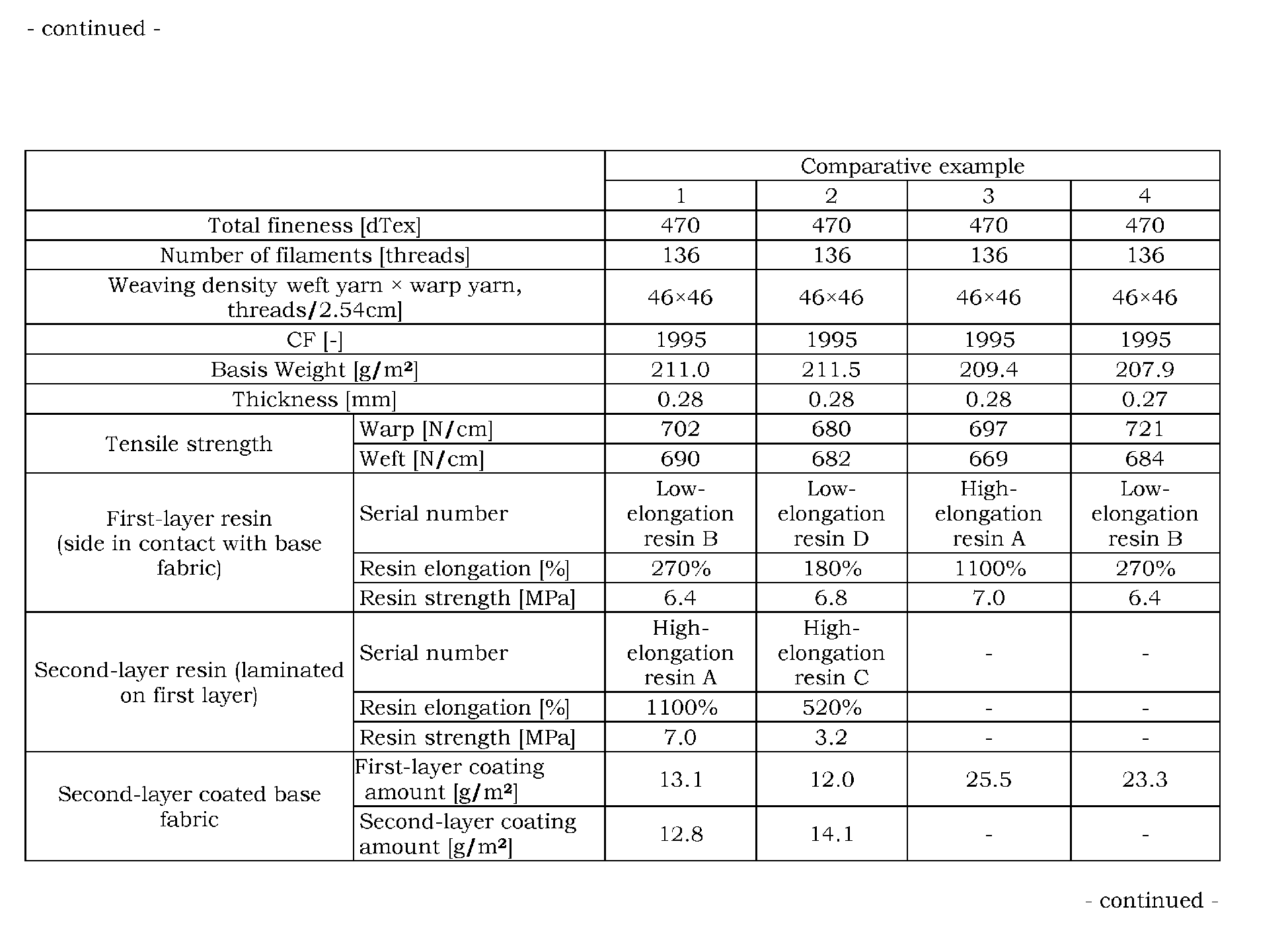

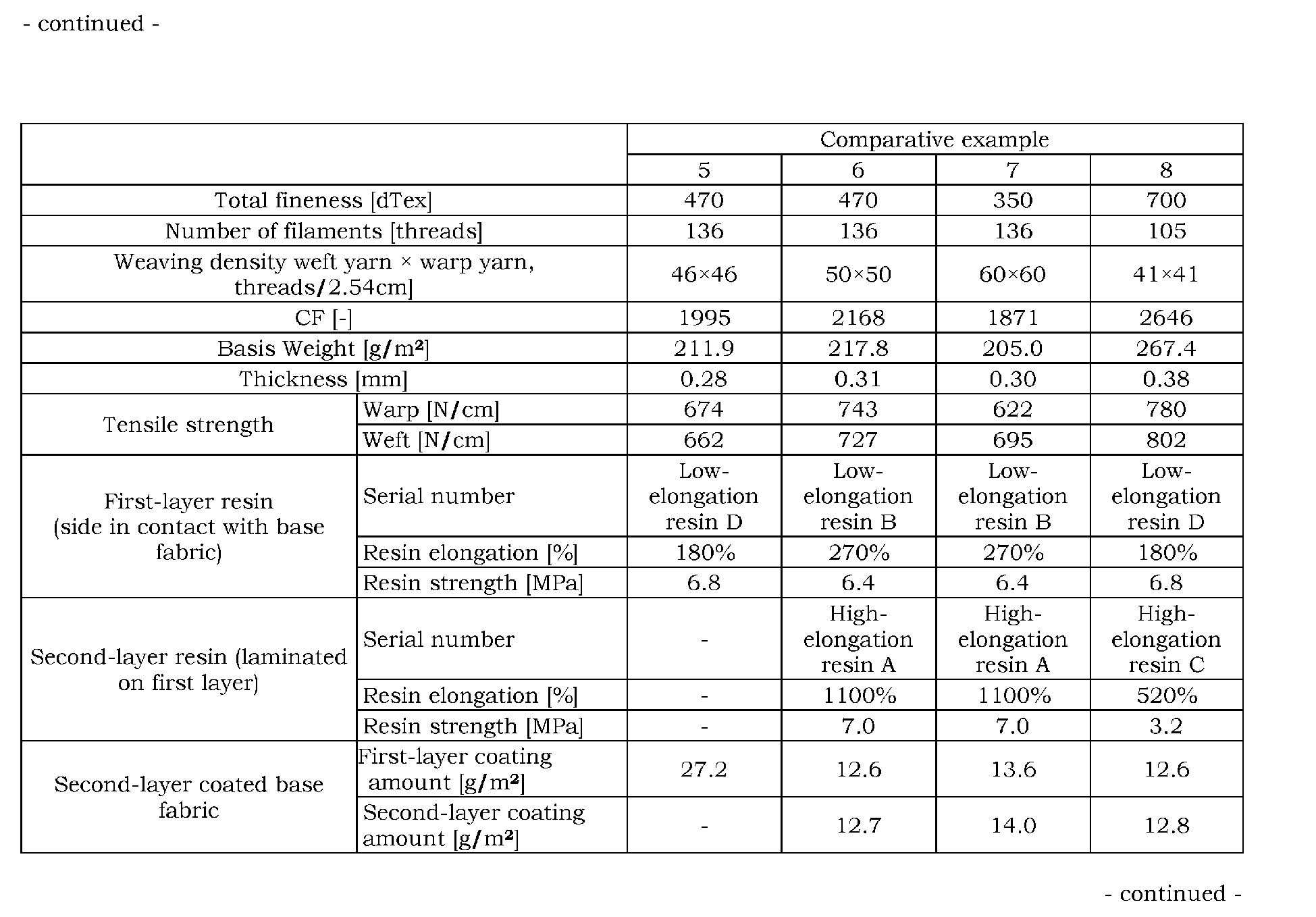

- As shown in Table 1, the base fabrics fabricated in Examples 1 to 5 had a high puncture resistance and were excellent in cut resistance. Further, the base fabrics also had low bending stiffness and were excellent in storability. Meanwhile, the base fabrics fabricated in Comparative examples 1 to 3 had low puncture load, and were considered to be low in cut resistance. Further, the base fabrics fabricated in Comparative examples 4, 5, and 8 had high bending stiffness, and were considered to be low in storability. Moreover, the base fabrics fabricated in Comparative examples 6 and 7 had low puncture load and were considered to be low in cut resistance, and also had low puncture load and were considered to be low in storability.
Claims (4)
- A base fabric for an airbag, wherein a puncture load (JIS T 8051(2005)5) is equal to or more than 6.0 N, and wherein values obtained by dividing a bending stiffness (method A of JIS L 1096(2010)8.21) in each of a warp direction and a weft direction by a cover factor are equal to or less than 0.030 mm.
- The base fabric for an airbag according to claim 1, wherein at least two kinds of resins having different elongations are arranged, wherein a resin having an elongation of equal to or more than 500% is arranged on a first layer in contact with the fabric, and wherein a resin having an elongation of equal to or less than 300% is arranged on a second layer which is laminated on the first layer.
- A manufacturing method for the base fabric of claim 1 or 2, comprising an application step of applying two layers of resins having different elongations in superposition,
wherein the application step includes:a first-layer forming step of arranging, as a first layer in contact with a fabric, a resin having an elongation of equal to or more than 500%; anda second-layer forming step of arranging, as a second layer, a resin having an elongation of equal to or less than 300% on the first layer. - An airbag using the base fabric for an airbag of claim 1 or 2.
Applications Claiming Priority (2)
| Application Number | Priority Date | Filing Date | Title |
|---|---|---|---|
| JP2019040185 | 2019-03-06 | ||
| PCT/JP2020/007207 WO2020179518A1 (en) | 2019-03-06 | 2020-02-21 | Base fabric for airbag, method for manufacturing base fabric for airbag, and airbag |
Publications (2)
| Publication Number | Publication Date |
|---|---|
| EP3936657A1 true EP3936657A1 (en) | 2022-01-12 |
| EP3936657A4 EP3936657A4 (en) | 2023-01-04 |
Family
ID=72338598
Family Applications (1)
| Application Number | Title | Priority Date | Filing Date |
|---|---|---|---|
| EP20766713.0A Pending EP3936657A4 (en) | 2019-03-06 | 2020-02-21 | AIRBAG BASE FABRIC, METHOD FOR MAKING AIRBAG BASE FABRIC AND AIRBAG |
Country Status (8)
| Country | Link |
|---|---|
| US (1) | US12221057B2 (en) |
| EP (1) | EP3936657A4 (en) |
| JP (1) | JP7533215B2 (en) |
| KR (1) | KR20210132021A (en) |
| CN (1) | CN113544324B (en) |
| MX (1) | MX2021010091A (en) |
| PH (1) | PH12021551716A1 (en) |
| WO (1) | WO2020179518A1 (en) |
Family Cites Families (10)
| Publication number | Priority date | Publication date | Assignee | Title |
|---|---|---|---|---|
| US6715790B2 (en) * | 1994-05-23 | 2004-04-06 | Automotive Technologies International, Inc. | Side curtain air bag |
| JP3278968B2 (en) | 1993-04-12 | 2002-04-30 | 東レ株式会社 | Method of manufacturing base fabric for airbag |
| JP2660986B2 (en) | 1993-12-13 | 1997-10-08 | 鐘紡株式会社 | Low air permeability fabric and method for producing the same |
| GB9705524D0 (en) * | 1997-03-18 | 1997-05-07 | Dow Corning | Coated textile fabrics |
| EP1698523A3 (en) * | 2000-08-30 | 2008-04-02 | Milliken & Company | Abrasion and/or puncture resistant fabrics, airbag cushions, and methods |
| US20020122908A1 (en) | 2000-08-30 | 2002-09-05 | Shulong Li | Abrasion and/or puncture resistant fabrics, airbag cushions, and methods |
| JP2003175789A (en) | 2002-12-05 | 2003-06-24 | Toyobo Co Ltd | Silicone coated woven fabric |
| JP4701177B2 (en) | 2004-07-16 | 2011-06-15 | 旭化成せんい株式会社 | Base fabric for bag-woven airbag and method for manufacturing the same |
| JP2006062590A (en) | 2004-08-30 | 2006-03-09 | Nippon Plast Co Ltd | Airbag |
| WO2008020605A1 (en) * | 2006-08-14 | 2008-02-21 | Dow Corning Toray Co., Ltd. | Silicone rubber composition for coating of woven fabric, and coated woven fabric |
-
2020
- 2020-02-21 CN CN202080018055.9A patent/CN113544324B/en active Active
- 2020-02-21 US US17/435,735 patent/US12221057B2/en active Active
- 2020-02-21 WO PCT/JP2020/007207 patent/WO2020179518A1/en not_active Ceased
- 2020-02-21 JP JP2020515061A patent/JP7533215B2/en active Active
- 2020-02-21 PH PH1/2021/551716A patent/PH12021551716A1/en unknown
- 2020-02-21 EP EP20766713.0A patent/EP3936657A4/en active Pending
- 2020-02-21 KR KR1020217024824A patent/KR20210132021A/en not_active Withdrawn
- 2020-02-21 MX MX2021010091A patent/MX2021010091A/en unknown
Also Published As
| Publication number | Publication date |
|---|---|
| CN113544324B (en) | 2023-08-18 |
| JP7533215B2 (en) | 2024-08-14 |
| MX2021010091A (en) | 2021-09-21 |
| EP3936657A4 (en) | 2023-01-04 |
| US12221057B2 (en) | 2025-02-11 |
| WO2020179518A1 (en) | 2020-09-10 |
| PH12021551716A1 (en) | 2022-03-28 |
| CN113544324A (en) | 2021-10-22 |
| KR20210132021A (en) | 2021-11-03 |
| US20220134992A1 (en) | 2022-05-05 |
| JPWO2020179518A1 (en) | 2020-09-10 |
Similar Documents
| Publication | Publication Date | Title |
|---|---|---|
| EP2891745B1 (en) | Coated cloth and method for producing same | |
| EP3279377B1 (en) | Coated base fabric for airbag, airbag, and method for producing coated base fabric for airbag | |
| EP2789715B1 (en) | Polyamide fiber and airbag fabric | |
| EP2042628A1 (en) | Woven fabric for air bags, air bags and process for production of the woven fabric | |
| EP3279376B1 (en) | Polyester base fabric for airbag, polyester airbag, and method for manufacturing polyester base fabric for airbag | |
| EP2028315A1 (en) | Woven fabric for airbag | |
| EP3020607B1 (en) | Air-bag | |
| WO2020153446A1 (en) | Coated base fabric for airbag and airbag including same | |
| EP3418129B1 (en) | Bag body | |
| EP2344366B1 (en) | Woven airbag fabric | |
| EP3854919B1 (en) | Non-coated base fabric for airbag, airbag, and manufacturing method of non-coated base fabric for airbag | |
| JP4872174B2 (en) | Non-coated airbag fabric and airbag fabric | |
| US12221057B2 (en) | Base fabric for airbag, manufacturing method for base fabric for airbag, and airbag | |
| EP3690091A1 (en) | Airbag base cloth and airbag including same | |
| JP7320678B2 (en) | Hollow weave fabric for airbags | |
| EP3936647B1 (en) | Base fabric for airbag, and manufacturing method of base fabric for airbag | |
| US20220251740A1 (en) | Multi-layer fabric | |
| EP4166702B1 (en) | Airbag patch cloth | |
| JP2010047872A (en) | Ground fabric for air-bag, and method for producing the same | |
| JP4629882B2 (en) | Airbag | |
| JPH08158153A (en) | Polyester yarn for airbag base fabric | |
| KR20090072250A (en) | Fabric for airbag and manufacturing method thereof |
Legal Events
| Date | Code | Title | Description |
|---|---|---|---|
| STAA | Information on the status of an ep patent application or granted ep patent |
Free format text: STATUS: THE INTERNATIONAL PUBLICATION HAS BEEN MADE |
|
| PUAI | Public reference made under article 153(3) epc to a published international application that has entered the european phase |
Free format text: ORIGINAL CODE: 0009012 |
|
| STAA | Information on the status of an ep patent application or granted ep patent |
Free format text: STATUS: REQUEST FOR EXAMINATION WAS MADE |
|
| 17P | Request for examination filed |
Effective date: 20210723 |
|
| AK | Designated contracting states |
Kind code of ref document: A1 Designated state(s): AL AT BE BG CH CY CZ DE DK EE ES FI FR GB GR HR HU IE IS IT LI LT LU LV MC MK MT NL NO PL PT RO RS SE SI SK SM TR |
|
| A4 | Supplementary search report drawn up and despatched |
Effective date: 20221205 |
|
| RIC1 | Information provided on ipc code assigned before grant |
Ipc: D03D 1/02 20060101ALI20221129BHEP Ipc: B60R 21/235 20060101ALI20221129BHEP Ipc: B32B 5/02 20060101ALI20221129BHEP Ipc: D06M 15/643 20060101AFI20221129BHEP |
|
| STAA | Information on the status of an ep patent application or granted ep patent |
Free format text: STATUS: EXAMINATION IS IN PROGRESS |
|
| 17Q | First examination report despatched |
Effective date: 20260213 |