EP3936416B1 - Motor vehicle comprising a cab body firewall with a lower cross beam and an upper cross beam - Google Patents
Motor vehicle comprising a cab body firewall with a lower cross beam and an upper cross beam Download PDFInfo
- Publication number
- EP3936416B1 EP3936416B1 EP20185293.6A EP20185293A EP3936416B1 EP 3936416 B1 EP3936416 B1 EP 3936416B1 EP 20185293 A EP20185293 A EP 20185293A EP 3936416 B1 EP3936416 B1 EP 3936416B1
- Authority
- EP
- European Patent Office
- Prior art keywords
- cross beam
- windshield
- motor vehicle
- sensor
- cab
- Prior art date
- Legal status (The legal status is an assumption and is not a legal conclusion. Google has not performed a legal analysis and makes no representation as to the accuracy of the status listed.)
- Active
Links
Images

Classifications
-
- B—PERFORMING OPERATIONS; TRANSPORTING
- B62—LAND VEHICLES FOR TRAVELLING OTHERWISE THAN ON RAILS
- B62D—MOTOR VEHICLES; TRAILERS
- B62D25/00—Superstructure or monocoque structure sub-units; Parts or details thereof not otherwise provided for
- B62D25/08—Front or rear portions
-
- B—PERFORMING OPERATIONS; TRANSPORTING
- B62—LAND VEHICLES FOR TRAVELLING OTHERWISE THAN ON RAILS
- B62D—MOTOR VEHICLES; TRAILERS
- B62D33/00—Superstructures for load-carrying vehicles
- B62D33/06—Drivers' cabs
-
- B—PERFORMING OPERATIONS; TRANSPORTING
- B60—VEHICLES IN GENERAL
- B60S—SERVICING, CLEANING, REPAIRING, SUPPORTING, LIFTING, OR MANOEUVRING OF VEHICLES, NOT OTHERWISE PROVIDED FOR
- B60S1/00—Cleaning of vehicles
- B60S1/02—Cleaning windscreens, windows or optical devices
- B60S1/04—Wipers or the like, e.g. scrapers
- B60S1/06—Wipers or the like, e.g. scrapers characterised by the drive
- B60S1/08—Wipers or the like, e.g. scrapers characterised by the drive electrically driven
- B60S1/0818—Wipers or the like, e.g. scrapers characterised by the drive electrically driven including control systems responsive to external conditions, e.g. by detection of moisture, dirt or the like
- B60S1/0822—Wipers or the like, e.g. scrapers characterised by the drive electrically driven including control systems responsive to external conditions, e.g. by detection of moisture, dirt or the like characterized by the arrangement or type of detection means
- B60S1/0833—Optical rain sensor
- B60S1/0844—Optical rain sensor including a camera
-
- B—PERFORMING OPERATIONS; TRANSPORTING
- B60—VEHICLES IN GENERAL
- B60R—VEHICLES, VEHICLE FITTINGS, OR VEHICLE PARTS, NOT OTHERWISE PROVIDED FOR
- B60R11/00—Arrangements for holding or mounting articles, not otherwise provided for
- B60R11/04—Mounting of cameras operative during drive; Arrangement of controls thereof relative to the vehicle
-
- B—PERFORMING OPERATIONS; TRANSPORTING
- B60—VEHICLES IN GENERAL
- B60S—SERVICING, CLEANING, REPAIRING, SUPPORTING, LIFTING, OR MANOEUVRING OF VEHICLES, NOT OTHERWISE PROVIDED FOR
- B60S1/00—Cleaning of vehicles
- B60S1/02—Cleaning windscreens, windows or optical devices
- B60S1/04—Wipers or the like, e.g. scrapers
- B60S1/06—Wipers or the like, e.g. scrapers characterised by the drive
- B60S1/08—Wipers or the like, e.g. scrapers characterised by the drive electrically driven
- B60S1/0818—Wipers or the like, e.g. scrapers characterised by the drive electrically driven including control systems responsive to external conditions, e.g. by detection of moisture, dirt or the like
- B60S1/0822—Wipers or the like, e.g. scrapers characterised by the drive electrically driven including control systems responsive to external conditions, e.g. by detection of moisture, dirt or the like characterized by the arrangement or type of detection means
- B60S1/0874—Wipers or the like, e.g. scrapers characterised by the drive electrically driven including control systems responsive to external conditions, e.g. by detection of moisture, dirt or the like characterized by the arrangement or type of detection means characterized by the position of the sensor on the windshield
-
- B—PERFORMING OPERATIONS; TRANSPORTING
- B62—LAND VEHICLES FOR TRAVELLING OTHERWISE THAN ON RAILS
- B62D—MOTOR VEHICLES; TRAILERS
- B62D25/00—Superstructure or monocoque structure sub-units; Parts or details thereof not otherwise provided for
- B62D25/08—Front or rear portions
- B62D25/14—Dashboards as superstructure sub-units
Definitions
- the present invention relates to motor vehicles and in particular, to motor vehicles comprising a cab body firewall having a lower cross beam and an upper cross beam.
- a driver assistance system uses a plurality of sensors to detect parameters of an external environment of the vehicle.
- the sensors can comprise a camera, a radar, a lidar, or a rain sensor and the sensors can detect road panels, lanes, pedestrians, other vehicles on the road, or rain.
- the detected parameters are then process by a control unit to assist the driver.
- the sensors are positioned on the windshield of the vehicles.
- the sensors can either be positioned on the upper part of the windshield or on the lower part of the windshield.
- the more the sensors are positioned high the more the part of the external environment of the vehicle which is visible for the sensors is reduced. So, when the sensors are positioned on the upper part of the windshield, they are located too high with respect to the road on which the vehicle drives, and the sensors cannot view a sufficient part of the external environment of the vehicle. For example, some road signs cannot be seen by the sensors.
- a motor vehicle intended to be driven by a driver comprising:
- the sensors are thus positioned on the cab body firewall.
- the cab body firewall comprises two cross beams: the lower cross beam and the upper cross beam. This specific shape of the cab body firewall makes it possible to have the lower cross beam to hold the windshield and to ensure the reinforcement of the structure of the vehicle, in particular in the event of a frontal collision, and to have the upper cross beam dedicated to the holding of the sensors.
- the sensors By being held by the upper cross beam, the sensors are positioned facing the lower part of the windshield. This positon allows maximizing the visible part of the external environment of the vehicle for the sensors. Therefore, the sensors have a satisfactory visible part of the external environment of the vehicle.
- the upper cross beam is covered by the dashboard.
- the driver of the vehicle cannot see the sensors since they are not positioned regarding a part of the windshield which is visible by the driver. Therefore, it avoids forming blind spots for the driver.
- the windshield comprises an interior face directed toward the inside of the cab, the upper cross beam being arranged on the side of the interior face of the windshield and the sensor comprises a detection part facing the windshield, the sensor being configured to detect the parameter of the external environment through the windshield.
- the senor is disposed behind the windshield when considering the normal direction of travel of the vehicle.
- the sensor is thus protected by the windshield, which allows avoiding any damage to the sensor.
- the detection of the parameter of the external environment of the vehicle can be done through the windshield.
- the motor vehicle comprises a wiping system attached to the cab body firewall and configured to clean a wiping area of the windshield, the detection part being arranged facing the wiping area of the windshield.
- the wiping area of the windshield is easily washable and remains clean. Thus, agood visibility of the external environment of the vehicle for the sensors is maintained, which ensures the efficiency of the detection of the sensors.
- the upper cross beam forms a cavity opened towards the interior face of the windshield and closed by the windshield, and in which the sensor is positioned.
- the cavity allows to easily position the sensor, and the closing of the cavity by the windshield allows enhancing the protection and the maintenance of the sensor.
- the cab body firewall extends transversally to the motor vehicle from a first transverse extremity of the motor vehicle to a second transverse extremity of the motor vehicle.
- the driver assistance system comprises a front camera configured to capture an image of the external environment of the vehicle and the driver assistance system is configured to assist the driver to detect an element on the external environment of the vehicle.
- the driver assistance system comprises a rain sensor configured to detect rain in the external environment of the vehicle, the vehicle comprising wipers and the driver assistance system being configured to control the wipers of the vehicle depending on the detection of the rain sensor.
- the cab body firewall comprises a transverse wall positioned transversely to the vehicle, on which the upper cross beam and the lower cross beam are fixed.
- the cab body firewall comprises a transverse wall positioned transversely to the vehicle, on which the lower cross beam is fixed, the upper cross beam being attached on the upper side of the lower cross beam.
- the transverse wall, the upper cross beam and the lower cross beam are made of steel.
- both the upper cross beam and the lower cross beam reinforces the structure of the vehicle.
- the transverse wall and the lower cross beam are made of steel and the upper cross beam is made of plastic
- the lower cross beam allows reinforcing the structure of the vehicle and the weight of the cab body firewall is reduced.
- the longitudinal direction L is defined as the direction from the rear to the front of the vehicle when considering the normal direction of travel of the vehicle
- the transverse direction T is defined as the direction perpendicular to the longitudinal direction and from one side of the vehicle to the other
- the vertical direction V is defined from top to bottom, as the direction perpendicular to the longitudinal direction and to the transverse direction.
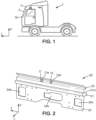
- Figure 1 shows a truck 1 comprising a cab 2 which can receive a driver and a windshield 3.
- the windshield 3 forms an upper front part of the cab 2.
- the windshield 3 has a lower extremity 3L.
- the truck 1 also comprises a cab body firewall 20.
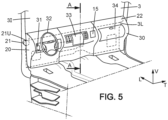
- the shape of the cab body firewall 20 is described with reference to figure 2 .
- the cab body firewall 20 comprises a transverse wall 23.
- the cab body firewall 20 also comprises a lower cross beam 21 comprising an upper side 21U fixed to the traverse wall 23.
- the lower cross beam 21 allows reinforcing the structure of the cab body firewall 20, and thus reinforcing the structure of the truck 1.
- the lower cross beam 21 prevents significant deformation of the front of the truck 1 in the event of a frontal collision.
- the cab body firewall 20 also comprises an upper cross beam 22.
- the upper cross beam 22 is fixed to the traverse wall 23.
- the upper cross beam 22 is arranged above the upper side 21U of the lower cross beam 21.
- the upper cross beam 22 forms a cavity.
- the lower cross beam 21 could be fixed to the traverse wall 23, and the upper cross beam 22 could be attached on the upper side 21U of the lower cross beam 21.
- the transverse wall 23, the upper cross beam 22 and the lower cross beam 21 are made of steel. This material allows reinforcing the structure of the truck 1.
- the lower cross beam 21 and the upper cross beam 22 are then welded on the transverse wall 23.
- the transverse wall 23 and the lower cross beam 21 are made of steel to ensure the robustness of the cab body firewall 20 and the upper cross beam is made of plastic to reduce the weight of the cab body firewall 20.
- the cab body firewall 20 extends transversally to the truck 1 from a first transverse extremity of the truck to a second transverse extremity of the truck 1.
- the first transverse extremity is formed by a first vertical pillar 4
- the second transverse extremity is formed by a second vertical pillar 5.
- the transverse wall 23, the lower cross beam 21 and the upper cross beam 22 all extend transversally to the truck 1 from the first vertical pillar 4 to the second vertical pillar 5.
- the upper side 21U of the lower cross beam 21 holds the windshield 3 by its lower extremity 3L.
- the windshield 3 is bonded to the upper side 21U of the lower cross beam 1.
- the upper cross beam 22 is arranged above the lower extremity 3L of the windshield 3.
- the windshield 3 comprises an interior face 3I directed toward the inside of the cab 2.
- the upper cross beam 22 is arranged on the side of the interior face 3I of the windshield 3.
- the cavity of the upper cross beam 22 is opened towards the interior face 3I of the windshield 3 and is closed by the windshield 3.
- the cab body firewall 20 forms a frame structure of a lower front part of the cab 2. It comprises receiving openings 24a, 24b, 24c.
- the truck 1 also comprises a driver assistance system having sensors such as a front camera 10 and a rain sensor 11 each detecting a parameter of an external environment of the truck 1.
- the front camera 10 is able to capture an image of the external environment of the truck 1.
- the rain sensor 11 is able to detect rain in the external environment of the truck 1.
- the front camera 10 and the rain sensor 11 are disposed on the upper cross beam 22.
- the sensors are thus disposed regarding the lower part of the windshield 3, which allows maximizing the visible part of the external environment of the vehicle for the sensors.
- the front camera 10 and the rain sensor 11 are disposed on the cavity of the upper cross beam 22.
- the front camera 10 comprises a detection part 10a facing the windshield 3.
- the rain sensor 11 comprising a detection part 11a facing the windshield 3.
- the rain sensor 11 and the front camera 10 can thus detect the parameter of the external environment through the windshield 3.
- the sensors are protected by the cavity of the upper cross beam 22 and by the windshield 3 which closes the cavity. It reduces the damages that can occur to the sensors, which increases the lifetime of these sensors.
- the truck 1 also comprises a wiping system attached to the cab body firewall 20.
- the wiping system comprises two wipers 6 attached to the cab body firewall 20 to wash the windshield on a wiping area 7.
- the wiping area 7 of the windshield 3 is thus easily washable and remains clean.
- the detection part 10a of the front camera 10 and the detection part 11a of the rain sensor 11 are arranged facing the wiping area 7 of the windshield 3. Therefore, the front camera 10 and the rain sensor 11 can keep a good visibility of the external environment of the vehicle. The efficiency of the detection of the front camera 10 and the rain sensor 11 is maintained.
- the driver assistance system could comprise other sensors such as a radar or a lidar, in addition to the front camera 10 and the rain sensor 11, or instead of the front camera 10 or the rain sensor 11 or both.
- the radar or the lidar would be able to measure the speed of element in the external environment of the truck 1.
- the driver assistance system also comprises a control unit 15 to process the parameter of the external environment of the truck 1. For example, from the image of the external environment of the truck 1 captured by the front camera 10, the control unit 15 can identify elements present in the external environment of the truck 1 such as road panels, lanes, pedestrians, or other vehicles on the road. These identified elements can then be displayed on a screen 33 positioned in the truck 1. These identified elements are thus enhanced for the driver.
- the driver assistance system assist the driver to detect these elements of the external environment of the truck.
- control unit 15 can control the wipers 6 of the truck 1 depending on the detection done by the rain sensor 11. In particular, when the rain sensor 11 detects rain in the external environment of the truck 1, the control unit 15 can activate the wipers 6 and when the rain sensor 11 detects that it is not raining anymore, the control unit 15 can deactivate the wipers 6.
- the cab 2 comprises a dashboard 30.
- the dashboard 30 comprises a plurality of elements such as a steering wheel 32, the control unit 15, a speed display 31, the screen 33 for displaying the elements identified by the control unit 15 on the image captured by the front camera 10, and a glove compartment 34. This list of elements is not exhaustive. The dashboard 30 may include only some of these elements. It could still include other elements that are not listed.
- the dashboard 30 is fixed to the cab body firewall 20.
- the receiving openings 24a, 24b, 24c of the cab body firewall 20 are arranged to receive the plurality of elements of the dashboard 30.
- the upper cross beam 22 is covered by the dashboard 30.
- the dashboard 30 is arranged between the cab body firewall 20 and a driving position of the driver in the longitudinal direction L.
- the dashboard 30 is hiding the upper cross beam 22 for the driver of the truck 1 when he is in the driving position. Hence, neither the upper cross beam 22, nor the sensors disposed on the upper cross beam 22 are visible for the driver of the truck 1. The sensors do not create any blind spots for the driver.
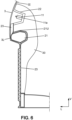
- figure 6 shows a cross sectional view of the truck 1 along the A-A axis of figure 5 .
- this cross section view shows the lower cross beam 21 and the upper cross beam 22 are fixed to the transverse wall 23.
- the upper cross beam 22 is arranged above the upper side 21U of the lower cross beam 21.
- the lower cross beam 21 holds the windshield 3 by its lower extremity 3L and the windshield 3 is arranged in front of the upper cross beam 22.
- the upper cross beam 22 holds the sensors of the driver assistance system.
- the rain sensor 11 is in particular visible on figure 4 . Its detection part 11a is oriented towards the windshield 3.
- the dashboard 30 is arranged against the cab body firewall 20, and covers the upper cross beam 22.
Landscapes
- Engineering & Computer Science (AREA)
- Mechanical Engineering (AREA)
- Chemical & Material Sciences (AREA)
- Combustion & Propulsion (AREA)
- Transportation (AREA)
- Automation & Control Theory (AREA)
- Body Structure For Vehicles (AREA)
Description
- The present invention relates to motor vehicles and in particular, to motor vehicles comprising a cab body firewall having a lower cross beam and an upper cross beam.
- More and more motor vehicles are equipped with driver assistance systems. A driver assistance system uses a plurality of sensors to detect parameters of an external environment of the vehicle. For example, the sensors can comprise a camera, a radar, a lidar, or a rain sensor and the sensors can detect road panels, lanes, pedestrians, other vehicles on the road, or rain. The detected parameters are then process by a control unit to assist the driver.
- Nowadays, the sensors are positioned on the windshield of the vehicles. The sensors can either be positioned on the upper part of the windshield or on the lower part of the windshield.
- However, the more the sensors are positioned high, the more the part of the external environment of the vehicle which is visible for the sensors is reduced. So, when the sensors are positioned on the upper part of the windshield, they are located too high with respect to the road on which the vehicle drives, and the sensors cannot view a sufficient part of the external environment of the vehicle. For example, some road signs cannot be seen by the sensors.
- And, when the sensors are positioned on the lower part of the windshield, even though it provides the sensors with a satisfactory visible part of the external environment of the vehicle, the sensors are positioned on the field of view of the driver and thus, they create blind spots for the driver. Documents
EP3617040 ,WO2018215811 andWO2019111565 disclose above prior art driver assistance system. - Hence, there is a need to find an optimal position for the sensors which allows the sensors to have a satisfactory visible part of the external environment of the vehicle without creating blind spots for the driver.
- It is proposed a motor vehicle intended to be driven by a driver comprising:
- a cab configured to receive the driver inside and comprising a dashboard,
- a windshield forming an upper front part of the cab and having a lower extremity,
- a driver assistance system comprising at least one sensor configured to detect a parameter of an external environment of the vehicle and a control unit configured to process the parameter of the external environment of the vehicle,
- a cab body firewall forming a frame structure of a lower front part of the cab on which the dashboard is attached, the cab body firewall comprising:
- a lower cross beam holding the windshield by the lower extremity on an upper side of the lower cross beam,
- an upper cross beam holding the at least one sensor, arranged above the upper side of the lower cross beam and above the lower extremity of the windshield, and covered by the dashboard.
- In the motor vehicle according to the invention, the sensors are thus positioned on the cab body firewall. In particular, the cab body firewall comprises two cross beams: the lower cross beam and the upper cross beam. This specific shape of the cab body firewall makes it possible to have the lower cross beam to hold the windshield and to ensure the reinforcement of the structure of the vehicle, in particular in the event of a frontal collision, and to have the upper cross beam dedicated to the holding of the sensors.
- By being held by the upper cross beam, the sensors are positioned facing the lower part of the windshield. This positon allows maximizing the visible part of the external environment of the vehicle for the sensors. Therefore, the sensors have a satisfactory visible part of the external environment of the vehicle.
- Besides, the upper cross beam is covered by the dashboard. Hence, the driver of the vehicle cannot see the sensors since they are not positioned regarding a part of the windshield which is visible by the driver. Therefore, it avoids forming blind spots for the driver.
- The following features, can be optionally implemented, separately or in combination one with the others.
- According to one aspect, the windshield comprises an interior face directed toward the inside of the cab, the upper cross beam being arranged on the side of the interior face of the windshield and the sensor comprises a detection part facing the windshield, the sensor being configured to detect the parameter of the external environment through the windshield.
- This way, the sensor is disposed behind the windshield when considering the normal direction of travel of the vehicle. The sensor is thus protected by the windshield, which allows avoiding any damage to the sensor. Besides, the detection of the parameter of the external environment of the vehicle can be done through the windshield.
- According to one aspect, the motor vehicle comprises a wiping system attached to the cab body firewall and configured to clean a wiping area of the windshield, the detection part being arranged facing the wiping area of the windshield.
- The wiping area of the windshield is easily washable and remains clean. Thus, agood visibility of the external environment of the vehicle for the sensors is maintained, which ensures the efficiency of the detection of the sensors.
- According to one aspect, the upper cross beam forms a cavity opened towards the interior face of the windshield and closed by the windshield, and in which the sensor is positioned.
- The cavity allows to easily position the sensor, and the closing of the cavity by the windshield allows enhancing the protection and the maintenance of the sensor.
- According to one aspect, the cab body firewall extends transversally to the motor vehicle from a first transverse extremity of the motor vehicle to a second transverse extremity of the motor vehicle.
- According to one aspect, among the at least on sensor, the driver assistance system comprises a front camera configured to capture an image of the external environment of the vehicle and the driver assistance system is configured to assist the driver to detect an element on the external environment of the vehicle.
- According to one aspect, among the at least one sensor, the driver assistance system comprises a rain sensor configured to detect rain in the external environment of the vehicle, the vehicle comprising wipers and the driver assistance system being configured to control the wipers of the vehicle depending on the detection of the rain sensor.
- According to one aspect, the cab body firewall comprises a transverse wall positioned transversely to the vehicle, on which the upper cross beam and the lower cross beam are fixed.
- According to one aspect, the cab body firewall comprises a transverse wall positioned transversely to the vehicle, on which the lower cross beam is fixed, the upper cross beam being attached on the upper side of the lower cross beam.
- According to one alternative, the transverse wall, the upper cross beam and the lower cross beam are made of steel.
- Hence, both the upper cross beam and the lower cross beam reinforces the structure of the vehicle.
- According to another alternative, the transverse wall and the lower cross beam are made of steel and the upper cross beam is made of plastic
- Hence, the lower cross beam allows reinforcing the structure of the vehicle and the weight of the cab body firewall is reduced.
- Other features, details and advantages will be shown in the following detailed description and on the figures, on which:
- [
Fig. 1] Figure 1 illustrates a side view of a truck comprising a cab and a windshield; - [
Fig. 2] Figure 2 illustrates a cab body firewall of the truck offigure 1 ; - [
Fig. 3] Figure 3 illustrates a partial view of the inside of truck offigure 2 showing the windshield and the cab body firewall; - [
Fig. 4] Figure 4 illustrates a partial view of the outside of the truck offigure 2 showing the windshield and the cab body firewall; - [
Fig. 5] Figure 5 illustrates the partial view of the inside of the truck offigure 2 , in which a dashboard has been represented; - [
Fig. 6] Figure 6 is a cross-sectional view of the truck along the A-A axis offigure 5 . - In the figures, the same references denote identical or similar elements. For sake of clarity, various elements may not be represented at scale.
- In the description, the longitudinal direction L is defined as the direction from the rear to the front of the vehicle when considering the normal direction of travel of the vehicle, the transverse direction T is defined as the direction perpendicular to the longitudinal direction and from one side of the vehicle to the other, and the vertical direction V is defined from top to bottom, as the direction perpendicular to the longitudinal direction and to the transverse direction.
-
Figure 1 shows atruck 1 comprising acab 2 which can receive a driver and awindshield 3. Thewindshield 3 forms an upper front part of thecab 2. Thewindshield 3 has alower extremity 3L. Although the description presents atruck 1 as a motor vehicle, it is understood that the invention applies to any type of vehicle such as a car, a bus or any other ground vehicle. - The
truck 1 also comprises acab body firewall 20. The shape of thecab body firewall 20 is described with reference tofigure 2 . Thecab body firewall 20 comprises atransverse wall 23. Thecab body firewall 20 also comprises alower cross beam 21 comprising anupper side 21U fixed to thetraverse wall 23. Thelower cross beam 21 allows reinforcing the structure of thecab body firewall 20, and thus reinforcing the structure of thetruck 1. Thelower cross beam 21 prevents significant deformation of the front of thetruck 1 in the event of a frontal collision. - The
cab body firewall 20 also comprises anupper cross beam 22. Theupper cross beam 22 is fixed to thetraverse wall 23. Theupper cross beam 22 is arranged above theupper side 21U of thelower cross beam 21. Theupper cross beam 22 forms a cavity. - In a non-represented alternative, the
lower cross beam 21 could be fixed to thetraverse wall 23, and theupper cross beam 22 could be attached on theupper side 21U of thelower cross beam 21. - In a first alternative, the
transverse wall 23, theupper cross beam 22 and thelower cross beam 21 are made of steel. This material allows reinforcing the structure of thetruck 1. Thelower cross beam 21 and theupper cross beam 22 are then welded on thetransverse wall 23. - In a second alternative, the
transverse wall 23 and thelower cross beam 21 are made of steel to ensure the robustness of thecab body firewall 20 and the upper cross beam is made of plastic to reduce the weight of thecab body firewall 20. - As represented on
figure 3 and figure 4 , which respectively show a partial view of the inside of thetruck 1 and a partial view of the outside of thetruck 1, thecab body firewall 20 extends transversally to thetruck 1 from a first transverse extremity of the truck to a second transverse extremity of thetruck 1. The first transverse extremity is formed by a firstvertical pillar 4, and the second transverse extremity is formed by a secondvertical pillar 5. Thetransverse wall 23, thelower cross beam 21 and theupper cross beam 22 all extend transversally to thetruck 1 from the firstvertical pillar 4 to the secondvertical pillar 5. - The
upper side 21U of thelower cross beam 21 holds thewindshield 3 by itslower extremity 3L. Thewindshield 3 is bonded to theupper side 21U of thelower cross beam 1. Theupper cross beam 22 is arranged above thelower extremity 3L of thewindshield 3. - The
windshield 3 comprises an interior face 3I directed toward the inside of thecab 2. Theupper cross beam 22 is arranged on the side of the interior face 3I of thewindshield 3. The cavity of theupper cross beam 22 is opened towards the interior face 3I of thewindshield 3 and is closed by thewindshield 3. - The
cab body firewall 20 forms a frame structure of a lower front part of thecab 2. It comprises receivingopenings - The
truck 1 also comprises a driver assistance system having sensors such as afront camera 10 and arain sensor 11 each detecting a parameter of an external environment of thetruck 1. Thefront camera 10 is able to capture an image of the external environment of thetruck 1. Therain sensor 11 is able to detect rain in the external environment of thetruck 1. - The
front camera 10 and therain sensor 11 are disposed on theupper cross beam 22. The sensors are thus disposed regarding the lower part of thewindshield 3, which allows maximizing the visible part of the external environment of the vehicle for the sensors. - The
front camera 10 and therain sensor 11 are disposed on the cavity of theupper cross beam 22. Thefront camera 10 comprises adetection part 10a facing thewindshield 3. Therain sensor 11 comprising adetection part 11a facing thewindshield 3. Therain sensor 11 and thefront camera 10 can thus detect the parameter of the external environment through thewindshield 3. - In that position, the sensors are protected by the cavity of the
upper cross beam 22 and by thewindshield 3 which closes the cavity. It reduces the damages that can occur to the sensors, which increases the lifetime of these sensors. - The
truck 1 also comprises a wiping system attached to thecab body firewall 20. The wiping system comprises twowipers 6 attached to thecab body firewall 20 to wash the windshield on awiping area 7. The wipingarea 7 of thewindshield 3 is thus easily washable and remains clean. - The
detection part 10a of thefront camera 10 and thedetection part 11a of therain sensor 11 are arranged facing the wipingarea 7 of thewindshield 3. Therefore, thefront camera 10 and therain sensor 11 can keep a good visibility of the external environment of the vehicle. The efficiency of the detection of thefront camera 10 and therain sensor 11 is maintained. - The driver assistance system could comprise other sensors such as a radar or a lidar, in addition to the
front camera 10 and therain sensor 11, or instead of thefront camera 10 or therain sensor 11 or both. The radar or the lidar would be able to measure the speed of element in the external environment of thetruck 1. - The driver assistance system also comprises a
control unit 15 to process the parameter of the external environment of thetruck 1. For example, from the image of the external environment of thetruck 1 captured by thefront camera 10, thecontrol unit 15 can identify elements present in the external environment of thetruck 1 such as road panels, lanes, pedestrians, or other vehicles on the road. These identified elements can then be displayed on ascreen 33 positioned in thetruck 1. These identified elements are thus enhanced for the driver. The driver assistance system assist the driver to detect these elements of the external environment of the truck. - In another example, the
control unit 15 can control thewipers 6 of thetruck 1 depending on the detection done by therain sensor 11. In particular, when therain sensor 11 detects rain in the external environment of thetruck 1, thecontrol unit 15 can activate thewipers 6 and when therain sensor 11 detects that it is not raining anymore, thecontrol unit 15 can deactivate thewipers 6. - Additionally, as shown on
figure 5 , thecab 2 comprises adashboard 30. Thedashboard 30 comprises a plurality of elements such as asteering wheel 32, thecontrol unit 15, aspeed display 31, thescreen 33 for displaying the elements identified by thecontrol unit 15 on the image captured by thefront camera 10, and aglove compartment 34. This list of elements is not exhaustive. Thedashboard 30 may include only some of these elements. It could still include other elements that are not listed. - The
dashboard 30 is fixed to thecab body firewall 20. The receivingopenings cab body firewall 20 are arranged to receive the plurality of elements of thedashboard 30. - The
upper cross beam 22 is covered by thedashboard 30. Thedashboard 30 is arranged between thecab body firewall 20 and a driving position of the driver in the longitudinal direction L. - The
dashboard 30 is hiding theupper cross beam 22 for the driver of thetruck 1 when he is in the driving position. Hence, neither theupper cross beam 22, nor the sensors disposed on theupper cross beam 22 are visible for the driver of thetruck 1. The sensors do not create any blind spots for the driver. - The layout of the
cab body firewall 20, thewindshield 3 and thedashboard 30 is particularly visible onfigure 6 , which shows a cross sectional view of thetruck 1 along the A-A axis offigure 5 . - As previously described, this cross section view shows the
lower cross beam 21 and theupper cross beam 22 are fixed to thetransverse wall 23. Theupper cross beam 22 is arranged above theupper side 21U of thelower cross beam 21. Thelower cross beam 21 holds thewindshield 3 by itslower extremity 3L and thewindshield 3 is arranged in front of theupper cross beam 22. Theupper cross beam 22 holds the sensors of the driver assistance system. Therain sensor 11 is in particular visible onfigure 4 . Itsdetection part 11a is oriented towards thewindshield 3. Thedashboard 30 is arranged against thecab body firewall 20, and covers theupper cross beam 22.
Claims (11)
- A motor vehicle (1) intended to be driven by a driver comprising:- a cab (2) configured to receive the driver inside and comprising a dashboard (30),- a windshield (3) forming an upper front part of the cab and having a lower extremity (3L), characterized in that motor vehicle (1) also comprising- a driver assistance system comprising at least one sensor (10, 11) configured to detect a parameter of an external environment of the vehicle and a control unit (15) configured to process the parameter of the external environment of the vehicle,- a cab body firewall (20) forming a frame structure of a lower front part of the cab on which the dashboard is attached, the cab body firewall comprising:- a lower cross beam (21) holding the windshield by the lower extremity on an upper side (21U) of the lower cross beam,- an upper cross beam (22) holding the at least one sensor, arranged above the upper side of the lower cross beam and above the lower extremity of the windshield, and covered by the dashboard.
- The motor vehicle according to claim 1, wherein the windshield comprises an interior face (3I) directed toward the inside of the cab, the upper cross beam being arranged on the side of the interior face of the windshield and wherein the sensor comprises a detection part (10a, 11a) facing the windshield, the sensor being configured to detect the parameter of the external environment through the windshield.
- The motor vehicle according to claim 2, comprising a wiping system attached to the cab body firewall and configured to clean a wiping area (7) of the windshield, the detection part being arranged facing the wiping area of the windshield.
- The motor vehicle according to claim 2 or 3, wherein the upper cross beam forms a cavity opened towards the interior face of the windshield and closed by the windshield, and in which the sensor is positioned.
- The motor vehicle according to any one of claims 1 to 4, wherein the cab body firewall extends transversally to the motor vehicle from a first transverse extremity of the motor vehicle (4) to a second transverse extremity of the motor vehicle (5).
- The motor vehicle according to any one of claims 1 to 5, wherein, among the at least on sensor, the driver assistance system comprises a front camera (10) configured to capture an image of the external environment of the vehicle and the driver assistance system is configured to assist the driver to detect an element on the external environment of the vehicle.
- The motor vehicle according to any one of claims 1 to 6, wherein, among the at least one sensor, the driver assistance system comprises a rain sensor (11) configured to detect rain in the external environment of the vehicle, the vehicle comprising wipers (6) and the driver assistance system being configured to control the wipers of the vehicle depending on the detection of the rain sensor.
- The motor vehicle according to any one of claims 1 to 7, wherein the cab body firewall comprises a transverse wall (23) positioned transversely to the vehicle, on which the upper cross beam and the lower cross beam are fixed.
- The motor vehicle according to any one of claims 1 to 7, wherein the cab body firewall comprises a transverse wall (23) positioned transversely to the vehicle, on which the lower cross beam is fixed, the upper cross beam being attached on the upper side of the lower cross beam.
- The motor vehicle according to claim 8 or 9, wherein the transverse wall, the upper cross beam and the lower cross beam are made of steel.
- The motor vehicle according to claim 8 or 9, wherein the transverse wall and the lower cross beam are made of steel and the upper cross beam is made of plastic.
Priority Applications (3)
| Application Number | Priority Date | Filing Date | Title |
|---|---|---|---|
| EP20185293.6A EP3936416B1 (en) | 2020-07-10 | 2020-07-10 | Motor vehicle comprising a cab body firewall with a lower cross beam and an upper cross beam |
| US17/368,943 US11560123B2 (en) | 2020-07-10 | 2021-07-07 | Motor vehicle comprising a cab body firewall with a lower crossbeam and an upper crossbeam |
| CN202110769062.9A CN113911213A (en) | 2020-07-10 | 2021-07-07 | Motor vehicle comprising a firewall with a lower cross member and an upper cross member |
Applications Claiming Priority (1)
| Application Number | Priority Date | Filing Date | Title |
|---|---|---|---|
| EP20185293.6A EP3936416B1 (en) | 2020-07-10 | 2020-07-10 | Motor vehicle comprising a cab body firewall with a lower cross beam and an upper cross beam |
Publications (3)
| Publication Number | Publication Date |
|---|---|
| EP3936416A1 EP3936416A1 (en) | 2022-01-12 |
| EP3936416C0 EP3936416C0 (en) | 2024-06-19 |
| EP3936416B1 true EP3936416B1 (en) | 2024-06-19 |
Family
ID=71575202
Family Applications (1)
| Application Number | Title | Priority Date | Filing Date |
|---|---|---|---|
| EP20185293.6A Active EP3936416B1 (en) | 2020-07-10 | 2020-07-10 | Motor vehicle comprising a cab body firewall with a lower cross beam and an upper cross beam |
Country Status (3)
| Country | Link |
|---|---|
| US (1) | US11560123B2 (en) |
| EP (1) | EP3936416B1 (en) |
| CN (1) | CN113911213A (en) |
Families Citing this family (2)
| Publication number | Priority date | Publication date | Assignee | Title |
|---|---|---|---|---|
| DE102023131943A1 (en) * | 2023-11-16 | 2025-05-22 | Man Truck & Bus Se | Driver's cab with sensor device, commercial vehicle with the driver's cab and method for assembling the driver's cab |
| DE102023131947A1 (en) * | 2023-11-16 | 2025-05-22 | Man Truck & Bus Se | Driver's cab with front mask and commercial vehicle with the driver's cab |
Family Cites Families (19)
| Publication number | Priority date | Publication date | Assignee | Title |
|---|---|---|---|---|
| DE19513089C2 (en) * | 1995-04-07 | 2000-04-20 | Man Nutzfahrzeuge Ag | Driver's cab of a front-steering truck |
| JPH11115814A (en) * | 1997-10-17 | 1999-04-27 | Suzuki Motor Corp | Body front structure |
| GB2360156B (en) * | 2000-03-10 | 2004-03-31 | Nokia Mobile Phones Ltd | Transceiver interface reduction |
| JP2006103669A (en) * | 2004-09-07 | 2006-04-20 | Mitsubishi Fuso Truck & Bus Corp | Ventilation device for vehicle |
| US20090200835A1 (en) * | 2006-03-28 | 2009-08-13 | Volvo Lastvagnar Ab | Laminated vehicle wall |
| CA2742126A1 (en) * | 2007-10-30 | 2009-05-07 | Allen E. Webster | Vehicle safety camera system |
| DE102008007590A1 (en) * | 2008-01-31 | 2009-08-06 | Siemens Aktiengesellschaft | Head assembly for forming the front of a vehicle |
| FR2983450B1 (en) | 2011-12-02 | 2014-05-16 | Renault Sa | MOTOR VEHICLE COMPRISING A TOP TRAVERSE OF AN APRON |
| US9545954B2 (en) * | 2012-11-30 | 2017-01-17 | Volvo Truck Corporation | Instrument panel frame to be fixed to the body-in-white of a cab, cab including such an instrument panel frame and method for assembling such a cab |
| CN105000069A (en) * | 2015-07-31 | 2015-10-28 | 安徽江淮汽车股份有限公司 | Front wall assembly structure of heavy truck cab |
| SE539846C2 (en) * | 2015-08-20 | 2017-12-19 | Scania Cv Ab | Method, control unit and a system in a vehicle for detectionof a vulnerable road user |
| SE1650608A1 (en) * | 2016-05-06 | 2017-02-24 | Scania Cv Ab | Method and control unit for a vehicle |
| DE102016013703A1 (en) * | 2016-11-17 | 2018-05-17 | Man Truck & Bus Ag | Method and device for controlling or regulating a cab mounting of a motor vehicle |
| EP3630542A1 (en) * | 2017-05-22 | 2020-04-08 | Volvo Truck Corporation | A camera assembly for an industrial vehicle cab |
| WO2019111565A1 (en) * | 2017-12-07 | 2019-06-13 | 株式会社小糸製作所 | Vehicle communication system, vehicle module, a front composite module, and vehicle lamp |
| JP6926361B2 (en) * | 2018-02-27 | 2021-08-25 | トヨタ車体株式会社 | Instrument panel structure for vehicles |
| DE102018121211A1 (en) * | 2018-08-30 | 2020-03-05 | Man Truck & Bus Se | Cab front module and method for manufacturing a cab |
| US10543812B1 (en) * | 2018-09-28 | 2020-01-28 | Ford Global Technologies, Llc | Vehicle sensor |
| DE102018125125A1 (en) * | 2018-10-11 | 2020-04-16 | HELLA GmbH & Co. KGaA | Motor vehicle with a rain sensor which is provided and designed for the detection of rain |
-
2020
- 2020-07-10 EP EP20185293.6A patent/EP3936416B1/en active Active
-
2021
- 2021-07-07 CN CN202110769062.9A patent/CN113911213A/en active Pending
- 2021-07-07 US US17/368,943 patent/US11560123B2/en active Active
Also Published As
| Publication number | Publication date |
|---|---|
| US11560123B2 (en) | 2023-01-24 |
| CN113911213A (en) | 2022-01-11 |
| US20220009449A1 (en) | 2022-01-13 |
| EP3936416A1 (en) | 2022-01-12 |
| EP3936416C0 (en) | 2024-06-19 |
Similar Documents
| Publication | Publication Date | Title |
|---|---|---|
| CN103171489B (en) | For driving the method for the indicating device of controlling motor vehicle | |
| CN102460211B (en) | Device and method for displaying objects in the surroundings of a vehicle | |
| US10073178B2 (en) | Placement structure for peripheral information detecting sensor, and self-driving vehicle | |
| US8289141B2 (en) | Auxiliary system for motor vehicles | |
| US20220363194A1 (en) | Vehicular display system with a-pillar display | |
| US11560123B2 (en) | Motor vehicle comprising a cab body firewall with a lower crossbeam and an upper crossbeam | |
| US20140098230A1 (en) | Blind zone detection and alert system for vehicle | |
| CN114248725A (en) | Vehicle sensor assembly | |
| US11091101B2 (en) | Vehicle capable of drive assist or automatic driving | |
| US7423521B2 (en) | Vehicular visual assistance system | |
| EP3349198B1 (en) | Vehicular display device and vehicular display method | |
| CN113085729B (en) | Electronic mirror systems for vehicles | |
| US12528459B2 (en) | System and method for monitoring surroundings of a vehicle | |
| JP7488727B2 (en) | Mobile | |
| CN114103821A (en) | Moving body | |
| US12515489B2 (en) | Method and device for assisting detection of objects in an environment of a motor vehicle | |
| US20060162982A1 (en) | Device for recognising an obstacle underride | |
| CN1922057A (en) | Device for collision detection | |
| JP2019206287A (en) | Personal protection system for vehicle | |
| JP2019043317A (en) | vehicle | |
| WO2013093450A2 (en) | Driver display system | |
| KR101445501B1 (en) | Vehicle Having Transparent A-Pillar Structure | |
| EP3964395B1 (en) | A method and system for adapting to a vehicle configuration an image displayed on a monitor, and vehicle using such system | |
| JP7571758B2 (en) | Vehicle front structure | |
| US20210122293A1 (en) | Peripheral information acquisition device and vehicle |
Legal Events
| Date | Code | Title | Description |
|---|---|---|---|
| PUAI | Public reference made under article 153(3) epc to a published international application that has entered the european phase |
Free format text: ORIGINAL CODE: 0009012 |
|
| STAA | Information on the status of an ep patent application or granted ep patent |
Free format text: STATUS: THE APPLICATION HAS BEEN PUBLISHED |
|
| AK | Designated contracting states |
Kind code of ref document: A1 Designated state(s): AL AT BE BG CH CY CZ DE DK EE ES FI FR GB GR HR HU IE IS IT LI LT LU LV MC MK MT NL NO PL PT RO RS SE SI SK SM TR |
|
| B565 | Issuance of search results under rule 164(2) epc |
Effective date: 20210120 |
|
| STAA | Information on the status of an ep patent application or granted ep patent |
Free format text: STATUS: REQUEST FOR EXAMINATION WAS MADE |
|
| 17P | Request for examination filed |
Effective date: 20220325 |
|
| RBV | Designated contracting states (corrected) |
Designated state(s): AL AT BE BG CH CY CZ DE DK EE ES FI FR GB GR HR HU IE IS IT LI LT LU LV MC MK MT NL NO PL PT RO RS SE SI SK SM TR |
|
| STAA | Information on the status of an ep patent application or granted ep patent |
Free format text: STATUS: EXAMINATION IS IN PROGRESS |
|
| 17Q | First examination report despatched |
Effective date: 20220801 |
|
| GRAP | Despatch of communication of intention to grant a patent |
Free format text: ORIGINAL CODE: EPIDOSNIGR1 |
|
| STAA | Information on the status of an ep patent application or granted ep patent |
Free format text: STATUS: GRANT OF PATENT IS INTENDED |
|
| INTG | Intention to grant announced |
Effective date: 20240307 |
|
| GRAS | Grant fee paid |
Free format text: ORIGINAL CODE: EPIDOSNIGR3 |
|
| GRAA | (expected) grant |
Free format text: ORIGINAL CODE: 0009210 |
|
| STAA | Information on the status of an ep patent application or granted ep patent |
Free format text: STATUS: THE PATENT HAS BEEN GRANTED |
|
| AK | Designated contracting states |
Kind code of ref document: B1 Designated state(s): AL AT BE BG CH CY CZ DE DK EE ES FI FR GB GR HR HU IE IS IT LI LT LU LV MC MK MT NL NO PL PT RO RS SE SI SK SM TR |
|
| REG | Reference to a national code |
Ref country code: GB Ref legal event code: FG4D |
|
| REG | Reference to a national code |
Ref country code: CH Ref legal event code: EP |
|
| REG | Reference to a national code |
Ref country code: DE Ref legal event code: R096 Ref document number: 602020032543 Country of ref document: DE |
|
| U01 | Request for unitary effect filed |
Effective date: 20240703 |
|
| U07 | Unitary effect registered |
Designated state(s): AT BE BG DE DK EE FI FR IT LT LU LV MT NL PT RO SE SI Effective date: 20240902 |
|
| U20 | Renewal fee for the european patent with unitary effect paid |
Year of fee payment: 5 Effective date: 20240903 |
|
| PG25 | Lapsed in a contracting state [announced via postgrant information from national office to epo] |
Ref country code: HR Free format text: LAPSE BECAUSE OF FAILURE TO SUBMIT A TRANSLATION OF THE DESCRIPTION OR TO PAY THE FEE WITHIN THE PRESCRIBED TIME-LIMIT Effective date: 20240619 |
|
| PG25 | Lapsed in a contracting state [announced via postgrant information from national office to epo] |
Ref country code: GR Free format text: LAPSE BECAUSE OF FAILURE TO SUBMIT A TRANSLATION OF THE DESCRIPTION OR TO PAY THE FEE WITHIN THE PRESCRIBED TIME-LIMIT Effective date: 20240920 |
|
| PG25 | Lapsed in a contracting state [announced via postgrant information from national office to epo] |
Ref country code: NO Free format text: LAPSE BECAUSE OF FAILURE TO SUBMIT A TRANSLATION OF THE DESCRIPTION OR TO PAY THE FEE WITHIN THE PRESCRIBED TIME-LIMIT Effective date: 20240919 Ref country code: HR Free format text: LAPSE BECAUSE OF FAILURE TO SUBMIT A TRANSLATION OF THE DESCRIPTION OR TO PAY THE FEE WITHIN THE PRESCRIBED TIME-LIMIT Effective date: 20240619 Ref country code: GR Free format text: LAPSE BECAUSE OF FAILURE TO SUBMIT A TRANSLATION OF THE DESCRIPTION OR TO PAY THE FEE WITHIN THE PRESCRIBED TIME-LIMIT Effective date: 20240920 Ref country code: RS Free format text: LAPSE BECAUSE OF FAILURE TO SUBMIT A TRANSLATION OF THE DESCRIPTION OR TO PAY THE FEE WITHIN THE PRESCRIBED TIME-LIMIT Effective date: 20240919 |
|
| PG25 | Lapsed in a contracting state [announced via postgrant information from national office to epo] |
Ref country code: PL Free format text: LAPSE BECAUSE OF FAILURE TO SUBMIT A TRANSLATION OF THE DESCRIPTION OR TO PAY THE FEE WITHIN THE PRESCRIBED TIME-LIMIT Effective date: 20240619 |
|
| PG25 | Lapsed in a contracting state [announced via postgrant information from national office to epo] |
Ref country code: IS Free format text: LAPSE BECAUSE OF FAILURE TO SUBMIT A TRANSLATION OF THE DESCRIPTION OR TO PAY THE FEE WITHIN THE PRESCRIBED TIME-LIMIT Effective date: 20241019 |
|
| PG25 | Lapsed in a contracting state [announced via postgrant information from national office to epo] |
Ref country code: CZ Free format text: LAPSE BECAUSE OF FAILURE TO SUBMIT A TRANSLATION OF THE DESCRIPTION OR TO PAY THE FEE WITHIN THE PRESCRIBED TIME-LIMIT Effective date: 20240619 |
|
| PG25 | Lapsed in a contracting state [announced via postgrant information from national office to epo] |
Ref country code: SK Free format text: LAPSE BECAUSE OF FAILURE TO SUBMIT A TRANSLATION OF THE DESCRIPTION OR TO PAY THE FEE WITHIN THE PRESCRIBED TIME-LIMIT Effective date: 20240619 |
|
| PG25 | Lapsed in a contracting state [announced via postgrant information from national office to epo] |
Ref country code: ES Free format text: LAPSE BECAUSE OF FAILURE TO SUBMIT A TRANSLATION OF THE DESCRIPTION OR TO PAY THE FEE WITHIN THE PRESCRIBED TIME-LIMIT Effective date: 20240619 Ref country code: SM Free format text: LAPSE BECAUSE OF FAILURE TO SUBMIT A TRANSLATION OF THE DESCRIPTION OR TO PAY THE FEE WITHIN THE PRESCRIBED TIME-LIMIT Effective date: 20240619 |
|
| PG25 | Lapsed in a contracting state [announced via postgrant information from national office to epo] |
Ref country code: SM Free format text: LAPSE BECAUSE OF FAILURE TO SUBMIT A TRANSLATION OF THE DESCRIPTION OR TO PAY THE FEE WITHIN THE PRESCRIBED TIME-LIMIT Effective date: 20240619 Ref country code: SK Free format text: LAPSE BECAUSE OF FAILURE TO SUBMIT A TRANSLATION OF THE DESCRIPTION OR TO PAY THE FEE WITHIN THE PRESCRIBED TIME-LIMIT Effective date: 20240619 Ref country code: PL Free format text: LAPSE BECAUSE OF FAILURE TO SUBMIT A TRANSLATION OF THE DESCRIPTION OR TO PAY THE FEE WITHIN THE PRESCRIBED TIME-LIMIT Effective date: 20240619 Ref country code: IS Free format text: LAPSE BECAUSE OF FAILURE TO SUBMIT A TRANSLATION OF THE DESCRIPTION OR TO PAY THE FEE WITHIN THE PRESCRIBED TIME-LIMIT Effective date: 20241019 Ref country code: ES Free format text: LAPSE BECAUSE OF FAILURE TO SUBMIT A TRANSLATION OF THE DESCRIPTION OR TO PAY THE FEE WITHIN THE PRESCRIBED TIME-LIMIT Effective date: 20240619 Ref country code: CZ Free format text: LAPSE BECAUSE OF FAILURE TO SUBMIT A TRANSLATION OF THE DESCRIPTION OR TO PAY THE FEE WITHIN THE PRESCRIBED TIME-LIMIT Effective date: 20240619 |
|
| REG | Reference to a national code |
Ref country code: CH Ref legal event code: PL |
|
| PG25 | Lapsed in a contracting state [announced via postgrant information from national office to epo] |
Ref country code: MC Free format text: LAPSE BECAUSE OF FAILURE TO SUBMIT A TRANSLATION OF THE DESCRIPTION OR TO PAY THE FEE WITHIN THE PRESCRIBED TIME-LIMIT Effective date: 20240619 |
|
| PG25 | Lapsed in a contracting state [announced via postgrant information from national office to epo] |
Ref country code: MC Free format text: LAPSE BECAUSE OF FAILURE TO SUBMIT A TRANSLATION OF THE DESCRIPTION OR TO PAY THE FEE WITHIN THE PRESCRIBED TIME-LIMIT Effective date: 20240619 |
|
| PG25 | Lapsed in a contracting state [announced via postgrant information from national office to epo] |
Ref country code: CH Free format text: LAPSE BECAUSE OF NON-PAYMENT OF DUE FEES Effective date: 20240731 |
|
| PLBE | No opposition filed within time limit |
Free format text: ORIGINAL CODE: 0009261 |
|
| STAA | Information on the status of an ep patent application or granted ep patent |
Free format text: STATUS: NO OPPOSITION FILED WITHIN TIME LIMIT |
|
| 26N | No opposition filed |
Effective date: 20250320 |
|
| GBPC | Gb: european patent ceased through non-payment of renewal fee |
Effective date: 20240919 |
|
| PG25 | Lapsed in a contracting state [announced via postgrant information from national office to epo] |
Ref country code: GB Free format text: LAPSE BECAUSE OF NON-PAYMENT OF DUE FEES Effective date: 20240919 |
|
| PG25 | Lapsed in a contracting state [announced via postgrant information from national office to epo] |
Ref country code: IE Free format text: LAPSE BECAUSE OF NON-PAYMENT OF DUE FEES Effective date: 20240710 |
|
| U20 | Renewal fee for the european patent with unitary effect paid |
Year of fee payment: 6 Effective date: 20250725 |
|
| PG25 | Lapsed in a contracting state [announced via postgrant information from national office to epo] |
Ref country code: CY Free format text: LAPSE BECAUSE OF FAILURE TO SUBMIT A TRANSLATION OF THE DESCRIPTION OR TO PAY THE FEE WITHIN THE PRESCRIBED TIME-LIMIT; INVALID AB INITIO Effective date: 20200710 |
|
| PG25 | Lapsed in a contracting state [announced via postgrant information from national office to epo] |
Ref country code: HU Free format text: LAPSE BECAUSE OF FAILURE TO SUBMIT A TRANSLATION OF THE DESCRIPTION OR TO PAY THE FEE WITHIN THE PRESCRIBED TIME-LIMIT; INVALID AB INITIO Effective date: 20200710 |