EP3936085A1 - Anatomisches glenoidimplantat - Google Patents
Anatomisches glenoidimplantat Download PDFInfo
- Publication number
- EP3936085A1 EP3936085A1 EP21183832.1A EP21183832A EP3936085A1 EP 3936085 A1 EP3936085 A1 EP 3936085A1 EP 21183832 A EP21183832 A EP 21183832A EP 3936085 A1 EP3936085 A1 EP 3936085A1
- Authority
- EP
- European Patent Office
- Prior art keywords
- keel
- implant
- glenoid implant
- glenoid
- medial
- Prior art date
- Legal status (The legal status is an assumption and is not a legal conclusion. Google has not performed a legal analysis and makes no representation as to the accuracy of the status listed.)
- Granted
Links
Images









Classifications
-
- A—HUMAN NECESSITIES
- A61—MEDICAL OR VETERINARY SCIENCE; HYGIENE
- A61F—FILTERS IMPLANTABLE INTO BLOOD VESSELS; PROSTHESES; DEVICES PROVIDING PATENCY TO, OR PREVENTING COLLAPSING OF, TUBULAR STRUCTURES OF THE BODY, e.g. STENTS; ORTHOPAEDIC, NURSING OR CONTRACEPTIVE DEVICES; FOMENTATION; TREATMENT OR PROTECTION OF EYES OR EARS; BANDAGES, DRESSINGS OR ABSORBENT PADS; FIRST-AID KITS
- A61F2/00—Filters implantable into blood vessels; Prostheses, i.e. artificial substitutes or replacements for parts of the body; Appliances for connecting them with the body; Devices providing patency to, or preventing collapsing of, tubular structures of the body, e.g. stents
- A61F2/02—Prostheses implantable into the body
- A61F2/30—Joints
- A61F2/30767—Special external or bone-contacting surface, e.g. coating for improving bone ingrowth
-
- A—HUMAN NECESSITIES
- A61—MEDICAL OR VETERINARY SCIENCE; HYGIENE
- A61F—FILTERS IMPLANTABLE INTO BLOOD VESSELS; PROSTHESES; DEVICES PROVIDING PATENCY TO, OR PREVENTING COLLAPSING OF, TUBULAR STRUCTURES OF THE BODY, e.g. STENTS; ORTHOPAEDIC, NURSING OR CONTRACEPTIVE DEVICES; FOMENTATION; TREATMENT OR PROTECTION OF EYES OR EARS; BANDAGES, DRESSINGS OR ABSORBENT PADS; FIRST-AID KITS
- A61F2/00—Filters implantable into blood vessels; Prostheses, i.e. artificial substitutes or replacements for parts of the body; Appliances for connecting them with the body; Devices providing patency to, or preventing collapsing of, tubular structures of the body, e.g. stents
- A61F2/02—Prostheses implantable into the body
- A61F2/30—Joints
- A61F2/40—Joints for shoulders
- A61F2/4081—Glenoid components, e.g. cups
-
- A—HUMAN NECESSITIES
- A61—MEDICAL OR VETERINARY SCIENCE; HYGIENE
- A61F—FILTERS IMPLANTABLE INTO BLOOD VESSELS; PROSTHESES; DEVICES PROVIDING PATENCY TO, OR PREVENTING COLLAPSING OF, TUBULAR STRUCTURES OF THE BODY, e.g. STENTS; ORTHOPAEDIC, NURSING OR CONTRACEPTIVE DEVICES; FOMENTATION; TREATMENT OR PROTECTION OF EYES OR EARS; BANDAGES, DRESSINGS OR ABSORBENT PADS; FIRST-AID KITS
- A61F2/00—Filters implantable into blood vessels; Prostheses, i.e. artificial substitutes or replacements for parts of the body; Appliances for connecting them with the body; Devices providing patency to, or preventing collapsing of, tubular structures of the body, e.g. stents
- A61F2/02—Prostheses implantable into the body
- A61F2/30—Joints
- A61F2/30767—Special external or bone-contacting surface, e.g. coating for improving bone ingrowth
- A61F2/30771—Special external or bone-contacting surface, e.g. coating for improving bone ingrowth applied in original prostheses, e.g. holes or grooves
-
- A—HUMAN NECESSITIES
- A61—MEDICAL OR VETERINARY SCIENCE; HYGIENE
- A61F—FILTERS IMPLANTABLE INTO BLOOD VESSELS; PROSTHESES; DEVICES PROVIDING PATENCY TO, OR PREVENTING COLLAPSING OF, TUBULAR STRUCTURES OF THE BODY, e.g. STENTS; ORTHOPAEDIC, NURSING OR CONTRACEPTIVE DEVICES; FOMENTATION; TREATMENT OR PROTECTION OF EYES OR EARS; BANDAGES, DRESSINGS OR ABSORBENT PADS; FIRST-AID KITS
- A61F2/00—Filters implantable into blood vessels; Prostheses, i.e. artificial substitutes or replacements for parts of the body; Appliances for connecting them with the body; Devices providing patency to, or preventing collapsing of, tubular structures of the body, e.g. stents
- A61F2/02—Prostheses implantable into the body
- A61F2/30—Joints
- A61F2/40—Joints for shoulders
-
- A—HUMAN NECESSITIES
- A61—MEDICAL OR VETERINARY SCIENCE; HYGIENE
- A61B—DIAGNOSIS; SURGERY; IDENTIFICATION
- A61B17/00—Surgical instruments, devices or methods
- A61B17/16—Instruments for performing osteoclasis; Drills or chisels for bones; Trepans
- A61B2017/1602—Mills
-
- A—HUMAN NECESSITIES
- A61—MEDICAL OR VETERINARY SCIENCE; HYGIENE
- A61B—DIAGNOSIS; SURGERY; IDENTIFICATION
- A61B34/00—Computer-aided surgery; Manipulators or robots specially adapted for use in surgery
- A61B34/10—Computer-aided planning, simulation or modelling of surgical operations
- A61B2034/101—Computer-aided simulation of surgical operations
- A61B2034/102—Modelling of surgical devices, implants or prosthesis
- A61B2034/104—Modelling the effect of the tool, e.g. the effect of an implanted prosthesis or for predicting the effect of ablation or burring
-
- A—HUMAN NECESSITIES
- A61—MEDICAL OR VETERINARY SCIENCE; HYGIENE
- A61B—DIAGNOSIS; SURGERY; IDENTIFICATION
- A61B34/00—Computer-aided surgery; Manipulators or robots specially adapted for use in surgery
- A61B34/10—Computer-aided planning, simulation or modelling of surgical operations
- A61B2034/101—Computer-aided simulation of surgical operations
- A61B2034/105—Modelling of the patient, e.g. for ligaments or bones
-
- A—HUMAN NECESSITIES
- A61—MEDICAL OR VETERINARY SCIENCE; HYGIENE
- A61B—DIAGNOSIS; SURGERY; IDENTIFICATION
- A61B34/00—Computer-aided surgery; Manipulators or robots specially adapted for use in surgery
- A61B34/10—Computer-aided planning, simulation or modelling of surgical operations
-
- A—HUMAN NECESSITIES
- A61—MEDICAL OR VETERINARY SCIENCE; HYGIENE
- A61B—DIAGNOSIS; SURGERY; IDENTIFICATION
- A61B34/00—Computer-aided surgery; Manipulators or robots specially adapted for use in surgery
- A61B34/30—Surgical robots
-
- A—HUMAN NECESSITIES
- A61—MEDICAL OR VETERINARY SCIENCE; HYGIENE
- A61B—DIAGNOSIS; SURGERY; IDENTIFICATION
- A61B34/00—Computer-aided surgery; Manipulators or robots specially adapted for use in surgery
- A61B34/70—Manipulators specially adapted for use in surgery
- A61B34/76—Manipulators having means for providing feel, e.g. force or tactile feedback
-
- A—HUMAN NECESSITIES
- A61—MEDICAL OR VETERINARY SCIENCE; HYGIENE
- A61F—FILTERS IMPLANTABLE INTO BLOOD VESSELS; PROSTHESES; DEVICES PROVIDING PATENCY TO, OR PREVENTING COLLAPSING OF, TUBULAR STRUCTURES OF THE BODY, e.g. STENTS; ORTHOPAEDIC, NURSING OR CONTRACEPTIVE DEVICES; FOMENTATION; TREATMENT OR PROTECTION OF EYES OR EARS; BANDAGES, DRESSINGS OR ABSORBENT PADS; FIRST-AID KITS
- A61F2/00—Filters implantable into blood vessels; Prostheses, i.e. artificial substitutes or replacements for parts of the body; Appliances for connecting them with the body; Devices providing patency to, or preventing collapsing of, tubular structures of the body, e.g. stents
- A61F2/02—Prostheses implantable into the body
- A61F2/30—Joints
- A61F2002/30001—Additional features of subject-matter classified in A61F2/28, A61F2/30 and subgroups thereof
- A61F2002/30003—Material related properties of the prosthesis or of a coating on the prosthesis
- A61F2002/30004—Material related properties of the prosthesis or of a coating on the prosthesis the prosthesis being made from materials having different values of a given property at different locations within the same prosthesis
- A61F2002/30011—Material related properties of the prosthesis or of a coating on the prosthesis the prosthesis being made from materials having different values of a given property at different locations within the same prosthesis differing in porosity
-
- A—HUMAN NECESSITIES
- A61—MEDICAL OR VETERINARY SCIENCE; HYGIENE
- A61F—FILTERS IMPLANTABLE INTO BLOOD VESSELS; PROSTHESES; DEVICES PROVIDING PATENCY TO, OR PREVENTING COLLAPSING OF, TUBULAR STRUCTURES OF THE BODY, e.g. STENTS; ORTHOPAEDIC, NURSING OR CONTRACEPTIVE DEVICES; FOMENTATION; TREATMENT OR PROTECTION OF EYES OR EARS; BANDAGES, DRESSINGS OR ABSORBENT PADS; FIRST-AID KITS
- A61F2/00—Filters implantable into blood vessels; Prostheses, i.e. artificial substitutes or replacements for parts of the body; Appliances for connecting them with the body; Devices providing patency to, or preventing collapsing of, tubular structures of the body, e.g. stents
- A61F2/02—Prostheses implantable into the body
- A61F2/30—Joints
- A61F2002/30001—Additional features of subject-matter classified in A61F2/28, A61F2/30 and subgroups thereof
- A61F2002/30108—Shapes
- A61F2002/30199—Three-dimensional shapes
- A61F2002/30252—Three-dimensional shapes quadric-shaped
- A61F2002/30253—Three-dimensional shapes quadric-shaped ellipsoidal or ovoid
-
- A—HUMAN NECESSITIES
- A61—MEDICAL OR VETERINARY SCIENCE; HYGIENE
- A61F—FILTERS IMPLANTABLE INTO BLOOD VESSELS; PROSTHESES; DEVICES PROVIDING PATENCY TO, OR PREVENTING COLLAPSING OF, TUBULAR STRUCTURES OF THE BODY, e.g. STENTS; ORTHOPAEDIC, NURSING OR CONTRACEPTIVE DEVICES; FOMENTATION; TREATMENT OR PROTECTION OF EYES OR EARS; BANDAGES, DRESSINGS OR ABSORBENT PADS; FIRST-AID KITS
- A61F2/00—Filters implantable into blood vessels; Prostheses, i.e. artificial substitutes or replacements for parts of the body; Appliances for connecting them with the body; Devices providing patency to, or preventing collapsing of, tubular structures of the body, e.g. stents
- A61F2/02—Prostheses implantable into the body
- A61F2/30—Joints
- A61F2002/30001—Additional features of subject-matter classified in A61F2/28, A61F2/30 and subgroups thereof
- A61F2002/30108—Shapes
- A61F2002/30199—Three-dimensional shapes
- A61F2002/30313—Three-dimensional shapes pear-shaped
-
- A—HUMAN NECESSITIES
- A61—MEDICAL OR VETERINARY SCIENCE; HYGIENE
- A61F—FILTERS IMPLANTABLE INTO BLOOD VESSELS; PROSTHESES; DEVICES PROVIDING PATENCY TO, OR PREVENTING COLLAPSING OF, TUBULAR STRUCTURES OF THE BODY, e.g. STENTS; ORTHOPAEDIC, NURSING OR CONTRACEPTIVE DEVICES; FOMENTATION; TREATMENT OR PROTECTION OF EYES OR EARS; BANDAGES, DRESSINGS OR ABSORBENT PADS; FIRST-AID KITS
- A61F2/00—Filters implantable into blood vessels; Prostheses, i.e. artificial substitutes or replacements for parts of the body; Appliances for connecting them with the body; Devices providing patency to, or preventing collapsing of, tubular structures of the body, e.g. stents
- A61F2/02—Prostheses implantable into the body
- A61F2/30—Joints
- A61F2002/30001—Additional features of subject-matter classified in A61F2/28, A61F2/30 and subgroups thereof
- A61F2002/30316—The prosthesis having different structural features at different locations within the same prosthesis; Connections between prosthetic parts; Special structural features of bone or joint prostheses not otherwise provided for
- A61F2002/30317—The prosthesis having different structural features at different locations within the same prosthesis
- A61F2002/30322—The prosthesis having different structural features at different locations within the same prosthesis differing in surface structures
-
- A—HUMAN NECESSITIES
- A61—MEDICAL OR VETERINARY SCIENCE; HYGIENE
- A61F—FILTERS IMPLANTABLE INTO BLOOD VESSELS; PROSTHESES; DEVICES PROVIDING PATENCY TO, OR PREVENTING COLLAPSING OF, TUBULAR STRUCTURES OF THE BODY, e.g. STENTS; ORTHOPAEDIC, NURSING OR CONTRACEPTIVE DEVICES; FOMENTATION; TREATMENT OR PROTECTION OF EYES OR EARS; BANDAGES, DRESSINGS OR ABSORBENT PADS; FIRST-AID KITS
- A61F2/00—Filters implantable into blood vessels; Prostheses, i.e. artificial substitutes or replacements for parts of the body; Appliances for connecting them with the body; Devices providing patency to, or preventing collapsing of, tubular structures of the body, e.g. stents
- A61F2/02—Prostheses implantable into the body
- A61F2/30—Joints
- A61F2002/30001—Additional features of subject-matter classified in A61F2/28, A61F2/30 and subgroups thereof
- A61F2002/30316—The prosthesis having different structural features at different locations within the same prosthesis; Connections between prosthetic parts; Special structural features of bone or joint prostheses not otherwise provided for
- A61F2002/30317—The prosthesis having different structural features at different locations within the same prosthesis
- A61F2002/30326—The prosthesis having different structural features at different locations within the same prosthesis differing in height or in length
-
- A—HUMAN NECESSITIES
- A61—MEDICAL OR VETERINARY SCIENCE; HYGIENE
- A61F—FILTERS IMPLANTABLE INTO BLOOD VESSELS; PROSTHESES; DEVICES PROVIDING PATENCY TO, OR PREVENTING COLLAPSING OF, TUBULAR STRUCTURES OF THE BODY, e.g. STENTS; ORTHOPAEDIC, NURSING OR CONTRACEPTIVE DEVICES; FOMENTATION; TREATMENT OR PROTECTION OF EYES OR EARS; BANDAGES, DRESSINGS OR ABSORBENT PADS; FIRST-AID KITS
- A61F2/00—Filters implantable into blood vessels; Prostheses, i.e. artificial substitutes or replacements for parts of the body; Appliances for connecting them with the body; Devices providing patency to, or preventing collapsing of, tubular structures of the body, e.g. stents
- A61F2/02—Prostheses implantable into the body
- A61F2/30—Joints
- A61F2002/30001—Additional features of subject-matter classified in A61F2/28, A61F2/30 and subgroups thereof
- A61F2002/30316—The prosthesis having different structural features at different locations within the same prosthesis; Connections between prosthetic parts; Special structural features of bone or joint prostheses not otherwise provided for
- A61F2002/30329—Connections or couplings between prosthetic parts, e.g. between modular parts; Connecting elements
- A61F2002/30331—Connections or couplings between prosthetic parts, e.g. between modular parts; Connecting elements made by longitudinally pushing a protrusion into a complementarily-shaped recess, e.g. held by friction fit
- A61F2002/30332—Conically- or frustoconically-shaped protrusion and recess
-
- A—HUMAN NECESSITIES
- A61—MEDICAL OR VETERINARY SCIENCE; HYGIENE
- A61F—FILTERS IMPLANTABLE INTO BLOOD VESSELS; PROSTHESES; DEVICES PROVIDING PATENCY TO, OR PREVENTING COLLAPSING OF, TUBULAR STRUCTURES OF THE BODY, e.g. STENTS; ORTHOPAEDIC, NURSING OR CONTRACEPTIVE DEVICES; FOMENTATION; TREATMENT OR PROTECTION OF EYES OR EARS; BANDAGES, DRESSINGS OR ABSORBENT PADS; FIRST-AID KITS
- A61F2/00—Filters implantable into blood vessels; Prostheses, i.e. artificial substitutes or replacements for parts of the body; Appliances for connecting them with the body; Devices providing patency to, or preventing collapsing of, tubular structures of the body, e.g. stents
- A61F2/02—Prostheses implantable into the body
- A61F2/30—Joints
- A61F2002/30001—Additional features of subject-matter classified in A61F2/28, A61F2/30 and subgroups thereof
- A61F2002/30316—The prosthesis having different structural features at different locations within the same prosthesis; Connections between prosthetic parts; Special structural features of bone or joint prostheses not otherwise provided for
- A61F2002/30329—Connections or couplings between prosthetic parts, e.g. between modular parts; Connecting elements
- A61F2002/30331—Connections or couplings between prosthetic parts, e.g. between modular parts; Connecting elements made by longitudinally pushing a protrusion into a complementarily-shaped recess, e.g. held by friction fit
- A61F2002/30354—Cylindrically-shaped protrusion and recess, e.g. cylinder of circular basis
-
- A—HUMAN NECESSITIES
- A61—MEDICAL OR VETERINARY SCIENCE; HYGIENE
- A61F—FILTERS IMPLANTABLE INTO BLOOD VESSELS; PROSTHESES; DEVICES PROVIDING PATENCY TO, OR PREVENTING COLLAPSING OF, TUBULAR STRUCTURES OF THE BODY, e.g. STENTS; ORTHOPAEDIC, NURSING OR CONTRACEPTIVE DEVICES; FOMENTATION; TREATMENT OR PROTECTION OF EYES OR EARS; BANDAGES, DRESSINGS OR ABSORBENT PADS; FIRST-AID KITS
- A61F2/00—Filters implantable into blood vessels; Prostheses, i.e. artificial substitutes or replacements for parts of the body; Appliances for connecting them with the body; Devices providing patency to, or preventing collapsing of, tubular structures of the body, e.g. stents
- A61F2/02—Prostheses implantable into the body
- A61F2/30—Joints
- A61F2002/30001—Additional features of subject-matter classified in A61F2/28, A61F2/30 and subgroups thereof
- A61F2002/30316—The prosthesis having different structural features at different locations within the same prosthesis; Connections between prosthetic parts; Special structural features of bone or joint prostheses not otherwise provided for
- A61F2002/30329—Connections or couplings between prosthetic parts, e.g. between modular parts; Connecting elements
- A61F2002/30383—Connections or couplings between prosthetic parts, e.g. between modular parts; Connecting elements made by laterally inserting a protrusion, e.g. a rib into a complementarily-shaped groove
-
- A—HUMAN NECESSITIES
- A61—MEDICAL OR VETERINARY SCIENCE; HYGIENE
- A61F—FILTERS IMPLANTABLE INTO BLOOD VESSELS; PROSTHESES; DEVICES PROVIDING PATENCY TO, OR PREVENTING COLLAPSING OF, TUBULAR STRUCTURES OF THE BODY, e.g. STENTS; ORTHOPAEDIC, NURSING OR CONTRACEPTIVE DEVICES; FOMENTATION; TREATMENT OR PROTECTION OF EYES OR EARS; BANDAGES, DRESSINGS OR ABSORBENT PADS; FIRST-AID KITS
- A61F2/00—Filters implantable into blood vessels; Prostheses, i.e. artificial substitutes or replacements for parts of the body; Appliances for connecting them with the body; Devices providing patency to, or preventing collapsing of, tubular structures of the body, e.g. stents
- A61F2/02—Prostheses implantable into the body
- A61F2/30—Joints
- A61F2002/30001—Additional features of subject-matter classified in A61F2/28, A61F2/30 and subgroups thereof
- A61F2002/30316—The prosthesis having different structural features at different locations within the same prosthesis; Connections between prosthetic parts; Special structural features of bone or joint prostheses not otherwise provided for
- A61F2002/30329—Connections or couplings between prosthetic parts, e.g. between modular parts; Connecting elements
- A61F2002/30476—Connections or couplings between prosthetic parts, e.g. between modular parts; Connecting elements locked by an additional locking mechanism
- A61F2002/305—Snap connection
-
- A—HUMAN NECESSITIES
- A61—MEDICAL OR VETERINARY SCIENCE; HYGIENE
- A61F—FILTERS IMPLANTABLE INTO BLOOD VESSELS; PROSTHESES; DEVICES PROVIDING PATENCY TO, OR PREVENTING COLLAPSING OF, TUBULAR STRUCTURES OF THE BODY, e.g. STENTS; ORTHOPAEDIC, NURSING OR CONTRACEPTIVE DEVICES; FOMENTATION; TREATMENT OR PROTECTION OF EYES OR EARS; BANDAGES, DRESSINGS OR ABSORBENT PADS; FIRST-AID KITS
- A61F2/00—Filters implantable into blood vessels; Prostheses, i.e. artificial substitutes or replacements for parts of the body; Appliances for connecting them with the body; Devices providing patency to, or preventing collapsing of, tubular structures of the body, e.g. stents
- A61F2/02—Prostheses implantable into the body
- A61F2/30—Joints
- A61F2002/30001—Additional features of subject-matter classified in A61F2/28, A61F2/30 and subgroups thereof
- A61F2002/30316—The prosthesis having different structural features at different locations within the same prosthesis; Connections between prosthetic parts; Special structural features of bone or joint prostheses not otherwise provided for
- A61F2002/30329—Connections or couplings between prosthetic parts, e.g. between modular parts; Connecting elements
- A61F2002/30518—Connections or couplings between prosthetic parts, e.g. between modular parts; Connecting elements with possibility of relative movement between the prosthetic parts
-
- A—HUMAN NECESSITIES
- A61—MEDICAL OR VETERINARY SCIENCE; HYGIENE
- A61F—FILTERS IMPLANTABLE INTO BLOOD VESSELS; PROSTHESES; DEVICES PROVIDING PATENCY TO, OR PREVENTING COLLAPSING OF, TUBULAR STRUCTURES OF THE BODY, e.g. STENTS; ORTHOPAEDIC, NURSING OR CONTRACEPTIVE DEVICES; FOMENTATION; TREATMENT OR PROTECTION OF EYES OR EARS; BANDAGES, DRESSINGS OR ABSORBENT PADS; FIRST-AID KITS
- A61F2/00—Filters implantable into blood vessels; Prostheses, i.e. artificial substitutes or replacements for parts of the body; Appliances for connecting them with the body; Devices providing patency to, or preventing collapsing of, tubular structures of the body, e.g. stents
- A61F2/02—Prostheses implantable into the body
- A61F2/30—Joints
- A61F2002/30001—Additional features of subject-matter classified in A61F2/28, A61F2/30 and subgroups thereof
- A61F2002/30316—The prosthesis having different structural features at different locations within the same prosthesis; Connections between prosthetic parts; Special structural features of bone or joint prostheses not otherwise provided for
- A61F2002/30535—Special structural features of bone or joint prostheses not otherwise provided for
- A61F2002/30537—Special structural features of bone or joint prostheses not otherwise provided for adjustable
-
- A—HUMAN NECESSITIES
- A61—MEDICAL OR VETERINARY SCIENCE; HYGIENE
- A61F—FILTERS IMPLANTABLE INTO BLOOD VESSELS; PROSTHESES; DEVICES PROVIDING PATENCY TO, OR PREVENTING COLLAPSING OF, TUBULAR STRUCTURES OF THE BODY, e.g. STENTS; ORTHOPAEDIC, NURSING OR CONTRACEPTIVE DEVICES; FOMENTATION; TREATMENT OR PROTECTION OF EYES OR EARS; BANDAGES, DRESSINGS OR ABSORBENT PADS; FIRST-AID KITS
- A61F2/00—Filters implantable into blood vessels; Prostheses, i.e. artificial substitutes or replacements for parts of the body; Appliances for connecting them with the body; Devices providing patency to, or preventing collapsing of, tubular structures of the body, e.g. stents
- A61F2/02—Prostheses implantable into the body
- A61F2/30—Joints
- A61F2002/30001—Additional features of subject-matter classified in A61F2/28, A61F2/30 and subgroups thereof
- A61F2002/30316—The prosthesis having different structural features at different locations within the same prosthesis; Connections between prosthetic parts; Special structural features of bone or joint prostheses not otherwise provided for
- A61F2002/30535—Special structural features of bone or joint prostheses not otherwise provided for
- A61F2002/30574—Special structural features of bone or joint prostheses not otherwise provided for with an integral complete or partial collar or flange
-
- A—HUMAN NECESSITIES
- A61—MEDICAL OR VETERINARY SCIENCE; HYGIENE
- A61F—FILTERS IMPLANTABLE INTO BLOOD VESSELS; PROSTHESES; DEVICES PROVIDING PATENCY TO, OR PREVENTING COLLAPSING OF, TUBULAR STRUCTURES OF THE BODY, e.g. STENTS; ORTHOPAEDIC, NURSING OR CONTRACEPTIVE DEVICES; FOMENTATION; TREATMENT OR PROTECTION OF EYES OR EARS; BANDAGES, DRESSINGS OR ABSORBENT PADS; FIRST-AID KITS
- A61F2/00—Filters implantable into blood vessels; Prostheses, i.e. artificial substitutes or replacements for parts of the body; Appliances for connecting them with the body; Devices providing patency to, or preventing collapsing of, tubular structures of the body, e.g. stents
- A61F2/02—Prostheses implantable into the body
- A61F2/30—Joints
- A61F2002/30001—Additional features of subject-matter classified in A61F2/28, A61F2/30 and subgroups thereof
- A61F2002/30316—The prosthesis having different structural features at different locations within the same prosthesis; Connections between prosthetic parts; Special structural features of bone or joint prostheses not otherwise provided for
- A61F2002/30535—Special structural features of bone or joint prostheses not otherwise provided for
- A61F2002/30579—Special structural features of bone or joint prostheses not otherwise provided for with mechanically expandable devices, e.g. fixation devices
-
- A—HUMAN NECESSITIES
- A61—MEDICAL OR VETERINARY SCIENCE; HYGIENE
- A61F—FILTERS IMPLANTABLE INTO BLOOD VESSELS; PROSTHESES; DEVICES PROVIDING PATENCY TO, OR PREVENTING COLLAPSING OF, TUBULAR STRUCTURES OF THE BODY, e.g. STENTS; ORTHOPAEDIC, NURSING OR CONTRACEPTIVE DEVICES; FOMENTATION; TREATMENT OR PROTECTION OF EYES OR EARS; BANDAGES, DRESSINGS OR ABSORBENT PADS; FIRST-AID KITS
- A61F2/00—Filters implantable into blood vessels; Prostheses, i.e. artificial substitutes or replacements for parts of the body; Appliances for connecting them with the body; Devices providing patency to, or preventing collapsing of, tubular structures of the body, e.g. stents
- A61F2/02—Prostheses implantable into the body
- A61F2/30—Joints
- A61F2002/30001—Additional features of subject-matter classified in A61F2/28, A61F2/30 and subgroups thereof
- A61F2002/30316—The prosthesis having different structural features at different locations within the same prosthesis; Connections between prosthetic parts; Special structural features of bone or joint prostheses not otherwise provided for
- A61F2002/30535—Special structural features of bone or joint prostheses not otherwise provided for
- A61F2002/30593—Special structural features of bone or joint prostheses not otherwise provided for hollow
-
- A—HUMAN NECESSITIES
- A61—MEDICAL OR VETERINARY SCIENCE; HYGIENE
- A61F—FILTERS IMPLANTABLE INTO BLOOD VESSELS; PROSTHESES; DEVICES PROVIDING PATENCY TO, OR PREVENTING COLLAPSING OF, TUBULAR STRUCTURES OF THE BODY, e.g. STENTS; ORTHOPAEDIC, NURSING OR CONTRACEPTIVE DEVICES; FOMENTATION; TREATMENT OR PROTECTION OF EYES OR EARS; BANDAGES, DRESSINGS OR ABSORBENT PADS; FIRST-AID KITS
- A61F2/00—Filters implantable into blood vessels; Prostheses, i.e. artificial substitutes or replacements for parts of the body; Appliances for connecting them with the body; Devices providing patency to, or preventing collapsing of, tubular structures of the body, e.g. stents
- A61F2/02—Prostheses implantable into the body
- A61F2/30—Joints
- A61F2002/30001—Additional features of subject-matter classified in A61F2/28, A61F2/30 and subgroups thereof
- A61F2002/30316—The prosthesis having different structural features at different locations within the same prosthesis; Connections between prosthetic parts; Special structural features of bone or joint prostheses not otherwise provided for
- A61F2002/30535—Special structural features of bone or joint prostheses not otherwise provided for
- A61F2002/30594—Special structural features of bone or joint prostheses not otherwise provided for slotted, e.g. radial or meridian slot ending in a polar aperture, non-polar slots, horizontal or arcuate slots
-
- A—HUMAN NECESSITIES
- A61—MEDICAL OR VETERINARY SCIENCE; HYGIENE
- A61F—FILTERS IMPLANTABLE INTO BLOOD VESSELS; PROSTHESES; DEVICES PROVIDING PATENCY TO, OR PREVENTING COLLAPSING OF, TUBULAR STRUCTURES OF THE BODY, e.g. STENTS; ORTHOPAEDIC, NURSING OR CONTRACEPTIVE DEVICES; FOMENTATION; TREATMENT OR PROTECTION OF EYES OR EARS; BANDAGES, DRESSINGS OR ABSORBENT PADS; FIRST-AID KITS
- A61F2/00—Filters implantable into blood vessels; Prostheses, i.e. artificial substitutes or replacements for parts of the body; Appliances for connecting them with the body; Devices providing patency to, or preventing collapsing of, tubular structures of the body, e.g. stents
- A61F2/02—Prostheses implantable into the body
- A61F2/30—Joints
- A61F2002/30001—Additional features of subject-matter classified in A61F2/28, A61F2/30 and subgroups thereof
- A61F2002/30316—The prosthesis having different structural features at different locations within the same prosthesis; Connections between prosthetic parts; Special structural features of bone or joint prostheses not otherwise provided for
- A61F2002/30535—Special structural features of bone or joint prostheses not otherwise provided for
- A61F2002/30604—Special structural features of bone or joint prostheses not otherwise provided for modular
-
- A—HUMAN NECESSITIES
- A61—MEDICAL OR VETERINARY SCIENCE; HYGIENE
- A61F—FILTERS IMPLANTABLE INTO BLOOD VESSELS; PROSTHESES; DEVICES PROVIDING PATENCY TO, OR PREVENTING COLLAPSING OF, TUBULAR STRUCTURES OF THE BODY, e.g. STENTS; ORTHOPAEDIC, NURSING OR CONTRACEPTIVE DEVICES; FOMENTATION; TREATMENT OR PROTECTION OF EYES OR EARS; BANDAGES, DRESSINGS OR ABSORBENT PADS; FIRST-AID KITS
- A61F2/00—Filters implantable into blood vessels; Prostheses, i.e. artificial substitutes or replacements for parts of the body; Appliances for connecting them with the body; Devices providing patency to, or preventing collapsing of, tubular structures of the body, e.g. stents
- A61F2/02—Prostheses implantable into the body
- A61F2/30—Joints
- A61F2002/30001—Additional features of subject-matter classified in A61F2/28, A61F2/30 and subgroups thereof
- A61F2002/30316—The prosthesis having different structural features at different locations within the same prosthesis; Connections between prosthetic parts; Special structural features of bone or joint prostheses not otherwise provided for
- A61F2002/30535—Special structural features of bone or joint prostheses not otherwise provided for
- A61F2002/30604—Special structural features of bone or joint prostheses not otherwise provided for modular
- A61F2002/30607—Kits of prosthetic parts to be assembled in various combinations for forming different prostheses
-
- A—HUMAN NECESSITIES
- A61—MEDICAL OR VETERINARY SCIENCE; HYGIENE
- A61F—FILTERS IMPLANTABLE INTO BLOOD VESSELS; PROSTHESES; DEVICES PROVIDING PATENCY TO, OR PREVENTING COLLAPSING OF, TUBULAR STRUCTURES OF THE BODY, e.g. STENTS; ORTHOPAEDIC, NURSING OR CONTRACEPTIVE DEVICES; FOMENTATION; TREATMENT OR PROTECTION OF EYES OR EARS; BANDAGES, DRESSINGS OR ABSORBENT PADS; FIRST-AID KITS
- A61F2/00—Filters implantable into blood vessels; Prostheses, i.e. artificial substitutes or replacements for parts of the body; Appliances for connecting them with the body; Devices providing patency to, or preventing collapsing of, tubular structures of the body, e.g. stents
- A61F2/02—Prostheses implantable into the body
- A61F2/30—Joints
- A61F2002/30001—Additional features of subject-matter classified in A61F2/28, A61F2/30 and subgroups thereof
- A61F2002/30316—The prosthesis having different structural features at different locations within the same prosthesis; Connections between prosthetic parts; Special structural features of bone or joint prostheses not otherwise provided for
- A61F2002/30535—Special structural features of bone or joint prostheses not otherwise provided for
- A61F2002/30604—Special structural features of bone or joint prostheses not otherwise provided for modular
- A61F2002/30616—Sets comprising a plurality of prosthetic parts of different sizes or orientations
-
- A—HUMAN NECESSITIES
- A61—MEDICAL OR VETERINARY SCIENCE; HYGIENE
- A61F—FILTERS IMPLANTABLE INTO BLOOD VESSELS; PROSTHESES; DEVICES PROVIDING PATENCY TO, OR PREVENTING COLLAPSING OF, TUBULAR STRUCTURES OF THE BODY, e.g. STENTS; ORTHOPAEDIC, NURSING OR CONTRACEPTIVE DEVICES; FOMENTATION; TREATMENT OR PROTECTION OF EYES OR EARS; BANDAGES, DRESSINGS OR ABSORBENT PADS; FIRST-AID KITS
- A61F2/00—Filters implantable into blood vessels; Prostheses, i.e. artificial substitutes or replacements for parts of the body; Appliances for connecting them with the body; Devices providing patency to, or preventing collapsing of, tubular structures of the body, e.g. stents
- A61F2/02—Prostheses implantable into the body
- A61F2/30—Joints
- A61F2/30767—Special external or bone-contacting surface, e.g. coating for improving bone ingrowth
- A61F2/30771—Special external or bone-contacting surface, e.g. coating for improving bone ingrowth applied in original prostheses, e.g. holes or grooves
- A61F2002/30772—Apertures or holes, e.g. of circular cross section
- A61F2002/30777—Oblong apertures
-
- A—HUMAN NECESSITIES
- A61—MEDICAL OR VETERINARY SCIENCE; HYGIENE
- A61F—FILTERS IMPLANTABLE INTO BLOOD VESSELS; PROSTHESES; DEVICES PROVIDING PATENCY TO, OR PREVENTING COLLAPSING OF, TUBULAR STRUCTURES OF THE BODY, e.g. STENTS; ORTHOPAEDIC, NURSING OR CONTRACEPTIVE DEVICES; FOMENTATION; TREATMENT OR PROTECTION OF EYES OR EARS; BANDAGES, DRESSINGS OR ABSORBENT PADS; FIRST-AID KITS
- A61F2/00—Filters implantable into blood vessels; Prostheses, i.e. artificial substitutes or replacements for parts of the body; Appliances for connecting them with the body; Devices providing patency to, or preventing collapsing of, tubular structures of the body, e.g. stents
- A61F2/02—Prostheses implantable into the body
- A61F2/30—Joints
- A61F2/30767—Special external or bone-contacting surface, e.g. coating for improving bone ingrowth
- A61F2/30771—Special external or bone-contacting surface, e.g. coating for improving bone ingrowth applied in original prostheses, e.g. holes or grooves
- A61F2002/30772—Apertures or holes, e.g. of circular cross section
- A61F2002/30784—Plurality of holes
-
- A—HUMAN NECESSITIES
- A61—MEDICAL OR VETERINARY SCIENCE; HYGIENE
- A61F—FILTERS IMPLANTABLE INTO BLOOD VESSELS; PROSTHESES; DEVICES PROVIDING PATENCY TO, OR PREVENTING COLLAPSING OF, TUBULAR STRUCTURES OF THE BODY, e.g. STENTS; ORTHOPAEDIC, NURSING OR CONTRACEPTIVE DEVICES; FOMENTATION; TREATMENT OR PROTECTION OF EYES OR EARS; BANDAGES, DRESSINGS OR ABSORBENT PADS; FIRST-AID KITS
- A61F2/00—Filters implantable into blood vessels; Prostheses, i.e. artificial substitutes or replacements for parts of the body; Appliances for connecting them with the body; Devices providing patency to, or preventing collapsing of, tubular structures of the body, e.g. stents
- A61F2/02—Prostheses implantable into the body
- A61F2/30—Joints
- A61F2/30767—Special external or bone-contacting surface, e.g. coating for improving bone ingrowth
- A61F2/30771—Special external or bone-contacting surface, e.g. coating for improving bone ingrowth applied in original prostheses, e.g. holes or grooves
- A61F2002/30818—Special external or bone-contacting surface, e.g. coating for improving bone ingrowth applied in original prostheses, e.g. holes or grooves castellated or crenellated
-
- A—HUMAN NECESSITIES
- A61—MEDICAL OR VETERINARY SCIENCE; HYGIENE
- A61F—FILTERS IMPLANTABLE INTO BLOOD VESSELS; PROSTHESES; DEVICES PROVIDING PATENCY TO, OR PREVENTING COLLAPSING OF, TUBULAR STRUCTURES OF THE BODY, e.g. STENTS; ORTHOPAEDIC, NURSING OR CONTRACEPTIVE DEVICES; FOMENTATION; TREATMENT OR PROTECTION OF EYES OR EARS; BANDAGES, DRESSINGS OR ABSORBENT PADS; FIRST-AID KITS
- A61F2/00—Filters implantable into blood vessels; Prostheses, i.e. artificial substitutes or replacements for parts of the body; Appliances for connecting them with the body; Devices providing patency to, or preventing collapsing of, tubular structures of the body, e.g. stents
- A61F2/02—Prostheses implantable into the body
- A61F2/30—Joints
- A61F2/30767—Special external or bone-contacting surface, e.g. coating for improving bone ingrowth
- A61F2/30771—Special external or bone-contacting surface, e.g. coating for improving bone ingrowth applied in original prostheses, e.g. holes or grooves
- A61F2002/3082—Grooves
-
- A—HUMAN NECESSITIES
- A61—MEDICAL OR VETERINARY SCIENCE; HYGIENE
- A61F—FILTERS IMPLANTABLE INTO BLOOD VESSELS; PROSTHESES; DEVICES PROVIDING PATENCY TO, OR PREVENTING COLLAPSING OF, TUBULAR STRUCTURES OF THE BODY, e.g. STENTS; ORTHOPAEDIC, NURSING OR CONTRACEPTIVE DEVICES; FOMENTATION; TREATMENT OR PROTECTION OF EYES OR EARS; BANDAGES, DRESSINGS OR ABSORBENT PADS; FIRST-AID KITS
- A61F2/00—Filters implantable into blood vessels; Prostheses, i.e. artificial substitutes or replacements for parts of the body; Appliances for connecting them with the body; Devices providing patency to, or preventing collapsing of, tubular structures of the body, e.g. stents
- A61F2/02—Prostheses implantable into the body
- A61F2/30—Joints
- A61F2/30767—Special external or bone-contacting surface, e.g. coating for improving bone ingrowth
- A61F2/30771—Special external or bone-contacting surface, e.g. coating for improving bone ingrowth applied in original prostheses, e.g. holes or grooves
- A61F2002/3082—Grooves
- A61F2002/30822—Circumferential grooves
-
- A—HUMAN NECESSITIES
- A61—MEDICAL OR VETERINARY SCIENCE; HYGIENE
- A61F—FILTERS IMPLANTABLE INTO BLOOD VESSELS; PROSTHESES; DEVICES PROVIDING PATENCY TO, OR PREVENTING COLLAPSING OF, TUBULAR STRUCTURES OF THE BODY, e.g. STENTS; ORTHOPAEDIC, NURSING OR CONTRACEPTIVE DEVICES; FOMENTATION; TREATMENT OR PROTECTION OF EYES OR EARS; BANDAGES, DRESSINGS OR ABSORBENT PADS; FIRST-AID KITS
- A61F2/00—Filters implantable into blood vessels; Prostheses, i.e. artificial substitutes or replacements for parts of the body; Appliances for connecting them with the body; Devices providing patency to, or preventing collapsing of, tubular structures of the body, e.g. stents
- A61F2/02—Prostheses implantable into the body
- A61F2/30—Joints
- A61F2/30767—Special external or bone-contacting surface, e.g. coating for improving bone ingrowth
- A61F2/30771—Special external or bone-contacting surface, e.g. coating for improving bone ingrowth applied in original prostheses, e.g. holes or grooves
- A61F2002/3082—Grooves
- A61F2002/30827—Plurality of grooves
-
- A—HUMAN NECESSITIES
- A61—MEDICAL OR VETERINARY SCIENCE; HYGIENE
- A61F—FILTERS IMPLANTABLE INTO BLOOD VESSELS; PROSTHESES; DEVICES PROVIDING PATENCY TO, OR PREVENTING COLLAPSING OF, TUBULAR STRUCTURES OF THE BODY, e.g. STENTS; ORTHOPAEDIC, NURSING OR CONTRACEPTIVE DEVICES; FOMENTATION; TREATMENT OR PROTECTION OF EYES OR EARS; BANDAGES, DRESSINGS OR ABSORBENT PADS; FIRST-AID KITS
- A61F2/00—Filters implantable into blood vessels; Prostheses, i.e. artificial substitutes or replacements for parts of the body; Appliances for connecting them with the body; Devices providing patency to, or preventing collapsing of, tubular structures of the body, e.g. stents
- A61F2/02—Prostheses implantable into the body
- A61F2/30—Joints
- A61F2/30767—Special external or bone-contacting surface, e.g. coating for improving bone ingrowth
- A61F2/30771—Special external or bone-contacting surface, e.g. coating for improving bone ingrowth applied in original prostheses, e.g. holes or grooves
- A61F2002/3082—Grooves
- A61F2002/30827—Plurality of grooves
- A61F2002/30828—Plurality of grooves parallel
-
- A—HUMAN NECESSITIES
- A61—MEDICAL OR VETERINARY SCIENCE; HYGIENE
- A61F—FILTERS IMPLANTABLE INTO BLOOD VESSELS; PROSTHESES; DEVICES PROVIDING PATENCY TO, OR PREVENTING COLLAPSING OF, TUBULAR STRUCTURES OF THE BODY, e.g. STENTS; ORTHOPAEDIC, NURSING OR CONTRACEPTIVE DEVICES; FOMENTATION; TREATMENT OR PROTECTION OF EYES OR EARS; BANDAGES, DRESSINGS OR ABSORBENT PADS; FIRST-AID KITS
- A61F2/00—Filters implantable into blood vessels; Prostheses, i.e. artificial substitutes or replacements for parts of the body; Appliances for connecting them with the body; Devices providing patency to, or preventing collapsing of, tubular structures of the body, e.g. stents
- A61F2/02—Prostheses implantable into the body
- A61F2/30—Joints
- A61F2/30767—Special external or bone-contacting surface, e.g. coating for improving bone ingrowth
- A61F2/30771—Special external or bone-contacting surface, e.g. coating for improving bone ingrowth applied in original prostheses, e.g. holes or grooves
- A61F2002/30878—Special external or bone-contacting surface, e.g. coating for improving bone ingrowth applied in original prostheses, e.g. holes or grooves with non-sharp protrusions, for instance contacting the bone for anchoring, e.g. keels, pegs, pins, posts, shanks, stems, struts
-
- A—HUMAN NECESSITIES
- A61—MEDICAL OR VETERINARY SCIENCE; HYGIENE
- A61F—FILTERS IMPLANTABLE INTO BLOOD VESSELS; PROSTHESES; DEVICES PROVIDING PATENCY TO, OR PREVENTING COLLAPSING OF, TUBULAR STRUCTURES OF THE BODY, e.g. STENTS; ORTHOPAEDIC, NURSING OR CONTRACEPTIVE DEVICES; FOMENTATION; TREATMENT OR PROTECTION OF EYES OR EARS; BANDAGES, DRESSINGS OR ABSORBENT PADS; FIRST-AID KITS
- A61F2/00—Filters implantable into blood vessels; Prostheses, i.e. artificial substitutes or replacements for parts of the body; Appliances for connecting them with the body; Devices providing patency to, or preventing collapsing of, tubular structures of the body, e.g. stents
- A61F2/02—Prostheses implantable into the body
- A61F2/30—Joints
- A61F2/30767—Special external or bone-contacting surface, e.g. coating for improving bone ingrowth
- A61F2/30771—Special external or bone-contacting surface, e.g. coating for improving bone ingrowth applied in original prostheses, e.g. holes or grooves
- A61F2002/30878—Special external or bone-contacting surface, e.g. coating for improving bone ingrowth applied in original prostheses, e.g. holes or grooves with non-sharp protrusions, for instance contacting the bone for anchoring, e.g. keels, pegs, pins, posts, shanks, stems, struts
- A61F2002/30891—Plurality of protrusions
-
- A—HUMAN NECESSITIES
- A61—MEDICAL OR VETERINARY SCIENCE; HYGIENE
- A61F—FILTERS IMPLANTABLE INTO BLOOD VESSELS; PROSTHESES; DEVICES PROVIDING PATENCY TO, OR PREVENTING COLLAPSING OF, TUBULAR STRUCTURES OF THE BODY, e.g. STENTS; ORTHOPAEDIC, NURSING OR CONTRACEPTIVE DEVICES; FOMENTATION; TREATMENT OR PROTECTION OF EYES OR EARS; BANDAGES, DRESSINGS OR ABSORBENT PADS; FIRST-AID KITS
- A61F2/00—Filters implantable into blood vessels; Prostheses, i.e. artificial substitutes or replacements for parts of the body; Appliances for connecting them with the body; Devices providing patency to, or preventing collapsing of, tubular structures of the body, e.g. stents
- A61F2/02—Prostheses implantable into the body
- A61F2/30—Joints
- A61F2/30767—Special external or bone-contacting surface, e.g. coating for improving bone ingrowth
- A61F2/30771—Special external or bone-contacting surface, e.g. coating for improving bone ingrowth applied in original prostheses, e.g. holes or grooves
- A61F2002/30878—Special external or bone-contacting surface, e.g. coating for improving bone ingrowth applied in original prostheses, e.g. holes or grooves with non-sharp protrusions, for instance contacting the bone for anchoring, e.g. keels, pegs, pins, posts, shanks, stems, struts
- A61F2002/30899—Protrusions pierced with apertures
-
- A—HUMAN NECESSITIES
- A61—MEDICAL OR VETERINARY SCIENCE; HYGIENE
- A61F—FILTERS IMPLANTABLE INTO BLOOD VESSELS; PROSTHESES; DEVICES PROVIDING PATENCY TO, OR PREVENTING COLLAPSING OF, TUBULAR STRUCTURES OF THE BODY, e.g. STENTS; ORTHOPAEDIC, NURSING OR CONTRACEPTIVE DEVICES; FOMENTATION; TREATMENT OR PROTECTION OF EYES OR EARS; BANDAGES, DRESSINGS OR ABSORBENT PADS; FIRST-AID KITS
- A61F2/00—Filters implantable into blood vessels; Prostheses, i.e. artificial substitutes or replacements for parts of the body; Appliances for connecting them with the body; Devices providing patency to, or preventing collapsing of, tubular structures of the body, e.g. stents
- A61F2/02—Prostheses implantable into the body
- A61F2/30—Joints
- A61F2/30767—Special external or bone-contacting surface, e.g. coating for improving bone ingrowth
- A61F2/30771—Special external or bone-contacting surface, e.g. coating for improving bone ingrowth applied in original prostheses, e.g. holes or grooves
- A61F2002/30878—Special external or bone-contacting surface, e.g. coating for improving bone ingrowth applied in original prostheses, e.g. holes or grooves with non-sharp protrusions, for instance contacting the bone for anchoring, e.g. keels, pegs, pins, posts, shanks, stems, struts
- A61F2002/30899—Protrusions pierced with apertures
- A61F2002/30901—Protrusions pierced with apertures longitudinally
-
- A—HUMAN NECESSITIES
- A61—MEDICAL OR VETERINARY SCIENCE; HYGIENE
- A61F—FILTERS IMPLANTABLE INTO BLOOD VESSELS; PROSTHESES; DEVICES PROVIDING PATENCY TO, OR PREVENTING COLLAPSING OF, TUBULAR STRUCTURES OF THE BODY, e.g. STENTS; ORTHOPAEDIC, NURSING OR CONTRACEPTIVE DEVICES; FOMENTATION; TREATMENT OR PROTECTION OF EYES OR EARS; BANDAGES, DRESSINGS OR ABSORBENT PADS; FIRST-AID KITS
- A61F2/00—Filters implantable into blood vessels; Prostheses, i.e. artificial substitutes or replacements for parts of the body; Appliances for connecting them with the body; Devices providing patency to, or preventing collapsing of, tubular structures of the body, e.g. stents
- A61F2/02—Prostheses implantable into the body
- A61F2/30—Joints
- A61F2/30767—Special external or bone-contacting surface, e.g. coating for improving bone ingrowth
- A61F2/30771—Special external or bone-contacting surface, e.g. coating for improving bone ingrowth applied in original prostheses, e.g. holes or grooves
- A61F2002/30878—Special external or bone-contacting surface, e.g. coating for improving bone ingrowth applied in original prostheses, e.g. holes or grooves with non-sharp protrusions, for instance contacting the bone for anchoring, e.g. keels, pegs, pins, posts, shanks, stems, struts
- A61F2002/30899—Protrusions pierced with apertures
- A61F2002/30902—Protrusions pierced with apertures laterally or radially
-
- A—HUMAN NECESSITIES
- A61—MEDICAL OR VETERINARY SCIENCE; HYGIENE
- A61F—FILTERS IMPLANTABLE INTO BLOOD VESSELS; PROSTHESES; DEVICES PROVIDING PATENCY TO, OR PREVENTING COLLAPSING OF, TUBULAR STRUCTURES OF THE BODY, e.g. STENTS; ORTHOPAEDIC, NURSING OR CONTRACEPTIVE DEVICES; FOMENTATION; TREATMENT OR PROTECTION OF EYES OR EARS; BANDAGES, DRESSINGS OR ABSORBENT PADS; FIRST-AID KITS
- A61F2/00—Filters implantable into blood vessels; Prostheses, i.e. artificial substitutes or replacements for parts of the body; Appliances for connecting them with the body; Devices providing patency to, or preventing collapsing of, tubular structures of the body, e.g. stents
- A61F2/02—Prostheses implantable into the body
- A61F2/30—Joints
- A61F2/30767—Special external or bone-contacting surface, e.g. coating for improving bone ingrowth
- A61F2002/3093—Special external or bone-contacting surface, e.g. coating for improving bone ingrowth for promoting ingrowth of bone tissue
-
- A—HUMAN NECESSITIES
- A61—MEDICAL OR VETERINARY SCIENCE; HYGIENE
- A61F—FILTERS IMPLANTABLE INTO BLOOD VESSELS; PROSTHESES; DEVICES PROVIDING PATENCY TO, OR PREVENTING COLLAPSING OF, TUBULAR STRUCTURES OF THE BODY, e.g. STENTS; ORTHOPAEDIC, NURSING OR CONTRACEPTIVE DEVICES; FOMENTATION; TREATMENT OR PROTECTION OF EYES OR EARS; BANDAGES, DRESSINGS OR ABSORBENT PADS; FIRST-AID KITS
- A61F2/00—Filters implantable into blood vessels; Prostheses, i.e. artificial substitutes or replacements for parts of the body; Appliances for connecting them with the body; Devices providing patency to, or preventing collapsing of, tubular structures of the body, e.g. stents
- A61F2/02—Prostheses implantable into the body
- A61F2/30—Joints
- A61F2/40—Joints for shoulders
- A61F2/4081—Glenoid components, e.g. cups
- A61F2002/4085—Glenoid components, e.g. cups having a convex shape, e.g. hemispherical heads
-
- A—HUMAN NECESSITIES
- A61—MEDICAL OR VETERINARY SCIENCE; HYGIENE
- A61F—FILTERS IMPLANTABLE INTO BLOOD VESSELS; PROSTHESES; DEVICES PROVIDING PATENCY TO, OR PREVENTING COLLAPSING OF, TUBULAR STRUCTURES OF THE BODY, e.g. STENTS; ORTHOPAEDIC, NURSING OR CONTRACEPTIVE DEVICES; FOMENTATION; TREATMENT OR PROTECTION OF EYES OR EARS; BANDAGES, DRESSINGS OR ABSORBENT PADS; FIRST-AID KITS
- A61F2/00—Filters implantable into blood vessels; Prostheses, i.e. artificial substitutes or replacements for parts of the body; Appliances for connecting them with the body; Devices providing patency to, or preventing collapsing of, tubular structures of the body, e.g. stents
- A61F2/02—Prostheses implantable into the body
- A61F2/30—Joints
- A61F2/46—Special tools for implanting artificial joints
- A61F2002/4632—Special tools for implanting artificial joints using computer-controlled surgery, e.g. robotic surgery
-
- A—HUMAN NECESSITIES
- A61—MEDICAL OR VETERINARY SCIENCE; HYGIENE
- A61F—FILTERS IMPLANTABLE INTO BLOOD VESSELS; PROSTHESES; DEVICES PROVIDING PATENCY TO, OR PREVENTING COLLAPSING OF, TUBULAR STRUCTURES OF THE BODY, e.g. STENTS; ORTHOPAEDIC, NURSING OR CONTRACEPTIVE DEVICES; FOMENTATION; TREATMENT OR PROTECTION OF EYES OR EARS; BANDAGES, DRESSINGS OR ABSORBENT PADS; FIRST-AID KITS
- A61F2/00—Filters implantable into blood vessels; Prostheses, i.e. artificial substitutes or replacements for parts of the body; Appliances for connecting them with the body; Devices providing patency to, or preventing collapsing of, tubular structures of the body, e.g. stents
- A61F2/02—Prostheses implantable into the body
- A61F2/30—Joints
- A61F2/46—Special tools for implanting artificial joints
- A61F2002/4632—Special tools for implanting artificial joints using computer-controlled surgery, e.g. robotic surgery
- A61F2002/4633—Special tools for implanting artificial joints using computer-controlled surgery, e.g. robotic surgery for selection of endoprosthetic joints or for pre-operative planning
-
- A—HUMAN NECESSITIES
- A61—MEDICAL OR VETERINARY SCIENCE; HYGIENE
- A61F—FILTERS IMPLANTABLE INTO BLOOD VESSELS; PROSTHESES; DEVICES PROVIDING PATENCY TO, OR PREVENTING COLLAPSING OF, TUBULAR STRUCTURES OF THE BODY, e.g. STENTS; ORTHOPAEDIC, NURSING OR CONTRACEPTIVE DEVICES; FOMENTATION; TREATMENT OR PROTECTION OF EYES OR EARS; BANDAGES, DRESSINGS OR ABSORBENT PADS; FIRST-AID KITS
- A61F2310/00—Prostheses classified in A61F2/28 or A61F2/30 - A61F2/44 being constructed from or coated with a particular material
- A61F2310/00005—The prosthesis being constructed from a particular material
- A61F2310/00011—Metals or alloys
- A61F2310/00023—Titanium or titanium-based alloys, e.g. Ti-Ni alloys
Definitions
- a damaged or diseased shoulder that requires treatment may be determined to require replacement.
- known procedures such as total shoulder arthroplasty (“TSA”) and reverse shoulder arthroplasty (“RSA”) may be employed to carry out the replacement. These procedures may involve the placement of an implant in the glenoid, the humerus, or both.
- a relevant part of such procedures is obtaining sufficient securement between the glenoid implant and the glenoid. Doing so not only ensures that the implant is properly positioned, but also increases the likelihood that the implant will last for a longer period of time. This is an ongoing challenge not only for implants in the shoulder, but also for implants in joints more generally. Further, the characteristics of an optimal articular surface of the implant may vary widely among patients. Thus, problems may arise if an articular surface part of a glenoid implant cannot be dimensioned in an optimal manner for a particular patient.
- the present disclosure addresses challenges extant with glenoid implants by providing an implant with an anatomically shaped keel for improved securement with bone and improved methods of securing such implants. These methods may also be advantageous when employed in other joints of the body. Additionally, the present disclosure contemplates an articular surface part of a glenoid implant with a bump on a non-exposed surface opposite the articular surface to allow for a greater range in the depth and radius of the articular surface. This may be accomplished by having a bottom side that protrudes away from the articular surface to allow such articular surface to extend deeper into a central region of the implant.
- a first glenoid implant may include a body with an articulation surface, a bone facing surface and a keel.
- the keel may have a depth extending from the bone facing surface to a free end of the keel remote from the bone facing surface.
- the keel may have a first width and a first thickness both measured in a plane perpendicular to a direction of the depth.
- the first width may be perpendicular to the first thickness and may extend from an inferior end of the keel to a superior end of the keel.
- the first thickness may taper from a first location along the first width adjacent to the inferior end toward the superior end.
- the body of the first glenoid implant of the first example has a second width and a second thickness.
- the second width may be perpendicular to the second thickness and may extend from an inferior end of the body to a superior end of the body.
- the second thickness may taper from a second location along the second width adjacent to the inferior end of the body toward the superior end of the body.
- the first width of the keel of the first glenoid implant of any one of the first and second examples has a first width portion and a second width portion. The first width portion may extend from the inferior end of the keel to the first location and the second width portion may extend from the first location to the superior end of the keel.
- the second width portion may be at least two times longer in a superior-inferior direction than the first width portion.
- the keel of the first glenoid implant of the third example includes a second width portion that may be at least three times longer in the superior-inferior direction than the first width portion.
- the keel of the first glenoid implant of any one of the first through fourth examples may be hollow and defined by an enclosed wall, the enclosed wall having a superior part, an inferior part, a first side part and a second side part.
- the superior part may have a first radius of curvature and the inferior part may have a second radius of curvature greater than the first radius of curvature.
- the keel of the first glenoid implant of any one of the first through fifth examples may have an ovoid shape in a cross-section cut at a first distance from the free end of the keel, the ovoid shape being symmetric about a single axis.
- the keel of the first glenoid implant of any one of the first through sixth examples may have a polygonal shape in a cross-section cut at a first distance from the free end of the keel.
- the keel of the first glenoid implant of any one of the first through seventh examples may be hollow and include three separate openings.
- the first glenoid implant of the eighth example includes three separate openings in the keel that may include a first opening, a second opening and a third opening, the first opening at the free end of the keel, and the second and third openings being opposite one another on side surfaces of the keel in between the bone facing surface of the body and the free end.
- the keel of the first glenoid implant of any one of the first through ninth examples may include an outward facing protrusion around its perimeter at the free end.
- the body of the first glenoid implant of any one of the first through tenth examples may include a first peg and a second peg, each of the first and second pegs extending from the bone facing surface of the body.
- the body of the first glenoid implant of any one of the first through eleventh examples may include a plurality of slots therethrough, each of the slots having an edge portion parallel to an outer surface of the keel.
- the keel of the first glenoid implant of any one of the first through twelfth examples may have an outer surface with a plurality of notches thereon, each of the plurality of notches having a length that extends around a perimeter of the keel and being oriented perpendicular to the direction of the depth of the keel.
- the keel of the first glenoid implant of any one of the first through thirteenth examples may have an outer surface with a plurality of protrusions thereon. Each the plurality of protrusions may have a length that extends around a perimeter of the keel and have an orientation perpendicular to the direction of the depth of the keel.
- the keel of the first glenoid implant of any one of the first through fourteenth examples may include a plurality of slits parallel to the direction of the depth of the keel.
- the slits may be sized and spaced to increase a flexural capacity of the keel.
- the first glenoid implant of any one of the first through fifteenth examples has a body that may include a metallic medial part and a polymeric lateral part.
- the keel of the second glenoid implant of the third example has dimensions such that the first portion of the keel may be at least three times longer in the superior-inferior direction than the second portion.
- the keel of the second glenoid implant of any one of the first through fourth examples may be hollow and defined by an enclosed wall.
- the enclosed wall may have a superior part, an inferior part, a first side part and a second side part.
- the superior part may have a first radius of curvature and the inferior part may have a second radius of curvature greater than the first radius of curvature.
- the keel of the second glenoid implant of any one of the first through fifth examples may have an ovoid shape in a cross-section cut at a third distance from the free end of the keel, the ovoid shape being symmetric about a single plane.
- the keel of the second glenoid implant of any one of the first through fifth examples may have a polygonal shape in a cross-section cut at a first distance from the free end of the keel.
- the keel of the second glenoid implant of any one of the first through seventh examples may be hollow and include three separate openings.
- the keel of the second glenoid implant of the eighth example may be hollow and includes a first opening, a second opening and a third opening.
- the first opening may be located at the free end of the keel, and the second and third openings may be located opposite one another on side surfaces of the keel in between the bone facing surface of the body and the free end.
- the keel of the second glenoid implant of any one of the first through ninth examples may include an outward facing protrusion around its perimeter at the free end.
- the body of the second glenoid implant of any one of the first through tenth examples may include a first peg and a second peg, each of the first and second pegs extending from the bone facing surface of the body.
- the body of the second glenoid implant of any one of the first through eleventh examples may include a plurality of slots therethrough, each of the slots having an edge portion parallel to an outer surface of the keel.
- the keel of the second glenoid implant of any one of the first through twelfth examples may have an outer surface with a plurality of notches or protrusions thereon. Each of the plurality of notches or protrusions may have a length that extends around a perimeter of the keel and may be oriented perpendicular to the direction of the depth of the keel.
- the keel of the second glenoid implant of any one of the first through thirteenth examples may include a plurality of slits parallel to the direction of the depth of the keel.
- a third glenoid implant may include a medial part with a bone facing surface and a lateral part.
- the lateral part may include a lateral facing surface with a concave portion and a medial facing surface configured to couple to the medial part.
- the medial facing surface may include a peripheral region and a central region, the peripheral region separating an outer edge of the lateral part from the central region, and the central region having a protrusion relative to the peripheral region.
- the peripheral region may abut the central region along the inner edge.
- the lateral part may have a first thickness at the outer edge, a second thickness at the inner edge, and a third thickness in the central region, the second thickness being less than the first thickness and the third thickness being no less than the second thickness.
- the medial facing surface of the lateral part of the third glenoid implant of any one of the first through fourth examples may have a first surface area coincident with the peripheral region and a second surface area coincident with the central region, the first surface area being up to 200% larger than the second surface area.
- the medial facing surface of the lateral part of the third glenoid implant of any one of the first through fifth examples may have a first surface area coincident with the peripheral region and a second surface area coincident with the central region, the second surface area being larger than the first surface area.
- the protrusion of the third glenoid implant of the sixth example may have a convex surface.
- the radius of the concave portion of the third glenoid implant of the eleventh example may be in a range from 22 mm to 24 mm.
- the medial part of the third glenoid implant of any one of the first through twelfth examples may include a keel that extends from the bone facing surface.
- the keel may include a first opening with a rotatable blade disposed therein.
- the blade may be rotatable from a first position to a second position.
- the blade may be positionable so that an entirely of the blade is within the keel in the first position and at least part of the blade is outside of the keel in the second position.
- a fourth glenoid implant in a first example, includes a body and a keel.
- the body includes a medial facing surface and a lateral facing surface, and the keel extends from the medial facing surface of the body.
- the keel may include a first opening with a rotatable blade disposed therein.
- the rotatable blade may be movable between a first position and a second position within the opening. When in the first position, the blade may be entirely within the keel. When in the second position, the blade may be at least partially outside of the keel.
- the blade of the fourth glenoid implant of the first example may be rotatable about an axis through the keel and aligned along a depth of the keel.
- the blade of the fourth glenoid implant of the first or second example may be centered on the axis of rotation.
- the blade of the fourth glenoid implant of any one of the first through third examples may have a boomerang-type shape.
- the blade of the fourth glenoid implant of any one of the first through fourth examples may be actuated by a mechanism attached to the glenoid implant.
- the mechanism of the fourth glenoid implant of the fifth example may be a screw.
- the screw of the fourth glenoid implant of the sixth example may be attached to the body.
- the keel of the fourth glenoid implant of any one of the first through seventh examples may further include a second opening with a second blade such that the second opening is at a different distance from the body than the first opening.
- the fourth glenoid implant of any one of the first through eighth examples may further include a second blade such that the second blade and the first blade may be independently rotatable or otherwise independently actuatable.
- the present disclosure relates to a method of implantation of a glenoid implant.
- the method may include: resecting a glenoid to remove a closed loop groove of bone material without disturbing a bone portion interior to the closed loop groove; and inserting the glenoid implant into the glenoid, a keel of the glenoid implant being received in the closed loop groove such that the bone portion is disposed within a hollow interior of the keel, the keel engaging with an internal surface within the glenoid, the internal surface defining part of the closed loop groove.
- the method of any one of the first through third examples may also include inserting the glenoid implant into the glenoid such that when the glenoid implant is inserted into the glenoid, the keel is operable to bend such that a surface of the keel applies pressure onto the internal surface.
- the method of any one of the first through fourth examples may also include resecting that is performed by an end effector of a robot.
- the method of any one of the first through fifth examples may involve a method performed such that no bone substitute materials are disposed into the keel or the closed loop groove in the performance of the method.
- the term “medial” when used in reference to a prosthetic implant refers to a position closer to the mid-line of the patient's body when the prosthetic implant is implanted in an intended position and orientation, whereas the term “lateral” means farther away from the mid-line of the patient's body.
- the term “superior” when used in reference to a prosthetic implant refers to a position closer to the top or head of the patient's body when the prosthetic implant is implanted in an intended position and orientation, whereas the term “inferior” means closer to the bottom or feet of the patient's body.
- anterior when used in reference to a prosthetic implant refers to a position closer to the front of the patient's body when the prosthetic implant is implanted in an intended position and orientation, whereas the term “posterior” means closer to the rear of the patient's body.
- the present disclosure is directed to mammalian joint implants and methods related to same, including methods of bone preparation and methods of implant placement.
- many embodiments of the disclosure are directed to shoulder implants, it should be appreciated that the features of the implants and their methods of use are contemplated for other joints in a mammalian body, such as other ball-and-socket joints including the hip, as well as other non-ball-and-socket joints including the knee and the ankle.
- the present disclosure relates to a glenoid implant.
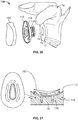
- a glenoid implant One embodiment of the glenoid implant and its constituent parts is shown in FIGs. 1-7 .
- the glenoid implant is designed for TSA, although it should be appreciated that the concepts described herein may be applied in either TSA or RSA. Similarly, other embodiments of the present disclosure that are explicitly directed to RSA may be modified for use in TSA procedures and vice versa.
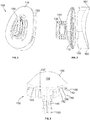
- Glenoid implant 100 as shown in FIGs. 1-3 , includes a medial part 110 and a lateral part 150.
- Medial part 110 is the anchor component of the implant for placement into the glenoid, while the lateral part includes an articulating surface that interfaces with the humerus. As shown in FIG.
- medial part 110 includes an engagement feature 112 that interfaces with a complementary engagement feature 156 of the lateral part 150.
- the lateral part 150 is preferably polymeric and has capacity for flexure so that engagement feature 156 may flex or be bent around the corresponding engagement feature 112 on medial part 110 to snap fit the parts with one another.
- materials other than polymers may be suitable, particularly those that provide a suitable level of flexibility.
- Specific examples of material usable for lateral part 150 includes polycarbonate urethane and silicone rubber, both of which are biocompatible. Any imposed deformation of the lateral part 150 is elastic such that the snapping action results in the return of the lateral part to its original shape.
- the fit between the lateral part 150 and medial part (110) may be a press fit, although other types of fit may be suitable.
- Each engagement feature 112, 156 may be a dovetail connection, as shown, though other types of engagement features are also contemplated.
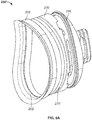
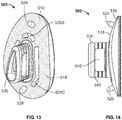
- FIGs. 4-5 show the medial part 110 in isolation.
- Medial part 110 includes a medial surface 118 that is generally convex in shape, and has a keel 130 extending medially therefrom.
- An outer layer of medial part 110 including medial surface 118 preferably has a porous structure that facilitates bone ingrowth.
- On an opposite side of medial part 110 is a lateral surface 122, shown in FIG. 4 .
- Lateral surface 122 is generally planar and includes engagement feature 112 around its perimeter. Extending through lateral surface 112 are three separate slots 120A-C that surround a central opening 142.
- Central opening 142 has a tear drop shape and extends through medial part 110. In some arrangements, central opening 142 may extend through an entire length of keel 130.
- central opening 142 may have a pear shape.
- Slot 120A is shorter than slots 120B, 120C and is located superior to opening 142.
- Each slot 120B, 120C is positioned on an opposite side of the central opening 142 and extends approximately parallel to lateral sides of opening 142.
- All three slots 120A-C may have slightly curved edges along their lengths to generally follow a shape of keel 130 and opening 142, as best shown in FIG. 5 .
- Inclusion of the slots 120A-C may provide access to the bone, for example via a bone-cutting tool, when the implant is in place to simplify a revision procedure.
- the bone instead of cutting around the exterior perimeter of medial part 110 to remove the medial part from the bone, the bone may be cut through slots 120A-C to allow keel 130 to be removed from the bone, sparing a relatively large amount of bone.
- Keel 130 is hollow with central opening 142 passing therethrough, as mentioned above. Keel 130 may also include a graft window 140 as shown in FIGs. 1, 2 and 4 passing laterally therethrough.
- a shape of graft window 140 may be rectangular with one or more rounded corners as shown in FIG. 2 , although it is contemplated that the shape may be square, obround, circular or other similar shapes.
- Along an outer surface 132 of keel 130 are grooves or notches 144 spaced apart from one another and oriented approximately parallel to lateral surface 122 in an inferior-superior alignment. The inclusion of notches 144 gives the keel 130 a larger surface area to increase contact with bone when implanted, which may provide better anchoring to the bone.
- the notches may have a U or V shaped profile. In some examples, the notches may be oriented orthogonally to the orientation of notches 144 shown in FIGs. 2 and 4 .
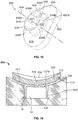
- the structure of keel 130 itself may be anatomically shaped. That is, the keel 130 may have a shape that is consistent with that of the perimeter of medial part 110 as defined by outer edge 116. For medial part 110 as shown in FIGs. 1-5 , keel 130 is pear shaped when viewed in a medial or lateral direction.
- Keel 130 includes a superior part 134, an inferior part 136, and opposite side parts 138A-B that bridge a distance between the superior and inferior parts.
- the combined superior part 134, opposite side parts 138A-B and inferior part 136 define a continuous enclosed loop, as shown in FIG. 5 .
- Keel 130 is wider nearer to inferior part 136 and has an inner surface 131 with a larger first radius of curvature at inferior part 136, measured about a medial-to-lateral axis through a length of the keel, than a second radius at superior part 134.
- Each side part 138A-B may have slight curvature so that inner surface 131 is concave in those parts, but the side parts have much less curvature than the respective end parts 134, 136.
- Side parts 138A-B become closer together moving toward superior part 134.
- a rim 145 at a terminal or free end of keel 130 may have a rounded edge, as shown in FIG. 1 . However, as mentioned elsewhere in the disclosure, a profile of the rim may vary from that shown for implant 100.
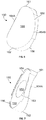
- FIGs. 6-7 show lateral part 150 in isolation.
- Lateral part 150 includes articular surface 158 and medial surface 154 opposite the articular surface.
- Lateral part 150 has a varying depth (in the medial-to-lateral direction) along its length and width as a function of the concave shape of articular surface 158.
- a length of lateral part 150 extends from inferior apex 162 to superior apex 161.
- Articular surface 158 has a width (in the anterior-to-posterior direction) with a maximum closer to inferior apex 162 than superior apex 161. From a location with the maximum width, a width of the lateral part 150 tapers toward superior apex 161, as shown in Fig. 6 .
- lateral part 150 has a pear-shape consistent with a shape of medial part 110.
- the shape of the articular surface 158 is bounded by edge 160. Further, because articular surface 158 is concave, the surface has low edge points 164A, 164B in between apices 161, 162.
- a radius of curvature of the concavity of articular surface 158 may be in a range from about 15 mm to about 30 mm. In some examples, the range may be from about 15 mm to about 25 mm. In further examples, the range may be from about 15 mm to about 23 mm. In further examples, the range may be from about 22 mm to about 24 mm. In yet another example, the radius of curvature may be about 23 mm. In other examples, the radius may be greater than about 30 mm.
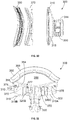
- medial surface 154 has a central region 152 and a peripheral region 155 radially outward of the central region.
- An outer bound of peripheral region 155 includes a rim as shown in FIGs. 3 and 7 , the rim including engagement feature 156.
- Central region 152 protrudes medially relative to peripheral region 155, as best shown in FIGs. 3 and 7 .
- An outer extent of central region 152 interfaces with peripheral region 155 at edge 153, as shown in FIG. 7 .
- central region 152 includes a convex surface. In some alternative arrangements, the surface may be partially convex. In further arrangements, the surface of central region 152 may have planar parts.
- a size of the protrusion of central region 152 is preferably such that articular surface 158 extends to a depth at its lowest point that is close to a plane through peripheral region 155. This is best shown in FIG. 3 .
- the central region 152 protrudes sufficiently relative to peripheral region 155 so that articular surface 158 crosses the plane through the peripheral region.
- Central region 152 provides extra material or structure to increase a minimum thickness of lateral part 150 in a portion of the lateral part that would otherwise be the thinnest part of the structure. Without the protruding surface of central region 152, a curvature of the articular surface 158 would be limited to one that would preserve a minimum thickness between an articular surface and a generally planar medial surface.
- a surface area of the central region 152 may be such that the surface area of peripheral region 155 is about 500% of the surface area of the central region.
- the surface area of the central region 152 may be anywhere from about 15% to about 100% of a total surface area of the medial surface 154.
- Implant 100 preferably utilizes a material combination such that medial part 110 is a metal material and lateral part 150 is a polymeric material.
- the metal may be a metal or metal alloy such as cobalt-chromium (CoCr) or Ti64.
- the polymeric material may be polyethylene such as X3 polyethylene by Stryker ® .
- the lateral part 150 may be ceramic or pyrolytic carbon instead of a polymer. It is contemplated that the aforementioned materials may be used in the respective medial and lateral parts of the glenoid implants of other embodiments of the present disclosure, including those illustrated in FIG. 8 through FIG. 22E , for example.
- the central part may function as an insert to bridge the differences between the metallic material of the medial part and the flexible polymeric material of the lateral part.
- Medial part 210 includes engagement feature 212 on a periphery of lateral surface 222.
- Central part 270 includes engagement features 276 that are engageable with engagement feature 212. As shown in FIG. 9 , the respective engagement features 212, 276 form a dovetail connection, though other connection types are contemplated, such as a snap fit connection.
- Lateral part 250 a flexible component, includes a peripheral wall 256 that forms a closed loop or ring sized so that when placed over central part 270, the lateral part engages with the central part through an interference fit.
- a ring-shaped inward protrusion (not shown) on the peripheral wall of the lateral part engages with a ring-shaped groove on the central part, thereby establishing a compression fit.
- Lateral part 250 includes an articular surface 258 and a medial surface 254, although unlike implant 100, medial surface 254 is a single convex surface throughout and does not have a protrusion or other distinctive sub-surface that deviates from the convex shape.
- Central part 270 may function as an insert between the medial part and the lateral part and includes a lateral surface 278 that is concave and sized and shaped such that when lateral part 250 is placed over and against lateral surface 278, as shown in FIG. 9 , medial surface 254 of lateral part 250 and lateral surface 278 of central part 270 are flush with one another. Opposite the lateral surface of central part 270 is medial surface 272, 275.
- the medial surface of central part 270 includes a peripheral region 275 and a central region 272 that protrudes medially relative to peripheral region 275.
- the structure of the medial surface 272, 275 of central part 270 is similar to medial surface 154 of lateral part 150 in implant 100.
- Central region 272 as shown in FIG. 9 has a convex protrusion that is entirely surrounded by peripheral region 275.
- central region 272 provides a thickness 277 of the lateral part at or above a set minimum, while also providing space so that lateral surface 278 has a deeper low point in a central area of the implant and a smaller radius of curvature than otherwise possible, if desired.
- lateral surface 278 crosses a plane through peripheral region 275, a depth that, without the central protrusion, would result in a void in central part 270 toward its center.
- Wedged portion 219B protrudes relative to shallow portion as shown in FIG. 9 and has a slight convex contour.
- Surfaces of portions 219A-B are characteristic of augmented glenoid implant structures for use with patients having eccentric glenoid erosion, in which the wedged portion 219B is adapted to contact a neoglenoid surface and the shallow portion 219A is adapted to contact a paleoglenoid surface.
- Augmented glenoid surfaces which may be used in place of those illustrated in FIGs. 8-9 , are described in greater detail in U.S. Provisional Patent Application No. 62/873,266, filed July 12, 2019 , the disclosure of which is hereby incorporated by reference herein.
- Keel 230 of medial part 210 includes grooves, ribs or notches 244 which have extensions thereon, as shown in FIGs. 8 and 9 .
- the extensions may have a "7"-shaped or “V"-shaped profile.
- Notches 244 with extensions function to compress bone upon impaction of implant 200 into bone. Although extensions on the notches 244 are not shown for implant 100, it is contemplated that such extensions may be included on the keel of any one of the implants of the present disclosure.
- a complete glenoid implant may include medial part 210 and central part 270 alone, without the lateral part. With an implant assembled in such a manner, central part 270 functions as an articulation surface with the humeral implant head, e.g., an implant made of a metallic material such as cobalt-chromium (CoCr).
- a complete glenoid implant 200' may include medial part 210', central part 270', and a lateral part 250' in the form of a flexible ring, which has a length that extends around a perimeter of central part 270'.
- Lateral part 250' includes an inward facing protrusion 252' that is engageable with a complementary recess 279' on central part 270', the engagement being in the form of a compression fit.
- Lateral part 250' is hollow so that when implant 200' is fully assembled, an articular surface of central part 270' is exposed. In this manner, the articular surface of central part 270' is exposed to contact with a humeral implant post-surgery. In use, wear between the exposed surface of the glenoid implant 200' and the humeral head is minimized through the inclusion of lateral part 250'. Less wear results in less buildup of debris.
- Glenoid implant 300 is yet another embodiment of the glenoid implant and is illustrated in FIGs. 10 and 11 .
- like reference numerals refer to like elements of implants 100 and 200, but within the 300-series of numerals.
- Glenoid implant 300 includes many of the same features as implant 200, with distinctions as shown in the Figures and as described in the following.
- Glenoid implant 300 includes medial part 310, central part 370, and lateral part 350, each engageable with one another as shown in FIG. 11 and having engagement features that are the same as those described for glenoid implant 200.
- Lateral part 350 includes articular surface 358 with an outer part 359 curved as shown in FIGs. 10 and 11 .
- Medial part 310 includes lateral surface 322 and medial surface 318.
- Medial surface 318 includes a first portion 319A and a second portion 319B, shown in FIG. 11 .
- Second portion 319B tapers from an outer surface of medial part 310 toward keel 330 and first portion 319A tapers from the keel toward the outer surface.
- medial part 310 is thicker in second portion 319B than in first portion 319A.
- medial surface 318 is generally convex, though the medial surface includes slots 320A-C therein.
- the shape of medial part 310 provides additional versatility for the glenoid implants contemplated by the present disclosure in that it may be used to accommodate different anatomy or surgical conditions than implants 100, 200, for example. This may be desirable if the labrum in the shoulder has a shape that is best accommodated by implant 300.
- FIGs. 12 , 12A and 12B illustrate yet another embodiment of the implant, glenoid implant 400.
- Implant 400 includes medial part 410 and lateral part 450.
- Medial part 410 includes a medial surface 418, a lateral surface 422 opposite the medial surface, and a keel 430 extending from the medial surface.
- Medial part 410 includes a central opening 442 through keel 430 and slots 420A-C.
- Medial surface 418 is convex in shape, with lateral surface 422 being generally parallel to the medial surface and thus having a concave shape. As shown in FIG.
- lateral surface 422 includes a superior ridge 425A and lateral ridges 425B-C, the ridges defining a protruding central region interior to the ridges.
- Lateral part 450 includes a medial surface 454 and an articular surface 458 opposite the medial surface. As shown in FIG. 12A , medial surface 454 includes a superior ridge 455A and lateral ridges 455B-C, the ridges defining a recessed surface interior to the ridges. Ridges 455A-C are complementary to ridges 425A-C.
- FIGs. 15 and 16 illustrate a glenoid implant 600 according to an embodiment of the disclosure.
- glenoid implant 600 is shown implanted into bone.
- Implant 600 includes medial part 610 and lateral part 650.
- Medial part 610 includes a keel 630 that extends from a central part of medial surface 618.
- Keel 630 is hollow and is pear-shaped when viewed along an axis 648 through the hollow part.
- Keel 630 is defined by a wall with an inner surface 631 and an outer surface 632.
- FIGs. 17 and 18 illustrate a glenoid implant 700 according to an embodiment of the disclosure.
- glenoid implant 700 is shown implanted into bone.
- Implant 700 includes medial part 710 and lateral part 750.
- a keel 730 extends medially from medial surface 718 of medial part 710.
- Keel 730 is hollow with an opening 742.
- the wall of keel 730 defines a pear-shape when viewed on axis 748 through a center of opening 742, and is solid throughout, as shown in FIG. 17 .
- keel 730 may be a relatively solid metallic material while in other arrangements the keel maybe a relatively porous metallic material.
- FIGs. 22A-E illustrate a glenoid implant 900 according to an embodiment of the disclosure.
- Implant 900 includes a medial part 910 and a lateral part 950.
- medial part 910 may be porous titanium in a central region and a polymeric in a peripheral region.
- the titanium medial part is a base that is dipped in liquid polymer in a mold so that the polymer solidifies over the titanium medial part. Extending medially from medial surface 918 is keel 930, shown in FIG. 22A .
- Keel 930 has a generally rectangular sectional shape with rounded corners, and has such a shape throughout its depth. Keel 930 further includes openings 940A, 940B, separate from one another as shown in FIG. 22A . Each opening 940A-B has a length perpendicular to the depth of the keel 930. Disposed within opening 940A is a blade 980A and within opening 904B is a blade 980B. Each of these blades has a similar structure as shown in FIG. 22B where blade 980A is shown as representative. Blade 980A has a first end 982A and a second end 984A opposite first end 982A.
- Opening 1046 is triangular such that a path defined through the keel 1030 is a triangular prism and functions to receive bone graft or other bony ingrowth during implant use.
- Keel 1030 has an outer surface that is pear shaped and includes notches 1 thereon. Through medial part 1010 and on opposite sides of the keel 1030 are slots 1020B, 1020C.
- Glenosphere 1050 includes a hemispherical surface 1058 and a medial surface 1054 that presses onto or toward medial part 1010 when engaged thereto.
- Glenoid implant 1100 illustrated in FIG. 24 is also for a RSA procedure.
- like reference numerals refer to like elements of implant 1000, but within the 1100-series of numerals.
- Both medial part 1110 and glenosphere 1150 are preferably metallic.
- keel 1130 has two parallel openings 1142, 1146, opening 1146 is cylindrical and sized to receive a fastener 1170.
- Fastener 1170 has surface characteristics for engagement with bone, in furtherance of the purpose of implant 1100.
- opening 1142 is defined by an inner wall that is tapered in toward a lateral surface of medial part. This is sometimes referred to as a Morse taper and is shown in FIG. 25 . The inclusion of the Morse taper enhances engagement between engagement portion 1152 of glenosphere 1150 and medial part 1110.
- FIG. 26 illustrates an embodiment of a glenoid implant 1200 that utilizes a metallic medial part 1210 that is the same as medial part 1110, but includes a polymeric lateral part 1250 attached thereto. This allows a lateral part with a concave articular surface to be substituted with a glenosphere such as that described for FIG. 25 and vice versa.
- like reference numerals refer to like elements of implants 100, 1100, but within the 1200-series of numerals.
- FIG. 27 illustrates an embodiment of a glenoid implant 1300 that includes medial part 1310 and lateral part 1350. Unless otherwise stated, like reference numerals refer to like elements of implants 100, 1000, but within the 1300-series of numerals.
- Medial part 1310 is preferably metallic and lateral part 1350 is preferably polymeric.
- Medial part 1310 includes a keel 1330 extending medially from medial surface 1318.
- Keel 1330 has a structure consistent with keel 130.
- Lateral part 1350 includes a glenosphere with a hemispherical surface 1358 at an inferior end on top of a base 1351.
- Base 1351 is pear-shaped to be commensurate in size with medial part 1310. In this manner, complementary engagement features of the medial part and the lateral part, 1312, 1356, line up for engagement between the two parts.
- the lateral part may have a medial surface with a protruding central region that has planar surfaces thereon or has a surface that only includes part that is partially convex.
- the central region may be proportionally larger or smaller than what is shown in FIG. 7 .
- the height of the protrusion may be greater or lesser proportional to a size of the implant than that shown in FIG. 3 .
- the height of the protrusion will be 3 mm, a thickness of the lateral part in the central region, combined with a minimum distance between a plane of the peripheral region and a maximum depth of the articular surface.
- kits contemplated herein may be varied in many ways. For example, it is contemplated that any combination of particular implants and tools as described herein may further include other tools or instruments not otherwise described as part of a kit. Some or all of the various combinations of elements of any contemplated kit may be included in a single package or distributed among multiple packages. In other examples, the kits contemplated herein may be accompanied by an instruction manual on how to perform one or more of the methods of using the contents of the kit.
- the present disclosure relates to a method of assembly of an implant.
- implant 100 as shown in FIG. 2 is assembled by bringing lateral part 150 to medial part 110 with medial surface 154 of the lateral part facing lateral surface 122 of the medial part. Engagement feature 156 is then snapped onto engagement feature 112, positioning an outer rim of lateral part 150 over the medial part, as shown, for example, in FIG. 3 .
- implant 200 is assembled in the same manner as implant 100 to bring central part 270 together with medial part 210. Then, lateral part 250 is slid over central part 270 by placing peripheral wall 256 over an outer surface of central part 270. In this manner, an interference fit is created between the parts. Similar methods of assembly may be employed for implants contemplated in the disclosure.
- implant 1000 as shown in FIG. 23 is assembled by advancing engagement portion 1052 of glenosphere 150 through opening 1042 in medial part 1010 to obtain an interference fit, e.g., via a Morse taper.
- a method of assembly of implant 1100 is similar, with an additional step of advancing fastener 1170 into opening 1146.
- implant 1300 is assembled. Engagement features 1356 of lateral part 1350 are snap fit onto corresponding engagement feature 1312 of medial part 1310.
- the present disclosure relates to a method of implantation of an implant in a joint.
- the joint may be a shoulder, but may be other joints in the body as well, such as a hip, knee or ankle.
- a method of implanting a glenoid implant into a shoulder is as shown in FIGs. 28-31 .
- the method may be performed autonomously or semi-autonomously with the assistance of a robotic manipulator for the implantation of the glenoid implant.
- the term "robotic manipulator” is used interchangeably with "robot.”
- the robot may form part of a larger system (not shown) that includes a computer, memory, controller, inputs and outputs, and/or a navigation system, which may be interconnected with one another.
- the inputs may include a keyboard or other user interface and the output may include at least a display that outputs images and/or data associated with the three-dimensional model and the surgical plan, among other information pertinent to the surgery.
- One function of the robot is to store data that relates to the location of various elements involved in the performance of the method. These include data for the location of the implant, the surface features on the implant, the cutting tool and the planned bone cuts.
- the robot may be configured to operate with haptic guidance, may be set up for connection to a cutting tool, such as a bur, and may be set up for connection to a rotatable driver for seating of the glenoid implant.
- the system is configured to provide force feedback and visual guidance during surgery, as described in greater detail below.
- the robot with haptics may be as described in U.S. Pat. App. Pub. No. 2006/0142657 (the '657 Publication), hereby incorporated by reference herein in its entirety.
- the robot of the '657 Publication is shown in FIG. 28 as robot 1400 and includes a base 1432, platform 1439 and arms 1433, 1434 that extend from base 1432.
- Arm 1434 extends to a haptic device tracker 1445 while arm 1433 includes a plurality of linkages and extends to an end effector 1435 that connects to a tool.
- the tool is a bur tool 1450, though in some arrangements, other tools may be attached.
- Another example of a robot is described in U.S. Pat. No.
- the method may be fully automatic or may include certain steps performed manually by a user.
- the term "user” refers to an individual that performs the surgical method. This may include an operator of the robot or a surgeon, for example.
- the system used for the method may employ a robot that includes both a cutting instrument and imaging hardware.
- a robot is advantageous in that it streamlines workflow and reduces the need to move around the various parts of the system during the procedure and/or reduces the need for repeated registrations of one or more elements of the system.
- One example of such a robot is described in U.S. Pat. App. Pub. No. 2014/0188132 , hereby incorporated by reference herein in its entirety.
- planning With the anatomy registered, surgical planning, also referred to herein as planning, for the surgery surrounding shoulder 10 is performed.
- planning involves establishment of the particular bone structure, including location, size and shape, to be cut with the robot. Because the glenoid implant is already manufactured at this stage and thus has a predetermined keel shape for engagement with bone, the dimensions of the glenoid implant are used as a guide to determine or confirm how the glenoid will be cut.
- the robot may optionally be used to prepare an overall surface 12 of the glenoid to receive the medial part of the glenoid implant.
- the surface 12 is prepared as necessary to receive medial surface 118 of medial part 110.
- Such surface preparation is in accordance with known practices for shoulder replacement surgery and typically involves resection of bone to expose subchondral bone. Further, the bone surface is resected to refine its curvature to match that of medial surface 118 of medial part 110.
- a deeper cut is made into the glenoid, as shown in FIGs. 29-31 .
- a closed loop groove 14 is cut with a size and shape to receive keel 130.
- the groove is cut to a size so that an interference fit may be achieved when the keel is received in the groove.
- data for the bone cuts is saved into the memory linked to the computer and incorporated into the three-dimensional model described above. With the precise identification of anatomical locations already in the model, this approach allows for very precise cutting of the bone so that when the implant is inserted into the glenoid, a close fit will result.
- the computer is used to generate boundary volumes for disposal of the implant into the resected bone as part of the planning process.
- the model may generate a range of acceptable cut volumes and/or cut paths in the bone that will allow for a satisfactory seating of the implant.
- the exact dimensions of the planned cut may be varied based on results of an optional bone density review that may warrant deeper or shallower cuts.
- Some examples of how bone density of a particular patient may be used to optimize implant geometry are described in U.S. Pat. App. Pub. No. 2015/0119987 , hereby incorporated by reference herein in its entirety.
- the depth of the cuts may be slightly shallower to increase friction between the keel and the bone or deeper to reduce friction.
- the robot such as robot 1400
- the controller and/or computer along with the navigation system, to ensure data from the robot including the bur location is overlaid with the three-dimensional model.
- the bur is then connected to the robot if not already connected. It should be appreciated that although the method is described with the use of a bur as a cutting tool, it is contemplated that other cutting tools may also be used.
- advancement of the bur into the glenoid will be visible on the display showing the three-dimensional model. As shown in FIG.
- bur tool 1450 e.g., a ball bur tool
- the navigation system tracks the coordinates of the bur and relays such information to the computer to show a location of bur tool 1450 on the display that shows the three-dimensional model.
- the model is viewable via the display and the surgical site is also viewable via direct visualization.
- the user references the cut plan on the model to guide bur 1450 to glenoid surface 12 to make the first cut, which is the initial surface cut that corresponds to the size and shape of the convex medial surface 118 of glenoid implant 100.
- This cut may be performed to expose subchondral bone on the glenoid.
- the location of the bur tip is fed back to the computer and associated with the three-dimensional model information.
- the model has a predetermined cut depth based on the surgical plan programmed as noted above.
- glenoid surface 12 is sized and shaped to closely fit, e.g., be flush with a size and shape of the convex medial surface 118 of the implant. However, prior to insertion of the implant onto the glenoid, a further cut to create the closed loop groove may be completed.
- bur tool 1450 is used to cut closed loop groove 14 in surface 12 in accordance with the three-dimensional model parameters as established during the planning stage of the procedure described above.
- the application of bur tool 1450 to the glenoid surface to cut the grooves is shown in FIG. 29 .
- the user directs the bur tool along the surface of the glenoid within a predetermined cut path for the tool to create closed loop groove 14.
- the cut path follows what may be described as a tear-drop shape as shown in FIG. 29 . Through this cut, the remaining bone left intact interior to the groove, bone core 16, also has a tear-drop shape.
- the glenoid is ready to receive glenoid implant 100. Confirmation that the lateral part and the medial part of the implant are assembled is done prior to implantation, and assembly completed if required. Then, implant 100 is advanced onto the glenoid, and in particular, keel 130 is advanced into closed loop groove 14, as shown in FIGs. 30 and 31 . This step may be done manually by the user or with the robot. When the robot is used, planning and controls as described above are utilized to obtain accurate placement. Further, the closed loop groove is sized with a high degree of accuracy such that once it receives keel 130, a secure fit should be expected with resistance to removal more than sufficient to hold the glenoid implant in place on the bone. As shown in FIG.
- the method of implantation described for glenoid implant 100 may also be performed to implant glenoid implants 200, 300, 400, 500, 600, 700, 800 shown in FIGs. 8-21 .
- Such a method may be performed with the same steps as described above.
- use of such method may involve formation of a wider closed loop groove in the glenoid so that when the implant is inserted, there is space to flex the keel in order to allow the protrusion of the keel to snap into the outward facing step in the removed material.
- a method of implantation of implant 600 shown in FIGs. 15 and 16 is performed as described above for implant 100, with additional steps as follows.
- a central region 18 of the bone is removed and the robot is used to further remove an outward facing step 19 at a terminal depth of the cut, all shown in FIG. 16 , where the implant is shown positioned within the space left subsequent to the removal of the bone material.
- This outward facing step may also be referred to as an undercut.
- a method of implantation of glenoid implant 100 involves preparation of an opening within the glenoid surface with a volume sufficient to receive keel such that when keel 130 is received in the bone, opening 142 within keel 130 remains unoccupied by bone. That is, a full volume of bone is removed for receipt of the keel and there is no bone core left in place once the cut in the glenoid is made.
- such method may be performed with placement of bone graft in keel 130, then placement of keel 130 into the glenoid opening to position implant 100 in the implanted position. Bone graft may be received through graft opening 140 and opening 142.
- opening 140 includes two openings located on opposite sides of keel 130, this arrangement provides for bone ingrowth from three separate openings.
- bone graft that may be used include natural bone graft and a porous structure that acts as an allograft, such as a porous titanium.
- the humerus cut head may be used as a source.
- the porous material on medial surface 118 promotes bone ingrowth.
- Such a method may also be performed for the other contemplated implants, including glenoid implants 200, 300, 400, 500, 600, 700, 800.
- a reverse shoulder implant with glenoid implant 1300 is implanted as part of an RSA. With keel 1330, implant 1300 may be implanted with methods that correspond to those described above for glenoid implant 100.
- another reverse shoulder implant is implanted into the shoulder as shown in FIGs. 33 and 34 .
- a cavity is formed in the glenoid to receive keel 1130.
- the keel has notches 1144 to aid in engagement with the bone once the keel is in place.
- a fastener element 1170 is receivable through opening 1146 in keel and thus may be advanced into bone to aid in the fixation of implant 1100 onto the glenoid.
- the fastener may be a locking and compression based screw.
- a complete assembly of the shoulder implant is shown in FIG. 34 , with reverse humeral implant 1190 in the humerus, the humeral implant having a polymer articular surface and the glenosphere having a metallic articular surface for polymer-metal contact.
- a shoulder joint is prepared for implantation of glenoid implant 900 according to one of the methods described herein or other techniques known to those of ordinary skill in the art.
- blades 980A-B are rotated into the unlocked position shown in FIG. 22C .
- the implant is advanced and otherwise impacted into place on the glenoid.
- rotatable shaft 986 is actuated to rotate blades 980A-B into the locked position shown in FIG. 22D to provide additional engagement of the implant with the bone.
- a knee surgery may include a tibial implant with keel, the tibia being prepared with a closed loop resection to receive a hollow keel of the tibial implant.
- a similar approach may be adopted for a femoral implant at the knee.
Landscapes
- Health & Medical Sciences (AREA)
- Orthopedic Medicine & Surgery (AREA)
- Cardiology (AREA)
- Oral & Maxillofacial Surgery (AREA)
- Transplantation (AREA)
- Engineering & Computer Science (AREA)
- Biomedical Technology (AREA)
- Heart & Thoracic Surgery (AREA)
- Vascular Medicine (AREA)
- Life Sciences & Earth Sciences (AREA)
- Animal Behavior & Ethology (AREA)
- General Health & Medical Sciences (AREA)
- Public Health (AREA)
- Veterinary Medicine (AREA)
- Prostheses (AREA)
Applications Claiming Priority (1)
| Application Number | Priority Date | Filing Date | Title |
|---|---|---|---|
| US202063048271P | 2020-07-06 | 2020-07-06 |
Publications (3)
| Publication Number | Publication Date |
|---|---|
| EP3936085A1 true EP3936085A1 (de) | 2022-01-12 |
| EP3936085B1 EP3936085B1 (de) | 2025-07-23 |
| EP3936085B8 EP3936085B8 (de) | 2025-09-03 |
Family
ID=76807526
Family Applications (1)
| Application Number | Title | Priority Date | Filing Date |
|---|---|---|---|
| EP21183832.1A Active EP3936085B8 (de) | 2020-07-06 | 2021-07-05 | Anatomisches glenoidimplantat |
Country Status (3)
| Country | Link |
|---|---|
| US (2) | US12011357B2 (de) |
| EP (1) | EP3936085B8 (de) |
| AU (1) | AU2021204625A1 (de) |
Families Citing this family (3)
| Publication number | Priority date | Publication date | Assignee | Title |
|---|---|---|---|---|
| CA2988052A1 (en) * | 2016-12-06 | 2018-06-06 | Smed-Ta/Td, Llc | Orthopaedic implant with fixation feature and a method of implanting thereof |
| CA3126604A1 (en) * | 2019-01-15 | 2020-07-23 | Biopoly, Llc | Implant systems for repair of a glenoid cavity |
| GB2633839A (en) * | 2023-09-25 | 2025-03-26 | Osstec Ltd | Tibial component |
Citations (12)
| Publication number | Priority date | Publication date | Assignee | Title |
|---|---|---|---|---|
| US4261062A (en) * | 1979-03-22 | 1981-04-14 | The Regents Of The University Of California | Natural shoulder joint prosthesis |
| US20060142657A1 (en) | 2002-03-06 | 2006-06-29 | Mako Surgical Corporation | Haptic guidance system and method |
| US20070142917A1 (en) * | 2005-10-26 | 2007-06-21 | Roche Christopher P | Apparatus and method to obtain bone fixation |
| US20070244564A1 (en) * | 2006-04-13 | 2007-10-18 | Tornier | Glenoid component with an anatomically optimized keel |
| US7831292B2 (en) | 2002-03-06 | 2010-11-09 | Mako Surgical Corp. | Guidance system and method for surgical procedures with improved feedback |
| US20110224673A1 (en) * | 2010-03-11 | 2011-09-15 | The Curators Of The University Of Missouri | Joint implant and prosthesis and method |
| US20140188132A1 (en) | 2012-12-31 | 2014-07-03 | Mako Surgical Corp. | System for image-based robotic surgery |
| US20150080717A1 (en) | 2013-09-18 | 2015-03-19 | Stryker Corporation | Patient specific bone preparation for consistent effective fixation feature engagement |
| US20150119987A1 (en) | 2013-10-28 | 2015-04-30 | Stryker Corporation | Implant design using heterogeneous bone properties and probabilistic tools to determine optimal geometries for fixation features |
| EP2057970B1 (de) * | 2007-11-07 | 2016-01-06 | Arthrex, Inc. | Hybride Schultergelenkpfanne für Schulterarthroplastie |
| US20170000562A1 (en) | 2015-07-01 | 2017-01-05 | Mako Surgical Corp. | Implant placement planning |
| US20190076261A1 (en) * | 2009-12-14 | 2019-03-14 | Tornier Sas | Shoulder prosthesis glenoid component |
Family Cites Families (31)
| Publication number | Priority date | Publication date | Assignee | Title |
|---|---|---|---|---|
| FR2741796B1 (fr) | 1995-11-30 | 1998-03-27 | Tornier Sa | Dispositif pour la fixation d'une prothese et notamment d'une prothese glenoidienne de l'omoplate |
| US6699289B2 (en) | 2001-12-31 | 2004-03-02 | Depuy Orthopaedics, Inc. | Augmented glenoid component having an interrupted surface and associated method for securing the augmented glenoid component to a glenoid surface of a scapula |
| US7182786B2 (en) | 2002-04-25 | 2007-02-27 | Zimmer Technology, Inc. | Modular bone implant, tool, and method |
| EP1509161B1 (de) | 2002-05-23 | 2009-05-13 | Active Implants Corporation | Gelenk- und zahnimplantate |
| WO2005016123A2 (en) | 2003-08-11 | 2005-02-24 | Chudik Steven C M D | Devices and methods used for shoulder replacement |
| FR2859099B1 (fr) * | 2003-08-25 | 2006-01-06 | Tornier Sa | Composant glenoidien de prothese d'epaule et prothese totale d'epaule incorporant un tel composant |
| ATE503442T1 (de) | 2004-05-19 | 2011-04-15 | Zimmer Gmbh | Glenoidverankerung |
| US7892287B2 (en) | 2004-09-27 | 2011-02-22 | Depuy Products, Inc. | Glenoid augment and associated method |
| US8007538B2 (en) | 2005-02-25 | 2011-08-30 | Shoulder Innovations, Llc | Shoulder implant for glenoid replacement |
| US8778028B2 (en) * | 2005-02-25 | 2014-07-15 | Shoulder Innovations, Inc. | Methods and devices for less invasive glenoid replacement |
| EP1787603A1 (de) | 2005-11-18 | 2007-05-23 | Zimmer GmbH | Basisplattform für ein künstliches Gelenk |
| US9474619B2 (en) | 2006-03-21 | 2016-10-25 | Tornier, Inc. | Glenoid component with improved fixation stability |
| BRPI0709103B8 (pt) * | 2006-03-23 | 2021-06-22 | Exactech Inc | conjunto glenóide para prótese de ombro inverso |
| WO2008014258A2 (en) | 2006-07-24 | 2008-01-31 | Spine Solutions, Inc. | Intervertebral implant with keel |
| US9545311B2 (en) * | 2009-03-05 | 2017-01-17 | Tornier, Inc. | Glenoid implant anchor post |
| US8721727B2 (en) | 2009-11-24 | 2014-05-13 | Tornier Sas | Glenoid component with offset center and associated methods |
| US8882845B2 (en) * | 2010-05-05 | 2014-11-11 | DePuy Synthes Products, LLC | Mobile bearing glenoid prosthesis |
| US9232955B2 (en) | 2010-08-12 | 2016-01-12 | Smith & Nephew, Inc. | Methods and devices for installing standard and reverse shoulder implants |
| CA2836772C (en) | 2011-05-20 | 2020-03-10 | Zimmer, Inc. | Stabilizing prosthesis support structure |
| WO2012178031A1 (en) | 2011-06-23 | 2012-12-27 | Stryker Corporation | Prosthetic implant and method of implantation |
| US9414927B2 (en) | 2011-12-08 | 2016-08-16 | Imds Llc | Shoulder arthroplasty |
| WO2014137876A2 (en) | 2013-03-08 | 2014-09-12 | Stryker Corporation | Bone pads |
| US20170319348A1 (en) | 2015-08-10 | 2017-11-09 | Catalyst Orthoscience Inc. | Arthroplasty prostheses with multi-axis fixation |
| US9814471B2 (en) | 2013-03-11 | 2017-11-14 | Catalyst Orthoscience Inc. | Glenoid arthroplasty and offset reamers |
| US9775716B2 (en) | 2013-03-11 | 2017-10-03 | Catalyst Orthoscience Inc. | Glenoid arthroplasty |
| US9044330B2 (en) | 2013-03-12 | 2015-06-02 | DePuy Synthes Products, Inc. | System and method for implanting a secondary glenoid prosthesis |
| US9480570B2 (en) | 2013-03-13 | 2016-11-01 | Biomet Manufacturing, Llc | Porous metal glenoid and associated method for molding the same |
| US9962266B2 (en) | 2015-09-11 | 2018-05-08 | Deltoid, Llc | Arthroplasty components |
| US20150272741A1 (en) | 2014-03-26 | 2015-10-01 | Biomet Manufacturing, Llc | Press-fit glenoid with peripheral compression pegs |
| AU2016246513B2 (en) * | 2015-04-07 | 2019-08-29 | Zimmer, Inc. | Convertible glenoid |
| US12059354B2 (en) | 2019-02-15 | 2024-08-13 | Howmedica Osteonics Corp. | Robotic acetabulum preparation for acceptance of acetabular cup with engagement features |
-
2021
- 2021-07-01 AU AU2021204625A patent/AU2021204625A1/en active Pending
- 2021-07-02 US US17/366,381 patent/US12011357B2/en active Active
- 2021-07-05 EP EP21183832.1A patent/EP3936085B8/de active Active
-
2024
- 2024-05-14 US US18/663,345 patent/US20240366395A1/en active Pending
Patent Citations (12)
| Publication number | Priority date | Publication date | Assignee | Title |
|---|---|---|---|---|
| US4261062A (en) * | 1979-03-22 | 1981-04-14 | The Regents Of The University Of California | Natural shoulder joint prosthesis |
| US20060142657A1 (en) | 2002-03-06 | 2006-06-29 | Mako Surgical Corporation | Haptic guidance system and method |
| US7831292B2 (en) | 2002-03-06 | 2010-11-09 | Mako Surgical Corp. | Guidance system and method for surgical procedures with improved feedback |
| US20070142917A1 (en) * | 2005-10-26 | 2007-06-21 | Roche Christopher P | Apparatus and method to obtain bone fixation |
| US20070244564A1 (en) * | 2006-04-13 | 2007-10-18 | Tornier | Glenoid component with an anatomically optimized keel |
| EP2057970B1 (de) * | 2007-11-07 | 2016-01-06 | Arthrex, Inc. | Hybride Schultergelenkpfanne für Schulterarthroplastie |
| US20190076261A1 (en) * | 2009-12-14 | 2019-03-14 | Tornier Sas | Shoulder prosthesis glenoid component |
| US20110224673A1 (en) * | 2010-03-11 | 2011-09-15 | The Curators Of The University Of Missouri | Joint implant and prosthesis and method |
| US20140188132A1 (en) | 2012-12-31 | 2014-07-03 | Mako Surgical Corp. | System for image-based robotic surgery |
| US20150080717A1 (en) | 2013-09-18 | 2015-03-19 | Stryker Corporation | Patient specific bone preparation for consistent effective fixation feature engagement |
| US20150119987A1 (en) | 2013-10-28 | 2015-04-30 | Stryker Corporation | Implant design using heterogeneous bone properties and probabilistic tools to determine optimal geometries for fixation features |
| US20170000562A1 (en) | 2015-07-01 | 2017-01-05 | Mako Surgical Corp. | Implant placement planning |
Also Published As
| Publication number | Publication date |
|---|---|
| US20240366395A1 (en) | 2024-11-07 |
| US12011357B2 (en) | 2024-06-18 |
| AU2021204625A1 (en) | 2022-01-20 |
| EP3936085B1 (de) | 2025-07-23 |
| US20220000629A1 (en) | 2022-01-06 |
| EP3936085B8 (de) | 2025-09-03 |
Similar Documents
| Publication | Publication Date | Title |
|---|---|---|
| US20260076804A1 (en) | Convertible stem/fracture stem | |
| US20240366395A1 (en) | Anatomic Implant For Joints | |
| JP4722182B2 (ja) | 関節の表面を彫刻するための装置および方法 | |
| EP2720643B1 (de) | Prothetisches implantat | |
| US10405982B2 (en) | Partial joint resurfacing implant,instrumentation, and method | |
| JP5868718B2 (ja) | 整形外科手術で使用するための振動ラスプ | |
| AU2009212243B2 (en) | Femoral component of knee prosthesis, the femoral component having anterior/posterios claw(s) for digging into bone and/or a raised rib with a bulbous terminus | |
| EP2291147B1 (de) | Implantat zur teilweisen wiederherstellung einer gelenkoberfläche | |
| CA2906631C (en) | Unicondylar tibial knee implant | |
| US8545507B2 (en) | Prosthesis removal cutting guide, cutting tool and method | |
| EP3771456B1 (de) | Glenoidkomponente mit hybridmetallrücken | |
| EP3146919A2 (de) | Orthopädisches, chirurgisches instrumentensystem | |
| CN114129311A (zh) | 用于膝关节成形术的胫骨植入物 | |
| US20240325161A1 (en) | Systems and methods for knee arthroplasty | |
| US20250009521A1 (en) | Stemless implant assemblies with screw fixation |
Legal Events
| Date | Code | Title | Description |
|---|---|---|---|
| PUAI | Public reference made under article 153(3) epc to a published international application that has entered the european phase |
Free format text: ORIGINAL CODE: 0009012 |
|
| STAA | Information on the status of an ep patent application or granted ep patent |
Free format text: STATUS: REQUEST FOR EXAMINATION WAS MADE |
|
| 17P | Request for examination filed |
Effective date: 20210705 |
|
| AK | Designated contracting states |
Kind code of ref document: A1 Designated state(s): AL AT BE BG CH CY CZ DE DK EE ES FI FR GB GR HR HU IE IS IT LI LT LU LV MC MK MT NL NO PL PT RO RS SE SI SK SM TR |
|
| B565 | Issuance of search results under rule 164(2) epc |
Effective date: 20211213 |
|
| STAA | Information on the status of an ep patent application or granted ep patent |
Free format text: STATUS: EXAMINATION IS IN PROGRESS |
|
| 17Q | First examination report despatched |
Effective date: 20230602 |
|
| GRAP | Despatch of communication of intention to grant a patent |
Free format text: ORIGINAL CODE: EPIDOSNIGR1 |
|
| STAA | Information on the status of an ep patent application or granted ep patent |
Free format text: STATUS: GRANT OF PATENT IS INTENDED |
|
| RIC1 | Information provided on ipc code assigned before grant |
Ipc: A61F 2/46 20060101ALN20250120BHEP Ipc: A61B 17/16 20060101ALN20250120BHEP Ipc: A61F 2/40 20060101ALI20250120BHEP Ipc: A61F 2/30 20060101AFI20250120BHEP |
|
| INTG | Intention to grant announced |
Effective date: 20250203 |
|
| GRAS | Grant fee paid |
Free format text: ORIGINAL CODE: EPIDOSNIGR3 |
|
| GRAA | (expected) grant |
Free format text: ORIGINAL CODE: 0009210 |
|
| STAA | Information on the status of an ep patent application or granted ep patent |
Free format text: STATUS: THE PATENT HAS BEEN GRANTED |
|
| P01 | Opt-out of the competence of the unified patent court (upc) registered |
Free format text: CASE NUMBER: APP_25909/2025 Effective date: 20250530 |
|
| AK | Designated contracting states |
Kind code of ref document: B1 Designated state(s): AL AT BE BG CH CY CZ DE DK EE ES FI FR GB GR HR HU IE IS IT LI LT LU LV MC MK MT NL NO PL PT RO RS SE SI SK SM TR |
|
| REG | Reference to a national code |
Ref country code: GB Ref legal event code: FG4D |
|
| REG | Reference to a national code |
Ref country code: CH Ref legal event code: EP |
|
| REG | Reference to a national code |
Ref country code: IE Ref legal event code: FG4D |
|
| REG | Reference to a national code |
Ref country code: DE Ref legal event code: R096 Ref document number: 602021034485 Country of ref document: DE |
|
| REG | Reference to a national code |
Ref country code: CH Ref legal event code: PK Free format text: BERICHTIGUNG B8 |
|
| RAP4 | Party data changed (patent owner data changed or rights of a patent transferred) |
Owner name: HOWMEDICA OSTEONICS CORP. |
|
| REG | Reference to a national code |
Ref country code: NL Ref legal event code: MP Effective date: 20250723 |
|
| PG25 | Lapsed in a contracting state [announced via postgrant information from national office to epo] |
Ref country code: PT Free format text: LAPSE BECAUSE OF FAILURE TO SUBMIT A TRANSLATION OF THE DESCRIPTION OR TO PAY THE FEE WITHIN THE PRESCRIBED TIME-LIMIT Effective date: 20251124 |
|
| PG25 | Lapsed in a contracting state [announced via postgrant information from national office to epo] |
Ref country code: NL Free format text: LAPSE BECAUSE OF FAILURE TO SUBMIT A TRANSLATION OF THE DESCRIPTION OR TO PAY THE FEE WITHIN THE PRESCRIBED TIME-LIMIT Effective date: 20250723 |
|
| REG | Reference to a national code |
Ref country code: AT Ref legal event code: MK05 Ref document number: 1815624 Country of ref document: AT Kind code of ref document: T Effective date: 20250723 |
|
| PG25 | Lapsed in a contracting state [announced via postgrant information from national office to epo] |
Ref country code: IS Free format text: LAPSE BECAUSE OF FAILURE TO SUBMIT A TRANSLATION OF THE DESCRIPTION OR TO PAY THE FEE WITHIN THE PRESCRIBED TIME-LIMIT Effective date: 20251123 |
|
| PG25 | Lapsed in a contracting state [announced via postgrant information from national office to epo] |
Ref country code: NO Free format text: LAPSE BECAUSE OF FAILURE TO SUBMIT A TRANSLATION OF THE DESCRIPTION OR TO PAY THE FEE WITHIN THE PRESCRIBED TIME-LIMIT Effective date: 20251023 |
|
| REG | Reference to a national code |
Ref country code: LT Ref legal event code: MG9D |
|
| PG25 | Lapsed in a contracting state [announced via postgrant information from national office to epo] |
Ref country code: AT Free format text: LAPSE BECAUSE OF FAILURE TO SUBMIT A TRANSLATION OF THE DESCRIPTION OR TO PAY THE FEE WITHIN THE PRESCRIBED TIME-LIMIT Effective date: 20250723 |
|
| PG25 | Lapsed in a contracting state [announced via postgrant information from national office to epo] |
Ref country code: FI Free format text: LAPSE BECAUSE OF FAILURE TO SUBMIT A TRANSLATION OF THE DESCRIPTION OR TO PAY THE FEE WITHIN THE PRESCRIBED TIME-LIMIT Effective date: 20250723 |
|
| PG25 | Lapsed in a contracting state [announced via postgrant information from national office to epo] |
Ref country code: HR Free format text: LAPSE BECAUSE OF FAILURE TO SUBMIT A TRANSLATION OF THE DESCRIPTION OR TO PAY THE FEE WITHIN THE PRESCRIBED TIME-LIMIT Effective date: 20250723 |
|
| PG25 | Lapsed in a contracting state [announced via postgrant information from national office to epo] |
Ref country code: GR Free format text: LAPSE BECAUSE OF FAILURE TO SUBMIT A TRANSLATION OF THE DESCRIPTION OR TO PAY THE FEE WITHIN THE PRESCRIBED TIME-LIMIT Effective date: 20251024 |
|
| PG25 | Lapsed in a contracting state [announced via postgrant information from national office to epo] |
Ref country code: SE Free format text: LAPSE BECAUSE OF FAILURE TO SUBMIT A TRANSLATION OF THE DESCRIPTION OR TO PAY THE FEE WITHIN THE PRESCRIBED TIME-LIMIT Effective date: 20250723 |
|
| PG25 | Lapsed in a contracting state [announced via postgrant information from national office to epo] |
Ref country code: LV Free format text: LAPSE BECAUSE OF FAILURE TO SUBMIT A TRANSLATION OF THE DESCRIPTION OR TO PAY THE FEE WITHIN THE PRESCRIBED TIME-LIMIT Effective date: 20250723 |
|
| PG25 | Lapsed in a contracting state [announced via postgrant information from national office to epo] |
Ref country code: BG Free format text: LAPSE BECAUSE OF FAILURE TO SUBMIT A TRANSLATION OF THE DESCRIPTION OR TO PAY THE FEE WITHIN THE PRESCRIBED TIME-LIMIT Effective date: 20250723 Ref country code: PL Free format text: LAPSE BECAUSE OF FAILURE TO SUBMIT A TRANSLATION OF THE DESCRIPTION OR TO PAY THE FEE WITHIN THE PRESCRIBED TIME-LIMIT Effective date: 20250723 |
|
| PG25 | Lapsed in a contracting state [announced via postgrant information from national office to epo] |
Ref country code: RS Free format text: LAPSE BECAUSE OF FAILURE TO SUBMIT A TRANSLATION OF THE DESCRIPTION OR TO PAY THE FEE WITHIN THE PRESCRIBED TIME-LIMIT Effective date: 20251023 |
|
| PG25 | Lapsed in a contracting state [announced via postgrant information from national office to epo] |
Ref country code: ES Free format text: LAPSE BECAUSE OF FAILURE TO SUBMIT A TRANSLATION OF THE DESCRIPTION OR TO PAY THE FEE WITHIN THE PRESCRIBED TIME-LIMIT Effective date: 20250723 |