EP3934944B1 - Hupenbaugruppe, verfahren zu deren herstellung sowie fahrzeuglenkvorrichtung mit einer solchen hupenbaugruppe - Google Patents
Hupenbaugruppe, verfahren zu deren herstellung sowie fahrzeuglenkvorrichtung mit einer solchen hupenbaugruppe Download PDFInfo
- Publication number
- EP3934944B1 EP3934944B1 EP20710086.8A EP20710086A EP3934944B1 EP 3934944 B1 EP3934944 B1 EP 3934944B1 EP 20710086 A EP20710086 A EP 20710086A EP 3934944 B1 EP3934944 B1 EP 3934944B1
- Authority
- EP
- European Patent Office
- Prior art keywords
- clip
- horn assembly
- horn
- carrier element
- electrical conductor
- Prior art date
- Legal status (The legal status is an assumption and is not a legal conclusion. Google has not performed a legal analysis and makes no representation as to the accuracy of the status listed.)
- Active
Links
Images



Classifications
-
- B—PERFORMING OPERATIONS; TRANSPORTING
- B60—VEHICLES IN GENERAL
- B60R—VEHICLES, VEHICLE FITTINGS, OR VEHICLE PARTS, NOT OTHERWISE PROVIDED FOR
- B60R21/00—Arrangements or fittings on vehicles for protecting or preventing injuries to occupants or pedestrians in case of accidents or other traffic risks
- B60R21/02—Occupant safety arrangements or fittings, e.g. crash pads
- B60R21/16—Inflatable occupant restraints or confinements designed to inflate upon impact or impending impact, e.g. air bags
- B60R21/20—Arrangements for storing inflatable members in their non-use or deflated condition; Arrangement or mounting of air bag modules or components
- B60R21/203—Arrangements for storing inflatable members in their non-use or deflated condition; Arrangement or mounting of air bag modules or components in steering wheels or steering columns
- B60R21/2035—Arrangements for storing inflatable members in their non-use or deflated condition; Arrangement or mounting of air bag modules or components in steering wheels or steering columns using modules containing inflator, bag and cover attachable to the steering wheel as a complete sub-unit
- B60R21/2037—Arrangements for storing inflatable members in their non-use or deflated condition; Arrangement or mounting of air bag modules or components in steering wheels or steering columns using modules containing inflator, bag and cover attachable to the steering wheel as a complete sub-unit the module or a major component thereof being yieldably mounted, e.g. for actuating the horn switch or for protecting the driver in a non-deployment situation
-
- B—PERFORMING OPERATIONS; TRANSPORTING
- B60—VEHICLES IN GENERAL
- B60Q—ARRANGEMENT OF SIGNALLING OR LIGHTING DEVICES, THE MOUNTING OR SUPPORTING THEREOF OR CIRCUITS THEREFOR, FOR VEHICLES IN GENERAL
- B60Q5/00—Arrangement or adaptation of acoustic signal devices
- B60Q5/001—Switches therefor
- B60Q5/003—Switches therefor mounted on the steering wheel
Definitions
- the invention relates to a horn assembly of a vehicle steering device with the features in the preamble of claim 1, a method for its production and a vehicle steering device with such a horn assembly.
- Vehicle steering devices are usually equipped with a horn assembly so that a driver of the vehicle can trigger an acoustic signal when required by operating the horn assembly.
- the horn assembly can be located anywhere on the steering device, although the driver intuitively expects the horn to be activated in the center of the steering device, so that the horn assembly is often provided in the hub section of the steering device.
- the hub section of the steering device often also contains a front gas bag module for the driver, so that the integration of a horn assembly in this area is not technically trivial.
- the steering devices and gas bag modules differ in shape and size, so that the horn assembly must be adapted in each case at great expense.
- keeping specially shaped components of the horn assembly for the different vehicle models is logistically complex and costly.
- a vehicle steering device of the generic type DE 10 2014 003 422 A1 already comprises a horn assembly with the features in the preamble of claim 1, wherein a device for fastening a gas bag module is provided, which by means of guide sleeves advantageously combines both a guide function for the gas bag module and a horn function.
- the object of the invention is to create a horn assembly for a vehicle steering device, which comprises components that are as simple and universally applicable as possible and can be manufactured quickly and with little effort.
- the object is achieved by a horn assembly with an electrically non-conductive carrier element, an elongated, flexible electrical conductor arranged on the carrier element, an electrically conductive component which is in contact with the flexible electrical conductor and a first horn contact, and a second horn contact which is spaced apart from the first horn contact in a basic position of the horn assembly and is electrically connected to the first horn contact in an actuated position of the horn assembly, wherein the electrically conductive component is designed as an electrically conductive clip (22) and is latched onto the carrier element (18) in order to realize the first horn contact at any desired location along the flexible electrical conductor (20).
- the elongated, flexible electrical conductor allows the horn assembly to be quickly and easily adapted to the shape and size of the carrier element, wherein the carrier part can be, for example, a module housing of a front airbag module or a plastic cover of the vehicle steering device.
- the carrier part can be, for example, a module housing of a front airbag module or a plastic cover of the vehicle steering device.
- the elongated, flexible electrical conductor is a cable which has an electrically conductive wire and, at least in sections, an electrically insulating sheath in a longitudinal direction of the conductor.
- Such cables are inexpensive to obtain, can be easily cut to a desired length and can be adapted to a geometry of the carrier element with little effort by plastic deformation.
- the clip can have a cutting edge for cutting into the electrically insulating sheath, with the cutting edge touching the electrically conductive wire when the horn assembly is assembled.
- the cutting edge is preferably formed integrally onto the clip and, when the clip is locked onto the carrier element, makes contact with the electrical conductor, specifically with the electrically conductive wire of the cable.
- the clip has a spring tongue and the cable in the mounting area of the clip is designed without an electrically insulating sheath, whereby the spring tongue touches the electrically conductive wire when the horn assembly is assembled.
- the spring tongue is preferably formed in one piece onto the clip and, when the clip is locked onto the carrier element, makes contact with the electrical conductor, specifically with the electrically conductive wire of the cable.
- the electrically conductive clip can have an integrally formed, elastic tab for pushing the horn assembly into its basic position and/or for electrically contacting the second horn contact.
- This tab ensures or can at least contribute to the fact that the horn assembly is in a defined basic position when not actuated. Furthermore, this tab can also be used to influence the actuation force of the horn assembly. Alternatively or additionally, the elastic tab can be deformed in the actuation position of the horn assembly in particular so that it touches the second horn contact and thus creates the electrical connection between the two horn contacts.
- the clip is preferably a bent stamped part made of sheet metal, for example spring steel. This makes the clip very easy, inexpensive and quick to produce.
- a further elongated, flexible electrical conductor is provided, wherein the second horn contact is formed by a further electrically conductive clip which is in contact with the further elongated, flexible electrical conductor.
- the two clips can be designed as identical parts in order to minimize the number of different individual components.
- the two elongated, flexible electrical conductors can be arranged on the same electrically non-conductive carrier element and the two electrically conductive clips can be locked onto the same electrically non-conductive carrier element.
- a further electrically non-conductive carrier element is provided, wherein the further elongated, flexible electrical conductor is arranged on the further carrier element and the further electrically conductive clip is locked onto the further carrier element.
- the invention further comprises a vehicle steering device with a steering device skeleton, a gas bag module and a horn assembly as described above, wherein at least one carrier element of the horn assembly is designed in one piece with a skeleton-fixed steering device cover or a module housing of the gas bag module.
- the elongated, flexible electrical conductor is a cable which has an electrically conductive wire and an electrically insulating sheath in a longitudinal direction of the conductor, wherein the associated clip has a cutting edge which cuts into the sheath in step c) until it touches the electrical wire in the final assembly position.
- the elongated, flexible electrical conductor is a cable which has an electrically conductive wire and an electrically insulating sheath in a longitudinal direction of the conductor, wherein the sheath is recessed in the mounting area of the associated clip and the clip has a spring tongue which is applied against the exposed electrical wire in step c) and touches the wire in the final assembly position.
- the horn assembly with clips and cables is not only made up of simple components that can be easily adapted to external conditions and assembled in a variety of ways, but can also be manufactured with minimal effort.
- the clip is attached to a desired location on the carrier using a simple snap-in connection and, when snapped in, is simultaneously brought into contact with the associated electrical conductor. Tools or fastening devices, such as screws, are not required due to the snap-in connection. Furthermore, no complex welding or soldering connections are necessary due to the electrical contact of the clip via the cutting edge or the spring tongue.
- the Figures 1 and 2 show a vehicle steering device 10, specifically a steering wheel unit of a motor vehicle, with a steering device skeleton 12, a gas bag module 14 and a horn assembly 16.
- the horn assembly 16 of the vehicle steering device 10 comprises an electrically non-conductive carrier element 18, an elongated, flexible electrical conductor 20 arranged on the carrier element 18, an electrically conductive, elastic clip 22 which is in contact with the flexible electrical conductor 20, is latched to the carrier element 18 and forms a first horn contact, and a second horn contact which is spaced from the first horn contact in a basic position of the horn assembly 16 and is electrically connected to the first horn contact in an actuated position of the horn assembly 16.
- the carrier element 18 is preferably made of a plastic and in the embodiment of the horn assembly 16 according to the Figures 1 and 2 integrated in one piece into a skeleton-proof steering device cover 24.
- the carrier element 18 can also be designed in one piece with the gas bag module 14, in particular a module housing of the gas bag module 14.
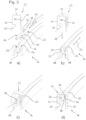
- FIGS. 3 and 4 each illustrate a sequence of process steps for producing the horn assembly 16, in particular for mechanically locking the clip 22 on the carrier element 18 and simultaneously establishing an electrical contact between the clip 22 and the elongated, flexible electrical conductor 20.
- a method step a the non-conductive carrier element 18 is first provided, to which the elongated, flexible electrical conductor 20 is mounted in a method step b).
- the electrically conductive clip 22 is fed in an assembly direction 28 running transversely to the longitudinal direction 26 of the electrical conductor 20 until the clip 22 locks into the carrier element 18 in a final assembly position, the clip 22 forming an electrical contact with the electrical conductor 20 when fed in the assembly direction 28.
- the clip 22 is essentially U-shaped and has two opposing legs 30, 32 and a web 34 which connects the legs 30, 32.
- One of the legs 30, 32 has a leg section 35 running obliquely to the assembly direction 28, so that the U-shaped clip 22 widens when fed in the assembly direction 28.
- the clip 22 snaps back and forms a locking connection with the carrier element 18, by which the clip 22 is fixed to the carrier element 18.
- the elongated, flexible electrical conductor 20 is a cable which has an electrically conductive wire 36 and an electrically insulating sheath 38 in the longitudinal direction 26 of the conductor 20, the sheath 38 being recessed in the mounting area of the associated clip 22 and the clip 22 has a spring tongue 40 which is applied in step c) against the exposed, electrically conductive wire 36 and the wire 36 in the final assembly position according to Figure 3d ) is touched.
- the clip 22 is made in particular as a bent stamped part from a sheet metal, for example from spring steel, wherein the spring tongue 40 is formed integrally onto the clip 22 and is in contact with the electrically conductive wire 36 when the horn assembly 16 is assembled.
- one leg 32 of the U-shaped clip 22 has the leg section 35 running obliquely to the mounting direction 28 and the other leg 30 of the clip 22 has the spring tongue 40.
- the elongated, flexible electrical conductor 20 is also a cable which has at least one electrically conductive wire 36 and an electrically insulating sheath 38 in the longitudinal direction 26 of the conductor 20, the associated clip 22 having a cutting edge 42 instead of the spring tongue 40, which in step c) cuts into the sheath 38 until it is in the final assembly position according to Figure 4d ) touches the electrically conductive wire 36.
- the clip 22 is made in particular as a bent stamped part from a sheet metal, for example from spring steel, with the cutting edge 42 being integrally formed on the clip 22 and being in contact with the electrically conductive wire when the horn assembly 16 is assembled.
- one leg 32 of the U-shaped clip 22 has the leg section 35 running obliquely to the assembly direction 28 and the other leg 30 of the clip 22 has the cutting edge 42.
- the Figures 5 to 7 show the manufacture or assembly of a horn assembly 16, which has a further elongated, flexible electrical conductor 44 (highlighted by dots), wherein the second horn contact is formed by a further electrically conductive clip 46, which in the assembled state of the horn assembly 16 is in contact with the further elongated, flexible electrical conductor 44.
- the electrical conductor 20 is due to the perspective in the Figures 5 to 7 not be recognized, which is why in this regard the Figures 3 and 4 is referred to.
- FIG. 5 a section of the electrically non-conductive carrier element 18 is shown in the mounting area of the two clips 22, 46. Openings 48, 50 through which the legs 30 of the clips 22, 46 extend in the assembled state of the horn assembly 16. Chamfered edges 52, 54 are provided opposite each other, along which the leg sections 35 of the clips 22, 46 slide during clip assembly.
- the two elongated, flexible electrical conductors 20, 44 are inserted into recesses 56, 58 of the carrier element 18 and the clip 46 is already mounted on the carrier element 18. Finally, the clip 22 is then mounted so that the two clips 22, 46 are in the longitudinal direction 26 of the electrical conductors 20, 44 according to Figure 7 are arranged one behind the other. The clips 22, 46 are mounted as shown in Figure 4 shown.
- the clip 22 acting as the first horn contact specifically the web 34 of the U-shaped clip 22, has an integrally formed, elastic tab 60 which, in an unloaded state, is spaced apart from the further clip 46 acting as the second horn contact. This corresponds to the basic position of the horn assembly 16, as is also shown in Figure 2 is shown.
- the elastic tab 60 When the vehicle horn is actuated, the elastic tab 60 is deformed by an actuating element 62 such that it touches the second horn contact in the actuating position of the horn assembly 16, whereby a horn circuit is closed and a horn signal is consequently triggered.
- the actuating element 62 is formed, for example, on the gas bag module 14 and according to Figure 2 in particular as an extension on the module housing of the gas bag module 14.
- the elastic tab 60 also supports a return of the horn assembly 16 to its basic position.
- the Figure 8 shows a further design variant of the horn assembly 16, which differs from the design variant according to Figure 7 only differs in that the further clip 46 also has an elastic tab 64. However, this tab 64 has no electrical contact function, but merely supports the return of the horn assembly 16 to its basic position.
- This increased restoring force of the tabs 60, 64 may already be sufficient to reliably reach the basic position, so that further restoring elements can be dispensed with.
- the carrier element 18 would then preferably be integrated into the module base and the actuating element 62 into the module cap.
- the Figure 9 shows a variant in which neither of the two clips 22, 46 has an elastic tab 60, 64.
- the horn assembly 16 is reset to its basic position by separate reset elements, such as in Figure 2
- the electrical contact is made by an electrical conductor piece 68, which is attached, for example, to a side of the actuating element 62 facing the clips 22, 46 (see also Figure 2 ).
- FIGS. 10 and 11 finally show two design variants which differ from the previously described horn assemblies 16 in that the two clips 22, 46 are not attached to the same carrier element 18.
- a further, electrically non-conductive carrier element 70 is provided, wherein the further elongated, flexible electrical conductor 44 is mounted on the further carrier element 70 and the further electrically conductive clip 46 is latched onto this further carrier element 70.
- the carrier element 18 is integrally integrated into the steering device cover 24 (analogous to the previously described embodiments), while the further carrier element 70 is formed integrally with the gas bag module 14, in particular a module housing of the gas bag module 14.
- the in Figure 11 The horn assembly 16 11 shown differs from the embodiment according to Figure 10 merely in that the electrically conductive clip 22 has an elastic tab 60 which urges the horn assembly 16 into its basic position but has no electrical contacting function.
Landscapes
- Engineering & Computer Science (AREA)
- Mechanical Engineering (AREA)
- Physics & Mathematics (AREA)
- Acoustics & Sound (AREA)
- Air Bags (AREA)
- Steering Controls (AREA)
Description
- Die Erfindung betrifft eine Hupenbaugruppe einer Fahrzeuglenkvorrichtung mit den Merkmalen im Oberbegriff des Anspruchs 1, ein Verfahren zu deren Herstellung und eine Fahrzeuglenkvorrichtung mit einer solchen Hupenbaugruppe.
- Fahrzeuglenkvorrichtungen sind üblicherweise mit einer Hupenbaugruppe versehen, damit ein Fahrer des Fahrzeugs durch Betätigen der Hupenbaugruppe bei Bedarf ein akustisches Signal auslösen kann.
- Generell kann die Hupenbaugruppe überall an der Lenkvorrichtung angeordnet sein, wobei der Fahrer intuitiv zumeist eine Hupenbetätigung im Zentrum der Lenkvorrichtung erwartet, sodass die Hupenbaugruppe oftmals im Nabenabschnitt der Lenkvorrichtung vorgesehen ist.
- Im Nabenabschnitt der Lenkvorrichtung befindet sich häufig auch ein Frontgassackmodul für den Fahrer, sodass die Integration einer Hupenbaugruppe in diesem Bereich technisch nicht trivial ist. Je nach Fahrzeugmodell unterscheiden sich die Lenkvorrichtungen und Gassackmodule in Form und Größe, sodass die Hupenbaugruppe jeweils aufwendig angepasst werden muss. Zudem ist das Vorhalten speziell geformter Komponenten der Hupenbaugruppe für die unterschiedlichen Fahrzeugmodelle logistisch aufwendig und kostenintensiv.
- Eine Fahrzeuglenkvorrichtung der gattungsgemäßen
DE 10 2014 003 422 A1 umfasst bereits eine Hupenbaugruppe mit den Merkmalen im Oberbegriff des Anspruchs 1, wobei eine Vorrichtung zur Befestigung eines Gassackmoduls vorgesehen ist, welche mittels Führungshülsen sowohl eine Führungsfunktion für das Gassackmodul als auch eine Hupfunktion in vorteilhafter Weise vereint. - Aufgabe der Erfindung ist die Schaffung einer Hupenbaugruppe für eine Fahrzeuglenkvorrichtung, die möglichst einfache und universell einsetzbare Komponenten umfasst sowie schnell und mit geringem Aufwand herstellbar ist.
- Erfindungsgemäß wird die Aufgabe gelöst durch eine Hupenbaugruppe mit einem elektrisch nicht-leitfähigen Trägerelement, einem langgestreckten, flexiblen elektrischen Leiter, der am Trägerelement angeordnet sind, einem elektrisch leitenden Bauteil, das mit dem flexiblen elektrischen Leiter in Kontakt steht und einen ersten Hupenkontakt bildet, sowie einem zweiten Hupenkontakt, der in einer Grundstellung der Hupenbaugruppe vom ersten Hupenkontakt beabstandet und in einer Betätigungsstellung der Hupenbaugruppe mit dem ersten Hupenkontakt elektrisch verbunden ist, wobei das elektrisch leitende Bauteil als elektrisch leitender Clip (22) ausgebildet und am Trägerelement (18) verrastet ist, um den ersten Hupenkontakt an einer beliebigen, gewünschten Stelle entlang des flexiblen elektrischen Leiters (20) zu realisieren. Durch den langgestreckten, flexiblen elektrischen Leiter lässt sich die Hupenbaugruppe schnell und einfach an die Form und Größe des Trägerelements anpassen, wobei das Trägerteil zum Beispiel ein Modulgehäuse eines Frontgassackmoduls oder eine Kunststoffblende der Fahrzeuglenkvorrichtung sein kann. Über das einfache Verrasten des elektrisch leitenden Clips mit dem Trägerelement wird dieser mit dem flexiblen elektrischen Leiter verbunden, sodass sich der erste Hupenkontakt mit geringem Aufwand an einer beliebigen, gewünschten Stelle entlang des flexiblen elektrischen Leiters realisieren lässt.
- Gemäß einer bevorzugten Ausführungsform der Hupenbaugruppe ist der langgestreckte, flexible elektrische Leiter ein Kabel, welches eine elektrisch leitende Ader und in einer Längsrichtung des Leiters zumindest abschnittsweise eine elektrisch isolierende Ummantelung aufweist. Derartige Kabel sind preiswert erhältlich, lassen sich einfach auf eine gewünschte Länge zuschneiden und durch plastisches Verformen mit geringem Aufwand an eine Geometrie des Trägerelements anpassen.
- Der Clip kann in dieser Ausführungsform eine Schneide zum Einschneiden in die elektrisch isolierende Ummantelung aufweisen, wobei die Schneide im zusammengebauten Zustand der Hupenbaugruppe die elektrisch leitende Ader berührt. Die Schneide ist vorzugsweise einstückig an den Clip angeformt und stellt beim Verrasten des Clips am Trägerelement den Kontakt zum elektrischen Leiter, konkret zur elektrisch leitenden Ader des Kabels her.
- Alternativ ist auch denkbar, dass der Clip eine Federzunge aufweist und das Kabel im Montagebereich des Clips ohne elektrisch isolierende Ummantelung ausgebildet ist, wobei die Federzunge im zusammengebauten Zustand der Hupenbaugruppe die elektrisch leitende Ader berührt. Die Federzunge ist vorzugsweise einstückig an den Clip angeformt und stellt beim Verrasten des Clips am Trägerelement den Kontakt zum elektrischen Leiter, konkret zur elektrisch leitenden Ader des Kabels her.
- Der elektrisch leitende Clip kann eine einstückig angeformte, elastische Lasche zur Beaufschlagung der Hupenbaugruppe in ihre Grundstellung und/oder zur elektrischen Kontaktierung des zweiten Hupenkontakts aufweisen. Diese Lasche gewährleistet oder kann zumindest dazu beitragen, dass sich die Hupenbaugruppe im unbetätigten Zustand in einer definierten Grundstellung befindet. Ferner lässt sich über diese Lasche auch eine Betätigungskraft der Hupenbaugruppe beeinflussen. Alternativ oder zusätzlich kann die elastische Lasche in der Betätigungsstellung der Hupenbaugruppe insbesondere so verformt sein, dass sie den zweiten Hupenkontakt berührt und somit die elektrische Verbindung zwischen den beiden Hupenkontakten herstellt.
- Der Clip ist im Übrigen bevorzugt ein Biegestanzteil aus Blech, beispielsweise aus Federstahl. Dadurch ist der Clip sehr einfach, preiswert und schnell herstellbar.
- Gemäß einer weiteren Ausführungsform der Hupenbaugruppe ist ein weiterer langgestreckter, flexibler elektrischer Leiter vorgesehen, wobei der zweite Hupenkontakt durch einen weiteren elektrisch leitenden Clip gebildet ist, der mit dem weiteren langgestreckten, flexiblen elektrischen Leiter in Kontakt steht. Gemäß einer speziellen Ausführungsvariante können die beiden Clips als Gleichteile ausgeführt sein, um die Anzahl der unterschiedlichen Einzelbauteile zu minimieren.
- In dieser Ausführungsform können die beiden langgestreckten, flexiblen elektrischen Leiter an demselben elektrisch nicht-leitfähigen Trägerelement angeordnet und die beiden elektrisch leitenden Clips an demselben elektrisch nicht-leitfähigen Trägerelement verrastet sein.
- Alternativ ist auch denkbar, dass ein weiteres elektrisch nicht-leitfähiges Trägerelement vorgesehen ist, wobei der weitere langgestreckte, flexible elektrische Leiter an dem weiteren Trägerelement angeordnet und der weitere elektrisch leitende Clip an dem weiteren Trägerelement verrastet ist.
- Die Erfindung umfasst ferner eine Fahrzeuglenkvorrichtung mit einem Lenkvorrichtungsskelett, einem Gassackmodul und einer oben beschriebenen Hupenbaugruppe, wobei wenigstens ein Trägerelement der Hupenbaugruppe einstückig mit einer skelettfesten Lenkvorrichtungsblende oder einem Modulgehäuse des Gassackmoduls ausgeführt ist.
- Schließlich umfasst die Erfindung auch ein Verfahren zur Herstellung einer oben beschriebenen Hupenbaugruppe, welches die folgenden Schritte umfasst:
- a) Bereitstellen eines nicht-leitfähigen Trägerelements;
- b) Montage des langgestreckten, flexiblen elektrischen Leiters am Trägerelement, wobei der elektrische Leiter insbesondere als Kabel ausgebildet ist; und
- c) Zuführen des elektrisch leitenden Clips an einer beliebigen, gewünschten Stelle entlang des flexiblen elektrischen Leiters in einer quer zur Längsrichtung des elektrischen Leiters verlaufenden Montagerichtung bis der Clip in einer Endmontageposition mit dem Trägerelement verrastet, wobei der Clip beim Zuführen in Montagerichtung mit dem elektrischen Leiter einen elektrischen Kontakt ausbildet.
- Gemäß einer bevorzugten Verfahrensvariante ist der langgestreckte, flexible elektrische Leiter ein Kabel, welches eine elektrisch leitende Ader und in einer Längsrichtung des Leiters eine elektrisch isolierende Ummantelung aufweist, wobei der zugeordnete Clip eine Schneide aufweist, welche im Schritt c) in die Ummantelung einschneidet, bis sie in der Endmontageposition die elektrische Ader berührt.
- Gemäß einer alternativen Ausführungsvariante ist der langgestreckte, flexible elektrische Leiter ein Kabel, welches eine elektrisch leitende Ader und in einer Längsrichtung des Leiters eine elektrisch isolierende Ummantelung aufweist, wobei die Ummantelung im Montagebereich des zugeordneten Clips ausgespart ist und der Clip eine Federzunge aufweist, welche im Schritt c) gegen die freiliegende elektrische Ader beaufschlagt wird und die Ader in der Endmontageposition berührt.
- Folglich ist die Hupenbaugruppe mit Clips und Kabeln nicht nur aus einfachen Komponenten zusammengesetzt, welche problemlos an äußere Randbedingungen anpassbar und variabel zusammensetzbar sind, sondern überdies auch mit minimalem Aufwand herstellbar. So wird der Clip durch eine einfache Rastverbindung an einer gewünschten Stelle des Trägers befestigt und bei der Verrastung gleichzeitig mit dem zugeordneten elektrischen Leiter in Kontakt gebracht. Werkzeuge oder Befestigungsmittel, beispielsweise Schrauben, werden aufgrund der Rastverbindung nicht benötigt. Ferner sind aufgrund der elektrischen Kontaktierung des Clips über die Schneide oder die Federzunge keine aufwendigen Schweiß- oder Lötverbindungen notwendig.
- Weitere Merkmale und Vorteile der Erfindung ergeben sich aus der nachfolgenden Beschreibung bevorzugter Ausführungsformen unter Bezugnahme auf die Zeichnungen. In diesen zeigt:
-
Figur 1 eine perspektivische Explosionsansicht einer erfindungsgemäßen Fahrzeuglenkvorrichtung mit einer erfindungsgemäßen Hupenbaugruppe; -
Figur 2 einen Schnitt durch die Fahrzeuglenkvorrichtung gemäßFigur 1 ; -
Figur 3 den Ablauf eines erfindungsgemäßen Verfahrens zur Herstellung einer Hupenbaugruppe gemäß einer Ausführungsform; -
Figur 4 den Ablauf eines erfindungsgemäßen Verfahrens zur Herstellung einer Hupenbaugruppe gemäß einer weiteren Ausführungsform; -
Figur 5 eine perspektivische Ansicht eines Trägerelements einer erfindungsgemäßen Hupenbaugruppe vor einer Clip-Montage; -
Figur 6 eine perspektivische Ansicht des Trägerelements gemäßFigur 5 nach der Montage zweier flexibler elektrischer Leiter und eines Clips; -
Figur 7 eine perspektivische Ansicht des Trägerelements gemäßFigur 6 nach der Montage eines weiteren Clips; -
Figur 8 eine perspektivische Ansicht einer erfindungsgemäßen Hupenbaugruppe gemäß einer weiteren Ausführungsvariante; -
Figur 9 eine perspektivische Ansicht einer erfindungsgemäßen Hupenbaugruppe gemäß einer weiteren Ausführungsvariante; -
Figur 10 einen Schnitt durch eine Fahrzeuglenkvorrichtung mit einer erfindungsgemäßen Hupenbaugruppe gemäß einer weiteren Ausführungsvariante; und -
Figur 11 eine perspektivische Ansicht einer erfindungsgemäßen Hupenbaugruppe gemäß noch einer weiteren Ausführungsvariante. - Die
Figuren 1 und 2 zeigen eine Fahrzeuglenkvorrichtung 10, konkret eine Lenkradeinheit eines Kraftfahrzeugs, mit einem Lenkvorrichtungsskelett 12, einem Gassackmodul 14 und einer Hupenbaugruppe 16. - Die Hupenbaugruppe 16 der Fahrzeuglenkvorrichtung 10 umfasst ein elektrisch nicht-leitfähiges Trägerelement 18, einen langgestreckten, flexiblen elektrischen Leiter 20, der am Trägerelement 18 angeordnet ist, einen elektrisch leitenden, elastischen Clip 22, der mit dem flexiblen elektrischen Leiter 20 in Kontakt steht, am Trägerelement 18 verrastet ist und einen ersten Hupenkontakt bildet, sowie einen zweiten Hupenkontakt, der in einer Grundstellung der Hupenbaugruppe 16 vom ersten Hupenkontakt beabstandet und in einer Betätigungsstellung der Hupenbaugruppe 16 mit dem ersten Hupenkontakt elektrisch verbunden ist.
- Das Trägerelement 18 ist bevorzugt aus einem Kunststoff hergestellt und in der Ausführungsform der Hupenbaugruppe 16 gemäß den
Figuren 1 und 2 einstückig in eine skelettfeste Lenkvorrichtungsblende 24 integriert. Alternativ kann das Trägerelement 18 aber beispielsweise auch einstückig mit dem Gassackmodul 14, insbesondere einem Modulgehäuse des Gassackmoduls 14 ausgeführt sein. - Die
Figuren 3 und4 illustrieren jeweils eine Abfolge von Verfahrensschritten zur Herstellung der Hupenbaugruppe 16, insbesondere zur mechanischen Verrastung des Clips 22 am Trägerelement 18 und gleichzeitigen Herstellung eines elektrischen Kontakts zwischen dem Clip 22 und dem langgestreckten, flexiblen elektrischen Leiter 20. - Dabei wird in einem Verfahrensschritt a) zunächst das nicht-leitfähige Trägerelement 18 bereitgestellt, an dem in einem Verfahrensschritt b) der langgestreckte, flexible elektrische Leiter 20 montiert wird.
- In einem Verfahrensschritt c) wird der elektrisch leitende Clip 22 in einer quer zur Längsrichtung 26 des elektrischen Leiters 20 verlaufenden Montagerichtung 28 zugeführt, bis der Clip 22 in einer Endmontageposition mit dem Trägerelement 18 verrastet, wobei der Clip 22 beim Zuführen in Montagerichtung 28 mit dem elektrischen Leiter 20 einen elektrischen Kontakt ausbildet. Der Clip 22 ist im Wesentlichen U-förmig ausgebildet und weist zwei einander gegenüberliegende Schenkel 30, 32 sowie einen Steg 34 auf, welcher die Schenkel 30, 32 verbindet. Einer der Schenkel 30, 32 weist einen schräg zur Montagerichtung 28 verlaufenden Schenkelabschnitt 35 auf, sodass sich der U-förmige Clip 22 beim Zuführen in Montagerichtung 28 aufweitet. Bei Erreichen der Endmontageposition schnappt der Clip 22 zurück und bildet mit dem Trägerelement 18 eine Rastverbindung aus, durch die der Clip 22 am Trägerelement 18 fixiert ist.
- In der Verfahrensvariante gemäß
Figur 3 ist der langgestreckte, flexible elektrische Leiter 20 ein Kabel, welches eine elektrisch leitende Ader 36 und in Längsrichtung 26 des Leiters 20 eine elektrisch isolierende Ummantelung 38 aufweist, wobei die Ummantelung 38 im Montagebereich des zugeordneten Clips 22 ausgespart ist und der Clip 22 eine Federzunge 40 aufweist, welche im Schritt c) gegen die freiliegende, elektrisch leitende Ader 36 beaufschlagt wird und die Ader 36 in der Endmontageposition gemäßFigur 3d ) berührt. - Der Clip 22 ist in diesem Fall insbesondere als Biegestanzteil aus einem Blech hergestellt, beispielsweise aus Federstahl, wobei die Federzunge 40 einstückig an den Clip 22 angeformt ist und im zusammengebauten Zustand der Hupenbaugruppe 16 mit der elektrisch leitenden Ader 36 in Kontakt steht. Konkret weist der eine Schenkel 32 des U-förmigen Clips 22 den schräg zur Montagerichtung 28 verlaufenden Schenkelabschnitt 35 und der andere Schenkel 30 des Clips 22 die Federzunge 40 auf.
- In der alternativen Verfahrensvariante gemäß
Figur 4 ist der langgestreckte, flexible elektrische Leiter 20 ebenfalls ein Kabel, welches wenigstens eine elektrisch leitende Ader 36 und in Längsrichtung 26 des Leiters 20 eine elektrisch isolierende Ummantelung 38 aufweist, wobei der zugeordnete Clip 22 statt der Federzunge 40 eine Schneide 42 aufweist, welche im Schritt c) in die Ummantelung 38 einschneidet, bis sie in der Endmontageposition gemäßFigur 4d ) die elektrisch leitende Ader 36 berührt. - Auch in diesem Fall ist der Clip 22 insbesondere als Biegestanzteil aus einem Blech hergestellt, beispielsweise aus Federstahl, wobei die Schneide 42 einstückig an den Clip 22 angeformt ist und im zusammengebauten Zustand der Hupenbaugruppe 16 mit der elektrisch leitenden Ader in Kontakt steht. Konkret weist der eine Schenkel 32 des U-förmigen Clips 22 den schräg zur Montagerichtung 28 verlaufenden Schenkelabschnitt 35 und der andere Schenkel 30 des Clips 22 die Schneide 42 auf.
- Die
Figuren 5 bis 7 zeigen die Herstellung bzw. den Zusammenbau einer Hupenbaugruppe 16, die einen weiteren langgestreckten, flexiblen elektrischen Leiter 44 aufweist (gepunktet hervorgehoben), wobei der zweite Hupenkontakt durch einen weiteren elektrisch leitenden Clip 46 gebildet ist, der im zusammengebauten Zustand der Hupenbaugruppe 16 mit dem weiteren langgestreckten, flexiblen elektrischen Leiter 44 in Kontakt steht. Der elektrische Leiter 20 ist aufgrund der Perspektive in denFiguren 5 bis 7 nicht zu erkennen, weshalb diesbezüglich auf dieFiguren 3 und4 verwiesen wird. - In
Figur 5 ist ein Ausschnitt des elektrisch nicht-leitfähigen Trägerelements 18 im Montagebereich der beiden Clips 22, 46 dargestellt. Hierbei sind Öffnungen 48, 50 zu erkennen, durch die sich im zusammengebauten Zustand der Hupenbaugruppe 16 die Schenkel 30 der Clips 22, 46 erstrecken. Jeweils gegenüberliegend sind abgefaste Kanten 52, 54 vorgesehen, an welchen die Schenkelabschnitte 35 der Clips 22, 46 bei der Clip-Montage entlanggleiten. - Gemäß
Figur 6 sind die beiden langgestreckten, flexiblen elektrischen Leiter 20, 44 in Aussparungen 56, 58 des Trägerelements 18 eingelegt und der Clip 46 ist bereits am Trägerelement 18 montiert. Schließlich wird dann der Clip 22 montiert, sodass die beiden Clips 22, 46 in Längsrichtung 26 der elektrischen Leiter 20, 44 gemäßFigur 7 hintereinander angeordnet sind. Die Montage der Clips 22, 46 erfolgt dabei jeweils wie inFigur 4 dargestellt. - Anhand der
Figur 7 wird deutlich, dass die beiden langgestreckten, flexiblen elektrischen Leiter 20, 44 an demselben elektrisch nicht-leitfähigen Trägerelement 18 angeordnet und die beiden elektrisch leitenden Clips 22, 46 an demselben elektrisch nicht-leitfähigen Trägerelement 18 verrastet sind. - Gemäß den
Figuren 4a ) und7 weist der als erster Hupenkontakt fungierende Clip 22, konkret der Steg 34 des U-förmigen Clips 22, eine einstückig angeformte, elastische Lasche 60 auf, welche in einem unbelasteten Zustand von dem als zweiten Hupenkontakt fungierenden weiteren Clip 46 beabstandet ist. Dies entspricht der Grundstellung der Hupenbaugruppe 16, wie sie auch inFigur 2 dargestellt ist. - Bei einer Betätigung der Fahrzeughupe wird die elastische Lasche 60 durch ein Betätigungselement 62 so verformt, dass sie in der Betätigungsstellung der Hupenbaugruppe 16 den zweiten Hupenkontakt berührt, wodurch ein Hupenstromkreis geschlossen ist und folglich ein Hupsignal ausgelöst wird. Das Betätigungselement 62 ist beispielsweise am Gassackmodul 14 ausgebildet und gemäß
Figur 2 insbesondere als Fortsatz am Modulgehäuse des Gassackmoduls 14 ausgeführt. - Neben der elektrischen Kontaktierung unterstützt die elastische Lasche 60 ferner eine Rückstellung der Hupenbaugruppe 16 in ihre Grundstellung.
- Die
Figur 8 zeigt eine weitere Ausführungsvariante der Hupenbaugruppe 16, welche sich von der Ausführungsvariante gemäßFigur 7 lediglich dadurch unterscheidet, dass auch der weitere Clip 46 eine elastische Lasche 64 aufweist. Diese Lasche 64 hat dabei jedoch keine elektrische Kontaktierungsfunktion, sondern unterstützt lediglich die Rückstellung der Hupenbaugruppe 16 in ihre Grundstellung. - Diese erhöhte Rückstellkraft der Laschen 60, 64 reicht dabei unter Umständen bereits für ein zuverlässiges Erreichen der Grundstellung aus, sodass auf weitere Rückstellelemente verzichtet werden kann. Dies ist insbesondere für Fahrzeuglenkvorrichtungen 10 denkbar, bei denen die Fahrzeughupe durch eine Relativbewegung zwischen einer Modulkappe und einem Modulboden des Gassackmoduls 14 betätigt wird. Das Trägerelement 18 wäre dann bevorzugt in den Modulboden und das Betätigungselement 62 in die Modulkappe integriert.
- Die
Figur 9 zeigt eine Ausführungsvariante, bei der keiner der beiden Clips 22, 46 eine elastische Lasche 60, 64 aufweist. Die Rückstellung der Hupenbaugruppe 16 in ihre Grundstellung erfolgt in diesem Fall durch separate Rückstellelemente, wie zum Beispiel inFigur 2 dargestellte Schraubenfedern 66. Die elektrische Kontaktierung übernimmt ein elektrisches Leiterstück 68, welches beispielsweise an einer den Clips 22, 46 zugewandten Seite des Betätigungselements 62 angebracht ist (siehe auchFigur 2 ). - Die
Figuren 10 und 11 zeigen schließlich zwei Ausführungsvarianten, welche sich von den zuvor beschriebenen Hupenbaugruppen 16 dadurch unterscheiden, dass die beiden Clips 22, 46 nicht an demselben Trägerelement 18 angebracht sind. - Stattdessen ist ein weiteres, elektrisch nicht-leitfähiges Trägerelement 70 vorgesehen, wobei der weitere langgestreckte, flexible elektrische Leiter 44 an dem weiteren Trägerelement 70 montiert und der weitere elektrisch leitende Clip 46 an diesem weiteren Trägerelement 70 verrastet ist.
- Gemäß den
Figuren 10 und 11 ist das Trägerelement 18 einstückig in die Lenkvorrichtungsblende 24 integriert (analog zu den zuvor beschriebenen Ausführungsformen), während das weitere Trägerelement 70 einstückig mit dem Gassackmodul 14, insbesondere einem Modulgehäuse des Gassackmoduls 14 ausgebildet ist. - Bei einer Betätigung der Fahrzeughupe werden die Clips 22, 46 aufeinander zu bewegt, sodass der elektrische Kontaktschluss in diesem Fall durch eine Berührung der Stege 34 der U-förmigen Clips 22, 46 erfolgt.
- Die in
Figur 11 dargestellte Hupenbaugruppe 16 11 unterscheidet sich von der Ausführungsform gemäßFigur 10 lediglich dadurch, dass der elektrisch leitende Clip 22 eine elastische Lasche 60 aufweist, welche die Hupenbaugruppe 16 in ihre Grundstellung beaufschlagt, jedoch keine elektrische Kontaktierungsfunktion hat.
Claims (13)
- Hupenbaugruppe einer Fahrzeuglenkvorrichtung (10), miteinem elektrisch nicht-leitfähigen Trägerelement (18),einem langgestreckten, flexiblen elektrischen Leiter (20), der am Trägerelement (18) angeordnet ist,einem elektrisch leitenden Bauteil, das mit dem flexiblen elektrischen Leiter (20) in Kontakt steht und einen ersten Hupenkontakt bildet, sowieeinem zweiten Hupenkontakt, der in einer Grundstellung der Hupenbaugruppe (16) vom ersten Hupenkontakt beabstandet und in einer Betätigungsstellung der Hupenbaugruppe (16) mit dem ersten Hupenkontakt elektrisch verbunden ist,dadurch gekennzeichnet, dass das elektrisch leitende Bauteil als elektrisch leitender Clip (22) ausgebildet und am Trägerelement (18) verrastet ist, um den ersten Hupenkontakt an einer beliebigen, gewünschten Stelle entlang des flexiblen elektrischen Leiters (20) zu realisieren.
- Hupenbaugruppe nach Anspruch 1, dadurch gekennzeichnet, dass der langgestreckte, flexible elektrische Leiter (20) ein Kabel ist, welches eine elektrisch leitende Ader (36) und in einer Längsrichtung (26) des Leiters (20) zumindest abschnittsweise eine elektrisch isolierende Ummantelung (38) aufweist.
- Hupenbaugruppe nach Anspruch 2, dadurch gekennzeichnet, dass der Clip (22) eine Schneide (42) zum Einschneiden in die elektrisch isolierende Ummantelung (38) aufweist, wobei die Schneide (42) im zusammengebauten Zustand der Hupenbaugruppe (16) die elektrisch leitende Ader (36) berührt.
- Hupenbaugruppe nach Anspruch 2, dadurch gekennzeichnet, dass der Clip (22) eine Federzunge (40) aufweist und das Kabel im Montagebereich des Clips (22) ohne elektrisch isolierende Ummantelung (38) ausgebildet ist, wobei die Federzunge (40) im zusammengebauten Zustand der Hupenbaugruppe (16) die elektrisch leitende Ader (36) berührt.
- Hupenbaugruppe nach einem der vorhergehenden Ansprüche, dadurch gekennzeichnet, dass der elektrisch leitende Clip (22) eine einstückig angeformte, elastische Lasche (60) zur Beaufschlagung der Hupenbaugruppe (16) in ihre Grundstellung und/oder zur elektrischen Kontaktierung des zweiten Hupenkontakts aufweist.
- Hupenbaugruppe nach einem der vorhergehenden Ansprüche, dadurch gekennzeichnet, dass der Clip (22) ein Biegestanzteil aus Blech ist.
- Hupenbaugruppe nach einem der vorhergehenden Ansprüche, dadurch gekennzeichnet, dass ein weiterer langgestreckter, flexibler elektrischer Leiter (44) vorgesehen ist, wobei der zweite Hupenkontakt durch einen weiteren elektrisch leitenden Clip (46) gebildet ist, der mit dem weiteren langgestreckten, flexiblen elektrischen Leiter (44) in Kontakt steht.
- Hupenbaugruppe nach Anspruch 7, dadurch gekennzeichnet, dass die beiden langgestreckten, flexiblen elektrischen Leiter (20, 44) an demselben elektrisch nicht-leitfähigen Trägerelement (18) angeordnet und die beiden elektrisch leitenden Clips (22, 46) an demselben elektrisch nicht-leitfähigen Trägerelement (18) verrastet sind.
- Hupenbaugruppe nach Anspruch 7, dadurch gekennzeichnet, dass ein weiteres elektrisch nicht-leitfähiges Trägerelement (70) vorgesehen ist, wobei der weitere langgestreckte, flexible elektrische Leiter (44) an dem weiteren Trägerelement (70) angeordnet und der weitere elektrisch leitende Clip (46) an dem weiteren Trägerelement (70) verrastet ist.
- Fahrzeuglenkvorrichtung mit einem Lenkvorrichtungsskelett (12), einem Gassackmodul (14) und einer Hupenbaugruppe (16) nach einem der vorhergehenden Ansprüche, dadurch gekennzeichnet, dass wenigstens ein Trägerelement (18, 70) der Hupenbaugruppe (16) einstückig mit einer skelettfesten Lenkvorrichtungsblende (24) oder einem Modulgehäuse des Gassackmoduls (14) ausgeführt ist.
- Verfahren zur Herstellung einer Hupenbaugruppe (16) nach einem der Ansprüche 1 bis 9, umfassend die folgenden Schritte:a) Bereitstellen eines nicht-leitfähigen Trägerelements (18);b) Montage des langgestreckten, flexiblen elektrischen Leiters (20) am Trägerelement (18); undc) Zuführen des elektrisch leitenden Clips (22) an einer beliebigen, gewünschten Stelle entlang des flexiblen elektrischen Leiters (20) in einer quer zur Längsrichtung (26) des elektrischen Leiters (20) verlaufenden Montagerichtung (28) bis der Clip (22) in einer Endmontageposition mit dem Trägerelement (18) verrastet, wobei der Clip (22) beim Zuführen in Montagerichtung (28) mit dem elektrischen Leiter (20) einen elektrischen Kontakt ausbildet.
- Verfahren nach Anspruch 11, dadurch gekennzeichnet, dass der langgestreckte, flexible elektrische Leiter (20) ein Kabel ist, welches eine elektrisch leitende Ader (36) und in einer Längsrichtung (26) des Leiters (20) eine elektrisch isolierende Ummantelung (38) aufweist, wobei der zugeordnete Clip (22) eine Schneide (42) aufweist, welche im Schritt c) in die Ummantelung (38) einschneidet, bis sie in der Endmontageposition die elektrisch leitende Ader (36) berührt.
- Verfahren nach Anspruch 11, dadurch gekennzeichnet, dass der langgestreckte, flexible elektrische Leiter (20) ein Kabel ist, welches eine elektrisch leitende Ader (36) und in einer Längsrichtung (26) des Leiters (20) eine elektrisch isolierende Ummantelung (38) aufweist, wobei die Ummantelung (38) im Montagebereich des zugeordneten Clips (22) ausgespart ist und der Clip (22) eine Federzunge (40) aufweist, welche im Schritt c) gegen die freiliegende, elektrisch leitende Ader (36) beaufschlagt wird und die Ader (36) in der Endmontageposition berührt.
Applications Claiming Priority (2)
| Application Number | Priority Date | Filing Date | Title |
|---|---|---|---|
| DE102019105802.3A DE102019105802A1 (de) | 2019-03-07 | 2019-03-07 | Hupenbaugruppe, Verfahren zu deren Herstellung sowie Fahrzeuglenkvorrichtung mit einer solchen Hupenbaugruppe |
| PCT/EP2020/055561 WO2020178286A1 (de) | 2019-03-07 | 2020-03-03 | Hupenbaugruppe, verfahren zu deren herstellung sowie fahrzeuglenkvorrichtung mit einer solchen hupenbaugruppe |
Publications (2)
| Publication Number | Publication Date |
|---|---|
| EP3934944A1 EP3934944A1 (de) | 2022-01-12 |
| EP3934944B1 true EP3934944B1 (de) | 2025-01-22 |
Family
ID=69780164
Family Applications (1)
| Application Number | Title | Priority Date | Filing Date |
|---|---|---|---|
| EP20710086.8A Active EP3934944B1 (de) | 2019-03-07 | 2020-03-03 | Hupenbaugruppe, verfahren zu deren herstellung sowie fahrzeuglenkvorrichtung mit einer solchen hupenbaugruppe |
Country Status (4)
| Country | Link |
|---|---|
| EP (1) | EP3934944B1 (de) |
| CN (1) | CN113544013A (de) |
| DE (1) | DE102019105802A1 (de) |
| WO (1) | WO2020178286A1 (de) |
Families Citing this family (1)
| Publication number | Priority date | Publication date | Assignee | Title |
|---|---|---|---|---|
| FR3167595A1 (fr) * | 2024-10-18 | 2026-04-24 | Autoliv Development Ab | Dispositif d’avertisseur sonore de véhicule |
Citations (3)
| Publication number | Priority date | Publication date | Assignee | Title |
|---|---|---|---|---|
| US20050017484A1 (en) * | 2003-07-21 | 2005-01-27 | Worrell Barry C. | Isolated ground for horn mechanism |
| DE102011018643A1 (de) * | 2010-04-26 | 2011-11-10 | Trw Vehicle Safety Systems Inc. | Lenkrad und Hupenschalter |
| DE102008000224B4 (de) * | 2008-02-01 | 2013-10-02 | TAKATA Aktiengesellschaft | Gassackmodul mit Hupvorrichtung |
Family Cites Families (9)
| Publication number | Priority date | Publication date | Assignee | Title |
|---|---|---|---|---|
| JPH0958393A (ja) * | 1995-08-24 | 1997-03-04 | Bridgestone Corp | エアバッグ装置 |
| DE19908385C2 (de) * | 1999-02-26 | 2001-11-15 | Petri Ag | Kontaktprofil für die Hornauslösung |
| DE19927032A1 (de) * | 1999-06-04 | 2000-12-14 | Petri Ag | Anordnung zur Verrastung eines Airbagmoduls mit einem Lenkrad |
| IT1308842B1 (it) * | 1999-09-24 | 2002-01-11 | Gallino Plasturgia S R L | Dispositivo di azionamento di avvisatore acustico per un volante diazionamento. |
| US7126073B2 (en) * | 2004-07-21 | 2006-10-24 | Fci Usa, Inc. | Intermittent connection device |
| DE502005003357D1 (de) * | 2005-10-08 | 2008-04-30 | Rafi Gmbh & Co Kg | Betätigungsvorrichtung für eine elektrische betriebene Signalanlage |
| US8398115B2 (en) * | 2008-06-25 | 2013-03-19 | Autoliv Development Ab | Vehicle steering wheel |
| DE102010007569B4 (de) * | 2010-02-10 | 2014-04-30 | Autoliv Development Ab | Sicherheitsanordnung |
| DE102014003422B4 (de) * | 2014-03-13 | 2025-02-13 | Dalphi Metal Espana, S.A. | Vorrichtung zur Befestigung eines Gassackmoduls in einem Kraftfahrzeug, Lenkrad, Lenkradbaugruppe sowie Verfahren zur Herstellung einer Lenkradbaugruppe |
-
2019
- 2019-03-07 DE DE102019105802.3A patent/DE102019105802A1/de not_active Withdrawn
-
2020
- 2020-03-03 WO PCT/EP2020/055561 patent/WO2020178286A1/de not_active Ceased
- 2020-03-03 CN CN202080018970.8A patent/CN113544013A/zh active Pending
- 2020-03-03 EP EP20710086.8A patent/EP3934944B1/de active Active
Patent Citations (3)
| Publication number | Priority date | Publication date | Assignee | Title |
|---|---|---|---|---|
| US20050017484A1 (en) * | 2003-07-21 | 2005-01-27 | Worrell Barry C. | Isolated ground for horn mechanism |
| DE102008000224B4 (de) * | 2008-02-01 | 2013-10-02 | TAKATA Aktiengesellschaft | Gassackmodul mit Hupvorrichtung |
| DE102011018643A1 (de) * | 2010-04-26 | 2011-11-10 | Trw Vehicle Safety Systems Inc. | Lenkrad und Hupenschalter |
Also Published As
| Publication number | Publication date |
|---|---|
| WO2020178286A1 (de) | 2020-09-10 |
| CN113544013A (zh) | 2021-10-22 |
| EP3934944A1 (de) | 2022-01-12 |
| DE102019105802A1 (de) | 2020-09-10 |
Similar Documents
| Publication | Publication Date | Title |
|---|---|---|
| EP1181172B1 (de) | Lenkrad | |
| DE20017527U1 (de) | Fahrzeuglenkrad | |
| EP2956996B1 (de) | Anschluss- oder verbindungsklemme | |
| EP2786447B1 (de) | Anschlussklemme mit einer stegförmigen leiterführung | |
| DE10304278B4 (de) | Struktur zur Befestigung einer Anzeigeeinheit an einer Instrumentenkonsole eines Automobils | |
| EP2810829A1 (de) | Befestigungsclip | |
| EP1557852B1 (de) | Fahrzeuglenkrad | |
| WO2003034751A2 (de) | Anschlussleiste | |
| EP3934944B1 (de) | Hupenbaugruppe, verfahren zu deren herstellung sowie fahrzeuglenkvorrichtung mit einer solchen hupenbaugruppe | |
| DE102021104504A1 (de) | Anschlussanordnung, Anschlussklemme und elektronisches Gerät | |
| DE102016117001B4 (de) | Hupenaktivierungseinrichtung | |
| DE202014002484U1 (de) | Hupeneinrichtung für ein Lenkrad und Lenkrad mit einer Hupeneinrichtung | |
| EP3891017B1 (de) | Hupeinrichtung für ein lenkrad, lenkrad mit einer derartigen hupeinrichtung sowie herstellungsverfahren | |
| EP0412418B1 (de) | Vorrichtung mit Haltewunschtaste | |
| DE102015106518A1 (de) | Elektrisches Bauteil | |
| EP1559951B1 (de) | Fahrzeugleuchte und Verfahren zur Montage der Fahrzeugleuchte | |
| DE29813239U1 (de) | Kontaktvorrichtung | |
| EP3576984B1 (de) | Hupenbetätigungseinheit | |
| WO2014202306A1 (de) | Schalter, verfahren zum herstellen eines schalters und elektronikmodulsystem | |
| DE102010015340B4 (de) | Gassackmodul | |
| DE112021007396T5 (de) | Anschlussmodul | |
| DE102022113717B4 (de) | Verbindungssystem zur Kontaktierung von Stromschienen mit unterschiedlichen Dicken | |
| DE19501855C2 (de) | Verfahren zur Herstellung einer mehrere funktional eigenständige elektrische Schalter aufweisenden Schalteranordnung | |
| EP1783870B1 (de) | Verbindungsstück, Verbindungsgegenstück und elektrisches Verbindungssystem für eine elektrische Verbindung | |
| DE102014018832A1 (de) | Anschluss, insbesondere für elektrischen Schalter |
Legal Events
| Date | Code | Title | Description |
|---|---|---|---|
| STAA | Information on the status of an ep patent application or granted ep patent |
Free format text: STATUS: UNKNOWN |
|
| STAA | Information on the status of an ep patent application or granted ep patent |
Free format text: STATUS: THE INTERNATIONAL PUBLICATION HAS BEEN MADE |
|
| PUAI | Public reference made under article 153(3) epc to a published international application that has entered the european phase |
Free format text: ORIGINAL CODE: 0009012 |
|
| STAA | Information on the status of an ep patent application or granted ep patent |
Free format text: STATUS: REQUEST FOR EXAMINATION WAS MADE |
|
| 17P | Request for examination filed |
Effective date: 20211007 |
|
| AK | Designated contracting states |
Kind code of ref document: A1 Designated state(s): AL AT BE BG CH CY CZ DE DK EE ES FI FR GB GR HR HU IE IS IT LI LT LU LV MC MK MT NL NO PL PT RO RS SE SI SK SM TR |
|
| DAV | Request for validation of the european patent (deleted) | ||
| DAX | Request for extension of the european patent (deleted) | ||
| REG | Reference to a national code |
Ref country code: DE Ref legal event code: R079 Free format text: PREVIOUS MAIN CLASS: B60R0021200000 Ipc: B60Q0005000000 Ref document number: 502020010257 Country of ref document: DE |
|
| GRAP | Despatch of communication of intention to grant a patent |
Free format text: ORIGINAL CODE: EPIDOSNIGR1 |
|
| STAA | Information on the status of an ep patent application or granted ep patent |
Free format text: STATUS: GRANT OF PATENT IS INTENDED |
|
| RIC1 | Information provided on ipc code assigned before grant |
Ipc: B60Q 5/00 20060101AFI20240821BHEP |
|
| INTG | Intention to grant announced |
Effective date: 20240912 |
|
| GRAS | Grant fee paid |
Free format text: ORIGINAL CODE: EPIDOSNIGR3 |
|
| GRAA | (expected) grant |
Free format text: ORIGINAL CODE: 0009210 |
|
| STAA | Information on the status of an ep patent application or granted ep patent |
Free format text: STATUS: THE PATENT HAS BEEN GRANTED |
|
| AK | Designated contracting states |
Kind code of ref document: B1 Designated state(s): AL AT BE BG CH CY CZ DE DK EE ES FI FR GB GR HR HU IE IS IT LI LT LU LV MC MK MT NL NO PL PT RO RS SE SI SK SM TR |
|
| REG | Reference to a national code |
Ref country code: GB Ref legal event code: FG4D Free format text: NOT ENGLISH |
|
| REG | Reference to a national code |
Ref country code: CH Ref legal event code: EP |
|
| REG | Reference to a national code |
Ref country code: IE Ref legal event code: FG4D Free format text: LANGUAGE OF EP DOCUMENT: GERMAN |
|
| REG | Reference to a national code |
Ref country code: DE Ref legal event code: R096 Ref document number: 502020010257 Country of ref document: DE |
|
| REG | Reference to a national code |
Ref country code: NL Ref legal event code: MP Effective date: 20250122 |
|
| PG25 | Lapsed in a contracting state [announced via postgrant information from national office to epo] |
Ref country code: NL Free format text: LAPSE BECAUSE OF FAILURE TO SUBMIT A TRANSLATION OF THE DESCRIPTION OR TO PAY THE FEE WITHIN THE PRESCRIBED TIME-LIMIT Effective date: 20250122 |
|
| PG25 | Lapsed in a contracting state [announced via postgrant information from national office to epo] |
Ref country code: RS Free format text: LAPSE BECAUSE OF FAILURE TO SUBMIT A TRANSLATION OF THE DESCRIPTION OR TO PAY THE FEE WITHIN THE PRESCRIBED TIME-LIMIT Effective date: 20250422 |
|
| PG25 | Lapsed in a contracting state [announced via postgrant information from national office to epo] |
Ref country code: FI Free format text: LAPSE BECAUSE OF FAILURE TO SUBMIT A TRANSLATION OF THE DESCRIPTION OR TO PAY THE FEE WITHIN THE PRESCRIBED TIME-LIMIT Effective date: 20250122 |
|
| PG25 | Lapsed in a contracting state [announced via postgrant information from national office to epo] |
Ref country code: PL Free format text: LAPSE BECAUSE OF FAILURE TO SUBMIT A TRANSLATION OF THE DESCRIPTION OR TO PAY THE FEE WITHIN THE PRESCRIBED TIME-LIMIT Effective date: 20250122 |
|
| PG25 | Lapsed in a contracting state [announced via postgrant information from national office to epo] |
Ref country code: ES Free format text: LAPSE BECAUSE OF FAILURE TO SUBMIT A TRANSLATION OF THE DESCRIPTION OR TO PAY THE FEE WITHIN THE PRESCRIBED TIME-LIMIT Effective date: 20250122 |
|
| REG | Reference to a national code |
Ref country code: LT Ref legal event code: MG9D |
|
| PG25 | Lapsed in a contracting state [announced via postgrant information from national office to epo] |
Ref country code: NO Free format text: LAPSE BECAUSE OF FAILURE TO SUBMIT A TRANSLATION OF THE DESCRIPTION OR TO PAY THE FEE WITHIN THE PRESCRIBED TIME-LIMIT Effective date: 20250422 Ref country code: IS Free format text: LAPSE BECAUSE OF FAILURE TO SUBMIT A TRANSLATION OF THE DESCRIPTION OR TO PAY THE FEE WITHIN THE PRESCRIBED TIME-LIMIT Effective date: 20250522 |
|
| PG25 | Lapsed in a contracting state [announced via postgrant information from national office to epo] |
Ref country code: HR Free format text: LAPSE BECAUSE OF FAILURE TO SUBMIT A TRANSLATION OF THE DESCRIPTION OR TO PAY THE FEE WITHIN THE PRESCRIBED TIME-LIMIT Effective date: 20250122 |
|
| PG25 | Lapsed in a contracting state [announced via postgrant information from national office to epo] |
Ref country code: LV Free format text: LAPSE BECAUSE OF FAILURE TO SUBMIT A TRANSLATION OF THE DESCRIPTION OR TO PAY THE FEE WITHIN THE PRESCRIBED TIME-LIMIT Effective date: 20250122 Ref country code: PT Free format text: LAPSE BECAUSE OF FAILURE TO SUBMIT A TRANSLATION OF THE DESCRIPTION OR TO PAY THE FEE WITHIN THE PRESCRIBED TIME-LIMIT Effective date: 20250522 |
|
| PG25 | Lapsed in a contracting state [announced via postgrant information from national office to epo] |
Ref country code: GR Free format text: LAPSE BECAUSE OF FAILURE TO SUBMIT A TRANSLATION OF THE DESCRIPTION OR TO PAY THE FEE WITHIN THE PRESCRIBED TIME-LIMIT Effective date: 20250423 Ref country code: BG Free format text: LAPSE BECAUSE OF FAILURE TO SUBMIT A TRANSLATION OF THE DESCRIPTION OR TO PAY THE FEE WITHIN THE PRESCRIBED TIME-LIMIT Effective date: 20250122 |
|
| PG25 | Lapsed in a contracting state [announced via postgrant information from national office to epo] |
Ref country code: SE Free format text: LAPSE BECAUSE OF FAILURE TO SUBMIT A TRANSLATION OF THE DESCRIPTION OR TO PAY THE FEE WITHIN THE PRESCRIBED TIME-LIMIT Effective date: 20250122 |
|
| PG25 | Lapsed in a contracting state [announced via postgrant information from national office to epo] |
Ref country code: SM Free format text: LAPSE BECAUSE OF FAILURE TO SUBMIT A TRANSLATION OF THE DESCRIPTION OR TO PAY THE FEE WITHIN THE PRESCRIBED TIME-LIMIT Effective date: 20250122 |
|
| PG25 | Lapsed in a contracting state [announced via postgrant information from national office to epo] |
Ref country code: DK Free format text: LAPSE BECAUSE OF FAILURE TO SUBMIT A TRANSLATION OF THE DESCRIPTION OR TO PAY THE FEE WITHIN THE PRESCRIBED TIME-LIMIT Effective date: 20250122 |
|
| PG25 | Lapsed in a contracting state [announced via postgrant information from national office to epo] |
Ref country code: MC Free format text: LAPSE BECAUSE OF FAILURE TO SUBMIT A TRANSLATION OF THE DESCRIPTION OR TO PAY THE FEE WITHIN THE PRESCRIBED TIME-LIMIT Effective date: 20250122 |
|
| PG25 | Lapsed in a contracting state [announced via postgrant information from national office to epo] |
Ref country code: IT Free format text: LAPSE BECAUSE OF FAILURE TO SUBMIT A TRANSLATION OF THE DESCRIPTION OR TO PAY THE FEE WITHIN THE PRESCRIBED TIME-LIMIT Effective date: 20250122 |
|
| PG25 | Lapsed in a contracting state [announced via postgrant information from national office to epo] |
Ref country code: EE Free format text: LAPSE BECAUSE OF FAILURE TO SUBMIT A TRANSLATION OF THE DESCRIPTION OR TO PAY THE FEE WITHIN THE PRESCRIBED TIME-LIMIT Effective date: 20250122 Ref country code: CZ Free format text: LAPSE BECAUSE OF FAILURE TO SUBMIT A TRANSLATION OF THE DESCRIPTION OR TO PAY THE FEE WITHIN THE PRESCRIBED TIME-LIMIT Effective date: 20250122 |
|
| REG | Reference to a national code |
Ref country code: CH Ref legal event code: H13 Free format text: ST27 STATUS EVENT CODE: U-0-0-H10-H13 (AS PROVIDED BY THE NATIONAL OFFICE) Effective date: 20251023 Ref country code: DE Ref legal event code: R097 Ref document number: 502020010257 Country of ref document: DE |
|
| PG25 | Lapsed in a contracting state [announced via postgrant information from national office to epo] |
Ref country code: RO Free format text: LAPSE BECAUSE OF FAILURE TO SUBMIT A TRANSLATION OF THE DESCRIPTION OR TO PAY THE FEE WITHIN THE PRESCRIBED TIME-LIMIT Effective date: 20250122 |
|
| PG25 | Lapsed in a contracting state [announced via postgrant information from national office to epo] |
Ref country code: SK Free format text: LAPSE BECAUSE OF FAILURE TO SUBMIT A TRANSLATION OF THE DESCRIPTION OR TO PAY THE FEE WITHIN THE PRESCRIBED TIME-LIMIT Effective date: 20250122 |
|
| PG25 | Lapsed in a contracting state [announced via postgrant information from national office to epo] |
Ref country code: LU Free format text: LAPSE BECAUSE OF NON-PAYMENT OF DUE FEES Effective date: 20250303 |
|
| PLBE | No opposition filed within time limit |
Free format text: ORIGINAL CODE: 0009261 |
|
| STAA | Information on the status of an ep patent application or granted ep patent |
Free format text: STATUS: NO OPPOSITION FILED WITHIN TIME LIMIT |
|
| REG | Reference to a national code |
Ref country code: BE Ref legal event code: MM Effective date: 20250331 |
|
| GBPC | Gb: european patent ceased through non-payment of renewal fee |
Effective date: 20250422 |
|
| 26N | No opposition filed |
Effective date: 20251023 |
|
| PG25 | Lapsed in a contracting state [announced via postgrant information from national office to epo] |
Ref country code: GB Free format text: LAPSE BECAUSE OF NON-PAYMENT OF DUE FEES Effective date: 20250422 |
|
| PGFP | Annual fee paid to national office [announced via postgrant information from national office to epo] |
Ref country code: FR Payment date: 20251231 Year of fee payment: 7 |
|
| PG25 | Lapsed in a contracting state [announced via postgrant information from national office to epo] |
Ref country code: BE Free format text: LAPSE BECAUSE OF NON-PAYMENT OF DUE FEES Effective date: 20250331 |
|
| PG25 | Lapsed in a contracting state [announced via postgrant information from national office to epo] |
Ref country code: CH Free format text: LAPSE BECAUSE OF NON-PAYMENT OF DUE FEES Effective date: 20250331 |
|
| PG25 | Lapsed in a contracting state [announced via postgrant information from national office to epo] |
Ref country code: IE Free format text: LAPSE BECAUSE OF NON-PAYMENT OF DUE FEES Effective date: 20250303 |
|
| PGFP | Annual fee paid to national office [announced via postgrant information from national office to epo] |
Ref country code: DE Payment date: 20260331 Year of fee payment: 7 |