EP3934005B1 - Battery electric flow test system and method - Google Patents
Battery electric flow test system and method Download PDFInfo
- Publication number
- EP3934005B1 EP3934005B1 EP21755881.6A EP21755881A EP3934005B1 EP 3934005 B1 EP3934005 B1 EP 3934005B1 EP 21755881 A EP21755881 A EP 21755881A EP 3934005 B1 EP3934005 B1 EP 3934005B1
- Authority
- EP
- European Patent Office
- Prior art keywords
- battery
- frequency
- impedance
- insulation resistance
- voltage
- Prior art date
- Legal status (The legal status is an assumption and is not a legal conclusion. Google has not performed a legal analysis and makes no representation as to the accuracy of the status listed.)
- Active
Links
Images




Classifications
-
- G—PHYSICS
- G01—MEASURING; TESTING
- G01R—MEASURING ELECTRIC VARIABLES; MEASURING MAGNETIC VARIABLES
- G01R31/00—Arrangements for testing electric properties; Arrangements for locating electric faults; Arrangements for electrical testing characterised by what is being tested not provided for elsewhere
- G01R31/36—Arrangements for testing, measuring or monitoring the electrical condition of accumulators or electric batteries, e.g. capacity or state of charge [SoC]
- G01R31/382—Arrangements for monitoring battery or accumulator variables, e.g. SoC
- G01R31/3835—Arrangements for monitoring battery or accumulator variables, e.g. SoC involving only voltage measurements
-
- G—PHYSICS
- G01—MEASURING; TESTING
- G01R—MEASURING ELECTRIC VARIABLES; MEASURING MAGNETIC VARIABLES
- G01R31/00—Arrangements for testing electric properties; Arrangements for locating electric faults; Arrangements for electrical testing characterised by what is being tested not provided for elsewhere
- G01R31/12—Testing dielectric strength or breakdown voltage ; Testing or monitoring effectiveness or level of insulation, e.g. of a cable or of an apparatus, for example using partial discharge measurements; Electrostatic testing
-
- G—PHYSICS
- G01—MEASURING; TESTING
- G01R—MEASURING ELECTRIC VARIABLES; MEASURING MAGNETIC VARIABLES
- G01R31/00—Arrangements for testing electric properties; Arrangements for locating electric faults; Arrangements for electrical testing characterised by what is being tested not provided for elsewhere
- G01R31/36—Arrangements for testing, measuring or monitoring the electrical condition of accumulators or electric batteries, e.g. capacity or state of charge [SoC]
- G01R31/3644—Constructional arrangements
- G01R31/3646—Constructional arrangements for indicating electrical conditions or variables, e.g. visual or audible indicators
-
- G—PHYSICS
- G01—MEASURING; TESTING
- G01R—MEASURING ELECTRIC VARIABLES; MEASURING MAGNETIC VARIABLES
- G01R31/00—Arrangements for testing electric properties; Arrangements for locating electric faults; Arrangements for electrical testing characterised by what is being tested not provided for elsewhere
- G01R31/36—Arrangements for testing, measuring or monitoring the electrical condition of accumulators or electric batteries, e.g. capacity or state of charge [SoC]
- G01R31/385—Arrangements for measuring battery or accumulator variables
-
- G—PHYSICS
- G01—MEASURING; TESTING
- G01R—MEASURING ELECTRIC VARIABLES; MEASURING MAGNETIC VARIABLES
- G01R31/00—Arrangements for testing electric properties; Arrangements for locating electric faults; Arrangements for electrical testing characterised by what is being tested not provided for elsewhere
- G01R31/36—Arrangements for testing, measuring or monitoring the electrical condition of accumulators or electric batteries, e.g. capacity or state of charge [SoC]
- G01R31/389—Measuring internal impedance, internal conductance or related variables
-
- G—PHYSICS
- G06—COMPUTING OR CALCULATING; COUNTING
- G06F—ELECTRIC DIGITAL DATA PROCESSING
- G06F1/00—Details not covered by groups G06F3/00 - G06F13/00 and G06F21/00
- G06F1/26—Power supply means, e.g. regulation thereof
- G06F1/28—Supervision thereof, e.g. detecting power-supply failure by out of limits supervision
-
- G—PHYSICS
- G06—COMPUTING OR CALCULATING; COUNTING
- G06F—ELECTRIC DIGITAL DATA PROCESSING
- G06F17/00—Digital computing or data processing equipment or methods, specially adapted for specific functions
- G06F17/10—Complex mathematical operations
-
- G—PHYSICS
- G06—COMPUTING OR CALCULATING; COUNTING
- G06F—ELECTRIC DIGITAL DATA PROCESSING
- G06F3/00—Input arrangements for transferring data to be processed into a form capable of being handled by the computer; Output arrangements for transferring data from processing unit to output unit, e.g. interface arrangements
- G06F3/01—Input arrangements or combined input and output arrangements for interaction between user and computer
- G06F3/048—Interaction techniques based on graphical user interfaces [GUI]
- G06F3/0484—Interaction techniques based on graphical user interfaces [GUI] for the control of specific functions or operations, e.g. selecting or manipulating an object, an image or a displayed text element, setting a parameter value or selecting a range
-
- H—ELECTRICITY
- H01—ELECTRIC ELEMENTS
- H01M—PROCESSES OR MEANS, e.g. BATTERIES, FOR THE DIRECT CONVERSION OF CHEMICAL ENERGY INTO ELECTRICAL ENERGY
- H01M10/00—Secondary cells; Manufacture thereof
- H01M10/42—Methods or arrangements for servicing or maintenance of secondary cells or secondary half-cells
- H01M10/4285—Testing apparatus
-
- H—ELECTRICITY
- H01—ELECTRIC ELEMENTS
- H01M—PROCESSES OR MEANS, e.g. BATTERIES, FOR THE DIRECT CONVERSION OF CHEMICAL ENERGY INTO ELECTRICAL ENERGY
- H01M10/00—Secondary cells; Manufacture thereof
- H01M10/42—Methods or arrangements for servicing or maintenance of secondary cells or secondary half-cells
- H01M10/44—Methods for charging or discharging
-
- H—ELECTRICITY
- H01—ELECTRIC ELEMENTS
- H01M—PROCESSES OR MEANS, e.g. BATTERIES, FOR THE DIRECT CONVERSION OF CHEMICAL ENERGY INTO ELECTRICAL ENERGY
- H01M10/00—Secondary cells; Manufacture thereof
- H01M10/42—Methods or arrangements for servicing or maintenance of secondary cells or secondary half-cells
- H01M10/48—Accumulators combined with arrangements for measuring, testing or indicating the condition of cells, e.g. the level or density of the electrolyte
-
- H—ELECTRICITY
- H01—ELECTRIC ELEMENTS
- H01M—PROCESSES OR MEANS, e.g. BATTERIES, FOR THE DIRECT CONVERSION OF CHEMICAL ENERGY INTO ELECTRICAL ENERGY
- H01M10/00—Secondary cells; Manufacture thereof
- H01M10/54—Reclaiming serviceable parts of waste accumulators
-
- H—ELECTRICITY
- H01—ELECTRIC ELEMENTS
- H01M—PROCESSES OR MEANS, e.g. BATTERIES, FOR THE DIRECT CONVERSION OF CHEMICAL ENERGY INTO ELECTRICAL ENERGY
- H01M2220/00—Batteries for particular applications
- H01M2220/20—Batteries in motive systems, e.g. vehicle, ship, plane
-
- Y—GENERAL TAGGING OF NEW TECHNOLOGICAL DEVELOPMENTS; GENERAL TAGGING OF CROSS-SECTIONAL TECHNOLOGIES SPANNING OVER SEVERAL SECTIONS OF THE IPC; TECHNICAL SUBJECTS COVERED BY FORMER USPC CROSS-REFERENCE ART COLLECTIONS [XRACs] AND DIGESTS
- Y02—TECHNOLOGIES OR APPLICATIONS FOR MITIGATION OR ADAPTATION AGAINST CLIMATE CHANGE
- Y02E—REDUCTION OF GREENHOUSE GAS [GHG] EMISSIONS, RELATED TO ENERGY GENERATION, TRANSMISSION OR DISTRIBUTION
- Y02E60/00—Enabling technologies; Technologies with a potential or indirect contribution to GHG emissions mitigation
- Y02E60/10—Energy storage using batteries
-
- Y—GENERAL TAGGING OF NEW TECHNOLOGICAL DEVELOPMENTS; GENERAL TAGGING OF CROSS-SECTIONAL TECHNOLOGIES SPANNING OVER SEVERAL SECTIONS OF THE IPC; TECHNICAL SUBJECTS COVERED BY FORMER USPC CROSS-REFERENCE ART COLLECTIONS [XRACs] AND DIGESTS
- Y02—TECHNOLOGIES OR APPLICATIONS FOR MITIGATION OR ADAPTATION AGAINST CLIMATE CHANGE
- Y02E—REDUCTION OF GREENHOUSE GAS [GHG] EMISSIONS, RELATED TO ENERGY GENERATION, TRANSMISSION OR DISTRIBUTION
- Y02E60/00—Enabling technologies; Technologies with a potential or indirect contribution to GHG emissions mitigation
- Y02E60/30—Hydrogen technology
- Y02E60/50—Fuel cells
-
- Y—GENERAL TAGGING OF NEW TECHNOLOGICAL DEVELOPMENTS; GENERAL TAGGING OF CROSS-SECTIONAL TECHNOLOGIES SPANNING OVER SEVERAL SECTIONS OF THE IPC; TECHNICAL SUBJECTS COVERED BY FORMER USPC CROSS-REFERENCE ART COLLECTIONS [XRACs] AND DIGESTS
- Y02—TECHNOLOGIES OR APPLICATIONS FOR MITIGATION OR ADAPTATION AGAINST CLIMATE CHANGE
- Y02W—CLIMATE CHANGE MITIGATION TECHNOLOGIES RELATED TO WASTEWATER TREATMENT OR WASTE MANAGEMENT
- Y02W30/00—Technologies for solid waste management
- Y02W30/50—Reuse, recycling or recovery technologies
- Y02W30/84—Recycling of batteries or fuel cells
Definitions
- the present disclosure relates to a technic of testing electricity flow for a used battery (e.g., waste battery, etc.), and more particularly, to a system of testing electricity flow of a used battery to check a state of charge and chargeability of a used battery before reusing or recycling and check whether there is any abnormality in electricity flow through an electrical resistance test and to a method of the same.
- a used battery e.g., waste battery, etc.
- JP H04 198783A relates to a method for determining the life of a lead-acid battery, and more particularly to a method for determining the service life by measuring the internal impedance of a lead-acid battery.
- KR 102029776 B1 relates to a method of detecting a life of a storage battery.
- US 2011/0191043 A1 describes an apparatus for checking insulation of a cell module assembly composed of a plurality of pouch cells.
- US 3 872 457 A relates to a battery monitor system for multi-cell batteries.
- the electricity flow test of the used battery is to check the current state of charge and chargeability, and to check whether there is any abnormality in the electricity flow through an electrical resistance test through connection to a charging equipment.
- Embodiments of the present disclosure are directed to a system and a method of testing electricity flow of a battery, the system and the method being capable of performing electricity flow tests of a used battery.
- Embodiments of the present disclosure are directed to a system and a method of testing electricity flow of a battery, the system and the method being capable of performing electricity flow tests of a used battery for an electric vehicle.
- a system of testing electricity flow of a battery is defined in claim 1.
- the system of testing electricity flow of a battery further includes: a battery voltage identifier configured to operate a battery voltage meter electrically connected thereto according to an instruction of the test item manager, and identify a voltage of the battery through the battery voltage meter; a voltage diagnoser configured to compare the voltage of the battery identified by the battery voltage identifier with a set voltage range and diagnose that it is normal when the identified battery voltage is within the set voltage range and otherwise, diagnose that it is abnormal; an insulation resistance identifier configured to operate an insulation resistance meter electrically connected thereto according to an instruction of the test item manager, and identify an insulation resistance of the battery through the insulation resistance meter; an insulation resistance diagnoser configured to compare the insulation resistance identified by the insulation resistance identifier with a set insulation resistance lower limit and diagnose that it is abnormal when the identified insulation resistance is lower than the set insulation resistance lower limit and diagnose that it is normal when the identified insulation resistance is higher than the set insulation resistance lower limit; and a conformance diagnoser configured to receive each diagnosis result output from the voltage diagnoser, the insulation resistance diagnoser,
- the test item manager provides an item setting screen to a user through a display device, the item setting screen including a field in which a battery type, the set voltage range according to the battery type, the insulation resistance lower limit, and the electricity flow upper limit may be input by a user or displayed, a field for displaying the battery voltaeg, the insulation resistance and the AC impedance identified by each of the identifiers, a field for displaying a state of charge, an electricity flow, and an insulation safety according to the disgnosis result of each of the diagnosers, and a field for displaying the final conformance result diagnosed by the conformance diagnoser.
- a method of testing electricity flow of a battery is defined in claim 4.
- a method of testing electricity flow of a battery further includes: identifying a voltage of the battery through a battery voltage meter connected thereto; comparing the voltage of the battery with a set voltage range to diagnose that it is normal when the voltage of the battery is within the set voltage range and otherwise, diagnose that it is abnormal; identifying an insulation resistance of the battery through an insulation resistance meter connected thereto; comparing the insulation resistance identified by the insulation resistance identifier with a set insulation resistance lower limit to diagnose that it is abnormal when the identified insulation resistance is lower than the set insulation resistance lower limit and diagnose that it is normal when the identified insulation resistance is higher than the set insulation resistance lower limit; and receiving a diagnosis result for the voltage of the battery and a diagnosis result for the insulation resistance of the battery and determining a final conformance result.
- a system and a method are capable of performing electricity flow tests of a waste battery for an electric vehicle at a low cost by using an AC power.
- unit in the specification may mean a hardware component or circuit.
- a battery used hereinbelow may mean a used battery (e.g., a waste battery, etc.) used in an electric vehicle, and a battery to be tested may be one of a battery cell, a battery module, or a battery pack.
- a used battery e.g., a waste battery, etc.
- a battery to be tested may be one of a battery cell, a battery module, or a battery pack.
- FIG. 1 is a block diagram illustrating a system of testing electricity flow of a battery according to an embodiment of the present disclosure.
- a system 100 of testing electricity flow of a battery according to an embodiment of the present disclosure includes a test item manager 110, a set value storage 120, a battery voltage identifier 130, an insulation resistance identifier 140, an impedance identifier 150, a voltage diagnoser (e.g., diagnose unit) 160, an insulation resistance diagnoser 170, an electricity flow diagnoser 180, a conformance diagnoser 190, and an AC impedance meter 230.
- a voltage diagnoser e.g., diagnose unit
- the system 100 when the AC impedance meter 230 is manufactured in a form detachable from the system 100 of the present disclosure, the system 100 according to an embodiment of the present disclosure may omit the AC impedance meter 230.
- the system of testing electricity flow of a battery uses only the AC impedance meter 230, the battery voltage identifier 130, the insulation resistance identifier 140, the voltage diagnoser 160, and the insulation resistance diagnoser 170 may be omitted.
- the test item manager 110 manages a set value, a measured value, a diagnostic value, and a final test value for each battery test item.
- the set value means a reference value for each test item for comparison with a measured value
- the measured value means a value measured for each test item, for example, a measured battery voltage, a measured battery insulation resistance, and a measured battery impedance.
- a diagnostic value is a result of comparison between the reference value and the measured value for each test item, and means pass (e.g., normal) or fail (e.g., abnormal).
- a final test value is a value indicating final conformance of the battery according to the diagnostic value, and means, for example, that it conforms (e.g., suitable, proper, appropriate, etc.) or non-conforms (e.g., unsuitable, non-proper, inappropriate, etc.).
- test item manager 110 registers a set value, which is a reference value for each test item, for each battery type according to a user's request input through a user input unit 10, and performs management such as modification (e.g., correction) or deletion of the set value.
- the test item manager 110 generates an item setting screen to be displayed externally through a display device 20, and the user may input and register a new battery type and set values for a new battery type through the item setting screen, and check the set values for each test item, various diagnostic values, and final test values for the battery to be tested through the item setting screen.
- FIGS. 6 and 7 are diagrams illustrating a screen for displaying test items and test results in the system of testing electricity flow of a battery according to an embodiment of the present disclosure. Referring to FIGS. 6 and 7
- a field (1) in which a battery ID (identification information) may be input by a user or a registered battery ID may be called to be displayed a field (2) in which a battery type may be input by a user or a registered battery type may be called to be displayed, a button (3) to call a new item setting screen for recording information of a new battery, a button (4) to delete the currently displayed battery information, a field (5) in which a set value for test items may be input by a user or a registered set value may be called to be displayed, and a button (6) to instruct the start of the test.
- the button (6) to instruct the start of the test is changed to "test reset" and displayed when the user clicks the button.
- a field indicated as "voltage range”, displaying upper and lower limits of a battery voltage for the corresponding battery type, a field, indicated as “capacity”, displaying a reference current value, a field, indicated as “electricity flow upper limit”, displaying an upper limit of an AC impedance, and a field, indicated as "insulation resistance lower limit”, displaying a lower limit of an insulation resistance.
- a field (7) in which a test progress level (e.g., runtime) is displayed a field (8), indicated as "state of charge”, displaying a measured battery voltage and a state of charge (SOC), a field (9), indicated as "electricity flow”, displaying a measured AC impedance, a field (10), indicated as “insulation safety”, displaying a measured insulation resistance, a field (11) displaying a diagnosis result according to each measurement value and a field (12) displaying the final result of the electricity flow test.
- a test progress level e.g., runtime
- the SOC is calculated using the battery voltage or is identified using an SOC table generated based on maximum and minimum voltages of the battery.
- the measured battery voltage is 27.72 V, which falls within the set voltage range of 24.20 V to 29.40 V, and thus is displayed as pass
- the AC impedance that is, electricity flow
- the measured insulation resistance exceeds the set value of 1.00 M ⁇ , and thus is displayed as pass. Accordingly, since all test items passed, the final test result is indicated as "conform/chargeable".
- the measured battery voltage is 27.71 V, which is out of the set voltage range of 288.00 V to 403.20 V, and thus is displayed as fail
- the AC impedance that is, electricity flow
- the measured insulation resistance exceeds the set value of 1.00 M ⁇ , and thus is displayed as pass. Accordingly, since there was an abnormality in one of all test items, the final test result is indicated as "non-conform/non-chargeable".
- the set value storage 120 matches the set value for each test item registered by the test item manager 110 with the corresponding battery type and stores it. It is obvious that the set value storage 120 may store the test result of the tested used battery.
- the system 100 of testing electricity flow of a battery has a measurement value identifier A for identifying a measurement value for each test item.
- Each identifier of the measurement value identifier A operates according to an instruction of the test item manager 110, and provides the identified measurement value to the test item manager 110.
- the measurement value identifier A includes a battery voltage identifier 130, an insulation resistance identifier 140, and an impedance identifier 150.
- the battery voltage identifier 130 controls operation of the battery voltage meter 210 to receive a measurement result measured by the battery voltage meter 210 and identify a battery voltage (e.g., a voltage of a battery cell or a battery module or a battery pack).
- a battery voltage e.g., a voltage of a battery cell or a battery module or a battery pack.
- the battery voltage meter 210 is a device for measuring a voltage of the battery by having one measuring terminal connected to a negative electrode of the battery and another measuring terminal connected to a positive electrode of the battery, and is a common battery voltage meter.
- the insulation resistance identifier 140 controls the operation of the battery voltage meter 210 to receive and identify an insulation resistance of the battery measured by the insulation resistance meter 220.
- the insulation resistance meter 220 is a device for measuring the insulation resistance of a common battery, for example, a device having one terminal connected to one of the positive or negative terminal of the battery and another terminal connected to a body of the battery to measure the insulation resistance of the battery.
- the impedance identifier 150 controls operation of the AC impedance meter 230 to receive a frequency of a plurality of currents supplied from the AC impedance meter 230 and a frequency of a voltage measured corresponding to the frequency of the supplied current, to identify a phase difference between the frequencies with respect to a current and a voltage of the same frequency, and then to identify an AC impedance by using a voltage and a current of a frequency that has no phase difference.
- the AC impedance represents the same value as a DC impedance with respect to a DC power by using the voltage and the current of a frequency having no phase difference.
- the system 100 of testing electricity flow of a battery includes a measurement value diagnoser B for diagnosing whether a measurement value for each test item passes or fails (e.g., normal or abnormal).
- Each diagnoser of the measurement value diagnoser B provides a diagnosis result to the test item manager 110.
- the measurement value diagnoser B includes a voltage diagnoser 160, an insulation resistance diagnoser 170, and an electricity flow diagnoser 180.
- the voltage diagnoser 160 compares the voltage detected by the battery voltage identifier 130 with a set voltage, that is, a set voltage range, and diagnoses whether the detected voltage is within the set voltage range.
- the voltage diagnoser 160 diagnoses that it is normal (e.g., pass) when the detected voltage is within the set voltage range, and otherwise, diagnoses that it is abnormal (e.g., fail).
- the insulation resistance diagnoser 170 compares the insulation resistance identified by the insulation resistance identifier 140 with the set insulation resistance, and when the identified insulation resistance is higher than the set insulation resistance, it is diagnosed as normal, and otherwise, it is diagnosed as abnormal.
- the electricity flow diagnoser 180 compares the AC impedance identified by the impedance identifier 150 with the set impedance, and when the determined AC impedance is lower than the set insulation resistance, it is diagnosed as normal, and otherwise, it is diagnosed as abnormal.
- the conformance diagnoser 190 receives each diagnosis result output from the voltage diagnoser 160, the insulation resistance diagnoser 170, and the electricity flow diagnoser 180, determines a final conformance result, and provides the final conformance result to the test item manager 110.
- the AC impedance meter 230 sequentially generates frequencies in a set frequency band in the order from the minimum frequency to the maximum frequency or from the maximum frequency to the minimum frequency, inputs them to the used battery 30, and provides an output frequency corresponding to the input frequency to the impedance identifier 150.
- FIG. 2 is a perspective view illustrating a system of testing electricity flow of a battery according to an embodiment of the present disclosure.
- the display device 20 is configured as a common monitor, and in the system 100 of testing electricity flow of a battery, a connection member of a plug or a socket to be electrically connected to terminals of each meter (e.g., measurement apparatus) 210, 220, 230 is provided.
- a connection member of a plug or a socket to be electrically connected to terminals of each meter (e.g., measurement apparatus) 210, 220, 230 is provided.
- the AC impedance meter 230 is configured, the system 100 of testing electricity flow of a battery will be configured unitarily (e.g., in a monolithic manner) with the AC impedance meter 230.
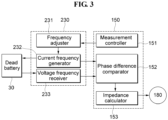
- FIG. 3 is a diagram illustrating in detail an impedance measurement configuration in a system of testing electricity flow of a battery according to an embodiment of the present disclosure
- FIGS. 4 and 5 are diagrams for explaining an impedance measuring principle in a system of testing electricity flow of a battery according to an embodiment of the present disclosure.
- An electrical flow test is to test a flow of an AC current, and the flow of the AC current is affected by an AC impedance. Since a battery is an electrochemical device that uses DC electricity and the test is to determine conformance of an electricity flow thereof, a resistance to the DC electricity shows the most similar DC resistance value when there is no phase difference between current and voltage when measured through AC electricity.
- Equation 1 The inductive reactance X L and the capacitive reactance X C may be expressed by Equations 1 and 2 below.
- X L 2 ⁇ ⁇ L
- X C 1 2 ⁇ ⁇ c
- Equations 1 and 2 f is frequency, L is inductance, and C is capacitance.
- the inductive reactance X L and the capacitive reactance X C are affected by the frequency. That is, the inductive reactance X L and the capacitive reactance X C are factors that affect the frequency of current and the frequency of voltage, generates a phase difference between the frequencies of voltage and current, and affects the cycle and change rate of the frequency of voltage and the frequency of current. These inductive reactance X L and capacitive reactance X C shift opposite to each other in terms of magnitude according to the frequency.
- a phase difference ( ⁇ ) between the frequency of current and the frequency of voltage may be expressed by the following Equation (3).
- ⁇ tan ⁇ 1 1 X L ⁇ 1 X C 1 R
- a resonant frequency is determined during electricity flow measurement, and an AC impedance at the resonant frequency is used as a measured AC impedance.
- FIG. 3 is a diagram illustrating in detail an impedance measurement configuration in a system of testing electricity flow of a battery according to an embodiment of the present disclosure.
- the impedance identifier 150 includes a measurement controller 151, a phase difference identifier 152, and an impedance calculator 153
- the AC impedance meter 230 includes a frequency adjustor 231, an input frequency generator 232 and an output frequency meter 233.
- the measurement controller 151 operates the AC impedance meter 230 according to an instruction of the test item manager 110, and the phase difference identifier 152 receives an input frequency input to the used battery 30 and an output frequency output from the used battery 30 to identify a phase difference between the two frequencies.
- the input frequency is a frequency of current
- the output frequency is a frequency of voltage.
- the impedance calculator 153 identifies a point in time when a value of the phase difference continuously received from the phase difference identifier 152 is '0', and calculates the AC impedance Z by using an amplitude at the input frequency and the output frequency at the point in time when the value of the phase difference is '0', that is, the current value and the voltage value. In such a case, since the value of the phase difference of the AC impedance Z is '0', only the resistance R is calculated.
- FIGS. 4 and 5 are diagrams for explaining an impedance measurement operation in a system of testing electricity flow of a battery according to an embodiment of the present disclosure
- FIG. 4 is a Bode plot illustrating a change in a phase difference of a frequency and an impedance according to a frequency change
- FIG. 5 is a Nyquist plot illustrating a real part and an imaginary part.
- a theta ⁇ which is a phase difference between current and voltage identified by the impedance calculator 153 varies from a negative value to a positive value as in a graph g1.
- the impedance calculator 153 determines a highest frequency from among the at least one resonant frequency, that is, a high-frequency resonant frequency.
- the impedance calculator 153 calculates an impedance at the high-frequency resonant frequency determined in FIG. 4(a) and it is considered as an AC impedance which is an electricity flow value.
- the description of FIG. 4 is described through the Nyquist diagram of FIG. 5 , when the frequency varies from 0.1, a section in which a value on the vertical axis, which is the imaginary part, is '0' and only a value on the horizontal axis, which is the real part, exists is displayed, and a section in which values of the imaginary part and the real part appear at the same time is displayed.
- the section in which the value on the vertical axis, which is the imaginary part, is '0' and only the value on the horizontal axis, which is the real part, exists is a section in which a phase difference between voltage and current is '0', and in such a section, an impedance at a point at which the value of the real part is highest is the AC impedance calculated by the impedance calculator 153.
- FIG. 8 is a flowchart illustrating a method of testing electricity flow of a battery according to an embodiment of the present disclosure.
- the user electrically connects the battery voltage meter 210 and the insulation resistance meter 220 to the system 100 to test electricity flow of a battery, and connects terminals for tests of the battery voltage meter 210, the insulation resistance meter 220, and the AC impedance meter 230 are connected to the used battery 30.
- the test item manager 110 displays an item setting screen, which is a setting window, through the display device 20 (S801).
- the test item manager 110 receives the test target information, for example, a battery type or battery ID (S802) and calls the set value for each test item for the received test target from the set value storage 120 and displays it on the item setting screen (S803).
- the test target information for example, a battery type or battery ID (S802)
- S803 the set value for each test item for the received test target from the set value storage 120 and displays it on the item setting screen (S803).
- test item manager 110 notifies each of the identifiers 130, 140, 150 of the start of the test (S804).
- the battery voltage identifier 130 operates the battery voltage meter 210 to measure a voltage of the used battery 30, identifies the voltage of the battery through the measured result, and provides the voltage of the battery to the voltage diagnoser 160 (S805).
- the voltage diagnoser 160 calculates a state of charge (SOC) of the used battery based on the received battery voltage and provides the voltage of the battery and the calculated SOC information of the battery to the test item manager 110 to display each information on the item setting screen (S806).
- SOC state of charge
- the voltage diagnoser 160 diagnoses whether the received battery voltage is within a set voltage range and whether the SOC of the battery is suitable, and provides a diagnosis result to the test item manager 110 such that the diagnosis result related to the battery voltage is displayed on the item setting screen (S807).
- the insulation resistance identifier 140 operates the insulation resistance meter 220 to measure an insulation resistance of the used battery 30, and identifies the insulation resistance through the measurement result to provide it to the insulation resistance diagnoser 170 (S808).
- the insulation resistance diagnoser 170 diagnoses whether the received insulation resistance exceeds a set insulation resistance lower limit and provides a diagnosis result to the test item manager 110 so that the insulation resistance, that is, the diagnostic result related to the insulation stability may be displayed on the item setting screen (S809).
- the impedance identifier 150 operates the AC impedance meter 230 (S810), the AC impedance meter 230 then varies frequency so that the input frequency increases from 0.1 Hz to a set frequency (5811) and provides, to the impedance identifier 150, an input frequency input to the battery 30 and an output frequency corresponding to the input frequency so that the impedance identifier 150 identifies a phase difference between the input frequency and the output frequency (S812).
- the impedance identifier 150 determines a high-frequency resonant frequency having a phase difference of '0' (S813), identifies an AC impedance by using a voltage value and a current value of the determined high-frequency resonant frequency, and provides the identified AC impedance to the electricity flow diagnoser 180 and the test item manager 110 (S814).
- the electricity flow diagnoser 180 compares the identified AC impedance with a set electricity flow upper limit, and when the AC impedance is lower than the electricity flow upper limit, it is diagnosed as normal (e.g., pass), and when the AC impedance is higher than the electricity flow upper limit, it is diagnosed as abnormal (e.g., fail), and the diagnosis result is provided to the test item manager 110 to be displayed on the item setting screen (S815).
- the diagnosis result of each diagnoser 160, 170, 180 is received by the conformance identifier 190, and the conformance identifier 190 combines each diagnosis result to diagnose that it conforms or non-conforms, and transmits the diagnosis result to the test item manager (110) to be displayed on the item setting screen (S816).
Landscapes
- Engineering & Computer Science (AREA)
- Physics & Mathematics (AREA)
- General Physics & Mathematics (AREA)
- Manufacturing & Machinery (AREA)
- Chemical & Material Sciences (AREA)
- Chemical Kinetics & Catalysis (AREA)
- Electrochemistry (AREA)
- General Chemical & Material Sciences (AREA)
- Theoretical Computer Science (AREA)
- General Engineering & Computer Science (AREA)
- Data Mining & Analysis (AREA)
- Mathematical Physics (AREA)
- Mathematical Analysis (AREA)
- Mathematical Optimization (AREA)
- Pure & Applied Mathematics (AREA)
- Databases & Information Systems (AREA)
- Software Systems (AREA)
- Computational Mathematics (AREA)
- Algebra (AREA)
- Human Computer Interaction (AREA)
- Tests Of Electric Status Of Batteries (AREA)
- Measurement Of Resistance Or Impedance (AREA)
Description
- The present disclosure relates to a technic of testing electricity flow for a used battery (e.g., waste battery, etc.), and more particularly, to a system of testing electricity flow of a used battery to check a state of charge and chargeability of a used battery before reusing or recycling and check whether there is any abnormality in electricity flow through an electrical resistance test and to a method of the same.
- According to the [Specific Observances for Those Recycling Wastes] in accordance with Article 13-2,
Paragraph 3 of the [Waste Management Act] and Article 13-2,Paragraph 3 of the Enforcement Rule thereof, and Attached Table 5-4, No. 3 of the Enforcement Rule thereof, a person who intends to recycle waste batteries shall perform an appearance test and an electricity flow test of a used battery of electrical vehicles before recycling. -
JP H04 198783A -
KR 102029776 B1 - Calborean et al., "Resonance frequency analysis of lead-acid cell:
- An EIS approach to predict the state-of-health", Journal of Energy Storage, vol. 27,
- 1 February 2020, is related to an electrochemical impedance spectroscopy approach for lifetime prediction of lead-acid cells under imposed aging conditions.
-
US 2011/0191043 A1 describes an apparatus for checking insulation of a cell module assembly composed of a plurality of pouch cells. -
US 3 872 457 A relates to a battery monitor system for multi-cell batteries. - In the published content, the electricity flow test of the used battery is to check the current state of charge and chargeability, and to check whether there is any abnormality in the electricity flow through an electrical resistance test through connection to a charging equipment.
- However, there is no system or device for checking the electricity flow of waste batteries through connection of a charging equipment so far.
- Embodiments of the present disclosure are directed to a system and a method of testing electricity flow of a battery, the system and the method being capable of performing electricity flow tests of a used battery.
- Embodiments of the present disclosure are directed to a system and a method of testing electricity flow of a battery, the system and the method being capable of performing electricity flow tests of a used battery for an electric vehicle.
- According to an aspect of the present disclosure, a system of testing electricity flow of a battery is defined in
claim 1. - In some embodiments, the system of testing electricity flow of a battery further includes:
a battery voltage identifier configured to operate a battery voltage meter electrically connected thereto according to an instruction of the test item manager, and identify a voltage of the battery through the battery voltage meter; a voltage diagnoser configured to compare the voltage of the battery identified by the battery voltage identifier with a set voltage range and diagnose that it is normal when the identified battery voltage is within the set voltage range and otherwise, diagnose that it is abnormal; an insulation resistance identifier configured to operate an insulation resistance meter electrically connected thereto according to an instruction of the test item manager, and identify an insulation resistance of the battery through the insulation resistance meter; an insulation resistance diagnoser configured to compare the insulation resistance identified by the insulation resistance identifier with a set insulation resistance lower limit and diagnose that it is abnormal when the identified insulation resistance is lower than the set insulation resistance lower limit and diagnose that it is normal when the identified insulation resistance is higher than the set insulation resistance lower limit; and a conformance diagnoser configured to receive each diagnosis result output from the voltage diagnoser, the insulation resistance diagnoser, and the impedance diagnoser to determine a final conformance result. - In some embodiments, the test item manager provides an item setting screen to a user through a display device, the item setting screen including a field in which a battery type, the set voltage range according to the battery type, the insulation resistance lower limit, and the electricity flow upper limit may be input by a user or displayed, a field for displaying the battery voltaeg, the insulation resistance and the AC impedance identified by each of the identifiers, a field for displaying a state of charge, an electricity flow, and an insulation safety according to the disgnosis result of each of the diagnosers, and a field for displaying the final conformance result diagnosed by the conformance diagnoser.
- According to an another aspect of the present disclosure, a method of testing electricity flow of a battery is defined in
claim 4. - According to an embodiment of the present disclosure, a method of testing electricity flow of a battery, the battery including a used battery further includes: identifying a voltage of the battery through a battery voltage meter connected thereto; comparing the voltage of the battery with a set voltage range to diagnose that it is normal when the voltage of the battery is within the set voltage range and otherwise, diagnose that it is abnormal; identifying an insulation resistance of the battery through an insulation resistance meter connected thereto; comparing the insulation resistance identified by the insulation resistance identifier with a set insulation resistance lower limit to diagnose that it is abnormal when the identified insulation resistance is lower than the set insulation resistance lower limit and diagnose that it is normal when the identified insulation resistance is higher than the set insulation resistance lower limit; and receiving a diagnosis result for the voltage of the battery and a diagnosis result for the insulation resistance of the battery and determining a final conformance result.
- According to one or more embodiments of the present disclosure, it is possible to perform electricity flow tests of a waste battery of an electric vehicle in accordance with the ordinance of the Ministry of Environment.
- According to one or more embodiments of the present disclosure, a system and a method are capable of performing electricity flow tests of a waste battery for an electric vehicle at a low cost by using an AC power.
- In addition to the above objects, embodiment according to the present disclosure may be used to achieve other objects not specifically mentioned herein.
-
-
FIG. 1 is a block diagram illustrating a system of testing electricity flow of a battery according to an embodiment of the present disclosure. -
FIG. 2 is a perspective view illustrating a system of testing electricity flow of a battery according to an embodiment of the present disclosure. -
FIG. 3 is a diagram illustrating in detail an impedance measurement configuration in a system of testing electricity flow of a battery according to an embodiment of the present disclosure. -
FIGS. 4 and5 are diagrams for explaining an impedance measuring operation in a system of testing electricity flow of a battery according to an embodiment of the present disclosure. -
FIGS. 6 and7 are diagrams illustrating a screen for displaying test items and test results in the system of testing electricity flow of a battery according to an embodiment of the present disclosure. -
FIG. 8 is a flowchart illustrating a method of testing electricity flow of a battery according to an embodiment of the present disclosure. - Hereinbelow, some embodiments will be described clearly and in detail with reference to the accompanying drawings so that those of ordinary skill in the art to which the present disclosure pertains (hereinafter, those skilled in the art) may easily practice the present disclosure. As used herein, the term "unit" in the specification may mean a hardware component or circuit.
- Hereinafter, a system and a method of testing electricity flow of battery according to an embodiment of the present disclosure will be described with reference to the accompanying drawings.
- Prior to description, a battery used hereinbelow may mean a used battery (e.g., a waste battery, etc.) used in an electric vehicle, and a battery to be tested may be one of a battery cell, a battery module, or a battery pack.
-
FIG. 1 is a block diagram illustrating a system of testing electricity flow of a battery according to an embodiment of the present disclosure. Referring toFIG. 1 , asystem 100 of testing electricity flow of a battery according to an embodiment of the present disclosure includes atest item manager 110, aset value storage 120, abattery voltage identifier 130, aninsulation resistance identifier 140, animpedance identifier 150, a voltage diagnoser (e.g., diagnose unit) 160, aninsulation resistance diagnoser 170, anelectricity flow diagnoser 180, a conformance diagnoser 190, and anAC impedance meter 230. - Herein, when the
AC impedance meter 230 is manufactured in a form detachable from thesystem 100 of the present disclosure, thesystem 100 according to an embodiment of the present disclosure may omit theAC impedance meter 230. - In an embodiment, when the system of testing electricity flow of a battery according to an embodiment of the present disclosure uses only the
AC impedance meter 230, thebattery voltage identifier 130, theinsulation resistance identifier 140, the voltage diagnoser 160, and theinsulation resistance diagnoser 170 may be omitted. - The
test item manager 110 manages a set value, a measured value, a diagnostic value, and a final test value for each battery test item. The set value means a reference value for each test item for comparison with a measured value, and the measured value means a value measured for each test item, for example, a measured battery voltage, a measured battery insulation resistance, and a measured battery impedance. In addition, a diagnostic value is a result of comparison between the reference value and the measured value for each test item, and means pass (e.g., normal) or fail (e.g., abnormal). In addition, a final test value is a value indicating final conformance of the battery according to the diagnostic value, and means, for example, that it conforms (e.g., suitable, proper, appropriate, etc.) or non-conforms (e.g., unsuitable, non-proper, inappropriate, etc.). - In addition, the
test item manager 110 registers a set value, which is a reference value for each test item, for each battery type according to a user's request input through auser input unit 10, and performs management such as modification (e.g., correction) or deletion of the set value. Thetest item manager 110 generates an item setting screen to be displayed externally through adisplay device 20, and the user may input and register a new battery type and set values for a new battery type through the item setting screen, and check the set values for each test item, various diagnostic values, and final test values for the battery to be tested through the item setting screen. - Herein, the item setting screen will be described with reference to
FIGS. 6 and7 .FIGS. 6 and7 are diagrams illustrating a screen for displaying test items and test results in the system of testing electricity flow of a battery according to an embodiment of the present disclosure. Referring toFIGS. 6 and7 , on the left side of the item setting screen, there displayed a field (①) in which a battery ID (identification information) may be input by a user or a registered battery ID may be called to be displayed, a field (②) in which a battery type may be input by a user or a registered battery type may be called to be displayed, a button (③) to call a new item setting screen for recording information of a new battery, a button (④) to delete the currently displayed battery information, a field (⑤) in which a set value for test items may be input by a user or a registered set value may be called to be displayed, and a button (⑥) to instruct the start of the test. The button (⑥) to instruct the start of the test is changed to "test reset" and displayed when the user clicks the button. - In the field (CD), there are a field, indicated as "voltage range", displaying upper and lower limits of a battery voltage for the corresponding battery type, a field, indicated as "capacity", displaying a reference current value, a field, indicated as "electricity flow upper limit", displaying an upper limit of an AC impedance, and a field, indicated as "insulation resistance lower limit", displaying a lower limit of an insulation resistance.
- In addition, on the right side of the item setting screen, there is a field for displaying the measurement value and measurement result for the test item.
- For example, referring to
FIGS. 6 and7 , on the right side of the item setting screen, there displayed a field (⑦) in which a test progress level (e.g., runtime) is displayed, a field (⑧), indicated as "state of charge", displaying a measured battery voltage and a state of charge (SOC), a field (⑨), indicated as "electricity flow", displaying a measured AC impedance, a field (⑩), indicated as "insulation safety", displaying a measured insulation resistance, a field (⑪) displaying a diagnosis result according to each measurement value and a field (⑫) displaying the final result of the electricity flow test. - The SOC is calculated using the battery voltage or is identified using an SOC table generated based on maximum and minimum voltages of the battery.
- In
FIG. 6 , referring to the measurement results on the right side of the item setting screen, the measured battery voltage is 27.72 V, which falls within the set voltage range of 24.20 V to 29.40 V, and thus is displayed as pass, the AC impedance, that is, electricity flow, is 15.62 Ω, which is equal or less than the set value of 20.00 Ω, and thus is displayed as pass, and the measured insulation resistance exceeds the set value of 1.00 MΩ, and thus is displayed as pass. Accordingly, since all test items passed, the final test result is indicated as "conform/chargeable". - On another hand, in
FIG. 7 , referring to the measurement result on the right side of the item setting screen, the measured battery voltage is 27.71 V, which is out of the set voltage range of 288.00 V to 403.20 V, and thus is displayed as fail, the AC impedance, that is, electricity flow, is 15.62 Ω, which is equal or less than the set value of 416.65 Ω, and thus is displayed as pass, and the measured insulation resistance exceeds the set value of 1.00 MΩ, and thus is displayed as pass. Accordingly, since there was an abnormality in one of all test items, the final test result is indicated as "non-conform/non-chargeable". - The
set value storage 120 matches the set value for each test item registered by thetest item manager 110 with the corresponding battery type and stores it. It is obvious that theset value storage 120 may store the test result of the tested used battery. - The
system 100 of testing electricity flow of a battery according to an embodiment of the present disclosure has a measurement value identifier A for identifying a measurement value for each test item. Each identifier of the measurement value identifier A operates according to an instruction of thetest item manager 110, and provides the identified measurement value to thetest item manager 110. The measurement value identifier A includes abattery voltage identifier 130, aninsulation resistance identifier 140, and animpedance identifier 150. - The
battery voltage identifier 130 controls operation of thebattery voltage meter 210 to receive a measurement result measured by thebattery voltage meter 210 and identify a battery voltage (e.g., a voltage of a battery cell or a battery module or a battery pack). Herein, thebattery voltage meter 210 is a device for measuring a voltage of the battery by having one measuring terminal connected to a negative electrode of the battery and another measuring terminal connected to a positive electrode of the battery, and is a common battery voltage meter. - The
insulation resistance identifier 140 controls the operation of thebattery voltage meter 210 to receive and identify an insulation resistance of the battery measured by theinsulation resistance meter 220. Herein, theinsulation resistance meter 220 is a device for measuring the insulation resistance of a common battery, for example, a device having one terminal connected to one of the positive or negative terminal of the battery and another terminal connected to a body of the battery to measure the insulation resistance of the battery. - The
impedance identifier 150 controls operation of theAC impedance meter 230 to receive a frequency of a plurality of currents supplied from theAC impedance meter 230 and a frequency of a voltage measured corresponding to the frequency of the supplied current, to identify a phase difference between the frequencies with respect to a current and a voltage of the same frequency, and then to identify an AC impedance by using a voltage and a current of a frequency that has no phase difference. Herein, the AC impedance represents the same value as a DC impedance with respect to a DC power by using the voltage and the current of a frequency having no phase difference. - The
system 100 of testing electricity flow of a battery according to an embodiment of the present disclosure includes a measurement value diagnoser B for diagnosing whether a measurement value for each test item passes or fails (e.g., normal or abnormal). Each diagnoser of the measurement value diagnoser B provides a diagnosis result to thetest item manager 110. The measurement value diagnoser B includes avoltage diagnoser 160, aninsulation resistance diagnoser 170, and anelectricity flow diagnoser 180. - The
voltage diagnoser 160 compares the voltage detected by thebattery voltage identifier 130 with a set voltage, that is, a set voltage range, and diagnoses whether the detected voltage is within the set voltage range. Thevoltage diagnoser 160 diagnoses that it is normal (e.g., pass) when the detected voltage is within the set voltage range, and otherwise, diagnoses that it is abnormal (e.g., fail). - The
insulation resistance diagnoser 170 compares the insulation resistance identified by theinsulation resistance identifier 140 with the set insulation resistance, and when the identified insulation resistance is higher than the set insulation resistance, it is diagnosed as normal, and otherwise, it is diagnosed as abnormal. - The
electricity flow diagnoser 180 compares the AC impedance identified by theimpedance identifier 150 with the set impedance, and when the determined AC impedance is lower than the set insulation resistance, it is diagnosed as normal, and otherwise, it is diagnosed as abnormal. - The
conformance diagnoser 190 receives each diagnosis result output from thevoltage diagnoser 160, theinsulation resistance diagnoser 170, and theelectricity flow diagnoser 180, determines a final conformance result, and provides the final conformance result to thetest item manager 110. - The
AC impedance meter 230 sequentially generates frequencies in a set frequency band in the order from the minimum frequency to the maximum frequency or from the maximum frequency to the minimum frequency, inputs them to the usedbattery 30, and provides an output frequency corresponding to the input frequency to theimpedance identifier 150. - The
system 100 of testing electricity flow of a battery according to an embodiment of the present disclosure configured as described above is manufactured as illustrated inFIG. 2 as an example.FIG. 2 is a perspective view illustrating a system of testing electricity flow of a battery according to an embodiment of the present disclosure. Referring toFIG. 2 , thedisplay device 20 is configured as a common monitor, and in thesystem 100 of testing electricity flow of a battery, a connection member of a plug or a socket to be electrically connected to terminals of each meter (e.g., measurement apparatus) 210, 220, 230 is provided. It is obvious that when theAC impedance meter 230 is configured, thesystem 100 of testing electricity flow of a battery will be configured unitarily (e.g., in a monolithic manner) with theAC impedance meter 230. - Hereinafter, the
impedance identifier 150 and theAC impedance meter 230 in the system of testing electricity flow of a battery according to an embodiment of the present disclosure will be described with reference toFIGS. 3 to 5 .FIG. 3 is a diagram illustrating in detail an impedance measurement configuration in a system of testing electricity flow of a battery according to an embodiment of the present disclosure, andFIGS. 4 and5 are diagrams for explaining an impedance measuring principle in a system of testing electricity flow of a battery according to an embodiment of the present disclosure. - An electrical flow test is to test a flow of an AC current, and the flow of the AC current is affected by an AC impedance. Since a battery is an electrochemical device that uses DC electricity and the test is to determine conformance of an electricity flow thereof, a resistance to the DC electricity shows the most similar DC resistance value when there is no phase difference between current and voltage when measured through AC electricity.
- In more detail, as is generally known, an impedance Z in DC electricity is calculated as "Z = resistance R", and an impedance Z in AC electricity is calculated as "Z = R (resistance) + jX (impedance)". That is, in AC electricity, dissimilar to DC electricity, the flow of AC current is affected by impedance X, and reactance X includes inductive reactance XL and capacitive reactance XC.
- The inductive reactance XL and the capacitive reactance XC may be expressed by
Equations 

- In
Equations - Referring to
Equations - A phase difference (ϕ) between the frequency of current and the frequency of voltage may be expressed by the following Equation (3).

- Accordingly, when the impedances of the inductive reactance XL and the capacitive reactance XC become equal, the phase difference between the frequency of current and the frequency of voltage becomes '0', and thus the AC impedance becomes equal to the DC impedance. A frequency when the phase difference between the frequency of current and the frequency of voltage becomes '0' in the electric circuit is called resonant frequency.
- Accordingly, in the present disclosure, a resonant frequency is determined during electricity flow measurement, and an AC impedance at the resonant frequency is used as a measured AC impedance.
- According to the electricity flow measurement principle of the present disclosure, the
impedance identifier 150 and theAC impedance meter 230 are configured as illustrated inFIG. 3. FIG. 3 is a diagram illustrating in detail an impedance measurement configuration in a system of testing electricity flow of a battery according to an embodiment of the present disclosure. - Referring to
FIG. 3 , theimpedance identifier 150 includes ameasurement controller 151, aphase difference identifier 152, and animpedance calculator 153, and theAC impedance meter 230 includes afrequency adjustor 231, aninput frequency generator 232 and anoutput frequency meter 233. - The
measurement controller 151 operates theAC impedance meter 230 according to an instruction of thetest item manager 110, and thephase difference identifier 152 receives an input frequency input to the usedbattery 30 and an output frequency output from the usedbattery 30 to identify a phase difference between the two frequencies. In such a case, the input frequency is a frequency of current, and the output frequency is a frequency of voltage. - The
impedance calculator 153 identifies a point in time when a value of the phase difference continuously received from thephase difference identifier 152 is '0', and calculates the AC impedance Z by using an amplitude at the input frequency and the output frequency at the point in time when the value of the phase difference is '0', that is, the current value and the voltage value. In such a case, since the value of the phase difference of the AC impedance Z is '0', only the resistance R is calculated. - The operations of the
phase difference identifier 152 and theimpedance calculator 153 will be described with reference toFIGS. 4 and5 .FIGS. 4 and5 are diagrams for explaining an impedance measurement operation in a system of testing electricity flow of a battery according to an embodiment of the present disclosure,FIG. 4 is a Bode plot illustrating a change in a phase difference of a frequency and an impedance according to a frequency change, andFIG. 5 is a Nyquist plot illustrating a real part and an imaginary part. - Referring to the Bode plot illustrated in FIG. 4(a), when the frequency varies from 0.1 by the
AC impedance meter 230, a theta ϕ, which is a phase difference between current and voltage identified by theimpedance calculator 153 varies from a negative value to a positive value as in a graph g1. In such a change, at least one resonant frequency at which the phase difference becomes '0' is determined, and theimpedance calculator 153 determines a highest frequency from among the at least one resonant frequency, that is, a high-frequency resonant frequency. - As illustrated in FIG. 4(b), the
impedance calculator 153 calculates an impedance at the high-frequency resonant frequency determined in FIG. 4(a) and it is considered as an AC impedance which is an electricity flow value. When the description ofFIG. 4 is described through the Nyquist diagram ofFIG. 5 , when the frequency varies from 0.1, a section in which a value on the vertical axis, which is the imaginary part, is '0' and only a value on the horizontal axis, which is the real part, exists is displayed, and a section in which values of the imaginary part and the real part appear at the same time is displayed. In such a case, the section in which the value on the vertical axis, which is the imaginary part, is '0' and only the value on the horizontal axis, which is the real part, exists is a section in which a phase difference between voltage and current is '0', and in such a section, an impedance at a point at which the value of the real part is highest is the AC impedance calculated by theimpedance calculator 153. - Hereinafter, a method of testing electricity flow of a battery according to an embodiment of the present disclosure will be described.
FIG. 8 is a flowchart illustrating a method of testing electricity flow of a battery according to an embodiment of the present disclosure. - Referring to
FIG. 8 , the user electrically connects thebattery voltage meter 210 and theinsulation resistance meter 220 to thesystem 100 to test electricity flow of a battery, and connects terminals for tests of thebattery voltage meter 210, theinsulation resistance meter 220, and theAC impedance meter 230 are connected to the usedbattery 30. - In such a state, when the user requests a battery electricity flow test through the
user input unit 10, thetest item manager 110 displays an item setting screen, which is a setting window, through the display device 20 (S801). - Then, when the user selects or inputs test target information about a battery to be tested on the item setting screen through the
user input unit 10, thetest item manager 110 receives the test target information, for example, a battery type or battery ID (S802) and calls the set value for each test item for the received test target from theset value storage 120 and displays it on the item setting screen (S803). - Then, when the user clicks a test start button (⑥) on the item setting screen, the
test item manager 110 notifies each of theidentifiers - Accordingly, the
battery voltage identifier 130 operates thebattery voltage meter 210 to measure a voltage of the usedbattery 30, identifies the voltage of the battery through the measured result, and provides the voltage of the battery to the voltage diagnoser 160 (S805). - The
voltage diagnoser 160 calculates a state of charge (SOC) of the used battery based on the received battery voltage and provides the voltage of the battery and the calculated SOC information of the battery to thetest item manager 110 to display each information on the item setting screen (S806). - In addition, the
voltage diagnoser 160 diagnoses whether the received battery voltage is within a set voltage range and whether the SOC of the battery is suitable, and provides a diagnosis result to thetest item manager 110 such that the diagnosis result related to the battery voltage is displayed on the item setting screen (S807). - The
insulation resistance identifier 140 operates theinsulation resistance meter 220 to measure an insulation resistance of the usedbattery 30, and identifies the insulation resistance through the measurement result to provide it to the insulation resistance diagnoser 170 (S808). Theinsulation resistance diagnoser 170 diagnoses whether the received insulation resistance exceeds a set insulation resistance lower limit and provides a diagnosis result to thetest item manager 110 so that the insulation resistance, that is, the diagnostic result related to the insulation stability may be displayed on the item setting screen (S809). - The
impedance identifier 150 operates the AC impedance meter 230 (S810), theAC impedance meter 230 then varies frequency so that the input frequency increases from 0.1 Hz to a set frequency (5811) and provides, to theimpedance identifier 150, an input frequency input to thebattery 30 and an output frequency corresponding to the input frequency so that theimpedance identifier 150 identifies a phase difference between the input frequency and the output frequency (S812). - Then, the
impedance identifier 150 determines a high-frequency resonant frequency having a phase difference of '0' (S813), identifies an AC impedance by using a voltage value and a current value of the determined high-frequency resonant frequency, and provides the identified AC impedance to theelectricity flow diagnoser 180 and the test item manager 110 (S814). Accordingly, theelectricity flow diagnoser 180 compares the identified AC impedance with a set electricity flow upper limit, and when the AC impedance is lower than the electricity flow upper limit, it is diagnosed as normal (e.g., pass), and when the AC impedance is higher than the electricity flow upper limit, it is diagnosed as abnormal (e.g., fail), and the diagnosis result is provided to thetest item manager 110 to be displayed on the item setting screen (S815). - The diagnosis result of each
diagnoser conformance identifier 190, and theconformance identifier 190 combines each diagnosis result to diagnose that it conforms or non-conforms, and transmits the diagnosis result to the test item manager (110) to be displayed on the item setting screen (S816). - The above descriptions are intended to provide exemplary configurations and operations for implementing the inventive concept of the present disclosure, as defined by the appended claims.
Claims (5)
- A system of testing electricity flow of a battery (30), the battery comprising a used battery, the system comprising:a test item manager (110) operating in response to an output of a user input unit (10) and configured to manage registration, modification, deletion, and display of a set value, a measured value, and a diagnostic value for each test item for the battery (30);a set value storage (120) configured to match the set value for each test item registered by the test item manager (110) with a type of the battery (30) and store the set value;an AC impedance meter (230) configured to vary an input frequency, sequentially input the varied input frequency to the battery (30), and output an output frequency for each sequentially inputted input frequency;an impedance identifier (150) configured to operate the AC impedance meter (230) according to an instruction of the test item manager (110), identify a phase difference between the input frequency input to the battery and an output frequency corresponding to the input frequency to determine the highest frequency among at least one resonant frequency,and calculating an AC impedance corresponding to the determined highest frequency; andan impedance diagnoser (180) configured to compare the AC impedance calculated by the impedance identifier (150) with an electricity flow upper limit and diagnose that it is normal when the calculated AC impedance is lower than the electricity flow upper limit and diagnose that it is abnormal when the calculated AC impedance is higher than the electricity flow upper limit, andwherein the impedance identifier (150) comprising,a measurement controller (151) operates the AC impedance meter (230) according to an instruction of the test item manager (110),a phase difference identifier (152) receives an input frequency input to the used battery (30) and an output frequency output from the used battery (30) to identify a phase difference between the two frequencies, andan impedance calculator (153) identifies a point in time when a value of the phase difference continuously received from the phase difference identifier (152) is '0', and calculates the AC impedance by using an amplitude, which is the current value and the voltage value at the input frequency and the output frequency at the point in time when the value of the phase difference is '0', wherein the phase difference identifier (152) identifies a high-frequency resonant frequency at the point in time when the value of the phase difference is '0', and that the impedance calculator (153) calculates the AC impedance of the highest point corresponding to the identified high-frequency resonance frequency.
- The system of testing electricity flow of a battery of claim 1, further comprising:a battery voltage identifier (130) configured to operate a battery voltage meter electrically connected thereto according to an instruction of the test item manager (110), and identify a voltage of the battery through the battery voltage meter (210);a voltage diagnoser (160) configured to compare the voltage of the battery identified by the battery voltage identifier (130) with a set voltage range and diagnose that it is normal when the identified battery voltage is within the set voltage range and otherwise, diagnose that it is abnormal;an insulation resistance identifier (140) configured to operate an insulation resistance meter (220) electrically connected thereto according to an instruction of the test item manager (110), and identify an insulation resistance of the battery (30) through the insulation resistance meter (220);an insulation resistance diagnoser (170) configured to compare the insulation resistance identified by the insulation resistance identifier (140) with a set insulation resistance lower limit and diagnose that it is abnormal when the identified insulation resistance is lower than the set insulation resistance lower limit and diagnose that it is normal when the identified insulation resistance is higher than the set insulation resistance lower limit; anda conformance diagnoser (190) configured to receive each diagnosis result output from the voltage diagnoser (160), the insulation resistance diagnoser (170), and an electricity flow diagnose (180) to determine a final conformance result.
- The system of testing electricity flow of a battery of claim 2, wherein the test item manager (110) provides an item setting screen to a user through a display device (20), the item setting screen comprising a field in which a battery type, the set voltage range according to the battery type, the insulation resistance lower limit, and the electricity flow upper limit be input by a user or displayed, a field for displaying the battery voltaeg, the insulation resistance and the AC impedance identified by each of the identifiers (130, 140, 150), a field for displaying a state of charge, an electricity flow, and an insulation safety according to the disgnosis result of each of the diagnosers, and a field for displaying the final conformance result diagnosed by the conformance diagnoser (190).
- A method of testing electricity flow of a battery (30), the battery comprising a used battery, the method comprising:setting a type of the battery (30) to be tested and a set value for each test item;operating an AC impedance meter (230) according to output of a user input unit (10), inputting a first input frequency to the battery (30), and identifying a first output frequency for the first input frequency;identifying a first phase difference between the first input frequency and the first output frequency;determining a resonant frequency by identifying whether the first phase difference is '0';inputting a second input frequency to the battery (30) by varying frequency and identifying a second output frequency for the second input frequency;sequentially varying the frequency up to a set frequency to input the varied frequency to the battery (30), identifying a point in time when a value of the phase difference is '0' between the varied frequency input to the battery (30) and the output frequency corresponding to the varied frequency to determine the highest frequency among at least one resonant frequency, and registering the determined highest frequencydetermining the determined highest frequency as a resonant frequency;calculating an AC impedance using a voltage and a current at the determined resonant frequency; andcomparing the calculated AC impedance with an electricity flow upper limit of the set value to diagnose that it is normal when the calculated AC impedance is lower than the electricity flow upper limit and diagnose that it is abnormal when the calculated AC impedance is higher than the electricity flow upper limit, wherein in the registering the determined highest frequency, a phase difference identifier (152) identifies a high-frequency resonant frequency of the highest frequency at the point in time when the value of the phase difference is '0'; and in the calculating an AC impedance using a voltage and a current at the determined resonant frequency, the impedance calculator (153) calculates the AC impedance of the highest point corresponding to the identified high-frequency resonance frequency.
- The method of testing electricity flow of a battery of claim 4, further comprising:identifying a voltage of the battery through a battery voltage meter (210) connected thereto;comparing the voltage of the battery (30) with a set voltage range to diagnose that it is normal when the voltage of the battery (30) is within the set voltage range and otherwise, diagnose that it is abnormal;identifying an insulation resistance of the battery (30) through an insulation resistance meter (220) connected thereto;comparing the insulation resistance identified by the insulation resistance identifier (220) with a set insulation resistance lower limit to diagnose that it is abnormal when the identified insulation resistance is lower than the set insulation resistance lower limit and diagnose that it is normal when the identified insulation resistance is higher than the set insulation resistance lower limit; andreceiving a diagnosis result for the voltage of the battery (30) and a diagnosis result for the insulation resistance of the battery (30) and determining a final conformance result.
Applications Claiming Priority (3)
| Application Number | Priority Date | Filing Date | Title |
|---|---|---|---|
| KR20200051636 | 2020-04-28 | ||
| KR1020210032828A KR102657996B1 (en) | 2020-04-28 | 2021-03-12 | Battery electric flow test system and metho |
| PCT/KR2021/004588 WO2021221350A1 (en) | 2020-04-28 | 2021-04-12 | Battery electric flow test system and method |
Publications (4)
| Publication Number | Publication Date |
|---|---|
| EP3934005A1 EP3934005A1 (en) | 2022-01-05 |
| EP3934005A4 EP3934005A4 (en) | 2022-05-18 |
| EP3934005C0 EP3934005C0 (en) | 2024-07-31 |
| EP3934005B1 true EP3934005B1 (en) | 2024-07-31 |
Family
ID=78373653
Family Applications (1)
| Application Number | Title | Priority Date | Filing Date |
|---|---|---|---|
| EP21755881.6A Active EP3934005B1 (en) | 2020-04-28 | 2021-04-12 | Battery electric flow test system and method |
Country Status (5)
| Country | Link |
|---|---|
| US (1) | US12326475B2 (en) |
| EP (1) | EP3934005B1 (en) |
| CN (1) | CN113906301B (en) |
| ES (1) | ES2991928T3 (en) |
| WO (1) | WO2021221350A1 (en) |
Families Citing this family (1)
| Publication number | Priority date | Publication date | Assignee | Title |
|---|---|---|---|---|
| CN118731773B (en) * | 2024-07-22 | 2025-09-30 | 合肥国轩高科动力能源有限公司 | Abnormal battery cell detection method, device, electronic device and storage medium |
Family Cites Families (22)
| Publication number | Priority date | Publication date | Assignee | Title |
|---|---|---|---|---|
| US3872457A (en) * | 1972-07-31 | 1975-03-18 | Said Ray By Said King | Battery monitor |
| JP2639219B2 (en) * | 1990-11-28 | 1997-08-06 | 株式会社ユアサコーポレーション | Lead-acid battery life judgment method |
| JP2004198783A (en) | 2002-12-19 | 2004-07-15 | Konica Minolta Holdings Inc | Image forming apparatus |
| DE10345057B4 (en) * | 2003-09-26 | 2005-09-15 | Rheinisch-Westfälisch-Technische Hochschule Aachen | Method and device for determining the state of charge of a battery |
| KR100812760B1 (en) * | 2005-12-08 | 2008-03-12 | 김득수 | Measurement Device of Internal Impedance effective value of Stationary Battery And Method Thereof |
| US20080048622A1 (en) * | 2006-02-27 | 2008-02-28 | Fee John A | Method and apparatus to determine battery resonance |
| CN101221223B (en) * | 2007-12-27 | 2011-03-16 | 武汉理工大学 | Single slice battery essential resistance and voltage on-line testing system for fuel cell pile |
| KR101180830B1 (en) * | 2008-10-13 | 2012-09-07 | 주식회사 엘지화학 | Apparatus and method for checking insulation of cell module assembly and probe for it |
| JP4807443B2 (en) * | 2009-07-08 | 2011-11-02 | トヨタ自動車株式会社 | Secondary battery temperature estimation device |
| US9207285B1 (en) * | 2010-12-08 | 2015-12-08 | Global Energy Innovations, Inc. | Automatic determination of multi-frequency baselines for battery testing |
| FR2985033B1 (en) * | 2011-12-23 | 2014-09-19 | Accumulateurs Fixes | METHOD FOR DETERMINING A STATE PARAMETER OF AN ELECTROCHEMICAL ELEMENT BY COMPLEX IMPEDANCE AT RADIO FREQUENCIES |
| CN103760492A (en) * | 2014-01-17 | 2014-04-30 | 三峡大学 | Method for online testing performance of lead-acid storage cells of transformer substation |
| CA2939987C (en) * | 2014-02-19 | 2017-11-21 | Nissan Motor Co., Ltd. | Impedance measuring device and control method for impedance measuring device |
| KR101628684B1 (en) * | 2014-12-15 | 2016-06-10 | 현대오트론 주식회사 | Apparatus for measuring impedance for diagnosis of fuel cell and method thereof |
| JP6789025B2 (en) * | 2015-11-30 | 2020-11-25 | 積水化学工業株式会社 | Diagnostic frequency determination method, storage battery deterioration diagnosis method, diagnostic frequency determination system and storage battery deterioration diagnosis device |
| US10345384B2 (en) * | 2016-03-03 | 2019-07-09 | Battelle Energy Alliance, Llc | Device, system, and method for measuring internal impedance of a test battery using frequency response |
| CN105954592B (en) * | 2016-07-18 | 2017-08-25 | 天津金星奥宇科技有限公司 | A kind of power battery pack internal resistance measurement system |
| JP6939308B2 (en) * | 2017-09-19 | 2021-09-22 | トヨタ自動車株式会社 | Battery abnormality diagnosis method |
| KR102029776B1 (en) * | 2018-04-27 | 2019-10-08 | 주식회사 민테크 | Battery diagnosis method |
| CN108614220B (en) * | 2018-05-14 | 2019-09-20 | 浙江大学 | A Method for Measuring Battery Internal Resistance Based on Damped Oscillation |
| KR102749310B1 (en) * | 2018-08-08 | 2025-01-02 | 주식회사 민테크 | Apparatus for battery diagnosis |
| US11598812B2 (en) * | 2018-11-15 | 2023-03-07 | Lear Corporation | Methods and systems for performing diagnostic processes with reduced processing time |
-
2021
- 2021-04-12 ES ES21755881T patent/ES2991928T3/en active Active
- 2021-04-12 WO PCT/KR2021/004588 patent/WO2021221350A1/en not_active Ceased
- 2021-04-12 US US17/435,034 patent/US12326475B2/en active Active
- 2021-04-12 CN CN202180002391.9A patent/CN113906301B/en active Active
- 2021-04-12 EP EP21755881.6A patent/EP3934005B1/en active Active
Also Published As
| Publication number | Publication date |
|---|---|
| CN113906301B (en) | 2025-04-11 |
| CN113906301A (en) | 2022-01-07 |
| EP3934005A1 (en) | 2022-01-05 |
| US20220326310A1 (en) | 2022-10-13 |
| ES2991928T3 (en) | 2024-12-05 |
| EP3934005C0 (en) | 2024-07-31 |
| US12326475B2 (en) | 2025-06-10 |
| WO2021221350A1 (en) | 2021-11-04 |
| EP3934005A4 (en) | 2022-05-18 |
Similar Documents
| Publication | Publication Date | Title |
|---|---|---|
| US7034541B2 (en) | Query based electronic battery tester | |
| US10429449B2 (en) | Battery pack tester | |
| US7710119B2 (en) | Battery tester that calculates its own reference values | |
| US7545146B2 (en) | Apparatus and method for predicting battery capacity and fitness for service from a battery dynamic parameter and a recovery voltage differential | |
| US7642786B2 (en) | Battery tester capable of identifying faulty battery post adapters | |
| US7595643B2 (en) | Apparatus and method for simulating a battery tester with a fixed resistance load | |
| US7116109B2 (en) | Apparatus and method for simulating a battery tester with a fixed resistance load | |
| US7081755B2 (en) | Battery tester capable of predicting a discharge voltage/discharge current of a battery | |
| US6249124B1 (en) | Electronic battery tester with internal battery | |
| US7003410B2 (en) | Electronic battery tester with relative test output | |
| US10355325B2 (en) | Method for reusing vehicle rechargeable battery | |
| US20110267067A1 (en) | Electronic battery tester | |
| US20180321326A1 (en) | Method and system for estimating state of charge or depth of discharge of battery, and method and system for evaluating health of battery | |
| KR20200017367A (en) | Apparatus for battery diagnosis | |
| US20040046566A1 (en) | Electronic battery tester configured to predict a load test result | |
| JP7515956B2 (en) | Battery diagnostic device and method | |
| Kulkarni et al. | Li-ion battery digital twin based on online impedance estimation | |
| EP3934005B1 (en) | Battery electric flow test system and method | |
| KR102657996B1 (en) | Battery electric flow test system and metho | |
| EP4589723A1 (en) | Battery pack | |
| KR102876216B1 (en) | State diagnostic device and method for electrical inspection after using an electric vehicle | |
| US20250355051A1 (en) | Electrochemical impedance spectroscopy excitation through battery passive balancing circuit |
Legal Events
| Date | Code | Title | Description |
|---|---|---|---|
| STAA | Information on the status of an ep patent application or granted ep patent |
Free format text: STATUS: UNKNOWN |
|
| STAA | Information on the status of an ep patent application or granted ep patent |
Free format text: STATUS: THE INTERNATIONAL PUBLICATION HAS BEEN MADE |
|
| PUAI | Public reference made under article 153(3) epc to a published international application that has entered the european phase |
Free format text: ORIGINAL CODE: 0009012 |
|
| STAA | Information on the status of an ep patent application or granted ep patent |
Free format text: STATUS: REQUEST FOR EXAMINATION WAS MADE |
|
| 17P | Request for examination filed |
Effective date: 20210827 |
|
| AK | Designated contracting states |
Kind code of ref document: A1 Designated state(s): AL AT BE BG CH CY CZ DE DK EE ES FI FR GB GR HR HU IE IS IT LI LT LU LV MC MK MT NL NO PL PT RO RS SE SI SK SM TR |
|
| REG | Reference to a national code |
Ref country code: DE Ref legal event code: R079 Free format text: PREVIOUS MAIN CLASS: H01M0010540000 Ipc: G01R0031389000 Ref document number: 602021016532 Country of ref document: DE |
|
| A4 | Supplementary search report drawn up and despatched |
Effective date: 20220421 |
|
| RIC1 | Information provided on ipc code assigned before grant |
Ipc: H01M 10/44 20060101ALI20220413BHEP Ipc: H01M 10/42 20060101ALI20220413BHEP Ipc: H01M 10/54 20060101ALI20220413BHEP Ipc: G01R 31/389 20190101AFI20220413BHEP |
|
| STAA | Information on the status of an ep patent application or granted ep patent |
Free format text: STATUS: EXAMINATION IS IN PROGRESS |
|
| 17Q | First examination report despatched |
Effective date: 20230208 |
|
| DAV | Request for validation of the european patent (deleted) | ||
| DAX | Request for extension of the european patent (deleted) | ||
| REG | Reference to a national code |
Ref country code: DE Ref legal event code: R079 Free format text: PREVIOUS MAIN CLASS: G01R0031389000 Ipc: G01R0031385000 Ref country code: DE Ref legal event code: R079 Ref document number: 602021016532 Country of ref document: DE Free format text: PREVIOUS MAIN CLASS: G01R0031389000 Ipc: G01R0031385000 |
|
| GRAP | Despatch of communication of intention to grant a patent |
Free format text: ORIGINAL CODE: EPIDOSNIGR1 |
|
| STAA | Information on the status of an ep patent application or granted ep patent |
Free format text: STATUS: GRANT OF PATENT IS INTENDED |
|
| RIC1 | Information provided on ipc code assigned before grant |
Ipc: H01M 10/54 20060101ALI20240303BHEP Ipc: H01M 10/44 20060101ALI20240303BHEP Ipc: H01M 10/42 20060101ALI20240303BHEP Ipc: G06F 1/28 20060101ALI20240303BHEP Ipc: G01R 31/389 20190101ALI20240303BHEP Ipc: G01R 31/385 20190101AFI20240303BHEP |
|
| INTG | Intention to grant announced |
Effective date: 20240318 |
|
| GRAS | Grant fee paid |
Free format text: ORIGINAL CODE: EPIDOSNIGR3 |
|
| GRAA | (expected) grant |
Free format text: ORIGINAL CODE: 0009210 |
|
| STAA | Information on the status of an ep patent application or granted ep patent |
Free format text: STATUS: THE PATENT HAS BEEN GRANTED |
|
| AK | Designated contracting states |
Kind code of ref document: B1 Designated state(s): AL AT BE BG CH CY CZ DE DK EE ES FI FR GB GR HR HU IE IS IT LI LT LU LV MC MK MT NL NO PL PT RO RS SE SI SK SM TR |
|
| RAP3 | Party data changed (applicant data changed or rights of an application transferred) |
Owner name: MINTECH CO., LTD. |
|
| REG | Reference to a national code |
Ref country code: CH Ref legal event code: EP Ref country code: GB Ref legal event code: FG4D |
|
| REG | Reference to a national code |
Ref country code: DE Ref legal event code: R096 Ref document number: 602021016532 Country of ref document: DE |
|
| REG | Reference to a national code |
Ref country code: IE Ref legal event code: FG4D |
|
| U01 | Request for unitary effect filed |
Effective date: 20240827 |
|
| U07 | Unitary effect registered |
Designated state(s): AT BE BG DE DK EE FI FR IT LT LU LV MT NL PT RO SE SI Effective date: 20240904 |
|
| REG | Reference to a national code |
Ref country code: ES Ref legal event code: FG2A Ref document number: 2991928 Country of ref document: ES Kind code of ref document: T3 Effective date: 20241205 |
|
| PG25 | Lapsed in a contracting state [announced via postgrant information from national office to epo] |
Ref country code: GR Free format text: LAPSE BECAUSE OF FAILURE TO SUBMIT A TRANSLATION OF THE DESCRIPTION OR TO PAY THE FEE WITHIN THE PRESCRIBED TIME-LIMIT Effective date: 20241101 Ref country code: PL Free format text: LAPSE BECAUSE OF FAILURE TO SUBMIT A TRANSLATION OF THE DESCRIPTION OR TO PAY THE FEE WITHIN THE PRESCRIBED TIME-LIMIT Effective date: 20240731 |
|
| PG25 | Lapsed in a contracting state [announced via postgrant information from national office to epo] |
Ref country code: IS Free format text: LAPSE BECAUSE OF FAILURE TO SUBMIT A TRANSLATION OF THE DESCRIPTION OR TO PAY THE FEE WITHIN THE PRESCRIBED TIME-LIMIT Effective date: 20241130 |
|
| PG25 | Lapsed in a contracting state [announced via postgrant information from national office to epo] |
Ref country code: HR Free format text: LAPSE BECAUSE OF FAILURE TO SUBMIT A TRANSLATION OF THE DESCRIPTION OR TO PAY THE FEE WITHIN THE PRESCRIBED TIME-LIMIT Effective date: 20240731 |
|
| PG25 | Lapsed in a contracting state [announced via postgrant information from national office to epo] |
Ref country code: RS Free format text: LAPSE BECAUSE OF FAILURE TO SUBMIT A TRANSLATION OF THE DESCRIPTION OR TO PAY THE FEE WITHIN THE PRESCRIBED TIME-LIMIT Effective date: 20241031 |
|
| PG25 | Lapsed in a contracting state [announced via postgrant information from national office to epo] |
Ref country code: RS Free format text: LAPSE BECAUSE OF FAILURE TO SUBMIT A TRANSLATION OF THE DESCRIPTION OR TO PAY THE FEE WITHIN THE PRESCRIBED TIME-LIMIT Effective date: 20241031 Ref country code: PL Free format text: LAPSE BECAUSE OF FAILURE TO SUBMIT A TRANSLATION OF THE DESCRIPTION OR TO PAY THE FEE WITHIN THE PRESCRIBED TIME-LIMIT Effective date: 20240731 Ref country code: IS Free format text: LAPSE BECAUSE OF FAILURE TO SUBMIT A TRANSLATION OF THE DESCRIPTION OR TO PAY THE FEE WITHIN THE PRESCRIBED TIME-LIMIT Effective date: 20241130 Ref country code: HR Free format text: LAPSE BECAUSE OF FAILURE TO SUBMIT A TRANSLATION OF THE DESCRIPTION OR TO PAY THE FEE WITHIN THE PRESCRIBED TIME-LIMIT Effective date: 20240731 Ref country code: GR Free format text: LAPSE BECAUSE OF FAILURE TO SUBMIT A TRANSLATION OF THE DESCRIPTION OR TO PAY THE FEE WITHIN THE PRESCRIBED TIME-LIMIT Effective date: 20241101 |
|
| U20 | Renewal fee for the european patent with unitary effect paid |
Year of fee payment: 5 Effective date: 20250306 |
|
| PG25 | Lapsed in a contracting state [announced via postgrant information from national office to epo] |
Ref country code: SM Free format text: LAPSE BECAUSE OF FAILURE TO SUBMIT A TRANSLATION OF THE DESCRIPTION OR TO PAY THE FEE WITHIN THE PRESCRIBED TIME-LIMIT Effective date: 20240731 |
|
| PG25 | Lapsed in a contracting state [announced via postgrant information from national office to epo] |
Ref country code: CZ Free format text: LAPSE BECAUSE OF FAILURE TO SUBMIT A TRANSLATION OF THE DESCRIPTION OR TO PAY THE FEE WITHIN THE PRESCRIBED TIME-LIMIT Effective date: 20240731 |
|
| PG25 | Lapsed in a contracting state [announced via postgrant information from national office to epo] |
Ref country code: SK Free format text: LAPSE BECAUSE OF FAILURE TO SUBMIT A TRANSLATION OF THE DESCRIPTION OR TO PAY THE FEE WITHIN THE PRESCRIBED TIME-LIMIT Effective date: 20240731 |
|
| PLBE | No opposition filed within time limit |
Free format text: ORIGINAL CODE: 0009261 |
|
| STAA | Information on the status of an ep patent application or granted ep patent |
Free format text: STATUS: NO OPPOSITION FILED WITHIN TIME LIMIT |
|
| 26N | No opposition filed |
Effective date: 20250501 |
|
| PGFP | Annual fee paid to national office [announced via postgrant information from national office to epo] |
Ref country code: ES Payment date: 20250519 Year of fee payment: 5 |
|
| PGFP | Annual fee paid to national office [announced via postgrant information from national office to epo] |
Ref country code: NO Payment date: 20250422 Year of fee payment: 5 |
|
| PGFP | Annual fee paid to national office [announced via postgrant information from national office to epo] |
Ref country code: TR Payment date: 20250404 Year of fee payment: 5 |
|
| REG | Reference to a national code |
Ref country code: CH Ref legal event code: H13 Free format text: ST27 STATUS EVENT CODE: U-0-0-H10-H13 (AS PROVIDED BY THE NATIONAL OFFICE) Effective date: 20251125 |
|
| PG25 | Lapsed in a contracting state [announced via postgrant information from national office to epo] |
Ref country code: MC Free format text: LAPSE BECAUSE OF FAILURE TO SUBMIT A TRANSLATION OF THE DESCRIPTION OR TO PAY THE FEE WITHIN THE PRESCRIBED TIME-LIMIT Effective date: 20240731 |
|
| PG25 | Lapsed in a contracting state [announced via postgrant information from national office to epo] |
Ref country code: CH Free format text: LAPSE BECAUSE OF NON-PAYMENT OF DUE FEES Effective date: 20250430 |
|
| U20 | Renewal fee for the european patent with unitary effect paid |
Year of fee payment: 6 Effective date: 20260305 |
|
| PGFP | Annual fee paid to national office [announced via postgrant information from national office to epo] |
Ref country code: GB Payment date: 20260324 Year of fee payment: 6 |
|
| PG25 | Lapsed in a contracting state [announced via postgrant information from national office to epo] |
Ref country code: IE Free format text: LAPSE BECAUSE OF NON-PAYMENT OF DUE FEES Effective date: 20250412 |