EP3933995B1 - Non-aqueous electrolyte secondary battery - Google Patents
Non-aqueous electrolyte secondary battery Download PDFInfo
- Publication number
- EP3933995B1 EP3933995B1 EP20762722.5A EP20762722A EP3933995B1 EP 3933995 B1 EP3933995 B1 EP 3933995B1 EP 20762722 A EP20762722 A EP 20762722A EP 3933995 B1 EP3933995 B1 EP 3933995B1
- Authority
- EP
- European Patent Office
- Prior art keywords
- positive electrode
- separator
- negative electrode
- winding
- electrolyte secondary
- Prior art date
- Legal status (The legal status is an assumption and is not a legal conclusion. Google has not performed a legal analysis and makes no representation as to the accuracy of the status listed.)
- Active
Links
Images

Classifications
-
- H—ELECTRICITY
- H01—ELECTRIC ELEMENTS
- H01M—PROCESSES OR MEANS, e.g. BATTERIES, FOR THE DIRECT CONVERSION OF CHEMICAL ENERGY INTO ELECTRICAL ENERGY
- H01M10/00—Secondary cells; Manufacture thereof
- H01M10/05—Accumulators with non-aqueous electrolyte
- H01M10/052—Li-accumulators
-
- H—ELECTRICITY
- H01—ELECTRIC ELEMENTS
- H01M—PROCESSES OR MEANS, e.g. BATTERIES, FOR THE DIRECT CONVERSION OF CHEMICAL ENERGY INTO ELECTRICAL ENERGY
- H01M10/00—Secondary cells; Manufacture thereof
- H01M10/05—Accumulators with non-aqueous electrolyte
- H01M10/052—Li-accumulators
- H01M10/0525—Rocking-chair batteries, i.e. batteries with lithium insertion or intercalation in both electrodes; Lithium-ion batteries
-
- H—ELECTRICITY
- H01—ELECTRIC ELEMENTS
- H01M—PROCESSES OR MEANS, e.g. BATTERIES, FOR THE DIRECT CONVERSION OF CHEMICAL ENERGY INTO ELECTRICAL ENERGY
- H01M10/00—Secondary cells; Manufacture thereof
- H01M10/05—Accumulators with non-aqueous electrolyte
- H01M10/058—Construction or manufacture
- H01M10/0587—Construction or manufacture of accumulators having only wound construction elements, i.e. wound positive electrodes, wound negative electrodes and wound separators
-
- H—ELECTRICITY
- H01—ELECTRIC ELEMENTS
- H01M—PROCESSES OR MEANS, e.g. BATTERIES, FOR THE DIRECT CONVERSION OF CHEMICAL ENERGY INTO ELECTRICAL ENERGY
- H01M10/00—Secondary cells; Manufacture thereof
- H01M10/42—Methods or arrangements for servicing or maintenance of secondary cells or secondary half-cells
- H01M10/4235—Safety or regulating additives or arrangements in electrodes, separators or electrolyte
-
- H—ELECTRICITY
- H01—ELECTRIC ELEMENTS
- H01M—PROCESSES OR MEANS, e.g. BATTERIES, FOR THE DIRECT CONVERSION OF CHEMICAL ENERGY INTO ELECTRICAL ENERGY
- H01M4/00—Electrodes
- H01M4/02—Electrodes composed of, or comprising, active material
- H01M4/36—Selection of substances as active materials, active masses, active liquids
- H01M4/48—Selection of substances as active materials, active masses, active liquids of inorganic oxides or hydroxides
- H01M4/485—Selection of substances as active materials, active masses, active liquids of inorganic oxides or hydroxides of mixed oxides or hydroxides for inserting or intercalating light metals, e.g. LiTi2O4 or LiTi2OxFy
-
- H—ELECTRICITY
- H01—ELECTRIC ELEMENTS
- H01M—PROCESSES OR MEANS, e.g. BATTERIES, FOR THE DIRECT CONVERSION OF CHEMICAL ENERGY INTO ELECTRICAL ENERGY
- H01M50/00—Constructional details or processes of manufacture of the non-active parts of electrochemical cells other than fuel cells, e.g. hybrid cells
- H01M50/40—Separators; Membranes; Diaphragms; Spacing elements inside cells
- H01M50/46—Separators, membranes or diaphragms characterised by their combination with electrodes
-
- H—ELECTRICITY
- H01—ELECTRIC ELEMENTS
- H01M—PROCESSES OR MEANS, e.g. BATTERIES, FOR THE DIRECT CONVERSION OF CHEMICAL ENERGY INTO ELECTRICAL ENERGY
- H01M50/00—Constructional details or processes of manufacture of the non-active parts of electrochemical cells other than fuel cells, e.g. hybrid cells
- H01M50/40—Separators; Membranes; Diaphragms; Spacing elements inside cells
- H01M50/471—Spacing elements inside cells other than separators, membranes or diaphragms; Manufacturing processes thereof
- H01M50/474—Spacing elements inside cells other than separators, membranes or diaphragms; Manufacturing processes thereof characterised by their position inside the cells
-
- H—ELECTRICITY
- H01—ELECTRIC ELEMENTS
- H01M—PROCESSES OR MEANS, e.g. BATTERIES, FOR THE DIRECT CONVERSION OF CHEMICAL ENERGY INTO ELECTRICAL ENERGY
- H01M50/00—Constructional details or processes of manufacture of the non-active parts of electrochemical cells other than fuel cells, e.g. hybrid cells
- H01M50/40—Separators; Membranes; Diaphragms; Spacing elements inside cells
- H01M50/489—Separators, membranes, diaphragms or spacing elements inside the cells, characterised by their physical properties, e.g. swelling degree, hydrophilicity or shut down properties
-
- H—ELECTRICITY
- H01—ELECTRIC ELEMENTS
- H01M—PROCESSES OR MEANS, e.g. BATTERIES, FOR THE DIRECT CONVERSION OF CHEMICAL ENERGY INTO ELECTRICAL ENERGY
- H01M50/00—Constructional details or processes of manufacture of the non-active parts of electrochemical cells other than fuel cells, e.g. hybrid cells
- H01M50/50—Current conducting connections for cells or batteries
- H01M50/572—Means for preventing undesired use or discharge
-
- H—ELECTRICITY
- H01—ELECTRIC ELEMENTS
- H01M—PROCESSES OR MEANS, e.g. BATTERIES, FOR THE DIRECT CONVERSION OF CHEMICAL ENERGY INTO ELECTRICAL ENERGY
- H01M4/00—Electrodes
- H01M4/02—Electrodes composed of, or comprising, active material
- H01M2004/026—Electrodes composed of, or comprising, active material characterised by the polarity
- H01M2004/028—Positive electrodes
-
- H—ELECTRICITY
- H01—ELECTRIC ELEMENTS
- H01M—PROCESSES OR MEANS, e.g. BATTERIES, FOR THE DIRECT CONVERSION OF CHEMICAL ENERGY INTO ELECTRICAL ENERGY
- H01M50/00—Constructional details or processes of manufacture of the non-active parts of electrochemical cells other than fuel cells, e.g. hybrid cells
- H01M50/40—Separators; Membranes; Diaphragms; Spacing elements inside cells
- H01M50/409—Separators, membranes or diaphragms characterised by the material
-
- Y—GENERAL TAGGING OF NEW TECHNOLOGICAL DEVELOPMENTS; GENERAL TAGGING OF CROSS-SECTIONAL TECHNOLOGIES SPANNING OVER SEVERAL SECTIONS OF THE IPC; TECHNICAL SUBJECTS COVERED BY FORMER USPC CROSS-REFERENCE ART COLLECTIONS [XRACs] AND DIGESTS
- Y02—TECHNOLOGIES OR APPLICATIONS FOR MITIGATION OR ADAPTATION AGAINST CLIMATE CHANGE
- Y02E—REDUCTION OF GREENHOUSE GAS [GHG] EMISSIONS, RELATED TO ENERGY GENERATION, TRANSMISSION OR DISTRIBUTION
- Y02E60/00—Enabling technologies; Technologies with a potential or indirect contribution to GHG emissions mitigation
- Y02E60/10—Energy storage using batteries
-
- Y—GENERAL TAGGING OF NEW TECHNOLOGICAL DEVELOPMENTS; GENERAL TAGGING OF CROSS-SECTIONAL TECHNOLOGIES SPANNING OVER SEVERAL SECTIONS OF THE IPC; TECHNICAL SUBJECTS COVERED BY FORMER USPC CROSS-REFERENCE ART COLLECTIONS [XRACs] AND DIGESTS
- Y02—TECHNOLOGIES OR APPLICATIONS FOR MITIGATION OR ADAPTATION AGAINST CLIMATE CHANGE
- Y02P—CLIMATE CHANGE MITIGATION TECHNOLOGIES IN THE PRODUCTION OR PROCESSING OF GOODS
- Y02P70/00—Climate change mitigation technologies in the production process for final industrial or consumer products
- Y02P70/50—Manufacturing or production processes characterised by the final manufactured product
Definitions
- the present disclosure relates to a non-aqueous electrolyte secondary battery.
- PATENT LITERATURE 1 discloses a non-aqueous electrolyte secondary battery which provides restraint on thermal runaway of the battery due to impact from the outside in the charging state by using separators which satisfy predetermined tensile breaking strengths.
- PATENT LIETRATURE 2 discloses an electrode assembly and non-aqueous electrolyte battery.
- PATENT LITERATURE 3 discloses a nonaqueous electrolyte secondary battery.
- the invention is defined in claim 1.
- a non-aqueous electrolyte secondary battery which is an aspect of the present disclosure comprises a winding-shaped electrode assembly having a positive electrode and a negative electrode wound with a first separator and a second separator intervening therebetween, characterized in that the first separator is provided on an outer winding side of the positive electrode, the second separator is provided on an inner winding side of the positive electrode, and a piercing strength of the second separator is higher than a piercing strength of the first separator.
- non-aqueous electrolyte secondary battery there may be enhanced the insulation between the positive electrode and the negative electrode and be restrained the thermal runaway of the battery due to the impact from the outside in the charging state.
- FIG. 1 is a longitudinal sectional view of a non-aqueous electrolyte secondary battery 10 which is an example of embodiments.
- the non-aqueous electrolyte secondary battery 10 has an electrode assembly 14 and a nonaqueous electrolyte (not shown) which are housed in a battery case 15.
- a nonaqueous solvent organic solvent
- carbonates, lactones, ethers, ketones, esters, and the like can be used, and two kinds or more of these solvents can be mixed and used.
- cyclic carbonates such as ethylene carbonate, propylene carbonate, and butylene carbonate
- chain carbonates such as dimethyl carbonate, ethyl methyl carbonate, and diethyl carbonate
- mixed solvents of the cyclic carbonates and the chain carbonates and the like
- electrolyte salt of the non-aqueous electrolyte LiPF 6 , LiBF 4 , LiCF 3 SO 3 , and the like, and mixtures of these can be used.
- the amount of the dissolved electrolyte salt relative to and in the non-aqueous solvent can be set, for example, to 0.5 to 2.0 mol/L.
- An exterior member 16 and a sealing assembly 17 constitute the battery case 15. Insulating plates 18 and 19 are provided on and below on the electrode assembly 14, respectively.
- a positive electrode lead 20 extends to the sealing assembly 17 side through a through hole of the insulating plate 18 and is welded onto a lower surface of a filter 23 which is a bottom plate of the sealing assembly 17.
- a cap 27 which is a top board of the sealing assembly 17 electrically connected to the filter 23 is a positive electrode terminal.
- a negative electrode lead 21 extends to the bottom part side of the exterior member 16 through a through hole of the insulating plate 19 and is welded onto an inner surface of the bottom part of the exterior member 16.
- the exterior member 16 is a negative electrode terminal.
- the negative electrode lead 21 When the negative electrode lead 21 is installed in the vicinity of the outer winding end, the negative electrode lead 21 extends to the bottom part side of the battery case 15 through the outside of the insulating plate 18 and is welded onto an inner surface of the bottom part of the battery case 15.
- the exterior member 16 is a bottomed cylindrical metal-made container.
- a gasket 28 is provided between the exterior member 16 and the sealing assembly 17 and the sealability of the interior of the battery case is secured.
- the exterior member 16 has a projecting portion 22 which is formed, for example, by pressing its lateral surface part from the outside and which supports the sealing assembly 17.
- the projecting portion 22 is preferably formed into an annular shape along the circumferential direction of the exterior member 16 and supports the sealing assembly 17 on its upper surface.
- the sealing assembly 17 has the filter 23, a lower vent member 24, an insulating member 25, an upper vent member 26 and the cap 27 which are laminated sequentially from the electrode assembly 14 side.
- the members constituting the sealing assembly 17 have disc shapes or ring shapes, for example, and the members except the insulating member 25 are electrically connected to one another.
- the lower vent member 24 and the upper vent member 26 are connected to each other at their center parts, and the insulating member 25 interposes between their peripheral edges.
- the lower vent member 24 fractures, for example, this causes the upper vent member 26 to expand to the cap 27 side and to be separated from the lower vent member 24, and thereby, electric connection between these is interrupted.
- the upper vent member 26 fractures, and gas is discharged from an opening of the cap 27.
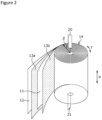
- FIG. 2 is a perspective view of the electrode assembly 14 in a winding shape of the non-aqueous electrolyte secondary battery 10 shown in FIG. 1 .
- the electrode assembly 14 has a winding-shaped structure in which a positive electrode 11 and a negative electrode 12 are wound with a first separator 13a and a second separator 13b intervening therebetween. All of the positive electrode 11, the negative electrode 12, the first separator 13a and the second separator 13b are formed into strip shapes, which are wound into a spiral shape around the winding axis which is the center of the winding of the electrode assembly 14 into a state where they are alternately laminated in a radial direction ⁇ of the electrode assembly 14.
- the longitudinal direction of the positive electrode 11 and the negative electrode 12 is a winding direction y
- the width direction of the positive electrode 11 and the negative electrode 12 is a winding axis direction ⁇ .
- the longitudinal direction of the positive electrode 11 and the negative electrode 12 may be referred to as a longitudinal direction ⁇ .
- an inner winding side means the winding axis side in the radial direction ⁇
- an outer winding side means the outside of the electrode assembly 14 in the radial direction ⁇ .
- the positive electrode 11 has a strip-shaped positive electrode current collector, and a positive electrode active material layer formed on at least one of surfaces of the positive electrode current collector.
- the positive electrode 11 has a positive electrode active material layer including a positive electrode active material on at least one of its surfaces.
- the positive electrode active material layer is preferably formed on both sides of the positive electrode current collector.
- the positive electrode current collector there is used, for example, foil of a metal such as aluminum, a film having the metal disposed on its surface layer, or the like.
- a preferable positive electrode current collector is foil of metal the main component of which is aluminum or aluminum alloy.
- the thickness of the positive electrode current collector is 10 ⁇ m to 30 ⁇ m, for example.
- the positive electrode active material layer is preferably formed in the whole region, on both sides of the positive electrode current collector, except a positive electrode exposed part mentioned later.
- the positive electrode active material layer preferably includes the positive electrode active material, a conductive agent, and a binder.
- the positive electrode 11 is produced, for example, by applying positive electrode slurry including the positive electrode active material, the conductive agent, the binder, and a solvent such as N-methyl-2-pyrrolidone (NMP) on both sides of the positive electrode current collector, and after that, drying and rolling it.
- NMP N-methyl-2-pyrrolidone
- the positive electrode active material examples include lithium-containing composite oxides containing transition metal elements such as Co, Mn, and Ni.
- the lithium-containing composite oxides are not specially limited, they are preferably composite oxides represented by the general formula Li 1+x MO 2 wherein -0.2 ⁇ x ⁇ 0.2, and M includes at least one of the group consisting of Ni, Co, Mn, and Al.
- Examples of the conductive agent include carbon materials such as carbon black (CB), acetylene black (AB), Ketjen black, and graphite, and the like.
- Examples of the binder can include fluorine-based resins such as polytetrafluoroethylene (PTFE) and polyvinylidene fluoride (PVdF), polyacrylonitrile (PAN), polyimide (PI), acrylic resins, polyolefin-based resins, and the like.
- PTFE polytetrafluoroethylene
- PVdF polyvinylidene fluoride
- PAN polyacrylonitrile
- PI polyimide
- acrylic resins polyolefin-based resins, and the like.
- CMC carboxymethylcellulose
- PEO polyethylene oxide
- the positive electrode exposed part is a portion to which the positive electrode lead 20 is connected and is a portion where the surface of the positive electrode current collector is not covered by the positive electrode active material layer.
- the positive electrode lead 20 is joined to the positive electrode exposed part, for example, by ultrasonic welding.
- a structure material of the positive electrode lead 20 is not specially limited as long as it has conductivity.
- the positive electrode lead 20 is preferably composed of metal the main component of which is aluminum.
- the positive electrode exposed part can be provided, for example, in a center part of the positive electrode 11 in the longitudinal direction ⁇ .
- the positive electrode exposed part may be formed shifting toward an end part of the positive electrode 11 in the longitudinal direction y, it is preferably provided at a position at substantially the same distances from both ends thereof in the longitudinal direction y, preferably, in view of current collectability.
- the positive electrode lead 20 By connecting the positive electrode lead 20 to the positive electrode exposed part provided at such a position, the positive electrode lead 20 is to be arranged to protrude from an end face of the electrode assembly 14 in the winding axis direction ⁇ at the middle position thereof in the radial direction ⁇ as shown in FIG. 2 after the winding is made as the electrode assembly 14.
- the positive electrode exposed part is provided, for example, by intermittent application by which a part of the positive electrode current collector is not coated with the positive electrode slurry.
- the negative electrode 12 has a strip shaped negative electrode current collector, and a negative electrode active material layer formed on at least one of surfaces of the negative electrode current collector.
- the negative electrode active material layer is preferably formed on both sides of the negative electrode current collector.
- the negative electrode current collector there is used, for example, foil of a metal such as copper, a film having the metal disposed on its surface layer, or the like.
- a preferable negative electrode current collector is foil of metal the main component of which is copper or copper alloy.
- the thickness of the negative electrode current collector is 5 ⁇ m to 30 ⁇ m, for example.
- the negative electrode active material layer is preferably formed in the whole region, on both sides of the negative electrode current collector, except a negative electrode exposed part mentioned later.
- the negative electrode active material layer preferably includes a negative electrode active material and a binder.
- the negative electrode 12 is produced, for example, by applying negative electrode slurry including the negative electrode active material, the binder, water, and the like on both sides of the negative electrode current collector, and after that, drying and rolling it.
- the negative electrode active material is not specially limited as long as it can reversibly store and release lithium ions and, for example, can employ carbon materials such as natural graphite and artificial graphite, metals alloyed with lithium, such as Si and Sn, alloys and oxides including these, and the like.
- carbon materials such as natural graphite and artificial graphite, metals alloyed with lithium, such as Si and Sn, alloys and oxides including these, and the like.
- the binder included in the negative electrode active material layer there are used, for example, fluorine-based resins such as polytetrafluoroethylene (PTFE) and polyvinylidene fluoride (PVdF), polyacrylonitrile (PAN), polyimide (PI), acrylic resins, polyolefin-based resins, and the like, similarly to the case of the positive electrode 11.
- PTFE polytetrafluoroethylene
- PVdF polyvinylidene fluoride
- PAN polyacrylonitrile
- PI
- the negative electrode slurry is prepared with an aqueous solvent
- SBR styrene-butadiene rubber
- CMC styrene-butadiene rubber
- polyacrylic acid or its salt polyvinyl alcohol, and the like.
- the negative electrode exposed part is a portion to which the negative electrode lead 21 is connected and is a portion where the surface of the negative electrode current collector is not covered by the positive electrode active material layer.
- the negative electrode lead 21 is joined to the positive electrode exposed part, for example, by ultrasonic welding.
- a structure material of the negative electrode lead 21 is not specially limited as long as it has conductivity.
- the negative electrode lead 21 is preferably composed of metal the main component of which is nickel or copper, or of metal including both nickel and copper.
- the negative electrode exposed part is provided, for example, in an inner end part of the negative electrode 12 in the longitudinal direction ⁇ .
- the negative electrode lead 21 is arranged to protrude from an end face of the electrode assembly 14 in the winding axis direction ⁇ at a center part thereof in the radial direction ⁇ .
- the inner end part and an outer end part mean the end part of the positive electrode 11 on the inner winding side, and the end part of the negative electrode 12 on the outer winding side, respectively.
- the negative electrode exposed part is provided, for example, by intermittent application by which a part of the negative electrode current collector is not coated with the negative electrode slurry.
- the arrangement position of the negative electrode lead 21 is not limited to that in the example shown in FIG.
- the negative electrode lead 21 may be provided in the outer end part of the negative electrode 12. Moreover, the negative electrode leads 21 may be provided in both the inner end part and the outer end part. In this case, the current collectability can be improved.
- the terminal end part of the negative electrode 12 may be electrically connected to the battery case 15 not using the negative electrode lead 21, by bringing an exposed part of the negative electrode 12 at the terminal end part into contact with the inner peripheral surface of the battery case 15.
- the first separator 13a is provided on the outer winding side of the positive electrode 11, and the second separator 13b is provided on the inner winding side of the positive electrode 11.
- the first separator 13a and the second separator 13b intervene between the positive electrode 11 and the negative electrode 12, and thereby, make the positive electrode 11 and the negative electrode 12 physically and electrically separated from each other.
- the first separator 13a and the second separator 13b protect the positive electrode 11 and the negative electrode 12 upon reception of impact from the outside.
- first separator 13a and the second separator 13b there are used porous sheets having ion permeability and insulation properties.
- the porous sheets include microporous thin films, woven fabric, nonwoven fabric, and the like.
- the materials of the bases of the first separator 13a and the second separator 13b there can be used polyolefin-based resins such as polyethylene and polypropylene.
- the thicknesses of the first separator 13a and the second separator 13b are 10 ⁇ m to 50 ⁇ m, for example, and are preferably 9 ⁇ m to 17 ⁇ m.
- the first separator 13a and the second separator 13b have melting points, for example, of about 130°C to about 180°C.
- the piercing strength of the second separator 13b is higher than the piercing strength of the first separator 13a. This can enhance the insulation between the positive electrode 11 and the negative electrode 12.
- the reason is considered as follows.
- the positive electrode 11 and the negative electrode 12 are wound into spiral shapes, their active material layers that are on the respective inner winding sides are subject to compressive stress. Since the positive electrode 11 includes a hard active material, there is a case where the positive electrode active material layer cannot absorb the compressive stress. Therefore, the second separator 13b which is on the inner winding side of the positive electrode 11 is more subject to stress from a positive electrode mixture layer than the first separator 13a which is on the outer winding side thereof.
- enhancing the piercing strength of the second separator 13b leads to effective means for enhancing the insulation between the positive electrode 11 and the negative electrode 12.
- the piercing strengths are measured in conformity to the JIS standard, JIS Z-1707.
- a fixed piercing strength measurement sample (separator) is pricked with a semicircular needle having 1.0 mm of diameter and 0.5 mm of tip diameter at 50 ⁇ 5 mm/min of speed to measure the maximum stress until it is pierced by the needle.
- the measurements are performed on five piercing strength measurement samples which are sampled at random to set an average value of the measurement results as the value of the piercing strength of each separator.
- the first separator 13a lower in piercing strength has a higher coefficient of extension in the winding axis direction ⁇ than the second separator 13b.
- the difference in coefficient of extension between the first separator 13a and the second separator 13b contributes to the restraint of the thermal runaway. Accordingly, by arranging the first separator 13a lower in piercing strength on the outer winding side of the positive electrode 11 and arranging the second separator 13b higher in piercing strength on the inner winding side of the positive electrode 11, there can be enhanced the insulation between the positive electrode 11 and the negative electrode 12 and be obtained the nonaqueous electrolyte secondary battery 10 that is strong against impact from the outside.
- the first separator 13a has 3.0 N or more and less than 3.9 N of piercing strength, and 185% or more and 260% or less of coefficient of extension in the winding axis direction ⁇ , preferably 3.0 N or more and 3.7 N or less of piercing strength, and 185% or more and 220% or less of coefficient of extension in the winding axis direction ⁇ .
- the second separator 13b has 3.9 N or more and 6.0 N or less of piercing strength, and 170% or more and 240% or less of coefficient of extension in the winding axis direction ⁇ , preferably 3.9 N or more and 5.0 N or less of piercing strength, and 170% or more and 200% or less of coefficient of extension in the winding axis direction ⁇ .
- the coefficients of extension in the winding axis direction ⁇ are measured in conformity to the JIS standard, JIS K-7127.
- the first separator 13a and the second separator 13b are cut to have 10 mm to 25 mm of widths and 150 mm or more of lengths to produce samples for measuring coefficients of extension.
- Each sample for measuring a coefficient of extension is attached to grippers such that its longitudinal direction coincides with the axis of the tester, there are measured tensile force and its extension during pulling the sample for measuring the coefficient of extension at a constant speed to measure the coefficient of extension in the winding axis direction ⁇ .
- the negative electrode lead 21 is provided at the inner end part of the negative electrode 12 in the longitudinal direction y, there is a case where, at a site on the outer winding side of the negative electrode lead 21, the insulation between the positive electrode 11 and the negative electrode 12 lowers. Accordingly, when the negative electrode lead 21 is provided at the inner end part of the negative electrode 12 in the longitudinal direction y, there is significant the effect, of the present embodiment, of improving the insulation between the positive electrode 11 and the negative electrode 12.
- the first separator 13a and the second separator 13b each is produced by extruding and shaping a polyolefin-based resin into a sheet shape, and after that, stretching it in the flow direction (MD: Machine Direction) and in the direction (TD: Transverse Direction) perpendicular to the flow direction simultaneously or sequentially to make it into a thin film.
- MD Machine Direction
- TD Transverse Direction
- the stretching can make molecules in the polyolefin-based resin oriented, which leads to its crystallization and can improve its piercing strength.
- a polyolefin-based resin has a predefined amount by which it can be stretched, and the stretching of those into thin films causes the coefficients of extension of the first separator 13a and the second separator 13b after made into the thin films to be made small.
- the first separator 13a and the second separator 13b have trade-off relation between the coefficients of extension and the piercing strengths.
- the positive electrode active material there was used aluminum-containing lithium cobalt nickelate represented by LiNi 0.88 Co 0.09 Al 0.03 O 2 . 100 parts by mass of LiNi 0.88 Co 0.09 Al 0.03 O 2 , 1.0 part by mass of acetylene black, and 0.9 parts by mass of polyvinylidene fluoride (PVDF) were mixed, and an appropriate amount of N-methyl-2-pyrrolidone (NMP) was added to those to prepare the positive electrode slurry. Next, the positive electrode slurry was applied onto both sides of a long strip-shaped positive electrode current collector composed of aluminum foil with 15 ⁇ m of thickness, and the coating film was heated and dried at 100°C to 150°C. The dried coating film was compressed to have 0.144 mm of thickness using rolls, and after that, was cut to have 62.6 mm of width and 861 mm of length to produce the positive electrode having the positive electrode active material layers formed on both sides of the positive electrode current collector.
- PVDF polyvinylidene fluoride
- the negative electrode slurry was applied onto both sides of a long strip-shaped negative electrode current collector composed of copper foil with 8 ⁇ m of thickness, and the coating film was dried. The dried coating film was compressed to have 0.160 mm of thickness using rolls, and after that, was cut to have 64.2 mm of width and 959 mm of length to produce the negative electrode having the negative electrode active material layers formed on both sides of the negative electrode current collector.
- separators made of polyolefin-based resins.
- first separator there was used a separator A having 15 ⁇ m of thickness, 3.8 N of piercing strength, and 247% of coefficient of extension in the winding axis direction.
- second separator there was used a separator B having 15 ⁇ m of thickness, 3.9 N of piercing strength, and 178% of coefficient of extension in the winding axis direction.
- Ten winding-shaped electrode assemblies were produced each by laminating, and then winding, the second separator, the positive electrode, the first separator and the negative electrode in this order from the inner winding side.
- 1200 V of AC voltage was applied in an atmosphere at 45°C, and it was examined whether 100 mA or more of current flowed therein.
- the electrode assembly(assemblies) that allowed 100 mA or more of current to flow was(were) taken as being defective and the other(s) was(were) taken as being good to calculate the fraction defective of those.
- Two winding-shaped electrode assemblies were produced each by laminating, and then winding, the second separator, the positive electrode, the first separator and the negative electrode in this order from the inner winding side. Insulating plates were arranged on and below on the electrode assembly, and the electrode assembly was housed in the battery case. Next, a negative electrode lead was welded to the bottom part of the battery case, and a positive electrode lead was welded to a sealing assembly having a vent valve of internal pressure operation type. After that, after the electrolytic solution was injected into the interior of the battery case in a reduced pressure scheme, the opening end part of the battery case was sealed in such a manner that the opening end part of the battery case is crimped onto the sealing assembly across the gasket, for producing two cylinder-shaped secondary batteries.
- Winding-shaped electrode assemblies were produced similarly to Example 1 except that the separators A were used for the first separator and the second separator.
- Winding-shaped electrode assemblies were produced similarly to Example 1 except that the separators B were used for the first separator and the second separator.
- Winding-shaped electrode assemblies were produced similarly to Example 1 except that the separator B was used for the first separator and the separator A was used for the second separator.
- Example 1 where the separator A and the separator B were used for the first separator and the second separator, respectively, being defective did not arise in the breakdown test, and being good arose even in the impact test where the dropping height of the weight was 80 cm. Moreover, although in the impact tests where the dropping height of the weight was 61 cm, being good arose in all of the example and the comparative examples, being defective arose in the impact test with 80 cm of dropping height of the weight in Comparative Example 2 where the separators B were used on the inner winding side and on the outer winding side of the positive electrode, the separators having not very high coefficients of extension in the winding axis direction while having high piercing strengths.
- Comparative Example 2 is considered as resulting in being defective because the separators did not sufficiently extend when the cylinder-shaped secondary battery received the impact. Moreover, as to the breakdown tests, being defective arose in Comparative Examples 1 to 3, and in particular, being defective significantly arose in Comparative Examples 1 and 3 where the separator A low in piercing strength was installed on the inner winding side of the positive electrode. It has been found as above that the excellent results can be obtained in the breakdown test and the impact tests through the well-balanced arrangement of the two kinds of separators on the inner winding side and on the outer winding side of the positive electrode.
Landscapes
- Chemical & Material Sciences (AREA)
- Chemical Kinetics & Catalysis (AREA)
- Electrochemistry (AREA)
- General Chemical & Material Sciences (AREA)
- Engineering & Computer Science (AREA)
- Manufacturing & Machinery (AREA)
- Materials Engineering (AREA)
- Inorganic Chemistry (AREA)
- Secondary Cells (AREA)
- Cell Separators (AREA)
Description
- The present disclosure relates to a non-aqueous electrolyte secondary battery.
- There have widely been used non-aqueous electrolyte secondary batteries which house a winding-shaped electrode assembly having strip-shaped positive and negative electrodes wound with intervening separators in a metal-made battery case. PATENT LITERATURE 1 discloses a non-aqueous electrolyte secondary battery which provides restraint on thermal runaway of the battery due to impact from the outside in the charging state by using separators which satisfy predetermined tensile breaking strengths. PATENT LIETRATURE 2 discloses an electrode assembly and non-aqueous electrolyte battery. PATENT LITERATURE 3 discloses a nonaqueous electrolyte secondary battery.
-
- PATENT LITERATURE 1:
Japanese Unexamined Patent Application Publication No. 2014-139865 - PATENT LITERATURE 2: International Patent Application Publication (
WO) No. 2008/035806 - PATENT LITERATURE 3:
Japanese Unexamined Patent Application Publication No. 2014-139865 - Now, it is an important problem, on a non-aqueous electrolyte secondary battery, to secure electric insulation between the positive electrode and the negative electrode. The insulation between the positive electrode and the negative electrode is evaluated, for example, with a breakdown test to measure a leak current flowing between the positive electrode and the negative electrode under application of high voltage to the electrode assembly that is still to be impregnated with an electrolytic solution. The breakdown test is performed in order to reject a defective product that is insufficient in terms of the insulation between the positive electrode and the negative electrode in the production process of the non-aqueous electrolyte secondary batteries. Accordingly, securing the insulation between the positive electrode and the negative electrode results in reduction of the fraction defective in the production process. The technology disclosed in PATENT LITERATURE 1 does not consider such insulation between the positive electrode and the negative electrode, and still has room for improvement.
- It is an advantage of the present disclosure to provide a non-aqueous electrolyte secondary battery capable of enhancing insulation between a positive electrode and a negative electrode and restraining thermal runaway of the battery due to impact from the outside in the charging state.
- The invention is defined in claim 1.
- A non-aqueous electrolyte secondary battery which is an aspect of the present disclosure comprises a winding-shaped electrode assembly having a positive electrode and a negative electrode wound with a first separator and a second separator intervening therebetween, characterized in that the first separator is provided on an outer winding side of the positive electrode, the second separator is provided on an inner winding side of the positive electrode, and a piercing strength of the second separator is higher than a piercing strength of the first separator.
- According to the non-aqueous electrolyte secondary battery according to the present disclosure, there may be enhanced the insulation between the positive electrode and the negative electrode and be restrained the thermal runaway of the battery due to the impact from the outside in the charging state.
-
-
FIG. 1 is a longitudinal sectional view of a non-aqueous electrolyte secondary battery which is an example of embodiments. -
FIG. 2 is a perspective view of a winding-shaped electrode assembly of the nonaqueous electrolyte secondary battery shown inFIG. 1 . - Hereafter, an example of embodiments of a non-aqueous electrolyte secondary battery according to the present disclosure will be described in detail with reference to the drawings. Specific shapes, materials, numerical values, directions and the like in the following description are exemplary illustrations for facilitating understanding of the present disclosure, and can be properly modified to meet the specifications of a nonaqueous electrolyte secondary battery. Moreover, it has been originally supposed that, in the case where the following description includes a plurality of embodiments and modifications, their characteristic portions are properly combined and used.
-
FIG. 1 is a longitudinal sectional view of a non-aqueous electrolytesecondary battery 10 which is an example of embodiments. As exemplarily shown inFIG. 1 , the non-aqueous electrolytesecondary battery 10 has anelectrode assembly 14 and a nonaqueous electrolyte (not shown) which are housed in abattery case 15. For a nonaqueous solvent (organic solvent) of the non-aqueous electrolyte, carbonates, lactones, ethers, ketones, esters, and the like can be used, and two kinds or more of these solvents can be mixed and used. For example, cyclic carbonates such as ethylene carbonate, propylene carbonate, and butylene carbonate, chain carbonates such as dimethyl carbonate, ethyl methyl carbonate, and diethyl carbonate, mixed solvents of the cyclic carbonates and the chain carbonates, and the like can be used. For an electrolyte salt of the non-aqueous electrolyte, LiPF6, LiBF4, LiCF3SO3, and the like, and mixtures of these can be used. The amount of the dissolved electrolyte salt relative to and in the non-aqueous solvent can be set, for example, to 0.5 to 2.0 mol/L. - An
exterior member 16 and asealing assembly 17 constitute thebattery case 15.Insulating plates electrode assembly 14, respectively. Apositive electrode lead 20 extends to thesealing assembly 17 side through a through hole of theinsulating plate 18 and is welded onto a lower surface of afilter 23 which is a bottom plate of thesealing assembly 17. In the non-aqueous electrolytesecondary battery 10, acap 27 which is a top board of thesealing assembly 17 electrically connected to thefilter 23 is a positive electrode terminal. Meanwhile, anegative electrode lead 21 extends to the bottom part side of theexterior member 16 through a through hole of theinsulating plate 19 and is welded onto an inner surface of the bottom part of theexterior member 16. In the non-aqueous electrolytesecondary battery 10, theexterior member 16 is a negative electrode terminal. When thenegative electrode lead 21 is installed in the vicinity of the outer winding end, thenegative electrode lead 21 extends to the bottom part side of thebattery case 15 through the outside of theinsulating plate 18 and is welded onto an inner surface of the bottom part of thebattery case 15. - The
exterior member 16 is a bottomed cylindrical metal-made container. Agasket 28 is provided between theexterior member 16 and thesealing assembly 17 and the sealability of the interior of the battery case is secured. Theexterior member 16 has a projectingportion 22 which is formed, for example, by pressing its lateral surface part from the outside and which supports thesealing assembly 17. The projectingportion 22 is preferably formed into an annular shape along the circumferential direction of theexterior member 16 and supports thesealing assembly 17 on its upper surface. - The
sealing assembly 17 has thefilter 23, alower vent member 24, aninsulating member 25, anupper vent member 26 and thecap 27 which are laminated sequentially from theelectrode assembly 14 side. The members constituting thesealing assembly 17 have disc shapes or ring shapes, for example, and the members except the insulatingmember 25 are electrically connected to one another. Thelower vent member 24 and theupper vent member 26 are connected to each other at their center parts, and theinsulating member 25 interposes between their peripheral edges. When the internal pressure of the battery rises due to abnormal heat generation, thelower vent member 24 fractures, for example, this causes theupper vent member 26 to expand to thecap 27 side and to be separated from thelower vent member 24, and thereby, electric connection between these is interrupted. When the internal pressure further rises, theupper vent member 26 fractures, and gas is discharged from an opening of thecap 27. - Hereafter, the
electrode assembly 14 will be described in detail with reference toFIG. 2. FIG. 2 is a perspective view of theelectrode assembly 14 in a winding shape of the non-aqueous electrolytesecondary battery 10 shown inFIG. 1 . Theelectrode assembly 14 has a winding-shaped structure in which apositive electrode 11 and anegative electrode 12 are wound with afirst separator 13a and asecond separator 13b intervening therebetween. All of thepositive electrode 11, thenegative electrode 12, thefirst separator 13a and thesecond separator 13b are formed into strip shapes, which are wound into a spiral shape around the winding axis which is the center of the winding of theelectrode assembly 14 into a state where they are alternately laminated in a radial direction β of theelectrode assembly 14. On theelectrode assembly 14, the longitudinal direction of thepositive electrode 11 and thenegative electrode 12 is a winding direction y, and the width direction of thepositive electrode 11 and thenegative electrode 12 is a winding axis direction α. Hereinafter, the longitudinal direction of thepositive electrode 11 and thenegative electrode 12 may be referred to as a longitudinal direction γ. Moreover, an inner winding side means the winding axis side in the radial direction β, and an outer winding side means the outside of theelectrode assembly 14 in the radial direction β. - The
positive electrode 11 has a strip-shaped positive electrode current collector, and a positive electrode active material layer formed on at least one of surfaces of the positive electrode current collector. In other words, thepositive electrode 11 has a positive electrode active material layer including a positive electrode active material on at least one of its surfaces. The positive electrode active material layer is preferably formed on both sides of the positive electrode current collector. For the positive electrode current collector, there is used, for example, foil of a metal such as aluminum, a film having the metal disposed on its surface layer, or the like. A preferable positive electrode current collector is foil of metal the main component of which is aluminum or aluminum alloy. The thickness of the positive electrode current collector is 10 µm to 30 µm, for example. - The positive electrode active material layer is preferably formed in the whole region, on both sides of the positive electrode current collector, except a positive electrode exposed part mentioned later. The positive electrode active material layer preferably includes the positive electrode active material, a conductive agent, and a binder. The
positive electrode 11 is produced, for example, by applying positive electrode slurry including the positive electrode active material, the conductive agent, the binder, and a solvent such as N-methyl-2-pyrrolidone (NMP) on both sides of the positive electrode current collector, and after that, drying and rolling it. - Examples of the positive electrode active material include lithium-containing composite oxides containing transition metal elements such as Co, Mn, and Ni. Although the lithium-containing composite oxides are not specially limited, they are preferably composite oxides represented by the general formula Li1+xMO2 wherein -0.2<x≤0.2, and M includes at least one of the group consisting of Ni, Co, Mn, and Al.
- Examples of the conductive agent include carbon materials such as carbon black (CB), acetylene black (AB), Ketjen black, and graphite, and the like. Examples of the binder can include fluorine-based resins such as polytetrafluoroethylene (PTFE) and polyvinylidene fluoride (PVdF), polyacrylonitrile (PAN), polyimide (PI), acrylic resins, polyolefin-based resins, and the like. Moreover, there may be used, together with these resins, carboxymethylcellulose (CMC) or its salt, polyethylene oxide (PEO), and the like. These may be used singly or in combinations of two or more thereof.
- There is provided, on the
positive electrode 11, the positive electrode exposed part from which a surface of the positive electrode current collector is exposed. The positive electrode exposed part is a portion to which thepositive electrode lead 20 is connected and is a portion where the surface of the positive electrode current collector is not covered by the positive electrode active material layer. Thepositive electrode lead 20 is joined to the positive electrode exposed part, for example, by ultrasonic welding. A structure material of thepositive electrode lead 20 is not specially limited as long as it has conductivity. Thepositive electrode lead 20 is preferably composed of metal the main component of which is aluminum. - The positive electrode exposed part can be provided, for example, in a center part of the
positive electrode 11 in the longitudinal direction γ. Although the positive electrode exposed part may be formed shifting toward an end part of thepositive electrode 11 in the longitudinal direction y, it is preferably provided at a position at substantially the same distances from both ends thereof in the longitudinal direction y, preferably, in view of current collectability. By connecting thepositive electrode lead 20 to the positive electrode exposed part provided at such a position, thepositive electrode lead 20 is to be arranged to protrude from an end face of theelectrode assembly 14 in the winding axis direction α at the middle position thereof in the radial direction β as shown inFIG. 2 after the winding is made as theelectrode assembly 14. The positive electrode exposed part is provided, for example, by intermittent application by which a part of the positive electrode current collector is not coated with the positive electrode slurry. - The
negative electrode 12 has a strip shaped negative electrode current collector, and a negative electrode active material layer formed on at least one of surfaces of the negative electrode current collector. The negative electrode active material layer is preferably formed on both sides of the negative electrode current collector. For the negative electrode current collector, there is used, for example, foil of a metal such as copper, a film having the metal disposed on its surface layer, or the like. A preferable negative electrode current collector is foil of metal the main component of which is copper or copper alloy. The thickness of the negative electrode current collector is 5 µm to 30 µm, for example. - The negative electrode active material layer is preferably formed in the whole region, on both sides of the negative electrode current collector, except a negative electrode exposed part mentioned later. The negative electrode active material layer preferably includes a negative electrode active material and a binder. The
negative electrode 12 is produced, for example, by applying negative electrode slurry including the negative electrode active material, the binder, water, and the like on both sides of the negative electrode current collector, and after that, drying and rolling it. - The negative electrode active material is not specially limited as long as it can reversibly store and release lithium ions and, for example, can employ carbon materials such as natural graphite and artificial graphite, metals alloyed with lithium, such as Si and Sn, alloys and oxides including these, and the like. For the binder included in the negative electrode active material layer, there are used, for example, fluorine-based resins such as polytetrafluoroethylene (PTFE) and polyvinylidene fluoride (PVdF), polyacrylonitrile (PAN), polyimide (PI), acrylic resins, polyolefin-based resins, and the like, similarly to the case of the
positive electrode 11. In the case where the negative electrode slurry is prepared with an aqueous solvent, there can be used styrene-butadiene rubber (SBR), CMC or its salt, polyacrylic acid or its salt, polyvinyl alcohol, and the like. These may be used singly or in combinations of two or more thereof. - There is provided, on the
negative electrode 12, the negative electrode exposed part from which a surface of the negative electrode current collector is exposed. The negative electrode exposed part is a portion to which thenegative electrode lead 21 is connected and is a portion where the surface of the negative electrode current collector is not covered by the positive electrode active material layer. Thenegative electrode lead 21 is joined to the positive electrode exposed part, for example, by ultrasonic welding. A structure material of thenegative electrode lead 21 is not specially limited as long as it has conductivity. Thenegative electrode lead 21 is preferably composed of metal the main component of which is nickel or copper, or of metal including both nickel and copper. - The negative electrode exposed part is provided, for example, in an inner end part of the
negative electrode 12 in the longitudinal direction γ. In this case, as shown inFIG. 2 , thenegative electrode lead 21 is arranged to protrude from an end face of theelectrode assembly 14 in the winding axis direction α at a center part thereof in the radial direction β. Herein, the inner end part and an outer end part mean the end part of thepositive electrode 11 on the inner winding side, and the end part of thenegative electrode 12 on the outer winding side, respectively. The negative electrode exposed part is provided, for example, by intermittent application by which a part of the negative electrode current collector is not coated with the negative electrode slurry. The arrangement position of thenegative electrode lead 21 is not limited to that in the example shown inFIG. 2 but thenegative electrode lead 21 may be provided in the outer end part of thenegative electrode 12. Moreover, the negative electrode leads 21 may be provided in both the inner end part and the outer end part. In this case, the current collectability can be improved. The terminal end part of thenegative electrode 12 may be electrically connected to thebattery case 15 not using thenegative electrode lead 21, by bringing an exposed part of thenegative electrode 12 at the terminal end part into contact with the inner peripheral surface of thebattery case 15. - As shown in
FIG. 2 , thefirst separator 13a is provided on the outer winding side of thepositive electrode 11, and thesecond separator 13b is provided on the inner winding side of thepositive electrode 11. Thefirst separator 13a and thesecond separator 13b intervene between thepositive electrode 11 and thenegative electrode 12, and thereby, make thepositive electrode 11 and thenegative electrode 12 physically and electrically separated from each other. Moreover, thefirst separator 13a and thesecond separator 13b protect thepositive electrode 11 and thenegative electrode 12 upon reception of impact from the outside. - For the
first separator 13a and thesecond separator 13b, there are used porous sheets having ion permeability and insulation properties. Specific examples of the porous sheets include microporous thin films, woven fabric, nonwoven fabric, and the like. For the materials of the bases of thefirst separator 13a and thesecond separator 13b, there can be used polyolefin-based resins such as polyethylene and polypropylene. The thicknesses of thefirst separator 13a and thesecond separator 13b are 10 µm to 50 µm, for example, and are preferably 9 µm to 17 µm. Thefirst separator 13a and thesecond separator 13b have melting points, for example, of about 130°C to about 180°C. - The piercing strength of the
second separator 13b is higher than the piercing strength of thefirst separator 13a. This can enhance the insulation between thepositive electrode 11 and thenegative electrode 12. The reason is considered as follows. When thepositive electrode 11 and thenegative electrode 12 are wound into spiral shapes, their active material layers that are on the respective inner winding sides are subject to compressive stress. Since thepositive electrode 11 includes a hard active material, there is a case where the positive electrode active material layer cannot absorb the compressive stress. Therefore, thesecond separator 13b which is on the inner winding side of thepositive electrode 11 is more subject to stress from a positive electrode mixture layer than thefirst separator 13a which is on the outer winding side thereof. Accordingly, enhancing the piercing strength of thesecond separator 13b leads to effective means for enhancing the insulation between thepositive electrode 11 and thenegative electrode 12. The piercing strengths are measured in conformity to the JIS standard, JIS Z-1707. A fixed piercing strength measurement sample (separator) is pricked with a semicircular needle having 1.0 mm of diameter and 0.5 mm of tip diameter at 50±5 mm/min of speed to measure the maximum stress until it is pierced by the needle. The measurements are performed on five piercing strength measurement samples which are sampled at random to set an average value of the measurement results as the value of the piercing strength of each separator. - Moreover, by providing the
first separator 13a on the outer winding side of thepositive electrode 11 and providing thesecond separator 13b on the inner winding side of thepositive electrode 11, there are restrained the separators from fracturing in the case where the non-aqueous electrolytesecondary battery 10 receives the impact from the outside. Therefore, the thermal runaway can be restrained even when the impact from the outside is exerted on the non-aqueous electrolytesecondary battery 10 in the charging state. According to the invention, thefirst separator 13a lower in piercing strength has a higher coefficient of extension in the winding axis direction α than thesecond separator 13b. It is therefore inferred that the difference in coefficient of extension between thefirst separator 13a and thesecond separator 13b contributes to the restraint of the thermal runaway. Accordingly, by arranging thefirst separator 13a lower in piercing strength on the outer winding side of thepositive electrode 11 and arranging thesecond separator 13b higher in piercing strength on the inner winding side of thepositive electrode 11, there can be enhanced the insulation between thepositive electrode 11 and thenegative electrode 12 and be obtained the nonaqueous electrolytesecondary battery 10 that is strong against impact from the outside. - According to the invention, the
first separator 13a has 3.0 N or more and less than 3.9 N of piercing strength, and 185% or more and 260% or less of coefficient of extension in the winding axis direction α, preferably 3.0 N or more and 3.7 N or less of piercing strength, and 185% or more and 220% or less of coefficient of extension in the winding axis direction α. According to the invention, thesecond separator 13b has 3.9 N or more and 6.0 N or less of piercing strength, and 170% or more and 240% or less of coefficient of extension in the winding axis direction α, preferably 3.9 N or more and 5.0 N or less of piercing strength, and 170% or more and 200% or less of coefficient of extension in the winding axis direction α. - The coefficients of extension in the winding axis direction α are measured in conformity to the JIS standard, JIS K-7127. The
first separator 13a and thesecond separator 13b are cut to have 10 mm to 25 mm of widths and 150 mm or more of lengths to produce samples for measuring coefficients of extension. Each sample for measuring a coefficient of extension is attached to grippers such that its longitudinal direction coincides with the axis of the tester, there are measured tensile force and its extension during pulling the sample for measuring the coefficient of extension at a constant speed to measure the coefficient of extension in the winding axis direction α. - Moreover, when the
negative electrode lead 21 is provided at the inner end part of thenegative electrode 12 in the longitudinal direction y, there is a case where, at a site on the outer winding side of thenegative electrode lead 21, the insulation between thepositive electrode 11 and thenegative electrode 12 lowers. Accordingly, when thenegative electrode lead 21 is provided at the inner end part of thenegative electrode 12 in the longitudinal direction y, there is significant the effect, of the present embodiment, of improving the insulation between thepositive electrode 11 and thenegative electrode 12. - The
first separator 13a and thesecond separator 13b each is produced by extruding and shaping a polyolefin-based resin into a sheet shape, and after that, stretching it in the flow direction (MD: Machine Direction) and in the direction (TD: Transverse Direction) perpendicular to the flow direction simultaneously or sequentially to make it into a thin film. The stretching can make molecules in the polyolefin-based resin oriented, which leads to its crystallization and can improve its piercing strength. Meanwhile, a polyolefin-based resin has a predefined amount by which it can be stretched, and the stretching of those into thin films causes the coefficients of extension of thefirst separator 13a and thesecond separator 13b after made into the thin films to be made small. In other words, thefirst separator 13a and thesecond separator 13b have trade-off relation between the coefficients of extension and the piercing strengths. - While the present disclosure will be hereinafter further described with examples, the present disclosure is not limited to these examples.
- As the positive electrode active material, there was used aluminum-containing lithium cobalt nickelate represented by LiNi0.88Co0.09Al0.03O2. 100 parts by mass of LiNi0.88Co0.09Al0.03O2, 1.0 part by mass of acetylene black, and 0.9 parts by mass of polyvinylidene fluoride (PVDF) were mixed, and an appropriate amount of N-methyl-2-pyrrolidone (NMP) was added to those to prepare the positive electrode slurry. Next, the positive electrode slurry was applied onto both sides of a long strip-shaped positive electrode current collector composed of aluminum foil with 15 µm of thickness, and the coating film was heated and dried at 100°C to 150°C. The dried coating film was compressed to have 0.144 mm of thickness using rolls, and after that, was cut to have 62.6 mm of width and 861 mm of length to produce the positive electrode having the positive electrode active material layers formed on both sides of the positive electrode current collector.
- 95 parts by mass of graphite, 5 parts by mass of Si oxide, 1 part by mass of carboxymethylcellulose (CMC), and 1 part by mass of styrene-butadiene rubber were mixed, and an appropriate amount of water was added to those to prepare the negative electrode slurry. Next, the negative electrode slurry was applied onto both sides of a long strip-shaped negative electrode current collector composed of copper foil with 8 µm of thickness, and the coating film was dried. The dried coating film was compressed to have 0.160 mm of thickness using rolls, and after that, was cut to have 64.2 mm of width and 959 mm of length to produce the negative electrode having the negative electrode active material layers formed on both sides of the negative electrode current collector.
- There were prepared two kinds of separators made of polyolefin-based resins. As the first separator, there was used a separator A having 15 µm of thickness, 3.8 N of piercing strength, and 247% of coefficient of extension in the winding axis direction. Moreover, as the second separator, there was used a separator B having 15 µm of thickness, 3.9 N of piercing strength, and 178% of coefficient of extension in the winding axis direction.
- To 100 parts by mass of a mixed solvent composed of ethylene carbonate (EC) and dimethylmethyl carbonate (DMC) (EC:DMC=1:3 by volume), 5 parts by mass of vinylene carbonate (VC) was added. LiPF6 was dissolved in the mixed solvent so as to be in 1.5 mol/L of concentration to prepare the electrolytic solution.
- Ten winding-shaped electrode assemblies were produced each by laminating, and then winding, the second separator, the positive electrode, the first separator and the negative electrode in this order from the inner winding side. To each of the electrode assemblies, 1200 V of AC voltage was applied in an atmosphere at 45°C, and it was examined whether 100 mA or more of current flowed therein. The electrode assembly(assemblies) that allowed 100 mA or more of current to flow was(were) taken as being defective and the other(s) was(were) taken as being good to calculate the fraction defective of those.
- Two winding-shaped electrode assemblies were produced each by laminating, and then winding, the second separator, the positive electrode, the first separator and the negative electrode in this order from the inner winding side. Insulating plates were arranged on and below on the electrode assembly, and the electrode assembly was housed in the battery case. Next, a negative electrode lead was welded to the bottom part of the battery case, and a positive electrode lead was welded to a sealing assembly having a vent valve of internal pressure operation type. After that, after the electrolytic solution was injected into the interior of the battery case in a reduced pressure scheme, the opening end part of the battery case was sealed in such a manner that the opening end part of the battery case is crimped onto the sealing assembly across the gasket, for producing two cylinder-shaped secondary batteries. After the produced batteries were charged up to 3.75 V through constant current charging at 1410 mA (0.3 of hour rate) in an atmosphere at 25°C, they were charged through constant voltage charging at 3.75 V with 94 mA of cut-off current. After that, on one of the batteries, the test was conducted in conformity to the items for the T6 impact test under the UN test conditions for transport (causing 9.1 kg of weight to drop from 61 cm of height onto a metal-made round rod with 15.8 mm of diameter placed above on the center of the battery). On the other of the batteries, the test was conducted similarly to the one battery except that 9.1 kg of weight was caused to drop from 80 cm of height. It was examined whether or not firing from each battery and/or blowup of each battery arose within six hours after the tests. The case of no firing or blowup was taken as being good, and the other cases were taken as being defective.
- Winding-shaped electrode assemblies were produced similarly to Example 1 except that the separators A were used for the first separator and the second separator.
- Winding-shaped electrode assemblies were produced similarly to Example 1 except that the separators B were used for the first separator and the second separator.
- Winding-shaped electrode assemblies were produced similarly to Example 1 except that the separator B was used for the first separator and the separator A was used for the second separator.
- The evaluation results for the example and the comparative examples are presented in Table 1.
[Table 1] Fraction Defective from Breakdown Test Impact Test (Dropping Height: 61 cm) Impact Test (Dropping Height: 80 cm) Example 1 0/10 Good Good Comparative Example 1 3/10 Good Good Comparative Example 2 1/10 Good Defective Comparative Example 3 2/10 Good Good - In Example 1 where the separator A and the separator B were used for the first separator and the second separator, respectively, being defective did not arise in the breakdown test, and being good arose even in the impact test where the dropping height of the weight was 80 cm. Moreover, although in the impact tests where the dropping height of the weight was 61 cm, being good arose in all of the example and the comparative examples, being defective arose in the impact test with 80 cm of dropping height of the weight in Comparative Example 2 where the separators B were used on the inner winding side and on the outer winding side of the positive electrode, the separators having not very high coefficients of extension in the winding axis direction while having high piercing strengths. Comparative Example 2 is considered as resulting in being defective because the separators did not sufficiently extend when the cylinder-shaped secondary battery received the impact. Moreover, as to the breakdown tests, being defective arose in Comparative Examples 1 to 3, and in particular, being defective significantly arose in Comparative Examples 1 and 3 where the separator A low in piercing strength was installed on the inner winding side of the positive electrode. It has been found as above that the excellent results can be obtained in the breakdown test and the impact tests through the well-balanced arrangement of the two kinds of separators on the inner winding side and on the outer winding side of the positive electrode.
-
- 10 non-aqueous electrolyte secondary battery
- 11 positive electrode
- 12 negative electrode
- 13a first separator
- 13b second separator
- 14 electrode assembly
- 15 battery case
- 16 exterior member
- 17 sealing assembly
- 18, 19 insulating plate
- 20 positive electrode lead
- 21 negative electrode lead
- 22 projecting portion
- 23 filter
- 24 lower vent member
- 25 insulating member
- 26 upper vent member
- 27 cap
- 28 gasket
Claims (2)
- A non-aqueous electrolyte secondary battery (10), comprising:a winding-shaped electrode assembly (14) having a positive electrode (11) and a negative electrode (12) wound with a first separator (13a) and a second separator (13b) intervening therebetween; anda battery case (15) housing the electrode assembly (14), whereinthe first separator (13a) is provided on an outer winding side of the positive electrode (11),the second separator (13b) is provided on an inner winding side of the positive electrode (11), andcharacterized in that the first separator (13a) has 3.0 N or more and less than 3.9 N of piercing strength, and 185% or more and 260% or less of coefficient of extension in a winding axis direction, andthe second separator (13b) has 3.9 N or more and 6.0 N or less of piercing strength, and 170% or more and 240% or less of coefficient of extension in the winding axis direction, wherein the piercing strength and the coefficient of extension are measured according to the description,wherein the first separator (13a) has a higher coefficient of extension in the winding axis direction (α) than the second separator (13b).
- The non-aqueous electrolyte secondary battery (10) according to claim 1, whereinthe positive electrode (11) has a positive electrode active material layer including a positive electrode active material on at least one of its surfaces, andthe positive electrode active material is a lithium-containing composite oxide.
Applications Claiming Priority (2)
| Application Number | Priority Date | Filing Date | Title |
|---|---|---|---|
| JP2019035250 | 2019-02-28 | ||
| PCT/JP2020/007018 WO2020175359A1 (en) | 2019-02-28 | 2020-02-21 | Non-aqueous electrolyte secondary battery |
Publications (3)
| Publication Number | Publication Date |
|---|---|
| EP3933995A1 EP3933995A1 (en) | 2022-01-05 |
| EP3933995A4 EP3933995A4 (en) | 2022-04-06 |
| EP3933995B1 true EP3933995B1 (en) | 2025-02-12 |
Family
ID=72238489
Family Applications (1)
| Application Number | Title | Priority Date | Filing Date |
|---|---|---|---|
| EP20762722.5A Active EP3933995B1 (en) | 2019-02-28 | 2020-02-21 | Non-aqueous electrolyte secondary battery |
Country Status (5)
| Country | Link |
|---|---|
| US (1) | US20220037742A1 (en) |
| EP (1) | EP3933995B1 (en) |
| JP (1) | JP7445931B2 (en) |
| CN (1) | CN113474930B (en) |
| WO (1) | WO2020175359A1 (en) |
Families Citing this family (4)
| Publication number | Priority date | Publication date | Assignee | Title |
|---|---|---|---|---|
| US20250239656A1 (en) * | 2022-02-28 | 2025-07-24 | Panasonic Energy Co., Ltd. | Cylindrical nonaqueous electrolyte secondary battery |
| CN119895655A (en) * | 2022-09-30 | 2025-04-25 | 松下知识产权经营株式会社 | Power storage device |
| CN115832621A (en) * | 2022-12-21 | 2023-03-21 | 欣旺达电动汽车电池有限公司 | Diaphragm, preparation method thereof, battery and power utilization device |
| CN118137072B (en) * | 2024-02-29 | 2025-05-27 | 东莞市创明电池技术有限公司 | Roll up core bearing structure, roll up core structure and power battery |
Family Cites Families (11)
| Publication number | Priority date | Publication date | Assignee | Title |
|---|---|---|---|---|
| JP5017754B2 (en) * | 2001-07-10 | 2012-09-05 | パナソニック株式会社 | Non-aqueous electrolyte secondary battery and manufacturing method thereof |
| KR20030033491A (en) * | 2001-10-23 | 2003-05-01 | 삼성에스디아이 주식회사 | A lithium secondary battery |
| CN100559632C (en) * | 2002-01-24 | 2009-11-11 | 日立麦克赛尔株式会社 | Electronic equipment containing non-aqueous secondary batteries inside |
| JP2004281292A (en) * | 2003-03-18 | 2004-10-07 | Sanyo Electric Co Ltd | Non-aqueous electrolyte secondary battery |
| WO2008035806A1 (en) * | 2006-09-19 | 2008-03-27 | Tonen Chemical Corporation | Electrode assembly and non-aqueous electrolyte battery |
| JP4733232B2 (en) * | 2008-03-31 | 2011-07-27 | 旭化成イーマテリアルズ株式会社 | Polyolefin microporous membrane and wound product |
| JP2010061819A (en) * | 2008-09-01 | 2010-03-18 | Panasonic Corp | Nonaqueous secondary battery |
| JP2012033268A (en) * | 2008-11-06 | 2012-02-16 | Hitachi Maxell Ltd | Electrochemical element |
| JP2014139865A (en) * | 2011-04-28 | 2014-07-31 | Sanyo Electric Co Ltd | Nonaqueous electrolyte secondary battery |
| CN109075305A (en) * | 2016-03-24 | 2018-12-21 | 三洋电机株式会社 | Non-aqueous electrolyte secondary battery |
| JP2018163855A (en) * | 2017-03-27 | 2018-10-18 | 三洋電機株式会社 | Nonaqueous electrolyte secondary battery |
-
2020
- 2020-02-21 CN CN202080016157.7A patent/CN113474930B/en active Active
- 2020-02-21 JP JP2021502180A patent/JP7445931B2/en active Active
- 2020-02-21 WO PCT/JP2020/007018 patent/WO2020175359A1/en not_active Ceased
- 2020-02-21 US US17/430,883 patent/US20220037742A1/en active Pending
- 2020-02-21 EP EP20762722.5A patent/EP3933995B1/en active Active
Also Published As
| Publication number | Publication date |
|---|---|
| JPWO2020175359A1 (en) | 2020-09-03 |
| US20220037742A1 (en) | 2022-02-03 |
| CN113474930B (en) | 2024-12-31 |
| JP7445931B2 (en) | 2024-03-08 |
| EP3933995A1 (en) | 2022-01-05 |
| EP3933995A4 (en) | 2022-04-06 |
| CN113474930A (en) | 2021-10-01 |
| WO2020175359A1 (en) | 2020-09-03 |
Similar Documents
| Publication | Publication Date | Title |
|---|---|---|
| EP3933995B1 (en) | Non-aqueous electrolyte secondary battery | |
| EP3813178B1 (en) | Nonaqueous electrolyte secondary battery | |
| US11502382B2 (en) | Nonaqueous electrolyte secondary battery | |
| EP3813177A1 (en) | Nonaqueous electrolyte secondary battery | |
| CN110224181B (en) | Non-aqueous electrolyte secondary battery and method for manufacturing the same | |
| EP4235872B1 (en) | Winding-type nonaqueous electrolyte secondary battery | |
| WO2021039275A1 (en) | Non-aqueous electrolyte secondary battery | |
| EP4471927A1 (en) | Cylindrical nonaqueous electrolyte secondary battery | |
| US20110135981A1 (en) | Nonaqueous electrolyte secondary battery and method for fabricating the same | |
| EP4030520B1 (en) | Non-aqueous electrolyte secondary battery | |
| EP4489211A1 (en) | Cylindrical nonaqueous electrolyte secondary battery | |
| US12027677B2 (en) | Method for manufacturing non-aqueous-electrolyte secondary cell, and voltage detection method | |
| US20220247051A1 (en) | Nonaqueous electrolyte secondary battery | |
| EP4099429B1 (en) | Non-aqueous electrolytic secondary battery | |
| EP4024555A1 (en) | Non-aqueous electrolyte secondary battery and method for producing non-aqueous electrolyte secondary battery | |
| EP4005980A1 (en) | Non-aqueous electrolyte secondary battery | |
| EP3940838B1 (en) | Non-aqueous electrolyte secondary battery and method for manufacturing non-aqueous electrolyte secondary battery | |
| EP4471885A1 (en) | Non-aqueous electrolyte secondary battery | |
| EP4123749A1 (en) | Non-aqueous electrolyte secondary battery | |
| EP3926711A1 (en) | Positive electrode and secondary battery | |
| EP4550514A1 (en) | Non-aqueous electrolyte secondary battery | |
| EP4661146A1 (en) | Nonaqueous electrolyte secondary battery | |
| EP4661148A1 (en) | Non-aqueous electrolyte secondary battery | |
| EP4475214A1 (en) | Lithium ion battery | |
| WO2024225016A1 (en) | Cylindrical secondary battery |
Legal Events
| Date | Code | Title | Description |
|---|---|---|---|
| STAA | Information on the status of an ep patent application or granted ep patent |
Free format text: STATUS: THE INTERNATIONAL PUBLICATION HAS BEEN MADE |
|
| PUAI | Public reference made under article 153(3) epc to a published international application that has entered the european phase |
Free format text: ORIGINAL CODE: 0009012 |
|
| STAA | Information on the status of an ep patent application or granted ep patent |
Free format text: STATUS: REQUEST FOR EXAMINATION WAS MADE |
|
| 17P | Request for examination filed |
Effective date: 20210729 |
|
| AK | Designated contracting states |
Kind code of ref document: A1 Designated state(s): AL AT BE BG CH CY CZ DE DK EE ES FI FR GB GR HR HU IE IS IT LI LT LU LV MC MK MT NL NO PL PT RO RS SE SI SK SM TR |
|
| REG | Reference to a national code |
Ref country code: DE Ref legal event code: R079 Ipc: H01M0050489000 Ref country code: DE Ref legal event code: R079 Ref document number: 602020045944 Country of ref document: DE Free format text: PREVIOUS MAIN CLASS: H01M0010052000 Ipc: H01M0050489000 |
|
| A4 | Supplementary search report drawn up and despatched |
Effective date: 20220309 |
|
| RIC1 | Information provided on ipc code assigned before grant |
Ipc: H01M 50/409 20210101ALI20220302BHEP Ipc: H01M 10/0587 20100101ALI20220302BHEP Ipc: H01M 10/052 20100101ALI20220302BHEP Ipc: H01M 50/489 20210101AFI20220302BHEP |
|
| DAV | Request for validation of the european patent (deleted) | ||
| DAX | Request for extension of the european patent (deleted) | ||
| STAA | Information on the status of an ep patent application or granted ep patent |
Free format text: STATUS: EXAMINATION IS IN PROGRESS |
|
| 17Q | First examination report despatched |
Effective date: 20231016 |
|
| GRAP | Despatch of communication of intention to grant a patent |
Free format text: ORIGINAL CODE: EPIDOSNIGR1 |
|
| STAA | Information on the status of an ep patent application or granted ep patent |
Free format text: STATUS: GRANT OF PATENT IS INTENDED |
|
| INTG | Intention to grant announced |
Effective date: 20240910 |
|
| RIC1 | Information provided on ipc code assigned before grant |
Ipc: H01M 50/572 20210101ALI20240904BHEP Ipc: H01M 50/474 20210101ALI20240904BHEP Ipc: H01M 50/46 20210101ALI20240904BHEP Ipc: H01M 10/42 20060101ALI20240904BHEP Ipc: H01M 50/409 20210101ALI20240904BHEP Ipc: H01M 10/0587 20100101ALI20240904BHEP Ipc: H01M 10/052 20100101ALI20240904BHEP Ipc: H01M 50/489 20210101AFI20240904BHEP |
|
| RIN1 | Information on inventor provided before grant (corrected) |
Inventor name: SUGII, NORIKO Inventor name: KAIDUKA, ATSUSHI Inventor name: NOWATARI, YUKO |
|
| P01 | Opt-out of the competence of the unified patent court (upc) registered |
Free format text: CASE NUMBER: APP_56435/2024 Effective date: 20241016 |
|
| GRAS | Grant fee paid |
Free format text: ORIGINAL CODE: EPIDOSNIGR3 |
|
| GRAA | (expected) grant |
Free format text: ORIGINAL CODE: 0009210 |
|
| STAA | Information on the status of an ep patent application or granted ep patent |
Free format text: STATUS: THE PATENT HAS BEEN GRANTED |
|
| AK | Designated contracting states |
Kind code of ref document: B1 Designated state(s): AL AT BE BG CH CY CZ DE DK EE ES FI FR GB GR HR HU IE IS IT LI LT LU LV MC MK MT NL NO PL PT RO RS SE SI SK SM TR |
|
| REG | Reference to a national code |
Ref country code: GB Ref legal event code: FG4D |
|
| REG | Reference to a national code |
Ref country code: CH Ref legal event code: EP |
|
| REG | Reference to a national code |
Ref country code: DE Ref legal event code: R096 Ref document number: 602020045944 Country of ref document: DE |
|
| REG | Reference to a national code |
Ref country code: IE Ref legal event code: FG4D |
|
| REG | Reference to a national code |
Ref country code: NL Ref legal event code: MP Effective date: 20250212 |
|
| PG25 | Lapsed in a contracting state [announced via postgrant information from national office to epo] |
Ref country code: RS Free format text: LAPSE BECAUSE OF FAILURE TO SUBMIT A TRANSLATION OF THE DESCRIPTION OR TO PAY THE FEE WITHIN THE PRESCRIBED TIME-LIMIT Effective date: 20250512 |
|
| PG25 | Lapsed in a contracting state [announced via postgrant information from national office to epo] |
Ref country code: FI Free format text: LAPSE BECAUSE OF FAILURE TO SUBMIT A TRANSLATION OF THE DESCRIPTION OR TO PAY THE FEE WITHIN THE PRESCRIBED TIME-LIMIT Effective date: 20250212 |
|
| PG25 | Lapsed in a contracting state [announced via postgrant information from national office to epo] |
Ref country code: PL Free format text: LAPSE BECAUSE OF FAILURE TO SUBMIT A TRANSLATION OF THE DESCRIPTION OR TO PAY THE FEE WITHIN THE PRESCRIBED TIME-LIMIT Effective date: 20250212 |
|
| PG25 | Lapsed in a contracting state [announced via postgrant information from national office to epo] |
Ref country code: ES Free format text: LAPSE BECAUSE OF FAILURE TO SUBMIT A TRANSLATION OF THE DESCRIPTION OR TO PAY THE FEE WITHIN THE PRESCRIBED TIME-LIMIT Effective date: 20250212 |
|
| REG | Reference to a national code |
Ref country code: LT Ref legal event code: MG9D |
|
| PG25 | Lapsed in a contracting state [announced via postgrant information from national office to epo] |
Ref country code: IS Free format text: LAPSE BECAUSE OF FAILURE TO SUBMIT A TRANSLATION OF THE DESCRIPTION OR TO PAY THE FEE WITHIN THE PRESCRIBED TIME-LIMIT Effective date: 20250612 Ref country code: NO Free format text: LAPSE BECAUSE OF FAILURE TO SUBMIT A TRANSLATION OF THE DESCRIPTION OR TO PAY THE FEE WITHIN THE PRESCRIBED TIME-LIMIT Effective date: 20250512 |
|
| PG25 | Lapsed in a contracting state [announced via postgrant information from national office to epo] |
Ref country code: NL Free format text: LAPSE BECAUSE OF FAILURE TO SUBMIT A TRANSLATION OF THE DESCRIPTION OR TO PAY THE FEE WITHIN THE PRESCRIBED TIME-LIMIT Effective date: 20250212 |
|
| PG25 | Lapsed in a contracting state [announced via postgrant information from national office to epo] |
Ref country code: HR Free format text: LAPSE BECAUSE OF FAILURE TO SUBMIT A TRANSLATION OF THE DESCRIPTION OR TO PAY THE FEE WITHIN THE PRESCRIBED TIME-LIMIT Effective date: 20250212 |
|
| PG25 | Lapsed in a contracting state [announced via postgrant information from national office to epo] |
Ref country code: PT Free format text: LAPSE BECAUSE OF FAILURE TO SUBMIT A TRANSLATION OF THE DESCRIPTION OR TO PAY THE FEE WITHIN THE PRESCRIBED TIME-LIMIT Effective date: 20250612 Ref country code: LV Free format text: LAPSE BECAUSE OF FAILURE TO SUBMIT A TRANSLATION OF THE DESCRIPTION OR TO PAY THE FEE WITHIN THE PRESCRIBED TIME-LIMIT Effective date: 20250212 |
|
| PG25 | Lapsed in a contracting state [announced via postgrant information from national office to epo] |
Ref country code: GR Free format text: LAPSE BECAUSE OF FAILURE TO SUBMIT A TRANSLATION OF THE DESCRIPTION OR TO PAY THE FEE WITHIN THE PRESCRIBED TIME-LIMIT Effective date: 20250513 Ref country code: BG Free format text: LAPSE BECAUSE OF FAILURE TO SUBMIT A TRANSLATION OF THE DESCRIPTION OR TO PAY THE FEE WITHIN THE PRESCRIBED TIME-LIMIT Effective date: 20250212 |
|
| REG | Reference to a national code |
Ref country code: AT Ref legal event code: MK05 Ref document number: 1767005 Country of ref document: AT Kind code of ref document: T Effective date: 20250212 |
|
| PG25 | Lapsed in a contracting state [announced via postgrant information from national office to epo] |
Ref country code: SE Free format text: LAPSE BECAUSE OF FAILURE TO SUBMIT A TRANSLATION OF THE DESCRIPTION OR TO PAY THE FEE WITHIN THE PRESCRIBED TIME-LIMIT Effective date: 20250212 |
|
| REG | Reference to a national code |
Ref country code: CH Ref legal event code: PL |
|
| PG25 | Lapsed in a contracting state [announced via postgrant information from national office to epo] |
Ref country code: SM Free format text: LAPSE BECAUSE OF FAILURE TO SUBMIT A TRANSLATION OF THE DESCRIPTION OR TO PAY THE FEE WITHIN THE PRESCRIBED TIME-LIMIT Effective date: 20250212 |
|
| PG25 | Lapsed in a contracting state [announced via postgrant information from national office to epo] |
Ref country code: DK Free format text: LAPSE BECAUSE OF FAILURE TO SUBMIT A TRANSLATION OF THE DESCRIPTION OR TO PAY THE FEE WITHIN THE PRESCRIBED TIME-LIMIT Effective date: 20250212 |
|
| PG25 | Lapsed in a contracting state [announced via postgrant information from national office to epo] |
Ref country code: IT Free format text: LAPSE BECAUSE OF FAILURE TO SUBMIT A TRANSLATION OF THE DESCRIPTION OR TO PAY THE FEE WITHIN THE PRESCRIBED TIME-LIMIT Effective date: 20250212 Ref country code: LU Free format text: LAPSE BECAUSE OF NON-PAYMENT OF DUE FEES Effective date: 20250221 |
|
| PG25 | Lapsed in a contracting state [announced via postgrant information from national office to epo] |
Ref country code: AT Free format text: LAPSE BECAUSE OF FAILURE TO SUBMIT A TRANSLATION OF THE DESCRIPTION OR TO PAY THE FEE WITHIN THE PRESCRIBED TIME-LIMIT Effective date: 20250212 |
|
| PG25 | Lapsed in a contracting state [announced via postgrant information from national office to epo] |
Ref country code: CH Free format text: LAPSE BECAUSE OF NON-PAYMENT OF DUE FEES Effective date: 20250228 |
|
| PG25 | Lapsed in a contracting state [announced via postgrant information from national office to epo] |
Ref country code: EE Free format text: LAPSE BECAUSE OF FAILURE TO SUBMIT A TRANSLATION OF THE DESCRIPTION OR TO PAY THE FEE WITHIN THE PRESCRIBED TIME-LIMIT Effective date: 20250212 Ref country code: CZ Free format text: LAPSE BECAUSE OF FAILURE TO SUBMIT A TRANSLATION OF THE DESCRIPTION OR TO PAY THE FEE WITHIN THE PRESCRIBED TIME-LIMIT Effective date: 20250212 |
|
| PG25 | Lapsed in a contracting state [announced via postgrant information from national office to epo] |
Ref country code: RO Free format text: LAPSE BECAUSE OF FAILURE TO SUBMIT A TRANSLATION OF THE DESCRIPTION OR TO PAY THE FEE WITHIN THE PRESCRIBED TIME-LIMIT Effective date: 20250212 |
|
| PG25 | Lapsed in a contracting state [announced via postgrant information from national office to epo] |
Ref country code: SK Free format text: LAPSE BECAUSE OF FAILURE TO SUBMIT A TRANSLATION OF THE DESCRIPTION OR TO PAY THE FEE WITHIN THE PRESCRIBED TIME-LIMIT Effective date: 20250212 |
|
| REG | Reference to a national code |
Ref country code: DE Ref legal event code: R097 Ref document number: 602020045944 Country of ref document: DE |
|
| REG | Reference to a national code |
Ref country code: BE Ref legal event code: MM Effective date: 20250228 |
|
| PLBE | No opposition filed within time limit |
Free format text: ORIGINAL CODE: 0009261 |
|
| STAA | Information on the status of an ep patent application or granted ep patent |
Free format text: STATUS: NO OPPOSITION FILED WITHIN TIME LIMIT |
|
| PG25 | Lapsed in a contracting state [announced via postgrant information from national office to epo] |
Ref country code: MC Free format text: LAPSE BECAUSE OF FAILURE TO SUBMIT A TRANSLATION OF THE DESCRIPTION OR TO PAY THE FEE WITHIN THE PRESCRIBED TIME-LIMIT Effective date: 20250212 |
|
| PG25 | Lapsed in a contracting state [announced via postgrant information from national office to epo] |
Ref country code: BE Free format text: LAPSE BECAUSE OF NON-PAYMENT OF DUE FEES Effective date: 20250228 |
|
| PG25 | Lapsed in a contracting state [announced via postgrant information from national office to epo] |
Ref country code: IE Free format text: LAPSE BECAUSE OF NON-PAYMENT OF DUE FEES Effective date: 20250221 |
|
| 26N | No opposition filed |
Effective date: 20251113 |
|
| PGFP | Annual fee paid to national office [announced via postgrant information from national office to epo] |
Ref country code: GB Payment date: 20260220 Year of fee payment: 7 |
|
| PGFP | Annual fee paid to national office [announced via postgrant information from national office to epo] |
Ref country code: DE Payment date: 20260218 Year of fee payment: 7 |
|
| PGFP | Annual fee paid to national office [announced via postgrant information from national office to epo] |
Ref country code: FR Payment date: 20260219 Year of fee payment: 7 |