EP3933988B1 - Fuel cell device - Google Patents
Fuel cell device Download PDFInfo
- Publication number
- EP3933988B1 EP3933988B1 EP20763042.7A EP20763042A EP3933988B1 EP 3933988 B1 EP3933988 B1 EP 3933988B1 EP 20763042 A EP20763042 A EP 20763042A EP 3933988 B1 EP3933988 B1 EP 3933988B1
- Authority
- EP
- European Patent Office
- Prior art keywords
- fuel cell
- air
- temperature
- utilization
- controller
- Prior art date
- Legal status (The legal status is an assumption and is not a legal conclusion. Google has not performed a legal analysis and makes no representation as to the accuracy of the status listed.)
- Active
Links
Images


Classifications
-
- H—ELECTRICITY
- H01—ELECTRIC ELEMENTS
- H01M—PROCESSES OR MEANS, e.g. BATTERIES, FOR THE DIRECT CONVERSION OF CHEMICAL ENERGY INTO ELECTRICAL ENERGY
- H01M8/00—Fuel cells; Manufacture thereof
- H01M8/04—Auxiliary arrangements, e.g. for control of pressure or for circulation of fluids
- H01M8/04007—Auxiliary arrangements, e.g. for control of pressure or for circulation of fluids related to heat exchange
- H01M8/04014—Heat exchange using gaseous fluids; Heat exchange by combustion of reactants
-
- H—ELECTRICITY
- H01—ELECTRIC ELEMENTS
- H01M—PROCESSES OR MEANS, e.g. BATTERIES, FOR THE DIRECT CONVERSION OF CHEMICAL ENERGY INTO ELECTRICAL ENERGY
- H01M8/00—Fuel cells; Manufacture thereof
- H01M8/04—Auxiliary arrangements, e.g. for control of pressure or for circulation of fluids
- H01M8/04298—Processes for controlling fuel cells or fuel cell systems
- H01M8/04313—Processes for controlling fuel cells or fuel cell systems characterised by the detection or assessment of variables; characterised by the detection or assessment of failure or abnormal function
- H01M8/0432—Temperature; Ambient temperature
-
- H—ELECTRICITY
- H01—ELECTRIC ELEMENTS
- H01M—PROCESSES OR MEANS, e.g. BATTERIES, FOR THE DIRECT CONVERSION OF CHEMICAL ENERGY INTO ELECTRICAL ENERGY
- H01M8/00—Fuel cells; Manufacture thereof
- H01M8/04—Auxiliary arrangements, e.g. for control of pressure or for circulation of fluids
- H01M8/04298—Processes for controlling fuel cells or fuel cell systems
- H01M8/04694—Processes for controlling fuel cells or fuel cell systems characterised by variables to be controlled
- H01M8/04701—Temperature
-
- H—ELECTRICITY
- H01—ELECTRIC ELEMENTS
- H01M—PROCESSES OR MEANS, e.g. BATTERIES, FOR THE DIRECT CONVERSION OF CHEMICAL ENERGY INTO ELECTRICAL ENERGY
- H01M8/00—Fuel cells; Manufacture thereof
- H01M8/04—Auxiliary arrangements, e.g. for control of pressure or for circulation of fluids
- H01M8/04298—Processes for controlling fuel cells or fuel cell systems
- H01M8/04694—Processes for controlling fuel cells or fuel cell systems characterised by variables to be controlled
- H01M8/04746—Pressure; Flow
- H01M8/04753—Pressure; Flow of fuel cell reactants
-
- H—ELECTRICITY
- H01—ELECTRIC ELEMENTS
- H01M—PROCESSES OR MEANS, e.g. BATTERIES, FOR THE DIRECT CONVERSION OF CHEMICAL ENERGY INTO ELECTRICAL ENERGY
- H01M8/00—Fuel cells; Manufacture thereof
- H01M8/04—Auxiliary arrangements, e.g. for control of pressure or for circulation of fluids
- H01M8/04298—Processes for controlling fuel cells or fuel cell systems
- H01M8/04694—Processes for controlling fuel cells or fuel cell systems characterised by variables to be controlled
- H01M8/04858—Electric variables
- H01M8/04925—Power, energy, capacity or load
- H01M8/0494—Power, energy, capacity or load of fuel cell stacks
-
- H—ELECTRICITY
- H01—ELECTRIC ELEMENTS
- H01M—PROCESSES OR MEANS, e.g. BATTERIES, FOR THE DIRECT CONVERSION OF CHEMICAL ENERGY INTO ELECTRICAL ENERGY
- H01M8/00—Fuel cells; Manufacture thereof
- H01M8/10—Fuel cells with solid electrolytes
- H01M8/12—Fuel cells with solid electrolytes operating at high temperature, e.g. with stabilised ZrO2 electrolyte
- H01M2008/1293—Fuel cells with solid oxide electrolytes
-
- H—ELECTRICITY
- H01—ELECTRIC ELEMENTS
- H01M—PROCESSES OR MEANS, e.g. BATTERIES, FOR THE DIRECT CONVERSION OF CHEMICAL ENERGY INTO ELECTRICAL ENERGY
- H01M8/00—Fuel cells; Manufacture thereof
- H01M8/04—Auxiliary arrangements, e.g. for control of pressure or for circulation of fluids
- H01M8/04007—Auxiliary arrangements, e.g. for control of pressure or for circulation of fluids related to heat exchange
-
- Y—GENERAL TAGGING OF NEW TECHNOLOGICAL DEVELOPMENTS; GENERAL TAGGING OF CROSS-SECTIONAL TECHNOLOGIES SPANNING OVER SEVERAL SECTIONS OF THE IPC; TECHNICAL SUBJECTS COVERED BY FORMER USPC CROSS-REFERENCE ART COLLECTIONS [XRACs] AND DIGESTS
- Y02—TECHNOLOGIES OR APPLICATIONS FOR MITIGATION OR ADAPTATION AGAINST CLIMATE CHANGE
- Y02E—REDUCTION OF GREENHOUSE GAS [GHG] EMISSIONS, RELATED TO ENERGY GENERATION, TRANSMISSION OR DISTRIBUTION
- Y02E60/00—Enabling technologies; Technologies with a potential or indirect contribution to GHG emissions mitigation
- Y02E60/30—Hydrogen technology
- Y02E60/50—Fuel cells
Definitions
- the present disclosure relates to a fuel cell system.
- Patent Literature 1 A known technique is described in, for example, Patent Literature 1.
- US 2013/183599 A1 discloses a solid oxide fuel cell for producing variable power in response to power demand, comprising: a fuel cell module configured to generate electricity using supplied fuel; a fuel supply device configured to supply fuel to the fuel cell module; a generating oxidant gas supply device configured to supply oxidant gas for electrical generation to the fuel cell module; a combustion section configured to burn remaining residual fuel supplied by the fuel supply device and not utilized for electrical generation, and heating the interior of the fuel cell module; a heat storing material configured to accumulate heat generated within the fuel cell module; a power demand detection device configured to detect power demand; a temperature detection device configured to detect the temperature of the fuel cell module; and a control device programmed to control, based on the power demand detected by the power demand detection device, such that the fuel utilization rate is high when generated power is large, and the fuel utilization rate is low when generated power is small, and also for changing the power actually output from the fuel cell module at a delay after changing the fuel supply amount in response to changes in power demand; wherein the control device includes a stored heat estimating
- EP 2 624 350 A1 discloses a solid oxide fuel cell system for producing variable generated power in accordance with power demand, comprising: a fuel cell module that generates power using supplied fuel; a fuel supply device that supplies fuel to the fuel cell module; a generating oxidant gas supply device that supplies oxidant gas for electrical generation to the fuel cell module; a heat storage material that stores heat produced within the fuel cell module; a demand power detection device that detects power demand; and a controller programmed to control the fuel supply device based on the demand power detected by the demand power detection device so that the fuel utilization rate increases when generated power is large and decreases when generated power is small, wherein the controller is programmed to change the electrical power actually output from the fuel cell module with a delay after changing the fuel supply amount based on changes in demand power; wherein the controller comprises a stored heat estimating circuit that estimates the amount of surplus heat based on fuel supplied by the fuel supply device and on the power output at a delay relative to fuel supply, and wherein when the stored heat estimating circuit estimates that a utilizable amount
- US 2008/193812 A1 discloses an air-cooled fuel cell system comprising: an air-cooled fuel cell having a cell in which a first channel portion for letting an oxidizing gas for cooling flow and a second channel portion for letting an oxidizing gas for power generation flow are formed such that both the oxidizing gas for cooling and the oxidizing gas for power generation flow from a same side; a supplying device for supplying oxidizing gas; and a distributing device for distributing the supplied oxidizing gas into the first channel portion and the second channel portion, as the oxidizing gas for cooling and the oxidizing gas for power generation, respectively, in a variable distribution ratio.
- US 2017/069925 A1 discloses a fuel cell system comprising: a controller; a temperature sensor that has a physical presence in a conduit within the system; and a wall temperature sensor for sensing a temperature of a wall of the conduit; the controller operative to iteratively apply a thermal model to calculate a predicted temperature value that is, based on temperature values measured using the temperature sensor in the conduit and the wall temperature sensor, expected to be measured; wherein, when in an iterative step the predicted temperature value does not fulfil an interrupt criterion, an input temperature value used in a next iterative step is altered based on a difference between the temperatures measured by the sensors.
- WO 2011 /008189 A1 discloses a fuel cell stack that is operated with a low air utilization which is very low when the stack is providing low current density, and is operated with air utilization increasing as a function of current density above a predetermined current density.
- US 2015/194684 A1 discloses a fuel cell stack assembly comprising: a stack of fuel cells, each fuel cell having a cooling air conduit with an input/output ventilation aperture disposed on a ventilation face of the stack, the ventilation apertures forming an array over said ventilation face of the stack; a first fan configured to direct air flow through a first portion of the ventilation face and a second fan configured to direct air flow through a second portion of the ventilation face; and, a reconfigurable plenum in fluid communication with said first fan and said second fan, the plenum having a first configuration in which air is directed, by the first and second fans, through the first and second portions of the ventilation face in the same direction, and a second configuration in which air is directed, by at least one of the fans, respectively through the first and second portions of the ventilation face in opposing directions.
- Patent Literature 1 WO 2011/037258
- the present invention provides a fuel cell system according to claim 1. Further embodiments of the present invention are disclosed in the dependent claims.
- a fuel cell system with the structure that forms the basis of a fuel cell system according to one or more embodiments of the present disclosure will be described first.
- a known solid oxide fuel cell generates electricity using a fuel gas as a hydrogen-containing gas and air as an oxygen-containing gas.
- SOFC solid oxide fuel cell
- Such a fuel cell may generate electricity using a fuel gas and air supplied in varying amounts to meet the power level requested by an external load, such as a home appliance.
- FIG. 1 is a schematic diagram of the fuel cell system according to one or more embodiments of the present disclosure.
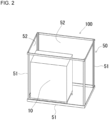
- FIG. 2 is a perspective view of the fuel cell system housed in an external case.
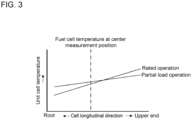
- FIG. 3 is a graph showing the temperature of a fuel cell in a rated operation mode and in a partial load operation mode.
- FIG. 4 is a flowchart showing control for increasing air.
- a fuel cell system 100 includes a fuel cell 11 that generates electricity using a fuel gas and air, an air supply 13 that supplies air to the fuel cell 11, a temperature meter TC that measures the temperature of the fuel cell 11, and a controller 30.
- the fuel cell system 100 can operate in multiple operation modes in a manner switchable as appropriate.
- the operation modes used in the present embodiment include at least a rated operation mode and a partial load operation mode (load-following operation mode).
- the rated operation mode is used for generating rated power.
- the fuel cell 11 operates with a predetermined amount of fuel gas and a predetermined amount of air supplied to generate a predetermined level of power.
- the partial load operation mode is used for generating varying levels of output power in accordance with varying power levels requested by an external load.
- the requested power level varies depending on the types and the number of home appliances to be used.
- the fuel cell generates electricity in accordance with the varying requested power level.
- the fuel cell system 100 includes a first heat circulation system (heat cycle) as a waste heat recovery system including a first heat exchanger 2, a heat storage tank 3, a refrigerator 5, a heating medium pump P2, and circulation channels connecting these components.
- a first heat circulation system heat cycle
- the fuel cell system 100 also includes a second heat circulation system as a waste heat recovery system including a second heat exchanger 4 (also referred to as a clean water heat exchanger), a circulation pump P3 for circulation of a heating medium from the heat storage tank 3, and channel pipes connecting these components.
- a second heat circulation system as a waste heat recovery system including a second heat exchanger 4 (also referred to as a clean water heat exchanger), a circulation pump P3 for circulation of a heating medium from the heat storage tank 3, and channel pipes connecting these components.
- the high-temperature heating medium stored in the heat storage tank 3 is used to heat, with the second heat exchanger 4, water such as tap water supplied from an external source through a supply channel Kin.
- the heated water is then supplied to a reheater, such as an external water heater, through a feed channel Kout.
- a fuel cell module 1 includes the fuel cell 11 and a reformer 12 housed in a housing 10.
- the fuel cell 11 may have any cell structure that generates electricity using a fuel gas and air.
- the fuel cell 11 may be a cell stack structure including multiple unit cells.
- the fuel cell 11 with the cell stack structure includes unit cells having their lower ends fixed to a manifold with an insulating bond such as a glass sealant between them.
- the fuel gas and air to be used by the fuel cell 11 for power generation are supplied through the lower ends of the unit cells.
- the fuel cell 11 includes the unit cells that are vertically arranged prisms having gas channels inside to allow gas to flow in the longitudinal direction.
- the unit cells are electrically connected in series to one another with a current collector between adj acent unit cells.
- SOFCs may be used in a fuel cell system with the partial load operation (load-following operation) mode as one of its operation modes.
- the fuel cell system 100 may include a temperature meter TC to measure the temperature of the fuel cell 11.
- the temperature meter TC may be a known measurement device such as a thermocouple.
- the temperature at the center position of the fuel cell 11 is measured by a thermocouple and used as a representative value of the temperature of the fuel cell 11.
- the moisture contained in the discharged gas then condenses to produce condensed water.
- the resultant condensed water is collected through a condensed water channel C and is stored in a reformed water tank 6. Any condensed water exceeding the capacity of the reformed water tank 6 overflows and is discharged through a water discharge channel D.
- the discharged gas from which the moisture has been removed is discharged out of the fuel cell system through a discharged gas channel E.
- the reformed water stored in the reformed water tank 6 is supplied to the reformer 12 included in the fuel cell module 1 through a reformed water channel R and a reformed water pump P1, and is used for steam reforming of a raw fuel gas.
- Air used for power generation in the fuel cell module 1 is supplied into the fuel cell 11 by the air supply 13.
- the air supply 13 includes a blower B2 and a pipe F as an air channel.
- the raw fuel gas, together with the reformed water flowing through the reformed water channel R, is supplied into the reformer 12 through a fuel gas pump B1 and a pipe G as a raw fuel gas channel.
- the fuel cell system 100 may include various other components for, for example, power generation or hot water supply.
- the components described above are examples.
- the components other than those associated with the control for increasing air may have any structure.
- the fuel cell system 100 may include, as auxiliary devices to assist its power generation operation, a power conditioner 20, the controller 30, an operation board 40 including a display and an operation panel, in addition to the fuel cell module 1 and other components described above.
- the fuel cell system 100 is housed in a case 50 including, for example, frames 51 and exterior panels 52 as shown in FIG. 2 .
- the fuel cell system 100 includes the controller 30 including at least one processor and a memory to implement control and processing capability for performing various functions described in detail later.
- the at least one processor may be a single integrated circuit or may include multiple integrated circuits and/or discrete circuits that are connected to one another to allow communication between them.
- the at least one processor may be implemented with various known techniques.
- the processor includes one or more circuits or units that perform one or more data computation procedures or processes by, for example, executing instructions stored in an associated memory.
- the processor may be firmware, or for example, a discrete logic component that performs one or more data computation procedures or processes.
- the processor may be one or more processors, controllers, microprocessors, microcontrollers, application-specific integrated circuits, digital signal processors, programmable logic devices, field programmable gate arrays, or any combination of these devices or configurations or any other known combination of devices and configurations that may perform the functions described later.
- the controller 30 is connected to a memory and a display (both not shown) and to various components and various sensors included in the fuel cell system 100.
- the controller 30 controls and manages these functional components and thus controls and manages the entire fuel cell system 100.
- the controller 30 obtains a program stored in its memory, and executes the program to implement various functions of the components of the fuel cell system 100.
- the controller 30 may be connected to the other functional components either with wires or wirelessly.
- the particular control performed by the controller 30 in the present embodiment will be described later.
- the controller 30 controls various auxiliary devices, such as the fuel gas pump B1, based on instructions and commands from external devices connected to the fuel cell system or based on instructions and measurements results from various sensors listed above.
- the connections between the controller 30 and the components of the fuel cell and the sensors may not be shown.
- the memory (not shown) can store programs and data.
- the memory may be used as a work area to temporarily store the processing results.
- the memory includes a recording medium.
- the recording medium may include any non-transitory recording medium, such as a semiconductor memory or a magnetic memory.
- the memory may include multiple different recording media.
- the memory may include a combination of a memory reader and a portable recording medium, such as a memory card, an optical disc, or a magneto-optical disk.
- the memory may include a memory device usable as a temporary storage area, such as a random-access memory (RAM).
- RAM random-access memory
- the controller 30 and the memory in the fuel cell system may be external to the fuel cell system 100, or may be implemented with a control method including particular control steps of the controller 30 in one or more embodiments of the present disclosure, or as a control program for causing a computer to execute these steps.
- FIG. 3 is a graph showing the temperature of the fuel cell in the rated operation mode and in the partial load operation mode.
- the fuel cell 11 in the present embodiment is a cell stack structure including vertically arranged prism-like unit cells.
- the fuel cell 11 receives a fuel gas and air supplied through its lower end.
- larger amounts of fuel gas and air are supplied than in the partial load operation mode, thus causing upper end portions of the vertically arranged unit cells to generate more power and thus have higher temperatures.
- the temperature profile shows an increase from the root portions to the upper end portions of the unit cells.
- the temperature profile shows a decrease from the root portions to the upper end portions of the unit cells.
- This temperature profile causes the temperature at the center position of the fuel cell 11 (center temperature) to be higher when the temperature is measured as a representative value of the fuel cell 11 in the partial load operation mode, although the output power level is actually lower in the partial load operation mode than in the rated operation mode.
- the air supply 13 is controlled to increase the amount of air supplied to the fuel cell 11.
- a predetermined temperature threshold temperature
- the determination using the single threshold temperature can cause the issues described above due to the temperature distribution across the different operation modes.
- multiple threshold temperatures are used for cooling the fuel cell 11 appropriately in different operation modes. This reduces the likelihood that the durability of the fuel cell system 100 decreases.
- different operation modes are reflected in different levels of output power, which are then detected as the current values each representing the output power level.
- FIG. 3 is a flowchart showing the control for increasing air.
- symbol S represents a step
- Yes represents a positive result (with a computer flag indicating 1) in the determination
- No represents a negative result (with a computer flag indicating 0) in the determination.
- the control in the fuel cell system 100 includes, preceding the start of this process, measuring the center temperature of the fuel cell 22 continuously with the temperature meter TC.
- the measured center temperature may be used in control other than the control for increasing air. Once the air increasing control starts in the present embodiment, the controller 30 starts monitoring the center temperature of the fuel cell 11.
- the fuel cell system 100 controls the air supply 13 in accordance with an increase or decrease in the level of output power, and changes an air utilization Ua as appropriate.
- the air utilization Ua is the ratio of the amount of air used by the fuel cell 11 for power generation to the amount of air supplied to the fuel cell 11.
- the air utilization Ua includes a first utilization Ua1 as a reference value used during power generation.
- the determination is performed as to whether the center temperature exceeds a first set temperature H1.
- the first set temperature H1 is the highest of set temperatures including a second set temperature H2 and a third set temperature H3, and is the upper limit of the operational temperature of the fuel cell 11.
- the second set temperature H2 is used for a level of output power of the fuel cell 11 less than a predetermined level corresponding to the partial load operation mode.
- the third set temperature H3 is used for a level of output power of the fuel cell 11 greater than or equal to a predetermined level corresponding to the rated operation mode, and lower than the second set temperature H2.
- the temperature H1 is 720 °C
- the temperature H2 is 690 °C
- the temperature H3 is 660 °C.
- the controller 30 sets the air utilization Ua to a second utilization Ua2 lower than the first utilization Ua1, which is the reference value. This decreases the air utilization Ua, with the amount of air used for power generation remaining substantially unchanged although a larger amount of air is supplied to the fuel cell 11 to cool the fuel cell 11.
- the air supply 13 is controlled to increase the amount of air supplied to the fuel cell 11.
- the determination is performed in S3 as to whether the duration for which the center temperature remains lower than or equal to the first set temperature H1 exceeds a predetermined time T.
- the duration does not exceed the time T (Yes)
- the processing returns to S1.
- the controller 30 detects the output power level of the fuel cell 11 and determines whether the output power level is greater than or equal to a predetermined level.
- the current value output from the fuel cell 11 is measured as the output power level and is compared with a predetermined current value A1 to determine whether the current value is greater than or equal to the predetermined current value A1.
- the time T may be, for example, two minutes.
- the controller 30 determines whether the center temperature exceeds the second set temperature H2 in S5. When the center temperature exceeds the second set temperature H2 (Yes), the controller 30 determines whether the air utilization is the second utilization Ua2 in S9. When the air utilization is not the second utilization Ua2 (No), the air utilization is decreased by one stage in S10 to cause the air utilization to approach the second utilization Ua2. In other words, when the center temperature exceeds the second set temperature H2 in the partial load operation mode, the air supply amount is increased for cooling.
- the controller 30 determines whether the center temperature exceeds the third set temperature H3 in S6. When the center temperature exceeds the third set temperature H3 (Yes), the controller 30 determines whether the air utilization is the second utilization Ua2 in S9. When the air utilization is not the second utilization Ua2 (No), the air utilization is decreased by one stage in S10 to cause the air utilization to approach the second utilization Ua2. In other words, when the center temperature exceeds the third set temperature H3 lower than the second set temperature H2 in the rated operation mode, the air supply amount is increased for cooling.
- the air utilization is the second utilization Ua2 in S9 (Yes)
- the air utilization is unchanged and maintained.
- the processing then returns to S1.
- the air utilization is controlled to decrease in stages with the second utilization Ua2 as the lower limit.
- the controller 30 determines whether the air utilization is the first utilization Ua1, which is the reference value, in S7. When the air utilization is not the first utilization Ua1 (No), the air utilization is increased by one stage in S8. More specifically, when the center temperature is lower than or equal to the threshold temperature and the current air utilization is not the reference value in the partial load operation mode or in the rated operation mode, the controller 30 controls the air supply amount to cause the air utilization to approach and return to the reference value. In other words, the air utilization is controlled to increase in stages with the reference value or the first utilization Ua1 as the upper limit.
- a fuel cell system includes a fuel cell that generates electricity using a fuel gas and air, an air supply that supplies air to the fuel cell, a temperature meter that measures a temperature of the fuel cell, and a controller that controls the air supply to increase an amount of air to be supplied to the fuel cell in response to the temperature of the fuel cell exceeding one of a plurality of predetermined temperatures.
Landscapes
- Engineering & Computer Science (AREA)
- Chemical & Material Sciences (AREA)
- Life Sciences & Earth Sciences (AREA)
- Manufacturing & Machinery (AREA)
- Sustainable Development (AREA)
- Sustainable Energy (AREA)
- Chemical Kinetics & Catalysis (AREA)
- Electrochemistry (AREA)
- General Chemical & Material Sciences (AREA)
- Fuel Cell (AREA)
- Combustion & Propulsion (AREA)
Description
- The present disclosure relates to a fuel cell system.
- A known technique is described in, for example, Patent Literature 1.
-
US 2013/183599 A1 discloses a solid oxide fuel cell for producing variable power in response to power demand, comprising: a fuel cell module configured to generate electricity using supplied fuel; a fuel supply device configured to supply fuel to the fuel cell module; a generating oxidant gas supply device configured to supply oxidant gas for electrical generation to the fuel cell module; a combustion section configured to burn remaining residual fuel supplied by the fuel supply device and not utilized for electrical generation, and heating the interior of the fuel cell module; a heat storing material configured to accumulate heat generated within the fuel cell module; a power demand detection device configured to detect power demand; a temperature detection device configured to detect the temperature of the fuel cell module; and a control device programmed to control, based on the power demand detected by the power demand detection device, such that the fuel utilization rate is high when generated power is large, and the fuel utilization rate is low when generated power is small, and also for changing the power actually output from the fuel cell module at a delay after changing the fuel supply amount in response to changes in power demand; wherein the control device includes a stored heat estimating circuit configured to estimate amount of stored heat accumulated in the heat storing material based on the detected temperature detected by the temperature detection device, and the control device reduces the fuel supply amount so that the fuel utilization rate increases relative to the same generated power when it is estimated that a usable amount of heat has accumulated in this heat storing material, in comparison with cases in which it is estimated that a usable amount of heat has not accumulated. -
EP 2 624 350 A1 -
US 2008/193812 A1 discloses an air-cooled fuel cell system comprising: an air-cooled fuel cell having a cell in which a first channel portion for letting an oxidizing gas for cooling flow and a second channel portion for letting an oxidizing gas for power generation flow are formed such that both the oxidizing gas for cooling and the oxidizing gas for power generation flow from a same side; a supplying device for supplying oxidizing gas; and a distributing device for distributing the supplied oxidizing gas into the first channel portion and the second channel portion, as the oxidizing gas for cooling and the oxidizing gas for power generation, respectively, in a variable distribution ratio. -
US 2017/069925 A1 discloses a fuel cell system comprising: a controller; a temperature sensor that has a physical presence in a conduit within the system; and a wall temperature sensor for sensing a temperature of a wall of the conduit; the controller operative to iteratively apply a thermal model to calculate a predicted temperature value that is, based on temperature values measured using the temperature sensor in the conduit and the wall temperature sensor, expected to be measured; wherein, when in an iterative step the predicted temperature value does not fulfil an interrupt criterion, an input temperature value used in a next iterative step is altered based on a difference between the temperatures measured by the sensors. -
WO 2011 /008189 A1 discloses a fuel cell stack that is operated with a low air utilization which is very low when the stack is providing low current density, and is operated with air utilization increasing as a function of current density above a predetermined current density. -
US 2015/194684 A1 discloses a fuel cell stack assembly comprising: a stack of fuel cells, each fuel cell having a cooling air conduit with an input/output ventilation aperture disposed on a ventilation face of the stack, the ventilation apertures forming an array over said ventilation face of the stack; a first fan configured to direct air flow through a first portion of the ventilation face and a second fan configured to direct air flow through a second portion of the ventilation face; and, a reconfigurable plenum in fluid communication with said first fan and said second fan, the plenum having a first configuration in which air is directed, by the first and second fans, through the first and second portions of the ventilation face in the same direction, and a second configuration in which air is directed, by at least one of the fans, respectively through the first and second portions of the ventilation face in opposing directions. - Patent Literature 1:
WO 2011/037258 - The present invention provides a fuel cell system according to claim 1. Further embodiments of the present invention are disclosed in the dependent claims.
- The objects, features, and advantages of the present disclosure will become more apparent from the following detailed description and the drawings.
-
FIG. 1 is a schematic diagram of a fuel cell system according to one or more embodiments of the present disclosure. -
FIG. 2 is a perspective view of the fuel cell system housed in an external case. -
FIG. 3 is a graph showing the temperature of a fuel cell in a rated operation mode and in a partial load operation mode. -
FIG. 4 is a flowchart showing control for increasing air. - A fuel cell system with the structure that forms the basis of a fuel cell system according to one or more embodiments of the present disclosure will be described first.
- A known solid oxide fuel cell (SOFC) generates electricity using a fuel gas as a hydrogen-containing gas and air as an oxygen-containing gas. Such a fuel cell may generate electricity using a fuel gas and air supplied in varying amounts to meet the power level requested by an external load, such as a home appliance.
- A fuel cell system according to one or more embodiments of the present disclosure will now be described with reference to the drawings.
FIG. 1 is a schematic diagram of the fuel cell system according to one or more embodiments of the present disclosure.FIG. 2 is a perspective view of the fuel cell system housed in an external case.FIG. 3 is a graph showing the temperature of a fuel cell in a rated operation mode and in a partial load operation mode.FIG. 4 is a flowchart showing control for increasing air. - A
fuel cell system 100 according to one or more embodiments includes afuel cell 11 that generates electricity using a fuel gas and air, anair supply 13 that supplies air to thefuel cell 11, a temperature meter TC that measures the temperature of thefuel cell 11, and acontroller 30. Thefuel cell system 100 can operate in multiple operation modes in a manner switchable as appropriate. The operation modes used in the present embodiment include at least a rated operation mode and a partial load operation mode (load-following operation mode). The rated operation mode is used for generating rated power. In the rated operation mode for generating rated power, thefuel cell 11 operates with a predetermined amount of fuel gas and a predetermined amount of air supplied to generate a predetermined level of power. The partial load operation mode is used for generating varying levels of output power in accordance with varying power levels requested by an external load. For example, the requested power level varies depending on the types and the number of home appliances to be used. In this operation mode, the fuel cell generates electricity in accordance with the varying requested power level. - As indicated by symbol HC1 in
FIG. 1 , thefuel cell system 100 includes a first heat circulation system (heat cycle) as a waste heat recovery system including afirst heat exchanger 2, aheat storage tank 3, arefrigerator 5, a heating medium pump P2, and circulation channels connecting these components. As indicated by symbol HC2 inFIG. 1 , thefuel cell system 100 also includes a second heat circulation system as a waste heat recovery system including a second heat exchanger 4 (also referred to as a clean water heat exchanger), a circulation pump P3 for circulation of a heating medium from theheat storage tank 3, and channel pipes connecting these components. The high-temperature heating medium stored in theheat storage tank 3 is used to heat, with thesecond heat exchanger 4, water such as tap water supplied from an external source through a supply channel Kin. The heated water is then supplied to a reheater, such as an external water heater, through a feed channel Kout. - A fuel cell module 1 includes the
fuel cell 11 and areformer 12 housed in ahousing 10. Thefuel cell 11 may have any cell structure that generates electricity using a fuel gas and air. For example, thefuel cell 11 may be a cell stack structure including multiple unit cells. Thefuel cell 11 with the cell stack structure includes unit cells having their lower ends fixed to a manifold with an insulating bond such as a glass sealant between them. The fuel gas and air to be used by thefuel cell 11 for power generation are supplied through the lower ends of the unit cells. Thefuel cell 11 includes the unit cells that are vertically arranged prisms having gas channels inside to allow gas to flow in the longitudinal direction. The unit cells are electrically connected in series to one another with a current collector between adj acent unit cells. Among various known unit cells, SOFCs may be used in a fuel cell system with the partial load operation (load-following operation) mode as one of its operation modes. - The
fuel cell system 100 may include a temperature meter TC to measure the temperature of thefuel cell 11. The temperature meter TC may be a known measurement device such as a thermocouple. In the present embodiment, the temperature at the center position of thefuel cell 11 is measured by a thermocouple and used as a representative value of the temperature of thefuel cell 11. - Gas discharged from the fuel cell module 1 through power generation performed by the
fuel cell 11 exchanges heat using a heating medium or a refrigerant such as water flowing through thefirst heat exchanger 2. The moisture contained in the discharged gas then condenses to produce condensed water. The resultant condensed water is collected through a condensed water channel C and is stored in a reformedwater tank 6. Any condensed water exceeding the capacity of the reformedwater tank 6 overflows and is discharged through a water discharge channel D. - The discharged gas from which the moisture has been removed is discharged out of the fuel cell system through a discharged gas channel E. The reformed water stored in the reformed
water tank 6 is supplied to thereformer 12 included in the fuel cell module 1 through a reformed water channel R and a reformed water pump P1, and is used for steam reforming of a raw fuel gas. - Air used for power generation in the fuel cell module 1 is supplied into the
fuel cell 11 by theair supply 13. Theair supply 13 includes a blower B2 and a pipe F as an air channel. The raw fuel gas, together with the reformed water flowing through the reformed water channel R, is supplied into thereformer 12 through a fuel gas pump B1 and a pipe G as a raw fuel gas channel. - The
fuel cell system 100 may include various other components for, for example, power generation or hot water supply. The components described above are examples. The components other than those associated with the control for increasing air (described later) may have any structure. - The
fuel cell system 100 may include, as auxiliary devices to assist its power generation operation, apower conditioner 20, thecontroller 30, anoperation board 40 including a display and an operation panel, in addition to the fuel cell module 1 and other components described above. Thefuel cell system 100 is housed in acase 50 including, for example, frames 51 andexterior panels 52 as shown inFIG. 2 . - The
fuel cell system 100 includes thecontroller 30 including at least one processor and a memory to implement control and processing capability for performing various functions described in detail later. - In various embodiments, the at least one processor may be a single integrated circuit or may include multiple integrated circuits and/or discrete circuits that are connected to one another to allow communication between them. The at least one processor may be implemented with various known techniques.
- In one embodiment, the processor includes one or more circuits or units that perform one or more data computation procedures or processes by, for example, executing instructions stored in an associated memory. In some embodiments, the processor may be firmware, or for example, a discrete logic component that performs one or more data computation procedures or processes.
- In various embodiments, the processor may be one or more processors, controllers, microprocessors, microcontrollers, application-specific integrated circuits, digital signal processors, programmable logic devices, field programmable gate arrays, or any combination of these devices or configurations or any other known combination of devices and configurations that may perform the functions described later.
- The
controller 30 is connected to a memory and a display (both not shown) and to various components and various sensors included in thefuel cell system 100. Thecontroller 30 controls and manages these functional components and thus controls and manages the entirefuel cell system 100. Thecontroller 30 obtains a program stored in its memory, and executes the program to implement various functions of the components of thefuel cell system 100. - To transmit control signals or various types of information from the
controller 30 to other functional components or devices, thecontroller 30 may be connected to the other functional components either with wires or wirelessly. The particular control performed by thecontroller 30 in the present embodiment will be described later. In the present embodiment, thecontroller 30 controls various auxiliary devices, such as the fuel gas pump B1, based on instructions and commands from external devices connected to the fuel cell system or based on instructions and measurements results from various sensors listed above. In the figure, the connections between thecontroller 30 and the components of the fuel cell and the sensors may not be shown. - The memory (not shown) can store programs and data. The memory may be used as a work area to temporarily store the processing results. The memory includes a recording medium. The recording medium may include any non-transitory recording medium, such as a semiconductor memory or a magnetic memory. The memory may include multiple different recording media. The memory may include a combination of a memory reader and a portable recording medium, such as a memory card, an optical disc, or a magneto-optical disk. The memory may include a memory device usable as a temporary storage area, such as a random-access memory (RAM).
- The
controller 30 and the memory in the fuel cell system may be external to thefuel cell system 100, or may be implemented with a control method including particular control steps of thecontroller 30 in one or more embodiments of the present disclosure, or as a control program for causing a computer to execute these steps. - The temperature of the
fuel cell 11 in the rated operation mode and in the partial load operation mode will now be described briefly.FIG. 3 is a graph showing the temperature of the fuel cell in the rated operation mode and in the partial load operation mode. Thefuel cell 11 in the present embodiment is a cell stack structure including vertically arranged prism-like unit cells. Thefuel cell 11 receives a fuel gas and air supplied through its lower end. In the rated operation mode, larger amounts of fuel gas and air are supplied than in the partial load operation mode, thus causing upper end portions of the vertically arranged unit cells to generate more power and thus have higher temperatures. In other words, the temperature profile shows an increase from the root portions to the upper end portions of the unit cells. In the partial load operation mode, smaller amounts of fuel gas and air are supplied, and the root portions of the vertically arranged unit cells are not cooled with air and thus have higher temperatures than in the rated operation mode. Further, the upper end portions of the unit cells generate less power than in the rated operation mode and thus have lower temperatures. In other words, the temperature profile shows a decrease from the root portions to the upper end portions of the unit cells. This temperature profile causes the temperature at the center position of the fuel cell 11 (center temperature) to be higher when the temperature is measured as a representative value of thefuel cell 11 in the partial load operation mode, although the output power level is actually lower in the partial load operation mode than in the rated operation mode. Thus, changing the amount of air supplied to cool thefuel cell 11 based on a higher center temperature assumingly indicating more power generation can cause either insufficient or excessive cooling or other issues. - When the temperature of the
fuel cell 11 exceeds a predetermined temperature (threshold temperature) in thefuel cell system 100, theair supply 13 is controlled to increase the amount of air supplied to thefuel cell 11. However, the determination using the single threshold temperature can cause the issues described above due to the temperature distribution across the different operation modes. In the present embodiment, multiple threshold temperatures are used for cooling thefuel cell 11 appropriately in different operation modes. This reduces the likelihood that the durability of thefuel cell system 100 decreases. In the present embodiment, different operation modes are reflected in different levels of output power, which are then detected as the current values each representing the output power level. -
FIG. 3 is a flowchart showing the control for increasing air. In this flowchart, symbol S represents a step, Yes represents a positive result (with a computer flag indicating 1) in the determination, and No represents a negative result (with a computer flag indicating 0) in the determination. - The control in the
fuel cell system 100 includes, preceding the start of this process, measuring the center temperature of the fuel cell 22 continuously with the temperature meter TC. The measured center temperature may be used in control other than the control for increasing air. Once the air increasing control starts in the present embodiment, thecontroller 30 starts monitoring the center temperature of thefuel cell 11. - The
fuel cell system 100 controls theair supply 13 in accordance with an increase or decrease in the level of output power, and changes an air utilization Ua as appropriate. The air utilization Ua is the ratio of the amount of air used by thefuel cell 11 for power generation to the amount of air supplied to thefuel cell 11. The air utilization Ua includes a first utilization Ua1 as a reference value used during power generation. - In S1, the determination is performed as to whether the center temperature exceeds a first set temperature H1. The first set temperature H1 is the highest of set temperatures including a second set temperature H2 and a third set temperature H3, and is the upper limit of the operational temperature of the
fuel cell 11. The second set temperature H2 is used for a level of output power of thefuel cell 11 less than a predetermined level corresponding to the partial load operation mode. The third set temperature H3 is used for a level of output power of thefuel cell 11 greater than or equal to a predetermined level corresponding to the rated operation mode, and lower than the second set temperature H2. In the present embodiment, for example, the temperature H1 is 720 °C, the temperature H2 is 690 °C, and the temperature H3 is 660 °C. - For the center temperature exceeding the first set temperature H1 (Yes), the temperature of the
fuel cell 11 is to be lowered promptly. In S2, thecontroller 30 sets the air utilization Ua to a second utilization Ua2 lower than the first utilization Ua1, which is the reference value. This decreases the air utilization Ua, with the amount of air used for power generation remaining substantially unchanged although a larger amount of air is supplied to thefuel cell 11 to cool thefuel cell 11. In S2, theair supply 13 is controlled to increase the amount of air supplied to thefuel cell 11. - When the center temperature is lower than or equal to the first set temperature H1 (No), the determination is performed in S3 as to whether the duration for which the center temperature remains lower than or equal to the first set temperature H1 exceeds a predetermined time T. When the duration does not exceed the time T (Yes), the processing returns to S1. When the duration exceeds the time T (No), the
controller 30 detects the output power level of thefuel cell 11 and determines whether the output power level is greater than or equal to a predetermined level. In detail, the current value output from thefuel cell 11 is measured as the output power level and is compared with a predetermined current value A1 to determine whether the current value is greater than or equal to the predetermined current value A1. In the present embodiment, the time T may be, for example, two minutes. - When the current value is less than the current value A1 in S4 (No), the
controller 30 determines whether the center temperature exceeds the second set temperature H2 in S5. When the center temperature exceeds the second set temperature H2 (Yes), thecontroller 30 determines whether the air utilization is the second utilization Ua2 in S9. When the air utilization is not the second utilization Ua2 (No), the air utilization is decreased by one stage in S10 to cause the air utilization to approach the second utilization Ua2. In other words, when the center temperature exceeds the second set temperature H2 in the partial load operation mode, the air supply amount is increased for cooling. - When the current value is greater than or equal to the current value A1 in S4 (Yes), the
controller 30 determines whether the center temperature exceeds the third set temperature H3 in S6. When the center temperature exceeds the third set temperature H3 (Yes), thecontroller 30 determines whether the air utilization is the second utilization Ua2 in S9. When the air utilization is not the second utilization Ua2 (No), the air utilization is decreased by one stage in S10 to cause the air utilization to approach the second utilization Ua2. In other words, when the center temperature exceeds the third set temperature H3 lower than the second set temperature H2 in the rated operation mode, the air supply amount is increased for cooling. - When the air utilization is the second utilization Ua2 in S9 (Yes), the air utilization is unchanged and maintained. The processing then returns to S1. In other words, the air utilization is controlled to decrease in stages with the second utilization Ua2 as the lower limit.
- When the center temperature is lower than or equal to the second set temperature H2 in S5 (No) or when the center temperature is lower than or equal to the third set temperature H3 in S6 (No), the
controller 30 determines whether the air utilization is the first utilization Ua1, which is the reference value, in S7. When the air utilization is not the first utilization Ua1 (No), the air utilization is increased by one stage in S8. More specifically, when the center temperature is lower than or equal to the threshold temperature and the current air utilization is not the reference value in the partial load operation mode or in the rated operation mode, thecontroller 30 controls the air supply amount to cause the air utilization to approach and return to the reference value. In other words, the air utilization is controlled to increase in stages with the reference value or the first utilization Ua1 as the upper limit. - When the air utilization is the first utilization Ua1 in S7 (Yes), the air utilization is unchanged and maintained. The processing then returns to S1.
- The present disclosure may be implemented in the following forms.
- A fuel cell system according to one or more aspects of the present disclosure includes a fuel cell that generates electricity using a fuel gas and air, an air supply that supplies air to the fuel cell, a temperature meter that measures a temperature of the fuel cell, and a controller that controls the air supply to increase an amount of air to be supplied to the fuel cell in response to the temperature of the fuel cell exceeding one of a plurality of predetermined temperatures.
- This reduces the likelihood that the durability of the fuel cell system decreases.
-
- 11 fuel cell
- 13 air supply
- 30 controller
- 100 fuel cell system
- TC temperature meter
Claims (6)
- A fuel cell system (100), comprising:a fuel cell (11) configured to generate electricity using a fuel gas and air;an air supply (13) configured to supply air to the fuel cell (11);a temperature meter (TC) configured to measure a temperature of the fuel cell (11); anda controller (30), whereinthe fuel cell system (100) is configured to operate in multiple operation modes including a rated operation mode and a partial load operation mode,the controller (30) is configured to control the air supply (13) to increase an amount of air to be supplied to the fuel cell (11) in response to the temperature of the fuel cell (11) exceeding one of a plurality of predetermined temperatures,the controller (30) is configured to decrease, as an air utilization (Ua), a ratio of an amount of air used for power generation of the fuel cell (11) to an amount of air supplied to the fuel cell (11) by increasing an amount of air supplied to the fuel cell (11), andthe plurality of predetermined temperatures includea first set temperature (H1) being highest,a second set temperature (H2) for a power level of the fuel cell (11) being less than a predetermined level corresponding to the partial load operation mode, anda third set temperature (H3) lower than the second set temperature (H2) for a power level of the fuel cell (11) being greater than or equal to the predetermined level corresponding to the rated operation mode.
- The fuel cell system (100) according to claim 1, wherein
the controller (30) controls the air supply (13) to increase the amount of air to be supplied to the fuel cell (11) in response to the temperature of the fuel cell (11) exceeding the first set temperature (H1), and detects a power level of the fuel cell (11) in response to the temperature of the fuel cell (11) without exceeding the first set temperature (H1) for a predetermined duration. - The fuel cell system (100) according to claim 2, whereinthe air utilization (Ua) includes a first utilization (Ua1) as a reference value, andthe controller (30) decreases the air utilization (Ua) in response to the power level of the fuel cell (11) being less than the predetermined level and the temperature of the fuel cell (11) exceeding the second set temperature (H2).
- The fuel cell system (100) according to claim 2, whereinthe air utilization (Ua) includes a first utilization (Ua1) as a reference value, andthe controller (30) decreases the air utilization (Ua) in response to the power level of the fuel cell (11) being greater than or equal to the predetermined level and the temperature of the fuel cell (11) exceeding the third set temperature (H3).
- The fuel cell system (100) according to claim 3 or claim 4, whereinthe air utilization (Ua) includes a second utilization (Ua2) lower than the first utilization (Ua 1),the controller (30) uses the second utilization (Ua2) as the air utilization (Ua) in response to the temperature of the fuel cell (11) exceeding the first set temperature (H1), andthe controller (30) decreases the air utilization (Ua) in stages with the second utilization (Ua2) as a lower limit in response to the power level of the fuel cell (11) being less than the predetermined level and the temperature of the fuel cell (11) exceeding the second set temperature (H2), or in response to the power level of the fuel cell (11) being greater than or equal to the predetermined level and the temperature of the fuel cell (11) exceeding the third set temperature (H3).
- The fuel cell system (100) according to claim 5, wherein
the controller (30) increases the air utilization (Ua) in response to the power level of the fuel cell (11) being less than the predetermined level and the temperature of the fuel cell (11) lower than or equal to the second set temperature (H2), or in response to the power level of the fuel cell (11) being greater than or equal to the predetermined level, the temperature of the fuel cell (11) lower than or equal to the third set temperature (H3), and the air utilization (Ua) being other than the first utilization (Ua1).
Applications Claiming Priority (2)
| Application Number | Priority Date | Filing Date | Title |
|---|---|---|---|
| JP2019036898 | 2019-02-28 | ||
| PCT/JP2020/006108 WO2020175218A1 (en) | 2019-02-28 | 2020-02-17 | Fuel cell device |
Publications (3)
| Publication Number | Publication Date |
|---|---|
| EP3933988A1 EP3933988A1 (en) | 2022-01-05 |
| EP3933988A4 EP3933988A4 (en) | 2023-08-09 |
| EP3933988B1 true EP3933988B1 (en) | 2024-10-09 |
Family
ID=72239460
Family Applications (1)
| Application Number | Title | Priority Date | Filing Date |
|---|---|---|---|
| EP20763042.7A Active EP3933988B1 (en) | 2019-02-28 | 2020-02-17 | Fuel cell device |
Country Status (5)
| Country | Link |
|---|---|
| US (1) | US11876260B2 (en) |
| EP (1) | EP3933988B1 (en) |
| JP (1) | JP6942259B2 (en) |
| CN (1) | CN113519082B (en) |
| WO (1) | WO2020175218A1 (en) |
Families Citing this family (2)
| Publication number | Priority date | Publication date | Assignee | Title |
|---|---|---|---|---|
| CN113519082B (en) * | 2019-02-28 | 2024-07-30 | 京瓷株式会社 | Fuel cell device |
| JP7565187B2 (en) | 2020-10-26 | 2024-10-10 | 京セラ株式会社 | Fuel Cell Device |
Family Cites Families (25)
| Publication number | Priority date | Publication date | Assignee | Title |
|---|---|---|---|---|
| JP2005268091A (en) * | 2004-03-19 | 2005-09-29 | Mitsubishi Electric Corp | Fuel cell operating method and fuel cell system |
| JP4770208B2 (en) * | 2005-03-10 | 2011-09-14 | トヨタ自動車株式会社 | Air-cooled fuel cell system |
| JP2007287633A (en) * | 2006-04-20 | 2007-11-01 | Mitsubishi Materials Corp | Fuel cell power generator, control program, and control method |
| JP2008243771A (en) * | 2007-03-29 | 2008-10-09 | Mitsubishi Materials Corp | Fuel cell power generator, control program, and control method |
| JP2009158202A (en) * | 2007-12-25 | 2009-07-16 | Toshiba Corp | Fuel cell |
| JP5517106B2 (en) * | 2009-05-28 | 2014-06-11 | Toto株式会社 | Solid oxide fuel cell |
| WO2011008189A1 (en) * | 2009-07-16 | 2011-01-20 | Utc Power Corporation | Variable air utilization increases fuel cell membrane durability |
| JP5528451B2 (en) * | 2009-07-29 | 2014-06-25 | 京セラ株式会社 | Fuel cell device |
| US20120183876A1 (en) | 2009-09-28 | 2012-07-19 | Ono Takashi | Fuel cell device |
| JP5373681B2 (en) * | 2010-03-29 | 2013-12-18 | Jx日鉱日石エネルギー株式会社 | Fuel cell system |
| JP5646221B2 (en) * | 2010-06-15 | 2014-12-24 | 株式会社東芝 | Fuel cell system and operation method thereof |
| EP2624350B1 (en) * | 2010-09-29 | 2017-09-13 | Toto Ltd. | Solid oxide fuel cell |
| US9531018B2 (en) * | 2010-09-29 | 2016-12-27 | Toto Ltd. | Solid oxide fuel cell system for producing variable generated power based on power demand |
| JP2012079410A (en) | 2010-09-30 | 2012-04-19 | Toto Ltd | Fuel cell device |
| CN103339776B (en) * | 2011-01-24 | 2015-08-26 | 日产自动车株式会社 | Fuel cell power generation system and control method for fuel cell power generation system |
| KR101287105B1 (en) * | 2011-06-30 | 2013-07-17 | 삼성에스디아이 주식회사 | Fuel cell system and driving method thereof |
| JP5804261B2 (en) * | 2011-09-29 | 2015-11-04 | Toto株式会社 | Solid oxide fuel cell |
| JP5783369B2 (en) | 2011-09-29 | 2015-09-24 | Toto株式会社 | Solid oxide fuel cell |
| JP5829936B2 (en) * | 2012-02-09 | 2015-12-09 | Jx日鉱日石エネルギー株式会社 | Solid oxide fuel cell system and method for operating solid oxide fuel cell system |
| GB2503240B (en) * | 2012-06-20 | 2019-05-29 | Intelligent Energy Ltd | Cooling system for fuel cells |
| JP6382623B2 (en) * | 2013-08-05 | 2018-08-29 | 日本特殊陶業株式会社 | FUEL CELL SYSTEM, FUEL CELL SYSTEM CONTROL DEVICE, AND FUEL CELL SYSTEM CONTROL METHOD |
| CN106068575B (en) * | 2014-03-18 | 2018-08-24 | 京瓷株式会社 | Fuel-cell device |
| GB2541933B (en) * | 2015-09-04 | 2017-11-22 | Ceres Ip Co Ltd | Temperature measuring method |
| CN113519082B (en) * | 2019-02-28 | 2024-07-30 | 京瓷株式会社 | Fuel cell device |
| US11811115B2 (en) * | 2021-03-30 | 2023-11-07 | Honda Motor Co., Ltd. | Method of determining degradation of fuel cell stack, and fuel cell vehicle equipped with the fuel cell stack |
-
2020
- 2020-02-17 CN CN202080016961.5A patent/CN113519082B/en active Active
- 2020-02-17 EP EP20763042.7A patent/EP3933988B1/en active Active
- 2020-02-17 US US17/434,062 patent/US11876260B2/en active Active
- 2020-02-17 JP JP2020536295A patent/JP6942259B2/en active Active
- 2020-02-17 WO PCT/JP2020/006108 patent/WO2020175218A1/en not_active Ceased
Also Published As
| Publication number | Publication date |
|---|---|
| EP3933988A4 (en) | 2023-08-09 |
| JPWO2020175218A1 (en) | 2021-03-11 |
| EP3933988A1 (en) | 2022-01-05 |
| JP6942259B2 (en) | 2021-09-29 |
| US11876260B2 (en) | 2024-01-16 |
| US20220140364A1 (en) | 2022-05-05 |
| CN113519082B (en) | 2024-07-30 |
| WO2020175218A1 (en) | 2020-09-03 |
| CN113519082A (en) | 2021-10-19 |
Similar Documents
| Publication | Publication Date | Title |
|---|---|---|
| CA2636972C (en) | A fuel cell system coolant control strategy | |
| US9252436B2 (en) | Fuel cell system | |
| US20060150652A1 (en) | Cooling/heating apparatus using waste heat from fuel cell | |
| KR20170124884A (en) | Temperature control apparatus and method for energy storage system | |
| EP2221907A1 (en) | Back-up fuel cell electric generator comprising a compact manifold body, methods of managing the operation thereof | |
| JP2015232955A (en) | Power storage device and temperature control device of the same, temperature adjustment system, and temperature adjustment method | |
| JP4513168B2 (en) | Combined system of fuel cell device and hot water supply device | |
| EP3933988B1 (en) | Fuel cell device | |
| CN112751056A (en) | Fuel cell purging system and control method | |
| EP2829817A1 (en) | Method for controlling and device for controlling cogeneration system | |
| JP6936758B2 (en) | Deterioration diagnosis method for fuel cell power generation equipment | |
| CN118548644B (en) | A centralized liquid supply liquid cooling energy storage power station and control method thereof | |
| JPWO2013129493A1 (en) | Control device and control method for cogeneration system | |
| KR101032775B1 (en) | Household Fuel Cell System | |
| JP7290543B2 (en) | fuel cell device | |
| KR101795243B1 (en) | Driving control apparatus of fuel cell system and method thereof | |
| EP3933990B1 (en) | Fuel cell apparatus | |
| US20180069250A1 (en) | Fuel cell system and its operation method | |
| US12113253B2 (en) | Fuel cell system | |
| JP7512654B2 (en) | Fuel cell system and control method thereof | |
| JP7431012B2 (en) | Cogeneration system | |
| JP7369949B2 (en) | cogeneration system | |
| KR102347322B1 (en) | Thermal Management Method and Device For PEFMC | |
| CN117476980A (en) | Thermal management method, system, terminal and storage medium for fuel cell stack | |
| JP2010129278A (en) | Fuel cell system |
Legal Events
| Date | Code | Title | Description |
|---|---|---|---|
| STAA | Information on the status of an ep patent application or granted ep patent |
Free format text: STATUS: THE INTERNATIONAL PUBLICATION HAS BEEN MADE |
|
| PUAI | Public reference made under article 153(3) epc to a published international application that has entered the european phase |
Free format text: ORIGINAL CODE: 0009012 |
|
| STAA | Information on the status of an ep patent application or granted ep patent |
Free format text: STATUS: REQUEST FOR EXAMINATION WAS MADE |
|
| 17P | Request for examination filed |
Effective date: 20210826 |
|
| AK | Designated contracting states |
Kind code of ref document: A1 Designated state(s): AL AT BE BG CH CY CZ DE DK EE ES FI FR GB GR HR HU IE IS IT LI LT LU LV MC MK MT NL NO PL PT RO RS SE SI SK SM TR |
|
| DAV | Request for validation of the european patent (deleted) | ||
| DAX | Request for extension of the european patent (deleted) | ||
| P01 | Opt-out of the competence of the unified patent court (upc) registered |
Effective date: 20230505 |
|
| A4 | Supplementary search report drawn up and despatched |
Effective date: 20230707 |
|
| RIC1 | Information provided on ipc code assigned before grant |
Ipc: H01M 8/04007 20160101ALN20230703BHEP Ipc: H01M 8/04858 20160101ALI20230703BHEP Ipc: H01M 8/04701 20160101ALI20230703BHEP Ipc: H01M 8/04014 20160101ALI20230703BHEP Ipc: H01M 8/12 20160101ALI20230703BHEP Ipc: H01M 8/04746 20160101ALI20230703BHEP Ipc: H01M 8/04537 20160101ALI20230703BHEP Ipc: H01M 8/0432 20160101ALI20230703BHEP Ipc: H01M 8/04 20160101AFI20230703BHEP |
|
| GRAP | Despatch of communication of intention to grant a patent |
Free format text: ORIGINAL CODE: EPIDOSNIGR1 |
|
| STAA | Information on the status of an ep patent application or granted ep patent |
Free format text: STATUS: GRANT OF PATENT IS INTENDED |
|
| RIC1 | Information provided on ipc code assigned before grant |
Ipc: H01M 8/04007 20160101ALN20240417BHEP Ipc: H01M 8/04858 20160101ALI20240417BHEP Ipc: H01M 8/04701 20160101ALI20240417BHEP Ipc: H01M 8/04014 20160101ALI20240417BHEP Ipc: H01M 8/12 20160101ALI20240417BHEP Ipc: H01M 8/04746 20160101ALI20240417BHEP Ipc: H01M 8/04537 20160101ALI20240417BHEP Ipc: H01M 8/0432 20160101ALI20240417BHEP Ipc: H01M 8/04 20160101AFI20240417BHEP |
|
| INTG | Intention to grant announced |
Effective date: 20240430 |
|
| GRAS | Grant fee paid |
Free format text: ORIGINAL CODE: EPIDOSNIGR3 |
|
| GRAA | (expected) grant |
Free format text: ORIGINAL CODE: 0009210 |
|
| STAA | Information on the status of an ep patent application or granted ep patent |
Free format text: STATUS: THE PATENT HAS BEEN GRANTED |
|
| AK | Designated contracting states |
Kind code of ref document: B1 Designated state(s): AL AT BE BG CH CY CZ DE DK EE ES FI FR GB GR HR HU IE IS IT LI LT LU LV MC MK MT NL NO PL PT RO RS SE SI SK SM TR |
|
| REG | Reference to a national code |
Ref country code: CH Ref legal event code: EP |
|
| REG | Reference to a national code |
Ref country code: DE Ref legal event code: R096 Ref document number: 602020039146 Country of ref document: DE |
|
| REG | Reference to a national code |
Ref country code: IE Ref legal event code: FG4D |
|
| REG | Reference to a national code |
Ref country code: LT Ref legal event code: MG9D |
|
| REG | Reference to a national code |
Ref country code: NL Ref legal event code: MP Effective date: 20241009 |
|
| REG | Reference to a national code |
Ref country code: AT Ref legal event code: MK05 Ref document number: 1731589 Country of ref document: AT Kind code of ref document: T Effective date: 20241009 |
|
| PG25 | Lapsed in a contracting state [announced via postgrant information from national office to epo] |
Ref country code: NL Free format text: LAPSE BECAUSE OF FAILURE TO SUBMIT A TRANSLATION OF THE DESCRIPTION OR TO PAY THE FEE WITHIN THE PRESCRIBED TIME-LIMIT Effective date: 20241009 |
|
| PG25 | Lapsed in a contracting state [announced via postgrant information from national office to epo] |
Ref country code: NL Free format text: LAPSE BECAUSE OF FAILURE TO SUBMIT A TRANSLATION OF THE DESCRIPTION OR TO PAY THE FEE WITHIN THE PRESCRIBED TIME-LIMIT Effective date: 20241009 |
|
| PG25 | Lapsed in a contracting state [announced via postgrant information from national office to epo] |
Ref country code: PT Free format text: LAPSE BECAUSE OF FAILURE TO SUBMIT A TRANSLATION OF THE DESCRIPTION OR TO PAY THE FEE WITHIN THE PRESCRIBED TIME-LIMIT Effective date: 20250210 Ref country code: IS Free format text: LAPSE BECAUSE OF FAILURE TO SUBMIT A TRANSLATION OF THE DESCRIPTION OR TO PAY THE FEE WITHIN THE PRESCRIBED TIME-LIMIT Effective date: 20250209 Ref country code: HR Free format text: LAPSE BECAUSE OF FAILURE TO SUBMIT A TRANSLATION OF THE DESCRIPTION OR TO PAY THE FEE WITHIN THE PRESCRIBED TIME-LIMIT Effective date: 20241009 |
|
| PGFP | Annual fee paid to national office [announced via postgrant information from national office to epo] |
Ref country code: DE Payment date: 20250131 Year of fee payment: 6 |
|
| PG25 | Lapsed in a contracting state [announced via postgrant information from national office to epo] |
Ref country code: FI Free format text: LAPSE BECAUSE OF FAILURE TO SUBMIT A TRANSLATION OF THE DESCRIPTION OR TO PAY THE FEE WITHIN THE PRESCRIBED TIME-LIMIT Effective date: 20241009 |
|
| PG25 | Lapsed in a contracting state [announced via postgrant information from national office to epo] |
Ref country code: BG Free format text: LAPSE BECAUSE OF FAILURE TO SUBMIT A TRANSLATION OF THE DESCRIPTION OR TO PAY THE FEE WITHIN THE PRESCRIBED TIME-LIMIT Effective date: 20241009 |
|
| PG25 | Lapsed in a contracting state [announced via postgrant information from national office to epo] |
Ref country code: ES Free format text: LAPSE BECAUSE OF FAILURE TO SUBMIT A TRANSLATION OF THE DESCRIPTION OR TO PAY THE FEE WITHIN THE PRESCRIBED TIME-LIMIT Effective date: 20241009 |
|
| PG25 | Lapsed in a contracting state [announced via postgrant information from national office to epo] |
Ref country code: NO Free format text: LAPSE BECAUSE OF FAILURE TO SUBMIT A TRANSLATION OF THE DESCRIPTION OR TO PAY THE FEE WITHIN THE PRESCRIBED TIME-LIMIT Effective date: 20250109 |
|
| PG25 | Lapsed in a contracting state [announced via postgrant information from national office to epo] |
Ref country code: LV Free format text: LAPSE BECAUSE OF FAILURE TO SUBMIT A TRANSLATION OF THE DESCRIPTION OR TO PAY THE FEE WITHIN THE PRESCRIBED TIME-LIMIT Effective date: 20241009 Ref country code: GR Free format text: LAPSE BECAUSE OF FAILURE TO SUBMIT A TRANSLATION OF THE DESCRIPTION OR TO PAY THE FEE WITHIN THE PRESCRIBED TIME-LIMIT Effective date: 20250110 Ref country code: AT Free format text: LAPSE BECAUSE OF FAILURE TO SUBMIT A TRANSLATION OF THE DESCRIPTION OR TO PAY THE FEE WITHIN THE PRESCRIBED TIME-LIMIT Effective date: 20241009 |
|
| PG25 | Lapsed in a contracting state [announced via postgrant information from national office to epo] |
Ref country code: PL Free format text: LAPSE BECAUSE OF FAILURE TO SUBMIT A TRANSLATION OF THE DESCRIPTION OR TO PAY THE FEE WITHIN THE PRESCRIBED TIME-LIMIT Effective date: 20241009 |
|
| PGFP | Annual fee paid to national office [announced via postgrant information from national office to epo] |
Ref country code: GB Payment date: 20250220 Year of fee payment: 6 |
|
| PG25 | Lapsed in a contracting state [announced via postgrant information from national office to epo] |
Ref country code: RS Free format text: LAPSE BECAUSE OF FAILURE TO SUBMIT A TRANSLATION OF THE DESCRIPTION OR TO PAY THE FEE WITHIN THE PRESCRIBED TIME-LIMIT Effective date: 20250109 |
|
| PG25 | Lapsed in a contracting state [announced via postgrant information from national office to epo] |
Ref country code: SM Free format text: LAPSE BECAUSE OF FAILURE TO SUBMIT A TRANSLATION OF THE DESCRIPTION OR TO PAY THE FEE WITHIN THE PRESCRIBED TIME-LIMIT Effective date: 20241009 |
|
| PG25 | Lapsed in a contracting state [announced via postgrant information from national office to epo] |
Ref country code: DK Free format text: LAPSE BECAUSE OF FAILURE TO SUBMIT A TRANSLATION OF THE DESCRIPTION OR TO PAY THE FEE WITHIN THE PRESCRIBED TIME-LIMIT Effective date: 20241009 |
|
| REG | Reference to a national code |
Ref country code: DE Ref legal event code: R097 Ref document number: 602020039146 Country of ref document: DE |
|
| PG25 | Lapsed in a contracting state [announced via postgrant information from national office to epo] |
Ref country code: EE Free format text: LAPSE BECAUSE OF FAILURE TO SUBMIT A TRANSLATION OF THE DESCRIPTION OR TO PAY THE FEE WITHIN THE PRESCRIBED TIME-LIMIT Effective date: 20241009 |
|
| PG25 | Lapsed in a contracting state [announced via postgrant information from national office to epo] |
Ref country code: RO Free format text: LAPSE BECAUSE OF FAILURE TO SUBMIT A TRANSLATION OF THE DESCRIPTION OR TO PAY THE FEE WITHIN THE PRESCRIBED TIME-LIMIT Effective date: 20241009 |
|
| PG25 | Lapsed in a contracting state [announced via postgrant information from national office to epo] |
Ref country code: SK Free format text: LAPSE BECAUSE OF FAILURE TO SUBMIT A TRANSLATION OF THE DESCRIPTION OR TO PAY THE FEE WITHIN THE PRESCRIBED TIME-LIMIT Effective date: 20241009 |
|
| PG25 | Lapsed in a contracting state [announced via postgrant information from national office to epo] |
Ref country code: CZ Free format text: LAPSE BECAUSE OF FAILURE TO SUBMIT A TRANSLATION OF THE DESCRIPTION OR TO PAY THE FEE WITHIN THE PRESCRIBED TIME-LIMIT Effective date: 20241009 |
|
| PG25 | Lapsed in a contracting state [announced via postgrant information from national office to epo] |
Ref country code: IT Free format text: LAPSE BECAUSE OF FAILURE TO SUBMIT A TRANSLATION OF THE DESCRIPTION OR TO PAY THE FEE WITHIN THE PRESCRIBED TIME-LIMIT Effective date: 20241009 |
|
| PLBE | No opposition filed within time limit |
Free format text: ORIGINAL CODE: 0009261 |
|
| STAA | Information on the status of an ep patent application or granted ep patent |
Free format text: STATUS: NO OPPOSITION FILED WITHIN TIME LIMIT |
|
| PG25 | Lapsed in a contracting state [announced via postgrant information from national office to epo] |
Ref country code: SE Free format text: LAPSE BECAUSE OF FAILURE TO SUBMIT A TRANSLATION OF THE DESCRIPTION OR TO PAY THE FEE WITHIN THE PRESCRIBED TIME-LIMIT Effective date: 20241009 |
|
| PG25 | Lapsed in a contracting state [announced via postgrant information from national office to epo] |
Ref country code: MC Free format text: LAPSE BECAUSE OF FAILURE TO SUBMIT A TRANSLATION OF THE DESCRIPTION OR TO PAY THE FEE WITHIN THE PRESCRIBED TIME-LIMIT Effective date: 20241009 |
|
| 26N | No opposition filed |
Effective date: 20250710 |
|
| REG | Reference to a national code |
Ref country code: CH Ref legal event code: PL |
|
| PG25 | Lapsed in a contracting state [announced via postgrant information from national office to epo] |
Ref country code: LU Free format text: LAPSE BECAUSE OF NON-PAYMENT OF DUE FEES Effective date: 20250217 |
|
| PG25 | Lapsed in a contracting state [announced via postgrant information from national office to epo] |
Ref country code: CH Free format text: LAPSE BECAUSE OF NON-PAYMENT OF DUE FEES Effective date: 20250228 |
|
| REG | Reference to a national code |
Ref country code: BE Ref legal event code: MM Effective date: 20250228 |
|
| PG25 | Lapsed in a contracting state [announced via postgrant information from national office to epo] |
Ref country code: FR Free format text: LAPSE BECAUSE OF NON-PAYMENT OF DUE FEES Effective date: 20250228 |
|
| PG25 | Lapsed in a contracting state [announced via postgrant information from national office to epo] |
Ref country code: BE Free format text: LAPSE BECAUSE OF NON-PAYMENT OF DUE FEES Effective date: 20250228 |
|
| PG25 | Lapsed in a contracting state [announced via postgrant information from national office to epo] |
Ref country code: IE Free format text: LAPSE BECAUSE OF NON-PAYMENT OF DUE FEES Effective date: 20250217 |