EP3933986B1 - Electrochemical cell and electrochemical cell stack - Google Patents
Electrochemical cell and electrochemical cell stack Download PDFInfo
- Publication number
- EP3933986B1 EP3933986B1 EP21183423.9A EP21183423A EP3933986B1 EP 3933986 B1 EP3933986 B1 EP 3933986B1 EP 21183423 A EP21183423 A EP 21183423A EP 3933986 B1 EP3933986 B1 EP 3933986B1
- Authority
- EP
- European Patent Office
- Prior art keywords
- layer
- electrochemical cell
- barrier
- oxide
- electrolyte
- Prior art date
- Legal status (The legal status is an assumption and is not a legal conclusion. Google has not performed a legal analysis and makes no representation as to the accuracy of the status listed.)
- Active
Links
Images



Classifications
-
- H—ELECTRICITY
- H01—ELECTRIC ELEMENTS
- H01M—PROCESSES OR MEANS, e.g. BATTERIES, FOR THE DIRECT CONVERSION OF CHEMICAL ENERGY INTO ELECTRICAL ENERGY
- H01M4/00—Electrodes
- H01M4/86—Inert electrodes with catalytic activity, e.g. for fuel cells
- H01M4/90—Selection of catalytic material
- H01M4/9016—Oxides, hydroxides or oxygenated metallic salts
- H01M4/9025—Oxides specially used in fuel cell operating at high temperature, e.g. SOFC
-
- H—ELECTRICITY
- H01—ELECTRIC ELEMENTS
- H01M—PROCESSES OR MEANS, e.g. BATTERIES, FOR THE DIRECT CONVERSION OF CHEMICAL ENERGY INTO ELECTRICAL ENERGY
- H01M4/00—Electrodes
- H01M4/86—Inert electrodes with catalytic activity, e.g. for fuel cells
- H01M4/8605—Porous electrodes
- H01M4/8621—Porous electrodes containing only metallic or ceramic material, e.g. made by sintering or sputtering
-
- H—ELECTRICITY
- H01—ELECTRIC ELEMENTS
- H01M—PROCESSES OR MEANS, e.g. BATTERIES, FOR THE DIRECT CONVERSION OF CHEMICAL ENERGY INTO ELECTRICAL ENERGY
- H01M4/00—Electrodes
- H01M4/86—Inert electrodes with catalytic activity, e.g. for fuel cells
- H01M4/88—Processes of manufacture
- H01M4/8878—Treatment steps after deposition of the catalytic active composition or after shaping of the electrode being free-standing body
- H01M4/8882—Heat treatment, e.g. drying, baking
- H01M4/8885—Sintering or firing
- H01M4/8889—Cosintering or cofiring of a catalytic active layer with another type of layer
-
- H—ELECTRICITY
- H01—ELECTRIC ELEMENTS
- H01M—PROCESSES OR MEANS, e.g. BATTERIES, FOR THE DIRECT CONVERSION OF CHEMICAL ENERGY INTO ELECTRICAL ENERGY
- H01M4/00—Electrodes
- H01M4/86—Inert electrodes with catalytic activity, e.g. for fuel cells
- H01M4/90—Selection of catalytic material
- H01M4/9016—Oxides, hydroxides or oxygenated metallic salts
- H01M4/9025—Oxides specially used in fuel cell operating at high temperature, e.g. SOFC
- H01M4/9033—Complex oxides, optionally doped, of the type M1MeO3, M1 being an alkaline earth metal or a rare earth, Me being a metal, e.g. perovskites
-
- H—ELECTRICITY
- H01—ELECTRIC ELEMENTS
- H01M—PROCESSES OR MEANS, e.g. BATTERIES, FOR THE DIRECT CONVERSION OF CHEMICAL ENERGY INTO ELECTRICAL ENERGY
- H01M8/00—Fuel cells; Manufacture thereof
- H01M8/02—Details
- H01M8/0202—Collectors; Separators, e.g. bipolar separators; Interconnectors
- H01M8/023—Porous and characterised by the material
- H01M8/0236—Glass; Ceramics; Cermets
-
- H—ELECTRICITY
- H01—ELECTRIC ELEMENTS
- H01M—PROCESSES OR MEANS, e.g. BATTERIES, FOR THE DIRECT CONVERSION OF CHEMICAL ENERGY INTO ELECTRICAL ENERGY
- H01M8/00—Fuel cells; Manufacture thereof
- H01M8/10—Fuel cells with solid electrolytes
- H01M8/12—Fuel cells with solid electrolytes operating at high temperature, e.g. with stabilised ZrO2 electrolyte
- H01M8/1213—Fuel cells with solid electrolytes operating at high temperature, e.g. with stabilised ZrO2 electrolyte characterised by the electrode/electrolyte combination or the supporting material
-
- H—ELECTRICITY
- H01—ELECTRIC ELEMENTS
- H01M—PROCESSES OR MEANS, e.g. BATTERIES, FOR THE DIRECT CONVERSION OF CHEMICAL ENERGY INTO ELECTRICAL ENERGY
- H01M8/00—Fuel cells; Manufacture thereof
- H01M8/10—Fuel cells with solid electrolytes
- H01M8/12—Fuel cells with solid electrolytes operating at high temperature, e.g. with stabilised ZrO2 electrolyte
- H01M8/124—Fuel cells with solid electrolytes operating at high temperature, e.g. with stabilised ZrO2 electrolyte characterised by the process of manufacturing or by the material of the electrolyte
- H01M8/1246—Fuel cells with solid electrolytes operating at high temperature, e.g. with stabilised ZrO2 electrolyte characterised by the process of manufacturing or by the material of the electrolyte the electrolyte consisting of oxides
- H01M8/1253—Fuel cells with solid electrolytes operating at high temperature, e.g. with stabilised ZrO2 electrolyte characterised by the process of manufacturing or by the material of the electrolyte the electrolyte consisting of oxides the electrolyte containing zirconium oxide
-
- H—ELECTRICITY
- H01—ELECTRIC ELEMENTS
- H01M—PROCESSES OR MEANS, e.g. BATTERIES, FOR THE DIRECT CONVERSION OF CHEMICAL ENERGY INTO ELECTRICAL ENERGY
- H01M8/00—Fuel cells; Manufacture thereof
- H01M8/10—Fuel cells with solid electrolytes
- H01M8/12—Fuel cells with solid electrolytes operating at high temperature, e.g. with stabilised ZrO2 electrolyte
- H01M2008/1293—Fuel cells with solid oxide electrolytes
-
- H—ELECTRICITY
- H01—ELECTRIC ELEMENTS
- H01M—PROCESSES OR MEANS, e.g. BATTERIES, FOR THE DIRECT CONVERSION OF CHEMICAL ENERGY INTO ELECTRICAL ENERGY
- H01M2300/00—Electrolytes
- H01M2300/0017—Non-aqueous electrolytes
- H01M2300/0065—Solid electrolytes
- H01M2300/0068—Solid electrolytes inorganic
- H01M2300/0071—Oxides
- H01M2300/0074—Ion conductive at high temperature
-
- H—ELECTRICITY
- H01—ELECTRIC ELEMENTS
- H01M—PROCESSES OR MEANS, e.g. BATTERIES, FOR THE DIRECT CONVERSION OF CHEMICAL ENERGY INTO ELECTRICAL ENERGY
- H01M2300/00—Electrolytes
- H01M2300/0017—Non-aqueous electrolytes
- H01M2300/0065—Solid electrolytes
- H01M2300/0068—Solid electrolytes inorganic
- H01M2300/0071—Oxides
- H01M2300/0074—Ion conductive at high temperature
- H01M2300/0077—Ion conductive at high temperature based on zirconium oxide
-
- H—ELECTRICITY
- H01—ELECTRIC ELEMENTS
- H01M—PROCESSES OR MEANS, e.g. BATTERIES, FOR THE DIRECT CONVERSION OF CHEMICAL ENERGY INTO ELECTRICAL ENERGY
- H01M2300/00—Electrolytes
- H01M2300/0088—Composites
- H01M2300/0094—Composites in the form of layered products, e.g. coatings
-
- Y—GENERAL TAGGING OF NEW TECHNOLOGICAL DEVELOPMENTS; GENERAL TAGGING OF CROSS-SECTIONAL TECHNOLOGIES SPANNING OVER SEVERAL SECTIONS OF THE IPC; TECHNICAL SUBJECTS COVERED BY FORMER USPC CROSS-REFERENCE ART COLLECTIONS [XRACs] AND DIGESTS
- Y02—TECHNOLOGIES OR APPLICATIONS FOR MITIGATION OR ADAPTATION AGAINST CLIMATE CHANGE
- Y02E—REDUCTION OF GREENHOUSE GAS [GHG] EMISSIONS, RELATED TO ENERGY GENERATION, TRANSMISSION OR DISTRIBUTION
- Y02E60/00—Enabling technologies; Technologies with a potential or indirect contribution to GHG emissions mitigation
- Y02E60/30—Hydrogen technology
- Y02E60/50—Fuel cells
Definitions
- An embodiment of the present invention relates to an electrochemical cell and an electrochemical cell stack.
- a solid oxide electrochemical cell can have sufficient reaction speed without the use of an expensive precious metal catalyst due to its high operation temperature (600 to 1000°C). For this reason, the solid oxide electrochemical cell, when operating as a solid oxide fuel cell (SOFC), has the highest power generation efficiency and generates less CO 2 as compared with other types of fuel cells. Therefore, the solid oxide electrochemical cell is expected as a clean power generation system of the next generation.
- SOFC solid oxide fuel cell
- the solid oxide electrochemical cell when operating as a solid oxide electrolysis cell (SOEC), can produce hydrogen theoretically at a low electrolytic voltage due to its high operation temperature. Therefore, the solid oxide electrochemical cell is expected as a high-efficiency hydrogen production device. Additionally, the solid oxide electrochemical cell is examined for use as a power storage system with SOFC/SOEC.
- SOEC solid oxide electrolysis cell
- a perovskite oxide having high conductivity is generally used.
- a lanthania-manganese based oxide (LaMnO 3 based) is often used for an oxygen electrode of high temperature operation type and a lanthania-cobalt based oxide (LaCoO 3 based) is often used for an oxygen electrode of middle-and-low temperature operation type.
- the LaCoO 3 based oxide has higher electric conductivity and higher electrode catalytic activity compared with those of the LaMnO 3 based oxide.
- the LaCoO 3 based oxide has higher reactivity with a zirconia based oxide (ZrO 2 based) generally used as an electrolyte of the solid oxide electrochemical cell. For this reason, a solid-phase reaction may occur during firing in the cell manufacture. In this case, a high resistance phase composed of La 2 Zr 2 O 7 or the like may be formed such that the cell performance may deteriorate.
- ZrO 2 based zirconia based oxide
- a known method to prevent the formation of the high resistance phase is to form a dense and thin barrier-layer made of a CeO 2 -based oxide between the electrolyte and the oxygen electrode.
- US2013248360 A1 refers to a solid oxide fuel cell having a porous region and a thickness between 1 and 50 ⁇ m.
- JP2010003478 A refers to a solid oxide fuel cell having improved performance with an intermediate layer with a thickness between 3 and 20 ⁇ m.
- US2011177424 A1 refers to an electrolyte-electrode assembly having an intermediate layer with a thickness between 0.2 and 10 ⁇ m.
- An electrochemical cell includes a hydrogen electrode, an electrolyte laminated on the hydrogen electrode, a barrier-layer laminated on the electrolyte, and an oxygen electrode laminated on the barrier-layer.
- the barrier-layer has a porous structure having a thickness of 100 ⁇ m or greater and 500 ⁇ m or less and a porosity of greater than 10% determined by scanning electron microscopy.
- an electrochemical cell stack includes an electrochemical cell according to claims 1 to 4.
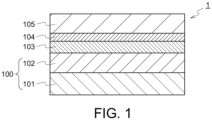
- FIG. 1 is a simplified cross sectional view of a structure of a part of an electrochemical cell according to an embodiment.
- the electrochemical cell 1 according to the present embodiment is a solid oxide electrochemical cell of hydrogen electrode support type.
- a hydrogen electrode 100, an electrolyte 103, a barrier-layer 104, and an oxygen electrode 105 are laminated in this order.
- the hydrogen electrode 100 is composed of a substrate 101 and an active layer 102 laminated on the substrate 101.
- the substrate 101 may be a porous layer or may have the same structure as that of the active layer 102.
- a sintered body containing a metal particulate and a metal oxide may be used for the substrate 101 and the active layer 102.
- the metal particulate contained in the sintered body or contained in the oxide in the form of a solid solution includes, for example, one or more metals selected from the group consisting of nickel (Ni), cobalt (Co), iron (Fe), and copper (Cu), or alloys containing these metals.
- the metal oxide includes, for example, a stabilized zirconia containing one or more stabilizers selected from the group consisting of yttrium oxide (Y 2 O 3 ), scandium oxide (Sc 2 O 3 ), ytterbium oxide (Yb 2 O 3 ), gadolinium oxide (Gd 2 O 3 ), calcium oxide (CaO), magnesium oxide (MgO), cerium oxide (CeO 2 ), and the like in the form of a solid solution, as well as a doped ceria in which one or more oxides selected from the group consisting of samarium oxide (Sm 2 O 3 ), Gd 2 O 3 , Y 2 O 3 , and the like and CeO 2 form a solid solution.
- a stabilized zirconia containing one or more stabilizers selected from the group consisting of yttrium oxide (Y 2 O 3 ), scandium oxide (Sc 2 O 3 ), ytterbium oxide (Yb 2 O 3 ), gadolinium oxide (
- the electrolyte 103 is composed of a stabilized zirconia containing one or more stabilizers selected from the group consisting of Y 2 O 3 , Sc 2 O 3 , Yb 2 O 3 , Gd 2 O 3 , CaO, MgO, CeO 2 , and the like in the form of a solid solution, or a doped ceria in which one or more oxides selected from the group consisting of Sm 2 O 3 , Gd 2 O 3 , Y 2 O 3 , and the like and CeO 2 form a solid solution.
- the barrier-layer 104 is composed of a doped ceria in which one or more oxides selected from the group consisting of Sm 2 O 3 , Gd 2 O 3 , Y 2 O 3 , and the like and CeO 2 form a solid solution.
- the oxygen electrode 105 is composed of a sintered body containing a perovskite oxide.
- the perovskite oxide is mainly represented by Ln 1-x A x B 1-y C y O 3- ⁇ .
- Ln includes rare earth elements such as lanthania (La), for example.
- A includes strontium (Sr), calcium (Ca), and barium (Ba), for example.
- B and “C” include chromium (Cr), manganese (Mn), Co, Fe, and Ni, for example.
- x, y and ⁇ satisfy 0 ⁇ x ⁇ 1, 0 ⁇ y ⁇ 1, and 0 ⁇ ⁇ ⁇ 1.
- the oxygen electrode 105 may further contain ceria in which one or more oxides selected from the group consisting of Sm 2 O 3 , Gd 2 O 3 , Y 2 O 3 , and the like are doped in CeO 2 .
- a laminated body, in which a plurality of electrochemical cells 1 configured as described above are laminated, is an electrochemical cell stack.
- the electrochemical cell stack all layers do not need to be the electrochemical cells 1, and at least one layer may be the electrochemical cell 1.
- a substrate precursor 111 is made as illustrated in FIG. 2A .
- a powder is prepared, which is obtained by mixing, at a weight ratio of 6: 4, nickel oxide (NiO) and Gd 2 O 3 -doped ceria (GDC) in which Gd 2 O 3 is doped in ceria to give a composition of (Gd 2 O 3 ) 0.1 (CeO 2 ) 0.9 .
- GDC nickel oxide
- GDC Gd 2 O 3 -doped ceria
- a paste made from the powder is formed into a sheet, and thereby the substrate precursor 111 is completed.
- an active layer precursor 112 is formed on the substrate precursor 111, and the electrolyte 103 is then formed on the active layer precursor 112.
- the active layer precursor 112 is made of a mixture of NiO and GDC.
- the electrolyte 103 is made using yttria-stabilized zirconia.
- the barrier-layer 104 is formed on the electrolyte 103.
- GDC is fired, and the fired product is then formed into a porous structure having a thickness of 300 ⁇ m and a porosity of about 80%.
- the porosity represents a ratio of voids per unit volume.
- the porosity can be adjusted, for example, by adding a pore-forming material or by setting a porous pattern with a ceramic 3D printer and the like.
- the substrate precursor 111, the active layer precursor 112, the electrolyte 103, and the barrier-layer 104 are fired under a temperature condition of 1200°C or higher and 1600°C or lower. This firing step is performed until sufficient strength is obtained in the layers and between the layers.
- the oxygen electrode 105 is formed on the barrier-layer 104.
- a layer composed of La(Sr)Co(Fe)O 3- ⁇ is formed on the barrier-layer 104, and then fired within a range of 900°C or higher and 1200°C or lower.
- the oxygen electrode 105 can be thereby adhered firmly to the barrier-layer 104.
- the laminated body consisted of the substrate precursor 111, the active layer precursor 112, the electrolyte 103, the barrier-layer 104, and the oxygen electrode 105 is set in a hydrogen electrode output characteristic evaluation device.
- a hydrogen electrode output characteristic evaluation device When dry hydrogen is circulated on the substrate precursor 111 side and an N 2 /O 2 -mixture gas obtained by mixing N 2 and O 2 at a volume ratio of 4:1 is circulated on the oxygen electrode 105 side, in the hydrogen electrode output characteristic evaluation device at 700°C or higher, the substrate precursor 111 and the active layer precursor 112 are reduced, and the substrate 101 and the active layer 102 are formed.
- the electrochemical cell 1 illustrated in FIG. 1 is thereby completed.
- the hydrogen electrode output characteristic evaluation device controls the concentration of vapor on the hydrogen electrode side and operates the electrochemical cell 1 in the SOFC mode or the SOEC mode so that the I-V characteristics indicating a relationship between a current and a voltage at that time can be evaluated. After the reduction reaction, the electrochemical cell 1 is operated as SOEC at a measurement temperature, and the initial I-V characteristic evaluation is performed.
- the oxygen electrode 105 is separated and the pressure loss of the barrier-layer 104 is measured.
- a section of the electrochemical cell 1 is prepared to observe the structure of the barrier-layer 104 with a scanning electron microscope (SEM). From the obtained SEM image, the porosity of the barrier-layer 104 is calculated.
- Example 2 on the substrate precursor 111, the active layer precursor 112, the electrolyte 103, the barrier-layer 104, and the oxygen electrode 105 are sequentially laminated by a manufacturing method similar to that in Example 1 described above.
- the thickness of the barrier-layer 104 is designed to be 100 ⁇ m, which is thinner than that in Example 1.
- the substrate precursor 111 and the active layer precursor 112 are reduced to form the substrate 101 and the active layer 102 by a manufacturing method also similar to that in Example 1.
- An electrochemical cell according to Example 2 is thereby completed.
- Example 1 the I-V characteristic evaluation of the electrochemical cell 1 in the initial state is performed as in Example 1.
- the pressure loss and the porosity of the barrier-layer 104 are also measured.
- Example 3 on the substrate precursor 111, the active layer precursor 112, the electrolyte 103, the barrier-layer 104, and the oxygen electrode 105 are sequentially laminated by a manufacturing method similar to that in Example 1 described above.
- the thickness of the barrier-layer 104 is designed to be 500 ⁇ m, which is thicker than that in Example 1.
- the substrate precursor 111 and the active layer precursor 112 are reduced to form the substrate 101 and the active layer 102 by a manufacturing method also similar to that in Example 1.
- An electrochemical cell according to Example 3 is thereby completed.
- Example 1 the I-V characteristic evaluation of the electrochemical cell 1 in the initial state is performed as in Example 1.
- the pressure loss and the porosity of the barrier-layer 104 are also measured.
- Example 4 on the substrate precursor 111, the active layer precursor 112, the electrolyte 103, the barrier-layer 104, and the oxygen electrode 105 are sequentially laminated by a manufacturing method similar to that in Example 1 described above.
- the thickness of the barrier-layer 104 is designed to be 100 ⁇ m, which is thinner than that in Example 1.
- the porosity of the barrier-layer 104 is designed to be about 60%, which porosity is smaller than that in Example 1, by adjusting the porous pattern with a ceramic 3D printer.
- the substrate precursor 111 and the active layer precursor 112 are reduced to form the substrate 101 and the active layer 102 by a manufacturing method also similar to that in Example 1.
- An electrochemical cell according to Example 4 is thereby completed.
- Example 1 the I-V characteristic evaluation of the electrochemical cell 1 in the initial state is performed as in Example 1.
- the pressure loss and the porosity of the barrier-layer 104 are also measured.
- Comparative Example 1 a forming method of the barrier-layer 104 is different from that in Example 1 described above.
- a slurry containing the GDC particle is coated on the electrolyte 103 using a screen printing method or a tape casting method.
- the thickness of the barrier-layer 104 is designed to be 5 ⁇ m, which is significantly thinner than that in Example 1.
- the oxygen electrode 105 is laminated on the barrier-layer 104 as in Example 1.
- the substrate precursor 111 and the active layer precursor 112 are then reduced to form the substrate 101 and the active layer 102.
- An electrochemical cell according to Comparative Example 1 is thereby completed.
- Example 1 the I-V characteristic evaluation of the electrochemical cell in the initial state is performed as in Example 1.
- the pressure loss and the porosity of the barrier-layer 104 are also measured.
- a forming method of the barrier-layer 104 is different from that in Example 1 described above.
- the barrier-layer 104 is formed by coating a slurry containing the GDC particle on the electrolyte 103 as in Comparative Example 1 described above.
- the thickness of the barrier-layer 104 is designed to be 20 ⁇ m, which is thicker than that in Comparative Example 1 and thinner than that in Example 1.
- the oxygen electrode 105 is laminated on the barrier-layer 104 as in Example 1.
- the substrate precursor 111 and the active layer precursor 112 are then reduced to form the substrate 101 and the active layer 102.
- An electrochemical cell according to Comparative Example 2 is thereby completed.
- Example 1 the I-V characteristic evaluation of the electrochemical cell in the initial state is performed as in Example 1.
- the pressure loss and the porosity of the barrier-layer 104 are also measured.
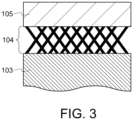
- FIG. 3 is an enlarged cross sectional view of the barrier-layer 104 formed in Examples 1 to 4.
- FIG. 4 is an enlarged cross sectional view of the barrier-layer 104 formed in Comparative Examples 1 and 2.
- FIG. 5 is a table showing evaluation measurement results of Examples and Comparative Examples.
- the table in FIG. 5 shows the thickness, the porosity, and the pressure loss of the barrier-layer 104 and the current density of the electrochemical cell for each of Examples and Comparative Examples.
- the current density which is one of the I-V characteristics, is a current density when the electrochemical cell is operated as SOEC at a voltage of 1.3 V.
- Each thickness of the barrier-layer 104 shown in the table is a measured value and is in agreement with each designed value.
- the barrier-layer 104 formed in Examples 1 to 4 is thick as illustrated in FIG. 3 , and has high porosity. Therefore, a component of the electrolyte 103 and a component of the oxygen electrode 105 are hard to diffuse.
- the porosity is 60% or greater, and the pressure loss is within a range of 0.1 to 10 MPa/m, the current density is at least 0.85 A/cm 2 or greater. As a result, the cell performance is improved.
- the barrier-layer 104 formed in Comparative Examples 1 and 2 is thin as illustrated in FIG 4 , and has low porosity. In this case, the diffusion of a component of the electrolyte 103 and a component of the oxygen electrode 105 cannot be sufficiently suppressed, and thus the current density is 0.68 A/cm 2 or less. As a result, the cell performance is insufficient.
- the electrochemical cell 1 having the barrier-layer 104 according to Examples 1 to 4 has a higher current density characteristic than that of the electrochemical cell according to Comparative Examples 1 and 2. Therefore, according to the present embodiment, the cell characteristics can be improved.
Landscapes
- Chemical & Material Sciences (AREA)
- Engineering & Computer Science (AREA)
- General Chemical & Material Sciences (AREA)
- Chemical Kinetics & Catalysis (AREA)
- Electrochemistry (AREA)
- Manufacturing & Machinery (AREA)
- Life Sciences & Earth Sciences (AREA)
- Sustainable Development (AREA)
- Sustainable Energy (AREA)
- Materials Engineering (AREA)
- Ceramic Engineering (AREA)
- Physics & Mathematics (AREA)
- Thermal Sciences (AREA)
- Inert Electrodes (AREA)
- Electrolytic Production Of Non-Metals, Compounds, Apparatuses Therefor (AREA)
- Fuel Cell (AREA)
- Secondary Cells (AREA)
Description
- An embodiment of the present invention relates to an electrochemical cell and an electrochemical cell stack.
- A solid oxide electrochemical cell can have sufficient reaction speed without the use of an expensive precious metal catalyst due to its high operation temperature (600 to 1000°C). For this reason, the solid oxide electrochemical cell, when operating as a solid oxide fuel cell (SOFC), has the highest power generation efficiency and generates less CO2 as compared with other types of fuel cells. Therefore, the solid oxide electrochemical cell is expected as a clean power generation system of the next generation.
- The solid oxide electrochemical cell, when operating as a solid oxide electrolysis cell (SOEC), can produce hydrogen theoretically at a low electrolytic voltage due to its high operation temperature. Therefore, the solid oxide electrochemical cell is expected as a high-efficiency hydrogen production device. Additionally, the solid oxide electrochemical cell is examined for use as a power storage system with SOFC/SOEC.
- For an oxygen electrode of the solid oxide electrochemical cell, a perovskite oxide having high conductivity is generally used. For example, a lanthania-manganese based oxide (LaMnO3 based) is often used for an oxygen electrode of high temperature operation type and a lanthania-cobalt based oxide (LaCoO3 based) is often used for an oxygen electrode of middle-and-low temperature operation type. The LaCoO3 based oxide has higher electric conductivity and higher electrode catalytic activity compared with those of the LaMnO3 based oxide. On the other hand, the LaCoO3 based oxide has higher reactivity with a zirconia based oxide (ZrO2 based) generally used as an electrolyte of the solid oxide electrochemical cell. For this reason, a solid-phase reaction may occur during firing in the cell manufacture. In this case, a high resistance phase composed of La2Zr2O7 or the like may be formed such that the cell performance may deteriorate.
- A known method to prevent the formation of the high resistance phase is to form a dense and thin barrier-layer made of a CeO2-based oxide between the electrolyte and the oxygen electrode.
- When the electrochemical cell having the above-mentioned barrier-layer formed therein operates at a high temperature, a component of the electrolyte and a component of the oxygen electrode diffuse and the form of the CeO2-based oxide is changed such that the cell performance may deteriorate. Relevant background :
US2013248360 A1 refers to a solid oxide fuel cell having a porous region and a thickness between 1 and 50µm.JP2010003478 A US2011177424 A1 refers to an electrolyte-electrode assembly having an intermediate layer with a thickness between 0.2 and 10 µm. -
-
FIG. 1 is a simplified cross sectional view of a structure of a part of an electrochemical cell according to an embodiment; -
FIG. 2A is a cross sectional view illustrating a step of making a substrate precursor in Examples 1 to 4; -
FIG. 2B is a cross sectional view illustrating a step of forming an active layer precursor and an electrolyte in Examples 1 to 4; -
FIG. 2C is a cross sectional view illustrating a step of forming a barrier-layer in Examples 1 to 4; -
FIG. 2D is a cross sectional view illustrating a step of forming an oxygen electrode in Examples 1 to 4; -
FIG. 3 is an enlarged cross sectional view of the barrier-layer formed in Examples; -
FIG. 4 is an enlarged cross sectional view of the barrier-layer formed in Comparative Examples; and -
FIG. 5 is a table showing evaluation measurement results of Examples and Comparative Examples. - Hereinafter, electrochemical cells according to the present invention are described. However, the present invention should not be construed as being limited to the following embodiment and examples. The schematic views referred to in the following description are intended to illustrate the positional relationships between components, and the size of particles, the thickness ratio of layers, and the like do not necessarily correspond to actual ones.
- An electrochemical cell according to an embodiment includes a hydrogen electrode, an electrolyte laminated on the hydrogen electrode, a barrier-layer laminated on the electrolyte, and an oxygen electrode laminated on the barrier-layer. The barrier-layer has a porous structure having a thickness of 100µm or greater and 500µm or less and a porosity of greater than 10% determined by scanning electron microscopy.
- Additionally, an electrochemical cell stack according to an embodiment includes an electrochemical cell according to
claims 1 to 4.FIG. 1 is a simplified cross sectional view of a structure of a part of an electrochemical cell according to an embodiment. Theelectrochemical cell 1 according to the present embodiment is a solid oxide electrochemical cell of hydrogen electrode support type. In theelectrochemical cell 1, ahydrogen electrode 100, anelectrolyte 103, a barrier-layer 104, and anoxygen electrode 105 are laminated in this order. - The
hydrogen electrode 100 is composed of asubstrate 101 and anactive layer 102 laminated on thesubstrate 101. Thesubstrate 101 may be a porous layer or may have the same structure as that of theactive layer 102. For thesubstrate 101 and theactive layer 102, a sintered body containing a metal particulate and a metal oxide may be used. The metal particulate contained in the sintered body or contained in the oxide in the form of a solid solution includes, for example, one or more metals selected from the group consisting of nickel (Ni), cobalt (Co), iron (Fe), and copper (Cu), or alloys containing these metals. - The metal oxide includes, for example, a stabilized zirconia containing one or more stabilizers selected from the group consisting of yttrium oxide (Y2O3), scandium oxide (Sc2O3), ytterbium oxide (Yb2O3), gadolinium oxide (Gd2O3), calcium oxide (CaO), magnesium oxide (MgO), cerium oxide (CeO2), and the like in the form of a solid solution, as well as a doped ceria in which one or more oxides selected from the group consisting of samarium oxide (Sm2O3), Gd2O3, Y2O3, and the like and CeO2 form a solid solution.
- The
electrolyte 103 is composed of a stabilized zirconia containing one or more stabilizers selected from the group consisting of Y2O3, Sc2O3, Yb2O3, Gd2O3, CaO, MgO, CeO2, and the like in the form of a solid solution, or a doped ceria in which one or more oxides selected from the group consisting of Sm2O3, Gd2O3, Y2O3, and the like and CeO2 form a solid solution. - The barrier-
layer 104 is composed of a doped ceria in which one or more oxides selected from the group consisting of Sm2O3, Gd2O3, Y2O3, and the like and CeO2 form a solid solution. - The
oxygen electrode 105 is composed of a sintered body containing a perovskite oxide. The perovskite oxide is mainly represented by Ln1-xAxB1-yCyO3-δ. "Ln" includes rare earth elements such as lanthania (La), for example. "A" includes strontium (Sr), calcium (Ca), and barium (Ba), for example. "B" and "C" include chromium (Cr), manganese (Mn), Co, Fe, and Ni, for example. For the perovskite oxide, x, y and δ satisfy 0 ≤ x ≤ 1, 0 ≤ y ≤ 1, and 0 ≤ δ ≤ 1. In addition to the perovskite oxide, theoxygen electrode 105 may further contain ceria in which one or more oxides selected from the group consisting of Sm2O3, Gd2O3, Y2O3, and the like are doped in CeO2. - A laminated body, in which a plurality of
electrochemical cells 1 configured as described above are laminated, is an electrochemical cell stack. In the electrochemical cell stack, all layers do not need to be theelectrochemical cells 1, and at least one layer may be theelectrochemical cell 1. - Hereinafter, a method of manufacturing the
electrochemical cell 1 will be specifically described with reference toFIGs 2A to 2D according to the following examples. - First, a
substrate precursor 111 is made as illustrated inFIG. 2A . In this example, a powder is prepared, which is obtained by mixing, at a weight ratio of 6: 4, nickel oxide (NiO) and Gd2O3-doped ceria (GDC) in which Gd2O3 is doped in ceria to give a composition of (Gd2O3)0.1(CeO2)0.9. Subsequently, a paste made from the powder is formed into a sheet, and thereby thesubstrate precursor 111 is completed. - Next, as shown in
FIG. 2B , anactive layer precursor 112 is formed on thesubstrate precursor 111, and theelectrolyte 103 is then formed on theactive layer precursor 112. In this example, theactive layer precursor 112 is made of a mixture of NiO and GDC. Theelectrolyte 103 is made using yttria-stabilized zirconia. - Next, as illustrated in
FIG. 2C , the barrier-layer 104 is formed on theelectrolyte 103. In this example, GDC is fired, and the fired product is then formed into a porous structure having a thickness of 300 µm and a porosity of about 80%. The porosity represents a ratio of voids per unit volume. The porosity can be adjusted, for example, by adding a pore-forming material or by setting a porous pattern with a ceramic 3D printer and the like. - Next, the
substrate precursor 111, theactive layer precursor 112, theelectrolyte 103, and the barrier-layer 104 are fired under a temperature condition of 1200°C or higher and 1600°C or lower. This firing step is performed until sufficient strength is obtained in the layers and between the layers. - Next, as illustrated in
FIG. 2D , theoxygen electrode 105 is formed on the barrier-layer 104. In this example, a layer composed of La(Sr)Co(Fe)O3-δ is formed on the barrier-layer 104, and then fired within a range of 900°C or higher and 1200°C or lower. Theoxygen electrode 105 can be thereby adhered firmly to the barrier-layer 104. - Next, the laminated body consisted of the
substrate precursor 111, theactive layer precursor 112, theelectrolyte 103, the barrier-layer 104, and theoxygen electrode 105 is set in a hydrogen electrode output characteristic evaluation device. When dry hydrogen is circulated on thesubstrate precursor 111 side and an N2/O2-mixture gas obtained by mixing N2 and O2 at a volume ratio of 4:1 is circulated on theoxygen electrode 105 side, in the hydrogen electrode output characteristic evaluation device at 700°C or higher, thesubstrate precursor 111 and theactive layer precursor 112 are reduced, and thesubstrate 101 and theactive layer 102 are formed. Theelectrochemical cell 1 illustrated inFIG. 1 is thereby completed. - The hydrogen electrode output characteristic evaluation device controls the concentration of vapor on the hydrogen electrode side and operates the
electrochemical cell 1 in the SOFC mode or the SOEC mode so that the I-V characteristics indicating a relationship between a current and a voltage at that time can be evaluated. After the reduction reaction, theelectrochemical cell 1 is operated as SOEC at a measurement temperature, and the initial I-V characteristic evaluation is performed. - After the I-V characteristic evaluation, the
oxygen electrode 105 is separated and the pressure loss of the barrier-layer 104 is measured. In addition, a section of theelectrochemical cell 1 is prepared to observe the structure of the barrier-layer 104 with a scanning electron microscope (SEM). From the obtained SEM image, the porosity of the barrier-layer 104 is calculated. - In Example 2, on the
substrate precursor 111, theactive layer precursor 112, theelectrolyte 103, the barrier-layer 104, and theoxygen electrode 105 are sequentially laminated by a manufacturing method similar to that in Example 1 described above. However, in this example, the thickness of the barrier-layer 104 is designed to be 100 µm, which is thinner than that in Example 1. - Next, the
substrate precursor 111 and theactive layer precursor 112 are reduced to form thesubstrate 101 and theactive layer 102 by a manufacturing method also similar to that in Example 1. An electrochemical cell according to Example 2 is thereby completed. - Subsequently, the I-V characteristic evaluation of the
electrochemical cell 1 in the initial state is performed as in Example 1. In addition, the pressure loss and the porosity of the barrier-layer 104 are also measured. - Also in Example 3, on the
substrate precursor 111, theactive layer precursor 112, theelectrolyte 103, the barrier-layer 104, and theoxygen electrode 105 are sequentially laminated by a manufacturing method similar to that in Example 1 described above. However, in this example, the thickness of the barrier-layer 104 is designed to be 500 µm, which is thicker than that in Example 1. - Next, the
substrate precursor 111 and theactive layer precursor 112 are reduced to form thesubstrate 101 and theactive layer 102 by a manufacturing method also similar to that in Example 1. An electrochemical cell according to Example 3 is thereby completed. - Subsequently, the I-V characteristic evaluation of the
electrochemical cell 1 in the initial state is performed as in Example 1. In addition, the pressure loss and the porosity of the barrier-layer 104 are also measured. - Also in Example 4, on the
substrate precursor 111, theactive layer precursor 112, theelectrolyte 103, the barrier-layer 104, and theoxygen electrode 105 are sequentially laminated by a manufacturing method similar to that in Example 1 described above. However, in this example, the thickness of the barrier-layer 104 is designed to be 100 µm, which is thinner than that in Example 1. In addition, the porosity of the barrier-layer 104 is designed to be about 60%, which porosity is smaller than that in Example 1, by adjusting the porous pattern with a ceramic 3D printer. - Next, the
substrate precursor 111 and theactive layer precursor 112 are reduced to form thesubstrate 101 and theactive layer 102 by a manufacturing method also similar to that in Example 1. An electrochemical cell according to Example 4 is thereby completed. - Subsequently, the I-V characteristic evaluation of the
electrochemical cell 1 in the initial state is performed as in Example 1. In addition, the pressure loss and the porosity of the barrier-layer 104 are also measured. - In Comparative Example 1, a forming method of the barrier-
layer 104 is different from that in Example 1 described above. In this comparative example, a slurry containing the GDC particle is coated on theelectrolyte 103 using a screen printing method or a tape casting method. At that time, the thickness of the barrier-layer 104 is designed to be 5 µm, which is significantly thinner than that in Example 1. - After forming the barrier-
layer 104 as described above, theoxygen electrode 105 is laminated on the barrier-layer 104 as in Example 1. Thesubstrate precursor 111 and theactive layer precursor 112 are then reduced to form thesubstrate 101 and theactive layer 102. An electrochemical cell according to Comparative Example 1 is thereby completed. - Subsequently, the I-V characteristic evaluation of the electrochemical cell in the initial state is performed as in Example 1. In addition, the pressure loss and the porosity of the barrier-
layer 104 are also measured. - Also in Comparative Example 2, a forming method of the barrier-
layer 104 is different from that in Example 1 described above. In this comparative example, the barrier-layer 104 is formed by coating a slurry containing the GDC particle on theelectrolyte 103 as in Comparative Example 1 described above. However, in this comparative example, the thickness of the barrier-layer 104 is designed to be 20 µm, which is thicker than that in Comparative Example 1 and thinner than that in Example 1. - After forming the barrier-
layer 104 as described above, theoxygen electrode 105 is laminated on the barrier-layer 104 as in Example 1. Thesubstrate precursor 111 and theactive layer precursor 112 are then reduced to form thesubstrate 101 and theactive layer 102. An electrochemical cell according to Comparative Example 2 is thereby completed. - Subsequently, the I-V characteristic evaluation of the electrochemical cell in the initial state is performed as in Example 1. In addition, the pressure loss and the porosity of the barrier-
layer 104 are also measured. -
FIG. 3 is an enlarged cross sectional view of the barrier-layer 104 formed in Examples 1 to 4.FIG. 4 is an enlarged cross sectional view of the barrier-layer 104 formed in Comparative Examples 1 and 2.FIG. 5 is a table showing evaluation measurement results of Examples and Comparative Examples. - The table in
FIG. 5 shows the thickness, the porosity, and the pressure loss of the barrier-layer 104 and the current density of the electrochemical cell for each of Examples and Comparative Examples. The current density, which is one of the I-V characteristics, is a current density when the electrochemical cell is operated as SOEC at a voltage of 1.3 V. Each thickness of the barrier-layer 104 shown in the table is a measured value and is in agreement with each designed value. - The barrier-
layer 104 formed in Examples 1 to 4 is thick as illustrated inFIG. 3 , and has high porosity. Therefore, a component of theelectrolyte 103 and a component of theoxygen electrode 105 are hard to diffuse. In particular, when the thickness is 100 to 500 µm, the porosity is 60% or greater, and the pressure loss is within a range of 0.1 to 10 MPa/m, the current density is at least 0.85 A/cm2 or greater. As a result, the cell performance is improved. - On the other hand, the barrier-
layer 104 formed in Comparative Examples 1 and 2 is thin as illustrated inFIG 4 , and has low porosity. In this case, the diffusion of a component of theelectrolyte 103 and a component of theoxygen electrode 105 cannot be sufficiently suppressed, and thus the current density is 0.68 A/cm2 or less. As a result, the cell performance is insufficient. - As described above, the
electrochemical cell 1 having the barrier-layer 104 according to Examples 1 to 4 has a higher current density characteristic than that of the electrochemical cell according to Comparative Examples 1 and 2. Therefore, according to the present embodiment, the cell characteristics can be improved.
Claims (5)
- An electrochemical cell (1) comprising:a hydrogen electrode (100);an electrolyte (103) laminated on the hydrogen electrode (100);a barrier-layer (104) laminated on the electrolyte (103); andan oxygen electrode (105) laminated on the barrier-layer (104),wherein the barrier-layer (104) has a porous structure having a thickness of 100 µm or greater and 500 µm or less and a porosity of greater than 10%, determined by scanning electron microscopy.
- The electrochemical cell (1) according to claim 1, wherein the barrier-layer (104) has a porosity of 60% or greater.
- The electrochemical cell (1) according to claim 1 or 2, wherein the barrier-layer (104) has a pressure loss of 0.1 MPa/m or greater and 10 MPa/m or less.
- The electrochemical cell (1) according to any one of claims 1 to 3, wherein the barrier-layer (104) is a doped ceria containing an oxide of at least one of gadolinium (Gd), samarium (Sm), and yttrium (Y).
- An electrochemical cell stack comprising the electrochemical cell (1) according to any one of claims 1 to 4.
Applications Claiming Priority (1)
| Application Number | Priority Date | Filing Date | Title |
|---|---|---|---|
| JP2020114580A JP7530223B2 (en) | 2020-07-02 | 2020-07-02 | Electrochemical Cells and Electrochemical Cell Stacks |
Publications (2)
| Publication Number | Publication Date |
|---|---|
| EP3933986A1 EP3933986A1 (en) | 2022-01-05 |
| EP3933986B1 true EP3933986B1 (en) | 2025-05-21 |
Family
ID=76764901
Family Applications (1)
| Application Number | Title | Priority Date | Filing Date |
|---|---|---|---|
| EP21183423.9A Active EP3933986B1 (en) | 2020-07-02 | 2021-07-02 | Electrochemical cell and electrochemical cell stack |
Country Status (6)
| Country | Link |
|---|---|
| US (1) | US11682771B2 (en) |
| EP (1) | EP3933986B1 (en) |
| JP (1) | JP7530223B2 (en) |
| AU (1) | AU2021204646B2 (en) |
| CA (1) | CA3123793C (en) |
| DK (1) | DK3933986T3 (en) |
Families Citing this family (2)
| Publication number | Priority date | Publication date | Assignee | Title |
|---|---|---|---|---|
| JP7722567B2 (en) * | 2022-04-04 | 2025-08-13 | 株式会社村田製作所 | Electrolyte substrate for solid oxide fuel cell, single cell for solid oxide fuel cell, solid oxide fuel cell stack, and method for manufacturing electrolyte substrate for solid oxide fuel cell |
| CN116914173B (en) * | 2023-09-05 | 2023-11-24 | 中石油深圳新能源研究院有限公司 | Compact isolation layer, preparation method thereof and solid oxide fuel cell |
Family Cites Families (8)
| Publication number | Priority date | Publication date | Assignee | Title |
|---|---|---|---|---|
| JP2005310737A (en) * | 2004-03-23 | 2005-11-04 | Toto Ltd | Solid oxide fuel cell |
| JP5590281B2 (en) | 2008-06-19 | 2014-09-17 | 日産自動車株式会社 | Solid oxide fuel cell and method for producing the same |
| US9070946B2 (en) | 2010-01-19 | 2015-06-30 | Honda Motor Co., Ltd. | Electrolyte-electrode joined assembly and method for producing the same |
| JP5802589B2 (en) | 2012-03-26 | 2015-10-28 | 株式会社東芝 | Solid oxide electrochemical cell |
| WO2018167889A1 (en) | 2017-03-15 | 2018-09-20 | 株式会社 東芝 | Oxygen electrode for electrochemical cell, and electrochemical cell |
| JP2018154864A (en) | 2017-03-16 | 2018-10-04 | 東芝エネルギーシステムズ株式会社 | High temperature steam electrolysis cell, hydrogen electrode layer for high temperature steam electrolysis cell and solid oxide electrochemical cell |
| JP2019157146A (en) | 2018-03-07 | 2019-09-19 | 東芝エネルギーシステムズ株式会社 | Electrochemical cell, electrochemical cell stack, fuel cell, and hydrogen production device |
| JP2020187864A (en) | 2019-05-10 | 2020-11-19 | 株式会社東芝 | Electrochemical cells, electrochemical cell stacks, fuel cells and hydrogen production equipment |
-
2020
- 2020-07-02 JP JP2020114580A patent/JP7530223B2/en active Active
-
2021
- 2021-06-30 US US17/363,323 patent/US11682771B2/en active Active
- 2021-07-02 EP EP21183423.9A patent/EP3933986B1/en active Active
- 2021-07-02 AU AU2021204646A patent/AU2021204646B2/en active Active
- 2021-07-02 CA CA3123793A patent/CA3123793C/en active Active
- 2021-07-02 DK DK21183423.9T patent/DK3933986T3/en active
Also Published As
| Publication number | Publication date |
|---|---|
| JP7530223B2 (en) | 2024-08-07 |
| AU2021204646A1 (en) | 2022-01-20 |
| US11682771B2 (en) | 2023-06-20 |
| CA3123793A1 (en) | 2022-01-02 |
| JP2022022700A (en) | 2022-02-07 |
| EP3933986A1 (en) | 2022-01-05 |
| US20220006102A1 (en) | 2022-01-06 |
| AU2021204646B2 (en) | 2022-07-28 |
| DK3933986T3 (en) | 2025-06-23 |
| CA3123793C (en) | 2023-08-08 |
Similar Documents
| Publication | Publication Date | Title |
|---|---|---|
| JP5208518B2 (en) | Method for producing a reversible solid oxide fuel cell | |
| JP5213589B2 (en) | Metal-supported solid oxide fuel cell | |
| CN112447982B (en) | Solid oxide fuel cell and method for manufacturing the same | |
| EP2194597A1 (en) | Solid oxide cell and solid oxide cell stack | |
| EP2410598A1 (en) | Electrode Material and Solid Oxide Fuel Cell Containing the Electrode Material | |
| JP2021155852A (en) | Production method of high temperature steam electrolytic cell, production method of hydrogen electrode layer for high temperature steam electrolytic cell, and production method of solid oxide electrochemical cell | |
| CN113394435B (en) | Solid oxide fuel cell and method for manufacturing same | |
| EP2244322A1 (en) | Composite oxygen electrode and method for preparing same | |
| US8337939B2 (en) | Method of processing a ceramic layer and related articles | |
| EP3933986B1 (en) | Electrochemical cell and electrochemical cell stack | |
| JP2023147070A (en) | Cermet layer and hydrogen electrode for steam electrolysis | |
| WO2023089978A1 (en) | Solid oxide fuel cell and method for manufacturing same | |
| JP7301768B2 (en) | Electrochemical cells, electrochemical cell stacks and electrolytes for electrochemical cells | |
| KR20120085488A (en) | Solid electrolyte for solid oxide fuel cell, and solid oxide fuel cell including the solid electrolyte | |
| JPWO2018167889A1 (en) | Oxygen electrode for electrochemical cell and electrochemical cell | |
| US20080131750A1 (en) | Ceramic electrolyte structure and method of forming; and related articles | |
| EP4496045A2 (en) | Solid oxide fuel cell and solid oxide fuel cell stack | |
| US12381247B2 (en) | Solid oxide fuel cells and methods of forming thereof | |
| US20260081184A1 (en) | Electrode | |
| JP7114555B2 (en) | Electrodes for water vapor electrolysis | |
| JP2015056363A (en) | Fuel cell unit and manufacturing method therefor | |
| US20250293266A1 (en) | Electrode | |
| EP4108809A1 (en) | Electrochemical cell and electrochemical cell stack | |
| JP2024137341A (en) | Fuel electrode for solid oxide water electrolysis cell and solid oxide water electrolysis cell | |
| WO2023195245A1 (en) | Electrochemical cell |
Legal Events
| Date | Code | Title | Description |
|---|---|---|---|
| PUAI | Public reference made under article 153(3) epc to a published international application that has entered the european phase |
Free format text: ORIGINAL CODE: 0009012 |
|
| STAA | Information on the status of an ep patent application or granted ep patent |
Free format text: STATUS: REQUEST FOR EXAMINATION WAS MADE |
|
| 17P | Request for examination filed |
Effective date: 20210702 |
|
| AK | Designated contracting states |
Kind code of ref document: A1 Designated state(s): AL AT BE BG CH CY CZ DE DK EE ES FI FR GB GR HR HU IE IS IT LI LT LU LV MC MK MT NL NO PL PT RO RS SE SI SK SM TR |
|
| B565 | Issuance of search results under rule 164(2) epc |
Effective date: 20211028 |
|
| GRAP | Despatch of communication of intention to grant a patent |
Free format text: ORIGINAL CODE: EPIDOSNIGR1 |
|
| STAA | Information on the status of an ep patent application or granted ep patent |
Free format text: STATUS: GRANT OF PATENT IS INTENDED |
|
| INTG | Intention to grant announced |
Effective date: 20241219 |
|
| GRAS | Grant fee paid |
Free format text: ORIGINAL CODE: EPIDOSNIGR3 |
|
| GRAA | (expected) grant |
Free format text: ORIGINAL CODE: 0009210 |
|
| STAA | Information on the status of an ep patent application or granted ep patent |
Free format text: STATUS: THE PATENT HAS BEEN GRANTED |
|
| AK | Designated contracting states |
Kind code of ref document: B1 Designated state(s): AL AT BE BG CH CY CZ DE DK EE ES FI FR GB GR HR HU IE IS IT LI LT LU LV MC MK MT NL NO PL PT RO RS SE SI SK SM TR |
|
| REG | Reference to a national code |
Ref country code: GB Ref legal event code: FG4D |
|
| REG | Reference to a national code |
Ref country code: CH Ref legal event code: EP |
|
| REG | Reference to a national code |
Ref country code: DE Ref legal event code: R096 Ref document number: 602021031026 Country of ref document: DE |
|
| REG | Reference to a national code |
Ref country code: IE Ref legal event code: FG4D |
|
| REG | Reference to a national code |
Ref country code: DK Ref legal event code: T3 Effective date: 20250616 |
|
| REG | Reference to a national code |
Ref country code: NL Ref legal event code: MP Effective date: 20250521 |
|
| PG25 | Lapsed in a contracting state [announced via postgrant information from national office to epo] |
Ref country code: ES Free format text: LAPSE BECAUSE OF FAILURE TO SUBMIT A TRANSLATION OF THE DESCRIPTION OR TO PAY THE FEE WITHIN THE PRESCRIBED TIME-LIMIT Effective date: 20250521 Ref country code: FI Free format text: LAPSE BECAUSE OF FAILURE TO SUBMIT A TRANSLATION OF THE DESCRIPTION OR TO PAY THE FEE WITHIN THE PRESCRIBED TIME-LIMIT Effective date: 20250521 Ref country code: PT Free format text: LAPSE BECAUSE OF FAILURE TO SUBMIT A TRANSLATION OF THE DESCRIPTION OR TO PAY THE FEE WITHIN THE PRESCRIBED TIME-LIMIT Effective date: 20250922 |
|
| PGFP | Annual fee paid to national office [announced via postgrant information from national office to epo] |
Ref country code: DE Payment date: 20250528 Year of fee payment: 5 Ref country code: DK Payment date: 20250714 Year of fee payment: 5 |
|
| REG | Reference to a national code |
Ref country code: LT Ref legal event code: MG9D |
|
| PG25 | Lapsed in a contracting state [announced via postgrant information from national office to epo] |
Ref country code: NO Free format text: LAPSE BECAUSE OF FAILURE TO SUBMIT A TRANSLATION OF THE DESCRIPTION OR TO PAY THE FEE WITHIN THE PRESCRIBED TIME-LIMIT Effective date: 20250821 Ref country code: GR Free format text: LAPSE BECAUSE OF FAILURE TO SUBMIT A TRANSLATION OF THE DESCRIPTION OR TO PAY THE FEE WITHIN THE PRESCRIBED TIME-LIMIT Effective date: 20250822 |
|
| PG25 | Lapsed in a contracting state [announced via postgrant information from national office to epo] |
Ref country code: NL Free format text: LAPSE BECAUSE OF FAILURE TO SUBMIT A TRANSLATION OF THE DESCRIPTION OR TO PAY THE FEE WITHIN THE PRESCRIBED TIME-LIMIT Effective date: 20250521 Ref country code: PL Free format text: LAPSE BECAUSE OF FAILURE TO SUBMIT A TRANSLATION OF THE DESCRIPTION OR TO PAY THE FEE WITHIN THE PRESCRIBED TIME-LIMIT Effective date: 20250521 |
|
| PG25 | Lapsed in a contracting state [announced via postgrant information from national office to epo] |
Ref country code: BG Free format text: LAPSE BECAUSE OF FAILURE TO SUBMIT A TRANSLATION OF THE DESCRIPTION OR TO PAY THE FEE WITHIN THE PRESCRIBED TIME-LIMIT Effective date: 20250521 |
|
| PG25 | Lapsed in a contracting state [announced via postgrant information from national office to epo] |
Ref country code: HR Free format text: LAPSE BECAUSE OF FAILURE TO SUBMIT A TRANSLATION OF THE DESCRIPTION OR TO PAY THE FEE WITHIN THE PRESCRIBED TIME-LIMIT Effective date: 20250521 |
|
| PGFP | Annual fee paid to national office [announced via postgrant information from national office to epo] |
Ref country code: AT Payment date: 20251020 Year of fee payment: 5 |
|
| PG25 | Lapsed in a contracting state [announced via postgrant information from national office to epo] |
Ref country code: RS Free format text: LAPSE BECAUSE OF FAILURE TO SUBMIT A TRANSLATION OF THE DESCRIPTION OR TO PAY THE FEE WITHIN THE PRESCRIBED TIME-LIMIT Effective date: 20250821 |
|
| PG25 | Lapsed in a contracting state [announced via postgrant information from national office to epo] |
Ref country code: IS Free format text: LAPSE BECAUSE OF FAILURE TO SUBMIT A TRANSLATION OF THE DESCRIPTION OR TO PAY THE FEE WITHIN THE PRESCRIBED TIME-LIMIT Effective date: 20250921 |
|
| PG25 | Lapsed in a contracting state [announced via postgrant information from national office to epo] |
Ref country code: LV Free format text: LAPSE BECAUSE OF FAILURE TO SUBMIT A TRANSLATION OF THE DESCRIPTION OR TO PAY THE FEE WITHIN THE PRESCRIBED TIME-LIMIT Effective date: 20250521 |
|
| REG | Reference to a national code |
Ref country code: AT Ref legal event code: MK05 Ref document number: 1797578 Country of ref document: AT Kind code of ref document: T Effective date: 20250521 |
|
| PG25 | Lapsed in a contracting state [announced via postgrant information from national office to epo] |
Ref country code: SM Free format text: LAPSE BECAUSE OF FAILURE TO SUBMIT A TRANSLATION OF THE DESCRIPTION OR TO PAY THE FEE WITHIN THE PRESCRIBED TIME-LIMIT Effective date: 20250521 Ref country code: AT Free format text: LAPSE BECAUSE OF FAILURE TO SUBMIT A TRANSLATION OF THE DESCRIPTION OR TO PAY THE FEE WITHIN THE PRESCRIBED TIME-LIMIT Effective date: 20250521 |
|
| PG25 | Lapsed in a contracting state [announced via postgrant information from national office to epo] |
Ref country code: CZ Free format text: LAPSE BECAUSE OF FAILURE TO SUBMIT A TRANSLATION OF THE DESCRIPTION OR TO PAY THE FEE WITHIN THE PRESCRIBED TIME-LIMIT Effective date: 20250521 |
|
| PG25 | Lapsed in a contracting state [announced via postgrant information from national office to epo] |
Ref country code: EE Free format text: LAPSE BECAUSE OF FAILURE TO SUBMIT A TRANSLATION OF THE DESCRIPTION OR TO PAY THE FEE WITHIN THE PRESCRIBED TIME-LIMIT Effective date: 20250521 |
|
| PG25 | Lapsed in a contracting state [announced via postgrant information from national office to epo] |
Ref country code: SK Free format text: LAPSE BECAUSE OF FAILURE TO SUBMIT A TRANSLATION OF THE DESCRIPTION OR TO PAY THE FEE WITHIN THE PRESCRIBED TIME-LIMIT Effective date: 20250521 Ref country code: RO Free format text: LAPSE BECAUSE OF FAILURE TO SUBMIT A TRANSLATION OF THE DESCRIPTION OR TO PAY THE FEE WITHIN THE PRESCRIBED TIME-LIMIT Effective date: 20250521 |
|
| PG25 | Lapsed in a contracting state [announced via postgrant information from national office to epo] |
Ref country code: IT Free format text: LAPSE BECAUSE OF FAILURE TO SUBMIT A TRANSLATION OF THE DESCRIPTION OR TO PAY THE FEE WITHIN THE PRESCRIBED TIME-LIMIT Effective date: 20250521 |
|
| REG | Reference to a national code |
Ref country code: CH Ref legal event code: H13 Free format text: ST27 STATUS EVENT CODE: U-0-0-H10-H13 (AS PROVIDED BY THE NATIONAL OFFICE) Effective date: 20260224 Ref country code: DE Ref legal event code: R097 Ref document number: 602021031026 Country of ref document: DE |
|
| PG25 | Lapsed in a contracting state [announced via postgrant information from national office to epo] |
Ref country code: LU Free format text: LAPSE BECAUSE OF NON-PAYMENT OF DUE FEES Effective date: 20250702 |
|
| REG | Reference to a national code |
Ref country code: BE Ref legal event code: MM Effective date: 20250731 |
|
| PLBE | No opposition filed within time limit |
Free format text: ORIGINAL CODE: 0009261 |
|
| STAA | Information on the status of an ep patent application or granted ep patent |
Free format text: STATUS: NO OPPOSITION FILED WITHIN TIME LIMIT |
|
| REG | Reference to a national code |
Ref country code: CH Ref legal event code: L10 Free format text: ST27 STATUS EVENT CODE: U-0-0-L10-L00 (AS PROVIDED BY THE NATIONAL OFFICE) Effective date: 20260402 |
|
| PG25 | Lapsed in a contracting state [announced via postgrant information from national office to epo] |
Ref country code: BE Free format text: LAPSE BECAUSE OF NON-PAYMENT OF DUE FEES Effective date: 20250731 |
|
| PG25 | Lapsed in a contracting state [announced via postgrant information from national office to epo] |
Ref country code: FR Free format text: LAPSE BECAUSE OF NON-PAYMENT OF DUE FEES Effective date: 20250721 |
|
| PG25 | Lapsed in a contracting state [announced via postgrant information from national office to epo] |
Ref country code: CH Free format text: LAPSE BECAUSE OF NON-PAYMENT OF DUE FEES Effective date: 20250731 |
|
| 26N | No opposition filed |
Effective date: 20260224 |