EP3933949A1 - Composition comprising an organic semiconducting polymer and a crosslinking agent and organic photodiode thereof - Google Patents
Composition comprising an organic semiconducting polymer and a crosslinking agent and organic photodiode thereof Download PDFInfo
- Publication number
- EP3933949A1 EP3933949A1 EP20183080.9A EP20183080A EP3933949A1 EP 3933949 A1 EP3933949 A1 EP 3933949A1 EP 20183080 A EP20183080 A EP 20183080A EP 3933949 A1 EP3933949 A1 EP 3933949A1
- Authority
- EP
- European Patent Office
- Prior art keywords
- alkyl
- cor
- occurrence
- group
- independently
- Prior art date
- Legal status (The legal status is an assumption and is not a legal conclusion. Google has not performed a legal analysis and makes no representation as to the accuracy of the status listed.)
- Withdrawn
Links
- 239000000203 mixture Substances 0.000 title claims abstract description 39
- 229920000642 polymer Polymers 0.000 title claims abstract description 26
- 239000003431 cross linking reagent Substances 0.000 title claims abstract description 24
- 230000000903 blocking effect Effects 0.000 claims abstract description 42
- 238000006243 chemical reaction Methods 0.000 claims abstract description 6
- 238000004132 cross linking Methods 0.000 claims abstract description 4
- 125000001072 heteroaryl group Chemical group 0.000 claims description 51
- 125000005915 C6-C14 aryl group Chemical group 0.000 claims description 47
- 229910052736 halogen Inorganic materials 0.000 claims description 46
- 150000002367 halogens Chemical class 0.000 claims description 46
- 125000000008 (C1-C10) alkyl group Chemical group 0.000 claims description 45
- 125000003837 (C1-C20) alkyl group Chemical group 0.000 claims description 45
- 125000001424 substituent group Chemical group 0.000 claims description 35
- -1 acyl azide Chemical class 0.000 claims description 34
- 125000000113 cyclohexyl group Chemical group [H]C1([H])C([H])([H])C([H])([H])C([H])(*)C([H])([H])C1([H])[H] 0.000 claims description 30
- 125000001511 cyclopentyl group Chemical group [H]C1([H])C([H])([H])C([H])([H])C([H])(*)C1([H])[H] 0.000 claims description 30
- 125000001997 phenyl group Chemical group [H]C1=C([H])C([H])=C(*)C([H])=C1[H] 0.000 claims description 30
- 125000005647 linker group Chemical group 0.000 claims description 16
- YTPLMLYBLZKORZ-UHFFFAOYSA-N Thiophene Chemical group C=1C=CSC=1 YTPLMLYBLZKORZ-UHFFFAOYSA-N 0.000 claims description 12
- UHOVQNZJYSORNB-UHFFFAOYSA-N Benzene Chemical compound C1=CC=CC=C1 UHOVQNZJYSORNB-UHFFFAOYSA-N 0.000 claims description 10
- 229910052739 hydrogen Inorganic materials 0.000 claims description 8
- 239000001257 hydrogen Substances 0.000 claims description 8
- 125000004435 hydrogen atom Chemical class [H]* 0.000 claims description 8
- 229910052760 oxygen Inorganic materials 0.000 claims description 8
- 229910052799 carbon Inorganic materials 0.000 claims description 7
- 229910052717 sulfur Inorganic materials 0.000 claims description 7
- 229930192474 thiophene Natural products 0.000 claims description 7
- 229920000547 conjugated polymer Polymers 0.000 claims description 6
- 125000004178 (C1-C4) alkyl group Chemical group 0.000 claims description 5
- 125000003903 2-propenyl group Chemical group [H]C([*])([H])C([H])=C([H])[H] 0.000 claims description 5
- 125000003342 alkenyl group Chemical group 0.000 claims description 5
- 125000000304 alkynyl group Chemical group 0.000 claims description 5
- 125000003118 aryl group Chemical group 0.000 claims description 5
- 125000004209 (C1-C8) alkyl group Chemical group 0.000 claims description 4
- 125000004432 carbon atom Chemical group C* 0.000 claims description 4
- 125000000753 cycloalkyl group Chemical group 0.000 claims description 4
- 125000006574 non-aromatic ring group Chemical group 0.000 claims description 4
- VWDMRYFKUDZXIN-UHFFFAOYSA-N 1h-pyrrole;1h-pyrrole-2,3-dione Chemical compound C=1C=CNC=1.O=C1NC=CC1=O VWDMRYFKUDZXIN-UHFFFAOYSA-N 0.000 claims description 3
- YOBOIKMFTLTNTR-UHFFFAOYSA-N 1-azido-2-fluorobenzene Chemical compound FC1=CC=CC=C1N=[N+]=[N-] YOBOIKMFTLTNTR-UHFFFAOYSA-N 0.000 claims description 2
- YXHKONLOYHBTNS-UHFFFAOYSA-N Diazomethane Chemical compound C=[N+]=[N-] YXHKONLOYHBTNS-UHFFFAOYSA-N 0.000 claims description 2
- 150000001555 benzenes Chemical class 0.000 claims description 2
- CTRLRINCMYICJO-UHFFFAOYSA-N phenyl azide Chemical compound [N-]=[N+]=NC1=CC=CC=C1 CTRLRINCMYICJO-UHFFFAOYSA-N 0.000 claims description 2
- 150000003577 thiophenes Chemical class 0.000 claims description 2
- 125000003545 alkoxy group Chemical group 0.000 claims 1
- 239000000463 material Substances 0.000 description 15
- MCEWYIDBDVPMES-UHFFFAOYSA-N [60]pcbm Chemical compound C123C(C4=C5C6=C7C8=C9C%10=C%11C%12=C%13C%14=C%15C%16=C%17C%18=C(C=%19C=%20C%18=C%18C%16=C%13C%13=C%11C9=C9C7=C(C=%20C9=C%13%18)C(C7=%19)=C96)C6=C%11C%17=C%15C%13=C%15C%14=C%12C%12=C%10C%10=C85)=C9C7=C6C2=C%11C%13=C2C%15=C%12C%10=C4C23C1(CCCC(=O)OC)C1=CC=CC=C1 MCEWYIDBDVPMES-UHFFFAOYSA-N 0.000 description 14
- YXFVVABEGXRONW-UHFFFAOYSA-N Toluene Chemical compound CC1=CC=CC=C1 YXFVVABEGXRONW-UHFFFAOYSA-N 0.000 description 6
- 239000000370 acceptor Substances 0.000 description 5
- STTGYIUESPWXOW-UHFFFAOYSA-N 2,9-dimethyl-4,7-diphenyl-1,10-phenanthroline Chemical compound C=12C=CC3=C(C=4C=CC=CC=4)C=C(C)N=C3C2=NC(C)=CC=1C1=CC=CC=C1 STTGYIUESPWXOW-UHFFFAOYSA-N 0.000 description 4
- CSCPPACGZOOCGX-UHFFFAOYSA-N Acetone Chemical compound CC(C)=O CSCPPACGZOOCGX-UHFFFAOYSA-N 0.000 description 4
- CTQNGGLPUBDAKN-UHFFFAOYSA-N O-Xylene Chemical compound CC1=CC=CC=C1C CTQNGGLPUBDAKN-UHFFFAOYSA-N 0.000 description 4
- 229920000301 poly(3-hexylthiophene-2,5-diyl) polymer Polymers 0.000 description 4
- 238000004528 spin coating Methods 0.000 description 4
- 239000008096 xylene Substances 0.000 description 4
- 239000004971 Cross linker Substances 0.000 description 3
- YMWUJEATGCHHMB-UHFFFAOYSA-N Dichloromethane Chemical compound ClCCl YMWUJEATGCHHMB-UHFFFAOYSA-N 0.000 description 3
- KFZMGEQAYNKOFK-UHFFFAOYSA-N Isopropanol Chemical compound CC(C)O KFZMGEQAYNKOFK-UHFFFAOYSA-N 0.000 description 3
- 230000000694 effects Effects 0.000 description 3
- 239000003960 organic solvent Substances 0.000 description 3
- 239000004065 semiconductor Substances 0.000 description 3
- 239000002904 solvent Substances 0.000 description 3
- GWEVSGVZZGPLCZ-UHFFFAOYSA-N Titan oxide Chemical compound O=[Ti]=O GWEVSGVZZGPLCZ-UHFFFAOYSA-N 0.000 description 2
- 238000000576 coating method Methods 0.000 description 2
- 238000004519 manufacturing process Methods 0.000 description 2
- AUHZEENZYGFFBQ-UHFFFAOYSA-N mesitylene Substances CC1=CC(C)=CC(C)=C1 AUHZEENZYGFFBQ-UHFFFAOYSA-N 0.000 description 2
- 125000001827 mesitylenyl group Chemical group [H]C1=C(C(*)=C(C([H])=C1C([H])([H])[H])C([H])([H])[H])C([H])([H])[H] 0.000 description 2
- 238000000034 method Methods 0.000 description 2
- 238000013086 organic photovoltaic Methods 0.000 description 2
- 238000002360 preparation method Methods 0.000 description 2
- LLHKCFNBLRBOGN-UHFFFAOYSA-N propylene glycol methyl ether acetate Chemical compound COCC(C)OC(C)=O LLHKCFNBLRBOGN-UHFFFAOYSA-N 0.000 description 2
- 239000000758 substrate Substances 0.000 description 2
- TVIVIEFSHFOWTE-UHFFFAOYSA-K tri(quinolin-8-yloxy)alumane Chemical compound [Al+3].C1=CN=C2C([O-])=CC=CC2=C1.C1=CN=C2C([O-])=CC=CC2=C1.C1=CN=C2C([O-])=CC=CC2=C1 TVIVIEFSHFOWTE-UHFFFAOYSA-K 0.000 description 2
- RSJKGSCJYJTIGS-UHFFFAOYSA-N undecane Chemical compound CCCCCCCCCCC RSJKGSCJYJTIGS-UHFFFAOYSA-N 0.000 description 2
- OCJBOOLMMGQPQU-UHFFFAOYSA-N 1,4-dichlorobenzene Chemical compound ClC1=CC=C(Cl)C=C1 OCJBOOLMMGQPQU-UHFFFAOYSA-N 0.000 description 1
- JEBPUSJPDDISRP-UHFFFAOYSA-N 1,6-diazidohexane Chemical compound [N-]=[N+]=NCCCCCCN=[N+]=[N-] JEBPUSJPDDISRP-UHFFFAOYSA-N 0.000 description 1
- KXFBLYGHUVFKRM-UHFFFAOYSA-N 1-(azidomethyl)-4-[4-(azidomethyl)phenyl]benzene Chemical group C1=CC(CN=[N+]=[N-])=CC=C1C1=CC=C(CN=[N+]=[N-])C=C1 KXFBLYGHUVFKRM-UHFFFAOYSA-N 0.000 description 1
- XNCMQRWVMWLODV-UHFFFAOYSA-N 1-phenylbenzimidazole Chemical compound C1=NC2=CC=CC=C2N1C1=CC=CC=C1 XNCMQRWVMWLODV-UHFFFAOYSA-N 0.000 description 1
- LMEHSTPTYNAMPG-UHFFFAOYSA-N 2-(4-azido-2,3,5,6-tetrafluorobenzoyl)oxyethyl 4-azido-2,3,5,6-tetrafluorobenzoate Chemical compound FC1=C(N=[N+]=[N-])C(F)=C(F)C(C(=O)OCCOC(=O)C=2C(=C(F)C(N=[N+]=[N-])=C(F)C=2F)F)=C1F LMEHSTPTYNAMPG-UHFFFAOYSA-N 0.000 description 1
- HECVCZGHYICQIL-UHFFFAOYSA-N 2-(4-azido-2,3,5-trifluoro-6-propan-2-ylbenzoyl)oxyethyl 4-azido-2,3,5-trifluoro-6-propan-2-ylbenzoate Chemical compound CC(C)C1=C(F)C(N=[N+]=[N-])=C(F)C(F)=C1C(=O)OCCOC(=O)C1=C(F)C(F)=C(N=[N+]=[N-])C(F)=C1C(C)C HECVCZGHYICQIL-UHFFFAOYSA-N 0.000 description 1
- DHDHJYNTEFLIHY-UHFFFAOYSA-N 4,7-diphenyl-1,10-phenanthroline Chemical compound C1=CC=CC=C1C1=CC=NC2=C1C=CC1=C(C=3C=CC=CC=3)C=CN=C21 DHDHJYNTEFLIHY-UHFFFAOYSA-N 0.000 description 1
- QOCSTWZXXUFVKY-UHFFFAOYSA-N 4-[5-[5-(3-azidopropyl)thiophen-2-yl]thiophen-2-yl]-N,N-bis[4-[5-[5-(3-azidopropyl)thiophen-2-yl]thiophen-2-yl]phenyl]aniline Chemical compound N(=[N+]=[N-])CCCC1=CC=C(S1)C=1SC(=CC=1)C1=CC=C(C=C1)N(C1=CC=C(C=C1)C1=CC=C(S1)C=1SC(=CC=1)CCCN=[N+]=[N-])C1=CC=C(C=C1)C1=CC=C(S1)C=1SC(=CC=1)CCCN=[N+]=[N-] QOCSTWZXXUFVKY-UHFFFAOYSA-N 0.000 description 1
- JCORXJUUSVCJEP-UHFFFAOYSA-N 6-azidohexanoic acid Chemical compound OC(=O)CCCCCN=[N+]=[N-] JCORXJUUSVCJEP-UHFFFAOYSA-N 0.000 description 1
- GNRRPWAPNLLDQN-UHFFFAOYSA-N 6-fluoro-4-[5-(5-hexylthiophen-2-yl)thiophen-2-yl]-2,1,3-benzothiadiazole Chemical compound S1C(CCCCCC)=CC=C1C1=CC=C(C=2C3=NSN=C3C=C(F)C=2)S1 GNRRPWAPNLLDQN-UHFFFAOYSA-N 0.000 description 1
- 229910001148 Al-Li alloy Inorganic materials 0.000 description 1
- 102100024089 Aldo-keto reductase family 1 member C2 Human genes 0.000 description 1
- XMWRBQBLMFGWIX-UHFFFAOYSA-N C60 fullerene Chemical class C12=C3C(C4=C56)=C7C8=C5C5=C9C%10=C6C6=C4C1=C1C4=C6C6=C%10C%10=C9C9=C%11C5=C8C5=C8C7=C3C3=C7C2=C1C1=C2C4=C6C4=C%10C6=C9C9=C%11C5=C5C8=C3C3=C7C1=C1C2=C4C6=C2C9=C5C3=C12 XMWRBQBLMFGWIX-UHFFFAOYSA-N 0.000 description 1
- 102100033672 Deleted in azoospermia-like Human genes 0.000 description 1
- 101000690303 Homo sapiens Aldo-keto reductase family 1 member C2 Proteins 0.000 description 1
- 101000871280 Homo sapiens Deleted in azoospermia-like Proteins 0.000 description 1
- QCDZKAFASJAQEF-UHFFFAOYSA-N N(=[N+]=[N-])CC1=CC=C(C=C1)CCSCCSCCC1=CC=C(C=C1)CN=[N+]=[N-] Chemical compound N(=[N+]=[N-])CC1=CC=C(C=C1)CCSCCSCCC1=CC=C(C=C1)CN=[N+]=[N-] QCDZKAFASJAQEF-UHFFFAOYSA-N 0.000 description 1
- 239000004793 Polystyrene Substances 0.000 description 1
- 239000007983 Tris buffer Substances 0.000 description 1
- 238000003848 UV Light-Curing Methods 0.000 description 1
- 229910052782 aluminium Inorganic materials 0.000 description 1
- 238000000137 annealing Methods 0.000 description 1
- QVGXLLKOCUKJST-UHFFFAOYSA-N atomic oxygen Chemical compound [O] QVGXLLKOCUKJST-UHFFFAOYSA-N 0.000 description 1
- 230000004888 barrier function Effects 0.000 description 1
- UFVXQDWNSAGPHN-UHFFFAOYSA-K bis[(2-methylquinolin-8-yl)oxy]-(4-phenylphenoxy)alumane Chemical compound [Al+3].C1=CC=C([O-])C2=NC(C)=CC=C21.C1=CC=C([O-])C2=NC(C)=CC=C21.C1=CC([O-])=CC=C1C1=CC=CC=C1 UFVXQDWNSAGPHN-UHFFFAOYSA-K 0.000 description 1
- BBRLKRNNIMVXOD-UHFFFAOYSA-N bis[4-(3-aminophenoxy)phenyl]methanone Chemical compound NC1=CC=CC(OC=2C=CC(=CC=2)C(=O)C=2C=CC(OC=3C=C(N)C=CC=3)=CC=2)=C1 BBRLKRNNIMVXOD-UHFFFAOYSA-N 0.000 description 1
- 239000011248 coating agent Substances 0.000 description 1
- 230000007423 decrease Effects 0.000 description 1
- SWXVUIWOUIDPGS-UHFFFAOYSA-N diacetone alcohol Natural products CC(=O)CC(C)(C)O SWXVUIWOUIDPGS-UHFFFAOYSA-N 0.000 description 1
- 238000010586 diagram Methods 0.000 description 1
- 229940117389 dichlorobenzene Drugs 0.000 description 1
- 230000005669 field effect Effects 0.000 description 1
- 238000007646 gravure printing Methods 0.000 description 1
- 238000004770 highest occupied molecular orbital Methods 0.000 description 1
- 230000002401 inhibitory effect Effects 0.000 description 1
- 238000007641 inkjet printing Methods 0.000 description 1
- 229910052744 lithium Inorganic materials 0.000 description 1
- FQHFBFXXYOQXMN-UHFFFAOYSA-M lithium;quinolin-8-olate Chemical compound [Li+].C1=CN=C2C([O-])=CC=CC2=C1 FQHFBFXXYOQXMN-UHFFFAOYSA-M 0.000 description 1
- 229910052749 magnesium Inorganic materials 0.000 description 1
- ZQSSFUXUICZGAV-UHFFFAOYSA-N n-phenyl-n-[4-(3-trichlorosilylpropyl)phenyl]-5-[5-(n-[4-(3-trichlorosilylpropyl)phenyl]anilino)thiophen-2-yl]thiophen-2-amine Chemical compound C1=CC(CCC[Si](Cl)(Cl)Cl)=CC=C1N(C=1C=CC=CC=1)C1=CC=C(C=2SC(=CC=2)N(C=2C=CC=CC=2)C=2C=CC(CCC[Si](Cl)(Cl)Cl)=CC=2)S1 ZQSSFUXUICZGAV-UHFFFAOYSA-N 0.000 description 1
- 239000001301 oxygen Substances 0.000 description 1
- 239000002245 particle Substances 0.000 description 1
- YPJUNDFVDDCYIH-UHFFFAOYSA-N perfluorobutyric acid Chemical compound OC(=O)C(F)(F)C(F)(F)C(F)(F)F YPJUNDFVDDCYIH-UHFFFAOYSA-N 0.000 description 1
- 238000000206 photolithography Methods 0.000 description 1
- 229920002223 polystyrene Polymers 0.000 description 1
- 230000005855 radiation Effects 0.000 description 1
- 238000007650 screen-printing Methods 0.000 description 1
- 230000035945 sensitivity Effects 0.000 description 1
- JACPFCQFVIAGDN-UHFFFAOYSA-M sipc iv Chemical compound [OH-].[Si+4].CN(C)CCC[Si](C)(C)[O-].C=1C=CC=C(C(N=C2[N-]C(C3=CC=CC=C32)=N2)=N3)C=1C3=CC([C]1C=CC=CC1=1)=NC=1N=C1[C]3C=CC=CC3=C2[N-]1 JACPFCQFVIAGDN-UHFFFAOYSA-M 0.000 description 1
- 238000007764 slot die coating Methods 0.000 description 1
- 238000000527 sonication Methods 0.000 description 1
- 239000007858 starting material Substances 0.000 description 1
- 238000010998 test method Methods 0.000 description 1
- 238000002207 thermal evaporation Methods 0.000 description 1
- XLYOFNOQVPJJNP-UHFFFAOYSA-N water Chemical compound O XLYOFNOQVPJJNP-UHFFFAOYSA-N 0.000 description 1
Images

Classifications
-
- C—CHEMISTRY; METALLURGY
- C08—ORGANIC MACROMOLECULAR COMPOUNDS; THEIR PREPARATION OR CHEMICAL WORKING-UP; COMPOSITIONS BASED THEREON
- C08G—MACROMOLECULAR COMPOUNDS OBTAINED OTHERWISE THAN BY REACTIONS ONLY INVOLVING UNSATURATED CARBON-TO-CARBON BONDS
- C08G61/00—Macromolecular compounds obtained by reactions forming a carbon-to-carbon link in the main chain of the macromolecule
-
- C—CHEMISTRY; METALLURGY
- C08—ORGANIC MACROMOLECULAR COMPOUNDS; THEIR PREPARATION OR CHEMICAL WORKING-UP; COMPOSITIONS BASED THEREON
- C08G—MACROMOLECULAR COMPOUNDS OBTAINED OTHERWISE THAN BY REACTIONS ONLY INVOLVING UNSATURATED CARBON-TO-CARBON BONDS
- C08G73/00—Macromolecular compounds obtained by reactions forming a linkage containing nitrogen with or without oxygen or carbon in the main chain of the macromolecule, not provided for in groups C08G12/00 - C08G71/00
- C08G73/02—Polyamines
- C08G73/0246—Polyamines containing other atoms than carbon, hydrogen, nitrogen or oxygen in the main chain
- C08G73/0253—Polyamines containing sulfur in the main chain
-
- C—CHEMISTRY; METALLURGY
- C08—ORGANIC MACROMOLECULAR COMPOUNDS; THEIR PREPARATION OR CHEMICAL WORKING-UP; COMPOSITIONS BASED THEREON
- C08G—MACROMOLECULAR COMPOUNDS OBTAINED OTHERWISE THAN BY REACTIONS ONLY INVOLVING UNSATURATED CARBON-TO-CARBON BONDS
- C08G73/00—Macromolecular compounds obtained by reactions forming a linkage containing nitrogen with or without oxygen or carbon in the main chain of the macromolecule, not provided for in groups C08G12/00 - C08G71/00
- C08G73/06—Polycondensates having nitrogen-containing heterocyclic rings in the main chain of the macromolecule
- C08G73/0666—Polycondensates containing five-membered rings, condensed with other rings, with nitrogen atoms as the only ring hetero atoms
- C08G73/0672—Polycondensates containing five-membered rings, condensed with other rings, with nitrogen atoms as the only ring hetero atoms with only one nitrogen atom in the ring
-
- H—ELECTRICITY
- H10—SEMICONDUCTOR DEVICES; ELECTRIC SOLID-STATE DEVICES NOT OTHERWISE PROVIDED FOR
- H10K—ORGANIC ELECTRIC SOLID-STATE DEVICES
- H10K85/00—Organic materials used in the body or electrodes of devices covered by this subclass
- H10K85/10—Organic polymers or oligomers
- H10K85/111—Organic polymers or oligomers comprising aromatic, heteroaromatic, or aryl chains, e.g. polyaniline, polyphenylene or polyphenylene vinylene
-
- H—ELECTRICITY
- H10—SEMICONDUCTOR DEVICES; ELECTRIC SOLID-STATE DEVICES NOT OTHERWISE PROVIDED FOR
- H10K—ORGANIC ELECTRIC SOLID-STATE DEVICES
- H10K85/00—Organic materials used in the body or electrodes of devices covered by this subclass
- H10K85/10—Organic polymers or oligomers
- H10K85/111—Organic polymers or oligomers comprising aromatic, heteroaromatic, or aryl chains, e.g. polyaniline, polyphenylene or polyphenylene vinylene
- H10K85/113—Heteroaromatic compounds comprising sulfur or selene, e.g. polythiophene
-
- H—ELECTRICITY
- H10—SEMICONDUCTOR DEVICES; ELECTRIC SOLID-STATE DEVICES NOT OTHERWISE PROVIDED FOR
- H10K—ORGANIC ELECTRIC SOLID-STATE DEVICES
- H10K85/00—Organic materials used in the body or electrodes of devices covered by this subclass
- H10K85/10—Organic polymers or oligomers
- H10K85/151—Copolymers
-
- H—ELECTRICITY
- H10—SEMICONDUCTOR DEVICES; ELECTRIC SOLID-STATE DEVICES NOT OTHERWISE PROVIDED FOR
- H10K—ORGANIC ELECTRIC SOLID-STATE DEVICES
- H10K30/00—Organic devices sensitive to infrared radiation, light, electromagnetic radiation of shorter wavelength or corpuscular radiation
- H10K30/30—Organic devices sensitive to infrared radiation, light, electromagnetic radiation of shorter wavelength or corpuscular radiation comprising bulk heterojunctions, e.g. interpenetrating networks of donor and acceptor material domains
- H10K30/353—Organic devices sensitive to infrared radiation, light, electromagnetic radiation of shorter wavelength or corpuscular radiation comprising bulk heterojunctions, e.g. interpenetrating networks of donor and acceptor material domains comprising blocking layers, e.g. exciton blocking layers
-
- H—ELECTRICITY
- H10—SEMICONDUCTOR DEVICES; ELECTRIC SOLID-STATE DEVICES NOT OTHERWISE PROVIDED FOR
- H10K—ORGANIC ELECTRIC SOLID-STATE DEVICES
- H10K39/00—Integrated devices, or assemblies of multiple devices, comprising at least one organic radiation-sensitive element covered by group H10K30/00
- H10K39/30—Devices controlled by radiation
Definitions
- the present invention relates to a composition used for electron blocking layer of organic photodiode, and also relates to organic photodiode comprising an electron blocking layer formed by such composition.
- Organic photodiode is used in a wide range of applications for being light weight, flexible and easily tunable in its organic molecular characteristics. It compensates for the shortcomings of its inorganic counterpart. Organic photodiodes utilizing p type organic donors blended with n type organic acceptors to form the bulk heterojunction active layer, which enables better photon conversion and detectivity of the devices. However, high dark current level and reliability of organic photodiodes have hindered their use for sophisticated applications.
- US8399761 B2 discloses an organic photovoltaic device with interfacial layer and method of fabricating same.
- the interfacial layer comprises 5,5'-bis[(p-trichlorosilylpropylphenyl)phenylamino]-2,2'-bithiophene (PABTSi2) which is crosslinked.
- PABTSi2 5,5'-bis[(p-trichlorosilylpropylphenyl)phenylamino]-2,2'-bithiophene
- US 2009/0302311A1 discloses polymers which can be used as organic semiconductor in organic devices, such as organic diodes.
- the polymers used in semiconductor devices or organic photovoltaic devices can lead to high efficiency of energy conversion, excellent field-effect mobility, good on/off current ratios and/or excellent stability.
- WO 2015/004563 discloses crosslinkers which can be used for preparing polymer layer in electronic devices.
- the crosslinkers can absorb radiation at the same wavelength as that used for the photoresist-layer, so that the preparation process can be conducted in a convenient way.
- the composition comprises an organic semiconducting polymer and a crosslinking agent, wherein the organic semiconducting polymer and the crosslinking agent can undergo crosslinking reaction under thermal and/or light exposure.
- the present invention also provides an organic photodiode, which comprises:
- organic electronic device comprising such electron blocking layer, such as organic photodiode
- organic photodiode has greatly reduced dark current level. Consequently, an organic photodiode comprising said electron blocking layer is energy-efficient and can lead to longer battery life when being used in mobile devices.
- Fig. 1 shows a cross-sectional diagram of layers of an organic photodiode.
- the invention provides a composition which comprises an organic semiconducting polymer and a crosslinking agent, wherein the organic semiconducting polymer and the crosslinking agent can undergo crosslinking reaction under thermal and/or light exposure.
- the organic semiconducting polymer may be selected from the group consisting of thiophene-based conjugated polymer and diketo-pyrrole-pyrrole (DPP)-based conjugated polymer. More preferably, the organic semiconducting polymer comprises repeating units of the formula wherein R 1 and R 2 may be the same or different and are selected from hydrogen, a C 1-25 -alkyl group, an alkenyl group, an alkynyl group, an allyl group, which can be substituted one to three times with C 1-4 -alkyl; or a cycloalkyl group, which can be substituted one to three times with C 1-8 -alkyl; a and b are independently of each other an integral number in the range of 0 to 10, Ar 1 and Ar 2 in each case may be the same or different and independently of each other stand for a group of formula
- R 1 and R 2 may be the same or different and are selected from hydrogen, a C 1-25 -alkyl group, an alkenyl group, an alkynyl group, or an allyl group, which can be substituted one to three times with C 1-4 alkyl. More preferably, R 1 and R 2 may be the same or different and are selected from hydrogen, or a C 1-25 -alkyl group. Most preferably, R 1 and R 2 may be the same or different and stand for a C 5-25 -alkyl group.
- a and b are in the range of 0 to 6, preferably in the range of 1 to 3.
- Ar 1 and Ar 2 in each case may be the same or different and independently of each other stand for a group of formula
- the organic semiconducting polymer may have the following structure:
- the organic semiconducting polymer has the following structure: wherein n is a number in the range of 0.05 to 0.95 while m is a number in the range of 0.95 to 0.05.
- n is a number in the range of 0.5 to 0.9 while m is a number in the range of 0.5 to 0.1. More preferably, n is a number in the range of 0.7 to 0.85 while m is a number in the range of 0.3 to 0.15.
- the crosslinking agent may be selected from the group consisting of diazirine, phenyl azide, fluoro-phenyl azide and acyl azide.
- Many bisazides may be used, such as 1,6-diazidohexane (DAZH), ethylene bis(4-azido-2,3,5-trifluoro-6isopropylbenzoate) (sFPA), 4,4'-bis(azidomethyl)-1,1'-biphenyl (BABP), 1,2-bis((4-(azidomethyl)phenethyl)thio)ethane (TBA-X), ethylene bis(4-azido-2,3,5,6-tetrafluorobenzoate) (Bis(PFBA)), 3,6-bis(5-(4,4"-bis(3-azidopropyl)-[1,1':3',1"-terphenyl)-5'-yl)thiophen-2-yl)-2
- linking moiety A examples include C 1-10 -alkylene, C 2-10 -alkenylene, C 5-8 -cycloalkylene, C 1-4 -alkylene-C 5-8 -cycloalkylene- C 1-4 -alkylene, C 1-4 -alkylene-phenylene- C 1-4 -alkylene, C 2-4 -alkenylene-C 5-8 -cycloalkylene-C 2-4 -alkenylene and C 2-4 -alkenylene-phenylene-C 2-4 -alkenylene, which can be substituted with one or more substitutent R f at each occurrence selected from the group consisting of C 1-20 -alkyl, C 5-8 -cycloalkyl, C 6-14 -aryl, 5 to 12 membered heteroaryl, COOR 40 , CONR 40 R 41 , COR 40 , SO 3 R 40 , CN, NO 2 , halogen, OR 40 , SR 40 , NR 40 R 41
- the crosslinking agent has the following structure: wherein
- linking moiety A examples include C 1-10 -alkylene, C 2-10 -alkenylene, C 5-8 -cycloalkylene, C 1-4 -alkylene-C 5-8 -cycloalkylene- C 1-4 -alkylene, C 1-4 -alkylene-phenylene- C 1-4 -alkylene, C 2-4 -alkenylene-C 5-8 -cycloalkylene-C 2-4 -alkenylene and C 2-4 -alkenylene-phenylene-C 2-4 -alkenylene, which can be substituted with one or more substitutent R f at each occurrence selected from the group consisting of C 1-20 -alkyl, C 5-8 -cycloalkyl, C 6-14 -aryl, 5 to 12 membered heteroaryl, COOR 40 , CONR 40 R 41 , COR 40 , SO 3 R 40 , CN, NO 2 , halogen, OR 40 , SR 40 , NR 40 R 41
- the crosslinking agent can be used in an amount of 0.12 to 4% by weight, based on the total weight of the composition.
- the crosslinking agent is used in an amount of 0.15 to 3.5% by weight, based on the total weight of the composition. More preferably, the crosslinking agent is used in an amount of 0.15 to 3.2% by weight, based on the total weight of the composition.
- the composition may optionally comprise an organic solvent.
- Suitable organic solvent may be selected from the group consisting of volatile organic solvent, such as toluene, xylene, mesitylene, etc.
- the composition shows good solvent resistance against solvent commonly used in fabrication of organic electronic device, such as acetone, propylene glycol methyl ether acetate (PGMEA), toluene, xylene, mesitylene, dichlorobenzene and dichloromethane.
- solvent commonly used in fabrication of organic electronic device
- PMEA propylene glycol methyl ether acetate
- toluene toluene
- xylene toluene
- mesitylene mesitylene
- dichlorobenzene dichloromethane
- the present invention also provides an organic photodiode, which comprises:
- the electron blocking layer may have a thickness in the range of 70 nm to 300 nm, preferably in the range of 80 nm to 250 nm, and more preferably in the range of 90 nm to 200 nm.
- the electron blocking layer can be fabricated by spin coating, blade coating, inkjet printing, gravure printing, slot-die coating and screen printing or photolithography process, or other suitable coating methods which are known in the art.
- the active layer is composed of electron donor material and electron acceptor material, which form bulk heterojunction.
- Electron donor materials are p-type organic semiconductor materials, including at least one of thiophene-based conjugated polymer and diketo-pyrrole-pyrrole (DPP)-based conjugated polymer.
- Electron acceptor materials include at least one of C60 and fullerene derivatives.
- the electron donor material of the active layer is the same as the organic semiconducting polymer of the electron blocking layer, so that the active layer has a HOMO level similar to that of the electron blocking layer, which leads to a reduced energy barrier and thus a higher sensitivity of the photodiode, and also reduced dark current level.
- Hole blocking layer may be formed by a material known as having hole blocking effect, such as a material selected from the group consisting of Tris-(8-hydroxyquinoline) aluminum (Alq3), Bis(8-hydroxy-2-methylquinoline)-(4-phenylphenoxy)aluminum (BAIq3), 2,2',2"-(1,3,5-Benzinetriyl)-tris(1-phenyl-1-H-benzimidazole) (TPBi), Bathocuproine (BCP), Bathophenanthroline (Bphen), 8-Hydroxyquinolinolato-lithium (Liq), TiO 2 and ZnO.
- a material known as having hole blocking effect such as a material selected from the group consisting of Tris-(8-hydroxyquinoline) aluminum (Alq3), Bis(8-hydroxy-2-methylquinoline)-(4-phenylphenoxy)aluminum (BAIq3), 2,2',2"-(1,3,5-Benzinetri
- the first electrode may be formed from, for example, ITO, IZO, FTO, ZnO and the like.
- the second electrode may be formed from, for example, Al, Mg, Li, Al-Li, Mg-ln and the like.
- the materials for forming the first and second electrodes are known and can be selected by those skilled in the art.
- the organic photodiode may have a dark current level of about 0.1 to 1 nA/cm 2 , similar to inorganic photodiodes.
- BAZI from BASF.
- P3HT Poly(3-hexylthiophene-2,5-diyl)
- PCBM [6,6]-phenyl-C61-butyric acid methyl ester
- ITO substrate (first electrode, designed by BASF with active area of 0.09 cm 2 , made by AMG) was cleaned in sonication bath with DI water, acetone and isopropyl alcohol, and then treated with oxygen plasma to remove residue particles.
- Electron blocking layer material was prepared by dissolving certain amount of organic semiconducting polymer (according to table 1) and crosslinking agent (according to table 1) in 10 ml xylene. Electron blocking layer material was then coated on the substrate using spin coater at a speed of 900 rpm for 30 sec, and subjected to soft bake at 90 °C for 2 minutes.
- the electron blocking layer had a thickness of 100 nm, which was subjected to UV curing with intensity of 300 mW/cm 2 at 365nm and thermal annealed at 120 °C for 1 hour to fully crosslinked.
- Active layer material was prepared by dissolving certain amount of electron donor material (according to table 1) and electron acceptor material (according to table 1) in 10 ml xylene. Active layer material was applied using spin coater at a speed of 400 rpm for 30 sec, followed by soft bake of 90° C for 2 minutes and thermal annealing at 120 °C for 20 minutes. The active layer had a thickness of 100 nm.
- Hole blocking layer (BCP) was then applied by spin coating at a speed of 1000 rpm for 30 sec on top of the active layer and the hole blocking layer has a thickness less than 10 nm.
- the second electrode (Al) was deposited through thermal evaporation and the second electrode had a thickness of 100 nm.
- Table 1 shows the measured dark current of examples 1 to 12, which are prepared as described above.
- Table 1 Electron Blocking Layer Active Layer Dark Current (nA/cm 2 ) Organic Semiconducting Polymer (g) Crosslinking agent (g) Donor (g) Acceptor (g) Ex1 N.A. N.A. P3HT (0.0375) PCBM (0.0375) 4.2*10 4 Ex2 P3000 (0.125) BAZI (0.000628) P3HT (0.0375) PCBM (0.0375) 10.8 Ex3 N.A. N.A. P3000 (0.05) PCBM (0.05) 6.4 Ex4 P3000 (0.125) BAZI (0.000628) P3000 (0.05) PCBM (0.05) 0.23 Ex5 P3000(0.125) N.A.
- Example 4 In order to know the effect of the thickness of the electron blocking layer on the dark current of the photodiode, Example 4 was repeated, with the thickness of the electron blocking layer varied by changing the spin coating speed.
- Table 2 Spin Coating Speed (rpm) Electron Blocking Layer thickness (nm) Dark Current (nA/cm 2 ) Ex4 900 100 0.23 Ex4-1 350 150 0.21 Ex4-2 2500 50 4.05
Landscapes
- Chemical & Material Sciences (AREA)
- Health & Medical Sciences (AREA)
- Chemical Kinetics & Catalysis (AREA)
- Medicinal Chemistry (AREA)
- Polymers & Plastics (AREA)
- Organic Chemistry (AREA)
- Engineering & Computer Science (AREA)
- Materials Engineering (AREA)
- Compositions Of Macromolecular Compounds (AREA)
Abstract
Description
- The present invention relates to a composition used for electron blocking layer of organic photodiode, and also relates to organic photodiode comprising an electron blocking layer formed by such composition.
- Organic photodiode is used in a wide range of applications for being light weight, flexible and easily tunable in its organic molecular characteristics. It compensates for the shortcomings of its inorganic counterpart. Organic photodiodes utilizing p type organic donors blended with n type organic acceptors to form the bulk heterojunction active layer, which enables better photon conversion and detectivity of the devices. However, high dark current level and reliability of organic photodiodes have hindered their use for sophisticated applications.
-
US8399761 B2 discloses an organic photovoltaic device with interfacial layer and method of fabricating same. The interfacial layer comprises 5,5'-bis[(p-trichlorosilylpropylphenyl)phenylamino]-2,2'-bithiophene (PABTSi2) which is crosslinked. The overall performance of the photovoltaic device is improved. -
US 2009/0302311A1 discloses polymers which can be used as organic semiconductor in organic devices, such as organic diodes. The polymers used in semiconductor devices or organic photovoltaic devices can lead to high efficiency of energy conversion, excellent field-effect mobility, good on/off current ratios and/or excellent stability. -
WO 2015/004563 discloses crosslinkers which can be used for preparing polymer layer in electronic devices. The crosslinkers can absorb radiation at the same wavelength as that used for the photoresist-layer, so that the preparation process can be conducted in a convenient way. - However, combined use of the polymers and crosslinkers has not been disclosed in the prior art. Moreover, it is desired to provide organic photodiodes which have reduced dark current level.
- It is an object of the present invention to provide a composition used for electron blocking layer. Electron blocking layer made from such composition shows excellent effect of reducing dark current level of organic electronic devices. The composition comprises an organic semiconducting polymer and a crosslinking agent, wherein the organic semiconducting polymer and the crosslinking agent can undergo crosslinking reaction under thermal and/or light exposure.
- The present invention also provides an organic photodiode, which comprises:
- a first electrode,
- a second electrode,
- an active layer disposed between the first electrode and the second electrode,
- a hole blocking layer disposed between the active layer and the second electrode, and
- an electron blocking layer disposed between the active layer and the first electrode, wherein the electron blocking layer is made from the composition according to the present invention.
- It has been surprisingly found that by using the composition according to the present invention to form the electron blocking layer, organic electronic device comprising such electron blocking layer, such as organic photodiode, has greatly reduced dark current level. Consequently, an organic photodiode comprising said electron blocking layer is energy-efficient and can lead to longer battery life when being used in mobile devices.
- The present invention will be described with reference to the figures, which are not intended to limit the present invention.
-
Fig. 1 shows a cross-sectional diagram of layers of an organic photodiode. - Unless defined otherwise, all technical and scientific terms used herein have the meaning commonly understood by a person skilled in the art to which the invention belongs.
- In one aspect, the invention provides a composition which comprises an organic semiconducting polymer and a crosslinking agent, wherein the organic semiconducting polymer and the crosslinking agent can undergo crosslinking reaction under thermal and/or light exposure.
- Preferably, the organic semiconducting polymer may be selected from the group consisting of thiophene-based conjugated polymer and diketo-pyrrole-pyrrole (DPP)-based conjugated polymer. More preferably, the organic semiconducting polymer comprises repeating units of the formula


- p stands for 0, 1, 2, 3 or 4;
- R3 in each case may be the same or different and is selected from C1-25-alkyl group or C1-18-alkoxy; and
- R4 and R4' independently from each other stand for hydrogen, C1-25-alkyl group or C1-18-alkoxy.
- In a preferred embodiment, R1 and R2 may be the same or different and are selected from hydrogen, a C1-25-alkyl group, an alkenyl group, an alkynyl group, or an allyl group, which can be substituted one to three times with C1-4 alkyl. More preferably, R1 and R2 may be the same or different and are selected from hydrogen, or a C1-25-alkyl group. Most preferably, R1 and R2 may be the same or different and stand for a C5-25-alkyl group.
- In another preferred embodiment, a and b are in the range of 0 to 6, preferably in the range of 1 to 3.
- In another preferred embodiment, Ar1 and Ar2 in each case may be the same or different and independently of each other stand for a group of formula

- In another preferred embodiment, the organic semiconducting polymer may have the following structure:

- wherein R1, R2, R3 and R4 may be the same or different and are selected from hydrogen, a C1-25-alkyl group, an alkenyl group, an alkynyl group, an allyl group, which can be substituted one to three times with C1-4-alkyl; or a cycloalkyl group, which can be substituted one to three times with C1-8-alkyl;
- Ar1, Ar2, Ar3 and Ar4 in each case may be the same or different and independently of each other stand for a group of benzene, substituted benzene, thiophene and substituted thiophene;
- a, b, c and d are independently of each other an integral number in the range of 0 to 10, preferably in the range of 1 to 5 and more preferably in the range of 1 to 3; and n is a number in the range of 0.05 to 0.95 and m is a number in the range of 0.95 to 0.05, preferably n is a number in the range of 0.1 to 0.9 and m is a number in the range of 0.9 to 0.1, and more preferably n is a number in the range of 0.15 to 0.85 and m is a number in the range of 0.85 to 0.15.
- In another preferred embodiment, the organic semiconducting polymer has the following structure:

- Preferably, the crosslinking agent may be selected from the group consisting of diazirine, phenyl azide, fluoro-phenyl azide and acyl azide. Many bisazides may be used, such as 1,6-diazidohexane (DAZH), ethylene bis(4-azido-2,3,5-trifluoro-6isopropylbenzoate) (sFPA), 4,4'-bis(azidomethyl)-1,1'-biphenyl (BABP), 1,2-bis((4-(azidomethyl)phenethyl)thio)ethane (TBA-X), ethylene bis(4-azido-2,3,5,6-tetrafluorobenzoate) (Bis(PFBA)), 3,6-bis(5-(4,4"-bis(3-azidopropyl)-[1,1':3',1"-terphenyl)-5'-yl)thiophen-2-yl)-2,5-bis(2-ethylhexyl)-2,5-dihydropyrrolo(3,4-c)pyrrole-1,4-dione (DPPTPTA), 4-4'-bis(1-azido)undecane)dicyclopenta-(2,1-b:3,4-b')dithiophene-bis(5-fluoro-7-(5'-hexyl-(2,2'-bithiophene)-5-yl)benzo-(c)(1,2,5)thiadiazole) N3-(CPDT(FBTTh2)2), bis(6-azidohexanoate)silicon phthalocyanine (HxN3)2-SiPc), and tris(4-(5'-(3-azidopropyl)-2,2'- bithiophen5-yl)phenyl)amine (TPT-N3). More preferably, the crosslinking agent is of formula

- a is 0, 1 or 2,
- b is 1, 2, 3 or 4,
- c is 0 or 1 ,
- d is 0, 1, 2, 3 or 4,
- e is 0, 1 or 2,
- x is 0, 1 or 2,
- y is 0, 1 or 2,
- z is 0, 1 or 2,
- w is 0, 1 or 2,
- n is 0 or 1,
- Ar1 and Ar2 are independently from each other and at each occurrence an aromatic or heteroaromatic moiety, which can be substituted with one or more substituent Ra selected from the group consisting of C1-20-alkyl, C5-8-cycloalkyl, C6-14-aryl, 5 to 12 membered heteroaryl, COOR10, CONR10R11, COR10, SO3R10, CN, NO2, halogen, OR10, SR10, NR10R11, OCOR10 and NR10COR11, wherein R10 and R11 are independently from each other and at each occurrence H, C1-20-alkyl, C5-8-cycloalkyl, C6-14-aryl or 5 to 12 membered heteroaryl,
- R3 and R4 are independently from each other and at each occurrence H , C1-20-alkyl, C5-8-cycloalkyl, C6-14-aryl, 5 to 12 membered heteroaryl, COOR20, CONR20R21, COR20, SO3R20, CN, NO2, or halogen,
- wherein R20 and R21 are independently from each other and at each occurrence H, C1-20-alkyl, C5-8-cycloalkyl, C6-14-aryl or 5 to 12 membered heteroaryl,
- wherein C1-20-alkyl and C5-8-cycloalkyl can be substituted with one or more substituents Rb at each occurrence selected from the group consisting of phenyl,
- COOR22, CONR22R23, COR22, SO3R22, CN, NO2, halogen, OR22, SR22, NR22R23, OCOR22 and NR22COR23,
- R3 and R4 together with the C-atoms to which they are attached form a 5 to 7-membered non-aromatic ring system,
- L2 is a linking moiety A, and
- R1 and R2 are independently from each other and at each occurrence H, C1-20-alkyl, C5-8-cycloalkyl, C6-14-aryl, 5 to 12 membered heteroaryl, COOR30, CONR30R31, COR30, SO3R30, CN, NO2, halogen, OR30, SR30, NR30R31, OCOR30 or NR30COR31, wherein R30 and R31 are independently from each other and at each occurrence H, C1-20-alkyl, C5-8-cycloalkyl, C6-14-aryl or 5 to 12 membered heteroaryl,
- Examples of linking moiety A are C1-10-alkylene, C2-10-alkenylene, C5-8-cycloalkylene, C1-4-alkylene-C5-8-cycloalkylene- C1-4-alkylene, C1-4-alkylene-phenylene- C1-4-alkylene, C2-4-alkenylene-C5-8-cycloalkylene-C2-4-alkenylene and C2-4-alkenylene-phenylene-C2-4-alkenylene, which can be substituted with one or more substitutent Rf at each occurrence selected from the group consisting of C1-20-alkyl, C5-8-cycloalkyl, C6-14-aryl, 5 to 12 membered heteroaryl, COOR40, CONR40R41, COR40, SO3R40, CN, NO2, halogen, OR40, SR40, NR40R41, OCOR40 and NR40COR41,
wherein R40 and R41 are independently from each other and at each occurrence H, C1-10-alkyl, C5-8-cycloalkyl, C6-14-aryl or 5 to 12 membered heteroaryl,
wherein C1-20-alkyl and C5-8-cycloalkyl can be substituted with one or more substituents Rfa at each occurrence selected from the group consisting of phenyl,
COOR42, CONR42R43, COR42, SO3R42, CN, NO2, halogen, OR42, SR42, NR42R43, OCOR42 and NR42COR43,
wherein C6-14-aryl and 5 to 12 membered heteroaryl can be substituted with one or more substituent Rfb at each occurrence selected from the group consisting of C1-10-alkyl, cyclopentyl, cyclohexyl, COOR42, CONR42R43, COR42, SO3R42, CN, NO2, halogen, OR42, SR42, NR42R43, OCOR42 and NR42COR43,
wherein R42 and R43 are independently from each other and at each occurrence C1-10-alkyl, cyclopentyl, cyclohexyl or phenyl, and
wherein one or more CH2 groups of C1-10-alkylene, C1-4-alkylene, C2-10-alkenylene, C2-4-alkenylene and/or C5-8-cycloalkylene can be replaced by C=O, (C=O)O, (C=O)NR50, SO2-NR50, NR50, NR50R51, O or S,
wherein R50 and R51 are independently from each other and at each occurrence C1-10-alkyl. - Examples of linking moiety B are C1-4-alkylene, which can be substituted with one or more C1-10-alkyl, wherein one or more CH2 groups of C1-4-alkylene can be replaced by C=O, (C=O)O, (C=O)NR60, SO2-NR60, NR60, NR60R61, O or S,
wherein R60 and R61 are independently from each other and at each occurrence C1-10-alkyl. - In preferred embodiment, the crosslinking agent has the following structure:

- a is 0, 1 or 2,
- b is 1, 2, 3 or 4,
- c is 0 or 1 ,
- d is 0, 1, 2, 3 or 4,
- e is 0, 1 or 2,
- x is 0, 1 or 2,
- y is 0, 1 or 2,
- z is 0, 1 or 2,
- w is 0, 1 or 2,
- Ar1 and Ar2 are independently from each other and at each occurrence an aromatic or heteroaromatic moiety, which can be substituted with one or more substituent Ra selected from the group consisting of C1-20-alkyl, C5-8-cycloalkyl, C6-14-aryl, 5 to 12 membered heteroaryl, COOR10, CONR10R11, COR10, SO3R10, CN, NO2, halogen, OR10, SR10, NR10R11, OCOR10 and NR10COR11, wherein R10 and R11 are independently from each other and at each occurrence H, C1-20-alkyl, C5-8-cycloalkyl, C6-14-aryl or 5 to 12 membered heteroaryl,
- wherein R3 and R4 are independently from each other and at each occurrence H, C1-20-alkyl, C5-8-cycloalkyl, C6-14-aryl, 5 to 12 membered heteroaryl, COOR20, CONR20R21, COR20, SO3R20, CN, NO2, or halogen,
- wherein R20 and R21 are independently from each other and at each occurrence H, C1-20-alkyl, C5-8-cycloalkyl, C6-14-aryl or 5 to 12 membered heteroaryl, wherein C1-20-alkyl and C5-8-cycloalkyl can be substituted with one or more substituents Rb at each occurrence selected from the group consisting of phenyl, COOR22, CONR22R23, COR22, SO3R22, CN, NO2, halogen, OR22, SR22, NR22R23, OCOR22 and NR22COR23, wherein C6-14-aryl and 5 to 12 membered heteroaryl can be substituted with one or more substituent Rc at each occurrence selected from the group consisting of C1-10-alkyl, cyclopentyl, cyclohexyl, COOR22, CONR22R23, COR22, SO3R22, CN, NO2, halogen, OR22, SR22, NR22R23, OCOR22 and NR22COR23,
- R3 and R4 together with the C-atoms to which they are attached form a 5 to 7-membered non-aromatic ring system,
- L2 is a linking moiety A, and
- R1 and R2 are independently from each other and at each occurrence H, C1-20-alkyl, C5-8-cycloalkyl, C6-14-aryl, 5 to 12 membered heteroaryl, COOR30, CONR30R31, COR30, SO3R30, CN, NO2, halogen, OR30, SR30, NR30R31, OCOR30 or NR30COR31, wherein R30 and R31 are independently from each other and at each occurrence H, C1-20-alkyl, C5-8-cycloalkyl, C6-14-aryl or 5 to 12 membered heteroaryl,
- Examples of linking moiety A are C1-10-alkylene, C2-10-alkenylene, C5-8-cycloalkylene, C1-4-alkylene-C5-8-cycloalkylene- C1-4-alkylene, C1-4-alkylene-phenylene- C1-4-alkylene, C2-4-alkenylene-C5-8-cycloalkylene-C2-4-alkenylene and C2-4-alkenylene-phenylene-C2-4-alkenylene, which can be substituted with one or more substitutent Rf at each occurrence selected from the group consisting of C1-20-alkyl, C5-8-cycloalkyl, C6-14-aryl, 5 to 12 membered heteroaryl, COOR40, CONR40R41, COR40, SO3R40, CN, NO2, halogen, OR40, SR40, NR40R41, OCOR40 and NR40COR41,
wherein R40 and R41 are independently from each other and at each occurrence H, C1-10-alkyl, C5-8-cycloalkyl, C6-14-aryl or 5 to 12 membered heteroaryl,
wherein C1-20-alkyl and C5-8-cycloalkyl can be substituted with one or more substituents Rfa at each occurrence selected from the group consisting of phenyl,
COOR42, CONR42R43, COR42, SO3R42, CN, NO2, halogen, OR42, SR42, NR42R43, OCOR42 and NR42COR43,
wherein C6-14-aryl and 5 to 12 membered heteroaryl can be substituted with one or more substituent Rfb at each occurrence selected from the group consisting of C1-10-alkyl, cyclopentyl, cyclohexyl, COOR42, CONR42R43, COR42, SO3R42, CN, NO2, halogen, OR42, SR42, NR42R43, OCOR42 and NR42COR43,
wherein R42 and R43 are independently from each other and at each occurrence C1-10 alkyl, cyclopentyl, cyclohexyl or phenyl, and
wherein one or more CH2 groups of C1-10-alkylene, C1-4-alkylene, C2-10-alkenylene, C2-4-alkenylene and/or C5-8-cycloalkylene can be replaced by C=O, (C=O)O, (C=O)NR50, SO2-NR50, NR50, NR50R51, O or S,
wherein R50 and R51 are independently from each other and at each occurrence C1-10 alkyl. - Examples of linking moiety B are C1-4-alkylene, which can be substituted with one or more C1-10-alkyl, wherein one or more CH2 groups of C1-4-alkylene can be replaced by C=O, (C=O)O, (C=O)NR60, SO2-NR60, NR60, NR60R61, O or S,
wherein R60 and R61 are independently from each other and at each occurrence C1-10 alkyl. - The crosslinking agent can be used in an amount of 0.12 to 4% by weight, based on the total weight of the composition. Preferably, the crosslinking agent is used in an amount of 0.15 to 3.5% by weight, based on the total weight of the composition. More preferably, the crosslinking agent is used in an amount of 0.15 to 3.2% by weight, based on the total weight of the composition.
- The composition may optionally comprise an organic solvent. Suitable organic solvent may be selected from the group consisting of volatile organic solvent, such as toluene, xylene, mesitylene, etc.
- The composition shows good solvent resistance against solvent commonly used in fabrication of organic electronic device, such as acetone, propylene glycol methyl ether acetate (PGMEA), toluene, xylene, mesitylene, dichlorobenzene and dichloromethane. Thus, it enables using a wide range of solvents for the active layer. Moreover, since the composition is photo-patternable, the electron blocking layer can be fabricated into sophisticated structure through a simple process.
- The present invention also provides an organic photodiode, which comprises:
- a first electrode,
- a second electrode,
- an active layer disposed between the first electrode and the second electrode,
- a hole blocking layer disposed between the active layer and the second electrode, and
- an electron blocking layer disposed between the active layer and the first electrode, wherein the electron blocking layer is made from the composition as described above.
- In one embodiment, the electron blocking layer may have a thickness in the range of 70 nm to 300 nm, preferably in the range of 80 nm to 250 nm, and more preferably in the range of 90 nm to 200 nm.
- The above definitions and description concerning the composition also apply to the electron blocking layer.
- The electron blocking layer can be fabricated by spin coating, blade coating, inkjet printing, gravure printing, slot-die coating and screen printing or photolithography process, or other suitable coating methods which are known in the art.
- The active layer is composed of electron donor material and electron acceptor material, which form bulk heterojunction. Electron donor materials are p-type organic semiconductor materials, including at least one of thiophene-based conjugated polymer and diketo-pyrrole-pyrrole (DPP)-based conjugated polymer. Electron acceptor materials include at least one of C60 and fullerene derivatives.
- Preferably, the electron donor material of the active layer is the same as the organic semiconducting polymer of the electron blocking layer, so that the active layer has a HOMO level similar to that of the electron blocking layer, which leads to a reduced energy barrier and thus a higher sensitivity of the photodiode, and also reduced dark current level.
- Hole blocking layer may be formed by a material known as having hole blocking effect, such as a material selected from the group consisting of Tris-(8-hydroxyquinoline) aluminum (Alq3), Bis(8-hydroxy-2-methylquinoline)-(4-phenylphenoxy)aluminum (BAIq3), 2,2',2"-(1,3,5-Benzinetriyl)-tris(1-phenyl-1-H-benzimidazole) (TPBi), Bathocuproine (BCP), Bathophenanthroline (Bphen), 8-Hydroxyquinolinolato-lithium (Liq), TiO2 and ZnO.
- The first electrode may be formed from, for example, ITO, IZO, FTO, ZnO and the like. The second electrode may be formed from, for example, Al, Mg, Li, Al-Li, Mg-ln and the like. The materials for forming the first and second electrodes are known and can be selected by those skilled in the art.
- By incorporating an electron blocking layer made from the composition according to the present invention, the organic photodiode may have a dark current level of about 0.1 to 1 nA/cm2, similar to inorganic photodiodes.
- The present invention will now be described with reference to the following examples, which are not intended to limit the present invention.
-

- P3000, from BASF, wherein n=0.8, m=0.2 and the polymer has a weight average molecular weight of 50 kDa (measured by GPC against Polystyrene standard in THF).

- BCP, from Sigma-Aldrich.
- P3HT (Poly(3-hexylthiophene-2,5-diyl)) and PCBM ([6,6]-phenyl-C61-butyric acid methyl ester), from Sigma-Aldrich.
- Al, from iTASCO.
- Dark current was determined by Keithley 4200, two channel system in black box.
- ITO substrate (first electrode, designed by BASF with active area of 0.09 cm2, made by AMG) was cleaned in sonication bath with DI water, acetone and isopropyl alcohol, and then treated with oxygen plasma to remove residue particles. Electron blocking layer material was prepared by dissolving certain amount of organic semiconducting polymer (according to table 1) and crosslinking agent (according to table 1) in 10 ml xylene. Electron blocking layer material was then coated on the substrate using spin coater at a speed of 900 rpm for 30 sec, and subjected to soft bake at 90 °C for 2 minutes. The electron blocking layer had a thickness of 100 nm, which was subjected to UV curing with intensity of 300 mW/cm2 at 365nm and thermal annealed at 120 °C for 1 hour to fully crosslinked. Active layer material was prepared by dissolving certain amount of electron donor material (according to table 1) and electron acceptor material (according to table 1) in 10 ml xylene. Active layer material was applied using spin coater at a speed of 400 rpm for 30 sec, followed by soft bake of 90° C for 2 minutes and thermal annealing at 120 °C for 20 minutes. The active layer had a thickness of 100 nm. Hole blocking layer (BCP) was then applied by spin coating at a speed of 1000 rpm for 30 sec on top of the active layer and the hole blocking layer has a thickness less than 10 nm. The second electrode (Al) was deposited through thermal evaporation and the second electrode had a thickness of 100 nm.
- Table 1 shows the measured dark current of examples 1 to 12, which are prepared as described above.
Table 1 Electron Blocking Layer Active Layer Dark Current (nA/cm2) Organic Semiconducting Polymer (g) Crosslinking agent (g) Donor (g) Acceptor (g) Ex1 N.A. N.A. P3HT (0.0375) PCBM (0.0375) 4.2*104 Ex2 P3000 (0.125) BAZI (0.000628) P3HT (0.0375) PCBM (0.0375) 10.8 Ex3 N.A. N.A. P3000 (0.05) PCBM (0.05) 6.4 Ex4 P3000 (0.125) BAZI (0.000628) P3000 (0.05) PCBM (0.05) 0.23 Ex5 P3000(0.125) N.A. P3000 (0.05) PCBM (0.05) 8.3 Ex6 P3000(0.125) BAZI (0.000125) P3000 (0.05) PCBM (0.05) 11 Ex7 P3000(0.125) BAZI (0.000313) P3000 (0.05) PCBM (0.05) 0.27 Ex8 P3000(0.125) BAZI (0.000944) P3000 (0.05) PCBM (0.05) 0.82 Ex9 P3000(0.125) BAZI (0.00126) P3000 (0.05) PCBM (0.05) 0.96 Ex10 P3000(0.125) BAZI (0.00386) P3000 (0.05) PCBM (0.05) 0.79 Ex11 P3000(0.125) BAZI (0.00657) P3000 (0.05) PCBM (0.05) 16 Ex12 P3000(0.125) BAZI (0.0138) P3000 (0.05) PCBM (0.05) 18 - From the table, it can be seen that when a composition comprising an organic semiconducting polymer and a crosslinking agent is used in the electronic blocking layer, dark current of the organic photodiode can be reduced. Moreover, when the amount of crosslinking agent is in the range 0.12 to 4% by weight, based on the total weight of the composition, the dark current can be controlled to a very low level.
- In order to know the effect of the thickness of the electron blocking layer on the dark current of the photodiode, Example 4 was repeated, with the thickness of the electron blocking layer varied by changing the spin coating speed.
Table 2 Spin Coating Speed (rpm) Electron Blocking Layer thickness (nm) Dark Current (nA/cm2) Ex4 900 100 0.23 Ex4-1 350 150 0.21 Ex4-2 2500 50 4.05 - It is obvious that when the thickness of the electron blocking layer decreases to 50 nm, dark current level increases rapidly. Thus, for achieving better effect of inhibiting dark current, it is preferred to use higher thickness of the electron blocking layer.
wherein R12 and R13 are independently from each other and at each occurrence C1-10-alkyl, cyclopentyl, cyclohexyl or phenyl, and
wherein at least two adjacent Ar1, at least two adjacent Ar2 , and/or Ar1 and Ar2 , both connected to L2 or if c = 0 to each other, can be additionally linked by one or more La , wherein La is a linking moiety B,
L1 and L3 are independently from each other and at each occurrence

wherein R22 and R23 are independently from each other and at each occurrence C1-10-alkyl, cyclopentyl, cyclohexyl or phenyl,
or, if L1 or L3 are

wherein C6-14-aryl and 5 to 12 membered heteroaryl can be substituted with one or more substituent Re at each occurrence selected from the group consisting of C1-10-alkyl, cyclopentyl, cyclohexyl, COOR32, CONR32R33, COR32, SO3R32, CN, NO2, halogen, OR32, SR32, NR32R33, OCOR32 and NR32COR33,
wherein R32 and R33 are independently from each other and at each occurrence C1-10-alkyl, cyclopentyl, cyclohexyl or phenyl.
wherein R12 and R13 are independently from each other and at each occurrence C1-10-alkyl, cyclopentyl, cyclohexyl or phenyl, and wherein at least two adjacent Ar1, at least two adjacent Ar2, and/or Ar1 and Ar2, both connected to L2 or if c = 0 to each other, can be additionally linked by one or more La, wherein La is a linking moiety B, L1 and L3 are independently from each other and at each occurrence


wherein C6-14-aryl and 5 to 12 membered heteroaryl can be substituted with one or more substituent Re at each occurrence selected from the group consisting of C1-10-alkyl, cyclopentyl, cyclohexyl, COOR32, CONR32R33, COR32, SO3R32, CN, NO2, halogen, OR32, SR32, NR32R33, OCOR32 and NR32COR33,
wherein R32 and R33 are independently from each other and at each occurrence C1-10-alkyl, cyclopentyl, cyclohexyl or phenyl.
Claims (15)
- A composition, comprising an organic semiconducting polymer and a crosslinking agent, wherein the organic semiconducting polymer and the crosslinking agent can undergo crosslinking reaction under thermal and/or light exposure.
- The composition according to claim 1, wherein the organic semiconducting polymer is selected from the group consisting of thiophene-based conjugated polymer and diketo-pyrrole-pyrrole (DPP)-based conjugated polymer.
- The composition according to claim 1, wherein the organic semiconducting polymer comprises repeating units of the formula
 wherein R1 and R2 may be the same or different and are selected from hydrogen, a C1-25-alkyl group, an alkenyl group, an alkynyl group, an allyl group, which can be substituted one to three times with C1-4-alkyl; or a cycloalkyl group, which can be substituted one to three times with C1-8-alkyl;a and b are independently of each other an integral number in the range of 0 to 10, Ar1 and Ar2 in each case may be the same or different and independently of each other stand for a group of formula
 p stands for 0, 1, 2, 3 or 4;R3 in each case may be the same or different and is selected from C1-25-alkyl group or C1-18-alkoxy; andR4 and R4' independently from each other stand for hydrogen, C1-C25 alkyl group or C1-C18 alkoxy.
 - The composition according to claim 1, wherein the organic semiconducting polymer have the following structure:
 wherein R1, R2, R3 and R4 may be the same or different and are selected from hydrogen, a C1-25-alkyl group, an alkenyl group, an alkynyl group, an allyl group, which can be substituted one to three times with C1-4-alkyl; or a cycloalkyl group, which can be substituted one to three times with C1-8-alkyl;Ar1, Ar2, Ar3 and Ar4 in each case may be the same or different and independently of each other stand for a group of benzene, substituted benzene, thiophene and substituted thiophene;a, b, c and d are independently of each other an integral number in the range of 0 to 10, preferably in the range of 1 to 5 and more preferably in the range of 1 to 3; and n is a number in the range of 0.05 to 0.95 and m is a number in the range of 0.95 to 0.05, preferably n is a number in the range of 0.1 to 0.9 and m is a number in the range of 0.9 to 0.1, and more preferably n is a number in the range of 0.15 to 0.85 and m is a number in the range of 0.85 to 0.15.
 - The composition according to claim 1, wherein the organic semiconducting polymer has the following structure:

- The composition according to claim 5, wherein n=0.8 and m=0.2.
- The composition according to claim 1, wherein the crosslinking agent is selected from the group consisting of diazirine, phenyl azide, fluoro-phenyl azide and acyl azide.
- The composition according to claim 1, wherein the crosslinking agent is of formula
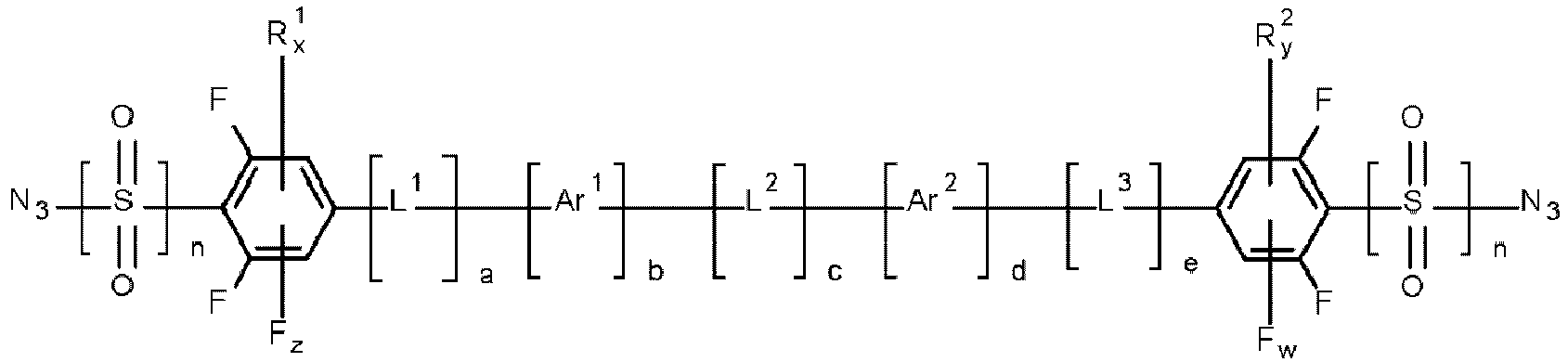 a is 0, 1 or 2,b is 1 , 2, 3 or 4,c is 0 or 1 ,d is 0, 1 , 2, 3 or 4,e is 0, 1 or 2,x is 0, 1 or 2,y is 0, 1 or 2,z is 0, 1 or 2,w is 0, 1 or 2,n is 0 or 1,Ar1 and Ar2 are independently from each other and at each occurrence an aromatic or heteroaromatic moiety, which can be substituted with one or more substituent Ra selected from the group consisting of C1-20-alkyl, C5-8-cycloalkyl, C6-14-aryl, 5 to 12 membered heteroaryl, COOR10, CONR10R11, COR10, SO3R10, CN, NO2, halogen, OR10, SR10, NR10R11, OCOR10 and NR10COR11, wherein R10 and R11 are independently from each other and at each occurrence H, C1-20-alkyl, C5-8-cycloalkyl, C6-14-aryl or 5 to 12 membered heteroaryl,wherein C1-20-alkyl and C5-8-cycloalkyl can be substituted with one or more substituents Raa at each occurrence selected from the group consisting of phenyl, COOR12, CONR12R13, COR12, SO3R12, CN, NO2, halogen, OR12, SR12, NR11R12, OCOR12 and NR12COR13, wherein C6-14-aryl and 5 to 12 membered heteroaryl can be substituted with one or more substituent Rab at each occurrence selected from the group consisting of C1-10-alkyl, cyclopentyl, cyclohexyl, COOR12, CONR12R13, COR12, SO3R12, CN, NO2, halogen, OR12, SR12, NR12R13, OCOR12 and NR12COR13,
wherein R12 and R13 are independently from each other and at each occurrence C1-10 alkyl, cyclopentyl, cyclohexyl or phenyl, and
wherein at least two adjacent Ar1, at least two adjacent Ar2 , and/or Ar1 and Ar2 , both connected to L2 or if c = 0 to each other, can be additionally linked by one or more La
, wherein La is a linking moiety B,
L1 and L3 are independently from each other and at each occurrence R3 and R4 are independently from each other and at each occurrence H , C1-20-alkyl, C5-8-cycloalkyl, C6-14-aryl, 5 to 12 membered heteroaryl, COOR20, CONR20R21, COR20, SO3R20, CN, NO2, or halogen,wherein R20 and R21 are independently from each other and at each occurrence H, C1-20-alkyl, C5-8-cycloalkyl, C6-14-aryl or 5 to 12 membered heteroaryl,wherein C1-20-alkyl and C5-8-cycloalkyl can be substituted with one or more substituents Rb at each occurrence selected from the group consisting of phenyl, COOR22, CONR22R23, COR22, SO3R22, CN, NO2, halogen, OR22, SR22, NR22R23, OCOR22 and NR22COR23,wherein C6-14-aryl and 5 to 12 membered heteroaryl can be substituted with one or more substituent Rc at each occurrence selected from the group consisting of C1-10-alkyl, cyclopentyl, cyclohexyl, COOR22, CONR22R23, COR22, SO3R22, CN, NO2, halogen, OR22, SR22, NR22R23, OCOR22 and NR22COR23,wherein R22 and R23 are independently from each other and at each occurrence C1-10 alkyl, cyclopentyl, cyclohexyl or phenyl,or, if L1 or L3 are
 R3 and R4 together with the C-atoms to which they are attached form a 5 to 7-membered non-aromatic ring system,L2 is a linking moiety A, andR1 and R2 are independently from each other and at each occurrence H, C1-20-alkyl, C5-8-cycloalkyl, C6-14-aryl, 5 to 12 membered heteroaryl, COOR30, CONR30R31, COR30, SO3R30, CN, NO2, halogen, OR30, SR30, NR30R31, OCOR30 or NR30COR31, wherein R30 and R31 are independently from each other and at each occurrence H, C1-20-alkyl, C5-8-cycloalkyl, C6-14-aryl or 5 to 12 membered heteroaryl,wherein C1-20-alkyl and C5-8-cycloalkyl can be substituted with one or more substituents Rd at each occurrence selected from the group consisting of phenyl, COOR32, CONR32R33, COR32, SO3R32, CN, NO2, halogen, OR32, SR32, NR32R33, OCOR32 and NR32COR33,wherein C6-14-aryl and 5 to 12 membered heteroaryl can be substituted with one or more substituent Re at each occurrence selected from the group consisting of C1-10-alkyl, cyclopentyl, cyclohexyl, COOR32, CONR32R33, COR32, SO3R32, CN, NO2, halogen, OR32, SR32, NR32R33, OCOR32 and NR32COR33,wherein R32 and R33 are independently from each other and at each occurrence C1-10 alkyl, cyclopentyl, cyclohexyl or phenyl;wherein linking moiety A is selected from the group consisting of C1-10-alkylene, C2-10-alkenylene, C5-8-cycloalkylene, C1-4-alkylene-C5-8-cycloalkylene-C1-4-alkylene, C1-4-alkylene-phenylene-C1-4-alkylene, C2-4-alkenylene-C5-8-cycloalkylene- C2-4-alkenylene and C2-4-alkenylene-phenylene-C2-4-alkenylene, which can be substituted with one or more substitutent Rf at each occurrence selected from the group consisting of C1-20-alkyl, C5-8-cycloalkyl, C6-14-aryl, 5 to 12 membered heteroaryl, COOR40, CONR40R41, COR40, SO3R40, CN, NO2, halogen, OR40, SR40, NR40R41, OCOR40 and NR40COR41, wherein R40 and R41 are independently from each other and at each occurrence H, C1-10-alkyl, C5-8-cycloalkyl, C6-14-aryl or 5 to 12 membered heteroaryl,wherein C1-20-alkyl and C5-8-cycloalkyl can be substituted with one or more substituents Rfa at each occurrence selected from the group consisting of phenyl, COOR42, CONR42R43, COR42, SO3R42, CN, NO2, halogen, OR42, SR42, NR42R43, OCOR42 and NR42COR43,wherein C6-14-aryl and 5 to 12 membered heteroaryl can be substituted with one or more substituent Rfb at each occurrence selected from the group consisting of C1-10-alkyl, cyclopentyl, cyclohexyl, COOR42, CONR42R43, COR42, SO3R42, CN, NO2, halogen, OR42, SR42, NR42R43, OCOR42 and NR42COR43,wherein R42 and R43 are independently from each other and at each occurrence C1-10 alkyl, cyclopentyl, cyclohexyl or phenyl, andwherein one or more CH2 groups of C1-10-alkylene, C1-4-alkylene, C2-10-alkenylene, C2-4-alkenylene and/or C5-8-cycloalkylene can be replaced by C=O, (C=O)O, (C=O)NR50, SO2-NR50, NR50, NR50R51, O or S,wherein R50 and R51 are independently from each other and at each occurrence C1-10 alkyl; andwherein linking moiety B is C1-4-alkylene, which can be substituted with one or more C1-10-alkyl, wherein one or more CH2 groups of C1-4-alkylene can be replaced by C=O, (C=O)O, (C=O)NR60, SO2-NR60, NR60, NR60R61, O or S,wherein R60 and R61 are independently from each other and at each occurrence C1-10 alkyl.
 - The composition according to claim 1, wherein the crosslinking agent has the following structure:
 wherein a is 0, 1 or 2,b is 1, 2, 3 or 4,c is 0 or 1 ,d is 0, 1, 2, 3 or 4,e is 0, 1 or 2,x is 0, 1 or 2,y is 0, 1 or 2,z is 0, 1 or 2,w is 0, 1 or 2,Ar1 and Ar2 are independently from each other and at each occurrence an aromatic or heteroaromatic moiety, which can be substituted with one or more substituent Ra selected from the group consisting of C1-20-alkyl, C5-8-cycloalkyl, C6-14-aryl, 5 to 12 membered heteroaryl, COOR10, CONR10R11, COR10, SO3R10, CN, NO2, halogen, OR10, SR10, NR10R11, OCOR10 and NR10COR11, wherein R10 and R11 are independently from each other and at each occurrence H, C1-20-alkyl, C5-8-cycloalkyl, C6-14-aryl or 5 to 12 membered heteroaryl,wherein C1-20-alkyl and C5-8-cyclolkyl can be substituted with one or more substituents Raa at each occurrence selected from the group consisting of phenyl, COOR12, CONR12R13, COR12, SO3R12, CN, NO2, halogen, OR12, SR12, NR11R12, OCOR12 and NR12COR13, wherein C6-14-aryl and 5 to 12 membered heteroaryl can be substituted with one or more substituent Rab at each occurrence selected from the group consisting of C1-10-alkyl, cyclopentyl, cyclohexyl, COOR12, CONR12R13, COR12, SO3R12, CN, NO2, halogen, OR12, SR12, NR12R13, OCOR12 and NR12COR13,wherein R12 and R13 are independently from each other and at each occurrence C1-10-alkyl, cyclopentyl, cyclohexyl or phenyl, and wherein at least two adjacent Ar1, at least two adjacent Ar2, and/or Ar1 and Ar2, both connected to L2 or if c = 0 to each other, can be additionally linked by one or more La, wherein La is a linking moiety B, L1 and L3 are independently from each other and at each occurrence
 wherein R3 and R4 are independently from each other and at each occurrence H, C1-20-alkyl, C5-8-cycloalkyl, C6-14-aryl, 5 to 12 membered heteroaryl, COOR20, CONR20R21, COR20, SO3R20, CN, NO2, or halogen,wherein R20 and R21 are independently from each other and at each occurrence H, C1-20-alkyl, C5-8-cycloalkyl, C6-14-aryl or 5 to 12 membered heteroaryl, wherein C1-20-alkyl and C5-8-cycloalkyl can be substituted with one or more substituents Rb at each occurrence selected from the group consisting of phenyl, COOR22, CONR22R23, COR22, SO3R22, CN, NO2, halogen, OR22, SR22, NR22R23, OCOR22 and NR22COR23, wherein C6-14-aryl and 5 to 12 membered heteroaryl can be substituted with one or more substituent Rc at each occurrence selected from the group consisting of C1-10-alkyl, cyclopentyl, cyclohexyl, COOR22, CONR22R23, COR22, SO3R22, CN, NO2, halogen, OR22, SR22, NR22R23, OCOR22 and NR22COR23,wherein R22 and R23 are independently from each other and at each occurrence C1-10-alkyl, cyclopentyl, cyclohexyl or phenyl, or, if L1 or L3 are
 R3 and R4 together with the C-atoms to which they are attached form a 5 to 7-membered non-aromatic ring system,L2 is a linking moiety A, andR1 and R2 are independently from each other and at each occurrence H, C1-20-alkyl, C5-8-cycloalkyl, C6-14-aryl, 5 to 12 membered heteroaryl, COOR30, CONR30R31, COR30, SO3R30, CN, NO2, halogen, OR30, SR30, NR30R31, OCOR30 or NR30COR31, wherein R30 and R31 are independently from each other and at each occurrence H, C1-20-alkyl, C5-8-cycloalkyl, C6-14-aryl or 5 to 12 membered heteroaryl,wherein C1-20-alkyl and C5-8-cycloalkyl can be substituted with one or more substituents Rd at each occurrence selected from the group consisting of phenyl, COOR32, CONR32R33, COR32, SO3R32, CN, NO2, halogen, OR32, SR32, NR32R33, OCOR32 and NR2COR33,wherein C6-14-aryl and 5 to 12 membered heteroaryl can be substituted with one or more substituent Re at each occurrence selected from the group consisting of C1-10-alkyl, cyclopentyl, cyclohexyl, COOR32, CONR32R33, COR32, SO3R32, CN, NO2, halogen, OR32, SR32, NR32R33, OCOR32 and NR32COR33,wherein R32 and R33 are independently from each other and at each occurrence C1-10-alkyl, cyclopentyl, cyclohexyl or phenyl,wherein linking moiety A is selected from the group consisting of C1-10-alkylene, C2-10-alkenylene, C5-8-CyCloalkylene, C1-4-alkylene-C5-8-CyCloalkylene- C1-4-alkylene, C1-4-alkylene-phenylene-C1-4-alkylene, C2-4-alkenylene-C5-8-cycloalkylene- C2-4-alkenylene and C2-4-alkenylene-phenylene-C2-4-alkenylene, which can be substituted with one or more substitutent Rf at each occurrence selected from the group consisting of C1-20-alkyl, C5-8-cycloalkyl, C6-14-aryl, 5 to 12 membered heteroaryl, COOR40, CONR40R41, COR40, SO3R40, CN, NO2, halogen, OR40, SR40, NR40R41, OCOR40 and NR40COR41, wherein R40 and R41 are independently from each other and at each occurrence H, C1-10-alkyl, C5-8-cycloalkyl, C6-14-aryl or 5 to 12 membered heteroaryl,wherein linking moiety B is C1-4-alkylene, which can be substituted with one or more C1-10-alkyl, wherein one or more CH2 groups of C1-4-alkylene can be replaced by C=O, (C=O)O, (C=O)NR60 , SO2-NR60, NR60, NR60R61, O or S,wherein R60 and R61 are independently from each other and at each occurrence C1-10-alkyl.
 - The composition according to claim 9, wherein
R1 and R2 are independently from each other and at each occurrence H, C1-20-alkyl, C5-8-cycloalkyl,
L1 and L3 are independently from each other and at each occurrence
- The composition according to claim 10, wherein b and e are respectively 1 or 2.
- The composition according to claim 11, wherein the crosslinking agent has the following structure:

- The composition according to claim 1, wherein the crosslinking agent is used in an amount of 0.12 to 4% by weight, preferably in an amount of 0.15 to 3.5% by weight, and more preferably in an amount of 0.15 to 3.2% by weight, based on the total weight of the composition.
- An organic photodiode, comprising:a first electrode,a second electrode,an active layer disposed between the first electrode and the second electrode,a hole blocking layer disposed between the active layer and the second electrode,andan electron blocking layer disposed between the active layer and the first electrode,wherein the electron blocking layer is made from the composition according to any of claims 1-13.
- an organic photodiode according to claim 14, wherein the electron blocking layer has a thickness in the range of 70 nm to 300 nm, preferably in the range of 80 nm to 250 nm, and more preferably in the range of 90 nm to 200 nm.
Priority Applications (2)
| Application Number | Priority Date | Filing Date | Title |
|---|---|---|---|
| EP20183080.9A EP3933949A1 (en) | 2020-06-30 | 2020-06-30 | Composition comprising an organic semiconducting polymer and a crosslinking agent and organic photodiode thereof |
| PCT/EP2021/066288 WO2022002597A1 (en) | 2020-06-30 | 2021-06-16 | Composition comprising an organic semiconducting polymer and a crosslingking agent and organic photodiode thereof |
Applications Claiming Priority (1)
| Application Number | Priority Date | Filing Date | Title |
|---|---|---|---|
| EP20183080.9A EP3933949A1 (en) | 2020-06-30 | 2020-06-30 | Composition comprising an organic semiconducting polymer and a crosslinking agent and organic photodiode thereof |
Publications (1)
| Publication Number | Publication Date |
|---|---|
| EP3933949A1 true EP3933949A1 (en) | 2022-01-05 |
Family
ID=71451970
Family Applications (1)
| Application Number | Title | Priority Date | Filing Date |
|---|---|---|---|
| EP20183080.9A Withdrawn EP3933949A1 (en) | 2020-06-30 | 2020-06-30 | Composition comprising an organic semiconducting polymer and a crosslinking agent and organic photodiode thereof |
Country Status (2)
| Country | Link |
|---|---|
| EP (1) | EP3933949A1 (en) |
| WO (1) | WO2022002597A1 (en) |
Citations (6)
| Publication number | Priority date | Publication date | Assignee | Title |
|---|---|---|---|---|
| US20090302311A1 (en) | 2006-06-30 | 2009-12-10 | Turbiez Mathieu G R | Diketopyrrolopyrrole polymers as organic semiconductors |
| US8399761B2 (en) | 2007-03-12 | 2013-03-19 | Northwestern University | Organic photovoltaic device with interfacial layer and method of fabricating same |
| WO2015004563A1 (en) | 2013-07-08 | 2015-01-15 | Basf Se | Azide-based crosslinking agents |
| WO2016024196A1 (en) * | 2014-08-12 | 2016-02-18 | Basf Se | Sorting of carbon nanotubes |
| WO2020076882A1 (en) * | 2018-10-12 | 2020-04-16 | Corning Incorporated | Uv patternable polymer blends for organic thin-film transistors |
| WO2020096761A1 (en) * | 2018-11-05 | 2020-05-14 | Corning Incorporated | Uv patternable polymer blends for organic thin-film transistors |
-
2020
- 2020-06-30 EP EP20183080.9A patent/EP3933949A1/en not_active Withdrawn
-
2021
- 2021-06-16 WO PCT/EP2021/066288 patent/WO2022002597A1/en not_active Ceased
Patent Citations (6)
| Publication number | Priority date | Publication date | Assignee | Title |
|---|---|---|---|---|
| US20090302311A1 (en) | 2006-06-30 | 2009-12-10 | Turbiez Mathieu G R | Diketopyrrolopyrrole polymers as organic semiconductors |
| US8399761B2 (en) | 2007-03-12 | 2013-03-19 | Northwestern University | Organic photovoltaic device with interfacial layer and method of fabricating same |
| WO2015004563A1 (en) | 2013-07-08 | 2015-01-15 | Basf Se | Azide-based crosslinking agents |
| WO2016024196A1 (en) * | 2014-08-12 | 2016-02-18 | Basf Se | Sorting of carbon nanotubes |
| WO2020076882A1 (en) * | 2018-10-12 | 2020-04-16 | Corning Incorporated | Uv patternable polymer blends for organic thin-film transistors |
| WO2020096761A1 (en) * | 2018-11-05 | 2020-05-14 | Corning Incorporated | Uv patternable polymer blends for organic thin-film transistors |
Also Published As
| Publication number | Publication date |
|---|---|
| WO2022002597A1 (en) | 2022-01-06 |
Similar Documents
| Publication | Publication Date | Title |
|---|---|---|
| EP2210291B1 (en) | Processing additives for fabricating organic photovoltaic cells | |
| EP3473627B1 (en) | Heterocyclic compound and organic electronic device comprising same | |
| Lee et al. | Medium-bandgap conjugated polymers containing fused dithienobenzochalcogenadiazoles: Chalcogen atom effects on organic photovoltaics | |
| EP2905819B1 (en) | A method for manufacturing an organic solar cell comprising an optically active layer | |
| KR20100014661A (en) | Solvent system for conujugated polymers | |
| KR20110074522A (en) | Use of Dibenzotetraphenylferiplanten in Organic Solar Cells | |
| CN101689606A (en) | Blends for the production of photosensitive layers in organic solar cells and organic photodetectors | |
| US20120216866A1 (en) | Organic photovoltaic cell | |
| KR102106668B1 (en) | Heterocyclic compound and organic electronic device comprising the same | |
| KR20120037317A (en) | Organic solar cell and method for preparing the same | |
| KR20170106802A (en) | Phenazine derivatives with the extended conjugated structure and applied to the organic photovoltaic polymers | |
| KR20130137889A (en) | Solar cell and method of manufacturing the same | |
| EP2985801B1 (en) | Photoactive layer, organic solar cell comprising same, and manufacturing method therefor | |
| KR102760537B1 (en) | Photoactive layer compound having ternary blends and organic solar cell comprising thereof | |
| KR102555626B1 (en) | Heterocyclic compound, composition comprising the same, and organic electronic device comprising the same | |
| KR101099601B1 (en) | Conductive polymer incorporating dithienothiophene compound and organic solar cell using the same as photoelectric conversion material | |
| KR20180059011A (en) | Printing photoactive ink for containing additive and method for manufacturing photoactive layer the same | |
| Tavakoli et al. | Efficient and Stable Mesoscopic Perovskite Solar Cells Using a Dopant‐Free D–A Copolymer Hole‐Transporting Layer | |
| GB2547460A (en) | Solvent systems for tuning of the external quantum efficiency of organic photodiodes | |
| WO2011030411A1 (en) | Organic thin film solar cell | |
| EP3933949A1 (en) | Composition comprising an organic semiconducting polymer and a crosslinking agent and organic photodiode thereof | |
| KR20200033541A (en) | Polymer and organic electronic device comprising the | |
| KR102508587B1 (en) | Polymer and organic solar cell comprising the same | |
| CN105980300B (en) | Fullerene derivative, organic solar cell using same, and manufacturing method thereof | |
| TW202122449A (en) | Conjugated polymer material and organic photovolatic device using the same |
Legal Events
| Date | Code | Title | Description |
|---|---|---|---|
| PUAI | Public reference made under article 153(3) epc to a published international application that has entered the european phase |
Free format text: ORIGINAL CODE: 0009012 |
|
| STAA | Information on the status of an ep patent application or granted ep patent |
Free format text: STATUS: THE APPLICATION HAS BEEN PUBLISHED |
|
| AK | Designated contracting states |
Kind code of ref document: A1 Designated state(s): AL AT BE BG CH CY CZ DE DK EE ES FI FR GB GR HR HU IE IS IT LI LT LU LV MC MK MT NL NO PL PT RO RS SE SI SK SM TR |
|
| B565 | Issuance of search results under rule 164(2) epc |
Effective date: 20210420 |
|
| STAA | Information on the status of an ep patent application or granted ep patent |
Free format text: STATUS: REQUEST FOR EXAMINATION WAS MADE |
|
| 17P | Request for examination filed |
Effective date: 20220705 |
|
| RBV | Designated contracting states (corrected) |
Designated state(s): AL AT BE BG CH CY CZ DE DK EE ES FI FR GB GR HR HU IE IS IT LI LT LU LV MC MK MT NL NO PL PT RO RS SE SI SK SM TR |
|
| STAA | Information on the status of an ep patent application or granted ep patent |
Free format text: STATUS: THE APPLICATION IS DEEMED TO BE WITHDRAWN |
|
| 18D | Application deemed to be withdrawn |
Effective date: 20240103 |