EP3933899A1 - Machine file processing method and system - Google Patents
Machine file processing method and system Download PDFInfo
- Publication number
- EP3933899A1 EP3933899A1 EP21761907.1A EP21761907A EP3933899A1 EP 3933899 A1 EP3933899 A1 EP 3933899A1 EP 21761907 A EP21761907 A EP 21761907A EP 3933899 A1 EP3933899 A1 EP 3933899A1
- Authority
- EP
- European Patent Office
- Prior art keywords
- data
- file
- transaction
- server
- layer data
- Prior art date
- Legal status (The legal status is an assumption and is not a legal conclusion. Google has not performed a legal analysis and makes no representation as to the accuracy of the status listed.)
- Granted
Links
Images




Classifications
-
- G—PHYSICS
- G06—COMPUTING OR CALCULATING; COUNTING
- G06F—ELECTRIC DIGITAL DATA PROCESSING
- G06F16/00—Information retrieval; Database structures therefor; File system structures therefor
- G06F16/10—File systems; File servers
- G06F16/17—Details of further file system functions
- G06F16/178—Techniques for file synchronisation in file systems
- G06F16/1794—Details of file format conversion
-
- G—PHYSICS
- G06—COMPUTING OR CALCULATING; COUNTING
- G06F—ELECTRIC DIGITAL DATA PROCESSING
- G06F16/00—Information retrieval; Database structures therefor; File system structures therefor
- G06F16/10—File systems; File servers
- G06F16/17—Details of further file system functions
- G06F16/1734—Details of monitoring file system events, e.g. by the use of hooks, filter drivers, logs
-
- G—PHYSICS
- G06—COMPUTING OR CALCULATING; COUNTING
- G06F—ELECTRIC DIGITAL DATA PROCESSING
- G06F11/00—Error detection; Error correction; Monitoring
- G06F11/07—Responding to the occurrence of a fault, e.g. fault tolerance
- G06F11/14—Error detection or correction of the data by redundancy in operations
- G06F11/1446—Point-in-time backing up or restoration of persistent data
- G06F11/1448—Management of the data involved in backup or backup restore
-
- G—PHYSICS
- G06—COMPUTING OR CALCULATING; COUNTING
- G06F—ELECTRIC DIGITAL DATA PROCESSING
- G06F11/00—Error detection; Error correction; Monitoring
- G06F11/07—Responding to the occurrence of a fault, e.g. fault tolerance
- G06F11/14—Error detection or correction of the data by redundancy in operations
- G06F11/1446—Point-in-time backing up or restoration of persistent data
- G06F11/1448—Management of the data involved in backup or backup restore
- G06F11/1451—Management of the data involved in backup or backup restore by selection of backup contents
-
- G—PHYSICS
- G06—COMPUTING OR CALCULATING; COUNTING
- G06F—ELECTRIC DIGITAL DATA PROCESSING
- G06F11/00—Error detection; Error correction; Monitoring
- G06F11/30—Monitoring
- G06F11/3003—Monitoring arrangements specially adapted to the computing system or computing system component being monitored
- G06F11/302—Monitoring arrangements specially adapted to the computing system or computing system component being monitored where the computing system component is a software system
-
- G—PHYSICS
- G06—COMPUTING OR CALCULATING; COUNTING
- G06F—ELECTRIC DIGITAL DATA PROCESSING
- G06F11/00—Error detection; Error correction; Monitoring
- G06F11/30—Monitoring
- G06F11/34—Recording or statistical evaluation of computer activity, e.g. of down time, of input/output operation ; Recording or statistical evaluation of user activity, e.g. usability assessment
- G06F11/3466—Performance evaluation by tracing or monitoring
- G06F11/3476—Data logging
-
- G—PHYSICS
- G06—COMPUTING OR CALCULATING; COUNTING
- G06F—ELECTRIC DIGITAL DATA PROCESSING
- G06F16/00—Information retrieval; Database structures therefor; File system structures therefor
- G06F16/10—File systems; File servers
- G06F16/17—Details of further file system functions
- G06F16/178—Techniques for file synchronisation in file systems
-
- G—PHYSICS
- G06—COMPUTING OR CALCULATING; COUNTING
- G06F—ELECTRIC DIGITAL DATA PROCESSING
- G06F16/00—Information retrieval; Database structures therefor; File system structures therefor
- G06F16/10—File systems; File servers
- G06F16/18—File system types
- G06F16/1865—Transactional file systems
-
- G—PHYSICS
- G06—COMPUTING OR CALCULATING; COUNTING
- G06F—ELECTRIC DIGITAL DATA PROCESSING
- G06F2201/00—Indexing scheme relating to error detection, to error correction, and to monitoring
- G06F2201/87—Monitoring of transactions
-
- H—ELECTRICITY
- H10—SEMICONDUCTOR DEVICES; ELECTRIC SOLID-STATE DEVICES NOT OTHERWISE PROVIDED FOR
- H10P—GENERIC PROCESSES OR APPARATUS FOR THE MANUFACTURE OR TREATMENT OF DEVICES COVERED BY CLASS H10
- H10P74/00—Testing or measuring during manufacture or treatment of wafers, substrates or devices
Definitions
- the present disclosure relates to a machine station file processing method and a machine station file processing system.
- test file processing method in the industry is to manually export the test files out of the machine station and then generate relevant analysis data of wafers by EXCEL macros.
- the present disclosure provides a machine station file processing method, applied to an edge computing server, comprising:
- the present disclosure further provides a machine station file processing method, applied to a machine station file processing system comprising a data warehouse server, the machine station file processing method comprises: controlling the data warehouse server to:
- the present disclosure further provides a machine station file processing system, comprising:
- Data can be generated by manual operation.
- the newly generated test files cannot be acquired in time, and the files are exported slowly; and on the other hand, when data is manually processed, different EXCEL macros may be needed for different machines station, and only one file can be processed at a time. Therefore, the present processing method cannot meet the industry's demand for the timeliness of machine station file processing.
- orientations or positional relationships indicated by terms such as “upper”, “lower”, “vertical”, “horizontal”, “inner”, “outer” are the orientations and the positional relationships illustrated on the basis of the drawings, and used just for convenience of describing the present disclosure and simplifying the description, rather than indicating or implying that the devices or elements must have a specific orientation and be constructed and operated in the specific orientation, and therefore shall not be considered as any limitations to the present disclosure.
- FIG. 1 is a flowchart of a machine station file processing method in an embodiment.
- the machine station file processing method in this embodiment is applied to an edge computing server.
- the machine station file processing method in this embodiment comprises S100 to S300.
- S100 The operation of a file system of a machine server is monitored and a transaction file generated by the operation is acquired, the transaction file comprising transaction data.
- the machine station server comprises a WP machine station server, a TM machine station server, etc.
- Different machine stations are used to acquire test data at different stages of wafer process or in different characterization methods.
- the different characterization methods comprise optical tests, electrical tests, etc.
- the addition, modification, and deletion of files are all operations of the file system, but only the addition and modification operations will generate transaction files. Therefore, the machine station file processing method in this embodiment focuses on only the addition and modification operations.
- the transaction data is the data saved in the transaction files.
- FIG. 2 is a screenshot of transaction data in an embodiment.
- a transaction file usually comprises multiple lines of transaction data.
- lines of transaction data contain different data formats and data volumes. It is unable for the operator to know the test result of a wafer only by the transaction file. Therefore, it is necessary to process the data in the transaction file to obtain the intuitive test result.
- S200 The format of the transaction data is converted according to preset warehousing rules to generate model-layer data.
- the preset warehousing rules are rules that have been set in the edge computing server for different machine station servers, and the preset warehousing rules comprise conditions and methods for format conversion of the transaction data.
- the model-layer data is data that can be directly analyzed.
- FIG. 3 is a screenshot of model-layer data in an embodiment. As shown in FIG.
- the model-layer data is clear in structure, and transaction files generated by different machine stations can be converted into model-layer data with the same definition of the format, unit, naming, etc. Therefore, during data analysis, the test results of different wafer demand parameters may be obtained simply and quickly from the model-layer data according to the needs of data analysis.
- unstructured transaction data is converted into structured model-layer data by a format conversion operation, which reduces the complexity of data analysis, thereby improving the efficiency of data analysis.
- S300 The model-layer data and a data analysis request are sent to a data warehouse server.
- the data analysis request is used to instruct the data warehouse server to acquire application-layer data according to the model-layer data.
- the application-layer data is the data required by the business generated after handling and processing. That is, the application-layer data contains less data, and the data that does not need to be displayed and applied has been eliminated.
- the edge computing server synchronously sends the generated model-layer data and the data analysis request to the data warehouse server, and the data warehouse server further filters the model-layer data under the instruction of the data analysis request to retain, in the application-layer data, only the data to be displayed and applied.
- FIG. 4 is a screenshot of application-layer data in an embodiment. As shown in FIG. 4 , the field settings of the application-layer data are the same as the items that need to be displayed and applied. Compared with the model-layer data, the content of the application-layer data is more concise and clear. For example, the fields are PRODUCT_ID (product No.), X and Y, etc. The operator can obtain the test result of the required item by going through the application-layer data.
- the machine station file processing method realizes timely acquisition of the added and modified transaction files on the machine station server by monitoring the file system of the machine station server, avoiding low efficiency and easy file omissions when manually exporting data.
- the transaction files are sent to the edge computing server in an incremental synchronization manner, which improves the efficiency of file synchronization.
- the edge computing server and the machine station server in this embodiment are both located in the FAB network segment.
- data collection and initial processing are directly performed on the data side where the machine station server is located, and then the model-layer data initially processed by the edge computing server is sent to the data warehouse server in the OA network segment in real time, which solves the problems of low transmission speed and delay in processing that are easily caused by the excessive amount of machine station file data. Therefore, compared with the prior art, the machine station file processing method in this embodiment can automatically synchronize and warehouse transaction files and output structured model-layer data, thereby reducing the complexity of data analysis and improving the timeliness and accuracy of machine station file processing.
- the edge computing server comprises a file monitoring module, a file synchronization module, and a real-time warehousing module.
- FIG. 5 is a sub-flowchart of S100 in this embodiment. As shown in FIG. 5 , the step S100 of the machinestation file processing method comprises S110 to S120.
- the file monitoring module is controlled to monitor the operation of a file system of a machine station server, and send a synchronization request to the file synchronization module.
- the file monitoring module is configured to monitor the addition and modification operations of the file system of the machine station server
- the file synchronization module is configured to synchronize the transaction files on the machine station server to the edge computing server.
- the file monitoring module when the file monitoring module discovers the addition and modification operations of the file system, the file monitoring module immediately sends a synchronization request to the file synchronization module.
- the synchronization request is used to instruct the file synchronization module to synchronize the transaction files to the edge computing server for timely synchronization of the transaction files.
- the addition and modification operations of the file system of the machine station server are monitored by Inotify in Linux kernel.
- Inotify can monitor the set files and can also monitor the set directories or subdirectories, and issue related event warnings to the set programs or modules in time through the kernel. Therefore, in this embodiment, by Inotify, file monitoring that is more flexible, occupies less resource, and is more responsive is realized.
- the file synchronization module is controlled to receive the synchronization request, and call an incremental backup program to synchronize the transaction file; and when the synchronization of the transaction file is completed, send a warehousing instruction to the real-time warehousing module, the warehousing instruction being used to instruct the real-time warehousing module to convert the format of the transaction data according to preset warehousing rules.
- the incremental backup program is used for incremental backup of the transaction files.
- Incremental backup is a backup method to obtain the differential data between this backup and the previous backup. That is, after the first full backup, when the second incremental backup is performed, only the differential data between the second backup and the first backup is backed up; when the third incremental backup is performed, only the differential data between the third backup and the second backup is backed up; and so on.
- the real-time warehousing module is configured to warehouse the transaction data synchronized to the edge computing server to generate model-layer data.
- the file synchronization module calls the incremental backup program to synchronize the transaction files.
- the incremental backup requires less data to be backed up during each time of synchronization and is less time-consuming, and data occupies less space in the edge computing server, which is more suitable for the machine station file processing method in this embodiment.
- the file control module can immediately send the warehousing instruction to the real-time warehousing module when the synchronization is completed. This can warehouse the transaction data in time, and effectively avoid the accumulation of transaction data caused by delay in processing.
- the transaction file comprises at least one line of transaction data.
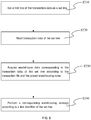
- FIG. 6 is a sub-flowchart of S200 in this embodiment. As shown in FIG. 6 , the step S200 of the machine station file processing method comprises S210 to S240.
- S210 The first line of the transaction data is set as a set line.
- each line of transaction data contain different data formats and data volumes, it is unable to warehouse each line of the data in exactly the same way. Therefore, in this embodiment, set lines are warehoused one by one, by reading in lines. Further, in order to avoid the omission of transaction data, after acquiring the transaction file from a designate directory of the edge computing server, the real-time warehousing module in this embodiment starts reading and conversion from the first line of the transaction data, that is, sets the first line of the transaction data as a set line. For example, the first line in FIG. 2 is the line "0001, 20, 74, 1, 3, 767".
- S220 The transaction data of the set line is read.
- Model-layer data corresponding to the transaction data of the set line is acquired according to the transaction file and the preset warehousing rules.
- the preset warehousing rules comprise the conditions and methods for format conversion of the transaction data. Therefore, the content, which meets the format conversion conditions, in the transaction data can be imported into the set output position according to the set format conversion method and in a set output format, so as to acquire the model-layer data corresponding to the transaction data of the set line.
- S240 A corresponding warehousing strategy is performed according to a line identifier of the set line.
- the transaction file usually comprises multiple lines of transaction data, and this embodiment supports warehousing by reading in lines. Therefore, it is necessary to traverse through each line of data in the transaction data by a set method.
- the warehousing strategy stipulates the logic and sequence of traversing through each line of transaction data. In this embodiment, by performing a corresponding warehousing strategy according to the line identifier, each line of transaction data can be acquired efficiently and completely.
- the step S230 of the machine station file processing method comprises S231 to S233.
- S231 A storage version of the transaction file is acquired.
- transaction files of different types have different storage methods, and the storage versions of the transaction files are in one-to-one correspondence to the storage methods. Therefore, the storage methods of the transaction files may be acquired by acquiring their storage versions, so as to accurately warehouse the transaction data. This avoids format errors or content errors during the warehousing.
- S232 It is determined, according to the storage version and the preset warehousing rules, whether the format of the transaction data of the set line needs to be converted.
- the preset warehousing rules have been set in the real-time warehousing module.
- the preset warehousing rules comprise information such as format conversion conditions and methods. Therefore, whether the format of data of the set line needs to be converted may be determined according to the conditions in the preset warehousing rules.
- S233 The transaction data of the set line is converted into model-layer data, if the format of data of the set line needs to be converted.
- the data of the set line in the transaction data is only used to record the test time of the wafer on the machine station, without involving information such as the wafer No. and test results. It is stipulated in the preset warehousing rules that the test time parameter is not warehoused, so there is no need to convert the transaction data of the set line into model-layer data.
- the process directly returns to S240 where a corresponding warehousing strategy is performed according to the line identifier of the set line.
- the step S240 of the machine station file processing method comprises S241 to S242.
- the process jumps out of the loop of S220 to S230. Further, when the transaction file is successfully read and warehoused, by generating a read identifier for the transaction file, it is possible to prevent the repeated reading of files without any transaction by mistake, thereby improving the reliability of reading the files when they are warehoused in the machine station file processing method.
- FIG. 9 is a flowchart of a machine station file processing method in an embodiment.
- the machine station file processing method in this embodiment is applied to a machine station file processing system.
- the machine station file processing system comprises a data warehouse server.
- the machine station file processing method in this embodiment comprises S400 to S500.
- the data warehouse server receives structured model-layer data, and responds to the data analysis request to acquire application-layer data according to the model-layer data.
- S500 A data field required to be output is acquired and the format of the model-layer data is converted according to the data field to generate application-layer data, the application-layer data being used to generate a visual page.
- the data fields required to be output are the data fields that need to be displayed and applied, that is, the data fields such as PRODUCT_ID, ROUTE_ID, X, Y, and CHIP_MAP shown in FIG. 4 .
- the visual page is an intuitive graph or image that will be generated based on data. For example, scatter charts, pie charts, histograms, etc., are all visual pages.
- FIG. 10 shows a visual page of a wafer map commonly used in the field of semiconductors. The wafer map is used to intuitively show the distribution of qualified and defective grains in the wafer. The different filling methods in the wafer map may indicate the process or cause for the generation of defective grains.
- the data field required to be output is acquired first, then the data required to be output is filtered from the model-layer data, and finally the application-layer data is acquired according to the filtered data.
- the data field "X” it is necessary to output the data in the data field "X"
- the test file generated by the machine station comprises the test data in both the field "A” and the field "B”.
- the data in the field "X” needs to be acquired by further analysis of the test data in the field "A” and the field "B".
- the test data in the field "A” and the field “B” needs to be filtered from the model-layer data first, then the set data analysis is performed to obtain the data in the field "X”, and finally the data in the field "X” is saved in the application-layer data.
- the application-layer data is automatically acquired according to the model-layer data and the data field required to be output. This can greatly reduce the complicated operation of acquiring the application-layer data manually, thereby improving the efficiency and reliability of acquiring the application-layer data.
- test data sheets in multiple different dimensions may be acquired based on the same actual test data, and the test data may be analyzed in multiple dimensions, thereby solving the problem that the analysis is not comprehensive enough since the data cannot be correlated for analysis.
- the machine station file processing system further comprises a front-end application server.
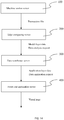
- FIG. 11 is a flowchart of a machine station file processing method in this embodiment. As shown in FIG. 11 , the machine station file processing method in this embodiment further comprises S600 to S700.
- the data warehouse server is controlled to send, to a front-end application server, the application-layer data and a data application request that is used to instruct the front-end application server to acquire a visual page according to the application-layer data.
- the front-end application server can be instructed to automatically acquire an appropriate visual page according to the application-layer data.
- the front-end application server is instructed to automatically acquire a visual page, thereby improving the efficiency of data display and application.
- the front-end application server is controlled to receive application-layer data and a data application request sent by the data warehouse server; acquire the visual page according to the application-layer data; and display the visual page.
- the front-end application server receives the application-level data, and responds to the data application request, thereby quickly acquiring and displaying a visual page according to the application-layer data, which improves the speed of data display and application of the machine station file processing method.
- the front-end application server may acquire the visual page by methods such as data analysis tools or front-end code development.
- FIG. 12 is a machine station file processing method in an embodiment.
- the machine station file processing method in this embodiment comprises S100 to S700.
- the machine station file processing method in this embodiment realizes timely acquisition of the added and modified files on the machine station server by monitoring the file system of the machine station server, avoiding low efficiency and easy file omissions when manually exporting data.
- the transaction files are sent to the edge computing server in an incremental synchronization manner, which improves the efficiency of file synchronization.
- the edge computing server and the machine station server in this embodiment are both located in the FAB network segment.
- data collection and initial processing are directly performed on the data side where the machine station server is located, and then the model-layer data initially processed by the edge computing server is sent to the data warehouse server in the OA network segment in real time, which solves the problems of low transmission speed and delay in processing that are easily caused by the excessive amount of machine station file data.
- the application-layer data is acquired automatically by the data warehouse server, and a visual page is automatically acquired and displayed by the front-end application server.
- this embodiment realizes a completely automatic data processing process, so the method in this embodiment is a machine station file processing method with both timeliness and reliability.
- FIG. 13 is a schematic structure diagram of a machine station file processing system in an embodiment.
- the machine station file processing system comprises a machine station server 100, an edge computing server 200, and a data warehouse server 300.
- the machine station server 100 is configured to perform file system operations and generate a transaction file.
- the edge computing server 200 is configured to: monitor the operation of the file system of the machine station server 100 and acquire a transaction file generated by the operation; the edge computing server convert the format of the transaction data according to preset warehousing rules to generate model-layer data; and send, to the data warehouse server 300, the model-layer data and a data analysis request that is used to instruct the data warehouse server 300 to acquire application-layer data according to the model-layer data.
- the data warehouse server 300 is configured to: receive model-layer data and a data analysis request sent by the edge computing server 200; and acquire a data field required to be output and convert the format of the model-layer data according to the data field to generate application-layer data, the application-layer data being used to generate a visual page.
- the machine station file processing system in this embodiment acquires the added and modified transaction files on the machine station server 100 in time by the edge computing server 200, and converts the transaction data into structured model-layer data on the data side, and then converts the model-layer data into application-layer data by the data warehouse server 300,thereby realizing fast acquisition and analysis of test files.
- FIG. 14 is a schematic structure diagram of a machine station file processing system in an embodiment.
- the data warehouse server 300 is further configured to send, to the front-end application server 400, the application-layer data and a data application request that is used to instruct the front-end application server 400 to acquire a visual page according to the application-layer data.
- the machine station file processing system further comprises a front-end application server 400 configured to: receive application-layer data and a data application request sent by the data warehouse server 300; acquire the visual page according to the application-layer data; and display the visual page.
- the machine station file processing system in this embodiment realizes automatic visualization of test data by the front-end application server 400, thereby improving the efficiency of data display and application.
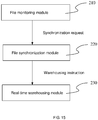
- FIG. 15 is a schematic structure diagram of an edge computing server 200 in an embodiment.
- the edge computing server 200 comprises: a file monitoring module 210, a file synchronization module 220 and a real-time warehousing module 230.
- the file monitoring module 210 is configured to monitor the operation of a file system of a machine station server 100, and send a synchronization request to the file synchronization module 220.
- the file synchronization module 220 is configured to: receive the synchronization request, and call an incremental backup program to synchronize the transaction file; and when the synchronization of the transaction file is completed, send a warehousing instruction to the real-time warehousing module 230, the warehousing instruction being used to instruct the real-time warehousing module 230 to convert the format of the transaction data according to preset warehousing rules.
- the real-time warehousing module 230 is configured to: convert the format of the transaction data according to preset warehousing rules to generate model-layer data; and send, to a data warehouse server 300, the model-layer data and a data analysis request that is used to instruct the data warehouse server 300 to acquire application-layer data according to the model-layer data.
- the edge computing server 200 in this embodiment realizes the automatic incremental synchronization of transaction files and the automatic warehousing of transaction data, thereby effectively avoiding the accumulation of transaction data caused by delay in processing, and thus improving the operational reliability of the machine station file processing system.
Landscapes
- Engineering & Computer Science (AREA)
- Theoretical Computer Science (AREA)
- Physics & Mathematics (AREA)
- General Engineering & Computer Science (AREA)
- General Physics & Mathematics (AREA)
- Data Mining & Analysis (AREA)
- Databases & Information Systems (AREA)
- Quality & Reliability (AREA)
- Computing Systems (AREA)
- Computer Hardware Design (AREA)
- Mathematical Physics (AREA)
- Information Retrieval, Db Structures And Fs Structures Therefor (AREA)
Abstract
Description
- The present disclosure claims the priority to the
Chinese patent application 202010113609.5, titled "MACHINE STATION FILE PROCESSING METHODS AND MACHINE STATION FILE PROCESSING SYSTEMS", and filed on February 24, 2020 - The present disclosure relates to a machine station file processing method and a machine station file processing system.
- As the demand for chips from terminal devices such as mobile phones and computers continues to increase, in the field of semiconductors, manufacturing devices and testing devices for chips are further upgraded, which correspondingly shortens the chip production and test periods. Therefore, in order to acquire the test results of wafers and chips faster and more intuitively, higher requirements for the processing speed and accuracy of the test files produced by the machine station have been proposed.
- In the prior art , the commonly used test file processing method in the industry is to manually export the test files out of the machine station and then generate relevant analysis data of wafers by EXCEL macros.
- According to various embodiments, the present disclosure provides a machine station file processing method, applied to an edge computing server, comprising:
- monitoring operation of a file system of a machine station server and acquiring a transaction file generated by the operation, the transaction file comprising transaction data;
- converting a format of the transaction data according to preset warehousing rules to generate model-layer data; and
- sending, to a data warehouse server, the model-layer data and a data analysis request, the data analysis request is used to instruct the data warehouse server to acquire application-layer data according to the model-layer data.
- According to various embodiments, the present disclosure further provides a machine station file processing method, applied to a machine station file processing system comprising a data warehouse server, the machine station file processing method comprises:
controlling the data warehouse server to: - receive model- layer data and a data analysis request sent by an edge computing server; and
- acquire a data field required to be output and convert a format of the model- layer data according to the data field to generate application- layer data, the application-layer data being used to generate a visual page.
- According to various embodiments, the present disclosure further provides a machine station file processing system, comprising:
- an edge computing server, configured to monitor operation of a file system of a machine station server and acquire a transaction file generated by the operation; convert a format of the transaction data according to preset warehousing rules, to generate model- layer data; and send, to a data warehouse server, the model- layer data and a data analysis request, the data analysis request is used to instruct the data warehouse server to acquire application- layer data according to the model- layer data; and
- a data warehouse server, configured to receive the model-level data and the data analysis request sent by an edge computing server; and acquire a data field required to be output and convert the format of the model- layer data according to the data field to generate the application- layer data.
- The details of one or more embodiments of the present disclosure are set forth in the following drawings and description. Other features and advantages of the present disclosure will become apparent from the description, drawings and claims.
- In order to explain technical solutions of embodiments of the present disclosure or in the prior art more clearly, the drawings to be used for describing the embodiments or the prior art will be introduced simply. Apparently, the drawings to be described below are merely some embodiments of the present disclosure, and a person of ordinary skill in the art may further obtain other drawings according to these drawings without paying any creative effort.
-
FIG. 1 is a flowchart of a machine station file processing method in an embodiment; -
FIG. 2 is a screenshot of transaction data in an embodiment; -
FIG. 3 is a screenshot of model-layer data in an embodiment; -
FIG. 4 is a screenshot of application-layer data in an embodiment; -
FIG. 5 is a sub-flowchart of S100 in an embodiment; -
FIG. 6 is a sub-flowchart of S200 in an embodiment; -
FIG. 7 is a sub-flowchart of S230 to S240 in an embodiment; -
FIG. 8 is a sub-flowchart of S200 in another embodiment; -
FIG. 9 is a flowchart of a machine station file processing method in another embodiment; -
FIG. 10 is a visual page of a wafer map in an embodiment; -
FIG. 11 is a flowchart of a machine station file processing method in still another embodiment; -
FIG. 12 is a flowchart of a machine station file processing method in yet another embodiment; -
FIG. 13 is a schematic structure diagram of a machine station file processing system in an embodiment; -
FIG. 14 is a schematic structure diagram of a machine station file processing system in another embodiment; and -
FIG. 15 is a schematic structure diagram of an edge computing server in an embodiment. - Data can be generated by manual operation. However, on one hand, by manually exporting, the newly generated test files cannot be acquired in time, and the files are exported slowly; and on the other hand, when data is manually processed, different EXCEL macros may be needed for different machines station, and only one file can be processed at a time. Therefore, the present processing method cannot meet the industry's demand for the timeliness of machine station file processing.
- In order to facilitate the understanding of the present disclosure, the present disclosure will be described more fully below with reference to the relevant drawings. Preferred embodiments of the present disclosure are shown in the drawings. However, the present disclosure may be implemented in many different forms and is not limited to the embodiments described herein. On the contrary, these embodiments are provided to make the disclosure of the present disclosure more thorough and comprehensive.
- Unless otherwise defined, all technical and scientific terms used herein have the same meaning as commonly understood by a person of ordinary skill in the art to which the present disclosure belongs. Here, terms used in the description of the present disclosure are merely intended to describe specific embodiments, rather than limiting the present disclosure. As used herein, the term "and/or" includes any or all of one or more associated listed items or combinations thereof.
- In the description of the present disclosure, it should be understood that orientations or positional relationships indicated by terms such as "upper", "lower", "vertical", "horizontal", "inner", "outer" are the orientations and the positional relationships illustrated on the basis of the drawings, and used just for convenience of describing the present disclosure and simplifying the description, rather than indicating or implying that the devices or elements must have a specific orientation and be constructed and operated in the specific orientation, and therefore shall not be considered as any limitations to the present disclosure.
-
FIG. 1 is a flowchart of a machine station file processing method in an embodiment. The machine station file processing method in this embodiment is applied to an edge computing server. As shown inFIG. 1 , the machine station file processing method in this embodiment comprises S100 to S300. - S100: The operation of a file system of a machine server is monitored and a transaction file generated by the operation is acquired, the transaction file comprising transaction data.
- Wherein, the machine station server comprises a WP machine station server, a TM machine station server, etc. Different machine stations are used to acquire test data at different stages of wafer process or in different characterization methods. The different characterization methods comprise optical tests, electrical tests, etc. The addition, modification, and deletion of files are all operations of the file system, but only the addition and modification operations will generate transaction files. Therefore, the machine station file processing method in this embodiment focuses on only the addition and modification operations. The transaction data is the data saved in the transaction files.
- Specifically, when the machine station server tests a new wafer, an added transaction file will be generated; and when the machine station server repeats the test on the tested wafer, a modified transaction file will be generated. The generation of transaction files must be accompanied by corresponding operations. Therefore, by monitoring the addition or modification operation of the file system, it may be found that transaction files have been generated on the machine station server. In this way, the transaction files may be sent to the edge computing server in time.
-
FIG. 2 is a screenshot of transaction data in an embodiment. As shown inFIG. 2 , a transaction file usually comprises multiple lines of transaction data. In this embodiment, lines of transaction data contain different data formats and data volumes. It is unable for the operator to know the test result of a wafer only by the transaction file. Therefore, it is necessary to process the data in the transaction file to obtain the intuitive test result. - S200: The format of the transaction data is converted according to preset warehousing rules to generate model-layer data.
- Wherein, the preset warehousing rules are rules that have been set in the edge computing server for different machine station servers, and the preset warehousing rules comprise conditions and methods for format conversion of the transaction data. The model-layer data is data that can be directly analyzed.
- Specifically, there is difference in the definition of the format, unit, naming, etc., of the transaction files generated by different machine stations. For example, to determine whether the thickness of a set layer of a wafer meets a thickness threshold, some machine stations are recorded in 0 and 1 while the other machine stations are recorded in YES and NO. For another example, to record the width of lines, micrometer is used as the unit in some machine stations while nanometer is used as the unit in the other machine stations. Therefore, it is unable to efficiently analyze the transaction files generated by different machine stations only by a same data analysis method.
FIG. 3 is a screenshot of model-layer data in an embodiment. As shown inFIG. 3 , the model-layer data is clear in structure, and transaction files generated by different machine stations can be converted into model-layer data with the same definition of the format, unit, naming, etc. Therefore, during data analysis, the test results of different wafer demand parameters may be obtained simply and quickly from the model-layer data according to the needs of data analysis. In this embodiment, unstructured transaction data is converted into structured model-layer data by a format conversion operation, which reduces the complexity of data analysis, thereby improving the efficiency of data analysis. - S300: The model-layer data and a data analysis request are sent to a data warehouse server. The data analysis request is used to instruct the data warehouse server to acquire application-layer data according to the model-layer data.
- Wherein, the application-layer data is the data required by the business generated after handling and processing. That is, the application-layer data contains less data, and the data that does not need to be displayed and applied has been eliminated.
- Specifically, the edge computing server synchronously sends the generated model-layer data and the data analysis request to the data warehouse server, and the data warehouse server further filters the model-layer data under the instruction of the data analysis request to retain, in the application-layer data, only the data to be displayed and applied.
FIG. 4 is a screenshot of application-layer data in an embodiment. As shown inFIG. 4 , the field settings of the application-layer data are the same as the items that need to be displayed and applied. Compared with the model-layer data, the content of the application-layer data is more concise and clear. For example, the fields are PRODUCT_ID (product No.), X and Y, etc. The operator can obtain the test result of the required item by going through the application-layer data. - The machine station file processing method realizes timely acquisition of the added and modified transaction files on the machine station server by monitoring the file system of the machine station server, avoiding low efficiency and easy file omissions when manually exporting data. Moreover, in this embodiment, the transaction files are sent to the edge computing server in an incremental synchronization manner, which improves the efficiency of file synchronization. Further, the edge computing server and the machine station server in this embodiment are both located in the FAB network segment. In this embodiment, data collection and initial processing are directly performed on the data side where the machine station server is located, and then the model-layer data initially processed by the edge computing server is sent to the data warehouse server in the OA network segment in real time, which solves the problems of low transmission speed and delay in processing that are easily caused by the excessive amount of machine station file data. Therefore, compared with the prior art, the machine station file processing method in this embodiment can automatically synchronize and warehouse transaction files and output structured model-layer data, thereby reducing the complexity of data analysis and improving the timeliness and accuracy of machine station file processing.
- In an embodiment, the edge computing server comprises a file monitoring module, a file synchronization module, and a real-time warehousing module.
FIG. 5 is a sub-flowchart of S100 in this embodiment. As shown inFIG. 5 , the step S100 of the machinestation file processing method comprises S110 to S120. - S110: The file monitoring module is controlled to monitor the operation of a file system of a machine station server, and send a synchronization request to the file synchronization module.
- Wherein, the file monitoring module is configured to monitor the addition and modification operations of the file system of the machine station server, and the file synchronization module is configured to synchronize the transaction files on the machine station server to the edge computing server.
- Specifically, when the file monitoring module discovers the addition and modification operations of the file system, the file monitoring module immediately sends a synchronization request to the file synchronization module. The synchronization request is used to instruct the file synchronization module to synchronize the transaction files to the edge computing server for timely synchronization of the transaction files.
- In an embodiment, the addition and modification operations of the file system of the machine station server are monitored by Inotify in Linux kernel. Inotify can monitor the set files and can also monitor the set directories or subdirectories, and issue related event warnings to the set programs or modules in time through the kernel. Therefore, in this embodiment, by Inotify, file monitoring that is more flexible, occupies less resource, and is more responsive is realized.
- S120: The file synchronization module is controlled to receive the synchronization request, and call an incremental backup program to synchronize the transaction file; and when the synchronization of the transaction file is completed, send a warehousing instruction to the real-time warehousing module, the warehousing instruction being used to instruct the real-time warehousing module to convert the format of the transaction data according to preset warehousing rules.
- Wherein, the incremental backup program is used for incremental backup of the transaction files. Incremental backup is a backup method to obtain the differential data between this backup and the previous backup. That is, after the first full backup, when the second incremental backup is performed, only the differential data between the second backup and the first backup is backed up; when the third incremental backup is performed, only the differential data between the third backup and the second backup is backed up; and so on. The real-time warehousing module is configured to warehouse the transaction data synchronized to the edge computing server to generate model-layer data.
- Specifically, after the file synchronization module receives the synchronization request, the file synchronization module calls the incremental backup program to synchronize the transaction files. Compared with the full backup and the differential backup, the incremental backup requires less data to be backed up during each time of synchronization and is less time-consuming, and data occupies less space in the edge computing server, which is more suitable for the machine station file processing method in this embodiment. Moreover, the file control module can immediately send the warehousing instruction to the real-time warehousing module when the synchronization is completed. This can warehouse the transaction data in time, and effectively avoid the accumulation of transaction data caused by delay in processing.
- In an embodiment, the transaction file comprises at least one line of transaction data.
FIG. 6 is a sub-flowchart of S200 in this embodiment. As shown inFIG. 6 , the step S200 of the machine station file processing method comprises S210 to S240. - S210: The first line of the transaction data is set as a set line.
- Specifically, since each line of transaction data contain different data formats and data volumes, it is unable to warehouse each line of the data in exactly the same way. Therefore, in this embodiment, set lines are warehoused one by one, by reading in lines. Further, in order to avoid the omission of transaction data, after acquiring the transaction file from a designate directory of the edge computing server, the real-time warehousing module in this embodiment starts reading and conversion from the first line of the transaction data, that is, sets the first line of the transaction data as a set line. For example, the first line in
FIG. 2 is the line "0001, 20, 74, 1, 3, 767". - S220: The transaction data of the set line is read.
- S230: Model-layer data corresponding to the transaction data of the set line is acquired according to the transaction file and the preset warehousing rules.
- Specifically, the preset warehousing rules comprise the conditions and methods for format conversion of the transaction data. Therefore, the content, which meets the format conversion conditions, in the transaction data can be imported into the set output position according to the set format conversion method and in a set output format, so as to acquire the model-layer data corresponding to the transaction data of the set line.
- S240: A corresponding warehousing strategy is performed according to a line identifier of the set line.
- Specifically, the transaction file usually comprises multiple lines of transaction data, and this embodiment supports warehousing by reading in lines. Therefore, it is necessary to traverse through each line of data in the transaction data by a set method. The warehousing strategy stipulates the logic and sequence of traversing through each line of transaction data. In this embodiment, by performing a corresponding warehousing strategy according to the line identifier, each line of transaction data can be acquired efficiently and completely.
- In an embodiment, as shown in
FIG. 7 , the step S230 of the machine station file processing method comprises S231 to S233. - S231: A storage version of the transaction file is acquired.
- Specifically, transaction files of different types have different storage methods, and the storage versions of the transaction files are in one-to-one correspondence to the storage methods. Therefore, the storage methods of the transaction files may be acquired by acquiring their storage versions, so as to accurately warehouse the transaction data. This avoids format errors or content errors during the warehousing.
- S232: It is determined, according to the storage version and the preset warehousing rules, whether the format of the transaction data of the set line needs to be converted.
- Specifically, the preset warehousing rules have been set in the real-time warehousing module. The preset warehousing rules comprise information such as format conversion conditions and methods. Therefore, whether the format of data of the set line needs to be converted may be determined according to the conditions in the preset warehousing rules.
- S233: The transaction data of the set line is converted into model-layer data, if the format of data of the set line needs to be converted.
- If the format of data of the set line does not need to be converted, for example, the data of the set line in the transaction data is only used to record the test time of the wafer on the machine station, without involving information such as the wafer No. and test results. It is stipulated in the preset warehousing rules that the test time parameter is not warehoused, so there is no need to convert the transaction data of the set line into model-layer data. The process directly returns to S240 where a corresponding warehousing strategy is performed according to the line identifier of the set line.
- In an embodiment, as shown in
FIG. 8 , the step S240 of the machine station file processing method comprises S241 to S242. - S241: When the set line is the last line, a read identifier is generated for the transaction file.
- Specifically, when the set line is the last line, it is indicated that the transaction data in the transaction file has been all read and warehoused. Then, the process jumps out of the loop of S220 to S230. Further, when the transaction file is successfully read and warehoused, by generating a read identifier for the transaction file, it is possible to prevent the repeated reading of files without any transaction by mistake, thereby improving the reliability of reading the files when they are warehoused in the machine station file processing method.
- S242: When the set line is not the last line, the next line of the set line is set as a new set line, and the steps (S220 to S230) of reading the transaction data of the set line and acquiring model-layer data corresponding to the transaction data of the set line according to the transaction file and the preset warehousing rules are repeated until the new set line becomes the last line.
-
FIG. 9 is a flowchart of a machine station file processing method in an embodiment. The machine station file processing method in this embodiment is applied to a machine station file processing system. The machine station file processing system comprises a data warehouse server. As shown inFIG. 9 , the machine station file processing method in this embodiment comprises S400 to S500. - S400: Model-layer data and a data analysis request sent by an edge computing server are received.
- Specifically, the data warehouse server receives structured model-layer data, and responds to the data analysis request to acquire application-layer data according to the model-layer data.
- S500: A data field required to be output is acquired and the format of the model-layer data is converted according to the data field to generate application-layer data, the application-layer data being used to generate a visual page.
- The data fields required to be output are the data fields that need to be displayed and applied, that is, the data fields such as PRODUCT_ID, ROUTE_ID, X, Y, and CHIP_MAP shown in
FIG. 4 . The visual page is an intuitive graph or image that will be generated based on data. For example, scatter charts, pie charts, histograms, etc., are all visual pages.FIG. 10 shows a visual page of a wafer map commonly used in the field of semiconductors. The wafer map is used to intuitively show the distribution of qualified and defective grains in the wafer. The different filling methods in the wafer map may indicate the process or cause for the generation of defective grains. - Specifically, in this embodiment, the data field required to be output is acquired first, then the data required to be output is filtered from the model-layer data, and finally the application-layer data is acquired according to the filtered data. For example, in this embodiment, it is necessary to output the data in the data field "X", and the test file generated by the machine station comprises the test data in both the field "A" and the field "B". The data in the field "X" needs to be acquired by further analysis of the test data in the field "A" and the field "B". Therefore, in this embodiment, the test data in the field "A" and the field "B" needs to be filtered from the model-layer data first, then the set data analysis is performed to obtain the data in the field "X", and finally the data in the field "X" is saved in the application-layer data. It may be understood that, due to the enormous amount of wafer tests on a machine station, there is still a large amount of test data to be processed even in the stage of acquiring application-layer data. Therefore, in this embodiment, the application-layer data is automatically acquired according to the model-layer data and the data field required to be output. This can greatly reduce the complicated operation of acquiring the application-layer data manually, thereby improving the efficiency and reliability of acquiring the application-layer data.
- Further, in this embodiment, in the process of acquiring the application-layer data, test data sheets in multiple different dimensions may be acquired based on the same actual test data, and the test data may be analyzed in multiple dimensions, thereby solving the problem that the analysis is not comprehensive enough since the data cannot be correlated for analysis.
- In an embodiment, the machine station file processing system further comprises a front-end application server.
FIG. 11 is a flowchart of a machine station file processing method in this embodiment. As shown inFIG. 11 , the machine station file processing method in this embodiment further comprises S600 to S700. - S600: The data warehouse server is controlled to send, to a front-end application server, the application-layer data and a data application request that is used to instruct the front-end application server to acquire a visual page according to the application-layer data.
- Specifically, by sending the application-layer data and the data application request to the front-end application server, the front-end application server can be instructed to automatically acquire an appropriate visual page according to the application-layer data. Usually in the wafer data application stage, different visual pages need to be output for different data fields, so manual operations require complicated data selection and visual page type selection operations. In this embodiment, by the data application request, the front-end application server is instructed to automatically acquire a visual page, thereby improving the efficiency of data display and application.
- S700: The front-end application server is controlled to receive application-layer data and a data application request sent by the data warehouse server; acquire the visual page according to the application-layer data; and display the visual page.
- Specifically, the front-end application server receives the application-level data, and responds to the data application request, thereby quickly acquiring and displaying a visual page according to the application-layer data, which improves the speed of data display and application of the machine station file processing method. Wherein, the front-end application server may acquire the visual page by methods such as data analysis tools or front-end code development.
-
FIG. 12 is a machine station file processing method in an embodiment. As shown inFIG. 12 , the machine station file processing method in this embodiment comprises S100 to S700. The machine station file processing method in this embodiment realizes timely acquisition of the added and modified files on the machine station server by monitoring the file system of the machine station server, avoiding low efficiency and easy file omissions when manually exporting data. Moreover, in this embodiment, the transaction files are sent to the edge computing server in an incremental synchronization manner, which improves the efficiency of file synchronization. Further, the edge computing server and the machine station server in this embodiment are both located in the FAB network segment. In this embodiment, data collection and initial processing are directly performed on the data side where the machine station server is located, and then the model-layer data initially processed by the edge computing server is sent to the data warehouse server in the OA network segment in real time, which solves the problems of low transmission speed and delay in processing that are easily caused by the excessive amount of machine station file data. After the model-layer data is acquired, in this embodiment, the application-layer data is acquired automatically by the data warehouse server, and a visual page is automatically acquired and displayed by the front-end application server. Thus, faster data display and application is realized. Therefore, from test file generation, data collection, data analysis to visual page display, this embodiment realizes a completely automatic data processing process, so the method in this embodiment is a machine station file processing method with both timeliness and reliability. -
FIG. 13 is a schematic structure diagram of a machine station file processing system in an embodiment. As shown inFIG. 13 , the machine station file processing system comprises amachine station server 100, anedge computing server 200, and adata warehouse server 300. - The
machine station server 100 is configured to perform file system operations and generate a transaction file. - The
edge computing server 200 is configured to: monitor the operation of the file system of themachine station server 100 and acquire a transaction file generated by the operation; the edge computing server convert the format of the transaction data according to preset warehousing rules to generate model-layer data; and send, to thedata warehouse server 300, the model-layer data and a data analysis request that is used to instruct thedata warehouse server 300 to acquire application-layer data according to the model-layer data. - The
data warehouse server 300 is configured to: receive model-layer data and a data analysis request sent by theedge computing server 200; and acquire a data field required to be output and convert the format of the model-layer data according to the data field to generate application-layer data, the application-layer data being used to generate a visual page. - The machine station file processing system in this embodiment acquires the added and modified transaction files on the
machine station server 100 in time by theedge computing server 200, and converts the transaction data into structured model-layer data on the data side, and then converts the model-layer data into application-layer data by thedata warehouse server 300,thereby realizing fast acquisition and analysis of test files. -
FIG. 14 is a schematic structure diagram of a machine station file processing system in an embodiment. As shown inFIG. 14 , thedata warehouse server 300 is further configured to send, to the front-end application server 400, the application-layer data and a data application request that is used to instruct the front-end application server 400 to acquire a visual page according to the application-layer data. The machine station file processing system further comprises a front-end application server 400 configured to: receive application-layer data and a data application request sent by thedata warehouse server 300; acquire the visual page according to the application-layer data; and display the visual page. The machine station file processing system in this embodiment realizes automatic visualization of test data by the front-end application server 400, thereby improving the efficiency of data display and application. -
FIG. 15 is a schematic structure diagram of anedge computing server 200 in an embodiment. As shown inFIG. 15 , theedge computing server 200 comprises: afile monitoring module 210, afile synchronization module 220 and a real-time warehousing module 230. - The
file monitoring module 210 is configured to monitor the operation of a file system of amachine station server 100, and send a synchronization request to thefile synchronization module 220. - The
file synchronization module 220 is configured to: receive the synchronization request, and call an incremental backup program to synchronize the transaction file; and when the synchronization of the transaction file is completed, send a warehousing instruction to the real-time warehousing module 230, the warehousing instruction being used to instruct the real-time warehousing module 230 to convert the format of the transaction data according to preset warehousing rules. - The real-
time warehousing module 230 is configured to: convert the format of the transaction data according to preset warehousing rules to generate model-layer data; and send, to adata warehouse server 300, the model-layer data and a data analysis request that is used to instruct thedata warehouse server 300 to acquire application-layer data according to the model-layer data. - Through the cooperation of the
file monitoring module 210, thefile synchronization module 220 and the real-time warehousing module 230, theedge computing server 200 in this embodiment realizes the automatic incremental synchronization of transaction files and the automatic warehousing of transaction data, thereby effectively avoiding the accumulation of transaction data caused by delay in processing, and thus improving the operational reliability of the machine station file processing system. - Various technical features of the above embodiments can be arbitrarily combined. For simplicity, all possible combinations of various technical features of the above embodiments are not described. However, all those technical features shall be included in the protection scope of the present disclosure if not conflict.
- The embodiments described above merely represent certain implementations of the present disclosure. Although those embodiments are described in more specific details, it is not to be construed as any limitation to the scope of the present disclosure. It should be noted that, for a person of ordinary skill in the art, a number of variations and improvements may be made without departing from the concept of the present disclosure, and those variations and improvements should be regarded as falling into the protection scope of the present disclosure. Therefore, the protection scope of the present disclosure should be subject to the appended claims.
Claims (14)
- A machine station file processing method, applied to an edge computing server, comprising:monitoring operation of a file system of a machine station server and acquiring a transaction file generated by the operation, the transaction file comprising transaction data;converting a format of the transaction data according to preset warehousing rules to generate model-layer data; andsending, to a data warehouse server, the model-layer data and a data analysis request, the data analysis request is used to instruct the data warehouse server to acquire application-layer data according to the model-layer data.
- The machine station file processing method according to claim 1, wherein the edge computing server comprises a file monitoring module, a file synchronization module and a real-time warehousing module; and the monitoring operation of a file system of a machine station server and acquiring a transaction file generated by the operation comprises:controlling the file monitoring module to monitor the operation of the file system of the machine station server, and sending a synchronization request to the file synchronization module; andcontrolling the file synchronization module to receive the synchronization request, and calling an incremental backup program to synchronize the transaction file; and when the synchronization of the transaction file is completed, sending a warehousing instruction to the real-time warehousing module, the warehousing instruction being used to instruct the real-time warehousing module to convert the format of the transaction data according to the preset warehousing rules.
- The machine station file processing method according to claim 1, wherein the transaction file comprises at least one line of transaction data; and the converting a format of the transaction data according to preset warehousing rules to generate model-layer data comprises:setting a first line of the transaction data as a set line;reading transaction data of the set line;acquiring model-layer data corresponding to the transaction data of the set line according to the transaction file and the preset warehousing rules; andperforming a corresponding warehousing strategy according to a line identifier of the set line.
- The machine station file processing method according to claim 3, wherein the performing a corresponding warehousing strategy according to a line identifier of the set line comprises:when the set line is a last line, generating a read identifier for the transaction file; andwhen the set line is not the last line, setting a next line of the set line as a new set line, and repeating steps of reading the transaction data of the set line and acquiring model-layer data corresponding to the transaction data of the set line according to the transaction file and the preset warehousing rules until the new set line becomes the last line.
- The machine station file processing method according to claim 3 or 4, wherein the acquiring model-layer data corresponding to the transaction data of the set line according to the transaction file and the preset warehousing rules comprises:acquiring a storage version of the transaction file;determining, according to the storage version and the preset warehousing rules, whether the format of the transaction data of the set line needs to be converted;converting the transaction data of the set line into the model-layer data, if the format of the transaction data of the set line needs to be converted; anddirectly returning to step of performing a corresponding warehousing strategy according to the line identifier of the set line, if the format of the transaction data of the set line does not need to be converted.
- The machine station file processing method according to claim 1, wherein the monitoring operation of a file system of a machine station server comprises: monitoring addition and modification operations of the file system of the machine station server by Inotify in Linux kernel.
- The machine station file processing method according to claim 1, wherein the sending, to the data warehouse server, the model-layer data and the data analysis request and the data analysis request is used to instruct the data warehouse server to acquire application-layer data according to the model-layer data comprises:
synchronously sending, by the edge computing server, generated model-layer data and the data analysis request to the data warehouse server, and further filtering, by the data warehouse server, the model-layer data under the instruction of the data analysis request to retain, in the application-layer data, only the data to be displayed and applied. - The machine station file processing method according to claim 2, wherein, after acquiring the transaction file from a designate directory of the edge computing server, the real-time warehousing module starts reading and conversion from a first line of the transaction data, that is, sets the first line of the transaction data as a set line.
- A machine station file processing method, applied to a machine station file processing system comprising a data warehouse server, the machine station file processing method comprises: controlling the data warehouse server to:receive model-layer data and a data analysis request sent by an edge computing server; andacquire a data field required to be output and convert a format of the model-layer data according to the data field to generate application-layer data, the application-layer data being used to generate a visual page.
- The machine station file processing method according to claim 9, wherein the machine station file processing system further comprises a front-end application server; and the machine station file processing method further comprises:controlling the data warehouse server to send, to the front-end application server, the application-layer data and a data application request, the data application request is used to instruct the front-end application server to acquire a visual page according to the application-layer data; andcontrolling the front-end application server to receive application-layer data and a data application request sent by the data warehouse server; acquiring the visual page according to the application-layer data; and displaying the visual page.
- The machine station file processing method according to claim 9, wherein the data field required to be output is acquired first, then the data required to be output is filtered from the model-layer data, and finally the application-layer data is acquired according to the filtered data.
- A machine station file processing system, comprising:an edge computing server, configured to monitor operation of a file system of a machine station server and acquire a transaction file generated by the operation; convert a format of the transaction data according to preset warehousing rules, to generate model-layer data; and send, to a data warehouse server, the model-layer data and a data analysis request, the data analysis request is used to instruct the data warehouse server to acquire application-layer data according to the model-layer data; anda data warehouse server, configured to receive the model-layer data and the data analysis request sent by an edge computing server; and acquire a data field required to be output and convert the format of the model-layer data according to the data field to generate the application-layer data.
- The machine station file processing system according to claim 12, wherein the data warehouse server is further configured to send, to a front-end application server, the application-layer data and a data application request, the data application request is used to instruct the front-end application server to acquire a visual page according to the application-layer data; and the machine station file processing system further comprises:
a front-end application server, configured to receive the application-layer data and the data application request sent by the data warehouse server; acquire a visual page according to the application-layer data; and display the visual page. - The machine station file processing system according to claim 12 or 13, wherein the edge computing server comprises:a file monitoring module, configured to monitor the operation of the file system of the machine station server, and send a synchronization request to a file synchronization module;the file synchronization module, configured to receive the synchronization request, and call an incremental backup program to synchronize a transaction file; and when the synchronization of the transaction file is completed, send a warehousing instruction to a real-time warehousing module, the warehousing instruction being used to instruct the real-time warehousing module to convert a format of the transaction data according to preset warehousing rules; andthe real-time warehousing module, configured to convert the format of the transaction data according to preset warehousing rules to generate model-layer data; and send, to a data warehouse server, the model-layer data and a data analysis request, the data analysis request is used to instruct the data warehouse server to acquire application-layer data according to the model-layer data.
Applications Claiming Priority (2)
| Application Number | Priority Date | Filing Date | Title |
|---|---|---|---|
| CN202010113609.5A CN113297157B (en) | 2020-02-24 | 2020-02-24 | Machine file processing method and processing system |
| PCT/CN2021/076330 WO2021169808A1 (en) | 2020-02-24 | 2021-02-09 | Machine file processing method and system |
Publications (3)
| Publication Number | Publication Date |
|---|---|
| EP3933899A1 true EP3933899A1 (en) | 2022-01-05 |
| EP3933899A4 EP3933899A4 (en) | 2022-04-27 |
| EP3933899B1 EP3933899B1 (en) | 2023-05-10 |
Family
ID=77318579
Family Applications (1)
| Application Number | Title | Priority Date | Filing Date |
|---|---|---|---|
| EP21761907.1A Active EP3933899B1 (en) | 2020-02-24 | 2021-02-09 | Machine file processing method and system |
Country Status (4)
| Country | Link |
|---|---|
| US (1) | US20220318205A1 (en) |
| EP (1) | EP3933899B1 (en) |
| CN (1) | CN113297157B (en) |
| WO (1) | WO2021169808A1 (en) |
Families Citing this family (4)
| Publication number | Priority date | Publication date | Assignee | Title |
|---|---|---|---|---|
| EP4304157B1 (en) * | 2022-07-05 | 2026-02-25 | Yokogawa Electric Corporation | Edge controller apparatus and corresponding system |
| CN115186020A (en) * | 2022-07-15 | 2022-10-14 | 深圳安巽科技有限公司 | A data access storage processing method, system and storage medium |
| CN115391438A (en) * | 2022-08-24 | 2022-11-25 | 中国银行股份有限公司 | Method, device, equipment and storage medium for generating data warehouse configuration document |
| CN116737482A (en) * | 2023-08-10 | 2023-09-12 | 上海孤波科技有限公司 | Method and device for collecting chip test data in real time and electronic equipment |
Family Cites Families (23)
| Publication number | Priority date | Publication date | Assignee | Title |
|---|---|---|---|---|
| US7003560B1 (en) * | 1999-11-03 | 2006-02-21 | Accenture Llp | Data warehouse computing system |
| US7111023B2 (en) * | 2001-05-24 | 2006-09-19 | Oracle International Corporation | Synchronous change data capture in a relational database |
| JP2005515556A (en) * | 2002-01-15 | 2005-05-26 | ネットワーク アプライアンス, インコーポレイテッド | Active file change notification |
| EP1949281A4 (en) * | 2005-11-03 | 2011-02-02 | Kt Freetel Co Ltd | Open mobile business supporting system and method |
| EP2053552A3 (en) * | 2005-11-03 | 2011-02-02 | KTFreetel Co., Ltd. | A legacy cooperation device and processing method |
| JP4857199B2 (en) * | 2007-04-05 | 2012-01-18 | 株式会社日立製作所 | Information asset management system, log analysis device, and log analysis program |
| EP2079020B1 (en) * | 2008-01-03 | 2013-03-20 | Accenture Global Services Limited | System amd method for automating ETL applications |
| CN102111428A (en) * | 2009-12-29 | 2011-06-29 | 捷达世软件(深圳)有限公司 | Machine data acquisition system and method |
| KR101108534B1 (en) * | 2011-01-24 | 2012-01-30 | (주)아이비즈소프트웨어 | Web application input value validation and conversion based on domain rules, database output value management management automation system and control method |
| CN103514223B (en) * | 2012-06-28 | 2017-09-01 | 阿里巴巴集团控股有限公司 | A kind of data warehouse data synchronous method and system |
| CN103793437A (en) * | 2012-11-01 | 2014-05-14 | 无锡华润上华科技有限公司 | Wafer test data processing method and system |
| TW201533456A (en) * | 2014-02-19 | 2015-09-01 | 訊利電業股份有限公司 | Wafer test data analysis method |
| CN104122871B (en) * | 2014-07-29 | 2017-02-15 | 于兵 | Real-time monitoring method of semiconductor test data |
| CN105574039B (en) * | 2014-10-16 | 2019-05-24 | 中芯国际集成电路制造(上海)有限公司 | A kind of processing method and system of wafer test data |
| US10394661B2 (en) * | 2015-09-22 | 2019-08-27 | International Business Machines Corporation | Policy driven data updates |
| DE102016112049B3 (en) * | 2016-06-30 | 2017-08-24 | Infineon Technologies Ag | METHOD FOR PRODUCING CZ-SILICON WAFERS AND METHOD FOR PRODUCING A SEMICONDUCTOR DEVICE |
| CN107391617A (en) * | 2017-07-05 | 2017-11-24 | 国网福建省电力有限公司 | Model method is led based on monitoring system automatically |
| KR20190020491A (en) * | 2017-08-21 | 2019-03-04 | 한국전자통신연구원 | Method for integration status monitoring of ground station system |
| CN110377648A (en) * | 2018-04-11 | 2019-10-25 | 西安邮电大学 | A kind of multi-source heterogeneous Data Analysis Platform towards intelligence manufacture |
| CN108874585B (en) * | 2018-05-25 | 2021-01-22 | 南京云信达科技有限公司 | File backup method, device and system |
| CN109298997A (en) * | 2018-08-08 | 2019-02-01 | 平安科技(深圳)有限公司 | Interface test method, system, computer equipment and storage medium |
| CN109726234B (en) * | 2018-09-14 | 2023-10-17 | 上海华岭集成电路技术股份有限公司 | Integrated circuit test informatization management system based on industrial Internet |
| US11294926B1 (en) * | 2019-05-31 | 2022-04-05 | Facteus, Inc. | Master extract, transform, and load (ETL) application for accommodating multiple data source types having disparate data formats |
-
2020
- 2020-02-24 CN CN202010113609.5A patent/CN113297157B/en active Active
-
2021
- 2021-02-09 EP EP21761907.1A patent/EP3933899B1/en active Active
- 2021-02-09 WO PCT/CN2021/076330 patent/WO2021169808A1/en not_active Ceased
- 2021-02-09 US US17/310,355 patent/US20220318205A1/en not_active Abandoned
Also Published As
| Publication number | Publication date |
|---|---|
| US20220318205A1 (en) | 2022-10-06 |
| EP3933899B1 (en) | 2023-05-10 |
| WO2021169808A1 (en) | 2021-09-02 |
| CN113297157B (en) | 2024-06-07 |
| EP3933899A4 (en) | 2022-04-27 |
| CN113297157A (en) | 2021-08-24 |
Similar Documents
| Publication | Publication Date | Title |
|---|---|---|
| EP3933899B1 (en) | Machine file processing method and system | |
| CN107040578B (en) | Data synchronization method, device and system | |
| CN111638690B (en) | Data acquisition method, device, system and equipment based on general information model | |
| CN111459944B (en) | MR data storage method, device, server and storage medium | |
| CN111258990B (en) | Index database data migration method, device, equipment and storage medium | |
| CN111914390A (en) | Method, device and computer storage medium for predicting vehicle assembly | |
| CN111399764A (en) | Data storage method, data reading device, data storage equipment and data storage medium | |
| CN110955709B (en) | Data processing method and device and electronic equipment | |
| CN119986222A (en) | Vehicle electromagnetic compatibility test method and device based on big data platform | |
| CN108667872B (en) | Archiving method and device for scheduling server | |
| CN117215910A (en) | Interface test frame generation method, test method, electronic device and storage medium | |
| CN116129142A (en) | Test method, device, terminal equipment and storage medium for image recognition model | |
| CN112671567B (en) | 5G core network topology discovery method and device based on service interface | |
| CN114757157B (en) | Method, apparatus, device and medium for generating an aircraft kit | |
| CN116382220A (en) | A method and system for data acquisition of workshop equipment based on MES | |
| CN110851752B (en) | An image transmission method and device | |
| US9569061B2 (en) | System and method for organizing field data obtained through a plurality of devices | |
| CN113535575A (en) | Benchmark testing method and device for basic environment of software and hardware product | |
| CN113126993A (en) | Automatic testing method and system applied to vehicle detection software | |
| CN116204670B (en) | Method, system and electronic device for managing vehicle target detection data | |
| CN117762968A (en) | Data aggregation method, system, equipment and storage medium | |
| CN115577160A (en) | A production line data acquisition method, device, equipment and medium | |
| CN110727565A (en) | Network equipment platform information collection method and system | |
| CN110297757B (en) | Test case management method, device, equipment and computer readable storage medium | |
| CN111913758A (en) | Method, device and system for automatic addition of component monitoring tasks |
Legal Events
| Date | Code | Title | Description |
|---|---|---|---|
| STAA | Information on the status of an ep patent application or granted ep patent |
Free format text: STATUS: THE INTERNATIONAL PUBLICATION HAS BEEN MADE |
|
| PUAI | Public reference made under article 153(3) epc to a published international application that has entered the european phase |
Free format text: ORIGINAL CODE: 0009012 |
|
| STAA | Information on the status of an ep patent application or granted ep patent |
Free format text: STATUS: REQUEST FOR EXAMINATION WAS MADE |
|
| 17P | Request for examination filed |
Effective date: 20210927 |
|
| AK | Designated contracting states |
Kind code of ref document: A1 Designated state(s): AL AT BE BG CH CY CZ DE DK EE ES FI FR GB GR HR HU IE IS IT LI LT LU LV MC MK MT NL NO PL PT RO RS SE SI SK SM TR |
|
| A4 | Supplementary search report drawn up and despatched |
Effective date: 20220329 |
|
| RIC1 | Information provided on ipc code assigned before grant |
Ipc: G06F 16/17 20190101ALI20220323BHEP Ipc: G06F 16/178 20190101ALI20220323BHEP Ipc: G06F 17/00 20190101ALI20220323BHEP Ipc: H01L 21/66 20060101AFI20220323BHEP |
|
| GRAP | Despatch of communication of intention to grant a patent |
Free format text: ORIGINAL CODE: EPIDOSNIGR1 |
|
| STAA | Information on the status of an ep patent application or granted ep patent |
Free format text: STATUS: GRANT OF PATENT IS INTENDED |
|
| INTG | Intention to grant announced |
Effective date: 20230116 |
|
| GRAS | Grant fee paid |
Free format text: ORIGINAL CODE: EPIDOSNIGR3 |
|
| GRAA | (expected) grant |
Free format text: ORIGINAL CODE: 0009210 |
|
| STAA | Information on the status of an ep patent application or granted ep patent |
Free format text: STATUS: THE PATENT HAS BEEN GRANTED |
|
| DAV | Request for validation of the european patent (deleted) | ||
| DAX | Request for extension of the european patent (deleted) | ||
| AK | Designated contracting states |
Kind code of ref document: B1 Designated state(s): AL AT BE BG CH CY CZ DE DK EE ES FI FR GB GR HR HU IE IS IT LI LT LU LV MC MK MT NL NO PL PT RO RS SE SI SK SM TR |
|
| REG | Reference to a national code |
Ref country code: GB Ref legal event code: FG4D |
|
| REG | Reference to a national code |
Ref country code: AT Ref legal event code: REF Ref document number: 1567561 Country of ref document: AT Kind code of ref document: T Effective date: 20230515 Ref country code: CH Ref legal event code: EP |
|
| REG | Reference to a national code |
Ref country code: DE Ref legal event code: R096 Ref document number: 602021002354 Country of ref document: DE |
|
| REG | Reference to a national code |
Ref country code: IE Ref legal event code: FG4D |
|
| P01 | Opt-out of the competence of the unified patent court (upc) registered |
Effective date: 20230531 |
|
| REG | Reference to a national code |
Ref country code: LT Ref legal event code: MG9D |
|
| REG | Reference to a national code |
Ref country code: NL Ref legal event code: MP Effective date: 20230510 |
|
| REG | Reference to a national code |
Ref country code: AT Ref legal event code: MK05 Ref document number: 1567561 Country of ref document: AT Kind code of ref document: T Effective date: 20230510 |
|
| PG25 | Lapsed in a contracting state [announced via postgrant information from national office to epo] |
Ref country code: SE Free format text: LAPSE BECAUSE OF FAILURE TO SUBMIT A TRANSLATION OF THE DESCRIPTION OR TO PAY THE FEE WITHIN THE PRESCRIBED TIME-LIMIT Effective date: 20230510 Ref country code: PT Free format text: LAPSE BECAUSE OF FAILURE TO SUBMIT A TRANSLATION OF THE DESCRIPTION OR TO PAY THE FEE WITHIN THE PRESCRIBED TIME-LIMIT Effective date: 20230911 Ref country code: NO Free format text: LAPSE BECAUSE OF FAILURE TO SUBMIT A TRANSLATION OF THE DESCRIPTION OR TO PAY THE FEE WITHIN THE PRESCRIBED TIME-LIMIT Effective date: 20230810 Ref country code: NL Free format text: LAPSE BECAUSE OF FAILURE TO SUBMIT A TRANSLATION OF THE DESCRIPTION OR TO PAY THE FEE WITHIN THE PRESCRIBED TIME-LIMIT Effective date: 20230510 Ref country code: ES Free format text: LAPSE BECAUSE OF FAILURE TO SUBMIT A TRANSLATION OF THE DESCRIPTION OR TO PAY THE FEE WITHIN THE PRESCRIBED TIME-LIMIT Effective date: 20230510 Ref country code: AT Free format text: LAPSE BECAUSE OF FAILURE TO SUBMIT A TRANSLATION OF THE DESCRIPTION OR TO PAY THE FEE WITHIN THE PRESCRIBED TIME-LIMIT Effective date: 20230510 |
|
| PG25 | Lapsed in a contracting state [announced via postgrant information from national office to epo] |
Ref country code: RS Free format text: LAPSE BECAUSE OF FAILURE TO SUBMIT A TRANSLATION OF THE DESCRIPTION OR TO PAY THE FEE WITHIN THE PRESCRIBED TIME-LIMIT Effective date: 20230510 Ref country code: PL Free format text: LAPSE BECAUSE OF FAILURE TO SUBMIT A TRANSLATION OF THE DESCRIPTION OR TO PAY THE FEE WITHIN THE PRESCRIBED TIME-LIMIT Effective date: 20230510 Ref country code: LV Free format text: LAPSE BECAUSE OF FAILURE TO SUBMIT A TRANSLATION OF THE DESCRIPTION OR TO PAY THE FEE WITHIN THE PRESCRIBED TIME-LIMIT Effective date: 20230510 Ref country code: LT Free format text: LAPSE BECAUSE OF FAILURE TO SUBMIT A TRANSLATION OF THE DESCRIPTION OR TO PAY THE FEE WITHIN THE PRESCRIBED TIME-LIMIT Effective date: 20230510 Ref country code: IS Free format text: LAPSE BECAUSE OF FAILURE TO SUBMIT A TRANSLATION OF THE DESCRIPTION OR TO PAY THE FEE WITHIN THE PRESCRIBED TIME-LIMIT Effective date: 20230910 Ref country code: HR Free format text: LAPSE BECAUSE OF FAILURE TO SUBMIT A TRANSLATION OF THE DESCRIPTION OR TO PAY THE FEE WITHIN THE PRESCRIBED TIME-LIMIT Effective date: 20230510 Ref country code: GR Free format text: LAPSE BECAUSE OF FAILURE TO SUBMIT A TRANSLATION OF THE DESCRIPTION OR TO PAY THE FEE WITHIN THE PRESCRIBED TIME-LIMIT Effective date: 20230811 |
|
| PG25 | Lapsed in a contracting state [announced via postgrant information from national office to epo] |
Ref country code: FI Free format text: LAPSE BECAUSE OF FAILURE TO SUBMIT A TRANSLATION OF THE DESCRIPTION OR TO PAY THE FEE WITHIN THE PRESCRIBED TIME-LIMIT Effective date: 20230510 |
|
| PG25 | Lapsed in a contracting state [announced via postgrant information from national office to epo] |
Ref country code: SK Free format text: LAPSE BECAUSE OF FAILURE TO SUBMIT A TRANSLATION OF THE DESCRIPTION OR TO PAY THE FEE WITHIN THE PRESCRIBED TIME-LIMIT Effective date: 20230510 |
|
| PG25 | Lapsed in a contracting state [announced via postgrant information from national office to epo] |
Ref country code: SM Free format text: LAPSE BECAUSE OF FAILURE TO SUBMIT A TRANSLATION OF THE DESCRIPTION OR TO PAY THE FEE WITHIN THE PRESCRIBED TIME-LIMIT Effective date: 20230510 Ref country code: SK Free format text: LAPSE BECAUSE OF FAILURE TO SUBMIT A TRANSLATION OF THE DESCRIPTION OR TO PAY THE FEE WITHIN THE PRESCRIBED TIME-LIMIT Effective date: 20230510 Ref country code: RO Free format text: LAPSE BECAUSE OF FAILURE TO SUBMIT A TRANSLATION OF THE DESCRIPTION OR TO PAY THE FEE WITHIN THE PRESCRIBED TIME-LIMIT Effective date: 20230510 Ref country code: EE Free format text: LAPSE BECAUSE OF FAILURE TO SUBMIT A TRANSLATION OF THE DESCRIPTION OR TO PAY THE FEE WITHIN THE PRESCRIBED TIME-LIMIT Effective date: 20230510 Ref country code: DK Free format text: LAPSE BECAUSE OF FAILURE TO SUBMIT A TRANSLATION OF THE DESCRIPTION OR TO PAY THE FEE WITHIN THE PRESCRIBED TIME-LIMIT Effective date: 20230510 Ref country code: CZ Free format text: LAPSE BECAUSE OF FAILURE TO SUBMIT A TRANSLATION OF THE DESCRIPTION OR TO PAY THE FEE WITHIN THE PRESCRIBED TIME-LIMIT Effective date: 20230510 |
|
| REG | Reference to a national code |
Ref country code: DE Ref legal event code: R097 Ref document number: 602021002354 Country of ref document: DE |
|
| PLBE | No opposition filed within time limit |
Free format text: ORIGINAL CODE: 0009261 |
|
| STAA | Information on the status of an ep patent application or granted ep patent |
Free format text: STATUS: NO OPPOSITION FILED WITHIN TIME LIMIT |
|
| 26N | No opposition filed |
Effective date: 20240213 |
|
| PG25 | Lapsed in a contracting state [announced via postgrant information from national office to epo] |
Ref country code: SI Free format text: LAPSE BECAUSE OF FAILURE TO SUBMIT A TRANSLATION OF THE DESCRIPTION OR TO PAY THE FEE WITHIN THE PRESCRIBED TIME-LIMIT Effective date: 20230510 |
|
| PG25 | Lapsed in a contracting state [announced via postgrant information from national office to epo] |
Ref country code: SI Free format text: LAPSE BECAUSE OF FAILURE TO SUBMIT A TRANSLATION OF THE DESCRIPTION OR TO PAY THE FEE WITHIN THE PRESCRIBED TIME-LIMIT Effective date: 20230510 Ref country code: IT Free format text: LAPSE BECAUSE OF FAILURE TO SUBMIT A TRANSLATION OF THE DESCRIPTION OR TO PAY THE FEE WITHIN THE PRESCRIBED TIME-LIMIT Effective date: 20230510 |
|
| PG25 | Lapsed in a contracting state [announced via postgrant information from national office to epo] |
Ref country code: MC Free format text: LAPSE BECAUSE OF FAILURE TO SUBMIT A TRANSLATION OF THE DESCRIPTION OR TO PAY THE FEE WITHIN THE PRESCRIBED TIME-LIMIT Effective date: 20230510 |
|
| REG | Reference to a national code |
Ref country code: CH Ref legal event code: PL |
|
| PG25 | Lapsed in a contracting state [announced via postgrant information from national office to epo] |
Ref country code: LU Free format text: LAPSE BECAUSE OF NON-PAYMENT OF DUE FEES Effective date: 20240209 |
|
| PG25 | Lapsed in a contracting state [announced via postgrant information from national office to epo] |
Ref country code: CH Free format text: LAPSE BECAUSE OF NON-PAYMENT OF DUE FEES Effective date: 20240229 |
|
| PG25 | Lapsed in a contracting state [announced via postgrant information from national office to epo] |
Ref country code: LU Free format text: LAPSE BECAUSE OF NON-PAYMENT OF DUE FEES Effective date: 20240209 Ref country code: CH Free format text: LAPSE BECAUSE OF NON-PAYMENT OF DUE FEES Effective date: 20240229 |
|
| PG25 | Lapsed in a contracting state [announced via postgrant information from national office to epo] |
Ref country code: BG Free format text: LAPSE BECAUSE OF FAILURE TO SUBMIT A TRANSLATION OF THE DESCRIPTION OR TO PAY THE FEE WITHIN THE PRESCRIBED TIME-LIMIT Effective date: 20230510 |
|
| PG25 | Lapsed in a contracting state [announced via postgrant information from national office to epo] |
Ref country code: BG Free format text: LAPSE BECAUSE OF FAILURE TO SUBMIT A TRANSLATION OF THE DESCRIPTION OR TO PAY THE FEE WITHIN THE PRESCRIBED TIME-LIMIT Effective date: 20230510 |
|
| REG | Reference to a national code |
Ref country code: BE Ref legal event code: MM Effective date: 20240229 |
|
| PG25 | Lapsed in a contracting state [announced via postgrant information from national office to epo] |
Ref country code: BE Free format text: LAPSE BECAUSE OF NON-PAYMENT OF DUE FEES Effective date: 20240229 |
|
| PG25 | Lapsed in a contracting state [announced via postgrant information from national office to epo] |
Ref country code: IE Free format text: LAPSE BECAUSE OF NON-PAYMENT OF DUE FEES Effective date: 20240209 |
|
| PG25 | Lapsed in a contracting state [announced via postgrant information from national office to epo] |
Ref country code: IE Free format text: LAPSE BECAUSE OF NON-PAYMENT OF DUE FEES Effective date: 20240209 Ref country code: BE Free format text: LAPSE BECAUSE OF NON-PAYMENT OF DUE FEES Effective date: 20240229 |
|
| PG25 | Lapsed in a contracting state [announced via postgrant information from national office to epo] |
Ref country code: CY Free format text: LAPSE BECAUSE OF FAILURE TO SUBMIT A TRANSLATION OF THE DESCRIPTION OR TO PAY THE FEE WITHIN THE PRESCRIBED TIME-LIMIT; INVALID AB INITIO Effective date: 20210209 |
|
| PG25 | Lapsed in a contracting state [announced via postgrant information from national office to epo] |
Ref country code: HU Free format text: LAPSE BECAUSE OF FAILURE TO SUBMIT A TRANSLATION OF THE DESCRIPTION OR TO PAY THE FEE WITHIN THE PRESCRIBED TIME-LIMIT; INVALID AB INITIO Effective date: 20210209 |
|
| REG | Reference to a national code |
Ref country code: DE Ref legal event code: R079 Ref document number: 602021002354 Country of ref document: DE Free format text: PREVIOUS MAIN CLASS: H01L0021660000 Ipc: H10P0074000000 |
|
| PG25 | Lapsed in a contracting state [announced via postgrant information from national office to epo] |
Ref country code: TR Free format text: LAPSE BECAUSE OF FAILURE TO SUBMIT A TRANSLATION OF THE DESCRIPTION OR TO PAY THE FEE WITHIN THE PRESCRIBED TIME-LIMIT Effective date: 20230510 |
|
| PGFP | Annual fee paid to national office [announced via postgrant information from national office to epo] |
Ref country code: GB Payment date: 20260220 Year of fee payment: 6 |
|
| PGFP | Annual fee paid to national office [announced via postgrant information from national office to epo] |
Ref country code: DE Payment date: 20260218 Year of fee payment: 6 |
|
| PGFP | Annual fee paid to national office [announced via postgrant information from national office to epo] |
Ref country code: FR Payment date: 20260219 Year of fee payment: 6 |