EP3933637B1 - Verfahren und system zum einsatz eines intelligenten vertrags in einem blockchain-netzwerk - Google Patents
Verfahren und system zum einsatz eines intelligenten vertrags in einem blockchain-netzwerk Download PDFInfo
- Publication number
- EP3933637B1 EP3933637B1 EP20182804.3A EP20182804A EP3933637B1 EP 3933637 B1 EP3933637 B1 EP 3933637B1 EP 20182804 A EP20182804 A EP 20182804A EP 3933637 B1 EP3933637 B1 EP 3933637B1
- Authority
- EP
- European Patent Office
- Prior art keywords
- blockchain network
- instructions
- programming language
- variable types
- smart contract
- Prior art date
- Legal status (The legal status is an assumption and is not a legal conclusion. Google has not performed a legal analysis and makes no representation as to the accuracy of the status listed.)
- Active
Links
Images

Classifications
-
- G—PHYSICS
- G06—COMPUTING OR CALCULATING; COUNTING
- G06F—ELECTRIC DIGITAL DATA PROCESSING
- G06F21/00—Security arrangements for protecting computers, components thereof, programs or data against unauthorised activity
- G06F21/60—Protecting data
- G06F21/64—Protecting data integrity, e.g. using checksums, certificates or signatures
- G06F21/645—Protecting data integrity, e.g. using checksums, certificates or signatures using a third party
-
- H—ELECTRICITY
- H04—ELECTRIC COMMUNICATION TECHNIQUE
- H04L—TRANSMISSION OF DIGITAL INFORMATION, e.g. TELEGRAPHIC COMMUNICATION
- H04L9/00—Cryptographic mechanisms or cryptographic arrangements for secret or secure communications; Network security protocols
- H04L9/50—Cryptographic mechanisms or cryptographic arrangements for secret or secure communications; Network security protocols using hash chains, e.g. blockchains or hash trees
-
- H—ELECTRICITY
- H04—ELECTRIC COMMUNICATION TECHNIQUE
- H04L—TRANSMISSION OF DIGITAL INFORMATION, e.g. TELEGRAPHIC COMMUNICATION
- H04L2209/00—Additional information or applications relating to cryptographic mechanisms or cryptographic arrangements for secret or secure communication H04L9/00
- H04L2209/56—Financial cryptography, e.g. electronic payment or e-cash
Definitions
- the present disclosure relates to a method and system for deploying a smart contract in a blockchain network, and more particularly to a method and system for a deploying a smart contract in a blockchain network.
- a blockchain is essentially a distributed ledger with an incremental list of records called blocks which are linked together and secured using cryptography, forming a chain in the process. Copies of this chain are stored and made available to several peers on a network who can see the chain and its contents.
- a peer To add a new block, a peer must first find a key to a random pattern generated using cryptography and verify the block he/she intends to add.
- Each block contains a cryptographic hash of the previous block, a timestamp and transaction data.
- the event of addition of a new block is broadcasted to all the other peers on the network so that each of the peers can update their copies of the blockchain.
- a blockchain can be public or private depending on access rights. It is secure since it uses cryptography to create transactions which are almost impossible to tamper with. Blockchains hence eliminate the risk of storing records in a traditional ledger which is vulnerable to hacking and manipulation.
- Smart contracts are applications deployed on blockchain networks such as Ethereum. Smart contracts are basically self-executing contracts wherein the terms and conditions of an agreement between two or more parties are written into lines of software code. The code and the agreements contained therein exist across a blockchain network. Smart contracts allow trusted transactions and agreements to be carried out among disparate, anonymous parties without the need for a central authority or a legal system or an external enforcement mechanism. They render transactions traceable, transparent, and irreversible.
- Conventional blockchain networks use custom-built programming languages for deploying smart contracts.
- Solidity for example, is the primary programming language used for developing and deploying smart contracts in an Ethereum blockchain network.
- ⁇ Pact' is used for deploying smart contracts in a Kadena blockchain network
- 'Liquidity is used for deploying smart contracts in a Tezos blockchain network.
- custom-built programming languages are generally tied to the specific blockchain network it is designed for and is not compatible with other blockchain networks. Further, they are generally complicated and difficult to use in comparison to traditional and commonly used programming languages, and they cannot communicate with a blockchain network independently without usage of traditional programming languages such as Javascript.
- C sharp C#
- PHP HyperText Preprocessor
- Prior art methods and systems do not disclose means to use traditional programming languages such as C#, Visual Basic, PHP etc., to deploy smart contracts in blockchain networks.
- Prior art document US2020/0201838-A1 discloses a method for automated verification of a smart contract on a blockchain by translating operating properties of a smart contract annotated with contract specifications.
- the present invention relates to a system and method for deploying a smart contract in a programmable blockchain network using a platform agnostic traditional programming language, as set out in the appended claims, using instructions written in a traditional programming language agnostic to the blockchain network, such as a scripting language or an object-oriented programming language.
- the present invention provides a system and a method for deploying a smart contract in a programmable blockchain network using a platform agnostic traditional programming language.
- the invention provides an interface which enables the deployment of smart contracts in a blockchain network using a platform agnostic traditional programming language.
- a computing device implemented method for deploying a smart contract in a blockchain network comprises the steps of firstly inputting a plurality of instructions written in a traditional programming language agnostic to the blockchain network.
- a traditional programming language may be, for example, a scripting language such as PHP or Visual Basic, or an object-oriented programming language such as C#.
- the method further comprises the steps of initializing a software module comprising a predefined set of a plurality of special variable types, defining a plurality of variable names and declaring a plurality of variable types included in the plurality of instructions, defining a plurality of function names included in the plurality of instructions, and defining a plurality of variable names and declaring a plurality of variable types outputted by the plurality of instructions.
- the plurality of instructions is further converted to bytecode or operation code which is compatible with the blockchain network. Based on the bytecode or the operation code as the case maybe, a smart contract is generated, and the generated smart contract is deployed to the blockchain network.
- a system for deploying a smart contract in a blockchain network comprises a computing device and a memory means.
- the memory means is operatively coupled to the computing device and is adapted to store a plurality of instructions written in a traditional programming language which is agnostic to the blockchain network.
- the computing device is characterized by an application binary interface.
- the application binary interface is configured to receive the plurality of instructions inputted by a user, initialize a software module comprising a predefined set of special variable types, define a plurality of variable names and declare a plurality of variable types included in the plurality of instructions, define a plurality of function names included in the plurality of instructions, and define a plurality of variable names and declare a plurality of variable types outputted by the plurality of instructions.
- the application binary interface is further configured to convert the plurality of instructions to byte code or operation code which is compatible with the blockchain network. Based on the bytecode or operation code, a smart contract is generated which is in turn deployed to the blockchain network.
- the system as per the present invention hence provides a platform to deploy smart contracts to blockchain networks using commonly used programming languages which are compatible with any blockchain network.
- the method and system as per the present invention can be used to deploy smart contract applications in a plurality of programmable blockchain networks such as Ethereum, Quorum, Hyperledger Fabric etc. It will be appreciated that the system will work on any programmable blockchain network, that can accept deployed application / "smart contract", such as (but not limited to) Ethereum, NEO, Hyperledger Fabric, QTUM, Quorum, Cardano and the like.
- instructions can be inputted using any traditional computer programming language or commonly used programming language, for example, a scripting language such as PHP, or an object-oriented programming language such as C#.
- a scripting language such as PHP
- an object-oriented programming language such as C#.
- the present invention hence empowers users having knowledge of any traditional programming language to take advantage of the benefits of blockchain networks such as data security, data decentralization, data immutability and data transparency.
- the present invention hence provides a robust and user-friendly solution to problems identified in the art.
- the present invention relates to a method and system for deploying a smart contract in a programmable blockchain network, and more particularly to a method and system for a deploying a smart contract in a programmable blockchain network using instructions written in a traditional programming language agnostic to the blockchain network, such as a scripting language or an object-oriented programming language.
- Figure 1 illustrates a method as per a preferred embodiment of the present invention.
- the method disclosed in the present invention is implemented using a computing device.
- the method comprises the steps of firstly inputting a plurality of instructions written in a traditional programming language which is agnostic to a programmable blockchain network 101.
- Traditional programming languages which are agnostic to a blockchain network includes all commonly used programming languages which are not specifically designed for or tied to a blockchain network, for example, scripting languages such as such as PHP or Visual Basic, or an object-oriented programming language such as C#.
- the method further comprises the steps of defining a plurality of variable names and declaring a plurality of variable types included in the plurality of instructions 103, defining a plurality of function names included in the plurality of instructions 104, and defining a plurality of variable names and declaring a plurality of variable types outputted by the plurality of instructions 105 i.e., defining names and types of variables returned by functions included in the plurality of instructions.
- the steps of defining variable names and function names, and declaring variable types is most important since a blockchain virtual machine processes only those instructions comprising variables which are correctly defined and declared. It might be possible that certain traditional programming languages do not recognize certain special variable types such as, "address", "block”, “balance” etc.
- the method as per the present invention hence further comprises the step of initializing a software module comprising a predefined set of a plurality of special variable types 102 which can be used for declaring variable types included in instructions written in all traditional programming languages.
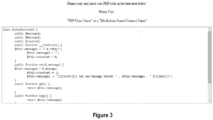
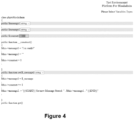
- Figure 3 and Figure 4 are screenshots illustrating sample source code which enables the above-mentioned steps of defining variable names, defining function names, and declaring variable types.
- Figure 3 and Figure 4 shall be construed to be exemplary in nature.
- Said figures illustrate sample source code written in PHP as per a preferred embodiment of the present invention.
- a class 'phptoblockchain' is first defined to declare the programming language as PHP, and thereafter variable names 'message 1', 'message 2', and 'countset', and functions names 'construct', 'get', 'set' and 'logs', are respectively defined.
- variables 'message 1' and 'message 2' are declared as strings and the variable 'countset' is declared as an integer. Further, variables outputted by the sample code or returned from the function defined as 'set' are declared to be strings. In case the instructions include special variable types which may not be recognized by PHP, such special variable types are declared using the software module.
- the inputted instructions are written in C#.
- the programming language firstly defined, i.e., it is first defined that the inputted instructions are written in C#.
- variable names and function names are defined, and variable types are declared.
- the instructions include special variable types which may not be recognized by C#, such special variable types are declared using the software module.
- the inputted instructions are converted or compiled to byte-code or operation code (opcode) that is compatible with the blockchain network 106 in which the code is to be deployed.
- opcode operation code
- the byte-code or opcode as the case maybe, is used to generate smart contract applications 107 which is in turn deployed to the blockchain network 108.
- variable names and function names enables deployment of smart contract applications to a blockchain network using traditional programming languages.
- function names further enables deployment of automatic instances of smart contracts by calling smart contract instances using function names.
- the function name is defined as "get()" and the instance name is "myinstance1”
- the smart contract is called using "myinstance1.get()”.
- the method as per the present invention can be used to deploy smart contract applications in a plurality of blockchain networks such as Ethereum, Quorum, Hyperledger Fabric, NEO, QTUM, Cardano, etc., using traditional programming languages such as PHP, C# and Visual Basic.
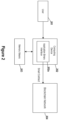
- FIG. 2 illustrates a schematic diagram of a system for deploying a smart contract to a blockchain network, as per a preferred embodiment of the present invention.
- the system comprises a computing device 202 and a memory means 203 operatively coupled to the computing device 202.
- the computing device 202 may be a personal computer, a portable device such as a tablet computer, a laptop, a smart phone, connected household device or any operating system based portable device.
- the operating system deployed on the computing device may be Windows, OSX, Linux, iOS, Android, or the like.
- the memory means 203 may be any internal or external device or web- based data storage mechanism adapted to store data.
- the memory means 203 is adapted to store a plurality of instructions written in a programming language agnostic to the blockchain network.
- Said programming language includes all traditional programming languages which are not designed specifically to work with a particular blockchain network.
- Such traditional programming languages include scripting languages such as PHP or Visual Basic or object-oriented programming languages such as C#.
- the computing device 202 is characterized by an application binary interface 202a.
- the application binary interface 202a is configured to receive the plurality of instructions inputted by a user 201 and to enable definition of a plurality of variable names and declare a plurality of variable types included in the plurality of instructions, define a plurality of function names included in the plurality of instructions, and define a plurality of variable names and declare a plurality of variable types outputted by the plurality of instructions.
- the application binary interface 202a provides means to define variable names and function names, and to declare variable types as illustrated in Figure 3 and Figure 4 .
- the application binary interface 202a initiates a software module comprising a predefined set of special variable types which can be used for declaring special variable types included in instructions written in all traditional programming languages. This is to ensure that all variable types can be declared, irrespective of whether the used traditional programming language recognizes all variable types that are inputted, for example special variable types such as "block", "address”, "balance”, etc. included in the instructions.
- the application binary interface 202a is further configured to convert the plurality of instructions to bytecode or opcode code compatible with the blockchain network and to generate the smart contract based on the bytecode or opcode code.
- the application binary interface 202a further provides means to select the blockchain network in which the user 201 intends to deploy the generated smart contract, The generated smart contract is thereafter deployed to the user selected blockchain network by the application binary interface 202a.
- the system and method as per the present invention is hence not tied to a blockchain network and can be used to deploy smart contracts in any programmable blockchain network such as Ethereum, Hyperledger Fabric, Quorum, NEO, QTUM, Cardano, etc..
- the apparatus described in the present disclosure may be implemented in hardware, firmware, software, or any combination thereof.
- the processing units, or processors(s) or controller(s) may be implemented within one or more application specific integrated circuits (ASICs), digital signal processors (DSPs), digital signal processing devices (DSPDs), programmable logic devices (PLDs), field programmable gate arrays (FPGAs), processors, controllers, micro-controllers, microprocessors, electronic devices, other electronic units designed to perform the functions described herein, or a combination thereof.
- ASICs application specific integrated circuits
- DSPs digital signal processors
- DSPDs digital signal processing devices
- PLDs programmable logic devices
- FPGAs field programmable gate arrays
- processors controllers, micro-controllers, microprocessors, electronic devices, other electronic units designed to perform the functions described herein, or a combination thereof.
- software codes may be stored in a memory and executed by a processor.
- Memory may be implemented within the processor unit or external to the processor unit.
- memory refers to any type of volatile memory or nonvolatile memory.
Landscapes
- Engineering & Computer Science (AREA)
- Computer Security & Cryptography (AREA)
- Theoretical Computer Science (AREA)
- General Health & Medical Sciences (AREA)
- Health & Medical Sciences (AREA)
- Bioethics (AREA)
- Signal Processing (AREA)
- Computer Hardware Design (AREA)
- Software Systems (AREA)
- Physics & Mathematics (AREA)
- General Engineering & Computer Science (AREA)
- General Physics & Mathematics (AREA)
- Computer Networks & Wireless Communication (AREA)
- Stored Programmes (AREA)
- Management, Administration, Business Operations System, And Electronic Commerce (AREA)
Claims (14)
- Von einem Computergerät implementiertes Verfahren zur Bereitstellung eines Smart Contracts in einem programmierbaren Blockchain-Netzwerk (204), wobei das Verfahren die folgenden Schritte umfasst:a) Eingeben (101) einer Vielzahl von Anweisungen, die in einer von dem Blockchain-Netzwerk (204) unabhängigen Programmiersprache geschrieben sind, wobei die Programmiersprache eine herkömmliche Programmiersprache ist, die nicht speziell für ein Blockchain-Netzwerk (204) entwickelt oder auf dieses zugeschnitten ist;b) Initialisieren (102) eines Softwaremoduls (202a), das einen vordefinierten Satz aus einer Vielzahl von speziellen Variablentypen umfasst, die von der Programmiersprache nicht erkannt werden und die Bereitstellung der Vielzahl von Anweisungen in dem Blockchain-Netzwerk ermöglichen;c) Definieren (103) einer Vielzahl von Variablen und Festlegen einer Vielzahl von Variablentypen, die in der Vielzahl von Anweisungen enthalten sind;d) Definieren (104) einer Vielzahl von Funktionsnamen, die in der Vielzahl von Anweisungen enthalten sind;e) Definieren (105) einer Vielzahl von Variablen und Festlegen einer Vielzahl von Variablentypen, die von der Vielzahl von Anweisungen ausgegeben werden;f) Umwandeln (106) der Vielzahl von Anweisungen, die alle definierten Variablen und festgelegten Variablentypen umfassen, zu Bytecode oder Operationscode, der mit dem Blockchain-Netzwerk (204) kompatibel ist;g) Erzeugen (107) des Smart Contracts basierend auf dem Bytecode oder dem Operationscode; undh) Bereitstellen (108) des erzeugten Smart Contracts in dem Blockchain-Netzwerk (204),wobei der vordefinierte Satz aus einer Vielzahl von speziellen Variablentypen verwendet werden kann, um die Variablentypen festzulegen.
- Verfahren nach Anspruch 1, wobei die Programmiersprache eine Skriptsprache ist.
- Verfahren nach Anspruch 1, wobei die Programmiersprache eine objektorientierte Programmiersprache ist.
- Verfahren nach Anspruch 1 bis 3, wobei es sich bei dem programmierbaren Blockchain-Netzwerk um Ethereum handelt.
- Verfahren nach Anspruch 1 bis Anspruch 3, wobei es sich bei dem programmierbaren Blockchain-Netzwerk um Quorum handelt.
- Verfahren nach Anspruch 1 bis 3, wobei es sich bei dem programmierbaren Blockchain-Netzwerk um Hyperledger Fabric handelt.
- Verfahren nach einem der vorhergehenden Ansprüche, wobei die Vielzahl von speziellen Variablentypen ,Adresse', ,Block' und 'Stand' beinhalten.
- System zur Bereitstellung eines Smart Contracts in einem programmierbaren Blockchain-Netzwerk (204), das System umfassend:ein Computergerät (202); undein Speichermittel (203), das mit dem Computergerät (202) operativ gekoppelt ist,wobei das Speichermittel dafür ausgelegt ist, eine Vielzahl von Anweisungen zu speichern, die in einer von dem Blockchain-Netzwerk (204) unabhängigen Programmiersprache geschrieben sind, wobei die Programmiersprache eine herkömmliche Programmiersprache ist, die nicht speziell für ein Blockchain-Netzwerk (204) entwickelt oder auf dieses zugeschnitten ist;wobei das Computergerät (202) eine Anwendungsbinärschnittstelle (202a) umfasst, die konfiguriert ist, die Vielzahl von Anweisungen zu empfangen, die von einem Benutzer eingegeben werden, ein Softwaremodul zu initialisieren, das einen vordefinierten Satz aus einer Vielzahl von speziellen Variablentypen umfasst, die von der Programmiersprache nicht erkannt werden und die Bereitstellung der Vielzahl von Anweisungen in dem Blockchain-Netzwerk (204) ermöglichen,eine Vielzahl von Variablennamen zu definieren und eine Vielzahl von Variablentypen festzulegen, die in der Vielzahl von Anweisungen enthalten sind, eine Vielzahl von Funktionsnamen zu definieren, die in der Vielzahl von Anweisungen enthalten sind, eine Vielzahl von Variablen zu definieren und eine Vielzahl von Variablentypen festzulegen, die durch die Vielzahl von Anweisungen ausgegeben werden, die Vielzahl von Anweisungen, die alle definierten Variablen und festgelegten Variablentypen umfassen, zu Bytecode oder Operationscode umzuwandeln, der mit dem Blockchain-Netzwerk (204) kompatibel ist, den Smart Contract basierend auf dem Bytecode oder dem Operationscode zu erzeugen, und den erzeugten Smart Contract in dem Blockchain-Netzwerk (204) bereitzustellen,wobei der vordefinierte Satz aus einer Vielzahl von speziellen Variablentypen verwendet werden kann, um die Variablentypen festzulegen.
- System nach Anspruch 8, wobei die Programmiersprache eine Skriptsprache ist.
- System nach Anspruch 8, wobei die Programmiersprache eine objektorientierte Programmiersprache ist.
- System nach Anspruch 8 bis 10, wobei es sich bei dem programmierbaren Blockchain-Netzwerk um Ethereum handelt.
- System nach Anspruch 8 bis 10, wobei es sich bei dem programmierbaren Blockchain-Netzwerk um Quorum handelt.
- System nach Anspruch 8 bis 10, wobei es sich bei dem programmierbaren Blockchain-Netzwerk um Hyperledger Fabric handelt.
- System nach einem der vorhergehenden Ansprüche, wobei die Vielzahl von speziellen Variablentypen ,Adresse', ,Block' und 'Stand' beinhalten.
Priority Applications (2)
| Application Number | Priority Date | Filing Date | Title |
|---|---|---|---|
| EP20182804.3A EP3933637B1 (de) | 2020-06-29 | 2020-06-29 | Verfahren und system zum einsatz eines intelligenten vertrags in einem blockchain-netzwerk |
| PCT/EP2022/025259 WO2023232216A1 (en) | 2020-06-29 | 2022-06-02 | Method and system for deploying a smart contract in a blockchain network |
Applications Claiming Priority (1)
| Application Number | Priority Date | Filing Date | Title |
|---|---|---|---|
| EP20182804.3A EP3933637B1 (de) | 2020-06-29 | 2020-06-29 | Verfahren und system zum einsatz eines intelligenten vertrags in einem blockchain-netzwerk |
Publications (4)
| Publication Number | Publication Date |
|---|---|
| EP3933637A1 EP3933637A1 (de) | 2022-01-05 |
| EP3933637A8 EP3933637A8 (de) | 2022-02-23 |
| EP3933637B1 true EP3933637B1 (de) | 2023-08-16 |
| EP3933637C0 EP3933637C0 (de) | 2023-08-16 |
Family
ID=71266461
Family Applications (1)
| Application Number | Title | Priority Date | Filing Date |
|---|---|---|---|
| EP20182804.3A Active EP3933637B1 (de) | 2020-06-29 | 2020-06-29 | Verfahren und system zum einsatz eines intelligenten vertrags in einem blockchain-netzwerk |
Country Status (2)
| Country | Link |
|---|---|
| EP (1) | EP3933637B1 (de) |
| WO (1) | WO2023232216A1 (de) |
Families Citing this family (2)
| Publication number | Priority date | Publication date | Assignee | Title |
|---|---|---|---|---|
| US20250078074A1 (en) * | 2023-08-30 | 2025-03-06 | Adobe Inc. | Using generative artificial intelligence for automated analysis of smart contracts on blockchain |
| CN117170677A (zh) * | 2023-09-01 | 2023-12-05 | 佛山市康颐福城市服务科技有限公司 | 智能合约的相似性检测方法、装置、设备和可读存储介质 |
Family Cites Families (2)
| Publication number | Priority date | Publication date | Assignee | Title |
|---|---|---|---|---|
| CN107844294B (zh) * | 2017-11-17 | 2020-05-19 | 杭州溪塔科技有限公司 | 一种高可用的合约执行方法及系统 |
| US20200201838A1 (en) * | 2018-12-20 | 2020-06-25 | Sri International | Middleware to automatically verify smart contracts on blockchains |
-
2020
- 2020-06-29 EP EP20182804.3A patent/EP3933637B1/de active Active
-
2022
- 2022-06-02 WO PCT/EP2022/025259 patent/WO2023232216A1/en not_active Ceased
Also Published As
| Publication number | Publication date |
|---|---|
| EP3933637A1 (de) | 2022-01-05 |
| EP3933637A8 (de) | 2022-02-23 |
| EP3933637C0 (de) | 2023-08-16 |
| WO2023232216A1 (en) | 2023-12-07 |
Similar Documents
| Publication | Publication Date | Title |
|---|---|---|
| EP3674954B1 (de) | Sicherheitssteuerungsverfahren und computersystem | |
| JP7450678B2 (ja) | アンロッキングトランザクションバイトコードの制約注入 | |
| Zheng et al. | Ethereum smart contract development in solidity | |
| Modi | Solidity Programming Essentials: A beginner's guide to build smart contracts for Ethereum and blockchain | |
| JP2009521020A (ja) | 高リスクアプリケーション用の実用的プラットフォーム | |
| CN111737304B (zh) | 一种区块链数据的处理方法、装置及设备 | |
| CN110210188A (zh) | Spring框架下代码加密方法、装置、设备及存储介质 | |
| WO2023232216A1 (en) | Method and system for deploying a smart contract in a blockchain network | |
| Chittoda | Mastering Blockchain Programming with Solidity: Write production-ready smart contracts for Ethereum blockchain with Solidity | |
| Bastys et al. | Tracking Information Flow via Delayed Output: Addressing Privacy in IoT and Emailing Apps | |
| CN113760294B (zh) | 应用软件加密部署方法和系统 | |
| Parno | Trust extension as a mechanism for secure code execution on commodity computers | |
| Di Pierro | web2py | |
| Modi | Solidity Programming Essentials: A guide to building smart contracts and tokens using the widely used Solidity language | |
| Runge et al. | Information flow control-by-construction for an object-oriented language | |
| US20240144228A1 (en) | Decentralized system for facilitating finding and recovery of lost and stolen properties | |
| Nurgaliyev et al. | Analysis of reverse engineering | |
| US8484232B2 (en) | Method, computer arrangement, computer program and computer program product for checking for the presence of control statements in a data value | |
| US20220309599A1 (en) | System and method for authorizing transfer requests of physical locations | |
| JP5863689B2 (ja) | 不正使用防止機能付き共有ライブラリ | |
| Iyer et al. | First steps with ethereum | |
| Lee | Storing Proofs Using Smart Contracts | |
| CN118133343A (zh) | 基于隐私保护的智能合约生成方法、装置、设备及介质 | |
| CN120470589A (zh) | 一种基于大模型的权限漏洞检测方法及其相关装置 | |
| Ureche et al. | Towards an implementation of information flow security using semantic web technologies |
Legal Events
| Date | Code | Title | Description |
|---|---|---|---|
| PUAI | Public reference made under article 153(3) epc to a published international application that has entered the european phase |
Free format text: ORIGINAL CODE: 0009012 |
|
| STAA | Information on the status of an ep patent application or granted ep patent |
Free format text: STATUS: THE APPLICATION HAS BEEN PUBLISHED |
|
| AK | Designated contracting states |
Kind code of ref document: A1 Designated state(s): AL AT BE BG CH CY CZ DE DK EE ES FI FR GB GR HR HU IE IS IT LI LT LU LV MC MK MT NL NO PL PT RO RS SE SI SK SM TR |
|
| B565 | Issuance of search results under rule 164(2) epc |
Effective date: 20201109 |
|
| RIN1 | Information on inventor provided before grant (corrected) |
Inventor name: FARES, SAMIR MORISS GERGES |
|
| STAA | Information on the status of an ep patent application or granted ep patent |
Free format text: STATUS: REQUEST FOR EXAMINATION WAS MADE |
|
| RAP3 | Party data changed (applicant data changed or rights of an application transferred) |
Owner name: BLOCKCHAIN 4 ALL LIMITED |
|
| 17P | Request for examination filed |
Effective date: 20220122 |
|
| RBV | Designated contracting states (corrected) |
Designated state(s): AL AT BE BG CH CY CZ DE DK EE ES FI FR GB GR HR HU IE IS IT LI LT LU LV MC MK MT NL NO PL PT RO RS SE SI SK SM TR |
|
| RAV | Requested validation state of the european patent: fee paid |
Extension state: TN Effective date: 20220804 Extension state: MD Effective date: 20220804 Extension state: MA Effective date: 20220804 Extension state: KH Effective date: 20220804 |
|
| RAX | Requested extension states of the european patent have changed |
Extension state: ME Payment date: 20220804 Extension state: BA Payment date: 20220804 |
|
| GRAP | Despatch of communication of intention to grant a patent |
Free format text: ORIGINAL CODE: EPIDOSNIGR1 |
|
| STAA | Information on the status of an ep patent application or granted ep patent |
Free format text: STATUS: GRANT OF PATENT IS INTENDED |
|
| GRAS | Grant fee paid |
Free format text: ORIGINAL CODE: EPIDOSNIGR3 |
|
| GRAA | (expected) grant |
Free format text: ORIGINAL CODE: 0009210 |
|
| STAA | Information on the status of an ep patent application or granted ep patent |
Free format text: STATUS: THE PATENT HAS BEEN GRANTED |
|
| INTG | Intention to grant announced |
Effective date: 20230626 |
|
| AK | Designated contracting states |
Kind code of ref document: B1 Designated state(s): AL AT BE BG CH CY CZ DE DK EE ES FI FR GB GR HR HU IE IS IT LI LT LU LV MC MK MT NL NO PL PT RO RS SE SI SK SM TR |
|
| REG | Reference to a national code |
Ref country code: CH Ref legal event code: EP Ref country code: DE Ref legal event code: R096 Ref document number: 602020015717 Country of ref document: DE |
|
| REG | Reference to a national code |
Ref country code: IE Ref legal event code: FG4D |
|
| U01 | Request for unitary effect filed |
Effective date: 20230907 |
|
| U07 | Unitary effect registered |
Designated state(s): AT BE BG DE DK EE FI FR IT LT LU LV MT NL PT SE SI Effective date: 20230918 |
|
| PG25 | Lapsed in a contracting state [announced via postgrant information from national office to epo] |
Ref country code: GR Free format text: LAPSE BECAUSE OF FAILURE TO SUBMIT A TRANSLATION OF THE DESCRIPTION OR TO PAY THE FEE WITHIN THE PRESCRIBED TIME-LIMIT Effective date: 20231117 |
|
| PG25 | Lapsed in a contracting state [announced via postgrant information from national office to epo] |
Ref country code: IS Free format text: LAPSE BECAUSE OF FAILURE TO SUBMIT A TRANSLATION OF THE DESCRIPTION OR TO PAY THE FEE WITHIN THE PRESCRIBED TIME-LIMIT Effective date: 20231216 |
|
| PG25 | Lapsed in a contracting state [announced via postgrant information from national office to epo] |
Ref country code: RS Free format text: LAPSE BECAUSE OF FAILURE TO SUBMIT A TRANSLATION OF THE DESCRIPTION OR TO PAY THE FEE WITHIN THE PRESCRIBED TIME-LIMIT Effective date: 20230816 Ref country code: NO Free format text: LAPSE BECAUSE OF FAILURE TO SUBMIT A TRANSLATION OF THE DESCRIPTION OR TO PAY THE FEE WITHIN THE PRESCRIBED TIME-LIMIT Effective date: 20231116 Ref country code: IS Free format text: LAPSE BECAUSE OF FAILURE TO SUBMIT A TRANSLATION OF THE DESCRIPTION OR TO PAY THE FEE WITHIN THE PRESCRIBED TIME-LIMIT Effective date: 20231216 Ref country code: HR Free format text: LAPSE BECAUSE OF FAILURE TO SUBMIT A TRANSLATION OF THE DESCRIPTION OR TO PAY THE FEE WITHIN THE PRESCRIBED TIME-LIMIT Effective date: 20230816 Ref country code: GR Free format text: LAPSE BECAUSE OF FAILURE TO SUBMIT A TRANSLATION OF THE DESCRIPTION OR TO PAY THE FEE WITHIN THE PRESCRIBED TIME-LIMIT Effective date: 20231117 |
|
| PG25 | Lapsed in a contracting state [announced via postgrant information from national office to epo] |
Ref country code: PL Free format text: LAPSE BECAUSE OF FAILURE TO SUBMIT A TRANSLATION OF THE DESCRIPTION OR TO PAY THE FEE WITHIN THE PRESCRIBED TIME-LIMIT Effective date: 20230816 |
|
| PG25 | Lapsed in a contracting state [announced via postgrant information from national office to epo] |
Ref country code: SM Free format text: LAPSE BECAUSE OF FAILURE TO SUBMIT A TRANSLATION OF THE DESCRIPTION OR TO PAY THE FEE WITHIN THE PRESCRIBED TIME-LIMIT Effective date: 20230816 Ref country code: RO Free format text: LAPSE BECAUSE OF FAILURE TO SUBMIT A TRANSLATION OF THE DESCRIPTION OR TO PAY THE FEE WITHIN THE PRESCRIBED TIME-LIMIT Effective date: 20230816 Ref country code: CZ Free format text: LAPSE BECAUSE OF FAILURE TO SUBMIT A TRANSLATION OF THE DESCRIPTION OR TO PAY THE FEE WITHIN THE PRESCRIBED TIME-LIMIT Effective date: 20230816 Ref country code: SK Free format text: LAPSE BECAUSE OF FAILURE TO SUBMIT A TRANSLATION OF THE DESCRIPTION OR TO PAY THE FEE WITHIN THE PRESCRIBED TIME-LIMIT Effective date: 20230816 |
|
| VS25 | Lapsed in a validation state [announced via postgrant information from nat. office to epo] |
Ref country code: MD Free format text: LAPSE BECAUSE OF FAILURE TO SUBMIT A TRANSLATION OF THE DESCRIPTION OR TO PAY THE FEE WITHIN THE PRESCRIBED TIME-LIMIT Effective date: 20230816 |
|
| REG | Reference to a national code |
Ref country code: DE Ref legal event code: R097 Ref document number: 602020015717 Country of ref document: DE |
|
| PLBE | No opposition filed within time limit |
Free format text: ORIGINAL CODE: 0009261 |
|
| STAA | Information on the status of an ep patent application or granted ep patent |
Free format text: STATUS: NO OPPOSITION FILED WITHIN TIME LIMIT |
|
| U20 | Renewal fee for the european patent with unitary effect paid |
Year of fee payment: 5 Effective date: 20240529 |
|
| PGFP | Annual fee paid to national office [announced via postgrant information from national office to epo] |
Ref country code: MC Payment date: 20240531 Year of fee payment: 5 |
|
| 26N | No opposition filed |
Effective date: 20240517 |
|
| PGFP | Annual fee paid to national office [announced via postgrant information from national office to epo] |
Ref country code: ES Payment date: 20240723 Year of fee payment: 5 |
|
| PGFP | Annual fee paid to national office [announced via postgrant information from national office to epo] |
Ref country code: IE Payment date: 20250629 Year of fee payment: 6 |
|
| U20 | Renewal fee for the european patent with unitary effect paid |
Year of fee payment: 6 Effective date: 20250629 |
|
| PG25 | Lapsed in a contracting state [announced via postgrant information from national office to epo] |
Ref country code: ES Free format text: LAPSE BECAUSE OF FAILURE TO SUBMIT A TRANSLATION OF THE DESCRIPTION OR TO PAY THE FEE WITHIN THE PRESCRIBED TIME-LIMIT Effective date: 20230816 |
|
| PGFP | Annual fee paid to national office [announced via postgrant information from national office to epo] |
Ref country code: GB Payment date: 20250722 Year of fee payment: 6 |
|
| PG25 | Lapsed in a contracting state [announced via postgrant information from national office to epo] |
Ref country code: CY Free format text: LAPSE BECAUSE OF FAILURE TO SUBMIT A TRANSLATION OF THE DESCRIPTION OR TO PAY THE FEE WITHIN THE PRESCRIBED TIME-LIMIT; INVALID AB INITIO Effective date: 20200629 |
|
| REG | Reference to a national code |
Ref country code: CH Ref legal event code: H13 Free format text: ST27 STATUS EVENT CODE: U-0-0-H10-H13 (AS PROVIDED BY THE NATIONAL OFFICE) Effective date: 20260127 |
|
| PG25 | Lapsed in a contracting state [announced via postgrant information from national office to epo] |
Ref country code: MC Free format text: LAPSE BECAUSE OF NON-PAYMENT OF DUE FEES Effective date: 20250630 |
|
| REG | Reference to a national code |
Ref country code: CH Ref legal event code: K11 Free format text: ST27 STATUS EVENT CODE: U-0-0-K10-K11 (AS PROVIDED BY THE NATIONAL OFFICE) Effective date: 20260209 Ref country code: CH Ref legal event code: U11 Free format text: ST27 STATUS EVENT CODE: U-0-0-U10-U11 (AS PROVIDED BY THE NATIONAL OFFICE) Effective date: 20260209 |
|
| VS25 | Lapsed in a validation state [announced via postgrant information from nat. office to epo] |
Ref country code: MA Free format text: FAILURE TO ELECT DOMICILE IN THE NATIONAL COUNTRY Effective date: 20231117 |
|
| PG25 | Lapsed in a contracting state [announced via postgrant information from national office to epo] |
Ref country code: HU Free format text: LAPSE BECAUSE OF FAILURE TO SUBMIT A TRANSLATION OF THE DESCRIPTION OR TO PAY THE FEE WITHIN THE PRESCRIBED TIME-LIMIT; INVALID AB INITIO Effective date: 20200629 |
|
| VS25 | Lapsed in a validation state [announced via postgrant information from nat. office to epo] |
Ref country code: MA Free format text: LAPSE BECAUSE OF FAILURE TO SUBMIT A TRANSLATION OF THE DESCRIPTION OR TO PAY THE FEE WITHIN THE PRESCRIBED TIME-LIMIT Effective date: 20230816 |
|
| PG25 | Lapsed in a contracting state [announced via postgrant information from national office to epo] |
Ref country code: CH Free format text: LAPSE BECAUSE OF NON-PAYMENT OF DUE FEES Effective date: 20250630 |
|
| PGFP | Annual fee paid to national office [announced via postgrant information from national office to epo] |
Ref country code: CH Payment date: 20260209 Year of fee payment: 6 |