EP3933340B1 - Arithmetic unit and parallax calculation method - Google Patents
Arithmetic unit and parallax calculation method Download PDFInfo
- Publication number
- EP3933340B1 EP3933340B1 EP20762283.8A EP20762283A EP3933340B1 EP 3933340 B1 EP3933340 B1 EP 3933340B1 EP 20762283 A EP20762283 A EP 20762283A EP 3933340 B1 EP3933340 B1 EP 3933340B1
- Authority
- EP
- European Patent Office
- Prior art keywords
- disparity
- image
- search unit
- unit
- invalid region
- Prior art date
- Legal status (The legal status is an assumption and is not a legal conclusion. Google has not performed a legal analysis and makes no representation as to the accuracy of the status listed.)
- Active
Links
Images





Classifications
-
- G—PHYSICS
- G01—MEASURING; TESTING
- G01C—MEASURING DISTANCES, LEVELS OR BEARINGS; SURVEYING; NAVIGATION; GYROSCOPIC INSTRUMENTS; PHOTOGRAMMETRY OR VIDEOGRAMMETRY
- G01C3/00—Measuring distances in line of sight; Optical rangefinders
- G01C3/10—Measuring distances in line of sight; Optical rangefinders using a parallactic triangle with variable angles and a base of fixed length in the observation station, e.g. in the instrument
- G01C3/14—Measuring distances in line of sight; Optical rangefinders using a parallactic triangle with variable angles and a base of fixed length in the observation station, e.g. in the instrument with binocular observation at a single point, e.g. stereoscopic type
-
- G—PHYSICS
- G06—COMPUTING OR CALCULATING; COUNTING
- G06T—IMAGE DATA PROCESSING OR GENERATION, IN GENERAL
- G06T7/00—Image analysis
- G06T7/50—Depth or shape recovery
- G06T7/55—Depth or shape recovery from multiple images
- G06T7/593—Depth or shape recovery from multiple images from stereo images
-
- H—ELECTRICITY
- H04—ELECTRIC COMMUNICATION TECHNIQUE
- H04N—PICTORIAL COMMUNICATION, e.g. TELEVISION
- H04N13/00—Stereoscopic video systems; Multi-view video systems; Details thereof
- H04N13/10—Processing, recording or transmission of stereoscopic or multi-view image signals
- H04N13/106—Processing image signals
- H04N13/128—Adjusting depth or disparity
-
- H—ELECTRICITY
- H04—ELECTRIC COMMUNICATION TECHNIQUE
- H04N—PICTORIAL COMMUNICATION, e.g. TELEVISION
- H04N13/00—Stereoscopic video systems; Multi-view video systems; Details thereof
- H04N13/20—Image signal generators
- H04N13/204—Image signal generators using stereoscopic image cameras
- H04N13/239—Image signal generators using stereoscopic image cameras using two two-dimensional [2D] image sensors having a relative position equal to or related to the interocular distance
-
- H—ELECTRICITY
- H04—ELECTRIC COMMUNICATION TECHNIQUE
- H04N—PICTORIAL COMMUNICATION, e.g. TELEVISION
- H04N13/00—Stereoscopic video systems; Multi-view video systems; Details thereof
- H04N13/20—Image signal generators
- H04N13/271—Image signal generators wherein the generated image signals comprise depth maps or disparity maps
-
- G—PHYSICS
- G06—COMPUTING OR CALCULATING; COUNTING
- G06T—IMAGE DATA PROCESSING OR GENERATION, IN GENERAL
- G06T2207/00—Indexing scheme for image analysis or image enhancement
- G06T2207/10—Image acquisition modality
- G06T2207/10004—Still image; Photographic image
- G06T2207/10012—Stereo images
-
- H—ELECTRICITY
- H04—ELECTRIC COMMUNICATION TECHNIQUE
- H04N—PICTORIAL COMMUNICATION, e.g. TELEVISION
- H04N13/00—Stereoscopic video systems; Multi-view video systems; Details thereof
- H04N2013/0074—Stereoscopic image analysis
- H04N2013/0081—Depth or disparity estimation from stereoscopic image signals
Definitions
- the present invention relates to an operation device and a disparity calculation method.
- a position measurement device that measures a distance to an object present in a field of view of a camera using a stereo image captured by a stereo camera having a pair of cameras on the basis of the principle of triangulation. That is, in the principle of triangulation, the distance from the camera to the object is calculated using a positional deviation between images of the same object captured by the left and right cameras, that is, disparity.
- the disparity is derived by identifying any place where an image on one image of the object exists on the other image.
- disparity calculation can be determined according to an application such as one disparity for a plurality of pixels and one disparity for one pixel.
- an application such as one disparity for a plurality of pixels and one disparity for one pixel.
- it is difficult to determine which one is a correct disparity it is difficult to determine which one is a correct disparity, and there is a problem that the disparity of the region has to be determined to be invalid, that is, a problem of a so-called invalid disparity.
- PTL 1 discloses a disparity image generation device including a valid pixel determination unit that determines a valid pixel based on a feature value of each pixel in a captured image; and a validation unit that validates a disparity that is not a valid disparity in the vicinity of a valid disparity equivalent to the valid pixel in a disparity image corresponding to the captured image.
- nPTL1 and nPTL2 each disclose a method for identification of invalid regions and a weigh-based disparity adjustment.
- the disparity is determined without using a dissimilarity calculation result of a block for which a disparity calculation has failed, and thus, there may occur a problem in the validity and accuracy of the determined disparity.
- the appropriate disparity can be calculated.
- FIGS. 1 to 5 a first embodiment of an operation device 1 according to the present invention will be described with reference to FIGS. 1 to 5 .
- FIG. 1 is a hardware configuration diagram of a vehicle 9 on which an operation device 1 according to the present invention is installed.
- the vehicle 9 includes the operation device 1, a left camera 2, a right camera 3, and a vehicle control device 4.
- the operation device 1 and the vehicle control device 4 are electronic control units.
- the left camera 2 and the right camera 3 output captured images obtained by capturing the surroundings of the vehicle 9 to the operation device 1.
- the left camera 2 and the right camera 3 are arranged side by side in the horizontal direction.
- the image captured by the left camera 2 will be referred to as a left image 21, and the image captured by the right camera 3 will be referred to as a right image 31.
- the left camera 2 will be referred to as a "first camera”
- the right camera 3 will be referred to as a "second camera", in some cases.
- the operation device 1 includes a CPU 11 that is a central processing unit, a ROM 12 that is a read-only storage device, a RAM 13 that is a readable/writable storage device, and an interface 14 that receives the left image 21 and the right image 31.
- the CPU 11 develops and executes a program, stored in the ROM 12, in the RAM 13, thereby realizing a plurality of functions to be described later.
- the operation device 1 may be realized by a field programmable gate array (FPGA) which is a rewritable logic circuit or an application specific integrated circuit (ASIC) which is an integrated circuit for a specific application.
- the operation device 1 may be realized by a combination of different configurations, for example, a combination of the CPU 11, the ROM 12, the RAM 13, and the FPGA, instead of the combination of the CPU 11, the ROM 12, and the RAM 13.
- the operation device 1 creates a temporary distance image 41 using the input left image 21 and right image 31, and outputs the temporary distance image 41 to the vehicle control device 4.
- a process in which the operation device 1 creates the temporary distance image 41 will be described later in detail with reference to FIG. 2 and subsequent drawings.
- the temporary distance image 41 represents the closeness or distantness of the distance on the two-dimensional plane with the gray scale of color or the saturation of color.
- each pixel of the temporary distance image 41 stores an integer value of "0" to "255" representing the gray scale in the present embodiment.
- "0" is a special numerical value indicating that the distance is not calculable.
- a range illustrated in the temporary distance image 41 is substantially the same as those of the left image 21 and the right image 31. However, the range illustrated in the temporary distance image 41 may be narrower than ranges illustrated in the left image 21 and the right image 31.
- the number of pixels of the temporary distance image 41 may be substantially the same as or a fraction of those of the left image 21 and the right image 31.
- the vehicle control device 4 controls the vehicle 9 using the temporary distance image 41 input from the operation device 1.
- the vehicle control device 4 detects an obstacle present around the vehicle 9 from the temporary distance image 41, and controls the vehicle 9 so as to avoid a collision between the vehicle 9 and the detected obstacle.
- the control of the vehicle 9 by the vehicle control device 4 is realized, for example, as the vehicle control device 4 outputs an operation command to a steering device (not illustrated) and a braking device (not illustrated).
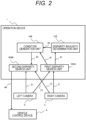
- FIG. 2 is a functional block diagram illustrating functions of the operation device 1 as functional blocks.
- the operation device 1 includes, as its functions, a first disparity search unit 103A, a second disparity search unit 103B, a disparity invalidity determination unit 105, and a condition generation unit 106.
- the first disparity search unit 103A, the second disparity search unit 103B, the disparity invalidity determination unit 105, and the condition generation unit 106 are realized by software processing with the above-described CPU 11. Note that information generated by the processing to be described later, for example, the temporary distance image 41, information 42 indicating an invalid region, a search condition 43, and a distance image 44 are temporarily stored in the RAM 13.
- the left image 21 and the right image 31 are input to the first disparity search unit 103A.
- the first disparity search unit 103A sets one of the left image 21 and the right image 31 as a standard image and the other as a reference image.
- the first disparity search unit 103A may select either the left image 21 or the right image 31 as the standard image, but this selection is made consistent in the present embodiment.
- the first disparity search unit 103A searches for a region of the reference image corresponding to a pixel block of the standard image.
- a known technique is used for this search.
- the first disparity search unit 103A calculates a dissimilarity by Zero-mean Sum of Absolute Differences (ZSAD), and searches for a region on the reference image having the smallest ZSAD value.
- ZSAD Zero-mean Sum of Absolute Differences
- the first disparity search unit 103A may search for all regions on an epipolar line or may search for only a predetermined range on the epipolar line.
- a size of a pixel block searched by the first disparity search unit 103A may be 1 pixel ⁇ 1 pixel, that is, one pixel, or may be 4 pixels ⁇ 4 pixels, 8 pixels ⁇ 8 pixels, 16 pixels ⁇ 25 pixels, or the like. Note that the size of the pixel block is also referred to as a size of a "first pixel block".
- the first disparity search unit 103A may use any one of Sum of Absolute Differences (SAD), Sum of Squared Differences (SSD), Zero-mean Sum of Squared Differences (ZSSD), Normalized Cross Correlation (NCC), and Zero-mean Normalized Cross Correlation (ZNCC) instead of ZSAD.
- SAD Sum of Absolute Differences
- SSD Sum of Squared Differences
- ZSSD Zero-mean Sum of Squared Differences
- NCC Normalized Cross Correlation
- ZNCC Zero-mean Normalized Cross Correlation
- the first disparity search unit 103A calculates a disparity for each pixel block to create the temporary distance image 41. However, when it is difficult to determine a disparity, the first disparity search unit 103A sets a pixel value of the temporary distance image 41 corresponding to such a pixel block to a special value indicating that the disparity is not calculable, for example, "0". Note that the first disparity search unit 103A may use the calculated disparity directly as the value of each pixel of the temporary distance image 41, or may perform scale conversion on the disparity value such that the minimum value to the maximum value are 1 to 255. Note that the operation of the first disparity search unit 103A is performed in units of first pixel blocks, the temporary distance image 41 is also output in units of first pixel blocks.
- the disparity invalidity determination unit 105 identifies a pixel whose disparity is invalidated in the temporary distance image 41, that is, a pixel whose pixel value is set to "0", from the temporary distance image 41.
- a region of the pixel whose disparity is invalidated is referred to as an "invalid region”.
- the disparity invalidity determination unit 105 outputs the information 42 indicating the invalid region to the condition generation unit 106.
- the condition generation unit 106 When the information 42 indicating the invalid region is input from the disparity invalidity determination unit 105, the condition generation unit 106 generates the search condition 43 using the temporary distance image 41 generated by the first disparity search unit 103A and outputs the search condition 43 to the second disparity search unit 103B. An operation of the condition generation unit 106 will be described later.
- the left image 21, the right image 31, and the search condition 43 are input to the second disparity search unit 103B.
- the second disparity search unit 103B searches for a region of the reference image corresponding to the invalid region of the standard image according to the search condition 43. Although a detailed operation of the second disparity search unit 103B will be described later, the second disparity search unit 103B uses ZSAD or the like similarly to the first disparity search unit 103A.
- the second disparity search unit 103B generates the distance image 44 by the operation and outputs the distance image 44 to the vehicle control device 4.
- the second disparity search unit 103B may recalculate a disparity value of a pixel block whose disparity has been calculated by the first disparity search unit 103A, or may receive the temporary distance image 41 from the first disparity search unit 103A and use the calculation result.
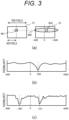
- FIG. 3 is a conceptual view illustrating a disparity determination performed by the first disparity search unit 103A.
- FIG. 3(a) illustrates the left image 21 and the right image 31.
- a region of a reference image corresponding to a region 901 of the left image 21, which is a standard image, that is, a region of the right image 31 is searched for.
- the epipolar line is a broken line indicated by reference sign 902 extending in the horizontal direction.
- each width of the left image 21 and the right image 31 in the lateral direction in the drawing is 1000 pixels and the center of the region 901 is located at the 400-th pixel from the left end
- numerical values of -400 to +600 are assigned to the right image 31, which is the reference image, as illustrated in the drawing.
- a disparity is calculated as "100".
- FIG. 3(b) is a view illustrating an example of a dissimilarity with the region 901 for each position on the broken line 902 of the reference image.
- FIG. 3(c) is a view illustrating another example of the dissimilarity with the region 901 for each position on the broken line 902 of the reference image.
- there are two peaks having the minimum dissimilarity and values thereof are substantially the same, it is difficult to determine whether the disparity of the region 901 is "-180" or "+115".
- the first disparity search unit 103A sets the region 901 as an invalid region, and sets "0" at a position corresponding to the region 901 of the temporary distance image 41.
- FIG. 4 is a conceptual view for describing operations of the condition generation unit 106 and the second disparity search unit 103B.
- the condition generation unit 106 When receiving the information 42 indicating an invalid region from the disparity invalidity determination unit 105, the condition generation unit 106 refers to the temporary distance image 41 to determine a disparity candidate value of the invalid region.
- the disparity candidate value is determined based on one or more disparity values set in the periphery of the invalid region in the temporary distance image 41.
- the periphery of the invalid region may be a region adjacent to the invalid region, or may be a region which is not adjacent to the invalid region in the periphery of the invalid region.
- a specific operation will be described hereinafter assuming that a disparity value of a region adjacent to the right side of the invalid region is adopted as a candidate standard value.
- a range of plus or minus 20 pixels from the standard value is set as candidates in the present embodiment.
- the condition generation unit 106 sets disparity candidate values to "80 to 120" by adding plus and minus 20 to "100". That is, the search condition 43 in this case is information indicating that the "disparity value candidates of the region 901 are 80 to 120". Note that, in practice, information of an X coordinate and a Y coordinate in the standard image of the region 901, for example, is stored such that the region 901 can be identified.
- the second disparity search unit 103B that has received the search condition 43 searches for the disparity of the region 901 of the standard image within the range of the disparity 80 to 120. For example, there are two peaks in the example illustrated in FIG. 3(c) since the entire region is set as a target, but the disparity can be identified as "115" by performing a search only in the range of the disparity 80 to 120 as illustrated in FIG. 4(b) . Therefore, the disparity of the invalid region can be identified as illustrated on the right side of FIG. 4(a) .
- FIG. 5 is a flowchart illustrating an operation of the operation device 1 according to the present embodiment. Meanwhile, FIG. 5 describes only processing of one pixel block in order to simplify the notation and the description. In practice, the operation device 1 sequentially changes processing target pixel blocks in a standard image and executes the processing illustrated in FIG. 5 for the entire region of the standard image.
- the first disparity search unit 103A calculates a dissimilarity of each of blocks of a reference image arranged side by side in the horizontal direction in the processing target pixel block, and detects a peak indicating the minimum value thereof.
- the first disparity search unit 103A determines whether the obtained peak is a valid value that needs to be adopted as a disparity. For example, the first disparity search unit 103A determines a peak value as invalid when a plurality of peaks are obtained and there is a peak indicating a value close to the minimum value in addition to a peak indicating the minimum value of the dissimilarity.
- the first disparity search unit 103A sets a disparity value corresponding to the peak value in the temporary distance image 41 and the distance image 44 and outputs the disparity value (S307), and ends the processing illustrated in FIG. 5 .
- step S302 determines the peak value as invalid in step S302 (S302: NO)
- a special value indicating that the disparity is not calculable for example, "0" is set and output for the processing target pixel block in the temporary distance image 41. Therefore, the processing target pixel block is detected by the disparity invalidity determination unit 105, and information for identifying the processing target pixel block is described in the information 42 indicating an invalid region and output to the condition generation unit 106.
- the condition generation unit 106 reads a disparity of the invalid region in the temporary distance image 41, that is, a pixel block adjacent to the processing target pixel block, and adds a predetermined width, for example, plus or minus 20 pixels to a value of the disparity to determine the search condition 43 as a disparity candidate, that is, a search range.
- the second disparity search unit 103B Since the condition generation unit 106 outputs the search condition 43 to the second disparity search unit 103B, the second disparity search unit 103B performs a search again according to the search condition 43 in step S304. Specifically, the second disparity search unit 103B calculates a dissimilarity in the range set in the search condition 43 similarly to step S301 to detect a peak. In subsequent S305, the second disparity search unit 103B determines whether the obtained peak is a valid value that needs to be adopted as a disparity similarly to step S302.
- the second disparity search unit 103B sets a disparity value corresponding to the peak value in the processing target pixel block of the distance image 44 and outputs the disparity value, and ends the processing illustrated in FIG. 5 .
- the second disparity search unit 103B sets a special value indicating that the disparity is not calculable, for example, "0", in the processing target pixel block of the distance image 44 and outputs the special value, and ends the processing illustrated in FIG. 5 .
- the vehicle control device 4 is not necessarily installed on the vehicle 9.
- any device that uses the temporary distance image 41 may be installed on the vehicle 9.
- a display device that presents the temporary distance image 41 to an occupant of the vehicle 9 may be installed, or a wireless communication device that transmits the temporary distance image 41 to the outside of the vehicle 9 may be installed.
- the above-described functional configuration of the operation device 1 is merely an example. Some functional configurations illustrated in FIG. 2 may be integrated, or a configuration illustrated in one functional block diagram in FIG. 2 may be divided into two or more functions.
- the first disparity search unit 103A and the second disparity search unit 103B having similar operations may be integrated. Note that the "integration" includes using a hardware arithmetic circuit and software in an overlapping manner.
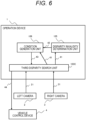
- FIG. 6 is a functional configuration diagram of the operation device 1 according to a second modification.
- the operation device 1 includes a third disparity search unit 103C in which the first disparity search unit 103A and the second disparity search unit 103B are integrated, instead of the first disparity search unit 103A and the second disparity search unit 103B.
- the third disparity search unit 103C changes an operation depending on whether or not the search condition 43 is input from the condition generation unit 106.
- the third disparity search unit 103C operates as the first disparity search unit 103A when the search condition 43 is not input from the condition generation unit 106, and operates as the second disparity search unit 103B when the search condition 43 is input from the condition generation unit 106.
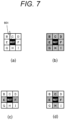
- FIG. 7 is a view illustrating a pixel block referred to by the condition generation unit 106 according to a third modification.
- the condition generation unit 106 may refer to a plurality of regions to determine a disparity candidate value as illustrated in FIGS. 7(b) to 7(d) .
- FIG. 7(a) is a view for describing a name of a pixel block.
- FIG. 7(a) is a view illustrating a certain invalid region 901 and a pixel block adjacent to the invalid region 901, and names of B to I as one alphabet are assigned to eight pixel blocks adjacent to the invalid region 901. Only the pixel block on the right of the invalid region 901 is referred to in the first embodiment, which corresponds to referring to only the block F in FIG. 7(a) .
- the condition generation unit 106 may select two or more regions adjacent to the invalid region 901 and use disparity values stored in the selected regions as standard values as illustrated in FIGS. 7(b) to 7(d) .
- the condition generation unit 106 may adopt disparity values of all the regions B to I as standard values. This is advantageous when there is a margin in calculation cost.
- the condition generation unit 106 may use disparity values of the region E and the region F arranged in the horizontal direction as standard values. This is a technique using the fact that adjacent regions in the horizontal direction have close disparities, and can be performed at lower calculation cost than a technique illustrated in FIG. 7(b) .
- condition generation unit 106 may adopt only the disparity values of the upper, lower, left, and right regions of the invalid region, that is, the regions C, E, F, and H as the standard values as illustrated in FIG. 7(d) .
- a technique illustrated in FIG. 7(d) can be realized at intermediate calculation cost between those of FIG. 7(b) and FIG. 7(c) , and an intermediate effect between those of FIG. 7(b) and FIG. 7(c) can be obtained.
- FIG. 7(c) a specific example of a technique illustrated in FIG. 7(c) will be described.
- FIG. 8 is a view illustrating a specific example in which the condition generation unit 106 sets a disparity value of a pixel block adjacent to the invalid region 109 in the horizontal direction as a standard value, and corresponds to FIG. 4 in the first embodiment.
- the condition generation unit 106 sets disparity candidate values as "80 to 120" and "160 to 200" by adding plus or minus 20 to each of "100" and "180". That is, the search condition 43 in this case is information indicating that the "disparity value candidates of the region 901 are 80 to 120 and 160 to 200".
- the second disparity search unit 103B that has received the search condition 43 searches for the disparity of the region 901 of the standard image within the ranges of the disparities 80 to 120 and the disparities 160 to 200. Note that there is no peak of a local minimum value in the disparity 160 to 200 in the example illustrated in FIG. 8(b) , and thus, the output of the second disparity search unit 103B is similar to that of the first embodiment.
- a pixel block referred to by the condition generation unit 106 is not limited to a block adjacent to an invalid region.
- FIG. 9 is a view illustrating an example in which the condition generation unit 106 refers to a pixel block other than the pixel block adjacent to the invalid region.
- three pixel blocks existing at the center that is, pixel blocks 601 to 603, are invalid regions, and a pixel block 605 and a pixel block 607 existing on the left thereof and a pixel block 604 and a pixel block 606 existing on the right thereof are not invalid regions.
- the condition generation unit 106 refers to a pixel block that is closest to the processing target pixel block and is not an invalid region. Since both the pixel block 602 and the pixel block 603 adjacent to the processing target pixel block 601 are the invalid regions in the example illustrated in FIG. 9 , either the pixel block 604 or the pixel block 605 that is second closest to the processing target pixel block is referred to.
- the second disparity search unit 103B performs a search similarly to the first disparity search unit 103A although a region to be searched is narrow.
- the second disparity search unit 103B may simply perform a selection by simplifying a calculation using past calculation progress. In this case, the second disparity search unit 103B acquires the calculation progress from the first disparity search unit 103A.
- FIG. 10 is a functional configuration diagram of the operation device 1 according to a fifth modification.
- the functional configuration diagram illustrated in FIG. 10 is different from FIG. 2 in that calculation progress 45 is output from the first disparity search unit 103A to the second disparity search unit 103B.
- an operation of the first disparity search unit 103A and an operation of the second disparity search unit 103B are different from those of the first embodiment as follows.
- the first disparity search unit 103A outputs a plurality of disparity candidates, that is, disparity values whose dissimilarities have the minimum value, for a pixel block whose disparity is not determinable. For example, in the example illustrated in FIG. 3(c) , the first disparity search unit 103A outputs information indicating that "the invalid region 901 of the 400-th pixel from the left has disparity candidates of -180 and +115" as the calculation progress 45.
- the second disparity search unit 103B determines a disparity using the search condition 43 and the calculation progress 45. Specifically, the second disparity search unit 103B selects the disparity included in the search condition 43 based on the calculation progress 45. For example, in a case where the calculation progress 45 is the above-described information and the search condition 43 is that "disparity value candidates of the region 901 are 80 to 120", the second disparity search unit 103B selects "+115" included in the range of "80 to 120" based on two values of "-180" and "+115" as the disparity of the region 901.
- FIG. 11 is a flowchart illustrating an operation of the operation device 1 according to the fifth modification.
- FIG. 11 corresponds to FIG. 5 according to the first embodiment.
- step S304A is executed instead of step S304.
- the second disparity search unit 103B determines a disparity using the search condition 43 and the calculation progress 45 as described above. However, in a case where none of the calculation progress 45 falls within a disparity range included in the search condition 43, the second disparity search unit 103B determines a special value indicating that the disparity is not calculable, for example, "0". Since processing other than step S304A is similar to that of the first embodiment, the description thereof is omitted.
- the first disparity search unit 103A outputs the disparity candidate of the invalid region to the second disparity search unit 103B as calculation progress.
- the second disparity search unit 103B selects one disparity candidate from the calculation progress 45 using disparity candidates included in the search condition 43, and sets the selected disparity candidate as a disparity of the invalid region. Therefore, the second disparity search unit 103B does not need to calculate a dissimilarity again, and the operation amount of the second disparity search unit 103B can be reduced.
- a smaller pixel block is defined as a second pixel block in the fifth modification of the first embodiment.
- the first pixel block is 4 pixels ⁇ 4 pixels
- the second pixel block is 1 pixel ⁇ 1 pixel.
- the operation device 1 may further calculate a disparity of the second pixel block included in the first pixel block using a disparity of the first pixel block.
- configurations overlapping with the fifth modification, particularly, an operation in which the second disparity search unit 103B selects a disparity value using the calculation progress 45 will not be described.
- the disparity value of the invalid region selected by the second disparity search unit 103B using the calculation progress 45 is also referred to as a "temporary disparity".
- FIG. 12 is a functional configuration diagram of the operation device 1 according to a sixth modification.
- the operation device 1 further includes a fourth disparity search unit 103D.
- the present embodiment is different from the fifth modification in that the second disparity search unit 103B outputs the distance image 44 to the fourth disparity search unit 103D instead of the vehicle control device 4.
- the fourth disparity search unit 103D generates a detailed distance image 46 storing distance information in units of second pixel blocks, and outputs the generated detailed distance image 46 to the vehicle control device 4.
- FIG. 13 is a view for describing an operation of the fourth disparity search unit 103D according to the sixth modification.
- Each of nine blocks A to I illustrated on the left side of FIG. 13 has a size of a first pixel block, for example, 4 pixels ⁇ 4 pixels.
- Each of sixteen blocks a00 to a33 illustrated on the right side of FIG. 13 has a size of the second pixel block, for example, 1 pixel ⁇ 1 pixel.
- the distance information is stored in units of the first pixel blocks in the distance image 44, and the distance information is stored in units of the second pixel block in the detailed distance image 46. Therefore, it can be said that the left and right of FIG. 13 correspond to the distance image 44 and a part of the detailed distance image 46, respectively.
- the fourth disparity search unit 103D calculates detailed distance information as illustrated in FIG. 13 for all the pixel blocks constituting the distance image 44.
- a relationship between the block A illustrated on the left of FIG. 13 and each of the blocks a00 to a33 illustrated on the right of FIG. 13 is referred to as a higher-level/lower-level relationship.
- a wider region has a higher level.
- a higher-level block of the block a00 is the block A
- lower-level blocks of the block A are the blocks a00 to a33.
- the fourth disparity search unit 103D calculates a dissimilarity similarly to the first disparity search unit 103A, identifies a corresponding region in a reference image, and calculates a disparity. Meanwhile, the fourth disparity search unit 103D searches only a predetermined range based on a disparity of A which is the higher-level block when searching for the region corresponding to a00 to a33 from the reference image. For example, when the disparity of the block A is "+115", only a range of "+95 to +135" is searched as a range of plus or minus 20 pixels. However, when the disparity of the higher-level block is not calculated, the fourth disparity search unit 103D may determine that the disparity of the corresponding lower-level block is not calculable, or may search all points on an epipolar line without identifying a range.
- a size of a target block and a source of information for restricting a search range are different.
- the size of the target block is the unit of the first pixel block in the second disparity search unit 103B and the unit of the second pixel block in the fourth disparity search unit 103D.
- the source of the information for restricting the search range is the search condition 43 in the second disparity search unit 103B, and the disparity of the corresponding higher-level block in the fourth disparity search unit 103D.
- a size of a second block is smaller than a size of a first block.
- the first disparity search unit 103A outputs candidate values, which are the disparity candidates of the invalid region, to the second disparity search unit 103B as the calculation progress 45.
- the second disparity search unit 103B selects one of the candidate values using the disparity candidates to set the selected candidate value as a temporary disparity
- the fourth disparity search unit 103D calculates a disparity of the second block included in the invalid region using a predetermined range from the temporary disparity as a search range. Therefore, even when the disparity has not been obtained with the size of the first block, the operation device 101 can first calculate a temporary disparity by the second disparity search unit 103B using peripheral disparity information, and calculate the disparity of the second block using the temporary disparity.
- the second disparity search unit 103B calculates the temporary disparity using the calculation progress 45 in the present modification, but the second disparity search unit 103B may calculate a dissimilarity of an invalid region again without using the calculation progress 45 as in the first embodiment.
- second disparity search unit 103B and the fourth disparity search unit 103D have been described as different configurations in the present modification, but may be integrated.
- the condition generation unit 106 causes the search condition 43 to include the information indicating the range set for the standard value of the disparity candidate.
- the search condition 43 may include a standard value of a disparity candidate without including range information, and the second disparity search unit 103B may determine a range based on the standard value.
- the search condition 43 of the first embodiment is the information indicating that "candidates for disparity values of the region 901 are 80 to 120", for example.
- the search condition 43 may be information indicating that "a standard value of a disparity value of the region 901 is 100", and the second disparity search unit 103B may set a range of "80 to 120" by setting plus or minus 20 with "100" as the center.
- the first disparity search unit 103A and the second disparity search unit 103B may generate and output whether or not a valid disparity has not been calculated independently of the temporary distance image 41 and the distance image 44.
- at least one of the temporary distance image 41, the information 42 indicating an invalid region, the search condition 43, and the distance image 44 may be stored in a storage device (not illustrated) existing outside the operation device 1 in a process of calculation.
- a second embodiment of an operation device according to the present invention will be described with reference to FIGS. 14 to 15 .
- a difference will mainly be described by applying the same reference signs to the same constituent elements as those of the first embodiment.
- a point not specifically described is the same as that of the first embodiment.
- the present embodiment is different from the sixth modification of the first embodiment mainly in terms of including a fifth disparity search unit that creates the detailed distance image 46 without passing through the distance image 44.
- a size of a first block is larger than 1 pixel ⁇ 1 pixel
- a second block size is defined as a size smaller than the first block size, which is similar to the sixth modification.
- FIG. 14 is a functional configuration diagram of the operation device 1A according to the second embodiment.
- a difference from FIG. 2 in the first embodiment is that a fifth disparity search unit 103E is provided instead of the second disparity search unit 103B.
- a function of the fifth disparity search unit 103E substantially corresponds to a combination of the function of the second disparity search unit 103B and the function of the fourth disparity search unit 103D in the sixth modification. Details of an operation of the fifth disparity search unit 103E will be described later.
- the first disparity search unit 103A also outputs the calculated temporary distance image 41 to the fifth disparity search unit 103E.
- the left image 21, the right image 31, the temporary distance image 41, and the search condition 43 are input to the fifth disparity search unit 103E.
- the fifth disparity search unit 103E outputs the detailed distance image 46 to the vehicle control device 4. Operations of the disparity invalidity determination unit 105 and the condition generation unit 106 are similar to those in the first embodiment.
- the fifth disparity search unit 103E calculates, for each first pixel block constituting the temporary distance image 41, distance information with a higher resolution, that is, disparities of a plurality of second pixel blocks. At this time, when a disparity is set in a first pixel block set as a processing target, the fifth disparity search unit 103E determines a range in which a disparity of a second pixel block is searched for based on the disparity value. In addition, when the disparity is not set in the first pixel block set as the processing target, in other words, when the first pixel block as the processing target is an invalid region, the fifth disparity search unit 103E searches a range set in the search condition 43.
- FIG. 15 is a flowchart illustrating an operation of the operation device 1A according to the second embodiment.
- steps S301 to S307 are processes for each first pixel block
- step S351 and the subsequent steps are processes for each second pixel block.
- symbols of repetitive processes are omitted for the brief description in the flowchart to be described later, in practice, the processes of steps S301 to S307 are executed for all the first pixel blocks constituting a standard image, and the processes in step S351 and the subsequent steps are executed for all the second pixel blocks constituting the temporary distance image 41. That is, a "processing target" in steps S301 to S307 is each first pixel block, and a "processing target” in step S351 and the subsequent steps is each second pixel block.
- the first disparity search unit 103A sets a first pixel block included in the standard image as a processing target, calculates a dissimilarity of each of blocks of a reference image arranged side by side in the horizontal direction, and detects a peak indicating a minimum value thereof.
- the first disparity search unit 103A determines whether the obtained peak is a valid value that needs to be adopted as a disparity.
- the first disparity search unit 103A sets a disparity value corresponding to the peak value as a value of the processing target pixel block of the temporary distance image 41 and outputs the value (S307), and proceeds to step S351.
- step S302 When the first disparity search unit 103A determines the peak value as invalid in step S302 (S302: NO), a special value indicating that the disparity is not calculable, for example, "0" is set and output for the processing target pixel block in the temporary distance image 41. Therefore, the processing target pixel block is detected by the disparity invalidity determination unit 105, and information for identifying the processing target pixel block is described in the information 42 indicating an invalid region and output to the condition generation unit 106. In subsequent step S303, the condition generation unit 106 reads a disparity of the invalid region in the temporary distance image 41, that is, a pixel block adjacent to the processing target pixel block.
- condition generation unit 106 adds a predetermined width, for example, plus or minus 20 pixels, to the disparity value to determine the search condition 43 as disparity candidates, that is, a search range, outputs the determined search condition 43 to the fifth disparity search unit 103E, and proceeds to step S351.
- step S351 the fifth disparity search unit 103E calculates a dissimilarity with a second pixel block included in the standard image as a processing target.
- the process in step S351 is similar to that in step S301, except that a disparity candidate value is used.
- the disparity candidate value used by the fifth disparity search unit 103E will be described.
- the disparity candidate value used to calculate the dissimilarity is based on a disparity value set in a higher-level pixel block of a processing target pixel block in the temporary distance image 41.
- the disparity of the higher-level pixel block of the processing target pixel block is set to "100" in the temporary distance image 41
- "100” is set as a standard value, and a predetermined range with the standard value as the center, for example, "80 to 120" obtained by adding plus or minus 20 pixels is set as the disparity candidate value.
- the fifth disparity search unit 103E sets a value described in the search condition 43 as the disparity candidate value.
- the case where the disparity is not set in the higher-level pixel block is, for example, a case where a special value indicating that the disparity is not calculable, for example, "0" is set. It is sufficient for the fifth disparity search unit 103E to calculate the dissimilarity only for the disparity candidate value, and thus, the calculation accuracy of the disparity can be improved while reducing the amount of calculation.
- step S352 the fifth disparity search unit 103E determines whether or not a peak obtained similarly to step S302 is a valid value that needs to be adopted as a disparity. However, a size of the processing target pixel block is different between step S302 and step S352. In addition, the fifth disparity search unit 103E proceeds to step S354 if an affirmative determination is made in step S352, and proceeds to step S353 if a negative determination is made in step S352.
- step S353 the fifth disparity search unit 103E sets a value of a region corresponding to a processing target in the detailed distance image 46 to the special value indicating that the disparity is not calculable, for example, "0", outputs the value, and ends the processing illustrated in FIG. #16#.
- step S354 the fifth disparity search unit 103E sets the value of the region corresponding to the processing target in the detailed distance image 46 to the disparity value determined to be valid and outputs the disparity value, and ends the processing illustrated in FIG. #16#.
- the second disparity search unit 103B calculates the disparity of the first pixel block again using disparities of peripheral pixel blocks, and then, the fourth disparity search unit 103D calculates a disparity of a second pixel block.
- the fifth disparity search unit 103E calculates a disparity of a second pixel block using disparity values of other first pixel blocks adjacent to a higher-level pixel block of the second pixel block as the processing target.
- the sixth modification and the second embodiment are common in that the disparity in the processing target pixel block is calculated using the value of the disparity of the pixel block existing in the periphery of the processing target pixel block.
- both the techniques are also common in that the accuracy of disparity is enhanced while reducing the amount of calculation.
- a size of a second block is smaller than a size of a first block.
- the fifth disparity search unit 103E calculates a disparity in units of second blocks other than the invalid region using, as the search range, a predetermined range from a disparity of the first block including the second block set as a calculation target. Therefore, the operation device 1A can create the detailed distance image 46 for the entire standard image.
- FIGS. 16 to 17 A third embodiment of an operation device according to the present invention will be described with reference to FIGS. 16 to 17 .
- a difference will mainly be described by applying the same reference signs to the same constituent elements as those of the first embodiment.
- a point not specifically described is the same as that of the first embodiment.
- the present embodiment is different from the first embodiment mainly in terms of considering an inclination of a vehicle.
- FIG. 16 is a hardware configuration diagram of a vehicle 9B according to the third embodiment.
- FIG. EX3 is different from FIG. 1 in the first embodiment in that a vehicle information acquisition device 5 is added.
- the vehicle information acquisition device 5 acquires vehicle information 47 by a sensor (not illustrated) and outputs the vehicle information 47 to the operation device 1.
- the vehicle information 47 is information capable of calculating at least an inclination of the vehicle 9B.
- the vehicle information 47 is, for example, information related to bending of a road surface on which the vehicle 9 is currently traveling, the inclination, a curvature of the curve, and wear of tires.
- the vehicle information 47 may include an output of an inclinometer or a gyro sensor (not illustrated) that measures the inclination of the vehicle 9B.
- a functional configuration of the operation device 1 and an operation of each functional configuration are similar to those of the first embodiment except for an operation of the condition generation unit 106.
- the condition generation unit 106 changes a pixel block to be referred to in accordance with the inclination of the vehicle 9B.
- the pixel block to be referred to is changed in accordance with an inclination of a vehicle body since a change in depth with respect to a change in position in the horizontal direction is gentler than a ratio of a change in depth with respect to a change in position in the vertical direction.
- FIG. 17 is a view illustrating the pixel block referred to by the condition generation unit 106B in the present embodiment.
- FIG. 17(a) is a view illustrating an example in which pixel blocks to be referred to are selected in a left-right asymmetric manner in a case where the vehicle 9B is inclined with respect to a road surface due to bending of the road surface, an inclination, a curve, wear of tires, or the like.
- FIG. 17(a) corresponds to a case where the vehicle 9B is inclined clockwise in the traveling direction, that is, a case where an image captured by the left camera 2 or the right camera 3 is rotated counterclockwise.
- disparity values of blocks 505 and 506 as well as blocks 504 and 507 adjacent in the horizontal direction on an image of a block 501 are used in order to re-search a disparity for the block 501 for which a disparity has been determined to be invalid.
- FIG. 17(b) is a view illustrating an example of a case where the vehicle 9B is inclined to the opposite side of that in FIG. 17(a) .
- a rotation direction is reversed, and thus, a pixel block to be referred is also reversed, that is, blocks 502 and 509 are selected in addition to the blocks 505 and 506.
- An operation device 1C, the left camera 2, and the right camera 3 are installed on the vehicle 9B.
- the condition generation unit 106 identifies the horizontal direction based on the vehicle information 47. Therefore, even when the vehicle 9B is inclined due to wear of tires, an inclination of a road, or the like, disparity values of pixel blocks adjacent in the horizontal direction, which are less different than those in the vertical direction, can be used as candidate standard values in search for the disparity of the invalid region.
- the program is stored in the ROM (not illustrated), but the program may be stored in a non-volatile memory (not illustrated) of the operation device 1.
- the operation device 1 may include input/output interfaces (not illustrated), and the programs may be read from another device through a medium available by the input/output interface and the operation device 1 if necessary.
- the medium indicates, for example, a storage medium attachable to and detachable from the input/output interface or a communication medium, that is, a wired, wireless, or optical network, or a carrier wave or a digital signal propagating through the network.
- some or all of the functions realized by the programs may be realized by a hardware circuit or an FPGA.
Landscapes
- Engineering & Computer Science (AREA)
- Multimedia (AREA)
- Signal Processing (AREA)
- Physics & Mathematics (AREA)
- General Physics & Mathematics (AREA)
- Theoretical Computer Science (AREA)
- Computer Vision & Pattern Recognition (AREA)
- Electromagnetism (AREA)
- Radar, Positioning & Navigation (AREA)
- Remote Sensing (AREA)
- Image Analysis (AREA)
- Image Processing (AREA)
- Measurement Of Optical Distance (AREA)
Description
- The present invention relates to an operation device and a disparity calculation method.
- There is known a position measurement device that measures a distance to an object present in a field of view of a camera using a stereo image captured by a stereo camera having a pair of cameras on the basis of the principle of triangulation. That is, in the principle of triangulation, the distance from the camera to the object is calculated using a positional deviation between images of the same object captured by the left and right cameras, that is, disparity. The disparity is derived by identifying any place where an image on one image of the object exists on the other image.
- Various techniques for deriving disparity have been proposed so far. For example, in a typical technique, block matching is known in which a region having the lowest dissimilarity with a region including a plurality of pixels in one image is searched for in the other image. The density of disparity calculation can be determined according to an application such as one disparity for a plurality of pixels and one disparity for one pixel. However, in a case where there is a plurality of regions with a low dissimilarity in a process of searching for the region with the low dissimilarity, it is difficult to determine which one is a correct disparity, and there is a problem that the disparity of the region has to be determined to be invalid, that is, a problem of a so-called invalid disparity. Regarding the elimination of the disparity invalidity, for example, a technique of
PTL 1 is known.PTL 1 discloses a disparity image generation device including a valid pixel determination unit that determines a valid pixel based on a feature value of each pixel in a captured image; and a validation unit that validates a disparity that is not a valid disparity in the vicinity of a valid disparity equivalent to the valid pixel in a disparity image corresponding to the captured image. Further, nPTL1 and nPTL2 each disclose a method for identification of invalid regions and a weigh-based disparity adjustment. - PTL 1:
JP 2017-54481 A -
- nPTL1: XIA HU ET AL, "Disparity Adjustment for Local Stereo Matching", COMPUTER AND INFORMATION TECHNOLOGY (CIT), 2010 IEEE 10TH INTERNATIONAL CONFERENCE ON, IEEE, PISCATAWAY, NJ, USA, (20100629), ISBN 978-1-4244-7547-6, pages 1388 - 1392, XP031757441,
- nPTL2: SONG SUNMIN ET AL, "Real-time correction system for improving the disparity image", 2013 13TH INTERNATIONAL CONFERENCE ON CONTROL, AUTOMATION AND SYSTEMS (ICCAS 2013), IEEE, doi:10.1109/ICCAS.2013.6704088, ISSN 2093-7121, (20131020), pages 1138 - 1142, (20140103), XP032540273.
- In the invention described in
PTL 1, the disparity is determined without using a dissimilarity calculation result of a block for which a disparity calculation has failed, and thus, there may occur a problem in the validity and accuracy of the determined disparity. - The above-mentioned problem is solved by providing an operation device and a disparity calculation method is as set out in the appended set of claims. Preferred embodiments of the present invention are described in the dependent claims.
- According to the present invention, the appropriate disparity can be calculated.
-
- [
FIG. 1] FIG. 1 is a hardware configuration diagram of avehicle 9. - [
FIG. 2] FIG. 2 is a functional block diagram of anoperation device 1 according to the first embodiment. - [
FIG. 3] FIG. 3 is a conceptual view for describing a disparity determination performed by a firstdisparity search unit 103A. - [
FIG. 4] FIG. 4 is a conceptual view for describing operations of acondition generation unit 106 and a seconddisparity search unit 103B. - [
FIG. 5] FIG. 5 is a flowchart illustrating an operation of theoperation device 1 according to the first embodiment. - [
FIG. 6] FIG. 6 is a functional configuration diagram of theoperation device 1 according to a second modification. - [
FIG. 7] FIG. 7 is a view illustrating a pixel block referred to by acondition generation unit 106 according to a third modification. - [
FIG. 8] FIG. 8 is a view illustrating a specific example in which thecondition generation unit 106 uses a disparity value of a pixel block adjacent to an invalid region 109 in the horizontal direction as a standard value. - [
FIG. 9] FIG. 9 is a view illustrating an example in which thecondition generation unit 106 refers to a pixel block other than the pixel block adjacent to the invalid region. - [
FIG. 10] FIG. 10 is a functional configuration diagram of anoperation device 1 according to a fifth modification. - [
FIG. 11] FIG. 11 is a flowchart illustrating an operation of theoperation device 1 according to the fifth modification. - [
FIG. 12] FIG. 12 is a functional configuration diagram of anoperation device 1 according a sixth modification. - [
FIG. 13] FIG. 13 is a view for describing an operation of a fourthdisparity search unit 103D according to the sixth modification. - [
FIG. 14] FIG. 14 is a functional block diagram of an operation device 1A according to a second embodiment. - [
FIG. 15] FIG. 15 is a flowchart illustrating an operation of the operation device 1A according to the second embodiment. - [
FIG. 16] FIG. 16 is a hardware configuration diagram of a vehicle 9B according to a third embodiment. - [
FIG. 17] FIG. 17 is a view illustrating a pixel block referred to by a condition generation unit 106B according to the second embodiment. - Hereinafter, a first embodiment of an
operation device 1 according to the present invention will be described with reference toFIGS. 1 to 5 . -
FIG. 1 is a hardware configuration diagram of avehicle 9 on which anoperation device 1 according to the present invention is installed. Thevehicle 9 includes theoperation device 1, aleft camera 2, aright camera 3, and avehicle control device 4. Theoperation device 1 and thevehicle control device 4 are electronic control units. Theleft camera 2 and theright camera 3 output captured images obtained by capturing the surroundings of thevehicle 9 to theoperation device 1. Theleft camera 2 and theright camera 3 are arranged side by side in the horizontal direction. Hereinafter, the image captured by theleft camera 2 will be referred to as aleft image 21, and the image captured by theright camera 3 will be referred to as aright image 31. In addition, theleft camera 2 will be referred to as a "first camera", and theright camera 3 will be referred to as a "second camera", in some cases. - The
operation device 1 includes aCPU 11 that is a central processing unit, aROM 12 that is a read-only storage device, aRAM 13 that is a readable/writable storage device, and aninterface 14 that receives theleft image 21 and theright image 31. TheCPU 11 develops and executes a program, stored in theROM 12, in theRAM 13, thereby realizing a plurality of functions to be described later. However, instead of a combination of theCPU 11, theROM 12, and theRAM 13, theoperation device 1 may be realized by a field programmable gate array (FPGA) which is a rewritable logic circuit or an application specific integrated circuit (ASIC) which is an integrated circuit for a specific application. In addition, theoperation device 1 may be realized by a combination of different configurations, for example, a combination of theCPU 11, theROM 12, theRAM 13, and the FPGA, instead of the combination of theCPU 11, theROM 12, and theRAM 13. - The
operation device 1 creates atemporary distance image 41 using the inputleft image 21 andright image 31, and outputs thetemporary distance image 41 to thevehicle control device 4. A process in which theoperation device 1 creates thetemporary distance image 41 will be described later in detail with reference toFIG. 2 and subsequent drawings. Thetemporary distance image 41 represents the closeness or distantness of the distance on the two-dimensional plane with the gray scale of color or the saturation of color. However, each pixel of thetemporary distance image 41 stores an integer value of "0" to "255" representing the gray scale in the present embodiment. Here, "0" is a special numerical value indicating that the distance is not calculable. - A range illustrated in the
temporary distance image 41 is substantially the same as those of theleft image 21 and theright image 31. However, the range illustrated in thetemporary distance image 41 may be narrower than ranges illustrated in theleft image 21 and theright image 31. The number of pixels of thetemporary distance image 41 may be substantially the same as or a fraction of those of theleft image 21 and theright image 31. - The
vehicle control device 4 controls thevehicle 9 using thetemporary distance image 41 input from theoperation device 1. For example, thevehicle control device 4 detects an obstacle present around thevehicle 9 from thetemporary distance image 41, and controls thevehicle 9 so as to avoid a collision between thevehicle 9 and the detected obstacle. The control of thevehicle 9 by thevehicle control device 4 is realized, for example, as thevehicle control device 4 outputs an operation command to a steering device (not illustrated) and a braking device (not illustrated). -
FIG. 2 is a functional block diagram illustrating functions of theoperation device 1 as functional blocks. Theoperation device 1 includes, as its functions, a firstdisparity search unit 103A, a seconddisparity search unit 103B, a disparityinvalidity determination unit 105, and acondition generation unit 106. The firstdisparity search unit 103A, the seconddisparity search unit 103B, the disparityinvalidity determination unit 105, and thecondition generation unit 106 are realized by software processing with the above-describedCPU 11. Note that information generated by the processing to be described later, for example, thetemporary distance image 41,information 42 indicating an invalid region, asearch condition 43, and adistance image 44 are temporarily stored in theRAM 13. - The
left image 21 and theright image 31 are input to the firstdisparity search unit 103A. First, the firstdisparity search unit 103A sets one of theleft image 21 and theright image 31 as a standard image and the other as a reference image. The firstdisparity search unit 103A may select either theleft image 21 or theright image 31 as the standard image, but this selection is made consistent in the present embodiment. Then, the firstdisparity search unit 103A searches for a region of the reference image corresponding to a pixel block of the standard image. A known technique is used for this search. For example, the firstdisparity search unit 103A calculates a dissimilarity by Zero-mean Sum of Absolute Differences (ZSAD), and searches for a region on the reference image having the smallest ZSAD value. - The first
disparity search unit 103A may search for all regions on an epipolar line or may search for only a predetermined range on the epipolar line. A size of a pixel block searched by the firstdisparity search unit 103A may be 1 pixel × 1 pixel, that is, one pixel, or may be 4 pixels × 4 pixels, 8 pixels × 8 pixels, 16 pixels × 25 pixels, or the like. Note that the size of the pixel block is also referred to as a size of a "first pixel block". The firstdisparity search unit 103A may use any one of Sum of Absolute Differences (SAD), Sum of Squared Differences (SSD), Zero-mean Sum of Squared Differences (ZSSD), Normalized Cross Correlation (NCC), and Zero-mean Normalized Cross Correlation (ZNCC) instead of ZSAD. - The first
disparity search unit 103A calculates a disparity for each pixel block to create thetemporary distance image 41. However, when it is difficult to determine a disparity, the firstdisparity search unit 103A sets a pixel value of thetemporary distance image 41 corresponding to such a pixel block to a special value indicating that the disparity is not calculable, for example, "0". Note that the firstdisparity search unit 103A may use the calculated disparity directly as the value of each pixel of thetemporary distance image 41, or may perform scale conversion on the disparity value such that the minimum value to the maximum value are 1 to 255. Note that the operation of the firstdisparity search unit 103A is performed in units of first pixel blocks, thetemporary distance image 41 is also output in units of first pixel blocks. - The disparity
invalidity determination unit 105 identifies a pixel whose disparity is invalidated in thetemporary distance image 41, that is, a pixel whose pixel value is set to "0", from thetemporary distance image 41. Hereinafter, a region of the pixel whose disparity is invalidated is referred to as an "invalid region". The disparityinvalidity determination unit 105 outputs theinformation 42 indicating the invalid region to thecondition generation unit 106. When theinformation 42 indicating the invalid region is input from the disparityinvalidity determination unit 105, thecondition generation unit 106 generates thesearch condition 43 using thetemporary distance image 41 generated by the firstdisparity search unit 103A and outputs thesearch condition 43 to the seconddisparity search unit 103B. An operation of thecondition generation unit 106 will be described later. - The
left image 21, theright image 31, and thesearch condition 43 are input to the seconddisparity search unit 103B. The seconddisparity search unit 103B searches for a region of the reference image corresponding to the invalid region of the standard image according to thesearch condition 43. Although a detailed operation of the seconddisparity search unit 103B will be described later, the seconddisparity search unit 103B uses ZSAD or the like similarly to the firstdisparity search unit 103A. The seconddisparity search unit 103B generates thedistance image 44 by the operation and outputs thedistance image 44 to thevehicle control device 4. The seconddisparity search unit 103B may recalculate a disparity value of a pixel block whose disparity has been calculated by the firstdisparity search unit 103A, or may receive thetemporary distance image 41 from the firstdisparity search unit 103A and use the calculation result. -
FIG. 3 is a conceptual view illustrating a disparity determination performed by the firstdisparity search unit 103A.FIG. 3(a) illustrates theleft image 21 and theright image 31. In this example, a region of a reference image corresponding to aregion 901 of theleft image 21, which is a standard image, that is, a region of theright image 31 is searched for. Since theleft camera 2 and theright camera 3 are installed side by side in the horizontal direction in the present embodiment, the epipolar line is a broken line indicated byreference sign 902 extending in the horizontal direction. In a case where each width of theleft image 21 and theright image 31 in the lateral direction in the drawing is 1000 pixels and the center of theregion 901 is located at the 400-th pixel from the left end, numerical values of -400 to +600 are assigned to theright image 31, which is the reference image, as illustrated in the drawing. For example, when it is determined that aregion 903 having the 500-th pixel from the left of the reference image as the center corresponds to theregion 901 of the standard image, a disparity is calculated as "100". -
FIG. 3(b) is a view illustrating an example of a dissimilarity with theregion 901 for each position on thebroken line 902 of the reference image. In the example illustrated inFIG. 3(b) , there is a peak having the minimum dissimilarity and there is no other peak having a close value, and thus, the disparity of theregion 901 is calculated as "100".FIG. 3(c) is a view illustrating another example of the dissimilarity with theregion 901 for each position on thebroken line 902 of the reference image. In the example illustrated inFIG. 3(b) , there are two peaks having the minimum dissimilarity and values thereof are substantially the same, it is difficult to determine whether the disparity of theregion 901 is "-180" or "+115". In such a case, the firstdisparity search unit 103A sets theregion 901 as an invalid region, and sets "0" at a position corresponding to theregion 901 of thetemporary distance image 41. -
FIG. 4 is a conceptual view for describing operations of thecondition generation unit 106 and the seconddisparity search unit 103B. When receiving theinformation 42 indicating an invalid region from the disparityinvalidity determination unit 105, thecondition generation unit 106 refers to thetemporary distance image 41 to determine a disparity candidate value of the invalid region. The disparity candidate value is determined based on one or more disparity values set in the periphery of the invalid region in thetemporary distance image 41. The periphery of the invalid region may be a region adjacent to the invalid region, or may be a region which is not adjacent to the invalid region in the periphery of the invalid region. In the present embodiment, a specific operation will be described hereinafter assuming that a disparity value of a region adjacent to the right side of the invalid region is adopted as a candidate standard value. In addition, a range of plus or minus 20 pixels from the standard value is set as candidates in the present embodiment. - For example, in a case where the disparity value of the region adjacent to the right of the invalid region is "100" as illustrated on the left side of
FIG. 4(a) , thecondition generation unit 106 sets disparity candidate values to "80 to 120" by adding plus and minus 20 to "100". That is, thesearch condition 43 in this case is information indicating that the "disparity value candidates of theregion 901 are 80 to 120". Note that, in practice, information of an X coordinate and a Y coordinate in the standard image of theregion 901, for example, is stored such that theregion 901 can be identified. - The second
disparity search unit 103B that has received thesearch condition 43 searches for the disparity of theregion 901 of the standard image within the range of thedisparity 80 to 120. For example, there are two peaks in the example illustrated inFIG. 3(c) since the entire region is set as a target, but the disparity can be identified as "115" by performing a search only in the range of thedisparity 80 to 120 as illustrated inFIG. 4(b) . Therefore, the disparity of the invalid region can be identified as illustrated on the right side ofFIG. 4(a) . -
FIG. 5 is a flowchart illustrating an operation of theoperation device 1 according to the present embodiment. Meanwhile,FIG. 5 describes only processing of one pixel block in order to simplify the notation and the description. In practice, theoperation device 1 sequentially changes processing target pixel blocks in a standard image and executes the processing illustrated inFIG. 5 for the entire region of the standard image. - First, in step S301, the first
disparity search unit 103A calculates a dissimilarity of each of blocks of a reference image arranged side by side in the horizontal direction in the processing target pixel block, and detects a peak indicating the minimum value thereof. In subsequent S302, the firstdisparity search unit 103A determines whether the obtained peak is a valid value that needs to be adopted as a disparity. For example, the firstdisparity search unit 103A determines a peak value as invalid when a plurality of peaks are obtained and there is a peak indicating a value close to the minimum value in addition to a peak indicating the minimum value of the dissimilarity. When a peak value is determined as valid, the firstdisparity search unit 103A sets a disparity value corresponding to the peak value in thetemporary distance image 41 and thedistance image 44 and outputs the disparity value (S307), and ends the processing illustrated inFIG. 5 . - When the first
disparity search unit 103A determines the peak value as invalid in step S302 (S302: NO), a special value indicating that the disparity is not calculable, for example, "0" is set and output for the processing target pixel block in thetemporary distance image 41. Therefore, the processing target pixel block is detected by the disparityinvalidity determination unit 105, and information for identifying the processing target pixel block is described in theinformation 42 indicating an invalid region and output to thecondition generation unit 106. In subsequent step S303, thecondition generation unit 106 reads a disparity of the invalid region in thetemporary distance image 41, that is, a pixel block adjacent to the processing target pixel block, and adds a predetermined width, for example, plus or minus 20 pixels to a value of the disparity to determine thesearch condition 43 as a disparity candidate, that is, a search range. - Since the
condition generation unit 106 outputs thesearch condition 43 to the seconddisparity search unit 103B, the seconddisparity search unit 103B performs a search again according to thesearch condition 43 in step S304. Specifically, the seconddisparity search unit 103B calculates a dissimilarity in the range set in thesearch condition 43 similarly to step S301 to detect a peak. In subsequent S305, the seconddisparity search unit 103B determines whether the obtained peak is a valid value that needs to be adopted as a disparity similarly to step S302. - When an affirmative determination is made in S305, the second
disparity search unit 103B sets a disparity value corresponding to the peak value in the processing target pixel block of thedistance image 44 and outputs the disparity value, and ends the processing illustrated inFIG. 5 . When a negative determination is made in step S305, the seconddisparity search unit 103B sets a special value indicating that the disparity is not calculable, for example, "0", in the processing target pixel block of thedistance image 44 and outputs the special value, and ends the processing illustrated inFIG. 5 . - According to the above-described first embodiment, the following operational effects can be obtained.
- (1) The
operation device 1 includes: the firstdisparity search unit 103A that uses theleft image 21, which is a standard image that is an image obtained by capturing with theleft camera 2, and theright image 31, which is a reference image that is an image obtained by capturing with theright camera 3, to calculate a disparity in theleft image 21 in units of pixel blocks and generate thetemporary distance image 41; the disparityinvalidity determination unit 105 that identifies an invalid region for which disparity calculation from thetemporary distance image 41 has failed; thecondition generation unit 106 that generates thesearch condition 43 including disparity candidates of the invalid region using thetemporary distance image 41; and the seconddisparity search unit 103B that uses theleft image 21, theright image 31, and thesearch condition 43 to calculate the disparity of the invalid region in units of pixel block. Therefore, the disparity can be calculated using a calculation result of a dissimilarity by adding thesearch condition 43 to a pixel block for which the disparity calculation has failed. That is, the appropriate disparity can be calculated since the calculation result of the dissimilarity of the pixel block itself is used. - (2) The second
disparity search unit 103B calculates the disparity of the invalid region in units of pixel blocks from among the disparity candidates with a predetermined range as a search range. Therefore, a peak of the dissimilarity can be correctly evaluated since a search is performed again in the range limited by thesearch condition 43. - (3) The
condition generation unit 106 sets a disparity of a region adjacent to the invalid region as the disparity candidate of the invalid region. Since a distance often changes continuously, the accuracy of the calculated disparity can be improved by using the disparity of the adjacent region having the closest distance from the invalid region as the candidate. - (4) Both the
left image 21 and theright image 31 are images obtained by capturing a three-dimensional space spreading in the vertical direction and the horizontal direction. Thecondition generation unit 106 sets a disparity of a region that is adjacent to the invalid region and exists in the horizontal direction of the invalid region as the disparity candidate of the invalid region. The distance to the ground increases from the bottom to the top in the vertical direction in the captured image even if there is no obstacle, but the distance is substantially constant in the horizontal direction if there is no obstacle. Therefore, the accuracy of the calculated disparity can be improved by using the disparity of the region adjacent in the horizontal direction as the candidate. - The
vehicle control device 4 is not necessarily installed on thevehicle 9. In this case, any device that uses thetemporary distance image 41 may be installed on thevehicle 9. For example, a display device that presents thetemporary distance image 41 to an occupant of thevehicle 9 may be installed, or a wireless communication device that transmits thetemporary distance image 41 to the outside of thevehicle 9 may be installed. - In the first embodiment, the above-described functional configuration of the
operation device 1 is merely an example. Some functional configurations illustrated inFIG. 2 may be integrated, or a configuration illustrated in one functional block diagram inFIG. 2 may be divided into two or more functions. In particular, the firstdisparity search unit 103A and the seconddisparity search unit 103B having similar operations may be integrated. Note that the "integration" includes using a hardware arithmetic circuit and software in an overlapping manner. -
FIG. 6 is a functional configuration diagram of theoperation device 1 according to a second modification. In the second modification, theoperation device 1 includes a thirddisparity search unit 103C in which the firstdisparity search unit 103A and the seconddisparity search unit 103B are integrated, instead of the firstdisparity search unit 103A and the seconddisparity search unit 103B. The thirddisparity search unit 103C changes an operation depending on whether or not thesearch condition 43 is input from thecondition generation unit 106. The thirddisparity search unit 103C operates as the firstdisparity search unit 103A when thesearch condition 43 is not input from thecondition generation unit 106, and operates as the seconddisparity search unit 103B when thesearch condition 43 is input from thecondition generation unit 106. -
FIG. 7 is a view illustrating a pixel block referred to by thecondition generation unit 106 according to a third modification. In the above-described first embodiment, the specific example in which thecondition generation unit 106 refers to only one region in the periphery of the invalid region has been described. However, thecondition generation unit 106 may refer to a plurality of regions to determine a disparity candidate value as illustrated inFIGS. 7(b) to 7(d) . -
FIG. 7(a) is a view for describing a name of a pixel block.FIG. 7(a) is a view illustrating a certaininvalid region 901 and a pixel block adjacent to theinvalid region 901, and names of B to I as one alphabet are assigned to eight pixel blocks adjacent to theinvalid region 901. Only the pixel block on the right of theinvalid region 901 is referred to in the first embodiment, which corresponds to referring to only the block F inFIG. 7(a) . - In the present modification, the
condition generation unit 106 may select two or more regions adjacent to theinvalid region 901 and use disparity values stored in the selected regions as standard values as illustrated inFIGS. 7(b) to 7(d) . As illustrated inFIG. 7(b) , thecondition generation unit 106 may adopt disparity values of all the regions B to I as standard values. This is advantageous when there is a margin in calculation cost. In addition, as illustrated inFIG. 7(c) , thecondition generation unit 106 may use disparity values of the region E and the region F arranged in the horizontal direction as standard values. This is a technique using the fact that adjacent regions in the horizontal direction have close disparities, and can be performed at lower calculation cost than a technique illustrated inFIG. 7(b) . - Further, the
condition generation unit 106 may adopt only the disparity values of the upper, lower, left, and right regions of the invalid region, that is, the regions C, E, F, and H as the standard values as illustrated inFIG. 7(d) . A technique illustrated inFIG. 7(d) can be realized at intermediate calculation cost between those ofFIG. 7(b) and FIG. 7(c) , and an intermediate effect between those ofFIG. 7(b) and FIG. 7(c) can be obtained. Next, a specific example of a technique illustrated inFIG. 7(c) will be described. -
FIG. 8 is a view illustrating a specific example in which thecondition generation unit 106 sets a disparity value of a pixel block adjacent to the invalid region 109 in the horizontal direction as a standard value, and corresponds toFIG. 4 in the first embodiment. In a case where a disparity value of a region adjacent to the right of the invalid region is "100" and a disparity value of a region adjacent to the left of the invalid region is "180" as illustrated on the left side inFIG. 8(a) , thecondition generation unit 106 sets disparity candidate values as "80 to 120" and "160 to 200" by adding plus or minus 20 to each of "100" and "180". That is, thesearch condition 43 in this case is information indicating that the "disparity value candidates of theregion 901 are 80 to 120 and 160 to 200". - The second
disparity search unit 103B that has received thesearch condition 43 searches for the disparity of theregion 901 of the standard image within the ranges of thedisparities 80 to 120 and thedisparities 160 to 200. Note that there is no peak of a local minimum value in thedisparity 160 to 200 in the example illustrated inFIG. 8(b) , and thus, the output of the seconddisparity search unit 103B is similar to that of the first embodiment. - A pixel block referred to by the
condition generation unit 106 is not limited to a block adjacent to an invalid region.FIG. 9 is a view illustrating an example in which thecondition generation unit 106 refers to a pixel block other than the pixel block adjacent to the invalid region. In the example illustrated inFIG. 9 , three pixel blocks existing at the center, that is, pixel blocks 601 to 603, are invalid regions, and apixel block 605 and apixel block 607 existing on the left thereof and apixel block 604 and apixel block 606 existing on the right thereof are not invalid regions. - In a case where the
pixel block 601, which is the invalid region, is a processing target, thecondition generation unit 106 refers to a pixel block that is closest to the processing target pixel block and is not an invalid region. Since both thepixel block 602 and thepixel block 603 adjacent to the processingtarget pixel block 601 are the invalid regions in the example illustrated inFIG. 9 , either thepixel block 604 or thepixel block 605 that is second closest to the processing target pixel block is referred to. - In the above-described first embodiment, the second
disparity search unit 103B performs a search similarly to the firstdisparity search unit 103A although a region to be searched is narrow. However, the seconddisparity search unit 103B may simply perform a selection by simplifying a calculation using past calculation progress. In this case, the seconddisparity search unit 103B acquires the calculation progress from the firstdisparity search unit 103A. -
FIG. 10 is a functional configuration diagram of theoperation device 1 according to a fifth modification. The functional configuration diagram illustrated inFIG. 10 is different fromFIG. 2 in thatcalculation progress 45 is output from the firstdisparity search unit 103A to the seconddisparity search unit 103B. In the present modification, an operation of the firstdisparity search unit 103A and an operation of the seconddisparity search unit 103B are different from those of the first embodiment as follows. - That is, the first
disparity search unit 103A outputs a plurality of disparity candidates, that is, disparity values whose dissimilarities have the minimum value, for a pixel block whose disparity is not determinable. For example, in the example illustrated inFIG. 3(c) , the firstdisparity search unit 103A outputs information indicating that "theinvalid region 901 of the 400-th pixel from the left has disparity candidates of -180 and +115" as thecalculation progress 45. - The second
disparity search unit 103B determines a disparity using thesearch condition 43 and thecalculation progress 45. Specifically, the seconddisparity search unit 103B selects the disparity included in thesearch condition 43 based on thecalculation progress 45. For example, in a case where thecalculation progress 45 is the above-described information and thesearch condition 43 is that "disparity value candidates of theregion 901 are 80 to 120", the seconddisparity search unit 103B selects "+115" included in the range of "80 to 120" based on two values of "-180" and "+115" as the disparity of theregion 901. -
FIG. 11 is a flowchart illustrating an operation of theoperation device 1 according to the fifth modification.FIG. 11 corresponds toFIG. 5 according to the first embodiment. A difference from the first embodiment is that step S304A is executed instead of step S304. In step S304A, the seconddisparity search unit 103B determines a disparity using thesearch condition 43 and thecalculation progress 45 as described above. However, in a case where none of thecalculation progress 45 falls within a disparity range included in thesearch condition 43, the seconddisparity search unit 103B determines a special value indicating that the disparity is not calculable, for example, "0". Since processing other than step S304A is similar to that of the first embodiment, the description thereof is omitted. - According to the present modification, the following operational effects can be obtained. (5) The first
disparity search unit 103A outputs the disparity candidate of the invalid region to the seconddisparity search unit 103B as calculation progress. The seconddisparity search unit 103B selects one disparity candidate from thecalculation progress 45 using disparity candidates included in thesearch condition 43, and sets the selected disparity candidate as a disparity of the invalid region. Therefore, the seconddisparity search unit 103B does not need to calculate a dissimilarity again, and the operation amount of the seconddisparity search unit 103B can be reduced. - In a case where a size of a first pixel block is larger than 1 pixel × 1 pixel, a smaller pixel block is defined as a second pixel block in the fifth modification of the first embodiment. For example, the first pixel block is 4 pixels × 4 pixels, and the second pixel block is 1 pixel × 1 pixel. In this case, the
operation device 1 may further calculate a disparity of the second pixel block included in the first pixel block using a disparity of the first pixel block. In the present modification, configurations overlapping with the fifth modification, particularly, an operation in which the seconddisparity search unit 103B selects a disparity value using thecalculation progress 45 will not be described. In the present embodiment, however, the disparity value of the invalid region selected by the seconddisparity search unit 103B using thecalculation progress 45 is also referred to as a "temporary disparity". -
FIG. 12 is a functional configuration diagram of theoperation device 1 according to a sixth modification. In the sixth modification, theoperation device 1 further includes a fourthdisparity search unit 103D. The present embodiment is different from the fifth modification in that the seconddisparity search unit 103B outputs thedistance image 44 to the fourthdisparity search unit 103D instead of thevehicle control device 4. The fourthdisparity search unit 103D generates adetailed distance image 46 storing distance information in units of second pixel blocks, and outputs the generateddetailed distance image 46 to thevehicle control device 4. -
FIG. 13 is a view for describing an operation of the fourthdisparity search unit 103D according to the sixth modification. Each of nine blocks A to I illustrated on the left side ofFIG. 13 has a size of a first pixel block, for example, 4 pixels × 4 pixels. Each of sixteen blocks a00 to a33 illustrated on the right side ofFIG. 13 has a size of the second pixel block, for example, 1 pixel × 1 pixel. As described above, the distance information is stored in units of the first pixel blocks in thedistance image 44, and the distance information is stored in units of the second pixel block in thedetailed distance image 46. Therefore, it can be said that the left and right ofFIG. 13 correspond to thedistance image 44 and a part of thedetailed distance image 46, respectively. The fourthdisparity search unit 103D calculates detailed distance information as illustrated inFIG. 13 for all the pixel blocks constituting thedistance image 44. - In the present modification, a relationship between the block A illustrated on the left of
FIG. 13 and each of the blocks a00 to a33 illustrated on the right ofFIG. 13 is referred to as a higher-level/lower-level relationship. Here, a wider region has a higher level. For example, a higher-level block of the block a00 is the block A, and lower-level blocks of the block A are the blocks a00 to a33. - Details of the block A are illustrated in a00 to a33 on the right side of
FIG. 13 . For each of a00 to a33, the fourthdisparity search unit 103D calculates a dissimilarity similarly to the firstdisparity search unit 103A, identifies a corresponding region in a reference image, and calculates a disparity. Meanwhile, the fourthdisparity search unit 103D searches only a predetermined range based on a disparity of A which is the higher-level block when searching for the region corresponding to a00 to a33 from the reference image. For example, when the disparity of the block A is "+115", only a range of "+95 to +135" is searched as a range of plus or minus 20 pixels. However, when the disparity of the higher-level block is not calculated, the fourthdisparity search unit 103D may determine that the disparity of the corresponding lower-level block is not calculable, or may search all points on an epipolar line without identifying a range. - When operations of the second
disparity search unit 103B and the fourthdisparity search unit 103D are compared, a size of a target block and a source of information for restricting a search range are different. The size of the target block is the unit of the first pixel block in the seconddisparity search unit 103B and the unit of the second pixel block in the fourthdisparity search unit 103D. The source of the information for restricting the search range is thesearch condition 43 in the seconddisparity search unit 103B, and the disparity of the corresponding higher-level block in the fourthdisparity search unit 103D. - According to the present modification, the following operational effects can be obtained.
- (6) A size of a second block is smaller than a size of a first block. The first
disparity search unit 103A outputs candidate values, which are the disparity candidates of the invalid region, to the seconddisparity search unit 103B as thecalculation progress 45. The seconddisparity search unit 103B selects one of the candidate values using the disparity candidates to set the selected candidate value as a temporary disparity, and the fourthdisparity search unit 103D calculates a disparity of the second block included in the invalid region using a predetermined range from the temporary disparity as a search range. Therefore, even when the disparity has not been obtained with the size of the first block, the operation device 101 can first calculate a temporary disparity by the seconddisparity search unit 103B using peripheral disparity information, and calculate the disparity of the second block using the temporary disparity. - Note that the second
disparity search unit 103B calculates the temporary disparity using thecalculation progress 45 in the present modification, but the seconddisparity search unit 103B may calculate a dissimilarity of an invalid region again without using thecalculation progress 45 as in the first embodiment. - Note that the second
disparity search unit 103B and the fourthdisparity search unit 103D have been described as different configurations in the present modification, but may be integrated. - In the above-described first embodiment, the
condition generation unit 106 causes thesearch condition 43 to include the information indicating the range set for the standard value of the disparity candidate. However, thesearch condition 43 may include a standard value of a disparity candidate without including range information, and the seconddisparity search unit 103B may determine a range based on the standard value. For example, thesearch condition 43 of the first embodiment is the information indicating that "candidates for disparity values of theregion 901 are 80 to 120", for example. In the present modification, however, thesearch condition 43 may be information indicating that "a standard value of a disparity value of theregion 901 is 100", and the seconddisparity search unit 103B may set a range of "80 to 120" by setting plus or minus 20 with "100" as the center. - The first
disparity search unit 103A and the seconddisparity search unit 103B may generate and output whether or not a valid disparity has not been calculated independently of thetemporary distance image 41 and thedistance image 44. In addition, at least one of thetemporary distance image 41, theinformation 42 indicating an invalid region, thesearch condition 43, and thedistance image 44 may be stored in a storage device (not illustrated) existing outside theoperation device 1 in a process of calculation. - A second embodiment of an operation device according to the present invention will be described with reference to
FIGS. 14 to 15 . In the following description, a difference will mainly be described by applying the same reference signs to the same constituent elements as those of the first embodiment. A point not specifically described is the same as that of the first embodiment. The present embodiment is different from the sixth modification of the first embodiment mainly in terms of including a fifth disparity search unit that creates thedetailed distance image 46 without passing through thedistance image 44. In addition, in the present embodiment, a size of a first block is larger than 1 pixel × 1 pixel, and a second block size is defined as a size smaller than the first block size, which is similar to the sixth modification. - Since a hardware configuration of an operation device 1A according to the second embodiment is the same as the hardware configuration of the
operation device 1 according to the first embodiment, the description thereof will be omitted. -
FIG. 14 is a functional configuration diagram of the operation device 1A according to the second embodiment. A difference fromFIG. 2 in the first embodiment is that a fifthdisparity search unit 103E is provided instead of the seconddisparity search unit 103B. A function of the fifthdisparity search unit 103E substantially corresponds to a combination of the function of the seconddisparity search unit 103B and the function of the fourthdisparity search unit 103D in the sixth modification. Details of an operation of the fifthdisparity search unit 103E will be described later. - In the present embodiment, the first
disparity search unit 103A also outputs the calculatedtemporary distance image 41 to the fifthdisparity search unit 103E. Theleft image 21, theright image 31, thetemporary distance image 41, and thesearch condition 43 are input to the fifthdisparity search unit 103E. The fifthdisparity search unit 103E outputs thedetailed distance image 46 to thevehicle control device 4. Operations of the disparityinvalidity determination unit 105 and thecondition generation unit 106 are similar to those in the first embodiment. - The fifth
disparity search unit 103E calculates, for each first pixel block constituting thetemporary distance image 41, distance information with a higher resolution, that is, disparities of a plurality of second pixel blocks. At this time, when a disparity is set in a first pixel block set as a processing target, the fifthdisparity search unit 103E determines a range in which a disparity of a second pixel block is searched for based on the disparity value. In addition, when the disparity is not set in the first pixel block set as the processing target, in other words, when the first pixel block as the processing target is an invalid region, the fifthdisparity search unit 103E searches a range set in thesearch condition 43. -
FIG. 15 is a flowchart illustrating an operation of the operation device 1A according to the second embodiment. In the operation of the operation device 1A to be described later, steps S301 to S307 are processes for each first pixel block, and step S351 and the subsequent steps are processes for each second pixel block. Although symbols of repetitive processes are omitted for the brief description in the flowchart to be described later, in practice, the processes of steps S301 to S307 are executed for all the first pixel blocks constituting a standard image, and the processes in step S351 and the subsequent steps are executed for all the second pixel blocks constituting thetemporary distance image 41. That is, a "processing target" in steps S301 to S307 is each first pixel block, and a "processing target" in step S351 and the subsequent steps is each second pixel block. - First, in step S301, the first
disparity search unit 103A sets a first pixel block included in the standard image as a processing target, calculates a dissimilarity of each of blocks of a reference image arranged side by side in the horizontal direction, and detects a peak indicating a minimum value thereof. In subsequent S302, the firstdisparity search unit 103A determines whether the obtained peak is a valid value that needs to be adopted as a disparity. When determining that the peak is the valid value, the firstdisparity search unit 103A sets a disparity value corresponding to the peak value as a value of the processing target pixel block of thetemporary distance image 41 and outputs the value (S307), and proceeds to step S351. - When the first
disparity search unit 103A determines the peak value as invalid in step S302 (S302: NO), a special value indicating that the disparity is not calculable, for example, "0" is set and output for the processing target pixel block in thetemporary distance image 41. Therefore, the processing target pixel block is detected by the disparityinvalidity determination unit 105, and information for identifying the processing target pixel block is described in theinformation 42 indicating an invalid region and output to thecondition generation unit 106. In subsequent step S303, thecondition generation unit 106 reads a disparity of the invalid region in thetemporary distance image 41, that is, a pixel block adjacent to the processing target pixel block. Then, thecondition generation unit 106 adds a predetermined width, for example, plus or minus 20 pixels, to the disparity value to determine thesearch condition 43 as disparity candidates, that is, a search range, outputs thedetermined search condition 43 to the fifthdisparity search unit 103E, and proceeds to step S351. - In step S351, the fifth
disparity search unit 103E calculates a dissimilarity with a second pixel block included in the standard image as a processing target. The process in step S351 is similar to that in step S301, except that a disparity candidate value is used. The disparity candidate value used by the fifthdisparity search unit 103E will be described. In principle, the disparity candidate value used to calculate the dissimilarity is based on a disparity value set in a higher-level pixel block of a processing target pixel block in thetemporary distance image 41. For example, in a case where the disparity of the higher-level pixel block of the processing target pixel block is set to "100" in thetemporary distance image 41, "100" is set as a standard value, and a predetermined range with the standard value as the center, for example, "80 to 120" obtained by adding plus or minus 20 pixels is set as the disparity candidate value. - However, in a case where the disparity is not set in the higher-level pixel block of the processing target pixel block in the
temporary distance image 41, the fifthdisparity search unit 103E sets a value described in thesearch condition 43 as the disparity candidate value. The case where the disparity is not set in the higher-level pixel block is, for example, a case where a special value indicating that the disparity is not calculable, for example, "0" is set. It is sufficient for the fifthdisparity search unit 103E to calculate the dissimilarity only for the disparity candidate value, and thus, the calculation accuracy of the disparity can be improved while reducing the amount of calculation. - In subsequent step S352, the fifth
disparity search unit 103E determines whether or not a peak obtained similarly to step S302 is a valid value that needs to be adopted as a disparity. However, a size of the processing target pixel block is different between step S302 and step S352. In addition, the fifthdisparity search unit 103E proceeds to step S354 if an affirmative determination is made in step S352, and proceeds to step S353 if a negative determination is made in step S352. - In step S353, the fifth
disparity search unit 103E sets a value of a region corresponding to a processing target in thedetailed distance image 46 to the special value indicating that the disparity is not calculable, for example, "0", outputs the value, and ends the processing illustrated in FIG. #16#. In step S354, the fifthdisparity search unit 103E sets the value of the region corresponding to the processing target in thedetailed distance image 46 to the disparity value determined to be valid and outputs the disparity value, and ends the processing illustrated in FIG. #16#. - A description will be given by comparing the operation of the sixth modification of the first embodiment in which the
detailed distance image 46 is output similarly to the second embodiment with the operation of the present embodiment. In the sixth modification, when a disparity of a first pixel block is not calculable, the seconddisparity search unit 103B calculates the disparity of the first pixel block again using disparities of peripheral pixel blocks, and then, the fourthdisparity search unit 103D calculates a disparity of a second pixel block. On the other hand, in the present embodiment, when a disparity of a first pixel block is not calculable, the fifthdisparity search unit 103E calculates a disparity of a second pixel block using disparity values of other first pixel blocks adjacent to a higher-level pixel block of the second pixel block as the processing target. - The sixth modification and the second embodiment are common in that the disparity in the processing target pixel block is calculated using the value of the disparity of the pixel block existing in the periphery of the processing target pixel block. In addition, both the techniques are also common in that the accuracy of disparity is enhanced while reducing the amount of calculation.
- According to the above-described second embodiment, the following operational effects can be obtained.
- (7) A size of a second block is smaller than a size of a first block.
- The fifth
disparity search unit 103E calculates a disparity in units of second blocks other than the invalid region using, as the search range, a predetermined range from a disparity of the first block including the second block set as a calculation target. Therefore, the operation device 1A can create thedetailed distance image 46 for the entire standard image. - A third embodiment of an operation device according to the present invention will be described with reference to
FIGS. 16 to 17 . In the following description, a difference will mainly be described by applying the same reference signs to the same constituent elements as those of the first embodiment. A point not specifically described is the same as that of the first embodiment. The present embodiment is different from the first embodiment mainly in terms of considering an inclination of a vehicle. -
FIG. 16 is a hardware configuration diagram of a vehicle 9B according to the third embodiment. FIG. EX3 is different fromFIG. 1 in the first embodiment in that a vehicleinformation acquisition device 5 is added. The vehicleinformation acquisition device 5 acquiresvehicle information 47 by a sensor (not illustrated) and outputs thevehicle information 47 to theoperation device 1. Thevehicle information 47 is information capable of calculating at least an inclination of the vehicle 9B. Thevehicle information 47 is, for example, information related to bending of a road surface on which thevehicle 9 is currently traveling, the inclination, a curvature of the curve, and wear of tires. However, thevehicle information 47 may include an output of an inclinometer or a gyro sensor (not illustrated) that measures the inclination of the vehicle 9B. - A functional configuration of the
operation device 1 and an operation of each functional configuration are similar to those of the first embodiment except for an operation of thecondition generation unit 106. Thecondition generation unit 106 changes a pixel block to be referred to in accordance with the inclination of the vehicle 9B. The pixel block to be referred to is changed in accordance with an inclination of a vehicle body since a change in depth with respect to a change in position in the horizontal direction is gentler than a ratio of a change in depth with respect to a change in position in the vertical direction. -
FIG. 17 is a view illustrating the pixel block referred to by the condition generation unit 106B in the present embodiment. -
FIG. 17(a) is a view illustrating an example in which pixel blocks to be referred to are selected in a left-right asymmetric manner in a case where the vehicle 9B is inclined with respect to a road surface due to bending of the road surface, an inclination, a curve, wear of tires, or the like.FIG. 17(a) corresponds to a case where the vehicle 9B is inclined clockwise in the traveling direction, that is, a case where an image captured by theleft camera 2 or theright camera 3 is rotated counterclockwise. In this case, disparity values ofblocks blocks block 501 are used in order to re-search a disparity for theblock 501 for which a disparity has been determined to be invalid. -
FIG. 17(b) is a view illustrating an example of a case where the vehicle 9B is inclined to the opposite side of that inFIG. 17(a) . In this case, a rotation direction is reversed, and thus, a pixel block to be referred is also reversed, that is, blocks 502 and 509 are selected in addition to theblocks - According to the above-described third embodiment, the following operational effects can be obtained.
- (8) An operation device 1C, the
left camera 2, and theright camera 3 are installed on the vehicle 9B. Thecondition generation unit 106 identifies the horizontal direction based on thevehicle information 47. Therefore, even when the vehicle 9B is inclined due to wear of tires, an inclination of a road, or the like, disparity values of pixel blocks adjacent in the horizontal direction, which are less different than those in the vertical direction, can be used as candidate standard values in search for the disparity of the invalid region. - In each of the above-described embodiments and modifications, the program is stored in the ROM (not illustrated), but the program may be stored in a non-volatile memory (not illustrated) of the
operation device 1. In addition, theoperation device 1 may include input/output interfaces (not illustrated), and the programs may be read from another device through a medium available by the input/output interface and theoperation device 1 if necessary. Here, the medium indicates, for example, a storage medium attachable to and detachable from the input/output interface or a communication medium, that is, a wired, wireless, or optical network, or a carrier wave or a digital signal propagating through the network. In addition, some or all of the functions realized by the programs may be realized by a hardware circuit or an FPGA. - The above-described embodiments and modifications may be combined with each other. In particular, it is preferable to combine the second embodiment and the first to fourth modifications. Although various embodiments and modifications have been described above, the present invention is not limited to these contents. Other aspects that can be considered within the scope of the technical ideas of the present invention are also included in the scope of the present invention.
- The disclosed content of the following priority application is given as the citation.
Japanese Patent Application No. 2019-34231 (filed on February 27, 2019 -
- 1 operation device
- 2 left camera
- 3 right camera
- 4 vehicle control device
- 9, 9B vehicle
- 11 CPU
- 21 left image
- 31 right image
- 41 temporary distance image
- 42 information
- 44 distance image
- 45 calculation progress
- 46 detailed distance image
- 47 vehicle information
- 103A first disparity search unit
- 103B second disparity search unit
- 103C third disparity search unit
- 103D fourth disparity search unit
- 103E fifth disparity search unit
- 105 disparity invalidity determination unit
- 106, 106B condition generation unit
- 106B condition generation unit
Claims (6)
- An operation device (1), comprising:a first disparity search unit (103A) that uses a standard image that is an image obtained by capturing with a first camera (2) and a reference image that is an image obtained by capturing with a second camera (3) to calculate a disparity in the standard image in a unit of a first block and generate a temporary distance image (41);a disparity invalidity determination unit (105) that identifies an invalid region for which disparity calculation from the temporary distance image (41) has failed;a condition generation unit (106, 106B) that generates a search condition (43) including disparity candidates of the invalid region using the temporary distance image (41); and characterized in that it comprisesa second disparity search unit (103B) that uses the standard image, the reference image, and the search condition (43) to calculate a disparity of the invalid region in a unit of a second block having a size smaller than a size of the first block, andthe first disparity search unit (103A) outputs candidate values, which are the disparity candidates of the invalid region, to the second disparity search unit (103B), andthe second disparity search unit (103B) selects one of the candidate values using the disparity candidates to set the selected candidate value as a temporary disparity, and calculates the disparity of the second block included in the invalid region using a predetermined range from the temporary disparity as a search range.
- The operation device (1) according to claim 1, wherein
the second disparity search unit (103B) calculates a disparity in the unit of the second block other than the invalid region using, as the search range, a predetermined range from a disparity of the first block including the second block set as a calculation target. - The operation device (1) according to claim 1, wherein
the condition generation unit (106, 106B) sets a disparity of a region adjacent to the invalid region as the disparity candidate of the invalid region. - The operation device (1) according to claim 1, whereinboth the standard image and the reference image are images obtained by capturing a three-dimensional space spreading in a vertical direction and a horizontal direction, andthe condition generation unit (106, 106B) sets a disparity of a region, which is adjacent to the invalid region and exists in the horizontal direction of the invalid region, as the disparity candidate of the invalid region.
- The operation device (1) according to claim 4, whereinthe operation device (1), the first camera (2), and the second camera (3) are installed on a vehicle (9, 9B), andthe condition generation unit (106, 106B) identifies a horizontal direction based on vehicle information (47) of the vehicle (9, 9B).
- A disparity calculation method executed by an operation device (1), which receives inputs of a standard image that is an image obtained by capturing with a first camera (2) and a reference image that is an image obtained by capturing with a second camera (3),
the disparity calculation method comprising:by the operation device (1),using the standard image and the reference image to calculate a disparity in the standard image in a unit of a first block and generate a temporary distance image (41);identifying an invalid region for which disparity calculation from the temporary distance image (41) has failed; generating a search condition (43) including disparity candidates of the invalid region using the temporary distance image (41); and characterized in that the method comprisesusing the standard image, the reference image, and the search condition (43) to calculate a disparity of the invalid region in a unit of a second block having a size smaller than a size of the first block, andthe first disparity search unit (103A) outputs candidate values, which are the disparity candidates of the invalid region, to the second disparity search unit (103B), andthe second disparity search unit (103B) selects one of the candidate values using the disparity candidates to set the selected candidate value as a temporary disparity, and calculates the disparity of the second block included in the invalid region using a predetermined range from the temporary disparity as a search range.
Applications Claiming Priority (2)
| Application Number | Priority Date | Filing Date | Title |
|---|---|---|---|
| JP2019034231A JP7118020B2 (en) | 2019-02-27 | 2019-02-27 | Arithmetic device, parallax calculation method |
| PCT/JP2020/004334 WO2020175062A1 (en) | 2019-02-27 | 2020-02-05 | Arithmetic unit and parallax calculation method |
Publications (3)
| Publication Number | Publication Date |
|---|---|
| EP3933340A1 EP3933340A1 (en) | 2022-01-05 |
| EP3933340A4 EP3933340A4 (en) | 2022-11-02 |
| EP3933340B1 true EP3933340B1 (en) | 2024-01-03 |
Family
ID=72239037
Family Applications (1)
| Application Number | Title | Priority Date | Filing Date |
|---|---|---|---|
| EP20762283.8A Active EP3933340B1 (en) | 2019-02-27 | 2020-02-05 | Arithmetic unit and parallax calculation method |
Country Status (3)
| Country | Link |
|---|---|
| EP (1) | EP3933340B1 (en) |
| JP (1) | JP7118020B2 (en) |
| WO (1) | WO2020175062A1 (en) |
Families Citing this family (2)
| Publication number | Priority date | Publication date | Assignee | Title |
|---|---|---|---|---|
| CN114764824B (en) * | 2020-12-30 | 2025-02-07 | 安霸国际有限合伙企业 | Disparity map construction using guide nodes |
| JP7794687B2 (en) | 2022-05-10 | 2026-01-06 | Astemo株式会社 | Image processing device and image processing method |
Citations (1)
| Publication number | Priority date | Publication date | Assignee | Title |
|---|---|---|---|---|
| US20140294289A1 (en) * | 2013-03-29 | 2014-10-02 | Sony Computer Entertainment Inc. | Image processing apparatus and image processing method |
Family Cites Families (7)
| Publication number | Priority date | Publication date | Assignee | Title |
|---|---|---|---|---|
| JP4899151B2 (en) | 2006-05-10 | 2012-03-21 | 独立行政法人産業技術総合研究所 | Parallax interpolation processing method and processing apparatus |
| JP6589313B2 (en) * | 2014-04-11 | 2019-10-16 | 株式会社リコー | Parallax value deriving apparatus, device control system, moving body, robot, parallax value deriving method, and program |
| TWI549477B (en) * | 2014-04-17 | 2016-09-11 | 聚晶半導體股份有限公司 | Method and apparatus for generating depth information |
| JP6565266B2 (en) | 2015-03-02 | 2019-08-28 | 株式会社リコー | Information processing apparatus, imaging apparatus, moving body control system, information processing method, and program |
| JP6805534B2 (en) | 2015-07-02 | 2020-12-23 | 株式会社リコー | Parallax image generator, parallax image generation method and parallax image generation program, object recognition device, device control system |
| JP6899673B2 (en) | 2017-03-15 | 2021-07-07 | 日立Astemo株式会社 | Object distance detector |
| JP6660076B2 (en) | 2018-12-06 | 2020-03-04 | 株式会社ユニバーサルエンターテインメント | Gaming machine |
-
2019
- 2019-02-27 JP JP2019034231A patent/JP7118020B2/en active Active
-
2020
- 2020-02-05 EP EP20762283.8A patent/EP3933340B1/en active Active
- 2020-02-05 WO PCT/JP2020/004334 patent/WO2020175062A1/en not_active Ceased
Patent Citations (1)
| Publication number | Priority date | Publication date | Assignee | Title |
|---|---|---|---|---|
| US20140294289A1 (en) * | 2013-03-29 | 2014-10-02 | Sony Computer Entertainment Inc. | Image processing apparatus and image processing method |
Non-Patent Citations (1)
| Title |
|---|
| ATAPOUR-ABARGHOUEI AMIR ET AL: "A comparative review of plausible hole filling strategies in the context of scene depth image completion", COMPUTERS AND GRAPHICS, ELSEVIER, GB, vol. 72, 15 February 2018 (2018-02-15), pages 39 - 58, XP085379151, ISSN: 0097-8493, DOI: 10.1016/J.CAG.2018.02.001 * |
Also Published As
| Publication number | Publication date |
|---|---|
| WO2020175062A1 (en) | 2020-09-03 |
| EP3933340A4 (en) | 2022-11-02 |
| JP7118020B2 (en) | 2022-08-15 |
| JP2020140344A (en) | 2020-09-03 |
| EP3933340A1 (en) | 2022-01-05 |
Similar Documents
| Publication | Publication Date | Title |
|---|---|---|
| US7471809B2 (en) | Method, apparatus, and program for processing stereo image | |
| US10116918B2 (en) | Disparity image generating device, disparity image generating method, and image | |
| EP3933340B1 (en) | Arithmetic unit and parallax calculation method | |
| KR20190029975A (en) | Apparatus of manufacturing map based on machine learning and image processing | |
| US10977816B2 (en) | Image processing apparatus, image processing program, and driving assistance system | |
| EP2293243A2 (en) | Image processing apparatus, image capture apparatus, image processing method, and program | |
| CN114119992A (en) | Multi-mode three-dimensional target detection method and device based on image and point cloud fusion | |
| JP2019100924A (en) | Vehicle trajectory correction device | |
| WO2018038257A1 (en) | Object detecting method and device therefor | |
| KR101453143B1 (en) | Stereo matching process system, stereo matching process method, and recording medium | |
| JP2009139323A (en) | Vehicle road surface detection device | |
| JP2000121319A (en) | Image processing apparatus, image processing method, and providing medium | |
| JP6645936B2 (en) | State estimation device | |
| JP2009092551A (en) | Method, apparatus and system for measuring obstacle | |
| EP3933341B1 (en) | Computation device and parallax calculation method | |
| US20190279384A1 (en) | Image processing apparatus, image processing method, and driving support system | |
| WO2014054124A1 (en) | Road surface markings detection device and road surface markings detection method | |
| CN116012413B (en) | Image feature point tracking method, device, electronic device and storage medium | |
| US7634111B2 (en) | Storage device, signal processor, image signal processor, and their methods | |
| US20250173885A1 (en) | Image Processing Device and Image Processing Method | |
| JP7764764B2 (en) | Sensor calibration device and sensor calibration method | |
| JP6337446B2 (en) | Image processing apparatus and method, and control program for image processing apparatus | |
| US11443410B2 (en) | Image processing method and image processing apparatus | |
| JP7684142B2 (en) | Calculation device, monitoring system, and parallax calculation method | |
| JP2007179236A (en) | Image generating apparatus and method |
Legal Events
| Date | Code | Title | Description |
|---|---|---|---|
| STAA | Information on the status of an ep patent application or granted ep patent |
Free format text: STATUS: THE INTERNATIONAL PUBLICATION HAS BEEN MADE |
|
| PUAI | Public reference made under article 153(3) epc to a published international application that has entered the european phase |
Free format text: ORIGINAL CODE: 0009012 |
|
| STAA | Information on the status of an ep patent application or granted ep patent |
Free format text: STATUS: REQUEST FOR EXAMINATION WAS MADE |
|
| 17P | Request for examination filed |
Effective date: 20210927 |
|
| AK | Designated contracting states |
Kind code of ref document: A1 Designated state(s): AL AT BE BG CH CY CZ DE DK EE ES FI FR GB GR HR HU IE IS IT LI LT LU LV MC MK MT NL NO PL PT RO RS SE SI SK SM TR |
|
| DAV | Request for validation of the european patent (deleted) | ||
| DAX | Request for extension of the european patent (deleted) | ||
| A4 | Supplementary search report drawn up and despatched |
Effective date: 20220929 |
|
| RIC1 | Information provided on ipc code assigned before grant |
Ipc: G01C 3/14 20060101ALI20220923BHEP Ipc: H04N 13/128 20180101ALI20220923BHEP Ipc: G06T 7/593 20170101ALI20220923BHEP Ipc: G01C 3/06 20060101AFI20220923BHEP |
|
| GRAP | Despatch of communication of intention to grant a patent |
Free format text: ORIGINAL CODE: EPIDOSNIGR1 |
|
| STAA | Information on the status of an ep patent application or granted ep patent |
Free format text: STATUS: GRANT OF PATENT IS INTENDED |
|
| INTG | Intention to grant announced |
Effective date: 20230724 |
|
| GRAS | Grant fee paid |
Free format text: ORIGINAL CODE: EPIDOSNIGR3 |
|
| GRAA | (expected) grant |
Free format text: ORIGINAL CODE: 0009210 |
|
| STAA | Information on the status of an ep patent application or granted ep patent |
Free format text: STATUS: THE PATENT HAS BEEN GRANTED |
|
| AK | Designated contracting states |
Kind code of ref document: B1 Designated state(s): AL AT BE BG CH CY CZ DE DK EE ES FI FR GB GR HR HU IE IS IT LI LT LU LV MC MK MT NL NO PL PT RO RS SE SI SK SM TR |
|
| REG | Reference to a national code |
Ref country code: GB Ref legal event code: FG4D |
|
| REG | Reference to a national code |
Ref country code: DE Ref legal event code: R096 Ref document number: 602020023865 Country of ref document: DE |
|
| REG | Reference to a national code |
Ref country code: CH Ref legal event code: EP |
|
| REG | Reference to a national code |
Ref country code: IE Ref legal event code: FG4D |
|
| REG | Reference to a national code |
Ref country code: LT Ref legal event code: MG9D |
|
| PG25 | Lapsed in a contracting state [announced via postgrant information from national office to epo] |
Ref country code: ES Free format text: LAPSE BECAUSE OF FAILURE TO SUBMIT A TRANSLATION OF THE DESCRIPTION OR TO PAY THE FEE WITHIN THE PRESCRIBED TIME-LIMIT Effective date: 20240103 |
|
| PG25 | Lapsed in a contracting state [announced via postgrant information from national office to epo] |
Ref country code: ES Free format text: LAPSE BECAUSE OF FAILURE TO SUBMIT A TRANSLATION OF THE DESCRIPTION OR TO PAY THE FEE WITHIN THE PRESCRIBED TIME-LIMIT Effective date: 20240103 |
|
| REG | Reference to a national code |
Ref country code: NL Ref legal event code: MP Effective date: 20240103 |
|
| REG | Reference to a national code |
Ref country code: AT Ref legal event code: MK05 Ref document number: 1647214 Country of ref document: AT Kind code of ref document: T Effective date: 20240103 |
|
| PG25 | Lapsed in a contracting state [announced via postgrant information from national office to epo] |
Ref country code: NL Free format text: LAPSE BECAUSE OF FAILURE TO SUBMIT A TRANSLATION OF THE DESCRIPTION OR TO PAY THE FEE WITHIN THE PRESCRIBED TIME-LIMIT Effective date: 20240103 |
|
| PG25 | Lapsed in a contracting state [announced via postgrant information from national office to epo] |
Ref country code: NL Free format text: LAPSE BECAUSE OF FAILURE TO SUBMIT A TRANSLATION OF THE DESCRIPTION OR TO PAY THE FEE WITHIN THE PRESCRIBED TIME-LIMIT Effective date: 20240103 |
|
| PG25 | Lapsed in a contracting state [announced via postgrant information from national office to epo] |
Ref country code: IS Free format text: LAPSE BECAUSE OF FAILURE TO SUBMIT A TRANSLATION OF THE DESCRIPTION OR TO PAY THE FEE WITHIN THE PRESCRIBED TIME-LIMIT Effective date: 20240503 |
|
| PG25 | Lapsed in a contracting state [announced via postgrant information from national office to epo] |
Ref country code: LT Free format text: LAPSE BECAUSE OF FAILURE TO SUBMIT A TRANSLATION OF THE DESCRIPTION OR TO PAY THE FEE WITHIN THE PRESCRIBED TIME-LIMIT Effective date: 20240103 |
|
| PG25 | Lapsed in a contracting state [announced via postgrant information from national office to epo] |
Ref country code: GR Free format text: LAPSE BECAUSE OF FAILURE TO SUBMIT A TRANSLATION OF THE DESCRIPTION OR TO PAY THE FEE WITHIN THE PRESCRIBED TIME-LIMIT Effective date: 20240404 |
|
| PG25 | Lapsed in a contracting state [announced via postgrant information from national office to epo] |
Ref country code: HR Free format text: LAPSE BECAUSE OF FAILURE TO SUBMIT A TRANSLATION OF THE DESCRIPTION OR TO PAY THE FEE WITHIN THE PRESCRIBED TIME-LIMIT Effective date: 20240103 Ref country code: RS Free format text: LAPSE BECAUSE OF FAILURE TO SUBMIT A TRANSLATION OF THE DESCRIPTION OR TO PAY THE FEE WITHIN THE PRESCRIBED TIME-LIMIT Effective date: 20240403 |
|
| PG25 | Lapsed in a contracting state [announced via postgrant information from national office to epo] |
Ref country code: CZ Free format text: LAPSE BECAUSE OF FAILURE TO SUBMIT A TRANSLATION OF THE DESCRIPTION OR TO PAY THE FEE WITHIN THE PRESCRIBED TIME-LIMIT Effective date: 20240103 Ref country code: AT Free format text: LAPSE BECAUSE OF FAILURE TO SUBMIT A TRANSLATION OF THE DESCRIPTION OR TO PAY THE FEE WITHIN THE PRESCRIBED TIME-LIMIT Effective date: 20240103 |
|
| PG25 | Lapsed in a contracting state [announced via postgrant information from national office to epo] |
Ref country code: RS Free format text: LAPSE BECAUSE OF FAILURE TO SUBMIT A TRANSLATION OF THE DESCRIPTION OR TO PAY THE FEE WITHIN THE PRESCRIBED TIME-LIMIT Effective date: 20240403 Ref country code: NO Free format text: LAPSE BECAUSE OF FAILURE TO SUBMIT A TRANSLATION OF THE DESCRIPTION OR TO PAY THE FEE WITHIN THE PRESCRIBED TIME-LIMIT Effective date: 20240403 Ref country code: LT Free format text: LAPSE BECAUSE OF FAILURE TO SUBMIT A TRANSLATION OF THE DESCRIPTION OR TO PAY THE FEE WITHIN THE PRESCRIBED TIME-LIMIT Effective date: 20240103 Ref country code: IS Free format text: LAPSE BECAUSE OF FAILURE TO SUBMIT A TRANSLATION OF THE DESCRIPTION OR TO PAY THE FEE WITHIN THE PRESCRIBED TIME-LIMIT Effective date: 20240503 Ref country code: HR Free format text: LAPSE BECAUSE OF FAILURE TO SUBMIT A TRANSLATION OF THE DESCRIPTION OR TO PAY THE FEE WITHIN THE PRESCRIBED TIME-LIMIT Effective date: 20240103 Ref country code: GR Free format text: LAPSE BECAUSE OF FAILURE TO SUBMIT A TRANSLATION OF THE DESCRIPTION OR TO PAY THE FEE WITHIN THE PRESCRIBED TIME-LIMIT Effective date: 20240404 Ref country code: CZ Free format text: LAPSE BECAUSE OF FAILURE TO SUBMIT A TRANSLATION OF THE DESCRIPTION OR TO PAY THE FEE WITHIN THE PRESCRIBED TIME-LIMIT Effective date: 20240103 Ref country code: BG Free format text: LAPSE BECAUSE OF FAILURE TO SUBMIT A TRANSLATION OF THE DESCRIPTION OR TO PAY THE FEE WITHIN THE PRESCRIBED TIME-LIMIT Effective date: 20240103 Ref country code: AT Free format text: LAPSE BECAUSE OF FAILURE TO SUBMIT A TRANSLATION OF THE DESCRIPTION OR TO PAY THE FEE WITHIN THE PRESCRIBED TIME-LIMIT Effective date: 20240103 |
|
| PG25 | Lapsed in a contracting state [announced via postgrant information from national office to epo] |
Ref country code: PT Free format text: LAPSE BECAUSE OF FAILURE TO SUBMIT A TRANSLATION OF THE DESCRIPTION OR TO PAY THE FEE WITHIN THE PRESCRIBED TIME-LIMIT Effective date: 20240503 Ref country code: PL Free format text: LAPSE BECAUSE OF FAILURE TO SUBMIT A TRANSLATION OF THE DESCRIPTION OR TO PAY THE FEE WITHIN THE PRESCRIBED TIME-LIMIT Effective date: 20240103 |
|
| PG25 | Lapsed in a contracting state [announced via postgrant information from national office to epo] |
Ref country code: SE Free format text: LAPSE BECAUSE OF FAILURE TO SUBMIT A TRANSLATION OF THE DESCRIPTION OR TO PAY THE FEE WITHIN THE PRESCRIBED TIME-LIMIT Effective date: 20240103 Ref country code: PT Free format text: LAPSE BECAUSE OF FAILURE TO SUBMIT A TRANSLATION OF THE DESCRIPTION OR TO PAY THE FEE WITHIN THE PRESCRIBED TIME-LIMIT Effective date: 20240503 Ref country code: PL Free format text: LAPSE BECAUSE OF FAILURE TO SUBMIT A TRANSLATION OF THE DESCRIPTION OR TO PAY THE FEE WITHIN THE PRESCRIBED TIME-LIMIT Effective date: 20240103 Ref country code: LV Free format text: LAPSE BECAUSE OF FAILURE TO SUBMIT A TRANSLATION OF THE DESCRIPTION OR TO PAY THE FEE WITHIN THE PRESCRIBED TIME-LIMIT Effective date: 20240103 |
|
| REG | Reference to a national code |
Ref country code: CH Ref legal event code: PL |
|
| REG | Reference to a national code |
Ref country code: DE Ref legal event code: R097 Ref document number: 602020023865 Country of ref document: DE |
|
| PG25 | Lapsed in a contracting state [announced via postgrant information from national office to epo] |
Ref country code: DK Free format text: LAPSE BECAUSE OF FAILURE TO SUBMIT A TRANSLATION OF THE DESCRIPTION OR TO PAY THE FEE WITHIN THE PRESCRIBED TIME-LIMIT Effective date: 20240103 |
|
| PG25 | Lapsed in a contracting state [announced via postgrant information from national office to epo] |
Ref country code: SM Free format text: LAPSE BECAUSE OF FAILURE TO SUBMIT A TRANSLATION OF THE DESCRIPTION OR TO PAY THE FEE WITHIN THE PRESCRIBED TIME-LIMIT Effective date: 20240103 |
|
| PG25 | Lapsed in a contracting state [announced via postgrant information from national office to epo] |
Ref country code: LU Free format text: LAPSE BECAUSE OF NON-PAYMENT OF DUE FEES Effective date: 20240205 |
|
| PG25 | Lapsed in a contracting state [announced via postgrant information from national office to epo] |
Ref country code: CH Free format text: LAPSE BECAUSE OF NON-PAYMENT OF DUE FEES Effective date: 20240229 |
|
| PG25 | Lapsed in a contracting state [announced via postgrant information from national office to epo] |
Ref country code: EE Free format text: LAPSE BECAUSE OF FAILURE TO SUBMIT A TRANSLATION OF THE DESCRIPTION OR TO PAY THE FEE WITHIN THE PRESCRIBED TIME-LIMIT Effective date: 20240103 |
|
| PG25 | Lapsed in a contracting state [announced via postgrant information from national office to epo] |
Ref country code: SK Free format text: LAPSE BECAUSE OF FAILURE TO SUBMIT A TRANSLATION OF THE DESCRIPTION OR TO PAY THE FEE WITHIN THE PRESCRIBED TIME-LIMIT Effective date: 20240103 |
|
| PG25 | Lapsed in a contracting state [announced via postgrant information from national office to epo] |
Ref country code: SM Free format text: LAPSE BECAUSE OF FAILURE TO SUBMIT A TRANSLATION OF THE DESCRIPTION OR TO PAY THE FEE WITHIN THE PRESCRIBED TIME-LIMIT Effective date: 20240103 Ref country code: SK Free format text: LAPSE BECAUSE OF FAILURE TO SUBMIT A TRANSLATION OF THE DESCRIPTION OR TO PAY THE FEE WITHIN THE PRESCRIBED TIME-LIMIT Effective date: 20240103 Ref country code: RO Free format text: LAPSE BECAUSE OF FAILURE TO SUBMIT A TRANSLATION OF THE DESCRIPTION OR TO PAY THE FEE WITHIN THE PRESCRIBED TIME-LIMIT Effective date: 20240103 Ref country code: LU Free format text: LAPSE BECAUSE OF NON-PAYMENT OF DUE FEES Effective date: 20240205 Ref country code: EE Free format text: LAPSE BECAUSE OF FAILURE TO SUBMIT A TRANSLATION OF THE DESCRIPTION OR TO PAY THE FEE WITHIN THE PRESCRIBED TIME-LIMIT Effective date: 20240103 Ref country code: DK Free format text: LAPSE BECAUSE OF FAILURE TO SUBMIT A TRANSLATION OF THE DESCRIPTION OR TO PAY THE FEE WITHIN THE PRESCRIBED TIME-LIMIT Effective date: 20240103 Ref country code: CH Free format text: LAPSE BECAUSE OF NON-PAYMENT OF DUE FEES Effective date: 20240229 |
|
| PLBE | No opposition filed within time limit |
Free format text: ORIGINAL CODE: 0009261 |
|
| STAA | Information on the status of an ep patent application or granted ep patent |
Free format text: STATUS: NO OPPOSITION FILED WITHIN TIME LIMIT |
|
| PG25 | Lapsed in a contracting state [announced via postgrant information from national office to epo] |
Ref country code: MC Free format text: LAPSE BECAUSE OF FAILURE TO SUBMIT A TRANSLATION OF THE DESCRIPTION OR TO PAY THE FEE WITHIN THE PRESCRIBED TIME-LIMIT Effective date: 20240103 |
|
| PG25 | Lapsed in a contracting state [announced via postgrant information from national office to epo] |
Ref country code: MC Free format text: LAPSE BECAUSE OF FAILURE TO SUBMIT A TRANSLATION OF THE DESCRIPTION OR TO PAY THE FEE WITHIN THE PRESCRIBED TIME-LIMIT Effective date: 20240103 |
|
| PG25 | Lapsed in a contracting state [announced via postgrant information from national office to epo] |
Ref country code: IT Free format text: LAPSE BECAUSE OF FAILURE TO SUBMIT A TRANSLATION OF THE DESCRIPTION OR TO PAY THE FEE WITHIN THE PRESCRIBED TIME-LIMIT Effective date: 20240103 |
|
| REG | Reference to a national code |
Ref country code: BE Ref legal event code: MM Effective date: 20240229 |
|
| 26N | No opposition filed |
Effective date: 20241007 |
|
| GBPC | Gb: european patent ceased through non-payment of renewal fee |
Effective date: 20240403 |
|
| PG25 | Lapsed in a contracting state [announced via postgrant information from national office to epo] |
Ref country code: IT Free format text: LAPSE BECAUSE OF FAILURE TO SUBMIT A TRANSLATION OF THE DESCRIPTION OR TO PAY THE FEE WITHIN THE PRESCRIBED TIME-LIMIT Effective date: 20240103 |
|
| PG25 | Lapsed in a contracting state [announced via postgrant information from national office to epo] |
Ref country code: BE Free format text: LAPSE BECAUSE OF NON-PAYMENT OF DUE FEES Effective date: 20240229 |
|
| PG25 | Lapsed in a contracting state [announced via postgrant information from national office to epo] |
Ref country code: GB Free format text: LAPSE BECAUSE OF NON-PAYMENT OF DUE FEES Effective date: 20240403 |
|
| PG25 | Lapsed in a contracting state [announced via postgrant information from national office to epo] |
Ref country code: FR Free format text: LAPSE BECAUSE OF NON-PAYMENT OF DUE FEES Effective date: 20240303 |
|
| PG25 | Lapsed in a contracting state [announced via postgrant information from national office to epo] |
Ref country code: IE Free format text: LAPSE BECAUSE OF NON-PAYMENT OF DUE FEES Effective date: 20240205 |
|
| PG25 | Lapsed in a contracting state [announced via postgrant information from national office to epo] |
Ref country code: IE Free format text: LAPSE BECAUSE OF NON-PAYMENT OF DUE FEES Effective date: 20240205 Ref country code: GB Free format text: LAPSE BECAUSE OF NON-PAYMENT OF DUE FEES Effective date: 20240403 Ref country code: FR Free format text: LAPSE BECAUSE OF NON-PAYMENT OF DUE FEES Effective date: 20240303 Ref country code: BE Free format text: LAPSE BECAUSE OF NON-PAYMENT OF DUE FEES Effective date: 20240229 |
|
| PG25 | Lapsed in a contracting state [announced via postgrant information from national office to epo] |
Ref country code: SI Free format text: LAPSE BECAUSE OF FAILURE TO SUBMIT A TRANSLATION OF THE DESCRIPTION OR TO PAY THE FEE WITHIN THE PRESCRIBED TIME-LIMIT Effective date: 20240103 |
|
| PG25 | Lapsed in a contracting state [announced via postgrant information from national office to epo] |
Ref country code: CY Free format text: LAPSE BECAUSE OF FAILURE TO SUBMIT A TRANSLATION OF THE DESCRIPTION OR TO PAY THE FEE WITHIN THE PRESCRIBED TIME-LIMIT; INVALID AB INITIO Effective date: 20200205 |
|
| PG25 | Lapsed in a contracting state [announced via postgrant information from national office to epo] |
Ref country code: HU Free format text: LAPSE BECAUSE OF FAILURE TO SUBMIT A TRANSLATION OF THE DESCRIPTION OR TO PAY THE FEE WITHIN THE PRESCRIBED TIME-LIMIT; INVALID AB INITIO Effective date: 20200205 |
|
| PG25 | Lapsed in a contracting state [announced via postgrant information from national office to epo] |
Ref country code: FI Free format text: LAPSE BECAUSE OF FAILURE TO SUBMIT A TRANSLATION OF THE DESCRIPTION OR TO PAY THE FEE WITHIN THE PRESCRIBED TIME-LIMIT Effective date: 20240103 |
|
| PG25 | Lapsed in a contracting state [announced via postgrant information from national office to epo] |
Ref country code: TR Free format text: LAPSE BECAUSE OF FAILURE TO SUBMIT A TRANSLATION OF THE DESCRIPTION OR TO PAY THE FEE WITHIN THE PRESCRIBED TIME-LIMIT Effective date: 20240103 |
|
| PGFP | Annual fee paid to national office [announced via postgrant information from national office to epo] |
Ref country code: DE Payment date: 20251230 Year of fee payment: 7 |