EP3932902A1 - Amine composition, amine compound, production method, and application thereof - Google Patents
Amine composition, amine compound, production method, and application thereof Download PDFInfo
- Publication number
- EP3932902A1 EP3932902A1 EP20762444.6A EP20762444A EP3932902A1 EP 3932902 A1 EP3932902 A1 EP 3932902A1 EP 20762444 A EP20762444 A EP 20762444A EP 3932902 A1 EP3932902 A1 EP 3932902A1
- Authority
- EP
- European Patent Office
- Prior art keywords
- group
- formula
- amine
- composition
- compound
- Prior art date
- Legal status (The legal status is an assumption and is not a legal conclusion. Google has not performed a legal analysis and makes no representation as to the accuracy of the status listed.)
- Granted
Links
Classifications
-
- C—CHEMISTRY; METALLURGY
- C07—ORGANIC CHEMISTRY
- C07C—ACYCLIC OR CARBOCYCLIC COMPOUNDS
- C07C211/00—Compounds containing amino groups bound to a carbon skeleton
- C07C211/01—Compounds containing amino groups bound to a carbon skeleton having amino groups bound to acyclic carbon atoms
- C07C211/26—Compounds containing amino groups bound to a carbon skeleton having amino groups bound to acyclic carbon atoms of an unsaturated carbon skeleton containing at least one six-membered aromatic ring
- C07C211/27—Compounds containing amino groups bound to a carbon skeleton having amino groups bound to acyclic carbon atoms of an unsaturated carbon skeleton containing at least one six-membered aromatic ring having amino groups linked to the six-membered aromatic ring by saturated carbon chains
-
- C—CHEMISTRY; METALLURGY
- C08—ORGANIC MACROMOLECULAR COMPOUNDS; THEIR PREPARATION OR CHEMICAL WORKING-UP; COMPOSITIONS BASED THEREON
- C08G—MACROMOLECULAR COMPOUNDS OBTAINED OTHERWISE THAN BY REACTIONS ONLY INVOLVING UNSATURATED CARBON-TO-CARBON BONDS
- C08G18/00—Polymeric products of isocyanates or isothiocyanates
- C08G18/06—Polymeric products of isocyanates or isothiocyanates with compounds having active hydrogen
- C08G18/08—Processes
- C08G18/10—Prepolymer processes involving reaction of isocyanates or isothiocyanates with compounds having active hydrogen in a first reaction step
-
- C—CHEMISTRY; METALLURGY
- C08—ORGANIC MACROMOLECULAR COMPOUNDS; THEIR PREPARATION OR CHEMICAL WORKING-UP; COMPOSITIONS BASED THEREON
- C08G—MACROMOLECULAR COMPOUNDS OBTAINED OTHERWISE THAN BY REACTIONS ONLY INVOLVING UNSATURATED CARBON-TO-CARBON BONDS
- C08G18/00—Polymeric products of isocyanates or isothiocyanates
- C08G18/06—Polymeric products of isocyanates or isothiocyanates with compounds having active hydrogen
- C08G18/28—Polymeric products of isocyanates or isothiocyanates with compounds having active hydrogen characterised by the compounds used containing active hydrogen
- C08G18/30—Low-molecular-weight compounds
- C08G18/32—Polyhydroxy compounds; Polyamines; Hydroxyamines
- C08G18/3225—Polyamines
- C08G18/3234—Polyamines cycloaliphatic
-
- C—CHEMISTRY; METALLURGY
- C08—ORGANIC MACROMOLECULAR COMPOUNDS; THEIR PREPARATION OR CHEMICAL WORKING-UP; COMPOSITIONS BASED THEREON
- C08G—MACROMOLECULAR COMPOUNDS OBTAINED OTHERWISE THAN BY REACTIONS ONLY INVOLVING UNSATURATED CARBON-TO-CARBON BONDS
- C08G18/00—Polymeric products of isocyanates or isothiocyanates
- C08G18/06—Polymeric products of isocyanates or isothiocyanates with compounds having active hydrogen
- C08G18/28—Polymeric products of isocyanates or isothiocyanates with compounds having active hydrogen characterised by the compounds used containing active hydrogen
- C08G18/30—Low-molecular-weight compounds
- C08G18/32—Polyhydroxy compounds; Polyamines; Hydroxyamines
- C08G18/3225—Polyamines
- C08G18/3237—Polyamines aromatic
- C08G18/324—Polyamines aromatic containing only one aromatic ring
-
- C—CHEMISTRY; METALLURGY
- C08—ORGANIC MACROMOLECULAR COMPOUNDS; THEIR PREPARATION OR CHEMICAL WORKING-UP; COMPOSITIONS BASED THEREON
- C08G—MACROMOLECULAR COMPOUNDS OBTAINED OTHERWISE THAN BY REACTIONS ONLY INVOLVING UNSATURATED CARBON-TO-CARBON BONDS
- C08G59/00—Polycondensates containing more than one epoxy group per molecule; Macromolecules obtained by polymerising compounds containing more than one epoxy group per molecule using curing agents or catalysts which react with the epoxy groups
- C08G59/18—Macromolecules obtained by polymerising compounds containing more than one epoxy group per molecule using curing agents or catalysts which react with the epoxy groups ; e.g. general methods of curing
- C08G59/40—Macromolecules obtained by polymerising compounds containing more than one epoxy group per molecule using curing agents or catalysts which react with the epoxy groups ; e.g. general methods of curing characterised by the curing agents used
- C08G59/50—Amines
- C08G59/5026—Amines cycloaliphatic
-
- C—CHEMISTRY; METALLURGY
- C08—ORGANIC MACROMOLECULAR COMPOUNDS; THEIR PREPARATION OR CHEMICAL WORKING-UP; COMPOSITIONS BASED THEREON
- C08G—MACROMOLECULAR COMPOUNDS OBTAINED OTHERWISE THAN BY REACTIONS ONLY INVOLVING UNSATURATED CARBON-TO-CARBON BONDS
- C08G59/00—Polycondensates containing more than one epoxy group per molecule; Macromolecules obtained by polymerising compounds containing more than one epoxy group per molecule using curing agents or catalysts which react with the epoxy groups
- C08G59/18—Macromolecules obtained by polymerising compounds containing more than one epoxy group per molecule using curing agents or catalysts which react with the epoxy groups ; e.g. general methods of curing
- C08G59/40—Macromolecules obtained by polymerising compounds containing more than one epoxy group per molecule using curing agents or catalysts which react with the epoxy groups ; e.g. general methods of curing characterised by the curing agents used
- C08G59/50—Amines
- C08G59/5033—Amines aromatic
-
- C—CHEMISTRY; METALLURGY
- C08—ORGANIC MACROMOLECULAR COMPOUNDS; THEIR PREPARATION OR CHEMICAL WORKING-UP; COMPOSITIONS BASED THEREON
- C08L—COMPOSITIONS OF MACROMOLECULAR COMPOUNDS
- C08L75/00—Compositions of polyureas or polyurethanes; Compositions of derivatives of such polymers
- C08L75/02—Polyureas
-
- C—CHEMISTRY; METALLURGY
- C08—ORGANIC MACROMOLECULAR COMPOUNDS; THEIR PREPARATION OR CHEMICAL WORKING-UP; COMPOSITIONS BASED THEREON
- C08L—COMPOSITIONS OF MACROMOLECULAR COMPOUNDS
- C08L75/00—Compositions of polyureas or polyurethanes; Compositions of derivatives of such polymers
- C08L75/04—Polyurethanes
-
- C—CHEMISTRY; METALLURGY
- C07—ORGANIC CHEMISTRY
- C07C—ACYCLIC OR CARBOCYCLIC COMPOUNDS
- C07C2602/00—Systems containing two condensed rings
- C07C2602/36—Systems containing two condensed rings the rings having more than two atoms in common
- C07C2602/42—Systems containing two condensed rings the rings having more than two atoms in common the bicyclo ring system containing seven carbon atoms
-
- C—CHEMISTRY; METALLURGY
- C08—ORGANIC MACROMOLECULAR COMPOUNDS; THEIR PREPARATION OR CHEMICAL WORKING-UP; COMPOSITIONS BASED THEREON
- C08G—MACROMOLECULAR COMPOUNDS OBTAINED OTHERWISE THAN BY REACTIONS ONLY INVOLVING UNSATURATED CARBON-TO-CARBON BONDS
- C08G69/00—Macromolecular compounds obtained by reactions forming a carboxylic amide link in the main chain of the macromolecule
- C08G69/02—Polyamides derived from amino-carboxylic acids or from polyamines and polycarboxylic acids
- C08G69/26—Polyamides derived from amino-carboxylic acids or from polyamines and polycarboxylic acids derived from polyamines and polycarboxylic acids
Definitions
- the present invention relates to a novel amine composition and a novel amine compound.
- the present invention also relates to a method for producing the amine composition and the amine compound, and to an epoxy resin curing agent, an epoxy resin composition, a cured product, a urethane prepolymer curing agent, a polyurethane urea resin composition, a polyamide varnish, and a polyamide, each obtained using the amine composition or amine compound.
- An amine compound containing an amino group as a functional group is useful as a curing agent for various resins including epoxy resins (for example, refer to Patent Documents 1 to 4).
- Amine compounds are also used as a synthetic raw material for a polyamide or polyurea, and are widely used as a coating material or a material for a molded product.
- an object of the present invention is to provide a novel amine composition, an amine compound contained therein, a method for manufacturing the amine composition and the amine compound, an epoxy resin curing agent using the amine composition or amine compound, an epoxy resin composition, a cured product thereof, a polyurethane prepolymer curing agent, a polyurethane urea resin composition, a cured product thereof, a polyamide varnish, and a polyamide.
- a novel amine compound, an amine composition containing the same, and a method for producing these, an epoxy resin curing agent using the amine composition or the amine compound, an epoxy resin composition, a cured product thereof, a polyurethane prepolymer curing agent, a polyurethane urea resin composition, a cured product thereof, a polyamide varnish, and a polyamide can be provided.
- An amine composition according to the present embodiment includes a compound represented by Formula (1).
- A is a cyclic alkylene group
- B is a group containing an aryl group or a heteroaryl group.
- A is a cyclic alkylene group. That is, the cyclic alkylene group is directly bonded to the methine group (CH) and the methylene group (CH 2 ) in the formula.
- the cyclic alkylene group herein may have a substituent. However, the cyclic alkylene group is preferably unsubstituted.
- the cyclic alkylene group is preferably a cyclic alkylene group having from 3 to 10 carbons, and is more preferably a cyclic alkylene group having from 5 to 8 carbons.
- the cyclic alkylene group is preferably one having a crosslinking structure.
- A examples include a cyclobutane diyl group, a cyclopentane diyl group, a cyclohexane diyl group, a norbornane diyl group, and a cyclooctane diyl group, and among these, a norbornane diyl group is particularly preferable.
- the norbornane diyl group is preferably a group represented by Formula (N1) or (N2). In the formulas, * represents a bond position.
- B is a group containing an aryl group or a heteroaryl group, and is preferably a group containing an aryl group.
- the aryl group or heteroaryl group herein may have a substituent such as an aminomethyl group or may be substituted with a methine group (CH) in the formula through a linking group.
- the aryl group or heteroaryl group is preferably unsubstituted.
- the aryl group or heteroaryl group is preferably bonded to the methine group (CH) in the formula without interposing a linking group.
- aryl group means a substituted or unsubstituted aromatic hydrocarbon group, and means that a “heteroaryl group” is not included.
- the aryl group is preferably one having from 6 to 22 carbons, more preferably from 6 to 18 carbons, and even more preferably from 6 to 10 carbons.
- Specific examples of the aryl group include a phenyl group, naphthyl group, anthracenyl group, phenanthrenyl group, biphenylyl group, and fluorenyl group, among which a phenyl group is preferable.
- the heteroaryl group is preferably one having from 1 to 24 carbons, more preferably from 2 to 12 carbons, and even more preferably from 3 to 6 carbons.
- Specific examples of the heteroaryl group include a thienyl group, furyl group, pyridyl group, oxazolyl group, pyrrolyl group, imidazolyl group, pyrazolyl group, indolyl group, and triazinyl group.
- the molecular weight of the compound represented by Formula (1) is preferably not less than 150, more preferably not less than 180, and even more preferably not less than 200.
- the upper limit is preferably not greater than 800, more preferably not greater than 500, and even more preferably not greater than 300.
- a content of the amine compound represented by Formula (1) is not particularly limited, but when the composition is produced at a high concentration by distillation or the like, the concentration of the compound represented by Formula (1) above is preferably not less than 70 mass%, more preferably not less than 80 mass%, and even more preferably not less than 90 mass%.
- An upper limit does not particularly exist, and the composition may have a concentration of 100 mass% of the compound represented by Formula (1) above.
- the amine composition according to the present embodiment may further contain a compound represented by Formula (2).
- E is a group containing an aryl group or a heteroaryl group.
- E is a group containing an aryl group or a heteroaryl group, and is preferably a group containing an aryl group.
- E is synonymous with B in Formula (1), and the preferred range is also the same.
- Examples of the compound represented by Formula (2) include benzylamine.
- the molecular weight of the compound represented by Formula (2) is preferably not less than 80, more preferably not less than 90, and even more preferably not less than 100.
- the upper limit is preferably not greater than 500, more preferably not greater than 300, and even more preferably not greater than 200.
- a content of the compound represented by Formula (2) is not particularly limited, but when the purity of the compound represented by Formula (1) is increased through distillation purification or the like, the amine composition may substantially not contain the compound represented by Formula (2).
- the content of the compound represented by Formula (2) is preferably not greater than 1 mass%, more preferably not greater than 0.5 mass%, and even more preferably not greater than 0.1 mass%.
- the lower limit is not particularly limited, but from a practical perspective, the content is not less than 0.001 mass%.
- the amine composition according to the present embodiment may further contain a compound represented by Formula (3).
- D is a cyclic alkenyl group.
- D is a cyclic alkenyl group. That is, the cyclic alkenyl group is substituted at (directly bonded to) the methylene group (CH 2 ) in the formula without interposing a linking group.
- the cyclic alkenyl group may have a substituent. However, the cyclic alkenyl group is preferably unsubstituted.
- the cyclic alkenyl group is preferably a cyclic alkylene group having from 3 to 10 carbons, and is more preferably a cyclic alkylene group having from 5 to 8 carbons.
- the cyclic alkenyl group is preferably a cyclic alkylene group having a crosslinking structure.
- the number of double bonds included in the cyclic alkenyl group is preferably one or two, and more preferably one.
- D include a cyclobutenyl group, cyclopentenyl group, cyclohexenyl group, norbornenyl group, and cyclooctenyl group, and of these, a norbornenyl group is particularly preferable.
- the norbornenyl group is preferably a group represented by Formula (N3) or (N4). In the formulas, * represents a bond position.
- the molecular weight of the compound represented by Formula (3) is preferably not less than 90, more preferably not less than 100, and even more preferably not less than 110.
- the upper limit is preferably not greater than 600, more preferably not greater than 400, and even more preferably not greater than 300.
- a content of the compound represented by Formula (3) is not particularly limited, but when the purity of the compound represented by Formula (1) is increased through distillation purification or the like, the amine composition may substantially not contain the compound represented by Formula (3).
- the content of the compound represented by Formula (3) is preferably not greater than 1 mass%, more preferably not greater than 0.5 mass%, and even more preferably not greater than 0.1 mass%.
- the lower limit is not particularly limited, but from a practical perspective, the content is not less than 0.001 mass%.
- amines and an alkali metal may be used simultaneously, and it is possible that a certain compound may be included as a byproduct, where the certain compound is formed by a reduction, through a Benkeser reduction, of an aromatic ring of an aryl group or heteroaryl group in the compound represented by Formula (1) or the compound represented by Formula (2) to, for example, a 1,3-cyclohexadiene ring or a 1,4-cyclohexadiene rings.
- a deammoniation or dehydrogenation type condensation reaction occurs between two amino groups in the compounds of Formulas (1) to (3), and it is possible that an imine compound or an ⁇ , ⁇ -diamino compound may be included as a byproduct.
- the compound represented by Formula (1) and the amine composition are produced by reacting a compound represented by Formula (2) and a compound represented by Formula (3) in the presence of a base composition.
- One type of each of the compound represented by Formula (2) and the compound represented by Formula (3) may be used alone, or two or more types of each may be used. When two or more types are used, the total amount is preferably in the above range.
- a molar ratio of the compound represented by Formula (2) to the compound represented by Formula (3), (Formula (2)/Formula (3)), is preferably not less than 0.2 times, more preferably not less than 0.4 times, even more preferably not less than 0.8 times, and yet even more preferably not less than 1.6 times. Furthermore, the upper limit value of the molar ratio of the compound represented by Formula (2) to the compound represented by Formula (3)), (Formula (2)/Formula (3)), is preferably not greater than 5.0 times, and more preferably not greater than 2.5 times.
- An example of the base composition is a base composition containing at least one type of an alkali metal-containing compound (a) (compound containing a periodic table group 1 element) and a metallic sodium (b).
- a preferable example is a composition containing at least one type of an alkali metal-containing compound (a) (compound containing a periodic table group 1 element), at least one type of an alkaline earth metal-containing compound (c) (compound containing a periodic table group 2 element), and a metallic sodium (b).
- the base composition contains an alkaline earth metal-containing compound (c)
- stickiness of the base composition can be suppressed, and handling ease can be improved.
- alkali metal-containing compound (a) examples include a potassium-containing compound, a rubidium-containing compound, a cesium-containing compound, and a francium-containing compound.
- a potassium-containing compound or cesium-containing compound is preferable, and a cesium-containing compound is more preferable.
- the alkali metal-containing compound (a) is preferably M a OH or M a 2 CO 3 (where M a is an alkali metal).
- the alkaline earth metal-containing compound (c) is preferably a calcium-containing compound or a magnesium-containing compound, and is more preferably a magnesium-containing compound.
- the alkaline earth metal-containing compound (c) is preferably M c (OH) 2 , or M c CO 3 , M c O (where M c is an alkaline earth metal).
- compositions containing a metallic sodium and a cesium-containing compound selected from cesium carbonate and cesium hydroxide include compositions containing a metallic sodium and a cesium-containing compound selected from cesium carbonate and cesium hydroxide.
- a cesium-containing compound selected from cesium carbonate and cesium hydroxide is another example.
- One type of the alkali metal-containing compound (a) may be used alone, or a combination of two or more types may be used.
- a molar ratio of the substance amount of the alkali metal included in the alkali metal-containing compound (a) to the substance amount of the metallic sodium (b) is from 0.50:1 to 8.0:1, preferably from 1.0:1 to 4.0:1, more preferably from 1.0:1 to 3.0:1, and even more preferably from 1.5:1 to 2.5:1.
- a content of the alkaline earth metal-containing compound (c) in the base composition is preferably from 30 to 150 parts by mass, more preferably from 40 to 130 parts by mass, and even more preferably from 50 to 100 parts by mass.
- the content of the alkaline earth metal-containing compound (c) is not less than 30 parts by mass, stickiness of the base composition tends to be suppressed.
- the content of the alkaline earth metal-containing compound (c) is not greater than 150 parts by mass, the reaction readily proceeds without affecting an activity of the base composition as a catalyst.
- One type of the alkaline earth metal-containing compound (c) may be used alone, or a combination of two or more types may be used.
- the base composition can be produced by thermal treatment of a mixture containing the alkali metal-containing compound (a) and the metallic sodium (b) at a temperature from 100°C to 500°C in an inert gas atmosphere.
- the order in which the alkali metal-containing compound (a) and the metallic sodium (b) are mixed is not particularly limited.
- inert gas examples include helium, nitrogen, and argon.
- the temperature when preparing the base composition is preferably from 100°C to 500°C, more preferably from 110°C to 300°C, and even more preferably from 120°C to 280°C.
- the temperature is from 100°C to 500°C, the metallic sodium melts and therefore tends to be easily dispersed and mixed, and also tends to be sufficiently fired such that a highly active catalyst is formed.
- the heating time when preparing the base composition is preferably from 10 minutes to 5 hours, more preferably from 30 minutes to 3 hours, and even more preferably from 30 minutes to 2 hours.
- the heating time is from 10 minutes to 5 hours, firing is sufficiently implemented, and a highly active catalyst tends to be formed.
- the alkaline earth metal-containing compound (c) may be added to the mixture of the alkali metal-containing compound (a) and the metallic sodium (b), and the order in which the alkali metal-containing compound (a), the metallic sodium (b), and the alkaline earth metal-containing compound (c) are mixed is not particularly limited.
- a heat treatment may be performed before the preparation of the base composition.
- the heat treatment before preparation is preferably performed under an inert gas or vacuum conditions.
- the temperature of the heat treatment before preparation is not particularly limited as long as it is a temperature at which unnecessary moisture can be removed, and is normally from 200°C to 500°C, and preferably from 250°C to 400°C.
- the heat treatment temperature is set from 200°C to 500°C, moisture in the compound can be sufficiently removed, and a highly active catalyst may be readily formed.
- the heat treatment time before preparation is preferably from 10 minutes to 5 hours, more preferably from 30 minutes to 3 hours, and even more preferably from 30 minutes to 2 hours.
- the heating time is set to a range from 10 minutes to 5 hours, moisture can be sufficiently removed, and a highly active catalyst tends to be formed.
- reaction solution and the base composition can be separated by an ordinary method such as fractional sedimentation, centrifugation, or filtration.
- the base composition acts as a catalyst in the synthesis reaction of the compound represented by formula (1), but also functions as an irreversible reaction initiator.
- the amount of the base composition in the system decreases as the synthesis reaction of the amine compound proceeds.
- the base composition is preferably divided in fractions and added two or more times.
- the number of times of fractional addition of the base composition is not more than 10 times, and may be not more than 5 times, or not more than 3 times.
- dividing the base composition into fractions and adding the base composition two or more times in fractions is beneficial when the synthesis reaction is carried out in a system not containing a solvent.
- the base composition may also be introduced into the reaction solution continuously or intermittently at a constant rate.
- the time required for introduction is, for example, from 0.1 to 36 hours, preferably from 0.5 to 6 hours, and more preferably from 2 to 5 hours.
- the rate of introduction may be constant or may be varied over time.
- a mass of the base composition is generally from 0.01 to 400 parts by mass, preferably from 0.1 to 300 parts by mass, and more preferably from 1.0 to 150 parts by mass, relative to 100 parts by mass of the compound represented by Formula (3).
- a total amount of the base composition is preferably within the range described above.
- a reaction temperature of the synthesis reaction of the compound represented by Formula (1) may be appropriately adjusted, and is generally in a range from 0 to 150°C, preferably from 10 to 120°C, more preferably from 10 to 40°C, and even more preferably from 10 to 35°C.
- a sufficient reaction rate may be achieved by setting the temperature to 0°C or higher.
- the synthesis reaction is preferably performed in an argon atmosphere.
- a solvent may be used, or production may be carried out without a solvent.
- the solvent is appropriately selected according to the reaction temperature, the reaction product, and the like.
- the formed reaction solution may be concentrated as necessary, after which the residue may be used as is as the compound represented by Formula (1) or as the amine composition.
- the treated residue may be used as the compound represented by Formula (1) or as the amine composition.
- Specific examples of the method of the post-treatment include well-known purification methods, such as distillation and chromatography.
- a filtration aid may be used to remove the base composition after completion of the reaction.
- the filtration aid include diatomaceous earth, aluminum hydroxide, hydrotalcite, magnesium silicate, magnesium oxide, and silicon oxide.
- Preferable examples include Kyowaad 600 (available from Kyowa Chemical Industry Co., Ltd.), Celite 503 (available from Imerys Filtration Minerals Inc.), Celite Hyflo Super-Cel (available from Imerys Filtration Minerals Inc.), and Celite Standard Super-Cel (available from Imerys Filtration Minerals Inc.), and Celite Standard Super-Cel is more preferable.
- the compound represented by Formula (1) and the amine composition can also be used as a curing agent for an epoxy resin. That is, an epoxy resin curing agent according to the present embodiment preferably contains an amine compound or an amine composition according to the present embodiment. Moreover, the epoxy resin composition of the present embodiment preferably contains the epoxy resin curing agent described above and an epoxy resin.
- the epoxy resin ordinarily has from 2 to 10 epoxy groups per molecule, preferably from 2 to 6 epoxy groups, more preferably from 2 to 4 epoxy groups, and even more preferably 2 epoxy groups per molecule.
- the epoxy group is preferably a glycidyl ether group.
- the epoxy resin may be a low molecular weight compound (for example, a number average molecular weight of less than 2000) or a high molecular weight compound (polymer, for example, a number average molecular weight of not less than 2000).
- the epoxy resin of the polymer may be an aliphatic compound, an alicyclic compound, or a compound having an aromatic ring.
- the epoxy resin preferably has, per molecule, two aromatic rings and/or two six-membered aliphatic rings, and more preferably has two aromatic rings per molecule.
- epoxy resins obtained through a reaction between epichlorohydrin and a compound having two or more reactive hydrogen atoms are preferable.
- the raw materials of the epoxy resin include bisphenol A (2,2-bis(4-hydroxyphenyl)propane) or a hydride thereof, bisphenol F (4,4'-dihydroxydiphenylmethane), or a hydride thereof, tetrabromobisphenol A (2,2-bis(3,5-dibromo-4-hydroxyphenyl)propane) or a hydride thereof, a novolac resin in which cresol is reacted with formaldehyde, hexahydrophthalic acid, and the like.
- a content of the epoxy resin in the epoxy resin composition is preferably not less than 60 mass%, and more preferably not less than 65 mass%, in the solid content not including the diluent.
- the upper limit is preferably not greater than 89 mass%, more preferably not greater than 87 mass%, and even more preferably not greater than 86 mass%.
- One type of epoxy resin may be used, or a plurality of types may be used. When a plurality of epoxy resins are used, the total amount thereof is within the range described above.
- the epoxy resin composition may include a curing agent besides the compound represented by Formula (1) and the amine composition.
- a curing agent besides the compound represented by Formula (1) and the amine composition.
- other curing agents an amine-based curing agent described in paragraph [0029] of JP 6177331 B and an amine-based curing agent described in paragraphs [0011] to [0016] of JP 2011-213983 A , the contents of which are incorporated herein, can be referenced.
- the epoxy resin composition may contain components besides the epoxy resin and curing agent.
- components besides the epoxy resin and curing agent include reactive diluents, non-reactive diluents, curing accelerators, plasticizers, pigments, dyes, fillers, release agents, toughening agents, antioxidants, UV absorbers, photostabilizers, fluidizers, leveling agents, defoaming agents, flame retardants, or thickeners.
- a cured product according to the present embodiment is formed from the epoxy resin composition.
- the cured product can be used in a wide range of fields, such as in architectural paints, adhesives, automotive components, aircraft components, composite materials, printed circuit board materials, insulating impregnated materials of a heavy electrical machinery, and sealing materials for electronic devices.
- the cured product is preferably used in the applications described in paragraph [0045] of JP 2018-083905 A , paragraph [0053] of JP 2018-135433 A , paragraph [0039] to [0043] of JP 2016-527384 T , and paragraph [0048] of JP 2011-213983 A , the contents of which are incorporated herein.
- the amine compound represented by Formula (1) and the amine composition can be used as a curing agent for curing a urethane prepolymer.
- a polyurethane urea resin composition of the present embodiment preferably contains the urethane prepolymer curing agent above and a urethane prepolymer.
- a cured product according to the present embodiment is formed from a polyurethane urea resin composition.
- the compound represented by Formula (1) and the amine composition can be used for a polyamide varnish containing a compound having at least one carboxyl group.
- a polyamide, in which this polyamide varnish has been subjected to polycondensation, can be formed.
- the compound having a carboxyl group is preferably a dicarboxylic acid having two carboxyl groups.
- the content ratios of each component in the amine composition were measured through the following method using GC analysis.
- GC-MS analysis was employed to identify the structure by mass spectrometry as follows.
- Carrier gas helium
- a 200 mL round-bottom flask equipped with a magnetic stirrer was charged with 23.375 g of cesium carbonate (Cs 2 CO 3 , available from Fujifilm Wako Pure Chemical Corporation) which had been dried under reduced pressure at a temperature of 300°C, 1.65 g of metallic sodium (available from Fujifilm Wako Pure Chemical Corporation), and 17.6 g of magnesium oxide (MgO, available from Fujifilm Wako Pure Chemical Corporation) which had been dried under reduced pressure at a temperature of 300°C.
- Cs 2 CO 3 cesium carbonate
- metallic sodium available from Fujifilm Wako Pure Chemical Corporation
- MgO magnesium oxide
- a magnetic stirrer In an argon atmosphere, a magnetic stirrer, 5.358 g of benzylamine (available from Tokyo Chemical Industry Co., Ltd.), and 3.080 g of 5-norbornene-2-methylamine (isomer mixture, available from Tokyo Chemical Industry Co., Ltd.) were charged into a 200 mL round-bottom flask, followed by addition of 0.996 g of the base composition. A reaction was initiated with stirring at 500 rpm in the argon atmosphere at 25°C. Additional amounts of the base composition were added to the mixture under an argon atmosphere at 60 minutes, 120 minutes, 180 minutes, and 240 minutes after the beginning of the reaction. The amount of each addition was 0.996 grams. After the passage of 360 minutes from the beginning of the reaction, the reaction was terminated by adding 16 mL of isopropyl alcohol.
- the composition contained benzylamine and amine compounds a to e of the compositional formula C 15 H 23 N 2 represented by Formula (1-1) or (1-2).
- the conversion ratio of the benzylamine was 53%
- the conversion ratio of aminomethyl norbornene was 86%
- the yield of the amine compounds a to e based on aminomethyl norbornene was 67%.
- the retention times and the surface area ratios excluding the solvent of the amine compounds a to e, the aminomethyl norbornene, and the benzylamine were as follows.
- NMR measurements of the amine composition X found that a ratio of an area of a peak at chemical shifts 7.21 to 7.34 ppm, which corresponds to the aromatic hydrogens of the compound represented by Formula (1-1) and of the compound represented by Formula (1-2), to an area of a peak at chemical shifts 3.41 to 3.53 ppm, which corresponds to the hydrogen at the benzyl position, was 5 to 1.
- a bond forming reaction occurred on the hydrogen at the benzyl position of the benzylamine used in the substrate.
- An epoxy resin composition was prepared by mixing 0.930 g of a bisphenol A-type liquid epoxy resin (trade name; JER828, available from Mitsubishi Chemical Corporation, epoxy equivalent weight: 186 g/eq) and 0.288 g of the amine composition X obtained by distillation and purification.
- a bisphenol A-type liquid epoxy resin (trade name; JER828, available from Mitsubishi Chemical Corporation, epoxy equivalent weight: 186 g/eq)
- 0.288 g of the amine composition X obtained by distillation and purification.
- DSC differential scanning calorimetry
- the glass transition temperature (hereinafter, abbreviated as Tg) of the epoxy resin cured product obtained above was determined by differential scanning calorimetry using the "DSC6220" differential scanning calorimeter (available from Seiko Instruments Inc.) at temperatures from 30°C to 250°C with a ramp rate of 5°C/minute. The results indicated that the Tg of the epoxy resin cured product was 161.3°C.
Landscapes
- Chemical & Material Sciences (AREA)
- Organic Chemistry (AREA)
- Health & Medical Sciences (AREA)
- Chemical Kinetics & Catalysis (AREA)
- Medicinal Chemistry (AREA)
- Polymers & Plastics (AREA)
- Organic Low-Molecular-Weight Compounds And Preparation Thereof (AREA)
- Epoxy Resins (AREA)
- Paints Or Removers (AREA)
Abstract
Description
- The present invention relates to a novel amine composition and a novel amine compound. The present invention also relates to a method for producing the amine composition and the amine compound, and to an epoxy resin curing agent, an epoxy resin composition, a cured product, a urethane prepolymer curing agent, a polyurethane urea resin composition, a polyamide varnish, and a polyamide, each obtained using the amine composition or amine compound.
- An amine compound containing an amino group as a functional group is useful as a curing agent for various resins including epoxy resins (for example, refer to Patent Documents 1 to 4). Amine compounds are also used as a synthetic raw material for a polyamide or polyurea, and are widely used as a coating material or a material for a molded product.
-
- Patent Document 1:
JP 2018-024835 A - Patent Document 2:
JP 2016-536287 T - Patent Document 3:
WO 2017/175740 - Patent Document 4:
WO 2012/105303 - In addition to the various applications described above, amine compounds and compositions containing the same are widely subject to research and development, and improvements in various properties have advanced. On the other hand, in view of technological progress and the expansion of applications in various fields in recent years, a demand now exists to further expand material options.
- Therefore, an object of the present invention is to provide a novel amine composition, an amine compound contained therein, a method for manufacturing the amine composition and the amine compound, an epoxy resin curing agent using the amine composition or amine compound, an epoxy resin composition, a cured product thereof, a polyurethane prepolymer curing agent, a polyurethane urea resin composition, a cured product thereof, a polyamide varnish, and a polyamide.
- In consideration of the above problem, the inventors carried on with research and development regarding the synthesis of novel amine compounds, and as a result, successfully synthesized novel amine compounds having a cyclic alkylene group (preferably a norbornane diyl group). The present invention solves the problem described above based on synthesis of such novel compounds, and in particular, the problem is solved by the following aspects.
-
- <1> An amine composition containing a compound represented by Formula (1).

- <2> The amine composition according to <1>, wherein A in Formula (1) is a norbornane diyl group.
- <3> The amine composition according to <1> or <2>, wherein B in Formula (1) is a group containing a phenyl group.
- <4> The amine composition according to any one of <1> to <3>, further including a compound represented by Formula (2).
[Chem. 2]
H2N-CH2-E (2)
(In Formula (2), E is a group containing an aryl group or a heteroaryl group.) - <5> The amine composition according to <4>, wherein E in Formula (2) is a group containing a phenyl group.
- <6> The amine composition according to any one of <1> to <5>, wherein the aryl or heteroaryl group, which is B in Formula (1), is bonded to a methine group (CH) in Formula (1) without a linking group being interposed therebetween.
- <7> A method for producing an amine compound represented by Formula (1) or an amine composition containing the compound represented by Formula (1), the method including:
reacting a compound represented by Formula (2) with a compound represented by Formula (3) in the presence of a base composition.
[Chem. 4]
H2N-CH2-E (2)
(In Formula (2), E is a group containing an aryl group or a heteroaryl group.)
[Chem. 5]
H2N-CH2-D (3)
(In Formula (3), D is a cyclic alkenyl group.) - <8> The production method according to <7>, wherein the base composition includes: a cesium-containing compound (a) selected from cesium carbonate and cesium hydroxide; and a metallic sodium (b).
- <9> The production method according to <7> or <8>, wherein, in the reaction between the compound represented by Formula (2) and the compound represented by Formula (3), the base composition added in fractions two or more times.
- <10> An amine compound represented by Formula (1).

- <11> The amine compound according to <10>, wherein A in Formula (1) is a norbornane diyl group.
- <12> The amine compound according to <10> or <11>, wherein B in Formula (1) is a group containing a phenyl group.
- <13> The amine compound according to any one of <10> to <12>, wherein the aryl or heteroaryl group, which is B in Formula (1), is bonded to a methine group (CH) in Formula (1) without a linking group being interposed therebetween.
- <14> An epoxy resin curing agent containing an amine composition described in any one of <1> to <6> or an amine compound described in any one of <10> to <13>.
- <15> An epoxy resin composition containing the epoxy resin curing agent described in <14> and an epoxy resin.
- <16> A cured product formed from the epoxy resin composition described in <15>.
- <17> A urethane prepolymer curing agent containing an amine composition described in any one of <1> to <6> or an amine compound described in any one of <10> to <13>.
- <18> A polyurethane urea resin composition containing the urethane prepolymer curing agent described in <17> and a urethane prepolymer.
- <19> A cured product formed from the polyurethane urea resin composition described in <18>.
- <20> A polyamide varnish containing an amine composition described in any one of <1> to <6> or an amine compound described in any one of <10> to <13> and a compound containing at least one carboxyl group.
- <21> A polyamide that is a polycondensate of the polyamide varnish described in <20>.
- According to the present invention, a novel amine compound, an amine composition containing the same, and a method for producing these, an epoxy resin curing agent using the amine composition or the amine compound, an epoxy resin composition, a cured product thereof, a polyurethane prepolymer curing agent, a polyurethane urea resin composition, a cured product thereof, a polyamide varnish, and a polyamide can be provided.
- The contents of the present invention will be described in detail below. In the present specification, "from ... to ..." or "of... to ..." is used to mean that the numerical values described before and after "to" are included as the lower limit and the upper limit, respectively.
- An amine composition according to the present embodiment includes a compound represented by Formula (1).
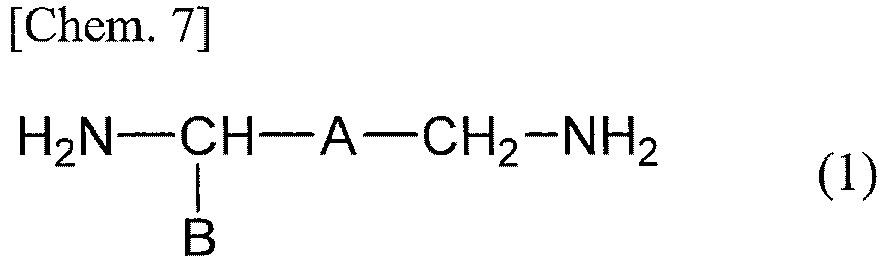
- In Formula (1), A is a cyclic alkylene group. That is, the cyclic alkylene group is directly bonded to the methine group (CH) and the methylene group (CH2) in the formula.
- The cyclic alkylene group herein may have a substituent. However, the cyclic alkylene group is preferably unsubstituted.
- The cyclic alkylene group is preferably a cyclic alkylene group having from 3 to 10 carbons, and is more preferably a cyclic alkylene group having from 5 to 8 carbons. In addition, the cyclic alkylene group is preferably one having a crosslinking structure.
- Specific examples of A include a cyclobutane diyl group, a cyclopentane diyl group, a cyclohexane diyl group, a norbornane diyl group, and a cyclooctane diyl group, and among these, a norbornane diyl group is particularly preferable. The norbornane diyl group is preferably a group represented by Formula (N1) or (N2). In the formulas, * represents a bond position.

- In Formula (1), B is a group containing an aryl group or a heteroaryl group, and is preferably a group containing an aryl group.
- The aryl group or heteroaryl group herein may have a substituent such as an aminomethyl group or may be substituted with a methine group (CH) in the formula through a linking group. However, the aryl group or heteroaryl group is preferably unsubstituted. Also, the aryl group or heteroaryl group is preferably bonded to the methine group (CH) in the formula without interposing a linking group.
- Note that in the present specification, "aryl group" means a substituted or unsubstituted aromatic hydrocarbon group, and means that a "heteroaryl group" is not included.
- The aryl group is preferably one having from 6 to 22 carbons, more preferably from 6 to 18 carbons, and even more preferably from 6 to 10 carbons. Specific examples of the aryl group include a phenyl group, naphthyl group, anthracenyl group, phenanthrenyl group, biphenylyl group, and fluorenyl group, among which a phenyl group is preferable.
- The heteroaryl group is preferably one having from 1 to 24 carbons, more preferably from 2 to 12 carbons, and even more preferably from 3 to 6 carbons. Specific examples of the heteroaryl group include a thienyl group, furyl group, pyridyl group, oxazolyl group, pyrrolyl group, imidazolyl group, pyrazolyl group, indolyl group, and triazinyl group.
- The molecular weight of the compound represented by Formula (1) is preferably not less than 150, more preferably not less than 180, and even more preferably not less than 200. The upper limit is preferably not greater than 800, more preferably not greater than 500, and even more preferably not greater than 300.
- In the amine composition according to the present embodiment, a content of the amine compound represented by Formula (1) is not particularly limited, but when the composition is produced at a high concentration by distillation or the like, the concentration of the compound represented by Formula (1) above is preferably not less than 70 mass%, more preferably not less than 80 mass%, and even more preferably not less than 90 mass%. An upper limit does not particularly exist, and the composition may have a concentration of 100 mass% of the compound represented by Formula (1) above.
- The amine composition according to the present embodiment may further contain a compound represented by Formula (2).
[Chem. 9]
H2N-CH2-E (2)
- (In Formula (2), E is a group containing an aryl group or a heteroaryl group.)
- In Formula (2), E is a group containing an aryl group or a heteroaryl group, and is preferably a group containing an aryl group.
- E is synonymous with B in Formula (1), and the preferred range is also the same.
- Examples of the compound represented by Formula (2) include benzylamine.
- The molecular weight of the compound represented by Formula (2) is preferably not less than 80, more preferably not less than 90, and even more preferably not less than 100. The upper limit is preferably not greater than 500, more preferably not greater than 300, and even more preferably not greater than 200.
- In the amine composition according to the present embodiment, a content of the compound represented by Formula (2) is not particularly limited, but when the purity of the compound represented by Formula (1) is increased through distillation purification or the like, the amine composition may substantially not contain the compound represented by Formula (2). The content of the compound represented by Formula (2) is preferably not greater than 1 mass%, more preferably not greater than 0.5 mass%, and even more preferably not greater than 0.1 mass%. The lower limit is not particularly limited, but from a practical perspective, the content is not less than 0.001 mass%.
- The amine composition according to the present embodiment may further contain a compound represented by Formula (3).
[Chem. 10]
H2N-CH2-D (3)
- (In Formula (3), D is a cyclic alkenyl group.)
- In Formula (3), D is a cyclic alkenyl group. That is, the cyclic alkenyl group is substituted at (directly bonded to) the methylene group (CH2) in the formula without interposing a linking group.
- The cyclic alkenyl group may have a substituent. However, the cyclic alkenyl group is preferably unsubstituted.
- Here, the cyclic alkenyl group is preferably a cyclic alkylene group having from 3 to 10 carbons, and is more preferably a cyclic alkylene group having from 5 to 8 carbons. In addition, the cyclic alkenyl group is preferably a cyclic alkylene group having a crosslinking structure.
- The number of double bonds included in the cyclic alkenyl group is preferably one or two, and more preferably one. Specific examples of D include a cyclobutenyl group, cyclopentenyl group, cyclohexenyl group, norbornenyl group, and cyclooctenyl group, and of these, a norbornenyl group is particularly preferable. The norbornenyl group is preferably a group represented by Formula (N3) or (N4). In the formulas, * represents a bond position.

- The molecular weight of the compound represented by Formula (3) is preferably not less than 90, more preferably not less than 100, and even more preferably not less than 110. The upper limit is preferably not greater than 600, more preferably not greater than 400, and even more preferably not greater than 300.
- In the amine composition according to the present embodiment, a content of the compound represented by Formula (3) is not particularly limited, but when the purity of the compound represented by Formula (1) is increased through distillation purification or the like, the amine composition may substantially not contain the compound represented by Formula (3). The content of the compound represented by Formula (3) is preferably not greater than 1 mass%, more preferably not greater than 0.5 mass%, and even more preferably not greater than 0.1 mass%. The lower limit is not particularly limited, but from a practical perspective, the content is not less than 0.001 mass%.
- In the synthesis reaction of the present invention, amines and an alkali metal may be used simultaneously, and it is possible that a certain compound may be included as a byproduct, where the certain compound is formed by a reduction, through a Benkeser reduction, of an aromatic ring of an aryl group or heteroaryl group in the compound represented by Formula (1) or the compound represented by Formula (2) to, for example, a 1,3-cyclohexadiene ring or a 1,4-cyclohexadiene rings. In addition, in this reaction, a deammoniation or dehydrogenation type condensation reaction occurs between two amino groups in the compounds of Formulas (1) to (3), and it is possible that an imine compound or an α,β-diamino compound may be included as a byproduct.
- The compound represented by Formula (1) and the amine composition are produced by reacting a compound represented by Formula (2) and a compound represented by Formula (3) in the presence of a base composition. One type of each of the compound represented by Formula (2) and the compound represented by Formula (3) may be used alone, or two or more types of each may be used. When two or more types are used, the total amount is preferably in the above range.
- A molar ratio of the compound represented by Formula (2) to the compound represented by Formula (3), (Formula (2)/Formula (3)), is preferably not less than 0.2 times, more preferably not less than 0.4 times, even more preferably not less than 0.8 times, and yet even more preferably not less than 1.6 times. Furthermore, the upper limit value of the molar ratio of the compound represented by Formula (2) to the compound represented by Formula (3)), (Formula (2)/Formula (3)), is preferably not greater than 5.0 times, and more preferably not greater than 2.5 times.
- An example of the base composition is a base composition containing at least one type of an alkali metal-containing compound (a) (compound containing a periodic table group 1 element) and a metallic sodium (b). A preferable example is a composition containing at least one type of an alkali metal-containing compound (a) (compound containing a periodic table group 1 element), at least one type of an alkaline earth metal-containing compound (c) (compound containing a periodic table group 2 element), and a metallic sodium (b). When the base composition contains an alkaline earth metal-containing compound (c), stickiness of the base composition can be suppressed, and handling ease can be improved.
- Examples of the alkali metal-containing compound (a) include a potassium-containing compound, a rubidium-containing compound, a cesium-containing compound, and a francium-containing compound. A potassium-containing compound or cesium-containing compound is preferable, and a cesium-containing compound is more preferable. The alkali metal-containing compound (a) is preferably MaOH or Ma 2CO3 (where Ma is an alkali metal).
- The alkaline earth metal-containing compound (c) is preferably a calcium-containing compound or a magnesium-containing compound, and is more preferably a magnesium-containing compound. The alkaline earth metal-containing compound (c) is preferably Mc(OH)2, or McCO3, McO (where Mc is an alkaline earth metal).
- Specific examples of the base composition used in the present invention include compositions containing a metallic sodium and a cesium-containing compound selected from cesium carbonate and cesium hydroxide. Another example is the composition described in
JP H10-259147A - One type of the alkali metal-containing compound (a) may be used alone, or a combination of two or more types may be used.
- From the perspective of efficient progress of the reaction, in the base composition, a molar ratio of the substance amount of the alkali metal included in the alkali metal-containing compound (a) to the substance amount of the metallic sodium (b) ((substance amount of alkali metal):(substance amount of sodium)) is from 0.50:1 to 8.0:1, preferably from 1.0:1 to 4.0:1, more preferably from 1.0:1 to 3.0:1, and even more preferably from 1.5:1 to 2.5:1.
- When a total amount of the alkali metal-containing compound (a) and the metallic sodium (b) is defined as 100 parts by mass, a content of the alkaline earth metal-containing compound (c) in the base composition is preferably from 30 to 150 parts by mass, more preferably from 40 to 130 parts by mass, and even more preferably from 50 to 100 parts by mass. When the content of the alkaline earth metal-containing compound (c) is not less than 30 parts by mass, stickiness of the base composition tends to be suppressed. In addition, when the content of the alkaline earth metal-containing compound (c) is not greater than 150 parts by mass, the reaction readily proceeds without affecting an activity of the base composition as a catalyst.
- One type of the alkaline earth metal-containing compound (c) may be used alone, or a combination of two or more types may be used.
- The base composition can be produced by thermal treatment of a mixture containing the alkali metal-containing compound (a) and the metallic sodium (b) at a temperature from 100°C to 500°C in an inert gas atmosphere. The order in which the alkali metal-containing compound (a) and the metallic sodium (b) are mixed is not particularly limited.
- Examples of the inert gas include helium, nitrogen, and argon.
- The temperature when preparing the base composition is preferably from 100°C to 500°C, more preferably from 110°C to 300°C, and even more preferably from 120°C to 280°C. When the temperature is from 100°C to 500°C, the metallic sodium melts and therefore tends to be easily dispersed and mixed, and also tends to be sufficiently fired such that a highly active catalyst is formed.
- The heating time when preparing the base composition is preferably from 10 minutes to 5 hours, more preferably from 30 minutes to 3 hours, and even more preferably from 30 minutes to 2 hours. When the heating time is from 10 minutes to 5 hours, firing is sufficiently implemented, and a highly active catalyst tends to be formed.
- The alkaline earth metal-containing compound (c) may be added to the mixture of the alkali metal-containing compound (a) and the metallic sodium (b), and the order in which the alkali metal-containing compound (a), the metallic sodium (b), and the alkaline earth metal-containing compound (c) are mixed is not particularly limited.
- Because the alkali metal-containing compound (a) and the alkaline earth metal-containing compound (c) are highly hygroscopic, a heat treatment may be performed before the preparation of the base composition. The heat treatment before preparation is preferably performed under an inert gas or vacuum conditions. The temperature of the heat treatment before preparation is not particularly limited as long as it is a temperature at which unnecessary moisture can be removed, and is normally from 200°C to 500°C, and preferably from 250°C to 400°C.
- When the heat treatment temperature is set from 200°C to 500°C, moisture in the compound can be sufficiently removed, and a highly active catalyst may be readily formed. The heat treatment time before preparation is preferably from 10 minutes to 5 hours, more preferably from 30 minutes to 3 hours, and even more preferably from 30 minutes to 2 hours. When the heating time is set to a range from 10 minutes to 5 hours, moisture can be sufficiently removed, and a highly active catalyst tends to be formed.
- After the reaction is completed, the reaction solution and the base composition can be separated by an ordinary method such as fractional sedimentation, centrifugation, or filtration.
- The base composition acts as a catalyst in the synthesis reaction of the compound represented by formula (1), but also functions as an irreversible reaction initiator. Thus, the amount of the base composition in the system decreases as the synthesis reaction of the amine compound proceeds. In addition, when a large amount of the base composition is added all at once, heat generation occurs, and side reactions may be promoted. Therefore, in the synthesis reaction of the compound represented by formula (1), the base composition is preferably divided in fractions and added two or more times. There is no particular upper limit to the number of times of fractional addition of the base composition, but practically, the number of times of the fractional addition is not more than 10 times, and may be not more than 5 times, or not more than 3 times. In particular, dividing the base composition into fractions and adding the base composition two or more times in fractions is beneficial when the synthesis reaction is carried out in a system not containing a solvent.
- The base composition may also be introduced into the reaction solution continuously or intermittently at a constant rate. The time required for introduction is, for example, from 0.1 to 36 hours, preferably from 0.5 to 6 hours, and more preferably from 2 to 5 hours. The rate of introduction may be constant or may be varied over time.
- In the production method of the present embodiment, a mass of the base composition is generally from 0.01 to 400 parts by mass, preferably from 0.1 to 300 parts by mass, and more preferably from 1.0 to 150 parts by mass, relative to 100 parts by mass of the compound represented by Formula (3). When the addition is divided into multiple fractions, a total amount of the base composition is preferably within the range described above.
- A reaction temperature of the synthesis reaction of the compound represented by Formula (1) may be appropriately adjusted, and is generally in a range from 0 to 150°C, preferably from 10 to 120°C, more preferably from 10 to 40°C, and even more preferably from 10 to 35°C. A sufficient reaction rate may be achieved by setting the temperature to 0°C or higher.
- The synthesis reaction is preferably performed in an argon atmosphere.
- In the production method according to the present embodiment, a solvent may be used, or production may be carried out without a solvent.
- The solvent is appropriately selected according to the reaction temperature, the reaction product, and the like. When a solvent is used in the synthesis reaction described above, the formed reaction solution may be concentrated as necessary, after which the residue may be used as is as the compound represented by Formula (1) or as the amine composition. Alternatively, after an appropriate post-treatment is performed, the treated residue may be used as the compound represented by Formula (1) or as the amine composition. Specific examples of the method of the post-treatment include well-known purification methods, such as distillation and chromatography.
- A filtration aid may be used to remove the base composition after completion of the reaction. Examples of the filtration aid include diatomaceous earth, aluminum hydroxide, hydrotalcite, magnesium silicate, magnesium oxide, and silicon oxide. Preferable examples include Kyowaad 600 (available from Kyowa Chemical Industry Co., Ltd.), Celite 503 (available from Imerys Filtration Minerals Inc.), Celite Hyflo Super-Cel (available from Imerys Filtration Minerals Inc.), and Celite Standard Super-Cel (available from Imerys Filtration Minerals Inc.), and Celite Standard Super-Cel is more preferable.
- The compound represented by Formula (1) and the amine composition can also be used as a curing agent for an epoxy resin. That is, an epoxy resin curing agent according to the present embodiment preferably contains an amine compound or an amine composition according to the present embodiment. Moreover, the epoxy resin composition of the present embodiment preferably contains the epoxy resin curing agent described above and an epoxy resin.
- The epoxy resin ordinarily has from 2 to 10 epoxy groups per molecule, preferably from 2 to 6 epoxy groups, more preferably from 2 to 4 epoxy groups, and even more preferably 2 epoxy groups per molecule. The epoxy group is preferably a glycidyl ether group. The epoxy resin may be a low molecular weight compound (for example, a number average molecular weight of less than 2000) or a high molecular weight compound (polymer, for example, a number average molecular weight of not less than 2000). The epoxy resin of the polymer may be an aliphatic compound, an alicyclic compound, or a compound having an aromatic ring. In particular, the epoxy resin preferably has, per molecule, two aromatic rings and/or two six-membered aliphatic rings, and more preferably has two aromatic rings per molecule. Among these, epoxy resins obtained through a reaction between epichlorohydrin and a compound having two or more reactive hydrogen atoms (for example, a polyol) are preferable. Specific examples of the raw materials of the epoxy resin include bisphenol A (2,2-bis(4-hydroxyphenyl)propane) or a hydride thereof, bisphenol F (4,4'-dihydroxydiphenylmethane), or a hydride thereof, tetrabromobisphenol A (2,2-bis(3,5-dibromo-4-hydroxyphenyl)propane) or a hydride thereof, a novolac resin in which cresol is reacted with formaldehyde, hexahydrophthalic acid, and the like. As the epoxy resin that can be used in the epoxy resin composition, in addition to the above, the disclosures of paragraphs [0036] to [0039] of
JP 2018-083905 A JP 2018-135433 A - A content of the epoxy resin in the epoxy resin composition is preferably not less than 60 mass%, and more preferably not less than 65 mass%, in the solid content not including the diluent. The upper limit is preferably not greater than 89 mass%, more preferably not greater than 87 mass%, and even more preferably not greater than 86 mass%.
- One type of epoxy resin may be used, or a plurality of types may be used. When a plurality of epoxy resins are used, the total amount thereof is within the range described above.
- The epoxy resin composition may include a curing agent besides the compound represented by Formula (1) and the amine composition. As such other curing agents, an amine-based curing agent described in paragraph [0029] of
JP 6177331 B JP 2011-213983 A - The epoxy resin composition may contain components besides the epoxy resin and curing agent. Specific examples of other components that may be contained include reactive diluents, non-reactive diluents, curing accelerators, plasticizers, pigments, dyes, fillers, release agents, toughening agents, antioxidants, UV absorbers, photostabilizers, fluidizers, leveling agents, defoaming agents, flame retardants, or thickeners.
- A cured product according to the present embodiment is formed from the epoxy resin composition. The cured product can be used in a wide range of fields, such as in architectural paints, adhesives, automotive components, aircraft components, composite materials, printed circuit board materials, insulating impregnated materials of a heavy electrical machinery, and sealing materials for electronic devices. In addition, the cured product is preferably used in the applications described in paragraph [0045] of
JP 2018-083905 A JP 2018-135433 A JP 2016-527384 T JP 2011-213983 A - The amine compound represented by Formula (1) and the amine composition can be used as a curing agent for curing a urethane prepolymer. Furthermore, a polyurethane urea resin composition of the present embodiment preferably contains the urethane prepolymer curing agent above and a urethane prepolymer.
- A cured product according to the present embodiment is formed from a polyurethane urea resin composition.
- The compound represented by Formula (1) and the amine composition can be used for a polyamide varnish containing a compound having at least one carboxyl group. A polyamide, in which this polyamide varnish has been subjected to polycondensation, can be formed. The compound having a carboxyl group is preferably a dicarboxylic acid having two carboxyl groups.
- The present invention will be described in further detail hereinafter using examples and comparative examples, but the present invention is not limited to the following examples.
- The content ratios of each component in the amine composition were measured through the following method using GC analysis.
-
- Column: CP-Sil 8 CB for Amines (0.25 µm × 0.25 mm × 30 m), available from Agilent Technologies, Inc.
- Column temperature: The temperature was maintained at 80°C for two minutes, and then increased to 150°C at a rate of 8°C/minute, maintained at 150°C for five minutes, and subsequently increased to 300°C at a rate of 15°C/minute, and then maintained at 300°C for five minutes.
- For each component in the produced amine compound and amine composition, GC-MS analysis was employed to identify the structure by mass spectrometry as follows.
-
- Instrument: GC7890A available from Agilent Technologies, Inc.
- Column: DB-1MS (0.25 um × 0.25 mm × 30 m), available from Agilent Technologies, Inc.
-
- Column temperature: The column temperature was maintained at 50°C for two minutes, subsequently increased to 320°C at a rate of 20°C/minute, and then maintained at 320°C for ten minutes.
- Mass spectrometer: AccuTOF GCX, available from JEOL, Ltd.
- Ionization technique: Electron ionization method (EI+)
- Ionization energy: 70 eV
- Ion source temperature: 250°C
-
- Instrument: GC7890A, available from Agilent Technologies, Inc.
- Column: DB-1MS (0.25 µm × 0.25 mm × 30 m), available from Agilent Technologies, Inc.
- Column temperature: The column temperature was maintained at 50°C for two minutes, subsequently increased to 320°C at a rate of 20°C/minute, and then maintained at 320°C for ten minutes.
- Mass spectrometer: AccuTOF GCX, available from JEOL, Ltd.
- Ionization technique; Field ionization method (FI+)
- In an argon atmosphere, a 200 mL round-bottom flask equipped with a magnetic stirrer was charged with 23.375 g of cesium carbonate (Cs2CO3, available from Fujifilm Wako Pure Chemical Corporation) which had been dried under reduced pressure at a temperature of 300°C, 1.65 g of metallic sodium (available from Fujifilm Wako Pure Chemical Corporation), and 17.6 g of magnesium oxide (MgO, available from Fujifilm Wako Pure Chemical Corporation) which had been dried under reduced pressure at a temperature of 300°C. The contents of the round-bottom flask were heated and stirred for one hour at 250°C using an aluminum block heater/stirrer, followed by removal of the round-bottom flask from the aluminum block heater/stirrer. The contents were cooled to room temperature by air cooling, and thereby a base composition was obtained.
- In an argon atmosphere, a magnetic stirrer, 5.358 g of benzylamine (available from Tokyo Chemical Industry Co., Ltd.), and 3.080 g of 5-norbornene-2-methylamine (isomer mixture, available from Tokyo Chemical Industry Co., Ltd.) were charged into a 200 mL round-bottom flask, followed by addition of 0.996 g of the base composition. A reaction was initiated with stirring at 500 rpm in the argon atmosphere at 25°C. Additional amounts of the base composition were added to the mixture under an argon atmosphere at 60 minutes, 120 minutes, 180 minutes, and 240 minutes after the beginning of the reaction. The amount of each addition was 0.996 grams. After the passage of 360 minutes from the beginning of the reaction, the reaction was terminated by adding 16 mL of isopropyl alcohol.
- To the resulting suspension, 50 mL of chloroform and 40 cm3 of Celite Standard Super-Cel (available from Junsei Chemical Co., Ltd.) were added, and the mixture was suction filtered using filter paper No. 5C (available from Kiriyama Glass Works Co.), Kiriyama funnel SB-60 (60 mmϕ, available from Kiriyama Glass Words Co.). 0.5M HCl and chloroform were added to the filtrate, and this mixture was subjected to liquid separation. Then, the aqueous phase was collected. Next, 1M sodium hydroxide and chloroform were added thereto once again and the resultant mixture was subjected to liquid separation, followed by collection of the organic phase. And subsequently the chloroform was distilled away under reduced pressure, and 8.1 g of an amine composition were obtained.
- When the obtained amine composition was subjected to GC-MS analysis, it was found that the composition contained benzylamine and amine compounds a to e of the compositional formula C15H23N2 represented by Formula (1-1) or (1-2). According to GC analysis, the conversion ratio of the benzylamine was 53%, the conversion ratio of aminomethyl norbornene was 86%, and the yield of the amine compounds a to e based on aminomethyl norbornene was 67%. From the obtained chromatograms, the retention times and the surface area ratios excluding the solvent of the amine compounds a to e, the aminomethyl norbornene, and the benzylamine were as follows.
-
- Benzylamine (retention time: 4.50 min): 34.9%
- Aminomethyl norbornene (retention time: 4.94 min and 5.03 min): 5.8%
- Amine compound a (retention time: 21.38 min): 9.8%
- Amine compound b (retention time: 21.52 min): 6.7%
- Amine compound c (retention time: 21.77 min): 2.8%
- Amine compound d (retention time: 21.90 min): 29.4%
- Amine compound e (retention time: 21.96 min): 2.2%
- An amount of 30.4 g of the amine composition obtained above was distilled at a vacuum pressure of 0.25 kPa, and the benzylamine was distilled off, after which an amine composition X containing, as main components, the amine compounds a to e represented by Formula (1-1) or (1-2) was collected as a fraction.
- Furthermore, NMR measurements of the amine composition X found that a ratio of an area of a peak at chemical shifts 7.21 to 7.34 ppm, which corresponds to the aromatic hydrogens of the compound represented by Formula (1-1) and of the compound represented by Formula (1-2), to an area of a peak at chemical shifts 3.41 to 3.53 ppm, which corresponds to the hydrogen at the benzyl position, was 5 to 1. Thus, it was confirmed that a bond forming reaction occurred on the hydrogen at the benzyl position of the benzylamine used in the substrate.
- An epoxy resin composition was prepared by mixing 0.930 g of a bisphenol A-type liquid epoxy resin (trade name; JER828, available from Mitsubishi Chemical Corporation, epoxy equivalent weight: 186 g/eq) and 0.288 g of the amine composition X obtained by distillation and purification.
- An aluminum pan for differential scanning calorimetry (hereinafter, abbreviated as DSC) was filled with 10 mg of the epoxy resin composition prepared above. The temperature was raised from 30°C to 280°C in a DSC instrument under a nitrogen atmosphere at a ramp rate of 5°C/minute, the temperature was then maintained at 280°C for 5 minutes, followed by rapid cooling at a rate of 20°C/minute.
- The glass transition temperature (hereinafter, abbreviated as Tg) of the epoxy resin cured product obtained above was determined by differential scanning calorimetry using the "DSC6220" differential scanning calorimeter (available from Seiko Instruments Inc.) at temperatures from 30°C to 250°C with a ramp rate of 5°C/minute. The results indicated that the Tg of the epoxy resin cured product was 161.3°C.


Claims (21)
- An amine composition comprising a compound represented by Formula (1)

- The amine composition according to claim 1, wherein A in Formula (1) is a norbornane diyl group.
- The amine composition according to claim 1 or 2, wherein B in Formula (1) is a group containing a phenyl group.
- The amine composition according to any one of claims 1 to 3, further comprising a compound represented by Formula (2)
[Chem. 2]
H2N-CH2-E (2)
where E is a group containing an aryl group or a heteroaryl group. - The amine composition according to claim 4, wherein E in Formula (2) is a group containing a phenyl group.
- The amine composition according to any one of claims 1 to 5, wherein the aryl or heteroaryl group, which is B in Formula (1), is bonded to a methine group (CH) in Formula (1) without a linking group being interposed therebetween.
- A method for producing an amine compound represented by Formula (1) or an amine composition comprising the compound represented by Formula (1), the method comprising:
reacting a compound represented by Formula (2) with a compound represented by Formula (3) in the presence of a base composition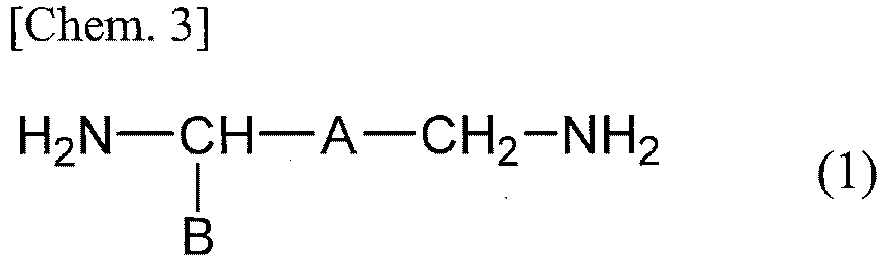
[Chem. 4]
H2N-CH2-E (2)
where E is a group containing an aryl group or a heteroaryl group; [Chem. 5]
H2N-CH2-D (3)
where D is a cyclic alkenyl group. - The production method according to claim 7, wherein the base composition comprises: a cesium-containing compound (a) selected from cesium carbonate and cesium hydroxide; and a metallic sodium (b).
- The production method according to claim 7 or 8, wherein, in the reaction between the compound represented by Formula (2) and the compound represented by Formula (3), the base composition is added in fractions two or more times.
- An amine compound represented by Formula (1)

- The amine compound according to claim 10, wherein A in Formula (1) is a norbornane diyl group.
- The amine compound according to claim 10 or 11, wherein B in Formula (1) is a group containing a phenyl group.
- The amine compound according to any one of claims 10 to 12, wherein the aryl or heteroaryl group, which is B in Formula (1), is bonded to a methine group (CH) in Formula (1) without a linking group being interposed therebetween.
- An epoxy resin curing agent comprising an amine composition described in any one of claims 1 to 6 or an amine compound described in any one of claims 10 to 13.
- An epoxy resin composition comprising the epoxy resin curing agent described in claim 14 and an epoxy resin.
- A cured product formed from the epoxy resin composition described in claim 15.
- A urethane prepolymer curing agent comprising an amine composition described in any one of claims 1 to 6 or an amine compound described in any one of claims 10 to 13.
- A polyurethane urea resin composition comprising the urethane prepolymer curing agent described in claim 17 and a urethane prepolymer.
- A cured product formed from the polyurethane urea resin composition described in claim 18.
- A polyamide varnish comprising an amine composition described in any one of claims 1 to 6 or an amine compound described in any one of claims 10 to 13 and a compound containing at least one carboxyl group.
- A polyamide that is a polycondensate of the polyamide varnish described in claim 20.
Applications Claiming Priority (2)
| Application Number | Priority Date | Filing Date | Title |
|---|---|---|---|
| JP2019032383 | 2019-02-26 | ||
| PCT/JP2020/007130 WO2020175380A1 (en) | 2019-02-26 | 2020-02-21 | Amine composition, amine compound, production method, and application thereof |
Publications (3)
| Publication Number | Publication Date |
|---|---|
| EP3932902A1 true EP3932902A1 (en) | 2022-01-05 |
| EP3932902A4 EP3932902A4 (en) | 2022-04-20 |
| EP3932902B1 EP3932902B1 (en) | 2026-01-28 |
Family
ID=72239591
Family Applications (1)
| Application Number | Title | Priority Date | Filing Date |
|---|---|---|---|
| EP20762444.6A Active EP3932902B1 (en) | 2019-02-26 | 2020-02-21 | Amine composition, amine compound, production method, and application thereof |
Country Status (5)
| Country | Link |
|---|---|
| US (1) | US11548847B2 (en) |
| EP (1) | EP3932902B1 (en) |
| JP (1) | JP6892015B2 (en) |
| CN (1) | CN113498410A (en) |
| WO (1) | WO2020175380A1 (en) |
Family Cites Families (14)
| Publication number | Priority date | Publication date | Assignee | Title |
|---|---|---|---|---|
| US4506099A (en) | 1981-10-12 | 1985-03-19 | Ciba-Geigy Corporation | Process for producing substituted 1,11-diaminoundecanes |
| US5587388A (en) * | 1992-12-02 | 1996-12-24 | Lucky Limited | Irreversible HIV protease inhibitors, intermediates, compositions and processes for the preparation thereof |
| JPH10259147A (en) | 1997-03-17 | 1998-09-29 | Mitsubishi Gas Chem Co Inc | Method for producing monoalkenylbenzenes |
| US20050159626A1 (en) | 2004-01-19 | 2005-07-21 | Allgeier Alan M. | Norbornane based cycloaliphatic compounds containing methylene amine groups |
| JP5672484B2 (en) | 2010-03-17 | 2015-02-18 | Dic株式会社 | Amine curing agent, epoxy resin composition and cured product thereof |
| WO2012105303A1 (en) * | 2011-02-01 | 2012-08-09 | 三菱瓦斯化学株式会社 | Production method for amino compound |
| ES2531144T3 (en) | 2012-09-07 | 2015-03-11 | Evonik Industries Ag | Curable compositions based on epoxy resins without benzyl alcohol |
| EP2837645A1 (en) | 2013-08-12 | 2015-02-18 | Basf Se | Use of 2,5-bisaminomethylfurane as curing agent for epoxy resins |
| US10513578B2 (en) | 2013-11-05 | 2019-12-24 | Huntsman Petrochemical Llc | Etheramines and their use as curatives or intermediates for polymer synthesis |
| WO2016143737A1 (en) * | 2015-03-11 | 2016-09-15 | 三菱瓦斯化学株式会社 | Novel polyamine compound and method for producing same, epoxy-resin curing agent using same, epoxy resin composition, and epoxy-resin cured article |
| WO2017175740A1 (en) | 2016-04-06 | 2017-10-12 | 三菱瓦斯化学株式会社 | Amine compound, amine composition, and epoxy resin curing agent |
| EP3255078B1 (en) | 2016-06-10 | 2018-08-15 | Evonik Degussa GmbH | Epoxy resin composition containing 2- (2,2,6,6-tetramethylpiperidine-4-yl) propane-1,3-diamine as curing agents |
| JP7177580B2 (en) | 2016-11-24 | 2022-11-24 | 三菱瓦斯化学株式会社 | Epoxy resin curing agent, epoxy resin composition and cured product thereof |
| JP6878944B2 (en) | 2017-02-21 | 2021-06-02 | 三菱瓦斯化学株式会社 | Epoxy resin curing agent, epoxy resin composition, fiber reinforced composite material |
-
2020
- 2020-02-21 EP EP20762444.6A patent/EP3932902B1/en active Active
- 2020-02-21 WO PCT/JP2020/007130 patent/WO2020175380A1/en not_active Ceased
- 2020-02-21 CN CN202080016369.5A patent/CN113498410A/en active Pending
- 2020-02-21 JP JP2020530396A patent/JP6892015B2/en active Active
- 2020-02-21 US US17/433,134 patent/US11548847B2/en active Active
Also Published As
| Publication number | Publication date |
|---|---|
| EP3932902A4 (en) | 2022-04-20 |
| WO2020175380A1 (en) | 2020-09-03 |
| US11548847B2 (en) | 2023-01-10 |
| JPWO2020175380A1 (en) | 2021-03-11 |
| CN113498410A (en) | 2021-10-12 |
| EP3932902B1 (en) | 2026-01-28 |
| US20220194892A1 (en) | 2022-06-23 |
| JP6892015B2 (en) | 2021-06-18 |
Similar Documents
| Publication | Publication Date | Title |
|---|---|---|
| US20090181165A1 (en) | Curable adhesive compositions, Process, and applications | |
| JP2003012763A5 (en) | ||
| EP4089131B1 (en) | Curable resin, curable resin composition, cured product, electronic device, laminated board material, electronic component encapsulant, and method for producing curable resin | |
| EP2912027B1 (en) | Novel epoxide compounds: 1,3-dioxiranylcyclopentane derivatives | |
| EP3932902B1 (en) | Amine composition, amine compound, production method, and application thereof | |
| EP2921513A1 (en) | Epoxy compound, production method therefor, and curable epoxy resin composition | |
| EP4215560B1 (en) | Epoxy resin curing agent, epoxy resin composition, and use of amine composition | |
| JP7272008B2 (en) | Amine composition, amine compound, production method and application thereof | |
| JP2003041001A (en) | Thermosetting resin having dihydrobenzoxazine ring structure, resin composition and cured product | |
| EP1538147B1 (en) | Method of producing glycidyl 2-hydroxyisobutyrate | |
| EP3805197B1 (en) | Method for producing compound, compound, epoxy curing agent, and method for producing amine composition | |
| JP7290039B2 (en) | Compound manufacturing method, compound, and epoxy curing agent | |
| WO2019230692A1 (en) | Method for producing compound, compound, epoxy curing agent, and method for producing amine composition | |
| KR102941088B1 (en) | Epoxy resin compositions, cured products, and electrical and electronic components | |
| CN116410445B (en) | Epoxy resin composition and resin film | |
| US6800721B1 (en) | Unsaturated oligophenol cyanates | |
| TW202440533A (en) | Composition, reactive diluent, curable composition and method for producing the composition | |
| JP2003073318A (en) | Polyvalent hydroxy compound, epoxy resin, epoxy resin composition and cured product thereof |
Legal Events
| Date | Code | Title | Description |
|---|---|---|---|
| STAA | Information on the status of an ep patent application or granted ep patent |
Free format text: STATUS: THE INTERNATIONAL PUBLICATION HAS BEEN MADE |
|
| PUAI | Public reference made under article 153(3) epc to a published international application that has entered the european phase |
Free format text: ORIGINAL CODE: 0009012 |
|
| STAA | Information on the status of an ep patent application or granted ep patent |
Free format text: STATUS: REQUEST FOR EXAMINATION WAS MADE |
|
| 17P | Request for examination filed |
Effective date: 20210824 |
|
| AK | Designated contracting states |
Kind code of ref document: A1 Designated state(s): AL AT BE BG CH CY CZ DE DK EE ES FI FR GB GR HR HU IE IS IT LI LT LU LV MC MK MT NL NO PL PT RO RS SE SI SK SM TR |
|
| A4 | Supplementary search report drawn up and despatched |
Effective date: 20220323 |
|
| RIC1 | Information provided on ipc code assigned before grant |
Ipc: C08G 69/26 20060101ALN20220318BHEP Ipc: C08L 75/04 20060101ALI20220318BHEP Ipc: C08L 75/02 20060101ALI20220318BHEP Ipc: C08G 59/50 20060101ALI20220318BHEP Ipc: C08G 18/32 20060101ALI20220318BHEP Ipc: C08G 18/10 20060101ALI20220318BHEP Ipc: C07C 211/27 20060101AFI20220318BHEP |
|
| DAV | Request for validation of the european patent (deleted) | ||
| DAX | Request for extension of the european patent (deleted) | ||
| STAA | Information on the status of an ep patent application or granted ep patent |
Free format text: STATUS: EXAMINATION IS IN PROGRESS |
|
| 17Q | First examination report despatched |
Effective date: 20250417 |
|
| GRAP | Despatch of communication of intention to grant a patent |
Free format text: ORIGINAL CODE: EPIDOSNIGR1 |
|
| STAA | Information on the status of an ep patent application or granted ep patent |
Free format text: STATUS: GRANT OF PATENT IS INTENDED |
|
| INTG | Intention to grant announced |
Effective date: 20250912 |
|
| GRAS | Grant fee paid |
Free format text: ORIGINAL CODE: EPIDOSNIGR3 |
|
| GRAA | (expected) grant |
Free format text: ORIGINAL CODE: 0009210 |
|
| STAA | Information on the status of an ep patent application or granted ep patent |
Free format text: STATUS: THE PATENT HAS BEEN GRANTED |
|
| AK | Designated contracting states |
Kind code of ref document: B1 Designated state(s): AL AT BE BG CH CY CZ DE DK EE ES FI FR GB GR HR HU IE IS IT LI LT LU LV MC MK MT NL NO PL PT RO RS SE SI SK SM TR |
|
| REG | Reference to a national code |
Ref country code: CH Ref legal event code: F10 Free format text: ST27 STATUS EVENT CODE: U-0-0-F10-F00 (AS PROVIDED BY THE NATIONAL OFFICE) Effective date: 20260128 Ref country code: GB Ref legal event code: FG4D |
|
| REG | Reference to a national code |
Ref country code: DE Ref legal event code: R096 Ref document number: 602020066007 Country of ref document: DE |
|
| REG | Reference to a national code |
Ref country code: IE Ref legal event code: FG4D |
|
| REG | Reference to a national code |
Ref country code: NL Ref legal event code: FP |
|
| PGFP | Annual fee paid to national office [announced via postgrant information from national office to epo] |
Ref country code: NL Payment date: 20260227 Year of fee payment: 7 |
|
| PGFP | Annual fee paid to national office [announced via postgrant information from national office to epo] |
Ref country code: DE Payment date: 20260225 Year of fee payment: 7 |
|
| PGFP | Annual fee paid to national office [announced via postgrant information from national office to epo] |
Ref country code: FR Payment date: 20260223 Year of fee payment: 7 |
|
| REG | Reference to a national code |
Ref country code: AT Ref legal event code: MK05 Ref document number: 1881118 Country of ref document: AT Kind code of ref document: T Effective date: 20260128 |
|
| PG25 | Lapsed in a contracting state [announced via postgrant information from national office to epo] |
Ref country code: RS Free format text: LAPSE BECAUSE OF FAILURE TO SUBMIT A TRANSLATION OF THE DESCRIPTION OR TO PAY THE FEE WITHIN THE PRESCRIBED TIME-LIMIT Effective date: 20260428 |
|
| PG25 | Lapsed in a contracting state [announced via postgrant information from national office to epo] |
Ref country code: ES Free format text: LAPSE BECAUSE OF FAILURE TO SUBMIT A TRANSLATION OF THE DESCRIPTION OR TO PAY THE FEE WITHIN THE PRESCRIBED TIME-LIMIT Effective date: 20260128 |
|
| PG25 | Lapsed in a contracting state [announced via postgrant information from national office to epo] |
Ref country code: PL Free format text: LAPSE BECAUSE OF FAILURE TO SUBMIT A TRANSLATION OF THE DESCRIPTION OR TO PAY THE FEE WITHIN THE PRESCRIBED TIME-LIMIT Effective date: 20260128 |
|
| PG25 | Lapsed in a contracting state [announced via postgrant information from national office to epo] |
Ref country code: GR Free format text: LAPSE BECAUSE OF FAILURE TO SUBMIT A TRANSLATION OF THE DESCRIPTION OR TO PAY THE FEE WITHIN THE PRESCRIBED TIME-LIMIT Effective date: 20260429 |
|
| REG | Reference to a national code |
Ref country code: LT Ref legal event code: MG9D |
|
| PG25 | Lapsed in a contracting state [announced via postgrant information from national office to epo] |
Ref country code: LT Free format text: LAPSE BECAUSE OF FAILURE TO SUBMIT A TRANSLATION OF THE DESCRIPTION OR TO PAY THE FEE WITHIN THE PRESCRIBED TIME-LIMIT Effective date: 20260128 |
|
| PG25 | Lapsed in a contracting state [announced via postgrant information from national office to epo] |
Ref country code: NO Free format text: LAPSE BECAUSE OF FAILURE TO SUBMIT A TRANSLATION OF THE DESCRIPTION OR TO PAY THE FEE WITHIN THE PRESCRIBED TIME-LIMIT Effective date: 20260428 |
|
| PG25 | Lapsed in a contracting state [announced via postgrant information from national office to epo] |
Ref country code: FI Free format text: LAPSE BECAUSE OF FAILURE TO SUBMIT A TRANSLATION OF THE DESCRIPTION OR TO PAY THE FEE WITHIN THE PRESCRIBED TIME-LIMIT Effective date: 20260128 Ref country code: AT Free format text: LAPSE BECAUSE OF FAILURE TO SUBMIT A TRANSLATION OF THE DESCRIPTION OR TO PAY THE FEE WITHIN THE PRESCRIBED TIME-LIMIT Effective date: 20260128 Ref country code: SE Free format text: LAPSE BECAUSE OF FAILURE TO SUBMIT A TRANSLATION OF THE DESCRIPTION OR TO PAY THE FEE WITHIN THE PRESCRIBED TIME-LIMIT Effective date: 20260128 |
|
| PG25 | Lapsed in a contracting state [announced via postgrant information from national office to epo] |
Ref country code: HR Free format text: LAPSE BECAUSE OF FAILURE TO SUBMIT A TRANSLATION OF THE DESCRIPTION OR TO PAY THE FEE WITHIN THE PRESCRIBED TIME-LIMIT Effective date: 20260128 |
|
| PG25 | Lapsed in a contracting state [announced via postgrant information from national office to epo] |
Ref country code: IS Free format text: LAPSE BECAUSE OF FAILURE TO SUBMIT A TRANSLATION OF THE DESCRIPTION OR TO PAY THE FEE WITHIN THE PRESCRIBED TIME-LIMIT Effective date: 20260528 Ref country code: PT Free format text: LAPSE BECAUSE OF FAILURE TO SUBMIT A TRANSLATION OF THE DESCRIPTION OR TO PAY THE FEE WITHIN THE PRESCRIBED TIME-LIMIT Effective date: 20260528 |
|
| PG25 | Lapsed in a contracting state [announced via postgrant information from national office to epo] |
Ref country code: LV Free format text: LAPSE BECAUSE OF FAILURE TO SUBMIT A TRANSLATION OF THE DESCRIPTION OR TO PAY THE FEE WITHIN THE PRESCRIBED TIME-LIMIT Effective date: 20260128 |
|
| PG25 | Lapsed in a contracting state [announced via postgrant information from national office to epo] |
Ref country code: BG Free format text: LAPSE BECAUSE OF FAILURE TO SUBMIT A TRANSLATION OF THE DESCRIPTION OR TO PAY THE FEE WITHIN THE PRESCRIBED TIME-LIMIT Effective date: 20260128 |