EP3930435B1 - Heat exchanger for cooling electrical elements of vehicle - Google Patents
Heat exchanger for cooling electrical elements of vehicle Download PDFInfo
- Publication number
- EP3930435B1 EP3930435B1 EP20759242.9A EP20759242A EP3930435B1 EP 3930435 B1 EP3930435 B1 EP 3930435B1 EP 20759242 A EP20759242 A EP 20759242A EP 3930435 B1 EP3930435 B1 EP 3930435B1
- Authority
- EP
- European Patent Office
- Prior art keywords
- bellows
- heat exchanger
- couplers
- pair
- coolers
- Prior art date
- Legal status (The legal status is an assumption and is not a legal conclusion. Google has not performed a legal analysis and makes no representation as to the accuracy of the status listed.)
- Active
Links
Images



Classifications
-
- H—ELECTRICITY
- H05—ELECTRIC TECHNIQUES NOT OTHERWISE PROVIDED FOR
- H05K—PRINTED CIRCUITS; CASINGS OR CONSTRUCTIONAL DETAILS OF ELECTRIC APPARATUS; MANUFACTURE OF ASSEMBLAGES OF ELECTRICAL COMPONENTS
- H05K7/00—Constructional details common to different types of electric apparatus
- H05K7/20—Modifications to facilitate cooling, ventilating, or heating
- H05K7/2089—Modifications to facilitate cooling, ventilating, or heating for power electronics, e.g. for inverters for controlling motor
- H05K7/20927—Liquid coolant without phase change
-
- B—PERFORMING OPERATIONS; TRANSPORTING
- B60—VEHICLES IN GENERAL
- B60H—ARRANGEMENTS OF HEATING, COOLING, VENTILATING OR OTHER AIR-TREATING DEVICES SPECIALLY ADAPTED FOR PASSENGER OR GOODS SPACES OF VEHICLES
- B60H1/00—Heating, cooling or ventilating devices
- B60H1/00271—HVAC devices specially adapted for particular vehicle parts or components and being connected to the vehicle HVAC unit
-
- H—ELECTRICITY
- H05—ELECTRIC TECHNIQUES NOT OTHERWISE PROVIDED FOR
- H05K—PRINTED CIRCUITS; CASINGS OR CONSTRUCTIONAL DETAILS OF ELECTRIC APPARATUS; MANUFACTURE OF ASSEMBLAGES OF ELECTRICAL COMPONENTS
- H05K7/00—Constructional details common to different types of electric apparatus
- H05K7/20—Modifications to facilitate cooling, ventilating, or heating
- H05K7/20218—Modifications to facilitate cooling, ventilating, or heating using a liquid coolant without phase change in electronic enclosures
- H05K7/20272—Accessories for moving fluid, for expanding fluid, for connecting fluid conduits, for distributing fluid, for removing gas or for preventing leakage, e.g. pumps, tanks or manifolds
-
- H—ELECTRICITY
- H10—SEMICONDUCTOR DEVICES; ELECTRIC SOLID-STATE DEVICES NOT OTHERWISE PROVIDED FOR
- H10W—GENERIC PACKAGES, INTERCONNECTIONS, CONNECTORS OR OTHER CONSTRUCTIONAL DETAILS OF DEVICES COVERED BY CLASS H10
- H10W40/00—Arrangements for thermal protection or thermal control
- H10W40/40—Arrangements for thermal protection or thermal control involving heat exchange by flowing fluids
- H10W40/47—Arrangements for thermal protection or thermal control involving heat exchange by flowing fluids by flowing liquids, e.g. forced water cooling
-
- H—ELECTRICITY
- H10—SEMICONDUCTOR DEVICES; ELECTRIC SOLID-STATE DEVICES NOT OTHERWISE PROVIDED FOR
- H10W—GENERIC PACKAGES, INTERCONNECTIONS, CONNECTORS OR OTHER CONSTRUCTIONAL DETAILS OF DEVICES COVERED BY CLASS H10
- H10W40/00—Arrangements for thermal protection or thermal control
- H10W40/20—Arrangements for cooling
- H10W40/25—Arrangements for cooling characterised by their materials
- H10W40/258—Metallic materials
Definitions
- the prevent invention relates to a heat exchanger for cooling electrical elements of a vehicle and, in detail, a heat exchanger for cooling electrical elements of a vehicle in which the possibility of leakage of cooling water can be reduced and the gap between the top and the bottom can be adjusted within a larger width.
- Eco-friendly vehicles such as an electric vehicle or a hybrid vehicle supply power using a motor and are required to use a power module, in which elements such as an insulated gate bipolar transistor (IGBT) and a diode are integrated, in order to more efficiently control the motor.
- IGBT insulated gate bipolar transistor
- the IGBT and the diode of a power module each generate heat close to 200 °C when a vehicle is driven or stopped, so when the heat of the power module is accumulated, the motor is not driven, which may cause a severe accident during driving. Accordingly, a heat management system for a power module is necessary for eco-friendly vehicles.
- a power module outputs maximum efficiency at an appropriate temperature and all of the elements are organically operated, if the efficiency of one element is deteriorated, the entire efficiency is deteriorated, so the elements should be uniformly cooled.
- a heat exchanger for cooling electrical elements should simultaneously cool the upper portion and the lower portion of a power module
- a heat exchange extrusion tube or a channel of a press article should be positioned at the upper and lower portions of the power module.
- a power module applied with thermal grease may be inserted between an upper cooler and a lower cooler. In this case, it is preferable that the power module is inserted such that the cooling water of the upper and lower coolers does not leak.
- Heat exchangers for cooling electrical elements of an eco-friendly vehicle that have been recently developed to satisfy this condition may be classified in a bending type and a gasket type in a broad meaning.
- the bending type is formed in an integral type by bending an extrusion tube in a 'U' shape or an ' ⁇ ' shape using softness of the tube and the gasket type is a type in which a gasket ring is fitted on the joint between an upper channel and a lower channel to tighten the joint.
- the extrusion tube when the heights of the extrusion tube and the channel are high, the extrusion tube should be bent much, so there is a defect that a large space is required, the shape of the channel cannot be varied, and the length that the extrusion tube occupies increases, so a pressure loss increases.
- the height of the channel is not limited, since one more gasket ring is fitted on the joint between the upper channel and the lower channel, there is a possibility of cooling water leaking due to twist of the gasket ring, etc. in assembly.
- a heat exchanger according to the state of the art is disclosed in document JP2005311046 .
- the present invention has been made in an effort to solve the general problems in the related art described above and an object of the present invention is to provide a heat exchanger for cooling electrical elements of a vehicle in which the possibility of leakage of cooling water can be reduced and the gap between the top and the bottom can be adjusted within a larger width.
- a heat exchanger for cooling electrical elements of a vehicle includes: a pair of coolers disposed over and under an electrical element module, respectively, and each having a plurality of channels longitudinally formed to pass cooling fluid; pipe couplers respectively coupled to first ends of the pair of coolers to pass cooling fluid, having protrusions on first surfaces facing each other, respectively, and connected with pipes on second surfaces; bellows couplers respectively coupled to second ends of the pair of coolers to pass cooling fluid and having protrusions on first surfaces facing each other; and a bellows having top and bottom openings fitted on the protrusions, and being able to contract.
- the bellows couplers have grooves formed around the protrusions in a shape corresponding to the bellows, and the widths of the grooves are larger than the width of the bellows.
- the bellows is configured such that the upper and lower parts are separable.
- the pipe couplers each have a first stopping step that is formed on the inner surface thereof and limits an insertion position of the first end of each of the pair of coolers.
- the bellows couplers each have a second stopping step that is formed on the inner surface thereof and limits an insertion position of the second end of each of the pair of coolers.
- the possibility of leakage of cooling water may be reduced and the gap between the top and the bottom may be adjusted within a larger width.
- the heat exchanger for cooling electrical elements of a vehicle there is an effect that even though force is transmitted to the second coupler through the pipe when a connector, a hose, etc. are fastened to the pipe, the second coupler is not easily deformed because the second coupler is supported by the protrusion of the first coupler.
- the bellows since the bellows may be divided, there is the advantage that it is possible to more easily manufacture a bellows of which a side is a brazing part that is a clad material in comparison to the integral type heat exchangers of the related art.
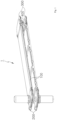
- FIG. 1 is a perspective view of a heat exchanger for cooling electrical elements of a vehicle according to the present invention
- FIG. 2 is an exploded perspective view of the heat exchanger for cooling electrical elements of a vehicle according to the present invention
- FIG. 3 is an enlarged cross-sectional view showing a pipe coupler in the heat exchanger for cooling electrical elements of a vehicle according to the present invention
- FIG. 4 is an enlarged cross-sectional view showing a bellows coupler and a bellows in the heat exchanger for cooling electrical elements of a vehicle according to the present invention
- FIG. 5 is an enlarged cross-sectional view showing states before and after contraction of the bellows coupler and the bellows in the heat exchanger for cooling electrical elements of a vehicle according to the present invention
- FIG. 1 is a perspective view of a heat exchanger for cooling electrical elements of a vehicle according to the present invention
- FIG. 2 is an exploded perspective view of the heat exchanger for cooling electrical elements of a vehicle according to the present invention
- FIG. 3 is
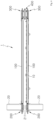
- FIG. 6 is a front cross-sectional view showing the state before contraction of the heat exchanger for cooling electrical elements of a vehicle according to the present invention
- FIG. 7 is a front cross-sectional view showing the state after contraction of the heat exchanger for cooling electrical elements of a vehicle according to the present invention.
- a heat exchanger 1 for cooling electrical elements of a vehicle according to an exemplary embodiment of the present invention is described hereafter with reference to FIGS. 1 to 7 .
- the heat exchanger 1 for cooling electrical elements of a vehicle includes a pair of coolers 100, pipe couplers 200, bellows couplers 300, and a bellows 400.
- the pair of coolers 100 are disposed over and under an electrical element module guide 10, respectively, and each have a plurality of channels longitudinally formed to pass cooling fluid. Cooling fluid flowing inside through a pipe 20 to be described below may flow through the plurality of channels formed in the pair of coolers 100.
- the electrical element module guide 10, which is provided to fix electrical element modules, may be an injected plastic part.
- the pair of coolers 100 each may have a metal plate 110, which is made of metal such as aluminum having high thermal conductivity, on a surface facing the electrical element module guide 10 to increase heat exchange efficiency.
- the pipe couplers 200 are coupled to first ends of the pair of coolers 100, respectively, to pass cooling fluid, and may be composed of a pair of first couplers 210 and a pair of second couplers 220.
- the pair of first couplers 210 respectively have protrusions 211 on surfaces facing each other with the electrical element module guide 10 therebetween.
- the protrusions 211 may move close to each other.
- the pair of second couplers 220 are coupled to the pair of first couplers 210, respectively, and each are connected with a pipe 20.
- the pipe 20 may have a stopping protrusion 21 on the outer surface and the pair of second couplers 220 each may have an open protrusion 221 protruding to be in contact with the stopping protrusion 21 at an opening in which the pipe 20 is inserted. That is, the pipe 20 may be inserted in the second coupler 220 until the stopping protrusion 21 is stopped by the open protrusion 221.
- a connector, a hose, etc. are fastened to the pipe 20 such that cooling fluid can flow inside or outside, but in this process, force is transmitted to the pipe 20, so the second coupler 220 connected to the pipe 20 may be bent or damaged.
- the pair of first couplers 210 having protrusions on surfaces facing each other are provided in the present invention.
- the second coupler 220 is not easily deformed because the second coupler 220 is supported by the protrusion 211 of the first coupler 210.
- the protrusion 211 may also serve to distribute pressure when cooling fluid flows into the pipe 20.
- the pipe coupler 200 has a first stopping step 230 on the inner surface thereof that limits the insertion position of the first end of the cooler 100.
- the first stopping step 230 is formed on the inner surfaces facing each other of the pipe couplers 200, thereby being able to decrease the width of the passage in which the first ends of the coolers 100 are inserted. That is, since the cooler 100 is inserted only to the portion stopped by the first stopping step 230 when the pipe coupler 200 is coupled to the first end of the cooler 100, it is easy to couple the first end of the cooler 100 at a predetermined position.
- the bellows couplers 300 are connected to second ends of the pair of coolers 100, respectively, to pass cooling fluid, and may be composed of a pair of first couplers 310 respectively having protrusions 311 on surfaces facing each other with the electrical element module guide 10 therebetween and a pair of second couplers 320 coupled to the pair of first couplers 310, respectively.
- the bellows coupler 300 has a second stopping step 330 formed on the inner surface and limiting the insertion position of the second end of the cooler 100.
- the second stopping step 330 is formed on the inner surfaces facing each other of the bellows couplers 300, thereby being able to decrease the width of the passage in which the second ends of the coolers 100 are inserted. That is, since the cooler 100 is inserted only to the portion stopped by the second stopping step 330 when the bellows coupler 300 is coupled to the second end of the cooler 100, it is easy to couple the second end of the cooler 100 at a predetermined position.
- the bellows 400 has top and bottom openings 410, so it may be fitted on the protrusions 311 formed on the bellows couplers 300 and is configured to be able to contract.
- the bellows 400 functions as a passage connecting the pair of coolers 100, and a side thereof is made of clad and may be brazed to the bellows coupler 300.
- the bellows 400 is configured such that the upper and lower parts are separable.
- a coupling groove 420 and a coupling protrusion 430 are formed around the edges of the contact surfaces of the upper part and the lower part of the bellows 400, respectively, to correspond to each other so that the upper and lower parts may be combined.
- the separable type bellows 400 of the present invention has the advantage that it is possible to adjust the available contraction height by changing the height of the circumferential portion 440 and it is also possible to adjust the force for contraction by changing the width of the circumferential portion 440.
- the bellows coupler 300 has a groove 312 formed around the protrusion 311 and having a shape corresponding to the bellows 400.
- the bellows 400 is disposed between the bellows couplers 300 and has the top and bottom openings 410, and bellows 400 is fitted on the protrusions 311 formed at the bellows couplers 300. As shown in FIG. 4 , the upper end and the lower end of the bellows 400 may be fitted to the surfaces 312a having the grooves 312 of the bellows coupler 300.
- the gap between the pair of coolers 100 is large in order to easily insert the electrical element module before contraction of the bellows 400.
- the grooves 312 having a shape corresponding to the bellows 400 are formed around the protrusions 311 in the present invention.
- the upper end and the lower end of the bellows 400 may be inserted to the surfaces 312a having the grooves 312 of the bellows couplers 300 before contraction of the bellows 400 and the circumferential portion 440 of the bellows 400 may have a large height, so the available contraction height may be increased.
- the bellows 400 may be maximally deformed until the protrusions 311 come in contact with each other.
- the circumferential portion 440 of the contracted and deformed bellows 400 may come in contact with the grooves 312 formed on the bellows couplers 300.
- the circumferential portion 440 may contract to be stably seated on the surfaces 312a having the grooves 312 because the widths of the grooves 312 are larger than the width of the circumferential portion 440 of the bellows 400.
- the present invention it is possible to obtain a large height difference before and after contraction of the bellows 400. That is, as shown in FIG. 6 , since the bellows 400 before contracting has a height that may secure a sufficient gap between the pair of coolers 100, it is possible to secure a sufficient space in which the electrical element module can be inserted. Further, as shown in FIG. 7 , since the bellows 400 may maximally contract due to the grooves 312 formed on the bellows couplers 300 when force contracting the bellows 400 is applied, it is possible to improve the efficiency of heat exchange with the electrical element module by maximally decreasing the gap between the pair of coolers 100.
Landscapes
- Engineering & Computer Science (AREA)
- Microelectronics & Electronic Packaging (AREA)
- Physics & Mathematics (AREA)
- Thermal Sciences (AREA)
- Mechanical Engineering (AREA)
- Cooling Or The Like Of Electrical Apparatus (AREA)
- Cooling Or The Like Of Semiconductors Or Solid State Devices (AREA)
Description
- The prevent invention relates to a heat exchanger for cooling electrical elements of a vehicle and, in detail, a heat exchanger for cooling electrical elements of a vehicle in which the possibility of leakage of cooling water can be reduced and the gap between the top and the bottom can be adjusted within a larger width.
- Eco-friendly vehicles such as an electric vehicle or a hybrid vehicle supply power using a motor and are required to use a power module, in which elements such as an insulated gate bipolar transistor (IGBT) and a diode are integrated, in order to more efficiently control the motor.
- The IGBT and the diode of a power module each generate heat close to 200 °C when a vehicle is driven or stopped, so when the heat of the power module is accumulated, the motor is not driven, which may cause a severe accident during driving. Accordingly, a heat management system for a power module is necessary for eco-friendly vehicles.
- Since a power module outputs maximum efficiency at an appropriate temperature and all of the elements are organically operated, if the efficiency of one element is deteriorated, the entire efficiency is deteriorated, so the elements should be uniformly cooled.
- Since a heat exchanger for cooling electrical elements should simultaneously cool the upper portion and the lower portion of a power module, a heat exchange extrusion tube or a channel of a press article should be positioned at the upper and lower portions of the power module. In detail, a power module applied with thermal grease may be inserted between an upper cooler and a lower cooler. In this case, it is preferable that the power module is inserted such that the cooling water of the upper and lower coolers does not leak.
- Heat exchangers for cooling electrical elements of an eco-friendly vehicle that have been recently developed to satisfy this condition may be classified in a bending type and a gasket type in a broad meaning.
- The bending type is formed in an integral type by bending an extrusion tube in a 'U' shape or an 'Ω' shape using softness of the tube and the gasket type is a type in which a gasket ring is fitted on the joint between an upper channel and a lower channel to tighten the joint.
- According to the bending type, when the heights of the extrusion tube and the channel are high, the extrusion tube should be bent much, so there is a defect that a large space is required, the shape of the channel cannot be varied, and the length that the extrusion tube occupies increases, so a pressure loss increases.
- According to the gasket type, although the height of the channel is not limited, since one more gasket ring is fitted on the joint between the upper channel and the lower channel, there is a possibility of cooling water leaking due to twist of the gasket ring, etc. in assembly.
- A heat exchanger according to the state of the art is disclosed in document
JP2005311046 - The present invention has been made in an effort to solve the general problems in the related art described above and an object of the present invention is to provide a heat exchanger for cooling electrical elements of a vehicle in which the possibility of leakage of cooling water can be reduced and the gap between the top and the bottom can be adjusted within a larger width.
- In order the achieve the objects of the present invention, a heat exchanger for cooling electrical elements of a vehicle according to the present invention includes: a pair of coolers disposed over and under an electrical element module, respectively, and each having a plurality of channels longitudinally formed to pass cooling fluid; pipe couplers respectively coupled to first ends of the pair of coolers to pass cooling fluid, having protrusions on first surfaces facing each other, respectively, and connected with pipes on second surfaces; bellows couplers respectively coupled to second ends of the pair of coolers to pass cooling fluid and having protrusions on first surfaces facing each other; and a bellows having top and bottom openings fitted on the protrusions, and being able to contract.
- The bellows couplers have grooves formed around the protrusions in a shape corresponding to the bellows, and the widths of the grooves are larger than the width of the bellows.
- The bellows is configured such that the upper and lower parts are separable.
- The pipe couplers each have a first stopping step that is formed on the inner surface thereof and limits an insertion position of the first end of each of the pair of coolers.
- The bellows couplers each have a second stopping step that is formed on the inner surface thereof and limits an insertion position of the second end of each of the pair of coolers.
- According to the heat exchanger for cooling electrical elements of a vehicle, the possibility of leakage of cooling water may be reduced and the gap between the top and the bottom may be adjusted within a larger width.
- According to the heat exchanger for cooling electrical elements of a vehicle, there is an effect that even though force is transmitted to the second coupler through the pipe when a connector, a hose, etc. are fastened to the pipe, the second coupler is not easily deformed because the second coupler is supported by the protrusion of the first coupler.
- According to the heat exchanger for cooling electrical elements of a vehicle, since the bellows may be divided, there is the advantage that it is possible to more easily manufacture a bellows of which a side is a brazing part that is a clad material in comparison to the integral type heat exchangers of the related art.
- According to the heat exchanger for cooling electrical elements of a vehicle, since the first and second stopping steps are formed at the pipe coupler and the bellows coupler, respectively, both ends of a plurality of coolers are disposed at predetermined positions, so combination is easy.
-
-
FIG. 1 is a perspective view of a heat exchanger for cooling electrical elements of a vehicle according to the present invention. -
FIG. 2 is an exploded perspective view of the heat exchanger for cooling electrical elements of a vehicle according to the present invention. -
FIG. 3 is an enlarged cross-sectional view showing a pipe coupler in the heat exchanger for cooling electrical elements of a vehicle according to the present invention. -
FIG. 4 is an enlarged cross-sectional view showing a bellows coupler and a bellows in the heat exchanger for cooling electrical elements of a vehicle according to the present invention. -
FIG. 5 is an enlarged cross-sectional view showing states before and after contraction of the bellows coupler and the bellows in the heat exchanger for cooling electrical elements of a vehicle according to the present invention. -
FIG. 6 is a front cross-sectional view showing the state before contraction of the heat exchanger for cooling electrical elements of a vehicle according to the present invention. -
FIG. 7 is a front cross-sectional view showing the state after contraction of the heat exchanger for cooling electrical elements of a vehicle according to the present invention. - Hereinafter, embodiments of the present invention will be described in detail with reference to the accompanying drawings. It should be noted that when components are given reference numerals in drawings, the same components are given the same reference numerals even if they are shown in different drawings. Further, when a component may make the spirit of the present disclosure unclear, the component is not described in detail. Further, it should be noted that although embodiments of the present disclosure will be described below, the spirit of the present disclosure is not limited thereto and may be achieved by those skilled in the art.
-
FIG. 1 is a perspective view of a heat exchanger for cooling electrical elements of a vehicle according to the present invention,FIG. 2 is an exploded perspective view of the heat exchanger for cooling electrical elements of a vehicle according to the present invention,FIG. 3 is an enlarged cross-sectional view showing a pipe coupler in the heat exchanger for cooling electrical elements of a vehicle according to the present invention,FIG. 4 is an enlarged cross-sectional view showing a bellows coupler and a bellows in the heat exchanger for cooling electrical elements of a vehicle according to the present invention,FIG. 5 is an enlarged cross-sectional view showing states before and after contraction of the bellows coupler and the bellows in the heat exchanger for cooling electrical elements of a vehicle according to the present invention,FIG. 6 is a front cross-sectional view showing the state before contraction of the heat exchanger for cooling electrical elements of a vehicle according to the present invention, andFIG. 7 is a front cross-sectional view showing the state after contraction of the heat exchanger for cooling electrical elements of a vehicle according to the present invention. - A
heat exchanger 1 for cooling electrical elements of a vehicle according to an exemplary embodiment of the present invention is described hereafter with reference toFIGS. 1 to 7 . - Referring to
FIG. 1 , theheat exchanger 1 for cooling electrical elements of a vehicle according to the present invention includes a pair ofcoolers 100,pipe couplers 200,bellows couplers 300, and abellows 400. - Referring to
FIG. 2 , the pair ofcoolers 100 are disposed over and under an electricalelement module guide 10, respectively, and each have a plurality of channels longitudinally formed to pass cooling fluid. Cooling fluid flowing inside through apipe 20 to be described below may flow through the plurality of channels formed in the pair ofcoolers 100. The electricalelement module guide 10, which is provided to fix electrical element modules, may be an injected plastic part. - The pair of
coolers 100 each may have ametal plate 110, which is made of metal such as aluminum having high thermal conductivity, on a surface facing the electricalelement module guide 10 to increase heat exchange efficiency. - The
pipe couplers 200 are coupled to first ends of the pair ofcoolers 100, respectively, to pass cooling fluid, and may be composed of a pair offirst couplers 210 and a pair ofsecond couplers 220. - In detail, the pair of
first couplers 210 respectively haveprotrusions 211 on surfaces facing each other with the electricalelement module guide 10 therebetween. When the pair offirst couplers 210 are moved toward each other, theprotrusions 211 may move close to each other. - The pair of
second couplers 220 are coupled to the pair offirst couplers 210, respectively, and each are connected with apipe 20. Thepipe 20 may have astopping protrusion 21 on the outer surface and the pair ofsecond couplers 220 each may have anopen protrusion 221 protruding to be in contact with thestopping protrusion 21 at an opening in which thepipe 20 is inserted. That is, thepipe 20 may be inserted in thesecond coupler 220 until thestopping protrusion 21 is stopped by theopen protrusion 221. - A connector, a hose, etc. are fastened to the
pipe 20 such that cooling fluid can flow inside or outside, but in this process, force is transmitted to thepipe 20, so thesecond coupler 220 connected to thepipe 20 may be bent or damaged. - In order to solve this problem, the pair of
first couplers 210 having protrusions on surfaces facing each other are provided in the present invention. - Referring to
FIG. 3 , when the pair offirst couplers 210 in the state shown inFIG. 3A are moved toward each other by contraction of thebellows 400 to be described below and the pair ofprotrusions 211 are moved close to each other, as shown inFIG. 3B , the pair ofsecond couplers 220 coupled to the pair offirst couplers 210 are supported by theprotrusions 211. - Accordingly, there is an effect that even though force is transmitted to the
second coupler 220 through thepipe 20 when a connector, a hose, etc. are fastened to thepipe 20, thesecond coupler 220 is not easily deformed because thesecond coupler 220 is supported by theprotrusion 211 of thefirst coupler 210. Theprotrusion 211 may also serve to distribute pressure when cooling fluid flows into thepipe 20. - Referring back to
FIG. 2 , it is preferable that thepipe coupler 200 has a first stoppingstep 230 on the inner surface thereof that limits the insertion position of the first end of thecooler 100. The first stoppingstep 230 is formed on the inner surfaces facing each other of thepipe couplers 200, thereby being able to decrease the width of the passage in which the first ends of thecoolers 100 are inserted. That is, since thecooler 100 is inserted only to the portion stopped by the first stoppingstep 230 when thepipe coupler 200 is coupled to the first end of thecooler 100, it is easy to couple the first end of thecooler 100 at a predetermined position. - The
bellows couplers 300 are connected to second ends of the pair ofcoolers 100, respectively, to pass cooling fluid, and may be composed of a pair offirst couplers 310 respectively havingprotrusions 311 on surfaces facing each other with the electricalelement module guide 10 therebetween and a pair ofsecond couplers 320 coupled to the pair offirst couplers 310, respectively. - It is preferable that the
bellows coupler 300 has a second stoppingstep 330 formed on the inner surface and limiting the insertion position of the second end of the cooler 100. The second stoppingstep 330 is formed on the inner surfaces facing each other of thebellows couplers 300, thereby being able to decrease the width of the passage in which the second ends of thecoolers 100 are inserted. That is, since the cooler 100 is inserted only to the portion stopped by the second stoppingstep 330 when thebellows coupler 300 is coupled to the second end of the cooler 100, it is easy to couple the second end of the cooler 100 at a predetermined position. - Referring to
FIGS. 2 and4 , thebellows 400 has top andbottom openings 410, so it may be fitted on theprotrusions 311 formed on thebellows couplers 300 and is configured to be able to contract. Thebellows 400 functions as a passage connecting the pair ofcoolers 100, and a side thereof is made of clad and may be brazed to thebellows coupler 300. - It is preferable that the
bellows 400 is configured such that the upper and lower parts are separable. Acoupling groove 420 and acoupling protrusion 430 are formed around the edges of the contact surfaces of the upper part and the lower part of thebellows 400, respectively, to correspond to each other so that the upper and lower parts may be combined. - Unlike an integral type bellows 400 of the related art of which the height or the width is limited, depending on the elongation of materials, the separable type bellows 400 of the present invention has the advantage that it is possible to adjust the available contraction height by changing the height of the
circumferential portion 440 and it is also possible to adjust the force for contraction by changing the width of thecircumferential portion 440. - The bellows coupler 300 has a
groove 312 formed around theprotrusion 311 and having a shape corresponding to thebellows 400. - In detail, the
bellows 400 is disposed between thebellows couplers 300 and has the top andbottom openings 410, and bellows 400 is fitted on theprotrusions 311 formed at the bellows couplers 300. As shown inFIG. 4 , the upper end and the lower end of thebellows 400 may be fitted to thesurfaces 312a having thegrooves 312 of thebellows coupler 300. - That is, the deeper the
grooves 312, the larger the height between the upper end and the lower end of thebellows 400 inserted therebetween may be, so it is possible to increase the available contraction height by increasing the height of thecircumferential portion 440. - As a result, it is possible to adjust the height of the
bellows 400 disposed between thegrooves 312 facing each other by adjusting the depths of thegrooves 312, whereby the available contraction height of thebellows 400 may be adjusted. Accordingly, it is possible to easily secure a sufficient gap in which the electrical element module can be inserted in accordance with the height of the electrical element module. - It is preferable that the gap between the pair of
coolers 100 is large in order to easily insert the electrical element module before contraction of thebellows 400. - To this end, there is a method of increasing the lengths of the
protrusions 311 of thebellows couplers 300 to which thebellows 400 is fastened, but there is a problem that when the lengths of theprotrusions 311 are increased, the gap between the pair ofcoolers 100 and the electrical element module is large even after contraction of thebellows 400, so the heat exchange efficiency decreases. That is, since the lengths of theprotrusions 311 should be set to fit the height of the electrical element module, so the lengths cannot be infinitely increased. - On the other hand, the
grooves 312 having a shape corresponding to thebellows 400 are formed around theprotrusions 311 in the present invention. As shown inFIG. 5A , the upper end and the lower end of thebellows 400 may be inserted to thesurfaces 312a having thegrooves 312 of thebellows couplers 300 before contraction of thebellows 400 and thecircumferential portion 440 of thebellows 400 may have a large height, so the available contraction height may be increased. - As shown in
FIG. 5B , since thegrooves 312 are formed around theprotrusions 311 of thebellows couplers 300, when thebellows 400 contracts, thebellows 400 may be maximally deformed until theprotrusions 311 come in contact with each other. - The
circumferential portion 440 of the contracted anddeformed bellows 400 may come in contact with thegrooves 312 formed on the bellows couplers 300. In this case, thecircumferential portion 440 may contract to be stably seated on thesurfaces 312a having thegrooves 312 because the widths of thegrooves 312 are larger than the width of thecircumferential portion 440 of thebellows 400. - As described above, according to the present invention, it is possible to obtain a large height difference before and after contraction of the
bellows 400. That is, as shown inFIG. 6 , since thebellows 400 before contracting has a height that may secure a sufficient gap between the pair ofcoolers 100, it is possible to secure a sufficient space in which the electrical element module can be inserted. Further, as shown inFIG. 7 , since thebellows 400 may maximally contract due to thegrooves 312 formed on thebellows couplers 300 when force contracting thebellows 400 is applied, it is possible to improve the efficiency of heat exchange with the electrical element module by maximally decreasing the gap between the pair ofcoolers 100. - Although exemplary embodiments of the present invention were described above, the technical range of the present invention is not limited thereto and should be construed on the basis of claims. Further, it should be considered that the present invention may be changed and modified in various ways by those skilled in the art without departing from the scope of the present invention.
Claims (4)
- A heat exchanger (1) for cooling electrical elements of a vehicle, the heat exchanger (1) comprising:a pair of coolers (100) disposed over and under an electrical element module, respectively, and each having a plurality of channels longitudinally formed to pass cooling fluid;pipe couplers (200) respectively coupled to first ends of the pair of coolers (100) to pass cooling fluid, having protrusions (211) on first surfaces facing each other, respectively, and connected with pipes (20) on second surfaces;bellows couplers (300) respectively coupled to second ends of the pair of coolers (100) to pass cooling fluid and having protrusions (311) on first surfaces facing each other; anda bellows (400) having top and bottom openings (410) fitted on the protrusions (311), and being able to contract, wherein the bellows couplers (300) have grooves (312) formed around the protrusions (311) in a shape corresponding to the bellows (400), and widths of the grooves (312) are larger than a width of the bellows (400).
- The heat exchanger of claim 1, wherein the bellows (400) is configured such that upper and lower parts are separable.
- The heat exchanger of claim 1, wherein the pipe couplers (200) each have a first stopping step (230) that is formed on an inner surface thereof and limits an insertion position of the first end of each of the pair of coolers (100).
- The heat exchanger of claim 1, wherein the bellows couplers (300) each have a second stopping step (330) that is formed on an inner surface thereof and limits an insertion position of the second end of each of the pair of coolers (100).
Applications Claiming Priority (2)
| Application Number | Priority Date | Filing Date | Title |
|---|---|---|---|
| KR1020190019078A KR102169412B1 (en) | 2019-02-19 | 2019-02-19 | Heat exchanger for electric element cooling |
| PCT/KR2020/001681 WO2020171436A1 (en) | 2019-02-19 | 2020-02-06 | Heat exchanger for cooling electrical elements of vehicle |
Publications (4)
| Publication Number | Publication Date |
|---|---|
| EP3930435A1 EP3930435A1 (en) | 2021-12-29 |
| EP3930435A4 EP3930435A4 (en) | 2022-11-30 |
| EP3930435C0 EP3930435C0 (en) | 2025-06-04 |
| EP3930435B1 true EP3930435B1 (en) | 2025-06-04 |
Family
ID=72144536
Family Applications (1)
| Application Number | Title | Priority Date | Filing Date |
|---|---|---|---|
| EP20759242.9A Active EP3930435B1 (en) | 2019-02-19 | 2020-02-06 | Heat exchanger for cooling electrical elements of vehicle |
Country Status (5)
| Country | Link |
|---|---|
| US (1) | US12017500B2 (en) |
| EP (1) | EP3930435B1 (en) |
| KR (1) | KR102169412B1 (en) |
| CN (1) | CN113170602B (en) |
| WO (1) | WO2020171436A1 (en) |
Families Citing this family (8)
| Publication number | Priority date | Publication date | Assignee | Title |
|---|---|---|---|---|
| KR102488058B1 (en) * | 2020-11-24 | 2023-01-13 | 주식회사 원진 | Heat exchanger for cooling electic element of vehicle |
| KR102505779B1 (en) | 2021-11-26 | 2023-03-06 | 주식회사 고산 | Heat exchanger for electric element cooling of vehicle having microchannel structure |
| KR20230090747A (en) * | 2021-12-15 | 2023-06-22 | 현대자동차주식회사 | Cooling apparatus for both sides of power module |
| EP4386304A3 (en) * | 2022-07-18 | 2024-06-26 | Erwin Quarder Systemtechnik GmbH | Cooling component |
| KR102825745B1 (en) | 2023-10-27 | 2025-07-24 | 주식회사 고산 | Heat exchanger for cooling electrical devices in a vehicle with heterogeneous joint structures and method for manufacturing the same |
| KR102858025B1 (en) | 2023-10-27 | 2025-09-11 | 주식회사 고산 | Heat exchanger for cooling electrical devices in a vehicle with heterogeneous joint structures and method for manufacturing the same |
| KR102870473B1 (en) * | 2024-03-15 | 2025-10-13 | 삼성발레오써멀시스템스 주식회사 | Cooling device for electric vehicle |
| KR102905460B1 (en) * | 2024-12-12 | 2026-01-02 | 주식회사 고산 | Heat exchanger for electric element cooling vehicle with a detachable guide |
Family Cites Families (23)
| Publication number | Priority date | Publication date | Assignee | Title |
|---|---|---|---|---|
| CA2153528C (en) * | 1995-07-10 | 2006-12-05 | Bruce Laurance Evans | Plate heat exchanger with reinforced input/output manifolds |
| DE69626085T2 (en) * | 1995-11-13 | 2003-11-13 | Denso Corp., Kariya | heat exchangers |
| JPH1163290A (en) * | 1997-08-25 | 1999-03-05 | Saginomiya Seisakusho Inc | Thermal expansion valve and method of manufacturing the same |
| JP2000283692A (en) * | 1999-03-30 | 2000-10-13 | Denso Corp | Neck filler and water injection structure |
| JP2001280555A (en) * | 2000-03-31 | 2001-10-10 | Asahi Kasei Corp | Multi-layer hose for automotive cooling system |
| JP4140549B2 (en) * | 2004-04-21 | 2008-08-27 | 株式会社デンソー | Cooler |
| DE102004057526B4 (en) * | 2003-12-03 | 2020-08-20 | Denso Corporation | Stack cooler |
| JP2005229030A (en) * | 2004-02-16 | 2005-08-25 | Hitachi Ltd | Electronic equipment with liquid cooling system |
| US8400607B2 (en) | 2005-10-11 | 2013-03-19 | Barco N.V. | Display assemblies and methods of display |
| JP2007205543A (en) * | 2006-02-06 | 2007-08-16 | Mitsubishi Heavy Ind Ltd | Vibration cancellation device |
| JP2007278568A (en) * | 2006-04-05 | 2007-10-25 | Matsushita Electric Ind Co Ltd | Heat exchanger |
| US20080011456A1 (en) * | 2006-07-12 | 2008-01-17 | Modine Manufacturing Company | Heat exchanger having integral elastic regions |
| KR101291029B1 (en) * | 2007-08-29 | 2013-08-01 | 한라비스테온공조 주식회사 | Integrated cold storage heat exchanger |
| RU2014125069A (en) * | 2011-12-20 | 2016-02-10 | Тойота Дзидося Кабусики Кайся | SEMICONDUCTOR MODULE |
| JP2015530552A (en) * | 2012-07-19 | 2015-10-15 | グランジェス・アーベー | Small aluminum heat exchanger with welded tube for power electronics and battery cooling |
| WO2014097561A1 (en) * | 2012-12-21 | 2014-06-26 | 株式会社デンソー | Heat dissipating sheet, heat dissipating apparatus, and method for manufacturing heat dissipating apparatus |
| KR101802748B1 (en) * | 2013-08-14 | 2017-11-29 | 한온시스템 주식회사 | Cooling Module |
| JP6344340B2 (en) * | 2014-09-23 | 2018-06-20 | 株式会社デンソー | COOLER MODULE AND METHOD FOR MANUFACTURING COOLER MODULE |
| DE102015120508A1 (en) * | 2015-11-26 | 2017-06-01 | Norma Germany Gmbh | Connection system for a coolant system and method for producing a connection arrangement |
| DE102016122455A1 (en) * | 2015-11-27 | 2017-06-01 | Hanon Systems | Heat exchanger for exhaust gas cooling in motor vehicles and method for producing the heat exchanger |
| KR102413829B1 (en) * | 2015-12-30 | 2022-06-29 | 한온시스템 주식회사 | heat exchanger for cooling electric element |
| JP6596398B2 (en) * | 2016-08-29 | 2019-10-23 | 本田技研工業株式会社 | Power converter |
| KR102592704B1 (en) * | 2016-12-29 | 2023-10-24 | 한온시스템 주식회사 | heat exchanger for cooling electric element |
-
2019
- 2019-02-19 KR KR1020190019078A patent/KR102169412B1/en active Active
-
2020
- 2020-02-06 CN CN202080006726.XA patent/CN113170602B/en active Active
- 2020-02-06 US US17/422,551 patent/US12017500B2/en active Active
- 2020-02-06 EP EP20759242.9A patent/EP3930435B1/en active Active
- 2020-02-06 WO PCT/KR2020/001681 patent/WO2020171436A1/en not_active Ceased
Also Published As
| Publication number | Publication date |
|---|---|
| EP3930435C0 (en) | 2025-06-04 |
| EP3930435A4 (en) | 2022-11-30 |
| US20220097477A1 (en) | 2022-03-31 |
| CN113170602B (en) | 2024-09-24 |
| KR102169412B1 (en) | 2020-10-23 |
| KR20200100999A (en) | 2020-08-27 |
| CN113170602A (en) | 2021-07-23 |
| EP3930435A1 (en) | 2021-12-29 |
| WO2020171436A1 (en) | 2020-08-27 |
| US12017500B2 (en) | 2024-06-25 |
Similar Documents
| Publication | Publication Date | Title |
|---|---|---|
| EP3930435B1 (en) | Heat exchanger for cooling electrical elements of vehicle | |
| US10928141B2 (en) | Heat exchanger for cooling multiple layers of electronic modules | |
| US10818985B2 (en) | Heat exchanger for cooling electrical element | |
| CN108541182B (en) | Heat exchanger for cooling multiple layers of an electronic module | |
| US20250132411A1 (en) | Heat sink | |
| CN105518855B (en) | Laminated type cooler | |
| CN109526182B (en) | Liquid-cooled double-sided cooler | |
| KR102067208B1 (en) | Heat exchanger for power semiconductor cooling of eco-friendly vehicle | |
| KR102197055B1 (en) | Heat exchanger for electric element cooling | |
| KR102236323B1 (en) | Heat exchanger for electric element cooling | |
| KR102488058B1 (en) | Heat exchanger for cooling electic element of vehicle | |
| KR102515583B1 (en) | Cooling panel structure of battery | |
| EP4585841A1 (en) | Pipe connection structure, thermal management assembly and battery pack | |
| KR102809648B1 (en) | Heat exchanger for electric element cooling | |
| KR102505779B1 (en) | Heat exchanger for electric element cooling of vehicle having microchannel structure | |
| KR102173395B1 (en) | heat exchanger for cooling electric element | |
| EP4517814A1 (en) | Double-side-cooling power semiconductor package | |
| KR101707046B1 (en) | Oil cooler | |
| KR102858025B1 (en) | Heat exchanger for cooling electrical devices in a vehicle with heterogeneous joint structures and method for manufacturing the same | |
| CN212463884U (en) | Radiator, air conditioner frequency converter with radiator and electronic equipment | |
| KR102825745B1 (en) | Heat exchanger for cooling electrical devices in a vehicle with heterogeneous joint structures and method for manufacturing the same | |
| KR102521350B1 (en) | Heat exchanger for inverter power module | |
| KR20230015168A (en) | Inverter cooling module and manufacturing method thereof | |
| JP6327081B2 (en) | COOLER MODULE AND METHOD FOR MANUFACTURING COOLER MODULE | |
| CN221783308U (en) | Manifolds and heat exchange tubes |
Legal Events
| Date | Code | Title | Description |
|---|---|---|---|
| STAA | Information on the status of an ep patent application or granted ep patent |
Free format text: STATUS: THE INTERNATIONAL PUBLICATION HAS BEEN MADE |
|
| PUAI | Public reference made under article 153(3) epc to a published international application that has entered the european phase |
Free format text: ORIGINAL CODE: 0009012 |
|
| STAA | Information on the status of an ep patent application or granted ep patent |
Free format text: STATUS: REQUEST FOR EXAMINATION WAS MADE |
|
| 17P | Request for examination filed |
Effective date: 20210715 |
|
| AK | Designated contracting states |
Kind code of ref document: A1 Designated state(s): AL AT BE BG CH CY CZ DE DK EE ES FI FR GB GR HR HU IE IS IT LI LT LU LV MC MK MT NL NO PL PT RO RS SE SI SK SM TR |
|
| DAV | Request for validation of the european patent (deleted) | ||
| DAX | Request for extension of the european patent (deleted) | ||
| A4 | Supplementary search report drawn up and despatched |
Effective date: 20221028 |
|
| RIC1 | Information provided on ipc code assigned before grant |
Ipc: H05K 7/20 20060101AFI20221024BHEP |
|
| GRAP | Despatch of communication of intention to grant a patent |
Free format text: ORIGINAL CODE: EPIDOSNIGR1 |
|
| STAA | Information on the status of an ep patent application or granted ep patent |
Free format text: STATUS: GRANT OF PATENT IS INTENDED |
|
| INTG | Intention to grant announced |
Effective date: 20250211 |
|
| GRAS | Grant fee paid |
Free format text: ORIGINAL CODE: EPIDOSNIGR3 |
|
| GRAA | (expected) grant |
Free format text: ORIGINAL CODE: 0009210 |
|
| STAA | Information on the status of an ep patent application or granted ep patent |
Free format text: STATUS: THE PATENT HAS BEEN GRANTED |
|
| AK | Designated contracting states |
Kind code of ref document: B1 Designated state(s): AL AT BE BG CH CY CZ DE DK EE ES FI FR GB GR HR HU IE IS IT LI LT LU LV MC MK MT NL NO PL PT RO RS SE SI SK SM TR |
|
| REG | Reference to a national code |
Ref country code: GB Ref legal event code: FG4D |
|
| REG | Reference to a national code |
Ref country code: CH Ref legal event code: EP |
|
| REG | Reference to a national code |
Ref country code: DE Ref legal event code: R096 Ref document number: 602020052310 Country of ref document: DE |
|
| REG | Reference to a national code |
Ref country code: IE Ref legal event code: FG4D |
|
| U01 | Request for unitary effect filed |
Effective date: 20250613 |
|
| U07 | Unitary effect registered |
Designated state(s): AT BE BG DE DK EE FI FR IT LT LU LV MT NL PT RO SE SI Effective date: 20250626 |
|
| PG25 | Lapsed in a contracting state [announced via postgrant information from national office to epo] |
Ref country code: ES Free format text: LAPSE BECAUSE OF FAILURE TO SUBMIT A TRANSLATION OF THE DESCRIPTION OR TO PAY THE FEE WITHIN THE PRESCRIBED TIME-LIMIT Effective date: 20250604 |
|
| PG25 | Lapsed in a contracting state [announced via postgrant information from national office to epo] |
Ref country code: GR Free format text: LAPSE BECAUSE OF FAILURE TO SUBMIT A TRANSLATION OF THE DESCRIPTION OR TO PAY THE FEE WITHIN THE PRESCRIBED TIME-LIMIT Effective date: 20250905 Ref country code: NO Free format text: LAPSE BECAUSE OF FAILURE TO SUBMIT A TRANSLATION OF THE DESCRIPTION OR TO PAY THE FEE WITHIN THE PRESCRIBED TIME-LIMIT Effective date: 20250904 |
|
| PG25 | Lapsed in a contracting state [announced via postgrant information from national office to epo] |
Ref country code: PL Free format text: LAPSE BECAUSE OF FAILURE TO SUBMIT A TRANSLATION OF THE DESCRIPTION OR TO PAY THE FEE WITHIN THE PRESCRIBED TIME-LIMIT Effective date: 20250604 |
|
| PG25 | Lapsed in a contracting state [announced via postgrant information from national office to epo] |
Ref country code: HR Free format text: LAPSE BECAUSE OF FAILURE TO SUBMIT A TRANSLATION OF THE DESCRIPTION OR TO PAY THE FEE WITHIN THE PRESCRIBED TIME-LIMIT Effective date: 20250604 |
|
| PG25 | Lapsed in a contracting state [announced via postgrant information from national office to epo] |
Ref country code: RS Free format text: LAPSE BECAUSE OF FAILURE TO SUBMIT A TRANSLATION OF THE DESCRIPTION OR TO PAY THE FEE WITHIN THE PRESCRIBED TIME-LIMIT Effective date: 20250904 |
|
| PG25 | Lapsed in a contracting state [announced via postgrant information from national office to epo] |
Ref country code: IS Free format text: LAPSE BECAUSE OF FAILURE TO SUBMIT A TRANSLATION OF THE DESCRIPTION OR TO PAY THE FEE WITHIN THE PRESCRIBED TIME-LIMIT Effective date: 20251004 |
|
| PG25 | Lapsed in a contracting state [announced via postgrant information from national office to epo] |
Ref country code: SM Free format text: LAPSE BECAUSE OF FAILURE TO SUBMIT A TRANSLATION OF THE DESCRIPTION OR TO PAY THE FEE WITHIN THE PRESCRIBED TIME-LIMIT Effective date: 20250604 |
|
| U20 | Renewal fee for the european patent with unitary effect paid |
Year of fee payment: 7 Effective date: 20251208 |
|
| PG25 | Lapsed in a contracting state [announced via postgrant information from national office to epo] |
Ref country code: CZ Free format text: LAPSE BECAUSE OF FAILURE TO SUBMIT A TRANSLATION OF THE DESCRIPTION OR TO PAY THE FEE WITHIN THE PRESCRIBED TIME-LIMIT Effective date: 20250604 |
|
| PG25 | Lapsed in a contracting state [announced via postgrant information from national office to epo] |
Ref country code: SK Free format text: LAPSE BECAUSE OF FAILURE TO SUBMIT A TRANSLATION OF THE DESCRIPTION OR TO PAY THE FEE WITHIN THE PRESCRIBED TIME-LIMIT Effective date: 20250604 |
|
| PLBE | No opposition filed within time limit |
Free format text: ORIGINAL CODE: 0009261 |
|
| STAA | Information on the status of an ep patent application or granted ep patent |
Free format text: STATUS: NO OPPOSITION FILED WITHIN TIME LIMIT |
|
| REG | Reference to a national code |
Ref country code: CH Ref legal event code: L10 Free format text: ST27 STATUS EVENT CODE: U-0-0-L10-L00 (AS PROVIDED BY THE NATIONAL OFFICE) Effective date: 20260416 |