EP3930087B1 - Rechargeable battery - Google Patents
Rechargeable battery Download PDFInfo
- Publication number
- EP3930087B1 EP3930087B1 EP21176340.4A EP21176340A EP3930087B1 EP 3930087 B1 EP3930087 B1 EP 3930087B1 EP 21176340 A EP21176340 A EP 21176340A EP 3930087 B1 EP3930087 B1 EP 3930087B1
- Authority
- EP
- European Patent Office
- Prior art keywords
- terminal
- electrode
- plating layer
- rechargeable battery
- plate
- Prior art date
- Legal status (The legal status is an assumption and is not a legal conclusion. Google has not performed a legal analysis and makes no representation as to the accuracy of the status listed.)
- Active
Links
Images

Classifications
-
- H—ELECTRICITY
- H01—ELECTRIC ELEMENTS
- H01M—PROCESSES OR MEANS, e.g. BATTERIES, FOR THE DIRECT CONVERSION OF CHEMICAL ENERGY INTO ELECTRICAL ENERGY
- H01M50/00—Constructional details or processes of manufacture of the non-active parts of electrochemical cells other than fuel cells, e.g. hybrid cells
- H01M50/50—Current conducting connections for cells or batteries
- H01M50/543—Terminals
- H01M50/547—Terminals characterised by the disposition of the terminals on the cells
-
- H—ELECTRICITY
- H01—ELECTRIC ELEMENTS
- H01M—PROCESSES OR MEANS, e.g. BATTERIES, FOR THE DIRECT CONVERSION OF CHEMICAL ENERGY INTO ELECTRICAL ENERGY
- H01M50/00—Constructional details or processes of manufacture of the non-active parts of electrochemical cells other than fuel cells, e.g. hybrid cells
- H01M50/50—Current conducting connections for cells or batteries
- H01M50/571—Methods or arrangements for affording protection against corrosion; Selection of materials therefor
-
- H—ELECTRICITY
- H01—ELECTRIC ELEMENTS
- H01M—PROCESSES OR MEANS, e.g. BATTERIES, FOR THE DIRECT CONVERSION OF CHEMICAL ENERGY INTO ELECTRICAL ENERGY
- H01M10/00—Secondary cells; Manufacture thereof
- H01M10/04—Construction or manufacture in general
- H01M10/0422—Cells or battery with cylindrical casing
- H01M10/0427—Button cells
-
- H—ELECTRICITY
- H01—ELECTRIC ELEMENTS
- H01M—PROCESSES OR MEANS, e.g. BATTERIES, FOR THE DIRECT CONVERSION OF CHEMICAL ENERGY INTO ELECTRICAL ENERGY
- H01M50/00—Constructional details or processes of manufacture of the non-active parts of electrochemical cells other than fuel cells, e.g. hybrid cells
- H01M50/10—Primary casings; Jackets or wrappings
- H01M50/102—Primary casings; Jackets or wrappings characterised by their shape or physical structure
- H01M50/109—Primary casings; Jackets or wrappings characterised by their shape or physical structure of button or coin shape
-
- H—ELECTRICITY
- H01—ELECTRIC ELEMENTS
- H01M—PROCESSES OR MEANS, e.g. BATTERIES, FOR THE DIRECT CONVERSION OF CHEMICAL ENERGY INTO ELECTRICAL ENERGY
- H01M50/00—Constructional details or processes of manufacture of the non-active parts of electrochemical cells other than fuel cells, e.g. hybrid cells
- H01M50/10—Primary casings; Jackets or wrappings
- H01M50/147—Lids or covers
-
- H—ELECTRICITY
- H01—ELECTRIC ELEMENTS
- H01M—PROCESSES OR MEANS, e.g. BATTERIES, FOR THE DIRECT CONVERSION OF CHEMICAL ENERGY INTO ELECTRICAL ENERGY
- H01M50/00—Constructional details or processes of manufacture of the non-active parts of electrochemical cells other than fuel cells, e.g. hybrid cells
- H01M50/10—Primary casings; Jackets or wrappings
- H01M50/147—Lids or covers
- H01M50/148—Lids or covers characterised by their shape
- H01M50/153—Lids or covers characterised by their shape for button or coin cells
-
- H—ELECTRICITY
- H01—ELECTRIC ELEMENTS
- H01M—PROCESSES OR MEANS, e.g. BATTERIES, FOR THE DIRECT CONVERSION OF CHEMICAL ENERGY INTO ELECTRICAL ENERGY
- H01M50/00—Constructional details or processes of manufacture of the non-active parts of electrochemical cells other than fuel cells, e.g. hybrid cells
- H01M50/10—Primary casings; Jackets or wrappings
- H01M50/147—Lids or covers
- H01M50/155—Lids or covers characterised by the material
- H01M50/164—Lids or covers characterised by the material having a layered structure
-
- H—ELECTRICITY
- H01—ELECTRIC ELEMENTS
- H01M—PROCESSES OR MEANS, e.g. BATTERIES, FOR THE DIRECT CONVERSION OF CHEMICAL ENERGY INTO ELECTRICAL ENERGY
- H01M50/00—Constructional details or processes of manufacture of the non-active parts of electrochemical cells other than fuel cells, e.g. hybrid cells
- H01M50/10—Primary casings; Jackets or wrappings
- H01M50/172—Arrangements of electric connectors penetrating the casing
- H01M50/174—Arrangements of electric connectors penetrating the casing adapted for the shape of the cells
- H01M50/181—Arrangements of electric connectors penetrating the casing adapted for the shape of the cells for button or coin cells
-
- H—ELECTRICITY
- H01—ELECTRIC ELEMENTS
- H01M—PROCESSES OR MEANS, e.g. BATTERIES, FOR THE DIRECT CONVERSION OF CHEMICAL ENERGY INTO ELECTRICAL ENERGY
- H01M50/00—Constructional details or processes of manufacture of the non-active parts of electrochemical cells other than fuel cells, e.g. hybrid cells
- H01M50/50—Current conducting connections for cells or batteries
- H01M50/531—Electrode connections inside a battery casing
- H01M50/533—Electrode connections inside a battery casing characterised by the shape of the leads or tabs
-
- H—ELECTRICITY
- H01—ELECTRIC ELEMENTS
- H01M—PROCESSES OR MEANS, e.g. BATTERIES, FOR THE DIRECT CONVERSION OF CHEMICAL ENERGY INTO ELECTRICAL ENERGY
- H01M50/00—Constructional details or processes of manufacture of the non-active parts of electrochemical cells other than fuel cells, e.g. hybrid cells
- H01M50/50—Current conducting connections for cells or batteries
- H01M50/543—Terminals
- H01M50/552—Terminals characterised by their shape
- H01M50/559—Terminals adapted for cells having curved cross-section, e.g. round, elliptic or button cells
- H01M50/56—Cup shaped terminals
-
- H—ELECTRICITY
- H01—ELECTRIC ELEMENTS
- H01M—PROCESSES OR MEANS, e.g. BATTERIES, FOR THE DIRECT CONVERSION OF CHEMICAL ENERGY INTO ELECTRICAL ENERGY
- H01M50/00—Constructional details or processes of manufacture of the non-active parts of electrochemical cells other than fuel cells, e.g. hybrid cells
- H01M50/50—Current conducting connections for cells or batteries
- H01M50/543—Terminals
- H01M50/562—Terminals characterised by the material
-
- H—ELECTRICITY
- H01—ELECTRIC ELEMENTS
- H01M—PROCESSES OR MEANS, e.g. BATTERIES, FOR THE DIRECT CONVERSION OF CHEMICAL ENERGY INTO ELECTRICAL ENERGY
- H01M2220/00—Batteries for particular applications
- H01M2220/30—Batteries in portable systems, e.g. mobile phone, laptop
-
- Y—GENERAL TAGGING OF NEW TECHNOLOGICAL DEVELOPMENTS; GENERAL TAGGING OF CROSS-SECTIONAL TECHNOLOGIES SPANNING OVER SEVERAL SECTIONS OF THE IPC; TECHNICAL SUBJECTS COVERED BY FORMER USPC CROSS-REFERENCE ART COLLECTIONS [XRACs] AND DIGESTS
- Y02—TECHNOLOGIES OR APPLICATIONS FOR MITIGATION OR ADAPTATION AGAINST CLIMATE CHANGE
- Y02E—REDUCTION OF GREENHOUSE GAS [GHG] EMISSIONS, RELATED TO ENERGY GENERATION, TRANSMISSION OR DISTRIBUTION
- Y02E60/00—Enabling technologies; Technologies with a potential or indirect contribution to GHG emissions mitigation
- Y02E60/10—Energy storage using batteries
-
- Y—GENERAL TAGGING OF NEW TECHNOLOGICAL DEVELOPMENTS; GENERAL TAGGING OF CROSS-SECTIONAL TECHNOLOGIES SPANNING OVER SEVERAL SECTIONS OF THE IPC; TECHNICAL SUBJECTS COVERED BY FORMER USPC CROSS-REFERENCE ART COLLECTIONS [XRACs] AND DIGESTS
- Y02—TECHNOLOGIES OR APPLICATIONS FOR MITIGATION OR ADAPTATION AGAINST CLIMATE CHANGE
- Y02P—CLIMATE CHANGE MITIGATION TECHNOLOGIES IN THE PRODUCTION OR PROCESSING OF GOODS
- Y02P70/00—Climate change mitigation technologies in the production process for final industrial or consumer products
- Y02P70/50—Manufacturing or production processes characterised by the final manufactured product
Definitions
- aspects of embodiments of the present disclosure relate to a rechargeable battery.
- a rechargeable battery is a battery that can be repeatedly charged and discharged.
- An electrode terminal disposed on an outer surface of the ultra-small rechargeable battery is in contact with a contact terminal of the wearable device to supply power to the wearable device.
- US 2004/023108 A1 discloses a rechargeable battery including a can, a lid and an electrode terminal having layers.
- a rechargeable battery is provided to suppress an increase of the contact resistance between the electrode terminal of the rechargeable battery and the contact terminal of the device.
- a rechargeable battery includes: an electrode assembly including a first electrode, a second electrode, and a separator between the first electrode and the second electrode; a case connected to the first electrode and accommodating the electrode assembly, the case including an opening to receive the electrode assembly; a cap plate bonded to the case to cover an outer region of the opening and including a through-hole to expose a center region of the opening; a terminal plate bonded to and insulated from the cap plate, covering the through-hole, and connected to the second electrode; and a terminal plating layer coated on an upper surface of the terminal plate, and a thickness of a center portion of the terminal plating layer overlapping the through-hole is thicker than a thickness of an outer portion of the terminal plating layer overlapping the upper surface of the terminal plate.
- a surface roughness of the center portion of the terminal plating layer may be less than a surface roughness of the outer portion of the terminal plating layer.
- the terminal plating layer may have a ductility less than that of the terminal plate.
- the center portion of the terminal plating layer may be protruded in an upper direction from the outer portion of the terminal plating layer.
- the terminal plate may include aluminum, and the terminal plating layer may include nickel.
- the case and the cap plate may include stainless steel.
- the terminal plate may include: a terminal part on the cap plate; and a protruded part penetrating through the through-hole from the terminal part to be connected to the second electrode.
- the terminal plating layer may be on an upper surface of the terminal part.
- the center portion of the terminal plating layer may be protruded in an opposite direction to the protruded part.
- the case and the cap plate may have a same polarity as the first electrode, and the terminal plate and the terminal plating layer may have a same polarity as the second electrode.
- the rechargeable battery may further include a thermal-fusion layer between the cap plate and the terminal plate to insulate and bond the cap plate and the terminal plate.
- the electrode assembly may further include: a first electrode tab extending from the first electrode to be bonded to the case; and a second electrode tab extending from the second electrode to be bonded to the terminal plate.
- the center portion of the terminal plating layer may be a second electrode terminal of the rechargeable battery.
- the second terminal of the rechargeable battery may be contactable to a terminal of an external device.
- a rechargeable battery in which an increase of the contact resistance between the electrode terminal of the rechargeable battery and the contact terminal of a device is suppressed.
- electrode assembly 200 case 300: cap plate 400: terminal plate 500: thermal-fusion layer 600: terminal plating layer 610: center portion 620: outer portion
- the rechargeable battery according to an embodiment is an ultra-small rechargeable battery and may be a coin-type cell or a button-type cell, but is not limited thereto, and may be a cylindrical or pin-type cell.
- the coin-type cell or the button-type cell is a thin coin-type or button-shape cell and may refer to a cell having a ratio of a height to a diameter of 1 or less, however, it is not limited thereto.
- the coin cell or the button cell may be cylindrical, and a horizontal cross-section may be circular, but the present invention is not limited thereto, and a horizontal cross-section may be oval or polygonal.
- the diameter may refer to the maximum distance based on the horizontal direction of the battery
- the height may refer to the maximum distance (a distance from a flat bottom surface to a flat uppermost surface) based on the vertical direction of the battery.
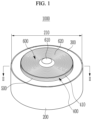
- FIG. 1 is a perspective view showing a rechargeable battery according to an embodiment
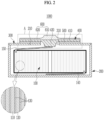
- FIG. 2 is a cross-sectional view taken along the line II-II of FIG. 1 .
- a rechargeable battery 1000 includes an electrode assembly 100, a case 200, a cap plate 300, a terminal plate 400, a thermal-fusion layer 500, and a terminal plating layer 600.
- the electrode assembly 100 is accommodated in the case 200.
- a lower part of the electrode assembly 100 faces a lower part of the case 200, and an upper part of the electrode assembly 100 faces the cap plate 300 and the terminal plate 400 covering an opening 210 of the case 200.
- the upper and lower parts of the electrode assembly 100 may have a planar shape parallel to each other, but are not limited thereto.
- the first electrode 110 has a band shape extending in a direction, and includes a cathode coated region that is an area where a cathode active material layer is coated to a current collector of a metal foil (for example, a Cu foil), and a cathode uncoated region that is an area where the active material is not coated.
- the cathode uncoated region may be disposed at an end in the extension direction of the first electrode 110.
- the rechargeable battery 1000 may suppress an increase of the contact resistance between the center portion 610 of the terminal plating layer 600 and a contact terminal of a device.
- the electrode terminal of the rechargeable battery 1000 may be in contact with a contact terminal of a device by a stronger pressure than the outer portion 620. Then, the contact area between the center portion 610 of the terminal plating layer 600 and the contact terminal of the device is increased, so that an increase of the contact resistance between the center portion 610 of the terminal plating layer 600 that is an electrode terminal of the rechargeable battery 1000 and the contact terminal of the device may be suppressed.
- the terminal plating layer 600 has less ductility than the terminal plate 400. In an embodiment, the terminal plating layer 600 is more rigid than the terminal plate 400.
- the rechargeable battery 1000 may suppress an increase of the contact resistance between the center portion 610 of the terminal plating layer 600 and a contact terminal of a device.
- the terminal plating layer 600 that is the electrode terminal of the rechargeable battery 1000 may be suppressed from being deformed by pressure due to the contact with a contact terminal of a device such that a reduction of the contact area between the terminal plating layer 600 and the contact terminal of a e device due to deformation of the terminal plating layer 600 may be suppressed.
- the rechargeable battery 1000 may suppress an increase of the contact resistance between the terminal plating layer 600 that is the electrode terminal of the rechargeable battery 1000 and the contact terminal of the device.
- the terminal plating layer 600 includes nickel (Ni), and the terminal plate 400 includes aluminum (Al).
- the terminal plating layer 600 includes nickel, which has higher corrosion resistance compared to aluminum contained in the terminal plate 400, since the formation of an oxide layer on the surface of the terminal plating layer 600 that is in contact with a contact terminal of a device may be suppressed, an increase in the contact resistance between the terminal plating layer 600, which is an electrode terminal of the rechargeable battery 1000 and the contact terminal of the device, may be suppressed.
- the first thickness T1 of the center portion 610 of the terminal plating layer 600 is thicker than the second thickness T2 of the outer portion 620, the surface roughness of the center portion 610 is less than the surface roughness of the outer portion 620, and the terminal plating layer 600 contains nickel (Ni) while having less ductility than the terminal plate 400.
- the rechargeable battery 1000 may suppress an increase of the contact resistance between the center portion 610 of the terminal plating layer 600 and a contact terminal of a device.
- the center portion 610 of the terminal plating layer 600 as the electrode terminal of the rechargeable battery 1000 may be in contact with a contact terminal of a device in a large area with a strong pressure, and an increase of the contact area between the terminal plating layer 600 and the contact terminal of the device and concurrently (e.g., simultaneously) deformation of the terminal plating layer 600 by pressure due to the contact with the contact terminal of the device may be suppressed and the formation of an oxide layer on the surface of the terminal plating layer 600 may be suppressed, and thereby an increase of the contact resistance between the terminal plating layer 600 as an electrode terminal of the rechargeable battery 1000 and the contact terminal of the device may be suppressed.
- the rechargeable battery 1000 in which the contact resistance between the electrode terminal of the rechargeable battery 1000 and the contact terminal of the device is suppressed, is provided.
Landscapes
- Chemical & Material Sciences (AREA)
- Chemical Kinetics & Catalysis (AREA)
- Electrochemistry (AREA)
- General Chemical & Material Sciences (AREA)
- Engineering & Computer Science (AREA)
- Manufacturing & Machinery (AREA)
- Connection Of Batteries Or Terminals (AREA)
- Sealing Battery Cases Or Jackets (AREA)
Description
- Aspects of embodiments of the present disclosure relate to a rechargeable battery.
- Generally, a rechargeable battery is a battery that can be repeatedly charged and discharged.
- In recent years, as a demand for wearable devices, such as headphones, earphones, smartwatches, and body-attached medical devices using wireless communication such as Bluetooth increases, a need for ultra-small rechargeable batteries installed in the wearable devices is increasing.
- An electrode terminal disposed on an outer surface of the ultra-small rechargeable battery is in contact with a contact terminal of the wearable device to supply power to the wearable device.
- However, since an oxide film may be naturally formed on the surface of the electrode terminal of the ultra-small rechargeable battery, there is a problem that contact resistance between the electrode terminal of the ultra-small rechargeable battery and the contact terminal of the wearable device is increased. There is a need to provide an ultra-small rechargeable battery to solve the problem.
- The above information disclosed in this Background section is only for enhancement of understanding of the background of the invention, and, therefore, it may contain information that does not form the prior art that is already known in this country to a person of ordinary skill in the art.
-
US 2004/023108 A1 discloses a rechargeable battery including a can, a lid and an electrode terminal having layers. - According to an aspect of one or more embodiments, a rechargeable battery is provided to suppress an increase of the contact resistance between the electrode terminal of the rechargeable battery and the contact terminal of the device.
- A rechargeable battery according to one or more embodiments of the present invention includes: an electrode assembly including a first electrode, a second electrode, and a separator between the first electrode and the second electrode; a case connected to the first electrode and accommodating the electrode assembly, the case including an opening to receive the electrode assembly; a cap plate bonded to the case to cover an outer region of the opening and including a through-hole to expose a center region of the opening; a terminal plate bonded to and insulated from the cap plate, covering the through-hole, and connected to the second electrode; and a terminal plating layer coated on an upper surface of the terminal plate, and a thickness of a center portion of the terminal plating layer overlapping the through-hole is thicker than a thickness of an outer portion of the terminal plating layer overlapping the upper surface of the terminal plate.
- A surface roughness of the center portion of the terminal plating layer may be less than a surface roughness of the outer portion of the terminal plating layer.
- The terminal plating layer may have a ductility less than that of the terminal plate.
- The center portion of the terminal plating layer may be protruded in an upper direction from the outer portion of the terminal plating layer.
- The terminal plate may include aluminum, and the terminal plating layer may include nickel.
- The case and the cap plate may include stainless steel.
- The terminal plate may include: a terminal part on the cap plate; and a protruded part penetrating through the through-hole from the terminal part to be connected to the second electrode.
- The terminal plating layer may be on an upper surface of the terminal part.
- The center portion of the terminal plating layer may be protruded in an opposite direction to the protruded part.
- The case and the cap plate may have a same polarity as the first electrode, and the terminal plate and the terminal plating layer may have a same polarity as the second electrode.
- The rechargeable battery may further include a thermal-fusion layer between the cap plate and the terminal plate to insulate and bond the cap plate and the terminal plate.
- The electrode assembly may further include: a first electrode tab extending from the first electrode to be bonded to the case; and a second electrode tab extending from the second electrode to be bonded to the terminal plate.
- The center portion of the terminal plating layer may be a second electrode terminal of the rechargeable battery.
- The second terminal of the rechargeable battery may be contactable to a terminal of an external device.
- According to an aspect of one or more embodiments, a rechargeable battery is provided in which an increase of the contact resistance between the electrode terminal of the rechargeable battery and the contact terminal of a device is suppressed.
-
-
FIG. 1 is a perspective view showing a rechargeable battery according to an embodiment. -
FIG. 2 is a cross-sectional view taken along the line II-II ofFIG. 1 . -
FIG. 3 is a cross-sectional view of a region "A" ofFIG. 2 . -
100: electrode assembly 200: case 300: cap plate 400: terminal plate 500: thermal-fusion layer 600: terminal plating layer 610: center portion 620: outer portion - The present invention will be described more fully herein with reference to the accompanying drawings, in which some example embodiments of the invention are shown. As those skilled in the art would realize, the described embodiments may be modified in various different ways, all without departing from the scope of the present invention. The drawings and description are to be regarded as illustrative in nature and not restrictive. Like reference numerals designate like elements throughout the specification.
- In addition, unless explicitly described to the contrary, it is to be understood that terms such as "comprises," "includes," or "have" used in the present specification specify the presence of stated features, numerals, steps, operations, components, parts, or a combination thereof, but do not preclude the presence or addition of one or more other features, numerals, steps, operations, components, parts, or a combination thereof.
- Also, in this specification, it is to be understood that when one component is referred to as being "connected" or "coupled" to another component, it may be connected or coupled directly to the other component or connected or coupled to another component with one or more other components intervening therebetween.
- Singular forms are to include plural forms unless the context clearly indicates otherwise.
- It is to be understood that, although the terms "first," "second," etc. may be used herein to describe various elements, these elements should not be limited by these terms. These terms are used to distinguish one element from another. For example, a first element could be termed a "second" element, and, similarly, a second element could be termed a "first" element, without departing from the scope of example embodiments of the inventive concept. The terms of a singular form may include plural forms unless the context clearly indicates otherwise.
- In addition, terms such as "below," "lower," "above," "upper," and the like are used to describe the relationship of the configurations shown in the drawings. However, the terms are used as a relative concept and are described with reference to the direction indicated in the drawings.
- Unless otherwise defined, all terms (including technical and scientific terms) used herein have the same meaning as commonly understood by one of ordinary skill in the art to which the inventive concept pertains. It is also to be understood that terms defined in commonly used dictionaries should be interpreted as having meanings consistent with the meanings in the context of the related art, and are expressly defined herein unless they are interpreted in an ideal or overly formal sense.
- Next, a rechargeable battery according to an embodiment is described with reference to
FIG. 1 to FIG. 3 . - The rechargeable battery according to an embodiment is an ultra-small rechargeable battery and may be a coin-type cell or a button-type cell, but is not limited thereto, and may be a cylindrical or pin-type cell.
- Here, the coin-type cell or the button-type cell is a thin coin-type or button-shape cell and may refer to a cell having a ratio of a height to a diameter of 1 or less, however, it is not limited thereto. The coin cell or the button cell may be cylindrical, and a horizontal cross-section may be circular, but the present invention is not limited thereto, and a horizontal cross-section may be oval or polygonal. In this case, the diameter may refer to the maximum distance based on the horizontal direction of the battery, and the height may refer to the maximum distance (a distance from a flat bottom surface to a flat uppermost surface) based on the vertical direction of the battery.
-
FIG. 1 is a perspective view showing a rechargeable battery according to an embodiment; andFIG. 2 is a cross-sectional view taken along the line II-II ofFIG. 1 . - Referring to
FIG. 1 andFIG. 2 , arechargeable battery 1000 according to an embodiment includes anelectrode assembly 100, acase 200, acap plate 300, aterminal plate 400, a thermal-fusion layer 500, and aterminal plating layer 600. - The
electrode assembly 100 is accommodated in thecase 200. A lower part of theelectrode assembly 100 faces a lower part of thecase 200, and an upper part of theelectrode assembly 100 faces thecap plate 300 and theterminal plate 400 covering anopening 210 of thecase 200. In an embodiment, the upper and lower parts of theelectrode assembly 100 may have a planar shape parallel to each other, but are not limited thereto. - The
electrode assembly 100 includes afirst electrode 110, asecond electrode 120, aseparator 130, afirst electrode tab 140, and asecond electrode tab 150. - The
first electrode 110 and thesecond electrode 120 are separated from each other, and theseparator 130 including an insulating material is disposed between thefirst electrode 110 and thesecond electrode 120. In an embodiment, thefirst electrode 110 may be a cathode, and thesecond electrode 120 may be an anode, but the present invention is not limited thereto, and, in another embodiment, thefirst electrode 110 may be an anode and thesecond electrode 120 may be a cathode. - In an embodiment, the
first electrode 110 has a band shape extending in a direction, and includes a cathode coated region that is an area where a cathode active material layer is coated to a current collector of a metal foil (for example, a Cu foil), and a cathode uncoated region that is an area where the active material is not coated. The cathode uncoated region may be disposed at an end in the extension direction of thefirst electrode 110. - In an embodiment, the
second electrode 120 has a band shape that is spaced apart from thefirst electrode 110 with theseparator 130 interposed therebetween, and extends in a direction and includes an anode coated region that is an area where an anode active material layer is applied to the current collector of a metal foil (for example, an Al foil), and an anode uncoated region that is an area where the active material is not applied. The anode uncoated region may be disposed at an end in the extending direction of thesecond electrode 120. - The
separator 130 extends in a direction between thefirst electrode 110 and thesecond electrode 120 to prevent or substantially prevent a short circuit between thefirst electrode 110 and thesecond electrode 120. - In an embodiment, the
first electrode 110, theseparator 130, and thesecond electrode 120 are sequentially stacked and wound in a jelly roll shape, but are not limited thereto, and may be formed in any of various known shapes. Each of thefirst electrode 110, thesecond electrode 120, and theseparator 130 may include any of various known materials. - The
first electrode tab 140 extends from thefirst electrode 110 of theelectrode assembly 100 to thecase 200. In an embodiment, thefirst electrode tab 140 is combined with a lower part of thecase 200 to connect thefirst electrode 110 and thecase 200. Thefirst electrode tab 140 is in contact with thefirst electrode 110 and thecase 200. By thefirst electrode tab 140, thecase 200 has a same polarity (for example, a cathode polarity) as thefirst electrode 110. - The
second electrode tab 150 extends from thesecond electrode 120 of theelectrode assembly 100 to theterminal plate 400. In an embodiment, thesecond electrode tab 150 is combined with aprotruded part 420 of theterminal plate 400 to connect thesecond electrode 120 and theterminal plate 400. Thesecond electrode tab 150 is in contact with thesecond electrode 120 and theterminal plate 400. By thesecond electrode tab 150, theterminal plate 400 has a same polarity as the second electrode 120 (for example, an anode polarity). - In an embodiment, a center pin penetrating the center of the
electrode assembly 100 in a vertical direction is disposed in a center portion of theelectrode assembly 100, and the center pin may support thefirst electrode tab 140 and thesecond electrode tab 150, but is not limited thereto. - The
case 200 is connected to thefirst electrode 110 of theelectrode assembly 100 and houses theelectrode assembly 100. Thecase 200 includes anopening 210 that exposes the top of theelectrode assembly 100. The lower part of thecase 200 is connected to thefirst electrode 110 of theelectrode assembly 100 by thefirst electrode tab 140, and has the same polarity (for example, the cathode polarity) as thefirst electrode 110. In an embodiment, thecase 200 has a cylinder shape for accommodating theelectrode assembly 100 in the form of the jelly roll, but is not limited thereto, and may have any of various known shapes. Thecase 200 can accommodate any of various known electrolyte solutions along with theelectrode assembly 100. The outer surface of thecase 200 may be a cathode terminal of therechargeable battery 1000. In this case, the outer surface of theterminal plate 400 coated with theterminal plating layer 600 may be an anode terminal of therechargeable battery 1000. In an embodiment, a plating layer may be coated on the outer surface of thecase 200, but is not limited thereto, and any of various known coating layers may be coated on the outer surface of thecase 200. - The
opening 210 of thecase 200 is covered by thecap plate 300 and theterminal plate 400. - The
cap plate 300 is combined with thecase 200 to cover an outer area of theopening 210. Thecap plate 300 includes a through-hole 310 that exposes a central area of theopening 210. In an embodiment, thecap plate 300 is directly coupled to a side wall of thecase 200 by a welding process to cover the outer area of theopening 210. Here, the outer area of theopening 210 is defined in the vicinity of the side wall of thecase 200, which surrounds . the center area of theopening 210. In an embodiment, thecap plate 300 has a ring shape by the through-hole 310 formed in the center, but is not limited thereto. Thecap plate 300 is combined with thecase 200, and has the same polarity (for example, the cathode polarity) asfirst electrode 110. In an embodiment, thecap plate 300 includes stainless steel, but is not limited thereto, and may include any of metals, such as aluminum, nickel, and copper. - In an embodiment, a plating layer may be coated on the outer surface of the
cap plate 300, but the present invention is not limited thereto, and any of various known coating layers may be coated on the outer surface of thecap plate 300. - The
terminal plate 400 is insulated and combined to thecap plate 300 to cover the through-hole 310 of thecap plate 300. Theterminal plate 400 is disposed on thecap plate 300. Theterminal plate 400 covers the central area of theopening 210 of thecase 200 exposed by the through-hole 310 of thecap plate 300. Since theterminal plate 400 covers the central area of theopening 210 and thecap plate 300 covers the outer area of theopening 210, theopening 210 of thecase 200 is completely covered by theterminal plate 400 and thecap plate 300. Theterminal plate 400 is connected to thesecond electrode tab 150 of theelectrode assembly 100 to be connected to thesecond electrode 120 of theelectrode assembly 100. Theterminal plate 400 has the same polarity (for example, the anode polarity) as thesecond electrode 120. - The
terminal plate 400 includes aterminal part 410 and theprotruded part 420. - The
terminal part 410 is disposed on thecap plate 300 and overlaps thecap plate 300. Theterminal part 410 has a wider area than theprotruded part 420. For example, theterminal part 410 may have a larger diameter than theprotruded part 420. A lower surface of theterminal part 410 is in contact with the thermal-fusion layer 500, and theterminal part 410 is insulated and combined to thecap plate 300 by the thermal-fusion layer 500. - The
protruded part 420 is protruded from theterminal part 410 corresponding to the through-hole 310 of thecap plate 300, and penetrates the through-hole 310. A lower surface of theprotruded part 420 is in contact with thesecond electrode tab 150. As theprotruded part 420 is combined with thesecond electrode tab 150, theterminal plate 400 has the same polarity as thesecond electrode 120. - In an embodiment, the
terminal plate 400 includes aluminum, but is not limited thereto, and may include any of metals, such as stainless steel, nickel, and copper. - The thermal-
fusion layer 500 is disposed between thecap plate 300 and theterminal part 410 of theterminal plate 400, and insulates and bonds between thecap plate 300 and theterminal plate 400. The thermal-fusion layer 500 includes an insulating material, and insulates between thecap plate 300 and theterminal plate 400. In an embodiment, the thermal-fusion layer 500 is thermally fused between thecap plate 300 and theterminal part 410 of theterminal plate 400 by using heat or a laser beam. The thermal-fusion layer 500 may include any of various known materials for insulating and bonding between thecap plate 300 and theterminal plate 400. By bonding the thermal-fusion layer 500 between thecap plate 300 and theterminal plate 400, theopening 210 of thecase 200 in which theelectrode assembly 100 is accommodated is completely sealed by thecap plate 300, theterminal plate 400, and the thermal-fusion layer 500. - The
terminal plating layer 600 is coated on an upper surface of theterminal plate 400. In an embodiment, theterminal plating layer 600 is coated only on the upper surface of theterminal part 410 of theterminal plate 400, but is not limited thereto, and, in another embodiment, may be coated on the entire surface of theterminal plate 400. - The
terminal plate 400 coated with theterminal plating layer 600 forms an anode terminal having the same polarity as thesecond electrode 120 of theelectrode assembly 100 of therechargeable battery 1000, but is not limited thereto. - The
terminal plating layer 600 includes acenter portion 610 and anouter portion 620, and thecenter portion 610 of theterminal plating layer 600 is protruded upward from theouter portion 620. In an embodiment, theterminal plating layer 600 may be plated on the upper surface of theterminal plate 400 in the form of a plate and formed in a form including acenter portion 610 and anouter portion 620 by a forging process, but is not limited thereto. - For example, the
terminal plating layer 600 is plated on the upper surface of the plate-shapedterminal plate 400 in the plate form, and the outer portion of the plate-shapedterminal plate 400 plated with the plate-shapedterminal plating layer 600 is forging-processed, thereby theterminal plate 400 including theterminal part 410 and theprotruded part 420 and theterminal plating layer 600 including thecenter portion 610 and theouter portion 620 may be concurrently (e.g., simultaneously) formed. -
FIG. 3 is a cross-sectional view showing a region "A" ofFIG. 2 . - Referring to
FIG. 3 , thecenter portion 610 of theterminal plating layer 600 overlaps a portion corresponding to the through-hole 310 of thecap plate 300 in a direction perpendicular to the through-hole 310, and theouter portion 620 of theterminal plating layer 600 overlaps a portion corresponding to a surface of thecap plate 300 in the direction perpendicular to the surface of thecap plate 300. - In an embodiment, a first thickness T1 of the
center portion 610 of theterminal plating layer 600 is thicker than a second thickness T2 of theouter portion 620. Thecenter portion 610 of theterminal plating layer 600 is protruded upward from the surface of theterminal plate 400 from theouter portion 620. Thecenter portion 610 of theterminal plating layer 600 is protruded in an opposite direction to theprotruded part 420 of theterminal plate 400. - The first thickness T1 of the
center portion 610 of theterminal plating layer 600 is thicker than the second thickness T2 of theouter portion 620 and thecenter portion 610 is protruded upward from the surface of theterminal plate 400 from theouter portion 620. Here, thecenter portion 610 of theterminal plating layer 600 is the electrode terminal of therechargeable battery 1000. - The
rechargeable battery 1000 may suppress an increase of the contact resistance between thecenter portion 610 of theterminal plating layer 600 and a contact terminal of a device. The electrode terminal of therechargeable battery 1000 may be in contact with a contact terminal of a device by a stronger pressure than theouter portion 620. Then, the contact area between thecenter portion 610 of theterminal plating layer 600 and the contact terminal of the device is increased, so that an increase of the contact resistance between thecenter portion 610 of theterminal plating layer 600 that is an electrode terminal of therechargeable battery 1000 and the contact terminal of the device may be suppressed. - In an embodiment, a surface roughness of the
center portion 610 of theterminal plating layer 600 is less than a surface roughness of theouter portion 620. In an embodiment, the surface of thecenter portion 610 of theterminal plating layer 600 is flatter than the surface of theouter portion 620. - As the surface roughness of the
center portion 610 of theterminal plating layer 600 is less than the surface roughness of theouter portion 620, thecenter portion 610 of theterminal plating layer 600 that is the electrode terminal of therechargeable battery 1000 may be in contact with a contact terminal of a device with a greater area than theouter portion 620 such that the contact area between thecenter portion 610 of theterminal plating layer 600 and the contact terminal of the device is increased, and thereby an increase of the contact resistance between thecenter portion 610 of theterminal plating layer 600 that is an electrode terminal of therechargeable battery 1000 and the contact terminal of the device may be suppressed. - In an embodiment, the
terminal plating layer 600 has less ductility than theterminal plate 400. In an embodiment, theterminal plating layer 600 is more rigid than theterminal plate 400. - As the
terminal plating layer 600 has less ductility than theterminal plate 400, therechargeable battery 1000 may suppress an increase of the contact resistance between thecenter portion 610 of theterminal plating layer 600 and a contact terminal of a device. - The
terminal plating layer 600 that is the electrode terminal of therechargeable battery 1000 may be suppressed from being deformed by pressure due to the contact with a contact terminal of a device such that a reduction of the contact area between theterminal plating layer 600 and the contact terminal of a e device due to deformation of theterminal plating layer 600 may be suppressed. Thus, therechargeable battery 1000 may suppress an increase of the contact resistance between theterminal plating layer 600 that is the electrode terminal of therechargeable battery 1000 and the contact terminal of the device. - In an embodiment, the
terminal plating layer 600 includes nickel (Ni), and theterminal plate 400 includes aluminum (Al). - In an embodiment, as the
terminal plating layer 600 includes nickel, which has higher corrosion resistance compared to aluminum contained in theterminal plate 400, since the formation of an oxide layer on the surface of theterminal plating layer 600 that is in contact with a contact terminal of a device may be suppressed, an increase in the contact resistance between theterminal plating layer 600, which is an electrode terminal of therechargeable battery 1000 and the contact terminal of the device, may be suppressed. - As described above, in the
rechargeable battery 1000 according to an embodiment, the first thickness T1 of thecenter portion 610 of theterminal plating layer 600 is thicker than the second thickness T2 of theouter portion 620, the surface roughness of thecenter portion 610 is less than the surface roughness of theouter portion 620, and theterminal plating layer 600 contains nickel (Ni) while having less ductility than theterminal plate 400. Therechargeable battery 1000 may suppress an increase of the contact resistance between thecenter portion 610 of theterminal plating layer 600 and a contact terminal of a device. - , The
center portion 610 of theterminal plating layer 600 as the electrode terminal of therechargeable battery 1000 may be in contact with a contact terminal of a device in a large area with a strong pressure, and an increase of the contact area between theterminal plating layer 600 and the contact terminal of the device and concurrently (e.g., simultaneously) deformation of theterminal plating layer 600 by pressure due to the contact with the contact terminal of the device may be suppressed and the formation of an oxide layer on the surface of theterminal plating layer 600 may be suppressed, and thereby an increase of the contact resistance between theterminal plating layer 600 as an electrode terminal of therechargeable battery 1000 and the contact terminal of the device may be suppressed. - That is, the
rechargeable battery 1000, in which the contact resistance between the electrode terminal of therechargeable battery 1000 and the contact terminal of the device is suppressed, is provided. - While the present invention has been described in connection with what are presently considered to be some example embodiments, it is to be understood that the invention is not limited to the disclosed embodiments. On the contrary, it is intended to cover various modifications and equivalent arrangements included within the scope of the appended claims.
Claims (13)
- A rechargeable battery comprising:an electrode assembly (100) comprising a first electrode (110), a second electrode (120), and a separator (130) between the first electrode (110) and the second electrode (120);a case (200) connected to the first electrode (110) and accommodating the electrode assembly, the case comprising an opening (210) to receive the electrode assembly;a cap plate (300) bonded to the case (200) to cover an outer region of the opening (210) and comprising a through-hole (310) to expose a center region of the opening (210);a terminal plate (400) bonded to and insulated from the cap plate (300), covering the through-hole (310), and connected to the second electrode (120); anda terminal plating layer (600) coated on an upper surface of the terminal plate (400),wherein a thickness of a center portion (610) of the terminal plating layer (600) overlapping the through-hole (310) is thicker than a thickness of an outer portion of the terminal plating layer (600) overlapping the upper surface of the terminal plate (400).
- The rechargeable battery of claim 1, wherein a surface roughness of the center portion (610) of the terminal plating layer (600) is less than a surface roughness of the outer portion of the terminal plating layer (600).
- The rechargeable battery of claim 1 or 2, wherein the terminal plating layer (600) has a ductility less than that of the terminal plate (400).
- The rechargeable battery of any of the preceding claims, wherein the center portion (610) of the terminal plating layer (600) is protruded in an upper direction from the outer portion (620) of the terminal plating layer.
- The rechargeable battery of any of the preceding claims, whereinthe terminal plate (400) comprises aluminum, andthe terminal plating layer (600) comprises nickel.
- The rechargeable battery of claim 5, wherein the case (200) and the cap plate (300) comprise stainless steel.
- The rechargeable battery of any of the preceding claims, wherein the terminal plate (400) comprises:a terminal part on the cap plate (300); anda protruded part penetrating through the through-hole (310) from the terminal part to be connected to the second electrode.
- The rechargeable battery of claim 7, wherein the terminal plating layer (600) is disposed on an upper surface of the terminal part.
- The rechargeable battery of claim 7 or 8, wherein the center portion (610) of the terminal plating layer (600) is protruded in an opposite direction to the protruded part.
- The rechargeable battery of any of the preceding claims, whereinthe case (200) and the cap plate (300) have a same polarity as the first electrode, andthe terminal plate (400) and the terminal plating layer (600) have a same polarity as the second electrode.
- The rechargeable battery of any of the preceding claims, further comprising a thermal-fusion layer between the cap plate (300) and the terminal plate to insulate and bond the cap plate (300) and the terminal plate (400).
- The rechargeable battery of any of the preceding claims, wherein the electrode assembly further comprises:a first electrode tab (140) extending from the first electrode (110) to be bonded to the case (200); anda second electrode tab (150) extending from the second electrode (120) to be bonded to the terminal plate (400).
- The rechargeable battery of any of the preceding claims, wherein the center portion (610) of the terminal plating layer (600) is a second electrode terminal of the rechargeable battery.
Applications Claiming Priority (1)
| Application Number | Priority Date | Filing Date | Title |
|---|---|---|---|
| KR1020200078576A KR20220000672A (en) | 2020-06-26 | 2020-06-26 | Rechargeable battery |
Publications (2)
| Publication Number | Publication Date |
|---|---|
| EP3930087A1 EP3930087A1 (en) | 2021-12-29 |
| EP3930087B1 true EP3930087B1 (en) | 2025-03-19 |
Family
ID=76159394
Family Applications (1)
| Application Number | Title | Priority Date | Filing Date |
|---|---|---|---|
| EP21176340.4A Active EP3930087B1 (en) | 2020-06-26 | 2021-05-27 | Rechargeable battery |
Country Status (6)
| Country | Link |
|---|---|
| US (1) | US11522257B2 (en) |
| EP (1) | EP3930087B1 (en) |
| KR (1) | KR20220000672A (en) |
| CN (1) | CN113851689B (en) |
| HU (1) | HUE071417T2 (en) |
| PL (1) | PL3930087T3 (en) |
Families Citing this family (4)
| Publication number | Priority date | Publication date | Assignee | Title |
|---|---|---|---|---|
| KR20220105018A (en) * | 2021-01-19 | 2022-07-26 | 삼성에스디아이 주식회사 | Rechargeable battery |
| KR20220118834A (en) * | 2021-02-19 | 2022-08-26 | 삼성에스디아이 주식회사 | Rechargeable battery |
| CN117559092A (en) * | 2023-11-14 | 2024-02-13 | 蜂巢能源科技股份有限公司 | Cover components and batteries |
| KR20250169691A (en) * | 2024-05-27 | 2025-12-04 | 삼성에스디아이 주식회사 | Secondary battery |
Family Cites Families (13)
| Publication number | Priority date | Publication date | Assignee | Title |
|---|---|---|---|---|
| JPH11167929A (en) * | 1997-12-04 | 1999-06-22 | Gs Merukotec Kk | Square battery |
| JP4039792B2 (en) * | 1999-08-27 | 2008-01-30 | 三洋電機株式会社 | Storage battery and manufacturing method thereof |
| JP2004071265A (en) | 2002-08-05 | 2004-03-04 | Sanyo Electric Co Ltd | battery |
| WO2006011645A1 (en) * | 2004-07-28 | 2006-02-02 | Gs Yuasa Corporation | Closed battery, its manufacturing method, battery pack composed of closed batteries, and its manufacturing method |
| JP2009277643A (en) * | 2008-01-28 | 2009-11-26 | Panasonic Corp | Secondary cell collector terminal board, the secondary cell, and secondary cell manufacturing method |
| KR101084785B1 (en) * | 2010-01-27 | 2011-11-21 | 에스비리모티브 주식회사 | Secondary battery |
| JP5194070B2 (en) * | 2010-07-20 | 2013-05-08 | 日立ビークルエナジー株式会社 | Secondary battery |
| CN201956410U (en) * | 2010-12-30 | 2011-08-31 | 深圳市量能科技有限公司 | Charging battery and assembling structure of charging battery cover and current collector |
| JP2014110327A (en) * | 2012-12-03 | 2014-06-12 | Tdk Corp | Electrochemical devices |
| US10193126B2 (en) * | 2014-10-24 | 2019-01-29 | Hitachi Metals, Ltd. | Battery terminal, method for manufacturing battery terminal, and battery |
| CN204596910U (en) | 2015-04-27 | 2015-08-26 | 深圳金山电池有限公司 | A kind of coin shape lithium rechargeable battery |
| JP7155881B2 (en) * | 2018-10-31 | 2022-10-19 | トヨタ自動車株式会社 | Electrode plate, battery using same, method for manufacturing electrode plate, method for manufacturing battery using same, die head |
| CN210379128U (en) | 2020-02-27 | 2020-04-21 | 比亚迪股份有限公司 | Button Battery |
-
2020
- 2020-06-26 KR KR1020200078576A patent/KR20220000672A/en active Pending
-
2021
- 2021-02-18 US US17/178,555 patent/US11522257B2/en active Active
- 2021-05-08 CN CN202110498576.5A patent/CN113851689B/en active Active
- 2021-05-27 PL PL21176340.4T patent/PL3930087T3/en unknown
- 2021-05-27 HU HUE21176340A patent/HUE071417T2/en unknown
- 2021-05-27 EP EP21176340.4A patent/EP3930087B1/en active Active
Also Published As
| Publication number | Publication date |
|---|---|
| CN113851689A (en) | 2021-12-28 |
| EP3930087A1 (en) | 2021-12-29 |
| CN113851689B (en) | 2024-11-22 |
| PL3930087T3 (en) | 2025-06-09 |
| US11522257B2 (en) | 2022-12-06 |
| KR20220000672A (en) | 2022-01-04 |
| HUE071417T2 (en) | 2025-08-28 |
| US20210408648A1 (en) | 2021-12-30 |
Similar Documents
| Publication | Publication Date | Title |
|---|---|---|
| US11522257B2 (en) | Button cell | |
| US11545709B2 (en) | Rechargeable battery | |
| EP4350854A2 (en) | Button cell | |
| US20240291078A1 (en) | Button cell | |
| EP4498484A2 (en) | Button cell | |
| US20240170775A1 (en) | Button cell | |
| EP3930085B1 (en) | Rechargeable battery | |
| EP4030539B1 (en) | Rechargeable battery | |
| KR102927442B1 (en) | Secondary battery | |
| US20230223580A1 (en) | Rechargeable battery | |
| US20220013872A1 (en) | Rechargeable battery | |
| US20220336897A1 (en) | Rechargeable battery | |
| US20240347827A1 (en) | Button cell | |
| US20220359935A1 (en) | Rechargeable battery | |
| KR102960972B1 (en) | Rechargeable battery | |
| US20220271397A1 (en) | Rechargeable battery |
Legal Events
| Date | Code | Title | Description |
|---|---|---|---|
| PUAI | Public reference made under article 153(3) epc to a published international application that has entered the european phase |
Free format text: ORIGINAL CODE: 0009012 |
|
| STAA | Information on the status of an ep patent application or granted ep patent |
Free format text: STATUS: REQUEST FOR EXAMINATION WAS MADE |
|
| 17P | Request for examination filed |
Effective date: 20210527 |
|
| AK | Designated contracting states |
Kind code of ref document: A1 Designated state(s): AL AT BE BG CH CY CZ DE DK EE ES FI FR GB GR HR HU IE IS IT LI LT LU LV MC MK MT NL NO PL PT RO RS SE SI SK SM TR |
|
| B565 | Issuance of search results under rule 164(2) epc |
Effective date: 20211123 |
|
| STAA | Information on the status of an ep patent application or granted ep patent |
Free format text: STATUS: EXAMINATION IS IN PROGRESS |
|
| 17Q | First examination report despatched |
Effective date: 20221006 |
|
| GRAP | Despatch of communication of intention to grant a patent |
Free format text: ORIGINAL CODE: EPIDOSNIGR1 |
|
| STAA | Information on the status of an ep patent application or granted ep patent |
Free format text: STATUS: GRANT OF PATENT IS INTENDED |
|
| INTG | Intention to grant announced |
Effective date: 20241118 |
|
| GRAS | Grant fee paid |
Free format text: ORIGINAL CODE: EPIDOSNIGR3 |
|
| GRAA | (expected) grant |
Free format text: ORIGINAL CODE: 0009210 |
|
| STAA | Information on the status of an ep patent application or granted ep patent |
Free format text: STATUS: THE PATENT HAS BEEN GRANTED |
|
| AK | Designated contracting states |
Kind code of ref document: B1 Designated state(s): AL AT BE BG CH CY CZ DE DK EE ES FI FR GB GR HR HU IE IS IT LI LT LU LV MC MK MT NL NO PL PT RO RS SE SI SK SM TR |
|
| REG | Reference to a national code |
Ref country code: GB Ref legal event code: FG4D |
|
| REG | Reference to a national code |
Ref country code: CH Ref legal event code: EP |
|
| REG | Reference to a national code |
Ref country code: DE Ref legal event code: R096 Ref document number: 602021027702 Country of ref document: DE |
|
| REG | Reference to a national code |
Ref country code: IE Ref legal event code: FG4D |
|
| REG | Reference to a national code |
Ref country code: SE Ref legal event code: TRGR |
|
| PG25 | Lapsed in a contracting state [announced via postgrant information from national office to epo] |
Ref country code: RS Free format text: LAPSE BECAUSE OF FAILURE TO SUBMIT A TRANSLATION OF THE DESCRIPTION OR TO PAY THE FEE WITHIN THE PRESCRIBED TIME-LIMIT Effective date: 20250619 |
|
| PG25 | Lapsed in a contracting state [announced via postgrant information from national office to epo] |
Ref country code: FI Free format text: LAPSE BECAUSE OF FAILURE TO SUBMIT A TRANSLATION OF THE DESCRIPTION OR TO PAY THE FEE WITHIN THE PRESCRIBED TIME-LIMIT Effective date: 20250319 |
|
| PGFP | Annual fee paid to national office [announced via postgrant information from national office to epo] |
Ref country code: DE Payment date: 20250514 Year of fee payment: 5 Ref country code: PL Payment date: 20250515 Year of fee payment: 5 |
|
| PGFP | Annual fee paid to national office [announced via postgrant information from national office to epo] |
Ref country code: GB Payment date: 20250508 Year of fee payment: 5 |
|
| REG | Reference to a national code |
Ref country code: LT Ref legal event code: MG9D |
|
| PG25 | Lapsed in a contracting state [announced via postgrant information from national office to epo] |
Ref country code: NO Free format text: LAPSE BECAUSE OF FAILURE TO SUBMIT A TRANSLATION OF THE DESCRIPTION OR TO PAY THE FEE WITHIN THE PRESCRIBED TIME-LIMIT Effective date: 20250619 |
|
| PG25 | Lapsed in a contracting state [announced via postgrant information from national office to epo] |
Ref country code: HR Free format text: LAPSE BECAUSE OF FAILURE TO SUBMIT A TRANSLATION OF THE DESCRIPTION OR TO PAY THE FEE WITHIN THE PRESCRIBED TIME-LIMIT Effective date: 20250319 |
|
| PG25 | Lapsed in a contracting state [announced via postgrant information from national office to epo] |
Ref country code: LV Free format text: LAPSE BECAUSE OF FAILURE TO SUBMIT A TRANSLATION OF THE DESCRIPTION OR TO PAY THE FEE WITHIN THE PRESCRIBED TIME-LIMIT Effective date: 20250319 |
|
| PGFP | Annual fee paid to national office [announced via postgrant information from national office to epo] |
Ref country code: HU Payment date: 20250529 Year of fee payment: 5 Ref country code: FR Payment date: 20250508 Year of fee payment: 5 |
|
| PG25 | Lapsed in a contracting state [announced via postgrant information from national office to epo] |
Ref country code: GR Free format text: LAPSE BECAUSE OF FAILURE TO SUBMIT A TRANSLATION OF THE DESCRIPTION OR TO PAY THE FEE WITHIN THE PRESCRIBED TIME-LIMIT Effective date: 20250620 Ref country code: BG Free format text: LAPSE BECAUSE OF FAILURE TO SUBMIT A TRANSLATION OF THE DESCRIPTION OR TO PAY THE FEE WITHIN THE PRESCRIBED TIME-LIMIT Effective date: 20250319 |
|
| REG | Reference to a national code |
Ref country code: NL Ref legal event code: MP Effective date: 20250319 |
|
| PGFP | Annual fee paid to national office [announced via postgrant information from national office to epo] |
Ref country code: SE Payment date: 20250514 Year of fee payment: 5 |
|
| REG | Reference to a national code |
Ref country code: AT Ref legal event code: MK05 Ref document number: 1777757 Country of ref document: AT Kind code of ref document: T Effective date: 20250319 |
|
| PG25 | Lapsed in a contracting state [announced via postgrant information from national office to epo] |
Ref country code: NL Free format text: LAPSE BECAUSE OF FAILURE TO SUBMIT A TRANSLATION OF THE DESCRIPTION OR TO PAY THE FEE WITHIN THE PRESCRIBED TIME-LIMIT Effective date: 20250319 |
|
| REG | Reference to a national code |
Ref country code: HU Ref legal event code: AG4A Ref document number: E071417 Country of ref document: HU |
|
| PG25 | Lapsed in a contracting state [announced via postgrant information from national office to epo] |
Ref country code: SM Free format text: LAPSE BECAUSE OF FAILURE TO SUBMIT A TRANSLATION OF THE DESCRIPTION OR TO PAY THE FEE WITHIN THE PRESCRIBED TIME-LIMIT Effective date: 20250319 |
|
| PG25 | Lapsed in a contracting state [announced via postgrant information from national office to epo] |
Ref country code: ES Free format text: LAPSE BECAUSE OF FAILURE TO SUBMIT A TRANSLATION OF THE DESCRIPTION OR TO PAY THE FEE WITHIN THE PRESCRIBED TIME-LIMIT Effective date: 20250319 Ref country code: PT Free format text: LAPSE BECAUSE OF FAILURE TO SUBMIT A TRANSLATION OF THE DESCRIPTION OR TO PAY THE FEE WITHIN THE PRESCRIBED TIME-LIMIT Effective date: 20250721 |
|
| PG25 | Lapsed in a contracting state [announced via postgrant information from national office to epo] |
Ref country code: IT Free format text: LAPSE BECAUSE OF FAILURE TO SUBMIT A TRANSLATION OF THE DESCRIPTION OR TO PAY THE FEE WITHIN THE PRESCRIBED TIME-LIMIT Effective date: 20250319 |
|
| PG25 | Lapsed in a contracting state [announced via postgrant information from national office to epo] |
Ref country code: AT Free format text: LAPSE BECAUSE OF FAILURE TO SUBMIT A TRANSLATION OF THE DESCRIPTION OR TO PAY THE FEE WITHIN THE PRESCRIBED TIME-LIMIT Effective date: 20250319 |
|
| PG25 | Lapsed in a contracting state [announced via postgrant information from national office to epo] |
Ref country code: EE Free format text: LAPSE BECAUSE OF FAILURE TO SUBMIT A TRANSLATION OF THE DESCRIPTION OR TO PAY THE FEE WITHIN THE PRESCRIBED TIME-LIMIT Effective date: 20250319 Ref country code: CZ Free format text: LAPSE BECAUSE OF FAILURE TO SUBMIT A TRANSLATION OF THE DESCRIPTION OR TO PAY THE FEE WITHIN THE PRESCRIBED TIME-LIMIT Effective date: 20250319 |
|
| PG25 | Lapsed in a contracting state [announced via postgrant information from national office to epo] |
Ref country code: RO Free format text: LAPSE BECAUSE OF FAILURE TO SUBMIT A TRANSLATION OF THE DESCRIPTION OR TO PAY THE FEE WITHIN THE PRESCRIBED TIME-LIMIT Effective date: 20250319 |
|
| PG25 | Lapsed in a contracting state [announced via postgrant information from national office to epo] |
Ref country code: SK Free format text: LAPSE BECAUSE OF FAILURE TO SUBMIT A TRANSLATION OF THE DESCRIPTION OR TO PAY THE FEE WITHIN THE PRESCRIBED TIME-LIMIT Effective date: 20250319 |
|
| PG25 | Lapsed in a contracting state [announced via postgrant information from national office to epo] |
Ref country code: IS Free format text: LAPSE BECAUSE OF FAILURE TO SUBMIT A TRANSLATION OF THE DESCRIPTION OR TO PAY THE FEE WITHIN THE PRESCRIBED TIME-LIMIT Effective date: 20250719 |
|
| REG | Reference to a national code |
Ref country code: DE Ref legal event code: R097 Ref document number: 602021027702 Country of ref document: DE |
|
| REG | Reference to a national code |
Ref country code: CH Ref legal event code: H13 Free format text: ST27 STATUS EVENT CODE: U-0-0-H10-H13 (AS PROVIDED BY THE NATIONAL OFFICE) Effective date: 20251223 |
|
| PG25 | Lapsed in a contracting state [announced via postgrant information from national office to epo] |
Ref country code: DK Free format text: LAPSE BECAUSE OF FAILURE TO SUBMIT A TRANSLATION OF THE DESCRIPTION OR TO PAY THE FEE WITHIN THE PRESCRIBED TIME-LIMIT Effective date: 20250319 |
|
| PG25 | Lapsed in a contracting state [announced via postgrant information from national office to epo] |
Ref country code: LU Free format text: LAPSE BECAUSE OF NON-PAYMENT OF DUE FEES Effective date: 20250527 |
|
| PG25 | Lapsed in a contracting state [announced via postgrant information from national office to epo] |
Ref country code: CH Free format text: LAPSE BECAUSE OF NON-PAYMENT OF DUE FEES Effective date: 20250531 |
|
| PLBE | No opposition filed within time limit |
Free format text: ORIGINAL CODE: 0009261 |
|
| STAA | Information on the status of an ep patent application or granted ep patent |
Free format text: STATUS: NO OPPOSITION FILED WITHIN TIME LIMIT |
|
| REG | Reference to a national code |
Ref country code: CH Ref legal event code: L10 Free format text: ST27 STATUS EVENT CODE: U-0-0-L10-L00 (AS PROVIDED BY THE NATIONAL OFFICE) Effective date: 20260128 |
|
| REG | Reference to a national code |
Ref country code: BE Ref legal event code: MM Effective date: 20250531 |
|
| PG25 | Lapsed in a contracting state [announced via postgrant information from national office to epo] |
Ref country code: MC Free format text: LAPSE BECAUSE OF FAILURE TO SUBMIT A TRANSLATION OF THE DESCRIPTION OR TO PAY THE FEE WITHIN THE PRESCRIBED TIME-LIMIT Effective date: 20250319 |
|
| 26N | No opposition filed |
Effective date: 20251222 |
|
| PG25 | Lapsed in a contracting state [announced via postgrant information from national office to epo] |
Ref country code: IE Free format text: LAPSE BECAUSE OF NON-PAYMENT OF DUE FEES Effective date: 20250527 |
|
| PG25 | Lapsed in a contracting state [announced via postgrant information from national office to epo] |
Ref country code: BE Free format text: LAPSE BECAUSE OF NON-PAYMENT OF DUE FEES Effective date: 20250531 |