EP3930085B1 - Rechargeable battery - Google Patents
Rechargeable battery Download PDFInfo
- Publication number
- EP3930085B1 EP3930085B1 EP21171203.9A EP21171203A EP3930085B1 EP 3930085 B1 EP3930085 B1 EP 3930085B1 EP 21171203 A EP21171203 A EP 21171203A EP 3930085 B1 EP3930085 B1 EP 3930085B1
- Authority
- EP
- European Patent Office
- Prior art keywords
- terminal
- electrode
- shape
- button cell
- protrusions
- Prior art date
- Legal status (The legal status is an assumption and is not a legal conclusion. Google has not performed a legal analysis and makes no representation as to the accuracy of the status listed.)
- Active
Links
Images


Classifications
-
- H—ELECTRICITY
- H01—ELECTRIC ELEMENTS
- H01M—PROCESSES OR MEANS, e.g. BATTERIES, FOR THE DIRECT CONVERSION OF CHEMICAL ENERGY INTO ELECTRICAL ENERGY
- H01M50/00—Constructional details or processes of manufacture of the non-active parts of electrochemical cells other than fuel cells, e.g. hybrid cells
- H01M50/50—Current conducting connections for cells or batteries
- H01M50/543—Terminals
- H01M50/547—Terminals characterised by the disposition of the terminals on the cells
-
- H—ELECTRICITY
- H01—ELECTRIC ELEMENTS
- H01M—PROCESSES OR MEANS, e.g. BATTERIES, FOR THE DIRECT CONVERSION OF CHEMICAL ENERGY INTO ELECTRICAL ENERGY
- H01M50/00—Constructional details or processes of manufacture of the non-active parts of electrochemical cells other than fuel cells, e.g. hybrid cells
- H01M50/50—Current conducting connections for cells or batteries
- H01M50/572—Means for preventing undesired use or discharge
-
- H—ELECTRICITY
- H01—ELECTRIC ELEMENTS
- H01M—PROCESSES OR MEANS, e.g. BATTERIES, FOR THE DIRECT CONVERSION OF CHEMICAL ENERGY INTO ELECTRICAL ENERGY
- H01M10/00—Secondary cells; Manufacture thereof
- H01M10/04—Construction or manufacture in general
- H01M10/0422—Cells or battery with cylindrical casing
- H01M10/0427—Button cells
-
- H—ELECTRICITY
- H01—ELECTRIC ELEMENTS
- H01M—PROCESSES OR MEANS, e.g. BATTERIES, FOR THE DIRECT CONVERSION OF CHEMICAL ENERGY INTO ELECTRICAL ENERGY
- H01M50/00—Constructional details or processes of manufacture of the non-active parts of electrochemical cells other than fuel cells, e.g. hybrid cells
- H01M50/10—Primary casings; Jackets or wrappings
- H01M50/102—Primary casings; Jackets or wrappings characterised by their shape or physical structure
- H01M50/109—Primary casings; Jackets or wrappings characterised by their shape or physical structure of button or coin shape
-
- H—ELECTRICITY
- H01—ELECTRIC ELEMENTS
- H01M—PROCESSES OR MEANS, e.g. BATTERIES, FOR THE DIRECT CONVERSION OF CHEMICAL ENERGY INTO ELECTRICAL ENERGY
- H01M50/00—Constructional details or processes of manufacture of the non-active parts of electrochemical cells other than fuel cells, e.g. hybrid cells
- H01M50/10—Primary casings; Jackets or wrappings
- H01M50/14—Primary casings; Jackets or wrappings for protecting against damage caused by external factors
- H01M50/145—Primary casings; Jackets or wrappings for protecting against damage caused by external factors for protecting against corrosion
-
- H—ELECTRICITY
- H01—ELECTRIC ELEMENTS
- H01M—PROCESSES OR MEANS, e.g. BATTERIES, FOR THE DIRECT CONVERSION OF CHEMICAL ENERGY INTO ELECTRICAL ENERGY
- H01M50/00—Constructional details or processes of manufacture of the non-active parts of electrochemical cells other than fuel cells, e.g. hybrid cells
- H01M50/10—Primary casings; Jackets or wrappings
- H01M50/147—Lids or covers
-
- H—ELECTRICITY
- H01—ELECTRIC ELEMENTS
- H01M—PROCESSES OR MEANS, e.g. BATTERIES, FOR THE DIRECT CONVERSION OF CHEMICAL ENERGY INTO ELECTRICAL ENERGY
- H01M50/00—Constructional details or processes of manufacture of the non-active parts of electrochemical cells other than fuel cells, e.g. hybrid cells
- H01M50/10—Primary casings; Jackets or wrappings
- H01M50/147—Lids or covers
- H01M50/148—Lids or covers characterised by their shape
- H01M50/153—Lids or covers characterised by their shape for button or coin cells
-
- H—ELECTRICITY
- H01—ELECTRIC ELEMENTS
- H01M—PROCESSES OR MEANS, e.g. BATTERIES, FOR THE DIRECT CONVERSION OF CHEMICAL ENERGY INTO ELECTRICAL ENERGY
- H01M50/00—Constructional details or processes of manufacture of the non-active parts of electrochemical cells other than fuel cells, e.g. hybrid cells
- H01M50/10—Primary casings; Jackets or wrappings
- H01M50/147—Lids or covers
- H01M50/155—Lids or covers characterised by the material
-
- H—ELECTRICITY
- H01—ELECTRIC ELEMENTS
- H01M—PROCESSES OR MEANS, e.g. BATTERIES, FOR THE DIRECT CONVERSION OF CHEMICAL ENERGY INTO ELECTRICAL ENERGY
- H01M50/00—Constructional details or processes of manufacture of the non-active parts of electrochemical cells other than fuel cells, e.g. hybrid cells
- H01M50/10—Primary casings; Jackets or wrappings
- H01M50/172—Arrangements of electric connectors penetrating the casing
-
- H—ELECTRICITY
- H01—ELECTRIC ELEMENTS
- H01M—PROCESSES OR MEANS, e.g. BATTERIES, FOR THE DIRECT CONVERSION OF CHEMICAL ENERGY INTO ELECTRICAL ENERGY
- H01M50/00—Constructional details or processes of manufacture of the non-active parts of electrochemical cells other than fuel cells, e.g. hybrid cells
- H01M50/50—Current conducting connections for cells or batteries
- H01M50/531—Electrode connections inside a battery casing
- H01M50/533—Electrode connections inside a battery casing characterised by the shape of the leads or tabs
-
- H—ELECTRICITY
- H01—ELECTRIC ELEMENTS
- H01M—PROCESSES OR MEANS, e.g. BATTERIES, FOR THE DIRECT CONVERSION OF CHEMICAL ENERGY INTO ELECTRICAL ENERGY
- H01M50/00—Constructional details or processes of manufacture of the non-active parts of electrochemical cells other than fuel cells, e.g. hybrid cells
- H01M50/50—Current conducting connections for cells or batteries
- H01M50/543—Terminals
- H01M50/545—Terminals formed by the casing of the cells
-
- H—ELECTRICITY
- H01—ELECTRIC ELEMENTS
- H01M—PROCESSES OR MEANS, e.g. BATTERIES, FOR THE DIRECT CONVERSION OF CHEMICAL ENERGY INTO ELECTRICAL ENERGY
- H01M50/00—Constructional details or processes of manufacture of the non-active parts of electrochemical cells other than fuel cells, e.g. hybrid cells
- H01M50/50—Current conducting connections for cells or batteries
- H01M50/571—Methods or arrangements for affording protection against corrosion; Selection of materials therefor
-
- H—ELECTRICITY
- H01—ELECTRIC ELEMENTS
- H01M—PROCESSES OR MEANS, e.g. BATTERIES, FOR THE DIRECT CONVERSION OF CHEMICAL ENERGY INTO ELECTRICAL ENERGY
- H01M2220/00—Batteries for particular applications
- H01M2220/30—Batteries in portable systems, e.g. mobile phone, laptop
-
- Y—GENERAL TAGGING OF NEW TECHNOLOGICAL DEVELOPMENTS; GENERAL TAGGING OF CROSS-SECTIONAL TECHNOLOGIES SPANNING OVER SEVERAL SECTIONS OF THE IPC; TECHNICAL SUBJECTS COVERED BY FORMER USPC CROSS-REFERENCE ART COLLECTIONS [XRACs] AND DIGESTS
- Y02—TECHNOLOGIES OR APPLICATIONS FOR MITIGATION OR ADAPTATION AGAINST CLIMATE CHANGE
- Y02E—REDUCTION OF GREENHOUSE GAS [GHG] EMISSIONS, RELATED TO ENERGY GENERATION, TRANSMISSION OR DISTRIBUTION
- Y02E60/00—Enabling technologies; Technologies with a potential or indirect contribution to GHG emissions mitigation
- Y02E60/10—Energy storage using batteries
-
- Y—GENERAL TAGGING OF NEW TECHNOLOGICAL DEVELOPMENTS; GENERAL TAGGING OF CROSS-SECTIONAL TECHNOLOGIES SPANNING OVER SEVERAL SECTIONS OF THE IPC; TECHNICAL SUBJECTS COVERED BY FORMER USPC CROSS-REFERENCE ART COLLECTIONS [XRACs] AND DIGESTS
- Y02—TECHNOLOGIES OR APPLICATIONS FOR MITIGATION OR ADAPTATION AGAINST CLIMATE CHANGE
- Y02P—CLIMATE CHANGE MITIGATION TECHNOLOGIES IN THE PRODUCTION OR PROCESSING OF GOODS
- Y02P70/00—Climate change mitigation technologies in the production process for final industrial or consumer products
- Y02P70/50—Manufacturing or production processes characterised by the final manufactured product
Definitions
- aspects of embodiments of the present disclosure relate to a button cell.
- a button cell is a battery that can be repeatedly charged and discharged.
- a button cell is disclosed in document KR20200020619 A .
- An electrode terminal disposed on an outer surface of the ultra-small button cell is in contact with a contact terminal of the wearable device to supply power to the wearable device, and since an oxide film is naturally formed on the surface of the electrode terminal of the ultra-small button cell.
- an oxide film is naturally formed on the surface of the electrode terminal of the ultra-small button cell.
- a button cell is provided in which electrode terminals have a smaller contacting area, which suppresses the oxide film.
- the button cell includes: an electrode assembly including a first electrode, a second electrode, and a separator between the first electrode and the second electrode; a case connected to the first electrode to house the electrode assembly and including an opening to expose the electrode assembly; a cap plate coupled with the case to cover an outer region of the opening and including a through-hole to expose a center region of the opening; and a terminal plate bonded to and insulated from the cap plate to cover the through-hole and connected to the second electrode, wherein the outer surface of the case has a first protrusions-and-depressions shape.
- the outer surface of the case is a first electrode terminal of the button cell.
- the outer surface of the case is a surface exposed to an outside environment and faces away from the electrode assembly, the outer surface of the case is disposed opposite to the cap plate button cell
- the first electrode terminal is configured to be contactable to an external first contact terminal.
- An outer surface of the case may contact an external first contact terminal.
- An oxide layer may be between depressions of the first protrusions-and-depressions shape and the first contact terminal, and the oxide layer may not be between protrusions of the first protrusions-and-depressions shape and the first contact terminal.
- the first protrusions-and-depressions shape may be formed by etching using a laser beam.
- the first protrusions-and-depressions shape may include at least one shape among a comb shape, a checkerboard shape, a circle shape, and an ellipse shape on a plane area.
- An outer surface of the cap plate may have a second protrusions-and-depressions shape.
- the outer surface of the cap plate may be a first electrode terminal of the button cell.
- the first electrode terminal is configured to be contactable to an external second contact terminal.
- the outer surface of the cap plate may contact an external second contact terminal.
- An oxide layer may be between depressions of the second protrusions-and-depressions shape and the second contact terminal, and the oxide layer may not be between protrusions of the second protrusions-and-depressions shape and the second contact terminal.
- the terminal plate may include: a terminal part arranged on the cap plate; and a protruded part penetrating the through-hole from the terminal part and connected to the second electrode.
- the button cell may further include a sealing part between the terminal part and the cap plate and bonding between the cap plate and the terminal plate.
- An outer surface of the terminal part may have a third protrusions-and-depressions shape.
- the outer surface of the terminal part may be a second electrode terminal of the button cell.
- the second electrode terminal is configured to be contactable to an external third contact terminal
- the outer surface of the terminal part may contact an external third contact terminal.
- An oxide layer may be between depressions of the third protrusions-and-depressions shape and the third contact terminal, and the oxide layer may not be between protrusions of the third protrusions-and-depressions shape and the third contact terminal.
- the case and the cap plate may have a same polarity as that of the first electrode, and the terminal plate may have a same polarity as that of the second electrode.
- the electrode assembly may further include: a first electrode tab extending from the first electrode and coupled with the case; and a second electrode tab extending from the second electrode and coupled with the terminal plate.
- the button cell includes electrode terminals having a smaller contacting area.
- electrode assembly 200 case 300: cap plate 400: terminal plate PD1: first protrusions-and-depressions shape
- buttons cell according to an embodiment is described with reference to FIG. 1 to FIG. 3 .
- the button cell according to an embodiment is an ultra-small button cell and may be a coin-type cell or a button-type cell, but is not limited thereto and, in another embodiment, may be a cylindrical or pin type cell.
- the coin-type cell or the button-type cell is a thin coin-type or button-shape cell and may refer to a cell having a ratio of a height to a diameter of 1 or less, however, is not limited thereto.
- the coin-type cell or the button-type cell is cylindrical, and a horizontal cross-section is circular, but the present invention is not limited thereto, and, in another embodiment, a horizontal cross-section may be oval or polygonal.
- the diameter may refer to the maximum distance based on the horizontal direction of the battery
- the height may refer to the maximum distance (a distance from the flat bottom surface to the flat upmost surface) based on the vertical direction of the battery.
- the coin-type cell or button-type cell that is a button cell which may be repeatedly charged and discharged, is described as an example, but, as another example, the coin-type cell or button-type cell capable of only being discharged may also be included in the present invention.
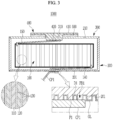
- FIG. 1 is a perspective view showing a button cell according to an embodiment
- FIG. 2 is a cross-sectional view taken along the line II-II of FIG. 1 .
- a button cell 1000 includes an electrode assembly 100, a case 200, a cap plate 300, a terminal plate 400, and a sealing part 500.
- the electrode assembly 100 is housed in the case 200.
- a lower part of the electrode assembly 100 faces a lower part of the case 200, and an upper part of the electrode assembly 100 faces the cap plate 300 and the terminal plate 400 covering an opening 210 of the case 200.
- the upper and lower parts of the electrode assembly 100 may have a planar shape such that they are parallel to each other, but are not limited thereto.
- the electrode assembly 100 includes a first electrode 110, a second electrode 120, a separator 130, a first electrode tab 140, and a second electrode tab 150.
- the first electrode 110 and the second electrode 120 are separated from each other, and the separator 130 including an insulating material is disposed between the first electrode 110 and the second electrode 120.
- the first electrode 110 may be an anode and the second electrode 120 may be a cathode, but the present invention is not limited thereto, and, in another embodiment, the first electrode 110 may be a cathode and the second electrode 120 may be an anode.
- the first electrode 110 has a band shape extending in a direction, and includes an anode coated region of an area where an anode active material layer is coated to a current collector of a metal foil (for example, a Cu foil), and an anode uncoated region of an area where the active material is not coated.
- the anode uncoated region may be disposed at an end in the extension direction of the first electrode 110.
- the second electrode 120 has a band shape that is spaced apart from the first electrode 110 with the separator 130 interposed therebetween, and extends in a direction and includes a cathode coated region of an area where a cathode active material layer is applied to a current collector of a metal foil (for example, an Al foil), and a cathode uncoated region of an area where the active material is not applied.
- the cathode uncoated region may be disposed at an end in the extending direction of the second electrode 120.
- the separator 130 extends in a direction between the first electrode 110 and the second electrode 120 to prevent or substantially prevent a short circuit between the first electrode 110 and the second electrode 120.
- first electrode 110, the separator 130, and the second electrode 120 are sequentially stacked and wound in a jelly roll shape, but are not limited thereto and may be formed in any of various shapes.
- first electrode 110, the second electrode 120, and the separator 130 may include any of various known materials.
- the first electrode tab 140 extends from the first electrode 110 of the electrode assembly 100 to the case 200.
- the first electrode tab 140 is combined with a lower part of the case 200 to connect the first electrode 110 and the case 200.
- the first electrode tab 140 is in contact with the first electrode 110 and the case 200.
- the case 200 has a same polarity (for example, an anode polarity) as the first electrode 110.
- the second electrode tab 150 extends from the second electrode 120 of the electrode assembly 100 to the terminal plate 400.
- the second electrode tab 150 is combined with a protruded part 420 of the terminal plate 400 to connect the second electrode 120 and the terminal plate 400.
- the second electrode tab 150 is in contact with the second electrode 120 and the terminal plate 400.
- the terminal plate 400 has a same polarity as the second electrode 120 (for example, a cathode polarity).
- a center pin penetrating the center of the electrode assembly 100 in a vertical direction is disposed in a center portion of the electrode assembly 100, and the center pin may support the first electrode tab 140 and the second electrode tab 150, but is not limited thereto.
- the case 200 is connected to the first electrode 110 of the electrode assembly 100 and houses the electrode assembly 100.
- the case 200 includes the opening 210 that exposes the upper part of the electrode assembly 100.
- the lower part of the case 200 is connected to the first electrode 110 of the electrode assembly 100 by the first electrode tab 140, and has the same polarity (for example, the anode polarity) as the first electrode 110.
- the case 200 has a cylinder shape for accommodating the electrode assembly 100 in the form of the jelly roll, but is not limited thereto, and may have any of various shapes.
- the case 200 may accommodate any of various known electrolyte solutions along with the electrode assembly 100.
- a first outer surface 201 of the case 200 which is disposed on the lower side of the case 200, has a first protrusions-and-depressions shape PD1.
- the first protrusions-and-depressions shape PD1 includes a plurality of first protrusions P1 and a plurality of first depressions D1.
- First depressions D1 of the plurality of first depressions D1 are respectively disposed between first protrusions P1 of the plurality of first protrusions P1, and first protrusions P1 of the plurality of first protrusions P1 are respectively disposed between first depressions D1 of the plurality of first depressions D1.
- the plurality of first depressions D1 and the plurality of first protrusions P1 define the first protrusions-and-depressions shape PD1 of the first outer surface 201.
- the first protrusions-and-depressions shape PD1 may include at least one shape among a comb shape, a checkerboard shape, a circle shape, an ellipse shape, and a polygon shape on a plane, but is not limited thereto.
- the first depressions D1 and the first protrusions P1 have a cross-sectional shape of a rectangle or square, but are not limited thereto, and may have any of various cross-sectional shapes, such as any of a triangular shape, a polygonal shape, a circular shape, an elliptical shape, and an irregular shape.
- any of various identification patterns such as letters, symbols, and numbers, may be formed in a plane area, and these identification patterns can have a depressed or protruded shape.
- the first protrusions-and-depressions shape PD1 may be formed by etching the first outer surface 201 of the case 200 using a laser beam, but is not limited thereto.
- the first protrusions-and-depressions shape PD1 may be formed by surface-treating the first outer surface 201 of the case 200 using a known MEMS process including photolithography, but is not limited thereto.
- the first outer surface 201 of the case 200 may be an anode terminal of the button cell 1000, and a contact terminal of a device, such as a wearable device, may be in contact with the first outer surface 201 of the case 200.
- a contact terminal of a device such as a wearable device
- an outer surface of the terminal plate 400 may be a cathode terminal of the button cell 1000, and the other contact terminal of the device may be in contact with the outer surface of the terminal plate 400.
- an oxide layer OL may be formed on the first outer surface 201 of the case 200 due to natural oxidation, but is not limited thereto.
- the case 200 includes stainless steel, but is not limited thereto, and may include a metal, such as any of aluminum, nickel, and copper.
- the opening 210 of the case 200 is covered by the cap plate 300 and the terminal plate 400.
- the cap plate 300 covers the outer region of the opening 210 in combination with the case 200.
- the cap plate 300 includes a through-hole 310 that exposes the center region of the opening 210.
- the cap plate 300 covers the outer region of the opening 210 by being directly coupled to the side wall of the case 200, which forms the opening 210 of the case 200, by a welding process.
- the cap plate 300 has a ring shape by the through-hole 310 formed in the center, but is not limited thereto.
- the cap plate 300 is combined with case 200 and has the same polarity (for example, the anode polarity) as the first electrode 110.
- the cap plate 300 includes stainless steel, but is not limited thereto, and may include a metal, such as any of aluminum, nickel, and copper.
- the terminal plate 400 is insulated from and combined to the cap plate 300 to cover the through-hole 310 of the cap plate 300.
- the terminal plate 400 is disposed on the cap plate 300, but is not limited thereto, and may be disposed between the cap plate 300 and the electrode assembly 100.
- the terminal plate 400 covers the center region of the opening 210 of the case 200 exposed by the through-hole 310 of the cap plate 300.
- the terminal plate 400 covers the center region of the opening 210 and the cap plate 300 covers the outer region of the opening 210, the opening 210 of the case 200 is completely covered by the terminal plate 400 and the cap plate 300.
- the terminal plate 400 is connected to the second electrode tab 150 of the electrode assembly 100 to be connected to the second electrode 120 of the electrode assembly 100.
- the terminal plate 400 has the same polarity (for example, the cathode polarity) as the second electrode 120.
- the terminal plate 400 includes a terminal part 410 and a protruded part 420.
- the terminal part 410 is disposed on the cap plate 300 and overlaps the cap plate 300.
- the terminal part 410 has a wider area than the protruded part 420.
- the terminal part 410 may have a larger diameter than the protruded part 420.
- a lower surface of the terminal part 410 is in contact with the sealing part 500, and the terminal part 410 is insulated from and bonded to the cap plate 300 by the sealing part 500.
- the protruded part 420 is protruded from the terminal part 410 corresponding to the through-hole 310 of the cap plate 300 and penetrates the through-hole 310.
- the lower surface of the protruded part 420 is in contact with the second electrode tab 150.
- the terminal plate 400 has the same polarity as the second electrode 120.
- the terminal plate 400 includes aluminum, but is not limited thereto, and may include a metal, such as any of stainless steel, nickel, and copper.
- the sealing part 500 is disposed between the cap plate 300 and the terminal part 410 of the terminal plate 400 and insulatively bonds the cap plate 300 and the terminal plate 400.
- the sealing part 500 includes an insulating material and insulates between the cap plate 300 and the terminal plate 400.
- the sealing part 500 may be thermally fused between the cap plate 300 and the terminal part 410 of the terminal plate 400 by using heat or a laser beam, or may be inserted between the cap plate 300 and the terminal part 410 of the terminal plate 400, however it is not limited thereto.
- the sealing part 500 may include any of various known materials for insulating and bonding between the cap plate 300 and the terminal plate 400. As the sealing part 500 bonds between the cap plate 300 and the terminal plate 400, the opening 210 of the case 200 is completely sealed by the cap plate 300, the terminal plate 400, and the sealing part 500.
- FIG. 3 is a cross-sectional view showing a first contact terminal in contact with an outer surface of a case of a button cell according to an embodiment.
- an external first contact terminal CP1 which may be one contact terminal of a device, is in contact with the first outer surface 201 of the case 200, which may be the anode terminal of the button cell 1000.
- the other contact terminal of the device may be in contact with the outer surface of the terminal plate 400, which may be the cathode terminal of the button cell 1000.
- the first contact terminal CP1 may have a plate or a pin shape, but is not limited thereto and may have any of various known shapes.
- the first outer surface 201 of the case 200 Due to the first protrusions-and-depressions shape PD1 in the first outer surface 201 of the case 200, the first outer surface 201 of the case 200 has a decreased contacting area.
- the first outer surface 201 of the case 200 may be an anode terminal of the chargeable battery 1000 as set forth.
- the first outer surface 201 of the case 200 may contact a cathode of a device. Then, the decreased contacting area of the case 200 could suppress formation of oxide layer thereon.
- a plurality of first protrusions P1 included in the first protrusions-and-depressions shape PD1 are in contact with the first contact terminal CP1, such that the contact area between the first outer surface 201 of the case 200 and the first contact terminals CP1 is decreased, and, thereby, pressure between the first outer surface 201 of the case 200 and the first contact terminal CP1 is increased.
- the oxide layer OL formed at the first outer surface 201 may be destroyed by the pressure between the first outer surface 201 and the first contact terminal CP1 and separated from the first outer surface 201, and the first protrusions P1 of the first outer surface 201 may be in direct contact with the first contact terminal CP1.
- the oxide layer OL is disposed between the first depressions D1 of the first protrusions-and-depressions shape PD1 and the first contact terminal CP1, and the oxide layer OL is destroyed between the first protrusions P1 of the first protrusions-and-depressions shape PD1 and the first contact terminal CP1 by the pressure and is not disposed therebetween.
- the oxide layer OL is formed on the first outer surface 201 of the case 200 of the button cell 1000, as the contact area between the first outer surface 201 and the first contact terminal CP1 is decreased by the first protrusions-and-depressions shape PD1 and the pressure between the first outer surface 201 and the first contact terminal CP1 is increased, since the oxide layer OL formed on the surface of the first protrusions P1 of the first protrusions-and-depressions shape PD1 of the first outer surface 201 may be destroyed by the pressure and the first protrusions P1 of the first outer surface 201 may be in direct contact with the first contact terminal CP1, an increase in contact resistance between the first outer surface 201 of the case 200, which may be the anode terminal of the button cell 1000, and the first contact terminal CP1 of the device, may be suppressed.
- the button cell 1000 is provided in which both an increase in contact resistance between the button cell 1000 and the first contact terminal CP1 of the device is suppressed and an increase in contact resistance between the button cell 1000 and the contact probe for the test of the button cell 1000 is suppressed.
- buttons cell according to another embodiment is described with reference to FIG. 4 .
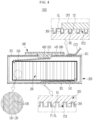
- FIG. 4 is a cross-sectional view showing a button cell according to another embodiment.
- a button cell 1002 includes an electrode assembly 100, a case 200, a cap plate 300, a terminal plate 400, and a sealing part 500.
- a second outer surface 301 of the cap plate 300 disposed at the upper side of the cap plate 300 has a second protrusions-and-depressions shape PD2.
- the second protrusions-and-depressions shape PD2 includes a plurality of second protrusions P2 and a plurality of second depressions D2. Second depressions D2 of the plurality of second depressions D2 are respectively disposed between second protrusions P2 of the plurality of second protrusions P2, and second protrusions P2 of the plurality of second protrusions P2 are respectively disposed between second depressions D2 of the plurality of second depressions D2.
- the plurality of second depressions D2 and the plurality of second protrusions P2 define the second protrusions-and-depressions shape PD2 of the second outer surface 301.
- the second protrusions-and-depressions shape PD2 may include at least one shape among a comb shape, a checkerboard shape, a circle shape, an ellipse shape, and a polygon shape on a plane area, but it is not limited thereto.
- the second depressions D2 and the second protrusions P2 may have a cross-section of a rectangular or square shape, but are not limited thereto, and may have any of various cross-sectional shapes, such as any of a triangular shape, a polygonal shape, a circular shape, an elliptical shape, and an irregular shape.
- any of various identification patterns such as letters, symbols, and numbers, may be formed on a plane area, and these identification patterns may have a depressed or embossed shape.
- the second protrusions-and-depressions shape PD2 may be formed by etching the second outer surface 301 of the cap plate 300 using a laser beam, but is not limited thereto.
- an oxide layer OL may be formed on the second outer surface 301 of the cap plate 300 due to natural oxidation, but is not limited thereto.
- An external second contact terminal CP2 which may be one contact terminal of a device, is in contact with the second outer surface 301 of the cap plate 300, which may be the anode terminal of the button cell 1002.
- the other contact terminal of the device may be in contact with the outer surface of the terminal plate 400, which may be the cathode terminal of the button cell 1002.
- the second outer surface 301 of the cap plate 300 Due to the second protrusions-and-depressions shape PD2 in the second outer surface 301 of the cap plate 300,the second outer surface 301 of the cap plate 300 has a decreased contacting area.
- the second outer surface 301 of the cap plate 300 may be an anode terminal of the chargeable battery 1002 as set forth.
- the second outer surface 301 of the cap plate 300 may contact a cathode of a device. Then, the decreased contacting area of the cap plate 300 could suppress formation of oxide layer thereon.
- a plurality of second protrusions P2 included in the second protrusions-and-depressions shape PD2 are in contact with the second contact terminal CP2, the contact area between the second outer surface 301 of the cap plate 300 and the second contact terminal CP2 is decreased, and the pressure between the second outer surface 301 of the cap plate 300 and the second contact terminal CP2 is increased.
- the oxide layer OL formed on the second outer surface 301 may be destroyed by the pressure between the second outer surface 301 and the second contact terminal CP2 and may be separated from the second outer surface 301, such that the second protrusions P2 of the second outer surface 301 are in direct contact with the second contact terminal CP2.
- the oxide layer OL is disposed between the second depressions D2 of the second protrusions-and-depressions shape PD2 and the second contact terminal CP2, and the oxide layer OL is destroyed between the second protrusions P2 of the second protrusions-and-depressions shape PD2 and the second contact terminal CP2 by the pressure and is not disposed therebetween.
- the oxide layer OL is formed on the second outer surface 301 of the cap plate 300 of the button cell 1002, as the contact area between the second outer surface 301 and the second contact terminal CP2 is decreased by the second protrusions-and-depressions shape PD2 and the pressure between the second outer surface 301 and the second contact terminal CP2 is increased, since the oxide layer OL formed on the surface of the second protrusions P2 of the second protrusions-and-depressions shape PD2 of the second outer surface 301 is destroyed by the pressure and the second protrusions P2 of the second outer surface 301 are in direct contact with the second contact terminal CP2, an increase in contact resistance between the second outer surface 301 of the cap plate 300, which may be the anode terminal of the button cell 1002, and the second contact terminal CP2 of the device, is suppressed.
- the button cell 1002 is provided in which both an increase in contact resistance between the button cell 1002 and the second contact terminal CP2 of the device is suppressed and an increase in contact resistance between the button cell 1002 and the contact probe for the test of the button cell 1002 is suppressed.
- the second outer surface 301 of the cap plate 300 of the button cell 1002 includes the second protrusions-and-depressions shape PD2 since the bonding area between the second outer surface 301 of the cap plate 300 and the sealing part 500 is increased, a bonding force between the terminal plate 400 and the cap plate 300 by the sealing part 500 is improved.
- buttons cell according to another embodiment is described with reference to FIG. 5 .
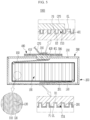
- FIG. 5 is a cross-sectional view showing a button cell according to another embodiment.
- a button cell 1003 includes an electrode assembly 100, a case 200, a cap plate 300, a terminal plate 400, and a sealing part 500.
- a third outer surface 401 of the terminal part 410 of the terminal plate 400 disposed at an upper side of the terminal part 410 of the terminal plate 400 has a third protrusions-and-depressions shape PD3.
- the third protrusions-and-depressions shape PD3 includes a plurality of third protrusions P3 and a plurality of third depressions D3.
- Third depressions D3 of the plurality of third depressions D3 are respectively disposed between third protrusions P3 of the plurality of third protrusions P3, and third protrusions P3 of the plurality of third protrusions P3 are respectively disposed between third depressions D3 of the plurality of third depressions D3.
- the plurality of third depressions D3 and the plurality of third protrusions P3 define the third protrusions-and-depressions shape PD3 of the third outer surface 401.
- the third protrusions-and-depressions shape PD3 may include at least one shape among a comb shape, a checkerboard shape, a circle shape, an ellipse shape, and a polygon shape on a plane area, but it is not limited thereto.
- the third depressions D3 and the third protrusions P3 have a cross-section of a rectangular or square shape, but are not limited thereto, and may have any of various cross-sectional shapes, such as any of a triangular shape, a polygonal shape, a circular shape, an elliptical shape, and an irregular shape.
- the third protrusions-and-depressions shape PD3 may be formed by etching the third outer surface 401 of the terminal part 410 of the terminal plate 400 using a laser beam, but is not limited thereto.
- an oxide layer OL may be formed on the third outer surface 401 of the terminal part 410 of the terminal plate 400, but is not limited thereto.
- an external third contact terminal CP3 which may be one contact terminal of a device, is in contact with the third outer surface 401 of the terminal part 410 of the terminal plate 400, which may be the cathode terminal of the button cell 1003.
- the other contact terminal of the device may be in contact with the first outer surface 201 of the case 200, which may be the anode terminal of the button cell 1003.
- the third outer surface 401 of the terminal part 410 of the terminal plate 400 Due to the third protrusions-and-depressions shape PD3 in the third outer surface 401 of the terminal part 410 of the terminal plate 400, the third outer surface 401 of the terminal part 410 of the terminal plate 400 has a decreased contacting area.
- the third outer surface 401 of the terminal part 410 of the terminal plate 400 may be a cathode terminal of the chargeable battery 1003 as set forth.
- the third outer surface 401 of the terminal part 410 of the terminal plate 400 may contact a anode of a device. Then, the decreased contacting area of the terminal part 410 of the terminal plate 400 could suppress formation of oxide layer thereon.
- a plurality of third protrusions P3 included in the third protrusions-and-depressions shape PD3 are in contact with the third contact terminal CP3 and the contact area between the third outer surface 401 of the terminal part 410 of the terminal plate 400 and the third contact terminal CP3 is decreased, and the pressure between the third outer surface 401 of the terminal part 410 of the terminal plate 400 and the third contact terminal CP3 is increased.
- the oxide layer OL formed on the third outer surface 401 may be destroyed by the pressure between the third outer surface 401 and the third contact terminal CP3 and separated from the third outer surface 401, and third protrusions P3 of the third outer surface 401 may be in direct contact with the third contact terminal CP3.
- the oxide layer OL is disposed between the third depressions D3 of the third protrusions-and-depressions shape PD3 and the third contact terminal CP3, and the oxide layer OL is destroyed by the pressure and is not disposed between the third protrusions P3 of the third protrusions-and-depressions shape PD3 and the third contact terminal CP3.
- the oxide layer OL is formed on the third outer surface 401 of the terminal part 410 of the terminal plate 400 of the button cell 1003, as the contact area between the third outer surface 401 and the third contact terminal CP3 is decreased due to the third protrusions-and-depressions shape PD3 and the pressure between the third outer surface 401 and the third contact terminal CP3 is increased, since the oxide layer OL formed on the surface of the third protrusions P3 of the third protrusions-and-depressions shape PD3 of the third outer surface 401 is destroyed by the pressure and the third protrusions P3 of the third outer surface 401 are in direct contact with the third contact terminal CP3, an increase in contact resistance between the third outer surface 401 of the terminal part 410 of the terminal plate 400, which may be the cathode terminal of the button cell 1003, and the third contact terminal CP3 of the device, is suppressed.
- the button cell 1003 is provided in which both an increase in contact resistance between the button cell 1003 and the third contact terminal CP3 of the device is suppressed and an increase in contact resistance between the button cell 1003 and the contact probe for the test of the button cell 1003 is suppressed.
Landscapes
- Chemical & Material Sciences (AREA)
- Chemical Kinetics & Catalysis (AREA)
- Electrochemistry (AREA)
- General Chemical & Material Sciences (AREA)
- Engineering & Computer Science (AREA)
- Manufacturing & Machinery (AREA)
- Connection Of Batteries Or Terminals (AREA)
- Sealing Battery Cases Or Jackets (AREA)
- Secondary Cells (AREA)
Description
- Aspects of embodiments of the present disclosure relate to a button cell.
- Generally, a button cell is a battery that can be repeatedly charged and discharged.
- A button cell is disclosed in document
KR20200020619 A - In recent years, as a demand for wearable devices, such as headphones, earphones, smartwatches, and body-attached medical devices using a wireless communication such as Bluetooth increases, a need for ultra-small rechargeable batteries installed in the wearable devices is increasing.
- An electrode terminal disposed on an outer surface of the ultra-small button cell is in contact with a contact terminal of the wearable device to supply power to the wearable device, and since an oxide film is naturally formed on the surface of the electrode terminal of the ultra-small button cell. Thus, there is a need to provide a button cell to suppress the oxide film. The above information disclosed in this section is only for enhancement of understanding of the background of the invention.
- The scope of the invention is defined by claim 1. According to the present invention, a button cell is provided in which electrode terminals have a smaller contacting area, which suppresses the oxide film.
- The button cell includes: an electrode assembly including a first electrode, a second electrode, and a separator between the first electrode and the second electrode; a case connected to the first electrode to house the electrode assembly and including an opening to expose the electrode assembly; a cap plate coupled with the case to cover an outer region of the opening and including a through-hole to expose a center region of the opening; and a terminal plate bonded to and insulated from the cap plate to cover the through-hole and connected to the second electrode, wherein the outer surface of the case has a first protrusions-and-depressions shape. The outer surface of the case is a first electrode terminal of the button cell. The outer surface of the case is a surface exposed to an outside environment and faces away from the electrode assembly, the outer surface of the case is disposed opposite to the cap plate button cellThe first electrode terminal is configured to be contactable to an external first contact terminal.
- An outer surface of the case may contact an external first contact terminal.
- An oxide layer may be between depressions of the first protrusions-and-depressions shape and the first contact terminal, and the oxide layer may not be between protrusions of the first protrusions-and-depressions shape and the first contact terminal.
- The first protrusions-and-depressions shape may be formed by etching using a laser beam.
- The first protrusions-and-depressions shape may include at least one shape among a comb shape, a checkerboard shape, a circle shape, and an ellipse shape on a plane area.
- An outer surface of the cap plate may have a second protrusions-and-depressions shape.
- The outer surface of the cap plate may be a first electrode terminal of the button cell.
- The first electrode terminal is configured to be contactable to an external second contact terminal.
- The outer surface of the cap plate may contact an external second contact terminal.
- An oxide layer may be between depressions of the second protrusions-and-depressions shape and the second contact terminal, and the oxide layer may not be between protrusions of the second protrusions-and-depressions shape and the second contact terminal.
- The terminal plate may include: a terminal part arranged on the cap plate; and a protruded part penetrating the through-hole from the terminal part and connected to the second electrode.
- The button cell may further include a sealing part between the terminal part and the cap plate and bonding between the cap plate and the terminal plate.
- An outer surface of the terminal part may have a third protrusions-and-depressions shape.
- The outer surface of the terminal part may be a second electrode terminal of the button cell.
- The second electrode terminal is configured to be contactable to an external third contact terminal
- The outer surface of the terminal part may contact an external third contact terminal.
- An oxide layer may be between depressions of the third protrusions-and-depressions shape and the third contact terminal, and the oxide layer may not be between protrusions of the third protrusions-and-depressions shape and the third contact terminal.
- The case and the cap plate may have a same polarity as that of the first electrode, and the terminal plate may have a same polarity as that of the second electrode.
- The electrode assembly may further include: a first electrode tab extending from the first electrode and coupled with the case; and a second electrode tab extending from the second electrode and coupled with the terminal plate.
- According to an exemplary embodiment, the button cell includes electrode terminals having a smaller contacting area.
-
-
FIG. 1 is a perspective view showing a button cell according to an embodiment. -
FIG. 2 is a cross-sectional view taken along the line II-II ofFIG. 1 . -
FIG. 3 is a cross-sectional view showing a first contact terminal in contact with an outer surface of a case of a button cell according to an embodiment. -
FIG. 4 is a cross-sectional view of a button cell according to another embodiment. -
FIG. 5 is a cross-sectional view of a button cell according to another embodiment. -
100: electrode assembly 200: case 300: cap plate 400: terminal plate PD1: first protrusions-and-depressions shape - The present invention will be described more fully herein with reference to the accompanying drawings, in which some example embodiments of the invention are shown. As those skilled in the art would realize, the described embodiments may be modified in various different ways, all without departing from the scope of the present invention. The drawings and description are to be regarded as illustrative in nature and not restrictive. Like reference numerals designate like elements throughout the specification.
- In addition, unless explicitly described to the contrary, it is to be understood that terms such as "comprises," "includes," or "have" used in the present specification specify the presence of stated features, numerals, steps, operations, components, parts, or a combination thereof, but do not preclude the presence or addition of one or more other features, numerals, steps, operations, components, parts, or a combination thereof.
- Also, in this specification, it is to be understood that when one component is referred to as being "connected" or "coupled" to another component, it may be connected or coupled directly to the other component or connected or coupled to another component with one or more other components intervening therebetween.
- Singular forms are to include plural forms unless the context clearly indicates otherwise.
- It is to be understood that, although the terms "first," "second," etc. may be used herein to describe various elements, these elements should not be limited by these terms. These terms are used to distinguish one element from another. For example, a first element could be termed a "second" element, and, similarly, a second element could be termed a "first" element, without departing from the scope of example embodiments of the inventive concept. The terms of a singular form may include plural forms unless the context clearly indicates otherwise.
- In addition, terms such as "below," "lower," "above," "upper," and the like are used to describe the relationship of the configurations shown in the drawings. However, the terms are used as a relative concept and are described with reference to the direction indicated in the drawings.
- Unless otherwise defined, all terms (including technical and scientific terms) used herein have the same meaning as commonly understood by one of ordinary skill in the art to which the inventive concept pertains. It is also to be understood that terms defined in commonly used dictionaries should be interpreted as having meanings consistent with the meanings in the context of the related art, and are expressly defined herein unless they are interpreted in an ideal or overly formal sense.
- Next, a button cell according to an embodiment is described with reference to
FIG. 1 to FIG. 3 . - The button cell according to an embodiment is an ultra-small button cell and may be a coin-type cell or a button-type cell, but is not limited thereto and, in another embodiment, may be a cylindrical or pin type cell.
- Here, the coin-type cell or the button-type cell is a thin coin-type or button-shape cell and may refer to a cell having a ratio of a height to a diameter of 1 or less, however, is not limited thereto. In an embodiment, the coin-type cell or the button-type cell is cylindrical, and a horizontal cross-section is circular, but the present invention is not limited thereto, and, in another embodiment, a horizontal cross-section may be oval or polygonal. At this time, the diameter may refer to the maximum distance based on the horizontal direction of the battery, and the height may refer to the maximum distance (a distance from the flat bottom surface to the flat upmost surface) based on the vertical direction of the battery.
- Herein, the coin-type cell or button-type cell that is a button cell, which may be repeatedly charged and discharged, is described as an example, but, as another example, the coin-type cell or button-type cell capable of only being discharged may also be included in the present invention.
-
FIG. 1 is a perspective view showing a button cell according to an embodiment; andFIG. 2 is a cross-sectional view taken along the line II-II ofFIG. 1 . - Referring to
FIG. 1 andFIG. 2 , abutton cell 1000 according to an embodiment includes anelectrode assembly 100, acase 200, acap plate 300, aterminal plate 400, and a sealingpart 500. - The
electrode assembly 100 is housed in thecase 200. A lower part of theelectrode assembly 100 faces a lower part of thecase 200, and an upper part of theelectrode assembly 100 faces thecap plate 300 and theterminal plate 400 covering anopening 210 of thecase 200. In an embodiment, the upper and lower parts of theelectrode assembly 100 may have a planar shape such that they are parallel to each other, but are not limited thereto. - The
electrode assembly 100 includes afirst electrode 110, asecond electrode 120, aseparator 130, afirst electrode tab 140, and asecond electrode tab 150. - The
first electrode 110 and thesecond electrode 120 are separated from each other, and theseparator 130 including an insulating material is disposed between thefirst electrode 110 and thesecond electrode 120. In an embodiment, thefirst electrode 110 may be an anode and thesecond electrode 120 may be a cathode, but the present invention is not limited thereto, and, in another embodiment, thefirst electrode 110 may be a cathode and thesecond electrode 120 may be an anode. - In an embodiment, the
first electrode 110 has a band shape extending in a direction, and includes an anode coated region of an area where an anode active material layer is coated to a current collector of a metal foil (for example, a Cu foil), and an anode uncoated region of an area where the active material is not coated. The anode uncoated region may be disposed at an end in the extension direction of thefirst electrode 110. - In an embodiment, the
second electrode 120 has a band shape that is spaced apart from thefirst electrode 110 with theseparator 130 interposed therebetween, and extends in a direction and includes a cathode coated region of an area where a cathode active material layer is applied to a current collector of a metal foil (for example, an Al foil), and a cathode uncoated region of an area where the active material is not applied. The cathode uncoated region may be disposed at an end in the extending direction of thesecond electrode 120. - The
separator 130 extends in a direction between thefirst electrode 110 and thesecond electrode 120 to prevent or substantially prevent a short circuit between thefirst electrode 110 and thesecond electrode 120. - In an embodiment, the
first electrode 110, theseparator 130, and thesecond electrode 120 are sequentially stacked and wound in a jelly roll shape, but are not limited thereto and may be formed in any of various shapes. Each of thefirst electrode 110, thesecond electrode 120, and theseparator 130 may include any of various known materials. - The
first electrode tab 140 extends from thefirst electrode 110 of theelectrode assembly 100 to thecase 200. Thefirst electrode tab 140 is combined with a lower part of thecase 200 to connect thefirst electrode 110 and thecase 200. Thefirst electrode tab 140 is in contact with thefirst electrode 110 and thecase 200. By thefirst electrode tab 140, thecase 200 has a same polarity (for example, an anode polarity) as thefirst electrode 110. - The
second electrode tab 150 extends from thesecond electrode 120 of theelectrode assembly 100 to theterminal plate 400. In an embodiment, thesecond electrode tab 150 is combined with aprotruded part 420 of theterminal plate 400 to connect thesecond electrode 120 and theterminal plate 400. Thesecond electrode tab 150 is in contact with thesecond electrode 120 and theterminal plate 400. By thesecond electrode tab 150, theterminal plate 400 has a same polarity as the second electrode 120 (for example, a cathode polarity). - In an embodiment, a center pin penetrating the center of the
electrode assembly 100 in a vertical direction is disposed in a center portion of theelectrode assembly 100, and the center pin may support thefirst electrode tab 140 and thesecond electrode tab 150, but is not limited thereto. - The
case 200 is connected to thefirst electrode 110 of theelectrode assembly 100 and houses theelectrode assembly 100. Thecase 200 includes theopening 210 that exposes the upper part of theelectrode assembly 100. The lower part of thecase 200 is connected to thefirst electrode 110 of theelectrode assembly 100 by thefirst electrode tab 140, and has the same polarity (for example, the anode polarity) as thefirst electrode 110. In an embodiment, thecase 200 has a cylinder shape for accommodating theelectrode assembly 100 in the form of the jelly roll, but is not limited thereto, and may have any of various shapes. Thecase 200 may accommodate any of various known electrolyte solutions along with theelectrode assembly 100. - A first
outer surface 201 of thecase 200, which is disposed on the lower side of thecase 200, has a first protrusions-and-depressions shape PD1. The first protrusions-and-depressions shape PD1 includes a plurality of first protrusions P1 and a plurality of first depressions D1. First depressions D1 of the plurality of first depressions D1 are respectively disposed between first protrusions P1 of the plurality of first protrusions P1, and first protrusions P1 of the plurality of first protrusions P1 are respectively disposed between first depressions D1 of the plurality of first depressions D1. The plurality of first depressions D1 and the plurality of first protrusions P1 define the first protrusions-and-depressions shape PD1 of the firstouter surface 201. The first protrusions-and-depressions shape PD1 may include at least one shape among a comb shape, a checkerboard shape, a circle shape, an ellipse shape, and a polygon shape on a plane, but is not limited thereto. In an embodiment, the first depressions D1 and the first protrusions P1 have a cross-sectional shape of a rectangle or square, but are not limited thereto, and may have any of various cross-sectional shapes, such as any of a triangular shape, a polygonal shape, a circular shape, an elliptical shape, and an irregular shape. - In an embodiment, in the first
outer surface 201 of thecase 200, any of various identification patterns, such as letters, symbols, and numbers, may be formed in a plane area, and these identification patterns can have a depressed or protruded shape. - In an embodiment, the first protrusions-and-depressions shape PD1 may be formed by etching the first
outer surface 201 of thecase 200 using a laser beam, but is not limited thereto. - As another example, the first protrusions-and-depressions shape PD1 may be formed by surface-treating the first
outer surface 201 of thecase 200 using a known MEMS process including photolithography, but is not limited thereto. - In an embodiment, the first
outer surface 201 of thecase 200 may be an anode terminal of thebutton cell 1000, and a contact terminal of a device, such as a wearable device, may be in contact with the firstouter surface 201 of thecase 200. In an embodiment, an outer surface of theterminal plate 400 may be a cathode terminal of thebutton cell 1000, and the other contact terminal of the device may be in contact with the outer surface of theterminal plate 400. - In an embodiment, an oxide layer OL may be formed on the first
outer surface 201 of thecase 200 due to natural oxidation, but is not limited thereto. - In an embodiment, the
case 200 includes stainless steel, but is not limited thereto, and may include a metal, such as any of aluminum, nickel, and copper. - The
opening 210 of thecase 200 is covered by thecap plate 300 and theterminal plate 400. - The
cap plate 300 covers the outer region of theopening 210 in combination with thecase 200. Thecap plate 300 includes a through-hole 310 that exposes the center region of theopening 210. In an embodiment, thecap plate 300 covers the outer region of theopening 210 by being directly coupled to the side wall of thecase 200, which forms theopening 210 of thecase 200, by a welding process. In an embodiment, thecap plate 300 has a ring shape by the through-hole 310 formed in the center, but is not limited thereto. Thecap plate 300 is combined withcase 200 and has the same polarity (for example, the anode polarity) as thefirst electrode 110. - In an embodiment, the
cap plate 300 includes stainless steel, but is not limited thereto, and may include a metal, such as any of aluminum, nickel, and copper. - The
terminal plate 400 is insulated from and combined to thecap plate 300 to cover the through-hole 310 of thecap plate 300. In an embodiment, theterminal plate 400 is disposed on thecap plate 300, but is not limited thereto, and may be disposed between thecap plate 300 and theelectrode assembly 100. Theterminal plate 400 covers the center region of theopening 210 of thecase 200 exposed by the through-hole 310 of thecap plate 300. In an embodiment, since theterminal plate 400 covers the center region of theopening 210 and thecap plate 300 covers the outer region of theopening 210, theopening 210 of thecase 200 is completely covered by theterminal plate 400 and thecap plate 300. Theterminal plate 400 is connected to thesecond electrode tab 150 of theelectrode assembly 100 to be connected to thesecond electrode 120 of theelectrode assembly 100. Theterminal plate 400 has the same polarity (for example, the cathode polarity) as thesecond electrode 120. - The
terminal plate 400 includes aterminal part 410 and aprotruded part 420. - The
terminal part 410 is disposed on thecap plate 300 and overlaps thecap plate 300. Theterminal part 410 has a wider area than theprotruded part 420. For example, theterminal part 410 may have a larger diameter than theprotruded part 420. A lower surface of theterminal part 410 is in contact with the sealingpart 500, and theterminal part 410 is insulated from and bonded to thecap plate 300 by the sealingpart 500. - The
protruded part 420 is protruded from theterminal part 410 corresponding to the through-hole 310 of thecap plate 300 and penetrates the through-hole 310. The lower surface of theprotruded part 420 is in contact with thesecond electrode tab 150. As theprotruded part 420 is combined with thesecond electrode tab 150, theterminal plate 400 has the same polarity as thesecond electrode 120. - In an embodiment, the
terminal plate 400 includes aluminum, but is not limited thereto, and may include a metal, such as any of stainless steel, nickel, and copper. - The sealing
part 500 is disposed between thecap plate 300 and theterminal part 410 of theterminal plate 400 and insulatively bonds thecap plate 300 and theterminal plate 400. The sealingpart 500 includes an insulating material and insulates between thecap plate 300 and theterminal plate 400. In an embodiment, the sealingpart 500 may be thermally fused between thecap plate 300 and theterminal part 410 of theterminal plate 400 by using heat or a laser beam, or may be inserted between thecap plate 300 and theterminal part 410 of theterminal plate 400, however it is not limited thereto. The sealingpart 500 may include any of various known materials for insulating and bonding between thecap plate 300 and theterminal plate 400. As the sealingpart 500 bonds between thecap plate 300 and theterminal plate 400, theopening 210 of thecase 200 is completely sealed by thecap plate 300, theterminal plate 400, and the sealingpart 500. -
FIG. 3 is a cross-sectional view showing a first contact terminal in contact with an outer surface of a case of a button cell according to an embodiment. - Referring to
FIG. 3 , an external first contact terminal CP1, which may be one contact terminal of a device, is in contact with the firstouter surface 201 of thecase 200, which may be the anode terminal of thebutton cell 1000. In an embodiment, the other contact terminal of the device may be in contact with the outer surface of theterminal plate 400, which may be the cathode terminal of thebutton cell 1000. The first contact terminal CP1 may have a plate or a pin shape, but is not limited thereto and may have any of various known shapes. - Due to the first protrusions-and-depressions shape PD1 in the first
outer surface 201 of thecase 200, the firstouter surface 201 of thecase 200 has a decreased contacting area. The firstouter surface 201 of thecase 200 may be an anode terminal of thechargeable battery 1000 as set forth. Thus, for example, the firstouter surface 201 of thecase 200 may contact a cathode of a device. Then, the decreased contacting area of thecase 200 could suppress formation of oxide layer thereon.
A plurality of first protrusions P1 included in the first protrusions-and-depressions shape PD1 are in contact with the first contact terminal CP1, such that the contact area between the firstouter surface 201 of thecase 200 and the first contact terminals CP1 is decreased, and, thereby, pressure between the firstouter surface 201 of thecase 200 and the first contact terminal CP1 is increased. As the pressure between the firstouter surface 201 of thecase 200 and the first contact terminal CP1 is increased, the oxide layer OL formed at the firstouter surface 201 may be destroyed by the pressure between the firstouter surface 201 and the first contact terminal CP1 and separated from the firstouter surface 201, and the first protrusions P1 of the firstouter surface 201 may be in direct contact with the first contact terminal CP1. - In an embodiment, the oxide layer OL is disposed between the first depressions D1 of the first protrusions-and-depressions shape PD1 and the first contact terminal CP1, and the oxide layer OL is destroyed between the first protrusions P1 of the first protrusions-and-depressions shape PD1 and the first contact terminal CP1 by the pressure and is not disposed therebetween.
- That is, even if the oxide layer OL is formed on the first
outer surface 201 of thecase 200 of thebutton cell 1000, as the contact area between the firstouter surface 201 and the first contact terminal CP1 is decreased by the first protrusions-and-depressions shape PD1 and the pressure between the firstouter surface 201 and the first contact terminal CP1 is increased, since the oxide layer OL formed on the surface of the first protrusions P1 of the first protrusions-and-depressions shape PD1 of the firstouter surface 201 may be destroyed by the pressure and the first protrusions P1 of the firstouter surface 201 may be in direct contact with the first contact terminal CP1, an increase in contact resistance between the firstouter surface 201 of thecase 200, which may be the anode terminal of thebutton cell 1000, and the first contact terminal CP1 of the device, may be suppressed. - Also, even if a contact probe is in contact with the first
outer surface 201 of thecase 200 for a test of thebutton cell 1000, as the contact area between the firstouter surface 201 and the contact probe is decreased by the first protrusions-and-depressions shape PD1 and the pressure between the firstouter surface 201 and the contact probe is increased, since the oxide layer OL formed on the surface of the first protrusions P1 of the first protrusions-and-depressions shape PD1 of the firstouter surface 201 is destroyed by the pressure and the first protrusions P1 of the firstouter surface 201 are in direct contact with the contact probe, an increase in contact resistance between the firstouter surface 201 of thecase 200, which may be the anode terminal thebutton cell 1000, and the contact probe is suppressed, thereby improving the test reliability for thebutton cell 1000. - That is, even if the oxide layer OL is formed on the first
outer surface 201 of thecase 200 which is the outer surface of thebutton cell 1000, thebutton cell 1000 is provided in which both an increase in contact resistance between thebutton cell 1000 and the first contact terminal CP1 of the device is suppressed and an increase in contact resistance between thebutton cell 1000 and the contact probe for the test of thebutton cell 1000 is suppressed. - Next, a button cell according to another embodiment is described with reference to
FIG. 4 . - Herein, parts that are different from those of the button cell according to an embodiment described above are mainly described.
-
FIG. 4 is a cross-sectional view showing a button cell according to another embodiment. - Referring to
FIG. 4 , abutton cell 1002 according to another embodiment includes anelectrode assembly 100, acase 200, acap plate 300, aterminal plate 400, and a sealingpart 500. - A second
outer surface 301 of thecap plate 300 disposed at the upper side of thecap plate 300 has a second protrusions-and-depressions shape PD2. The second protrusions-and-depressions shape PD2 includes a plurality of second protrusions P2 and a plurality of second depressions D2. Second depressions D2 of the plurality of second depressions D2 are respectively disposed between second protrusions P2 of the plurality of second protrusions P2, and second protrusions P2 of the plurality of second protrusions P2 are respectively disposed between second depressions D2 of the plurality of second depressions D2. The plurality of second depressions D2 and the plurality of second protrusions P2 define the second protrusions-and-depressions shape PD2 of the secondouter surface 301. The second protrusions-and-depressions shape PD2 may include at least one shape among a comb shape, a checkerboard shape, a circle shape, an ellipse shape, and a polygon shape on a plane area, but it is not limited thereto. The second depressions D2 and the second protrusions P2 may have a cross-section of a rectangular or square shape, but are not limited thereto, and may have any of various cross-sectional shapes, such as any of a triangular shape, a polygonal shape, a circular shape, an elliptical shape, and an irregular shape. - In an embodiment, on the second
outer surface 301 of thecap plate 300, any of various identification patterns, such as letters, symbols, and numbers, may be formed on a plane area, and these identification patterns may have a depressed or embossed shape. - In an embodiment, the second protrusions-and-depressions shape PD2 may be formed by etching the second
outer surface 301 of thecap plate 300 using a laser beam, but is not limited thereto. - In an embodiment, an oxide layer OL may be formed on the second
outer surface 301 of thecap plate 300 due to natural oxidation, but is not limited thereto. - An external second contact terminal CP2, which may be one contact terminal of a device, is in contact with the second
outer surface 301 of thecap plate 300, which may be the anode terminal of thebutton cell 1002. In an embodiment, the other contact terminal of the device may be in contact with the outer surface of theterminal plate 400, which may be the cathode terminal of thebutton cell 1002. - Due to the second protrusions-and-depressions shape PD2 in the second
outer surface 301 of thecap plate 300,the secondouter surface 301 of thecap plate 300 has a decreased contacting area. The secondouter surface 301 of thecap plate 300 may be an anode terminal of thechargeable battery 1002 as set forth. Thus, for example, the secondouter surface 301 of thecap plate 300 may contact a cathode of a device. Then, the decreased contacting area of thecap plate 300 could suppress formation of oxide layer thereon. - A plurality of second protrusions P2 included in the second protrusions-and-depressions shape PD2 are in contact with the second contact terminal CP2, the contact area between the second
outer surface 301 of thecap plate 300 and the second contact terminal CP2 is decreased, and the pressure between the secondouter surface 301 of thecap plate 300 and the second contact terminal CP2 is increased. As the pressure is increased between the secondouter surface 301 of thecap plate 300 and the second contact terminal CP2, the oxide layer OL formed on the secondouter surface 301 may be destroyed by the pressure between the secondouter surface 301 and the second contact terminal CP2 and may be separated from the secondouter surface 301, such that the second protrusions P2 of the secondouter surface 301 are in direct contact with the second contact terminal CP2. - In an embodiment, the oxide layer OL is disposed between the second depressions D2 of the second protrusions-and-depressions shape PD2 and the second contact terminal CP2, and the oxide layer OL is destroyed between the second protrusions P2 of the second protrusions-and-depressions shape PD2 and the second contact terminal CP2 by the pressure and is not disposed therebetween.
- That is, even if the oxide layer OL is formed on the second
outer surface 301 of thecap plate 300 of thebutton cell 1002, as the contact area between the secondouter surface 301 and the second contact terminal CP2 is decreased by the second protrusions-and-depressions shape PD2 and the pressure between the secondouter surface 301 and the second contact terminal CP2 is increased, since the oxide layer OL formed on the surface of the second protrusions P2 of the second protrusions-and-depressions shape PD2 of the secondouter surface 301 is destroyed by the pressure and the second protrusions P2 of the secondouter surface 301 are in direct contact with the second contact terminal CP2, an increase in contact resistance between the secondouter surface 301 of thecap plate 300, which may be the anode terminal of thebutton cell 1002, and the second contact terminal CP2 of the device, is suppressed. - Also, even if a contact probe is in contact to the second
outer surface 301 of thecap plate 300 for testing of thebutton cell 1002, as the contact area between the secondouter surface 301 and the contact probe is decreased by the second protrusions-and-depressions shape PD2 and the pressure between the secondouter surface 301 and the contact probe is increased, since the oxide layer OL formed on the surface of the second protrusions P2 of the second protrusions-and-depressions shape PD2 of the secondouter surface 301 is destroyed by the pressure and the second protrusions P2 of the secondouter surface 301 are in direct contact with the contact probe, an increase in contact resistance between the secondouter surface 301 of thecap plate 300, which may be the anode terminal thebutton cell 1002, and the contact probe, is suppressed, thereby improving the test reliability for thebutton cell 1002. - That is, even if the oxide layer OL is formed on the second
outer surface 301 of thecap plate 300 which is the outer surface of thebutton cell 1002, thebutton cell 1002 is provided in which both an increase in contact resistance between thebutton cell 1002 and the second contact terminal CP2 of the device is suppressed and an increase in contact resistance between thebutton cell 1002 and the contact probe for the test of thebutton cell 1002 is suppressed. - Also, as the second
outer surface 301 of thecap plate 300 of thebutton cell 1002 includes the second protrusions-and-depressions shape PD2, since the bonding area between the secondouter surface 301 of thecap plate 300 and the sealingpart 500 is increased, a bonding force between theterminal plate 400 and thecap plate 300 by the sealingpart 500 is improved. - Next, a button cell according to another embodiment is described with reference to
FIG. 5 . - Herein, parts that are different from those of the button cell according to an embodiment described above are mainly described.
-
FIG. 5 is a cross-sectional view showing a button cell according to another embodiment. - Referring to
FIG. 5 , abutton cell 1003 according to another embodiment includes anelectrode assembly 100, acase 200, acap plate 300, aterminal plate 400, and a sealingpart 500. - A third
outer surface 401 of theterminal part 410 of theterminal plate 400 disposed at an upper side of theterminal part 410 of theterminal plate 400 has a third protrusions-and-depressions shape PD3. The third protrusions-and-depressions shape PD3 includes a plurality of third protrusions P3 and a plurality of third depressions D3. Third depressions D3 of the plurality of third depressions D3 are respectively disposed between third protrusions P3 of the plurality of third protrusions P3, and third protrusions P3 of the plurality of third protrusions P3 are respectively disposed between third depressions D3 of the plurality of third depressions D3. The plurality of third depressions D3 and the plurality of third protrusions P3 define the third protrusions-and-depressions shape PD3 of the thirdouter surface 401. The third protrusions-and-depressions shape PD3 may include at least one shape among a comb shape, a checkerboard shape, a circle shape, an ellipse shape, and a polygon shape on a plane area, but it is not limited thereto. In an embodiment, the third depressions D3 and the third protrusions P3 have a cross-section of a rectangular or square shape, but are not limited thereto, and may have any of various cross-sectional shapes, such as any of a triangular shape, a polygonal shape, a circular shape, an elliptical shape, and an irregular shape. - In an embodiment, the third protrusions-and-depressions shape PD3 may be formed by etching the third
outer surface 401 of theterminal part 410 of theterminal plate 400 using a laser beam, but is not limited thereto. - In an embodiment, an oxide layer OL may be formed on the third
outer surface 401 of theterminal part 410 of theterminal plate 400, but is not limited thereto. - In an embodiment, an external third contact terminal CP3, which may be one contact terminal of a device, is in contact with the third
outer surface 401 of theterminal part 410 of theterminal plate 400, which may be the cathode terminal of thebutton cell 1003. In an embodiment, the other contact terminal of the device may be in contact with the firstouter surface 201 of thecase 200, which may be the anode terminal of thebutton cell 1003. - Due to the third protrusions-and-depressions shape PD3 in the third
outer surface 401 of theterminal part 410 of theterminal plate 400, the thirdouter surface 401 of theterminal part 410 of theterminal plate 400 has a decreased contacting area. The thirdouter surface 401 of theterminal part 410 of theterminal plate 400 may be a cathode terminal of thechargeable battery 1003 as set forth. Thus, for example, the thirdouter surface 401 of theterminal part 410 of theterminal plate 400 may contact a anode of a device. Then, the decreased contacting area of theterminal part 410 of theterminal plate 400 could suppress formation of oxide layer thereon. - A plurality of third protrusions P3 included in the third protrusions-and-depressions shape PD3 are in contact with the third contact terminal CP3 and the contact area between the third
outer surface 401 of theterminal part 410 of theterminal plate 400 and the third contact terminal CP3 is decreased, and the pressure between the thirdouter surface 401 of theterminal part 410 of theterminal plate 400 and the third contact terminal CP3 is increased. As the pressure between the thirdouter surface 401 of theterminal part 410 of theterminal plate 400 and the third contact terminal CP3 is increased, the oxide layer OL formed on the thirdouter surface 401 may be destroyed by the pressure between the thirdouter surface 401 and the third contact terminal CP3 and separated from the thirdouter surface 401, and third protrusions P3 of the thirdouter surface 401 may be in direct contact with the third contact terminal CP3. - In an embodiment, the oxide layer OL is disposed between the third depressions D3 of the third protrusions-and-depressions shape PD3 and the third contact terminal CP3, and the oxide layer OL is destroyed by the pressure and is not disposed between the third protrusions P3 of the third protrusions-and-depressions shape PD3 and the third contact terminal CP3.
- That is, even if the oxide layer OL is formed on the third
outer surface 401 of theterminal part 410 of theterminal plate 400 of thebutton cell 1003, as the contact area between the thirdouter surface 401 and the third contact terminal CP3 is decreased due to the third protrusions-and-depressions shape PD3 and the pressure between the thirdouter surface 401 and the third contact terminal CP3 is increased, since the oxide layer OL formed on the surface of the third protrusions P3 of the third protrusions-and-depressions shape PD3 of the thirdouter surface 401 is destroyed by the pressure and the third protrusions P3 of the thirdouter surface 401 are in direct contact with the third contact terminal CP3, an increase in contact resistance between the thirdouter surface 401 of theterminal part 410 of theterminal plate 400, which may be the cathode terminal of thebutton cell 1003, and the third contact terminal CP3 of the device, is suppressed. - Also, even if a contact probe is in contact with the third
outer surface 401 of theterminal part 410 of theterminal plate 400 for testing of thebutton cell 1003, as the contact area between the thirdouter surface 401 and the contact probe is decreased due to the third protrusions-and-depressions shape PD3 and the pressure between the thirdouter surface 401 and the contact probe is increased, since the oxide layer OL formed on the surface of the third protrusions P3 of the third protrusions-and-depressions shape PD3 of the thirdouter surface 401 is destroyed by the pressure and the third protrusions P3 of the thirdouter surface 401 are in direct contact with the contact probe, an increase in the contact resistance between the contact probe and the thirdouter surface 401 of theterminal part 410 of theterminal plate 400, which may be the anode terminal of thebutton cell 1003, is suppressed, thereby improving the reliability of the test for thebutton cell 1003. - That is, even if the oxide layer OL is formed on the third
outer surface 401 of theterminal part 410 of theterminal plate 400 which is the outer surface of thebutton cell 1003, thebutton cell 1003 is provided in which both an increase in contact resistance between thebutton cell 1003 and the third contact terminal CP3 of the device is suppressed and an increase in contact resistance between thebutton cell 1003 and the contact probe for the test of thebutton cell 1003 is suppressed.
Claims (11)
- A button cell comprising:an electrode assembly (100) comprising a first electrode (110), a second electrode (120), and a separator (130) between the first electrode and the second electrode;a case (200) connected to the first electrode (110) to house the electrode assembly and comprising an opening to receive the electrode assembly;a cap plate (300) coupled with the case (200) to cover an outer region of the opening and comprising a through-hole to expose a center region of the opening; anda terminal plate (400) bonded to and insulated from the cap plate (300) to cover the through-hole and connected to the second electrode,wherein an outer surface (201) of the case (200) has a first protrusions-and-depressions shape (PD1), the outer surface (201) of the case (200) being a surface exposed to an outside environment and facing away from the electrode assembly, the outer surface (201) of the case (200) being disposed opposite to the cap plate (300),wherein the outer surface (201) of the case (200) is a first electrode terminal of the button cell.
- The button cell of claim 1 , wherein the first protrusions-and-depressions shape (PD1) is formed by etching using a laser beam.
- The button cell of the preceding claims, wherein the first protrusions-and-depressions shape (PD1) comprises at least one shape among a comb shape, a checkerboard shape, a circle shape, and an ellipse shape on a plane area.
- The button cell of claim 1, wherein an outer surface (301) of the cap plate (300) has a second protrusions-and-depressions shape (PD2), the outer surface (301) of the case (300) being a surface exposed to an outside environment and facing away from the electrode assembly.
- The button cell of claim 4, wherein the outer surface (301) of the cap plate (300) is a first electrode terminal of the button cell.
- The button cell of claim 1, wherein the terminal plate (400) comprises:a terminal part (410) arranged on the cap plate (300); anda protruded part (420) penetrating the through-hole from the terminal part and connected to the second electrode.
- The button cell of claim 6, further comprising a sealing part positioned (500) between the terminal part (410) and the cap plate (300) and bonding the cap plate (300) to the terminal plate (400).
- The button cell of claim 6 or 7, wherein an outer surface (401) of the terminal part (410) has a third protrusions-and-depressions shape (PD3), the outer surface (401) of the terminal part (410) being a surface exposed to an outside environment and facing away from the electrode assembly
- The button cell of claim 8, wherein the outer surface (401) of the terminal part (410) is a second electrode terminal of the button cell.
- The button cell of any of the preceding claims, whereinthe case (200) and the cap plate (300) have a same polarity as that of the first electrode, andthe terminal plate (400) has a same polarity as that of the second electrode.
- The button cell of any of the preceding claims, wherein the electrode assembly further comprises:a first electrode tab (140) extending from the first electrode and coupled with the case (200); anda second electrode tab (150) extending from the second electrode and coupled with the terminal plate (400).
Applications Claiming Priority (1)
| Application Number | Priority Date | Filing Date | Title |
|---|---|---|---|
| KR1020200078578A KR20220000673A (en) | 2020-06-26 | 2020-06-26 | Rechargeable battery |
Publications (2)
| Publication Number | Publication Date |
|---|---|
| EP3930085A1 EP3930085A1 (en) | 2021-12-29 |
| EP3930085B1 true EP3930085B1 (en) | 2024-07-17 |
Family
ID=75746257
Family Applications (1)
| Application Number | Title | Priority Date | Filing Date |
|---|---|---|---|
| EP21171203.9A Active EP3930085B1 (en) | 2020-06-26 | 2021-04-29 | Rechargeable battery |
Country Status (6)
| Country | Link |
|---|---|
| US (1) | US12362442B2 (en) |
| EP (1) | EP3930085B1 (en) |
| KR (1) | KR20220000673A (en) |
| CN (1) | CN113851688B (en) |
| HU (1) | HUE068255T2 (en) |
| PL (1) | PL3930085T3 (en) |
Families Citing this family (2)
| Publication number | Priority date | Publication date | Assignee | Title |
|---|---|---|---|---|
| CN114614101B (en) * | 2022-03-17 | 2023-06-06 | 远景动力技术(江苏)有限公司 | Method for manufacturing cylindrical battery |
| WO2024065458A1 (en) * | 2022-09-29 | 2024-04-04 | 宁德新能源科技有限公司 | Electrochemical apparatus and electric device |
Family Cites Families (20)
| Publication number | Priority date | Publication date | Assignee | Title |
|---|---|---|---|---|
| JP2000133243A (en) | 1998-10-27 | 2000-05-12 | Zaza International:Kk | Dry cell |
| JP4830289B2 (en) * | 2004-11-26 | 2011-12-07 | トヨタ自動車株式会社 | Secondary battery |
| US7601458B2 (en) | 2005-03-24 | 2009-10-13 | Samsung Sdi Co., Ltd. | Rechargeable battery and battery module |
| KR100667946B1 (en) | 2005-03-24 | 2007-01-11 | 삼성에스디아이 주식회사 | Secondary Battery and Its Case |
| KR101146467B1 (en) | 2005-09-05 | 2012-05-21 | 삼성에스디아이 주식회사 | Case for lithium rechargeable battery and Lithium Rechargeable battery using the same |
| JP2008084809A (en) * | 2006-08-29 | 2008-04-10 | Yamaha Motor Co Ltd | Connection structure for piping for hydrogen supply |
| JP5122783B2 (en) | 2006-09-28 | 2013-01-16 | 三洋電機株式会社 | Coin-cell battery |
| KR20120004036A (en) | 2010-07-06 | 2012-01-12 | (주)엡스코어 | Electric double layer capacitor and manufacturing method thereof |
| JP5601926B2 (en) | 2010-08-05 | 2014-10-08 | 矢崎総業株式会社 | Crimp terminal |
| JP5556742B2 (en) | 2011-05-27 | 2014-07-23 | トヨタ自動車株式会社 | Battery terminal joining method |
| KR101370144B1 (en) * | 2012-01-25 | 2014-03-28 | (주)벡셀 | Square lithium type cell |
| KR101483422B1 (en) * | 2012-05-21 | 2015-01-16 | 주식회사 엘지화학 | Method for Treating Surface of Electrode by Laser Irradiation |
| KR20150101864A (en) | 2014-02-27 | 2015-09-04 | 삼성에스디아이 주식회사 | Secondary battery |
| US10103361B2 (en) * | 2016-01-12 | 2018-10-16 | Panasonic Intellectual Property Management Co., Ltd. | Coin type battery |
| DE102016209965A1 (en) * | 2016-06-07 | 2017-12-07 | Robert Bosch Gmbh | Printed circuit board and charger with a printed circuit board for a battery pack |
| DE102016219286A1 (en) * | 2016-10-05 | 2018-04-05 | Bayerische Motoren Werke Aktiengesellschaft | Electric energy storage with energy storage cells whose side surfaces are provided with a pattern |
| US11242591B2 (en) | 2017-03-31 | 2022-02-08 | Toyo Kohan Co., Ltd. | Surface-treated metal plate, cell container, and cell |
| KR102397762B1 (en) * | 2017-06-01 | 2022-05-13 | 삼성에스디아이 주식회사 | Secondary battery having positive electrode terminal-integrated cap plate |
| KR102571487B1 (en) * | 2017-08-31 | 2023-08-28 | 삼성에스디아이 주식회사 | Secondary Battery And Assembling Method thereof |
| DE102018128931A1 (en) * | 2018-11-19 | 2020-05-20 | Bayerische Motoren Werke Aktiengesellschaft | Battery cell and method for producing a battery cell |
-
2020
- 2020-06-26 KR KR1020200078578A patent/KR20220000673A/en active Pending
-
2021
- 2021-02-18 US US17/178,559 patent/US12362442B2/en active Active
- 2021-04-26 CN CN202110453300.5A patent/CN113851688B/en active Active
- 2021-04-29 HU HUE21171203A patent/HUE068255T2/en unknown
- 2021-04-29 PL PL21171203.9T patent/PL3930085T3/en unknown
- 2021-04-29 EP EP21171203.9A patent/EP3930085B1/en active Active
Also Published As
| Publication number | Publication date |
|---|---|
| CN113851688A (en) | 2021-12-28 |
| HUE068255T2 (en) | 2024-12-28 |
| US12362442B2 (en) | 2025-07-15 |
| US20210408649A1 (en) | 2021-12-30 |
| EP3930085A1 (en) | 2021-12-29 |
| CN113851688B (en) | 2025-02-25 |
| KR20220000673A (en) | 2022-01-04 |
| PL3930085T3 (en) | 2024-11-25 |
Similar Documents
| Publication | Publication Date | Title |
|---|---|---|
| KR102471745B1 (en) | Rechargeable battery | |
| US20230011273A1 (en) | Rechargeable battery | |
| KR20210021842A (en) | Rechargeable battery | |
| CN113851689B (en) | Rechargeable battery | |
| EP4398355A1 (en) | Button cell | |
| KR20210021841A (en) | Rechargeable battery | |
| CN117855766A (en) | Button Battery | |
| EP3930085B1 (en) | Rechargeable battery | |
| US20250046922A1 (en) | Rechargeable battery | |
| EP4145597A1 (en) | Rechargeable battery | |
| EP4170784A1 (en) | Rechargeable battery | |
| US20230170560A1 (en) | Rechargeable battery | |
| EP4175032A9 (en) | Rechargeable battery | |
| CN114342137B (en) | Rechargeable battery | |
| CN114824411A (en) | Rechargeable battery | |
| KR102960972B1 (en) | Rechargeable battery | |
| US20240347827A1 (en) | Button cell | |
| KR20260038623A (en) | Button cell | |
| KR20260059306A (en) | Secondary battery and method for manufacturing same |
Legal Events
| Date | Code | Title | Description |
|---|---|---|---|
| PUAI | Public reference made under article 153(3) epc to a published international application that has entered the european phase |
Free format text: ORIGINAL CODE: 0009012 |
|
| STAA | Information on the status of an ep patent application or granted ep patent |
Free format text: STATUS: REQUEST FOR EXAMINATION WAS MADE |
|
| 17P | Request for examination filed |
Effective date: 20210429 |
|
| AK | Designated contracting states |
Kind code of ref document: A1 Designated state(s): AL AT BE BG CH CY CZ DE DK EE ES FI FR GB GR HR HU IE IS IT LI LT LU LV MC MK MT NL NO PL PT RO RS SE SI SK SM TR |
|
| B565 | Issuance of search results under rule 164(2) epc |
Effective date: 20211015 |
|
| REG | Reference to a national code |
Ref country code: DE Ref legal event code: R079 Free format text: PREVIOUS MAIN CLASS: H01M0050145000 Ipc: H01M0050109000 Ref document number: 602021015683 Country of ref document: DE |
|
| GRAP | Despatch of communication of intention to grant a patent |
Free format text: ORIGINAL CODE: EPIDOSNIGR1 |
|
| STAA | Information on the status of an ep patent application or granted ep patent |
Free format text: STATUS: GRANT OF PATENT IS INTENDED |
|
| RIC1 | Information provided on ipc code assigned before grant |
Ipc: H01M 50/571 20210101ALI20240131BHEP Ipc: H01M 50/545 20210101ALI20240131BHEP Ipc: H01M 50/147 20210101ALI20240131BHEP Ipc: H01M 50/145 20210101ALI20240131BHEP Ipc: H01M 50/109 20210101AFI20240131BHEP |
|
| INTG | Intention to grant announced |
Effective date: 20240229 |
|
| GRAS | Grant fee paid |
Free format text: ORIGINAL CODE: EPIDOSNIGR3 |
|
| GRAA | (expected) grant |
Free format text: ORIGINAL CODE: 0009210 |
|
| STAA | Information on the status of an ep patent application or granted ep patent |
Free format text: STATUS: THE PATENT HAS BEEN GRANTED |
|
| AK | Designated contracting states |
Kind code of ref document: B1 Designated state(s): AL AT BE BG CH CY CZ DE DK EE ES FI FR GB GR HR HU IE IS IT LI LT LU LV MC MK MT NL NO PL PT RO RS SE SI SK SM TR |
|
| REG | Reference to a national code |
Ref country code: CH Ref legal event code: EP |
|
| REG | Reference to a national code |
Ref country code: DE Ref legal event code: R096 Ref document number: 602021015683 Country of ref document: DE |
|
| REG | Reference to a national code |
Ref country code: IE Ref legal event code: FG4D |
|
| REG | Reference to a national code |
Ref country code: SE Ref legal event code: TRGR |
|
| REG | Reference to a national code |
Ref country code: LT Ref legal event code: MG9D |
|
| REG | Reference to a national code |
Ref country code: NL Ref legal event code: MP Effective date: 20240717 |
|
| PG25 | Lapsed in a contracting state [announced via postgrant information from national office to epo] |
Ref country code: PT Free format text: LAPSE BECAUSE OF FAILURE TO SUBMIT A TRANSLATION OF THE DESCRIPTION OR TO PAY THE FEE WITHIN THE PRESCRIBED TIME-LIMIT Effective date: 20241118 |
|
| REG | Reference to a national code |
Ref country code: AT Ref legal event code: MK05 Ref document number: 1705010 Country of ref document: AT Kind code of ref document: T Effective date: 20240717 |
|
| PG25 | Lapsed in a contracting state [announced via postgrant information from national office to epo] |
Ref country code: NL Free format text: LAPSE BECAUSE OF FAILURE TO SUBMIT A TRANSLATION OF THE DESCRIPTION OR TO PAY THE FEE WITHIN THE PRESCRIBED TIME-LIMIT Effective date: 20240717 |
|
| REG | Reference to a national code |
Ref country code: HU Ref legal event code: AG4A Ref document number: E068255 Country of ref document: HU |
|
| PG25 | Lapsed in a contracting state [announced via postgrant information from national office to epo] |
Ref country code: PT Free format text: LAPSE BECAUSE OF FAILURE TO SUBMIT A TRANSLATION OF THE DESCRIPTION OR TO PAY THE FEE WITHIN THE PRESCRIBED TIME-LIMIT Effective date: 20241118 Ref country code: NL Free format text: LAPSE BECAUSE OF FAILURE TO SUBMIT A TRANSLATION OF THE DESCRIPTION OR TO PAY THE FEE WITHIN THE PRESCRIBED TIME-LIMIT Effective date: 20240717 |
|
| PG25 | Lapsed in a contracting state [announced via postgrant information from national office to epo] |
Ref country code: NO Free format text: LAPSE BECAUSE OF FAILURE TO SUBMIT A TRANSLATION OF THE DESCRIPTION OR TO PAY THE FEE WITHIN THE PRESCRIBED TIME-LIMIT Effective date: 20241017 |
|
| PG25 | Lapsed in a contracting state [announced via postgrant information from national office to epo] |
Ref country code: FI Free format text: LAPSE BECAUSE OF FAILURE TO SUBMIT A TRANSLATION OF THE DESCRIPTION OR TO PAY THE FEE WITHIN THE PRESCRIBED TIME-LIMIT Effective date: 20240717 Ref country code: GR Free format text: LAPSE BECAUSE OF FAILURE TO SUBMIT A TRANSLATION OF THE DESCRIPTION OR TO PAY THE FEE WITHIN THE PRESCRIBED TIME-LIMIT Effective date: 20241018 |
|
| PG25 | Lapsed in a contracting state [announced via postgrant information from national office to epo] |
Ref country code: BG Free format text: LAPSE BECAUSE OF FAILURE TO SUBMIT A TRANSLATION OF THE DESCRIPTION OR TO PAY THE FEE WITHIN THE PRESCRIBED TIME-LIMIT Effective date: 20240717 |
|
| PG25 | Lapsed in a contracting state [announced via postgrant information from national office to epo] |
Ref country code: LV Free format text: LAPSE BECAUSE OF FAILURE TO SUBMIT A TRANSLATION OF THE DESCRIPTION OR TO PAY THE FEE WITHIN THE PRESCRIBED TIME-LIMIT Effective date: 20240717 |
|
| PG25 | Lapsed in a contracting state [announced via postgrant information from national office to epo] |
Ref country code: IS Free format text: LAPSE BECAUSE OF FAILURE TO SUBMIT A TRANSLATION OF THE DESCRIPTION OR TO PAY THE FEE WITHIN THE PRESCRIBED TIME-LIMIT Effective date: 20241117 Ref country code: AT Free format text: LAPSE BECAUSE OF FAILURE TO SUBMIT A TRANSLATION OF THE DESCRIPTION OR TO PAY THE FEE WITHIN THE PRESCRIBED TIME-LIMIT Effective date: 20240717 |
|
| PG25 | Lapsed in a contracting state [announced via postgrant information from national office to epo] |
Ref country code: HR Free format text: LAPSE BECAUSE OF FAILURE TO SUBMIT A TRANSLATION OF THE DESCRIPTION OR TO PAY THE FEE WITHIN THE PRESCRIBED TIME-LIMIT Effective date: 20240717 |
|
| PG25 | Lapsed in a contracting state [announced via postgrant information from national office to epo] |
Ref country code: ES Free format text: LAPSE BECAUSE OF FAILURE TO SUBMIT A TRANSLATION OF THE DESCRIPTION OR TO PAY THE FEE WITHIN THE PRESCRIBED TIME-LIMIT Effective date: 20240717 Ref country code: RS Free format text: LAPSE BECAUSE OF FAILURE TO SUBMIT A TRANSLATION OF THE DESCRIPTION OR TO PAY THE FEE WITHIN THE PRESCRIBED TIME-LIMIT Effective date: 20241017 |
|
| PG25 | Lapsed in a contracting state [announced via postgrant information from national office to epo] |
Ref country code: RS Free format text: LAPSE BECAUSE OF FAILURE TO SUBMIT A TRANSLATION OF THE DESCRIPTION OR TO PAY THE FEE WITHIN THE PRESCRIBED TIME-LIMIT Effective date: 20241017 Ref country code: NO Free format text: LAPSE BECAUSE OF FAILURE TO SUBMIT A TRANSLATION OF THE DESCRIPTION OR TO PAY THE FEE WITHIN THE PRESCRIBED TIME-LIMIT Effective date: 20241017 Ref country code: LV Free format text: LAPSE BECAUSE OF FAILURE TO SUBMIT A TRANSLATION OF THE DESCRIPTION OR TO PAY THE FEE WITHIN THE PRESCRIBED TIME-LIMIT Effective date: 20240717 Ref country code: IS Free format text: LAPSE BECAUSE OF FAILURE TO SUBMIT A TRANSLATION OF THE DESCRIPTION OR TO PAY THE FEE WITHIN THE PRESCRIBED TIME-LIMIT Effective date: 20241117 Ref country code: HR Free format text: LAPSE BECAUSE OF FAILURE TO SUBMIT A TRANSLATION OF THE DESCRIPTION OR TO PAY THE FEE WITHIN THE PRESCRIBED TIME-LIMIT Effective date: 20240717 Ref country code: GR Free format text: LAPSE BECAUSE OF FAILURE TO SUBMIT A TRANSLATION OF THE DESCRIPTION OR TO PAY THE FEE WITHIN THE PRESCRIBED TIME-LIMIT Effective date: 20241018 Ref country code: FI Free format text: LAPSE BECAUSE OF FAILURE TO SUBMIT A TRANSLATION OF THE DESCRIPTION OR TO PAY THE FEE WITHIN THE PRESCRIBED TIME-LIMIT Effective date: 20240717 Ref country code: ES Free format text: LAPSE BECAUSE OF FAILURE TO SUBMIT A TRANSLATION OF THE DESCRIPTION OR TO PAY THE FEE WITHIN THE PRESCRIBED TIME-LIMIT Effective date: 20240717 Ref country code: BG Free format text: LAPSE BECAUSE OF FAILURE TO SUBMIT A TRANSLATION OF THE DESCRIPTION OR TO PAY THE FEE WITHIN THE PRESCRIBED TIME-LIMIT Effective date: 20240717 Ref country code: AT Free format text: LAPSE BECAUSE OF FAILURE TO SUBMIT A TRANSLATION OF THE DESCRIPTION OR TO PAY THE FEE WITHIN THE PRESCRIBED TIME-LIMIT Effective date: 20240717 |
|
| PG25 | Lapsed in a contracting state [announced via postgrant information from national office to epo] |
Ref country code: DK Free format text: LAPSE BECAUSE OF FAILURE TO SUBMIT A TRANSLATION OF THE DESCRIPTION OR TO PAY THE FEE WITHIN THE PRESCRIBED TIME-LIMIT Effective date: 20240717 Ref country code: RO Free format text: LAPSE BECAUSE OF FAILURE TO SUBMIT A TRANSLATION OF THE DESCRIPTION OR TO PAY THE FEE WITHIN THE PRESCRIBED TIME-LIMIT Effective date: 20240717 Ref country code: SM Free format text: LAPSE BECAUSE OF FAILURE TO SUBMIT A TRANSLATION OF THE DESCRIPTION OR TO PAY THE FEE WITHIN THE PRESCRIBED TIME-LIMIT Effective date: 20240717 |
|
| REG | Reference to a national code |
Ref country code: DE Ref legal event code: R097 Ref document number: 602021015683 Country of ref document: DE |
|
| PG25 | Lapsed in a contracting state [announced via postgrant information from national office to epo] |
Ref country code: EE Free format text: LAPSE BECAUSE OF FAILURE TO SUBMIT A TRANSLATION OF THE DESCRIPTION OR TO PAY THE FEE WITHIN THE PRESCRIBED TIME-LIMIT Effective date: 20240717 |
|
| PG25 | Lapsed in a contracting state [announced via postgrant information from national office to epo] |
Ref country code: CZ Free format text: LAPSE BECAUSE OF FAILURE TO SUBMIT A TRANSLATION OF THE DESCRIPTION OR TO PAY THE FEE WITHIN THE PRESCRIBED TIME-LIMIT Effective date: 20240717 |
|
| PG25 | Lapsed in a contracting state [announced via postgrant information from national office to epo] |
Ref country code: SK Free format text: LAPSE BECAUSE OF FAILURE TO SUBMIT A TRANSLATION OF THE DESCRIPTION OR TO PAY THE FEE WITHIN THE PRESCRIBED TIME-LIMIT Effective date: 20240717 |
|
| PLBE | No opposition filed within time limit |
Free format text: ORIGINAL CODE: 0009261 |
|
| STAA | Information on the status of an ep patent application or granted ep patent |
Free format text: STATUS: NO OPPOSITION FILED WITHIN TIME LIMIT |
|
| 26N | No opposition filed |
Effective date: 20250422 |
|
| PGFP | Annual fee paid to national office [announced via postgrant information from national office to epo] |
Ref country code: DE Payment date: 20250408 Year of fee payment: 5 |
|
| PGFP | Annual fee paid to national office [announced via postgrant information from national office to epo] |
Ref country code: GB Payment date: 20250403 Year of fee payment: 5 |
|
| PGFP | Annual fee paid to national office [announced via postgrant information from national office to epo] |
Ref country code: HU Payment date: 20250429 Year of fee payment: 5 |
|
| PGFP | Annual fee paid to national office [announced via postgrant information from national office to epo] |
Ref country code: FR Payment date: 20250409 Year of fee payment: 5 |
|
| REG | Reference to a national code |
Ref country code: CH Ref legal event code: H13 Free format text: ST27 STATUS EVENT CODE: U-0-0-H10-H13 (AS PROVIDED BY THE NATIONAL OFFICE) Effective date: 20251125 |
|
| PG25 | Lapsed in a contracting state [announced via postgrant information from national office to epo] |
Ref country code: LU Free format text: LAPSE BECAUSE OF NON-PAYMENT OF DUE FEES Effective date: 20250429 |
|
| PG25 | Lapsed in a contracting state [announced via postgrant information from national office to epo] |
Ref country code: MC Free format text: LAPSE BECAUSE OF FAILURE TO SUBMIT A TRANSLATION OF THE DESCRIPTION OR TO PAY THE FEE WITHIN THE PRESCRIBED TIME-LIMIT Effective date: 20240717 |
|
| REG | Reference to a national code |
Ref country code: BE Ref legal event code: MM Effective date: 20250430 |
|
| PG25 | Lapsed in a contracting state [announced via postgrant information from national office to epo] |
Ref country code: BE Free format text: LAPSE BECAUSE OF NON-PAYMENT OF DUE FEES Effective date: 20250430 |
|
| PG25 | Lapsed in a contracting state [announced via postgrant information from national office to epo] |
Ref country code: CH Free format text: LAPSE BECAUSE OF NON-PAYMENT OF DUE FEES Effective date: 20250430 |
|
| PG25 | Lapsed in a contracting state [announced via postgrant information from national office to epo] |
Ref country code: IT Free format text: LAPSE BECAUSE OF FAILURE TO SUBMIT A TRANSLATION OF THE DESCRIPTION OR TO PAY THE FEE WITHIN THE PRESCRIBED TIME-LIMIT Effective date: 20240717 |
|
| PGFP | Annual fee paid to national office [announced via postgrant information from national office to epo] |
Ref country code: SE Payment date: 20260327 Year of fee payment: 6 |
|
| PG25 | Lapsed in a contracting state [announced via postgrant information from national office to epo] |
Ref country code: IE Free format text: LAPSE BECAUSE OF NON-PAYMENT OF DUE FEES Effective date: 20250429 |
|
| PGFP | Annual fee paid to national office [announced via postgrant information from national office to epo] |
Ref country code: PL Payment date: 20260330 Year of fee payment: 6 |