EP3929274A1 - Method and apparatus for cultivating microalgae - Google Patents
Method and apparatus for cultivating microalgae Download PDFInfo
- Publication number
- EP3929274A1 EP3929274A1 EP20181703.8A EP20181703A EP3929274A1 EP 3929274 A1 EP3929274 A1 EP 3929274A1 EP 20181703 A EP20181703 A EP 20181703A EP 3929274 A1 EP3929274 A1 EP 3929274A1
- Authority
- EP
- European Patent Office
- Prior art keywords
- microalgae
- culture medium
- photoreactor
- suitably
- floating layer
- Prior art date
- Legal status (The legal status is an assumption and is not a legal conclusion. Google has not performed a legal analysis and makes no representation as to the accuracy of the status listed.)
- Ceased
Links
- 238000000034 method Methods 0.000 title claims abstract description 98
- 239000001963 growth medium Substances 0.000 claims abstract description 169
- 238000007667 floating Methods 0.000 claims abstract description 124
- 239000000203 mixture Substances 0.000 claims abstract description 51
- 238000003306 harvesting Methods 0.000 claims abstract description 21
- 238000007599 discharging Methods 0.000 claims abstract description 20
- OKTJSMMVPCPJKN-UHFFFAOYSA-N Carbon Chemical compound [C] OKTJSMMVPCPJKN-UHFFFAOYSA-N 0.000 claims description 35
- 229910052799 carbon Inorganic materials 0.000 claims description 35
- CURLTUGMZLYLDI-UHFFFAOYSA-N Carbon dioxide Chemical compound O=C=O CURLTUGMZLYLDI-UHFFFAOYSA-N 0.000 claims description 28
- 238000013019 agitation Methods 0.000 claims description 25
- 239000008394 flocculating agent Substances 0.000 claims description 25
- 238000005188 flotation Methods 0.000 claims description 21
- 239000001569 carbon dioxide Substances 0.000 claims description 15
- 229910002092 carbon dioxide Inorganic materials 0.000 claims description 15
- 238000012545 processing Methods 0.000 claims description 8
- 239000000126 substance Substances 0.000 claims description 8
- 239000002551 biofuel Substances 0.000 claims description 7
- 239000007789 gas Substances 0.000 description 28
- 235000015097 nutrients Nutrition 0.000 description 27
- 238000000926 separation method Methods 0.000 description 20
- 210000004027 cell Anatomy 0.000 description 17
- OAICVXFJPJFONN-UHFFFAOYSA-N Phosphorus Chemical compound [P] OAICVXFJPJFONN-UHFFFAOYSA-N 0.000 description 13
- 229910052698 phosphorus Inorganic materials 0.000 description 13
- 239000011574 phosphorus Substances 0.000 description 13
- IJGRMHOSHXDMSA-UHFFFAOYSA-N Atomic nitrogen Chemical compound N#N IJGRMHOSHXDMSA-UHFFFAOYSA-N 0.000 description 12
- 239000002351 wastewater Substances 0.000 description 12
- 230000014759 maintenance of location Effects 0.000 description 11
- 230000000243 photosynthetic effect Effects 0.000 description 11
- 235000014633 carbohydrates Nutrition 0.000 description 10
- 150000001720 carbohydrates Chemical class 0.000 description 10
- 239000002054 inoculum Substances 0.000 description 9
- 238000004519 manufacturing process Methods 0.000 description 9
- 150000002632 lipids Chemical class 0.000 description 8
- XLYOFNOQVPJJNP-UHFFFAOYSA-N water Substances O XLYOFNOQVPJJNP-UHFFFAOYSA-N 0.000 description 8
- 230000004907 flux Effects 0.000 description 7
- 239000007788 liquid Substances 0.000 description 7
- QJGQUHMNIGDVPM-UHFFFAOYSA-N nitrogen group Chemical group [N] QJGQUHMNIGDVPM-UHFFFAOYSA-N 0.000 description 7
- 229910052757 nitrogen Inorganic materials 0.000 description 6
- 230000000717 retained effect Effects 0.000 description 5
- 230000008901 benefit Effects 0.000 description 4
- 230000000694 effects Effects 0.000 description 4
- 235000019387 fatty acid methyl ester Nutrition 0.000 description 4
- 238000001914 filtration Methods 0.000 description 4
- 239000000463 material Substances 0.000 description 4
- 230000008569 process Effects 0.000 description 4
- 239000000047 product Substances 0.000 description 4
- 239000007787 solid Substances 0.000 description 4
- 208000016444 Benign adult familial myoclonic epilepsy Diseases 0.000 description 3
- BVKZGUZCCUSVTD-UHFFFAOYSA-M Bicarbonate Chemical class OC([O-])=O BVKZGUZCCUSVTD-UHFFFAOYSA-M 0.000 description 3
- 229920001503 Glucan Polymers 0.000 description 3
- 241000206764 Xanthophyceae Species 0.000 description 3
- 239000007864 aqueous solution Substances 0.000 description 3
- QVGXLLKOCUKJST-UHFFFAOYSA-N atomic oxygen Chemical compound [O] QVGXLLKOCUKJST-UHFFFAOYSA-N 0.000 description 3
- 238000005119 centrifugation Methods 0.000 description 3
- 208000016427 familial adult myoclonic epilepsy Diseases 0.000 description 3
- 229910052760 oxygen Inorganic materials 0.000 description 3
- 239000001301 oxygen Substances 0.000 description 3
- 238000004062 sedimentation Methods 0.000 description 3
- 239000000725 suspension Substances 0.000 description 3
- 239000002028 Biomass Substances 0.000 description 2
- UGFAIRIUMAVXCW-UHFFFAOYSA-N Carbon monoxide Chemical compound [O+]#[C-] UGFAIRIUMAVXCW-UHFFFAOYSA-N 0.000 description 2
- 241000195493 Cryptophyta Species 0.000 description 2
- 229910019142 PO4 Inorganic materials 0.000 description 2
- CDBYLPFSWZWCQE-UHFFFAOYSA-L Sodium Carbonate Chemical compound [Na+].[Na+].[O-]C([O-])=O CDBYLPFSWZWCQE-UHFFFAOYSA-L 0.000 description 2
- UIIMBOGNXHQVGW-UHFFFAOYSA-M Sodium bicarbonate Chemical compound [Na+].OC([O-])=O UIIMBOGNXHQVGW-UHFFFAOYSA-M 0.000 description 2
- 241000199474 Tribonema Species 0.000 description 2
- 239000001164 aluminium sulphate Substances 0.000 description 2
- 235000011128 aluminium sulphate Nutrition 0.000 description 2
- 238000009360 aquaculture Methods 0.000 description 2
- 244000144974 aquaculture Species 0.000 description 2
- 239000003225 biodiesel Substances 0.000 description 2
- -1 colour Substances 0.000 description 2
- 230000001419 dependent effect Effects 0.000 description 2
- BUACSMWVFUNQET-UHFFFAOYSA-H dialuminum;trisulfate;hydrate Chemical compound O.[Al+3].[Al+3].[O-]S([O-])(=O)=O.[O-]S([O-])(=O)=O.[O-]S([O-])(=O)=O BUACSMWVFUNQET-UHFFFAOYSA-H 0.000 description 2
- 235000014113 dietary fatty acids Nutrition 0.000 description 2
- 239000010840 domestic wastewater Substances 0.000 description 2
- 238000005265 energy consumption Methods 0.000 description 2
- 239000000194 fatty acid Substances 0.000 description 2
- 229930195729 fatty acid Natural products 0.000 description 2
- 150000004665 fatty acids Chemical class 0.000 description 2
- 238000005189 flocculation Methods 0.000 description 2
- 230000016615 flocculation Effects 0.000 description 2
- 239000003546 flue gas Substances 0.000 description 2
- 239000010842 industrial wastewater Substances 0.000 description 2
- 238000011081 inoculation Methods 0.000 description 2
- 238000005374 membrane filtration Methods 0.000 description 2
- 239000011785 micronutrient Substances 0.000 description 2
- 235000013369 micronutrients Nutrition 0.000 description 2
- 238000002156 mixing Methods 0.000 description 2
- 239000010841 municipal wastewater Substances 0.000 description 2
- BWHMMNNQKKPAPP-UHFFFAOYSA-L potassium carbonate Chemical compound [K+].[K+].[O-]C([O-])=O BWHMMNNQKKPAPP-UHFFFAOYSA-L 0.000 description 2
- 238000002360 preparation method Methods 0.000 description 2
- 102000004169 proteins and genes Human genes 0.000 description 2
- 108090000623 proteins and genes Proteins 0.000 description 2
- 238000005086 pumping Methods 0.000 description 2
- 238000001228 spectrum Methods 0.000 description 2
- QGZKDVFQNNGYKY-UHFFFAOYSA-O Ammonium Chemical compound [NH4+] QGZKDVFQNNGYKY-UHFFFAOYSA-O 0.000 description 1
- 241000192542 Anabaena Species 0.000 description 1
- 241000192660 Aphanizomenon Species 0.000 description 1
- 235000016425 Arthrospira platensis Nutrition 0.000 description 1
- 240000002900 Arthrospira platensis Species 0.000 description 1
- 241000227744 Aulacoseira Species 0.000 description 1
- 241000206761 Bacillariophyta Species 0.000 description 1
- 241000192550 Botryosphaerella Species 0.000 description 1
- VEXZGXHMUGYJMC-UHFFFAOYSA-M Chloride anion Chemical compound [Cl-] VEXZGXHMUGYJMC-UHFFFAOYSA-M 0.000 description 1
- 241000180279 Chlorococcum Species 0.000 description 1
- 241000196319 Chlorophyceae Species 0.000 description 1
- 241000195628 Chlorophyta Species 0.000 description 1
- 241001478778 Cladophora Species 0.000 description 1
- 241000192700 Cyanobacteria Species 0.000 description 1
- 241001607798 Cymbella Species 0.000 description 1
- MYMOFIZGZYHOMD-UHFFFAOYSA-N Dioxygen Chemical compound O=O MYMOFIZGZYHOMD-UHFFFAOYSA-N 0.000 description 1
- KCXVZYZYPLLWCC-UHFFFAOYSA-N EDTA Chemical compound OC(=O)CN(CC(O)=O)CCN(CC(O)=O)CC(O)=O KCXVZYZYPLLWCC-UHFFFAOYSA-N 0.000 description 1
- 241000195620 Euglena Species 0.000 description 1
- 241000393470 Gomphonema Species 0.000 description 1
- 241000196173 Hydrodictyon Species 0.000 description 1
- 241001134698 Lyngbya Species 0.000 description 1
- 241001491711 Melosira Species 0.000 description 1
- 241000192701 Microcystis Species 0.000 description 1
- 241000243190 Microsporidia Species 0.000 description 1
- 241000721605 Mougeotia Species 0.000 description 1
- 241000192656 Nostoc Species 0.000 description 1
- 241000546131 Oedogonium Species 0.000 description 1
- 241000192497 Oscillatoria Species 0.000 description 1
- 241000192608 Phormidium Species 0.000 description 1
- 229920005372 Plexiglas® Polymers 0.000 description 1
- 241000342028 Rhizoclonium Species 0.000 description 1
- 241000196294 Spirogyra Species 0.000 description 1
- 229920002472 Starch Polymers 0.000 description 1
- 241000159614 Ulothrix Species 0.000 description 1
- XSQUKJJJFZCRTK-UHFFFAOYSA-N Urea Chemical compound NC(N)=O XSQUKJJJFZCRTK-UHFFFAOYSA-N 0.000 description 1
- 241000200212 Vaucheria Species 0.000 description 1
- 241000159633 Zygnema Species 0.000 description 1
- 241000196295 Zygnemataceae Species 0.000 description 1
- 239000001132 aluminium potassium sulphate Substances 0.000 description 1
- 235000011126 aluminium potassium sulphate Nutrition 0.000 description 1
- 239000003963 antioxidant agent Substances 0.000 description 1
- 239000012075 bio-oil Substances 0.000 description 1
- 229910052796 boron Inorganic materials 0.000 description 1
- 230000005587 bubbling Effects 0.000 description 1
- 229910052791 calcium Inorganic materials 0.000 description 1
- 239000011575 calcium Substances 0.000 description 1
- 239000004202 carbamide Substances 0.000 description 1
- 150000004649 carbonic acid derivatives Chemical class 0.000 description 1
- 235000021466 carotenoid Nutrition 0.000 description 1
- 150000001747 carotenoids Chemical class 0.000 description 1
- 229920006317 cationic polymer Polymers 0.000 description 1
- 230000001413 cellular effect Effects 0.000 description 1
- 239000002738 chelating agent Substances 0.000 description 1
- 239000000701 coagulant Substances 0.000 description 1
- 238000004891 communication Methods 0.000 description 1
- 229910052802 copper Inorganic materials 0.000 description 1
- 238000012258 culturing Methods 0.000 description 1
- 238000010586 diagram Methods 0.000 description 1
- 229910001882 dioxygen Inorganic materials 0.000 description 1
- 238000009300 dissolved air flotation Methods 0.000 description 1
- 238000011143 downstream manufacturing Methods 0.000 description 1
- 238000001035 drying Methods 0.000 description 1
- 230000007717 exclusion Effects 0.000 description 1
- 230000002349 favourable effect Effects 0.000 description 1
- MSNWSDPPULHLDL-UHFFFAOYSA-K ferric hydroxide Chemical compound [OH-].[OH-].[OH-].[Fe+3] MSNWSDPPULHLDL-UHFFFAOYSA-K 0.000 description 1
- 239000012467 final product Substances 0.000 description 1
- 239000012530 fluid Substances 0.000 description 1
- 150000004676 glycans Chemical class 0.000 description 1
- 239000003673 groundwater Substances 0.000 description 1
- 230000036541 health Effects 0.000 description 1
- 238000005286 illumination Methods 0.000 description 1
- 239000012535 impurity Substances 0.000 description 1
- 239000000411 inducer Substances 0.000 description 1
- 238000007689 inspection Methods 0.000 description 1
- 230000003834 intracellular effect Effects 0.000 description 1
- 229910052742 iron Inorganic materials 0.000 description 1
- XEEYBQQBJWHFJM-UHFFFAOYSA-N iron Substances [Fe] XEEYBQQBJWHFJM-UHFFFAOYSA-N 0.000 description 1
- 238000002955 isolation Methods 0.000 description 1
- 238000009533 lab test Methods 0.000 description 1
- 238000011031 large-scale manufacturing process Methods 0.000 description 1
- 235000021073 macronutrients Nutrition 0.000 description 1
- 229910052749 magnesium Inorganic materials 0.000 description 1
- 239000011777 magnesium Substances 0.000 description 1
- 229910052748 manganese Inorganic materials 0.000 description 1
- 230000007246 mechanism Effects 0.000 description 1
- 238000009285 membrane fouling Methods 0.000 description 1
- 238000001471 micro-filtration Methods 0.000 description 1
- 238000012986 modification Methods 0.000 description 1
- 230000004048 modification Effects 0.000 description 1
- 229910052750 molybdenum Inorganic materials 0.000 description 1
- 239000008239 natural water Substances 0.000 description 1
- 150000002823 nitrates Chemical class 0.000 description 1
- 125000004433 nitrogen atom Chemical group N* 0.000 description 1
- 239000005416 organic matter Substances 0.000 description 1
- 238000000643 oven drying Methods 0.000 description 1
- 235000021317 phosphate Nutrition 0.000 description 1
- 150000003013 phosphoric acid derivatives Chemical class 0.000 description 1
- 125000004437 phosphorous atom Chemical group 0.000 description 1
- 230000029553 photosynthesis Effects 0.000 description 1
- 238000010672 photosynthesis Methods 0.000 description 1
- 239000000049 pigment Substances 0.000 description 1
- 239000004926 polymethyl methacrylate Substances 0.000 description 1
- 229920001282 polysaccharide Polymers 0.000 description 1
- 239000005017 polysaccharide Substances 0.000 description 1
- 229910052700 potassium Inorganic materials 0.000 description 1
- GRLPQNLYRHEGIJ-UHFFFAOYSA-J potassium aluminium sulfate Chemical compound [Al+3].[K+].[O-]S([O-])(=O)=O.[O-]S([O-])(=O)=O GRLPQNLYRHEGIJ-UHFFFAOYSA-J 0.000 description 1
- 229910000028 potassium bicarbonate Inorganic materials 0.000 description 1
- 235000015497 potassium bicarbonate Nutrition 0.000 description 1
- 239000011736 potassium bicarbonate Substances 0.000 description 1
- 229910000027 potassium carbonate Inorganic materials 0.000 description 1
- 235000011181 potassium carbonates Nutrition 0.000 description 1
- TYJJADVDDVDEDZ-UHFFFAOYSA-M potassium hydrogencarbonate Chemical compound [K+].OC([O-])=O TYJJADVDDVDEDZ-UHFFFAOYSA-M 0.000 description 1
- 238000002203 pretreatment Methods 0.000 description 1
- 238000004064 recycling Methods 0.000 description 1
- 230000009467 reduction Effects 0.000 description 1
- 238000012216 screening Methods 0.000 description 1
- 229910052711 selenium Inorganic materials 0.000 description 1
- 239000011734 sodium Substances 0.000 description 1
- 229910052708 sodium Inorganic materials 0.000 description 1
- 229910000030 sodium bicarbonate Inorganic materials 0.000 description 1
- 235000017557 sodium bicarbonate Nutrition 0.000 description 1
- 229910000029 sodium carbonate Inorganic materials 0.000 description 1
- 241000894007 species Species 0.000 description 1
- 229940082787 spirulina Drugs 0.000 description 1
- 235000019698 starch Nutrition 0.000 description 1
- 239000008107 starch Substances 0.000 description 1
- 230000003068 static effect Effects 0.000 description 1
- 229910052717 sulfur Inorganic materials 0.000 description 1
- 239000002352 surface water Substances 0.000 description 1
- 230000002459 sustained effect Effects 0.000 description 1
- 230000009182 swimming Effects 0.000 description 1
- 231100000331 toxic Toxicity 0.000 description 1
- 230000002588 toxic effect Effects 0.000 description 1
- 238000012546 transfer Methods 0.000 description 1
- 210000003934 vacuole Anatomy 0.000 description 1
- 229910052720 vanadium Inorganic materials 0.000 description 1
- 235000013343 vitamin Nutrition 0.000 description 1
- 239000011782 vitamin Substances 0.000 description 1
- 229940088594 vitamin Drugs 0.000 description 1
- 229930003231 vitamin Natural products 0.000 description 1
- 238000004065 wastewater treatment Methods 0.000 description 1
- 229910052725 zinc Inorganic materials 0.000 description 1
Images
Classifications
-
- C—CHEMISTRY; METALLURGY
- C12—BIOCHEMISTRY; BEER; SPIRITS; WINE; VINEGAR; MICROBIOLOGY; ENZYMOLOGY; MUTATION OR GENETIC ENGINEERING
- C12M—APPARATUS FOR ENZYMOLOGY OR MICROBIOLOGY; APPARATUS FOR CULTURING MICROORGANISMS FOR PRODUCING BIOMASS, FOR GROWING CELLS OR FOR OBTAINING FERMENTATION OR METABOLIC PRODUCTS, i.e. BIOREACTORS OR FERMENTERS
- C12M21/00—Bioreactors or fermenters specially adapted for specific uses
- C12M21/02—Photobioreactors
-
- C—CHEMISTRY; METALLURGY
- C12—BIOCHEMISTRY; BEER; SPIRITS; WINE; VINEGAR; MICROBIOLOGY; ENZYMOLOGY; MUTATION OR GENETIC ENGINEERING
- C12M—APPARATUS FOR ENZYMOLOGY OR MICROBIOLOGY; APPARATUS FOR CULTURING MICROORGANISMS FOR PRODUCING BIOMASS, FOR GROWING CELLS OR FOR OBTAINING FERMENTATION OR METABOLIC PRODUCTS, i.e. BIOREACTORS OR FERMENTERS
- C12M33/00—Means for introduction, transport, positioning, extraction, harvesting, peeling or sampling of biological material in or from the apparatus
- C12M33/22—Settling tanks; Sedimentation by gravity
Definitions
- the present invention relates to a method of cultivating microalgae, an apparatus for carrying out such a method, microalgae cultivated in this way, the use of such microalgae to produce a bioproduct, a method of producing a bioproduct from such microalgae, and a bioproduct produced in this way.
- the present invention relates to a method of selectively cultivating auto-floating microalgae from a mixture of microalgae, suitably a mixture of naturally occurring microalgae.
- Microalgae are a promising source of renewable biofuels and bio-based chemicals. Compared with conventional biofuel and biorefinery feedstocks, such as energy crops, microalgae may be attractive due to superior productivity and less competition for land. However, the microalgae biorefinery industry is currently not economically viable due to several technical challenges in large scale microalgae production, which include strain selection, nutrient supply and recycling, gas transfer and exchange, light delivery, environment control, land and water availability, and harvesting.
- microalgae biomass i.e. microalgae biomass
- cost-effective harvesting of microalgae is particularly problematic and faces challenges arising from (1) the low microalgae concentrations in common cultivation systems; (2) the small size of microalgal cells; (3) the similarity of density of the algal cells to the growth medium; and (4) the suspension stability of microalgal cells resulting from their negative surface charges. It is estimated that the cost of harvesting contributes to 20 to 40% of the total cost of microalgal biomass production. For some high added value products, the harvesting cost could even be as high as 60% of the total cost.
- dissolved oxygen which originates from the photosynthetic activity of microalgae is known as a source of flotation gas.
- DO dissolved oxygen
- some microalgae can float on top of flocculated water after being treated by certain types of flocculants, such as aluminium sulphate.
- the flotation efficiency is highly dependent on physicochemical variables such as DO concentration, flocculant (type, dosage and contact time), mixing intensity and total retention time.
- the utilisation of photosynthetic oxygen represents a considerable reduction in complexity and energy consumption relative to the mechanical provision of flotation gas, the high flocculant dosage remains a major limitation of this method.
- a method of cultivating microalgae comprising the steps of:
- microalgae we mean microscopic algae. Typically, microalgae are unicellular, but some may form filaments or colonies. Microalgae typically have a cell size ranging from about 1 ⁇ m to about 400 ⁇ m, for example from 2 to 200 ⁇ m.
- the method according to the first aspect is a method of cultivating auto-floating microalgae.
- the inventors have found that the method of the first aspect selects and cultivates auto-floating microalgae from a mixture of microalgae, resulting in enrichment of the auto-floating microalgae.
- the method advantageously does not require the use of flocculants or flotation gas, thereby greatly reducing the materials and energy required for cultivation and harvesting of the microalgae.
- the absence of flocculants leads to other advantages: it increases the quality of the microalgae ultimately obtained because the flocculants may otherwise interfere with the final application of the microalgae; it allows the culture medium to be reused for subsequent cultivation; and it reduces damage to the microalgal cells, allowing the healthy microalgal cells to be reused as an inoculum for subsequent cultivation.
- Another advantage of the method is that the enrichment of auto-floating microalgae is carried out in mixed culture conditions without needing to screen and isolate specific microalgal strains for inoculation and without need for closed reactors and sterile conditions.
- the steps of strain selection, cultivation and harvesting are integrated into a single process. This makes the method less labour intensive, as well as more suitable for large scale production.
- auto-floating we mean that the microalgae can naturally float at the surface of water without the need for chemical inducers (e.g. flocculants) or an external supply of flotation gas. It is believed that microalgae may exhibit auto-floatation activity through a variety of mechanisms, such as natural adhesion of micro oxygen gas bubbles resulting from photosynthesis to the cell surface; production of intracellular gas-filled structures (e.g. gas vacuoles or vesicles); production of liquid-filled floats; an increase in lipid content; and swimming. A variety of microalgal strains naturally found in the environment have auto-flotation activity.
- Typical auto-floating microalgae include (but are not limited to) green algae (Chlorophyceae) such as Zygnemataceae, Oedogonium, Rhizoclonium, Microspora, Ulothrix, Spirogyra, Mougeotia, Zygnema, Cladophora, Hydrodictyon, Botryosphaerella or Chlorococcum; yellow-green algae (Xanthophyceae) such as Tribonema or Vaucheria; diatoms (Baciallariophyceae) such as Melosira, Aulacoseira, Cymbella or Gomphonema; Cyanophyta such as Spirulina, Microcystis, Aphanizomenon, Anabaena, Oscillatoria, Lyngbya, Phormidium, Plankthotrix or Nostoc; flagellated organisms such as Euglena. Microalgae which are not auto-floating may
- Steps (c) to (g) of the method according to the first aspect may collectively be referred to as a cycle.
- Steps (c) to (g) may be repeated as part of a cycle at least once, suitably at least 10 times, suitably at least 20 times, for example at least 50 times.
- Steps (a) and (b) are not repeated as part of the cycle, since a repeated cycle uses the photoreactor and the microalgae retained therein in the previous cycle.
- Each cycle may independently comprise or not comprise step (f).
- the number of cycles required for sufficient enrichment of auto-floating microalgae will depend on various conditions, such as which strains of microalgae are present in the initial mixture of microalgae.
- the duration of a cycle of steps (c) to (g) may be referred to as the total cycle time.
- the total cycle time may be any suitable length of time, such as at least 12 hours, suitably from 1 to 30 days, suitably from 1 to 10 days, for example from 1 to 3 days .
- the total cycle time may be 1 day.
- the total cycle time may be from 10 to 30 days, for example from 14 to 21 days.
- the total cycle time may vary from cycle to cycle.
- the first cycle of steps (c) to (g) immediately following steps (a) and (b) may have a total cycle time which is longer than the total cycle time of subsequent cycles.
- Step (a) of the method according to the first aspect comprises providing a photoreactor.
- the photoreactor may be any photoreactor suitable for the cultivation of microalgae.
- the photoreactor comprises a housing, wherein at least a portion of the housing may be transparent.
- the housing suitably defines an interior volume for containing a culture medium in which microalgae may be suspended.
- the photoreactor may be a closed photoreactor or an open photoreactor.
- the photoreactor is preferably a vertical photoreactor.
- the photoreactor is a column photoreactor or a flat-panel (or flat-plate) photoreactor.
- step (a) comprises providing an apparatus according to the fifth aspect of the present invention as defined further below.
- the apparatus comprises a photoreactor.
- Step (b) of the method according to the first aspect comprises introducing a mixture of microalgae into the photoreactor.
- the mixture of microalgae introduced into the photoreactor in step (b) may be referred to as an inoculum, and step (b) may be defined as an inoculation step.
- the mixture of microalgae (or inoculum) typically comprises two or more strains of microalgae.
- the mixture of microalgae (or inoculum) comprises at least 5, preferably at least 10, for example at least 20 strains of microalgae.
- the mixture of microalgae (or inoculum) may comprise at least one strain of auto-floating microalgae.
- the mixture of microalgae may not comprise auto-floating microalgae and at least one strain of auto-floating microalgae may be introduced into the photoreactor in a step other than step (b).
- the auto-floating microalgae may be introduced via the culture medium and/or from the surrounding environment.
- the mixture of microalgae may be provided as a mixture in water.
- the mixture of microalgae comprises naturally occurring microalgae.
- naturally occurring we mean that the microalgae occur in nature, and suitably have not been bred or genetically engineered.
- the mixture of microalgae may be obtained from one or more sources.
- the mixture of microalgae may be obtained from at least two, suitably at least three, for example at least four sources.
- Obtaining the mixture of microalgae from a variety of sources increases the likelihood that the mixture will comprise at least one strain of auto-floating microalgae, without the need to individually identify the strains of microalgae present in the mixture.
- at least a portion of the mixture of microalgae is obtained from the natural environment and/or wastewater.
- the mixture of microalgae is obtained from the natural environment and/or wastewater.
- obtained from the natural environment we mean that the microalgae have not been cultured for use in the method according to the first aspect.
- Suitable sources of microalgae in the natural environment include ponds, lakes, rivers, and oceans.
- Examples of wastewater include domestic wastewater, industrial wastewater, agricultural wastewater and aquaculture wastewater.
- At least one strain of auto-floating microalgae is introduced into the photoreactor during the method of the first aspect.
- the at least one strain of auto-floating microalgae may be introduced into the photoreactor via the mixture of microalgae in step (b), and/or via the culture medium in step (c).
- the culture medium introduced into the photoreactor in step (c) may comprise auto-floating microalgae, especially if the culture medium is not sterilised.
- the at least one strain of auto-floating microalgae may be introduced into the photoreactor during steps of the method other than steps (b) and (c), for example if the photoreactor is an open photoreactor.
- Step (c) of the method according to the first aspect comprises introducing a culture medium into the photoreactor.
- the culture medium introduced into the photoreactor in step (c) may be referred to as fresh culture medium.
- the microalgae are suspended in the culture medium.
- the culture medium suitably comprises water and one or more nutrients, such as an aqueous solution of one or more nutrients. Any suitable nutrients may be used. Such nutrients are suitably in a form which is bioavailable to microalgae. Suitable nutrients for the growth of microalgae include nitrogen-containing nutrients, such as nitrates, ammonium and urea; phosphorus-containing nutrients, such as phosphates; carbon sources, such as carbon dioxide (CO 2 ), bicarbonates (HCO 3 - ) and organic sources of carbon; other macronutrients (such as S, K, Na, Fe, Mg and Ca) and micronutrients (such as B, Cu, Mn, Zn, Mo, Co, V and Se); and chelators (e.g. EDTA).
- nitrogen-containing nutrients such as nitrates, ammonium and urea
- phosphorus-containing nutrients such as phosphates
- carbon sources such as carbon dioxide (CO 2 ), bicarbonates (HCO 3 - ) and organic sources of
- Suitable nitrogen-containing nutrients comprise nitrogen in a form which is bioavailable to microalgae and suitable phosphorus-containing nutrients comprise phosphorus in a form which is bioavailable to microalgae.
- the culture medium preferably comprises both nitrogen-containing nutrients and phosphorus-containing nutrients.
- the culture medium preferably also comprises other macro- and micronutrients, for example a carbon source.
- the culture medium introduced into the photoreactor in step (c) suitably comprises one or more nitrogen-containing nutrients in an amount which provides at least 1 mg/L, preferably at least 5 mg/L, for example at least 10 mg/L of nitrogen.
- the culture medium may comprise one or more nitrogen-containing nutrients in an amount which provides from 1 to 1000 mg/L, preferably from 5 to 250 mg/L, for example from 10 to 100 mg/L of nitrogen.
- mg/L of nitrogen we mean the weight, in mg, of nitrogen atoms provided by the nutrient per litre of culture medium.
- the culture medium suitably comprises one or more phosphorus-containing nutrients in an amount which provides at least 0.1 mg/L, preferably at least 0.5 mg/L, for example at least 1 mg/L of phosphorus.
- the culture medium may comprise one or more phosphorus-containing nutrients in an amount which provides from 0.1 to 100 mg/L, preferably from 0.5 to 30 mg/L, for example from 1 to 10 mg/L of phosphorus.
- mg/L of phosphorus we mean the weight, in mg, of phosphorus atoms provided by the nutrient per litre of culture medium.
- the culture medium may comprise an algal culture medium.
- An algal culture medium typically comprises a mixture of nutrients at a concentration suitable for the cultivation of microalgae.
- suitable algal culture media include BG11, BBM, COMBO, Kuhl, ES, ASW, and f/2 (details of which are well known to persons skilled in the art).
- the culture medium may comprise or be prepared from nutrient-containing water, such as surface water, groundwater, runoff water, and wastewater.
- suitable wastewater include domestic wastewater, municipal wastewater, industrial wastewater, agricultural wastewater, and aquaculture wastewater.
- Wastewater is preferably pre-treated prior to use for the preparation of a culture medium. Such pre-treatment typically comprises removing organic matter, colour, solids, and turbidity. Sources of wastewater which have been pre-treated, such as secondary treated municipal wastewater, are especially suitable for the preparation of the culture medium.
- the culture medium is prepared from water obtained from natural water sources such as ponds, lakes, rivers and oceans. Suitably the culture medium is not sterilised.
- the fresh culture medium may have a pH value of from 4 to 11.
- the fresh culture medium has a pH value of from 6 to 9.
- the fresh culture medium is substantially free of flocculants.
- substantially free of flocculants we mean that flocculants are not intentionally added to the culture medium, and if flocculants are present in the culture medium, they are only present in trace amounts (i.e. less than 0.1 wt%, preferably less than 0.01 wt% based on the weight of the culture medium).
- the fresh culture medium is completely free of flocculants.
- the method suitably does not comprise adding a flocculant to the microalgae in the culture medium.
- the fresh culture medium is substantially free of flocculants and the method does not comprise adding a flocculant to the culture medium.
- flocculant we mean any solid or liquid substance which may be added to a suspension of microalgae to help the microalgae to float, with or without the use of a flotation gas.
- a flocculant functions to aggregate microalgal cells.
- flocculants include aluminium sulphate, aluminium potassium sulphate, iron (III) hydroxide, polyaluminium chloride, and cationic polymers.
- the culture medium may be introduced into the photoreactor by any suitable method, for example by pumping or pouring the culture medium into the photoreactor.
- the culture medium is preferably introduced into the photoreactor by pumping.
- the volume of culture medium introduced into the photoreactor in step (c) may be selected to achieve a desired hydraulic retention time (HRT).
- the hydraulic retention time is defined herein as the ratio of the volume of the photoreactor to the volume of culture medium introduced into the photoreactor per day.
- the hydraulic retention time is suitably from 0.5 to 10 days, preferably from 1 to 5 days, for example from 1.4 to 3 days.
- the duration of step (c) may be any suitable length of time, such as from 5 to 120 minutes, suitably from 10 to 60 minutes, for example from 20 to 50 minutes.
- Step (b) and step (c) may be carried out in any suitable order.
- step (b) is followed by step (c).
- a sample comprising a mixture of microalgae is introduced into the photoreactor, then a culture medium is introduced into the photoreactor such that the microalgae are suspended in the culture medium.
- step (b) and step (c) are carried out at least partially simultaneously, for example completely simultaneously. Steps (b) and (c) may be carried out simultaneously when the culture medium is present in the mixture of microalgae.
- a mixture of microalgae may be suspended in a culture medium which is then introduced into the photoreactor, or a mixture of microalgae and a culture medium may be simultaneously independently introduced into the photoreactor.
- step (c) is followed by step (b).
- a culture medium may be introduced into the photoreactor, then a mixture of microalgae may be introduced into the photoreactor such that the microalgae are suspended in the culture medium.
- step (g) is suitably followed by step (c), followed by step (d).
- the volume of culture medium introduced into the photoreactor in step (c) of a repeated cycle is suitably substantially the same as the volume of culture medium in the non-floating layer discharged from the photoreactor in step (g) of a preceding cycle, for example step (g) of an immediately preceding cycle. This provides a substantially constant volume of culture medium for step (d) in each cycle.
- Step (d) of the method according to the first aspect comprises growing the microalgae in the culture medium in the photoreactor.
- Step (d) may further comprise agitating the microalgae in the culture medium, i.e. as the microalgae grow.
- Step (d) suitably comprises exposing the microalgae to light.
- the light may have a photosynthetic photon flux density (PPFD) of from 50 to 2000 ⁇ mol/m 2 /s, suitably from 75 to 1000 ⁇ mol/m 2 /S, for example from 100 to 400 ⁇ molm 2 /s.
- the light may have a PPFD of from 200 to 500 ⁇ mol/m 2 /s, suitably from 250 to 450 ⁇ mol/m 2 /S, for example from 300 to 400 ⁇ mol/m 2 /s.
- the PPFD is a measure of the intensity of photosynthetically active light (i.e. light having a wavelength of from 400 to 700 nm) and may be measured by a quantum meter.
- the light comprises visible light, preferably light within the photosynthetic active spectrum (i.e. light having a wavelength of from 400 to 700 nm).
- the light may comprise natural light and/or artificial light, suitably natural light.
- natural light we mean light from the sun.
- the use of natural light has the advantage of reducing capital and operating costs.
- the microalgae may be exposed to light continuously or intermittently.
- the microalgae may be exposed to light for from 10 to 100%, suitably from 20 to 80%, for example from 30 to 70% of the duration of step (d).
- the microalgae may be exposed to light for from 6 to 24 hours per day, suitably from 8 to 20 hours per day, for example from 10 to 18 hours per day.
- the period during which the microalgae are exposed to light may be referred to as the photoperiod.
- Step (d) may comprise supplying a carbon source to the microalgae in the culture medium.
- the carbon source functions as a nutrient to support the growth of the microalgae.
- the carbon source may comprise an inorganic carbon source and/or an organic carbon source.
- the carbon source comprises an inorganic carbon source.
- Suitable examples of inorganic carbon sources include carbonates (e.g. sodium carbonate and potassium carbonate), bicarbonates (e.g. sodium bicarbonate and potassium bicarbonate), and carbon dioxide.
- the carbon source comprises carbon dioxide.
- the carbon source is supplied as carbon dioxide in one or more of air, flue gas, biogas, or pure carbon dioxide gas, preferably in flue gas.
- the amount of the carbon source supplied to the microalgae in the culture medium will typically be selected to maximise productivity of the microalgae, in particular to maximise the growth rate of the microalgae.
- the carbon source may be supplied to the microalgae in the culture medium in one or more discrete quantities, or continuously.
- the carbon source may be supplied to the microalgae in the culture medium while the microalgae are being exposed to light (i.e. during a light phase), or while the microalgae are not being exposed to light (i.e. during a dark phase).
- the carbon source comprises carbon dioxide
- it may be supplied in a concentration from 0.04% to 100%, suitably from 0.5% to 30%, preferably from 1% to 5% by volume.
- the carbon dioxide may be supplied continuously to the microalgae in the culture medium at a rate of from 0.005 to 10 vvm (gas volume flow per unit of liquid volume per minute), suitably from 0.05 to 5 vvm, for example from 0.1 to 3 vvm, depending on the concentration of carbon dioxide.
- the temperature of the culture medium/microalgae mixture is suitably maintained at a temperature which maximises growth of the microalgae.
- the temperature of the culture medium may be from 10 to 40°C, suitably from 10 to 30°C, preferably from 15 to 25°C.
- Step (d) suitably comprises growing the microalgae in the culture medium under agitation.
- the agitation enhances the growth of the microalgae.
- Step (d) may comprise agitating the microalgae in the culture medium by any suitable means, such as by a mechanical means or by bubbling a gas through the culture medium (e.g. gas sparging).
- suitable mechanical means include mechanical agitation devices, such as an impeller.
- the gas used to agitate the culture medium comprises a carbon source, such as carbon dioxide.
- the first step (d) following step (b) may be referred to as a preculture step.
- the first step (d) following step (b) may be carried out until the culture medium comprises from 5 to 10 g/L by dry weight of microalgae.
- the first step (d) following step (b) may have a duration of from 1 to 3 weeks.
- the dry weight of microalgae is suitably measured by filtering the microalgae through a 0.45 ⁇ m microfilter and oven drying the microalgae at 105°C for at least 2 hours.
- Steps (c) and (d) may be carried out at least partially simultaneously.
- the microalgae in the photoreactor may be exposed to light while a culture medium is being introduced into the photoreactor.
- Step (e) of the method according to the first aspect comprises separating the microalgae into a floating layer and a non-floating layer within the culture medium.
- the non-floating layer may alternatively be referred to as a subnatant. Any suitable method of separation may be used.
- Separating the microalgae suitably comprises keeping the culture medium comprising the microalgae static.
- the microalgae in the culture medium are not agitated during separation.
- step (e) may comprise stopping the agitation and allowing the microalgae to separate into the floating layer and the non-floating layer within the culture medium.
- Step (e) may comprise vigorously agitating the microalgae in the culture medium in order to produce a turbulent liquid flow, and then stopping the agitation and allowing the microalgae to separate into the floating layer and the non-floating layer within the culture medium. Vigorous agitation of the microalgae in the culture medium may increase the separation efficiency of step (e).
- Vigorous agitation of the microalgae may be achieved by any suitable means, such as a mechanical means.
- suitable mechanical means include mechanical mixing devices, such as an impeller or a holding tank.
- the culture medium containing the microalgae may be discharged into a holding tank, and reintroduced into the photoreactor within up to 5 minutes, suitably up to 3 minutes, preferably up to 1 minute, so as to create a vigorous flow.
- the microalgae are suitably allowed to separate without further agitation.
- Step (e) suitably comprises separating the microalgae (i.e. into a floating layer and a non-floating layer within the culture medium) for any suitable length of time, such as at least 0.1 hours, preferably at least 0.25 hours, for example at least 0.5 hours.
- Step (e) may comprise allowing the microalgae to separate for at least 0.1 hours, such as from 0.1 to 3 hours, suitably from 0.25 to 2 hours, for example from 0.5 to 1 hour.
- the time for which the microalgae are allowed to separate may be referred to as the separation time.
- Step (e) may comprise exposing the microalgae to light during separation of the microalgae.
- the light may have a photosynthetic photon flux density (PPFD) of from 50 to 2000 ⁇ mol/m 2 /s, suitably from 75 to 1000 ⁇ mol/m 2 /s, for example from 100 to 400 ⁇ molm 2 /s.
- PPFD photosynthetic photon flux density
- the light may have a PPFD of from 200 to 500 ⁇ mol/m 2 /S, suitably from 250 to 450 ⁇ mol/m 2 /S, for example from 300 to 400 ⁇ mol/m 2 /s.
- the light comprises visible light, preferably light within the photosynthetic active spectrum (i.e. light having a wavelength of from 400 to 700 nm).
- the light may comprise natural light and/or artificial light, suitably natural light.
- the light in step (e) is suitably from the same source as the light in step (d).
- Step (e) suitably has a separation efficiency of at least 50%, suitably at least 75%, for example at least 90%.
- the separation efficiency (%) is defined as 100 x (1-SS eff /SS r ), where SS eff is the microalgae concentration by dry weight (mg/L) in the non-floating layer and SS r is the microalgae concentration by dry weight (mg/L) in the culture medium in the photoreactor prior to the separation.
- step (e) does not comprise supplying a flotation gas to the microalgae in the culture medium.
- step (e) does not comprise carrying out dissolved air flotation, electrolytic flotation or dispersed air flotation on the microalgae in the culture medium.
- the method according to the first aspect does not comprise supplying a flotation gas to the microalgae in the culture medium.
- a flotation gas we mean a gas which is supplied as very fine bubbles to the microalgae in the culture medium.
- a flotation gas is typically generated by an electrochemical means or a mechanical means, such as by a sudden release of pressurised gas into the culture medium containing the microalgae.
- the floating layer and the non-floating layer each comprise a portion of the microalgae in the culture medium in the photoreactor.
- the floating layer and the non-floating layer together comprise all of the microalgae in the culture medium in the photoreactor.
- the floating layer is typically situated above the non-floating layer, for example on top of the non-floating layer in the photoreactor.
- the floating layer may be visually distinguished from the non-floating layer by the presence of floes of microalgae in the floating layer and the absence of floes of microalgae in the non-floating layer.
- the floating layer may comprise the highest 5 to 50%, suitably the highest 10 to 30%, for example the highest 20% by volume of the culture medium containing the microalgae in the photoreactor.
- the microalgae in the floating layer comprise auto-floating microalgae
- the microalgae in the non-floating layer comprise non-floatable microalgae.
- the microalgae in the floating layer comprise a higher proportion by dry weight of auto-floating microalgae than the microalgae in the non-floating layer.
- the microalgae in the floating layer comprise a higher proportion by dry weight of auto-floating microalgae than the mixture of microalgae introduced into the photoreactor in step (b).
- a "higher proportion by dry weight” is suitably defined as the proportion by dry weight of auto-floating microalgae in the microalgae of the floating layer being at least 1.1 times, suitably at least 1.5 times, such as at least 2 times the proportion by dry weight of auto-floating microalgae in the microalgae of the non-floating layer or the mixture of microalgae introduced into the photoreactor in step (b).
- step (d) is followed by step (e).
- Step (f) of the method according to the first aspect comprises optionally harvesting a portion of the microalgae in the floating layer.
- steps (c) to (g) are repeated in a cycle, each cycle may independently comprise or not comprise step (f).
- step (f) comprises harvesting from 5 to 90%, suitably from 10 to 80%, for example from 20 to 50% by dry weight of the microalgae in the floating layer.
- the amount of microalgae harvested may be selected to achieve a desired cell retention time (CRT).
- CRT cell retention time
- the cell retention time is defined herein as the ratio of the total dry weight of microalgae in the photoreactor (prior to harvesting) to the dry weight of microalgae harvested per day.
- the cell retention time may be selected to maximise microalgae productivity, to fine-tune the cellular composition of the microalgae, and to maintain a desired concentration of microalgae in the culture medium in the photoreactor.
- the cell retention time is suitably selected to achieve a concentration of microalgae in the culture medium of from 0.3 to 5 g/L, for example from 0.5 to 3 g/L, preferably from 1 to 2 g/L by dry weight of microalgae.
- the cell retention time is suitably from 1.25 to 30 days, preferably from 1.5 to 20 days, for example from 2 to 10 days.
- Step (f) may comprise harvesting a portion of the microalgae in the floating layer by any suitable method, for example by use of a collecting device arranged within the photoreactor.
- step (f) is only (optionally) carried out if there is at least 0.5 g/L, suitably at least 1 g/L by dry weight of microalgae in the culture medium in the photoreactor.
- step (f) is only (optionally) carried out if the separation efficiency of the preceding step (e) is at least 50%, suitably at least 75%, for example at least 90%.
- step (f) is omitted.
- the microalgae harvested in step (f) suitably comprise at least 50%, suitably at least 75%, for example at least 90% by dry weight of auto-floating microalgae.
- Step (f), if present, suitably follows step (e).
- step (e) is followed by step (f), followed by step (g).
- step (e) is followed by step (g), followed by step (f).
- steps (c) to (g) where step (f) follows step (g), step (f) is followed by step (c), followed by step (d).
- step (e) is suitably followed by step (g).
- Step (g) of the method according to the first aspect comprises discharging at least a portion of the non-floating layer from the photoreactor.
- Step (g) may comprise discharging the lowest 10 to 90%, suitably the lowest 30 to 80%, for example the lowest 50 to 70% by volume of the culture medium containing the microalgae in the photoreactor.
- step (g) comprises discharging the non-floating layer from the bottom of the photoreactor. This avoids accidentally discharging the floating layer from the photoreactor.
- the culture medium containing the microalgae which is discharged from the photoreactor may be referred to as spent culture medium.
- the spent culture medium may be discarded.
- Step (g) may comprise discharging at least 30%, suitably at least 50%, suitably at least 70%, for example at least 90% by volume of the non-floating layer from the photoreactor.
- Step (g) may comprise discharging from 10 to 90%, suitably from 30 to 80%, for example from 50 to 70% by volume of the culture medium containing the microalgae from the photoreactor.
- the duration of step (g) may be any suitable length of time, such as from 5 to 120 minutes, suitably from 20 to 90 minutes, for example from 30 to 60 minutes.
- Step (g) suitably comprises retaining at least a portion of the microalgae in the culture medium in the photoreactor.
- the microalgae retained in the photoreactor in step (g) typically comprise a mixture of microalgae.
- Step (g) suitably comprises retaining at least a portion of the floating layer in the photoreactor. Suitably all of the floating layer is retained in the photoreactor.
- Step (g) may comprise retaining at least a portion of the non-floating layer in the photoreactor, or may comprise discharging all of the non-floating layer from the photoreactor.
- steps (c) to (g) are repeated as part of a cycle, the mixture of microalgae present in the photoreactor at the start of a new cycle is provided by the microalgae retained in the photoreactor at the end of a preceding cycle.
- the steps of the method according to the first aspect may be carried out in any suitable order that provides the desired result of enrichment of auto-floating microalgae.
- the steps may be carried out in the order step (a); followed by step (b) and step (c); followed by step (d); followed by step (e); followed by step (f), if present, and step (g).
- the steps may be carried out in the order step (a); followed by step (b); followed by step (c); followed by step (d); followed by step (e); followed by step (f), if present, and step (g).
- the order of the steps may be varied as described above.
- the method according to the first aspect comprises the steps of:
- the method according to the first aspect comprises the steps of:
- microalgae cultivated in accordance with the method of the first aspect.
- microalgae are suitably harvested via step (f) of the method of the first aspect.
- microalgae according to the second aspect suitably comprise at least 50 wt%, suitably at least 75 wt%, for example at least 90 wt% by dry weight of auto-floating microalgae.
- the microalgae according to the second aspect are substantially free of flocculants.
- substantially free of flocculants we mean that flocculants are not intentionally added to the microalgae, and if flocculants are present in the microalgae, they are only present in trace amounts (i.e. less than 0.1 wt%, preferably less than 0.01 wt% based on the dry weight of the microalgae).
- the microalgae are completely free of flocculants.
- Flocculants are as defined in relation to the first aspect.
- Microalgae obtained by the method according to the first aspect have the advantage that they are free of flocculants, making the microalgae particularly suitable for further processing of the microalgae or for end applications of the microalgae such as animal or human consumption. Furthermore, the healthy microalgae cultivated by the method according to the first aspect are suitable for use as an inoculum for subsequent cultivation.
- Microalgae typically contain various useful biomolecules including, but not limited to, carbohydrates, proteins and lipids.
- the cultivation conditions of the method according to the first aspect may be controlled to alter the content of biomolecules in the microalgae in view of the intended use of the microalgae.
- the microalgae obtained by the method according to the first aspect may comprise from 40 to 75 wt%, suitably from 45 to 70 wt%, for example from 50 to 65 wt% of carbohydrates based on the dry weight of the microalgae.
- Microalgae rich in carbohydrates may be particularly suitable for the production of biomethane, bioethanol and biobutanol.
- the main component of the carbohydrates e.g. more than 50 wt% of the carbohydrates
- ⁇ -(1-3)/1-6)-glucans have wide applications and may be suitable for the production of health products.
- Microalgae rich in carbohydrates may be prepared by exposing the microalgae in the culture medium in step (d) to light having a photosynthetic photon flux density of from 200 to 500 ⁇ mol/m 2 /s, suitably from 250 to 450 ⁇ mol/m 2 /s, for example from 300 to 400 ⁇ molm 2 /s.
- the microalgae obtained by the method according to the first aspect may comprise from 20 to 50 wt%, suitably from 25 to 45 wt%, for example from 30 to 40 wt% of lipids based on the dry weight of the microalgae.
- the microalgae may comprise from 5 to 40 wt%, suitably from 10 to 35 wt%, for example from 15 to 30 wt% of fatty acids (measured as fatty acid methyl esters, FAMEs) based on the dry weight of the microalgae.
- Microalgae rich in lipids, including FAMEs may be particularly suitable for the production of biodiesel.
- Microalgae rich in lipids may be prepared by culturing the microalgae in accordance with the method of the first aspect, wherein the total cycle time is from 10 to 30 days, for example from 14 to 21 days.
- a use of microalgae according to the second aspect to produce a bioproduct, such as a biofuel or bio-based chemical.
- a method of producing a bioproduct comprising the steps of:
- Bioproducts and methods of processing microalgae to manufacture such bioproducts, will be known to a person skilled in the art.
- processing the microalgae comprises dewatering the harvested microalgae.
- the harvested microalgae are suitably dewatered by a filter press or by centrifugation.
- the filter press may be under pressure or under a vacuum.
- Processing the microalgae may comprise dewatering the harvested microalgae to a solids content of at least 10%, suitably at least 15%, for example at least 20%.
- Dewatered microalgae are typically more suitable for transporting and for further processing into desirable products.
- Auto-floating microalgae typically have good dewatering properties.
- the bioproduct may comprise a biofuel or a bio-based chemical.
- Biofuels may include, but are not limited to, biodiesel, bioethanol, biobutanol, biogas, biohydrogen, bio-oil, and syngas.
- Bio-based chemicals may include, but are not limited to, pigments, proteins, antioxidants, carotenoids, polysaccharides, fatty acids, and vitamins.
- a bioproduct produced in accordance with the method of the fourth aspect is provided.
- an apparatus for cultivating microalgae comprising:
- the apparatus is preferably suitable for cultivating microalgae according to a method of the first aspect.
- the apparatus may be suitable for cultivating auto-floating microalgae.
- the apparatus may be suitable for cultivating microalgae in batches and continuous cultivation.
- the apparatus according to the sixth aspect comprises a photoreactor.
- the photoreactor may be any photoreactor suitable for the cultivation of microalgae.
- the photoreactor comprises a housing, wherein at least a portion of the housing may be transparent.
- the housing suitably defines an interior volume for containing a culture medium in which microalgae may be suspended.
- the photoreactor may be a closed photoreactor or an open photoreactor.
- the photoreactor is preferably a vertical photoreactor.
- the photoreactor is a column photoreactor or a flat-panel (or flat plate) photoreactor.
- the photoreactor suitably comprises an inlet for receiving fresh culture medium and/or microalgae.
- the apparatus may comprise a feed pump for supplying fresh culture medium to the photoreactor via the inlet.
- the apparatus may comprise a light source.
- the light source is suitably arranged such that the light source may illuminate microalgae suspended in culture medium in the photoreactor.
- the light source is suitably able to produce light having a photosynthetic photon flux density of from 50 to 2000 ⁇ mol/m 2 /s, suitably from 75 to 1000 ⁇ mol/m 2 /S, for example from 100 to 400 ⁇ mol/m 2 /s.
- the means for supplying the carbon source may comprise a pump or a compressor for supplying the carbon source to the photoreactor.
- the means for supplying the carbon source suitably comprises a compressor, preferably a compressor in fluid communication with a diffusor.
- the diffusor is suitably arranged at the bottom of the photoreactor, such that the gas comprising the carbon source may rise through the culture medium contained in the photoreactor while in use.
- the means for supplying the carbon source suitably comprises a pump.
- the photoreactor suitably comprises an inlet for receiving a carbon source.
- the photoreactor suitably comprises an outlet for discharging spent culture medium.
- the outlet is arranged in the bottom 50%, preferably the bottom 25%, for example the bottom 10% by volume of the photoreactor. This prevents the outlet from discharging microalgae floating at the top of the culture medium when the apparatus is in use.
- the apparatus may comprise a discharge pump for removing spent culture medium from the photoreactor.
- the photoreactor comprises an inlet for receiving fresh culture medium and an outlet for discharging spent culture medium.
- the apparatus comprises an agitation device suitably adapted to agitate microalgae suspended in a culture medium contained in the photoreactor.
- the agitation device may be any suitable agitation device, for example a mechanical agitation device such as an impeller.
- the agitation device is suitably arranged within the interior volume of the housing of the photoreactor.
- the apparatus may comprise a motor for driving the agitation device.
- the apparatus comprises a collecting device suitably adapted to collect microalgae floating in a culture medium from the photoreactor.
- the collecting device is arranged in the top 50%, preferably the top 25%, for example the top 10% by volume of the photoreactor.
- the collecting device may comprise any suitable collecting device, for example a scraper, a skimmer, a pump, an electromagnetic valve, or a combination thereof.
- a method for cultivating microalgae comprises the steps of introducing a mixture of microalgae and a culture medium into a photoreactor, growing the microalgae, allowing the microalgae to separate into a floating layer and a non-floating layer within the culture medium, and discharging at least a portion of the non-floating layer from photoreactor.
- the method advantageously does not require the use of flocculants or flotation gas, reducing the energy and materials required, as well as increasing the quality of the microalgae obtained. Further, the method does not require screening and isolation of specific microalgal strains.
- Microalgae cultivated according to the method a use of such microalgae to produce a bioproduct, a method of producing a bioproduct, a bioproduct produced by such a method, and an apparatus for cultivating microalgae are also described.
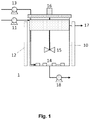
- FIG. 1 shows an apparatus (1) according to the sixth aspect of the present invention, comprising a photoreactor (10). Fresh culture medium and a mixture of microalgae are introduced to the photoreactor (10) by a feed pump (11).
- the microalgae suspended in a culture medium inside the photoreactor (10) are grown by providing them with illumination from a light source (12) arranged adjacent to the photoreactor (10), and agitating them by means of an impeller (15) driven by a motor (16).
- a carbon source is supplied to the growing microalgae by means of a compressor (13), which compresses carbon dioxide-containing gas, and a diffusor (14) which disperses the compressed carbon dioxide-containing gas into the culture medium in which the microalgae are suspended.
- a collecting device (17) is arranged such that it may harvest microalgae from the floating layer, which suitably comprises auto-floating microalgae. After separation of the microalgae into a floating layer and a non-floating layer, and optional harvesting of microalgae from the floating layer, spent culture medium, which suitably comprises non-floatable microalgae, is discharged from the bottom of the photoreactor (10) by means of a discharge pump (18).
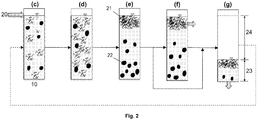
- Step (c) comprises feeding fresh culture medium (20) into a photoreactor (10), resulting in a suspension of a mixture of microalgae in the culture medium.
- the mixture of microalgae may have been introduced into the photoreactor in step (b) (not shown) or left over from a previous cycle of steps (c) to (g), and in this example comprises at least one strain of auto-floating microalgae and at least one strain of non-floatable microalgae.
- Step (d) comprises growing the microalgae in the culture medium in the photoreactor under agitation, causing the weight of microalgae in the culture medium in the photoreactor to increase.
- step (d) comprises exposing the microalgae to light and supplying a carbon source to the microalgae in the culture medium. Agitation is provided by means of a mechanical device or gas sparging.
- Step (e) comprises a short period of vigorous agitation followed by stopping the agitation and allowing the microalgae to separate into a floating layer (21) comprising auto-floating microalgae and a non-floating layer (22) comprising non-floatable microalgae within the culture medium.
- Microalgae may be harvested from the floating layer (21) in optional step (f), suitably by means of a collecting device.
- step (f) is carried out may depend on the concentration of the microalgae in the culture medium in the photoreactor, or on the separation efficiency of step (e).
- Step (g) comprises discharging at least a portion of the non-floating layer (22). At least a portion (23) of the culture medium and microalgae is retained in the photoreactor, suitably comprising all of the floating layer (21) and a portion of the non-floating layer (22).
- the cycle of steps (c) to (g) may be repeated one or more times.
- the volume of fresh culture medium (20) fed into the photoreactor in a repeated step (c) is suitably the same as the volume of the culture medium (24) discharged in step (g).
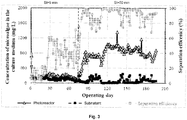
- the separation time was extended to 30 minutes from day 76, after which a highly productive auto-floating microalga ( Tribonema sp., Xanthophyta) rapidly became dominant and the separation efficiency increased remarkably to >90% within one week ( Figure 3 ). Thereafter, the separation efficiency remained above 80% for most of the time, with an average of 91 %.
- the harvested microalgae had excellent dewatering characteristics with specific resistance to filtration values below 10 10 m/kg, which facilitated economical dewatering of the harvested microalgae.
- the microalgae were easily dewatered with microfiltration to a solids content of 20-23%, without coagulant addition.
- the microalgae were exposed to a photosynthetic photon flux density of 350 ⁇ mo/m 2 /s.
- the microalgae accumulated a large amount of carbohydrates (52-62% of dry cell weight), which sustained complete nutrient removal during the dark phase.
- the main components of the carbohydrates were ⁇ -(1-3/1-6)-glucans (about 60 wt% of the total carbohydrates).
- the carbohydrates content of the microalgae prior to day 87 was 28.8-32.5% of dry cell weight.
- Example 1 was repeated, except that auto-floating microalgae obtained in Example 1 were used as inoculum, BG11 was used as the culture medium, and the total cycle time was set to 14-21 days.
- the microalgae accumulated a significant amount of lipids (30-40% by dry weight as total lipids; 15-30% by dry weight as FAMEs).
- the microalgae obtained in Example 1 had a lipids content of around 10% by dry weight.
- the example embodiment described above provides a method for cultivating microalgae without the use of flocculants or flotation gas, where the biochemical content of the microalgae obtained can be altered by tuning the method parameters.
- compositions consisting essentially of a set of components will comprise less than 5% by weight, typically less than 3% by weight, more typically less than 1% by weight of non-specified components.
- the mixture of microalgae comprises up to 20 wt% of auto-floating microalgae
- the mixture of microalgae means that up to 20 wt% of the mixture of microalgae is provided by auto-floating microalgae.
Landscapes
- Life Sciences & Earth Sciences (AREA)
- Health & Medical Sciences (AREA)
- Engineering & Computer Science (AREA)
- Wood Science & Technology (AREA)
- Organic Chemistry (AREA)
- Chemical & Material Sciences (AREA)
- Bioinformatics & Cheminformatics (AREA)
- Zoology (AREA)
- Genetics & Genomics (AREA)
- Biotechnology (AREA)
- Sustainable Development (AREA)
- Microbiology (AREA)
- Biomedical Technology (AREA)
- Molecular Biology (AREA)
- Biochemistry (AREA)
- General Engineering & Computer Science (AREA)
- General Health & Medical Sciences (AREA)
- Micro-Organisms Or Cultivation Processes Thereof (AREA)
- Apparatus Associated With Microorganisms And Enzymes (AREA)
Abstract
1. A method for cultivating microalgae, the method comprising the steps of:
(a) providing a photoreactor;
(b) introducing a mixture of microalgae into the photoreactor;
(c) introducing a culture medium into the photoreactor;
(d) growing the microalgae in the culture medium in the photoreactor;
(e) separating the microalgae into a floating layer and a non-floating layer within the culture medium;
(f) optionally harvesting a portion of the microalgae in the floating layer; and
(g) discharging at least a portion of the non-floating layer from the photoreactor.
(a) providing a photoreactor;
(b) introducing a mixture of microalgae into the photoreactor;
(c) introducing a culture medium into the photoreactor;
(d) growing the microalgae in the culture medium in the photoreactor;
(e) separating the microalgae into a floating layer and a non-floating layer within the culture medium;
(f) optionally harvesting a portion of the microalgae in the floating layer; and
(g) discharging at least a portion of the non-floating layer from the photoreactor.
Description
- The present invention relates to a method of cultivating microalgae, an apparatus for carrying out such a method, microalgae cultivated in this way, the use of such microalgae to produce a bioproduct, a method of producing a bioproduct from such microalgae, and a bioproduct produced in this way. In particular, the present invention relates to a method of selectively cultivating auto-floating microalgae from a mixture of microalgae, suitably a mixture of naturally occurring microalgae.
- Microalgae are a promising source of renewable biofuels and bio-based chemicals. Compared with conventional biofuel and biorefinery feedstocks, such as energy crops, microalgae may be attractive due to superior productivity and less competition for land. However, the microalgae biorefinery industry is currently not economically viable due to several technical challenges in large scale microalgae production, which include strain selection, nutrient supply and recycling, gas transfer and exchange, light delivery, environment control, land and water availability, and harvesting.
- Cost-effective harvesting of microalgae (i.e. microalgae biomass) is particularly problematic and faces challenges arising from (1) the low microalgae concentrations in common cultivation systems; (2) the small size of microalgal cells; (3) the similarity of density of the algal cells to the growth medium; and (4) the suspension stability of microalgal cells resulting from their negative surface charges. It is estimated that the cost of harvesting contributes to 20 to 40% of the total cost of microalgal biomass production. For some high added value products, the harvesting cost could even be as high as 60% of the total cost.
- Various methods have been suggested for harvesting microalgae on a large-scale. These methods include centrifugation, conventional filtration, membrane filtration, flocculation, sedimentation and air flotation. Centrifugation is the most rapid and reliable method for recovering suspended algae, but this method is cost-prohibitive for large scale use due to the high investment and operating costs. Conventional mechanical filtration has been found satisfactory at harvesting relatively large, filamentous microalgal strains but has low throughput and rapid clogging. Furthermore, it is not valid for small and non-filamentous strains which are commonly present in microalgae cultivation systems. Membrane filtration has been recently investigated as an efficient and reliable harvesting method, but membrane fouling and replacement lead to significant costs, in addition to high power requirements. The most accepted method is flocculation of algal cells followed by separation of flocs from the liquid by either sedimentation or air flotation. Air flotation is carried out in the presence of tiny gas bubbles. It is generally considered more advantageous than sedimentation because it can be carried out at relatively high overflow rates while still attaining favourable separation efficiencies and a well-compacted product. The latter characteristic is important for reducing the cost and energy consumption in further processing steps, such as dewatering and drying. However, the mechanical systems used to provide flotation gas are complex, costly and energy intensive.
- Alternatively, dissolved oxygen (DO) which originates from the photosynthetic activity of microalgae is known as a source of flotation gas. Under oxygen supersaturated conditions, some microalgae can float on top of flocculated water after being treated by certain types of flocculants, such as aluminium sulphate. The flotation efficiency is highly dependent on physicochemical variables such as DO concentration, flocculant (type, dosage and contact time), mixing intensity and total retention time. Although the utilisation of photosynthetic oxygen represents a considerable reduction in complexity and energy consumption relative to the mechanical provision of flotation gas, the high flocculant dosage remains a major limitation of this method. High dosages of flocculant are required for effective flotation, which is not only costly but also deteriorates the downstream processes and the quality of the final product. Furthermore, a high level of flocculants in the culture medium may be toxic to microalgae, hampering continuing microalgae cultivation.
- Therefore, there is a need for a method of cultivating microalgae which avoids the problems described above. In particular, there is a need for a method which avoids the use of complex and energy intensive equipment, and which avoids the use of flocculants.
- It is one aim of the present invention, amongst others, to provide a method of cultivating microalgae that addresses at least one disadvantage of the prior art, whether identified here or elsewhere, or to provide an alternative to existing methods of microalgae cultivation. For instance, it may be an aim of the present invention to provide a method of cultivating microalgae which provides high-quality microalgae which may be harvested at low cost.
- According to aspects of the present invention, there is provided a method of cultivating microalgae, cultivated microalgae, a use of such microalgae, a method of producing a bioproduct, and an apparatus as set forth in the appended claims. Other features of the invention will be apparent from the dependent claims, and the description which follows.
- According to a first aspect of the present invention, there is provided a method of cultivating microalgae, the method comprising the steps of:
- (a) providing a photoreactor;
- (b) introducing a mixture of microalgae into the photoreactor;
- (c) introducing a culture medium into the photoreactor;
- (d) growing the microalgae in the culture medium in the photoreactor;
- (e) separating the microalgae into a floating layer and a non-floating layer within the culture medium;
- (f) optionally harvesting a portion of the microalgae in the floating layer; and
- (g) discharging at least a portion of the non-floating layer from the photoreactor.
- By "microalgae" we mean microscopic algae. Typically, microalgae are unicellular, but some may form filaments or colonies. Microalgae typically have a cell size ranging from about 1 µm to about 400 µm, for example from 2 to 200 µm.
- Suitably the method according to the first aspect is a method of cultivating auto-floating microalgae.
- The inventors have found that the method of the first aspect selects and cultivates auto-floating microalgae from a mixture of microalgae, resulting in enrichment of the auto-floating microalgae. The method advantageously does not require the use of flocculants or flotation gas, thereby greatly reducing the materials and energy required for cultivation and harvesting of the microalgae. The absence of flocculants leads to other advantages: it increases the quality of the microalgae ultimately obtained because the flocculants may otherwise interfere with the final application of the microalgae; it allows the culture medium to be reused for subsequent cultivation; and it reduces damage to the microalgal cells, allowing the healthy microalgal cells to be reused as an inoculum for subsequent cultivation. Another advantage of the method is that the enrichment of auto-floating microalgae is carried out in mixed culture conditions without needing to screen and isolate specific microalgal strains for inoculation and without need for closed reactors and sterile conditions. The steps of strain selection, cultivation and harvesting are integrated into a single process. This makes the method less labour intensive, as well as more suitable for large scale production.
- By "auto-floating" we mean that the microalgae can naturally float at the surface of water without the need for chemical inducers (e.g. flocculants) or an external supply of flotation gas. It is believed that microalgae may exhibit auto-floatation activity through a variety of mechanisms, such as natural adhesion of micro oxygen gas bubbles resulting from photosynthesis to the cell surface; production of intracellular gas-filled structures (e.g. gas vacuoles or vesicles); production of liquid-filled floats; an increase in lipid content; and swimming. A variety of microalgal strains naturally found in the environment have auto-flotation activity. Typical auto-floating microalgae include (but are not limited to) green algae (Chlorophyceae) such as Zygnemataceae, Oedogonium, Rhizoclonium, Microspora, Ulothrix, Spirogyra, Mougeotia, Zygnema, Cladophora, Hydrodictyon, Botryosphaerella or Chlorococcum; yellow-green algae (Xanthophyceae) such as Tribonema or Vaucheria; diatoms (Baciallariophyceae) such as Melosira, Aulacoseira, Cymbella or Gomphonema; Cyanophyta such as Spirulina, Microcystis, Aphanizomenon, Anabaena, Oscillatoria, Lyngbya, Phormidium, Plankthotrix or Nostoc; flagellated organisms such as Euglena. Microalgae which are not auto-floating may be defined as non-floatable microalgae.
- Steps (c) to (g) of the method according to the first aspect may collectively be referred to as a cycle. Steps (c) to (g) may be repeated as part of a cycle at least once, suitably at least 10 times, suitably at least 20 times, for example at least 50 times. Steps (a) and (b) are not repeated as part of the cycle, since a repeated cycle uses the photoreactor and the microalgae retained therein in the previous cycle. Each cycle may independently comprise or not comprise step (f). The number of cycles required for sufficient enrichment of auto-floating microalgae will depend on various conditions, such as which strains of microalgae are present in the initial mixture of microalgae.
- The duration of a cycle of steps (c) to (g) may be referred to as the total cycle time. The total cycle time may be any suitable length of time, such as at least 12 hours, suitably from 1 to 30 days, suitably from 1 to 10 days, for example from 1 to 3 days . For example, the total cycle time may be 1 day. Alternatively, the total cycle time may be from 10 to 30 days, for example from 14 to 21 days. The total cycle time may vary from cycle to cycle. For example, the first cycle of steps (c) to (g) immediately following steps (a) and (b) may have a total cycle time which is longer than the total cycle time of subsequent cycles.
- Step (a) of the method according to the first aspect comprises providing a photoreactor. The photoreactor may be any photoreactor suitable for the cultivation of microalgae. Typically, the photoreactor comprises a housing, wherein at least a portion of the housing may be transparent. The housing suitably defines an interior volume for containing a culture medium in which microalgae may be suspended. The photoreactor may be a closed photoreactor or an open photoreactor. The photoreactor is preferably a vertical photoreactor. Suitably the photoreactor is a column photoreactor or a flat-panel (or flat-plate) photoreactor.
- In some embodiments step (a) comprises providing an apparatus according to the fifth aspect of the present invention as defined further below. The apparatus comprises a photoreactor.
- Step (b) of the method according to the first aspect comprises introducing a mixture of microalgae into the photoreactor. The mixture of microalgae introduced into the photoreactor in step (b) may be referred to as an inoculum, and step (b) may be defined as an inoculation step. The mixture of microalgae (or inoculum) typically comprises two or more strains of microalgae. Suitably, the mixture of microalgae (or inoculum) comprises at least 5, preferably at least 10, for example at least 20 strains of microalgae. The mixture of microalgae (or inoculum) may comprise at least one strain of auto-floating microalgae. Alternatively, the mixture of microalgae (or inoculum) may not comprise auto-floating microalgae and at least one strain of auto-floating microalgae may be introduced into the photoreactor in a step other than step (b). For example, the auto-floating microalgae may be introduced via the culture medium and/or from the surrounding environment.
- The mixture of microalgae may be provided as a mixture in water.
- Suitably the mixture of microalgae comprises naturally occurring microalgae. By "naturally occurring" we mean that the microalgae occur in nature, and suitably have not been bred or genetically engineered. The mixture of microalgae may be obtained from one or more sources. Suitably the mixture of microalgae may be obtained from at least two, suitably at least three, for example at least four sources. Obtaining the mixture of microalgae from a variety of sources increases the likelihood that the mixture will comprise at least one strain of auto-floating microalgae, without the need to individually identify the strains of microalgae present in the mixture. Suitably at least a portion of the mixture of microalgae is obtained from the natural environment and/or wastewater. Preferably all of the mixture of microalgae is obtained from the natural environment and/or wastewater. By "obtained from the natural environment" we mean that the microalgae have not been cultured for use in the method according to the first aspect. Suitable sources of microalgae in the natural environment include ponds, lakes, rivers, and oceans. Examples of wastewater include domestic wastewater, industrial wastewater, agricultural wastewater and aquaculture wastewater.
- Suitably, at least one strain of auto-floating microalgae is introduced into the photoreactor during the method of the first aspect. For example, the at least one strain of auto-floating microalgae may be introduced into the photoreactor via the mixture of microalgae in step (b), and/or via the culture medium in step (c). The culture medium introduced into the photoreactor in step (c) may comprise auto-floating microalgae, especially if the culture medium is not sterilised. The at least one strain of auto-floating microalgae may be introduced into the photoreactor during steps of the method other than steps (b) and (c), for example if the photoreactor is an open photoreactor.
- Step (c) of the method according to the first aspect comprises introducing a culture medium into the photoreactor. The culture medium introduced into the photoreactor in step (c) may be referred to as fresh culture medium. Suitably, following step (b) and step (c), the microalgae are suspended in the culture medium.
- The culture medium suitably comprises water and one or more nutrients, such as an aqueous solution of one or more nutrients. Any suitable nutrients may be used. Such nutrients are suitably in a form which is bioavailable to microalgae. Suitable nutrients for the growth of microalgae include nitrogen-containing nutrients, such as nitrates, ammonium and urea; phosphorus-containing nutrients, such as phosphates; carbon sources, such as carbon dioxide (CO2), bicarbonates (HCO3 -) and organic sources of carbon; other macronutrients (such as S, K, Na, Fe, Mg and Ca) and micronutrients (such as B, Cu, Mn, Zn, Mo, Co, V and Se); and chelators (e.g. EDTA). The suitability of particular nutrients may depend on the strains of microalgae present in the mixture of microalgae. Suitable nitrogen-containing nutrients comprise nitrogen in a form which is bioavailable to microalgae and suitable phosphorus-containing nutrients comprise phosphorus in a form which is bioavailable to microalgae. The culture medium preferably comprises both nitrogen-containing nutrients and phosphorus-containing nutrients. The culture medium preferably also comprises other macro- and micronutrients, for example a carbon source.
- The culture medium introduced into the photoreactor in step (c) (i.e. the fresh culture medium) suitably comprises one or more nitrogen-containing nutrients in an amount which provides at least 1 mg/L, preferably at least 5 mg/L, for example at least 10 mg/L of nitrogen. The culture medium may comprise one or more nitrogen-containing nutrients in an amount which provides from 1 to 1000 mg/L, preferably from 5 to 250 mg/L, for example from 10 to 100 mg/L of nitrogen. By "mg/L of nitrogen" we mean the weight, in mg, of nitrogen atoms provided by the nutrient per litre of culture medium. The culture medium suitably comprises one or more phosphorus-containing nutrients in an amount which provides at least 0.1 mg/L, preferably at least 0.5 mg/L, for example at least 1 mg/L of phosphorus. The culture medium may comprise one or more phosphorus-containing nutrients in an amount which provides from 0.1 to 100 mg/L, preferably from 0.5 to 30 mg/L, for example from 1 to 10 mg/L of phosphorus. By "mg/L of phosphorus" we mean the weight, in mg, of phosphorus atoms provided by the nutrient per litre of culture medium.
- The culture medium may comprise an algal culture medium. An algal culture medium typically comprises a mixture of nutrients at a concentration suitable for the cultivation of microalgae. Examples of suitable algal culture media include BG11, BBM, COMBO, Kuhl, ES, ASW, and f/2 (details of which are well known to persons skilled in the art).
- The culture medium may comprise or be prepared from nutrient-containing water, such as surface water, groundwater, runoff water, and wastewater. Examples of suitable wastewater include domestic wastewater, municipal wastewater, industrial wastewater, agricultural wastewater, and aquaculture wastewater. Wastewater is preferably pre-treated prior to use for the preparation of a culture medium. Such pre-treatment typically comprises removing organic matter, colour, solids, and turbidity. Sources of wastewater which have been pre-treated, such as secondary treated municipal wastewater, are especially suitable for the preparation of the culture medium. In some embodiments the culture medium is prepared from water obtained from natural water sources such as ponds, lakes, rivers and oceans. Suitably the culture medium is not sterilised.
- The fresh culture medium may have a pH value of from 4 to 11. Preferably the fresh culture medium has a pH value of from 6 to 9.
- Suitably the fresh culture medium is substantially free of flocculants. By "substantially free of flocculants" we mean that flocculants are not intentionally added to the culture medium, and if flocculants are present in the culture medium, they are only present in trace amounts (i.e. less than 0.1 wt%, preferably less than 0.01 wt% based on the weight of the culture medium). Preferably the fresh culture medium is completely free of flocculants. The method suitably does not comprise adding a flocculant to the microalgae in the culture medium. Preferably the fresh culture medium is substantially free of flocculants and the method does not comprise adding a flocculant to the culture medium.
- By "flocculant" we mean any solid or liquid substance which may be added to a suspension of microalgae to help the microalgae to float, with or without the use of a flotation gas. Typically, a flocculant functions to aggregate microalgal cells. Examples of flocculants include aluminium sulphate, aluminium potassium sulphate, iron (III) hydroxide, polyaluminium chloride, and cationic polymers.
- The culture medium may be introduced into the photoreactor by any suitable method, for example by pumping or pouring the culture medium into the photoreactor. The culture medium is preferably introduced into the photoreactor by pumping.
- The volume of culture medium introduced into the photoreactor in step (c) may be selected to achieve a desired hydraulic retention time (HRT). The hydraulic retention time is defined herein as the ratio of the volume of the photoreactor to the volume of culture medium introduced into the photoreactor per day. The hydraulic retention time is suitably from 0.5 to 10 days, preferably from 1 to 5 days, for example from 1.4 to 3 days.
- The duration of step (c) may be any suitable length of time, such as from 5 to 120 minutes, suitably from 10 to 60 minutes, for example from 20 to 50 minutes.
- Step (b) and step (c) may be carried out in any suitable order. In one embodiment step (b) is followed by step (c). For example, a sample comprising a mixture of microalgae is introduced into the photoreactor, then a culture medium is introduced into the photoreactor such that the microalgae are suspended in the culture medium. In one embodiment step (b) and step (c) are carried out at least partially simultaneously, for example completely simultaneously. Steps (b) and (c) may be carried out simultaneously when the culture medium is present in the mixture of microalgae. For example, a mixture of microalgae may be suspended in a culture medium which is then introduced into the photoreactor, or a mixture of microalgae and a culture medium may be simultaneously independently introduced into the photoreactor. In another embodiment, step (c) is followed by step (b). For example, a culture medium may be introduced into the photoreactor, then a mixture of microalgae may be introduced into the photoreactor such that the microalgae are suspended in the culture medium.
- In repeated cycles of steps (c) to (g), step (g) is suitably followed by step (c), followed by step (d). The volume of culture medium introduced into the photoreactor in step (c) of a repeated cycle is suitably substantially the same as the volume of culture medium in the non-floating layer discharged from the photoreactor in step (g) of a preceding cycle, for example step (g) of an immediately preceding cycle. This provides a substantially constant volume of culture medium for step (d) in each cycle.
- Step (d) of the method according to the first aspect comprises growing the microalgae in the culture medium in the photoreactor. Step (d) may further comprise agitating the microalgae in the culture medium, i.e. as the microalgae grow.
- Step (d) suitably comprises exposing the microalgae to light. The light may have a photosynthetic photon flux density (PPFD) of from 50 to 2000 µmol/m2/s, suitably from 75 to 1000 µmol/m2/S, for example from 100 to 400 µmolm2/s. For example, the light may have a PPFD of from 200 to 500 µmol/m2/s, suitably from 250 to 450 µmol/m2/S, for example from 300 to 400 µmol/m2/s. The PPFD is a measure of the intensity of photosynthetically active light (i.e. light having a wavelength of from 400 to 700 nm) and may be measured by a quantum meter.
- Suitably the light comprises visible light, preferably light within the photosynthetic active spectrum (i.e. light having a wavelength of from 400 to 700 nm). The light may comprise natural light and/or artificial light, suitably natural light. By natural light we mean light from the sun. The use of natural light has the advantage of reducing capital and operating costs.
- The microalgae may be exposed to light continuously or intermittently. The microalgae may be exposed to light for from 10 to 100%, suitably from 20 to 80%, for example from 30 to 70% of the duration of step (d). The microalgae may be exposed to light for from 6 to 24 hours per day, suitably from 8 to 20 hours per day, for example from 10 to 18 hours per day. The period during which the microalgae are exposed to light may be referred to as the photoperiod.
- Step (d) may comprise supplying a carbon source to the microalgae in the culture medium. The carbon source functions as a nutrient to support the growth of the microalgae. The carbon source may comprise an inorganic carbon source and/or an organic carbon source. Preferably the carbon source comprises an inorganic carbon source. Suitable examples of inorganic carbon sources include carbonates (e.g. sodium carbonate and potassium carbonate), bicarbonates (e.g. sodium bicarbonate and potassium bicarbonate), and carbon dioxide. Preferably the carbon source comprises carbon dioxide. In some embodiments the carbon source is supplied as carbon dioxide in one or more of air, flue gas, biogas, or pure carbon dioxide gas, preferably in flue gas.
- The amount of the carbon source supplied to the microalgae in the culture medium will typically be selected to maximise productivity of the microalgae, in particular to maximise the growth rate of the microalgae. The carbon source may be supplied to the microalgae in the culture medium in one or more discrete quantities, or continuously. The carbon source may be supplied to the microalgae in the culture medium while the microalgae are being exposed to light (i.e. during a light phase), or while the microalgae are not being exposed to light (i.e. during a dark phase). When the carbon source comprises carbon dioxide, it may be supplied in a concentration from 0.04% to 100%, suitably from 0.5% to 30%, preferably from 1% to 5% by volume. The carbon dioxide may be supplied continuously to the microalgae in the culture medium at a rate of from 0.005 to 10 vvm (gas volume flow per unit of liquid volume per minute), suitably from 0.05 to 5 vvm, for example from 0.1 to 3 vvm, depending on the concentration of carbon dioxide.
- During step (d), the temperature of the culture medium/microalgae mixture is suitably maintained at a temperature which maximises growth of the microalgae. The temperature of the culture medium may be from 10 to 40°C, suitably from 10 to 30°C, preferably from 15 to 25°C.
- Step (d) suitably comprises growing the microalgae in the culture medium under agitation. The agitation enhances the growth of the microalgae. Step (d) may comprise agitating the microalgae in the culture medium by any suitable means, such as by a mechanical means or by bubbling a gas through the culture medium (e.g. gas sparging). Suitable mechanical means include mechanical agitation devices, such as an impeller. Suitably the gas used to agitate the culture medium comprises a carbon source, such as carbon dioxide.
- The first step (d) following step (b) may be referred to as a preculture step. The first step (d) following step (b) may be carried out until the culture medium comprises from 5 to 10 g/L by dry weight of microalgae. The first step (d) following step (b) may have a duration of from 1 to 3 weeks.
- The dry weight of microalgae is suitably measured by filtering the microalgae through a 0.45 µm microfilter and oven drying the microalgae at 105°C for at least 2 hours.
- Steps (c) and (d) may be carried out at least partially simultaneously. For example, the microalgae in the photoreactor may be exposed to light while a culture medium is being introduced into the photoreactor.
- Step (e) of the method according to the first aspect comprises separating the microalgae into a floating layer and a non-floating layer within the culture medium. The non-floating layer may alternatively be referred to as a subnatant. Any suitable method of separation may be used.
- Separating the microalgae suitably comprises keeping the culture medium comprising the microalgae static. By this we mean that the microalgae in the culture medium are not agitated during separation.
- When step (d) comprises agitating the microalgae in the culture medium, step (e) may comprise stopping the agitation and allowing the microalgae to separate into the floating layer and the non-floating layer within the culture medium.
- Step (e) may comprise vigorously agitating the microalgae in the culture medium in order to produce a turbulent liquid flow, and then stopping the agitation and allowing the microalgae to separate into the floating layer and the non-floating layer within the culture medium. Vigorous agitation of the microalgae in the culture medium may increase the separation efficiency of step (e).
- Vigorous agitation of the microalgae may be achieved by any suitable means, such as a mechanical means. Suitable mechanical means include mechanical mixing devices, such as an impeller or a holding tank. For example, the culture medium containing the microalgae may be discharged into a holding tank, and reintroduced into the photoreactor within up to 5 minutes, suitably up to 3 minutes, preferably up to 1 minute, so as to create a vigorous flow.
- After the agitation is stopped, the microalgae are suitably allowed to separate without further agitation.
- Step (e) suitably comprises separating the microalgae (i.e. into a floating layer and a non-floating layer within the culture medium) for any suitable length of time, such as at least 0.1 hours, preferably at least 0.25 hours, for example at least 0.5 hours. Step (e) may comprise allowing the microalgae to separate for at least 0.1 hours, such as from 0.1 to 3 hours, suitably from 0.25 to 2 hours, for example from 0.5 to 1 hour. The time for which the microalgae are allowed to separate may be referred to as the separation time.
- Step (e) may comprise exposing the microalgae to light during separation of the microalgae. The light may have a photosynthetic photon flux density (PPFD) of from 50 to 2000 µmol/m2/s, suitably from 75 to 1000 µmol/m2/s, for example from 100 to 400 µmolm2/s. For example, the light may have a PPFD of from 200 to 500 µmol/m2/S, suitably from 250 to 450 µmol/m2/S, for example from 300 to 400 µmol/m2/s.
- Suitably the light comprises visible light, preferably light within the photosynthetic active spectrum (i.e. light having a wavelength of from 400 to 700 nm). The light may comprise natural light and/or artificial light, suitably natural light. The light in step (e) is suitably from the same source as the light in step (d).
- Step (e) suitably has a separation efficiency of at least 50%, suitably at least 75%, for example at least 90%. The separation efficiency (%) is defined as 100 x (1-SSeff/SSr), where SSeff is the microalgae concentration by dry weight (mg/L) in the non-floating layer and SSr is the microalgae concentration by dry weight (mg/L) in the culture medium in the photoreactor prior to the separation.
- Suitably step (e) does not comprise supplying a flotation gas to the microalgae in the culture medium. Suitably step (e) does not comprise carrying out dissolved air flotation, electrolytic flotation or dispersed air flotation on the microalgae in the culture medium. Preferably the method according to the first aspect does not comprise supplying a flotation gas to the microalgae in the culture medium. By a flotation gas, we mean a gas which is supplied as very fine bubbles to the microalgae in the culture medium. A flotation gas is typically generated by an electrochemical means or a mechanical means, such as by a sudden release of pressurised gas into the culture medium containing the microalgae.
- The floating layer and the non-floating layer each comprise a portion of the microalgae in the culture medium in the photoreactor. Suitably, the floating layer and the non-floating layer together comprise all of the microalgae in the culture medium in the photoreactor. The floating layer is typically situated above the non-floating layer, for example on top of the non-floating layer in the photoreactor. The floating layer may be visually distinguished from the non-floating layer by the presence of floes of microalgae in the floating layer and the absence of floes of microalgae in the non-floating layer. The floating layer may comprise the highest 5 to 50%, suitably the highest 10 to 30%, for example the highest 20% by volume of the culture medium containing the microalgae in the photoreactor.
- Suitably the microalgae in the floating layer comprise auto-floating microalgae, and the microalgae in the non-floating layer comprise non-floatable microalgae. Suitably the microalgae in the floating layer comprise a higher proportion by dry weight of auto-floating microalgae than the microalgae in the non-floating layer. Suitably the microalgae in the floating layer comprise a higher proportion by dry weight of auto-floating microalgae than the mixture of microalgae introduced into the photoreactor in step (b). A "higher proportion by dry weight" is suitably defined as the proportion by dry weight of auto-floating microalgae in the microalgae of the floating layer being at least 1.1 times, suitably at least 1.5 times, such as at least 2 times the proportion by dry weight of auto-floating microalgae in the microalgae of the non-floating layer or the mixture of microalgae introduced into the photoreactor in step (b).
- Suitably step (d) is followed by step (e).
- Step (f) of the method according to the first aspect comprises optionally harvesting a portion of the microalgae in the floating layer. When steps (c) to (g) are repeated in a cycle, each cycle may independently comprise or not comprise step (f).
- Suitably step (f) comprises harvesting from 5 to 90%, suitably from 10 to 80%, for example from 20 to 50% by dry weight of the microalgae in the floating layer.
- The amount of microalgae harvested may be selected to achieve a desired cell retention time (CRT). The cell retention time is defined herein as the ratio of the total dry weight of microalgae in the photoreactor (prior to harvesting) to the dry weight of microalgae harvested per day. The cell retention time may be selected to maximise microalgae productivity, to fine-tune the cellular composition of the microalgae, and to maintain a desired concentration of microalgae in the culture medium in the photoreactor. The cell retention time is suitably selected to achieve a concentration of microalgae in the culture medium of from 0.3 to 5 g/L, for example from 0.5 to 3 g/L, preferably from 1 to 2 g/L by dry weight of microalgae. The cell retention time is suitably from 1.25 to 30 days, preferably from 1.5 to 20 days, for example from 2 to 10 days.
- Step (f) may comprise harvesting a portion of the microalgae in the floating layer by any suitable method, for example by use of a collecting device arranged within the photoreactor.
- Suitably step (f) is only (optionally) carried out if there is at least 0.5 g/L, suitably at least 1 g/L by dry weight of microalgae in the culture medium in the photoreactor. Suitably step (f) is only (optionally) carried out if the separation efficiency of the preceding step (e) is at least 50%, suitably at least 75%, for example at least 90%. For the avoidance of doubt, when step (f) is not carried out because, for example, there is less than 0.5 g/L by dry weight of microalgae in the culture medium in the photoreactor, then step (f) is omitted.
- The microalgae harvested in step (f) suitably comprise at least 50%, suitably at least 75%, for example at least 90% by dry weight of auto-floating microalgae.
- Step (f), if present, suitably follows step (e). Suitably step (e) is followed by step (f), followed by step (g). Alternatively, step (e) is followed by step (g), followed by step (f). In repeated cycles of steps (c) to (g) where step (f) follows step (g), step (f) is followed by step (c), followed by step (d).
- When step (f) is omitted, step (e) is suitably followed by step (g).
- Step (g) of the method according to the first aspect comprises discharging at least a portion of the non-floating layer from the photoreactor.
- Step (g) may comprise discharging the lowest 10 to 90%, suitably the lowest 30 to 80%, for example the lowest 50 to 70% by volume of the culture medium containing the microalgae in the photoreactor. Suitably step (g) comprises discharging the non-floating layer from the bottom of the photoreactor. This avoids accidentally discharging the floating layer from the photoreactor.
- The culture medium containing the microalgae which is discharged from the photoreactor may be referred to as spent culture medium. The spent culture medium may be discarded.
- Step (g) may comprise discharging at least 30%, suitably at least 50%, suitably at least 70%, for example at least 90% by volume of the non-floating layer from the photoreactor. Step (g) may comprise discharging from 10 to 90%, suitably from 30 to 80%, for example from 50 to 70% by volume of the culture medium containing the microalgae from the photoreactor.
- The duration of step (g) may be any suitable length of time, such as from 5 to 120 minutes, suitably from 20 to 90 minutes, for example from 30 to 60 minutes.
- Step (g) suitably comprises retaining at least a portion of the microalgae in the culture medium in the photoreactor. The microalgae retained in the photoreactor in step (g) typically comprise a mixture of microalgae. Step (g) suitably comprises retaining at least a portion of the floating layer in the photoreactor. Suitably all of the floating layer is retained in the photoreactor. Step (g) may comprise retaining at least a portion of the non-floating layer in the photoreactor, or may comprise discharging all of the non-floating layer from the photoreactor. When steps (c) to (g) are repeated as part of a cycle, the mixture of microalgae present in the photoreactor at the start of a new cycle is provided by the microalgae retained in the photoreactor at the end of a preceding cycle.
- The steps of the method according to the first aspect may be carried out in any suitable order that provides the desired result of enrichment of auto-floating microalgae. The steps may be carried out in the order step (a); followed by step (b) and step (c); followed by step (d); followed by step (e); followed by step (f), if present, and step (g). The steps may be carried out in the order step (a); followed by step (b); followed by step (c); followed by step (d); followed by step (e); followed by step (f), if present, and step (g). The order of the steps may be varied as described above.
- Suitably the method according to the first aspect comprises the steps of:
- (a) providing a photoreactor;
- (b) introducing a mixture of naturally occurring microalgae into the photoreactor;
- (c) introducing a culture medium into the photoreactor, wherein the culture medium comprises an aqueous solution of one or more nitrogen-containing nutrients in an amount which provides at least 5 mg/L of nitrogen, and/or one or more phosphorus-containing nutrients which provides at least 0.1 mg/L of phosphorus;
- (d) growing the microalgae in the culture medium in the photoreactor by exposing the microalgae to light and supplying a carbon source to the microalgae in the culture medium, and agitating the microalgae in the culture medium;
- (e) stopping the agitation and allowing the microalgae to separate into a floating layer and a non-floating layer within the culture medium, wherein the microalgae are allowed to separate for at least 0.1 hours;
- (f) optionally harvesting a portion of the microalgae in the floating layer if there is at least 0.5 g/L by dry weight of microalgae in the culture medium in the photoreactor;
- (g) discharging at least 30% by volume of the non-floating layer from the photoreactor;
- Suitably the method according to the first aspect comprises the steps of:
- (a) providing a photoreactor;
- (b) introducing a mixture of naturally occurring microalgae into the photoreactor, wherein the mixture of microalgae comprises at least 10 strains of microalgae;
- (c) introducing a culture medium into the photoreactor, wherein the culture medium comprises an aqueous solution of one or more nitrogen-containing nutrients in an amount which provides at least 5 mg/L of nitrogen, and/or one or more phosphorus-containing nutrients which provides at least 0.5 mg/L of phosphorus, and wherein the culture medium does not comprise a flocculant;
- (d) growing the microalgae in the culture medium in the photoreactor by exposing the microalgae to light and supplying carbon dioxide to the microalgae in the culture medium, and agitating the microalgae in the culture medium;
- (e) vigorously agitating the microalgae in the culture medium and then stopping the agitation and allowing the microalgae to separate into a floating layer and a non-floating layer within the culture medium, wherein the microalgae are allowed to separate for at least 0.5 hours;
- (f) optionally harvesting from 30 to 70 wt% of the microalgae in the floating layer if there is at least 1 g/L by dry weight of microalgae in the culture medium in the photoreactor;
- (g) discharging at least 50% (for example at least 70%) by volume of the non-floating layer from the photoreactor;
- According to a second aspect of the present invention, there are provided microalgae cultivated in accordance with the method of the first aspect.
- Such microalgae are suitably harvested via step (f) of the method of the first aspect.
- The microalgae according to the second aspect suitably comprise at least 50 wt%, suitably at least 75 wt%, for example at least 90 wt% by dry weight of auto-floating microalgae.
- Suitably the microalgae according to the second aspect are substantially free of flocculants. By "substantially free of flocculants" we mean that flocculants are not intentionally added to the microalgae, and if flocculants are present in the microalgae, they are only present in trace amounts (i.e. less than 0.1 wt%, preferably less than 0.01 wt% based on the dry weight of the microalgae). Preferably the microalgae are completely free of flocculants. Flocculants are as defined in relation to the first aspect.
- Microalgae obtained by the method according to the first aspect have the advantage that they are free of flocculants, making the microalgae particularly suitable for further processing of the microalgae or for end applications of the microalgae such as animal or human consumption. Furthermore, the healthy microalgae cultivated by the method according to the first aspect are suitable for use as an inoculum for subsequent cultivation.
- Microalgae typically contain various useful biomolecules including, but not limited to, carbohydrates, proteins and lipids. The cultivation conditions of the method according to the first aspect may be controlled to alter the content of biomolecules in the microalgae in view of the intended use of the microalgae.
- The microalgae obtained by the method according to the first aspect may comprise from 40 to 75 wt%, suitably from 45 to 70 wt%, for example from 50 to 65 wt% of carbohydrates based on the dry weight of the microalgae. Microalgae rich in carbohydrates may be particularly suitable for the production of biomethane, bioethanol and biobutanol. Typically, the main component of the carbohydrates (e.g. more than 50 wt% of the carbohydrates) is starch or β-(1-3)/1-6)-glucans. β-(1-3)/1-6)-glucans have wide applications and may be suitable for the production of health products. Microalgae rich in carbohydrates may be prepared by exposing the microalgae in the culture medium in step (d) to light having a photosynthetic photon flux density of from 200 to 500 µmol/m2/s, suitably from 250 to 450 µmol/m2/s, for example from 300 to 400 µmolm2/s.
- The microalgae obtained by the method according to the first aspect may comprise from 20 to 50 wt%, suitably from 25 to 45 wt%, for example from 30 to 40 wt% of lipids based on the dry weight of the microalgae. The microalgae may comprise from 5 to 40 wt%, suitably from 10 to 35 wt%, for example from 15 to 30 wt% of fatty acids (measured as fatty acid methyl esters, FAMEs) based on the dry weight of the microalgae. Microalgae rich in lipids, including FAMEs, may be particularly suitable for the production of biodiesel. Microalgae rich in lipids may be prepared by culturing the microalgae in accordance with the method of the first aspect, wherein the total cycle time is from 10 to 30 days, for example from 14 to 21 days.
- According to a third aspect of the present invention, there is provided a use of microalgae according to the second aspect to produce a bioproduct, such as a biofuel or bio-based chemical.
- According to a fourth aspect of the present invention, there is provided a method of producing a bioproduct, comprising the steps of:
- (a) cultivating microalgae according to a method of the first aspect; and
- (b) processing the microalgae to produce the bioproduct.
- Bioproducts, and methods of processing microalgae to manufacture such bioproducts, will be known to a person skilled in the art.
- Typically, processing the microalgae comprises dewatering the harvested microalgae. The harvested microalgae are suitably dewatered by a filter press or by centrifugation. The filter press may be under pressure or under a vacuum. Processing the microalgae may comprise dewatering the harvested microalgae to a solids content of at least 10%, suitably at least 15%, for example at least 20%. Dewatered microalgae are typically more suitable for transporting and for further processing into desirable products. Auto-floating microalgae typically have good dewatering properties.
- The bioproduct may comprise a biofuel or a bio-based chemical. Biofuels may include, but are not limited to, biodiesel, bioethanol, biobutanol, biogas, biohydrogen, bio-oil, and syngas. Bio-based chemicals may include, but are not limited to, pigments, proteins, antioxidants, carotenoids, polysaccharides, fatty acids, and vitamins.
- According to a fifth aspect of the present invention, there is provided a bioproduct produced in accordance with the method of the fourth aspect.
- According to a sixth aspect of the present invention, there is provided an apparatus for cultivating microalgae, the apparatus comprising:
- a photoreactor;
- a means of supplying a carbon source to the photoreactor;
- an agitation device; and
- a collecting device.
- The apparatus is preferably suitable for cultivating microalgae according to a method of the first aspect. The apparatus may be suitable for cultivating auto-floating microalgae.
- The apparatus may be suitable for cultivating microalgae in batches and continuous cultivation.
- The apparatus according to the sixth aspect comprises a photoreactor. The photoreactor may be any photoreactor suitable for the cultivation of microalgae. Typically, the photoreactor comprises a housing, wherein at least a portion of the housing may be transparent. The housing suitably defines an interior volume for containing a culture medium in which microalgae may be suspended. The photoreactor may be a closed photoreactor or an open photoreactor. The photoreactor is preferably a vertical photoreactor. Suitably the photoreactor is a column photoreactor or a flat-panel (or flat plate) photoreactor.
- The photoreactor suitably comprises an inlet for receiving fresh culture medium and/or microalgae. The apparatus may comprise a feed pump for supplying fresh culture medium to the photoreactor via the inlet.
- The apparatus may comprise a light source. The light source is suitably arranged such that the light source may illuminate microalgae suspended in culture medium in the photoreactor. The light source is suitably able to produce light having a photosynthetic photon flux density of from 50 to 2000 µmol/m2/s, suitably from 75 to 1000 µmol/m2/S, for example from 100 to 400 µmol/m2/s.
- The means for supplying the carbon source may comprise a pump or a compressor for supplying the carbon source to the photoreactor. Where the carbon source is supplied by a gas, the means for supplying the carbon source suitably comprises a compressor, preferably a compressor in fluid communication with a diffusor. The diffusor is suitably arranged at the bottom of the photoreactor, such that the gas comprising the carbon source may rise through the culture medium contained in the photoreactor while in use. Where the carbon source is supplied by a liquid, the means for supplying the carbon source suitably comprises a pump. The photoreactor suitably comprises an inlet for receiving a carbon source.
- The photoreactor suitably comprises an outlet for discharging spent culture medium. Suitably the outlet is arranged in the bottom 50%, preferably the bottom 25%, for example the bottom 10% by volume of the photoreactor. This prevents the outlet from discharging microalgae floating at the top of the culture medium when the apparatus is in use. The apparatus may comprise a discharge pump for removing spent culture medium from the photoreactor.
- Suitably the photoreactor comprises an inlet for receiving fresh culture medium and an outlet for discharging spent culture medium.
- The apparatus according to the sixth aspect comprises an agitation device suitably adapted to agitate microalgae suspended in a culture medium contained in the photoreactor. The agitation device may be any suitable agitation device, for example a mechanical agitation device such as an impeller. The agitation device is suitably arranged within the interior volume of the housing of the photoreactor. The apparatus may comprise a motor for driving the agitation device.
- The apparatus according to the sixth aspect comprises a collecting device suitably adapted to collect microalgae floating in a culture medium from the photoreactor. Suitably the collecting device is arranged in the top 50%, preferably the top 25%, for example the top 10% by volume of the photoreactor. The collecting device may comprise any suitable collecting device, for example a scraper, a skimmer, a pump, an electromagnetic valve, or a combination thereof.
- In summary, a method for cultivating microalgae is disclosed which comprises the steps of introducing a mixture of microalgae and a culture medium into a photoreactor, growing the microalgae, allowing the microalgae to separate into a floating layer and a non-floating layer within the culture medium, and discharging at least a portion of the non-floating layer from photoreactor. The method advantageously does not require the use of flocculants or flotation gas, reducing the energy and materials required, as well as increasing the quality of the microalgae obtained. Further, the method does not require screening and isolation of specific microalgal strains. Microalgae cultivated according to the method, a use of such microalgae to produce a bioproduct, a method of producing a bioproduct, a bioproduct produced by such a method, and an apparatus for cultivating microalgae are also described.
- For a better understanding of the invention, and to show how example embodiments may be carried into effect, reference will now be made to the accompanying drawings in which:
-
Figure 1 is a schematic diagram of an apparatus according to the sixth aspect of the present invention. -
Figure 2 shows a typical operating sequence in a method according to the first aspect of the present invention. -
Figure 3 is a graph showing the evolution of microalgae concentration and separation efficiency in Example 1 overtime. -
Figure 1 shows an apparatus (1) according to the sixth aspect of the present invention, comprising a photoreactor (10). Fresh culture medium and a mixture of microalgae are introduced to the photoreactor (10) by a feed pump (11). The microalgae suspended in a culture medium inside the photoreactor (10) are grown by providing them with illumination from a light source (12) arranged adjacent to the photoreactor (10), and agitating them by means of an impeller (15) driven by a motor (16). A carbon source is supplied to the growing microalgae by means of a compressor (13), which compresses carbon dioxide-containing gas, and a diffusor (14) which disperses the compressed carbon dioxide-containing gas into the culture medium in which the microalgae are suspended. Once the microalgae suspended in the culture medium in the photoreactor (10) have been grown, they are allowed to separate into a floating layer and a non-floating layer within the culture medium by stopping agitation. A collecting device (17) is arranged such that it may harvest microalgae from the floating layer, which suitably comprises auto-floating microalgae. After separation of the microalgae into a floating layer and a non-floating layer, and optional harvesting of microalgae from the floating layer, spent culture medium, which suitably comprises non-floatable microalgae, is discharged from the bottom of the photoreactor (10) by means of a discharge pump (18). -
Figure 2 shows steps (c) to (g) of a method according to the first aspect of the present invention. Step (c) comprises feeding fresh culture medium (20) into a photoreactor (10), resulting in a suspension of a mixture of microalgae in the culture medium. The mixture of microalgae may have been introduced into the photoreactor in step (b) (not shown) or left over from a previous cycle of steps (c) to (g), and in this example comprises at least one strain of auto-floating microalgae and at least one strain of non-floatable microalgae. Step (d) comprises growing the microalgae in the culture medium in the photoreactor under agitation, causing the weight of microalgae in the culture medium in the photoreactor to increase. Suitably step (d) comprises exposing the microalgae to light and supplying a carbon source to the microalgae in the culture medium. Agitation is provided by means of a mechanical device or gas sparging. Step (e) comprises a short period of vigorous agitation followed by stopping the agitation and allowing the microalgae to separate into a floating layer (21) comprising auto-floating microalgae and a non-floating layer (22) comprising non-floatable microalgae within the culture medium. Microalgae may be harvested from the floating layer (21) in optional step (f), suitably by means of a collecting device. Whether step (f) is carried out may depend on the concentration of the microalgae in the culture medium in the photoreactor, or on the separation efficiency of step (e). Step (g) comprises discharging at least a portion of the non-floating layer (22). At least a portion (23) of the culture medium and microalgae is retained in the photoreactor, suitably comprising all of the floating layer (21) and a portion of the non-floating layer (22). The cycle of steps (c) to (g) may be repeated one or more times. The volume of fresh culture medium (20) fed into the photoreactor in a repeated step (c) is suitably the same as the volume of the culture medium (24) discharged in step (g). - A laboratory-scale column photoreactor (volume=6.65 L) was constructed from a Plexiglas® tube and used to cultivate microalgae under the following conditions:
Total cycle time (hours) 24 Photoperiod (hours/day) 10 Photosynthetic photon flux density (µmol/m2/s) 100-350 Inorganic carbon source 5% CO2 Rate of inorganic carbon supply (mL/minute) 30-60 Hydraulic retention time (days) 1.4 Cell retention time (days) 5 Culture pH 6-9 Temperature (°C) 16-25 Level of NO3 --N (mg/L) 10 Level of PO4 3--P (mg/L) 1 - Secondary effluent from a local wastewater treatment plant in Galway, Ireland was used as the culture medium.
- At the start-up, a highly diverse mixed algal sample (containing more than 20 species) sourced from wastewater (digestate, secondary effluent) and a local river was used as inoculum. The continuous laboratory test started with a separation time (St) of 5 minutes and a photosynthetic photon flux density of 100 µmol/m2/s for 75 days. Prior to the separation of the microalgae in the culture medium, turbulent liquid flow was created manually by discharging all the mixed liquor into a holding tank, followed by refilling the mixed liquor into the reactor in a short period of time (about 1 minute). During this period, some auto-floating microalgae appeared, but the culture was still dominated by non-floatable microalgae with inadequate separation efficiency (
Fig. 3 ). - The separation time was extended to 30 minutes from day 76, after which a highly productive auto-floating microalga (Tribonema sp., Xanthophyta) rapidly became dominant and the separation efficiency increased remarkably to >90% within one week (
Figure 3 ). Thereafter, the separation efficiency remained above 80% for most of the time, with an average of 91 %. The harvested microalgae had excellent dewatering characteristics with specific resistance to filtration values below 1010 m/kg, which facilitated economical dewatering of the harvested microalgae. The microalgae were easily dewatered with microfiltration to a solids content of 20-23%, without coagulant addition. - From day 87 the microalgae were exposed to a photosynthetic photon flux density of 350 µmo/m2/s. The microalgae accumulated a large amount of carbohydrates (52-62% of dry cell weight), which sustained complete nutrient removal during the dark phase. The main components of the carbohydrates were β-(1-3/1-6)-glucans (about 60 wt% of the total carbohydrates). For comparison, the carbohydrates content of the microalgae prior to day 87 was 28.8-32.5% of dry cell weight.
- Example 1 was repeated, except that auto-floating microalgae obtained in Example 1 were used as inoculum, BG11 was used as the culture medium, and the total cycle time was set to 14-21 days. The microalgae accumulated a significant amount of lipids (30-40% by dry weight as total lipids; 15-30% by dry weight as FAMEs). For comparison, the microalgae obtained in Example 1 had a lipids content of around 10% by dry weight.
- The example embodiment described above provides a method for cultivating microalgae without the use of flocculants or flotation gas, where the biochemical content of the microalgae obtained can be altered by tuning the method parameters.
- The harvesting of microalgae by using flocculants creates problems regarding the cost of microalgae production and the quality of the microalgae obtained. These problems may be addressed by example embodiments as described herein.
- Although a few preferred embodiments have been shown and described, it will be appreciated by those skilled in the art that various changes and modifications might be made without departing from the scope of the invention, as defined in the appended claims.
- Throughout this specification, the term "comprising" or "comprises" means including the component(s) specified but not to the exclusion of the presence of other components. The term "consisting essentially of" or "consists essentially of" means including the components specified but excluding other components except for materials present as impurities, unavoidable materials present as a result of processes used to provide the components, and components added for a purpose other than achieving the technical effect of the invention. Typically, when referring to compositions, a composition consisting essentially of a set of components will comprise less than 5% by weight, typically less than 3% by weight, more typically less than 1% by weight of non-specified components.
- The term "consisting of" or "consists of" means including the components specified but excluding addition of other components.
- Whenever appropriate, depending upon the context, the use of the term "comprises" or "comprising" may also be taken to encompass or include the meaning "consists essentially of" or "consisting essentially of", and may also be taken to include the meaning "consists of" or "consisting of".
- For the avoidance of doubt, wherein amounts of components in a composition are described in wt%, this means the weight percentage of the specified component in relation to the whole composition referred to. For example, "the mixture of microalgae comprises up to 20 wt% of auto-floating microalgae" means that up to 20 wt% of the mixture of microalgae is provided by auto-floating microalgae.
- The optional features set out herein may be used either individually or in combination with each other where appropriate and particularly in the combinations as set out in the accompanying claims. The optional features for each aspect or exemplary embodiment of the invention as set out herein are also to be read as applicable to any other aspect or exemplary embodiments of the invention, where appropriate. In other words, the skilled person reading this specification should consider the optional features for each exemplary embodiment of the invention as interchangeable and combinable between different exemplary embodiments.
- Attention is directed to all papers and documents which are filed concurrently with or previous to this specification in connection with this application and which are open to public inspection with this specification, and the contents of all such papers and documents are incorporated herein by reference.
- All of the features disclosed in this specification (including any accompanying claims, and drawings), and/or all of the steps of any method or process so disclosed, may be combined in any combination, except combinations where at least some of such features and/or steps are mutually exclusive.
- Each feature disclosed in this specification (including any accompanying claims, and drawings) may be replaced by alternative features serving the same, equivalent or similar purpose, unless expressly stated otherwise. Thus, unless expressly stated otherwise, each feature disclosed is one example only of a generic series of equivalent or similar features.
- The invention is not restricted to the details of the foregoing embodiment(s). The invention extends to any novel one, or any novel combination, of the features disclosed in this specification (including any accompanying claims, and drawings), or to any novel one, or any novel combination, of the steps of any method or process so disclosed.
wherein suitably at least one strain of auto-floating microalgae is introduced into the photoreactor during the method.
wherein suitably at least one strain of auto-floating microalgae is introduced into the photoreactor during the method.
Claims (15)
- A method for cultivating microalgae, the method comprising the steps of:(a) providing a photoreactor;(b) introducing a mixture of microalgae into the photoreactor;(c) introducing a culture medium into the photoreactor;(d) growing the microalgae in the culture medium in the photoreactor;(e) separating the microalgae into a floating layer and a non-floating layer within the culture medium;(f) optionally harvesting a portion of the microalgae in the floating layer; and(g) discharging at least a portion of the non-floating layer from the photoreactor.
- The method of claim 1 wherein steps (c) to (g) are repeated in a cycle at least once, preferably wherein the volume of culture medium introduced into the photoreactor in step (c) of a repeated cycle is substantially the same as the volume of culture medium in the non-floating layer discharged from the photoreactor in step (g) of a preceding cycle.
- The method of any preceding claim wherein at least one strain of auto-floating microalgae is introduced into the photoreactor during the method and/or wherein the mixture of microalgae in step (b) comprises naturally occurring microalgae.
- The method of any preceding claim wherein the microalgae in the floating layer in step (e) comprises a higher proportion by dry weight of auto-floating microalgae than the microalgae in the non-floating layer.
- The method of any preceding claim wherein step (d) comprises exposing the microalgae to light, preferably natural light.
- The method of any preceding claim wherein step (d) comprises supplying a carbon source to the microalgae in the culture medium, preferably wherein the carbon source comprises carbon dioxide.
- The method of any preceding claim, wherein step (d) comprises agitating the microalgae in the culture medium, preferably wherein step (e) comprises stopping the agitation and allowing the microalgae to separate into the floating layer and the non-floating layer within the culture medium.
- The method of any preceding claim wherein step (g) comprises discharging at least 30% by volume of the non-floating layer from the photoreactor.
- The method of any preceding claim wherein the culture medium introduced into the photoreactor in step (c) is substantially free of flocculants and/or wherein the method does not comprise adding a flocculant to the microalgae in the culture medium.
- The method of any preceding claim wherein step (e) does not comprise supplying a flotation gas to the microalgae in the culture medium.
- Microalgae cultivated in accordance with the method of any preceding claim.
- Use of the microalgae of claim 11 to produce a bioproduct, such as a biofuel or a bio-based chemical.
- A method of producing a bioproduct, such as a biofuel or a bio-based chemical, the method comprising the steps of:(a) cultivating microalgae according to the method of any of claims 1 to 10; and(b) processing the microalgae to produce the bioproduct.
- A bioproduct produced in accordance with the method of claim 13.
- An apparatus for cultivating microalgae, the apparatus comprising:a photoreactor;a means of supplying a carbon source to the photoreactor;an agitation device; anda collecting device,preferably wherein the photoreactor comprises an inlet for receiving fresh culture medium and an outlet for discharging spent culture medium.
Priority Applications (2)
| Application Number | Priority Date | Filing Date | Title |
|---|---|---|---|
| EP20181703.8A EP3929274A1 (en) | 2020-06-23 | 2020-06-23 | Method and apparatus for cultivating microalgae |
| PCT/EP2021/066405 WO2021259752A1 (en) | 2020-06-23 | 2021-06-17 | Method and apparatus for cultivating microalgae |
Applications Claiming Priority (1)
| Application Number | Priority Date | Filing Date | Title |
|---|---|---|---|
| EP20181703.8A EP3929274A1 (en) | 2020-06-23 | 2020-06-23 | Method and apparatus for cultivating microalgae |
Publications (1)
| Publication Number | Publication Date |
|---|---|
| EP3929274A1 true EP3929274A1 (en) | 2021-12-29 |
Family
ID=71138570
Family Applications (1)
| Application Number | Title | Priority Date | Filing Date |
|---|---|---|---|
| EP20181703.8A Ceased EP3929274A1 (en) | 2020-06-23 | 2020-06-23 | Method and apparatus for cultivating microalgae |
Country Status (2)
| Country | Link |
|---|---|
| EP (1) | EP3929274A1 (en) |
| WO (1) | WO2021259752A1 (en) |
Families Citing this family (1)
| Publication number | Priority date | Publication date | Assignee | Title |
|---|---|---|---|---|
| WO2025204026A1 (en) * | 2024-03-27 | 2025-10-02 | メタウォーター株式会社 | Concentration system and concentration method |
Citations (4)
| Publication number | Priority date | Publication date | Assignee | Title |
|---|---|---|---|---|
| US20050064577A1 (en) * | 2002-05-13 | 2005-03-24 | Isaac Berzin | Hydrogen production with photosynthetic organisms and from biomass derived therefrom |
| WO2013055887A1 (en) * | 2011-10-14 | 2013-04-18 | Regents Of The University Of Minnesota | Microalgae culture and harvest |
| WO2014136574A1 (en) * | 2013-03-04 | 2014-09-12 | 国立大学法人 東京大学 | Method for concentrating microalga culture fluid and apparatus therefor |
| US20170321184A1 (en) * | 2016-05-09 | 2017-11-09 | Global Algae Innovations, Inc. | Biological and algae harvesting and cultivation systems and methods |
-
2020
- 2020-06-23 EP EP20181703.8A patent/EP3929274A1/en not_active Ceased
-
2021
- 2021-06-17 WO PCT/EP2021/066405 patent/WO2021259752A1/en not_active Ceased
Patent Citations (4)
| Publication number | Priority date | Publication date | Assignee | Title |
|---|---|---|---|---|
| US20050064577A1 (en) * | 2002-05-13 | 2005-03-24 | Isaac Berzin | Hydrogen production with photosynthetic organisms and from biomass derived therefrom |
| WO2013055887A1 (en) * | 2011-10-14 | 2013-04-18 | Regents Of The University Of Minnesota | Microalgae culture and harvest |
| WO2014136574A1 (en) * | 2013-03-04 | 2014-09-12 | 国立大学法人 東京大学 | Method for concentrating microalga culture fluid and apparatus therefor |
| US20170321184A1 (en) * | 2016-05-09 | 2017-11-09 | Global Algae Innovations, Inc. | Biological and algae harvesting and cultivation systems and methods |
Also Published As
| Publication number | Publication date |
|---|---|
| WO2021259752A1 (en) | 2021-12-30 |
Similar Documents
| Publication | Publication Date | Title |
|---|---|---|
| Saeid et al. | Toward production of microalgae in photobioreactors under temperate climate | |
| Gao et al. | A novel algal biofilm membrane photobioreactor for attached microalgae growth and nutrients removal from secondary effluent | |
| US8308944B2 (en) | System and method for treating wastewater via phototactic heterotrophic microorganism growth | |
| Ting et al. | Progress in microalgae cultivation photobioreactors and applications in wastewater treatment: A review | |
| Shen et al. | Microalgae mass production methods | |
| Tan et al. | Chlorella pyrenoidosa cultivation using anaerobic digested starch processing wastewater in an airlift circulation photobioreactor | |
| Dragone et al. | Third generation biofuels from microalgae | |
| CN103184158B (en) | Microalgae collection method and application | |
| CN103013833A (en) | Novel high pH induction and carbon dioxide emission reduction coupling microalgae harvesting method | |
| CN104245916A (en) | Method and a system for mass-cultivating microalgae with enhanced photosynthetic efficiency | |
| Min et al. | Pilot-scale cultivation of water-net in secondary effluent using an open pond raceway for nutrient removal and bioethanol production | |
| Solmaz et al. | Polishing the secondary effluent and biomass production by microalgae submerged membrane photo bioreactor | |
| CN112919641A (en) | Method for removing nitrogen and phosphorus by using microalgae and treatment device | |
| Catarina Guedes et al. | Photobioreactors for cyanobacterial culturing | |
| AU2010286315A1 (en) | Biological wastewater treatment method | |
| WO2008010737A1 (en) | Photobioreactor for photosynthetic microorganism culture | |
| Qi et al. | Selective enrichment of auto-floating microalgae for wastewater bioremediation and biofuel/bioproduct production | |
| İhsan | Types of microalgae cultivation photobioreactors and production process of microalgal biodiesel as alternative fuel | |
| WO2014072294A1 (en) | Growing microalgae or cyanobacteria in liquid-based foam | |
| WO2021259752A1 (en) | Method and apparatus for cultivating microalgae | |
| Satpati et al. | Recent development in microalgal cultivation and biomass harvesting methods | |
| CN118755578B (en) | A microalgae settling agent and its application | |
| Manoharan et al. | Advances in attached growth microalgae cultivation for third-generation biofuel production: opportunities, challenges, and future prospect | |
| DE10222214A1 (en) | Laboratory culture reactor for phototrophic organisms such as algae is fabricated from translucent material and sub-divided into two or more compartments | |
| CN115181671B (en) | Cultivation methods and applications of oil-producing microalgae |
Legal Events
| Date | Code | Title | Description |
|---|---|---|---|
| PUAI | Public reference made under article 153(3) epc to a published international application that has entered the european phase |
Free format text: ORIGINAL CODE: 0009012 |
|
| STAA | Information on the status of an ep patent application or granted ep patent |
Free format text: STATUS: THE APPLICATION HAS BEEN PUBLISHED |
|
| AK | Designated contracting states |
Kind code of ref document: A1 Designated state(s): AL AT BE BG CH CY CZ DE DK EE ES FI FR GB GR HR HU IE IS IT LI LT LU LV MC MK MT NL NO PL PT RO RS SE SI SK SM TR |
|
| B565 | Issuance of search results under rule 164(2) epc |
Effective date: 20201216 |
|
| STAA | Information on the status of an ep patent application or granted ep patent |
Free format text: STATUS: THE APPLICATION HAS BEEN REFUSED |
|
| 18R | Application refused |
Effective date: 20220131 |