EP3928543B1 - Methods, systems, and computer readable media for monitoring internet of things (iot) device state through service capability exposure function (scef) - Google Patents
Methods, systems, and computer readable media for monitoring internet of things (iot) device state through service capability exposure function (scef) Download PDFInfo
- Publication number
- EP3928543B1 EP3928543B1 EP20705567.4A EP20705567A EP3928543B1 EP 3928543 B1 EP3928543 B1 EP 3928543B1 EP 20705567 A EP20705567 A EP 20705567A EP 3928543 B1 EP3928543 B1 EP 3928543B1
- Authority
- EP
- European Patent Office
- Prior art keywords
- network
- scef
- interface
- state information
- request
- Prior art date
- Legal status (The legal status is an assumption and is not a legal conclusion. Google has not performed a legal analysis and makes no representation as to the accuracy of the status listed.)
- Active
Links
Images



Classifications
-
- H—ELECTRICITY
- H04—ELECTRIC COMMUNICATION TECHNIQUE
- H04W—WIRELESS COMMUNICATION NETWORKS
- H04W4/00—Services specially adapted for wireless communication networks; Facilities therefor
- H04W4/70—Services for machine-to-machine communication [M2M] or machine type communication [MTC]
-
- H—ELECTRICITY
- H04—ELECTRIC COMMUNICATION TECHNIQUE
- H04W—WIRELESS COMMUNICATION NETWORKS
- H04W8/00—Network data management
- H04W8/22—Processing or transfer of terminal data, e.g. status or physical capabilities
-
- H—ELECTRICITY
- H04—ELECTRIC COMMUNICATION TECHNIQUE
- H04W—WIRELESS COMMUNICATION NETWORKS
- H04W24/00—Supervisory, monitoring or testing arrangements
- H04W24/10—Scheduling measurement reports ; Arrangements for measurement reports
-
- H—ELECTRICITY
- H04—ELECTRIC COMMUNICATION TECHNIQUE
- H04W—WIRELESS COMMUNICATION NETWORKS
- H04W88/00—Devices specially adapted for wireless communication networks, e.g. terminals, base stations or access point devices
- H04W88/02—Terminal devices
- H04W88/06—Terminal devices adapted for operation in multiple networks or having at least two operational modes, e.g. multi-mode terminals
Definitions
- the subject matter described herein relates to monitoring IoT device state. More particularly, the subject matter described herein relates to monitoring IoT device state by providing a common interface for monitoring IoT devices of different generation networks.
- the Third Generation Partnership Project (3GPP) defines machine type communication (MTC) monitoring procedures that allow IoT application servers (ASs) and service capability servers (SCSs) to monitor the state of 4G IoT devices. Examples of state that can be monitored include location information, roaming status, device reachability, etc.
- MTC machine type communication
- ASs IoT application servers
- SCSs service capability servers
- Examples of state that can be monitored include location information, roaming status, device reachability, etc.
- current 3GPP-defined procedures do not enable an IoT application server or service capability server to monitor the device state of IoT devices of or connected to 2G and 3G networks.
- One possible solution to this problem would be to provide one interface for allowing IoT application servers to subscribe to receive 4G IoT device state and providing a separate interface for allowing IoT application servers to subscribe to receive 2G or 3G IoT device state. Such a solution would require IoT application servers and service capability servers to comply with the requirements of different interfaces depending on the type of IoT device being monitored and is therefore undesirable.
- Machine Type Communication (MTC) applications on the (external) network/MTC servers) according to the use cases and service requirements defined in earlier 3GPP specifications TS 22.368 ("Service Requirements for Machine-Type Communications (MTC) " ), TS 22.101 ("Service Aspects; Service Principles "), and further related 3GPP requirements specifications. Both roaming and non-roaming scenarios are covered.
- MTC Machine Type Communication
- the present document also specifies transmission of non-IP data via SCEF for the CIoT EPS Optimization.”
- Supporting legacy HLR in Architecture for MTC usage 3GPP DRAFT; CHINA MOBILE; S2-121371_SUPPORTING LEGACY HLR IN ARCHITECTURE FOR MTC USAGE, 3RD GENERATION PARTNERSHIP PROJECT (3GPP), MOBILE COMPETENCE CENTRE ; 650, ROUTE DES LUCIOLES; F-06921 SOPHIA-ANTIPOLIS CEDEX; FRANCE, vol. SA WG2, no. Bratislava , Slovakia; 20120416 - 20120420, 10 April 2012 (2012-04-10 ), is a draft change request to the 3GPP standard.
- One method includes, in a service capability exposure function (SCEF) implemented using at least one processor, providing a common interface for receiving subscription requests from IoT application servers (ASs) or service capability servers (SCSs) for monitoring state of IoT devices of plural different generation networks.
- SCEF service capability exposure function
- IoT devices of plural different generation networks and “IoT devices of different generation networks” refer to IoT devices that are attached to and operate in different generations of networks, for the generations of networks defined by the 3GPP.
- a 2G network may be a network of one generation.
- a 3G network may be another network of another generation.
- a 4G network may be a network of yet another generation.
- a 5G network may be a network of yet another generation.
- the common interface provided by the SCEF allows monitoring event subscriptions for IoT devices attached to n generation networks and IoT devices attached to m generation networks, where n and m are integers and are not equal.
- the method further includes maintaining, in the SCEF, a database of identifiers of IoT devices of a network of a given generation (also referred to herein as a "first-generation network").
- the method further includes providing, in the SCEF, an interface to a subscriber data repository node of said network of a given generation.
- the method further includes receiving, via the common interface, a subscription request for subscribing to receive state information regarding an IoT device.
- the method further includes performing a lookup in the database and identifying the subscription request as being associated with an IoT device registered in said network of a given generation.
- the method further includes transmitting, via the interface to the first-generation network, a message to the subscriber data repository node for receiving state information regarding the IoT device.
- the common interface comprises a T8 interface
- said network of a given generation comprises a 2G or 3G network
- the T8 interface is further configured to receive subscription requests for state information regarding a 4G or 5G IoT device
- the method further comprises, transmitting, via an interface to a further network (also referred to herein as a "second generation network") of a different generation to said network of a given generation, a message to a node in the further network for subscribing to receive state information regarding the 4G or 5G IoT device.
- a further network also referred to herein as a "second generation network”
- providing the database includes providing a database indexed by mobile subscriber integrated services digital network (MSISDN) numbers or domain parts of external identifiers.
- MSISDN mobile subscriber integrated services digital network
- the subscriber data repository node comprises a home location register (HLR).
- HLR home location register
- transmitting the message to the subscriber data repository node comprises transmitting an anytime interrogation (ATI) request message to the data repository node.
- ATI anytime interrogation
- the subscription request is a request for one-time monitoring and wherein the ATI request message includes an information element indicating one-time monitoring.
- the subscription request is a request for continuous monitoring and wherein the ATI request message includes an information element indicating continuous monitoring.
- a timer is maintained at the SCEF.
- the SCEF periodically sends ATI request messages to the subscriber data repository node upon each expiration of the timer to effect the continuous monitoring.
- the SCEF receives state information regarding the IoT device and providing the state information to the SCS or AS via the common interface.
- the SCEF comprises a standalone node or a component of a Diameter signaling router (DSR) or a policy server.
- DSR Diameter signaling router
- a system for monitoring IoT device state includes a service capability exposure function (SCEF).
- the SCEF includes at least one processor.
- the SCEF further includes a common interface for receiving subscription requests from IoT application servers (ASs) or service capability servers (SCSs) for monitoring state of IoT devices of plural different generation networks.
- the SCEF further includes a database of identifiers of IoT devices of a network of a given generation (also referred to herein as a "first-generation network").
- the SCEF further includes an interface to a subscriber data repository node of said network of a given generation.
- the SCEF receives, via the common interface, a subscription request for subscribing to receive state information regarding an IoT device, performs a lookup in the database and identifying the subscription request as being associated with an IoT device registered in said network of a given generation, and transmits, via the interface to said network of a given generation, a message to the subscriber data repository node for receiving state information regarding the IoT device.
- a non-transitory computer readable medium having stored thereon executable instructions that when executed by a processor of a computer controls the computer to perform steps.
- the steps include, in a service capability exposure function (SCEF) implemented using at least one processor.
- the steps further include providing a common interface for receiving subscription requests from IoT application servers (ASs) or service capability servers (SCSs) for monitoring state of IoT devices of plural different generation networks.
- the steps further include maintaining, in the SCEF, a database of identifiers of IoT devices of a network of a given generation (also referred to herein as a "first-generation network").
- the steps further include providing, in the SCEF, an interface to a subscriber data repository node of said network of a given generation; receiving, via the common interface, a subscription request for subscribing to receive state information regarding an IoT device.
- the steps further include performing a lookup in the database and identifying the subscription request as being associated with an IoT device registered in said network of a given generation.
- the steps further include transmitting, via the interface to said network of a given generation, a message to the subscriber data repository node for receiving state information regarding the IoT device.
- the subject matter described herein can be implemented in software in combination with hardware and/or firmware.
- the subject matter described herein can be implemented in software executed by a processor.
- the subject matter described herein can be implemented using a non-transitory computer readable medium having stored thereon computer executable instructions that when executed by the processor of a computer control the computer to perform steps.
- Exemplary computer readable media suitable for implementing the subject matter described herein include non-transitory computer-readable media, such as disk memory devices, chip memory devices, programmable logic devices, and application specific integrated circuits.
- a computer readable medium that implements the subject matter described herein may be located on a single device or computing platform or may be distributed across multiple devices or computing platforms.
- the subject matter described herein includes an SCEF that provides a common interface for IoT application servers to subscribe to receive IoT device state information for IoT devices of different generation networks.
- the common interface may be the T8 interface specified in 3GPP standards documents where IoT ASs and SCSs subscribe to receive updates in state information for 4G IoT devices.
- the procedures specified for subscribing to receive updates is currently only valid for 4G IoT devices.
- the subject matter described herein uses the same interface to allow subscriptions to receive updates for IoT devices of different generation networks, including 2G and 3G network attached IoT devices.
- the T8 interface may also be used for 3GPP ASs and SCSs to subscribe to and receive state information updates for 5G IoT devices.
- Providing a common interface for ASs and SCSs to subscribe to and receive updates in state information for IoT devices of different generation networks is advantageous over an approach that requires separate interfaces for subscribing to receive updates in IoT state information for IoT devices of different generation networks. For example, if one interface is provided for subscribing to receive updates in state information for 2G and 3G IoT devices, and another interface is provided for subscribing to receive updates in state information for 4G IoT devices, then each SCS or AS is required to implement both interfaces and to know the type of network (e.g., 2G, 3G, or 4G) to which an IoT device is attached. Requiring SCSs and ASs to implement different interfaces for subscribing to and receiving state information for IoT devices pf different generation networks is inefficient in light of the expected numbers of SCS and AS devices relative to the number of SCEF devices.
- An SCEF that receives, via a common interface, subscription requests for state information for plural generation IoT devices is a technological improvement over requiring every SCS and AS to implement separate interfaces for obtaining state information for IoT devices of different generation networks, because the common interface is only required to be implemented at a single location, i.e., at the SCEF versus implementing separate subscription interfaces at each SCS and AS.
- the SCEF is also in a better position than the SCS or the AS from a security and efficiency standpoint to know the type of network to which each IoT device is attached. For example, a network operator can provision a database in the SCEF that indicates the type of network to which each IoT device is attached so that requests for state information can be sent to the proper network.
- the network operator may also wish to control access to IoT device state by limiting access to SCSs and ASs from authorized networks.
- Using an interface at the SCEF to access IoT device state allows the SCEF to be used as a security checkpoint to allow or deny incoming subscription requests for IoT device state information.
- Figure 1 is a message flow diagram illustrating the 4G machine type communication monitoring event configuration message flow that can be implemented by an SCEF as described herein for monitoring the state of 4G devices.
- the message flow illustrated in Figure 1 is for HSS only monitoring, either continuous or one time, where the HSS is contacted by the SCEF on behalf of the SCS or AS to provide IoT device state information.
- the interface used by between the SCEF and the SCS/AS for setting up a subscription and providing state information regarding an IoT device is referred to as the T8 interface.
- the T8 interface is defined in 3GPP TS 29.122, Technical Specification Group Core Network and Terminals; T8 reference point for Northbound APIs; (Release 15) (December 2018).
- the T8 interface or reference point is an interface between the SCS/AS and the SCEF.
- SCS/AS refers to the SCS and/or the AS, because in some cases, the AS interacts directly with the SCEF and in other cases, the AS interacts with the SCEF through the SCS.
- the monitoring procedure through with the SCS/AS can subscribe to receive information regarding 4G IoT devices is called the monitoring event configuration procedure.
- the same interface and the same procedure may be used by the SCS and AS to configure the SCEF and downstream elements to monitor and report the state of 2G and 3G IoT devices.
- the 4G message flow will first be described, followed by a description of the 2G/3G call flow.
- an SCS/AS 100 sends a monitoring event subscription message to an SCEF 102.
- the monitoring event subscription message may be sent to SCEF 102 via the T8 interface or reference point of SCEF 102.
- the monitoring event subscription request contains the type of event requested and an identifier for the UE. Examples of events that might be requested include request for location information, UE reachability, or changes in international mobile station identity (IMSI) to international mobile equipment identity (IMEI) mappings.
- IMSI international mobile station identity
- IMEI international mobile equipment identity
- the monitoring event subscription request may also include the SCS/AS identifier and the monitoring event type. Examples of monitoring event types include one-time reporting and continuous monitoring for a specified duration.
- the monitoring event subscription request message may be sent to SCEF 102 in a hypertext transfer protocol (HTTP) post message.
- HTTP hypertext transfer protocol
- SCEF 102 validates the monitoring event subscription request and sends a Diameter connection information request (CIR) message to home subscriber server (HSS) 104 over the S6t interface.
- CIR Diameter connection information request
- HSS home subscriber server
- the CIR message includes a unique SCEF reference ID generated for the user.
- Validating the monitoring event subscription request may include determining whether the sending SCS/AS is authorized to monitor state information for a particular IoT device. If the SCS/AS is not authorized to monitor state information for the IoT device, SCEF 102 may reject the monitoring event subscription request. In the example illustrated in Figure 1 , it is assumed that the monitoring event request is from an SCS/AS that is authorized to monitor state information for the IoT device identified in the monitoring event request message.
- HSS 104 validates the request and sends a response including IoT device state information, if the information is available.
- the response is a Diameter connection information answer (CIA) message and is transmitted to SCEF 102 via the S6t interface.
- SCEF 102 sends an HTTP response 201 to SCS/AS 100 .
- the response indicates that the subscription to receive state information has been accepted. Once the subscription to receive state information has been accepted, the subscription or configuration phase of the monitoring event procedure ends.
- HSS 104 after receiving the CIR containing the subscription information, will wait until monitoring data is available for the UE. Once monitoring data is available, HSS 104 will send the requested information to the SCEF 102. In line 1 of the reporting phase of the message flow diagram, HSS 104 sends a Diameter routing information request (RIR) message to SCEF 102 that includes the requested state information and the SCEF reference ID. If SCEF 102 determines that the monitoring request has expired either due to the generation of a one-time report (in the case of one-time reporting) or the expiration of a report duration or receipt of a specified number of reports (in the case of continuous reporting), SCEF 102 will delete the monitoring configuration for the UE.
- RIR Diameter routing information request
- SCEF 102 communicates the IoT device state to SCS/AS 100 .
- the device state information is communicated to SCS/AS 100 via the T8 interface or reference point.
- SCS/AS 100 sends a response over the T8 interface to SCEF 102 with a cause code indicating success.
- SCEF 102 sends a Diameter routing information answer (RIA) message to the HSS indicating success.
- RIA Diameter routing information answer
- FIG. 1 it is assumed that the HSS has the requested IoT device state information.
- the HSS may not have the requested IoT device state information and may contact a mobility management entity (MME) or a serving general packet radio service support node (SGSN) to obtain the requested IoT device state information.
- MME mobility management entity
- SGSN serving general packet radio service support node
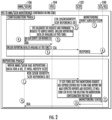
- FIG 2 is a message flow diagram illustrating the monitoring event configuration procedure and reporting procedure for obtaining 4G IoT device state information from an MME or an SGSN.
- the message flow is divided into a configuration phase and a subscription or reporting phase.
- SCS/AS 100 sends a monitoring event subscription message to SCEF 102.
- the monitoring event subscription message may be sent to SCEF 102 via the T8 interface or reference point of SCEF 102.
- the monitoring event subscription request contains the type of event requested and an identifier for the UE. Examples of events that might be requested include request for location information, UE reachability, or changes in IMSI to IMEI mappings.
- the monitoring event subscription request may also include the SCS/AS identifier and the monitoring event type. Examples of monitoring event types include one-time reporting and continuous monitoring for a specified duration.
- the monitoring event request message may be sent to SCEF 102 in an HTTP post message.
- SCEF 102 validates monitoring event request and sends a Diameter CIR message to HSS 104 over the S6t interface.
- the CIR message includes a unique SCEF reference ID generated for the user.
- Validating the monitoring event request may include determining whether the sending SCS/AS is authorized to monitor state information for a particular IoT device. If the SCS/AS is not authorized to monitor state information for the IoT device, SCEF 102 may reject the monitoring event request. In the example illustrated in Figure 2 , it is assumed that the monitoring event request is from an SCS/AS that is authorized to monitor state information for the IoT device identified in the monitoring event request message.
- HSS 104 validates the request, forwards the request to IoT device service nodes, such as MME/SGSN 106 , and reports any IoT device state information available to SCEF 102.
- the request from HSS 104 to MME/SGSN 106 is carried in a Diameter insert subscriber data request (IDR) message.
- MME/SGSN 106 responds with a Diameter insert subscriber data answer (IDA) message indicating that the request for a monitoring subscription has been accepted and includes, in the IDA message, any available IoT device state information.
- HSS 104 receives the IDA message and sends a CIA message to SCEF 102 indicating successful configuration of the monitoring of the IoT device.
- SCEF 102 sends an HTTP response 201 to SCS/AS 100.
- the response indicates that the subscription to receive state information has been accepted.
- MME/SGSN 106 During the reporting phase, when MME/SGSN 106 has state information to report for an IoT device, MME/SGSN 106 notifies SCEF 102.
- the notification is transmitted in line 1 of the reporting phase from MME/SGSN 106 to SCEF 102 in a Diameter RIR message.
- the Diameter RIR message includes the requested state information and the SCEF reference ID. If the SCEF determines that the monitoring request has expired either due to receipt a one-time report (in the case of one-time reporting) or expiration of a subscription duration or receipt of a specified number of reports (in the case of continuous reporting), SCEF 102 will delete the monitoring configuration for the IoT device.
- SCEF 102 communicates the IoT device state to SCS/AS 100.
- the device state information is communicated to SCS/AS 100 via the T8 interface or reference point.
- SCS/AS 100 sends a response over the T8 interface to SCEF 102 with a cause code indicating success.
- SCEF 102 sends a Diameter RIA message to the HSS indicating success.
- the T8 interface and monitoring event configuration procedure is used to configure downstream devices (i.e., the SCEF, the HSS, and the MME/SGSN) to monitor IoT device state for 4G IoT devices.
- downstream devices i.e., the SCEF, the HSS, and the MME/SGSN
- the T8 interface and the monitoring event configuration procedure may also be used to configure downstream devices to monitor and report device state information for non-4G IoT devices, including 2G and 3G IoT devices.
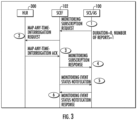
- Figure 3 is a message flow diagram illustrating the use of the T8 interface and the monitoring event configuration procedure to configure downstream devices to monitor and report status of 2G and 3G IoT devices. The message flow in Figure 3 is for one-time monitoring.
- SCS/AS 100 sends a monitoring subscription request to SCEF 102 over the T8 interface.
- the request is for one time monitoring.
- the monitoring duration parameter in the monitoring subscription request may be set to zero or the number of reports parameter may be set to 1.
- SCEF 100 validates the monitoring subscription request and determines, based on the device identifier present in the monitoring subscription request message, that the device is a 2G/3G IoT device, and sends a mobile application part (MAP) anytime interrogation (ATI) request message to home location register (HLR) 300.
- MAP mobile application part
- ATI anytime interrogation
- HLR home location register
- SCEF 102 may maintain a database of device identifiers for 2G/3G IoT devices.
- the device identifiers may be ranges of MSISDNs or domain identifiers of external IDs mapped to HLRs or HLR/HSSs that maintain state information for 2G and 3G IoT devices.
- SCEF 102 may insert in the MAP ATI request message one or more information elements (IEs) that identify the message as an IoT device state information subscription request and the type of subscription requested. SCEF 102 may determine the monitoring event type based on the monitoring event type received in the monitoring subscription request.
- the following table contains mappings between monitoring event subscription types and information elements that may be included in the MAP ATI request message.
- Table 1 IoT Monitoring Subscription Type to MAP ATI Information Element Mappings T8 Monitoring Subscription Type MAP ATI IE Location Reporting Location Information - used for one time reporting Current location - used for continuous reporting UE Reachability Subscriber State Change of IMSI-IMEI (SV) Association IMEI (with software version) From Table 1, if the monitoring event type is location reporting, SCEF 102 may include the location information element in the ATI request message for one time reporting and the current location information element for continuous reporting. If the SCS/AS requests notifications regarding UE reachability, SCEF 102 may include the subscriber state IE in the MAP ATI request message.
- SCEF 102 may include the IMEI information element in the ATI request message. Any other monitoring type coming from SCS/AS for 2G/3G devices may be rejected by SCEF 102 with proper error cause.
- HLR 300 responds to the ATI request by sending a MAP ATI acknowledgement (Ack) message to SCEF 102 indicating a successful subscription to the 2G or 3G IoT device state information.
- SCEF 102 sends a monitoring event subscription response to SCS/AS 100 with http cause 201 created.
- the configuration or subscription phase for receiving the 2G or 3G IoT device state is complete.
- SCEF 102 sends a monitoring event status notification to SCS/AS 100 with the requested monitoring information over T8 interface.
- SCS/AS 100 sends a monitoring event status notification response to SCEF 102.
- the monitoring subscription request is for one-time monitoring.
- SCEF 102 may also provide for continuous monitoring of state information regarding 2G and 3G IoT devices.
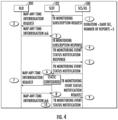
- Figure 4 is a message flow diagram illustrating exemplary steps performed by SCEF 102 for continuous monitoring of state information regarding 2G and 3G IoT devices.
- SCS/AS 100 sends a monitoring subscription request to SCEF 102 over the T8 interface.
- the monitoring subscription request may contain a non-zero monitoring duration parameter or a number of reports parameter that is greater than one, either of which indicates continuous monitoring of an IoT device.
- SCEF 102 validates the monitoring subscription request message and, based on the target IoT device identifier present in the T8 message, SCEF 102 determines the device is a 2G or 3G IoT device and sends a MAP ATI request to HLR 300.
- SCEF 102 may include a database of device identifiers for 2G/3G IoT devices and corresponding HLR addresses. Table 2 shown below is an example of an IoT device identifier database that may be present in SCEF 102.
- Table 2 IoT Device Identifier Database IoT Device ID 2G/3G HLR Address 9194930000-9194939999 HLR1 9194934000-9194934999 HLR2 2G_3GIoT.vzw.com HLR4 2G_3GIoT.att.com HLR5 Table 2 includes a list of IoT device IDs and corresponding 2G/3G HLR addresses. In the illustrated example, IoT devices are identified by ranges of MSISDN numbers and by the domain part of the external identifier in IoT device monitoring event subscription request messages.
- SCEF 102 When SCEF 102 receives a monitoring event subscription request message, SCEF 102 will extract the IoT device identifier from the message and perform a lookup in the IoT device identifier database. If the IoT device identifier database contains the identifier of the IoT device, the IoT device is determined to be a 2G or 3G IoT device, and SCEF 102 sends a subscription request message to the HLR corresponding to the IoT device identified in the database lookup. If the IoT device identifier is not present in the in the IoT device identifier database, the IoT device is determined to be a 4G or 5G IoT device and the query is sent to the corresponding 4G or 5G network. It is understood that SCEF 102 may also maintain mappings between 4G and 5G IoT device identifiers and addresses for corresponding HSS, MME, or SGSN nodes in 4G or 5G networks.
- the IoT device identifiers in Table 2 may also include 4G or 5G IoT devices that are attached to a 2G or 3G network.
- the procedure illustrated in Figures 3 and 4 for subscribing to and receiving state information updates for IoT devices can be used for any IoT device whose information is stored in an HLR that responds to ATI messages.
- the ATI procedure illustrated in Figures 3 and 4 can be used to subscribe to and obtain IoT device state information from an HSS or a combination HLR/HSS that will respond to ATI messages.
- SCEF 102 inserts the requested info IE into MAP ATI request according to the mappings illustrated in Table 1.
- the MAP ATI IEs may include the current location IE. If SCEF 102 does not recognize the monitoring event type received from SCS/AS 100 , SCEF 102 may reject the monitoring event subscription with an error message indicating an error cause.
- HLR 300 sends a MAP ATI Ack to SCEF 102 with the requested IoT device state information (if currently available).
- SCEF 102 sends a monitoring event subscription response to SCS/AS 100 with response code 201.
- SCEF 102 sends a monitoring event status notification over the T8 interface to SCS/AS 100 indicating that the monitoring subscription was successful.
- SCS/AS 100 sends monitoring event status notification response to SCEF 102.
- a static timer is configured on SCEF 102 to indicate the interval on which the continuous monitoring needs to be performed.
- SCEF 102 sends a MAP ATI request to HLR 300, one of which is indicated by line 7 of the message flow diagram.
- SCEF 102 may send the ATI request messages to HLR 300 on regular interval based on the statically configured value of the timer until the requested subscription duration or number of reports is reached. Once the requested subscription duration or number of reports is reached, SCEF 102 may cease sending the ATI request messages concerning the IoT device.
- HLR 300 sends a MAP ATI Ack to SCEF 102 with the requested monitoring information.
- SCEF 102 sends the monitoring event status notification to SCS/AS 100 with the requested monitoring information over T8 interface.
- SCS/AS 100 sends a monitoring event status notification response to SCEF 102.
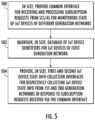
- FIG. 5 is a flow chart illustrating an exemplary process for monitoring IoT device state information for IoT devices of plural different generation networks.
- a common interface is provided in an SCEF for receiving subscription requests from IoT application servers for monitoring state of IoT devices of different generation networks.
- SCEF 102 may be implemented as a standalone computing platform.
- SCEF 102 includes a first interface 600 , which in the Illustrated example is a T8 interface, for receiving subscription request from IoT SCSs and ASs.
- the subscription requests may request IoT device state information for IoT devices of different generation networks.
- the subscription requests may request 4G or 5G IoT device state information using the monitoring event procedure Illustrated in Figures 1 and 2 .
- Other subscription requests may request IoT device state information regarding 2G or 3G IoT devices using the procedures Illustrated in Figures 3 and 4 .
- the process includes maintaining, in the SCEF, a database of IoT device identifiers for IoT devices of a first-generation network.
- the first-generation network may be a 2G or 3G network that contains state information for IoT devices.
- Table 2 above illustrates an example of IoT device identifier database that may be maintained.
- the process includes providing, in the SCEF, first and second IoT device state information collection interfaces for respectively collecting IoT device state information from first- and second-generation networks in response to subscription requests received via the common interface.
- SCEF 102 includes a 2G/3G IoT device state information collection interface 604 for collecting IoT device state information for 2G/3G IoT devices from an HLR and a 4G/5G IoT device state information collection interface 606 for collecting state information regarding 4G and 5G IoT devices.
- 2G/3G IoT device state information collection interface 604 may implement the above-described procedures for sending ATI messages for subscribing to receive IoT device state.
- ATI messages are MAP messages sent over SS7 networks.
- 2G/3G IoT device state information collection interface 604 may be an SS7 interface that implements a MAP layer, a transaction capabilities application part (TCAP) layer, a signaling connection control part (SCCP) layer, a message transfer part level 3 (MTP3) layer, and an IP or SS7 transport layer (either Sigtran over IP or SS7 layers 1 and 2).
- 4G/5G IoT device state information collection interface 606 may implement one or more Diameter layers for subscribing to and receiving IoT device state information from Diameter nodes, such as an HSS, an SGSN, or an MME.
- SCEF 102 also includes at least one processor 607 and a memory 608.
- SCEF 102 is a standalone component.
- a standalone SCEF may include SCEF functionality in addition to SCS and AS functionality as well as MTC device interworking functionality.
- SCEF 102 may be implemented as a component of a Diameter signaling router (DSR).
- DSR 700 includes a plurality of message processors 702 , 704 , 706 , and 708.
- Each message processor 702 , 704 , 706, and 708 includes a printed circuit board and at least one processor 710 and memory 712 mounted on the printed circuit board.
- Message processors 702 , 704 , 706 , and 708 may exchange messages via a communications medium 714 , such as an Ethernet backplane.
- message processor 702 implements a Diameter connection layer 716 and a Diameter routing layer 718.
- Diameter connection layer 716 establishes and maintains Diameter connections with peer Diameter nodes.
- Diameter routing layer 718 routes Diameter messages based on Diameter layer information, such as destination host and destination realm parameters, in the messages.
- Message processor 704 implements SS7 communications.
- message processor 704 includes a Sigtran layer 720 and an SS7 layer 722.
- Sigtran layer 720 implements Sigtran protocols for carrying SS7 messages over IP networks.
- SS7 layer 722 implements SS7 MTP level 3 for routing SS7 signaling messages based on SS7 point codes.
- Message processor 706 implements SCEF 102 and may include the components illustrated in Figure 6 .
- SCEF 102 may send outbound subscription requests via SS7 message processor 704 and receive subscription information from SS7 message processor 704.
- SCEF 102 may send subscription requests via a non-Diameter interface, such as a direct API-based interface to SCEF 102.
- Diameter application 724 may be any suitable Diameter application, such as a Diameter firewall application, performance monitoring application, or other suitable Diameter application.
- SCEF 102 is component of DSR 700.
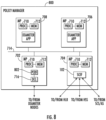
- SCEF 102 may be a component of a policy manager.
- Figure 8 illustrates such an implementation.
- policy manager 800 includes message processors 702 , 704 , 706, and 708 as illustrated in Figure 7 .
- Each message processor 702 , 704 , 706, and 708 includes a processor 710 and memory 712.
- Message processors 702 , 704 , 706 , and 708 may communicate via communications medium 714.
- message processor 702 illustrated in Figure 8 includes a policy and charging rules function (PCRF) 802 that implements PCRF functionality.
- PCRF functionality includes responding to policy and charging requests from Diameter nodes.
- Message processor 702 also implements a Diameter connection layer 716 for establishing and maintaining connections with external Diameter nodes.
- PCRF policy and charging rules function
- Message processor 704 implements the SCEF functionality Illustrated in Figure 6 . Briefly, such functionality includes receiving subscription requests for IoT device state information via a common interface, such as a T8 interface, and sending corresponding subscription requests to HLRs and HSSs.
- Message processors 706 and 708 may implement other Diameter applications such as policy related applications or non-policy related Diameter applications.
- the SCEF that provides a common interface for multi-generation IoT device state monitoring can be implemented either as a standalone node or as a component of another node, such as a DSR or a PCRF.
- Such an SCEF obviates the need to provide dedicated interfaces to monitor IoT device state information for IoT devices of different generation networks.
- Such a device improves the technological field of IoT device state monitoring because SCS and AS vendors are not required to comply with requirements of different interfaces for monitoring IoT devices of different generation networks.
- the foregoing description is for the purpose of illustration only, and not for the purpose of limitation.
Landscapes
- Engineering & Computer Science (AREA)
- Computer Networks & Wireless Communication (AREA)
- Signal Processing (AREA)
- Databases & Information Systems (AREA)
- Mobile Radio Communication Systems (AREA)
- Data Exchanges In Wide-Area Networks (AREA)
Applications Claiming Priority (2)
| Application Number | Priority Date | Filing Date | Title |
|---|---|---|---|
| US16/280,672 US10555202B1 (en) | 2019-02-20 | 2019-02-20 | Methods, systems, and computer readable media for monitoring internet of things (IoT) device state through service capability exposure function (SCEF) |
| PCT/US2020/013960 WO2020171899A1 (en) | 2019-02-20 | 2020-01-16 | Methods, systems, and computer readable media for monitoring internet of things (iot) device state through service capability exposure function (scef) |
Publications (2)
| Publication Number | Publication Date |
|---|---|
| EP3928543A1 EP3928543A1 (en) | 2021-12-29 |
| EP3928543B1 true EP3928543B1 (en) | 2023-06-07 |
Family
ID=69230397
Family Applications (1)
| Application Number | Title | Priority Date | Filing Date |
|---|---|---|---|
| EP20705567.4A Active EP3928543B1 (en) | 2019-02-20 | 2020-01-16 | Methods, systems, and computer readable media for monitoring internet of things (iot) device state through service capability exposure function (scef) |
Country Status (5)
| Country | Link |
|---|---|
| US (1) | US10555202B1 (https=) |
| EP (1) | EP3928543B1 (https=) |
| JP (1) | JP7439111B2 (https=) |
| CN (1) | CN112997513B (https=) |
| WO (1) | WO2020171899A1 (https=) |
Families Citing this family (17)
| Publication number | Priority date | Publication date | Assignee | Title |
|---|---|---|---|---|
| US10945120B2 (en) | 2019-02-27 | 2021-03-09 | Oracle International Corporation | Methods, systems, and computer readable media for dynamically provisioning and using public land mobile network (PLMN) location mappings in service capability exposure function (SCEF) or network exposure function (NEF) |
| US10742744B1 (en) | 2019-04-08 | 2020-08-11 | Oracle International Corporation | Methods, systems, and computer readable media for monitoring lightweight machine to machine (LWM2M) internet of things (IoT) devices through service capability exposure funtion (SCEF) T8 interface |
| MX2021012809A (es) * | 2019-04-30 | 2021-11-12 | Ericsson Telefon Ab L M | Metodos y aparatos para configuracion de monitoreo para dispositivo terminal. |
| US10972368B2 (en) | 2019-05-17 | 2021-04-06 | Oracle International Corporation | Methods, systems, and computer readable media for providing reduced signaling internet of things (IoT) device monitoring |
| KR102735502B1 (ko) * | 2020-02-13 | 2024-11-28 | 텔레폰악티에볼라겟엘엠에릭슨(펍) | 5gc-epc 연동 시나리오에서 imei 검색 및 imei 변경 통지 |
| JP7425300B2 (ja) * | 2020-03-09 | 2024-01-31 | 富士通株式会社 | 実行制御方法及び実行制御プログラム |
| US11588788B2 (en) * | 2020-05-06 | 2023-02-21 | Verizon Patent And Licensing Inc. | Systems and methods for facilitating data transmission to internet of things devices |
| CN113630366A (zh) * | 2020-05-07 | 2021-11-09 | 中移物联网有限公司 | 一种物联网设备接入方法及系统 |
| US11381955B2 (en) | 2020-07-17 | 2022-07-05 | Oracle International Corporation | Methods, systems, and computer readable media for monitoring machine type communications (MTC) device related information |
| JP7694114B2 (ja) * | 2021-03-31 | 2025-06-18 | ブラザー工業株式会社 | サービス提供プログラム、サーバ、サービスシステム及びサービス提供方法 |
| US11895080B2 (en) | 2021-06-23 | 2024-02-06 | Oracle International Corporation | Methods, systems, and computer readable media for resolution of inter-network domain names |
| WO2023043345A1 (en) * | 2021-09-17 | 2023-03-23 | Telefonaktiebolaget Lm Ericsson (Publ) | Reliability of reported performance indicators |
| CN114245441B (zh) * | 2021-12-28 | 2024-04-23 | 天翼物联科技有限公司 | 同时满足物用及人用场景的5g组网方法以及系统 |
| CN117978740A (zh) * | 2022-10-26 | 2024-05-03 | 腾讯科技(深圳)有限公司 | 网络信息开放方法及相关设备 |
| CN120345268A (zh) * | 2022-11-28 | 2025-07-18 | Oppo广东移动通信有限公司 | 无线通信的方法和设备 |
| US12413486B1 (en) | 2024-03-11 | 2025-09-09 | T-Mobile Usa, Inc. | Telecommunications system to timely send producer network function status notifications to consumer network functions |
| CN121509981A (zh) * | 2024-08-08 | 2026-02-10 | 中国电信股份有限公司技术创新中心 | 数据传输方法、装置、系统、通信设备和存储介质 |
Family Cites Families (16)
| Publication number | Priority date | Publication date | Assignee | Title |
|---|---|---|---|---|
| US8023482B2 (en) | 2007-03-15 | 2011-09-20 | Cisco Technology, Inc. | Dynamic rate limiting in wireless mesh networks |
| US9032077B1 (en) | 2012-06-28 | 2015-05-12 | Amazon Technologies, Inc. | Client-allocatable bandwidth pools |
| CN103796188B (zh) * | 2012-11-02 | 2017-06-06 | 华为终端有限公司 | 下行传输数据的方法和设备 |
| US9450881B2 (en) | 2013-07-09 | 2016-09-20 | Intel Corporation | Method and system for traffic metering to limit a received packet rate |
| CA2953516C (en) * | 2014-06-26 | 2023-07-18 | Interdigital Patent Holdings, Inc. | Application layer group services for machine type communications |
| US20160164788A1 (en) | 2014-12-05 | 2016-06-09 | Qualcomm Incorporated | Egress Rate Shaping To Reduce Burstiness In Application Data Delivery |
| US10038525B2 (en) | 2015-04-27 | 2018-07-31 | Nokia Solutions And Networks Oy | Management of coordinated multi-point communication |
| US9602677B2 (en) * | 2015-06-16 | 2017-03-21 | Alcatel Lucent | Charging for commercial group based messaging |
| CN114189815B (zh) * | 2016-01-18 | 2024-02-09 | 三星电子株式会社 | 移动通信系统中终端通信的方法和装置 |
| US20190007329A1 (en) * | 2016-02-17 | 2019-01-03 | Nec Corporation | Method for enforcement of non-ip data policing over the service exposure function |
| US10104567B2 (en) * | 2016-05-31 | 2018-10-16 | At&T Intellectual Property I, L.P. | System and method for event based internet of things (IOT) device status monitoring and reporting in a mobility network |
| US10212639B2 (en) * | 2016-07-26 | 2019-02-19 | At&T Intellectual Property I, L.P. | Method and apparatus for dynamic data path selection for narrow band wireless communication |
| US10405158B2 (en) | 2017-02-27 | 2019-09-03 | Oracle International Corporation | Methods, systems and computer readable media for providing service capability exposure function (SCEF) as a diameter routing agent (DRA) feature |
| US11038841B2 (en) * | 2017-05-05 | 2021-06-15 | Microsoft Technology Licensing, Llc | Methods of and systems of service capabilities exposure function (SCEF) based internet-of-things (IOT) communications |
| US10375530B2 (en) * | 2017-06-09 | 2019-08-06 | Blackberry Limited | Providing data file updates using multimedia broadcast multicast services |
| US10313883B2 (en) * | 2017-11-06 | 2019-06-04 | Oracle International Corporation | Methods, systems, and computer readable media for using authentication validation time periods |
-
2019
- 2019-02-20 US US16/280,672 patent/US10555202B1/en active Active
-
2020
- 2020-01-16 EP EP20705567.4A patent/EP3928543B1/en active Active
- 2020-01-16 CN CN202080005920.6A patent/CN112997513B/zh active Active
- 2020-01-16 WO PCT/US2020/013960 patent/WO2020171899A1/en not_active Ceased
- 2020-01-16 JP JP2021543455A patent/JP7439111B2/ja active Active
Also Published As
| Publication number | Publication date |
|---|---|
| CN112997513B (zh) | 2024-06-28 |
| US10555202B1 (en) | 2020-02-04 |
| EP3928543A1 (en) | 2021-12-29 |
| JP7439111B2 (ja) | 2024-02-27 |
| CN112997513A (zh) | 2021-06-18 |
| JP2022520725A (ja) | 2022-04-01 |
| WO2020171899A1 (en) | 2020-08-27 |
Similar Documents
| Publication | Publication Date | Title |
|---|---|---|
| EP3928543B1 (en) | Methods, systems, and computer readable media for monitoring internet of things (iot) device state through service capability exposure function (scef) | |
| US11849506B2 (en) | Methods, systems, and computer readable media for routing inter-public land mobile network (inter-PLMN) messages related to existing subscriptions with network function (NF) repository function (NRF) using security edge protection proxy (SEPP) | |
| US10742744B1 (en) | Methods, systems, and computer readable media for monitoring lightweight machine to machine (LWM2M) internet of things (IoT) devices through service capability exposure funtion (SCEF) T8 interface | |
| CN101931931B (zh) | 信息处理方法、系统以及移动性管理网元 | |
| US9794772B2 (en) | Machine type communication interworking function | |
| US10972368B2 (en) | Methods, systems, and computer readable media for providing reduced signaling internet of things (IoT) device monitoring | |
| US11140523B2 (en) | Methods, systems, and computer readable media for non-internet protocol (non-IP) data delivery between user equipment (UEs) and multiple application servers (ASs) | |
| US20210203636A1 (en) | Methods, systems, and computer readable media for implementing indirect general packet radio service (gprs) tunneling protocol (gtp) firewall filtering using diameter agent and signal transfer point (stp) | |
| US10542394B1 (en) | Methods, systems, and computer redable media for optimized short message service (SMS)-based Internet of Things (IoT) device triggering | |
| US9313759B2 (en) | Methods, systems, and computer readable media for providing triggerless equipment identity register (EIR) service in a diameter network | |
| US20210058766A1 (en) | METHODS, SYSTEMS, AND COMPUTER READABLE MEDIA FOR GROUP DEVICE TRIGGERING FOR INTERNET OF THINGS (IoT) DEVICES | |
| WO2006031627A2 (en) | Methods, systems, and computer program products for automatically provisioning intelligent network (in) platforms, including home location registers (hlrs), and routing nodes with prepaid mobile subscriber information | |
| WO2010132436A2 (en) | Methods, systems, and computer readable media for providing scalable number portability (np) home location register (hlr) | |
| US20140213265A1 (en) | Methods, systems, and computer readable media for tracking and communicating long term evolution (lte) handset communication capability | |
| US20250234187A1 (en) | Methods, systems, and computer readable media for detecting and processing inter-public land mobile network (plmn) service-based interface (sbi) messages without 3gpp-sbi-originating-network-id headers | |
| US10390211B2 (en) | Roaming solution | |
| CN102238617B (zh) | 机器类通信事件上报方法及系统 | |
| US11381955B2 (en) | Methods, systems, and computer readable media for monitoring machine type communications (MTC) device related information | |
| KR20240046212A (ko) | 모니터링 노출에 대한 향상 | |
| EP3869877B1 (en) | Configuring usage of a communication network | |
| EP2865199B1 (en) | Machine type communication interworking function | |
| US12532181B2 (en) | Methods, systems, and computer readable media for performing location and velocity check at security edge protection proxy (SEPP) using service communication proxy (SCP) | |
| US12526620B2 (en) | Methods, systems, and computer readable media for facilitating processing of inter-public land mobile network (PLMN) messages relating to existing subscriptions | |
| US20260067153A1 (en) | Methods, systems, and computer readable media for suppressing subscription notifications to resource update originators |
Legal Events
| Date | Code | Title | Description |
|---|---|---|---|
| STAA | Information on the status of an ep patent application or granted ep patent |
Free format text: STATUS: UNKNOWN |
|
| STAA | Information on the status of an ep patent application or granted ep patent |
Free format text: STATUS: THE INTERNATIONAL PUBLICATION HAS BEEN MADE |
|
| PUAI | Public reference made under article 153(3) epc to a published international application that has entered the european phase |
Free format text: ORIGINAL CODE: 0009012 |
|
| STAA | Information on the status of an ep patent application or granted ep patent |
Free format text: STATUS: REQUEST FOR EXAMINATION WAS MADE |
|
| 17P | Request for examination filed |
Effective date: 20210406 |
|
| AK | Designated contracting states |
Kind code of ref document: A1 Designated state(s): AL AT BE BG CH CY CZ DE DK EE ES FI FR GB GR HR HU IE IS IT LI LT LU LV MC MK MT NL NO PL PT RO RS SE SI SK SM TR |
|
| DAV | Request for validation of the european patent (deleted) | ||
| DAX | Request for extension of the european patent (deleted) | ||
| GRAP | Despatch of communication of intention to grant a patent |
Free format text: ORIGINAL CODE: EPIDOSNIGR1 |
|
| STAA | Information on the status of an ep patent application or granted ep patent |
Free format text: STATUS: GRANT OF PATENT IS INTENDED |
|
| INTG | Intention to grant announced |
Effective date: 20230103 |
|
| GRAS | Grant fee paid |
Free format text: ORIGINAL CODE: EPIDOSNIGR3 |
|
| GRAA | (expected) grant |
Free format text: ORIGINAL CODE: 0009210 |
|
| STAA | Information on the status of an ep patent application or granted ep patent |
Free format text: STATUS: THE PATENT HAS BEEN GRANTED |
|
| AK | Designated contracting states |
Kind code of ref document: B1 Designated state(s): AL AT BE BG CH CY CZ DE DK EE ES FI FR GB GR HR HU IE IS IT LI LT LU LV MC MK MT NL NO PL PT RO RS SE SI SK SM TR |
|
| REG | Reference to a national code |
Ref country code: GB Ref legal event code: FG4D |
|
| REG | Reference to a national code |
Ref country code: CH Ref legal event code: EP Ref country code: AT Ref legal event code: REF Ref document number: 1578292 Country of ref document: AT Kind code of ref document: T Effective date: 20230615 |
|
| REG | Reference to a national code |
Ref country code: DE Ref legal event code: R096 Ref document number: 602020011888 Country of ref document: DE |
|
| REG | Reference to a national code |
Ref country code: LT Ref legal event code: MG9D |
|
| REG | Reference to a national code |
Ref country code: NL Ref legal event code: MP Effective date: 20230607 |
|
| PG25 | Lapsed in a contracting state [announced via postgrant information from national office to epo] |
Ref country code: SE Free format text: LAPSE BECAUSE OF FAILURE TO SUBMIT A TRANSLATION OF THE DESCRIPTION OR TO PAY THE FEE WITHIN THE PRESCRIBED TIME-LIMIT Effective date: 20230607 Ref country code: NO Free format text: LAPSE BECAUSE OF FAILURE TO SUBMIT A TRANSLATION OF THE DESCRIPTION OR TO PAY THE FEE WITHIN THE PRESCRIBED TIME-LIMIT Effective date: 20230907 Ref country code: ES Free format text: LAPSE BECAUSE OF FAILURE TO SUBMIT A TRANSLATION OF THE DESCRIPTION OR TO PAY THE FEE WITHIN THE PRESCRIBED TIME-LIMIT Effective date: 20230607 |
|
| REG | Reference to a national code |
Ref country code: AT Ref legal event code: MK05 Ref document number: 1578292 Country of ref document: AT Kind code of ref document: T Effective date: 20230607 |
|
| PG25 | Lapsed in a contracting state [announced via postgrant information from national office to epo] |
Ref country code: RS Free format text: LAPSE BECAUSE OF FAILURE TO SUBMIT A TRANSLATION OF THE DESCRIPTION OR TO PAY THE FEE WITHIN THE PRESCRIBED TIME-LIMIT Effective date: 20230607 Ref country code: NL Free format text: LAPSE BECAUSE OF FAILURE TO SUBMIT A TRANSLATION OF THE DESCRIPTION OR TO PAY THE FEE WITHIN THE PRESCRIBED TIME-LIMIT Effective date: 20230607 Ref country code: LV Free format text: LAPSE BECAUSE OF FAILURE TO SUBMIT A TRANSLATION OF THE DESCRIPTION OR TO PAY THE FEE WITHIN THE PRESCRIBED TIME-LIMIT Effective date: 20230607 Ref country code: LT Free format text: LAPSE BECAUSE OF FAILURE TO SUBMIT A TRANSLATION OF THE DESCRIPTION OR TO PAY THE FEE WITHIN THE PRESCRIBED TIME-LIMIT Effective date: 20230607 Ref country code: HR Free format text: LAPSE BECAUSE OF FAILURE TO SUBMIT A TRANSLATION OF THE DESCRIPTION OR TO PAY THE FEE WITHIN THE PRESCRIBED TIME-LIMIT Effective date: 20230607 Ref country code: GR Free format text: LAPSE BECAUSE OF FAILURE TO SUBMIT A TRANSLATION OF THE DESCRIPTION OR TO PAY THE FEE WITHIN THE PRESCRIBED TIME-LIMIT Effective date: 20230908 |
|
| PG25 | Lapsed in a contracting state [announced via postgrant information from national office to epo] |
Ref country code: FI Free format text: LAPSE BECAUSE OF FAILURE TO SUBMIT A TRANSLATION OF THE DESCRIPTION OR TO PAY THE FEE WITHIN THE PRESCRIBED TIME-LIMIT Effective date: 20230607 |
|
| PG25 | Lapsed in a contracting state [announced via postgrant information from national office to epo] |
Ref country code: SK Free format text: LAPSE BECAUSE OF FAILURE TO SUBMIT A TRANSLATION OF THE DESCRIPTION OR TO PAY THE FEE WITHIN THE PRESCRIBED TIME-LIMIT Effective date: 20230607 |
|
| PG25 | Lapsed in a contracting state [announced via postgrant information from national office to epo] |
Ref country code: IS Free format text: LAPSE BECAUSE OF FAILURE TO SUBMIT A TRANSLATION OF THE DESCRIPTION OR TO PAY THE FEE WITHIN THE PRESCRIBED TIME-LIMIT Effective date: 20231007 |
|
| PG25 | Lapsed in a contracting state [announced via postgrant information from national office to epo] |
Ref country code: SM Free format text: LAPSE BECAUSE OF FAILURE TO SUBMIT A TRANSLATION OF THE DESCRIPTION OR TO PAY THE FEE WITHIN THE PRESCRIBED TIME-LIMIT Effective date: 20230607 Ref country code: SK Free format text: LAPSE BECAUSE OF FAILURE TO SUBMIT A TRANSLATION OF THE DESCRIPTION OR TO PAY THE FEE WITHIN THE PRESCRIBED TIME-LIMIT Effective date: 20230607 Ref country code: RO Free format text: LAPSE BECAUSE OF FAILURE TO SUBMIT A TRANSLATION OF THE DESCRIPTION OR TO PAY THE FEE WITHIN THE PRESCRIBED TIME-LIMIT Effective date: 20230607 Ref country code: PT Free format text: LAPSE BECAUSE OF FAILURE TO SUBMIT A TRANSLATION OF THE DESCRIPTION OR TO PAY THE FEE WITHIN THE PRESCRIBED TIME-LIMIT Effective date: 20231009 Ref country code: IS Free format text: LAPSE BECAUSE OF FAILURE TO SUBMIT A TRANSLATION OF THE DESCRIPTION OR TO PAY THE FEE WITHIN THE PRESCRIBED TIME-LIMIT Effective date: 20231007 Ref country code: EE Free format text: LAPSE BECAUSE OF FAILURE TO SUBMIT A TRANSLATION OF THE DESCRIPTION OR TO PAY THE FEE WITHIN THE PRESCRIBED TIME-LIMIT Effective date: 20230607 Ref country code: CZ Free format text: LAPSE BECAUSE OF FAILURE TO SUBMIT A TRANSLATION OF THE DESCRIPTION OR TO PAY THE FEE WITHIN THE PRESCRIBED TIME-LIMIT Effective date: 20230607 Ref country code: AT Free format text: LAPSE BECAUSE OF FAILURE TO SUBMIT A TRANSLATION OF THE DESCRIPTION OR TO PAY THE FEE WITHIN THE PRESCRIBED TIME-LIMIT Effective date: 20230607 |
|
| PG25 | Lapsed in a contracting state [announced via postgrant information from national office to epo] |
Ref country code: PL Free format text: LAPSE BECAUSE OF FAILURE TO SUBMIT A TRANSLATION OF THE DESCRIPTION OR TO PAY THE FEE WITHIN THE PRESCRIBED TIME-LIMIT Effective date: 20230607 |
|
| REG | Reference to a national code |
Ref country code: DE Ref legal event code: R097 Ref document number: 602020011888 Country of ref document: DE |
|
| PLBE | No opposition filed within time limit |
Free format text: ORIGINAL CODE: 0009261 |
|
| STAA | Information on the status of an ep patent application or granted ep patent |
Free format text: STATUS: NO OPPOSITION FILED WITHIN TIME LIMIT |
|
| PG25 | Lapsed in a contracting state [announced via postgrant information from national office to epo] |
Ref country code: DK Free format text: LAPSE BECAUSE OF FAILURE TO SUBMIT A TRANSLATION OF THE DESCRIPTION OR TO PAY THE FEE WITHIN THE PRESCRIBED TIME-LIMIT Effective date: 20230607 |
|
| PG25 | Lapsed in a contracting state [announced via postgrant information from national office to epo] |
Ref country code: SI Free format text: LAPSE BECAUSE OF FAILURE TO SUBMIT A TRANSLATION OF THE DESCRIPTION OR TO PAY THE FEE WITHIN THE PRESCRIBED TIME-LIMIT Effective date: 20230607 |
|
| 26N | No opposition filed |
Effective date: 20240308 |
|
| PG25 | Lapsed in a contracting state [announced via postgrant information from national office to epo] |
Ref country code: SI Free format text: LAPSE BECAUSE OF FAILURE TO SUBMIT A TRANSLATION OF THE DESCRIPTION OR TO PAY THE FEE WITHIN THE PRESCRIBED TIME-LIMIT Effective date: 20230607 Ref country code: IT Free format text: LAPSE BECAUSE OF FAILURE TO SUBMIT A TRANSLATION OF THE DESCRIPTION OR TO PAY THE FEE WITHIN THE PRESCRIBED TIME-LIMIT Effective date: 20230607 |
|
| PG25 | Lapsed in a contracting state [announced via postgrant information from national office to epo] |
Ref country code: MC Free format text: LAPSE BECAUSE OF FAILURE TO SUBMIT A TRANSLATION OF THE DESCRIPTION OR TO PAY THE FEE WITHIN THE PRESCRIBED TIME-LIMIT Effective date: 20230607 |
|
| PG25 | Lapsed in a contracting state [announced via postgrant information from national office to epo] |
Ref country code: MC Free format text: LAPSE BECAUSE OF FAILURE TO SUBMIT A TRANSLATION OF THE DESCRIPTION OR TO PAY THE FEE WITHIN THE PRESCRIBED TIME-LIMIT Effective date: 20230607 |
|
| REG | Reference to a national code |
Ref country code: CH Ref legal event code: PL |
|
| PG25 | Lapsed in a contracting state [announced via postgrant information from national office to epo] |
Ref country code: LU Free format text: LAPSE BECAUSE OF NON-PAYMENT OF DUE FEES Effective date: 20240116 |
|
| PG25 | Lapsed in a contracting state [announced via postgrant information from national office to epo] |
Ref country code: LU Free format text: LAPSE BECAUSE OF NON-PAYMENT OF DUE FEES Effective date: 20240116 |
|
| PG25 | Lapsed in a contracting state [announced via postgrant information from national office to epo] |
Ref country code: BE Free format text: LAPSE BECAUSE OF NON-PAYMENT OF DUE FEES Effective date: 20240131 |
|
| PG25 | Lapsed in a contracting state [announced via postgrant information from national office to epo] |
Ref country code: FR Free format text: LAPSE BECAUSE OF NON-PAYMENT OF DUE FEES Effective date: 20240131 |
|
| PG25 | Lapsed in a contracting state [announced via postgrant information from national office to epo] |
Ref country code: CH Free format text: LAPSE BECAUSE OF NON-PAYMENT OF DUE FEES Effective date: 20240131 |
|
| PG25 | Lapsed in a contracting state [announced via postgrant information from national office to epo] |
Ref country code: FR Free format text: LAPSE BECAUSE OF NON-PAYMENT OF DUE FEES Effective date: 20240131 Ref country code: CH Free format text: LAPSE BECAUSE OF NON-PAYMENT OF DUE FEES Effective date: 20240131 Ref country code: BE Free format text: LAPSE BECAUSE OF NON-PAYMENT OF DUE FEES Effective date: 20240131 |
|
| REG | Reference to a national code |
Ref country code: BE Ref legal event code: MM Effective date: 20240131 |
|
| PG25 | Lapsed in a contracting state [announced via postgrant information from national office to epo] |
Ref country code: BG Free format text: LAPSE BECAUSE OF FAILURE TO SUBMIT A TRANSLATION OF THE DESCRIPTION OR TO PAY THE FEE WITHIN THE PRESCRIBED TIME-LIMIT Effective date: 20230607 |
|
| P01 | Opt-out of the competence of the unified patent court (upc) registered |
Free format text: CASE NUMBER: UPC_APP_325460/2023 Effective date: 20230523 |
|
| PG25 | Lapsed in a contracting state [announced via postgrant information from national office to epo] |
Ref country code: BG Free format text: LAPSE BECAUSE OF FAILURE TO SUBMIT A TRANSLATION OF THE DESCRIPTION OR TO PAY THE FEE WITHIN THE PRESCRIBED TIME-LIMIT Effective date: 20230607 |
|
| PG25 | Lapsed in a contracting state [announced via postgrant information from national office to epo] |
Ref country code: IE Free format text: LAPSE BECAUSE OF NON-PAYMENT OF DUE FEES Effective date: 20240116 |
|
| PG25 | Lapsed in a contracting state [announced via postgrant information from national office to epo] |
Ref country code: IE Free format text: LAPSE BECAUSE OF NON-PAYMENT OF DUE FEES Effective date: 20240116 |
|
| PG25 | Lapsed in a contracting state [announced via postgrant information from national office to epo] |
Ref country code: CY Free format text: LAPSE BECAUSE OF FAILURE TO SUBMIT A TRANSLATION OF THE DESCRIPTION OR TO PAY THE FEE WITHIN THE PRESCRIBED TIME-LIMIT; INVALID AB INITIO Effective date: 20200116 |
|
| PG25 | Lapsed in a contracting state [announced via postgrant information from national office to epo] |
Ref country code: HU Free format text: LAPSE BECAUSE OF FAILURE TO SUBMIT A TRANSLATION OF THE DESCRIPTION OR TO PAY THE FEE WITHIN THE PRESCRIBED TIME-LIMIT; INVALID AB INITIO Effective date: 20200116 |
|
| PG25 | Lapsed in a contracting state [announced via postgrant information from national office to epo] |
Ref country code: TR Free format text: LAPSE BECAUSE OF FAILURE TO SUBMIT A TRANSLATION OF THE DESCRIPTION OR TO PAY THE FEE WITHIN THE PRESCRIBED TIME-LIMIT Effective date: 20230607 |
|
| PGFP | Annual fee paid to national office [announced via postgrant information from national office to epo] |
Ref country code: GB Payment date: 20251204 Year of fee payment: 7 |
|
| PGFP | Annual fee paid to national office [announced via postgrant information from national office to epo] |
Ref country code: DE Payment date: 20251203 Year of fee payment: 7 |