EP3927701B1 - A process for preparing anthranilic diamides and intermediates thereof - Google Patents
A process for preparing anthranilic diamides and intermediates thereof Download PDFInfo
- Publication number
- EP3927701B1 EP3927701B1 EP20758718.9A EP20758718A EP3927701B1 EP 3927701 B1 EP3927701 B1 EP 3927701B1 EP 20758718 A EP20758718 A EP 20758718A EP 3927701 B1 EP3927701 B1 EP 3927701B1
- Authority
- EP
- European Patent Office
- Prior art keywords
- acid
- formula
- compound
- reagent
- dione
- Prior art date
- Legal status (The legal status is an assumption and is not a legal conclusion. Google has not performed a legal analysis and makes no representation as to the accuracy of the status listed.)
- Active
Links
Classifications
-
- C—CHEMISTRY; METALLURGY
- C07—ORGANIC CHEMISTRY
- C07D—HETEROCYCLIC COMPOUNDS
- C07D401/00—Heterocyclic compounds containing two or more hetero rings, having nitrogen atoms as the only ring hetero atoms, at least one ring being a six-membered ring with only one nitrogen atom
- C07D401/02—Heterocyclic compounds containing two or more hetero rings, having nitrogen atoms as the only ring hetero atoms, at least one ring being a six-membered ring with only one nitrogen atom containing two hetero rings
- C07D401/04—Heterocyclic compounds containing two or more hetero rings, having nitrogen atoms as the only ring hetero atoms, at least one ring being a six-membered ring with only one nitrogen atom containing two hetero rings directly linked by a ring-member-to-ring-member bond
-
- C—CHEMISTRY; METALLURGY
- C07—ORGANIC CHEMISTRY
- C07D—HETEROCYCLIC COMPOUNDS
- C07D409/00—Heterocyclic compounds containing two or more hetero rings, at least one ring having sulfur atoms as the only ring hetero atoms
- C07D409/02—Heterocyclic compounds containing two or more hetero rings, at least one ring having sulfur atoms as the only ring hetero atoms containing two hetero rings
- C07D409/12—Heterocyclic compounds containing two or more hetero rings, at least one ring having sulfur atoms as the only ring hetero atoms containing two hetero rings linked by a chain containing hetero atoms as chain links
-
- C—CHEMISTRY; METALLURGY
- C07—ORGANIC CHEMISTRY
- C07D—HETEROCYCLIC COMPOUNDS
- C07D231/00—Heterocyclic compounds containing 1,2-diazole or hydrogenated 1,2-diazole rings
- C07D231/02—Heterocyclic compounds containing 1,2-diazole or hydrogenated 1,2-diazole rings not condensed with other rings
- C07D231/10—Heterocyclic compounds containing 1,2-diazole or hydrogenated 1,2-diazole rings not condensed with other rings having two or three double bonds between ring members or between ring members and non-ring members
- C07D231/14—Heterocyclic compounds containing 1,2-diazole or hydrogenated 1,2-diazole rings not condensed with other rings having two or three double bonds between ring members or between ring members and non-ring members with hetero atoms or with carbon atoms having three bonds to hetero atoms with at the most one bond to halogen, e.g. ester or nitrile radicals, directly attached to ring carbon atoms
-
- C—CHEMISTRY; METALLURGY
- C07—ORGANIC CHEMISTRY
- C07D—HETEROCYCLIC COMPOUNDS
- C07D231/00—Heterocyclic compounds containing 1,2-diazole or hydrogenated 1,2-diazole rings
- C07D231/02—Heterocyclic compounds containing 1,2-diazole or hydrogenated 1,2-diazole rings not condensed with other rings
- C07D231/10—Heterocyclic compounds containing 1,2-diazole or hydrogenated 1,2-diazole rings not condensed with other rings having two or three double bonds between ring members or between ring members and non-ring members
- C07D231/14—Heterocyclic compounds containing 1,2-diazole or hydrogenated 1,2-diazole rings not condensed with other rings having two or three double bonds between ring members or between ring members and non-ring members with hetero atoms or with carbon atoms having three bonds to hetero atoms with at the most one bond to halogen, e.g. ester or nitrile radicals, directly attached to ring carbon atoms
- C07D231/18—One oxygen or sulfur atom
- C07D231/20—One oxygen atom attached in position 3 or 5
- C07D231/22—One oxygen atom attached in position 3 or 5 with aryl radicals attached to ring nitrogen atoms
-
- C—CHEMISTRY; METALLURGY
- C07—ORGANIC CHEMISTRY
- C07D—HETEROCYCLIC COMPOUNDS
- C07D403/00—Heterocyclic compounds containing two or more hetero rings, having nitrogen atoms as the only ring hetero atoms, not provided for by group C07D401/00
- C07D403/02—Heterocyclic compounds containing two or more hetero rings, having nitrogen atoms as the only ring hetero atoms, not provided for by group C07D401/00 containing two hetero rings
- C07D403/06—Heterocyclic compounds containing two or more hetero rings, having nitrogen atoms as the only ring hetero atoms, not provided for by group C07D401/00 containing two hetero rings linked by a carbon chain containing only aliphatic carbon atoms
-
- A—HUMAN NECESSITIES
- A01—AGRICULTURE; FORESTRY; ANIMAL HUSBANDRY; HUNTING; TRAPPING; FISHING
- A01N—PRESERVATION OF BODIES OF HUMANS OR ANIMALS OR PLANTS OR PARTS THEREOF; BIOCIDES, e.g. AS DISINFECTANTS, AS PESTICIDES OR AS HERBICIDES; PEST REPELLANTS OR ATTRACTANTS; PLANT GROWTH REGULATORS
- A01N43/00—Biocides, pest repellants or attractants, or plant growth regulators containing heterocyclic compounds
- A01N43/48—Biocides, pest repellants or attractants, or plant growth regulators containing heterocyclic compounds having rings with two nitrogen atoms as the only ring hetero atoms
- A01N43/56—1,2-Diazoles; Hydrogenated 1,2-diazoles
-
- A—HUMAN NECESSITIES
- A01—AGRICULTURE; FORESTRY; ANIMAL HUSBANDRY; HUNTING; TRAPPING; FISHING
- A01N—PRESERVATION OF BODIES OF HUMANS OR ANIMALS OR PLANTS OR PARTS THEREOF; BIOCIDES, e.g. AS DISINFECTANTS, AS PESTICIDES OR AS HERBICIDES; PEST REPELLANTS OR ATTRACTANTS; PLANT GROWTH REGULATORS
- A01N43/00—Biocides, pest repellants or attractants, or plant growth regulators containing heterocyclic compounds
- A01N43/90—Biocides, pest repellants or attractants, or plant growth regulators containing heterocyclic compounds having two or more relevant hetero rings, condensed among themselves or with a common carbocyclic ring system
Definitions
- the present invention relates to a novel process for preparing anthranilic diamides involving the conversion of isatins into isatoic anhydrides.
- the present invention also relates to a novel process for preparing anthranilic amides and isatoic anhydrides useful in the process for preparing anthranilic diamides.
- WO2003015518 , WO2003015519 , WO2004067528 , WO2005077934 and WO20100069502 disclose the use of anthranilic diamides for controlling invertebrate pests such as arthropods.
- the present invention provides a solution to this objective by providing a novel process that allows the preparation of anthranilic diamides, overcoming at least one of the shortcomings of the processes described in the prior art.
- the process according to this invention comprises the step of obtaining a dione of Formula II from an aniline III and chloral hydrate IV, and converting the dione of Formula II into an isatoic anhydride of Formula V in a single step.
- the conversion of the dione of Formula II into an isatoic anhydride of Formula V is novel and inventive as both the oxidation and the halogenation reactions are carried out in a single step.
- R 2 is F, Cl, Br or I; R 1 and R 3c are as defined hereinabove.
- the isatoic anhydride of Formula V and an amine of Formula VI are reacted to obtain a compound of Formula VII that are then further reacted with a compound of Formula VIII to finally obtain the compound of Formula I, wherein, R 1 , R 2 , R 3a , R 3b , R 3c , R 4 , R 5 , R 6 and Z are as defined for Formula I; and R 8 is OH, Cl, X or O-C 1 -C 4 alkyl.
- the present invention is also directed to the preparation of a compound of formula VII from an aniline III and chloral hydrate IV according to the process as described above.
- the present invention is also related to a single step and a single pot process for preparing a compound of formula V from dione of Formula II according to the process as described above.
- compositions comprising, “comprising”, “includes”, “including”, “has”, “having”, “contains”, “containing”, “characterized by” or any other variation thereof, are intended to cover a non-exclusive inclusion, subject to any limitation explicitly indicated.
- a composition, mixture, process or method that comprises a list of elements is not necessarily limited to only those elements but may include other elements not expressly listed or inherent to such composition, mixture, process or method.
- transitional phrase "consisting essentially of” is used to define a composition or method that includes materials, steps, features, components or elements, in addition to those literally disclosed, provided that these additional materials, steps, features, components or elements do not materially affect the basic and novel characteristic(s) of the claimed invention.
- the term “consisting essentially of” occupies a middle ground between “comprising” and “consisting of”.
- Carbon-based radical refers to a monovalent molecular component comprising a carbon atom that connects the radical to the remainder of the chemical structure through a single bond.
- Carbon-based radicals can optionally comprise saturated, unsaturated and aromatic groups, chains, rings and ring systems, and heteroatoms.
- carbon-based radicals are not subject to any particular limit in size, in the context of the present invention they typically comprise 1 to 16 carbon atoms and o to 3 heteroatoms.
- carbon-based radicals selected from C 1 -C 6 alkyl, C 1 -C 6 haloalkyl and phenyl optionally substituted with 1-3 substituents selected from C 1 -C 3 alkyl, halogen and nitro.
- alkyl used either alone or in compound words such as “alkylthio” or “haloalkyl” or -N(alkyl) or alkylcarbonylalkyl or alkylsuphonylamino includes straight-chain or branched C 1 to C 24 alkyl, preferably C 1 to C 15 alkyl, more preferably C 1 to C 10 alkyl, most preferably C 1 to C 6 alkyl.
- alkyl include methyl, ethyl, propyl, 1-methylethyl, butyl, 1-methylpropyl, 2-methylpropyl, 1,1-dimethylethyl, pentyl, 1-methylbutyl, 2-methylbutyl, 3-methylbutyl, 2,2-dimethylpropyl, 1-ethylpropyl, hexyl, 1,1-dimethylpropyl, 1,2-dimethylpropyl, 1-methylpentyl, 2-methylpentyl, 3-methylpentyl, 4-methylpentyl, 1,1-dimethylbutyl, 1,2-dimethylbutyl, 1,3-dimethylbutyl, 2,2-dimethylbutyl, 2,3-dimethylbutyl, 3,3-dimethylbutyl, 1-ethylbutyl, 2-ethylbutyl, 1,1,2-trimethylpropyl, 1,2,2-trimethylpropyl, 1-ethyl-1-methylpropyl and 1-
- the alkyl is at the end of a composite substituent, as, for example, in alkylcycloalkyl
- the part of the composite substituent at the start for example the cycloalkyl
- other radicals for example alkenyl, alkynyl, hydroxyl, halogen, carbonyl, carbonyloxy and the like, are at the end.
- cycloalkyl means alkyl closed to form a ring. Representative examples include but are not limited to cyclopropyl, cyclobutyl, cyclopentyl and cyclohexyl. This definition also applies to cycloalkyl as a part of a composite substituent, for example cycloalkylalkyl etc., unless specifically defined elsewhere.
- the present invention relates to a process for preparing a compound of Formula I, wherein,
- a dione of Formula II is obtained by reacting an aniline of Formula III and chloral hydrate IV, wherein, R 1 and R 3c are as defined herein above.
- the compound of Formula III and chloral hydrate of Formula IV are reacted in the presence of one or more suitable reagent including but not limiting to hydrochloric acid, sulfuric acid, acetic acid, trifluoroacetic acid, nitric acid and sodium sulphate in one or more solvent/s at a temperature ranging from 25 °C to 100 °C, followed by stirring with mineral acid including but not limiting to sulfuric acid, hydrochloric acid and nitric acid at 0 °C to 45 °C to obtain the dione of Formula II.
- suitable reagent including but not limiting to hydrochloric acid, sulfuric acid, acetic acid, trifluoroacetic acid, nitric acid and sodium sulphate in one or more solvent/s at a temperature ranging from 25 °C to 100 °C, followed by stirring with mineral acid including but not limiting to sulfuric acid, hydrochloric acid and nitric acid at 0 °C to 45 °C to obtain the dione of Formula
- the oxime of Formula IIIa is formed by reacting the compound of Formula III and chloral hydrate of Formula IV or hydroxylamine in the presence of one or more suitable reagent including but not limiting to hydrochloric acid, sulfuric acid, acetic acid trifluoroacetic acid, nitric acid and sodium sulphate and one or more solvent/s at a temperature ranging from 15 °C to 150 °C, wherein, R 1 and R 3c are as defined herein above.
- suitable reagent including but not limiting to hydrochloric acid, sulfuric acid, acetic acid trifluoroacetic acid, nitric acid and sodium sulphate and one or more solvent/s at a temperature ranging from 15 °C to 150 °C, wherein, R 1 and R 3c are as defined herein above.
- the solvent useful in this step includes but is not limited to aliphatic hydrocarbons such as hexane, heptane, octane, nonane, decane, dodecane and the like; alicyclic hydrocarbons such as cycloalkanes: cyclopropane, cyclobutane, cyclopentane, cyclohexane, cycloheptane, cyclooctane, and the like; aromatic hydrocarbons such as toluene, xylene, mesitylene, benzene and the like; ethers such as diisopropyl ether, t-butyl methyl ether, tetrahydrofuran, 2-methyl tetrahydrofuran, methyl alcohol, ethyl alcohol, acetone, dioxane, monoglyme, diglyme, methoxy-methane, methoxy-ethane, ethoxy-ethane, di
- the oxime of Formula IIIa formed is then converted into the compound of Formula II by using mineral acid including but not limiting to sulfuric acid, hydrochloric acid and nitric acid and stirring within a temperature ranging from 0 °C to 150 °C.
- the obtained dione of Formula II is converted into an isatoic anhydride of Formula V using a suitable halogenating reagent, one or more suitable oxidizing reagent/s and one or more suitable solvent at a temperature ranging from 0 °C to 250 °C, wherein, R 2 is F, Cl, Br or I; R 1 and R 3c are as defined herein above.
- the oxidizing reagents useful for converting the dione of Formula II into the isatoic anhydride of Formula V include but is not limited to hydrogen peroxide, t-butyl-hydroperoxide, tungstic peroxide, m-chloroperbenzoic acid, benzoyl peroxide, hypohalous acid, ceric ammonium nitrate, hypoceric ammonium nitrate, oxone, periodic acid, hydrogen peroxide urea-adduct, sodium perborate, pyridinium chlorochromate and dimethyl sulfoxide.
- the solvent useful for converting the dione of Formula II into the isatoic anhydride of Formula V include but is not limited to an organic acid selected from the group consisting of formic acid, acetic acid, triflic acid, butyric acid, propionic acid, benzoic acid, m-chlorobenzoic acid, carbonic acid, glycolic acid, and trifluoroacetic acid.
- the solvents useful for converting the dione of Formula II into the isatoic anhydride of Formula V include but is not limited to a mixture of said organic acid/s with one or more solvent/s selected from the group comprising of aliphatic hydrocarbons such as hexane, heptane, octane, nonane, decane, dodecane and the like; alicyclic hydrocarbons such as cycloalkanes: cyclopropane, cyclobutane, cyclopentane, cyclohexane, cycloheptane, cyclooctane, and the like; aromatic hydrocarbons such as toluene, xylene, mesitylene, benzene and the like; ethers such as diisopropyl ether, t-butyl methyl ether, tetrahydrofuran, 2-methyl tetrahydrofuran, methyl alcohol, ethyl alcohol,
- the step of converting the dione of Formula II into the isatoic anhydride of Formula V is carried out by mixing i) a mixture of the halogenating reagent and the oxidizing reagent, and ii) a mixture of the dione of Formula II and the solvent, at a temperature ranging from 10 to 50 °C and then by heating at a temperature ranging from 15- 150 °C.
- the step of converting the dione of Formula II into the isatoic of Formula V is carried out by mixing i) the halogenating reagent, and ii) the oxidizing reagent separately in either sequence with iii) a mixture of the dione of Formula II and the solvent, at a temperature ranging from 10 to 50 °C, followed by heating at a temperature ranging from 15- 150 °C.
- the amine of Formula VI may be used in aqueous form or a gaseous form.
- R 3c is methyl
- methyl amine is used for the preparation of compound of Formula VII, wherein R 3c is methyl; in this case methyl amine may be used in gaseous form or may be used as a solution in water or one or more solvent/s.
- the solvents being useful for this reaction are preferably selected from the group comprising of aliphatic hydrocarbons such as hexane, heptane, octane, nonane, decane, dodecane and the like; alicyclic hydrocarbons such as cycloalkanes: cyclopropane, cyclobutane, cyclopentane, cyclohexane, cycloheptane, cyclooctane, and the like; aromatic hydrocarbons such as toluene, xylene, mesitylene, benzene and the like; ethers such as diisopropyl ether, t-butyl methyl ether, tetrahydrofuran, 2-methyl tetrahydrofuran, methyl alcohol, ethyl alcohol, acetone, dioxane, monoglyme, diglyme, methoxy-methane, methoxy-ethane, ethoxy
- the conversion of the isatoic anhydride of Formula V and the amine of Formula VI may further require the presence of a suitable reagent which includes but is not limited to formic acid, acetic acid, triflic acid, benzoic acid, m-chlorobenzoic acid, butyric acid, propionic acid, glycolic acid, trifluoroacetic acid, para-toluene sulfonic acid, methane sulfonic acid, butyric acid, citric acid, oxalic acid, malonic acid, maleic acid, gallic acid, tartaric acid, ascorbic acid, hydrochloric acid, hydroiodic acid, sulphuric acid, nitric acid, phosphoric acid, perchloric acid, boronic acids, amberlysts, aluminum chloride, zinc chloride, boron trifluoro ether, zinc oxide, titanium tetrachloride, tin chloride and combinations thereof.
- a suitable reagent which includes but is not
- the temperature conditions employed for the conversion of the isatoic anhydride of Formula V and the amine of Formula VI range from 0 °C to 150 °C, depending on the solvent used and the amine reactant employed.
- the compound of Formula V is isolated.
- the compound of Formula V is not isolated.
- the compound of Formula VII wherein in R 2 is F, Cl, Br or I, can be converted into a compound of Formula VII, wherein in R 2 is F, Cl, Br or I, by cyanation.
- the cyanation of the isatoic anhydride of Formula V and or the compound of Formula VII can be carried out by the process reported in WO2008010897 , WO2008070158 , WO2009085816 , WO2009061991 , WO2009006061 and WO2008082502 .
- the compound of Formula VIII can be obtained by either of the processes disclosed in WO2003015518 , WO20030155519 , WO2011157664 and WO2013030100 .
- the present invention also relates to a process for preparing a compound of Formula VII, wherein,
- the present invention further relates to a single step and a single pot process for preparing a compound of Formula V, wherein,
- All or any of the process steps of the present invention may be carried out in continuous, semi-continuous, flow or batch form. Particularly, the process steps of the present invention are carried out in semi-continuous form.
- All or any of the process steps may be carried out at a pressure ranging from 0.5 kg/cm 2 to 250 kg/cm 2 .
- Step B-1 Preparation of 7-methylindoline-2,3-dione
- Step B-2 Preparation of 7-methylindoline-2,3-dione
- Step C-1 Preparation of 6-chloro-8-methyl-2 H -benzo[d][1,3]oxazine-2,4(1 H )-dione
- Step C-2 Preparation of 6-chloro-8-methyl-2 H -benzo[d][1,3]oxazine-2,4(1 H )-dione
- Step C-3 Preparation of 6-chloro-8-methyl-2 H -benzo[d][1,3]oxazine-2,4(1 H )-dione
- Step C-4 Preparation of 6-Bromo-8-methyl-2 H -benzo[d][1,3]oxazine-2,4(1 H )-dione:
- reaction mixture was cooled to 25 °C and poured slowly over crushed ice-water mixture (500 g) under constant stirring at 0-5 °C.
- the solid obtained was filtered, washed with cold water (100 g) and dried under reduced pressure to obtain crude 6-Bromo-8-methyl-2 H -benzo[d][1,3]oxazine-2,4(1 H )-dione (11.5 g, 45 mmol, Yield: 75%).
- Step D-1 Preparation of 2-amino-5-chloro-N,3-dimethylbenzamide
- Step D-2 Preparation of 2-amino-5-chloro-N,3-dimethylbenzamide
- Step D-3 Preparation of 2-amino-5-chloro- N ,3-dimethylbenzamide
Landscapes
- Organic Chemistry (AREA)
- Chemical & Material Sciences (AREA)
- Life Sciences & Earth Sciences (AREA)
- Heterocyclic Carbon Compounds Containing A Hetero Ring Having Nitrogen And Oxygen As The Only Ring Hetero Atoms (AREA)
- Indole Compounds (AREA)
- Engineering & Computer Science (AREA)
- Agronomy & Crop Science (AREA)
- Pest Control & Pesticides (AREA)
- Plant Pathology (AREA)
- Health & Medical Sciences (AREA)
- Dentistry (AREA)
- General Health & Medical Sciences (AREA)
- Wood Science & Technology (AREA)
- Zoology (AREA)
- Environmental Sciences (AREA)
- Pharmaceuticals Containing Other Organic And Inorganic Compounds (AREA)
- Organic Low-Molecular-Weight Compounds And Preparation Thereof (AREA)
- Low-Molecular Organic Synthesis Reactions Using Catalysts (AREA)
Description
- The present invention relates to a novel process for preparing anthranilic diamides involving the conversion of isatins into isatoic anhydrides. The present invention also relates to a novel process for preparing anthranilic amides and isatoic anhydrides useful in the process for preparing anthranilic diamides.
-
WO2003015518 ,WO2003015519 ,WO2004067528 ,WO2005077934 andWO20100069502 - Several patent documents, for example
WO2004011447 ,WO2004111030 ,WO2006062978 ,WO2008010897 andWO2012103436 disclose processes for preparing anthranilic diamides and suitable intermediates. - However, the processes described in the above mentioned literature are laborious or are lacking from sufficient selectivity, and there is still need to find a simple, efficient and industrially economical process for the preparation of anthranilic diamides.
- It is the objective of the present invention to provide an industrially amenable and convenient process for the preparation of anthranilic diamides of Formula I.
- Surprisingly, the present invention provides a solution to this objective by providing a novel process that allows the preparation of anthranilic diamides, overcoming at least one of the shortcomings of the processes described in the prior art.
- The said objective was achieved according to the present invention by providing a novel process for preparing a compound of Formula I,

- R1 is CH3, Br or Cl;
- R2 is F, Cl, Br, or I;
- R3a and R3b are independently H, C1-C4 alkyl or C3-C6 cycoalkyl-C1-C4 alkyl;
- R3c is H or C1-C4 alkyl;
- R4 is Cl, Br, CF3, OCF2H, OCH2CF3,

- R5 is F, Cl or Br;
- R6 is H, F or Cl;
- Z is CR7 or N; and
- R7 is H, F, Cl or Br.
- The process according to this invention comprises the step of obtaining a dione of Formula II from an aniline III and chloral hydrate IV, and converting the dione of Formula II into an isatoic anhydride of Formula V in a single step. The conversion of the dione of Formula II into an isatoic anhydride of Formula V is novel and inventive as both the oxidation and the halogenation reactions are carried out in a single step.

- The isatoic anhydride of Formula V and an amine of Formula VI are reacted to obtain a compound of Formula VII that are then further reacted with a compound of Formula VIII to finally obtain the compound of Formula I,

- The present invention is also directed to the preparation of a compound of formula VII from an aniline III and chloral hydrate IV according to the process as described above.
- The present invention is also related to a single step and a single pot process for preparing a compound of formula V from dione of Formula II according to the process as described above.
- The definitions provided herein for the terminologies used in the present disclosure are for illustrative purpose only and in no manner limit the scope of the present invention disclosed in the present disclosure.
- As used herein, the terms "comprises", "comprising", "includes", "including", "has", "having", "contains", "containing", "characterized by" or any other variation thereof, are intended to cover a non-exclusive inclusion, subject to any limitation explicitly indicated. For example, a composition, mixture, process or method that comprises a list of elements is not necessarily limited to only those elements but may include other elements not expressly listed or inherent to such composition, mixture, process or method.
- The transitional phrase "consisting of" excludes any element, step or ingredient not specified. If in the claim, such would close the claim to the inclusion of materials other than those recited except for impurities ordinarily associated therewith. When the phrase "consisting of" appears in a clause of the body of a claim, rather than immediately following the preamble, it limits only the element set forth in that clause; other elements are not excluded from the claim as a whole.
- The transitional phrase "consisting essentially of" is used to define a composition or method that includes materials, steps, features, components or elements, in addition to those literally disclosed, provided that these additional materials, steps, features, components or elements do not materially affect the basic and novel characteristic(s) of the claimed invention. The term "consisting essentially of" occupies a middle ground between "comprising" and "consisting of".
- Further, unless expressly stated to the contrary, "or" refers to an inclusive "or" and not to an exclusive "or". For example, a condition A "or" B is satisfied by any one of the following: A is true (or present) and B is false (or not present), A is false (or not present) and B is true (or present), and both A and B are true (or present).
- Also, the indefinite articles "a" and "an" preceding an element or component of the present invention are intended to be nonrestrictive regarding the number of instances (i.e. occurrences) of the element or component. Therefore "a" or "an" should be read to include one or at least one, and the singular word form of the element or component also includes the plural unless the number is obviously meant to be singular.
- Carbon-based radical refers to a monovalent molecular component comprising a carbon atom that connects the radical to the remainder of the chemical structure through a single bond. Carbon-based radicals can optionally comprise saturated, unsaturated and aromatic groups, chains, rings and ring systems, and heteroatoms. Although carbon-based radicals are not subject to any particular limit in size, in the context of the present invention they typically comprise 1 to 16 carbon atoms and o to 3 heteroatoms. Of note are carbon-based radicals selected from C1-C6 alkyl, C1-C6 haloalkyl and phenyl optionally substituted with 1-3 substituents selected from C1-C3 alkyl, halogen and nitro.
- The meaning of various terms used in the description shall now be illustrated.
- The term "alkyl", used either alone or in compound words such as "alkylthio" or "haloalkyl" or -N(alkyl) or alkylcarbonylalkyl or alkylsuphonylamino includes straight-chain or branched C1 to C24 alkyl, preferably C1 to C15 alkyl, more preferably C1 to C10 alkyl, most preferably C1 to C6 alkyl. Representative examples of alkyl include methyl, ethyl, propyl, 1-methylethyl, butyl, 1-methylpropyl, 2-methylpropyl, 1,1-dimethylethyl, pentyl, 1-methylbutyl, 2-methylbutyl, 3-methylbutyl, 2,2-dimethylpropyl, 1-ethylpropyl, hexyl, 1,1-dimethylpropyl, 1,2-dimethylpropyl, 1-methylpentyl, 2-methylpentyl, 3-methylpentyl, 4-methylpentyl, 1,1-dimethylbutyl, 1,2-dimethylbutyl, 1,3-dimethylbutyl, 2,2-dimethylbutyl, 2,3-dimethylbutyl, 3,3-dimethylbutyl, 1-ethylbutyl, 2-ethylbutyl, 1,1,2-trimethylpropyl, 1,2,2-trimethylpropyl, 1-ethyl-1-methylpropyl and 1-ethyl-2-methylpropyl or the different isomers. If the alkyl is at the end of a composite substituent, as, for example, in alkylcycloalkyl, the part of the composite substituent at the start, for example the cycloalkyl, may be mono- or polysubstituted identically or differently and independently by alkyl. The same also applies to composite substituents in which other radicals, for example alkenyl, alkynyl, hydroxyl, halogen, carbonyl, carbonyloxy and the like, are at the end.
- The term "cycloalkyl" means alkyl closed to form a ring. Representative examples include but are not limited to cyclopropyl, cyclobutyl, cyclopentyl and cyclohexyl. This definition also applies to cycloalkyl as a part of a composite substituent, for example cycloalkylalkyl etc., unless specifically defined elsewhere.
- The present invention relates to a process for preparing a compound of Formula I,

- R1 is CH3, Br or Cl;
- R2 is F, Cl, Br, or I;
- R3a and R3b are independently H, C1-C4 alkyl or C3-C6 cycoalkyl-C1-C4 alkyl;
- R3c is H or C1-C4 alkyl;
- R4 is Cl, Br, CF3, OCF2H, OCH2CF3, or

- R5 is F, Cl or Br;
- R6 is H, F or Cl;
- Z is CR7 or N; and
- R7 is H, F, Cl or Br.
- The process of the present invention is described herein after.
- Initially, a dione of Formula II is obtained by reacting an aniline of Formula III and chloral hydrate IV,

- In one embodiment, the compound of Formula III and chloral hydrate of Formula IV are reacted in the presence of one or more suitable reagent including but not limiting to hydrochloric acid, sulfuric acid, acetic acid, trifluoroacetic acid, nitric acid and sodium sulphate in one or more solvent/s at a temperature ranging from 25 °C to 100 °C, followed by stirring with mineral acid including but not limiting to sulfuric acid, hydrochloric acid and nitric acid at 0 °C to 45 °C to obtain the dione of Formula II.
- In another embodiment, the oxime of Formula IIIa is formed by reacting the compound of Formula III and chloral hydrate of Formula IV or hydroxylamine in the presence of one or more suitable reagent including but not limiting to hydrochloric acid, sulfuric acid, acetic acid trifluoroacetic acid, nitric acid and sodium sulphate and one or more solvent/s at a temperature ranging from 15 °C to 150 °C,

- The solvent useful in this step includes but is not limited to aliphatic hydrocarbons such as hexane, heptane, octane, nonane, decane, dodecane and the like; alicyclic hydrocarbons such as cycloalkanes: cyclopropane, cyclobutane, cyclopentane, cyclohexane, cycloheptane, cyclooctane, and the like; aromatic hydrocarbons such as toluene, xylene, mesitylene, benzene and the like; ethers such as diisopropyl ether, t-butyl methyl ether, tetrahydrofuran, 2-methyl tetrahydrofuran, methyl alcohol, ethyl alcohol, acetone, dioxane, monoglyme, diglyme, methoxy-methane, methoxy-ethane, ethoxy-ethane, di-methoxyethane, di-ethoxyethane and the like; halogenated hydrocarbons such as dichloromethane, chloroform, dichloroethane and like; ethers, polar aprotic solvents such as N,N-dimethylmethanamide, dimethyl sulfoxide, N-methyl-2-pyrrolidone, 1,3-dimethyl-3,4,5,6-tetrahydro-2(1H)-pyrimidinone, hexamethylphosphoramidem, 1,3-dimethyl-2-imidazolidinone and the like; and water.
- The oxime of Formula IIIa formed is then converted into the compound of Formula II by using mineral acid including but not limiting to sulfuric acid, hydrochloric acid and nitric acid and stirring within a temperature ranging from 0 °C to 150 °C.
- The obtained dione of Formula II is converted into an isatoic anhydride of Formula V using a suitable halogenating reagent, one or more suitable oxidizing reagent/s and one or more suitable solvent at a temperature ranging from 0 °C to 250 °C,

- The halogenating reagent useful for converting the dione of Formula II into the isatoic anhydride of Formula V includes but is not limited to HX, NaX, KX, CuX2, MgX2, CsX, ZnX2, SOCl2, SO2Cl2, COCl2, X2, C(=O)(OCl3)2, t-BuOCl, NaOCl, Chloramine-T, N-halosuccinamides, POX3, PX3, PX5 or metal halides; wherein X is Cl, Br, I or F.
- The oxidizing reagents useful for converting the dione of Formula II into the isatoic anhydride of Formula V include but is not limited to hydrogen peroxide, t-butyl-hydroperoxide, tungstic peroxide, m-chloroperbenzoic acid, benzoyl peroxide, hypohalous acid, ceric ammonium nitrate, hypoceric ammonium nitrate, oxone, periodic acid, hydrogen peroxide urea-adduct, sodium perborate, pyridinium chlorochromate and dimethyl sulfoxide.
- The solvent useful for converting the dione of Formula II into the isatoic anhydride of Formula V include but is not limited to an organic acid selected from the group consisting of formic acid, acetic acid, triflic acid, butyric acid, propionic acid, benzoic acid, m-chlorobenzoic acid, carbonic acid, glycolic acid, and trifluoroacetic acid.
- Alternatively, the solvents useful for converting the dione of Formula II into the isatoic anhydride of Formula V include but is not limited to a mixture of said organic acid/s with one or more solvent/s selected from the group comprising of aliphatic hydrocarbons such as hexane, heptane, octane, nonane, decane, dodecane and the like; alicyclic hydrocarbons such as cycloalkanes: cyclopropane, cyclobutane, cyclopentane, cyclohexane, cycloheptane, cyclooctane, and the like; aromatic hydrocarbons such as toluene, xylene, mesitylene, benzene and the like; ethers such as diisopropyl ether, t-butyl methyl ether, tetrahydrofuran, 2-methyl tetrahydrofuran, methyl alcohol, ethyl alcohol, acetone, dioxane, monoglyme, diglyme, methoxy-methane, methoxy-ethane, ethoxy-ethane, di-methoxyethane, di-ethoxyethane and the like; halogenated hydrocarbons such as dichloromethane, chloroform, dichloroethane and the like; polar aprotic solvents such as N,N-dimethylmethanamide, dimethyl sulfoxide, N-methyl-2-pyrrolidone, 1,3-dimethyl-3,4,5,6-tetrahydro-2(1H)-pyrimidinone, hexamethylphosphoramidem, 1,3-dimethyl-2-imidazolidinone and the like; and water.
- In one embodiment, the step of converting the dione of Formula II into the isatoic anhydride of Formula V is carried out by mixing i) a mixture of the halogenating reagent and the oxidizing reagent, and ii) a mixture of the dione of Formula II and the solvent, at a temperature ranging from 10 to 50 °C and then by heating at a temperature ranging from 15- 150 °C.
- In another embodiment, the step of converting the dione of Formula II into the isatoic of Formula V is carried out by mixing i) the halogenating reagent, and ii) the oxidizing reagent separately in either sequence with iii) a mixture of the dione of Formula II and the solvent, at a temperature ranging from 10 to 50 °C, followed by heating at a temperature ranging from 15- 150 °C.
- In the next step, the isatoic anhydride of Formula V and an amine of Formula VI are reacted to obtain a compound of Formula VII,

- The amine of Formula VI may be used in aqueous form or a gaseous form. For example, when R3c is methyl, then methyl amine is used for the preparation of compound of Formula VII, wherein R3c is methyl; in this case methyl amine may be used in gaseous form or may be used as a solution in water or one or more solvent/s.
- The solvents being useful for this reaction are preferably selected from the group comprising of aliphatic hydrocarbons such as hexane, heptane, octane, nonane, decane, dodecane and the like; alicyclic hydrocarbons such as cycloalkanes: cyclopropane, cyclobutane, cyclopentane, cyclohexane, cycloheptane, cyclooctane, and the like; aromatic hydrocarbons such as toluene, xylene, mesitylene, benzene and the like; ethers such as diisopropyl ether, t-butyl methyl ether, tetrahydrofuran, 2-methyl tetrahydrofuran, methyl alcohol, ethyl alcohol, acetone, dioxane, monoglyme, diglyme, methoxy-methane, methoxy-ethane, ethoxy-ethane, di-methoxyethane, di-ethoxyethane and the like; halogenated hydrocarbons such as dichloromethane, chloroform, dichloroethane and like; ethers, polar aprotic solvents such as N,N-dimethylmethanamide, dimethyl sulfoxide, N-methyl-2-pyrrolidone, 1,3-dimethyl-3,4,5,6-tetrahydro-2(1H)-pyrimidinone, hexamethylphosphoramidem, 1,3-dimethyl-2-imidazolidinone and the like; and water.
- The conversion of the isatoic anhydride of Formula V and the amine of Formula VI may further require the presence of a suitable reagent which includes but is not limited to formic acid, acetic acid, triflic acid, benzoic acid, m-chlorobenzoic acid, butyric acid, propionic acid, glycolic acid, trifluoroacetic acid, para-toluene sulfonic acid, methane sulfonic acid, butyric acid, citric acid, oxalic acid, malonic acid, maleic acid, gallic acid, tartaric acid, ascorbic acid, hydrochloric acid, hydroiodic acid, sulphuric acid, nitric acid, phosphoric acid, perchloric acid, boronic acids, amberlysts, aluminum chloride, zinc chloride, boron trifluoro ether, zinc oxide, titanium tetrachloride, tin chloride and combinations thereof.
- The temperature conditions employed for the conversion of the isatoic anhydride of Formula V and the amine of Formula VI range from 0 °C to 150 °C, depending on the solvent used and the amine reactant employed.
- In one embodiment, the compound of Formula V is isolated.
- In another embodiment, the compound of Formula V is not isolated.
- The compound of Formula VII, wherein in R2 is F, Cl, Br or I, can be converted into a compound of Formula VII, wherein in R2 is F, Cl, Br or I, by cyanation. The cyanation of the isatoic anhydride of Formula V and or the compound of Formula VII can be carried out by the process reported in
WO2008010897 ,WO2008070158 ,WO2009085816 ,WO2009061991 ,WO2009006061 andWO2008082502 . - Finally, the compound of Formula VII and a compound of Formula VIII are reacted to obtain the compound of Formula I,

- The compound of Formula VIII can be obtained by either of the processes disclosed in
WO2003015518 ,WO20030155519 WO2011157664 andWO2013030100 . - The present invention also relates to a process for preparing a compound of Formula VII,

- R1 is CH3, Br or Cl;
- R2 is F, Cl, Br, or I;
- R3a and R3b are independently H, C1-C4 alkyl or C3-C6 cycoalkyl-C1-C4 alkyl; and
- R3c is independently H or C1-C4 alkyl.
- The process for preparing the compound of Formula VII, wherein the process comprising the steps of,
- a) obtaining a dione of Formula II by reacting a compound of Formula III, chloral hydrate of Formula IV and hydroxyl amine in the presence of at least one suitable reagent;

- obtaining the dione of Formula II by cyclizing a compound of Formula IIIa in the presence of at least one suitable reagent;

- wherein the compound of Formula IIIa is obtained as an intermediate in the process step of reacting the compound of Formula III, chloral hydrate of Formula IV and hydroxyl amine in the presence of at least one suitable reagent;

- wherein, R1 and R3c are as defined herein before,
- obtaining the dione of Formula II by cyclizing a compound of Formula IIIa in the presence of at least one suitable reagent;
- b) oxidizing and halogenating the dione of Formula II simultaneously into an isatoic anhydride of Formula V using at least one oxidizing reagent and at least one halogenating reagent in the presence of at least one suitable acid;

- c) reacting the compound of Formula V with an amine of Formula VI to obtain a compound of Formula VII in the presence of at least one suitable reagent;

- The present invention further relates to a single step and a single pot process for preparing a compound of Formula V,

- R1 is CH3, Br or Cl;
- R2 is F, Cl, Br, or I; and
- R3c is H or C1-C4 alkyl.
- The process for preparing the compound of Formula V, wherein the said process comprises a step of:
- oxidizing and halogenating the dione of Formula II simultaneously into an isatoic anhydride of Formula V using at least one oxidizing reagent and at least one halogenating reagent in the presence of
- at least one suitable acid;

- All or any of the process steps of the present invention may be carried out in continuous, semi-continuous, flow or batch form. Particularly, the process steps of the present invention are carried out in semi-continuous form.
- All or any of the process steps may be carried out at a pressure ranging from 0.5 kg/cm2 to 250 kg/cm2.
- The present inventions shall now be described in light of the following non-limiting examples.
- Into a solution of o-toluidine (75 g, 700 mmol) in water (170 mL), hydrochloric acid (73 g, 700 mmol, 35% w/w) was slowly added, followed by the addition of a solution of anhydrous sodium sulphate (636 g, 4478 mmol) in water (800 mL). The resulting reaction mixture was heated to 55 °C. Then an aqueous solution of hydroxylamine hydrochloride (73 g, 1050 mmol) in water (280 mL) was slowly added, followed by the addition of chloral hydrate (125 g, 757 mmol) in water (270 mL). The reaction mixture was maintained at 55 °C for 12 h. After completion of the reaction, the reaction mixture was cooled to 20 °C and stirred for 1 h. The solid product was filtered and washed two times with water (100 mL) to obtain 2-(hydroxyimino)-N-(o-tolyl)acetamide (95 g, 531 mmol, Yield: 76%).
- 1H-NMR (400 MHz, DMSO-d 6) δ 12.16 (s, 1H), 9.47 (bs, 1H), 7.66 (s, 1H), 7.45-7.47 (d, J = 7.8 Hz, 1H), 7.19-7.24 (dd, J = 7.4 Hz & 0.6 Hz, 1H), 7.14-7.18 (td, J = 7.6 Hz & 1.6 Hz, 1H), 7.08-7.13 (td, J = 7.4 Hz & 1.3 Hz, 1H), 2.22 (s, 3H)
MS: m/z = 179.05 [M+H]. - 2-(Hydroxyimino)-N-(o-tolyl)acetamide (92 g, 485 mmol) was added lot wise to a solution of sulphuric acid (333 g, 3397 mmol) at 0-5 °C. The temperature was slowly allowed to raise to 30 °C, and the reaction mixture was stirred for 12 h. Then the reaction mixture was slowly poured into water (1800 mL), and the precipitated solid product was filtered off and washed with water (200 mL) to obtain 7-methylindoline-2,3-dione (71.5 g, 485 mmol, Yield: 91%).
- 1H-NMR (400 MHz, DMSO-d 6) δ 11.08 (s, 1H), 7.42 (d, J = 7.6 Hz, 1H), 7.31 (d, J = 7.6 Hz, 1H), 6.96 (t, J = 7.6 Hz, 1H), 2.17 (s, 3H)
MS: m/z = 162.00 [M+H]. - 2-(Hydroxyimino)-N-(o-tolyl)acetamide (10 g, 15.8 mmol) was added lot wise to a solution of sulphuric acid (36.2 g, 369 mmol) and 1,2-dichloroethane (50 mL) at 0-5 °C. The temperature was allowed to rise to 30 °C, and the reaction mixture was stirred for 12 h. Then the reaction mixture was slowly poured into water (190 mL). The dichloroethane was removed under reduced pressure, and the remaining suspended solid product was filtered off and washed with water (20 mL) to obtain 7-methylindoline-2,3-dione (8.1 g, 50 mmol, Yield: 95%).
- 7-Methylindoline-2,3-dione (50 g, 261 mmol) and acetic acid (421 g) were mixed at 25 °C to obtain a suspension. To this suspension, hydrogen peroxide (163 g, 1437 mmol, 30% w/w) was added slowly at 25 °C within 15 min under stirring, followed by the addition of conc. hydrochloric acid (82.0 g, 653 mmol, 29% w/w) at a temperature between 30 and 40 °C within 45 min. The reaction mixture was stirred for 3 h at 40 °C. The reaction mass was then heated at 70 °C for 4 h. The reaction mass was cooled to 25 °C and then poured slowly onto crushed ice-water mixture (415 g), under stirring at 0-5 °C. The solid that was obtained by this procedure was filtered, washed with cold water (100 mL) and dried under vacuum to obtain crude compound of 6-chloro-8-methyl-2H-benzo[d][1,3]oxazine-2,4(IH)-dione (46 g, 261 mmol, Yield: 83%).
- 7-Methylindoline-2,3-dione (20 g, 116 mmol) and acetic acid (187 g, 3127 mmol) were mixed at 25 °C to obtain a suspension. To this, hydrogen peroxide (Lot-1) (18 g, 232 mmol) was added slowly within 5 min at the same temperature, followed by the addition of hydrochloric acid (51.0 g, 406 mmol) within 30 min at 15 °C. The resulting reaction mass was stirred for 2 h at 25 °C. Then hydrogen peroxide (Lot-2) (27 g, 348 mmol) was slowly added within 30 min at 15 °C and under stirring. The reaction mixture was heated to 60 °C and stirred for 6 h. Hydrogen peroxide (Lot-3) (12 g, 174 mmol) was again added slowly at 20 °C and under stirring. The reaction mixture was heated to 60 °C and stirred for further 2 h. The reaction was slowly quenched by pouring it into chilled water (930 g) at 0 °C. The resulting mixture was stirred for 1 h at 0 °C and filtered to obtain a solid material. The solid was washed with chilled water (40 g) and dried under reduced pressure at 50 °C for overnight to obtain 6-chloro-8-methyl-2H-benzo[d][1,3]oxazine-2,4(1H)-dione (15.4 g, 72.8 mmol, Yield: 63%).
- 1H-NMR (400 MHz, DMSO-d 6) δ 11.17 (s, 1H), 7.73 (dd, J = 2.4 Hz & 0.5 Hz, 1H), 7.69 (dd, J = 2.4 Hz & 0.7 Hz, 1H), 2.34 (s, 3H).
- MS: m/z = 209.90 [M-H].
- 7-methylindoline-2,3-dione (50 g, 298 mmol) and acetic acid (483 g, 8047 mmol) were mixed at 5 °C to obtain a suspension. Hydrogen peroxide (Lot-1) (69 g, 894 mmol) was added under stirring slowly to this suspension at 5 °C for 15 min. Then hydrochloric acid (Lot-1) (56 g, 447 mmol) was added very slowly and under stirring at 5 °C for 160 min. The resulting reaction mass was stirred further for 2.5 h at 10 °C, then allowed to warm up to 20 °C and stirred for further 23 h. Hydrogen peroxide (Lot-2) (26 g, 313 mmol) was added at 10 °C for 15 min under stirring, and then HCl (Lot-2) (18 g, 158 mmol) was added under stirring very slowly over a period of 30 min at 10 °C. The reaction mass was stirred at 40 °C for 3 h, filtered under reduced pressure. The filter cake which was obtained was washed three times with water (600 mL) and dried under reduced pressure at 25 °C for 16 h. The crude solid was then dried in an oven under reduced pressure (760 mm Hg) at 55 °C for 16 h to obtain 6-chloro-8-methyl-2H-benzo[d][1,3]oxazine-2,4(1H)-dione (52.70 g, 298 mmol, Yield: 84%).
- To the suspension of 7-Methylindoline-2,3-dione (10 g, 60.0 mmol) and acetic acid (100 g), hydrogen peroxide (27 g, 360 mmol) was added at 25-30 °C. Hydrobromic acid (11 g, 57.1 mmol) was added at a temperature between 15-25 °C in 1 h. After stirring for 2 h at 25-30 °C, sulphuric acid (0.3 g, 3.0 mmol) was added and the reaction mass was heated to 45-50 °C and stirred for 8 h. The temperature was slowly raised to 70-75°C and stirred further for 2 h. After completion of the reaction, the reaction mixture was cooled to 25 °C and poured slowly over crushed ice-water mixture (500 g) under constant stirring at 0-5 °C. The solid obtained was filtered, washed with cold water (100 g) and dried under reduced pressure to obtain crude 6-Bromo-8-methyl-2H-benzo[d][1,3]oxazine-2,4(1H)-dione (11.5 g, 45 mmol, Yield: 75%). 1H-NMR (400 MHz, DMSO-d 6) δ 11.16 (s, 1H), 7.83 (d, J = 2.4 Hz, 1H), 7.78 (d, J = 2.4 Hz, 1H), 2.31 (s, 3H)
LCMS: m/z = 254 [M-2H]. - A suspension of 6-chloro-8-methyl-2H-benzo[d][1,3]oxazine-2,4(1H)-dione (17 g, 80 mmol), acetic acid (10 g, 160 mmol) and ethyl acetate (200 mL) was cooled under stirring to 0 °C. Methylamine gas was bubbled through this stirred suspension at 0 °C for 15 min (pH = 9 to 10). The resulting reaction mixture was then allowed to warm to 25 °C and stirred for further 3 h. After completion of the reaction, the reaction mixture was poured into water (200 g) and extracted twice with ethyl acetate (200 g). The combined ethyl acetate layers were dried over anhydrous sodium sulphate, filtered and distilled under reduced pressure to obtain crude 2-amino-5-chloro-N,3-dimethylbenzamide (12.0 g, 60.4 mmol, Yield: 75%).
- 1H-NMR (400 MHz, DMSO-d 6) δ 8.31 (d, J = 4.2 Hz, 1H), 7.37-7.38 (d, J = 2.4 Hz, 1H), 7.10-7.12 (d, J = 2.4 Hz, 1H), 6.35 (s, 2H), 2.72 (d, J = 4.4 Hz, 3H), 2.08 (s, 3H).
- MS: m/z = 199.00 [M+H].
- A mixture of 6-chloro-8-methyl-2H-benzo[d][1,3]oxazine-2,4(1H)-dione (0.5 g, 2.4 mmol), methylamine hydrochloride (0.32 g, 4.7 mmol) and potassium carbonate (0.33 g, 2.4 mmol) in ethyl alcohol (10 mL) was stirred for 0.5 h at 25 °C, and then heated to 80 °C for 5 h. After completion of the reaction, the reaction mixture was poured into ice-water (50 mL). The solid precipitate was filtered off and washed with water (5 mL). The mother liquor was extracted twice with dichloromethane (50 mL). The combined dichloromethane layers were dried over anhydrous sodium sulphate, filtered and evaporated under reduced pressure to get a solid. Both the solids were combined to obtain crude 2-amino-5-chloro-N,3-dimethylbenzamide (0.3 g, 1.5 mmol, Yield: 64%).
- A mixture of 6-chloro-8-methyl-2H-benzo[d][1,3]oxazine-2,4(1H)-dione (0.5 g, 2.4 mmol), methylamine hydrochloride (0.32 g, 4.7 mmol) and pyridine (0.4 ml, 4.7 mmol) in ethyl alcohol (10 mL) was heated at 80 °C for 2 h. After completion of the reaction, the reaction mixture was diluted with water (50 mL) and extracted twice with ethyl acetate (50 mL). The combined ethyl acetate layers were dried over anhydrous sodium sulfate, filtered and evaporated under reduced pressure to get a crude solid. The crude solid was triturated with n-hexane (50 mL) to obtain pure 2-amino-5-chloro-N,3-dimethylbenzamide (0.3 g, 1.4 mmol, Yield: 60%).
Claims (11)
- A process for preparing anthranilic diamide of Formula I,
 R1 is CH3, Br or Cl;R2 is F, Cl, Br, or I;R3a and R3b are independently H, C1-C4 alkyl or C3-C6 cycloalkyl-C1-C4 alkyl;R3c is H or C1-C4 alkyl;R4 is Cl, Br, CF3, OCF2H, OCH2CF3,
 R5 is F, Cl or Br;R6 is H, F or Cl;Z is CR7 or N; andR7 is H, F, Cl or Br,said process comprising the steps of:a) obtaining a dione of Formula II by reacting a compound of Formula III, chloral hydrate of Formula IV and hydroxyl amine in the presence of at least one suitable reagent;
 obtaining the dione of Formula II by cyclizing a compound of Formula IIIa in the presence of at least one suitable reagent;
 wherein the compound of Formula IIIa is obtained as an intermediate in the process step of reacting the compound of Formula III, chloral hydrate of Formula IV and hydroxyl amine in the presence of at least one suitable reagent;
 wherein, R1 and R3c are as defined herein before,b) oxidizing and halogenating the dione of Formula II simultaneously into an isatoic anhydride of Formula V using at least one oxidizing reagent and at least one halogenating reagent in the presence of at least one suitable acid;
 c) reacting the compound of Formula V with an amine of Formula VI to obtain a compound of Formula VII in the presence of at least one suitable reagent;
 d) reacting the compound of Formula VII and a compound of Formula VIII to the compound of Formula I in the presence of at least one suitable reagent;
- The process as claimed in claim 1, wherein the process step (a) is carried outi) using at least one suitable reagent selected from the group consisting of hydrochloric acid, sulfuric acid, acetic acid, trifluoroacetic acid, nitric acid, and sodium sulphate;ii) at a temperature ranging from 0 °C to 150 °C; andiii) using at least one solvent selected from the group consisting of hexane, heptane, octane, nonane, decane, dodecane, cyclopropane, cyclobutane, cyclopentane, cyclohexane, cycloheptane, cyclooctane, toluene, xylene, mesitylene, benzene, diisopropyl ether, t-butyl methyl ether, tetrahydrofuran, 2-methyl tetrahydrofuran, dioxane, monoglyme, diglyme, methoxy-methane, methoxy-ethane, ethoxy-ethane, di-methoxyethane, di-ethoxyethane, dichloromethane, chloroform, dichloroethane, N,N-dimethylmethanamide, dimethyl sulfoxide, N-methyl-2-pyrrolidone, 1,3-dimethyl-3,4,5,6-tetrahydro-2(1H)-pyrimidinone, hexamethylphosphoramidem, 1,3-dimethyl-2-imidazolidinone and water.
- The process as claimed in claim 1, wherein the process step (b) is carried outi) using a suitable halogenating reagent selected from the group consisting of HX, NaX, KX, CuX2, MgX2, CsX, ZnX2, SOCl2, SO2Cl2, COCl2, X2, C(=O)(OCl3)2, t-BuOCl, NaOCl, chloramine-T, N-halosuccinamides, POX3, PX3, PX5 or metal halides; wherein X is Cl, Br, I or F;ii) using at least one suitable oxidizing reagent hydrogen peroxide, t-butyl-hydroperoxide, tungstic peroxide, m-chloroperbenzoic acid, benzoyl peroxide, hypohalous acid, ceric ammonium nitrate, hypoceric ammonium nitrate, oxone, periodic acid, hydrogen peroxide urea-adduct, sodium perborate, pyridinium chlorochromate and dimethyl sulfoxide;iii) using at least one acid selected from the group consisting of formic acid, acetic acid, triflic acid, benzoic acid, m-chlorobenzoic acid, butyric acid, propionic acid, glycolic acid, trifluoroacetic acid, para-toluene sulfonic acid, methane sulfonic acid, butyric acid, citric acid, oxalic acid, malonic acid, maleic acid, gallic acid, tartaric acid, ascorbic acid, hydrochloric acid, hydroiodic acid, sulphuric acid, nitric acid, phosphoric acid, and perchloric acid;iv) at a temperature ranging from 0 °C to 150 °C; andv) using at least one solvent selected from the group consisting of hexane, heptane, octane, nonane, decane, dodecane, cyclopropane, cyclobutane, cyclopentane, cyclohexane, cycloheptane, cyclooctane, toluene, xylene, mesitylene, benzene, diisopropyl ether, t-butyl methyl ether, tetrahydrofuran, 2-methyl tetrahydrofuran, dioxane, monoglyme, diglyme, methoxy-methane, methoxy-ethane, ethoxy-ethane, di-methoxyethane, di-ethoxyethane, dichloromethane, chloroform, dichloroethane, N,N-dimethylmethanamide, dimethyl sulfoxide, N-methyl-2-pyrrolidone, 1,3-dimethyl-3,4,5,6-tetrahydro-2(1H)-pyrimidinone, hexamethylphosphoramidem, 1,3-dimethyl-2-imidazolidinone and water.
- The process as claimed in claim 1, wherein the process step (b) is carried out by mixing i) a mixture of the halogenating reagent and the oxidizing reagent, and ii) a mixture of the dione of Formula II and the solvent, at a temperature ranging from 10 to 50 °C and then by heating at a temperature ranging from 15- 150 °C.
- The process as claimed in claim 1, wherein the process step (b) is carried out is carried out by adding i) the oxidizing reagent, and ii) the halogenating reagent separately in either sequence in portions or all at once to iii) a mixture of the dione of Formula II and the solvent, at a temperature ranging from 10 to 50 °C, followed by heating at a temperature ranging from 15-150 °C.
- The process as claimed in claim 1, wherein the process step (c) is carried outi) using at least one suitable reagent selected from the group consisting of formic acid, acetic acid, triflic acid, benzoic acid, m-chlorobenzoic acid, butyric acid, propionic acid, glycolic acid, trifluoroacetic acid, para-toluene sulfonic acid, methane sulfonic acid, butyric acid, citric acid, oxalic acid, malonic acid, maleic acid, gallic acid, tartaric acid, ascorbic acid, hydrochloric acid, hydroiodic acid, sulphuric acid, nitric acid, phosphoric acid, perchloric acid, boronic acids, amberlysts, aluminum chloride, zinc chloride, boron trifluoro ether, zinc oxide, titanium tetrachloride, tin chloride, sodium carbonate, potassium carbonate, sodium bicarbonate, potassium bicarbonate, pyridine, N-methyl-2-pyrrolidone, and N,N-dimethylmethanamide;ii) at a temperature ranging from 0 °C to 150 °C; andiii) using at least one solvent selected from the group consisting of formic acid, acetic acid, triflic acid, butyric acid, propionic acid, benzoic acid, m-chlorobenzoic acid, carbonic acid, glycolic acid, and trifluoroacetic acid optionally in combination with at least one additional solvent selected from the group consisting of hexane, heptane, octane, nonane, decane, dodecane, cyclopropane, cyclobutane, cyclopentane, cyclohexane, cycloheptane, cyclooctane, toluene, xylene, mesitylene, benzene, diisopropyl ether, t-butyl methyl ether, tetrahydrofuran, 2-methyl tetrahydrofuran, dioxane, monoglyme, diglyme, methoxy-methane, methoxy-ethane, ethoxy-ethane, di-methoxyethane, di-ethoxyethane, dichloromethane, chloroform, dichloroethane, N,N-dimethylmethanamide, dimethyl sulfoxide, N-methyl-2-pyrrolidone, 1,3-dimethyl-3,4,5,6-tetrahydro-2(1H)-pyrimidinone, hexamethylphosphoramidem, 1,3-dimethyl-2-imidazolidinone and water.
- The process for preparing anthranilic diamide of Formula I as claimed in claim 1,
 R1 is CH3, Br or Cl;R2 is Cl;R3a is H and R3b is methyl or 1-cyclopropyl ethyl;R3c is H;R4 is Br,
 R5 is Cl;R6 is H or Cl; andZ is N.
 - A single step and a single pot process for preparing a compound of Formula V, wherein the process comprises a step of:oxidizing and halogenating the dione of Formula II simultaneously into an isatoic anhydride of Formula V using at least one oxidizing reagent and at least one halogenating reagent in the presence of at least one suitable acid;
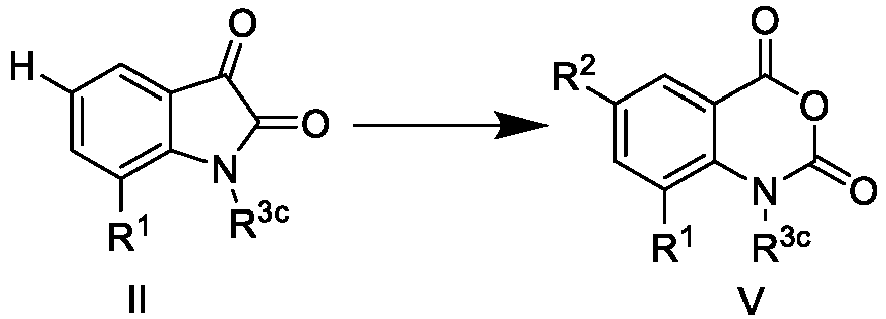 wherein, R1 is CH3, Br or Cl;R2 is F, Cl, Br, or I; andR3c is independently H or C1-C4 alkyl.
 - The process as claimed in claim 8, whereini) the halogenating reagent is HCl, SOCl2, NaOCl and Cl2;ii) using at least one suitable oxidizing reagent selected from the group consisting of hydrogen peroxide, m-chloroperbenzoic acid, periodic acid;iii) using at least one acid selected from the group consisting of formic acid, acetic acid, triflic acid, benzoic acid, m-chlorobenzoic acid, trifluoroacetic acid, para-toluene sulfonic acid, methane sulfonic acid, hydrochloric acid, hydroiodic acid, sulphuric acid, and perchloric acid;iv) at a temperature ranging from 5 °C to 80 °C; andv) using at least one solvent selected from the group consisting of toluene, xylene, t-butyl methyl ether, tetrahydrofuran, 2-methyl tetrahydrofuran, dioxane, monoglyme, diglyme, dichloromethane, chloroform, dichloroethane, N,N-dimethylmethanamide, dimethyl sulfoxide, N-methyl-2-pyrrolidone, and water.
- The process as claimed in claim 8, wherein i) the oxidizing reagent, and ii) the halogenating reagent are added separately in the sequence in portions to iii) a mixture of the dione of Formula II and the solvent, at a temperature ranging from 10 to 50 °C, followed by heating at a temperature ranging from 15- 150 °C.
- A process for preparing a compound of Formula VII,
 R1 is CH3, Br or Cl;R2 is F, Cl, Br, or I;R3a and R3b are independently H, C1-C4 alkyl or C3-C6 cycloalkyl-C1-C4 alkyl;R3c is H or C1-C4 alkyl;said process comprising the steps of:a) obtaining a dione of Formula II by reacting a compound of Formula III, chloral hydrate of Formula IV and hydroxyl amine in the presence of at least one suitable reagent;
 obtaining the dione of Formula II by cyclizing a compound of Formula IIIa in the presence of at least one suitable reagent;
 wherein the compound of Formula IIIa is obtained as an intermediate in the process step of reacting the compound of Formula III, chloral hydrate of Formula IV and hydroxyl amine in the presence of at least one suitable reagent;
 wherein, R1 and R3c are as defined herein before,b) oxidizing and halogenating the dione of Formula II simultaneously into an isatoic anhydride of Formula V using at least one oxidizing reagent and at least one halogenating reagent in the presence of at least one suitable acid;
 c) reacting the compound of Formula V with an amine of Formula VI to obtain a compound of Formula VII in the presence of at least one suitable reagent;
Applications Claiming Priority (2)
| Application Number | Priority Date | Filing Date | Title |
|---|---|---|---|
| IN201911006381 | 2019-02-18 | ||
| PCT/IB2020/051227 WO2020170092A1 (en) | 2019-02-18 | 2020-02-14 | A process for preparing anthranilic diamides and intermediates thereof |
Publications (3)
| Publication Number | Publication Date |
|---|---|
| EP3927701A1 EP3927701A1 (en) | 2021-12-29 |
| EP3927701A4 EP3927701A4 (en) | 2022-11-16 |
| EP3927701B1 true EP3927701B1 (en) | 2024-11-06 |
Family
ID=72144038
Family Applications (1)
| Application Number | Title | Priority Date | Filing Date |
|---|---|---|---|
| EP20758718.9A Active EP3927701B1 (en) | 2019-02-18 | 2020-02-14 | A process for preparing anthranilic diamides and intermediates thereof |
Country Status (11)
| Country | Link |
|---|---|
| US (1) | US12410158B2 (en) |
| EP (1) | EP3927701B1 (en) |
| KR (1) | KR102924197B1 (en) |
| CN (1) | CN113692406B (en) |
| CA (1) | CA3129876A1 (en) |
| FI (1) | FI3927701T3 (en) |
| HU (1) | HUE069962T2 (en) |
| IL (1) | IL285139B2 (en) |
| MX (1) | MX2021009924A (en) |
| PT (1) | PT3927701T (en) |
| WO (1) | WO2020170092A1 (en) |
Families Citing this family (9)
| Publication number | Priority date | Publication date | Assignee | Title |
|---|---|---|---|---|
| WO2022058916A1 (en) * | 2020-09-17 | 2022-03-24 | Pi Industries Limited | A process for the synthesis of anthranilic acid/amide compounds and intermediates thereof |
| AR123593A1 (en) * | 2020-09-26 | 2022-12-21 | Pi Industries Ltd | A PROCESS FOR THE SYNTHESIS OF ANTHRANILIC ACID/AMIDE COMPOUNDS AND INTERMEDIATES THEREOF |
| WO2024105700A1 (en) * | 2022-11-18 | 2024-05-23 | Pi Industries Ltd. | A method for the synthesis of anthranilic amide compounds and intermediates thereof |
| AR132134A1 (en) * | 2023-03-22 | 2025-05-28 | Pi Industries Ltd | A METHOD FOR THE PREPARATION OF ANTHRANILIC DIAMIDES |
| CN116730859B (en) * | 2023-06-01 | 2025-06-13 | 青岛科技大学 | A preparation method of 2-amino-5-chloro-N,3-dimethylbenzamide |
| CN116891419A (en) * | 2023-07-12 | 2023-10-17 | 青岛恒宁生物科技有限公司 | A kind of synthesis method of amino-substituted benzamide compounds |
| WO2025057193A1 (en) * | 2023-09-13 | 2025-03-20 | Pi Industries Ltd. | A method for the synthesis of substituted anthranilic amide compounds, intermediates and salts thereof |
| WO2025134140A1 (en) * | 2023-12-19 | 2025-06-26 | Pi Industries Ltd. | A method for the synthesis of substituted anthranilic amide compounds, intermediates and salts thereof |
| PY24113048A (en) | 2023-12-19 | 2025-10-10 | Pi Industries Ltd | A METHOD FOR THE SYNTHESIS OF SUBSTITUTED ANTHRANILIC AMIDE COMPOUNDS, INTERMEDIATES, AND SALTS THEREOF |
Family Cites Families (22)
| Publication number | Priority date | Publication date | Assignee | Title |
|---|---|---|---|---|
| CZ20013469A3 (en) * | 1999-03-31 | 2002-04-17 | Basf Aktiengesellschaft | Diamides of pyridine-2,3-dicarboxylic acids |
| AR036872A1 (en) | 2001-08-13 | 2004-10-13 | Du Pont | ANTRANILAMIDE COMPOSITE, COMPOSITION THAT INCLUDES IT AND METHOD FOR CONTROLLING AN INVERTEBRATE PEST |
| TWI325302B (en) | 2001-08-13 | 2010-06-01 | Du Pont | Benzoxazinone compounds |
| TWI326283B (en) | 2002-07-31 | 2010-06-21 | Du Pont | Method for preparing fused oxazinones |
| VN23181A1 (en) | 2003-01-28 | 2010-07-26 | Du Pont | Cyano anthranilamide insecticides |
| US7276601B2 (en) | 2003-06-12 | 2007-10-02 | E.I. Du Pont De Nemours And Company | Method and preparing fused oxazinones |
| AU2005212068B2 (en) | 2004-02-18 | 2010-12-02 | Ishihara Sangyo Kaisha, Ltd. | Anthranilamides, process for the production thereof, and pest controllers containing the same |
| TWI363756B (en) * | 2004-12-07 | 2012-05-11 | Du Pont | Method for preparing n-phenylpyrazole-1-carboxamides |
| KR101433395B1 (en) | 2006-07-19 | 2014-08-26 | 이 아이 듀폰 디 네모아 앤드 캄파니 | Preparation of 3-substituted 2-amino-5-halobenzamide |
| TWI395728B (en) | 2006-12-06 | 2013-05-11 | Du Pont | Process for preparing 2-amino-5-cyanobenzoic acid derivatives |
| TWI415827B (en) | 2006-12-21 | 2013-11-21 | Du Pont | Process for preparing 2-amino-5-cyanobenzoic acid derivatives |
| TWI430980B (en) | 2007-06-29 | 2014-03-21 | Du Pont | Process for preparing 2-amino-5-cyanobenzoic acid derivatives |
| KR20100098382A (en) | 2007-11-08 | 2010-09-06 | 이 아이 듀폰 디 네모아 앤드 캄파니 | Process for preparing 2-amino-5-cyanobenzoic acid derivatives |
| TWI432421B (en) | 2007-12-19 | 2014-04-01 | Du Pont | Process for preparing 2-amino-5-cyanobenzoic acid derivatives |
| CN102076635B (en) * | 2008-06-30 | 2013-12-25 | 巴斯夫欧洲公司 | Process for isomerization of semicarbazone compounds |
| KR101687743B1 (en) | 2008-12-18 | 2016-12-19 | 바이엘 인텔렉쳐 프로퍼티 게엠베하 | Tetrazole substituted anthranilic amides as pesticides |
| JP6199739B2 (en) | 2010-06-15 | 2017-09-20 | バイエル・インテレクチュアル・プロパティ・ゲゼルシャフト・ミット・ベシュレンクテル・ハフツングBayer Intellectual Property GmbH | Tetrazole-substituted anthranilamide derivatives and process for producing novel crystalline polymorphs of these derivatives |
| EP2668153B1 (en) | 2011-01-28 | 2015-03-04 | E.I. Du Pont De Nemours And Company | Method for preparing 2-aminobenzamide derivatives |
| CA2830134C (en) * | 2011-04-01 | 2018-03-06 | Lonza Ltd | Preparation of 3,5-dioxo hexanoate ester in two steps |
| MX349771B (en) | 2011-08-26 | 2017-08-10 | Bayer Ip Gmbh | Method for producing tetrazole-substituted anthranilic acid diamide derivatives by reacting benzoxazinones with amines. |
| MX382355B (en) * | 2015-04-10 | 2025-03-13 | Araxes Pharma Llc | SUBSTITUTED QUINAZOLINE COMPOUNDS AND METHODS OF USING SAME. |
| AU2017258665A1 (en) * | 2016-04-29 | 2018-10-11 | Syngenta Participations Ag | Process for the preparation of herbicidal compounds |
-
2020
- 2020-02-14 HU HUE20758718A patent/HUE069962T2/en unknown
- 2020-02-14 CN CN202080015121.7A patent/CN113692406B/en active Active
- 2020-02-14 EP EP20758718.9A patent/EP3927701B1/en active Active
- 2020-02-14 US US17/310,673 patent/US12410158B2/en active Active
- 2020-02-14 KR KR1020217028430A patent/KR102924197B1/en active Active
- 2020-02-14 FI FIEP20758718.9T patent/FI3927701T3/en active
- 2020-02-14 CA CA3129876A patent/CA3129876A1/en active Pending
- 2020-02-14 PT PT207587189T patent/PT3927701T/en unknown
- 2020-02-14 IL IL285139A patent/IL285139B2/en unknown
- 2020-02-14 WO PCT/IB2020/051227 patent/WO2020170092A1/en not_active Ceased
- 2020-02-14 MX MX2021009924A patent/MX2021009924A/en unknown
Also Published As
| Publication number | Publication date |
|---|---|
| WO2020170092A1 (en) | 2020-08-27 |
| US20220144814A1 (en) | 2022-05-12 |
| HUE069962T2 (en) | 2025-04-28 |
| IL285139B2 (en) | 2025-06-01 |
| BR112021016353A2 (en) | 2021-10-19 |
| US12410158B2 (en) | 2025-09-09 |
| WO2020170092A9 (en) | 2021-11-25 |
| PT3927701T (en) | 2025-02-03 |
| EP3927701A4 (en) | 2022-11-16 |
| EP3927701A1 (en) | 2021-12-29 |
| KR102924197B1 (en) | 2026-02-05 |
| IL285139B1 (en) | 2025-02-01 |
| FI3927701T3 (en) | 2025-03-27 |
| CA3129876A1 (en) | 2020-08-27 |
| KR20210130164A (en) | 2021-10-29 |
| CN113692406B (en) | 2024-07-23 |
| CN113692406A (en) | 2021-11-23 |
| IL285139A (en) | 2021-09-30 |
| MX2021009924A (en) | 2021-09-14 |
Similar Documents
| Publication | Publication Date | Title |
|---|---|---|
| US12410158B2 (en) | Process for preparing anthranilic diamides and intermediates thereof | |
| EP3797099B1 (en) | Method for preparing substituted heterocyclic compounds | |
| HU204753B (en) | Process for producing acylated cyclic diketone derivatives | |
| IL301294A (en) | Process for the synthesis of anthranilic acid / amide compounds and their intermediates | |
| US6815563B2 (en) | Method for producing bicyclic 1,3-diketones | |
| US11180441B2 (en) | Method for preparing substituted 4-aminoindane derivatives | |
| US20250368602A1 (en) | Process for preparing cyano substituted anthranilic diamides and intermediates thereof | |
| BR112021016353B1 (en) | PROCESS FOR PREPARING ANTHRANILIC DIAMIDES AND INTERMEDIATES THEREOF | |
| EP2125830A1 (en) | New process for preparing 3-methyl-4-phenylisoxazoloý3,4-d¨pyridazin-7(6h)-one | |
| WO2024105700A1 (en) | A method for the synthesis of anthranilic amide compounds and intermediates thereof | |
| US10604495B2 (en) | Process for preparing substituted phenylisoxazoline derivatives | |
| WO2025134140A1 (en) | A method for the synthesis of substituted anthranilic amide compounds, intermediates and salts thereof | |
| TW202525771A (en) | A method for the synthesis of substituted anthranilic amide compounds, intermediates and salts thereof | |
| IL123990A (en) | Process for the preparation of 3-bromoanisole from nitrobenzene | |
| WO2026098417A1 (en) | Preparation method for uracil-containing iminoaryl compound | |
| EP1789383A1 (en) | Chiral 3-halophthalic acid derivatives | |
| CN101208292A (en) | Process for the preparation of amines from hydroxamic acids | |
| US20040171864A1 (en) | Fluorinated aromatics | |
| TW201920106A (en) | Process for the preparation of 1-[6-halogeno-3-pyridyl]ketones | |
| JPWO1998046561A1 (en) | Benzene derivatives, benzofuran derivatives and methods for producing them | |
| JPH06279363A (en) | Production of aliphatic beta-keto ester |
Legal Events
| Date | Code | Title | Description |
|---|---|---|---|
| STAA | Information on the status of an ep patent application or granted ep patent |
Free format text: STATUS: THE INTERNATIONAL PUBLICATION HAS BEEN MADE |
|
| PUAI | Public reference made under article 153(3) epc to a published international application that has entered the european phase |
Free format text: ORIGINAL CODE: 0009012 |
|
| STAA | Information on the status of an ep patent application or granted ep patent |
Free format text: STATUS: REQUEST FOR EXAMINATION WAS MADE |
|
| 17P | Request for examination filed |
Effective date: 20210909 |
|
| AK | Designated contracting states |
Kind code of ref document: A1 Designated state(s): AL AT BE BG CH CY CZ DE DK EE ES FI FR GB GR HR HU IE IS IT LI LT LU LV MC MK MT NL NO PL PT RO RS SE SI SK SM TR |
|
| DAV | Request for validation of the european patent (deleted) | ||
| DAX | Request for extension of the european patent (deleted) | ||
| A4 | Supplementary search report drawn up and despatched |
Effective date: 20221013 |
|
| RIC1 | Information provided on ipc code assigned before grant |
Ipc: C07D 405/12 20060101AFI20221007BHEP |
|
| P01 | Opt-out of the competence of the unified patent court (upc) registered |
Effective date: 20230613 |
|
| STAA | Information on the status of an ep patent application or granted ep patent |
Free format text: STATUS: EXAMINATION IS IN PROGRESS |
|
| 17Q | First examination report despatched |
Effective date: 20231016 |
|
| REG | Reference to a national code |
Ref country code: DE Ref legal event code: R079 Free format text: PREVIOUS MAIN CLASS: C07D0405120000 Ipc: C07D0231220000 Ref country code: DE Ref legal event code: R079 Ref document number: 602020040867 Country of ref document: DE Free format text: PREVIOUS MAIN CLASS: C07D0405120000 Ipc: C07D0231220000 |
|
| GRAP | Despatch of communication of intention to grant a patent |
Free format text: ORIGINAL CODE: EPIDOSNIGR1 |
|
| STAA | Information on the status of an ep patent application or granted ep patent |
Free format text: STATUS: GRANT OF PATENT IS INTENDED |
|
| RIC1 | Information provided on ipc code assigned before grant |
Ipc: C07D 401/04 20060101ALI20240618BHEP Ipc: C07D 231/22 20060101AFI20240618BHEP |
|
| INTG | Intention to grant announced |
Effective date: 20240710 |
|
| GRAS | Grant fee paid |
Free format text: ORIGINAL CODE: EPIDOSNIGR3 |
|
| GRAA | (expected) grant |
Free format text: ORIGINAL CODE: 0009210 |
|
| STAA | Information on the status of an ep patent application or granted ep patent |
Free format text: STATUS: THE PATENT HAS BEEN GRANTED |
|
| AK | Designated contracting states |
Kind code of ref document: B1 Designated state(s): AL AT BE BG CH CY CZ DE DK EE ES FI FR GB GR HR HU IE IS IT LI LT LU LV MC MK MT NL NO PL PT RO RS SE SI SK SM TR |
|
| REG | Reference to a national code |
Ref country code: GB Ref legal event code: FG4D |
|
| REG | Reference to a national code |
Ref country code: CH Ref legal event code: EP |
|
| REG | Reference to a national code |
Ref country code: DE Ref legal event code: R096 Ref document number: 602020040867 Country of ref document: DE |
|
| REG | Reference to a national code |
Ref country code: IE Ref legal event code: FG4D |
|
| REG | Reference to a national code |
Ref country code: PT Ref legal event code: SC4A Ref document number: 3927701 Country of ref document: PT Date of ref document: 20250203 Kind code of ref document: T Free format text: AVAILABILITY OF NATIONAL TRANSLATION Effective date: 20250124 |
|
| REG | Reference to a national code |
Ref country code: NL Ref legal event code: FP |
|
| REG | Reference to a national code |
Ref country code: LT Ref legal event code: MG9D |
|
| REG | Reference to a national code |
Ref country code: FI Ref legal event code: FGE |
|
| PG25 | Lapsed in a contracting state [announced via postgrant information from national office to epo] |
Ref country code: HR Free format text: LAPSE BECAUSE OF FAILURE TO SUBMIT A TRANSLATION OF THE DESCRIPTION OR TO PAY THE FEE WITHIN THE PRESCRIBED TIME-LIMIT Effective date: 20241106 Ref country code: IS Free format text: LAPSE BECAUSE OF FAILURE TO SUBMIT A TRANSLATION OF THE DESCRIPTION OR TO PAY THE FEE WITHIN THE PRESCRIBED TIME-LIMIT Effective date: 20250306 |
|
| REG | Reference to a national code |
Ref country code: AT Ref legal event code: MK05 Ref document number: 1739250 Country of ref document: AT Kind code of ref document: T Effective date: 20241106 |
|
| PG25 | Lapsed in a contracting state [announced via postgrant information from national office to epo] |
Ref country code: BG Free format text: LAPSE BECAUSE OF FAILURE TO SUBMIT A TRANSLATION OF THE DESCRIPTION OR TO PAY THE FEE WITHIN THE PRESCRIBED TIME-LIMIT Effective date: 20241106 |
|
| PG25 | Lapsed in a contracting state [announced via postgrant information from national office to epo] |
Ref country code: ES Free format text: LAPSE BECAUSE OF FAILURE TO SUBMIT A TRANSLATION OF THE DESCRIPTION OR TO PAY THE FEE WITHIN THE PRESCRIBED TIME-LIMIT Effective date: 20241106 |
|
| PG25 | Lapsed in a contracting state [announced via postgrant information from national office to epo] |
Ref country code: NO Free format text: LAPSE BECAUSE OF FAILURE TO SUBMIT A TRANSLATION OF THE DESCRIPTION OR TO PAY THE FEE WITHIN THE PRESCRIBED TIME-LIMIT Effective date: 20250206 |
|
| PG25 | Lapsed in a contracting state [announced via postgrant information from national office to epo] |
Ref country code: LV Free format text: LAPSE BECAUSE OF FAILURE TO SUBMIT A TRANSLATION OF THE DESCRIPTION OR TO PAY THE FEE WITHIN THE PRESCRIBED TIME-LIMIT Effective date: 20241106 Ref country code: GR Free format text: LAPSE BECAUSE OF FAILURE TO SUBMIT A TRANSLATION OF THE DESCRIPTION OR TO PAY THE FEE WITHIN THE PRESCRIBED TIME-LIMIT Effective date: 20250207 Ref country code: AT Free format text: LAPSE BECAUSE OF FAILURE TO SUBMIT A TRANSLATION OF THE DESCRIPTION OR TO PAY THE FEE WITHIN THE PRESCRIBED TIME-LIMIT Effective date: 20241106 |
|
| PG25 | Lapsed in a contracting state [announced via postgrant information from national office to epo] |
Ref country code: PL Free format text: LAPSE BECAUSE OF FAILURE TO SUBMIT A TRANSLATION OF THE DESCRIPTION OR TO PAY THE FEE WITHIN THE PRESCRIBED TIME-LIMIT Effective date: 20241106 |
|
| REG | Reference to a national code |
Ref country code: HU Ref legal event code: AG4A Ref document number: E069962 Country of ref document: HU |
|
| PG25 | Lapsed in a contracting state [announced via postgrant information from national office to epo] |
Ref country code: RS Free format text: LAPSE BECAUSE OF FAILURE TO SUBMIT A TRANSLATION OF THE DESCRIPTION OR TO PAY THE FEE WITHIN THE PRESCRIBED TIME-LIMIT Effective date: 20250206 |
|
| PG25 | Lapsed in a contracting state [announced via postgrant information from national office to epo] |
Ref country code: SM Free format text: LAPSE BECAUSE OF FAILURE TO SUBMIT A TRANSLATION OF THE DESCRIPTION OR TO PAY THE FEE WITHIN THE PRESCRIBED TIME-LIMIT Effective date: 20241106 |
|
| PG25 | Lapsed in a contracting state [announced via postgrant information from national office to epo] |
Ref country code: DK Free format text: LAPSE BECAUSE OF FAILURE TO SUBMIT A TRANSLATION OF THE DESCRIPTION OR TO PAY THE FEE WITHIN THE PRESCRIBED TIME-LIMIT Effective date: 20241106 |
|
| PG25 | Lapsed in a contracting state [announced via postgrant information from national office to epo] |
Ref country code: EE Free format text: LAPSE BECAUSE OF FAILURE TO SUBMIT A TRANSLATION OF THE DESCRIPTION OR TO PAY THE FEE WITHIN THE PRESCRIBED TIME-LIMIT Effective date: 20241106 |
|
| PG25 | Lapsed in a contracting state [announced via postgrant information from national office to epo] |
Ref country code: RO Free format text: LAPSE BECAUSE OF FAILURE TO SUBMIT A TRANSLATION OF THE DESCRIPTION OR TO PAY THE FEE WITHIN THE PRESCRIBED TIME-LIMIT Effective date: 20241106 |
|
| PG25 | Lapsed in a contracting state [announced via postgrant information from national office to epo] |
Ref country code: SK Free format text: LAPSE BECAUSE OF FAILURE TO SUBMIT A TRANSLATION OF THE DESCRIPTION OR TO PAY THE FEE WITHIN THE PRESCRIBED TIME-LIMIT Effective date: 20241106 |
|
| PG25 | Lapsed in a contracting state [announced via postgrant information from national office to epo] |
Ref country code: CZ Free format text: LAPSE BECAUSE OF FAILURE TO SUBMIT A TRANSLATION OF THE DESCRIPTION OR TO PAY THE FEE WITHIN THE PRESCRIBED TIME-LIMIT Effective date: 20241106 |
|
| REG | Reference to a national code |
Ref country code: DE Ref legal event code: R097 Ref document number: 602020040867 Country of ref document: DE |
|
| PG25 | Lapsed in a contracting state [announced via postgrant information from national office to epo] |
Ref country code: SE Free format text: LAPSE BECAUSE OF FAILURE TO SUBMIT A TRANSLATION OF THE DESCRIPTION OR TO PAY THE FEE WITHIN THE PRESCRIBED TIME-LIMIT Effective date: 20241106 |
|
| PLBE | No opposition filed within time limit |
Free format text: ORIGINAL CODE: 0009261 |
|
| STAA | Information on the status of an ep patent application or granted ep patent |
Free format text: STATUS: NO OPPOSITION FILED WITHIN TIME LIMIT |
|
| PG25 | Lapsed in a contracting state [announced via postgrant information from national office to epo] |
Ref country code: MC Free format text: LAPSE BECAUSE OF FAILURE TO SUBMIT A TRANSLATION OF THE DESCRIPTION OR TO PAY THE FEE WITHIN THE PRESCRIBED TIME-LIMIT Effective date: 20241106 |
|
| REG | Reference to a national code |
Ref country code: CH Ref legal event code: PL |
|
| 26N | No opposition filed |
Effective date: 20250807 |
|
| PG25 | Lapsed in a contracting state [announced via postgrant information from national office to epo] |
Ref country code: LU Free format text: LAPSE BECAUSE OF NON-PAYMENT OF DUE FEES Effective date: 20250214 |
|
| PG25 | Lapsed in a contracting state [announced via postgrant information from national office to epo] |
Ref country code: CH Free format text: LAPSE BECAUSE OF NON-PAYMENT OF DUE FEES Effective date: 20250228 |
|
| REG | Reference to a national code |
Ref country code: BE Ref legal event code: MM Effective date: 20250228 |
|
| PG25 | Lapsed in a contracting state [announced via postgrant information from national office to epo] |
Ref country code: BE Free format text: LAPSE BECAUSE OF NON-PAYMENT OF DUE FEES Effective date: 20250228 |
|
| PGFP | Annual fee paid to national office [announced via postgrant information from national office to epo] |
Ref country code: NL Payment date: 20260219 Year of fee payment: 7 |
|
| PGFP | Annual fee paid to national office [announced via postgrant information from national office to epo] |
Ref country code: HU Payment date: 20260227 Year of fee payment: 7 |
|
| PGFP | Annual fee paid to national office [announced via postgrant information from national office to epo] |
Ref country code: GB Payment date: 20260212 Year of fee payment: 7 |
|
| PGFP | Annual fee paid to national office [announced via postgrant information from national office to epo] |
Ref country code: DE Payment date: 20260219 Year of fee payment: 7 Ref country code: IE Payment date: 20260209 Year of fee payment: 7 |
|
| PGFP | Annual fee paid to national office [announced via postgrant information from national office to epo] |
Ref country code: FI Payment date: 20260222 Year of fee payment: 7 Ref country code: IT Payment date: 20260219 Year of fee payment: 7 |
|
| PGFP | Annual fee paid to national office [announced via postgrant information from national office to epo] |
Ref country code: FR Payment date: 20260214 Year of fee payment: 7 |
|
| PGFP | Annual fee paid to national office [announced via postgrant information from national office to epo] |
Ref country code: PT Payment date: 20260204 Year of fee payment: 7 |