EP3927150B1 - Pet feeding device and method for supplying and opening capsules - Google Patents
Pet feeding device and method for supplying and opening capsules Download PDFInfo
- Publication number
- EP3927150B1 EP3927150B1 EP20706473.4A EP20706473A EP3927150B1 EP 3927150 B1 EP3927150 B1 EP 3927150B1 EP 20706473 A EP20706473 A EP 20706473A EP 3927150 B1 EP3927150 B1 EP 3927150B1
- Authority
- EP
- European Patent Office
- Prior art keywords
- container
- containers
- opening
- bag
- feeding device
- Prior art date
- Legal status (The legal status is an assumption and is not a legal conclusion. Google has not performed a legal analysis and makes no representation as to the accuracy of the status listed.)
- Active
Links
Images



Classifications
-
- A—HUMAN NECESSITIES
- A01—AGRICULTURE; FORESTRY; ANIMAL HUSBANDRY; HUNTING; TRAPPING; FISHING
- A01K—ANIMAL HUSBANDRY; AVICULTURE; APICULTURE; PISCICULTURE; FISHING; REARING OR BREEDING ANIMALS, NOT OTHERWISE PROVIDED FOR; NEW BREEDS OF ANIMALS
- A01K5/00—Feeding devices for stock or game ; Feeding wagons; Feeding stacks
- A01K5/01—Feed troughs; Feed pails
- A01K5/0114—Pet food dispensers; Pet food trays
- A01K5/0121—Disposable pet feeders
-
- A—HUMAN NECESSITIES
- A01—AGRICULTURE; FORESTRY; ANIMAL HUSBANDRY; HUNTING; TRAPPING; FISHING
- A01K—ANIMAL HUSBANDRY; AVICULTURE; APICULTURE; PISCICULTURE; FISHING; REARING OR BREEDING ANIMALS, NOT OTHERWISE PROVIDED FOR; NEW BREEDS OF ANIMALS
- A01K5/00—Feeding devices for stock or game ; Feeding wagons; Feeding stacks
- A01K5/02—Automatic devices
- A01K5/0291—Automatic devices with timing mechanisms, e.g. pet feeders
-
- A—HUMAN NECESSITIES
- A01—AGRICULTURE; FORESTRY; ANIMAL HUSBANDRY; HUNTING; TRAPPING; FISHING
- A01K—ANIMAL HUSBANDRY; AVICULTURE; APICULTURE; PISCICULTURE; FISHING; REARING OR BREEDING ANIMALS, NOT OTHERWISE PROVIDED FOR; NEW BREEDS OF ANIMALS
- A01K5/00—Feeding devices for stock or game ; Feeding wagons; Feeding stacks
- A01K5/02—Automatic devices
- A01K5/0275—Automatic devices with mechanisms for delivery of measured doses
-
- A—HUMAN NECESSITIES
- A01—AGRICULTURE; FORESTRY; ANIMAL HUSBANDRY; HUNTING; TRAPPING; FISHING
- A01K—ANIMAL HUSBANDRY; AVICULTURE; APICULTURE; PISCICULTURE; FISHING; REARING OR BREEDING ANIMALS, NOT OTHERWISE PROVIDED FOR; NEW BREEDS OF ANIMALS
- A01K5/00—Feeding devices for stock or game ; Feeding wagons; Feeding stacks
- A01K5/01—Feed troughs; Feed pails
- A01K5/0114—Pet food dispensers; Pet food trays
-
- A—HUMAN NECESSITIES
- A01—AGRICULTURE; FORESTRY; ANIMAL HUSBANDRY; HUNTING; TRAPPING; FISHING
- A01K—ANIMAL HUSBANDRY; AVICULTURE; APICULTURE; PISCICULTURE; FISHING; REARING OR BREEDING ANIMALS, NOT OTHERWISE PROVIDED FOR; NEW BREEDS OF ANIMALS
- A01K5/00—Feeding devices for stock or game ; Feeding wagons; Feeding stacks
- A01K5/01—Feed troughs; Feed pails
- A01K5/0114—Pet food dispensers; Pet food trays
- A01K5/0128—Pet feeders including liners; liners therefor; Means for holding liners to pet feeders
-
- A—HUMAN NECESSITIES
- A01—AGRICULTURE; FORESTRY; ANIMAL HUSBANDRY; HUNTING; TRAPPING; FISHING
- A01K—ANIMAL HUSBANDRY; AVICULTURE; APICULTURE; PISCICULTURE; FISHING; REARING OR BREEDING ANIMALS, NOT OTHERWISE PROVIDED FOR; NEW BREEDS OF ANIMALS
- A01K5/00—Feeding devices for stock or game ; Feeding wagons; Feeding stacks
- A01K5/02—Automatic devices
- A01K5/0225—Gravity replenishment from a reserve, e.g. a hopper
-
- A—HUMAN NECESSITIES
- A01—AGRICULTURE; FORESTRY; ANIMAL HUSBANDRY; HUNTING; TRAPPING; FISHING
- A01K—ANIMAL HUSBANDRY; AVICULTURE; APICULTURE; PISCICULTURE; FISHING; REARING OR BREEDING ANIMALS, NOT OTHERWISE PROVIDED FOR; NEW BREEDS OF ANIMALS
- A01K5/00—Feeding devices for stock or game ; Feeding wagons; Feeding stacks
- A01K5/02—Automatic devices
- A01K5/0225—Gravity replenishment from a reserve, e.g. a hopper
- A01K5/0233—Gravity replenishment from a reserve, e.g. a hopper dispensing by dosing means actively operated by the animal
-
- A—HUMAN NECESSITIES
- A01—AGRICULTURE; FORESTRY; ANIMAL HUSBANDRY; HUNTING; TRAPPING; FISHING
- A01K—ANIMAL HUSBANDRY; AVICULTURE; APICULTURE; PISCICULTURE; FISHING; REARING OR BREEDING ANIMALS, NOT OTHERWISE PROVIDED FOR; NEW BREEDS OF ANIMALS
- A01K5/00—Feeding devices for stock or game ; Feeding wagons; Feeding stacks
- A01K5/02—Automatic devices
- A01K5/0287—Automatic devices for opening food cartridges
-
- B—PERFORMING OPERATIONS; TRANSPORTING
- B65—CONVEYING; PACKING; STORING; HANDLING THIN OR FILAMENTARY MATERIAL
- B65F—GATHERING OR REMOVAL OF DOMESTIC OR LIKE REFUSE
- B65F1/00—Refuse receptacles; Accessories therefor
- B65F1/14—Other constructional features; Accessories
- B65F1/1405—Compressing means incorporated in, or specially adapted for, refuse receptacles
Definitions
- the invention relates to a pet feeding device and a method for supplying, opening and disposing filled containers.
- a pet feeding device which is fairly automated and, for example, is able to open capsules containing pet food and presenting the opened capsule to the pet.
- Such a device is described in WO 2015/198222 A2 , but for example suffers from the problem that cleanliness in the surroundings of empty capsules, which generally remain in the device, cannot always be ensured, until the empty capsules are disposed of.
- WO 2018/019782 A1 is related to an opening assembly for containers having a bar arranged across a container to be opened so as to prevent the container from raising.
- a similar arrangement can be taken from US 2008/017311 A1 with regard to an apparatus for peeling a sheet from a wafer.
- the pet feeding device or pet feeder comprises a lever for biasing a lid of a container being opened against the opening direction.
- the lid is biased against the opening direction, when the lid is folded back on the container after the container has been at least partly emptied.
- This will provide for reliable opening and folding back of the lid of the container which can also be called capsule. Consequently, the lid is kept tensioned during the opening and back-folding movement, so that the formation of wrinkles or similar deformations can be minimized. This also minimizes the risk of food sticking to the lid spoiling the surroundings, and in particular any surrounding components of the pet feeder, such as the pusher or parts thereof described in more detail below.
- the pet feeding device or pet feeder comprises at least one pusher for flattening and/or compressing and/or stacking in each other, i.e. nesting empty containers such as capsules.
- the empty containers are deformed and/or compressed and/or nested in order to reduce their dimension in a height direction which is typically perpendicular to the bottom and lid of the container, which is typically flat. This not only reduces the volume of waste but also allows to reduce the height of the device as a whole which makes it more convenient for the pets.
- tests have shown, that containers having an original height of 14 mm can be compressed to a height of about 3 mm.
- the space saving effect multiplies. In view of this effect achieved, whenever "flattening" is mentioned above or in the following, compressing, stacking in each other and nesting are equally meant.
- the pusher contacting the empty containers can be removable, in order to allow convenient cleaning thereof.
- this part can essentially have the shape of a disc with a footprint substantially corresponding to that of the empty containers to be flattened and/or a compartment, in which these are accommodated.
- the disc-shaped part can be attached to a rod pushing the disc, and the disc-shaped part can be removable from the rod in order to allow cleaning thereof.
- the pusher is preferably accommodated in a compartment adapted to accommodate empty containers.
- a bag can be provided in the compartment in order to receive the empty containers and prevent any leftovers or similar waste from spoiling the device.
- the device preferably comprises a bag for accommodating used containers.
- this bag can be regularly disposed it facilitates an easy cleaning of the spillage prone areas in the compartment storing any used capsules.
- Used capsules will in the following also be called empty capsules, although they may still contain food or food leftovers being prone to contaminate the device as these are usually unclosed.
- any type of container for accommodating empty capsules can be provided, but a significantly less stiff and easily deformable bag has the advantage of adapting to the enclosing compartment or being able to accommodate more and more empty capsules as they are being used consecutively.
- means are provided for closing the bag before or during removal.
- a mechanism can be provided which closes the bag automatically. Alternatively, this may be done manually by the user. Any principle like the following, but not limited to it, may be used: Twisting, gluing, thermal bonding, welding, pulling oppositely integrated strings, wrapping adhesive labels, a zip-lock, which can particularly be closed by pressure, etc. as regards the latter option, it should be mentioned that this corresponds to a zip-lock typically provided in bags for refrigerating or freezing foodstuff.
- the bag itself will typically have the means for closing the bag.
- the invention generally refers to containers, reference will be made to capsules in the following.
- the invention enables a both space saving and clean solution with regard to the collection and disposal of empty capsules.
- any food or other liquids remaining in the capsule will be subject to the force of gravity, appropriate measures can be taken below the position, where the capsule is presented to the pet, to collect any such substances. This significantly enhances cleanliness of a pet feeder and convenience for the pet owner.
- the device comprises means for conveying the container from one to another location within the device.
- certain actions such as opening the container, presenting the opened container to the pet, disposing of the container and reloading one or more containers can be performed.
- the conveying can initiate further mechanisms and/or steps, such as opening the container, as described in more detail below.
- the conveying mechanism may consist of pivoting means for pivoting a container to be supplied about at least one substantially horizontal or vertical axis.
- this axis is preferably outside the container to be pivoted.
- the pivoting means are preferably adapted to pivot a single container.
- the device is adapted to both supply and open filled containers, such as capsules or cans, and the containers are pivoted about at least one substantially horizontal axis when being supplied to a position, where the open container is presented to the pet.
- the pivoting means can have the shape of a part of a ball, globe or cylinder, with a globe being preferred for providing a particularly tight sealing with a compartment for accommodating empty capsules as described below.
- further components of the device such as at least part of the casing of the device as a whole, a slideable cover of the feeding position, a gripper for gripping the lid and the lever for biasing the lid against the opening direction can have shapes which correspond to a portion of a globe, cylinder but also a flat surface.
- pivoting means around two pivoting axes can be implemented by mounting two guide rods in parallel on these two axes and connect their loose ends by a bridge being parallel to the connection of the axes.
- plural containers can be pivoted or rotated about a typically vertical axis in the manner similar to a revolver.
- plural containers can be conveyed linearly in order to sequentially be located at appropriate stations, where the above-described steps are respectively taken.
- this cover or cover portion can be integrated with or even integral with, i.e. constituting a portion of the pivoting means or the capsule opening means.
- the compartment can be actuated and shifted allowing the pivoting means to pass during actuation.
- This shifting or displacement can, for example, be effected in a vertical direction.
- shifting in a horizontal direction or combinations of both vertical and horizontal directions are also possible.
- both full and empty capsules are storable in one and the same compartment of the device.
- filled capsules are consecutively removed and supplied to the feeding position, and for example at the other end of the compartment, the empty capsules are consecutively accommodated in the compartment.
- the above described compartment can be a secondary package of the capsules, and the above described bag can be integrated with the mentioned compartment and/or secondary package.
- accommodating filled and empty capsules in one and the same compartment will particularly be enabled by pivoting the capsule to be supplied about approximately 180 degrees and about at least one substantially horizontal axis, which are distant from the feeding position.
- Reliable and efficient operation can be achieved, when the containers are, one by one, releasable from a compartment and/or allowed to enter a compartment by the force of gravity and a blocking element that can be moved or opened.
- a blocking element that can be moved or opened.
- this can be at least one blocking element that releases the capsules when they are moved out of the releasing path and otherwise holding the capsules back when being moved into the releasing path.
- it can be realized by at least one blocking element, which blocks the opening in a radially inner position and opens or widens the opening when moved to a radially outer position.
- the radially movable element can, for example, be constituted by a latch.
- a mechanism having plural radially movable elements can be called an iris mechanism.
- the opening in the outer radial part of the conveying means may thus serve as a holding and releasing mechanism for the capsule during reloading, actuation, opening, feeding and disposal.
- the pet feeding device preferably further comprises a stamp for indenting and/or bending an edge, in particular a radial edge of the capsule.
- a stamp for indenting and/or bending an edge in particular a radial edge of the capsule.
- This will typically deform the capsule as such, which is typically made from a material having a high metal content, so that it will be plastically deformed, whereas the lid will preferably be radially shorter than the edge, so that it will remain in its initial orientation.
- it can have a significantly higher plastic content and will be elastically deformed, i.e. it will substantially return to its original shape.
- the capsule body i.e.
- a separate lid can have a surrounding flange, which can for example be a few millimeters wide.
- the lid will preferably be radially shorter than the edge and can alternatively have essentially the same dimension as the outer head of the flange, but is advantageously not sealed to the flange at least in the outermost few millimeters. If a force is now applied onto the lid in the area of the flange, the flange will deform, in particular, it will be angled away from the lid, in other words, in a usual orientation of the container, downwards, but the lid will not be deformed or essentially keep its shape, so that the resulting gap between the lid and the flange can be used for gripping the lid.
- the pet feeding device preferably comprises a step or platform which allows the pet to get close enough, in a vertical direction, to the feeding position.
- the pet feeder described herein can also have a camera and/or RFID reader in order to identify a pet approaching the device and in order to initiate supplying and opening a filled capsule at the appropriate time.
- the device can finally comprise a heater.
- the lid is preferably brought back onto or into the empty capsule before disposing the capsule into the compartment.
- empty containers are flattened, after the lid has been folded back.
- they can preferably be accommodated in a bag, the bag having means for closing the bag before or during removal.
- the capsule can be pivoted about at least one substantially horizontal axis. This method can be used for actuation of any type of containers also outside the field of pet feeding. An example may be the handling of capsules filled with food or granulates to be presented singularly.
- the pet feeding device 10 has, in the embodiment shown, a main part 28 having the general appearance of a part of a globe, and a platform 26. Since the containers containing pet food are presented essentially at the top of the main part 28, as will be detailed below, the platform 26 serves to allow the pet to reach this top area.
- a pivoting means 14 is provided for pivoting about an essentially horizontal axis A and for delivering a single container from essentially the bottom of the device to the top.
- the pivoting means 14 is shown in an intermediate state. Moreover, it can be seen that it essentially comprises two arms 30, 32 and a bottom 34 for transporting a container 12.
- the containers 12 are essentially provided in an "upside down" state, and means are provided, as detailed below, for allowing a single container 12 to be engaged or gripped by the pivoting means.
- the pivoting means 14 brings the container 12 to the top of the device, which is shown in Fig. 4 .
- the container is opened at this position so that the content of the container is accessible for the pet.
- the container is allowed to enter the compartment 20 so that, due to the consecutive use of the filled containers, the compartment 20 is consecutively filled with empty containers, from the top thereof.
- Fig. 6 indicates that the compartment 20 can be formed by a secondary package shown as a rectangular box in Fig. 6 .
- the containers are stacked with a bag 16, which later serves as a waste bag, typically wrapped around the top or the sides of the secondary package.
- the bag 16 is, together with the empty container 12, now being the uppermost, allowed to enter the secondary package.
- the complete number of empty containers is in the bag, the bag being accommodated in the secondary package, and the bag can then be removed.
- Fig. 7a shows the closing of the bag 16, filled with empty containers, before or during removal.
- reference numeral 19 indicates a zipper or bonding area which can be provided in a top part of the bag 16, in order to close the bag before or during removal thereof. Consequently, any remaining pet food and/or odors can advantageously be kept in the bag.
- Fig. 7b shows mechanisms to close the bag before or during removal, with two embedded, opposite strings.
- Fig. 7c shows an alternative for closing the bag before or during removal in the form of a cover 18.
- this measure can also be applied during use of the device as alternative to the cover 31 in Fig °7 in order, for example, to keep odors inside during use of the device.
- Fig. 8 shows a first alternative of a mechanism to allow a single container 12 to be released from a compartment (from the bottom according to Fig. 6 ) or to be allowed to enter the compartment (from the top of Fig. 7 ).
- the mechanism essentially has a plate 36 with a hole 38 wide enough to allow the container 12 to pass therethrough. Adjacent the hole 38, there is a recess 40 or a smaller hole 40 holding the container 12. Consequently, when the plate 36 and the container 12 are moved relative to each other in accordance with arrow B, the container can be allowed to be released from the compartment while the remaining stack of containers stays in the compartment.
- Fig. 9 and 10 show an alternative mechanism for removing a single container from the compartment.
- a so-called iris mechanism is provided having several, in the embodiment shown six radially movable members 42, which are displaced radially in order to provide a wide opening 38 as shown in Fig. 10 , whereas the opening is a smaller opening 40 in the state of Fig. 9 .
- Fig. 11 shows a stamp 44 for indenting an edge 46 of a container 12.
- both the lid 22 and the edge 46 are in an essentially horizontal state, which is shown for the lid 22 in Fig. 12 .
- the lid 22 is radially shorter, so that the stamp only acts on the edge 46 of the container 12.
- the edge 46 of the container is plastically deformed and stays in the inclined state shown in Fig. 12 .
- a gap 48 is thus formed between the lid 22 and the edge 46 of the container 12, which can be used to reliably grip and open the lid as shown in Fig. 13 and 14 .
- the lid 22 could be provided radially wider, so that the stamp 44 acts both on the lid 22 and the edge 46, which are, in an initial state, essentially horizontal. Since the lid 22 is made of an elastic material, it returns to its initial orientation even after the stamp 44 is removed, similarly as shown in Fig. 12 .
- a protrusion 50 enters the gap 48, when the lid is to be opened, and removes the lid from the container, as can be seen in Fig. 14 .
- This figure also shows a lever 24 for biasing the lid 22 in a direction (to the left in Fig. 13 and 14 ) opposite to an opening direction (to the right in Fig. 13 and 14 ), in order to minimize formation of wrinkles or similar deformations.
- Fig. 15 additionally shows the lever 24 being biased in the described direction by means of a spring 52.
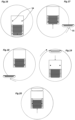
- Fig. 16 shows the actuation principle releasing a container, similar as Fig 2 , but now with two pivoting axes 54 and a shiftable compartment.
- the containers are supplied in a position with the lid facing upwards.
- Fig. 17 and ° 18 show the actuation principle moving the container 55 anti-clockwise and clockwise upwards, similar as Fig 3 , but now with two pivoting axes and a shiftable compartment.
- the actuated container stays in a position with the lid facing upwards.
- Fig. 19 shows the actuation principle with the pivoting means and the container in the top position, similar as Fig 4 , but now with two axes and a shiftable compartment.
- Fig. 20 shows the actuation principle after the container has been disposed to the compartment similar as Fig 5 but now with two pivoting axes and a shiftable compartment. Full and empty containers are facing the same direction.
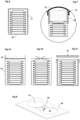
- Fig. 21 schematically shows a compartment 20, in which, in the situation shown, a single empty container 12 is accommodated.
- a pusher 56 comprising a rod 58 and a disc 60 is provided for flattening the container 12 as shown in Fig. 23 .
- the compartment 20 has essentially the same size in directions perpendicular to the rod 58 as the containers 12 to be accommodated. This also applies to the disc 60, so that the mentioned flattening of the container can be reliably achieved.
- Fig. 24 schematically shows a compartment 20, in which, in the situation shown, two empty containers 12 are accommodated.
- a pusher 56 comprising a rod 58 and a disc 60 is provided for stacking the containers in each other as shown in Fig. 26 .
- the compartment 20 has essentially the same size in directions perpendicular to the rod 58 as the containers 12 to be accommodated. This also applies to the disc 60, so that the mentioned stacking of the containers can be reliably achieved.
Landscapes
- Life Sciences & Earth Sciences (AREA)
- Environmental Sciences (AREA)
- Birds (AREA)
- Animal Husbandry (AREA)
- Biodiversity & Conservation Biology (AREA)
- Engineering & Computer Science (AREA)
- Mechanical Engineering (AREA)
- Fodder In General (AREA)
- Supplying Of Containers To The Packaging Station (AREA)
- Closing Of Containers (AREA)
- Feeding And Watering For Cattle Raising And Animal Husbandry (AREA)
- Basic Packing Technique (AREA)
Description
- The invention relates to a pet feeding device and a method for supplying, opening and disposing filled containers.
- For people having pets it is not always convenient or practicable to serve food to the pet themselves. Especially serving canned food while being absent is a challenge. Consequently, it would be desirable to have a pet feeding device, which is fairly automated and, for example, is able to open capsules containing pet food and presenting the opened capsule to the pet.
- Such a device is described in
WO 2015/198222 A2 , but for example suffers from the problem that cleanliness in the surroundings of empty capsules, which generally remain in the device, cannot always be ensured, until the empty capsules are disposed of. - This is considered in the apparatus of
US 2015/0053138 A1 , which, however, has a relatively complicated system for handling the containers. Similarly, as mentioned above, the apparatus ofWO 2014/013319 A1 cannot reliably ensure cleanliness which also applies to the subject matter ofFR 2 701 353 A1 -
WO 2018/019782 A1 is related to an opening assembly for containers having a bar arranged across a container to be opened so as to prevent the container from raising. A similar arrangement can be taken fromUS 2008/017311 A1 with regard to an apparatus for peeling a sheet from a wafer. - Thus, it is an object underlying the invention to provide a pet feeding device, which is improved particularly with regard to cleanliness and convenience in the context of opening and disposing of filled containers. Moreover, a corresponding method is to be provided.
- This object is, firstly, solved by the pet feeding device of claim 1.
- Accordingly, the pet feeding device or pet feeder according to the present invention comprises a lever for biasing a lid of a container being opened against the opening direction. In addition, the lid is biased against the opening direction, when the lid is folded back on the container after the container has been at least partly emptied. This will provide for reliable opening and folding back of the lid of the container which can also be called capsule. Consequently, the lid is kept tensioned during the opening and back-folding movement, so that the formation of wrinkles or similar deformations can be minimized. This also minimizes the risk of food sticking to the lid spoiling the surroundings, and in particular any surrounding components of the pet feeder, such as the pusher or parts thereof described in more detail below.
- Preferred embodiments are described in the further claims. Finally, any device features are also applicable to the method described herein and vice versa.
- Preferably, the pet feeding device or pet feeder according to the present invention comprises at least one pusher for flattening and/or compressing and/or stacking in each other, i.e. nesting empty containers such as capsules. In other words, the empty containers are deformed and/or compressed and/or nested in order to reduce their dimension in a height direction which is typically perpendicular to the bottom and lid of the container, which is typically flat. This not only reduces the volume of waste but also allows to reduce the height of the device as a whole which makes it more convenient for the pets. As an example, tests have shown, that containers having an original height of 14 mm can be compressed to a height of about 3 mm. Considering the fact that numerous containers may by collected, the space saving effect multiplies. In view of this effect achieved, whenever "flattening" is mentioned above or in the following, compressing, stacking in each other and nesting are equally meant.
- In particular, at least a part of the pusher contacting the empty containers can be removable, in order to allow convenient cleaning thereof. In particular, this part can essentially have the shape of a disc with a footprint substantially corresponding to that of the empty containers to be flattened and/or a compartment, in which these are accommodated. The disc-shaped part can be attached to a rod pushing the disc, and the disc-shaped part can be removable from the rod in order to allow cleaning thereof. As will be apparent from the following details, the pusher is preferably accommodated in a compartment adapted to accommodate empty containers. Moreover, a bag can be provided in the compartment in order to receive the empty containers and prevent any leftovers or similar waste from spoiling the device.
- Accordingly, the device preferably comprises a bag for accommodating used containers. As this bag can be regularly disposed it facilitates an easy cleaning of the spillage prone areas in the compartment storing any used capsules. Used capsules will in the following also be called empty capsules, although they may still contain food or food leftovers being prone to contaminate the device as these are usually unclosed. Generally, any type of container for accommodating empty capsules can be provided, but a significantly less stiff and easily deformable bag has the advantage of adapting to the enclosing compartment or being able to accommodate more and more empty capsules as they are being used consecutively.
- Further, means are provided for closing the bag before or during removal. For example, a mechanism can be provided which closes the bag automatically. Alternatively, this may be done manually by the user. Any principle like the following, but not limited to it, may be used: Twisting, gluing, thermal bonding, welding, pulling oppositely integrated strings, wrapping adhesive labels, a zip-lock, which can particularly be closed by pressure, etc. as regards the latter option, it should be mentioned that this corresponds to a zip-lock typically provided in bags for refrigerating or freezing foodstuff. In particular, the bag itself will typically have the means for closing the bag.
- Although the invention generally refers to containers, reference will be made to capsules in the following. As will be detailed below, the invention enables a both space saving and clean solution with regard to the collection and disposal of empty capsules. In particular, since any food or other liquids remaining in the capsule will be subject to the force of gravity, appropriate measures can be taken below the position, where the capsule is presented to the pet, to collect any such substances. This significantly enhances cleanliness of a pet feeder and convenience for the pet owner.
- Preferably, the device comprises means for conveying the container from one to another location within the device. Along the conveying path, on which single or plural containers are transported, certain actions, such as opening the container, presenting the opened container to the pet, disposing of the container and reloading one or more containers can be performed. In this context, the conveying can initiate further mechanisms and/or steps, such as opening the container, as described in more detail below.
- The conveying mechanism may consist of pivoting means for pivoting a container to be supplied about at least one substantially horizontal or vertical axis. In particular, this axis is preferably outside the container to be pivoted. Moreover, the pivoting means are preferably adapted to pivot a single container. In other words, the device is adapted to both supply and open filled containers, such as capsules or cans, and the containers are pivoted about at least one substantially horizontal axis when being supplied to a position, where the open container is presented to the pet.
- It should be mentioned that the pivoting means can have the shape of a part of a ball, globe or cylinder, with a globe being preferred for providing a particularly tight sealing with a compartment for accommodating empty capsules as described below.
- Correspondingly, further components of the device, such as at least part of the casing of the device as a whole, a slideable cover of the feeding position, a gripper for gripping the lid and the lever for biasing the lid against the opening direction can have shapes which correspond to a portion of a globe, cylinder but also a flat surface.
- Using multiple horizontal axes with the pivoting means enables an actuation, handling the capsules in a constant upright position. For example, pivoting means around two pivoting axes can be implemented by mounting two guide rods in parallel on these two axes and connect their loose ends by a bridge being parallel to the connection of the axes.
- Alternatively, plural containers can be pivoted or rotated about a typically vertical axis in the manner similar to a revolver. As a further alternative, plural containers can be conveyed linearly in order to sequentially be located at appropriate stations, where the above-described steps are respectively taken.
- In the context of a bag for accommodating empty capsules, it provides particular advantages with regard to keeping odors inside the device, keeping insects away from the device and similar effects, if the capsule compartment or its bag is closed by a cover while being used with the device. Advantageously, this cover or cover portion can be integrated with or even integral with, i.e. constituting a portion of the pivoting means or the capsule opening means.
- For improved space saving, the compartment can be actuated and shifted allowing the pivoting means to pass during actuation. This shifting or displacement can, for example, be effected in a vertical direction. However, shifting in a horizontal direction or combinations of both vertical and horizontal directions are also possible.
- In particular with regard to a space saving and convenient arrangement, it may provide further advantages, if both full and empty capsules are storable in one and the same compartment of the device. In other words, at one end of such a compartment, filled capsules are consecutively removed and supplied to the feeding position, and for example at the other end of the compartment, the empty capsules are consecutively accommodated in the compartment. As will be detailed below, the above described compartment can be a secondary package of the capsules, and the above described bag can be integrated with the mentioned compartment and/or secondary package. As will also be become more apparent from the explanations below, accommodating filled and empty capsules in one and the same compartment will particularly be enabled by pivoting the capsule to be supplied about approximately 180 degrees and about at least one substantially horizontal axis, which are distant from the feeding position.
- Reliable and efficient operation can be achieved, when the containers are, one by one, releasable from a compartment and/or allowed to enter a compartment by the force of gravity and a blocking element that can be moved or opened. For example this can be at least one blocking element that releases the capsules when they are moved out of the releasing path and otherwise holding the capsules back when being moved into the releasing path. Alternatively, it can be realized by at least one blocking element, which blocks the opening in a radially inner position and opens or widens the opening when moved to a radially outer position. The radially movable element can, for example, be constituted by a latch. A mechanism having plural radially movable elements can be called an iris mechanism.
- The opening in the outer radial part of the conveying means may thus serve as a holding and releasing mechanism for the capsule during reloading, actuation, opening, feeding and disposal.
- This can, for as example, be facilitated by a plate having a bore or hole in connection with another plate having a wider hole or bore that allows the container to pass through with a narrower bore enclosing the lower or mid part of the container. An alternative is a gripping mechanism in the pivoting means that either holds the container in place or is open wide enough to let a container pass through.
- With regard to reliable opening of capsules, which will typically have a lid, the pet feeding device preferably further comprises a stamp for indenting and/or bending an edge, in particular a radial edge of the capsule. This will typically deform the capsule as such, which is typically made from a material having a high metal content, so that it will be plastically deformed, whereas the lid will preferably be radially shorter than the edge, so that it will remain in its initial orientation. Alternatively, it can have a significantly higher plastic content and will be elastically deformed, i.e. it will substantially return to its original shape. In particular, the capsule body, i.e. that part of the capsule which contains the food and is covered by a separate lid, can have a surrounding flange, which can for example be a few millimeters wide. The lid will preferably be radially shorter than the edge and can alternatively have essentially the same dimension as the outer head of the flange, but is advantageously not sealed to the flange at least in the outermost few millimeters. If a force is now applied onto the lid in the area of the flange, the flange will deform, in particular, it will be angled away from the lid, in other words, in a usual orientation of the container, downwards, but the lid will not be deformed or essentially keep its shape, so that the resulting gap between the lid and the flange can be used for gripping the lid. Consequently, due to the deformation of the capsule, it can be reliably grabbed by an appropriate component of the pet feeding device. This also provides the significant advantage, that the measures for ensuring a reliable gripping of the lid are effected in the device itself as compared to a situation, in which the lid for example has a tab for gripping or any other, local means necessary for a reliable gripping of the lid. This generally has the consequence that the capsules have to be provided in the device with a defined orientation which always carries the risk of an inappropriate orientation being effected by the user, thus endangering a reliable gripping. Moreover, there is no risk that a necessary tab is deformed, for example, during transport of the capsules, which generally endangers a reliable gripping thereof. In contrast, by means of the above described, particularly preferred measure of providing a stamp for indenting and/or bending the capsule in the device, this can be arranged such that any component for gripping the lid will, with regard to its position, be appropriately adjusted to make use of the indentation or otherwise deformed flange of the capsule, as described above.
- Due to the disposal aided by gravity, a certain amount of space is needed in a vertical direction. This can advantageously be used in addition to store a significant number of capsules in the device in order to avoid frequent reloading. Since this will let the feeding position rise in a vertical direction, the pet feeding device preferably comprises a step or platform which allows the pet to get close enough, in a vertical direction, to the feeding position.
- The pet feeder described herein can also have a camera and/or RFID reader in order to identify a pet approaching the device and in order to initiate supplying and opening a filled capsule at the appropriate time.
- Since it is sometimes desirable to heat the pet food, the device can finally comprise a heater.
- In accordance with the preferred embodiments of the pet feeding device, it will be advantageous to seal a bag for accommodating empty capsules, after they have been supplied and emptied. In this context, it should also be mentioned, that the lid is preferably brought back onto or into the empty capsule before disposing the capsule into the compartment.
- The above-mentioned object underlying the invention is further achieved by the method of claim 11.
- Preferably, empty containers are flattened, after the lid has been folded back. Moreover, they can preferably be accommodated in a bag, the bag having means for closing the bag before or during removal. Further, the capsule can be pivoted about at least one substantially horizontal axis. This method can be used for actuation of any type of containers also outside the field of pet feeding. An example may be the handling of capsules filled with food or granulates to be presented singularly.
- The same applies to the device for supplying and opening containers described above and hereinafter.
- Hereinafter, a preferred embodiment of the invention will be described with reference to the drawings, in which:
- Fig. 1
- schematically shows the general design of a pet feeding device;
- Fig. 2
- shows a central part of the pet feeding device, having one pivoting axis, with a single container being released from a compartment;
- Fig. 3
- shows the part corresponding to that of
Fig. 2 during pivoting; - Fig. 4
- shows the same at the end of pivoting;
- Fig. 5
- shows the same after the empty container has been deposited in the compartment;
- Fig. 6
- shows a secondary package, accommodating containers;
- Fig. 7
- shows the secondary package of
Fig. 6 during use; - Fig. 7a
- shows a bag filled with empty containers closable by a zip or bonding area;
- Fig. 7b
- shows, a bag filled with empty containers closable with two embedded opposite strings;
- Fig. 7c
- shows an alternative for closing the bag with a cover;
- Fig. 8
- shows means for releasing a single container;
- Fig. 9 and 10
- show an alternative means for releasing a container;
- Fig. 11
- shows indenting a container lid;
- Fig. 12
- shows the part of the container also shown in
Fig. 11 after indenting; - Fig. 13 and 14
- show means for opening a container lid and biasing same in a direction opposite to the opening direction;
- Fig. 15
- shows means to bias the lever shown in
Figs. 13 and 14 ; - Fig. 16
- shows a central part of the pet feeding device, having two pivoting axes, with a single container being released from a compartment;
- Fig. 17 and 18
- show the part corresponding to that of
Fig. 16 during pivoting; - Fig. 19
- shows the same at the end of pivoting;
- Fig. 20
- shows the same after the empty container has been deposited in the compartment;
- Fig. 21
- shows a compartment having an empty container and a pusher for flattening the container;
- Fig. 22
- shows the pusher in action;
- Fig. 23
- shows the situation of
Fig. 21 with the flattened container; - Fig. 24
- shows a compartment having empty containers and a pusher for compressing the containers in itself;
- Fig. 25
- shows the pusher in action;
- Fig. 26
- shows the situation of
Fig. 21 with the containers being nested. - As can be taken from the schematic drawing of
Fig. 1 , thepet feeding device 10 has, in the embodiment shown, amain part 28 having the general appearance of a part of a globe, and aplatform 26. Since the containers containing pet food are presented essentially at the top of themain part 28, as will be detailed below, theplatform 26 serves to allow the pet to reach this top area. - Essentially in the center of the
main part 28, there is acompartment 20 containingcontainers 12, in the embodiment shown in the form of capsules. A pivoting means 14 is provided for pivoting about an essentially horizontal axis A and for delivering a single container from essentially the bottom of the device to the top. InFig. 1 , the pivoting means 14 is shown in an intermediate state. Moreover, it can be seen that it essentially comprises twoarms container 12. - As can be seen in
Fig. 2 , having one pivoting axis thecontainers 12 are essentially provided in an "upside down" state, and means are provided, as detailed below, for allowing asingle container 12 to be engaged or gripped by the pivoting means. - As can be taken from
Fig. 3 , the pivoting means 14 brings thecontainer 12 to the top of the device, which is shown inFig. 4 . As will be detailed below, the container is opened at this position so that the content of the container is accessible for the pet. - Afterwards, the container is allowed to enter the
compartment 20 so that, due to the consecutive use of the filled containers, thecompartment 20 is consecutively filled with empty containers, from the top thereof. -
Fig. 6 indicates that thecompartment 20 can be formed by a secondary package shown as a rectangular box inFig. 6 . In the initial state, the containers are stacked with abag 16, which later serves as a waste bag, typically wrapped around the top or the sides of the secondary package. - As shown in
Fig. 7 , as soon as the first container to be presented to a pet, i.e. the lowest one inFig. 6 , has been emptied, thebag 16 is, together with theempty container 12, now being the uppermost, allowed to enter the secondary package. When all filled containers have been removed from the secondary package, the complete number of empty containers is in the bag, the bag being accommodated in the secondary package, and the bag can then be removed. - A
cover 31, that can be part of the device or being separate, closes the secondary package or its bag. This helps to contain odor or protect any ingress of insects. This is further enhanced with aseal 33 between the secondary container or its bag and the cover. -
Fig. 7a shows the closing of thebag 16, filled with empty containers, before or during removal. In the embodiment shown,reference numeral 19 indicates a zipper or bonding area which can be provided in a top part of thebag 16, in order to close the bag before or during removal thereof. Consequently, any remaining pet food and/or odors can advantageously be kept in the bag. -
Fig. 7b shows mechanisms to close the bag before or during removal, with two embedded, opposite strings. -
Fig. 7c shows an alternative for closing the bag before or during removal in the form of acover 18. However, this measure can also be applied during use of the device as alternative to thecover 31 in Fig °7 in order, for example, to keep odors inside during use of the device. -
Fig. 8 shows a first alternative of a mechanism to allow asingle container 12 to be released from a compartment (from the bottom according toFig. 6 ) or to be allowed to enter the compartment (from the top ofFig. 7 ). As can be seen inFig. 8 , the mechanism essentially has aplate 36 with ahole 38 wide enough to allow thecontainer 12 to pass therethrough. Adjacent thehole 38, there is arecess 40 or asmaller hole 40 holding thecontainer 12. Consequently, when theplate 36 and thecontainer 12 are moved relative to each other in accordance with arrow B, the container can be allowed to be released from the compartment while the remaining stack of containers stays in the compartment. -
Fig. 9 and 10 show an alternative mechanism for removing a single container from the compartment. In this case, a so-called iris mechanism is provided having several, in the embodiment shown six radiallymovable members 42, which are displaced radially in order to provide awide opening 38 as shown inFig. 10 , whereas the opening is asmaller opening 40 in the state ofFig. 9 . -
Fig. 11 shows astamp 44 for indenting anedge 46 of acontainer 12. In an initial state, both thelid 22 and theedge 46 are in an essentially horizontal state, which is shown for thelid 22 inFig. 12 . This is because thelid 22 is radially shorter, so that the stamp only acts on theedge 46 of thecontainer 12. Thus, theedge 46 of the container is plastically deformed and stays in the inclined state shown inFig. 12 . Corresponding to the width of the stamp 44 (as seen perpendicular to the plane of the drawing ofFig. 11 and 12 ) agap 48 is thus formed between thelid 22 and theedge 46 of thecontainer 12, which can be used to reliably grip and open the lid as shown inFig. 13 and 14 . - Alternatively, the
lid 22 could be provided radially wider, so that thestamp 44 acts both on thelid 22 and theedge 46, which are, in an initial state, essentially horizontal. Since thelid 22 is made of an elastic material, it returns to its initial orientation even after thestamp 44 is removed, similarly as shown inFig. 12 . - As can be seen in
Fig. 13 , aprotrusion 50 enters thegap 48, when the lid is to be opened, and removes the lid from the container, as can be seen inFig. 14 . This figure also shows alever 24 for biasing thelid 22 in a direction (to the left inFig. 13 and 14 ) opposite to an opening direction (to the right inFig. 13 and 14 ), in order to minimize formation of wrinkles or similar deformations. -
Fig. 15 additionally shows thelever 24 being biased in the described direction by means of aspring 52. -
Fig. 16 shows the actuation principle releasing a container, similar asFig 2 , but now with two pivotingaxes 54 and a shiftable compartment. The containers are supplied in a position with the lid facing upwards. -
Fig. 17 and ° 18 show the actuation principle moving thecontainer 55 anti-clockwise and clockwise upwards, similar asFig 3 , but now with two pivoting axes and a shiftable compartment. The actuated container stays in a position with the lid facing upwards. -
Fig. 19 shows the actuation principle with the pivoting means and the container in the top position, similar asFig 4 , but now with two axes and a shiftable compartment. -
Fig. 20 shows the actuation principle after the container has been disposed to the compartment similar asFig 5 but now with two pivoting axes and a shiftable compartment. Full and empty containers are facing the same direction. -
Fig. 21 schematically shows acompartment 20, in which, in the situation shown, a singleempty container 12 is accommodated. As can particularly be taken fromFig. 22 , apusher 56 comprising arod 58 and adisc 60 is provided for flattening thecontainer 12 as shown inFig. 23 . As schematically shown, thecompartment 20 has essentially the same size in directions perpendicular to therod 58 as thecontainers 12 to be accommodated. This also applies to thedisc 60, so that the mentioned flattening of the container can be reliably achieved. -
Fig. 24 schematically shows acompartment 20, in which, in the situation shown, twoempty containers 12 are accommodated. As can particularly be taken fromFig. 25 , apusher 56 comprising arod 58 and adisc 60 is provided for stacking the containers in each other as shown inFig. 26 . As schematically shown, thecompartment 20 has essentially the same size in directions perpendicular to therod 58 as thecontainers 12 to be accommodated. This also applies to thedisc 60, so that the mentioned stacking of the containers can be reliably achieved.
Claims (18)
- Pet feeding device (10) for supplying filled containers (12) and opening a lid (22) of a filled container (12), comprising a slidable cover (31) of the feeding position and a gripper for gripping and opening the lid (22), characterised in that the pet feeding device further comprises a lever (24) for biasing the lid (22) against the opening direction when the lid (22) is being opened and folded back on the container (12).
- Pet feeding device (10) according to claim 1, wherein the lever (24) is biased by at least one spring (52).
- Pet feeding device of claim 1 or 2, further comprising a bag (16) for accommodating empty containers (12), the bag preferably having means (31, 18) for closing the bag (16) before or during removal.
- Pet feeding device according to claim 3, wherein the bag (16) is closable by a cover (31, 18).
- Pet feeding device according to one of claims 3 to 4 wherein the means for closing the bag is a zip-lock.
- Pet feeding device according to one of the preceding claims, further comprising at least one pivoting means (14) for pivoting a container (12) to be supplied about at least one substantially horizontal or vertical axis.
- Pet feeding device according to one of the preceding claims, wherein the containers (12) are, one by one, releasable from a compartment and/or allowed to enter a compartment by the force of gravity and an openable or widenable opening (40).
- Pet feeding device in accordance with one of the preceding claims, further comprising a stamp (44) for indenting and/or bending an edge (46) of the container (12).
- Pet feeding device according to one of the preceding claims further with at least one pusher (56) for flattening and/or compressing and/or stacking in each other the empty containers (12).
- Pet feeding device according to claim 9 wherein at least a part of the pusher (56) contacting empty containers (12) is removable.
- Method for supplying and opening filled containers (12) for pet feeding, in which a lid (22) of a container (12) is being opened and folded back in a direction opposite to the opening direction, by using a device according to any of the above claims.
- Method for supplying and opening filled containers (12) in accordance with claim 11, in which the lid (22) being opened is biased in a direction opposite to the opening direction.
- Method for supplying and opening filled containers (12) in accordance with claim 11 or 12, in which empty containers (12) are accommodated in a bag (16), the bag (16) having means (31, 18)for closing the bag (16) before or during removal.
- Method for supplying and opening filled containers (12) in accordance with claim 13 wherein the bag for accommodating empty containers (12) is closed by means of a zip-lock.
- Method for supplying and opening filled containers (12) in accordance with one of claims 11 to 14, wherein the container (12) to be supplied is pivoted about at least one substantially horizontal or vertical axis.
- Method in accordance with one of claims 11 to 15, wherein the containers (12) are, one by one, released from a compartment and/or allowed to enter a compartment by the force of gravity and an openable or widenable opening (40).
- Method in accordance with one of claims 11 to 16 wherein an edge of the container (12) is indented and/or bent before opening.
- Method in accordance with one of claims 11 to 17 wherein empty containers (12) are flattened and/or compressed and/or stacked in each other.
Priority Applications (1)
| Application Number | Priority Date | Filing Date | Title |
|---|---|---|---|
| EP23174303.0A EP4233531A3 (en) | 2019-02-21 | 2020-02-20 | Pet feeding device and method for supplying and opening capsules |
Applications Claiming Priority (2)
| Application Number | Priority Date | Filing Date | Title |
|---|---|---|---|
| CH000223/2019A CH715871B1 (en) | 2019-02-21 | 2019-02-21 | Device, in particular pet feeding device and method for providing and opening filled containers. |
| PCT/EP2020/054467 WO2020169726A1 (en) | 2019-02-21 | 2020-02-20 | Pet feeding device and method for supplying and opening capsules |
Related Child Applications (2)
| Application Number | Title | Priority Date | Filing Date |
|---|---|---|---|
| EP23174303.0A Division EP4233531A3 (en) | 2019-02-21 | 2020-02-20 | Pet feeding device and method for supplying and opening capsules |
| EP23174303.0A Division-Into EP4233531A3 (en) | 2019-02-21 | 2020-02-20 | Pet feeding device and method for supplying and opening capsules |
Publications (3)
| Publication Number | Publication Date |
|---|---|
| EP3927150A1 EP3927150A1 (en) | 2021-12-29 |
| EP3927150C0 EP3927150C0 (en) | 2024-05-01 |
| EP3927150B1 true EP3927150B1 (en) | 2024-05-01 |
Family
ID=69645986
Family Applications (4)
| Application Number | Title | Priority Date | Filing Date |
|---|---|---|---|
| EP20706473.4A Active EP3927150B1 (en) | 2019-02-21 | 2020-02-20 | Pet feeding device and method for supplying and opening capsules |
| EP23174303.0A Withdrawn EP4233531A3 (en) | 2019-02-21 | 2020-02-20 | Pet feeding device and method for supplying and opening capsules |
| EP20706471.8A Active EP3927149B1 (en) | 2019-02-21 | 2020-02-20 | Pet feeding device and method for supplying and opening capsules |
| EP20706470.0A Withdrawn EP3927148A1 (en) | 2019-02-21 | 2020-02-20 | Pet feeding device and method for supplying and opening capsules |
Family Applications After (3)
| Application Number | Title | Priority Date | Filing Date |
|---|---|---|---|
| EP23174303.0A Withdrawn EP4233531A3 (en) | 2019-02-21 | 2020-02-20 | Pet feeding device and method for supplying and opening capsules |
| EP20706471.8A Active EP3927149B1 (en) | 2019-02-21 | 2020-02-20 | Pet feeding device and method for supplying and opening capsules |
| EP20706470.0A Withdrawn EP3927148A1 (en) | 2019-02-21 | 2020-02-20 | Pet feeding device and method for supplying and opening capsules |
Country Status (6)
| Country | Link |
|---|---|
| US (3) | US20220142121A1 (en) |
| EP (4) | EP3927150B1 (en) |
| JP (1) | JP2022521522A (en) |
| CN (1) | CN113438895B (en) |
| CH (1) | CH715871B1 (en) |
| WO (4) | WO2020169723A1 (en) |
Families Citing this family (7)
| Publication number | Priority date | Publication date | Assignee | Title |
|---|---|---|---|---|
| US12593817B2 (en) | 2019-02-12 | 2026-04-07 | Faunology Inc. | Feeding system |
| EP4494462A3 (en) | 2019-02-12 | 2025-03-26 | Vachula, Le | Animal feeding system |
| WO2024251360A1 (en) | 2023-06-07 | 2024-12-12 | Smartpetcare Ag | Food container for an animal feeding system and animal feeding system |
| EP4477575A1 (en) * | 2023-06-12 | 2024-12-18 | Yangi AB | Packaging container |
| US20250268228A1 (en) * | 2024-02-23 | 2025-08-28 | Kee Seungjoo | Wet pet food dispenser |
| US20260035122A1 (en) * | 2024-08-03 | 2026-02-05 | Amletech Inc. | Automatic can food feeder and related method |
| US20260060209A1 (en) * | 2024-08-28 | 2026-03-05 | Hannah BATES | Fresh Pet Food Dispensing Techniques |
Family Cites Families (41)
| Publication number | Priority date | Publication date | Assignee | Title |
|---|---|---|---|---|
| US1608901A (en) * | 1926-04-14 | 1926-11-30 | Harvey R Miller | Container |
| US3720186A (en) * | 1971-10-14 | 1973-03-13 | Rourke W O | Dispensing apparatus |
| US3780702A (en) | 1972-11-06 | 1973-12-25 | R Waterbury | Power operated animal feeding and watering device |
| US4077360A (en) * | 1976-07-16 | 1978-03-07 | F. G. Waide, Inc. | Pet feeding apparatus |
| US4189808A (en) * | 1978-09-20 | 1980-02-26 | Brown Theodore G | Retainer and closure for a garbage can liner bag |
| US4249483A (en) * | 1979-09-06 | 1981-02-10 | Sobky Reda Z | Automatic moist pet food server |
| US5129361A (en) * | 1988-06-20 | 1992-07-14 | Harold L. Deutsch | Animal feeding system |
| US5056679A (en) * | 1989-06-30 | 1991-10-15 | John Lonczak | Refuse container assembly |
| US4949678A (en) * | 1989-11-13 | 1990-08-21 | Demko Albert J | Disposable pet feeding dish |
| US5174462A (en) * | 1991-10-17 | 1992-12-29 | John M. Norton | Adsorbent neutralizer |
| US5313708A (en) * | 1992-12-04 | 1994-05-24 | The Rival Company | Can opener |
| FR2701353B1 (en) * | 1993-02-12 | 1995-06-30 | Proville Rene | DEVICE FOR AUTOMATICALLY PROGRAMMABLE DISTRIBUTION OF FOOD PACKAGED IN STANDARD TRADE TRAYS FOR ANIMALS: DOGS, CATS, ETC ... |
| US5584263A (en) * | 1995-09-21 | 1996-12-17 | Sexton; James E. | Pet food dish elevating assembly |
| US5941643A (en) * | 1998-04-07 | 1999-08-24 | Triangle Package Machinery Company | Partially zippered pouch and machine for making same |
| JP2003009697A (en) * | 2001-07-03 | 2003-01-14 | Gen Tec:Kk | Method and apparatus for observing the state of a pet during absence |
| CA2562376A1 (en) * | 2004-04-08 | 2005-10-20 | Daniel B. Mckeown | Method and system for automatically feeding animals |
| DE102006005700A1 (en) | 2006-02-08 | 2007-08-09 | Robert Bosch Gmbh | Apparatus and method for removing a cover sheet from a container |
| JP4666514B2 (en) * | 2006-07-20 | 2011-04-06 | リンテック株式会社 | Sheet peeling apparatus and peeling method |
| EP2118669B1 (en) * | 2007-03-09 | 2013-01-30 | Nexus Biosystems, Inc., | Device and method for removing a peelable seal |
| EP2181047A1 (en) * | 2007-08-10 | 2010-05-05 | Stephen Hunt | A bag with sealing device and collar for disposing of waste |
| US8366873B2 (en) * | 2010-04-15 | 2013-02-05 | Suss Microtec Lithography, Gmbh | Debonding equipment and methods for debonding temporary bonded wafers |
| US20100263596A1 (en) * | 2009-04-21 | 2010-10-21 | Yildiray Sager | Weight Controlled Pet Feeding System |
| US20140373790A1 (en) * | 2009-07-27 | 2014-12-25 | Thomas G. Asimou | Disposable pet dish and method of advertising to pet owners |
| US8840306B1 (en) * | 2012-01-18 | 2014-09-23 | Gonzo Bags Corp. | Chemical odor trapping bag |
| US9877462B2 (en) * | 2012-03-12 | 2018-01-30 | Meena Anurag Taneja | Pet feeding robot . automatic pet wet food dispenser robot |
| ES2643052T3 (en) * | 2012-05-03 | 2017-11-21 | Vanrx Pharmasystems Inc. | Cover removal system for use in controlled environment enclosures |
| ITMO20120185A1 (en) * | 2012-07-18 | 2014-01-19 | Damco S R L | DISTRIBUTOR DEVICE FOR FOOD AND FOOD PACKAGING |
| ITBO20120581A1 (en) | 2012-10-25 | 2014-04-26 | Marchesini Group Spa | METHOD TO REMOVE THE SEALING FILM FROM A CONTAINER AND A DEVICE THAT ACTIVATES THIS METHOD |
| CN103329811B (en) * | 2013-06-20 | 2014-10-08 | 长兴华宝宠物玩具有限公司 | Pet feeder |
| US20150053138A1 (en) * | 2013-08-22 | 2015-02-26 | David Ramsey | Automated pet feeding apparatus |
| WO2015134698A1 (en) * | 2014-03-05 | 2015-09-11 | Exopack, Llc | Dispensing devices, systems, and related methods of use |
| EP3987924A1 (en) * | 2014-06-23 | 2022-04-27 | Pet Novations Ltd. | Animal feeding system |
| US9567126B2 (en) * | 2014-07-22 | 2017-02-14 | Garrett Marvel Wilson | Pet food apparatus |
| US9433189B2 (en) * | 2014-08-07 | 2016-09-06 | Bruce Taneja | Pop-top can food dispenser robot |
| US10034453B2 (en) * | 2015-10-08 | 2018-07-31 | Connor Neighbors | Intelligent pet food dispenser |
| US10244734B1 (en) * | 2016-04-26 | 2019-04-02 | Carlton Riley | Automated pet food dispensing machine |
| IT201600078059A1 (en) * | 2016-07-26 | 2018-01-26 | I M A Industria Macch Automatiche S P A In Sigla Ima S P A | OPENING GROUP FOR PACKAGING |
| WO2019079588A1 (en) * | 2017-10-18 | 2019-04-25 | Sonoco Development Inc. | Dual function portion control container and method of making the same |
| EP3598480B1 (en) * | 2018-07-18 | 2020-09-23 | Infineon Technologies AG | Device and method for debonding a structure from a main surface region of a carrier |
| WO2021225531A1 (en) * | 2020-05-08 | 2021-11-11 | Thai Union Manufacturing Company Limited | Pet food dispenser |
| US12290053B2 (en) * | 2021-06-15 | 2025-05-06 | Mythos Pet Foods Inc. | Automatic pet food dispenser |
-
2019
- 2019-02-21 CH CH000223/2019A patent/CH715871B1/en unknown
-
2020
- 2020-02-20 US US17/432,461 patent/US20220142121A1/en not_active Abandoned
- 2020-02-20 EP EP20706473.4A patent/EP3927150B1/en active Active
- 2020-02-20 US US17/432,460 patent/US12035695B2/en active Active
- 2020-02-20 EP EP23174303.0A patent/EP4233531A3/en not_active Withdrawn
- 2020-02-20 WO PCT/EP2020/054464 patent/WO2020169723A1/en not_active Ceased
- 2020-02-20 CN CN202080015157.5A patent/CN113438895B/en active Active
- 2020-02-20 EP EP20706471.8A patent/EP3927149B1/en active Active
- 2020-02-20 JP JP2021549159A patent/JP2022521522A/en active Pending
- 2020-02-20 EP EP20706470.0A patent/EP3927148A1/en not_active Withdrawn
- 2020-02-20 WO PCT/EP2020/054466 patent/WO2020169725A1/en not_active Ceased
- 2020-02-20 US US17/432,706 patent/US20220167584A1/en not_active Abandoned
- 2020-02-20 WO PCT/EP2020/054465 patent/WO2020169724A1/en not_active Ceased
- 2020-02-20 WO PCT/EP2020/054467 patent/WO2020169726A1/en not_active Ceased
Also Published As
| Publication number | Publication date |
|---|---|
| US12035695B2 (en) | 2024-07-16 |
| EP3927150C0 (en) | 2024-05-01 |
| WO2020169725A1 (en) | 2020-08-27 |
| BR112021015695A2 (en) | 2021-10-26 |
| CN113438895B (en) | 2022-12-23 |
| EP3927149A1 (en) | 2021-12-29 |
| WO2020169724A1 (en) | 2020-08-27 |
| US20220142120A1 (en) | 2022-05-12 |
| CH715871A1 (en) | 2020-08-31 |
| WO2020169723A1 (en) | 2020-08-27 |
| US20220167584A1 (en) | 2022-06-02 |
| EP4233531A3 (en) | 2023-11-08 |
| EP3927148A1 (en) | 2021-12-29 |
| JP2022521522A (en) | 2022-04-08 |
| EP3927149C0 (en) | 2024-01-03 |
| EP3927150A1 (en) | 2021-12-29 |
| EP3927149B1 (en) | 2024-01-03 |
| EP4233531A2 (en) | 2023-08-30 |
| US20220142121A1 (en) | 2022-05-12 |
| WO2020169726A1 (en) | 2020-08-27 |
| CH715871B1 (en) | 2023-10-13 |
| CN113438895A (en) | 2021-09-24 |
Similar Documents
| Publication | Publication Date | Title |
|---|---|---|
| EP3927149B1 (en) | Pet feeding device and method for supplying and opening capsules | |
| JP4219421B2 (en) | Disinfection and secondary packaging equipment and methods of use | |
| US10947043B2 (en) | Storage containers, bins and devices | |
| US8834089B2 (en) | Package assembly handling system for handling clamshell containers containing a particulate aliquot | |
| US7950205B2 (en) | Method for removing a pouch from a pouch container | |
| AU780848B2 (en) | Bag assembly | |
| US20050279056A1 (en) | Empty-bag group accommodation tray, tray transporting container, empty-bag group conveying method, empty-bag group supply method and empty-bag group supply system | |
| US20050247724A1 (en) | Cover dispenser | |
| US8479480B2 (en) | Packaging assembly comprising lightweight containers and manufacturing process | |
| CA2690814C (en) | Method of handling clamshell containers containing a particulate aliquot | |
| US12138783B2 (en) | Robotic end-tool with divider restraining mechanism | |
| BR112021015695B1 (en) | DEVICE AND METHOD FOR FEEDING PETS TO SUPPLY AND OPEN CAPSULES | |
| US20090196728A1 (en) | Apparatus and Method | |
| US12539994B2 (en) | Multi-bagger centrifugal organizer | |
| JP2018197937A (en) | vending machine | |
| AU2023250036A1 (en) | Method for operating a packaging device for packaging medicaments provided in tablet form, and method for operating a packaging device | |
| CN121285843A (en) | Bulk metering unit and related system | |
| FR2468535A1 (en) | Transfer feed for open packs - has feed tray and support plate with steady stop and vacuum pads to carry packs to chute | |
| JPS5920571B2 (en) | Cup feeding device | |
| BE627698A (en) |
Legal Events
| Date | Code | Title | Description |
|---|---|---|---|
| STAA | Information on the status of an ep patent application or granted ep patent |
Free format text: STATUS: UNKNOWN |
|
| STAA | Information on the status of an ep patent application or granted ep patent |
Free format text: STATUS: THE INTERNATIONAL PUBLICATION HAS BEEN MADE |
|
| PUAI | Public reference made under article 153(3) epc to a published international application that has entered the european phase |
Free format text: ORIGINAL CODE: 0009012 |
|
| STAA | Information on the status of an ep patent application or granted ep patent |
Free format text: STATUS: REQUEST FOR EXAMINATION WAS MADE |
|
| 17P | Request for examination filed |
Effective date: 20210915 |
|
| AK | Designated contracting states |
Kind code of ref document: A1 Designated state(s): AL AT BE BG CH CY CZ DE DK EE ES FI FR GB GR HR HU IE IS IT LI LT LU LV MC MK MT NL NO PL PT RO RS SE SI SK SM TR |
|
| DAV | Request for validation of the european patent (deleted) | ||
| DAX | Request for extension of the european patent (deleted) | ||
| STAA | Information on the status of an ep patent application or granted ep patent |
Free format text: STATUS: EXAMINATION IS IN PROGRESS |
|
| 17Q | First examination report despatched |
Effective date: 20230102 |
|
| GRAP | Despatch of communication of intention to grant a patent |
Free format text: ORIGINAL CODE: EPIDOSNIGR1 |
|
| STAA | Information on the status of an ep patent application or granted ep patent |
Free format text: STATUS: GRANT OF PATENT IS INTENDED |
|
| INTG | Intention to grant announced |
Effective date: 20231221 |
|
| GRAS | Grant fee paid |
Free format text: ORIGINAL CODE: EPIDOSNIGR3 |
|
| GRAA | (expected) grant |
Free format text: ORIGINAL CODE: 0009210 |
|
| STAA | Information on the status of an ep patent application or granted ep patent |
Free format text: STATUS: THE PATENT HAS BEEN GRANTED |
|
| AK | Designated contracting states |
Kind code of ref document: B1 Designated state(s): AL AT BE BG CH CY CZ DE DK EE ES FI FR GB GR HR HU IE IS IT LI LT LU LV MC MK MT NL NO PL PT RO RS SE SI SK SM TR |
|
| REG | Reference to a national code |
Ref country code: GB Ref legal event code: FG4D |
|
| REG | Reference to a national code |
Ref country code: CH Ref legal event code: EP |
|
| REG | Reference to a national code |
Ref country code: DE Ref legal event code: R096 Ref document number: 602020030073 Country of ref document: DE |
|
| REG | Reference to a national code |
Ref country code: IE Ref legal event code: FG4D |
|
| U01 | Request for unitary effect filed |
Effective date: 20240603 |
|
| U07 | Unitary effect registered |
Designated state(s): AT BE BG DE DK EE FI FR IT LT LU LV MT NL PT SE SI Effective date: 20240715 |
|
| PG25 | Lapsed in a contracting state [announced via postgrant information from national office to epo] |
Ref country code: IS Free format text: LAPSE BECAUSE OF FAILURE TO SUBMIT A TRANSLATION OF THE DESCRIPTION OR TO PAY THE FEE WITHIN THE PRESCRIBED TIME-LIMIT Effective date: 20240901 |
|
| PG25 | Lapsed in a contracting state [announced via postgrant information from national office to epo] |
Ref country code: HR Free format text: LAPSE BECAUSE OF FAILURE TO SUBMIT A TRANSLATION OF THE DESCRIPTION OR TO PAY THE FEE WITHIN THE PRESCRIBED TIME-LIMIT Effective date: 20240501 |
|
| PG25 | Lapsed in a contracting state [announced via postgrant information from national office to epo] |
Ref country code: GR Free format text: LAPSE BECAUSE OF FAILURE TO SUBMIT A TRANSLATION OF THE DESCRIPTION OR TO PAY THE FEE WITHIN THE PRESCRIBED TIME-LIMIT Effective date: 20240802 |
|
| PG25 | Lapsed in a contracting state [announced via postgrant information from national office to epo] |
Ref country code: ES Free format text: LAPSE BECAUSE OF FAILURE TO SUBMIT A TRANSLATION OF THE DESCRIPTION OR TO PAY THE FEE WITHIN THE PRESCRIBED TIME-LIMIT Effective date: 20240501 |
|
| PG25 | Lapsed in a contracting state [announced via postgrant information from national office to epo] |
Ref country code: PL Free format text: LAPSE BECAUSE OF FAILURE TO SUBMIT A TRANSLATION OF THE DESCRIPTION OR TO PAY THE FEE WITHIN THE PRESCRIBED TIME-LIMIT Effective date: 20240501 |
|
| PG25 | Lapsed in a contracting state [announced via postgrant information from national office to epo] |
Ref country code: PL Free format text: LAPSE BECAUSE OF FAILURE TO SUBMIT A TRANSLATION OF THE DESCRIPTION OR TO PAY THE FEE WITHIN THE PRESCRIBED TIME-LIMIT Effective date: 20240501 Ref country code: NO Free format text: LAPSE BECAUSE OF FAILURE TO SUBMIT A TRANSLATION OF THE DESCRIPTION OR TO PAY THE FEE WITHIN THE PRESCRIBED TIME-LIMIT Effective date: 20240801 Ref country code: IS Free format text: LAPSE BECAUSE OF FAILURE TO SUBMIT A TRANSLATION OF THE DESCRIPTION OR TO PAY THE FEE WITHIN THE PRESCRIBED TIME-LIMIT Effective date: 20240901 Ref country code: HR Free format text: LAPSE BECAUSE OF FAILURE TO SUBMIT A TRANSLATION OF THE DESCRIPTION OR TO PAY THE FEE WITHIN THE PRESCRIBED TIME-LIMIT Effective date: 20240501 Ref country code: GR Free format text: LAPSE BECAUSE OF FAILURE TO SUBMIT A TRANSLATION OF THE DESCRIPTION OR TO PAY THE FEE WITHIN THE PRESCRIBED TIME-LIMIT Effective date: 20240802 Ref country code: ES Free format text: LAPSE BECAUSE OF FAILURE TO SUBMIT A TRANSLATION OF THE DESCRIPTION OR TO PAY THE FEE WITHIN THE PRESCRIBED TIME-LIMIT Effective date: 20240501 Ref country code: RS Free format text: LAPSE BECAUSE OF FAILURE TO SUBMIT A TRANSLATION OF THE DESCRIPTION OR TO PAY THE FEE WITHIN THE PRESCRIBED TIME-LIMIT Effective date: 20240801 |
|
| PG25 | Lapsed in a contracting state [announced via postgrant information from national office to epo] |
Ref country code: CZ Free format text: LAPSE BECAUSE OF FAILURE TO SUBMIT A TRANSLATION OF THE DESCRIPTION OR TO PAY THE FEE WITHIN THE PRESCRIBED TIME-LIMIT Effective date: 20240501 |
|
| PG25 | Lapsed in a contracting state [announced via postgrant information from national office to epo] |
Ref country code: RO Free format text: LAPSE BECAUSE OF FAILURE TO SUBMIT A TRANSLATION OF THE DESCRIPTION OR TO PAY THE FEE WITHIN THE PRESCRIBED TIME-LIMIT Effective date: 20240501 Ref country code: SK Free format text: LAPSE BECAUSE OF FAILURE TO SUBMIT A TRANSLATION OF THE DESCRIPTION OR TO PAY THE FEE WITHIN THE PRESCRIBED TIME-LIMIT Effective date: 20240501 |
|
| PG25 | Lapsed in a contracting state [announced via postgrant information from national office to epo] |
Ref country code: SM Free format text: LAPSE BECAUSE OF FAILURE TO SUBMIT A TRANSLATION OF THE DESCRIPTION OR TO PAY THE FEE WITHIN THE PRESCRIBED TIME-LIMIT Effective date: 20240501 |
|
| PG25 | Lapsed in a contracting state [announced via postgrant information from national office to epo] |
Ref country code: SM Free format text: LAPSE BECAUSE OF FAILURE TO SUBMIT A TRANSLATION OF THE DESCRIPTION OR TO PAY THE FEE WITHIN THE PRESCRIBED TIME-LIMIT Effective date: 20240501 Ref country code: SK Free format text: LAPSE BECAUSE OF FAILURE TO SUBMIT A TRANSLATION OF THE DESCRIPTION OR TO PAY THE FEE WITHIN THE PRESCRIBED TIME-LIMIT Effective date: 20240501 Ref country code: RO Free format text: LAPSE BECAUSE OF FAILURE TO SUBMIT A TRANSLATION OF THE DESCRIPTION OR TO PAY THE FEE WITHIN THE PRESCRIBED TIME-LIMIT Effective date: 20240501 Ref country code: CZ Free format text: LAPSE BECAUSE OF FAILURE TO SUBMIT A TRANSLATION OF THE DESCRIPTION OR TO PAY THE FEE WITHIN THE PRESCRIBED TIME-LIMIT Effective date: 20240501 |
|
| REG | Reference to a national code |
Ref country code: DE Ref legal event code: R097 Ref document number: 602020030073 Country of ref document: DE |
|
| PLBE | No opposition filed within time limit |
Free format text: ORIGINAL CODE: 0009261 |
|
| STAA | Information on the status of an ep patent application or granted ep patent |
Free format text: STATUS: NO OPPOSITION FILED WITHIN TIME LIMIT |
|
| U20 | Renewal fee for the european patent with unitary effect paid |
Year of fee payment: 6 Effective date: 20250225 |
|
| 26N | No opposition filed |
Effective date: 20250204 |
|
| PG25 | Lapsed in a contracting state [announced via postgrant information from national office to epo] |
Ref country code: MC Free format text: LAPSE BECAUSE OF FAILURE TO SUBMIT A TRANSLATION OF THE DESCRIPTION OR TO PAY THE FEE WITHIN THE PRESCRIBED TIME-LIMIT Effective date: 20240501 |
|
| PG25 | Lapsed in a contracting state [announced via postgrant information from national office to epo] |
Ref country code: IE Free format text: LAPSE BECAUSE OF NON-PAYMENT OF DUE FEES Effective date: 20250220 |
|
| REG | Reference to a national code |
Ref country code: CH Ref legal event code: U11 Free format text: ST27 STATUS EVENT CODE: U-0-0-U10-U11 (AS PROVIDED BY THE NATIONAL OFFICE) Effective date: 20260301 |
|
| U20 | Renewal fee for the european patent with unitary effect paid |
Year of fee payment: 7 Effective date: 20260225 |
|
| PGFP | Annual fee paid to national office [announced via postgrant information from national office to epo] |
Ref country code: GB Payment date: 20260225 Year of fee payment: 7 |
|
| PGFP | Annual fee paid to national office [announced via postgrant information from national office to epo] |
Ref country code: CH Payment date: 20260301 Year of fee payment: 7 |