EP3925525B1 - Physical condition determination device, computer program, and recording medium - Google Patents
Physical condition determination device, computer program, and recording medium Download PDFInfo
- Publication number
- EP3925525B1 EP3925525B1 EP20755539.2A EP20755539A EP3925525B1 EP 3925525 B1 EP3925525 B1 EP 3925525B1 EP 20755539 A EP20755539 A EP 20755539A EP 3925525 B1 EP3925525 B1 EP 3925525B1
- Authority
- EP
- European Patent Office
- Prior art keywords
- time
- sudden change
- blood pressure
- physical condition
- series waveform
- Prior art date
- Legal status (The legal status is an assumption and is not a legal conclusion. Google has not performed a legal analysis and makes no representation as to the accuracy of the status listed.)
- Active
Links
Images






Classifications
-
- A—HUMAN NECESSITIES
- A61—MEDICAL OR VETERINARY SCIENCE; HYGIENE
- A61B—DIAGNOSIS; SURGERY; IDENTIFICATION
- A61B5/00—Measuring for diagnostic purposes; Identification of persons
- A61B5/16—Devices for psychotechnics; Testing reaction times ; Devices for evaluating the psychological state
- A61B5/18—Devices for psychotechnics; Testing reaction times ; Devices for evaluating the psychological state for vehicle drivers or machine operators
-
- A—HUMAN NECESSITIES
- A61—MEDICAL OR VETERINARY SCIENCE; HYGIENE
- A61B—DIAGNOSIS; SURGERY; IDENTIFICATION
- A61B5/00—Measuring for diagnostic purposes; Identification of persons
- A61B5/74—Details of notification to user or communication with user or patient; User input means
- A61B5/746—Alarms related to a physiological condition, e.g. details of setting alarm thresholds or avoiding false alarms
-
- A—HUMAN NECESSITIES
- A61—MEDICAL OR VETERINARY SCIENCE; HYGIENE
- A61B—DIAGNOSIS; SURGERY; IDENTIFICATION
- A61B5/00—Measuring for diagnostic purposes; Identification of persons
- A61B5/02—Detecting, measuring or recording for evaluating the cardiovascular system, e.g. pulse, heart rate, blood pressure or blood flow
- A61B5/021—Measuring pressure in heart or blood vessels
- A61B5/02108—Measuring pressure in heart or blood vessels from analysis of pulse wave characteristics
-
- A—HUMAN NECESSITIES
- A61—MEDICAL OR VETERINARY SCIENCE; HYGIENE
- A61B—DIAGNOSIS; SURGERY; IDENTIFICATION
- A61B5/00—Measuring for diagnostic purposes; Identification of persons
- A61B5/02—Detecting, measuring or recording for evaluating the cardiovascular system, e.g. pulse, heart rate, blood pressure or blood flow
- A61B5/021—Measuring pressure in heart or blood vessels
- A61B5/02141—Details of apparatus construction, e.g. pump units or housings therefor, cuff pressurising systems, arrangements of fluid conduits or circuits
-
- A—HUMAN NECESSITIES
- A61—MEDICAL OR VETERINARY SCIENCE; HYGIENE
- A61B—DIAGNOSIS; SURGERY; IDENTIFICATION
- A61B5/00—Measuring for diagnostic purposes; Identification of persons
- A61B5/02—Detecting, measuring or recording for evaluating the cardiovascular system, e.g. pulse, heart rate, blood pressure or blood flow
- A61B5/024—Measuring pulse rate or heart rate
- A61B5/02444—Details of sensor
-
- A—HUMAN NECESSITIES
- A61—MEDICAL OR VETERINARY SCIENCE; HYGIENE
- A61B—DIAGNOSIS; SURGERY; IDENTIFICATION
- A61B5/00—Measuring for diagnostic purposes; Identification of persons
- A61B5/02—Detecting, measuring or recording for evaluating the cardiovascular system, e.g. pulse, heart rate, blood pressure or blood flow
- A61B5/024—Measuring pulse rate or heart rate
- A61B5/0245—Measuring pulse rate or heart rate by using sensing means generating electric signals, i.e. ECG signals
-
- A—HUMAN NECESSITIES
- A61—MEDICAL OR VETERINARY SCIENCE; HYGIENE
- A61B—DIAGNOSIS; SURGERY; IDENTIFICATION
- A61B5/00—Measuring for diagnostic purposes; Identification of persons
- A61B5/103—Measuring devices for testing the shape, pattern, colour, size or movement of the body or parts thereof, for diagnostic purposes
- A61B5/11—Measuring movement of the entire body or parts thereof, e.g. head or hand tremor or mobility of a limb
-
- A—HUMAN NECESSITIES
- A61—MEDICAL OR VETERINARY SCIENCE; HYGIENE
- A61B—DIAGNOSIS; SURGERY; IDENTIFICATION
- A61B5/00—Measuring for diagnostic purposes; Identification of persons
- A61B5/72—Signal processing specially adapted for physiological signals or for diagnostic purposes
- A61B5/7271—Specific aspects of physiological measurement analysis
- A61B5/7282—Event detection, e.g. detecting unique waveforms indicative of a medical condition
-
- A—HUMAN NECESSITIES
- A61—MEDICAL OR VETERINARY SCIENCE; HYGIENE
- A61B—DIAGNOSIS; SURGERY; IDENTIFICATION
- A61B7/00—Instruments for auscultation
-
- B—PERFORMING OPERATIONS; TRANSPORTING
- B60—VEHICLES IN GENERAL
- B60T—VEHICLE BRAKE CONTROL SYSTEMS OR PARTS THEREOF; BRAKE CONTROL SYSTEMS OR PARTS THEREOF, IN GENERAL; ARRANGEMENT OF BRAKING ELEMENTS ON VEHICLES IN GENERAL; PORTABLE DEVICES FOR PREVENTING UNWANTED MOVEMENT OF VEHICLES; VEHICLE MODIFICATIONS TO FACILITATE COOLING OF BRAKES
- B60T17/00—Component parts, details, or accessories of power brake systems not covered by groups B60T8/00, B60T13/00 or B60T15/00, or presenting other characteristic features
- B60T17/18—Safety devices; Monitoring
-
- G—PHYSICS
- G16—INFORMATION AND COMMUNICATION TECHNOLOGY [ICT] SPECIALLY ADAPTED FOR SPECIFIC APPLICATION FIELDS
- G16H—HEALTHCARE INFORMATICS, i.e. INFORMATION AND COMMUNICATION TECHNOLOGY [ICT] SPECIALLY ADAPTED FOR THE HANDLING OR PROCESSING OF MEDICAL OR HEALTHCARE DATA
- G16H50/00—ICT specially adapted for medical diagnosis, medical simulation or medical data mining; ICT specially adapted for detecting, monitoring or modelling epidemics or pandemics
- G16H50/30—ICT specially adapted for medical diagnosis, medical simulation or medical data mining; ICT specially adapted for detecting, monitoring or modelling epidemics or pandemics for calculating health indices; for individual health risk assessment
-
- A—HUMAN NECESSITIES
- A61—MEDICAL OR VETERINARY SCIENCE; HYGIENE
- A61B—DIAGNOSIS; SURGERY; IDENTIFICATION
- A61B2562/00—Details of sensors; Constructional details of sensor housings or probes; Accessories for sensors
- A61B2562/02—Details of sensors specially adapted for in-vivo measurements
- A61B2562/0204—Acoustic sensors
-
- B—PERFORMING OPERATIONS; TRANSPORTING
- B60—VEHICLES IN GENERAL
- B60K—ARRANGEMENT OR MOUNTING OF PROPULSION UNITS OR OF TRANSMISSIONS IN VEHICLES; ARRANGEMENT OR MOUNTING OF PLURAL DIVERSE PRIME-MOVERS IN VEHICLES; AUXILIARY DRIVES FOR VEHICLES; INSTRUMENTATION OR DASHBOARDS FOR VEHICLES; ARRANGEMENTS IN CONNECTION WITH COOLING, AIR INTAKE, GAS EXHAUST OR FUEL SUPPLY OF PROPULSION UNITS IN VEHICLES
- B60K28/00—Safety devices for propulsion-unit control, specially adapted for, or arranged in, vehicles, e.g. preventing fuel supply or ignition in the event of potentially dangerous conditions
- B60K28/02—Safety devices for propulsion-unit control, specially adapted for, or arranged in, vehicles, e.g. preventing fuel supply or ignition in the event of potentially dangerous conditions responsive to conditions relating to the driver
Definitions
- the present invention relates to a physical condition determination device that determines the physical condition of a person using a biosignal, a computer program, and a recording medium.
- Patent Document 1 Patent Document 2, and so on disclose a device having a means that finds a frequency time-series waveform from a time-series waveform of a biosignal that is mainly cardiocirculatory vibration collected from the upper body of a person, further finds a frequency-gradient time-series waveform, and frequency-analyzes these to determine the state of the person.
- Patent Document 1 in the frequency analysis, power spectra of respective frequencies corresponding to predetermined function regulation signal, fatigue reception signal, and activity regulation signal belonging to the ULF band (ultra low-frequency band) to the VLF band (very low-frequency band) are found. Then, the state of the person is determined from time-series variations of the respective power spectra.
- the fatigue reception signal indicates a progress degree of fatigue in a normal active state
- additionally comparing the degrees of dominance of the power spectra of the function regulation signal and the activity regulation signal enables to determine the state of the person (a relaxed state, a fatigued state, a sympathetic dominant state, a parasympathetic dominant state, or the like).
- Patent Document 2 a function regulation signal, a fatigue reception signal, and an activity regulation signal belonging to the ULF band (ultra low-frequency band) to the VLF band (very low-frequency band) are used as in Patent Document 1, but in Patent Document 2, distribution ratios of frequency components corresponding to these three signals to the total value 100 of power spectra of the frequency components are found in a time-series manner, and the state of the person is determined using time-series variations of the distribution ratios.
- Patent Documents 1 and 2 are both based on the following findings. Specifically, the homeostasis of a person is maintained by fluctuation, and its frequency band is in the ULF band and the VLF band. On the other hand, in atrial fibrillation which is one of the heart diseases, it is said that a frequency at which the characteristic of the fluctuation of the cardiocirculatory system changes is a 0.0033 Hz, and by capturing a variation in the fluctuation near 0.0033 Hz, it is possible to obtain information regarding homeostasis (see Non-patent Document 1).
- a frequency band near 0.0033 Hz or lower and a frequency band near 0.0053 Hz are mainly associated with thermoregulation, and a frequency band of 0.01 to 0.04 Hz is associated with autonomic nervous control.
- a frequency-gradient time-series waveform for use in the calculation of fluctuations of these low frequencies included in a biosignal was actually found and was frequency-analyzed, it was confirmed that there were a fluctuation of lower than 0.0033Hz, namely, 0.0017 Hz and a fluctuation of near 0.0033Hz, namely, in a band around 0.0035 Hz, and besides these two, there was a fluctuation in a frequency band around 0.0053 Hz.
- the 0.0035 Hz signal (fatigue reception signal) is a fluctuation for maintaining the homeostasis by adapting to externally input stress and this indicates a progress degree of fatigue in a normal active state
- the 0.0053 Hz signal (activity regulation signal) is a signal where a degree of the influence of the control of the endocrine system hormone in the active state appears
- the signal of 0.0017 Hz lower than 0.0033 Hz (function regulation signal) is a signal controlling a change in physical condition and a decline in physical function
- these three signals in the aforesaid frequency bands work as a thermoregulatory function by interacting with one another. Therefore, the use of time-series variations and distribution ratios of power spectra of these signals enables the determination of the state of a person.
- Patent Document 3 relates to a biological state estimation for estimating a basic physical condition of a person.
- Patent Document 4 relates to displaying living body information.
- Non-patent Document 1 " Development of the measurement method of the prediction of sleep by finger plethysmogram data", FUJITA Etsunori et al., Ergonomics, Vol. 41, No. 4, 203-212, 2005
- Patent Documents 1 and 2 use, as the biosignal, a pulse wave that is vibration generated on the body surface of the back of a person (dorsal body surface pulse wave) and detect it in a non-constraining manner, and these means are excellent in obtaining biological information, in particular, during driving.
- Patent Documents 1 and 2 are effective for detecting a change in the biological state such as a hypnagogic symptom phenomenon and an imminent sleep phenomenon accompanying the progress of fatigue, but they do not disclose any specific method for detecting a sudden change in physical condition.
- the present invention was made in consideration of the above and has an object to provide a suitable art for detecting the occurrence of a sudden change in physical condition. Means for Solving the Problems
- the present inventor has focused on the following points.
- the aforesaid frequency-gradient time-series waveform found through the processing of the time-series waveform of the biosignal and the aforesaid time-series waveforms of the distribution ratios of the function regulation signal, the fatigue reception signal, and the activity regulation signal found from the frequency-gradient time-series waveform are all information regarding a variation in heart rate.
- a sudden change in an index related to the variation in heart rate naturally occurs, and in addition, blood pressure also suddenly changes.
- the present inventor thought that by also detecting the sudden change in the blood pressure from the dorsal body surface pulse wave as well as the variation in the heart rate, it is possible to determine that the sudden change in the physical condition has occurred when the two different indexes vary in different manners from those in the normal state, and has completed the present invention.
- a physical condition determination device of the present invention is a physical condition determination device which determines a physical condition of a person by analyzing a biosignal collected by a biosignal measurement device which is disposed in contact with a back of the person and captures the biosignal propagated through a body surface of the back, the physical condition determination device including:
- the heart rate-related index calculation unit includes: a frequency-gradient time-series waveform calculation unit which, after finding a frequency time-series waveform from the time-series waveform of the biosignal, finds a frequency-gradient time-series waveform in every predetermined time range from the frequency time-series waveform; and a distribution ratio time-series waveform calculation unit which extracts, from the frequency-gradient time-series waveform, frequency components belonging to a ULF band to a VLF band corresponding to a function regulation signal having a frequency lower than a frequency at which a fluctuation characteristic of a cardiocirculatory system changes, a fatigue reception signal higher in frequency than the function regulation signal, and an activity regulation signal higher in frequency than the fatigue reception signal, and finds time-series waveforms of distribution ratios of the frequency components.
- a frequency-gradient time-series waveform calculation unit which, after finding a frequency time-series waveform from the time-series waveform of the biosignal, finds a frequency-grad
- the physical condition sudden change determination unit specifies, as the appearance time of the sign of the sudden change in the heart rate, a time zone in which a point appears at which the waveforms of the function regulation signal, the fatigue reception signal, and the activity regulation signal all belong to a predetermined distribution ratio range and the distribution ratio of the activity regulation signal is the lowest, and thereafter a point appears at which the distribution ratio of the activity regulation signal becomes higher than the distribution ratios of the function regulation signal and the fatigue reception signal.
- the blood pressure-related index calculation unit includes: a systolic blood pressure-related index calculation unit which finds a time-series waveform of a systolic blood pressure-related index by using peak values of the time-series waveform of the biosignal; and a diastolic blood pressure-related index calculation unit which finds a time-series waveform of a diastolic blood pressure-related index by using bottom values of the time-series waveform of the biosignal.
- the systolic blood pressure-related index calculation unit finds the time-series waveform of the systolic blood pressure-related index by using a gradient of the peak values in every predetermined time range
- the diastolic blood pressure-related index calculation unit finds the time-series waveform of the diastolic blood pressure-related index by using a gradient of the bottom values in every predetermined time range
- the physical condition sudden change determination unit specifies, as the appearance time of the sign of the sudden change in the blood pressure, a time zone in which the time-series waveform of the systolic blood pressure-related index found using the gradient of the peak values in every predetermined time range and the time-series waveform of the diastolic blood pressure-related index found using the gradient of the bottom values in every predetermined time range cross each other and a point appears at which a value of the systolic blood pressure-related index is smaller than a value of the diastolic blood pressure-related index.
- the physical condition determination device further includes a heart function determination unit which determines whether or not a load on a heart function is large, and the physical condition sudden change determination unit determines that the sudden change in the physical condition has occurred in a case where the heart function determination unit determines that the load on the heart function is large as well as the appearance time of the sign of the sudden change in the heart rate and the appearance time of the sign of the sudden change in the blood pressure are within the predetermined time range.
- a heart function determination unit which determines whether or not a load on a heart function is large, and the physical condition sudden change determination unit determines that the sudden change in the physical condition has occurred in a case where the heart function determination unit determines that the load on the heart function is large as well as the appearance time of the sign of the sudden change in the heart rate and the appearance time of the sign of the sudden change in the blood pressure are within the predetermined time range.
- the heart function determination unit frequency-analyzes the frequency-gradient time-series waveform found at the time of the physical condition determination by the heart rate-related index calculation unit, compares the frequency analysis with a frequency analysis of a frequency-gradient time-series waveform found in advance at a resting time, and determines that the load on the heart function is large in a case where a ratio of a power spectrum value of a dominant frequency at the time of the physical condition determination to a power spectrum value of a dominant frequency at the resting time is equal to a predetermined value or more.
- a computer program of the present invention is a computer program which causes a computer as a physical condition determination device to execute a procedure for determining a physical condition of a person by analyzing a biosignal obtained from a biosignal measurement device which is disposed in contact with a back of the person and captures the biosignal propagated through a body surface of the back, the computer program causing the computer to execute:
- the computer program causes the computer to further execute a heart function determination procedure for determining whether or not a load on a heart function is large, and in the physical condition sudden change determination procedure, it is determined that the sudden change in the physical condition has occurred in a case where the load on the heart function is determined as large through the execution of the heart function determination procedure as well as the appearance time of the sign of the sudden change in the heart rate and the appearance time of the sign of the sudden change in the blood pressure are within the predetermined time range.
- a heart function determination procedure for determining whether or not a load on a heart function is large, and in the physical condition sudden change determination procedure, it is determined that the sudden change in the physical condition has occurred in a case where the load on the heart function is determined as large through the execution of the heart function determination procedure as well as the appearance time of the sign of the sudden change in the heart rate and the appearance time of the sign of the sudden change in the blood pressure are within the predetermined time range.
- the present invention provides a computer-readable recording medium in which the aforesaid computer program is recorded, the computer program causing the computer to function as the physical condition determination device by causing the computer to execute the procedure for determining the physical condition of a person by analyzing the biosignal obtained from the biosignal measurement device which is disposed in contact with the back of the person and captures the biosignal propagated through the body surface of the back.
- the present invention is configured to specify the appearance time of the sign of the sudden change in the heart rate, from the time-series waveform of the index corresponding to the variation in the heart rate (heart rate-related index) and specifies the appearance time of the sign of the sudden change in the blood pressure, from the time-series waveform of the index corresponding to the variation in the blood pressure (blood pressure-related index), and determine that the sudden change in the physical condition (physical condition sudden change) has occurred in the case where both of the appearance times are within the predetermined time range.
- This enables the determination in which the sudden change in the heart rate and the sudden change in the blood pressure are taken into consideration, enabling the detection of the physical condition sudden change.
- the load on the heart function is also large. Therefore, not only specifying the sudden change in the heart rate and the sudden change in the blood pressure but also determining whether or not the load on the heart function is large enables the more accurate detection of the occurrence of the physical condition sudden change.
- a biosignal propagated through the dorsal body surface of a person (dorsal body surface pulse wave) is used.
- the dorsal body surface pulse wave is vibration (including vibration transmitted as sound) that is generated when blood flowing in the ventricles or the atriums in atrial or ventricular systoles or diastoles collides with valves or myocardial inner walls or when the blood flowing in the aorta presses vascular walls, and transmitted to the body surface.
- the biosignal measurement device for collecting the dorsal body surface pulse wave can be used while assembled in a measurement chair or bed, a seat of a vehicle driver seat, or the like and is capable of collecting the biosignal without constraining an arm, a hand, a finger, or the like.
- FIG. 1 to FIG. 3 illustrate the biosignal measurement device 1 used in this embodiment.
- the biosignal measurement device 1 includes three biosignal detection units, namely, a left upper part biosignal detection unit 11, a right upper part biosignal detection unit 12, and a lower part biosignal detection unit 13 which are provided in a base member 10.
- the base member 10 is formed of a plate-shaped body having an area large enough to include the three biosignal detection units 11 to 13 and cover a range including the chest to the abdomen of the person.
- Its material is preferably a flexible synthetic resin or the like giving little uncomfortable feeling to the person when the back of the person abuts thereon, and is more preferably a bead foam. Thin films of beads forming the bead foam sensitively respond to the biosignal-based microvibration of the body surface to vibrate, so that the biosignal is easily propagated to the biosignal detection units 11 to 13.
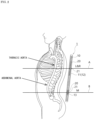
- two detection unit placement holes 10a, 10b are formed at a position corresponding to the position of the heart (near the line indicated by reference sign A in FIG. 1 and FIG. 2 ), and under (on the waist side of) the diaphragm-corresponding position, one detection unit placement hole 10c is formed at a position corresponding to the position of the waist (near the line indicated by reference sign B in FIG. 1 and FIG. 2 ).
- the two detection unit placement holes 10a, 10b on the upper side are provided at a predetermined interval on the left and right of a backbone-corresponding position corresponding to the position of the backbone of the person. Further, the two detection unit placement holes 10a, 10b on the upper side are substantially in a vertically-long rectangular shape that is longer in the up-down direction, and the detection unit placement hole 10c on the lower side is substantially in a laterally-long rectangular shape that is longer in the left-right direction.
- the two detection unit placement holes 10a, 10b on the upper side are vertically long, and to enable the capturing of abdominal information that is based on the activity of the left and right lungs and is transmitted through the diaphragm, the detection unit placement hole 10c on the lower side is laterally long. This corresponds to the shapes and the arrangement directions of the biosignal detection units 11 to 13.
- the biosignal detection units 11 to 13 each have a three-dimensional knitted fabric 20 and an acoustic sensor 21 constituted by a microphone.
- the three-dimensional knitted fabric 20 is formed of a pair of ground knitted fabrics disposed apart from each other and connecting yarns connecting the ground knitted fabrics as is disclosed in, for example, Japanese Patent Application Laid-open No. 2002-331603 .
- the ground knitted fabrics each can be formed to have a flat knitted fabric structure (fine meshes) continuous both in a wale direction and a course direction using yarns of twisted fibers or to have a knitted fabric structure having honeycomb (hexagonal) meshes.
- the connecting yarns impart predetermined rigidity to the three-dimensional knitted fabric so that one of the ground knitted fabrics and the other ground knitted fabric are kept at a predetermined interval. Therefore, applying tension in a planar direction makes it possible to cause string vibration of the yarns of the facing ground knitted fabrics forming the three-dimensional knitted fabric or of the connecting yarns connecting the facing ground knitted fabrics. Accordingly, cardio-vascular sound/vibration being a biosignal causes the string vibration and is propagated in the planar direction of the three-dimensional knitted fabric.
- the three-dimensional knitted fabrics 20 forming the biosignal detection units 11 to 13 are formed in a substantially rectangular shape corresponding to the aforesaid detection unit placement holes 10a to 10c. Then, films 14, 15 are stacked on both surfaces of the base member 10 to cover the front surfaces and the rear surfaces of the three-dimensional knitted fabrics 20.
- the films 14, 15 each may have a size corresponding to each of the detection unit placement holes 10a to 10c, or the films 14, 15 each may have a size that can cover, by itself, all the three detection unit placement holes 10a to 10c. Consequently, the detection unit placement holes 10a to 10c become resonance boxes to have a function of amplifying weak biosignals.
- the physical condition determination device 100 is constituted by a computer (including a personal computer, a microcomputer incorporated in the device, and the like), and a computer program causing the computer to execute a procedure for determining a physical condition is stored in a storage unit (including not only a built-in recording medium such as a hard disk of the computer (physical condition determination device 100) but also any of various removable recording mediums and a recording medium of another computer connected through a communication means).
- a storage unit including not only a built-in recording medium such as a hard disk of the computer (physical condition determination device 100) but also any of various removable recording mediums and a recording medium of another computer connected through a communication means.
- the computer By executing the procedure for determining a physical condition, the computer constitutes the physical condition determination device 100 having functions as a heart rate-related index calculation unit 110, a blood pressure-related index calculation unit 120, a physical condition sudden change determination unit 130, and a heart function determination unit 140. Further, the computer program causing the execution of the procedure for determining a physical condition can be implemented by an electronic circuit including one storage circuit or more in which the computer program is incorporated
- the computer program can be provided in a state of being stored in a recording medium.
- the recording medium storing the computer program may be a non-transitory recording medium.
- the non-transitory recording medium is not limited, and examples thereof are recording media such as a flexible disk, a hard disk, CD-ROM, MO (magneto-optical disk), DVD-ROM, and a memory card.
- the computer program can be transmitted to the computer through a communication line to be installed therein.
- the heart rate-related index calculation unit 110 and the blood pressure-related index calculation unit 120 both use a time-series waveform of a biosignal obtained from the acoustic sensor 21 of the biosignal measurement device 1 (hereinafter, referred to as a "sensor waveform”)), but preferably use not the sensor waveform itself but a time-series waveform resulting from the filtering of the sensor waveform with a band-pass filter whose center frequency is around 20 Hz, more preferably, a band-pass filter of a 10 to 30 Hz frequency band.
- the filtering converts the sensor waveform to a filtered waveform of 10 to 30 Hz (waveform in FIG. 5(c) (hereinafter, referred to as "RCW").
- a standard range of heart rate is around 1 to 1.5 Hz, and it is seen that, in RCW, waveform components with a relatively large total amplitude appear at a cycle of about one second, which means that the cardiac cycle is manifested in RCW. This is obvious from the comparison with the waveform of the electrocardiogram in FIG. 5(a) and the waveform of the phonocardiogram in FIG. 5(b) .
- the heart rate-related index calculation unit 110 finds a time-series waveform of an index corresponding to a variation in heart rate from the time-series waveform ("RCW" in this embodiment) of the biosignal.
- the heart rate-related index calculation unit 110 of this embodiment includes a frequency-gradient time-series waveform calculation unit 111 and a distribution ratio calculation unit 112.
- the frequency-gradient time-series waveform calculation unit 111 finds a frequency time-series waveform from RCW and finds a frequency-gradient time-series waveform in every predetermined time range, from the frequency time-series waveform.
- the frequency-gradient time-series waveform is obtained by the method disclosed in Patent Documents 1 and 2. Specifically, in RCW, positive-to-negative change points (zero-cross points) are found, are divided into segments in, for example, every five seconds, reciprocals of time intervals between the zero-cross points of the time-series waveform included in the five-second period are found as individual frequencies f, and an average value of the individual frequencies f in the five-second period is adopted as a value of a frequency F in the relevant five-second period. Then, the frequencies F obtained every five seconds are plotted in a time-series manner, whereby a time-series waveform of a frequency variation is found.
- time windows overlapping with each other by a predetermined overlap time for example, eighteen seconds
- a predetermined time width for example, 180 seconds
- the heart rate-related index calculation unit 110 repeats this calculation (moving calculation) in sequence to output a time-series variation in the frequency gradient as the frequency-gradient time-series waveform.
- the dorsal body surface pulse wave is a biosignal mainly including the control state of the heart being the central nervous system, that is, a biosignal including information on the state of the sympathetic innervation of arteries and the appearance of the sympathetic nervous system and the parasympathetic nervous system, and the frequency-gradient time-series waveform found by the zero-cross method is an index corresponding to a variation in heart rate.
- the distribution ratio calculation unit 112 first frequency-analyzes the frequency-gradient time-series waveform obtained from the frequency-gradient time-series waveform calculation unit 111 and extracts frequency components belonging to the ULF band to the VLF band corresponding to a function regulation signal whose frequency is lower than 0.0033 Hz which is a frequency at which the fluctuation characteristic of the cardiocirculatory system changes, a fatigue reception signal higher in frequency than the function regulation signal, and an activity regulation signal higher in frequency than the fatigue reception signal. Next, distribution ratios of these frequency components are found in a time-series manner. That is, ratios of the frequency components to the total value 1 of power spectra of the three frequency components are found as the distribution ratios in a time-series manner.
- a 0.0017 Hz frequency component is used as the function regulation signal, a 0.0035 Hz frequency component as the fatigue reception signal, and a 0.0053 Hz frequency component as the activity regulation signal, and the use of these frequency components is appropriate as described in "Background Art" section above.
- the frequency components used as these signals can be adjusted depending on an individual difference or the like, and the function regulation signal can be adjusted within a range of less than 0.0033Hz, preferably a range of 0.001 to 0.0027 Hz, the fatigue reception signal within a range of 0.002 to 0.0052 Hz, and the activation regulation signal within a range of 0.004 to 0.007 Hz.
- the blood pressure-related index calculation unit 120 finds a time-series waveform of an index corresponding to a variation in blood pressure from the time-series waveform ("RCW" in this embodiment) of the biosignal.
- the blood pressure-related index calculation unit 120 of this embodiment includes a systolic blood pressure-related index calculation unit 121 which finds a time-series waveform of a systolic blood pressure-related index by using peak values of RCW and a diastolic blood pressure-related index calculation unit 122 which finds a time-series waveform of a diastolic blood pressure-related index by using bottom values of RCW.
- the systolic blood pressure-related index calculation unit 121 and the diastolic blood pressure-related index calculation unit 122 each find a gradient (rate) of the change of the peak values or the bottom values in a predetermined time range (for example, 180 seconds), and perform slide calculation with, for example, an eighteen-second overlap time, to find a change in a gradient of the peak values or the bottom values in sequence.
- the charts (c) each illustrate time-series waveforms of systolic blood pressure and diastolic blood pressure measured with the continuous blood pressure monitor, and the charts (d) each illustrate time-series waveforms of average values of the peak values and the bottom values of RCW in every 180-second period which are found with eighteen-second sliding.
- FIG. 6 illustrates the result of the comparison of the time-series waveforms with the continuous blood pressure monitor measured at the same time.
- inferred SBP is a waveform obtained when the average value of the peak values calculated using RCW is multiplied by a predetermined coefficient so that the waveform approximates the systolic blood pressure value of the continuous blood pressure monitor
- inferred DBP is a waveform obtained when the average value of the bottom values calculated using RCW is multiplied by a predetermined coefficient so that the waveform approximates the diastole blood pressure value of the continuous blood pressure monitor.
- a gradient of the peak values of RCW found by the systolic blood pressure-related index calculation unit 121 and a gradient of the bottom values of RCW found by the diastolic blood pressure-related index calculation unit 122 are suitable as indexes indicating variation tendencies of the systolic blood pressure and the diastole blood pressure.
- the computer program causes the execution of a procedure functioning as a heart rate sudden change specification unit 131, causes the execution of a procedure functioning as a blood pressure sudden change specification unit 132, and thereafter, causes the execution of a procedure for determining a physical condition sudden change based on the execution results of the above two procedures.
- the heart rate sudden change specification unit 131 specifies a preset time zone in which the time-series waveform obtained from the heart rate-related index calculation unit 110 presents a predetermined waveform variation, as an appearance time of a sign of a sudden change in heart rate
- the blood pressure sudden change specification unit 132 specifies a preset time zone in which the time-series waveform obtained from the blood pressure-related index calculation unit 120 presents a predetermined waveform variation, as an appearance time of a sign of a sudden change in blood pressure.
- the physical condition sudden change determination unit 130 determines that a sudden change in the physical condition (physical condition sudden change) has occurred. That is, in a case where the two indexes of the variation in the heart rate and the variation in the blood pressure present waveforms different from normal waveforms and they appear in substantially the same period (the predetermined time range), it is determined that the physical condition sudden change mentioned here has occurred.
- the heart rate sudden change specification unit 131 preferably specifies the appearance time of the sign of the sudden change in the heart rate, as follows. Specifically, it is determined whether or not a point appears at which the waveforms of the aforesaid function regulation signal, fatigue reception signal, and activity regulation signal which are found from the frequency-gradient time-series waveform by the distribution ratio calculation unit 112 all belong to a predetermined distribution ratio range, and in this case, the distribution ratio of the activity regulation signal is the lowest (condition 1), and thereafter a point appears at which the distribution ratio of the activity regulation signal becomes higher than the distribution ratios of the function regulation signal and the fatigue reception signal (condition 2), and if the condition 1 and the condition 2 are both satisfied, it is determined that the sign of the sudden change in the heart rate has appeared.
- the distribution ratios of the three waveforms of the function regulation signal (0.0017 Hz), the fatigue reception signal (0.0035 Hz), and the activity regulation signal (0.0053 Hz) all belong to a 30 to 40% range
- the distribution ratio of the activity regulation signal (0.0053 Hz) is the lowest at this instant, and at an instant immediately thereafter (eighteen seconds later in this embodiment), the distribution ratio of the activity regulation signal (0.0053 Hz) becomes the highest, it is determined that the sign of the sudden change in the heart rate has appeared.
- a 30- to 40-second time zone including these two points is preferably specified as the appearance time of the sign of the sudden change in the heart rate.
- the 180-second windows preferably overlap with one another by eighteen seconds as in this embodiment.
- the present invention also includes a mode in which each of the time windows is set longer or shorter than 180 seconds and the overlap ratio is set to a different value in the calculation and the same method as above is used.
- the time zone when the sign of the sudden change in heart rate should appear can be set longer or shorter than thirty to forty seconds depending on the set time window, the set overlap ratio, or the like.
- the distribution ratio range, of the condition 1, in which the aforesaid signals should gather is preferably set to a range other than the 30 to 40% range. Further, since these conditions differ depending on each individual, the conditions can be set for each individual.
- the blood pressure sudden change specification unit 132 preferably specifies the appearance time of the sign of the sudden change in the blood pressure as follows. Specifically, as illustrated in FIG. 8 , a time zone in which the aforesaid time-series waveform of the systolic blood pressure-related index obtained from the systolic blood pressure-related index calculation unit 121 and the aforesaid time-series waveform of the diastolic blood pressure-related index obtained from the diastolic blood pressure-related index calculation unit 122 cross each other and a point appears at which a value of the systolic blood pressure-related index is smaller than a value of the diastolic blood pressure-related index is specified as the appearance time of the sign of the sudden change in the blood pressure.
- the blood pressure sudden change specification unit 132 may output the determination result at different time intervals depending on the set time and overlap ratio of the time windows, and so on of the slide calculation, similarly to the heart rate sudden change specification unit 131. Further, similarly to the above, the time window and the overlap ratio can be set appropriately for each individual.
- the physical condition sudden change determination unit 130 compares the appearance time of the sign of the sudden change in the heart rate, which time is specified by the heart rate sudden change specification unit 131, and the appearance time of the sign of the sudden change in the blood pressure, which time is specified by the blood pressure sudden change specification unit 132, to finally determine whether or not the physical condition sudden change has occurred.
- the appearance time of the sign of the sudden change in the heart rate and the appearance time of the sign of the sudden change in the blood pressure are within the predetermined time range, it is determined that the physical condition sudden change has occurred.
- the predetermined time range mentioned here is preferably about 30 to about 100 seconds, though differing depending on each individual. Note that this predetermined time range can be set differently depending on the set time and overlap ratio of the time window, and so on of the slide calculation or depending on each individual.
- the heart function determination unit 140 determines whether or not a load on the heart function is large Specifically, the heart function determination unit 140 of this embodiment obtains the aforesaid frequency gradient time-series waveform that the heart rate-related index calculation unit 110 has found through the arithmetic processing of the time-series waveform of the biosignal (RCW) obtained from the biosignal measurement device 1 at the time of the determination of the physical condition, for example, at the time of the determination of the physical condition of a driver in the middle of driving, at the time of the determination of the physical condition of a subject after driving or exercise, or the like. Next, the heart function determination unit 140 frequency-analyzes this frequency-gradient time-series waveform.
- RCW biosignal
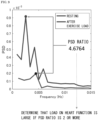
- the frequency analysis result at the time of the physical condition determination is compared with the frequency analysis result of a frequency-gradient time-series waveform found in advance at the resting time (see FIG. 4 ). If it turns out that a ratio of a power spectrum value of a dominant frequency at the time of the physical condition determination after the exercise load to a power spectrum value of a dominant frequency at the resting time (PSD ratio) is equal to or larger than a predetermined value (for example, 2 or more), it is determined that the load on the heart function is large as illustrated in, for example, FIG. 9 .
- PSD ratio a ratio of a power spectrum value of a dominant frequency at the time of the physical condition determination after the exercise load to a power spectrum value of a dominant frequency at the resting time
- the frequency analysis result at the resting time is data obtained through the analysis of a biosignal measured when the subject has a normal heart rate and breathing state such as when the subject is calmly seated in a chair without undergoing a load of driving, exercise, or the like, and storing this data in advance in the storage unit of the computer constituting the physical condition determination device 100 enables the physical condition sudden change determination unit 130 to read the stored data to use it for the aforesaid comparison at the time of the physical condition determination.
- the physical condition sudden change determination unit 130 determines that the physical condition sudden change has occurred, when the aforesaid sign of the sudden change in the heart rate and the aforesaid sign of the sudden change in the blood pressure appear, in consideration of the determination result of the heart function determination unit 130.
- Each subject ran on a treadmill for ten minutes to be given an exercise load and how the physical condition after the running changed from that before the running was examined.
- the subject Before and after given the exercise load, the subject was seated in an automobile seat to whose seat back part the biosignal measurement device 1 was attached, a biosignal of the subject was collected, and the aforesaid physical condition determination device 100 analyzed its data to determine whether or not a physical condition sudden change had occurred.
- the biosignal for the analysis was a dorsal body surface pulse wave of the vicinity of the second to fourth lumbar vertebrae, and the data was obtained from the acoustic sensor 21 of the lower part biosignal detection unit 13 of the biosignal measurement device 1.
- An instantaneous heart rate monitor and a continuous blood pressure monitor were worn by the subject to also measure his/her instantaneous blood pressure and continuous blood pressure.
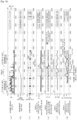
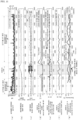
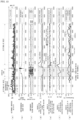
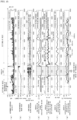
- FIGs. 10 to FIGs. 15 illustrate the experimental results of the subjects.
- the charts (a) each illustrate time-series waveforms of autonomic nervous activity
- the charts (b) each illustrate a time-series waveform of the instantaneous heart rate
- the charts (c) each illustrate time-series waveforms of the blood pressures.
- the charts (d) each illustrating time-series waveforms of average values of peak values and bottom values
- the charts (e) each illustrating time-series waveforms of gradients of the peak values and the bottom values
- the charts (f) each illustrating a frequency-gradient time-series waveform
- the charts (g) each illustrating time-series waveforms of distribution ratios.
- the heart rate sudden change specification unit 131 specifies an around 2700-second point as an appearance time of a sign of a sudden change in heart rate.
- the blood pressure sudden change specification unit 132 specifies appearance times of sudden change in blood pressure, in 50-second ranges before and after the 2700-second point which is the appearance time of the sign of the sudden change in the heart rate.
- the heart rate sudden change specification unit 131 specifies an around 3180-second point as an appearance time of a sign of a sudden change in heart rate.
- the blood pressure sudden change specification unit 132 specifies an around 3250-second point, as an appearance time of a sign of a sudden change in the blood pressure that is the closest to the appearance time of the sudden change in the heart rate.
- the physical condition sudden change determination unit 130 determines that the physical condition sudden change has occurred in the cases of FIGs. 10 and FIGs. 11 of the subject O in which the appearance time of the sign of the sudden change in the heart rate is specified and near this point, the appearance time of the sign of the sudden change in the blood pressure is specified.
- the occurrence of a physical condition sudden change is not confirmed.
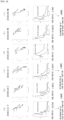
- FIGs. 16 are charts illustrating the results of the determination by the heart function determination unit 140.
- FIGs. 16(a) to (f) correspond to the data in FIGs. 10 to FIGs. 15 respectively.
- the PSD ratios in the charts are found by the heart function determination unit 140 by comparing data in the twenty-minute resting time before the exercise load and data in the twenty-minute resting time after the exercise load, a threshold of the PSD ratio is set to 2, and in the setting here, if the PSD ratio exceeds 2, the determination result is "load on heart function: large".
- the determination result was "load on heart function: large".
- the physical condition sudden change determination unit 130 determines that the physical condition sudden change has occurred only when the data of the subject O on November 13, 2018 in FIGs. 10 is measured.
- the substantially realtime determination is enabled. This enables the determination of the physical condition sudden change of a driver in the middle of driving.
- the heart function is determined using the data in twenty minutes after the exercise load, it requires a certain time to obtain the result regarding whether or not the load on the heart function is large. However, the more accurate determination is enabled if the following configuration is adopted.
- the load on the heart function can be determined at a shorter interval, and the determination in consideration of the determination result regarding the load on the heart function is enabled at a timing closer to the appearance time of the sign of the sudden change in the heart rate and the appearance time of the sign of the sudden change in the blood pressure.
- the physical condition sudden change determination unit 130 preferably takes the result of the determination by the heart function determination unit 140 into consideration.
- the appearance time of the sign of the sudden change in the heart rate and the appearance time of the sudden change in the blood pressure are different by about seventy seconds, and therefore, if the predetermined time range in which these signs should appear is set shorter, for example, set to fifty seconds, it is not determined that the physical condition sudden change has occurred, even based only on the criteria of whether the appearance time of the sign of the sudden change in the heart rate and the appearance time of the sign of the sudden change in the blood pressure are within the predetermined time. Therefore, this set time may be adjustable for each individual according to accumulated data of each individual.
- FIGs. 17 illustrate data obtained when the biosignal measurement device 1 was placed on a mattress and a subject slept thereon in a supine posture for 270 minutes.
- FIG. 17(a) is a chart illustrating an aortic pressure waveform resulting from the filtering of a biosignal obtained from the left upper part biosignal detection unit 11
- FIG. 17(b) is a chart illustrating the detection timings of body movement and time zones in which the subject is not in contact with the left upper part biosignal detection unit 11 because of the body movement
- FIG. 17(c) is a chart illustrating heart rate
- FIG. 17(d) is a chart illustrating respiratory rate
- FIG. 17(e) is a chart illustrating time-series waveforms of autonomic nervous activity
- FIG. 17(a) is a chart illustrating an aortic pressure waveform resulting from the filtering of a biosignal obtained from the left upper part biosignal detection unit 11
- FIG. 17(b) is a chart
- FIG. 17(f) is a chart illustrating a frequency-gradient time-series waveform
- FIG. 17(g) is a chart illustrating time-series waveforms of distribution ratios
- FIG. 17(h) is a chart illustrating time-series waveforms of a peak value gradient and a bottom value gradient.
- FIG. 17(g) and FIG. 17(h) at an about 152-minute point, a sign of a sudden change in heart rate appears and a sign of a sudden change in blood pressure also appears. Similarly, at an about 240-minute point, a sign of a sudden change in the heart rate appears and a sign of a sudden change in the blood pressure also appears. Therefore, during this experiment, at the about 152-minute and 240-minute points, it was determined that a physical condition sudden change had occurred. An observer observed that the subject's body movement momentarily became large and the subject seemed hard to sleep before and after the times at which it was determined that the physical condition sudden change had occurred. From this, it can be said that the determination result by the physical condition determination device 130 was mostly appropriate.
Landscapes
- Health & Medical Sciences (AREA)
- Life Sciences & Earth Sciences (AREA)
- Engineering & Computer Science (AREA)
- Public Health (AREA)
- Medical Informatics (AREA)
- General Health & Medical Sciences (AREA)
- Biomedical Technology (AREA)
- Animal Behavior & Ethology (AREA)
- Surgery (AREA)
- Molecular Biology (AREA)
- Veterinary Medicine (AREA)
- Pathology (AREA)
- Heart & Thoracic Surgery (AREA)
- Biophysics (AREA)
- Physics & Mathematics (AREA)
- Cardiology (AREA)
- Physiology (AREA)
- Signal Processing (AREA)
- Psychiatry (AREA)
- Vascular Medicine (AREA)
- Educational Technology (AREA)
- Hospice & Palliative Care (AREA)
- Social Psychology (AREA)
- Psychology (AREA)
- Transportation (AREA)
- Oral & Maxillofacial Surgery (AREA)
- Developmental Disabilities (AREA)
- Child & Adolescent Psychology (AREA)
- Mechanical Engineering (AREA)
- Dentistry (AREA)
- Computer Vision & Pattern Recognition (AREA)
- Artificial Intelligence (AREA)
- Primary Health Care (AREA)
- Epidemiology (AREA)
- Databases & Information Systems (AREA)
- Data Mining & Analysis (AREA)
- Measuring Pulse, Heart Rate, Blood Pressure Or Blood Flow (AREA)
- Measurement Of The Respiration, Hearing Ability, Form, And Blood Characteristics Of Living Organisms (AREA)
Description
- The present invention relates to a physical condition determination device that determines the physical condition of a person using a biosignal, a computer program, and a recording medium.
-
Patent Document 1,Patent Document 2, and so on disclose a device having a means that finds a frequency time-series waveform from a time-series waveform of a biosignal that is mainly cardiocirculatory vibration collected from the upper body of a person, further finds a frequency-gradient time-series waveform, and frequency-analyzes these to determine the state of the person. InPatent Document 1, in the frequency analysis, power spectra of respective frequencies corresponding to predetermined function regulation signal, fatigue reception signal, and activity regulation signal belonging to the ULF band (ultra low-frequency band) to the VLF band (very low-frequency band) are found. Then, the state of the person is determined from time-series variations of the respective power spectra. Since the fatigue reception signal indicates a progress degree of fatigue in a normal active state, additionally comparing the degrees of dominance of the power spectra of the function regulation signal and the activity regulation signal enables to determine the state of the person (a relaxed state, a fatigued state, a sympathetic dominant state, a parasympathetic dominant state, or the like). - In
Patent Document 2, a function regulation signal, a fatigue reception signal, and an activity regulation signal belonging to the ULF band (ultra low-frequency band) to the VLF band (very low-frequency band) are used as inPatent Document 1, but inPatent Document 2, distribution ratios of frequency components corresponding to these three signals to thetotal value 100 of power spectra of the frequency components are found in a time-series manner, and the state of the person is determined using time-series variations of the distribution ratios. - The arts of
Patent Documents - The 0.0035 Hz signal (fatigue reception signal) is a fluctuation for maintaining the homeostasis by adapting to externally input stress and this indicates a progress degree of fatigue in a normal active state, the 0.0053 Hz signal (activity regulation signal) is a signal where a degree of the influence of the control of the endocrine system hormone in the active state appears, the signal of 0.0017 Hz lower than 0.0033 Hz (function regulation signal) is a signal controlling a change in physical condition and a decline in physical function, and these three signals in the aforesaid frequency bands work as a thermoregulatory function by interacting with one another. Therefore, the use of time-series variations and distribution ratios of power spectra of these signals enables the determination of the state of a person.
-
Patent Document 3 relates to a biological state estimation for estimating a basic physical condition of a person. -
Patent Document 4 relates to displaying living body information. -
- Patent Document 1:
Japanese Patent Application Laid-open No. 2011-167362 - Patent Document 2:
Japanese Patent Application Laid-open No. 2012-179202 - Patent Document 3:
US 2018/296152 A1 - Patent Document 4:
US 2006/025698 A1 - Non-patent Document 1: "Development of the measurement method of the prediction of sleep by finger plethysmogram data", FUJITA Etsunori et al., Ergonomics, Vol. 41, No. 4, 203-212, 2005
- The means disclosed in
Patent Documents - A person may experience a sudden change in physical condition, for example, suddenly get pale, feel sick, or fall unconscious while driving or after given a load of exercise such as driving. As described above, the arts of
Patent Documents - The present invention was made in consideration of the above and has an object to provide a suitable art for detecting the occurrence of a sudden change in physical condition. Means for Solving the Problems
- As a result of studious studies for solving the above problem, the present inventor has focused on the following points. Specifically, the aforesaid frequency-gradient time-series waveform found through the processing of the time-series waveform of the biosignal and the aforesaid time-series waveforms of the distribution ratios of the function regulation signal, the fatigue reception signal, and the activity regulation signal found from the frequency-gradient time-series waveform are all information regarding a variation in heart rate. When the physical condition suddenly changes, a sudden change in an index related to the variation in heart rate naturally occurs, and in addition, blood pressure also suddenly changes. Therefore, the present inventor thought that by also detecting the sudden change in the blood pressure from the dorsal body surface pulse wave as well as the variation in the heart rate, it is possible to determine that the sudden change in the physical condition has occurred when the two different indexes vary in different manners from those in the normal state, and has completed the present invention.
- Specifically, a physical condition determination device of the present invention is a physical condition determination device which determines a physical condition of a person by analyzing a biosignal collected by a biosignal measurement device which is disposed in contact with a back of the person and captures the biosignal propagated through a body surface of the back, the physical condition determination device including:
- a heart rate-related index calculation unit which finds a time-series waveform of an index corresponding to a variation in heart rate from a time-series waveform of the biosignal;
- a blood pressure-related index calculation unit which finds a time-series waveform of an index corresponding to a variation in blood pressure from the time-series waveform of the biosignal; and
- a physical condition sudden change determination unit which specifies a preset time zone in which the time-series waveform obtained from the heart rate-related index calculation unit presents a predetermined waveform variation, as an appearance time of a sign of a sudden change in the heart rate, specifies a preset time zone in which the time-series waveform obtained from the blood pressure-related index calculation unit presents a predetermined waveform variation, as an appearance time of a sign of a sudden change in the blood pressure, and determines that a sudden change in the physical condition has occurred in a case where the appearance time of the sign of the sudden change in the heart rate and the appearance time of the sign of the sudden change in the blood pressure are within a predetermined time range.
- Preferably, the heart rate-related index calculation unit includes: a frequency-gradient time-series waveform calculation unit which, after finding a frequency time-series waveform from the time-series waveform of the biosignal, finds a frequency-gradient time-series waveform in every predetermined time range from the frequency time-series waveform; and a distribution ratio time-series waveform calculation unit which extracts, from the frequency-gradient time-series waveform, frequency components belonging to a ULF band to a VLF band corresponding to a function regulation signal having a frequency lower than a frequency at which a fluctuation characteristic of a cardiocirculatory system changes, a fatigue reception signal higher in frequency than the function regulation signal, and an activity regulation signal higher in frequency than the fatigue reception signal, and finds time-series waveforms of distribution ratios of the frequency components.
- Preferably, the physical condition sudden change determination unit specifies, as the appearance time of the sign of the sudden change in the heart rate, a time zone in which a point appears at which the waveforms of the function regulation signal, the fatigue reception signal, and the activity regulation signal all belong to a predetermined distribution ratio range and the distribution ratio of the activity regulation signal is the lowest, and thereafter a point appears at which the distribution ratio of the activity regulation signal becomes higher than the distribution ratios of the function regulation signal and the fatigue reception signal.
- Preferably, the blood pressure-related index calculation unit includes: a systolic blood pressure-related index calculation unit which finds a time-series waveform of a systolic blood pressure-related index by using peak values of the time-series waveform of the biosignal; and a diastolic blood pressure-related index calculation unit which finds a time-series waveform of a diastolic blood pressure-related index by using bottom values of the time-series waveform of the biosignal.
- Preferably, the systolic blood pressure-related index calculation unit finds the time-series waveform of the systolic blood pressure-related index by using a gradient of the peak values in every predetermined time range, the diastolic blood pressure-related index calculation unit finds the time-series waveform of the diastolic blood pressure-related index by using a gradient of the bottom values in every predetermined time range, and the physical condition sudden change determination unit specifies, as the appearance time of the sign of the sudden change in the blood pressure, a time zone in which the time-series waveform of the systolic blood pressure-related index found using the gradient of the peak values in every predetermined time range and the time-series waveform of the diastolic blood pressure-related index found using the gradient of the bottom values in every predetermined time range cross each other and a point appears at which a value of the systolic blood pressure-related index is smaller than a value of the diastolic blood pressure-related index.
- Preferably, the physical condition determination device further includes a heart function determination unit which determines whether or not a load on a heart function is large, and
the physical condition sudden change determination unit determines that the sudden change in the physical condition has occurred in a case where the heart function determination unit determines that the load on the heart function is large as well as the appearance time of the sign of the sudden change in the heart rate and the appearance time of the sign of the sudden change in the blood pressure are within the predetermined time range. - Preferably, the heart function determination unit frequency-analyzes the frequency-gradient time-series waveform found at the time of the physical condition determination by the heart rate-related index calculation unit, compares the frequency analysis with a frequency analysis of a frequency-gradient time-series waveform found in advance at a resting time, and determines that the load on the heart function is large in a case where a ratio of a power spectrum value of a dominant frequency at the time of the physical condition determination to a power spectrum value of a dominant frequency at the resting time is equal to a predetermined value or more.
- Further, a computer program of the present invention is a computer program which causes a computer as a physical condition determination device to execute a procedure for determining a physical condition of a person by analyzing a biosignal obtained from a biosignal measurement device which is disposed in contact with a back of the person and captures the biosignal propagated through a body surface of the back, the computer program causing the computer to execute:
- a heart rate-related index calculation procedure for finding a time-series waveform of an index corresponding to a variation in heart rate from a time-series waveform of the biosignal;
- a blood pressure-related index calculation procedure for finding a time-series waveform of an index corresponding to a variation in blood pressure from the time-series waveform of the biosignal; and
- a physical condition sudden change determination procedure for specifying a preset time zone in which the time-series waveform obtained through the execution of the heart rate-related index calculation procedure presents a predetermined waveform variation, as an appearance time of a sign of a sudden change in the heart rate, specifying a preset time zone in which the time-series waveform obtained through the execution of the blood pressure-related index calculation procedure presents a predetermined waveform variation, as an appearance time of a sign of a sudden change in the blood pressure, and determining that a sudden change in the physical condition has occurred in a case where the appearance time of the sign of the sudden change in the heart rate and the appearance time of the sign of the sudden change in the blood pressure are within a predetermined time range.
- Preferably, the computer program causes the computer to further execute a heart function determination procedure for determining whether or not a load on a heart function is large, and
in the physical condition sudden change determination procedure, it is determined that the sudden change in the physical condition has occurred in a case where the load on the heart function is determined as large through the execution of the heart function determination procedure as well as the appearance time of the sign of the sudden change in the heart rate and the appearance time of the sign of the sudden change in the blood pressure are within the predetermined time range. - Further, the present invention provides a computer-readable recording medium in which the aforesaid computer program is recorded, the computer program causing the computer to function as the physical condition determination device by causing the computer to execute the procedure for determining the physical condition of a person by analyzing the biosignal obtained from the biosignal measurement device which is disposed in contact with the back of the person and captures the biosignal propagated through the body surface of the back.
- The present invention is configured to specify the appearance time of the sign of the sudden change in the heart rate, from the time-series waveform of the index corresponding to the variation in the heart rate (heart rate-related index) and specifies the appearance time of the sign of the sudden change in the blood pressure, from the time-series waveform of the index corresponding to the variation in the blood pressure (blood pressure-related index), and determine that the sudden change in the physical condition (physical condition sudden change) has occurred in the case where both of the appearance times are within the predetermined time range. This enables the determination in which the sudden change in the heart rate and the sudden change in the blood pressure are taken into consideration, enabling the detection of the physical condition sudden change.
- It is preferable to additionally determine whether or not the load on the heart function is larger than that at a resting time. Typically, when the physical condition sudden change has occurred, the load on the heart function is also large. Therefore, not only specifying the sudden change in the heart rate and the sudden change in the blood pressure but also determining whether or not the load on the heart function is large enables the more accurate detection of the occurrence of the physical condition sudden change.
-
- [
FIG. 1] FIG. 1 is a plan view of a biosignal measurement device used in an embodiment of the present invention. - [
FIG. 2] FIG. 2 is a vertical sectional view illustrating arrangement positions of a left upper part biosignal detection unit (L), a right upper part biosignal detection unit (R), and a lower part biosignal detection unit (M) in relation to the body of a person when the biosignal measurement device is disposed on the back side of the person. - [
FIG. 3] FIG. 3 is a partial sectional view of the biosignal measurement device. - [
FIG. 4] FIG. 4 is an explanatory block diagram of the configuration of a physical condition determination device according to the embodiment of the present invention. - [
FIGs. 5] FIGs. 5(a) to (c) are charts illustrating an electrocardiogram waveform (a), a heart sound waveform (b), and a waveform (RCW) (c) resulting from the filtering of a biosignal obtained from the biosignal measurement device. - [
FIG. 6] FIG. 6 is a chart illustrating an example of a correspondence relation between time-series waveforms of systolic blood pressure and diastolic blood pressure which are obtained from a continuous blood pressure monitor and time-series waveforms of average values of peak values and bottom values calculated using RCW. - [
FIG. 7] FIG. 7 is a chart for explaining how a heart rate sudden change specification unit specifies an appearance time of a sign of a sudden change in heart rate. - [
FIG. 8] FIG. 8 is a chart for explaining how a blood pressure sudden change specification unit specifies an appearance time of a sign of a sudden change in blood pressure. - [
FIG. 9] FIG. 9 is a chart for explaining how a heart function determination unit determines whether or not a load on a heart function is large. - [
FIGs. 10] FIGs. 10(a) to (g) are charts illustrating experimental data of a subject O measured on November 13, 2018. - [
FIGs. 11] FIGs. 11(a) to (g) are charts illustrating experimental data of the subject O measured on January 18, 2019. - [
FIGs. 12] FIGs. 12(a) to (g) are charts illustrating experimental data of a subject U measured on November 14, 2018. - [
FIGs. 13] FIGs. 13(a) to (g) are charts illustrating experimental data of a subject H measured on November 20, 2018. - [
FIGs. 14] FIGs. 14(a) to (g) are charts illustrating experimental data of a subject MS measured on December 3, 2018. - [
FIGs. 15] FIGs. 15(a) to (g) are charts illustrating experimental data of a subject MK measured on December 4, 2018. - [
FIGs. 16] FIGs. 16(a) to (f) are charts illustrating the results of frequency analyses of data at a resting time before an exercise load and data at a resting time after the exercise load in the frequency-gradient time-series waveforms illustrated inFIG. 10(f) ,FIG. 11(f) ,FIG. 12(f) ,FIG. 13(f) ,FIG. 14(f) , andFIG. 15(f) , the charts in the lower row being charts where power spectrum values before and after the exercise load are compared, and the charts in the upper row being logarithmic representations of the frequency and the power spectrum value. - [
FIGs. 17] FIGs. 17(a) to (h) illustrate data of the results of experiments that are conducted while thebiosignal measurement device 1 is disposed on a mattress and a subject sleep thereon for 270 minutes in a supine posture. - The present invention will be hereinafter described in more detail based on an embodiment of the present invention illustrated in the drawings. In the present invention, a biosignal propagated through the dorsal body surface of a person (dorsal body surface pulse wave) is used. As described above, the dorsal body surface pulse wave is vibration (including vibration transmitted as sound) that is generated when blood flowing in the ventricles or the atriums in atrial or ventricular systoles or diastoles collides with valves or myocardial inner walls or when the blood flowing in the aorta presses vascular walls, and transmitted to the body surface.
- Preferably, the biosignal measurement device for collecting the dorsal body surface pulse wave can be used while assembled in a measurement chair or bed, a seat of a vehicle driver seat, or the like and is capable of collecting the biosignal without constraining an arm, a hand, a finger, or the like.
FIG. 1 to FIG. 3 illustrate thebiosignal measurement device 1 used in this embodiment. Thebiosignal measurement device 1 includes three biosignal detection units, namely, a left upper partbiosignal detection unit 11, a right upper partbiosignal detection unit 12, and a lower partbiosignal detection unit 13 which are provided in abase member 10. - The
base member 10 is formed of a plate-shaped body having an area large enough to include the threebiosignal detection units 11 to 13 and cover a range including the chest to the abdomen of the person. Its material is preferably a flexible synthetic resin or the like giving little uncomfortable feeling to the person when the back of the person abuts thereon, and is more preferably a bead foam. Thin films of beads forming the bead foam sensitively respond to the biosignal-based microvibration of the body surface to vibrate, so that the biosignal is easily propagated to thebiosignal detection units 11 to 13. - In the state in which the
base member 10 is disposed along the back of the person, above (on the shoulder side of) a diaphragm-corresponding position corresponding to the position of the diaphragm of the person, two detectionunit placement holes FIG. 1 andFIG. 2 ), and under (on the waist side of) the diaphragm-corresponding position, one detectionunit placement hole 10c is formed at a position corresponding to the position of the waist (near the line indicated by reference sign B inFIG. 1 andFIG. 2 ). The two detectionunit placement holes unit placement holes unit placement hole 10c on the lower side is substantially in a laterally-long rectangular shape that is longer in the left-right direction. To enable the capturing of biosignals of a range corresponding to the lungs and the heart, the two detectionunit placement holes unit placement hole 10c on the lower side is laterally long. This corresponds to the shapes and the arrangement directions of thebiosignal detection units 11 to 13. - The
biosignal detection units 11 to 13 each have a three-dimensionalknitted fabric 20 and anacoustic sensor 21 constituted by a microphone. The three-dimensionalknitted fabric 20 is formed of a pair of ground knitted fabrics disposed apart from each other and connecting yarns connecting the ground knitted fabrics as is disclosed in, for example,Japanese Patent Application Laid-open No. 2002-331603 - The three-dimensional
knitted fabrics 20 forming thebiosignal detection units 11 to 13 are formed in a substantially rectangular shape corresponding to the aforesaid detection unit placement holes 10a to 10c. Then,films base member 10 to cover the front surfaces and the rear surfaces of the three-dimensionalknitted fabrics 20. Thefilms films - Next, the configuration of the physical
condition determination device 100 of this embodiment will be described based onFIG. 4 . The physicalcondition determination device 100 is constituted by a computer (including a personal computer, a microcomputer incorporated in the device, and the like), and a computer program causing the computer to execute a procedure for determining a physical condition is stored in a storage unit (including not only a built-in recording medium such as a hard disk of the computer (physical condition determination device 100) but also any of various removable recording mediums and a recording medium of another computer connected through a communication means). By executing the procedure for determining a physical condition, the computer constitutes the physicalcondition determination device 100 having functions as a heart rate-relatedindex calculation unit 110, a blood pressure-relatedindex calculation unit 120, a physical condition suddenchange determination unit 130, and a heartfunction determination unit 140. Further, the computer program causing the execution of the procedure for determining a physical condition can be implemented by an electronic circuit including one storage circuit or more in which the computer program is incorporated - Further, the computer program can be provided in a state of being stored in a recording medium. The recording medium storing the computer program may be a non-transitory recording medium. The non-transitory recording medium is not limited, and examples thereof are recording media such as a flexible disk, a hard disk, CD-ROM, MO (magneto-optical disk), DVD-ROM, and a memory card. Further, the computer program can be transmitted to the computer through a communication line to be installed therein.
- The heart rate-related
index calculation unit 110 and the blood pressure-relatedindex calculation unit 120 both use a time-series waveform of a biosignal obtained from theacoustic sensor 21 of the biosignal measurement device 1 (hereinafter, referred to as a "sensor waveform")), but preferably use not the sensor waveform itself but a time-series waveform resulting from the filtering of the sensor waveform with a band-pass filter whose center frequency is around 20 Hz, more preferably, a band-pass filter of a 10 to 30 Hz frequency band. The filtering converts the sensor waveform to a filtered waveform of 10 to 30 Hz (waveform inFIG. 5(c) (hereinafter, referred to as "RCW"). A standard range of heart rate is around 1 to 1.5 Hz, and it is seen that, in RCW, waveform components with a relatively large total amplitude appear at a cycle of about one second, which means that the cardiac cycle is manifested in RCW. This is obvious from the comparison with the waveform of the electrocardiogram inFIG. 5(a) and the waveform of the phonocardiogram inFIG. 5(b) . - The heart rate-related
index calculation unit 110 finds a time-series waveform of an index corresponding to a variation in heart rate from the time-series waveform ("RCW" in this embodiment) of the biosignal. The heart rate-relatedindex calculation unit 110 of this embodiment includes a frequency-gradient time-serieswaveform calculation unit 111 and a distributionratio calculation unit 112. The frequency-gradient time-serieswaveform calculation unit 111 finds a frequency time-series waveform from RCW and finds a frequency-gradient time-series waveform in every predetermined time range, from the frequency time-series waveform. - More specifically, the frequency-gradient time-series waveform is obtained by the method disclosed in
Patent Documents index calculation unit 110 repeats this calculation (moving calculation) in sequence to output a time-series variation in the frequency gradient as the frequency-gradient time-series waveform. The dorsal body surface pulse wave is a biosignal mainly including the control state of the heart being the central nervous system, that is, a biosignal including information on the state of the sympathetic innervation of arteries and the appearance of the sympathetic nervous system and the parasympathetic nervous system, and the frequency-gradient time-series waveform found by the zero-cross method is an index corresponding to a variation in heart rate. - The distribution
ratio calculation unit 112 first frequency-analyzes the frequency-gradient time-series waveform obtained from the frequency-gradient time-serieswaveform calculation unit 111 and extracts frequency components belonging to the ULF band to the VLF band corresponding to a function regulation signal whose frequency is lower than 0.0033 Hz which is a frequency at which the fluctuation characteristic of the cardiocirculatory system changes, a fatigue reception signal higher in frequency than the function regulation signal, and an activity regulation signal higher in frequency than the fatigue reception signal. Next, distribution ratios of these frequency components are found in a time-series manner. That is, ratios of the frequency components to thetotal value 1 of power spectra of the three frequency components are found as the distribution ratios in a time-series manner. - In this embodiment, a 0.0017 Hz frequency component is used as the function regulation signal, a 0.0035 Hz frequency component as the fatigue reception signal, and a 0.0053 Hz frequency component as the activity regulation signal, and the use of these frequency components is appropriate as described in "Background Art" section above. Note that the frequency components used as these signals can be adjusted depending on an individual difference or the like, and the function regulation signal can be adjusted within a range of less than 0.0033Hz, preferably a range of 0.001 to 0.0027 Hz, the fatigue reception signal within a range of 0.002 to 0.0052 Hz, and the activation regulation signal within a range of 0.004 to 0.007 Hz.
- The blood pressure-related
index calculation unit 120 finds a time-series waveform of an index corresponding to a variation in blood pressure from the time-series waveform ("RCW" in this embodiment) of the biosignal. The blood pressure-relatedindex calculation unit 120 of this embodiment includes a systolic blood pressure-relatedindex calculation unit 121 which finds a time-series waveform of a systolic blood pressure-related index by using peak values of RCW and a diastolic blood pressure-relatedindex calculation unit 122 which finds a time-series waveform of a diastolic blood pressure-related index by using bottom values of RCW. Further, to manifest a change tendency of the peak values or the bottom values, the systolic blood pressure-relatedindex calculation unit 121 and the diastolic blood pressure-relatedindex calculation unit 122 each find a gradient (rate) of the change of the peak values or the bottom values in a predetermined time range (for example, 180 seconds), and perform slide calculation with, for example, an eighteen-second overlap time, to find a change in a gradient of the peak values or the bottom values in sequence. - Here, in the later-described experimental examples, experiments were conducted in which, before and after given an exercise load by ten-minute running using a treadmill, each subject was seated in an automobile seat to whose seat back part the above-described
biosignal measurement device 1 was attached, and his/her biosignal was detected. At the time of the experiments, an instantaneous heart rate monitor and a continuous blood pressure monitor were worn by each subject to also measure his/her instantaneous blood pressure and continuous blood pressure. InFIGs. 10 to FIGs. 15 , the charts (c) each illustrate time-series waveforms of systolic blood pressure and diastolic blood pressure measured with the continuous blood pressure monitor, and the charts (d) each illustrate time-series waveforms of average values of the peak values and the bottom values of RCW in every 180-second period which are found with eighteen-second sliding. The comparison of these charts shows that the time-series waveform of the systolic blood pressure measured with the continuous blood pressure monitor presents a variation substantially corresponding to that of the time-series waveform of the peak average value calculated using RCW, and the time-series waveform of the diastolic blood pressure measured with the continuous blood pressure monitor presents a variation substantially corresponding to that of the time-series waveform of the bottom average value calculated using RCW. - Further, a biosignal was detected while a subject was seated in the automobile seat to whose seat back the
biosignal measurement device 1 was attached, rested for twenty minutes, thereafter drove for sixty minutes, and then rested for twenty minutes, and time-series waveforms of average values of peak values and bottom values of RCW in each 180-second period were found with 180-second sliding.FIG. 6 illustrates the result of the comparison of the time-series waveforms with the continuous blood pressure monitor measured at the same time. InFIG. 6 , "inferred SBP" is a waveform obtained when the average value of the peak values calculated using RCW is multiplied by a predetermined coefficient so that the waveform approximates the systolic blood pressure value of the continuous blood pressure monitor, and "inferred DBP" is a waveform obtained when the average value of the bottom values calculated using RCW is multiplied by a predetermined coefficient so that the waveform approximates the diastole blood pressure value of the continuous blood pressure monitor. From these graphs, it is seen that the time-series waveforms of the average values of the peak values and the bottom values of RCW well correspond to the time-series waveforms of the systolic blood pressure and the diastolic blood pressure obtained from the continuous blood pressure monitor. - Therefore, a gradient of the peak values of RCW found by the systolic blood pressure-related
index calculation unit 121 and a gradient of the bottom values of RCW found by the diastolic blood pressure-relatedindex calculation unit 122 are suitable as indexes indicating variation tendencies of the systolic blood pressure and the diastole blood pressure. - In the physical condition sudden
change determination unit 130, the computer program causes the execution of a procedure functioning as a heart rate suddenchange specification unit 131, causes the execution of a procedure functioning as a blood pressure suddenchange specification unit 132, and thereafter, causes the execution of a procedure for determining a physical condition sudden change based on the execution results of the above two procedures. - Specifically, the heart rate sudden
change specification unit 131 specifies a preset time zone in which the time-series waveform obtained from the heart rate-relatedindex calculation unit 110 presents a predetermined waveform variation, as an appearance time of a sign of a sudden change in heart rate, and the blood pressure suddenchange specification unit 132 specifies a preset time zone in which the time-series waveform obtained from the blood pressure-relatedindex calculation unit 120 presents a predetermined waveform variation, as an appearance time of a sign of a sudden change in blood pressure. Next, in a case where the appearance time of the sign of the sudden change in the heart rate and the appearance time of the sign of the sudden change in the blood pressure are within a predetermined time range, the physical condition suddenchange determination unit 130 determines that a sudden change in the physical condition (physical condition sudden change) has occurred. That is, in a case where the two indexes of the variation in the heart rate and the variation in the blood pressure present waveforms different from normal waveforms and they appear in substantially the same period (the predetermined time range), it is determined that the physical condition sudden change mentioned here has occurred. - The heart rate sudden
change specification unit 131 preferably specifies the appearance time of the sign of the sudden change in the heart rate, as follows. Specifically, it is determined whether or not a point appears at which the waveforms of the aforesaid function regulation signal, fatigue reception signal, and activity regulation signal which are found from the frequency-gradient time-series waveform by the distributionratio calculation unit 112 all belong to a predetermined distribution ratio range, and in this case, the distribution ratio of the activity regulation signal is the lowest (condition 1), and thereafter a point appears at which the distribution ratio of the activity regulation signal becomes higher than the distribution ratios of the function regulation signal and the fatigue reception signal (condition 2), and if thecondition 1 and thecondition 2 are both satisfied, it is determined that the sign of the sudden change in the heart rate has appeared. For example, inFIG. 7 , in the case where the distribution ratios of the three waveforms of the function regulation signal (0.0017 Hz), the fatigue reception signal (0.0035 Hz), and the activity regulation signal (0.0053 Hz) all belong to a 30 to 40% range, the distribution ratio of the activity regulation signal (0.0053 Hz) is the lowest at this instant, and at an instant immediately thereafter (eighteen seconds later in this embodiment), the distribution ratio of the activity regulation signal (0.0053 Hz) becomes the highest, it is determined that the sign of the sudden change in the heart rate has appeared. In this embodiment, since calculation points are plotted every eighteen seconds by the moving calculation as described above, a 30- to 40-second time zone including these two points is preferably specified as the appearance time of the sign of the sudden change in the heart rate. - In the slide calculation for finding the frequency-gradient time-series waveform, the 180-second windows preferably overlap with one another by eighteen seconds as in this embodiment. However, the present invention also includes a mode in which each of the time windows is set longer or shorter than 180 seconds and the overlap ratio is set to a different value in the calculation and the same method as above is used. Further, the time zone when the sign of the sudden change in heart rate should appear can be set longer or shorter than thirty to forty seconds depending on the set time window, the set overlap ratio, or the like. Further, there may be a case where the distribution ratio range, of the
condition 1, in which the aforesaid signals should gather is preferably set to a range other than the 30 to 40% range. Further, since these conditions differ depending on each individual, the conditions can be set for each individual. - The blood pressure sudden
change specification unit 132 preferably specifies the appearance time of the sign of the sudden change in the blood pressure as follows. Specifically, as illustrated inFIG. 8 , a time zone in which the aforesaid time-series waveform of the systolic blood pressure-related index obtained from the systolic blood pressure-relatedindex calculation unit 121 and the aforesaid time-series waveform of the diastolic blood pressure-related index obtained from the diastolic blood pressure-relatedindex calculation unit 122 cross each other and a point appears at which a value of the systolic blood pressure-related index is smaller than a value of the diastolic blood pressure-related index is specified as the appearance time of the sign of the sudden change in the blood pressure. In this embodiment, since the calculation result is output every eighteen seconds as described above, whether or not the condition for the appearance time of the sign of the sudden change in the blood pressure is satisfied is determined every eighteen seconds, but this is only an example, and the blood pressure suddenchange specification unit 132 may output the determination result at different time intervals depending on the set time and overlap ratio of the time windows, and so on of the slide calculation, similarly to the heart rate suddenchange specification unit 131. Further, similarly to the above, the time window and the overlap ratio can be set appropriately for each individual. - The physical condition sudden
change determination unit 130 compares the appearance time of the sign of the sudden change in the heart rate, which time is specified by the heart rate suddenchange specification unit 131, and the appearance time of the sign of the sudden change in the blood pressure, which time is specified by the blood pressure suddenchange specification unit 132, to finally determine whether or not the physical condition sudden change has occurred. In this embodiment, only in the case where the appearance time of the sign of the sudden change in the heart rate and the appearance time of the sign of the sudden change in the blood pressure are within the predetermined time range, it is determined that the physical condition sudden change has occurred. The predetermined time range mentioned here is preferably about 30 to about 100 seconds, though differing depending on each individual. Note that this predetermined time range can be set differently depending on the set time and overlap ratio of the time window, and so on of the slide calculation or depending on each individual. - The heart
function determination unit 140 determines whether or not a load on the heart function is large Specifically, the heartfunction determination unit 140 of this embodiment obtains the aforesaid frequency gradient time-series waveform that the heart rate-relatedindex calculation unit 110 has found through the arithmetic processing of the time-series waveform of the biosignal (RCW) obtained from thebiosignal measurement device 1 at the time of the determination of the physical condition, for example, at the time of the determination of the physical condition of a driver in the middle of driving, at the time of the determination of the physical condition of a subject after driving or exercise, or the like. Next, the heartfunction determination unit 140 frequency-analyzes this frequency-gradient time-series waveform. Then, the frequency analysis result at the time of the physical condition determination is compared with the frequency analysis result of a frequency-gradient time-series waveform found in advance at the resting time (seeFIG. 4 ). If it turns out that a ratio of a power spectrum value of a dominant frequency at the time of the physical condition determination after the exercise load to a power spectrum value of a dominant frequency at the resting time (PSD ratio) is equal to or larger than a predetermined value (for example, 2 or more), it is determined that the load on the heart function is large as illustrated in, for example,FIG. 9 . The frequency analysis result at the resting time is data obtained through the analysis of a biosignal measured when the subject has a normal heart rate and breathing state such as when the subject is calmly seated in a chair without undergoing a load of driving, exercise, or the like, and storing this data in advance in the storage unit of the computer constituting the physicalcondition determination device 100 enables the physical condition suddenchange determination unit 130 to read the stored data to use it for the aforesaid comparison at the time of the physical condition determination. - In the case where the physical
condition determination device 100 has the heartfunction determination unit 140, the physical condition suddenchange determination unit 130 determines that the physical condition sudden change has occurred, when the aforesaid sign of the sudden change in the heart rate and the aforesaid sign of the sudden change in the blood pressure appear, in consideration of the determination result of the heartfunction determination unit 130. Specifically, even in the case where the sign of the sudden change in the heart rate and the sign of the sudden change in the blood pressure appear within the aforesaid predetermined time and according to these two indexes, it is determined that the physical condition sudden change has occurred, it is not determined that the physical condition sudden change has occurred if the result that the load on the heart function is small is output by the heartfunction determination unit 130, and only in the case where the result that the load on the heart function is large is output as well as the two indexes indicate the physical condition sudden change, it is finally determined that the physical condition sudden change has occurred. Therefore, since it is determined that the physical condition sudden change has occurred only when the load on the heart function is large, the determination result that the physical condition sudden change has occurred by the physicalcondition determination device 100 more matches the occurrence of the physical condition sudden change that the subject is actually conscious of. - Each subject ran on a treadmill for ten minutes to be given an exercise load and how the physical condition after the running changed from that before the running was examined. Before and after given the exercise load, the subject was seated in an automobile seat to whose seat back part the
biosignal measurement device 1 was attached, a biosignal of the subject was collected, and the aforesaid physicalcondition determination device 100 analyzed its data to determine whether or not a physical condition sudden change had occurred. The biosignal for the analysis was a dorsal body surface pulse wave of the vicinity of the second to fourth lumbar vertebrae, and the data was obtained from theacoustic sensor 21 of the lower partbiosignal detection unit 13 of thebiosignal measurement device 1. An instantaneous heart rate monitor and a continuous blood pressure monitor were worn by the subject to also measure his/her instantaneous blood pressure and continuous blood pressure. -
FIGs. 10 to FIGs. 15 illustrate the experimental results of the subjects. InFIGs. 10 to FIGs. 15 , the charts (a) each illustrate time-series waveforms of autonomic nervous activity, the charts (b) each illustrate a time-series waveform of the instantaneous heart rate, and the charts (c) each illustrate time-series waveforms of the blood pressures. The charts (d) to (g) inFIGs. 10 to FIGs. 15 illustrate data resulting from the analysis by the physicalcondition determination device 100, the charts (d) each illustrating time-series waveforms of average values of peak values and bottom values, the charts (e) each illustrating time-series waveforms of gradients of the peak values and the bottom values, the charts (f) each illustrating a frequency-gradient time-series waveform, and the charts (g) each illustrating time-series waveforms of distribution ratios. - In the data of a subject O measured on November 13, 2018 in
FIGs. 10 , the heart rate suddenchange specification unit 131 specifies an around 2700-second point as an appearance time of a sign of a sudden change in heart rate. The blood pressure suddenchange specification unit 132 specifies appearance times of sudden change in blood pressure, in 50-second ranges before and after the 2700-second point which is the appearance time of the sign of the sudden change in the heart rate. - In the data of the same subject O measured on January 18, 2019 in
FIGs. 11 , the heart rate suddenchange specification unit 131 specifies an around 3180-second point as an appearance time of a sign of a sudden change in heart rate. The blood pressure suddenchange specification unit 132 specifies an around 3250-second point, as an appearance time of a sign of a sudden change in the blood pressure that is the closest to the appearance time of the sudden change in the heart rate. - In any of the data of subjects U, H, MS, and MK in
FIGs. 12 to FIGs. 15 , appearance times of a sudden change in the blood pressure are specified but no appearance time of a sudden change in the heart rate is specified. - In the setting where the determination result of the heart
function determination unit 140 is not taken into consideration, the physical condition suddenchange determination unit 130 determines that the physical condition sudden change has occurred in the cases ofFIGs. 10 andFIGs. 11 of the subject O in which the appearance time of the sign of the sudden change in the heart rate is specified and near this point, the appearance time of the sign of the sudden change in the blood pressure is specified. On the other hand, in any of the subjects U, H, MS, and MK inFIGs. 12 to FIGs. 15 , the occurrence of a physical condition sudden change is not confirmed. -
FIGs. 16 are charts illustrating the results of the determination by the heartfunction determination unit 140.FIGs. 16(a) to (f) correspond to the data inFIGs. 10 to FIGs. 15 respectively. The PSD ratios in the charts are found by the heartfunction determination unit 140 by comparing data in the twenty-minute resting time before the exercise load and data in the twenty-minute resting time after the exercise load, a threshold of the PSD ratio is set to 2, and in the setting here, if the PSD ratio exceeds 2, the determination result is "load on heart function: large". As a result, regarding the data of the subject O on November 13, 2018 inFIGs. 10 , the data of the subject U inFIGs. 12 , and the data of the subject MK inFIGs. 15 , the determination result was "load on heart function: large". - In the setting where the physical condition sudden
change determination unit 130 takes the result of the heartfunction determination unit 140 into consideration, the data of the subject O on January 18, 2019 inFIGs. 11 does not satisfy the requirement for the determination that the load on heart function is large, and only the data of the subject O on November 13, 2018 inFIGs. 10 satisfies the requirements that the appearance time of the sign of the sudden change in the heart rate and the appearance time of the sign of the sudden change in the blood pressure are within the predetermined time and the load on the heart function is large. From this result, the physical condition suddenchange determination unit 130 determines that the physical condition sudden change has occurred only when the data of the subject O on November 13, 2018 inFIGs. 10 is measured. - In the case where only the condition that the appearance time of the sign of the sudden change in the heart rate and the appearance time of the sign of the sudden change in the blood pressure are specified in the same period (the predetermined time) serves as a basis of the determination that the physical condition sudden change has occurred, the substantially realtime determination is enabled. This enables the determination of the physical condition sudden change of a driver in the middle of driving. On the other hand, in
FIGs. 16(a) to (f) , since the heart function is determined using the data in twenty minutes after the exercise load, it requires a certain time to obtain the result regarding whether or not the load on the heart function is large. However, the more accurate determination is enabled if the following configuration is adopted. That is, it is temporarily determined that the physical condition sudden change has occurred when the appearance time of the sign of the sudden change in the heart rate and the appearance time of the sign of the sudden change in the blood pressure are in the same period, and thereafter, in consideration of the result of the determination on whether or not the load on the heart function is large, it is determined again whether or not the physical condition sudden change has occurred. Further, if a time width of the frequency analysis at the time of the determination on whether or not the load on the heart function is large is set short, the load on the heart function can be determined at a shorter interval, and the determination in consideration of the determination result regarding the load on the heart function is enabled at a timing closer to the appearance time of the sign of the sudden change in the heart rate and the appearance time of the sign of the sudden change in the blood pressure. - Actually, when the data of the subject O on November 13, 2018 in
FIGs. 10 was measured, an observer attending the experiment confirmed that the subject O got pale and underwent such a physical condition sudden change as to momentarily fall unconscious about sixty seconds later from the around 2700-second point at which the appearance time of the sign of the sudden change in the heart rate and the appearance time of the sudden change in the blood pressure were specified. On the other hand, when the data of the subject O on January 18, 2019 inFIGs. 11 was measured, the observer confirmed that the subject O had no symptom considered as the physical condition sudden change though the appearance time of the sign of the sudden change in the heart rate and the appearance time of the sign of the sudden change in the blood pressure were specified near a 3200-second point. Therefore, to more accurately determine the physical condition sudden change, the physical condition suddenchange determination unit 130 preferably takes the result of the determination by the heartfunction determination unit 140 into consideration. However, in the data of the subject O on January 18, 2019 inFIGs. 11 , the appearance time of the sign of the sudden change in the heart rate and the appearance time of the sudden change in the blood pressure are different by about seventy seconds, and therefore, if the predetermined time range in which these signs should appear is set shorter, for example, set to fifty seconds, it is not determined that the physical condition sudden change has occurred, even based only on the criteria of whether the appearance time of the sign of the sudden change in the heart rate and the appearance time of the sign of the sudden change in the blood pressure are within the predetermined time. Therefore, this set time may be adjustable for each individual according to accumulated data of each individual. -
FIGs. 17 illustrate data obtained when thebiosignal measurement device 1 was placed on a mattress and a subject slept thereon in a supine posture for 270 minutes.FIG. 17(a) is a chart illustrating an aortic pressure waveform resulting from the filtering of a biosignal obtained from the left upper partbiosignal detection unit 11,FIG. 17(b) is a chart illustrating the detection timings of body movement and time zones in which the subject is not in contact with the left upper partbiosignal detection unit 11 because of the body movement,FIG. 17(c) is a chart illustrating heart rate,FIG. 17(d) is a chart illustrating respiratory rate,FIG. 17(e) is a chart illustrating time-series waveforms of autonomic nervous activity,FIG. 17(f) is a chart illustrating a frequency-gradient time-series waveform,FIG. 17(g) is a chart illustrating time-series waveforms of distribution ratios, andFIG. 17(h) is a chart illustrating time-series waveforms of a peak value gradient and a bottom value gradient. - In
FIG. 17(g) and FIG. 17(h) , at an about 152-minute point, a sign of a sudden change in heart rate appears and a sign of a sudden change in blood pressure also appears. Similarly, at an about 240-minute point, a sign of a sudden change in the heart rate appears and a sign of a sudden change in the blood pressure also appears. Therefore, during this experiment, at the about 152-minute and 240-minute points, it was determined that a physical condition sudden change had occurred. An observer observed that the subject's body movement momentarily became large and the subject seemed hard to sleep before and after the times at which it was determined that the physical condition sudden change had occurred. From this, it can be said that the determination result by the physicalcondition determination device 130 was mostly appropriate. -
- 1
- biosignal measurement device
- 13
- lower part biosignal detection unit
- 21
- acoustic sensor
- 100
- physical condition determination device
- 110
- heart rate-related index calculation unit
- 111
- frequency-gradient time-series waveform calculation unit
- 112
- distribution ratio calculation unit
- 120
- blood pressure-related index calculation unit
- 121
- systolic blood pressure-related index calculation unit
- 122
- diastolic blood pressure-related index calculation unit
- 130
- physical condition sudden change determination unit
- 131
- heart rate sudden change specification unit
- 132
- blood pressure sudden change specification unit
- 140
- heart function determination unit
Claims (10)
- A physical condition determination device (100) configured to determine a physical condition of a person by analyzing a biosignal collected by a biosignal measurement device (1) which is disposed in contact with a back of the person and is configured to capture the biosignal propagated through a body surface of the back, the physical condition determination device (100) comprising:a heart rate-related index calculation unit (110) configured to find a time-series waveform of an index corresponding to a variation in heart rate from a time-series waveform of the biosignal;a blood pressure-related index calculation unit (120) configured to find a time-series waveform of an index corresponding to a variation in blood pressure from the time-series waveform of the biosignal; anda physical condition sudden change determination unit (130) configured to specify a preset time zone in which the time-series waveform obtained from the heart rate-related index calculation unit (110) presents a predetermined waveform variation, as an appearance time of a sign of a sudden change in the heart rate, specify a preset time zone in which the time-series waveform obtained from the blood pressure-related index calculation unit (120) presents a predetermined waveform variation, as an appearance time of a sign of a sudden change in the blood pressure, and determine that a sudden change in the physical condition has occurred in a case where the appearance time of the sign of the sudden change in the heart rate and the appearance time of the sign of the sudden change in the blood pressure are within a predetermined time range.
- The physical condition determination device (100) according to claim 1,
wherein the heart rate-related index calculation unit (110) comprises:a frequency-gradient time-series waveform calculation unit (111) configured to find, after finding a frequency time-series waveform from the time-series waveform of the biosignal, a frequency-gradient time-series waveform in every predetermined time range from the frequency time-series waveform; anda distribution ratio time-series waveform calculation unit (112) configured to extract, from the frequency-gradient time-series waveform, frequency components belonging to a ULF band to a VLF band corresponding to a function regulation signal having a frequency lower than a frequency at which a fluctuation characteristic of a cardiocirculatory system changes, a fatigue reception signal higher in frequency than the function regulation signal, and an activity regulation signal higher in frequency than the fatigue reception signal, and finds time-series waveforms of distribution ratios of the frequency components. - The physical condition determination device (100) according to claim 2,
wherein the physical condition sudden change determination unit (130) is configured to specify, as the appearance time of the sign of the sudden change in the heart rate, a time zone in which a point appears at which the waveforms of the function regulation signal, the fatigue reception signal, and the activity regulation signal all belong to a predetermined distribution ratio range and the distribution ratio of the activity regulation signal is the lowest, and thereafter a point appears at which the distribution ratio of the activity regulation signal becomes higher than the distribution ratios of the function regulation signal and the fatigue reception signal. - The physical condition determination device (100) according to any one of claims 1 to 3,
wherein the blood pressure-related index calculation unit (120) comprises:a systolic blood pressure-related index calculation unit (121) configured to find a time-series waveform of a systolic blood pressure-related index by using peak values of the time-series waveform of the biosignal; anda diastolic blood pressure-related index calculation unit (122) configured to find a time-series waveform of a diastolic blood pressure-related index by using bottom values of the time-series waveform of the biosignal. - The physical condition determination device (100) according to claim 4,wherein the systolic blood pressure-related index calculation unit (121) is configured to find the time-series waveform of the systolic blood pressure-related index by using a gradient of the peak values in every predetermined time range,wherein the diastolic blood pressure-related index calculation unit (122) is configured to find the time-series waveform of the diastolic blood pressure-related index by using a gradient of the bottom values in every predetermined time range, andwherein the physical condition sudden change determination unit (130) is configured to specify, as the appearance time of the sign of the sudden change in the blood pressure, a time zone in which the time-series waveform of the systolic blood pressure-related index found using the gradient of the peak values in every predetermined time range and the time-series waveform of the diastolic blood pressure-related index found using the gradient of the bottom values in every predetermined time range cross each other and a point appears at which a value of the systolic blood pressure-related index is smaller than a value of the diastolic blood pressure-related index.
- The physical condition determination device (100) according to claim 2 or 3, further comprisinga heart function determination unit (140) configured to determine whether or not a load on a heart function is large,wherein the physical condition sudden change determination unit (130) is configured to determine that the sudden change in the physical condition has occurred in a case where the heart function determination unit (140) determines that the load on the heart function is large as well as the appearance time of the sign of the sudden change in the heart rate and the appearance time of the sign of the sudden change in the blood pressure are within the predetermined time range.
- The physical condition determination device (100) according to claim 6,
wherein the heart function determination unit (140) is configured to frequency-analyze the frequency-gradient time-series waveform found at the time of the physical condition determination by the heart rate-related index calculation unit (110), compare the frequency analysis with a frequency analysis of a frequency-gradient time-series waveform found in advance at a resting time, and determine that the load on the heart function is large in a case where a ratio of a power spectrum value of a dominant frequency at the time of the physical condition determination to a power spectrum value of a dominant frequency at the resting time is equal to a predetermined value or more. - A computer program causing a computer as a physical condition determination device (100) according to claim 1 to execute a procedure for determining a physical condition of a person by analyzing a biosignal obtained from a biosignal measurement device (1) which is disposed in contact with a back of the person and captures the biosignal propagated through a body surface of the back, the computer program causing the computer to execute:a heart rate-related index calculation procedure for finding a time-series waveform of an index corresponding to a variation in heart rate from a time-series waveform of the biosignal;a blood pressure-related index calculation procedure for finding a time-series waveform of an index corresponding to a variation in blood pressure from the time-series waveform of the biosignal; anda physical condition sudden change determination procedure for specifying a preset time zone in which the time-series waveform obtained through the execution of the heart rate-related index calculation procedure presents a predetermined waveform variation, as an appearance time of a sign of a sudden change in the heart rate, specifying a preset time zone in which the time-series waveform obtained through the execution of the blood pressure-related index calculation procedure presents a predetermined waveform variation, as an appearance time of a sign of a sudden change in the blood pressure, and determining that a sudden change in the physical condition has occurred in a case where the appearance time of the sign of the sudden change in the heart rate and the appearance time of the sign of the sudden change in the blood pressure are within a predetermined time range.
- The computer program according to claim 8, the computer program causing the computer to further execute a heart function determination procedure for determining whether or not a load on a heart function is large,
wherein, in the physical condition sudden change determination procedure, it is determined that the sudden change in the physical condition has occurred in a case where the load on the heart function is determined as large through the execution of the heart function determination procedure as well as the appearance time of the sign of the sudden change in the heart rate and the appearance time of the sign of the sudden change in the blood pressure are within the predetermined time range. - A computer-readable recording medium in which the computer program according to claim 8 or 9 is recorded, the computer program causing the computer to function as the physical condition determination device (100) according to claim 1 by causing the computer to execute the procedure for determining the physical condition of a person by analyzing the biosignal obtained from the biosignal measurement device (1) which is disposed in contact with the back of the person and captures the biosignal propagated through the body surface of the back.
Applications Claiming Priority (2)
| Application Number | Priority Date | Filing Date | Title |
|---|---|---|---|
| JP2019024065A JP7320807B2 (en) | 2019-02-14 | 2019-02-14 | Physical condition determination device and computer program |
| PCT/JP2020/001107 WO2020166260A1 (en) | 2019-02-14 | 2020-01-15 | Physical condition determination device, computer program, and recording medium |
Publications (4)
| Publication Number | Publication Date |
|---|---|
| EP3925525A1 EP3925525A1 (en) | 2021-12-22 |
| EP3925525A4 EP3925525A4 (en) | 2022-11-09 |
| EP3925525C0 EP3925525C0 (en) | 2025-05-21 |
| EP3925525B1 true EP3925525B1 (en) | 2025-05-21 |
Family
ID=72045325
Family Applications (1)
| Application Number | Title | Priority Date | Filing Date |
|---|---|---|---|
| EP20755539.2A Active EP3925525B1 (en) | 2019-02-14 | 2020-01-15 | Physical condition determination device, computer program, and recording medium |
Country Status (5)
| Country | Link |
|---|---|
| US (1) | US11937931B2 (en) |
| EP (1) | EP3925525B1 (en) |
| JP (1) | JP7320807B2 (en) |
| CN (1) | CN113423331B (en) |
| WO (1) | WO2020166260A1 (en) |
Families Citing this family (5)
| Publication number | Priority date | Publication date | Assignee | Title |
|---|---|---|---|---|
| US20220061686A1 (en) * | 2020-08-31 | 2022-03-03 | Harry Zeritis | Heart rate variability notification device |
| CN113729727A (en) * | 2021-11-01 | 2021-12-03 | 毕胜普生物科技有限公司 | Control method and system for load exercise device used in physical examination scene |
| US20240207682A1 (en) * | 2022-12-23 | 2024-06-27 | Meta Platforms Technologies, Llc | Detecting Neuromuscular Signals at a Wearable Device to Facilitate Performance of Physical Activities, and Methods and Systems Thereof |
| JP2024142604A (en) | 2023-03-30 | 2024-10-11 | マツダ株式会社 | Driver abnormality prediction detection method and device |
| CN119745356B (en) * | 2024-12-03 | 2026-03-17 | 歌尔股份有限公司 | Blood pressure monitoring methods, devices, wearable devices and media |
Family Cites Families (18)
| Publication number | Priority date | Publication date | Assignee | Title |
|---|---|---|---|---|
| US4404974A (en) * | 1981-08-07 | 1983-09-20 | Possis Medical, Inc. | Method and apparatus for monitoring and displaying heart rate and blood pressure product information |
| JP4789342B2 (en) | 2001-05-10 | 2011-10-12 | 株式会社デルタツーリング | Cushion material, sheet and method of filing pile yarn |
| JP3931895B2 (en) * | 2004-07-29 | 2007-06-20 | 株式会社デンソー | Biological information display device |
| JP4636861B2 (en) * | 2004-11-25 | 2011-02-23 | 株式会社デルタツーリング | Comfort evaluation device |
| CN101365378A (en) * | 2005-11-29 | 2009-02-11 | 风险获利有限公司 | Monitoring human health from residual errors |
| JP4357503B2 (en) * | 2006-06-28 | 2009-11-04 | 株式会社東芝 | Biological information measuring device, biological information measuring method, and biological information measuring program |
| JP5043707B2 (en) * | 2008-02-12 | 2012-10-10 | テルモ株式会社 | Blood pressure measurement device and control method thereof |
| JP5553303B2 (en) * | 2010-02-18 | 2014-07-16 | 株式会社デルタツーリング | Biological state estimation device and computer program |
| JP5751475B2 (en) | 2011-02-28 | 2015-07-22 | 株式会社デルタツーリング | Biological state estimation device and computer program |
| JP5613922B2 (en) * | 2012-02-23 | 2014-10-29 | 株式会社タニタ | Blood pressure measuring device and blood pressure measuring method |
| JP5946904B2 (en) | 2012-04-27 | 2016-07-06 | パイオニア株式会社 | Physical condition monitoring apparatus and method |
| JP2015112117A (en) * | 2013-12-07 | 2015-06-22 | 株式会社デルタツーリング | Biological state determination apparatus and computer program |
| JP6404098B2 (en) | 2014-11-26 | 2018-10-10 | 吉田 一雄 | Indoor accident avoidance system |
| JP2016112144A (en) * | 2014-12-12 | 2016-06-23 | 株式会社デルタツーリング | Living body state analysis device and computer program |
| JP6631121B2 (en) * | 2015-09-18 | 2020-01-15 | オムロンヘルスケア株式会社 | Blood pressure analysis device, blood pressure measurement device, operation method of blood pressure analysis device, blood pressure analysis program |
| JP6666705B2 (en) | 2015-09-28 | 2020-03-18 | デルタ工業株式会社 | Biological condition estimation device, biological condition estimation method, and computer program |
| US11363961B2 (en) * | 2016-04-15 | 2022-06-21 | Omron Corporation | Biological information analysis device, system, and program |
| EP3991664B1 (en) * | 2019-06-25 | 2025-08-13 | Delta Kogyo Co., Ltd. | Health monitoring device, computer program, recording medium, and biosignal measuring device |
-
2019
- 2019-02-14 JP JP2019024065A patent/JP7320807B2/en active Active
-
2020
- 2020-01-15 CN CN202080013754.4A patent/CN113423331B/en not_active Expired - Fee Related
- 2020-01-15 US US17/431,028 patent/US11937931B2/en active Active
- 2020-01-15 EP EP20755539.2A patent/EP3925525B1/en active Active
- 2020-01-15 WO PCT/JP2020/001107 patent/WO2020166260A1/en not_active Ceased
Also Published As
| Publication number | Publication date |
|---|---|
| EP3925525A1 (en) | 2021-12-22 |
| WO2020166260A1 (en) | 2020-08-20 |
| EP3925525C0 (en) | 2025-05-21 |
| CN113423331B (en) | 2024-07-26 |
| CN113423331A (en) | 2021-09-21 |
| US11937931B2 (en) | 2024-03-26 |
| JP2020130264A (en) | 2020-08-31 |
| JP7320807B2 (en) | 2023-08-04 |
| US20220117530A1 (en) | 2022-04-21 |
| EP3925525A4 (en) | 2022-11-09 |
Similar Documents
| Publication | Publication Date | Title |
|---|---|---|
| EP3925525B1 (en) | Physical condition determination device, computer program, and recording medium | |
| US10117634B2 (en) | Acoustic and vibration information accumulation mechanism, acoustic and vibration sensing system, and computer program | |
| JP6097495B2 (en) | Biological condition analyzer and computer program | |
| JP5553303B2 (en) | Biological state estimation device and computer program | |
| JP5733499B2 (en) | Biological state estimation device and computer program | |
| US10420513B2 (en) | Biological state estimation device, biological state estimation method, computer program, and recording medium | |
| EP3991664B1 (en) | Health monitoring device, computer program, recording medium, and biosignal measuring device | |
| JP5327584B2 (en) | Biological condition analyzer, computer program, and recording medium | |
| EP3871593B1 (en) | Biological signal measurement device, biological state inference device, and biological state inference system | |
| JP6209395B2 (en) | Biological state estimation device and computer program | |
| JP6588035B2 (en) | Biological condition analyzer and computer program | |
| WO2023210668A1 (en) | Biological state evaluation device, biological state evaluation method, computer program, and recording medium | |
| JP2024004423A (en) | Blood pressure estimation device, computer program and recording medium | |
| JP2016112144A (en) | Living body state analysis device and computer program | |
| JP2023068812A (en) | Head biosignal detector and biological state estimation device |
Legal Events
| Date | Code | Title | Description |
|---|---|---|---|
| STAA | Information on the status of an ep patent application or granted ep patent |
Free format text: STATUS: THE INTERNATIONAL PUBLICATION HAS BEEN MADE |
|
| PUAI | Public reference made under article 153(3) epc to a published international application that has entered the european phase |
Free format text: ORIGINAL CODE: 0009012 |
|
| STAA | Information on the status of an ep patent application or granted ep patent |
Free format text: STATUS: REQUEST FOR EXAMINATION WAS MADE |
|
| 17P | Request for examination filed |
Effective date: 20210906 |
|
| AK | Designated contracting states |
Kind code of ref document: A1 Designated state(s): AL AT BE BG CH CY CZ DE DK EE ES FI FR GB GR HR HU IE IS IT LI LT LU LV MC MK MT NL NO PL PT RO RS SE SI SK SM TR |
|
| DAV | Request for validation of the european patent (deleted) | ||
| DAX | Request for extension of the european patent (deleted) | ||
| A4 | Supplementary search report drawn up and despatched |
Effective date: 20221006 |
|
| RIC1 | Information provided on ipc code assigned before grant |
Ipc: A61B 7/00 20060101ALI20220930BHEP Ipc: G16H 50/30 20180101ALI20220930BHEP Ipc: A61B 5/00 20060101ALI20220930BHEP Ipc: A61B 5/024 20060101ALI20220930BHEP Ipc: A61B 5/021 20060101ALI20220930BHEP Ipc: A61B 5/0245 20060101ALI20220930BHEP Ipc: A61B 5/022 20060101ALI20220930BHEP Ipc: A61B 5/02 20060101AFI20220930BHEP |
|
| GRAP | Despatch of communication of intention to grant a patent |
Free format text: ORIGINAL CODE: EPIDOSNIGR1 |
|
| STAA | Information on the status of an ep patent application or granted ep patent |
Free format text: STATUS: GRANT OF PATENT IS INTENDED |
|
| RIC1 | Information provided on ipc code assigned before grant |
Ipc: A61B 7/00 20060101ALI20250117BHEP Ipc: G16H 50/30 20180101ALI20250117BHEP Ipc: A61B 5/00 20060101ALI20250117BHEP Ipc: A61B 5/024 20060101ALI20250117BHEP Ipc: A61B 5/021 20060101ALI20250117BHEP Ipc: A61B 5/0245 20060101ALI20250117BHEP Ipc: A61B 5/022 20060101ALI20250117BHEP Ipc: A61B 5/02 20060101AFI20250117BHEP |
|
| INTG | Intention to grant announced |
Effective date: 20250130 |
|
| RIN1 | Information on inventor provided before grant (corrected) |
Inventor name: NOBUHIRO, YOSHIKA Inventor name: OGURA, YUMI Inventor name: FUJITA, ETSUNORI |
|
| GRAS | Grant fee paid |
Free format text: ORIGINAL CODE: EPIDOSNIGR3 |
|
| GRAA | (expected) grant |
Free format text: ORIGINAL CODE: 0009210 |
|
| STAA | Information on the status of an ep patent application or granted ep patent |
Free format text: STATUS: THE PATENT HAS BEEN GRANTED |
|
| AK | Designated contracting states |
Kind code of ref document: B1 Designated state(s): AL AT BE BG CH CY CZ DE DK EE ES FI FR GB GR HR HU IE IS IT LI LT LU LV MC MK MT NL NO PL PT RO RS SE SI SK SM TR |
|
| REG | Reference to a national code |
Ref country code: GB Ref legal event code: FG4D |
|
| REG | Reference to a national code |
Ref country code: CH Ref legal event code: EP |
|
| REG | Reference to a national code |
Ref country code: DE Ref legal event code: R096 Ref document number: 602020051632 Country of ref document: DE |
|
| REG | Reference to a national code |
Ref country code: IE Ref legal event code: FG4D |
|
| U01 | Request for unitary effect filed |
Effective date: 20250602 |
|
| U07 | Unitary effect registered |
Designated state(s): AT BE BG DE DK EE FI FR IT LT LU LV MT NL PT RO SE SI Effective date: 20250611 |
|
| PG25 | Lapsed in a contracting state [announced via postgrant information from national office to epo] |
Ref country code: ES Free format text: LAPSE BECAUSE OF FAILURE TO SUBMIT A TRANSLATION OF THE DESCRIPTION OR TO PAY THE FEE WITHIN THE PRESCRIBED TIME-LIMIT Effective date: 20250521 |
|
| PG25 | Lapsed in a contracting state [announced via postgrant information from national office to epo] |
Ref country code: NO Free format text: LAPSE BECAUSE OF FAILURE TO SUBMIT A TRANSLATION OF THE DESCRIPTION OR TO PAY THE FEE WITHIN THE PRESCRIBED TIME-LIMIT Effective date: 20250821 Ref country code: GR Free format text: LAPSE BECAUSE OF FAILURE TO SUBMIT A TRANSLATION OF THE DESCRIPTION OR TO PAY THE FEE WITHIN THE PRESCRIBED TIME-LIMIT Effective date: 20250822 |
|
| PG25 | Lapsed in a contracting state [announced via postgrant information from national office to epo] |
Ref country code: PL Free format text: LAPSE BECAUSE OF FAILURE TO SUBMIT A TRANSLATION OF THE DESCRIPTION OR TO PAY THE FEE WITHIN THE PRESCRIBED TIME-LIMIT Effective date: 20250521 |
|
| PG25 | Lapsed in a contracting state [announced via postgrant information from national office to epo] |
Ref country code: HR Free format text: LAPSE BECAUSE OF FAILURE TO SUBMIT A TRANSLATION OF THE DESCRIPTION OR TO PAY THE FEE WITHIN THE PRESCRIBED TIME-LIMIT Effective date: 20250521 |
|
| PG25 | Lapsed in a contracting state [announced via postgrant information from national office to epo] |
Ref country code: RS Free format text: LAPSE BECAUSE OF FAILURE TO SUBMIT A TRANSLATION OF THE DESCRIPTION OR TO PAY THE FEE WITHIN THE PRESCRIBED TIME-LIMIT Effective date: 20250821 |
|
| PG25 | Lapsed in a contracting state [announced via postgrant information from national office to epo] |
Ref country code: IS Free format text: LAPSE BECAUSE OF FAILURE TO SUBMIT A TRANSLATION OF THE DESCRIPTION OR TO PAY THE FEE WITHIN THE PRESCRIBED TIME-LIMIT Effective date: 20250921 |
|
| PG25 | Lapsed in a contracting state [announced via postgrant information from national office to epo] |
Ref country code: SM Free format text: LAPSE BECAUSE OF FAILURE TO SUBMIT A TRANSLATION OF THE DESCRIPTION OR TO PAY THE FEE WITHIN THE PRESCRIBED TIME-LIMIT Effective date: 20250521 |
|
| PG25 | Lapsed in a contracting state [announced via postgrant information from national office to epo] |
Ref country code: CZ Free format text: LAPSE BECAUSE OF FAILURE TO SUBMIT A TRANSLATION OF THE DESCRIPTION OR TO PAY THE FEE WITHIN THE PRESCRIBED TIME-LIMIT Effective date: 20250521 |
|
| PG25 | Lapsed in a contracting state [announced via postgrant information from national office to epo] |
Ref country code: SK Free format text: LAPSE BECAUSE OF FAILURE TO SUBMIT A TRANSLATION OF THE DESCRIPTION OR TO PAY THE FEE WITHIN THE PRESCRIBED TIME-LIMIT Effective date: 20250521 |
|
| U20 | Renewal fee for the european patent with unitary effect paid |
Year of fee payment: 7 Effective date: 20260130 |
|
| PLBE | No opposition filed within time limit |
Free format text: ORIGINAL CODE: 0009261 |
|
| STAA | Information on the status of an ep patent application or granted ep patent |
Free format text: STATUS: NO OPPOSITION FILED WITHIN TIME LIMIT |
|
| REG | Reference to a national code |
Ref country code: CH Ref legal event code: L10 Free format text: ST27 STATUS EVENT CODE: U-0-0-L10-L00 (AS PROVIDED BY THE NATIONAL OFFICE) Effective date: 20260402 |
|
| 26N | No opposition filed |
Effective date: 20260224 |