EP3925221B1 - Method and apparatus for interactions between decoder-side intra mode derivation and adaptive intra prediction modes - Google Patents
Method and apparatus for interactions between decoder-side intra mode derivation and adaptive intra prediction modes Download PDFInfo
- Publication number
- EP3925221B1 EP3925221B1 EP21750692.2A EP21750692A EP3925221B1 EP 3925221 B1 EP3925221 B1 EP 3925221B1 EP 21750692 A EP21750692 A EP 21750692A EP 3925221 B1 EP3925221 B1 EP 3925221B1
- Authority
- EP
- European Patent Office
- Prior art keywords
- intra prediction
- prediction mode
- mode
- current block
- determined
- Prior art date
- Legal status (The legal status is an assumption and is not a legal conclusion. Google has not performed a legal analysis and makes no representation as to the accuracy of the status listed.)
- Active
Links
Images





Classifications
-
- H—ELECTRICITY
- H04—ELECTRIC COMMUNICATION TECHNIQUE
- H04N—PICTORIAL COMMUNICATION, e.g. TELEVISION
- H04N19/00—Methods or arrangements for coding, decoding, compressing or decompressing digital video signals
- H04N19/10—Methods or arrangements for coding, decoding, compressing or decompressing digital video signals using adaptive coding
- H04N19/102—Methods or arrangements for coding, decoding, compressing or decompressing digital video signals using adaptive coding characterised by the element, parameter or selection affected or controlled by the adaptive coding
- H04N19/103—Selection of coding mode or of prediction mode
- H04N19/11—Selection of coding mode or of prediction mode among a plurality of spatial predictive coding modes
-
- H—ELECTRICITY
- H04—ELECTRIC COMMUNICATION TECHNIQUE
- H04N—PICTORIAL COMMUNICATION, e.g. TELEVISION
- H04N19/00—Methods or arrangements for coding, decoding, compressing or decompressing digital video signals
- H04N19/10—Methods or arrangements for coding, decoding, compressing or decompressing digital video signals using adaptive coding
- H04N19/134—Methods or arrangements for coding, decoding, compressing or decompressing digital video signals using adaptive coding characterised by the element, parameter or criterion affecting or controlling the adaptive coding
- H04N19/157—Assigned coding mode, i.e. the coding mode being predefined or preselected to be further used for selection of another element or parameter
- H04N19/159—Prediction type, e.g. intra-frame, inter-frame or bidirectional frame prediction
-
- H—ELECTRICITY
- H04—ELECTRIC COMMUNICATION TECHNIQUE
- H04N—PICTORIAL COMMUNICATION, e.g. TELEVISION
- H04N19/00—Methods or arrangements for coding, decoding, compressing or decompressing digital video signals
- H04N19/10—Methods or arrangements for coding, decoding, compressing or decompressing digital video signals using adaptive coding
- H04N19/102—Methods or arrangements for coding, decoding, compressing or decompressing digital video signals using adaptive coding characterised by the element, parameter or selection affected or controlled by the adaptive coding
- H04N19/103—Selection of coding mode or of prediction mode
-
- H—ELECTRICITY
- H04—ELECTRIC COMMUNICATION TECHNIQUE
- H04N—PICTORIAL COMMUNICATION, e.g. TELEVISION
- H04N19/00—Methods or arrangements for coding, decoding, compressing or decompressing digital video signals
- H04N19/10—Methods or arrangements for coding, decoding, compressing or decompressing digital video signals using adaptive coding
- H04N19/169—Methods or arrangements for coding, decoding, compressing or decompressing digital video signals using adaptive coding characterised by the coding unit, i.e. the structural portion or semantic portion of the video signal being the object or the subject of the adaptive coding
- H04N19/17—Methods or arrangements for coding, decoding, compressing or decompressing digital video signals using adaptive coding characterised by the coding unit, i.e. the structural portion or semantic portion of the video signal being the object or the subject of the adaptive coding the unit being an image region, e.g. an object
- H04N19/176—Methods or arrangements for coding, decoding, compressing or decompressing digital video signals using adaptive coding characterised by the coding unit, i.e. the structural portion or semantic portion of the video signal being the object or the subject of the adaptive coding the unit being an image region, e.g. an object the region being a block, e.g. a macroblock
-
- H—ELECTRICITY
- H04—ELECTRIC COMMUNICATION TECHNIQUE
- H04N—PICTORIAL COMMUNICATION, e.g. TELEVISION
- H04N19/00—Methods or arrangements for coding, decoding, compressing or decompressing digital video signals
- H04N19/10—Methods or arrangements for coding, decoding, compressing or decompressing digital video signals using adaptive coding
- H04N19/169—Methods or arrangements for coding, decoding, compressing or decompressing digital video signals using adaptive coding characterised by the coding unit, i.e. the structural portion or semantic portion of the video signal being the object or the subject of the adaptive coding
- H04N19/186—Methods or arrangements for coding, decoding, compressing or decompressing digital video signals using adaptive coding characterised by the coding unit, i.e. the structural portion or semantic portion of the video signal being the object or the subject of the adaptive coding the unit being a colour or a chrominance component
-
- H—ELECTRICITY
- H04—ELECTRIC COMMUNICATION TECHNIQUE
- H04N—PICTORIAL COMMUNICATION, e.g. TELEVISION
- H04N19/00—Methods or arrangements for coding, decoding, compressing or decompressing digital video signals
- H04N19/46—Embedding additional information in the video signal during the compression process
-
- H—ELECTRICITY
- H04—ELECTRIC COMMUNICATION TECHNIQUE
- H04N—PICTORIAL COMMUNICATION, e.g. TELEVISION
- H04N19/00—Methods or arrangements for coding, decoding, compressing or decompressing digital video signals
- H04N19/46—Embedding additional information in the video signal during the compression process
- H04N19/463—Embedding additional information in the video signal during the compression process by compressing encoding parameters before transmission
-
- H—ELECTRICITY
- H04—ELECTRIC COMMUNICATION TECHNIQUE
- H04N—PICTORIAL COMMUNICATION, e.g. TELEVISION
- H04N19/00—Methods or arrangements for coding, decoding, compressing or decompressing digital video signals
- H04N19/50—Methods or arrangements for coding, decoding, compressing or decompressing digital video signals using predictive coding
- H04N19/593—Methods or arrangements for coding, decoding, compressing or decompressing digital video signals using predictive coding involving spatial prediction techniques
-
- H—ELECTRICITY
- H04—ELECTRIC COMMUNICATION TECHNIQUE
- H04N—PICTORIAL COMMUNICATION, e.g. TELEVISION
- H04N19/00—Methods or arrangements for coding, decoding, compressing or decompressing digital video signals
- H04N19/70—Methods or arrangements for coding, decoding, compressing or decompressing digital video signals characterised by syntax aspects related to video coding, e.g. related to compression standards
Definitions
- One or more streaming clients (306, 308) can access the streaming server (305) to retrieve copies (307, 309) of the encoded video bitstream (304).
- a client (306) can include a video decoder (310), which decodes the incoming copy of the encoded video bitstream (307) and creates an outgoing video sample stream (311) that can be rendered on a display (312) or other rendering device (not depicted).
- the video bitstreams (304, 307, 309) can be encoded according to certain video coding/compression standards. Examples of those standards include ITU-T Recommendation H.265. Under development is a video coding standard informally known as VVC. The disclosed subject matter may be used in the context of VVC.
- FIG. 4 is a functional block diagram of a video decoder (310) according to embodiments.
- a receiver (410) may receive one or more codec video sequences to be decoded by the decoder (310); in the same or embodiments, one coded video sequence at a time, where the decoding of each coded video sequence is independent from other coded video sequences.
- the coded video sequence may be received from a channel (412), which may be a hardware/software link to a storage device, which stores the encoded video data.
- the receiver (410) may receive the encoded video data with other data, for example, coded audio data and/or ancillary data streams, that may be forwarded to their respective using entities (not depicted).
- the receiver (410) may separate the coded video sequence from the other data.
- a buffer memory (415) may be coupled in between receiver (410) and entropy decoder / parser (420) ("parser” henceforth).
- the buffer (415) may not be needed, or can be small.
- the buffer (415) may be required, can be comparatively large and can advantageously of adaptive size.
- Reconstruction of the symbols (421) can involve multiple different units depending on the type of the coded video picture or parts thereof (such as: inter and intra picture, inter and intra block), and other factors. Which units are involved, and how, can be controlled by the subgroup control information that was parsed from the coded video sequence by the parser (420). The flow of such subgroup control information between the parser (420) and the multiple units below is not depicted for clarity.
- a first unit is the scaler / inverse transform unit (451).
- the scaler / inverse transform unit (451) receives quantized transform coefficient as well as control information, including which transform to use, block size, quantization factor, quantization scaling matrices, etc. as symbol(s) (421) from the parser (420). It can output blocks including sample values that can be input into aggregator (455).
- the output samples of the scaler / inverse transform (451) can pertain to an intra coded block; that is: a block that is not using predictive information from previously reconstructed pictures, but can use predictive information from previously reconstructed parts of the current picture.
- Such predictive information can be provided by an intra picture prediction unit (452).
- the intra picture prediction unit (452) generates a block of the same size and shape of the block under reconstruction, using surrounding already reconstructed information fetched from the current (partly reconstructed) picture (456).
- the aggregator (455) adds, on a per sample basis, the prediction information the intra prediction unit (452) has generated to the output sample information as provided by the scaler / inverse transform unit (451).
- the output samples of the scaler / inverse transform unit (451) can pertain to an inter coded, and potentially motion compensated block.
- a Motion Compensation Prediction unit (453) can access reference picture memory (457) to fetch samples used for prediction. After motion compensating the fetched samples in accordance with the symbols (421) pertaining to the block, these samples can be added by the aggregator (455) to the output of the scaler / inverse transform unit (in this case called the residual samples or residual signal) so to generate output sample information.
- the addresses within the reference picture memory form where the motion compensation unit fetches prediction samples can be controlled by motion vectors, available to the motion compensation unit in the form of symbols (421) that can have, for example X, Y, and reference picture components.
- Motion compensation also can include interpolation of sample values as fetched from the reference picture memory when subsample exact motion vectors are in use, motion vector prediction mechanisms, and so forth.
- Video compression technologies can include in-loop filter technologies that are controlled by parameters included in the coded video bitstream and made available to the loop filter unit (454) as symbols (421) from the parser (420), but can also be responsive to meta-information obtained during the decoding of previous (in decoding order) parts of the coded picture or coded video sequence, as well as responsive to previously reconstructed and loop-filtered sample values.
- the output of the loop filter unit (454) can be a sample stream that can be output to the render device (312) as well as stored in the reference picture memory (456) for use in future inter-picture prediction.
- coded pictures once fully reconstructed, can be used as reference pictures for future prediction. Once a coded picture is fully reconstructed and the coded picture has been identified as a reference picture (by, for example, parser (420)), the current reference picture (456) can become part of the reference picture buffer (457), and a fresh current picture memory can be reallocated before commencing the reconstruction of the following coded picture.
- the video decoder (310) may perform decoding operations according to a predetermined video compression technology that may be documented in a standard, such as ITU-T Rec. H.265.
- the coded video sequence may conform to a syntax specified by the video compression technology or standard being used, in the sense that it adheres to the syntax of the video compression technology or standard, as specified in the video compression technology document or standard and specifically in the profiles document therein.
- the complexity of the coded video sequence is within bounds as defined by the level of the video compression technology or standard. In some cases, levels restrict the maximum picture size, maximum frame rate, maximum reconstruction sample rate (measured in, for example megasamples per second), maximum reference picture size, and so on. Limits set by levels can, in some cases, be further restricted through Hypothetical Reference Decoder (HRD) specifications and metadata for HRD buffer management signaled in the coded video sequence.
- HRD Hypothetical Reference Decoder
- FIG. 5 is a functional block diagram of a video encoder (303) according to embodiments.
- the encoder (303) may receive video samples from a video source (301) (that is not part of the encoder) that may capture video image(s) to be coded by the encoder (303).
- the encoder (303) may code and compress the pictures of the source video sequence into a coded video sequence (543) in real time or under any other time constraints as required by the application. Enforcing appropriate coding speed is one function of Controller (550). Controller controls other functional units as described below and is functionally coupled to these units. The coupling is not depicted for clarity. Parameters set by controller can include rate control related parameters (picture skip, quantizer, lambda value of rate-distortion optimization techniques, ...), picture size, group of pictures (GOP) layout, maximum motion vector search range, and so forth. A person skilled in the art can readily identify other functions of controller (550) as they may pertain to video encoder (303) optimized for a certain system design.
- a coding loop can consist of the encoding part of an encoder (530) ("source coder” henceforth) (responsible for creating symbols based on an input picture to be coded, and a reference picture(s)), and a (local) decoder (533) embedded in the encoder (303) that reconstructs the symbols to create the sample data that a (remote) decoder also would create (as any compression between symbols and coded video bitstream is lossless in the video compression technologies considered in the disclosed subject matter). That reconstructed sample stream is input to the reference picture memory (534).
- the reference picture buffer content is also bit exact between local encoder and remote encoder.
- the prediction part of an encoder "sees” as reference picture samples exactly the same sample values as a decoder would "see” when using prediction during decoding.
- This fundamental principle of reference picture synchronicity (and resulting drift, if synchronicity cannot be maintained, for example because of channel errors) is well known to a person skilled in the art.
- the operation of the "local" decoder (533) can be the same as of a “remote” decoder (310), which has already been described in detail above in conjunction with FIG. 4 .
- the entropy decoding parts of decoder (310), including channel (412), receiver (410), buffer (415), and parser (420) may not be fully implemented in local decoder (533).
- any decoder technology except the parsing/entropy decoding that is present in a decoder also necessarily needs to be present, in substantially identical functional form, in a corresponding encoder.
- the description of encoder technologies can be abbreviated as they are the inverse of the comprehensively described decoder technologies. Only in certain areas a more detail description is required and provided below.
- the source coder (530) may perform motion compensated predictive coding, which codes an input frame predictively with reference to one or more previously-coded frames from the video sequence that were designated as "reference frames.”
- the coding engine (532) codes differences between pixel blocks of an input frame and pixel blocks of reference frame(s) that may be selected as prediction reference(s) to the input frame.
- the local video decoder (533) may decode coded video data of frames that may be designated as reference frames, based on symbols created by the source coder (530). Operations of the coding engine (532) may advantageously be lossy processes.
- the coded video data may be decoded at a video decoder (not shown in FIG. 4 )
- the reconstructed video sequence typically may be a replica of the source video sequence with some errors.
- the local video decoder (533) replicates decoding processes that may be performed by the video decoder on reference frames and may cause reconstructed reference frames to be stored in the reference picture cache (534). In this manner, the encoder (303) may store copies of reconstructed reference frames locally that have common content as the reconstructed reference frames that will be obtained by a far-end video decoder (absent transmission errors).
- the predictor (535) may perform prediction searches for the coding engine (532). That is, for a new frame to be coded, the predictor (535) may search the reference picture memory (534) for sample data (as candidate reference pixel blocks) or certain metadata such as reference picture motion vectors, block shapes, and so on, that may serve as an appropriate prediction reference for the new pictures.
- the predictor (535) may operate on a sample block-by-pixel block basis to find appropriate prediction references. In some cases, as determined by search results obtained by the predictor (535), an input picture may have prediction references drawn from multiple reference pictures stored in the reference picture memory (534).
- the controller (550) may manage coding operations of the video coder (530), including, for example, setting of parameters and subgroup parameters used for encoding the video data.
- Output of all aforementioned functional units may be subjected to entropy coding in the entropy coder (545).
- the entropy coder translates the symbols as generated by the various functional units into a coded video sequence, by loss-less compressing the symbols according to technologies known to a person skilled in the art as, for example Huffman coding, variable length coding, arithmetic coding, and so forth.
- the transmitter (540) may buffer the coded video sequence(s) as created by the entropy coder (545) to prepare it for transmission via a communication channel (560), which may be a hardware/software link to a storage device that may store the encoded video data.
- the transmitter (540) may merge coded video data from the video coder (530) with other data to be transmitted, for example, coded audio data and/or ancillary data streams (sources not shown).
- the controller (550) may manage operation of the encoder (303). During coding, the controller (550) may assign to each coded picture a certain coded picture type, which may affect the coding techniques that may be applied to the respective picture. For example, pictures often may be assigned as one of the following frame types:
- An Intra Picture may be one that may be coded and decoded without using any other frame in the sequence as a source of prediction.
- Some video codecs allow for different types of Intra pictures, including, for example Independent Decoder Refresh Pictures.
- I picture may be one that may be coded and decoded without using any other frame in the sequence as a source of prediction.
- Some video codecs allow for different types of Intra pictures, including, for example Independent Decoder Refresh Pictures.
- a Predictive picture may be one that may be coded and decoded using intra prediction or inter prediction using at most one motion vector and reference index to predict the sample values of each block.
- a Bi-directionally Predictive Picture may be one that may be coded and decoded using intra prediction or inter prediction using at most two motion vectors and reference indices to predict the sample values of each block.
- multiple-predictive pictures can use more than two reference pictures and associated metadata for the reconstruction of a single block.
- Source pictures commonly may be subdivided spatially into a plurality of sample blocks (for example, blocks of 4 x 4, 8 x 8, 4 x 8, or 16 x 16 samples each) and coded on a block-by-block basis.
- Blocks may be coded predictively with reference to other (already coded) blocks as determined by the coding assignment applied to the blocks' respective pictures.
- blocks of I pictures may be coded non-predictively or they may be coded predictively with reference to already coded blocks of the same picture (spatial prediction or intra prediction).
- Pixel blocks of P pictures may be coded non-predictively, via spatial prediction or via temporal prediction with reference to one previously coded reference pictures.
- Blocks of B pictures may be coded non-predictively, via spatial prediction or via temporal prediction with reference to one or two previously coded reference pictures.
- the transmitter (540) may transmit additional data with the encoded video.
- the video coder (530) may include such data as part of the coded video sequence. Additional data may include temporal, spatial, and/or SNR enhancement layers, other forms of redundant data such as redundant pictures and slices, Supplementary Enhancement Information (SEI) messages, Visual Usability Information (VUI) parameter set fragments, and so on.
- SEI Supplementary Enhancement Information
- VUI Visual Usability Information
- AV1 there are 5 non-directional smooth intra prediction modes, which are DC, PAETH, SMOOTH, SMOOTH_V, and SMOOTH_H.
- DC prediction the average of left and above neighboring samples is used as the predictor of the block to be predicted.
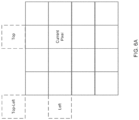
- PAETH predictor top, left and top-left reference samples are firstly fetched, and then the value that is closest to (top + left - topleft) is set as the predictor for the pixel to be predicted.
- FIG. 6A illustrates the positions of top, left, and top-left samples for one pixel in current block.
- SMOOTH, SMOOTH_V, and SMOOTH_H modes they predict the block using quadratic interpolation in vertical or horizontal directions, or the average of both directions.
- filter intra modes are designed for luma blocks.
- Five filter intra modes are defined for AV1, each represented by a set of eight 7-tap filters reflecting a correlation between pixels in a 4x2 patch and 7 neighbors adjacent to it.
- the weighting factors for a 7-tap filter are position dependent.
- For each patch its 7 neighbors, indicated by R0 ⁇ R6, are used to predict the pixels in current patch.
- Chroma from Luma is a chroma-only intra predictor that models chroma pixels as a linear function of coincident reconstructed luma pixels.
- L AC denotes the AC contribution of luma component
- ⁇ denotes the parameter of the linear model
- DC denotes the DC contribution of the chroma component.
- the reconstructed luma pixels are subsampled into the chroma resolution, and then the average value is subtracted to form the AC contribution.
- AV1 CfL determines the parameter ⁇ based on the original chroma pixels and signals them in the bitstream. This reduces decoder complexity and yields more precise predictions.
- the DC contribution of the chroma component it is computed using intra DC mode, which is sufficient for most chroma content and has mature fast implementations.
- AIPM allowed intra prediction mode set
- DIPM disallowed intra prediction mode
- AIPM is defined as one mode set with modes that can be used for intra prediction of a current block
- DIPM is defined as one mode set with modes that cannot be signaled or used for intra prediction of the current block.
- the modes in these two mode sets are derived according to the intra prediction modes of neighboring blocks. Neighboring modes are included in the AIPM set but not included in the DIPM set. The number of modes included in the AIPM and DIPM sets are predefined and fixed for all blocks. When the size of the AIPM set is S and the number of derived intra prediction modes from neighboring modes are less than S, the default modes are used to fill the AIPM set.
- DIMD decoder-side intra mode derivation
- An intra prediction mode is derived based on previously encoded/decoded pixels, and this is done in the same way at the encoder and decoder sides. Therefore, in the DIMD process, the signaling of an intra prediction mode index is avoided. This process defines a new coding mode called DIMD. One flag is signaled in the bitstream to indicate whether the DIMD mode is selected or not.
- a decoder-side intra mode derivation may be also called Derived Intra Mode, which has been implemented in proposals under the flag CONFIG_DERIVED_INTRA_MODE.
- IPM intra prediction mode
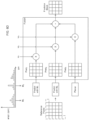
- Portion (c) of FIG. 6C shows an example of a HoG calculated after applying the above operations on all pixel positions in the template.
- this prediction fusion process may be used.
- DIMD uses neighboring samples of a current block to derive one or multiple angular IPMs and assign a shorter codeword for these derived IPMs.
- AIPM uses the IPMs of neighboring modes to derive a selected IPM list and assign a shorter codeword to the IPMs of neighboring modes. Both methods use the neighboring information to optimize the signaling of IPMs for the current block. However, there is no solution on how to combine these two methods together.
- Embodiments of a method and an apparatus for interactions between decoder-side intra mode derivation and adaptive intra prediction modes, are described herein.
- DIMD is a general term, and one process is called DIMD if it uses a neighboring reconstructed sample to derive an intra prediction mode.
- an AIPM set there are two intra prediction mode sets for each block, which are named an AIPM set and a DIPM set. All non-directional modes are always included in the AIPM set despite a block size of a current block and prediction modes of neighboring blocks.
- all non-directional smooth intra prediction modes in AV1 are always firstly inserted into an AIPM set despite intra prediction modes of neighboring blocks.
- DC, PAETH, SMOOTH, SMOOTH_V, and SMOOTH_H modes are always firstly included in an AIPM set despite intra prediction modes of neighboring blocks.
- modes included in an AIPM set can be split into K levels, K being a positive integer, such as 2 or 3 or 4.
- K being a positive integer, such as 2 or 3 or 4.
- a number of modes is equal to a number of non-directional modes.
- a number of modes is equal to a power of 2, such as 2 L , L being a positive integer larger than 1.
- a number of modes in an AIPM set may be S, and the AIPM set may have 3 levels.
- S is equal to K + 2 L + 2 M , wherein modes with an index smaller than K in the AIPM set are called first level modes, and modes with an index equal to or larger than K but smaller than K + 2 L in the AIPM set are called second level modes, and so on.
- all non-directional IPMs are placed in a first level of an AIPM set.
- only directional IPMs are included in an AIPM list, and a number of modes in the AIPM is set equal to a power of 2 or a sum of multiples of a power of 2.
- one flag is signaled to indicate whether a current block is a directional mode or not. If yes, a second flag is signaled to indicate an index of a current mode in an AIPM list. Otherwise, the second flag is signaled to indicate which non-directional mode the current mode is.
- one flag is signaled to indicate whether a current block is directional mode or not. If the current block is a directional mode, a second flag is signaled to indicate whether the current mode is a DIMD mode or not. If the current mode is not a DIMD mode, then a third flag is signaled to indicate an index of the current mode in an AIPM list. Otherwise if the current mode is a DIMD mode, then the third flag is avoided, and an IPM of the current block is derived from a decoder side. Otherwise if the current mode is not a directional IPM, then the second flag is signaled to indicate which non-directional mode the current mode is.
- IPMs derived from a DIMD process are always inserted into an AIPM list.
- the IPMs derived from the DIMD process are always firstly inserted into the AIPM list and placed in a first level of the AIPM list.
- an AIPM scheme is applied to a luma component only, while a DIMD scheme is applied to a chroma component only.
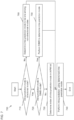
- FIG. 7 is a flowchart illustrating a method (700) of performing intra prediction of a current block of a picture of a video sequence, according to embodiments.
- one or more process blocks of FIG. 7 may be performed by the decoder (310).
- one or more process blocks of FIG. 7 may be performed by another device or a group of devices separate from or including the decoder (310), such as the encoder (303).
- the method (700) includes determining whether a first flag indicates that an intra prediction mode corresponding to the current block is a directional mode.
- the method (700) includes determining whether a second flag indicates that the intra prediction mode is a decoder-side intra mode derivation (DIMD) mode.
- DIMD decoder-side intra mode derivation
- the method (700) includes determining an index of the intra prediction mode in an allowed intra prediction modes (AIPM) list, and in a fourth block (740), the method (700) includes performing the intra prediction of the current block, using the intra prediction mode corresponding to the determined index in the AIPM list.
- AIPM allowed intra prediction modes
- the method (700) includes performing a DIMD to determine the intra prediction mode, and continues in the fourth block (740), in which the method (700) includes performing the intra prediction of the current block, using the determined intra prediction mode.
- the method (700) includes determining the intra prediction mode to be one among non-directional modes, and continues to the fourth block (740), in which the method (700) includes performing the intra prediction of the current block, using the determined intra prediction mode.
- the method (700) may further include inserting the intra prediction mode determined by performing the DIMD, first into a first level of the AIPM list.
- the method (700) may further include performing intra prediction of a luma component of the current block, using at least one intra prediction mode in the AIPM list.
- the method (700) may further include performing intra prediction of a chroma component of the current block, using the intra prediction mode determined by performing the DIMD.
- the AIPM list may include only directional modes, and a number of the directional modes included in the AIPM list may be equal to a power of 2 or a sum of multiples of the power of 2.
- FIG. 7 shows example blocks of the method (700), in some implementations, the method (700) may include additional blocks, fewer blocks, different blocks, or differently arranged blocks than those depicted in FIG. 7 . Additionally, or alternatively, two or more of the blocks of the method (700) may be performed in parallel.
- FIG. 8 is a simplified block diagram of an apparatus (800) for performing intra prediction of a current block of a picture of a video sequence, according to embodiments.
- the first determining code (805) is configured to cause at least one processor to determine whether a first flag indicates that an intra prediction mode corresponding to the current block is a directional mode.
- the third determining code (815) is configured to cause the at least one processor to, based on the first flag being determined to indicate that the intra prediction mode corresponding to the current block is the directional mode, determine whether a second flag indicates that the intra prediction mode is a decoder-side intra mode derivation (DIMD) mode.
- DIMD decoder-side intra mode derivation
- the second determining code (810) is configured to cause the at least one processor to, based on the second flag being determined to not indicate that the intra prediction mode corresponding to the current block is the DIMD mode, determine an index of the intra prediction mode in an allowed intra prediction modes (AIPM) list.
- AIPM allowed intra prediction modes
- the first performing code (820) is configured to cause the at least one processor to, based on the second flag being determined to not indicate that the intra prediction mode corresponding to the current block is the DIMD mode, perform the intra prediction of the current block, using the intra prediction mode corresponding to the determined index in the AIPM list.
- the second performing code (825) is configured to cause the at least one processor to, based on the second flag being determined to indicate that the intra prediction mode corresponding to the current block is the DIMD mode, perform a DIMD to determine the intra prediction mode.
- the first performing code (820) is further configured to cause the at least one processor to, based on the second flag being determined to indicate that the intra prediction mode corresponding to the current block is the DIMD mode, perform the intra prediction of the current block, using the determined intra prediction mode.
- the fourth determining code (830) is configured to cause the at least one processor to, based on the first flag being determined to not indicate that the intra prediction mode corresponding to the current block is the directional mode, determine the intra prediction mode to be one among non-directional modes.
- the first performing code (820) is further configured to cause the at least one processor to, based on the first flag being determined to not indicate that the intra prediction mode corresponding to the current block is the directional mode, perform the intra prediction of the current block, using the determined intra prediction mode.
- the apparatus (800) may further include inserting code configured to cause the at least one processor to insert the intra prediction mode determined by performing the DIMD, first into a first level of the AIPM list.
- the apparatus (800) may further include third performing code configured to cause the at least one processor to perform intra prediction of a luma component of the current block, using at least one intra prediction mode in the AIPM list.
- the third performing code may be further configured to cause the at least one processor to perform intra prediction of a chroma component of the current block, using the intra prediction mode determined by performing the DIMD.
- the AIPM list may include only directional modes, and a number of the directional modes included in the AIPM list may be equal to a power of 2 or a sum of multiples of the power of 2.
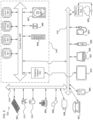
- FIG. 9 is a diagram of a computer system (900) suitable for implementing embodiments.
- the computer software can be coded using any suitable machine code or computer language, that may be subject to assembly, compilation, linking, or like mechanisms to create code including instructions that can be executed directly, or through interpretation, microcode execution, and the like, by computer central processing units (CPUs), Graphics Processing Units (GPUs), and the like.
- CPUs computer central processing units
- GPUs Graphics Processing Units
- the instructions can be executed on various types of computers or components thereof, including, for example, personal computers, tablet computers, servers, smartphones, gaming devices, internet of things devices, and the like.
- FIG. 9 for computer system (900) are examples in nature and are not intended to suggest any limitation as to the scope of use or functionality of the computer software implementing embodiments. Neither should the configuration of components be interpreted as having any dependency or requirement relating to any one or combination of components illustrated in embodiments of a computer system (900).
- Computer system (900) may include certain human interface input devices.
- a human interface input device may be responsive to input by one or more human users through, for example, tactile input (such as: keystrokes, swipes, data glove movements), audio input (such as: voice, clapping), visual input (such as: gestures), olfactory input (not depicted).
- the human interface devices can also be used to capture certain media not necessarily directly related to conscious input by a human, such as audio (such as: speech, music, ambient sound), images (such as: scanned images, photographic images obtain from a still image camera), video (such as two-dimensional video, three-dimensional video including stereoscopic video).
- Input human interface devices may include one or more of (only one of each depicted): keyboard (901), mouse (902), trackpad (903), touch screen (910), data-glove, joystick (905), microphone (906), scanner (907), camera (908).
- Computer system (900) can also include human accessible storage devices and their associated media such as optical media including CD/DVD ROM/RW (920) with CD/DVD or the like media (921), thumb-drive (922), removable hard drive or solid state drive (923), legacy magnetic media such as tape and floppy disc (not depicted), specialized ROM/ASIC/PLD based devices such as security dongles (not depicted), and the like.
- optical media including CD/DVD ROM/RW (920) with CD/DVD or the like media (921), thumb-drive (922), removable hard drive or solid state drive (923), legacy magnetic media such as tape and floppy disc (not depicted), specialized ROM/ASIC/PLD based devices such as security dongles (not depicted), and the like.
- Computer system (900) can also include interface(s) to one or more communication networks (955).
- Networks (955) can for example be wireless, wireline, optical.
- Networks (955) can further be local, wide-area, metropolitan, vehicular and industrial, real-time, delay-tolerant, and so on.
- Examples of networks (955) include local area networks such as Ethernet, wireless LANs, cellular networks to include global systems for mobile communications (GSM), third generation (3G), fourth generation (4G), fifth generation (5G), Long-Term Evolution (LTE), and the like, TV wireline or wireless wide area digital networks to include cable TV, satellite TV, and terrestrial broadcast TV, vehicular and industrial to include CANBus, and so forth.
- Certain networks (955) commonly require external network interface adapters that attached to certain general purpose data ports or peripheral buses ((949)) (such as, for example universal serial bus (USB) ports of the computer system (900); others are commonly integrated into the core of the computer system (900) by attachment to a system bus as described below (for example Ethernet interface into a PC computer system or cellular network interface (954) into a smartphone computer system).
- computer system (900) can communicate with other entities.
- Such communication can be uni-directional, receive only (for example, broadcast TV), uni-directional send-only (for example CANbus to certain CANbus devices), or bi-directional, for example to other computer systems using local or wide area digital networks.
- Certain protocols and protocol stacks can be used on each of those networks (955) and network interfaces (954) as described above.
- Aforementioned human interface devices, human-accessible storage devices, and network interfaces (954) can be attached to a core (940) of the computer system (900).
- the core (940) can include one or more Central Processing Units (CPU) (941), Graphics Processing Units (GPU) (942), specialized programmable processing units in the form of Field Programmable Gate Areas (FPGA) (943), hardware accelerators (944) for certain tasks, and so forth.
- CPU Central Processing Unit
- GPU Graphics Processing Unit
- FPGA Field Programmable Gate Areas
- ROM Read-only memory
- RAM Random-access memory
- SSD solid-state drives
- the peripheral devices can be attached either directly to the core's system bus (948), or through a peripheral bus (949). Architectures for a peripheral bus include peripheral component interconnect (PCI), USB, and the like.
- CPUs (941), GPUs (942), FPGAs (943), and accelerators (944) can execute certain instructions that, in combination, can make up the aforementioned computer code. That computer code can be stored in ROM (945) or RAM (946). Transitional data can also be stored in RAM (946), whereas permanent data can be stored for example, in the internal mass storage (947). Fast storage and retrieve to any of the memory devices can be enabled through the use of cache memory, that can be closely associated with one or more CPU (941), GPU (942), mass storage (947), ROM (945), RAM (946), and the like.
- the computer readable media can have computer code thereon for performing various computer-implemented operations.
- the media and computer code can be those specially designed and constructed for the purposes of embodiments, or they can be of the kind well known and available to those having skill in the computer software arts.
- the computer system having architecture (900), and specifically the core (940) can provide functionality as a result of processor(s) (including CPUs, GPUs, FPGA, accelerators, and the like) executing software embodied in one or more tangible, computer-readable media.
- processor(s) including CPUs, GPUs, FPGA, accelerators, and the like
- Such computer-readable media can be media associated with user-accessible mass storage as introduced above, as well as certain storage of the core (940) that are of non-transitory nature, such as core-internal mass storage (947) or ROM (945).
- the software implementing various embodiments can be stored in such devices and executed by core (940).
- a computer-readable medium can include one or more memory devices or chips, according to particular needs.
- the software can cause the core (940) and specifically the processors therein (including CPU, GPU, FPGA, and the like) to execute particular processes or particular parts of particular processes described herein, including defining data structures stored in RAM (946) and modifying such data structures according to the processes defined by the software.
- the computer system can provide functionality as a result of logic hardwired or otherwise embodied in a circuit (for example: accelerator (944)), which can operate in place of or together with software to execute particular processes or particular parts of particular processes described herein.
- Reference to software can encompass logic, and vice versa, where appropriate.
- Reference to a computer-readable media can encompass a circuit (such as an integrated circuit (IC)) storing software for execution, a circuit embodying logic for execution, or both, where appropriate.
- Embodiments encompass any suitable combination of hardware and software.
Landscapes
- Engineering & Computer Science (AREA)
- Multimedia (AREA)
- Signal Processing (AREA)
- Compression Or Coding Systems Of Tv Signals (AREA)
Priority Applications (1)
| Application Number | Priority Date | Filing Date | Title |
|---|---|---|---|
| EP25169796.7A EP4561063A3 (en) | 2020-02-05 | 2021-02-03 | Method and apparatus for interactions between decoder-side intra mode derivation and adaptive intra prediction modes |
Applications Claiming Priority (3)
| Application Number | Priority Date | Filing Date | Title |
|---|---|---|---|
| US202062970505P | 2020-02-05 | 2020-02-05 | |
| US17/094,923 US11197001B2 (en) | 2020-02-05 | 2020-11-11 | Method and apparatus for interactions between decoder-side intra mode derivation and adaptive intra prediction modes |
| PCT/US2021/016343 WO2021158615A1 (en) | 2020-02-05 | 2021-02-03 | Method and apparatus for interactions between decoder-side intra mode derivation and adaptive intra prediction modes |
Related Child Applications (2)
| Application Number | Title | Priority Date | Filing Date |
|---|---|---|---|
| EP25169796.7A Division EP4561063A3 (en) | 2020-02-05 | 2021-02-03 | Method and apparatus for interactions between decoder-side intra mode derivation and adaptive intra prediction modes |
| EP25169796.7A Division-Into EP4561063A3 (en) | 2020-02-05 | 2021-02-03 | Method and apparatus for interactions between decoder-side intra mode derivation and adaptive intra prediction modes |
Publications (3)
| Publication Number | Publication Date |
|---|---|
| EP3925221A1 EP3925221A1 (en) | 2021-12-22 |
| EP3925221A4 EP3925221A4 (en) | 2022-08-17 |
| EP3925221B1 true EP3925221B1 (en) | 2025-05-21 |
Family
ID=77062984
Family Applications (2)
| Application Number | Title | Priority Date | Filing Date |
|---|---|---|---|
| EP21750692.2A Active EP3925221B1 (en) | 2020-02-05 | 2021-02-03 | Method and apparatus for interactions between decoder-side intra mode derivation and adaptive intra prediction modes |
| EP25169796.7A Pending EP4561063A3 (en) | 2020-02-05 | 2021-02-03 | Method and apparatus for interactions between decoder-side intra mode derivation and adaptive intra prediction modes |
Family Applications After (1)
| Application Number | Title | Priority Date | Filing Date |
|---|---|---|---|
| EP25169796.7A Pending EP4561063A3 (en) | 2020-02-05 | 2021-02-03 | Method and apparatus for interactions between decoder-side intra mode derivation and adaptive intra prediction modes |
Country Status (6)
| Country | Link |
|---|---|
| US (3) | US11197001B2 (https=) |
| EP (2) | EP3925221B1 (https=) |
| JP (2) | JP7317994B2 (https=) |
| KR (1) | KR102780931B1 (https=) |
| CN (1) | CN113767633B (https=) |
| WO (1) | WO2021158615A1 (https=) |
Families Citing this family (31)
| Publication number | Priority date | Publication date | Assignee | Title |
|---|---|---|---|---|
| WO2022140718A1 (en) * | 2020-12-22 | 2022-06-30 | Qualcomm Incorporated | Decoder side intra mode derivation for most probable mode list construction in video coding |
| US11671589B2 (en) * | 2020-12-22 | 2023-06-06 | Qualcomm Incorporated | Decoder side intra mode derivation for most probable mode list construction in video coding |
| EP3962080A1 (en) * | 2020-08-26 | 2022-03-02 | Ateme | Method and apparatus for image processing |
| WO2022186616A1 (ko) * | 2021-03-04 | 2022-09-09 | 현대자동차주식회사 | 인트라 예측모드 유도를 이용하는 비디오 코딩방법 및 장치 |
| US12120335B2 (en) | 2021-08-24 | 2024-10-15 | Tencent America LLC | Hardware friendly design for intra mode coding |
| CN116472711A (zh) * | 2021-08-24 | 2023-07-21 | 腾讯美国有限责任公司 | 用于帧内模式编码的硬件友好设计 |
| CN117882378A (zh) * | 2021-09-22 | 2024-04-12 | 深圳市大疆创新科技有限公司 | 编解码方法及装置 |
| EP4412199A4 (en) | 2021-10-01 | 2025-10-08 | Lg Electronics Inc | INTRA-PREDICTION METHOD AND DEVICE BASED ON INTRA-PREDICTION MODE DERIVATION |
| CN118575475A (zh) * | 2021-12-30 | 2024-08-30 | Lg 电子株式会社 | 基于帧内预测模式推导的帧内预测方法和装置 |
| US12355982B2 (en) * | 2022-01-04 | 2025-07-08 | Alibaba (China) Co., Ltd | Decoder-side chroma intra prediction mode gradient-based derivation |
| US20250150583A1 (en) * | 2022-02-08 | 2025-05-08 | Lg Electronics Inc. | Image encoding/decoding method and apparatus, and recording medium having bitstream stored therein |
| EP4496307A4 (en) * | 2022-03-15 | 2026-03-04 | Kt Corp | METHOD AND DEVICE FOR IMAGE ENCODING/DECODING |
| EP4258662A1 (en) * | 2022-04-07 | 2023-10-11 | Beijing Xiaomi Mobile Software Co., Ltd. | Method and apparatus for dimd edge detection adjustment, and encoder/decoder including the same |
| EP4258670A1 (en) * | 2022-04-07 | 2023-10-11 | Beijing Xiaomi Mobile Software Co., Ltd. | Method and apparatus for dimd position dependent blending, and encoder/decoder including the same |
| EP4258668A1 (en) * | 2022-04-07 | 2023-10-11 | Beijing Xiaomi Mobile Software Co., Ltd. | Method and apparatus for dimd region-wise adaptive blending, and encoder/decoder including the same |
| WO2023200206A1 (ko) * | 2022-04-11 | 2023-10-19 | 현대자동차주식회사 | 영상 부호화/복호화 방법, 장치 및 비트스트림을 저장한 기록 매체 |
| CN119698832A (zh) | 2022-06-13 | 2025-03-25 | 联发科技股份有限公司 | 电子设备和视讯编译码的方法 |
| CN119366180A (zh) * | 2022-06-13 | 2025-01-24 | 联发科技股份有限公司 | 电子设备和视讯编译码的方法 |
| EP4554211A1 (en) * | 2022-07-05 | 2025-05-14 | LG Electronics Inc. | Image encoding/decoding method and apparatus, and recording medium having bitstream stored therein |
| EP4346202A1 (en) * | 2022-09-27 | 2024-04-03 | Beijing Xiaomi Mobile Software Co., Ltd. | Encoding/decoding video picture data |
| WO2024074751A1 (en) * | 2022-10-04 | 2024-04-11 | Nokia Technologies Oy | An apparatus, a method and a computer program for video coding and decoding |
| CN117956163A (zh) * | 2022-10-20 | 2024-04-30 | 腾讯科技(深圳)有限公司 | 一种视频处理方法及相关设备 |
| JP2025539793A (ja) * | 2022-11-18 | 2025-12-09 | エルジー エレクトロニクス インコーポレイティド | 映像エンコーディング/デコーディング方法及び装置、並びにビットストリームを保存した記録媒体 |
| WO2024125152A1 (en) * | 2022-12-12 | 2024-06-20 | Mediatek Inc. | Methods of apparatus of intra mode coding |
| CN120345241A (zh) * | 2022-12-16 | 2025-07-18 | 夏普株式会社 | 预测图像生成装置、视频解码装置、视频编码装置以及预测图像生成方法 |
| US12301889B2 (en) | 2023-02-03 | 2025-05-13 | Tencent America LLC | Systems and methods for blending block sections in a partition-based prediction mode |
| US12604000B2 (en) | 2023-02-03 | 2026-04-14 | Tencent America LLC | Systems and methods for partition-based prediction mode reordering |
| US12542900B2 (en) | 2023-02-03 | 2026-02-03 | Tencent America LLC | Systems and methods for blending inter-intra predictions |
| US20240357160A1 (en) * | 2023-04-24 | 2024-10-24 | Tencent America LLC | Inter coding in mesh compression |
| WO2025042121A1 (ko) * | 2023-08-18 | 2025-02-27 | 현대자동차주식회사 | 영상 부호화/복호화 방법, 장치 및 비트스트림을 저장한 기록 매체 |
| WO2026007136A1 (en) * | 2024-07-05 | 2026-01-08 | Shenzhen Tcl New Technology Co., Ltd. | Intra-prediction method for video coding involving template gradients and apparatus incorporating the same |
Family Cites Families (15)
| Publication number | Priority date | Publication date | Assignee | Title |
|---|---|---|---|---|
| EP2394437B1 (en) | 2009-02-06 | 2015-04-08 | Thomson Licensing | Methods and apparatus for implicit and semi-implicit intra mode signaling for video encoders and decoders |
| US9532058B2 (en) * | 2011-06-03 | 2016-12-27 | Qualcomm Incorporated | Intra prediction mode coding with directional partitions |
| GB2501535A (en) | 2012-04-26 | 2013-10-30 | Sony Corp | Chrominance Processing in High Efficiency Video Codecs |
| WO2017192995A1 (en) * | 2016-05-06 | 2017-11-09 | Vid Scale, Inc. | Method and system for decoder-side intra mode derivation for block-based video coding |
| US20170374369A1 (en) * | 2016-06-24 | 2017-12-28 | Mediatek Inc. | Methods and Apparatuses of Decoder Side Intra Mode Derivation |
| US20190215521A1 (en) * | 2016-09-22 | 2019-07-11 | Mediatek Inc. | Method and apparatus for video coding using decoder side intra prediction derivation |
| US20200036985A1 (en) | 2016-09-30 | 2020-01-30 | Lg Electronics Inc. | Method and apparatus for block partitioning and intra prediction in image coding system |
| KR102357283B1 (ko) * | 2016-10-14 | 2022-01-28 | 세종대학교산학협력단 | 영상의 부호화/복호화 방법 및 장치 |
| WO2018070790A1 (ko) * | 2016-10-14 | 2018-04-19 | 세종대학교 산학협력단 | 영상의 부호화/복호화 방법 및 장치 |
| US10609367B2 (en) * | 2016-12-21 | 2020-03-31 | Qualcomm Incorporated | Low-complexity sign prediction for video coding |
| WO2019007490A1 (en) * | 2017-07-04 | 2019-01-10 | Huawei Technologies Co., Ltd. | DECODER INTEGRATED MODE (DIMD) INTEGRATED DEVICE TOOL CALCULATION COMPLEXITY REDUCTION |
| WO2019007492A1 (en) * | 2017-07-04 | 2019-01-10 | Huawei Technologies Co., Ltd. | INTRAMODE BYPASS LINE MEMORY HARMONIZATION DECODER SIDE WITH UNBLOCKING FILTER |
| KR20190142748A (ko) * | 2018-06-18 | 2019-12-27 | 세종대학교산학협력단 | 영상 부호화/복호화 방법, 장치 및 비트스트림을 저장한 기록 매체 |
| US10469845B1 (en) * | 2018-09-21 | 2019-11-05 | Tencent America, Llc | Method and apparatus for intra mode coding |
| JP6974377B2 (ja) * | 2019-03-11 | 2021-12-01 | Kddi株式会社 | 画像復号装置、画像復号方法及びプログラム |
-
2020
- 2020-11-11 US US17/094,923 patent/US11197001B2/en active Active
-
2021
- 2021-02-03 KR KR1020217033611A patent/KR102780931B1/ko active Active
- 2021-02-03 JP JP2021561659A patent/JP7317994B2/ja active Active
- 2021-02-03 EP EP21750692.2A patent/EP3925221B1/en active Active
- 2021-02-03 EP EP25169796.7A patent/EP4561063A3/en active Pending
- 2021-02-03 CN CN202180002983.0A patent/CN113767633B/zh active Active
- 2021-02-03 WO PCT/US2021/016343 patent/WO2021158615A1/en not_active Ceased
- 2021-10-12 US US17/499,306 patent/US11595666B2/en active Active
-
2023
- 2023-01-24 US US18/158,775 patent/US11930187B2/en active Active
- 2023-07-19 JP JP2023117692A patent/JP7592797B2/ja active Active
Also Published As
| Publication number | Publication date |
|---|---|
| US20230171412A1 (en) | 2023-06-01 |
| CN113767633B (zh) | 2025-08-22 |
| JP7592797B2 (ja) | 2024-12-02 |
| KR20210134407A (ko) | 2021-11-09 |
| JP7317994B2 (ja) | 2023-07-31 |
| EP3925221A4 (en) | 2022-08-17 |
| JP2023126577A (ja) | 2023-09-07 |
| EP3925221A1 (en) | 2021-12-22 |
| KR102780931B1 (ko) | 2025-03-17 |
| WO2021158615A1 (en) | 2021-08-12 |
| EP4561063A3 (en) | 2025-07-23 |
| US20220030252A1 (en) | 2022-01-27 |
| US11197001B2 (en) | 2021-12-07 |
| US11595666B2 (en) | 2023-02-28 |
| US20210243452A1 (en) | 2021-08-05 |
| JP2022529645A (ja) | 2022-06-23 |
| US11930187B2 (en) | 2024-03-12 |
| EP4561063A2 (en) | 2025-05-28 |
| CN113767633A (zh) | 2021-12-07 |
Similar Documents
| Publication | Publication Date | Title |
|---|---|---|
| US11930187B2 (en) | Interactions between decoder-side intra mode derivation and adaptive intra prediction modes | |
| US11818366B2 (en) | Method and apparatus for intra mode coding | |
| US20240146928A1 (en) | Improved context design for prediction mode and cbf | |
| US20200092544A1 (en) | Method and device for mpm list generation for multi-line intra prediction | |
| EP3891996A1 (en) | Method and apparatus for further improved context design for prediction mode and coded block flag (cbf) | |
| US11438583B2 (en) | Reference sample filter selection in intra prediction | |
| US11949856B2 (en) | Intra mode selection in intra prediction | |
| US11601654B2 (en) | Coefficient scanning methods on adaptive angle mode |
Legal Events
| Date | Code | Title | Description |
|---|---|---|---|
| STAA | Information on the status of an ep patent application or granted ep patent |
Free format text: STATUS: THE INTERNATIONAL PUBLICATION HAS BEEN MADE |
|
| PUAI | Public reference made under article 153(3) epc to a published international application that has entered the european phase |
Free format text: ORIGINAL CODE: 0009012 |
|
| STAA | Information on the status of an ep patent application or granted ep patent |
Free format text: STATUS: REQUEST FOR EXAMINATION WAS MADE |
|
| 17P | Request for examination filed |
Effective date: 20210913 |
|
| AK | Designated contracting states |
Kind code of ref document: A1 Designated state(s): AL AT BE BG CH CY CZ DE DK EE ES FI FR GB GR HR HU IE IS IT LI LT LU LV MC MK MT NL NO PL PT RO RS SE SI SK SM TR |
|
| A4 | Supplementary search report drawn up and despatched |
Effective date: 20220715 |
|
| RIC1 | Information provided on ipc code assigned before grant |
Ipc: H04N 19/119 20140101ALI20220711BHEP Ipc: H04N 19/176 20140101AFI20220711BHEP |
|
| DAV | Request for validation of the european patent (deleted) | ||
| DAX | Request for extension of the european patent (deleted) | ||
| GRAP | Despatch of communication of intention to grant a patent |
Free format text: ORIGINAL CODE: EPIDOSNIGR1 |
|
| STAA | Information on the status of an ep patent application or granted ep patent |
Free format text: STATUS: GRANT OF PATENT IS INTENDED |
|
| INTG | Intention to grant announced |
Effective date: 20241211 |
|
| GRAS | Grant fee paid |
Free format text: ORIGINAL CODE: EPIDOSNIGR3 |
|
| GRAA | (expected) grant |
Free format text: ORIGINAL CODE: 0009210 |
|
| STAA | Information on the status of an ep patent application or granted ep patent |
Free format text: STATUS: THE PATENT HAS BEEN GRANTED |
|
| AK | Designated contracting states |
Kind code of ref document: B1 Designated state(s): AL AT BE BG CH CY CZ DE DK EE ES FI FR GB GR HR HU IE IS IT LI LT LU LV MC MK MT NL NO PL PT RO RS SE SI SK SM TR |
|
| REG | Reference to a national code |
Ref country code: GB Ref legal event code: FG4D |
|
| REG | Reference to a national code |
Ref country code: CH Ref legal event code: EP |
|
| REG | Reference to a national code |
Ref country code: DE Ref legal event code: R096 Ref document number: 602021031150 Country of ref document: DE |
|
| REG | Reference to a national code |
Ref country code: IE Ref legal event code: FG4D |
|
| REG | Reference to a national code |
Ref country code: NL Ref legal event code: FP |
|
| PG25 | Lapsed in a contracting state [announced via postgrant information from national office to epo] |
Ref country code: PT Free format text: LAPSE BECAUSE OF FAILURE TO SUBMIT A TRANSLATION OF THE DESCRIPTION OR TO PAY THE FEE WITHIN THE PRESCRIBED TIME-LIMIT Effective date: 20250922 Ref country code: FI Free format text: LAPSE BECAUSE OF FAILURE TO SUBMIT A TRANSLATION OF THE DESCRIPTION OR TO PAY THE FEE WITHIN THE PRESCRIBED TIME-LIMIT Effective date: 20250521 Ref country code: ES Free format text: LAPSE BECAUSE OF FAILURE TO SUBMIT A TRANSLATION OF THE DESCRIPTION OR TO PAY THE FEE WITHIN THE PRESCRIBED TIME-LIMIT Effective date: 20250521 |
|
| REG | Reference to a national code |
Ref country code: LT Ref legal event code: MG9D |
|
| PG25 | Lapsed in a contracting state [announced via postgrant information from national office to epo] |
Ref country code: NO Free format text: LAPSE BECAUSE OF FAILURE TO SUBMIT A TRANSLATION OF THE DESCRIPTION OR TO PAY THE FEE WITHIN THE PRESCRIBED TIME-LIMIT Effective date: 20250821 Ref country code: GR Free format text: LAPSE BECAUSE OF FAILURE TO SUBMIT A TRANSLATION OF THE DESCRIPTION OR TO PAY THE FEE WITHIN THE PRESCRIBED TIME-LIMIT Effective date: 20250822 |
|
| PG25 | Lapsed in a contracting state [announced via postgrant information from national office to epo] |
Ref country code: PL Free format text: LAPSE BECAUSE OF FAILURE TO SUBMIT A TRANSLATION OF THE DESCRIPTION OR TO PAY THE FEE WITHIN THE PRESCRIBED TIME-LIMIT Effective date: 20250521 |
|
| PG25 | Lapsed in a contracting state [announced via postgrant information from national office to epo] |
Ref country code: BG Free format text: LAPSE BECAUSE OF FAILURE TO SUBMIT A TRANSLATION OF THE DESCRIPTION OR TO PAY THE FEE WITHIN THE PRESCRIBED TIME-LIMIT Effective date: 20250521 |
|
| PG25 | Lapsed in a contracting state [announced via postgrant information from national office to epo] |
Ref country code: HR Free format text: LAPSE BECAUSE OF FAILURE TO SUBMIT A TRANSLATION OF THE DESCRIPTION OR TO PAY THE FEE WITHIN THE PRESCRIBED TIME-LIMIT Effective date: 20250521 |
|
| PG25 | Lapsed in a contracting state [announced via postgrant information from national office to epo] |
Ref country code: RS Free format text: LAPSE BECAUSE OF FAILURE TO SUBMIT A TRANSLATION OF THE DESCRIPTION OR TO PAY THE FEE WITHIN THE PRESCRIBED TIME-LIMIT Effective date: 20250821 |
|
| PG25 | Lapsed in a contracting state [announced via postgrant information from national office to epo] |
Ref country code: IS Free format text: LAPSE BECAUSE OF FAILURE TO SUBMIT A TRANSLATION OF THE DESCRIPTION OR TO PAY THE FEE WITHIN THE PRESCRIBED TIME-LIMIT Effective date: 20250921 |
|
| PG25 | Lapsed in a contracting state [announced via postgrant information from national office to epo] |
Ref country code: LV Free format text: LAPSE BECAUSE OF FAILURE TO SUBMIT A TRANSLATION OF THE DESCRIPTION OR TO PAY THE FEE WITHIN THE PRESCRIBED TIME-LIMIT Effective date: 20250521 |
|
| REG | Reference to a national code |
Ref country code: AT Ref legal event code: MK05 Ref document number: 1797861 Country of ref document: AT Kind code of ref document: T Effective date: 20250521 |
|
| PG25 | Lapsed in a contracting state [announced via postgrant information from national office to epo] |
Ref country code: SM Free format text: LAPSE BECAUSE OF FAILURE TO SUBMIT A TRANSLATION OF THE DESCRIPTION OR TO PAY THE FEE WITHIN THE PRESCRIBED TIME-LIMIT Effective date: 20250521 Ref country code: AT Free format text: LAPSE BECAUSE OF FAILURE TO SUBMIT A TRANSLATION OF THE DESCRIPTION OR TO PAY THE FEE WITHIN THE PRESCRIBED TIME-LIMIT Effective date: 20250521 Ref country code: DK Free format text: LAPSE BECAUSE OF FAILURE TO SUBMIT A TRANSLATION OF THE DESCRIPTION OR TO PAY THE FEE WITHIN THE PRESCRIBED TIME-LIMIT Effective date: 20250521 |
|
| PG25 | Lapsed in a contracting state [announced via postgrant information from national office to epo] |
Ref country code: CZ Free format text: LAPSE BECAUSE OF FAILURE TO SUBMIT A TRANSLATION OF THE DESCRIPTION OR TO PAY THE FEE WITHIN THE PRESCRIBED TIME-LIMIT Effective date: 20250521 |
|
| PG25 | Lapsed in a contracting state [announced via postgrant information from national office to epo] |
Ref country code: EE Free format text: LAPSE BECAUSE OF FAILURE TO SUBMIT A TRANSLATION OF THE DESCRIPTION OR TO PAY THE FEE WITHIN THE PRESCRIBED TIME-LIMIT Effective date: 20250521 |
|
| PG25 | Lapsed in a contracting state [announced via postgrant information from national office to epo] |
Ref country code: SK Free format text: LAPSE BECAUSE OF FAILURE TO SUBMIT A TRANSLATION OF THE DESCRIPTION OR TO PAY THE FEE WITHIN THE PRESCRIBED TIME-LIMIT Effective date: 20250521 Ref country code: RO Free format text: LAPSE BECAUSE OF FAILURE TO SUBMIT A TRANSLATION OF THE DESCRIPTION OR TO PAY THE FEE WITHIN THE PRESCRIBED TIME-LIMIT Effective date: 20250521 |
|
| PG25 | Lapsed in a contracting state [announced via postgrant information from national office to epo] |
Ref country code: IT Free format text: LAPSE BECAUSE OF FAILURE TO SUBMIT A TRANSLATION OF THE DESCRIPTION OR TO PAY THE FEE WITHIN THE PRESCRIBED TIME-LIMIT Effective date: 20250521 |
|
| REG | Reference to a national code |
Ref country code: DE Ref legal event code: R097 Ref document number: 602021031150 Country of ref document: DE |
|
| PGFP | Annual fee paid to national office [announced via postgrant information from national office to epo] |
Ref country code: NL Payment date: 20260218 Year of fee payment: 6 |
|
| PLBE | No opposition filed within time limit |
Free format text: ORIGINAL CODE: 0009261 |
|
| STAA | Information on the status of an ep patent application or granted ep patent |
Free format text: STATUS: NO OPPOSITION FILED WITHIN TIME LIMIT |
|
| REG | Reference to a national code |
Ref country code: CH Ref legal event code: L10 Free format text: ST27 STATUS EVENT CODE: U-0-0-L10-L00 (AS PROVIDED BY THE NATIONAL OFFICE) Effective date: 20260402 |
|
| PGFP | Annual fee paid to national office [announced via postgrant information from national office to epo] |
Ref country code: GB Payment date: 20260219 Year of fee payment: 6 |
|
| PGFP | Annual fee paid to national office [announced via postgrant information from national office to epo] |
Ref country code: DE Payment date: 20260217 Year of fee payment: 6 |
|
| PGFP | Annual fee paid to national office [announced via postgrant information from national office to epo] |
Ref country code: FR Payment date: 20260219 Year of fee payment: 6 |
|
| 26N | No opposition filed |
Effective date: 20260224 |