EP3924680B1 - Matratzenlagenanordnung mit mindestens einer lage mit phasenwechselmaterialien - Google Patents
Matratzenlagenanordnung mit mindestens einer lage mit phasenwechselmaterialien Download PDFInfo
- Publication number
- EP3924680B1 EP3924680B1 EP20711404.2A EP20711404A EP3924680B1 EP 3924680 B1 EP3924680 B1 EP 3924680B1 EP 20711404 A EP20711404 A EP 20711404A EP 3924680 B1 EP3924680 B1 EP 3924680B1
- Authority
- EP
- European Patent Office
- Prior art keywords
- layer
- phase change
- mattress
- change material
- assembly
- Prior art date
- Legal status (The legal status is an assumption and is not a legal conclusion. Google has not performed a legal analysis and makes no representation as to the accuracy of the status listed.)
- Active
Links
Images

Classifications
-
- F—MECHANICAL ENGINEERING; LIGHTING; HEATING; WEAPONS; BLASTING
- F28—HEAT EXCHANGE IN GENERAL
- F28D—HEAT-EXCHANGE APPARATUS, NOT PROVIDED FOR IN ANOTHER SUBCLASS, IN WHICH THE HEAT-EXCHANGE MEDIA DO NOT COME INTO DIRECT CONTACT
- F28D20/00—Heat storage plants or apparatus in general; Regenerative heat-exchange apparatus not covered by groups F28D17/00 or F28D19/00
- F28D20/02—Heat storage plants or apparatus in general; Regenerative heat-exchange apparatus not covered by groups F28D17/00 or F28D19/00 using latent heat
- F28D20/023—Heat storage plants or apparatus in general; Regenerative heat-exchange apparatus not covered by groups F28D17/00 or F28D19/00 using latent heat the latent heat storage material being enclosed in granular particles or dispersed in a porous, fibrous or cellular structure
-
- A—HUMAN NECESSITIES
- A47—FURNITURE; DOMESTIC ARTICLES OR APPLIANCES; COFFEE MILLS; SPICE MILLS; SUCTION CLEANERS IN GENERAL
- A47C—CHAIRS; SOFAS; BEDS
- A47C21/00—Attachments for beds, e.g. sheet holders or bed-cover holders; Ventilating, cooling or heating means in connection with bedsteads or mattresses
- A47C21/04—Devices for ventilating, cooling or heating
- A47C21/042—Devices for ventilating, cooling or heating for ventilating or cooling
- A47C21/046—Devices for ventilating, cooling or heating for ventilating or cooling without active means, e.g. with openings or heat conductors
-
- A—HUMAN NECESSITIES
- A47—FURNITURE; DOMESTIC ARTICLES OR APPLIANCES; COFFEE MILLS; SPICE MILLS; SUCTION CLEANERS IN GENERAL
- A47C—CHAIRS; SOFAS; BEDS
- A47C21/00—Attachments for beds, e.g. sheet holders or bed-cover holders; Ventilating, cooling or heating means in connection with bedsteads or mattresses
- A47C21/04—Devices for ventilating, cooling or heating
- A47C21/048—Devices for ventilating, cooling or heating for heating
-
- A—HUMAN NECESSITIES
- A47—FURNITURE; DOMESTIC ARTICLES OR APPLIANCES; COFFEE MILLS; SPICE MILLS; SUCTION CLEANERS IN GENERAL
- A47C—CHAIRS; SOFAS; BEDS
- A47C27/00—Spring, stuffed or fluid mattresses or cushions specially adapted for chairs, beds or sofas
- A47C27/04—Spring, stuffed or fluid mattresses or cushions specially adapted for chairs, beds or sofas with spring inlays
-
- A—HUMAN NECESSITIES
- A47—FURNITURE; DOMESTIC ARTICLES OR APPLIANCES; COFFEE MILLS; SPICE MILLS; SUCTION CLEANERS IN GENERAL
- A47C—CHAIRS; SOFAS; BEDS
- A47C27/00—Spring, stuffed or fluid mattresses or cushions specially adapted for chairs, beds or sofas
- A47C27/04—Spring, stuffed or fluid mattresses or cushions specially adapted for chairs, beds or sofas with spring inlays
- A47C27/06—Spring inlays
- A47C27/063—Spring inlays wrapped or otherwise protected
- A47C27/064—Pocketed springs
-
- A—HUMAN NECESSITIES
- A47—FURNITURE; DOMESTIC ARTICLES OR APPLIANCES; COFFEE MILLS; SPICE MILLS; SUCTION CLEANERS IN GENERAL
- A47C—CHAIRS; SOFAS; BEDS
- A47C27/00—Spring, stuffed or fluid mattresses or cushions specially adapted for chairs, beds or sofas
- A47C27/14—Spring, stuffed or fluid mattresses or cushions specially adapted for chairs, beds or sofas with foamed material inlays
- A47C27/148—Spring, stuffed or fluid mattresses or cushions specially adapted for chairs, beds or sofas with foamed material inlays of different resilience
-
- A—HUMAN NECESSITIES
- A47—FURNITURE; DOMESTIC ARTICLES OR APPLIANCES; COFFEE MILLS; SPICE MILLS; SUCTION CLEANERS IN GENERAL
- A47C—CHAIRS; SOFAS; BEDS
- A47C27/00—Spring, stuffed or fluid mattresses or cushions specially adapted for chairs, beds or sofas
- A47C27/14—Spring, stuffed or fluid mattresses or cushions specially adapted for chairs, beds or sofas with foamed material inlays
- A47C27/15—Spring, stuffed or fluid mattresses or cushions specially adapted for chairs, beds or sofas with foamed material inlays consisting of two or more layers
-
- A—HUMAN NECESSITIES
- A61—MEDICAL OR VETERINARY SCIENCE; HYGIENE
- A61F—FILTERS IMPLANTABLE INTO BLOOD VESSELS; PROSTHESES; DEVICES PROVIDING PATENCY TO, OR PREVENTING COLLAPSING OF, TUBULAR STRUCTURES OF THE BODY, e.g. STENTS; ORTHOPAEDIC, NURSING OR CONTRACEPTIVE DEVICES; FOMENTATION; TREATMENT OR PROTECTION OF EYES OR EARS; BANDAGES, DRESSINGS OR ABSORBENT PADS; FIRST-AID KITS
- A61F7/00—Heating or cooling appliances for medical or therapeutic treatment of the human body
- A61F7/02—Compresses or poultices for effecting heating or cooling
-
- A—HUMAN NECESSITIES
- A47—FURNITURE; DOMESTIC ARTICLES OR APPLIANCES; COFFEE MILLS; SPICE MILLS; SUCTION CLEANERS IN GENERAL
- A47C—CHAIRS; SOFAS; BEDS
- A47C27/00—Spring, stuffed or fluid mattresses or cushions specially adapted for chairs, beds or sofas
- A47C27/08—Fluid mattresses
- A47C27/081—Fluid mattresses of pneumatic type
-
- A—HUMAN NECESSITIES
- A47—FURNITURE; DOMESTIC ARTICLES OR APPLIANCES; COFFEE MILLS; SPICE MILLS; SUCTION CLEANERS IN GENERAL
- A47C—CHAIRS; SOFAS; BEDS
- A47C31/00—Details or accessories for chairs, beds, or the like, not provided for in other groups of this subclass, e.g. upholstery fasteners, mattress protectors, stretching devices for mattress nets
- A47C31/12—Means, e.g. measuring means, for adapting chairs, beds or mattresses to the shape or weight of persons
- A47C31/123—Means, e.g. measuring means, for adapting chairs, beds or mattresses to the shape or weight of persons for beds or mattresses
-
- A—HUMAN NECESSITIES
- A61—MEDICAL OR VETERINARY SCIENCE; HYGIENE
- A61F—FILTERS IMPLANTABLE INTO BLOOD VESSELS; PROSTHESES; DEVICES PROVIDING PATENCY TO, OR PREVENTING COLLAPSING OF, TUBULAR STRUCTURES OF THE BODY, e.g. STENTS; ORTHOPAEDIC, NURSING OR CONTRACEPTIVE DEVICES; FOMENTATION; TREATMENT OR PROTECTION OF EYES OR EARS; BANDAGES, DRESSINGS OR ABSORBENT PADS; FIRST-AID KITS
- A61F7/00—Heating or cooling appliances for medical or therapeutic treatment of the human body
- A61F7/02—Compresses or poultices for effecting heating or cooling
- A61F2007/0292—Compresses or poultices for effecting heating or cooling using latent heat produced or absorbed during phase change of materials, e.g. of super-cooled solutions
Definitions
- the present disclosure generally relates to mattress layer assemblies including at least one layer including phase change materials.
- Phase change is a term used to describe a reversible process in which a solid turns into a liquid or a gas.
- the process of phase change from a solid to a liquid requires energy to be absorbed by the solid.
- a phase change material (“PCM”) liquefies, energy is absorbed from the immediate environment as it changes from the solid to the liquid.
- PCM phase change material
- a phase change material absorbs and releases a large quantity of energy in the vicinity of its melting/freezing point. Therefore, a PCM that melts below body temperature would feel cool as it absorbs heat, for example, from a body.
- Phase change materials therefore, include materials that liquefy (melt) to absorb heat and solidify (freeze) to release heat. The melting and freezing of the material typically take place over a narrow temperature range.
- PCMs have been used in various applications ranging from household insulation to clothing. Dispersal in pre-formed foams is expensive, involves an additional step after formation of the foam, and typically does not uniformly distribute the PCMs throughout foams greater than one inch in thickness.
- the PCM is microencapsulated.
- the PCM material itself is a relatively inexpensive long chain hydrocarbon that is subsequently microencapsulated.
- Exemplary long chain hydrocarbons include octadecane, nonadecane, icosane, heptadecane, and the like. These materials have low melting point temperatures.
- the microencapsulation process dramatically increases the price of the PCM. As one decreases the overall size of the microencapsulated PCM, the net volume of the PCM within the microencapsulated PCM significantly decreases whereas the volume taken up by the capsule increases.
- US 2018/049914 discloses a thermal composite material and devices that incorporate the material control skin temperature within a specified range during standard cold therapy or heat therapy.
- the material and subsequent devices can also have a structural input-output feature to apply and measure a degree of compression.
- a primary use is as portable means for the immediate treatment of soft tissue injury. Secondary uses include use as portable means to aid temperature regulation in hot or cold environments for comfort or safety purpose.
- US5837002 discloses a focal cooling apparatus, which includes a cooling, or heat sinking, layer over which a layer of compressible, thermally insulating material is disposed.
- the layer of compressible, thermally insulating material has a surface for supporting a portion of a human (or animal) body.
- the layer of compressible, thermally insulating material responds to pressure exerted against the surface by exhibiting a thermal resistance between the surface and the cooling layer that varies inversely with the pressure.
- Means are provided for maintaining the cooling layer at a predetermined temperature below normal human temperature.
- US 2012/023664 discloses a cooling mat in which an effective cooling effect can be promoted by a simple structure free from separate manipulation or external power sources, capable of increasing reliability in operation and portability, the cooling mat including: a plurality of cooling pads filled therein with a phase change material; an upper cover coupled to the cooling pad, lengthwise formed with a plurality of openings and exposing an upper surface of the cooling pad through the openings; a bottom cover coupled to the upper cover at an edge portion; and a folding unit formed between the openings of the upper cover to provide a bending flexibility.
- mattresses including at least one panel or layer including phase change materials encapsulated with a preformed capsulate sheet similar to so-called bubble wrap including individual cells and/or interconnected cells that can be filled with the desired phase change material or mixture of phase change materials.
- the preformed capsulate sheets are formed of materials selected to have mechanical properties sufficient to accommodate volume changes that may occur during phase change transitions, withstand the rigors of product durability, and maintain thermal and tactile comfort during use in a variety of end use environments.
- At least one panel or layer including the phase change materials can be used as a topper layer and/or as one or more of the layers defining the mattress.
- At least one panel or layer including the encapsulated phase change materials is at or proximate to a sleeping surface and may span the length and/or width of the sleeping surface or a portion thereof to define one or more zones.
- the multiple zones of the phase change material can be the same or different phase change material, can have different amounts of the phase change material depending on location one the sleeping surface, and/or can include different cell configurations of the preformed capsulate sheet.
- Phase change materials are relatively inexpensive whereas the cost to manufacture and encapsulate prior art microencapsulated phase change materials are relatively high since the encapsulate material has a high surface area relative to the amount of phase change material contained within each cell.
- the preformed capsulate sheets of the present invention provide a markedly higher volume of phase change material to be encapsulated that lowers the surface area of the encapsulate material relative to the amount of phase change material, thereby providing a significant cost reduction.
- the present invention instead of milligrams to grams of phase change material within a given layer as is currently done in the prior art, the present invention provides the capability of utilizing hundreds of grams or pounds of phase change material within a given layer as may be desired for different applications.
- the increased amount of phase change material within a given layer can be configured to extend the effective solid to liquid or liquid to solid transition time of the phase change material throughout an entire sleep cycle of 8 hours or more, which is unlike prior art microencapsulated phase change layers that generally provide an effective transition time of a few minutes to about 30 minutes.
- transition time generally refers to the time of the transition of the phase change material per unit cell volume of the phase change material during use by an end user on the mattress. For example, an end user would feel cool as the phase change material absorbs heat from the end user during the sleep cycle.
- the amount of phase change material within a given cell can be calculated to provide cooling or heating from about 30 minutes to about 8 hours or longer.
- the cells within the sheet can have the same or different shape and/or size.
- the cells can be individual cells or linked cells, wherein the linked cells may have a fluid connection therebetween and/or at least one shared wall.
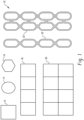
- the exemplary individual cells 10 can have any geometric shape such as the illustrated square shape 12, circular shape 14, or hexagonal shape 16. Further illustrated are linear linked cells 18, multi-linked cells 20, and fluidly interconnected channels 22 connecting different cells that allow the flow of PCM material between the cells.
- the cellular volumes are generally greater than 1 cm 3 .
- FIG. 2 shows an exploded perspective view of an exemplary mattress assembly including a phase change capsulate sheet layer as described above.
- the mattress assembly 100 includes a base core layer 102 configured with generally planar top and bottom surfaces but may include surfaces that are not flat such as convoluted foams.
- the core layer 102 is chosen to have a thickness less than or about equal to the overall thickness of the mattress assembly.
- the thickness of the core layer 102 is within a range of 4 inches to 10 inches, with a range of about 6 inches to 8 inches thickness in other embodiments, and a range of about 6 to 6.5 inches in still other embodiments.
- the core layer 102 can be formed of open or closed cell foam including, without limitation, viscoelastic foams, non-viscoelastic foams, latex foams, polyurethane foams, and the like.
- the core layer 102 is pre-stressed foam layer. That is, the foam core layer is subjected to a pre-stressing process such as disclosed in U.S. Pat. No. 7,690,096 to Gladney et a..
- a force can applied to at least a section of the foam core layer in an amount sufficient to temporarily compress its height so as to permanently alter a mechanical property of the foam layer to provide a pre-stressed foam layer having a firmness that is different from the firmness of a similar foam that was not pre-stressed.
- the foam core layer 102 has a density of 0.016 g/cm 3 (1 pound per cubic foot (lb/ft 3 )) to 0,096 g/cm 3 (6 lb/ft 3 ).
- the density is 0.016 g/cm 3 (1 lb/ft 3 ) to 0,0800 g/cm 3 (5 lb/ft 3 ) and in still other embodiments, from 0.024 g/cm 3 (1.5 lb/ft 3 ) to 0.064 g/cm 3 (4 lb/ft 3 ).
- the density can be about 0.024 g/cm 3 (1.5 lb/ft 3 ).
- the hardness of the foam core layer also referred to as the indention load deflection (ILD) or indention force deflection (IFD) is within a range of 9.07 kg (20 pounds) to 20.41 kg (45 pounds)-force, wherein the hardness is measured in accordance with ASTM D-3574 and is generally defined as the amount of force in pounds required to indent a 20.32 cm (8") disc into a 38.1 cm (15") ⁇ 38.1 cm (15") ⁇ 10.16 cm (4") foam sample and make a 2.54 cm (1") indentation. In other embodiments, the hardness is about 9.07 kg (20 pounds) to 13.61 kg (30 pounds)-force.
- the core layer 102 could be constructed of an innerspring assembly, an air bladder, an air/foam bladder or bladder filled with any fluid.
- the coil springs of the innerspring assembly may be open coils or may be encased coils, e.g., pocketed (Marshall) coils.
- the coil spring layer may further include foam. Bordering the outer row of the coil springs in the innerspring assembly is a side rail (not shown) made, for example, of foam or another suitable material known to those skilled in the art.
- the core layer 102 may further include foam rail encasement around the bladders and may also include foam layers consisting of open or closed cell foam including, without limitation, viscoelastic foams, non-viscoelastic foams, latex foams, polyurethane foams, and the like place above or below the bladders.
- Phase change preformed capsulate layer 104 overlays the core layer 102 and is positioned proximate to a sleeping surface.
- the phase change provides extended cooling as needed to an end user of the mattress assembly.
- the phase change layer 104 generally has a thickness equal to or less than 5.08 cm (2 inches) in some embodiments, a thickness equal to or less than linch in other embodiments, or a thickness equal to or less than 1.27 cm (0.5 inches) in still other embodiments. In other embodiments, the thickness is greater than or equal to 1.27 cm (0.5 inch).
- the amount of phase change material in the preformed capsulate layer 104 is at least 100 grams per square foot of surface area, greater than about 200 grams per square foot in other embodiments, and greater than about 454 grams per square foot in still other embodiments.
- the phase change capsulate sheet layer 104 includes a plurality of cells 108 formed of a flexible material such as polyethylene.
- the cells are filled with a phase change material 110 or a mixture of phase change materials.
- additional material(s) such as flame retardants, antibacterial agents, thermally conductive components, and/or the like can be included in the cells.
- the phase change layer 104 has a generally planar top and bottom surface and is intended to be sandwiched between layers as is generally shown in FIG. 2 . Although the phase change layer is shown spanning the width and length of the mattress assembly, it should be apparent that phase change layer can be configured to span a portion of the mattress assembly so as to provide one or more different zones.
- a phase change layer 104 configured for use in queen sized mattress can have a width of 151.13 cm (59.5 inches) and a length of 201.93 cm (79.5 inches) or span a portion thereof.
- the capsulate sheet layer 104 can contain channels or interconnected cells that have been filled with an open cell foam or other permeable materials. This foam is then saturated with the PCM while it is in a liquid state and then sealed. This would help the layer keep its shape when the PCM changes to its liquid state. Without the addition of the foam when the PCM changes state to a liquid it would naturally migrate to the side under the pressure of the body. The addition of the foam will insure there is still a level of support being provided by the layer even after the PCM transition to a liquid state.
- phase change capsulate sheet layer 104 The particular configuration in terms of cell shape, cell size, cell spatial volume, spacing between cells, fluid connection between linked cells, and the like of the phase change capsulate sheet layer 104 is not intended to be limited. Generally, as it relates to the size, spatial volume, and shape of the cell, the amount of phase change material contained therein is effective to provide a phase transition time to the end user of at least about 30 minutes or greater. In contrast, prior art microencapsulated phase change materials for bedding applications are generally on the order of a few micrograms per square foot.
- heat production of an end user can be about 60 Watts/square meter, which is equivalent to about 59.94 W/m 2 (19 BTU/hour-square foot).
- the effective surface area of an exemplary individual torso in its entirety is about 0.37 m 2 (4 square feet).
- the effective surface area of the individual torso when prone and in contact with a sleeping surface of a mattress, e.g., an end user lying on his back is about half, i.e., 0.19 m 2 (2 square feet).
- the latent heat of a phase change material is 232.6 KJ/kg (100 BTU/pound)
- phase change material in this example to provide heat dissipation during an 8 hour sleep cycle would be about 1.45 kg (3.2 pounds) (8 ⁇ 1.81 kg (0.4 pounds)/hour).
- Prior art microencapsulated phase change materials typically are on the order milligrams per square foot, not grams or pounds, and because of the relatively small amount of phase change material present in prior art microencapsulated phase change materials, the transition duration is relatively short, i.e., the transition from solid to liquid is on the order of about 15 to 30 minutes.
- a cover panel 106 is shown disposed on the phase change layer 104.
- the cover panel layer can be formed from viscoelastic foam or non-viscoelastic foam depending on the intended application.
- the foam itself can be of any open or closed cell foam material including without limitation, latex foams, natural latex foams, polyurethane foams, combinations thereof, and the like.
- the cover panel 106 has planar top and bottom surfaces. The thickness of the cover panel is generally within a range of about 12.7 cm (0.5 inches) to 5.08 cm (2 inches) in some embodiments, and less than 2.54 cm (1") in other embodiments so as to provide the extended cooling benefits of the underlying phase change layer 104.
- the density of the cover panel layer 106 can be within a range of 0.016 g/cm 3 (1 lb/ft 3 ) to 0.13 g/cm 3 (8 lb/ft 3 ) in some embodiments, and 0.032 g/cm 3 (2 lb/ft 3 ) to 0.064 g/cm 3 (4 lb/ft 3 ) in other embodiments.
- the hardness is within a range of about 3.18 kg (7 pounds) to 9.98 kg (22 pounds)-force in some embodiments, and less than 6.80 kg (15 pounds)-force in other embodiments.
- the cover panel can be configured as a quilt panel or a convoluted foam.
- the various multiple stacked mattress layers 102, 104, and 106 may be adjoined to one another using an adhesive or may be thermally bonded to one another or may be mechanically fastened to one another as may be desired for different applications.
- the mattress assembly 100 can further include a side rail assembly (not shown) about all or a portion of the perimeter of the mattress assembly defined by foam layers 102, 104, 106.
- the side rails that define the assembly may be attached to or placed adjacent to at least a portion of the perimeter of the stacked mattress layers 102, 104, 106, and may include metal springs, spring coils, encased spring coils, foam, latex, natural latex, latex w/ gel, gel, viscoelastic gel, fluid bladders, or a combination thereof, in one or more layers.
- the side rails may be placed on one or more of the sides of the stacked mattress layers, e.g., on all four sides of the stacked mattress layers, on opposing sides, on three adjacent sides, or only on one side of the stacked mattress layers.
- the side rails may comprise edge supports with a firmness greater than that provided by the stacked mattress layers.
- the side rails may be fastened to the stacked mattress layers via adhesives, thermal bonding, or mechanical fasteners.
- the side rail assembly may be assembled in linear sections that are joined to one another to form the perimeter about the mattress layers.
- the ends may be mitered or have some other shape, e.g., lock and key type shape.
- the at least one panel of phase change material is disposed under the fabric cover or quilt panel of the mattress as described above, which is typically one of the uppermost layers of a mattress.
- the at least one panel of the phase change material can be a removable topper layer.
- high conductivity foams can be placed above and/or below the phase change material layer 104 to enhance thermal transfer.
- selective positioning of the phase change materials with or without the high conductivity foam layers above and/or below the phase change material layer as noted above can influence the rate of phase change, e.g., phase change from a liquid state back to a solid state after the end user has left the mattress.
- multiple panels of the phase change material are disposed under the fabric cover or quilt panel of the mattress as described above, wherein each panel has a different transition temperature.
- the multiple panels can be arranged to provide a gradient.
- the panel nearest the sleeper i.e., the first panel
- the preformed capsulate can be in the form of a bubble wrap.
- the bubble wrap can include a plurality of cells of any configuration and can be filled and sealed at the point of use.
- the desired phase change material or phase change materials can be heated above its melting point and injected into one or more of the cells and subsequently sealed.
- the capsulate sheets are two-ply and are formed of a resilient material such as polyethylene to prevent hard spots when in use and is selected to be compatible with the intended PCM material(s) to be used.
- the term "two-ply" generally refers to two separate sheets, first and second sheets, that are coupled to one another to form the capsulate sheet as described in greater detail below.
- each cell should be configured to accommodate any volume changes related to the phase change of the PCM material(s).
- Phase change materials that can be incorporated in the preformed capsulate in accordance with various embodiments of the invention include a variety of organic and inorganic substances including paraffins; bio-phase change materials derived from acids, alcohols, amines, esters, and the like; salt hydrates; and the like.
- the particular phase change material or mixtures thereof are not intended to be limited.
- phase change materials include hydrocarbons (e.g., straight chain alkanes or paraffinic hydrocarbons, branched-chain alkanes, unsaturated hydrocarbons, halogenated hydrocarbons, and alicyclic hydrocarbons), bio-phase change materials derived from fatty acids and their derivatives, (e.g., alcohols, amines, esters, and the like), hydrated salts (e.g., calcium chloride hexahydrate, calcium bromide hexahydrate, magnesium nitrate hexahydrate, lithium nitrate trihydrate, potassium fluoride tetrahydrate, ammonium alum, magnesium chloride hexahydrate, sodium carbonate decahydrate, disodium phosphate dodecahydrate, sodium sulfate decahydrate, and sodium acetate trihydrate), waxes, oils, water, fatty acids, fatty acid esters, dibasic acids, dibasic esters, 1-halides, primary alcohols, aromatic compounds, clathrates,
- phase change material will typically be dependent upon a desired transition temperature.
- a phase change material having a transition temperature slightly above room temperature but below skin temperature may be desirable for mattress applications to maintain a comfortable temperature for a user.
- a suitable phase change material can have a phase transition temperature within a range of about 22° to about 40° C. In one or more other embodiments, the transition temperature within a range of about 26°C to about 30° C.
- the number of carbon atoms of a paraffinic hydrocarbon typically correlates with its melting point. For example, n-octacosane, which contains twenty-eight straight chain carbon atoms per molecule, has a melting point of 61.4° C whereas n-tridecane, which contains thirteen straight chain carbon atoms per molecule, has a melting point of -5.5° C. According to an embodiment of the invention, n-octadecane, which contains eighteen straight chain carbon atoms per molecule and has a melting point of 28.2° C, is particularly desirable for mattress applications.
- phase change materials include polymeric phase change materials having transition temperatures within a range of about 22° to about 40° C in one or more embodiments, and a transition temperature within a range of about 26° to about 30° C in other embodiments.
- a polymeric phase change material may comprise a polymer (or mixture of polymers) having a variety of chain structures that include one or more types of monomer units.
- polymeric phase change materials may include linear polymers, branched polymers (e.g., star branched polymers, comb branched polymers, or dendritic branched polymers), or mixtures thereof.
- a polymeric phase change material may comprise a homopolymer, a copolymer (e.g., terpolymer, statistical copolymer, random copolymer, alternating copolymer, periodic copolymer, block copolymer, radial copolymer, or graft copolymer), or a mixture thereof.
- a copolymer e.g., terpolymer, statistical copolymer, random copolymer, alternating copolymer, periodic copolymer, block copolymer, radial copolymer, or graft copolymer
- the reactivity and functionality of a polymer may be altered by addition of a functional group such as, for example, amine, amide, carboxyl, hydroxyl, ester, ether, epoxide, anhydride, isocyanate, silane, ketone, and aldehyde.
- a polymer comprising a polymeric phase change material may be capable of crosslinking
- a polymeric phase change material may be desirable as a result of having a higher molecular weight, larger molecular size, or higher viscosity relative to non-polymeric phase change materials (e.g., paraffinic hydrocarbons).
- a polymeric phase change material may provide improved mechanical properties (e.g., ductility, tensile strength, and hardness).
- polyethylene glycols may be used as the phase change material in some embodiments of the invention.
- the number average molecular weight of a polyethylene glycol typically correlates with its melting point.
- a polyethylene glycol having a number average molecular weight range of 570 to 630 e.g., Carbowax 600
- Further desirable phase change materials include polyesters having a melting point in the range of 22° to 40° C. that may be formed, for example, by polycondensation of glycols (or their derivatives) with diacids (or their derivatives).
- a polymeric phase change material having a desired transition temperature may be formed by reacting a phase change material (e.g., an exemplary phase change material discussed above) with a polymer (or mixture of polymers).
- a phase change material e.g., an exemplary phase change material discussed above
- a polymer or mixture of polymers.
- n-octadecylic acid i.e., stearic acid
- dodecanoic acid i.e., lauric acid
- polyvinyl alcohol to yield polyvinyl laurate.
- phase change materials e.g., phase change materials with one or more functional groups such as amine, carboxyl, hydroxyl, epoxy, silane, sulfuric, and so forth
- polymers may be reacted to yield polymeric phase change materials having desired transition temperatures.
- Table 1 provides a list of exemplary commercially available phase change materials and the corresponding metal point (Tm) suitable for use in mattress applications described herein.
- the phase change material can have a latent heat that is at least about 40 Joules/gram (J/g), at least about 50 J/g in other embodiments, and at least about 60 J/g in still other embodiments.
- latent heat can refer to an amount of heat absorbed or released by a substance (or mixture of substances) as it undergoes a transition between two states. Thermal energy can be stored or removed from a phase change material, and the phase change material typically can be effectively recharged by a source of heat or cold.
- a multi-component fiber can be designed for use in any one of numerous products.
- the phase change material can include a mixture of two or more substances (e.g., two or more of the exemplary phase change materials discussed above).
- a temperature stabilizing range can be adjusted over a wide range to extend the cooling effect over a longer period of time.
- octadecane can be used as the primary phase change material to which a small amount of phase change material(s) having a lower carbon content (e.g., C 16 , C 17 ) can be used to lower the melting point, which can make the mixture less hard at room temperature.
- the mixture of two or more different substances may exhibit two or more distinct transition temperatures or a single modified transition temperature.
- the phase change material in the raw form may be provided as a solid in a variety of forms (e.g., bulk form, powders, pellets, granules, flakes, microencapsulates, and so forth) or as a liquid in a variety of forms (e.g., molten form, dissolved in a solvent, and so forth).
- forms e.g., bulk form, powders, pellets, granules, flakes, microencapsulates, and so forth
- a liquid in a variety of forms e.g., molten form, dissolved in a solvent, and so forth.
- the phase change material is provided in at least a portion of the cells of the preformed capsulate sheet, which generally consist of flexible pouches partially filled with air.
- the phase change material can be injected directly into a cell and subsequently sealed using a hardener or a sealing adhesive.
- recesses are formed in a carrier sheet and subsequently filled with the desired phase change material.
- a cover sheet is the coupled applied to the carrier sheet. The coupling can be provided with an applied adhesive or can be thermally fused.
- the phase change material can be maintained above its melting temperature during the injection.
- a flame retardant can be injected into the cell in addition to the phase change material.
- exemplary fire retardants include, without limitation, chlorinated flame retardant compounds, such as chlorinated hydrocarbons, chlorinated phosphate esters, chlorinated polyphosphates, chlorinated organic phosphonates, chloroalkyl phosphates, polychlorinated biphenyls, polychlorinated dibenzo-p-dioxins and dibenzofurans are molecules containing a high concentration of chlorine that generally act chemically in the gas phase. They are often used in combination with antimony trioxide and/or zinc borate as a synergist.
- chlorinated flame retardant compounds such as chlorinated hydrocarbons, chlorinated phosphate esters, chlorinated polyphosphates, chlorinated organic phosphonates, chloroalkyl phosphates, polychlorinated biphenyls, polychlorinated dibenzo-p-dioxins and dibenzofurans are molecules
- chlorinated compounds include dodecachlorodimethanodibe-nzocyclooctane, tris(2-chloroethyl)phosphate, tris(2-chloro-1-methylethyl)phosphate, tris(2-chloro-1-(chloromethyl)ethyl)phosphate(TDPP), tris(chloropropyl)phosphate, tris (dichloropropyl)phosphate, tris(2-chloroethyl)phosphite, ammonium chloride, chlorendic acid, chlorendic anhydride, tris(dichlorobropropyl)phosphite, Bis(hexachlorocyclopentadieno)cyclo-octane, tris(dichloropropyl)phosphite, bis [bis(2-chloroethoxy)-phosphinyl]isop-ropylchloro-ethyl phosphate and MIREX ® (1
- Brominated fire retardant compounds such as brominated organic compounds and brominated hydrocarbons, exhibit fire retardant efficiency in many materials.
- the three main families of brominated fire retardants include: (a) aliphatic brominated compounds; (b) aromatic brominated compounds; and (c) brominated epoxy fire retardants.
- Aliphatic brominated compounds include, for example, trisbromoneopentylphosphate, trisbromoneopentyl alcohol, dibromoneopentyl glycol, hexabromocyclohexane, hexabromocyclododecane, tetrabromo cyclopentane, hexabromo cyclohexane, hexabromo cyclooctane, hexabromo cyclodecane and hexabromo cyclododecane.
- Aromatic brominated compounds include, for example, hexabromo benzene, decabromobiphenyl, octabromodiphenyl oxide, hexabromobenzene, tris (tribromophenyl)triazine, tetrabromobisphenolA bis (2,3 dibromo propyl ether), dibromoneopentyl glycol, poly(pentabromobenzyl acrylate), pentabromodiphenyl ether, octabromodiphenyl oxide, octabromodiphenyl ether, decabromodiphenyl, decabromodiphenyl ethane, decabromodiphenyl oxide, decabromodiphenyl ether, tetrabromobisphenol A and brominated trimethylphenyl indan.
- Brominated epoxy fire retardants include brominated epoxy oligomers and polymers.
- brominated fire retardant compounds include brominated diphenyl ethers, polybrominated diphenyl ethers, dimethyl-3-(hydroxymethy-lamino)-3-oxopropyl phosphonate, pentabromo toluene, tetrabromo chlorotoluene, pentabromo phenol, tribromo aniline, dibromobenzoic acid, pentabromotoluene, decabromodiphenyl oxide, tribromophenol, hexabromocyclododecane, brominated phosphorous, ammonium bromide, decabromobiphenyl oxide, pentabromobiphenyl oxide, decabromobiphenyl ether, 2,3-dibromopropanol, octabromobiphenyl ether, octabromodiphenyl oxide, tetrabromobiphenyl ether, hexabromocyclododecane
- Phosphorous-based fire retardants are compounds that include phosphorous, such as halogenated phosphates (chlorinated phosphates, brominated phosphates and the like), non-halogenated phosphates, triphenyl phosphates, phosphate esters, polyols, phosphonium derivatives, phosphonates, phosphoric acid esters and phosphate esters, which are the largest class of phosphorous flame retardant compounds.
- Phosphorous-based fire retardants are usually composed of a phosphate core to which is bonded alkyl (generally straight chain) or aryl (aromatic ring) groups. Halogenated phosphate compounds are often introduced to decrease total halogen concentration.
- Non-halogenated phosphate compounds include, for example, red phosphorous, inorganic phosphates, insoluble ammonium phosphate, ammonium polyphosphate, ammonium urea polyphosphate, ammonium orthophosphate, ammonium carbonate phosphate, ammonium urea phosphate, diammonium phosphate, ammonium melamine phosphate, diethylenediamine polyphosphate, dicyandiamide polyphosphate, polyphosphate, urea phosphate, melamine pyrophosphate, melamine orthophosphate, melamine salt of boron-polyphosphate, melamine salt of dimethyl methyl phosphonate, melamine salt of dimethyl hydrogen phosphite, ammonium salt of boronpolyphosphate, urea salt of dimethyl methyl phosphonate, organophosphates, phosphonates and phosphine oxide.
- Phosphate esters include, for example, trialkyl derivatives, such as triethyl phosphate and trioctyl phosphate, triaryl derivatives, such as triphenyl phosphate, and aryl-alkyl derivatives, such as 2-ethylhexyl-diphenyl phosphate.
- phosphorous-based fire retardants include methylamine boron-phosphate, cyanuramide phosphate, cresyl diphenyl phosphate, tris(1-chloro-2-propyl) phosphate, tris(2-chloroethyl)phosphate, tris(2,3-dibromopropyl)phosphate, triphenyl phosphate, magnesium phosphate, tricresyl phosphate, hexachlorocyclopentadiene, isopropyl triphenyl phosphate, tricresol phosphate, ethanolamine dimethyl phosphate, cyclic phosphonate ester, monoammonium phosphate and diammonium phosphate, which permit a char formation as a result of esterification of hydroxyl groups with the phosphoric acid, trialkyl phosphates and phosphonates, such as triethyl phosphate and dimethyl, aryl phosphates, such as triaryl phosphate
- Metal hydroxide fire retardants include inorganic hydroxides, such as aluminum hydroxide, magnesium hydroxide, aluminum trihydroxide (ATH) and hydroxycarbonate.
- Melamine-based fire retardants are a family of non-halogenated flame retardants that include three chemical groups: (a) melamine(2,4,6-triamino-1,3,5 triazine); (b) melamine derivatives (including salts with organic or inorganic acids, such as boric acid, cyanuric acid, phosphoric acid or pyro/poly-phosphoric acid); and (c) melamine homologues.
- Melamine derivatives include, for example, melamine cyanurate (a salt of melamine and cyanuric acid)), melamine-mono-phosphate (a salt of melamine and phosphoric acid), melamine pyrophosphate and melamine polyphosphate.
- Melamine homologues include melam (1,3,5-triazin-2,4,6-tri-amine-n-(4,6-diamino-1,3,5-triazine-2-yl), melem (2,5,8-triamino 1,3,4,6,7,9,9b-heptaazaphenalene) and melon (poly[8-amino-1,3,4,6,7,9,9b-heptaazaphenalene-2,5-diyl).
- Other melamine-based fire retardant compounds are set forth hereinabove.
- Borate fire retardant compounds include zinc borate, borax (sodium borate), ammonium borate, and calcium borate.
- Zinc borate is a boron-based fire retardant having the chemical composition xZnOyB 2 O 3 zH 2 O.
- Zinc borate can be used alone, or in conjunction with other chemical compounds, such as antimony oxide, alumina trihydrate, magnesium hydroxide or red phosphorous. It acts through zinc halide or zinc oxyhalide, which accelerate the decomposition of halogen sources and promote char formation.
- Silicon-based materials include linear and branched chain-type silicone with (hydroxy or methoxy) or without (saturated hydrocarbons) functional reactive groups.
- Phosphonic acid derivatives include phosphonic acid, ethylenediamine salt of phosphonic acid, tetrakis hydroxymethyl phosphonium chloride and n-methyl dimethylphosphono propionamide.
- intumescent substances include, but are not limited to, ammonium polyphosphate, boric acid, chlorinated paraffin, DI-pentaerythritol, melamine, monoammonium phosphate, pentaerythritol, phosphate esters, polytetrafluoroethylene, tributoxyethyl phosphate, triethyl phosphate, tris (2-ethylhexyl) phosphonate, urea, xylene and zinc borate.
- powdered metal containing flame retardant substances which can be employed alone or in combination with other flame retardant substances, include, but are not limited to, magnesium oxide, magnesium chloride, talcum, alumina hydrate, zinc oxide, zinc borate, alumina trihydrate, alumina magnesium, calcium silicate, sodium silicate, zeolite, magnesium hydroxide, sodium carbonate, calcium carbonate, ammonium molybdate, iron oxide, copper oxide, zinc phosphate, zinc chloride, clay, sodium dihydrogen phosphate, tin, molybdenum and zinc.
- fire retardant substances that can be applied to the fibers also include boric acid, boron oxide, calcium borate, alumina trihydrate (alumina hydroxide), alumina carbonate, hydrated aluminum, aluminum hydroxide, antimony oxide, antimony trioxide, antimony pentoxide, sodium antimonate, magnesium carbonate, potassium fluorotitanate, potassium fluorozirconate, zinc oxide, hunite-hydromagnesite, ammonium octamolybdate, ammonium bromide, ammonium sulfate, ammonium carbonate, ammonium oxylate, barium metaborate, molybdenum trioxide, zinc hydroxystannate, sodium tungstate, sodium antimonate, sodium stannate, sodium aluminate, sodium silicate, sodium bisulfate, ammonium borate, ammonium iodide, tin compounds, molybdic oxide, sodium antimonate, ammonium sulfamate, ammonium si
Landscapes
- Engineering & Computer Science (AREA)
- Physics & Mathematics (AREA)
- Thermal Sciences (AREA)
- Health & Medical Sciences (AREA)
- Animal Behavior & Ethology (AREA)
- Heart & Thoracic Surgery (AREA)
- Vascular Medicine (AREA)
- Life Sciences & Earth Sciences (AREA)
- Biomedical Technology (AREA)
- General Health & Medical Sciences (AREA)
- Public Health (AREA)
- Veterinary Medicine (AREA)
- Chemical & Material Sciences (AREA)
- Dispersion Chemistry (AREA)
- Mechanical Engineering (AREA)
- General Engineering & Computer Science (AREA)
- Mattresses And Other Support Structures For Chairs And Beds (AREA)
Claims (16)
- Eine Matratzenlagenanordnung, die eine Basiskernlage (102) mit einer Dicke in einem Bereich von 10,16 cm (4 Zoll) bis 25,4 cm (10 Zoll) beinhaltet, wobei die Matratzenlage Folgendes umfasst:
mindestens eine Lage (104), die über der Basiskernlage (102) in der Nähe einer Schlaf- bzw. Liegefläche (sleeping surface) der Matratzenanordnung über mindestens einen Teil der Länge und/oder Breite der Liegefläche liegt, wobei die genannte mindestens eine Lage gekennzeichnet ist durch:eine zweischichtige, vorgeformte Kapsellage (two-ply preformed capsulate sheet layer), die eine Vielzahl miteinander verbundener Zellen (108) umfasst, undein Phasenwechselmaterial (110), das in einen offenzelligen Schaumstoff in mindestens einem Teil der Vielzahl von miteinander verbundenen Zellen (108) eingebracht ist (infused within), wobei die Menge des Phasenwechselmaterials in der vorgeformten Kapsellage (104) mindestens 108 Gramm pro Quadratmeter Flächeninhalt (100 Gramm pro Quadratfuß) beträgt. - Die Matratzenlagenanordnung (100) nach Anspruch 1, wobei das Phasenwechselmaterial (110) einen oder mehrere paraffinische Kohlenwasserstoffe oder Bio-Phasenwechselmaterialien mit unterschiedlichen Schmelzpunkten umfasst.
- Die Matratzenlagenanordnung (100) nach Anspruch 1, die ferner ein feuerhemmendes Mittel innerhalb der Zelle (108) umfasst.
- Die Matratzenlagenanordnung (100) nach Anspruch 1, wobei die zweischichtige vorgeformte Kapsellage (104) Aussparungen umfasst, die in einer ersten Schicht und einer damit verbundenen Schicht ausgebildet sind, um die Vielzahl von Zellen (108) zu definieren.
- Die Matratzenlagenanordnung (100) nach Anspruch 1, wobei das Phasenwechselmaterial (110) einen Schmelzpunkt in einem Bereich von etwa 22°C bis etwa 40°C aufweist.
- Die Matratzenlagenanordnung (100) nach Anspruch 1, wobei das Phasenwechselmaterial (110) einen Schmelzpunkt im Bereich von etwa 26°C bis etwa 30°C hat.
- Die Matratzenlageanordnung (100) nach Anspruch 1, wobei die Vielzahl von Zellen (108) einzelne Zellen umfasst.
- Die Matratzenlagenanordnung (100) nach Anspruch 1, wobei mindestens ein Teil der Vielzahl von Zellen (108) miteinander fluidisch verbunden ist.
- Die Matratzenlageanordnung (100) nach Anspruch 1, wobei die mindestens eine Lage (104) unter einem Teil der Liegefläche der Matratzenanordnung (100) liegt.
- Die Matratzenlagenanordnung (100) nach Anspruch 1, wobei die mindestens eine Lage (104) eine Stepplage ist.
- Die Matratzenlagenanordnung (100) nach Anspruch 1, wobei die mindestens eine Lage (104) eine Topperlage ist.
- Die Matratzenlagenanordnung (100) nach Anspruch 1, wobei die mindestens eine Lage (104) in der Nähe der Liegefläche der Matratzenlagenanordnung über einem Teil der Matratzenlagenanordnung (100) liegt, der einem Rumpfbereich eines Endbenutzers entspricht.
- Die Matratzenlageanordnung (100) nach Anspruch 1, wobei das Phasenwechselmaterial (110) eine latente Wärme von mindestens etwa 40 J/g aufweist.
- Die Matratzenlageanordnung (100) nach Anspruch 1, wobei die Vielzahl der miteinander verbundenen Zellen (108) ein Volumen von mehr als 1 cm3 aufweist.
- Die Matratzenlageanordnung (100) nach Anspruch 1, wobei die zweischichtige vorgeformte Kapsellage (104), die die Vielzahl von Zellen und das Phasenwechselmaterial in mindestens einem Teil der Vielzahl von Zellen umfasst, ferner Schaumstoff innerhalb der Zellen umfasst.
- Die Matratzenlageanordnung (100) nach Anspruch 1, wobei die zweischichtige, vorgeformte Kapsellage (104) Polyethylen umfasst.
Applications Claiming Priority (2)
| Application Number | Priority Date | Filing Date | Title |
|---|---|---|---|
| US16/276,382 US12167795B2 (en) | 2019-02-14 | 2019-02-14 | Mattress assemblies including at least one panel including phase change materials |
| PCT/US2020/018055 WO2020168040A1 (en) | 2019-02-14 | 2020-02-13 | Mattress assemblies including at least one panel including phase change materials |
Publications (3)
| Publication Number | Publication Date |
|---|---|
| EP3924680A1 EP3924680A1 (de) | 2021-12-22 |
| EP3924680B1 true EP3924680B1 (de) | 2024-10-16 |
| EP3924680C0 EP3924680C0 (de) | 2024-10-16 |
Family
ID=69811907
Family Applications (1)
| Application Number | Title | Priority Date | Filing Date |
|---|---|---|---|
| EP20711404.2A Active EP3924680B1 (de) | 2019-02-14 | 2020-02-13 | Matratzenlagenanordnung mit mindestens einer lage mit phasenwechselmaterialien |
Country Status (3)
| Country | Link |
|---|---|
| US (1) | US12167795B2 (de) |
| EP (1) | EP3924680B1 (de) |
| WO (1) | WO2020168040A1 (de) |
Families Citing this family (8)
| Publication number | Priority date | Publication date | Assignee | Title |
|---|---|---|---|---|
| US11089879B2 (en) * | 2018-10-11 | 2021-08-17 | Dreamwell, Ltd. | Temperature management bedding systems |
| US20200187670A1 (en) * | 2018-12-18 | 2020-06-18 | Dreamwell, Ltd. | Active comfort controlled bedding systems |
| US12484706B2 (en) * | 2020-01-14 | 2025-12-02 | Dreamwell, Ltd. | Mattress assemblies including at least one encapsualted panel including a heat absorbing material |
| JP7684990B2 (ja) * | 2020-12-28 | 2025-05-28 | 重一 中津川 | 寝具システム |
| US12557917B2 (en) * | 2021-09-20 | 2026-02-24 | Dreamwell, Ltd. | Mattress assemblies including phase change materials |
| US11812861B2 (en) * | 2021-09-22 | 2023-11-14 | L&P Property Management Company | Comfort layer with liquid pods and method of making same |
| US12357100B2 (en) * | 2021-09-29 | 2025-07-15 | Dreamwell, Ltd. | Mattress assemblies including phase change materials and processes to dissipate thermal load associated with the phase change materials |
| US20250089904A1 (en) * | 2023-08-28 | 2025-03-20 | Serta Simmons Bedding, Llc | Mattress assemblies including macroencapsulated phase change material |
Family Cites Families (11)
| Publication number | Priority date | Publication date | Assignee | Title |
|---|---|---|---|---|
| US5837002A (en) | 1996-08-30 | 1998-11-17 | International Business Machines Corporation | Support apparatus with localized cooling of high-contact-pressure body surface areas |
| US7793372B2 (en) * | 2008-05-23 | 2010-09-14 | Latex Foam International Holdings, Inc. | Latex foam bedding products including phase change microcapsules |
| US7690096B1 (en) | 2008-09-19 | 2010-04-06 | Dreamwell, Ltd. | Method of manufacturing an aged mattress assembly |
| KR101226333B1 (ko) | 2010-08-02 | 2013-01-24 | 이용학 | 쿨매트 |
| ES2583207T3 (es) * | 2012-01-25 | 2016-09-19 | Sealy Technology Llc | Espumas diseñadas para las estructuras de colchones de espuma |
| US10051973B2 (en) * | 2012-07-31 | 2018-08-21 | Sealy Technology Llc | Air conditioned mattresses |
| US10111534B2 (en) * | 2015-04-01 | 2018-10-30 | Milliken & Company | Mattress containing microencapsulated phase change material |
| US10323345B2 (en) * | 2016-07-15 | 2019-06-18 | Pranasleep, LLC | Mattress with casing having a quilted layer of high density foam method and system for making same |
| US20180049914A1 (en) * | 2016-08-19 | 2018-02-22 | PolyPhysics, Inc. | Thermal Composite Material and Compression Sheet |
| CN107242931A (zh) | 2017-05-27 | 2017-10-13 | 松冷(武汉)科技有限公司 | 医用无源相变控温毯 |
| US20190053634A1 (en) * | 2017-08-17 | 2019-02-21 | Serta Simmons Bedding, Llc | Three dimensional polymeric fiber matrix layer for bedding products |
-
2019
- 2019-02-14 US US16/276,382 patent/US12167795B2/en active Active
-
2020
- 2020-02-13 EP EP20711404.2A patent/EP3924680B1/de active Active
- 2020-02-13 WO PCT/US2020/018055 patent/WO2020168040A1/en not_active Ceased
Also Published As
| Publication number | Publication date |
|---|---|
| WO2020168040A1 (en) | 2020-08-20 |
| US20200260882A1 (en) | 2020-08-20 |
| EP3924680A1 (de) | 2021-12-22 |
| US12167795B2 (en) | 2024-12-17 |
| CA3130296A1 (en) | 2020-08-20 |
| EP3924680C0 (de) | 2024-10-16 |
Similar Documents
| Publication | Publication Date | Title |
|---|---|---|
| EP3924680B1 (de) | Matratzenlagenanordnung mit mindestens einer lage mit phasenwechselmaterialien | |
| US11414583B2 (en) | Enhanced thermally conductive latex cushioning foams by addition of metal materials | |
| US8045846B2 (en) | Composition for heat-storage object formation, heat-storage object, and process for producing heat-storage object | |
| CA2958348A1 (en) | Mattress panels including antimcrobial treated fibers and/or foams | |
| EP1472078B1 (de) | Wärmesperren mit umkehrbaren verbesserten wärmeeigenschaften | |
| EP0437331B1 (de) | Phasenänderungsmaterialien enthaltende Trockenpulvermischungen | |
| WO2013009538A2 (en) | Microcapillary films containing phase change materials | |
| WO2014105690A1 (en) | Enhanced thermally-conductive cushioning foams by addition of graphite | |
| US12557917B2 (en) | Mattress assemblies including phase change materials | |
| CA3130296C (en) | Mattress assemblies including at least one panel including phase change materials | |
| US12484706B2 (en) | Mattress assemblies including at least one encapsualted panel including a heat absorbing material | |
| AU2019286158B2 (en) | A foam padding having hollow volumes and a flexible band | |
| US20250375043A1 (en) | Reversible mattress topper | |
| CN112437799A (zh) | 通过添加金属材料制成的增强导热的垫子泡沫 | |
| US20180298264A1 (en) | Enhanced Thermally Conductive Cushioning Foams by Addition of Metal Materials | |
| Yang et al. | Typical Applications and Flame‐Retardant Strategies for Organic Phase‐Change Materials | |
| CN201733927U (zh) | 火灾安全防护服面料 | |
| US12357100B2 (en) | Mattress assemblies including phase change materials and processes to dissipate thermal load associated with the phase change materials | |
| KR20040041255A (ko) | 상변화 물질, 방향, 소취 및 항균성 마이크로캡슐을포함하고 있는 발포체의제조방법 | |
| KR102230665B1 (ko) | 면상발열체를 적층한 침대용 난연성 폼매트리스 구조 | |
| CA3163343C (en) | Mattress assemblies including at least one encapsulated panel including a heat absorbing material | |
| US20250089904A1 (en) | Mattress assemblies including macroencapsulated phase change material | |
| CN218551901U (zh) | 凉感垫 | |
| Singamneni et al. | Flame retardant selection for additive manufacturing | |
| JP2002226840A (ja) | 温度調整材料 |
Legal Events
| Date | Code | Title | Description |
|---|---|---|---|
| STAA | Information on the status of an ep patent application or granted ep patent |
Free format text: STATUS: UNKNOWN |
|
| STAA | Information on the status of an ep patent application or granted ep patent |
Free format text: STATUS: THE INTERNATIONAL PUBLICATION HAS BEEN MADE |
|
| PUAI | Public reference made under article 153(3) epc to a published international application that has entered the european phase |
Free format text: ORIGINAL CODE: 0009012 |
|
| STAA | Information on the status of an ep patent application or granted ep patent |
Free format text: STATUS: REQUEST FOR EXAMINATION WAS MADE |
|
| 17P | Request for examination filed |
Effective date: 20210913 |
|
| AK | Designated contracting states |
Kind code of ref document: A1 Designated state(s): AL AT BE BG CH CY CZ DE DK EE ES FI FR GB GR HR HU IE IS IT LI LT LU LV MC MK MT NL NO PL PT RO RS SE SI SK SM TR |
|
| DAV | Request for validation of the european patent (deleted) | ||
| DAX | Request for extension of the european patent (deleted) | ||
| P01 | Opt-out of the competence of the unified patent court (upc) registered |
Effective date: 20230630 |
|
| REG | Reference to a national code |
Ref country code: DE Ref legal event code: R079 Free format text: PREVIOUS MAIN CLASS: F28D0020020000 Ipc: A61F0007020000 Ref document number: 602020039522 Country of ref document: DE |
|
| GRAP | Despatch of communication of intention to grant a patent |
Free format text: ORIGINAL CODE: EPIDOSNIGR1 |
|
| STAA | Information on the status of an ep patent application or granted ep patent |
Free format text: STATUS: GRANT OF PATENT IS INTENDED |
|
| RIC1 | Information provided on ipc code assigned before grant |
Ipc: F28D 20/02 20060101ALI20240417BHEP Ipc: A47C 27/14 20060101ALI20240417BHEP Ipc: A47C 27/08 20060101ALI20240417BHEP Ipc: A47C 27/06 20060101ALI20240417BHEP Ipc: A47C 21/04 20060101ALI20240417BHEP Ipc: A61F 7/02 20060101AFI20240417BHEP |
|
| INTG | Intention to grant announced |
Effective date: 20240508 |
|
| GRAS | Grant fee paid |
Free format text: ORIGINAL CODE: EPIDOSNIGR3 |
|
| GRAA | (expected) grant |
Free format text: ORIGINAL CODE: 0009210 |
|
| STAA | Information on the status of an ep patent application or granted ep patent |
Free format text: STATUS: THE PATENT HAS BEEN GRANTED |
|
| AK | Designated contracting states |
Kind code of ref document: B1 Designated state(s): AL AT BE BG CH CY CZ DE DK EE ES FI FR GB GR HR HU IE IS IT LI LT LU LV MC MK MT NL NO PL PT RO RS SE SI SK SM TR |
|
| REG | Reference to a national code |
Ref country code: GB Ref legal event code: FG4D |
|
| REG | Reference to a national code |
Ref country code: DE Ref legal event code: R096 Ref document number: 602020039522 Country of ref document: DE Ref country code: CH Ref legal event code: EP |
|
| REG | Reference to a national code |
Ref country code: IE Ref legal event code: FG4D |
|
| U01 | Request for unitary effect filed |
Effective date: 20241108 |
|
| U07 | Unitary effect registered |
Designated state(s): AT BE BG DE DK EE FI FR IT LT LU LV MT NL PT RO SE SI Effective date: 20241118 |
|
| P04 | Withdrawal of opt-out of the competence of the unified patent court (upc) registered |
Free format text: CASE NUMBER: APP_61033/2024 Effective date: 20241113 |
|
| PG25 | Lapsed in a contracting state [announced via postgrant information from national office to epo] |
Ref country code: HR Free format text: LAPSE BECAUSE OF FAILURE TO SUBMIT A TRANSLATION OF THE DESCRIPTION OR TO PAY THE FEE WITHIN THE PRESCRIBED TIME-LIMIT Effective date: 20241016 Ref country code: IS Free format text: LAPSE BECAUSE OF FAILURE TO SUBMIT A TRANSLATION OF THE DESCRIPTION OR TO PAY THE FEE WITHIN THE PRESCRIBED TIME-LIMIT Effective date: 20250216 |
|
| PG25 | Lapsed in a contracting state [announced via postgrant information from national office to epo] |
Ref country code: ES Free format text: LAPSE BECAUSE OF FAILURE TO SUBMIT A TRANSLATION OF THE DESCRIPTION OR TO PAY THE FEE WITHIN THE PRESCRIBED TIME-LIMIT Effective date: 20241016 |
|
| PG25 | Lapsed in a contracting state [announced via postgrant information from national office to epo] |
Ref country code: NO Free format text: LAPSE BECAUSE OF FAILURE TO SUBMIT A TRANSLATION OF THE DESCRIPTION OR TO PAY THE FEE WITHIN THE PRESCRIBED TIME-LIMIT Effective date: 20250116 |
|
| PG25 | Lapsed in a contracting state [announced via postgrant information from national office to epo] |
Ref country code: GR Free format text: LAPSE BECAUSE OF FAILURE TO SUBMIT A TRANSLATION OF THE DESCRIPTION OR TO PAY THE FEE WITHIN THE PRESCRIBED TIME-LIMIT Effective date: 20250117 |
|
| PG25 | Lapsed in a contracting state [announced via postgrant information from national office to epo] |
Ref country code: PL Free format text: LAPSE BECAUSE OF FAILURE TO SUBMIT A TRANSLATION OF THE DESCRIPTION OR TO PAY THE FEE WITHIN THE PRESCRIBED TIME-LIMIT Effective date: 20241016 |
|
| PG25 | Lapsed in a contracting state [announced via postgrant information from national office to epo] |
Ref country code: RS Free format text: LAPSE BECAUSE OF FAILURE TO SUBMIT A TRANSLATION OF THE DESCRIPTION OR TO PAY THE FEE WITHIN THE PRESCRIBED TIME-LIMIT Effective date: 20250116 |
|
| U21 | Renewal fee for the european patent with unitary effect paid with additional fee |
Year of fee payment: 6 Effective date: 20250527 |
|
| PG25 | Lapsed in a contracting state [announced via postgrant information from national office to epo] |
Ref country code: SM Free format text: LAPSE BECAUSE OF FAILURE TO SUBMIT A TRANSLATION OF THE DESCRIPTION OR TO PAY THE FEE WITHIN THE PRESCRIBED TIME-LIMIT Effective date: 20241016 |
|
| PG25 | Lapsed in a contracting state [announced via postgrant information from national office to epo] |
Ref country code: SK Free format text: LAPSE BECAUSE OF FAILURE TO SUBMIT A TRANSLATION OF THE DESCRIPTION OR TO PAY THE FEE WITHIN THE PRESCRIBED TIME-LIMIT Effective date: 20241016 |
|
| PG25 | Lapsed in a contracting state [announced via postgrant information from national office to epo] |
Ref country code: CZ Free format text: LAPSE BECAUSE OF FAILURE TO SUBMIT A TRANSLATION OF THE DESCRIPTION OR TO PAY THE FEE WITHIN THE PRESCRIBED TIME-LIMIT Effective date: 20241016 |
|
| PLBE | No opposition filed within time limit |
Free format text: ORIGINAL CODE: 0009261 |
|
| STAA | Information on the status of an ep patent application or granted ep patent |
Free format text: STATUS: NO OPPOSITION FILED WITHIN TIME LIMIT |
|
| PG25 | Lapsed in a contracting state [announced via postgrant information from national office to epo] |
Ref country code: MC Free format text: LAPSE BECAUSE OF FAILURE TO SUBMIT A TRANSLATION OF THE DESCRIPTION OR TO PAY THE FEE WITHIN THE PRESCRIBED TIME-LIMIT Effective date: 20241016 |
|
| 26N | No opposition filed |
Effective date: 20250717 |
|
| REG | Reference to a national code |
Ref country code: CH Ref legal event code: PL |
|
| PG25 | Lapsed in a contracting state [announced via postgrant information from national office to epo] |
Ref country code: CH Free format text: LAPSE BECAUSE OF NON-PAYMENT OF DUE FEES Effective date: 20250228 |
|
| GBPC | Gb: european patent ceased through non-payment of renewal fee |
Effective date: 20250213 |
|
| PG25 | Lapsed in a contracting state [announced via postgrant information from national office to epo] |
Ref country code: GB Free format text: LAPSE BECAUSE OF NON-PAYMENT OF DUE FEES Effective date: 20250213 |
|
| PG25 | Lapsed in a contracting state [announced via postgrant information from national office to epo] |
Ref country code: IE Free format text: LAPSE BECAUSE OF NON-PAYMENT OF DUE FEES Effective date: 20250213 |
|
| U20 | Renewal fee for the european patent with unitary effect paid |
Year of fee payment: 7 Effective date: 20260227 |