EP3924648B1 - Park lock mechanism - Google Patents
Park lock mechanism Download PDFInfo
- Publication number
- EP3924648B1 EP3924648B1 EP20706413.0A EP20706413A EP3924648B1 EP 3924648 B1 EP3924648 B1 EP 3924648B1 EP 20706413 A EP20706413 A EP 20706413A EP 3924648 B1 EP3924648 B1 EP 3924648B1
- Authority
- EP
- European Patent Office
- Prior art keywords
- park lock
- rotational member
- rotational
- resilient
- lock system
- Prior art date
- Legal status (The legal status is an assumption and is not a legal conclusion. Google has not performed a legal analysis and makes no representation as to the accuracy of the status listed.)
- Active
Links
Images



Classifications
-
- F—MECHANICAL ENGINEERING; LIGHTING; HEATING; WEAPONS; BLASTING
- F16—ENGINEERING ELEMENTS AND UNITS; GENERAL MEASURES FOR PRODUCING AND MAINTAINING EFFECTIVE FUNCTIONING OF MACHINES OR INSTALLATIONS; THERMAL INSULATION IN GENERAL
- F16H—GEARING
- F16H63/00—Control outputs from the control unit to change-speed- or reversing-gearings for conveying rotary motion or to other devices than the final output mechanism
- F16H63/02—Final output mechanisms therefor; Actuating means for the final output mechanisms
- F16H63/30—Constructional features of the final output mechanisms
- F16H63/34—Locking or disabling mechanisms
-
- F—MECHANICAL ENGINEERING; LIGHTING; HEATING; WEAPONS; BLASTING
- F16—ENGINEERING ELEMENTS AND UNITS; GENERAL MEASURES FOR PRODUCING AND MAINTAINING EFFECTIVE FUNCTIONING OF MACHINES OR INSTALLATIONS; THERMAL INSULATION IN GENERAL
- F16H—GEARING
- F16H63/00—Control outputs from the control unit to change-speed- or reversing-gearings for conveying rotary motion or to other devices than the final output mechanism
- F16H63/02—Final output mechanisms therefor; Actuating means for the final output mechanisms
- F16H63/30—Constructional features of the final output mechanisms
- F16H63/34—Locking or disabling mechanisms
- F16H63/3416—Parking lock mechanisms or brakes in the transmission
-
- B—PERFORMING OPERATIONS; TRANSPORTING
- B60—VEHICLES IN GENERAL
- B60R—VEHICLES, VEHICLE FITTINGS, OR VEHICLE PARTS, NOT OTHERWISE PROVIDED FOR
- B60R25/00—Fittings or systems for preventing or indicating unauthorised use or theft of vehicles
- B60R25/01—Fittings or systems for preventing or indicating unauthorised use or theft of vehicles operating on vehicle systems or fittings, e.g. on doors, seats or windscreens
- B60R25/04—Fittings or systems for preventing or indicating unauthorised use or theft of vehicles operating on vehicle systems or fittings, e.g. on doors, seats or windscreens operating on the propulsion system, e.g. engine or drive motor
- B60R25/06—Fittings or systems for preventing or indicating unauthorised use or theft of vehicles operating on vehicle systems or fittings, e.g. on doors, seats or windscreens operating on the propulsion system, e.g. engine or drive motor operating on the vehicle transmission
-
- B—PERFORMING OPERATIONS; TRANSPORTING
- B60—VEHICLES IN GENERAL
- B60T—VEHICLE BRAKE CONTROL SYSTEMS OR PARTS THEREOF; BRAKE CONTROL SYSTEMS OR PARTS THEREOF, IN GENERAL; ARRANGEMENT OF BRAKING ELEMENTS ON VEHICLES IN GENERAL; PORTABLE DEVICES FOR PREVENTING UNWANTED MOVEMENT OF VEHICLES; VEHICLE MODIFICATIONS TO FACILITATE COOLING OF BRAKES
- B60T1/00—Arrangements of braking elements, i.e. of those parts where braking effect occurs specially for vehicles
- B60T1/005—Arrangements of braking elements, i.e. of those parts where braking effect occurs specially for vehicles by locking of wheel or transmission rotation
-
- F—MECHANICAL ENGINEERING; LIGHTING; HEATING; WEAPONS; BLASTING
- F16—ENGINEERING ELEMENTS AND UNITS; GENERAL MEASURES FOR PRODUCING AND MAINTAINING EFFECTIVE FUNCTIONING OF MACHINES OR INSTALLATIONS; THERMAL INSULATION IN GENERAL
- F16D—COUPLINGS FOR TRANSMITTING ROTATION; CLUTCHES; BRAKES
- F16D63/00—Brakes not otherwise provided for; Brakes combining more than one of the types of groups F16D49/00 - F16D61/00
- F16D63/006—Positive locking brakes
-
- F—MECHANICAL ENGINEERING; LIGHTING; HEATING; WEAPONS; BLASTING
- F16—ENGINEERING ELEMENTS AND UNITS; GENERAL MEASURES FOR PRODUCING AND MAINTAINING EFFECTIVE FUNCTIONING OF MACHINES OR INSTALLATIONS; THERMAL INSULATION IN GENERAL
- F16H—GEARING
- F16H63/00—Control outputs from the control unit to change-speed- or reversing-gearings for conveying rotary motion or to other devices than the final output mechanism
- F16H63/02—Final output mechanisms therefor; Actuating means for the final output mechanisms
- F16H63/30—Constructional features of the final output mechanisms
- F16H63/34—Locking or disabling mechanisms
- F16H63/3416—Parking lock mechanisms or brakes in the transmission
- F16H63/3458—Parking lock mechanisms or brakes in the transmission with electric actuating means, e.g. shift by wire
- F16H63/3466—Parking lock mechanisms or brakes in the transmission with electric actuating means, e.g. shift by wire using electric motors
-
- B—PERFORMING OPERATIONS; TRANSPORTING
- B60—VEHICLES IN GENERAL
- B60Y—INDEXING SCHEME RELATING TO ASPECTS CROSS-CUTTING VEHICLE TECHNOLOGY
- B60Y2200/00—Type of vehicle
- B60Y2200/90—Vehicles comprising electric prime movers
- B60Y2200/91—Electric vehicles
-
- F—MECHANICAL ENGINEERING; LIGHTING; HEATING; WEAPONS; BLASTING
- F16—ENGINEERING ELEMENTS AND UNITS; GENERAL MEASURES FOR PRODUCING AND MAINTAINING EFFECTIVE FUNCTIONING OF MACHINES OR INSTALLATIONS; THERMAL INSULATION IN GENERAL
- F16D—COUPLINGS FOR TRANSMITTING ROTATION; CLUTCHES; BRAKES
- F16D2125/00—Components of actuators
- F16D2125/18—Mechanical mechanisms
- F16D2125/58—Mechanical mechanisms transmitting linear movement
- F16D2125/582—Flexible element, e.g. spring, other than the main force generating element
Definitions
- the present invention relates to the field of park lock mechanisms.
- Electric vehicles may be provided with a park lock connected indirectly to the wheels of the electric vehicle via a transmission or drive unit to prevent rolling of the vehicle when the park lock mechanism is engaged, for example when the vehicle is parked on a slope.
- the park lock may be engaged when the wheels of the vehicle are still turning. When the park lock is then engaged, the wheels of the vehicle connected to the drivetrain are locked and may slip on the road surface on which the wheels were rolling. The friction force between the wheels and the road surface causes the vehicle to come to a standstill and causes a load on the park lock mechanism.
- components of the park lock system and/or other components of the drive unit such as a pawl, cone, park lock wheel, bearings, shafts and housing are often oversized. It is preferred to provide an improved park lock system with a reduced size.
- the reduction in size may be achieved by providing a resilient member within the park lock system or in the transmission.
- the resilient member is arranged for decreasing deceleration forces when engaging the park lock. With these decreased forces, and because the shock load from the deceleration of the rotor shaft may exceed the load caused by the friction between the wheels and the road surface, smaller components such as smaller bearings may be chosen in the design of a gear train of an electric vehicle.
- a first aspect provides a park lock system for an electric vehicle, comprising a first rotational member arranged to be, preferably rigidly, rotationally connected to a rotor shaft of an electric motor of the electric vehicle, a second rotational member, a park lock mechanism arranged to substantially prevent, in an engaged setting, a rotation of the second rotational member and allow, in a disengaged setting, a rotation of the second rotational member, and a resilient member rotationally connecting the first rotational member and the second rotational member.
- a rotational member may be any object arranged to be rotated, such as a gear, cog, sprocket, axle, pinion, shaft, ratchet wheel, pulley, sheave, any other object, or a member comprising any combination of said objects.
- the first rotational member be the rotor of part thereof, and may the second rotational member be a park lock wheel.
- a rotational member may rotate at a certain rotational speed, which may be expressed in e.g. rad/s (radians/sec), deg/s (degrees/sec) or RPM (Revolutions Per Minute).
- the rotation may be around a single rotational axis, which is often an axis of rotational symmetry of the rotational member.
- a moment of inertia of a rotational member defines the torque required for a certain angular acceleration around the rotational axis, and may be expressed in kg ⁇ m 2 .
- the rotational energy of a rotational member is the kinetic energy due to rotation of the rotational member, and may be expressed in Joules.
- Rotational stiffness is defined as the amount of torque required to internally twist a body for a certain amount of degrees.
- the rotational stiffness may be expressed in Nm/deg.
- a low rotational stiffness implies that it is easier, i.e. a low amount of torque is required, to internally twist a body;
- a high rotational stiffness implies that it is harder, i.e. a high amount of torque is required, to internally twist a body.
- a person skilled in the art will appreciate how to influence rotational stiffness of a body, for example by manipulating the shape of the body or by choosing a particular material with a particular G-modulus for the body.
- Translational stiffness is defined as the amount of force required to deform a body, and may be expressed in N/mm.
- a translational stiffness, also referred to just as stiffness, of an object may be influenced for example by its dimensions and by choosing a particular material with a particular E modulus for the object.
- An object being resilient means that when a certain force or torque is applied to the object, at least part of the object will elastically deform. When the force or torque is released from the resilient object, the resilient object will substantially return to the original shape it held before the force or torque was applied to it.
- rotational energy may be converted to elastic energy stored in the deformation of the material comprised by the object.
- the rotational energy may be at least partially converted to thermal energy, which may dissipate into the environment surrounding the object.
- the gear train of an electric vehicle may comprise a transmission, one or more drive shafts, one or more differentials, and a final drive.
- the gear train is rotationally connectable to a power source, such as an electric motor.
- a first object and a second object being rotationally connected means that rotational energy may be transferred between the first object and the second object.
- two objects that are rotationally connected are two parts of a shaft which are fixed in line with each other and two gears which are provided substantially co-axially with meshing teeth.
- This difference in rotational speed results in two effects: a deceleration of the first rotational member and a deformation of the resilient member. Since rotational energy of the rotor shaft, which is rotationally connected to the first rotational member, is at least partially used for deformation of the resilient member, the deceleration of the first rotational member and thus the deceleration of the rotor shaft will be lower compared to a situation with a substantially non-resilient member rotationally connecting the first rotational member and the second rotational member. The reduction of deceleration of the rotor shaft will in turn result in a lower dynamic load on the park lock system by virtue of the resilient member provided somewhere between the rotor and the park lock system.
- the park lock system may comprise a shaft, wherein the first rotational member is connected at a first axial position on the shaft and the second rotational member is connected at a second axial position on the shaft.
- the shaft may comprise the resilient member, or be the resilient member.
- a torsional resilience may be provided by the shaft between the first rotational member and the second rotational member due to the axial distance between the first rotational member and the second rotational member.
- the axial distance may be increased or decreased dependent on the desired rotational stiffness of the shaft as the resilient member or the shaft comprising the resilient member.
- the second rotational member is rotationally connected to the shaft via the resilient member. As such, rotational energy passing between the second rotational member and the first rotational member has to travel through the resilient member and may thus deform the resilient member.
- the resilient member may comprise vulcanized rubber, any other resilient material, or any combination thereof.
- a first of the resilient member and the second rotational member comprises a plurality of axial protrusions and a second of the resilient member and the second rotational member comprises a plurality of axial indentations arranged to receive the axial protrusions.
- the resilient member may be rotationally connected to the second rotational member.
- the resilient member comprises a plurality of compression springs provided substantially tangentially relative to the second rotational member.
- the resilient member may rotationally connect the first rotational member and the second rotational member, wherein rotational energy transferring between the first rotational member and the second rotational member passes through the plurality of compression springs as the resilient member.
- the resilient member is arranged as a plurality of leaf springs provided substantially radially relative to the second rotational member.
- the resilient member may rotationally connect the first rotational member and the second rotational member, wherein rotational energy transferring between the first rotational member and the second rotational member passes through the plurality of leaf springs as the resilient member.
- the resilient member When the resilient member is arranged to rotationally connect the first rotational member and the second rotational member, the resilient member may have a torsional stiffness between 20 Nm/deg and 600 Nm/deg, preferably between 50 Nm/deg and 400 Nm/deg, more preferably between 75 Nm/deg and 300 Nm/deg, and even more preferably between 100 Nm/deg and 250 Nm/deg.
- the preferred rotational stiffness of the resilient member may depend on for example the vehicle mass, the maximum vehicle speed at which the park lock system may be engaged, the rotor inertia, any other mass or moment of inertia comprised by the vehicle, any gear ratio between the rotor and the resilient member, any other factor, or any combination thereof.
- a second aspect provides a further embodiment of a park lock system sharing the preference to provide an improved park lock system with a reduced size, using a resilient member.
- an embodiment of the park lock system comprises: a first rotational member arranged to be rotationally connected to a rotor shaft of an electric motor of the electric vehicle, a second rotational member rotationally connected to the first rotational member and arranged to be connected to a park lock mechanism, a park lock mechanism arranged to substantially prevent, in an engaged setting, a rotation of the second rotational member and allow, in a disengaged setting, a rotation of the second rotational member, and a resilient member arranged to in the engaged setting couple a force between the second rotational member and a transmission housing.
- the park lock system according to the second aspect makes use of a resilient member arranged to reduce deceleration of the first rotational member when the park lock system is engaged while the vehicle is moving.
- a third aspect provides a transmission for an electric vehicle, comprising a transmission housing fixable to a frame of the electric vehicle, the park lock system according to the first aspect or according to the second aspect, wherein in the engaged setting of the park lock mechanism rotation of the second rotational member is coupled to the housing via the park lock mechanism and in the disengaged setting the second rotational member and the park lock mechanism are not rotationally connected such that the second rotational member may be rotated relative to the housing.
- the second rotational member is arranged as a gear wheel
- the park lock mechanism comprises an engagement member movable between an engaged position and a disengaged position corresponding to the engaged setting and the disengaged setting, wherein in the engaged position the engagement member engages the gear wheel, and in the disengaged position the engagement member does not engage the gear wheel.
- a fourth aspect provides a powertrain of an electric vehicle, comprising a transmission according to the third aspect, and an electric motor comprising a rotor comprising a rotor shaft, wherein the rotor shaft is rotationally connected to the first rotational member of the park lock system of the transmission such that rotation of the rotor is connected to the housing of the transmission via the resilient member when the park lock mechanism is in the engaged setting.
- a fifth aspect provides an electric vehicle, comprising a powertrain according to the fourth aspect.
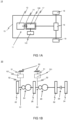
- Fig. 1A shows a schematic view of an electric vehicle 10, comprising a vehicle chasses 15, comprising a powertrain 11 comprising an electric motor 12 with a rotor 14 connected to a transmission 100 comprising a transmission housing 17.
- the transmission 100 is connected via an optional differential 16 to a first wheel 18 and a second wheel 19.
- the rotor 14 is always rotationally connected to the wheels 18,19 as there is no clutch or other decoupling element provided between the wheels 18,19 and the rotor.
- the electric vehicle 10 may comprise four wheels, all four of which may be connected to the motor 12 and may thus be driven by the motor 12.
- the electric vehicle 10 comprises a park lock system 101 which may be provided in the transmission housing 17 or at least partially outside the transmission housing 17.
- the park lock system 101 is arranged to prevent rolling of the vehicle when a park lock mechanism comprised by the park lock system 101 is engaged, for example when the vehicle 10 is parked on a slope.
- Fig. 1B shows a schematic overview of the inertias in a driveline 20 of the electric vehicle 10, wherein a rotor inertia 22 is connected to a first gear ratio 24, which in turn may be connected to an intermediate shaft inertia 26, which may be connected to a second gear ratio 28. Any number of intermediate shafts and gear ratios may be provided, including no intermediate shafts and no gear ratios at all.
- the second gear ratio 28 is connected to an after gear inertia 32, which may comprise any of an inertia of a differential, wheel rims and tires, or any other inertia connected in the driveline 20.
- a vehicle inertia 34 is connected to the rotor inertia 22.
- Fig. 1B shows as dotted lines two park lock systems 101 at optional locations, a first optional location 31 being between the rotor inertia 22 and the first gear ratio 24 and a second optional location 33 being between the intermediate shaft inertia 26 and the second gear ratio 28.
- the park lock system 101 is via a first connection 51 connected to a fixed world 50, for example the transmission housing 17 or any other rigid component of the vehicle 10 such as the chassis 15.
- the fixed world 50 may be assumed to have a substantially infinite stiffness.
- the park lock system 101 may be in an engaged setting connected to the driveline 20 via a second connection 52, and in a disengaged setting not connected to the driveline 20.
- More locations for the park lock system 101 are envisioned as well, for example between the first gear ratio 24 and the intermediate shaft inertia 26, between the second gear ratio 28 and the after gear inertia 32, between any two components comprised by the after gear inertia 32, or any other location where the park lock system 101 may in the engaged setting be coupled to the rotor inertia 22.
- the location may for example be chosen based on a dynamic model of the inertias in the drive line 20.
- the resilient member for reducing a deceleration of the rotor inertia 22 may be provided in the first connection 51, in the second connection 52, or in both connections.
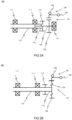
- Fig. 2A shows part of an embodiment of a transmission 100, comprising a rotor shaft 110 which in this embodiment is an at least partially hollow rotor shaft 110.
- the rotor shaft 110 is rotationally supported by two rotor bearings 111.
- the rotor bearings 111 are connected to the transmission 100 such that the rotor shaft 110 may rotate relative to the transmission 100.
- the rotor shaft 110 may be provided with a rotor gear 112 which is arranged to be rotationally connected to a further component of the transmission 100, such as an intermediate shaft or a differential.
- the transmission 100 further comprises an embodiment of a park lock system 101 according to the first aspect, comprising a part 131 of the rotor shaft 110 as a first rotational member, and a park lock wheel 132 as a second rotational member.
- the rotor shaft 110 is rotationally connected to the park lock wheel 132 through a resilient shaft 148 as a resilient member.
- the resilient shaft 148 is in this embodiment rotationally supported by a resilient shaft bearing 141 and is at least partially provided inside the hollow rotor shaft 110.
- the part 131 of the rotor shaft 110 as the first rotational member is connected to the shaft 148 at a first axial position at an axial distance from a second axial position where the park lock wheel 132 as the second rotational member is connected to the shaft 148.
- the park lock system 101 further comprises a park lock mechanism 130 comprising a park lock actuator 136 for engaging and disengaging the park lock mechanism 130 and the park lock wheel 132 and a housing connection 138 rigidly connecting the park lock mechanism 130 to the transmission housing or any other component of an electric vehicle 10 to which the park lock mechanism 130 may be substantially rigidly connected.
- a park lock mechanism 130 comprising a park lock actuator 136 for engaging and disengaging the park lock mechanism 130 and the park lock wheel 132 and a housing connection 138 rigidly connecting the park lock mechanism 130 to the transmission housing or any other component of an electric vehicle 10 to which the park lock mechanism 130 may be substantially rigidly connected.
- Fig. 2B shows part of another embodiment of the transmission 100, wherein an embodiment of the park lock system 101 according to the first aspect comprises an extended section 173 as a first rotational member, which may be a separate part rotationally connected to the rotor shaft 110 or may be part of the rotor shaft 110 itself.
- the park lock wheel 132 is provided as the second rotational member, and the park lock wheel 132 is connected to the extended section 173 via the resilient member 140.
- the resilient member 140 which may be applied in the park lock mechanism 101 of Fig. 2B , some of which will be explained in conjunction with Figs. 4A, 4B , 5A, 5B , 6A, 6B , 7A , and 8A .
- the extended section 173 may be omitted and the park lock wheel 132 may be connected via the resilient member 140 to the rotor shaft 110, for example between the right rotor bearing 111 and the rotor gear 112.
- Fig. 3A shows part of a further embodiment of the transmission 100, comprising a park lock system 101 according to the second aspect comprising the extended section 173 as a first rotational member, which may be a separate part rotationally connected to the rotor shaft 110 or may be part of the rotor shaft 110 itself.
- the park lock mechanism 130 comprises an engagement member 137 which, when the park lock mechanism 130 is engaged, engages with the second rotational member 132.
- the engagement member 137 is in a park lock system 101 according to the second aspect connected to the housing connection 138 via the resilient member 140. As such, when the park lock mechanism 130 is engaged, the rotational energy from the second rotational member 138 is at least partially dissipated by the resilient member 140.
- the resilient member 140 may in a park lock system 101 according to the second aspect be provided anywhere between the engagement member 137 and the housing connection 138 when the park lock mechanism 130 is engaged.
- the park lock mechanism 130 comprises a pawl as an engagement mechanism, and a cone and push rod as park lock actuator 136
- the cone may be embodied as the resilient member 140.
- Fig. 3B shows part of an even further embodiment of the transmission 100 comprising an intermediate shaft 114 which is rotationally connected to the rotor shaft 110 via the rotor gear 112 and an intermediate gear 116 and rotationally supported in intermediate shaft bearings 115.
- the intermediate gear 116 in the embodiment of Fig. 3B comprises the second rotational member 132, or may be the second rotational member itself.
- Mounted on the intermediate shaft 114 may be a further gear 118, arranged to be rotationally connected to a further component of the electric vehicle 10, such as the differential 16.
- the park lock mechanism 130 may be engaged in an axial direction relative to the rotor shaft 110, whereas in other embodiments of the park lock system 101, the park lock mechanism 130 may be engaged in a radial direction relative to the rotor shaft 101, or a tangential direction relative to the rotor shaft 101, or in any other direction.
- the second rotational member 132 may be arranged as a crown wheel.
- the park lock mechanism 130 may also be arranged for engagement in a direction between the axial direction and the radial direction, and in such an embodiment the second rotational member 132 may be arranged as a bevel gear with a angle corresponding to the engagement direction of the park lock mechanism.
- a park lock system 101 may be used as well, wherein the second rotational member 132 is rotationally connected to the intermediate shaft 114. While in Fig. 3B the resilient member 140 is provided between the intermediate gear 116 and the second rotational member 132, the resilient member 140 may in embodiments of the park lock system 101 also be provided between the second rotational member 132 and one or both of the housing connection 138 or the park lock actuator 136 or another part of the park lock mechanism 130.
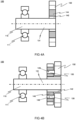
- Fig. 4A shows part of an embodiment of the transmission 100, focused on the rotor shaft 110 and the first rotation member 131 as a part of the rotor shaft 110 supported in rotor bearing 111.
- a park lock wheel 132 is provided as second rotational member, and radially provided between the park lock wheel 132 and the rotor shaft 110 is a resilient ring 144 as a resilient member for rotationally connecting the park lock wheel 132 and the rotor shaft 110.
- the resilient ring 144 may be connected directly to the rotor shaft 110 or via a coupling ring 142.
- the resilient ring 144 may comprise vulcanized rubber as a resilient material, any other resilient material or any combination thereof. Dimensions of the resilient ring 144 such as an inner radius, outer radius and/or thickness may be chosen and combined with resilient material options such that the resilient ring 144 provides a preferred rotational stiffness between the rotor shaft 110 and the park lock wheel 132.
- Fig. 4B shows part of yet another embodiment of the transmission 100 focused on the rotor shaft 110 and the part of the rotor shaft 131 as the first rotation member supported in rotor bearing 111.
- the park lock wheel 132 as the second rotational member and as a first of the resilient member and the second rotational member comprises a one or more dowels 135 as axial protrusions.
- the resilient holed member 140 as a second of the resilient member and the second rotational member 132 comprises a plurality of axial indentations 149 arranged to receive the dowels 135.
- the resilient member 140 comprises the axial protrusions and the second rotational member comprises the indentations arranged to receive the axial protrusions of the resilient member.
- Figs. 5A and 5B respectively show a section view and a front view of part of yet another embodiment of the transmission 100 with the views focused on the rotor shaft 110 and the part of the rotor shaft 131 as the first rotation member supported in rotor bearing 111.
- tangentially oriented compression springs 145 are provided as resilient members between the park lock wheel 132 with teeth 133 and the rotor shaft 110. Any number of tangentially oriented compression springs 145 including only one may be provided between the park lock wheel 132 and the rotor shaft 110, for example dependent on the desired rotational stiffness between the park lock wheel 132 and the rotor shaft 110.
- An intermediate part 142 may optionally be provided to connect the compression springs 145 to the rotor shaft 110.
- Figs. 6A and 6B respectively show a section view and a front view of a further embodiment of the transmission 100 with the views focused on the rotor shaft 110 and the part of the rotor shaft 131 as the first rotation member supported in rotor bearing 111.
- radially oriented leaf springs 146 are provided as resilient members between the park lock wheel 132 with teeth 133 and the rotor shaft 110. Any number of radially oriented leaf springs 146 including only one may be provided between the park lock wheel 132 and the rotor shaft 110, for example dependent on the desired rotational stiffness between the park lock wheel 132 and the rotor shaft 110.
- An intermediate part 142 may optionally be provided to connect the leaf springs 146 to the rotor shaft 110.
- Fig. 7A shows part of an embodiment of the park lock system 100 according to the second aspect, comprising the park lock wheel 132 as the second rotational member.
- the park lock wheel 132 comprises a plurality of teeth 133, and is, rigidly or resiliently, rotationally connectable to the rotor as the first rotational element, which has been omitted in Fig. 7A for clarity of the figure.
- the park lock system 100 comprises a park lock mechanism 130, which comprises a pawl 742 as an engagement element, and a cone and push rod 136 as park lock actuator.
- the park lock mechanism 130 in Fig. 7A is shown in the engaged setting, wherein the pawl 742 is provided between two teeth 133 of the park lock wheel 132 to prevent rotation of the park lock wheel 132.
- rotation of the park lock wheel 132 is coupled to the transmission housing (not shown) via the pawl 742, a lever 743, a resilient shaft 740 as the resilient member, and a toothed shaft end 738 as the housing connection which is resiliently connectable to the transmission housing.
- the lever 743 may be arranged as the resilient member.
- the lever 743 comprises to split lever sections to allow the push rod 136 to extend through the lever sections.
- Fig. 8A shows part of yet another embodiment of the park lock system 100 according to the second aspect, comprising the park lock wheel 132 as the second rotational member.
- the park lock wheel 132 comprises a plurality of teeth 133, and is, rigidly or resiliently, rotationally connectable to the rotor as the first rotational element, which has been omitted in Fig. 7B for conciseness and clarity of the figure.
- the park lock wheel 132 is rotationally connected to the pawl 742, which in turn is connected to an excenter 739.
- the excenter 739 is to be connected to the housing of the transmission via a spring as the resilient member.
- the excenter 739 is further rotationally mounted to a bearing 741 as a housing connection.
- Fig. 8B shows the embodiment of the park lock system 100 of Fig. 8A , but now in a disengaged setting wherein the rotation of the park lock wheel 132 is not coupled to the transmission housing, and thus the park lock wheel 132 is free to rotate.
- Figs. 4A, 4B , 5A, 5B , 6A, 6B , 7A , and 8A many options are envisioned for providing the resilient connection in the park lock mechanism 101. Any combination of embodiments provided at any location within the transmission or drive line of the electric vehicle as discussed in conjunction with figures 1B , 2A , 2B , 3A, and 3B is envisioned.
- Different components in a park lock system may be manufactured as single monolithic parts. Additionally or alternatively may any set of components in a park lock system be fused together, such as the park lock wheel 132 and the rotor shaft 110.
- the invention may also be embodied with less components than provided in the embodiments described here, wherein one component carries out multiple functions.
- the invention be embodied using more elements than depicted in the Figures, wherein functions carried out by one component in the embodiment provided are distributed over multiple components.
- a park lock system is used in vehicles to provide a coupling between a rotor of an electric motor powering the vehicle to part of the chassis of the vehicle to, in an engaged setting, prevent rolling of the vehicle when the vehicle is parked on a hill.
- the park lock system may however also be engaged while the vehicle is rolling. In such a case, high loads may occur on parts of the vehicle's powertrain due to sudden deceleration of those parts.
- a resilient member is introduced. The resilient member is arranged to resiliently deform and slow the sudden deceleration, decreasing loads on parts of the powertrain due to the deceleration. By virtue of these decreased loads, smaller and/or lighter components may be used in the powertrain which may be advantageous for the size and/or weight of the vehicle.
Landscapes
- Engineering & Computer Science (AREA)
- General Engineering & Computer Science (AREA)
- Mechanical Engineering (AREA)
- Transportation (AREA)
- Gear-Shifting Mechanisms (AREA)
- Arrangement Or Mounting Of Propulsion Units For Vehicles (AREA)
- Braking Arrangements (AREA)
Description
- The present invention relates to the field of park lock mechanisms.
- Electric vehicles may be provided with a park lock connected indirectly to the wheels of the electric vehicle via a transmission or drive unit to prevent rolling of the vehicle when the park lock mechanism is engaged, for example when the vehicle is parked on a slope.
- The park lock may be engaged when the wheels of the vehicle are still turning. When the park lock is then engaged, the wheels of the vehicle connected to the drivetrain are locked and may slip on the road surface on which the wheels were rolling. The friction force between the wheels and the road surface causes the vehicle to come to a standstill and causes a load on the park lock mechanism.
- In many electric vehicles, no clutch is present to disconnect the electric motor from the wheels. As a result, the rotor of the electric motor will stop as well when the park lock is engaged, which may cause a sudden and intense deceleration of the rotor if the park lock is engaged during vehicle movement. This deceleration causes high loads on the park lock system which may cause damage to the park lock system and/or other components of the drive unit. The shock load from the deceleration of the rotor shaft might exceed the load caused by the friction between the wheels and the road surface. To prevent the shock load, a system may be provided which prevents engagement of the park lock whilst the vehicle is still moving.
- To prevent damage to the park lock system due to high loads caused by deceleration of the rotor shaft, components of the park lock system and/or other components of the drive unit such as a pawl, cone, park lock wheel, bearings, shafts and housing are often oversized. It is preferred to provide an improved park lock system with a reduced size.
- The reduction in size may be achieved by providing a resilient member within the park lock system or in the transmission. The resilient member is arranged for decreasing deceleration forces when engaging the park lock. With these decreased forces, and because the shock load from the deceleration of the rotor shaft may exceed the load caused by the friction between the wheels and the road surface, smaller components such as smaller bearings may be chosen in the design of a gear train of an electric vehicle.
- A first aspect provides a park lock system for an electric vehicle, comprising a first rotational member arranged to be, preferably rigidly, rotationally connected to a rotor shaft of an electric motor of the electric vehicle, a second rotational member, a park lock mechanism arranged to substantially prevent, in an engaged setting, a rotation of the second rotational member and allow, in a disengaged setting, a rotation of the second rotational member, and a resilient member rotationally connecting the first rotational member and the second rotational member.
- A rotational member may be any object arranged to be rotated, such as a gear, cog, sprocket, axle, pinion, shaft, ratchet wheel, pulley, sheave, any other object, or a member comprising any combination of said objects. For example may the first rotational member be the rotor of part thereof, and may the second rotational member be a park lock wheel.
- A rotational member may rotate at a certain rotational speed, which may be expressed in e.g. rad/s (radians/sec), deg/s (degrees/sec) or RPM (Revolutions Per Minute). The rotation may be around a single rotational axis, which is often an axis of rotational symmetry of the rotational member. A moment of inertia of a rotational member defines the torque required for a certain angular acceleration around the rotational axis, and may be expressed in kg·m2. The rotational energy of a rotational member is the kinetic energy due to rotation of the rotational member, and may be expressed in Joules.
- Rotational stiffness is defined as the amount of torque required to internally twist a body for a certain amount of degrees. The rotational stiffness may be expressed in Nm/deg. A low rotational stiffness implies that it is easier, i.e. a low amount of torque is required, to internally twist a body; a high rotational stiffness implies that it is harder, i.e. a high amount of torque is required, to internally twist a body. A person skilled in the art will appreciate how to influence rotational stiffness of a body, for example by manipulating the shape of the body or by choosing a particular material with a particular G-modulus for the body.
- Translational stiffness is defined as the amount of force required to deform a body, and may be expressed in N/mm. A translational stiffness, also referred to just as stiffness, of an object may be influenced for example by its dimensions and by choosing a particular material with a particular E modulus for the object.
- An object being resilient means that when a certain force or torque is applied to the object, at least part of the object will elastically deform. When the force or torque is released from the resilient object, the resilient object will substantially return to the original shape it held before the force or torque was applied to it. During elastic deformation under influence of a torque, e.g. twisting, rotational energy may be converted to elastic energy stored in the deformation of the material comprised by the object. For some materials, the rotational energy may be at least partially converted to thermal energy, which may dissipate into the environment surrounding the object.
- The gear train of an electric vehicle may comprise a transmission, one or more drive shafts, one or more differentials, and a final drive. The gear train is rotationally connectable to a power source, such as an electric motor.
- A first object and a second object being rotationally connected means that rotational energy may be transferred between the first object and the second object. Examples of two objects that are rotationally connected are two parts of a shaft which are fixed in line with each other and two gears which are provided substantially co-axially with meshing teeth.
- When a park lock system according to the first aspect is engaged while the vehicle is moving, and thus while the rotor shaft is rotating, rotation of the second rotational member is locked by the park lock mechanism in the engaged setting. The first rotational member is still rotating at the time of engagement between the park lock mechanism and the second rotational member, causing a difference in rotational speed between the first rotational member and the second rotational member.
- This difference in rotational speed results in two effects: a deceleration of the first rotational member and a deformation of the resilient member. Since rotational energy of the rotor shaft, which is rotationally connected to the first rotational member, is at least partially used for deformation of the resilient member, the deceleration of the first rotational member and thus the deceleration of the rotor shaft will be lower compared to a situation with a substantially non-resilient member rotationally connecting the first rotational member and the second rotational member. The reduction of deceleration of the rotor shaft will in turn result in a lower dynamic load on the park lock system by virtue of the resilient member provided somewhere between the rotor and the park lock system.
- The park lock system may comprise a shaft, wherein the first rotational member is connected at a first axial position on the shaft and the second rotational member is connected at a second axial position on the shaft.
- The shaft may comprise the resilient member, or be the resilient member. A torsional resilience may be provided by the shaft between the first rotational member and the second rotational member due to the axial distance between the first rotational member and the second rotational member. The axial distance may be increased or decreased dependent on the desired rotational stiffness of the shaft as the resilient member or the shaft comprising the resilient member.
- In an embodiment of the park lock system, the second rotational member is rotationally connected to the shaft via the resilient member. As such, rotational energy passing between the second rotational member and the first rotational member has to travel through the resilient member and may thus deform the resilient member.
- For achieving the desired stiffness of the resilient member, the resilient member may comprise vulcanized rubber, any other resilient material, or any combination thereof.
- A first of the resilient member and the second rotational member comprises a plurality of axial protrusions and a second of the resilient member and the second rotational member comprises a plurality of axial indentations arranged to receive the axial protrusions. As such, the resilient member may be rotationally connected to the second rotational member.
- In a further embodiment, the resilient member comprises a plurality of compression springs provided substantially tangentially relative to the second rotational member. As such, the resilient member may rotationally connect the first rotational member and the second rotational member, wherein rotational energy transferring between the first rotational member and the second rotational member passes through the plurality of compression springs as the resilient member.
- In an even further embodiment of the park lock system, the resilient member is arranged as a plurality of leaf springs provided substantially radially relative to the second rotational member. As such, the resilient member may rotationally connect the first rotational member and the second rotational member, wherein rotational energy transferring between the first rotational member and the second rotational member passes through the plurality of leaf springs as the resilient member.
- When the resilient member is arranged to rotationally connect the first rotational member and the second rotational member, the resilient member may have a torsional stiffness between 20 Nm/deg and 600 Nm/deg, preferably between 50 Nm/deg and 400 Nm/deg, more preferably between 75 Nm/deg and 300 Nm/deg, and even more preferably between 100 Nm/deg and 250 Nm/deg.
- The preferred rotational stiffness of the resilient member may depend on for example the vehicle mass, the maximum vehicle speed at which the park lock system may be engaged, the rotor inertia, any other mass or moment of inertia comprised by the vehicle, any gear ratio between the rotor and the resilient member, any other factor, or any combination thereof.
- A second aspect provides a further embodiment of a park lock system sharing the preference to provide an improved park lock system with a reduced size, using a resilient member.
- As such, an embodiment of the park lock system according to the second aspect comprises: a first rotational member arranged to be rotationally connected to a rotor shaft of an electric motor of the electric vehicle, a second rotational member rotationally connected to the first rotational member and arranged to be connected to a park lock mechanism, a park lock mechanism arranged to substantially prevent, in an engaged setting, a rotation of the second rotational member and allow, in a disengaged setting, a rotation of the second rotational member, and a resilient member arranged to in the engaged setting couple a force between the second rotational member and a transmission housing.
- As with the park lock system according to the first aspect, the park lock system according to the second aspect makes use of a resilient member arranged to reduce deceleration of the first rotational member when the park lock system is engaged while the vehicle is moving.
- A third aspect provides a transmission for an electric vehicle, comprising a transmission housing fixable to a frame of the electric vehicle, the park lock system according to the first aspect or according to the second aspect, wherein in the engaged setting of the park lock mechanism rotation of the second rotational member is coupled to the housing via the park lock mechanism and in the disengaged setting the second rotational member and the park lock mechanism are not rotationally connected such that the second rotational member may be rotated relative to the housing.
- In an embodiment of the transmission, the second rotational member is arranged as a gear wheel, and the park lock mechanism comprises an engagement member movable between an engaged position and a disengaged position corresponding to the engaged setting and the disengaged setting, wherein in the engaged position the engagement member engages the gear wheel, and in the disengaged position the engagement member does not engage the gear wheel.
- A fourth aspect provides a powertrain of an electric vehicle, comprising a transmission according to the third aspect, and an electric motor comprising a rotor comprising a rotor shaft, wherein the rotor shaft is rotationally connected to the first rotational member of the park lock system of the transmission such that rotation of the rotor is connected to the housing of the transmission via the resilient member when the park lock mechanism is in the engaged setting.
- A fifth aspect provides an electric vehicle, comprising a powertrain according to the fourth aspect.
- The various aspects and embodiments thereof will now be discussed in conjunction with figures. In the figures:
-
Fig. 1A : shows a schematic view of an electric vehicle; -
Fig. 1B : shows a schematic overview of the inertias in a drive line; -
Fig. 2A : shows part of an embodiment of a transmission; -
Fig. 2B : shows part of another embodiment of the transmission; -
Fig. 3A : shows part of yet another embodiment of the transmission; -
Fig. 3B : shows part of a further embodiment of the transmission with a park lock system according to the second aspect; -
Fig. 4A : shows part of an even further embodiment of the transmission; -
Fig. 4B : shows part of yet another embodiment of the transmission; -
Fig. 5A : shows a section view of yet another embodiment of the transmission; -
Fig. 5B : shows a front view of the embodiment of the transmission ofFig. 5A ; -
Fig. 6A : shows a section view of a further embodiment of the transmission; and -
Fig. 6B : shows a front view of the embodiment of the transmission ofFig. 6A ; -
Fig. 7A : shows an isometric grid of a park lock in engaged braking position; -
Fig. 7B : shows an isometric grid of a park lock in disengaged position; -
Fig. 8A : shows an isometric grid of another park lock in engaged braking position; and -
Fig. 8B : shows an isometric grid of another park lock in disengaged position. -
Fig. 1A shows a schematic view of anelectric vehicle 10, comprising avehicle chasses 15, comprising apowertrain 11 comprising anelectric motor 12 with arotor 14 connected to atransmission 100 comprising atransmission housing 17. Thetransmission 100 is connected via an optional differential 16 to afirst wheel 18 and asecond wheel 19. Note that in the embodiment of thevehicle 10 as shown inFig. 1A , therotor 14 is always rotationally connected to thewheels wheels electric vehicle 10 may comprise four wheels, all four of which may be connected to themotor 12 and may thus be driven by themotor 12. - The
electric vehicle 10 comprises apark lock system 101 which may be provided in thetransmission housing 17 or at least partially outside thetransmission housing 17. Thepark lock system 101 is arranged to prevent rolling of the vehicle when a park lock mechanism comprised by thepark lock system 101 is engaged, for example when thevehicle 10 is parked on a slope. -
Fig. 1B shows a schematic overview of the inertias in adriveline 20 of theelectric vehicle 10, wherein arotor inertia 22 is connected to afirst gear ratio 24, which in turn may be connected to anintermediate shaft inertia 26, which may be connected to asecond gear ratio 28. Any number of intermediate shafts and gear ratios may be provided, including no intermediate shafts and no gear ratios at all. Thesecond gear ratio 28 is connected to an aftergear inertia 32, which may comprise any of an inertia of a differential, wheel rims and tires, or any other inertia connected in thedriveline 20. Finally, via africtional contact 29 between the tires and the road, avehicle inertia 34 is connected to therotor inertia 22. -
Fig. 1B shows as dotted lines twopark lock systems 101 at optional locations, a firstoptional location 31 being between therotor inertia 22 and thefirst gear ratio 24 and a secondoptional location 33 being between theintermediate shaft inertia 26 and thesecond gear ratio 28. Thepark lock system 101 is via afirst connection 51 connected to afixed world 50, for example thetransmission housing 17 or any other rigid component of thevehicle 10 such as thechassis 15. The fixedworld 50 may be assumed to have a substantially infinite stiffness. Thepark lock system 101 may be in an engaged setting connected to thedriveline 20 via asecond connection 52, and in a disengaged setting not connected to thedriveline 20. - More locations for the
park lock system 101 are envisioned as well, for example between thefirst gear ratio 24 and theintermediate shaft inertia 26, between thesecond gear ratio 28 and the aftergear inertia 32, between any two components comprised by the aftergear inertia 32, or any other location where thepark lock system 101 may in the engaged setting be coupled to therotor inertia 22. The location may for example be chosen based on a dynamic model of the inertias in thedrive line 20. - The resilient member for reducing a deceleration of the
rotor inertia 22 may be provided in thefirst connection 51, in thesecond connection 52, or in both connections. -
Fig. 2A shows part of an embodiment of atransmission 100, comprising arotor shaft 110 which in this embodiment is an at least partiallyhollow rotor shaft 110. Therotor shaft 110 is rotationally supported by tworotor bearings 111. Therotor bearings 111 are connected to thetransmission 100 such that therotor shaft 110 may rotate relative to thetransmission 100. Therotor shaft 110 may be provided with arotor gear 112 which is arranged to be rotationally connected to a further component of thetransmission 100, such as an intermediate shaft or a differential. - The
transmission 100 further comprises an embodiment of apark lock system 101 according to the first aspect, comprising apart 131 of therotor shaft 110 as a first rotational member, and apark lock wheel 132 as a second rotational member. Therotor shaft 110 is rotationally connected to thepark lock wheel 132 through aresilient shaft 148 as a resilient member. Theresilient shaft 148 is in this embodiment rotationally supported by a resilient shaft bearing 141 and is at least partially provided inside thehollow rotor shaft 110. - The
part 131 of therotor shaft 110 as the first rotational member is connected to theshaft 148 at a first axial position at an axial distance from a second axial position where thepark lock wheel 132 as the second rotational member is connected to theshaft 148. - The
park lock system 101 further comprises apark lock mechanism 130 comprising apark lock actuator 136 for engaging and disengaging thepark lock mechanism 130 and thepark lock wheel 132 and ahousing connection 138 rigidly connecting thepark lock mechanism 130 to the transmission housing or any other component of anelectric vehicle 10 to which thepark lock mechanism 130 may be substantially rigidly connected. -
Fig. 2B shows part of another embodiment of thetransmission 100, wherein an embodiment of thepark lock system 101 according to the first aspect comprises anextended section 173 as a first rotational member, which may be a separate part rotationally connected to therotor shaft 110 or may be part of therotor shaft 110 itself. - The
park lock wheel 132 is provided as the second rotational member, and thepark lock wheel 132 is connected to theextended section 173 via theresilient member 140. Different embodiments are envisioned for theresilient member 140 which may be applied in thepark lock mechanism 101 ofFig. 2B , some of which will be explained in conjunction withFigs. 4A, 4B ,5A, 5B ,6A, 6B ,7A , and8A . - As an alternative to the embodiment of
Fig. 2B , theextended section 173 may be omitted and thepark lock wheel 132 may be connected via theresilient member 140 to therotor shaft 110, for example between theright rotor bearing 111 and therotor gear 112. -
Fig. 3A shows part of a further embodiment of thetransmission 100, comprising apark lock system 101 according to the second aspect comprising theextended section 173 as a first rotational member, which may be a separate part rotationally connected to therotor shaft 110 or may be part of therotor shaft 110 itself. - The
park lock mechanism 130 comprises anengagement member 137 which, when thepark lock mechanism 130 is engaged, engages with the secondrotational member 132. Theengagement member 137 is in apark lock system 101 according to the second aspect connected to thehousing connection 138 via theresilient member 140. As such, when thepark lock mechanism 130 is engaged, the rotational energy from the secondrotational member 138 is at least partially dissipated by theresilient member 140. - The
resilient member 140 may in apark lock system 101 according to the second aspect be provided anywhere between theengagement member 137 and thehousing connection 138 when thepark lock mechanism 130 is engaged. For example, when thepark lock mechanism 130 comprises a pawl as an engagement mechanism, and a cone and push rod aspark lock actuator 136, the cone may be embodied as theresilient member 140. -
Fig. 3B shows part of an even further embodiment of thetransmission 100 comprising anintermediate shaft 114 which is rotationally connected to therotor shaft 110 via therotor gear 112 and anintermediate gear 116 and rotationally supported inintermediate shaft bearings 115. Theintermediate gear 116 in the embodiment ofFig. 3B comprises the secondrotational member 132, or may be the second rotational member itself. Mounted on theintermediate shaft 114 may be afurther gear 118, arranged to be rotationally connected to a further component of theelectric vehicle 10, such as the differential 16. - As an option which may be provided in other embodiments of the
transmission 100 as well, in the embodiment ofFig. 3B , thepark lock mechanism 130 may be engaged in an axial direction relative to therotor shaft 110, whereas in other embodiments of thepark lock system 101, thepark lock mechanism 130 may be engaged in a radial direction relative to therotor shaft 101, or a tangential direction relative to therotor shaft 101, or in any other direction. For axial engagement, the secondrotational member 132 may be arranged as a crown wheel. Thepark lock mechanism 130 may also be arranged for engagement in a direction between the axial direction and the radial direction, and in such an embodiment the secondrotational member 132 may be arranged as a bevel gear with a angle corresponding to the engagement direction of the park lock mechanism. - When the
transmission 100 comprises theintermediate shaft 114, apark lock system 101 according to the second aspect may be used as well, wherein the secondrotational member 132 is rotationally connected to theintermediate shaft 114. While inFig. 3B theresilient member 140 is provided between theintermediate gear 116 and the secondrotational member 132, theresilient member 140 may in embodiments of thepark lock system 101 also be provided between the secondrotational member 132 and one or both of thehousing connection 138 or thepark lock actuator 136 or another part of thepark lock mechanism 130. -
Fig. 4A shows part of an embodiment of thetransmission 100, focused on therotor shaft 110 and thefirst rotation member 131 as a part of therotor shaft 110 supported inrotor bearing 111. Apark lock wheel 132 is provided as second rotational member, and radially provided between thepark lock wheel 132 and therotor shaft 110 is aresilient ring 144 as a resilient member for rotationally connecting thepark lock wheel 132 and therotor shaft 110. Theresilient ring 144 may be connected directly to therotor shaft 110 or via acoupling ring 142. - The
resilient ring 144 may comprise vulcanized rubber as a resilient material, any other resilient material or any combination thereof. Dimensions of theresilient ring 144 such as an inner radius, outer radius and/or thickness may be chosen and combined with resilient material options such that theresilient ring 144 provides a preferred rotational stiffness between therotor shaft 110 and thepark lock wheel 132. -
Fig. 4B shows part of yet another embodiment of thetransmission 100 focused on therotor shaft 110 and the part of therotor shaft 131 as the first rotation member supported inrotor bearing 111. Thepark lock wheel 132 as the second rotational member and as a first of the resilient member and the second rotational member comprises a one ormore dowels 135 as axial protrusions. The resilient holedmember 140 as a second of the resilient member and the secondrotational member 132 comprises a plurality ofaxial indentations 149 arranged to receive thedowels 135. - In an alternative embodiment, the
resilient member 140 comprises the axial protrusions and the second rotational member comprises the indentations arranged to receive the axial protrusions of the resilient member. -
Figs. 5A and 5B respectively show a section view and a front view of part of yet another embodiment of thetransmission 100 with the views focused on therotor shaft 110 and the part of therotor shaft 131 as the first rotation member supported inrotor bearing 111. In the embodiment ofFigs. 5A and 5B , tangentially oriented compression springs 145 are provided as resilient members between thepark lock wheel 132 withteeth 133 and therotor shaft 110. Any number of tangentially oriented compression springs 145 including only one may be provided between thepark lock wheel 132 and therotor shaft 110, for example dependent on the desired rotational stiffness between thepark lock wheel 132 and therotor shaft 110. Anintermediate part 142 may optionally be provided to connect the compression springs 145 to therotor shaft 110. -
Figs. 6A and 6B respectively show a section view and a front view of a further embodiment of thetransmission 100 with the views focused on therotor shaft 110 and the part of therotor shaft 131 as the first rotation member supported inrotor bearing 111. In the embodiment ofFigs. 6A and 6B , radially orientedleaf springs 146 are provided as resilient members between thepark lock wheel 132 withteeth 133 and therotor shaft 110. Any number of radially orientedleaf springs 146 including only one may be provided between thepark lock wheel 132 and therotor shaft 110, for example dependent on the desired rotational stiffness between thepark lock wheel 132 and therotor shaft 110. Anintermediate part 142 may optionally be provided to connect theleaf springs 146 to therotor shaft 110. -
Fig. 7A shows part of an embodiment of thepark lock system 100 according to the second aspect, comprising thepark lock wheel 132 as the second rotational member. Thepark lock wheel 132 comprises a plurality ofteeth 133, and is, rigidly or resiliently, rotationally connectable to the rotor as the first rotational element, which has been omitted inFig. 7A for clarity of the figure. - The
park lock system 100 comprises apark lock mechanism 130, which comprises apawl 742 as an engagement element, and a cone and pushrod 136 as park lock actuator. Thepark lock mechanism 130 inFig. 7A is shown in the engaged setting, wherein thepawl 742 is provided between twoteeth 133 of thepark lock wheel 132 to prevent rotation of thepark lock wheel 132. - In the engaged setting as shown in
Fig. 7A , rotation of thepark lock wheel 132 is coupled to the transmission housing (not shown) via thepawl 742, alever 743, aresilient shaft 740 as the resilient member, and atoothed shaft end 738 as the housing connection which is resiliently connectable to the transmission housing. - In the disengaged setting as shown in
Fig. 7B , rotation of thepark lock wheel 132 is not coupled to the transmission housing, and thus thepark lock wheel 132 is free to rotate. - Alternatively or additionally to the
resilient shaft 740 being the resilient member, thelever 743 may be arranged as the resilient member. In the embodiment ofFig. 7A , thelever 743 comprises to split lever sections to allow thepush rod 136 to extend through the lever sections. -
Fig. 8A shows part of yet another embodiment of thepark lock system 100 according to the second aspect, comprising thepark lock wheel 132 as the second rotational member. Thepark lock wheel 132 comprises a plurality ofteeth 133, and is, rigidly or resiliently, rotationally connectable to the rotor as the first rotational element, which has been omitted inFig. 7B for conciseness and clarity of the figure. - In the engaged setting as shown in
Fig. 8A , thepark lock wheel 132 is rotationally connected to thepawl 742, which in turn is connected to anexcenter 739. Theexcenter 739 is to be connected to the housing of the transmission via a spring as the resilient member. Theexcenter 739 is further rotationally mounted to abearing 741 as a housing connection. -
Fig. 8B shows the embodiment of thepark lock system 100 ofFig. 8A , but now in a disengaged setting wherein the rotation of thepark lock wheel 132 is not coupled to the transmission housing, and thus thepark lock wheel 132 is free to rotate. - As can be seen from the embodiments of
Figs. 4A, 4B ,5A, 5B ,6A, 6B ,7A , and8A , many options are envisioned for providing the resilient connection in thepark lock mechanism 101. Any combination of embodiments provided at any location within the transmission or drive line of the electric vehicle as discussed in conjunction withfigures 1B ,2A ,2B ,3A, and 3B is envisioned. - Different components in a park lock system may be manufactured as single monolithic parts. Additionally or alternatively may any set of components in a park lock system be fused together, such as the
park lock wheel 132 and therotor shaft 110. - In the description above, it will be understood that when an element such as layer, region or substrate is referred to as being "on" or "onto" another element, the element is either directly on the other element, or intervening elements may also be present. Also, it will be understood that the values given in the description above, are given by way of example and that other values may be possible and/or may be strived for.
- Furthermore, the invention may also be embodied with less components than provided in the embodiments described here, wherein one component carries out multiple functions. Just as well may the invention be embodied using more elements than depicted in the Figures, wherein functions carried out by one component in the embodiment provided are distributed over multiple components.
- It is to be noted that the figures are only schematic representations of embodiments of the invention that are given by way of non-limiting examples. For the purpose of clarity and a concise description, features are described herein as part of the same or separate embodiments, however, it will be appreciated that the scope of the invention may include embodiments having combinations of all or some of the features described. The word 'comprising' does not exclude the presence of other features or steps than those listed in a claim. Furthermore, the words 'a' and 'an' shall not be construed as limited to 'only one', but instead are used to mean 'at least one', and do not exclude a plurality.
- A person skilled in the art will readily appreciate that various parameters and values thereof disclosed in the description may be modified and that various embodiments disclosed and/or claimed may be combined without departing from the scope of the invention, as defined by the appended claims.
- It is stipulated that the reference signs in the claims do not limit the scope of the claims, but are merely inserted to enhance the legibility of the claims.
- In summary, a park lock system is used in vehicles to provide a coupling between a rotor of an electric motor powering the vehicle to part of the chassis of the vehicle to, in an engaged setting, prevent rolling of the vehicle when the vehicle is parked on a hill. The park lock system may however also be engaged while the vehicle is rolling. In such a case, high loads may occur on parts of the vehicle's powertrain due to sudden deceleration of those parts. To reduce the deceleration after engaging the park lock mechanism, a resilient member is introduced. The resilient member is arranged to resiliently deform and slow the sudden deceleration, decreasing loads on parts of the powertrain due to the deceleration. By virtue of these decreased loads, smaller and/or lighter components may be used in the powertrain which may be advantageous for the size and/or weight of the vehicle.
Claims (12)
- A park lock system (101) for an electric vehicle (10), comprising:- a first rotational member arranged to be rotationally connected to a rotor shaft (110) of an electric motor (12) of the electric vehicle (10);- a second rotational member;- a park lock mechanism (130) arranged to substantially prevent, in an engaged setting, a rotation of the second rotational member and allow, in a disengaged setting, a rotation of the second rotational member; and- a resilient member (140, 148, 740) rotationally connecting the first rotational member and the second rotational member,wherein a first of the resilient member (140, 740) and the second rotational member comprises a plurality of axial protrusions and a second of the resilient member (140, 740) and the second rotational member comprises a plurality of axial indentations (149) arranged to receive the axial protrusions.
- The park lock system according to claim 1, comprising a shaft, wherein the first rotational member is connected at a first axial position on the shaft and the second rotational member is connected at a second axial position on the shaft.
- The park lock system according to claim 2, wherein the shaft comprises the resilient member (140, 740).
- The park lock system according to claim 2, wherein the second rotational member is rotationally connected to the shaft via the resilient member (140, 740).
- The park lock system according to any of the preceding claims, wherein the resilient member (140, 740) comprises vulcanized rubber.
- The park lock system according to any of the preceding claims, wherein the resilient member (140, 740) has a torsional stiffness between 100 Nm/deg and 250 Nm/deg.
- A park lock system (101) for an electric vehicle (10), comprising:- a first rotational member arranged to be rotationally connected to a rotor shaft (110) of an electric motor (12) of the electric vehicle (10);- a second rotational member;- a park lock mechanism (130) arranged to substantially prevent, in an engaged setting, a rotation of the second rotational member and allow, in a disengaged setting, a rotation of the second rotational member; and- a resilient member (140) rotationally connecting the first rotational member and the second rotational member,wherein the resilient member (140) comprises a plurality of compression springs (145) provided substantially tangentially relative to the second rotational member or the resilient member (140) is arranged as a plurality of leaf springs (146) provided substantially radially relative to the second rotational member.
- A park lock system for an electric vehicle (10), comprising:- a first rotational member arranged to be rotationally connected to a rotor shaft (110) of an electric motor (12) of the electric vehicle (10);- a second rotational member rotationally connected to the first rotational member and arranged to be connected to a park lock mechanism (130);- a park lock mechanism (130) arranged to substantially prevent, in an engaged setting, a rotation of the second rotational member and allow, in a disengaged setting, a rotation of the second rotational member; and- a resilient member (140) arranged to in the engaged setting couple a force between the second rotational member and a transmission housing (17).
- A transmission (100) for an electric vehicle (10), comprising:- a housing fixable to a frame of the electric vehicle (10);- the park lock system (101) according to any of the preceding claims,wherein in the engaged setting of the park lock mechanism (130) rotation of the second rotational member is substantially fixed to the housing via the park lock mechanism (130) and in the disengaged setting the second rotational member and the park lock mechanism (130) are not rotationally connected such that the second rotational member may be rotated relative to the housing.
- Transmission according to claim 9, wherein the second rotational member is arranged as a gear wheel, and the park lock mechanism (130) comprises an engagement member (137) movable between an engaged position and a disengaged position corresponding to the engaged setting and the disengaged setting, wherein in the engaged position the engagement member (137) engages the gear wheel, and in the disengaged position the engagement member (137) does not engage the gear wheel.
- A powertrain (11) of an electric vehicle (10), comprising:- a transmission (100) according to claim 9 or 10, and- an electric motor (12) comprising a rotor (14) comprising a rotor shaft (110), wherein the rotor shaft (110) is rotationally connected to the first rotational member of the park lock system (101) of the transmission (100) such that rotation of the rotor (14) is locked to the housing (17) of the transmission via the resilient member (140) when the park lock mechanism (130) is in the engaged setting.
- An electric vehicle (10) comprising the powertrain (11) according to claim 11.
Applications Claiming Priority (2)
| Application Number | Priority Date | Filing Date | Title |
|---|---|---|---|
| BE20195088A BE1027046B1 (en) | 2019-02-12 | 2019-02-12 | PARKING BRAKE MECHANISM |
| PCT/EP2020/053635 WO2020165273A1 (en) | 2019-02-12 | 2020-02-12 | Park lock mechanism |
Publications (3)
| Publication Number | Publication Date |
|---|---|
| EP3924648A1 EP3924648A1 (en) | 2021-12-22 |
| EP3924648B1 true EP3924648B1 (en) | 2024-10-02 |
| EP3924648C0 EP3924648C0 (en) | 2024-10-02 |
Family
ID=66323597
Family Applications (1)
| Application Number | Title | Priority Date | Filing Date |
|---|---|---|---|
| EP20706413.0A Active EP3924648B1 (en) | 2019-02-12 | 2020-02-12 | Park lock mechanism |
Country Status (4)
| Country | Link |
|---|---|
| EP (1) | EP3924648B1 (en) |
| CN (2) | CN113710930B (en) |
| BE (1) | BE1027046B1 (en) |
| WO (1) | WO2020165273A1 (en) |
Families Citing this family (4)
| Publication number | Priority date | Publication date | Assignee | Title |
|---|---|---|---|---|
| DE102021204062A1 (en) | 2021-04-23 | 2022-10-27 | Zf Friedrichshafen Ag | Electric drive for a vehicle |
| CN115614445B (en) * | 2022-11-03 | 2025-08-26 | 浙江龙虎锻造有限公司 | An external meshing pawl structure |
| DE102022131665A1 (en) | 2022-11-30 | 2023-02-23 | FEV Group GmbH | parking lock |
| WO2026005674A1 (en) * | 2024-06-27 | 2026-01-02 | Infimotion Technology Europe Ab | Transmission apparatus |
Family Cites Families (10)
| Publication number | Priority date | Publication date | Assignee | Title |
|---|---|---|---|---|
| JPS63297152A (en) * | 1987-05-28 | 1988-12-05 | Aisin Seiki Co Ltd | Parking device for vehicle transmission |
| DE10143386B4 (en) * | 2001-09-05 | 2004-05-06 | Zf Sachs Ag | Parking lock for a motor vehicle |
| KR100983468B1 (en) * | 2008-09-01 | 2010-09-24 | 현대 파워텍 주식회사 | Parking brake apparatus |
| DE102011016584A1 (en) * | 2011-04-07 | 2012-10-11 | Magna Powertrain Ag & Co. Kg | Lock mechanism for locking intermediate shaft of e.g. motor vehicle, has axle portion that is arranged as torsion damper on ratchet wheel including detent recess at which lock pawl is connected |
| DE102013106301A1 (en) * | 2013-06-18 | 2014-12-18 | Getrag Getriebe- Und Zahnradfabrik Hermann Hagenmeyer Gmbh & Cie Kg | Parking lock arrangement and motor vehicle transmission |
| DE102014103914A1 (en) * | 2014-03-21 | 2015-09-24 | Getrag Getriebe- Und Zahnradfabrik Hermann Hagenmeyer Gmbh & Cie Kg | Parking lock arrangement for a motor vehicle transmission |
| US10041591B2 (en) * | 2015-07-13 | 2018-08-07 | Ford Global Technologies, Llc | Transmission park mechanism |
| CN205220419U (en) * | 2015-12-16 | 2016-05-11 | 江苏奥新新能源汽车有限公司 | Electric automobile parking mechanism |
| DE102016115925B4 (en) * | 2016-08-26 | 2022-08-11 | Gkn Automotive Ltd. | System for hydraulically actuating a parking lock |
| JP6493367B2 (en) * | 2016-11-22 | 2019-04-03 | トヨタ自動車株式会社 | Manual release device for parking lock mechanism |
-
2019
- 2019-02-12 BE BE20195088A patent/BE1027046B1/en not_active IP Right Cessation
-
2020
- 2020-02-12 WO PCT/EP2020/053635 patent/WO2020165273A1/en not_active Ceased
- 2020-02-12 EP EP20706413.0A patent/EP3924648B1/en active Active
- 2020-02-12 CN CN202080027235.3A patent/CN113710930B/en active Active
- 2020-02-12 CN CN202311014614.0A patent/CN116816930A/en not_active Withdrawn
Also Published As
| Publication number | Publication date |
|---|---|
| EP3924648A1 (en) | 2021-12-22 |
| BE1027046B1 (en) | 2020-09-10 |
| CN116816930A (en) | 2023-09-29 |
| CN113710930B (en) | 2023-08-08 |
| BE1027046A1 (en) | 2020-09-03 |
| CN113710930A (en) | 2021-11-26 |
| WO2020165273A1 (en) | 2020-08-20 |
| EP3924648C0 (en) | 2024-10-02 |
Similar Documents
| Publication | Publication Date | Title |
|---|---|---|
| EP3924648B1 (en) | Park lock mechanism | |
| CN100540351C (en) | electric wheel driving device | |
| JP6527955B2 (en) | Electric axle drive for cars | |
| CN103154582B (en) | Torque transmitter | |
| JP5394531B2 (en) | Electric vehicle power transmission device | |
| CN111828625B (en) | Parking lock gear and parking lock device | |
| US7806219B2 (en) | Axle drive unit for a drive train | |
| JP2003294110A (en) | Differential device | |
| US11338660B2 (en) | Modular head assembly for an electric axle | |
| KR101837458B1 (en) | Apparatus for power train, vehicle including the same | |
| JPS6021263B2 (en) | Vehicle transmission device | |
| CN116745156A (en) | Electric drives for vehicle axles | |
| JP2007505276A (en) | Transmission assembly | |
| US7819771B2 (en) | Asymmetrical, active axle transmission | |
| EP2626591B1 (en) | Torsional vibration attenuation apparatus | |
| JP3568968B2 (en) | Differential device | |
| JP2008281159A (en) | Differential device | |
| JP2012192765A (en) | Motor type vehicle drive apparatus | |
| US9518611B2 (en) | Driveshaft assembly | |
| JP2018131009A (en) | Parking lock device | |
| US20220389987A1 (en) | Drivetrain for a hybrid or electric vehicle fitted with an dynamic absorber in torsion | |
| CN107387590B (en) | Clutch device capable of maintaining state | |
| CN112747087A (en) | Planetary gear system, torsion safety device and method for operating transmission system | |
| CN101110537B (en) | Transmission system with unidirectional gear and rim motor with the transmission system | |
| JPS63297152A (en) | Parking device for vehicle transmission |
Legal Events
| Date | Code | Title | Description |
|---|---|---|---|
| STAA | Information on the status of an ep patent application or granted ep patent |
Free format text: STATUS: UNKNOWN |
|
| STAA | Information on the status of an ep patent application or granted ep patent |
Free format text: STATUS: THE INTERNATIONAL PUBLICATION HAS BEEN MADE |
|
| PUAI | Public reference made under article 153(3) epc to a published international application that has entered the european phase |
Free format text: ORIGINAL CODE: 0009012 |
|
| STAA | Information on the status of an ep patent application or granted ep patent |
Free format text: STATUS: REQUEST FOR EXAMINATION WAS MADE |
|
| 17P | Request for examination filed |
Effective date: 20210820 |
|
| AK | Designated contracting states |
Kind code of ref document: A1 Designated state(s): AL AT BE BG CH CY CZ DE DK EE ES FI FR GB GR HR HU IE IS IT LI LT LU LV MC MK MT NL NO PL PT RO RS SE SI SK SM TR |
|
| DAV | Request for validation of the european patent (deleted) | ||
| DAX | Request for extension of the european patent (deleted) | ||
| RAP1 | Party data changed (applicant data changed or rights of an application transferred) |
Owner name: PUNCH POWERTRAIN E-VEHICLES NV |
|
| STAA | Information on the status of an ep patent application or granted ep patent |
Free format text: STATUS: EXAMINATION IS IN PROGRESS |
|
| 17Q | First examination report despatched |
Effective date: 20230404 |
|
| GRAP | Despatch of communication of intention to grant a patent |
Free format text: ORIGINAL CODE: EPIDOSNIGR1 |
|
| STAA | Information on the status of an ep patent application or granted ep patent |
Free format text: STATUS: GRANT OF PATENT IS INTENDED |
|
| INTG | Intention to grant announced |
Effective date: 20240422 |
|
| GRAS | Grant fee paid |
Free format text: ORIGINAL CODE: EPIDOSNIGR3 |
|
| GRAA | (expected) grant |
Free format text: ORIGINAL CODE: 0009210 |
|
| STAA | Information on the status of an ep patent application or granted ep patent |
Free format text: STATUS: THE PATENT HAS BEEN GRANTED |
|
| AK | Designated contracting states |
Kind code of ref document: B1 Designated state(s): AL AT BE BG CH CY CZ DE DK EE ES FI FR GB GR HR HU IE IS IT LI LT LU LV MC MK MT NL NO PL PT RO RS SE SI SK SM TR |
|
| REG | Reference to a national code |
Ref country code: GB Ref legal event code: FG4D |
|
| REG | Reference to a national code |
Ref country code: CH Ref legal event code: EP |
|
| REG | Reference to a national code |
Ref country code: IE Ref legal event code: FG4D |
|
| REG | Reference to a national code |
Ref country code: DE Ref legal event code: R096 Ref document number: 602020038656 Country of ref document: DE |
|
| U01 | Request for unitary effect filed |
Effective date: 20241029 |
|
| U07 | Unitary effect registered |
Designated state(s): AT BE BG DE DK EE FI FR IT LT LU LV MT NL PT RO SE SI Effective date: 20241111 |
|
| PG25 | Lapsed in a contracting state [announced via postgrant information from national office to epo] |
Ref country code: IS Free format text: LAPSE BECAUSE OF FAILURE TO SUBMIT A TRANSLATION OF THE DESCRIPTION OR TO PAY THE FEE WITHIN THE PRESCRIBED TIME-LIMIT Effective date: 20250202 Ref country code: HR Free format text: LAPSE BECAUSE OF FAILURE TO SUBMIT A TRANSLATION OF THE DESCRIPTION OR TO PAY THE FEE WITHIN THE PRESCRIBED TIME-LIMIT Effective date: 20241002 |
|
| PG25 | Lapsed in a contracting state [announced via postgrant information from national office to epo] |
Ref country code: ES Free format text: LAPSE BECAUSE OF FAILURE TO SUBMIT A TRANSLATION OF THE DESCRIPTION OR TO PAY THE FEE WITHIN THE PRESCRIBED TIME-LIMIT Effective date: 20241002 |
|
| PG25 | Lapsed in a contracting state [announced via postgrant information from national office to epo] |
Ref country code: NO Free format text: LAPSE BECAUSE OF FAILURE TO SUBMIT A TRANSLATION OF THE DESCRIPTION OR TO PAY THE FEE WITHIN THE PRESCRIBED TIME-LIMIT Effective date: 20250102 |
|
| PG25 | Lapsed in a contracting state [announced via postgrant information from national office to epo] |
Ref country code: GR Free format text: LAPSE BECAUSE OF FAILURE TO SUBMIT A TRANSLATION OF THE DESCRIPTION OR TO PAY THE FEE WITHIN THE PRESCRIBED TIME-LIMIT Effective date: 20250103 |
|
| PG25 | Lapsed in a contracting state [announced via postgrant information from national office to epo] |
Ref country code: CZ Free format text: LAPSE BECAUSE OF FAILURE TO SUBMIT A TRANSLATION OF THE DESCRIPTION OR TO PAY THE FEE WITHIN THE PRESCRIBED TIME-LIMIT Effective date: 20241002 Ref country code: PL Free format text: LAPSE BECAUSE OF FAILURE TO SUBMIT A TRANSLATION OF THE DESCRIPTION OR TO PAY THE FEE WITHIN THE PRESCRIBED TIME-LIMIT Effective date: 20241002 |
|
| PG25 | Lapsed in a contracting state [announced via postgrant information from national office to epo] |
Ref country code: RS Free format text: LAPSE BECAUSE OF FAILURE TO SUBMIT A TRANSLATION OF THE DESCRIPTION OR TO PAY THE FEE WITHIN THE PRESCRIBED TIME-LIMIT Effective date: 20250102 |
|
| PG25 | Lapsed in a contracting state [announced via postgrant information from national office to epo] |
Ref country code: SM Free format text: LAPSE BECAUSE OF FAILURE TO SUBMIT A TRANSLATION OF THE DESCRIPTION OR TO PAY THE FEE WITHIN THE PRESCRIBED TIME-LIMIT Effective date: 20241002 |
|
| PG25 | Lapsed in a contracting state [announced via postgrant information from national office to epo] |
Ref country code: SK Free format text: LAPSE BECAUSE OF FAILURE TO SUBMIT A TRANSLATION OF THE DESCRIPTION OR TO PAY THE FEE WITHIN THE PRESCRIBED TIME-LIMIT Effective date: 20241002 |
|
| PLBE | No opposition filed within time limit |
Free format text: ORIGINAL CODE: 0009261 |
|
| STAA | Information on the status of an ep patent application or granted ep patent |
Free format text: STATUS: NO OPPOSITION FILED WITHIN TIME LIMIT |
|
| 26N | No opposition filed |
Effective date: 20250703 |
|
| PG25 | Lapsed in a contracting state [announced via postgrant information from national office to epo] |
Ref country code: MC Free format text: LAPSE BECAUSE OF FAILURE TO SUBMIT A TRANSLATION OF THE DESCRIPTION OR TO PAY THE FEE WITHIN THE PRESCRIBED TIME-LIMIT Effective date: 20241002 |
|
| REG | Reference to a national code |
Ref country code: CH Ref legal event code: PL |
|
| U21 | Renewal fee for the european patent with unitary effect paid with additional fee |
Year of fee payment: 6 Effective date: 20250828 |
|
| PG25 | Lapsed in a contracting state [announced via postgrant information from national office to epo] |
Ref country code: CH Free format text: LAPSE BECAUSE OF NON-PAYMENT OF DUE FEES Effective date: 20250228 |
|
| PG25 | Lapsed in a contracting state [announced via postgrant information from national office to epo] |
Ref country code: IE Free format text: LAPSE BECAUSE OF NON-PAYMENT OF DUE FEES Effective date: 20250212 |
|
| U20 | Renewal fee for the european patent with unitary effect paid |
Year of fee payment: 7 Effective date: 20260225 |
|
| PGFP | Annual fee paid to national office [announced via postgrant information from national office to epo] |
Ref country code: GB Payment date: 20260220 Year of fee payment: 7 |