EP3923403A1 - Connector, battery management unit and battery pack - Google Patents
Connector, battery management unit and battery pack Download PDFInfo
- Publication number
- EP3923403A1 EP3923403A1 EP20856379.1A EP20856379A EP3923403A1 EP 3923403 A1 EP3923403 A1 EP 3923403A1 EP 20856379 A EP20856379 A EP 20856379A EP 3923403 A1 EP3923403 A1 EP 3923403A1
- Authority
- EP
- European Patent Office
- Prior art keywords
- connector
- connection terminal
- battery
- connection terminals
- present disclosure
- Prior art date
- Legal status (The legal status is an assumption and is not a legal conclusion. Google has not performed a legal analysis and makes no representation as to the accuracy of the status listed.)
- Granted
Links
Images



Classifications
-
- H—ELECTRICITY
- H01—ELECTRIC ELEMENTS
- H01R—ELECTRICALLY-CONDUCTIVE CONNECTIONS; STRUCTURAL ASSOCIATIONS OF A PLURALITY OF MUTUALLY-INSULATED ELECTRICAL CONNECTING ELEMENTS; COUPLING DEVICES; CURRENT COLLECTORS
- H01R13/00—Details of coupling devices of the kinds covered by groups H01R12/70 or H01R24/00 - H01R33/00
- H01R13/02—Contact members
- H01R13/10—Sockets for co-operation with pins or blades
- H01R13/11—Resilient sockets
- H01R13/115—U-shaped sockets having inwardly bent legs, e.g. spade type
-
- H—ELECTRICITY
- H01—ELECTRIC ELEMENTS
- H01M—PROCESSES OR MEANS, e.g. BATTERIES, FOR THE DIRECT CONVERSION OF CHEMICAL ENERGY INTO ELECTRICAL ENERGY
- H01M50/00—Constructional details or processes of manufacture of the non-active parts of electrochemical cells other than fuel cells, e.g. hybrid cells
- H01M50/20—Mountings; Secondary casings or frames; Racks, modules or packs; Suspension devices; Shock absorbers; Transport or carrying devices; Holders
-
- H—ELECTRICITY
- H01—ELECTRIC ELEMENTS
- H01M—PROCESSES OR MEANS, e.g. BATTERIES, FOR THE DIRECT CONVERSION OF CHEMICAL ENERGY INTO ELECTRICAL ENERGY
- H01M10/00—Secondary cells; Manufacture thereof
- H01M10/42—Methods or arrangements for servicing or maintenance of secondary cells or secondary half-cells
- H01M10/425—Structural combination with electronic components, e.g. electronic circuits integrated to the outside of the casing
-
- H—ELECTRICITY
- H01—ELECTRIC ELEMENTS
- H01M—PROCESSES OR MEANS, e.g. BATTERIES, FOR THE DIRECT CONVERSION OF CHEMICAL ENERGY INTO ELECTRICAL ENERGY
- H01M10/00—Secondary cells; Manufacture thereof
- H01M10/42—Methods or arrangements for servicing or maintenance of secondary cells or secondary half-cells
- H01M10/48—Accumulators combined with arrangements for measuring, testing or indicating the condition of cells, e.g. the level or density of the electrolyte
-
- H—ELECTRICITY
- H01—ELECTRIC ELEMENTS
- H01M—PROCESSES OR MEANS, e.g. BATTERIES, FOR THE DIRECT CONVERSION OF CHEMICAL ENERGY INTO ELECTRICAL ENERGY
- H01M10/00—Secondary cells; Manufacture thereof
- H01M10/42—Methods or arrangements for servicing or maintenance of secondary cells or secondary half-cells
- H01M10/48—Accumulators combined with arrangements for measuring, testing or indicating the condition of cells, e.g. the level or density of the electrolyte
- H01M10/482—Accumulators combined with arrangements for measuring, testing or indicating the condition of cells, e.g. the level or density of the electrolyte for several batteries or cells simultaneously or sequentially
-
- H—ELECTRICITY
- H01—ELECTRIC ELEMENTS
- H01M—PROCESSES OR MEANS, e.g. BATTERIES, FOR THE DIRECT CONVERSION OF CHEMICAL ENERGY INTO ELECTRICAL ENERGY
- H01M10/00—Secondary cells; Manufacture thereof
- H01M10/60—Heating or cooling; Temperature control
- H01M10/61—Types of temperature control
- H01M10/613—Cooling or keeping cold
-
- H—ELECTRICITY
- H01—ELECTRIC ELEMENTS
- H01M—PROCESSES OR MEANS, e.g. BATTERIES, FOR THE DIRECT CONVERSION OF CHEMICAL ENERGY INTO ELECTRICAL ENERGY
- H01M10/00—Secondary cells; Manufacture thereof
- H01M10/60—Heating or cooling; Temperature control
- H01M10/62—Heating or cooling; Temperature control specially adapted for specific applications
- H01M10/623—Portable devices, e.g. mobile telephones, cameras or pacemakers
-
- H—ELECTRICITY
- H01—ELECTRIC ELEMENTS
- H01M—PROCESSES OR MEANS, e.g. BATTERIES, FOR THE DIRECT CONVERSION OF CHEMICAL ENERGY INTO ELECTRICAL ENERGY
- H01M10/00—Secondary cells; Manufacture thereof
- H01M10/60—Heating or cooling; Temperature control
- H01M10/62—Heating or cooling; Temperature control specially adapted for specific applications
- H01M10/625—Vehicles
-
- H—ELECTRICITY
- H01—ELECTRIC ELEMENTS
- H01M—PROCESSES OR MEANS, e.g. BATTERIES, FOR THE DIRECT CONVERSION OF CHEMICAL ENERGY INTO ELECTRICAL ENERGY
- H01M10/00—Secondary cells; Manufacture thereof
- H01M10/60—Heating or cooling; Temperature control
- H01M10/65—Means for temperature control structurally associated with the cells
- H01M10/655—Solid structures for heat exchange or heat conduction
- H01M10/6551—Surfaces specially adapted for heat dissipation or radiation, e.g. fins or coatings
-
- H—ELECTRICITY
- H01—ELECTRIC ELEMENTS
- H01M—PROCESSES OR MEANS, e.g. BATTERIES, FOR THE DIRECT CONVERSION OF CHEMICAL ENERGY INTO ELECTRICAL ENERGY
- H01M10/00—Secondary cells; Manufacture thereof
- H01M10/60—Heating or cooling; Temperature control
- H01M10/65—Means for temperature control structurally associated with the cells
- H01M10/655—Solid structures for heat exchange or heat conduction
- H01M10/6553—Terminals or leads
-
- H—ELECTRICITY
- H01—ELECTRIC ELEMENTS
- H01M—PROCESSES OR MEANS, e.g. BATTERIES, FOR THE DIRECT CONVERSION OF CHEMICAL ENERGY INTO ELECTRICAL ENERGY
- H01M50/00—Constructional details or processes of manufacture of the non-active parts of electrochemical cells other than fuel cells, e.g. hybrid cells
- H01M50/20—Mountings; Secondary casings or frames; Racks, modules or packs; Suspension devices; Shock absorbers; Transport or carrying devices; Holders
- H01M50/204—Racks, modules or packs for multiple batteries or multiple cells
- H01M50/207—Racks, modules or packs for multiple batteries or multiple cells characterised by their shape
- H01M50/213—Racks, modules or packs for multiple batteries or multiple cells characterised by their shape adapted for cells having curved cross-section, e.g. round or elliptic
-
- H—ELECTRICITY
- H01—ELECTRIC ELEMENTS
- H01M—PROCESSES OR MEANS, e.g. BATTERIES, FOR THE DIRECT CONVERSION OF CHEMICAL ENERGY INTO ELECTRICAL ENERGY
- H01M50/00—Constructional details or processes of manufacture of the non-active parts of electrochemical cells other than fuel cells, e.g. hybrid cells
- H01M50/20—Mountings; Secondary casings or frames; Racks, modules or packs; Suspension devices; Shock absorbers; Transport or carrying devices; Holders
- H01M50/249—Mountings; Secondary casings or frames; Racks, modules or packs; Suspension devices; Shock absorbers; Transport or carrying devices; Holders specially adapted for aircraft or vehicles, e.g. cars or trains
-
- H—ELECTRICITY
- H01—ELECTRIC ELEMENTS
- H01M—PROCESSES OR MEANS, e.g. BATTERIES, FOR THE DIRECT CONVERSION OF CHEMICAL ENERGY INTO ELECTRICAL ENERGY
- H01M50/00—Constructional details or processes of manufacture of the non-active parts of electrochemical cells other than fuel cells, e.g. hybrid cells
- H01M50/20—Mountings; Secondary casings or frames; Racks, modules or packs; Suspension devices; Shock absorbers; Transport or carrying devices; Holders
- H01M50/284—Mountings; Secondary casings or frames; Racks, modules or packs; Suspension devices; Shock absorbers; Transport or carrying devices; Holders with incorporated circuit boards, e.g. printed circuit boards [PCB]
-
- H—ELECTRICITY
- H01—ELECTRIC ELEMENTS
- H01M—PROCESSES OR MEANS, e.g. BATTERIES, FOR THE DIRECT CONVERSION OF CHEMICAL ENERGY INTO ELECTRICAL ENERGY
- H01M50/00—Constructional details or processes of manufacture of the non-active parts of electrochemical cells other than fuel cells, e.g. hybrid cells
- H01M50/50—Current conducting connections for cells or batteries
- H01M50/502—Interconnectors for connecting terminals of adjacent batteries; Interconnectors for connecting cells outside a battery casing
- H01M50/519—Interconnectors for connecting terminals of adjacent batteries; Interconnectors for connecting cells outside a battery casing comprising printed circuit boards [PCB]
-
- H—ELECTRICITY
- H01—ELECTRIC ELEMENTS
- H01M—PROCESSES OR MEANS, e.g. BATTERIES, FOR THE DIRECT CONVERSION OF CHEMICAL ENERGY INTO ELECTRICAL ENERGY
- H01M50/00—Constructional details or processes of manufacture of the non-active parts of electrochemical cells other than fuel cells, e.g. hybrid cells
- H01M50/50—Current conducting connections for cells or batteries
- H01M50/543—Terminals
- H01M50/552—Terminals characterised by their shape
- H01M50/559—Terminals adapted for cells having curved cross-section, e.g. round, elliptic or button cells
-
- H—ELECTRICITY
- H01—ELECTRIC ELEMENTS
- H01R—ELECTRICALLY-CONDUCTIVE CONNECTIONS; STRUCTURAL ASSOCIATIONS OF A PLURALITY OF MUTUALLY-INSULATED ELECTRICAL CONNECTING ELEMENTS; COUPLING DEVICES; CURRENT COLLECTORS
- H01R12/00—Structural associations of a plurality of mutually-insulated electrical connecting elements, specially adapted for printed circuits, e.g. printed circuit boards [PCB], flat or ribbon cables, or like generally planar structures, e.g. terminal strips, terminal blocks; Coupling devices specially adapted for printed circuits, flat or ribbon cables, or like generally planar structures; Terminals specially adapted for contact with, or insertion into, printed circuits, flat or ribbon cables, or like generally planar structures
- H01R12/50—Fixed connections
-
- H—ELECTRICITY
- H01—ELECTRIC ELEMENTS
- H01R—ELECTRICALLY-CONDUCTIVE CONNECTIONS; STRUCTURAL ASSOCIATIONS OF A PLURALITY OF MUTUALLY-INSULATED ELECTRICAL CONNECTING ELEMENTS; COUPLING DEVICES; CURRENT COLLECTORS
- H01R12/00—Structural associations of a plurality of mutually-insulated electrical connecting elements, specially adapted for printed circuits, e.g. printed circuit boards [PCB], flat or ribbon cables, or like generally planar structures, e.g. terminal strips, terminal blocks; Coupling devices specially adapted for printed circuits, flat or ribbon cables, or like generally planar structures; Terminals specially adapted for contact with, or insertion into, printed circuits, flat or ribbon cables, or like generally planar structures
- H01R12/70—Coupling devices
- H01R12/71—Coupling devices for rigid printing circuits or like structures
- H01R12/712—Coupling devices for rigid printing circuits or like structures co-operating with the surface of the printed circuit or with a coupling device exclusively provided on the surface of the printed circuit
- H01R12/716—Coupling device provided on the PCB
- H01R12/718—Contact members provided on the PCB without an insulating housing
-
- H—ELECTRICITY
- H01—ELECTRIC ELEMENTS
- H01R—ELECTRICALLY-CONDUCTIVE CONNECTIONS; STRUCTURAL ASSOCIATIONS OF A PLURALITY OF MUTUALLY-INSULATED ELECTRICAL CONNECTING ELEMENTS; COUPLING DEVICES; CURRENT COLLECTORS
- H01R12/00—Structural associations of a plurality of mutually-insulated electrical connecting elements, specially adapted for printed circuits, e.g. printed circuit boards [PCB], flat or ribbon cables, or like generally planar structures, e.g. terminal strips, terminal blocks; Coupling devices specially adapted for printed circuits, flat or ribbon cables, or like generally planar structures; Terminals specially adapted for contact with, or insertion into, printed circuits, flat or ribbon cables, or like generally planar structures
- H01R12/70—Coupling devices
- H01R12/71—Coupling devices for rigid printing circuits or like structures
- H01R12/72—Coupling devices for rigid printing circuits or like structures coupling with the edge of the rigid printed circuits or like structures
- H01R12/722—Coupling devices for rigid printing circuits or like structures coupling with the edge of the rigid printed circuits or like structures coupling devices mounted on the edge of the printed circuits
- H01R12/724—Coupling devices for rigid printing circuits or like structures coupling with the edge of the rigid printed circuits or like structures coupling devices mounted on the edge of the printed circuits containing contact members forming a right angle
-
- H—ELECTRICITY
- H01—ELECTRIC ELEMENTS
- H01R—ELECTRICALLY-CONDUCTIVE CONNECTIONS; STRUCTURAL ASSOCIATIONS OF A PLURALITY OF MUTUALLY-INSULATED ELECTRICAL CONNECTING ELEMENTS; COUPLING DEVICES; CURRENT COLLECTORS
- H01R12/00—Structural associations of a plurality of mutually-insulated electrical connecting elements, specially adapted for printed circuits, e.g. printed circuit boards [PCB], flat or ribbon cables, or like generally planar structures, e.g. terminal strips, terminal blocks; Coupling devices specially adapted for printed circuits, flat or ribbon cables, or like generally planar structures; Terminals specially adapted for contact with, or insertion into, printed circuits, flat or ribbon cables, or like generally planar structures
- H01R12/70—Coupling devices
- H01R12/71—Coupling devices for rigid printing circuits or like structures
- H01R12/72—Coupling devices for rigid printing circuits or like structures coupling with the edge of the rigid printed circuits or like structures
- H01R12/722—Coupling devices for rigid printing circuits or like structures coupling with the edge of the rigid printed circuits or like structures coupling devices mounted on the edge of the printed circuits
- H01R12/728—Coupling devices without an insulating housing provided on the edge of the PCB
-
- H—ELECTRICITY
- H01—ELECTRIC ELEMENTS
- H01R—ELECTRICALLY-CONDUCTIVE CONNECTIONS; STRUCTURAL ASSOCIATIONS OF A PLURALITY OF MUTUALLY-INSULATED ELECTRICAL CONNECTING ELEMENTS; COUPLING DEVICES; CURRENT COLLECTORS
- H01R13/00—Details of coupling devices of the kinds covered by groups H01R12/70 or H01R24/00 - H01R33/00
- H01R13/02—Contact members
- H01R13/10—Sockets for co-operation with pins or blades
- H01R13/11—Resilient sockets
- H01R13/113—Resilient sockets co-operating with pins or blades having a rectangular transverse section
-
- H—ELECTRICITY
- H01—ELECTRIC ELEMENTS
- H01R—ELECTRICALLY-CONDUCTIVE CONNECTIONS; STRUCTURAL ASSOCIATIONS OF A PLURALITY OF MUTUALLY-INSULATED ELECTRICAL CONNECTING ELEMENTS; COUPLING DEVICES; CURRENT COLLECTORS
- H01R13/00—Details of coupling devices of the kinds covered by groups H01R12/70 or H01R24/00 - H01R33/00
- H01R13/02—Contact members
- H01R13/22—Contacts for co-operating by abutting
- H01R13/24—Contacts for co-operating by abutting resilient; resiliently-mounted
-
- H—ELECTRICITY
- H01—ELECTRIC ELEMENTS
- H01M—PROCESSES OR MEANS, e.g. BATTERIES, FOR THE DIRECT CONVERSION OF CHEMICAL ENERGY INTO ELECTRICAL ENERGY
- H01M10/00—Secondary cells; Manufacture thereof
- H01M10/42—Methods or arrangements for servicing or maintenance of secondary cells or secondary half-cells
- H01M10/425—Structural combination with electronic components, e.g. electronic circuits integrated to the outside of the casing
- H01M2010/4271—Battery management systems including electronic circuits, e.g. control of current or voltage to keep battery in healthy state, cell balancing
-
- H—ELECTRICITY
- H01—ELECTRIC ELEMENTS
- H01M—PROCESSES OR MEANS, e.g. BATTERIES, FOR THE DIRECT CONVERSION OF CHEMICAL ENERGY INTO ELECTRICAL ENERGY
- H01M2220/00—Batteries for particular applications
- H01M2220/20—Batteries in motive systems, e.g. vehicle, ship, plane
-
- H—ELECTRICITY
- H01—ELECTRIC ELEMENTS
- H01M—PROCESSES OR MEANS, e.g. BATTERIES, FOR THE DIRECT CONVERSION OF CHEMICAL ENERGY INTO ELECTRICAL ENERGY
- H01M2220/00—Batteries for particular applications
- H01M2220/30—Batteries in portable systems, e.g. mobile phone, laptop
-
- Y—GENERAL TAGGING OF NEW TECHNOLOGICAL DEVELOPMENTS; GENERAL TAGGING OF CROSS-SECTIONAL TECHNOLOGIES SPANNING OVER SEVERAL SECTIONS OF THE IPC; TECHNICAL SUBJECTS COVERED BY FORMER USPC CROSS-REFERENCE ART COLLECTIONS [XRACs] AND DIGESTS
- Y02—TECHNOLOGIES OR APPLICATIONS FOR MITIGATION OR ADAPTATION AGAINST CLIMATE CHANGE
- Y02E—REDUCTION OF GREENHOUSE GAS [GHG] EMISSIONS, RELATED TO ENERGY GENERATION, TRANSMISSION OR DISTRIBUTION
- Y02E60/00—Enabling technologies; Technologies with a potential or indirect contribution to GHG emissions mitigation
- Y02E60/10—Energy storage using batteries
Definitions
- the present disclosure relates to a connector, a battery management unit, and a battery pack, and more particularly, to a connector with increased heat dissipation efficiency and ease of use.
- secondary batteries capable of charging and discharging have been widely used as an energy source for wireless mobile devices.
- secondary batteries are attracting attention as a power source for electric vehicles (EVs) and hybrid electric vehicles (HEVs), which are proposed as a solution to air pollution such as existing gasoline vehicles and diesel vehicles that use fossil fuels.
- EVs electric vehicles
- HEVs hybrid electric vehicles
- battery packs are preferably manufactured in a small size and weight as possible, battery packs may be stacked with a high degree of integration, and square shape cells, pouch type cells, etc. having a small weight to capacity are mainly used as battery cells applied to a battery pack.
- the battery pack in order for the battery pack to provide output and capacity required in a given apparatus or device, it is necessary to electrically connect a plurality of battery cells in series, in parallel, or in a combination of series and parallel.
- the battery cells included in the battery pack may be welded to a plurality of bus bar plates provided with electrode terminals in the form of metal plates and electrically connected in series, in parallel, or in a combination of series and parallel.
- the battery pack since the battery pack has a structure in which a plurality of battery cells are combined, the battery pack requires a sensing means capable of sensing a current generated from the battery cells in order to detect when some battery cells are overvoltage, overcurrent, or overheating. Such sensing means are individually connected to the battery cells to provide voltage/current information of the battery cells to a battery management unit.
- Such a battery management unit may include a printed circuit board in which a printed circuit is embedded.
- the battery management unit needs a connector mounted on the printed circuit board in order to exchange signals with an external device or to receive power from the outside to charge the battery cells or to supply power to the external device to discharge the battery cells.
- a connector may be repeatedly connected to and disconnected from a counterpart connector.
- a high temperature connector may damage a printed circuit board which is an internal configuration of the battery pack, or a contacted pack housing may melt, and there is a high possibility of getting burned when a user holds the battery pack with his or her hand.
- the present disclosure is designed to solve the problems of the related art, and therefore the present disclosure is directed to providing a connector with increased heat dissipation efficiency and ease of use.
- a connector including a mounting portion electrically connected to a printed circuit board of a battery management unit configured to manage voltages of a plurality of battery cells; and a connection portion comprising two or more connection terminals configured to contact a counterpart connection terminal and comprising a concave-convex structure formed on an outer surface of the connection terminal.
- the concave-convex structure may include a plurality of grooves respectively formed in the two or more connection terminals.
- the plurality of grooves may be formed in an inner side surface of the two or more connection terminals facing each other, an outer side surface that is an opposite surface to the inner side surface, or the inner side surface and the outer side surface.
- the concave-convex structure may include a plurality of protrusions respectively formed in the two or more connection terminals.
- the plurality of protrusions may be formed on an inner side surface of the two or more connection terminals facing each other, an outer side surface that is an opposite surface to the inner side surface, or the inner side surface and the outer side surface.
- connection terminals may have a shape extending side by side in one direction from a main body of the mounting portion.
- the two or more connection terminals may be configured such that the counterpart connection terminal is inserted between the two or more connection terminals.
- An end portion of each of the plurality of protrusions formed on the inner side surface of the connection terminal may protrude to contact the counterpart connection terminal.
- the plurality of protrusions formed on the inner side surface of the connection terminal may have different sizes protruding toward the counterpart connection terminal.
- each of the plurality of protrusions formed on the inner side surface of the connection terminal may include a bending structure bent in a direction in which the counterpart connection terminal is inserted.
- a battery management unit including a connector and a printed circuit board electrically connected to the connector.
- a battery pack including the battery management unit.
- a connection portion includes two or more connection terminals configured to contact a counterpart connection terminal, and a concave-convex structure formed on an outer surface of the connection terminal, and thus, when a connector of the present disclosure transmits a current to the counterpart connection terminal, the connector may effectively dissipate heat generated by resistance to air. Accordingly, it is possible to prevent the connector from having high heat and damaging a printed circuit board. In addition, it is possible to effectively reduce an increase in the internal temperature of a battery pack.
- a plurality of grooves are formed in inner side surfaces and outer side surfaces of the two or more connection terminals facing each other, and thus, compared to the case where the concave-convex structure is formed only on one side of the inner side surface and the outer side surface, it is possible to further increase a heat dissipation area. Accordingly, it is possible to effectively increase the amount of heat dissipation of the connector.
- a plurality of protrusions are formed on inner side surfaces and outer side surfaces of the two or more connection terminals facing each other, and thus, compared to the case where the concave-convex structure is formed only on one side of the inner side surface and the outer side surface, it is possible to further increase a heat dissipation area. Accordingly, it is possible to effectively increase the amount of heat dissipation of the connector.
- an end portion of each of a plurality of protrusions formed on the inner side surface of the connection terminal protrudes to contact the counterpart connection terminal, and thus the present disclosure may effectively increase contact points between the connection terminal and the counterpart connection terminal. Accordingly, it is possible to improve the connection reliability of the connector 100A. Furthermore, the protrusions may elastically guide an insertion direction of the counterpart connection terminal.
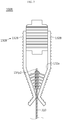
- FIG. 1 is a front perspective view schematically showing a connector and a battery pack according to an embodiment of the present disclosure.
- FIG. 2 is a rear perspective view schematically showing a connector and a battery pack according to an embodiment of the present disclosure.
- FIG. 3 is a perspective view schematically showing a connector according to an embodiment of the present disclosure.
- a connector 100 includes a mounting portion 110 and a connection portion 130.
- the mounting portion 110 may be configured to be electrically connected to a printed circuit board 222 provided in a battery management unit 220 configured to manage voltages of a plurality of battery cells 210.
- the mounting portion 110 may include a lead 110b connected to a printed circuit embedded in the printed circuit board 222.
- the lead 110b may have a shape protruding downward.
- a part of the lead 110b may be inserted through the printed circuit board 222.
- the lead 110b may have a structure extending downward to be electrically connected to the printed circuit board 222.
- the lead 110n may be inserted into the through hole H1 provided in the printed circuit board 222 and electrically connected to the printed circuit of the printed circuit board 222 by soldering.
- the mounting portion 110 may include a main body 110a having an end portion connected to the lead 110b.
- the mounting portion 110 may include the main body 110a of a plate shape extending in a horizontal direction, and two leads 110b bent downward and extending from both ends of the main body 110a in a front and rear direction.
- connection portion 130 may have a plate shape erected in a vertical direction to contact a counterpart connection terminal (see 310 of FIG. 6 ).
- the 'counterpart connection terminal 310' refers to a connection terminal that contacts the connector 100 in order for the connector 100 to transfer a current transferred from a plurality of battery cells 210 to an external device or receive power from a charger to charge the plurality of battery cells 210. That is, power of a battery pack 200 may be supplied to an external device through the counterpart connection terminal 310.
- the external device may be, for example, an electric motor (not shown) of a vacuum cleaner.
- connection terminal 310 may include an alloy having aluminum, nickel, copper, or the like having excellent electrical conductivity.
- connection portion 130 and the mounting portion 110 may include an alloy having aluminum, nickel, copper, etc. having excellent electrical conductivity.
- FIG. 4 is a plan view schematically showing a connector according to an embodiment of the present disclosure.
- the connection portion 130 includes a concave-convex structure 134 to increase a heat dissipation surface area.
- the concave-convex structure 134 may include a plurality of grooves 134h formed in the respective two or more connection terminals 132.
- the groove 134h may have a shape linearly extending in a vertical direction in an outer surface of the connection portion 130.
- the plurality of grooves 134h may be arranged to be spaced apart by a predetermined distance in a front and rear direction.
- connection portion 130 includes the two or more connection terminals 132 configured to contact the counterpart connection terminal 310, and the concave-convex structure 134 formed on the outer surface of the connection terminal 132, and thus, when the connector 100 of the present disclosure transmits a current to the counterpart connection terminal 310, the connector 100 may effectively dissipate heat generated by resistance to air. Accordingly, it is possible to prevent the connector 100 from having high heat and damaging the printed circuit board 222. In addition, it is possible to effectively reduce an increase in the internal temperature of the battery pack 200.
- the plurality of grooves 134h may be formed in an inner side surface 132a of each of the two or more connection terminals 132 facing each other, an outer side surface 132b that is an opposite surface to the inner side surface 132a, or the inner side surface 132a and the outer side surface 132b.
- the plurality of grooves 134h may be provided in the inner side surface 132a and the outer side surface 132b of the two or more connection terminals 132.
- the plurality of grooves 134h are formed in the inner side surfaces 132a and the outer side surfaces 132b of the two or more connection terminals 132 facing each other, and thus, compared to the case where the concave-convex structure 134 is formed only on one side of the inner side surface 132a and the outer side surface 132b, the heat dissipation area may further increase. Accordingly, the amount of heat dissipation of the connector 100 may effectively increase.
- the two or more connection terminals 132 may have a shape extending side by side in one direction from the main body 110a of the mounting portion 110.
- the two connection terminals 132 may have a plate shape extending in an upper direction from both ends of the main body 110a of the mounting portion 110 in the left and right direction.
- a part of the two connection terminals 132 may have a shape protruding forward from the main body 110a of the mounting portion 110.
- connection terminals 132 may be configured such that the counterpart connection terminal (310 of FIG. 6 ) is inserted between the two or more connection terminals 132.
- the two connection terminals 132 may be configured such that the counterpart connection terminal 310 is inserted between the two connection terminals 132.
- connection terminal 132 may be elastically deformable and may have a contact structure 132c.
- the contact structure 132c of each of the two or more connection terminals 132 may be configured to contact the counterpart connection terminal 310.
- the counterpart connection terminal (310 of FIG. 6 ) may be interposed between the respective contact structures 132c of the two connection terminals 132.
- the elastically deformed contact structure 132c of the connection terminal 132 may pressurize an outer surface of the counterpart connection terminal 310.
- the contact structures 132c of the two or more connection terminals 132 may extend in a direction in which the contact structures 132c are closer to each other forward, and then extend in a direction in which the contact structures 132c are away from each other at a predetermined distance.
- the contact structures 132c are provided in the respective two connection terminals 132, and the contact structures 132c may extend in a direction in which the contact structures 132c are closer to each other forward, and then extend in a direction in which the contact structures 132c are away from each other at a predetermined distance.
- the two or more connection terminals 132 may include cutting structures 13j to be divided into a plurality of individual terminals.
- the cutting structure 132j may have a slit 132s extending in a horizontal direction so that some of the two or more connection terminals 132 are divided in a vertical direction. That is, as shown in FIG. 3 , the two or more connection terminals 132 may include the cutting structure 132j that is cut in a horizontal direction from a front end thereof to a predetermined depth. Accordingly, the connection portion 130 may have four connection points with the counterpart connection terminal (310 in FIG. 6 ).
- FIG. 5 is a perspective view schematically showing a connector according to another embodiment of the present disclosure.
- FIG. 6 is a plan view schematically showing a connector according to another embodiment of the present disclosure.
- the concave-convex structure 134 of a connector 100A may include a plurality of protrusions 134p formed on the respective two or more connection terminals 132A.
- the protrusion 134p may have a shape linearly extending in a vertical direction on an outer surface of the connection portion 130A.
- the plurality of protrusions 134p may be arranged spaced apart by a predetermined distance in a front and rear direction.
- the plurality of protrusions 134p may be formed on the inner side surface 132a of each of the two or more connection terminals 132A facing each other, the outer side surface 132b that is an opposite surface to the inner side surface 132a, or the inner side surface 132a and the outer side surface 132b.
- the plurality of protrusions 134p may be provided on the inner side surface 132a and the outer side surface 132b of the two or more connection terminals 132A.
- the plurality of protrusions 134p are formed on the inner side surfaces 132a and the outer side surfaces 132b of the two or more connection terminals 132A facing each other, and thus, compared to the case where the concave-convex structure 134 is formed only on one side of the inner side surface 132a and the outer side surface 132b, the heat dissipation area may further increase. Accordingly, the amount of heat dissipation of the connector 100A may effectively increase.
- an end portion of each of the plurality of protrusions 134p1 formed on the inner side surface 132a of the connection terminal 132A may protrude to contact the counterpart connection terminal 310. That is, the plurality of protrusions 134p1 may protrude in a direction in which the counterpart connection terminal 310 is located. In addition, the end portions of the plurality of protrusions 134p1 in a protruding direction may be configured to contact a side surface of the connection terminal 132A in the horizontal direction.
- the plurality of protrusions 134p1 formed on the inner side surface 132a of the connection terminal 132A may have different sizes protruding toward the counterpart connection terminal 310.
- the plurality of protrusions 134p1 may be configured to have a longer length protruding toward the counterpart connection terminal 310 as the plurality of protrusions 134p1 are located on the rear.
- the protrusion may be integral with the connection terminal 132A, and may include an electrically conductive metal.
- the end portion of each of the plurality of protrusions 134p1 formed on the inner side surface 132a of the connection terminal 132A protrudes to contact the counterpart connection terminal 310, and thus the present disclosure may effectively increase contact points between the connection terminal 132A and the counterpart connection terminal 310. Accordingly, the connection reliability of the connector 100A may be improved. Furthermore, the protrusions 134p1 may elastically guide an insertion direction of the counterpart connection terminal 310.
- FIG. 7 is a plan view schematically showing a connector according to another embodiment of the present disclosure.
- a connector 100B shown in FIG. 7 has the same structures and configurations, except that the formation of protrusions provided on the inner side surface 132a is different. Therefore, descriptions of the remaining configurations of the connector 100B of FIG. 7 are omitted.
- an end portion of each of a plurality of protrusions 134p2 formed on the inner side surface 132a of the connection terminal 132B of a connection portion 130B may have a bending structure bent in a direction in which the counterpart connection terminal 310 is inserted. This is to prevent an increase in the friction when the counterpart connection terminal 310 is inserted and contacts the plurality of protrusions 134p2.
- the bent end portion of each of the plurality of protrusions 134p2 may be configured to guide the direction in which the counterpart connection terminal 310 is inserted.
- each of the plurality of protrusions 134p2 formed on the inner side surface 132a of the connection terminal 132B has the structure bent in the direction into which the counterpart connection terminal 310 is inserted, and thus the friction generated in a process of inserting the counterpart connection terminal 310 may be effectively reduced, so that the counterpart connection terminal 310 may be inserted smoothly. Accordingly, there is an advantage in that it is easy to connect the counterpart connection terminal 310 and the connection terminal 132B.
- FIG. 8 is an exploded perspective view schematically showing components of a battery pack according to an embodiment of the present disclosure.
- the battery management unit 220 includes the plurality of connectors 100 and the printed circuit board 222 electrically connected to the plurality of connectors 100.
- the battery pack 200 according to the present disclosure includes the battery pack 200 including the plurality of battery cells 210 and the battery management unit 220. That is, the battery pack 200 according to the present disclosure may include the battery management unit 220 as various devices for controlling charging and discharging of the plurality of battery cells 210.
- the battery cell 210 may be a cylindrical battery cell.
- the cylindrical battery cell 210 may include a cylindrical battery can 212 and an electrode assembly (not shown) accommodated in the battery can 212.
- the battery can 212 includes a material having high electrical conductivity, and for example, the battery can 212 may include aluminum, steel, or copper.
- electrode terminals 211a and 211b may be respectively formed on both ends of the battery can 212 in a horizontal direction.
- the electrode terminal 211 may include a first electrode terminal 211a and a second electrode terminal 211b having different electrical polarities.
- the first electrode terminal 211a may be formed on one end (a front end) of the battery can 212 in the horizontal direction
- the second electrode terminal 211b may be formed on the other end (a rear end) in the horizontal direction.
- the electrode assembly may be formed in a structure wound in a jelly-roll type with a separator interposed between a positive electrode and a negative electrode.
- a positive electrode tab (not illustrated) may be attached to the positive electrode (not illustrated) to be connected to the first electrode terminal 211a on the front end of the battery can 212.
- a negative electrode tab (not illustrated) may be attached to the negative electrode (not illustrated) to be connected to the second electrode terminal 211b on the rear end of the battery can 212.
- the battery pack 200 may include 12 cylindrical battery cells 210 arranged in one direction.
- the first electrode terminals 211a of the 12 cylindrical battery cells 210 may be disposed to be adjacent to the second electrode terminals 211b having different polarities.
- the battery cell 210 according to the present disclosure is not limited to the cylindrical battery cell 210 described above, and various types of battery cells 210 known at the time of filing of the present application may be employed.
- the battery pack 200 may further include a pack housing 240 in which an internal space accommodating the plurality of battery cells 210 is formed.
- the pack housing 240 may include an electrically insulating material.
- the pack housing 240 may include a plastic material such as polyvinyl chloride.
- the pack housing 240 may include a first case 241 and a second case 242.
- a plurality of hollow structures H2 may be formed in the first case 241 and the second case 242 to surround an outer surface of an upper portion or a lower portion of the cylindrical battery cell 210 so that a plurality of cylindrical battery cells 210 may be accommodated.
- a bolt fastening structure may be formed in the first case 241 and the second case 242.
- fastening holes S1 configured to make four bolts 252 inserted thereinto may be formed in the first case 241 and the second case 242.
- the four bolts 252 are fastened to the fastening holes S1 of the first case 241 and the second case 242, so that a rear portion of the first case 241 and a front portion of the second case 242 may be coupled to each other.
- inlet grooves 242h may be formed in outer surfaces of the first case 241 and the second case 242 of the pack housing 240 so that at least a part of the connection portion 232 and the sensing portion 234 of the bus bar plate 230 is inserted and fixed.
- the inlet groove 242h formed on the outer surface of the pack housing 240 may have an inner surface having a size corresponding to the outer shape of the bus bar plate 230.
- the inlet groove 242h into which the connection portion 232 of the bus bar plate 230 may be inserted and embedded may be formed in the outer surface of the front of the first case 241.
- the inlet groove 242h into which a part of the sensing portion 234 of the bus bar plate 230 may be inserted and fixed may be formed in an upper outer surface of the first case 241.
- the inlet groove 242h may also be formed in a rear outer surface and an upper outer surface of each of the second case 242 of the pack housing 240 so that a part of the connection portion 232 and the sensing portion 234 of the bus bar plate 230 may be inserted and fixed
- the inlet grooves 242h may be formed in the outer surface of the pack housing 240 so that at least a part of the connection portion 232 and the sensing portion 234 of the bus bar plate 230 is inserted and fixed, and thus the busbar plate 230 may stably establish an electrical connection between the plurality of battery cells 210, and prevent the busbar plate 230 from being damaged from external substances.
- the sensing portion 234 of the bus bar plate 230 may be prevented from flowing due to an external impact, the electrical connection between the battery management unit 220 and the plurality of battery cells 210 may be stably maintained. Accordingly, durability of the battery pack 200 may be improved.
- the printed circuit board 222 on which the plurality of connectors 100 are mounted may be mounted to the upper portion of the pack housing 240.
- connection 110 mounting portion 130: connection portion 132: connection terminal 134: concave-convex structure 134h: groove 134p, 134p1, 134p2: protrusion 132a, 132b: inner side surface, outer side surface 200: battery pack 210: battery cell 220: battery management unit 222: printed circuit board
- the present disclosure relates to a connector. Further, the present disclosure is applicable to a battery pack to which the connector is applied and an electronic device industry including the battery pack.
Landscapes
- Chemical & Material Sciences (AREA)
- Chemical Kinetics & Catalysis (AREA)
- Electrochemistry (AREA)
- General Chemical & Material Sciences (AREA)
- Engineering & Computer Science (AREA)
- Manufacturing & Machinery (AREA)
- Microelectronics & Electronic Packaging (AREA)
- Life Sciences & Earth Sciences (AREA)
- Biophysics (AREA)
- Aviation & Aerospace Engineering (AREA)
- Battery Mounting, Suspending (AREA)
- Connection Of Batteries Or Terminals (AREA)
- Coupling Device And Connection With Printed Circuit (AREA)
- Secondary Cells (AREA)
Abstract
Description
- The present disclosure relates to a connector, a battery management unit, and a battery pack, and more particularly, to a connector with increased heat dissipation efficiency and ease of use.
- The present application claims priority to
Korean Patent Application No. 10-2019-0105128 filed on August 27, 2019 - Recently, secondary batteries capable of charging and discharging have been widely used as an energy source for wireless mobile devices. In addition, secondary batteries are attracting attention as a power source for electric vehicles (EVs) and hybrid electric vehicles (HEVs), which are proposed as a solution to air pollution such as existing gasoline vehicles and diesel vehicles that use fossil fuels.
- In small mobile devices, one or two or three battery cells per device are used, whereas in medium and large devices such as automobiles, due to the need for high power and large capacity, medium and large battery modules electrically connecting multiple battery cells are used. A battery pack implemented by connecting such multiple battery cells is used.
- Since such battery packs are preferably manufactured in a small size and weight as possible, battery packs may be stacked with a high degree of integration, and square shape cells, pouch type cells, etc. having a small weight to capacity are mainly used as battery cells applied to a battery pack.
- In addition, in order for the battery pack to provide output and capacity required in a given apparatus or device, it is necessary to electrically connect a plurality of battery cells in series, in parallel, or in a combination of series and parallel. For example, the battery cells included in the battery pack may be welded to a plurality of bus bar plates provided with electrode terminals in the form of metal plates and electrically connected in series, in parallel, or in a combination of series and parallel.
- Moreover, since the battery pack has a structure in which a plurality of battery cells are combined, the battery pack requires a sensing means capable of sensing a current generated from the battery cells in order to detect when some battery cells are overvoltage, overcurrent, or overheating. Such sensing means are individually connected to the battery cells to provide voltage/current information of the battery cells to a battery management unit.
- Such a battery management unit may include a printed circuit board in which a printed circuit is embedded. In addition, the battery management unit needs a connector mounted on the printed circuit board in order to exchange signals with an external device or to receive power from the outside to charge the battery cells or to supply power to the external device to discharge the battery cells. Such a connector may be repeatedly connected to and disconnected from a counterpart connector.
- However, in the related art, because a high current flows through a connector applied to a high capacity and high current battery pack, it is easy to heat up to a high temperature due to electrical resistance. Accordingly, a high temperature connector may damage a printed circuit board which is an internal configuration of the battery pack, or a contacted pack housing may melt, and there is a high possibility of getting burned when a user holds the battery pack with his or her hand.
- The present disclosure is designed to solve the problems of the related art, and therefore the present disclosure is directed to providing a connector with increased heat dissipation efficiency and ease of use.
- These and other objects and advantages of the present disclosure may be understood from the following detailed description and will become more fully apparent from the exemplary embodiments of the present disclosure. Also, it will be easily understood that the objects and advantages of the present disclosure may be realized by the means shown in the appended claims and combinations thereof.
- In one aspect of the present disclosure, there is provided a connector including a mounting portion electrically connected to a printed circuit board of a battery management unit configured to manage voltages of a plurality of battery cells; and a connection portion comprising two or more connection terminals configured to contact a counterpart connection terminal and comprising a concave-convex structure formed on an outer surface of the connection terminal.
- The concave-convex structure may include a plurality of grooves respectively formed in the two or more connection terminals.
- The plurality of grooves may be formed in an inner side surface of the two or more connection terminals facing each other, an outer side surface that is an opposite surface to the inner side surface, or the inner side surface and the outer side surface.
- The concave-convex structure may include a plurality of protrusions respectively formed in the two or more connection terminals.
- The plurality of protrusions may be formed on an inner side surface of the two or more connection terminals facing each other, an outer side surface that is an opposite surface to the inner side surface, or the inner side surface and the outer side surface.
- The two or more connection terminals may have a shape extending side by side in one direction from a main body of the mounting portion.
- The two or more connection terminals may be configured such that the counterpart connection terminal is inserted between the two or more connection terminals.
- An end portion of each of the plurality of protrusions formed on the inner side surface of the connection terminal may protrude to contact the counterpart connection terminal.
- The plurality of protrusions formed on the inner side surface of the connection terminal may have different sizes protruding toward the counterpart connection terminal.
- The end portion of each of the plurality of protrusions formed on the inner side surface of the connection terminal may include a bending structure bent in a direction in which the counterpart connection terminal is inserted.
- In another aspect of the present disclosure, there is provided a battery management unit including a connector and a printed circuit board electrically connected to the connector.
- In another aspect of the present disclosure, there is provided a battery pack including the battery management unit.
- According to an aspect of the present disclosure, a connection portion includes two or more connection terminals configured to contact a counterpart connection terminal, and a concave-convex structure formed on an outer surface of the connection terminal, and thus, when a connector of the present disclosure transmits a current to the counterpart connection terminal, the connector may effectively dissipate heat generated by resistance to air. Accordingly, it is possible to prevent the connector from having high heat and damaging a printed circuit board. In addition, it is possible to effectively reduce an increase in the internal temperature of a battery pack.
- In addition, according to an aspect of the present disclosure, a plurality of grooves are formed in inner side surfaces and outer side surfaces of the two or more connection terminals facing each other, and thus, compared to the case where the concave-convex structure is formed only on one side of the inner side surface and the outer side surface, it is possible to further increase a heat dissipation area. Accordingly, it is possible to effectively increase the amount of heat dissipation of the connector.
- Moreover, according to an aspect of the present disclosure, a plurality of protrusions are formed on inner side surfaces and outer side surfaces of the two or more connection terminals facing each other, and thus, compared to the case where the concave-convex structure is formed only on one side of the inner side surface and the outer side surface, it is possible to further increase a heat dissipation area. Accordingly, it is possible to effectively increase the amount of heat dissipation of the connector.
- In addition, according to an aspect of the present disclosure, an end portion of each of a plurality of protrusions formed on the inner side surface of the connection terminal protrudes to contact the counterpart connection terminal, and thus the present disclosure may effectively increase contact points between the connection terminal and the counterpart connection terminal. Accordingly, it is possible to improve the connection reliability of the
connector 100A. Furthermore, the protrusions may elastically guide an insertion direction of the counterpart connection terminal. - The accompanying drawings illustrate a preferred embodiment of the present disclosure and together with the foregoing disclosure, serve to provide further understanding of the technical features of the present disclosure, and thus, the present disclosure is not construed as being limited to the drawing.
-
FIG. 1 is a front perspective view schematically showing a connector and a battery pack according to an embodiment of the present disclosure. -
FIG. 2 is a rear perspective view schematically showing a connector and a battery pack according to an embodiment of the present disclosure. -
FIG. 3 is a perspective view schematically showing a connector according to an embodiment of the present disclosure. -
FIG. 4 is a plan view schematically showing a connector according to an embodiment of the present disclosure. -
FIG. 5 is a perspective view schematically showing a connector according to another embodiment of the present disclosure. -
FIG. 6 is a plan view schematically showing a connector according to another embodiment of the present disclosure. -
FIG. 7 is a plan view schematically showing a connector according to another embodiment of the present disclosure. -
FIG. 8 is an exploded perspective view schematically showing components of a battery pack according to an embodiment of the present disclosure. - Hereinafter, preferred embodiments of the present disclosure will be described in detail with reference to the accompanying drawings. Prior to the description, it should be understood that the terms used in the specification and the appended claims should not be construed as limited to general and dictionary meanings, but interpreted based on the meanings and concepts corresponding to technical aspects of the present disclosure on the basis of the principle that the inventor is allowed to define terms appropriately for the best explanation.
- Therefore, the description proposed herein is just a preferable example for the purpose of illustrations only, not intended to limit the scope of the disclosure, so it should be understood that other equivalents and modifications could be made thereto without departing from the scope of the disclosure.
-
FIG. 1 is a front perspective view schematically showing a connector and a battery pack according to an embodiment of the present disclosure.FIG. 2 is a rear perspective view schematically showing a connector and a battery pack according to an embodiment of the present disclosure.FIG. 3 is a perspective view schematically showing a connector according to an embodiment of the present disclosure. - Referring to
FIGS. 1 to 3 , aconnector 100 according to an embodiment of the present disclosure includes amounting portion 110 and aconnection portion 130. - Specifically, the
mounting portion 110 may be configured to be electrically connected to a printedcircuit board 222 provided in abattery management unit 220 configured to manage voltages of a plurality ofbattery cells 210. The mountingportion 110 may include a lead 110b connected to a printed circuit embedded in the printedcircuit board 222. The lead 110b may have a shape protruding downward. - A part of the lead 110b may be inserted through the printed
circuit board 222. The lead 110b may have a structure extending downward to be electrically connected to the printedcircuit board 222. The lead 110n may be inserted into the through hole H1 provided in the printedcircuit board 222 and electrically connected to the printed circuit of the printedcircuit board 222 by soldering. - In addition, the mounting
portion 110 may include amain body 110a having an end portion connected to the lead 110b. For example, as shown inFIG. 3 , when viewed in the F direction ofFIG. 1 , the mountingportion 110 may include themain body 110a of a plate shape extending in a horizontal direction, and twoleads 110b bent downward and extending from both ends of themain body 110a in a front and rear direction. - Here, terms representing directions such as before, after, left, right, up, and down described in the present specification may vary depending on the position of an observer or the shape of an object that is placed. However, in the present specification, for convenience of description, the directions such as front, rear, left, right, up, and down are indicated separately based on when viewed in the F direction.
- Specifically, the
connection portion 130 may have a plate shape erected in a vertical direction to contact a counterpart connection terminal (see 310 ofFIG. 6 ). Here, the 'counterpart connection terminal 310' refers to a connection terminal that contacts theconnector 100 in order for theconnector 100 to transfer a current transferred from a plurality ofbattery cells 210 to an external device or receive power from a charger to charge the plurality ofbattery cells 210. That is, power of abattery pack 200 may be supplied to an external device through thecounterpart connection terminal 310. The external device may be, for example, an electric motor (not shown) of a vacuum cleaner. - The
counterpart connection terminal 310 may include an alloy having aluminum, nickel, copper, or the like having excellent electrical conductivity. Likewise, theconnection portion 130 and the mountingportion 110 may include an alloy having aluminum, nickel, copper, etc. having excellent electrical conductivity. -
FIG. 4 is a plan view schematically showing a connector according to an embodiment of the present disclosure. - Referring back to
FIG. 4 along withFIG. 3 , theconnection portion 130 includes a concave-convex structure 134 to increase a heat dissipation surface area. For example, the concave-convex structure 134 may include a plurality ofgrooves 134h formed in the respective two ormore connection terminals 132. Thegroove 134h may have a shape linearly extending in a vertical direction in an outer surface of theconnection portion 130. The plurality ofgrooves 134h may be arranged to be spaced apart by a predetermined distance in a front and rear direction. - Accordingly, according to this configuration of the present disclosure, the
connection portion 130 includes the two ormore connection terminals 132 configured to contact thecounterpart connection terminal 310, and the concave-convex structure 134 formed on the outer surface of theconnection terminal 132, and thus, when theconnector 100 of the present disclosure transmits a current to thecounterpart connection terminal 310, theconnector 100 may effectively dissipate heat generated by resistance to air. Accordingly, it is possible to prevent theconnector 100 from having high heat and damaging the printedcircuit board 222. In addition, it is possible to effectively reduce an increase in the internal temperature of thebattery pack 200. - More specifically, the plurality of
grooves 134h may be formed in aninner side surface 132a of each of the two ormore connection terminals 132 facing each other, anouter side surface 132b that is an opposite surface to theinner side surface 132a, or theinner side surface 132a and theouter side surface 132b. For example, as shown inFIG. 3 , the plurality ofgrooves 134h may be provided in theinner side surface 132a and theouter side surface 132b of the two ormore connection terminals 132. - Accordingly, according to this configuration of the present disclosure, the plurality of
grooves 134h are formed in theinner side surfaces 132a and the outer side surfaces 132b of the two ormore connection terminals 132 facing each other, and thus, compared to the case where the concave-convex structure 134 is formed only on one side of theinner side surface 132a and theouter side surface 132b, the heat dissipation area may further increase. Accordingly, the amount of heat dissipation of theconnector 100 may effectively increase. - Referring back to
FIGS. 3 and4 , the two ormore connection terminals 132 may have a shape extending side by side in one direction from themain body 110a of the mountingportion 110. For example, as shown inFIG. 4 , the twoconnection terminals 132 may have a plate shape extending in an upper direction from both ends of themain body 110a of the mountingportion 110 in the left and right direction. A part of the twoconnection terminals 132 may have a shape protruding forward from themain body 110a of the mountingportion 110. - In addition, the two or
more connection terminals 132 may be configured such that the counterpart connection terminal (310 ofFIG. 6 ) is inserted between the two ormore connection terminals 132. For example, as shown inFIG. 4 , the twoconnection terminals 132 may be configured such that thecounterpart connection terminal 310 is inserted between the twoconnection terminals 132. - Moreover, the
connection terminal 132 may be elastically deformable and may have acontact structure 132c. For example, thecontact structure 132c of each of the two ormore connection terminals 132 may be configured to contact thecounterpart connection terminal 310. As shown inFIG. 4 , the counterpart connection terminal (310 ofFIG. 6 ) may be interposed between therespective contact structures 132c of the twoconnection terminals 132. In this regard, the elasticallydeformed contact structure 132c of theconnection terminal 132 may pressurize an outer surface of thecounterpart connection terminal 310. - Further, the
contact structures 132c of the two ormore connection terminals 132 may extend in a direction in which thecontact structures 132c are closer to each other forward, and then extend in a direction in which thecontact structures 132c are away from each other at a predetermined distance. For example, as shown inFIG. 4 , thecontact structures 132c are provided in the respective twoconnection terminals 132, and thecontact structures 132c may extend in a direction in which thecontact structures 132c are closer to each other forward, and then extend in a direction in which thecontact structures 132c are away from each other at a predetermined distance. - Further, in order to improve the reliability of contact between the
contact structure 132c of each of the two ormore connection terminals 132 and thecounterpart connection terminal 310, the two ormore connection terminals 132 may include cutting structures 13j to be divided into a plurality of individual terminals. The cuttingstructure 132j may have aslit 132s extending in a horizontal direction so that some of the two ormore connection terminals 132 are divided in a vertical direction. That is, as shown inFIG. 3 , the two ormore connection terminals 132 may include the cuttingstructure 132j that is cut in a horizontal direction from a front end thereof to a predetermined depth. Accordingly, theconnection portion 130 may have four connection points with the counterpart connection terminal (310 inFIG. 6 ). -
FIG. 5 is a perspective view schematically showing a connector according to another embodiment of the present disclosure.FIG. 6 is a plan view schematically showing a connector according to another embodiment of the present disclosure. - Referring to
FIGS. 5 and6 , the concave-convex structure 134 of aconnector 100A according to another embodiment may include a plurality ofprotrusions 134p formed on the respective two ormore connection terminals 132A. Here, theprotrusion 134p may have a shape linearly extending in a vertical direction on an outer surface of theconnection portion 130A. The plurality ofprotrusions 134p may be arranged spaced apart by a predetermined distance in a front and rear direction. - More specifically, the plurality of
protrusions 134p may be formed on theinner side surface 132a of each of the two ormore connection terminals 132A facing each other, theouter side surface 132b that is an opposite surface to theinner side surface 132a, or theinner side surface 132a and theouter side surface 132b. For example, as shown inFIG. 6 , the plurality ofprotrusions 134p may be provided on theinner side surface 132a and theouter side surface 132b of the two ormore connection terminals 132A. - Accordingly, according to this configuration of the present disclosure, the plurality of
protrusions 134p are formed on theinner side surfaces 132a and the outer side surfaces 132b of the two ormore connection terminals 132A facing each other, and thus, compared to the case where the concave-convex structure 134 is formed only on one side of theinner side surface 132a and theouter side surface 132b, the heat dissipation area may further increase. Accordingly, the amount of heat dissipation of theconnector 100A may effectively increase. - Referring back to
FIG. 6 , an end portion of each of the plurality of protrusions 134p1 formed on theinner side surface 132a of theconnection terminal 132A may protrude to contact thecounterpart connection terminal 310. That is, the plurality of protrusions 134p1 may protrude in a direction in which thecounterpart connection terminal 310 is located. In addition, the end portions of the plurality of protrusions 134p1 in a protruding direction may be configured to contact a side surface of theconnection terminal 132A in the horizontal direction. - In addition, the plurality of protrusions 134p1 formed on the
inner side surface 132a of theconnection terminal 132A may have different sizes protruding toward thecounterpart connection terminal 310. For example, as shown inFIG. 6 , the plurality of protrusions 134p1 may be configured to have a longer length protruding toward thecounterpart connection terminal 310 as the plurality of protrusions 134p1 are located on the rear. In this regard, the protrusion may be integral with theconnection terminal 132A, and may include an electrically conductive metal. - Accordingly, according to this configuration of the present disclosure, the end portion of each of the plurality of protrusions 134p1 formed on the
inner side surface 132a of theconnection terminal 132A protrudes to contact thecounterpart connection terminal 310, and thus the present disclosure may effectively increase contact points between theconnection terminal 132A and thecounterpart connection terminal 310. Accordingly, the connection reliability of theconnector 100A may be improved. Furthermore, the protrusions 134p1 may elastically guide an insertion direction of thecounterpart connection terminal 310. -
FIG. 7 is a plan view schematically showing a connector according to another embodiment of the present disclosure. When compared with theconnector 100A ofFIG. 6 , aconnector 100B shown inFIG. 7 has the same structures and configurations, except that the formation of protrusions provided on theinner side surface 132a is different. Therefore, descriptions of the remaining configurations of theconnector 100B ofFIG. 7 are omitted. - Referring back to
FIG. 7 , in theconnector 100B according to another embodiment, an end portion of each of a plurality of protrusions 134p2 formed on theinner side surface 132a of theconnection terminal 132B of aconnection portion 130B may have a bending structure bent in a direction in which thecounterpart connection terminal 310 is inserted. This is to prevent an increase in the friction when thecounterpart connection terminal 310 is inserted and contacts the plurality of protrusions 134p2. The bent end portion of each of the plurality of protrusions 134p2 may be configured to guide the direction in which thecounterpart connection terminal 310 is inserted. - For example, as shown in
FIG. 7 , the end portion of each of the plurality of protrusions 134p2 formed on theinner side surface 132a of theconnection terminal 132B has the structure bent in the direction into which thecounterpart connection terminal 310 is inserted, and thus the friction generated in a process of inserting thecounterpart connection terminal 310 may be effectively reduced, so that thecounterpart connection terminal 310 may be inserted smoothly. Accordingly, there is an advantage in that it is easy to connect thecounterpart connection terminal 310 and theconnection terminal 132B. -
FIG. 8 is an exploded perspective view schematically showing components of a battery pack according to an embodiment of the present disclosure. - Referring to
FIG. 8 , thebattery management unit 220 according to the present disclosure includes the plurality ofconnectors 100 and the printedcircuit board 222 electrically connected to the plurality ofconnectors 100. - Moreover, the
battery pack 200 according to the present disclosure includes thebattery pack 200 including the plurality ofbattery cells 210 and thebattery management unit 220. That is, thebattery pack 200 according to the present disclosure may include thebattery management unit 220 as various devices for controlling charging and discharging of the plurality ofbattery cells 210. - Specifically, the
battery cell 210 may be a cylindrical battery cell. In addition, thecylindrical battery cell 210 may include a cylindrical battery can 212 and an electrode assembly (not shown) accommodated in the battery can 212. - Here, the battery can 212 includes a material having high electrical conductivity, and for example, the battery can 212 may include aluminum, steel, or copper. In addition,
electrode terminals - Specifically, the
electrode terminal 211 may include afirst electrode terminal 211a and asecond electrode terminal 211b having different electrical polarities. In addition, when viewed in the F direction (shown inFIG. 1 ), thefirst electrode terminal 211a may be formed on one end (a front end) of the battery can 212 in the horizontal direction, and thesecond electrode terminal 211b may be formed on the other end (a rear end) in the horizontal direction. - Here, terms representing directions such as before, after, left, right, up, and down described in the present specification may vary depending on the position of an observer or the shape of an object that is placed. However, in the present specification, for convenience of description, the directions such as front, rear, left, right, up, and down are indicated separately based on when viewed in the F direction.
- Further, the electrode assembly may be formed in a structure wound in a jelly-roll type with a separator interposed between a positive electrode and a negative electrode. In addition, a positive electrode tab (not illustrated) may be attached to the positive electrode (not illustrated) to be connected to the
first electrode terminal 211a on the front end of the battery can 212. Furthermore, a negative electrode tab (not illustrated) may be attached to the negative electrode (not illustrated) to be connected to thesecond electrode terminal 211b on the rear end of the battery can 212. - For example, as shown in
FIG. 2 , thebattery pack 200 may include 12cylindrical battery cells 210 arranged in one direction. In addition, thefirst electrode terminals 211a of the 12cylindrical battery cells 210 may be disposed to be adjacent to thesecond electrode terminals 211b having different polarities. - However, the
battery cell 210 according to the present disclosure is not limited to thecylindrical battery cell 210 described above, and various types ofbattery cells 210 known at the time of filing of the present application may be employed. - The
battery pack 200 may further include apack housing 240 in which an internal space accommodating the plurality ofbattery cells 210 is formed. - Specifically, the
pack housing 240 may include an electrically insulating material. For example, thepack housing 240 may include a plastic material such as polyvinyl chloride. In addition, thepack housing 240 may include afirst case 241 and asecond case 242. A plurality of hollow structures H2 may be formed in thefirst case 241 and thesecond case 242 to surround an outer surface of an upper portion or a lower portion of thecylindrical battery cell 210 so that a plurality ofcylindrical battery cells 210 may be accommodated. - Furthermore, a bolt fastening structure may be formed in the
first case 241 and thesecond case 242. For example, as shown inFIG. 8 , fastening holes S1 configured to make fourbolts 252 inserted thereinto may be formed in thefirst case 241 and thesecond case 242. In addition, the fourbolts 252 are fastened to the fastening holes S1 of thefirst case 241 and thesecond case 242, so that a rear portion of thefirst case 241 and a front portion of thesecond case 242 may be coupled to each other. - In addition,
inlet grooves 242h may be formed in outer surfaces of thefirst case 241 and thesecond case 242 of thepack housing 240 so that at least a part of theconnection portion 232 and thesensing portion 234 of thebus bar plate 230 is inserted and fixed. - Specifically, the
inlet groove 242h formed on the outer surface of thepack housing 240 may have an inner surface having a size corresponding to the outer shape of thebus bar plate 230. For example, as shown inFIG. 2 , theinlet groove 242h into which theconnection portion 232 of thebus bar plate 230 may be inserted and embedded may be formed in the outer surface of the front of thefirst case 241. - In addition, the
inlet groove 242h into which a part of thesensing portion 234 of thebus bar plate 230 may be inserted and fixed may be formed in an upper outer surface of thefirst case 241. Similarly, theinlet groove 242h may also be formed in a rear outer surface and an upper outer surface of each of thesecond case 242 of thepack housing 240 so that a part of theconnection portion 232 and thesensing portion 234 of thebus bar plate 230 may be inserted and fixed - Accordingly, according to this configuration of the present disclosure, the
inlet grooves 242h may be formed in the outer surface of thepack housing 240 so that at least a part of theconnection portion 232 and thesensing portion 234 of thebus bar plate 230 is inserted and fixed, and thus thebusbar plate 230 may stably establish an electrical connection between the plurality ofbattery cells 210, and prevent thebusbar plate 230 from being damaged from external substances. In addition, since thesensing portion 234 of thebus bar plate 230 may be prevented from flowing due to an external impact, the electrical connection between thebattery management unit 220 and the plurality ofbattery cells 210 may be stably maintained. Accordingly, durability of thebattery pack 200 may be improved. - In addition, the printed
circuit board 222 on which the plurality ofconnectors 100 are mounted may be mounted to the upper portion of thepack housing 240. - Meanwhile, in the present specification, although the terms indicating directions such as up, down, left, right, front, and back are used, it is apparent to those skilled in the art that these terms are for convenience of explanation only and vary depending on the position of a target object or the position of an observer.
- The present disclosure has been described in detail. However, it should be understood that the detailed description and specific examples, while indicating preferred embodiments of the disclosure, are given by way of illustration only, since various changes and modifications within the scope of the disclosure will become apparent to those skilled in the art from this detailed description.
[Description of Reference Numerals] 100: connector 110: mounting portion 130: connection portion 132: connection terminal 134: concave- convex structure 134h: groove 134p, 134p1, 134p2: protrusion 132a, 132b: inner side surface, outer side surface 200: battery pack 210: battery cell 220: battery management unit 222: printed circuit board - The present disclosure relates to a connector. Further, the present disclosure is applicable to a battery pack to which the connector is applied and an electronic device industry including the battery pack.
Claims (10)
- A connector comprising:a mounting portion electrically connected to a printed circuit board of a battery management unit configured to manage voltages of a plurality of battery cells; anda connection portion comprising two or more connection terminals configured to contact a counterpart connection terminal and comprising a concave-convex structure formed on an outer surface of the connection terminal.
- The connector of claim 1,
wherein the concave-convex structure comprises a plurality of grooves respectively formed in the two or more connection terminals. - The connector of claim 2,
wherein the plurality of grooves are formed in an inner side surface of the two or more connection terminals facing each other, an outer side surface that is an opposite surface to the inner side surface, or the inner side surface and the outer side surface. - The connector of claim 1,
wherein the concave-convex structure comprises a plurality of protrusions respectively formed in the two or more connection terminals. - The connector of claim 4,
wherein the plurality of protrusions are formed on an inner side surface of the two or more connection terminals facing each other, an outer side surface that is an opposite surface to the inner side surface, or the inner side surface and the outer side surface. - The connector of claim 5,wherein the two or more connection terminals have a shape extending side by side in one direction from a main body of the mounting portion,wherein the two or more connection terminals are configured such that the counterpart connection terminal is inserted between the two or more connection terminals, andwherein an end portion of each of the plurality of protrusions formed on the inner side surface of the connection terminal protrudes to contact the counterpart connection terminal.
- The connector of claim 6,
wherein the plurality of protrusions formed on the inner side surface of the connection terminal have different sizes protruding toward the counterpart connection terminal. - The connector of claim 6,
wherein the end portion of each of the plurality of protrusions formed on the inner side surface of the connection terminal comprises a bending structure bent in a direction in which the counterpart connection terminal is inserted. - A battery management unit comprising a connector according to any one of claims 1 to 8, and a printed circuit board electrically connected to the connector.
- A battery pack comprising a battery management unit according to claim 9.
Applications Claiming Priority (2)
| Application Number | Priority Date | Filing Date | Title |
|---|---|---|---|
| KR1020190105128A KR102748301B1 (en) | 2019-08-27 | 2019-08-27 | Connector |
| PCT/KR2020/011509 WO2021040438A1 (en) | 2019-08-27 | 2020-08-27 | Connector, battery management unit and battery pack |
Publications (3)
| Publication Number | Publication Date |
|---|---|
| EP3923403A1 true EP3923403A1 (en) | 2021-12-15 |
| EP3923403A4 EP3923403A4 (en) | 2022-05-18 |
| EP3923403B1 EP3923403B1 (en) | 2025-06-11 |
Family
ID=74685501
Family Applications (1)
| Application Number | Title | Priority Date | Filing Date |
|---|---|---|---|
| EP20856379.1A Active EP3923403B1 (en) | 2019-08-27 | 2020-08-27 | Connector, battery management unit and battery pack |
Country Status (8)
| Country | Link |
|---|---|
| US (1) | US12051868B2 (en) |
| EP (1) | EP3923403B1 (en) |
| JP (1) | JP7367021B2 (en) |
| KR (1) | KR102748301B1 (en) |
| CN (1) | CN113661606A (en) |
| ES (1) | ES3036446T3 (en) |
| HU (1) | HUE071990T2 (en) |
| WO (1) | WO2021040438A1 (en) |
Families Citing this family (2)
| Publication number | Priority date | Publication date | Assignee | Title |
|---|---|---|---|---|
| JP7779707B2 (en) * | 2021-11-24 | 2025-12-03 | 矢崎総業株式会社 | Terminals |
| FR3137954B1 (en) * | 2022-07-12 | 2024-10-04 | A Raymond Et Cie | Connector |
Family Cites Families (40)
| Publication number | Priority date | Publication date | Assignee | Title |
|---|---|---|---|---|
| JPH01107481A (en) * | 1987-10-19 | 1989-04-25 | Hitachi Cable Ltd | terminal structure |
| JPH01126069U (en) * | 1988-02-22 | 1989-08-29 | ||
| JP2607822Y2 (en) * | 1993-05-21 | 2003-03-31 | タイコエレクトロニクスアンプ株式会社 | Contacts and connectors |
| JPH07223313A (en) | 1994-02-09 | 1995-08-22 | Fuji Xerox Co Ltd | Recording device and recording head and manufacture of recording head |
| US5695367A (en) | 1994-09-30 | 1997-12-09 | Daiichi Denso Buhin Co., Ltd. | Connector attachment component |
| JP2001345134A (en) * | 2000-05-31 | 2001-12-14 | Mitsubishi Electric Corp | Connectors and semiconductor devices |
| CN2439118Y (en) | 2000-07-15 | 2001-07-11 | 莫列斯公司 | Battery connector |
| JP3682259B2 (en) | 2001-01-04 | 2005-08-10 | 東芝Itコントロールシステム株式会社 | Contact terminal and method for maintaining conductivity of contact terminal |
| SG121012A1 (en) | 2004-10-01 | 2006-04-26 | Molex Inc | Heat dissipating terminal and elctrical connector using same |
| KR100904373B1 (en) | 2004-12-24 | 2009-06-25 | 주식회사 엘지화학 | Heat dissipation structure for secondary battery module, and switching board and secondary battery module comprising same |
| JP4333715B2 (en) * | 2006-09-07 | 2009-09-16 | 日立工機株式会社 | Battery pack, charger, and power tool |
| WO2010096567A1 (en) | 2009-02-18 | 2010-08-26 | Molex Incorporated | Vertical connector for a printed circuit board |
| JP2010205494A (en) * | 2009-03-02 | 2010-09-16 | Junichi Morino | Female type electric connection terminal |
| KR101069798B1 (en) * | 2009-09-15 | 2011-10-04 | 성경정밀(주) | A Socket for Battery Connector |
| US8647147B2 (en) * | 2010-03-09 | 2014-02-11 | Nii Northern International Inc. | Dual conductor cable connector |
| JP5573383B2 (en) | 2010-06-09 | 2014-08-20 | 住友電装株式会社 | Connector cap |
| JP5592194B2 (en) * | 2010-08-20 | 2014-09-17 | 三洋電機株式会社 | Battery pack |
| FR2975835B1 (en) * | 2011-05-24 | 2014-05-16 | Raymond A & Cie | GROUND CLIP AND EARTH ASSEMBLY |
| CN202602018U (en) * | 2012-04-25 | 2012-12-12 | 昆山嘉华电子有限公司 | Coaxial electric connector and conductive terminal thereof |
| CN202602017U (en) * | 2012-04-25 | 2012-12-12 | 昆山嘉华电子有限公司 | Coaxial electric connector and conductive terminal thereof |
| CN202759105U (en) | 2012-09-05 | 2013-02-27 | 至佳电子股份有限公司 | electrical connector |
| US9065106B2 (en) | 2012-10-17 | 2015-06-23 | Black & Decker Inc. | Battery pack with guide rails for improved terminal alignment |
| US9912020B2 (en) | 2013-03-12 | 2018-03-06 | Milwaukee Electric Tool Corporation | Battery pack with heat sink |
| JP6091968B2 (en) * | 2013-04-04 | 2017-03-08 | 株式会社マキタ | Battery pack for electric tools |
| US9017093B1 (en) * | 2013-12-05 | 2015-04-28 | Cooper Technologies Company | Electric meter socket assembly |
| KR102283792B1 (en) | 2014-08-25 | 2021-08-02 | 삼성에스디아이 주식회사 | Rechargeable battery module |
| KR102358209B1 (en) | 2014-11-13 | 2022-02-03 | 현대모비스 주식회사 | Detachable cell tap connector |
| JP6581824B2 (en) * | 2015-07-06 | 2019-09-25 | 株式会社マキタ | Battery pack |
| KR102092267B1 (en) | 2015-07-20 | 2020-03-23 | 주식회사 엘지화학 | Battery module, battery pack comprising the battery module and vehicle comprising the battery pack |
| DE102016107482A1 (en) * | 2016-04-22 | 2017-10-26 | Phoenix Contact Gmbh & Co. Kg | plug contact |
| KR102376956B1 (en) * | 2016-06-15 | 2022-03-21 | 에스케이온 주식회사 | Battery Module |
| KR101847376B1 (en) * | 2016-08-10 | 2018-04-11 | (주)베바스토동희 홀딩스 | Power-supplying node structure equipped with sunroof-operating apparatus of vehicle |
| KR101733525B1 (en) * | 2016-10-12 | 2017-05-08 | 공간정보기술 주식회사 | The underground facility locator for the grounding measure |
| JP6485593B2 (en) | 2017-03-27 | 2019-03-20 | 東レ株式会社 | Semiconductor element, complementary semiconductor device, semiconductor element manufacturing method, wireless communication device, and product tag |
| CN107453104B (en) | 2017-07-13 | 2020-07-24 | Oppo广东移动通信有限公司 | Connector, power supply module and terminal equipment |
| KR102088976B1 (en) * | 2017-09-25 | 2020-03-13 | 주식회사 엘지화학 | Secondary Battery Pack Having Connection Slot Portion |
| KR102002489B1 (en) | 2017-12-13 | 2019-07-23 | 계양전기 주식회사 | Battery for electric tool having termanal of different material |
| KR102321513B1 (en) * | 2018-08-21 | 2021-11-02 | 주식회사 엘지에너지솔루션 | Battery Module Having Bus-Bar Plate |
| CN109149196A (en) | 2018-10-22 | 2019-01-04 | 凡甲电子(苏州)有限公司 | electrical connector |
| US20210005997A1 (en) * | 2019-07-03 | 2021-01-07 | Dinkle Enterprise Co., Ltd. | Connector for high-current terminal |
-
2019
- 2019-08-27 KR KR1020190105128A patent/KR102748301B1/en active Active
-
2020
- 2020-08-27 JP JP2021529461A patent/JP7367021B2/en active Active
- 2020-08-27 CN CN202080025608.3A patent/CN113661606A/en active Pending
- 2020-08-27 US US17/424,830 patent/US12051868B2/en active Active
- 2020-08-27 EP EP20856379.1A patent/EP3923403B1/en active Active
- 2020-08-27 WO PCT/KR2020/011509 patent/WO2021040438A1/en not_active Ceased
- 2020-08-27 HU HUE20856379A patent/HUE071990T2/en unknown
- 2020-08-27 ES ES20856379T patent/ES3036446T3/en active Active
Also Published As
| Publication number | Publication date |
|---|---|
| JP2022510160A (en) | 2022-01-26 |
| WO2021040438A1 (en) | 2021-03-04 |
| CN113661606A (en) | 2021-11-16 |
| KR102748301B1 (en) | 2024-12-27 |
| EP3923403A4 (en) | 2022-05-18 |
| US12051868B2 (en) | 2024-07-30 |
| EP3923403B1 (en) | 2025-06-11 |
| JP7367021B2 (en) | 2023-10-23 |
| ES3036446T3 (en) | 2025-09-18 |
| US20220123491A1 (en) | 2022-04-21 |
| HUE071990T2 (en) | 2025-10-28 |
| KR20210025294A (en) | 2021-03-09 |
Similar Documents
| Publication | Publication Date | Title |
|---|---|---|
| US11888253B2 (en) | Connector, battery management unit, and battery pack | |
| US10361463B2 (en) | Battery module having improved fastening structure | |
| EP3361574B1 (en) | Interconnecting member occupying less space in battery module and battery module comprising same | |
| KR100863729B1 (en) | Battery module interface | |
| CN104704649B (en) | Battery module with busbar assembly and the battery pack including the battery module | |
| US20240250368A1 (en) | Battery Module Comprising Module Housing | |
| US20110293992A1 (en) | Battery connection topology | |
| EP4053989A1 (en) | Battery module having busbar, battery pack and vehicle | |
| KR102951291B1 (en) | Battery module having a simple connection structure between cell lead and voltage sensing member and battery pack including the same | |
| US20240030568A1 (en) | Battery Module Having Improved Assembly Structure Of Voltage Sensing Components And Battery Pack Including The Battery Module | |
| KR100530347B1 (en) | Secondary lithium battery module | |
| EP4354644A1 (en) | Cell module assembly and battery pack comprising same | |
| EP3923403B1 (en) | Connector, battery management unit and battery pack | |
| KR102517098B1 (en) | Battery module | |
| EP4287360B1 (en) | Battery module, battery pack comprising battery module, and vehicle comprising battery pack | |
| US20240047840A1 (en) | Battery pack with improved safety | |
| EP4567963A1 (en) | Battery pack for a road vehicle with electric propulsion and electrically propelled road vehicle provided with said battery pack | |
| EP4075573A1 (en) | Battery module, and battery pack and vehicle comprising same |
Legal Events
| Date | Code | Title | Description |
|---|---|---|---|
| STAA | Information on the status of an ep patent application or granted ep patent |
Free format text: STATUS: THE INTERNATIONAL PUBLICATION HAS BEEN MADE |
|
| PUAI | Public reference made under article 153(3) epc to a published international application that has entered the european phase |
Free format text: ORIGINAL CODE: 0009012 |
|
| STAA | Information on the status of an ep patent application or granted ep patent |
Free format text: STATUS: REQUEST FOR EXAMINATION WAS MADE |
|
| 17P | Request for examination filed |
Effective date: 20210909 |
|
| AK | Designated contracting states |
Kind code of ref document: A1 Designated state(s): AL AT BE BG CH CY CZ DE DK EE ES FI FR GB GR HR HU IE IS IT LI LT LU LV MC MK MT NL NO PL PT RO RS SE SI SK SM TR |
|
| RAP3 | Party data changed (applicant data changed or rights of an application transferred) |
Owner name: LG ENERGY SOLUTION, LTD. |
|
| A4 | Supplementary search report drawn up and despatched |
Effective date: 20220422 |
|
| RIC1 | Information provided on ipc code assigned before grant |
Ipc: H01M 50/213 20210101ALN20220414BHEP Ipc: H01R 12/72 20110101ALI20220414BHEP Ipc: H01R 13/11 20060101ALI20220414BHEP Ipc: H01M 10/48 20060101ALI20220414BHEP Ipc: H01M 10/42 20060101ALI20220414BHEP Ipc: H01M 10/613 20140101ALI20220414BHEP Ipc: H01M 50/284 20210101ALI20220414BHEP Ipc: H01M 10/6551 20140101ALI20220414BHEP Ipc: H01M 10/6553 20140101AFI20220414BHEP |
|
| DAV | Request for validation of the european patent (deleted) | ||
| DAX | Request for extension of the european patent (deleted) | ||
| STAA | Information on the status of an ep patent application or granted ep patent |
Free format text: STATUS: EXAMINATION IS IN PROGRESS |
|
| 17Q | First examination report despatched |
Effective date: 20241209 |
|
| GRAP | Despatch of communication of intention to grant a patent |
Free format text: ORIGINAL CODE: EPIDOSNIGR1 |
|
| STAA | Information on the status of an ep patent application or granted ep patent |
Free format text: STATUS: GRANT OF PATENT IS INTENDED |
|
| INTG | Intention to grant announced |
Effective date: 20250213 |
|
| P01 | Opt-out of the competence of the unified patent court (upc) registered |
Free format text: CASE NUMBER: APP_13948/2025 Effective date: 20250321 |
|
| GRAS | Grant fee paid |
Free format text: ORIGINAL CODE: EPIDOSNIGR3 |
|
| GRAA | (expected) grant |
Free format text: ORIGINAL CODE: 0009210 |
|
| STAA | Information on the status of an ep patent application or granted ep patent |
Free format text: STATUS: THE PATENT HAS BEEN GRANTED |
|
| AK | Designated contracting states |
Kind code of ref document: B1 Designated state(s): AL AT BE BG CH CY CZ DE DK EE ES FI FR GB GR HR HU IE IS IT LI LT LU LV MC MK MT NL NO PL PT RO RS SE SI SK SM TR |
|
| REG | Reference to a national code |
Ref country code: GB Ref legal event code: FG4D |
|
| REG | Reference to a national code |
Ref country code: CH Ref legal event code: EP |
|
| REG | Reference to a national code |
Ref country code: DE Ref legal event code: R096 Ref document number: 602020052733 Country of ref document: DE |
|
| REG | Reference to a national code |
Ref country code: IE Ref legal event code: FG4D |
|
| PGFP | Annual fee paid to national office [announced via postgrant information from national office to epo] |
Ref country code: HU Payment date: 20250827 Year of fee payment: 6 |
|
| REG | Reference to a national code |
Ref country code: ES Ref legal event code: FG2A Ref document number: 3036446 Country of ref document: ES Kind code of ref document: T3 Effective date: 20250918 |
|
| PG25 | Lapsed in a contracting state [announced via postgrant information from national office to epo] |
Ref country code: FI Free format text: LAPSE BECAUSE OF FAILURE TO SUBMIT A TRANSLATION OF THE DESCRIPTION OR TO PAY THE FEE WITHIN THE PRESCRIBED TIME-LIMIT Effective date: 20250611 |
|
| PGFP | Annual fee paid to national office [announced via postgrant information from national office to epo] |
Ref country code: ES Payment date: 20250911 Year of fee payment: 6 |
|
| PGFP | Annual fee paid to national office [announced via postgrant information from national office to epo] |
Ref country code: DE Payment date: 20250721 Year of fee payment: 6 |
|
| REG | Reference to a national code |
Ref country code: LT Ref legal event code: MG9D |
|
| PG25 | Lapsed in a contracting state [announced via postgrant information from national office to epo] |
Ref country code: GR Free format text: LAPSE BECAUSE OF FAILURE TO SUBMIT A TRANSLATION OF THE DESCRIPTION OR TO PAY THE FEE WITHIN THE PRESCRIBED TIME-LIMIT Effective date: 20250912 Ref country code: NO Free format text: LAPSE BECAUSE OF FAILURE TO SUBMIT A TRANSLATION OF THE DESCRIPTION OR TO PAY THE FEE WITHIN THE PRESCRIBED TIME-LIMIT Effective date: 20250911 |
|
| REG | Reference to a national code |
Ref country code: NL Ref legal event code: MP Effective date: 20250611 |
|
| PG25 | Lapsed in a contracting state [announced via postgrant information from national office to epo] |
Ref country code: BG Free format text: LAPSE BECAUSE OF FAILURE TO SUBMIT A TRANSLATION OF THE DESCRIPTION OR TO PAY THE FEE WITHIN THE PRESCRIBED TIME-LIMIT Effective date: 20250611 |
|
| PGFP | Annual fee paid to national office [announced via postgrant information from national office to epo] |
Ref country code: BE Payment date: 20250722 Year of fee payment: 6 Ref country code: GB Payment date: 20250722 Year of fee payment: 6 |
|
| PG25 | Lapsed in a contracting state [announced via postgrant information from national office to epo] |
Ref country code: HR Free format text: LAPSE BECAUSE OF FAILURE TO SUBMIT A TRANSLATION OF THE DESCRIPTION OR TO PAY THE FEE WITHIN THE PRESCRIBED TIME-LIMIT Effective date: 20250611 |
|
| PGFP | Annual fee paid to national office [announced via postgrant information from national office to epo] |
Ref country code: FR Payment date: 20250725 Year of fee payment: 6 |
|
| PG25 | Lapsed in a contracting state [announced via postgrant information from national office to epo] |
Ref country code: RS Free format text: LAPSE BECAUSE OF FAILURE TO SUBMIT A TRANSLATION OF THE DESCRIPTION OR TO PAY THE FEE WITHIN THE PRESCRIBED TIME-LIMIT Effective date: 20250911 |
|
| REG | Reference to a national code |
Ref country code: HU Ref legal event code: AG4A Ref document number: E071990 Country of ref document: HU |
|
| PG25 | Lapsed in a contracting state [announced via postgrant information from national office to epo] |
Ref country code: LV Free format text: LAPSE BECAUSE OF FAILURE TO SUBMIT A TRANSLATION OF THE DESCRIPTION OR TO PAY THE FEE WITHIN THE PRESCRIBED TIME-LIMIT Effective date: 20250611 |
|
| PG25 | Lapsed in a contracting state [announced via postgrant information from national office to epo] |
Ref country code: NL Free format text: LAPSE BECAUSE OF FAILURE TO SUBMIT A TRANSLATION OF THE DESCRIPTION OR TO PAY THE FEE WITHIN THE PRESCRIBED TIME-LIMIT Effective date: 20250611 |
|
| PG25 | Lapsed in a contracting state [announced via postgrant information from national office to epo] |
Ref country code: PT Free format text: LAPSE BECAUSE OF FAILURE TO SUBMIT A TRANSLATION OF THE DESCRIPTION OR TO PAY THE FEE WITHIN THE PRESCRIBED TIME-LIMIT Effective date: 20251013 |
|
| REG | Reference to a national code |
Ref country code: AT Ref legal event code: MK05 Ref document number: 1802995 Country of ref document: AT Kind code of ref document: T Effective date: 20250611 |
|
| PG25 | Lapsed in a contracting state [announced via postgrant information from national office to epo] |
Ref country code: IS Free format text: LAPSE BECAUSE OF FAILURE TO SUBMIT A TRANSLATION OF THE DESCRIPTION OR TO PAY THE FEE WITHIN THE PRESCRIBED TIME-LIMIT Effective date: 20251011 |
|
| PG25 | Lapsed in a contracting state [announced via postgrant information from national office to epo] |
Ref country code: SM Free format text: LAPSE BECAUSE OF FAILURE TO SUBMIT A TRANSLATION OF THE DESCRIPTION OR TO PAY THE FEE WITHIN THE PRESCRIBED TIME-LIMIT Effective date: 20250611 Ref country code: AT Free format text: LAPSE BECAUSE OF FAILURE TO SUBMIT A TRANSLATION OF THE DESCRIPTION OR TO PAY THE FEE WITHIN THE PRESCRIBED TIME-LIMIT Effective date: 20250611 |
|
| PG25 | Lapsed in a contracting state [announced via postgrant information from national office to epo] |
Ref country code: CZ Free format text: LAPSE BECAUSE OF FAILURE TO SUBMIT A TRANSLATION OF THE DESCRIPTION OR TO PAY THE FEE WITHIN THE PRESCRIBED TIME-LIMIT Effective date: 20250611 |
|
| PG25 | Lapsed in a contracting state [announced via postgrant information from national office to epo] |
Ref country code: PL Free format text: LAPSE BECAUSE OF FAILURE TO SUBMIT A TRANSLATION OF THE DESCRIPTION OR TO PAY THE FEE WITHIN THE PRESCRIBED TIME-LIMIT Effective date: 20250611 |
|
| PG25 | Lapsed in a contracting state [announced via postgrant information from national office to epo] |
Ref country code: EE Free format text: LAPSE BECAUSE OF FAILURE TO SUBMIT A TRANSLATION OF THE DESCRIPTION OR TO PAY THE FEE WITHIN THE PRESCRIBED TIME-LIMIT Effective date: 20250611 |
|
| PG25 | Lapsed in a contracting state [announced via postgrant information from national office to epo] |
Ref country code: SK Free format text: LAPSE BECAUSE OF FAILURE TO SUBMIT A TRANSLATION OF THE DESCRIPTION OR TO PAY THE FEE WITHIN THE PRESCRIBED TIME-LIMIT Effective date: 20250611 Ref country code: RO Free format text: LAPSE BECAUSE OF FAILURE TO SUBMIT A TRANSLATION OF THE DESCRIPTION OR TO PAY THE FEE WITHIN THE PRESCRIBED TIME-LIMIT Effective date: 20250611 |
|
| REG | Reference to a national code |
Ref country code: DE Ref legal event code: R097 Ref document number: 602020052733 Country of ref document: DE |
|
| REG | Reference to a national code |
Ref country code: CH Ref legal event code: H13 Free format text: ST27 STATUS EVENT CODE: U-0-0-H10-H13 (AS PROVIDED BY THE NATIONAL OFFICE) Effective date: 20260324 |
|
| PG25 | Lapsed in a contracting state [announced via postgrant information from national office to epo] |
Ref country code: MC Free format text: LAPSE BECAUSE OF FAILURE TO SUBMIT A TRANSLATION OF THE DESCRIPTION OR TO PAY THE FEE WITHIN THE PRESCRIBED TIME-LIMIT Effective date: 20250611 |
|
| PG25 | Lapsed in a contracting state [announced via postgrant information from national office to epo] |
Ref country code: DK Free format text: LAPSE BECAUSE OF FAILURE TO SUBMIT A TRANSLATION OF THE DESCRIPTION OR TO PAY THE FEE WITHIN THE PRESCRIBED TIME-LIMIT Effective date: 20250611 |
|
| PG25 | Lapsed in a contracting state [announced via postgrant information from national office to epo] |
Ref country code: LU Free format text: LAPSE BECAUSE OF NON-PAYMENT OF DUE FEES Effective date: 20250827 Ref country code: IT Free format text: LAPSE BECAUSE OF FAILURE TO SUBMIT A TRANSLATION OF THE DESCRIPTION OR TO PAY THE FEE WITHIN THE PRESCRIBED TIME-LIMIT Effective date: 20250611 |
|
| PLBE | No opposition filed within time limit |
Free format text: ORIGINAL CODE: 0009261 |
|
| STAA | Information on the status of an ep patent application or granted ep patent |
Free format text: STATUS: NO OPPOSITION FILED WITHIN TIME LIMIT |
|
| PG25 | Lapsed in a contracting state [announced via postgrant information from national office to epo] |
Ref country code: CH Free format text: LAPSE BECAUSE OF NON-PAYMENT OF DUE FEES Effective date: 20250831 |
|
| REG | Reference to a national code |
Ref country code: CH Ref legal event code: L10 Free format text: ST27 STATUS EVENT CODE: U-0-0-L10-L00 (AS PROVIDED BY THE NATIONAL OFFICE) Effective date: 20260423 |