EP3922677A1 - Resin composition and molded article - Google Patents
Resin composition and molded article Download PDFInfo
- Publication number
- EP3922677A1 EP3922677A1 EP20752551.0A EP20752551A EP3922677A1 EP 3922677 A1 EP3922677 A1 EP 3922677A1 EP 20752551 A EP20752551 A EP 20752551A EP 3922677 A1 EP3922677 A1 EP 3922677A1
- Authority
- EP
- European Patent Office
- Prior art keywords
- bisphenol
- type polycarbonate
- polycarbonate resin
- resin composition
- resin
- Prior art date
- Legal status (The legal status is an assumption and is not a legal conclusion. Google has not performed a legal analysis and makes no representation as to the accuracy of the status listed.)
- Granted
Links
Classifications
-
- C—CHEMISTRY; METALLURGY
- C08—ORGANIC MACROMOLECULAR COMPOUNDS; THEIR PREPARATION OR CHEMICAL WORKING-UP; COMPOSITIONS BASED THEREON
- C08J—WORKING-UP; GENERAL PROCESSES OF COMPOUNDING; AFTER-TREATMENT NOT COVERED BY SUBCLASSES C08B, C08C, C08F, C08G or C08H
- C08J5/00—Manufacture of articles or shaped materials containing macromolecular substances
- C08J5/18—Manufacture of films or sheets
-
- C—CHEMISTRY; METALLURGY
- C08—ORGANIC MACROMOLECULAR COMPOUNDS; THEIR PREPARATION OR CHEMICAL WORKING-UP; COMPOSITIONS BASED THEREON
- C08L—COMPOSITIONS OF MACROMOLECULAR COMPOUNDS
- C08L69/00—Compositions of polycarbonates; Compositions of derivatives of polycarbonates
-
- G—PHYSICS
- G06—COMPUTING OR CALCULATING; COUNTING
- G06F—ELECTRIC DIGITAL DATA PROCESSING
- G06F3/00—Input arrangements for transferring data to be processed into a form capable of being handled by the computer; Output arrangements for transferring data from processing unit to output unit, e.g. interface arrangements
- G06F3/01—Input arrangements or combined input and output arrangements for interaction between user and computer
- G06F3/03—Arrangements for converting the position or the displacement of a member into a coded form
- G06F3/041—Digitisers, e.g. for touch screens or touch pads, characterised by the transducing means
-
- C—CHEMISTRY; METALLURGY
- C08—ORGANIC MACROMOLECULAR COMPOUNDS; THEIR PREPARATION OR CHEMICAL WORKING-UP; COMPOSITIONS BASED THEREON
- C08J—WORKING-UP; GENERAL PROCESSES OF COMPOUNDING; AFTER-TREATMENT NOT COVERED BY SUBCLASSES C08B, C08C, C08F, C08G or C08H
- C08J2369/00—Characterised by the use of polycarbonates; Derivatives of polycarbonates
-
- C—CHEMISTRY; METALLURGY
- C08—ORGANIC MACROMOLECULAR COMPOUNDS; THEIR PREPARATION OR CHEMICAL WORKING-UP; COMPOSITIONS BASED THEREON
- C08J—WORKING-UP; GENERAL PROCESSES OF COMPOUNDING; AFTER-TREATMENT NOT COVERED BY SUBCLASSES C08B, C08C, C08F, C08G or C08H
- C08J2469/00—Characterised by the use of polycarbonates; Derivatives of polycarbonates
-
- C—CHEMISTRY; METALLURGY
- C08—ORGANIC MACROMOLECULAR COMPOUNDS; THEIR PREPARATION OR CHEMICAL WORKING-UP; COMPOSITIONS BASED THEREON
- C08L—COMPOSITIONS OF MACROMOLECULAR COMPOUNDS
- C08L2205/00—Polymer mixtures characterised by other features
- C08L2205/02—Polymer mixtures characterised by other features containing two or more polymers of the same C08L -group
-
- C—CHEMISTRY; METALLURGY
- C08—ORGANIC MACROMOLECULAR COMPOUNDS; THEIR PREPARATION OR CHEMICAL WORKING-UP; COMPOSITIONS BASED THEREON
- C08L—COMPOSITIONS OF MACROMOLECULAR COMPOUNDS
- C08L2205/00—Polymer mixtures characterised by other features
- C08L2205/02—Polymer mixtures characterised by other features containing two or more polymers of the same C08L -group
- C08L2205/025—Polymer mixtures characterised by other features containing two or more polymers of the same C08L -group containing two or more polymers of the same hierarchy C08L, and differing only in parameters such as density, comonomer content, molecular weight, structure
-
- G—PHYSICS
- G06—COMPUTING OR CALCULATING; COUNTING
- G06F—ELECTRIC DIGITAL DATA PROCESSING
- G06F2203/00—Indexing scheme relating to G06F3/00 - G06F3/048
- G06F2203/041—Indexing scheme relating to G06F3/041 - G06F3/045
- G06F2203/04103—Manufacturing, i.e. details related to manufacturing processes specially suited for touch sensitive devices
Definitions
- the present invention relates to a resin composition comprising polycarbonate resins, and to a formed article using the same.
- Polycarbonate resins have been applied as forming materials for a variety of products.
- Patent Literature 1 discloses a resin composition with excellent compatibility comprising an aromatic polycarbonate polymer obtained by carbonate-bonding 2,2-bis-(4-hydroxyphenyl)propane and an aromatic polycarbonate polymer obtained by carbonate-bonding 4,4-dihydroxy-2,2,2-triphenylethane.
- Patent Literature 1 Japanese Patent Laid-Open No. 64-043558
- the present invention has an object to solve such problems, and is to provide a resin composition comprising a bisphenol AP type polycarbonate resin and a bisphenol A type polycarbonate resin, the resin composition being excellent in formability, and being also excellent in heat resistance and transparency when made into a formed article, as well as a formed article.
- the present inventors have found that it is possible to solve the problems described above by setting the respective viscosity average molecular weights of the bisphenol AP type polycarbonate resin and the bisphenol A type polycarbonate resin and the ratio of the contents of both resins within particular ranges, and by setting the difference between the viscosity average molecular weights of both resins within a particular range.
- the present invention has the following solutions.
- the present invention has made it possible to provide a resin composition that is excellent in formability, and is also excellent in heat resistance and transparency when made into a formed article, as well as a formed article using the resin composition.
- film and sheet both refer to a generally flat formed product that has a thin thickness relative to its length and width.
- film in the present specification may have a single layer or multiple layers.
- the resin composition of the present invention is a resin composition is characterized in that the resin composition contains a bisphenol AP type polycarbonate resin having a viscosity average molecular weight of 18,500 to 23,000; and a bisphenol A type polycarbonate resin having a viscosity average molecular weight of 10,000 to 15,000; and the mass ratio of the bisphenol AP type polycarbonate resin to the bisphenol A type polycarbonate resin is 20/80 to 90/10, the difference between the viscosity average molecular weight of the bisphenol AP type polycarbonate resin and the viscosity average molecular weight of the bisphenol A type polycarbonate resin is 5,000 to 13,000, and the total content of the bisphenol AP type polycarbonate resin and the bisphenol A type polycarbonate resin is more than 85% by mass of the total amount of resin components contained in the composition.
- the resin composition is excellent in formability, and is also excellent in heat resistance and transparency when made into a formed article.
- the bisphenol AP type polycarbonate resin is excellent in heat resistance.
- the bisphenol AP type polycarbonate resin has a high melt viscosity, and is inferior in processability.
- the bisphenol AP type polycarbonate resin refers to a resin having a carbonate unit derived from bisphenol AP or its derivative, and it is preferable to have a constituent unit represented by the following formula (A-1).
- R 1 to R 4 each independently represent a fluorine atom, a chlorine atom, a bromine atom, an iodine atom, an alkyl group having 1 to 9 (preferably 1 to 3) carbon atoms, an aryl group having 6 to 12 (preferably 6 to 10) carbon atoms, an alkoxy group having 1 to 5 (preferably 1 to 3) carbon atoms, an alkenyl group having 2 to 5 (preferably 2 or 3) carbon atoms, or an aralkyl group having 7 to 17 (preferably 7 to 11) carbon atoms.
- 1 represents an integer of 0 to 5.
- m and n each independently represent an integer of 0 to 4. * represents an end group or a bonding position with another constituent unit.
- the constituent unit represented by the formula (A-1) is preferably a constituent unit represented by the following formula (A-2). * in the formula represents an end group or a bonding position with another constituent unit.
- R 1 , R 2 , R 3 , R 4 , l, m, and n have the same meaning as defined in the formula (A-1).
- the constituent unit represented by the formula (A-2) is preferably a constituent unit represented by the following formula (A-3). * in the formula represents an end group or a bonding position with another constituent unit.
- the content of the constituent unit represented by the formula (A-1) in the bisphenol AP type polycarbonate resin is preferably 70% by mol or more, more preferably 80% by mol or more, and still more preferably 90% by mol or more in the entire constituent units excluding the end groups.
- the upper limit is not particularly limited, and the constituent unit represented by the formula (A-1) may account for 100% by mol.
- the constituent unit derived from bisphenol AP may be formed of only one kind thereof or with two or more kinds.
- a particularly preferable example of the bisphenol AP type polycarbonate resin is a resin substantially entirely formed of the constituent unit of the formula (A-1).
- the term "substantially entirely” here specifically means 99.0% by mol or more, preferably 99.5% by mol or more, and more preferably 99.9% by mol or more of the entire constituent units excluding the end groups.
- the bisphenol AP type polycarbonate resin may have another constituent unit that is different from the carbonate unit derived from bisphenol AP or a derivative thereof.
- dihydroxy compounds forming such another constituent unit can be aromatic dihydroxy compounds described in paragraph 0014 of Japanese Patent Laid-Open No. 2018-154819 , the contents of which are incorporated herein.
- the method for producing the bisphenol AP type polycarbonate resin is not particularly limited, and an arbitrary method can be employed. Examples of such a method may include an interfacial polymerization method, a melt transesterification method, a pyridine method, a ring opening polymerization method for cyclic carbonate compounds, and a solid phase transesterification method for prepolymers.
- the bisphenol AP type polycarbonate resin has a viscosity average molecular weight of 18,500 to 23,000.
- the lower limit value is further preferably 19,000 or more, more preferably 19,500 or more, and still more preferably 20,000 or more.
- the upper limit is preferably 22,000 or less, more preferably 21,000 or less, and still more preferably 20,500 or less.
- the resin composition has two or more kinds of bisphenol AP type polycarbonate resins
- the measured value of the viscosity average molecular weight of the mixture is treated as the viscosity average molecular weight of the bisphenol AP type polycarbonate resins.
- the viscosity average molecular weight is measured by the method described in Examples, which will be mentioned later.
- the intrinsic viscosity of the bisphenol AP type polycarbonate resin is preferably 0.2 dL/g or more, more preferably 0.3 dL/g or more, and still more preferably 0.4 dL/g or more.
- the upper limit is preferably 1.0 dL/g or less, more preferably 0.8 dL/g or less, and still more preferably 0.6 dL/g or less.
- the resin composition has two or more kinds of bisphenol AP type polycarbonate resins
- the measured value of the intrinsic viscosity of the mixture is treated as the intrinsic viscosity of the bisphenol AP type polycarbonate resins.
- the intrinsic viscosity is measured by the method described in Examples, which will be mentioned later.
- the glass transition temperature (Tg) of the bisphenol AP type polycarbonate resin is preferably 172°C or higher, more preferably 175°C or higher, and still more preferably 180°C or higher.
- the upper limit is preferably 210°C or lower, more preferably 200°C or lower, and still more preferably 190°C or lower.
- the resin composition has two or more kinds of bisphenol AP type polycarbonate resins
- the measured value of the Tg of the mixture is treated as the Tg of the bisphenol AP type polycarbonate resins.
- the glass transition temperature (Tg) is measured by the method described in Examples, which will be mentioned later.
- the bisphenol AP type polycarbonate resin has a melt viscosity at 300°C, measured with a shear rate of 122 sec -1 , of preferably 1,000 Pa ⁇ s or more, more preferably 1,500 Pa ⁇ s or more, and still more preferably 3,000 Pa ⁇ s or more.
- the upper limit value of the above melt viscosity is preferably 8,000 Pa ⁇ s or less, more preferably 7,000 Pa ⁇ s or less, and still more preferably 6,500 Pa ⁇ s or less.
- the resin composition has two or more kinds of bisphenol AP type polycarbonate resins
- the measured value of the melt viscosity of the mixture is treated as the melt viscosity of the bisphenol AP type polycarbonate resins.
- melt viscosity is measured by the method described in Examples, which will be mentioned later.
- the content of the bisphenol AP type polycarbonate resin in the resin composition is preferably 40% by mass or more, more preferably 50% by mass or more, and still more preferably 55% by mass or more.
- the upper limit value is preferably 90% by mass or less, more preferably 85% by mass or less, and still more preferably 80% by mass or less.
- One kind of or two or more kinds of bisphenol AP type polycarbonate resins may be used. When two or more kinds are used, the total amount thereof is within the above range.
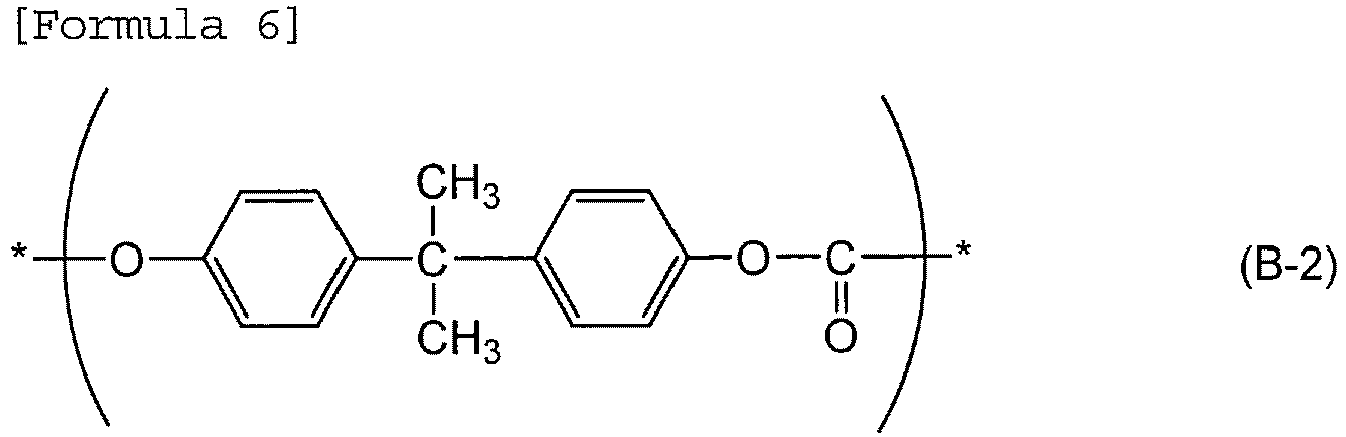
- the bisphenol A type polycarbonate resin refers to a resin having a carbonate unit derived from bisphenol A or its derivative, and it is preferable to have a constituent unit represented by the following formula (B-1). * in the formula represents an end group or a bonding position with another constituent unit.
- X 1 represents the following structure.
- R 5 and R 6 are each a hydrogen atom or a methyl group. It is preferable that at least one of them should be a methyl group, and it is more preferable that both should be methyl groups.
- the content of the constituent unit represented by the formula (B-1) in the bisphenol A type polycarbonate resin is preferably 70% by mol or more, more preferably 80% by mol or more, and still more preferably 90% by mol or more in the entire constituent units excluding the end groups.
- the upper limit is not particularly limited, and the constituent unit represented by the formula (B-1) may account for 100% by mol.
- the bisphenol A type polycarbonate resin is particularly preferably a resin substantially entirely formed of the constituent unit of the formula (B-1).
- the term "substantially entirely” here specifically means 99.0% by mol or more, preferably 99.5% by mol or more, and more preferably 99.9% by mol or more of the entire constituent units excluding the end groups.
- the bisphenol A type polycarbonate resin may have another constituent unit other than the carbonate unit derived from bisphenol A or a derivative thereof.
- dihydroxy compounds forming such another constituent unit can be aromatic dihydroxy compounds described in paragraph 0014 of Japanese Patent Laid-Open No. 2018-154819 , the contents of which are incorporated herein.
- the method for producing the bisphenol A type polycarbonate resin is not particularly limited, and an arbitrary method can be employed. Examples of such a method may include an interfacial polymerization method, a melt transesterification method, a pyridine method, a ring opening polymerization method for cyclic carbonate compounds, and a solid phase transesterification method for prepolymers.
- the bisphenol A type polycarbonate resin has a viscosity average molecular weight of 10,000 to 15,000.
- the lower limit value is further preferably 10,200 or more, more preferably 10,500 or more, and still more preferably 10,750 or more.
- the upper limit is preferably 14,500 or less, more preferably 14,250 or less, and still more preferably 14,200 or less.
- the resin composition has two or more kinds of bisphenol A type polycarbonate resins
- the measured value of the viscosity average molecular weight of the mixture is treated as the viscosity average molecular weight of the bisphenol A type polycarbonate resins.
- the viscosity average molecular weight is measured by the method described in Examples, which will be mentioned later.
- the intrinsic viscosity of the bisphenol A type polycarbonate resin is preferably 0.1 dL/g or more, more preferably 0.15 dL/g or more, and still more preferably 0.2 dL/g or more.
- the upper limit is preferably 0.4 dL/g or less, more preferably 0.35 dL/g or less, and still more preferably 0.32 dL/g or less.
- the resin composition has two or more kinds of bisphenol A type polycarbonate resins
- the measured value of the intrinsic viscosity of the mixture is treated as the intrinsic viscosity of the bisphenol A type polycarbonate resins.
- the intrinsic viscosity is measured by the method described in Examples, which will be mentioned later.
- the content of the bisphenol A type polycarbonate resin in the resin composition is preferably 10% by mass or more, more preferably 15% by mass or more, and still more preferably 20% by mass or more.
- the upper limit value is preferably 60% by mass or less, more preferably 50% by mass or less, and still more preferably 45% by mass or less.
- One kind of or two or more kinds of bisphenol A type polycarbonate resins may be used. When two or more kinds are used, the total amount thereof is within the above range.
- the ratio (W AP /W A ) of the mass (W AP ) of the bisphenol AP type polycarbonate resin to the mass (W A ) of the bisphenol A type polycarbonate resin is 20/80 to 90/10.
- the lower limit value of the above ratio (W AP /W A ) is preferably 30/70 or more, more preferably 40/60 or more, still more preferably 45/55 or more, even more preferably 51/49 or more, and yet more preferably 55/45 or more.
- the upper limit value of the above ratio (W AP /W A ) is preferably 85/15 or less, more preferably 80/20 or less, and still more preferably 78/22 or less.
- the difference between the viscosity average molecular weight of the bisphenol AP type polycarbonate resin and the viscosity average molecular weight of the bisphenol A type polycarbonate resin is 5,000 or more and 13,000 or less.
- the difference between the viscosity average molecular weights described above is preferably 5,400 or more, more preferably 5,800 or more, and still more preferably 6,000 or more.
- the upper limit value is preferably 12,000 or less, more preferably 11,000 or less, and still more preferably 10,000 or less.
- ) between the intrinsic viscosity ( ⁇ AP ) of the bisphenol AP type polycarbonate resin and the intrinsic viscosity ( ⁇ A ) of the bisphenol A type polycarbonate resin is preferably 0.04 dL/g or more, more preferably 0.06 dL/g or more, still more preferably 0.08 dL/g or more, and even more preferably 0.09 dL/g or more.
- the upper limit value is preferably 0.4 dL/g or less, more preferably 0.37 dL/g or less, still more preferably 0.35 dL/g or less, even more preferably 0.32 dL/g or less, yet more preferably 0.3 dL/g or less, further more preferably 0.25 dL/g or less, and particularly more preferably 0.22 dL/g or less.
- the intrinsic viscosity ( ⁇ AP ) > the intrinsic viscosity ( ⁇ A ) is preferable.
- the total content of the bisphenol AP type polycarbonate resin and the bisphenol A type polycarbonate resin is more than 85% by mass, preferably 90% by mass or more, more preferably 92% by mass or more, still more preferably 95% by mass or more, yet more preferably 97% by mass or more, and further more preferably 99% by mass or more based on the total amount of resin components contained in the resin composition.
- the resin composition of the present invention should contain an antioxidant.
- the antioxidant examples include a phenol antioxidant, an amine antioxidant, a phosphorus-based antioxidant, a thioether antioxidant, and the like.
- the phosphorus-based antioxidant and the phenol antioxidant are preferable in the present invention.
- the phosphorus-based antioxidant is particularly preferable because of the excellent color phase of the formed article.
- a preferable phosphite stabilizer as the phosphorus-based antioxidant is preferably a phosphite compound represented by the following formula (1) or (2).
- R 11 and R 12 each independently represent an alkyl group having 1 to 30 carbon atoms or an aryl group having 6 to 30 carbon atoms.
- R 13 to R 17 each independently represent a hydrogen atom, an aryl group having 6 to 20 carbon atoms, or an alkyl group having 1 to 20 carbon atoms.
- the alkyl groups represented by R 11 and R 12 should be each independently a linear or branched alkyl group having 1 to 10 carbon atoms.
- R 11 and R 12 are each an aryl group, it is preferable that they should be each an aryl group represented by any of the following formulas (1-a), (1-b) and (1-c) . * in the formulas represents a bonding position with another site.
- R A each independently represent an alkyl group having 1 to 10 carbon atoms.
- R B each independently represent an alkyl group having 1 to 10 carbon atoms.
- Hindered phenol antioxidants can be referred to the description in paragraph 0063 of Japanese Patent Laid-Open No. 2018-090677 and paragraph 0076 of Japanese Patent Laid-Open No. 2018-188496 , the contents of which are incorporated herein.
- Antioxidants other than the above can be consulted in the description in paragraphs 0057 to 0061 of Japanese Patent Laid-Open No. 2017-031313 , the contents of which are incorporated herein.
- the content of the antioxidant is preferably 0.01 parts by mass or more, more preferably 0.03 parts by mass or more, and still more preferably 0.05 parts by mass or more based on 100 parts by mass of the polycarbonate resins.
- the upper limit value of the content of the antioxidant is preferably 0.4 parts by mass or less, more preferably 0.3 parts by mass or less, still more preferably 0.2 parts by mass or less, and even more preferably 0.15 parts by mass or less based on 100 parts by mass of the polycarbonate resins.
- the resin composition should contain the phosphorus-based antioxidant in the range of 0.001 to 0.2 parts by mass and the phenol antioxidant in the range of 0.001 to 0.2 parts by mass based on 100 parts by mass of the polycarbonate resins.
- the resin composition of the present invention should contain a mold release agent.
- the rolling properties upon rolling a film-like or sheet-like formed article can be improved.
- the article can be released more easily from a metal mold when the article is formed using it.
- the kind of mold release agent is not particularly specified, and examples thereof include an aliphatic carboxylic acid, an ester of an aliphatic carboxylic acid and an alcohol, an aliphatic hydrocarbon compound with a number average molecular weight of 200 to 15,000, a polyether with a number average molecular weight of 100 to 5,000, a polysiloxane-based silicone oil.
- mold release agents can be consulted in the description in paragraphs 0035 to 0039 of International Publication No. WO 2015/190162 , the contents of which are incorporated herein.
- the content of the mold release agent is preferably 0.001 parts by mass or more, more preferably 0.005 parts by mass or more, and still more preferably 0.007 parts by mass or more based on 100 parts by mass of the polycarbonate resins.
- the upper limit value is preferably 0.5 parts by mass or less, more preferably 0.3 parts by mass or less, and still more preferably 0.1 parts by mass or less.
- mold release agents Only one kind of or two or more kinds of mold release agents may be used. When two or more kinds are used, it is preferable that the total amount thereof should be within the above range.
- the resin composition of the present invention may contain, in addition to the components described above, a polycarbonate resin other than the bisphenol A type polycarbonate resin and the bisphenol AP type polycarbonate resin, a thermoplastic resin other than the polycarbonate resins, an ultraviolet absorbent, a heat stabilizer, a flame retardant, a flame retardant auxiliary, a colorant, an antistatic agent, a fluorescent brightener, an antifogging agent, a flow improver, a plasticizer, a dispersing agent, an antimicrobial agent, an antiblocking agent, an impact improver, a sliding improver, a color phase improver, an acid trapping agent, and the like.
- These components each may be used as one kind thereof, or may be used in combination of two or more kinds.
- the content of the above components, if contained, should be 0.1 to 5% by mass in total.
- the resin composition of the present invention can be composed in a manner substantially free of the bisphenol C polycarbonate resin.
- substantially free of means that the content of the bisphenol C polycarbonate resin is less than 1% by mass among the resin components contained in the resin composition.
- the resin composition of the present invention should have a melt viscosity adjusted to an appropriate range to provide good formability.
- the resin composition of the present invention has a melt viscosity at 300°C, measured with a shear rate of 122 sec -1 , of preferably 3,500 Pa ⁇ s or less, more preferably 3,000 Pa ⁇ s or less, and still more preferably 2,500 Pa ⁇ s or less, and it may be 2,000 Pa ⁇ s or less.
- the lower limit value is preferably 1,000 Pa ⁇ s or more from the viewpoint of formability.
- melt viscosity the value measured in accordance with the method described in Examples, which will be mentioned later, is employed.
- the resin composition of the present invention is preferably transparent when made into a formed article, and more preferably it has high light transmission.
- the resin composition of the present invention has a total light transmittance of preferably 80% or more, and more preferably 85% or more, when formed into a formed article having a thickness of 4 mm.
- a total light transmittance preferably 80% or more, and more preferably 85% or more, when formed into a formed article having a thickness of 4 mm.
- the resin composition of the present invention has a haze of preferably 5.0% or less, more preferably 2.0% or less, and still more preferably 1.8% or less, when formed into a formed article having a thickness of 4 mm.
- a haze preferably 5.0% or less, more preferably 2.0% or less, and still more preferably 1.8% or less, when formed into a formed article having a thickness of 4 mm.
- the lower limit value there is no particular limitation on the lower limit value, and for example, 0.1% or more, or even 0.5% or more, is sufficient to meet the performance requirements.
- the resin composition of the present invention has a deflection temperature under load at a load of 1.8 MPa, measured in accordance with ISO 75-1, of preferably 135°C or higher, more preferably 137°C or higher, and still more preferably 140°C or higher.
- a higher upper limit is more preferable, but for example, 200°C or lower, or even 160°C or lower, is sufficient to meet the performance requirements.
- the method for producing the resin composition of the present invention there is no limitation on the method for producing the resin composition of the present invention, and a wide range of known methods for producing resin compositions can be employed.
- An example thereof is a method in which the polycarbonate resins described above and other components to be compounded therewith if required are premixed using, for example, one of various mixing machines such as a tumbler or a Henschel mixer, and then melt-kneaded using a mixing machine such as a Banbury mixer, a roll, a Brabender, a single screw kneading extruder, a twin screw kneading extruder, or a kneader.
- a mixing machine such as a Banbury mixer, a roll, a Brabender, a single screw kneading extruder, a twin screw kneading extruder, or a kneader.
- the temperature for melt kneading is not particularly limited, and it is normally in the range of 240 to 360°C.
- pellets are obtained by, for example, strand cutting.
- a film extruder for example, a film-like or sheet-like formed article can be produced.
- a formed article with an arbitrary shape can be produced.
- a formed article of the present invention is formed from the resin composition of the present invention.
- the formed article of the present invention is suitably used for components of electrical and electronic equipment, office automation equipment, mobile information terminals, machine components, home appliances, vehicle components, various containers, lighting equipment, and the like.
- the formed article of the present invention is particularly suitable for use in the housing of electrical and electronic equipment, office automation equipment, information terminal equipment, and home appliances, lighting equipment and vehicle components (particularly, vehicle interior components), surface films for smart phones and touch panels, optical materials, and optical discs.
- the formed article of the present invention is suited for touch panel sensors.
- a film is exemplified, and it is particularly suitable for use as a transparent film for high heat resistance applications. More specifically, it can be used as a film for transparent electrode base materials.
- the transparent electrode is one in which a transparent electrode layer is arranged on one side or both sides of a transparent base material. A further layer may be present between the transparent base material and the transparent electrode layer.
- the transparent film of the present invention can be used as the transparent base material in this transparent electrode. It can also be suitably used as a protective film for protecting products in high heat resistance applications.
- the thickness of a film formed from the resin composition of the present invention is not particularly limited, and it is preferably 30 ⁇ m or more and more preferably 40 ⁇ m or more, and it may be 50 ⁇ m or more, and even 80 ⁇ m or more.
- the upper limit value is preferably 5 mm or less, more preferably 3 mm or less, and still more preferably 1 mm or less.
- the obtained pellets were dried at 120°C for 5 hours. Then, using a capillary rheometer, the resin was extruded through a nozzle hole (orifice) of 10 mm in length and 1.0 mm in diameter at 300°C. At that time, the shear viscosity (unit: Pa ⁇ s) at a shear rate of 122 sec -1 was measured and used as the melt viscosity.
- Capilograph 1B (trade name) manufactured by Toyo Seiki Seisaku-sho, Ltd. was used.
- the obtained pellets were dried at 120°C for 5 hours with a hot air circulation drying machine. Then, using an injection forming machine, a flat plate specimen (60 mm ⁇ 60 mm ⁇ 4 mm) was formed under conditions with a cylinder temperature of 300°C, a metal mold temperature of 80°C, and a forming cycle of 45 seconds.
- J110AD trade name
- Japan Steel Works, LTD. Japan Steel Works
- the total light transmittance (%) and the haze (%) of the plate specimen obtained by the injection forming were measured under conditions with a light source of D65 and a field of view of 10° in accordance with JIS-K-7361 and JIS-K-7136, respectively.
- HM-150 (trade name) manufactured by MURAKAMI COLOR RESEARCH LABORATORY CO., LTD. was used.
- the obtained pellets were dried at 120°C for 5 hours with a hot air circulation drying machine.
- an ISO multipurpose test specimen (type A1, thickness of 4 mm) in accordance with JIS-K 7139 was formed under conditions with a cylinder temperature of 300°C, a metal mold temperature of 80°C, and a forming cycle of 45 seconds.
- J110AD trade name
- Japan Steel Works, LTD. Japan Steel Works
- the deflection temperature under load (unit: °C) was measured under conditions with a load of 1.80 MPa (method A) using an HDT testing apparatus in accordance with ISO 75-1.
- HDT (deflection temperature under load) testing apparatus As the HDT (deflection temperature under load) testing apparatus, "3M-2" (trade name) manufactured by Toyo Seiki Seisaku-sho, Ltd. was used.
- the obtained formed articles had excellent transparency, high total light transmittance, and small haze. Furthermore, the formed articles had high formability, a high deflection temperature, and excellent heat resistance (Examples 1 to 3) .
Landscapes
- Chemical & Material Sciences (AREA)
- Engineering & Computer Science (AREA)
- Organic Chemistry (AREA)
- Polymers & Plastics (AREA)
- Health & Medical Sciences (AREA)
- Chemical Kinetics & Catalysis (AREA)
- Medicinal Chemistry (AREA)
- General Engineering & Computer Science (AREA)
- Manufacturing & Machinery (AREA)
- Theoretical Computer Science (AREA)
- Materials Engineering (AREA)
- Human Computer Interaction (AREA)
- Physics & Mathematics (AREA)
- General Physics & Mathematics (AREA)
- Compositions Of Macromolecular Compounds (AREA)
- Manufacture Of Macromolecular Shaped Articles (AREA)
Abstract
Description
- The present invention relates to a resin composition comprising polycarbonate resins, and to a formed article using the same.
- Polycarbonate resins have been applied as forming materials for a variety of products.
- For example, Patent Literature 1 discloses a resin composition with excellent compatibility comprising an aromatic polycarbonate polymer obtained by carbonate-bonding 2,2-bis-(4-hydroxyphenyl)propane and an aromatic polycarbonate polymer obtained by carbonate-bonding 4,4-dihydroxy-2,2,2-triphenylethane.
- [Patent Literature 1]
Japanese Patent Laid-Open No. 64-043558 - As described in the above Patent Literature 1, in order to impart heat resistance to a bisphenol A type polycarbonate resin such as an aromatic polycarbonate polymer obtained by carbonate-bonding 2,2-bis-(4-hydroxyphenyl)propane, it is conceivable to compound therewith a bisphenol AP type polycarbonate resin such as an aromatic polycarbonate polymer obtained by carbonate-bonding 4,4-dihydroxy-2,2,2-triphenylethane. However, it was found that blending the bisphenol A type polycarbonate resin and the bisphenol AP type polycarbonate resin may result in inferior processability. Furthermore, it was also found that the resulting resin composition and formed article may become cloudy.
- The present invention has an object to solve such problems, and is to provide a resin composition comprising a bisphenol AP type polycarbonate resin and a bisphenol A type polycarbonate resin, the resin composition being excellent in formability, and being also excellent in heat resistance and transparency when made into a formed article, as well as a formed article.
- As a result of investigations for the problems described above, the present inventors have found that it is possible to solve the problems described above by setting the respective viscosity average molecular weights of the bisphenol AP type polycarbonate resin and the bisphenol A type polycarbonate resin and the ratio of the contents of both resins within particular ranges, and by setting the difference between the viscosity average molecular weights of both resins within a particular range.
- More specifically, the present invention has the following solutions.
-
- <1> A resin composition comprising: a bisphenol AP type polycarbonate resin having a viscosity average molecular weight of 18,500 to 23,000; and a bisphenol A type polycarbonate resin having a viscosity average molecular weight of 10,000 to 15,000, wherein a mass ratio of the bisphenol AP type polycarbonate resin to the bisphenol A type polycarbonate resin is 20/80 to 90/10, a difference between the viscosity average molecular weight of the bisphenol AP type polycarbonate resin and the viscosity average molecular weight of the bisphenol A type polycarbonate resin is 5,000 to 13,000, and a total content of the bisphenol AP type polycarbonate resin and the bisphenol A type polycarbonate resin is more than 85% by mass of a total amount of resin components contained in the resin composition.
- <2> The resin composition according to <1>, wherein a difference (|ηAP - ηA|) between an intrinsic viscosity (ηAP) of the bisphenol AP type polycarbonate resin and an intrinsic viscosity (ηA) of the bisphenol A type polycarbonate resin is 0.04 to 0.4 dL/g.
- <3> The resin composition according to <1> or <2>, wherein the resin composition has a melt viscosity at 300°C of 1,000 to 3,500 Pa·s, as measured with a shear rate of 122 sec-1.
- <4> The resin composition according to any one of <1> to <3>, wherein the resin composition has a deflection temperature under load of 135°C or higher at a load of 1.8 MPa, as measured in accordance with ISO 75-1.
- <5> The resin composition according to any one of <1> to <4>, wherein the bisphenol AP type polycarbonate resin has a glass transition temperature of 172°C or higher.
- <6> The resin composition according to any one of <1> to <5>, wherein, when the resin composition is formed into a formed article having a thickness of 4 mm, the formed article has a total light transmittance of 80% or more.
- <7> The resin composition according to any one of <1> to <6>, wherein, when the resin composition is formed into a formed article having a thickness of 4 mm, the formed article has a haze of 5.0% or less.
- <8> The resin composition according to any one of <1> to <7>, further comprising at least one of an antioxidant and a mold release agent.
- <9> A formed article formed from the resin composition according to any one of <1> to <8>.
- <10> The formed article according to <9>, wherein the formed article is a film.
- <11> The formed article according to <9> or <10>, wherein the formed article is for a touch panel sensor.
- The present invention has made it possible to provide a resin composition that is excellent in formability, and is also excellent in heat resistance and transparency when made into a formed article, as well as a formed article using the resin composition.
- Hereinafter, the contents of the present invention will be described in detail. Note that, in the present specification, the phrase "A to B" is used in the sense that the values listed before and after "to" are included as the lower limit value and the upper limit value, respectively.
- Note that, in the present specification, the term "parts by mass" refers to the relative amounts of components, and the term "% by mass" refers to the absolute amounts of components.
- The terms "film" and "sheet" both refer to a generally flat formed product that has a thin thickness relative to its length and width. In addition, the term "film" in the present specification may have a single layer or multiple layers.
- The resin composition of the present invention is a resin composition is characterized in that the resin composition contains a bisphenol AP type polycarbonate resin having a viscosity average molecular weight of 18,500 to 23,000; and a bisphenol A type polycarbonate resin having a viscosity average molecular weight of 10,000 to 15,000; and the mass ratio of the bisphenol AP type polycarbonate resin to the bisphenol A type polycarbonate resin is 20/80 to 90/10, the difference between the viscosity average molecular weight of the bisphenol AP type polycarbonate resin and the viscosity average molecular weight of the bisphenol A type polycarbonate resin is 5,000 to 13,000, and the total content of the bisphenol AP type polycarbonate resin and the bisphenol A type polycarbonate resin is more than 85% by mass of the total amount of resin components contained in the composition. When the resin composition is composed as mentioned above, the resin composition is excellent in formability, and is also excellent in heat resistance and transparency when made into a formed article.
- The bisphenol AP type polycarbonate resin is excellent in heat resistance. However, the bisphenol AP type polycarbonate resin has a high melt viscosity, and is inferior in processability. In addition, it was found that when the bisphenol A type polycarbonate resin, which is a general-purpose product, was compounded therewith for improving processability, it resulted in clouding. In the present invention, by blending a bisphenol AP type polycarbonate resin with a bisphenol A type polycarbonate resin having a relatively small viscosity average molecular weight, and by setting the difference between the viscosity average molecular weight of the bisphenol AP type polycarbonate resin and the viscosity average molecular weight of the bisphenol A type polycarbonate resin within a particular range, both resins were successfully compatibilized, and a formed article that has good formability and that is excellent in heat resistance and excellent in transparency was successfully provided.
- The bisphenol AP type polycarbonate resin refers to a resin having a carbonate unit derived from bisphenol AP or its derivative, and it is preferable to have a constituent unit represented by the following formula (A-1).

- In the formula (A-1), R1 to R4 each independently represent a fluorine atom, a chlorine atom, a bromine atom, an iodine atom, an alkyl group having 1 to 9 (preferably 1 to 3) carbon atoms, an aryl group having 6 to 12 (preferably 6 to 10) carbon atoms, an alkoxy group having 1 to 5 (preferably 1 to 3) carbon atoms, an alkenyl group having 2 to 5 (preferably 2 or 3) carbon atoms, or an aralkyl group having 7 to 17 (preferably 7 to 11) carbon atoms. 1 represents an integer of 0 to 5. m and n each independently represent an integer of 0 to 4. * represents an end group or a bonding position with another constituent unit.
- The constituent unit represented by the formula (A-1) is preferably a constituent unit represented by the following formula (A-2). * in the formula represents an end group or a bonding position with another constituent unit.


- R1, R2, R3, R4, l, m, and n have the same meaning as defined in the formula (A-1).
- The constituent unit represented by the formula (A-2) is preferably a constituent unit represented by the following formula (A-3). * in the formula represents an end group or a bonding position with another constituent unit.

- The content of the constituent unit represented by the formula (A-1) in the bisphenol AP type polycarbonate resin is preferably 70% by mol or more, more preferably 80% by mol or more, and still more preferably 90% by mol or more in the entire constituent units excluding the end groups. The upper limit is not particularly limited, and the constituent unit represented by the formula (A-1) may account for 100% by mol. The constituent unit derived from bisphenol AP may be formed of only one kind thereof or with two or more kinds. A particularly preferable example of the bisphenol AP type polycarbonate resin is a resin substantially entirely formed of the constituent unit of the formula (A-1). The term "substantially entirely" here specifically means 99.0% by mol or more, preferably 99.5% by mol or more, and more preferably 99.9% by mol or more of the entire constituent units excluding the end groups.
- The bisphenol AP type polycarbonate resin may have another constituent unit that is different from the carbonate unit derived from bisphenol AP or a derivative thereof. Examples of dihydroxy compounds forming such another constituent unit can be aromatic dihydroxy compounds described in paragraph 0014 of
Japanese Patent Laid-Open No. 2018-154819 - The method for producing the bisphenol AP type polycarbonate resin is not particularly limited, and an arbitrary method can be employed. Examples of such a method may include an interfacial polymerization method, a melt transesterification method, a pyridine method, a ring opening polymerization method for cyclic carbonate compounds, and a solid phase transesterification method for prepolymers.
- In the present invention the bisphenol AP type polycarbonate resin has a viscosity average molecular weight of 18,500 to 23,000. The lower limit value is further preferably 19,000 or more, more preferably 19,500 or more, and still more preferably 20,000 or more. The upper limit is preferably 22,000 or less, more preferably 21,000 or less, and still more preferably 20,500 or less. By setting the viscosity average molecular weight to the above, it becomes possible to impart excellent heat resistance while maintaining the transparency of the resulting resin composition.
- Note that, when the resin composition has two or more kinds of bisphenol AP type polycarbonate resins, the measured value of the viscosity average molecular weight of the mixture is treated as the viscosity average molecular weight of the bisphenol AP type polycarbonate resins.
- The viscosity average molecular weight is measured by the method described in Examples, which will be mentioned later.
- In the present invention, the intrinsic viscosity of the bisphenol AP type polycarbonate resin is preferably 0.2 dL/g or more, more preferably 0.3 dL/g or more, and still more preferably 0.4 dL/g or more. The upper limit is preferably 1.0 dL/g or less, more preferably 0.8 dL/g or less, and still more preferably 0.6 dL/g or less.
- Note that, when the resin composition has two or more kinds of bisphenol AP type polycarbonate resins, the measured value of the intrinsic viscosity of the mixture is treated as the intrinsic viscosity of the bisphenol AP type polycarbonate resins.
- The intrinsic viscosity is measured by the method described in Examples, which will be mentioned later.
- The glass transition temperature (Tg) of the bisphenol AP type polycarbonate resin is preferably 172°C or higher, more preferably 175°C or higher, and still more preferably 180°C or higher. The upper limit is preferably 210°C or lower, more preferably 200°C or lower, and still more preferably 190°C or lower.
- Note that, when the resin composition has two or more kinds of bisphenol AP type polycarbonate resins, the measured value of the Tg of the mixture is treated as the Tg of the bisphenol AP type polycarbonate resins.
- The glass transition temperature (Tg) is measured by the method described in Examples, which will be mentioned later.
- In the present invention, the bisphenol AP type polycarbonate resin has a melt viscosity at 300°C, measured with a shear rate of 122 sec-1, of preferably 1,000 Pa·s or more, more preferably 1,500 Pa·s or more, and still more preferably 3,000 Pa·s or more. The upper limit value of the above melt viscosity is preferably 8,000 Pa·s or less, more preferably 7,000 Pa·s or less, and still more preferably 6,500 Pa·s or less.
- Note that, when the resin composition has two or more kinds of bisphenol AP type polycarbonate resins, the measured value of the melt viscosity of the mixture is treated as the melt viscosity of the bisphenol AP type polycarbonate resins.
- The melt viscosity is measured by the method described in Examples, which will be mentioned later.
- The content of the bisphenol AP type polycarbonate resin in the resin composition is preferably 40% by mass or more, more preferably 50% by mass or more, and still more preferably 55% by mass or more. The upper limit value is preferably 90% by mass or less, more preferably 85% by mass or less, and still more preferably 80% by mass or less.
- One kind of or two or more kinds of bisphenol AP type polycarbonate resins may be used. When two or more kinds are used, the total amount thereof is within the above range.
- The bisphenol A type polycarbonate resin refers to a resin having a carbonate unit derived from bisphenol A or its derivative, and it is preferable to have a constituent unit represented by the following formula (B-1). * in the formula represents an end group or a bonding position with another constituent unit.

- In the formula (B-1), X1 represents the following structure.

- R5 and R6 are each a hydrogen atom or a methyl group. It is preferable that at least one of them should be a methyl group, and it is more preferable that both should be methyl groups.
- It is preferable that the formula (B-1) should be represented by the following formula (B-2).
- The content of the constituent unit represented by the formula (B-1) in the bisphenol A type polycarbonate resin is preferably 70% by mol or more, more preferably 80% by mol or more, and still more preferably 90% by mol or more in the entire constituent units excluding the end groups. The upper limit is not particularly limited, and the constituent unit represented by the formula (B-1) may account for 100% by mol. The bisphenol A type polycarbonate resin is particularly preferably a resin substantially entirely formed of the constituent unit of the formula (B-1). The term "substantially entirely" here specifically means 99.0% by mol or more, preferably 99.5% by mol or more, and more preferably 99.9% by mol or more of the entire constituent units excluding the end groups.
- The bisphenol A type polycarbonate resin may have another constituent unit other than the carbonate unit derived from bisphenol A or a derivative thereof. Examples of dihydroxy compounds forming such another constituent unit can be aromatic dihydroxy compounds described in paragraph 0014 of
Japanese Patent Laid-Open No. 2018-154819 - The method for producing the bisphenol A type polycarbonate resin is not particularly limited, and an arbitrary method can be employed. Examples of such a method may include an interfacial polymerization method, a melt transesterification method, a pyridine method, a ring opening polymerization method for cyclic carbonate compounds, and a solid phase transesterification method for prepolymers.
- In the present invention the bisphenol A type polycarbonate resin has a viscosity average molecular weight of 10,000 to 15,000. The lower limit value is further preferably 10,200 or more, more preferably 10,500 or more, and still more preferably 10,750 or more. The upper limit is preferably 14,500 or less, more preferably 14,250 or less, and still more preferably 14,200 or less. By setting the viscosity average molecular weight to the above, the compatibility with the bisphenol AP type polycarbonate resin can be further improved.
- Note that, when the resin composition has two or more kinds of bisphenol A type polycarbonate resins, the measured value of the viscosity average molecular weight of the mixture is treated as the viscosity average molecular weight of the bisphenol A type polycarbonate resins.
- The viscosity average molecular weight is measured by the method described in Examples, which will be mentioned later.
- In the present invention, the intrinsic viscosity of the bisphenol A type polycarbonate resin is preferably 0.1 dL/g or more, more preferably 0.15 dL/g or more, and still more preferably 0.2 dL/g or more. The upper limit is preferably 0.4 dL/g or less, more preferably 0.35 dL/g or less, and still more preferably 0.32 dL/g or less.
- Note that, when the resin composition has two or more kinds of bisphenol A type polycarbonate resins, the measured value of the intrinsic viscosity of the mixture is treated as the intrinsic viscosity of the bisphenol A type polycarbonate resins.
- The intrinsic viscosity is measured by the method described in Examples, which will be mentioned later.
- The content of the bisphenol A type polycarbonate resin in the resin composition is preferably 10% by mass or more, more preferably 15% by mass or more, and still more preferably 20% by mass or more. The upper limit value is preferably 60% by mass or less, more preferably 50% by mass or less, and still more preferably 45% by mass or less.
- One kind of or two or more kinds of bisphenol A type polycarbonate resins may be used. When two or more kinds are used, the total amount thereof is within the above range.
- In the resin composition of the present invention, the ratio (WAP/WA) of the mass (WAP) of the bisphenol AP type polycarbonate resin to the mass (WA) of the bisphenol A type polycarbonate resin is 20/80 to 90/10. The lower limit value of the above ratio (WAP/WA) is preferably 30/70 or more, more preferably 40/60 or more, still more preferably 45/55 or more, even more preferably 51/49 or more, and yet more preferably 55/45 or more. The upper limit value of the above ratio (WAP/WA) is preferably 85/15 or less, more preferably 80/20 or less, and still more preferably 78/22 or less.
- When the above ratio (WAP/WA) is more than the upper limit value, the heat resistance of the resin composition is reduced. On the other hand, when the above ratio is lower than the lower limit value described above, the melt viscosity of the resin composition is increased and the formability is reduced.
- In the resin composition of the present invention, the difference between the viscosity average molecular weight of the bisphenol AP type polycarbonate resin and the viscosity average molecular weight of the bisphenol A type polycarbonate resin is 5,000 or more and 13,000 or less. By setting the difference between the viscosity average molecular weights of both resins to the above range, it becomes possible to achieve good transparency and heat resistance at a high level in the formed article while appropriately adjusting the melt viscosity of the resin composition. The difference between the viscosity average molecular weights described above is preferably 5,400 or more, more preferably 5,800 or more, and still more preferably 6,000 or more. The upper limit value is preferably 12,000 or less, more preferably 11,000 or less, and still more preferably 10,000 or less.
- In the present invention, the difference (|ηAP - ηA|) between the intrinsic viscosity (ηAP) of the bisphenol AP type polycarbonate resin and the intrinsic viscosity (ηA) of the bisphenol A type polycarbonate resin is preferably 0.04 dL/g or more, more preferably 0.06 dL/g or more, still more preferably 0.08 dL/g or more, and even more preferably 0.09 dL/g or more. The upper limit value is preferably 0.4 dL/g or less, more preferably 0.37 dL/g or less, still more preferably 0.35 dL/g or less, even more preferably 0.32 dL/g or less, yet more preferably 0.3 dL/g or less, further more preferably 0.25 dL/g or less, and particularly more preferably 0.22 dL/g or less.
- In addition, the intrinsic viscosity (ηAP) > the intrinsic viscosity (ηA) is preferable.
- In the present invention, the total content of the bisphenol AP type polycarbonate resin and the bisphenol A type polycarbonate resin is more than 85% by mass, preferably 90% by mass or more, more preferably 92% by mass or more, still more preferably 95% by mass or more, yet more preferably 97% by mass or more, and further more preferably 99% by mass or more based on the total amount of resin components contained in the resin composition. There is no particular upper limit value, and the entire amount (100% by mass) may be composed of the bisphenol AP type polycarbonate resin and the bisphenol A type polycarbonate resin. By setting the ratio to the above range, it becomes possible to achieve both heat resistance and toughness.
- It is preferable that the resin composition of the present invention should contain an antioxidant.
- Examples of the antioxidant include a phenol antioxidant, an amine antioxidant, a phosphorus-based antioxidant, a thioether antioxidant, and the like. Among the above, the phosphorus-based antioxidant and the phenol antioxidant (more preferably, hindered phenol antioxidant) are preferable in the present invention. The phosphorus-based antioxidant is particularly preferable because of the excellent color phase of the formed article.
- A preferable phosphite stabilizer as the phosphorus-based antioxidant is preferably a phosphite compound represented by the following formula (1) or (2).
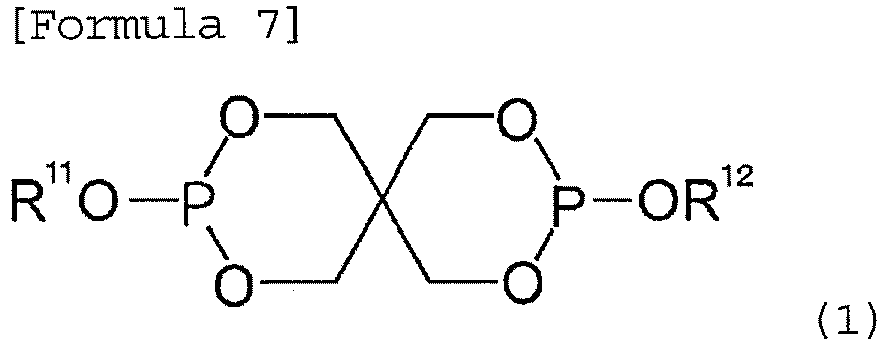


- In the above formula (1), it is preferable that the alkyl groups represented by R11 and R12 should be each independently a linear or branched alkyl group having 1 to 10 carbon atoms. When R11 and R12 are each an aryl group, it is preferable that they should be each an aryl group represented by any of the following formulas (1-a), (1-b) and (1-c) . * in the formulas represents a bonding position with another site.

- (In the formula (1-a), RA each independently represent an alkyl group having 1 to 10 carbon atoms. In the formula (1-b), RB each independently represent an alkyl group having 1 to 10 carbon atoms.)
- Hindered phenol antioxidants can be referred to the description in paragraph 0063 of
Japanese Patent Laid-Open No. 2018-090677 Japanese Patent Laid-Open No. 2018-188496 - Antioxidants other than the above can be consulted in the description in paragraphs 0057 to 0061 of
Japanese Patent Laid-Open No. 2017-031313 - The content of the antioxidant is preferably 0.01 parts by mass or more, more preferably 0.03 parts by mass or more, and still more preferably 0.05 parts by mass or more based on 100 parts by mass of the polycarbonate resins. In addition, the upper limit value of the content of the antioxidant is preferably 0.4 parts by mass or less, more preferably 0.3 parts by mass or less, still more preferably 0.2 parts by mass or less, and even more preferably 0.15 parts by mass or less based on 100 parts by mass of the polycarbonate resins.
- By setting the content of the antioxidant to the lower limit value described above or more, it becomes possible to obtain a formed article with better color phase and heat discoloration resistance. Also, by setting the content of the antioxidant to the upper limit value described above or less, it becomes possible to obtain a formed article with good moist heat stability without worsening heat discoloration resistance.
- Moreover, when the phosphorus-based antioxidant and the phenol antioxidant (preferably, hindered phenol antioxidant) are used in combination as the antioxidant, it is preferable that the resin composition should contain the phosphorus-based antioxidant in the range of 0.001 to 0.2 parts by mass and the phenol antioxidant in the range of 0.001 to 0.2 parts by mass based on 100 parts by mass of the polycarbonate resins.
- Only one kind of or two or more kinds of antioxidants may be used. When two or more kinds are used, it is preferable that the total amount thereof should be within the above range.
- It is preferable that the resin composition of the present invention should contain a mold release agent.
- When the resin composition contains a mold release agent, the rolling properties upon rolling a film-like or sheet-like formed article can be improved. For a formed article with a three dimensional shape, the article can be released more easily from a metal mold when the article is formed using it.
- The kind of mold release agent is not particularly specified, and examples thereof include an aliphatic carboxylic acid, an ester of an aliphatic carboxylic acid and an alcohol, an aliphatic hydrocarbon compound with a number average molecular weight of 200 to 15,000, a polyether with a number average molecular weight of 100 to 5,000, a polysiloxane-based silicone oil.
- Details of mold release agents can be consulted in the description in paragraphs 0035 to 0039 of
International Publication No. WO 2015/190162 , the contents of which are incorporated herein. - The content of the mold release agent is preferably 0.001 parts by mass or more, more preferably 0.005 parts by mass or more, and still more preferably 0.007 parts by mass or more based on 100 parts by mass of the polycarbonate resins. The upper limit value is preferably 0.5 parts by mass or less, more preferably 0.3 parts by mass or less, and still more preferably 0.1 parts by mass or less.
- Only one kind of or two or more kinds of mold release agents may be used. When two or more kinds are used, it is preferable that the total amount thereof should be within the above range.
- The resin composition of the present invention may contain, in addition to the components described above, a polycarbonate resin other than the bisphenol A type polycarbonate resin and the bisphenol AP type polycarbonate resin, a thermoplastic resin other than the polycarbonate resins, an ultraviolet absorbent, a heat stabilizer, a flame retardant, a flame retardant auxiliary, a colorant, an antistatic agent, a fluorescent brightener, an antifogging agent, a flow improver, a plasticizer, a dispersing agent, an antimicrobial agent, an antiblocking agent, an impact improver, a sliding improver, a color phase improver, an acid trapping agent, and the like. These components each may be used as one kind thereof, or may be used in combination of two or more kinds.
- It is preferable that the content of the above components, if contained, should be 0.1 to 5% by mass in total.
- As the polycarbonate resin other than the bisphenol A type polycarbonate resin and the bisphenol AP type polycarbonate resin, a bisphenol C polycarbonate resin is exemplified. Alternatively, the resin composition of the present invention can be composed in a manner substantially free of the bisphenol C polycarbonate resin. The term "substantially free of" means that the content of the bisphenol C polycarbonate resin is less than 1% by mass among the resin components contained in the resin composition.
- It is preferable that the resin composition of the present invention should have a melt viscosity adjusted to an appropriate range to provide good formability.
- Specifically, the resin composition of the present invention has a melt viscosity at 300°C, measured with a shear rate of 122 sec-1, of preferably 3,500 Pa·s or less, more preferably 3,000 Pa·s or less, and still more preferably 2,500 Pa·s or less, and it may be 2,000 Pa·s or less. The lower limit value is preferably 1,000 Pa·s or more from the viewpoint of formability.
- Note that, for the above melt viscosity, the value measured in accordance with the method described in Examples, which will be mentioned later, is employed.
- The resin composition of the present invention is preferably transparent when made into a formed article, and more preferably it has high light transmission.
- The resin composition of the present invention has a total light transmittance of preferably 80% or more, and more preferably 85% or more, when formed into a formed article having a thickness of 4 mm. There is no particular limitation on the upper limit value, and for example, 99% or less, or even 95% or less, is sufficient to meet the performance requirements.
- Note that, for the total light transmittance in the present specification, the value measured in accordance with the method described in Examples, which will be mentioned later, is employed.
- In addition, the resin composition of the present invention has a haze of preferably 5.0% or less, more preferably 2.0% or less, and still more preferably 1.8% or less, when formed into a formed article having a thickness of 4 mm. There is no particular limitation on the lower limit value, and for example, 0.1% or more, or even 0.5% or more, is sufficient to meet the performance requirements.
- Note that, for the haze in the present specification, the value measured in accordance with the method described in Examples, which will be mentioned later, is employed.
- The resin composition of the present invention has a deflection temperature under load at a load of 1.8 MPa, measured in accordance with ISO 75-1, of preferably 135°C or higher, more preferably 137°C or higher, and still more preferably 140°C or higher. A higher upper limit is more preferable, but for example, 200°C or lower, or even 160°C or lower, is sufficient to meet the performance requirements.
- Note that, for the deflection temperature under load in the present specification, the value measured in accordance with the method described in Examples, which will be mentioned later, is employed.
- There is no limitation on the method for producing the resin composition of the present invention, and a wide range of known methods for producing resin compositions can be employed. An example thereof is a method in which the polycarbonate resins described above and other components to be compounded therewith if required are premixed using, for example, one of various mixing machines such as a tumbler or a Henschel mixer, and then melt-kneaded using a mixing machine such as a Banbury mixer, a roll, a Brabender, a single screw kneading extruder, a twin screw kneading extruder, or a kneader.
- Note that the temperature for melt kneading is not particularly limited, and it is normally in the range of 240 to 360°C.
- From the above melt-kneaded resin composition, pellets are obtained by, for example, strand cutting. By subjecting the pellets thus obtained to extrusion forming with a film extruder, for example, a film-like or sheet-like formed article can be produced. Alternatively, by subjecting the pellets to injection forming with an injection forming machine, a formed article with an arbitrary shape can be produced.
- A formed article of the present invention is formed from the resin composition of the present invention. The formed article of the present invention is suitably used for components of electrical and electronic equipment, office automation equipment, mobile information terminals, machine components, home appliances, vehicle components, various containers, lighting equipment, and the like. Among the above, the formed article of the present invention is particularly suitable for use in the housing of electrical and electronic equipment, office automation equipment, information terminal equipment, and home appliances, lighting equipment and vehicle components (particularly, vehicle interior components), surface films for smart phones and touch panels, optical materials, and optical discs. In particular, the formed article of the present invention is suited for touch panel sensors.
- As one embodiment of the formed article of the present invention, a film is exemplified, and it is particularly suitable for use as a transparent film for high heat resistance applications. More specifically, it can be used as a film for transparent electrode base materials. Here, the transparent electrode is one in which a transparent electrode layer is arranged on one side or both sides of a transparent base material. A further layer may be present between the transparent base material and the transparent electrode layer. The transparent film of the present invention can be used as the transparent base material in this transparent electrode. It can also be suitably used as a protective film for protecting products in high heat resistance applications.
- The thickness of a film formed from the resin composition of the present invention is not particularly limited, and it is preferably 30 µm or more and more preferably 40 µm or more, and it may be 50 µm or more, and even 80 µm or more. The upper limit value is preferably 5 mm or less, more preferably 3 mm or less, and still more preferably 1 mm or less.
- Hereinafter, the present invention will be described in further detail with reference to Examples, but the present invention is not to be construed as limited by them.
-
- Bisphenol AP type polycarbonate resin (A):
- (A1) aromatic polycarbonate resin obtained by the interfacial polymerization method using bisphenol AP as the starting raw material (manufactured by Mitsubishi Gas Chemical Company, Inc., FPC-0220, viscosity average molecular weight: 20,200, intrinsic viscosity: 0.44 dL/g, Tg: 184°C, and melt viscosity: 6,400 Pa·s); and
- (A2) aromatic polycarbonate resin obtained by the interfacial polymerization method using bisphenol AP as the starting raw material (manufactured by Mitsubishi Gas Chemical Company, Inc., FPC-0210, viscosity average molecular weight: 11,500, intrinsic viscosity: 0.27 dL/g, Tg: 170°C, and melt viscosity: 1,300 Pa·s).
-
- Bisphenol A type polycarbonate resin (B):
- (B1) aromatic polycarbonate resin obtained by the interfacial polymerization method using bisphenol A as the starting raw material (manufactured by Mitsubishi Engineering-Plastics Corporation, H-7000F, viscosity average molecular weight: 14,000, intrinsic viscosity: 0.30 dL/g);
- (B2) aromatic polycarbonate resin obtained by the interfacial polymerization method using bisphenol A as the starting raw material (manufactured by Mitsubishi Engineering-Plastics Corporation, L-1000F, viscosity average molecular weight: 10,800, intrinsic viscosity: 0.24 dL/g); and
- (B3) aromatic polycarbonate resin obtained by the interfacial polymerization method using bisphenol A as the starting raw material (manufactured by Mitsubishi Engineering-Plastics Corporation, S-3000F, viscosity average molecular weight: 21,000, intrinsic viscosity: 0.43 dL/g).
-
- Antioxidant (C):
- (C1) bis(2,6-di-tert-butyl-4-methylphenyl)pentaerythritol diphosphite (phosphorus-based antioxidant, manufactured by ADEKA CORPORATION, Adekastab PEP-36);
- (C2) tris(2,4-di-tert-butylphenyl) phosphite (phosphorus-based antioxidant, manufactured by ADEKA CORPORATION, Adekastab 2112); and
- (C3) pentaerythritol tetrakis[3-3,5-di-tert-butyl-4-hydroxyphenyl]propionate (phenol antioxidant, manufactured by BASF SE, Irganox 1010).
-
- Mold release agent (D):
(Dl) glycerin monostearate (manufactured by RIKEN VITAMIN CO., LTD., RIKEMAL S-100A). - Each of the components described above was weighed to achieve the amounts to be added described in Table 1. Then, after mixing them in a tumbler for 15 minutes, the materials were melt-kneaded in a vented twin screw extruder at a cylinder temperature of 320°C, and pellets were obtained by strand cutting.
- As the twin screw extruder, "TEX30α" manufactured by The Japan Steel Works, LTD. with a screw diameter of 32 mm was used.
- The intrinsic viscosity [η] (unit: dL/g) of each resin was measured using methylene chloride as the solvent. The temperature condition was set at 25°C. The specific viscosity [ηsp] at each solution concentration [C] (g/dL) was measured with an Ubbelohde viscometer. The intrinsic viscosity was calculated from the obtained value of specific viscosity and concentration according to the following formula.

- The viscosity average molecular weight [Mv] was calculated according to the Schnell's viscosity equation, that is, η = 1.23 × 10⁻⁴Mv0.83.
- Using a differential scanning calorimeter (EXSTAR DSC7020, SII NanoTechnology Inc.), about 5 to 10 mg of the sample was heated from 40°C to 280°C at a temperature increase rate of 20°C/min. The temperature was held for 5 minutes and then cooled down to 40°C at a rate of 40°C/min. The temperature was held at 40°C for 10 minutes and then increased again to 280°C at a rate of 10°C/min. From the DSC data obtained in the second temperature increase, the midpoint glass transition temperature was set as the glass transition temperature (Tg).
- The obtained pellets were dried at 120°C for 5 hours. Then, using a capillary rheometer, the resin was extruded through a nozzle hole (orifice) of 10 mm in length and 1.0 mm in diameter at 300°C. At that time, the shear viscosity (unit: Pa·s) at a shear rate of 122 sec-1 was measured and used as the melt viscosity.
- As the capillary rheometer, "Capilograph 1B" (trade name) manufactured by Toyo Seiki Seisaku-sho, Ltd. was used.
- The obtained pellets were dried at 120°C for 5 hours with a hot air circulation drying machine. Then, using an injection forming machine, a flat plate specimen (60 mm × 60 mm × 4 mm) was formed under conditions with a cylinder temperature of 300°C, a metal mold temperature of 80°C, and a forming cycle of 45 seconds.
- As the injection forming machine, "J110AD" (trade name) manufactured by The Japan Steel Works, LTD. was used.
- Using a haze meter, the total light transmittance (%) and the haze (%) of the plate specimen obtained by the injection forming were measured under conditions with a light source of D65 and a field of view of 10° in accordance with JIS-K-7361 and JIS-K-7136, respectively.
- As the haze meter, "HM-150" (trade name) manufactured by MURAKAMI COLOR RESEARCH LABORATORY CO., LTD. was used.
- The obtained pellets were dried at 120°C for 5 hours with a hot air circulation drying machine.
- Then, using an injection forming machine, an ISO multipurpose test specimen (type A1, thickness of 4 mm) in accordance with JIS-K 7139 was formed under conditions with a cylinder temperature of 300°C, a metal mold temperature of 80°C, and a forming cycle of 45 seconds.
- As the injection forming machine, "J110AD" (trade name) manufactured by The Japan Steel Works, LTD. was used.
- Using the above ISO multipurpose test specimen, the deflection temperature under load (unit: °C) was measured under conditions with a load of 1.80 MPa (method A) using an HDT testing apparatus in accordance with ISO 75-1.
- As the HDT (deflection temperature under load) testing apparatus, "3M-2" (trade name) manufactured by Toyo Seiki Seisaku-sho, Ltd. was used.


- As can be seen from Table 1, by using the bisphenol AP type polycarbonate resin and the bisphenol A type polycarbonate resin with particular viscosity average molecular weights, with a particular content ratio, and with a particular difference between the viscosity average molecular weights, the obtained formed articles had excellent transparency, high total light transmittance, and small haze. Furthermore, the formed articles had high formability, a high deflection temperature, and excellent heat resistance (Examples 1 to 3) .
- In contrast, when the bisphenol A type polycarbonate resin had a large viscosity average molecular weight and the difference in viscosity average molecular weight with the bisphenol AP type polycarbonate resin was small, the total light transmittance was low and the haze was high (Comparative Example 1).
- In addition, when no bisphenol AP type polycarbonate resin was contained, the deflection temperature under load was low and the heat resistance was inferior (Comparative Example 2).
- On the other hand, when no bisphenol A type polycarbonate resin was contained, the resin composition had a high melt viscosity and could not be formed (Comparative Example 3).
- Furthermore, when the bisphenol AP type polycarbonate resin had a small viscosity average molecular weight and the difference in viscosity average molecular weight with the bisphenol A type polycarbonate resin was small, the heat resistance of the resulting resin composition was inferior (Comparative Example 4).
Claims (11)
- A resin composition comprising:a bisphenol AP type polycarbonate resin having a viscosity average molecular weight of 18,500 to 23,000; anda bisphenol A type polycarbonate resin having a viscosity average molecular weight of 10,000 to 15,000, whereina mass ratio of the bisphenol AP type polycarbonate resin to the bisphenol A type polycarbonate resin is 20/80 to 90/10,a difference between the viscosity average molecular weight of the bisphenol AP type polycarbonate resin and the viscosity average molecular weight of the bisphenol A type polycarbonate resin is 5,000 to 13,000, anda total content of the bisphenol AP type polycarbonate resin and the bisphenol A type polycarbonate resin is more than 85% by mass of a total amount of resin components contained in the resin composition.
- The resin composition according to claim 1, wherein a difference (|ηAP - ηA|) between an intrinsic viscosity (ηAP) of the bisphenol AP type polycarbonate resin and an intrinsic viscosity (ηA) of the bisphenol A type polycarbonate resin is 0.04 to 0.4 dL/g.
- The resin composition according to claim 1 or 2, wherein the resin composition has a melt viscosity at 300°C of 1,000 to 3,500 Pa·s, as measured with a shear rate of 122 sec-1.
- The resin composition according to any one of claims 1 to 3, wherein the resin composition has a deflection temperature under load of 135°C or higher at a load of 1.8 MPa, as measured in accordance with ISO 75-1.
- The resin composition according to any one of claims 1 to 4, wherein the bisphenol AP type polycarbonate resin has a glass transition temperature of 172°C or higher.
- The resin composition according to any one of claims 1 to 5, wherein, when the resin composition is formed into a formed article having a thickness of 4 mm, the formed article has a total light transmittance of 80% or more.
- The resin composition according to any one of claims 1 to 6, wherein, when the resin composition is formed into a formed article having a thickness of 4 mm, the formed article has a haze of 5.0% or less.
- The resin composition according to any one of claims 1 to 7, further comprising at least one of an antioxidant and a mold release agent.
- A formed article formed from the resin composition according to any one of claims 1 to 8.
- The formed article according to claim 9, wherein the formed article is a film.
- The formed article according to claim 9 or 10, wherein the formed article is for a touch panel sensor.
Applications Claiming Priority (2)
| Application Number | Priority Date | Filing Date | Title |
|---|---|---|---|
| JP2019019463 | 2019-02-06 | ||
| PCT/JP2020/004022 WO2020162420A1 (en) | 2019-02-06 | 2020-02-04 | Resin composition and molded article |
Publications (3)
| Publication Number | Publication Date |
|---|---|
| EP3922677A1 true EP3922677A1 (en) | 2021-12-15 |
| EP3922677A4 EP3922677A4 (en) | 2022-03-30 |
| EP3922677B1 EP3922677B1 (en) | 2023-03-01 |
Family
ID=71947767
Family Applications (1)
| Application Number | Title | Priority Date | Filing Date |
|---|---|---|---|
| EP20752551.0A Active EP3922677B1 (en) | 2019-02-06 | 2020-02-04 | Resin composition and molded article |
Country Status (6)
| Country | Link |
|---|---|
| US (1) | US20220089866A1 (en) |
| EP (1) | EP3922677B1 (en) |
| JP (1) | JP6777269B1 (en) |
| KR (1) | KR102377581B1 (en) |
| CN (1) | CN113396183B (en) |
| WO (1) | WO2020162420A1 (en) |
Family Cites Families (18)
| Publication number | Priority date | Publication date | Assignee | Title |
|---|---|---|---|---|
| JPS608356A (en) * | 1983-06-27 | 1985-01-17 | Sumitomo Chem Co Ltd | Resin composition |
| JPS6443558A (en) * | 1987-08-10 | 1989-02-15 | Daicel Chem | Resin composition excellent in compatibility |
| DE3908037A1 (en) * | 1989-03-11 | 1990-09-13 | Bayer Ag | POLYCARBONATE MIXTURES |
| JPH05209119A (en) * | 1991-10-11 | 1993-08-20 | Unitika Ltd | Resin composition |
| JPH05179096A (en) * | 1991-12-27 | 1993-07-20 | Sumitomo Dow Ltd | Aromatic polycarbonate resin composition |
| JPH101539A (en) * | 1996-06-19 | 1998-01-06 | Mitsubishi Chem Corp | Resin substrate material for liquid crystal display elements |
| JP3478053B2 (en) * | 1997-05-13 | 2003-12-10 | 三菱化学株式会社 | Aromatic polycarbonate resin composition and optical product member comprising the same |
| US7144971B2 (en) * | 2004-08-04 | 2006-12-05 | Xerox Corporation | Polycarbonates and photoconductive imaging members |
| US9115283B2 (en) * | 2011-03-31 | 2015-08-25 | Sabic Global Technologies B.V. | Heat resistant clear polycarbonate-polysiloxane compounds |
| CN102850761B (en) * | 2012-09-26 | 2015-04-01 | 上海锦湖日丽塑料有限公司 | Scratch-resistant polycarbonate and preparation method thereof |
| CN104812839B (en) * | 2012-11-28 | 2017-04-19 | 三菱瓦斯化学株式会社 | Aromatic polycarbonate resin composition, method for producing same, and molded article formed from aromatic polycarbonate resin composition |
| KR20170016842A (en) | 2014-06-11 | 2017-02-14 | 미츠비시 가스 가가쿠 가부시키가이샤 | Polycarbonate resin composition, and molded article and method for manufacturing same |
| EP3320018B1 (en) * | 2015-07-09 | 2022-08-10 | SHPP Global Technologies B.V. | Polycarbonate compositions with improved flame retardance |
| JP6657641B2 (en) | 2015-07-31 | 2020-03-04 | 三菱瓦斯化学株式会社 | Resin composition and molded product thereof |
| KR20190013722A (en) * | 2016-05-27 | 2019-02-11 | 미츠비시 가스 가가쿠 가부시키가이샤 | POLYCARBONATE RESIN COMPOSITION FOR OPTICAL, PROCESS FOR PRODUCING THE SAME, AND SPECTRO LENS AND CAMERA LENS |
| JP2018090677A (en) | 2016-11-30 | 2018-06-14 | 三菱瓦斯化学株式会社 | Aromatic polycarbonate resin sheet or film |
| JP7522528B2 (en) * | 2017-03-15 | 2024-07-25 | 三菱ケミカル株式会社 | Polycarbonate resin composition and molded article |
| JP6915365B2 (en) | 2017-04-28 | 2021-08-04 | 三菱エンジニアリングプラスチックス株式会社 | Carbon fiber / polycarbonate resin composite pellet and its manufacturing method |
-
2020
- 2020-02-04 CN CN202080012536.9A patent/CN113396183B/en active Active
- 2020-02-04 US US17/428,337 patent/US20220089866A1/en not_active Abandoned
- 2020-02-04 EP EP20752551.0A patent/EP3922677B1/en active Active
- 2020-02-04 WO PCT/JP2020/004022 patent/WO2020162420A1/en not_active Ceased
- 2020-02-04 KR KR1020217027026A patent/KR102377581B1/en active Active
- 2020-02-04 JP JP2020524928A patent/JP6777269B1/en active Active
Also Published As
| Publication number | Publication date |
|---|---|
| KR20210111318A (en) | 2021-09-10 |
| WO2020162420A1 (en) | 2020-08-13 |
| CN113396183B (en) | 2022-02-22 |
| JPWO2020162420A1 (en) | 2021-02-18 |
| EP3922677A4 (en) | 2022-03-30 |
| JP6777269B1 (en) | 2020-10-28 |
| CN113396183A (en) | 2021-09-14 |
| KR102377581B1 (en) | 2022-03-22 |
| EP3922677B1 (en) | 2023-03-01 |
| US20220089866A1 (en) | 2022-03-24 |
Similar Documents
| Publication | Publication Date | Title |
|---|---|---|
| JP5323688B2 (en) | Polycarbonate resin composition | |
| JP5905655B2 (en) | Polycarbonate resin composition | |
| EP3578607A1 (en) | Polycarbonate resin composition | |
| JP5716274B2 (en) | Resin composition and film, plate and injection molded product formed from the same | |
| TW201936782A (en) | Aromatic polycarbonate resin composition and optical molded article | |
| EP2987829A1 (en) | Polycarbonate-type resin composition and molded article | |
| JP7559754B2 (en) | Composition, flat plate-like molded body, and method for producing flat plate-like molded body | |
| CN103797070B (en) | Poly carbonate resin composition | |
| EP3922677B1 (en) | Resin composition and molded article | |
| JP7522528B2 (en) | Polycarbonate resin composition and molded article | |
| KR101800071B1 (en) | Flame-retardant resin composition and melt-molded body | |
| EP3922676B1 (en) | Resin composition and formed article | |
| CN103189449B (en) | Resin composition and film, plate and injection molded product obtained by molding it | |
| JP2008274009A (en) | Polycarbonate resin composition | |
| EP3578608A1 (en) | Polycarbonate resin composition | |
| JP7857088B2 (en) | Methods for producing resin compositions, molded articles, and pellets, and light transmittance enhancers. | |
| JP2025145598A (en) | Polycarbonate resin composition and molded article made thereof | |
| JP2025079726A (en) | Resin composition, pellets, and molded products | |
| JP2015007248A (en) | Polycarbonate resin pellet | |
| JP2011127037A (en) | Molded article with low photoelasticity |
Legal Events
| Date | Code | Title | Description |
|---|---|---|---|
| STAA | Information on the status of an ep patent application or granted ep patent |
Free format text: STATUS: THE INTERNATIONAL PUBLICATION HAS BEEN MADE |
|
| PUAI | Public reference made under article 153(3) epc to a published international application that has entered the european phase |
Free format text: ORIGINAL CODE: 0009012 |
|
| STAA | Information on the status of an ep patent application or granted ep patent |
Free format text: STATUS: REQUEST FOR EXAMINATION WAS MADE |
|
| 17P | Request for examination filed |
Effective date: 20210819 |
|
| AK | Designated contracting states |
Kind code of ref document: A1 Designated state(s): AL AT BE BG CH CY CZ DE DK EE ES FI FR GB GR HR HU IE IS IT LI LT LU LV MC MK MT NL NO PL PT RO RS SE SI SK SM TR |
|
| A4 | Supplementary search report drawn up and despatched |
Effective date: 20220228 |
|
| RIC1 | Information provided on ipc code assigned before grant |
Ipc: G06F 3/041 20060101ALI20220223BHEP Ipc: C08L 69/00 20060101AFI20220223BHEP |
|
| DAV | Request for validation of the european patent (deleted) | ||
| DAX | Request for extension of the european patent (deleted) | ||
| GRAP | Despatch of communication of intention to grant a patent |
Free format text: ORIGINAL CODE: EPIDOSNIGR1 |
|
| STAA | Information on the status of an ep patent application or granted ep patent |
Free format text: STATUS: GRANT OF PATENT IS INTENDED |
|
| RIC1 | Information provided on ipc code assigned before grant |
Ipc: C08J 5/18 20060101ALI20220909BHEP Ipc: G06F 3/041 20060101ALI20220909BHEP Ipc: C08L 69/00 20060101AFI20220909BHEP |
|
| INTG | Intention to grant announced |
Effective date: 20221018 |
|
| GRAS | Grant fee paid |
Free format text: ORIGINAL CODE: EPIDOSNIGR3 |
|
| GRAA | (expected) grant |
Free format text: ORIGINAL CODE: 0009210 |
|
| STAA | Information on the status of an ep patent application or granted ep patent |
Free format text: STATUS: THE PATENT HAS BEEN GRANTED |
|
| AK | Designated contracting states |
Kind code of ref document: B1 Designated state(s): AL AT BE BG CH CY CZ DE DK EE ES FI FR GB GR HR HU IE IS IT LI LT LU LV MC MK MT NL NO PL PT RO RS SE SI SK SM TR |
|
| REG | Reference to a national code |
Ref country code: GB Ref legal event code: FG4D |
|
| REG | Reference to a national code |
Ref country code: CH Ref legal event code: EP Ref country code: AT Ref legal event code: REF Ref document number: 1550972 Country of ref document: AT Kind code of ref document: T Effective date: 20230315 |
|
| REG | Reference to a national code |
Ref country code: DE Ref legal event code: R096 Ref document number: 602020008554 Country of ref document: DE |
|
| REG | Reference to a national code |
Ref country code: IE Ref legal event code: FG4D |
|
| REG | Reference to a national code |
Ref country code: LT Ref legal event code: MG9D |
|
| REG | Reference to a national code |
Ref country code: NL Ref legal event code: MP Effective date: 20230301 |
|
| PG25 | Lapsed in a contracting state [announced via postgrant information from national office to epo] |
Ref country code: RS Free format text: LAPSE BECAUSE OF FAILURE TO SUBMIT A TRANSLATION OF THE DESCRIPTION OR TO PAY THE FEE WITHIN THE PRESCRIBED TIME-LIMIT Effective date: 20230301 Ref country code: NO Free format text: LAPSE BECAUSE OF FAILURE TO SUBMIT A TRANSLATION OF THE DESCRIPTION OR TO PAY THE FEE WITHIN THE PRESCRIBED TIME-LIMIT Effective date: 20230601 Ref country code: LV Free format text: LAPSE BECAUSE OF FAILURE TO SUBMIT A TRANSLATION OF THE DESCRIPTION OR TO PAY THE FEE WITHIN THE PRESCRIBED TIME-LIMIT Effective date: 20230301 Ref country code: LT Free format text: LAPSE BECAUSE OF FAILURE TO SUBMIT A TRANSLATION OF THE DESCRIPTION OR TO PAY THE FEE WITHIN THE PRESCRIBED TIME-LIMIT Effective date: 20230301 Ref country code: HR Free format text: LAPSE BECAUSE OF FAILURE TO SUBMIT A TRANSLATION OF THE DESCRIPTION OR TO PAY THE FEE WITHIN THE PRESCRIBED TIME-LIMIT Effective date: 20230301 Ref country code: ES Free format text: LAPSE BECAUSE OF FAILURE TO SUBMIT A TRANSLATION OF THE DESCRIPTION OR TO PAY THE FEE WITHIN THE PRESCRIBED TIME-LIMIT Effective date: 20230301 |
|
| REG | Reference to a national code |
Ref country code: AT Ref legal event code: MK05 Ref document number: 1550972 Country of ref document: AT Kind code of ref document: T Effective date: 20230301 |
|
| PG25 | Lapsed in a contracting state [announced via postgrant information from national office to epo] |
Ref country code: SE Free format text: LAPSE BECAUSE OF FAILURE TO SUBMIT A TRANSLATION OF THE DESCRIPTION OR TO PAY THE FEE WITHIN THE PRESCRIBED TIME-LIMIT Effective date: 20230301 Ref country code: PL Free format text: LAPSE BECAUSE OF FAILURE TO SUBMIT A TRANSLATION OF THE DESCRIPTION OR TO PAY THE FEE WITHIN THE PRESCRIBED TIME-LIMIT Effective date: 20230301 Ref country code: NL Free format text: LAPSE BECAUSE OF FAILURE TO SUBMIT A TRANSLATION OF THE DESCRIPTION OR TO PAY THE FEE WITHIN THE PRESCRIBED TIME-LIMIT Effective date: 20230301 Ref country code: GR Free format text: LAPSE BECAUSE OF FAILURE TO SUBMIT A TRANSLATION OF THE DESCRIPTION OR TO PAY THE FEE WITHIN THE PRESCRIBED TIME-LIMIT Effective date: 20230602 Ref country code: FI Free format text: LAPSE BECAUSE OF FAILURE TO SUBMIT A TRANSLATION OF THE DESCRIPTION OR TO PAY THE FEE WITHIN THE PRESCRIBED TIME-LIMIT Effective date: 20230301 |
|
| PG25 | Lapsed in a contracting state [announced via postgrant information from national office to epo] |
Ref country code: SM Free format text: LAPSE BECAUSE OF FAILURE TO SUBMIT A TRANSLATION OF THE DESCRIPTION OR TO PAY THE FEE WITHIN THE PRESCRIBED TIME-LIMIT Effective date: 20230301 Ref country code: RO Free format text: LAPSE BECAUSE OF FAILURE TO SUBMIT A TRANSLATION OF THE DESCRIPTION OR TO PAY THE FEE WITHIN THE PRESCRIBED TIME-LIMIT Effective date: 20230301 Ref country code: PT Free format text: LAPSE BECAUSE OF FAILURE TO SUBMIT A TRANSLATION OF THE DESCRIPTION OR TO PAY THE FEE WITHIN THE PRESCRIBED TIME-LIMIT Effective date: 20230703 Ref country code: EE Free format text: LAPSE BECAUSE OF FAILURE TO SUBMIT A TRANSLATION OF THE DESCRIPTION OR TO PAY THE FEE WITHIN THE PRESCRIBED TIME-LIMIT Effective date: 20230301 Ref country code: CZ Free format text: LAPSE BECAUSE OF FAILURE TO SUBMIT A TRANSLATION OF THE DESCRIPTION OR TO PAY THE FEE WITHIN THE PRESCRIBED TIME-LIMIT Effective date: 20230301 Ref country code: AT Free format text: LAPSE BECAUSE OF FAILURE TO SUBMIT A TRANSLATION OF THE DESCRIPTION OR TO PAY THE FEE WITHIN THE PRESCRIBED TIME-LIMIT Effective date: 20230301 |
|
| PG25 | Lapsed in a contracting state [announced via postgrant information from national office to epo] |
Ref country code: SK Free format text: LAPSE BECAUSE OF FAILURE TO SUBMIT A TRANSLATION OF THE DESCRIPTION OR TO PAY THE FEE WITHIN THE PRESCRIBED TIME-LIMIT Effective date: 20230301 Ref country code: IS Free format text: LAPSE BECAUSE OF FAILURE TO SUBMIT A TRANSLATION OF THE DESCRIPTION OR TO PAY THE FEE WITHIN THE PRESCRIBED TIME-LIMIT Effective date: 20230701 |
|
| REG | Reference to a national code |
Ref country code: DE Ref legal event code: R097 Ref document number: 602020008554 Country of ref document: DE |
|
| PLBE | No opposition filed within time limit |
Free format text: ORIGINAL CODE: 0009261 |
|
| STAA | Information on the status of an ep patent application or granted ep patent |
Free format text: STATUS: NO OPPOSITION FILED WITHIN TIME LIMIT |
|
| PG25 | Lapsed in a contracting state [announced via postgrant information from national office to epo] |
Ref country code: SI Free format text: LAPSE BECAUSE OF FAILURE TO SUBMIT A TRANSLATION OF THE DESCRIPTION OR TO PAY THE FEE WITHIN THE PRESCRIBED TIME-LIMIT Effective date: 20230301 Ref country code: DK Free format text: LAPSE BECAUSE OF FAILURE TO SUBMIT A TRANSLATION OF THE DESCRIPTION OR TO PAY THE FEE WITHIN THE PRESCRIBED TIME-LIMIT Effective date: 20230301 |
|
| 26N | No opposition filed |
Effective date: 20231204 |
|
| PG25 | Lapsed in a contracting state [announced via postgrant information from national office to epo] |
Ref country code: IT Free format text: LAPSE BECAUSE OF FAILURE TO SUBMIT A TRANSLATION OF THE DESCRIPTION OR TO PAY THE FEE WITHIN THE PRESCRIBED TIME-LIMIT Effective date: 20230301 |
|
| PG25 | Lapsed in a contracting state [announced via postgrant information from national office to epo] |
Ref country code: MC Free format text: LAPSE BECAUSE OF FAILURE TO SUBMIT A TRANSLATION OF THE DESCRIPTION OR TO PAY THE FEE WITHIN THE PRESCRIBED TIME-LIMIT Effective date: 20230301 |
|
| REG | Reference to a national code |
Ref country code: CH Ref legal event code: PL |
|
| PG25 | Lapsed in a contracting state [announced via postgrant information from national office to epo] |
Ref country code: LU Free format text: LAPSE BECAUSE OF NON-PAYMENT OF DUE FEES Effective date: 20240204 |
|
| PG25 | Lapsed in a contracting state [announced via postgrant information from national office to epo] |
Ref country code: CH Free format text: LAPSE BECAUSE OF NON-PAYMENT OF DUE FEES Effective date: 20240229 |
|
| GBPC | Gb: european patent ceased through non-payment of renewal fee |
Effective date: 20240204 |
|
| PG25 | Lapsed in a contracting state [announced via postgrant information from national office to epo] |
Ref country code: LU Free format text: LAPSE BECAUSE OF NON-PAYMENT OF DUE FEES Effective date: 20240204 Ref country code: CH Free format text: LAPSE BECAUSE OF NON-PAYMENT OF DUE FEES Effective date: 20240229 |
|
| PG25 | Lapsed in a contracting state [announced via postgrant information from national office to epo] |
Ref country code: BG Free format text: LAPSE BECAUSE OF FAILURE TO SUBMIT A TRANSLATION OF THE DESCRIPTION OR TO PAY THE FEE WITHIN THE PRESCRIBED TIME-LIMIT Effective date: 20230301 |
|
| PG25 | Lapsed in a contracting state [announced via postgrant information from national office to epo] |
Ref country code: BG Free format text: LAPSE BECAUSE OF FAILURE TO SUBMIT A TRANSLATION OF THE DESCRIPTION OR TO PAY THE FEE WITHIN THE PRESCRIBED TIME-LIMIT Effective date: 20230301 |
|
| REG | Reference to a national code |
Ref country code: BE Ref legal event code: MM Effective date: 20240229 |
|
| PG25 | Lapsed in a contracting state [announced via postgrant information from national office to epo] |
Ref country code: BE Free format text: LAPSE BECAUSE OF NON-PAYMENT OF DUE FEES Effective date: 20240229 |
|
| PG25 | Lapsed in a contracting state [announced via postgrant information from national office to epo] |
Ref country code: GB Free format text: LAPSE BECAUSE OF NON-PAYMENT OF DUE FEES Effective date: 20240204 |
|
| PG25 | Lapsed in a contracting state [announced via postgrant information from national office to epo] |
Ref country code: FR Free format text: LAPSE BECAUSE OF NON-PAYMENT OF DUE FEES Effective date: 20240229 |
|
| PG25 | Lapsed in a contracting state [announced via postgrant information from national office to epo] |
Ref country code: IE Free format text: LAPSE BECAUSE OF NON-PAYMENT OF DUE FEES Effective date: 20240204 |
|
| PG25 | Lapsed in a contracting state [announced via postgrant information from national office to epo] |
Ref country code: IE Free format text: LAPSE BECAUSE OF NON-PAYMENT OF DUE FEES Effective date: 20240204 Ref country code: GB Free format text: LAPSE BECAUSE OF NON-PAYMENT OF DUE FEES Effective date: 20240204 Ref country code: FR Free format text: LAPSE BECAUSE OF NON-PAYMENT OF DUE FEES Effective date: 20240229 Ref country code: BE Free format text: LAPSE BECAUSE OF NON-PAYMENT OF DUE FEES Effective date: 20240229 |
|
| PG25 | Lapsed in a contracting state [announced via postgrant information from national office to epo] |
Ref country code: CY Free format text: LAPSE BECAUSE OF FAILURE TO SUBMIT A TRANSLATION OF THE DESCRIPTION OR TO PAY THE FEE WITHIN THE PRESCRIBED TIME-LIMIT; INVALID AB INITIO Effective date: 20200204 |
|
| PG25 | Lapsed in a contracting state [announced via postgrant information from national office to epo] |
Ref country code: HU Free format text: LAPSE BECAUSE OF FAILURE TO SUBMIT A TRANSLATION OF THE DESCRIPTION OR TO PAY THE FEE WITHIN THE PRESCRIBED TIME-LIMIT; INVALID AB INITIO Effective date: 20200204 |
|
| PG25 | Lapsed in a contracting state [announced via postgrant information from national office to epo] |
Ref country code: TR Free format text: LAPSE BECAUSE OF FAILURE TO SUBMIT A TRANSLATION OF THE DESCRIPTION OR TO PAY THE FEE WITHIN THE PRESCRIBED TIME-LIMIT Effective date: 20230301 |
|
| PGFP | Annual fee paid to national office [announced via postgrant information from national office to epo] |
Ref country code: DE Payment date: 20251230 Year of fee payment: 7 |