EP3921802B1 - Erlernbare lokalisierung unter verwendung von bildern - Google Patents
Erlernbare lokalisierung unter verwendung von bildern Download PDFInfo
- Publication number
- EP3921802B1 EP3921802B1 EP19710679.2A EP19710679A EP3921802B1 EP 3921802 B1 EP3921802 B1 EP 3921802B1 EP 19710679 A EP19710679 A EP 19710679A EP 3921802 B1 EP3921802 B1 EP 3921802B1
- Authority
- EP
- European Patent Office
- Prior art keywords
- image
- pose
- data
- proximate
- neural network
- Prior art date
- Legal status (The legal status is an assumption and is not a legal conclusion. Google has not performed a legal analysis and makes no representation as to the accuracy of the status listed.)
- Active
Links
Images




Classifications
-
- G—PHYSICS
- G06—COMPUTING OR CALCULATING; COUNTING
- G06T—IMAGE DATA PROCESSING OR GENERATION, IN GENERAL
- G06T7/00—Image analysis
- G06T7/70—Determining position or orientation of objects or cameras
-
- G—PHYSICS
- G06—COMPUTING OR CALCULATING; COUNTING
- G06T—IMAGE DATA PROCESSING OR GENERATION, IN GENERAL
- G06T7/00—Image analysis
- G06T7/70—Determining position or orientation of objects or cameras
- G06T7/73—Determining position or orientation of objects or cameras using feature-based methods
- G06T7/74—Determining position or orientation of objects or cameras using feature-based methods involving reference images or patches
-
- G—PHYSICS
- G06—COMPUTING OR CALCULATING; COUNTING
- G06T—IMAGE DATA PROCESSING OR GENERATION, IN GENERAL
- G06T2207/00—Indexing scheme for image analysis or image enhancement
- G06T2207/10—Image acquisition modality
- G06T2207/10028—Range image; Depth image; 3D point clouds
-
- G—PHYSICS
- G06—COMPUTING OR CALCULATING; COUNTING
- G06T—IMAGE DATA PROCESSING OR GENERATION, IN GENERAL
- G06T2207/00—Indexing scheme for image analysis or image enhancement
- G06T2207/20—Special algorithmic details
- G06T2207/20081—Training; Learning
-
- G—PHYSICS
- G06—COMPUTING OR CALCULATING; COUNTING
- G06T—IMAGE DATA PROCESSING OR GENERATION, IN GENERAL
- G06T2207/00—Indexing scheme for image analysis or image enhancement
- G06T2207/20—Special algorithmic details
- G06T2207/20084—Artificial neural networks [ANN]
-
- G—PHYSICS
- G06—COMPUTING OR CALCULATING; COUNTING
- G06T—IMAGE DATA PROCESSING OR GENERATION, IN GENERAL
- G06T2207/00—Indexing scheme for image analysis or image enhancement
- G06T2207/30—Subject of image; Context of image processing
- G06T2207/30244—Camera pose
Definitions
- the present disclosure in some embodiments thereof, relates to localization of an image in an area of interest, and, more specifically, but not exclusively, to localization of an image in an area of interest using a neural network.
- ADAS advanced driver-assistance systems
- self-driving systems are increasingly important tasks in many technological fields, such as robotics, advanced driver-assistance systems (ADAS) and self-driving systems.
- ADAS advanced driver-assistance systems
- self-driving systems are increasingly important tasks in many technological fields, such as robotics, advanced driver-assistance systems (ADAS) and self-driving systems.
- a defined area/route is first mapped by capturing sensor information about the defined area to create a map.
- the map is a collection of geometric information and other data depicting the properties of an area of interest (e.g. a route).
- the map is used together with current sensor information to deduce the current location of the vehicle or system within the mapped area.
- One of the most important types of sensor inputs comes from optical sensors, such as digital cameras.
- features are extracted from the images based on the captured image sequence.
- the extracted features are processed to deduce the scene geometry and scene structure in order to create a map of the defined area, which typically contains image features with their respective three-dimensional (3D) locations, as well as pose nodes which contain information about the location and orientation of the vehicle along its trajectory during the mapping.
- 3D three-dimensional
- Localization may be conducted using the image features (e.g. point or edge features), location data and orientation data contained in the map by matching current sensor readings with the map data.
- image features e.g. point or edge features
- orientation data contained in the map by matching current sensor readings with the map data.
- SLAM simultaneous localization and mapping
- SLAM technologies exploit point features (e.g. ORB2 SLAM) or line/edge features (e.g. LSD-SLAM) for mapping and localization. This may be an adequate solution scenes with high texture and limited moving objects. However, in scenes with limited texture and/or many or large moving objects, these approaches may lead to incorrect localization results which are difficult to compensate for.
- point features e.g. ORB2 SLAM
- line/edge features e.g. LSD-SLAM
- mapping time and localization time Another problem encountered by these approaches is that the scene must appear similar in both mapping time and localization time. This requirement is not satisfied, for example, when the mapping is done in winter (e.g. snowy scene) but the localization is done in summer.
- the scene structure may be too different for feature points or edge features to be identified and matched.
- some applications have very specific conditions for the scenes (e.g. parking places) with repetitive patterns in the scene. Using only local information within the image (such as point and edge features) may make it difficult to have a reliable mapping and localization system.
- ego-motion, odometry poses and corresponding depth maps are simultaneously estimated from multiple views in an unsupervised manner. Relative poses with respect to a reference pose depend solely on the corresponding images and the corresponding estimated depth maps.
- optical flow is also estimated and used to compute relative poses. Only images and corresponding depth maps and optical flow fields are input to the CNN.
- the focus is on estimating the scale parameter of a monocular camera trajectory.
- PoseNet is a convolutional network for real-time six degrees of freedom (6-DOF) camera relocalization.
- PoseNet implements localization by training a CNN to estimate a 6DOF pose using a single image as input.
- PoseNet has large errors due to the limited amount of information about the scene being provided to the estimator/CNN. The larger the area covered for localization, the larger the localization estimation error will be.
- GURRAM AKHIL ET AL. "Monocular Depth Estimation by Learning from Heterogeneous Datasets", 2018 IEEE Intelligent Vehicles Symposium (IV), 2018-06-26, pages 2176-2181 , discloses combining KITTI depth and Cityscapes semantic segmentation datasets, on Monocular Depth Estimation.
- YU XIANG ET AL "PoseCNN: A convolutional Neutral Network for 6D Object Pose Estimation in cluttered Scenes", ARXIV.ORG, Cornell University Library, 2017-11-01 , discloses using depth data to further refine the poses.
- the present invention is as defined in the appended set of claims.
- the images obtained during the mapping process are stored.
- a necessary amount of content and/or scene overlap is maintained between each consecutive key-frame.
- a neural network (such as a deep neural network) is trained to predict pose differences, based on a data set which includes multiple data samples.
- Each data sample assigns respective poses to a subset of the images that were captured when the area of interest was mapped.
- the poses are expressed relative to the pose of a reference image as described below.
- the trained neural network estimates the pose of the localization image, based on the localization image itself and stored images captured during mapping and their respective poses.
- the output of the neural network is an estimate of the pose of the localization image.
- a transformation may be applied to convert the pose estimate to a map-relative pose.
- neural networks which may be trained and used for localization include but are not limited to:
- Benefits of the invention include:
- an apparatus for generating a model for pose estimation of a system includes processor circuitry.
- the processor circuitry obtains training data for a multiple locations.
- the training data includes one or more images captured by an image capturing device and the respective poses of the captured images, where a respective pose of an image is the respective location and orientation of the image capturing device during capture of the image.
- At least one data sample is generated by the processing circuitry from the training data for each of the captured images, where a data sample for an image is an assignment of the image and at least one other image selected from the training data to respective poses.
- the processor circuitry trains a neural network with a data set made up of the data samples to estimate a respective pose of a localization image from:
- a method for generating a neural network for pose estimation of a system includes obtaining training data for a multiple locations.
- the training data includes one or more images captured by an image capturing device and the respective poses of the captured images, where a respective pose of an image is the respective location and orientation of the image capturing device during capture of the image.
- the method further includes generating at least one data sample for each of the captured images from the training data and training the neural network with a data set made up of the data samples, where a data sample for an image is an assignment of the image and at least one other image selected from the training data to respective poses.
- the neural network is trained to estimate a respective pose of a localization image from:
- generating at least one data sample includes:
- assigning an image and at least one other image selected from the training data to respective poses includes:
- respective poses of the at least one proximate image are within a specified distance from a pose of at least one of the reference images.
- the proximate image(s) may be easily selected, as distant images are automatically eliminated from consideration.
- an error is introduced into the training data by changing at least one pose in the data samples prior to the training. Deliberately introducing errors into the training data increases the robustness of the trained neural network changes in the area of interest after the mapping is performed.
- errors in estimation of the poses are tracked during the training, and to respective confidence values are calculated for poses estimated by the neural network based on the tracked errors.
- the confidence values increase the amount of information available for training the neural network, thereby improving the training process.
- At least one of the data samples further includes a semantic segmentation computed for at least one image mapped in the data set.
- At least one of the data samples further includes a depth map computed for at least one image mapped in the data set.
- Semantic segmentation and/or depth map information which is included in the data sample serves as additional input to the neural network, thereby relaxing the training data requirements and improving neural network generalization.
- the neural network is a deep neural network (DNN).
- DNNs are able to model complex and non-linear relationships as required for image analysis and recognition, which is beneficial for deriving pose information using actual images as input to the neural network.
- an apparatus for image-based localization of a system in an area of interest includes a memory and processor circuitry.
- the memory is configured to store images captured by an image capturing device of the system at a multiple locations in an area of interest, and respective poses of the image capturing device associated with the stored images at each of the locations, wherein a pose of an image comprises a location and orientation of the capturing device associated with a respective image.
- the processor circuitry is configured to:
- a method for image-based localization of a system in an area of interest includes:
- an approximate location of the image capturing device during the capturing of the localization image is determined and the subset of stored images is selected based on the approximate location.
- Using close images may assist with detecting errors in the pose estimates. Since the pose difference between an image in the subset and the localization image should be small, large differences between the predicted pose and the known poses of the images may indicate an error.
- the neural network outputs a single estimated pose relative to a pose of a single reference image selected from the retrieved images. Outputting a single pose estimate per localization image minimizes the processing required after the neural network.
- the neural network outputs multiple estimated poses, each of the estimated poses being relative to a pose of a different reference image selected from the retrieved images.
- a final estimated pose is calculated from the multiple estimated poses. Calculating the final estimated pose from multiple intermediate estimates increases the amount of information utilized to obtain the final pose estimate, thereby improving its accuracy.
- an estimation accuracy measure is calculated by comparing a pose change between multiple estimated poses for the localization image to at least one pose change between reference images used for calculating the multiple estimated poses.
- the estimation accuracy measure ensures that inaccurate pose estimates are identified and are not relied on by a user or external system.
- the trained neural network is a deep neural network (DNN).
- DNNs are able to model complex and non-linear relationships as required for image analysis and recognition, which is beneficial for deriving pose information using actual images as input to the neural network.
- the trained neural network is further provided with a semantic segmentation computed for at least one of the images provided to the trained neural network.
- the trained neural network is further provided with a depth map computed for at least one of the images provided to the trained neural network.
- the semantic segmentation and/or depth map information serves as additional input to the neural network, thereby improving the accuracy of the pose estimate.
- the present invention in some embodiments thereof, relates to localization of an image in an area of interest, and, more specifically, but not exclusively, to localization of an image in an area of interest using a neural network.
- Embodiments of the invention presented herein take a hybrid approach to localization using a trained neural network. Localization is performed by the neural network not only based on data extracted from the images captured during the mapping but also using the images themselves. The images captured during the mapping process are used to train the neural network and also as input to the trained neural network during localization.
- the term "pose of an image” means the location and orientation of the image capturing device when it captured the image (i.e. at the time of image capture).
- the pose may be expressed as three location coordinates and three angular coordinates, which indicate the location and orientation associated with an image. It will be appreciated that the pose is relative to a coordinate system and that a pose may be transformed from one coordinate system to another by a linear and/or angular transformation.
- the term "localization image” means an image whose pose is being estimated by the neural network.
- map-relative pose means a pose expressed in the map coordinate system (also denoted a ground truth pose).
- pose relative to a reference image means a pose expressed in the coordinate system of a reference image.
- the present invention may be a system, a method, and/or a computer program product.
- the computer program product may include a computer readable storage medium (or media) having computer readable program instructions thereon for causing a processor to carry out aspects of the present invention.
- the computer readable storage medium can be a tangible device that can retain and store instructions for use by an instruction execution device.
- the computer readable storage medium may be, for example, but is not limited to, an electronic storage device, a magnetic storage device, an optical storage device, an electromagnetic storage device, a semiconductor storage device, or any suitable combination of the foregoing.
- a non-exhaustive list of more specific examples of the computer readable storage medium includes the following: a portable computer diskette, a hard disk, a random access memory (RAM), a read-only memory (ROM), an erasable programmable read-only memory (EPROM or Flash memory), a static random access memory (SRAM), a portable compact disc read-only memory (CD-ROM), a digital versatile disk (DVD), a memory stick, a floppy disk, a mechanically encoded device such as punch-cards or raised structures in a groove having instructions recorded thereon, and any suitable combination of the foregoing.
- RAM random access memory
- ROM read-only memory
- EPROM or Flash memory erasable programmable read-only memory
- SRAM static random access memory
- CD-ROM compact disc read-only memory
- DVD digital versatile disk
- memory stick a floppy disk
- a mechanically encoded device such as punch-cards or raised structures in a groove having instructions recorded thereon
- a computer readable storage medium is not to be construed as being transitory signals per se, such as radio waves or other freely propagating electromagnetic waves, electromagnetic waves propagating through a waveguide or other transmission media (e.g., light pulses passing through a fiber-optic cable), or electrical signals transmitted through a wire.
- Computer readable program instructions described herein can be downloaded to respective computing/processing devices from a computer readable storage medium or to an external computer or external storage device via a network, for example, the Internet, a local area network, a wide area network and/or a wireless network.
- the network may comprise copper transmission cables, optical transmission fibers, wireless transmission, routers, firewalls, switches, gateway computers and/or edge servers.
- a network adapter card or network interface in each computing/processing device receives computer readable program instructions from the network and forwards the computer readable program instructions for storage in a computer readable storage medium within the respective computing/processing device.
- Computer readable program instructions for carrying out operations of the present invention may be assembler instructions, instruction-set-architecture (ISA) instructions, machine instructions, machine dependent instructions, microcode, firmware instructions, state-setting data, or either source code or object code written in any combination of one or more programming languages, including an object oriented programming language such as Smalltalk, C++ or the like, and conventional procedural programming languages, such as the "C" programming language or similar programming languages.
- the computer readable program instructions may execute entirely on the user's computer, partly on the user's computer, as a stand-alone software package, partly on the user's computer and partly on a remote computer or entirely on the remote computer or server.
- the remote computer may be connected to the user's computer through any type of network, including a local area network (LAN) or a wide area network (WAN), or the connection may be made to an external computer (for example, through the Internet using an Internet Service Provider).
- electronic circuitry including, for example, programmable logic circuitry, field-programmable gate arrays (FPGA), or programmable logic arrays (PLA) may execute the computer readable program instructions by utilizing state information of the computer readable program instructions to personalize the electronic circuitry, in order to perform aspects of the present invention.
- These computer readable program instructions may be provided to a processor of a general purpose computer, special purpose computer, or other programmable data processing apparatus to produce a machine, such that the instructions, which execute via the processor of the computer or other programmable data processing apparatus, create means for implementing the functions/acts specified in the flowchart and/or block diagram block or blocks.
- These computer readable program instructions may also be stored in a computer readable storage medium that can direct a computer, a programmable data processing apparatus, and/or other devices to function in a particular manner, such that the computer readable storage medium having instructions stored therein comprises an article of manufacture including instructions which implement aspects of the function/act specified in the flowchart and/or block diagram block or blocks.
- the computer readable program instructions may also be loaded onto a computer, other programmable data processing apparatus, or other device to cause a series of operational steps to be performed on the computer, other programmable apparatus or other device to produce a computer implemented process, such that the instructions which execute on the computer, other programmable apparatus, or other device implement the functions/acts specified in the flowchart and/or block diagram block or blocks.
- each block in the flowchart or block diagrams may represent a module, segment, or portion of instructions, which comprises one or more executable instructions for implementing the specified logical function(s).
- the functions noted in the block may occur out of the order noted in the figures.
- two blocks shown in succession may, in fact, be executed substantially concurrently, or the blocks may sometimes be executed in the reverse order, depending upon the functionality involved.
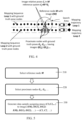
- Fig. 1 illustrates mapping and localization using a neural network, according to an exemplary embodiment of the invention.
- mapping a sequence of images is captured at multiple locations in an area of interest (in this case the route of a vehicle).
- the map includes the captured images and their map-relative poses (i.e. ground truth poses).
- the pose graph includes interconnected pose nodes which define one or multiple chains of poses (e.g. follow one or multiple trajectories of a vehicle). It is to be understood that corresponding embodiments may be implemented for other representations of the map used to train the neural network and/or of the image and pose information used as input to the neural network during localization.
- the neural network is trained to estimate the pose of the localization image relative to the coordinate system of a selected reference node 10.
- the ground truth pose estimate for the localization image is calculated from the ground-truth pose of reference node 10 (which is known from the mapping) and the estimated pose output by the neural network.
- pose node and “node” mean an element having an associated image and pose, and information about connections to other pose nodes.
- a pose node may include additional information, including but not limited to:
- the neural network is further trained to detect when there is a high probability that the localization image is from a location outside the mapped area of interest, in which case it may not be possible to perform accurate localization based on the localization image.
- images are captured by an image capturing device over an area of interest (e.g. a route).
- a mapping sequence is created from the captured images and their respective poses.
- a vehicle carrying an image capturing device and location and orientation sensors travels along a route.
- the image capturing device captures images at a fixed rate and the pose at the time each image is captured.
- image capturing device means any type of device capable of capturing an image, without limitation as to how the image is captured or to the hardware or type of the image capturing device. Examples of an image capturing device include, but are not limited to, a camera and an image sensor.
- One or more images may be captured at each location, possibly at different times and/or at different orientations (for example stereo images).
- the types of images which may be captured include but are not limited to RGB images, chrominance-luminance images and infra-red images.
- the map is updated during the localization stage in order to maintain accuracy.
- Apparatus 200 includes processor circuitry 210.
- Embodiments of apparatus 200 may further include one or more of:
- Processor circuitry 210 performs processing operations for training the neural network.
- Apparatus 200 obtains training data which was gathered at multiple locations during the mapping process.
- the training data includes least one image captured at each location and respective poses of the captured images.
- the apparatus includes at least one memory 220, and some or all of the captured images and their respective poses are stored in memory 220 for use as training data.
- the apparatus includes communication interface 230, and some or all of the training data is obtained from an external element (e.g. an external memory, server, over a network, etc.).
- Apparatus 200 generates data samples from the training data. Each data sample assigns images selected from the training data to their respective poses. Examples of generating data samples are illustrated in Figs. 4-9 and are described in more detail below.
- the data samples are combined into a data set which is used to train the neural network.
- the neural network is trained to identify the pose of a localization image from:
- FIG. 3 is a simplified flowchart of a method for generating a neural network for pose estimation of a system, according to embodiments of the invention.
- the training data is obtained.
- At least one data sample is generated for each of the images.
- a data sample for an image is an assignment of the image and at least one other image selected from said training data to respective poses.
- a data set for training a neural network is formed from multiple data samples.
- the neural network is trained with the data set to estimate a pose of a localization image from:
- a data sample is generated by selecting at least one reference image from the training data. At least one proximate image is also selected from the training data.
- the proximate image(s) have respective pose(s) which are proximate to the pose of at least one reference image.
- the proximate images are images that were captured at a close distance from the location at which a reference image was captured.
- the proximate nodes are not necessarily consecutive within the mapping sequence nor are they necessarily the closest nodes to the reference node(s).
- the proximate nodes are located within a specified distance from one or more reference nodes.
- the data sample is created by assigning respective poses to each proximate image relative to each reference image.
- the data sample further includes semantic segmentation (SS) information for at least one of its images.
- the semantic segmentation information classifies pixels in the image as to the type of object it is depicting (e.g., pixel of a car, pixel of a vegetation, building, sky, road).
- the data sample further includes depth map information for at least one of its images.
- the depth map (DM) provides respective depth information for a scene point in the image.
- the data samples which form the data set used for training are not necessarily of the same structure or type. Possible differences between data samples include but are not limited to:
- One benefit of creating the training data set according to embodiments of the invention is that there is no need for manual labelling. This allows for fully-automatic training data set generation.
- the pose node of a reference image is denoted a reference node and the pose node of a proximate image is denoted a proximate node.
- At least one data sample has a single reference node and multiple proximate nodes.
- the reference nodes are shown as part of the first mapping loop and the proximate nodes are shown as part of the second mapping loop. It is noted that the reference and proximate nodes are not necessarily selected from different mapping loops but rather may be in any order or combination. Furthermore, the mapping sequence is not necessarily defined as two mapping loops.
- FIG. 4 illustrates the creation of a data sample having a single reference node M and proximate nodes ( G1 , G2 ...), according to embodiments of the invention.
- Reference node M is selected as the origin coordinate system.
- the data sample is the assignment: I M , I G 1 , I G 2 , ... ⁇ C 1 , C 2 , ... , where I(X) means the image at the pose node X and C1 , C2, ... are the image-relative poses expressed with respect to node M .
- semantic segmentation data and/or depth mapping data is available for one or more nodes and the data sample is: I M , I G 1 , I G 2 , ... , SS M , SS G 1 , ... , DM M ⁇ C 1 , C 2 , ... , where SS(X) means the semantic segmentation information for the image at pose node X and DM(X) means the depth map information for the image at pose node X .
- FIG. 5 is a simplified flowchart of a method for creating a data sample having a single reference node and multiple proximate nodes, according to embodiments of the invention.
- reference node M is selected.
- proximate nodes G1 , G2 ... are selected.
- a data sample is built for M , G1, G2... by assigning the respective poses.
- the data sample does not include SS and DM information.
- Other types of data samples may be built for the same images with SS and/or DM information and/or additional information as described below.
- At least one data sample has multiple reference nodes (denoted M k + n ) and multiple proximate nodes (denoted G j ). Respective poses are designated for each proximate image relative to each of the reference images. By including the additional information provided by the multiple reference nodes, the available information is better exploited when training the neural network.
- the pose information of all the reference nodes M k + n is included as information in the data sample. This provides the benefit of wider coverage of the scene information provided by the proximate nodes.
- FIG. 6 illustrates the creation of a data sample having multiple reference nodes, M k + n , and multiple proximate nodes, G j , according to embodiments of the invention.
- the data sample is the assignment: I M k + n , I G j , M ′ k + n ⁇ C k , j , where I(Mk+n) means the images at reference nodes X k ...X k + n , I( G j ) means the images at proximate nodes G j .
- semantic segmentation data and/or depth mapping data is available for one or more nodes and the data sample is: I M k + n , I G j , M ′ k + n , ... , SS M k + n , SS G j , ... , DM M k + n ⁇ C k , j ,
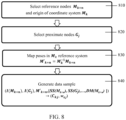
- FIG. 7 is a simplified flowchart of a method for creating a data sample having multiple reference nodes and multiple proximate nodes, according to embodiments of the invention.
- multiple reference nodes, M k + n are selected and one of the reference nodes, M k , is selected as the origin of the coordinate system.
- proximate nodes G j are selected.
- the poses of the reference nodes are transformed to the M k coordinate system.
- a data sample is built for M k + n and G j by assigning the respective poses C k,j .
- the data sample includes SS and DM information, and the data sample is (I(M k + n ), l(G j ), M' k + n , ... , [SS(M k + n ), SS(G j ),...,DM(M k+n )]) ⁇ (C k,j ) .
- Other data samples may be built for the same images without SS and/or DM information.
- pose estimation errors are tracked while the neural network is being trained.
- the errors are used to calculate confidence values, w , for pose estimates output by the neural network.
- the confidence values are used as additional input for training the neural network.
- the data sample is generated for a single reference node and multiple proximate nodes with no SS or DM information (as in Figs. 2-3 ).
- the data sample may be expressed as: I M , I G 1 , I G 2 , ... ⁇ C 1 , C 2 , ... w 1 , w 2 ... , where w x is the confidence value for pose CX .
- Fig. 8 is a simplified flowchart of a method for creating a data sample with confidence values, according to an exemplary embodiment of the invention.
- the data sample is for multiple reference nodes and multiple proximate nodes with SS and DM information, according to embodiments of the invention.
- multiple reference nodes, M k + n are selected and one of the reference nodes, M k , is selected as the origin of the coordinate system.
- proximate nodes G j are selected.
- the poses of the reference nodes are transformed to the M k coordinate system.
- a data sample is built for M k + n and G j by assigning the respective poses C k,j .
- the data sample includes SS and DM information, and the data sample is (I(M k + n ), I(G j ), M' k+n , ... ,[SS(M k + n ), SS(G j ),...,DM(M k+n )]) ⁇ (C kj , w k,j ).
- Other data samples may be built for the same images without SS and/or DM information.
- one or more errors are introduced into the training data by changing at least one pose in at least one data sample. For example, minor angular and/or location may be added to the correct pose parameters. Adding error(s) to a pose simulates mapping inaccuracies, so that the neural network may be trained to maintain high accuracy even when the mapping used during localization is not accurate. Note that the accurate poses C k,j are available during training, so that the neural network may be trained to estimate the poses correctly.
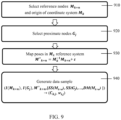
- Fig. 9 is a simplified flowchart of a method for introducing error into a data sample, according to an exemplary embodiment of the invention.
- the data sample is for multiple reference nodes and multiple proximate nodes with SS and DM information, according to embodiments of the invention.
- multiple reference nodes, M k + n are selected and one of the reference nodes, M k , is selected as the origin of the coordinate system.
- proximate nodes G j are selected.
- a data sample is built for M" k + n and G j by assigning the respective poses C k,j .
- the data sample includes SS and DM information, and the data sample is (I(M k + n ), I(G j ), M" k + n , ... , [SS(M k+n ), SS(G j ),...,DM(M k+n )]) ⁇ ( C k,j ) .
- Other data samples may be built for the same images without SS and/or DM information and/or confidence values.
- the SS and DM information is not available, confidence values are available and the data sample is: I M k + n , I G j , M " k + n ⁇ C k , j , w k , j
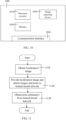
- FIG. 10 is a simplified block diagram of an apparatus for image-based localization of a system in an area of interest, according to embodiments of the invention. Localization is performed using a neural network which has been trained to perform pose estimation for a localization image using stored images that were captured during the mapping (denoted map images) and their respective poses.
- the trained neural network is one of:
- Apparatus 1000 includes processor circuitry 1010 and memory 1020. Optionally, apparatus 1000 further includes one or more of:
- Processor circuitry 1010 performs processing operations for performing the localization.
- Memory 1020 stores images that were captured at multiple locations in an area of interest during mapping and the respective poses of the stored images.
- the pose of an image is the location and orientation of the image capturing device which captured the stored image at the time of image capture.
- Apparatus 1000 obtains a localization image that was captured by an image capturing device.
- apparatus 1000 includes image capturing device 1030 which captures the localization images.
- the localization image is obtained from an external image capturing device.
- a subset of the stored map images is retrieved from memory 1020.
- Information is provided to the trained neural network in order to obtain a pose estimate for the localization image.
- the information includes:
- further input to the trained neural network includes: semantic segmentation information computed for at least one of the images and/or depth map(s) computed for at least one of the images.
- the subset of stored images retrieved from memory 1020 is selected based on the approximate location of the system being localized. Further optionally, the subset includes some or all of the stored images that were captured within a certain distance from the approximate location of the system.
- the approximate location of the system being localized may be determined, for example, using a simple GPS device which provides a low accuracy estimate of the location and/or by place recognition and/or based on previous localization pose estimates.
- one or more of the retrieved images is selected as a reference image.
- the output of the neural network is at least one localization pose estimate, which is expressed relative to a reference node coordinate system and/or relative to the map coordinate system.
- the neural network outputs a single localization pose estimate which is expressed relative to the pose of a single reference image.
- the neural network outputs multiple localization pose estimates.
- Each localization pose estimate is expressed relative to the pose of a different reference image.
- a final localization pose estimate is calculated from the multiple pose estimates.
- the neural network is trained to jointly estimate poses for multiple localization images, for example consecutive localization images. Joint estimation of multiple localization poses reduces error, as the neural network may be trained to ensure that vehicle dynamics constraints are satisfied (e.g. maximum vehicle speed is not exceeded in consecutive pose estimates).
- FIG. 11 is a simplified flowchart of a method for image-based localization of a system in an area of interest, according to embodiments of the invention.
- the localization image is obtained from an image capturing device.
- input data is provided to a trained neural network.
- the input data includes:
- At least one pose estimate is obtained from the trained neural network.
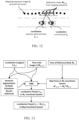
- FIG. 12 illustrates pose estimation of a localization pose, L j , relative to a single reference node M k , according to an exemplary embodiment of the invention.
- respective images and poses of multiple mapped pose nodes, M k + n are retrieved from memory.
- One of the pose nodes, in this example M k is selected as a reference node. All poses are expressed relative to the M k coordinate system, thereby bounding the pose estimate values within a limited range.
- reference node M k is the pose node closest to the approximate location of the system. Further optionally, the pose node closest to the localization pose is found by computing the relative poses of M k + n with respect to the localization image, and choosing the n having the smallest distance from the localization pose.
- the other pose nodes, M k-1 , M k + 1 and M k + 2 are proximate to M k , for example within a specified distance from M k .
- multiple localization poses (..., L j-3 , L j-2 , L j-1i , L j ... ) are estimated jointly, where C k,j is the pose estimate for localization image I(L j ) relative to reference node M k .
- Fig. 13 shows the inputs and outputs of the trained neural network in accordance with the exemplary embodiment of Fig. 12 .
- Inputs to neural network DNN include:
- the output of neural network DNN is the localization pose estimate C k,j in the M k coordinate system, which is transformed into the map-relative pose L j .
- Fig. 14 illustrates pose estimation relative to multiple reference nodes, according to an exemplary embodiment of the invention.
- Using multiple reference nodes reduces estimation error by providing more information to the neural network.
- L j In order to estimate localization pose L j , respective images and poses of multiple reference nodes, M k + m , are selected. Images and pose information for reference nodes M k + m are retrieved from memory. The neural network calculates multiple pose estimates for each localization image, where each pose estimate is relative to a different reference node. The multiple pose estimates are combined to form the final pose estimate L j .
- L j may be computed as the weighted average of the multiple pose estimates, where the weights are the confidence values w k,j .
- multiple localization poses ..., L j-3 , L j-2 , L j-1 , L j , are estimated jointly, where C k,j is the pose estimate for localization image I(L j ) relative to reference node M k .
- Fig. 15 shows the inputs and outputs of the trained neural network in accordance with the exemplary embodiment of Fig. 14 .
- Inputs to neural network DNN include:
- the outputs of neural network DNN are multiple pose estimates ( C k + i,j ) for each localization image, I(L j ) , in the M k + m coordinate system.
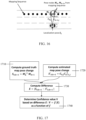
- an estimation accuracy measure is provided for a pose estimate.
- the estimation accuracy measure is based on a comparison of the difference between ground truth pose estimates obtained for the same localization image for different reference nodes to the actual ground truth pose difference for those reference nodes (which is known from the map).
- Fig. 16 illustrates how different estimates are obtained for a single localization pose, L j .
- C k,j is the pose estimate for localization image I(L j ) when M k is used as the reference node
- C k + 1,j is the pose estimate for localization image I(L j ) when M k + 1 is used as the reference node.
- FIG. 17 is a simplified flowchart of a method for determining an estimation accuracy measure for a pose estimate, according to embodiments of the invention.
- a confidence value V is calculated from the difference E , where V is a measure of the accuracy of the pose estimate.
Landscapes
- Engineering & Computer Science (AREA)
- Computer Vision & Pattern Recognition (AREA)
- Physics & Mathematics (AREA)
- General Physics & Mathematics (AREA)
- Theoretical Computer Science (AREA)
- Image Analysis (AREA)
- Image Processing (AREA)
Claims (5)
- Vorrichtung (200) zum Erzeugen eines Modells für eine Posenabschätzung eines Systems, wobei die Vorrichtung eine Prozessorschaltlogik (210) umfasst, wobei die Prozessorschaltlogik für Folgendes konfiguriert ist:Erhalten von Trainingsdaten für eine Vielzahl von Orten, wobei die Trainingsdaten mindestens ein von einer Bilderfassungseinrichtung (240) erfasstes Bild und jeweilige Posen des mindestens einen von der Bilderfassungseinrichtung erfassten Bildes umfassen, wobei eine jeweilige Pose eines Bildes einen jeweiligen Ort und eine jeweilige Ausrichtung der Bilderfassungseinrichtung während der Erfassung des Bildes umfasst;Erzeugen von mindestens einer Datenprobe aus den Trainingsdaten für jedes der erfassten Bilder, wobei eine Datenprobe für ein Bild eine Zuordnung des Bildes und mindestens eines anderen Bildes, das aus den Trainingsdaten ausgewählt istm zu jeweiligen Posen umfasst;Trainieren eines neuronalen Netzwerks mit einem Datensatz, der die Datenproben umfasst, um eine jeweilige Pose eines Lokalisierungsbildes anhand von Folgendem zu schätzen:dem Lokalisierungsbild;mindestens einem zusätzlichen Bild aus den Trainingsdaten; undeiner jeweiligen Pose jedes des mindestens einen zusätzlichen Bildes; wobei das Erzeugen von mindestens einer Datenprobe Folgendes umfasst:Auswählen von mindestens einem Referenzbild aus den Trainingsdaten;Auswählen von mindestens einem nahen Bild, das eine Pose aufweist, die nahe der Pose des mindestens einen Referenzbildes ist, aus den Trainingsdaten; undZuordnen des mindestens einen Referenzbildes und des mindestens einen nahen Bildes zu jeweiligen Posen jedes nahen Bildes relativ zu jedem Referenzbild;wobei ein Pose-Knoten des mindestens einen Referenzbildes als ein Referenzknoten bezeichnet wird und ein Pose-Knoten des mindestens einen nahen Bildes als ein naher Knoten bezeichnet wird;wobei sich die nahen Knoten innerhalb einer bestimmten Entfernung von einem oder mehreren Referenzknoten befinden.
- Vorrichtung nach Anspruch 1, wobei das mindestens eine Referenzbild ein einzelnes Referenzbild umfasst und die Zuordnung die jeweiligen Posen jedes nahen Bildes relativ zu dem einzelnen Referenzbild bezeichnet, oder
wobei das mindestens eine Referenzbild eine Vielzahl von Referenzbildern umfasst und die Zuweisung jeweilige Posen jedes nahen Bildes relativ zu jedem der Referenzbilder bezeichnet. - Vorrichtung nach Anspruch 1 oder 2, wobei die jeweiligen Posen des mindestens einen nahen Bildes innerhalb einer bestimmten Entfernung von einer Pose von mindestens einem der Referenzbilder liegen, und/oder wobei die Prozessorschaltlogik ferner konfiguriert ist, um einen Fehler in die Trainingsdaten einzubringen, durch Ändern mindestens einer Pose in den Datenproben vor dem Training, und/oder wobei die Prozessorschaltlogik ferner konfiguriert ist, um Fehler bei der Schätzung der Posen während des Trainings zu verfolgen und jeweilige Konfidenzwerte für die von dem neuronalen Netzwerk geschätzten Posen basierend auf den verfolgten Fehlern zu kalkulieren, und/oder wobei mindestens eine der Datenproben ferner eine semantische Segmentierung umfasst, die für mindestens ein in dem Datensatz abgebildetes Bild berechnet wurde, und/oderwobei mindestens eine der Datenproben ferner eine Tiefenkarte umfasst, die für mindestens ein in dem Datensatz abgebildetes Bild berechnet wurde, und/oderwobei das neuronale Netzwerk ein tiefes neuronales Netzwerk (DNN) umfasst.
- Verfahren zum Erzeugen eines neuronalen Netzwerks für die Posenabschätzung eines Systems, wobei das Verfahren umfasst:Erhalten (310) von Trainingsdaten für eine Vielzahl von Orten, wobei die Trainingsdaten mindestens ein von einer Bilderfassungseinrichtung erfasstes Bild und jeweilige Posen des mindestens einen von der Bilderfassungseinrichtung erfassten Bildes umfassen, wobei eine jeweilige Pose eines Bildes einen jeweiligen Ort und eine jeweilige Ausrichtung der Bilderfassungseinrichtung während der Erfassung des Bildes umfasst;Erzeugen (320) von mindestens einer Datenprobe aus den Trainingsdaten für jedes der erfassten Bilder, wobei eine Datenprobe für ein Bild eine Zuordnung des Bildes und mindestens eines anderen Bildes, das aus den Trainingsdaten ausgewählt ist, zu jeweiligen Posen umfasst;Trainieren (340) eines neuronalen Netzwerks mit einem Datensatz, der die Datenproben umfasst, um eine jeweilige Pose eines Lokalisierungsbildes anhand von Folgendem zu schätzen:dem Lokalisierungsbild;mindestens einem zusätzlichen Bild aus den Trainingsdaten; undeiner jeweiligen Pose jedes des mindestens einen zusätzlichen Bildes; wobei die Zuordnung für mindestens eine der Datenproben Folgendes umfasst:Auswählen eines einzelnen Referenzbildes aus den Trainingsdaten;Auswählen von mindestens einem nahen Bild aus ausgewählten Trainingsdaten basierend auf der Nähe zu dem Referenzbild; undBezeichnen der jeweiligen Posen des mindestens einen nahen Bildes relativ zu dem einzelnen Referenzbild;wobei ein Pose-Knoten des Referenzbildes als ein Referenzknoten bezeichnet wird und ein Pose-Knoten des mindestens einen nahen Bildes als ein naher Knoten bezeichnet wird;wobei sich die nahen Knoten innerhalb einer bestimmten Entfernung von einem oder mehreren Referenzknoten befinden.
- Verfahren nach Anspruch 4, wobei die Zuordnung für mindestens eine der Datenproben Folgendes umfasst:Auswählen einer Vielzahl von Referenzbildern, die aus den Trainingsdaten ausgewählt wurden;Auswählen von mindestens einem nahen Bild aus den Trainingsdaten basierend auf der Nähe zu den Referenzbildern; undBezeichnen der jeweiligen Posen jedes nahen Bildes relativ zu jedem Referenzbild, und/oderferner das Einbringen eines Fehlers in die Trainingsdaten durch Ändern von mindestens einer Pose in den Datenproben vor dem Training umfasst, und/oderferner das Verfolgen von Fehlern bei der Schätzung der Posen während des Trainings und das Kalkulieren eines jeweiligen Konfidenzwerts für die von dem neuronalen Netzwerk geschätzten Posen basierend auf dem Verfolgen umfasst.
Applications Claiming Priority (1)
| Application Number | Priority Date | Filing Date | Title |
|---|---|---|---|
| PCT/EP2019/056151 WO2020182297A1 (en) | 2019-03-12 | 2019-03-12 | Learnable localization using images |
Publications (3)
| Publication Number | Publication Date |
|---|---|
| EP3921802A1 EP3921802A1 (de) | 2021-12-15 |
| EP3921802B1 true EP3921802B1 (de) | 2024-11-27 |
| EP3921802B8 EP3921802B8 (de) | 2025-01-01 |
Family
ID=65763465
Family Applications (1)
| Application Number | Title | Priority Date | Filing Date |
|---|---|---|---|
| EP19710679.2A Active EP3921802B8 (de) | 2019-03-12 | 2019-03-12 | Erlernbare lokalisierung unter verwendung von bildern |
Country Status (4)
| Country | Link |
|---|---|
| US (1) | US12106511B2 (de) |
| EP (1) | EP3921802B8 (de) |
| CN (1) | CN113302655B (de) |
| WO (1) | WO2020182297A1 (de) |
Families Citing this family (7)
| Publication number | Priority date | Publication date | Assignee | Title |
|---|---|---|---|---|
| DE102019216379A1 (de) * | 2019-10-24 | 2021-04-29 | Robert Bosch Gmbh | Verfahren zum Trainieren eines neuronalen Faltungs-Netzwerkes zum Bestimmen einer Lokalisierungs-Pose |
| CN112907663B (zh) * | 2021-02-03 | 2024-08-13 | 阿里巴巴集团控股有限公司 | 定位方法、计算机程序产品、装置及系统 |
| CN113916254B (zh) * | 2021-07-22 | 2024-08-09 | 北京控制工程研究所 | 一种停靠式抓捕的航天器自主交会对接试验方法 |
| CN116824631B (zh) * | 2023-06-14 | 2024-02-27 | 西南交通大学 | 一种姿态估计方法及系统 |
| US12579662B2 (en) * | 2023-06-15 | 2026-03-17 | Oracle International Corporation | High-precision localization of a moving object on a trajectory |
| US12608825B2 (en) | 2023-09-12 | 2026-04-21 | Oracle International Corporation | Preparing data for high-precision absolute localization of a moving object along a trajectory |
| TWI884033B (zh) * | 2024-07-12 | 2025-05-11 | 中華電信股份有限公司 | 基於影像之定位系統、方法以及電腦程式產品 |
Family Cites Families (4)
| Publication number | Priority date | Publication date | Assignee | Title |
|---|---|---|---|---|
| US9730643B2 (en) * | 2013-10-17 | 2017-08-15 | Siemens Healthcare Gmbh | Method and system for anatomical object detection using marginal space deep neural networks |
| US10282861B2 (en) * | 2016-12-12 | 2019-05-07 | Here Global B.V. | Pose error estimation and localization using static features |
| US10467756B2 (en) * | 2017-05-14 | 2019-11-05 | International Business Machines Corporation | Systems and methods for determining a camera pose of an image |
| TW202230211A (zh) * | 2020-12-10 | 2022-08-01 | 美商尼安蒂克公司 | 使用圖像神經網路及相關姿勢監督之視覺攝影機重新局部化 |
-
2019
- 2019-03-12 WO PCT/EP2019/056151 patent/WO2020182297A1/en not_active Ceased
- 2019-03-12 EP EP19710679.2A patent/EP3921802B8/de active Active
- 2019-03-12 CN CN201980088681.2A patent/CN113302655B/zh active Active
-
2021
- 2021-09-13 US US17/473,466 patent/US12106511B2/en active Active
Also Published As
| Publication number | Publication date |
|---|---|
| US20210407128A1 (en) | 2021-12-30 |
| WO2020182297A1 (en) | 2020-09-17 |
| US12106511B2 (en) | 2024-10-01 |
| EP3921802A1 (de) | 2021-12-15 |
| CN113302655A (zh) | 2021-08-24 |
| EP3921802B8 (de) | 2025-01-01 |
| CN113302655B (zh) | 2025-03-11 |
Similar Documents
| Publication | Publication Date | Title |
|---|---|---|
| EP3921802B1 (de) | Erlernbare lokalisierung unter verwendung von bildern | |
| US11462023B2 (en) | Systems and methods for 3D object detection | |
| US20250362133A1 (en) | Systems, Methods and Devices for Map-Based Object's Localization Deep Learning and Object's Motion Trajectories on Geospatial Maps Using Neural Network | |
| Chiu et al. | Robust vision-aided navigation using sliding-window factor graphs | |
| Saleem et al. | Neural network-based recent research developments in SLAM for autonomous ground vehicles: A review | |
| Chen et al. | High-precision positioning, perception and safe navigation for automated heavy-duty mining trucks | |
| Murali et al. | Utilizing semantic visual landmarks for precise vehicle navigation | |
| Chiu et al. | Precise vision-aided aerial navigation | |
| CN111507373A (zh) | 执行无缝参数变更的方法及装置 | |
| CN111126327B (zh) | 车道线检测方法、系统、车载系统及车辆 | |
| Yusefi et al. | A generalizable D-VIO and its fusion with GNSS/IMU for improved autonomous vehicle localization | |
| Ghasemieh et al. | Towards explainable artificial intelligence in deep vision-based odometry | |
| Wang et al. | Eum-slam: An enhancing underwater monocular visual slam with deep learning-based optical flow estimation | |
| Xia et al. | Bayesian simultaneous localization and multi-lane tracking using onboard sensors and a sd map | |
| Xu et al. | Direct visual-inertial odometry with semi-dense mapping | |
| Wei et al. | A semantic-aided fusion localization method for intelligent vehicles in GNSS-denied dynamic environments | |
| Zhou et al. | Vision SLAM algorithm for wheeled robots integrating multiple sensors | |
| Wang et al. | Perceptual enhancement for unsupervised monocular visual odometry | |
| CN119472771B (zh) | 基于四足机器人的田间巡检方法、装置及四足机器人 | |
| Chiu et al. | Sub-meter vehicle navigation using efficient pre-mapped visual landmarks | |
| CN115762154A (zh) | 一种红绿灯时序状态估算方法、装置及电子设备 | |
| Xu et al. | A novel heading angle estimation methodology for land vehicles based on deep learning and enhanced digital map | |
| Chen et al. | Monocular visual odometry based on trifocal tensor constraint | |
| Menon et al. | 37‐3: Invited Paper: Deep‐Learning based Approaches to Visual‐Inertial Odometry for Autonomous Tracking Applications | |
| Ojala et al. | Determination of outdoor object distances from monocular thermal images |
Legal Events
| Date | Code | Title | Description |
|---|---|---|---|
| STAA | Information on the status of an ep patent application or granted ep patent |
Free format text: STATUS: UNKNOWN |
|
| STAA | Information on the status of an ep patent application or granted ep patent |
Free format text: STATUS: THE INTERNATIONAL PUBLICATION HAS BEEN MADE |
|
| PUAI | Public reference made under article 153(3) epc to a published international application that has entered the european phase |
Free format text: ORIGINAL CODE: 0009012 |
|
| STAA | Information on the status of an ep patent application or granted ep patent |
Free format text: STATUS: REQUEST FOR EXAMINATION WAS MADE |
|
| 17P | Request for examination filed |
Effective date: 20210907 |
|
| AK | Designated contracting states |
Kind code of ref document: A1 Designated state(s): AL AT BE BG CH CY CZ DE DK EE ES FI FR GB GR HR HU IE IS IT LI LT LU LV MC MK MT NL NO PL PT RO RS SE SI SK SM TR |
|
| DAV | Request for validation of the european patent (deleted) | ||
| DAX | Request for extension of the european patent (deleted) | ||
| GRAP | Despatch of communication of intention to grant a patent |
Free format text: ORIGINAL CODE: EPIDOSNIGR1 |
|
| STAA | Information on the status of an ep patent application or granted ep patent |
Free format text: STATUS: GRANT OF PATENT IS INTENDED |
|
| INTG | Intention to grant announced |
Effective date: 20240703 |
|
| P01 | Opt-out of the competence of the unified patent court (upc) registered |
Free format text: CASE NUMBER: APP_48735/2024 Effective date: 20240827 |
|
| GRAS | Grant fee paid |
Free format text: ORIGINAL CODE: EPIDOSNIGR3 |
|
| GRAA | (expected) grant |
Free format text: ORIGINAL CODE: 0009210 |
|
| STAA | Information on the status of an ep patent application or granted ep patent |
Free format text: STATUS: THE PATENT HAS BEEN GRANTED |
|
| AK | Designated contracting states |
Kind code of ref document: B1 Designated state(s): AL AT BE BG CH CY CZ DE DK EE ES FI FR GB GR HR HU IE IS IT LI LT LU LV MC MK MT NL NO PL PT RO RS SE SI SK SM TR |
|
| REG | Reference to a national code |
Ref country code: GB Ref legal event code: FG4D |
|
| REG | Reference to a national code |
Ref country code: CH Ref legal event code: EP |
|
| REG | Reference to a national code |
Ref country code: DE Ref legal event code: R081 Ref document number: 602019062535 Country of ref document: DE Owner name: SHENZHEN YINWANG INTELLIGENT TECHNOLOGIES CO.,, CN Free format text: FORMER OWNER: HUAWEI TECHNOLOGIES CO., LTD., SHENZHEN, GUANGDONG, CN |
|
| REG | Reference to a national code |
Ref country code: DE Ref legal event code: R082 Ref document number: 602019062535 Country of ref document: DE |
|
| REG | Reference to a national code |
Ref country code: CH Ref legal event code: PK Free format text: BERICHTIGUNG B8 |
|
| REG | Reference to a national code |
Ref country code: IE Ref legal event code: FG4D |
|
| REG | Reference to a national code |
Ref country code: DE Ref legal event code: R096 Ref document number: 602019062535 Country of ref document: DE |
|
| RAP2 | Party data changed (patent owner data changed or rights of a patent transferred) |
Owner name: SHENZHEN YINWANG INTELLIGENTTECHNOLOGIES CO., LTD. |
|
| REG | Reference to a national code |
Ref country code: LT Ref legal event code: MG9D |
|
| REG | Reference to a national code |
Ref country code: NL Ref legal event code: MP Effective date: 20241127 |
|
| PG25 | Lapsed in a contracting state [announced via postgrant information from national office to epo] |
Ref country code: HR Free format text: LAPSE BECAUSE OF FAILURE TO SUBMIT A TRANSLATION OF THE DESCRIPTION OR TO PAY THE FEE WITHIN THE PRESCRIBED TIME-LIMIT Effective date: 20241127 Ref country code: IS Free format text: LAPSE BECAUSE OF FAILURE TO SUBMIT A TRANSLATION OF THE DESCRIPTION OR TO PAY THE FEE WITHIN THE PRESCRIBED TIME-LIMIT Effective date: 20250327 Ref country code: PT Free format text: LAPSE BECAUSE OF FAILURE TO SUBMIT A TRANSLATION OF THE DESCRIPTION OR TO PAY THE FEE WITHIN THE PRESCRIBED TIME-LIMIT Effective date: 20250327 |
|
| PG25 | Lapsed in a contracting state [announced via postgrant information from national office to epo] |
Ref country code: FI Free format text: LAPSE BECAUSE OF FAILURE TO SUBMIT A TRANSLATION OF THE DESCRIPTION OR TO PAY THE FEE WITHIN THE PRESCRIBED TIME-LIMIT Effective date: 20241127 Ref country code: NL Free format text: LAPSE BECAUSE OF FAILURE TO SUBMIT A TRANSLATION OF THE DESCRIPTION OR TO PAY THE FEE WITHIN THE PRESCRIBED TIME-LIMIT Effective date: 20241127 |
|
| REG | Reference to a national code |
Ref country code: AT Ref legal event code: MK05 Ref document number: 1746455 Country of ref document: AT Kind code of ref document: T Effective date: 20241127 |
|
| PG25 | Lapsed in a contracting state [announced via postgrant information from national office to epo] |
Ref country code: BG Free format text: LAPSE BECAUSE OF FAILURE TO SUBMIT A TRANSLATION OF THE DESCRIPTION OR TO PAY THE FEE WITHIN THE PRESCRIBED TIME-LIMIT Effective date: 20241127 |
|
| PG25 | Lapsed in a contracting state [announced via postgrant information from national office to epo] |
Ref country code: ES Free format text: LAPSE BECAUSE OF FAILURE TO SUBMIT A TRANSLATION OF THE DESCRIPTION OR TO PAY THE FEE WITHIN THE PRESCRIBED TIME-LIMIT Effective date: 20241127 |
|
| PG25 | Lapsed in a contracting state [announced via postgrant information from national office to epo] |
Ref country code: NO Free format text: LAPSE BECAUSE OF FAILURE TO SUBMIT A TRANSLATION OF THE DESCRIPTION OR TO PAY THE FEE WITHIN THE PRESCRIBED TIME-LIMIT Effective date: 20250227 |
|
| PG25 | Lapsed in a contracting state [announced via postgrant information from national office to epo] |
Ref country code: LV Free format text: LAPSE BECAUSE OF FAILURE TO SUBMIT A TRANSLATION OF THE DESCRIPTION OR TO PAY THE FEE WITHIN THE PRESCRIBED TIME-LIMIT Effective date: 20241127 Ref country code: GR Free format text: LAPSE BECAUSE OF FAILURE TO SUBMIT A TRANSLATION OF THE DESCRIPTION OR TO PAY THE FEE WITHIN THE PRESCRIBED TIME-LIMIT Effective date: 20250228 Ref country code: AT Free format text: LAPSE BECAUSE OF FAILURE TO SUBMIT A TRANSLATION OF THE DESCRIPTION OR TO PAY THE FEE WITHIN THE PRESCRIBED TIME-LIMIT Effective date: 20241127 |
|
| PG25 | Lapsed in a contracting state [announced via postgrant information from national office to epo] |
Ref country code: PL Free format text: LAPSE BECAUSE OF FAILURE TO SUBMIT A TRANSLATION OF THE DESCRIPTION OR TO PAY THE FEE WITHIN THE PRESCRIBED TIME-LIMIT Effective date: 20241127 |
|
| PG25 | Lapsed in a contracting state [announced via postgrant information from national office to epo] |
Ref country code: RS Free format text: LAPSE BECAUSE OF FAILURE TO SUBMIT A TRANSLATION OF THE DESCRIPTION OR TO PAY THE FEE WITHIN THE PRESCRIBED TIME-LIMIT Effective date: 20250227 |
|
| PG25 | Lapsed in a contracting state [announced via postgrant information from national office to epo] |
Ref country code: SM Free format text: LAPSE BECAUSE OF FAILURE TO SUBMIT A TRANSLATION OF THE DESCRIPTION OR TO PAY THE FEE WITHIN THE PRESCRIBED TIME-LIMIT Effective date: 20241127 |
|
| PG25 | Lapsed in a contracting state [announced via postgrant information from national office to epo] |
Ref country code: DK Free format text: LAPSE BECAUSE OF FAILURE TO SUBMIT A TRANSLATION OF THE DESCRIPTION OR TO PAY THE FEE WITHIN THE PRESCRIBED TIME-LIMIT Effective date: 20241127 |
|
| PG25 | Lapsed in a contracting state [announced via postgrant information from national office to epo] |
Ref country code: RO Free format text: LAPSE BECAUSE OF FAILURE TO SUBMIT A TRANSLATION OF THE DESCRIPTION OR TO PAY THE FEE WITHIN THE PRESCRIBED TIME-LIMIT Effective date: 20241127 |
|
| PG25 | Lapsed in a contracting state [announced via postgrant information from national office to epo] |
Ref country code: SK Free format text: LAPSE BECAUSE OF FAILURE TO SUBMIT A TRANSLATION OF THE DESCRIPTION OR TO PAY THE FEE WITHIN THE PRESCRIBED TIME-LIMIT Effective date: 20241127 |
|
| PG25 | Lapsed in a contracting state [announced via postgrant information from national office to epo] |
Ref country code: CZ Free format text: LAPSE BECAUSE OF FAILURE TO SUBMIT A TRANSLATION OF THE DESCRIPTION OR TO PAY THE FEE WITHIN THE PRESCRIBED TIME-LIMIT Effective date: 20241127 |
|
| PG25 | Lapsed in a contracting state [announced via postgrant information from national office to epo] |
Ref country code: IT Free format text: LAPSE BECAUSE OF FAILURE TO SUBMIT A TRANSLATION OF THE DESCRIPTION OR TO PAY THE FEE WITHIN THE PRESCRIBED TIME-LIMIT Effective date: 20241127 |
|
| REG | Reference to a national code |
Ref country code: DE Ref legal event code: R097 Ref document number: 602019062535 Country of ref document: DE |
|
| PG25 | Lapsed in a contracting state [announced via postgrant information from national office to epo] |
Ref country code: SE Free format text: LAPSE BECAUSE OF FAILURE TO SUBMIT A TRANSLATION OF THE DESCRIPTION OR TO PAY THE FEE WITHIN THE PRESCRIBED TIME-LIMIT Effective date: 20241127 |
|
| PLBE | No opposition filed within time limit |
Free format text: ORIGINAL CODE: 0009261 |
|
| STAA | Information on the status of an ep patent application or granted ep patent |
Free format text: STATUS: NO OPPOSITION FILED WITHIN TIME LIMIT |
|
| REG | Reference to a national code |
Ref country code: CH Ref legal event code: L10 Free format text: ST27 STATUS EVENT CODE: U-0-0-L10-L00 (AS PROVIDED BY THE NATIONAL OFFICE) Effective date: 20251008 |
|
| PG25 | Lapsed in a contracting state [announced via postgrant information from national office to epo] |
Ref country code: MC Free format text: LAPSE BECAUSE OF FAILURE TO SUBMIT A TRANSLATION OF THE DESCRIPTION OR TO PAY THE FEE WITHIN THE PRESCRIBED TIME-LIMIT Effective date: 20241127 |
|
| REG | Reference to a national code |
Ref country code: CH Ref legal event code: H13 Free format text: ST27 STATUS EVENT CODE: U-0-0-H10-H13 (AS PROVIDED BY THE NATIONAL OFFICE) Effective date: 20251023 |
|
| 26N | No opposition filed |
Effective date: 20250828 |
|
| PG25 | Lapsed in a contracting state [announced via postgrant information from national office to epo] |
Ref country code: LU Free format text: LAPSE BECAUSE OF NON-PAYMENT OF DUE FEES Effective date: 20250312 |
|
| REG | Reference to a national code |
Ref country code: BE Ref legal event code: MM Effective date: 20250331 |
|
| PG25 | Lapsed in a contracting state [announced via postgrant information from national office to epo] |
Ref country code: BE Free format text: LAPSE BECAUSE OF NON-PAYMENT OF DUE FEES Effective date: 20250331 |
|
| PG25 | Lapsed in a contracting state [announced via postgrant information from national office to epo] |
Ref country code: CH Free format text: LAPSE BECAUSE OF NON-PAYMENT OF DUE FEES Effective date: 20250331 |
|
| PG25 | Lapsed in a contracting state [announced via postgrant information from national office to epo] |
Ref country code: IE Free format text: LAPSE BECAUSE OF NON-PAYMENT OF DUE FEES Effective date: 20250312 |
|
| PGFP | Annual fee paid to national office [announced via postgrant information from national office to epo] |
Ref country code: GB Payment date: 20260202 Year of fee payment: 8 |
|
| PGFP | Annual fee paid to national office [announced via postgrant information from national office to epo] |
Ref country code: DE Payment date: 20260204 Year of fee payment: 8 |
|
| PGFP | Annual fee paid to national office [announced via postgrant information from national office to epo] |
Ref country code: FR Payment date: 20260209 Year of fee payment: 8 |