EP3919577A1 - Pressure-sensitive adhesive tape - Google Patents
Pressure-sensitive adhesive tape Download PDFInfo
- Publication number
- EP3919577A1 EP3919577A1 EP21177087.0A EP21177087A EP3919577A1 EP 3919577 A1 EP3919577 A1 EP 3919577A1 EP 21177087 A EP21177087 A EP 21177087A EP 3919577 A1 EP3919577 A1 EP 3919577A1
- Authority
- EP
- European Patent Office
- Prior art keywords
- sensitive adhesive
- pressure
- nonwoven fabric
- mass
- adhesive layer
- Prior art date
- Legal status (The legal status is an assumption and is not a legal conclusion. Google has not performed a legal analysis and makes no representation as to the accuracy of the status listed.)
- Withdrawn
Links
- 239000004820 Pressure-sensitive adhesive Substances 0.000 title claims abstract description 182
- 239000004745 nonwoven fabric Substances 0.000 claims abstract description 119
- 239000010410 layer Substances 0.000 claims abstract description 94
- 239000003086 colorant Substances 0.000 claims abstract description 32
- 239000000203 mixture Substances 0.000 claims description 20
- 239000000835 fiber Substances 0.000 description 37
- 238000002360 preparation method Methods 0.000 description 35
- 229920000058 polyacrylate Polymers 0.000 description 29
- NIXOWILDQLNWCW-UHFFFAOYSA-N acrylic acid group Chemical group C(C=C)(=O)O NIXOWILDQLNWCW-UHFFFAOYSA-N 0.000 description 25
- 239000000839 emulsion Substances 0.000 description 25
- NIXOWILDQLNWCW-UHFFFAOYSA-M Acrylate Chemical compound [O-]C(=O)C=C NIXOWILDQLNWCW-UHFFFAOYSA-M 0.000 description 22
- 125000000217 alkyl group Chemical group 0.000 description 20
- -1 lithopone Inorganic materials 0.000 description 20
- 239000000178 monomer Substances 0.000 description 19
- 239000003999 initiator Substances 0.000 description 18
- 239000000758 substrate Substances 0.000 description 17
- 239000000126 substance Substances 0.000 description 15
- 239000003995 emulsifying agent Substances 0.000 description 13
- 230000000052 comparative effect Effects 0.000 description 12
- 239000000463 material Substances 0.000 description 12
- 239000011347 resin Substances 0.000 description 12
- 229920005989 resin Polymers 0.000 description 12
- 239000003795 chemical substances by application Substances 0.000 description 11
- 239000007788 liquid Substances 0.000 description 11
- 239000000049 pigment Substances 0.000 description 11
- 239000012295 chemical reaction liquid Substances 0.000 description 10
- 230000001070 adhesive effect Effects 0.000 description 9
- 229920003171 Poly (ethylene oxide) Polymers 0.000 description 7
- 125000003647 acryloyl group Chemical group O=C([*])C([H])=C([H])[H] 0.000 description 7
- 125000004432 carbon atom Chemical group C* 0.000 description 7
- RSWGJHLUYNHPMX-UHFFFAOYSA-N Abietic-Saeure Natural products C12CCC(C(C)C)=CC2=CCC2C1(C)CCCC2(C)C(O)=O RSWGJHLUYNHPMX-UHFFFAOYSA-N 0.000 description 6
- 229920000297 Rayon Polymers 0.000 description 6
- KHPCPRHQVVSZAH-HUOMCSJISA-N Rosin Natural products O(C/C=C/c1ccccc1)[C@H]1[C@H](O)[C@@H](O)[C@@H](O)[C@@H](CO)O1 KHPCPRHQVVSZAH-HUOMCSJISA-N 0.000 description 6
- 239000012986 chain transfer agent Substances 0.000 description 6
- 150000001875 compounds Chemical class 0.000 description 6
- 150000002978 peroxides Chemical class 0.000 description 6
- 239000002964 rayon Substances 0.000 description 6
- KHPCPRHQVVSZAH-UHFFFAOYSA-N trans-cinnamyl beta-D-glucopyranoside Natural products OC1C(O)C(O)C(CO)OC1OCC=CC1=CC=CC=C1 KHPCPRHQVVSZAH-UHFFFAOYSA-N 0.000 description 6
- XLYOFNOQVPJJNP-UHFFFAOYSA-N water Substances O XLYOFNOQVPJJNP-UHFFFAOYSA-N 0.000 description 6
- 229920002978 Vinylon Polymers 0.000 description 5
- WNAHIZMDSQCWRP-UHFFFAOYSA-N dodecane-1-thiol Chemical compound CCCCCCCCCCCCS WNAHIZMDSQCWRP-UHFFFAOYSA-N 0.000 description 5
- 239000000975 dye Substances 0.000 description 5
- 238000002156 mixing Methods 0.000 description 5
- 230000035699 permeability Effects 0.000 description 5
- 239000003505 polymerization initiator Substances 0.000 description 5
- MHAJPDPJQMAIIY-UHFFFAOYSA-N Hydrogen peroxide Chemical compound OO MHAJPDPJQMAIIY-UHFFFAOYSA-N 0.000 description 4
- 239000011230 binding agent Substances 0.000 description 4
- 238000006243 chemical reaction Methods 0.000 description 4
- 239000011248 coating agent Substances 0.000 description 4
- 238000000576 coating method Methods 0.000 description 4
- 238000007720 emulsion polymerization reaction Methods 0.000 description 4
- 239000006260 foam Substances 0.000 description 4
- 239000001023 inorganic pigment Substances 0.000 description 4
- 238000004519 manufacturing process Methods 0.000 description 4
- 238000000034 method Methods 0.000 description 4
- NMZSJIQGMAGSSO-UHFFFAOYSA-N 3-[[1-amino-2-[[1-amino-1-(2-carboxyethylimino)-2-methylpropan-2-yl]diazenyl]-2-methylpropylidene]amino]propanoic acid Chemical compound OC(=O)CCNC(=N)C(C)(C)N=NC(C)(C)C(=N)NCCC(O)=O NMZSJIQGMAGSSO-UHFFFAOYSA-N 0.000 description 3
- VHUUQVKOLVNVRT-UHFFFAOYSA-N Ammonium hydroxide Chemical compound [NH4+].[OH-] VHUUQVKOLVNVRT-UHFFFAOYSA-N 0.000 description 3
- JOYRKODLDBILNP-UHFFFAOYSA-N Ethyl urethane Chemical compound CCOC(N)=O JOYRKODLDBILNP-UHFFFAOYSA-N 0.000 description 3
- DGAQECJNVWCQMB-PUAWFVPOSA-M Ilexoside XXIX Chemical compound C[C@@H]1CC[C@@]2(CC[C@@]3(C(=CC[C@H]4[C@]3(CC[C@@H]5[C@@]4(CC[C@@H](C5(C)C)OS(=O)(=O)[O-])C)C)[C@@H]2[C@]1(C)O)C)C(=O)O[C@H]6[C@@H]([C@H]([C@@H]([C@H](O6)CO)O)O)O.[Na+] DGAQECJNVWCQMB-PUAWFVPOSA-M 0.000 description 3
- CERQOIWHTDAKMF-UHFFFAOYSA-N Methacrylic acid Chemical compound CC(=C)C(O)=O CERQOIWHTDAKMF-UHFFFAOYSA-N 0.000 description 3
- 239000004372 Polyvinyl alcohol Substances 0.000 description 3
- 150000001252 acrylic acid derivatives Chemical class 0.000 description 3
- 125000005037 alkyl phenyl group Chemical group 0.000 description 3
- 235000011114 ammonium hydroxide Nutrition 0.000 description 3
- 239000012874 anionic emulsifier Substances 0.000 description 3
- 239000006229 carbon black Substances 0.000 description 3
- 239000003638 chemical reducing agent Substances 0.000 description 3
- RTZKZFJDLAIYFH-UHFFFAOYSA-N ether Substances CCOCC RTZKZFJDLAIYFH-UHFFFAOYSA-N 0.000 description 3
- 238000011156 evaluation Methods 0.000 description 3
- 239000003002 pH adjusting agent Substances 0.000 description 3
- 229920000728 polyester Polymers 0.000 description 3
- 229920002451 polyvinyl alcohol Polymers 0.000 description 3
- 229910052708 sodium Inorganic materials 0.000 description 3
- 239000011734 sodium Substances 0.000 description 3
- 239000007787 solid Substances 0.000 description 3
- CCTFAOUOYLVUFG-UHFFFAOYSA-N 2-(1-amino-1-imino-2-methylpropan-2-yl)azo-2-methylpropanimidamide Chemical compound NC(=N)C(C)(C)N=NC(C)(C)C(N)=N CCTFAOUOYLVUFG-UHFFFAOYSA-N 0.000 description 2
- OZAIFHULBGXAKX-UHFFFAOYSA-N 2-(2-cyanopropan-2-yldiazenyl)-2-methylpropanenitrile Chemical compound N#CC(C)(C)N=NC(C)(C)C#N OZAIFHULBGXAKX-UHFFFAOYSA-N 0.000 description 2
- XDLMVUHYZWKMMD-UHFFFAOYSA-N 3-trimethoxysilylpropyl 2-methylprop-2-enoate Chemical compound CO[Si](OC)(OC)CCCOC(=O)C(C)=C XDLMVUHYZWKMMD-UHFFFAOYSA-N 0.000 description 2
- IJGRMHOSHXDMSA-UHFFFAOYSA-N Atomic nitrogen Chemical compound N#N IJGRMHOSHXDMSA-UHFFFAOYSA-N 0.000 description 2
- 241000196324 Embryophyta Species 0.000 description 2
- YCKRFDGAMUMZLT-UHFFFAOYSA-N Fluorine atom Chemical compound [F] YCKRFDGAMUMZLT-UHFFFAOYSA-N 0.000 description 2
- BAPJBEWLBFYGME-UHFFFAOYSA-N Methyl acrylate Chemical compound COC(=O)C=C BAPJBEWLBFYGME-UHFFFAOYSA-N 0.000 description 2
- SJEYSFABYSGQBG-UHFFFAOYSA-M Patent blue Chemical compound [Na+].C1=CC(N(CC)CC)=CC=C1C(C=1C(=CC(=CC=1)S([O-])(=O)=O)S([O-])(=O)=O)=C1C=CC(=[N+](CC)CC)C=C1 SJEYSFABYSGQBG-UHFFFAOYSA-M 0.000 description 2
- 239000004793 Polystyrene Substances 0.000 description 2
- 229920001131 Pulp (paper) Polymers 0.000 description 2
- GWEVSGVZZGPLCZ-UHFFFAOYSA-N Titan oxide Chemical compound O=[Ti]=O GWEVSGVZZGPLCZ-UHFFFAOYSA-N 0.000 description 2
- XLOMVQKBTHCTTD-UHFFFAOYSA-N Zinc monoxide Chemical compound [Zn]=O XLOMVQKBTHCTTD-UHFFFAOYSA-N 0.000 description 2
- 239000000980 acid dye Substances 0.000 description 2
- 229920002678 cellulose Polymers 0.000 description 2
- 239000001913 cellulose Substances 0.000 description 2
- 238000004040 coloring Methods 0.000 description 2
- 239000000982 direct dye Substances 0.000 description 2
- 239000012153 distilled water Substances 0.000 description 2
- 230000000694 effects Effects 0.000 description 2
- 150000002148 esters Chemical class 0.000 description 2
- 239000011737 fluorine Substances 0.000 description 2
- 229910052731 fluorine Inorganic materials 0.000 description 2
- QYZFTMMPKCOTAN-UHFFFAOYSA-N n-[2-(2-hydroxyethylamino)ethyl]-2-[[1-[2-(2-hydroxyethylamino)ethylamino]-2-methyl-1-oxopropan-2-yl]diazenyl]-2-methylpropanamide Chemical compound OCCNCCNC(=O)C(C)(C)N=NC(C)(C)C(=O)NCCNCCO QYZFTMMPKCOTAN-UHFFFAOYSA-N 0.000 description 2
- 229910052757 nitrogen Inorganic materials 0.000 description 2
- 239000002245 particle Substances 0.000 description 2
- JRKICGRDRMAZLK-UHFFFAOYSA-L persulfate group Chemical group S(=O)(=O)([O-])OOS(=O)(=O)[O-] JRKICGRDRMAZLK-UHFFFAOYSA-L 0.000 description 2
- 229920000139 polyethylene terephthalate Polymers 0.000 description 2
- 239000005020 polyethylene terephthalate Substances 0.000 description 2
- 238000006116 polymerization reaction Methods 0.000 description 2
- 229920001296 polysiloxane Polymers 0.000 description 2
- 229920002223 polystyrene Polymers 0.000 description 2
- 230000000717 retained effect Effects 0.000 description 2
- 235000010378 sodium ascorbate Nutrition 0.000 description 2
- 229960005055 sodium ascorbate Drugs 0.000 description 2
- PPASLZSBLFJQEF-RKJRWTFHSA-M sodium ascorbate Substances [Na+].OC[C@@H](O)[C@H]1OC(=O)C(O)=C1[O-] PPASLZSBLFJQEF-RKJRWTFHSA-M 0.000 description 2
- PPASLZSBLFJQEF-RXSVEWSESA-M sodium-L-ascorbate Chemical compound [Na+].OC[C@H](O)[C@H]1OC(=O)C(O)=C1[O-] PPASLZSBLFJQEF-RXSVEWSESA-M 0.000 description 2
- 229920002994 synthetic fiber Polymers 0.000 description 2
- 239000012209 synthetic fiber Substances 0.000 description 2
- 238000012360 testing method Methods 0.000 description 2
- 239000002562 thickening agent Substances 0.000 description 2
- 238000012546 transfer Methods 0.000 description 2
- 238000002834 transmittance Methods 0.000 description 2
- DGVVWUTYPXICAM-UHFFFAOYSA-N β‐Mercaptoethanol Chemical compound OCCS DGVVWUTYPXICAM-UHFFFAOYSA-N 0.000 description 2
- SMZOUWXMTYCWNB-UHFFFAOYSA-N 2-(2-methoxy-5-methylphenyl)ethanamine Chemical compound COC1=CC=C(C)C=C1CCN SMZOUWXMTYCWNB-UHFFFAOYSA-N 0.000 description 1
- GOXQRTZXKQZDDN-UHFFFAOYSA-N 2-Ethylhexyl acrylate Chemical compound CCCCC(CC)COC(=O)C=C GOXQRTZXKQZDDN-UHFFFAOYSA-N 0.000 description 1
- ZFSPZXXKYPTSTJ-UHFFFAOYSA-N 5-methyl-2-propan-2-yl-4,5-dihydro-1h-imidazole Chemical compound CC(C)C1=NCC(C)N1 ZFSPZXXKYPTSTJ-UHFFFAOYSA-N 0.000 description 1
- QTBSBXVTEAMEQO-UHFFFAOYSA-M Acetate Chemical compound CC([O-])=O QTBSBXVTEAMEQO-UHFFFAOYSA-M 0.000 description 1
- QGZKDVFQNNGYKY-UHFFFAOYSA-O Ammonium Chemical compound [NH4+] QGZKDVFQNNGYKY-UHFFFAOYSA-O 0.000 description 1
- 239000004342 Benzoyl peroxide Substances 0.000 description 1
- OMPJBNCRMGITSC-UHFFFAOYSA-N Benzoylperoxide Chemical compound C=1C=CC=CC=1C(=O)OOC(=O)C1=CC=CC=C1 OMPJBNCRMGITSC-UHFFFAOYSA-N 0.000 description 1
- 229920000049 Carbon (fiber) Polymers 0.000 description 1
- 229920000742 Cotton Polymers 0.000 description 1
- RWSOTUBLDIXVET-UHFFFAOYSA-N Dihydrogen sulfide Chemical class S RWSOTUBLDIXVET-UHFFFAOYSA-N 0.000 description 1
- SNRUBQQJIBEYMU-UHFFFAOYSA-N Dodecane Natural products CCCCCCCCCCCC SNRUBQQJIBEYMU-UHFFFAOYSA-N 0.000 description 1
- 235000000177 Indigofera tinctoria Nutrition 0.000 description 1
- 240000000907 Musa textilis Species 0.000 description 1
- ISWSIDIOOBJBQZ-UHFFFAOYSA-N Phenol Chemical compound OC1=CC=CC=C1 ISWSIDIOOBJBQZ-UHFFFAOYSA-N 0.000 description 1
- 239000004698 Polyethylene Substances 0.000 description 1
- 239000004743 Polypropylene Substances 0.000 description 1
- PMZURENOXWZQFD-UHFFFAOYSA-L Sodium Sulfate Chemical compound [Na+].[Na+].[O-]S([O-])(=O)=O PMZURENOXWZQFD-UHFFFAOYSA-L 0.000 description 1
- DWAQJAXMDSEUJJ-UHFFFAOYSA-M Sodium bisulfite Chemical compound [Na+].OS([O-])=O DWAQJAXMDSEUJJ-UHFFFAOYSA-M 0.000 description 1
- DBMJMQXJHONAFJ-UHFFFAOYSA-M Sodium laurylsulphate Chemical compound [Na+].CCCCCCCCCCCCOS([O-])(=O)=O DBMJMQXJHONAFJ-UHFFFAOYSA-M 0.000 description 1
- 229920002125 Sokalan® Polymers 0.000 description 1
- 229910000004 White lead Inorganic materials 0.000 description 1
- 235000010724 Wisteria floribunda Nutrition 0.000 description 1
- HCHKCACWOHOZIP-UHFFFAOYSA-N Zinc Chemical compound [Zn] HCHKCACWOHOZIP-UHFFFAOYSA-N 0.000 description 1
- RMKZLFMHXZAGTM-UHFFFAOYSA-N [dimethoxy(propyl)silyl]oxymethyl prop-2-enoate Chemical compound CCC[Si](OC)(OC)OCOC(=O)C=C RMKZLFMHXZAGTM-UHFFFAOYSA-N 0.000 description 1
- 239000000654 additive Substances 0.000 description 1
- 230000000996 additive effect Effects 0.000 description 1
- 125000005370 alkoxysilyl group Chemical group 0.000 description 1
- 150000005215 alkyl ethers Chemical class 0.000 description 1
- BTBJBAZGXNKLQC-UHFFFAOYSA-N ammonium lauryl sulfate Chemical compound [NH4+].CCCCCCCCCCCCOS([O-])(=O)=O BTBJBAZGXNKLQC-UHFFFAOYSA-N 0.000 description 1
- 229940063953 ammonium lauryl sulfate Drugs 0.000 description 1
- ROOXNKNUYICQNP-UHFFFAOYSA-N ammonium peroxydisulfate Substances [NH4+].[NH4+].[O-]S(=O)(=O)OOS([O-])(=O)=O ROOXNKNUYICQNP-UHFFFAOYSA-N 0.000 description 1
- VAZSKTXWXKYQJF-UHFFFAOYSA-N ammonium persulfate Chemical compound [NH4+].[NH4+].[O-]S(=O)OOS([O-])=O VAZSKTXWXKYQJF-UHFFFAOYSA-N 0.000 description 1
- 229910001870 ammonium persulfate Inorganic materials 0.000 description 1
- 125000000129 anionic group Chemical group 0.000 description 1
- PYKYMHQGRFAEBM-UHFFFAOYSA-N anthraquinone Natural products CCC(=O)c1c(O)c2C(=O)C3C(C=CC=C3O)C(=O)c2cc1CC(=O)OC PYKYMHQGRFAEBM-UHFFFAOYSA-N 0.000 description 1
- 150000004056 anthraquinones Chemical class 0.000 description 1
- 230000003712 anti-aging effect Effects 0.000 description 1
- 230000002421 anti-septic effect Effects 0.000 description 1
- IRERQBUNZFJFGC-UHFFFAOYSA-L azure blue Chemical compound [Na+].[Na+].[Na+].[Na+].[Na+].[Na+].[Na+].[Na+].[Al+3].[Al+3].[Al+3].[Al+3].[Al+3].[Al+3].[S-]S[S-].[O-][Si]([O-])([O-])[O-].[O-][Si]([O-])([O-])[O-].[O-][Si]([O-])([O-])[O-].[O-][Si]([O-])([O-])[O-].[O-][Si]([O-])([O-])[O-].[O-][Si]([O-])([O-])[O-] IRERQBUNZFJFGC-UHFFFAOYSA-L 0.000 description 1
- QVQLCTNNEUAWMS-UHFFFAOYSA-N barium oxide Chemical compound [Ba]=O QVQLCTNNEUAWMS-UHFFFAOYSA-N 0.000 description 1
- 229910001864 baryta Inorganic materials 0.000 description 1
- 239000000981 basic dye Substances 0.000 description 1
- 235000019400 benzoyl peroxide Nutrition 0.000 description 1
- 239000001045 blue dye Substances 0.000 description 1
- 239000001055 blue pigment Substances 0.000 description 1
- 125000000484 butyl group Chemical group [H]C([*])([H])C([H])([H])C([H])([H])C([H])([H])[H] 0.000 description 1
- 239000004917 carbon fiber Substances 0.000 description 1
- 239000000969 carrier Substances 0.000 description 1
- 125000002091 cationic group Chemical group 0.000 description 1
- 238000011109 contamination Methods 0.000 description 1
- 238000001816 cooling Methods 0.000 description 1
- 125000002704 decyl group Chemical group [H]C([H])([H])C([H])([H])C([H])([H])C([H])([H])C([H])([H])C([H])([H])C([H])([H])C([H])([H])C([H])([H])C([H])([H])* 0.000 description 1
- 239000000986 disperse dye Substances 0.000 description 1
- VFNGKCDDZUSWLR-UHFFFAOYSA-L disulfate(2-) Chemical compound [O-]S(=O)(=O)OS([O-])(=O)=O VFNGKCDDZUSWLR-UHFFFAOYSA-L 0.000 description 1
- GVGUFUZHNYFZLC-UHFFFAOYSA-N dodecyl benzenesulfonate;sodium Chemical compound [Na].CCCCCCCCCCCCOS(=O)(=O)C1=CC=CC=C1 GVGUFUZHNYFZLC-UHFFFAOYSA-N 0.000 description 1
- 125000003438 dodecyl group Chemical group [H]C([H])([H])C([H])([H])C([H])([H])C([H])([H])C([H])([H])C([H])([H])C([H])([H])C([H])([H])C([H])([H])C([H])([H])C([H])([H])C([H])([H])* 0.000 description 1
- 230000007613 environmental effect Effects 0.000 description 1
- 125000001495 ethyl group Chemical group [H]C([H])([H])C([H])([H])* 0.000 description 1
- 239000000945 filler Substances 0.000 description 1
- 239000003365 glass fiber Substances 0.000 description 1
- 238000010438 heat treatment Methods 0.000 description 1
- 125000004051 hexyl group Chemical group [H]C([H])([H])C([H])([H])C([H])([H])C([H])([H])C([H])([H])C([H])([H])* 0.000 description 1
- QOSATHPSBFQAML-UHFFFAOYSA-N hydrogen peroxide;hydrate Chemical compound O.OO QOSATHPSBFQAML-UHFFFAOYSA-N 0.000 description 1
- 229940097275 indigo Drugs 0.000 description 1
- COHYTHOBJLSHDF-UHFFFAOYSA-N indigo powder Natural products N1C2=CC=CC=C2C(=O)C1=C1C(=O)C2=CC=CC=C2N1 COHYTHOBJLSHDF-UHFFFAOYSA-N 0.000 description 1
- 239000012784 inorganic fiber Substances 0.000 description 1
- DCYOBGZUOMKFPA-UHFFFAOYSA-N iron(2+);iron(3+);octadecacyanide Chemical compound [Fe+2].[Fe+2].[Fe+2].[Fe+3].[Fe+3].[Fe+3].[Fe+3].N#[C-].N#[C-].N#[C-].N#[C-].N#[C-].N#[C-].N#[C-].N#[C-].N#[C-].N#[C-].N#[C-].N#[C-].N#[C-].N#[C-].N#[C-].N#[C-].N#[C-].N#[C-] DCYOBGZUOMKFPA-UHFFFAOYSA-N 0.000 description 1
- LDHBWEYLDHLIBQ-UHFFFAOYSA-M iron(3+);oxygen(2-);hydroxide;hydrate Chemical compound O.[OH-].[O-2].[Fe+3] LDHBWEYLDHLIBQ-UHFFFAOYSA-M 0.000 description 1
- 125000000959 isobutyl group Chemical group [H]C([H])([H])C([H])(C([H])([H])[H])C([H])([H])* 0.000 description 1
- 125000001972 isopentyl group Chemical group [H]C([H])([H])C([H])(C([H])([H])[H])C([H])([H])C([H])([H])* 0.000 description 1
- 150000002576 ketones Chemical class 0.000 description 1
- XMFOQHDPRMAJNU-UHFFFAOYSA-N lead(ii,iv) oxide Chemical compound O1[Pb]O[Pb]11O[Pb]O1 XMFOQHDPRMAJNU-UHFFFAOYSA-N 0.000 description 1
- 238000005259 measurement Methods 0.000 description 1
- 229910052751 metal Inorganic materials 0.000 description 1
- 239000002184 metal Substances 0.000 description 1
- 125000005395 methacrylic acid group Chemical group 0.000 description 1
- 125000002496 methyl group Chemical group [H]C([H])([H])* 0.000 description 1
- 238000012986 modification Methods 0.000 description 1
- 230000004048 modification Effects 0.000 description 1
- CWQXQMHSOZUFJS-UHFFFAOYSA-N molybdenum disulfide Chemical compound S=[Mo]=S CWQXQMHSOZUFJS-UHFFFAOYSA-N 0.000 description 1
- 239000012875 nonionic emulsifier Substances 0.000 description 1
- 239000012860 organic pigment Substances 0.000 description 1
- REJKHFKLPFJGAQ-UHFFFAOYSA-N oxiran-2-ylmethanethiol Chemical compound SCC1CO1 REJKHFKLPFJGAQ-UHFFFAOYSA-N 0.000 description 1
- 125000001147 pentyl group Chemical group C(CCCC)* 0.000 description 1
- 239000003208 petroleum Substances 0.000 description 1
- 239000004014 plasticizer Substances 0.000 description 1
- 239000004584 polyacrylic acid Substances 0.000 description 1
- 229920002647 polyamide Polymers 0.000 description 1
- 125000003367 polycyclic group Chemical group 0.000 description 1
- 229920006267 polyester film Polymers 0.000 description 1
- 229920000573 polyethylene Polymers 0.000 description 1
- 229920000642 polymer Polymers 0.000 description 1
- 229920000098 polyolefin Polymers 0.000 description 1
- 229920001155 polypropylene Polymers 0.000 description 1
- 229920001343 polytetrafluoroethylene Polymers 0.000 description 1
- 239000004810 polytetrafluoroethylene Substances 0.000 description 1
- USHAGKDGDHPEEY-UHFFFAOYSA-L potassium persulfate Chemical compound [K+].[K+].[O-]S(=O)(=O)OOS([O-])(=O)=O USHAGKDGDHPEEY-UHFFFAOYSA-L 0.000 description 1
- 239000000843 powder Substances 0.000 description 1
- 125000004368 propenyl group Chemical group C(=CC)* 0.000 description 1
- 125000001436 propyl group Chemical group [H]C([*])([H])C([H])([H])C([H])([H])[H] 0.000 description 1
- 229960003351 prussian blue Drugs 0.000 description 1
- 239000013225 prussian blue Substances 0.000 description 1
- 239000000985 reactive dye Substances 0.000 description 1
- 239000001044 red dye Substances 0.000 description 1
- 239000001054 red pigment Substances 0.000 description 1
- 238000010992 reflux Methods 0.000 description 1
- 125000002914 sec-butyl group Chemical group [H]C([H])([H])C([H])([H])C([H])(*)C([H])([H])[H] 0.000 description 1
- 229940083542 sodium Drugs 0.000 description 1
- 229940080264 sodium dodecylbenzenesulfonate Drugs 0.000 description 1
- 229940079827 sodium hydrogen sulfite Drugs 0.000 description 1
- 235000010267 sodium hydrogen sulphite Nutrition 0.000 description 1
- 235000019333 sodium laurylsulphate Nutrition 0.000 description 1
- 239000003381 stabilizer Substances 0.000 description 1
- 239000000988 sulfur dye Substances 0.000 description 1
- 238000004381 surface treatment Methods 0.000 description 1
- 150000003505 terpenes Chemical class 0.000 description 1
- 235000007586 terpenes Nutrition 0.000 description 1
- CIHOLLKRGTVIJN-UHFFFAOYSA-N tert‐butyl hydroperoxide Chemical compound CC(C)(C)OO CIHOLLKRGTVIJN-UHFFFAOYSA-N 0.000 description 1
- 239000004408 titanium dioxide Substances 0.000 description 1
- 235000013799 ultramarine blue Nutrition 0.000 description 1
- 239000004034 viscosity adjusting agent Substances 0.000 description 1
- 238000009941 weaving Methods 0.000 description 1
- 210000002268 wool Anatomy 0.000 description 1
- 239000002759 woven fabric Substances 0.000 description 1
- 239000001043 yellow dye Substances 0.000 description 1
- 239000001052 yellow pigment Substances 0.000 description 1
- 239000011701 zinc Substances 0.000 description 1
- 229910052725 zinc Inorganic materials 0.000 description 1
- 239000011787 zinc oxide Substances 0.000 description 1
Images
Classifications
-
- C—CHEMISTRY; METALLURGY
- C09—DYES; PAINTS; POLISHES; NATURAL RESINS; ADHESIVES; COMPOSITIONS NOT OTHERWISE PROVIDED FOR; APPLICATIONS OF MATERIALS NOT OTHERWISE PROVIDED FOR
- C09J—ADHESIVES; NON-MECHANICAL ASPECTS OF ADHESIVE PROCESSES IN GENERAL; ADHESIVE PROCESSES NOT PROVIDED FOR ELSEWHERE; USE OF MATERIALS AS ADHESIVES
- C09J7/00—Adhesives in the form of films or foils
- C09J7/20—Adhesives in the form of films or foils characterised by their carriers
- C09J7/21—Paper; Textile fabrics
-
- C—CHEMISTRY; METALLURGY
- C08—ORGANIC MACROMOLECULAR COMPOUNDS; THEIR PREPARATION OR CHEMICAL WORKING-UP; COMPOSITIONS BASED THEREON
- C08F—MACROMOLECULAR COMPOUNDS OBTAINED BY REACTIONS ONLY INVOLVING CARBON-TO-CARBON UNSATURATED BONDS
- C08F220/00—Copolymers of compounds having one or more unsaturated aliphatic radicals, each having only one carbon-to-carbon double bond, and only one being terminated by only one carboxyl radical or a salt, anhydride ester, amide, imide or nitrile thereof
- C08F220/02—Monocarboxylic acids having less than ten carbon atoms; Derivatives thereof
- C08F220/10—Esters
- C08F220/12—Esters of monohydric alcohols or phenols
- C08F220/16—Esters of monohydric alcohols or phenols of phenols or of alcohols containing two or more carbon atoms
- C08F220/18—Esters of monohydric alcohols or phenols of phenols or of alcohols containing two or more carbon atoms with acrylic or methacrylic acids
- C08F220/1808—C8-(meth)acrylate, e.g. isooctyl (meth)acrylate or 2-ethylhexyl (meth)acrylate
-
- C—CHEMISTRY; METALLURGY
- C09—DYES; PAINTS; POLISHES; NATURAL RESINS; ADHESIVES; COMPOSITIONS NOT OTHERWISE PROVIDED FOR; APPLICATIONS OF MATERIALS NOT OTHERWISE PROVIDED FOR
- C09J—ADHESIVES; NON-MECHANICAL ASPECTS OF ADHESIVE PROCESSES IN GENERAL; ADHESIVE PROCESSES NOT PROVIDED FOR ELSEWHERE; USE OF MATERIALS AS ADHESIVES
- C09J133/00—Adhesives based on homopolymers or copolymers of compounds having one or more unsaturated aliphatic radicals, each having only one carbon-to-carbon double bond, and at least one being terminated by only one carboxyl radical, or of salts, anhydrides, esters, amides, imides, or nitriles thereof; Adhesives based on derivatives of such polymers
- C09J133/04—Homopolymers or copolymers of esters
- C09J133/06—Homopolymers or copolymers of esters of esters containing only carbon, hydrogen and oxygen, the oxygen atom being present only as part of the carboxyl radical
- C09J133/08—Homopolymers or copolymers of acrylic acid esters
-
- C—CHEMISTRY; METALLURGY
- C08—ORGANIC MACROMOLECULAR COMPOUNDS; THEIR PREPARATION OR CHEMICAL WORKING-UP; COMPOSITIONS BASED THEREON
- C08K—Use of inorganic or non-macromolecular organic substances as compounding ingredients
- C08K2201/00—Specific properties of additives
- C08K2201/019—Specific properties of additives the composition being defined by the absence of a certain additive
-
- C—CHEMISTRY; METALLURGY
- C09—DYES; PAINTS; POLISHES; NATURAL RESINS; ADHESIVES; COMPOSITIONS NOT OTHERWISE PROVIDED FOR; APPLICATIONS OF MATERIALS NOT OTHERWISE PROVIDED FOR
- C09J—ADHESIVES; NON-MECHANICAL ASPECTS OF ADHESIVE PROCESSES IN GENERAL; ADHESIVE PROCESSES NOT PROVIDED FOR ELSEWHERE; USE OF MATERIALS AS ADHESIVES
- C09J2203/00—Applications of adhesives in processes or use of adhesives in the form of films or foils
- C09J2203/302—Applications of adhesives in processes or use of adhesives in the form of films or foils for bundling cables
-
- C—CHEMISTRY; METALLURGY
- C09—DYES; PAINTS; POLISHES; NATURAL RESINS; ADHESIVES; COMPOSITIONS NOT OTHERWISE PROVIDED FOR; APPLICATIONS OF MATERIALS NOT OTHERWISE PROVIDED FOR
- C09J—ADHESIVES; NON-MECHANICAL ASPECTS OF ADHESIVE PROCESSES IN GENERAL; ADHESIVE PROCESSES NOT PROVIDED FOR ELSEWHERE; USE OF MATERIALS AS ADHESIVES
- C09J2301/00—Additional features of adhesives in the form of films or foils
- C09J2301/10—Additional features of adhesives in the form of films or foils characterized by the structural features of the adhesive tape or sheet
- C09J2301/12—Additional features of adhesives in the form of films or foils characterized by the structural features of the adhesive tape or sheet by the arrangement of layers
- C09J2301/124—Additional features of adhesives in the form of films or foils characterized by the structural features of the adhesive tape or sheet by the arrangement of layers the adhesive layer being present on both sides of the carrier, e.g. double-sided adhesive tape
-
- C—CHEMISTRY; METALLURGY
- C09—DYES; PAINTS; POLISHES; NATURAL RESINS; ADHESIVES; COMPOSITIONS NOT OTHERWISE PROVIDED FOR; APPLICATIONS OF MATERIALS NOT OTHERWISE PROVIDED FOR
- C09J—ADHESIVES; NON-MECHANICAL ASPECTS OF ADHESIVE PROCESSES IN GENERAL; ADHESIVE PROCESSES NOT PROVIDED FOR ELSEWHERE; USE OF MATERIALS AS ADHESIVES
- C09J2301/00—Additional features of adhesives in the form of films or foils
- C09J2301/30—Additional features of adhesives in the form of films or foils characterized by the chemical, physicochemical or physical properties of the adhesive or the carrier
- C09J2301/302—Additional features of adhesives in the form of films or foils characterized by the chemical, physicochemical or physical properties of the adhesive or the carrier the adhesive being pressure-sensitive, i.e. tacky at temperatures inferior to 30°C
-
- C—CHEMISTRY; METALLURGY
- C09—DYES; PAINTS; POLISHES; NATURAL RESINS; ADHESIVES; COMPOSITIONS NOT OTHERWISE PROVIDED FOR; APPLICATIONS OF MATERIALS NOT OTHERWISE PROVIDED FOR
- C09J—ADHESIVES; NON-MECHANICAL ASPECTS OF ADHESIVE PROCESSES IN GENERAL; ADHESIVE PROCESSES NOT PROVIDED FOR ELSEWHERE; USE OF MATERIALS AS ADHESIVES
- C09J2301/00—Additional features of adhesives in the form of films or foils
- C09J2301/30—Additional features of adhesives in the form of films or foils characterized by the chemical, physicochemical or physical properties of the adhesive or the carrier
- C09J2301/312—Additional features of adhesives in the form of films or foils characterized by the chemical, physicochemical or physical properties of the adhesive or the carrier parameters being the characterizing feature
-
- C—CHEMISTRY; METALLURGY
- C09—DYES; PAINTS; POLISHES; NATURAL RESINS; ADHESIVES; COMPOSITIONS NOT OTHERWISE PROVIDED FOR; APPLICATIONS OF MATERIALS NOT OTHERWISE PROVIDED FOR
- C09J—ADHESIVES; NON-MECHANICAL ASPECTS OF ADHESIVE PROCESSES IN GENERAL; ADHESIVE PROCESSES NOT PROVIDED FOR ELSEWHERE; USE OF MATERIALS AS ADHESIVES
- C09J2301/00—Additional features of adhesives in the form of films or foils
- C09J2301/40—Additional features of adhesives in the form of films or foils characterized by the presence of essential components
- C09J2301/41—Additional features of adhesives in the form of films or foils characterized by the presence of essential components additives as essential feature of the carrier layer
-
- C—CHEMISTRY; METALLURGY
- C09—DYES; PAINTS; POLISHES; NATURAL RESINS; ADHESIVES; COMPOSITIONS NOT OTHERWISE PROVIDED FOR; APPLICATIONS OF MATERIALS NOT OTHERWISE PROVIDED FOR
- C09J—ADHESIVES; NON-MECHANICAL ASPECTS OF ADHESIVE PROCESSES IN GENERAL; ADHESIVE PROCESSES NOT PROVIDED FOR ELSEWHERE; USE OF MATERIALS AS ADHESIVES
- C09J2400/00—Presence of inorganic and organic materials
- C09J2400/20—Presence of organic materials
- C09J2400/26—Presence of textile or fabric
- C09J2400/263—Presence of textile or fabric in the substrate
-
- C—CHEMISTRY; METALLURGY
- C09—DYES; PAINTS; POLISHES; NATURAL RESINS; ADHESIVES; COMPOSITIONS NOT OTHERWISE PROVIDED FOR; APPLICATIONS OF MATERIALS NOT OTHERWISE PROVIDED FOR
- C09J—ADHESIVES; NON-MECHANICAL ASPECTS OF ADHESIVE PROCESSES IN GENERAL; ADHESIVE PROCESSES NOT PROVIDED FOR ELSEWHERE; USE OF MATERIALS AS ADHESIVES
- C09J2433/00—Presence of (meth)acrylic polymer
Definitions
- the present invention relates to a pressure-sensitive adhesive tape.
- a pressure-sensitive adhesive tape is used to fix an object to an substrate.
- a plurality of objects adhere to an substrate by a plurality of pressure-sensitive adhesive tapes.
- the pressure-sensitive adhesive tape is missed, the object may fall off from the substrate, and reliability of the product may be lowered. Therefore, it is desirable to improve visibility of the pressure-sensitive adhesive tape.
- a pressure-sensitive adhesive tape for example, a pressure-sensitive adhesive sheet including a nonwoven fabric and a pressure-sensitive adhesive layer disposed on the nonwoven fabric with the pressure-sensitive adhesive layer including a colorant has been proposed (ref: for example, Patent Document 1).
- Patent Document 1 Japanese Unexamined Patent Publication No. 2015-40218
- the pressure-sensitive adhesive tape may adhere to a curved surface of the substrate when the object adheres to the substrate.
- the pressure-sensitive adhesive sheet described in Patent Document 1 adheres to the curved surface, the pressure-sensitive adhesive sheet may be peeled from the curved surface of the substrate due to elasticity of the nonwoven fabric.
- the present invention provides a pressure-sensitive adhesive tape which is capable of improving visibility and suppressing peeling from an substrate.
- the present invention [1] includes a pressure-sensitive adhesive tape including a nonwoven fabric carrier and a pressure-sensitive adhesive layer disposed at one side of the nonwoven fabric carrier in a thickness direction, wherein the nonwoven fabric carrier contains a colorant, a basis weight of the nonwoven fabric carrier is 10 g/m 2 or more and 30 g/m 2 or less, a thickness of the nonwoven fabric carrier is 20 ⁇ m or more and 50 ⁇ m or less, and the pressure-sensitive adhesive layer does not contain a colorant.
- the present invention [2] includes the pressure-sensitive adhesive tape described in the above-described [1], wherein the pressure-sensitive adhesive layer contains a water-dispersed pressure-sensitive adhesive composition.
- the present invention [3] includes the pressure-sensitive adhesive tape described in the above-described [1] or [2] used for fixing a wire harness.
- the nonwoven fabric carrier contains a colorant, while the pressure-sensitive adhesive layer does not contain a colorant. Then, since the basis weight of the nonwoven fabric carrier is the above-described lower limit or more and the thickness of the nonwoven fabric carrier is the above-described lower limit or more, it is possible to improve visibility of the pressure-sensitive adhesive tape. Further, since the basis weight of the nonwoven fabric carrier is the above-described upper limit or less and the thickness of the nonwoven fabric carrier is the above-described upper limit or less, it is possible to reduce an elastic force of the nonwoven fabric carrier, and it is possible to suppress peeling of the pressure-sensitive adhesive tape from an substrate.
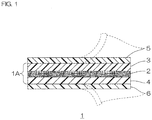
- a double-sided pressure-sensitive adhesive tape 1 as one embodiment of a pressure-sensitive adhesive tape of the present invention is described with reference to FIG. 1 .
- the double-sided pressure-sensitive adhesive tape 1 includes a nonwoven fabric carrier 2, a first pressure-sensitive adhesive layer 3, a second pressure-sensitive adhesive layer 4, a first release liner 5, and a second release liner 6.
- the nonwoven fabric carrier 2 is formed by entangling fibers without weaving.
- the fiber of the nonwoven fabric carrier 2 include natural fibers (for example, plant fibers such as wood pulp, manila hemp, and cotton, animal fibers such as wool and silk, and the like), synthetic fibers (for example, cellulose-based fibers such as acetate-based fibers and rayon-based fibers, polyester-based fibers, polyamide-based fibers, polyvinyl alcohol-based fibers (vinylon fibers), and the like), and inorganic fibers (for example, glass fibers, carbon fibers, and the like). These fibers may be used alone or in combination of two or more.
- the fiber preferably includes natural fibers and/or synthetic fibers, more preferably includes at least one fiber selected from the group consisting of plant fibers, polyvinyl alcohol-based fibers, and cellulose-based fibers, and further more preferably includes at least one fiber selected from the group consisting of wood pulp, rayon-based fibers, and polyvinyl alcohol-based fibers.
- the nonwoven fabric carrier 2 contains a colorant.
- the nonwoven fabric carrier 2 contains a fiber and a colorant.
- the colorant examples include inorganic pigments (for example, black pigments such as carbon black, red pigments such as red lead and iron oxide, yellow pigments such as yellow lead and yellow zinc, blue pigments such as ultramarine blue, Prussian blue, and YInMn blue, white pigments such as zinc oxide, white lead, lithopone, titanium dioxide, and baryta powder, and the like), organic pigments, polycyclic pigments, azo pigments, rake pigments, fluorescent pigments, direct dyes (for example, black dyes, red dyes, yellow dyes, blue dyes, and the like), reactive dyes, sulfur dyes, basic dyes, acid dyes, metal-containing acid dyes, indigo dyes, threne dyes, disperse dyes, and cationic dyes.
- the direct dye examples include azo-based and anthraquinone-based. These colorants may be used alone or in combination of two or more.
- the colorant is appropriately selected in accordance with the color of the substrate.
- the colorant preferably has a different color from the substrate.
- the substrate is a ceiling material of a vehicle and has a pale color such as white
- the colorant preferably has a black color.
- the colorant preferably contains an inorganic pigment, more preferably contains a black pigment, and further more preferably contains carbon black.
- the colorant preferably consists of an inorganic pigment.
- the colorant contains the inorganic pigment, it is possible to suppress transfer of the colorant from the nonwoven fabric carrier 2 to the first pressure-sensitive adhesive layer 3 and/or the second pressure-sensitive adhesive layer 4, and it is also possible to suppress contamination of a manufacturing facility (for example, a roll and the like) of the double-sided pressure-sensitive adhesive tape 1 by the colorant.
- a content ratio of the colorant is, for example, 0.05 parts by mass or more, preferably 0.5 parts by mass or more, and for example, 2.0 parts by mass or less, preferably 1.5 parts by mass or less with respect to 100 parts by mass of the fiber (nonwoven fabric carrier before adding a colorant).
- the content ratio of the colorant is the above-described lower limit or more, it is possible to reliably improve visibility of the double-sided pressure-sensitive adhesive tape 1.
- a basis weight of the nonwoven fabric carrier 2 is 10 g/m 2 or more, preferably 14 g/m 2 or more, and 30 g/m 2 or less, preferably 20 g/m 2 or less.
- the basis weight of the nonwoven fabric carrier 2 is the above-described lower limit or more, it is possible to improve the visibility of the double-sided pressure-sensitive adhesive tape 1.
- the basis weight of the nonwoven fabric carrier 2 is the above-described upper limit or less, it is possible to reduce an elastic force of the nonwoven fabric carrier 2, and it is possible to improve adhesive properties of the double-sided pressure-sensitive adhesive tape 1 with respect to a curved surface. Therefore, it is possible to suppress peeling of the double-sided pressure-sensitive adhesive tape 1 from the curved surface.
- a thickness of the nonwoven fabric carrier 2 is 20 ⁇ m or more, preferably 25 ⁇ m or more, more preferably 32 ⁇ m or more, and 50 ⁇ m or less, preferably 45 ⁇ m or less.
- the thickness of the nonwoven fabric carrier 2 is the above-described lower limit or more, it is possible to reliably improve the visibility of the double-sided pressure-sensitive adhesive tape 1.
- the thickness of the nonwoven fabric carrier 2 is the above-described upper limit or less, it is possible to reliably reduce the elastic force of the nonwoven fabric carrier 2, and it is possible to reliably improve the adhesive properties of the double-sided pressure-sensitive adhesive tape 1 with respect to the curved surface. Therefore, it is possible to stably suppress the peeling of the double-sided pressure-sensitive adhesive tape 1 from the curved surface.
- the air permeability of the nonwoven fabric carrier 2 is, for example, 0.10s or more, preferably 0.15s or more, and for example, 1.00s or less, preferably 0.80s or less, more preferably 0.50s or less.
- the air permeability is the time at which 100 cc of the air passes through a sample in which four nonwoven fabric carriers are laminated, and can be measured in conformity with the method described in JIS P8177: 2009 (hereinafter, the same).
- the total light transmittance of the nonwoven fabric carrier 2 is, for example, 5% or more, and 30% or less.
- the total light transmittance can be measured in conformity with the method described in JIS K 7136 (hereinafter, the same).
- nonwoven fabric carrier 2 for example, a nonwoven fabric carrier without a colorant is immersed into a colorant-containing liquid containing a colorant and then dried. It is also possible to form the nonwoven fabric carrier 2 from fibers after the fibers are colored by the colorant.
- the first pressure-sensitive adhesive layer 3 is disposed at one side of the nonwoven fabric carrier 2 in a thickness direction. Specifically, the first pressure-sensitive adhesive layer 3 is disposed on one surface of the nonwoven fabric carrier 2 in the thickness direction.
- the first pressure-sensitive adhesive layer 3 has a flat plate shape (sheet shape).
- a thickness of the first pressure-sensitive adhesive layer 3 is, for example, 40 ⁇ m or more and 80 ⁇ m or less.
- the first pressure-sensitive adhesive layer 3 does not contain the above-described colorant. Therefore, it is possible to improve a pressure-sensitive adhesive force of the first pressure-sensitive adhesive layer 3 as compared with a case where the first pressure-sensitive adhesive layer 3 contains a colorant.
- the first pressure-sensitive adhesive layer 3 contains a pressure-sensitive adhesive composition.
- the pressure-sensitive adhesive composition is not particularly limited unless it contains a colorant.
- a water-dispersed pressure-sensitive adhesive composition is used from the viewpoint of environmental load.
- the first pressure-sensitive adhesive layer 3 contains a water-dispersed pressure-sensitive adhesive composition, and is preferably made of a water-dispersed pressure-sensitive adhesive composition.
- water-dispersed pressure-sensitive adhesive composition for example, a water-dispersed pressure-sensitive adhesive composition described in Japanese Unexamined Patent Publication No. 2011-16943 is used.
- the water-dispersed pressure-sensitive adhesive composition contains at least a (meth)acrylic polymer.
- the (meth)acrylic is synonymous with methacrylic and/or acrylic.
- the (meth)acrylic polymer is, for example, prepared by emulsion polymerization of a (meth)acrylic monomer by adding an emulsified liquid containing a (meth)acrylic monomer, an emulsifier, and water to an initiator solution containing a polymerization initiator (described later).
- the (meth)acrylic monomer contains an alkyl (meth)acrylate as a main component.
- alkyl (meth)acrylate examples include alkyl (meth)acrylates having an alkyl group having 1 to 3 carbon atoms (for example, methyl (meth)acrylate, ethyl (meth)acrylate, propyl (meth)acrylate, and the like) and alkyl (meth)acrylates having an alkyl group having 4 to 12 carbon atoms (for example, butyl (meth)acrylate, isobutyl (meth)acrylate, sec-butyl (meth)acrylate, pentyl (meth)acrylate, isopentyl (meth)acrylate, hexyl (meth)acrylate, 2-ethylhexyl (meth)acrylate, isooctyl (meth)acrylate, decyl (meth)acrylate, dodecyl (meth)acrylate, and the like).
- alkyl (meth)acrylates having an alkyl group having 1 to 3 carbon atoms for example
- alkyl (meth)acrylates may be used alone or in combination of two or more.
- the alkyl (meth)acrylate contains at least an alkyl (meth)acrylate having an alkyl group having 4 to 12 carbon atoms, and preferably contains an alkyl (meth)acrylate having an alkyl group having 4 to 12 carbon atoms and an alkyl (meth)acrylate having an alkyl group having 1 to 3 carbon atoms.
- a content ratio of the alkyl (meth)acrylate having an alkyl group having 4 to 12 carbon atoms is, for example, 60% by mass or more, preferably 80% by mass or more, and for example, 100% by mass or less, preferably 90% by mass or less with respect to 100% by mass of the (meth)acrylic monomer.
- a content ratio of the alkyl (meth)acrylate having an alkyl group having 1 to 3 carbon atoms is, for example, 0% by mass or more, preferably 5% by mass or more, and for example, 35% by mass or less, preferably 15% by mass or less with respect to 100% by mass of the (meth)acrylic monomer.
- a content ratio of the alkyl (meth)acrylate is, for example, 60% by mass or more, preferably 85% by mass or more, and for example, 100% by mass or less, preferably 98% by mass or less with respect to 100% by mass of the (meth)acrylic monomer.
- the (meth)acrylic monomer preferably further contains a (meth)acrylic acid and a (meth)acryloyl group-containing alkoxysilane compound.
- a content ratio of the (meth)acrylic acid is, for example, 0% by mass or more, preferably 1% by mass or more, and for example, 5% by mass or less, preferably 3% by mass or less with respect to 100% by mass of the (meth)acrylic monomer.
- the (meth)acryloyl group-containing alkoxysilane compound contains a (meth)acryloyl group and an alkoxysilyl group.
- Examples of the (meth)acryloyl group-containing alkoxysilane compound include 3-(meth)acryloxypropyltrimethoxysilane, 3-(meth)acryloxypropyltriethoxysilane, 3-(meth)acryloxypropylmethyldimethoxysilane, and 3-(meth)acryloxypropylmethyldiethoxysilane.
- These (meth)acryloyl group-containing alkoxysilane compounds may be used alone or in combination of two or more.
- the (meth)acryloyl group-containing alkoxysilane compound preferably contains 3-(meth)acryloxypropyltriethoxysilane, and more preferably consists of 3-(meth)acryloxypropyltriethoxysilane.
- a content ratio of the (meth)acryloyl group-containing alkoxysilane compound is, for example, 0% by mass or more, preferably 0.001% by mass or more, and for example, 0.1% by mass or less, preferably 0.05% by mass or less with respect to 100% by mass of the (meth)acrylic monomer.
- a content ratio of the (meth)acrylic monomer in the emulsified liquid is, for example, 60% by mass or more, preferably 70% by mass or more, and for example, 90% by mass or less, preferably 80% by mass or less.
- the emulsifier examples include anionic emulsifiers (for example, sodium lauryl sulfate, ammonium lauryl sulfate, sodium dodecyl benzene sulfonate, sodium polyoxyethylene alkyl ether sulfate, ammonium polyoxyethylene alkyl phenyl ether sulfate, sodium polyoxyethylene alkyl phenyl ether sulfate, and the like) and nonionic emulsifiers (for example, polyoxyethylene alkyl ether, polyoxyethylene alkyl phenyl ether, and the like).
- anionic emulsifiers for example, sodium lauryl sulfate, ammonium lauryl sulfate, sodium dodecyl benzene sulfonate, sodium polyoxyethylene alkyl ether sulfate, ammonium polyoxyethylene alkyl phenyl ether sulfate, sodium polyoxyethylene alkyl
- a radically polymerizable emulsifier in which a radically polymerizable group (for example, a propenyl group and the like) is introduced into the above-described anionic emulsifier or the above-described nonionic emulsifier can be also used.
- a radically polymerizable group for example, a propenyl group and the like
- emulsifiers may be used alone or in combination of two or more.
- the emulsifier preferably contains an anionic emulsifier and preferably contains sodium polyoxyethylene alkyl ether sulfate.
- the emulsifier preferably consists of an anionic emulsifier.
- a content ratio of the emulsifier in the emulsified liquid is, for example, 0.01% by mass or more, preferably 0.5% by mass or more, and for example, 5.0% by mass or less, preferably 3.0% by mass or less.
- the content ratio of the emulsifier is, for example, 0.5 parts by mass or more, preferably 1.0 part by mass or more, and for example, 5.0 parts by mass or less, preferably 3.0 parts by mass or less with respect to 100 parts by mass of the (meth)acrylic monomer.
- a content ratio of the water in the emulsified liquid is, for example, 5% by mass or more, preferably 10% by mass or more, and for example, 35% by mass or less, preferably 25% by mass or less.
- the content ratio of the water is, for example, 10 parts by mass or more, preferably 20 parts by mass or more, and for example, 50 parts by mass or less, preferably 40 parts by mass or less with respect to 100 parts by mass of the (meth)acrylic monomer.
- the emulsified liquid preferably further contains a chain transfer agent.
- chain transfer agent examples include mercaptans such as dodecyl mercaptan (dodecanethiol), glycidyl mercaptan, and 2-mercaptoethanol.
- chain transfer agents may be used alone or in combination of two or more.
- the chain transfer agent preferably contains dodecanethiol and more preferably consists of dodecanethiol.
- a content ratio of the chain transfer agent in the emulsified liquid is, for example, 0% by mass or more and 0.5% by mass or less.
- the content ratio of the chain transfer agent is, for example, 0 parts by mass or more, preferably 0.01 parts by mass or more, and for example, 0.5 parts by mass or less, preferably 0.05 parts by mass or less with respect to 100 parts by mass of the (meth)acrylic monomer.
- polymerization initiator examples include an azo-based initiator, a peroxide-based initiator, and a redox-based initiator in which a peroxide and a reducing agent are combined.
- azo-based initiator examples include 2,2'-azobis[N-(2-carboxyethyl)-2-methylpropionamidine]hydrate, 2,2'-azobis isobutyronitrile, 2,2'-azobis(2-methylpropionamidine)disulfate, 2,2'-azobis(2-amidinopropane)dihydrochloride 2,2'-azobis[2-(5-methyl-2-imidazolin-2-yl)propane]dihydrochloride, and 2,2' -azobis(N,N' -dimethyl eneisobutylamidine)dihydrochloride.
- peroxide-based initiator examples include persulfates (for example, potassium persulfate, ammonium persulfate, and the like), benzoyl peroxide, t-butyl hydroperoxide, and hydrogen peroxide.
- persulfates for example, potassium persulfate, ammonium persulfate, and the like
- benzoyl peroxide examples include benzoyl peroxide, t-butyl hydroperoxide, and hydrogen peroxide.
- Examples of the redox-based initiator include a combination of persulfate and sodium hydrogen sulfite, and a combination of hydrogen peroxide and sodium ascorbate.
- These polymerization initiators may be used alone or in combination of two or more.
- an azo-based initiator and a redox-based initiator are used in combination.
- the azo-based initiator and the redox-based initiator are used in combination, first, the above-described emulsified liquid is added to an initiator solution containing the azo-based initiator to subject a (meth)acrylic monomer to emulsion polymerization.
- a mixing ratio of the azo-based initiator is, for example, 0.01 parts by mass or more, preferably 0.05 parts by mass or more, and for example, 0.5 parts by mass or less, preferably 0.2 parts by mass or less with respect to 100 parts by mass of the (meth)acrylic monomer.
- a polymerization temperature in the presence of the azo-based initiator is, for example, 20°C or more, preferably 40°C or more, and for example, 100°C or less, preferably 80°C or less.
- a mixing ratio of the peroxide is, for example, 0.03 parts by mass or more, preferably 0.05 parts by mass or more, and for example, 0.2 parts by mass or less, preferably 0.1 parts by mass or less with respect to 100 parts by mass of the (meth)acrylic monomer.
- a mixing ratio of the reducing agent is, for example, 0.1 parts by mass or more, preferably 0.2 parts by mass or more, and for example, 1.0 part by mass or less, preferably 0.8 parts by mass or less with respect to 100 parts by mass of the (meth)acrylic monomer.
- a range of the temperature of the redox treatment is, for example, the same as the range of the polymerization temperature in the presence of the azo-based initiator.
- a (meth)acrylic polymer which is a polymer of a (meth)acrylic monomer is produced, and a (meth)acrylic polymer emulsion containing a (meth)acrylic polymer and water is prepared.
- the first pressure-sensitive adhesive layer 3 containing a pressure-sensitive adhesive composition is prepared from the (meth)acrylic polymer emulsion.
- the acrylic polymer emulsion is cooled to room temperature (25°C) if necessary.
- a pH adjusting agent for example, ammonia water and the like
- a pH of the acrylic polymer emulsion is adjusted to, for example, 5.0 or more and 8.0 or less.
- the solid content concentration (NV) of the acrylic polymer emulsion is, for example, 30% by mass or more, preferably 40% by mass or more, and for example, 70% by mass or less, preferably 60% by mass or less.
- An average particle size of the emulsion in the acrylic polymer emulsion is, for example, 100 nm or more and 300 nm or less.
- the (meth)acrylic polymer emulsion is, for example, applied onto the nonwoven fabric carrier 2 or the first release liner 5, and then, dried if necessary.
- the first pressure-sensitive adhesive layer 3 containing a water-dispersed pressure-sensitive adhesive composition is prepared.
- the water-dispersed pressure-sensitive adhesive composition preferably contains a tackifier in addition to the (meth)acrylic polymer described above.
- the tackifier is added to the (meth)acrylic polymer emulsion.
- tackifier examples include a rosin-based resin, a rosin derivative resin, a petroleum-based resin, a terpene-based resin, a phenol-based resin, and a ketone-based resin.
- tackifiers may be used alone or in combination of two or more.
- a rosin-based resin is used.
- a content ratio of the tackifier is, for example, 5 parts by mass or more, preferably 10 parts by mass or more, and for example, 40 parts by mass or less, preferably 30 parts by mass or less with respect to 100 parts by mass of the (meth)acrylic polymer.
- the water-dispersed pressure-sensitive adhesive composition may contain a known additive such as a viscosity modifier, a leveling agent, a plasticizer, a filler, a stabilizer, an antiseptic, and an antiaging agent at an appropriate ratio.
- a viscosity modifier such as a viscosity modifier, a leveling agent, a plasticizer, a filler, a stabilizer, an antiseptic, and an antiaging agent at an appropriate ratio.
- the second pressure-sensitive adhesive layer 4 is disposed at the other side of the nonwoven fabric carrier 2 in the thickness direction. Specifically, the second pressure-sensitive adhesive layer 4 is disposed on the other surface of the nonwoven fabric carrier 2 in the thickness direction.
- the second pressure-sensitive adhesive layer 4 is described in the same manner as the first pressure-sensitive adhesive layer 3. Therefore, the description of the second pressure-sensitive adhesive layer 4 is omitted.
- the first release liner 5 is located on the opposite side of the nonwoven fabric carrier 2 with respect to the first pressure-sensitive adhesive layer 3.
- the first release liner 5 is peelably attached to one surface of the first pressure-sensitive adhesive layer 3 in the thickness direction in order to protect the first pressure-sensitive adhesive layer 3 before the use of the double-sided pressure-sensitive adhesive tape 1.
- the first release liner 5 has a flat plate shape (sheet shape).
- the first release liner 5 is formed from a resin film having flexibility. Examples of the resin film include fluorine-based films such as polytetrafluoroethylene, polyolefin films such as polyethylene and polypropylene, and polyester films such as polyethylene terephthalate.
- An attachment surface of the first release liner 5 is subjected to a surface treatment with a release treatment agent if necessary.
- a release treatment agent include a silicone-based release treatment agent, a long-chain alkyl-based release treatment agent, a fluorine-based release treatment agent, and a molybdenum sulfide-based release treatment agent. These release treatment agents may be used alone or in combination of two or more.
- the first release liner 5 is peeled from the first pressure-sensitive adhesive layer 3 at the time of the use of the double-sided pressure-sensitive adhesive tape 1. Then, the exposed first pressure-sensitive adhesive layer 3 pressure-sensitively adheres to an substrate or an object.
- the second release liner 6 is located on the opposite side of the nonwoven fabric carrier 2 with respect to the second pressure-sensitive adhesive layer 4.
- the second pressure-sensitive adhesive layer 4 is peelably attached to the other surface of the second pressure-sensitive adhesive layer 4 in the thickness direction in order to protect the second pressure-sensitive adhesive layer 4 before the use of the double-sided pressure-sensitive adhesive tape 1.
- the second release liner 6 is described in the same manner as the first release liner 5. Therefore, the description of the second release liner 6 is omitted.
- the second release liner 6 is peeled from the second pressure-sensitive adhesive layer 4 at the time of the use of the double-sided pressure-sensitive adhesive tape 1. Then, the exposed second pressure-sensitive adhesive layer 4 pressure-sensitively adheres to an substrate or an object.
- the above-described (meth)acrylic polymer emulsion is applied onto the first release liner 5 by a known application method. Thereafter, a coating film of the (meth)acrylic polymer emulsion is, if necessary, dried to form the first pressure-sensitive adhesive layer 3.
- the first pressure-sensitive adhesive layer 3 on the first release liner 5 is compressively bonded to one surface of the nonwoven fabric carrier 2 in the thickness direction so that the first pressure-sensitive adhesive layer 3 is in direct contact with one surface of the nonwoven fabric carrier 2 in the thickness direction.
- the above-described (meth)acrylic polymer emulsion is directly applied to the other surface of the nonwoven fabric carrier 2 in the thickness direction by a known application method. Thereafter, a coating film is, if necessary, dried to form the second pressure-sensitive adhesive layer 4.
- the second release liner 6 is compressively bonded to the opposite side of the nonwoven fabric carrier 2 with respect to the second pressure-sensitive adhesive layer 4.
- the double-sided pressure-sensitive adhesive tape 1 is produced.
- the double-sided pressure-sensitive adhesive tape 1 includes the second release liner 6, the second pressure-sensitive adhesive layer 4, the nonwoven fabric carrier 2, the first pressure-sensitive adhesive layer 3, and the first release liner 5 in order in the thickness direction of the nonwoven fabric carrier 2.
- the double-sided pressure-sensitive adhesive tape 1 is, for example, used in the production of various industrial products, and is preferably used in the production of automobiles. More specifically, the double-sided pressure-sensitive adhesive tape 1 is preferably used when an automobile component (for example, wire harness) is fixed to a vehicle frame having a curved surface. In other words, the double-sided pressure-sensitive adhesive tape 1 is used for fixing an automobile component (wire harness).
- an automobile component for example, wire harness
- the first release liner 5 is peeled from the first pressure-sensitive adhesive layer 3, and the second release liner 6 is peeled from the second pressure-sensitive adhesive layer 4. Therefore, in a usage state of the double-sided pressure-sensitive adhesive tape 1, a tape main body 1A including the nonwoven fabric carrier 2, the first pressure-sensitive adhesive layer 3, and the second pressure-sensitive adhesive layer 4 and not including the first release liner 5 and the second release liner 6 is adhesively bonded to an substrate.
- the nonwoven fabric carrier 2 contains the colorant, while the first pressure-sensitive adhesive layer 3 and the second pressure-sensitive adhesive layer 4 do not contain the colorant. Then, the basis weight of the nonwoven fabric carrier 2 is the above-described lower limit or more and the thickness of the nonwoven fabric carrier 2 is the above-described lower limit or more. Therefore, it is possible to improve the visibility of the tape main body 1A in a state where the double-sided pressure-sensitive adhesive tape 1 (specifically, the tape main body 1A) is adhesively bonded to the curved surface of the substrate.
- the basis weight of the nonwoven fabric carrier 2 is the above-described upper limit or less and the thickness of the nonwoven fabric carrier 2 is the above-described upper limit or less, even when the double-sided pressure-sensitive adhesive tape 1 (specifically, the tape main body 1A) is adhesively bonded to the curved surface of the substrate, it is possible to reduce the elastic force of the nonwoven fabric carrier 2, and it is possible to suppress the peeling of the tape main body 1A from the substrate.
- the double-sided pressure-sensitive adhesive tape 1 includes the nonwoven fabric carrier 2, the first pressure-sensitive adhesive layer 3, the second pressure-sensitive adhesive layer 4, the first release liner 5, and the second release liner 6.
- the pressure-sensitive adhesive tape of the present invention is not particularly limited as long as it includes the nonwoven fabric carrier 2 and the first pressure-sensitive adhesive layer 3.
- the pressure-sensitive adhesive tape may consist of the nonwoven fabric carrier 2 and the first pressure-sensitive adhesive layer 3.
- the pressure-sensitive adhesive tape may consist of the nonwoven fabric carrier 2, the first pressure-sensitive adhesive layer 3, and the first release liner 5.
- the pressure-sensitive adhesive tape may consist of the nonwoven fabric carrier 2, the first pressure-sensitive adhesive layer 3, and the second pressure-sensitive adhesive layer 4.
- the pressure-sensitive adhesive tape may consist of the nonwoven fabric carrier 2, the first pressure-sensitive adhesive layer 3, the second pressure-sensitive adhesive layer 4, and the first release liner 5.
- Black pigment (carbon black) (1 part by mass) was added to 100 parts by mass of a nonwoven fabric A (material: pulp/ rayon/ vinylon binder, trade name: chemical fiber paper black 14.0 g/m 2 , manufactured by NIPPON PAPER PAPYLIA CO., LTD.) to dye the nonwoven fabric.
- a nonwoven fabric carrier was obtained.
- the air permeability, the basis weight, and the thickness of the nonwoven fabric carrier are shown in Table 1.
- a nonwoven fabric carrier was obtained in the same manner as in Preparation Example 1, except that the nonwoven fabric A (trade name: chemical fiber paper black 14.0 g/m 2 , manufactured by NIPPON PAPER PAPYLIA CO., LTD.) was changed to a nonwoven fabric B (material: pulp, trade name: No. 4134, manufactured by DAIFUKU PAPER MFG. CO., LTD.).
- the nonwoven fabric A trade name: chemical fiber paper black 14.0 g/m 2 , manufactured by NIPPON PAPER PAPYLIA CO., LTD.
- a nonwoven fabric B material: pulp, trade name: No. 4134, manufactured by DAIFUKU PAPER MFG. CO., LTD.
- a nonwoven fabric carrier was obtained in the same manner as in Preparation Example 1, except that the nonwoven fabric A (trade name: chemical fiber paper black 14.0 g/m 2 , manufactured by NIPPON PAPER PAPYLIA CO., LTD.) was changed to a nonwoven fabric C (material: pulp, trade name: NTO-16P-black, manufactured by DAIFUKU PAPER MFG. CO., LTD.).
- the nonwoven fabric A trade name: chemical fiber paper black 14.0 g/m 2 , manufactured by NIPPON PAPER PAPYLIA CO., LTD.
- a nonwoven fabric C material: pulp, trade name: NTO-16P-black, manufactured by DAIFUKU PAPER MFG. CO., LTD.
- a nonwoven fabric carrier was obtained in the same manner as in Preparation Example 1, except that the nonwoven fabric A (trade name: chemical fiber paper black 14.0 g/m 2 , manufactured by NIPPON PAPER PAPYLIA CO., LTD.) was changed to a nonwoven fabric D (material: pulp/ rayon/ vinylon binder, trade name: chemical fiber paper black 30.0 g/m 2 , manufactured by NIPPON PAPER PAPYLIA CO., LTD.).
- the nonwoven fabric A trade name: chemical fiber paper black 14.0 g/m 2 , manufactured by NIPPON PAPER PAPYLIA CO., LTD.
- D material: pulp/ rayon/ vinylon binder, trade name: chemical fiber paper black 30.0 g/m 2 , manufactured by NIPPON PAPER PAPYLIA CO., LTD.
- a nonwoven fabric carrier was obtained in the same manner as in Preparation Example 1, except that the nonwoven fabric A (trade name: chemical fiber paper black 14.0 g/m 2 , manufactured by NIPPON PAPER PAPYLIA CO., LTD.) was changed to a nonwoven fabric E (material: pulp, manufactured by FUJI Corporation).
- the nonwoven fabric A trade name: chemical fiber paper black 14.0 g/m 2 , manufactured by NIPPON PAPER PAPYLIA CO., LTD.
- a nonwoven fabric E material: pulp, manufactured by FUJI Corporation
- a nonwoven fabric carrier was obtained in the same manner as in Preparation Example 1, except that the nonwoven fabric A (trade name: chemical fiber paper black 14.0 g/m 2 , manufactured by NIPPON PAPER PAPYLIA CO., LTD.) was changed to a nonwoven fabric F.
- the nonwoven fabric A trade name: chemical fiber paper black 14.0 g/m 2 , manufactured by NIPPON PAPER PAPYLIA CO., LTD.
- a nonwoven fabric carrier was obtained in the same manner as in Preparation Example 1, except that the nonwoven fabric A (trade name: chemical fiber paper black 14.0 g/m 2 , manufactured by NIPPON PAPER PAPYLIA CO., LTD.) was changed to a nonwoven fabric G (material: polyester, trade name: PET paper 30 g/m 2 , manufactured by NIPPON PAPER PAPYLIA CO., LTD.).
- the nonwoven fabric A trade name: chemical fiber paper black 14.0 g/m 2 , manufactured by NIPPON PAPER PAPYLIA CO., LTD.
- a nonwoven fabric G material: polyester, trade name: PET paper 30 g/m 2 , manufactured by NIPPON PAPER PAPYLIA CO., LTD.
- a nonwoven fabric carrier was obtained in the same manner as in Preparation Example 1, except that the nonwoven fabric A (trade name: chemical fiber paper black 14.0 g/m 2 , manufactured by NIPPON PAPER PAPYLIA CO., LTD.) was changed to a nonwoven fabric H (material: pulp, trade name: F-18 processed paper, manufactured by NIPPON PAPER PAPYLIA
- a nonwoven fabric carrier was obtained in the same manner as in Preparation Example 1, except that the nonwoven fabric A (trade name: chemical fiber paper black 14.0 g/m 2 , manufactured by NIPPON PAPER PAPYLIA CO., LTD.) was changed to a nonwoven fabric I (material: pulp, trade name: MM base paper, manufactured by Miki Tokusyu Paper Mfg. Co., Ltd.).
- the nonwoven fabric A trade name: chemical fiber paper black 14.0 g/m 2 , manufactured by NIPPON PAPER PAPYLIA CO., LTD.
- a nonwoven fabric I material: pulp, trade name: MM base paper, manufactured by Miki Tokusyu Paper Mfg. Co., Ltd.
- a nonwoven fabric carrier was obtained in the same manner as in Preparation Example 1, except that the nonwoven fabric A (trade name: chemical fiber paper black 14.0 g/m 2 , manufactured by NIPPON PAPER PAPYLIA CO., LTD.) was changed to a nonwoven fabric J (material: pulp, trade name: NTO-16P-black, manufactured by DAIFUKU PAPER MFG. CO., LTD.).
- the nonwoven fabric A trade name: chemical fiber paper black 14.0 g/m 2 , manufactured by NIPPON PAPER PAPYLIA CO., LTD.
- a nonwoven fabric J material: pulp, trade name: NTO-16P-black, manufactured by DAIFUKU PAPER MFG. CO., LTD.
- Distilled water 60 parts by mass
- 0.1 parts by mass of an emulsifier sodium polyoxyethylene alkyl ether sulfate, trade name: LATEMUL E-118B, manufactured by Kao Corporation
- the reaction vessel was provided with a container body, a stirrer, a thermometer, a reflux condenser, a dropping device, and a nitrogen introducing pipe.
- the temperature of the emulsified liquid was adjusted to 60°C. Then, the emulsified liquid was gradually added dropwise to the above-described reaction vessel over 4 hours to be subjected to emulsion polymerization. Thereafter, the reaction liquid was stirred at 60°C for 3 hours, and heating of the reaction liquid was stopped.
- reaction liquid 0.75 parts by mass of 10% by mass hydrogen peroxide water was added to the reaction liquid. Thereafter, the reaction liquid was stirred for 5 minutes. Subsequently, 0.5 parts by mass of sodium ascorbate was added to the reaction liquid, and the obtained mixture was subjected to a redox treatment. Thereafter, the reaction liquid was cooled to room temperature (25°C). Then, 10% by mass ammonia water was added to the reaction liquid after cooling to adjust a pH of the reaction liquid to 6.5.
- the solid content concentration (NV) of the (meth)acrylic polymer emulsion was about 51% by mass.
- An average particle size of the emulsion was about 200 nm.
- a pH adjusting agent (10% by mass ammonia water) and a thickener (polyacrylic acid) were added to the (meth)acrylic polymer emulsion.
- a pH of the (meth)acrylic polymer emulsion was 7.2.
- the viscosity of the (meth)acrylic polymer emulsion was 8 Pa ⁇ s.
- first release liner (trade name: SLB-80WD (V2), manufactured by Kaito Chemical Industry Co., Ltd.).
- SLB-80WD (V2), manufactured by Kaito Chemical Industry Co., Ltd.
- the front surface and the back surface of the first release liner were treated with a silicone-based release agent.
- a coating film of the (meth)acrylic polymer emulsion was dried at 100°C for 2 minutes.
- a first pressure-sensitive adhesive layer made of a water-dispersed acrylic pressure-sensitive adhesive composition was formed.
- a thickness of the first pressure-sensitive adhesive layer was about 60 ⁇ m.
- the first pressure-sensitive adhesive layer on the first release liner was disposed on the nonwoven fabric so that the first pressure-sensitive adhesive layer was in direct contact with the front surface of each of the nonwoven fabrics of Preparation Examples. Therefore, the nonwoven fabric, the first pressure-sensitive adhesive layer, and the first release liner were laminated in order in the thickness direction of the nonwoven fabric.
- the (meth)acrylic polymer emulsion to which the water-dispersed rosin resin, the pH adjusting agent, and the thickener were added was directly applied to the back surface of the nonwoven fabric. Thereafter, a coating film of the (meth)acrylic polymer emulsion was dried at 100°C for 2 minutes. Thus, a second pressure-sensitive adhesive layer made of the water-dispersed acrylic pressure-sensitive adhesive composition was formed. A thickness of the second pressure-sensitive adhesive layer was about 60 ⁇ m.
- a second release liner was attached to the opposite side of the nonwoven fabric carrier with respect to the second pressure-sensitive adhesive layer.
- the laminate included the first release liner, the second pressure-sensitive adhesive layer, the nonwoven fabric, the first pressure-sensitive adhesive layer, and the first release liner in order in the thickness direction of the nonwoven fabric. Thereafter, the laminate was retained in an oven at 50°C for 24 hours.
- a double-sided pressure-sensitive adhesive tape was obtained in the same manner as in Example 1, except that the water-dispersed acrylic pressure-sensitive adhesive composition contained a black pigment and the nonwoven fabric carrier A of Preparation Example 1 was changed to the nonwoven fabric carrier C of Preparation Example 3.
- the black pigment was added to the (meth)acrylic polymer emulsion.
- An addition ratio of the black pigment was 10 parts by mass with respect to 100 parts by mass of the (meth)acrylic monomer.
- Each of the double-sided pressure-sensitive adhesive tapes of Examples and Comparative Examples was cut into a size of 10 cm ⁇ 10 cm. Thereafter, the first release liner was peeled from the first pressure-sensitive adhesive layer. Next, the first pressure-sensitive adhesive layer was attached to a white polystyrene film.
- the white polystyrene film had a color taste of L*: 88.85, a*: 0.45, and b*: -5.76.
- the second release liner was peeled from the second pressure-sensitive adhesive layer.
- the color taste of the double-sided pressure-sensitive adhesive tape was measured from the opposite side of the nonwoven fabric carrier with respect to the second pressure-sensitive adhesive layer.
- the color taste was measured with a multi-angle spectrophotometer (MA68II, manufactured by X-Rite Inc.). The measurement angle was 45°.
- the first release liner was peeled from the first pressure-sensitive adhesive layer. Then, a flexible urethane foam (trade name: ECS (gray)) was attached to the first pressure-sensitive adhesive layer. Thereafter, a 1-kg roller was brought into contact with the flexible urethane foam from the opposite side of the first pressure-sensitive adhesive layer to reciprocate the 1-kg roller.
- ECS flexible urethane foam
- the laminate included the second release liner, the second pressure-sensitive adhesive layer, the nonwoven fabric carrier, the first pressure-sensitive adhesive layer, and the flexible urethane foam in order.
- the laminate was retained at 23°C for 24 hours. Then, the laminate was cut into a size of a width of 10 mm and a length of 50 mm. Thus, a sample was obtained.
- the second release liner was peeled from the second pressure-sensitive adhesive layer.
- an ABS plate was attached to a first portion from one end to 10 mm of the second pressure-sensitive adhesive layer in a length direction of the sample.
- a 2-kg roller was brought into contact with the ABS plate from the opposite side of the second pressure-sensitive adhesive layer to reciprocate the 2-kg roller.
- the sample was folded back, and a second portion other than the first portion in the second pressure-sensitive adhesive layer was attached to the back surface of the ABS plate. Thereafter, the sample attached to the ABS plate was left to stand under the environment of 23°C and 50 %RH for 24 hours.
- the adhesive properties (repulsion resistance) of the double-sided pressure-sensitive adhesive tape were evaluated based on whether or not the first portion of the second pressure-sensitive adhesive layer was peeled from the ABS plate.
- the adhesive properties (repulsion resistance) of the double-sided pressure-sensitive adhesive tape were evaluated as "Bad".
- the adhesive properties (repulsion resistance) of the double-sided pressure-sensitive adhesive tape were evaluated as "Good”. The results are shown in Table 1.
Landscapes
- Chemical & Material Sciences (AREA)
- Organic Chemistry (AREA)
- Health & Medical Sciences (AREA)
- Chemical Kinetics & Catalysis (AREA)
- Medicinal Chemistry (AREA)
- Polymers & Plastics (AREA)
- Adhesive Tapes (AREA)
- Adhesives Or Adhesive Processes (AREA)
Abstract
A double-sided pressure-sensitive adhesive tape 1 includes a nonwoven fabric carrier 2 and a first pressure-sensitive adhesive layer 3 disposed on one side of the nonwoven fabric carrier 2 in a thickness direction. A colorant is contained in the nonwoven fabric carrier 2, and is not contained in the first pressure-sensitive adhesive layer 3. Then, a basis weight of the nonwoven fabric carrier 2 is adjusted to be 10 g/m<sup>2</sup> or more and 30 g/m<sup>2</sup> or less, and a thickness of the nonwoven fabric carrier 2 is adjusted to be 20 µm or more and 50 µm or less.The pressure-sensitive adhesive tape is used for fixing a wire harness.
Description
- The present invention relates to a pressure-sensitive adhesive tape.
- In various industrial fields, a pressure-sensitive adhesive tape is used to fix an object to an substrate. For example, in the production of various industrial products such as automobiles, a plurality of objects adhere to an substrate by a plurality of pressure-sensitive adhesive tapes. However, when the pressure-sensitive adhesive tape is missed, the object may fall off from the substrate, and reliability of the product may be lowered. Therefore, it is desirable to improve visibility of the pressure-sensitive adhesive tape.
- As such a pressure-sensitive adhesive tape, for example, a pressure-sensitive adhesive sheet including a nonwoven fabric and a pressure-sensitive adhesive layer disposed on the nonwoven fabric with the pressure-sensitive adhesive layer including a colorant has been proposed (ref: for example, Patent Document 1).
- Patent Document 1:
Japanese Unexamined Patent Publication No. 2015-40218 - Thus, the pressure-sensitive adhesive tape may adhere to a curved surface of the substrate when the object adheres to the substrate. However, when the pressure-sensitive adhesive sheet described in
Patent Document 1 adheres to the curved surface, the pressure-sensitive adhesive sheet may be peeled from the curved surface of the substrate due to elasticity of the nonwoven fabric. - The present invention provides a pressure-sensitive adhesive tape which is capable of improving visibility and suppressing peeling from an substrate.
- The present invention [1] includes a pressure-sensitive adhesive tape including a nonwoven fabric carrier and a pressure-sensitive adhesive layer disposed at one side of the nonwoven fabric carrier in a thickness direction, wherein the nonwoven fabric carrier contains a colorant, a basis weight of the nonwoven fabric carrier is 10 g/m2 or more and 30 g/m2 or less, a thickness of the nonwoven fabric carrier is 20 µm or more and 50 µm or less, and the pressure-sensitive adhesive layer does not contain a colorant.
- The present invention [2] includes the pressure-sensitive adhesive tape described in the above-described [1], wherein the pressure-sensitive adhesive layer contains a water-dispersed pressure-sensitive adhesive composition.
- The present invention [3] includes the pressure-sensitive adhesive tape described in the above-described [1] or [2] used for fixing a wire harness.
- In the pressure-sensitive adhesive tape of the present invention, the nonwoven fabric carrier contains a colorant, while the pressure-sensitive adhesive layer does not contain a colorant. Then, since the basis weight of the nonwoven fabric carrier is the above-described lower limit or more and the thickness of the nonwoven fabric carrier is the above-described lower limit or more, it is possible to improve visibility of the pressure-sensitive adhesive tape. Further, since the basis weight of the nonwoven fabric carrier is the above-described upper limit or less and the thickness of the nonwoven fabric carrier is the above-described upper limit or less, it is possible to reduce an elastic force of the nonwoven fabric carrier, and it is possible to suppress peeling of the pressure-sensitive adhesive tape from an substrate.
-
-
FIG. 1 shows a schematic configuration view of a double-sided pressure-sensitive adhesive tape as one embodiment of a pressure-sensitive adhesive tape of the present invention. - A double-sided pressure-sensitive
adhesive tape 1 as one embodiment of a pressure-sensitive adhesive tape of the present invention is described with reference toFIG. 1 . - The double-sided pressure-sensitive
adhesive tape 1 includes anonwoven fabric carrier 2, a first pressure-sensitiveadhesive layer 3, a second pressure-sensitiveadhesive layer 4, afirst release liner 5, and asecond release liner 6. - The
nonwoven fabric carrier 2 is formed by entangling fibers without weaving. Examples of the fiber of thenonwoven fabric carrier 2 include natural fibers (for example, plant fibers such as wood pulp, manila hemp, and cotton, animal fibers such as wool and silk, and the like), synthetic fibers (for example, cellulose-based fibers such as acetate-based fibers and rayon-based fibers, polyester-based fibers, polyamide-based fibers, polyvinyl alcohol-based fibers (vinylon fibers), and the like), and inorganic fibers (for example, glass fibers, carbon fibers, and the like). These fibers may be used alone or in combination of two or more. - The fiber preferably includes natural fibers and/or synthetic fibers, more preferably includes at least one fiber selected from the group consisting of plant fibers, polyvinyl alcohol-based fibers, and cellulose-based fibers, and further more preferably includes at least one fiber selected from the group consisting of wood pulp, rayon-based fibers, and polyvinyl alcohol-based fibers.
- The
nonwoven fabric carrier 2 contains a colorant. In other words, thenonwoven fabric carrier 2 contains a fiber and a colorant. - Examples of the colorant include inorganic pigments (for example, black pigments such as carbon black, red pigments such as red lead and iron oxide, yellow pigments such as yellow lead and yellow zinc, blue pigments such as ultramarine blue, Prussian blue, and YInMn blue, white pigments such as zinc oxide, white lead, lithopone, titanium dioxide, and baryta powder, and the like), organic pigments, polycyclic pigments, azo pigments, rake pigments, fluorescent pigments, direct dyes (for example, black dyes, red dyes, yellow dyes, blue dyes, and the like), reactive dyes, sulfur dyes, basic dyes, acid dyes, metal-containing acid dyes, indigo dyes, threne dyes, disperse dyes, and cationic dyes. Examples of the direct dye include azo-based and anthraquinone-based. These colorants may be used alone or in combination of two or more.
- The colorant is appropriately selected in accordance with the color of the substrate. The colorant preferably has a different color from the substrate. For example, when the substrate is a ceiling material of a vehicle and has a pale color such as white, the colorant preferably has a black color.
- The colorant preferably contains an inorganic pigment, more preferably contains a black pigment, and further more preferably contains carbon black. The colorant preferably consists of an inorganic pigment.
- When the colorant contains the inorganic pigment, it is possible to suppress transfer of the colorant from the
nonwoven fabric carrier 2 to the first pressure-sensitiveadhesive layer 3 and/or the second pressure-sensitiveadhesive layer 4, and it is also possible to suppress contamination of a manufacturing facility (for example, a roll and the like) of the double-sided pressure-sensitiveadhesive tape 1 by the colorant. - A content ratio of the colorant is, for example, 0.05 parts by mass or more, preferably 0.5 parts by mass or more, and for example, 2.0 parts by mass or less, preferably 1.5 parts by mass or less with respect to 100 parts by mass of the fiber (nonwoven fabric carrier before adding a colorant).
- When the content ratio of the colorant is the above-described lower limit or more, it is possible to reliably improve visibility of the double-sided pressure-sensitive
adhesive tape 1. - A basis weight of the
nonwoven fabric carrier 2 is 10 g/m2 or more, preferably 14 g/m2 or more, and 30 g/m2 or less, preferably 20 g/m2 or less. - When the basis weight of the
nonwoven fabric carrier 2 is the above-described lower limit or more, it is possible to improve the visibility of the double-sided pressure-sensitiveadhesive tape 1. When the basis weight of thenonwoven fabric carrier 2 is the above-described upper limit or less, it is possible to reduce an elastic force of thenonwoven fabric carrier 2, and it is possible to improve adhesive properties of the double-sided pressure-sensitiveadhesive tape 1 with respect to a curved surface. Therefore, it is possible to suppress peeling of the double-sided pressure-sensitiveadhesive tape 1 from the curved surface. - A thickness of the
nonwoven fabric carrier 2 is 20 µm or more, preferably 25 µm or more, more preferably 32 µm or more, and 50 µm or less, preferably 45 µm or less. - When the thickness of the
nonwoven fabric carrier 2 is the above-described lower limit or more, it is possible to reliably improve the visibility of the double-sided pressure-sensitiveadhesive tape 1. When the thickness of thenonwoven fabric carrier 2 is the above-described upper limit or less, it is possible to reliably reduce the elastic force of thenonwoven fabric carrier 2, and it is possible to reliably improve the adhesive properties of the double-sided pressure-sensitiveadhesive tape 1 with respect to the curved surface. Therefore, it is possible to stably suppress the peeling of the double-sided pressure-sensitiveadhesive tape 1 from the curved surface. - The air permeability of the
nonwoven fabric carrier 2 is, for example, 0.10s or more, preferably 0.15s or more, and for example, 1.00s or less, preferably 0.80s or less, more preferably 0.50s or less. The air permeability is the time at which 100 cc of the air passes through a sample in which four nonwoven fabric carriers are laminated, and can be measured in conformity with the method described in JIS P8177: 2009 (hereinafter, the same). - The total light transmittance of the
nonwoven fabric carrier 2 is, for example, 5% or more, and 30% or less. The total light transmittance can be measured in conformity with the method described in JIS K 7136 (hereinafter, the same). - In order to produce the
nonwoven fabric carrier 2, for example, a nonwoven fabric carrier without a colorant is immersed into a colorant-containing liquid containing a colorant and then dried. It is also possible to form thenonwoven fabric carrier 2 from fibers after the fibers are colored by the colorant. - The first pressure-sensitive
adhesive layer 3 is disposed at one side of thenonwoven fabric carrier 2 in a thickness direction. Specifically, the first pressure-sensitiveadhesive layer 3 is disposed on one surface of thenonwoven fabric carrier 2 in the thickness direction. The first pressure-sensitiveadhesive layer 3 has a flat plate shape (sheet shape). A thickness of the first pressure-sensitiveadhesive layer 3 is, for example, 40 µm or more and 80 µm or less. - The first pressure-sensitive
adhesive layer 3 does not contain the above-described colorant. Therefore, it is possible to improve a pressure-sensitive adhesive force of the first pressure-sensitiveadhesive layer 3 as compared with a case where the first pressure-sensitiveadhesive layer 3 contains a colorant. - The first pressure-
sensitive adhesive layer 3 contains a pressure-sensitive adhesive composition. The pressure-sensitive adhesive composition is not particularly limited unless it contains a colorant. As the pressure-sensitive adhesive composition, preferably, a water-dispersed pressure-sensitive adhesive composition is used from the viewpoint of environmental load. In other words, the first pressure-sensitive adhesive layer 3 contains a water-dispersed pressure-sensitive adhesive composition, and is preferably made of a water-dispersed pressure-sensitive adhesive composition. - As the water-dispersed pressure-sensitive adhesive composition, for example, a water-dispersed pressure-sensitive adhesive composition described in
Japanese Unexamined Patent Publication No. 2011-16943 - The water-dispersed pressure-sensitive adhesive composition contains at least a (meth)acrylic polymer. The (meth)acrylic is synonymous with methacrylic and/or acrylic.
- The (meth)acrylic polymer is, for example, prepared by emulsion polymerization of a (meth)acrylic monomer by adding an emulsified liquid containing a (meth)acrylic monomer, an emulsifier, and water to an initiator solution containing a polymerization initiator (described later).
- The (meth)acrylic monomer contains an alkyl (meth)acrylate as a main component.
- Examples of the alkyl (meth)acrylate include alkyl (meth)acrylates having an alkyl group having 1 to 3 carbon atoms (for example, methyl (meth)acrylate, ethyl (meth)acrylate, propyl (meth)acrylate, and the like) and alkyl (meth)acrylates having an alkyl group having 4 to 12 carbon atoms (for example, butyl (meth)acrylate, isobutyl (meth)acrylate, sec-butyl (meth)acrylate, pentyl (meth)acrylate, isopentyl (meth)acrylate, hexyl (meth)acrylate, 2-ethylhexyl (meth)acrylate, isooctyl (meth)acrylate, decyl (meth)acrylate, dodecyl (meth)acrylate, and the like).
- These alkyl (meth)acrylates may be used alone or in combination of two or more. The alkyl (meth)acrylate contains at least an alkyl (meth)acrylate having an alkyl group having 4 to 12 carbon atoms, and preferably contains an alkyl (meth)acrylate having an alkyl group having 4 to 12 carbon atoms and an alkyl (meth)acrylate having an alkyl group having 1 to 3 carbon atoms.
- A content ratio of the alkyl (meth)acrylate having an alkyl group having 4 to 12 carbon atoms is, for example, 60% by mass or more, preferably 80% by mass or more, and for example, 100% by mass or less, preferably 90% by mass or less with respect to 100% by mass of the (meth)acrylic monomer.
- A content ratio of the alkyl (meth)acrylate having an alkyl group having 1 to 3 carbon atoms is, for example, 0% by mass or more, preferably 5% by mass or more, and for example, 35% by mass or less, preferably 15% by mass or less with respect to 100% by mass of the (meth)acrylic monomer.
- A content ratio of the alkyl (meth)acrylate is, for example, 60% by mass or more, preferably 85% by mass or more, and for example, 100% by mass or less, preferably 98% by mass or less with respect to 100% by mass of the (meth)acrylic monomer.
- Further, the (meth)acrylic monomer preferably further contains a (meth)acrylic acid and a (meth)acryloyl group-containing alkoxysilane compound.
- A content ratio of the (meth)acrylic acid is, for example, 0% by mass or more, preferably 1% by mass or more, and for example, 5% by mass or less, preferably 3% by mass or less with respect to 100% by mass of the (meth)acrylic monomer.
- The (meth)acryloyl group-containing alkoxysilane compound contains a (meth)acryloyl group and an alkoxysilyl group.
- Examples of the (meth)acryloyl group-containing alkoxysilane compound include 3-(meth)acryloxypropyltrimethoxysilane, 3-(meth)acryloxypropyltriethoxysilane, 3-(meth)acryloxypropylmethyldimethoxysilane, and 3-(meth)acryloxypropylmethyldiethoxysilane.
- These (meth)acryloyl group-containing alkoxysilane compounds may be used alone or in combination of two or more.
- The (meth)acryloyl group-containing alkoxysilane compound preferably contains 3-(meth)acryloxypropyltriethoxysilane, and more preferably consists of 3-(meth)acryloxypropyltriethoxysilane.
- A content ratio of the (meth)acryloyl group-containing alkoxysilane compound is, for example, 0% by mass or more, preferably 0.001% by mass or more, and for example, 0.1% by mass or less, preferably 0.05% by mass or less with respect to 100% by mass of the (meth)acrylic monomer.
- A content ratio of the (meth)acrylic monomer in the emulsified liquid is, for example, 60% by mass or more, preferably 70% by mass or more, and for example, 90% by mass or less, preferably 80% by mass or less.
- Examples of the emulsifier include anionic emulsifiers (for example, sodium lauryl sulfate, ammonium lauryl sulfate, sodium dodecyl benzene sulfonate, sodium polyoxyethylene alkyl ether sulfate, ammonium polyoxyethylene alkyl phenyl ether sulfate, sodium polyoxyethylene alkyl phenyl ether sulfate, and the like) and nonionic emulsifiers (for example, polyoxyethylene alkyl ether, polyoxyethylene alkyl phenyl ether, and the like).
- Further, as an emulsifier, a radically polymerizable emulsifier in which a radically polymerizable group (for example, a propenyl group and the like) is introduced into the above-described anionic emulsifier or the above-described nonionic emulsifier can be also used.
- These emulsifiers may be used alone or in combination of two or more.
- The emulsifier preferably contains an anionic emulsifier and preferably contains sodium polyoxyethylene alkyl ether sulfate. The emulsifier preferably consists of an anionic emulsifier.
- A content ratio of the emulsifier in the emulsified liquid is, for example, 0.01% by mass or more, preferably 0.5% by mass or more, and for example, 5.0% by mass or less, preferably 3.0% by mass or less.
- The content ratio of the emulsifier is, for example, 0.5 parts by mass or more, preferably 1.0 part by mass or more, and for example, 5.0 parts by mass or less, preferably 3.0 parts by mass or less with respect to 100 parts by mass of the (meth)acrylic monomer.
- Further, a content ratio of the water in the emulsified liquid is, for example, 5% by mass or more, preferably 10% by mass or more, and for example, 35% by mass or less, preferably 25% by mass or less.
- The content ratio of the water is, for example, 10 parts by mass or more, preferably 20 parts by mass or more, and for example, 50 parts by mass or less, preferably 40 parts by mass or less with respect to 100 parts by mass of the (meth)acrylic monomer.
- Also, the emulsified liquid preferably further contains a chain transfer agent.
- Examples of the chain transfer agent include mercaptans such as dodecyl mercaptan (dodecanethiol), glycidyl mercaptan, and 2-mercaptoethanol.
- These chain transfer agents may be used alone or in combination of two or more.
- The chain transfer agent preferably contains dodecanethiol and more preferably consists of dodecanethiol.
- Further, a content ratio of the chain transfer agent in the emulsified liquid is, for example, 0% by mass or more and 0.5% by mass or less.
- The content ratio of the chain transfer agent is, for example, 0 parts by mass or more, preferably 0.01 parts by mass or more, and for example, 0.5 parts by mass or less, preferably 0.05 parts by mass or less with respect to 100 parts by mass of the (meth)acrylic monomer.
- Examples of the polymerization initiator include an azo-based initiator, a peroxide-based initiator, and a redox-based initiator in which a peroxide and a reducing agent are combined.
- Examples of the azo-based initiator include 2,2'-azobis[N-(2-carboxyethyl)-2-methylpropionamidine]hydrate, 2,2'-azobis isobutyronitrile, 2,2'-azobis(2-methylpropionamidine)disulfate, 2,2'-azobis(2-amidinopropane)
dihydrochloride 2,2'-azobis[2-(5-methyl-2-imidazolin-2-yl)propane]dihydrochloride, and 2,2' -azobis(N,N' -dimethyl eneisobutylamidine)dihydrochloride. - Examples of the peroxide-based initiator include persulfates (for example, potassium persulfate, ammonium persulfate, and the like), benzoyl peroxide, t-butyl hydroperoxide, and hydrogen peroxide.
- Examples of the redox-based initiator include a combination of persulfate and sodium hydrogen sulfite, and a combination of hydrogen peroxide and sodium ascorbate.
- These polymerization initiators may be used alone or in combination of two or more.
- As the polymerization initiator, preferably, an azo-based initiator and a redox-based initiator are used in combination.
- When the azo-based initiator and the redox-based initiator are used in combination, first, the above-described emulsified liquid is added to an initiator solution containing the azo-based initiator to subject a (meth)acrylic monomer to emulsion polymerization.
- A mixing ratio of the azo-based initiator is, for example, 0.01 parts by mass or more, preferably 0.05 parts by mass or more, and for example, 0.5 parts by mass or less, preferably 0.2 parts by mass or less with respect to 100 parts by mass of the (meth)acrylic monomer.
- A polymerization temperature in the presence of the azo-based initiator is, for example, 20°C or more, preferably 40°C or more, and for example, 100°C or less, preferably 80°C or less.
- Next, a peroxide of a redox-based initiator is added to a reaction liquid of the emulsion polymerization. A mixing ratio of the peroxide is, for example, 0.03 parts by mass or more, preferably 0.05 parts by mass or more, and for example, 0.2 parts by mass or less, preferably 0.1 parts by mass or less with respect to 100 parts by mass of the (meth)acrylic monomer.
- Then, a reducing agent of a redox-based initiator is added to a reaction liquid to which the peroxide is added, and the obtained mixture is subjected to a redox treatment. A mixing ratio of the reducing agent is, for example, 0.1 parts by mass or more, preferably 0.2 parts by mass or more, and for example, 1.0 part by mass or less, preferably 0.8 parts by mass or less with respect to 100 parts by mass of the (meth)acrylic monomer.
- A range of the temperature of the redox treatment is, for example, the same as the range of the polymerization temperature in the presence of the azo-based initiator.
- Thus, a (meth)acrylic polymer which is a polymer of a (meth)acrylic monomer is produced, and a (meth)acrylic polymer emulsion containing a (meth)acrylic polymer and water is prepared.
- Further, the first pressure-
sensitive adhesive layer 3 containing a pressure-sensitive adhesive composition is prepared from the (meth)acrylic polymer emulsion. - The acrylic polymer emulsion is cooled to room temperature (25°C) if necessary. In addition, if necessary, a pH adjusting agent (for example, ammonia water and the like) is added to the acrylic polymer emulsion. Thus, a pH of the acrylic polymer emulsion is adjusted to, for example, 5.0 or more and 8.0 or less.
- The solid content concentration (NV) of the acrylic polymer emulsion is, for example, 30% by mass or more, preferably 40% by mass or more, and for example, 70% by mass or less, preferably 60% by mass or less.
- An average particle size of the emulsion in the acrylic polymer emulsion is, for example, 100 nm or more and 300 nm or less.
- Then, the (meth)acrylic polymer emulsion is, for example, applied onto the
nonwoven fabric carrier 2 or thefirst release liner 5, and then, dried if necessary. - Thus, the first pressure-
sensitive adhesive layer 3 containing a water-dispersed pressure-sensitive adhesive composition is prepared. - Further, the water-dispersed pressure-sensitive adhesive composition preferably contains a tackifier in addition to the (meth)acrylic polymer described above. In this case, the tackifier is added to the (meth)acrylic polymer emulsion.
- Examples of the tackifier include a rosin-based resin, a rosin derivative resin, a petroleum-based resin, a terpene-based resin, a phenol-based resin, and a ketone-based resin.
- These tackifiers may be used alone or in combination of two or more.
- Of the tackifiers, preferably, a rosin-based resin is used.
- A content ratio of the tackifier is, for example, 5 parts by mass or more, preferably 10 parts by mass or more, and for example, 40 parts by mass or less, preferably 30 parts by mass or less with respect to 100 parts by mass of the (meth)acrylic polymer.
- In addition, if necessary, the water-dispersed pressure-sensitive adhesive composition may contain a known additive such as a viscosity modifier, a leveling agent, a plasticizer, a filler, a stabilizer, an antiseptic, and an antiaging agent at an appropriate ratio.
- The second pressure-
sensitive adhesive layer 4 is disposed at the other side of thenonwoven fabric carrier 2 in the thickness direction. Specifically, the second pressure-sensitive adhesive layer 4 is disposed on the other surface of thenonwoven fabric carrier 2 in the thickness direction. The second pressure-sensitive adhesive layer 4 is described in the same manner as the first pressure-sensitive adhesive layer 3. Therefore, the description of the second pressure-sensitive adhesive layer 4 is omitted. - The
first release liner 5 is located on the opposite side of thenonwoven fabric carrier 2 with respect to the first pressure-sensitive adhesive layer 3. Thefirst release liner 5 is peelably attached to one surface of the first pressure-sensitive adhesive layer 3 in the thickness direction in order to protect the first pressure-sensitive adhesive layer 3 before the use of the double-sided pressure-sensitiveadhesive tape 1. Thefirst release liner 5 has a flat plate shape (sheet shape). Thefirst release liner 5 is formed from a resin film having flexibility. Examples of the resin film include fluorine-based films such as polytetrafluoroethylene, polyolefin films such as polyethylene and polypropylene, and polyester films such as polyethylene terephthalate. - An attachment surface of the
first release liner 5 is subjected to a surface treatment with a release treatment agent if necessary. Examples of the release treatment agent include a silicone-based release treatment agent, a long-chain alkyl-based release treatment agent, a fluorine-based release treatment agent, and a molybdenum sulfide-based release treatment agent. These release treatment agents may be used alone or in combination of two or more. - The
first release liner 5 is peeled from the first pressure-sensitive adhesive layer 3 at the time of the use of the double-sided pressure-sensitiveadhesive tape 1. Then, the exposed first pressure-sensitive adhesive layer 3 pressure-sensitively adheres to an substrate or an object. - The
second release liner 6 is located on the opposite side of thenonwoven fabric carrier 2 with respect to the second pressure-sensitive adhesive layer 4. The second pressure-sensitive adhesive layer 4 is peelably attached to the other surface of the second pressure-sensitive adhesive layer 4 in the thickness direction in order to protect the second pressure-sensitive adhesive layer 4 before the use of the double-sided pressure-sensitiveadhesive tape 1. Thesecond release liner 6 is described in the same manner as thefirst release liner 5. Therefore, the description of thesecond release liner 6 is omitted. Thesecond release liner 6 is peeled from the second pressure-sensitive adhesive layer 4 at the time of the use of the double-sided pressure-sensitiveadhesive tape 1. Then, the exposed second pressure-sensitive adhesive layer 4 pressure-sensitively adheres to an substrate or an object. - In order to produce the double-sided pressure-sensitive
adhesive tape 1, for example, the above-described (meth)acrylic polymer emulsion is applied onto thefirst release liner 5 by a known application method. Thereafter, a coating film of the (meth)acrylic polymer emulsion is, if necessary, dried to form the first pressure-sensitive adhesive layer 3. - Then, the first pressure-
sensitive adhesive layer 3 on thefirst release liner 5 is compressively bonded to one surface of thenonwoven fabric carrier 2 in the thickness direction so that the first pressure-sensitive adhesive layer 3 is in direct contact with one surface of thenonwoven fabric carrier 2 in the thickness direction. - Then, the above-described (meth)acrylic polymer emulsion is directly applied to the other surface of the
nonwoven fabric carrier 2 in the thickness direction by a known application method. Thereafter, a coating film is, if necessary, dried to form the second pressure-sensitive adhesive layer 4. - Next, the
second release liner 6 is compressively bonded to the opposite side of thenonwoven fabric carrier 2 with respect to the second pressure-sensitive adhesive layer 4. - Thus, the double-sided pressure-sensitive
adhesive tape 1 is produced. - The double-sided pressure-sensitive
adhesive tape 1 includes thesecond release liner 6, the second pressure-sensitive adhesive layer 4, thenonwoven fabric carrier 2, the first pressure-sensitive adhesive layer 3, and thefirst release liner 5 in order in the thickness direction of thenonwoven fabric carrier 2. - The double-sided pressure-sensitive
adhesive tape 1 is, for example, used in the production of various industrial products, and is preferably used in the production of automobiles. More specifically, the double-sided pressure-sensitiveadhesive tape 1 is preferably used when an automobile component (for example, wire harness) is fixed to a vehicle frame having a curved surface. In other words, the double-sided pressure-sensitiveadhesive tape 1 is used for fixing an automobile component (wire harness). - At the time of the use of the double-sided pressure-sensitive
adhesive tape 1, as described above, thefirst release liner 5 is peeled from the first pressure-sensitive adhesive layer 3, and thesecond release liner 6 is peeled from the second pressure-sensitive adhesive layer 4. Therefore, in a usage state of the double-sided pressure-sensitiveadhesive tape 1, a tapemain body 1A including thenonwoven fabric carrier 2, the first pressure-sensitive adhesive layer 3, and the second pressure-sensitive adhesive layer 4 and not including thefirst release liner 5 and thesecond release liner 6 is adhesively bonded to an substrate. - In the double-sided pressure-sensitive
adhesive tape 1, thenonwoven fabric carrier 2 contains the colorant, while the first pressure-sensitive adhesive layer 3 and the second pressure-sensitive adhesive layer 4 do not contain the colorant. Then, the basis weight of thenonwoven fabric carrier 2 is the above-described lower limit or more and the thickness of thenonwoven fabric carrier 2 is the above-described lower limit or more. Therefore, it is possible to improve the visibility of the tapemain body 1A in a state where the double-sided pressure-sensitive adhesive tape 1 (specifically, the tapemain body 1A) is adhesively bonded to the curved surface of the substrate. Also, since the basis weight of thenonwoven fabric carrier 2 is the above-described upper limit or less and the thickness of thenonwoven fabric carrier 2 is the above-described upper limit or less, even when the double-sided pressure-sensitive adhesive tape 1 (specifically, the tapemain body 1A) is adhesively bonded to the curved surface of the substrate, it is possible to reduce the elastic force of thenonwoven fabric carrier 2, and it is possible to suppress the peeling of the tapemain body 1A from the substrate. - As shown in
FIG. 1 , the double-sided pressure-sensitiveadhesive tape 1 includes thenonwoven fabric carrier 2, the first pressure-sensitive adhesive layer 3, the second pressure-sensitive adhesive layer 4, thefirst release liner 5, and thesecond release liner 6. However, the pressure-sensitive adhesive tape of the present invention is not particularly limited as long as it includes thenonwoven fabric carrier 2 and the first pressure-sensitive adhesive layer 3. - The pressure-sensitive adhesive tape may consist of the
nonwoven fabric carrier 2 and the first pressure-sensitive adhesive layer 3. The pressure-sensitive adhesive tape may consist of thenonwoven fabric carrier 2, the first pressure-sensitive adhesive layer 3, and thefirst release liner 5. The pressure-sensitive adhesive tape may consist of thenonwoven fabric carrier 2, the first pressure-sensitive adhesive layer 3, and the second pressure-sensitive adhesive layer 4. The pressure-sensitive adhesive tape may consist of thenonwoven fabric carrier 2, the first pressure-sensitive adhesive layer 3, the second pressure-sensitive adhesive layer 4, and thefirst release liner 5. - Also, in the modified examples, the same function and effect as that of the above-described embodiment can be achieved.
- Next, the present invention is more specifically described based on Preparation Examples, Examples, and Comparative Examples shown below. The present invention is however not limited by Preparation Examples, Examples, and Comparative Examples. The specific numerical values in mixing ratio (content ratio), property value, and parameter used in the following description can be replaced with upper limit values (numerical values defined as "or less" or "below") or lower limit values (numerical values defined as "or more" or "above") of corresponding numerical values in mixing ratio (content ratio), property value, and parameter described in the above-described "DESCRIPTION OF EMBODIMENTS".
- Black pigment (carbon black) (1 part by mass) was added to 100 parts by mass of a nonwoven fabric A (material: pulp/ rayon/ vinylon binder, trade name: chemical fiber paper black 14.0 g/m2, manufactured by NIPPON PAPER PAPYLIA CO., LTD.) to dye the nonwoven fabric. Thus, a nonwoven fabric carrier was obtained. The air permeability, the basis weight, and the thickness of the nonwoven fabric carrier are shown in Table 1.
- A nonwoven fabric carrier was obtained in the same manner as in Preparation Example 1, except that the nonwoven fabric A (trade name: chemical fiber paper black 14.0 g/m2, manufactured by NIPPON PAPER PAPYLIA CO., LTD.) was changed to a nonwoven fabric B (material: pulp, trade name: No. 4134, manufactured by DAIFUKU PAPER MFG. CO., LTD.).
- A nonwoven fabric carrier was obtained in the same manner as in Preparation Example 1, except that the nonwoven fabric A (trade name: chemical fiber paper black 14.0 g/m2, manufactured by NIPPON PAPER PAPYLIA CO., LTD.) was changed to a nonwoven fabric C (material: pulp, trade name: NTO-16P-black, manufactured by DAIFUKU PAPER MFG. CO., LTD.).
- A nonwoven fabric carrier was obtained in the same manner as in Preparation Example 1, except that the nonwoven fabric A (trade name: chemical fiber paper black 14.0 g/m2, manufactured by NIPPON PAPER PAPYLIA CO., LTD.) was changed to a nonwoven fabric D (material: pulp/ rayon/ vinylon binder, trade name: chemical fiber paper black 30.0 g/m2, manufactured by NIPPON PAPER PAPYLIA CO., LTD.).
- A nonwoven fabric carrier was obtained in the same manner as in Preparation Example 1, except that the nonwoven fabric A (trade name: chemical fiber paper black 14.0 g/m2, manufactured by NIPPON PAPER PAPYLIA CO., LTD.) was changed to a nonwoven fabric E (material: pulp, manufactured by FUJI Corporation).
- A nonwoven fabric carrier was obtained in the same manner as in Preparation Example 1, except that the nonwoven fabric A (trade name: chemical fiber paper black 14.0 g/m2, manufactured by NIPPON PAPER PAPYLIA CO., LTD.) was changed to a nonwoven fabric F.
- A nonwoven fabric carrier was obtained in the same manner as in Preparation Example 1, except that the nonwoven fabric A (trade name: chemical fiber paper black 14.0 g/m2, manufactured by NIPPON PAPER PAPYLIA CO., LTD.) was changed to a nonwoven fabric G (material: polyester, trade name: PET paper 30 g/m2, manufactured by NIPPON PAPER PAPYLIA CO., LTD.).
- A nonwoven fabric carrier was obtained in the same manner as in Preparation Example 1, except that the nonwoven fabric A (trade name: chemical fiber paper black 14.0 g/m2, manufactured by NIPPON PAPER PAPYLIA CO., LTD.) was changed to a nonwoven fabric H (material: pulp, trade name: F-18 processed paper, manufactured by NIPPON PAPER PAPYLIA
- A nonwoven fabric carrier was obtained in the same manner as in Preparation Example 1, except that the nonwoven fabric A (trade name: chemical fiber paper black 14.0 g/m2, manufactured by NIPPON PAPER PAPYLIA CO., LTD.) was changed to a nonwoven fabric I (material: pulp, trade name: MM base paper, manufactured by Miki Tokusyu Paper Mfg. Co., Ltd.).
- A nonwoven fabric carrier was obtained in the same manner as in Preparation Example 1, except that the nonwoven fabric A (trade name: chemical fiber paper black 14.0 g/m2, manufactured by NIPPON PAPER PAPYLIA CO., LTD.) was changed to a nonwoven fabric J (material: pulp, trade name: NTO-16P-black, manufactured by DAIFUKU PAPER MFG. CO., LTD.).
- Distilled water (60 parts by mass), and 0.1 parts by mass of an emulsifier (sodium polyoxyethylene alkyl ether sulfate, trade name: LATEMUL E-118B, manufactured by Kao Corporation) were added to a reaction vessel. The reaction vessel was provided with a container body, a stirrer, a thermometer, a reflux condenser, a dropping device, and a nitrogen introducing pipe.
- Then, 0.1 parts by mass of a polymerization initiator (2,2'-azobis[N-(2-carboxyethyl)-2-methylpropionamidine]hydrate, trade name: VA-057, manufactured by Wako Pure Chemical Industries, Ltd.) was added to the reaction vessel.
- Further, 85 parts by mass of 2-ethylhexylacrylate, 13 parts by mass of methyl acrylate, 1.5 parts by mass of acrylic acid, 0.5 parts by mass of methacrylic acid, 0.02 parts by mass of 3-methacryloxypropyltrimethoxysilane (trade name: KBM-503, manufactured by Shin-Etsu Chemical Co., Ltd.), 0.033 parts by mass of a chain transfer agent (dodecanethiol), 1.9 parts by mass of the above-described emulsifier, and 28.6 parts by mass of distilled water were mixed and emulsified to prepare an emulsified liquid.
- Next, the temperature of the emulsified liquid was adjusted to 60°C. Then, the emulsified liquid was gradually added dropwise to the above-described reaction vessel over 4 hours to be subjected to emulsion polymerization. Thereafter, the reaction liquid was stirred at 60°C for 3 hours, and heating of the reaction liquid was stopped.
- Then, 0.75 parts by mass of 10% by mass hydrogen peroxide water was added to the reaction liquid. Thereafter, the reaction liquid was stirred for 5 minutes. Subsequently, 0.5 parts by mass of sodium ascorbate was added to the reaction liquid, and the obtained mixture was subjected to a redox treatment. Thereafter, the reaction liquid was cooled to room temperature (25°C). Then, 10% by mass ammonia water was added to the reaction liquid after cooling to adjust a pH of the reaction liquid to 6.5.
- Thus, a (meth)acrylic polymer emulsion was obtained. The solid content concentration (NV) of the (meth)acrylic polymer emulsion was about 51% by mass. An average particle size of the emulsion was about 200 nm.
- Then, 10 parts by mass (in terms of solid content) of a first water-dispersed rosin resin (trade name: SUPER ESTER KE-802, manufactured by Arakawa Chemical Industries, Ltd.) and 10 parts by mass of a second water-dispersed rosin resin (trade name: SUPER ESTER NS-100H, manufactured by Arakawa Chemical Industries, Ltd.) were added to the (meth)acrylic polymer emulsion.
- Thereafter, a pH adjusting agent (10% by mass ammonia water) and a thickener (polyacrylic acid) were added to the (meth)acrylic polymer emulsion. A pH of the (meth)acrylic polymer emulsion was 7.2. The viscosity of the (meth)acrylic polymer emulsion was 8 Pa·s.
- Then, the (meth)acrylic polymer emulsion was applied to the surface of a first release liner (trade name: SLB-80WD (V2), manufactured by Kaito Chemical Industry Co., Ltd.). The front surface and the back surface of the first release liner were treated with a silicone-based release agent.
- Thereafter, a coating film of the (meth)acrylic polymer emulsion was dried at 100°C for 2 minutes. Thus, a first pressure-sensitive adhesive layer made of a water-dispersed acrylic pressure-sensitive adhesive composition was formed. A thickness of the first pressure-sensitive adhesive layer was about 60 µm.
- Next, the first pressure-sensitive adhesive layer on the first release liner was disposed on the nonwoven fabric so that the first pressure-sensitive adhesive layer was in direct contact with the front surface of each of the nonwoven fabrics of Preparation Examples. Therefore, the nonwoven fabric, the first pressure-sensitive adhesive layer, and the first release liner were laminated in order in the thickness direction of the nonwoven fabric.
- Then, the (meth)acrylic polymer emulsion to which the water-dispersed rosin resin, the pH adjusting agent, and the thickener were added was directly applied to the back surface of the nonwoven fabric. Thereafter, a coating film of the (meth)acrylic polymer emulsion was dried at 100°C for 2 minutes. Thus, a second pressure-sensitive adhesive layer made of the water-dispersed acrylic pressure-sensitive adhesive composition was formed. A thickness of the second pressure-sensitive adhesive layer was about 60 µm.
- Thereafter, a second release liner was attached to the opposite side of the nonwoven fabric carrier with respect to the second pressure-sensitive adhesive layer. Thus, a laminate was obtained. The laminate included the first release liner, the second pressure-sensitive adhesive layer, the nonwoven fabric, the first pressure-sensitive adhesive layer, and the first release liner in order in the thickness direction of the nonwoven fabric. Thereafter, the laminate was retained in an oven at 50°C for 24 hours.
- By the description above, a double-sided pressure-sensitive adhesive tape was obtained.
- A double-sided pressure-sensitive adhesive tape was obtained in the same manner as in Example 1, except that the water-dispersed acrylic pressure-sensitive adhesive composition contained a black pigment and the nonwoven fabric carrier A of Preparation Example 1 was changed to the nonwoven fabric carrier C of Preparation Example 3. The black pigment was added to the (meth)acrylic polymer emulsion. An addition ratio of the black pigment was 10 parts by mass with respect to 100 parts by mass of the (meth)acrylic monomer.
- Each of the double-sided pressure-sensitive adhesive tapes of Examples and Comparative Examples was cut into a size of 10 cm× 10 cm. Thereafter, the first release liner was peeled from the first pressure-sensitive adhesive layer. Next, the first pressure-sensitive adhesive layer was attached to a white polystyrene film. The white polystyrene film had a color taste of L*: 88.85, a*: 0.45, and b*: -5.76.
- Next, the second release liner was peeled from the second pressure-sensitive adhesive layer. Then, the color taste of the double-sided pressure-sensitive adhesive tape (tape main body) was measured from the opposite side of the nonwoven fabric carrier with respect to the second pressure-sensitive adhesive layer. The color taste was measured with a multi-angle spectrophotometer (MA68II, manufactured by X-Rite Inc.). The measurement angle was 45°.
- Then, the color taste of the double-sided pressure-sensitive adhesive tape was evaluated on the basis of the following criteria. The results are shown in Table 1.
Good: L*was 40 or less.
Bad: L* was above 40. - The adhesive properties (repulsion resistance) of each of the double-sided pressure-sensitive adhesive tapes of Examples and Comparative Examples were evaluated by a repulsion resistance test (foam repulsion resistance test) described in
Japanese Unexamined Patent Publication No. 2015-218283 - Specifically, in each of the double-sided pressure-sensitive adhesive tapes of Examples and Comparative Examples, the first release liner was peeled from the first pressure-sensitive adhesive layer. Then, a flexible urethane foam (trade name: ECS (gray)) was attached to the first pressure-sensitive adhesive layer. Thereafter, a 1-kg roller was brought into contact with the flexible urethane foam from the opposite side of the first pressure-sensitive adhesive layer to reciprocate the 1-kg roller.
- Thus, a laminate was obtained. The laminate included the second release liner, the second pressure-sensitive adhesive layer, the nonwoven fabric carrier, the first pressure-sensitive adhesive layer, and the flexible urethane foam in order.
- Next, the laminate was retained at 23°C for 24 hours. Then, the laminate was cut into a size of a width of 10 mm and a length of 50 mm. Thus, a sample was obtained.
- Then, in the sample, the second release liner was peeled from the second pressure-sensitive adhesive layer. Next, an ABS plate was attached to a first portion from one end to 10 mm of the second pressure-sensitive adhesive layer in a length direction of the sample. Subsequently, a 2-kg roller was brought into contact with the ABS plate from the opposite side of the second pressure-sensitive adhesive layer to reciprocate the 2-kg roller.
- Then, the sample was folded back, and a second portion other than the first portion in the second pressure-sensitive adhesive layer was attached to the back surface of the ABS plate. Thereafter, the sample attached to the ABS plate was left to stand under the environment of 23°C and 50 %RH for 24 hours.
- Then, the adhesive properties (repulsion resistance) of the double-sided pressure-sensitive adhesive tape were evaluated based on whether or not the first portion of the second pressure-sensitive adhesive layer was peeled from the ABS plate. When the first portion of the second pressure-sensitive adhesive layer was peeled from the ABS plate, the adhesive properties (repulsion resistance) of the double-sided pressure-sensitive adhesive tape were evaluated as "Bad". When the first portion of the second pressure-sensitive adhesive layer was not peeled from the ABS plate, the adhesive properties (repulsion resistance) of the double-sided pressure-sensitive adhesive tape were evaluated as "Good". The results are shown in Table 1.
- [Table 1]
Table 1 No. Ex. 1 Ex. 2 Ex. 3 Ex. 4 Ex. 5 Nonwoven fabric Carrier Nonwoven Fabric A (Preparation Ex. 1) B (Preparation Ex. 2) C (Preparation Ex. 3) D (Preparation Ex. 4) E (Preparation Ex. 5) Material Pulp/Rayon/Vinylon Binder Pulp Pulp Pulp/Rayon/Vinylon Binder Pulp Air Permeability [s] 0.21 0.30 0.50 - 0.15 Basis Weight [g/m2] 14 18 16 30 15 thickness [µm] 38 37 32 50 42 Presence or Absence of Coloring in Pressure-Sensitive Adhesive Layer Absence Absence Absence Absence Absence Evaluation Visibility (L∗45°) Good Good Good Good Good 31 23 20 15 20 Adhesive Properties (Repulsion Resistance) Good Good Good Good Good No. Comparative Ex. 1 Comparative Ex. 2 Comparative Ex. 3 Comparative Ex. 4 Comparative Ex. 5 Nomwoven woven Fabric Carrier Nonwoven Fabric F (Preparation Ex. 6) G (Preparation Ex. 7) H (Preparation Ex. 8) I (Preparation Ex. 9) C (Preparation Ex. 3) Material - Polyester Pulp Pulp Pulp Air Permeability [s] - 3.00 0.07 - 0.50 Basis Weight [g/m2] 20 30 18 8 16 Thickness [µm] 15 40 60 23 32 Presence or Absence of Coloring in Pressure-Sensitive Adhesive Layer Absence Absence Absence Absence Presence Evaluation Visibility (L∗45°) Bad Good Good Bad Good 60 25 23 50 5 Adhesive Properties (Repulsion Resistance) Good Bad Bad Good Bad - While the illustrative embodiments of the present invention are provided in the above description, such is for illustrative purpose only and it is not to be construed as limiting the scope of the present invention. Modification and variation of the present invention that will be obvious to those skilled in the art is to be covered by the following claims. Description of Reference Numerals
- 1
- Double-sided pressure-sensitive adhesive tape
- 2
- Nonwoven fabric carrier
- 3
- First pressure-sensitive adhesive layer
- 4
- Second pressure-sensitive adhesive layer
- 5
- First release liner
- 6
- Second release liner
Claims (3)
- A pressure-sensitive adhesive tape comprising:a nonwoven fabric carrier anda pressure-sensitive adhesive layer disposed at one side of the nonwoven fabric carrier in a thickness direction, whereinthe nonwoven fabric carrier contains a colorant,a basis weight of the nonwoven fabric carrier is 10 g/m2 or more and 30 g/m2 or less,a thickness of the nonwoven fabric carrier is 20 µm or more and 50 µm or less, andthe pressure-sensitive adhesive layer does not contain a colorant.
- The pressure-sensitive adhesive tape according to claim 1, wherein
the pressure-sensitive adhesive layer contains a water-dispersed pressure-sensitive adhesive composition. - The pressure-sensitive adhesive tape according to claim 1 or 2 used for fixing a wire harness.
Applications Claiming Priority (1)
| Application Number | Priority Date | Filing Date | Title |
|---|---|---|---|
| JP2020097020A JP7558684B2 (en) | 2020-06-03 | 2020-06-03 | Pressure Sensitive Adhesive Tape |
Publications (1)
| Publication Number | Publication Date |
|---|---|
| EP3919577A1 true EP3919577A1 (en) | 2021-12-08 |
Family
ID=76217760
Family Applications (1)
| Application Number | Title | Priority Date | Filing Date |
|---|---|---|---|
| EP21177087.0A Withdrawn EP3919577A1 (en) | 2020-06-03 | 2021-06-01 | Pressure-sensitive adhesive tape |
Country Status (3)
| Country | Link |
|---|---|
| EP (1) | EP3919577A1 (en) |
| JP (1) | JP7558684B2 (en) |
| CN (1) | CN113755108A (en) |
Citations (5)
| Publication number | Priority date | Publication date | Assignee | Title |
|---|---|---|---|---|
| EP1932892A1 (en) * | 2006-12-13 | 2008-06-18 | Scapa France | Wire harnessing tape |
| JP2011016943A (en) | 2009-07-09 | 2011-01-27 | Nitto Denko Corp | Double-sided adhesive sheet |
| JP2015040218A (en) | 2013-08-20 | 2015-03-02 | Dic株式会社 | Adhesive sheet and speaker |
| JP2015105319A (en) * | 2013-11-29 | 2015-06-08 | Dic株式会社 | Adhesive sheet and loudspeaker |
| JP2015218283A (en) | 2014-05-19 | 2015-12-07 | 日東電工株式会社 | Water-dispersed adhesive composition and adhesive sheet |
Family Cites Families (4)
| Publication number | Priority date | Publication date | Assignee | Title |
|---|---|---|---|---|
| DE102004028825B4 (en) * | 2004-06-15 | 2022-07-14 | Coroplast Fritz Müller Gmbh & Co. Kg | Wiring harness and use of a technical tape |
| JP6171673B2 (en) * | 2013-07-25 | 2017-08-02 | Dic株式会社 | Adhesive sheet and speaker |
| JP6337611B2 (en) * | 2014-05-22 | 2018-06-06 | Dic株式会社 | Adhesive tape |
| DE202017107156U1 (en) * | 2017-11-24 | 2017-12-05 | Certoplast Technische Klebebänder Gmbh | Orange stain taking into account transition metal based pigments |
-
2020
- 2020-06-03 JP JP2020097020A patent/JP7558684B2/en active Active
-
2021
- 2021-06-01 EP EP21177087.0A patent/EP3919577A1/en not_active Withdrawn
- 2021-06-02 CN CN202110614849.8A patent/CN113755108A/en active Pending
Patent Citations (5)
| Publication number | Priority date | Publication date | Assignee | Title |
|---|---|---|---|---|
| EP1932892A1 (en) * | 2006-12-13 | 2008-06-18 | Scapa France | Wire harnessing tape |
| JP2011016943A (en) | 2009-07-09 | 2011-01-27 | Nitto Denko Corp | Double-sided adhesive sheet |
| JP2015040218A (en) | 2013-08-20 | 2015-03-02 | Dic株式会社 | Adhesive sheet and speaker |
| JP2015105319A (en) * | 2013-11-29 | 2015-06-08 | Dic株式会社 | Adhesive sheet and loudspeaker |
| JP2015218283A (en) | 2014-05-19 | 2015-12-07 | 日東電工株式会社 | Water-dispersed adhesive composition and adhesive sheet |
Also Published As
| Publication number | Publication date |
|---|---|
| JP2021188007A (en) | 2021-12-13 |
| JP7558684B2 (en) | 2024-10-01 |
| CN113755108A (en) | 2021-12-07 |
Similar Documents
| Publication | Publication Date | Title |
|---|---|---|
| TWI727257B (en) | Adhesive sheet and peeling method of adhesive sheet | |
| EP2770033B1 (en) | Removable water-dispersible acrylic-based adhesive composition and adhesive sheet | |
| JP2020094225A (en) | Surface protection sheet and water dispersion type adhesive composition for surface protection sheet | |
| EP2135908A2 (en) | Pressure-sensitive adhesive composition and pressure-sensitive adhesive sheet to be attached to metal surface | |
| EP3240811B1 (en) | Water-based pressure-sensitive adhesive compositions | |
| JP4688658B2 (en) | Shading adhesive sheet | |
| KR102242902B1 (en) | Removable water-dispersible pressure-sensitive adhesive composition, pressure-sensitive adhesive sheet and optical component | |
| KR20140045883A (en) | Acrylic emulsion pressure sensitive adhesive composition comprising nano-sized latex of monomodal particle size distribution and manufacturing process thereof | |
| JPWO2015064283A1 (en) | Surface protection sheet | |
| EP2568026A1 (en) | Aqueous dispersion pressure-sensitive adhesive composition and pressure-sensitive adhesive sheet | |
| US20170283669A1 (en) | Pressure-sensitive adhesive containing nanocrystalline cellulose | |
| JP2016102195A (en) | Adhesive sheet | |
| EP3191544A1 (en) | Allyl acrylate crosslinkers for psas | |
| EP2818486B1 (en) | Water-dispersed pressure-sensitive adhesive composition and method for producing same | |
| JP2017132993A (en) | Aqueous pressure-sensitive adhesive composition and use thereof | |
| TWI811296B (en) | Adhesive sheet peeling method | |
| EP3919577A1 (en) | Pressure-sensitive adhesive tape | |
| JP5518356B2 (en) | Water-dispersed pressure-sensitive adhesive composition, production method thereof, and pressure-sensitive adhesive sheet | |
| JP2007224187A (en) | Emulsion type adhesive and adhesive sheet using the same | |
| WO2016048768A1 (en) | Oligomeric quinoline compounds for tackifying pressure sensitive adhesives | |
| JP4763416B2 (en) | Emulsion type acrylic adhesive | |
| JPH0539474A (en) | Adhesive composition for surface protection material | |
| JP5411580B2 (en) | Adhesive sheet and method for producing the same |
Legal Events
| Date | Code | Title | Description |
|---|---|---|---|
| PUAI | Public reference made under article 153(3) epc to a published international application that has entered the european phase |
Free format text: ORIGINAL CODE: 0009012 |
|
| STAA | Information on the status of an ep patent application or granted ep patent |
Free format text: STATUS: THE APPLICATION HAS BEEN PUBLISHED |
|
| AK | Designated contracting states |
Kind code of ref document: A1 Designated state(s): AL AT BE BG CH CY CZ DE DK EE ES FI FR GB GR HR HU IE IS IT LI LT LU LV MC MK MT NL NO PL PT RO RS SE SI SK SM TR |
|
| B565 | Issuance of search results under rule 164(2) epc |
Effective date: 20211108 |
|
| STAA | Information on the status of an ep patent application or granted ep patent |
Free format text: STATUS: THE APPLICATION IS DEEMED TO BE WITHDRAWN |
|
| 18D | Application deemed to be withdrawn |
Effective date: 20220609 |