EP3919480A1 - 2-homopiperazine-1-yl-4h-1,3-benzothiazine-4-one derivatives and process for the preparation of 2-(homo)piperazine 1,3-benzothiazine-4-one hydrochlorides - Google Patents
2-homopiperazine-1-yl-4h-1,3-benzothiazine-4-one derivatives and process for the preparation of 2-(homo)piperazine 1,3-benzothiazine-4-one hydrochlorides Download PDFInfo
- Publication number
- EP3919480A1 EP3919480A1 EP21186636.3A EP21186636A EP3919480A1 EP 3919480 A1 EP3919480 A1 EP 3919480A1 EP 21186636 A EP21186636 A EP 21186636A EP 3919480 A1 EP3919480 A1 EP 3919480A1
- Authority
- EP
- European Patent Office
- Prior art keywords
- linear
- branched
- substituted
- broad
- formula
- Prior art date
- Legal status (The legal status is an assumption and is not a legal conclusion. Google has not performed a legal analysis and makes no representation as to the accuracy of the status listed.)
- Pending
Links
- 0 CCN(CCN(C)*)C(Sc1c2cc(C(F)(F)F)cc1*)=NC2=O Chemical compound CCN(CCN(C)*)C(Sc1c2cc(C(F)(F)F)cc1*)=NC2=O 0.000 description 2
Classifications
-
- C—CHEMISTRY; METALLURGY
- C07—ORGANIC CHEMISTRY
- C07D—HETEROCYCLIC COMPOUNDS
- C07D417/00—Heterocyclic compounds containing two or more hetero rings, at least one ring having nitrogen and sulfur atoms as the only ring hetero atoms, not provided for by group C07D415/00
- C07D417/02—Heterocyclic compounds containing two or more hetero rings, at least one ring having nitrogen and sulfur atoms as the only ring hetero atoms, not provided for by group C07D415/00 containing two hetero rings
- C07D417/04—Heterocyclic compounds containing two or more hetero rings, at least one ring having nitrogen and sulfur atoms as the only ring hetero atoms, not provided for by group C07D415/00 containing two hetero rings directly linked by a ring-member-to-ring-member bond
-
- A—HUMAN NECESSITIES
- A61—MEDICAL OR VETERINARY SCIENCE; HYGIENE
- A61P—SPECIFIC THERAPEUTIC ACTIVITY OF CHEMICAL COMPOUNDS OR MEDICINAL PREPARATIONS
- A61P31/00—Antiinfectives, i.e. antibiotics, antiseptics, chemotherapeutics
- A61P31/04—Antibacterial agents
-
- A—HUMAN NECESSITIES
- A61—MEDICAL OR VETERINARY SCIENCE; HYGIENE
- A61K—PREPARATIONS FOR MEDICAL, DENTAL OR TOILETRY PURPOSES
- A61K31/00—Medicinal preparations containing organic active ingredients
- A61K31/33—Heterocyclic compounds
- A61K31/395—Heterocyclic compounds having nitrogen as a ring hetero atom, e.g. guanethidine or rifamycins
- A61K31/54—Heterocyclic compounds having nitrogen as a ring hetero atom, e.g. guanethidine or rifamycins having six-membered rings with at least one nitrogen and one sulfur as the ring hetero atoms, e.g. sulthiame
- A61K31/5415—Heterocyclic compounds having nitrogen as a ring hetero atom, e.g. guanethidine or rifamycins having six-membered rings with at least one nitrogen and one sulfur as the ring hetero atoms, e.g. sulthiame ortho- or peri-condensed with carbocyclic ring systems, e.g. phenothiazine, chlorpromazine, piroxicam
-
- A—HUMAN NECESSITIES
- A61—MEDICAL OR VETERINARY SCIENCE; HYGIENE
- A61K—PREPARATIONS FOR MEDICAL, DENTAL OR TOILETRY PURPOSES
- A61K31/00—Medicinal preparations containing organic active ingredients
- A61K31/33—Heterocyclic compounds
- A61K31/395—Heterocyclic compounds having nitrogen as a ring hetero atom, e.g. guanethidine or rifamycins
- A61K31/55—Heterocyclic compounds having nitrogen as a ring hetero atom, e.g. guanethidine or rifamycins having seven-membered rings, e.g. azelastine, pentylenetetrazole
- A61K31/551—Heterocyclic compounds having nitrogen as a ring hetero atom, e.g. guanethidine or rifamycins having seven-membered rings, e.g. azelastine, pentylenetetrazole having two nitrogen atoms, e.g. dilazep
-
- C—CHEMISTRY; METALLURGY
- C07—ORGANIC CHEMISTRY
- C07D—HETEROCYCLIC COMPOUNDS
- C07D279/00—Heterocyclic compounds containing six-membered rings having one nitrogen atom and one sulfur atom as the only ring hetero atoms
- C07D279/04—1,3-Thiazines; Hydrogenated 1,3-thiazines
- C07D279/08—1,3-Thiazines; Hydrogenated 1,3-thiazines condensed with carbocyclic rings or ring systems
-
- C—CHEMISTRY; METALLURGY
- C07—ORGANIC CHEMISTRY
- C07D—HETEROCYCLIC COMPOUNDS
- C07D281/00—Heterocyclic compounds containing rings of more than six members having one nitrogen atom and one sulfur atom as the only ring hetero atoms
- C07D281/02—Seven-membered rings
Definitions
- the present invention relates to 2-homopiperazine-1-yl-4H-1,3-benzothiazine-4-one derivatives and their use in a method for treating mammalian infections caused by bacteria, especially tuberculosis (TB), buruli ulcer and leprosy.
- the present invention relates to a process for the preparation of 2-(homo)piperazine-1,3-benzothiazine-4-one hydrochlorides.
- TB tuberculosis
- TB is incontestably the most important and challenging threat to human health, in part because of the increasing prevalence of primary resistance to the current drugs.
- Balganesh, T.S., P.M. Alzari, and S.T. Cole. Trends Pharmacol Sci, 2008. 29(11): p. 576-81 . may also find application in treating other mycobacterial diseases and infections due to other Corynebacterineae.
- MDR multidrug-resistant
- MDR-strains of M. tuberculosis have acquired additional resistance mutations to second line drugs giving rise to extensively drug-resistant (XDR) disease.
- XDR strains of M. tuberculosis are also resistant to fluoroquinolones and to the injectable aminoglycosides ( Jassal, M. & W. R. Bishai. Lancet Infect Dis 2009. 9: 19-30 ).
- Over 50 countries have now reported XDR-TB, thereby underlining the necessity and importance of finding new drugs to treat both drug-sensitive and drug-resistant TB.
- a new TB drug advantageously exhibits high potency, so that treatment duration can be reduced; and high specificity, so that side-effects including destruction of the gut flora can be avoided.
- the new drug is suitable for oral administration.
- 2-Amino substituted 1,3-benzothiazine-4-ones can be used as drugs for the treatment of mycobacterial diseases in humans and mammals.
- the most active compounds available are 2-[(2 S )-2-methyl-1,4-dioxa-8-azaspiro[4.5]dec-8-yl]-8-nitro-6-(trifluoromethyl)-4 H -1,3-benzothia-zin-4-one (BTZ043) ( V. Makarov et al. Science, 2009, 324, 801 ; M.R. Pasca, et al. Antimicrob.
- drugs effective in the treatment of mammalian infections caused by bacteria, especially disease such as tuberculosis, Buruli ulcer and leprosy with an improved inhibitory activity.
- these drugs are effective against MDR- and XDR-strains as well as strains which are resistant against other drugs.
- the present invention relates to a process for the preparation of 2-(homo)piperazine (diazepan) 1,3-benzothiazine-4-one hydrochlorides of general formula (Ia) which comprises the following steps:
- the present invention is directed to 2-homopiperazine-1-yl-4 H -1,3-benzothiazine-4-one derivatives according to general formula (I) and their pharmaceutically acceptable salts, in particular to their hydrochlorides.
- the present invention provides a one-pot synthesis for the preparation of 2-piperazine and 2-homopiperazine 1,3-benzothiazine-4-one hydrochlorides of general formula (Ia).
- the term "homopiperazine” is synonymous with the term “diazepan” and can be used interchangeably.
- the process according to the invention comprises the following steps:
- n, R 1 , M, and R 2 are as defined above.
- Preferred embodiments of R 1 and R 2 are those which are described below in relation to the compounds of the invention.
- R 2 is NHOH
- R 2 is NO 2
- hydrochlorides of general formula (Ia) which are obtained in the process of the present invention may be converted into the corresponding compounds of general formula (I), i.e. into the free base form or other pharmaceutically acceptable salts thereof, by standard methods which are known to the skilled person.
- the free base may conveniently be obtained by reaction of the hydrochloride salt with sodium carbonate.
- the process of the present invention is preferably carried out in an organic solvent, preferably THF or acetone, most preferably THF.
- the thiocyanate salt M-SCN is preferably used in a molar ratio of from 1 to 3, more preferably of from 1 to 1.4, based on the compound of formula (II).
- a freshly distilled substituted piperazine or homopiperazine in THF is added dropwise to the substituted 2-chloro-5-(trifluoromethyl)benzoyl isothiocyanate mother liquid at a temperature of -10°C to +75°C, preferably between 0 to +50°C.
- the free base of the 2-piperazine or 2-homopiperazine 1,3-benzothiazine-4-one precipitates as a solid from the reaction mixture during storage at a temperature of between 0°C to +30°C, preferably at +25°C, for 0.5 to 3 hours.
- the substituted piperazine or homopiperazine is used in a molar ratio of 1 to 5, preferably in a molar ratio of 1 to 2, based on the compound of formula (II).
- the obtained reaction mixture is treated with a solution of HCl in water or an organic solvent, preferably methanol, ethanol, isopropanol or ethyl acetate, thereby converting the free base into the hydrochloride salt.
- the hydrochloride salt precipitates from the reaction mixture, and is obtained with high yield and purity.
- HCl is used in a concentration of 5%, and is added in an amount so as to adjust the pH to about 2.
- the mixture is cooled over night, preferably at a temperature of 4°C.
- the precipitated 2-piperazine or 2-homopiperazine 1,3-benzothiazine-4-one hydrochloride is filtered off, and subsequently washed with a small amount of an organic solvent, preferably acetone.
- the present invention is directed to novel 2-piperazine-1-yl-4 H -1,3-benzothiazine-4-one derivatives of formula (I) and their pharmaceutically acceptable salts, in particular to the hydrochloride salts of the compounds of formula (I): wherein n, R 1 , and R 2 are as defined above.
- R 1 is a linear, branched or cyclic C 3-12 alkyl group which may be substituted with halogen and wherein one or two CH 2 -groups may be substituted with O or S.
- R 1 is a linear, branched or cyclic C 3-12 alkyl group, wherein one CH 2 -group may be substituted with O.
- R 1 is a linear, branched or cyclic C 4-9 alkyl group, wherein one CH 2 -group may be substituted with O.
- R 1 is a linear or cyclic C 4-9 alkyl group.
- R 1 is a linear or cyclic C 4-9 alkyl group and R 2 is NO 2 .
- the compounds of formula (I) may be in the form of their free bases or their pharmaceutically acceptable salts, including their hydrochlorides, sulfates, nitrates, methanesulfonates, benzenesulfonates, oxalates, maleates, phosphates, malates, tartrates, fumarates and salicylates, preferably their hydrochlorides and sulfates.
- the hydrochlorides are particularly preferred.
- the compounds of the formula (I) according to the invention exhibit strong antibacterial activity, especially against mycobacteria with minimal inhibitory concentrations (MIC) in the range of ⁇ 0.2 - 1 ng/ml for M. tuberculosis H37Rv, determined by the resazurin reduction method ( J.C. Palomino, A. Martin, M. Camacho, H. Guerra, J. Swings, F. Portaels, Antimicrob. Agents Chemother., 2002, 46, 2720-2722 ).
- the compounds according to the invention demonstrate a high level of selectivity for mycobacteria and related actinobacteria, so that they are expected to be associated with fewer adverse effects.
- the compounds of the invention are useful for the treatment of mycobacterial infections, and even other actinobacterial infections such as diphtheria or nocardiosis, in humans and in animals. They are especially potent in the treatment of tuberculosis, buruli ulcer and leprosy.
- Pharmaceutical compositions comprising the compounds according to the invention may be prepared in a manner known to the skilled person, e.g. by mixing with commonly used excipients and tabletting.
- Chemicals and solvents were purchased from Alfa-Aesar (GB) or from Aldrich Co. (Sigma-Aldrich Company, St-Louis, US). They were used without additional purification.
- Mass spectra were obtained using a Finnigan SSQ-700 (USA) instrument with direct injection.
- reaction mixture was stored for 1 hour at room temperature, and subsequently treated with 5% HCl solution in MeOH until a pH of ⁇ 2 was reached. The mixture was cooled to 4°C overnight. Light yellow 2-[4-(cyclohexylmethyl)-1,4-diazepan-1-yl]-8-nitro-6-(trifluoromethyl)-4 H -1,3-benzothiazin-4-one was filtered off and washed with a small volume of acetone.
Landscapes
- Chemical & Material Sciences (AREA)
- Organic Chemistry (AREA)
- Health & Medical Sciences (AREA)
- General Health & Medical Sciences (AREA)
- Public Health (AREA)
- Veterinary Medicine (AREA)
- Medicinal Chemistry (AREA)
- Animal Behavior & Ethology (AREA)
- Life Sciences & Earth Sciences (AREA)
- Pharmacology & Pharmacy (AREA)
- Oncology (AREA)
- Nuclear Medicine, Radiotherapy & Molecular Imaging (AREA)
- Communicable Diseases (AREA)
- Chemical Kinetics & Catalysis (AREA)
- General Chemical & Material Sciences (AREA)
- Epidemiology (AREA)
- Pharmaceuticals Containing Other Organic And Inorganic Compounds (AREA)
- Plural Heterocyclic Compounds (AREA)
Abstract
Description
- The present invention relates to 2-homopiperazine-1-yl-4H-1,3-benzothiazine-4-one derivatives and their use in a method for treating mammalian infections caused by bacteria, especially tuberculosis (TB), buruli ulcer and leprosy. In another embodiment, the present invention relates to a process for the preparation of 2-(homo)piperazine-1,3-benzothiazine-4-one hydrochlorides.
- Mycobacteria have plagued humanity for several millennia by causing major diseases like tuberculosis (TB), leprosy and Buruli ulcer. In terms of disease burden and mortality, TB is incontestably the most important and challenging threat to human health, in part because of the increasing prevalence of primary resistance to the current drugs. There is thus a growing need for new compounds with a novel mode of action (Balganesh, T.S., P.M. Alzari, and S.T. Cole. Trends Pharmacol Sci, 2008. 29(11): p. 576-81.) and these may also find application in treating other mycobacterial diseases and infections due to other Corynebacterineae. Leprosy is nearing elimination as a public health problem (Britton, W.J. and D.N. Lockwood. Lancet, 2004. 363(9416): p. 1209-19), thanks to the control measures implemented by the World Health Organisation, while the emerging disease, Buruli ulcer, is of growing concern (Demangel, C., T.P. Stinear, and S.T. Cole. Nat Rev Microbiol, 2009. 7(1): p. 50-60).
- In the past twenty years, drug-resistant tuberculosis has reached an alarming level. In the 1990s, there had been increasing concern about the multidrug-resistant (MDR) form, where Mycobacterium tuberculosis has acquired resistance to the main front-line drugs, i.e. isoniazid and rifampicin. There are an estimated 500,000 cases of MDR-TB worldwide of which ∼70,000 occur in Europe (Zignol, M. et al. J Infect Dis, 2006. 194: 479-485; Fears, R., S. Kaufmann, V. Ter Meulen & A. Zumla. Tuberculosis (Edinb) 2010. 90: 182-187).
- In the past decade, MDR-strains of M. tuberculosis have acquired additional resistance mutations to second line drugs giving rise to extensively drug-resistant (XDR) disease. In addition to isoniazid and rifampicin, XDR strains of M. tuberculosis are also resistant to fluoroquinolones and to the injectable aminoglycosides (Jassal, M. & W. R. Bishai. Lancet Infect Dis 2009. 9: 19-30). Over 50 countries have now reported XDR-TB, thereby underlining the necessity and importance of finding new drugs to treat both drug-sensitive and drug-resistant TB. In addition to a new mechanism of action, a new TB drug advantageously exhibits high potency, so that treatment duration can be reduced; and high specificity, so that side-effects including destruction of the gut flora can be avoided. Preferably, the new drug is suitable for oral administration.
- 2-Amino substituted 1,3-benzothiazine-4-ones can be used as drugs for the treatment of mycobacterial diseases in humans and mammals. Presently, the most active compounds available are 2-[(2S)-2-methyl-1,4-dioxa-8-azaspiro[4.5]dec-8-yl]-8-nitro-6-(trifluoromethyl)-4H-1,3-benzothia-zin-4-one (BTZ043) (V. Makarov et al. Science, 2009, 324, 801; M.R. Pasca, et al. Antimicrob. Agents Chemother., 2010, 54, 1616) and 2-[4-(cyclohexylmethyl)piperazin-1-yl]-8-nitro-6-(trifluoromethyl)-4H-1,3-benzothiazin-4-one (PBTZ169) (V. Makarov et al. EMBO Mo1 Med. 2014, 6(3): 372-83).
- It is thus desirable to provide drugs effective in the treatment of mammalian infections caused by bacteria, especially disease such as tuberculosis, Buruli ulcer and leprosy with an improved inhibitory activity. Preferably, these drugs are effective against MDR- and XDR-strains as well as strains which are resistant against other drugs.
- Recent methods for the synthesis of 2-aminosubstituted 1,3-benzothiazine-4-ones are described e.g. in
WO 2007/134625 ,WO 2009/010163 andEP 2 029 583 . These methods include: - 1) Reacting 2-chlorobenzcarboxamide with a substituted piperazine sodium dithiocarbamate (e.g.
WO 2009/010163 , method A to C).
- 2) Reacting 2-chlorobenzcarboxamide with a metal alkylxantogenate. The isolated 2-alkoxy-4H-1,3-benzothiazine-4-one is further reacted with a secondary amine (
WO 2009/01063 
- 3) Reacting 2-chlorobenzoyl chloride (e.g.
WO 2009/010163 , method D) with a thiocyanate salt and subsequently treating the crude 2-chlorobenzoylthiocyanate with the corresponding secondary amine (EP 2 029 583 ). In this method, the yield of the final product is in the range of below 1% which is unsatisfactory and unsuitable for industrial application. - In view of these drawbacks, it is highly desirable to provide a process for preparing 2-amino-substituted 1,3-benzothiazine-4-ones, especially 2-(homo)piperazine-1,3-benzothiazine-4-one derivatives which is superior to the prior art methods and which is suitable for manufacture in an industrial scale.
- It has surprisingly been found that 2-(homo)piperazine 1,3-benzothiazine-4-one hydrochlorides of general formula (Ia) can be obtained in a high yield by (1) reaction of 2-chloro-3-nitro-5-(trifluoromethyl)benzoyl chloride of general formula (II) with a thiocyanate salt M-SCN, (2) followed by reaction with a 2-substituted piperazine or homopiperazine, and (3) acidification with hydrochloric acid.

- By way of this process, the hydrochlorides of general formula (Ia) are obtained in high yields (58%-78%) and high purity in a one pot-reaction. This finding was very surprising because it was known from the prior art that the reaction of piperidine derivatives with an isothiocyanate results in very low yields of below 1% (see
EP 2 029 583 ). - Consequently, the present invention relates to a process for the preparation of 2-(homo)piperazine (diazepan) 1,3-benzothiazine-4-one hydrochlorides of general formula (Ia) which comprises the following steps:
- (1) reacting a substituted 2-chloro-5-(trifluoromethyl)benzoyl chloride of formula (II) with a thiocyanate salt M-SCN;

- (2) reacting the resulting substituted 2-chloro-5-(trifluoromethyl)benzoyl isothiocyanate without isolation with a substituted piperazine or homopiperazine of formula (III);

- (3) acidifying the resulting 2-(homo)piperazine-1,3-benzothiazine-4-one with hydrochloric acid to obtain a compound of formula (Ia).

- n is 1 or 2; preferably 2;
- R1 is a linear, branched or cyclic C3-12 alkyl group, a linear, branched or cyclic C3-12 alkenyl group or a linear or branched C3-12 alkynyl group, all of which may be substituted with halogen (such as F, Cl, Br and I), and wherein one or two CH2-groups may be substituted with O or S, or

- X is a linear or branched C1-6 alkyl group, a linear or branched C1-6 alkenyl group or a linear or branched C1-6 alkynyl group;
- Y is a direct bond, O, S, NH, NMe, NEt, or NPr;
- Z is a direct bond, or a linear or branched C1-3 alkyl group;
- Q is cyclopentyl, cyclohexyl, cycloheptyl, phenyl, or naphtyl, which may be substituted with 1-3 substituents selected from halogen, a linear or branched C1-3 alkoxy group, a linear or branched C1-3 alkenyloxy group, a linear or branched C1-3 alkynyloxy group, mono-, di or trifluoromethyl;
- M is an alkali metal, or NH4; preferably Na, K or NH4; more preferably NH4;
- R2 is NO2, NHOH; preferably NO2.
- In a second aspect, the present invention is directed to 2-homopiperazine-1-yl-4H-1,3-benzothiazine-4-one derivatives according to general formula (I) and their pharmaceutically acceptable salts, in particular to their hydrochlorides.

- n is 2;
- R1 is a linear, branched or cyclic C3-12 alkyl group, a linear, branched or cyclic C3-12 alkenyl group, a linear, branched or cyclic C3-12 alkynyl group, all of which may be substituted with halogen (such as F, Cl, Br and I), and wherein one or two CH2-groups may be substituted with O or S, or

- X is a linear or branched C1-6 alkyl group, a linear or branched C1-6 alkenyl group, or a linear or branched C1-6 alkynyl group;
- Y is a direct bond, O, S, NH, NMe, NEt, or NPr;
- Z is a direct bond, or a linear or branched C1-3 alkyl group;
- Q is cyclopentyl, cyclohexyl, cycloheptyl, phenyl, or naphtyl, which may be substituted with 1-3 substituents selected from halogen, a linear or branched C1-3 alkoxy group, a linear or branched C1-3 alkenyloxy group, a linear or branched C1-3 alkynyloxy group, mono-, di or trifluoromethyl; and
- R2 is NO2 or NHOH; preferably NO2.
- In a first aspect, the present invention provides a one-pot synthesis for the preparation of 2-piperazine and 2-homopiperazine 1,3-benzothiazine-4-one hydrochlorides of general formula (Ia). The term "homopiperazine" is synonymous with the term "diazepan" and can be used interchangeably.
- As the process of the present invention is a one-pot-synthesis, it is unnecessary to isolate and purify the intermediates which may be difficult and usually lowers the yield of the final product.
- The process according to the invention comprises the following steps:
- (1) reacting a substituted 2-chloro-5-(trifluoromethyl)benzoyl chloride of formula (II) with a thiocyanate salt M-SCN;
- (2) reacting the resulting substituted 2-chloro-5-(trifluoromethyl)benzoyl isothiocyanate without isolation with a substituted piperazine or homopiperazine of formula (III);
- (3) acidifying the resulting 2-piperazine or 2-homopiperazine 1,3-benzothiazine-4-one with hydrochloric acid to obtain a compound of formula (Ia).
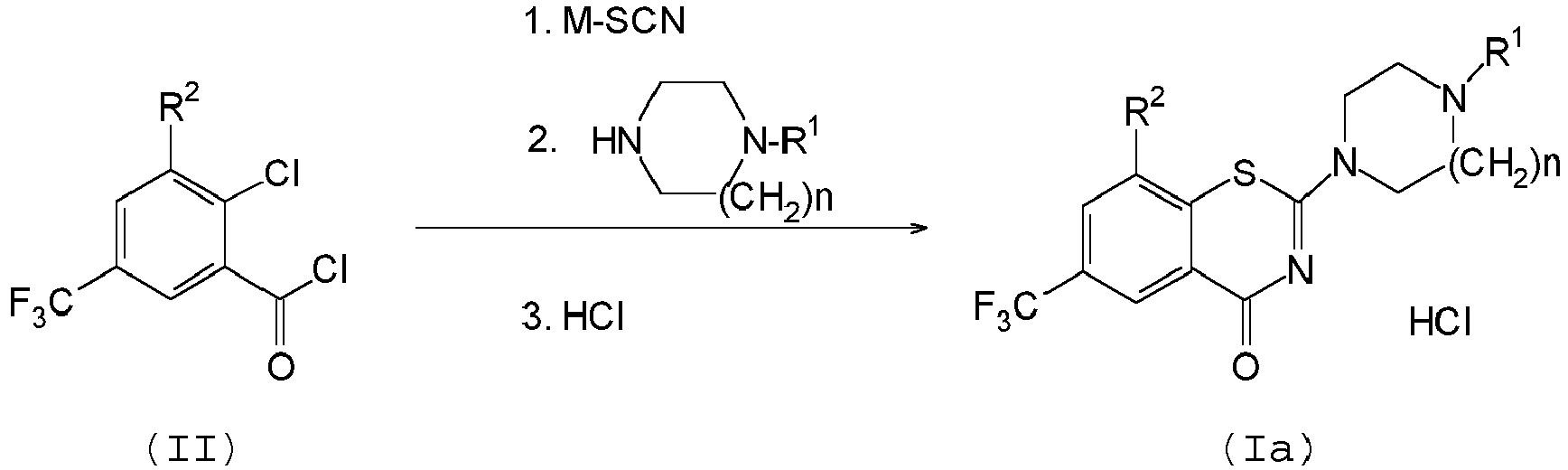
- In this scheme, n, R1, M, and R2 are as defined above. Preferred embodiments of R1 and R2 are those which are described below in relation to the compounds of the invention.
- The compounds wherein R2 is NHOH may be obtained by reducing the corresponding compound of formula (Ia) wherein R2 is NO2 in a manner known to the skilled person.
- The hydrochlorides of general formula (Ia) which are obtained in the process of the present invention may be converted into the corresponding compounds of general formula (I), i.e. into the free base form or other pharmaceutically acceptable salts thereof, by standard methods which are known to the skilled person. In particular, the free base may conveniently be obtained by reaction of the hydrochloride salt with sodium carbonate.
- The process of the present invention is preferably carried out in an organic solvent, preferably THF or acetone, most preferably THF.
- Hereinafter, a particularly preferred embodiment of the process according to the invention is described:
In the first reaction step, a solution of a substituted 2-chloro-5-(trifluoromethyl)benzoyl chloride in THF, preferably 2-chloro-3-nitro-5-(trifluoromethyl)benzoyl chloride, is added to a solution of the thiocyanate salt M-SCN at a temperature of -10°C to +30°C, preferably -5 to +20°C. - In this step, the thiocyanate salt M-SCN is preferably used in a molar ratio of from 1 to 3, more preferably of from 1 to 1.4, based on the compound of formula (II).
- Following the reaction of the thiocyanate salt with the substituted 2-chloro-5-(trifluoromethyl)benzoyl chloride so as to obtain the corresponding 2-chloro-5-(trifluoromethyl)benzoyl isothiocyanate, the precipitated, white, solid alkali/ammonium chloride is removed by filtration.
- In the second reaction step, a freshly distilled substituted piperazine or homopiperazine in THF is added dropwise to the substituted 2-chloro-5-(trifluoromethyl)benzoyl isothiocyanate mother liquid at a temperature of -10°C to +75°C, preferably between 0 to +50°C. The free base of the 2-piperazine or 2-homopiperazine 1,3-benzothiazine-4-one precipitates as a solid from the reaction mixture during storage at a temperature of between 0°C to +30°C, preferably at +25°C, for 0.5 to 3 hours.
- The substituted piperazine or homopiperazine is used in a molar ratio of 1 to 5, preferably in a molar ratio of 1 to 2, based on the compound of formula (II).
- In the final acidification step, the obtained reaction mixture is treated with a solution of HCl in water or an organic solvent, preferably methanol, ethanol, isopropanol or ethyl acetate, thereby converting the free base into the hydrochloride salt. The hydrochloride salt precipitates from the reaction mixture, and is obtained with high yield and purity.
- Preferably, HCl is used in a concentration of 5%, and is added in an amount so as to adjust the pH to about 2. The mixture is cooled over night, preferably at a temperature of 4°C. The precipitated 2-piperazine or 2-homopiperazine 1,3-benzothiazine-4-one hydrochloride is filtered off, and subsequently washed with a small amount of an organic solvent, preferably acetone.
- In a second embodiment, the present invention is directed to novel 2-piperazine-1-yl-4H-1,3-benzothiazine-4-one derivatives of formula (I) and their pharmaceutically acceptable salts, in particular to the hydrochloride salts of the compounds of formula (I):

- In a preferred embodiment, R1 is a linear, branched or cyclic C3-12 alkyl group which may be substituted with halogen and wherein one or two CH2-groups may be substituted with O or S. In a more preferred embodiment, R1 is a linear, branched or cyclic C3-12 alkyl group, wherein one CH2-group may be substituted with O. In an even more preferred embodiment, R1 is a linear, branched or cyclic C4-9 alkyl group, wherein one CH2-group may be substituted with O. In the most preferred embodiment, R1 is a linear or cyclic C4-9 alkyl group.
- In a particularly preferred embodiment of the compounds of formula (I), R1 is a linear or cyclic C4-9 alkyl group and R2 is NO2.
- The compounds of formula (I) may be in the form of their free bases or their pharmaceutically acceptable salts, including their hydrochlorides, sulfates, nitrates, methanesulfonates, benzenesulfonates, oxalates, maleates, phosphates, malates, tartrates, fumarates and salicylates, preferably their hydrochlorides and sulfates. The hydrochlorides are particularly preferred.
- The compounds of the formula (I) according to the invention exhibit strong antibacterial activity, especially against mycobacteria with minimal inhibitory concentrations (MIC) in the range of ∼ 0.2 - 1 ng/ml for M. tuberculosis H37Rv, determined by the resazurin reduction method (J.C. Palomino, A. Martin, M. Camacho, H. Guerra, J. Swings, F. Portaels, Antimicrob. Agents Chemother., 2002, 46, 2720-2722). In particular, the compounds according to the invention demonstrate a high level of selectivity for mycobacteria and related actinobacteria, so that they are expected to be associated with fewer adverse effects.
- Thus, the compounds of the invention are useful for the treatment of mycobacterial infections, and even other actinobacterial infections such as diphtheria or nocardiosis, in humans and in animals. They are especially potent in the treatment of tuberculosis, buruli ulcer and leprosy. Pharmaceutical compositions comprising the compounds according to the invention may be prepared in a manner known to the skilled person, e.g. by mixing with commonly used excipients and tabletting.
- The present invention will hereinafter be described in more detail by way of the following non-limiting examples.
- Chemicals and solvents were purchased from Alfa-Aesar (GB) or from Aldrich Co. (Sigma-Aldrich Company, St-Louis, US). They were used without additional purification.
- Melting points were determined according to the BP procedure and are uncorrected (Electrothermal 9001, GB).
- The molecular formula was analysed (Carlo-Erba 5500, Italy).
- NMR spectra were determined with a Varian Unity Plus 300 (USA). Shifts for 1H NMR are reported in ppm downfield from TMS (δ).
- Mass spectra were obtained using a Finnigan SSQ-700 (USA) instrument with direct injection.
- Reactions and purity of compounds were controlled by TLC using Silicagel 60 F254 aluminium sheets (Merck Co, Germany).
- A solution of 5.0 g (17.3 mmol) fresh 2-chloro-3-nitro-5-(trifluoromethyl)benzoyl chloride in 25 ml of THF was added to a solution of 1.45 g (19.0 mmol) NH4SCN in 25 ml of THF within 5 min at room temperature. The reaction mixture was stored for 10 min at room temperature, and the white solid (NH4Cl) was quickly removed by filtration, and washed with 5 ml THF. A solution of 3.40 g (17.3 mmol) of distilled 1-(cyclohexylmethyl)-1,4-diazepane in 25 THF was added dropwise to the mother liquid within 5 min at room temperature and a yellow solid formed. The reaction mixture was stored for 1 hour at room temperature, and subsequently treated with 5% HCl solution in MeOH until a pH of ∼2 was reached. The mixture was cooled to 4°C overnight. Light yellow 2-[4-(cyclohexylmethyl)-1,4-diazepan-1-yl]-8-nitro-6-(trifluoromethyl)-4H-1,3-benzothiazin-4-one was filtered off and washed with a small volume of acetone.
- The product was recrystallized from an appropriate solvent, such as EtOH.
Yield: 67%
mp: 269-271°C (EtOH)
MS (m/z): 470 (M+)
1H NMR (DMSO-de) : δ 10.93 (1H, broad s, NH), 8.80 and 8.86 (two 1H, two s, 2CH), 4.60 and 4.32 (2H, broad s, NCH 2), 3.78 (2H, broad s, NHCH 2), 3.16 (2H, broad s, NCH 2), 3.18 (2H, broad s, NCH 2), 2.96 (2H, broad s, CH2), 2.12 (2H, broad s, NCH 2), 1.86 (2H, broad s, CH2), 1.74 and 1.55 (11H, 2 m, HC(CH2)5) ppm
Anal. for C21H25F3N4O3S x HCl:Calc. : C, 49.75; H, 5.17; N, 11.05 Found: C, 49.64; H, 5.14; N, 11.14 - The following compounds were obtained by conducting the process of Example 1, except for using the appropriate (homo)piperazine derivative.
- Yield: 59%
mp: 246-248°C (EtOH)
MS (m/z) : 444 (M+)
1H NMR (DMSO-d6): δ 10.89 (1H, broad s, NH), 8.82 and 8.86 (two 1H, two s, 2CH), 0.76-4.62 (21H, several very broad s, 9 CH2 and CH3) ppm
Anal. for C19H23F3N4O3S x HCl:Calc. : C, 47.45; H, 5.29; N, 11.32 Found: C, 47.47; H, 5.26; N, 11.30 - Yield: 63%
mp: 249-251°C (EtOH)
MS (m/z): 458 (M+)
1H NMR (DMSO-d6): δ 10.92 (1H, broad s, NH), 8.81 and 8.87 (two 1H, two s, 2CH), 4.64 and 4.21 (2H, broad d, NHCH 2) , 3.92 (2H, broad s, NCH 2), 3.65 (2H, broad s, NCH 2), 3.06 (2H, broad s, NCH 2), 2.32 (2H, broad s, NCH 2), 1.76 (2H, broad s, CH 2), 1.35 (6H, broad s, (CH2)3) and 0.94 (2H, broad s, CH2) ppm
Anal. for C20H25F3N4O3S x HC1:Calc. : C, 48.53; H, 5.29; N, 11.32 Found: C, 48.59; H, 5.23; N, 11.27 - Yield: 60%
mp: 274-277°C(EtOH)
MS (m/z): 484 (M+)
1H NMR (DMSO-d6): δ 10.86 (1H, broad s, NH), 8.82 and 8.86 (two 1H, two s, 2CH), 0.91-4.65 (25H, several very broad s, 12 CH2 and CH) ppm
Anal. for C22H27F3N4O3S x HC1:Calc. : C, 50.72; H, 5.42; N, 10.75 Found: C, 50.75; H, 5.59; N, 10.59 - Yield: 67%
mp: 256-258°C (EtOH)
MS (m/z): 472 (M+)
1H NMR (DMSO-d6): δ 10.85 (1H, broad s, NH), 8.81 and 8.87 (two 1H, two s, 2CH), 1.12-4.68 (25H, several very broad s, 11 CH2 and CH3) ppm
Anal. for C21H27F3N4O3S x HCl:Calc. : C, 49.55; H, 5.54; N, 11.01 Found: C, 49.47; H, 5.50; N, 11.09 - Yield: 64%
mp: 290-293°C (EtOH/H2O)
MS (m/z): 456 (M+)
1H NMR (DMSO-d6): δ 10.89 (1H, broad s, NH), 8.82 and 8.87 (two 1H, two s, 2CH), 0.87-4.65 (21H, several very broad s, 10 CH2 and CH) ppm
Anal. for C20H24F3N4O3S x HCl:Calc. : C, 48.73; H, 4.91; N, 11.37 Found: C, 48.66; H, 4.94; N, 11.42 - Yield: 58%
mp: 264-267°C (EtOH/H2O)
MS (m/z): 478 (M+)
1H NMR (DMSO-d6): δ 11.32 (1H, broad s, NH), 8.98 and 8.89 (two 1H, two s, 2CH), 7.21-7.43 (5H, m, C6H5), 4.60 and 4.34 (2H, broad d, NHCH 2), 4.01 (2H, broad s, NCH 2), 3.65 (2H, broad s, NCH 2), 3.32 (2H, broad s, NCH 2), 3.13 (2H, broad s, CH 2), 2.61 (2H, broad s, CH2), 2.40 (2H, broad s, NHCH 2) ppm
Anal. for C22H21F3N4O3S x HCl:Calc. : C, 51.31; H, 4.31; N, 10.88 Found: C, 51.37; H, 4.37; N, 10.93 - Yield: 78%
mp: 296-297°C (EtOH/H2O)
MS (m/z): 456 (M+)
1H NMR (DMSO-d6): δ 11.13 (1H, broad s, NH), 8.86 and 8.76 (two 1H, two s, 2CH), 4.64 (2H, broad s, NHCH2), 3.94 (2H, broad s, NHCH 2), 3.18 (2H, broad s, NCH 2), 3.18 (2H, broad s, NCH 2), 2.96 (2H, broad s, CH2), 1.75 and 1.53 (11H, 2 m, HC (CH2)5) ppm
Anal. for C20H23F3N4O3S x HCl:Calc. : C, 48.73; H, 4.91; N, 11.37 Found: C, 48.79; H, 4.85; N, 11.46 - The following compounds in the form of light yellow crystals were obtained in the same manner as Example 8.
- Yield: 76.7%
mp: 271-273°C (EtOH/H2O)
MS (m/z): 470 (M+)
1H NMR (DMSO-de) : δ 11.13 (1H, broad s, NH), 8.86 and 8.76 (two 1H, two s, 2CH), 3.91 (4H, broad s, N(CH2)2), 2.51 (4H, broad s, N(CH2)2), 2.36 (2H, t, CH2), 1.70 - 0.85 (13H, 4 broad m, CH2-CH (C5H10)) ppm.
Anal. for C21H25F3N4O3S x HCl:Calc. : C, 49.75; H, 5.17; N, 11.05 Found: C, 49.63; H, 5.11; N, 11.20 - Yield: 68%
mp: 254-256°C (EtOH/H2O)
MS (m/z): 458 (M+)
1H NMR (DMSO-de) : δ 11.01 (1H, broad s, NH), 8.85 and 8.76 (two 1H, two s, 2CH), 3.90 (4H, broad s, N(CH2)2), 2.52 (4H, broad s, N(CH2)2), 2.33 (3H, t, CH), 1.43 (2H, broad m, CH2) , 1.28 (8H, broad m, 4CH2), 0.86 (3H, t, CH3) ppm
Anal. for C20H25F3N4O3S x HCl:Calc. : C, 48.53; H, 5.29; N, 11.32 Found: C, 48.61; H, 5.22; N, 11.18 - Yield: 74%
mp: 256-258°C (EtOH)
MS (m/z): 508 (M+)
1H NMR (DMSO-de) : δ 10.93 (1H, broad s, NH), 8.91 and 8.80 (two 1H, two s, 2CH), 7.29 (2H, t, 2CH), 6.93 (3H, d, 3CH), 4.03 (2H, t, OCH2), 3.65 (2H, d, 2CH), 3.19 (4H, broad m, N(CH2)2), 1.94 and 1.79 (4H, 2 broad m, 2CH2) ppm
Anal. for C23H23F3N4O4S x HCl:Calc. : C, 50.69; H, 4.44; N, 10.28 Found: C, 50.47; H, 4.32; N, 10.16 - Yield: 77%
mp: 261-2637°C (ethanol)
MS (m/z): 512 (M+)
1H NMR (DMSO-de) : δ 10.97 (1H, broad s, NH), 8.85 and 8.76 (two 1□H, two s, 2CH), 7.11 (2H, t, 2CH), 6.94 (2H, m, 2CH), 4.12 (2H, t, OCH2), 3.85 (4H, broad s, N(CH2)2), 2.52 (4H, broad s, N(CH2)2), 2.48 (2H, m, CH2) , 1.83 (2H, q, CH2) ppm
Anal. for C22H20F4N4O4S x HCl:Calc. : C, 48.14; H, 3.86; N, 10.21 Found: C, 47.97; H, 3.83; N, 10.27 - Yield: 67%
mp: 239-241°C (EtOH/H2O)
MS (m/z): 416 (M+)
1H NMR (DMSO-d6): δ 10.06 (1H, broad s, NH), 8.85 and 8.76 (two 1H, two s, 2CH), 3.90 (4H, broad s, N(CH2)2), 2.51 (4H, broad s, N(CH2)2), 2.32 (2H, t, CH2), 1.46 and 1.33 (4H, 2 m, 2CH2), 0.91 (3H, t, CH3) ppm
Anal. for C17H19F3N4O3S x HCl:Calc. : C, 45.09; H, 4.45; N, 12.37 Found: C, 45.16; H, 4.54; N, 12.30 - Activity against M. tuberculosis strains H37Rv and NBT1 was determined by the resazurin reduction assay (MIC99). The method is described in detail in: J.C. Palomino, A. Martin, M. Camacho, H. Guerra, J. Swings, F. Portaels, Antimicrob. Agents Chemother., 2002, 46, 2720-2722. The results are presented in Table 1.
Table 1 Compound H37Rv NTB1 Units MIC99 MIC99 1 µg/mL 0.001 NA 2 µg/mL 0.0002 >10 3 µg/mL 0.0002 >10 4 µg/mL 0.0002 >10 5 µg/mL 0.0003 13.8 6 µg/mL 0.001 50.5 7 µg/mL 0.0008 27.1 PBTZ169 µg/mL 0.0003 >100 NA - not available
H37Rv - BTZ-susceptible wild type strain
NTB1 - BTZ-resistant mutant of H37Rv - It can clearly be derived from Table 1 above that the compounds of the present invention are more effective against the BTZ-resistant mutant NBT1 than the prior art compound PBTZ169, and are equally effective against H37Rv.
-
- (1) A process for the preparation of a compound of formula (Ia) comprising the following steps:
- a) reacting a substituted 2-chloro-5-(trifluoromethyl)benzoyl chloride according to formula (II) with M-SCN;

- b) reacting the thus obtained crude 2-chloro-5-(trifluoromethyl)benzoyl isothiocyanate without isolation with a substituted piperazine or homopiperazine of formula (III),

- c) acidifying the thus obtained 2-piperazine or 2-homopiperazine 1,3-benzothiazine-4-one with hydrochloric acid to obtain a compound of formula (Ia).

- n is 1 or 2; preferably 2;
- R1 is a linear, branched or cyclic C3-12 alkyl group, a linear, branched or cyclic C3-12 alkenyl group or a linear or branched C3-12 alkynyl group, all of which may be substituted with halogen, and wherein one or two CH2-groups may be substituted by O or S, or

- X is a linear or branched C1-6 alkyl group, a linear or branched C1-6 alkenyl group or a linear or branched C1-6 alkynyl group;
- Y is a direct bond, O, S, NH, NMe, NEt, or NPr;
- Z is a direct bond, or a linear or branched C1-3 alkyl group;
- Q is cyclopentyl, cyclohexyl, cycloheptyl, phenyl, or naphtyl, which may be substituted with 1-3 substituents selected from halogen, a linear or branched C1-3 alkoxy group, a linear or branched C1-3 alkenyloxy group, a linear or branched C1-3 alkynyloxy group, mono-, di or trifluoromethyl;
- M is an alkali metal, or NH4; preferably Na, K or NH4; more preferably NH4;
- R2 is NO2, NHOH; preferably NO2.
- a) reacting a substituted 2-chloro-5-(trifluoromethyl)benzoyl chloride according to formula (II) with M-SCN;
- (2) The process according to Item 1, wherein the thiocyanate M-SCN in step (1) is selected from sodium thiocyanate, potassium thiocyanate and ammonium thiocyanate, and is preferably ammonium thiocyanate.
- (3) The process according to Item 1 or 2, wherein the molar ratio of M-SCN in step (1) is 1 to 3, preferably 1 to 1.4, based on the compound of formula (II).
- (4) The process according to Item 3, wherein ammonium thiocyanate is used and the molar ratio is 1 to 1.4.
- (5) The process according to any of the preceding items, wherein the molar ratio of the substituted piperazine or homopiperazine in step b) is 1 to 5, and preferably 1 to 2, based on the compound of formula (II).
- (6) The process according to any of the preceding items, wherein a mixture of hydrochloric acid with water, methanol, ethanol, n- or iso-propanol, or ethyl acetate, preferably methanol, is used in step c).
- (7) The process according to Item 6, wherein the acidification is conducted with a 5% solution of hydrochloric acid at a pH of 2.
- (8) The process according to any of the preceding items, wherein the reaction is conducted in THF or acetone, preferably in THF.
- (9) The process according to Item 1, comprising the following steps:
- a) reacting a substituted 2-chloro-5-(trifluoromethyl)benzoyl chloride according to formula (II) with ammonium thiocyanate in THF, wherein ammonium thiocyanate is used in a molar ratio of 1 to 1.4, based on the compound of formula (II),
- b) reacting the obtained crude 2-chloro-5-(trifluoromethyl)benzoyl isothiocyanate without isolation with a substituted piperazine or homopiperazine in a molar ratio of 1:1 to 1:2, based on the compound of formula (II),
- c) acidifying the obtained 2-piperazine or 2-homopiperazine 1,3-benzothiazine-4-one with a 5% solution of hydrochloric acid in methanol at a pH of 2 to obtain a compound of formula (Ia).
- (10) A process for preparing a compound of formula (I) or a pharmaceutically acceptable salt thereof, which comprises the process according to any one of Items 1-9 and subsequent conversion of the hydrochloride of formula (Ia).

- (11) A compound of formula (I) or a pharmaceutically acceptable salt thereof:

- n is 2;
- R1 is a linear, branched or cyclic C3-12 alkyl group, a linear, branched or cyclic C3-12 alkenyl group, a linear, branched or cyclic C3-12 alkynyl group, all of which may be substituted with halogen, and wherein one or two CH2-groups may be substituted with O or S, or

- X is a linear or branched C1-6 alkyl group, a linear or branched C1-6 alkenyl group, or a linear or branched C1-6 alkynyl group;
- Y is a direct bond, O, S, NH, NMe, NEt, or NPr;
- Z is a direct bond, or a linear or branched C1-3 alkyl group;
- Q is cyclopentyl, cyclohexyl, cycloheptyl, phenyl, or naphtyl, which may be substituted with 1-3 substituents selected from halogen, a linear or branched C1-3 alkoxy group, a linear or branched C1-3 alkenyloxy group, a linear or branched C1-3 alkynyloxy group, mono-, di or trifluoromethyl; and
- R2 is NO2 or NHOH; preferably NO2.
- (12) The compound according to Item 11, wherein R1 is a linear, branched or cyclic C3-12 alkyl group, which may substituted with halogen, and wherein one or two CH2-groups may be substituted by O or S.
- (13) The compound according to Item 11, wherein n is 2, R1 is a linear or cyclic C4-9 alkyl group, and R2 is NO2.
- (14) The compound according to any one of Items 11-13, which is the hydrochloride salt of formula (Ia):

- (15) The compound according to any one of Items 11-14 for use in a method for the treatment of bacterial infections, preferably mycobacterial infections, more preferably tuberculosis, buruli ulcer and leprosy.
- (16) A pharmaceutical composition comprising the compound of formula (I) according to any one of Items 11-14.
Claims (6)
- A compound of formula (I) or a pharmaceutically acceptable salt thereof:
 n is 2;R1 is a linear, branched or cyclic C3-12 alkyl group, a linear, branched or cyclic C3-12 alkenyl group, a linear, branched or cyclic C3-12 alkynyl group, all of which may be substituted with halogen, and wherein one or two CH2-groups may be substituted with O or S, or
 X is a linear or branched C1-6 alkyl group, a linear or branched C1-6 alkenyl group, or a linear or branched C1-6 alkynyl group;Y is a direct bond, O, S, NH, NMe, NEt, or NPr;Z is a direct bond, or a linear or branched C1-3 alkyl group;Q is cyclopentyl, cyclohexyl, cycloheptyl, phenyl, or naphtyl, which may be substituted with 1-3 substituents selected from halogen, a linear or branched C1-3 alkoxy group, a linear or branched C1-3 alkenyloxy group, a linear or branched C1-3 alkynyloxy group, mono-, di or trifluoromethyl; andR2 is NO2 or NHOH; preferably NO2.
 - The compound according to claim 1, wherein R1 is a linear, branched or cyclic C3-12 alkyl group, which may substituted with halogen, and wherein one or two CH2-groups may be substituted by O or S.
- The compound according to claim 1, wherein n is 2, R1 is a linear or cyclic C4-9 alkyl group, and R2 is NO2.
- The compound according to any one of claims 1-3, which is the hydrochloride salt of formula (Ia):

- The compound according to any one of claims 1-4 for use in a method for the treatment of bacterial infections, preferably mycobacterial infections, more preferably tuberculosis, buruli ulcer and leprosy.
- A pharmaceutical composition comprising the compound of formula (I) according to any one of claims 1-4.
Applications Claiming Priority (3)
| Application Number | Priority Date | Filing Date | Title |
|---|---|---|---|
| EP15160267.9A EP3072889A1 (en) | 2015-03-23 | 2015-03-23 | 2-Homopiperazine-1-yl-4H-1,3-benzothiazine-4-one derivatives and process for the preparation of 2-(homo)piperazine 1,3-benzothiazine-4-one hydrochlorides |
| PCT/EP2016/056371 WO2016151011A1 (en) | 2015-03-23 | 2016-03-23 | 2-homopiperazine-1-yl-4h-1,3-benzothiazine-4-one derivatives and process for the preparation of 2- (homo)piperazine 1,3-benzothiazine-4-one hydrochlorides |
| EP16711296.0A EP3274339B1 (en) | 2015-03-23 | 2016-03-23 | Process for the preparation of 2- (homo)piperazine 1,3-benzothiazine-4-one hydrochlorides |
Related Parent Applications (2)
| Application Number | Title | Priority Date | Filing Date |
|---|---|---|---|
| EP16711296.0A Division EP3274339B1 (en) | 2015-03-23 | 2016-03-23 | Process for the preparation of 2- (homo)piperazine 1,3-benzothiazine-4-one hydrochlorides |
| EP16711296.0A Division-Into EP3274339B1 (en) | 2015-03-23 | 2016-03-23 | Process for the preparation of 2- (homo)piperazine 1,3-benzothiazine-4-one hydrochlorides |
Publications (1)
| Publication Number | Publication Date |
|---|---|
| EP3919480A1 true EP3919480A1 (en) | 2021-12-08 |
Family
ID=52780412
Family Applications (3)
| Application Number | Title | Priority Date | Filing Date |
|---|---|---|---|
| EP15160267.9A Withdrawn EP3072889A1 (en) | 2015-03-23 | 2015-03-23 | 2-Homopiperazine-1-yl-4H-1,3-benzothiazine-4-one derivatives and process for the preparation of 2-(homo)piperazine 1,3-benzothiazine-4-one hydrochlorides |
| EP21186636.3A Pending EP3919480A1 (en) | 2015-03-23 | 2016-03-23 | 2-homopiperazine-1-yl-4h-1,3-benzothiazine-4-one derivatives and process for the preparation of 2-(homo)piperazine 1,3-benzothiazine-4-one hydrochlorides |
| EP16711296.0A Active EP3274339B1 (en) | 2015-03-23 | 2016-03-23 | Process for the preparation of 2- (homo)piperazine 1,3-benzothiazine-4-one hydrochlorides |
Family Applications Before (1)
| Application Number | Title | Priority Date | Filing Date |
|---|---|---|---|
| EP15160267.9A Withdrawn EP3072889A1 (en) | 2015-03-23 | 2015-03-23 | 2-Homopiperazine-1-yl-4H-1,3-benzothiazine-4-one derivatives and process for the preparation of 2-(homo)piperazine 1,3-benzothiazine-4-one hydrochlorides |
Family Applications After (1)
| Application Number | Title | Priority Date | Filing Date |
|---|---|---|---|
| EP16711296.0A Active EP3274339B1 (en) | 2015-03-23 | 2016-03-23 | Process for the preparation of 2- (homo)piperazine 1,3-benzothiazine-4-one hydrochlorides |
Country Status (11)
| Country | Link |
|---|---|
| US (2) | US10160754B2 (en) |
| EP (3) | EP3072889A1 (en) |
| CN (1) | CN107567439B (en) |
| CA (1) | CA2980653A1 (en) |
| EA (2) | EA202091353A1 (en) |
| ES (1) | ES2905453T3 (en) |
| GE (3) | GEP20217258B (en) |
| PL (1) | PL3274339T3 (en) |
| UA (1) | UA123724C2 (en) |
| WO (1) | WO2016151011A1 (en) |
| ZA (1) | ZA202401526B (en) |
Families Citing this family (2)
| Publication number | Priority date | Publication date | Assignee | Title |
|---|---|---|---|---|
| EP3072889A1 (en) | 2015-03-23 | 2016-09-28 | Ecole Polytechnique Federale De Lausanne (Epfl) | 2-Homopiperazine-1-yl-4H-1,3-benzothiazine-4-one derivatives and process for the preparation of 2-(homo)piperazine 1,3-benzothiazine-4-one hydrochlorides |
| CN108929329B (en) * | 2017-05-24 | 2020-12-11 | 中国医学科学院药物研究所 | 2-Azacyclo-5-trifluoromethyl-8-nitrobenzo(thio)pyran-4-ones |
Citations (5)
| Publication number | Priority date | Publication date | Assignee | Title |
|---|---|---|---|---|
| WO2007134625A1 (en) | 2006-05-24 | 2007-11-29 | Leibniz Institute For Natural Product Research And Infection Biology E.V. Hans-Knöll-Institut (Hki) | New benzothiazinone derivatives and their use as antibacterial agents |
| WO2009001063A1 (en) | 2007-06-22 | 2008-12-31 | Cadbury Holdings Limited | Chocolate composition |
| WO2009010163A1 (en) | 2007-07-16 | 2009-01-22 | Leibniz-Institut Für Naturstoff-Forschung Und Infektionsbiologie E.V. Hans-Knöll-Institut | New antimicrobial compounds, their synthesis and their use for treatment of mammalian infections |
| WO2012066518A1 (en) * | 2010-11-19 | 2012-05-24 | Ecole Polytechnique Federale De Lausanne (Epfl) | 2-piperazin-1-yl-4h-1,3-benzothiazin-4-one derivatives and their use for the treatment of mammalian infections |
| WO2012085654A1 (en) * | 2010-12-23 | 2012-06-28 | The University Of Queensland | Novel anti-tuberculosis agents |
Family Cites Families (3)
| Publication number | Priority date | Publication date | Assignee | Title |
|---|---|---|---|---|
| CN103508980B (en) * | 2012-06-14 | 2016-07-06 | 四川大学 | Benzothiazine-4-ketone derivatives and its production and use |
| EP3072889A1 (en) | 2015-03-23 | 2016-09-28 | Ecole Polytechnique Federale De Lausanne (Epfl) | 2-Homopiperazine-1-yl-4H-1,3-benzothiazine-4-one derivatives and process for the preparation of 2-(homo)piperazine 1,3-benzothiazine-4-one hydrochlorides |
| CN105669664B (en) * | 2016-02-19 | 2019-05-10 | 浙江司太立制药股份有限公司 | Benzothiazin-4-one compounds containing basic nitrogen heterocyclic fragment and preparation method thereof |
-
2015
- 2015-03-23 EP EP15160267.9A patent/EP3072889A1/en not_active Withdrawn
-
2016
- 2016-03-23 EP EP21186636.3A patent/EP3919480A1/en active Pending
- 2016-03-23 EA EA202091353A patent/EA202091353A1/en unknown
- 2016-03-23 UA UAA201710145A patent/UA123724C2/en unknown
- 2016-03-23 US US15/560,771 patent/US10160754B2/en active Active
- 2016-03-23 GE GEAP201614821A patent/GEP20217258B/en unknown
- 2016-03-23 ES ES16711296T patent/ES2905453T3/en active Active
- 2016-03-23 EA EA201792095A patent/EA035946B1/en unknown
- 2016-03-23 GE GEAP202014609A patent/GEAP202014609A/en unknown
- 2016-03-23 WO PCT/EP2016/056371 patent/WO2016151011A1/en not_active Ceased
- 2016-03-23 PL PL16711296T patent/PL3274339T3/en unknown
- 2016-03-23 CA CA2980653A patent/CA2980653A1/en active Pending
- 2016-03-23 CN CN201680017268.3A patent/CN107567439B/en not_active Expired - Fee Related
- 2016-03-23 GE GEAP201614609A patent/GEP20207127B/en unknown
- 2016-03-23 EP EP16711296.0A patent/EP3274339B1/en active Active
-
2018
- 2018-11-13 US US16/189,743 patent/US10358442B2/en active Active
-
2024
- 2024-02-21 ZA ZA2024/01526A patent/ZA202401526B/en unknown
Patent Citations (6)
| Publication number | Priority date | Publication date | Assignee | Title |
|---|---|---|---|---|
| WO2007134625A1 (en) | 2006-05-24 | 2007-11-29 | Leibniz Institute For Natural Product Research And Infection Biology E.V. Hans-Knöll-Institut (Hki) | New benzothiazinone derivatives and their use as antibacterial agents |
| EP2029583A1 (en) | 2006-05-24 | 2009-03-04 | Leibniz Institute For Natural Product Research And Infection Biology E.V. Hans-Knöll-Institut (HKI) | New benzothiazinone derivatives and their use as antibacterial agents |
| WO2009001063A1 (en) | 2007-06-22 | 2008-12-31 | Cadbury Holdings Limited | Chocolate composition |
| WO2009010163A1 (en) | 2007-07-16 | 2009-01-22 | Leibniz-Institut Für Naturstoff-Forschung Und Infektionsbiologie E.V. Hans-Knöll-Institut | New antimicrobial compounds, their synthesis and their use for treatment of mammalian infections |
| WO2012066518A1 (en) * | 2010-11-19 | 2012-05-24 | Ecole Polytechnique Federale De Lausanne (Epfl) | 2-piperazin-1-yl-4h-1,3-benzothiazin-4-one derivatives and their use for the treatment of mammalian infections |
| WO2012085654A1 (en) * | 2010-12-23 | 2012-06-28 | The University Of Queensland | Novel anti-tuberculosis agents |
Non-Patent Citations (12)
| Title |
|---|
| BALGANESH, T.S.P.M. ALZARIS.T. COLE, TRENDS PHARMACOL SCI, vol. 29, no. 11, 2008, pages 576 - 81 |
| BRITTON, W.J.D.N. LOCKWOOD, LANCET, vol. 363, no. 9416, 2004, pages 1209 - 19 |
| CUI-TING PENG ET AL: "Supplementary information for Synthesis and Antitubercular Evaluation of 4-carbonyl piperazine substituted 1,3-benzothiazin-4-one derivatives", 2 March 2015 (2015-03-02), XP055191153, Retrieved from the Internet <URL:http://www.sciencedirect.com/science/MiamiMultiMediaURL/1-s2.0-S0960894X1500181X/1-s2.0-S0960894X1500181X-mmc1.doc/271398/html/S0960894X1500181X/f9cfa54e67743e1102eaf791aa3c64bf/mmc1.doc> [retrieved on 20150522] * |
| CUI-TING PENG ET AL: "Synthesis and antitubercular evaluation of 4-carbonyl piperazine substituted 1,3-benzothiazin-4-one derivatives", BIOORGANIC & MEDICINAL CHEMISTRY LETTERS, vol. 25, no. 7, 1 April 2015 (2015-04-01), pages 1373 - 1376, XP055191091, ISSN: 0960-894X, DOI: 10.1016/j.bmcl.2015.02.061 * |
| DEMANGEL, C.T.P. STINEARS.T. COLE, NAT REV MICROBIOL, vol. 7, no. 1, 2009, pages 50 - 60 |
| FEARS, R.S. KAUFMANNV. TER MEULENA. ZUMLA, TUBERCULOSIS (EDINB, vol. 90, 2010, pages 182 - 187 |
| J.C. PALOMINOA. MARTINM. CAMACHOH. GUERRAJ. SWINGSF. PORTAELS, ANTIMICROB. AGENTS CHEMOTHER., vol. 46, 2002, pages 2720 - 2722 |
| JASSAL, M.W. R. BISHAI, LANCET INFECT DIS, vol. 9, 2009, pages 19 - 30 |
| M.R. PASCA ET AL., ANTIMICROB. AGENTS CHEMOTHER., vol. 54, 2010, pages 1616 |
| V. MAKAROV ET AL., EMBO MOL MED., vol. 6, no. 3, 2014, pages 372 - 83 |
| V. MAKAROV ET AL., SCIENCE, vol. 324, 2009, pages 801 |
| ZIGNOL, M. ET AL., J INFECT DIS, vol. 194, 2006, pages 479 - 485 |
Also Published As
| Publication number | Publication date |
|---|---|
| US10160754B2 (en) | 2018-12-25 |
| EA201792095A1 (en) | 2018-03-30 |
| WO2016151011A1 (en) | 2016-09-29 |
| US10358442B2 (en) | 2019-07-23 |
| EA202091353A1 (en) | 2020-08-19 |
| PL3274339T3 (en) | 2022-03-07 |
| EP3274339A1 (en) | 2018-01-31 |
| GEP20207127B (en) | 2020-06-25 |
| ZA202401526B (en) | 2025-04-30 |
| ES2905453T3 (en) | 2022-04-08 |
| CN107567439A (en) | 2018-01-09 |
| US20190077798A1 (en) | 2019-03-14 |
| UA123724C2 (en) | 2021-05-26 |
| CA2980653A1 (en) | 2016-09-29 |
| EP3274339B1 (en) | 2021-10-13 |
| CN107567439B (en) | 2021-04-16 |
| EA035946B1 (en) | 2020-09-04 |
| GEP20217258B (en) | 2021-05-25 |
| EP3072889A1 (en) | 2016-09-28 |
| GEAP202014609A (en) | 2020-01-27 |
| US20180051016A1 (en) | 2018-02-22 |
Similar Documents
| Publication | Publication Date | Title |
|---|---|---|
| SU1535379A3 (en) | Method of producing 5-substituted 2,4-diaminopyrimidines or their acid-additive salts | |
| EP2176248B1 (en) | New antimicrobial compounds, their synthesis and their use for treatment of mammalian infections | |
| CA2727780A1 (en) | Novel potassium channel blockers and uses thereof | |
| EP2640712B1 (en) | 2-piperazin-1-yl-4h-1,3-benzothiazin-4-one derivatives and their use for the treatment of mammalian infections | |
| MXPA97002488A (en) | Compounds of purine and guanine as inhibitors of | |
| US6352987B2 (en) | 8,8a-dihydroindeno[1,2-d]thiazole derivatives which carry in the 2-position a substituent having a sulfonamide structure or sulfone structure; processes for their preparation and their use as medicaments | |
| US20020058658A1 (en) | 8,8A-dihydroindeno[1,2-D] thiazole derivatives which are substituted in the 8A-position; processes for their preparation and their use as medicaments | |
| EP3004079B1 (en) | Pyrimidine compounds and their use as gamma secretase modulators | |
| KR20250023339A (en) | Phenyl triazole MLL1-WDR5 protein-protein interaction inhibitor | |
| US10358442B2 (en) | 2-homopiperazine-1-yl-4H-1,3-benzothiazine-4-one derivatives and process for the preparation of 2-(homo)piperazine 1,3-benzothiazine-4-one hydrochlorides | |
| WO2013192610A2 (en) | Pro-drugs of riluzole and their method of use for the treatment of amyotrophic lateral sclerosis | |
| AU2012310242A1 (en) | Benzothiazinone derivatives as anti -tuberculosis agents | |
| EP2142518B1 (en) | 3,4-dihydroquinazoline derivatives | |
| EP3740484B1 (en) | 5-(pyrimidin-4-yl)thiazol-2-yl urea derivatives as therapeutic agents | |
| EA029044B1 (en) | Methanethione compounds having antiviral activity | |
| EP2380886A1 (en) | Process for the preparation of 2-aminosubstituted 1,3-benzothiazine-4-ones | |
| EA003424B1 (en) | Novel derivatives of 1,2-dithiolane, process for preparing them and pharmaceutical compositions containing them | |
| WO2011151701A1 (en) | 6 - methyl - 4 - phenyl - 5 - ( phenyl or cycloalkyl) carbamoyl - 1,2,3, 4 - tetrahydropyrimidin- 2 - one derivatives as antitubercular agents | |
| EP0690066A1 (en) | Phosphinic acid derivatives, their preparation as well as their use | |
| US10618892B2 (en) | Processes for the preparation of a BACE inhibitor | |
| EA039959B1 (en) | 2-HOMOPIPERAZIN-1-IL-4H-1,3-BENZOTHIAZIN-4-ONE DERIVATIVES AND THEIR USE FOR THE TREATMENT OF BACTERIAL INFECTIONS | |
| US6117867A (en) | Substituted 6-R-1,3,4-thiadiazine-2-amines, the use thereof as anaesthetizing, cardiovascular and hypometabolic agents, and a pharmaceutical composition containing them | |
| CA2449189A1 (en) | Naphtothiazine positive allosteric ampa receptor modulators (paarm) |
Legal Events
| Date | Code | Title | Description |
|---|---|---|---|
| PUAI | Public reference made under article 153(3) epc to a published international application that has entered the european phase |
Free format text: ORIGINAL CODE: 0009012 |
|
| STAA | Information on the status of an ep patent application or granted ep patent |
Free format text: STATUS: THE APPLICATION HAS BEEN PUBLISHED |
|
| AC | Divisional application: reference to earlier application |
Ref document number: 3274339 Country of ref document: EP Kind code of ref document: P |
|
| AK | Designated contracting states |
Kind code of ref document: A1 Designated state(s): AL AT BE BG CH CY CZ DE DK EE ES FI FR GB GR HR HU IE IS IT LI LT LU LV MC MK MT NL NO PL PT RO RS SE SI SK SM TR |
|
| B565 | Issuance of search results under rule 164(2) epc |
Effective date: 20211022 |
|
| STAA | Information on the status of an ep patent application or granted ep patent |
Free format text: STATUS: REQUEST FOR EXAMINATION WAS MADE |
|
| 17P | Request for examination filed |
Effective date: 20220608 |
|
| RBV | Designated contracting states (corrected) |
Designated state(s): AL AT BE BG CH CY CZ DE DK EE ES FI FR GB GR HR HU IE IS IT LI LT LU LV MC MK MT NL NO PL PT RO RS SE SI SK SM TR |
|
| GRAP | Despatch of communication of intention to grant a patent |
Free format text: ORIGINAL CODE: EPIDOSNIGR1 |
|
| STAA | Information on the status of an ep patent application or granted ep patent |
Free format text: STATUS: GRANT OF PATENT IS INTENDED |
|
| RIC1 | Information provided on ipc code assigned before grant |
Ipc: C07D 279/08 20060101AFI20251022BHEP Ipc: A61K 31/551 20060101ALI20251022BHEP Ipc: A61P 31/04 20060101ALI20251022BHEP |
|
| INTG | Intention to grant announced |
Effective date: 20251106 |