EP3919469A1 - Copper-catalyzed method for preparing aldehyde or ketone compound by oxidizing alcohol by using oxygen as oxidant, and application thereof - Google Patents
Copper-catalyzed method for preparing aldehyde or ketone compound by oxidizing alcohol by using oxygen as oxidant, and application thereof Download PDFInfo
- Publication number
- EP3919469A1 EP3919469A1 EP20747658.1A EP20747658A EP3919469A1 EP 3919469 A1 EP3919469 A1 EP 3919469A1 EP 20747658 A EP20747658 A EP 20747658A EP 3919469 A1 EP3919469 A1 EP 3919469A1
- Authority
- EP
- European Patent Office
- Prior art keywords
- mmol
- group
- functional groups
- nmr
- arh
- Prior art date
- Legal status (The legal status is an assumption and is not a legal conclusion. Google has not performed a legal analysis and makes no representation as to the accuracy of the status listed.)
- Withdrawn
Links
- 229910052760 oxygen Inorganic materials 0.000 title claims abstract description 35
- 239000001301 oxygen Substances 0.000 title claims abstract description 35
- QVGXLLKOCUKJST-UHFFFAOYSA-N atomic oxygen Chemical compound [O] QVGXLLKOCUKJST-UHFFFAOYSA-N 0.000 title claims abstract description 34
- 238000000034 method Methods 0.000 title claims abstract description 29
- 239000007800 oxidant agent Substances 0.000 title claims abstract description 17
- -1 ketone compound Chemical class 0.000 title claims description 29
- LFQSCWFLJHTTHZ-UHFFFAOYSA-N Ethanol Chemical compound CCO LFQSCWFLJHTTHZ-UHFFFAOYSA-N 0.000 title claims description 20
- 230000001590 oxidative effect Effects 0.000 title claims description 19
- 150000001299 aldehydes Chemical class 0.000 title abstract 3
- 125000000524 functional group Chemical group 0.000 claims abstract description 51
- 238000006243 chemical reaction Methods 0.000 claims abstract description 34
- 239000002994 raw material Substances 0.000 claims abstract description 22
- 239000003054 catalyst Substances 0.000 claims abstract description 14
- 239000003960 organic solvent Substances 0.000 claims abstract description 14
- 150000001298 alcohols Chemical class 0.000 claims abstract description 12
- 150000001879 copper Chemical class 0.000 claims abstract description 12
- 150000002576 ketones Chemical class 0.000 claims abstract description 10
- RTZKZFJDLAIYFH-UHFFFAOYSA-N Diethyl ether Chemical compound CCOCC RTZKZFJDLAIYFH-UHFFFAOYSA-N 0.000 claims description 272
- WEVYAHXRMPXWCK-UHFFFAOYSA-N Acetonitrile Chemical compound CC#N WEVYAHXRMPXWCK-UHFFFAOYSA-N 0.000 claims description 51
- WSLDOOZREJYCGB-UHFFFAOYSA-N 1,2-Dichloroethane Chemical compound ClCCCl WSLDOOZREJYCGB-UHFFFAOYSA-N 0.000 claims description 36
- 125000002485 formyl group Chemical class [H]C(*)=O 0.000 claims description 34
- YLQBMQCUIZJEEH-UHFFFAOYSA-N Furan Chemical compound C=1C=COC=1 YLQBMQCUIZJEEH-UHFFFAOYSA-N 0.000 claims description 26
- 125000001997 phenyl group Chemical group [H]C1=C([H])C([H])=C(*)C([H])=C1[H] 0.000 claims description 22
- 125000003118 aryl group Chemical group 0.000 claims description 21
- YTPLMLYBLZKORZ-UHFFFAOYSA-N Thiophene Chemical compound C=1C=CSC=1 YTPLMLYBLZKORZ-UHFFFAOYSA-N 0.000 claims description 20
- 125000002541 furyl group Chemical group 0.000 claims description 20
- 125000001424 substituent group Chemical group 0.000 claims description 19
- YMWUJEATGCHHMB-UHFFFAOYSA-N Dichloromethane Chemical compound ClCCl YMWUJEATGCHHMB-UHFFFAOYSA-N 0.000 claims description 18
- 239000000203 mixture Substances 0.000 claims description 18
- 239000011203 carbon fibre reinforced carbon Substances 0.000 claims description 17
- 125000005282 allenyl group Chemical group 0.000 claims description 16
- 229910052739 hydrogen Inorganic materials 0.000 claims description 14
- 125000001544 thienyl group Chemical group 0.000 claims description 14
- 125000003837 (C1-C20) alkyl group Chemical group 0.000 claims description 12
- WYURNTSHIVDZCO-UHFFFAOYSA-N Tetrahydrofuran Chemical compound C1CCOC1 WYURNTSHIVDZCO-UHFFFAOYSA-N 0.000 claims description 12
- 125000000623 heterocyclic group Chemical group 0.000 claims description 12
- VYPSYNLAJGMNEJ-UHFFFAOYSA-N Silicium dioxide Chemical compound O=[Si]=O VYPSYNLAJGMNEJ-UHFFFAOYSA-N 0.000 claims description 11
- 125000002252 acyl group Chemical group 0.000 claims description 11
- 125000004423 acyloxy group Chemical group 0.000 claims description 11
- 125000003178 carboxy group Chemical group [H]OC(*)=O 0.000 claims description 11
- 125000004093 cyano group Chemical group *C#N 0.000 claims description 11
- 125000004185 ester group Chemical group 0.000 claims description 11
- 229910052736 halogen Inorganic materials 0.000 claims description 11
- 150000002367 halogens Chemical class 0.000 claims description 11
- 239000000741 silica gel Substances 0.000 claims description 11
- 229910002027 silica gel Inorganic materials 0.000 claims description 11
- JUJWROOIHBZHMG-UHFFFAOYSA-N Pyridine Chemical compound C1=CC=NC=C1 JUJWROOIHBZHMG-UHFFFAOYSA-N 0.000 claims description 10
- KAESVJOAVNADME-UHFFFAOYSA-N Pyrrole Chemical compound C=1C=CNC=1 KAESVJOAVNADME-UHFFFAOYSA-N 0.000 claims description 10
- 125000003342 alkenyl group Chemical group 0.000 claims description 10
- 125000000304 alkynyl group Chemical group 0.000 claims description 10
- 125000001160 methoxycarbonyl group Chemical group [H]C([H])([H])OC(*)=O 0.000 claims description 10
- 229930192474 thiophene Natural products 0.000 claims description 10
- YXFVVABEGXRONW-UHFFFAOYSA-N Toluene Chemical compound CC1=CC=CC=C1 YXFVVABEGXRONW-UHFFFAOYSA-N 0.000 claims description 9
- KXDAEFPNCMNJSK-UHFFFAOYSA-N Benzamide Chemical compound NC(=O)C1=CC=CC=C1 KXDAEFPNCMNJSK-UHFFFAOYSA-N 0.000 claims description 8
- 125000002777 acetyl group Chemical group [H]C([H])([H])C(*)=O 0.000 claims description 8
- 125000000217 alkyl group Chemical group 0.000 claims description 8
- 125000003236 benzoyl group Chemical group [H]C1=C([H])C([H])=C(C([H])=C1[H])C(*)=O 0.000 claims description 8
- OPQARKPSCNTWTJ-UHFFFAOYSA-L copper(ii) acetate Chemical compound [Cu+2].CC([O-])=O.CC([O-])=O OPQARKPSCNTWTJ-UHFFFAOYSA-L 0.000 claims description 8
- 125000003754 ethoxycarbonyl group Chemical group C(=O)(OCC)* 0.000 claims description 8
- RVWUHFFPEOKYLB-UHFFFAOYSA-N 2,2,6,6-tetramethyl-1-oxidopiperidin-1-ium Chemical compound CC1(C)CCCC(C)(C)[NH+]1[O-] RVWUHFFPEOKYLB-UHFFFAOYSA-N 0.000 claims description 6
- UHOVQNZJYSORNB-UHFFFAOYSA-N Benzene Chemical compound C1=CC=CC=C1 UHOVQNZJYSORNB-UHFFFAOYSA-N 0.000 claims description 6
- HSFWRNGVRCDJHI-UHFFFAOYSA-N alpha-acetylene Natural products C#C HSFWRNGVRCDJHI-UHFFFAOYSA-N 0.000 claims description 6
- 125000003368 amide group Chemical group 0.000 claims description 6
- 239000010949 copper Substances 0.000 claims description 6
- 125000002534 ethynyl group Chemical group [H]C#C* 0.000 claims description 6
- 125000002887 hydroxy group Chemical group [H]O* 0.000 claims description 6
- 125000000449 nitro group Chemical group [O-][N+](*)=O 0.000 claims description 6
- LYGJENNIWJXYER-UHFFFAOYSA-N nitromethane Chemical compound C[N+]([O-])=O LYGJENNIWJXYER-UHFFFAOYSA-N 0.000 claims description 6
- 125000000391 vinyl group Chemical group [H]C([*])=C([H])[H] 0.000 claims description 6
- 229920002554 vinyl polymer Polymers 0.000 claims description 6
- 125000005913 (C3-C6) cycloalkyl group Chemical group 0.000 claims description 5
- 229910021591 Copper(I) chloride Inorganic materials 0.000 claims description 5
- 229910021595 Copper(I) iodide Inorganic materials 0.000 claims description 5
- OXBLHERUFWYNTN-UHFFFAOYSA-M copper(I) chloride Chemical compound [Cu]Cl OXBLHERUFWYNTN-UHFFFAOYSA-M 0.000 claims description 5
- SXTLQDJHRPXDSB-UHFFFAOYSA-N copper;dinitrate;trihydrate Chemical compound O.O.O.[Cu+2].[O-][N+]([O-])=O.[O-][N+]([O-])=O SXTLQDJHRPXDSB-UHFFFAOYSA-N 0.000 claims description 5
- UMJSCPRVCHMLSP-UHFFFAOYSA-N pyridine Natural products COC1=CC=CN=C1 UMJSCPRVCHMLSP-UHFFFAOYSA-N 0.000 claims description 5
- 125000004076 pyridyl group Chemical group 0.000 claims description 5
- 125000006527 (C1-C5) alkyl group Chemical group 0.000 claims description 4
- CSGAUKGQUCHWDP-UHFFFAOYSA-N 1-hydroxy-2,2,6,6-tetramethylpiperidin-4-ol Chemical compound CC1(C)CC(O)CC(C)(C)N1O CSGAUKGQUCHWDP-UHFFFAOYSA-N 0.000 claims description 4
- XTHFKEDIFFGKHM-UHFFFAOYSA-N Dimethoxyethane Chemical compound COCCOC XTHFKEDIFFGKHM-UHFFFAOYSA-N 0.000 claims description 4
- 239000003921 oil Substances 0.000 claims description 4
- 239000013589 supplement Substances 0.000 claims description 4
- 125000006552 (C3-C8) cycloalkyl group Chemical group 0.000 claims description 3
- RYGMFSIKBFXOCR-UHFFFAOYSA-N Copper Chemical compound [Cu] RYGMFSIKBFXOCR-UHFFFAOYSA-N 0.000 claims description 3
- XUIMIQQOPSSXEZ-UHFFFAOYSA-N Silicon Chemical group [Si] XUIMIQQOPSSXEZ-UHFFFAOYSA-N 0.000 claims description 3
- ODWXUNBKCRECNW-UHFFFAOYSA-M bromocopper(1+) Chemical compound Br[Cu+] ODWXUNBKCRECNW-UHFFFAOYSA-M 0.000 claims description 3
- 229910052802 copper Inorganic materials 0.000 claims description 3
- LSXDOTMGLUJQCM-UHFFFAOYSA-M copper(i) iodide Chemical compound I[Cu] LSXDOTMGLUJQCM-UHFFFAOYSA-M 0.000 claims description 3
- 229940045803 cuprous chloride Drugs 0.000 claims description 3
- SCYULBFZEHDVBN-UHFFFAOYSA-N 1,1-Dichloroethane Chemical compound CC(Cl)Cl SCYULBFZEHDVBN-UHFFFAOYSA-N 0.000 claims description 2
- KNKRKFALVUDBJE-UHFFFAOYSA-N 1,2-dichloropropane Chemical compound CC(Cl)CCl KNKRKFALVUDBJE-UHFFFAOYSA-N 0.000 claims description 2
- YHRUOJUYPBUZOS-UHFFFAOYSA-N 1,3-dichloropropane Chemical compound ClCCCCl YHRUOJUYPBUZOS-UHFFFAOYSA-N 0.000 claims description 2
- AYSOUYKQIUYGFR-UHFFFAOYSA-N 1-hydroxy-2,2,6,6-tetramethylpiperidin-4-amine Chemical compound CC1(C)CC(N)CC(C)(C)N1O AYSOUYKQIUYGFR-UHFFFAOYSA-N 0.000 claims description 2
- KRNWYBIEWUXCOB-UHFFFAOYSA-N 1-hydroxy-4-methoxy-2,2,6,6-tetramethylpiperidine Chemical compound COC1CC(C)(C)N(O)C(C)(C)C1 KRNWYBIEWUXCOB-UHFFFAOYSA-N 0.000 claims description 2
- BUXKULRFRATXSI-UHFFFAOYSA-N 1-hydroxypyrrole-2,5-dione Chemical compound ON1C(=O)C=CC1=O BUXKULRFRATXSI-UHFFFAOYSA-N 0.000 claims description 2
- 229910052799 carbon Inorganic materials 0.000 claims description 2
- 125000000753 cycloalkyl group Chemical group 0.000 claims description 2
- 238000001914 filtration Methods 0.000 claims description 2
- 238000003818 flash chromatography Methods 0.000 claims description 2
- 239000001257 hydrogen Substances 0.000 claims description 2
- 125000004435 hydrogen atom Chemical group [H]* 0.000 claims description 2
- YYTYIUAYFBFKHX-UHFFFAOYSA-N n-(1-hydroxy-2,2,6,6-tetramethylpiperidin-4-yl)acetamide Chemical compound CC(=O)NC1CC(C)(C)N(O)C(C)(C)C1 YYTYIUAYFBFKHX-UHFFFAOYSA-N 0.000 claims description 2
- 125000001624 naphthyl group Chemical group 0.000 claims description 2
- 238000005086 pumping Methods 0.000 claims description 2
- 238000003756 stirring Methods 0.000 claims description 2
- 238000005406 washing Methods 0.000 claims description 2
- QTVKZDGGMKYGIP-UHFFFAOYSA-N CC(OC(C(N)=O)(OC=O)OC(C1=CC=CC=C1)=O)=O Chemical compound CC(OC(C(N)=O)(OC=O)OC(C1=CC=CC=C1)=O)=O QTVKZDGGMKYGIP-UHFFFAOYSA-N 0.000 claims 2
- 238000007254 oxidation reaction Methods 0.000 abstract description 16
- 230000003647 oxidation Effects 0.000 abstract description 14
- 239000000758 substrate Substances 0.000 abstract description 6
- 238000009776 industrial production Methods 0.000 abstract description 5
- 230000008901 benefit Effects 0.000 abstract description 4
- 239000003153 chemical reaction reagent Substances 0.000 abstract description 2
- 238000000746 purification Methods 0.000 abstract description 2
- 150000003841 chloride salts Chemical class 0.000 abstract 1
- HEDRZPFGACZZDS-MICDWDOJSA-N Trichloro(2H)methane Chemical compound [2H]C(Cl)(Cl)Cl HEDRZPFGACZZDS-MICDWDOJSA-N 0.000 description 216
- XTVVROIMIGLXTD-UHFFFAOYSA-N copper(II) nitrate Chemical compound [Cu+2].[O-][N+]([O-])=O.[O-][N+]([O-])=O XTVVROIMIGLXTD-UHFFFAOYSA-N 0.000 description 138
- 238000005160 1H NMR spectroscopy Methods 0.000 description 76
- GDOPTJXRTPNYNR-UHFFFAOYSA-N methyl-cyclopentane Natural products CC1CCCC1 GDOPTJXRTPNYNR-UHFFFAOYSA-N 0.000 description 75
- 239000003208 petroleum Substances 0.000 description 66
- 239000003480 eluent Substances 0.000 description 54
- 238000001644 13C nuclear magnetic resonance spectroscopy Methods 0.000 description 53
- XEKOWRVHYACXOJ-UHFFFAOYSA-N Ethyl acetate Chemical compound CCOC(C)=O XEKOWRVHYACXOJ-UHFFFAOYSA-N 0.000 description 42
- 239000007788 liquid Substances 0.000 description 40
- 238000004458 analytical method Methods 0.000 description 24
- 238000005481 NMR spectroscopy Methods 0.000 description 23
- 239000007787 solid Substances 0.000 description 17
- 230000003197 catalytic effect Effects 0.000 description 9
- 230000008018 melting Effects 0.000 description 9
- 238000002844 melting Methods 0.000 description 9
- 238000001953 recrystallisation Methods 0.000 description 9
- 238000000926 separation method Methods 0.000 description 7
- SECXISVLQFMRJM-UHFFFAOYSA-N N-Methylpyrrolidone Chemical compound CN1CCCC1=O SECXISVLQFMRJM-UHFFFAOYSA-N 0.000 description 5
- 239000000460 chlorine Substances 0.000 description 5
- 238000003786 synthesis reaction Methods 0.000 description 5
- 239000002699 waste material Substances 0.000 description 5
- DLFVBJFMPXGRIB-UHFFFAOYSA-N Acetamide Chemical compound CC(N)=O DLFVBJFMPXGRIB-UHFFFAOYSA-N 0.000 description 4
- 239000012298 atmosphere Substances 0.000 description 4
- 238000004440 column chromatography Methods 0.000 description 4
- QTMDXZNDVAMKGV-UHFFFAOYSA-L copper(ii) bromide Chemical compound [Cu+2].[Br-].[Br-] QTMDXZNDVAMKGV-UHFFFAOYSA-L 0.000 description 4
- 125000000816 ethylene group Chemical group [H]C([H])([*:1])C([H])([H])[*:2] 0.000 description 4
- 230000006872 improvement Effects 0.000 description 4
- 238000002390 rotary evaporation Methods 0.000 description 4
- 239000002904 solvent Substances 0.000 description 4
- WVDDGKGOMKODPV-UHFFFAOYSA-N Benzyl alcohol Chemical group OCC1=CC=CC=C1 WVDDGKGOMKODPV-UHFFFAOYSA-N 0.000 description 3
- WKBOTKDWSSQWDR-UHFFFAOYSA-N Bromine atom Chemical compound [Br] WKBOTKDWSSQWDR-UHFFFAOYSA-N 0.000 description 2
- ZAMOUSCENKQFHK-UHFFFAOYSA-N Chlorine atom Chemical compound [Cl] ZAMOUSCENKQFHK-UHFFFAOYSA-N 0.000 description 2
- 229910021590 Copper(II) bromide Inorganic materials 0.000 description 2
- XEEYBQQBJWHFJM-UHFFFAOYSA-N Iron Chemical compound [Fe] XEEYBQQBJWHFJM-UHFFFAOYSA-N 0.000 description 2
- XXROGKLTLUQVRX-UHFFFAOYSA-N allyl alcohol Chemical compound OCC=C XXROGKLTLUQVRX-UHFFFAOYSA-N 0.000 description 2
- 230000015572 biosynthetic process Effects 0.000 description 2
- GDTBXPJZTBHREO-UHFFFAOYSA-N bromine Substances BrBr GDTBXPJZTBHREO-UHFFFAOYSA-N 0.000 description 2
- 229910052794 bromium Inorganic materials 0.000 description 2
- 239000006227 byproduct Substances 0.000 description 2
- 229910052801 chlorine Inorganic materials 0.000 description 2
- 230000008030 elimination Effects 0.000 description 2
- 238000003379 elimination reaction Methods 0.000 description 2
- 230000007613 environmental effect Effects 0.000 description 2
- 229910001385 heavy metal Inorganic materials 0.000 description 2
- 230000007246 mechanism Effects 0.000 description 2
- 125000000956 methoxy group Chemical group [H]C([H])([H])O* 0.000 description 2
- 230000008569 process Effects 0.000 description 2
- 230000035484 reaction time Effects 0.000 description 2
- 150000003839 salts Chemical class 0.000 description 2
- XLYOFNOQVPJJNP-UHFFFAOYSA-N water Substances O XLYOFNOQVPJJNP-UHFFFAOYSA-N 0.000 description 2
- RYHBNJHYFVUHQT-UHFFFAOYSA-N 1,4-Dioxane Chemical compound C1COCCO1 RYHBNJHYFVUHQT-UHFFFAOYSA-N 0.000 description 1
- 125000004800 4-bromophenyl group Chemical group [H]C1=C([H])C(*)=C([H])C([H])=C1Br 0.000 description 1
- CAHVYPHGDZWRDY-UHFFFAOYSA-N CC(OC1=CC=CC(C(N)=O)=C1OC(C1=CC=CC=C1)=O)=O Chemical compound CC(OC1=CC=CC(C(N)=O)=C1OC(C1=CC=CC=C1)=O)=O CAHVYPHGDZWRDY-UHFFFAOYSA-N 0.000 description 1
- YFVPOTBIMMZYDB-UHFFFAOYSA-N CCCC(C#CC(c1ccccc1)O)N Chemical compound CCCC(C#CC(c1ccccc1)O)N YFVPOTBIMMZYDB-UHFFFAOYSA-N 0.000 description 1
- VYZAMTAEIAYCRO-UHFFFAOYSA-N Chromium Chemical compound [Cr] VYZAMTAEIAYCRO-UHFFFAOYSA-N 0.000 description 1
- XDTMQSROBMDMFD-UHFFFAOYSA-N Cyclohexane Chemical compound C1CCCCC1 XDTMQSROBMDMFD-UHFFFAOYSA-N 0.000 description 1
- MYMOFIZGZYHOMD-UHFFFAOYSA-N Dioxygen Chemical compound O=O MYMOFIZGZYHOMD-UHFFFAOYSA-N 0.000 description 1
- VEXZGXHMUGYJMC-UHFFFAOYSA-N Hydrochloric acid Chemical compound Cl VEXZGXHMUGYJMC-UHFFFAOYSA-N 0.000 description 1
- 230000009286 beneficial effect Effects 0.000 description 1
- 235000019445 benzyl alcohol Nutrition 0.000 description 1
- 238000009835 boiling Methods 0.000 description 1
- CREMABGTGYGIQB-UHFFFAOYSA-N carbon carbon Chemical group C.C CREMABGTGYGIQB-UHFFFAOYSA-N 0.000 description 1
- 150000001805 chlorine compounds Chemical class 0.000 description 1
- 229910052804 chromium Inorganic materials 0.000 description 1
- 239000011651 chromium Substances 0.000 description 1
- 238000011161 development Methods 0.000 description 1
- FJBFPHVGVWTDIP-UHFFFAOYSA-N dibromomethane Chemical group BrCBr FJBFPHVGVWTDIP-UHFFFAOYSA-N 0.000 description 1
- 230000000694 effects Effects 0.000 description 1
- 238000005516 engineering process Methods 0.000 description 1
- 238000002474 experimental method Methods 0.000 description 1
- IXCSERBJSXMMFS-UHFFFAOYSA-N hydrogen chloride Substances Cl.Cl IXCSERBJSXMMFS-UHFFFAOYSA-N 0.000 description 1
- 229910000041 hydrogen chloride Inorganic materials 0.000 description 1
- 239000002440 industrial waste Substances 0.000 description 1
- 229910052742 iron Inorganic materials 0.000 description 1
- 238000011031 large-scale manufacturing process Methods 0.000 description 1
- 239000003446 ligand Substances 0.000 description 1
- 238000004519 manufacturing process Methods 0.000 description 1
- 229910052751 metal Inorganic materials 0.000 description 1
- 239000002184 metal Substances 0.000 description 1
- 229910001510 metal chloride Inorganic materials 0.000 description 1
- 238000012986 modification Methods 0.000 description 1
- 230000004048 modification Effects 0.000 description 1
- 230000007935 neutral effect Effects 0.000 description 1
- 150000003138 primary alcohols Chemical class 0.000 description 1
- 239000000047 product Substances 0.000 description 1
- TVDSBUOJIPERQY-UHFFFAOYSA-N prop-2-yn-1-ol Chemical compound OCC#C TVDSBUOJIPERQY-UHFFFAOYSA-N 0.000 description 1
- 230000009467 reduction Effects 0.000 description 1
- 238000011160 research Methods 0.000 description 1
- 150000003333 secondary alcohols Chemical class 0.000 description 1
- 239000002893 slag Substances 0.000 description 1
- 239000000126 substance Substances 0.000 description 1
- 125000003258 trimethylene group Chemical group [H]C([H])([*:2])C([H])([H])C([H])([H])[*:1] 0.000 description 1
- 125000000026 trimethylsilyl group Chemical group [H]C([H])([H])[Si]([*])(C([H])([H])[H])C([H])([H])[H] 0.000 description 1
- 239000002912 waste gas Substances 0.000 description 1
Classifications
-
- C—CHEMISTRY; METALLURGY
- C07—ORGANIC CHEMISTRY
- C07F—ACYCLIC, CARBOCYCLIC OR HETEROCYCLIC COMPOUNDS CONTAINING ELEMENTS OTHER THAN CARBON, HYDROGEN, HALOGEN, OXYGEN, NITROGEN, SULFUR, SELENIUM OR TELLURIUM
- C07F7/00—Compounds containing elements of Groups 4 or 14 of the Periodic Table
- C07F7/02—Silicon compounds
- C07F7/08—Compounds having one or more C—Si linkages
- C07F7/0803—Compounds with Si-C or Si-Si linkages
- C07F7/0825—Preparations of compounds not comprising Si-Si or Si-cyano linkages
- C07F7/083—Syntheses without formation of a Si-C bond
-
- C—CHEMISTRY; METALLURGY
- C07—ORGANIC CHEMISTRY
- C07C—ACYCLIC OR CARBOCYCLIC COMPOUNDS
- C07C45/00—Preparation of compounds having >C = O groups bound only to carbon or hydrogen atoms; Preparation of chelates of such compounds
- C07C45/27—Preparation of compounds having >C = O groups bound only to carbon or hydrogen atoms; Preparation of chelates of such compounds by oxidation
- C07C45/32—Preparation of compounds having >C = O groups bound only to carbon or hydrogen atoms; Preparation of chelates of such compounds by oxidation with molecular oxygen
- C07C45/37—Preparation of compounds having >C = O groups bound only to carbon or hydrogen atoms; Preparation of chelates of such compounds by oxidation with molecular oxygen of >C—O—functional groups to >C=O groups
- C07C45/38—Preparation of compounds having >C = O groups bound only to carbon or hydrogen atoms; Preparation of chelates of such compounds by oxidation with molecular oxygen of >C—O—functional groups to >C=O groups being a primary hydroxyl group
-
- C—CHEMISTRY; METALLURGY
- C07—ORGANIC CHEMISTRY
- C07C—ACYCLIC OR CARBOCYCLIC COMPOUNDS
- C07C49/00—Ketones; Ketenes; Dimeric ketenes; Ketonic chelates
- C07C49/76—Ketones containing a keto group bound to a six-membered aromatic ring
- C07C49/794—Ketones containing a keto group bound to a six-membered aromatic ring having unsaturation outside an aromatic ring
-
- B—PERFORMING OPERATIONS; TRANSPORTING
- B01—PHYSICAL OR CHEMICAL PROCESSES OR APPARATUS IN GENERAL
- B01J—CHEMICAL OR PHYSICAL PROCESSES, e.g. CATALYSIS OR COLLOID CHEMISTRY; THEIR RELEVANT APPARATUS
- B01J31/00—Catalysts comprising hydrides, coordination complexes or organic compounds
- B01J31/006—Catalysts comprising hydrides, coordination complexes or organic compounds comprising organic radicals, e.g. TEMPO
-
- B—PERFORMING OPERATIONS; TRANSPORTING
- B01—PHYSICAL OR CHEMICAL PROCESSES OR APPARATUS IN GENERAL
- B01J—CHEMICAL OR PHYSICAL PROCESSES, e.g. CATALYSIS OR COLLOID CHEMISTRY; THEIR RELEVANT APPARATUS
- B01J31/00—Catalysts comprising hydrides, coordination complexes or organic compounds
- B01J31/26—Catalysts comprising hydrides, coordination complexes or organic compounds containing in addition, inorganic metal compounds not provided for in groups B01J31/02 - B01J31/24
- B01J31/28—Catalysts comprising hydrides, coordination complexes or organic compounds containing in addition, inorganic metal compounds not provided for in groups B01J31/02 - B01J31/24 of the platinum group metals, iron group metals or copper
-
- C—CHEMISTRY; METALLURGY
- C07—ORGANIC CHEMISTRY
- C07B—GENERAL METHODS OF ORGANIC CHEMISTRY; APPARATUS THEREFOR
- C07B41/00—Formation or introduction of functional groups containing oxygen
- C07B41/06—Formation or introduction of functional groups containing oxygen of carbonyl groups
-
- C—CHEMISTRY; METALLURGY
- C07—ORGANIC CHEMISTRY
- C07C—ACYCLIC OR CARBOCYCLIC COMPOUNDS
- C07C201/00—Preparation of esters of nitric or nitrous acid or of compounds containing nitro or nitroso groups bound to a carbon skeleton
- C07C201/06—Preparation of nitro compounds
- C07C201/12—Preparation of nitro compounds by reactions not involving the formation of nitro groups
-
- C—CHEMISTRY; METALLURGY
- C07—ORGANIC CHEMISTRY
- C07C—ACYCLIC OR CARBOCYCLIC COMPOUNDS
- C07C205/00—Compounds containing nitro groups bound to a carbon skeleton
- C07C205/45—Compounds containing nitro groups bound to a carbon skeleton the carbon skeleton being further substituted by at least one doubly—bound oxygen atom, not being part of a —CHO group
-
- C—CHEMISTRY; METALLURGY
- C07—ORGANIC CHEMISTRY
- C07C—ACYCLIC OR CARBOCYCLIC COMPOUNDS
- C07C253/00—Preparation of carboxylic acid nitriles
- C07C253/30—Preparation of carboxylic acid nitriles by reactions not involving the formation of cyano groups
-
- C—CHEMISTRY; METALLURGY
- C07—ORGANIC CHEMISTRY
- C07C—ACYCLIC OR CARBOCYCLIC COMPOUNDS
- C07C255/00—Carboxylic acid nitriles
- C07C255/49—Carboxylic acid nitriles having cyano groups bound to carbon atoms of six-membered aromatic rings of a carbon skeleton
- C07C255/56—Carboxylic acid nitriles having cyano groups bound to carbon atoms of six-membered aromatic rings of a carbon skeleton containing cyano groups and doubly-bound oxygen atoms bound to the carbon skeleton
-
- C—CHEMISTRY; METALLURGY
- C07—ORGANIC CHEMISTRY
- C07C—ACYCLIC OR CARBOCYCLIC COMPOUNDS
- C07C45/00—Preparation of compounds having >C = O groups bound only to carbon or hydrogen atoms; Preparation of chelates of such compounds
- C07C45/27—Preparation of compounds having >C = O groups bound only to carbon or hydrogen atoms; Preparation of chelates of such compounds by oxidation
- C07C45/32—Preparation of compounds having >C = O groups bound only to carbon or hydrogen atoms; Preparation of chelates of such compounds by oxidation with molecular oxygen
- C07C45/37—Preparation of compounds having >C = O groups bound only to carbon or hydrogen atoms; Preparation of chelates of such compounds by oxidation with molecular oxygen of >C—O—functional groups to >C=O groups
- C07C45/39—Preparation of compounds having >C = O groups bound only to carbon or hydrogen atoms; Preparation of chelates of such compounds by oxidation with molecular oxygen of >C—O—functional groups to >C=O groups being a secondary hydroxyl group
-
- C—CHEMISTRY; METALLURGY
- C07—ORGANIC CHEMISTRY
- C07C—ACYCLIC OR CARBOCYCLIC COMPOUNDS
- C07C47/00—Compounds having —CHO groups
- C07C47/20—Unsaturated compounds having —CHO groups bound to acyclic carbon atoms
- C07C47/21—Unsaturated compounds having —CHO groups bound to acyclic carbon atoms with only carbon-to-carbon double bonds as unsaturation
-
- C—CHEMISTRY; METALLURGY
- C07—ORGANIC CHEMISTRY
- C07C—ACYCLIC OR CARBOCYCLIC COMPOUNDS
- C07C47/00—Compounds having —CHO groups
- C07C47/20—Unsaturated compounds having —CHO groups bound to acyclic carbon atoms
- C07C47/225—Unsaturated compounds having —CHO groups bound to acyclic carbon atoms containing rings other than six-membered aromatic rings
-
- C—CHEMISTRY; METALLURGY
- C07—ORGANIC CHEMISTRY
- C07C—ACYCLIC OR CARBOCYCLIC COMPOUNDS
- C07C47/00—Compounds having —CHO groups
- C07C47/52—Compounds having —CHO groups bound to carbon atoms of six—membered aromatic rings
- C07C47/55—Compounds having —CHO groups bound to carbon atoms of six—membered aromatic rings containing halogen
-
- C—CHEMISTRY; METALLURGY
- C07—ORGANIC CHEMISTRY
- C07C—ACYCLIC OR CARBOCYCLIC COMPOUNDS
- C07C49/00—Ketones; Ketenes; Dimeric ketenes; Ketonic chelates
- C07C49/20—Unsaturated compounds containing keto groups bound to acyclic carbon atoms
- C07C49/207—Unsaturated compounds containing keto groups bound to acyclic carbon atoms with only carbon-to-carbon triple bonds as unsaturation
-
- C—CHEMISTRY; METALLURGY
- C07—ORGANIC CHEMISTRY
- C07C—ACYCLIC OR CARBOCYCLIC COMPOUNDS
- C07C49/00—Ketones; Ketenes; Dimeric ketenes; Ketonic chelates
- C07C49/20—Unsaturated compounds containing keto groups bound to acyclic carbon atoms
- C07C49/255—Unsaturated compounds containing keto groups bound to acyclic carbon atoms containing ether groups, groups, groups, or groups
-
- C—CHEMISTRY; METALLURGY
- C07—ORGANIC CHEMISTRY
- C07C—ACYCLIC OR CARBOCYCLIC COMPOUNDS
- C07C49/00—Ketones; Ketenes; Dimeric ketenes; Ketonic chelates
- C07C49/76—Ketones containing a keto group bound to a six-membered aromatic ring
- C07C49/794—Ketones containing a keto group bound to a six-membered aromatic ring having unsaturation outside an aromatic ring
- C07C49/796—Ketones containing a keto group bound to a six-membered aromatic ring having unsaturation outside an aromatic ring polycyclic
-
- C—CHEMISTRY; METALLURGY
- C07—ORGANIC CHEMISTRY
- C07C—ACYCLIC OR CARBOCYCLIC COMPOUNDS
- C07C49/00—Ketones; Ketenes; Dimeric ketenes; Ketonic chelates
- C07C49/76—Ketones containing a keto group bound to a six-membered aromatic ring
- C07C49/794—Ketones containing a keto group bound to a six-membered aromatic ring having unsaturation outside an aromatic ring
- C07C49/798—Ketones containing a keto group bound to a six-membered aromatic ring having unsaturation outside an aromatic ring containing rings other than six-membered aromatic rings
-
- C—CHEMISTRY; METALLURGY
- C07—ORGANIC CHEMISTRY
- C07C—ACYCLIC OR CARBOCYCLIC COMPOUNDS
- C07C49/00—Ketones; Ketenes; Dimeric ketenes; Ketonic chelates
- C07C49/76—Ketones containing a keto group bound to a six-membered aromatic ring
- C07C49/80—Ketones containing a keto group bound to a six-membered aromatic ring containing halogen
- C07C49/807—Ketones containing a keto group bound to a six-membered aromatic ring containing halogen all halogen atoms bound to the ring
-
- C—CHEMISTRY; METALLURGY
- C07—ORGANIC CHEMISTRY
- C07C—ACYCLIC OR CARBOCYCLIC COMPOUNDS
- C07C49/00—Ketones; Ketenes; Dimeric ketenes; Ketonic chelates
- C07C49/76—Ketones containing a keto group bound to a six-membered aromatic ring
- C07C49/82—Ketones containing a keto group bound to a six-membered aromatic ring containing hydroxy groups
- C07C49/835—Ketones containing a keto group bound to a six-membered aromatic ring containing hydroxy groups having unsaturation outside an aromatic ring
-
- C—CHEMISTRY; METALLURGY
- C07—ORGANIC CHEMISTRY
- C07C—ACYCLIC OR CARBOCYCLIC COMPOUNDS
- C07C49/00—Ketones; Ketenes; Dimeric ketenes; Ketonic chelates
- C07C49/76—Ketones containing a keto group bound to a six-membered aromatic ring
- C07C49/84—Ketones containing a keto group bound to a six-membered aromatic ring containing ether groups, groups, groups, or groups
-
- C—CHEMISTRY; METALLURGY
- C07—ORGANIC CHEMISTRY
- C07C—ACYCLIC OR CARBOCYCLIC COMPOUNDS
- C07C67/00—Preparation of carboxylic acid esters
- C07C67/30—Preparation of carboxylic acid esters by modifying the acid moiety of the ester, such modification not being an introduction of an ester group
- C07C67/313—Preparation of carboxylic acid esters by modifying the acid moiety of the ester, such modification not being an introduction of an ester group by introduction of doubly bound oxygen containing functional groups, e.g. carboxyl groups
-
- C—CHEMISTRY; METALLURGY
- C07—ORGANIC CHEMISTRY
- C07C—ACYCLIC OR CARBOCYCLIC COMPOUNDS
- C07C69/00—Esters of carboxylic acids; Esters of carbonic or haloformic acids
- C07C69/76—Esters of carboxylic acids having a carboxyl group bound to a carbon atom of a six-membered aromatic ring
- C07C69/78—Benzoic acid esters
-
- C—CHEMISTRY; METALLURGY
- C07—ORGANIC CHEMISTRY
- C07D—HETEROCYCLIC COMPOUNDS
- C07D307/00—Heterocyclic compounds containing five-membered rings having one oxygen atom as the only ring hetero atom
- C07D307/02—Heterocyclic compounds containing five-membered rings having one oxygen atom as the only ring hetero atom not condensed with other rings
- C07D307/34—Heterocyclic compounds containing five-membered rings having one oxygen atom as the only ring hetero atom not condensed with other rings having two or three double bonds between ring members or between ring members and non-ring members
- C07D307/38—Heterocyclic compounds containing five-membered rings having one oxygen atom as the only ring hetero atom not condensed with other rings having two or three double bonds between ring members or between ring members and non-ring members with substituted hydrocarbon radicals attached to ring carbon atoms
- C07D307/40—Radicals substituted by oxygen atoms
- C07D307/46—Doubly bound oxygen atoms, or two oxygen atoms singly bound to the same carbon atom
-
- C—CHEMISTRY; METALLURGY
- C07—ORGANIC CHEMISTRY
- C07D—HETEROCYCLIC COMPOUNDS
- C07D333/00—Heterocyclic compounds containing five-membered rings having one sulfur atom as the only ring hetero atom
- C07D333/02—Heterocyclic compounds containing five-membered rings having one sulfur atom as the only ring hetero atom not condensed with other rings
- C07D333/04—Heterocyclic compounds containing five-membered rings having one sulfur atom as the only ring hetero atom not condensed with other rings not substituted on the ring sulphur atom
- C07D333/06—Heterocyclic compounds containing five-membered rings having one sulfur atom as the only ring hetero atom not condensed with other rings not substituted on the ring sulphur atom with only hydrogen atoms, hydrocarbon or substituted hydrocarbon radicals, directly attached to the ring carbon atoms
- C07D333/22—Radicals substituted by doubly bound hetero atoms, or by two hetero atoms other than halogen singly bound to the same carbon atom
-
- B—PERFORMING OPERATIONS; TRANSPORTING
- B01—PHYSICAL OR CHEMICAL PROCESSES OR APPARATUS IN GENERAL
- B01J—CHEMICAL OR PHYSICAL PROCESSES, e.g. CATALYSIS OR COLLOID CHEMISTRY; THEIR RELEVANT APPARATUS
- B01J2231/00—Catalytic reactions performed with catalysts classified in B01J31/00
- B01J2231/70—Oxidation reactions, e.g. epoxidation, (di)hydroxylation, dehydrogenation and analogues
- B01J2231/76—Dehydrogenation
- B01J2231/763—Dehydrogenation of -CH-XH (X= O, NH/N, S) to -C=X or -CX triple bond species
-
- C—CHEMISTRY; METALLURGY
- C07—ORGANIC CHEMISTRY
- C07C—ACYCLIC OR CARBOCYCLIC COMPOUNDS
- C07C2601/00—Systems containing only non-condensed rings
- C07C2601/02—Systems containing only non-condensed rings with a three-membered ring
-
- C—CHEMISTRY; METALLURGY
- C07—ORGANIC CHEMISTRY
- C07C—ACYCLIC OR CARBOCYCLIC COMPOUNDS
- C07C2601/00—Systems containing only non-condensed rings
- C07C2601/12—Systems containing only non-condensed rings with a six-membered ring
- C07C2601/14—The ring being saturated
Definitions
- the present invention belongs to the technical field of chemical synthesis, particularly to a copper-catalyzed method and application for preparing aldehydes or ketones by oxidizing alcohols with oxygen as an oxidant.
- aldehydes and ketones are widely used in the industry and scientific research area. Oxidation is one of the most basic and important chemical reactions. In industry, aldehydes and ketones are often prepared by the oxidation of alcohols. Therefore, the development of mild conditions, environment-friendly, efficient and convenient catalytic oxidation system has a broad application prospect. Traditional oxidation methods of alcohol compounds often need to use stoichimetric oxidants and produce equivalent industrial waste, which brings great harm to the ecological environment and is not suitable for large-scale industrial production ( Chromium Oxidations in Organic Chemistry; Springer: Berlin, 1984 ; Regen, S. L.; Koteel, C. J. Am. Chem. Soc.
- TEMPO as a cheap, stable and efficient oxygen radical, plays an important role in the oxidation system with iron or copper salts as catalysts ( Gamez, P.; Arends, I. W.C.E.; Reedijk, J.; Sheldon, R. A. Chem. Commun. 2003, 2414 ; Ma, S.; Liu, J.; Li, S.; Chen, B.; Cheng, J.; Kuang, J.; Liu, Y; Wan, B.; Wang, Y; Ye, J.; Yu, Q.; Yuan, W.; Yu, S. Adv. Synth. Catal. 2011 , Hoover, J. M.; Stahl, S. S. J. Am. Chem. Soc.
- the present invention overcomes the disadvantages of using heavy metals as catalysts or chlorides, harsh reaction conditions, long reaction time, limited types of catalytic substrates, use of high temperature and high pressure, etc. in the existing metal-catalyzed oxygen oxidation technology, and provides a method for preparing aldehydes or ketones by oxidizing alcohols with oxygen under 1 atmospheric pressure, using copper salt and nitroxide radicals as catalysts, oxygen is used as oxidant.
- the method of the present invention has wide sources of raw materials, can avoid the discharge of a large number of chemical reaction wastes, can greatly reduce the cost of the oxidation reaction, and has the beneficial effects of mild reaction, high reaction efficiency, suitability for large-scale production, low cost, and ecological and environmental protection.
- the purpose of the present invention is to provide a method with oxygen as an oxidant with mild reaction conditions, high efficiency, low cost and green for preparing aldehydes or ketones by catalytic oxidation of alcohol.
- the object of the present invention is achieved by using the following solution:
- R 1 and R 2 is a C1-C20 alkyl, a C1-C20 alkyl with functional groups, a C3-C8 cycloalkyl, a phenyl, an aryl, a heterocyclic group, an ethynyl, an alkynyl with functional groups, a vinyl, an alkenyl with functional groups, an allenyl, an allenyl with functional groups;
- the said aryl is phenyl, thiophene, furan, pyrrole with substituents at the ortho, meta, and para positions;
- the said substituent is selected from C1-C5 alkyl, ester group (the said ester group including methoxycarbonyl, ethoxycarbonyl), hydroxyl group, acyl group (the said acyl group including formyl, acetyl, benzoyl), acyloxy group (the said acyloxy group including formyloxy, acetoxy, benzoyloxy),
- the organic solvent used in the present invention is any one or more of benzene, toluene, dichloromethane (DCM), 1,2-dichloroethane (DCE), 1,1-dichloroethane, 1,2-dichloropropane, 1,3-dichloropropane, nitromethane (MeNO 2 ), diethyl ether (Et 2 O), ethylene glycol dimethyl ether, tetrahydrofuran (THF) or acetonitrile (MeCN); preferably, is acetonitrile or 1,2-dichloroethane; wherein, said the organic solvent is based on the amount of alcohol shown in formula (a), and the dosage of the organic solvent is 1.0-10.0 mL/mmol; preferably, is 4.0 mL/mmol.
- the copper salts used in the present invention are any one or more of tetrakiscopper hexa-fluorophosph (Cu(MeCN) 4 PF 6 ), cuprous chloride, copper bromide, cuprous iodide, copper acetate or copper nitrate trihydrate; preferably, is copper nitrate trihydrate (Cu(NO 3 ) 2 •3H 2 O); said the copper salt is based on the amount of alcohol shown in formula (a), and the dosage of the copper salt is 0.025-0.1 mmol/mmol; preferably, is 0.1 mmol/mmol.
- the nitroxide radicals used in the present invention are any one or more of 2,2,6,6-tetramethylpiperidine oxide, 4-hydroxy-2,2,6,6-tetramethylpiperidine oxide, 4-methoxy-2,2,6,6-tetramethylpiperidine oxide, 4-acetylamino -2,2,6,6-tetramethylpiperidine oxide, 4-oxy-2,2,6,6-tetramethylpiperidine oxide, 4-amino-2,2,6,6-tetramethylpiperidine oxide, N-hydroxymaleimide, 9-azabicyclo [3.3.1] nonane nitroxide radical, 2-azaadamantane nitroxide radical; preferably, is 2,2,6,6-tetramethylpiperidine oxide (TEMPO); said the nitroxide radical is based on the amount of alcohol shown in formula (a), and the dosage of the nitroxide radical is 0.025-0.1 mmol/mmol; preferably, is 0.1 mmol/mmol.
- TEMPO 2,2,6,6-
- the present invention proposes a method at room temperature, in an organic solvent, copper nitrate trihydrate (Cu(NO 3 ) 2 •3H 2 O), 2,2,6,6-tetramethylpiperidine oxide (TEMPO) or 4-hydroxy-2,2,6,6-tetramethylpiperidine oxide (4-OH-TEMPO) are used as catalysts, oxygen or oxygen in the air are used as oxidant, for preparing aldehydes or ketones by oxidizing alcohols.
- copper nitrate trihydrate Cu(NO 3 ) 2 •3H 2 O
- TEMPO 2,2,6,6-tetramethylpiperidine oxide
- 4-hydroxy-2,2,6,6-tetramethylpiperidine oxide (4-OH-TEMPO) 4-hydroxy-2,2,6,6-tetramethylpiperidine oxide
- alcohols with functional groups such as carbon-carbon single bond, carbon-carbon double bonds, carbon-carbon triple bonds and so on can be selectively oxidized, corresponding aldehydes and ketones can be prepared from primary alcohols or secondary alcohols.
- the present invention has the advantages of simple operations, mild reaction conditions, high yield, wide substrate universality, convenient separation and purification, environmental friendliness and no pollution, and is suitable for industrial production.
- TEMPO 2,2,6,6-tetramethylpiperidine oxide
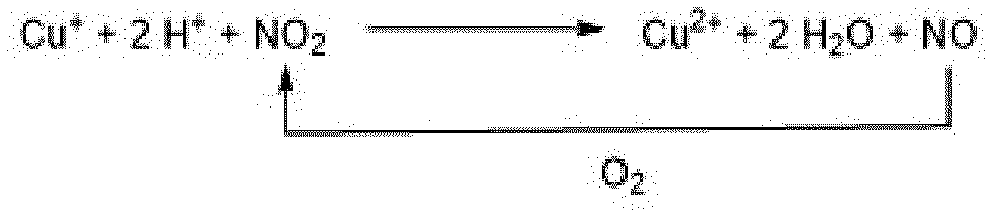
- the present invention proposes the following possible mechanism for the reaction: TEMPO first interacts with Cu 2+ to form intermediate 1, which interacts with alcohol substrate to form intermediate 2, and intermediate 2 simultaneously undergoes ⁇ -H elimination and reduction elimination, and then generates the corresponding aldehyde or ketone compounds, TEMPOH and Cu + at the same time, and then Cu + is oxidized by NO 2 to produce Cu 2+ , TEMPOH is oxidized by Cu 2+ to produce TEMPO and Cu + , realizing the catalytic cycle of TEMPO, and the produced Cu + is reoxidized by NO 2 to Cu 2+ , thus realizing the catalytic cycle of copper, the catalytic cycle of Cu + and Cu 2+ is realized synchronously with the cycle of NO 2 and NO, while the cycle of NO 2 and NO is realized by the oxidation of NO by the addition of oxygen.
- the specific mechanism is shown in the following formula.
- the present invention has the advantage of wide substrate universality.
- the copper salts, TEMPO are used as catalysts, which can not only catalyze and oxidize the common alcohol, benzyl alcohol, allyl alcohol and so on, but also can be used to catalyze and oxidize a series of alcohols with a more complex structure such as propargyl alcohol and allenol.
- the present invention has high catalytic efficiency, for example, when the amount of the catalyst is as low as 2.5 mol% (based on the amount of the alcohol shown in formula (a)), the corresponding aldehyde or ketone compounds can be generated.
- the present invention overcomes the disadvantages of the prior art requiring the use of relatively expensive heavy metal salts as catalysts, harsh reaction conditions, long reaction time, and limited types of catalytic substrates.
- the method proposed by the present invention can be used for laboratory synthesis as well as large-scale industrial production.
- the by-product of the present invention is water, no equivalent or excessive oxidizing agent is required, and no equivalent or excessive waste liquid and waste residue are generated.
- the present invention has cheap and easily available raw materials and mild reaction conditions. Different from the existing oxidation method, the present invention creatively avoids the addition of ligands and metal chlorides, does not generate hydrogen chloride or other waste liquids that have corrosive effects on industrial reactors, and can greatly reduce industrial production costs.
- the present invention uses low-cost, widely available oxygen or air as the oxidant instead of the chemical oxidant used in the traditional oxidant system. Therefore, the reaction conditions for the catalytic oxidation of alcohol to the corresponding aldehyde or ketone compounds in the present invention are extremely mild, and can be carried out only under room temperature, normal pressure, and neutral conditions, and the operation is simple, convenient and easy to control.
- the reaction can proceed smoothly under the conditions of room temperature and an oxygen pressure of 1 atmospheric pressure. Since the oxidant used in the reaction process is oxygen or oxygen in the air, and the by-product is water, the entire reaction process hardly generates any waste gas, waste liquid, and slag that are harmful to the environment. It is a green chemical synthesis method.
- the post-treatment process of the present invention is simple, the product yield is high (the highest can be completely converted), and the production cost is effectively reduced.
Landscapes
- Chemical & Material Sciences (AREA)
- Organic Chemistry (AREA)
- Chemical Kinetics & Catalysis (AREA)
- Engineering & Computer Science (AREA)
- Materials Engineering (AREA)
- Inorganic Chemistry (AREA)
- Organic Low-Molecular-Weight Compounds And Preparation Thereof (AREA)
- Catalysts (AREA)
- Furan Compounds (AREA)
- Low-Molecular Organic Synthesis Reactions Using Catalysts (AREA)
Abstract
Description
- The present invention belongs to the technical field of chemical synthesis, particularly to a copper-catalyzed method and application for preparing aldehydes or ketones by oxidizing alcohols with oxygen as an oxidant.
- As a kind of important raw material for organic synthesis, aldehydes and ketones are widely used in the industry and scientific research area. Oxidation is one of the most basic and important chemical reactions. In industry, aldehydes and ketones are often prepared by the oxidation of alcohols. Therefore, the development of mild conditions, environment-friendly, efficient and convenient catalytic oxidation system has a broad application prospect. Traditional oxidation methods of alcohol compounds often need to use stoichimetric oxidants and produce equivalent industrial waste, which brings great harm to the ecological environment and is not suitable for large-scale industrial production ( Chromium Oxidations in Organic Chemistry; Springer: Berlin, 1984; Regen, S. L.; Koteel, C. J. Am. Chem. Soc. 1977, 99, 3837; Griffith, W. P. Chem. Soc. Rev. 1992, 21, 179; Caron, S.; Dugger, R. W.; Ruggeri, S. G.; Ragan, J. A.; Ripin, D. H. B. Chem. Rev. 2006, 106, 2943.) . Therefore, a series of metal-catalyzed oxidation methods using oxygen or oxygen in the air as oxidants have been developed (Marko, I. E.; Giles, P. R.; Tsukazaki, M.; Brown, S. M.; Urch, C. J. Science 1996, 274, 2044; Dijksman, A.; Arends, I.W. C. E.; Sheldon, R. A. Chem. Commun. 1999, 1591; Shibuya, M.; Tomizawa, M.; Suzuki, I.; Iwabuchi, Y J. Am. Chem. Soc. 2006, 128, 8412; Piera, J.; Backvall, J. E. Angew. Chem. Int. Ed. 2008, 47, 3506; Steves, J. E.; Stahl, S. S. J. Am. Chem. Soc. 2013, 135, 15742; Guan, M.; Wang, C.; Zhang, J.; Zhao, Y RSC Adv. 2014, 4, 48777; Jiang, J.-A.; Du, J.-L.; Wang, Z.-G.; Zhang, Z.-N.; Xu, X.; Zheng, G.-L.; Ji, Y.-F. Tetrahedron Lett. 2014, 55, 1677; Zhang, G.; Yang, C.; Liu, E.; Li, L.; Golen, J. A.; Rheingold, A. L. RSC Adv. 2014, 4, 61907; Wang, D.; Weinstein, A. B.; White, P. B.; Stahl, S. S. Chem. Rev. 2018, 118, 2636). TEMPO, as a cheap, stable and efficient oxygen radical, plays an important role in the oxidation system with iron or copper salts as catalysts (Gamez, P.; Arends, I. W.C.E.; Reedijk, J.; Sheldon, R. A. Chem. Commun. 2003, 2414; Ma, S.; Liu, J.; Li, S.; Chen, B.; Cheng, J.; Kuang, J.; Liu, Y; Wan, B.; Wang, Y; Ye, J.; Yu, Q.; Yuan, W.; Yu, S. Adv. Synth. Catal. 2011 , Hoover, J. M.; Stahl, S. S. J. Am. Chem. Soc. 2011, 133, 16901; 353, 1005; Liu, J.; Ma, S. Org. Lett. 2013, 15, 5150; Liu, J.; Xie, X.; Ma, S. Synthesis 2012, 44, 1569; Jiang, X.; Zhang, J.; Ma, S. J. Am. Chem. Soc. 2016, 138, 8344; Jiang, X.; Ma, S. Synthesis 2018, 50, 1629) .
- The present invention overcomes the disadvantages of using heavy metals as catalysts or chlorides, harsh reaction conditions, long reaction time, limited types of catalytic substrates, use of high temperature and high pressure, etc. in the existing metal-catalyzed oxygen oxidation technology, and provides a method for preparing aldehydes or ketones by oxidizing alcohols with oxygen under 1 atmospheric pressure, using copper salt and nitroxide radicals as catalysts, oxygen is used as oxidant. The method of the present invention has wide sources of raw materials, can avoid the discharge of a large number of chemical reaction wastes, can greatly reduce the cost of the oxidation reaction, and has the beneficial effects of mild reaction, high reaction efficiency, suitability for large-scale production, low cost, and ecological and environmental protection.
- The purpose of the present invention is to provide a method with oxygen as an oxidant with mild reaction conditions, high efficiency, low cost and green for preparing aldehydes or ketones by catalytic oxidation of alcohol.
- The object of the present invention is achieved by using the following solution:
A method for preparing aldehydes or ketones compounds by oxidizing alcohols with oxygen as an oxidant, including at 0-100°C, in an organic solvent, using the alcohol shown in formula (a) as raw material, oxygen or oxygen in the air is used as oxidant, copper salts and nitroxide radicals are used as catalysts, reacting 4-48 hours to oxidize the alcohol to produce aldehyde or ketone compounds shown in formula (b), the reaction process has the following reaction equation (1):
- Preferably, R1 and R2 is a C1-C20 alkyl, a C1-C20 alkyl with functional groups, a C3-C8 cycloalkyl, a phenyl, an aryl, a heterocyclic group, an ethynyl, an alkynyl with functional groups, a vinyl, an alkenyl with functional groups, an allenyl, an allenyl with functional groups; the said aryl is phenyl, thiophene, furan, pyrrole with substituents at the ortho, meta, and para positions; the said substituent is selected from C1-C5 alkyl, ester group (the said ester group including methoxycarbonyl, ethoxycarbonyl), hydroxyl group, acyl group (the said acyl group including formyl, acetyl, benzoyl), acyloxy group (the said acyloxy group including formyloxy, acetoxy, benzoyloxy), nitro group, halogen, carboxyl group, cyano group, methoxyl group; the said heterocyclic group is thienyl, furyl or pyridyl, or thiophene, furan or pyridine with electron-donating or electron-withdrawing substituents;
- wherein, the C1-C20 alkyl with functional group, said the functional group is selected from carbon-carbon double bond, carbon-carbon triple bond, ester group (the said ester group including methoxycarbonyl, ethoxycarbonyl), acyl group (the said acyl group including formyl, acetyl, benzoyl), acyloxy group (the said acyloxy group including formyloxy, acetoxy, benzoyloxy), amido (the said amido including acetamide, benzamide), halogen, carboxyl group, cyano group, phenyl, aryl, thienyl, furyl; the alkynyl with functional group, the alkenyl with functional group, and the allenyl with functional group, said the functional group is selected from C1-C20 alkyl, C3-C6 cycloalkyl, carbon-carbon double bond, carbon-carbon triple bond, ester group (the said ester group including methoxycarbonyl, ethoxycarbonyl), acyl group (the said acyl group including formyl, acetyl, benzoyl), acyloxy group (the said acyloxy group including formyloxy, acetoxy, benzoyloxy), amido (the said amido including acetamide, benzamide), halogen, carboxyl group, cyano group, phenyl, aryl, thienyl, furyl, silicon group; all aryl groups in the above definition of functional group is a phenyl, thiophene, furan, pyrrole with substituents at the ortho, meta, and para positions, the said substituent is selected from C1-C5 alkyl, ester group (the said ester group including methoxycarbonyl, ethoxycarbonyl), hydroxyl group, acyl group (the said acyl group including formyl, acetyl, benzoyl), acyloxy group (the said acyloxy group including formyloxy, acetoxy, benzoyloxy), nitro group, halogen, carboxyl group, cyano group, methoxyl group;
- more preferably, R1 and R2 is a C1-C16 alkyl, a C1-C16 alkyl with functional groups, a C3-C6 cycloalkyl, a phenyl, an aryl (the said aryl is a phenyl with substituents at the ortho, meta, and para positions, the said substituent is selected from methoxycarbonyl, hydroxyl group, nitro group, chlorine, bromine, iodine, cyano, methyl, methoxy), a heterocyclic group (the said heterocyclic group is thienyl, furyl), an ethynyl, an alkynyl with functional groups, a vinyl, an alkenyl with functional groups, an allenyl, an allenyl with functional groups;
- wherein, the C1-C16 alkyl with functional groups, the said functional group is selected from carbon-carbon double bond, carbon-carbon triple bond, methoxycarbonyl, ethoxycarbonyl, acetyl, benzoyl, acetoxy, benzoyloxy, benzamide, halogen, carboxyl group, cyano group, phenyl, aryl (the said aryl is a phenyl with substituents at the ortho, meta, and para positions, the said substituent is selected from methoxycarbonyl, hydroxyl group, nitro group, chlorine, bromine, iodine, cyano, methyl, methoxy), thienyl, furyl; the alkynyl with functional groups, the alkenyl with functional groups, and the allenyl with functional groups, said the functional group is selected from C1-C16 alkyl, C3-C6 cycloalkyl, phenyl, p-bromophenyl, o-hydroxyphenyl, thienyl, furyl, trimethylsilyl.
- As a further improvement, the specific operation steps of the present invention are as follows:
- 1) inserting an oxygen balloon into the dry reaction tube, pumping air three times, and adding a copper catalyst, a nitroxide radical, an alcohol organic solvent solution in sequence, or using air to supplement oxygen, or airflow, putting the reaction tube in the 25°C oil bath and stirring for 4-48 hours;
- 2) after the completion of the reaction in step (1), raising the reaction tube from the oil bath, filtering the mixture with silica gel short column, washing with a certain amount of diethyl ether, concentrating, and subjecting to the flash column chromatography, so as to obtain the aldehyde or ketone compounds; said the diethyl ether is based on the amount of alcohol shown in formula (a), and the dosage of the diethyl ether is 3.75-75 mL/mmol; preferably, is 75 mL/mmol.
- As a further improvement, the organic solvent used in the present invention is any one or more of benzene, toluene, dichloromethane (DCM), 1,2-dichloroethane (DCE), 1,1-dichloroethane, 1,2-dichloropropane, 1,3-dichloropropane, nitromethane (MeNO2), diethyl ether (Et2O), ethylene glycol dimethyl ether, tetrahydrofuran (THF) or acetonitrile (MeCN); preferably, is acetonitrile or 1,2-dichloroethane; wherein, said the organic solvent is based on the amount of alcohol shown in formula (a), and the dosage of the organic solvent is 1.0-10.0 mL/mmol; preferably, is 4.0 mL/mmol.
- As a further improvement, the copper salts used in the present invention are any one or more of tetrakiscopper hexa-fluorophosph (Cu(MeCN)4PF6), cuprous chloride, copper bromide, cuprous iodide, copper acetate or copper nitrate trihydrate; preferably, is copper nitrate trihydrate (Cu(NO3)2•3H2O); said the copper salt is based on the amount of alcohol shown in formula (a), and the dosage of the copper salt is 0.025-0.1 mmol/mmol; preferably, is 0.1 mmol/mmol.
- As a further improvement, the nitroxide radicals used in the present invention are any one or more of 2,2,6,6-tetramethylpiperidine oxide, 4-hydroxy-2,2,6,6-tetramethylpiperidine oxide, 4-methoxy-2,2,6,6-tetramethylpiperidine oxide, 4-acetylamino -2,2,6,6-tetramethylpiperidine oxide, 4-oxy-2,2,6,6-tetramethylpiperidine oxide, 4-amino-2,2,6,6-tetramethylpiperidine oxide, N-hydroxymaleimide, 9-azabicyclo [3.3.1] nonane nitroxide radical, 2-azaadamantane nitroxide radical; preferably, is 2,2,6,6-tetramethylpiperidine oxide (TEMPO); said the nitroxide radical is based on the amount of alcohol shown in formula (a), and the dosage of the nitroxide radical is 0.025-0.1 mmol/mmol; preferably, is 0.1 mmol/mmol.
- The present invention proposes a method at room temperature, in an organic solvent, copper nitrate trihydrate (Cu(NO3)2•3H2O), 2,2,6,6-tetramethylpiperidine oxide (TEMPO) or 4-hydroxy-2,2,6,6-tetramethylpiperidine oxide (4-OH-TEMPO) are used as catalysts, oxygen or oxygen in the air are used as oxidant, for preparing aldehydes or ketones by oxidizing alcohols. Through the method of the present invention, in the atmosphere of oxygen in the air or pure oxygen under normal pressure, alcohols with functional groups such as carbon-carbon single bond, carbon-carbon double bonds, carbon-carbon triple bonds and so on can be selectively oxidized, corresponding aldehydes and ketones can be prepared from primary alcohols or secondary alcohols. The present invention has the advantages of simple operations, mild reaction conditions, high yield, wide substrate universality, convenient separation and purification, environmental friendliness and no pollution, and is suitable for industrial production.
- Taking the catalyst 2,2,6,6-tetramethylpiperidine oxide (TEMPO) as an example, the present invention proposes the following possible mechanism for the reaction:
TEMPO first interacts with Cu2+ to form intermediate 1, which interacts with alcohol substrate to form intermediate 2, and intermediate 2 simultaneously undergoes β-H elimination and reduction elimination, and then generates the corresponding aldehyde or ketone compounds, TEMPOH and Cu+ at the same time, and then Cu+ is oxidized by NO2 to produce Cu2+, TEMPOH is oxidized by Cu2+ to produce TEMPO and Cu+, realizing the catalytic cycle of TEMPO, and the produced Cu+ is reoxidized by NO2 to Cu2+, thus realizing the catalytic cycle of copper, the catalytic cycle of Cu+ and Cu2+ is realized synchronously with the cycle of NO2 and NO, while the cycle of NO2 and NO is realized by the oxidation of NO by the addition of oxygen. The specific mechanism is shown in the following formula.
- The present invention has the advantage of wide substrate universality. The copper salts, TEMPO are used as catalysts, which can not only catalyze and oxidize the common alcohol, benzyl alcohol, allyl alcohol and so on, but also can be used to catalyze and oxidize a series of alcohols with a more complex structure such as propargyl alcohol and allenol. The present invention has high catalytic efficiency, for example, when the amount of the catalyst is as low as 2.5 mol% (based on the amount of the alcohol shown in formula (a)), the corresponding aldehyde or ketone compounds can be generated. The present invention overcomes the disadvantages of the prior art requiring the use of relatively expensive heavy metal salts as catalysts, harsh reaction conditions, long reaction time, and limited types of catalytic substrates. The method proposed by the present invention can be used for laboratory synthesis as well as large-scale industrial production.
- Compared with the traditional oxidation method of alcohol compounds, the by-product of the present invention is water, no equivalent or excessive oxidizing agent is required, and no equivalent or excessive waste liquid and waste residue are generated. Compared with the existing oxidation reactions in which other metal salts and nitroxide radicals are used as catalysts, the present invention has cheap and easily available raw materials and mild reaction conditions. Different from the existing oxidation method, the present invention creatively avoids the addition of ligands and metal chlorides, does not generate hydrogen chloride or other waste liquids that have corrosive effects on industrial reactors, and can greatly reduce industrial production costs.
- The present invention uses low-cost, widely available oxygen or air as the oxidant instead of the chemical oxidant used in the traditional oxidant system. Therefore, the reaction conditions for the catalytic oxidation of alcohol to the corresponding aldehyde or ketone compounds in the present invention are extremely mild, and can be carried out only under room temperature, normal pressure, and neutral conditions, and the operation is simple, convenient and easy to control. The reaction can proceed smoothly under the conditions of room temperature and an oxygen pressure of 1 atmospheric pressure. Since the oxidant used in the reaction process is oxygen or oxygen in the air, and the by-product is water, the entire reaction process hardly generates any waste gas, waste liquid, and slag that are harmful to the environment. It is a green chemical synthesis method. The post-treatment process of the present invention is simple, the product yield is high (the highest can be completely converted), and the production cost is effectively reduced.
- With reference to the following specific embodiments, the present invention will be further described in detail, and the protection of the present invention is not limited to the following embodiments. Without departing from the spirit and scope of the inventive concept, changes and advantages that those skilled in the field can think of are all included in the present invention, and the appended claims are the protection scope. The processes, conditions, reagents, experimental methods and so on, for implementing the present invention, except for the content specifically mentioned below, are common knowledge and common knowledge in the field, and the present invention has no special limitations. The following examples are helpful to understand the present invention, but do not limit the protection scope of the present invention.
wherein, in the following example reaction formula, "equiv" represents equivalent; "mol" represents mole; "Cu(NO3)2•3H2O" represents copper nitrate trihydrate(II); "TEMPO" represents 2,2,6,6-tetramethylpiperidine oxide; "4-OH-TEMPO" represents 4-hydroxy-2,2,6,6-tetramethylpiperidine oxide; "MeCN" represents acetonitrile; "DCE" represents 1,2-dichloroethane; "NMP" represents N-methylpyrrolidone; "MeNO2" represents nitromethane; "THF" represents tetrahydrofuran; "Et2O" represents diethyl ether; "DCM" represents dichloromethane; "Cu(MeCN)4PF6" represents tetrakiscopper hexa-fluorophosph; "CuCl" represents cuprous chloride(I); "CuBr2" represents copper bromide(II); "CuI" represents cuprous iodide(I); "Cu(OAc)2" represents copper acetate (II); "rt" represents the room temperature; "O2 balloon" represents the reaction is carried out in the oxygen atmosphere provided by the oxygen balloon; "air bag" represents the reaction is carried out in the air atmosphere provided by the air bag; "O2 bag" represents the reaction is carried out in the atmosphere of oxygen supplement in the oxygen bag; "min" represents minute; "h" represents hour; the boiling range of petroleum ether is 60-90°C; the NMR yield is determined by 1H NMR; the internal standard is dibromomethane, and the mesh number of silica gel is 300-400. -

- An oxygen balloon was inserted into the dry reaction tube, pumped O2 for three times, Cu(NO3)2•3H2O (24.6 mg, 0.1 mmol), TEMPO (16.2 mg, 0.1 mmol), and 1b (146.4 mg, 1.0 mmol) of MeCN solution (4 mL) were added sequentially. The reaction tube was stirred at 25 °C for 6 h. The mixture solution was filtered through a short column of silica gel (2cm), and washed with ethyl ether, rotary evaporation to remove the solvent. The mixture solution was separated and purified by column chromatography on silica gel (eluent: petroleum ether/ethyl ether = 60/1), to afford 2b (130.7 mg, 91%): white solid. Melting point: 44.2-44.7 °C (petroleum ether/ethyl acetate recrystallization); 1H NMR (400 MHz, CDCl3): δ = 8.06 (d, J = 8.4 Hz, 2 H, ArH), 7.29 (d, J = 8.0 Hz, 2 H, ArH), 3.40 (s, 3 H, CH3), 2.44 (s, 1 H, ≡CH); 13C NMR (100 MHz, CDCl3): δ = 177.0, 145.7, 133.8, 129.8, 129.4, 80.34, 80.28, 21.8; MS (70 eV, EI) m/z (%): 144 (M+, 74.75), 115 (100); IR (neat): v = 3257, 2090, 1632, 1594, 1459, 1404, 1310, 1246, 1167, 1117 cm-1.
-

- Operations were conducted by referring to Example 1. Cu(NO3)2•3H2O (24.0 mg, 0.1 mmol), TEMPO (16.1 mg, 0.1 mmol), 1c (161.8 mg, 1.0 mmol), MeCN (4 mL), reacted 12.5 hours to afford 2c (134.0 mg, 84%) (eluent: petroleum ether/ethyl acetate = 30/1): oily liquid; 1H NMR (400 MHz, CDCl3): δ = 8.06 (dd, J 1 = 7.8 Hz, J 2 = 1.8 Hz, 1 H, ArH), 7.55 (td, J 1 = 8.0 Hz, J 2 = 1.8 Hz, 1 H, ArH), 7.07-6.97 (m, 2 H, ArH), 3.94 (s, 3 H, CH3), 3.37 (s, 1 H, ≡CH); 13C NMR (100 MHz, CDCl3): δ = 175.8, 159.8, 135.4, 132.9, 125.5, 120.1, 112.0, 81.9, 79.5, 55.6; MS (70 eV, EI) m/z (%): 161 (M++1, 7.26), 160 (M+, 64.37), 131 (100); IR (neat): v = 3234, 2089, 1647, 1595, 1573, 1484, 1462, 1434, 1286, 1253, 1224, 1164, 1116, 1019 cm-1.
-

- Operations were conducted by referring to Example 1. Cu(NO3)2•3H2O (24.1 mg, 0.1 mmol), TEMPO (16.3 mg, 0.1 mmol), 1d (162.2 mg, 1.0 mmol), MeCN (4 mL), reacted 13 hours to afford 2d (142.6 mg, 89%) (eluent: petroleum ether/ethyl acetate = 30/1): oily liquid; 1H NMR (400 MHz, CDCl3): δ = 7.80 (d, J = 7.6 Hz, 1 H, ArH), 7.64 (s, 1 H, ArH), 7.42 (t, J = 8.0 Hz, 1 H, ArH), 7.19 (dd, J 1 = 8.4 Hz, J 2 = 2.0 Hz, 1 H, ArH), 3.87 (s, 3 H, CH3), 3.43 (s, 1 H, ≡CH); 13C NMR (100 MHz, CDCl3): δ = 177.1, 159.8, 137.4, 129.7, 122.9, 121.4, 112.8, 80.6, 80.3, 55.4; MS (70 eV, EI) m/z (%): 161 (M++1, 11.54), 160 (M+, 100); IR (neat): v = 3250, 2094, 1644, 1595, 1581, 1485, 1429, 1323, 1264, 1207, 1177, 1021, 1012 cm-1.
-

- Operations were conducted by referring to Example 1. Cu(NO3)2•3H2O (24.6 mg, 0.1 mmol), TEMPO (16.0 mg, 0.1 mmol), 1e (161.8 mg, 1.0 mmol), MeCN (4 mL), reacted 6 hours to afford 2e (143.6 mg, 90%) (eluent: petroleum ether/ethyl acetate = 25/1): white solid. Melting point: 85.5-86.5 °C (petroleum ether/ethyl acetate recrystallization); 1H NMR (400 MHz, CDCl3): δ = 8.13 (d, J = 9.2 Hz, 2 H, ArH), 6.97 (d, J = 8.8 Hz, 2 H, ArH), 3.90 (s, 3 H, CH3), 3.38 (s, 1 H, ≡CH); 13C NMR (100 MHz, CDCl3): δ = 175.8, 164.7, 132.0, 129.4, 113.8, 80.3, 80.1, 55.5; MS (70 eV, EI) m/z (%):161 (M++1, 11.17), 160 (M+, 100); IR (neat): v = 3248, 2091, 1638, 1596, 1570, 1507, 1421, 1254, 1168, 1116, 1022, 1008 cm-1.
-

- Operations were conducted by referring to Example 1. Cu(NO3)2•3H2O (24.0 mg, 0.1 mmol), TEMPO (15.8 mg, 0.1 mmol), If (190.2 mg, 1.0 mmol), MeCN (4 mL), reacted 12.5 hours to afford 2f (170.3 mg, 90%) (eluent: petroleum ether/ethyl acetate = 30/1): white solid. Melting point: 117.0-118.3 °C (petroleum ether/ethyl acetate recrystallization); 1H NMR (400 MHz, CDCl3): δ = 8.22 (d, J = 8.4 Hz, 2 H, ArH), 8.16 (d, J = 8.4 Hz, 2 H, ArH), 3.97 (s, 3 H, CH3), 3.53 (s, 1 H, ≡CH); 13C NMR (100 MHz, CDCl3): δ = 176.6, 165.9, 139.0, 135.0, 129.8, 129.4, 81.8, 80.0, 52.5; MS (70 eV, EI) m/z (%):189 (M++1, 5.41), 188 (M+, 41.74), 157 (100); IR (neat): v = 3217, 2096, 1717, 1636, 1606, 1437, 1275, 1233, 1195, 1119, 1006 cm-1.
-

- Operations were conducted by referring to Example 1. Cu(NO3)2•3H2O (24.4 mg, 0.1 mmol), TEMPO (15.8 mg, 0.1 mmol), 1g (137.8 mg, 1.0 mmol), MeCN (4 mL), reacted 6 hours to afford 2g (118.4 mg, 87%) (eluent: petroleum ether/ethyl acetate = 30/1): white solid. Melting point: 32.4-34.0 °C (petroleum ether/ethyl acetate recrystallization); 1H NMR (400 MHz, CDCl3): δ = 7.97 (dd, J 1 = 3.8 Hz, J 2 = 0.6 Hz, 1 H, ArH), 7.75 (dd, J 1 = 4.8 Hz, J 2 = 0.8 Hz, 1 H, ArH), 7.18 (t, J = 4.2 Hz, 1 H, ArH), 3.37 (s, 1 H, ≡CH); 13C NMR (100 MHz, CDCl3): δ = 169.0, 144.0, 136.1, 135.9, 128.4, 79.8, 79.3; MS (70 eV, EI) m/z (%): 136 (M+, 100), 108 (95.16); IR (neat): v = 3244, 3103, 2095, 1616, 1512, 1406, 1354, 1266, 1231, 1201, 1082, 1051 cm-1.
-

- Operations were conducted by referring to Example 1. Cu(NO3)2•3H2O (24.0 mg, 0.1 mmol), TEMPO (16.0 mg, 0.1 mmol), 1h (182.1 mg, 1.0 mmol), DCE (4 mL), reacted 8 hours to afford 2h (160.4 mg, 89%) (eluent: petroleum ether/ethyl ether = 40/1): oily liquid; 1H NMR (400 MHz, CDCl3): δ = 3.20 (s, 1 H, CH), 2.58 (t, J= 7.4 Hz, 2 H, CH2), 1.73-1.60 (m, 2 H, CH2), 1.40-1.16 (m, 12 H, 6×CH2), 0.88 (t, J = 6.8 Hz, 3 H, CH3); 13C NMR (100 MHz, CDCl3): δ = 187.5, 81.4, 78.2, 45.4, 31.8, 29.3, 29.22, 29.17, 28.8, 23.7, 22.6, 14.0.
-

- Operations were conducted by referring to Example 1. Cu(NO3)2•3H2O (23.9 mg, 0.1 mmol), TEMPO (16.1 mg, 0.1 mmol), 1a (187.2 mg, 1.0 mmol), MeCN (4 mL), reacted 4 hours to afford 2a (177.4 mg, 96%) (eluent: petroleum ether/ethyl ether = 30/1): oily liquid; 1H NMR (400 MHz, CDCl3): δ = 8.14 (d, J = 7.2 Hz, 2 H, ArH), 7.60 (t, J = 7.2 Hz, 1 H, ArH), 7.48 (t, J = 7.8 Hz, 2 H, ArH), 2.51 (t, J = 70 Hz, 2 H, CH2), 1.74-1.58 (m, 2 H, CH2), 1.58-1.42 (m, 2 H, CH2), 0.97 (t, J = 7.4 Hz, 3 H, CH3); 13C NMR (100 MHz, CDCl3): δ = 178.2, 136.9, 133.8, 129.5, 128.4, 96.8, 79.6, 29.8, 22.0, 18.8, 13.4; MS (70 eV, EI) m/z (%): 186 (M+, 12.46), 144 (100); IR (neat): v = 2957, 2933, 2868, 2232, 2200, 1641, 1588, 1452, 1314, 1257, 1172 cm-1.
-

- Operations were conducted by referring to Example 1. Cu(NO3)2•3H2O (24.0 mg, 0.1 mmol), TEMPO (16.0 mg, 0.1 mmol), 1a (188.0 mg, 1.0 mmol), DCE (4 mL), reacted 7 hours to afford 2a (185.2 mg, 100%) (eluent: petroleum ether/ethyl ether = 40/1): oily liquid; 1H NMR (400 MHz, CDCl3): δ = 8.18-8.10 (m, 2 H, ArH), 7.63-7.57 (m, 1 H, ArH), 7.48 (t, J= 7.8 Hz, 2 H, ArH), 2.51 (t, J= 7.0 Hz, 2 H, CH2), 1.74-1.58 (m, 2 H, CH2), 1.58-1.42 (m, 2 H, CH2), 0.97 (t, J = 7.6 Hz, 3 H, CH3); 13C NMR (100 MHz, CDCl3): δ = 178.1, 136.8, 133.8, 129.4, 128.4, 96.7, 79.6, 29.7, 22.0, 18.8, 13.4.
-

- Operations were conducted by referring to Example 1. Cu(NO3)2•3H2O (24.2 mg, 0.1 mmol), TEMPO (15.8 mg, 0.1 mmol), 1i (172.2 mg, 1.0 mmol), MeCN (4 mL), reacted 7 hours to afford 2i (166.6 mg, 98%) (eluent: petroleum ether/ethyl ether = 30/1): oily liquid; 1H NMR (400 MHz, CDCl3): δ = 8.16-8.05 (m, 2 H, ArH), 7.59 (t, J = 7.4 Hz, 1 H, ArH), 7.47 (t, J = 7.6 Hz, 2 H, ArH), 1.64-1.48 (m, 1 H, CH), 1.12-0.96 (m, 4 H, CH2CH2); 13C NMR (100 MHz, CDCl3): δ = 177.7, 136.8, 133.6, 129.2, 128.3, 101.0, 75.4, 9.7, -0.2; MS (70 eV, EI) m/z (%):170 (M++1, 10.75), 170 (M+, 70.44), 141 (100); IR (neat): v = 2207, 1635, 1596, 1579, 1449, 1356, 1311, 1264, 1172, 1046, 1023 cm-1.
-

- Operations were conducted by referring to Example 1. Cu(NO3)2•3H2O (24.2 mg, 0.1 mmol), TEMPO (16.0 mg, 0.1 mmol), 1i (172.3 mg, 1.0 mmol), DCE (4 mL), reacted 6 hours to afford 2i (163.5 mg, 96%) (eluent: petroleum ether/ethyl ether = 30/1): oily liquid; 1H NMR (400 MHz, CDCl3): δ = 8.20-8.05 (m, 2 H, ArH), 7.65-7.54 (m, 1 H, ArH), 7.47 (t, J = 7.6 Hz, 2 H, ArH), 1.66-1.48 (m, 1 H, CH), 1.13-0.94 (m, 4 H, CH2CH2); 13C NMR (100 MHz, CDCl3): δ = 177.8, 136.8, 133.6, 129.3, 128.3, 101.0, 75.4, 9.8, -0.1.
-

- Operations were conducted by referring to Example 1. Cu(NO3)2•3H2O (24.4 mg, 0.1 mmol), TEMPO (16.1 mg, 0.1 mmol), 1j (209.8 mg, 1.0 mmol), MeCN (4 mL), reacted 7 hours to afford 2j (203.4 mg, 98%) (eluent: petroleum ether/ethyl ether = 30/1): white solid. Melting point: 45.3-46.6 °C (petroleum ether/ethyl acetate recrystallization); 1H NMR (400 MHz, CDCl3): δ = 8.23 (d, J = 7.6 Hz, 2 H, ArH), 7.70 (d, J = 6.8 Hz, 2 H, ArH), 7.64 (t, J = 7.4 Hz, 1 H, ArH), 7.57-7.48 (m, 3 H, CH3), 7.43 (t, J = 7.2 Hz, 2 H, ArH); 13C NMR (100 MHz, CDCl3): δ = 177.8, 136.7, 134.0, 132.9, 130.7, 129.4, 128.54, 128.48, 119.9, 93.0, 86.8; MS (70 eV, EI) m/z (%): 206 (M+, 65.85), 178 (100); IR (neat): v = 2195, 1637, 1597, 1579, 1488, 1447, 1313, 1282, 1207, 1171, 1031, 1010 cm-1.
-

-

- Operations were conducted by referring to Example 1. Cu(NO3)2•3H2O (24.4 mg, 0.1 mmol), TEMPO (15.9 mg, 0.1 mmol), 1k (204.1 mg, 1.0 mmol), DCE (4 mL), reacted 10.5 hours to afford 2k (191.5 mg, 95%) (eluent: petroleum ether/ethyl ether = 60/1): oily liquid; 1H NMR (400 MHz, CDCl3): δ = 8.20-8.10 (m, 2 H, ArH), 7.62 (t, J = 7.6 Hz, 1 H, ArH), 7.49 (t, J = 7.6 Hz, 2 H, ArH), 0.33 (s, 9 H, 3×CH3); 13C NMR (100 MHz, CDCl3): δ = 177.6, 136.4, 134.1, 129.6, 128.5, 100.8, 100.5, -0.7.
-

- Operations were conducted by referring to Example 1. Cu(NO3)2•3H2O (24.4 mg, 0.1 mmol), TEMPO (16.0 mg, 0.1 mmol), 11 (222.8 mg, 1.0 mmol), MeCN (4 mL), reacted 4 hours to afford 21 (213.9 mg, 97%) (eluent: petroleum ether/ethyl ether = 30/1): oily liquid; 1H NMR (400 MHz, CDCl3): δ = 8.10 (t, J = 1.8 Hz, 1 H, ArH), 8.02 (d, J = 7.6 Hz, 1 H, ArH), 7.57 (dt, J 1 = 7.6 Hz, J 1 = 1.2 Hz, 1 H, ArH), 7.43 (t, J = 7.8 Hz, 1 H, ArH), 2.52 (t, J = 7.0 Hz, 2 H, CH2), 1.74-1.60 (m, 2 H, CH2), 1.58-1.44 (m, 2 H, CH2), 0.97 (t, J= 7.4 Hz, 3 H, CH3); 13C NMR (100 MHz, CDCl3): δ = 176.6, 138.3, 134.7, 133.6, 129.8, 129.3, 127.5, 97.7, 79.2, 29.6, 22.0, 18.8, 13.4; MS (70 eV, EI) m/z (%): 222 (M+ (37Cl), 10.02), 220 (M+ (35Cl), 29.95), 139 (100); IR (neat): v = 2959, 2933, 2871, 2204, 1645, 1571, 1424, 1286, 1245 cm-1; HRMS calcd for C13H13O35Cl [M+]: 220.0655, found: 220.0657.
-

- Operations were conducted by referring to Example 1. Cu(NO3)2•3H2O (24.0 mg, 0.1 mmol), TEMPO (15.9 mg, 0.1 mmol), 11 (222.5 mg, 1.0 mmol), DCE (4 mL), reacted 23 hours to afford 21 (216.2 mg, 98%) (eluent: petroleum ether/ethyl ether = 30/1): oily liquid; 1H NMR (400 MHz, CDCl3): δ = 8.10 (t, J = 1.8 Hz, 1 H, ArH), 8.02 (d, J = 7.6 Hz, 1 H, ArH), 7.60-7.53 (m, 1 H, ArH), 7.42 (t, J = 7.8 Hz, 1 H, ArH), 2.52 (t, J = 7.0 Hz, 2 H, CH2), 1.74-1.60 (m, 2 H, CH2), 1.58-1.44 (m, 2 H, CH2), 0.98 (t, J = 7.4 Hz, 3 H, CH3); 13C NMR (100 MHz, CDCl3): δ = 176.6, 138.4, 134.7, 133.6, 129.8, 129.3, 127.5, 97.7, 79.2, 29.7, 22.0, 18.8, 13.4.
-

- Operations were conducted by referring to Example 1. Cu(NO3)2•3H2O (24.4 mg, 0.1 mmol), TEMPO (16.0 mg, 0.1 mmol), 1m (266.2 mg, 1.0 mmol), MeCN (4 mL), reacted 6 hours to afford 2m (257.4 mg, 97%) (eluent: petroleum ether/ethyl ether = 30/1): oily liquid; 1H NMR (400 MHz, CDCl3): δ = 8.00 (d, J = 7.6 Hz, 1 H, ArH), 7.67 (d, J= 8.0 Hz, 1 H, ArH), 7.47-7.31 (m, 2 H, ArH), 2.48 (t, J= 7.0 Hz, 2 H, CH2), 1.70-1.56 (m, 2 H, CH2), 1.55-1.41 (m, 2 H, CH2), 0.95 (t, J = 7.4 Hz, 3 H, CH3); 13C NMR (100 MHz, CDCl3): δ = 177.5, 137.4, 134.8, 133.0, 132.7, 127.2, 120.9, 98.0, 80.6, 29.5, 22.0, 18.9, 13.4; MS (70 eV, EI) m/z (%): 266 (M+ (81Br), 9.56), 264 (M+ (79Br), 9.29), 185 (100); IR (neat): v = 2187, 1648, 1580, 1474, 1386, 1262, 1063, 1008 cm-1.
-

- Operations were conducted by referring to Example 1. Cu(NO3)2•3H2O (24.4 mg, 0.1 mmol), TEMPO (16.0 mg, 0.1 mmol), 1m (267.2 mg, 1.0 mmol), DCE (4 mL), reacted 4.5 hours to afford 2m (260.6 mg, 98%) (eluent: petroleum ether/ethyl ether = 30/1): oily liquid; 1H NMR (400 MHz, CDCl3): δ = 8.00 (dd, J 1 = 8.0 Hz, J 2 = 1.6 Hz, 1 H, ArH), 7.67 (d, J = 8.0 Hz, 1 H, ArH), 7.42 (td, J 1 = 7.2 Hz, J 2 = 1.2 Hz, 1 H, ArH), 7.35 (td, J 1 = 7.6 Hz, J 2 = 1.6 Hz, 1 H, ArH), 2.48 (t, J = 7.0 Hz, 2 H, CH2), 1.70-1.56 (m, 2 H, CH2), 1.55-1.41 (m, 2 H, CH2), 0.95 (t, J = 7.2 Hz, 3 H, CH3); 13C NMR (100 MHz, CDCl3): δ = 177.5, 137.3, 134.7, 133.0, 132.7, 127.1, 120.8, 97.9, 80.6, 29.5, 21.9, 18.9, 13.4.
-

- Operations were conducted by referring to Example 1. Cu(NO3)2•3H2O (24.4 mg, 0.1 mmol), TEMPO (16.0 mg, 0.1 mmol), In (222.8 mg, 1.0 mmol), MeCN (4 mL), reacted 4 hours to afford 2n (214.3 mg, 100%) (eluent: petroleum ether/ethyl ether = 20/1): oily liquid; 1H NMR (400 MHz, CDCl3): δ = 8.11 (d, J = 8.4 Hz, 2 H, ArH), 6.95 (d, J = 8.4 Hz, 2 H, ArH), 3.89 (s, 3 H, CH3), 2.49 (t, J = 7.2 Hz, 2 H, CH2), 1.72-1.56 (m, 2 H, CH2), 1.54-1.46 (m, 2 H, CH2), 0.97 (t, J = 7.2 Hz, 3 H, CH3); 13C NMR (100 MHz, CDCl3): δ = 176.8, 164.2, 131.8, 130.2, 113.6, 95.8, 79.5, 55.4, 29.8, 22.0, 18.7, 13.4.
-

- Operations were conducted by referring to Example 1. Cu(NO3)2•3H2O (24.4 mg, 0.1 mmol), TEMPO (16.0 mg, 0.1 mmol), In (218.5 mg, 1.0 mmol), DCE (4 mL), reacted 4 hours to afford 2n (209.6 mg, 97%) (eluent: petroleum ether/ethyl ether = 30/1(300 mL), petroleum ether/ethyl ether = 15/1): oily liquid; 1H NMR (400 MHz, CDCl3): δ = 8.11 (d, J = 8.8 Hz, 2 H, ArH), 6.95 (d, J = 8.8 Hz, 2 H, ArH), 3.89 (s, 3 H, CH3), 2.49 (t, J = 7.6 Hz, 2 H, CH2), 1.72-1.58 (m, 2 H, CH2), 1.56-1.44 (m, 2 H, CH2), 0.96 (t, J = 7.4 Hz, 3 H, CH3); 13C NMR (100 MHz, CDCl3): δ = 176.9, 164.2, 131.8, 130.2, 113.6, 95.8, 79.5, 55.4, 29.8, 22.0, 18.7, 13.4.
-
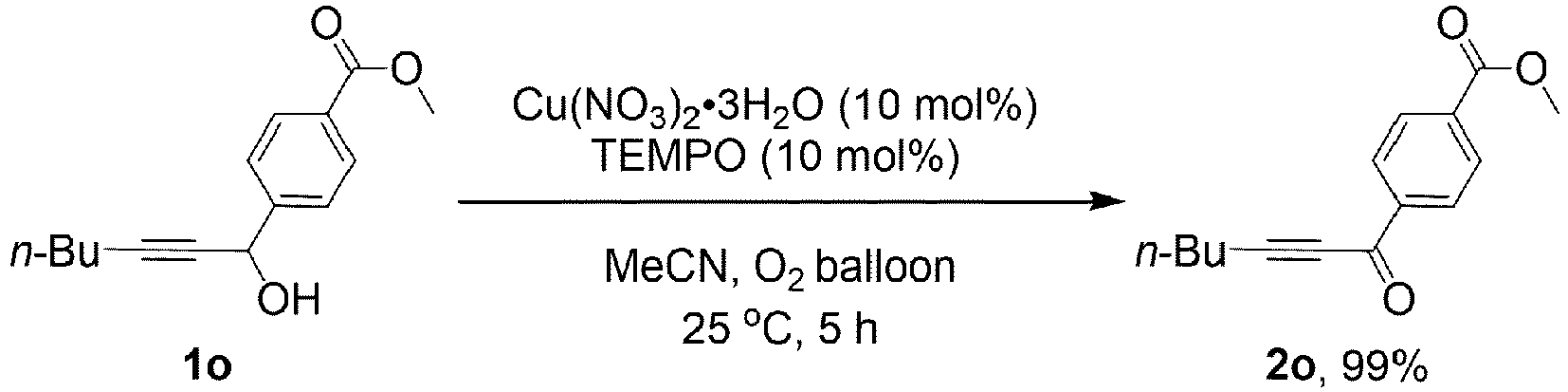
- Operations were conducted by referring to Example 1. Cu(NO3)2•3H2O (24.2 mg, 0.1 mmol), TEMPO (15.9 mg, 0.1 mmol), 1o (246.3 mg, 1.0 mmol), MeCN (4 mL), reacted 5 hours to afford 2o (243.0 mg, 99%) (eluent: petroleum ether/ethyl ether = 20/1): oily liquid; 1H NMR (400 MHz, CDCl3): δ = 8.19 (d, J = 8.8 Hz, 2 H, ArH), 8.13 (d, J = 8.8 Hz, 2 H, ArH), 3.96 (s, 3 H, CH3), 2.53 (t, J = 7.2 Hz, 2 H, CH2), 1.73-1.62 (m, 2 H, CH2), 1.58-1.45 (m, 2 H, CH2), 0.98 (t, J = 7.4 Hz, 3 H, CH3); 13C NMR (100 MHz, CDCl3): δ = 177.1, 165.9, 139.8, 134.3, 129.5, 129.2, 97.9, 79.4, 52.3, 29.6, 21.9, 18.8, 13.3; MS (70 eV, EI) m/z (%): 244 (M+, 14.91), 202 (100); IR (neat): v = 2956, 2933, 2872, 2237, 2198, 1724, 1646, 1435, 1407, 1276, 1259, 1244, 1116, 1102, 1017 cm-1; HRMS calcd. for C15H16O3 (M+): 244.1099; Found: 244.1099.
-

- Operations were conducted by referring to Example 1. Cu(NO3)2•3H2O (24.2 mg, 0.1 mmol), TEMPO (16.0 mg, 0.1 mmol), 1p (224.2 mg, 1.0 mmol), DCE (4 mL), reacted 8 hours to afford 2p (180.1 mg, 81%) (eluent: petroleum ether/ethyl ether = 60/1): yellow solid. Melting point: 64.0-65.6 °C (petroleum ether/ethyl acetate recrystallization); 1H NMR (400 MHz, CDCl3): δ = 11.75 (s, 1 H, OH), 8.13 (d, J = 8.4 Hz, 1 H, ArH), 7.76-7.64 (m, 2 H, ArH), 7.58-7.38 (m, 4 H, ArH), 7.00 (t, J = 80 Hz, 2 H, ArH); 13C NMR (100 MHz, CDCl3): δ = 182.2, 162.7, 137.1, 133.1, 133.0, 131.1, 128.7, 120.7, 119.6, 119.4, 118.1, 96.0, 85.6.
-

- Operations were conducted by referring to Example 1. Cu(NO3)2•3H2O (24.1 mg, 0.1 mmol), TEMPO (16.0 mg, 0.1 mmol), 1q (213.0 mg, 1.0 mmol), MeCN (4 mL), reacted 6 hours to afford 2q (194.8 mg, 92%) (eluent: petroleum ether/ethyl ether = 20/1): oily liquid; 1H NMR (400 MHz, CDCl3): δ = 8.42 (s, 1 H, ArH), 8.34 (dd, J 1 = 8.0 Hz, J 2 = 1.2 Hz, 1 H, ArH), 7.87 (d, J= 7.6 Hz, 1 H, ArH), 7.63 (t, J= 7.8 Hz, 1 H, ArH), 2.55 (t, J = 7.0 Hz, 2 H, CH2), 1.75-1.63 (m, 2 H, CH2), 1.62-1.45 (m, 2 H, CH2), 0.98 (t, J = 7.2 Hz, 3 H, CH3); 13C NMR (100 MHz, CDCl3): δ = 175.6, 137.4, 136.5, 133.1, 132.9, 129.5, 117.7, 112.9, 98.9, 78.8, 29.5, 21.9, 18.8, 13.3; MS (70 eV, EI) m/z (%): 211 (M+, 7.31), 169 (100); IR (neat): v = 2959, 2933, 2872, 2219, 2200, 1647, 1598, 1579, 1465, 1427, 1292, 1265, 1180 cm-1; HRMS calcd. for C14H13NO (M+): 211.0997; Found: 211.0993.
-

- Operations were conducted by referring to Example 1. Cu(NO3)2•3H2O (24.4 mg, 0.1 mmol), TEMPO (15.7 mg, 0.1 mmol), 1r (233.3 mg, 1.0 mmol), MeCN (4 mL), reacted 7 hours to afford 2r (223.7 mg, 97%) (eluent: petroleum ether/ethyl ether = 40/1): oily liquid; 1H NMR (400 MHz, CDCl3): δ = 8.33 (d, J = 9.2 Hz, 2 H, ArH), 8.29 (d, J = 9.2 Hz, 2 H, ArH), 2.55 (t, J = 70 Hz, 2 H, CH2), 1.73-1.64 (m, 2 H, CH2), 1.56-1.46 (m, 2 H, CH2), 0.98 (t, J= 7.2 Hz, 3 H, CH3); 13C NMR (100 MHz, CDCl3): δ = 175.8, 150.6, 140.9, 130.2, 123.5, 99.3, 79.2, 29.5, 21.9, 18.8, 13.3; MS (70 eV, EI) m/z (%): 231 (M+, 4.21), 189 (100); IR (neat): v = 2959, 2934, 2871, 2237, 2199, 1650, 1602, 1524, 1343, 1320, 1257, 1104 cm-1.
-

- Operations were conducted by referring to Example 1. Cu(NO3)2•3H2O (24.2 mg, 0.1 mmol), TEMPO (16.0 mg, 0.1 mmol), 1s (177.8 mg, 1.0 mmol), MeCN (4 mL), reacted 10 hours to afford 2s (162.5 mg, 92%) (eluent: petroleum ether/ethyl ether = 10/1): oily liquid; 1H NMR (400 MHz, CDCl3): δ = 7.65 (s, 1 H, H from furyl), 7.32 (d, J = 3.2 Hz, 1 H, H from furyl), 6.56 (dd, J 1 = 3.6 Hz, J 2 = 1.6 Hz, 1 H, H from furyl), 2.47 (t, J = 7.0 Hz, 2 H, CH2), 1.74-1.58 (m, 2 H, CH2), 1.56-1.42 (m, 2 H, CH2), 0.96 (t, J = 7.2 Hz, 3 H, CH3); 13C NMR (100 MHz, CDCl3): δ = 164.9, 153.1, 147.6, 120.6, 112.4, 95.4, 78.8, 29.5, 21.8, 18.6, 13.3; MS (70 eV, EI) m/z (%): 176 (M+, 27.69), 95 (100); IR (neat): v = 2957, 2933, 2868, 2251, 2207, 1631, 1562, 1460, 1390, 1294, 1168, 1123, 1014 cm-1.
-

- Operations were conducted by referring to Example 1. Cu(NO3)2•3H2O (24.0 mg, 0.1 mmol), TEMPO (16.0 mg, 0.1 mmol), 1s (178.5 mg, 1.0 mmol), DCE(4mL), reacted 10 hours to afford 2s (168.0 mg, 95%) (eluent: petroleum ether/ethyl ether = 15/1): oily liquid; 1H NMR (400 MHz, CDCl3): δ = 7.64 (s, 1 H, H from furyl), 7.31 (d, J = 3.2 Hz, 1 H, H from furyl), 6.56 (t, J = 1.6 Hz, 1 H, H from furyl), 2.47 (t, J = 7.0 Hz, 2 H, CH2), 1.70-1.56 (m, 2 H, CH2), 1.56-1.43 (m, 2 H, CH2), 0.96 (t, J = 7.2 Hz, 3 H, CH3); 13C NMR (100 MHz, CDCl3): δ = 164.4, 152.7, 147.2, 120.1, 111.9, 94.9, 78.4, 29.1, 21.4, 18.2, 12.9.
-

- Operations were conducted by referring to Example 1. Cu(NO3)2•3H2O (23.8 mg, 0.1 mmol), TEMPO (15.9 mg, 0.1 mmol), It (169.1 mg, 1.0 mmol), MeCN (4 mL), reacted 9.5 hours to afford 2t (160.1 mg, 96%) (eluent: petroleum ether/ethyl ether = 60/1): oily liquid; 1H NMR (400 MHz, CDCl3): δ = 2.53 (t, J = 7.4 Hz, 2 H, CH2), 2.37 (t, J = 7.0 Hz, 2 H, CH2), 1.70-1.50 (m, 4 H, CH2CH2), 1.50-1.25 (m, 4 H, CH2CH2), 1.00-0.86 (m, 6 H, 2×CH3); 13C NMR (100 MHz, CDCl3): δ = 188.3, 94.0, 80.7, 45.1, 29.6, 26.1, 22.0, 21.8, 18.4, 13.6, 13.3.
-

- Operations were conducted by referring to Example 1. Cu(NO3)2•3H2O (24.0 mg, 0.1 mmol), TEMPO (16.0 mg, 0.1 mmol), It (168.6 mg, 1.0 mmol), DCE(4mL), reacted 9 hours to afford 2t (158.8 mg, 95%) (eluent: petroleum ether/ethyl ether = 40/1): oily liquid; 1H NMR (400 MHz, CDCl3): δ = 2.53 (t, J = 7.4 Hz, 2 H, CH2), 2.37 (t, J = 7.0 Hz, 2 H, CH2), 1.70-1.50 (m, 4 H, CH2-CH2), 1.50-1.17 (m, 4 H, CH2-CH2), 0.98-0.88 (m, 6 H, 2×CH3); 13C NMR (100 MHz, CDCl3): δ = 188.4, 94.1, 80.8, 45.2, 29.7, 26.1, 22.0, 21.9, 18.5, 13.7, 13.4.
-

- Operations were conducted by referring to Example 1. Cu(NO3)2•3H2O (24.0 mg, 0.1 mmol), TEMPO (15.9 mg, 0.1 mmol), 1u (188.4 mg, 1.0 mmol), MeCN (4 mL), reacted 12 hours to afford 2u (173.2 mg, 93%) (eluent: petroleum ether/ethyl ether = 30/1): oily liquid; 1H NMR (400 MHz, CDCl3): δ = 7.58 (d, J = 7.2 Hz, 2 H, ArH), 7.50-7.34 (m, 3 H, ArH), 2.67 (t, J = 7.2 Hz, 2 H, CH2), 1.80-1.66 (m, 2 H, CH2), 1.48-1.32 (m, 2 H, CH2), 0.95 (t, J = 7.4 Hz, 3 H, CH3); 13C NMR (100 MHz, CDCl3): δ = 188.2, 132.9, 130.5, 128.5, 120.0, 90.4, 87.8, 45.1, 26.1, 22.1, 13.7; MS (70 eV, EI) m/z (%): 186 (M+, 1.30), 129 (100); IR (neat): v = 2958, 2932, 2872, 2200, 1666, 1489, 1272, 1125, 1067 cm-1.
-

- Operations were conducted by referring to Example 1. Cu(NO3)2•3H2O (24.2 mg, 0.1 mmol), TEMPO (16.2 mg, 0.1 mmol), 1u (188.4 mg, 1.0 mmol), DCE(4mL), reacted 11.5 hours to afford 2u (179.8 mg, 96%) (eluent: petroleum ether/ethyl ether = 30/1): oily liquid; 1H NMR (400 MHz, CDCl3): δ = 7.61-7.54 (m, 2 H, ArH), 7.49-7.35 (m, 3 H, ArH), 2.67 (t, J = 7.4 Hz, 2 H, CH2), 1.80-1.66 (m, 2 H, CH2), 1.47-1.34 (m, 2 H, CH2), 0.95 (t, J = 7.2 Hz, 3 H, CH3); 13C NMR (100 MHz, CDCl3): δ = 187.9, 132.8, 130.4, 128.4, 119.9, 90.3, 87.7, 45.0, 26.0, 21.9, 13.6.
-

- Operations were conducted by referring to Example 1. Cu(NO3)2•3H2O (24.1 mg, 0.1 mmol), TEMPO (16.0 mg, 0.1 mmol), 1v (214.1 mg, 1.0 mmol), MeCN (4 mL), reacted 17 hours to afford 2v (200.7 mg, 95%) (eluent: petroleum ether/ethyl ether = 30/1): oily liquid; 1H NMR (400 MHz, CDCl3): δ = 7.59 (d, J = 7.2 Hz, 2 H, ArH), 7.50-7.34 (m, 3 H, ArH), 2.57-2.44 (m, 1 H, CH), 2.06 (d, J = 11.2 Hz, 2 H, CH2), 1.82 (dd, J 1 = 9.2 Hz, J 2 = 3.6 Hz, 2 H, CH2), 1.69 (d, J= 12.0 Hz, 1 H, one proton of CH2), 1.50 (dd, J 1 = 23.2 Hz, J 2 = 11.4 Hz, 2 H, CH2), 1.42-1.16 (m, 3 H, 3 H from Cy); 13C NMR (100 MHz, CDCl3): δ = 191.3, 132.9, 130.5, 128.5, 120.1, 91.2, 87.1, 52.2, 28.2, 25.7, 25.3; MS (70 eV, EI) m/z (%): 212 (M+, 4.97), 129 (100); IR (neat): v = 2929, 2853, 2196, 1660, 1488, 1445, 1262, 1142, 1089, 1069 cm-1.
-

- Operations were conducted by referring to Example 1. Cu(NO3)2•3H2O (24.0 mg, 0.1 mmol), TEMPO (16.0 mg, 0.1 mmol), 1v (214.2 mg, 1.0 mmol), DCE(4mL), reacted 8 hours to afford 2v (211.4 mg, 100%) (eluent: petroleum ether/ethyl ether = 30/1): oily liquid; 1H NMR (400 MHz, CDCl3): δ = 7.58 (d, J = 7.2 Hz, 2 H, ArH), 7.50-7.34 (m, 3 H, ArH), 2.57-2.44 (m, 1 H, CH), 2.06 (d, J = 10.8 Hz, 2 H, CH2), 1.89-1.76 (m, 2 H, CH2), 1.74-1.16 (m, 6 H, CH2CH2CH2); 13C NMR (100 MHz, CDCl3): δ = 191.3, 132.9, 130.4, 128.5, 120.1, 91.2, 87.1, 52.2, 28.2, 25.7, 25.3.
-

- Operations were conducted by referring to Example 1. Cu(NO3)2•3H2O (24.0 mg, 0.1 mmol), TEMPO (16.0 mg, 0.1 mmol), 1w (258.3 mg, 1.0 mmol), MeCN (4 mL), reacted 8 hours to afford 2w (244.7 mg, 95%) (eluent: petroleum ether/ethyl ether = 60/1): white solid. Melting point: 93.0-94.7 °C (petroleum ether/ethyl acetate recrystallization); 1H NMR (400 MHz, CDCl3): δ = 9.24 (d, J = 8.8 Hz, 1 H, ArH), 8.65 (d, J = 6.8 Hz, 1 H, ArH), 8.10 (d, J = 80 Hz, 1 H, ArH), 7.92 (d, J = 80 Hz, 1 H, ArH), 7.80-7.38 (m, 8 H, ArH); 13C NMR (100 MHz, CDCl3): δ = 179.6, 135.0, 134.5, 133.8, 132.9, 130.6, 130.5, 128.9, 128.6, 128.5, 126.7, 125.9, 124.4, 120.2, 91.6, 88.4; MS (70 eV, EI) m/z (%):257 (M++1, 16.50), 256 (M+, 86.95), 255 (100); IR (neat): v = 2192, 1629, 1589, 1570, 1508, 1285, 1176, 1100, 1072 cm-1.
-

- Operations were conducted by referring to Example 1. Cu(NO3)2•3H2O (24.3 mg, 0.1 mmol), TEMPO (15.9 mg, 0.1 mmol), 1w (258.8 mg, 1.0 mmol), DCE (4 mL), reacted 5 hours to afford 2w (243.2 mg, 95%) (eluent: petroleum ether/ethyl ether = 40/1): white solid. 1H NMR (400 MHz, CDCl3): δ = 9.24 (d, J = 8.8 Hz, 1 H, ArH), 8.65 (d, J = 7.2 Hz, 1 H, ArH), 8.09 (d, J = 8.4 Hz, 1 H, ArH), 7.91 (d, J = 80 Hz, 1 H, ArH), 7.76-7.38 (m, 8 H, ArH); 13C NMR (100 MHz, CDCl3): δ = 179.6, 135.0, 134.5, 133.8, 132.85, 132.82, 130.6, 130.5, 128.9, 128.6, 128.5, 126.7, 125.9, 124.4, 120.2, 91.6, 88.4.
-

- Operations were conducted by referring to Example 1. Cu(NO3)2•3H2O (23.7 mg, 0.1 mmol), TEMPO (16.0 mg, 0.1 mmol), 1x (211.0 mg, 1.0 mmol), MeCN (4 mL), reacted 8 hours to afford 2x (159.0 mg, 76%) (eluent: petroleum ether/ethyl ether = 60/1): red solid. Melting point: 92.0-93.4 °C (petroleum ether/ethyl acetate recrystallization); 1H NMR (400 MHz, CDCl3): δ = 9.42 (s, 1 H, CHO), 7.56 (d, J = 8.8 Hz, 2 H, ArH), 7.47 (d, J = 8.0 Hz, 2 H, ArH); 13C NMR (100 MHz, CDCl3): δ = 176.5, 134.4, 132.1, 126.2, 118.3, 93.5, 89.0; MS (70 eV, EI) m/z (%): 210 (M+(81Br), 86.41), 208 (M+(79Br), 86.47), 101 (100); IR (neat): v = 2949, 2866, 2203, 1649, 1578, 1460, 1427, 1284, 1238, 1030 cm-1.
-

- Operations were conducted by referring to Example 1. Cu(NO3)2•3H2O (24.2 mg, 0.1 mmol), TEMPO (16.0 mg, 0.1 mmol), 1x (211.2 mg, 1.0 mmol), DCE(4mL), reacted 19 hours to afford 2x (135.8 mg, 65%) (eluent: petroleum ether/ethyl ether = 60/1): red solid. 1H NMR (400 MHz, CDCl3): δ = 9.42 (s, 1 H, CHO), 7.56 (d, J= 8.0 Hz, 2 H, ArH), 7.46 (d, J = 8.0 Hz, 2 H, ArH); 13C NMR (100 MHz, CDCl3): δ = 176.5, 134.5, 132.1, 126.2, 118.3, 93.5, 89.0.
-

- Operations were conducted by referring to Example 1. Cu(NO3)2•3H2O (24.2 mg, 0.1 mmol), TEMPO (16.0 mg, 0.1 mmol), 3a (187.6 mg, 1.0 mmol), DCE(4mL), reacted 10 hours to afford 4a (164.4 mg, 93%, Z:E > 99:1) (eluent: petroleum ether/ethyl ether = 20/1) (before separation afforded a crude mixture Z:E = 95:5, as determined by 1H NMR analysis): oily liquid; 1H NMR (400 MHz, CDCl3): 10.05 (d, J= 6.8 Hz, 1 H, CHO), 7.42-7.28 (m, 5 H, ArH), 6.64 (dt, J 1 = 11.2 Hz, J 2 = 5.6 Hz, 1 H, CH=), 6.07 (ddt, J 1 = 11.2 Hz, J 2 = 6.4 Hz, J 3 = 2.0 Hz, 1 H, CH=), 4.59 (s, 2 H, ArCH2), 4.53 (dd, J 1 = 5.6 Hz, J 2 = 2.0 Hz, 2 H, OCH2); 13C NMR (100 MHz, CDCl3): δ = 191.4, 147.5, 137.2, 129.6, 128.5, 127.9, 127.7, 73.0, 66.9.
-

- Operations were conducted by referring to Example 1. Cu(NO3)2•3H2O (24.4 mg, 0.1 mmol), TEMPO (16.0 mg, 0.1 mmol), 3b (155.4 mg, 1.0 mmol), DCE (10 mL), reacted 14 hours to afford 4b (126.3 mg, 83%, E:Z = 97:3) (eluent: petroleum ether/ethyl ether = 50/1(400 mL), petroleum ether/ethyl ether = 20/1(300 mL)) (before separation afforded a crude mixture E:Z = 96:4, as determined by 1H NMR analysis): oily liquid; 1H NMR (400 MHz, CDCl3): δ = 10.00 (d, J = 8.0 Hz, 1 H, CHO), 5.88 (d, J = 8.0 Hz, 1 H, CH=), 5.08 (d, J = 6.4 Hz, 1 H, CH=), 2.30-2.16 (m, 4 H, 2xCH2), 2.17 (s, 3 H, CH3), 1.69 (s, 3 H, CH3), 1.61 (s, 3 H, CH3); 13C NMR (100 MHz, CDCl3): δ = 191.1, 163.6, 132.7, 127.2, 122.3, 40.4, 25.5, 25.4, 17.5, 17.3.
-

- Operations were conducted by referring to Example 1. Cu(NO3)2•3H2O (24.6 mg, 0.1 mmol), TEMPO (16.1 mg, 0.1 mmol), 3c (153.6 mg, 1.0 mmol), DCE (10 mL), reacted 30 hours to afford 4c (118.1 mg, 80%, Z:E = 94:6) (eluent: petroleum ether/ethyl ether = 15/1) (before separation afforded a crude mixture Z:E = 93:7, as determined by 1H NMR analysis): oily liquid; 1H NMR (400 MHz, CDCl3):6 = 9.90 (d, J = 8.4 Hz, 1 H, CHO), 5.88 (d, J = 8.4 Hz, 1 H, CH=), 5.10 (t, J = 7.0 Hz, 1 H, CH=), 2.59 (t, J = 7.6 Hz, 2 H, CH2), 2.24 (dd, J 1 = 14.6 Hz, J 2 = 7.4 Hz, 2 H, CH2), 1.99 (s, 3 H, CH3), 1.69 (s, 3 H, CH3), 1.61 (s, 3 H, CH3); 13C NMR (100 MHz, CDCl3): δ = 190.2, 163.3, 133.1, 128.1, 121.8, 32.1, 26.5, 25.1, 24.5, 17.2; the following signals are discernible for E -4c: δ = 190.8, 132.4, 126.9, 122.1, 40.1, 25.2, 17.1.
-

- Operations were conducted by referring to Example 1. Cu(NO3)2•3H2O (24.2 mg, 0.1 mmol), TEMPO (16.0 mg, 0.1 mmol), 3d (177.3 mg, 1.0 mmol), DCE (4 mL), reacted 10 hours to afford 4d (161.3 mg, 96%, E:Z > 99:1) (eluent: petroleum ether/ethyl ether = 50/1) (before separation afforded a crude mixture E:Z > 99:1, as determined by 1H NMR analysis): oily liquid; 1 H NMR (400 MHz, CDCl3): δ = 9.51 (d, J = 8.0 Hz, 1 H, CHO), 6.86 (dt, J 1 = 15.8 Hz, J 2 = 7.0 Hz, 1 H, CH=), 6.18-6.07 (m, 1 H, CH=), 2.38-2.27 (m, 2 H, CH2), 1.56-1.44 (m, 2 H, CH2), 1.40-1.20 (m, 10 H, 5×CH2), 0.89 (t, J = 6.8 Hz, 3 H, CH3); 13C NMR (100 MHz, CDCl3): δ = 194.0, 158.9, 132.9, 32.6, 31.7, 29.2, 29.06, 29.04, 27.7, 22.5, 14.0.
-

- Operations were conducted by referring to Example 1. Cu(NO3)2•3H2O (24.2 mg, 0.1 mmol), TEMPO (16.0 mg, 0.1 mmol), 3e (199.4 mg, 1.0 mmol), DCE(4mL), reacted 18 hours to afford 4e (178.9 mg, 91%) (eluent: petroleum ether/ethyl ether = 100/1) (before separation afforded a crude mixture E:Z > 99:1, as determined by 1H NMR analysis): oily liquid; 1 H NMR (400 MHz, CDCl3): δ = 6.83 (dt, J 1 = 16.0 Hz, J 2 = 7.0 Hz, 1 H, =CH), 6.09 (d, J = 16.0 Hz, 1 H, =CH), 2.56 (q, J = 7.4 Hz, 2 H, CH2), 2.20 (q, J = 7.2 Hz, 2 H, CH2), 1.56-1.18 (m, 12 H, 6×CH2), 1.10 (t, J = 7.4 Hz, 3 H, CH3), 0.88 (t, J = 6.6 Hz, 3 H, CH3); 13C NMR (100 MHz, CDCl3): δ = 201.0, 147.0, 129.9, 33.0, 32.3, 31.7, 29.2, 29.0, 28.0, 22.5, 13.9, 8.0; MS (70 eV, EI) m/z (%): 196 (M+, 2.27), 167 (100); IR (neat): v = 2925, 2855, 1699, 1675, 1630, 1460, 1355, 1200, 1116 cm-1; HRMS calcd. for C13H24O (M+): 196.1827; Found: 196.1830.
-

- Operations were conducted by referring to Example 1. Cu(NO3)2•3H2O (24.1 mg, 0.1 mmol), TEMPO (16.0 mg, 0.1 mmol), 5a (241.5 mg, 1.0 mmol), DCE(4mL), reacted 12.2 hours to afford 6a (194.5 mg, 84%) (eluent: petroleum ether/ethyl ether = 30/1): white solid. 1H NMR (400 MHz, CDCl3): δ = 9.96 (s, 1 H, CHO), 7.92 (d, J = 8.0 Hz, 2 H, ArH), 7.60 (d, J = 8.0 Hz, 2 H, ArH); 13C NMR (100 MHz, CDCl3): δ = 191.4, 138.4, 135.5, 130.8, 102.8.
-

- Operations were conducted by referring to Example 1. Cu(NO3)2•3H2O (24.0 mg, 0.1 mmol), TEMPO (16.0 mg, 0.1 mmol), 5b (165.8 mg, 1.0 mmol), DCE(4mL), reacted 18 hours to afford 6b (159.8 mg, 98%) (eluent: petroleum ether/ethyl ether = 20/1): oily liquid; 1H NMR (400 MHz, CDCl3): δ = 7.54 (d, J = 7.6 Hz, 1 H, ArH), 7.50 (s, 1 H, ArH), 7.36 (t, J = 7.8 Hz, 1 H, ArH), 7.10 (dd, J 1 = 8.4 Hz, J 2 = 2.4 Hz, 1 H, ArH), 3.86 (s, 3 H, CH3), 2.99 (q, J = 7.4 Hz, 2 H, CH2), 1.22 (t, J = 7.2 Hz, 3 H, CH3); 13C NMR (100 MHz, CDCl3): δ = 200.1, 159.3, 137.8, 129.0, 120.1, 118.7, 111.8, 54.9, 31.4, 7.7; MS (70 eV, EI) m/z (%): 165 (M++1, 3.73), 164 (M+, 35.35), 135 (100); IR (neat): v = 2976, 2938, 1686, 1582, 1485, 1461, 1429, 1286, 1254, 1197, 1171, 1044, 1020 cm-1.
-

- Operations were conducted by referring to Example 1. Cu(NO3)2•3H2O (24.1 mg, 0.1 mmol), TEMPO (16.0 mg, 0.1 mmol), 7a (247.4 mg, 1.0 mmol), DCE (4 mL), reacted 21 hours to afford 8a (187.8 mg, 78%) (eluent: petroleum ether/ethyl ether = 60/1): white solid. 1H NMR (400 MHz, CDCl3): δ = 9.77 (t, J = 1.6 Hz, 1 H, CHO), 2.42 (td, J 1 = 7.0 Hz, J 2 = 1.9 Hz, 2 H, CH2), 1.68-1.56 (m, 2 H, CH2), 1.37-1.20 (m, 24 H, 12×CH2), 0.88 (t, J = 7.0 Hz, 3 H, CH3); 13C NMR (100 MHz, CDCl3): δ = 202.9, 43.9, 31.9, 29.7, 29.64, 29.62, 29.61, 29.5, 29.4, 29.3, 29.1, 22.7, 22.0, 14.1.
-
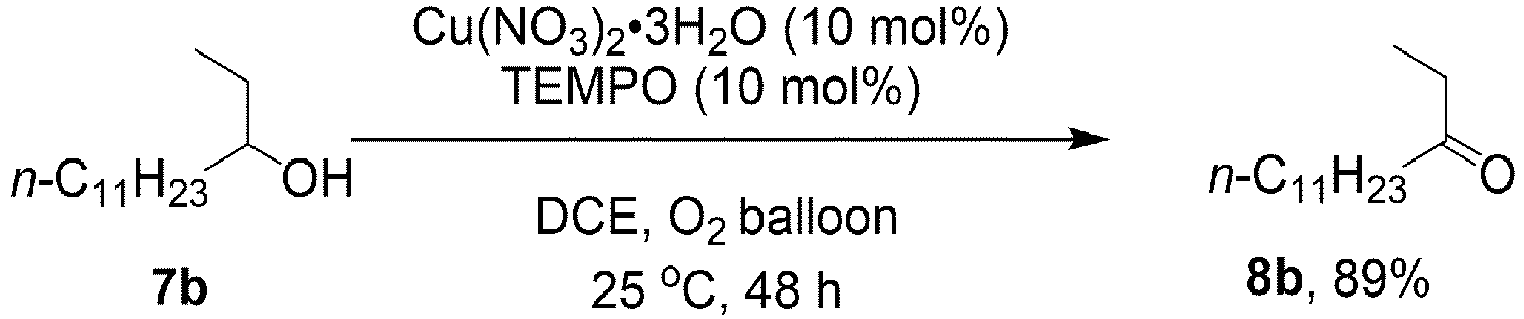
- Operations were conducted by referring to Example 1. Cu(NO3)2•3H2O (24.1 mg, 0.1 mmol), TEMPO (16.0 mg, 0.1 mmol), 7b (213.3 mg, 1.0 mmol), DCE(4mL), reacted 48 hours to afford 8b (188.3 mg, 89%) (eluent: petroleum ether/ethyl ether = 60/1): white solid. Melting point: 32.6-33.5 °C (petroleum ether/ethyl acetate recrystallization); 1H NMR (400 MHz, CDCl3): δ = 2.46-2.34 (m, 4 H, 2×CH2), 1.62-1.52 (m, 2 H, CH2), 1.34-1.18 (m, 16 H, 8×CH2), 1.05 (t, J = 7.2 Hz, 3 H, CH3), 0.88 (t, J = 6.8 Hz, 3 H, CH3); 13C NMR (100 MHz, CDCl3): δ = 211.8, 42.3, 35.7, 31.8, 29.5, 29.4, 29.35, 29.25, 29.2, 23.9, 22.6, 14.0, 7.7; MS (70 eV, EI) m/z (%): 213 (M++1, 1.00), 212 (M+, 2.03), 72 (100); IR (neat): v = 2960, 2916, 2872, 2849, 1709, 1702, 1471, 1463, 1455, 1374, 1231, 1131, 1114 cm-1.
-

- Operations were conducted by referring to Example 1. Cu(NO3)2•3H2O (24.4 mg, 0.1 mmol), TEMPO (16.0 mg, 0.1 mmol), 9a (152.0 mg, 1.0 mmol), DCE(4mL), reacted 22 hours to afford 10a (128.2 mg, 85%) (eluent: petroleum ether/ethyl ether = 60/1): oily liquid; 1H NMR (400 MHz, CDCl3): δ = 9.47 (d, J = 7.2 Hz, 1 H), 5.89-5.81 (m, 1 H), 5.75 (t, J = 6.0 Hz, 1 H), 2.28-2.13 (m, 1 H), 1.92-1.56 (m, 5 H), 1.40-1.08 (m, 5 H); 13C NMR (100 MHz, CDCl3): δ = 218.5, 192.3, 102.0, 99.4, 36.6, 32.8, 32.7, 25.7.
-

- Operations were conducted by referring to Example 1. Cu(NO3)2•3H2O (24.0 mg, 0.1 mmol), TEMPO (16.0 mg, 0.1 mmol), 9b (198.1 mg, 1.0 mmol), DCE (4 mL), reacted 24 hours to afford 10b (141.8 mg, 72%) (eluent: petroleum ether/ethyl ether = 60/1): oily liquid; 1H NMR (400 MHz, CDCl3): δ = 9.49 (d, J = 7.2 Hz, 1 H), 5.85-5.71 (m, 2 H), 2.24-2.14 (m, 2 H), 1.54-1.42 (m, 2 H), 1.42-1.20 (m, 12 H, 6×CH2), 0.88 (t, J = 6.6 Hz, 3 H); 13C NMR (100 MHz, CDCl3): δ = 219.1, 192.3, 98.6, 96.3, 31.8, 29.5, 29.25, 29.21, 28.9, 28.8, 27.4, 22.6, 14.0.
-

- An oxygen balloon was inserted into the dry 250 mL flask, pumped O2 for three times, Cu(NO3)2•3H2O (182.3 mg, 0.75 mmol), TEMPO (120.3 mg, 0.75 mmol), 1a (5.6549 g, 30 mmol) of MeCN solution (30 mL) were added sequentially. The flask was stirred at 25 °C for 15 h. The mixture solution was filtered through a short column of silica gel, and washed with ethyl ether, rotary evaporation to remove the solvent. The mixture solution was separated and purified by column chromatography on silica gel (eluent: petroleum ether/ethyl ether = 30/1), to afford 2a (5.4919 g, 98%): oily liquid; 1H NMR (400 MHz, CDCl3): δ = 8.14 (d, J = 7.2 Hz, 2 H, ArH), 7.60 (t, J = 7.4 Hz, 1 H, ArH), 7.48 (t, J = 7.6 Hz, 2 H, ArH), 2.51 (t, J = 7.0 Hz, 2 H, CH2), 1.73-1.60 (m, 2 H, CH2), 1.57-1.45 (m, 2 H, CH2), 0.97 (t, J = 7.4 Hz, 3 H, CH3); 13C NMR (100 MHz, CDCl3): δ = 178.1, 136.8, 133.8, 129.4, 128.4, 96.8, 79.6, 29.7, 22.0, 18.8, 13.4.
-

- Cu(NO3)2•3H2O (968.2 mg, 4.0 mmol), TEMPO (636.7 mg, 4.0 mmol), 1a (7.5332 g, 40.0 mmol) of MeCN solution (80 mL) were added sequentially into a dry 250 mL three-necked flask. A 42 L airbag was connected to the three-necked flask, and the three-necked flask was stirred at 25 °C, after 1.5 hours, a 2 L O2 bag was connected to the three-necked flask to supplement oxygen. The three-necked flask was stirred at 25 °C for 4.5 h. The mixture solution was filtered through a short column of silica gel, and then washed with ethyl ether, rotary evaporation to remove solvent. The mixture solution was separated and purified by column chromatography on silica gel (eluent: petroleum ether/ethyl ether = 30/1), to afford 2a (7.4587 g, 100%): oily liquid; 1H NMR (400 MHz, CDCl3): δ = 8.14 (d, J = 8.0 Hz, 2 H, ArH), 7.60 (t, J = 7.4 Hz, 1 H, ArH), 7.48 (t, J = 7.6 Hz, 2 H, ArH), 2.51 (t, J = 7.2 Hz, 2 H, CH2), 1.74-1.62 (m, 2 H, CH2), 1.58-1.46 (m, 2 H, CH2), 0.97 (t, J = 7.4 Hz, 3 H, CH3); 13C NMR (100 MHz, CDCl3): δ = 178.1, 136.8, 133.8, 129.4, 128.4, 96.7, 79.6, 29.7, 21.9, 18.8, 13.4.
-

- Cu(NO3)2•3H2O (967.8 mg, 4.0 mmol), TEMPO (639.4 mg, 4.0 mmol), 1g (5.5340 g, 40.0 mmol) of MeCN solution (120 mL) were added sequentially into a dry 250 mL three-necked flask. The three-necked flask was connected with the air cylinder and the air flow released slowly (high purity air, 30 mL/min), The three-necked flask was stirred at 25 °C for 46 h. The mixture solution was filtered through a short column of silica gel, and then washed with ethyl ether, rotary evaporation to remove solvent. The mixture solution was separated and purified by column chromatography on silica gel (eluent: petroleum ether/ethyl ether = 30/1), to afford 2g (4.3224 g, 79%): white solid; 1 H NMR (400 MHz, CDCl3): δ = 7.98 (d, J 1 = 3.6 Hz, 1 H, ArH), 7.75 (d, J = 4.8 Hz, 1 H, ArH), 7.18 (t, J = 4.2 Hz, 1 H, ArH), 3.36 (s, 1 H, ≡CH); 13 C NMR (100 MHz, CDCl3): δ = 169.0, 144.0, 136.1, 135.9, 128.4, 79.8, 79.4.
-

- Operations were conducted by referring to Example 1. Cu(NO3)2•3H2O (24.4 mg, 0.1 mmol), 4-OH-TEMPO (18.0 mg, 0.1 mmol), 1f (190.4 mg, 1.0 mmol), MeCN (4 mL), reacted 18 hours to afford 2f (166.3 mg, 88%) (eluent: petroleum ether/ethyl ether = 30/1): white solid. 1H NMR (400 MHz, CDCl3) δ = 8.22 (d, J = 7.6 Hz, 2 H, ArH), 8.16 (d, J = 7.6 Hz, 2 H, ArH), 3.97 (s, 3 H, CH3), 3.52 (s, 1 H, ≡CH); 13C NMR (100 MHz, CDCl3): δ = 176.6, 166.0, 139.0, 135.0, 129.8, 129.5, 81.7, 80.0, 52.5.
-

- Operations were conducted by referring to Example 1. Cu(NO3)2•3H2O (24.4 mg, 0.1 mmol), 4-OH-TEMPO (17.4 mg, 0.1 mmol), 3d (177.6 mg, 1.0 mmol), DCE (4 mL), reacted 22 hours to afford 4d (166.2 mg, 99%, E:Z >99:1) (eluent: petroleum ether/ethyl ether = 60/1) (before separation afforded a crude mixture E:Z > 99:1, as determined by 1H NMR analysis): oily liquid; 1H NMR (400 MHz, CDCl3): δ = 9.51 (d, J = 7.6 Hz, 1 H, CHO), 6.85 (dt, J 1 = 15.6 Hz, J = 7.0 Hz, 1 H, CH=), 6.18-6.07 (dd, J 1 = 15.6 Hz, J = 8.0 Hz, 1 H, CH=), 2.34 (dd, J 1 = 14.4 Hz, J = 7.2 Hz, 2 H, CH2), 1.56-1.44 (m, 2 H, CH2), 1.40-1.20 (m, 10 H, 5×CH2), 0.89 (t, J= 6.6 Hz, 3 H, CH3); 13C NMR (100 MHz, CDCl3): δ = 194.0, 158.9, 132.9, 32.6, 31.7, 29.2, 29.05, 29.03, 27.7, 22.5, 14.0.
-

- Operations were conducted by referring to Example 1. Cu(NO3)2•3H2O (24.4 mg, 0.1 mmol), 4-OH-TEMPO (17.9 mg, 0.1 mmol), 5a (241.0 mg, 1.0 mmol), DCE(4 mL), reacted 7 hours to afford 6a (215.6 mg, 93%) (eluent: petroleum ether/ethyl ether = 30/1): white solid. 1H NMR (400 MHz, CDCl3): δ = 9.96 (s, 1 H, CHO), 7.92 (d, J = 8.0 Hz, 2 H, ArH), 7.59 (d, J = 8.0 Hz, 2 H, ArH); 13C NMR (100 MHz, CDCl3): δ= 191.4, 138.4, 135.5, 130.8, 102.8.
-

- Operations were conducted by referring to Example 1. Cu(NO3)2•3H2O (24.3 mg, 0.1 mmol), 4-OH-TEMPO (17.6 mg, 0.1 mmol), 7a (247.1 mg, 1.0 mmol), DCE (4 mL), reacted 36 hours to afford 8a (192.7 mg, 80%) (eluent: petroleum ether/ethyl ether = 60/1): white solid. 1H NMR (400 MHz, CDCl3): δ = 9.76 (s, 1 H, CHO), 2.42 (t, J = 7.2 Hz, 2 H, CH2), 1.63 (t, J = 6.8 Hz, 2 H, CH2), 1.37-1.18 (m, 24 H, 12×CH2), 0.88 (t, J = 6.6 Hz, 3 H, CH3); 13C NMR (100 MHz, CDCl3): δ = 202.8, 43.9, 31.9, 29.6, 29.65, 29.63, 29.55, 29.4, 29.3, 29.1, 22.7, 22.0, 14.1.
-

- Operations were conducted by referring to Example 1. Cu(NO3)2•3H2O (24.4 mg, 0.1 mmol), TEMPO (16.0 mg, 0.1 mmol), 3c (158.5 mg, 1.0 mmol), DCE (10 mL), reacted 41 hours to afford a crude mixture of 4c, (78% NMR yield, Z:E = 92:8, as determined by 1H NMR analysis).
-

- Operations were conducted by referring to Example 1. Cu(NO3)2•3H2O (24.4 mg, 0.1 mmol), 4-OH-TEMPO (17.4 mg, 0.1 mmol), 3c (159.1 mg, 1.0 mmol), DCE (10 mL), reacted 41 hours to afford a crude mixture of 4c, (58% NMR yield, Z:E = 93:7, raw material remaining 27%, as determined by 1H NMR analysis).
-

- Operations were conducted by referring to Example 1. Cu(NO3)2•3H2O (9.9 mg, 0.04 mmol), TEMPO (6.6 mg, 0.04 mmol), 1a (75.4 mg, 0.4 mmol), NMP (1.6 mL), reacted 8 hours to afford 2a, (11% NMR yield, raw material remaining 84%, as determined by 1H NMR analysis).
-

- Operations were conducted by referring to Example 1. Cu(NO3)2•3H2O (9.8 mg, 0.04 mmol), TEMPO (6.5 mg, 0.04 mmol), 1a (75.2 mg, 0.4 mmol), cyclohexane (1.6 mL), reacted 8 hours to afford 2a, (12% NMR yield, raw material remaining 76%, as determined by 1H NMR analysis).
-

- Operations were conducted by referring to Example 1. Cu(NO3)2·3H2O (9.8 mg, 0.04 mmol), TEMPO (6.6 mg, 0.04 mmol), 1a (74.9 mg, 0.4 mmol), MeNO2 (1.6 mL), reacted 8 hours to afford 2a, (37% NMR yield, raw material remaining 56%, as determined by 1H NMR analysis).
-

- Operations were conducted by referring to Example 1. Cu(NO3)2•3H2O (9.9 mg, 0.04 mmol), TEMPO (6.4 mg, 0.04 mmol), 1a (75.2 mg, 0.4 mmol), dioxane (1.6 mL), reacted 8 hours to afford 2a, (42% NMR yield, raw material remaining 50%, as determined by 1H NMR analysis).
-
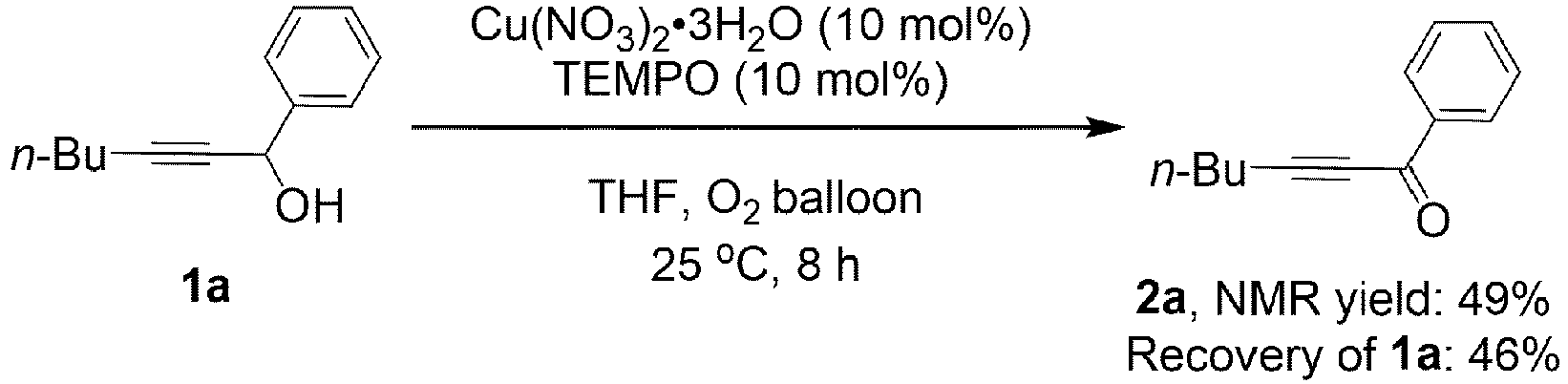
- Operations were conducted by referring to Example 1. Cu(NO3)2•3H2O (9.7 mg, 0.04 mmol), TEMPO (6.4 mg, 0.04 mmol), 1a (75.7 mg, 0.4 mmol), THF (1.6 mL), reacted 8 hours to afford 2a, (49% NMR yield, raw material remaining 46%, as determined by 1H NMR analysis).
-

- Operations were conducted by referring to Example 1. Cu(NO3)2•3H2O (9.8 mg, 0.04 mmol), TEMPO (6.4 mg, 0.04 mmol), 1a (75.2 mg, 0.4 mmol), Et2O (1.6 mL), reacted 8 hours to afford 2a, (85% NMR yield, raw material remaining 12%, as determined by 1H NMR analysis).
-

- Operations were conducted by referring to Example 1. Cu(NO3)2•3H2O (9.8 mg, 0.04 mmol), TEMPO (6.4 mg, 0.04 mmol), 1a (75.0 mg, 0.4 mmol), DCM (1.6 mL), reacted 8 hours to afford 2a, (91% NMR yield, raw material remaining 5%, as determined by 1H NMR analysis).
-

- Operations were conducted by referring to Example 1. Cu(NO3)2•3H2O (9.9 mg, 0.04 mmol), TEMPO (6.4 mg, 0.04 mmol), 1a (75.0 mg, 0.4 mmol), toluene (1.6 mL), reacted 8 hours to afford 2a, (92% NMR yield, raw material remaining 8%, as determined by 1H NMR analysis).
-

- Operations were conducted by referring to Example 1. Cu(MeCN)4PF6 (14.9 mg, 0.04 mmol), TEMPO (6.4 mg, 0.04 mmol), 1a (75.3 mg, 0.4 mmol), MeCN (1.6 mL), reacted 4 hours to afford 2a, (6% NMR yield, raw material remaining 90%, as determined by 1H NMR analysis).
-

- Operations were conducted by referring to Example 1. CuCl (4.0 mg, 0.04 mmol), TEMPO (6.4 mg, 0.04 mmol), 1a (75.3 mg, 0.4 mmol), MeCN (1.6 mL), reacted 4 hours to afford 2a, (9% NMR yield, raw material remaining 91%, as determined by 1H NMR analysis).
-

- Operations were conducted by referring to Example 1. CuBr2 (8.9 mg, 0.04 mmol), TEMPO (6.4 mg, 0.04 mmol), 1a (75.4 mg, 0.4 mmol), MeCN (1.6 mL), reacted 4 hours to afford 2a, (12% NMR yield, raw material remaining 84%, as determined by 1H NMR analysis).
-

- Operations were conducted by referring to Example 1. CuI (7.7 mg, 0.04 mmol), TEMPO (6.6 mg, 0.04 mmol), 1a (75.3 mg, 0.4 mmol), MeCN (1.6 mL), reacted 4 hours to afford 2a, (19% NMR yield, raw material remaining 78%, as determined by 1H NMR analysis).
-

- Operations were conducted by referring to Example 1. Cu(OAc)2 (7.4 mg, 0.04 mmol), TEMPO (6.4 mg, 0.04 mmol), 1a (75.3 mg, 0.4 mmol), MeCN (1.6 mL), reacted 4 hours to afford 2a, (43% NMR yield, raw material remaining 57%, as determined by 1H NMR analysis).
-

- Operations were conducted by referring to Example 1. Cu(NO3)2•3H2O (9.8 mg, 0.04 mmol), TEMPO (6.4 mg, 0.04 mmol), 1a (75.4 mg, 0.4 mmol), MeCN (1.6 mL), reacted 4 hours to afford 2a, (96% NMR yield as determined by 1H NMR analysis).
-

- Operations were conducted by referring to Example 1. TEMPO (6.3 mg, 0.04 mmol), 1a (75.4 mg, 0.4 mmol), MeCN (1.6 mL), reacted 4 hours to afford 2a, (1% NMR yield, raw material remaining 94%, as determined by 1H NMR analysis).
-

- Operations were conducted by referring to Example 1. Cu(NO3)2•3H2O (9.8 mg, 0.04 mmol), 1a (75.4 mg, 0.4 mmol), MeCN (1.6 mL), reacted 4 hours to afford 2a, (3% NMR yield, raw material remaining 94%, as determined by 1H NMR analysis).
- The present invention is not limited to the specific embodiments disclosed and described above. Without departing from the spirit and scope of the inventive concept, some modifications and changes to the present invention should also fall within the protection scope of the claims of the present invention, and the appended claims shall be the protection scope. In addition, although some specific terms are used in this specification, these terms are only for the convenience of description and do not constitute any limitation to the present invention.
Claims (10)
- A copper-catalyzed method for preparing aldehydes or ketones by oxidizing alcohols with oxygen as an oxidant, wherein, at 0-100°C, in an organic solvent, using the alcohol shown in formula (a) as raw material, oxygen or oxygen in the air is used as oxidant, copper salts and nitroxide radicals are used as catalysts, reacting 4-48 hours to oxidize the alcohol to produce aldehyde or ketone compounds shown in formula (b), the reaction process has the following reaction equation (1):

- The method of claim 1, wherein, R1 and R2 is a C1-C20 alkyl, a C1-C20 alkyl with functional groups, a C3-C8 cycloalkyl, a phenyl, an aryl, a heterocyclic group, an ethynyl, an alkynyl with functional groups, a vinyl, an alkenyl with functional groups, an allenyl, an allenyl with functional groups; the said heterocyclic group is thienyl, furyl or pyridyl, or thiophene, furan or pyridine with electron-donating or electron-withdrawing substituents;wherein, the C1-C20 alkyl with functional groups, said the functional group is selected from carbon-carbon double bond, carbon-carbon triple bond, ester group, acyl group, acyloxy group, amide group, halogen, carboxyl group, cyano group, phenyl, aryl, thienyl, furyl; the alkynyl with functional groups, the alkenyl with functional groups, and the allenyl with functional groups, said the functional group is selected from C1-C20 alkyl, C3-C6 cycloalkyl, carbon-carbon double bond, carbon-carbon triple bond, ester group, acyl group, acyloxy group, amide group, halogen, carboxyl group, cyano group, phenyl, aryl, thienyl, furyl, silicon group;wherein, the said aryl is phenyl, thiophene, furan, pyrrole with substituents at the ortho, meta, and para positions; the said substituent is selected from C1-C5 alkyl, ester group, hydroxyl group, acyl group, acyloxy group, nitro group, halogen, carboxyl group, cyano group, methoxyl group.
- The method of claim 2, wherein, R1 and R2 is a C1-C20 alkyl, a C1-C20 alkyl with functional groups, a C3-C8 cycloalkyl, a phenyl, an aryl, a heterocyclic group, an ethynyl, an alkynyl with functional groups, a vinyl, an alkenyl with functional groups, an allenyl, an allenyl with functional groups; the said heterocyclic group is thienyl, furyl or pyridyl, or thiophene, furan or pyridine with electron-donating or electron-withdrawing substituents;wherein, the C1-C20 alkyl with functional groups, the said functional group is selected from carbon-carbon double bond, carbon-carbon triple bond, methoxycarbonyl, ethoxycarbonyl, formyl, acetyl, benzoyl, formyloxy, acetoxy, benzoyloxy, acetamide, benzamide, halogen, carboxyl group, cyano group, phenyl, aryl, thienyl, furyl; the alkynyl with functional groups, the alkenyl with functional groups, and the allenyl with functional groups, said the functional group is selected from C1-C20 alkyl, C3-C6 cycloalkyl, carbon-carbon double bond, carbon-carbon triple bond, methoxycarbonyl, ethoxycarbonyl, formyl, acetyl, benzoyl, formyloxy, acetoxy, benzoyloxy, acetamide, benzamide, halogen, carboxyl group, cyano group, phenyl, aryl, thienyl, furyl, silicon group;wherein, the said aryl is phenyl with substituents at the ortho, meta, and para positions; the said substituent is selected from C1-C5 alkyl, methoxycarbonyl, ethoxycarbonyl, hydroxyl group, formyl, acetyl, benzoyl, formyloxy, acetoxy, benzoyloxy, nitro group, halogen, carboxyl group, cyano group, methoxyl group.
- The method of claim 1, wherein, said the method comprises the following steps:1) inserting an oxygen balloon into the dry reaction tube, pumping air three times, and adding a copper catalyst, a nitroxide radical, an alcohol organic solvent solution in sequence, or using air to supplement oxygen, or airflow, putting the reaction tube in the 25 °C oil bath and stirring for 4-48 hours; wherein, the organic solvent is based on the amount of alcohol shown in formula (a), and the dosage of the organic solvent is 1.0-10.0 mL/mmol;2) after the completion of the reaction in step (1), raising the reaction tube from the oil bath, filtering the mixture with silica gel short column, washing with a certain amount of diethyl ether, concentrating, and subjecting to the flash column chromatography, so as to obtain the aldehyde or ketone compounds; said the diethyl ether is based on the amount of alcohol shown in formula (a), and the dosage of the diethyl ether is 3.75-75 mL/mmol.
- The method of claim 1, wherein the organic solvent is any one or more of benzene, toluene, dichloromethane, 1,2-dichloroethane, 1,1-dichloroethane, 1,2-dichloropropane, 1,3-dichloropropane, nitromethane, diethyl ether, ethylene glycol dimethyl ether, tetrahydrofuran or acetonitrile.
- The method of claim 1, wherein the organic solvent is based on the amount of alcohol shown in formula (a), and the dosage of the organic solvent is 1.0-10.0 mL/mmol.
- The method of claim 1, wherein the copper salts are any one or more of tetrakiscopper hexa-fluorophosph, cuprous chloride, copper bromide, cuprous iodide, copper acetate or copper nitrate trihydrate.
- The method of claim 1, wherein the copper salt is based on the amount of alcohol shown in formula (a), and the dosage of the copper salt is 0.025-0.1 mmol/mmol.
- The method of claim 1, wherein the nitroxide radicals are any one or more of 2,2,6,6-tetramethylpiperidine oxide, 4-hydroxy-2,2,6,6-tetramethylpiperidine oxide, 4-methoxy-2,2,6,6-tetramethylpiperidine oxide, 4-acetylamino -2,2,6,6-tetramethylpiperidine oxide, 4-oxy-2,2,6,6-tetramethylpiperidine oxide, 4-amino-2,2,6,6-tetramethylpiperidine oxide, N-hydroxymaleimide, 9-azabicyclo [3.3.1] nonane nitroxide radical, 2-azaadamantane nitroxide radical.
- The method of claim 1, wherein the nitroxide radical is based on the amount of alcohol shown in formula (a), and the dosage of the nitroxide radical is 0.025-0.1 mmol/mmol.
Applications Claiming Priority (2)
| Application Number | Priority Date | Filing Date | Title |
|---|---|---|---|
| CN201910084267.6A CN111484404A (en) | 2019-01-29 | 2019-01-29 | Method for preparing aldehyde or ketone compound by oxidizing alcohol with oxygen as oxidant under catalysis of copper and application |
| PCT/CN2020/072732 WO2020156238A1 (en) | 2019-01-29 | 2020-01-17 | Copper-catalyzed method for preparing aldehyde or ketone compound by oxidizing alcohol by using oxygen as oxidant, and application thereof |
Publications (2)
| Publication Number | Publication Date |
|---|---|
| EP3919469A1 true EP3919469A1 (en) | 2021-12-08 |
| EP3919469A4 EP3919469A4 (en) | 2023-01-11 |
Family
ID=71811620
Family Applications (1)
| Application Number | Title | Priority Date | Filing Date |
|---|---|---|---|
| EP20747658.1A Withdrawn EP3919469A4 (en) | 2019-01-29 | 2020-01-17 | COPPER CATALYSED PROCESS FOR THE PRODUCTION OF ALDEHYDE OR KETONE COMPOUNDS BY OXIDATION OF ALCOHOL USING OXYGEN AS THE OXIDANT AND THE USE OF IT |
Country Status (5)
| Country | Link |
|---|---|
| US (1) | US20220127215A1 (en) |
| EP (1) | EP3919469A4 (en) |
| JP (1) | JP2022520528A (en) |
| CN (1) | CN111484404A (en) |
| WO (1) | WO2020156238A1 (en) |
Families Citing this family (5)
| Publication number | Priority date | Publication date | Assignee | Title |
|---|---|---|---|---|
| CN114634407B (en) * | 2020-12-16 | 2024-02-02 | 复旦大学 | Method for stereospecifically synthesizing 2-enal, 2-enone compound and deuterated compound thereof |
| CN112920028B (en) * | 2021-02-05 | 2023-01-31 | 湖北滋兰生物医药科技有限公司 | Method for preparing aldehyde compound by olefin oxidation |
| CN115160123B (en) * | 2021-04-01 | 2024-07-30 | 复旦大学 | A copper-catalyzed method for preparing carboxylic acid compounds by oxidizing alcohols using oxygen as an oxidant |
| WO2023054702A1 (en) * | 2021-09-30 | 2023-04-06 | クミアイ化学工業株式会社 | Aldehyde compound production method and dihydroisoxazole compound production method |
| CN118146075A (en) * | 2024-02-28 | 2024-06-07 | 山东新和成药业有限公司 | A method for preparing anisaldehyde by utilizing anise alcohol still residue |
Family Cites Families (11)
| Publication number | Priority date | Publication date | Assignee | Title |
|---|---|---|---|---|
| EP1541590A1 (en) * | 2003-12-08 | 2005-06-15 | SCA Hygiene Products AB | Process for the oxidation of hydroxy compounds by means of nitroxy compounds |
| CN101148400A (en) * | 2006-09-22 | 2008-03-26 | 中国科学院大连化学物理研究所 | A kind of method that oxygen oxidation alcohol prepares aldehyde and ketone |
| CN101544548B (en) * | 2008-03-26 | 2013-05-01 | 中国科学院大连化学物理研究所 | Method for preparing aldehydes or ketones by oxidizing alcohols with oxygen |
| CN101830783B (en) * | 2010-05-28 | 2013-02-20 | 济南大学 | Method for preparing aldehyde by oxidizing alcohol with oxygen in presence of Schiff-base complex catalyst |
| CN103772082B (en) * | 2010-07-26 | 2016-01-20 | 华东师范大学 | The method of aldehydes or ketones prepared by a kind of dioxygen oxidation alcohol |
| JP6099133B2 (en) * | 2013-03-11 | 2017-03-22 | 株式会社ダイセル | Method for producing ketol compound |
| CN103420748B (en) * | 2013-06-19 | 2015-06-24 | 温州大学 | Greening method for preparing aldehydes and ketones through alcohol oxidation of copper catalyst |
| CN104193600B (en) * | 2014-08-11 | 2016-08-17 | 济南大学 | A kind of method preparing aldehydes or ketones for promoter air oxidation alcohol with aluminium oxide |
| CN106800492A (en) * | 2015-11-26 | 2017-06-06 | 中国科学院大连化学物理研究所 | A kind of iron catalytic alcohol oxidation prepares the green method of aldehyde or copper |
| CN106905097A (en) * | 2017-03-07 | 2017-06-30 | 浙江工业大学 | Method for preparing aldehyde by oxidizing primary alcohol |
| CN109096068A (en) * | 2018-07-10 | 2018-12-28 | 嘉兴学院 | The method that mantoquita/bidentate ligand/TEMPO catalytic air oxidation alcohol prepares aldehydes or ketones |
-
2019
- 2019-01-29 CN CN201910084267.6A patent/CN111484404A/en active Pending
-
2020
- 2020-01-17 JP JP2021543125A patent/JP2022520528A/en active Pending
- 2020-01-17 US US17/426,024 patent/US20220127215A1/en not_active Abandoned
- 2020-01-17 EP EP20747658.1A patent/EP3919469A4/en not_active Withdrawn
- 2020-01-17 WO PCT/CN2020/072732 patent/WO2020156238A1/en not_active Ceased
Also Published As
| Publication number | Publication date |
|---|---|
| CN111484404A (en) | 2020-08-04 |
| EP3919469A4 (en) | 2023-01-11 |
| JP2022520528A (en) | 2022-03-31 |
| US20220127215A1 (en) | 2022-04-28 |
| WO2020156238A1 (en) | 2020-08-06 |
Similar Documents
| Publication | Publication Date | Title |
|---|---|---|
| EP3919469A1 (en) | Copper-catalyzed method for preparing aldehyde or ketone compound by oxidizing alcohol by using oxygen as oxidant, and application thereof | |
| Wang et al. | A photocatalytic iminyl radical-mediated C–C bond cleavage/addition/cyclization cascade for the synthesis of 1, 2, 3, 4-tetrahydrophenanthrenes | |
| Kiran et al. | N-Heterocyclic carbene catalyzed esterification of aromatic aldehydes with alcohols under aerobic conditions | |
| Bikshapathi et al. | Hypervalent iodine catalysis for selective oxidation of Baylis–Hillman adducts via in situ generation of o-iodoxybenzoic acid (IBX) from 2-iodosobenzoic acid (IBA) in the presence of oxone | |
| Zhou et al. | Synthesis of cyclohexylidenehydrazine-fused polycyclics via a photocatalytic radical cascade reaction of 2-ethynylaldehyde hydrazones | |
| CN101619050A (en) | Method for preparing 2,5-diformyl furan by catalyzing 5-hydroxy methyl furfural | |
| Cheng et al. | The oxidative coupling of benzylic compounds catalyzed by 2, 3-dichloro-5, 6-dicyano-benzoquinone and sodium nitrite using molecular oxygen as a co-oxidant | |
| Zhao et al. | Copper on charcoal: Cu 0 nanoparticle catalysed aerobic oxidation of α-diazo esters | |
| Zhang et al. | Photocatalytic anion oxidation achieves direct aerobic difunctionalization of alkenes leading to β-thiocyanato alcohols | |
| Cen et al. | Site-selective decarbonylative [4+ 2] annulation of carboxylic acids with terminal alkynes by C–C/C–H activation strategy and cluster catalysis | |
| Shakir et al. | A convenient alternative for the selective oxidation of alcohols by silica supported TEMPO using dioxygen as the final oxidant | |
| CN112679521B (en) | Method for synthesizing mild azaspiro tricyclic framework molecule | |
| Ohno et al. | Thermal [2+ 2]-cycloaddition between silylalkynes and allenylphenols followed by the nucleophilic addition of water: metal-free and economical synthesis of arylcyclobutenals | |
| He et al. | Enantioselective reductive conjugate alkenylation of α, β-enones with keto alkenyl acetates by nickel catalysis | |
| CN103694182B (en) | A kind of preparation method of quinoxaline compound | |
| CN111393437A (en) | Trisubstituted indolizine compound and preparation method thereof | |
| CN109833908A (en) | A kind of chirality high price iodine catalyst and its preparation method and application | |
| CN109438245B (en) | A kind of synthetic method of nitro-substituted cyclobutane naphthalene dione compounds | |
| CN102898388B (en) | Method for synthesizing substituted benzo[alpha]phenazine compound | |
| CN116410126B (en) | A ligand, a ruthenium complex, a preparation method thereof, and application thereof in catalyzing alkyne semihydrogenation reaction | |
| Mei et al. | TEMPO-mediated oxidation of primary alcohols to carboxylic acids by exploitation of ethers in an aqueous–organic biphase system | |
| CN121426651A (en) | A green synthetic method for 1,2-diketone compounds | |
| CN116813587B (en) | Method for preparing chiral spirosteroid by using chiral aryl iodine catalyst derived from clotrimide | |
| CN106565604B (en) | A kind of synthetic method of 5- nitro -8- amide groups quinolines | |
| CN119528703B (en) | A method for visible light-driven air oxidation of benzyl carbon-hydrogen bonds |
Legal Events
| Date | Code | Title | Description |
|---|---|---|---|
| STAA | Information on the status of an ep patent application or granted ep patent |
Free format text: STATUS: THE INTERNATIONAL PUBLICATION HAS BEEN MADE |
|
| PUAI | Public reference made under article 153(3) epc to a published international application that has entered the european phase |
Free format text: ORIGINAL CODE: 0009012 |
|
| STAA | Information on the status of an ep patent application or granted ep patent |
Free format text: STATUS: REQUEST FOR EXAMINATION WAS MADE |
|
| 17P | Request for examination filed |
Effective date: 20210722 |
|
| AK | Designated contracting states |
Kind code of ref document: A1 Designated state(s): AL AT BE BG CH CY CZ DE DK EE ES FI FR GB GR HR HU IE IS IT LI LT LU LV MC MK MT NL NO PL PT RO RS SE SI SK SM TR |
|
| DAV | Request for validation of the european patent (deleted) | ||
| DAX | Request for extension of the european patent (deleted) | ||
| REG | Reference to a national code |
Ref country code: DE Ref legal event code: R079 Free format text: PREVIOUS MAIN CLASS: C07C0045380000 Ipc: C07B0041060000 |
|
| A4 | Supplementary search report drawn up and despatched |
Effective date: 20221209 |
|
| RIC1 | Information provided on ipc code assigned before grant |
Ipc: C07D 307/46 20060101ALI20221205BHEP Ipc: C07C 253/30 20060101ALI20221205BHEP Ipc: C07C 201/12 20060101ALI20221205BHEP Ipc: C07C 67/313 20060101ALI20221205BHEP Ipc: C07C 45/39 20060101ALI20221205BHEP Ipc: B01J 31/28 20060101ALI20221205BHEP Ipc: C07D 333/22 20060101ALI20221205BHEP Ipc: C07D 213/48 20060101ALI20221205BHEP Ipc: C07C 49/00 20060101ALI20221205BHEP Ipc: C07C 47/00 20060101ALI20221205BHEP Ipc: C07C 45/38 20060101ALI20221205BHEP Ipc: C07B 41/06 20060101AFI20221205BHEP |
|
| STAA | Information on the status of an ep patent application or granted ep patent |
Free format text: STATUS: THE APPLICATION IS DEEMED TO BE WITHDRAWN |
|
| 18D | Application deemed to be withdrawn |
Effective date: 20230714 |