EP3919058A1 - Use of composition containing cdk4/6 inhibitor in combination with anastrozole in preparation of medicament for treating tumor diseases - Google Patents
Use of composition containing cdk4/6 inhibitor in combination with anastrozole in preparation of medicament for treating tumor diseases Download PDFInfo
- Publication number
- EP3919058A1 EP3919058A1 EP20748834.7A EP20748834A EP3919058A1 EP 3919058 A1 EP3919058 A1 EP 3919058A1 EP 20748834 A EP20748834 A EP 20748834A EP 3919058 A1 EP3919058 A1 EP 3919058A1
- Authority
- EP
- European Patent Office
- Prior art keywords
- formula
- compound represented
- pharmaceutically acceptable
- acceptable salt
- cancer
- Prior art date
- Legal status (The legal status is an assumption and is not a legal conclusion. Google has not performed a legal analysis and makes no representation as to the accuracy of the status listed.)
- Withdrawn
Links
- YBBLVLTVTVSKRW-UHFFFAOYSA-N anastrozole Chemical compound N#CC(C)(C)C1=CC(C(C)(C#N)C)=CC(CN2N=CN=C2)=C1 YBBLVLTVTVSKRW-UHFFFAOYSA-N 0.000 title claims abstract description 158
- 229960002932 anastrozole Drugs 0.000 title claims abstract description 157
- 239000003814 drug Substances 0.000 title claims abstract description 86
- 206010028980 Neoplasm Diseases 0.000 title claims abstract description 49
- 238000002360 preparation method Methods 0.000 title claims abstract description 12
- 229940124297 CDK 4/6 inhibitor Drugs 0.000 title abstract description 5
- 239000000203 mixture Substances 0.000 title abstract description 4
- 150000001875 compounds Chemical class 0.000 claims abstract description 278
- 150000003839 salts Chemical class 0.000 claims abstract description 238
- 230000002354 daily effect Effects 0.000 claims description 59
- HPJKCIUCZWXJDR-UHFFFAOYSA-N letrozole Chemical compound C1=CC(C#N)=CC=C1C(N1N=CN=C1)C1=CC=C(C#N)C=C1 HPJKCIUCZWXJDR-UHFFFAOYSA-N 0.000 claims description 57
- 229960003881 letrozole Drugs 0.000 claims description 54
- 239000008194 pharmaceutical composition Substances 0.000 claims description 48
- 238000000034 method Methods 0.000 claims description 47
- SUMDYPCJJOFFON-UHFFFAOYSA-N isethionic acid Chemical compound OCCS(O)(=O)=O SUMDYPCJJOFFON-UHFFFAOYSA-N 0.000 claims description 42
- 206010006187 Breast cancer Diseases 0.000 claims description 38
- 238000011282 treatment Methods 0.000 claims description 33
- VWUXBMIQPBEWFH-WCCTWKNTSA-N Fulvestrant Chemical compound OC1=CC=C2[C@H]3CC[C@](C)([C@H](CC4)O)[C@@H]4[C@@H]3[C@H](CCCCCCCCCS(=O)CCCC(F)(F)C(F)(F)F)CC2=C1 VWUXBMIQPBEWFH-WCCTWKNTSA-N 0.000 claims description 29
- 208000026310 Breast neoplasm Diseases 0.000 claims description 28
- 229960002258 fulvestrant Drugs 0.000 claims description 28
- 125000003118 aryl group Chemical group 0.000 claims description 19
- 229940043355 kinase inhibitor Drugs 0.000 claims description 19
- 239000003757 phosphotransferase inhibitor Substances 0.000 claims description 19
- 206010055113 Breast cancer metastatic Diseases 0.000 claims description 17
- 230000000306 recurrent effect Effects 0.000 claims description 15
- 206010038111 Recurrent cancer Diseases 0.000 claims description 13
- 229940102550 Estrogen receptor antagonist Drugs 0.000 claims description 11
- 201000011510 cancer Diseases 0.000 claims description 11
- 239000000546 pharmaceutical excipient Substances 0.000 claims description 10
- 206010067484 Adverse reaction Diseases 0.000 claims description 9
- 230000006838 adverse reaction Effects 0.000 claims description 9
- 208000003174 Brain Neoplasms Diseases 0.000 claims description 8
- 239000003085 diluting agent Substances 0.000 claims description 8
- 239000000314 lubricant Substances 0.000 claims description 8
- 201000001441 melanoma Diseases 0.000 claims description 8
- 101001012157 Homo sapiens Receptor tyrosine-protein kinase erbB-2 Proteins 0.000 claims description 6
- 102100030086 Receptor tyrosine-protein kinase erbB-2 Human genes 0.000 claims description 6
- 108091008039 hormone receptors Proteins 0.000 claims description 6
- 239000011230 binding agent Substances 0.000 claims description 5
- 239000007884 disintegrant Substances 0.000 claims description 5
- 208000031261 Acute myeloid leukaemia Diseases 0.000 claims description 4
- 208000032791 BCR-ABL1 positive chronic myelogenous leukemia Diseases 0.000 claims description 4
- 206010004146 Basal cell carcinoma Diseases 0.000 claims description 4
- 206010005003 Bladder cancer Diseases 0.000 claims description 4
- 201000009030 Carcinoma Diseases 0.000 claims description 4
- 206010008342 Cervix carcinoma Diseases 0.000 claims description 4
- 208000010833 Chronic myeloid leukaemia Diseases 0.000 claims description 4
- 206010048832 Colon adenoma Diseases 0.000 claims description 4
- 206010009944 Colon cancer Diseases 0.000 claims description 4
- 206010014733 Endometrial cancer Diseases 0.000 claims description 4
- 206010014759 Endometrial neoplasm Diseases 0.000 claims description 4
- 208000000461 Esophageal Neoplasms Diseases 0.000 claims description 4
- 208000032027 Essential Thrombocythemia Diseases 0.000 claims description 4
- 206010061968 Gastric neoplasm Diseases 0.000 claims description 4
- 206010017993 Gastrointestinal neoplasms Diseases 0.000 claims description 4
- 208000032612 Glial tumor Diseases 0.000 claims description 4
- 206010018338 Glioma Diseases 0.000 claims description 4
- 208000008839 Kidney Neoplasms Diseases 0.000 claims description 4
- 206010023825 Laryngeal cancer Diseases 0.000 claims description 4
- 206010058467 Lung neoplasm malignant Diseases 0.000 claims description 4
- 208000028018 Lymphocytic leukaemia Diseases 0.000 claims description 4
- 206010025323 Lymphomas Diseases 0.000 claims description 4
- 208000003445 Mouth Neoplasms Diseases 0.000 claims description 4
- 208000034578 Multiple myelomas Diseases 0.000 claims description 4
- 208000033761 Myelogenous Chronic BCR-ABL Positive Leukemia Diseases 0.000 claims description 4
- 208000033776 Myeloid Acute Leukemia Diseases 0.000 claims description 4
- 208000015914 Non-Hodgkin lymphomas Diseases 0.000 claims description 4
- 206010030155 Oesophageal carcinoma Diseases 0.000 claims description 4
- 206010033128 Ovarian cancer Diseases 0.000 claims description 4
- 206010061535 Ovarian neoplasm Diseases 0.000 claims description 4
- 206010061902 Pancreatic neoplasm Diseases 0.000 claims description 4
- 208000009565 Pharyngeal Neoplasms Diseases 0.000 claims description 4
- 206010034811 Pharyngeal cancer Diseases 0.000 claims description 4
- 206010035226 Plasma cell myeloma Diseases 0.000 claims description 4
- 206010060862 Prostate cancer Diseases 0.000 claims description 4
- 208000000236 Prostatic Neoplasms Diseases 0.000 claims description 4
- 208000015634 Rectal Neoplasms Diseases 0.000 claims description 4
- 206010038389 Renal cancer Diseases 0.000 claims description 4
- 206010039491 Sarcoma Diseases 0.000 claims description 4
- 208000005718 Stomach Neoplasms Diseases 0.000 claims description 4
- NKANXQFJJICGDU-QPLCGJKRSA-N Tamoxifen Chemical compound C=1C=CC=CC=1C(/CC)=C(C=1C=CC(OCCN(C)C)=CC=1)/C1=CC=CC=C1 NKANXQFJJICGDU-QPLCGJKRSA-N 0.000 claims description 4
- 208000024770 Thyroid neoplasm Diseases 0.000 claims description 4
- 208000007097 Urinary Bladder Neoplasms Diseases 0.000 claims description 4
- 208000006105 Uterine Cervical Neoplasms Diseases 0.000 claims description 4
- 208000033559 Waldenström macroglobulinemia Diseases 0.000 claims description 4
- 208000009621 actinic keratosis Diseases 0.000 claims description 4
- 201000005188 adrenal gland cancer Diseases 0.000 claims description 4
- 208000024447 adrenal gland neoplasm Diseases 0.000 claims description 4
- 208000035269 cancer or benign tumor Diseases 0.000 claims description 4
- 201000010881 cervical cancer Diseases 0.000 claims description 4
- 208000006990 cholangiocarcinoma Diseases 0.000 claims description 4
- 208000029742 colonic neoplasm Diseases 0.000 claims description 4
- 201000002758 colorectal adenoma Diseases 0.000 claims description 4
- 201000004101 esophageal cancer Diseases 0.000 claims description 4
- 206010017758 gastric cancer Diseases 0.000 claims description 4
- 208000005017 glioblastoma Diseases 0.000 claims description 4
- 206010073071 hepatocellular carcinoma Diseases 0.000 claims description 4
- 231100000844 hepatocellular carcinoma Toxicity 0.000 claims description 4
- 201000007450 intrahepatic cholangiocarcinoma Diseases 0.000 claims description 4
- 201000010982 kidney cancer Diseases 0.000 claims description 4
- 206010023841 laryngeal neoplasm Diseases 0.000 claims description 4
- 208000032839 leukemia Diseases 0.000 claims description 4
- 208000012987 lip and oral cavity carcinoma Diseases 0.000 claims description 4
- 201000007270 liver cancer Diseases 0.000 claims description 4
- 208000014018 liver neoplasm Diseases 0.000 claims description 4
- 201000005202 lung cancer Diseases 0.000 claims description 4
- 208000020816 lung neoplasm Diseases 0.000 claims description 4
- 208000003747 lymphoid leukemia Diseases 0.000 claims description 4
- 201000000564 macroglobulinemia Diseases 0.000 claims description 4
- 208000015486 malignant pancreatic neoplasm Diseases 0.000 claims description 4
- 208000020984 malignant renal pelvis neoplasm Diseases 0.000 claims description 4
- 208000025113 myeloid leukemia Diseases 0.000 claims description 4
- 201000002528 pancreatic cancer Diseases 0.000 claims description 4
- 208000008443 pancreatic carcinoma Diseases 0.000 claims description 4
- 206010038038 rectal cancer Diseases 0.000 claims description 4
- 201000001275 rectum cancer Diseases 0.000 claims description 4
- 201000007444 renal pelvis carcinoma Diseases 0.000 claims description 4
- 201000002314 small intestine cancer Diseases 0.000 claims description 4
- 206010041823 squamous cell carcinoma Diseases 0.000 claims description 4
- 201000011549 stomach cancer Diseases 0.000 claims description 4
- 201000002510 thyroid cancer Diseases 0.000 claims description 4
- 201000005112 urinary bladder cancer Diseases 0.000 claims description 4
- 206010046885 vaginal cancer Diseases 0.000 claims description 4
- 208000013139 vaginal neoplasm Diseases 0.000 claims description 4
- 208000024051 villous adenoma of colon Diseases 0.000 claims description 4
- 230000003203 everyday effect Effects 0.000 claims description 3
- 238000009806 oophorectomy Methods 0.000 claims description 3
- CLPFFLWZZBQMAO-UHFFFAOYSA-N 4-(5,6,7,8-tetrahydroimidazo[1,5-a]pyridin-5-yl)benzonitrile Chemical compound C1=CC(C#N)=CC=C1C1N2C=NC=C2CCC1 CLPFFLWZZBQMAO-UHFFFAOYSA-N 0.000 claims description 2
- BFYIZQONLCFLEV-DAELLWKTSA-N Aromasine Chemical compound O=C1C=C[C@]2(C)[C@H]3CC[C@](C)(C(CC4)=O)[C@@H]4[C@@H]3CC(=C)C2=C1 BFYIZQONLCFLEV-DAELLWKTSA-N 0.000 claims description 2
- PEPMWUSGRKINHX-TXTPUJOMSA-N atamestane Chemical compound C1C[C@@H]2[C@@]3(C)C(C)=CC(=O)C=C3CC[C@H]2[C@@H]2CCC(=O)[C@]21C PEPMWUSGRKINHX-TXTPUJOMSA-N 0.000 claims description 2
- 229950004810 atamestane Drugs 0.000 claims description 2
- 229960000255 exemestane Drugs 0.000 claims description 2
- 229950011548 fadrozole Drugs 0.000 claims description 2
- 229950001083 finrozole Drugs 0.000 claims description 2
- SLJZVZKQYSKYNV-ZWKOTPCHSA-N finrozole Chemical compound C([C@H](O)[C@@H](C=1C=CC(=CC=1)C#N)N1N=CN=C1)C1=CC=C(F)C=C1 SLJZVZKQYSKYNV-ZWKOTPCHSA-N 0.000 claims description 2
- 229960004421 formestane Drugs 0.000 claims description 2
- OSVMTWJCGUFAOD-KZQROQTASA-N formestane Chemical compound O=C1CC[C@]2(C)[C@H]3CC[C@](C)(C(CC4)=O)[C@@H]4[C@@H]3CCC2=C1O OSVMTWJCGUFAOD-KZQROQTASA-N 0.000 claims description 2
- 229960001603 tamoxifen Drugs 0.000 claims description 2
- 229960001771 vorozole Drugs 0.000 claims description 2
- XLMPPFTZALNBFS-INIZCTEOSA-N vorozole Chemical compound C1([C@@H](C2=CC=C3N=NN(C3=C2)C)N2N=CN=C2)=CC=C(Cl)C=C1 XLMPPFTZALNBFS-INIZCTEOSA-N 0.000 claims description 2
- 206010028537 myelofibrosis Diseases 0.000 claims 2
- 229940079593 drug Drugs 0.000 description 74
- 238000011160 research Methods 0.000 description 35
- 239000003826 tablet Substances 0.000 description 26
- 230000000291 postprandial effect Effects 0.000 description 23
- 235000012054 meals Nutrition 0.000 description 21
- 210000004369 blood Anatomy 0.000 description 15
- 239000008280 blood Substances 0.000 description 15
- 230000000694 effects Effects 0.000 description 13
- 238000004458 analytical method Methods 0.000 description 11
- 238000011156 evaluation Methods 0.000 description 11
- 231100000226 haematotoxicity Toxicity 0.000 description 8
- 230000003247 decreasing effect Effects 0.000 description 7
- 201000002364 leukopenia Diseases 0.000 description 7
- 231100001022 leukopenia Toxicity 0.000 description 7
- 208000004235 neutropenia Diseases 0.000 description 7
- XLYOFNOQVPJJNP-UHFFFAOYSA-N water Substances O XLYOFNOQVPJJNP-UHFFFAOYSA-N 0.000 description 7
- 230000002411 adverse Effects 0.000 description 6
- 238000003384 imaging method Methods 0.000 description 6
- 238000002347 injection Methods 0.000 description 6
- 239000007924 injection Substances 0.000 description 6
- 235000021152 breakfast Nutrition 0.000 description 5
- 238000009261 endocrine therapy Methods 0.000 description 5
- 229940034984 endocrine therapy antineoplastic and immunomodulating agent Drugs 0.000 description 5
- 208000024891 symptom Diseases 0.000 description 5
- 238000010521 absorption reaction Methods 0.000 description 4
- 229940086756 anastrozole 1 mg Drugs 0.000 description 4
- DDRJAANPRJIHGJ-UHFFFAOYSA-N creatinine Chemical compound CN1CC(=O)NC1=N DDRJAANPRJIHGJ-UHFFFAOYSA-N 0.000 description 4
- 208000037265 diseases, disorders, signs and symptoms Diseases 0.000 description 4
- 239000003651 drinking water Substances 0.000 description 4
- 235000020188 drinking water Nutrition 0.000 description 4
- 235000013305 food Nutrition 0.000 description 4
- 235000009200 high fat diet Nutrition 0.000 description 4
- 229940080456 letrozole 2.5 mg Drugs 0.000 description 4
- 206010061289 metastatic neoplasm Diseases 0.000 description 4
- 238000005070 sampling Methods 0.000 description 4
- 231100000419 toxicity Toxicity 0.000 description 4
- 230000001988 toxicity Effects 0.000 description 4
- SGJLSPUSUBJWHO-UHFFFAOYSA-N 6-acetyl-8-cyclopentyl-5-methyl-2-[(5-piperidin-4-ylpyridin-2-yl)amino]pyrido[2,3-d]pyrimidin-7-one Chemical compound N1=C2N(C3CCCC3)C(=O)C(C(=O)C)=C(C)C2=CN=C1NC(N=C1)=CC=C1C1CCNCC1 SGJLSPUSUBJWHO-UHFFFAOYSA-N 0.000 description 3
- 229940126062 Compound A Drugs 0.000 description 3
- NLDMNSXOCDLTTB-UHFFFAOYSA-N Heterophylliin A Natural products O1C2COC(=O)C3=CC(O)=C(O)C(O)=C3C3=C(O)C(O)=C(O)C=C3C(=O)OC2C(OC(=O)C=2C=C(O)C(O)=C(O)C=2)C(O)C1OC(=O)C1=CC(O)=C(O)C(O)=C1 NLDMNSXOCDLTTB-UHFFFAOYSA-N 0.000 description 3
- 230000005856 abnormality Effects 0.000 description 3
- 238000002512 chemotherapy Methods 0.000 description 3
- 201000010099 disease Diseases 0.000 description 3
- 230000008030 elimination Effects 0.000 description 3
- 238000003379 elimination reaction Methods 0.000 description 3
- -1 lentilate Chemical compound 0.000 description 3
- 238000012544 monitoring process Methods 0.000 description 3
- 210000000440 neutrophil Anatomy 0.000 description 3
- 235000018102 proteins Nutrition 0.000 description 3
- 102000004169 proteins and genes Human genes 0.000 description 3
- 108090000623 proteins and genes Proteins 0.000 description 3
- 230000004044 response Effects 0.000 description 3
- 230000004083 survival effect Effects 0.000 description 3
- 206010043554 thrombocytopenia Diseases 0.000 description 3
- 108010082126 Alanine transaminase Proteins 0.000 description 2
- 108010003415 Aspartate Aminotransferases Proteins 0.000 description 2
- 102000004625 Aspartate Aminotransferases Human genes 0.000 description 2
- BPYKTIZUTYGOLE-IFADSCNNSA-N Bilirubin Chemical compound N1C(=O)C(C)=C(C=C)\C1=C\C1=C(C)C(CCC(O)=O)=C(CC2=C(C(C)=C(\C=C/3C(=C(C=C)C(=O)N\3)C)N2)CCC(O)=O)N1 BPYKTIZUTYGOLE-IFADSCNNSA-N 0.000 description 2
- 101000715943 Caenorhabditis elegans Cyclin-dependent kinase 4 homolog Proteins 0.000 description 2
- 102000003903 Cyclin-dependent kinases Human genes 0.000 description 2
- 108090000266 Cyclin-dependent kinases Proteins 0.000 description 2
- 101000904173 Homo sapiens Progonadoliberin-1 Proteins 0.000 description 2
- 206010027476 Metastases Diseases 0.000 description 2
- 229920000881 Modified starch Polymers 0.000 description 2
- 102100024028 Progonadoliberin-1 Human genes 0.000 description 2
- 101000996723 Sus scrofa Gonadotropin-releasing hormone receptor Proteins 0.000 description 2
- 238000009260 adjuvant endocrine therapy Methods 0.000 description 2
- 239000002775 capsule Substances 0.000 description 2
- 150000001720 carbohydrates Chemical class 0.000 description 2
- 235000014633 carbohydrates Nutrition 0.000 description 2
- 239000003433 contraceptive agent Substances 0.000 description 2
- 230000002254 contraceptive effect Effects 0.000 description 2
- 229940109239 creatinine Drugs 0.000 description 2
- 238000010586 diagram Methods 0.000 description 2
- XLXSAKCOAKORKW-UHFFFAOYSA-N gonadorelin Chemical compound C1CCC(C(=O)NCC(N)=O)N1C(=O)C(CCCN=C(N)N)NC(=O)C(CC(C)C)NC(=O)CNC(=O)C(NC(=O)C(CO)NC(=O)C(CC=1C2=CC=CC=C2NC=1)NC(=O)C(CC=1NC=NC=1)NC(=O)C1NC(=O)CC1)CC1=CC=C(O)C=C1 XLXSAKCOAKORKW-UHFFFAOYSA-N 0.000 description 2
- 230000002401 inhibitory effect Effects 0.000 description 2
- 238000010255 intramuscular injection Methods 0.000 description 2
- 239000007927 intramuscular injection Substances 0.000 description 2
- 210000000265 leukocyte Anatomy 0.000 description 2
- HQKMJHAJHXVSDF-UHFFFAOYSA-L magnesium stearate Chemical compound [Mg+2].CCCCCCCCCCCCCCCCCC([O-])=O.CCCCCCCCCCCCCCCCCC([O-])=O HQKMJHAJHXVSDF-UHFFFAOYSA-L 0.000 description 2
- 230000009401 metastasis Effects 0.000 description 2
- 238000007911 parenteral administration Methods 0.000 description 2
- 230000001575 pathological effect Effects 0.000 description 2
- 229920000036 polyvinylpyrrolidone Polymers 0.000 description 2
- 235000013855 polyvinylpyrrolidone Nutrition 0.000 description 2
- 238000001959 radiotherapy Methods 0.000 description 2
- 238000012216 screening Methods 0.000 description 2
- 210000002966 serum Anatomy 0.000 description 2
- 239000000243 solution Substances 0.000 description 2
- 235000000891 standard diet Nutrition 0.000 description 2
- 239000000126 substance Substances 0.000 description 2
- BDHFUVZGWQCTTF-UHFFFAOYSA-M sulfonate Chemical compound [O-]S(=O)=O BDHFUVZGWQCTTF-UHFFFAOYSA-M 0.000 description 2
- 239000000829 suppository Substances 0.000 description 2
- 238000001356 surgical procedure Methods 0.000 description 2
- 239000000725 suspension Substances 0.000 description 2
- 230000009885 systemic effect Effects 0.000 description 2
- 238000012360 testing method Methods 0.000 description 2
- 229940124597 therapeutic agent Drugs 0.000 description 2
- 230000001225 therapeutic effect Effects 0.000 description 2
- OKMWKBLSFKFYGZ-UHFFFAOYSA-N 1-behenoylglycerol Chemical compound CCCCCCCCCCCCCCCCCCCCCC(=O)OCC(O)CO OKMWKBLSFKFYGZ-UHFFFAOYSA-N 0.000 description 1
- LDMOEFOXLIZJOW-UHFFFAOYSA-N 1-dodecanesulfonic acid Chemical compound CCCCCCCCCCCCS(O)(=O)=O LDMOEFOXLIZJOW-UHFFFAOYSA-N 0.000 description 1
- WZPLEIAOQJXZJX-UHFFFAOYSA-N 2,3-dihydroxynaphthalene-1-carboxylic acid Chemical compound C1=CC=C2C(C(=O)O)=C(O)C(O)=CC2=C1 WZPLEIAOQJXZJX-UHFFFAOYSA-N 0.000 description 1
- RHXHGRAEPCAFML-UHFFFAOYSA-N 7-cyclopentyl-n,n-dimethyl-2-[(5-piperazin-1-ylpyridin-2-yl)amino]pyrrolo[2,3-d]pyrimidine-6-carboxamide Chemical compound N1=C2N(C3CCCC3)C(C(=O)N(C)C)=CC2=CN=C1NC(N=C1)=CC=C1N1CCNCC1 RHXHGRAEPCAFML-UHFFFAOYSA-N 0.000 description 1
- QTBSBXVTEAMEQO-UHFFFAOYSA-M Acetate Chemical compound CC([O-])=O QTBSBXVTEAMEQO-UHFFFAOYSA-M 0.000 description 1
- 102100036475 Alanine aminotransferase 1 Human genes 0.000 description 1
- 201000004384 Alopecia Diseases 0.000 description 1
- GUBGYTABKSRVRQ-XLOQQCSPSA-N Alpha-Lactose Chemical compound O[C@@H]1[C@@H](O)[C@@H](O)[C@@H](CO)O[C@H]1O[C@@H]1[C@@H](CO)O[C@H](O)[C@H](O)[C@H]1O GUBGYTABKSRVRQ-XLOQQCSPSA-N 0.000 description 1
- 102000014654 Aromatase Human genes 0.000 description 1
- 108010078554 Aromatase Proteins 0.000 description 1
- BTBUEUYNUDRHOZ-UHFFFAOYSA-N Borate Chemical compound [O-]B([O-])[O-] BTBUEUYNUDRHOZ-UHFFFAOYSA-N 0.000 description 1
- 0 C[C@@](*)[C@@](C)C1(C)N2C1C2 Chemical compound C[C@@](*)[C@@](C)C1(C)N2C1C2 0.000 description 1
- 229920002785 Croscarmellose sodium Polymers 0.000 description 1
- 102000016736 Cyclin Human genes 0.000 description 1
- 108050006400 Cyclin Proteins 0.000 description 1
- FBPFZTCFMRRESA-FSIIMWSLSA-N D-Glucitol Natural products OC[C@H](O)[C@H](O)[C@@H](O)[C@H](O)CO FBPFZTCFMRRESA-FSIIMWSLSA-N 0.000 description 1
- FBPFZTCFMRRESA-KVTDHHQDSA-N D-Mannitol Chemical compound OC[C@@H](O)[C@@H](O)[C@H](O)[C@H](O)CO FBPFZTCFMRRESA-KVTDHHQDSA-N 0.000 description 1
- FBPFZTCFMRRESA-JGWLITMVSA-N D-glucitol Chemical compound OC[C@H](O)[C@@H](O)[C@H](O)[C@H](O)CO FBPFZTCFMRRESA-JGWLITMVSA-N 0.000 description 1
- RGHNJXZEOKUKBD-SQOUGZDYSA-M D-gluconate Chemical compound OC[C@@H](O)[C@@H](O)[C@H](O)[C@@H](O)C([O-])=O RGHNJXZEOKUKBD-SQOUGZDYSA-M 0.000 description 1
- FEWJPZIEWOKRBE-JCYAYHJZSA-N Dextrotartaric acid Chemical compound OC(=O)[C@H](O)[C@@H](O)C(O)=O FEWJPZIEWOKRBE-JCYAYHJZSA-N 0.000 description 1
- 206010061818 Disease progression Diseases 0.000 description 1
- 208000030453 Drug-Related Side Effects and Adverse reaction Diseases 0.000 description 1
- WQZGKKKJIJFFOK-GASJEMHNSA-N Glucose Natural products OC[C@H]1OC(O)[C@H](O)[C@@H](O)[C@@H]1O WQZGKKKJIJFFOK-GASJEMHNSA-N 0.000 description 1
- 102000001554 Hemoglobins Human genes 0.000 description 1
- 108010054147 Hemoglobins Proteins 0.000 description 1
- 101001059454 Homo sapiens Serine/threonine-protein kinase MARK2 Proteins 0.000 description 1
- VEXZGXHMUGYJMC-UHFFFAOYSA-N Hydrochloric acid Chemical compound Cl VEXZGXHMUGYJMC-UHFFFAOYSA-N 0.000 description 1
- 229920002153 Hydroxypropyl cellulose Polymers 0.000 description 1
- DGAQECJNVWCQMB-PUAWFVPOSA-M Ilexoside XXIX Chemical compound C[C@@H]1CC[C@@]2(CC[C@@]3(C(=CC[C@H]4[C@]3(CC[C@@H]5[C@@]4(CC[C@@H](C5(C)C)OS(=O)(=O)[O-])C)C)[C@@H]2[C@]1(C)O)C)C(=O)O[C@H]6[C@@H]([C@H]([C@@H]([C@H](O6)CO)O)O)O.[Na+] DGAQECJNVWCQMB-PUAWFVPOSA-M 0.000 description 1
- WHUUTDBJXJRKMK-VKHMYHEASA-N L-glutamic acid Chemical compound OC(=O)[C@@H](N)CCC(O)=O WHUUTDBJXJRKMK-VKHMYHEASA-N 0.000 description 1
- GUBGYTABKSRVRQ-QKKXKWKRSA-N Lactose Natural products OC[C@H]1O[C@@H](O[C@H]2[C@H](O)[C@@H](O)C(O)O[C@@H]2CO)[C@H](O)[C@@H](O)[C@H]1O GUBGYTABKSRVRQ-QKKXKWKRSA-N 0.000 description 1
- OFOBLEOULBTSOW-UHFFFAOYSA-L Malonate Chemical compound [O-]C(=O)CC([O-])=O OFOBLEOULBTSOW-UHFFFAOYSA-L 0.000 description 1
- 229930195725 Mannitol Natural products 0.000 description 1
- 206010027457 Metastases to liver Diseases 0.000 description 1
- AFVFQIVMOAPDHO-UHFFFAOYSA-N Methanesulfonic acid Chemical compound CS(O)(=O)=O AFVFQIVMOAPDHO-UHFFFAOYSA-N 0.000 description 1
- 229920000168 Microcrystalline cellulose Polymers 0.000 description 1
- WHNWPMSKXPGLAX-UHFFFAOYSA-N N-Vinyl-2-pyrrolidone Chemical compound C=CN1CCCC1=O WHNWPMSKXPGLAX-UHFFFAOYSA-N 0.000 description 1
- 206010061309 Neoplasm progression Diseases 0.000 description 1
- MUBZPKHOEPUJKR-UHFFFAOYSA-N Oxalic acid Chemical compound OC(=O)C(O)=O MUBZPKHOEPUJKR-UHFFFAOYSA-N 0.000 description 1
- 229910019142 PO4 Inorganic materials 0.000 description 1
- NBIIXXVUZAFLBC-UHFFFAOYSA-L Phosphate ion(2-) Chemical compound OP([O-])([O-])=O NBIIXXVUZAFLBC-UHFFFAOYSA-L 0.000 description 1
- 229940124639 Selective inhibitor Drugs 0.000 description 1
- 102100028904 Serine/threonine-protein kinase MARK2 Human genes 0.000 description 1
- 229920002472 Starch Polymers 0.000 description 1
- LSNNMFCWUKXFEE-UHFFFAOYSA-N Sulfurous acid Chemical compound OS(O)=O LSNNMFCWUKXFEE-UHFFFAOYSA-N 0.000 description 1
- 238000008050 Total Bilirubin Reagent Methods 0.000 description 1
- 229950001573 abemaciclib Drugs 0.000 description 1
- DPXJVFZANSGRMM-UHFFFAOYSA-N acetic acid;2,3,4,5,6-pentahydroxyhexanal;sodium Chemical compound [Na].CC(O)=O.OCC(O)C(O)C(O)C(O)C=O DPXJVFZANSGRMM-UHFFFAOYSA-N 0.000 description 1
- 230000001154 acute effect Effects 0.000 description 1
- 239000000556 agonist Substances 0.000 description 1
- 238000011292 agonist therapy Methods 0.000 description 1
- 231100000360 alopecia Toxicity 0.000 description 1
- 230000000259 anti-tumor effect Effects 0.000 description 1
- 238000011319 anticancer therapy Methods 0.000 description 1
- 229940078010 arimidex Drugs 0.000 description 1
- 239000003886 aromatase inhibitor Substances 0.000 description 1
- 229940046844 aromatase inhibitors Drugs 0.000 description 1
- 238000005899 aromatization reaction Methods 0.000 description 1
- 238000003287 bathing Methods 0.000 description 1
- WPYMKLBDIGXBTP-UHFFFAOYSA-N benzoic acid Chemical compound OC(=O)C1=CC=CC=C1 WPYMKLBDIGXBTP-UHFFFAOYSA-N 0.000 description 1
- WQZGKKKJIJFFOK-VFUOTHLCSA-N beta-D-glucose Chemical compound OC[C@H]1O[C@@H](O)[C@H](O)[C@@H](O)[C@@H]1O WQZGKKKJIJFFOK-VFUOTHLCSA-N 0.000 description 1
- 230000002146 bilateral effect Effects 0.000 description 1
- 210000001185 bone marrow Anatomy 0.000 description 1
- 239000000872 buffer Substances 0.000 description 1
- FUFJGUQYACFECW-UHFFFAOYSA-L calcium hydrogenphosphate Chemical compound [Ca+2].OP([O-])([O-])=O FUFJGUQYACFECW-UHFFFAOYSA-L 0.000 description 1
- 239000001768 carboxy methyl cellulose Substances 0.000 description 1
- 230000022131 cell cycle Effects 0.000 description 1
- 230000010261 cell growth Effects 0.000 description 1
- 230000004663 cell proliferation Effects 0.000 description 1
- 239000003795 chemical substances by application Substances 0.000 description 1
- 238000010411 cooking Methods 0.000 description 1
- 239000001767 crosslinked sodium carboxy methyl cellulose Substances 0.000 description 1
- 235000010947 crosslinked sodium carboxy methyl cellulose Nutrition 0.000 description 1
- 238000013461 design Methods 0.000 description 1
- 239000008121 dextrose Substances 0.000 description 1
- 235000019700 dicalcium phosphate Nutrition 0.000 description 1
- 239000000539 dimer Substances 0.000 description 1
- 230000005750 disease progression Effects 0.000 description 1
- 208000035475 disorder Diseases 0.000 description 1
- POULHZVOKOAJMA-UHFFFAOYSA-M dodecanoate Chemical compound CCCCCCCCCCCC([O-])=O POULHZVOKOAJMA-UHFFFAOYSA-M 0.000 description 1
- 239000002552 dosage form Substances 0.000 description 1
- 239000003995 emulsifying agent Substances 0.000 description 1
- 229940011871 estrogen Drugs 0.000 description 1
- 239000000262 estrogen Substances 0.000 description 1
- 230000007717 exclusion Effects 0.000 description 1
- 238000013401 experimental design Methods 0.000 description 1
- 238000002474 experimental method Methods 0.000 description 1
- 229940087861 faslodex Drugs 0.000 description 1
- 201000007741 female breast cancer Diseases 0.000 description 1
- 201000002276 female breast carcinoma Diseases 0.000 description 1
- 238000011354 first-line chemotherapy Methods 0.000 description 1
- 230000009246 food effect Effects 0.000 description 1
- 229940050410 gluconate Drugs 0.000 description 1
- 229930195712 glutamate Natural products 0.000 description 1
- 229940049906 glutamate Drugs 0.000 description 1
- 229940049654 glyceryl behenate Drugs 0.000 description 1
- 230000002489 hematologic effect Effects 0.000 description 1
- IPCSVZSSVZVIGE-UHFFFAOYSA-M hexadecanoate Chemical compound CCCCCCCCCCCCCCCC([O-])=O IPCSVZSSVZVIGE-UHFFFAOYSA-M 0.000 description 1
- 238000001794 hormone therapy Methods 0.000 description 1
- QAOWNCQODCNURD-UHFFFAOYSA-M hydrogensulfate Chemical compound OS([O-])(=O)=O QAOWNCQODCNURD-UHFFFAOYSA-M 0.000 description 1
- 239000001863 hydroxypropyl cellulose Substances 0.000 description 1
- 235000010977 hydroxypropyl cellulose Nutrition 0.000 description 1
- 239000001866 hydroxypropyl methyl cellulose Substances 0.000 description 1
- 235000010979 hydroxypropyl methyl cellulose Nutrition 0.000 description 1
- 229920003088 hydroxypropyl methyl cellulose Polymers 0.000 description 1
- UFVKGYZPFZQRLF-UHFFFAOYSA-N hydroxypropyl methyl cellulose Chemical compound OC1C(O)C(OC)OC(CO)C1OC1C(O)C(O)C(OC2C(C(O)C(OC3C(C(O)C(O)C(CO)O3)O)C(CO)O2)O)C(CO)O1 UFVKGYZPFZQRLF-UHFFFAOYSA-N 0.000 description 1
- 238000001727 in vivo Methods 0.000 description 1
- 239000003112 inhibitor Substances 0.000 description 1
- 238000007689 inspection Methods 0.000 description 1
- 238000009533 lab test Methods 0.000 description 1
- 239000008101 lactose Substances 0.000 description 1
- 229940070765 laurate Drugs 0.000 description 1
- 230000003902 lesion Effects 0.000 description 1
- 229940031703 low substituted hydroxypropyl cellulose Drugs 0.000 description 1
- 235000019359 magnesium stearate Nutrition 0.000 description 1
- 229940049920 malate Drugs 0.000 description 1
- VZCYOOQTPOCHFL-UPHRSURJSA-N maleic acid Chemical compound OC(=O)\C=C/C(O)=O VZCYOOQTPOCHFL-UPHRSURJSA-N 0.000 description 1
- BJEPYKJPYRNKOW-UHFFFAOYSA-N malic acid Chemical compound OC(=O)C(O)CC(O)=O BJEPYKJPYRNKOW-UHFFFAOYSA-N 0.000 description 1
- 239000000594 mannitol Substances 0.000 description 1
- 235000010355 mannitol Nutrition 0.000 description 1
- 230000009245 menopause Effects 0.000 description 1
- 210000004914 menses Anatomy 0.000 description 1
- 235000019813 microcrystalline cellulose Nutrition 0.000 description 1
- 239000008108 microcrystalline cellulose Substances 0.000 description 1
- 229940016286 microcrystalline cellulose Drugs 0.000 description 1
- 238000012986 modification Methods 0.000 description 1
- 230000004048 modification Effects 0.000 description 1
- 238000011242 molecular targeted therapy Methods 0.000 description 1
- UZWDCWONPYILKI-UHFFFAOYSA-N n-[5-[(4-ethylpiperazin-1-yl)methyl]pyridin-2-yl]-5-fluoro-4-(7-fluoro-2-methyl-3-propan-2-ylbenzimidazol-5-yl)pyrimidin-2-amine Chemical compound C1CN(CC)CCN1CC(C=N1)=CC=C1NC1=NC=C(F)C(C=2C=C3N(C(C)C)C(C)=NC3=C(F)C=2)=N1 UZWDCWONPYILKI-UHFFFAOYSA-N 0.000 description 1
- QIQXTHQIDYTFRH-UHFFFAOYSA-N octadecanoic acid Chemical compound CCCCCCCCCCCCCCCCCC(O)=O QIQXTHQIDYTFRH-UHFFFAOYSA-N 0.000 description 1
- 229940049964 oleate Drugs 0.000 description 1
- ZQPPMHVWECSIRJ-KTKRTIGZSA-N oleic acid Chemical compound CCCCCCCC\C=C/CCCCCCCC(O)=O ZQPPMHVWECSIRJ-KTKRTIGZSA-N 0.000 description 1
- 210000000056 organ Anatomy 0.000 description 1
- 230000003204 osmotic effect Effects 0.000 description 1
- 229960004390 palbociclib Drugs 0.000 description 1
- AHJRHEGDXFFMBM-UHFFFAOYSA-N palbociclib Chemical compound N1=C2N(C3CCCC3)C(=O)C(C(=O)C)=C(C)C2=CN=C1NC(N=C1)=CC=C1N1CCNCC1 AHJRHEGDXFFMBM-UHFFFAOYSA-N 0.000 description 1
- 230000036961 partial effect Effects 0.000 description 1
- 230000000144 pharmacologic effect Effects 0.000 description 1
- 239000010452 phosphate Substances 0.000 description 1
- NBIIXXVUZAFLBC-UHFFFAOYSA-K phosphate Chemical compound [O-]P([O-])([O-])=O NBIIXXVUZAFLBC-UHFFFAOYSA-K 0.000 description 1
- 239000001267 polyvinylpyrrolidone Substances 0.000 description 1
- 229940069328 povidone Drugs 0.000 description 1
- 238000009597 pregnancy test Methods 0.000 description 1
- 239000003755 preservative agent Substances 0.000 description 1
- 230000003449 preventive effect Effects 0.000 description 1
- 230000002035 prolonged effect Effects 0.000 description 1
- 230000001737 promoting effect Effects 0.000 description 1
- 230000009467 reduction Effects 0.000 description 1
- 238000002271 resection Methods 0.000 description 1
- 229950003687 ribociclib Drugs 0.000 description 1
- YGSDEFSMJLZEOE-UHFFFAOYSA-M salicylate Chemical compound OC1=CC=CC=C1C([O-])=O YGSDEFSMJLZEOE-UHFFFAOYSA-M 0.000 description 1
- 229960001860 salicylate Drugs 0.000 description 1
- 239000011734 sodium Substances 0.000 description 1
- 229910052708 sodium Inorganic materials 0.000 description 1
- 235000019812 sodium carboxymethyl cellulose Nutrition 0.000 description 1
- 229920001027 sodium carboxymethylcellulose Polymers 0.000 description 1
- 239000002904 solvent Substances 0.000 description 1
- 239000000600 sorbitol Substances 0.000 description 1
- 238000001228 spectrum Methods 0.000 description 1
- 230000002269 spontaneous effect Effects 0.000 description 1
- 239000003381 stabilizer Substances 0.000 description 1
- 239000008107 starch Substances 0.000 description 1
- 235000019698 starch Nutrition 0.000 description 1
- 238000007619 statistical method Methods 0.000 description 1
- KDYFGRWQOYBRFD-UHFFFAOYSA-L succinate(2-) Chemical compound [O-]C(=O)CCC([O-])=O KDYFGRWQOYBRFD-UHFFFAOYSA-L 0.000 description 1
- 239000000454 talc Substances 0.000 description 1
- 229910052623 talc Inorganic materials 0.000 description 1
- JOXIMZWYDAKGHI-UHFFFAOYSA-N toluene-4-sulfonic acid Chemical compound CC1=CC=C(S(O)(=O)=O)C=C1 JOXIMZWYDAKGHI-UHFFFAOYSA-N 0.000 description 1
- 231100000331 toxic Toxicity 0.000 description 1
- 230000002588 toxic effect Effects 0.000 description 1
- VZCYOOQTPOCHFL-UHFFFAOYSA-N trans-butenedioic acid Natural products OC(=O)C=CC(O)=O VZCYOOQTPOCHFL-UHFFFAOYSA-N 0.000 description 1
- 230000009466 transformation Effects 0.000 description 1
- 230000005751 tumor progression Effects 0.000 description 1
- 229940070710 valerate Drugs 0.000 description 1
- NQPDZGIKBAWPEJ-UHFFFAOYSA-N valeric acid Chemical compound CCCCC(O)=O NQPDZGIKBAWPEJ-UHFFFAOYSA-N 0.000 description 1
- WKOLLVMJNQIZCI-UHFFFAOYSA-M vanillate Chemical compound COC1=CC(C([O-])=O)=CC=C1O WKOLLVMJNQIZCI-UHFFFAOYSA-M 0.000 description 1
- 238000005406 washing Methods 0.000 description 1
- XOOUIPVCVHRTMJ-UHFFFAOYSA-L zinc stearate Chemical compound [Zn+2].CCCCCCCCCCCCCCCCCC([O-])=O.CCCCCCCCCCCCCCCCCC([O-])=O XOOUIPVCVHRTMJ-UHFFFAOYSA-L 0.000 description 1
Images


Classifications
-
- A—HUMAN NECESSITIES
- A61—MEDICAL OR VETERINARY SCIENCE; HYGIENE
- A61K—PREPARATIONS FOR MEDICAL, DENTAL OR TOILETRY PURPOSES
- A61K31/00—Medicinal preparations containing organic active ingredients
- A61K31/33—Heterocyclic compounds
- A61K31/395—Heterocyclic compounds having nitrogen as a ring hetero atom, e.g. guanethidine or rifamycins
- A61K31/495—Heterocyclic compounds having nitrogen as a ring hetero atom, e.g. guanethidine or rifamycins having six-membered rings with two or more nitrogen atoms as the only ring heteroatoms, e.g. piperazine or tetrazines
- A61K31/505—Pyrimidines; Hydrogenated pyrimidines, e.g. trimethoprim
- A61K31/519—Pyrimidines; Hydrogenated pyrimidines, e.g. trimethoprim ortho- or peri-condensed with heterocyclic rings
-
- A—HUMAN NECESSITIES
- A61—MEDICAL OR VETERINARY SCIENCE; HYGIENE
- A61P—SPECIFIC THERAPEUTIC ACTIVITY OF CHEMICAL COMPOUNDS OR MEDICINAL PREPARATIONS
- A61P35/00—Antineoplastic agents
-
- A—HUMAN NECESSITIES
- A61—MEDICAL OR VETERINARY SCIENCE; HYGIENE
- A61K—PREPARATIONS FOR MEDICAL, DENTAL OR TOILETRY PURPOSES
- A61K31/00—Medicinal preparations containing organic active ingredients
- A61K31/33—Heterocyclic compounds
- A61K31/395—Heterocyclic compounds having nitrogen as a ring hetero atom, e.g. guanethidine or rifamycins
- A61K31/41—Heterocyclic compounds having nitrogen as a ring hetero atom, e.g. guanethidine or rifamycins having five-membered rings with two or more ring hetero atoms, at least one of which being nitrogen, e.g. tetrazole
- A61K31/4196—1,2,4-Triazoles
-
- A—HUMAN NECESSITIES
- A61—MEDICAL OR VETERINARY SCIENCE; HYGIENE
- A61K—PREPARATIONS FOR MEDICAL, DENTAL OR TOILETRY PURPOSES
- A61K45/00—Medicinal preparations containing active ingredients not provided for in groups A61K31/00 - A61K41/00
- A61K45/06—Mixtures of active ingredients without chemical characterisation, e.g. antiphlogistics and cardiaca
-
- A—HUMAN NECESSITIES
- A61—MEDICAL OR VETERINARY SCIENCE; HYGIENE
- A61K—PREPARATIONS FOR MEDICAL, DENTAL OR TOILETRY PURPOSES
- A61K2300/00—Mixtures or combinations of active ingredients, wherein at least one active ingredient is fully defined in groups A61K31/00 - A61K41/00
-
- C—CHEMISTRY; METALLURGY
- C07—ORGANIC CHEMISTRY
- C07D—HETEROCYCLIC COMPOUNDS
- C07D471/00—Heterocyclic compounds containing nitrogen atoms as the only ring hetero atoms in the condensed system, at least one ring being a six-membered ring with one nitrogen atom, not provided for by groups C07D451/00 - C07D463/00
- C07D471/02—Heterocyclic compounds containing nitrogen atoms as the only ring hetero atoms in the condensed system, at least one ring being a six-membered ring with one nitrogen atom, not provided for by groups C07D451/00 - C07D463/00 in which the condensed system contains two hetero rings
- C07D471/04—Ortho-condensed systems
Definitions
- Breast cancer is one of the most common malignant tumors in women, with approximately 1.3 million new cases occurring worldwide each year.
- the incidence of breast cancer accounts for 7% to 10% of all malignant tumors in the whole body, and accounts for approximately 18% of all tumors of the female;at present, the number of patients in China has exceeded 500,000, and its incidence has increased rapidly, ranking first in the incidence spectrum of tumors of the female in some big cities, and nearly 50% of patients have recurrence and metastasis after treatment.
- molecular targeted therapy has been widely used in the treatment of breast cancer and achieved remarkable curative effect. It has become a new treatment mode after the three traditional modes of surgery, radiotherapy and chemotherapy, and is also a hot spot in the field of breast cancer treatment.
- Cyclin-dependent kinase is a type of serine/threonine kinase, which forms a dimer with the corresponding cyclin, and then phosphorylates the downstream protein molecules, thus promoting the orderly progress of each phase of the cell cycle and realizing cell growth and proliferation.
- CDK4/6 selective inhibitors have been listed in the clinical trial stage or approved for marketing, including Palbociclib in Pfizer, Ribociclib in Novartis and Abemaciclib in Lilly, etc.
- PCT application WO2014183520 disclosed a CDK4/6 inhibitor with chemical name of 6-acetyl-8-cyclopentyl-5-methyl-2-((5-(piperidin-4-yl)pyridin-2-yl)amino)pyrido[2,3-d]pyrimi din-7(8H)-one as shown in formula (I),which has significant inhibitory activity and high selectivity of CDK4/6.
- PCT application WO2016124067A disclosed a hydroxyethyl sulfonate of the compound represented by formula (I) above and a preparation method thereof.
- the prior art CN107137408A also investigated the combination of the compound represented by formula (I) and the pharmaceutically acceptable salt thereof with aromatic kinase inhibitors.
- a pharmacokinetic research of letrozole and anastrozole as a single agent showed that letrozole (2.5 mg once a day) is a more effective systemic aromatization and plasma estrogen level inhibitor than anastrozole (1 mg daily) in postmenopausal women with metastatic breast cancer (PMID : 11821457).
- the present disclosure provides a use of a pharmaceutical composition containing a compound represented by formula (I) or a pharmaceutically acceptable salt thereof in combination with anastrozole in the preparation of a medicament for treating tumor diseases,
- the tumor diseases described in this disclosure are selected from one or more of sarcoma, lymphoma, lung cancer, bronchial cancer, prostate cancer, pancreatic cancer, gastrointestinal cancer, colon cancer, rectal cancer, colorectal adenoma, thyroid cancer, liver cancer, intrahepatic cholangiocarcinoma, hepatocellular carcinoma, adrenal cancer, gastric cancer, gastric tumor, glioma, glioblastoma, endometrial cancer, melanoma, kidney cancer, renal pelvis cancer, bladder cancer, uterine body cancer, cervical cancer, vaginal cancer, ovarian cancer, multiple myeloma, esophageal cancer, leukemia, acute myeloid leukemia, chronic myeloid leukemia, lymphocytic leukemia, myeloid leukemia, brain tumor, brain cancer, oral and pharyngeal cancer, laryngeal cancer, small intestine cancer, non-Hodgkin's lymphoma, melanom
- the breast cancer described in the present disclosure is preferably hormone receptor positive (HR+) and/or human epidermal growth factor receptor 2 negative (HER2-); more preferably locally advanced or metastatic breast cancer of the above phenotype.
- HR+ hormone receptor positive
- HER2- human epidermal growth factor receptor 2 negative
- the pharmaceutically acceptable salt of the compound represented by formula (I) is selected from one or more of hydrochloride, phosphate, hydrogen phosphate, sulfate, hydrogen sulfate, sulfite, acetate, oxalate, malonate, valerate, glutamate, oleate, palmitate, stearate, laurate, borate, p -toluenesulfonate, methanesulfonate, hydroxyethyl sulfonate, maleate, malate, tartarate, benzoate, dihydroxynaphthalenate, salicylate, vanillate, lentilate, succinate, gluconate, lactonate and lauryl sulfonate, preferably hydroxyethyl sulfonate, the structure of which is represented by formula (II),
- the amount of the compound represented by formula (I) or the pharmaceutically acceptable salt thereof in the pharmaceutical composition containing the compound represented by formula (I) or the pharmaceutically acceptable salt thereof administered daily is 1-500 mg, preferably 50-200 mg, more preferably 100-150 mg.
- the amount of the compound represented by formula (I) or the pharmaceutically acceptable salt thereof in the pharmaceutical composition containing the compound represented by formula (I) or the pharmaceutically acceptable salt thereof administered daily is 50 mg, 75 mg, 100 mg, 125 mg, 150 mg, 175 mg, preferably 100 mg, 125 mg or 150mg.
- the administration frequency of the pharmaceutical composition containing the compound represented by formula (I) or the pharmaceutically acceptable salt thereof is once a day, twice a day, preferably once a day.
- the daily dose of anastrozole is selected from 0.1-50 mg, preferably 1-25 mg, and most preferably 1-10 mg.
- the daily dose of anastrozole is selected from 0.5 mg, 1.0 mg, 1.5 mg, 2.0 mg, 2.5 mg, 3.0 mg, 3.5 mg, 4.0 mg, 4.5 mg, 5.0 mg, preferably 1.0 mg.
- the administration frequency of anastrozole is once a day, twice a day, preferably once a day.
- the amount of the compound represented by formula (I) or the pharmaceutically acceptable salt thereof in the pharmaceutical composition containing the compound represented by formula (I) or the pharmaceutically acceptable salt thereof administered daily is 50 mg, 75 mg, 100 mg, 125 mg, 150 mg, 175 mg
- the administration frequency of the pharmaceutical composition containing the compound represented by formula (I) or the pharmaceutically acceptable salt thereof is once a day, twice a day, preferably once a day
- the daily dose of anastrozole is selected from 0.5 mg, 1.0 mg, 1.5 mg, 2.0 mg, 2.5 mg, 3.0 mg, 3.5 mg, 4.0 mg, 4.5 mg, 5.0 mg, preferably 1.0 mg
- the administration frequency of anastrozole is once a day, twice a day, preferably once a day.
- the amount of the compound represented by formula (I) or the pharmaceutically acceptable salt thereof in the pharmaceutical composition containing the compound represented by formula (I) or the pharmaceutically acceptable salt thereof administered daily is 100 mg, 125 mg, 150 mg, and the administration frequency of the pharmaceutical composition containing the compound represented by formula (I) or the pharmaceutically acceptable salt thereof is once a day, the daily dose of anastrozole is 1.0 mg, and the administration frequency of anastrozole is once a day.
- the amount of the compound represented by formula (I) or the pharmaceutically acceptable salt thereof in the pharmaceutical composition containing the compound represented by formula (I) or the pharmaceutically acceptable salt thereof administered daily is 100 mg, and the administration frequency of the pharmaceutical composition containing the compound represented by formula (I) or the pharmaceutically acceptable salt thereof is once a day, the daily dose of anastrozole is 1.0 mg, and the administration frequency of anastrozole is once a day.
- the amount of the compound represented by formula (I) or the pharmaceutically acceptable salt thereof in the pharmaceutical composition containing the compound represented by formula (I) or the pharmaceutically acceptable salt thereof administered daily is 125 mg, and the administration frequency of the pharmaceutical composition containing the compound represented by formula (I) or the pharmaceutically acceptable salt thereof is once a day, the daily dose of anastrozole is 1.0 mg, and the administration frequency of anastrozole is once a day.
- the amount of the compound represented by formula (I) or the pharmaceutically acceptable salt thereof in the pharmaceutical composition containing the compound represented by formula (I) or the pharmaceutically acceptable salt thereof administered daily is 150 mg, and the administration frequency of the pharmaceutical composition containing the compound represented by formula (I) or the pharmaceutically acceptable salt thereof is once a day, the daily dose of anastrozole is 1.0 mg, and the administration frequency of anastrozole is once a day.
- the pharmaceutical composition containing the compound represented by formula (I) or the pharmaceutically acceptable salt thereof in the present disclosure may further contain at least one pharmaceutically acceptable excipient, the excipient is selected from diluent, binder, disintegrant and lubricant.
- the content of the diluent in the pharmaceutical composition containing the compound represented by formula (I) or the pharmaceutically acceptable salt thereof in the present disclosure may be 1%-99% by weight, preferably 5%-95% by weight relative to the total weight of the pharmaceutical composition.
- the content of the lubricant in the pharmaceutical composition containing the compound represented by formula (I) or the pharmaceutically acceptable salt thereof in the present disclosure may be 0.01%-25% by weight, preferably 0.1%-10% by weight relative to the total weight of the pharmaceutical composition.
- Anastrozole in the present disclosure can be administered in the form of a pharmaceutical composition, and specifically, anastrozole is administered in the form of a pharmaceutical composition suitable for enteral administration or parenteral administration, such as tablets, capsules, suppositories, ampoules, injection solutions or injection suspensions.
- Anastrozole can be administered, for example, in a commercially available form (e.g., ARIMlDEX ⁇ , R).
- the pharmaceutical composition containing the compound represented by formula (I) or the pharmaceutically acceptable salt thereof and anastrozole are both administered orally.
- the present disclosure provides a use of the pharmaceutical composition containing the compound represented by formula (I) or the pharmaceutically acceptable salt thereof in combination with anastrozole in the preparation of a medicament for treating tumors, wherein anastrozole increases the AUC of the compound represented by formula (I) or the pharmaceutically acceptable salt thereof in patients.
- the present disclosure provides a use of the pharmaceutical composition containing the compound represented by formula (I) or the pharmaceutically acceptable salt thereof in combination with anastrozole in the preparation of a medicament for treating tumors, wherein anastrozole reduces the incidence of adverse reactions in patients.
- the adverse reaction is preferably hematological toxicity, and the hematological toxicity may be selected from neutropenia, leukopenia and/or thrombocytopenia, preferably grade 3, 4 neutropenia and/or grade 3, 4 leukopenia.
- the patient with tumor diseases in the present disclosure is a human.
- the present disclosure provides a method for increasing AUC of the compound represented by formula (I) or the pharmaceutically acceptable salt thereof in a patient, which comprises administering a therapeutically effective amount of the compound represented by formula (I) or the pharmaceutically acceptable salt thereof and a therapeutically effective amount of anastrozole to the patient, and the patient is preferably a human.
- increasing AUC of the compound represented by formula (I) or the pharmaceutically acceptable salt thereof in a patient refers to increasing relative to AUC produced in the patient by administering an equivalent dose of the compound represented by formula (I) or the pharmaceutically available salt thereof alone, and/or AUC produced in the patient by administering an equivalent dose of the compound represented by formula (I) or the pharmaceutically acceptable salt thereof in combination withletrozole.
- Reducing the incidence of adverse reactions in a patient also refers to that of the compound represented by formula (I) in combination with anastrozole relative to that of an equivalent dose of the compound represented by formula (I) administered alone and/or relative to that of an equivalent dose of the compound represented by formula (I) or the pharmaceutically acceptable salt in combination with letrozole.
- the AUC produced in the patient is increased by more than 18%, optionally, the AUC is increased by 20%-150%, optionally, the AUC is increased by 25%-100%; optionally, the AUC is increased by 30%-85%; optionally, the AUC is increased by 35%-80%; optionally, the AUC is increased by 40%-80%; preferably, the AUC is increased by 45%-80%; preferably, the AUC is increased by 50%-80%, preferably, the AUC is increased by 55%-80%; preferably, the AUC is increased by 60%-80%; specifically, the AUC of the compound represented by formula (I) or the pharmaceutically available salt thereof is increases by about 18%, 19%, 20%, 21%, 22%, 23%, 24%, 25%, 26%, 27%, 2
- the AUC ratio of the compound represented by formula (I) or the pharmaceutically available salt thereof in the patient is more than 1:1, optionally, the AUC ratio is selected from 1 to 10:1; optionally, the AUC ratio is selected from 1 to 5:1; optionally, the AUC ratio is selected from 1 to 4:1; optionally, the AUC ratio is selected from 1 to 3:1; preferably, the AUC ratio is selected from 1 to 2:1; preferably, the AUC ratio is selected from 1 to 1.5:1; specifically, the AUC ratio may be 1.01 :1, 1.02 :1, 1.03 :1, 1.04 :1, 1.05 :1, 1.06 :1, 1.07 :1, 1.08 :1, 1.09 :1, 1.10 :1, 1.11 :1, 1.12
- the compound represented by formula (I) or the pharmaceutically acceptable salt thereof provides an AUC of 2800-8000 ng ⁇ h/mL in a patient; optionally, the compound represented by formula (I) or the pharmaceutically acceptable salt thereof provides an AUC of 2800-7800 ng ⁇ h/mL in a patient; optionally, the compound represented by formula (I) or the pharmaceutically acceptable salt thereof provides an AUC of 3000-7600 ng ⁇ h/mL in a patient; optionally, the compound represented by formula (I) or the pharmaceutically acceptable salt thereof provides an AUC of 3000-7400 ng ⁇ h/mL in a patient; optionally, the compound represented by formula (I) or the pharmaceutically acceptable salt thereof provides an AUC of 3000-7200 ng ⁇ h/mL in a patient; optionally, the compound represented by formula (I) or the pharmaceutically acceptable salt thereof provides an AUC of 3000-7200 ng ⁇ h/mL in a patient; optionally, the compound represented by formula (I)
- the method for increasing the AUC of the compound represented by formula (I) or the pharmaceutically acceptable salt thereof in the patient with anastrozole provided by the present disclosure optionally simultaneously increases the C max of the compound represented by formula (I) or the pharmaceutically acceptable salt thereof in the patient.
- the C max ratio of the compound represented by formula (I) or the pharmaceutically acceptable salt thereof in a patient is more than 1:1, optionally, the C max ratio is selected from 1 to 10:1; optionally, the C max ratio is selected from 1 to 5:1; optionally, the C max ratio is selected from 1 to 4:1; optionally, the C max ratio is selected from 1 to 3:1; preferably, the C max ratio is selected from 1 to 2:1; and preferably, the C max ratio is selected from 1 to 1.5:1.
- the specific C max ratio may be 1.02 :1, 1.04 :1, 1.06 :1, 1.08 :1, 1.10 :1, 1.12 :1, 1.14 :1, 1.16 :1, 1.18 :1, 1.20 :1, 1.22 :1, 1.24 :1, 1.26 :1, 1.28 :1, 1.30 :1, 1.32 :1, 1.34 :1, 1.36 :1, 1.38 :1, 1.40 :1, 1.42 :1, 1.44 :1, 1.46 :1, 1.48 :1, 1.50 :1, 1.52 :1, 1.54 :1, 1.56 :1, 1.58 :1, 1.60 :1, 1.62 :1, 1.64 :1, 1.66 :1, 1.68 :1, 1.70 :1, 1.72 :1, 1.74 :1, 1.76 :1, 1.78 :1, 1.80 :1, 1.82 :1, 1.84 :1, 1.86 :1, 1.88 :1, 1.90 :1, 1.92 :1, 1.94 :1, 1.96 :1, 1.98 :1, 2.00
- the method for increasing AUC of the compound represented by formula (I) or the pharmaceutically acceptable salt thereof in the patient with anastrozole provided by the present disclosure may comprise administering 1-500 mg/day of the compound represented by formula (I) or the pharmaceutically acceptable salt thereof, preferably 50-200 mg/day of the compound represented by formula (I) or the pharmaceutically acceptable salt thereof, more preferably 100-150 mg/day of the compound represented by formula (I) or the pharmaceutically acceptable salt thereof, and 0.1-50 mg/day anastrozole, preferably 1-25 mg/day anastrozole, most preferably 1-10 mg/day anastrozole.
- the amount of the compound represented by formula (I) or the pharmaceutically acceptable salt thereof administered daily is 50 mg, 75 mg, 100 mg, 125 mg, 150 mg, 175 mg, preferably 100 mg, 125 mg or 150mg.
- the administration frequency of the pharmaceutical composition of the compound represented by formula (I) or a pharmaceutically acceptable salt thereof is once a day, twice a day, preferably once a day.
- the daily dose of anastrozole is selected from 0.5 mg, 1.0 mg, 1.5 mg, 2.0 mg, 2.5 mg, 3.0 mg, 3.5 mg, 4.0 mg, 4.5 mg, 5.0 mg, preferably 1.0 mg.
- the administration frequency of anastrozole is once a day, twice a day, preferably once a day.
- the amount of the compound represented by formula (I) or the pharmaceutically acceptable salt thereof administered daily is 50 mg, 75 mg, 100 mg, 125 mg, 150 mg, 175 mg, and the administration frequency of the compound represented by formula (I) or the pharmaceutically acceptable salt thereof is once a day, twice a day, preferably once a day;
- the daily dose of anastrozole is selected from 0.5 mg, 1.0 mg, 1.5 mg, 2.0 mg, 2.5 mg, 3.0 mg, 3.5 mg, 4.0 mg, 4.5 mg, 5.0 mg, preferably 1.0 mg, and the administration frequency is once a day, twice a day, preferably once a day.
- the amount of the compound represented by formula (I) or the pharmaceutically acceptable salt thereof administered daily is 100 mg, 125 mg, 150 mg, and the administration frequency is once a day; the daily dose of anastrozole is 1.0 mg, and the administration frequency is once a day.
- the amount of the compound represented by formula (I) or the pharmaceutically acceptable salt thereof administered daily is 150 mg, and the administration frequency is once a day; the daily dose of anastrozole is 1.0 mg, and the administration frequency is once a day.
- the amount of the compound represented by formula (I) or the pharmaceutically acceptable salt thereof administered daily is 175 mg, and the administration frequency is once a day; the daily dose of anastrozole is 1.0 mg, and the administration frequency is once a day.
- the pharmaceutically acceptable salt of the compound represented by formula (I) is hydroxyethyl sulfonate.
- the method of increasing the AUC of the compound represented by formula (I) or the pharmaceutically acceptable salt thereof in the patient with anastrozole provided by the present disclosure wherein the compound represented by formula (I) or the pharmaceutically acceptable salt thereof may be administered in the form of a pharmaceutical composition; specifically, the pharmaceutical composition of the compound represented by formula (I) or the pharmaceutically acceptable salt thereof in the present disclosure may further contain at least one pharmaceutically acceptable excipient, the excipient is selected from diluent, binder, disintegrant and lubricant.
- the content of the diluent may be 1%-99% by weight, preferably 5%-95% by weight relative to the total weight of the pharmaceutical composition; the content of the lubricant may be 0.01%-25% by weight, preferably 0.1%-10% by weight relative to the total weight of the pharmaceutical composition.
- anastrozole is administered in the form of a pharmaceutical composition suitable for enteral administration or parenteral administration, such as tablets, capsules,suppositories, ampoules, injection solutions or injection suspensions.
- a pharmaceutical composition suitable for enteral administration or parenteral administration such as tablets, capsules,suppositories, ampoules, injection solutions or injection suspensions.
- Anastrozole can be administered, for example, in a commercially available form (e.g., ARIMIDEX ⁇ , R).
- the present disclosure provides a method for treating tumor diseases, which comprises administering a therapeutically effective amount of the compound represented by formula (I) or the pharmaceutically acceptable salt thereof and a therapeutically effective amount of anastrozole to a patient.
- the method for treating tumor diseases may comprise administering a therapeutically effective amount of the compound represented by formula (I) or the pharmaceutically acceptable salt thereof and a therapeutically effective amount of anastrozole to a patient, wherein anastrozole increases the AUC of the compound represented by formula (I) or the pharmaceutically acceptable salt thereof in a patient.
- anastrozole reduces the hematological toxicity of the compound represented by formula (I), and the hematological toxicity may be selected from neutropenia, leukopenia and/or thrombocytopenia, preferably grade 3, 4 neutropenia and/or grade 3, 4 leukopenia.
- the present disclosure provides a method for reducing adverse reactions of a patient, wherein, the adverse reaction is preferably hematological toxicity, and the hematological toxicity may be selected from neutropenia, leukopenia and/or thrombocytopenia, preferably grade 3, 4 neutropenia and/or grade 3, 4 leukopenia; the method may comprise administering to a patient a therapeutically effective amount of the compound represented by formula (I) or the pharmaceutically acceptable salt thereof and a therapeutically effective amount of anastrozole, the patient may be a patient with tumor diseases.
- the adverse reaction is preferably hematological toxicity
- the hematological toxicity may be selected from neutropenia, leukopenia and/or thrombocytopenia, preferably grade 3, 4 neutropenia and/or grade 3, 4 leukopenia
- the method may comprise administering to a patient a therapeutically effective amount of the compound represented by formula (I) or the pharmaceutically acceptable salt thereof and a therapeutically effective amount of anastrozo
- the tumor diseases areselected from one or more of sarcoma, lymphoma, lung cancer, bronchial cancer, prostate cancer, pancreatic cancer, gastrointestinal cancer, colon cancer, rectal cancer, colorectal adenoma, thyroid cancer, liver cancer, intrahepatic cholangiocarcinoma, hepatocellular carcinoma, adrenal cancer, gastric cancer, gastric tumor, glioma, glioblastoma, endometrial cancer, melanoma, kidney cancer, renal pelvis cancer, bladder cancer, uterine body cancer, cervical cancer, vaginal cancer, ovarian cancer, multiple myeloma, esophageal cancer, leukemia, acute myeloid leukemia, chronic myeloid leukemia, lymphocytic leukemia, myeloid leukemia, brain tumor, brain cancer, oral and pharyngeal cancer, laryngeal cancer, small intestine cancer, non-Hodgkin's lymphoma, melanoma, colon
- the breast cancer is preferably hormone receptor positive (HR+) and/or human epidermal growth factor receptor 2 negative (HER2-); more preferably locally advanced or metastatic breast cancer of the above phenotype.
- HR+ hormone receptor positive
- HER2- human epidermal growth factor receptor 2 negative
- the method for treating tumor provided by the present disclosure may comprise administering 1-500 mg/day of the compound represented by formula (I) or the pharmaceutically acceptable salt thereof, preferably 50-200 mg/day of the compound represented by formula (I) or the pharmaceutically acceptable salt thereof, more preferably 100-150 mg/day of the compound represented by formula (I) or the pharmaceutically acceptable salt thereof, and 0.1-50 mg/day anastrozole, preferably 1-25 mg/day anastrozole, most preferably 1-10 mg/day anastrozole.
- the amount of the compound represented by formula (I) or the pharmaceutically acceptable salt thereof administered daily is 50 mg, 75 mg, 100 mg, 125 mg, 150 mg, 175 mg, preferably 100 mg, 125 mg or 150mg.
- the administration frequency of the compound represented by formula (I) or a pharmaceutically acceptable salt thereof is once a day, twice a day, preferably once a day.
- the daily dose of anastrozole is selected from 0.5 mg, 1.0 mg, 1.5 mg, 2.0 mg, 2.5 mg, 3.0 mg, 3.5 mg, 4.0 mg, 4.5 mg, 5.0 mg, preferably 1.0 mg.
- the administration frequency of anastrozole is once a day, twice a day, preferably once a day.
- the amount of the compound represented by formula (I) or the pharmaceutically acceptable salt thereof administered daily is 50 mg, 75 mg, 100 mg, 125 mg, 150 mg, 175 mg, and the administration frequency of the compound represented by formula (I) or the pharmaceutically acceptable salt thereof is once a day, twice a day, preferably once a day;
- the daily dose of anastrozole is selected from 0.5 mg, 1.0 mg, 1.5 mg, 2.0 mg, 2.5 mg, 3.0 mg, 3.5 mg, 4.0 mg, 4.5 mg, 5.0 mg, preferably 1.0 mg, and the administration frequency is once a day, twice a day, preferably once a day.
- the amount of the compound represented by formula (I) or the pharmaceutically acceptable salt thereof administered daily is 100 mg, 125 mg, 150 mg, and the administration frequency is once a day; the daily dose of anastrozole is 1.0 mg, and the administration frequency is once a day.
- the amount of the compound represented by formula (I) or the pharmaceutically acceptable salt thereof administered daily is 150 mg, and the administration frequency is once a day; the daily dose of anastrozole is 1.0 mg, and the administration frequency is once a day.
- the amount of the compound represented by formula (I) or the pharmaceutically acceptable salt thereof administered daily is 175 mg, and the administration frequency is once a day; the daily dose of anastrozole is 1.0 mg, and the administration frequency is once a day.
- the method for treating tumor provided by the present disclosure may take a 28-day dosing cycle, wherein the compound represented by formula (I) or the pharmaceutically acceptable salt thereof is administered from the first day to the 21th day, then the administration is stopped for 7 days, and anastrozole is administered every day in a 28-day treatment cycle.
- the present disclosure provides a method for treating locally recurrent or metastatic breast cancer in a human patient, comprising administering orally to the patient an effective amount of the compound represented by formula (I) or the pharmaceutically acceptable salt thereof, and an effective amount of anastrozole, the patient is a postmenopausal female patient or premenopausal female patient or perimenopausal female patient or a premenopausal female undergone ovariectomy,
- the method for treating locally recurrent or metastatic breast cancer provided by the present disclosure,every 28 days is a treatment cycle, wherein the compound represented by formula (I) or the pharmaceutically acceptable salt thereof is continuously administered from the first day to the 21th day, and anastrozole is administered every day in the 28-day treatment cycle.
- the patient in the method for treating locally recurrent or metastatic breast cancer in human patients provided by the present disclosure, is in the fasting state when the compound represented by formula (I) or the pharmaceutically acceptable salt thereof is administered.
- the breast cancer is hormone receptor positive (HR+) and/or human epidermal growth factor receptor 2 negative (HER2-).
- HR+ hormone receptor positive
- HER2- human epidermal growth factor receptor 2 negative
- the daily dose of the compound represented by formula (I) or a pharmaceutically acceptable salt thereof is 100-150 mg.
- the daily dose of the compound represented by formula (I) or a pharmaceutically acceptable salt thereof is 100 mg, 125 mg or 150 mg.
- the daily dose of anastrozole is 0.1-10 mg.
- the daily dose of anastrozole is 0.5 mg, 1 mg or 1.5mg.
- the compound represented by formula (I) or a pharmaceutically acceptable salt thereof is administered in the morning.
- the pharmaceutically acceptable salt of the compound represented by formula (I) is hydroxyethyl sulfonate.
- the present disclosure provides a method for treating breast cancer, comprising administering 150 mg/day of the compound represented by formula (I) or the pharmaceutically acceptable salt thereof and 0.1-50 mg/day of anastrozole to a patient, monitoring adverse reactions (AE grade) of the patient; and if the patient has grade 3/4 AE, administering 125 mg/day or 100 mg/day of the compound represented by formula (I) or the pharmaceutically acceptable salt thereof.
- the method for treating breast cancer comprises administering 150 mg/day of the compound represented by formula (I) or the pharmaceutically acceptable salt thereof and 1 mg/day of anastrozole to a patient, monitoring adverse reactions (AE grade) of the patient; and if the patient has grade 3/4 AE, administering 125 mg/day or 100 mg/day of the compound represented by formula (I) or the pharmaceutically acceptable salt thereof.
- AE grade adverse reactions
- the method for treating breast cancer comprisesadministering 150 mg/day of the compound represented by formula (I) or the pharmaceutically acceptable salt thereof to a patient, administering orally once a day; administering 1 mg/day of anastrozole, administering orally once a day; monitoring adverse reactions (AE grade) of the patient; and if the patient has grade 3/4 AE, administering 125 mg/day or 100 mg/day of the compound represented by formula (I) or the pharmaceutically acceptable salt thereof to the patient.
- AE grade adverse reactions
- anastrozole increases the AUC of the compound represented by formula (I) or the pharmaceutically acceptable salt thereof, the curative effect of the drug in the patient has a greater chance to be maintained after reducing the dose compared with the original dose.
- the present disclosure provides a use of anastrozole in the preparation of a medicament increasing the AUC of the compound represented by formula (I) or the pharmaceutically acceptable salt thereof in a patient.
- the AUC produced in the patient is increased by more than 18%, optionally, the AUC is increased by 20%-150%, optionally, the AUC is increased by 25%-100%; optionally, the AUC is increased by 30%-85%; optionally, the AUC is increased by 35%-80%; optionally, the AUC is increased by 40%-80%; preferably, the AUC is increased by 45%-80%; preferably, the AUC is increased by 50%-80%, preferably, the AUC is increased by 55%-80%; preferably, the AUC is increased by 60%-80%; specifically, the AUC of the compound represented by formula (I) or the pharmaceutically available salt thereof is increases by about 18%, 19%, 20%, 21%, 22%, 23%, 24%, 25%, 26%, 27%,
- the AUC ratio of the compound represented by formula (I) or the pharmaceutically available salt thereof in the patient is more than 1:1, optionally, the AUC ratio is selected from 1 to 10:1; optionally, the AUC ratio is selected from 1 to 5:1; optionally, the AUC ratio is selected from 1 to 4:1; optionally, the AUC ratio is selected from 1 to 3:1; preferably, the AUC ratio is selected from 1 to 2:1; preferably, the AUC ratio is selected from 1 to 1.5:1; specifically, the AUC ratio may be 1.01 :1, 1.02 :1, 1.03 :1, 1.04 :1, 1.05 :1, 1.06 :1, 1.07 :1, 1.08 :1, 1.09 :1, 1.10 :1, 1.11 :1, 1.
- the compound represented by formula (I) or the pharmaceutically acceptable salt thereof provides an AUC of 2800-8000 ng ⁇ h/mL in a patient; optionally, the compound represented by formula (I) or the pharmaceutically acceptable salt thereof provides an AUC of 2800-7800 ng ⁇ h/mL in a patient; optionally, the compound represented by formula (I) or the pharmaceutically acceptable salt thereof provides an AUC of 3000-7600 ng ⁇ h/mL in a patient; optionally, the compound represented by formula (I) or the pharmaceutically acceptable salt thereof provides an AUC of 3000-7400 ng ⁇ h/mL in a patient; optionally, the compound represented by formula (I) or the pharmaceutically acceptable salt thereof provides an AUC of 3000-7200 ng ⁇ h/mL in a patient; optionally, the compound represented by formula (I) or the pharmaceutically acceptable salt thereof provides an AUC of 3000-7200 ng ⁇ h/mL in a patient; optionally, the compound represented by formula (I)
- anastrozole in the preparation of a medicament for increasing the AUC of the compound represented by formula (I) or the pharmaceutically acceptable salt thereof in the patient provided by the present disclosure, optionally anastrozole increases C max of the compound represented by formula (I) or the pharmaceutically acceptable salt thereof in the patient.
- the C max ratio of the compound represented by formula (I) or the pharmaceutically acceptable salt thereof in a patient is more than 1:1, optionally, the C max ratio is selected from 1 to 10:1; optionally, the C max ratio is selected from 1 to 5:1; optionally, the C max ratio is selected from 1 to 4:1; optionally, the C max ratio is selected from 1 to 3:1; preferably, the C max ratio is selected from 1 to 2:1; and preferably, the Cmax ratio is selected from 1 to 1.5:1.
- the specific C max ratio may be 1.02 :1, 1.04 :1, 1.06 :1, 1.08 :1, 1.10 :1, 1.12 :1, 1.14 :1, 1.16 :1, 1.18 :1, 1.20 :1, 1.22 :1, 1.24 :1, 1.26 :1, 1.28 :1, 1.30 :1, 1.32 :1, 1.34 :1, 1.36 :1, 1.38 :1, 1.40 :1, 1.42 :1, 1.44 :1, 1.46 :1, 1.48 :1, 1.50 :1, 1.52 :1, 1.54 :1, 1.56 :1, 1.58 :1, 1.60 :1, 1.62 :1, 1.64 :1, 1.66 :1, 1.68 :1, 1.70 :1, 1.72 :1, 1.74 :1, 1.76 :1, 1.78 :1, 1.80 :1, 1.82 :1, 1.84 :1, 1.86 :1, 1.88 :1, 1.90 :1, 1.92 :1, 1.94 :1, 1.96 :1, 1.98 :1, 2.00
- the dose of the compound represented by formula (I) or the pharmaceutically acceptable salt thereof is less than or equal to 175 mg, preferably less than or equal to 150 mg.
- the administration frequency of the compound represented by formula (I) or the pharmaceutically acceptable salt thereof is once a day or twice a day
- the daily dose of the compound represented by formula (I) or the pharmaceutically acceptable salt thereof is 1-500 mg, preferably 50-200 mg, more preferably 100-150 mg
- the administration frequency of anastrozole is once a day or twice a day
- the daily dose is 0.1-50 mg, preferably 1-25 mg, most preferably 1-10 mg.
- the administration frequency of the compound represented by formula (I) or the pharmaceutically acceptable salt thereof is once a day; the daily dose is 150 mg; and the administration frequency of anastrozole is once a day, the daily dose is 1 mg.
- the present disclosure provides a method for increasing the AUC of the compound represented by formula (I) or the pharmaceutically acceptable salt thereof after administering, comprising administering an effective amount of anastrozole to a patient, the patient has breast cancer, and the patient is in the fasting state when the compound represented by formula (I) or the pharmaceutically acceptable salt thereof is administered.
- the present disclosure provides a method for treating tumor diseases, comprising administering to a patient a therapeutically effective amount of the compound represented by formula (I) or the pharmaceutically acceptable salt thereof and a therapeutically effective amount of at least one aromatic kinase inhibitor or estrogen receptor antagonist
- the aromatic kinase inhibitor is selected from one or more of formestane, atamestane, anastrozole, fadrozole, letrozole, vorozole, exemestane and finrozole, preferably letrozole and/or anastrozole
- the estrogen receptor antagonist is selected from one or more of tamoxifen, fulvestrant, preferably fulvestrant, wherein the compound represented by formula (I) or the pharmaceutically acceptable salt thereof is administered in the fasting state, the patient is preferably a human.
- food especially high-fat meal
- the aromatic kinase inhibitor is anastrozole
- the dose of the compound represented by formula (I) or the pharmaceutically acceptable salt thereof is 1-500 mg, preferably 50-200 mg, more preferably 100-150 mg
- the administration frequency is once a day, twice a day, preferably once a day
- the dose of anastrazole is selected from 0.1-50 mg, preferably 1-25 mg, most preferably 1-10 mg, once a day, twice a day, preferably once a day, wherein the compound represented by formula (I) or the pharmaceutically acceptable salt thereof is administered in the fasting state.
- the aromatic kinase inhibitor is anastrozole
- the dose of the compound represented by formula (I) or the pharmaceutically acceptable salt thereof is selected from 50 mg, 75 mg, 100 mg, 125 mg, 150 mg, 175 mg, preferably 100 mg, 125 mg or 150 mg
- the administration frequency is once a day
- the dose of anastrazole is selected from 0.5 mg, 1.0 mg, 1.5 mg, 2.0 mg, 2.5 mg, 3.0 mg, 3.5 mg, 4.0 mg, 4.5 mg, 5.0 mg, preferably 1.0 mg
- the administration frequency is once a day, wherein the compound represented by formula (I) or the pharmaceutically acceptable salt thereof is administered in the fasting state.
- the aromatic kinase inhibitor is anastrozole
- the dose of the compound represented by formula (I) or the pharmaceutically acceptable salt thereof is 100 mg, 125 mg or 150 mg
- the administration frequency is once a day
- the dose of anastrazole is 1.0 mg
- the administration frequency is once a day, wherein the compound represented by formula (I) or the pharmaceutically acceptable salt thereof is administered in the fasting state.
- the aromatic kinase inhibitor is anastrozole, the dose of the compound represented by formula (I) or the pharmaceutically acceptable salt thereof is 100 mg, the administration frequency is once a day; and the dose of anastrazole is 1.0 mg, the administration frequency is once a day, wherein the compound represented by formula (I) or the pharmaceutically acceptable salt thereof is administered in the fasting state.
- the aromatic kinase inhibitor is anastrozole
- the dose of the compound represented by formula (I) or the pharmaceutically acceptable salt thereof is 125 mg
- the administration frequency is once a day
- the dose of anastrazole is 1.0 mg
- the administration frequency is once a day, wherein the compound represented by formula (I) or the pharmaceutically acceptable salt thereof is administered in the fasting state.
- the aromatic kinase inhibitor is anastrozole, the dose of the compound represented by formula (I) or the pharmaceutically acceptable salt thereof is 150 mg, the administration frequency is once a day; and the dose of anastrazole is 1.0 mg, the administration frequency is once a day, wherein the compound represented by formula (I) or the pharmaceutically acceptable salt thereof is administered in the fasting state.
- the aromatic kinase inhibitor is letrozole
- the dose of the compound represented by formula (I) or the pharmaceutically acceptable salt thereof is 1-500 mg, preferably 50-200 mg, more preferably 100-150 mg
- the administration frequency is once a day, twice a day, preferably once a day
- the dose of letrozole is selected from 1-100 mg, preferably 1-10 mg, most preferably 1-5 mg
- the administration frequency is once a day, twice a day, preferably once a day, wherein the compound represented by formula (I) or the pharmaceutically acceptable salt thereof is administered in the fasting state.
- the aromatic kinase inhibitor is letrozole
- the dose of the compound represented by formula (I) or the pharmaceutically acceptable salt thereof is selected from 50 mg, 75 mg, 100 mg, 125 mg, 150 mg, 175 mg, preferably 100 mg, 125 mg or 150 mg, the administration frequency is once a day; and the dose of letrozole is selected from 0.5 mg, 1.0 mg, 1.5 mg, 2.0 mg, 2.5 mg, 3.0 mg, 3.5 mg, 4.0 mg, 4.5 mg, 5.0 mg, preferably 2.5 mg, the administration frequency is once a day, wherein the compound represented by formula (I) or the pharmaceutically acceptable salt thereof is administered in the fasting state.
- the aromatic kinase inhibitor is letrozole
- the dose of the compound represented by formula (I) or the pharmaceutically acceptable salt thereof is 100 mg, 125 mg or 150 mg
- the administration frequency is once a day
- the dose of letrozole is 2.5 mg
- the administration frequency is once a day, wherein the compound represented by formula (I) or the pharmaceutically acceptable salt thereof is administered in the fasting state.
- the aromatic kinase inhibitor is letrozole
- the dose of the compound represented by formula (I) or the pharmaceutically acceptable salt thereof is 100 mg
- the administration frequency is once a day
- the dose of letrozole is 2.5 mg
- the administration frequency is once a day, wherein the compound represented by formula (I) or the pharmaceutically acceptable salt thereof is administered in the fasting state.
- the aromatic kinase inhibitor is letrozole
- the dose of the compound represented by formula (I) or the pharmaceutically acceptable salt thereof is 125 mg
- the administration frequency is once a day
- the dose of letrozole is 2.5 mg
- the administration frequency is once a day, wherein the compound represented by formula (I) or the pharmaceutically acceptable salt thereof is administered in the fasting state.
- the aromatic kinase inhibitor is letrozole
- the dose of the compound represented by formula (I) or the pharmaceutically acceptable salt thereof is 150 mg
- the administration frequency is once a day
- the dose of letrozole is 2.5 mg
- the administration frequency is once a day, wherein the compound represented by formula (I) or the pharmaceutically acceptable salt thereof is administered in the fasting state.
- the estrogen receptor antagonist is fulvestrant
- the dose of the compound represented by formula (I) or the pharmaceutically acceptable salt thereof is 1-500 mg, preferably 50-200 mg, more preferably 100-150 mg
- the administration frequency is once a day, twice a day, preferably once a day
- the dose of fulvestrant is selected from 1-2000 mg, preferably 10-1000 mg, most preferably 100-1000 mg
- the administration frequency is once a week or once two weeks, wherein the compound represented by formula (I) or the pharmaceutically acceptable salt thereof is administered in the fasting state.
- the estrogen receptor antagonist is fulvestrant
- the dose of the compound represented by formula (I) or the pharmaceutically acceptable salt thereof is selected from 50 mg, 75 mg, 100 mg, 125 mg, 150 mg, 175 mg, preferably 100 mg, 125 mg or 150 mg
- the administration frequency is once a day
- the dose of fulvestrant is selected from 200 mg, 300 mg, 400 mg, 500 mg, 600 mg, 700 mg, 800 mg, preferably 500 mg
- the administration frequency is once a week or once two weeks, wherein the compound represented by formula (I) or the pharmaceutically acceptable salt thereof is administered in the fasting state.
- the estrogen receptor antagonist is fulvestrant
- the dose of the compound represented by formula (I) or the pharmaceutically acceptable salt thereof is selected from 100 mg, 125 mg or 150 mg
- the administration frequency is once a day
- the dose of fulvestrant is 500 mg
- the administration frequency is once a week or once two weeks , wherein the compound represented by formula (I) or the pharmaceutically acceptable salt thereof is administered in the fasting state.
- the estrogen receptor antagonist is fulvestrant
- the dose of the compound represented by formula (I) or the pharmaceutically acceptable salt thereof is 100 mg
- the administration frequency is once a day
- the dose of fulvestrant is 500 mg
- the administration frequency is once a week or once two weeks, wherein the compound represented by formula (I) or the pharmaceutically acceptable salt thereof is administered in the fasting state.
- the estrogen receptor antagonist is fulvestrant
- the dose of the compound represented by formula (I) or the pharmaceutically acceptable salt thereof is 125 mg
- the administration frequency is once a day
- the dose of fulvestrant is 500 mg
- the administration frequency is once a week or once two weeks, wherein the compound represented by formula (I) or the pharmaceutically acceptable salt thereof is administered in the fasting state.
- the estrogen receptor antagonist is fulvestrant
- the dose of the compound represented by formula (I) or the pharmaceutically acceptable salt thereof is 150 mg
- the administration frequency is once a day
- the dose of fulvestrant is 500 mg
- the administration frequency is once a week or once two weeks, wherein the compound represented by formula (I) or the pharmaceutically acceptable salt thereof is administered in the fasting state.
- the compound represented by formula (I) or the pharmaceutically acceptable salt thereof is administered in the fasting state in the morning.
- the combination of the pharmaceutical composition containing the compound represented by formula (I) or the pharmaceutically acceptable salt thereof with anastrozole are superior to the combination of the compound represented by formula (I) or the pharmaceutically acceptable salt thereof with letrozolein the use in the preparation of a medicament for treating tumors, which can be manifested in a higher objective remission rate (ORR) or progression-free survival (PFS) or duration of remission (DoR) or disease control rate (DCR) or overall survival (OS), higher rates of complete remission (CR) and/or partial remission (PR) and/or stable disease (SD), and lower incidence of adverse events in the patient, which can also be used to demonstrate the effect of the present disclosure.
- ORR objective remission rate
- PFS progression-free survival
- DoR duration of remission
- DCR disease control rate
- OS overall survival
- higher rates of complete remission (CR) and/or partial remission (PR) and/or stable disease (SD) lower incidence of adverse events in the patient, which can also be
- Treatment includes the preventive and therapeutic treatment (including, but not limited to, remission, cure, symptom relief, symptom reduction) and delay of progression of tumor diseases or disorders.
- “Pharmaceutical composition” refers to a mixture containing at least one therapeutic agent and at least one pharmaceutically acceptable excipient, the pharmaceutically acceptable excipient includes, but not limited to, diluent, binder, disintegrant, lubricant, the diluent includes, but not limited to, mannitol, dextrose microcrystalline cellulose, pregelatinized starch, calcium hydrogen phosphate, lactose, sorbitol; the binder may be selected from one or more of starch, sodium carboxymethylcellulose, polyvinylpyrrolidone, pregelatinized starch, hydroxypropylmethylcellulose and hydroxypropylcellulose; the disintegrant may be selected from one or more of cross-linked sodium carboxymethylcellulose, sodium carboxymethylstarch, low-substituted hydroxypropylcellulose and cross-linked povidone; the lubricant may be selected from one or more of talc, magnesium stearate, zinc stearate, and glycerylbehen
- the pharmaceutical composition containing the compound represented by formula (I) or the pharmaceutically acceptable salt thereof and the pharmaceutical composition containing anastrozolein the present disclosure may also be administered in a parenteral form, the pharmaceutical composition may comprise pharmaceutically acceptable excipient, the excipient is selected from one or more of preservatives, stabilizers, solubilizers, emulsifiers, osmotic pressure regulatorss, buffers.
- “Therapeutically effective” preferably refers to an amount of therapeutic agent that is therapeutically or more broadly also prophylactically effective against tumor progression.
- the expression "in combination with” in the present invention is a mode of administration, which means that at least one dose of the the pharmaceutical composition containing the compound represented by formula (I) or the pharmaceutically acceptable salt thereof and anastrozole are administered within a certain period of time, wherein both of the two drugs exhibit pharmacological effects.
- the period of time can be within one administration cycle, preferably within 24 hours.
- the pharmaceutical composition containing the compound represented by formula (I) or the pharmaceutically acceptable salt thereof and anastrozole can be administered simultaneously or sequentially. This period of time includes the treatment in which the pharmaceutical composition containing the compound represented by formula (I) or the pharmaceutically acceptable salt thereof and anastrozole are administered via the same route or different routes.
- C max in the present disclosure refers to the peak concentration of the pharmacokinetic drug in the blood, which is an important index to evaluate the absorption rate of the drug and reflects the exposure characteristics of the drug in the body.
- the AUC described in the present disclosure is the mean AUC 0-24 of a patient after reaching a steady state through a single dose or multiple doses, preferably the mean AUC 0-24 of a patient after reaching a steady state through multiple doses (i.e., AUC ss ).
- High-fat meal is a meal with high fat (providing about 50% of calories in food) and high calorie (about 800-1000 kcal), in which protein provides about 150 kcal, carbohydrate provides about 250 kcal and fat provides about 500-600 kcal.
- “Fasting” means that the interval between administration and eating is at least 0.5 hours, or at least 1 hour, or at least 2 hours, or at least 3 hours, or at least 4 hours, or at least 5 hours, or at least 6 hours, or at least 7 hours, or at least 8 hours, specifically at least 0.5 hour before a meal, or at least 1 hour before a meal, or at least 1.5 hours before a meal, or at least 2 hours before a meal, or at least 2 hours after a meal, or at least 3 hours after a meal, at least 4 hours after a meal, preferably at least 0.5 hour before breakfast, or at least 1 hour before breakfast, or at least 1.5 hours before breakfast, or at least 2 hours before breakfast.
- the criteria for determining the severity of adverse events in the present disclosure are based on the NCI-CTC AE version 4.03 of the grading standard for adverse drug events.
- the following criteria is available for reference: Grade Clinical description of severity 1 Mild; no clinical symptoms or mild clinical symptoms; only abnormalities in clinical or laboratory examination; no need for treatment 2 Moderate; less, local or non-invasive treatment is needed; the age-appropriate activities of daily living (ADL)using tools are limited, and the activities of daily living using tools refers to cooking, shopping, making phone calls, counting money, etc.
- Self care ADL refers to: bathing, dressing, undressing, eating, going to the bathroom, taking medication, etc., not bedridden 4 Life-threatening; urgent treatment is needed 5 Causing death
- Embodiment 1 Phase Ib/II clinical research of hydroxyethyl sulfonate of the compound represented by formula (I) (drug A)in combination with letrozole or anastrozole or fulvestrant for treating advanced breast cancer with positive hormone receptor and negative HER2
- the main research purposes of the first stage To evaluate the safety and tolerance of drug A in combination with letrozole, anastrozole or fulvestrant in the treatment of locally recurrent or metastatic breast cancer in the HR+, HER2-postmenopausal or premenopausal female.
- the main research purposes of the second stage To evaluate the efficacy of drug A in combination with letrozole or anastrozole in the treatment of locally recurrent or metastatic breast cancer in the HR+, HER2-postmenopausal or premenopausal female.
- the secondary research purposes of the second stage To evaluate the safety of drug A in combination with letrozole or anastrozole in patients with advanced breast cancer.
- the main research endpoints of the first stage Incidence and severity of adverse events (AE) and serious adverse events (SAE) and abnormalities of laboratory examination.
- AE Incidence and severity of adverse events
- SAE serious adverse events
- the first cycle (28 days) of combined administration was used as the tolerance observation period, during which the dose group was considered tolerable if the proportion of subjects with clinically significant toxicity was ⁇ 33% (i.e., no more than 3 out of 10 subjects who can be evaluated for tolerability had clinically significant toxicity).
- the researcher and the sponsor jointly negotiated and decided the dose of cohort 2 according to the safety and tolerance results and the data of other relevant clinical studies.
- the researcher and the sponsor jointly negotiated and decided the dose of cohort 4 according to the safety and tolerance results and the data of other relevant clinical studies.
- Phase II research was selected for further evaluation of efficacy and safety in patients with advanced breast cancer: Drug A (RP2D, d1-21) + letrozole 2.5 mg qd or anastrozole 1 mg qd;
- the screening period did not exceed 28 days, and subjects who were eligible after completing the screening examination and assessment entered the research treatment period (every 28 days was a treatment cycle), and research treatment and visit were carried out as specified in the scheme.
- tumor imaging evaluation was conducted every 2 cycles (8 weeks ⁇ 7 days);thereafter, tumor imaging evaluation was conductedevery 4 cycles (16 weeks ⁇ 7 days).
- Subjects should visit the research center at the end of treatment/when withdrawing from the research to complete the corresponding safety inspection and imaging evaluation; and visit the research center 30 days after the last treatment to complete the corresponding safety assessment.
- subjects will be administered according to the cohort (dose level) they belong to as follows: cohort 1, drug A 150 mg, administered orally, once a day; cohort 2, drug A 125 mg, administered orally, once a day; cohort 3, drug A 150 mg, administered orally, once a day; cohort 4, the dose of drug A was to be determined, administered orally, once a day. Every 28 days was a treatment cycle, drug A (once a day) was administered continuously from the first day to the 21th day, and rested from the 22th day to the 28th day (drug A).
- the recommended dose of Phase II research was used, drug A (RP2D), administered orally, once a day, every 28 days was a treatment cycle, drug A (once a day) was administered continuously from the first day to the 21th day, and rested (without administering) from the 22th day to the 28th day.
- RP2D Phase II research
- Subjects should continue to receive research treatment until disease progression, intolerable toxicity, termination of research treatment or withdrawal from the research voluntarily requested by the subject, or withdrawal from the research determined by the investigator.
- Patients with recurrent and metastatic diseases are allowed to receive no more than first-line chemotherapy.
- Cohort 1 Drug A 150 mg, enrolled 17 cases, of which 13 cases were treated in combination with letrozole and 4 cases were treated in combination with anastrozole.
- Cohort 2 Drug A 125 mg, enrolled 16 cases, of which 15 cases were treated in combination with letrozole and 1 case was treated in combination with anastrozole.
- At least one efficacy evaluation was conducted in 32 subjects (cohort 1: 16 cases in the 150 mg dose group; cohort 2: 16 cases in the 125 mg dose group), and the safety evaluation was completed in 33 subjects at least within the first cycle.
- results of efficacy evaluation (as shown in Table 1 below): A total of 16 patients in the drug A 150 mg dose group underwent at least one efficacy evaluation, including 7 cases (44%) of PR, 1 case (6%) of PD and 8 cases (50%) of SD. A total of 16 patients in the drug A 125 mg dose group underwent at least one efficacy evaluation, including 5 cases (31%) of PR and 11 cases (69%) of SD. In cohorts 1 and 2, there were 5 subjects were treated in combination with anastrozole (4 cases in cohort 1; 1 case in cohort 2), and 4 of them were evaluated as PR at the first efficacy evaluation (2 months) after the first administration (as shown in Table 1 for details). Table 1.
- the overall safety evaluation results a total of 33 cases can be evaluated, including 17 cases in 150 mg dose group and 16 cases in 125 mg group. AE was reported for all subjects, most of subjects were grade 1-2. Grade 3-4 hematological AE mainly included leukopenia (9 cases, 27.3%) and neutropenia (20 cases, 60.6%). After a total of 57 subjects were enrolled in cohort 1 and 2, the group of compound A in combination with letrozole and the group of compound A in combination with anastrozole showed great differences in hematological toxicity.
- grade 3 neutrophils decreased by 84.6% and 60.0% respectively in the two groups, grade 3, 4 leukocytes decreased by 38.5% and 20% respectivelyin the two groups, and platelets decreased by 23.1% and 5.0% respectively; in 125 mg cohort, grade 3, 4 neutrophils decreased by 73.3% and 44.4% respectively in the two groups, grade 3, 4 leukocytes decreased by 26.7% and 22.2% respectivelyin the two groups, and platelets decreased by 33.3% and 11.1% respectively; the data trends of the two cohorts were consistent, which indicated that compound A in combination with anastrozole was superior and safer in hematological toxicity than that in combination with letrozole.
- the exposure levels of drug A in the 150 mg dose group were: combination with anastrozole>combination with letrozole> single drug.
- the AUC of the anastrozole group was 1.65 times higher than that of the single-drug research, and the AUC of the anastrozole group was 1.41 times higher than that of the letrozole group.
- the exposure levels of drug A in the 150 mg dose group were: combination with anastrozole>combination with letrozole> single drug.
- the AUC of the anastrozole group was 1.38 times higher than that of the single-drug research, and the AUC of the anastrozole group was 1.16 times higher than that of the letrozole group.
- Embodiment 2 Effects of high-fat diet on the pharmacokinetic of healthy Chinese adult subjects after oral administration of tablets of hydroxyethyl sulfonate of the compound represented by formula (I)
- a sequence group A single dose of 150 mg of tablets of hydroxyethyl sulfonate of the compound represented by formula (I) were administered in the fasting state on the first day, and PK plasma samples were collected from 0 to 144 hours, and a single dose of 150 mg of tablets of hydroxyethyl sulfonate of the compound represented by formula (I) were administered postprandially on the 15th day, and PK plasma samples were collected from 0 to 144 hours.
- B sequence group A single dose of 150 mg of tablets ofhydroxyethyl sulfonate of the compound represented by formula (I) were administered postprandially on the first day, and PK plasma samples were collected from 0 to 144 hours, and a single dose of 150 mg of tablets of hydroxyethyl sulfonate of the compound represented by formula (I) were administered in the fasting state on the 15th day, and PK plasma samples were collected from 0 to 144 hours.
- Subjects were admitted to the Phase I clinical research center at D-1, where they were served with a standard dinner and then fasted overnight for at least 10 hours.
- D 1 On the morning of the day of administration (D 1), the A sequence group was administered with 150 mg of tablets of hydroxyethyl sulfonate of the compound represented by formula (I) with 240 mL warm water in the fasting state in the morning, and then blood samples were collected from 0 to 144 hours.
- a high-fat meal was eaten in the morning, at 30 minutes of eating (timed from the start of eating), 150 mg of tablets of hydroxyethyl sulfonate of the compound represented by formula (I) were administered with 240 mL of warm water, and then blood samples were collected from 0 to 144 hours.
- Drinking water was prohibited from 1 hour before administration to 1 hour after administration (except the water contained in high fat/high calorie meal), and drinking water was free at other times.
- Fasting for 4 hours after administration standard diet was provided 4 hours after administration and about 10 hours after administration, respectively. 72 hours after administration, they can leave the phase I clinical research center.
- a high-fat meal was eaten in the morning, at 30 minutes of eating (timed from the start of eating), 150 mg of tablets ofhydroxyethyl sulfonate of the compound represented by formula (I) were administered with 240 mL of water, and then blood samples were collected from 0 to 144 hours.
- Drinking water was prohibited from 1 hour before administration to 1 hour after administration (except the water contained in high fat/high calorie meal), and drinking water was free at other times.
- Fasting for 4 hours after administration standard diet was provided 4 hours after administration and about 10 hours after administration, respectively. 72 hours after administration, they can leave the phase I clinical research center.
- Breakfast was required to be with high fat (providing about 50% of calories in food) and high calorie (about 800-1000 kcal), in which protein provided about 150 kcal, carbohydrate provided about 250 kcal and fat provided about 500-600 kcal.
- mean/median blood drug concentration-time curves were plotted for subjects in different administering states (fasting and postprandial) according to the sampling times specified in the scheme.
- PK parameters were calculated based on the actual sampling time using the non-compartment model (NCA) of WinNonlin version 7.0, and the PK parameters were tabulated and descriptive statistics were performed using SAS version 9.4 software.
- NCA non-compartment model
- the mean values of C max were 58.2 ng/mL and 88.2 ng/mL, the mean values of AUC 0-t were 1708 h ⁇ ng/mL and 2279 h ⁇ ng/mL, and the mean values of AUC 0- ⁇ were 1841 h ⁇ ng/mL and 2448 h ⁇ ng/mL after oral administration of 150 mg of tablets of hydroxyethyl sulfonate of the compound represented by formula (I) to the fasting and postprandial subjects, respectively; the C max and AUC of the postprandial group were higher than those of the fasting group, indicating that eating a high-fat meal had a tendency to increase the absorption of hydroxyethyl sulfonate of the compound represented by formula (I).
- the blood drug concentration-time curves of the fasting group and the postprandial group showed the same trend, with time of peak in about 5 ⁇ 6 h, but the plasma exposure level of the postprandial group was higher than that of the fasting group.
- the semi-logarithmic drug-time curve showed a linear elimination of hydroxyethyl sulfonate of the compound represented by formula (I) inplasma after a single oral administration of tablets of hydroxyethyl sulfonate of the compound represented by formula (I).
- High-fat diet has an effect on the exposure level of hydroxyethyl sulfonate of the compound represented by formula (I) in healthy subjects, and eating high-fat meal can increase the exposure level of hydroxyethyl sulfonate of the compound represented by formula (I).
- the C max , AUC 0-t and AUC 0- ⁇ of hydroxyethylsulfonate of the compound represented by formula (I)in the postprandial group were increased by 56.9%, 38.6% and 37.5%, respectively, compared with those in the fasting group.
Landscapes
- Health & Medical Sciences (AREA)
- Life Sciences & Earth Sciences (AREA)
- Public Health (AREA)
- Veterinary Medicine (AREA)
- Medicinal Chemistry (AREA)
- Pharmacology & Pharmacy (AREA)
- Chemical & Material Sciences (AREA)
- Animal Behavior & Ethology (AREA)
- General Health & Medical Sciences (AREA)
- Epidemiology (AREA)
- Chemical Kinetics & Catalysis (AREA)
- Organic Chemistry (AREA)
- Nuclear Medicine, Radiotherapy & Molecular Imaging (AREA)
- General Chemical & Material Sciences (AREA)
- Pharmaceuticals Containing Other Organic And Inorganic Compounds (AREA)
- Medicines That Contain Protein Lipid Enzymes And Other Medicines (AREA)
- Nitrogen Condensed Heterocyclic Rings (AREA)
Abstract
Description
- The present application claims the priorities of Chinese Patent Application No.
CN201910089738.2 filed on January 30, 2019 CN201910339438.5 filed on April 25, 2019 CN201910516489.0 CN201910620303.6 filed on July 10, 2019 CN201910907616.X filed on September24, 2019 - A use of a composition containing a CDK4/6 inhibitor in combination with anastrozole in the preparation of a medicament for treating tumors.
- Breast cancer is one of the most common malignant tumors in women, with approximately 1.3 million new cases occurring worldwide each year. In China, the incidence of breast cancer accounts for 7% to 10% of all malignant tumors in the whole body, and accounts for approximately 18% of all tumors of the female;at present, the number of patients in China has exceeded 500,000, and its incidence has increased rapidly, ranking first in the incidence spectrum of tumors of the female in some big cities, and nearly 50% of patients have recurrence and metastasis after treatment. In recent years, with the deepening of tumor molecular biology research, molecular targeted therapy has been widely used in the treatment of breast cancer and achieved remarkable curative effect. It has become a new treatment mode after the three traditional modes of surgery, radiotherapy and chemotherapy, and is also a hot spot in the field of breast cancer treatment.
- Cyclin-dependent kinase (CDK) is a type of serine/threonine kinase, which forms a dimer with the corresponding cyclin, and then phosphorylates the downstream protein molecules, thus promoting the orderly progress of each phase of the cell cycle and realizing cell growth and proliferation. At present, a variety of CDK4/6 selective inhibitors have been listed in the clinical trial stage or approved for marketing, including Palbociclib in Pfizer, Ribociclib in Novartis and Abemaciclib in Lilly, etc.
-
PCT application WO2014183520 disclosed a CDK4/6 inhibitor with chemical name of 6-acetyl-8-cyclopentyl-5-methyl-2-((5-(piperidin-4-yl)pyridin-2-yl)amino)pyrido[2,3-d]pyrimi din-7(8H)-one as shown in formula (I),which has significant inhibitory activity and high selectivity of CDK4/6.
- PCT application
WO2016124067A disclosed a hydroxyethyl sulfonate of the compound represented by formula (I) above and a preparation method thereof. The prior artCN107137408A also investigated the combination of the compound represented by formula (I) and the pharmaceutically acceptable salt thereof with aromatic kinase inhibitors. A pharmacokinetic research of letrozole and anastrozole as a single agent showed that letrozole (2.5 mg once a day) is a more effective systemic aromatization and plasma estrogen level inhibitor than anastrozole (1 mg daily) in postmenopausal women with metastatic breast cancer (PMID : 11821457). Another open randomized trial comparingletrozoleandanastrozolein second-line endocrine therapy foradvanced breast cancer concluded that, in support of the prior description of letrozole's higher aromatase inhibitory activity, advanced breast cancer responded more strongly to letrozole than to anastrozole as second-line hormonal therapy (PMID: 14556923). - European Journal of Cancer 39 (2003) 2318―2327 relates to an open randomized trial of second-line endocrine therapy for advanced breast cancer, specifically the comparison between aromatase inhibitors letrozole and anastrozole, the part of the abstract disclosed that letrozole is significantly superior to anastrozole in terms of total remission rate (ORR).
- The present disclosure provides a use of a pharmaceutical composition containing a compound represented by formula (I) or a pharmaceutically acceptable salt thereof in combination with anastrozole in the preparation of a medicament for treating tumor diseases,

- The tumor diseases described in this disclosure are selected from one or more of sarcoma, lymphoma, lung cancer, bronchial cancer, prostate cancer, pancreatic cancer, gastrointestinal cancer, colon cancer, rectal cancer, colorectal adenoma, thyroid cancer, liver cancer, intrahepatic cholangiocarcinoma, hepatocellular carcinoma, adrenal cancer, gastric cancer, gastric tumor, glioma, glioblastoma, endometrial cancer, melanoma, kidney cancer, renal pelvis cancer, bladder cancer, uterine body cancer, cervical cancer, vaginal cancer, ovarian cancer, multiple myeloma, esophageal cancer, leukemia, acute myeloid leukemia, chronic myeloid leukemia, lymphocytic leukemia, myeloid leukemia, brain tumor, brain cancer, oral and pharyngeal cancer, laryngeal cancer, small intestine cancer, non-Hodgkin's lymphoma, melanoma, colonic villous adenoma, neoplasm, epithelial cancer, breast cancer, basal cell carcinoma, squamous cell carcinoma, actinic keratosis, tumor disease, neck or head tumor, primary thrombocythemia, myeloid metaplasticmyelofibrosis, and macroglobulinemia, preferably breast cancer.
- The breast cancer described in the present disclosure is preferably hormone receptor positive (HR+) and/or human epidermal growth factor receptor 2 negative (HER2-); more preferably locally advanced or metastatic breast cancer of the above phenotype.
- In the present disclosure, the pharmaceutically acceptable salt of the compound represented by formula (I) is selected from one or more of hydrochloride, phosphate, hydrogen phosphate, sulfate, hydrogen sulfate, sulfite, acetate, oxalate, malonate, valerate, glutamate, oleate, palmitate, stearate, laurate, borate, p-toluenesulfonate, methanesulfonate, hydroxyethyl sulfonate, maleate, malate, tartarate, benzoate, dihydroxynaphthalenate, salicylate, vanillate, lentilate, succinate, gluconate, lactonate and lauryl sulfonate, preferably hydroxyethyl sulfonate, the structure of which is represented by formula (II),

- In some embodiments of the present disclosure, the amount of the compound represented by formula (I) or the pharmaceutically acceptable salt thereof in the pharmaceutical composition containing the compound represented by formula (I) or the pharmaceutically acceptable salt thereof administered daily is 1-500 mg, preferably 50-200 mg, more preferably 100-150 mg.
- In some preferable embodiments of the present disclosure, the amount of the compound represented by formula (I) or the pharmaceutically acceptable salt thereof in the pharmaceutical composition containing the compound represented by formula (I) or the pharmaceutically acceptable salt thereof administered daily is 50 mg, 75 mg, 100 mg, 125 mg, 150 mg, 175 mg, preferably 100 mg, 125 mg or 150mg.
- In the preferable embodiments of the present disclosure, the administration frequency of the pharmaceutical composition containing the compound represented by formula (I) or the pharmaceutically acceptable salt thereof is once a day, twice a day, preferably once a day.
- In some embodiments of the present disclosure, the daily dose of anastrozole is selected from 0.1-50 mg, preferably 1-25 mg, and most preferably 1-10 mg.
- In the preferable embodiments of the present disclosure, the daily dose of anastrozole is selected from 0.5 mg, 1.0 mg, 1.5 mg, 2.0 mg, 2.5 mg, 3.0 mg, 3.5 mg, 4.0 mg, 4.5 mg, 5.0 mg, preferably 1.0 mg.
- In the preferable embodiments of the present disclosure, the administration frequency of anastrozole is once a day, twice a day, preferably once a day.
- In the preferable embodiments of the present disclosure, the amount of the compound represented by formula (I) or the pharmaceutically acceptable salt thereof in the pharmaceutical composition containing the compound represented by formula (I) or the pharmaceutically acceptable salt thereof administered daily is 50 mg, 75 mg, 100 mg, 125 mg, 150 mg, 175 mg, and the administration frequency of the pharmaceutical composition containing the compound represented by formula (I) or the pharmaceutically acceptable salt thereof is once a day, twice a day, preferably once a day, the daily dose of anastrozole is selected from 0.5 mg, 1.0 mg, 1.5 mg, 2.0 mg, 2.5 mg, 3.0 mg, 3.5 mg, 4.0 mg, 4.5 mg, 5.0 mg, preferably 1.0 mg, and the administration frequency of anastrozole is once a day, twice a day, preferably once a day.
- In the preferable embodiments of the present disclosure, the amount of the compound represented by formula (I) or the pharmaceutically acceptable salt thereof in the pharmaceutical composition containing the compound represented by formula (I) or the pharmaceutically acceptable salt thereof administered daily is 100 mg, 125 mg, 150 mg, and the administration frequency of the pharmaceutical composition containing the compound represented by formula (I) or the pharmaceutically acceptable salt thereof is once a day, the daily dose of anastrozole is 1.0 mg, and the administration frequency of anastrozole is once a day.
- In a embodiment of the present disclosure, the amount of the compound represented by formula (I) or the pharmaceutically acceptable salt thereof in the pharmaceutical composition containing the compound represented by formula (I) or the pharmaceutically acceptable salt thereof administered daily is 100 mg, and the administration frequency of the pharmaceutical composition containing the compound represented by formula (I) or the pharmaceutically acceptable salt thereof is once a day, the daily dose of anastrozole is 1.0 mg, and the administration frequency of anastrozole is once a day.
- In a embodiment of the present disclosure, the amount of the compound represented by formula (I) or the pharmaceutically acceptable salt thereof in the pharmaceutical composition containing the compound represented by formula (I) or the pharmaceutically acceptable salt thereof administered daily is 125 mg, and the administration frequency of the pharmaceutical composition containing the compound represented by formula (I) or the pharmaceutically acceptable salt thereof is once a day, the daily dose of anastrozole is 1.0 mg, and the administration frequency of anastrozole is once a day.
- In a embodiment of the present disclosure, the amount of the compound represented by formula (I) or the pharmaceutically acceptable salt thereof in the pharmaceutical composition containing the compound represented by formula (I) or the pharmaceutically acceptable salt thereof administered daily is 150 mg, and the administration frequency of the pharmaceutical composition containing the compound represented by formula (I) or the pharmaceutically acceptable salt thereof is once a day, the daily dose of anastrozole is 1.0 mg, and the administration frequency of anastrozole is once a day.
- The pharmaceutical composition containing the compound represented by formula (I) or the pharmaceutically acceptable salt thereof in the present disclosure may further contain at least one pharmaceutically acceptable excipient, the excipient is selected from diluent, binder, disintegrant and lubricant.
- The content of the diluent in the pharmaceutical composition containing the compound represented by formula (I) or the pharmaceutically acceptable salt thereof in the present disclosure may be 1%-99% by weight, preferably 5%-95% by weight relative to the total weight of the pharmaceutical composition.
- The content of the lubricant in the pharmaceutical composition containing the compound represented by formula (I) or the pharmaceutically acceptable salt thereof in the present disclosure may be 0.01%-25% by weight, preferably 0.1%-10% by weight relative to the total weight of the pharmaceutical composition.
- Anastrozole in the present disclosure can be administered in the form of a pharmaceutical composition, and specifically, anastrozole is administered in the form of a pharmaceutical composition suitable for enteral administration or parenteral administration, such as tablets, capsules, suppositories, ampoules, injection solutions or injection suspensions. Anastrozole can be administered, for example, in a commercially available form (e.g., ARIMlDEX○, R).
- In the preferable embodiments of the present disclosure, the pharmaceutical composition containing the compound represented by formula (I) or the pharmaceutically acceptable salt thereof and anastrozole are both administered orally.
- In some embodiments, the present disclosure provides a use of the pharmaceutical composition containing the compound represented by formula (I) or the pharmaceutically acceptable salt thereof in combination with anastrozole in the preparation of a medicament for treating tumors, wherein anastrozole increases the AUC of the compound represented by formula (I) or the pharmaceutically acceptable salt thereof in patients.
- In some embodiments, the present disclosure provides a use of the pharmaceutical composition containing the compound represented by formula (I) or the pharmaceutically acceptable salt thereof in combination with anastrozole in the preparation of a medicament for treating tumors, wherein anastrozole reduces the incidence of adverse reactions in patients. Wherein, the adverse reaction is preferably hematological toxicity, and the hematological toxicity may be selected from neutropenia, leukopenia and/or thrombocytopenia, preferably grade 3, 4 neutropenia and/or grade 3, 4 leukopenia.
- In the preferable embodiments, the patient with tumor diseases in the present disclosure is a human.
- On the other hand, the present disclosure provides a method for increasing AUC of the compound represented by formula (I) or the pharmaceutically acceptable salt thereof in a patient, which comprises administering a therapeutically effective amount of the compound represented by formula (I) or the pharmaceutically acceptable salt thereof and a therapeutically effective amount of anastrozole to the patient, and the patient is preferably a human.
- In the present disclosure, "increasing AUC of the compound represented by formula (I) or the pharmaceutically acceptable salt thereof in a patient" refers to increasing relative to AUC produced in the patient by administering an equivalent dose of the compound represented by formula (I) or the pharmaceutically available salt thereof alone, and/or AUC produced in the patient by administering an equivalent dose of the compound represented by formula (I) or the pharmaceutically acceptable salt thereof in combination withletrozole. "Reducing the incidence of adverse reactions in a patient" also refers to that of the compound represented by formula (I) in combination with anastrozole relative to that of an equivalent dose of the compound represented by formula (I) administered alone and/or relative to that of an equivalent dose of the compound represented by formula (I) or the pharmaceutically acceptable salt in combination with letrozole.
- In some embodiments, by administering to a patient an effective amount of the compound represented by formula (I) or the pharmaceutically acceptable salt thereof and an effective amount of anastrozole, relative to administering an equivalent dose of the compound represented by formula (I) or the pharmaceutically acceptable salt thereof alone, the AUC produced in the patient is increased by more than 18%, optionally, the AUC is increased by 20%-150%, optionally, the AUC is increased by 25%-100%; optionally, the AUC is increased by 30%-85%; optionally, the AUC is increased by 35%-80%; optionally, the AUC is increased by 40%-80%; preferably, the AUC is increased by 45%-80%; preferably, the AUC is increased by 50%-80%, preferably, the AUC is increased by 55%-80%; preferably, the AUC is increased by 60%-80%; specifically, the AUC of the compound represented by formula (I) or the pharmaceutically available salt thereof is increases by about 18%, 19%, 20%, 21%, 22%, 23%, 24%, 25%, 26%, 27%, 28%, 29%, 30%, 31%, 32%, 33%, 34%, 35%, 36%, 37%, 38%, 39%, 40%, 41%, 42%, 43%, 44%, 45%, 46%, 47%, 48%, 49%, 50%, 51%, 52%, 53%, 54%, 55%, 56%, 57%, 58%, 59%, 60%, 61%, 62%, 63%, 64%, 65%, 66%, 67%, 68%, 69%, 70%, 71%, 72%, 73%, 74%, 75%, 76%, 77%, 78%, 79%, 80%, 81%, 82%, 83%, 84%, 85%, 86%, 87%, 88%, 89%, 90%, 91%, 92%, 93%, 94%, 95%, 96%, 97%, 98%, 99%, 100%, 101%, 102%, 103%, 104%, 105%, 106%, 107%, 108%, 109%, 110%, 111%, 112%, 113%, 114%, 115%, 116%, 117%, 118%, 119%, 120%, 121%, 122%, 123%, 124%, 125%, 126%, 127%, 128%, 129%, 130%, 131%, 132%, 133%, 134%, 135%, 136%, 137%, 138%, 139%, 140%, 141%, 142%, 143%, 144%, 145%, 146%, 147%, 148%, 149%, 150%.
- In some embodiments, by administering to a patient an effective amount of the compound represented by formula (I) or the pharmaceutically acceptable salt thereof and an effective amount of anastrozole, relative to administering an equivalent dose of the compound represented by formula (I) or the pharmaceutically acceptable salt thereof in combination with letrozole, the AUC ratio of the compound represented by formula (I) or the pharmaceutically available salt thereof in the patient is more than 1:1, optionally, the AUC ratio is selected from 1 to 10:1; optionally, the AUC ratio is selected from 1 to 5:1; optionally, the AUC ratio is selected from 1 to 4:1; optionally, the AUC ratio is selected from 1 to 3:1; preferably, the AUC ratio is selected from 1 to 2:1; preferably, the AUC ratio is selected from 1 to 1.5:1; specifically, the AUC ratio may be 1.01 :1, 1.02 :1, 1.03 :1, 1.04 :1, 1.05 :1, 1.06 :1, 1.07 :1, 1.08 :1, 1.09 :1, 1.10 :1, 1.11 :1, 1.12 :1, 1.13 :1, 1.14 :1, 1.15 :1, 1.16 :1, 1.17 :1, 1.18 :1, 1.19 :1, 1.20 :1, 1.21 :1, 1.22 :1, 1.23 :1, 1.24 :1, 1.25 :1, 1.26 :1, 1.27 :1, 1.28 :1, 1.29 :1, 1.30 :1, 1.31 :1, 1.32 :1, 1.33 :1, 1.34 :1, 1.35 :1, 1.36 :1, 1.37 :1, 1.38 :1, 1.39 :1, 1.40 :1, 1.41 :1, 1.42 :1, 1.43 :1, 1.44 :1, 1.45 :1, 1.46 :1, 1.47 :1, 1.48 :1, 1.49 :1, 1.50 :1, 1.51 :1, 1.52 :1, 1.53 :1, 1.54 :1, 1.55 :1, 1.56 :1, 1.57 :1, 1.58 :1, 1.59 :1, 1.60 :1, 1.61 :1, 1.62 :1, 1.63 :1, 1.64 :1, 1.65 :1, 1.66 :1, 1.67 :1, 1.68 :1, 1.69 :1, 1.70 :1, 1.71 :1, 1.72 :1, 1.73 :1, 1.74 :1, 1.75 :1, 1.76 :1, 1.77 :1, 1.78 :1, 1.79 :1, 1.80 :1, 1.81 :1, 1.82 :1, 1.83 :1, 1.84 :1, 1.85 :1, 1.86 :1, 1.87 :1, 1.88 :1, 1.89 :1, 1.90 :1, 1.91 :1, 1.92 :1, 1.93 :1, 1.94 :1, 1.95 :1, 1.96 :1, 1.97 :1, 1.98 :1, 1.99 :1, 2.00:1.
- In some embodiments, by administering to the patient an effective amount of the compound represented by formula (I) or the pharmaceutically acceptable salt thereof and an effective amount of anastrozole, the compound represented by formula (I) or the pharmaceutically acceptable salt thereof provides an AUC of 2800-8000 ng∗h/mL in a patient; optionally, the compound represented by formula (I) or the pharmaceutically acceptable salt thereof provides an AUC of 2800-7800 ng∗h/mL in a patient; optionally, the compound represented by formula (I) or the pharmaceutically acceptable salt thereof provides an AUC of 3000-7600 ng∗h/mL in a patient; optionally, the compound represented by formula (I) or the pharmaceutically acceptable salt thereof provides an AUC of 3000-7400 ng∗h/mL in a patient; optionally, the compound represented by formula (I) or the pharmaceutically acceptable salt thereof provides an AUC of 3000-7200 ng∗h/mL in a patient; optionally, the compound represented by formula (I) or the pharmaceutically acceptable salt thereof provides an AUC of 3000-7000 ng∗h/mL in a patient; optionally, the compound represented by formula (I) or the pharmaceutically acceptable salt thereof provides an AUC of 3000-6800 ng∗h/mL in a patient; optionally, the compound represented by formula (I) or the pharmaceutically acceptable salt thereof provides an AUC of 3000-6600 ng∗h/mL in a patient; optionally, the compound represented by formula (I) or the pharmaceutically acceptable salt thereof provides an AUC of 3000-6400 ng∗h/mL in a patient; optionally, the compound represented by formula (I) or the pharmaceutically acceptable salt thereof provides an AUC of 3000-6200 ng∗h/mL in a patient; optionally, the compound represented by formula (I) or the pharmaceutically acceptable salt thereof provides an AUC of 3000-6000 ng∗h/mL in a patient; optionally, the compound represented by formula (I) or the pharmaceutically acceptable salt thereof provides an AUC of 3000-5800 ng∗h/mL in a patient; optionally, the compound represented by formula (I) or the pharmaceutically acceptable salt thereof provides an AUC of 3000-5600 ng∗h/mL in a patient; optionally, the compound represented by formula (I) or the pharmaceutically acceptable salt thereof provides an AUC of 3000-5400 ng∗h/mL in a patient; optionally, the compound represented by formula (I) or the pharmaceutically acceptable salt thereof provides an AUC of 3000-5200 ng∗h/mL in a patient; optionally, the compound represented by formula (I) or the pharmaceutically acceptable salt thereof provides an AUC of 3000-5000 ng∗h/mL in a patient; preferably, the compound represented by formula (I) or the pharmaceutically acceptable salt thereof provides an AUC of 3000-4800 ng∗h/mL in a patient; preferably, the compound represented by formula (I) or the pharmaceutically acceptable salt thereof provides an AUC of 3200-4600 ng∗h/mL in a patient; preferably, the compound represented by formula (I) or the pharmaceutically acceptable salt thereof provides an AUC of 3400-4400 ng∗h/mL in a patient; preferably, the compound represented by formula (I) or the pharmaceutically acceptable salt thereof provides an AUC of 3600-4200 ng∗h/mL in a patient.
- The method for increasing the AUC of the compound represented by formula (I) or the pharmaceutically acceptable salt thereof in the patient with anastrozole provided by the present disclosure, optionally simultaneously increases the Cmax of the compound represented by formula (I) or the pharmaceutically acceptable salt thereof in the patient.
- In the optional embodiments, by administering to a patient an effective amount of the compound represented by formula (I) or the pharmaceutically acceptable salt thereof and an effective amount of anastrozole, relative to administering an equivalent dose of the compound represented by formula (I) or the pharmaceutically acceptable salt thereof alone, the Cmax ratio of the compound represented by formula (I) or the pharmaceutically acceptable salt thereof in a patient is more than 1:1, optionally, the Cmax ratio is selected from 1 to 10:1; optionally, the Cmax ratio is selected from 1 to 5:1; optionally, the Cmax ratio is selected from 1 to 4:1; optionally, the Cmax ratio is selected from 1 to 3:1; preferably, the Cmax ratio is selected from 1 to 2:1; and preferably, the Cmax ratio is selected from 1 to 1.5:1. The specific Cmax ratio may be 1.02 :1, 1.04 :1, 1.06 :1, 1.08 :1, 1.10 :1, 1.12 :1, 1.14 :1, 1.16 :1, 1.18 :1, 1.20 :1, 1.22 :1, 1.24 :1, 1.26 :1, 1.28 :1, 1.30 :1, 1.32 :1, 1.34 :1, 1.36 :1, 1.38 :1, 1.40 :1, 1.42 :1, 1.44 :1, 1.46 :1, 1.48 :1, 1.50 :1, 1.52 :1, 1.54 :1, 1.56 :1, 1.58 :1, 1.60 :1, 1.62 :1, 1.64 :1, 1.66 :1, 1.68 :1, 1.70 :1, 1.72 :1, 1.74 :1, 1.76 :1, 1.78 :1, 1.80 :1, 1.82 :1, 1.84 :1, 1.86 :1, 1.88 :1, 1.90 :1, 1.92 :1, 1.94 :1, 1.96 :1, 1.98 :1, 2.00:1.
- The method for increasing AUC of the compound represented by formula (I) or the pharmaceutically acceptable salt thereof in the patient with anastrozole provided by the present disclosure may comprise administering 1-500 mg/day of the compound represented by formula (I) or the pharmaceutically acceptable salt thereof, preferably 50-200 mg/day of the compound represented by formula (I) or the pharmaceutically acceptable salt thereof, more preferably 100-150 mg/day of the compound represented by formula (I) or the pharmaceutically acceptable salt thereof, and 0.1-50 mg/day anastrozole, preferably 1-25 mg/day anastrozole, most preferably 1-10 mg/day anastrozole.
- In some optional embodiments, the amount of the compound represented by formula (I) or the pharmaceutically acceptable salt thereof administered daily is 50 mg, 75 mg, 100 mg, 125 mg, 150 mg, 175 mg, preferably 100 mg, 125 mg or 150mg.
- In the optional embodiments, the administration frequency of the pharmaceutical composition of the compound represented by formula (I) or a pharmaceutically acceptable salt thereofis once a day, twice a day, preferably once a day.
- In the optional embodiments, the daily dose of anastrozole is selected from 0.5 mg, 1.0 mg, 1.5 mg, 2.0 mg, 2.5 mg, 3.0 mg, 3.5 mg, 4.0 mg, 4.5 mg, 5.0 mg, preferably 1.0 mg.
- In the optional embodiments, the administration frequency of anastrozole is once a day, twice a day, preferably once a day.
- In the optional embodiments, the amount of the compound represented by formula (I) or the pharmaceutically acceptable salt thereof administered daily is 50 mg, 75 mg, 100 mg, 125 mg, 150 mg, 175 mg, and the administration frequency of the compound represented by formula (I) or the pharmaceutically acceptable salt thereof is once a day, twice a day, preferably once a day; the daily dose of anastrozole is selected from 0.5 mg, 1.0 mg, 1.5 mg, 2.0 mg, 2.5 mg, 3.0 mg, 3.5 mg, 4.0 mg, 4.5 mg, 5.0 mg, preferably 1.0 mg, and the administration frequency is once a day, twice a day, preferably once a day.
- In the preferable embodiments, the amount of the compound represented by formula (I) or the pharmaceutically acceptable salt thereof administered daily is 100 mg, 125 mg, 150 mg, and the administration frequency is once a day; the daily dose of anastrozole is 1.0 mg, and the administration frequency is once a day.
- In the preferable embodiments, the amount of the compound represented by formula (I) or the pharmaceutically acceptable salt thereof administered daily is 150 mg, and the administration frequency is once a day; the daily dose of anastrozole is 1.0 mg, and the administration frequency is once a day.
- In the preferable embodiments, the amount of the compound represented by formula (I) or the pharmaceutically acceptable salt thereof administered daily is 175 mg, and the administration frequency is once a day; the daily dose of anastrozole is 1.0 mg, and the administration frequency is once a day.
- In the particularly preferable embodiments, the pharmaceutically acceptable salt of the compound represented by formula (I) is hydroxyethyl sulfonate.
- The method of increasing the AUC of the compound represented by formula (I) or the pharmaceutically acceptable salt thereof in the patient with anastrozole provided by the present disclosure, wherein the compound represented by formula (I) or the pharmaceutically acceptable salt thereof may be administered in the form of a pharmaceutical composition; specifically, the pharmaceutical composition of the compound represented by formula (I) or the pharmaceutically acceptable salt thereof in the present disclosure may further contain at least one pharmaceutically acceptable excipient, the excipient is selected from diluent, binder, disintegrant and lubricant.
- Preferably, in the pharmaceutical composition containing the compound represented by formula (I) or the pharmaceutically acceptable salt thereof, the content of the diluent may be 1%-99% by weight, preferably 5%-95% by weight relative to the total weight of the pharmaceutical composition; the content of the lubricant may be 0.01%-25% by weight, preferably 0.1%-10% by weight relative to the total weight of the pharmaceutical composition.
- In the specific embodiments, anastrozole is administered in the form of a pharmaceutical composition suitable for enteral administration or parenteral administration, such as tablets, capsules,suppositories, ampoules, injection solutions or injection suspensions. Anastrozole can be administered, for example, in a commercially available form (e.g., ARIMIDEX○, R).
- On the other hand, the present disclosure provides a method for treating tumor diseases, which comprises administering a therapeutically effective amount of the compound represented by formula (I) or the pharmaceutically acceptable salt thereof and a therapeutically effective amount of anastrozole to a patient.
- The method for treating tumor diseases provided by the present disclosure, which may comprise administering a therapeutically effective amount of the compound represented by formula (I) or the pharmaceutically acceptable salt thereof and a therapeutically effective amount of anastrozole to a patient, wherein anastrozole increases the AUC of the compound represented by formula (I) or the pharmaceutically acceptable salt thereof in a patient. In an optional embodiment, anastrozole reduces the hematological toxicity of the compound represented by formula (I), and the hematological toxicity may be selected from neutropenia, leukopenia and/or thrombocytopenia, preferably grade 3, 4 neutropenia and/or grade 3, 4 leukopenia.
- On the other hand, the present disclosure provides a method for reducing adverse reactions of a patient, wherein, the adverse reaction is preferably hematological toxicity, and the hematological toxicity may be selected from neutropenia, leukopenia and/or thrombocytopenia, preferably grade 3, 4 neutropenia and/or grade 3, 4 leukopenia; the method may comprise administering to a patient a therapeutically effective amount of the compound represented by formula (I) or the pharmaceutically acceptable salt thereof and a therapeutically effective amount of anastrozole, the patient may be a patient with tumor diseases.
- The tumor diseasesareselected from one or more of sarcoma, lymphoma, lung cancer, bronchial cancer, prostate cancer, pancreatic cancer, gastrointestinal cancer, colon cancer, rectal cancer, colorectal adenoma, thyroid cancer, liver cancer, intrahepatic cholangiocarcinoma, hepatocellular carcinoma, adrenal cancer, gastric cancer, gastric tumor, glioma, glioblastoma, endometrial cancer, melanoma, kidney cancer, renal pelvis cancer, bladder cancer, uterine body cancer, cervical cancer, vaginal cancer, ovarian cancer, multiple myeloma, esophageal cancer, leukemia, acute myeloid leukemia, chronic myeloid leukemia, lymphocytic leukemia, myeloid leukemia, brain tumor, brain cancer, oral and pharyngeal cancer, laryngeal cancer, small intestine cancer, non-Hodgkin's lymphoma, melanoma, colonic villous adenoma, neoplasm, epithelial cancer, breast cancer, basal cell carcinoma, squamous cell carcinoma, actinic keratosis, tumor disease, neck or head tumor, primary thrombocythemia, myeloid metaplasticmyelofibrosis, and macroglobulinemia, preferably breast cancer.
- The breast cancer is preferably hormone receptor positive (HR+) and/or human epidermal growth factor receptor 2 negative (HER2-); more preferably locally advanced or metastatic breast cancer of the above phenotype.
- In the optional embodiments, the method for treating tumor provided by the present disclosure may comprise administering 1-500 mg/day of the compound represented by formula (I) or the pharmaceutically acceptable salt thereof, preferably 50-200 mg/day of the compound represented by formula (I) or the pharmaceutically acceptable salt thereof, more preferably 100-150 mg/day of the compound represented by formula (I) or the pharmaceutically acceptable salt thereof, and 0.1-50 mg/day anastrozole, preferably 1-25 mg/day anastrozole, most preferably 1-10 mg/day anastrozole.
- In the optional embodiments, the amount of the compound represented by formula (I) or the pharmaceutically acceptable salt thereof administered daily is 50 mg, 75 mg, 100 mg, 125 mg, 150 mg, 175 mg, preferably 100 mg, 125 mg or 150mg.
- In the optional embodiments, the administration frequency of the compound represented by formula (I) or a pharmaceutically acceptable salt thereof is once a day, twice a day, preferably once a day.
- In the optional embodiments, the daily dose of anastrozole is selected from 0.5 mg, 1.0 mg, 1.5 mg, 2.0 mg, 2.5 mg, 3.0 mg, 3.5 mg, 4.0 mg, 4.5 mg, 5.0 mg, preferably 1.0 mg.
- In the optional embodiments, the administration frequency of anastrozole is once a day, twice a day, preferably once a day.
- In the optional embodiments, the amount of the compound represented by formula (I) or the pharmaceutically acceptable salt thereof administered daily is 50 mg, 75 mg, 100 mg, 125 mg, 150 mg, 175 mg, and the administration frequency of the compound represented by formula (I) or the pharmaceutically acceptable salt thereof is once a day, twice a day, preferably once a day; the daily dose of anastrozole is selected from 0.5 mg, 1.0 mg, 1.5 mg, 2.0 mg, 2.5 mg, 3.0 mg, 3.5 mg, 4.0 mg, 4.5 mg, 5.0 mg, preferably 1.0 mg, and the administration frequency is once a day, twice a day, preferably once a day.
- In the preferable embodiments, the amount of the compound represented by formula (I) or the pharmaceutically acceptable salt thereof administered daily is 100 mg, 125 mg, 150 mg, and the administration frequency is once a day; the daily dose of anastrozole is 1.0 mg, and the administration frequency is once a day.
- In the preferable embodiments, the amount of the compound represented by formula (I) or the pharmaceutically acceptable salt thereof administered daily is 150 mg, and the administration frequency is once a day; the daily dose of anastrozole is 1.0 mg, and the administration frequency is once a day.
- In the preferable embodiments, the amount of the compound represented by formula (I) or the pharmaceutically acceptable salt thereof administered daily is 175 mg, and the administration frequency is once a day; the daily dose of anastrozole is 1.0 mg, and the administration frequency is once a day.
- The method for treating tumor provided by the present disclosure may take a 28-day dosing cycle, wherein the compound represented by formula (I) or the pharmaceutically acceptable salt thereof is administered from the first day to the 21th day, then the administration is stopped for 7 days, and anastrozole is administered every day in a 28-day treatment cycle.
- The present disclosure provides a method for treating locally recurrent or metastatic breast cancer in a human patient, comprising administering orally to the patient an effective amount of the compound represented by formula (I) or the pharmaceutically acceptable salt thereof, and an effective amount of anastrozole, the patient is a postmenopausal female patient or premenopausal female patient or perimenopausal female patient or a premenopausal female undergone ovariectomy,
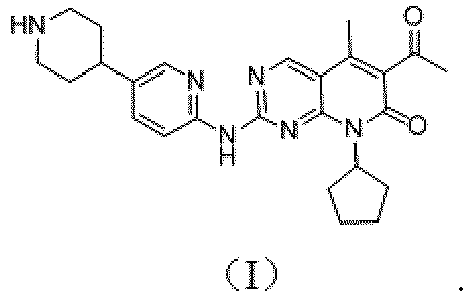
- In the optional embodiments, in the method for treating locally recurrent or metastatic breast cancer provided by the present disclosure,every 28 days is a treatment cycle, wherein the compound represented by formula (I) or the pharmaceutically acceptable salt thereof is continuously administered from the first day to the 21th day, and anastrozole is administered every day in the 28-day treatment cycle.
- In the optional embodiments, in the method for treating locally recurrent or metastatic breast cancer in human patients provided by the present disclosure, the patient is in the fasting state when the compound represented by formula (I) or the pharmaceutically acceptable salt thereof is administered.
- In the optional embodiments, in the method for treating locally recurrent or metastatic breast cancer in the human patient provided by the present disclosure, the breast cancer is hormone receptor positive (HR+) and/or human epidermal growth factor receptor 2 negative (HER2-).
- In the optional embodiments, in the method for treating locally recurrent or metastatic breast cancer in the human patient provided by the present disclosure, the daily dose of the compound represented by formula (I) or a pharmaceutically acceptable salt thereof is 100-150 mg.
- In the optional embodiments, in the method for treating locally recurrent or metastatic breast cancer in the human patient provided by the present disclosure, the daily dose of the compound represented by formula (I) or a pharmaceutically acceptable salt thereof is 100 mg, 125 mg or 150 mg.
- In the optional embodiments, in the method for treating locally recurrent or metastatic breast cancer in the human patient provided by the present disclosure, the daily dose of anastrozole is 0.1-10 mg.
- In the optional embodiments, in the method for treating locally recurrent or metastatic breast cancer in the human patient provided by the present disclosure, the daily dose of anastrozole is 0.5 mg, 1 mg or 1.5mg.
- In the optional embodiments, in the method for treating locally recurrent or metastatic breast cancer in the human patient provided by the present disclosure, the compound represented by formula (I) or a pharmaceutically acceptable salt thereof is administered in the morning.
- In the optional embodiments, in the method for treating locally recurrent or metastatic breast cancer in the human patient provided by the present disclosure, the pharmaceutically acceptable salt of the compound represented by formula (I) is hydroxyethyl sulfonate.
- On the other hand, the present disclosure provides a method for treating breast cancer, comprising administering 150 mg/day of the compound represented by formula (I) or the pharmaceutically acceptable salt thereof and 0.1-50 mg/day of anastrozole to a patient, monitoring adverse reactions (AE grade) of the patient; and if the patient has grade 3/4 AE, administering 125 mg/day or 100 mg/day of the compound represented by formula (I) or the pharmaceutically acceptable salt thereof.
- Preferably, the method for treating breast cancer provided by the present disclosure, comprises administering 150 mg/day of the compound represented by formula (I) or the pharmaceutically acceptable salt thereof and 1 mg/day of anastrozole to a patient, monitoring adverse reactions (AE grade) of the patient; and if the patient has grade 3/4 AE, administering 125 mg/day or 100 mg/day of the compound represented by formula (I) or the pharmaceutically acceptable salt thereof.
- Preferably, the method for treating breast cancer provided by the present disclosure, comprisesadministering 150 mg/day of the compound represented by formula (I) or the pharmaceutically acceptable salt thereof to a patient, administering orally once a day; administering 1 mg/day of anastrozole, administering orally once a day; monitoring adverse reactions (AE grade) of the patient; and if the patient has grade 3/4 AE, administering 125 mg/day or 100 mg/day of the compound represented by formula (I) or the pharmaceutically acceptable salt thereof to the patient.
- Since anastrozole increases the AUC of the compound represented by formula (I) or the pharmaceutically acceptable salt thereof, the curative effect of the drug in the patient has a greater chance to be maintained after reducing the dose compared with the original dose.
- On the other hand, the present disclosure provides a use of anastrozole in the preparation of a medicament increasing the AUC of the compound represented by formula (I) or the pharmaceutically acceptable salt thereof in a patient.
- In the optional embodiments, by administering to a patient an effective amount of the compound represented by formula (I) or the pharmaceutically acceptable salt thereof and an effective amount of anastrozole, relative to administering an equivalent dose of the compound represented by formula (I) or the pharmaceutically acceptable salt thereof alone, the AUC produced in the patient is increased by more than 18%, optionally, the AUC is increased by 20%-150%, optionally, the AUC is increased by 25%-100%; optionally, the AUC is increased by 30%-85%; optionally, the AUC is increased by 35%-80%; optionally, the AUC is increased by 40%-80%; preferably, the AUC is increased by 45%-80%; preferably, the AUC is increased by 50%-80%, preferably, the AUC is increased by 55%-80%; preferably, the AUC is increased by 60%-80%; specifically, the AUC of the compound represented by formula (I) or the pharmaceutically available salt thereof is increases by about 18%, 19%, 20%, 21%, 22%, 23%, 24%, 25%, 26%, 27%, 28%, 29%, 30%, 31%, 32%, 33%, 34%, 35%, 36%, 37%, 38%, 39%, 40%, 41%, 42%, 43%, 44%, 45%, 46%, 47%, 48%, 49%, 50%, 51%, 52%, 53%, 54%, 55%, 56%, 57%, 58%, 59%, 60%, 61%, 62%, 63%, 64%, 65%, 66%, 67%, 68%, 69%, 70%, 71%, 72%, 73%, 74%, 75%, 76%, 77%, 78%, 79%, 80%, 81%, 82%, 83%, 84%, 85%, 86%, 87%, 88%, 89%, 90%, 91%, 92%, 93%, 94%, 95%, 96%, 97%, 98%, 99%, 100%, 101%, 102%, 103%, 104%, 105%, 106%, 107%, 108%, 109%, 110%, 111%, 112%, 113%, 114%, 115%, 116%, 117%, 118%, 119%, 120%, 121%, 122%, 123%, 124%, 125%, 126%, 127%, 128%, 129%, 130%, 131%, 132%, 133%, 134%, 135%, 136%, 137%, 138%, 139%, 140%, 141%, 142%, 143%, 144%, 145%, 146%, 147%, 148%, 149%, 150%.
- In the optional embodiments, by administering to a patient an effective amount of the compound represented by formula (I) or the pharmaceutically acceptable salt thereof and an effective amount of anastrozole, relative to administering an equivalent dose of the compound represented by formula (I) or the pharmaceutically acceptable salt thereof in combination with letrozole, the AUC ratio of the compound represented by formula (I) or the pharmaceutically available salt thereof in the patient is more than 1:1, optionally, the AUC ratio is selected from 1 to 10:1; optionally, the AUC ratio is selected from 1 to 5:1; optionally, the AUC ratio is selected from 1 to 4:1; optionally, the AUC ratio is selected from 1 to 3:1; preferably, the AUC ratio is selected from 1 to 2:1; preferably, the AUC ratio is selected from 1 to 1.5:1; specifically, the AUC ratio may be 1.01 :1, 1.02 :1, 1.03 :1, 1.04 :1, 1.05 :1, 1.06 :1, 1.07 :1, 1.08 :1, 1.09 :1, 1.10 :1, 1.11 :1, 1.12 :1, 1.13 :1, 1.14 :1, 1.15 :1, 1.16 :1, 1.17 :1, 1.18 :1, 1.19 :1, 1.20 :1, 1.21 :1, 1.22 :1, 1.23 :1, 1.24 :1, 1.25 :1, 1.26 :1, 1.27 :1, 1.28 :1, 1.29 :1, 1.30 :1, 1.31 :1, 1.32 :1, 1.33 :1, 1.34 :1, 1.35 :1, 1.36 :1, 1.37 :1, 1.38 :1, 1.39 :1, 1.40 :1, 1.41 :1, 1.42 :1, 1.43 :1, 1.44 :1, 1.45 :1, 1.46 :1, 1.47 :1, 1.48 :1, 1.49 :1, 1.50 :1, 1.51 :1, 1.52 :1, 1.53 :1, 1.54 :1, 1.55 :1, 1.56 :1, 1.57 :1, 1.58 :1, 1.59 :1, 1.60 :1, 1.61 :1, 1.62 :1, 1.63 :1, 1.64 :1, 1.65 :1, 1.66 :1, 1.67 :1, 1.68 :1, 1.69 :1, 1.70 :1, 1.71 :1, 1.72 :1, 1.73 :1, 1.74 :1, 1.75 :1, 1.76 :1, 1.77 :1, 1.78 :1, 1.79 :1, 1.80 :1, 1.81 :1, 1.82 :1, 1.83 :1, 1.84 :1, 1.85 :1, 1.86 :1, 1.87 :1, 1.88 :1, 1.89 :1, 1.90 :1, 1.91 :1, 1.92 :1, 1.93 :1, 1.94 :1, 1.95 :1, 1.96 :1, 1.97 :1, 1.98 :1, 1.99 :1, 2.00:1.
- In the optional embodiments, by administering to the patient an effective amount of the compound represented by formula (I) or the pharmaceutically acceptable salt thereof and an effective amount of anastrozole, the compound represented by formula (I) or the pharmaceutically acceptable salt thereof provides an AUC of 2800-8000 ng∗h/mL in a patient; optionally, the compound represented by formula (I) or the pharmaceutically acceptable salt thereof provides an AUC of 2800-7800 ng∗h/mL in a patient; optionally, the compound represented by formula (I) or the pharmaceutically acceptable salt thereof provides an AUC of 3000-7600 ng∗h/mL in a patient; optionally, the compound represented by formula (I) or the pharmaceutically acceptable salt thereof provides an AUC of 3000-7400 ng∗h/mL in a patient; optionally, the compound represented by formula (I) or the pharmaceutically acceptable salt thereof provides an AUC of 3000-7200 ng∗h/mL in a patient; optionally, the compound represented by formula (I) or the pharmaceutically acceptable salt thereof provides an AUC of 3000-7000 ng∗h/mL in a patient; optionally, the compound represented by formula (I) or the pharmaceutically acceptable salt thereof provides an AUC of 3000-6800 ng∗h/mL in a patient; optionally, the compound represented by formula (I) or the pharmaceutically acceptable salt thereof provides an AUC of 3000-6600 ng∗h/mL in a patient; optionally, the compound represented by formula (I) or the pharmaceutically acceptable salt thereof provides an AUC of 3000-6400 ng∗h/mL in a patient; optionally, the compound represented by formula (I) or the pharmaceutically acceptable salt thereof provides an AUC of 3000-6200 ng∗h/mL in a patient; optionally, the compound represented by formula (I) or the pharmaceutically acceptable salt thereof provides an AUC of 3000-6000 ng∗h/mL in a patient; optionally, the compound represented by formula (I) or the pharmaceutically acceptable salt thereof provides an AUC of 3000-5800 ng∗h/mL in a patient; optionally, the compound represented by formula (I) or the pharmaceutically acceptable salt thereof provides an AUC of 3000-5600 ng∗h/mL in a patient; optionally, the compound represented by formula (I) or the pharmaceutically acceptable salt thereof provides an AUC of 3000-5400 ng∗h/mL in a patient; optionally, the compound represented by formula (I) or the pharmaceutically acceptable salt thereof provides an AUC of 3000-5200 ng∗h/mL in a patient; optionally, the compound represented by formula (I) or the pharmaceutically acceptable salt thereof provides an AUC of 3000-5000 ng∗h/mL in a patient; preferably, the compound represented by formula (I) or the pharmaceutically acceptable salt thereof provides an AUC of 3000-4800 ng∗h/mL in a patient; preferably, the compound represented by formula (I) or the pharmaceutically acceptable salt thereof provides an AUC of 3200-4600 ng∗h/mL in a patient; preferably, the compound represented by formula (I) or the pharmaceutically acceptable salt thereof provides an AUC of 3400-4400 ng∗h/mL in a patient; preferably, the compound represented by formula (I) or the pharmaceutically acceptable salt thereof provides an AUC of 3600-4200 ng∗h/mL in a patient.
- In the use of anastrozole in the preparation of a medicament for increasing the AUC of the compound represented by formula (I) or the pharmaceutically acceptable salt thereof in the patient provided by the present disclosure, optionally anastrozole increases Cmax of the compound represented by formula (I) or the pharmaceutically acceptable salt thereof in the patient.
- In the optional embodiments, by administering to a patient an effective amount of the compound represented by formula (I) or the pharmaceutically acceptable salt thereof and an effective amount of anastrozole, relative to administering an equivalent dose of the compound represented by formula (I) or the pharmaceutically acceptable salt thereof alone, the Cmax ratio of the compound represented by formula (I) or the pharmaceutically acceptable salt thereof in a patient is more than 1:1, optionally, the Cmax ratio is selected from 1 to 10:1; optionally, the Cmax ratio is selected from 1 to 5:1; optionally, the Cmax ratio is selected from 1 to 4:1; optionally, the Cmax ratio is selected from 1 to 3:1; preferably, the Cmax ratio is selected from 1 to 2:1; and preferably, the Cmax ratio is selected from 1 to 1.5:1. The specific Cmax ratio may be 1.02 :1, 1.04 :1, 1.06 :1, 1.08 :1, 1.10 :1, 1.12 :1, 1.14 :1, 1.16 :1, 1.18 :1, 1.20 :1, 1.22 :1, 1.24 :1, 1.26 :1, 1.28 :1, 1.30 :1, 1.32 :1, 1.34 :1, 1.36 :1, 1.38 :1, 1.40 :1, 1.42 :1, 1.44 :1, 1.46 :1, 1.48 :1, 1.50 :1, 1.52 :1, 1.54 :1, 1.56 :1, 1.58 :1, 1.60 :1, 1.62 :1, 1.64 :1, 1.66 :1, 1.68 :1, 1.70 :1, 1.72 :1, 1.74 :1, 1.76 :1, 1.78 :1, 1.80 :1, 1.82 :1, 1.84 :1, 1.86 :1, 1.88 :1, 1.90 :1, 1.92 :1, 1.94 :1, 1.96 :1, 1.98 :1, 2.00:1.
- In the preferable embodiments, the dose of the compound represented by formula (I) or the pharmaceutically acceptable salt thereof is less than or equal to 175 mg, preferably less than or equal to 150 mg.
- In the optional embodiments, the administration frequency of the compound represented by formula (I) or the pharmaceutically acceptable salt thereof is once a day or twice a day, and the daily dose of the compound represented by formula (I) or the pharmaceutically acceptable salt thereof is 1-500 mg, preferably 50-200 mg, more preferably 100-150 mg; the administration frequency of anastrozole is once a day or twice a day, and the daily dose is 0.1-50 mg, preferably 1-25 mg, most preferably 1-10 mg.
- In the preferable embodiments, the administration frequency of the compound represented by formula (I) or the pharmaceutically acceptable salt thereof is once a day; the daily dose is 150 mg; and the administration frequency of anastrozole is once a day, the daily dose is 1 mg.
- The present disclosure provides a method for increasing the AUC of the compound represented by formula (I) or the pharmaceutically acceptable salt thereof after administering, comprising administering an effective amount of anastrozole to a patient,

- On the other hand, the present disclosure provides a method for treating tumor diseases, comprising administering to a patient a therapeutically effective amount of the compound represented by formula (I) or the pharmaceutically acceptable salt thereof and a therapeutically effective amount of at least one aromatic kinase inhibitor or estrogen receptor antagonist, the aromatic kinase inhibitor is selected from one or more of formestane, atamestane, anastrozole, fadrozole, letrozole, vorozole, exemestane and finrozole, preferably letrozole and/or anastrozole, the estrogen receptor antagonist is selected from one or more of tamoxifen, fulvestrant, preferably fulvestrant, wherein the compound represented by formula (I) or the pharmaceutically acceptable salt thereof is administered in the fasting state, the patient is preferably a human.
- In the method for treating tumor diseases provided by the present disclosure, food, especially high-fat meal, may increase the exposure level of the compound represented by formula (I) or the pharmaceutically acceptable salt thereof; the therapeutic safety and effect of the drug is ensured by separating the administration and eating for a longer time, avoiding the pharmacokinetic effects of food on the compound represented by formula (I) or the pharmaceutically acceptable salt thereof.
- In the optional embodiments, the aromatic kinase inhibitor is anastrozole, the dose of the compound represented by formula (I) or the pharmaceutically acceptable salt thereof is 1-500 mg, preferably 50-200 mg, more preferably 100-150 mg, the administration frequency is once a day, twice a day, preferably once a day; and the dose of anastrazole is selected from 0.1-50 mg, preferably 1-25 mg, most preferably 1-10 mg, once a day, twice a day, preferably once a day, wherein the compound represented by formula (I) or the pharmaceutically acceptable salt thereof is administered in the fasting state.
- In the optional embodiments, the aromatic kinase inhibitor is anastrozole, the dose of the compound represented by formula (I) or the pharmaceutically acceptable salt thereof is selected from 50 mg, 75 mg, 100 mg, 125 mg, 150 mg, 175 mg, preferably 100 mg, 125 mg or 150 mg, the administration frequency is once a day; and the dose of anastrazole is selected from 0.5 mg, 1.0 mg, 1.5 mg, 2.0 mg, 2.5 mg, 3.0 mg, 3.5 mg, 4.0 mg, 4.5 mg, 5.0 mg, preferably 1.0 mg, the administration frequency is once a day, wherein the compound represented by formula (I) or the pharmaceutically acceptable salt thereof is administered in the fasting state.
- In the optional embodiments, the aromatic kinase inhibitor is anastrozole, the dose of the compound represented by formula (I) or the pharmaceutically acceptable salt thereof is 100 mg, 125 mg or 150 mg, the administration frequency is once a day; and the dose of anastrazole is 1.0 mg, the administration frequency is once a day, wherein the compound represented by formula (I) or the pharmaceutically acceptable salt thereof is administered in the fasting state.
- In the optional embodiments, the aromatic kinase inhibitor is anastrozole, the dose of the compound represented by formula (I) or the pharmaceutically acceptable salt thereof is 100 mg, the administration frequency is once a day; and the dose of anastrazole is 1.0 mg, the administration frequency is once a day, wherein the compound represented by formula (I) or the pharmaceutically acceptable salt thereof is administered in the fasting state.
- In the optional embodiments, the aromatic kinase inhibitor is anastrozole, the dose of the compound represented by formula (I) or the pharmaceutically acceptable salt thereof is 125 mg, the administration frequency is once a day; and the dose of anastrazole is 1.0 mg, the administration frequency is once a day, wherein the compound represented by formula (I) or the pharmaceutically acceptable salt thereof is administered in the fasting state.
- In the optional embodiments, the aromatic kinase inhibitor is anastrozole, the dose of the compound represented by formula (I) or the pharmaceutically acceptable salt thereof is 150 mg, the administration frequency is once a day; and the dose of anastrazole is 1.0 mg, the administration frequency is once a day, wherein the compound represented by formula (I) or the pharmaceutically acceptable salt thereof is administered in the fasting state.
- In the optional embodiments, the aromatic kinase inhibitor is letrozole, the dose of the compound represented by formula (I) or the pharmaceutically acceptable salt thereof is 1-500 mg, preferably 50-200 mg, more preferably 100-150 mg, the administration frequency is once a day, twice a day, preferably once a day; and the dose of letrozole is selected from 1-100 mg, preferably 1-10 mg, most preferably 1-5 mg, the administration frequency is once a day, twice a day, preferably once a day, wherein the compound represented by formula (I) or the pharmaceutically acceptable salt thereof is administered in the fasting state.
- In the optional embodiments, the aromatic kinase inhibitor is letrozole, the dose of the compound represented by formula (I) or the pharmaceutically acceptable salt thereof is selected from 50 mg, 75 mg, 100 mg, 125 mg, 150 mg, 175 mg, preferably 100 mg, 125 mg or 150 mg, the administration frequency is once a day; and the dose of letrozole is selected from 0.5 mg, 1.0 mg, 1.5 mg, 2.0 mg, 2.5 mg, 3.0 mg, 3.5 mg, 4.0 mg, 4.5 mg, 5.0 mg, preferably 2.5 mg, the administration frequency is once a day, wherein the compound represented by formula (I) or the pharmaceutically acceptable salt thereof is administered in the fasting state.
- In the optional embodiments, the aromatic kinase inhibitor is letrozole, the dose of the compound represented by formula (I) or the pharmaceutically acceptable salt thereof is 100 mg, 125 mg or 150 mg, the administration frequency is once a day; and the dose of letrozole is 2.5 mg, the administration frequency is once a day, wherein the compound represented by formula (I) or the pharmaceutically acceptable salt thereof is administered in the fasting state.
- In the optional embodiments, the aromatic kinase inhibitor is letrozole, the dose of the compound represented by formula (I) or the pharmaceutically acceptable salt thereof is 100 mg, the administration frequency is once a day; and the dose of letrozole is 2.5 mg, the administration frequency is once a day, wherein the compound represented by formula (I) or the pharmaceutically acceptable salt thereof is administered in the fasting state.
- In the optional embodiments, the aromatic kinase inhibitor is letrozole, the dose of the compound represented by formula (I) or the pharmaceutically acceptable salt thereof is 125 mg, the administration frequency is once a day; and the dose of letrozole is 2.5 mg, the administration frequency is once a day, wherein the compound represented by formula (I) or the pharmaceutically acceptable salt thereof is administered in the fasting state.
- In the optional embodiments, the aromatic kinase inhibitor is letrozole, the dose of the compound represented by formula (I) or the pharmaceutically acceptable salt thereof is 150 mg, the administration frequency is once a day; and the dose of letrozole is 2.5 mg, the administration frequency is once a day, wherein the compound represented by formula (I) or the pharmaceutically acceptable salt thereof is administered in the fasting state.
- In the optional embodiments, the estrogen receptor antagonist is fulvestrant, the dose of the compound represented by formula (I) or the pharmaceutically acceptable salt thereof is 1-500 mg, preferably 50-200 mg, more preferably 100-150 mg, the administration frequency is once a day, twice a day, preferably once a day; and the dose of fulvestrant is selected from 1-2000 mg, preferably 10-1000 mg, most preferably 100-1000 mg, the administration frequency is once a week or once two weeks, wherein the compound represented by formula (I) or the pharmaceutically acceptable salt thereof is administered in the fasting state.
- In the optional embodiments, the estrogen receptor antagonist is fulvestrant, the dose of the compound represented by formula (I) or the pharmaceutically acceptable salt thereof is selected from 50 mg, 75 mg, 100 mg, 125 mg, 150 mg, 175 mg, preferably 100 mg, 125 mg or 150 mg, the administration frequency is once a day; and the dose of fulvestrant is selected from 200 mg, 300 mg, 400 mg, 500 mg, 600 mg, 700 mg, 800 mg, preferably 500 mg, the administration frequency is once a week or once two weeks, wherein the compound represented by formula (I) or the pharmaceutically acceptable salt thereof is administered in the fasting state.
- In the optional embodiments, the estrogen receptor antagonist is fulvestrant, the dose of the compound represented by formula (I) or the pharmaceutically acceptable salt thereof is selected from 100 mg, 125 mg or 150 mg, the administration frequency is once a day; and the dose of fulvestrant is 500 mg, the administration frequency is once a week or once two weeks , wherein the compound represented by formula (I) or the pharmaceutically acceptable salt thereof is administered in the fasting state.
- In the optional embodiments, the estrogen receptor antagonist is fulvestrant, the dose of the compound represented by formula (I) or the pharmaceutically acceptable salt thereof is 100 mg, the administration frequency is once a day; and the dose of fulvestrant is 500 mg, the administration frequency is once a week or once two weeks, wherein the compound represented by formula (I) or the pharmaceutically acceptable salt thereof is administered in the fasting state.
- In the optional embodiments, the estrogen receptor antagonist is fulvestrant, the dose of the compound represented by formula (I) or the pharmaceutically acceptable salt thereof is 125 mg, the administration frequency is once a day; and the dose of fulvestrant is 500 mg, the administration frequency is once a week or once two weeks, wherein the compound represented by formula (I) or the pharmaceutically acceptable salt thereof is administered in the fasting state.
- In the optional embodiments, the estrogen receptor antagonist is fulvestrant, the dose of the compound represented by formula (I) or the pharmaceutically acceptable salt thereof is 150 mg, the administration frequency is once a day; and the dose of fulvestrant is 500 mg, the administration frequency is once a week or once two weeks, wherein the compound represented by formula (I) or the pharmaceutically acceptable salt thereof is administered in the fasting state. In the particularly preferable embodiments, the compound represented by formula (I) or the pharmaceutically acceptable salt thereof is administered in the fasting state in the morning.
- In the present disclosure, the combination of the pharmaceutical composition containing the compound represented by formula (I) or the pharmaceutically acceptable salt thereof with anastrozole are superior to the combination of the compound represented by formula (I) or the pharmaceutically acceptable salt thereof with letrozolein the use in the preparation of a medicament for treating tumors, which can be manifested in a higher objective remission rate (ORR) or progression-free survival (PFS) or duration of remission (DoR) or disease control rate (DCR) or overall survival (OS), higher rates of complete remission (CR) and/or partial remission (PR) and/or stable disease (SD), and lower incidence of adverse events in the patient, which can also be used to demonstrate the effect of the present disclosure.
- "Treatment" includes the preventive and therapeutic treatment (including, but not limited to, remission, cure, symptom relief, symptom reduction) and delay of progression of tumor diseases or disorders.
- "Pharmaceutical composition" refers to a mixture containing at least one therapeutic agent and at least one pharmaceutically acceptable excipient, the pharmaceutically acceptable excipient includes, but not limited to, diluent, binder, disintegrant, lubricant, the diluent includes, but not limited to, mannitol, dextrose microcrystalline cellulose, pregelatinized starch, calcium hydrogen phosphate, lactose, sorbitol; the binder may be selected from one or more of starch, sodium carboxymethylcellulose, polyvinylpyrrolidone, pregelatinized starch, hydroxypropylmethylcellulose and hydroxypropylcellulose; the disintegrant may be selected from one or more of cross-linked sodium carboxymethylcellulose, sodium carboxymethylstarch, low-substituted hydroxypropylcellulose and cross-linked povidone; the lubricant may be selected from one or more of talc, magnesium stearate, zinc stearate, and glycerylbehenate.
- The pharmaceutical composition containing the compound represented by formula (I) or the pharmaceutically acceptable salt thereof and the pharmaceutical composition containing anastrozolein the present disclosure may also be administered in a parenteral form, the pharmaceutical composition may comprise pharmaceutically acceptable excipient, the excipient is selected from one or more of preservatives, stabilizers, solubilizers, emulsifiers, osmotic pressure regulatorss, buffers.
- "Therapeutically effective" preferably refers to an amount of therapeutic agent that is therapeutically or more broadly also prophylactically effective against tumor progression.
- The expression "in combination with" in the present invention is a mode of administration, which means that at least one dose of the the pharmaceutical composition containing the compound represented by formula (I) or the pharmaceutically acceptable salt thereof and anastrozole are administered within a certain period of time, wherein both of the two drugs exhibit pharmacological effects. The period of time can be within one administration cycle, preferably within 24 hours. The pharmaceutical composition containing the compound represented by formula (I) or the pharmaceutically acceptable salt thereof and anastrozole can be administered simultaneously or sequentially. This period of time includes the treatment in which the pharmaceutical composition containing the compound represented by formula (I) or the pharmaceutically acceptable salt thereof and anastrozole are administered via the same route or different routes.
- "Cmax" in the present disclosure refers to the peak concentration of the pharmacokinetic drug in the blood, which is an important index to evaluate the absorption rate of the drug and reflects the exposure characteristics of the drug in the body.
- "AUC" refers to the area surrounded by the pharmacokinetic blood drug concentration curve on the time axis, which is an important index to evaluate the degree of drug absorption and reflects the exposure characteristics of the drug in vivo. Since the blood drug concentration in pharmacokinetic studies can only be observed up to a certain time point t, there are two ways to express AUC: AUC(0-t) and AUC(0-∞), the former is obtained according to trapezoidal area method, and the latter is calculated by the following formula: AUC(0-∞) = AUC(0-t)+terminal concentration/terminal elimination rate. The AUC described in the present disclosure is the mean AUC0-24 of a patient after reaching a steady state through a single dose or multiple doses, preferably the mean AUC0-24 of a patient after reaching a steady state through multiple doses (i.e., AUCss).
- "High-fat meal" is a meal with high fat (providing about 50% of calories in food) and high calorie (about 800-1000 kcal), in which protein provides about 150 kcal, carbohydrate provides about 250 kcal and fat provides about 500-600 kcal.
- "Fasting" means that the interval between administration and eating is at least 0.5 hours, or at least 1 hour, or at least 2 hours, or at least 3 hours, or at least 4 hours, or at least 5 hours, or at least 6 hours, or at least 7 hours, or at least 8 hours, specifically at least 0.5 hour before a meal, or at least 1 hour before a meal, or at least 1.5 hours before a meal, or at least 2 hours before a meal, or at least 2 hours after a meal, or at least 3 hours after a meal, at least 4 hours after a meal, preferably at least 0.5 hour before breakfast, or at least 1 hour before breakfast, or at least 1.5 hours before breakfast, or at least 2 hours before breakfast.
- The criteria for determining the severity of adverse events in the present disclosure are based on the NCI-CTC AE version 4.03 of the grading standard for adverse drug events. In the event of an adverse event not listed in the NCI-CTC AE version 4.03 table, the following criteria is available for reference:
Grade Clinical description of severity 1 Mild; no clinical symptoms or mild clinical symptoms; only abnormalities in clinical or laboratory examination; no need for treatment 2 Moderate; less, local or non-invasive treatment is needed; the age-appropriate activities of daily living (ADL)using tools are limited, and the activities of daily living using tools refers to cooking, shopping, making phone calls, counting money, etc. 3 Severe illness or medically serious symptoms but temporarily not life-threatening; resulting in hospitalization or prolonged hospitalization; resulting in disability; limitations in self care ADL. Self care ADL refers to: bathing, dressing, undressing, eating, going to the bathroom, taking medication, etc., not bedridden 4 Life-threatening; urgent treatment is needed 5 Causing death -
-
Figure 1 . The mean (Mean±SD) blood drug concentration-time curve of hydroxyethyl sulfonate of the compound represented by formula (I) (PK concentration analysis of the population); -
Figure 2 . The median blood drug concentration-time curve of hydroxyethyl sulfonate of the compound represented by formula (I) (PK concentration analysis of the population); -
Figure 3 . Box and whisker diagram of the main PK parameters of hydroxyethyl sulfonate of the compound represented by formula (I) for the individual (PK parameter analysis of the population). - The present disclosure will be further described in conjunction with the embodiments, but these embodiments are not intended to limit the scope of the present disclosure.
- Embodiment 1: Phase Ib/II clinical research of hydroxyethyl sulfonate of the compound represented by formula (I) (drug A)in combination with letrozole or anastrozole or fulvestrant for treating advanced breast cancer with positive hormone receptor and negative HER2
-
- 1) drug A, prepared according to the method provided by
WO2016124067A , with the specification of 25 mg/tablet and 125 mg/ tablet; - 2) Letrozole tablets, manufacturer: Jiangsu Hengrui Medicine Co.,Ltd., specification: 2.5 mg/tablet;
- 3) Anastrozole tablets (Rainide), manufacturer: AstraZeneca Pharmaceutical Co., Ltd., specification: 1 mg/tablet;
- (4) Fulvestrant injection (Faslodex); manufacturer: Vetter Pharma-Fertigung GmbH &Co.KG; dosage form: injection; specification: 5 ml: 0.25 mg.
- The main research purposes of the first stage:
To evaluate the safety and tolerance of drug A in combination with letrozole, anastrozole or fulvestrant in the treatment of locally recurrent or metastatic breast cancer in the HR+, HER2-postmenopausal or premenopausal female. - The secondary research purposes of the first stage:
- To evaluate the pharmacokinetic properties of drug A in combination with letrozole or anastrozole or fulvestrant in patients with advanced breast cancer;
- To preliminarily evaluate the efficacy of drug A in combination with letrozole or anastrozole or fulvestrant in the treatment of advanced breast cancer.
- The main research purposes of the second stage:
To evaluate the efficacy of drug A in combination with letrozole or anastrozole in the treatment of locally recurrent or metastatic breast cancer in the HR+, HER2-postmenopausal or premenopausal female. - The secondary research purposes of the second stage:
To evaluate the safety of drug A in combination with letrozole or anastrozole in patients with advanced breast cancer. - The main research endpoints of the first stage:
Incidence and severity of adverse events (AE) and serious adverse events (SAE) and abnormalities of laboratory examination. - The secondary research endpoints of the first stage:
- Pharmacokinetic parameters of drug A in combination with letrozole or anastrozole or fulvestrant: AUC, Tmax, t1/2 and Cmax, etc.;
- Objective Response Rate, ORR
- The main research endpoints of the second stage:
Objective Response Rate, ORR - The secondary research endpoints of the second stage:
- Progression Free Survival, PFS;
- Duration of Response, DoR;
- Disease Control Rate, DCR;
- Incidence and severity of adverse events (AE) and serious adverse events (SAE) and abnormalities of laboratory examination.
- In order to effectively investigate the safety, pharmacokinetic properties and efficacy of drug A in combination with letrozole or anastrozole or fulvestrant, the following cohort (dose level) studies were planned:
- Cohort 1: drug A 150 mg qd (d1-21) + letrozole 2.5 mg qd or
anastrozole 1 mg qd; - cohort 2: drug A 125 mg qd (d1-21) + letrozole 2.5 mg qd or
anastrozole 1 mg qd; - cohort 3: drug A 150 mg qd (d1-21) + fulvestrant 500 mg, intramuscular injection (first cycle: d1 and d15, followed by cycle d1);
- cohort 4: drug A, dose to be determined qd (d1-21) + fulvestrant 500 mg, intramuscular injection (first cycle: d1 and d15, followed by cycle d1);
- About 15 subjects were enrolled in each cohort (at least 10 subjects can be evaluated for tolerance and pharmacokinetics). The first cycle (28 days) of combined administration was used as the tolerance observation period, during which the dose group was considered tolerable if the proportion of subjects with clinically significant toxicity was ≤33% (i.e., no more than 3 out of 10 subjects who can be evaluated for tolerability had clinically significant toxicity). After the observation of the first cycle of
cohort 1, the researcher and the sponsor jointly negotiated and decided the dose of cohort 2 according to the safety and tolerance results and the data of other relevant clinical studies. After the observation of the first cycle of cohort 3, the researcher and the sponsor jointly negotiated and decided the dose of cohort 4 according to the safety and tolerance results and the data of other relevant clinical studies. - Every 28 days was a treatment cycle: drug A was administered continuously in the first 3 weeks (from the first day to the 21th day), and rested (without administering) in the next 1 week (from the 22th day to the 28th day); letrozole or anastrozole was administered once a day. Fulvestrant was administered on the 1st day and the 15th day of the first cycle, followed by administration on the first day of each cycle.
- According to the results of the first stage, the recommended dose of Phase II research (RP2D) was selected for further evaluation of efficacy and safety in patients with advanced breast cancer:
Drug A (RP2D, d1-21) + letrozole 2.5 mg qd oranastrozole 1 mg qd; - In this research, the screening period did not exceed 28 days, and subjects who were eligible after completing the screening examination and assessment entered the research treatment period (every 28 days was a treatment cycle), and research treatment and visit were carried out as specified in the scheme. Wherein, during the first 14 treatment cycles of the research treatment period, tumor imaging evaluation was conducted every 2 cycles (8 weeks ± 7 days);thereafter, tumor imaging evaluation was conductedevery 4 cycles (16 weeks ± 7 days). Subjects should visit the research center at the end of treatment/when withdrawing from the research to complete the corresponding safety inspection and imaging evaluation; and visit the research center 30 days after the last treatment to complete the corresponding safety assessment.
- In the first stage, subjects will be administered according to the cohort (dose level) they belong to as follows:
cohort 1,drug A 150 mg, administered orally, once a day; cohort 2, drug A 125 mg, administered orally, once a day; cohort 3,drug A 150 mg, administered orally, once a day; cohort 4, the dose of drug A was to be determined, administered orally, once a day. Every 28 days was a treatment cycle, drug A (once a day) was administered continuously from the first day to the 21th day, and rested from the 22th day to the 28th day (drug A). - In the second stage, according to the results of the first stage, the recommended dose of Phase II research (RP2D) was used, drug A (RP2D), administered orally, once a day, every 28 days was a treatment cycle, drug A (once a day) was administered continuously from the first day to the 21th day, and rested (without administering) from the 22th day to the 28th day.
- All subjects were administered drug A with letrozole or anastrozole or fulvestrantat the same time in the first stage. Letrozole 2.5 mg or
anastrozole 1 mg, administered orally, once a day, continuously administered, every 28 days was a treatment cycle. It was recommended to administer drug A with letrozole or anastrozole orally at the same time with warm water at 8:00 every morning in the fasting state. - Subjects should continue to receive research treatment until disease progression, intolerable toxicity, termination of research treatment or withdrawal from the research voluntarily requested by the subject, or withdrawal from the research determined by the investigator.
- All subjects must meet the following entry criteria to be eligible for this trial.
- 1. Female breast cancer patients diagnosed as HR+ and HER2- by pathological testing, with evidence of focal recurrence or metastasis, not suitable for surgical resection or radiation therapy for curative purposes, and with no clinical indications for chemotherapy.
- 2. Postmenopausal female aged 18 to75, menopause is defined as:
- a) previous bilateral oophorectomy, or
- b) age ≥ 60 years; or age < 60, natural postmenopausal state (defined as spontaneous cessation of regular menses for at least 12 consecutive months without other pathological or physiological causes), in addition, premenopausal or perimenopausal female patients may be enrolled provided they are willing to receive LHRH agonist therapy during the research period and have received LHRH agonist administration at least 14 days prior to enrollment in the research.
- 3. The score of physical status of the Eastern Cooperative Oncology Group (ECOG) is 0-1.
- 4. All acute toxic reactions caused by previous anti-tumor treatment or surgery are relieved to grade 0-1 (according to NCI CTCAE Version 4.03) or to the level specified by inclusion/exclusion criteria. Other toxicities such as alopecia that the investigator believes do not pose a safety risk to the patient are excluded.
- 5. Adequate organ and bone marrow function, defined as follows:
- a) Neutrophil count (ANC) ≥ 1,500/mm3 (1.5 × 10⁹/L);
- b) Platelet count (PLT) ≥ 100,000/mm3 (100 × 109/L);
- c) Hemoglobin (Hb) ≥ 9 g/dL (90 g/L);
- d) Serum creatinine ≤ 1.5 times the upper limit of normal (ULN) or creatinine clearance rate ≥ 60 ml/min
- e) Total bilirubin (BIL) ≤ 1.5 times the upper limit of normal (ULN).
- f) Aspartate aminotransferase (AST/SGOT) or alanine aminotransferase (ALT/SGPT) levels ≤ 2.5 times the upper limit of normal (ULN), and patients with liver metastases should ≤ 5×ULN.
- 6. Female subjects of childbearing age must have a serum pregnancy test within 3 days before administering the research drug, and the result is negative, and they are willing to adopt a medically recognized high-efficiency contraceptive measure (such as intrauterine device, contraceptive or condom) during the research period and within 3 months after the last administration of the research drug.
- 7. Have given their consent and signed an informed consent form, and are willing and able to comply with planned visits, research treatment plans, laboratory tests and other trial procedures.
- 8. There are measurable lesions in accordance with RECIST 1.1 criteria.
- 9. Life expectancy > 12 weeks.
- The subjects in
cohort 1 and cohort 2 must meet all the following entry criteria to be eligible for this trial. - No prior systemic anticancer therapy for focal recurrent or metastatic disease.
- The subjects in cohort 3 and cohort 4 must meet all the following entry criteria to be eligible for this trial:
- 1. Patients need to meet one of the following criteria:
- a) Recurrence or progression confirmed by imaging examination after 2 years after receiving adjuvant endocrine therapy, and no further endocrine therapy is received;
- b) recurrence or progression confirmed by imaging examination within 1 year after the completion of adjuvant endocrine therapy;
- c) recurrence or progression confirmed by imaging examination after 6 months after receiving first-line endocrine therapy for patients with metastatic diseases. Patients did not receive endocrine therapy or chemotherapy after the first line of metastatic disease.
- Patients with recurrent and metastatic diseases are allowed to receive no more than first-line chemotherapy.
- At present, 33 subjects had been included. Cohort 1:
Drug A 150 mg, enrolled 17 cases, of which 13 cases were treated in combination with letrozole and 4 cases were treated in combination with anastrozole. Cohort 2: Drug A 125 mg, enrolled 16 cases, of which 15 cases were treated in combination with letrozole and 1 case was treated in combination with anastrozole. At least one efficacy evaluation was conducted in 32 subjects (cohort 1: 16 cases in the 150 mg dose group; cohort 2: 16 cases in the 125 mg dose group), and the safety evaluation was completed in 33 subjects at least within the first cycle. - Results of efficacy evaluation (as shown in Table 1 below): A total of 16 patients in the
drug A 150 mg dose group underwent at least one efficacy evaluation, including 7 cases (44%) of PR, 1 case (6%) of PD and 8 cases (50%) of SD. A total of 16 patients in the drug A 125 mg dose group underwent at least one efficacy evaluation, including 5 cases (31%) of PR and 11 cases (69%) of SD. Incohorts 1 and 2, there were 5 subjects were treated in combination with anastrozole (4 cases incohort 1; 1 case in cohort 2), and 4 of them were evaluated as PR at the first efficacy evaluation (2 months) after the first administration (as shown in Table 1 for details).Table 1. Phase Ib/II research efficacy of drug A Drug A dose group CR (N,%) PR (N,%) SD (N, %) PD (N,%) Cohort 1150 mg (N=16 cases) 0 7 cases, 44% 8 cases, 50% 1 cases, 6% Combination with Anastrozole (N=4) 0 3 cases, 75% 1 cases, 25% 0 Combination with letrozole (N=12) 0 4 cases, 33% 7 cases, 58% 1 cases, 8% Cohort 2 125 mg (N=16 cases) 0 5 cases, 31% 11 cases, 69% 0 Combination with Anastrozole (N=1) 0 1 case, 100% 0 0 Combination with letrozole (N=15) 0 4 cases, 27% 11 cases, 73% 0 - The overall safety evaluation results: a total of 33 cases can be evaluated, including 17 cases in 150 mg dose group and 16 cases in 125 mg group. AE was reported for all subjects, most of subjects were grade 1-2. Grade 3-4 hematological AE mainly included leukopenia (9 cases, 27.3%) and neutropenia (20 cases, 60.6%). After a total of 57 subjects were enrolled in
cohort 1 and 2, the group of compound A in combination with letrozole and the group of compound A in combination with anastrozole showed great differences in hematological toxicity. In 150 mg cohort, grade 3, 4 neutrophils decreased by 84.6% and 60.0% respectively in the two groups, grade 3, 4 leukocytes decreased by 38.5% and 20% respectivelyin the two groups, and platelets decreased by 23.1% and 5.0% respectively; in 125 mg cohort, grade 3, 4 neutrophils decreased by 73.3% and 44.4% respectively in the two groups, grade 3, 4 leukocytes decreased by 26.7% and 22.2% respectivelyin the two groups, and platelets decreased by 33.3% and 11.1% respectively; the data trends of the two cohorts were consistent, which indicated that compound A in combination with anastrozole was superior and safer in hematological toxicity than that in combination with letrozole. - The PK data for drug A in combination with letrozole and drug A in combination with anastrozole were compared with those for the single drug after multiple administration in the first administration cycle, and the results are shown in Table 2 and Table 3.
Table 2. Multiple administration (D21) Single-drug research Combination with letrozolegroup Combination with anastrozole group 125 mg group 150 mg group 125 mg group 150 mg group 125 mg group 150 mg group N=8 N=8 N=13 N=12 N=1 N=4 Cmax (ng/ml) 121 (25.5) 126 (26.2) 138 (42.6) 148 (33.4) 147 192 (15.1) AUCss (h∗ng/ml) 2110 (29.5) 2230 (21.5) 2229 (36.8) 2614 (34.5) 2146 3686 (16.2) t1/2z (h) 36.2 (57.3) 30.8 (24.7) 54.5 (17.9) 50.4 (17.5) 46.5 46.0 (19.0) CLss/F (L/h) 59.3 (29.2) 67.2 (26.8) 56.1 (36.8) 57.4 (34.5) 58.2 40.7 (16.2) Racc_Cmax 2.74 2.01 2.09 1.93 1.71 2.10 Racc_AUC 3.53 2.71 3.12 2.77 2.35 3.06 Table 3. Combination with anastrozole/single drug (ratio) Combination with anastrozole/Combination with letrozole (ratio) Dose of drug A Cycle Cmax ratio AUC ratio Cmax ratio AUC ratio 125 mg C1D1 1.15 1.47 1.31 1.28 C1D21 1.21 1.02 1.07 0.96 150 mg C1D1 1.44 1.49 1.20 1.28 C1D21 1.52 1.65 1.30 1.41 Note: Cmax and AUC are both geometric mean value(CV%). - As shown in Table 2, the exposure levels of drug A in the 150 mg dose group were: combination with anastrozole>combination with letrozole> single drug.
- As shown in Table 3, at the 150 mg dose, the AUC of the anastrozole group was 1.65 times higher than that of the single-drug research, and the AUC of the anastrozole group was 1.41 times higher than that of the letrozole group.
- Wherein, in the 150 mg dose group of drug A in combination with anastrozole, one patient had grade 4 AE, and the patient maintained PR status after the dose was lowered to 125 mg in the third administration cycle.
- In the later period, 9 patients were further enrolled in
cohort 1, including 1 case treated in combination with letrozole and 8 cases treated in combination with anastrozole, and 5 patients were further enrolled in cohort 2, including 2 cases treated in combination with letrozole and 3 cases treated in combination with anastrozole. The PK data for drug A in combination with letrozole and drug A in combination with anastrozole were compared with those of the single drug after multiple administration in the first administration cycle, and the results are shown in Table 4 and Table 5.Table 4. Multiple administration (D21) Single-drug research Combination with letrozole group Combination with anastrozole group 125 mg group 150 mg group 125 mg group 150 mg group 125 mg group 150 mg group N=8 N=8 N=15 N=13 N=4 N=12 Cmax (ng/ml) 121 (25.5) 126 (26.2) 137 (39.6) 151 (32.6) 124 (17.0) 173 (21.3) AUCss (h∗ng/ml) 2110 (29.5) 2230 (21.5) 2264 (34.5) 2643 (33.3) 2006 (19.2) 3075 (22.8) t1/2z (h) 36.2 (57.3) 30.8 (24.7) 53.7 (17.1) 50.5 (16.8) 47.2 (3.91) 47.6 (20.8) CLss/F (L/h) 59.3 (29.2) 67.2 (26.8) 55.2 (34.5) 56.8 (33.3) 62.3 (19.2) 48.8 (22.8) Racc Cmax 2.74 2.01 2.17 1.95 1.79 2.22 Racc AUC 3.53 2.71 3.16 2.77 2.57 3.27 Table 5. Combination with anastrozole/single drug (ratio) Combination with anastrozole/Combination with letrozole (ratio) Dose of drug A Cycle Cmax ratio AUC ratio Cmax ratio AUC ratio 125 mg C1D1 1.52 1.26 1.10 1.09 C1D21 1.02 0.951 0.906 0.886 150 mg C1D1 1.23 1.16 1.01 0.987 C1D21 1.37 1.38 1.15 1.16 - As shown in Table 4, the exposure levels of drug A in the 150 mg dose group were: combination with anastrozole>combination with letrozole> single drug.
- As shown in Table 5, at the 150 mg dose, the AUC of the anastrozole group was 1.38 times higher than that of the single-drug research, and the AUC of the anastrozole group was 1.16 times higher than that of the letrozole group.
- Embodiment 2: Effects of high-fat diet on the pharmacokinetic of healthy Chinese adult subjects after oral administration of tablets of hydroxyethyl sulfonate of the compound represented by formula (I)
- Tablets of hydroxyethyl sulfonate of the compound represented by formula (I), with specifications of 25 mg/ tablet and 125 mg/ tablet.
- In this research, 24 healthy adult subjects were enrolled; a randomized, open, single-dose, two-cycle, two-sequence, and cross-controlled trial design was adopted; the 24 healthy subjects were randomly divided into two sequence groups, A and B, 12 subjects in each sequence group were administered in the sequence of fasting→postprandial or postprandial→fasting, and the washing period was 14 days.
- A sequence group: A single dose of 150 mg of tablets of hydroxyethyl sulfonate of the compound represented by formula (I) were administered in the fasting state on the first day, and PK plasma samples were collected from 0 to 144 hours, and a single dose of 150 mg of tablets of hydroxyethyl sulfonate of the compound represented by formula (I) were administered postprandially on the 15th day, and PK plasma samples were collected from 0 to 144 hours.
- B sequence group: A single dose of 150 mg of tablets ofhydroxyethyl sulfonate of the compound represented by formula (I) were administered postprandially on the first day, and PK plasma samples were collected from 0 to 144 hours, and a single dose of 150 mg of tablets of hydroxyethyl sulfonate of the compound represented by formula (I) were administered in the fasting state on the 15th day, and PK plasma samples were collected from 0 to 144 hours.
- Subjects were admitted to the Phase I clinical research center at D-1, where they were served with a standard dinner and then fasted overnight for at least 10 hours. On the morning of the day of administration (D 1), the A sequence group was administered with 150 mg of tablets of hydroxyethyl sulfonate of the compound represented by formula (I) with 240 mL warm water in the fasting state in the morning, and then blood samples were collected from 0 to 144 hours. In the B sequence group, a high-fat meal was eaten in the morning, at 30 minutes of eating (timed from the start of eating), 150 mg of tablets of hydroxyethyl sulfonate of the compound represented by formula (I) were administered with 240 mL of warm water, and then blood samples were collected from 0 to 144 hours. Drinking water was prohibited from 1 hour before administration to 1 hour after administration (except the water contained in high fat/high calorie meal), and drinking water was free at other times. Fasting for 4 hours after administration, standard diet was provided 4 hours after administration and about 10 hours after administration, respectively. 72 hours after administration, they can leave the phase I clinical research center.
- After a 14-day washout period, subjects were admitted to the Phase I clinical research center at D14, where they were served witha standard dinner and then fasted overnight for at least 10 hours. On the day of administration (D15), the B sequence group was administeredwith 150 mg of tablets of hydroxyethyl sulfonate of the compound represented by formula (I) with 240mL warm water in the fasting state in the morning, and then blood samples were collected from 0 to 144 hours. In the A sequence group, a high-fat meal was eaten in the morning, at 30 minutes of eating (timed from the start of eating), 150 mg of tablets ofhydroxyethyl sulfonate of the compound represented by formula (I) were administered with 240 mL of water, and then blood samples were collected from 0 to 144 hours. Drinking water was prohibited from 1 hour before administration to 1 hour after administration (except the water contained in high fat/high calorie meal), and drinking water was free at other times. Fasting for 4 hours after administration, standard diet was provided 4 hours after administration and about 10 hours after administration, respectively. 72 hours after administration, they can leave the phase I clinical research center.
- Breakfast was required to be with high fat (providing about 50% of calories in food) and high calorie (about 800-1000 kcal), in which protein provided about 150 kcal, carbohydrate provided about 250 kcal and fat provided about 500-600 kcal.
- Based on the PK concentration analysis of the population, descriptive statistics were performed on the drug concentrations of the subjects according to the sampling time specified in the scheme, divided by the state for administration (fasting and postprandial). Statistics include: number of subjects (n), number of BQL (n of BQL), arithmetic mean (Mean), standard deviation (SD), median (Median), minimum (Min), maximum (Max), coefficient of variation (%CV), geometric mean (GeoMean), log standard deviation (SD log) and geometric coefficient of variation (%CVb).
- Based on the PK concentration analysis of the population, mean/median blood drug concentration-time curves (linear and semi-logarithmic) were plotted for subjects in different administering states (fasting and postprandial) according to the sampling times specified in the scheme.
- Based on the PK concentration analysis of the population, individual blood drug concentration-time curves(linear and semi-logarithmic) were plotted for subjects in different administering states (fasting and postprandial) according to actual sampling time.
- The mean (Mean±SD) blood drugconcentration-time curves for hydroxyethyl sulfonate of the compound represented by formula (I) was shown in
Figure 1 ; the median blood drug concentration-time curves for hydroxyethyl sulfonate of the compound represented by formula (I) was shown inFigure 2 . - Based on the PK parameters analysis of the population, PK parameters were calculated based on the actual sampling time using the non-compartment model (NCA) of WinNonlin version 7.0, and the PK parameters were tabulated and descriptive statistics were performed using SAS version 9.4 software.
- Box and whisker diagram of the main PK parameters (Cmax, AUC0-t and AUC0-∞) for individual subjects at different administering states are shown in
Figure 3 . - The results of the descriptive statistical analysis of PK parameters for subjects at different administration states are shown in Table 6.
Table 6. Summary table of PK parameters (PK parameters analysis of the population) PK parameters (unit) Statistic Fasting administration (N=24) Postprandial administration (N=24) Tmax(h) Median(Min, Max) 6.00 (1.00,8.00) 5.00 (2.00, 10.0) Cmax(ng/mL) Mean±SD 58.2±27.1 88.2±40.2 Geomean(%CVb) 52.2 (53.2) 81.8 (38.6) AUC0-t (h∗ng/mL) Mean±SD 1708±668 2279±643 Geomean(%CVb) 1586 (42.4) 2197 (28.0) AUC0-∞ (h∗ng/mL) Mean±SD 1841±697 2448±670 Geomean(%CVb) 1719 (40.6) 2364 (27.4) %AUCex(%) Mean±SD 7.72±2.83 7.00±2.64 Geomean(%CVb) 7.29 (35.0) 6.62 (33.9) λz(1/h) Mean±SD 0.0166±0.00270 0.0168±0.00260 Geomean(%CVb) 0.0164 (17.3 0.0166 (16.2 t1/2 (h) Mean±SD 43.0±7.81 42.2±7.32 Geomean(%CVb) 42.4 (17.3) 41.7 (16.2) Vz/F (L) Mean±SD 6093±4108 3992±1215 Geomean(%CVb) 5334 (51.2) 3813 (32.2) PK parameters (unit) Statistic Fasting administration (N=24) Postprandial administration (N=24) CL/F (L/h) Mean±SD 94.5±45.0 65.7±17.5 Geomean(%CVb) 87.2 (40.6) 63.5 (27.4) - As can be seen from the figure, the distribution intervals of the Cmax and AUC of the postprandial group and the fasting group were partially overlapped, but those of the postprandial group weregenerally higher than those of the fasting group, showing an obvious distribution difference, indicating that eating a high-fat meal had a tendency to increase the exposure level of hydroxyethyl sulfonate of the compound represented by formula (I).
- As can be seen from the table, after oral administration of 150 mg of tablets of hydroxy ethyl sulfonate of the compound represented by formula (I) to the subjects in the fasting state and postprandially, the median Tmax values were 6.00 h and 5.00 h respectively, indicating that the rate of absorption of hydroxyethyl sulfonate of the compound represented by formula (I) was less affected by eating a high-fat meal. The mean values of Cmax were 58.2 ng/mL and 88.2 ng/mL, the mean values of AUC0-t were 1708 h∗ng/mL and 2279 h∗ng/mL, and the mean values of AUC0-∞ were 1841 h∗ng/mL and 2448 h∗ng/mL after oral administration of 150 mg of tablets of hydroxyethyl sulfonate of the compound represented by formula (I) to the fasting and postprandial subjects, respectively; the Cmax and AUC of the postprandial group were higher than those of the fasting group, indicating that eating a high-fat meal had a tendency to increase the absorption of hydroxyethyl sulfonate of the compound represented by formula (I). In addition, the average t1/2 of hydroxyethyl sulfonate of the compound represented by formula (I) in the fasting group was 43.0 h, and the average t1/2 of hydroxyethyl sulfonate of the compound represented by formula (I) in the postprandial group was 42.2 h, indicating that eating a high-fat meal has no significant effect on the elimination of hydroxyethyl sulfonate of the compound represented by formula (I).
- Based on the PK parameters analysis of the population, the PK parameters (Cmax, AUC0-t and AUC0-∞) of subjects at different administration state after natural logarithm transformation were analyzed using SAS version 9.4 software with mixed-effects model, and the results are shown in Table 7.
Table 7 Effect of food on PK of hydroxyethyl sulfonate of the compound represented by formula (I) (PK parameters analysis of the population) Compare PK parameters(unit) Administration state n GeoLSM Ratio (%) 90% CI of Ratio (%) Postprandial vs fasting Cmax(ng/mL) Postprandial administration 24 81.8190 156.85 (138.42, 177.72) In the fasting state 24 52.1653 AUC0-t(h∗ng/mL) Postprandial administration 24 2197.4672138.57 (126.01,152.39) In the fasting state 24 1585.8079 AUC0-∞(ng∗h/mL) Postprandial administration 24 2363.9365 137.50 (125.54, 150.59) In the fasting state 24 1719.2351 Note: GeoLSM is the geometrically adjusted mean value. - As can be seen from the above table, after a single oral administration of 150 mg of tablets of hydroxyethyl sulfonate of the compound represented by formula (I) in subjects,the geometric mean ratios of Cmax, AUC0-t and AUC0-∞ were 156.85%, 138.57% and 137.50% in the postprandial group and the fasting group, respectively, and the exposure level of hydroxyethyl sulfonate of the compound represented by formula (I) increased by 37.5% to 56.9% after eating a high-fat meal compared with that in the fasting state; the 90% CI of the geometric mean ratios of Cmax, AUC0-t and AUC0-∞were 138.42% to 177.72%, 126.01% to 152.39% and 125.54% to 150.59% in the postprandial group and the fasting group, respectively, none of which were within the range of 80.00% to 125.00% and all of which were higher than 125.00%. The above results indicate that high-fat diet has an effect on the exposure level of hydroxyethyl sulfonate of the compound represented by formula (I), and eating high-fat meal can increase the exposure level of hydroxyethylsulfonate of the compound represented by formula (I).
- After a single oral administration of 150 mg of tablets of hydroxyethyl sulfonate of the compound represented by formula (I), the blood drug concentration-time curves of the fasting group and the postprandial group showed the same trend, with time of peak in about 5~6 h, but the plasma exposure level of the postprandial group was higher than that of the fasting group. The semi-logarithmic drug-time curve showed a linear elimination of hydroxyethyl sulfonate of the compound represented by formula (I) inplasma after a single oral administration of tablets of hydroxyethyl sulfonate of the compound represented by formula (I).
- In addition, after a single oral administration of 150 mg of tablets of hydroxyethyl sulfonate of the compound represented by formula (I), the geometric coefficients of variation of Cmax, AUC0-t and AUC0-∞ were 53.20%, 42.44% and 40.58% in the fasting group, respectively; the geometric coefficients of variation of Cmax, AUC0-t and AUC0-∞ were 38.57%, 28.00% and 27.38% in the postprandial group, respectively, and the PK parameters in the postprandial groupshowed a trend of decreasing variation compared with that in the fasting group.
- High-fat diet has an effect on the exposure level of hydroxyethyl sulfonate of the compound represented by formula (I) in healthy subjects, and eating high-fat meal can increase the exposure level of hydroxyethyl sulfonate of the compound represented by formula (I). At 150 mg administered dose,the Cmax, AUC0-t and AUC0-∞ of hydroxyethylsulfonate of the compound represented by formula (I)in the postprandial group were increased by 56.9%, 38.6% and 37.5%, respectively, compared with those in the fasting group.
- Although the above describes specific embodiments of the present invention, it should be understood by those skilled in the art that these are merely illustrative examples and that a variety of changes or modifications can be made to these embodiments without departing from the principles and substance of the present invention. Therefore, the scope of protection of the present disclosure is defined by the appended claims.
Claims (44)
- A use of a pharmaceutical composition containing a compound represented by formula (I) or a pharmaceutically acceptable salt thereof in combination with anastrozole in the preparation of a medicament for treating tumor diseases,

- The use according to claim 1, wherein the tumor diseases are selected from one or more of sarcoma, lymphoma, lung cancer, bronchial cancer, prostate cancer, pancreatic cancer, gastrointestinal cancer, colon cancer, rectal cancer, colorectal adenoma, thyroid cancer, liver cancer, intrahepatic cholangiocarcinoma, hepatocellular carcinoma, adrenal cancer, gastric cancer, gastric tumor, glioma, glioblastoma, endometrial cancer, melanoma, kidney cancer, renal pelvis cancer, bladder cancer, uterine body cancer, cervical cancer, vaginal cancer, ovarian cancer, multiple myeloma, esophageal cancer, leukemia, acute myeloid leukemia, chronic myeloid leukemia, lymphocytic leukemia, myeloid leukemia, brain tumor, brain cancer, oral and pharyngeal cancer, laryngeal cancer, small intestine cancer, non-Hodgkin's lymphoma, melanoma, colonic villous adenoma, neoplasm, epithelial cancer, breast cancer, basal cell carcinoma, squamous cell carcinoma, actinic keratosis, tumor disease, neck or head tumor, primary thrombocythemia, myeloid metaplastic myelofibrosis, and macroglobulinemia, preferably breast cancer.
- The use according to claim 2, wherein the breast cancer is hormone receptor positive (HR+) breast cancer.
- The use according to claim 2, wherein the breast cancer is human epidermal growth factor receptor 2 negative (HER2-) breast cancer.
- The use according to claim 3 or 4, wherein the breast cancer is locally advanced or metastatic breast cancer.
- The use according to claim 1, the pharmaceutically acceptable salt of the compound represented by formula (I) is hydroxyethylsulfonate.
- The use according to any one of claims 1-6, wherein the administration frequency of the pharmaceutical composition containing the compound represented by formula (I) or the pharmaceutically acceptable salt thereof is once a day or twice a day, and the daily dose of the compound represented by formula (I) or the pharmaceutically acceptable salt thereof is 1-500 mg, preferably 50-200 mg, more preferably 100-150 mg.
- The use according to claim 7, wherein the administration frequency of the pharmaceutical composition containing the compound represented by formula (I) or the pharmaceutically acceptable salt thereof is once a day, the daily dose is 100 mg, 125 mg or 150 mg.
- The use according to any one of claims 1 to 8, wherein the administration frequency of anastrozole is once a day or twice a day, the daily dose is 0.1-50 mg, preferably 1-25 mg, more preferably 1-10 mg.
- The use according to claim 9, wherein the administration frequency of anastrozole is once a day, the daily dose is 1 mg.
- The use according to any one of claims 7-10, wherein the administration frequency of the pharmaceutical composition containing the compound represented by formula (I) or the pharmaceutically acceptable salt thereof is once a day, the daily dose is 125 mg or 150 mg; the administration frequency of anastrozole is once a day, the daily dose is 1 mg.
- The use according to any one of claims 7-11, wherein the pharmaceutical composition containing the compound represented by formula (I) or the pharmaceutically acceptable salt thereof and anastrozole are both administered orally.
- The use according to any one of claims 1-12, wherein the pharmaceutical composition containing the compound represented by formula (I) or the pharmaceutically acceptable salt thereof further contain at least one pharmaceutically acceptable excipient, the excipient is selected from diluent, binder, disintegrant and lubricant.
- The use according to claim 13, wherein, the content of the diluent is 1%-99% by weight, preferably 5%-95% by weight relative to the total weight of the pharmaceutical composition.
- The use according to claim 13, wherein, the content of the lubricant is 0.01%-25% by weight, preferably 0.1%-10% by weight relative to the total weight of the pharmaceutical composition.
- The use according to any one of claims 1-15, wherein anastrozole increases the AUC of the compound represented by formula (I) or the pharmaceutically acceptable salt thereof in a patient.
- The use according to any one of claims 1-15, wherein anastrozole reduces the incidence of adverse reactions in a patient.
- A use of anastrozole in the preparation of a medicament for increasing the AUC of a compound represented by formula (I) or a pharmaceutically acceptable salt thereof in a patient,

- The use according to claim 18, wherein, relative to administering an equivalent dose of the compound represented by formula (I) or the pharmaceutically acceptable salt thereof alone, the AUC of the compound represented by formula (I) or the pharmaceutically acceptable salt thereof produced in the patient is increased by more than 18%, preferably, the AUC is increased by 20%-150%, more preferably, the AUC is increased by 25%-100%.
- The use according to claim 18, wherein, relative to administering an equivalent dose of the compound represented by formula (I) or the pharmaceutically acceptable salt thereof in combination with letrozole, the AUC ratio of the compound represented by formula (I) or the pharmaceutically available salt thereof in the patient is more than 1:1, preferably, the AUC ratio is selected from 1 to 10:1; preferably, the AUC ratio is selected from 1 to 5:1.
- The use according to claim 18, wherein, by administering to the patient an effective amount of the compound represented by formula (I) or the pharmaceutically acceptable salt thereof and an effective amount of anastrozole, the compound represented by formula (I) or the pharmaceutically acceptable salt thereof provides an AUC of 2800-8000 ng∗h/mL in the patient; preferably, the compound represented by formula (I) or the pharmaceutically acceptable salt thereof provides an AUC of 3000-4800 ng∗h/mL in the patient; preferably, the compound represented by formula (I) or the pharmaceutically acceptable salt thereof provides an AUC of 3200-4600 ng∗h/mL in the patient.
- The use according to any one of claims 19-21, wherein,the dose of the compound represented by formula (I) or the pharmaceutically acceptable salt thereof is less than or equal to 175 mg, preferably less than or equal to 150 mg.
- The use according to claim 18, wherein, the administration frequency of the compound represented by formula (I) or the pharmaceutically acceptable salt thereof is once a day or twice a day, and the daily dose of the compound represented by formula (I) or the pharmaceutically acceptable salt thereof is 1-500 mg, preferably 50-200 mg, more preferably 100-150 mg; the administration frequency of anastrozole is once a day or twice a day, and the daily dose is 0.1-50 mg, preferably 1-25 mg, most preferably 1-10 mg.
- The use according to claim 18, wherein the administration frequency of the pharmaceutical composition containing the compound represented by formula (I) or the pharmaceutically acceptable salt thereof is once a day, the daily dose is 150 mg; the administration frequency of anastrozole is once a day, the daily dose is 1 mg.
- A method for treating tumor diseases, wherein, which comprises administering a therapeutically effective amount of the compound represented by formula (I) or the pharmaceutically acceptable salt thereof and a therapeutically effective amount of at least one aromatic kinase inhibitor or estrogen receptor antagonist to a patient,

- The method according to claim 25, wherein, the aromatic kinase inhibitor is anastrozole, the dose of the compound represented by formula (I) or the pharmaceutically acceptable salt thereof is 1-500 mg, preferably 50-200 mg, more preferably 100-150 mg, the administration frequency is once a day, twice a day, preferably once a day; and the dose of anastrazole is selected from 0.1-50 mg, preferably 1-25 mg, most preferably 1-10 mg, once a day, twice a day, preferably once a day.
- The method according to claim 25, wherein, the aromatic kinase inhibitor is letrozole, the dose of the compound represented by formula (I) or the pharmaceutically acceptable salt thereof is 1-500 mg, preferably 50-200 mg, more preferably 100-150 mg, the administration frequency is once a day, twice a day, preferably once a day; and the dose of letrozole is selected from 1-100 mg, preferably 1-10 mg, most preferably 1-5 mg, the administration frequency is once a day, twice a day, preferably once a day.
- The method according to claim 25, wherein, the estrogen receptor antagonist is fulvestrant, the dose of the compound represented by formula (I) or the pharmaceutically acceptable salt thereof is 1-500 mg, preferably 50-200 mg, more preferably 100-150 mg, the administration frequency is once a day, twice a day, preferably once a day; and the dose of fulvestrant is selected from 1-2000 mg, preferably 10-1000 mg, most preferably 100-1000 mg, the administration frequency is once a week or once two weeks .
- The method according to claim 25, wherein the tumor diseasesareselected from one or more of sarcoma, lymphoma, lung cancer, bronchial cancer, prostate cancer, pancreatic cancer, gastrointestinal cancer, colon cancer, rectal cancer, colorectal adenoma, thyroid cancer, liver cancer, intrahepatic cholangiocarcinoma, hepatocellular carcinoma, adrenal cancer, gastric cancer, gastric tumor, glioma, glioblastoma, endometrial cancer, melanoma, kidney cancer, renal pelvis cancer, bladder cancer, uterine body cancer, cervical cancer, vaginal cancer, ovarian cancer, multiple myeloma, esophageal cancer, leukemia, acute myeloid leukemia, chronic myeloid leukemia, lymphocytic leukemia, myeloid leukemia, brain tumor, brain cancer, oral and pharyngeal cancer, laryngeal cancer, small intestine cancer, non-Hodgkin's lymphoma, melanoma, colonic villous adenoma, neoplasm, epithelial cancer, breast cancer, basal cell carcinoma, squamous cell carcinoma, actinic keratosis, tumor disease, neck or head tumor, primary thrombocythemia, myeloid metaplastic myelofibrosis, and macroglobulinemia, preferably breast cancer.
- The method according to any one of claims 25-29, wherein, the pharmaceutically acceptable salt of the compound represented by formula (I) is hydroxyethyl sulfonate.
- The use according to any one of claims 1-17, wherein the patient with the tumor diseases is a human.
- The use according to any one of claims 18-24, wherein the patient is a human.
- The methodaccording to any one of claims 25-30, wherein the patient is a human.
- A method for treating locally recurrent or metastatic breast cancer in a human patient, wherein, comprising administering orally to a patient an effective amount of the compound represented by formula (I) or the pharmaceutically acceptable salt thereof, and an effective amount of anastrozole,

- The method according to claim 34, wherein, every 28 days is a treatment cycle, wherein the compound represented by formula (I) or the pharmaceutically acceptable salt thereof is continuously administered from the first day to the 21st day, and anastrozole is administered every day in the 28-day treatment cycle.
- The method according to claim 34, wherein, the patient is administered withthe compound represented by formula (I) or a pharmaceutically acceptable salt thereof in fasting state.
- The method according to any one of claims 34- 36, wherein the breast cancer is hormone receptor positive (HR+) and/or human epidermal growth factor receptor 2 negative (HER2-) breast cancer.
- The method according to claim 37, wherein the daily dose of the compound represented by formula (I) or the pharmaceutically acceptable salt thereof is 100-150 mg.
- The method according to claim 38, wherein the daily dose of the compound represented by formula (I) or the pharmaceutically acceptable salt thereof is 100 mg, 125 mg or 150 mg.
- The method according to claim 37, wherein the daily dose of anastrozole is 0.1-10 mg.
- The method according to claim 40, wherein the daily dose of anastrozole is 0.5 mg, 1 mg or 1.5 mg.
- The method according to any one of claims 34-41, wherein, the pharmaceutically acceptable salt of the compound represented by formula (I) is administered in the morning.
- The method according to any one of claims 34-42, wherein, the pharmaceutically acceptable salt of the compound represented by formula (I) is hydroxyethyl sulfonate.
- A method for increasing AUC of a compound represented by formula (I) or a pharmaceutically acceptable salt thereof after administration, which comprises administering an effective amount of the compound represented by formula (I) or the pharmaceutically acceptable salt thereof and anastrozole to a patient,
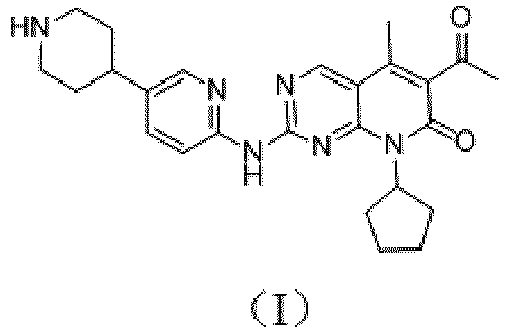
Applications Claiming Priority (6)
| Application Number | Priority Date | Filing Date | Title |
|---|---|---|---|
| CN201910089738 | 2019-01-30 | ||
| CN201910339438 | 2019-04-25 | ||
| CN201910516489 | 2019-06-14 | ||
| CN201910620303 | 2019-07-10 | ||
| CN201910907616 | 2019-09-24 | ||
| PCT/CN2020/073815 WO2020156446A1 (en) | 2019-01-30 | 2020-01-22 | Use of composition containing cdk4/6 inhibitor in combination with anastrozole in preparation of medicament for treating tumor diseases |
Publications (2)
| Publication Number | Publication Date |
|---|---|
| EP3919058A1 true EP3919058A1 (en) | 2021-12-08 |
| EP3919058A4 EP3919058A4 (en) | 2022-11-02 |
Family
ID=71840877
Family Applications (1)
| Application Number | Title | Priority Date | Filing Date |
|---|---|---|---|
| EP20748834.7A Withdrawn EP3919058A4 (en) | 2019-01-30 | 2020-01-22 | Use of composition containing cdk4/6 inhibitor in combination with anastrozole in preparation of medicament for treating tumor diseases |
Country Status (11)
| Country | Link |
|---|---|
| US (1) | US20220125792A1 (en) |
| EP (1) | EP3919058A4 (en) |
| JP (1) | JP2022523088A (en) |
| KR (1) | KR20210121188A (en) |
| CN (1) | CN113395969A (en) |
| AU (1) | AU2020214930A1 (en) |
| BR (1) | BR112021014820A2 (en) |
| CA (1) | CA3128072A1 (en) |
| MX (1) | MX2021009188A (en) |
| TW (1) | TW202042810A (en) |
| WO (1) | WO2020156446A1 (en) |
Families Citing this family (2)
| Publication number | Priority date | Publication date | Assignee | Title |
|---|---|---|---|---|
| CN117222411B (en) * | 2021-03-24 | 2026-03-27 | 贝达药业股份有限公司 | Drug combinations, kits containing them, and their uses |
| WO2023046200A1 (en) * | 2021-09-27 | 2023-03-30 | 正大天晴药业集团股份有限公司 | Combined pharmaceutical composition of cdk4/6 inhibitor and aromatase inhibitor |
Family Cites Families (4)
| Publication number | Priority date | Publication date | Assignee | Title |
|---|---|---|---|---|
| WO2014183520A1 (en) | 2013-05-17 | 2014-11-20 | 上海恒瑞医药有限公司 | Thiophene miazines derivate, preparation method therefor, and medical application thereof |
| SI3255046T1 (en) * | 2015-02-03 | 2020-02-28 | Jiangsu Hengrui Medicine Co., Ltd. | Hydroxyethyl sulfonate of cyclin-dependent protein kinase inhibitor, crystalline form thereof and preparation method therefor |
| CN107137408A (en) | 2016-03-01 | 2017-09-08 | 江苏恒瑞医药股份有限公司 | A kind of CDK4/6 inhibitor combines the purposes in the medicine for preparing treatment breast cancer with arimedex |
| CN107137409A (en) * | 2016-03-01 | 2017-09-08 | 江苏恒瑞医药股份有限公司 | A kind of CDK4/6 inhibitor combines the purposes in the medicine for preparing treatment breast cancer with estrogen receptor antagon |
-
2020
- 2020-01-22 CA CA3128072A patent/CA3128072A1/en active Pending
- 2020-01-22 JP JP2021544382A patent/JP2022523088A/en active Pending
- 2020-01-22 US US17/427,501 patent/US20220125792A1/en not_active Abandoned
- 2020-01-22 BR BR112021014820-5A patent/BR112021014820A2/en not_active Application Discontinuation
- 2020-01-22 CN CN202080011642.5A patent/CN113395969A/en active Pending
- 2020-01-22 KR KR1020217027639A patent/KR20210121188A/en not_active Withdrawn
- 2020-01-22 MX MX2021009188A patent/MX2021009188A/en unknown
- 2020-01-22 EP EP20748834.7A patent/EP3919058A4/en not_active Withdrawn
- 2020-01-22 WO PCT/CN2020/073815 patent/WO2020156446A1/en not_active Ceased
- 2020-01-22 TW TW109102331A patent/TW202042810A/en unknown
- 2020-01-22 AU AU2020214930A patent/AU2020214930A1/en not_active Abandoned
Also Published As
| Publication number | Publication date |
|---|---|
| AU2020214930A1 (en) | 2021-09-16 |
| MX2021009188A (en) | 2021-11-12 |
| US20220125792A1 (en) | 2022-04-28 |
| EP3919058A4 (en) | 2022-11-02 |
| JP2022523088A (en) | 2022-04-21 |
| BR112021014820A2 (en) | 2021-09-28 |
| TW202042810A (en) | 2020-12-01 |
| WO2020156446A1 (en) | 2020-08-06 |
| CN113395969A (en) | 2021-09-14 |
| KR20210121188A (en) | 2021-10-07 |
| CA3128072A1 (en) | 2020-08-06 |
Similar Documents
| Publication | Publication Date | Title |
|---|---|---|
| US12083129B2 (en) | Treatment of breast cancer using combination therapies comprising an ATP competitive AKT inhibitor, a CDK4/6 inhibitor, and fulvestrant | |
| US12427142B2 (en) | Combination comprising alpelisib and 6-(2,4-dichlorophenyl)-5-[4-[(3S)-1-(3-fluoropropyl)pyrrolidin-3-yl[oxyphenyl]-8,9-dihydro-7H-benzo[7]annulene-2-carboxylic acid | |
| CN114173776A (en) | 6- (2, 4-dichlorophenyl) -5- [4- [ (3S) -1- (3-fluoropropyl) pyrrolidin-3-yl ] oxyphenyl ] -8, 9-dihydro-7H-benzo [7] annulene-2-carboxylic acid for patients with metastatic or advanced breast cancer | |
| AU2022400308B2 (en) | Cdk4 inhibitor for the treatment of cancer | |
| TW202133857A (en) | Combination therapies for treatment of breast cancer | |
| EP3919058A1 (en) | Use of composition containing cdk4/6 inhibitor in combination with anastrozole in preparation of medicament for treating tumor diseases | |
| JP2024509823A (en) | Treatment of breast cancer with amsenestrant and palbociclib | |
| US20250186393A1 (en) | Treatment of breast cancer with amcenestrant | |
| CN118338901A (en) | CDK4 inhibitors for cancer treatment | |
| WO2023281413A1 (en) | Methods and dosing regimens comprising pf-06873600 for the treatment of cancer | |
| HK40062029A (en) | Use of composition containing cdk4/6 inhibitor in combination with anastrozole in preparation of medicament for treating tumor diseases | |
| RU2854294C2 (en) | Cdk4 inhibitor for treating cancer | |
| TWI922768B (en) | Methods and dosing regimens comprising a cdk4 inhibitor for the treatment of cancer | |
| HK40110657A (en) | Cdk4 inhibitor for the treatment of cancer | |
| KR20250095627A (en) | Treatment of Estrogen Receptor-Mediated Disorders | |
| JP2026513685A (en) | Drugs used in the treatment of locally advanced, unresectable or metastatic colorectal cancer and their use | |
| EP4719405A1 (en) | Methods and modified dosing regimens comprising a cdk4 inhibitor for the treatment of cancer | |
| CN120035437A (en) | N-(1-((R)-1-acryloylazepan-3-yl)-7-chloro-6-(((R)-tetrahydrofuran-3-yl)oxy)-1H-benzo[d]imidazol-2-yl)-2-methylisonicotinamide (NX-019) for the treatment of EGFR-mutated cancers | |
| CN118660706A (en) | CDK4 and 6 inhibitors in combination with fulvestrant for the treatment of hormone receptor-positive, human epidermal growth factor receptor 2-negative advanced or metastatic breast cancer in patients previously treated with CDK4 and 6 inhibitors | |
| JP2025505381A (en) | Pharmaceutical composition for combined administration with anticancer drug containing phthalazinone derivative | |
| CN117580572A (en) | Treating Breast Cancer with Onsenstein and Palbociclib | |
| HK40018197A (en) | Pharmaceutical combinations comprising a b-raf inhibitor, an egfr inhibitor and optionally a pi3k-alpha inhibitor | |
| HK1204976B (en) | Pharmaceutical combinations comprising a b-raf inhibitor, an egfr inhibitor and optionally a pi3k-alpha inhibitor | |
| HK1204976A1 (en) | Pharmaceutical combinations comprising a b-raf inhibitor, an egfr inhibitor and optionally a pi3k-alpha inhibitor |
Legal Events
| Date | Code | Title | Description |
|---|---|---|---|
| STAA | Information on the status of an ep patent application or granted ep patent |
Free format text: STATUS: THE INTERNATIONAL PUBLICATION HAS BEEN MADE |
|
| PUAI | Public reference made under article 153(3) epc to a published international application that has entered the european phase |
Free format text: ORIGINAL CODE: 0009012 |
|
| STAA | Information on the status of an ep patent application or granted ep patent |
Free format text: STATUS: REQUEST FOR EXAMINATION WAS MADE |
|
| 17P | Request for examination filed |
Effective date: 20210830 |
|
| AK | Designated contracting states |
Kind code of ref document: A1 Designated state(s): AL AT BE BG CH CY CZ DE DK EE ES FI FR GB GR HR HU IE IS IT LI LT LU LV MC MK MT NL NO PL PT RO RS SE SI SK SM TR |
|
| DAV | Request for validation of the european patent (deleted) | ||
| DAX | Request for extension of the european patent (deleted) | ||
| A4 | Supplementary search report drawn up and despatched |
Effective date: 20221006 |
|
| RIC1 | Information provided on ipc code assigned before grant |
Ipc: A61P 35/00 20060101ALI20220929BHEP Ipc: A61K 31/4196 20060101ALI20220929BHEP Ipc: A61K 31/519 20060101AFI20220929BHEP |
|
| STAA | Information on the status of an ep patent application or granted ep patent |
Free format text: STATUS: THE APPLICATION IS DEEMED TO BE WITHDRAWN |
|
| 18D | Application deemed to be withdrawn |
Effective date: 20230505 |