EP3917907B1 - Modulators of potassium ion channels and uses thereof - Google Patents
Modulators of potassium ion channels and uses thereof Download PDFInfo
- Publication number
- EP3917907B1 EP3917907B1 EP20702775.6A EP20702775A EP3917907B1 EP 3917907 B1 EP3917907 B1 EP 3917907B1 EP 20702775 A EP20702775 A EP 20702775A EP 3917907 B1 EP3917907 B1 EP 3917907B1
- Authority
- EP
- European Patent Office
- Prior art keywords
- amino
- trifluoromethyl
- benzyl
- henyl
- phenyl
- Prior art date
- Legal status (The legal status is an assumption and is not a legal conclusion. Google has not performed a legal analysis and makes no representation as to the accuracy of the status listed.)
- Active
Links
Classifications
-
- C—CHEMISTRY; METALLURGY
- C07—ORGANIC CHEMISTRY
- C07D—HETEROCYCLIC COMPOUNDS
- C07D209/00—Heterocyclic compounds containing five-membered rings, condensed with other rings, with one nitrogen atom as the only ring hetero atom
- C07D209/02—Heterocyclic compounds containing five-membered rings, condensed with other rings, with one nitrogen atom as the only ring hetero atom condensed with one carbocyclic ring
- C07D209/04—Indoles; Hydrogenated indoles
- C07D209/30—Indoles; Hydrogenated indoles with hetero atoms or with carbon atoms having three bonds to hetero atoms with at the most one bond to halogen, directly attached to carbon atoms of the hetero ring
- C07D209/40—Nitrogen atoms, not forming part of a nitro radical, e.g. isatin semicarbazone
-
- A—HUMAN NECESSITIES
- A61—MEDICAL OR VETERINARY SCIENCE; HYGIENE
- A61P—SPECIFIC THERAPEUTIC ACTIVITY OF CHEMICAL COMPOUNDS OR MEDICINAL PREPARATIONS
- A61P25/00—Drugs for disorders of the nervous system
-
- C—CHEMISTRY; METALLURGY
- C07—ORGANIC CHEMISTRY
- C07C—ACYCLIC OR CARBOCYCLIC COMPOUNDS
- C07C233/00—Carboxylic acid amides
- C07C233/01—Carboxylic acid amides having carbon atoms of carboxamide groups bound to hydrogen atoms or to acyclic carbon atoms
- C07C233/02—Carboxylic acid amides having carbon atoms of carboxamide groups bound to hydrogen atoms or to acyclic carbon atoms having nitrogen atoms of carboxamide groups bound to hydrogen atoms or to carbon atoms of unsubstituted hydrocarbon radicals
- C07C233/04—Carboxylic acid amides having carbon atoms of carboxamide groups bound to hydrogen atoms or to acyclic carbon atoms having nitrogen atoms of carboxamide groups bound to hydrogen atoms or to carbon atoms of unsubstituted hydrocarbon radicals with carbon atoms of carboxamide groups bound to acyclic carbon atoms of an acyclic saturated carbon skeleton
- C07C233/07—Carboxylic acid amides having carbon atoms of carboxamide groups bound to hydrogen atoms or to acyclic carbon atoms having nitrogen atoms of carboxamide groups bound to hydrogen atoms or to carbon atoms of unsubstituted hydrocarbon radicals with carbon atoms of carboxamide groups bound to acyclic carbon atoms of an acyclic saturated carbon skeleton having the nitrogen atom of at least one of the carboxamide groups bound to a carbon atom of a six-membered aromatic ring
-
- C—CHEMISTRY; METALLURGY
- C07—ORGANIC CHEMISTRY
- C07C—ACYCLIC OR CARBOCYCLIC COMPOUNDS
- C07C233/00—Carboxylic acid amides
- C07C233/01—Carboxylic acid amides having carbon atoms of carboxamide groups bound to hydrogen atoms or to acyclic carbon atoms
- C07C233/12—Carboxylic acid amides having carbon atoms of carboxamide groups bound to hydrogen atoms or to acyclic carbon atoms having the nitrogen atom of at least one of the carboxamide groups bound to a carbon atom of a hydrocarbon radical substituted by halogen atoms or by nitro or nitroso groups
- C07C233/15—Carboxylic acid amides having carbon atoms of carboxamide groups bound to hydrogen atoms or to acyclic carbon atoms having the nitrogen atom of at least one of the carboxamide groups bound to a carbon atom of a hydrocarbon radical substituted by halogen atoms or by nitro or nitroso groups with the substituted hydrocarbon radical bound to the nitrogen atom of the carboxamide group by a carbon atom of a six-membered aromatic ring
-
- C—CHEMISTRY; METALLURGY
- C07—ORGANIC CHEMISTRY
- C07C—ACYCLIC OR CARBOCYCLIC COMPOUNDS
- C07C233/00—Carboxylic acid amides
- C07C233/01—Carboxylic acid amides having carbon atoms of carboxamide groups bound to hydrogen atoms or to acyclic carbon atoms
- C07C233/34—Carboxylic acid amides having carbon atoms of carboxamide groups bound to hydrogen atoms or to acyclic carbon atoms having the nitrogen atom of at least one of the carboxamide groups bound to a carbon atom of a hydrocarbon radical substituted by amino groups
- C07C233/42—Carboxylic acid amides having carbon atoms of carboxamide groups bound to hydrogen atoms or to acyclic carbon atoms having the nitrogen atom of at least one of the carboxamide groups bound to a carbon atom of a hydrocarbon radical substituted by amino groups with the substituted hydrocarbon radical bound to the nitrogen atom of the carboxamide group by a carbon atom of a six-membered aromatic ring
- C07C233/43—Carboxylic acid amides having carbon atoms of carboxamide groups bound to hydrogen atoms or to acyclic carbon atoms having the nitrogen atom of at least one of the carboxamide groups bound to a carbon atom of a hydrocarbon radical substituted by amino groups with the substituted hydrocarbon radical bound to the nitrogen atom of the carboxamide group by a carbon atom of a six-membered aromatic ring having the carbon atom of the carboxamide group bound to a hydrogen atom or to a carbon atom of a saturated carbon skeleton
-
- C—CHEMISTRY; METALLURGY
- C07—ORGANIC CHEMISTRY
- C07C—ACYCLIC OR CARBOCYCLIC COMPOUNDS
- C07C233/00—Carboxylic acid amides
- C07C233/01—Carboxylic acid amides having carbon atoms of carboxamide groups bound to hydrogen atoms or to acyclic carbon atoms
- C07C233/34—Carboxylic acid amides having carbon atoms of carboxamide groups bound to hydrogen atoms or to acyclic carbon atoms having the nitrogen atom of at least one of the carboxamide groups bound to a carbon atom of a hydrocarbon radical substituted by amino groups
- C07C233/42—Carboxylic acid amides having carbon atoms of carboxamide groups bound to hydrogen atoms or to acyclic carbon atoms having the nitrogen atom of at least one of the carboxamide groups bound to a carbon atom of a hydrocarbon radical substituted by amino groups with the substituted hydrocarbon radical bound to the nitrogen atom of the carboxamide group by a carbon atom of a six-membered aromatic ring
- C07C233/44—Carboxylic acid amides having carbon atoms of carboxamide groups bound to hydrogen atoms or to acyclic carbon atoms having the nitrogen atom of at least one of the carboxamide groups bound to a carbon atom of a hydrocarbon radical substituted by amino groups with the substituted hydrocarbon radical bound to the nitrogen atom of the carboxamide group by a carbon atom of a six-membered aromatic ring having the carbon atom of the carboxamide group bound to a carbon atom of an unsaturated carbon skeleton
-
- C—CHEMISTRY; METALLURGY
- C07—ORGANIC CHEMISTRY
- C07C—ACYCLIC OR CARBOCYCLIC COMPOUNDS
- C07C233/00—Carboxylic acid amides
- C07C233/57—Carboxylic acid amides having carbon atoms of carboxamide groups bound to carbon atoms of rings other than six-membered aromatic rings
- C07C233/62—Carboxylic acid amides having carbon atoms of carboxamide groups bound to carbon atoms of rings other than six-membered aromatic rings having the nitrogen atom of at least one of the carboxamide groups bound to a carbon atom of a hydrocarbon radical substituted by amino groups
-
- C—CHEMISTRY; METALLURGY
- C07—ORGANIC CHEMISTRY
- C07C—ACYCLIC OR CARBOCYCLIC COMPOUNDS
- C07C237/00—Carboxylic acid amides, the carbon skeleton of the acid part being further substituted by amino groups
- C07C237/02—Carboxylic acid amides, the carbon skeleton of the acid part being further substituted by amino groups having the carbon atoms of the carboxamide groups bound to acyclic carbon atoms of the carbon skeleton
- C07C237/04—Carboxylic acid amides, the carbon skeleton of the acid part being further substituted by amino groups having the carbon atoms of the carboxamide groups bound to acyclic carbon atoms of the carbon skeleton the carbon skeleton being acyclic and saturated
- C07C237/10—Carboxylic acid amides, the carbon skeleton of the acid part being further substituted by amino groups having the carbon atoms of the carboxamide groups bound to acyclic carbon atoms of the carbon skeleton the carbon skeleton being acyclic and saturated having the nitrogen atom of at least one of the carboxamide groups bound to an acyclic carbon atom of a hydrocarbon radical substituted by nitrogen atoms not being part of nitro or nitroso groups
-
- C—CHEMISTRY; METALLURGY
- C07—ORGANIC CHEMISTRY
- C07C—ACYCLIC OR CARBOCYCLIC COMPOUNDS
- C07C237/00—Carboxylic acid amides, the carbon skeleton of the acid part being further substituted by amino groups
- C07C237/02—Carboxylic acid amides, the carbon skeleton of the acid part being further substituted by amino groups having the carbon atoms of the carboxamide groups bound to acyclic carbon atoms of the carbon skeleton
- C07C237/20—Carboxylic acid amides, the carbon skeleton of the acid part being further substituted by amino groups having the carbon atoms of the carboxamide groups bound to acyclic carbon atoms of the carbon skeleton the carbon skeleton containing six-membered aromatic rings
-
- C—CHEMISTRY; METALLURGY
- C07—ORGANIC CHEMISTRY
- C07C—ACYCLIC OR CARBOCYCLIC COMPOUNDS
- C07C311/00—Amides of sulfonic acids, i.e. compounds having singly-bound oxygen atoms of sulfo groups replaced by nitrogen atoms, not being part of nitro or nitroso groups
- C07C311/14—Sulfonamides having sulfur atoms of sulfonamide groups bound to carbon atoms of rings other than six-membered aromatic rings
-
- C—CHEMISTRY; METALLURGY
- C07—ORGANIC CHEMISTRY
- C07C—ACYCLIC OR CARBOCYCLIC COMPOUNDS
- C07C311/00—Amides of sulfonic acids, i.e. compounds having singly-bound oxygen atoms of sulfo groups replaced by nitrogen atoms, not being part of nitro or nitroso groups
- C07C311/15—Sulfonamides having sulfur atoms of sulfonamide groups bound to carbon atoms of six-membered aromatic rings
- C07C311/21—Sulfonamides having sulfur atoms of sulfonamide groups bound to carbon atoms of six-membered aromatic rings having the nitrogen atom of at least one of the sulfonamide groups bound to a carbon atom of a six-membered aromatic ring
-
- C—CHEMISTRY; METALLURGY
- C07—ORGANIC CHEMISTRY
- C07D—HETEROCYCLIC COMPOUNDS
- C07D207/00—Heterocyclic compounds containing five-membered rings not condensed with other rings, with one nitrogen atom as the only ring hetero atom
- C07D207/02—Heterocyclic compounds containing five-membered rings not condensed with other rings, with one nitrogen atom as the only ring hetero atom with only hydrogen or carbon atoms directly attached to the ring nitrogen atom
- C07D207/04—Heterocyclic compounds containing five-membered rings not condensed with other rings, with one nitrogen atom as the only ring hetero atom with only hydrogen or carbon atoms directly attached to the ring nitrogen atom having no double bonds between ring members or between ring members and non-ring members
- C07D207/10—Heterocyclic compounds containing five-membered rings not condensed with other rings, with one nitrogen atom as the only ring hetero atom with only hydrogen or carbon atoms directly attached to the ring nitrogen atom having no double bonds between ring members or between ring members and non-ring members with hetero atoms or with carbon atoms having three bonds to hetero atoms with at the most one bond to halogen, e.g. ester or nitrile radicals, directly attached to ring carbon atoms
- C07D207/16—Carbon atoms having three bonds to hetero atoms with at the most one bond to halogen, e.g. ester or nitrile radicals
-
- C—CHEMISTRY; METALLURGY
- C07—ORGANIC CHEMISTRY
- C07D—HETEROCYCLIC COMPOUNDS
- C07D207/00—Heterocyclic compounds containing five-membered rings not condensed with other rings, with one nitrogen atom as the only ring hetero atom
- C07D207/02—Heterocyclic compounds containing five-membered rings not condensed with other rings, with one nitrogen atom as the only ring hetero atom with only hydrogen or carbon atoms directly attached to the ring nitrogen atom
- C07D207/30—Heterocyclic compounds containing five-membered rings not condensed with other rings, with one nitrogen atom as the only ring hetero atom with only hydrogen or carbon atoms directly attached to the ring nitrogen atom having two double bonds between ring members or between ring members and non-ring members
- C07D207/32—Heterocyclic compounds containing five-membered rings not condensed with other rings, with one nitrogen atom as the only ring hetero atom with only hydrogen or carbon atoms directly attached to the ring nitrogen atom having two double bonds between ring members or between ring members and non-ring members with only hydrogen atoms, hydrocarbon or substituted hydrocarbon radicals, directly attached to ring carbon atoms
- C07D207/33—Heterocyclic compounds containing five-membered rings not condensed with other rings, with one nitrogen atom as the only ring hetero atom with only hydrogen or carbon atoms directly attached to the ring nitrogen atom having two double bonds between ring members or between ring members and non-ring members with only hydrogen atoms, hydrocarbon or substituted hydrocarbon radicals, directly attached to ring carbon atoms with substituted hydrocarbon radicals, directly attached to ring carbon atoms
- C07D207/335—Radicals substituted by nitrogen atoms not forming part of a nitro radical
-
- C—CHEMISTRY; METALLURGY
- C07—ORGANIC CHEMISTRY
- C07D—HETEROCYCLIC COMPOUNDS
- C07D209/00—Heterocyclic compounds containing five-membered rings, condensed with other rings, with one nitrogen atom as the only ring hetero atom
- C07D209/02—Heterocyclic compounds containing five-membered rings, condensed with other rings, with one nitrogen atom as the only ring hetero atom condensed with one carbocyclic ring
- C07D209/44—Iso-indoles; Hydrogenated iso-indoles
-
- C—CHEMISTRY; METALLURGY
- C07—ORGANIC CHEMISTRY
- C07D—HETEROCYCLIC COMPOUNDS
- C07D213/00—Heterocyclic compounds containing six-membered rings, not condensed with other rings, with one nitrogen atom as the only ring hetero atom and three or more double bonds between ring members or between ring members and non-ring members
- C07D213/02—Heterocyclic compounds containing six-membered rings, not condensed with other rings, with one nitrogen atom as the only ring hetero atom and three or more double bonds between ring members or between ring members and non-ring members having three double bonds between ring members or between ring members and non-ring members
- C07D213/04—Heterocyclic compounds containing six-membered rings, not condensed with other rings, with one nitrogen atom as the only ring hetero atom and three or more double bonds between ring members or between ring members and non-ring members having three double bonds between ring members or between ring members and non-ring members having no bond between the ring nitrogen atom and a non-ring member or having only hydrogen or carbon atoms directly attached to the ring nitrogen atom
- C07D213/24—Heterocyclic compounds containing six-membered rings, not condensed with other rings, with one nitrogen atom as the only ring hetero atom and three or more double bonds between ring members or between ring members and non-ring members having three double bonds between ring members or between ring members and non-ring members having no bond between the ring nitrogen atom and a non-ring member or having only hydrogen or carbon atoms directly attached to the ring nitrogen atom with substituted hydrocarbon radicals attached to ring carbon atoms
- C07D213/36—Radicals substituted by singly-bound nitrogen atoms
-
- C—CHEMISTRY; METALLURGY
- C07—ORGANIC CHEMISTRY
- C07D—HETEROCYCLIC COMPOUNDS
- C07D213/00—Heterocyclic compounds containing six-membered rings, not condensed with other rings, with one nitrogen atom as the only ring hetero atom and three or more double bonds between ring members or between ring members and non-ring members
- C07D213/02—Heterocyclic compounds containing six-membered rings, not condensed with other rings, with one nitrogen atom as the only ring hetero atom and three or more double bonds between ring members or between ring members and non-ring members having three double bonds between ring members or between ring members and non-ring members
- C07D213/04—Heterocyclic compounds containing six-membered rings, not condensed with other rings, with one nitrogen atom as the only ring hetero atom and three or more double bonds between ring members or between ring members and non-ring members having three double bonds between ring members or between ring members and non-ring members having no bond between the ring nitrogen atom and a non-ring member or having only hydrogen or carbon atoms directly attached to the ring nitrogen atom
- C07D213/24—Heterocyclic compounds containing six-membered rings, not condensed with other rings, with one nitrogen atom as the only ring hetero atom and three or more double bonds between ring members or between ring members and non-ring members having three double bonds between ring members or between ring members and non-ring members having no bond between the ring nitrogen atom and a non-ring member or having only hydrogen or carbon atoms directly attached to the ring nitrogen atom with substituted hydrocarbon radicals attached to ring carbon atoms
- C07D213/36—Radicals substituted by singly-bound nitrogen atoms
- C07D213/40—Acylated substituent nitrogen atom
-
- C—CHEMISTRY; METALLURGY
- C07—ORGANIC CHEMISTRY
- C07D—HETEROCYCLIC COMPOUNDS
- C07D295/00—Heterocyclic compounds containing polymethylene-imine rings with at least five ring members, 3-azabicyclo [3.2.2] nonane, piperazine, morpholine or thiomorpholine rings, having only hydrogen atoms directly attached to the ring carbon atoms
- C07D295/04—Heterocyclic compounds containing polymethylene-imine rings with at least five ring members, 3-azabicyclo [3.2.2] nonane, piperazine, morpholine or thiomorpholine rings, having only hydrogen atoms directly attached to the ring carbon atoms with substituted hydrocarbon radicals attached to ring nitrogen atoms
- C07D295/14—Heterocyclic compounds containing polymethylene-imine rings with at least five ring members, 3-azabicyclo [3.2.2] nonane, piperazine, morpholine or thiomorpholine rings, having only hydrogen atoms directly attached to the ring carbon atoms with substituted hydrocarbon radicals attached to ring nitrogen atoms substituted by carbon atoms having three bonds to hetero atoms with at the most one bond to halogen, e.g. ester or nitrile radicals
- C07D295/155—Heterocyclic compounds containing polymethylene-imine rings with at least five ring members, 3-azabicyclo [3.2.2] nonane, piperazine, morpholine or thiomorpholine rings, having only hydrogen atoms directly attached to the ring carbon atoms with substituted hydrocarbon radicals attached to ring nitrogen atoms substituted by carbon atoms having three bonds to hetero atoms with at the most one bond to halogen, e.g. ester or nitrile radicals with the ring nitrogen atoms and the carbon atoms with three bonds to hetero atoms separated by carbocyclic rings or by carbon chains interrupted by carbocyclic rings
-
- C—CHEMISTRY; METALLURGY
- C07—ORGANIC CHEMISTRY
- C07D—HETEROCYCLIC COMPOUNDS
- C07D403/00—Heterocyclic compounds containing two or more hetero rings, having nitrogen atoms as the only ring hetero atoms, not provided for by group C07D401/00
- C07D403/02—Heterocyclic compounds containing two or more hetero rings, having nitrogen atoms as the only ring hetero atoms, not provided for by group C07D401/00 containing two hetero rings
- C07D403/12—Heterocyclic compounds containing two or more hetero rings, having nitrogen atoms as the only ring hetero atoms, not provided for by group C07D401/00 containing two hetero rings linked by a chain containing hetero atoms as chain links
-
- C—CHEMISTRY; METALLURGY
- C07—ORGANIC CHEMISTRY
- C07C—ACYCLIC OR CARBOCYCLIC COMPOUNDS
- C07C2601/00—Systems containing only non-condensed rings
- C07C2601/02—Systems containing only non-condensed rings with a three-membered ring
-
- C—CHEMISTRY; METALLURGY
- C07—ORGANIC CHEMISTRY
- C07C—ACYCLIC OR CARBOCYCLIC COMPOUNDS
- C07C2601/00—Systems containing only non-condensed rings
- C07C2601/12—Systems containing only non-condensed rings with a six-membered ring
- C07C2601/14—The ring being saturated
Definitions
- the present invention belongs to the technical field of pharmacy, pharmaceutical chemistry and pharmacology.
- the present invention relates to a class of novel compounds of general formula I, their use as medicaments and pharmaceutical compositions comprising them.
- the compounds of the invention are useful as voltage-gated potassium ion channels modulators.
- Potassium channels represent the most widely diffused and heterogeneous class of ionic channels characterized so far. Potassium channels are responsible for the stabilization of the membrane potential in neurons: they shift the membrane potential toward the K + equilibrium potential, away from the firing threshold. Potassium channels are classified both structurally and functionally in four main families: inward rectifier potassium channels (Kir); two pores potassium channels (K2p); Calcium-activated potassium channels (KCa) and voltage-gated potassium channels (Kv). ( Aldrich R. et al. Potassium channels. IUPHAR/BPS Guide to PHARMACOLOGY ).
- Kv7 (also known as KNCQ) comprises 5 different members (Kv7.1-Kv7.5), characterized by different tissue distribution and physiopathological role.
- the Kv7.1 channel subunit is mainly expressed in the heart, representing the molecular basis for the I ks ventricular repolarization current;
- Kv7.2 and Kv7.3 subunits are mainly expressed in the central nervous system (CNS) where they generate the M-current, a repolarizing current limiting the neuronal spike discharge rate;
- Kv7.4 is mainly expressed in the inner ear and in the visceral, vascular and pulmonary smooth muscles, being involved in the regulation of smooth muscle tone;
- Kv7.5 is mainly expressed in the CNS, in vascular smooth and skeletal muscles ( Soldovieri MV et al., Physiology 2011, 26(5), 365-376 ).
- Kv7 channels Given the prominent role played by Kv7 channels in controlling neuronal excitability and considering that neuronal hyperexcitability is a common feature of neuropsychiatric disorders such as epilepsy, neuropathic pain, ischemic stroke, amyotrophic lateral sclerosis, and several other neurodegenerative diseases, pharmacological modulation of Kv7 channels appears as a rational pharmacological approach to treat these conditions.
- Specific members of the Kv7 subfamily of voltage-gated potassium channels expressed in the vascular smooth muscle produce membrane hyperpolarization sufficient to reduce the likelihood of Ca 2+ channel opening and hence attenuate vasoconstrictor response; thus their pharmacological modulation reduces the frequency of spontaneous contractions and results in dose-dependent hypotension, with potentially beneficial consequences in vascular hypertension.
- Kv7 activators may be useful pharmacological agents against myotonia, myokymia and other skeletal muscle hyperexcitability diseases.
- Kv7.2 and Kv7.3 in neuronal excitability is evidenced by the occurrence of convulsive disorders with high phenotypic variability in humans, caused by specific mutations of their corresponding genes.
- these mutations can be responsible of a benign neonatal epilepsy with autosomal dominant transmission, also known as "Benign familiar neonatal seizures", or of a severe sporadic neonatal epileptic encephalopathy, leading to neurocognitive impairment, anti-epileptic drugs resistance and typical neuroradiological findings ( Miceli et al, GeneReviews 2016 ).
- potassium channels are also highlighted by them being the therapeutic targets class III of antiarrhythmics (Amiodarone, Sotalol, Ibutilide, Dofetilide), oral hypoglycemic agents for treatment of type 2 diabetes (Sulfonylureas, Glinides), antihypertensive vasodilators (minoxidil, diazoxide and hydralazine), and for the treatment of multiple sclerosis (3,4-diaminopyridines).
- antiarrhythmics Amiodarone, Sotalol, Ibutilide, Dofetilide
- oral hypoglycemic agents for treatment of type 2 diabetes Sulfonylureas, Glinides
- antihypertensive vasodilators minoxidil, diazoxide and hydralazine
- multiple sclerosis 3,4-diaminopyridines
- Epilepsy is a neurologic disorder usually ascribed to impaired and paroxysmal neurons firing, responsible for an impairment in the sensitive, cognitive, mental, vegetative and motor activities.
- Epilepsy can be both a chronic or acute disease with an incidence rate of about 1% in the world population.
- Epilepsy is also associated to numerous psychiatric (such as anxiety and depression) or cognitive comorbidities, and to an increased risk of death (Sudden Death in Epilepsy or SUDEP). Seizures represent a typical clinical symptom of the epilepsy; they are involuntary and spontaneous motor manifestations caused by neuronal hyperexcitability.
- the hyperexcitability can be evidenced recording the brain electrical activity by specific electrodes positioned on the scalp, using a technique known as electroencephalogram (EEG).
- EEG electroencephalogram
- Two main electrophysiological properties characterize seizures: hyperexcitability (that is the tendency of the cortical or subcortical neurons to overreact to a normal stimulus) and hypersincronicity (that is the tendency to simultaneous activation).
- Physiological neuron excitability is guaranteed by a proper balance between the main excitatory (glutamaergic) and inhibitory (GABAergic) neural transmissions.
- anti-epileptic drugs used nowadays in therapy can be classified on the basis of their mechanism of action, corresponding to: sodium voltage-gated channel blockade, increased GABAergic neurotransmission and voltage-gated Calcium channels blockade.
- sodium voltage-gated channel blockade increased GABAergic neurotransmission
- voltage-gated Calcium channels blockade increased GABAergic neurotransmission
- anticonvulsants represent important and often critical tools for epilepsy treatment, their risk/benefit ratio is suboptimal, often because of their poor target selectivity and of their wide range of side effects.
- retigabine (trade name in Europe Trobalt ® ; trade name in the US Potiga ® ), the prototypical Kv7 channel modulator, acts by increasing the activity of Kv7.2-5 channels and has been recommended as an adjunctive treatment for drug-resistant partial epilepsies in adults since 2011-2012 ( Porter RJ et al., Neurology, 2007, 68(15), 1197-1204 ).
- Retigabine has a peculiar pharmacokinetic profile, with a fast absorption after oral administration (1.5-2.0h after administration) but also a fast metabolization, mainly leading to the formation of glucuronic derivatives at N-2 and N-4 ( Borlak et al., Metabolism: Clinical and Experimental 2006, 55(6):711-21 ). Moreover, retigabine is poorly stable under oxidative conditions both during synthesis and in its final form.
- One of the most characteristic side effects revealed during chronic (> 4 years) therapies is the occurrence of side effects represented by blue coloration of skin, lips, nails and, particularly, retina, due to the accumulation of blue-colored precipitates.
- U.S. patent No 5,384,330 describes compounds with the following chemical structure, characterized by the presence of two vicinal amino group, as anticonvulsivants, antipyretics, muscle-relaxants and pheripheral analgesics:
- WO 2005/087754 relates to compounds with the following chemical structure, in which two amino groups are placed in para-position on the aromatic ring, one of the two groups is part of an aliphatic cycle, while the two ortho-positions to the other amino group are occupied by R1 and R2 substituents:
- Such derivatives act as openers of the Kv family of potassium ion channels.
- WO 2008/024398 refers to the following structures, characterized by a bicyclic-fused structure between aromatic and aliphatic rings, and their effect on modulation of voltage-gated potassium channels:
- WO 2009/023677 concerns 4,6 bisubstitued-5-aminoindoline and 5-aminoindoles with the following general structure, with the N-5 derivatized as amide, carbamate, thioamide, dithiocarbamate or thiocarbamic ester:
- Such compounds are potassium channels modulators.
- Kv7 modulators characterized by increased pharmacodynamic (increased potency and selectivity), and pharmacokinetic properties (increased distribution in the CNS and stability to oxidation), as well as by reduced side effects and good tolerability compared to current therapeutic options for Kv7-mediated disorders.
- novel molecules may be used for the pharmacological treatment of central nervous system diseases (such as epilepsy, neuropathic pain, ischemic stroke and neurodegenerative disorders), peripheral nervous system diseases (such as pain), respiratory system diseases (such as asthma), genitourinary system diseases (such as bladder hyper-reactivity) and cardiovascular diseases (such as hypertension).
- the present invention provides a novel class of compounds of formula I as shown below, as well as tautomers, salts, solvates, stereoisomers or isotopes thereof.
- compounds of the present invention may act as agonists or antagonists of voltage-gated potassium channels.
- the substituent in position R 6 is able to modulate the activity of the compounds of general formula I in terms of modulation (agonism/antagonism), potency and efficacy.
- the NHQ functionality includes sulfonamide, urea, thiourea and guanidine bonds.
- the compounds object of the present invention when compared to retigabine, have improved pharmacological properties, both pharmacodynamic and pharmacokinetic. Moreover, they can be synthesized using easier and safer chemical procedures and show increased chemical stability than retigabine.
- substitutions represent an important feature in some embodiments of this invention to modulate the activity of some compounds, with some substitutions resulting in a blockade of the ionic currents carried by the channel (with the resulting molecules thereby acting as antagonists or blockers of the channels), whereas others enhance the ionic currents carried by the channels (with the resulting molecules thereby acting as agonists or openers).
- the functional electrophysiologial experiments carried out and whose results are detailed below allow a direct estimate of the pharmacological effects exerted by each drug, which could therefore be classified as a blocker or as an opener with respect to a specific channel target.
- the present invention discloses each one of the following compounds: COMPOUND STRUCTURE COMPOUND NAME 1. N-(2-(piperidin-1-yl)-4-((4-(trifluoromethyl)benzyl)amino)p henyl)heptanamide 2. N-(2-(piperidin-1-yl)-4-((4-(trifluoromethyl)benzyl)amino)p henyl)heptanamide 3. N-(2-(piperidin-1-yl)-4-((4-(trifluoromethyl)benzyl)amino)p henyl)octanamide 4.
- 6R N-(2-(diethylamino)-4-((4-(trifluoromethyl)benzyl)amino)p henyl)-6,7-difluoroheptanamide
- 6S N-(2-(diethylamino)-4-((4-(trifluoromethyl)benzyl)amino)p henyl)-6,7-difluoroheptanamide 31.
- N-(2-amino-4-(4-(trifluoromethyl)phenethyl)phen yl)-6,7-difluoroheptanamide (6R)-N-(2-amino-4-(4-(trifluoromethyl)phenethyl)phen yl)-6,7-difluoroheptanamide
- N-(2-amino-4-(4-(trifluoromethyl)phenethyl)phen yl)octanamide 40.
- N-(2-amino-4-(4-(trifluoromethyl)phenethyl)phen yl)-7,8-difluorooctanamide (7R)-N-(2-amino-4-(4-(trifluoromethyl)phenethyl)phen yl)-7,8-difluorooctanamide
- N-(2-amino-4-((4-(trifluoromethyl)benzyl)amino)p henyl)-6,7-difluoroheptanamide (6R)-N-(2-amino-4-((4-(trifluoromethyl)benzyl)amino)p henyl)-6,7-difluoroheptanamide
- N-(2-amino-4-((4-(trifluoromethyl)benzyl)amino)p henyl)-7,8-difluorooctanamide (7R)-N-(2-amino-4-((4-(trifluoromethyl)benzyl)amino)p henyl)-7,8-difluorooctanamide
- N-(2-amino-4-((4-hydroxybenzyl)amino)phenyl)de canamide 104.
- N-(4-((4-hydroxybenzyl)amino)phenyl)de canamide 105.
- N-(2-amino-3-fluoro-4-((4-hydroxybenzyl)amino)phenyl)de canamide 106.
- 9,10-difluoro-N-(4-((4-hydroxybenzyl)amino)phenyl)de canamide (9R)-9,10-difluoro-N-(4-((4-hydroxybenzyl)amino)phenyl)de canamide (9S)-9,10-difluoro-N-(4-((4-hydroxybenzyl)amino)phenyl)de ca namide racemic mixtures thereof 110.
- N-(2-amino-3-fluoro-4-((4-hydroxybenzyl)amino)phenyl)-6,7-difluoroheptanamide (6R)-N-(2-amino-3-fluoro-4-((4-hydroxybenzyl)amino)phenyl)-6,7-difluoroheptanamide
- N-(2-amino-4-((4-nitrobenzyl)amino)phenyl)hepta namide 125.
- 2,3-difluoro-N-(2-(piperidin-1-yl)-4-(4-(trifluoromethyl)phenethyl)phen yl)octanamide (2R,3 S)-2,3-difluoro-N-(2-(piperidin-1-yl)-4-(4-(trifluoromethyl)phenethyl)phen yl)octanamide
- (2S,3R)-2,3-difluoro-N-(2-(piperidin-1-yl)-4-(4-(trifluoromethyl)phenethyl)phen yl)octanamide (2R,3R)-2,3-difluoro-N-(2-(piperidin-1-yl)-4-(4-(trifluoromethyl)phene
- 7S -N-(2-cyclohexyl-4-(4-(trifluoromethyl)phenethyl)phen yl)-7,8-difluorooctanamide 242.
- the compound or tautomer, salt, solvate, stereoisomer or isotope thereof as defined above is a voltage-gated potassium channel modulator.
- the compound or tautomer, salt, solvate, stereoisomer or isotope thereof as defined above is a Kv7.1, Kv7.2, Kv7.3, Kv7.4 and/or Kv7.5 modulator.
- the compound or tautomer, salt, solvate, stereoisomer or isotope thereof as defined above is a Kv7.2 and Kv7.3 modulator.
- the compound or tautomer, salt, solvate, stereoisomer or isotope thereof as defined above is for use as a medicament.
- the compound or tautomer, salt, solvate, stereoisomer or isotope thereof as defined above is for use in the treatment and/or prevention of a condition characterised by a defect in the structure and/or function of at least one voltage-gated potassium channel.
- the compound or tautomer, salt, solvate, stereoisomer or isotope thereof as defined above is for use as an anticonvulsant, analgesic, anti-ischemic, anti-arrhythmic, neuroprotective, anti-tinnitus, antiasthmatic, gastrointestinal motility modulator, antihypertensive, antimyotonic and/or anti-skeletal muscle dystrophia medicament.
- composition comprising the compound or tautomer, salt, solvate, stereoisomer or isotope thereof as defined above and a pharmaceutically acceptable carrier.
- said pharmaceutical composition comprises a further therapeutic agent selected from: an anticonvulsivant, an analgesic and a nonsteroidal anti-inflammatory drug (NSAID).
- NSAID nonsteroidal anti-inflammatory drug
- said anticonvulsant is selected from the group consisting of: Acetazolamide, Brivaracetam, Carbamazepine, Clobazam, Clonazepam, Diazepam, Eslicarbazepine, Ethosuximide, Fosphenytoin, Gabapentin, Lacosamide, Lamotrigine, Levetiracetam, Lorazepam, Methosuximide, Nitrazepam, Oxcarbazepine, Perampanel, Phenobarbital, Phenytoin, Pregabalin, Primidone, Rufinamide, Stiripentol, Topiramate, Valproic Acid, Vigabatrin, Felbamate, Tiagabine and Zonisamide.
- said analgesic is acetaminophen or an opioid.
- said nonsteroidal anti-inflammatory drug is selected from the group consisting of: aspirin, diclofenac, diflusinal, etodolac, fenbufen, fenoprofen, flufenisal, flurbiprofen, ibuprofen, indomethacin, ketoprofen, ketorolac, meclofenamic acid, mefenamic acid, meloxicam, nabumetone, naproxen, nimesulide, nitroflurbiprofen, olsalazine, oxaprozin, phenylbutazone, piroxicam, sulfasalazine, sulindac, tolmetin and zomepirac.
- said opioid is morphine.
- the pharmaceutical composition as defined above is for use in the treatment and/or prevention of a condition characterised by a defect in the structure and/or function of at least one voltage-gated potassium channel.
- a condition characterised by a defect in the structure and/or function of at least one voltage-gated potassium channel Preferably, at least one of Kv7.1, Kv7.2, Kv7.3, Kv7.4 and/or Kv7.5, more preferably of both Kv7.2 and Kv7.3.
- the pharmaceutical composition as defined above is for use as an anticonvulsant, analgesic, anti-ischemic, anti-arrhythmic, neuroprotective, anti-tinnitus, antiasthmatic, gastrointestinal motility modulator, antihypertensive, antimyotonic and/or anti-skeletal muscle dystrophia medicament.
- said condition characterised by a defect in the structure and/or function of at least one voltage-gated potassium channel is selected from the group consisting of: a central nervous system disease, a peripheral nervous system disease, a sensory system disease, a respiratory system disease, a genitourinary system disease, a gastrointestinal system disease, a cardiovascular disease, a skeletal muscle disease and a channelopathy.
- said condition characterised by a defect in the structure and/or function of at least one voltage-gated potassium channel is selected from the group consisting of: epilepsy, a convulsive disorder, a seizure, a seizure disorder, a disorder characterised by hyperexcitability of the nervous system, a neonatal epilepsy, spontaneous contractions, an early-onset epileptic disorder, Ohtahara syndrome, early infantile epileptic encelopathy with suppression-burst, benign familiar neonatal seizures, epileptic encelopathy, severe sporadic neonatal epileptic encelopathy, an intellectual disability, a psychiatric or cognitive comorbidity, a cognitive defect, anxiety, depression, schizophrenia, sudden death in epilepsy, drug-resistant epilepsy, neuropathic pain, an ischemic stroke, angina, migraine, a neurodegenerative disorder, a neurologic disorder, amyotrophic lateral sclerosis, Alzheimer's disease, Parkinson's disease, tremors,
- the compound for use as defined above or the pharmaceutical composition for use as defined above is administered to an animal.
- said animal is a companion animal or livestock.
- the present invention also provides the compound or tautomer, salt, solvate, stereoisomer or isotope thereof as defined above for use in a method of modulating a voltage-gated potassium channel.
- a voltage-gated potassium channel Preferably, at least one of Kv7.1, Kv7.2, Kv7.3, Kv7.4 and/or Kv7.5.
- the compound or tautomer, salt, solvate, stereoisomer or isotope thereof as defined above is for use in a method of modulating Kv7.2 and Kv7.3.
- in-vitro method of modulating a voltage-gated potassium channel by using the compound or tautomer, salt, solvate, stereoisomer or isotope thereof as defined above.
- Kv7.1, Kv7.2, Kv7.3, Kv7.4 and/or Kv7.5 More preferably, said in-vitro method is an in-vitro method of modulating Kv7.2 and Kv7.3 by using the compound or tautomer, salt, solvate, stereoisomer or isotope thereof as defined above.
- alkylcarbonyl preferably refers to groups such as CH 3 (CH 2 ) n CO where n is a number comprised between 0 and 10 and to branched isomers thereof.
- alkylcarbonyl include acetamide, CH 3 (CH 2 ) 6 CO, (CH 3 ) 3 CCH 2 CO, CH 3 (CH 2 ) 2 CH(CH 3 )CO, (CH 3 ) 3 C(CH 2 ) 6 CO, CH 3 (CH 2 ) 5 C(CH 3 ) 3 CO, CH 3 (CH 2 ) 4 C(CH 3 ) 3 CH 2 CO.
- alkoxycarbonyl preferably refers to groups such as CH 3 (CH 2 ) n OCO where n is a number comprised between 0 and 10 and to branched isomers thereof.
- alkoxycarbonyl include CH 3 (CH 2 ) 6 OCO, (CH 3 ) 3 CCH 2 OCO, CH 3 (CH 2 ) 2 CH(CH 3 )OCO, (CH 3 ) 3 C(CH 2 ) 6 OCO, CH 3 (CH 2 ) 5 C(CH 3 ) 3 OCO, CH 3 (CH 2 ) 4 C(CH 3 ) 3 CH 2 OCO.
- alkylamino preferably refers to linear or branched alkyl groups bearing a NH or NH 2 substitutent, preferably a terminal NH or NH 2 substitutent.
- Preferred alkylamino groups include groups such as CH 3 (CH 2 ) n NH where n is a number comprised between 0 and 10 and their branched isomers, as well as groups such as NH 2 (CH 2 ) n CH 2 where n is a number comprised between 0 and 10 and their branched isomers.
- Alkylamino as used herein also preferably refers to C1-C10 linear or branched alkyl chains bearing a primary, secondary or tertiary amine as side chain.
- alkylamino include NHMe, NHEt, NHiPr, N(Me) 2 , N(Et) 2 , N(iPr) 2 , CH 3 (CH 2 ) 6 NH, (CH 3 ) 3 CCH 2 NH, CH 3 (CH 2 ) 2 CH(CH 3 )NH, (CH 3 ) 3 C(CH 2 ) 6 NH, CH 3 (CH 2 ) 5 C(CH 3 ) 3 NH, CH 3 (CH 2 ) 4 C(CH 3 ) 3 CH 2 NH, NH 2 CH 2 (CH 2 ) 5 CH 2 , [NH 2 (CH 3 ) 2 ]CCH 2 NH, NH 2 CH 2 (CH 2 ) 2 CH(CH 3 ), NH 2 (CH 3 ) 2 C(CH 2 )
- alkenylamino refers to a linear or branched alkylamino group as defined above comprising at least one carbon-carbon double bond.
- alkynylamino refers to a linear or branched alkylamino group as defined above comprising at least one carbon-carbon triple bond.
- alkylaminocarbonyl preferably refers to groups such as NH 2 (CH 2 ) n CH 2 CO where n is a number comprised between 0 and 10 and to branched isomers thereof.
- Alkylaminocarbonyl as used herein also preferably refers to C3-C10 linear or branched CH 3 X(CH 2 ) n CO or CH 3 (CH 2 ) n X(CH 2 ) n CO where X is a primary, secondary or tertiary amine and n is comprised between 1 and 10.
- alkylaminocarbonyl examples include NH 2 CH 2 (CH 2 ) 5 CH 2 CO, NH 2 C(CH 3 ) 2 CH 2 CO, NH 2 CH 2 (CH 2 ) 2 CH(CH 3 )CO, NH 2 (CH 3 ) 2 C(CH 2 ) 6 CO, NH 2 CH 2 (CH 2 ) 5 C(CH 3 ) 3 CO, NH 2 CH 2 (CH 2 ) 4 C(CH 3 ) 3 CH 2 CO, CH 3 CH(NH 2 )(CH 2 ) 5 CO, CH 3 (CH 2 ) 2 C(NH 2 )(CH 2 ) 2 CO, CH 3 (CH 2 ) 2 CH 2 [N(CH 3 ) 2 ]CO, CH 3 (CH 2 ) 2 C[N(CH 3 ) 2 ](CH 2 ) 2 CO, CH 3 (CH 2 ) 2 CH[NH(CH 3 )](CH 2 ) 2 CO.
- alkyloxy refers to groups bearing at least one oxygen atom linked to an alkyl chain.
- Preferred alkyloxy groups include groups such as: CH 3 (CH 2 ) n O where n is a number comprised between 0 and 10 and their branched isomers, HO(CH 2 ) n CH 2 where n is a number comprised between 0 and 10 and their branched isomers, as well as groups such as CH 3 X(CH 2 ) n CH 2 , CH 3 (CH 2 ) n XCH 2 and CH 3 (CH 2 ) n X(CH 2 ) n where X is an oxygen atom and n is comprised between 1 and 10.
- alkyloxy or “alkoxy” include methoxy, ethoxy, HOCH 2 (CH 2 ) 5 CH 2 , HO(CH 3 ) 2 CCH 2 , HOCH 2 (CH 2 ) 2 CH(CH 3 ), HO(CH 3 ) 2 C(CH 2 ) 6 , HOCH 2 (CH 2 ) 5 C(CH 3 ) 3 , HOCH 2 (CH 2 ) 4 C(CH 3 ) 3 CH 2 , HOCH 2 CH 2 O(CH 2 ) 5 , CH 3 (CH 2 ) 2 C(OH)(CH 2 ) 2 , CH 3 (CH 2 ) 2 CH 2 OCH 3 , CH 3 (CH 2 ) 2 C(OCH 3 )(CH 2 ) 2 , CH 3 (CH 2 ) 2 C(OCH 3 )(CH 2 ) 2 , CH 3 (CH 2 ) 6 O, (CH 3 ) 3 CCH 2 O, CH 3 (CH 2 ) 2 CH(CH 3 ) 2 CH(
- alkylthio refers to groups bearing at least one sulfur atom linked to an alkyl chain.
- Preferred alkylthio groups include groups such as: SMe, SEt, CH 3 (CH 2 ) n S where n is a number comprised between 0 and 10 and their branched isomers, HS(CH 2 ) n CH 2 where n is a number comprised between 0 and 10 and their branched isomers, as well as groups such as CH 3 X(CH 2 ) n CH 2 , CH 3 (CH 2 ) n XCH 2 or CH 3 (CH 2 ) n X(CH 2 ) n where X is a sulfur atom and n is comprised between 1 and 10.
- alkylthio examples include HSCH 2 (CH 2 ) 5 CH 2 , HS(CH 3 ) 2 CCH 2 CO, HSCH 2 (CH 2 ) 2 CH(CH 3 ), HS(CH 3 ) 2 C(CH 2 ) 6 , HSCH 2 (CH 2 ) 5 C(CH 3 ) 3 , HSCH 2 (CH 2 ) 4 C(CH 3 ) 3 CH 2 , HSCH 2 CH 2 S(CH 2 ) 5 , CH 3 (CH 2 ) 2 CSH(CH 2 ) 2 , CH 3 (CH 2 ) 2 CH 2 SCH 2 , CH 3 (CH 2 ) 2 C(SCH 3 )(CH 2 ) 2 , CH 3 (CH 2 ) 2 C(SCH 3 )(CH 2 ) 2 , CH 3 (CH 2 ) 6 S, (CH 3 )3CCH 2 S, CH 3 (CH 2 ) 2 CH(CH 3 )S, (CH 3 ) 3 C(CH 2 ) 6 S, CH 3 (CH 2 (CH 2
- amide preferably refers to groups such as CH 3 CONH, CH 3 (CH 2 ) n CONH, H 2 NCO(CH 2 ) n where n is a number comprised between 0 and 10 and to branched isomers thereof.
- amide functionalities are preferably substituted at the nitrogen position.
- Carboxyl preferably refers to groups such as XOOC(CH 2 ) n where n is a number comprised between 0 and 10, X is selected between H and alkyl chain and to branched isomers thereof.
- Carboxyl also preferably refers to groups such as CH 3 (CH 2 ) n CH 2 (COOX) where X is selected between H and alkyl chain, and to branched isomers.
- amine preferably refers to groups such as NH 2 , NHX, NX 1 X 2 where X 1 and X 2 represents any of the groups described above, in particular linear or branched alkyl chains.
- aryl or “aromatic ring” are used interchangeably and refer to a monocyclic, bicyclic or polycyclic aromatic ring system comprising carbon atoms and hydrogen atoms, preferably comprising from 5 to 10 carbon atoms.
- aromatic rings optionally comprise as members of the ring one or more heteroatoms, preferably 1 to 3 heteroatoms, preferably selected from N, O and S, in which case they are also referred to as "heteroaryl” or “heteroaromatic rings".
- Aryl groups of the present invention only need to have some degree of aromatic character.
- Preferred aryl groups are formed by a phenyl ring and/or phenyl rings optionally substituted in one position or in more than one position, or in any possible position by any kind of possible substituents.
- aryl examples include benzene, naphthalene, anthracene, pyridine, quinoline, isoquinoline, pyrazine, quinoxaline, acridine, pyrimidine, quinazoline, pyridazine, cinnoline, phthalazine, 1,2,3-triazine, 1,2,4-triazine, 1,3,5 triazine, furan, benzofuran, isobenzofuran, pyrrole, indole, isoindole, thiophene, benzothiophene, benzo[c]thiophene, imidazole, benzoimidazole, purine, pyrazole, indazole, oxazole, benzoxazole, isoxazole, benzoisoxazole, thiazole, benzothiazole.
- aromatic rings are phenyl, pyridine and pyrrole. or Such aryls may optionally be substituted with one or more substituents, preferably selected from alkyloxy, nitrile, amino, hydroxyl, halogen, trifluoroalkyl, trichloroalkyl, difluoroalkyl, dichloroalkyl, alkylcarbonyl, trifluoromethoxy, alkyl alkoxycarbonyl, alkylamino, alkylaminocarbonyl, alkylthio, carbonyl, amide and/or carboxyl.
- substituents preferably selected from alkyloxy, nitrile, amino, hydroxyl, halogen, trifluoroalkyl, trichloroalkyl, difluoroalkyl, dichloroalkyl, alkylcarbonyl, trifluoromethoxy, alkyl alkoxycarbonyl, alkylamino, alkylaminocarbonyl, alkyl
- cycloalkyl refers to a saturated hydrocarbon ring, preferably bearing from 3 to 8 cabon atoms, more preferably bearing from 3 to 6 carbon atoms, that can be unsubstituted or substituted in one, more than one or any of the possible position by any kind of possible substituents.
- cycloalkyl examples include cyclopropyl, cyclobutyl, cyclopentyl, cyclohexyl, cyclohexyl, cycloheptyl, cyclooctyl, norbornane, optionally substituted with one or more substituents, preferably selected from: alkyloxy, nitrile, amino, hydroxyl, halogen, trifluoroalkyl, trichloroalkyl, difluoroalkyl, dichloroalkyl, alkylcarbonyl, trifluoromethoxy, alkyl, alkoxycarbonyl, alkylamino, alkylaminocarbonyl, alkylthio, carbonyl, amide and carboxyl.
- substituents preferably selected from: alkyloxy, nitrile, amino, hydroxyl, halogen, trifluoroalkyl, trichloroalkyl, difluoroalkyl, dichloroalkyl
- heterocycle refers to a saturated or partially saturated aliphatic ring, preferably bearing from 3 to 7 carbon atoms and comprising as ring members one or more than one heteroatoms, preferably selected from N, O and S. Heterocycles can be unsubstituted or substituted in one, more than one or any of the postion possible position by any kind of possible substituents.
- heterocycle comprise piperidine, quinoline, decahydroquinoline decahydroisoquinoline, pyperazine, decahydroquinoxaline, tetradecahydroacridine, hexahydropyrimidine, decahydroquinazoline, hexahydropyridazine, decahydrocinnoline, decahydrophthalazine, tetrahydrofuran, octahydrobenzofuran, octahydroisobenzofuran, pyrrolidine, octahydro-1H-indole, octahydro-1H-isoindole, tetrahydrothiophene, octahydrobenzothiophene, octahydrobenzo[c]thiophene, imidazoline, inidazolidine, octahydrobenzoimidazole, oc
- alkyl refers to a linear or branched hydrocarbon chain. Suitable examples of said alkyl include but are not limited to methyl, ethyl, n-propyl, isopropyl, butyl, sec-butyl, tert-butyl, pentyl, isopentyl, tert-pentyl, hexyl, heptyl, octyl, nonyl, decanyl, hexadecanyl, eicosanyl, CH 2 C(CH 3 ) 3 , CH 2 CH(CH 3 ) 2 etc.
- Long alkyl chains e.g. C5-30 alkyl, preferably C6-C30 alkyl, more preferably C7-C30 alkyl, still preferably C10-C30 alkyl, are particularly preferred in some embodiments of the invention.
- alkenyl refers to a linear or branched alkyl chain as defined above comprising at least one carbon-carbon double bond.
- Long alkenyl chains e.g. C5-30 alkenyl, preferably C6-C30 alkenyl, more preferably C7-C30 alkenyl, still preferably C10-C30 alkenyl, are particularly preferred in some embodiments of the invention.
- alkynyl refers to a linear or branched alkyl group as defined above comprising at least one carbon-carbon triple bond.
- Long alkynyl chains e.g. C5-30 alkynyl, preferably C6-C30 alkynyl, more preferably C7-C30 alkynyl, still preferably C10-C30 alkynyl, are particularly preferred in some embodiments of the invention.
- haloalkyl refers to a linear or branched alkyl group, wherein at least one hydrogen atom is replaced by a halogen atom, preferably fluorine and/or chlorine. Preferred haloalkyl groups comprise 1-3 carbon atoms. Examples of “haloalkyl” include difluoroalkyl, trifluoroalkyl, trichloroalkyl, difluoroalkyl, dichloroalkyl, 2,2,2 trifluoroethyl, such as CF 3 , CHF 2 , CH 2 F, CCl 3 , CHCl 2 , CH 2 Cl.
- haloalkoxy refers to a linear or branched alkoxy group, wherein at least one hydrogen atom is replaced by a halogen atom, preferably fluorine and/or chlorine. Preferred haloalkoxy groups comprise 1-3 carbon atoms. Examples of "haloalkoxy” include trifluoroalkoxyl, trichloroalkoxyl, difluoroalkoxyl, dichloroalkoxyl, such as OCF 3 , OCHF 2 , OCH 2 F, OCCl 3 , OCHCl 2 , OCH 2 Cl.
- halogen is fluorine, chlorine or bromine.
- linear or branched C6-C30 arylalkyl refers to aryl groups, as previously defined, bearing linear or branched alkyl chain substituents in one, more or all possible positions.
- C3-C7 cycloalkylamino refers to cycloalkyl groups, as previously defined, bearing one or more amines and/or alkylamines and/or dialkylamines as substituents.
- C7-C15 arylalkylamino refers to arylalkyl groups, as previously defined, bearing one or more amines and/or alkylamine and/or dialkylamines as substituents.
- C7-C15 arylalkenylamino refers to to aryl groups, as previously defined, bearing linear or branched alkenyl chain, as defined above, and further substituted by one or more amines and/or alkylamine and/or dialkylamines.
- C7-C15 arylalkynylamino refers to to aryl groups, as previously defined, bearing one or more linear or branched alkynyl chain, as defined above, and further substituted by one or more amines and/or alkylamine and/or dialkylamines.
- any aliphatic substituent such as alkyl, cycloalkyl, alkylcarbonyl, alkoxycarbonyl, alkylamino, alkylaminocarbonyl, alkyloxy, alkylthio, alkenyl, cycloalkenyl, alkynyl, may be linear or branched.
- compounds of the invention are voltage-gated potassium channel modulators. Hence, they are useful in the treatment of a condition or disorder that is responsive to the modulation of voltage-gated potassium channels, preferably to the blocking or the opening of voltage-gated potassium channels. Compounds of the invention may also be useful in the treatment of a voltage-gated potassium channel-mediated disease or disorder. Such condition, disease or disorder may also be referred to as a condition characterised by a defect in the structure and/or function of at least one potassium channel.
- a potassium channel is preferably a voltage-gated potassium channel, more preferably Kv7.1 (KCNQ1; NM_000218.2), Kv7.2 (KCNQ2; NM_004518.4), Kv7.2/3, Kv7.3 (KCNQ3; NM_004519.2), Kv7.4 (KCNQ4; NM_004700.4) or Kv7.5 (KCNQ5; NM_019842.3), still more preferably Kv7.2 (KCNQ2), Kv7.2/3, Kv7.3 (KCNQ3), Kv7.4 or Kv7.5.
- Particularly preferred potassium channels are Kv7.2 (KCNQ2) and Kv7.3 (KCNQ3).
- compounds of the present invention can modulate other ionic channels, such as non voltage-gated potassium channels and sodium and calcium channels.
- Modulation comprises antagonism, agonism, partial antagonism and/or partial agonism of the activity associated with voltage-gated potassium channels.
- modulation includes opening, activating, closing, blocking, partial opening, partially-activating, partial closing or partial bocking of voltage-gated potassium channels.
- the term “voltage-gated potassium channel modulator” includes compounds able to increase or decrease the basal potassium currents, or otherwise able to increase or decrease the channel opening. Moreover, as used herein, the term “voltage-gated potassium channel modulator” refers to a compound able to modulate prevalently but not exclusively voltage-gated potassium channels.
- compounds of the invention are useful as voltage-gated potassium channel blockers.
- the term "antagonist” or “blocker” includes a molecule that blocks the ionic current(s) carried by an ionic channel.
- voltage-gated potassium channel antagonists can be compounds that bind to and decrease, close, deactivate, or hamper voltage-gated potassium channel activity.
- Antagonism of voltage-gated potassium channels may include either or both of: (1) decreasing current through a voltage-gated potassium channel; or (2) shifting the half-activation potential of voltage-gated potassium channels to more positive voltages (i.e. a depolarizing shift of the V 1/2 for activation).
- compounds of the invention are useful as voltage-gated potassium channel openers.
- the term "agonist” or “opener” includes a molecule that enchances the ionic current(s) carried by an ionic channel.
- voltage-gated potassium channel agonists can be compounds that bind to and stimulate, increase, open, activate, or facilitate voltage-gated potassium channel activity.
- Activation of voltage-gated potassium channels may include either or both of: (1) increasing current through a voltage-gated potassium channel; or (2) shifting the half-activation potential of voltage-gated potassium channels to less depolarized voltages (i.e. a hyperpolarizing shift of the V 1/2 for activation).
- Example 7 provides an illustrative procedure to discriminate whether a compound acts as a modulator, in particular as an antagonist or as an agonist, of a voltage-gated potassium channel.
- a compound may be classified as a voltage-gated potassium channel antagonist when it possesses a value of I drug /I ctl , as defined in Example 7, ⁇ 1 and a compound may be classified as a voltage-gated potassium channel agonist when it possesses a value of I drug /I ctl , as defined in Example 7, > 1.
- Kv7 channels are directly implicated in genetic channelopathies, namely human monogenic diseases caused by specific mutations in the primary sequence of changes Kv7 genes; these include congenital arrhythmias, such as the long QT syndrome, epileptic and non-epileptic diseases known altogether as Kv7.2- and Kv7.3-related disorders, and autosomal dominant type 2 deafness (DFNA2), a progressive form of sensorineural hearing loss.
- congenital arrhythmias such as the long QT syndrome
- epileptic and non-epileptic diseases known altogether as Kv7.2- and Kv7.3-related disorders
- DFNA2 autosomal dominant type 2 deafness
- Kv7 channels underlie diverse physiopathologial conditions (so-called transcriptional channelopathies) including, but not limited to: epilepsy, neuropathic pain, ischemic stroke, amyotrophic lateral sclerosis, and several other neurodegenerative diseases, for the neuronal component; vascular hypertension, asthma and bladder hyperreactivity for the smooth muscle component; myotonia, myokymia and other skeletal muscle hyperexcitability diseases. All such conditions may be prevented and/or treated using compounds of the present invention or pharmaceutical compositions comprising them.
- physiopathologial conditions including, but not limited to: epilepsy, neuropathic pain, ischemic stroke, amyotrophic lateral sclerosis, and several other neurodegenerative diseases, for the neuronal component; vascular hypertension, asthma and bladder hyperreactivity for the smooth muscle component; myotonia, myokymia and other skeletal muscle hyperexcitability diseases. All such conditions may be prevented and/or treated using compounds of the present invention or pharmaceutical compositions comprising
- defect in the structure and/or function of at least one voltage-gated potassium channel includes mutations in genes coding for voltage-gated potassium channels and changes in the expression of voltage-gated potassium channels.
- a defect in the structure and/or function of at least one voltage-gated potassium channel is a mutation occurring de novo or inherited by one of the parents which produces gain-of-function or loss-of-function.
- a defect in the structure and/or function of at least one voltage-gated potassium channel which is responsible for changes in the function of specific ion channels, involves accessory subunits or small molecules mostly acting as cytoplasmic regulators, known to interfere with the K + channel by direct or indirect mechanisms.
- such accessory subunits or small molecules include but are not limited to: PIP2 ( Zhang H et al., Neuron 2003, 37: 963-975 ,), the Calmodulin (CaM) ( Yus-Najera E et al., JBC 2002, 277: 28545-28553 ; Wen H et al., J Neurosci 2002, 22: 7991-8001 ), the protein kinase A anchoring (AKAP) ( Hoshi N et al., Nat Neurosci 2003, 6: 564-571 ), the Ankyrin G (Ank-G), which regulates the subcellular distribution in level of the axonal compartment ( Pan Z et al., J Neurosci 2006, 26: 2599-2613 ) and the ligase ubiquitin Nedd4-2 ( Ekberg J et al., JBC 2007, 282: 12135-12142 ).
- PIP2 Zhang H et al., Neuron 2003, 37: 9
- pain includes disorders or conditions related to pain, such as neuropathic pain (including diabetic polyneuropathy), nociceptive pain, persistent pain, osteoarthritic pain, cancer pain, inflammatory pain, postoperative pain, fibromyalgia, chronic widespread pain, musculoskeletal pain, myofascial pain, Temporomandibular joint pain (TMJ pain).
- Compounds of the invention may be used to modulate the M-current, for instance to increase or to decrease the M-current. Therefore, the present invention provides compounds of formula I or II as defined above for use in modulating the M-current, especially in a patient characterized by aberrant M-current.
- Compounds of the invention may also be used in a method to open a potassium channel.
- Compounds of the invention may also be used in a method to block a potassium channel.
- This invention contemplates any tautomer, salt, stereoisomer of the compounds with general formula I. Moreover, it must be considered as part of the present invention any molecule having general formula I in which one or more atoms are replaced by isotopes.
- salts of the compounds of the present invention are also included.
- the salts of the compounds of formula I are preferably pharmaceutically acceptable.
- Pharmaceutically acceptable salts comprise the conventional non-toxic salts obtained by salification of a compound of formula I with inorganic acids (e.g. hydrochloric, hydrobromic, sulphuric or phosphoric acid), or with organic acids (e.g.
- suitable pharmaceutical salts see SM Berge, et al., J. Pharm. Sci. 1977, 66, 1-19 ; PL Gould, Int. J. Pharm.
- the compounds of formula I can exist in non-solvated forms as well as in forms solvated with pharmaceutically acceptable solvents such as water, EtOH and the like.
- Some compounds of formula I can exist in stereoisomeric forms (e.g. they may contain one or more asymmetric carbon atoms).
- the individual stereoisomers (enantiomers and diastereoisomers) and any mixture, in particular racemic mixture, comprising these are included in the scope of the present invention.
- the present invention also covers the individual isomers of the compounds represented by formula I as well as mixtures with isomers in which one or more chiral centres are inverted.
- the invention also includes all the suitable isotopic variations of a compound of the invention.
- An isotopic variation of a compound of the invention is defined as one in which at least one atom is replaced by an atom having the same atomic number but a different atomic mass from the atomic mass usually found in nature.
- isotope refers to any molecule having the general formula I in which one or more atoms are replaced by isotopes, preferably radioactive isotopes.
- isotopes which may be incorporated in the compounds of the invention include isotopes such as 2 H, 3 H, 13 C, 14 C, 15 N, 17 O, 18 O, 31 P, 32 P, 35 S, 18 F and 36 Cl, respectively.
- isotopic variations of the invention for example those in which a radioactive isotope such as 3 H or 14 C is incorporated, are useful in studies on tissue distribution of the medicament and/or substrate. Furthermore, substitution with isotopes such as deuterium 2 H, may provide certain therapeutic advantages resulting from a greater metabolic stability.
- the isotopic variations of the compounds of the invention can generally be prepared by conventional procedures as well as with the methods illustrated or by the preparations described in the examples below using appropriate isotopic variations of suitable reagents.
- the invention further comprises pharmaceutical compositions containing at least one compound of the present invention or a pharmaceutically acceptable tautomer, salt, solvate, stereoisomer or isotope thereof and one or more pharmaceutically acceptable carriers.
- a pharmaceutically acceptable ingredient comprises any excipient, diluent, binder, lubricant, tablettig agent, disintegrant, preservative, buffering agent and any other ingredient tipically used in the art of formulation of pharmaceuticals and veterinary.
- An exemplary but not exhaustive list of examples of pharmaceutically acceptable carriers is reported in Kibbe, Handbook of Pharmaceutical Excipients, London, Pharmaceutical Press, 2000 .
- compositions can be chosen according to the needs of treatment.
- Such compositions are prepared by mixing and are suitably adapted to oral or parenteral administration, and as such can be administered in the form of tablets, capsules, oral preparations, powders, granules, pills, or injectable or infusible liquid solutions, suspensions, suppositories, preparation by inhalation.
- Tablets and capsules for oral administration are usually presented in unit dosage form and contain conventional excipients such as ligands, fillers (including cellulose, mannitol, lactose), diluents, tablet agents, lubricants (including magnesium stearate), detergents, disintegrants (for example polyvinylpyrrolidone and starch derivatives such as sodium starch glycolate), colorants, flavourings and wetting agents (for example sodium lauryl sulphate).
- excipients such as ligands, fillers (including cellulose, mannitol, lactose), diluents, tablet agents, lubricants (including magnesium stearate), detergents, disintegrants (for example polyvinylpyrrolidone and starch derivatives such as sodium starch glycolate), colorants, flavourings and wetting agents (for example sodium lauryl sulphate).
- the solid oral compositions may be prepared by conventional methods of mixing, filling or tabletting.
- the mixing operation can be repeated to distribute the active substance in all the compositions containing large quantities of fillers. Such operations are conventional.
- the oral liquid preparations may be in the form of, for example, aqueous or oily suspensions, solutions, emulsions, syrups or elixirs, or may be presented as a dry product for reconstitution with water or with a suitable vehicle before use.
- Such liquid preparations may contain conventional additives such as suspending agents, for example sorbitol, syrup, methyl cellulose, gelatine, hydroxyethyl cellulose, carboxymethyl cellulose, aluminium stearate gel or hydrogenated edible fats; emulsifying agents such as lecithin, sorbitan monooleate, or acacia; non-aqueous vehicles (which may include edible oils) such as almond oil, fractionated coconut oil, oily esters such as glycerine esters, propylene glycol, or ethyl alcohol; preservatives such as methyl or propyl p-hydroxybenzoate or sorbic acid, and if desired, conventional flavourings or colourants.
- Oral formulations also include conventional slow-release formulations such as gastro-resistant coated tablets or granules.
- the pharmaceutical preparation for administration via inhalation can be provided by an insufflator or by a pressurized nebulizer.
- the unit dosage of fluid can be prepared comprising the compound and a sterile vehicle.
- the compound may be suspended or dissolved, depending on the vehicle and concentration.
- Parenteral solutions are normally prepared by dissolving the compound in a vehicle, sterilizing the latter by filtration, filling suitable vials and sealing.
- adjuvants such as local anaesthetics, preservatives and buffering agents can be dissolved in the vehicle.
- the composition can be frozen after having filled the vials and removed water under vacuum.
- Parenteral suspensions are prepared in substantially the same manner, except that the compound may be suspended in the vehicle instead of being dissolved and sterilized by exposure to ethylene oxide before suspending in the sterile vehicle.
- a surfactant or a wetting agent may be included in the composition to facilitate uniform distribution of the compound of the invention.
- compositions may be tablets, lozenges, or gel.
- the compounds may be pharmaceutically formulated as suppositories or retention enemas, e.g. suppositories containing conventional bases such as cocoa butter, polyethylene glycol, or other glycerides, for rectal administration.
- the topical formulations may contain for example ointments, creams, lotions, gels, solutions, pastes and/or can contain liposomes, micelles and/or microspheres.
- ointments include oleaginous ointments such as vegetable oils, animal fats, semi-solid hydrocarbons, emulsifiable ointments such as hydroxystearic sulphate, anhydrous lanolin, hydrophilic petrolatum, cetyl alcohol, glycerol monostearate, stearic acid, water soluble ointments containing polyethylene glycols of various molecular weights.
- the creams are viscous liquids or semi-solid emulsions, and contain an oily phase, an emulsifier and an aqueous phase.
- the oily phase generally contains petrolatum and an alcohol such as cetyl or stearyl alcohol.
- the formulations suitable for topical ocular administration also include eye drops, in which the active ingredient is dissolved or suspended in a suitable vehicle, in particular in an aqueous solvent for the active ingredient.
- transdermal vehiculation A further method of administration of the compounds of the invention regards transdermal vehiculation.
- Typical transdermal formulations comprise conventional aqueous and non-aqueous vectors, such as creams, oils, lotions or pastes or may be in the form of membranes or medicated patches.
- the compounds of the present invention can be used in the treatment and/or prevention of the conditions referred to herein as a single therapy or in combination with other therapeutic agents, either by separate administrations, or by including the two or more active substances in the same pharmaceutical formulation.
- the compounds can be administered simultaneously or sequentially.
- the other therapeutic agents may be compounds currently on the market.
- Suitable therapeutic agents include anticonvulsants (for example, but not limited to, Acetazolamide, Brivaracetam, Carbamazepine, Clobazam, Clonazepam, Diazepam, Eslicarbazepine, Ethosuximide, Fosphenytoin, Gabapentin, Lacosamide, Lamotrigine, Levetiracetam, Lorazepam, Methosuximide, Nitrazepam, Oxcarbazepine, Perampanel, Phenobarbital, Phenytoin, Pregabalin, Primidone, Rufinamide, Stiripentol, Topiramate, Valproic Acid, Vigabatrin, Felbamate, Tiagabine, Zonisamide), analgesics (for example, acetaminophen or opioids such as, but not limited to, morphine) and nonsteroidal anti-inflammatory drugs (NSAIDs).
- anticonvulsants for example, but not limited to, Acetazolamide,
- NSAIDs include, but are not limited to, aspirin, diclofenac, diflusinal, etodolac, fenbufen, fenoprofen, flufenisal, flurbiprofen, ibuprofen, indomethacin, ketoprofen, ketorolac, meclofenamic acid, mefenamic acid, meloxicam, nabumetone, naproxen, nimesulide, nitroflurbiprofen, olsalazine, oxaprozin, phenylbutazone, piroxicam, sulfasalazine, sulindac, tolmetin and zomepirac.
- the combination can be administered as a separate composition (simultaneous, sequential) of the individual components of the treatment or as a single dosage form containing both agents.
- the active substances may be formulated separately in the form of single ingredient preparations of one of the forms described above, and then given as combined preparations, administered at the same time or different times, or may be formulated together in preparations with two or more ingredients.
- the compounds of general formula I may be administered to a patient in a total daily dose of, for example, 0.001 to 1000 mg/kg of body weight per day.
- the compositions of the dosage units may contain amounts of sub-multiples thereof to make up the daily dose.
- the compound can also be administered weekly or every other day.
- the determination of optimum dosages for a specific patient is well known to those skilled in the art.
- the compositions are normally accompanied by instructions for use in the treatment in question written or printed.
- compounds with general formula I are useful for systemic administration (oral, parenteral, or rectal), and/or topical with a variable dosing between 50 to 4000 mg die. Consequently, this invention contemplates different compositions suitable for the human or animal administration of compounds with general formula I, and/or their mixtures, and/or their isotopes, and/or any possible isomer, mixed with pharmaceutically acceptable ingredients.
- the present invention contemplates solutions or suspensions (sterile or not), syrups, any kind of tablets and capsules (chewable, dispersible etc.), topical ointments, controlled release pharmaceutical or veterinary formulations, nanotechnology-based pharmaceutical or veterinary formulations suitable for the administrations of compounds with general formula I, and/or their mixtures, and/or their isotopes, and/or any possible isomer.
- the 1-substitued-5nitroindolines of formula 2, obtained as descrive above, are dissolved in a mixture of tetrahydrofurane/methanol (1:1.5 v/v) at a final concentration of 0.1M and subjected to catalytic hydrogenation using a continuous-flow hydrogenation reactor (H-Cube, TalesNano, Budapest, Hungary).
- the typical process parameters selected are: 30°C of temperature, 10 atm of pressure and 1 ml/min of flow.
- Prepacked Pd/C 10% cartridges (TalesNano) are used as supported catalyst.
- the products of formula 3 obtained at the end of the reduction cycle are used directly in the following steps without further purification.
- Example 2 To a toluene solution (10 mL) containing one of the intermediates with general formula 3 described in Example 1 (1.0 eq) and 1.0 equivalents of triethylamine (TEA), are rapidly added 1.1 equivalents of carbon disulfide (CS 2 ) at the temperature of -15°C. The mixture is maintained under magnetic stirring for 2h. The reaction is then warmed to room temperature for 5 minutes and suddenly cooled to -20°C for 24h. The suspension thus obtained is warmed again to room temperature and added with 1.0 equivalents of triethylamine. After cooling to -5°C, 1.1 equivalents of ethylchloroformate are added.
- CS 2 carbon disulfide
- the starting compounds of formula 9 can be then derivatized to compounds of formula 10 using the method 2 described in Example 1 for the synthesis of intermediates with general formula 2 .
- Derivatives with general formula 12a can be synthesized according to the procedures previously described in Example 1 for the synthesis of final products of formula 4a, while derivatives with general formula 12b can be synthesized according to the procedures described for in Example 1 for the synthesis of final products of formula 4b.
- 15a and 15b are synthesized according to the procedures described in Example 1 for the synthesis of compounds of formula 4a and 4b, respectively.
- separation is performed by HPLC using a teicoplanine-based chiral stationary phase previously described by Ismail et al. (J Chromatogr A. 2016, 4;1427:55-68 ).
- the mixture is maintained at 0°C for 30 minutes to obtain an intermediate of formula 16, then it is warmed to ambient temperature and 20 equivalents of the proper glycol (ethylene glycol, diethylene glycol, triethylene glycol or tetraethyleneglycol) are added together with 2.0 equivalents of DBU.
- the mixture is stirred for further 12 h at ambient temperature, then is diluted with water and ethyl acetate.
- the organic phase is isolated, washed twice with a saturated solution of sodium bicarbonate and brine, and dryed over anhydrous sodium sulfate. After filtration, the resulting solution is evaporated in vacuo and purified by flash chromatography using dichloromethane/methanol as mobile phase to afford a compound of formula 17.
- Derivatives of formula 17 (1.0 eq) are dissolved in 20 mL of anhydrous dichloromethane and added with 2.0 equivalents of DBU and 2.0 equivalents of the proper alkyl iodide of formula CH 3 (CH 2 ) n I, with n comprised between 0 and 10. The mixture is stirred at ambient temperature for 24h. Then the mixture is diluted with a saturated solution of sodium bicarbonate and further washed with brine. The organic phase is dried over anhydrous sodium sulfate, filtered and concentrated to dryness before purification by flash column chromatography using dichloromethane/methanol as mobile phases to obtain a compound of formula 18.
- Channel subunits were expressed in Chinese Hamster Ovary (CHO) cells (ATCC, Catalogue Number CRL-9618) by transient transfection, using plasmids containing cDNAs encoding human Kv7.1, Kv7.2, Kv7.3, Kv7.4 and Kv7.2 W236L (a Kv7.2 mutant channel insensitive to retigabine as described in Results section) ( Soldovieri et al. J Biol Chem. 2006;281(1):418-28 ; Iannotti et al. J Pharmacol Exp Ther. 2010;332(3):811-20 ; Landoulsi et al., Mol Pharmacol.
- CHO cells were grown in 100-mm plastic Petri dishes in Dulbecco's modified Eagle's medium containing 10% fetal bovine serum, nonessential amino acids (0.1 mM), penicillin (50 U/ml), and streptomycin (50 mg/ml) in a humidified atmosphere at 37°C with 5% CO2.
- the cells were plated on glass coverslips coated with poly-L-lysine, and transfected one day after plating with the appropriate cDNA using Lipofectamine 2000 (Life Technologies), according to the manufacturer's protocol.
- the extracellular solution contained (in mM): 138 NaCl, 2 CaCl 2 , 5.4 KCl, 1 MgCl 2 , 10 glucose, and 10 HEPES, at pH 7.4, adjusted with NaOH.
- the pipette (intracellular) solution contained (in mM): 140 KCl, 2 MgCl 2 , 10 EGTA, 10 HEPES, 5 Mg 2+ -ATP, at pH 7.3-7.4, adjusted with KOH.
- Ramp-evoked Kv7.2 currents were analyzed by measuring the currents at -40 mV (a membrane potential value close to the activation threshold) and at 0 mV (a membrane potential value at which Kv7.2 conductance is largely saturated).
- -40 mV represents the threshold potential for spike initiation
- 0 mV represents instead the membrane potential value at which maximal conductance of the channel is achieved.
- the inventors have approximated drug effects at membrane potential values achieved by the neurons during low and high frequency firing activity, respectively. Results are reported as average values ⁇ standard error from the mean (N ⁇ SEM).
- the effect of exemplary compounds of the invention is expressed as the ratio between current amplitude in the presence (I drug ) and absence (I ctl ) of the drug at these two membrane voltages.
- I drug /I ctl >1 represents activating activity;
- I drug /I ctl ⁇ 1 represents inhibiting activity;
- I drug /I ctl 1 indicates no effect of the drug on this parameter.
- indole, indoline and aryl-1-4diamine are all suitable scaffolds for the design of Kv7.2 channel modulators.
- the activity of the derivatives is modulated in particular by the substituents present in position N1 of the indole/indoline core, as well in position N4 of the aryldiamino core. It was also found that the activity of the tested compounds is influenced by the substitution in position N5 of the indole/indoline core and N1 of the aryldiamine core, as well by the nature of the bond between these substituents and the nitrogen itself (i.e. substituent Q).
- Sulfonamide and amide derivatives act, preferentially, as agonists of Kv7.2 channel, depending also on the nature of the side chain.
- Flexible and highly lipophilic side chains as for N-(2-amino-4-((4-(trifluoromethoxy)benzyl)amino)phenyl)heptanamide, N-(2-amino-4-((4-(trifluoromethyl)benzyl)amino)phenyl)heptanamide, N-(1-(4-fluorobenzyl)indolin-5-yl)cyclohexanesulfonamide and 3,3-dimethyl-N-(1-(4-(trifluoromethyl)benzyl)-1H-indol-5-yl)butanamide) tend to enhance the agonistic activity.
- Q substituents such as urea (as for 1-cyclohexyl-3-(1-(4-fluorobenzyl)indolin-5-yl)urea) and guanidine (as for 1-(1-(4-fluorobenzyl)indolin-5-yl)-3-neopentylguanidine) tends to switch the activity to antagonism, as well.
- N-(1-(4-(trifluoromethyl)benzyl)-1H-indol-5-yl)heptanamide and N-(2-amino-4-((4-(trifluoromethyl)benzyl)amino)phenyl)heptanamide are expected to exert their desired pharmacodynamic effects at lower concentrations than retigabine.
- N-(1-(4-(trifluoromethyl)benzyl)-1H-indol-5-yl)heptanamide does not potentiate the currents carried by cardiac Kv7.1 channels, thus avoiding detrimental cardiovascular side effects.
- retigabine is selectively active on specific Kv7 channel subtypes, due to its ability to interact with specific channel residues; in particular, a major component of the retigabine binding site seems to be provided by a tryptophane residue at position 236 (W236) along the primary sequence of Kv7.2 subunit.
- a stock solution of the proper analyte (1 mg/mL) in dimethylsulfoxide (DMSO) has been prepared.
- This solution has been then diluted to a concentration of 100 ppm using extracellular solution containing (in mM): 138 NaCl, 2 CaCl 2 , 5.4 KCl, 1 MgCl 2 , 10 glucose, and 10 HEPES, at pH 7.4, adjusted with NaOH.
- the diluted solutions have been maintained at ambient temperature for 6 h.
- the diluted solutions have been irradiated for 6 h using a Oriel Sol3A Solar Simulator (Newport corporation, Irvine, CA, USA) with a 12x12 inches output beam. Aliquots of solution have been withdrawn after 6h and analyzed by HPLC using a Kinetex C18, 150 mm ⁇ 4.6 mm ⁇ 2.6 ⁇ m (Phenomenex, Bologna, Italy) as stationary phase and a mobile phase constituted by A: H 2 O/CH 3 CN (80:20) and B: CH 3 CN. Gradient elution has been performed from 20% to 90% of B in 7.50 minutes and from 90% to 20% of B in 1 minute. The pump flux has been set to 1.5 mL/min.
- the two compounds N-(1-(4-(trifluoromethyl)benzyl)-1H-indol-5-yl)heptanamide and N-(2-amino-4-((4-(trifluoromethyl)benzyl)amino)phenyl)heptanamide in addition to being more potent than retigabine on Kv7.2/3 currents, are also chemically more stable than retigabine.
- the improved chemical stability shown by the compounds of the invention with respect to retigabine may translate, in vivo, in a lower tendency of these molecules to accumulate as blue-colored precipitates in the skin, mucasae, and in the retina of subjects taking these drugs.
Landscapes
- Chemical & Material Sciences (AREA)
- Organic Chemistry (AREA)
- Health & Medical Sciences (AREA)
- Medicinal Chemistry (AREA)
- Pharmacology & Pharmacy (AREA)
- Biomedical Technology (AREA)
- Neurology (AREA)
- Neurosurgery (AREA)
- Chemical Kinetics & Catalysis (AREA)
- General Chemical & Material Sciences (AREA)
- Engineering & Computer Science (AREA)
- Nuclear Medicine, Radiotherapy & Molecular Imaging (AREA)
- Bioinformatics & Cheminformatics (AREA)
- Life Sciences & Earth Sciences (AREA)
- Animal Behavior & Ethology (AREA)
- General Health & Medical Sciences (AREA)
- Public Health (AREA)
- Veterinary Medicine (AREA)
- Pharmaceuticals Containing Other Organic And Inorganic Compounds (AREA)
- Organic Low-Molecular-Weight Compounds And Preparation Thereof (AREA)
Description
- The present invention belongs to the technical field of pharmacy, pharmaceutical chemistry and pharmacology. In particular, the present invention relates to a class of novel compounds of general formula I, their use as medicaments and pharmaceutical compositions comprising them. Specifically, the compounds of the invention are useful as voltage-gated potassium ion channels modulators.
- Potassium channels represent the most widely diffused and heterogeneous class of ionic channels characterized so far. Potassium channels are responsible for the stabilization of the membrane potential in neurons: they shift the membrane potential toward the K+ equilibrium potential, away from the firing threshold. Potassium channels are classified both structurally and functionally in four main families: inward rectifier potassium channels (Kir); two pores potassium channels (K2p); Calcium-activated potassium channels (KCa) and voltage-gated potassium channels (Kv). (Aldrich R. et al. Potassium channels. IUPHAR/BPS Guide to PHARMACOLOGY). Among the 13 classes of Kv channels, the family identified as Kv7 (also known as KNCQ) comprises 5 different members (Kv7.1-Kv7.5), characterized by different tissue distribution and physiopathological role. The Kv7.1 channel subunit is mainly expressed in the heart, representing the molecular basis for the Iks ventricular repolarization current; Kv7.2 and Kv7.3 subunits are mainly expressed in the central nervous system (CNS) where they generate the M-current, a repolarizing current limiting the neuronal spike discharge rate; Kv7.4 is mainly expressed in the inner ear and in the visceral, vascular and pulmonary smooth muscles, being involved in the regulation of smooth muscle tone; finally, Kv7.5 is mainly expressed in the CNS, in vascular smooth and skeletal muscles (Soldovieri MV et al., Physiology 2011, 26(5), 365-376).
- Given the prominent role played by Kv7 channels in controlling neuronal excitability and considering that neuronal hyperexcitability is a common feature of neuropsychiatric disorders such as epilepsy, neuropathic pain, ischemic stroke, amyotrophic lateral sclerosis, and several other neurodegenerative diseases, pharmacological modulation of Kv7 channels appears as a rational pharmacological approach to treat these conditions. Specific members of the Kv7 subfamily of voltage-gated potassium channels expressed in the vascular smooth muscle produce membrane hyperpolarization sufficient to reduce the likelihood of Ca2+ channel opening and hence attenuate vasoconstrictor response; thus their pharmacological modulation reduces the frequency of spontaneous contractions and results in dose-dependent hypotension, with potentially beneficial consequences in vascular hypertension. Similar myolytic responses in the respiratory and genitourinary systems may result in Kv7 activators being potentially useful to treat asthma and bladder hyperreactivity, respectively. Further, given the described role of Kv7 channels in controlling skeletal muscle differentiation, proliferation, and function, it has been suggested that Kv7 channel activators may be useful pharmacological agents against myotonia, myokymia and other skeletal muscle hyperexcitability diseases.
- In particular, the pivotal role of Kv7.2 and Kv7.3 in neuronal excitability is evidenced by the occurrence of convulsive disorders with high phenotypic variability in humans, caused by specific mutations of their corresponding genes. For instance, these mutations can be responsible of a benign neonatal epilepsy with autosomal dominant transmission, also known as "Benign familiar neonatal seizures", or of a severe sporadic neonatal epileptic encephalopathy, leading to neurocognitive impairment, anti-epileptic drugs resistance and typical neuroradiological findings (Miceli et al, GeneReviews 2016).
- Current therapeutic options to treat the above-cited diseases could be improved in terms of efficacy and tolerability. Although none of the drugs currently approved for each of the mentioned indications targets Kv7 channels directly, available knowledge suggests that defects in the structure or function of at least one voltage-gated potassium channel of the Kv7 subfamily plays a relevant pathophysiological role in each of the cited conditions. The current relevance of potassium channels (possibly different from Kv7) as pharmacological targets is also highlighted by them being the therapeutic targets class III of antiarrhythmics (Amiodarone, Sotalol, Ibutilide, Dofetilide), oral hypoglycemic agents for treatment of type 2 diabetes (Sulfonylureas, Glinides), antihypertensive vasodilators (minoxidil, diazoxide and hydralazine), and for the treatment of multiple sclerosis (3,4-diaminopyridines).
- Focusing on epilepsy, it is a neurologic disorder usually ascribed to impaired and paroxysmal neurons firing, responsible for an impairment in the sensitive, cognitive, mental, vegetative and motor activities. Epilepsy can be both a chronic or acute disease with an incidence rate of about 1% in the world population. Epilepsy is also associated to numerous psychiatric (such as anxiety and depression) or cognitive comorbidities, and to an increased risk of death (Sudden Death in Epilepsy or SUDEP). Seizures represent a typical clinical symptom of the epilepsy; they are involuntary and spontaneous motor manifestations caused by neuronal hyperexcitability. The hyperexcitability can be evidenced recording the brain electrical activity by specific electrodes positioned on the scalp, using a technique known as electroencephalogram (EEG). Two main electrophysiological properties characterize seizures: hyperexcitability (that is the tendency of the cortical or subcortical neurons to overreact to a normal stimulus) and hypersincronicity (that is the tendency to simultaneous activation). Physiological neuron excitability is guaranteed by a proper balance between the main excitatory (glutamaergic) and inhibitory (GABAergic) neural transmissions.
- Moreover, the mechanisms regulating seizure threshold, duration and spread, mediated by voltage-gated sodium, potassium and calcium channels, play a pivotal role.
- The most important anti-epileptic drugs used nowadays in therapy can be classified on the basis of their mechanism of action, corresponding to: sodium voltage-gated channel blockade, increased GABAergic neurotransmission and voltage-gated Calcium channels blockade. In addition to these, additional molecular mechanisms appear to be exploited by newer anti-epileptic drugs. Although anticonvulsants represent important and often critical tools for epilepsy treatment, their risk/benefit ratio is suboptimal, often because of their poor target selectivity and of their wide range of side effects. Among the latest anti-epileptic drugs, retigabine (trade name in Europe Trobalt®; trade name in the US Potiga®), the prototypical Kv7 channel modulator, acts by increasing the activity of Kv7.2-5 channels and has been recommended as an adjunctive treatment for drug-resistant partial epilepsies in adults since 2011-2012 (Porter RJ et al., Neurology, 2007, 68(15), 1197-1204). Unfortunately, over the last five years, the use of this drug has been limited because of its important side effects; due to the unfavourable risk/benefit ratio, the manufacturing Company (GSK) has decided to discontinue the commercialization of retigabine, which is no longer available since June 2017 (http://www.ilae.org/Visitors/News/documents/GSK_Retigabine_market_withdrawal.pdf).

- Retigabine has a peculiar pharmacokinetic profile, with a fast absorption after oral administration (1.5-2.0h after administration) but also a fast metabolization, mainly leading to the formation of glucuronic derivatives at N-2 and N-4 (Borlak et al., Metabolism: Clinical and Experimental 2006, 55(6):711-21). Moreover, retigabine is poorly stable under oxidative conditions both during synthesis and in its final form. One of the most characteristic side effects revealed during chronic (> 4 years) therapies is the occurrence of side effects represented by blue coloration of skin, lips, nails and, particularly, retina, due to the accumulation of blue-colored precipitates. These precipitates may represent degradation products of the aniline ring of the retigabine molecular structure catalyzed by oxidation triggered by visible light (Kumar et al., Mol. Pharmacol. 2016, 89(6):667-77). Another side effect is represented by urinary retention, possibly due to the interference of retigabine with Kv7 subunits located in the visceral smooth muscle and regulating bladder contraction (Kv7.4).
- Different agonists of the Kv7 channels have been described so far, bearing the chemical features summarised below.
-
U.S. patent No 5,384,330 describes compounds with the following chemical structure, characterized by the presence of two vicinal amino group, as anticonvulsivants, antipyretics, muscle-relaxants and pheripheral analgesics:
-
WO 2005/087754 relates to compounds with the following chemical structure, in which two amino groups are placed in para-position on the aromatic ring, one of the two groups is part of an aliphatic cycle, while the two ortho-positions to the other amino group are occupied by R1 and R2 substituents:
- Such derivatives act as openers of the Kv family of potassium ion channels.
-
WO 2008/024398 refers to the following structures, characterized by a bicyclic-fused structure between aromatic and aliphatic rings, and their effect on modulation of voltage-gated potassium channels:
-
WO 2009/023677 concerns 4,6 bisubstitued-5-aminoindoline and 5-aminoindoles with the following general structure, with the N-5 derivatized as amide, carbamate, thioamide, dithiocarbamate or thiocarbamic ester:
- Such compounds are potassium channels modulators.
-
US 2014/0336252 describes compounds having the following general formula as Kv potassium channel agonists for treating nervous system diseases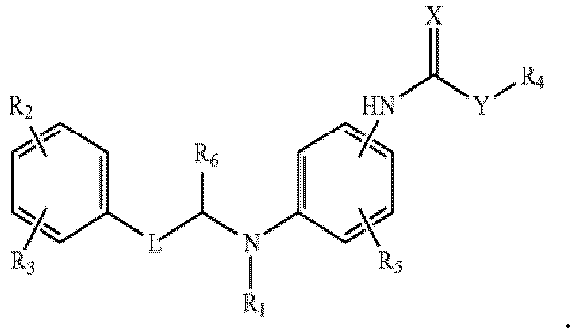
- Therefore, there is still a need for the development of new Kv7 modulators characterized by increased pharmacodynamic (increased potency and selectivity), and pharmacokinetic properties (increased distribution in the CNS and stability to oxidation), as well as by reduced side effects and good tolerability compared to current therapeutic options for Kv7-mediated disorders. These novel molecules may be used for the pharmacological treatment of central nervous system diseases (such as epilepsy, neuropathic pain, ischemic stroke and neurodegenerative disorders), peripheral nervous system diseases (such as pain), respiratory system diseases (such as asthma), genitourinary system diseases (such as bladder hyper-reactivity) and cardiovascular diseases (such as hypertension).
- The present invention provides a novel class of compounds of formula I as shown below, as well as tautomers, salts, solvates, stereoisomers or isotopes thereof.

- Compounds of the present invention were tested by patch-clamp measurements and stability assays as described in the Examples. They were found to act as voltage-gated potassium channels modulators, with EC50 values for Kv7.2, Kv7.2/7.3, Kv7.3 and Kv7.4 in the low micromolar range, and to possess desirable stability and photostability properties.
- Notably, compounds of the present invention may act as agonists or antagonists of voltage-gated potassium channels. As a matter of fact, the substituent in position R6 is able to modulate the activity of the compounds of general formula I in terms of modulation (agonism/antagonism), potency and efficacy.
- Furthermore, the NHQ functionality includes sulfonamide, urea, thiourea and guanidine bonds.
- The inventors found an exceptional activity towards potassium channels in comparison with retigabine, herein used as reference compound, which is known to increase the activity of voltage-gated potassium channels Kv7.2-7.5 and has been used in therapy as anticonvulsant. In particular, when compared to retigabine, the compounds object of the present invention have improved pharmacological properties, both pharmacodynamic and pharmacokinetic. Moreover, they can be synthesized using easier and safer chemical procedures and show increased chemical stability than retigabine.
- Therefore, compounds with general formula I are able to overcome the main problems limiting the clinical use of retigabine, in particular since they are more stable (chemically and biologically) and less prone to photoinduced oxidation.
- The inventors have further observed that compounds of general formula I, in particular IA and IIA as well as IE, IIE, IIIE and IVE, possess a plethora of desiderable properties, including increased potency and stability compared to retigabine.
- Another important observation made by the inventors is that the use of a sterically encumbered aliphatic and/or aromatic group in position R6 is useful to switch the activity of the compounds from agonism to antagonism.
- Thus, these specific substitutions represent an important feature in some embodiments of this invention to modulate the activity of some compounds, with some substitutions resulting in a blockade of the ionic currents carried by the channel (with the resulting molecules thereby acting as antagonists or blockers of the channels), whereas others enhance the ionic currents carried by the channels (with the resulting molecules thereby acting as agonists or openers). The functional electrophysiologial experiments carried out and whose results are detailed below allow a direct estimate of the pharmacological effects exerted by each drug, which could therefore be classified as a blocker or as an opener with respect to a specific channel target.
- Therefore, it is an object of the present invention a compound of general formula I:

- or a tautomer, salt, solvate, stereoisomer or isotope thereof,
- wherein:
- Y is selected from: C1-C10 alkyl, , C1-C10 alkylamino, C1-C10 alkoxy,
- b is 1
- R2 is an aromatic ring bearing in one or more positions at least one substituent independently selected from the group consisting of: OH, NO2, halogen, NH2, C1-C3 haloalkyl, C1-C3 haloalkoxy, C1-C6 alkylcarbonyl, acetamidyl ,C1-C6 alkyloxy.
- R1, R3, R4 and R5 are each independently selected from the group consisting of: H, NH2, OH, halogen, C1-C6 alkyl, C3-C6 cycloalkyl, C2-C6 alkylcarbonyl, C2-C6 alkoxycarbonyl, C1-C6 alkylamino, C2-C6 dialkylamino, C2-C6 alkylaminocarbonyl, C1-C6 alkyloxy, C1-C6 alkylthio, C2-C8 alkenyl, C5-C7 cycloalkenyl, heterocycle, C2-C8 alkynyl and C5-C10 aryl, any of which being optionally substituted by one or more substituents independently selected from: hydroxyl, amine, thiol, carboxyl and halogen;
- Q is selected from the group consisting of: C=O, SO2,
- when Q is C=O, R6 is selected from: linear or branched C1-C30 alkyl, linear or branched C5-C30 arylalkyl, C3-C8 cycloalkyl, linear or branched C2-C4 alkyl substituted by C3-C8 cycloalkyl C2-C30 alkenyl, C2-C30 alkynyl any of which being optionally substituted with one or more substituents independently selected from: halogen, and cycloalkyl; and
- when Q is SO2 R6 is C3-C8 cycloalkyl or aryl and it is optionally substituted with one or more C1-C6 alkyl
- In an embodiment, the present invention discloses each one of the following compounds:
COMPOUND STRUCTURE COMPOUND NAME 1. 
N-(2-(piperidin-1-yl)-4-((4-(trifluoromethyl)benzyl)amino)p henyl)heptanamide 2. 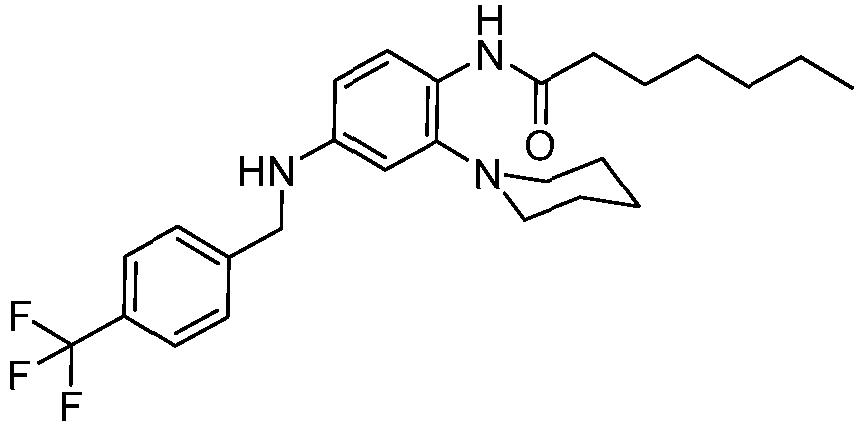
N-(2-(piperidin-1-yl)-4-((4-(trifluoromethyl)benzyl)amino)p henyl)heptanamide 3. 
N-(2-(piperidin-1-yl)-4-((4-(trifluoromethyl)benzyl)amino)p henyl)octanamide 4. 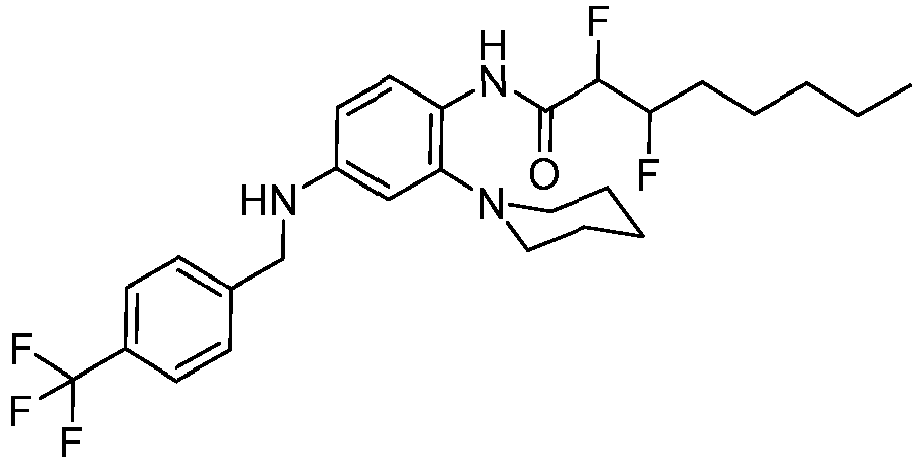
2,3-difluoro-N-(2-(piperidin-1-yl)-4-((4-(trifluoromethyl)benzyl)amino)p henyl)octanamide (2R,3 S)-2,3-difluoro-N-(2-(piperidin-1-yl)-4-((4-(trifluoromethyl)benzyl)amino)p henyl)octanamide (2S,3R)-2,3-difluoro-N-(2-(piperidin-1-yl)-4-((4-(trifluoromethyl)benzyl)amino)p henyl)octanamide (2R,3R)-2,3-difluoro-N-(2-(piperidin-1-yl)-4-((4-(trifluoromethyl)benzyl)amino)p henyl)octanamide (2S,3 S)-2,3-difluoro-N-(2-(piperidin-1-yl)-4-((4-(trifluoromethyl)benzyl)amino)p henyl)octanamide 5. 
7,8-difluoro-N-(2-(piperidin-1-yl)-4-((4-(trifluoromethyl)benzyl)amino)p henyl)octanamide (7R)-7,8-difluoro-N-(2-(piperidin-1-yl)-4-((4-(trifluoromethyl)benzyl)amino)p henyl)octanamide (7S)-7,8-difluoro-N-(2-(piperidin-1-yl)-4-((4-(trifluoromethyl)benzyl)amino)p henyl)octanamide 6. 
2,3-difluoro-N-(2-(piperidin-1-yl)-4-((4-(trifluoromethyl)benzyl)amino)p henyl)heptanamide (2R,3 S)-2,3-difluoro-N-(2-(piperidin-1-yl)-4-((4-(trifluoromethyl)benzyl)amino)p henyl)heptanamide (2S,3R)-2,3-difluoro-N-(2-(piperidin-1-yl)-4-((4-(trifluoromethyl)benzyl)amino)p henyl)heptanamide (2R,3R)-2,3-difluoro-N-(2-(piperidin-1-yl)-4-((4-(trifluoromethyl)benzyl)amino)p henyl)heptanamide (2S,3S)-2,3-difluoro-N-(2-(piperidin-1-yl)-4-((4-(trifluoromethyl)benzyl)amino)p henyl)heptanamide 7. 
6,7-difluoro-N-(2-(piperidin-1-yl)-4-((4-(trifluoromethyl)benzyl)amino)p henyl)heptanamide (6R)-6,7-difluoro-N-(2-(piperidin-1-yl)-4-((4-(trifluoromethyl)benzyl)amino)p henyl)heptanamide (6S)-6,7-difluoro-N-(2-(piperidin-1-yl)-4-((4-(trifluoromethyl)benzyl)amino)p henyl)heptanamide 8. 
3,3-dimethyl-N-(2-(piperidin-1-yl)-4-((4-(trifluoromethyl)benzyl)amino)p henyl)butanamide 9. 
3,3-dimethyl-N-(2-(pyrrolidin-1-yl)-4-((4-(trifluoromethyl)benzyl)amino)p henyl)butanamide 10. 
N-(2-(pyrrolidin-1-yl)-4-((4-(trifluoromethyl)benzyl)amino)p henyl)heptanamide 11. 
(2R,3 S)-2,3-difluoro-N-(2-(pyrrolidin-1-yl)-4-((4-(trifluoromethyl)benzyl)amino)p henyl)heptanamide (2S,3R)- 2,3-difluoro-N-(2-(pyrrolidin-1-yl)-4-((4-(trifluoromethyl)benzyl)amino)p henyl)heptanamide (2R,3R)- 2,3-difluoro-N-(2-(pyrrolidin-1-yl)-4-((4-(trifluoromethyl)benzyl)amino)p henyl)heptanamide (2S,3S)- 2,3-difluoro-N-(2-(pyrrolidin-1-yl)-4-((4-(trifluoromethyl)benzyl)amino)p henyl)heptanamide 12. 
6,7-difluoro-N-(2-(pyrrolidin-1-yl)-4-((4-(trifluoromethyl)benzyl)amino)p henyl)heptanamide (6R)-6,7-difluoro-N-(2-(pyrrolidin-1-yl)-4-((4-(trifluoromethyl)benzyl)amino)p henyl)heptanamide (6S)-6,7-difluoro-N-(2-(pyrrolidin-1-yl)-4-((4-(trifluoromethyl)benzyl)amino)p henyl)heptanamide 13. 
N-(2-(pyrrolidin-1-yl)-4-((4-(trifluoromethyl)benzyl)amino)p henyl)octanamide 14. 
2,3-difluoro-N-(2-(pyrrolidin-1-yl)-4-((4-(trifluoromethyl)benzyl)amino)p henyl)octanamide (2R,3 S)-2,3-difluoro-N-(2-(pyrrolidin-1-yl)-4-((4-(trifluoromethyl)benzyl)amino)p henyl)octanamide (2S,3R)-2,3-difluoro-N-(2-(pyrrolidin-1-yl)-4-((4-(trifluoromethyl)benzyl)amino)p henyl)octanamide (2R,3R)-2,3-difluoro-N-(2-(pyrrolidin-1-yl)-4-((4-(trifluoromethyl)benzyl)amino)p henyl)octanamide (2S,3S)-2,3-difluoro-N-(2-(pyrrolidin-1-yl)-4-((4-(trifluoromethyl)benzyl)amino)p henyl)octanamide 15. 
7,8-difluoro-N-(2-(pyrrolidin-1-yl)-4-((4-(trifluoromethyl)benzyl)amino)p henyl)octanamide (7R)-7,8-difluoro-N-(2-(pyrrolidin-1-yl)-4-((4-(trifluoromethyl)benzyl)amino)p henyl)octanamide (7S)-7,8-difluoro-N-(2-(pyrrolidin-1-yl)-4-((4-(trifluoromethyl)benzyl)amino)p henyl)octanamide 16. 
3,3-dimethyl-N-(2-(methylamino)-4-((4-(trifluoromethyl)benzyl)amino)p henyl)butanamide 17. 
N-(2-(methylamino)-4-((4-(trifluoromethyl)benzyl)amino)p henyl)heptanamide 18. 
2,3-difluoro-N-(2-(methylamino)-4-((4-(trifluoromethyl)benzyl)amino)p henyl)heptanamide (2R, 3S)-2,3-difluoro-N-(2-(methylamino)-4-((4-(trifluoromethyl)benzyl)amino)p henyl)heptanamide (2S, 3R)-2,3-difluoro-N-(2-(methylamino)-4-((4-(trifluoromethyl)benzyl)amino)p henyl)heptanamide (2R, 3R)-2,3-difluoro-N-(2-(methylamino)-4-((4-(trifluoromethyl)benzyl)amino)p henyl)heptanamide (2S, 3S)-2,3-difluoro-N-(2-(methylamino)-4-((4-(trifluoromethyl)benzyl)amino)p henyl)heptanamide 19. 
6,7-difluoro-N-(2-(methylamino)-4-((4-(trifluoromethyl)benzyl)amino)p henyl)heptanamide (6R)-6,7-difluoro-N-(2-(methylamino)-4-((4-(trifluoromethyl)benzyl)amino)p henyl)heptanamide (6S)-6,7-difluoro-N-(2-(methylamino)-4-((4-(trifluoromethyl)benzyl)amino)p henyl)heptanamide 20. 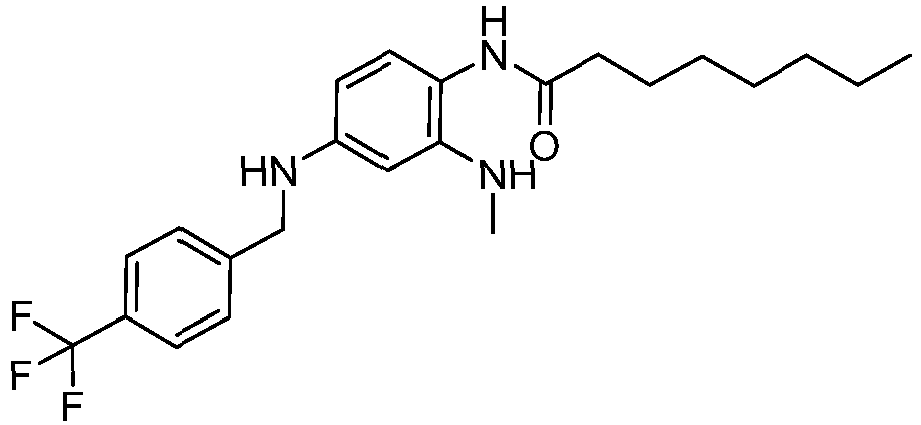
N-(2-(methylamino)-4-((4-(trifluoromethyl)benzyl)amino)p henyl)octanamide 21. 
2,3-difluoro-N-(2-(methylamino)-4-((4-(trifluoromethyl)benzyl)amino)p henyl)octanamide (2R,3 S)-2,3-difluoro-N-(2-(methylamino)-4-((4-(trifluoromethyl)benzyl)amino)p henyl)octanamide (2S,3R)-2,3-difluoro-N-(2-(methylamino)-4-((4-(trifluoromethyl)benzyl)amino)p henyl)octanamide (2R,3R)-2,3-difluoro-N-(2-(methylamino)-4-((4-(trifluoromethyl)benzyl)amino)p henyl)octanamide (2S,3 S)-2,3-difluoro-N-(2-(methylamino)-4-((4-(trifluoromethyl)benzyl)amino)p henyl)octanamide 22. 
7,8-difluoro-N-(2-(methylamino)-4-((4-(trifluoromethyl)benzyl)amino)p henyl)octanamide (7R)-7,8-difluoro-N-(2-(methylamino)-4-((4-(trifluoromethyl)benzyl)amino)p henyl)octanamide (7S)-7,8-difluoro-N-(2-(methylamino)-4-((4-(trifluoromethyl)benzyl)amino)p henyl)octanamide 23. 
N-(2-(diethylamino)-4-((4-(trifluoromethyl)benzyl)amino)p henyl)-3,3-dimethylbutanamide 24. 
3-cyclohexyl-N-(2-(diethylamino)-4-((4-(trifluoromethyl)benzyl)amino)p henyl)propanamide 25. 
3-cyclohexyl-N-(2-(methylamino)-4-((4-(trifluoromethyl)benzyl)amino)p henyl)propanamide 26. 
3-cyclohexyl-N-(2-(piperidin-1-yl)-4-((4-(trifluoromethyl)benzyl)amino)p henyl)propanamide 27. 
3-cyclohexyl-N-(2-(pyrrolidin-1-yl)-4-((4-(trifluoromethyl)benzyl)amino)p henyl)propanamide 28. 
N-(2-(diethylamino)-4-((4-(trifluoromethyl)benzyl)amino)p henyl)heptanamide 29. 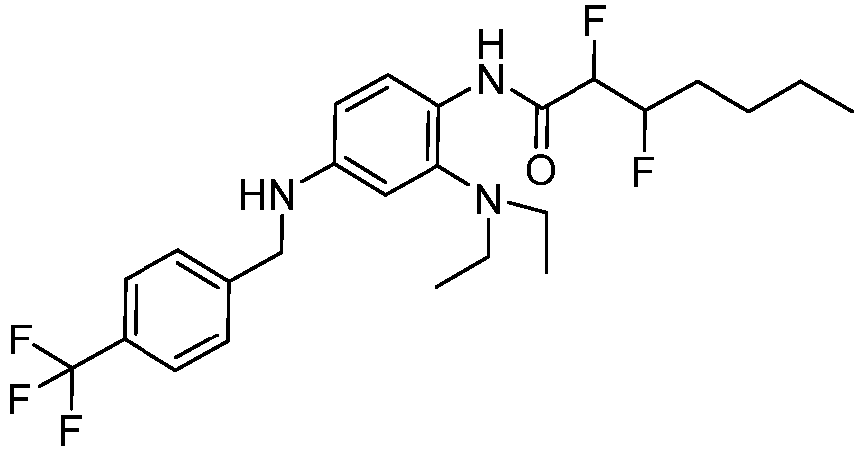
N-(2-(diethylamino)-4-((4-(trifluoromethyl)benzyl)amino)p henyl)-2,3-difluoroheptanamide (2R,3S)- N-(2-(diethylamino)-4-((4-(trifluoromethyl)benzyl)amino)p henyl)-2,3-difluoroheptanamide (2S,3R)- N-(2-(diethylamino)-4-((4-(trifluoromethyl)benzyl)amino)p henyl)-2,3-difluoroheptanamide (2R,3R)- N-(2-(diethylamino)-4-((4-(trifluoromethyl)benzyl)amino)p henyl)-2,3-difluoroheptanamide (2S,3 S)- N-(2-(diethylamino)-4-((4-(trifluoromethyl)benzyl)amino)p henyl)-2,3-difluoroheptanamide. 30. 
N-(2-(diethylamino)-4-((4-(trifluoromethyl)benzyl)amino)p henyl)-6,7-difluoroheptanamide (6R)-N-(2-(diethylamino)-4-((4-(trifluoromethyl)benzyl)amino)p henyl)-6,7-difluoroheptanamide (6S)-N-(2-(diethylamino)-4-((4-(trifluoromethyl)benzyl)amino)p henyl)-6,7-difluoroheptanamide 31. 
N-(2-(diethylamino)-4-((4-(trifluoromethyl)benzyl)amino)p henyl)-7,8-difluorooctanamide (7R)-N-(2-(diethylamino)-4-((4-(trifluoromethyl)benzyl)amino)p henyl)-7,8-difluorooctanamide (7S)-N-(2-(diethylamino)-4-((4-(trifluoromethyl)benzyl)amino)p henyl)-7,8-difluorooctanamide 32. 
N-(2-(diethylamino)-4-((4-(trifluoromethyl)benzyl)amino)p henyl)-2,3-difluorooctanamide (2R,3 S)-N-(2-(diethylamino)-4-((4-(trifluoromethyl)benzyl)amino)p henyl)-2,3-difluorooctanamide (2S,3R)-N-(2-(diethylamino)-4-((4-(trifluoromethyl)benzyl)amino)p henyl)-2,3-difluorooctanamide (2R,3R)-N-(2-(diethylamino)-4-((4-(trifluoromethyl)benzyl)amino)p henyl)-2,3-difluorooctanamide (2S,3S)-N-(2-(diethylamino)-4-((4-(trifluoromethyl)benzyl)amino)p henyl)-2,3-difluorooctanamide 33. 
N-(2-(diethylamino)-4-((4-(trifluoromethyl)benzyl)amino)p henyl)octanamide 34. 
N-(2-amino-4-(4-(trifluoromethyl)phenethyl)phen yl)-3-cyclohexylpropanamide 35. 
N-(2-amino-4-(4-(trifluoromethyl)phenethyl)phen yl)-3-cyclohexylpropanamide 36. 
N-(2-amino-4-(4-(trifluoromethyl)phenethyl)phen yl)heptanamide 37. 
N-(2-amino-4-(4-(trifluoromethyl)phenethyl)phen yl)-2,3-difluoroheptanamide (2R,3 S)-N-(2-amino-4-(4-(trifluoromethyl)phenethyl)phen yl)-2,3-difluoroheptanamide (2S,3R)-N-(2-amino-4-(4-(trifluoromethyl)phenethyl)phen yl)-2,3-difluoroheptanamide (2R,3R)-N-(2-amino-4-(4-(trifluoromethyl)phenethyl)phen yl)-2,3-difluoroheptanamide (2S,3 S)-N-(2-amino-4-(4-(trifluoromethyl)phenethyl)phen yl)-2,3-difluoroheptanamide 38. 
N-(2-amino-4-(4-(trifluoromethyl)phenethyl)phen yl)-6,7-difluoroheptanamide (6R)-N-(2-amino-4-(4-(trifluoromethyl)phenethyl)phen yl)-6,7-difluoroheptanamide (6S)-N-(2-amino-4-(4-(trifluoromethyl)phenethyl)phen yl)-6,7-difluoroheptanamide 39. 
N-(2-amino-4-(4-(trifluoromethyl)phenethyl)phen yl)octanamide 40. 
N-(2-amino-4-(4-(trifluoromethyl)phenethyl)phen yl)-2,3-difluorooctanamide 41. 
N-(2-amino-4-(4-(trifluoromethyl)phenethyl)phen yl)-2,3-difluorooctanamide (2R,3 S)-N-(2-amino-4-(4-(trifluoromethyl)phenethyl)phen yl)-2,3-difluorooctanamide (2S,3R)-N-(2-amino-4-(4-(trifluoromethyl)phenethyl)phen yl)-2,3-difluorooctanamide (2R,3R)-N-(2-amino-4-(4-(trifluoromethyl)phenethyl)phen yl)-2,3-difluorooctanamide (2S,3 S)-N-(2-amino-4-(4-(trifluoromethyl)phenethyl)phen yl)-2,3-difluorooctanamide 42. 
N-(2-amino-4-(4-(trifluoromethyl)phenethyl)phen yl)-7,8-difluorooctanamide (7R)-N-(2-amino-4-(4-(trifluoromethyl)phenethyl)phen yl)-7,8-difluorooctanamide (7S)-N-(2-amino-4-(4-(trifluoromethyl)phenethyl)phen yl)-7,8-difluorooctanamide 43. 
3-cyclohexyl-N-(2-(piperidin-1-yl)-4-(4-(trifluoromethyl)phenethyl)phen yl)propanamide 44. 
N-(4-((4-fluorobenzyl)amino)phenyl)hept anamide 45. 
N-(3-fluoro-4-((4-fluorobenzyl)amino)phenyl)hept anamide 46. 
N-(2-amino-3-fluoro-4-((4-fluorobenzyl)amino)phenyl)hept anamide 47. 
N-(2-amino-4-((4-fluorobenzyl)amino)phenyl)hept anamide 48. 
N-(4-((4-(trifluoromethyl)benzyl)amino)p henyl)heptanamide 49. 
N-(3-fluoro-4-((4-(trifluoromethyl)benzyl)amino)p henyl)heptanamide 50. 
N-(2-amino-3-fluoro-4-((4-(trifluoromethyl)benzyl)amino)p henyl)heptanamide 51. 
N-(2-amino-4-((4-(trifluoromethyl)benzyl)amino)p henyl)heptanamide 52. 
N-(4-((4-(trifluoromethoxy)benzyl)amino )phenyl)heptanamide 53. 
N-(3-fluoro-4-((4-(trifluoromethoxy)benzyl)amino )phenyl)heptanamide 54. 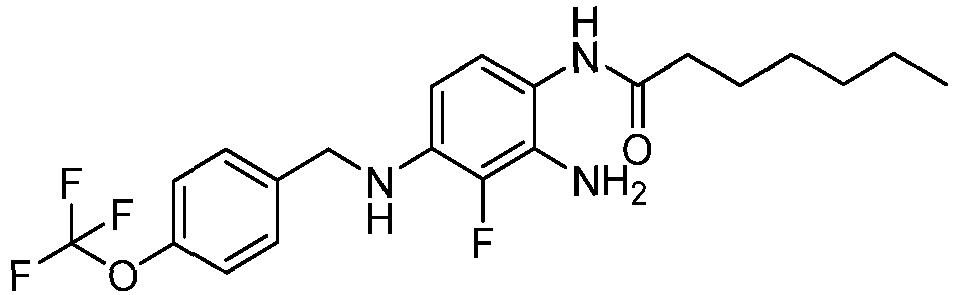
N-(2-amino-3-fluoro-4-((4-(trifluoromethoxy)benzyl)amino )phenyl)heptanamide 55. 
N-(2-amino-4-((4-(trifluoromethoxy)benzyl)amino )phenyl)heptanamide 56. 
3,3-dimethyl-N-(4-((4-(trifluoromethoxy)benzyl)amino )phenyl)butanamide 57. 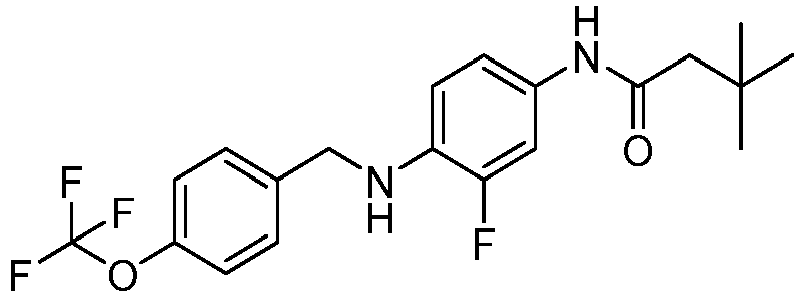
N-(3-fluoro-4-((4-(trifluoromethoxy)benzyl)amino )phenyl)-3,3-dimethylbutanamide 58. 
N-(2-amino-3-fluoro-4-((4-(trifluoromethoxy)benzyl)amino )phenyl)-3,3-dimethylbutanamide 59. 
N-(2-amino-4-((4-(trifluoromethoxy)benzyl)amino )phenyl)-3,3-dimethylbutanamide 60. 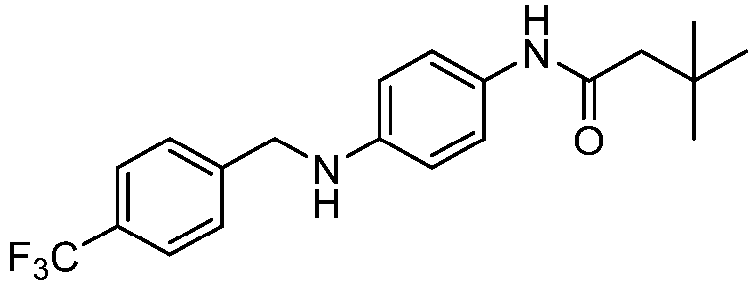
3,3-dimethyl-N-(4-((4-(trifluoromethyl)benzyl)amino)p henyl)butanamide 61. 
N-(3-fluoro-4-((4-(trifluoromethyl)benzyl)amino)p henyl)-3,3-dimethylbutanamide 62. 
N-(2-amino-3-fluoro-4-((4-(trifluoromethyl)benzyl)amino)p henyl)-3,3-dimethylbutanamide 63. 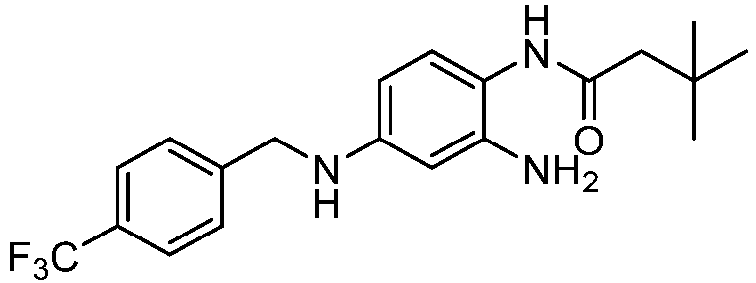
N-(2-amino-4-((4-(trifluoromethyl)benzyl)amino)p henyl)-3,3-dimethylbutanamide 64. 
N-(2-amino-4-((4-(trifluoromethyl)benzyl)amino)p henyl)octanamide 65. 
N-(2-amino-4-((4-(trifluoromethyl)benzyl)amino)p henyl)nonanamide 66. 
N-(2-amino-4-((4-(trifluoromethyl)benzyl)amino)p henyl)decanamide 67. 
N-(2-amino-4-((4-(trifluoromethyl)benzyl)amino)p henyl)undecanamide 68. 
N-(2-amino-4-((4-(trifluoromethyl)benzyl)amino)p henyl)dodecanamide 69. 
N-(3-fluoro-4-((4-(trifluoromethyl)benzyl)amino)p henyl)octanamide 70. 
N-(3-fluoro-4-((4-(trifluoromethyl)benzyl)amino)p henyl)nonanamide 71. 
N-(3-fluoro-4-((4-(trifluoromethyl)benzyl)amino)p henyl)decanamide 72. 
N-(3-fluoro-4-((4-(trifluoromethyl)benzyl)amino)p henyl)undecanamide 73. 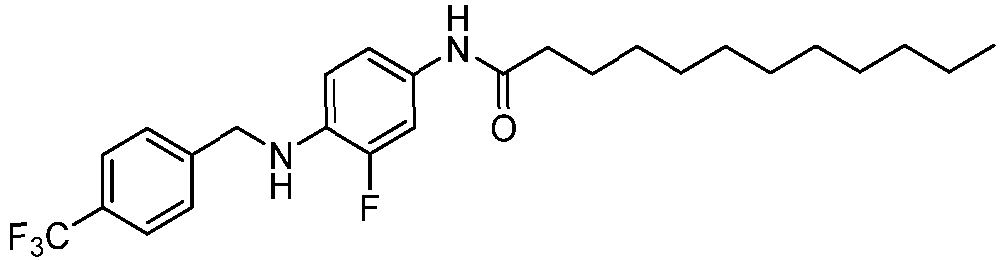
N-(3-fluoro-4-((4-(trifluoromethyl)benzyl)amino)p henyl)dodecanamide 74. 
N-(2-amino-3-fluoro-4-((4-(trifluoromethyl)benzyl)amino)p henyl)octanamide 75. 
N-(2-amino-3-fluoro-4-((4-(trifluoromethyl)benzyl)amino)p henyl)nonanamide 76. 
N-(2-amino-3-fluoro-4-((4-(trifluoromethyl)benzyl)amino)p henyl)decanamide 77. 
N-(2-amino-3-fluoro-4-((4-(trifluoromethyl)benzyl)amino)p henyl)undecanamide 78. 
N-(2-amino-3-fluoro-4-((4-(trifluoromethyl)benzyl)amino)p henyl)dodecanamide 79. 
N-(2-amino-3-fluoro-4-((4-(trifluoromethyl)benzyl)amino)p henyl)-2,3-difluoroheptanamide (2R,3 S)-N-(2-amino-3-fluoro-4-((4-(trifluoromethyl)benzyl)amino)p henyl)-2,3-difluoroheptanamide (2S,3R)-N-(2-amino-3-fluoro-4-((4-(trifluoromethyl)benzyl)amino)p henyl)-2,3-difluoroheptanamide (2R,3R)-N-(2-amino-3-fluoro-4-((4-(trifluoromethyl)benzyl)amino)p henyl)-2,3-difluoroheptanamide (2S,3S)-N-(2-amino-3-fluoro-4-((4-(trifluoromethyl)benzyl)amino)p henyl)-2,3-difluoroheptanamide racemic mixtures thereof 80. 
N-(2-amino-3-fluoro-4-((4-(trifluoromethyl)benzyl)amino)p henyl)-2,3-difluorooctanamide (2R,3 S)-N-(2-amino-3-fluoro-4-((4-(trifluoromethyl)benzyl)amino)p henyl)-2,3-difluorooctanamide (2S,3R)-N-(2-amino-3-fluoro-4-((4-(trifluoromethyl)benzyl)amino)p henyl)-2,3-difluorooctanamide (2R,3R)-N-(2-amino-3-fluoro-4-((4-(trifluoromethyl)benzyl)amino)p henyl)-2,3-difluorooctanamide (2S,3S)-N-(2-amino-3-fluoro-4-((4-(trifluoromethyl)benzyl)amino)p henyl)-2,3-difluorooctanamide racemic mixtures thereof 81. 
N-(2-amino-3-fluoro-4-((4-(trifluoromethyl)benzyl)amino)p henyl)-2,3-difluorononanamide (2R,3S)-N-(2-amino-3-fluoro-4-((4-(trifluoromethyl)benzyl)amino)p henyl)-2,3-difluorononanamide (2S,3R)-N-(2-amino-3-fluoro-4-((4-(trifluoromethyl)benzyl)amino)p henyl)-2,3-difluorononanamide (2R,3R)-N-(2-amino-3-fluoro-4-((4-(trifluoromethyl)benzyl)amino)p henyl)-2,3-difluorononanamide (2S,3S)-N-(2-amino-3-fluoro-4-((4-(trifluoromethyl)benzyl)amino)p henyl)-2,3-difluorononanamide racemic mixtures thereof 82. 
N-(2-amino-3-fluoro-4-((4-(trifluoromethyl)benzyl)amino)p henyl)-2,3-difluorodecanamide (2R,3S)-N-(2-amino-3-fluoro-4-((4-(trifluoromethyl)benzyl)amino)p henyl)-2,3-difluorodecanamide (2S,3R)-N-(2-amino-3-fluoro-4-((4-(trifluoromethyl)benzyl)amino)p henyl)-2,3-difluorodecanamide (2R,3R)-N-(2-amino-3-fluoro-4-((4-(trifluoromethyl)benzyl)amino)p henyl)-2,3-difluorodecanamide (2S,3S)-N-(2-amino-3-fluoro-4-((4-(trifluoromethyl)benzyl)amino)p henyl)-2,3-difluorodecanamide racemic mixtures thereof 83. 
N-(2-amino-3-fluoro-4-((4-(trifluoromethyl)benzyl)amino)p henyl)-2,3-difluoroundecanamide (2R,3 S)-N-(2-amino-3-fluoro-4-((4-(trifluoromethyl)benzyl)amino)p henyl)-2,3-difluoroundecanamide (2S,3R)-N-(2-amino-3-fluoro-4-((4-(trifluoromethyl)benzyl)amino)p henyl)-2,3-difluoroundecanamide (2R,3R)-N-(2-amino-3-fluoro-4-((4-(trifluoromethyl)benzyl)amino)p henyl)-2,3-difluoroundecanamide (2S,3S)-N-(2-amino-3-fluoro-4-((4-(trifluoromethyl)benzyl)amino)p henyl)-2,3-difluoroundecanamide racemic mixtures thereof 84. 
N-(2-amino-3-fluoro-4-((4-(trifluoromethyl)benzyl)amino)p henyl)-2,3-difluorododecanamide (2R,3 S)-N-(2-amino-3-fluoro-4-((4-(trifluoromethyl)benzyl)amino)p henyl)-2,3-difluorododecanamide (2S,3R)-N-(2-amino-3-fluoro-4-((4-(trifluoromethyl)benzyl)amino)p henyl)-2,3-difluorododecanamide (2R,3R)-N-(2-amino-3-fluoro-4-((4-(trifluoromethyl)benzyl)amino)p henyl)-2,3-difluorododecanamide (2S,3S)-N-(2-amino-3-fluoro-4-((4-(trifluoromethyl)benzyl)amino)p henyl)-2,3-difluorododecanamide racemic mixtures thereof 85. 
N-(2-amino-3-fluoro-4-((4-(trifluoromethyl)benzyl)amino)p henyl)-6,7-difluoroheptanamide (6R)-N-(2-amino-3-fluoro-4-((4-(trifluoromethyl)benzyl)amino)p henyl)-6,7-difluoroheptanamide (6S)-N-(2-amino-3-fluoro-4-((4-(trifluoromethyl)benzyl)amino)p henyl)-6,7-difluoroheptanamide racemic mixtures thereof 86. 
N-(2-amino-3-fluoro-4-((4-(trifluoromethyl)benzyl)amino)p henyl)-6,7-difluorooctanamide (6R)-N-(2-amino-3-fluoro-4-((4-(trifluoromethyl)benzyl)amino)p henyl)-6,7-difluorooctanamide (6S)-N-(2-amino-3-fluoro-4-((4-(trifluoromethyl)benzyl)amino)p henyl)-6,7-difluorooctanamide racemic mixtures thereof 87. 
N-(2-amino-3-fluoro-4-((4-(trifluoromethyl)benzyl)amino)p henyl)-8,9-difluorononanamide (8R)-N-(2-amino-3-fluoro-4-((4-(trifluoromethyl)benzyl)amino)p henyl)-8,9-difluorononanamide (8S)-N-(2-amino-3-fluoro-4-((4-(trifluoromethyl)benzyl)amino)p henyl)-8,9-difluorononanamide racemic mixtures thereof 88. 
N-(2-amino-3-fluoro-4-((4-(trifluoromethyl)benzyl)amino)p henyl)-9,10-difluorodecanamide (9R)-N-(2-amino-3-fluoro-4-((4-(trifluoromethyl)benzyl)amino)p henyl)-9,10-difluorodecanamide (9S)-N-(2-amino-3-fluoro-4-((4-(trifluoromethyl)benzyl)amino)p henyl)-9,10-difluorodecanamide racemic mixtures thereof 89. 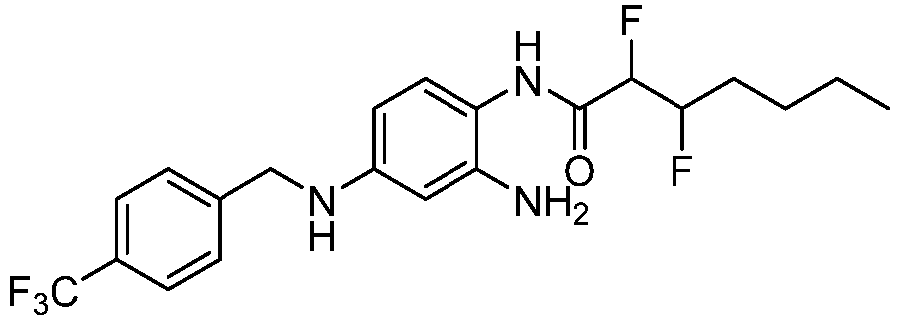
N-(2-amino-4-((4-(trifluoromethyl)benzyl)amino)p henyl)-2,3-difluoroheptanamide (2R,3 S)-N-(2-amino-4-((4-(trifluoromethyl)benzyl)amino)p henyl)-2,3-difluoroheptanamide (2S,3R)-N-(2-amino-4-((4-(trifluoromethyl)benzyl)amino)p henyl)-2,3-difluoroheptanamide (2R,3R)-N-(2-amino-4-((4-(trifluoromethyl)benzyl)amino)p henyl)-2,3-difluoroheptanamide (2S,3 S)-N-(2-amino-4-((4-(trifluoromethyl)benzyl)amino)p henyl)-2,3-difluoroheptanamide racemic mixtures thereof 90. 
N-(2-amino-4-((4-(trifluoromethyl)benzyl)amino)p henyl)-2,3-difluorooctanamide (2R,3 S)-N-(2-amino-4-((4-(trifluoromethyl)benzyl)amino)p henyl)-2,3-difluorooctanamide (2S,3R)-N-(2-amino-4-((4-(trifluoromethyl)benzyl)amino)p henyl)-2,3-difluorooctanamide (2R,3R)-N-(2-amino-4-((4-(trifluoromethyl)benzyl)amino)p henyl)-2,3-difluorooctanamide (2S,3 S)-N-(2-amino-4-((4-(trifluoromethyl)benzyl)amino)p henyl)-2,3-difluorooctanamide racemic mixtures thereof 91. 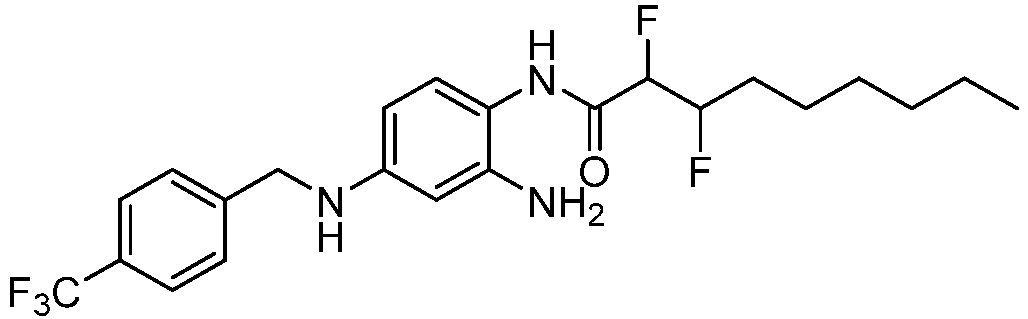
N-(2-amino-4-((4-(trifluoromethyl)benzyl)amino)p henyl)-2,3-difluorononanamide (2R,3 S)-N-(2-amino-4-((4-(trifluoromethyl)benzyl)amino)p henyl)-2,3-difluorononanamide (2S,3R)-N-(2-amino-4-((4-(trifluoromethyl)benzyl)amino)p henyl)-2,3-difluorononanamide (2R,3R)-N-(2-amino-4-((4-(trifluoromethyl)benzyl)amino)p henyl)-2,3-difluorononanamide (2S,3 S)-N-(2-amino-4-((4-(trifluoromethyl)benzyl)amino)p henyl)-2,3-difluorononanamide racemic mixtures thereof 92. 
N-(2-amino-4-((4-(trifluoromethyl)benzyl)amino)p henyl)-2,3-difluorodecanamide (2R,3 S)- N-(2-amino-4-((4-(trifluoromethyl)benzyl)amino)p henyl)-2,3-difluorodecanamide (2S,3R)- N-(2-amino-4-((4-(trifluoromethyl)benzyl)amino)p henyl)-2,3-difluorodecanamide (2R,3R)- N-(2-amino-4-((4-(trifluoromethyl)benzyl)amino)p henyl)-2,3-difluorodecanamide (2S,3 S)- N-(2-amino-4-((4-(trifluoromethyl)benzyl)amino)p henyl)-2,3-difluorodecanamide racemic mixtures thereof 93. 
N-(2-amino-4-((4-(trifluoromethyl)benzyl)amino)p henyl)-6,7-difluoroheptanamide (6R)-N-(2-amino-4-((4-(trifluoromethyl)benzyl)amino)p henyl)-6,7-difluoroheptanamide (6S)-N-(2-amino-4-((4-(trifluoromethyl)benzyl)amino)p henyl)-6,7-difluoroheptanamide racemic mixtures thereof 94. 
N-(2-amino-4-((4-(trifluoromethyl)benzyl)amino)p henyl)-7,8-difluorooctanamide (7R)-N-(2-amino-4-((4-(trifluoromethyl)benzyl)amino)p henyl)-7,8-difluorooctanamide (7S)-N-(2-amino-4-((4-(trifluoromethyl)benzyl)amino)p henyl)-7,8-difluorooctanamide racemic mixtures thereof 95. 
N-(2-amino-3-fluoro-4-((4-(trifluoromethyl)benzyl)amino)p henyl)-6,7-difluorononanamide (6R)-N-(2-amino-3-fluoro-4-((4-(trifluoromethyl)benzyl)amino)p henyl)-6,7-difluorononanamide (6S)-N-(2-amino-3-fluoro-4-((4-(trifluoromethyl)benzyl)amino)p henyl)-6,7-difluorononanamide racemic mixtures thereof 96. 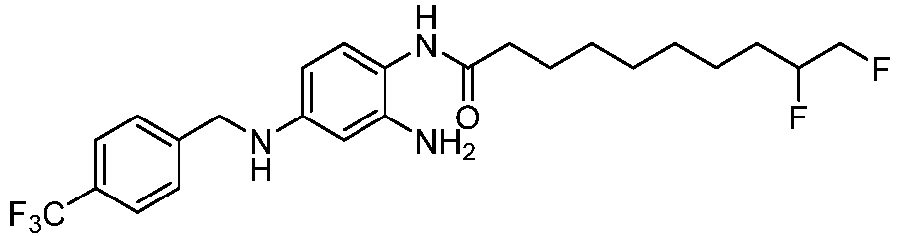
N-(2-amino-3-fluoro-4-((4-(trifluoromethyl)benzyl)amino)p henyl)-6,7-difluorododecanamide (6R)-N-(2-amino-3-fluoro-4-((4-(trifluoromethyl)benzyl)amino)p henyl)-6,7-difluorododecanamide (6S)-N-(2-amino-3-fluoro-4-((4-(trifluoromethyl)benzyl)amino)p henyl)-6,7-difluorododecanamide racemic mixtures thereof 97. 
N-(2-amino-4-((4-hydroxybenzyl)amino)phenyl)he ptanamide 98. 
N-(4-((4-hydroxybenzyl)amino)phenyl)he ptanamide 99. 
N-(2-amino-3-fluoro-4-((4-hydroxybenzyl)amino)phenyl)he ptanamide 100. 
N-(2-amino-4-((4-hydroxybenzyl)amino)phenyl)oc tanamide 101. 
N-(4-((4-hydroxybenzyl)amino)phenyl)oc tanamide 102. 
N-(2-amino-3-fluoro-4-((4-hydroxybenzyl)amino)phenyl)oc tanamide 103. 
N-(2-amino-4-((4-hydroxybenzyl)amino)phenyl)de canamide 104. 
N-(4-((4-hydroxybenzyl)amino)phenyl)de canamide 105. 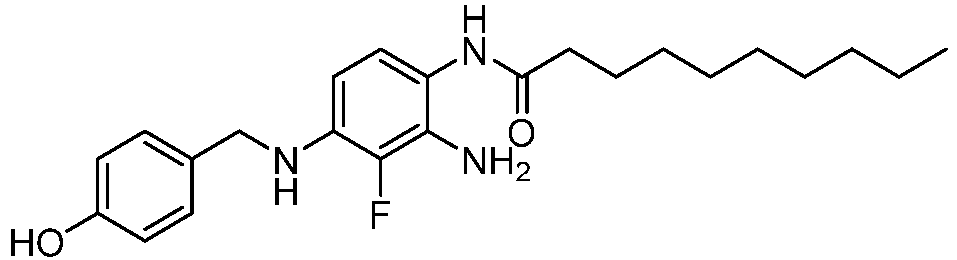
N-(2-amino-3-fluoro-4-((4-hydroxybenzyl)amino)phenyl)de canamide 106. 
N-(2-amino-4-((4-hydroxybenzyl)amino)phenyl)-2,3-difluorodecanamide (2R,3 S)-N-(2-amino-4-((4-hydroxybenzyl)amino)phenyl)-2,3-difluorodecanamide (2S,3R)-N-(2-amino-4-((4-hydroxybenzyl)amino)phenyl)-2,3-difluorodecanamide (2R,3R)-N-(2-amino-4-((4-hydroxybenzyl)amino)phenyl)-2,3-difluorodecanamide (2S,3 S)-N-(2-amino-4-((4-hydroxybenzyl)amino)phenyl)-2,3-difluorodecanamide racemic mixtures thereof 107. 
N-(2-amino-4-((4-hydroxybenzyl)amino)phenyl)-9,10-difluorodecanamide (9R)-N-(2-amino-4-((4-hydroxybenzyl)amino)phenyl)-2,3-difluorodecanamide (9S)-N-(2-amino-4-((4-hydroxybenzyl)amino)phenyl)-2,3-difluorodecanamide racemic mixtures thereof 108. 
2,3-difluoro-N-(4-((4-hydroxybenzyl)amino)phenyl)de ca decanamide (2R,3S)-2,3-difluoro-N-(4-((4-hydroxybenzyl)amino)phenyl)de ca decanamide (2S,3R)-2,3-difluoro-N-(4-((4-hydroxybenzyl)amino)phenyl)de canamide (2R,3R)-2,3-difluoro-N-(4-((4-hydroxybenzyl)amino)phenyl)de ca decanamide (2S,3S)-2,3-difluoro-N-(4-((4-hydroxybenzyl)amino)phenyl)de canamide racemic mixtures thereof 109. 
9,10-difluoro-N-(4-((4-hydroxybenzyl)amino)phenyl)de canamide (9R)-9,10-difluoro-N-(4-((4-hydroxybenzyl)amino)phenyl)de canamide (9S)-9,10-difluoro-N-(4-((4-hydroxybenzyl)amino)phenyl)de ca namide racemic mixtures thereof 110. 
N-(2-amino-3-fluoro-4-((4-hydroxybenzyl)amino)phenyl)-2,3-difluorodecanamide (2R,3 S)-N-(2-amino-3-fluoro-4-((4-hydroxybenzyl)amino)phenyl)-2,3-difluorodecanamide (2S,3R)-N-(2-amino-3-fluoro-4-((4-hydroxybenzyl)amino)phenyl)-2,3-difluorodecanamide (2R,3R)-N-(2-amino-3-fluoro-4-((4-hydroxybenzyl)amino)phenyl)-2,3-difluorodecanamide (2S,3S)-N-(2-amino-3-fluoro-4-((4-hydroxybenzyl)amino)phenyl)-2,3-difluorodecanamide racemic mixtures thereof 111. 
N-(2-amino-3-fluoro-4-((4-hydroxybenzyl)amino)phenyl)-9,10-difluorodecanamide (9R)-N-(2-amino-3-fluoro-4-((4-hydroxybenzyl)amino)phenyl)-9,10-difluorodecanamide (9S)-N-(2-amino-3-fluoro-4-((4-hydroxybenzyl)amino)phenyl)-9,10-difluorodecanamide racemic mixtures thereof 112. 
N-(2-amino-4-((4-hydroxybenzyl)amino)phenyl)-2,3-difluorooctanamide (2R,3 S)-N-(2-amino-4-((4-hydroxybenzyl)amino)phenyl)-2,3-difluorooctanamide (2S,3R)-N-(2-amino-4-((4-hydroxybenzyl)amino)phenyl)-2,3-difluorooctanamide (2R,3R)-N-(2-amino-4-((4-hydroxybenzyl)amino)phenyl)-2,3-difluorooctanamide (2S,3 S)-N-(2-amino-4-((4-hydroxybenzyl)amino)phenyl)-2,3-difluorooctanamide racemic mixtures thereof 113. 
2,3-difluoro-N-(4-((4-hydroxybenzyl)amino)phenyl)oc tanamide (2R,3S)-2,3-difluoro-N-(4-((4-hydroxybenzyl)amino)phenyl)oc tanamide (2S,3R)-2,3-difluoro-N-(4-((4-hydroxybenzyl)amino)phenyl)oc (2R,3R)-2,3-difluoro-N-(4-((4-hydroxybenzyl)amino)phenyl)oc tanamide (2S,3S)-2,3-difluoro-N-(4-((4-hydroxybenzyl)amino)phenyl)oc tanamide racemic mixtures thereof 114. 
N-(2-amino-3-fluoro-4-((4-hydroxybenzyl)amino)phenyl)-2,3-difluorooctanamide (2R,3S)-N-(2-amino-3-fluoro-4-((4-hydroxybenzyl)amino)phenyl)-2,3-difluorooctanamide (2S,3R)-N-(2-amino-3-fluoro-4-((4-hydroxybenzyl)amino)phenyl)-2,3-difluorooctanamide (2R,3R)-N-(2-amino-3-fluoro-4-((4-hydroxybenzyl)amino)phenyl)-2,3-difluorooctanamide (2S,3S)-N-(2-amino-3-fluoro-4-((4-hydroxybenzyl)amino)phenyl)-2,3-difluorooctanamide racemic mixtures thereof 115. 
N-(2-amino-4-((4-hydroxybenzyl)amino)phenyl)-7,8-difluorooctanamide (7S)-N-(2-amino-4-((4-hydroxybenzyl)amino)phenyl)-7,8-difluorooctanamide (7R)-N-(2-amino-4-((4-hydroxybenzyl)amino)phenyl)-7,8-difluorooctanamide racemic mixtures thereof 116. 
7,8-difluoro-N-(4-((4-hydroxybenzyl)amino)phenyl)oc tanamide (7R)-7,8-difluoro-N-(4-((4-hydroxybenzyl)amino)phenyl)oc tanamide (7S)-7,8-difluoro-N-(4-((4-hydroxybenzyl)amino)phenyl)oc tanamide racemic mixtures thereof 117. 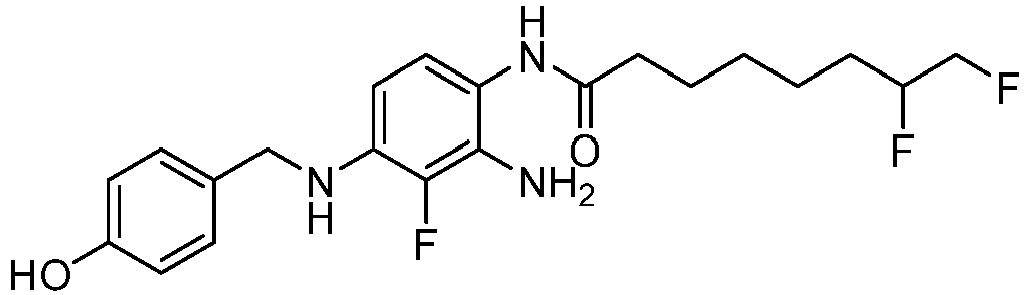
N-(2-amino-3-fluoro-4-((4-hydroxybenzyl)amino)phenyl)-7,8-difluorooctanamide (7R)-N-(2-amino-3-fluoro-4-((4-hydroxybenzyl)amino)phenyl)-7,8-difluorooctanamide (7S)-N-(2-amino-3-fluoro-4-((4-hydroxybenzyl)amino)phenyl)-7,8-difluorooctanamide racemic mixtures thereof 118. 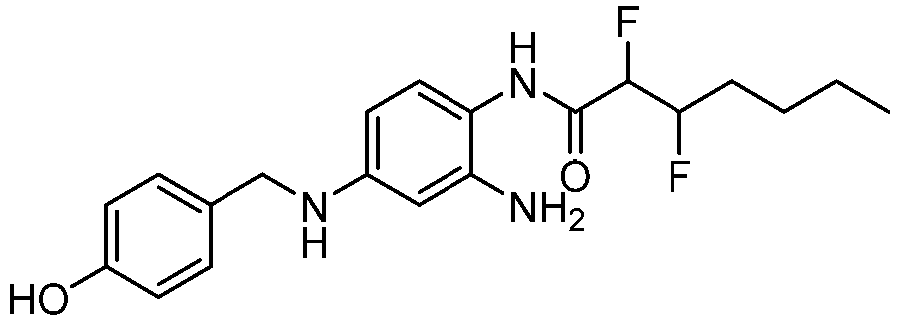
N-(2-amino-4-((4-hydroxybenzyl)amino)phenyl)-2,3-difluoroheptanamide (2R,3 S)-N-(2-amino-4-((4-hydroxybenzyl)amino)phenyl)-2,3 -difluoroheptanamide (2S,3R)-N-(2-amino-4-((4-hydroxybenzyl)amino)phenyl)-2,3-difluoroheptanamide (2R,3R)-N-(2-amino-4-((4-hydroxybenzyl)amino)phenyl)-2,3 -difluoroheptanamide (2S,3 S)-N-(2-amino-4-((4-hydroxybenzyl)amino)phenyl)-2,3 -difluoroheptanamide racemic mixtures thereof 119. 
2,3-difluoro-N-(4-((4-hydroxybenzyl)amino)phenyl)he ptanamide (2R,3S)-2,3-difluoro-N-(4-((4-hydroxybenzyl)amino)phenyl)he ptanamide (2S,3R)-2,3-difluoro-N-(4-((4-hydroxybenzyl)amino)phenyl)he ptanamide (2R,3R)-2,3-difluoro-N-(4-((4-hydroxybenzyl)amino)phenyl)he ptanamide (2S,3S)-2,3-difluoro-N-(4-((4-hydroxybenzyl)amino)phenyl)he ptanamide racemic mixtures thereof 120. 
N-(2-amino-3-fluoro-4-((4-hydroxybenzyl)amino)phenyl)-2,3 -difluoroheptanamide (2R,3 S)-N-(2-amino-3-fluoro-4-((4-hydroxybenzyl)amino)phenyl)-2,3 -difluoroheptanamide (2S,3R)-N-(2-amino-3-fluoro-4-((4-hydroxybenzyl)amino)phenyl)-2,3 -difluoroheptanamide (2R,3R)-N-(2-amino-3-fluoro-4-((4-hydroxybenzyl)amino)phenyl)-2,3 -difluoroheptanamide (2S,3S)-N-(2-amino-3-fluoro-4-((4-hydroxybenzyl)amino)phenyl)-2,3-difluoroheptanamide racemic mixtures thereof 121. 
N-(2-amino-4-((4-hydroxybenzyl)amino)phenyl)-6,7-difluoroheptanamide (6R)-N-(2-amino-4-((4-hydroxybenzyl)amino)phenyl)-6,7-difluoroheptanamide (6S)-N-(2-amino-4-((4-hydroxybenzyl)amino)phenyl)-6,7-difluoroheptanamide racemic mixtures thereof 122. 
6,7-difluoro-N-(4-((4-hydroxybenzyl)amino)phenyl)he ptanamide (6R)-6,7-difluoro-N-(4-((4-hydroxybenzyl)amino)phenyl)he ptanamide (6S)-6,7-difluoro-N-(4-((4-hydroxybenzyl)amino)phenyl)he ptanamide racemic mixtures thereof 123. 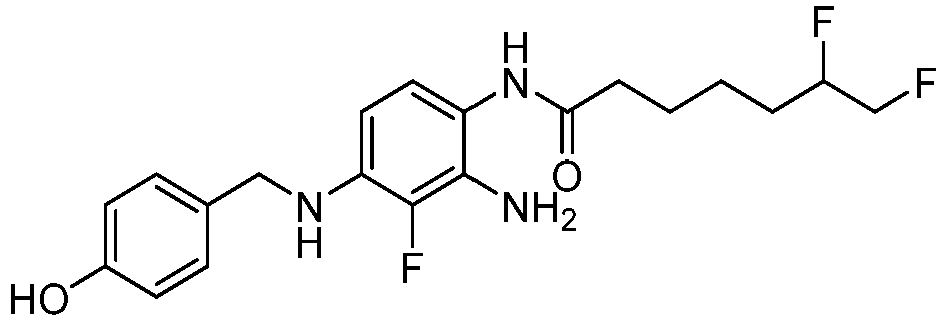
N-(2-amino-3-fluoro-4-((4-hydroxybenzyl)amino)phenyl)-6,7-difluoroheptanamide (6R)-N-(2-amino-3-fluoro-4-((4-hydroxybenzyl)amino)phenyl)-6,7-difluoroheptanamide (6S)-N-(2-amino-3-fluoro-4-((4-hydroxybenzyl)amino)phenyl)-6,7-difluoroheptanamide racemic mixtures thereof 124. 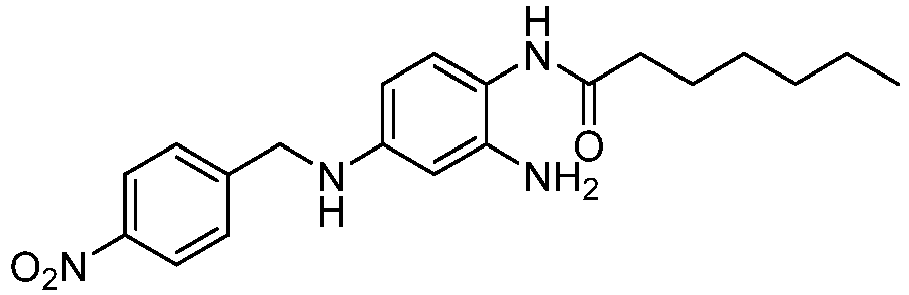
N-(2-amino-4-((4-nitrobenzyl)amino)phenyl)hepta namide 125. 
N-(4-((4-nitrobenzyl)amino)phenyl)hepta namide 126. 
N-(2-amino-3-fluoro-4-((4-nitrobenzyl)amino)phenyl)hepta namide 127. 
N-(2-amino-4-((4-aminobenzyl)amino)phenyl)hept anamide 128. 
N-(4-((4-aminobenzyl)amino)phenyl)hept anamide 129. 
N-(2-amino-3-fluoro-4-((4-aminobenzyl)amino)phenyl)hept anamide 130. 
N-(2-amino-4-((4-nitrobenzyl)amino)phenyl)octan amide 131. 
N-(4-((4-nitrobenzyl)amino)phenyl)octan amide 132. 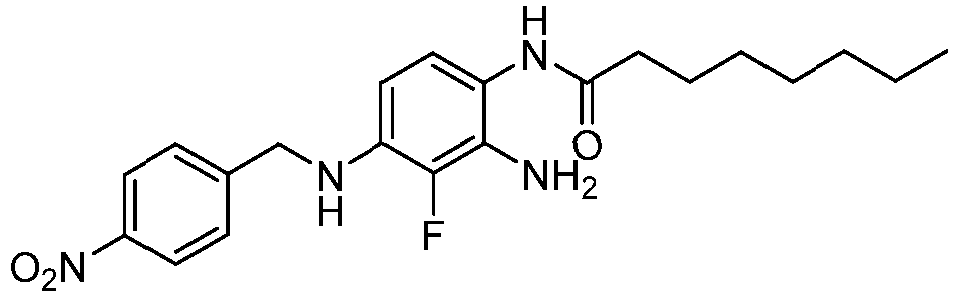
N-(2-amino-3-fluoro-4-((4-nitrobenzyl)amino)phenyl)octan amide 133. 
N-(2-amino-4-((4-aminobenzyl)amino)phenyl)octa namide 134. 
N-(4-((4-aminobenzyl)amino)phenyl)octa namide 135. 
N-(2-amino-3-fluoro-4-((4-aminobenzyl)amino)phenyl)octa namide 136. 
N-(2-amino-4-((4-nitrobenzyl)amino)phenyl)decan amide 137. 
N-(4-((4-nitrobenzyl)amino)phenyl)decan amide 138. 
N-(2-amino-3-fluoro-4-((4-nitrobenzyl)amino)phenyl)decan amide 139. 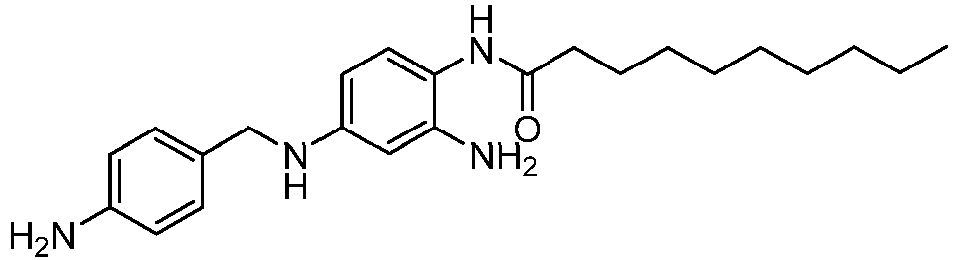
N-(2-amino-4-((4-aminobenzyl)amino)phenyl)deca namide 140. 
N-(4-((4-aminobenzyl)amino)phenyl)deca namide 141. 
N-(2-amino-3-fluoro-4-((4-aminobenzyl)amino)phenyl)deca namide 142. 
N-(2-amino-4-((pyridin-4-ylmethyl)amino)phenyl)heptana mide 143. 
N-(4-((pyridin-4-ylmethyl)amino)phenyl)heptana mide 144. 
N-(2-amino-3-fluoro-4-((pyridin-4-ylmethyl)amino)phenyl)heptana mide 145. 
N-(2-amino-4-((pyridin-4-ylmethyl)amino)phenyl)octanam ide 146. 
N-(4-((pyridin-4-ylmethyl)amino)phenyl)octanam ide 147. 
N-(2-amino-3-fluoro-4-((pyridin-4-ylmethyl)amino)phenyl)octanam ide 148. 
N-(2-amino-4-((pyridin-4-ylmethyl)amino)phenyl)decana mide 149. 
N-(4-((pyridin-4-ylmethyl)amino)phenyl)decana mide 150. 
N-(2-amino-3-fluoro-4-((pyridin-4-ylmethyl)amino)phenyl)decana mide 151. 
N-(4-(((1H-pyrrol-3-yl)methyl)amino)-2-aminophenyl)heptanamide 152. 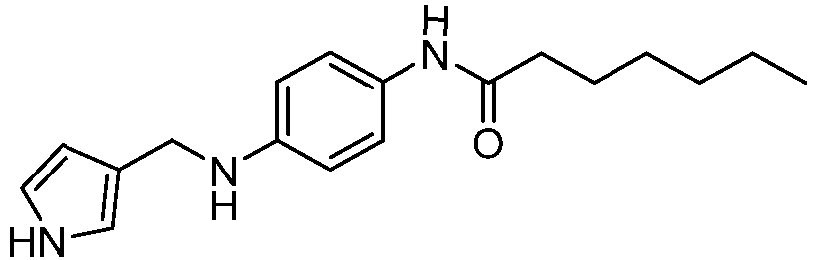
N-(4-(((1H-pyrrol-3-yl)methyl)amino)phenyl)heptana mide 153. 
N-(4-(((1H-pyrrol-3-yl)methyl)amino)-2-amino-3-fluorophenyl)heptanamide 154. 
N-(4-(((1H-pyrrol-3-yl)methyl)amino)-2-aminophenyl)octanamide 155. 
N-(4-(((1H-pyrrol-3-yl)methyl)amino)phenyl)octana mide 156. 
N-(4-(((1H-pyrrol-3-yl)methyl)amino)-2-amino-3-fluorophenyl)octanamide 157. 
N-(4-(((1H-pyrrol-3-yl)methyl)amino)-2-aminophenyl)decanamide 158. 
N-(4-(((1H-pyrrol-3-yl)methyl)amino)phenyl)decana mide 159. 
N-(4-(((1H-pyrrol-3-yl)methyl)amino)-2-amino-3-fluorophenyl)decanamide 160. 
N-(4-((4-acetamidobenzyl)amino)-2-amino-3-fluorophenyl)heptanamide 161. 
N-(4-((4-acetamidobenzyl)amino)-2-aminophenyl)heptanamide 162. 
N-(4-((4-acetamidobenzyl)amino)phenyl) heptanamide 163. 
N-(4-((4-acetamidobenzyl)amino)-2-amino-3-fluorophenyl)octanamide 164. 
N-(4-((4-acetamidobenzyl)amino)-2-aminophenyl)octanamide 165. 
N-(4-((4-acetamidobenzyl)amino)phenyl) octanamide 166. 
N-(4-((4-acetamidobenzyl)amino)-2-amino-3-fluorophenyl)decanamide 167. 
N-(4-((4-acetamidobenzyl)amino)-2-aminophenyl)decanamide 168. 
N-(4-((4-acetamidobenzyl)amino)phenyl) decanamide 169. 
N-(2-amino-3-fluoro-4-((4-(trifluoromethyl)phenethyl)amin o)phenyl)heptanamide 170. 
N-(2-amino-4-((4-(trifluoromethyl)phenethyl)amin o)phenyl)heptanamide 171. 
N-(4-((4-(trifluoromethyl)phenethyl)amin o)phenyl)heptanamide 172. 
N-(2-amino-3-fluoro-4-((4-(trifluoromethyl)phenethyl)amin o)phenyl)octanamide 173. 
N-(2-amino-4-((4-(trifluoromethyl)phenethyl)amin o)pheny)loctanamide 174. 
N-(4-((4-(trifluoromethyl)phenethyl)amin o)phenyl)octanamide 175. 
N-(2-amino-3-fluoro-4-((4-(trifluoromethyl)phenethyl)amin o)phenyl)decanamide 176. 
N-(2-amino-4-((4-(trifluoromethyl)phenethyl)amin o)phenyl)decanamide 177. 
N-(4-((4-(trifluoromethyl)phenethyl)amin o)phenyl)decanamide 178. 
N-(2-amino-3-fluoro-4-((3-(4-(trifluoromethyl)phenyl)propyl)a mino)phenyl)heptanamide 179. 
N-(2-amino-4-((3-(4-(trifluoromethyl)phenyl)propyl)a mino)phenyl)heptanamide 180. 
N-(4-((3-(4-(trifluoromethyl)phenyl)propyl)a mino)phenyl)heptanamide 181. 
N-(2-amino-3-fluoro-4-((3-(4-(trifluoromethyl)phenyl)propyl)a mino)phenyl)octanamide 182. 
N-(2-amino-4-((3-(4-(trifluoromethyl)phenyl)propyl)a mino)phenyl)octanamide 183. 
N-(4-((3-(4-(trifluoromethyl)phenyl)propyl)a mino)phenyl)octanamide 184. 
N-(2-amino-3-fluoro-4-((3-(4-(trifluoromethyl)phenyl)propyl)a mino)phenyl)decanamide 185. 
N-(2-amino-4-((3-(4-(trifluoromethyl)phenyl)propyl)a mino)phenyl)decanamide 186. 
N-(4-((3-(4-(trifluoromethyl)phenyl)propyl)a mino)phenyl)decanamide 187. 
4-cyclohexyl-N-(4-((4-(trifluoromethoxy)benzyl)amino )phenyl)butanamide 188. 
N-(2-amino-3-fluoro-4-((4-(trifluoromethoxy)benzyl)amino )phenyl)-4-cyclohexylbutanamide 189. 
N-(2-amino-4-((4-(trifluoromethoxy)benzyl)amino )phenyl)-4-cyclohexylbutanamide 190. 
4-cyclohexyl-N-(4-((4-(trifluoromethyl)benzyl)amino)p henyl)butanamide 191. 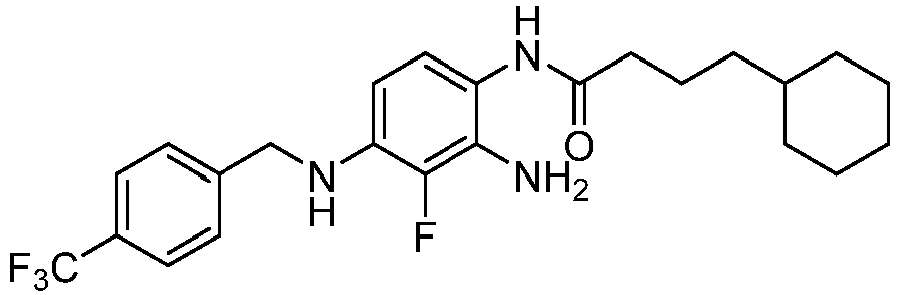
N-(2-amino-3-fluoro-4-((4-(trifluoromethyl)benzyl)amino)p henyl)-4-cyclohexylbutanamide 192. 
N-(2-amino-4-((4-(trifluoromethyl)benzyl)amino)p henyl)-4-cyclohexylbutanamide 193. 
7-phenyl-N-(4-((4-(trifluoromethyl)benzyl)amino)p henyl)heptanamide 194. 
N-(2-amino-4-((4-(trifluoromethyl)benzyl)amino)p henyl)-7-phenylheptanamide 195. 
N-(2-amino-3-fluoro-4-((4-(trifluoromethyl)benzyl)amino)p henyl)-7-phenylheptanamide 196. 
N-(2-amino-3-fluoro-4-((4-(trifluoromethyl)benzyl)amino)p henyl)-7-(4-fluorophenyl)heptanamide 197. 
N-(2-amino-4-((4-(trifluoromethyl)benzyl)amino)p henyl)-7-(4-fluorophenyl)heptanamide 198. 
7-(4-fluorophenyl)-N-(4-((4-(trifluoromethyl)benzyl)amino)p henyl)heptanamide 199. 
7-amino-N-(2-amino-3-fluoro-4-((4-(trifluoromethyl)benzyl)amino)p henyl)heptanamide 200. 
7-amino-N-(2-amino-4-((4-(trifluoromethyl)benzyl)amino)p henyl)heptanamide 201. 
7-amino-N-(4-((4-(trifluoromethyl)benzyl)amino)p henyl)heptanamide 202. 
8-amino-N-(2-amino-3-fluoro-4-((4-(trifluoromethyl)benzyl)amino)p henyl)octanamide 203. 
8-amino-N-(2-amino-4-((4-(trifluoromethyl)benzyl)amino)p henyl)octanamide 204. 
8-amino-N-(4-((4-(trifluoromethyl)benzyl)amino)p henyl)octanamide 205. 
10-amino-N-(2-amino-3-fluoro-4-((4-(trifluoromethyl)benzyl)amino)p henyl)decanamide 206. 
10-amino-N-(2-amino-4-((4-(trifluoromethyl)benzyl)amino)p henyl)decanamide 207. 
10-amino-N-(4-((4-(trifluoromethyl)benzyl)amino)p henyl)decanamide 208. 
N-(2-amino-3-fluoro-4-((4-(trifluoromethyl)benzyl)amino)p henyl)-7-(4-aminophenyl)heptanamide 209. 
N-(2-amino-4-((4-(trifluoromethyl)benzyl)amino)p henyl)-7-(4-aminophenyl)heptanamide 210. 
7-(4-aminophenyl)-N-(4-((4-(trifluoromethyl)benzyl)amino)p henyl)heptanamide 211. 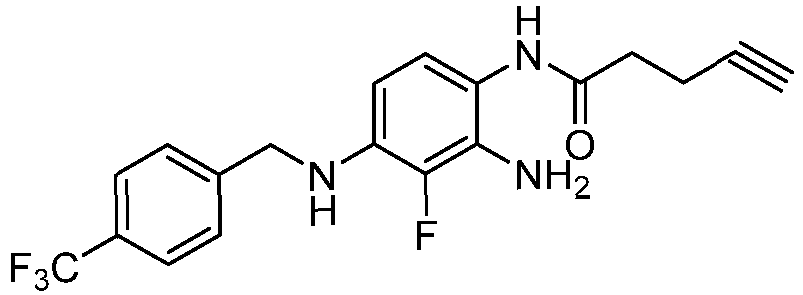
N-(2-amino-3-fluoro-4-((4-(trifluoromethyl)benzyl)amino)p henyl)pent-4-ynamide 212. 
N-(2-amino-4-((4-(trifluoromethyl)benzyl)amino)p henyl)pent-4-ynamide 213. 
N-(4-((4-(trifluoromethyl)benzyl)amino)p henyl)pent-4-ynamide 214. 
N-(2-amino-3-fluoro-4-((4-(trifluoromethoxy)benzyl)amino )phenyl)pent-4-ynamide 215. 
N-(2-amino-4-((4-(trifluoromethoxy)benzyl)amino )phenyl)pent-4-ynamide 216. 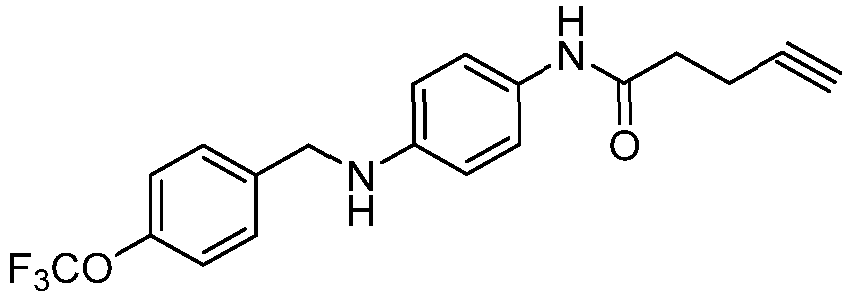
N-(4-((4-(trifluoromethoxy)benzyl)amino )phenyl)pent-4-ynamide 217. 
N-(2-amino-3-fluoro-4-((4-hydroxybenzyl)amino)phenyl)pe nt-4-ynamide 218. 
N-(2-amino-4-((4-hydroxybenzyl)amino)phenyl)pe nt-4-ynamide 219. 
N-(4-((4-hydroxybenzyl)amino)phenyl)pe nt-4-ynamide 220. 
N-(2-amino-3-fluoro-4-((4-(trifluoromethyl)benzyl)amino)p henyl)-4-cyclopropylbut-3-ynamide 221. 
N-(2-amino-4-((4-(trifluoromethyl)benzyl)amino)p henyl)-4-cyclopropylbut-3-ynamide 222. 
4-cyclopropyl-N-(4-((4-(trifluoromethyl)benzyl)amino)p henyl)but-3-ynamide 223. 
(E)-N-(2-amino-3-fluoro-4-((4-(trifluoromethyl)benzyl)amino)p henyl)dec-5-enamide 224. 
(E)-N-(2-amino-4-((4-(trifluoromethyl)benzyl)amino)p henyl)dec-5-enamide 225. 
(E)-N-(4-((4-(trifluoromethyl)benzyl)amino)p henyl)dec-5-enamide 226. 
(Z)-N-(2-amino-3-fluoro-4-((4-(trifluoromethyl)benzyl)amino)p henyl)dec-5-enamide 227. 
(Z)-N-(2-amino-4-((4-(trifluoromethyl)benzyl)amino)p henyl)dec-5-enamide 228. 
(Z)-N-(4-((4-(trifluoromethyl)benzyl)amino)p henyl)dec-5-enamide 229. 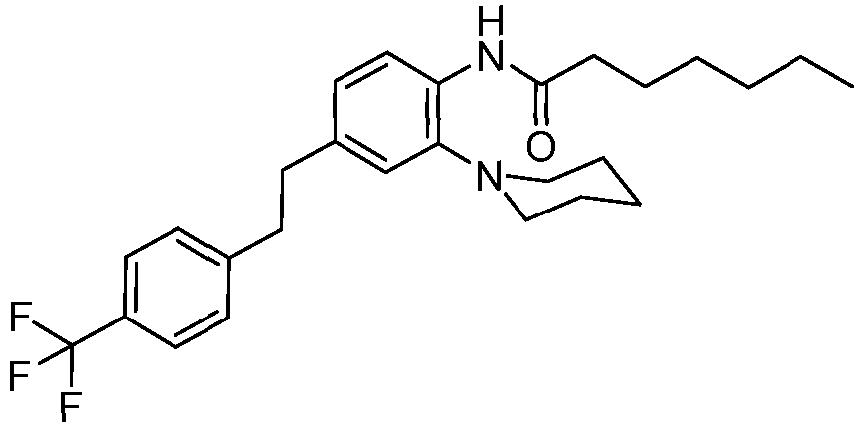
N-(2-(piperidin-1-yl)-4-(4-(trifluoromethyl)phenethyl)phen yl)heptanamide 230. 
2,3-difluoro-N-(2-(piperidin-1-yl)-4-(4-(trifluoromethyl)phenethyl)phen yl)heptanamide (2R,3 S)-2,3-difluoro-N-(2-(piperidin-1-yl)-4-(4-(trifluoromethyl)phenethyl)phen yl)heptanamide (2S,3R)-2,3-difluoro-N-(2-(piperidin-1-yl)-4-(4-(trifluoromethyl)phenethyl)phen yl)heptanamide (2R,3R)-2,3-difluoro-N-(2-(piperidin-1-yl)-4-(4-(trifluoromethyl)phenethyl)phen yl)heptanamide (2S,3 S)-2,3-difluoro-N-(2-(piperidin-1-yl)-4-(4-(trifluoromethyl)phenethyl)phen yl)heptanamide 231. 
6,7-difluoro-N-(2-(piperidin-1-yl)-4-(4-(trifluoromethyl)phenethyl)phen yl)heptanamide (6R)-6,7-difluoro-N-(2-(piperidin-1-yl)-4-(4-(trifluoromethyl)phenethyl)phen yl)heptanamide (6S)-6,7-difluoro-N-(2-(piperidin-1-yl)-4-(4-(trifluoromethyl)phenethyl)phen yl)heptanamide 232. 
N-(2-(piperidin-1-yl)-4-(4-(trifluoromethyl)phenethyl)phen yl)octanamide 233. 
2,3-difluoro-N-(2-(piperidin-1-yl)-4-(4-(trifluoromethyl)phenethyl)phen yl)octanamide (2R,3 S)-2,3-difluoro-N-(2-(piperidin-1-yl)-4-(4-(trifluoromethyl)phenethyl)phen yl)octanamide (2S,3R)-2,3-difluoro-N-(2-(piperidin-1-yl)-4-(4-(trifluoromethyl)phenethyl)phen yl)octanamide (2R,3R)-2,3-difluoro-N-(2-(piperidin-1-yl)-4-(4-(trifluoromethyl)phenethyl)phen yl)octanamide (2S,3 S)-2,3-difluoro-N-(2-(piperidin-1-yl)-4-(4-(trifluoromethyl)phenethyl)phen yl)octanamide 234. 
7,8-difluoro-N-(2-(piperidin-1-yl)-4-(4-(trifluoromethyl)phenethyl)phen yl)octanamide (7R)-7,8-difluoro-N-(2-(piperidin-1-yl)-4-(4-(trifluoromethyl)phenethyl)phen yl)octanamide (7S)-7,8-difluoro-N-(2-(piperidin-1-yl)-4-(4-(trifluoromethyl)phenethyl)phen yl)octanamide 235. 
3-cyclohexyl-N-(2-cyclohexyl-4-(4-(trifluoromethyl)phenethyl)phen yl)propanamide 236. 
N-(2-cyclohexyl-4-(4-(trifluoromethyl)phenethyl)phen yl)-3,3-dimethylbutanamide 237. 
N-(2-cyclohexyl-4-((4-(trifluoromethyl)benzyl)amino)p henyl)-3,3-dimethylbutanamide 238. 
3-cyclohexyl-N-(2-cyclohexyl-4-((4-(trifluoromethyl)benzyl)amino)p henyl)propanamide 239. 
N-(2-cyclohexyl-4-(4-(trifluoromethyl)phenethyl)phen yl)-2,3-difluoroheptanamide (2R,3 S)-N-(2-cyclohexyl-4-(4-(trifluoromethyl)phenethyl)phen yl)-2,3-difluoroheptanamide (2S,3R)-N-(2-cyclohexyl-4-(4-(trifluoromethyl)phenethyl)phen yl)-2,3-difluoroheptanamide (2R,3R)-N-(2-cyclohexyl-4-(4-(trifluoromethyl)phenethyl)phen yl)-2,3-difluoroheptanamide (2S,3 S)-N-(2-cyclohexyl-4-(4-(trifluoromethyl)phenethyl)phen yl)-2,3-difluoroheptanamide 240. 
N-(2-cyclohexyl-4-(4-(trifluoromethyl)phenethyl)phen yl)heptanamide 241. 
N-(2-cyclohexyl-4-(4-(trifluoromethyl)phenethyl)phen yl)-7,8-difluorooctanamide (7R)-N-(2-cyclohexyl-4-(4-(trifluoromethyl)phenethyl)phen yl)-7,8-difluorooctanamide (7S)-N-(2-cyclohexyl-4-(4-(trifluoromethyl)phenethyl)phen yl)-7,8-difluorooctanamide 242. 
N-(2-cyclohexyl-4-(4-(trifluoromethyl)phenethyl)phen yl)octanamide 243. 
N-(2-cyclohexyl-4-((4-(trifluoromethyl)benzyl)amino)p henyl)heptanamide 244. 
N-(2-cyclohexyl-4-((4-(trifluoromethyl)benzyl)amino)p henyl)-2,3-difluoroheptanamide (2R,3S)-N-(2-cyclohexyl-4-((4-(trifluoromethyl)benzyl)amino)p henyl)-2,3-difluoroheptanamide (2S,3R)-N-(2-cyclohexyl-4-((4-(trifluoromethyl)benzyl)amino)p henyl)-2,3-difluoroheptanamide
(2R,3R)-N-(2-cyclohexyl-4-((4-(trifluoromethyl)benzyl)amino)p henyl)-2,3-difluoroheptanamide
(2S,3 S)-N-(2-cyclohexyl-4-((4-(trifluoromethyl)benzyl)amino)p henyl)-2,3-difluoroheptanamide245. 
N-(2-cyclohexyl-4-((4-(trifluoromethyl)benzyl)amino)p henyl)-7,8-difluorooctanamide (7R)-N-(2-cyclohexyl-4-((4-(trifluoromethyl)benzyl)amino)p henyl)-7,8-difluorooctanamide (7S)- N-(2-cyclohexyl-4-((4-(trifluoromethyl)benzyl)amino)p henyl)-7,8-difluorooctanamide 246. 
N-(2-cyclohexyl-4-((4-(trifluoromethyl)benzyl)amino)p henyl)octanamide 247. 
N-(3-fluoro-4-((4-fluorobenzyl)amino)phenyl)cycl ohexanesulfonamide 248. 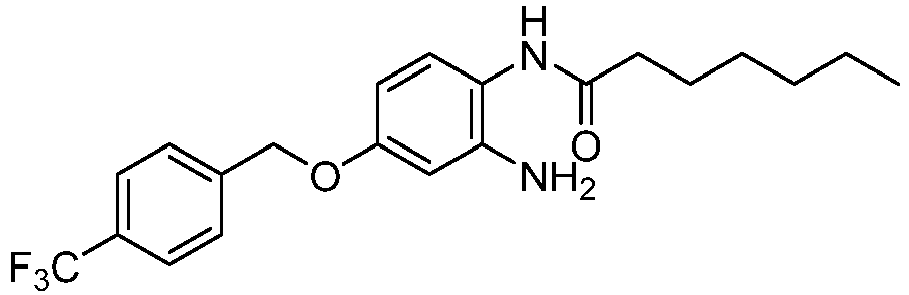
N-(2-amino-4-((4-(trifluoromethyl)benzyl)oxy)phe nyl)heptanamide 249. 
N-(2-amino-4-((4-(trifluoromethyl)benzyl)oxy)phe nyl)cyclohexanesulfonamide 250. 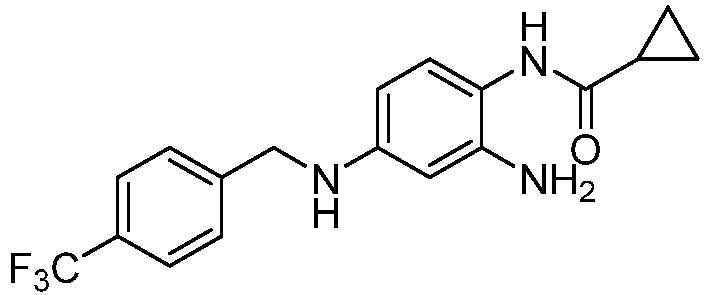
N-(2-amino-4-((4-(trifluoromethyl)benzyl)amino)p henyl)cyclopropanecarboxamide 251. 
N-(2-amino-4-((4-(trifluoromethyl)benzyl)amino)p henyl)-3-cyclohexylpropanamide 252. 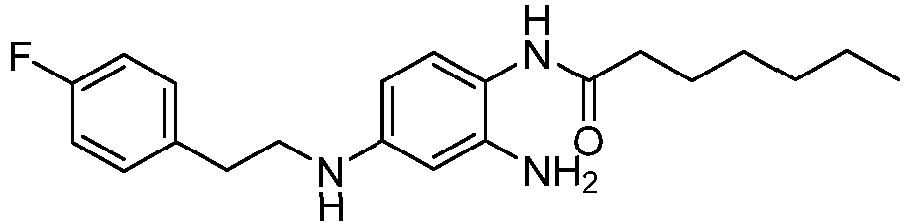
N-(2-amino-4-((4-fluorophenethyl)amino)phenyl)h eptanamide 253. 
N-(2-amino-4-((pyridin-2-ylmethyl)amino)phenyl)heptana mide 254. 
N-(2-amino-4-((2-fluorobenzyl)amino)phenyl)hept anamide 255. 
N-(2-amino-4-((4-(trifluoromethyl)benzyl)amino)p henyl)-2-(2-methoxyethoxy)acetamide 256. 
N-(2-amino-4-(benzylamino)phenyl)heptanami de 257. 
N-(2,6-difluoro-4-((4-(trifluoromethyl)benzyl)amino)p henyl)heptanamide 258. 
N-(2-amino-4-(methyl(4-(trifluoromethyl)benzyl)amino)p henyl)heptanamide 259. 
N-(2-amino-3-fluoro-4-((4-(trifluoromethyl)benzyl)amino)p henyl)isobutyramide 260. 
N-(2-amino-3-fluoro-4-((4-(trifluoromethyl)benzyl)amino)p henyl)-3-methylbutanamide 261. 
N-(2-amino-3-fluoro-4-((4-(trifluoromethyl)benzyl)amino)p henyl)-3-cyclohexylpropanamide 262. 
N-(2,6-difluoro-4-((4-(trifluoromethyl)benzyl)amino)p henyl)-3,3-dimethylbutanamide 263. 
N-(2-amino-4-(propyl(4-(trifluoromethyl)benzyl)amino)p henyl)heptanamide 264. 
N-(2-amino-4-(methyl(4-(trifluoromethyl)benzyl)amino)p henyl)-3,3-dimethylbutanamide 265. 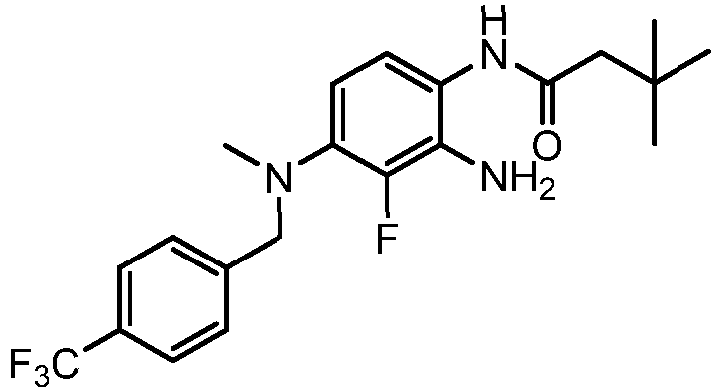
N-(2-amino-3-fluoro-4-(methyl(4-(trifluoromethyl)benzyl)amino)p henyl)-3,3-dimethylbutanamide 266. 
N-(2-amino-4-((4-(trifluoromethyl)benzyl)amino)p henyl)cyclohexanesulfonamide 267. 
N-(4-((4-methoxybenzyl)amino)phenyl) cyclohexanesulfonamide 268. 
N-(4-((4-methoxybenzyl)(methyl)amino)p henyl) cyclohexanesulfonamide 269. 
(R)-N-(4-((1-(4-methoxyphenyl)ethyl)amino)phe nyl) cyclohexanesulfonamide 270. 
(S)-N-(4-((1-(4-methoxyphenyl)ethyl)amino)phe nyl) cyclohexanesulfonamide 271. 
3-ethyl-N-(4-((4-methoxybenzyl)amino)phenyl)b enzenesulfonamide - In a preferred embodiment, the compound or tautomer, salt, solvate, stereoisomer or isotope thereof as defined above is a voltage-gated potassium channel modulator.
- Preferably the compound or tautomer, salt, solvate, stereoisomer or isotope thereof as defined above is a Kv7.1, Kv7.2, Kv7.3, Kv7.4 and/or Kv7.5 modulator.
- Still more preferably, the compound or tautomer, salt, solvate, stereoisomer or isotope thereof as defined above is a Kv7.2 and Kv7.3 modulator.
- In another preferred embodiment, the compound or tautomer, salt, solvate, stereoisomer or isotope thereof as defined above is for use as a medicament.
- Preferably, the compound or tautomer, salt, solvate, stereoisomer or isotope thereof as defined above is for use in the treatment and/or prevention of a condition characterised by a defect in the structure and/or function of at least one voltage-gated potassium channel. Preferably, Kv7.1, Kv7.2, Kv7.3, Kv7.4 and/or Kv7.5, more preferably of both Kv7.2 and Kv7.3.
- In another preferred embodiment, the compound or tautomer, salt, solvate, stereoisomer or isotope thereof as defined above is for use as an anticonvulsant, analgesic, anti-ischemic, anti-arrhythmic, neuroprotective, anti-tinnitus, antiasthmatic, gastrointestinal motility modulator, antihypertensive, antimyotonic and/or anti-skeletal muscle dystrophia medicament.
- It is another object of the present invention a pharmaceutical composition comprising the compound or tautomer, salt, solvate, stereoisomer or isotope thereof as defined above and a pharmaceutically acceptable carrier.
- Preferably, said pharmaceutical composition comprises a further therapeutic agent selected from: an anticonvulsivant, an analgesic and a nonsteroidal anti-inflammatory drug (NSAID).
- Preferably, said anticonvulsant is selected from the group consisting of: Acetazolamide, Brivaracetam, Carbamazepine, Clobazam, Clonazepam, Diazepam, Eslicarbazepine, Ethosuximide, Fosphenytoin, Gabapentin, Lacosamide, Lamotrigine, Levetiracetam, Lorazepam, Methosuximide, Nitrazepam, Oxcarbazepine, Perampanel, Phenobarbital, Phenytoin, Pregabalin, Primidone, Rufinamide, Stiripentol, Topiramate, Valproic Acid, Vigabatrin, Felbamate, Tiagabine and Zonisamide.
- Preferably, said analgesic is acetaminophen or an opioid.
- Preferably, said nonsteroidal anti-inflammatory drug (NSAID) is selected from the group consisting of: aspirin, diclofenac, diflusinal, etodolac, fenbufen, fenoprofen, flufenisal, flurbiprofen, ibuprofen, indomethacin, ketoprofen, ketorolac, meclofenamic acid, mefenamic acid, meloxicam, nabumetone, naproxen, nimesulide, nitroflurbiprofen, olsalazine, oxaprozin, phenylbutazone, piroxicam, sulfasalazine, sulindac, tolmetin and zomepirac. Preferably, said opioid is morphine.
- In a preferred embodiment, the pharmaceutical composition as defined above is for use in the treatment and/or prevention of a condition characterised by a defect in the structure and/or function of at least one voltage-gated potassium channel. Preferably, at least one of Kv7.1, Kv7.2, Kv7.3, Kv7.4 and/or Kv7.5, more preferably of both Kv7.2 and Kv7.3.
- In another preferred embodiment, the pharmaceutical composition as defined above is for use as an anticonvulsant, analgesic, anti-ischemic, anti-arrhythmic, neuroprotective, anti-tinnitus, antiasthmatic, gastrointestinal motility modulator, antihypertensive, antimyotonic and/or anti-skeletal muscle dystrophia medicament.
- Preferably, said condition characterised by a defect in the structure and/or function of at least one voltage-gated potassium channel is selected from the group consisting of: a central nervous system disease, a peripheral nervous system disease, a sensory system disease, a respiratory system disease, a genitourinary system disease, a gastrointestinal system disease, a cardiovascular disease, a skeletal muscle disease and a channelopathy.
- Also preferably, said condition characterised by a defect in the structure and/or function of at least one voltage-gated potassium channel is selected from the group consisting of: epilepsy, a convulsive disorder, a seizure, a seizure disorder, a disorder characterised by hyperexcitability of the nervous system, a neonatal epilepsy, spontaneous contractions, an early-onset epileptic disorder, Ohtahara syndrome, early infantile epileptic encelopathy with suppression-burst, benign familiar neonatal seizures, epileptic encelopathy, severe sporadic neonatal epileptic encelopathy, an intellectual disability, a psychiatric or cognitive comorbidity, a cognitive defect, anxiety, depression, schizophrenia, sudden death in epilepsy, drug-resistant epilepsy, neuropathic pain, an ischemic stroke, angina, migraine, a neurodegenerative disorder, a neurologic disorder, amyotrophic lateral sclerosis, Alzheimer's disease, Parkinson's disease, tremors, paroxysmal choreoathetosis, tinnitus, pain, asthma, bladder hyper-reactivity, urinary incontinence, constipation, irritable bowel syndrome, diarrhea, Krohn's disease, hypertension, vascular hypertension, muscular dystrophy, a skeletal muscle hyperexcitability disease, myokymia, myotonia, a genetic channelopathy, a transcriptional channelopathy, a Kv7.2- and/or Kv7.3-related disorder, a Kv 7.2 encelopathy, autosomal dominant type 2 deafness (DFNA2), ataxia, episodic ataxia type 1, episodic ataxia with myokymia syndrome, neuromyotonia, hypokalaemic periodic paralysis, an arrhythmia, a congenital arrhythmia, a long QT syndrome, Romano-Ward syndrome, Jervell and Lange-Nielsen syndrome, Bartter syndrome, hyperinsulinemic hypoglycaemia of infancy (HHI), attenuate vasoconstrictor response, type 2 diabetes and multiple sclerosis.
- In yet another preferred embodiment, the compound for use as defined above or the pharmaceutical composition for use as defined above is administered to an animal. Preferably, said animal is a companion animal or livestock.
- The present invention also provides the compound or tautomer, salt, solvate, stereoisomer or isotope thereof as defined above for use in a method of modulating a voltage-gated potassium channel. Preferably, at least one of Kv7.1, Kv7.2, Kv7.3, Kv7.4 and/or Kv7.5. More preferably, the compound or tautomer, salt, solvate, stereoisomer or isotope thereof as defined above is for use in a method of modulating Kv7.2 and Kv7.3.
- It is also an object of the present invention an in-vitro method of modulating a voltage-gated potassium channel by using the compound or tautomer, salt, solvate, stereoisomer or isotope thereof as defined above. Preferably, Kv7.1, Kv7.2, Kv7.3, Kv7.4 and/or Kv7.5 More preferably, said in-vitro method is an in-vitro method of modulating Kv7.2 and Kv7.3 by using the compound or tautomer, salt, solvate, stereoisomer or isotope thereof as defined above.
- As used herein, the term "alkylcarbonyl" preferably refers to groups such as CH3(CH2)nCO where n is a number comprised between 0 and 10 and to branched isomers thereof. Examples of "alkylcarbonyl" include acetamide, CH3(CH2)6CO, (CH3)3CCH2CO, CH3(CH2)2CH(CH3)CO, (CH3)3C(CH2)6CO, CH3(CH2)5C(CH3)3CO, CH3(CH2)4C(CH3)3CH2CO.
- As used herein, the term "alkoxycarbonyl" preferably refers to groups such as CH3(CH2)nOCO where n is a number comprised between 0 and 10 and to branched isomers thereof. Examples of "alkoxycarbonyl" include CH3(CH2)6OCO, (CH3)3CCH2OCO, CH3(CH2)2CH(CH3)OCO, (CH3)3C(CH2)6OCO, CH3(CH2)5C(CH3)3OCO, CH3(CH2)4C(CH3)3CH2OCO.
- As used herein, the term "alkylamino", preferably refers to linear or branched alkyl groups bearing a NH or NH2 substitutent, preferably a terminal NH or NH2 substitutent. Preferred alkylamino groups include groups such as CH3(CH2)nNH where n is a number comprised between 0 and 10 and their branched isomers, as well as groups such as NH2(CH2)nCH2 where n is a number comprised between 0 and 10 and their branched isomers. "Alkylamino" as used herein also preferably refers to C1-C10 linear or branched alkyl chains bearing a primary, secondary or tertiary amine as side chain. Examples of "alkylamino" include NHMe, NHEt, NHiPr, N(Me)2, N(Et)2, N(iPr)2, CH3(CH2)6NH, (CH3)3CCH2NH, CH3(CH2)2CH(CH3)NH, (CH3)3C(CH2)6NH, CH3(CH2)5C(CH3)3NH, CH3(CH2)4C(CH3)3CH2NH, NH2CH2(CH2)5CH2, [NH2(CH3)2]CCH2NH, NH2CH2(CH2)2CH(CH3), NH2(CH3)2C(CH2)6, NH2CH2(CH2)5C(CH3)2, NH2CH2(CH2)4C(CH3)3CH2, CH3CHNH2(CH2)5, CH3(CH2)2CNH2(CH2)2, CH3(CH2)2CH2[N(CH3)2], CH3(CH2)2C[N(CH3)2](CH2)2, CH3(CH2)2C[NH(CH3)](CH2)2.
- The term "alkenylamino" as used herein refers to a linear or branched alkylamino group as defined above comprising at least one carbon-carbon double bond.
- The term "alkynylamino" as used herein refers to a linear or branched alkylamino group as defined above comprising at least one carbon-carbon triple bond.
- As used herein, the term "alkylaminocarbonyl" preferably refers to groups such as NH2(CH2)nCH2CO where n is a number comprised between 0 and 10 and to branched isomers thereof. "Alkylaminocarbonyl" as used herein also preferably refers to C3-C10 linear or branched CH3X(CH2)nCO or CH3(CH2)nX(CH2)nCO where X is a primary, secondary or tertiary amine and n is comprised between 1 and 10. Examples of "alkylaminocarbonyl" include NH2CH2(CH2)5CH2CO, NH2C(CH3)2CH2CO, NH2CH2(CH2)2CH(CH3)CO, NH2(CH3)2C(CH2)6CO, NH2CH2(CH2)5C(CH3)3CO, NH2CH2(CH2)4C(CH3)3CH2CO, CH3CH(NH2)(CH2)5CO, CH3(CH2)2C(NH2)(CH2)2CO, CH3(CH2)2CH2[N(CH3)2]CO, CH3(CH2)2C[N(CH3)2](CH2)2CO, CH3(CH2)2CH[NH(CH3)](CH2)2CO.
- As used herein, the term "alkyloxy" or "alkoxy" refers to groups bearing at least one oxygen atom linked to an alkyl chain. Preferred alkyloxy groups include groups such as: CH3(CH2)nO where n is a number comprised between 0 and 10 and their branched isomers, HO(CH2)nCH2 where n is a number comprised between 0 and 10 and their branched isomers, as well as groups such as CH3X(CH2)nCH2, CH3(CH2)nXCH2 and CH3(CH2)nX(CH2)n where X is an oxygen atom and n is comprised between 1 and 10. Examples of "alkyloxy" or "alkoxy" include methoxy, ethoxy, HOCH2(CH2)5CH2, HO(CH3)2CCH2, HOCH2(CH2)2CH(CH3), HO(CH3)2C(CH2)6, HOCH2(CH2)5C(CH3)3, HOCH2(CH2)4C(CH3)3CH2, HOCH2CH2O(CH2)5, CH3(CH2)2C(OH)(CH2)2, CH3(CH2)2CH2OCH3, CH3(CH2)2C(OCH3)(CH2)2, CH3(CH2)2C(OCH3)(CH2)2, CH3(CH2)6O, (CH3)3CCH2O, CH3(CH2)2CH(CH3)O, (CH3)3C(CH2)6O, CH3(CH2)5C(CH3)3O, CH3(CH2)4C(CH3)3CH2O, CH3CH2OCH2CH2OH, CH3CH2OCH2CH2O, CH2CH2OCH2CH2O.
- As used herein, the term "alkylthio" refers to groups bearing at least one sulfur atom linked to an alkyl chain. Preferred alkylthio groups include groups such as: SMe, SEt, CH3(CH2)nS where n is a number comprised between 0 and 10 and their branched isomers, HS(CH2)nCH2 where n is a number comprised between 0 and 10 and their branched isomers, as well as groups such as CH3X(CH2)nCH2, CH3(CH2)nXCH2 or CH3(CH2)nX(CH2)n where X is a sulfur atom and n is comprised between 1 and 10. Examples of "alkylthio" include HSCH2(CH2)5CH2, HS(CH3)2CCH2CO, HSCH2(CH2)2CH(CH3), HS(CH3)2C(CH2)6, HSCH2(CH2)5C(CH3)3, HSCH2(CH2)4C(CH3)3CH2, HSCH2CH2S(CH2)5, CH3(CH2)2CSH(CH2)2, CH3(CH2)2CH2SCH2, CH3(CH2)2C(SCH3)(CH2)2, CH3(CH2)2C(SCH3)(CH2)2, CH3(CH2)6S, (CH3)3CCH2S, CH3(CH2)2CH(CH3)S, (CH3)3C(CH2)6S, CH3(CH2)5C(CH3)3S, CH3(CH2)4C(CH3)3CH2S, CH3CH2S(CH2)5, CH3CH2SCH2CH2SH, CH3CH2SCH2CH2SCH2CH2SCH2CH2S.
- As used herein, the term "carbonyl" preferably refers to C1-C10 aliphatic aldheydhes or ketones. Examples of "carbonyl" include HOCCH2(CH2)5CH2, HOC(CH3)2CCH2CO, HOCCH2(CH2)2CH(CH3), HOC(CH3)2C(CH2)6, HOCCH2(CH2)4C(CH3)3, HOCCH2(CH2)3C(CH3)3CH2, HOCCH2CH2O(CH2)5, and CH3(CH2)nCO(CH2)m groups where n is a number comprised between 0 and 10 and m is a number comprised between 1 and 10 and branched isomers thereof.
- As used herein, the term "amide" preferably refers to groups such as CH3CONH, CH3(CH2)nCONH, H2NCO(CH2)n where n is a number comprised between 0 and 10 and to branched isomers thereof. In the present invention, amide functionalities are preferably substituted at the nitrogen position.
- As used herein, the term "carboxyl", preferably refers to groups such as XOOC(CH2)n where n is a number comprised between 0 and 10, X is selected between H and alkyl chain and to branched isomers thereof. "Carboxyl" also preferably refers to groups such as CH3(CH2)nCH2(COOX) where X is selected between H and alkyl chain, and to branched isomers.
- As used herein, the term "amine" preferably refers to groups such as NH2, NHX, NX1X2 where X1 and X2 represents any of the groups described above, in particular linear or branched alkyl chains. As used herein, the terms "aryl" or "aromatic ring" are used interchangeably and refer to a monocyclic, bicyclic or polycyclic aromatic ring system comprising carbon atoms and hydrogen atoms, preferably comprising from 5 to 10 carbon atoms. In the present invention, aromatic rings optionally comprise as members of the ring one or more heteroatoms, preferably 1 to 3 heteroatoms, preferably selected from N, O and S, in which case they are also referred to as "heteroaryl" or "heteroaromatic rings". Aryl groups of the present invention only need to have some degree of aromatic character. Preferred aryl groups are formed by a phenyl ring and/or phenyl rings optionally substituted in one position or in more than one position, or in any possible position by any kind of possible substituents. Examples of "aryl" include benzene, naphthalene, anthracene, pyridine, quinoline, isoquinoline, pyrazine, quinoxaline, acridine, pyrimidine, quinazoline, pyridazine, cinnoline, phthalazine, 1,2,3-triazine, 1,2,4-triazine, 1,3,5 triazine, furan, benzofuran, isobenzofuran, pyrrole, indole, isoindole, thiophene, benzothiophene, benzo[c]thiophene, imidazole, benzoimidazole, purine, pyrazole, indazole, oxazole, benzoxazole, isoxazole, benzoisoxazole, thiazole, benzothiazole. Preferably, aromatic rings are phenyl, pyridine and pyrrole. or Such aryls may optionally be substituted with one or more substituents, preferably selected from alkyloxy, nitrile, amino, hydroxyl, halogen, trifluoroalkyl, trichloroalkyl, difluoroalkyl, dichloroalkyl, alkylcarbonyl, trifluoromethoxy, alkyl alkoxycarbonyl, alkylamino, alkylaminocarbonyl, alkylthio, carbonyl, amide and/or carboxyl.
- As used herein, the term "cycloalkyl" refers to a saturated hydrocarbon ring, preferably bearing from 3 to 8 cabon atoms, more preferably bearing from 3 to 6 carbon atoms, that can be unsubstituted or substituted in one, more than one or any of the possible position by any kind of possible substituents. Examples of cycloalkyl include cyclopropyl, cyclobutyl, cyclopentyl, cyclohexyl, cyclohexyl, cycloheptyl, cyclooctyl, norbornane, optionally substituted with one or more substituents, preferably selected from: alkyloxy, nitrile, amino, hydroxyl, halogen, trifluoroalkyl, trichloroalkyl, difluoroalkyl, dichloroalkyl, alkylcarbonyl, trifluoromethoxy, alkyl, alkoxycarbonyl, alkylamino, alkylaminocarbonyl, alkylthio, carbonyl, amide and carboxyl.
- As used herein, the term "heterocycle", refers to a saturated or partially saturated aliphatic ring, preferably bearing from 3 to 7 carbon atoms and comprising as ring members one or more than one heteroatoms, preferably selected from N, O and S. Heterocycles can be unsubstituted or substituted in one, more than one or any of the postion possible position by any kind of possible substituents. Examples of "heterocycle" comprise piperidine, quinoline, decahydroquinoline decahydroisoquinoline, pyperazine, decahydroquinoxaline, tetradecahydroacridine, hexahydropyrimidine, decahydroquinazoline, hexahydropyridazine, decahydrocinnoline, decahydrophthalazine, tetrahydrofuran, octahydrobenzofuran, octahydroisobenzofuran, pyrrolidine, octahydro-1H-indole, octahydro-1H-isoindole, tetrahydrothiophene, octahydrobenzothiophene, octahydrobenzo[c]thiophene, imidazoline, inidazolidine, octahydrobenzoimidazole, octahydro-1H-purine, octahydro-1H-indazole, oxazolidine, octahydrobenzoxazole, isoxazolidine, octahydrobenzoisoxazole, thiazolidine, octahydrobenzothiazole optionally substituted with one or more substituents, preferably selected from: alkyloxy, nitrile, amino, hydroxyl, halogen, trifluoroalkyl, trichloroalkyl, difluoroalkyl, dichloroalkyl, alkylcarbonyl, trifluoromethoxy, alkyl, alkoxycarbonyl, alkylamino, alkylaminocarbonyl, alkylthio, carbonyl, amide and carboxyl.
- As used herein, the term "alkyl" refers to a linear or branched hydrocarbon chain. Suitable examples of said alkyl include but are not limited to methyl, ethyl, n-propyl, isopropyl, butyl, sec-butyl, tert-butyl, pentyl, isopentyl, tert-pentyl, hexyl, heptyl, octyl, nonyl, decanyl, hexadecanyl, eicosanyl, CH2C(CH3)3, CH2CH(CH3)2 etc. Long alkyl chains, e.g. C5-30 alkyl, preferably C6-C30 alkyl, more preferably C7-C30 alkyl, still preferably C10-C30 alkyl, are particularly preferred in some embodiments of the invention.
- As used herein, the term "alkenyl" refers to a linear or branched alkyl chain as defined above comprising at least one carbon-carbon double bond. Long alkenyl chains, e.g. C5-30 alkenyl, preferably C6-C30 alkenyl, more preferably C7-C30 alkenyl, still preferably C10-C30 alkenyl, are particularly preferred in some embodiments of the invention.
- The term "alkynyl" as used herein refers to a linear or branched alkyl group as defined above comprising at least one carbon-carbon triple bond. Long alkynyl chains, e.g. C5-30 alkynyl, preferably C6-C30 alkynyl, more preferably C7-C30 alkynyl, still preferably C10-C30 alkynyl, are particularly preferred in some embodiments of the invention.
- As used herein, the term "haloalkyl" refers to a linear or branched alkyl group, wherein at least one hydrogen atom is replaced by a halogen atom, preferably fluorine and/or chlorine. Preferred haloalkyl groups comprise 1-3 carbon atoms. Examples of "haloalkyl" include difluoroalkyl, trifluoroalkyl, trichloroalkyl, difluoroalkyl, dichloroalkyl, 2,2,2 trifluoroethyl, such as CF3, CHF2, CH2F, CCl3, CHCl2, CH2Cl.
- As used herein, the term "haloalkoxy" refers to a linear or branched alkoxy group, wherein at least one hydrogen atom is replaced by a halogen atom, preferably fluorine and/or chlorine. Preferred haloalkoxy groups comprise 1-3 carbon atoms. Examples of "haloalkoxy" include trifluoroalkoxyl, trichloroalkoxyl, difluoroalkoxyl, dichloroalkoxyl, such as OCF3, OCHF2, OCH2F, OCCl3, OCHCl2, OCH2Cl.
- Preferably, halogen is fluorine, chlorine or bromine.
- As used herein, the term "linear or branched C6-C30 arylalkyl" refers to aryl groups, as previously defined, bearing linear or branched alkyl chain substituents in one, more or all possible positions. As used herein, the term "C3-C7 cycloalkylamino" refers to cycloalkyl groups, as previously defined, bearing one or more amines and/or alkylamines and/or dialkylamines as substituents. As used herein, the term "C7-C15 arylalkylamino" refers to arylalkyl groups, as previously defined, bearing one or more amines and/or alkylamine and/or dialkylamines as substituents.
- As used herein, the term "C7-C15 arylalkenylamino" refers to to aryl groups, as previously defined, bearing linear or branched alkenyl chain, as defined above, and further substituted by one or more amines and/or alkylamine and/or dialkylamines.
- As used herein, the term "C7-C15 arylalkynylamino" refers to to aryl groups, as previously defined, bearing one or more linear or branched alkynyl chain, as defined above, and further substituted by one or more amines and/or alkylamine and/or dialkylamines.
- It is to be understood that in the present invention any aliphatic substituent, such as alkyl, cycloalkyl, alkylcarbonyl, alkoxycarbonyl, alkylamino, alkylaminocarbonyl, alkyloxy, alkylthio, alkenyl, cycloalkenyl, alkynyl, may be linear or branched.
- In a preferred embodiment, compounds of the invention are voltage-gated potassium channel modulators. Hence, they are useful in the treatment of a condition or disorder that is responsive to the modulation of voltage-gated potassium channels, preferably to the blocking or the opening of voltage-gated potassium channels. Compounds of the invention may also be useful in the treatment of a voltage-gated potassium channel-mediated disease or disorder. Such condition, disease or disorder may also be referred to as a condition characterised by a defect in the structure and/or function of at least one potassium channel.
- In the present invention, a potassium channel is preferably a voltage-gated potassium channel, more preferably Kv7.1 (KCNQ1; NM_000218.2), Kv7.2 (KCNQ2; NM_004518.4), Kv7.2/3, Kv7.3 (KCNQ3; NM_004519.2), Kv7.4 (KCNQ4; NM_004700.4) or Kv7.5 (KCNQ5; NM_019842.3), still more preferably Kv7.2 (KCNQ2), Kv7.2/3, Kv7.3 (KCNQ3), Kv7.4 or Kv7.5. Particularly preferred potassium channels are Kv7.2 (KCNQ2) and Kv7.3 (KCNQ3).
- In different human tissues, various classes of voltage-gated potassium channels are expressed, each with peculiar functional and pharmacological properties, reflecting the large genetic heterogeneity of this protein class, with over 70 human genes encoding for voltage-gated potassium channel subunits. Given the overall structural similarity among the different voltage-gated potassium channels, common also to other types of ion channels with different gating and selectivity properties (namely, non voltage-gated potassium channels and sodium and calcium channels), in a preferred embodiment, compounds of the present invention can modulate other ionic channels, such as non voltage-gated potassium channels and sodium and calcium channels.
- "Modulation", as used herein in its various forms, comprises antagonism, agonism, partial antagonism and/or partial agonism of the activity associated with voltage-gated potassium channels. In particular, "modulation", as used herein in its various forms, includes opening, activating, closing, blocking, partial opening, partially-activating, partial closing or partial bocking of voltage-gated potassium channels.
- As used herein, the term "voltage-gated potassium channel modulator" includes compounds able to increase or decrease the basal potassium currents, or otherwise able to increase or decrease the channel opening. Moreover, as used herein, the term "voltage-gated potassium channel modulator" refers to a compound able to modulate prevalently but not exclusively voltage-gated potassium channels.
- In an embodiment, compounds of the invention are useful as voltage-gated potassium channel blockers. As used herein, the term "antagonist" or "blocker" includes a molecule that blocks the ionic current(s) carried by an ionic channel. In particular, voltage-gated potassium channel antagonists can be compounds that bind to and decrease, close, deactivate, or hamper voltage-gated potassium channel activity. Antagonism of voltage-gated potassium channels may include either or both of: (1) decreasing current through a voltage-gated potassium channel; or (2) shifting the half-activation potential of voltage-gated potassium channels to more positive voltages (i.e. a depolarizing shift of the V1/2 for activation).
- In another embodiment, compounds of the invention are useful as voltage-gated potassium channel openers. As used herein, the term "agonist" or "opener" includes a molecule that enchances the ionic current(s) carried by an ionic channel. In particular, voltage-gated potassium channel agonists can be compounds that bind to and stimulate, increase, open, activate, or facilitate voltage-gated potassium channel activity. Activation of voltage-gated potassium channels may include either or both of: (1) increasing current through a voltage-gated potassium channel; or (2) shifting the half-activation potential of voltage-gated potassium channels to less depolarized voltages (i.e. a hyperpolarizing shift of the V1/2 for activation).
- Example 7 provides an illustrative procedure to discriminate whether a compound acts as a modulator, in particular as an antagonist or as an agonist, of a voltage-gated potassium channel. In particular, a compound may be classified as a voltage-gated potassium channel antagonist when it possesses a value of Idrug/Ictl, as defined in Example 7, < 1 and a compound may be classified as a voltage-gated potassium channel agonist when it possesses a value of Idrug/Ictl, as defined in Example 7, > 1.
- Kv7 channels are directly implicated in genetic channelopathies, namely human monogenic diseases caused by specific mutations in the primary sequence of changes Kv7 genes; these include congenital arrhythmias, such as the long QT syndrome, epileptic and non-epileptic diseases known altogether as Kv7.2- and Kv7.3-related disorders, and autosomal dominant type 2 deafness (DFNA2), a progressive form of sensorineural hearing loss. In addition to these rare monogenic diseases, and given their prominent role in controlling neuronal, smooth muscle, and skeletal muscle excitability, changes in the expression of Kv7 channels underlie diverse physiopathologial conditions (so-called transcriptional channelopathies) including, but not limited to: epilepsy, neuropathic pain, ischemic stroke, amyotrophic lateral sclerosis, and several other neurodegenerative diseases, for the neuronal component; vascular hypertension, asthma and bladder hyperreactivity for the smooth muscle component; myotonia, myokymia and other skeletal muscle hyperexcitability diseases. All such conditions may be prevented and/or treated using compounds of the present invention or pharmaceutical compositions comprising them.
- As used herein, "defect in the structure and/or function of at least one voltage-gated potassium channel" includes mutations in genes coding for voltage-gated potassium channels and changes in the expression of voltage-gated potassium channels.
- Preferably, a defect in the structure and/or function of at least one voltage-gated potassium channel is a mutation occurring de novo or inherited by one of the parents which produces gain-of-function or loss-of-function.
- Also preferably, a defect in the structure and/or function of at least one voltage-gated potassium channel, which is responsible for changes in the function of specific ion channels, involves accessory subunits or small molecules mostly acting as cytoplasmic regulators, known to interfere with the K+ channel by direct or indirect mechanisms. For example, for Kv7.2 and Kv7.3, such accessory subunits or small molecules include but are not limited to: PIP2 (Zhang H et al., Neuron 2003, 37: 963-975,), the Calmodulin (CaM) (Yus-Najera E et al., JBC 2002, 277: 28545-28553; Wen H et al., J Neurosci 2002, 22: 7991-8001), the protein kinase A anchoring (AKAP) (Hoshi N et al., Nat Neurosci 2003, 6: 564-571), the Ankyrin G (Ank-G), which regulates the subcellular distribution in level of the axonal compartment (Pan Z et al., J Neurosci 2006, 26: 2599-2613) and the ligase ubiquitin Nedd4-2 (Ekberg J et al., JBC 2007, 282: 12135-12142).
- As used herein, "pain" includes disorders or conditions related to pain, such as neuropathic pain (including diabetic polyneuropathy), nociceptive pain, persistent pain, osteoarthritic pain, cancer pain, inflammatory pain, postoperative pain, fibromyalgia, chronic widespread pain, musculoskeletal pain, myofascial pain, Temporomandibular joint pain (TMJ pain).
- Compounds of the invention may be used to modulate the M-current, for instance to increase or to decrease the M-current. Therefore, the present invention provides compounds of formula I or II as defined above for use in modulating the M-current, especially in a patient characterized by aberrant M-current.
- Compounds of the invention may also be used in a method to open a potassium channel.
- Compounds of the invention may also be used in a method to block a potassium channel.
- This invention contemplates any tautomer, salt, stereoisomer of the compounds with general formula I. Moreover, it must be considered as part of the present invention any molecule having general formula I in which one or more atoms are replaced by isotopes.
- In the context of the invention the salts of the compounds of the present invention are also included. On account of their potential use in medicine, the salts of the compounds of formula I are preferably pharmaceutically acceptable. Pharmaceutically acceptable salts comprise the conventional non-toxic salts obtained by salification of a compound of formula I with inorganic acids (e.g. hydrochloric, hydrobromic, sulphuric or phosphoric acid), or with organic acids (e.g. acetic, propionic, succinic, benzoic, sulfanilic, 2-acetoxy-benzoic, cinnamic, mandelic, salicylic, glycolic, lactic, oxalic, malic, maleic, malonic, fumaric, tartaric, citric, p-toluenesulfonic, methanesulfonic, ethanesulfonic, or naphthalenesulfonic acid). For a review of suitable pharmaceutical salts see SM Berge, et al., J. Pharm. Sci. 1977, 66, 1-19; PL Gould, Int. J. Pharm. 1986, 33, 201-217; LD Bighley, et al., Encyclopedia of Pharmaceutical Technology, Marcel Dekker Inc, New York 1996, Volume 13, page 453-497. Other salts which are not pharmaceutically acceptable, such as trifluoroacetate salt, can be useful in the preparation of compounds of the present invention and these form a further aspect of the invention. The invention includes within its scope all possible stoichiometric and non-stoichiometric forms of the salts of the compounds of formula I.
- Furthermore, the compounds of formula I can exist in non-solvated forms as well as in forms solvated with pharmaceutically acceptable solvents such as water, EtOH and the like.
- Some compounds of formula I can exist in stereoisomeric forms (e.g. they may contain one or more asymmetric carbon atoms). The individual stereoisomers (enantiomers and diastereoisomers) and any mixture, in particular racemic mixture, comprising these are included in the scope of the present invention. The present invention also covers the individual isomers of the compounds represented by formula I as well as mixtures with isomers in which one or more chiral centres are inverted.
- Similarly, it is understood that the compounds of formula I can exist in tautomeric forms other than those shown in the formula and these are included in the scope of the present invention.
- Though structural representations can show only one of the possible tautomeric or stereoisomeric forms, it is to be understood that the invention encompasses any tautomeric or stereoisomeric form, and mixtures thereof, and is not to be limited merely to any one tautomeric or stereoisomeric form utilized within drawings or the naming of the compounds.
- The invention also includes all the suitable isotopic variations of a compound of the invention. An isotopic variation of a compound of the invention is defined as one in which at least one atom is replaced by an atom having the same atomic number but a different atomic mass from the atomic mass usually found in nature. In particular, the term "isotope" as used herein refers to any molecule having the general formula I in which one or more atoms are replaced by isotopes, preferably radioactive isotopes. Examples of isotopes which may be incorporated in the compounds of the invention include isotopes such as 2H, 3H, 13C, 14C, 15N, 17O, 18O, 31P, 32P, 35S, 18F and 36Cl, respectively. Certain isotopic variations of the invention, for example those in which a radioactive isotope such as 3H or 14C is incorporated, are useful in studies on tissue distribution of the medicament and/or substrate. Furthermore, substitution with isotopes such as deuterium 2H, may provide certain therapeutic advantages resulting from a greater metabolic stability. The isotopic variations of the compounds of the invention can generally be prepared by conventional procedures as well as with the methods illustrated or by the preparations described in the examples below using appropriate isotopic variations of suitable reagents.
- The invention further comprises pharmaceutical compositions containing at least one compound of the present invention or a pharmaceutically acceptable tautomer, salt, solvate, stereoisomer or isotope thereof and one or more pharmaceutically acceptable carriers. As used herein a pharmaceutically acceptable ingredient comprises any excipient, diluent, binder, lubricant, tablettig agent, disintegrant, preservative, buffering agent and any other ingredient tipically used in the art of formulation of pharmaceuticals and veterinary. An exemplary but not exhaustive list of examples of pharmaceutically acceptable carriers is reported in Kibbe, Handbook of Pharmaceutical Excipients, London, Pharmaceutical Press, 2000.
- The pharmaceutical compositions can be chosen according to the needs of treatment. Such compositions are prepared by mixing and are suitably adapted to oral or parenteral administration, and as such can be administered in the form of tablets, capsules, oral preparations, powders, granules, pills, or injectable or infusible liquid solutions, suspensions, suppositories, preparation by inhalation.
- Tablets and capsules for oral administration are usually presented in unit dosage form and contain conventional excipients such as ligands, fillers (including cellulose, mannitol, lactose), diluents, tablet agents, lubricants (including magnesium stearate), detergents, disintegrants (for example polyvinylpyrrolidone and starch derivatives such as sodium starch glycolate), colorants, flavourings and wetting agents (for example sodium lauryl sulphate).
- The solid oral compositions may be prepared by conventional methods of mixing, filling or tabletting. The mixing operation can be repeated to distribute the active substance in all the compositions containing large quantities of fillers. Such operations are conventional.
- The oral liquid preparations may be in the form of, for example, aqueous or oily suspensions, solutions, emulsions, syrups or elixirs, or may be presented as a dry product for reconstitution with water or with a suitable vehicle before use. Such liquid preparations may contain conventional additives such as suspending agents, for example sorbitol, syrup, methyl cellulose, gelatine, hydroxyethyl cellulose, carboxymethyl cellulose, aluminium stearate gel or hydrogenated edible fats; emulsifying agents such as lecithin, sorbitan monooleate, or acacia; non-aqueous vehicles (which may include edible oils) such as almond oil, fractionated coconut oil, oily esters such as glycerine esters, propylene glycol, or ethyl alcohol; preservatives such as methyl or propyl p-hydroxybenzoate or sorbic acid, and if desired, conventional flavourings or colourants. Oral formulations also include conventional slow-release formulations such as gastro-resistant coated tablets or granules.
- The pharmaceutical preparation for administration via inhalation can be provided by an insufflator or by a pressurized nebulizer.
- For parenteral administration, the unit dosage of fluid can be prepared comprising the compound and a sterile vehicle. The compound may be suspended or dissolved, depending on the vehicle and concentration. Parenteral solutions are normally prepared by dissolving the compound in a vehicle, sterilizing the latter by filtration, filling suitable vials and sealing. Advantageously, adjuvants such as local anaesthetics, preservatives and buffering agents can be dissolved in the vehicle. To increase stability, the composition can be frozen after having filled the vials and removed water under vacuum. Parenteral suspensions are prepared in substantially the same manner, except that the compound may be suspended in the vehicle instead of being dissolved and sterilized by exposure to ethylene oxide before suspending in the sterile vehicle. Advantageously, a surfactant or a wetting agent may be included in the composition to facilitate uniform distribution of the compound of the invention.
- For oral or sublingual administration the compositions may be tablets, lozenges, or gel.
- The compounds may be pharmaceutically formulated as suppositories or retention enemas, e.g. suppositories containing conventional bases such as cocoa butter, polyethylene glycol, or other glycerides, for rectal administration.
- Another route of administration of the compounds of the invention regards topical treatment. The topical formulations may contain for example ointments, creams, lotions, gels, solutions, pastes and/or can contain liposomes, micelles and/or microspheres. Examples of ointments include oleaginous ointments such as vegetable oils, animal fats, semi-solid hydrocarbons, emulsifiable ointments such as hydroxystearic sulphate, anhydrous lanolin, hydrophilic petrolatum, cetyl alcohol, glycerol monostearate, stearic acid, water soluble ointments containing polyethylene glycols of various molecular weights. The creams, as known to persons skilled in formulation, are viscous liquids or semi-solid emulsions, and contain an oily phase, an emulsifier and an aqueous phase. The oily phase generally contains petrolatum and an alcohol such as cetyl or stearyl alcohol. The formulations suitable for topical ocular administration also include eye drops, in which the active ingredient is dissolved or suspended in a suitable vehicle, in particular in an aqueous solvent for the active ingredient.
- A further method of administration of the compounds of the invention regards transdermal vehiculation. Typical transdermal formulations comprise conventional aqueous and non-aqueous vectors, such as creams, oils, lotions or pastes or may be in the form of membranes or medicated patches.
- A reference for the formulations is Remington's book (Remington "The Science and Practice of Pharmacy", Lippincott Williams & Wilkins, 2000).
- The compounds of the present invention can be used in the treatment and/or prevention of the conditions referred to herein as a single therapy or in combination with other therapeutic agents, either by separate administrations, or by including the two or more active substances in the same pharmaceutical formulation. The compounds can be administered simultaneously or sequentially. The other therapeutic agents may be compounds currently on the market.
- Examples of suitable therapeutic agents that can be used in combination with compounds of the invention include anticonvulsants (for example, but not limited to, Acetazolamide, Brivaracetam, Carbamazepine, Clobazam, Clonazepam, Diazepam, Eslicarbazepine, Ethosuximide, Fosphenytoin, Gabapentin, Lacosamide, Lamotrigine, Levetiracetam, Lorazepam, Methosuximide, Nitrazepam, Oxcarbazepine, Perampanel, Phenobarbital, Phenytoin, Pregabalin, Primidone, Rufinamide, Stiripentol, Topiramate, Valproic Acid, Vigabatrin, Felbamate, Tiagabine, Zonisamide), analgesics (for example, acetaminophen or opioids such as, but not limited to, morphine) and nonsteroidal anti-inflammatory drugs (NSAIDs). Examples of NSAIDs include, but are not limited to, aspirin, diclofenac, diflusinal, etodolac, fenbufen, fenoprofen, flufenisal, flurbiprofen, ibuprofen, indomethacin, ketoprofen, ketorolac, meclofenamic acid, mefenamic acid, meloxicam, nabumetone, naproxen, nimesulide, nitroflurbiprofen, olsalazine, oxaprozin, phenylbutazone, piroxicam, sulfasalazine, sulindac, tolmetin and zomepirac.
- The combination can be administered as a separate composition (simultaneous, sequential) of the individual components of the treatment or as a single dosage form containing both agents. When the compounds of the present invention are combined with other active substances, the active substances may be formulated separately in the form of single ingredient preparations of one of the forms described above, and then given as combined preparations, administered at the same time or different times, or may be formulated together in preparations with two or more ingredients.
- The compounds of general formula I may be administered to a patient in a total daily dose of, for example, 0.001 to 1000 mg/kg of body weight per day. The compositions of the dosage units may contain amounts of sub-multiples thereof to make up the daily dose. The compound can also be administered weekly or every other day. The determination of optimum dosages for a specific patient is well known to those skilled in the art. As is common practice, the compositions are normally accompanied by instructions for use in the treatment in question written or printed.
- Preferably, compounds with general formula I are useful for systemic administration (oral, parenteral, or rectal), and/or topical with a variable dosing between 50 to 4000 mg die. Consequently, this invention contemplates different compositions suitable for the human or animal administration of compounds with general formula I, and/or their mixtures, and/or their isotopes, and/or any possible isomer, mixed with pharmaceutically acceptable ingredients. Hence, the present invention contemplates solutions or suspensions (sterile or not), syrups, any kind of tablets and capsules (chewable, dispersible etc.), topical ointments, controlled release pharmaceutical or veterinary formulations, nanotechnology-based pharmaceutical or veterinary formulations suitable for the administrations of compounds with general formula I, and/or their mixtures, and/or their isotopes, and/or any possible isomer.
- The following schemes are examples of synthetic procedures that may be used to prepare the compounds of the invention. In the following schemes, unless otherwise indicated, R1, R2, R3, R4, R5 and R6 are as defined herein above for general formula I. The substituent R as used in the following schemes refers to the one or more substituents that are optionally present on the Hy group of general formula I.
- It will be understood by those skilled in the art that these synthetic procedures may be modified to still obtain compounds of the invention. For instance, by choosing the appropriate reagents, those skilled in the art will obtain compounds of general formula I wherein (Y)b-Hy is different from CH2Ph, as shown below for the indoline core. In addition, reactive groups can be protected with protecting groups and deprotected according to well established techniques. Further, certain compounds of the invention can be converted into other compounds of the invention according to standard chemical methods.
- The synthetic procedures for compounds with general formula 4a or 4b is shown in Scheme 1.
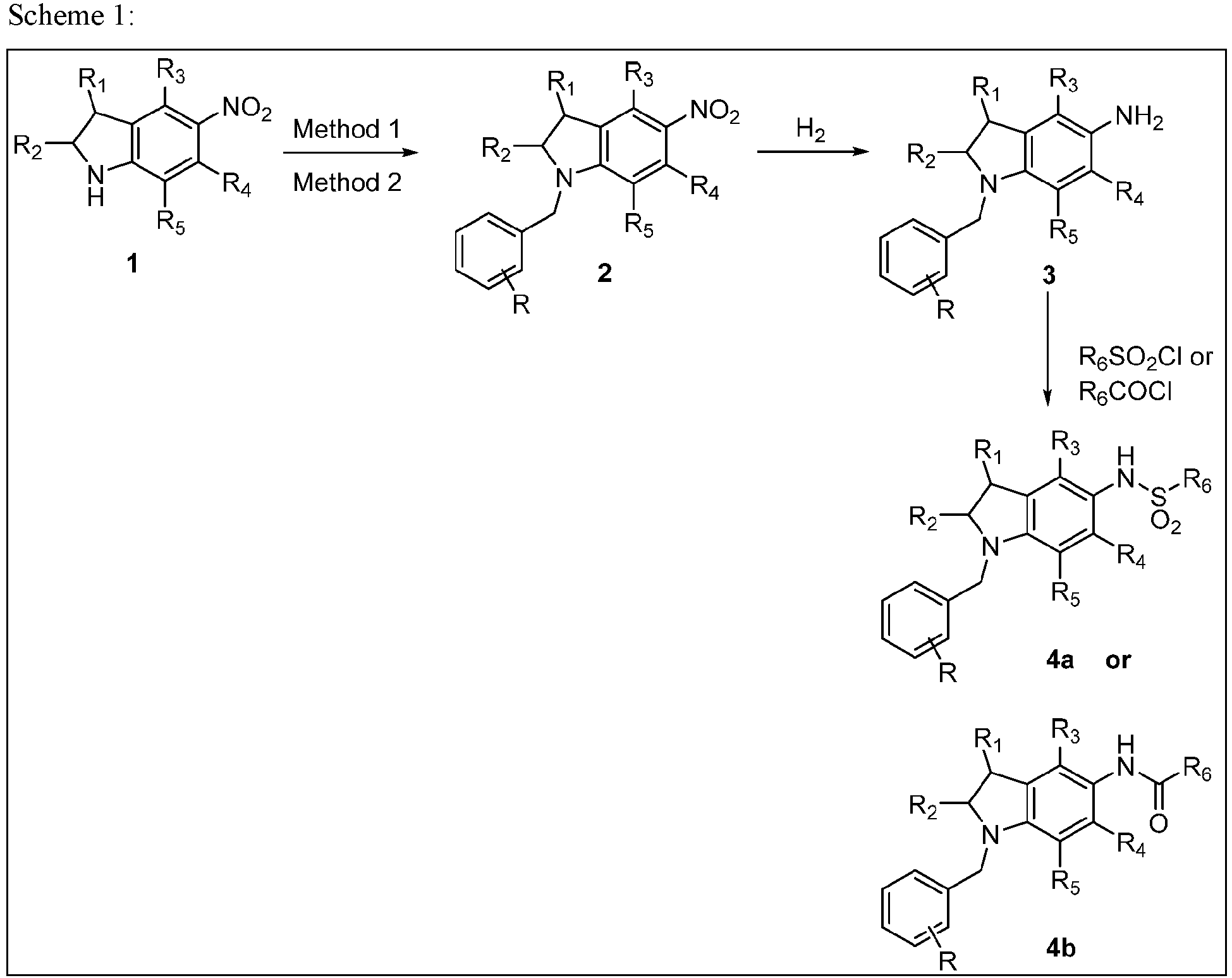
- The differently substitued 5-nitroindoline of formula 1 used as starting compounds in Scheme 1 can be synthesized using typical and well described synthetic methods. As an example, see
WO 2009/023677 A1 . The compounds of formula 1 have been derivatized using one of the two methods described below (method 1 and method 2). - 1.0 equivalents of 1 are dissolved in a mixture of dichloromethane and acetic acid (3:1 v/v, 16 ml any 6 mmol of 1), added with 2.0 equivalents of the proper aldehyde of formula RHyCHO (Scheme 1 in particular refers to RPhCHO), and warmed to 65°C for 1-3h under magnetic stirring. The mixture is then added with 1.8 equivalents of sodium triacetoxyborohydride maintaining at the same temperature for further 3h. The reaction is then diluted with dichloromethane and quenched with aqueous NaOH (3N). The organic phase is dried over anhydrous sodium sulfate, filtered and concentrated in vacuo to obtain a compound of formula 2. Crude products are purified by flash column chromatography using n-hexane/ethyl acetate as mobile phases.
- 1.0 equivalents of 1 are dissolved in 10 mL of anhydrous dichloromethane, and are added dropwise to a suspension of sodium hydride (1.2 equivalents) in 5 mL of anhydrous dichloromethane while maintaining under stirring in an ice bath at 0°C. After about 30 minutes the resulting solution is added with 1.2 equivalents of the proper Hy-alkyl halide of formula RHy(CH2)bX or Hy-acyl halide of formula RHy(CH2)nCOX (Scheme 1 refers in particular to RPh(CH2)X and RPh(CH2)COX) and is left under stirring at ambient temperature for further 2h. Reaction is then quenched by aqueous citric acid (2N) and the organic phase is isolated, washed with brine, dried over anhydrous sodium sulfate, filtered and concentrated in vacuo to obtain a compound of formula 2. Crude products are purified by flas h column chromatography using n-hexane/ethyl acetate as mobile phases.
- The 1-substitued-5nitroindolines of formula 2, obtained as descrive above, are dissolved in a mixture of tetrahydrofurane/methanol (1:1.5 v/v) at a final concentration of 0.1M and subjected to catalytic hydrogenation using a continuous-flow hydrogenation reactor (H-Cube, TalesNano, Budapest, Hungary). The typical process parameters selected are: 30°C of temperature, 10 atm of pressure and 1 ml/min of flow. Prepacked Pd/C 10% cartridges (TalesNano) are used as supported catalyst. The products of formula 3 obtained at the end of the reduction cycle are used directly in the following steps without further purification.
- To a solution of an intermediate of formula 3 (1 eq) in 10 mL of anhydrous dichloromethane are added 2.0 equivalents of 1,5-diazabicyclo(5.4.0)undec-5-ene (DBU) and 2.5 equivalents of the proper sulfonyl halide of formula R6SO2X (Scheme 1 indicates in particular a sulfonyl chloride of formula R6SO2Cl). The reaction is stirred at room temperature for 1-3h, then diluted with dichloromethane and washed with aqueous citric acid (2N) and brine. The organic phase is dried over anhydrous sodium sulfate, filtered, concentrated in vacuo and purified by flash column chromatography using n-hexane/ethyl acetate as mobile phases to afford the final compound of formula 4a.
- To a solution of an intermediate of formula 3 (1 eq) in 15 mL of anhydrous dichloromethane are added 1.2 equivalents of N,N'-diisopropylethylamine (DIPEA) and 1.2 equivalents of the proper acyl halide of formula R6COX (Scheme 1 indicates in particular an acyl chloride of formula R6COCl) or alkyl chloroformate. The reaction is stirred at room temperature for 1h, then diluted with dichloromethane and washed with aqueous citric acid (2N) and brine. The organic phase is dried over anhydrous sodium sulfate, filtered, concentrated in vacuo and purified by flash column chromatography using n-hexane/ethyl acetate as mobile phases.
- The list below depicts examples of some compounds prepared by using the above procedure:
-

- Synthesized starting from 5-nitroindoline, reacted with 4-trifluoromethylbenzhaldheyde following method 1. After reduction of the nitro group, the corresponding amine was coupled with cyclohexylsulfonyl chloride. 1H NMR (CDCl3, 400 MHz): δ: 1.22-1.28 (m, 2H, CH 2); 1.56-1.65 (m, 4H, 2 CH 2); 1.69-1.73 (m, 2H, CH 2); 2.17-2.22 (m, 2H, CH 2); 2.92-2.98 (m, 1H, CH); 3.02 (t, 2H, CH 2, J = 8.0 Hz); 3.39 (t, 2H, CH 2, J = 8.0 Hz); 4.30 (s, 2H, CH 2); 6.14 (s, 1H, NH); 6.37 (d, 1H, aryl, J = 8.0 Hz); 6.91 (d, 1H, aryl, J = 8.0 Hz); 7.09 (s, 1H, aryl); 7.50 (d, 2H, aryl, J = 8.0 Hz); 7.63 (d, 2H, aryl, J = 8.0 Hz). HR-MS m/z: calcd for C22H26F3N2O2S, [(M+H)+]: 439.1662; found 439.1677; [(M+Na)+]: 461.1481; found 461.1490.
-

- Synthesized starting from 5-nitroindoline, reacted with 4-methoxybenzaldehyde following method 1. After reduction of the nitro group, the corresponding amine was coupled with cyclohexylsulfonyl chloride.1H NMR (CDCl3, 400 MHz): δ: 1.22-1.28 (m, 2H, CH 2); 1.57-1.72 (m, 4H, 2 CH 2); 1.89-1.92 (m, 2H, CH 2); 2.17-2.21 (m, 2H, CH 2); 2.92-2.98 (m, 1H, CH); 2.92-2.99 (m, 3H, H-3 and CH); 3.39 (t, 2H, H-2, J = 8.0 Hz); 3.83 (s, 3H, CH3 ); 4.19 (s, 2H, CH 2); 5.93 (s, 1H, NH); 6.43 (d, 1H, H-7, J = 8.0 Hz); 6.90 (m, 3H, H-6 and aryl); 7.05 (s, 1H, H-4); 7.28 (d, 2H, aryl, J = 8.0 Hz). HR-MS m/z: calcd for C22H29F3N2O3S, [(M+H)+]: 401.1893; found 401.1902; [(M+Na)+]: 423.1718; found 423.1724.
-

- Synthesized starting from 5-nitroindoline, reacted with 4-fluorobenzaldehyde following method 1. After reduction of the nitro group, the corresponding amine was coupled with cyclohexylsulfonyl chloride.1H NMR (CDCl3, 400 MHz): δ: 1.10-1.21 (m, 2H, CH 2); 1.47-1.62 (m, 4H, 2 CH 2); 1.80-1.82 (m, 2H, CH 2); 2.08-2.11 (m, 2H, CH 2); 2.83-2.91 (m, 3H, CH 2 and CH); 3.25 (t, 2H, CH 2, J = 8.0 Hz); 4.12 (s, 2H, CH 2); 5.96 (s, 1H, NH); 6.31 (d, 1H, aryl, J = 8.0 Hz); 6.80 (d, 1H, aryl, J = 8.0 Hz); 6.94-6.98 (m, 3H, aryl); 7.21-7.26 (m, 2H, aryl). HR-MS m/z: calcd for C21H26FN2O2S, [(M+H)+]: 389.1694; found 389.1699; [(M+Na)+]: 411.1513; found 411.1520.
-

- Synthesized starting from 5-nitroindoline, reacted with 2,4-difluorobenzyl bromide following method 2. After reduction of the nitro group, the corresponding amine was coupled with cyclohexylsulfonyl chloride. 1H NMR (CDCl3, 400 MHz): δ: 1.20-1.26 (m, 3H, CH 2); 1.50-1.71 (m, 2H, CH 2); 1.88-1.92 (m, 4H, 2 CH 2); 2.17-2.20 (m, 2H, CH 2); 2.91-3.02 (m, 3H, CH 2 and CH); 3.40 (t, 2H, CH 2, J = 8.0 Hz); 4.26 (s, 2H, CH 2); 6.21 (s, 1H, NH); 6.41 (d, 1H, aryl, J = 8.0 Hz); 6.85-6.93 (m, 3H, aryl); 7.07 (s, 1H, aryl); 7.34-7.40 (m, 1H, aryl). HR-MS m/z: calcd for C21H25F2N2O2S, [(M+H)+]: 407.1599; found 407.1611; [(M+Na)+]: 429.1419; found 429.1427.
-

- Synthesized starting from 5-nitroindoline, reacted with 4-fluorobenzaldehyde following method 1. After reduction of the nitro group, the corresponding amine was coupled with benzenesulfonyl chloride. 1H NMR (CDCl3, 400 MHz): δ: 2.91 (t, 2H, CH 2, J = 12.0 Hz); 3.31 (t, 2H, CH 2, J = 12.0 Hz); 4.18 (s, 2H, CH 2); 6.28-6.30 (m, 2H, aryl and NH); 6.61 (d, 1H, aryl, J = 8.0 Hz); 6.87 (s, 1H, aryl); 7.03 (t, 2H, aryl, J = 8.0 Hz); 7.28-7.30 (m, 2H, aryl); 7.46 (t, 2H, aryl, J = 8.0 Hz); 7.56 (t, 1H, aryl, J = 8.0 Hz); 7.74 (t, 2H, aryl, J = 8.0 Hz). HR-MS m/z: calcd for C21H20FN2O2S, [(M+H)+]: 383.1224; found 383.1230.
-

- Synthesized starting from 5-nitroindoline, reacted with 4-fluorobenzaldehyde following method 1. After reduction of the nitro group, the corresponding amine was coupled with butanesulfonyl chloride.1H NMR (CDCl3, 400 MHz): δ: 0.94 (t, 3H, CH 3, J= 8.0 Hz); 1.41-1.49 (m, 2H, CH 2); 1.80-1.88 (m, 2H, CH 2); 2.95-3.06 (m, 4H, 2 CH 2); 3.34 (t, 2H, CH 2, J = 8.0 Hz); 4.21 (s, 2H, CH 2); 6.28 (s, 1H, NH); 6.40 (d, 1H, aryl, J= 12.0 Hz); 6.91 (d, 1H, aryl, J = 12.0 Hz); 7.02-7.07 (m, 3H, aryl); 7.30-7.35 (m, 2H, aryl). HR-MS m/z: calcd for C19H24FN2O2S, [(M+H)+]: 363.1537; found 363.1545.
-

- Synthesized starting from 5-nitroindoline, reacted with 4-fluorobenzaldehyde following method 1. After reduction of the nitro group, the corresponding amine was coupled with 2-methylpropane-1-sulfonyl chloride. 1H NMR (CDCl3, 400 MHz): δ: 1.08 (d, 6H, CH 3, J = 7.0 Hz); 2.25-2.29 (m, 1H, CH); 2.90 (d, 2H, CH 2 J = 4.0 Hz); 2.96 (t, 2H, CH 2, J = 8.0 Hz); 3.32 (t, 2H, CH 2, J = 8.0 Hz); 4.19 (s, 2H, CH 2); 6.17 (s, 1H, NH); 6.38 (d, 1H, aryl, J = 8.0 Hz); 6.88 (d, 1H, aryl, J = 8.0 Hz); 7.00-7.05 (m, 3H, aryl); 7.28-7.32 (m, 2H, aryl). HR-MS m/z: calcd for C19H24FN2O2S, [(M+H)+]: 363.1537; found 363.1545.
-

- Synthesized starting from 5-nitroindoline, reacted with 4-fluorobenzaldehyde following method 1. After reduction of the nitro group, the corresponding amine was coupled with azepane-1-sulfonyl chloride. 1H NMR (CDCl3, 400 MHz): δ: 1.54-1.59 (m, 4H, 2 CH 2); 1.68-1.70 (m, 4H, 2 CH 2); 2.97 (t, 2H, CH 2, J = 12.0 Hz); 3.28-3.35 (m, 6H, 3 CH 2); 4.21 (s, 2H, CH 2); 5.99 (s, 1H, NH); 6.40 (d, 1H, aryl, J= 12.0 Hz); 6.88 (d, 1H, aryl, J= 8.0 Hz); 7.01-7.07 (m, 3H, aryl); 7.30-7.35 (m, 2H, aryl). HR-MS m/z: calcd for C21H27FN3O2S, [(M+H)+]: 404.1803; found 404.1876.
-

- Synthesized starting from 5-nitroindoline, reacted with 4-fluorobenzaldehyde following method 1. After reduction of the nitro group, the corresponding amine was coupled with hexane-1-sulfonyl chloride. 1H NMR (CD3OD, 400 MHz): δ: 0.91 (t, 3H, CH 3, J = 8.0 Hz); 1.28-1.34 (m, 4H, CH 2); 1.36-1.46 (m, 2H, CH 2); 1.78-1.82 (m, 2H, CH 2); 3.13-3.18 (m, 4H, 2 CH 2); 3.91(t, 2H, CH 2, J= 8.0 Hz); 4.70 (s, 2H, CH 2); 7.18-7.27 (m, 3H, aryl); 7.33-7.35 (d, 2H, aryl, J = 8.0 Hz); 7.51 (dd, 2H, aryl, J1=4Hz, J2=8 Hz). HR-MS m/z: calcd for C21H28FN2O2S, [(M+H)+]: 391.1850; found 391.1862.
-

- Synthesized starting from 5-nitroindoline, reacted with 4-fluorobenzaldehyde following method 1. After reduction of the nitro group, the corresponding amine was coupled with 4-methylpiperazine-1-sulfonyl chloride. 1H NMR (CDCl3, 400 MHz): δ: 2.30 (s, 3H, CH3 ); 2.43 (t, 4H, CH 2, J = 4.0 Hz); 2.96 (t, 2H, CH 2, J = 8.0 Hz); 3.29-3.34 (m, 6H, 3CH 2); 4.19 (s, 2H, CH 2); 6.38 (d, 1H, aryl, J = 8.0 Hz); 6.93 (d, 1H, aryl, J = 8.0 Hz); 7.01-7.07 (m, 3H, aryl); 7.30-7.34 (m, 2H, aryl). HR-MS m/z: calcd for C20H26FN4O2S, [(M+H)+]: 405.1755; found 405.1762.
-

- Synthesized starting from 5-nitroindoline, reacted with 4-fluorobenzaldehyde following method 1. After reduction of the nitro group, the corresponding amine was coupled with (1S)-(+)-10-camphorsulfonyl chloride. [α]25 D : 37.50 ± 0.05 (c = 0.12, MeOH). 1H NMR (CDCl3, 400 MHz): δ: 0.92 (s, 3H, CH3 ); 0.99 (s, 3H, CH3 ); 1.47-1.52 (m, 1H, CH); 1.98-2.20 (m, 5H, 2 CH 2 and CH2a ); 2.44-2.51 (m, 1H, CH2b ); 2.81 (d, 1H, CH 2a', J = 16.0 Hz); 2.98 (t, 2H, CH 2, J = 12.0 Hz); 3.34 (t, 2H, CH 2, J= 12.0 Hz); 3.45 (d, 1H, CH 2b' , J = 16.0 Hz); 4.21 (s, 2H, CH 2); 6.41 (d, 1H, aryl, J = 12.0 Hz); 6.94 (d, 1H, aryl, J = 12.0 Hz); 7.02-7.06 (m, 2H, aryl); 7.10 (s, 1H, aryl); 7.31-7.33 (m, 2H, aryl); 7.45 (s, 1H, NH). HR-MS m/z: calcd for C25H30FN2O3S, [(M+H)+]: 457.1986; found 457.2001.
-

- Synthesized starting from 5-nitroindoline, reacted with 4-fluorobenzaldehyde following method 1. After reduction of the nitro group, the corresponding amine was coupled with (1R)-(-)-10-camphorsulfonyl chloride. [α]25 D : -38.10 ± 0.06 (c = 0.12, MeOH). 1H NMR (CDCl3, 400 MHz): δ: 0.92 (s, 3H, CH3 ); 0.98 (s, 3H, CH3 ); 1.47-1.52 (m, 1H, CH); 1.97-2.22 (m, 5H, 2 CH 2 and CH2a ); 2.44-2.52 (m, 1H, CH2b ); 2.80 (d, 1H, CH 2a', J = 16.0 Hz); 2.97 (t, 2H, CH, J = 12.0 Hz); 3.32 (t, 2H, CH, J = 12.0 Hz); 3.43 (d, 1H, CH 2b', J = 16.0 Hz); 4.21 (s, 2H, CH 2); 6.41 (d, 1H, aryl, J = 12.0 Hz); 6.93 (d, 1H, aryl, J = 12.0 Hz); 7.01-7.10 (m, 3H, aryl); 7.30-7.35 (m, 2H, aryl); 7.47 (s, 1H, NH). HR-MS m/z: calcd for C25H30FN2O3S, [(M+H)+]: 457.1986; found 457.1995.
-

- Synthesized starting from 5-nitroindoline, reacted with 4-fluorobenzaldehyde following method 1. After reduction of the nitro group, the corresponding amine was coupled with 3,5-dimethylpiperidine-1-sulfonyl chloride. 1H NMR (CD3OD, 400 MHz): δ: 0.49-0.58 (m, 1H, CH); 0.78 (d, 6H, 2 CH 3, J=8.0 Hz); 1.43-1.50 (m, 2H, CH2,); 1.64 (d, 2H, CH 2, J=16.0 Hz); 2.13 (t, 2H, CH 2, J=12.0 Hz); 3.02 (bs, 2H, CH 2); 3.57 (dd, 2H, CH 2, J1= 4.0 Hz, J2=9.0 Hz); 3.81 (bs, 2H, CH 2); 4.57 (s, 2H, CH 2); 7.06-7.16 (m, 5H, aryl); 7.35-7.38 (m, 2H, aryl). HR-MS m/z: calcd for C22H29FN3O2S, [(M+H)+]: 418.1959; found 418.1964.
-

- Synthesized starting from 5-nitroindoline, reacted with 4-fluorobenzoyl chloride following method 2. After reduction of the nitro group, the corresponding amine was coupled with cyclohexylsulfonyl chloride.1H NMR (DMSO-d6, 400 MHz): δ: 1.13-1.24 (m, 2H, CH 2); 1.36-1.42 (m, 4H, 2 CH 2); 1.58-1.60 (m, 1H, CH 2); 1.75-1.78 (m, 2H, CH 2); 2.00-2.03 (m, 2H, CH 2); 2.89-2.97 (m, 1H, CH); 3.07 (t, 2H, CH 2, J = 8.0 Hz); 4.00 (t, 2H, CH 2, J = 8.0 Hz); 7.04 (bs, 1H, aryl); 7.16 (s, 1H, aryl); 7.30-7.35 (m, 2H, aryl); 7.65-7.68 (m, 2H, aryl); 7.95 (bs, 1H, aryl); 9.65 (s, 1H, NH). HR-MS m/z: calcd for C21H24FN2O3S, [(M+H)+]: 403.1486; found 403.1495; [(M+Na)+]: 425.1306; found 425.1316.
-

- Synthesized starting from 5-nitroindoline, reacted with 3,4-difluorobenzyl bromide following method 2. After reduction of the nitro group, the corresponding amine was coupled with cyclohexylsulfonyl chloride.1H NMR (CDCl3, 400 MHz): δ: 1.20-1.31 (m, 2H, CH 2); 1.59-1.72 (m, 4H, 2 CH 2); 1.89-1.92 (m, 2H, CH 2); 2.18-2.21 (m, 2H, CH 2); 2.91-2.97 (m, 1H, CH); 3.01 (t, 2H, CH 2, J = 8.0 Hz); 3.37 (t, 2H, CH 2, J = 8.0 Hz); 4.19 (s, 2H, CH 2); 6.02 (s, 1H, NH); 6.36 (d, 1H, aryl, J = 8.0 Hz); 6.90 (d, 1H, aryl, J = 8.0 Hz); 7.08-7.22 (m, 4H, aryl). HR-MS m/z: calcd for C21H25F2N2O2S, [(M+H)+]: 407.1599; found 407.1612; [(M+Na)+]: 429.1419; found 429.1426.
-

- Synthesized starting from 5-nitroindoline, reacted with 2-(4-chlorophenyl)acetyl chloride following method 2. After reduction of the nitro group, the corresponding amine was coupled with cyclohexylsulfonyl chloride1H NMR (CDCl3, 400 MHz): δ: 1.18-1.28 (m, 2H, CH 2); 1.54-1.71 (m, 4H, 2 CH 2); 1.89-1.92 (m, 2H, CH 2); 2.16 (d, 2H, CH 2, J=12.0 Hz); 2.90-2.97 (m, 1H, CH); 4.25 (s, 2H, CH 2); 6.11 (s, 1H, NH); 6.59 (t, 2H, aryl, J= 12.0 Hz); 6.84 (d, 1H, aryl, J = 8.0 Hz); 7.03-7.09 (m, 4H, aryl);7.35 (dd, 2H, aryl, Ji=5.2 Hz, J2=8.4 Hz);.HR-MS m/z: calcd for C22H26ClNO3S, [(M+H)+]: 433.1347 and [(M+H)++2]: 435.1318; found 433.1342 and 435.1323.
-

- Synthesized starting from 5-nitroindoline, reacted with 1-(bromomethyl)-2,4-bis(trifluoromethyl)benzene following method 2. After reduction of the nitro group, the corresponding amine was coupled with cyclohexylsulfonyl chloride.1H NMR (CDCl3, 400 MHz): δ: 1.20-1.31 (m, 2H, CH 2); 1.56-1.72 (m, 4H, 2 CH 2); 1.90-1.92 (m, 2H, CH 2); 2.19-2.21 (m, 2H, CH 2); 2.93-2.99 (m, 1H, CH); 3.09 (t, 2H, H-3, J = 8.0 Hz); 3.50 (t, 2H, H-2, J = 8.0 Hz); 4.49 (s, 2H, CH 2); 6.17 (s, 1H, NH); 6.24 (d, 1H, H-7, J = 12.0 Hz); 6.89 (d, 1H, H-6, J = 12.0 Hz); 7.13 (s, 1H, H-4); 7.80 (d, 1H, aryl, J = 12.0 Hz); 7.87 (d, 1H, aryl, J = 12.0 Hz);7.96 (s, 1H, aryl). HR-MS m/z: calcd for C23H25F6N2O2S, [(M+H)+]: 507.1535; found 507.1541; [(M+Na)+]: 529.1355; found 529.1362.
-

- Synthesized starting from 5-nitroindoline, reacted with 4-bromo-1-(bromomethyl)-2-nitrobenzene following method 2. After reduction of the nitro group, the corresponding amine was coupled with cyclohexylsulfonyl chloride.1H NMR (CDCl3, 400 MHz): δ: 1.20-1.31 (m, 2H, CH 2); 1.56-1.72 (m, 4H, 2 CH 2); 1.89-1.92 (m, 2H, CH 2); 2.17-2.20 (m, 2H, CH 2); 2.91-2.99 (m, 1H, CH); 3.06 (t, 2H, H-3, J = 8.0 Hz); 3.48 (t, 2H, H-2, J = 8.0 Hz); 4.54 (s, 2H, CH 2); 5.99 (s, 1H, NH); 6.26 (d, 1H, H-7, J = 8.0 Hz); 6.87 (d, 1H, H-6, J = 8.0 Hz); 7.10 (s, 1H, H-4); 7.59 (d, 1H, aryl, J = 12.0 Hz); 7.74 (d, 1H, aryl, J = 12.0 Hz);8.21 (s, 1H, aryl). HR-MS m/z: calcd for C21H25BrN3O4S, [(M+H)+]: 494.0744; found 494.0755; [(M+Na)+]: 516.0563; found 516.0570.
-

- Synthesized starting from 5-nitroindoline, reacted with 1-(2-bromoethyl)-4-fluorobenzene following method 2. After reduction of the nitro group, the corresponding amine was coupled with cyclohexylsulfonyl chloride.1H NMR (CDCl3, 400 MHz): δ: 1.19-1.31 (m, 2H, CH 2); 1.62-1.71 (m, 4H, 2 CH 2); 1.89-1.92 (m, 2H, CH 2); 2.17-2.20 (m, 2H, CH 2); 2.85-3.00 (m, 5H, CH, 2 CH 2); 3.30 (t, 2H, CH 2, J = 8.0 Hz); 3.42 (t, 2H, CH 2, J = 8.0 Hz); 5.99 (s, 1H, NH); 6.35 (d, 1H, aryl, J = 8.0 Hz); 6.90 (d, 1H, aryl, J = 8.0 Hz); 6.99-7.04 (m, 3H, aryl); 7.20-7.23 (m, 2H, aryl). HR-MS m/z: calcd for C22H28FN2O2S, [(M+H)+]: 403.1850; found 403.1862; [(M+Na)+]: 425.1669; found 425.1675.
-

- Synthesized starting from 2-methyl-5-nitroindoline, reacted with 4-methoxybenzaldheyde following method 1. After reduction of the nitro group, the corresponding amine was coupled with cyclohexylsulfonyl chloride.1H NMR (CDCl3, 400 MHz): δ: 1.15-1.34 (m, 2H, CH 2); 1.33 (d, 3H, CH 3, J=8.0 Hz) 1.50-1.68 (m, 4H, 2CH2 ); 1.84-1.86 (m, 2H, CH 2); 2.08-2.10 (m, 2H, CH 2); 2.60-2.66 (m, 1H, H-3a); 2.97-3.16 (m, 1H, CH); 3.02-3.11 (m, 1H, H-3b); 3.77-3.81 (m, 4H, H-2 and CH3 ); 4.12 (d, 1H, CH 2a, J=20 Hz), 4.36 (d, 1H, CH 2b, J=20 Hz); 6.06 (s, 1H NH); 6.23 (s, 1H, H-4); 6.39 (d, 1H, H-6, J=8 Hz); 6.87 (d, 2H, aryl, J= 8 Hz) 6.94 (d, 1H, H-7, J=8 Hz); 7.27 (d, 2H, aryl, J=8 Hz); HR-MS m/z: calcd for C23H31N2O3S, [(M+H)+]: 415.2050; found 415.2059; [(M+Na)+]: 437.1869; found 437.1874.
-

- Synthesized starting from 5-nitroindoline, reacted with 4-fluorobenzaldheyde following method 1. After reduction of the nitro group, the corresponding amine was coupled with 2-cyclohexanecarbonyl bromide. 1H NMR (CDCl3, 400 MHz): δ: 1.12-1.28 (m, 3H, CH 2); 1.41-1.54 (m, 3H, CH 2); 1.74-1.77 (m, 2H, CH 2); 1.86-1.89 (m, 2H, CH 2); 2.08-2.14 (m, 1H, CH); 2.86 (t, 2H, CH 2, J = 8.0 Hz); 3.19 (t, 2H, CH 2, J = 8.0 Hz); 4.10 (s, 2H, CH 2); 6.33 (d, 1H, aryl, J = 8.0 Hz); 6.92-6.96 (m, 4H, aryl); 7.22-7.25 (m, 2H, aryl); 7.29 (s, 1H, NH). HR-MS m/z: calcd for C22H26FN2O, [(M+H)+]: 353.2024; found 353.2031.
-

- Synthesized starting from 5-nitroindoline, reacted with 4-fluorobenzaldheyde following method 1. After reduction of the nitro group, the corresponding amine was coupled with acetyl bromide.1H NMR (CDCl3, 400 MHz) δ: 2.06 (s, 3H, CH3 ); 2.88 (t, 2H, CH 2, J = 8.0 Hz); 3.20 (t, 2H, CH 2, J = 8.0 Hz); 4.10 (s, 2H, CH 2); 6.33 (d, 1H, aryl, J = 8.0 Hz); 6.91-6.97 (m, 4H, aryl); 7.23-7.26 (m, 4H, aryl and NH). HR-MS m/z: calcd for C17H18FN2O, [(M+H)+]: 285.1398; found 285.1405.
-

- Synthesized starting from 5-nitroindoline, reacted with 4-fluorobenzaldheyde following method 1. After reduction of the nitro group, the corresponding amine was coupled with 2-cyclohexylacetyl bromide.1H NMR (DMSO-d6, 400 MHz): δ: 0.90-1.00 (m, 2H, CH 2); 1.11-1.27 (m, 3H, CH 2); 1.26-1.77 (m, 5H, CH 2); 2.11 (d, 2H, CH 2, J = 8.0 Hz); 2.85 (t, 2H, CH 2, J = 8.0 Hz); 3.18 (t, 2H, CH 2, J = 8.0 Hz); 4.20 (s, 2H, CH 2); 6.51 (d, 1H, aryl, J = 8.0 Hz); 7.12-7.19 (m, 3H, aryl); 7.34-7.40 (m, 3H, aryl); 9.48 (s, 1H, NH). HR-MS m/z: calcd for C23H28FN2O, [(M+H)+]: 367.2186; found 367.2195.
-

- Synthesized starting from 5-nitroindoline, reacted with 4-fluorobenzaldheyde following method 1. After reduction of the nitro group, the corresponding amine was coupled with ethyl chloroformate. 1H NMR (CDCl3, 400 MHz): δ: 1.29 (t, 3H, CH 3, J = 8.0 Hz); 2.94 (t, 2H, CH 2, J = 8.0 Hz); 3.25 (t, 2H, CH 2, J = 8.0 Hz); 4.16-4.22 (m, 4H, CH 2); 6.36 (bs, 1H, NH); 6.40 (d, 1H, aryl, J = 8.0 Hz); 6.93 (d, 1H, aryl, J = 8.0 Hz); 7.01-7.04 (m, 2H, aryl); 7.19 (s, 1H, aryl); 7.31-7.33 (m, 2H, aryl). HR-MS m/z: calcd for C18H20FN2O2, [(M+H)+]: 315.1503; found 315.1514.
-

- Synthesized starting from 5-nitroindoline, reacted with 4-fluorobenzaldheyde following method 1. After reduction of the nitro group, the corresponding amine was coupled with (1S)-(+)-menthyl chloroformate. [α]25 D : 32.67 ± 0.04 (c = 0.15, MeOH). 1H NMR (CDCl3, 400 MHz): δ: 0.83 (d, 3H, CH 3, J = 8.0 Hz); 0.93 (d, 6H, CH 3, J = 8.0 Hz); 1.00-1.13 (m, 2H, CH 2); 1.28-1.37 (m, 1H, CH 2); 1.32-1.41 (m, 1H, CH 2); 1.47-1.56 (m, 1H, CH); 1.67-1.74 (m, 2H, CH 2); 1.94-2.04 (m, 1H, CH); 2.09-2.16 (m, 1H, CH 2); 2.96 (t, 2H, CH 2, J = 12.0 Hz); 3.27 (t, 2H, CH 2, J = 12.0 Hz); 4.18 (s, 2H, CH 2); 4.61-4.69 (m, 1H, CH); 6.34 (s, 1H, NH); 6.42 (d, 1H, aryl, J = 12.0 Hz); 6.95 (d, 1H, aryl, J= 12.0 Hz); 7.01-7.06 (m, 2H, aryl); 7.25 (s, 1H, aryl); 7.31-7.36 (m, 2H, aryl). HR-MS m/z: calcd for C26H34FN2O2, [(M+H)+]: 425.2599; found 425.2608.
- The general synthetic procedure for compounds of general formula 5 is shown in Scheme 2.

- To a solution of triphosgene (1.0 equivalents) in 5 ml of anhydrous dichloromethane are added dropwise (during 10 minutes) 5 mL of a solution containing 1.25 equivalents of one of the intermediates with general formula 3 described in Example 1, and 2.6 equivalents of N,N'-diisopropylethylamine (DIPEA) in anhydrous dichloromethane. The reaction is magnetically stirred for 30-60 minutes at ambient temperature. Then 5 mL of a solution containing the proper amine of formula R6NH2 (2.5 equivalents) in anhydrous dichloromethane is added dropwise. The reaction is stirred for further 60 minutes and washed with citric acid (2N), saturated sodium bicarbonate solution and brine. The organic phase is then dried over sodium sulfate, filtered and concentrated in vacuo to obtain a compound of formula 5. Crude products thus obtained are purified by flash column chromatography using n-hexane/ethyl acetate as mobile phases.
- Below follow two examples of compounds prepared by using the above-described procedure for the synthesis of final products of formula 5:
-
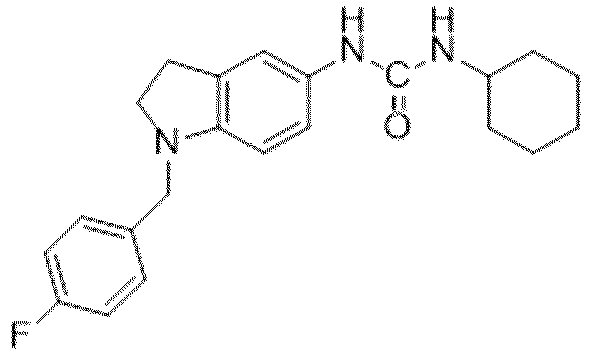
- Synthesized starting from 1-(4-fluorobenzyl)indolin-5-amine, reacted with cyclohexylamine, following the general procedure. 1H NMR (DMSO-d6, 400 MHz): δ: 1.18-1.26 (m, 3H, CH 2 and CH2a ); 1.34-1.41 (m, 2H, CH 2); 1.59-1.64 (m, 1H, CH2b ); 1.71-1.76 (m, 2H, CH 2); 1.85-1.89 (m, 2H, CH 2); 2.91 (t, 2H, CH 2, J = 8.0 Hz); 3.23 (t, 2H, CH 2, J = 8.0 Hz); 3.48-3.53 (m, 1H, CH); 4.24 (s, 2H, CH 2); 5.93 (d, 1H, NH, J = 8.0 Hz); 6.56 (d, 1H, aryl, J = 4.0 Hz); 6.99 (d, 1H, aryl, J= 8.0 Hz); 7.22-7.27 (m, 3H, aryl); 7.46-7.49 (m, 2H, aryl); 7.95 (s, 1H, NH). HR-MS m/z: calcd for C22H27FN3O, [(M+H)+]: 368.2133; found 368.2139.
-

- Synthesized starting from 1-(4-fluorobenzyl)indolin-5-amine, reacted with 2,2-dimethylpropan-1-amine, following the general procedure. 1H NMR (CDCl3, 400 MHz): δ: 0.89 (s, 9H, CH3 ); 2.99 (t, 2H, H-3, J = 8.0 Hz); 3.03 (d, 2H, CH 2, J = 4.0 Hz); 3.35 (t, 2H, H-2, J = 8.0 Hz); 4.23 (s, 2H, CH 2); 4.71 (t, 1H, NH, J = 4.0 Hz); 5.98 (s, 1H, NH); 6.45 (d, 1H, H-7, J = 8.0 Hz); 6.92 (d, 1H, H-6, J= 8.0 Hz); 6.91-7.07 (m, 3H, aryl and H-4); 7.32-7.35 (m, 2H, aryl). HR-MS m/z: calcd for C21H27FN3O, [(M+H)+]: 356.2133; found 356.2148.
- The general procedure for the synthesis of compounds with general formula 7 or 8 is depicted in Scheme 3.

- To a toluene solution (10 mL) containing one of the intermediates with general formula 3 described in Example 1 (1.0 eq) and 1.0 equivalents of triethylamine (TEA), are rapidly added 1.1 equivalents of carbon disulfide (CS2) at the temperature of -15°C. The mixture is maintained under magnetic stirring for 2h. The reaction is then warmed to room temperature for 5 minutes and suddenly cooled to -20°C for 24h. The suspension thus obtained is warmed again to room temperature and added with 1.0 equivalents of triethylamine. After cooling to -5°C, 1.1 equivalents of ethylchloroformate are added. Reaction is allowed to reach room temperature and is maintained under stirring for 2h, before being quenched with HCl (2N). The organic phase is separated, washed with a saturated solution of sodium bicarbonate, dried over sodium sulfate, filtered and concentrated in vacuo to obtain a compound of formula 6. Crude products are dissolved in 15 mL of anhydrous dichloromethane and added with 2.5 equivalents of TEA. To this solution 2.5 equivalents of the proper amine of formula R6NH2 are added dropwise, maintaining under stirring for 12h. The resulting solution is washed with citric acid (2N), dried over sodium sulfate, filtered and evaporated under vacuum to obtain a compound of formula 7. Crude products are purified by flash column chromatography using n-hexane/ethyl acetate as mobile phases.
- Below follows the example of one derivative synthesized used the above-described procedure for the synthesis of final products of formula 7:
-

- Synthesized starting from 1-(4-fluorobenzyl)indolin-5-amine, reacted with 2,2-dimethylpropan-1-amine, following the general procedure. 1H NMR (CDCl3, 400 MHz): δ: 0.89 (s, 9H, CH3 ); 2.99 (t, 2H, CH 2, J= 8.0 Hz); 3.39 (t, 2H, CH 2, J = 8.0 Hz); 3.48 (d, 2H, CH 2, J = 8.0 Hz); 4.25 (s, 2H, CH 2); 5.93 (t, 1H, NH, J = 4.0 Hz); 6.46 (d, 1H, aryl, J = 8.0 Hz); 6.89-6.92 (m, 2H, aryl); 7.01-7.07 (m, 2H, aryl); 7.29-7.33 (m, 2H, aryl); 7.58 (s, 1H, NH). HR-MS m/z: calcd for C21H27FN3S, [(M+H)+]: 372.1904; found 372.1911.
- Starting form 1.0 equivalents of one of the derivatives with general formula 7, dissolved in 10 mL of anhydrous THF, 76.5 equivalents of anhydrous sodium sulfate, 76.5 equivalents of anhydrous calcium chloride (CaCl2) and 153 equivalents of triethylamine were added. The resulting suspension was stirred for 30-60 minutes. Then, 41 equivalents of HgO were added and the reaction was warmed to 55°C for 1-2h. The reaction is then filtered under vacuum in 1 mL solution of ammonium hydroxide and the filtrate is maintained under stirring for 4-5h at room temperature. The crude product is diluted in ethyl acetate and washed with sodium hydroxide (2N). The organic phase is then dried over sodium sulfate, filtered and concentrated in vacuo to obtain a compound of formula 8. Crude products thus obtained are purified by flash column chromatography using dichloromethane/methanol as mobile phases.
- Below follows the example of one derivative synthesized used the above-described procedure for the synthesis of final products of formula 8:
-

- Synthesized starting from 1-(1-(4-fluorobenzyl)indolin-5-yl)-3-neopentylthiourea following the general procedure. 1H NMR (CDCl3, 400 MHz): δ: 0.97 (s, 9H, CH3 ); 2.93 (t, 2H, H-3, J = 8.0 Hz); 2.99 (s, 2H, CH 2); 3.25 (t, 2H, H-2, J= 8.0 Hz); 4.18 (s, 2H, CH 2); 6.47 (d, 1H, H-7, J = 8.0 Hz); 6.67 (d, 1H, H-6, J = 8.0 Hz); 6.77 (s, 1H, H-4); 7.02-7.06 (m, 2H, aryl); 7.34-7.37 (m, 2H, aryl). HR-MS m/z: calcd for C21H28FN4, [(M+H)+]: 355.2293; found 355.2300.
- The general synthetic procedure for compounds with general formula 12a or 12b is depicted in Scheme 4.
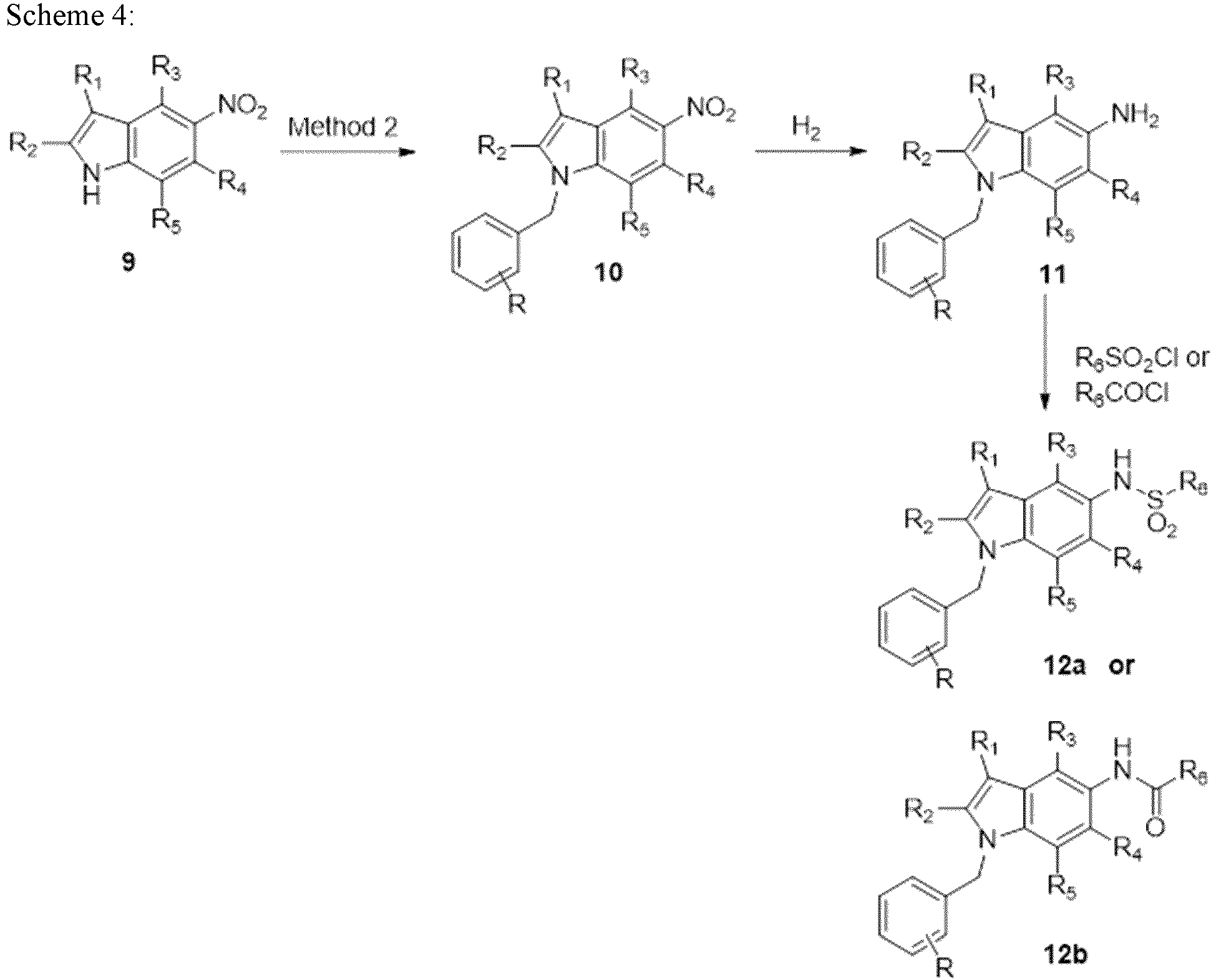
- The substitued 5-nitroindoles of formula 9 used as starting compounds in Scheme 4 can be synthesized using typical and well described synthetic methods that are known to skilled chemists. As an example, see
WO2009/023677 A1 . - The starting compounds of formula 9 can be then derivatized to compounds of formula 10 using the method 2 described in Example 1 for the synthesis of intermediates with general formula 2.
- Intermediates with the general formula 11 are synthesized following the continuous-flow hydrogenation procedures described in Example 1 for the synthesis of intermediates of formula 3.
- Derivatives with general formula 12a can be synthesized according to the procedures previously described in Example 1 for the synthesis of final products of formula 4a, while derivatives with general formula 12b can be synthesized according to the procedures described for in Example 1 for the synthesis of final products of formula 4b.
- The list below depicts examples of some compounds prepared by using the above-described procedure for the synthesis of compounds of general formula 12a or 12b:
-

- Synthesized starting from 5-nitro-1H-indole, reacted with 4-fluorobenzyl bromide following general procedure. After reduction of the nitro group, the corresponding amine was coupled with cyclohexanesulfonyl chloride. 1H NMR (CDCl3, 400 MHz) δ: 1.19-1.29 (m, 2H, CH 2); 1.61-1.67 (m, 4H, 2 CH 2); 1.86-1.89 (m, 2H, CH 2); 2.19-2.22 (m, 2H, CH 2); 2.95-3.02 (m, 1H, CH); 5.29 (s, 2H, CH 2); 6.41 (s, 1H, NH); 6.55 (d, 1H, aryl, J = 3.2 Hz); 7.00-7.04 (m, 2H, aryl); 7.07-7.13 (m, 3H, aryl). 7.16 (d, 1H, H-2, J = 3.2 Hz); 7.22 (d, 1H, aryl, J = 8.0 Hz); 7.57 (s, 1H, aryl). HR-MS m/z: calcd for C21H24FN2O2S, [(M+H)+]: 387.1537; found 387.1548; [(M+Na)+]: 409.1356; found 409.1362.
-

- Synthesized starting from 5-nitro-1H-indole, reacted with 4-(trifluoromethyl)benzyl bromide following general procedure. After reduction of the nitro group, the corresponding amine was coupled with cyclohexanesulfonyl chloride. 1H NMR (CDCl3, 400 MHz): δ: 1.20-1.25 (m, 2H, CH 2); 1.58-1.70 (m, 4H, 2 CH 2); 1.87-1.91 (m, 2H, CH 2); 2.20-2.23 (m, 2H, CH 2); 2.94-3.03 (m, 1H, CH); 5.39 (s, 2H, CH 2); 6.24 (s, 1H, NH); 6.58 (d, 1H, aryl, J= 4.0 Hz); 7.08 (d, 1H, aryl, J = 8.0 Hz); 7.17-7.22 (m, 4H, aryl); 7.58-7.61 (m, 3H, aryl); HR-MS m/z: calcd for C22H24F3N2O2S, [(M+H)+]: 437.1505; found 437.1513; [(M+Na)+]: 459.1325; found 459.1333.
-

- Synthesized starting from 5-nitro-1H-indole, reacted with 4-(trifluoromethyl)benzyl bromide following general procedure. After reduction of the nitro group, the corresponding amine was coupled with heptanoyl chloride.1H NMR (CDCl3, 400 MHz) δ: 0.92 (t, 3H, CH3 , J = 8.0 Hz); 1.33-1.44 (m, 6H, CH 2); 1.75-1.79 (m, 2H, CH 2); 1.94 (bs, 1H, NH); 2.39 (t, 2H, CH2 ,J = 8.0 Hz); 5.38 (s, 2H, CH 2); 6.56 (d, 1H, aryl, J = 4.0 Hz); 7.14-7.23 (m, 6H, aryl); 7.56 (d, 2H, aryl, J = 8.0 Hz); 7.89 (s, 1H, NH);. HR-MS m/z: calcd for C23H26F3N2O, [(M+H)+]: 403.1992; found 403.2003; [(M+Na)+]: 425.1811; found 425.1820.
-

- Synthesized starting from 5-nitro-1H-indole, reacted with 4-methoxybenzyl bromide following general procedure. After reduction of the nitro group, the corresponding amine was coupled with hexanesulfonyl chloride. 1H NMR (CDCl3, 400 MHz): δ: 1.20-1.25 (m, 2H, CH 2); 1.61-1.69 (m, 4H, 2 CH 2); 1.87-1.90 (m, 2H, CH 2); 2.20-2.22 (m, 2H, CH 2); 2.95-3.03 (m, 1H, CH); 3.80 (s, 3H, CH3 ); 5.26 (s, 2H, CH 2); 6.21 (s, 1H, NH); 6.52 (d, 1H, H-3, J = 4.0 Hz); 6.86 (d, 2H, aryl, J = 12.0 Hz); 7.07-7.11 (m, 3H, H-6 and aryl); 7.16 (d, 1H, aryl, J = 4.0 Hz); 7.26 (d, 1H, aryl, J = 8.0 Hz); 7.55 (s, 1H, H-4). HR-MS m/z: calcd for C22H27N2O3, [(M+H)+]: 399.1737; found 399.1745; [(M+Na)+]: 421.1556; found 421.1566.
-

- Synthesized starting from 5-nitro-1H-indole, reacted with 4-fluorobenzyl bromide following general procedure. After reduction of the nitro group, the corresponding amine was coupled with 2-cyclohexylethane-1-sulfonyl chloride. 1H NMR (CDCl3, 400 MHz): δ: 0.75-0.84 (m, 2H, CH 2); 1.01-1.24 (m, 4H, CH 2); 1.52-1.68 (m, 7H, CH and 3 CH 2); 1.62-1.68 (m, 2H, CH 2); 2.95-2.99 (m, 2H, CH2), 5.20 (s, 2H, CH 2); 6.38 (s, 1H, NH); 6.45 (d, 1H, aryl, J= 3.4 Hz), 6.89-6.94 (m, 2H, aryl); 6.97-7.02 (m, 3H, Aryl); 7.07 (d, 1H, aryl, J= 4.0 Hz); 7.13 (d, 1H, aryl, J= 8.0 Hz); 7.46 (s, 1H, aryl). HR-MS m/z: calcd for C24H28F3N2O2S, [(M+H)+]: 414,1777; found 414.1783.
-

- Synthesized starting from 5-nitro-1H-indole, reacted with 4-(trifluoromethyl)benzyl bromide following general procedure. After reduction of the nitro group, the corresponding amine was coupled with 3,3-dimethylbutanoyl chloride.1H NMR (CDCl3, 400 MHz): δ: 1.14 (s, 9H, CH3 ); 2.25 (s, 2H, CH 2); 5.36 (s, 2H, CH 2); 6.55 (s, 1H, aryl); 7.11-7.22 (m, 6H, aryl); 7.55 (d, 2H, aryl, J= 8.0 Hz); 7.90 (s, 1H, NH). HR-MS m/z: calcd for C22H24F3N2O, [(M+H)+]: 389.1835; found 389.1901.
- The general procedure for the synthesis of compounds with general formula 15a or 15b is shown in Scheme 5.

- The differently substitued 4-nitroaniline of formula 13a or the differently substituted 1-fluoro-4-nitrobenzene of formula 13c used as starting compounds in Scheme 5 have been synthesized using typical and well described synthetic methods or, otherwise, are commercially available.
- For the synthesis of compounds with general formula 13b, intermediates of formula 13a (1.0 eq) are dissolved in 15 mL of dimethylformamide and added with 1.5 equivalents of triethylamine (TEA) or N,N-Diisopropylethylamine (DIPEA), a catalytic amount of KI (2.5% mol) and 1.1 equivalents of the proper halide with general formula RiX. The mixture is stirred at 60°C until completion. The resulting solution is diluted with water and extracted 3 times with ethyl acetate. Organic phases are dried over anhydrous Na2SO4, filtered and concentrated in vacuo. The crude products are purified by flash chromatography using mixtures of n-hexane/ethyl acetate as mobile phase.
- For the synthesis of compounds with general formula 13d, intermediates of formula 13c (1.0 eq) are dissolved in 15 mL of dimethylformamide and added with 1.2 equivalents of triethylamine (TEA), a catalytic amount of I2 (5% mol) and 3.0 equivalents of the proper amine with general formula R1NH2. The mixture is refluxed at 120°C for 2.5-3.5h. The resulting solution is diluted with water and extracted 2 times with dichloromethane. Organic phases are dried over anhydrous Na2SO4, filtered and concentrated in vacuo. The crude products are purified by flash chromatography using mixtures of n-hexane/ethyl acetate as mobile phase.
- Intermediates with general formula 14 can be synthesized starting from 13b or 13d following the continuous-flow hydrogenation procedures described in Example 1 for the synthesis of intermediates with general formula 3.
- 15a and 15b are synthesized according to the procedures described in Example 1 for the synthesis of compounds of formula 4a and 4b, respectively. When optical isomers are obtained, separation is performed by HPLC using a teicoplanine-based chiral stationary phase previously described by Ismail et al. (J Chromatogr A. 2016, 4;1427:55-68).
- The list below depicts examples of some compounds prepared by using the above-described procedure for the synthesis of compounds of general formula 15a or 15b:
-

- Synthesized starting from 4-nitrobenzene-1,3-diamine, reacted with 4-(trifluoromethyl)benzyl bromide following the general procedure for the synthesis of compounds with general formula 13b. The obtained intermediate was reduced under continuous flow hydrogenation condition to give the corresponding N4-(4-(trifluoromethyl)benzyl)benzene-1,2,4-triamine that was lately reacted with heptanoyl choride to give the final compound. 1H NMR (CD3OD, 400 MHz): δ: 0.81 (t, 3H, CH 3, J=4.2 Hz); 1.19-1.31 (m, 6H, 3 CH 2); 1.55-1.62 (m, 2H, CH 2); 2.25 (t, 2H, CH 2, J=7.8 Hz); 4.27 (s, 2H, CH 2); 5.95-6.00 (m, 2H, aryl); 6.65 (d, 1H, aryl, J = 12.2 Hz); 7.43 (d, 2H, aryl, J = 8.2 Hz); 7.48 (d, 2H, aryl, J = 8.4 Hz); HR-MS m/z: calcd for C21H27F3N3O, [(M+H)+]: 394,2101; found 394.2109.
-

- Synthesized starting from 2-fluoro-4-nitroaniline, reacted with 4-fluorobenzyl bromide following the general procedure for the synthesis of compounds with general formula 13b. The obtained intermediate was reduced under continuous flow hydrogenation condition to give the corresponding 2-fluoro-N1-(4-fluorobenzyl)benzene-1,4-diamine, that was lately reacted with heptanoyl choride to give the final compound. 1H NMR (CD3OD, 400 MHz): δ: 0.93 (t, 3H, CH 3, J=7.8 Hz); 1.31-1.42 (m, 6H, 3 CH 2); 1.66-1.73 (m, 2H, CH 2); 2.38 (t, 2H, CH 2, J=8.4 Hz); 4.52 (s, 2H, CH 2); 7.06-7.15 (m, 3H, aryl); 7.25 (d, 1H, aryl, J = 8.3 Hz); 7.40-7.43 (m, 2H, aryl); 7.71 (d, 1H aryl, J= 12.5 Hz). HR-MS m/z: calcd for C20H25F2N2O, [(M+H)+]: 347,1929; found 347,1936.
-
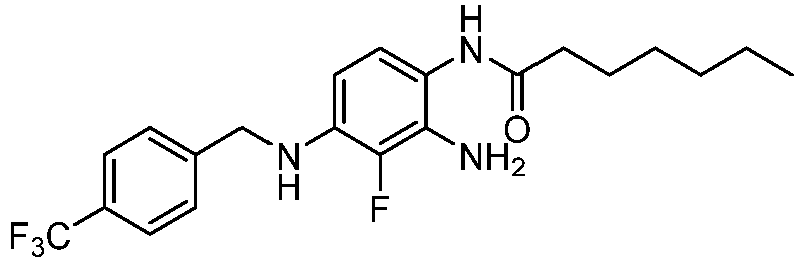
- Synthesized starting from 2,3-difluoro-6-nitroaniline, reacted with (4-(trifluoromethyl)phenyl)methanamine following the general procedure for the synthesis of compounds with general formula 13d. The obtained intermediate was reduced under continuous flow hydrogenation condition to give the corresponding 3-fluoro-N4-(4-(trifluoromethyl)benzyl)benzene-1,2,4-triamine that was lately reacted with heptanoyl choride to give the final compound. 1H NMR (DMSO-d6, 400 MHz): δ: 0.87 (t, 3H, CH 3, J=8.3 Hz); 1.24-1.31 (m, 6H, 3 CH 2); 1.53-1.57 (m, 2H, CH 2); 2.24 (t, 2H, CH 2, J=8.1 Hz); 4.39 (d, 2H, CH 2, J = 7.7 Hz); 4.57 (bs, 2H, NH2 ); 5.78 (t, 1H, aryl, J = 7.6 Hz); 6.03 (t, 1H, NH, J = 3.7 Hz); 6.58 (d, 1H, aryl, J = 8.4 Hz); 7.55 (d, 2H, aryl, J = 8.3 Hz); 7.66 (d, 2H, aryl, J = 8.4 Hz); 8.90 (s, 1H, CONH); HR-MS m/z: calcd for C21H26F4N3O, [(M+H)+]: 412,2007; found 412.2011.
-

- Synthesized starting from N1-(4-methoxybenzyl)-3-nitrobenzene-1,4-diamine, reacted with 4-(trifluoromethyl)benzyl bromide following general procedure for the synthesis of compounds with general formula 13b. After reduction of the nitro group, the corresponding amine was coupled with heptanoyl chloride. 1H NMR (DMSO-d6, 400 MHz): δ: 0.87 (t, 3H, CH 3, J=6.7 Hz); 1.20-1.31 (m, 6H, 3 CH 2); 1.53-1.57 (m, 2H, CH 2); 2.22 (t, 2H, CH 2, J=8.1 Hz); 4.22 (d, 2H, CH 2, J=7.8 Hz); 4.51 (bs, 2H NH 2); 5.84 (d, 1H, aryl, J= 8.4 Hz); 5.95-5.97 (m, 2H, aryl and NH); 6.70 (d, 1H, aryl, J= 8.2Hz); 7.30 (d, 2H, aryl, J= 11.6 Hz); 7.45 (d, 2H, aryl, J= 11.5 Hz); 8.80 (s, 1H, aryl, CONH); HR-MS m/z: calcd for C21H27F3N3O2, [(M+H)+]: 410,2050; found 410,2048.
-

- Synthesized starting from 4-nitrobenzene-1,3-diamine, reacted with 4-(trifluoromethyl)benzyl bromide following the general procedure for the synthesis of compounds with general formula 13b. The obtained intermediate was reduced under continuous flow hydrogenation condition to give the corresponding N4-(4-(trifluoromethyl)benzyl)benzene-1,2,4-triamine that was lately reacted with hexanesulfonyl chloride to give the final compound. 1H NMR (CD3OD, 400 MHz): δ: 1.23-1.37 (m, 3H, CH2 and CH); 2.21-2.24 (m, 2H, CH 2); 3.00 (t, 1H, CH, J=12.2 Hz); 5.13 (s, 2H, CH 2); 6.35 (d, 1H, aryl, J=8.1 Hz); 6.48 (s, 1H, aryl); 7.03 (d, 1H, aryl, J= 8.3 Hz); 7.62 (d, 2H, aryl J=8.2 Hz); 7.68 (d, 2H, aryl, J=8.3 Hz);. HR-MS m/z: calcd for C20H26F3N3O2S, [(M+H)+]: 429.1692; found 429.1701.
- The general procedure for the synthesis of compounds with general formula 17 or 18 is shown in Scheme 6.

- Intermediates with general formula 3 or 10 (1 eq), prepared as described in Examples 1 and 4 respectively, are dissolved in THF dry at a final concentration of 1 mM. Diisopropyl ethylamine (1.2 eq) is then added while the temperature is lowered to 0°C while stirring. To this solution is added dropwise a solution of bromoacetyl chloride or bromopropyl chloride or bromobutyl chloride in THF (1.2 eq, 1mM, 10 mL). The mixture is maintained at 0°C for 30 minutes to obtain an intermediate of formula 16, then it is warmed to ambient temperature and 20 equivalents of the proper glycol (ethylene glycol, diethylene glycol, triethylene glycol or tetraethyleneglycol) are added together with 2.0 equivalents of DBU. The mixture is stirred for further 12 h at ambient temperature, then is diluted with water and ethyl acetate. The organic phase is isolated, washed twice with a saturated solution of sodium bicarbonate and brine, and dryed over anhydrous sodium sulfate. After filtration, the resulting solution is evaporated in vacuo and purified by flash chromatography using dichloromethane/methanol as mobile phase to afford a compound of formula 17.
- Derivatives of formula 17 (1.0 eq) are dissolved in 20 mL of anhydrous dichloromethane and added with 2.0 equivalents of DBU and 2.0 equivalents of the proper alkyl iodide of formula CH3(CH2)nI, with n comprised between 0 and 10. The mixture is stirred at ambient temperature for 24h. Then the mixture is diluted with a saturated solution of sodium bicarbonate and further washed with brine. The organic phase is dried over anhydrous sodium sulfate, filtered and concentrated to dryness before purification by flash column chromatography using dichloromethane/methanol as mobile phases to obtain a compound of formula 18.
- The following products represent an example of the molecules obtained by the above described synthetic protocol for the synthesis of compounds of general formula 17 or 18:
-

- Synthesized starting from 1-(4-(trifluoromethyl)benzyl)-1H-indol-5-amine, reacted with chloroacetyl bromide following the general procedure for the synthesis of compounds with general formula 16. The obtained intermediate of formula 16 was further reacted with ethylene glycol to give 2-(2-hydroxyethoxy)-N-(1-(4-(trifluoromethyl)benzyl)-1H-indol-5-yl)acetamide. Nucleophilic displacement of methyl iodide gave the final compound. 1H NMR (CDCl3, 400 MHz): δ: 3.48 (s, 3H, CH3 ); 3.64-3.66 (m, 2H, CH 2); 3.79-3.81 (m, 2H, CH 2); 4.16 (s, 2H, CH 2); 6.57 (d, 1H, aryl, J=3.3 Hz); 7.14-7.19 (m, 4H, aryl); 7.30 (d, 1H, aryl, J= 8.4 Hz); 7.56 (d, 2H, aryl, J=8.8 Hz); 8.01 (d, 1H, aryl J=2.4 Hz); 8.86 (s, 1H, CONH);. HR-MS m/z: calcd for C21H22F3N2O3, [(M+H)+]: 407,1577; found 407,1581.
-

- Synthesized starting from 1-(4-(trifluoromethyl)benzyl)-1H-indol-5-amine, reacted with 3-chloropropionyl chloride following the general procedure for the synthesis of compounds with general formula 16. The obtained intermediate of formula 16 was further reacted with ethylene glycol to give 3-(2-hydroxyethoxy)-N-(1-(4-(trifluoromethyl)benzyl)-1H-indol-5-yl)propanamide. Nucleophilic displacement of methyl iodide gave the final compound. 1H NMR (CDCl3, 400 MHz): δ: 2.60 (t, 2H CH 2, J= 7.8 Hz); 3.32 (s, 3H, CH3 ); 3.42-3.54 (m, 2H, CH 2); 3.62-3.64 (m, 2H, CH 2); 3.76 (t, 2H, CH 2, J= 8.3 Hz); 5.27 (s, 2H, CH 2); 6.45 (d, 1H, aryl, J=3.4 Hz); 7.03-7.08 (m, 4H, aryl); 7.19 (d, 1H, aryl, J= 8.1 Hz); 7.45 (d, 2H, aryl, J=8.6 Hz); 7.85 (d, 1H, aryl J=2.1 Hz); 8.46 (s, 1H, CONH);. HR-MS m/z: calcd for C22H24F3N2O3, [(M+H)+]: 421,1734; found 421,1739.
- Channel subunits were expressed in Chinese Hamster Ovary (CHO) cells (ATCC, Catalogue Number CRL-9618) by transient transfection, using plasmids containing cDNAs encoding human Kv7.1, Kv7.2, Kv7.3, Kv7.4 and Kv7.2 W236L (a Kv7.2 mutant channel insensitive to retigabine as described in Results section) (Soldovieri et al. J Biol Chem. 2006;281(1):418-28; Iannotti et al. J Pharmacol Exp Ther. 2010;332(3):811-20; Landoulsi et al., Mol Pharmacol. 2013;84(5):763-73), all cloned in pcDNA3.1(+) vector (ThermoFisher Scientific, Catalog number: V79020). According to the experimental protocol, these plasmids were expressed individually or in combination (in particular of Kv7.2 and Kv7.3), together with a plasmid-expressing enhanced green fluorescent protein (Clontech, Palo Alto, CA) used as a transfection marker. Total cDNA in the transfection mixture was kept at 4 µg. CHO cells were grown in 100-mm plastic Petri dishes in Dulbecco's modified Eagle's medium containing 10% fetal bovine serum, nonessential amino acids (0.1 mM), penicillin (50 U/ml), and streptomycin (50 mg/ml) in a humidified atmosphere at 37°C with 5% CO2. The cells were plated on glass coverslips coated with poly-L-lysine, and transfected one day after plating with the appropriate cDNA using Lipofectamine 2000 (Life Technologies), according to the manufacturer's protocol.
- Currents from CHO cells were recorded at room temperature (20-22°C) 24 hours after trasfection using the whole-cell configuration of the patch-clamp technique, with glass micropipettes of 3-5 MΩ resistance. During the recording, constant perfusion of extracellular solution was maintained. The extracellular solution contained (in mM): 138 NaCl, 2 CaCl2, 5.4 KCl, 1 MgCl2, 10 glucose, and 10 HEPES, at pH 7.4, adjusted with NaOH. The pipette (intracellular) solution contained (in mM): 140 KCl, 2 MgCl2, 10 EGTA, 10 HEPES, 5 Mg2+-ATP, at pH 7.3-7.4, adjusted with KOH. Currents were recorded using an Axopatch-200A amplifier, filtered at 5 kHz, and digitized using a DigiData 1440A (Molecular Devices). The pCLAMP software (version 10.2, Molecular Devices) was used for data acquisition and analysis. To evaluate the activity of exemplary compounds on Kv7.2 (see Table 1), as well as on Kv7.1, Kv7.2/7.3, Kv7.3 and Kv7.4 channels for selected compounds (see Table 2), the cells were clamped at -80 mV and currents were elicited by 3-s voltage ramps from -80 mV to +20 mV in the presence and absence of each compound. To calculate the EC50, cells were perfused with increased concentration of the compund (0.01, 0.1, 1, 10 µM) until saturation was achieved. The effects of drugs were expressed as shift in the ramp-voltage (ΔV) calculated at 20% of the maximal current (Miceli et al, Proc Natl Acad Sci U S A. 2013, 110(11):4386-91). Curves were fitted using the following equation: y=max/(1+x/EC50)n, where x is the drug concentration, n is the Hill coefficient and max is the maximal value achieved, as previously described (Ambrosino et al, Br J Pharmacol. 2013, 168(6):1430-1444). Data analysis and fit were performed using Sigmaplot (version 12.3).
- Ramp-evoked Kv7.2 currents were analyzed by measuring the currents at -40 mV (a membrane potential value close to the activation threshold) and at 0 mV (a membrane potential value at which Kv7.2 conductance is largely saturated). In particular, -40 mV represents the threshold potential for spike initiation and 0 mV represents instead the membrane potential value at which maximal conductance of the channel is achieved. Using the measurements at -40 and 0 mV, the inventors have approximated drug effects at membrane potential values achieved by the neurons during low and high frequency firing activity, respectively. Results are reported as average values ± standard error from the mean (N±SEM).
- In Table 1, the effect of exemplary compounds of the invention is expressed as the ratio between current amplitude in the presence (Idrug) and absence (Ictl) of the drug at these two membrane voltages. Idrug/Ictl>1 represents activating activity; Idrug/Ictl<1 represents inhibiting activity; Idrug/Ictl=1 indicates no effect of the drug on this parameter.
Table 1. Effect of exemplary compounds on Kv7.2 in comparison with retigabine COMPOUND STRUCTURE COMPOUND NAME Idrug /Ictl at -40 mV Idrug /Ictl at 0 mV N 
Retigabine 6.20±1.03 1.95±0.12 38 
1-(1-(4-fluorobenzyl)indolin-5-yl)-3-neopentylurea 3.31±0.61 1.40±0.08 6 
N-(1-(4-fluorobenzyl)indolin-5-yl)cyclohexanesulfonamide 6.41±0.93 2.81±0.26 9 
N-(1-(4-fluorobenzyl)indolin-5-yl)cyclohexanecarboxamide 1.32±0.21 0.66±0.07 3 
(1S,2R,5S)-2-isopropyl-5-methylcyclohexyl (1-(4-fluorobenzyl)indolin-5-yl)carbamate 0.80±0.14 0.48±0.07 5 
N-(1-(4-fluorobenzyl)indolin-5-yl)benzenesulfonamide 1.15±0.28 0.64±0.14 3 
N-(1-(4-fluorobenzyl)indolin-5-yl)butane-1-sulfonamide 2.03±0.19 1.55±0.12 3 
N-(1-(4-fluorobenzyl)indolin-5-yl)acetamide 1.88±0.14 1.64±0.20 5 
ethyl (1-(4-fluorobenzyl)indolin-5-yl)carbamate 2.01±0.58 1.26±0.13 6 
N-(1-(4-fluorobenzyl)indolin-5-yl)-2-methylpropane-1-sulfonamide 2.55±0.79 1.93±0.32 5 
N-(1-(4-fluorobenzyl)indolin-5-yl)hexane-1-sulfonamide 2.48±0.20 2.18±0.09 3 
1-cyclohexyl-3-(1-(4-fluorobenzyl)indolin-5-yl)urea 0.95±0.16 0.85±0.12 3 
1-(1-(4-fluorobenzyl)indolin-5-yl)-3-neopentylthiourea 1.77±0.77 1.04±0.24 3 
1-(1-(4-fluorobenzyl)indolin-5-yl)-3-neopentylguanidine 0.98±0.09 0.84±0.09 3 
N-(1-(4-fluorobenzyl)indolin-5-yl)-4-methylpiperazine-1-sulfonamide 1.25±0.19 0.95±0.07 4 
1-((1S,4R)-7,7-dimethyl-2-oxobicyclo[2.2.1]heptan-1-yl)-N-(1-(4-fluorobenzyl)indolin-5-yl)methanesulfonamide 1.12±0.05 0.99±0.06 3 
1-((1R,4S)-7,7-dimethyl-2-oxobicyclo[2.2.1]heptan-1-yl)-N-(1-(4-fluorobenzyl)indolin-5-yl)methanesulfonamide 1.49±0.28 1.16±0.07 5 
N-(1-(4-fluorobenzyl)indolin-5-yl)azepane-1-sulfonamide 0.89±0.12 0.98±0.11 5 
2-cyclohexyl-N-(1-(4-fluorobenzyl)indolin-5-yl)acetamide 2.37±0.40 1.71±0.12 4 
N-(1-(4-fluorobenzyl)indolin-5-yl)-3,5-dimethylpiperidine-1-sulfonamide 1.91±0.44 1.87±0.22 3 
N-(1-(4-fluorobenzyl)-1H-indol-5-yl)cyclohexanesulfonamide 4.71±1.31 2.76±0.19 4 
N-(1-(2,4-difluorobenzyl)indolin-5-yl)cyclohexanesulfonamide 5.82±1.38 3.79±1.09 3 
N-(1-(4-fluorobenzoyl)indolin-5-yl)cyclohexanesulfonamide 1.85±0.30 1.22±0.07 3 
N-(1-(3,4-difluorobenzyl)indolin-5-yl)cyclohexanesulfonamide 4.56±1.11 2.11±0.18 4 
N-(1-(4-(trifluoromethyl)benzyl)ind olin-5-yl)cyclohexanesulfonamide 3.2±0.20 2.37±0.58 4 
N-(1-(4-methoxybenzyl)indolin-5-yl)cyclohexanesulfonamide 6.43±1.51 4.24±0.83 3 
N-(1-(2-(4-chlorophenyl)acetyl)indolin-5-yl)cyclohexanesulfonamide 1.45±0.08 1.18±0.08 3 
N-(1-(2,4-bis(trifluoromethyl)benzyl)i ndolin-5-yl)cyclohexanesulfonamide 1.53±0.39 1.22±0.11 5 
N-(1-(4-bromo-2-nitrobenzyl)indolin-5-yl)cyclohexanesulfonamide 7.27±1.32 3.09±0.52 4 
N-(1-(4-(trifluoromethyl)benzyl)-1H-indol-5-yl)cyclohexanesulfonamide 2.27±0.49 1.93±0.19 3 
N-(1-(4-(trifluoromethyl)benzyl)-1H-indol-5-yl)heptanamide 9.34±0.82 3.24±0.18 7 
N-(1-(4-methoxybenzyl)-1H-indol-5-yl)cyclohexanesulfonamide 2.00±0.36 1.63±0.06 3 
N-(1-(4-fluorophenethyl)indolin-5-yl)cyclohexanesulfonamide 3.24±1.52 1.37±0.17 4 
N-(1-(4-methoxybenzyl)-2-methylindolin-5-yl)cyclohexanesulfonamide 1.13±0.15 0.92±0.13 3 
N-(3-fluoro-4-((4-fluorobenzyl)amino)phenyl) heptanamide 8.85±1.17 3.30±0.40 3 
N-(2-amino-4-((4-(trifluoromethyl)benzyl)ami no)phenyl)heptanamide 16.90±3.33 2.55±0.56 5 
2-(2-methoxyethoxy)-N-(1-(4-(trifluoromethyl)benzyl)-1H-indol-5-yl)acetamide 1.50±0.16 0.86±0.01 4 
3-(2-methoxyethoxy)-N-(1-(4-(trifluoromethyl)benzyl)-1H-indol-5-yl)propanamide 2.64±0.77 1.34±0.10 4 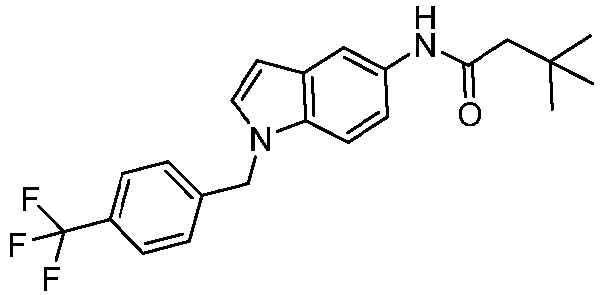
3,3-dimethyl-N-(1-(4-(trifluoromethyl)benzyl)-1H-indol-5-yl)butanamide 8.23±1.36 3.54±0.88 3 
N-(2-amino-3-fluoro-4-((4-(trifluoromethyl)benzyl)ami no)phenyl)heptanamide 5.76±1.28 1.94±0.12 3 
N-(2-amino-4-((4-(trifluoromethoxy)benzyl)a mino)phenyl)heptanamide 12.4±2.05 2.05±0.56 3 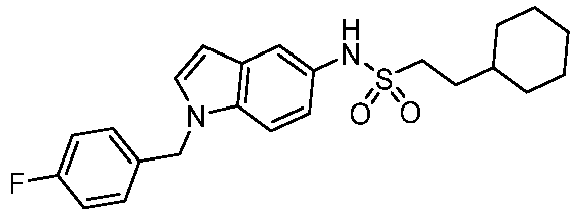
2-cyclohexyl-N-(1-(4-fluorobenzyl)-1H-indol-5-yl)ethane-1-sulfonamide 1.64±0.10 1.18±0.09 3 
N-(2-amino-4-((4-(trifluoromethyl)benzyl)ami no)phenyl)cyclohexanesulfo namide 1.5±0.2 0.19±0.1 3 
N-(3-fluoro-4-((4-fluorobenzyl)amino)phenyl) cyclohexanesulfonamide 0.78±0.15 0.83±0.10 5 - As evidenced in Table 1, indole, indoline and aryl-1-4diamine are all suitable scaffolds for the design of Kv7.2 channel modulators. The activity of the derivatives is modulated in particular by the substituents present in position N1 of the indole/indoline core, as well in position N4 of the aryldiamino core. It was also found that the activity of the tested compounds is influenced by the substitution in position N5 of the indole/indoline core and N1 of the aryldiamine core, as well by the nature of the bond between these substituents and the nitrogen itself (i.e. substituent Q). Sulfonamide and amide derivatives act, preferentially, as agonists of Kv7.2 channel, depending also on the nature of the side chain. Flexible and highly lipophilic side chains (as for N-(2-amino-4-((4-(trifluoromethoxy)benzyl)amino)phenyl)heptanamide, N-(2-amino-4-((4-(trifluoromethyl)benzyl)amino)phenyl)heptanamide, N-(1-(4-fluorobenzyl)indolin-5-yl)cyclohexanesulfonamide and 3,3-dimethyl-N-(1-(4-(trifluoromethyl)benzyl)-1H-indol-5-yl)butanamide) tend to enhance the agonistic activity. Contrariwise, the use of rigid substituents is able to reduce currents, leading some of the tested molecules to behave as antagonist, as for example N-(1-(4-fluorobenzyl)indolin-5-yl)benzenesulfonamide, N-(1-(4-fluorobenzyl)indolin-5-yl)azepane-1-sulfonamide. The use of more rigid Q substituents such as urea (as for 1-cyclohexyl-3-(1-(4-fluorobenzyl)indolin-5-yl)urea) and guanidine (as for 1-(1-(4-fluorobenzyl)indolin-5-yl)-3-neopentylguanidine) tends to switch the activity to antagonism, as well.
- The EC50 of retigabine and of a compound of the invention [N-(1-(4-(trifluoromethyl)benzyl)-1H-indol-5-yl)heptanamide] for Kv.7.1, Kv7.2, Kv7.2/3, Kv7.3 and Kv7.4 currents was calculated (Table 2). For another compound of the invention (N-(2-amino-4-((4-(trifluoromethyl)benzyl)amino)phenyl)heptanamide), the EC50 for Kv 7.1 and Kv7.2/7.3 was calculated (Table 2).
Table 2. EC50 values of retigabine, N-(1-(4-(trifluoromethyl)benzyl)-1H-indol-5-yl)heptanamide and N-(2-amino-4-((4-(trifluoromethyl)benzyl)amino)phenyl)heptanamide on different subtype of Kv7 channels EC50 (µM) RETIGABINE N-(1-(4-(trifluoromethyl)benzyl)-1H-indol-5-yl)heptanamide N-(2-amino-4-((4-(trifluoromethyl)benzyl) amino)phenyl)heptana mide Kv7.1 Inactive Inactive Inactive Kv7.2 0.93±0.43 0.08±0.04 Kv7.2/7.3 1.72±0.41 0.21±0.14 0.20±0.10 Kv7.3 3.9±1.7 10.5±6 Kv7.4 1.98±0.84 0.10±0.02 - The data shown in Table 2 suggest that the two novel compounds N-(1-(4-(trifluoromethyl)benzyl)-1H-indol-5-yl)heptanamide and N-(2-amino-4-((4-(trifluoromethyl)benzyl)amino)phenyl)heptanamide are eight times more potent than retigabine with respect to their ability to increase Kv7.2/3 currents. The data also suggest that the potency of N-(1-(4-(trifluoromethyl)benzyl)-1H-indol-5-yl)heptanamide is about 130-fold higher in activating Kv7.2 when compared to Kv7.3 homomers; by contrast, retigabine potency at Kv7.2 channels is only 4 times higher than that at Kv7.3 channels; the EC50 of N-(1-(4-(trifluoromethyl)benzyl)-1H-indol-5-yl)heptanamide for Kv7.2 channels is similar to that for Kv7.4 channels. Due to their higher potency on Kv7.2/3 current, N-(1-(4-(trifluoromethyl)benzyl)-1H-indol-5-yl)heptanamide and N-(2-amino-4-((4-(trifluoromethyl)benzyl)amino)phenyl)heptanamide are expected to exert their desired pharmacodynamic effects at lower concentrations than retigabine.
- Additionally, similar to retigabine, N-(1-(4-(trifluoromethyl)benzyl)-1H-indol-5-yl)heptanamide does not potentiate the currents carried by cardiac Kv7.1 channels, thus avoiding detrimental cardiovascular side effects. As a matter of fact, retigabine is selectively active on specific Kv7 channel subtypes, due to its ability to interact with specific channel residues; in particular, a major component of the retigabine binding site seems to be provided by a tryptophane residue at position 236 (W236) along the primary sequence of Kv7.2 subunit. The substitution of this residue with a leucine (the naturally-occurring residue in retigabine-insensitive Kv7.1 channels; W236L substitution) largely hampers the ability of retigabine to act as a Kv7.2 channel modulator (Wuttke et al., Mol. Pharmacol., 2005, 67(4), 1009-1017). Table 2 shows that the same W236L substitution also removes the activity of N-(1-(4-(trifluoromethyl)benzyl)-1H-indol-5-yl)heptanamide, one of the most effective compound herein described as Kv7.2 modulators.
- In particular, application of 10 µM retigabine or 10 µM N-(1-(4-(trifluoromethyl)benzyl)-1H-indol-5-yl)heptanamide in cells expressing Kv7.2 W236L mutant channels, failed to affect current amplitude; indeed, the ratio between current amplitude in the presence and absence of the drug at -40 mV was 1.2±0.1 and 1.3±0.3 for retigabine and N-(1-(4-(trifluoromethyl)benzyl)-1H-indol-5-yl)heptanamide, respectively (see in vitro pharmacological assays). These results suggest that this compound displays a similar mode of action to retigabine.
- In order to study the solution stability and photostability of the potassium channel modulators object of the present invention, a stock solution of the proper analyte (1 mg/mL) in dimethylsulfoxide (DMSO) has been prepared. This solution has been then diluted to a concentration of 100 ppm using extracellular solution containing (in mM): 138 NaCl, 2 CaCl2, 5.4 KCl, 1 MgCl2, 10 glucose, and 10 HEPES, at pH 7.4, adjusted with NaOH. To measure solution stability, the diluted solutions have been maintained at ambient temperature for 6 h. To measure photostability, the diluted solutions have been irradiated for 6 h using a Oriel Sol3A Solar Simulator (Newport corporation, Irvine, CA, USA) with a 12x12 inches output beam. Aliquots of solution have been withdrawn after 6h and analyzed by HPLC using a Kinetex C18, 150 mm × 4.6 mm × 2.6 µm (Phenomenex, Bologna, Italy) as stationary phase and a mobile phase constituted by A: H2O/CH3CN (80:20) and B: CH3CN. Gradient elution has been performed from 20% to 90% of B in 7.50 minutes and from 90% to 20% of B in 1 minute. The pump flux has been set to 1.5 mL/min. Column has been thermostatted at 40°C during analysis. Results are espressed in Table 3 as percentage of degradation of the product calculated as ratio between the peak area of the analyte at time 0 (Pa0) and after 6h (Pa6) using the following formula:

-
Table 3: Stability in solution and photostability of exemplary compounds object of the present invention in comparison with retigabine Compound structure Compound name Solution stability Photostability 
Retigabine A C 
1-(1-(4-fluorobenzyl)indolin-5-yl)-3-neopentylurea A A 
N-(1-(4-fluorobenzyl)indolin-5-yl)cyclohexanesulfonamide C C 
N-(1-(4-fluorobenzyl)indolin-5-yl)cyclohexanecarboxamide A B 
(1S,2R,5S)-2-isopropyl-5-methylcyclohexyl (1-(4-fluorobenzyl)indolin-5-yl)carbamate A B 
N-(1-(4-fluorobenzyl)indolin-5-yl)benzenesulfonamide A B 
N-(1-(4-fluorobenzyl)indolin-5-yl)butane-1-sulfonamide C C 
N-(1-(4-fluorobenzyl)indolin-5-yl)acetamide A A 
ethyl (1-(4-fluorobenzyl)indolin-5-yl)carbamate A C 
N-(1-(4-fluorobenzyl)indolin-5-yl)-2-methylpropane-1-sulfonamide C C 
N-(1-(4-fluorobenzyl)indolin-5-yl)hexane-1-sulfonamide B C 
1-cyclohexyl-3-(1-(4-fluorobenzyl)indolin-5-yl)urea A B 
1-(1-(4-fluorobenzyl)indolin-5-yl)-3-neopentylthiourea A B 
1-(1-(4-fluorobenzyl)indolin-5-yl)-3-neopentylguanidine A B 
N-(1-(4-fluorobenzyl)indolin-5-yl)-4-methylpiperazine-1-sulfonamide B B 
1-((1S,4R)-7,7-dimethyl-2-oxobicyclo[2.2.1]heptan-1-yl)-N-(1-(4-fluorobenzyl)indolin-5-yl)methanesulfonamide C C 
1-((1R,4S)-7,7-dimethyl-2-oxobicyclo[2.2.1]heptan-1-yl)-N-(1-(4-fluorobenzyl)indolin-5-yl)methanesulfonamide C C 
N-(1-(4-fluorobenzyl)indolin-5-yl)azepane-1-sulfonamide B B 
2-cyclohexyl-N-(1-(4-fluorobenzyl)indolin-5-yl)acetamide A A 
N-(1-(4-fluorobenzyl)indolin-5-yl)-3,5-dimethylpiperidine-1-sulfonamide B B 
N-(1-(4-fluorobenzyl)-1H-indol-5-yl)cyclohexanesulfonamide A A 
N-(1-(2,4-difluorobenzyl)indolin-5-yl)cyclohexanesulfonamide C C 
N-(1-(4-fluorobenzoyl)indolin-5-yl)cyclohexanesulfonamide A B 
N-(1-(3,4-difluorobenzyl)indolin-5-yl)cyclohexanesulfonamide C C 
N-(1-(4-(trifluoromethyl)benzyl)indolin-5-yl)cyclohexanesulfonamide C C 
N-(1-(4-methoxybenzyl)indolin-5-yl)cyclohexanesulfonamide C C 
N-(1-(2-(4-chlorophenyl)acetyl)indolin-5-yl)cyclohexanesulfonamide A B 
N-(1-(2,4-bis(trifluoromethyl)benzyl)indolin-5-yl)cyclohexanesulfonamide B C 
N-(1-(4-bromo-2-nitrobenzyl)indolin-5-yl)cyclohexanesulfonamide B C 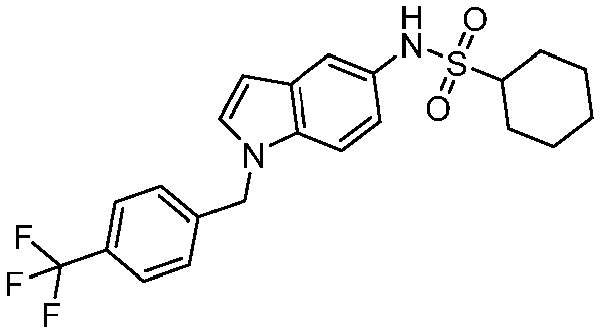
N-(1-(4-(trifluoromethyl)benzyl)-1H-indol-5-yl)cyclohexanesulfonamide A A 
N-(1-(4-(trifluoromethyl)benzyl)-1H-indol-5-yl)heptanamide A A 
N-(1-(4-methoxybenzyl)-1H-indol-5-yl)cyclohexanesulfonamide A A 
N-(1-(4-fluorophenethyl)indolin-5-yl)cyclohexanesulfonamide C C 
N-(1-(4-methoxybenzyl)-2-methylindolin-5-yl)cyclohexanesulfonamide B C 
N-(3-fluoro-4-((4-fluorobenzyl)amino)phenyl)heptana mide A A 
N-(2-amino-4-((4-(trifluoromethyl)benzyl)amino)phen yl)heptanamide A B 
2-(2-methoxyethoxy)-N-(1-(4-(trifluoromethyl)benzyl)-1H-indol-5-yl)acetamide A A 
3-(2-methoxyethoxy)-N-(1-(4-(trifluoromethyl)benzyl)-1H-indol-5-yl)propanamide A A 
3,3-dimethyl-N-(1-(4-(trifluoromethyl)benzyl)-1H-indol-5-yl)butanamide A A 
N-(2-amino-3-fluoro-4-((4-(trifluoromethyl)benzyl)amino)phen yl)heptanamide A A 
N-(2-amino-4-((4-(trifluoromethoxy)benzyl)amino)ph enyl)heptanamide A B 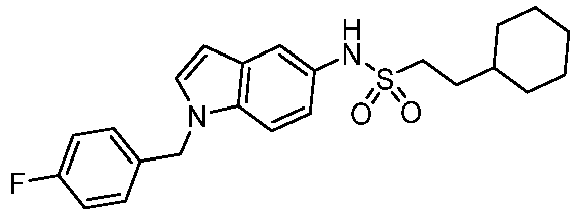
2-cyclohexyl-N-(1-(4-fluorobenzyl)-1H-indol-5-yl)ethane-1-sulfonamide A A 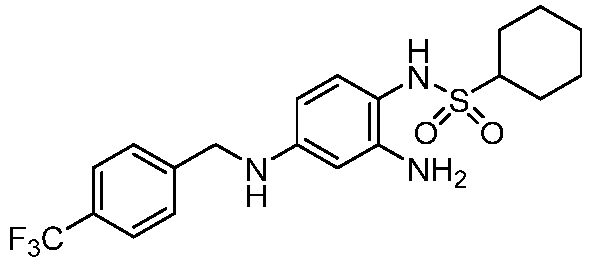
N-(2-amino-4-((4-(trifluoromethyl)benzyl)amino)phen yl)cyclohexanesulfonamide C C 
N-(7-fluoro-1-(4-(trifluoromethyl)benzyl)indolin-5-yl) cyclohexanesulfonamide B B 
N-(4,6-dimethyl-1-(4-(trifluoromethyl)benzyl)indolin-5-yl)cyclohexanesulfonamide A B 
1-cyclohexyl-N-(1-(4-fluorobenzyl)-1H-indol-5-yl)methanesulfonamide A A 
N-(7-fluoro-1-(4-(trifluoromethyl)benzyl)-1H-indol-5-yl) cyclohexanesulfonamide A A 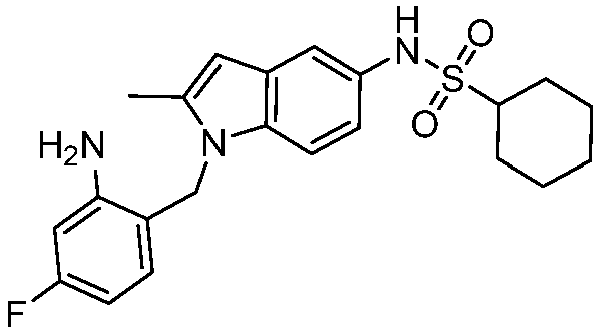
N-(1-(2-amino-4-fluorobenzyl)-2-methyl-1H-indol-5-yl)cyclohexanesulfonamide A B 
N-(1-(2-(4-chlorophenyl)acetyl)-1H-indol-5-yl) cyclohexanesulfonamide A A 
N-(1-(2-(4-bromophenyl)-2-oxoethyl)-1H-indol-5-yl)-1-cyclohexylmethanesulfonamide A B 
N-(1-(2-hydroxy-4-(trifluoromethyl)benzyl)-1H-indol-5-yl)cyclohexanesulfonamide A A 
N-(4-methyl-1-(4-(trifluoromethyl)benzyl)-1H-indol-5-yl)cyclohexanesulfonamide A B 
N-(3-ethyl-1-(4-(trifluoromethyl)benzyl)-1H-indol-5-yl) cyclohexanesulfonamide A A 
N-(4-((4-methoxybenzyl)amino)phenyl) cyclohexanesulfonamide B C 
N-(4-((4-methoxybenzyl)(methyl)amino)phen yl) cyclohexanesulfonamide B B 
(R)-N-(4-((1-(4-methoxyphenyl)ethyl)amino)phenyl ) cyclohexanesulfonamide B C 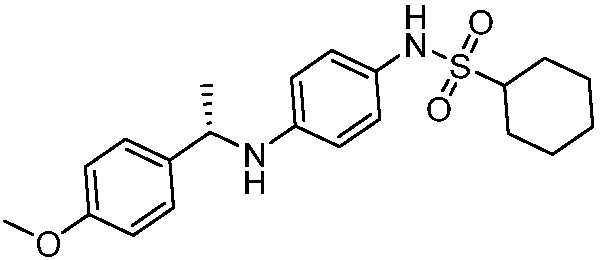
(S)-N-(4-((1-(4-methoxyphenyl)ethyl)amino)phenyl ) cyclohexanesulfonamide B C 
3-ethyl-N-(4-((4-methoxybenzyl)amino)phenyl)benze nesulfonamide B C A: degradation lower than 20%; B: 20%< degradation<40%; C: degradation > 40% - The data in Table 3 show that retigabine is chemically unstable when exposed to visible light; indeed, after 6 hours of exposure to light, more that 40% of the drug is degraded. By contrast, most of the indole, indoline and aryl-1-4diamine derivatives of the invention were degraded by less than 20% after light exposure for the same exposure time. In particular, the two compounds N-(1-(4-(trifluoromethyl)benzyl)-1H-indol-5-yl)heptanamide and N-(2-amino-4-((4-(trifluoromethyl)benzyl)amino)phenyl)heptanamide, in addition to being more potent than retigabine on Kv7.2/3 currents, are also chemically more stable than retigabine. The improved chemical stability shown by the compounds of the invention with respect to retigabine may translate, in vivo, in a lower tendency of these molecules to accumulate as blue-colored precipitates in the skin, mucasae, and in the retina of subjects taking these drugs.
Claims (11)
- A compound of general formula I:
 or a tautomer, salt, solvate, stereoisomer or isotope thereof,wherein:Y is selected from: C1-C10 alkylamino, C1-C10 alkyl, C1-C10 alkoxyR2 is an aromatic ring optionally bearing in one or more positions at least one substituent independently selected from the group consisting of: OH, NO2, halogen, NH2, C1-C3 haloalkyl, C1-C3 haloalkoxy, C1-C6 alkylcarbonyl, acetamidyl, C1-C6 alkyloxy;R1, R3, R4 and R5 are each independently selected from the group consisting of: H, NH2, OH, halogen, C1-C6 alkyl, C3-C6 cycloalkyl, C1-C6 alkylcarbonyl, C1-C6 alkoxycarbonyl, C1-C6 alkylamino, C2-C6 dialkylamino, C1-C6 alkylaminocarbonyl, C1-C6 alkyloxy, C1-C6 alkylthio, C2-C8 alkenyl, C5-C7 cycloalkenyl, heterocycle, C2-C8 alkynyl and C5-C10 aryl, any of which being optionally substituted by one or more substituents independently selected from: hydroxyl, amine, thiol, carboxyl, carboxylic acid, and halogen;Q is selected from the group consisting of: C=O, SO2;wherein:when Q is C=O R6 is selected from: linear or branched C3-C30 alkyl, linear or branched C5-C30 arylalkyl, C3-C8 cycloalkyl, linear or branched C2-C4 alkyl substituted by C3-C8 cycloalkyl, C2-C30 alkenyl, C2-C30 alkynyl and any of which being optionally substituted with one or more substituents independently selected from: halogen and cycloalkyl; andwhen Q is SO2, R6 is C3-C8 cycloalkyl or aryl and is optionally substituted with one or more C1-C6 alkyl.
 - The compound according to claim 1 being selected from:
COMPOUND STRUCTURE COMPOUND NAME 1. 
N-(2-(piperidin-1-yl)-4-((4-(trifluoromethyl)benzyl)amino)p henyl)heptanamide 2. 
N-(2-(piperidin-1-yl)-4-((4-(trifluoromethyl)benzyl)amino)p henyl)heptanamide 3. 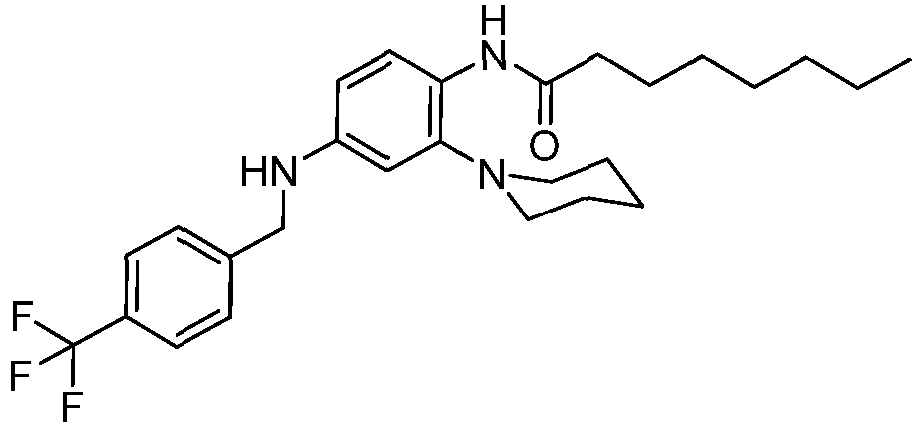
N-(2-(piperidin-1-yl)-4-((4-(trifluoromethyl)benzyl)amino)p henyl)octanamide 4. 
2,3-difluoro-N-(2-(piperidin-1-yl)-4-((4-(trifluoromethyl)benzyl)amino)p henyl)octanamide (2R,3 S)-2,3-difluoro-N-(2-(piperidin-1-yl)-4-((4-(trifluoromethyl)benzyl)amino)p henyl)octanamide (2S,3R)-2,3-difluoro-N-(2-(piperidin-1-yl)-4-((4-(trifluoromethyl)benzyl)amino)p henyl)octanamide (2R,3R)-2,3-difluoro-N-(2-(piperidin-1-yl)-4-((4-(trifluoromethyl)benzyl)amino)p henyl)octanamide (2S,3 S)-2,3-difluoro-N-(2-(piperidin-1-yl)-4-((4-(trifluoromethyl)benzyl)amino)p henyl)octanamide 5. 
7,8-difluoro-N-(2-(piperidin-1-yl)-4-((4-(trifluoromethyl)benzyl)amino)p henyl)octanamide (7R)-7,8-difluoro-N-(2-(piperidin-1-yl)-4-((4-(trifluoromethyl)benzyl)amino)p henyl)octanamide (7S)-7,8-difluoro-N-(2-(piperidin-1-yl)-4-((4-(trifluoromethyl)benzyl)amino)p henyl)octanamide 6. 
2,3-difluoro-N-(2-(piperidin-1-yl)-4-((4-(trifluoromethyl)benzyl)amino)p henyl)heptanamide (2R,3 S)-2,3-difluoro-N-(2-(piperidin-1-yl)-4-((4-(trifluoromethyl)benzyl)amino)p henyl)heptanamide (2S,3R)-2,3-difluoro-N-(2-(piperidin-1-yl)-4-((4-(trifluoromethyl)benzyl)amino)p henyl)heptanamide (2R,3R)-2,3-difluoro-N-(2-(piperidin-1-yl)-4-((4-(trifluoromethyl)benzyl)amino)p henyl)heptanamide (2S,3S)-2,3-difluoro-N-(2-(piperidin-1-yl)-4-((4-(trifluoromethyl)benzyl)amino)p henyl)heptanamide 7. 
6,7-difluoro-N-(2-(piperidin-1-yl)-4-((4-(trifluoromethyl)benzyl)amino)p henyl)heptanamide (6R)-6,7-difluoro-N-(2-(piperidin-1-yl)-4-((4-(trifluoromethyl)benzyl)amino)p henyl)heptanamide (6S)-6,7-difluoro-N-(2-(piperidin-1-yl)-4-((4-(trifluoromethyl)benzyl)amino)p henyl)heptanamide 8. 
3,3-dimethyl-N-(2-(piperidin-1-yl)-4-((4-(trifluoromethyl)benzyl)amino)p henyl)butanamide 9. 
3,3-dimethyl-N-(2-(pyrrolidin-1-yl)-4-((4-(trifluoromethyl)benzyl)amino)p henyl)butanamide 10. 
N-(2-(pyrrolidin-1-yl)-4-((4-(trifluoromethyl)benzyl)amino)p henyl)heptanamide 11. 
(2R,3 S)-2,3-difluoro-N-(2-(pyrrolidin-1-yl)-4-((4-(trifluoromethyl)benzyl)amino)p henyl)heptanamide (2S,3R)- 2,3-difluoro-N-(2-(pyrrolidin-1-yl)-4-((4-(trifluoromethyl)benzyl)amino)p henyl)heptanamide (2R,3R)- 2,3-difluoro-N-(2-(pyrrolidin-1-yl)-4-((4-(trifluoromethyl)benzyl)amino)p henyl)heptanamide (2S,3S)- 2,3-difluoro-N-(2-(pyrrolidin-1-yl)-4-((4-(trifluoromethyl)benzyl)amino)p henyl)heptanamide 12. 
6,7-difluoro-N-(2-(pyrrolidin-1-yl)-4-((4-(trifluoromethyl)benzyl)amino)p henyl)heptanamide (6R)-6,7-difluoro-N-(2-(pyrrolidin-1-yl)-4-((4-(trifluoromethyl)benzyl)amino)p henyl)heptanamide (6S)-6,7-difluoro-N-(2-(pyrrolidin-1-yl)-4-((4-(trifluoromethyl)benzyl)amino)p henyl)heptanamide 13. 
N-(2-(pyrrolidin-1-yl)-4-((4-(trifluoromethyl)benzyl)amino)p henyl)octanamide 14. 
2,3-difluoro-N-(2-(pyrrolidin-1-yl)-4-((4-(trifluoromethyl)benzyl)amino)p henyl)octanamide (2R,3 S)-2,3-difluoro-N-(2-(pyrrolidin-1-yl)-4-((4-(trifluoromethyl)benzyl)amino)p henyl)octanamide (2S,3R)-2,3-difluoro-N-(2-(pyrrolidin-1-yl)-4-((4-(trifluoromethyl)benzyl)amino)p henyl)octanamide (2R,3R)-2,3-difluoro-N-(2-(pyrrolidin-1-yl)-4-((4-(trifluoromethyl)benzyl)amino)p henyl)octanamide (2S,3S)-2,3-difluoro-N-(2-(pyrrolidin-1-yl)-4-((4-(trifluoromethyl)benzyl)amino)p henyl)octanamide 15. 
7,8-difluoro-N-(2-(pyrrolidin-1-yl)-4-((4-(trifluoromethyl)benzyl)amino)p henyl)octanamide (7R)-7,8-difluoro-N-(2-(pyrrolidin-1-yl)-4-((4-(trifluoromethyl)benzyl)amino)p henyl)octanamide (7S)-7,8-difluoro-N-(2-(pyrrolidin-1-yl)-4-((4-(trifluoromethyl)benzyl)amino)p henyl)octanamide 16. 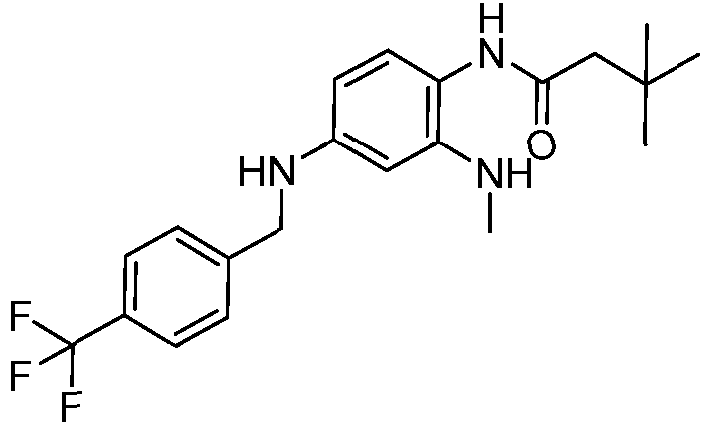
3,3-dimethyl-N-(2-(methylamino)-4-((4-(trifluoromethyl)benzyl)amino)p henyl)butanamide 17. 
N-(2-(methylamino)-4-((4-(trifluoromethyl)benzyl)amino)p henyl)heptanamide 18. 
2,3-difluoro-N-(2-(methylamino)-4-((4-(trifluoromethyl)benzyl)amino)p henyl)heptanamide (2R, 3S)-2,3-difluoro-N-(2-(methylamino)-4-((4-(trifluoromethyl)benzyl)amino)p henyl)heptanamide (2S, 3R)-2,3-difluoro-N-(2-(methylamino)-4-((4-(trifluoromethyl)benzyl)amino)p henyl)heptanamide (2R, 3R)-2,3-difluoro-N-(2-(methylamino)-4-((4-(trifluoromethyl)benzyl)amino)p henyl)heptanamide (2S, 3S)-2,3-difluoro-N-(2-(methylamino)-4-((4-(trifluoromethyl)benzyl)amino)p henyl)heptanamide 19. 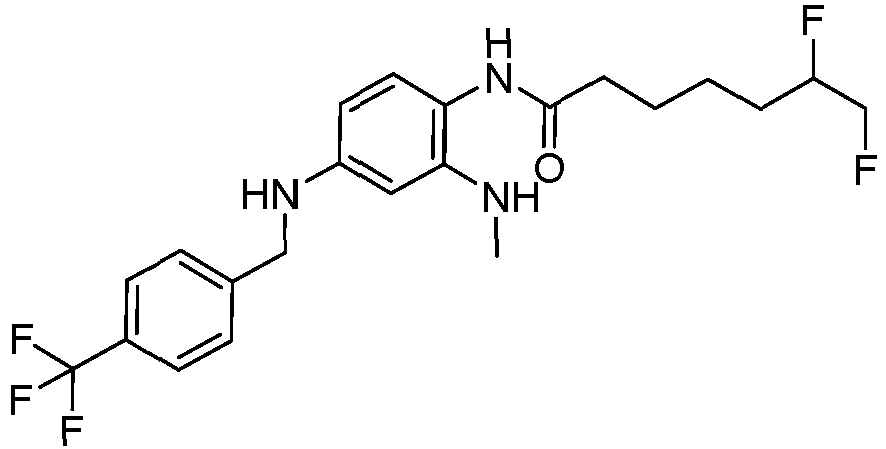
6,7-difluoro-N-(2-(methylamino)-4-((4-(trifluoromethyl)benzyl)amino)p henyl)heptanamide (6R)-6,7-difluoro-N-(2-(methylamino)-4-((4-(trifluoromethyl)benzyl)amino)p henyl)heptanamide (6S)-6,7-difluoro-N-(2-(methylamino)-4-((4-(trifluoromethyl)benzyl)amino)p henyl)heptanamide 20. 
N-(2-(methylamino)-4-((4-(trifluoromethyl)benzyl)amino)p henyl)octanamide 21. 
2,3-difluoro-N-(2-(methylamino)-4-((4-(trifluoromethyl)benzyl)amino)p henyl)octanamide (2R,3 S)-2,3-difluoro-N-(2-(methylamino)-4-((4-(trifluoromethyl)benzyl)amino)p henyl)octanamide (2S,3R)-2,3-difluoro-N-(2-(methylamino)-4-((4-(trifluoromethyl)benzyl)amino)p henyl)octanamide (2R,3R)-2,3-difluoro-N-(2-(methylamino)-4-((4-(trifluoromethyl)benzyl)amino)p henyl)octanamide (2S,3 S)-2,3-difluoro-N-(2-(methylamino)-4-((4-(trifluoromethyl)benzyl)amino)p henyl)octanamide 22. 
7,8-difluoro-N-(2-(methylamino)-4-((4-(trifluoromethyl)benzyl)amino)p henyl)octanamide (7R)-7,8-difluoro-N-(2-(methylamino)-4-((4-(trifluoromethyl)benzyl)amino)p henyl)octanamide (7S)-7,8-difluoro-N-(2-(methylamino)-4-((4-(trifluoromethyl)benzyl)amino)p henyl)octanamide 23. 
N-(2-(diethylamino)-4-((4-(trifluoromethyl)benzyl)amino)p henyl)-3,3-dimethylbutanamide 24. 
3-cyclohexyl-N-(2-(diethylamino)-4-((4-(trifluoromethyl)benzyl)amino)p henyl)propanamide 25. 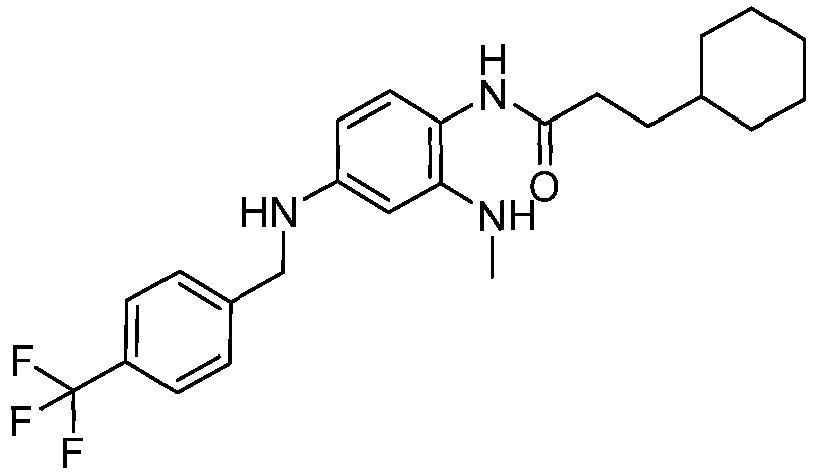
3-cyclohexyl-N-(2-(methylamino)-4-((4-(trifluoromethyl)benzyl)amino)p henyl)propanamide 26. 
3-cyclohexyl-N-(2-(piperidin-1-yl)-4-((4-(trifluoromethyl)benzyl)amino)p henyl)propanamide 27. 
3-cyclohexyl-N-(2-(pyrrolidin-1-yl)-4-((4-(trifluoromethyl)benzyl)amino)p henyl)propanamide 28. 
N-(2-(diethylamino)-4-((4-(trifluoromethyl)benzyl)amino)p henyl)heptanamide 29. 
N-(2-(diethylamino)-4-((4-(trifluoromethyl)benzyl)amino)p henyl)-2,3-difluoroheptanamide (2R,3S)- N-(2-(diethylamino)-4-((4-(trifluoromethyl)benzyl)amino)p henyl)-2,3-difluoroheptanamide (2S,3R)- N-(2-(diethylamino)-4-((4-(trifluoromethyl)benzyl)amino)p henyl)-2,3-difluoroheptanamide (2R,3R)- N-(2-(diethylamino)-4-((4-(trifluoromethyl)benzyl)amino)p henyl)-2,3-difluoroheptanamide (2S,3 S)- N-(2-(diethylamino)-4-((4-(trifluoromethyl)benzyl)amino)p henyl)-2,3-difluoroheptanamide. 30. 
N-(2-(diethylamino)-4-((4-(trifluoromethyl)benzyl)amino)p henyl)-6,7-difluoroheptanamide (6R)-N-(2-(diethylamino)-4-((4-(trifluoromethyl)benzyl)amino)p henyl)-6,7-difluoroheptanamide (6S)-N-(2-(diethylamino)-4-((4-(trifluoromethyl)benzyl)amino)p henyl)-6,7-difluoroheptanamide 31. 
N-(2-(diethylamino)-4-((4-(trifluoromethyl)benzyl)amino)p henyl)-7,8-difluorooctanamide (7R)-N-(2-(diethylamino)-4-((4-(trifluoromethyl)benzyl)amino)p henyl)-7,8-difluorooctanamide (7S)-N-(2-(diethylamino)-4-((4-(trifluoromethyl)benzyl)amino)p henyl)-7,8-difluorooctanamide 32. 
N-(2-(diethylamino)-4-((4-(trifluoromethyl)benzyl)amino)p henyl)-2,3-difluorooctanamide (2R,3 S)-N-(2-(diethylamino)-4-((4-(trifluoromethyl)benzyl)amino)p henyl)-2,3-difluorooctanamide (2S,3R)-N-(2-(diethylamino)-4-((4-(trifluoromethyl)benzyl)amino)p henyl)-2,3-difluorooctanamide (2R,3R)-N-(2-(diethylamino)-4-((4-(trifluoromethyl)benzyl)amino)p henyl)-2,3-difluorooctanamide (2S,3S)-N-(2-(diethylamino)-4-((4-(trifluoromethyl)benzyl)amino)p henyl)-2,3-difluorooctanamide 33. 
N-(2-(diethylamino)-4-((4-(trifluoromethyl)benzyl)amino)p henyl)octanamide 34. 
N-(2-amino-4-(4-(trifluoromethyl)phenethyl)phen yl)-3-cyclohexylpropanamide 35. 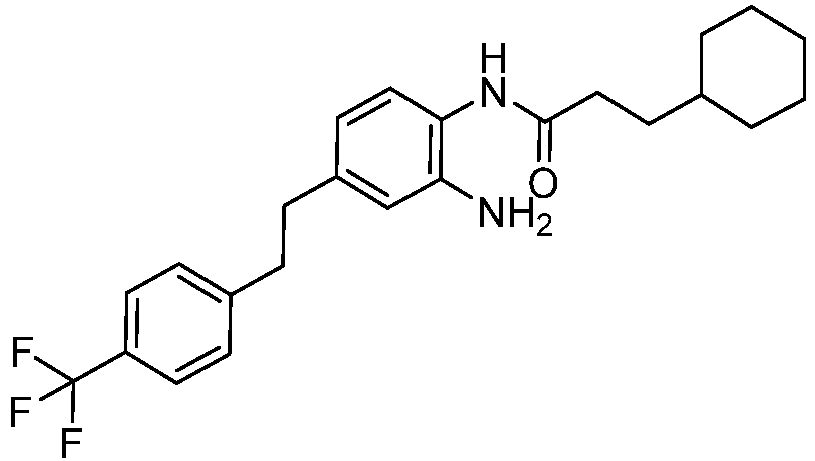
N-(2-amino-4-(4-(trifluoromethyl)phenethyl)phen yl)-3-cyclohexylpropanamide 36. 
N-(2-amino-4-(4-(trifluoromethyl)phenethyl)phen yl)heptanamide 37. 
N-(2-amino-4-(4-(trifluoromethyl)phenethyl)phen yl)-2,3-difluoroheptanamide (2R,3 S)-N-(2-amino-4-(4-(trifluoromethyl)phenethyl)phen yl)-2,3-difluoroheptanamide (2S,3R)-N-(2-amino-4-(4-(trifluoromethyl)phenethyl)phen yl)-2,3-difluoroheptanamide (2R,3R)-N-(2-amino-4-(4-(trifluoromethyl)phenethyl)phen yl)-2,3-difluoroheptanamide (2S,3 S)-N-(2-amino-4-(4-(trifluoromethyl)phenethyl)phen yl)-2,3-difluoroheptanamide 38. 
N-(2-amino-4-(4-(trifluoromethyl)phenethyl)phen yl)-6,7-difluoroheptanamide (6R)-N-(2-amino-4-(4-(trifluoromethyl)phenethyl)phen yl)-6,7-difluoroheptanamide (6S)-N-(2-amino-4-(4-(trifluoromethyl)phenethyl)phen yl)-6,7-difluoroheptanamide 39. 
N-(2-amino-4-(4-(trifluoromethyl)phenethyl)phen yl)octanamide 40. 
N-(2-amino-4-(4-(trifluoromethyl)phenethyl)phen yl)-2,3-difluorooctanamide 41. 
N-(2-amino-4-(4-(trifluoromethyl)phenethyl)phen yl)-2,3-difluorooctanamide (2R,3 S)-N-(2-amino-4-(4-(trifluoromethyl)phenethyl)phen yl)-2,3-difluorooctanamide (2S,3R)-N-(2-amino-4-(4-(trifluoromethyl)phenethyl)phen yl)-2,3-difluorooctanamide (2R,3R)-N-(2-amino-4-(4-(trifluoromethyl)phenethyl)phen yl)-2,3-difluorooctanamide (2S,3 S)-N-(2-amino-4-(4-(trifluoromethyl)phenethyl)phen yl)-2,3-difluorooctanamide 42. 
N-(2-amino-4-(4-(trifluoromethyl)phenethyl)phen yl)-7,8-difluorooctanamide (7R)-N-(2-amino-4-(4-(trifluoromethyl)phenethyl)phen yl)-7,8-difluorooctanamide (7S)-N-(2-amino-4-(4-(trifluoromethyl)phenethyl)phen yl)-7,8-difluorooctanamide 43. 
3-cyclohexyl-N-(2-(piperidin-1-yl)-4-(4-(trifluoromethyl)phenethyl)phen yl)propanamide 44. 
N-(4-((4-fluorobenzyl)amino)phenyl)hept anamide 45. 
N-(3-fluoro-4-((4-fluorobenzyl)amino)phenyl)hept anamide 46. 
N-(2-amino-3-fluoro-4-((4-fluorobenzyl)amino)phenyl)hept anamide 47. 
N-(2-amino-4-((4-fluorobenzyl)amino)phenyl)hept anamide 48. 
N-(4-((4-(trifluoromethyl)benzyl)amino)p henyl)heptanamide 49. 
N-(3-fluoro-4-((4-(trifluoromethyl)benzyl)amino)p henyl)heptanamide 50. 
N-(2-amino-3-fluoro-4-((4-(trifluoromethyl)benzyl)amino)p henyl)heptanamide 51. 
N-(2-amino-4-((4-(trifluoromethyl)benzyl)amino)p henyl)heptanamide 52. 
N-(4-((4-(trifluoromethoxy)benzyl)amino )phenyl)heptanamide 53. 
N-(3-fluoro-4-((4-(trifluoromethoxy)benzyl)amino )phenyl)heptanamide 54. 
N-(2-amino-3-fluoro-4-((4-(trifluoromethoxy)benzyl)amino )phenyl)heptanamide 55. 
N-(2-amino-4-((4-(trifluoromethoxy)benzyl)amino )phenyl)heptanamide 56. 
3,3-dimethyl-N-(4-((4-(trifluoromethoxy)benzyl)amino )phenyl)butanamide 57. 
N-(3-fluoro-4-((4-(trifluoromethoxy)benzyl)amino )phenyl)-3,3-dimethylbutanamide 58. 
N-(2-amino-3-fluoro-4-((4-(trifluoromethoxy)benzyl)amino )phenyl)-3,3-dimethylbutanamide 59. 
N-(2-amino-4-((4-(trifluoromethoxy)benzyl)amino )phenyl)-3,3-dimethylbutanamide 60. 
3,3-dimethyl-N-(4-((4-(trifluoromethyl)benzyl)amino)p henyl)butanamide 61. 
N-(3-fluoro-4-((4-(trifluoromethyl)benzyl)amino)p henyl)-3,3-dimethylbutanamide 62. 
N-(2-amino-3-fluoro-4-((4-(trifluoromethyl)benzyl)amino)p henyl)-3,3-dimethylbutanamide 63. 
N-(2-amino-4-((4-(trifluoromethyl)benzyl)amino)p henyl)-3,3-dimethylbutanamide 64. 
N-(2-amino-4-((4-(trifluoromethyl)benzyl)amino)p henyl)octanamide 65. 
N-(2-amino-4-((4-(trifluoromethyl)benzyl)amino)p henyl)nonanamide 66. 
N-(2-amino-4-((4-(trifluoromethyl)benzyl)amino)p henyl)decanamide 67. 
N-(2-amino-4-((4-(trifluoromethyl)benzyl)amino)p henyl)undecanamide 68. 
N-(2-amino-4-((4-(trifluoromethyl)benzyl)amino)p henyl)dodecanamide 69. 
N-(3-fluoro-4-((4-(trifluoromethyl)benzyl)amino)p henyl)octanamide 70. 
N-(3-fluoro-4-((4-(trifluoromethyl)benzyl)amino)p henyl)nonanamide 71. 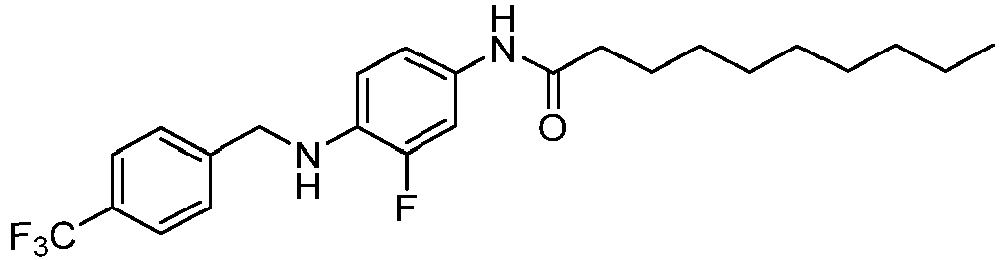
N-(3-fluoro-4-((4-(trifluoromethyl)benzyl)amino)p henyl)decanamide 72. 
N-(3-fluoro-4-((4-(trifluoromethyl)benzyl)amino)p henyl)undecanamide 73. 
N-(3-fluoro-4-((4-(trifluoromethyl)benzyl)amino)p henyl)dodecanamide 74. 
N-(2-amino-3-fluoro-4-((4-(trifluoromethyl)benzyl)amino)p henyl)octanamide 75. 
N-(2-amino-3-fluoro-4-((4-(trifluoromethyl)benzyl)amino)p henyl)nonanamide 76. 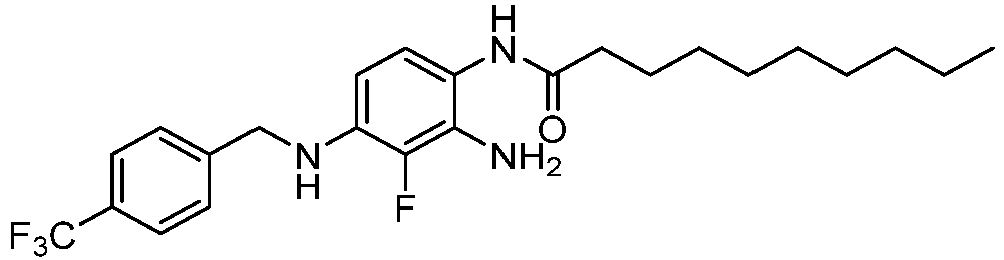
N-(2-amino-3-fluoro-4-((4-(trifluoromethyl)benzyl)amino)p henyl)decanamide 77. 
N-(2-amino-3-fluoro-4-((4-(trifluoromethyl)benzyl)amino)p henyl)undecanamide 78. 
N-(2-amino-3-fluoro-4-((4-(trifluoromethyl)benzyl)amino)p henyl)dodecanamide 79. 
N-(2-amino-3-fluoro-4-((4-(trifluoromethyl)benzyl)amino)p henyl)-2,3-difluoroheptanamide (2R,3 S)-N-(2-amino-3-fluoro-4-((4-(trifluoromethyl)benzyl)amino)p henyl)-2,3-difluoroheptanamide (2S,3R)-N-(2-amino-3-fluoro-4-((4-(trifluoromethyl)benzyl)amino)p henyl)-2,3-difluoroheptanamide (2R,3R)-N-(2-amino-3-fluoro-4-((4-(trifluoromethyl)benzyl)amino)p henyl)-2,3-difluoroheptanamide (2S,3S)-N-(2-amino-3-fluoro-4-((4-(trifluoromethyl)benzyl)amino)p henyl)-2,3-difluoroheptanamide racemic mixtures thereof 80. 
N-(2-amino-3-fluoro-4-((4-(trifluoromethyl)benzyl)amino)p henyl)-2,3-difluorooctanamide (2R,3 S)-N-(2-amino-3-fluoro-4-((4-(trifluoromethyl)benzyl)amino)p henyl)-2,3-difluorooctanamide (2S,3R)-N-(2-amino-3-fluoro-4-((4-(trifluoromethyl)benzyl)amino)p henyl)-2,3-difluorooctanamide (2R,3R)-N-(2-amino-3-fluoro-4-((4-(trifluoromethyl)benzyl)amino)p henyl)-2,3-difluorooctanamide (2S,3S)-N-(2-amino-3-fluoro-4-((4-(trifluoromethyl)benzyl)amino)p henyl)-2,3-difluorooctanamide racemic mixtures thereof 81. 
N-(2-amino-3-fluoro-4-((4-(trifluoromethyl)benzyl)amino)p henyl)-2,3-difluorononanamide (2R,3S)-N-(2-amino-3-fluoro-4-((4-(trifluoromethyl)benzyl)amino)p henyl)-2,3-difluorononanamide (2S,3R)-N-(2-amino-3-fluoro-4-((4-(trifluoromethyl)benzyl)amino)p henyl)-2,3-difluorononanamide (2R,3R)-N-(2-amino-3-fluoro-4-((4-(trifluoromethyl)benzyl)amino)p henyl)-2,3-difluorononanamide (2S,3S)-N-(2-amino-3-fluoro-4-((4-(trifluoromethyl)benzyl)amino)p henyl)-2,3-difluorononanamide racemic mixtures thereof 82. 
N-(2-amino-3-fluoro-4-((4-(trifluoromethyl)benzyl)amino)p henyl)-2,3-difluorodecanamide (2R,3 S)-N-(2-amino-3-fluoro-4-((4-(trifluoromethyl)benzyl)amino)p henyl)-2,3-difluorodecanamide (2S,3R)-N-(2-amino-3-fluoro-4-((4-(trifluoromethyl)benzyl)amino)p henyl)-2,3-difluorodecanamide (2R,3R)-N-(2-amino-3-fluoro-4-((4-(trifluoromethyl)benzyl)amino)p henyl)-2,3-difluorodecanamide (2S,3S)-N-(2-amino-3-fluoro-4-((4-(trifluoromethyl)benzyl)amino)p henyl)-2,3-difluorodecanamide racemic mixtures thereof 83. 
N-(2-amino-3-fluoro-4-((4-(trifluoromethyl)benzyl)amino)p henyl)-2,3-difluoroundecanamide (2R,3 S)-N-(2-amino-3-fluoro-4-((4-(trifluoromethyl)benzyl)amino)p henyl)-2,3-difluoroundecanamide (2S,3R)-N-(2-amino-3-fluoro-4-((4-(trifluoromethyl)benzyl)amino)p henyl)-2,3-difluoroundecanamide (2R,3R)-N-(2-amino-3-fluoro-4-((4-(trifluoromethyl)benzyl)amino)p henyl)-2,3-difluoroundecanamide (2S,3S)-N-(2-amino-3-fluoro-4-((4-(trifluoromethyl)benzyl)amino)p henyl)-2,3-difluoroundecanamide racemic mixtures thereof 84. 
N-(2-amino-3-fluoro-4-((4-(trifluoromethyl)benzyl)amino)p henyl)-2,3-difluorododecanamide (2R,3 S)-N-(2-amino-3-fluoro-4-((4-(trifluoromethyl)benzyl)amino)p henyl)-2,3-difluorododecanamide (2S,3R)-N-(2-amino-3-fluoro-4-((4-(trifluoromethyl)benzyl)amino)p henyl)-2,3-difluorododecanamide (2R,3R)-N-(2-amino-3-fluoro-4-((4-(trifluoromethyl)benzyl)amino)p henyl)-2,3-difluorododecanamide (2S,3S)-N-(2-amino-3-fluoro-4-((4-(trifluoromethyl)benzyl)amino)p henyl)-2,3-difluorododecanamide racemic mixtures thereof 85. 
N-(2-amino-3-fluoro-4-((4-(trifluoromethyl)benzyl)amino)p henyl)-6,7-difluoroheptanamide (6R)-N-(2-amino-3-fluoro-4-((4-(trifluoromethyl)benzyl)amino)p henyl)-6,7-difluoroheptanamide (6S)-N-(2-amino-3-fluoro-4-((4-(trifluoromethyl)benzyl)amino)p henyl)-6,7-difluoroheptanamide racemic mixtures thereof 86. 
N-(2-amino-3-fluoro-4-((4-(trifluoromethyl)benzyl)amino)p henyl)-6,7-difluorooctanamide (6R)-N-(2-amino-3-fluoro-4-((4-(trifluoromethyl)benzyl)amino)p henyl)-6,7-difluorooctanamide (6S)-N-(2-amino-3-fluoro-4-((4-(trifluoromethyl)benzyl)amino)p henyl)-6,7-difluorooctanamide racemic mixtures thereof 87. 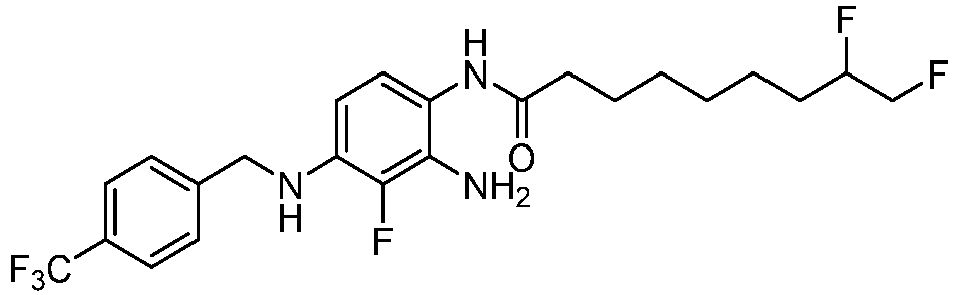
N-(2-amino-3-fluoro-4-((4-(trifluoromethyl)benzyl)amino)p henyl)-8,9-difluorononanamide (8R)-N-(2-amino-3-fluoro-4-((4-(trifluoromethyl)benzyl)amino)p henyl)-8,9-difluorononanamide (8S)-N-(2-amino-3-fluoro-4-((4-(trifluoromethyl)benzyl)amino)p henyl)-8,9-difluorononanamide racemic mixtures thereof 88. 
N-(2-amino-3-fluoro-4-((4-(trifluoromethyl)benzyl)amino)p henyl)-9,10-difluorodecanamide (9R)-N-(2-amino-3-fluoro-4-((4-(trifluoromethyl)benzyl)amino)p henyl)-9,10-difluorodecanamide (9S)-N-(2-amino-3-fluoro-4-((4-(trifluoromethyl)benzyl)amino)p henyl)-9,10-difluorodecanamide racemic mixtures thereof 89. 
N-(2-amino-4-((4-(trifluoromethyl)benzyl)amino)p henyl)-2,3-difluoroheptanamide (2R,3 S)-N-(2-amino-4-((4-(trifluoromethyl)benzyl)amino)p henyl)-2,3-difluoroheptanamide (2S,3R)-N-(2-amino-4-((4-(trifluoromethyl)benzyl)amino)p henyl)-2,3-difluoroheptanamide (2R,3R)-N-(2-amino-4-((4-(trifluoromethyl)benzyl)amino)p henyl)-2,3-difluoroheptanamide (2S,3 S)-N-(2-amino-4-((4-(trifluoromethyl)benzyl)amino)p henyl)-2,3-difluoroheptanamide racemic mixtures thereof 90. 
N-(2-amino-4-((4-(trifluoromethyl)benzyl)amino)p henyl)-2,3-difluorooctanamide (2R,3 S)-N-(2-amino-4-((4-(trifluoromethyl)benzyl)amino)p henyl)-2,3-difluorooctanamide (2S,3R)-N-(2-amino-4-((4-(trifluoromethyl)benzyl)amino)p henyl)-2,3-difluorooctanamide (2R,3R)-N-(2-amino-4-((4-(trifluoromethyl)benzyl)amino)p henyl)-2,3-difluorooctanamide (2S,3 S)-N-(2-amino-4-((4-(trifluoromethyl)benzyl)amino)p henyl)-2,3-difluorooctanamide racemic mixtures thereof 91. 
N-(2-amino-4-((4-(trifluoromethyl)benzyl)amino)p henyl)-2,3-difluorononanamide (2R,3 S)-N-(2-amino-4-((4-(trifluoromethyl)benzyl)amino)p henyl)-2,3-difluorononanamide (2S,3R)-N-(2-amino-4-((4-(trifluoromethyl)benzyl)amino)p henyl)-2,3-difluorononanamide (2R,3R)-N-(2-amino-4-((4-(trifluoromethyl)benzyl)amino)p henyl)-2,3-difluorononanamide (2S,3 S)-N-(2-amino-4-((4-(trifluoromethyl)benzyl)amino)p henyl)-2,3-difluorononanamide racemic mixtures thereof 92. 
N-(2-amino-4-((4-(trifluoromethyl)benzyl)amino)p henyl)-2,3-difluorodecanamide (2R,3 S)- N-(2-amino-4-((4-(trifluoromethyl)benzyl)amino)p henyl)-2,3-difluorodecanamide (2S,3R)- N-(2-amino-4-((4-(trifluoromethyl)benzyl)amino)p henyl)-2,3-difluorodecanamide (2R,3R)- N-(2-amino-4-((4-(trifluoromethyl)benzyl)amino)p henyl)-2,3-difluorodecanamide (2S,3 S)- N-(2-amino-4-((4-(trifluoromethyl)benzyl)amino)p henyl)-2,3-difluorodecanamide racemic mixtures thereof 93. 
N-(2-amino-4-((4-(trifluoromethyl)benzyl)amino)p henyl)-6,7-difluoroheptanamide (6R)-N-(2-amino-4-((4-(trifluoromethyl)benzyl)amino)p henyl)-6,7-difluoroheptanamide (6S)-N-(2-amino-4-((4-(trifluoromethyl)benzyl)amino)p henyl)-6,7-difluoroheptanamide racemic mixtures thereof 94. 
N-(2-amino-4-((4-(trifluoromethyl)benzyl)amino)p henyl)-7,8-difluorooctanamide (7R)-N-(2-amino-4-((4-(trifluoromethyl)benzyl)amino)p henyl)-7,8-difluorooctanamide (7S)-N-(2-amino-4-((4-(trifluoromethyl)benzyl)amino)p henyl)-7,8-difluorooctanamide racemic mixtures thereof 95. 
N-(2-amino-3-fluoro-4-((4-(trifluoromethyl)benzyl)amino)p henyl)-6,7-difluorononanamide (6R)-N-(2-amino-3-fluoro-4-((4-(trifluoromethyl)benzyl)amino)p henyl)-6,7-difluorononanamide (6S)-N-(2-amino-3-fluoro-4-((4-(trifluoromethyl)benzyl)amino)p henyl)-6,7-difluorononanamide racemic mixtures thereof 96. 
N-(2-amino-3-fluoro-4-((4-(trifluoromethyl)benzyl)amino)p henyl)-6,7-difluorododecanamide (6R)-N-(2-amino-3-fluoro-4-((4-(trifluoromethyl)benzyl)amino)p henyl)-6,7-difluorododecanamide (6S)-N-(2-amino-3-fluoro-4-((4-(trifluoromethyl)benzyl)amino)p henyl)-6,7-difluorododecanamide racemic mixtures thereof 97. 
N-(2-amino-4-((4-hydroxybenzyl)amino)phenyl)he ptanamide 98. 
N-(4-((4-hydroxybenzyl)amino)phenyl)he ptanamide 99. 
N-(2-amino-3-fluoro-4-((4-hydroxybenzyl)amino)phenyl)he ptanamide 100. 
N-(2-amino-4-((4-hydroxybenzyl)amino)phenyl)oc tanamide 101. 
N-(4-((4-hydroxybenzyl)amino)phenyl)oc tanamide 102. 
N-(2-amino-3-fluoro-4-((4-hydroxybenzyl)amino)phenyl)oc tanamide 103. 
N-(2-amino-4-((4-hydroxybenzyl)amino)phenyl)de canamide 104. 
N-(4-((4-hydroxybenzyl)amino)phenyl)de canamide 105. 
N-(2-amino-3-fluoro-4-((4-hydroxybenzyl)amino)phenyl)de canamide 106. 
N-(2-amino-4-((4-hydroxybenzyl)amino)phenyl)-2,3-difluorodecanamide (2R,3 S)-N-(2-amino-4-((4-hydroxybenzyl)amino)phenyl)-2,3-difluorodecanamide (2S,3R)-N-(2-amino-4-((4-hydroxybenzyl)amino)phenyl)-2,3-difluorodecanamide (2R,3R)-N-(2-amino-4-((4-hydroxybenzyl)amino)phenyl)-2,3-difluorodecanamide (2S,3 S)-N-(2-amino-4-((4-hydroxybenzyl)amino)phenyl)-2,3-difluorodecanamide racemic mixtures thereof 107. 
N-(2-amino-4-((4-hydroxybenzyl)amino)phenyl)-9,10-difluorodecanamide (9R)-N-(2-amino-4-((4-hydroxybenzyl)amino)phenyl)-2,3-difluorodecanamide (9S)-N-(2-amino-4-((4-hydroxybenzyl)amino)phenyl)-2,3-difluorodecanamide racemic mixtures thereof 108. 
2,3-difluoro-N-(4-((4-hydroxybenzyl)amino)phenyl)de ca decanamide (2R,3S)-2,3-difluoro-N-(4-((4-hydroxybenzyl)amino)phenyl)de ca decanamide (2S,3R)-2,3-difluoro-N-(4-((4-hydroxybenzyl)amino)phenyl)de canamide (2R,3R)-2,3-difluoro-N-(4-((4-hydroxybenzyl)amino)phenyl)de ca decanamide (2S,3S)-2,3-difluoro-N-(4-((4-hydroxybenzyl)amino)phenyl)de canamide racemic mixtures thereof 109. 
9,10-difluoro-N-(4-((4-hydroxybenzyl)amino)phenyl)de canamide (9R)-9,10-difluoro-N-(4-((4-hydroxybenzyl)amino)phenyl)de canamide (9S)-9,10-difluoro-N-(4-((4-hydroxybenzyl)amino)phenyl)de ca namide racemic mixtures thereof 110. 
N-(2-amino-3-fluoro-4-((4-hydroxybenzyl)amino)phenyl)-2,3-difluorodecanamide (2R,3 S)-N-(2-amino-3-fluoro-4-((4-hydroxybenzyl)amino)phenyl)-2,3-difluorodecanamide (2S,3R)-N-(2-amino-3-fluoro-4-((4-hydroxybenzyl)amino)phenyl)-2,3-difluorodecanamide (2R,3R)-N-(2-amino-3-fluoro-4-((4-hydroxybenzyl)amino)phenyl)-2,3-difluorodecanamide (2S,3S)-N-(2-amino-3-fluoro-4-((4-hydroxybenzyl)amino)phenyl)-2,3-difluorodecanamide racemic mixtures thereof 111. 
N-(2-amino-3-fluoro-4-((4-hydroxybenzyl)amino)phenyl)-9,10-difluorodecanamide (9R)-N-(2-amino-3-fluoro-4-((4-hydroxybenzyl)amino)phenyl)-9,10-difluorodecanamide (9S)-N-(2-amino-3-fluoro-4-((4-hydroxybenzyl)amino)phenyl)-9,10-difluorodecanamide racemic mixtures thereof 112. 
N-(2-amino-4-((4-hydroxybenzyl)amino)phenyl)-2,3-difluorooctanamide (2R,3 S)-N-(2-amino-4-((4-hydroxybenzyl)amino)phenyl)-2,3-difluorooctanamide (2S,3R)-N-(2-amino-4-((4-hydroxybenzyl)amino)phenyl)-2,3-difluorooctanamide (2R,3R)-N-(2-amino-4-((4-hydroxybenzyl)amino)phenyl)-2,3-difluorooctanamide (2S,3 S)-N-(2-amino-4-((4-hydroxybenzyl)amino)phenyl)-2,3-difluorooctanamide racemic mixtures thereof 113. 
2,3-difluoro-N-(4-((4-hydroxybenzyl)amino)phenyl)oc tanamide (2R,3S)-2,3-difluoro-N-(4-((4-hydroxybenzyl)amino)phenyl)oc tanamide (2S,3R)-2,3-difluoro-N-(4-((4-hydroxybenzyl)amino)phenyl)oc (2R,3R)-2,3-difluoro-N-(4-((4-hydroxybenzyl)amino)phenyl)oc tanamide (2S,3S)-2,3-difluoro-N-(4-((4-hydroxybenzyl)amino)phenyl)oc tanamide racemic mixtures thereof 114. 
N-(2-amino-3-fluoro-4-((4-hydroxybenzyl)amino)phenyl)-2,3-difluorooctanamide (2R,3S)-N-(2-amino-3-fluoro-4-((4-hydroxybenzyl)amino)phenyl)-2,3-difluorooctanamide (2S,3R)-N-(2-amino-3-fluoro-4-((4-hydroxybenzyl)amino)phenyl)-2,3-difluorooctanamide (2R,3R)-N-(2-amino-3-fluoro-4-((4-hydroxybenzyl)amino)phenyl)-2,3-difluorooctanamide (2S,3S)-N-(2-amino-3-fluoro-4-((4-hydroxybenzyl)amino)phenyl)-2,3-difluorooctanamide racemic mixtures thereof 115. 
N-(2-amino-4-((4-hydroxybenzyl)amino)phenyl)-7,8-difluorooctanamide (7S)-N-(2-amino-4-((4-hydroxybenzyl)amino)phenyl)-7,8-difluorooctanamide (7R)-N-(2-amino-4-((4-hydroxybenzyl)amino)phenyl)-7,8-difluorooctanamide racemic mixtures thereof 116. 
7,8-difluoro-N-(4-((4-hydroxybenzyl)amino)phenyl)oc tanamide (7R)-7,8-difluoro-N-(4-((4-hydroxybenzyl)amino)phenyl)oc tanamide (7S)-7,8-difluoro-N-(4-((4-hydroxybenzyl)amino)phenyl)oc tanamide racemic mixtures thereof 117. 
N-(2-amino-3-fluoro-4-((4-hydroxybenzyl)amino)phenyl)-7,8-difluorooctanamide (7R)-N-(2-amino-3-fluoro-4-((4-hydroxybenzyl)amino)phenyl)-7,8-difluorooctanamide (7S)-N-(2-amino-3-fluoro-4-((4-hydroxybenzyl)amino)phenyl)-7,8-difluorooctanamide racemic mixtures thereof 118. 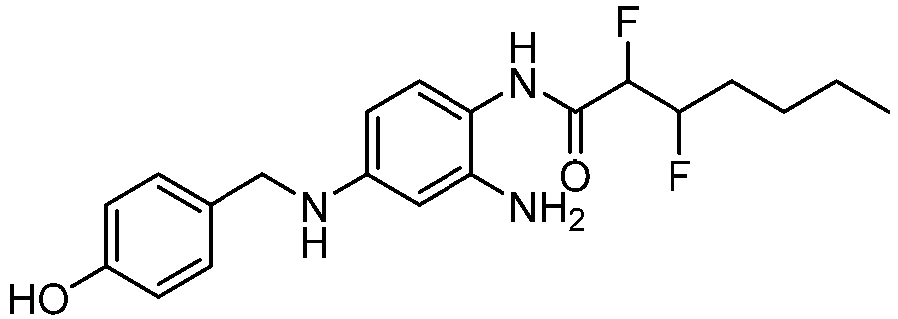
N-(2-amino-4-((4-hydroxybenzyl)amino)phenyl)-2,3-difluoroheptanamide (2R,3 S)-N-(2-amino-4-((4-hydroxybenzyl)amino)phenyl)-2,3 -difluoroheptanamide (2S,3R)-N-(2-amino-4-((4-hydroxybenzyl)amino)phenyl)-2,3-difluoroheptanamide (2R,3R)-N-(2-amino-4-((4-hydroxybenzyl)amino)phenyl)-2,3 -difluoroheptanamide (2S,3 S)-N-(2-amino-4-((4-hydroxybenzyl)amino)phenyl)-2,3 -difluoroheptanamide racemic mixtures thereof 119. 
2,3-difluoro-N-(4-((4-hydroxybenzyl)amino)phenyl)he ptanamide (2R,3S)-2,3-difluoro-N-(4-((4-hydroxybenzyl)amino)phenyl)he ptanamide (2S,3R)-2,3-difluoro-N-(4-((4-hydroxybenzyl)amino)phenyl)he ptanamide (2R,3R)-2,3-difluoro-N-(4-((4-hydroxybenzyl)amino)phenyl)he ptanamide (2S,3S)-2,3-difluoro-N-(4-((4-hydroxybenzyl)amino)phenyl)he ptanamide racemic mixtures thereof 120. 
N-(2-amino-3-fluoro-4-((4-hydroxybenzyl)amino)phenyl)-2,3 -difluoroheptanamide (2R,3 S)-N-(2-amino-3-fluoro-4-((4-hydroxybenzyl)amino)phenyl)-2,3 -difluoroheptanamide (2S,3R)-N-(2-amino-3-fluoro-4-((4-hydroxybenzyl)amino)phenyl)-2,3 -difluoroheptanamide (2R,3R)-N-(2-amino-3-fluoro-4-((4-hydroxybenzyl)amino)phenyl)-2,3 -difluoroheptanamide (2S,3S)-N-(2-amino-3-fluoro-4-((4-hydroxybenzyl)amino)phenyl)-2,3-difluoroheptanamide racemic mixtures thereof 121. 
N-(2-amino-4-((4-hydroxybenzyl)amino)phenyl)-6,7-difluoroheptanamide (6R)-N-(2-amino-4-((4-hydroxybenzyl)amino)phenyl)-6,7-difluoroheptanamide (6S)-N-(2-amino-4-((4-hydroxybenzyl)amino)phenyl)-6,7-difluoroheptanamide racemic mixtures thereof 122. 
6,7-difluoro-N-(4-((4-hydroxybenzyl)amino)phenyl)he ptanamide (6R)-6,7-difluoro-N-(4-((4-hydroxybenzyl)amino)phenyl)he ptanamide (6S)-6,7-difluoro-N-(4-((4-hydroxybenzyl)amino)phenyl)he ptanamide racemic mixtures thereof 123. 
N-(2-amino-3-fluoro-4-((4-hydroxybenzyl)amino)phenyl)-6,7-difluoroheptanamide (6R)-N-(2-amino-3-fluoro-4-((4-hydroxybenzyl)amino)phenyl)-6,7-difluoroheptanamide (6S)-N-(2-amino-3-fluoro-4-((4-hydroxybenzyl)amino)phenyl)-6,7-difluoroheptanamide racemic mixtures thereof 124. 
N-(2-amino-4-((4-nitrobenzyl)amino)phenyl)hepta namide 125. 
N-(4-((4-nitrobenzyl)amino)phenyl)hepta namide 126. 
N-(2-amino-3-fluoro-4-((4-nitrobenzyl)amino)phenyl)hepta namide 127. 
N-(2-amino-4-((4-aminobenzyl)amino)phenyl)hept anamide 128. 
N-(4-((4-aminobenzyl)amino)phenyl)hept anamide 129. 
N-(2-amino-3-fluoro-4-((4-aminobenzyl)amino)phenyl)hept anamide 130. 
N-(2-amino-4-((4-nitrobenzyl)amino)phenyl)octan amide 131. 
N-(4-((4-nitrobenzyl)amino)phenyl)octan amide 132. 
N-(2-amino-3-fluoro-4-((4-nitrobenzyl)amino)phenyl)octan amide 133. 
N-(2-amino-4-((4-aminobenzyl)amino)phenyl)octa namide 134. 
N-(4-((4-aminobenzyl)amino)phenyl)octa namide 135. 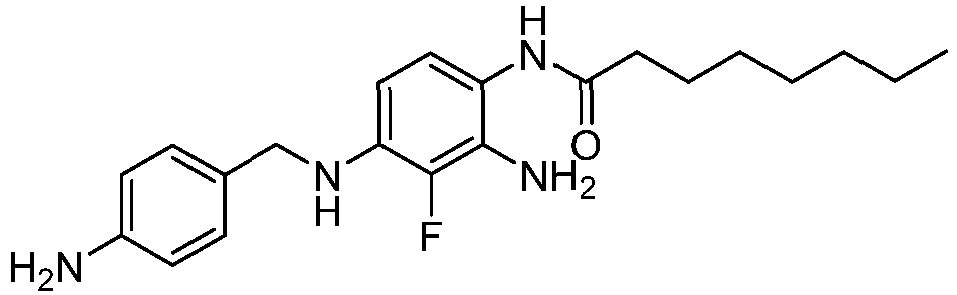
N-(2-amino-3-fluoro-4-((4-aminobenzyl)amino)phenyl)octa namide 136. 
N-(2-amino-4-((4-nitrobenzyl)amino)phenyl)decan amide 137. 
N-(4-((4-nitrobenzyl)amino)phenyl)decan amide 138. 
N-(2-amino-3-fluoro-4-((4-nitrobenzyl)amino)phenyl)decan amide 139. 
N-(2-amino-4-((4-aminobenzyl)amino)phenyl)deca namide 140. 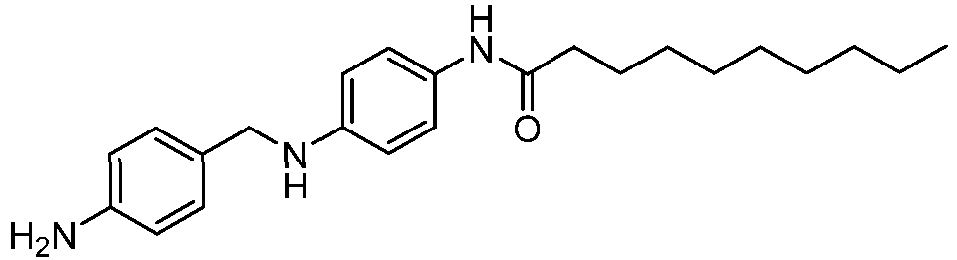
N-(4-((4-aminobenzyl)amino)phenyl)deca namide 141. 
N-(2-amino-3-fluoro-4-((4-aminobenzyl)amino)phenyl)deca namide 142. 
N-(2-amino-4-((pyridin-4-ylmethyl)amino)phenyl)heptana mide 143. 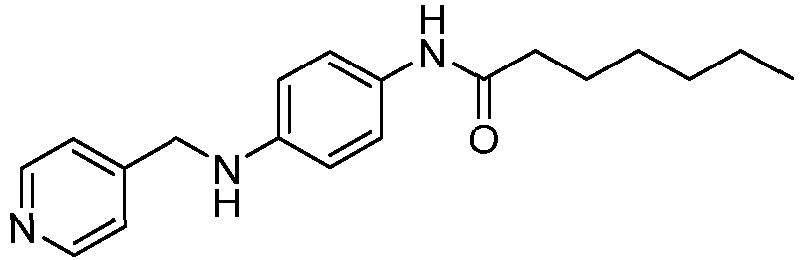
N-(4-((pyridin-4-ylmethyl)amino)phenyl)heptana mide 144. 
N-(2-amino-3-fluoro-4-((pyridin-4-ylmethyl)amino)phenyl)heptana mide 145. 
N-(2-amino-4-((pyridin-4-ylmethyl)amino)phenyl)octanam ide 146. 
N-(4-((pyridin-4-ylmethyl)amino)phenyl)octanam ide 147. 
N-(2-amino-3-fluoro-4-((pyridin-4-ylmethyl)amino)phenyl)octanam ide 148. 
N-(2-amino-4-((pyridin-4-ylmethyl)amino)phenyl)decana mide 149. 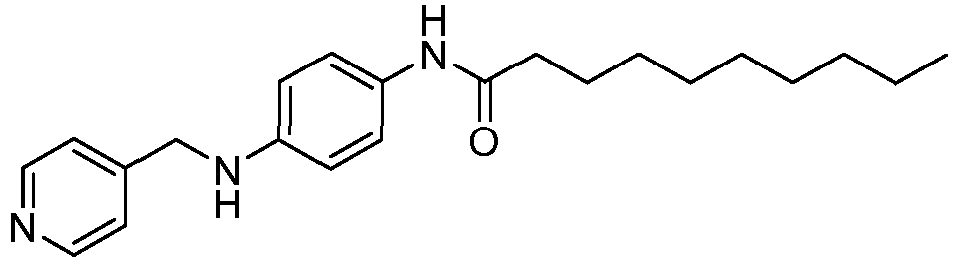
N-(4-((pyridin-4-ylmethyl)amino)phenyl)decana mide 150. 
N-(2-amino-3-fluoro-4-((pyridin-4-ylmethyl)amino)phenyl)decana mide 151. 
N-(4-(((1H-pyrrol-3-yl)methyl)amino)-2-aminophenyl)heptanamide 152. 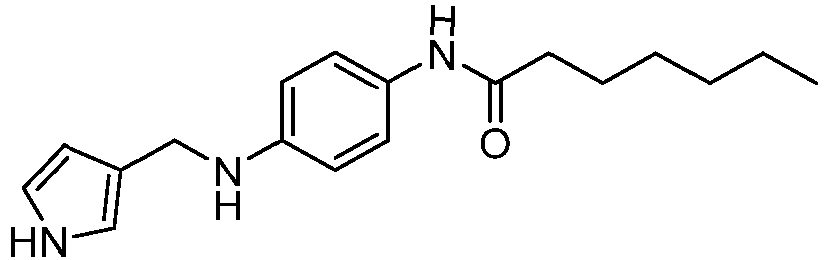
N-(4-(((1H-pyrrol-3-yl)methyl)amino)phenyl)heptana mide 153. 
N-(4-(((1H-pyrrol-3-yl)methyl)amino)-2-amino-3-fluorophenyl)heptanamide 154. 
N-(4-(((1H-pyrrol-3-yl)methyl)amino)-2-aminophenyl)octanamide 155. 
N-(4-(((1H-pyrrol-3-yl)methyl)amino)phenyl)octana mide 156. 
N-(4-(((1H-pyrrol-3-yl)methyl)amino)-2-amino-3-fluorophenyl)octanamide 157. 
N-(4-(((1H-pyrrol-3-yl)methyl)amino)-2-aminophenyl)decanamide 158. 
N-(4-(((1H-pyrrol-3-yl)methyl)amino)phenyl)decana mide 159. 
N-(4-(((1H-pyrrol-3-yl)methyl)amino)-2-amino-3-fluorophenyl)decanamide 160. 
N-(4-((4-acetamidobenzyl)amino)-2-amino-3-fluorophenyl)heptanamide 161. 
N-(4-((4-acetamidobenzyl)amino)-2-aminophenyl)heptanamide 162. 
N-(4-((4-acetamidobenzyl)amino)phenyl) heptanamide 163. 
N-(4-((4-acetamidobenzyl)amino)-2-amino-3-fluorophenyl)octanamide 164. 
N-(4-((4-acetamidobenzyl)amino)-2-aminophenyl)octanamide 165. 
N-(4-((4-acetamidobenzyl)amino)phenyl) octanamide 166. 
N-(4-((4-acetamidobenzyl)amino)-2-amino-3-fluorophenyl)decanamide 167. 
N-(4-((4-acetamidobenzyl)amino)-2-aminophenyl)decanamide 168. 
N-(4-((4-acetamidobenzyl)amino)phenyl) decanamide 169. 
N-(2-amino-3-fluoro-4-((4-(trifluoromethyl)phenethyl)amin o)phenyl)heptanamide 170. 
N-(2-amino-4-((4-(trifluoromethyl)phenethyl)amin o)phenyl)heptanamide 171. 
N-(4-((4-(trifluoromethyl)phenethyl)amin o)phenyl)heptanamide 172. 
N-(2-amino-3-fluoro-4-((4-(trifluoromethyl)phenethyl)amin o)phenyl)octanamide 173. 
N-(2-amino-4-((4-(trifluoromethyl)phenethyl)amin o)pheny)loctanamide 174. 
N-(4-((4-(trifluoromethyl)phenethyl)amin o)phenyl)octanamide 175. 
N-(2-amino-3-fluoro-4-((4-(trifluoromethyl)phenethyl)amin o)phenyl)decanamide 176. 
N-(2-amino-4-((4-(trifluoromethyl)phenethyl)amin o)phenyl)decanamide 177. 
N-(4-((4-(trifluoromethyl)phenethyl)amin o)phenyl)decanamide 178. 
N-(2-amino-3-fluoro-4-((3-(4-(trifluoromethyl)phenyl)propyl)a mino)phenyl)heptanamide 179. 
N-(2-amino-4-((3-(4-(trifluoromethyl)phenyl)propyl)a mino)phenyl)heptanamide 180. 
N-(4-((3-(4-(trifluoromethyl)phenyl)propyl)a mino)phenyl)heptanamide 181. 
N-(2-amino-3-fluoro-4-((3-(4-(trifluoromethyl)phenyl)propyl)a mino)phenyl)octanamide 182. 
N-(2-amino-4-((3-(4-(trifluoromethyl)phenyl)propyl)a mino)phenyl)octanamide 183. 
N-(4-((3-(4-(trifluoromethyl)phenyl)propyl)a mino)phenyl)octanamide 184. 
N-(2-amino-3-fluoro-4-((3-(4-(trifluoromethyl)phenyl)propyl)a mino)phenyl)decanamide 185. 
N-(2-amino-4-((3-(4-(trifluoromethyl)phenyl)propyl)a mino)phenyl)decanamide 186. 
N-(4-((3-(4-(trifluoromethyl)phenyl)propyl)a mino)phenyl)decanamide 187. 
4-cyclohexyl-N-(4-((4-(trifluoromethoxy)benzyl)amino )phenyl)butanamide 188. 
N-(2-amino-3-fluoro-4-((4-(trifluoromethoxy)benzyl)amino )phenyl)-4-cyclohexylbutanamide 189. 
N-(2-amino-4-((4-(trifluoromethoxy)benzyl)amino )phenyl)-4-cyclohexylbutanamide 190. 
4-cyclohexyl-N-(4-((4-(trifluoromethyl)benzyl)amino)p henyl)butanamide 191. 
N-(2-amino-3-fluoro-4-((4-(trifluoromethyl)benzyl)amino)p henyl)-4-cyclohexylbutanamide 192. 
N-(2-amino-4-((4-(trifluoromethyl)benzyl)amino)p henyl)-4-cyclohexylbutanamide 193. 
7-phenyl-N-(4-((4-(trifluoromethyl)benzyl)amino)p henyl)heptanamide 194. 
N-(2-amino-4-((4-(trifluoromethyl)benzyl)amino)p henyl)-7-phenylheptanamide 195. 
N-(2-amino-3-fluoro-4-((4-(trifluoromethyl)benzyl)amino)p henyl)-7-phenylheptanamide 196. 
N-(2-amino-3 -fluoro-4-((4-(trifluoromethyl)benzyl)amino)p henyl)-7-(4-fluorophenyl)heptanamide 197. 
N-(2-amino-4-((4-(trifluoromethyl)benzyl)amino)p henyl)-7-(4-fluorophenyl)heptanamide 198. 
7-(4-fluorophenyl)-N-(4-((4-(trifluoromethyl)benzyl)amino)p henyl)heptanamide 199. 
7-amino-N-(2-amino-3-fluoro-4-((4-(trifluoromethyl)benzyl)amino)p henyl)heptanamide 200. 
7-amino-N-(2-amino-4-((4-(trifluoromethyl)benzyl)amino)p henyl)heptanamide 201. 
7-amino-N-(4-((4-(trifluoromethyl)benzyl)amino)p henyl)heptanamide 202. 
8-amino-N-(2-amino-3-fluoro-4-((4-(trifluoromethyl)benzyl)amino)p henyl)octanamide 203. 
8-amino-N-(2-amino-4-((4-(trifluoromethyl)benzyl)amino)p henyl)octanamide 204. 
8-amino-N-(4-((4-(trifluoromethyl)benzyl)amino)p henyl)octanamide 205. 
10-amino-N-(2-amino-3-fluoro-4-((4-(trifluoromethyl)benzyl)amino)p henyl)decanamide 206. 
10-amino-N-(2-amino-4-((4-(trifluoromethyl)benzyl)amino)p henyl)decanamide 207. 
10-amino-N-(4-((4-(trifluoromethyl)benzyl)amino)p henyl)decanamide 208. 
N-(2-amino-3-fluoro-4-((4-(trifluoromethyl)benzyl)amino)p henyl)-7-(4-aminophenyl)heptanamide 209. 
N-(2-amino-4-((4-(trifluoromethyl)benzyl)amino)p henyl)-7-(4-aminophenyl)heptanamide 210. 
7-(4-aminophenyl)-N-(4-((4-(trifluoromethyl)benzyl)amino)p henyl)heptanamide 211. 
N-(2-amino-3-fluoro-4-((4-(trifluoromethyl)benzyl)amino)p henyl)pent-4-ynamide 212. 
N-(2-amino-4-((4-(trifluoromethyl)benzyl)amino)p henyl)pent-4-ynamide 213. 
N-(4-((4-(trifluoromethyl)benzyl)amino)p henyl)pent-4-ynamide 214. 
N-(2-amino-3-fluoro-4-((4-(trifluoromethoxy)benzyl)amino )phenyl)pent-4-ynamide 215. 
N-(2-amino-4-((4-(trifluoromethoxy)benzyl)amino )phenyl)pent-4-ynamide 216. 
N-(4-((4-(trifluoromethoxy)benzyl)amino )phenyl)pent-4-ynamide 217. 
N-(2-amino-3-fluoro-4-((4-hydroxybenzyl)amino)phenyl)pe nt-4-ynamide 218. 
N-(2-amino-4-((4-hydroxybenzyl)amino)phenyl)pe nt-4-ynamide 219. 
N-(4-((4-hydroxybenzyl)amino)phenyl)pe nt-4-ynamide 220. 
N-(2-amino-3-fluoro-4-((4-(trifluoromethyl)benzyl)amino)p henyl)-4-cyclopropylbut-3-ynamide 221. 
N-(2-amino-4-((4-(trifluoromethyl)benzyl)amino)p henyl)-4-cyclopropylbut-3-ynamide 222. 
4-cyclopropyl-N-(4-((4-(trifluoromethyl)benzyl)amino)p henyl)but-3-ynamide 223. 
(E)-N-(2-amino-3-fluoro-4-((4-(trifluoromethyl)benzyl)amino)p henyl)dec-5-enamide 224. 
(E)-N-(2-amino-4-((4-(trifluoromethyl)benzyl)amino)p henyl)dec-5-enamide 225. 
(E)-N-(4-((4-(trifluoromethyl)benzyl)amino)p henyl)dec-5-enamide 226. 
(Z)-N-(2-amino-3-fluoro-4-((4-(trifluoromethyl)benzyl)amino)p henyl)dec-5-enamide 227. 
(Z)-N-(2-amino-4-((4-(trifluoromethyl)benzyl)amino)p henyl)dec-5-enamide 228. 
(Z)-N-(4-((4-(trifluoromethyl)benzyl)amino)p henyl)dec-5-enamide 229. 
N-(2-(piperidin-1-yl)-4-(4-(trifluoromethyl)phenethyl)phen yl)heptanamide 230. 
2,3-difluoro-N-(2-(piperidin-1-yl)-4-(4-(trifluoromethyl)phenethyl)phen yl)heptanamide (2R,3 S)-2,3-difluoro-N-(2-(piperidin-1-yl)-4-(4-(trifluoromethyl)phenethyl)phen yl)heptanamide (2S,3R)-2,3-difluoro-N-(2-(piperidin-1-yl)-4-(4-(trifluoromethyl)phenethyl)phen yl)heptanamide (2R,3R)-2,3-difluoro-N-(2-(piperidin-1-yl)-4-(4-(trifluoromethyl)phenethyl)phen yl)heptanamide (2S,3 S)-2,3-difluoro-N-(2-(piperidin-1-yl)-4-(4-(trifluoromethyl)phenethyl)phen yl)heptanamide 231. 
6,7-difluoro-N-(2-(piperidin-1-yl)-4-(4-(trifluoromethyl)phenethyl)phen yl)heptanamide (6R)-6,7-difluoro-N-(2-(piperidin-1-yl)-4-(4-(trifluoromethyl)phenethyl)phen yl)heptanamide (6S)-6,7-difluoro-N-(2-(piperidin-1-yl)-4-(4-(trifluoromethyl)phenethyl)phen yl)heptanamide 232. 
N-(2-(piperidin-1-yl)-4-(4-(trifluoromethyl)phenethyl)phen yl)octanamide 233. 
2,3-difluoro-N-(2-(piperidin-1-yl)-4-(4-(trifluoromethyl)phenethyl)phen yl)octanamide (2R,3 S)-2,3-difluoro-N-(2-(piperidin-1-yl)-4-(4-(trifluoromethyl)phenethyl)phen yl)octanamide (2S,3R)-2,3-difluoro-N-(2-(piperidin-1-yl)-4-(4-(trifluoromethyl)phenethyl)phen yl)octanamide (2R,3R)-2,3-difluoro-N-(2-(piperidin-1-yl)-4-(4-(trifluoromethyl)phenethyl)phen yl)octanamide (2S,3 S)-2,3-difluoro-N-(2-(piperidin-1-yl)-4-(4-(trifluoromethyl)phenethyl)phen yl)octanamide 234. 
7,8-difluoro-N-(2-(piperidin-1-yl)-4-(4-(trifluoromethyl)phenethyl)phen yl)octanamide (7R)-7,8-difluoro-N-(2-(piperidin-1-yl)-4-(4-(trifluoromethyl)phenethyl)phen yl)octanamide (7S)-7,8-difluoro-N-(2-(piperidin-1-yl)-4-(4-(trifluoromethyl)phenethyl)phen yl)octanamide 235. 
3-cyclohexyl-N-(2-cyclohexyl-4-(4-(trifluoromethyl)phenethyl)phen yl)propanamide 236. 
N-(2-cyclohexyl-4-(4-(trifluoromethyl)phenethyl)phen yl)-3,3-dimethylbutanamide 237. 
N-(2-cyclohexyl-4-((4-(trifluoromethyl)benzyl)amino)p henyl)-3,3-dimethylbutanamide 238. 
3-cyclohexyl-N-(2-cyclohexyl-4-((4-(trifluoromethyl)benzyl)amino)p henyl)propanamide 239. 
N-(2-cyclohexyl-4-(4-(trifluoromethyl)phenethyl)phen yl)-2,3-difluoroheptanamide (2R,3 S)-N-(2-cyclohexyl-4-(4-(trifluoromethyl)phenethyl)phen yl)-2,3-difluoroheptanamide (2S,3R)-N-(2-cyclohexyl-4-(4-(trifluoromethyl)phenethyl)phen yl)-2,3-difluoroheptanamide (2R,3R)-N-(2-cyclohexyl-4-(4-(trifluoromethyl)phenethyl)phen yl)-2,3-difluoroheptanamide
(2S,3 S)-N-(2-cyclohexyl-4-(4-(trifluoromethyl)phenethyl)phen yl)-2,3-difluoroheptanamide240. 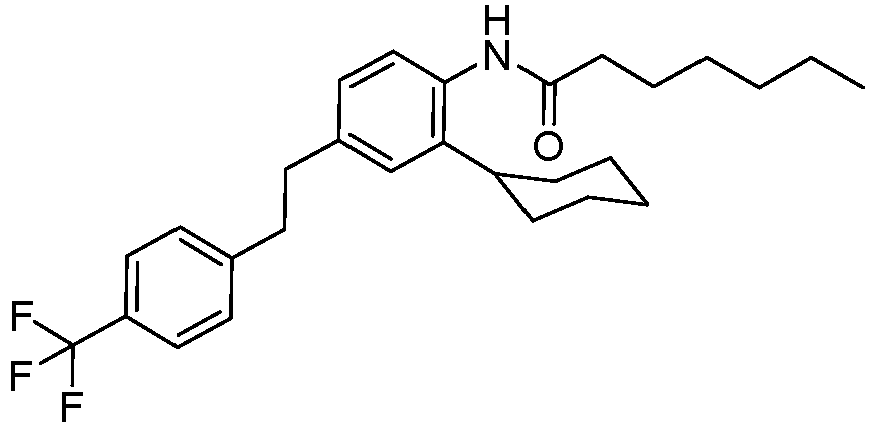
N-(2-cyclohexyl-4-(4-(trifluoromethyl)phenethyl)phen yl)heptanamide 241. 
N-(2-cyclohexyl-4-(4-(trifluoromethyl)phenethyl)phen yl)-7,8-difluorooctanamide (7R)-N-(2-cyclohexyl-4-(4-(trifluoromethyl)phenethyl)phen yl)-7,8-difluorooctanamide (7S)-N-(2-cyclohexyl-4-(4-(trifluoromethyl)phenethyl)phen yl)-7,8-difluorooctanamide 242. 
N-(2-cyclohexyl-4-(4-(trifluoromethyl)phenethyl)phen yl)octanamide 243. 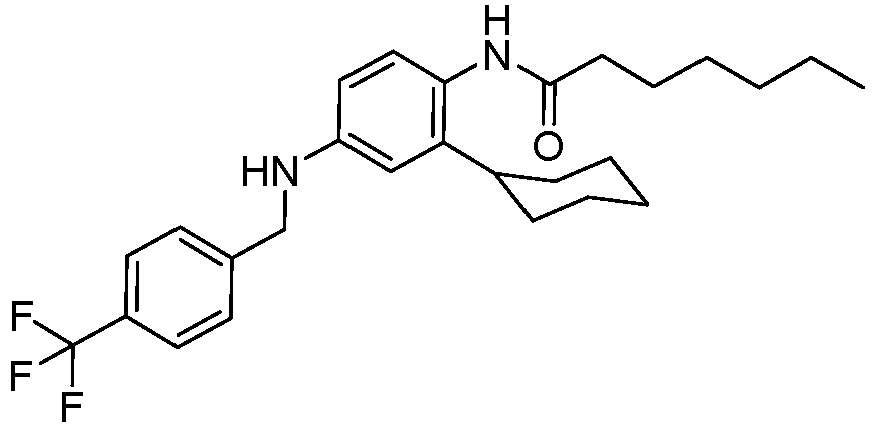
N-(2-cyclohexyl-4-((4-(trifluoromethyl)benzyl)amino)p henyl)heptanamide 244. 
N-(2-cyclohexyl-4-((4-(trifluoromethyl)benzyl)amino)p henyl)-2,3-difluoroheptanamide (2R,3 S)-N-(2-cyclohexyl-4-((4-(trifluoromethyl)benzyl)amino)p henyl)-2,3-difluoroheptanamide (2S,3R)-N-(2-cyclohexyl-4-((4-(trifluoromethyl)benzyl)amino)p henyl)-2,3-difluoroheptanamide
(2R,3R)-N-(2-cyclohexyl-4-((4-(trifluoromethyl)benzyl)amino)p henyl)-2,3-difluoroheptanamide
(2S,3 S)-N-(2-cyclohexyl-4-((4-(trifluoromethyl)benzyl)amino)p henyl)-2,3-difluoroheptanamide245. 
N-(2-cyclohexyl-4-((4-(trifluoromethyl)benzyl)amino)p henyl)-7,8-difluorooctanamide (7R)-N-(2-cyclohexyl-4-((4-(trifluoromethyl)benzyl)amino)p henyl)-7,8-difluorooctanamide (7S)- N-(2-cyclohexyl-4-((4-(trifluoromethyl)benzyl)amino)p henyl)-7,8-difluorooctanamide 246. 
N-(2-cyclohexyl-4-((4-(trifluoromethyl)benzyl)amino)p henyl)octanamide 247. 
N-(3-fluoro-4-((4-fluorobenzyl)amino)phenyl)cycl ohexanesulfonamide 248. 
N-(2-amino-4-((4-(trifluoromethyl)benzyl)oxy)phe nyl)heptanamide 249. 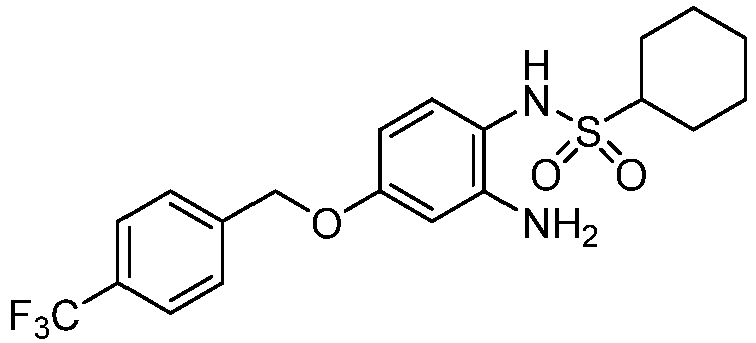
N-(2-amino-4-((4-(trifluoromethyl)benzyl)oxy)phe nyl)cyclohexanesulfonamide 250. 
N-(2-amino-4-((4-(trifluoromethyl)benzyl)amino)p henyl)cyclopropanecarboxamide 251. 
N-(2-amino-4-((4-(trifluoromethyl)benzyl)amino)p henyl)-3-cyclohexylpropanamide 252. 
N-(2-amino-4-((4-fluorophenethyl)amino)phenyl)h eptanamide 253. 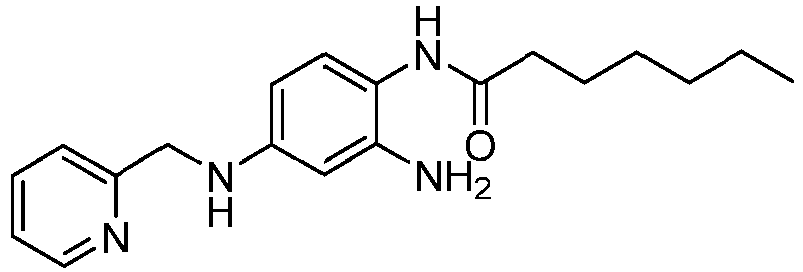
N-(2-amino-4-((pyridin-2-ylmethyl)amino)phenyl)heptana mide 254. 
N-(2-amino-4-((2-fluorobenzyl)amino)phenyl)hept anamide 255. 
N-(2-amino-4-((4-(trifluoromethyl)benzyl)amino)p henyl)-2-(2-methoxyethoxy)acetamide 256. 
N-(2-amino-4-(benzylamino)phenyl)heptanami de 257. 
N-(2,6-difluoro-4-((4-(trifluoromethyl)benzyl)amino)p henyl)heptanamide 258. 
N-(2-amino-4-(methyl(4-(trifluoromethyl)benzyl)amino)p henyl)heptanamide 259. 
N-(2-amino-3-fluoro-4-((4-(trifluoromethyl)benzyl)amino)p henyl)isobutyramide 260. 
N-(2-amino-3-fluoro-4-((4-(trifluoromethyl)benzyl)amino)p henyl)-3-methylbutanamide 261. 
N-(2-amino-3-fluoro-4-((4-(trifluoromethyl)benzyl)amino)p henyl)-3-cyclohexylpropanamide 262. 
N-(2,6-difluoro-4-((4-(trifluoromethyl)benzyl)amino)p henyl)-3,3-dimethylbutanamide 263. 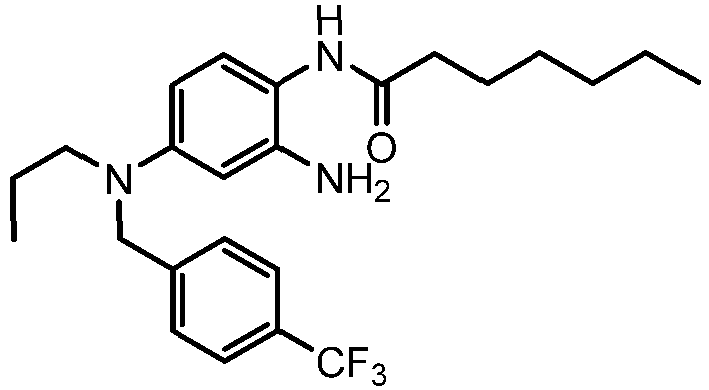
N-(2-amino-4-(propyl(4-(trifluoromethyl)benzyl)amino)p henyl)heptanamide 264. 
N-(2-amino-4-(methyl(4-(trifluoromethyl)benzyl)amino)p henyl)-3,3-dimethylbutanamide 265. 
N-(2-amino-3-fluoro-4-(methyl(4-(trifluoromethyl)benzyl)amino)p henyl)-3,3-dimethylbutanamide 266. 
N-(2-amino-4-((4-(trifluoromethyl)benzyl)amino)p henyl)cyclohexanesulfonamide 267. 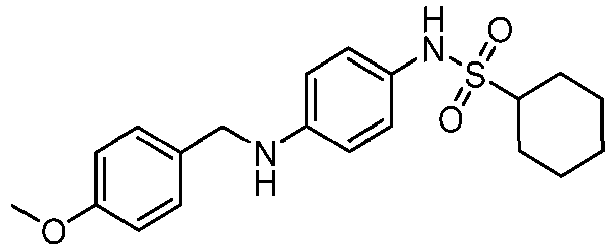
N-(4-((4-methoxybenzyl)amino)phenyl) cyclohexanesulfonamide 268. 
N-(4-((4-methoxybenzyl)(methyl)amino)p henyl) cyclohexanesulfonamide 269. 
(R)-N-(4-((1-(4-methoxyphenyl)ethyl)amino)phe nyl) cyclohexanesulfonamide 270. 
(S)-N-(4-((1-(4-methoxyphenyl)ethyl)amino)phe nyl) cyclohexanesulfonamide 271. 
3-ethyl-N-(4-((4-methoxybenzyl)amino)phenyl)b enzenesulfonamide - The compound or tautomer, salt, solvate, stereoisomer or isotope thereof according to any one of the previous claims, wherein said compound is a voltage-gated potassium channel modulator, preferably a Kv7.1, Kv7.2, Kv7.3, Kv7.4 and/or Kv7.5 modulator.
- The compound or tautomer, salt, solvate, stereoisomer or isotope thereof as defined in any one of the previous claims for use as a medicament; preferablyfor use in the treatment and/or prevention of a condition characterised by a defect in the structure and/or function of at least one voltage-gated potassium channel, preferably at least one of Kv7. 1, Kv7.2, Kv7.3, Kv7.4 and/or Kv7.5; preferablywherein said condition is selected from the group consisting of: a central nervous system disease, a peripheral nervous system disease, a sensory system disease, a respiratory system disease, a genitourinary system disease, a gastrointestinal system disease, a cardiovascular disease, a skeletal muscle disease and a channelopathy; preferablywherein said condition is selected from the group consisting of: epilepsy, a convulsive disorder, a seizure, a seizure disorder, a disorder characterised by hyperexcitability of the nervous system, a neonatal epilepsy, spontaneous contractions, an early-onset epileptic disorder, Ohtahara syndrome, early infantile epileptic encelopathy with suppression-burst, benign familiar neonatal seizures, epileptic encelopathy, severe sporadic neonatal epileptic encelopathy, an intellectual disability, a psychiatric or cognitive comorbidity, a cognitive defect, anxiety, depression, schizophrenia, sudden death in epilepsy, drug-resistant epilepsy, neuropathic pain, an ischemic stroke, angina, migraine, a neurodegenerative disorder, a neurologic disorder, amyotrophic lateral sclerosis, Alzheimer's disease, Parkinson's disease, tremors, paroxysmal choreoathetosis, tinnitus, pain, asthma, bladder hyper-reactivity, urinary incontinence, constipation, irritable bowel syndrome, diarrhea, Krohn's disease, hypertension, vascular hypertension, muscular dystrophy, a skeletal muscle hyperexcitability disease, myokymia, myotonia, a genetic channelopathy, a transcriptional channelopathy, a Kv7.2- and/or Kv7.3-related disorder, a Kv 7.2 encelopathy, autosomal dominant type 2 deafness (DFNA2), ataxia, episodic ataxia type 1, episodic ataxia with myokymia syndrome, neuromyotonia, hypokalaemic periodic paralysis, an arrhythmia, a congenital arrhythmia, a long QT syndrome, Romano-Ward syndrome, Jervell and Lange-Nielsen syndrome, Bartter syndrome, hyperinsulinemic hypoglycaemia of infancy (HHI), attenuate vasoconstrictor response, type 2 diabetes and multiple sclerosis.
- The compound or tautomer, salt, solvate, stereoisomer or isotope thereof as defined in any one of claims 1-3 for use as an anticonvulsant, analgesic, anti-ischemic, anti-arrhythmic, neuroprotective, anti-tinnitus, antiasthmatic, gastrointestinal motility modulator, antihypertensive, antimyotonic and/or anti-skeletal muscle dystrophia medicament.
- A pharmaceutical composition comprising the compound or tautomer, salt, solvate, stereoisomer or isotope thereof as defined in any one of claims 1-3 and a pharmaceutically acceptable carrier.
- The pharmaceutical composition according to claim 6 comprising a further therapeutic agent selected from: an anticonvulsivant, an analgesic and a nonsteroidal anti-inflammatory drug (NSAID), preferably said anticonvulsant is selected from the group consisting of: Acetazolamide, Brivaracetam, Carbamazepine, Clobazam, Clonazepam, Diazepam, Eslicarbazepine, Ethosuximide, Fosphenytoin, Gabapentin, Lacosamide, Lamotrigine, Levetiracetam, Lorazepam, Methosuximide, Nitrazepam, Oxcarbazepine, Perampanel, Phenobarbital, Phenytoin, Pregabalin, Primidone, Rufinamide, Stiripentol, Topiramate, Valproic Acid, Vigabatrin, Felbamate, Tiagabine and Zonisamide, preferably said analgesic is acetaminophen or an opioid, preferably said nonsteroidal anti-inflammatory drug (NSAID) is selected from the group consisting of: aspirin, diclofenac, diflusinal, etodolac, fenbufen, fenoprofen, flufenisal, flurbiprofen, ibuprofen, indomethacin, ketoprofen, ketorolac, meclofenamic acid, mefenamic acid, meloxicam, nabumetone, naproxen, nimesulide, nitroflurbiprofen, olsalazine, oxaprozin, phenylbutazone, piroxicam, sulfasalazine, sulindac, tolmetin and zomepirac, preferably said opioid is morphine.
- The pharmaceutical composition as defined in claim 6 or 7 for use in the treatment and/or prevention of a condition characterised by a defect in the structure and/or function of at least one voltage-gated potassium channel, preferably at least one of Kv7.1, Kv7.2, Kv7.3, Kv7.4 and/or Kv7.5.
- The compound for use according to any one of claims 4-5 or the pharmaceutical composition for use according to claim 8 being administered to an animal, preferably a companion animal or livestock.
- The compound or tautomer, salt, solvate, stereoisomer or isotope thereof as defined in any one of claims 1-3 for use in a method of modulating a voltage-gated potassium channel, preferably said voltage-gated potassium channel is Kv7.1, Kv7.2, Kv7.3, Kv7.4 and/or Kv7.5.
- An in-vitro method of modulating a voltage-gated potassium channel by using the compound or tautomer, salt, solvate, stereoisomer or isotope thereof as defined in any one of claims 1-3, said voltage-gated potassium channel being preferably Kv7.1, Kv7.2, Kv7.3, Kv7.4 and/or Kv7.5.
Applications Claiming Priority (2)
| Application Number | Priority Date | Filing Date | Title |
|---|---|---|---|
| EP2019052067 | 2019-01-29 | ||
| PCT/EP2020/052156 WO2020157126A1 (en) | 2019-01-29 | 2020-01-29 | Modulators of potassium ion channels and uses thereof |
Publications (3)
| Publication Number | Publication Date |
|---|---|
| EP3917907A1 EP3917907A1 (en) | 2021-12-08 |
| EP3917907C0 EP3917907C0 (en) | 2025-05-21 |
| EP3917907B1 true EP3917907B1 (en) | 2025-05-21 |
Family
ID=65243558
Family Applications (1)
| Application Number | Title | Priority Date | Filing Date |
|---|---|---|---|
| EP20702775.6A Active EP3917907B1 (en) | 2019-01-29 | 2020-01-29 | Modulators of potassium ion channels and uses thereof |
Country Status (3)
| Country | Link |
|---|---|
| EP (1) | EP3917907B1 (en) |
| ES (1) | ES3034157T3 (en) |
| WO (1) | WO2020157126A1 (en) |
Families Citing this family (5)
| Publication number | Priority date | Publication date | Assignee | Title |
|---|---|---|---|---|
| CA3182276A1 (en) | 2020-05-08 | 2021-12-02 | Halia Therapeutics, Inc. | Inhibitors of nek7 kinase |
| KR102415692B1 (en) * | 2020-09-01 | 2022-07-05 | 건국대학교 글로컬산학협력단 | Composition for preventing, improving and treating developmental disability by controlling synapse imbalance |
| US20230406812A1 (en) * | 2020-11-13 | 2023-12-21 | Institute For Basic Science | Novel aminoaromatic compound or pharmaceutically acceptable salt thereof, and pharmaceutical composition for preventing or treating neurodegenerative diseases comprising same as active ingredient |
| CN116535353A (en) * | 2022-01-25 | 2023-08-04 | 上海挚盟医药科技有限公司 | Amide compounds as potassium channel regulators and their preparation and application |
| HUP2300429A1 (en) * | 2023-12-04 | 2025-06-28 | Univ Szegedi | Aminoalkylated benzoxy compounds for use in the treatment of cardiac disorders |
Family Cites Families (5)
| Publication number | Priority date | Publication date | Assignee | Title |
|---|---|---|---|---|
| DE4200259A1 (en) | 1992-01-08 | 1993-07-15 | Asta Medica Ag | NEW 1,2,4-TRIAMINOBENZOL DERIVATIVES AND METHOD FOR THE PRODUCTION THEREOF |
| TWI349666B (en) | 2004-03-12 | 2011-10-01 | Lundbeck & Co As H | Substituted morpholine and thiomorpholine derivatives |
| NZ575652A (en) | 2006-08-23 | 2011-08-26 | Valeant Pharmaceuticals Int | Derivatives of 4-(n-azacycloalkyl) anilides as potassium channel modulators |
| EP2536394A2 (en) * | 2010-02-19 | 2012-12-26 | Medichem S.A. | Stabilized phenylcarbamate derivative in solid state |
| CN103073455B (en) | 2011-10-25 | 2015-08-19 | 中国科学院上海药物研究所 | Kcnq potassium channel agonist, Preparation Method And The Use that one class is novel |
-
2020
- 2020-01-29 ES ES20702775T patent/ES3034157T3/en active Active
- 2020-01-29 WO PCT/EP2020/052156 patent/WO2020157126A1/en not_active Ceased
- 2020-01-29 EP EP20702775.6A patent/EP3917907B1/en active Active
Also Published As
| Publication number | Publication date |
|---|---|
| EP3917907C0 (en) | 2025-05-21 |
| EP3917907A1 (en) | 2021-12-08 |
| ES3034157T3 (en) | 2025-08-13 |
| WO2020157126A1 (en) | 2020-08-06 |
Similar Documents
| Publication | Publication Date | Title |
|---|---|---|
| ES3034157T3 (en) | Modulators of potassium ion channels and uses thereof | |
| EP3651752B1 (en) | Carboxamides as modulators of sodium channels | |
| AU2014290411B2 (en) | Sulfonamides as modulators of sodium channels | |
| EP2951155B1 (en) | Amides as modulators of sodium channels | |
| EP2038268B1 (en) | Carbonylated (aza)cyclohexanes as dopamine d3 receptor ligands | |
| EP2870138B1 (en) | N-substituted benzamides and methods of use thereof | |
| JP5419691B2 (en) | Derivatives of 4- (N-azacycloalkyl) anilide as potassium channel modulators | |
| KR101449348B1 (en) | Piperidinyl pyrimidine amides as kv7 potassium channel openers | |
| CN1422257A (en) | Aryl substituted pyrazoles, triazoles and tetrazoles as sodium channel blocker | |
| EA018032B1 (en) | Phenylsulfamoyl benzamide derivatives as bradykinin receptor antagonists, process for producing same and pharmaceutical composition comprising them | |
| JP2010528035A (en) | Ion channel modulators and uses thereof | |
| WO2004052371A2 (en) | Cyclic quinoline compounds for use in mch receptor related disorders | |
| CN106715435B (en) | Pyrrolopyrimidine derivatives as NR2B nmda receptor antagonist | |
| EA018067B1 (en) | Thiadiazole derivatives for the treatment of neuro degenerative diseases | |
| RU2624011C2 (en) | Oxazethydine derivatives, method for their production and their use in medicine and cosmetics | |
| EP3204374B1 (en) | Isoindoline derivatives | |
| CA2610326A1 (en) | Substituted pyrr0lidin-2-0nes , piperidin-2-0nes and isothiazolidine-1, 1-dioxides, their use as kv1.5 potassium channel blockers and pharmaceutical preparations comprising them | |
| CN117362231A (en) | A kind of synthesis method and use of substituted amidine compounds | |
| JP4791968B2 (en) | Amidomethyl-substituted 2- (4-sulfonylamino) -3-hydroxy-3,4-dihydro-2H-chromen-6-yl derivatives, processes and intermediate products for preparing the derivatives and pharmaceuticals containing these compounds | |
| KR20050117563A (en) | Substituted aniline derivatives | |
| US12312333B2 (en) | SK channel positive allosteric modulators | |
| MX2010014461A (en) | Benzyloxy anilide derivatives useful as potassium channel modulators. | |
| WO2006000294A1 (en) | Novel diazeniumdiolate compounds, process for the preparation thereof, and therapeutic use thereof | |
| EP3498273A1 (en) | Pharmaceutical composition for modulating the response of a gaba-a receptor | |
| AU2008263915A1 (en) | 4,5-dihydro-(1H)-pyrazole derivatives as cannabinoid CB1 receptor modulators |
Legal Events
| Date | Code | Title | Description |
|---|---|---|---|
| STAA | Information on the status of an ep patent application or granted ep patent |
Free format text: STATUS: UNKNOWN |
|
| STAA | Information on the status of an ep patent application or granted ep patent |
Free format text: STATUS: THE INTERNATIONAL PUBLICATION HAS BEEN MADE |
|
| PUAI | Public reference made under article 153(3) epc to a published international application that has entered the european phase |
Free format text: ORIGINAL CODE: 0009012 |
|
| STAA | Information on the status of an ep patent application or granted ep patent |
Free format text: STATUS: REQUEST FOR EXAMINATION WAS MADE |
|
| 17P | Request for examination filed |
Effective date: 20210830 |
|
| AK | Designated contracting states |
Kind code of ref document: A1 Designated state(s): AL AT BE BG CH CY CZ DE DK EE ES FI FR GB GR HR HU IE IS IT LI LT LU LV MC MK MT NL NO PL PT RO RS SE SI SK SM TR |
|
| DAV | Request for validation of the european patent (deleted) | ||
| DAX | Request for extension of the european patent (deleted) | ||
| STAA | Information on the status of an ep patent application or granted ep patent |
Free format text: STATUS: EXAMINATION IS IN PROGRESS |
|
| 17Q | First examination report despatched |
Effective date: 20230818 |
|
| GRAP | Despatch of communication of intention to grant a patent |
Free format text: ORIGINAL CODE: EPIDOSNIGR1 |
|
| STAA | Information on the status of an ep patent application or granted ep patent |
Free format text: STATUS: GRANT OF PATENT IS INTENDED |
|
| INTG | Intention to grant announced |
Effective date: 20241223 |
|
| GRAS | Grant fee paid |
Free format text: ORIGINAL CODE: EPIDOSNIGR3 |
|
| GRAA | (expected) grant |
Free format text: ORIGINAL CODE: 0009210 |
|
| STAA | Information on the status of an ep patent application or granted ep patent |
Free format text: STATUS: THE PATENT HAS BEEN GRANTED |
|
| AK | Designated contracting states |
Kind code of ref document: B1 Designated state(s): AL AT BE BG CH CY CZ DE DK EE ES FI FR GB GR HR HU IE IS IT LI LT LU LV MC MK MT NL NO PL PT RO RS SE SI SK SM TR |
|
| REG | Reference to a national code |
Ref country code: GB Ref legal event code: FG4D |
|
| REG | Reference to a national code |
Ref country code: CH Ref legal event code: EP |
|
| REG | Reference to a national code |
Ref country code: DE Ref legal event code: R096 Ref document number: 602020051558 Country of ref document: DE |
|
| REG | Reference to a national code |
Ref country code: IE Ref legal event code: FG4D |
|
| U01 | Request for unitary effect filed |
Effective date: 20250604 |
|
| U07 | Unitary effect registered |
Designated state(s): AT BE BG DE DK EE FI FR IT LT LU LV MT NL PT RO SE SI Effective date: 20250612 |
|
| REG | Reference to a national code |
Ref country code: ES Ref legal event code: FG2A Ref document number: 3034157 Country of ref document: ES Kind code of ref document: T3 Effective date: 20250813 |
|
| PG25 | Lapsed in a contracting state [announced via postgrant information from national office to epo] |
Ref country code: NO Free format text: LAPSE BECAUSE OF FAILURE TO SUBMIT A TRANSLATION OF THE DESCRIPTION OR TO PAY THE FEE WITHIN THE PRESCRIBED TIME-LIMIT Effective date: 20250821 Ref country code: GR Free format text: LAPSE BECAUSE OF FAILURE TO SUBMIT A TRANSLATION OF THE DESCRIPTION OR TO PAY THE FEE WITHIN THE PRESCRIBED TIME-LIMIT Effective date: 20250822 |
|
| PG25 | Lapsed in a contracting state [announced via postgrant information from national office to epo] |
Ref country code: PL Free format text: LAPSE BECAUSE OF FAILURE TO SUBMIT A TRANSLATION OF THE DESCRIPTION OR TO PAY THE FEE WITHIN THE PRESCRIBED TIME-LIMIT Effective date: 20250521 |
|
| PG25 | Lapsed in a contracting state [announced via postgrant information from national office to epo] |
Ref country code: HR Free format text: LAPSE BECAUSE OF FAILURE TO SUBMIT A TRANSLATION OF THE DESCRIPTION OR TO PAY THE FEE WITHIN THE PRESCRIBED TIME-LIMIT Effective date: 20250521 |
|
| PG25 | Lapsed in a contracting state [announced via postgrant information from national office to epo] |
Ref country code: RS Free format text: LAPSE BECAUSE OF FAILURE TO SUBMIT A TRANSLATION OF THE DESCRIPTION OR TO PAY THE FEE WITHIN THE PRESCRIBED TIME-LIMIT Effective date: 20250821 |
|
| PG25 | Lapsed in a contracting state [announced via postgrant information from national office to epo] |
Ref country code: IS Free format text: LAPSE BECAUSE OF FAILURE TO SUBMIT A TRANSLATION OF THE DESCRIPTION OR TO PAY THE FEE WITHIN THE PRESCRIBED TIME-LIMIT Effective date: 20250921 |
|
| PG25 | Lapsed in a contracting state [announced via postgrant information from national office to epo] |
Ref country code: SM Free format text: LAPSE BECAUSE OF FAILURE TO SUBMIT A TRANSLATION OF THE DESCRIPTION OR TO PAY THE FEE WITHIN THE PRESCRIBED TIME-LIMIT Effective date: 20250521 |
|
| PG25 | Lapsed in a contracting state [announced via postgrant information from national office to epo] |
Ref country code: CZ Free format text: LAPSE BECAUSE OF FAILURE TO SUBMIT A TRANSLATION OF THE DESCRIPTION OR TO PAY THE FEE WITHIN THE PRESCRIBED TIME-LIMIT Effective date: 20250521 |
|
| PG25 | Lapsed in a contracting state [announced via postgrant information from national office to epo] |
Ref country code: SK Free format text: LAPSE BECAUSE OF FAILURE TO SUBMIT A TRANSLATION OF THE DESCRIPTION OR TO PAY THE FEE WITHIN THE PRESCRIBED TIME-LIMIT Effective date: 20250521 |
|
| REG | Reference to a national code |
Ref country code: CH Ref legal event code: U11 Free format text: ST27 STATUS EVENT CODE: U-0-0-U10-U11 (AS PROVIDED BY THE NATIONAL OFFICE) Effective date: 20260201 |
|
| U20 | Renewal fee for the european patent with unitary effect paid |
Year of fee payment: 7 Effective date: 20260120 |
|
| PLBE | No opposition filed within time limit |
Free format text: ORIGINAL CODE: 0009261 |
|
| STAA | Information on the status of an ep patent application or granted ep patent |
Free format text: STATUS: NO OPPOSITION FILED WITHIN TIME LIMIT |
|
| REG | Reference to a national code |
Ref country code: CH Ref legal event code: L10 Free format text: ST27 STATUS EVENT CODE: U-0-0-L10-L00 (AS PROVIDED BY THE NATIONAL OFFICE) Effective date: 20260402 |
|
| PGFP | Annual fee paid to national office [announced via postgrant information from national office to epo] |
Ref country code: GB Payment date: 20260123 Year of fee payment: 7 |
|
| PGFP | Annual fee paid to national office [announced via postgrant information from national office to epo] |
Ref country code: ES Payment date: 20260227 Year of fee payment: 7 |
|
| PGFP | Annual fee paid to national office [announced via postgrant information from national office to epo] |
Ref country code: IE Payment date: 20260122 Year of fee payment: 7 |
|
| PGFP | Annual fee paid to national office [announced via postgrant information from national office to epo] |
Ref country code: CH Payment date: 20260201 Year of fee payment: 7 |
|
| 26N | No opposition filed |
Effective date: 20260224 |