EP3916300A1 - Information processing device, information processing method, and information processing program - Google Patents
Information processing device, information processing method, and information processing program Download PDFInfo
- Publication number
- EP3916300A1 EP3916300A1 EP20745741.7A EP20745741A EP3916300A1 EP 3916300 A1 EP3916300 A1 EP 3916300A1 EP 20745741 A EP20745741 A EP 20745741A EP 3916300 A1 EP3916300 A1 EP 3916300A1
- Authority
- EP
- European Patent Office
- Prior art keywords
- waste
- time
- carried out
- transfer
- brought
- Prior art date
- Legal status (The legal status is an assumption and is not a legal conclusion. Google has not performed a legal analysis and makes no representation as to the accuracy of the status listed.)
- Granted
Links
Images


Classifications
-
- F—MECHANICAL ENGINEERING; LIGHTING; HEATING; WEAPONS; BLASTING
- F23—COMBUSTION APPARATUS; COMBUSTION PROCESSES
- F23G—CREMATION FURNACES; CONSUMING WASTE PRODUCTS BY COMBUSTION
- F23G5/00—Incineration of waste; Incinerator constructions; Details, accessories or control therefor
- F23G5/44—Details; Accessories
- F23G5/442—Waste feed arrangements
- F23G5/444—Waste feed arrangements for solid waste
-
- F—MECHANICAL ENGINEERING; LIGHTING; HEATING; WEAPONS; BLASTING
- F23—COMBUSTION APPARATUS; COMBUSTION PROCESSES
- F23G—CREMATION FURNACES; CONSUMING WASTE PRODUCTS BY COMBUSTION
- F23G5/00—Incineration of waste; Incinerator constructions; Details, accessories or control therefor
- F23G5/50—Control or safety arrangements
-
- F—MECHANICAL ENGINEERING; LIGHTING; HEATING; WEAPONS; BLASTING
- F23—COMBUSTION APPARATUS; COMBUSTION PROCESSES
- F23K—FEEDING FUEL TO COMBUSTION APPARATUS
- F23K1/00—Preparation of lump or pulverulent fuel in readiness for delivery to combustion apparatus
-
- F—MECHANICAL ENGINEERING; LIGHTING; HEATING; WEAPONS; BLASTING
- F23—COMBUSTION APPARATUS; COMBUSTION PROCESSES
- F23N—REGULATING OR CONTROLLING COMBUSTION
- F23N1/00—Regulating fuel supply
- F23N1/002—Regulating fuel supply using electronic means
Definitions
- the present invention relates to an information processing device, an information processing method, and an information processing program each for generating a waste disposal schedule.
- a waste incineration facility includes a waste pit for temporarily storing waste that has been brought in by a garbage truck.
- the waste inside the waste pit is mixed by a crane and then transferred to an incinerator for incineration.
- the mixing which is carried out in order to homogenize waste that is to be fed into the incinerator, is an important process for stably burning waste.
- Prior art documents which disclose automatic control of such a crane include, for example, Patent Literature 1 below.
- Patent Literature 1 discloses a control device which (i) determines, on the basis of a waste color tone map indicative of color tones of waste inside a waste pit, that heterogeneous waste is present in the waste pit and (ii) controls a crane so as to cause the crane to mix the heterogeneous waste.
- Main operations carried out by means of a crane also include an operation to put waste into a waste hopper which leads to an incinerator.
- a large crane is used in a waste pit, and at most two cranes are provided in a single waste pit.
- two cranes that are provided in the waste pit may contact each other. It is therefore not preferable to operate the cranes in areas that are close to each other. This may make it difficult to allot time to a mixing operation in a time frame during which waste is brought in one after another.
- An aspect of the present invention has been made in view of the above problems, and has an object to provide, for example, an information processing device which makes it possible to allot, to a mixing operation, a time longer than or equal to a predetermined time, while ensuring that a transfer operation is carried out for a required time.
- an information processing device in accordance with an aspect of the present invention includes: a transfer time estimating section configured to estimate a time in a series of time frames which includes (i) a first time frame during which a relatively large amount of waste is brought into a waste pit and (ii) a second time frame during which a smaller amount of waste is brought into the waste pit than during the first time frame, the time being required for a transfer operation to cause a crane to transfer waste that has been brought into the waste pit; and a scheduler section configured to divide, between a mixing operation and the transfer operation, an operation time, during which the mixing operation or the transfer operation is allowed to be carried out with respect to waste by means of the crane in the series of time frames, in a manner which satisfies the following requirements: (1) a requirement that the transfer operation is carried out for at least the time that has been estimated by the transfer time estimating section; and (2) a requirement that the mixing operation is carried out for a time equal to or longer than a predetermined time in the first time frame during which
- an information processing method in accordance with an aspect of the present invention which is carried out by an information processing device, includes the steps of: estimating a time in a series of time frames which includes (i) a first time frame during which a relatively large amount of waste is brought into a waste pit and (ii) a second time frame during which a smaller amount of waste is brought into the waste pit than during the first time frame, the time being required for a transfer operation to cause a crane to transfer waste that has been brought into the waste pit; and dividing, between a mixing operation and the transfer operation, an operation time, during which the mixing operation or the transfer operation is allowed to be carried out with respect to waste by means of the crane in the series of time frames, in a manner which satisfies the following requirements: (1) a requirement that the transfer operation is carried out for at least the time that has been estimated in the estimating; and (2) a requirement that the mixing operation is carried out for a time equal to or longer than a predetermined time in the first time frame during which a relatively
- An aspect of the present invention makes it possible to allot, to mixing work, a time longer than or equal to a predetermined time period, while ensuring that a transfer operation is carried out for a required time.
- An information processing device in accordance with the present embodiment is a device for generating a schedule according to which operations are carried out by means of a crane in a waste incineration plant.
- the following description will discuss the operations which are carried out by means of the crane in the waste incineration plant.
- the waste incineration plant includes a waste pit which is a facility for storing waste which has been brought into the waste incineration plant.
- the waste pit is provided with a crane which has a bucket for grabbing waste.
- the crane is capable of moving waste by (i) causing the bucket to grab and lift the waste in the waste pit, (ii) moving the bucket while grabbing and lifting the waste, and (iii) releasing, at a destination to which the waste has been moved, the waste which has been grabbed and lifted.
- the information processing device in accordance with the present embodiment generates a schedule according to which the crane is caused to carry out the following three operations (a transfer operation, a mixing operation, and a putting-in operation).
- the transfer operation is an operation to transfer, in the waste pit, waste which has been brought into the waste incineration plant.
- the waste which has been brought into the waste incineration plant by a garbage truck or the like is dropped into the waste pit through a predetermined bringing-in entrance.
- This requires the transfer operation to transfer waste from an area (acceptance area), located almost immediately below the bringing-in entrance of the waste pit, to an area (mixing area) for carrying out the mixing operation (described later).
- an area acceptance area
- mixing area for carrying out the mixing operation
- the mixing operation is an operation to mix waste by releasing (dropping), in the waste pit, waste which has been grabbed and lifted in the waste pit.
- the mixing operation is carried out so that waste is homogenized for achievement of stable incineration.
- the mixing operation is important for stable power generation.
- the mixing operation which is carried out basically in the mixing area in the waste pit, can alternatively be carried out in the acceptance area in a time frame during which no waste is brought in.
- the putting-in operation is an operation to put, into a waste hopper, waste which has been grabbed and lifted in the waste pit. Then, the waste which has been put into the waste hopper by the putting-in operation is incinerated because the waste hopper leads to an incinerator. A decrease in amount of the waste remaining in the waste hopper causes the waste hopper to issue a putting-in command to put in waste. Therefore, the putting-in operation is triggered by the putting-in command and carried out as needed. In the putting-in operation, sufficiently mixed waste is preferably put into the waste hopper.
- Fig. 1 is a block diagram illustrating an example configuration of components of an information processing device 1 in accordance with an embodiment of the present invention.
- the information processing device 1 includes: a control section 10 which collectively controls sections of the information processing device 1; and a storage section 20 which stores various kinds of data to be used by the information processing device 1.
- the information processing device 1 also includes an input section 30 which receives an input operation carried out with respect to the information processing device 1.
- the control section 10 includes an operation allowed time calculating section 101, a putting-in time estimating section 102, a bringing-in amount estimating section 103, a transfer time estimating section 104, a scheduler section 105, a waste state determining section 106, and an operation order determining section 107.
- the storage section 20 stores incinerator information 201, bringing-in information 202, and waste state information 203.
- the operation allowed time calculating section 101 calculates an operation allowed time in a target period, which is a period for which the information processing device 1 generates a schedule.
- the operation allowed time is a time during which any of the putting-in operation, the transfer operation, and the mixing operation is allowed to be carried out.
- the target period is not limited to any particular period, and can be set to, for example, one day, one week, one month, or one year.
- a user of the information processing device 1 can specify the target period by an input operation carried out via the input section 30.
- the putting-in time estimating section 102 estimates (i) a putting-in amount of waste to be put into the waste hopper and (ii) a required time for the putting-in operation. Specifically, the putting-in time estimating section 102 carries out the estimation on the basis of the incinerator information 201.
- the putting-in amount and the required time, which are estimated by the putting-in time estimating section 102, can have respective ranges. For example, the putting-in time estimating section 102 can estimate an upper limit and a lower limit of the putting-in amount.
- the incinerator information 201 is information about an incinerator of the waste incineration plant.
- the incinerator information 201 only needs to be information that is correlated with (i) the putting-in amount of waste to be put into the waste hopper and (ii) the required time for the putting-in operation.
- the description of the present embodiment will discuss an example in which the incinerator information 201 is information indicative of a waste incineration plan for the waste incineration plant. This information can be information indicative of an amount of waste to be incinerated in a predetermined period (for example, a period such as one day, one month, and one year).
- the incinerator information 201 can be information indicative of, for example, an operation history (an operation record) of the incinerator.
- the putting-in time estimating section 102 estimates the putting-in amount of waste in the target period from the amount of waste that was incinerated in the past.
- the bringing-in amount estimating section 103 estimates a bringing-in amount of waste to be brought into the waste pit in the target period.
- the bringing-in amount which is estimated by the bringing-in amount estimating section 103, can have a range.
- the bringing-in amount estimating section 103 can estimate an upper limit and a lower limit of the bringing-in amount.
- the bringing-in amount estimating section 103 can estimate the bringing-in amount of waste on the basis of the putting-in amount estimated by the putting-in time estimating section 102.
- the bringing-in amount estimating section 103 can alternatively use the bringing-in information 202 to estimate the bringing-in amount.
- the bringing-in information 202 is information about bringing-in of waste into the waste incineration plant.
- the bringing-in information 202 only needs to be information that is correlated with the bringing-in amount of waste that has been brought into the waste incineration plant.
- the description of the present embodiment will discuss an example in which the bringing-in information 202 is information indicative of a waste bringing-in plan for the waste incineration plant.
- This information can be information indicative of an amount of waste to be brought in in a predetermined period (for example, a period such as one day, one month, and one year).
- the bringing-in information 202 can be information indicative of, for example, a bringing-in history (a bringing-in record) of waste that has been brought into the waste incineration plant.
- the bringing-in amount estimating section 103 estimates the bringing-in amount of waste in the target period from the amount of waste that was brought in in the past.
- the transfer time estimating section 104 estimates a required time for the transfer operation in the target period.
- the target period is a series of time frames which includes (i) a first time frame during which a relatively large amount of waste is brought into the waste pit and (ii) a second time frame during which a smaller amount of waste is brought into the waste pit than during the first time frame.
- the transfer time estimating section 104 estimates the required time for the transfer operation on the basis of the bringing-in amount estimated by the bringing-in amount estimating section 103.
- the transfer time estimating section 104 can calculate, as the required time for the transfer operation, a time required for transfer of all the waste in the bringing-in amount estimated by the bringing-in amount estimating section 103.
- the scheduler section 105 divides, between the mixing operation and the transfer operation, an operation time, during which the mixing operation or the transfer operation is allowed to be carried out with respect to the waste in the target period.
- the scheduler section 105 carries out the division in a manner which satisfies predetermined requirements, though specifically described later. Further, the scheduler section 105 allots a given operation time to the putting-in operation in both (a) the first time frame, which is included in the target period and during which a relatively large amount of waste is brought in, and (b) the second time frame, which is included in the target period and during which a smaller amount of brought-in waste than during the first time frame.
- the scheduler section 105 makes it possible to generate a schedule indicating at what ratios to carry out the respective operations in each of the time frames included in the target period.
- the schedule generated by the scheduler section 105 is information indicative of times for which the respective operations are carried out in each of the time frames included in the target period, or a ratio among the times for which the respective operations are carried out.
- the waste state determining section 106 determines a state of waste in the waste pit. Examples of the state of waste determined by the waste state determining section 106 include (1) the height of waste (height from the bottom of the waste pit) in each place in the waste pit, and (2) a degree of mixing, a moisture amount, and a type of waste in the each place in the waste pit. The waste state determining section 106 can determine the state of waste with reference to the waste state information 203 indicative of such a state of waste.
- the waste state information 203 can be information indicative of (i) a degree of mixing of waste in each of the blocks and (ii) whether waste is present in each of the blocks.
- the waste state determining section 106 can determine, from the information indicative of whether waste is present in each of the blocks, the height of waste in each place in the waste pit. Note that a method for evaluating the degree of mixing of waste is not limited to any particular method.
- the number of times of mixing of waste can be the degree of mixing as it is.
- the degree of mixing can alternatively be a degree of mixing which degree is calculated on the basis of, for example, the appearance of waste, a mixing state, a moisture amount, and/or a type of waste.
- the waste state information 203 is preferably updated whenever needed so as to include information indicative of a state of waste at a point in time which should be considered in generating the schedule.
- the waste state information 203 can be updated by the information processing device 1 or by another device.
- the operation order determining section 107 determines, on the basis of a result of the division of the operation time which result has been obtained from the scheduler section 105, an order in which the mixing operation, the transfer operation, and the putting-in operation are carried out in the target period. This makes it possible to determine, within the scope of the schedule generated by the scheduler section 105, the order in which the mixing operation, the transfer operation, and the putting-in operation, which are the main operations carried out in the waste pit, are carried out.
- the control section 10 of the information processing device 1 can further include a crane control section for operating a crane in accordance with the order determined by the operation order determining section 107.
- the information processing device 1 can also be referred to as a crane control device. It is, of course, possible to cause a crane control device that is separate from the information processing device 1 to control the crane by notifying the crane control device of the schedule generated by the information processing device 1.
- the operation order determining section 107 can be omitted in a case where it is unnecessary to determine the order in which the operations are carried out.
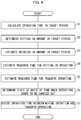
- Fig. 4 is a flow chart showing an example of a process (an information processing method) carried out by the information processing device 1 in accordance with the present embodiment.
- Fig. 2 is a view illustrating an example in which an operation time is divided for each day of the week
- Fig. 3 which is a view illustrating an example in which an operation time is divided for each of six time frames obtained by dividing a day by the four hours.
- the operation allowed time A is calculated as 10,080 minutes from Equation 1.
- the putting-in time estimating section 102 determines a putting-in amount of waste in the target period T.
- the putting-in amount of waste in the target period T is found from Equation 2 below.
- Putting ⁇ in amount of waste in target period T Putting ⁇ in amount per day ⁇ T days
- the putting-in time estimating section 102 can determine the putting-in amount per day on the basis of the waste incineration plan included in the incinerator information 201. For example, in a case where 240 tons of waste per day is planted to be incinerated, the putting-in time estimating section 102 determines that the putting-in amount per day is 240 tons, and calculates, from Equation 2, the putting-in amount of waste in the target period T as 1,680 tons.
- the bringing-in amount estimating section 103 estimates an amount of waste to be brought into the waste pit in the target period T. Specifically, the bringing-in amount estimating section 103 estimates a lower limit and an upper limit of the bringing-in amount of waste. This estimation can be carried out on the basis of the putting-in amount of waste in the target period T. For example, the bringing-in amount estimating section 103 can (i) estimate that the lower limit of the bringing-in amount of waste is half (50% of) the putting-in amount of waste in the target period T and (ii) estimate that the lower limit of the bringing-in amount of waste is two times (200% of) the putting-in amount of waste in the target period T.
- the bringing-in amount estimating section 103 can estimate the bringing-in amount on the basis of the bringing-in information 202.
- the putting-in time estimating section 102 estimates a required time for the putting-in operation in the target period T.
- a required time B for the putting-in operation in the target period T is found from Equation 3 below.
- Required time B for putting ⁇ in operation Operation time for which putting ⁇ in operation is carried out once ⁇ Number of times of putting ⁇ in per hour ⁇ 24 hours ⁇ T days
- an operation time for which the putting-in operation is carried out once is set in advance.
- the number of times of putting-in per hour is calculated from the putting-in amount calculated in S2. For example, assuming that the operation time for which the putting-in operation is carried out once is five minutes, and when the putting-in amount calculated in S2 is 1,680 tons, the required time for the putting-in operation in the target period T is calculated as 3,360 minutes from Equation 3.
- the ratio of the required time B for the putting-in operation to the operation allowed time A is approximately 33%.
- the transfer time estimating section 104 estimates a required time for the transfer operation in the target period T.
- the bringing-in amount estimating section 103 estimates a lower limit C1 and an upper limit C2 of the required time for the transfer operation in the target period T. This estimation can be carried out by using, for example, Equations 4 and 5 below. Note that the lower limit and the upper limit of the bringing-in amount are those estimated in S3. Further, (i) an amount of waste transferred by the transfer operation carried out once and (ii) an operation time for which the transfer operation is carried out once are set in advance.
- the amount of waste that is transferred by the transfer operation carried out once can be set to 2.5 tons, and the operation time for which the transfer operation is carried out once can be set to 2.5 minutes.
- the lower limit and the upper limit of the bringing-in amount are 840 tons and 3,360 tons, respectively
- the lower limit C1 and the upper limit C2 of the required time for the transfer operation are estimated to be 840 minutes (approximately 9% of the operation allowed time A) and 3,360 minutes (approximately 33% of the operation allowed time A), respectively.
- the waste state determining section 106 determines a state of waste in the waste pit at the time when the operations start to be carried out, i.e., at the beginning of the target period T.
- the state of waste at the time when the operations start to be carried out can be determined with reference to the waste state information 203.
- the scheduler section 105 divides the operation time in the target period T between the mixing operation and the transfer operation. For example, assuming that the target period T is one week, the scheduler section 105 can divide the operation time for each day of the week first. The following description will discuss an example in which the operation time is divided for each day of the week.
- the scheduler section 105 divides the operation time so as to allot a time to the putting-in operation for each day of the week.
- the putting-in operation needs to be carried out regularly while the incinerator is in operation.
- the scheduler section 105 (i) calculates a ratio of (a) the required time B, estimated in S4, for the putting-in operation to (b) the operation allowed time A calculated in S1 and (ii) sets the calculated ratio as a ratio of the putting-in operation to the operation time of each day of the week. For example, in a case where the above ratio is 33%, the scheduler section 105 also sets, to 33%, a ratio of the putting-in operation to the operation time of each day of the week.
- the scheduler section 105 divides, between the mixing operation and the transfer operation, the remaining time (during which the putting-in operation is not carried out) of each day of the week. It is possible to apply, to this division, a solution for a scheduling problem, such as simulated annealing, mixed-integer linear programming, a genetic algorithm, or a neural network.
- the above division is preferably carried out in consideration of (i) constraints on operation of the waste pit and (ii) an evaluation value of a result of the division.
- the constraints can include a requirement that the height of waste (the height of waste in the acceptance area or the height of waste in the mixing area) does not exceed a threshold.
- this division is carried out in consideration of the state of waste, which state has been determined in S6.
- the scheduler section 105 carries out the division appropriately (so as to achieve a higher evaluation value) by evaluating what state the waste in the state determined in S6 reaches in a case where the mixing operation and the transfer operation are carried out in accordance with the result of the division.
- the evaluation value can be calculated by evaluating the state of waste during the target period and/or at the end of the target period, the state being obtained in a case where the mixing operation and the transfer operation are carried out in accordance with the result of the division.
- the scheduler section 105 can calculate, as the evaluation value, an average value of degrees of mixing in respective blocks during the target period, the average value being obtained in a case where the mixing operation and the transfer operation are carried out in accordance with the result of the division.
- the scheduler section 105 can calculate, as the evaluation value, an average value of degrees of flatness of waste during the target period, the average value being obtained in a case where the mixing operation and the transfer operation are carried out in accordance with the result of the division.
- a degree of flatness is an index value indicating to what degree waste in the waste pit has a flat surface.
- the degree of flatness can be a variance in height of waste in a predetermined area (for example, an area of 3 ⁇ 3 blocks).
- the scheduler section 105 carries out the division in a manner which satisfies the requirements below. This makes it possible to, while ensuring that the transfer operation is carried out at least for a required time, allow the mixing operation to be carried out for a time equal to or longer than a predetermined time in the time frame during which a relatively large amount of waste is brought in.
- the scheduler section 105 can divide the operation time between the mixing operation and the transfer operation not only in a manner which satisfies the above requirements (1) and (2) but also in a manner which satisfies a predetermined requirement regarding the height of waste in the waste pit at a point in time when the operation that is carried out during the target period is ended. This (i) allows the transfer operation to be carried out for a required time, (ii) allows the mixing operation to be carried out for a time equal to or longer than a predetermined time in a time frame during which a relatively large amount of waste is brought in, and (iii) allows the predetermined requirement regarding the height of waste in the waste pit to be satisfied.
- Examples of the above predetermined requirement include the following requirements:
- the scheduler section 105 In a case where a genetic algorithm is used to carry out the above division, the scheduler section 105 generates, as a first-generation gene group, a plurality of genes each indicating a pattern in which the remaining time of each day of the week is divided between the mixing operation and the transfer operation. Then, the scheduler section 105 uses a genetic algorithm, in which (i) an evaluation, by an evaluation function, of fitness of each of the genes included in the generated gene group and (ii) an update on the gene group on the basis of the evaluation are repeatedly carried out, to select a gene having improved fitness.
- the evaluation which is carried out by use of the requirements (1) and (2) (described earlier), the constraints (described earlier), and the evaluation value (described earlier) makes it possible to, while ensuring that the transfer operation is carried out for at least a required time, carry out the mixing operation for a time equal to or longer than a predetermined time in a time frame during which a relatively large amount of waste is brought in. Further, by using the evaluation value of the degree of mixing and/or the degree of flatness to select a gene, it is possible to generate a schedule that allows waste to be in a desirable state in terms of the degree of mixing and/or the degree of flatness.
- the scheduler section 105 is capable of generating, for example, an operation schedule as illustrated in Fig. 2 , by carrying out the process described earlier.
- (a) of Fig. 2 illustrates an example of respective variations in bringing-in amount of waste, putting-in amount of waste, and remaining amount of waste in the waste pit for each day of the week.
- (b) of Fig. 2 illustrates the height of waste in each place in the waste pit.
- (c) of Fig. 2 illustrates an example in which an operation time is divided for each day of the week.
- the bringing-in amount is zero, i.e., no waste is brought in on Saturday and Sunday, and waste is brought in on Monday through Friday.
- the target period is one week
- a first time frame during which a relatively large amount of waste is brought in is from Monday to Friday
- a second time frame during which a smaller amount of waste is brought in than during the first time frame is from Saturday to Sunday.
- the putting-in amount is constant throughout a week.
- the remaining amount of waste greatly increases on Monday, changes at a generally high level on weekdays, and decreases on weekends.
- the scheduler section 105 allots a time for the mixing operation for weekdays by carrying out the division in a manner which satisfies the requirement (2) described earlier.
- 30% of the operation time is allotted to the putting-in operation
- 20% of the operation time is allotted to the transfer operation
- the remaining 50% of the operation time is allotted to the mixing operation
- 30% of the operation time is allotted to the putting-in operation
- 60% of the operation time is allotted to the transfer operation
- the remaining 10% of the operation time period is allotted to the mixing operation.
- the scheduler section 105 can divide the operation time on the basis of the upper limit C2 among the estimation values of the required time for the transfer operation, the estimation values having been obtained in S5. Alternatively, the scheduler section 105 can divide the operation time by using the estimated values (the lower limit C1 and the upper limit C2) of the required time for the transfer operation, the estimation values having been obtained in S5. In this case, two results of the division are obtained.
- the ratio of the mixing operation to the operation time can be set to approximately 40%. This also applies to division of the operation time for each time frame of one day (described below).
- the scheduler section 105 can generate, on the basis of the operation schedules generated as described earlier, an operation schedule in which the target period T is made shorter. For example, the scheduler section 105 can (i) assume the target period T to be one day, (ii) divide the one day into a plurality of time frames, and (iii) divide the operation time among the time frames.
- the scheduler section 105 allots an operation time for each of the time frames so that a sum of operation times of each operation carried out from the start to the end of the entire operation time for Saturday is consistent with a corresponding one of the above operation time ratios.
- Various solutions for a scheduling problem can also be applied to this division as with the division of the operations among the days of the week (described earlier).
- the scheduler section 105 divides the operation time in a manner which satisfies the following requirements: (1) a requirement that the transfer operation is carried out at the ratio allotted for each day of the week; and (2) a requirement that the mixing operation is carried out for a time equal to or longer than a predetermined time in a time frame during which a relatively large amount of waste is brought in.
- the scheduler section 105 preferably divides the operation time not only in a manner which satisfies the above requirements but also in a manner which satisfies (3) a predetermined requirement regarding the height of waste in the waste pit at the end of the operations for each day.
- the predetermined requirement can be a requirement as exemplified earlier by the requirements (A) to (C).
- Fig. 3 is a view illustrating an example in which the operation time is divided for each of six time frames obtained by dividing one day by the four hours. More specifically, (a) of Fig. 3 is a view illustrating an example of a bringing-in amount of waste for each of the time frames of a day (weekday) of the week on which waste is brought in. (b) of Fig. 3 is a view illustrating an example in which an operation time is divided for each of the time frames of a weekday.
- waste starts to be brought in at 8 o'clock.
- the bringing-in amount reaches a peak at 9 o'clock and decreases until 12 o'clock. Then, the bringing-in amount increases again at 13 o'clock and starts to decrease again at 14 o'clock, and the bringing-in of waste ends at 16 o'clock.
- the scheduler section 105 carries out the division in a manner which satisfies the above requirement (2).
- the operation order determining section 107 determines an order in which the operations are carried out in the target period. For example, the operation order determining section 107 can use such a solution for a scheduling problem as described earlier to determine an order which increases a predetermined evaluation value, while achieving satisfaction of predetermined constraints.
- the operation order determining section 107 can determine an order which satisfies the requirements below. Note that it is not necessary to use all the following requirements, and it is possible to use only necessary one(s) of the requirements:
- evaluation value can be calculated by, for example, evaluating such matters as listed below. Also for the evaluation value, it is not necessary to use all the following evaluation values, and it is possible to use only necessary one(s) of the evaluation values:
- the operation order determining section 107 determines an order in which the mixing operation, the transfer operation, and the putting-in operation are carried out in the target period. This makes it possible to determine, within the scope of the schedule generated by the scheduler section 105, the order in which the mixing operation, the transfer operation, and the putting-in operation, which are the main operations carried out in the waste pit, are carried out.
- Control blocks of the information processing device 1 can be realized by a logic circuit (hardware) provided in an integrated circuit (IC chip) or the like or can be alternatively realized by software.
- the information processing device 1 includes a computer that executes commands of a program that is software realizing the foregoing functions.
- the computer for example, includes at least one processor and at least one computer-readable storage medium in which the program is stored.
- An object of the present invention can be achieved by the processor of the computer reading and executing the program stored in the storage medium.
- the processor encompass a central processing unit (CPU).
- the storage medium encompass a "non-transitory tangible medium" such as a read only memory (ROM), a tape, a disk, a card, a semiconductor memory, and a programmable logic circuit.
- the computer may further include a random access memory (RAM) or the like in which the program is loaded.
- the program may be made available to the computer via any transmission medium (such as a communication network and a broadcast wave) which allows the program to be transmitted.
- a transmission medium such as a communication network and a broadcast wave
- an aspect of the present invention can also be achieved in the form of a computer data signal in which the program is embodied via electronic transmission and which is embedded in a carrier wave.
- An information processing device in accordance with an aspect of the present invention includes: a transfer time estimating section configured to estimate a time in a series of time frames which includes (i) a first time frame during which a relatively large amount of waste is brought into a waste pit and (ii) a second time frame during which a smaller amount of waste is brought into the waste pit than during the first time frame, the time being required for a transfer operation to cause a crane to transfer waste that has been brought into the waste pit; and a scheduler section configured to divide, between a mixing operation and the transfer operation, an operation time, during which the mixing operation or the transfer operation is allowed to be carried out with respect to waste by means of the crane in the series of time frames, in a manner which satisfies the following requirements: (1) a requirement that the transfer operation is carried out for at least the time that has been estimated by the transfer time estimating section; and (2) a requirement that the mixing operation is carried out for a time equal to or longer than a predetermined time in the first time frame during which a relatively large amount
- the scheduler section may divide the operation time between the mixing operation and the transfer operation not only in the manner which satisfies the requirements (1) and (2) but also in a manner which satisfies a predetermined requirement regarding a height of waste in the waste pit at a point in time when operations that are carried out during the series of time frames is ended.
- the information processing device may include an operation order determining section configured to, while achieving satisfaction of a requirement that the mixing operation and the transfer operation are carried out for respective times into which the scheduler section has divided the operation time, determine an order in which the mixing operation, the transfer operation, and a putting-in operation to put the waste in the waste pit into a hopper are carried out.
- An information processing method in accordance with an aspect of the present invention includes the steps of: estimating a time in a series of time frames which includes (i) a first time frame during which a relatively large amount of waste is brought into a waste pit and (ii) a second time frame during which a smaller amount of waste is brought into the waste pit than during the first time frame, the time being required for a transfer operation to cause a crane to transfer waste that has been brought into the waste pit; and dividing, between a mixing operation and the transfer operation, an operation time, during which the mixing operation or the transfer operation is allowed to be carried out with respect to waste by means of the crane in the series of time frames, in a manner which satisfies the following requirements: (1) a requirement that the transfer operation is carried out for at least the time that has been estimated in the estimating; and (2) a requirement that the mixing operation is carried out for a time equal to or longer than a predetermined time in the first time frame during which a relatively large amount of waste is brought into the waste pit.
- the following information processing program also falls within the scope of the present invention: an information processing program for causing a computer to function as the information processing device described earlier, the information processing program causing the computer to function as the transfer time estimating section and the scheduler section.
- the present invention is not limited to the embodiments, but can be altered by a skilled person in the art within the scope of the claims.
- the present invention also encompasses, in its technical scope, any embodiment derived by combining technical means disclosed in differing embodiments.
Landscapes
- Engineering & Computer Science (AREA)
- Mechanical Engineering (AREA)
- General Engineering & Computer Science (AREA)
- Chemical & Material Sciences (AREA)
- Combustion & Propulsion (AREA)
- Environmental & Geological Engineering (AREA)
- Processing Of Solid Wastes (AREA)
- Control And Safety Of Cranes (AREA)
- Refuse Collection And Transfer (AREA)
Abstract
Description
- The present invention relates to an information processing device, an information processing method, and an information processing program each for generating a waste disposal schedule.
- A waste incineration facility includes a waste pit for temporarily storing waste that has been brought in by a garbage truck. The waste inside the waste pit is mixed by a crane and then transferred to an incinerator for incineration. The mixing, which is carried out in order to homogenize waste that is to be fed into the incinerator, is an important process for stably burning waste. Prior art documents which disclose automatic control of such a crane include, for example, Patent Literature 1 below. Patent Literature 1 discloses a control device which (i) determines, on the basis of a waste color tone map indicative of color tones of waste inside a waste pit, that heterogeneous waste is present in the waste pit and (ii) controls a crane so as to cause the crane to mix the heterogeneous waste.
-
Japanese Patent Application Publication, Tokukai, No. 2007-126246 - In a waste incineration plant, in order to accept waste that is brought in one after another, it is necessary to transfer waste to another area from an area (an acceptance area) of the waste pit, which area is located almost immediately below an entrance through which waste is brought in (hereinafter referred to as a "bringing-in entrance"). However, the technique disclosed in Patent Literature 1 does not consider allotment of time to the transfer. Thus, according to the technique disclosed in Patent Literature 1, waste piles up high in the acceptance area during an automatic operation, and additional waste cannot be accepted. Therefore, the technique disclosed in Patent Literature 1 is insufficient to achieve medium- to long-term control of the crane.
- Main operations carried out by means of a crane also include an operation to put waste into a waste hopper which leads to an incinerator. Typically, a large crane is used in a waste pit, and at most two cranes are provided in a single waste pit. However, two cranes that are provided in the waste pit may contact each other. It is therefore not preferable to operate the cranes in areas that are close to each other. This may make it difficult to allot time to a mixing operation in a time frame during which waste is brought in one after another.
- An aspect of the present invention has been made in view of the above problems, and has an object to provide, for example, an information processing device which makes it possible to allot, to a mixing operation, a time longer than or equal to a predetermined time, while ensuring that a transfer operation is carried out for a required time.
- To solve the above problems, an information processing device in accordance with an aspect of the present invention includes: a transfer time estimating section configured to estimate a time in a series of time frames which includes (i) a first time frame during which a relatively large amount of waste is brought into a waste pit and (ii) a second time frame during which a smaller amount of waste is brought into the waste pit than during the first time frame, the time being required for a transfer operation to cause a crane to transfer waste that has been brought into the waste pit; and a scheduler section configured to divide, between a mixing operation and the transfer operation, an operation time, during which the mixing operation or the transfer operation is allowed to be carried out with respect to waste by means of the crane in the series of time frames, in a manner which satisfies the following requirements: (1) a requirement that the transfer operation is carried out for at least the time that has been estimated by the transfer time estimating section; and (2) a requirement that the mixing operation is carried out for a time equal to or longer than a predetermined time in the first time frame during which a relatively large amount of waste is brought into the waste pit.
- To solve the above problems, an information processing method in accordance with an aspect of the present invention, which is carried out by an information processing device, includes the steps of: estimating a time in a series of time frames which includes (i) a first time frame during which a relatively large amount of waste is brought into a waste pit and (ii) a second time frame during which a smaller amount of waste is brought into the waste pit than during the first time frame, the time being required for a transfer operation to cause a crane to transfer waste that has been brought into the waste pit; and dividing, between a mixing operation and the transfer operation, an operation time, during which the mixing operation or the transfer operation is allowed to be carried out with respect to waste by means of the crane in the series of time frames, in a manner which satisfies the following requirements: (1) a requirement that the transfer operation is carried out for at least the time that has been estimated in the estimating; and (2) a requirement that the mixing operation is carried out for a time equal to or longer than a predetermined time in the first time frame during which a relatively large amount of waste is brought into the waste pit.
- An aspect of the present invention makes it possible to allot, to mixing work, a time longer than or equal to a predetermined time period, while ensuring that a transfer operation is carried out for a required time.
-
-
Fig. 1 is a block diagram illustrating an example configuration of main parts of an information processing device in accordance with an embodiment of the present invention. -
Fig. 2 is a view illustrating an example in which an operation time is divided for each day of a week. -
Fig. 3 is a view illustrating an example in which an operation time is divided for each of six time frames obtained by dividing a day by the four hours. -
Fig. 4 is a flow chart showing an example of a process carried out by the information processing device. - An information processing device in accordance with the present embodiment is a device for generating a schedule according to which operations are carried out by means of a crane in a waste incineration plant. The following description will discuss the operations which are carried out by means of the crane in the waste incineration plant. The waste incineration plant includes a waste pit which is a facility for storing waste which has been brought into the waste incineration plant. The waste pit is provided with a crane which has a bucket for grabbing waste. The crane is capable of moving waste by (i) causing the bucket to grab and lift the waste in the waste pit, (ii) moving the bucket while grabbing and lifting the waste, and (iii) releasing, at a destination to which the waste has been moved, the waste which has been grabbed and lifted. The information processing device in accordance with the present embodiment generates a schedule according to which the crane is caused to carry out the following three operations (a transfer operation, a mixing operation, and a putting-in operation).
- The transfer operation is an operation to transfer, in the waste pit, waste which has been brought into the waste incineration plant. The waste which has been brought into the waste incineration plant by a garbage truck or the like is dropped into the waste pit through a predetermined bringing-in entrance. This requires the transfer operation to transfer waste from an area (acceptance area), located almost immediately below the bringing-in entrance of the waste pit, to an area (mixing area) for carrying out the mixing operation (described later). By carrying out the transfer operation, it is possible to keep the waste pit in a state which allows acceptance of newly brought-in waste.
- The mixing operation is an operation to mix waste by releasing (dropping), in the waste pit, waste which has been grabbed and lifted in the waste pit. The mixing operation is carried out so that waste is homogenized for achievement of stable incineration. In particular, in a case where the waste incineration plant includes a power generation facility in which heat generated by incineration of waste is used, the mixing operation is important for stable power generation. The mixing operation, which is carried out basically in the mixing area in the waste pit, can alternatively be carried out in the acceptance area in a time frame during which no waste is brought in.
- The putting-in operation is an operation to put, into a waste hopper, waste which has been grabbed and lifted in the waste pit. Then, the waste which has been put into the waste hopper by the putting-in operation is incinerated because the waste hopper leads to an incinerator. A decrease in amount of the waste remaining in the waste hopper causes the waste hopper to issue a putting-in command to put in waste. Therefore, the putting-in operation is triggered by the putting-in command and carried out as needed. In the putting-in operation, sufficiently mixed waste is preferably put into the waste hopper.
-
Fig. 1 is a block diagram illustrating an example configuration of components of an information processing device 1 in accordance with an embodiment of the present invention. As illustrated inFig. 1 , the information processing device 1 includes: acontrol section 10 which collectively controls sections of the information processing device 1; and astorage section 20 which stores various kinds of data to be used by the information processing device 1. The information processing device 1 also includes aninput section 30 which receives an input operation carried out with respect to the information processing device 1. - The
control section 10 includes an operation allowedtime calculating section 101, a putting-intime estimating section 102, a bringing-inamount estimating section 103, a transfertime estimating section 104, ascheduler section 105, a wastestate determining section 106, and an operationorder determining section 107. Thestorage section 20stores incinerator information 201, bringing-ininformation 202, andwaste state information 203. - The operation allowed
time calculating section 101 calculates an operation allowed time in a target period, which is a period for which the information processing device 1 generates a schedule. The operation allowed time is a time during which any of the putting-in operation, the transfer operation, and the mixing operation is allowed to be carried out. The target period is not limited to any particular period, and can be set to, for example, one day, one week, one month, or one year. Alternatively, a user of the information processing device 1 can specify the target period by an input operation carried out via theinput section 30. - The putting-in
time estimating section 102 estimates (i) a putting-in amount of waste to be put into the waste hopper and (ii) a required time for the putting-in operation. Specifically, the putting-intime estimating section 102 carries out the estimation on the basis of theincinerator information 201. The putting-in amount and the required time, which are estimated by the putting-intime estimating section 102, can have respective ranges. For example, the putting-intime estimating section 102 can estimate an upper limit and a lower limit of the putting-in amount. - The
incinerator information 201 is information about an incinerator of the waste incineration plant. Theincinerator information 201 only needs to be information that is correlated with (i) the putting-in amount of waste to be put into the waste hopper and (ii) the required time for the putting-in operation. The description of the present embodiment will discuss an example in which theincinerator information 201 is information indicative of a waste incineration plan for the waste incineration plant. This information can be information indicative of an amount of waste to be incinerated in a predetermined period (for example, a period such as one day, one month, and one year). Alternatively, theincinerator information 201 can be information indicative of, for example, an operation history (an operation record) of the incinerator. In this case, the putting-intime estimating section 102 estimates the putting-in amount of waste in the target period from the amount of waste that was incinerated in the past. - The bringing-in
amount estimating section 103 estimates a bringing-in amount of waste to be brought into the waste pit in the target period. The bringing-in amount, which is estimated by the bringing-inamount estimating section 103, can have a range. For example, the bringing-inamount estimating section 103 can estimate an upper limit and a lower limit of the bringing-in amount. The bringing-inamount estimating section 103 can estimate the bringing-in amount of waste on the basis of the putting-in amount estimated by the putting-intime estimating section 102. This is because the waste incineration plan is made on the basis of the amount of waste that was brought in in the past, and the putting-in amount of waste in a given target period is not very different from the bringing-in amount of waste in the given target period. The bringing-inamount estimating section 103 can alternatively use the bringing-ininformation 202 to estimate the bringing-in amount. - The bringing-in
information 202 is information about bringing-in of waste into the waste incineration plant. The bringing-ininformation 202 only needs to be information that is correlated with the bringing-in amount of waste that has been brought into the waste incineration plant. The description of the present embodiment will discuss an example in which the bringing-ininformation 202 is information indicative of a waste bringing-in plan for the waste incineration plant. This information can be information indicative of an amount of waste to be brought in in a predetermined period (for example, a period such as one day, one month, and one year). Alternatively, the bringing-ininformation 202 can be information indicative of, for example, a bringing-in history (a bringing-in record) of waste that has been brought into the waste incineration plant. In this case, the bringing-inamount estimating section 103 estimates the bringing-in amount of waste in the target period from the amount of waste that was brought in in the past. - The transfer
time estimating section 104 estimates a required time for the transfer operation in the target period. The target period is a series of time frames which includes (i) a first time frame during which a relatively large amount of waste is brought into the waste pit and (ii) a second time frame during which a smaller amount of waste is brought into the waste pit than during the first time frame. Specifically, the transfertime estimating section 104 estimates the required time for the transfer operation on the basis of the bringing-in amount estimated by the bringing-inamount estimating section 103. For example, the transfertime estimating section 104 can calculate, as the required time for the transfer operation, a time required for transfer of all the waste in the bringing-in amount estimated by the bringing-inamount estimating section 103. - The
scheduler section 105 divides, between the mixing operation and the transfer operation, an operation time, during which the mixing operation or the transfer operation is allowed to be carried out with respect to the waste in the target period. Thescheduler section 105 carries out the division in a manner which satisfies predetermined requirements, though specifically described later. Further, thescheduler section 105 allots a given operation time to the putting-in operation in both (a) the first time frame, which is included in the target period and during which a relatively large amount of waste is brought in, and (b) the second time frame, which is included in the target period and during which a smaller amount of brought-in waste than during the first time frame. As described above, thescheduler section 105 makes it possible to generate a schedule indicating at what ratios to carry out the respective operations in each of the time frames included in the target period. In other words, the schedule generated by thescheduler section 105 is information indicative of times for which the respective operations are carried out in each of the time frames included in the target period, or a ratio among the times for which the respective operations are carried out. - The waste
state determining section 106 determines a state of waste in the waste pit. Examples of the state of waste determined by the wastestate determining section 106 include (1) the height of waste (height from the bottom of the waste pit) in each place in the waste pit, and (2) a degree of mixing, a moisture amount, and a type of waste in the each place in the waste pit. The wastestate determining section 106 can determine the state of waste with reference to thewaste state information 203 indicative of such a state of waste. - The description of the present embodiment will discuss an example in which a state of waste in each place in the waste pit is managed in units of blocks (for example, 1 m cubic blocks) which are defined by equally dividing the lengths, extending in the respective longitudinal, transverse, and height directions, of the interior of the waste pit. In this case, the
waste state information 203 can be information indicative of (i) a degree of mixing of waste in each of the blocks and (ii) whether waste is present in each of the blocks. The wastestate determining section 106 can determine, from the information indicative of whether waste is present in each of the blocks, the height of waste in each place in the waste pit. Note that a method for evaluating the degree of mixing of waste is not limited to any particular method. For example, the number of times of mixing of waste can be the degree of mixing as it is. The degree of mixing can alternatively be a degree of mixing which degree is calculated on the basis of, for example, the appearance of waste, a mixing state, a moisture amount, and/or a type of waste. Thewaste state information 203 is preferably updated whenever needed so as to include information indicative of a state of waste at a point in time which should be considered in generating the schedule. Thewaste state information 203 can be updated by the information processing device 1 or by another device. - The operation
order determining section 107 determines, on the basis of a result of the division of the operation time which result has been obtained from thescheduler section 105, an order in which the mixing operation, the transfer operation, and the putting-in operation are carried out in the target period. This makes it possible to determine, within the scope of the schedule generated by thescheduler section 105, the order in which the mixing operation, the transfer operation, and the putting-in operation, which are the main operations carried out in the waste pit, are carried out. - Use of the order thus determined also makes it possible to automatically control a crane in a manner which ensures (1) that the transfer operation is carried out for a required time and (2) that the mixing operation is carried out for a time equal to or longer than a predetermined time in the time frame during which a relatively large amount of waste is brought in. Therefore, the
control section 10 of the information processing device 1 can further include a crane control section for operating a crane in accordance with the order determined by the operationorder determining section 107. In this case, the information processing device 1 can also be referred to as a crane control device. It is, of course, possible to cause a crane control device that is separate from the information processing device 1 to control the crane by notifying the crane control device of the schedule generated by the information processing device 1. Note that the operationorder determining section 107 can be omitted in a case where it is unnecessary to determine the order in which the operations are carried out. - The following description will discuss, with reference to
Fig. 4 , a flow of a process carried out by the information processing device 1 in accordance with the present embodiment.Fig. 4 is a flow chart showing an example of a process (an information processing method) carried out by the information processing device 1 in accordance with the present embodiment. The following description will also discussFig. 2 , which is a view illustrating an example in which an operation time is divided for each day of the week, andFig. 3 , which is a view illustrating an example in which an operation time is divided for each of six time frames obtained by dividing a day by the four hours. - In S1, the operation allowed
time calculating section 101 calculates an operation allowed time in a target period. Assuming that operations can be carried out for 24 hours per day, an operation allowed time A in a target period T is found from, for example, Equation 1 below.
- For example, in a case where the target period T is one week (seven days), the operation allowed time A is calculated as 10,080 minutes from Equation 1.
- In S2, the putting-in
time estimating section 102 determines a putting-in amount of waste in the target period T. The putting-in amount of waste in the target period T is found from Equation 2 below.
- Note that the putting-in
time estimating section 102 can determine the putting-in amount per day on the basis of the waste incineration plan included in theincinerator information 201. For example, in a case where 240 tons of waste per day is planted to be incinerated, the putting-intime estimating section 102 determines that the putting-in amount per day is 240 tons, and calculates, from Equation 2, the putting-in amount of waste in the target period T as 1,680 tons. - In S3, the bringing-in
amount estimating section 103 estimates an amount of waste to be brought into the waste pit in the target period T. Specifically, the bringing-inamount estimating section 103 estimates a lower limit and an upper limit of the bringing-in amount of waste. This estimation can be carried out on the basis of the putting-in amount of waste in the target period T. For example, the bringing-inamount estimating section 103 can (i) estimate that the lower limit of the bringing-in amount of waste is half (50% of) the putting-in amount of waste in the target period T and (ii) estimate that the lower limit of the bringing-in amount of waste is two times (200% of) the putting-in amount of waste in the target period T. In this case, when the putting-in amount of waste is estimated in S2 to be 1,680 tons, the lower limit and the upper limit of the bringing-in amount of waste are estimated to be 840 tons and 3,360 tons, respectively. Alternatively, the bringing-inamount estimating section 103 can estimate the bringing-in amount on the basis of the bringing-ininformation 202. - In S4, the putting-in
time estimating section 102 estimates a required time for the putting-in operation in the target period T. A required time B for the putting-in operation in the target period T is found from Equation 3 below.
- Note that an operation time for which the putting-in operation is carried out once is set in advance. In addition, the number of times of putting-in per hour is calculated from the putting-in amount calculated in S2. For example, assuming that the operation time for which the putting-in operation is carried out once is five minutes, and when the putting-in amount calculated in S2 is 1,680 tons, the required time for the putting-in operation in the target period T is calculated as 3,360 minutes from Equation 3. The ratio of the required time B for the putting-in operation to the operation allowed time A is approximately 33%.
- In S5, the transfer
time estimating section 104 estimates a required time for the transfer operation in the target period T. Specifically, the bringing-inamount estimating section 103 estimates a lower limit C1 and an upper limit C2 of the required time for the transfer operation in the target period T. This estimation can be carried out by using, for example,Equations 

- For example, the amount of waste that is transferred by the transfer operation carried out once can be set to 2.5 tons, and the operation time for which the transfer operation is carried out once can be set to 2.5 minutes. In this case, when the lower limit and the upper limit of the bringing-in amount are 840 tons and 3,360 tons, respectively, the lower limit C1 and the upper limit C2 of the required time for the transfer operation are estimated to be 840 minutes (approximately 9% of the operation allowed time A) and 3,360 minutes (approximately 33% of the operation allowed time A), respectively.
- The process described above shows that the putting-in operation needs to be carried out for approximately 33% of the operation allowed time A, and the transfer operation needs to be carried out for approximately 9% to approximately 33% of the remaining approximately 67% of the operation time. This makes it clear that the mixing operation can be carried out for approximately 34% to approximately 58% of the operation allowed time A.
- In S6, the waste
state determining section 106 determines a state of waste in the waste pit at the time when the operations start to be carried out, i.e., at the beginning of the target period T. The state of waste at the time when the operations start to be carried out can be determined with reference to thewaste state information 203. - In S7, the
scheduler section 105 divides the operation time in the target period T between the mixing operation and the transfer operation. For example, assuming that the target period T is one week, thescheduler section 105 can divide the operation time for each day of the week first. The following description will discuss an example in which the operation time is divided for each day of the week. - First, the
scheduler section 105 divides the operation time so as to allot a time to the putting-in operation for each day of the week. The putting-in operation needs to be carried out regularly while the incinerator is in operation. Thus, the scheduler section 105 (i) calculates a ratio of (a) the required time B, estimated in S4, for the putting-in operation to (b) the operation allowed time A calculated in S1 and (ii) sets the calculated ratio as a ratio of the putting-in operation to the operation time of each day of the week. For example, in a case where the above ratio is 33%, thescheduler section 105 also sets, to 33%, a ratio of the putting-in operation to the operation time of each day of the week. - Next, the
scheduler section 105 divides, between the mixing operation and the transfer operation, the remaining time (during which the putting-in operation is not carried out) of each day of the week. It is possible to apply, to this division, a solution for a scheduling problem, such as simulated annealing, mixed-integer linear programming, a genetic algorithm, or a neural network. - The above division is preferably carried out in consideration of (i) constraints on operation of the waste pit and (ii) an evaluation value of a result of the division. The constraints can include a requirement that the height of waste (the height of waste in the acceptance area or the height of waste in the mixing area) does not exceed a threshold. In addition, this division is carried out in consideration of the state of waste, which state has been determined in S6. In other words, the
scheduler section 105 carries out the division appropriately (so as to achieve a higher evaluation value) by evaluating what state the waste in the state determined in S6 reaches in a case where the mixing operation and the transfer operation are carried out in accordance with the result of the division. - The evaluation value can be calculated by evaluating the state of waste during the target period and/or at the end of the target period, the state being obtained in a case where the mixing operation and the transfer operation are carried out in accordance with the result of the division. For example, the
scheduler section 105 can calculate, as the evaluation value, an average value of degrees of mixing in respective blocks during the target period, the average value being obtained in a case where the mixing operation and the transfer operation are carried out in accordance with the result of the division. Alternatively, for example, thescheduler section 105 can calculate, as the evaluation value, an average value of degrees of flatness of waste during the target period, the average value being obtained in a case where the mixing operation and the transfer operation are carried out in accordance with the result of the division. Note that a degree of flatness is an index value indicating to what degree waste in the waste pit has a flat surface. The degree of flatness can be a variance in height of waste in a predetermined area (for example, an area of 3×3 blocks). - Further, the
scheduler section 105 carries out the division in a manner which satisfies the requirements below. This makes it possible to, while ensuring that the transfer operation is carried out at least for a required time, allow the mixing operation to be carried out for a time equal to or longer than a predetermined time in the time frame during which a relatively large amount of waste is brought in. - (1) a requirement that the transfer operation is carried out for at least the lower limit C1 estimated in S5.
- (2) a requirement that the mixing operation is carried out for a time equal to or longer than a predetermined time on a day of the week on which a relatively large amount of waste is brought in.
- Further, the
scheduler section 105 can divide the operation time between the mixing operation and the transfer operation not only in a manner which satisfies the above requirements (1) and (2) but also in a manner which satisfies a predetermined requirement regarding the height of waste in the waste pit at a point in time when the operation that is carried out during the target period is ended. This (i) allows the transfer operation to be carried out for a required time, (ii) allows the mixing operation to be carried out for a time equal to or longer than a predetermined time in a time frame during which a relatively large amount of waste is brought in, and (iii) allows the predetermined requirement regarding the height of waste in the waste pit to be satisfied. - Examples of the above predetermined requirement include the following requirements:
- (A) a requirement that the height of waste in the acceptance area is less than a threshold;
- (B) a requirement that there is no difference in level of not less than a predetermined height in the waste pit; and
- (C) a requirement that the degree of flatness is not less than a threshold.
- In a case where a genetic algorithm is used to carry out the above division, the
scheduler section 105 generates, as a first-generation gene group, a plurality of genes each indicating a pattern in which the remaining time of each day of the week is divided between the mixing operation and the transfer operation. Then, thescheduler section 105 uses a genetic algorithm, in which (i) an evaluation, by an evaluation function, of fitness of each of the genes included in the generated gene group and (ii) an update on the gene group on the basis of the evaluation are repeatedly carried out, to select a gene having improved fitness. - The evaluation which is carried out by use of the requirements (1) and (2) (described earlier), the constraints (described earlier), and the evaluation value (described earlier) makes it possible to, while ensuring that the transfer operation is carried out for at least a required time, carry out the mixing operation for a time equal to or longer than a predetermined time in a time frame during which a relatively large amount of waste is brought in. Further, by using the evaluation value of the degree of mixing and/or the degree of flatness to select a gene, it is possible to generate a schedule that allows waste to be in a desirable state in terms of the degree of mixing and/or the degree of flatness.
- The
scheduler section 105 is capable of generating, for example, an operation schedule as illustrated inFig. 2 , by carrying out the process described earlier. (a) ofFig. 2 illustrates an example of respective variations in bringing-in amount of waste, putting-in amount of waste, and remaining amount of waste in the waste pit for each day of the week. (b) ofFig. 2 illustrates the height of waste in each place in the waste pit. (c) ofFig. 2 illustrates an example in which an operation time is divided for each day of the week. - In the example illustrated in (a) of
Fig. 2 , the bringing-in amount is zero, i.e., no waste is brought in on Saturday and Sunday, and waste is brought in on Monday through Friday. In other words, assuming that the target period is one week, a first time frame during which a relatively large amount of waste is brought in is from Monday to Friday, and a second time frame during which a smaller amount of waste is brought in than during the first time frame is from Saturday to Sunday. Meanwhile, the putting-in amount is constant throughout a week. Thus, the remaining amount of waste greatly increases on Monday, changes at a generally high level on weekdays, and decreases on weekends. - In the example illustrated in (b) of
Fig. 2 , there is a belt-like area (i) which extends in the traverse direction of the crane that conveys waste and (ii) in which the height of waste is low. This area is the acceptance area. In a case where the transfer operation is carried out, on weekends during which no waste is brought in, until the height of waste in the acceptance area becomes low as illustrated in (b) ofFig. 2 , it is possible to minimize the ratio of the transfer operation to the operation time for weekdays so as to allot a time for the mixing operation. - Specifically, the
scheduler section 105 allots a time for the mixing operation for weekdays by carrying out the division in a manner which satisfies the requirement (2) described earlier. In the example illustrated in (c) ofFig. 2 , for Saturday on which no waste is brought in, 30% of the operation time is allotted to the putting-in operation, 20% of the operation time is allotted to the transfer operation, and the remaining 50% of the operation time is allotted to the mixing operation,. For Sunday, 30% of the operation time is allotted to the putting-in operation, 60% of the operation time is allotted to the transfer operation, and the remaining 10% of the operation time period is allotted to the mixing operation. By thus causing the transfer operation to be carried out at a higher ratio on Sunday, it is possible to reduce, as much as possible, the amount of waste in the acceptance area on Monday on which waste is brought in. - In the example illustrated in (c) of
Fig. 2 , even on weekdays from Monday to Friday on each of which waste is brought in, at least 30% of the entire operation time is allotted to the mixing operation. Thus, by causing the crane to carry out the operations in accordance with such allotment, it is possible, even on weekdays on which a relatively large amount of waste is brought in, to subject mixed waste to incineration so as to stably burn the waste. - The
scheduler section 105 can divide the operation time on the basis of the upper limit C2 among the estimation values of the required time for the transfer operation, the estimation values having been obtained in S5. Alternatively, thescheduler section 105 can divide the operation time by using the estimated values (the lower limit C1 and the upper limit C2) of the required time for the transfer operation, the estimation values having been obtained in S5. In this case, two results of the division are obtained. - By thus carrying out a plurality of types of division so as to generate a plurality of schedules, it is possible to flexibly operate the crane in accordance with, for example, an actual bringing-in amount of waste. Assume, for example, that 30% of the operation time is allotted to the mixing operation according to one of the schedules, and 40% of the operation time is allotted to the mixing operation according to the other of the schedules. In this case, under a situation where a bringing-in amount of waste is larger than is expected and more time is needed for the transfer operation, the ratio of the mixing operation to the operation time can be limited to at most approximately 30%. Alternatively, under a situation where a bringing-in amount of waste is smaller than is expected and less time is needed for the transfer operation, the ratio of the mixing operation to the operation time can be set to approximately 40%. This also applies to division of the operation time for each time frame of one day (described below).
- The
scheduler section 105 can generate, on the basis of the operation schedules generated as described earlier, an operation schedule in which the target period T is made shorter. For example, thescheduler section 105 can (i) assume the target period T to be one day, (ii) divide the one day into a plurality of time frames, and (iii) divide the operation time among the time frames. - For example, in the example illustrated in (c) of
Fig. 2 , for Saturday, 30% of the operation time is allotted to the putting-in operation, 20% of the operation time is allotted to the transfer operation, and 50% of the operation time is allotted to the mixing operation. Thescheduler section 105 allots an operation time for each of the time frames so that a sum of operation times of each operation carried out from the start to the end of the entire operation time for Saturday is consistent with a corresponding one of the above operation time ratios. The same applies to the other days of the week. Various solutions for a scheduling problem can also be applied to this division as with the division of the operations among the days of the week (described earlier). - Then, the
scheduler section 105 divides the operation time in a manner which satisfies the following requirements: (1) a requirement that the transfer operation is carried out at the ratio allotted for each day of the week; and (2) a requirement that the mixing operation is carried out for a time equal to or longer than a predetermined time in a time frame during which a relatively large amount of waste is brought in. In addition, thescheduler section 105 preferably divides the operation time not only in a manner which satisfies the above requirements but also in a manner which satisfies (3) a predetermined requirement regarding the height of waste in the waste pit at the end of the operations for each day. The predetermined requirement can be a requirement as exemplified earlier by the requirements (A) to (C). -
Fig. 3 is a view illustrating an example in which the operation time is divided for each of six time frames obtained by dividing one day by the four hours. More specifically, (a) ofFig. 3 is a view illustrating an example of a bringing-in amount of waste for each of the time frames of a day (weekday) of the week on which waste is brought in. (b) ofFig. 3 is a view illustrating an example in which an operation time is divided for each of the time frames of a weekday. - On the day illustrated in (a) of
Fig. 3 , waste starts to be brought in at 8 o'clock. The bringing-in amount reaches a peak at 9 o'clock and decreases until 12 o'clock. Then, the bringing-in amount increases again at 13 o'clock and starts to decrease again at 14 o'clock, and the bringing-in of waste ends at 16 o'clock. On such a day, it is important to allot, for the mixing operation, an operation time as long possible in the time frames (from 8 o'clock to 11 o'clock and around 13 o'clock) during which a relatively large amount of waste is brought in. For this reason, thescheduler section 105 carries out the division in a manner which satisfies the above requirement (2). - In the example illustrated in (b) of
Fig. 3 , in the time frame from 0 o'clock to 4 o'clock, which time frame is included in the time frames during which no waste is brought in, 30% of the operation time is allotted to the putting-in operation, 40% of the operation time is allotted to the transfer operation, and the remaining 30% of the operation time is allotted to the mixing operation. Furthermore, in the time frame from 4 o'clock to 8 o'clock, which time frame (i) is included in the time frames during which no waste is brought in and (ii) immediately precedes 8 o'clock at which waste starts to be brought in, 30% of the operation time is allotted to the putting-in operation, 60% of the operation time is allotted to the transfer operation, and the remaining 10% of the operation time is allotted to the mixing operation. By thus increasing the ratio of the transfer operation in the time frame which immediately precedes the time at which waste starts to be brought in, it is possible to reduce the amount of waste in the acceptance area as much as possible at the time at which waste starts to be brought in. This allows a time for the mixing operation to be allotted after waste starts to be brought in. - For example, in the example illustrated in (b) of
Fig. 3 , even in the time frame from 8 o'clock to 12 o'clock, during which time frame the largest amount of waste is brought in, 30% of the operation time is allotted to the mixing operation. Further, in the time frame from 12 o'clock to 16 o'clock, during which time frame the second largest amount of waste is brought in, 40% of the operation time is allotted to the mixing operation. In the example illustrated in (b) ofFig. 3 , at least 30% of the operation time is thus allotted through the time frames as a whole (during which waste is brought in) of a day during which time frame a relatively large amount of waste is brought in. Thus, by causing the crane to carry out the operations in accordance with such allotment, it is possible, even in a time frame during which a relatively large amount of waste is brought in, to subject mixed waste to incineration so as to stably burn the waste. - In the example illustrated in (b) of
Fig. 3 , 50% of the operation time is allotted to the mixing operation in the time frame from 16 o'clock, at which the bringing-in of waste is ended, to 20 o'clock, and 30% of the operation time is allotted to the mixing operation in the time frame from 20 o'clock to 24 o'clock. This allows waste that has been sufficiently mixed to be subjected to incineration in the following day even in a time frame during which (i) a time needs to be spared for the transfer operation and (ii) a large amount of waste is brought in. - While achieving satisfaction of a requirement that the mixing operation and the transfer operation are carried out for the respective times into which the
scheduler section 105 has divided the operation time as described earlier, the operationorder determining section 107 determines an order in which the operations are carried out in the target period. For example, the operationorder determining section 107 can use such a solution for a scheduling problem as described earlier to determine an order which increases a predetermined evaluation value, while achieving satisfaction of predetermined constraints. - For example, the operation
order determining section 107 can determine an order which satisfies the requirements below. Note that it is not necessary to use all the following requirements, and it is possible to use only necessary one(s) of the requirements: - (a) a requirement that the mixing operation and the transfer operation are carried out for the respective times into which the
scheduler section 105 has divided the operation time; - (b) a requirement that, in a case where the acceptance area has a place in which waste has a maximum height that is not less than a threshold, the transfer operation to transfer the waste from the place is carried out next; and
- (c) a requirement that, in a case where the waste hopper issues a command to put in waste, the putting-in operation is carried out next.
- In addition, the evaluation value can be calculated by, for example, evaluating such matters as listed below. Also for the evaluation value, it is not necessary to use all the following evaluation values, and it is possible to use only necessary one(s) of the evaluation values:
- (d) an evaluation value obtained by evaluating a degree of mixing (the evaluation value is high in a case where waste which has been mixed one or more times the number of which is not less than the predetermined number is present on a surface layer of the waste pit, and the evaluation value is low in a case where such waste is not present on the surface layer of the waste pit,); and
- (e) an evaluation value obtained by evaluating a degree of flatness (the evaluation value is low in a case where a variance in height of waste in a predetermined area in the waste pit is not less than a threshold, and the evaluation value is high in a case where the variance is less than the threshold).
- As described above, while achieving satisfaction of the requirement that the mixing operation and the transfer operation are carried out for the respective times into which the
scheduler section 105 has divided the operation time, the operationorder determining section 107 determines an order in which the mixing operation, the transfer operation, and the putting-in operation are carried out in the target period. This makes it possible to determine, within the scope of the schedule generated by thescheduler section 105, the order in which the mixing operation, the transfer operation, and the putting-in operation, which are the main operations carried out in the waste pit, are carried out. - Control blocks of the information processing device 1 (particularly, each section included in the control section 10) can be realized by a logic circuit (hardware) provided in an integrated circuit (IC chip) or the like or can be alternatively realized by software.
- In the latter case, the information processing device 1 includes a computer that executes commands of a program that is software realizing the foregoing functions. The computer, for example, includes at least one processor and at least one computer-readable storage medium in which the program is stored. An object of the present invention can be achieved by the processor of the computer reading and executing the program stored in the storage medium. Examples of the processor encompass a central processing unit (CPU). Examples of the storage medium encompass a "non-transitory tangible medium" such as a read only memory (ROM), a tape, a disk, a card, a semiconductor memory, and a programmable logic circuit. The computer may further include a random access memory (RAM) or the like in which the program is loaded. Further, the program may be made available to the computer via any transmission medium (such as a communication network and a broadcast wave) which allows the program to be transmitted. Note that an aspect of the present invention can also be achieved in the form of a computer data signal in which the program is embodied via electronic transmission and which is embedded in a carrier wave.
- An information processing device in accordance with an aspect of the present invention includes: a transfer time estimating section configured to estimate a time in a series of time frames which includes (i) a first time frame during which a relatively large amount of waste is brought into a waste pit and (ii) a second time frame during which a smaller amount of waste is brought into the waste pit than during the first time frame, the time being required for a transfer operation to cause a crane to transfer waste that has been brought into the waste pit; and a scheduler section configured to divide, between a mixing operation and the transfer operation, an operation time, during which the mixing operation or the transfer operation is allowed to be carried out with respect to waste by means of the crane in the series of time frames, in a manner which satisfies the following requirements: (1) a requirement that the transfer operation is carried out for at least the time that has been estimated by the transfer time estimating section; and (2) a requirement that the mixing operation is carried out for a time equal to or longer than a predetermined time in the first time frame during which a relatively large amount of waste is brought into the waste pit.
- According to the information processing device, the scheduler section may divide the operation time between the mixing operation and the transfer operation not only in the manner which satisfies the requirements (1) and (2) but also in a manner which satisfies a predetermined requirement regarding a height of waste in the waste pit at a point in time when operations that are carried out during the series of time frames is ended.
- The information processing device may include an operation order determining section configured to, while achieving satisfaction of a requirement that the mixing operation and the transfer operation are carried out for respective times into which the scheduler section has divided the operation time, determine an order in which the mixing operation, the transfer operation, and a putting-in operation to put the waste in the waste pit into a hopper are carried out.
- An information processing method in accordance with an aspect of the present invention includes the steps of: estimating a time in a series of time frames which includes (i) a first time frame during which a relatively large amount of waste is brought into a waste pit and (ii) a second time frame during which a smaller amount of waste is brought into the waste pit than during the first time frame, the time being required for a transfer operation to cause a crane to transfer waste that has been brought into the waste pit; and dividing, between a mixing operation and the transfer operation, an operation time, during which the mixing operation or the transfer operation is allowed to be carried out with respect to waste by means of the crane in the series of time frames, in a manner which satisfies the following requirements: (1) a requirement that the transfer operation is carried out for at least the time that has been estimated in the estimating; and (2) a requirement that the mixing operation is carried out for a time equal to or longer than a predetermined time in the first time frame during which a relatively large amount of waste is brought into the waste pit.
- The following information processing program also falls within the scope of the present invention: an information processing program for causing a computer to function as the information processing device described earlier, the information processing program causing the computer to function as the transfer time estimating section and the scheduler section.
- The present invention is not limited to the embodiments, but can be altered by a skilled person in the art within the scope of the claims. The present invention also encompasses, in its technical scope, any embodiment derived by combining technical means disclosed in differing embodiments.
-
- 1
- Information processing device
- 104
- Transfer time estimating section
- 105
- Scheduler section
- 107
- Operation order determining section
Claims (5)
- An information processing device comprising:a transfer time estimating section configured to estimate a time in a series of time frames which includes (i) a first time frame during which a relatively large amount of waste is brought into a waste pit and (ii) a second time frame during which a smaller amount of waste is brought into the waste pit than during the first time frame, the time being required for a transfer operation to cause a crane to transfer waste that has been brought into the waste pit; anda scheduler section configured to divide, between a mixing operation and the transfer operation, an operation time, during which the mixing operation or the transfer operation is allowed to be carried out with respect to waste by means of the crane in the series of time frames, in a manner which satisfies the following requirements:(1) a requirement that the transfer operation is carried out for at least the time that has been estimated by the transfer time estimating section; and(2) a requirement that the mixing operation is carried out for a time equal to or longer than a predetermined time in the first time frame during which a relatively large amount of waste is brought into the waste pit.
- The information processing device according to claim 1, wherein the scheduler section divides the operation time between the mixing operation and the transfer operation not only in the manner which satisfies the requirements (1) and (2) but also in a manner which satisfies a predetermined requirement regarding a height of waste in the waste pit at a point in time when operations that are carried out during the series of time frames is ended.
- The information processing device according to claim 1 or 2, further comprising
an operation order determining section configured to, while achieving satisfaction of a requirement that the mixing operation and the transfer operation are carried out for respective times into which the scheduler section has divided the operation time, determine an order in which the mixing operation, the transfer operation, and a putting-in operation to put the waste in the waste pit into a hopper are carried out. - An information processing method carried out by an information processing device, the method comprising the steps of:estimating a time in a series of time frames which includes (i) a first time frame during which a relatively large amount of waste is brought into a waste pit and (ii) a second time frame during which a smaller amount of waste is brought into the waste pit than during the first time frame, the time being required for a transfer operation to cause a crane to transfer waste that has been brought into the waste pit; anddividing, between a mixing operation and the transfer operation, an operation time, during which the mixing operation or the transfer operation is allowed to be carried out with respect to waste by means of the crane in the series of time frames, in a manner which satisfies the following requirements:(1) a requirement that the transfer operation is carried out for at least the time that has been estimated in the estimating; and(2) a requirement that the mixing operation is carried out for a time equal to or longer than a predetermined time in the first time frame during which a relatively large amount of waste is brought into the waste pit.
- An information processing program for causing a computer to function as an information processing device according to claim 1, the information processing program causing the computer to function as the transfer time estimating section and the scheduler section.
Applications Claiming Priority (2)
| Application Number | Priority Date | Filing Date | Title |
|---|---|---|---|
| JP2019011715A JP7201458B2 (en) | 2019-01-25 | 2019-01-25 | Information processing device, information processing method, and information processing program |
| PCT/JP2020/002490 WO2020153470A1 (en) | 2019-01-25 | 2020-01-24 | Information processing device, information processing method, and information processing program |
Publications (3)
| Publication Number | Publication Date |
|---|---|
| EP3916300A1 true EP3916300A1 (en) | 2021-12-01 |
| EP3916300A4 EP3916300A4 (en) | 2022-12-07 |
| EP3916300B1 EP3916300B1 (en) | 2024-03-06 |
Family
ID=71736271
Family Applications (1)
| Application Number | Title | Priority Date | Filing Date |
|---|---|---|---|
| EP20745741.7A Active EP3916300B1 (en) | 2019-01-25 | 2020-01-24 | Information processing device, information processing method, and information processing program for crane control |
Country Status (4)
| Country | Link |
|---|---|
| EP (1) | EP3916300B1 (en) |
| JP (1) | JP7201458B2 (en) |
| CN (1) | CN113330254B (en) |
| WO (1) | WO2020153470A1 (en) |
Families Citing this family (3)
| Publication number | Priority date | Publication date | Assignee | Title |
|---|---|---|---|---|
| JP7310758B2 (en) * | 2020-08-28 | 2023-07-19 | Jfeエンジニアリング株式会社 | Information processing device, information processing method, and program |
| JP2023063853A (en) * | 2021-10-25 | 2023-05-10 | 日立造船株式会社 | Information processing device, schedule generation method, schedule generation program, and control system |
| JP7760086B1 (en) * | 2025-05-20 | 2025-10-24 | 三菱重工環境・化学エンジニアリング株式会社 | Control device and control method |
Family Cites Families (12)
| Publication number | Priority date | Publication date | Assignee | Title |
|---|---|---|---|---|
| JPH02293515A (en) * | 1989-05-02 | 1990-12-04 | Babcock Hitachi Kk | Dust supplying crane control device |
| JPH09178141A (en) * | 1995-12-21 | 1997-07-11 | Kubota Corp | Crane control device for garbage pit |
| JP2000229248A (en) | 1999-02-08 | 2000-08-22 | Hitachi Kiden Kogyo Ltd | How to break the garbage bag |
| JP4149063B2 (en) | 1999-02-08 | 2008-09-10 | 株式会社日立プラントテクノロジー | Interlocking method between garbage input crane and garbage truck |
| JP3370306B2 (en) * | 2000-03-29 | 2003-01-27 | 裕一 上田 | Organic waste treatment method and apparatus |
| JP5025120B2 (en) | 2005-11-02 | 2012-09-12 | 株式会社日立プラントテクノロジー | Operation method of automatic crane by control device of automatic crane for waste disposal factory |
| JP6445236B2 (en) | 2014-01-30 | 2018-12-26 | 株式会社タクマ | Waste treatment apparatus and waste treatment method |
| JP6606434B2 (en) | 2016-01-12 | 2019-11-13 | 株式会社日立プラントメカニクス | Garbage disposal method in garbage disposal pit |
| JP6632490B2 (en) * | 2016-04-28 | 2020-01-22 | 日立造船株式会社 | Computing device, control method for computing device, control program, and recording medium |
| WO2017188328A1 (en) | 2016-04-28 | 2017-11-02 | 日立造船株式会社 | Calculation device, control method for calculation device, control program, and recording medium |
| JP6659474B2 (en) | 2016-06-09 | 2020-03-04 | 日立造船株式会社 | Crane control device, crane control device control method, control program, and recording medium |
| JP2019011915A (en) * | 2017-06-30 | 2019-01-24 | 荏原環境プラント株式会社 | Refuse condition management method in refuse incineration plant |
-
2019
- 2019-01-25 JP JP2019011715A patent/JP7201458B2/en active Active
-
2020
- 2020-01-24 WO PCT/JP2020/002490 patent/WO2020153470A1/en not_active Ceased
- 2020-01-24 EP EP20745741.7A patent/EP3916300B1/en active Active
- 2020-01-24 CN CN202080010234.8A patent/CN113330254B/en active Active
Also Published As
| Publication number | Publication date |
|---|---|
| EP3916300B1 (en) | 2024-03-06 |
| CN113330254B (en) | 2024-02-13 |
| CN113330254A (en) | 2021-08-31 |
| WO2020153470A1 (en) | 2020-07-30 |
| JP2020118402A (en) | 2020-08-06 |
| EP3916300A4 (en) | 2022-12-07 |
| JP7201458B2 (en) | 2023-01-10 |
Similar Documents
| Publication | Publication Date | Title |
|---|---|---|
| EP3916300B1 (en) | Information processing device, information processing method, and information processing program for crane control | |
| Harris | Packing method for resource leveling (PACK) | |
| EP3450845A1 (en) | Calculation device, control method for calculation device, control program, and recording medium | |
| US8290804B2 (en) | Method and apparatus for automated time banking and workforce scheduling | |
| EP3470735B1 (en) | Crane control device, method for controlling crane control device, control program, and recording medium | |
| US6434440B1 (en) | Production estimate management system | |
| Vile et al. | Time-dependent stochastic methods for managing and scheduling Emergency Medical Services | |
| EP3913885A1 (en) | Anomaly detection method and program | |
| US20040186605A1 (en) | Balancing work release based on both demand and supply variables | |
| Vandaele et al. | Advanced resource planning | |
| El-Bouri | A cooperative dispatching approach for minimizing mean tardiness in a dynamic flowshop | |
| JP2010183760A (en) | Load distribution system and method of power generator | |
| Yin et al. | Scheduling quay cranes and shuttle vehicles simultaneously with limited apron buffer capacity | |
| Klemmt et al. | A comparison of MIP-based decomposition techniques and VNS approaches for batch scheduling problems | |
| CN115511292A (en) | Production scheduling method, system, intelligent terminal and storage medium | |
| Thürer et al. | Card-based delivery date promising in high-variety manufacturing with order release control | |
| EP3792844A1 (en) | Task schedule creation apparatus, task schedule creation method, and computer program | |
| CN106292557A (en) | A kind of board that controls surveys the time interval constrained procedure of machine automatically | |
| Englberger et al. | Master production scheduling with scenario-based capacity-load factors in a rolling planning environment | |
| Munoz et al. | A stochastic model to determine the required number of trucks in sugarcane harvest systems | |
| US20220398613A1 (en) | Information processing device, information processing method, and storage medium | |
| Hu et al. | Time-stepped, simulation-based scheduling system for large-scale industrial construction projects | |
| Harhalakis | Special features of precedence network charts | |
| EP4660802A1 (en) | Information processing device, information processing method, and program | |
| KR100239756B1 (en) | Method for controlling the lot flow |
Legal Events
| Date | Code | Title | Description |
|---|---|---|---|
| STAA | Information on the status of an ep patent application or granted ep patent |
Free format text: STATUS: THE INTERNATIONAL PUBLICATION HAS BEEN MADE |
|
| PUAI | Public reference made under article 153(3) epc to a published international application that has entered the european phase |
Free format text: ORIGINAL CODE: 0009012 |
|
| STAA | Information on the status of an ep patent application or granted ep patent |
Free format text: STATUS: REQUEST FOR EXAMINATION WAS MADE |
|
| 17P | Request for examination filed |
Effective date: 20210810 |
|
| AK | Designated contracting states |
Kind code of ref document: A1 Designated state(s): AL AT BE BG CH CY CZ DE DK EE ES FI FR GB GR HR HU IE IS IT LI LT LU LV MC MK MT NL NO PL PT RO RS SE SI SK SM TR |
|
| DAV | Request for validation of the european patent (deleted) | ||
| DAX | Request for extension of the european patent (deleted) | ||
| A4 | Supplementary search report drawn up and despatched |
Effective date: 20221108 |
|
| RIC1 | Information provided on ipc code assigned before grant |
Ipc: F23K 1/00 20060101ALI20221102BHEP Ipc: F23G 5/50 20060101ALI20221102BHEP Ipc: B66C 13/18 20060101ALI20221102BHEP Ipc: F23G 5/44 20060101AFI20221102BHEP |
|
| GRAP | Despatch of communication of intention to grant a patent |
Free format text: ORIGINAL CODE: EPIDOSNIGR1 |
|
| STAA | Information on the status of an ep patent application or granted ep patent |
Free format text: STATUS: GRANT OF PATENT IS INTENDED |
|
| RIC1 | Information provided on ipc code assigned before grant |
Ipc: F23K 1/00 20060101ALI20230928BHEP Ipc: F23G 5/50 20060101ALI20230928BHEP Ipc: B66C 13/18 20060101ALI20230928BHEP Ipc: F23G 5/44 20060101AFI20230928BHEP |
|
| INTG | Intention to grant announced |
Effective date: 20231018 |
|
| P01 | Opt-out of the competence of the unified patent court (upc) registered |
Effective date: 20231121 |
|
| GRAS | Grant fee paid |
Free format text: ORIGINAL CODE: EPIDOSNIGR3 |
|
| GRAA | (expected) grant |
Free format text: ORIGINAL CODE: 0009210 |
|
| STAA | Information on the status of an ep patent application or granted ep patent |
Free format text: STATUS: THE PATENT HAS BEEN GRANTED |
|
| AK | Designated contracting states |
Kind code of ref document: B1 Designated state(s): AL AT BE BG CH CY CZ DE DK EE ES FI FR GB GR HR HU IE IS IT LI LT LU LV MC MK MT NL NO PL PT RO RS SE SI SK SM TR |
|
| REG | Reference to a national code |
Ref country code: CH Ref legal event code: EP |
|
| REG | Reference to a national code |
Ref country code: DE Ref legal event code: R096 Ref document number: 602020026861 Country of ref document: DE |
|
| REG | Reference to a national code |
Ref country code: IE Ref legal event code: FG4D |
|
| REG | Reference to a national code |
Ref country code: LT Ref legal event code: MG9D |
|
| PG25 | Lapsed in a contracting state [announced via postgrant information from national office to epo] |
Ref country code: LT Free format text: LAPSE BECAUSE OF FAILURE TO SUBMIT A TRANSLATION OF THE DESCRIPTION OR TO PAY THE FEE WITHIN THE PRESCRIBED TIME-LIMIT Effective date: 20240306 |
|
| REG | Reference to a national code |
Ref country code: NL Ref legal event code: MP Effective date: 20240306 |
|
| PG25 | Lapsed in a contracting state [announced via postgrant information from national office to epo] |
Ref country code: GR Free format text: LAPSE BECAUSE OF FAILURE TO SUBMIT A TRANSLATION OF THE DESCRIPTION OR TO PAY THE FEE WITHIN THE PRESCRIBED TIME-LIMIT Effective date: 20240607 |
|
| PG25 | Lapsed in a contracting state [announced via postgrant information from national office to epo] |
Ref country code: RS Free format text: LAPSE BECAUSE OF FAILURE TO SUBMIT A TRANSLATION OF THE DESCRIPTION OR TO PAY THE FEE WITHIN THE PRESCRIBED TIME-LIMIT Effective date: 20240606 Ref country code: HR Free format text: LAPSE BECAUSE OF FAILURE TO SUBMIT A TRANSLATION OF THE DESCRIPTION OR TO PAY THE FEE WITHIN THE PRESCRIBED TIME-LIMIT Effective date: 20240306 |
|
| PG25 | Lapsed in a contracting state [announced via postgrant information from national office to epo] |
Ref country code: ES Free format text: LAPSE BECAUSE OF FAILURE TO SUBMIT A TRANSLATION OF THE DESCRIPTION OR TO PAY THE FEE WITHIN THE PRESCRIBED TIME-LIMIT Effective date: 20240306 |
|
| PG25 | Lapsed in a contracting state [announced via postgrant information from national office to epo] |
Ref country code: RS Free format text: LAPSE BECAUSE OF FAILURE TO SUBMIT A TRANSLATION OF THE DESCRIPTION OR TO PAY THE FEE WITHIN THE PRESCRIBED TIME-LIMIT Effective date: 20240606 Ref country code: NO Free format text: LAPSE BECAUSE OF FAILURE TO SUBMIT A TRANSLATION OF THE DESCRIPTION OR TO PAY THE FEE WITHIN THE PRESCRIBED TIME-LIMIT Effective date: 20240606 Ref country code: LT Free format text: LAPSE BECAUSE OF FAILURE TO SUBMIT A TRANSLATION OF THE DESCRIPTION OR TO PAY THE FEE WITHIN THE PRESCRIBED TIME-LIMIT Effective date: 20240306 Ref country code: HR Free format text: LAPSE BECAUSE OF FAILURE TO SUBMIT A TRANSLATION OF THE DESCRIPTION OR TO PAY THE FEE WITHIN THE PRESCRIBED TIME-LIMIT Effective date: 20240306 Ref country code: GR Free format text: LAPSE BECAUSE OF FAILURE TO SUBMIT A TRANSLATION OF THE DESCRIPTION OR TO PAY THE FEE WITHIN THE PRESCRIBED TIME-LIMIT Effective date: 20240607 Ref country code: FI Free format text: LAPSE BECAUSE OF FAILURE TO SUBMIT A TRANSLATION OF THE DESCRIPTION OR TO PAY THE FEE WITHIN THE PRESCRIBED TIME-LIMIT Effective date: 20240306 Ref country code: ES Free format text: LAPSE BECAUSE OF FAILURE TO SUBMIT A TRANSLATION OF THE DESCRIPTION OR TO PAY THE FEE WITHIN THE PRESCRIBED TIME-LIMIT Effective date: 20240306 Ref country code: BG Free format text: LAPSE BECAUSE OF FAILURE TO SUBMIT A TRANSLATION OF THE DESCRIPTION OR TO PAY THE FEE WITHIN THE PRESCRIBED TIME-LIMIT Effective date: 20240306 |
|
| REG | Reference to a national code |
Ref country code: AT Ref legal event code: MK05 Ref document number: 1663849 Country of ref document: AT Kind code of ref document: T Effective date: 20240306 |
|
| PG25 | Lapsed in a contracting state [announced via postgrant information from national office to epo] |
Ref country code: SE Free format text: LAPSE BECAUSE OF FAILURE TO SUBMIT A TRANSLATION OF THE DESCRIPTION OR TO PAY THE FEE WITHIN THE PRESCRIBED TIME-LIMIT Effective date: 20240306 Ref country code: LV Free format text: LAPSE BECAUSE OF FAILURE TO SUBMIT A TRANSLATION OF THE DESCRIPTION OR TO PAY THE FEE WITHIN THE PRESCRIBED TIME-LIMIT Effective date: 20240306 |
|
| PG25 | Lapsed in a contracting state [announced via postgrant information from national office to epo] |
Ref country code: NL Free format text: LAPSE BECAUSE OF FAILURE TO SUBMIT A TRANSLATION OF THE DESCRIPTION OR TO PAY THE FEE WITHIN THE PRESCRIBED TIME-LIMIT Effective date: 20240306 |
|
| PG25 | Lapsed in a contracting state [announced via postgrant information from national office to epo] |
Ref country code: NL Free format text: LAPSE BECAUSE OF FAILURE TO SUBMIT A TRANSLATION OF THE DESCRIPTION OR TO PAY THE FEE WITHIN THE PRESCRIBED TIME-LIMIT Effective date: 20240306 |
|
| PG25 | Lapsed in a contracting state [announced via postgrant information from national office to epo] |
Ref country code: IS Free format text: LAPSE BECAUSE OF FAILURE TO SUBMIT A TRANSLATION OF THE DESCRIPTION OR TO PAY THE FEE WITHIN THE PRESCRIBED TIME-LIMIT Effective date: 20240706 |
|
| PG25 | Lapsed in a contracting state [announced via postgrant information from national office to epo] |
Ref country code: SM Free format text: LAPSE BECAUSE OF FAILURE TO SUBMIT A TRANSLATION OF THE DESCRIPTION OR TO PAY THE FEE WITHIN THE PRESCRIBED TIME-LIMIT Effective date: 20240306 Ref country code: PT Free format text: LAPSE BECAUSE OF FAILURE TO SUBMIT A TRANSLATION OF THE DESCRIPTION OR TO PAY THE FEE WITHIN THE PRESCRIBED TIME-LIMIT Effective date: 20240708 |
|
| PG25 | Lapsed in a contracting state [announced via postgrant information from national office to epo] |
Ref country code: EE Free format text: LAPSE BECAUSE OF FAILURE TO SUBMIT A TRANSLATION OF THE DESCRIPTION OR TO PAY THE FEE WITHIN THE PRESCRIBED TIME-LIMIT Effective date: 20240306 Ref country code: CZ Free format text: LAPSE BECAUSE OF FAILURE TO SUBMIT A TRANSLATION OF THE DESCRIPTION OR TO PAY THE FEE WITHIN THE PRESCRIBED TIME-LIMIT Effective date: 20240306 |
|
| PG25 | Lapsed in a contracting state [announced via postgrant information from national office to epo] |
Ref country code: AT Free format text: LAPSE BECAUSE OF FAILURE TO SUBMIT A TRANSLATION OF THE DESCRIPTION OR TO PAY THE FEE WITHIN THE PRESCRIBED TIME-LIMIT Effective date: 20240306 |
|
| PG25 | Lapsed in a contracting state [announced via postgrant information from national office to epo] |
Ref country code: PL Free format text: LAPSE BECAUSE OF FAILURE TO SUBMIT A TRANSLATION OF THE DESCRIPTION OR TO PAY THE FEE WITHIN THE PRESCRIBED TIME-LIMIT Effective date: 20240306 |
|
| PG25 | Lapsed in a contracting state [announced via postgrant information from national office to epo] |
Ref country code: SK Free format text: LAPSE BECAUSE OF FAILURE TO SUBMIT A TRANSLATION OF THE DESCRIPTION OR TO PAY THE FEE WITHIN THE PRESCRIBED TIME-LIMIT Effective date: 20240306 |
|
| PG25 | Lapsed in a contracting state [announced via postgrant information from national office to epo] |
Ref country code: SM Free format text: LAPSE BECAUSE OF FAILURE TO SUBMIT A TRANSLATION OF THE DESCRIPTION OR TO PAY THE FEE WITHIN THE PRESCRIBED TIME-LIMIT Effective date: 20240306 Ref country code: SK Free format text: LAPSE BECAUSE OF FAILURE TO SUBMIT A TRANSLATION OF THE DESCRIPTION OR TO PAY THE FEE WITHIN THE PRESCRIBED TIME-LIMIT Effective date: 20240306 Ref country code: RO Free format text: LAPSE BECAUSE OF FAILURE TO SUBMIT A TRANSLATION OF THE DESCRIPTION OR TO PAY THE FEE WITHIN THE PRESCRIBED TIME-LIMIT Effective date: 20240306 Ref country code: PT Free format text: LAPSE BECAUSE OF FAILURE TO SUBMIT A TRANSLATION OF THE DESCRIPTION OR TO PAY THE FEE WITHIN THE PRESCRIBED TIME-LIMIT Effective date: 20240708 Ref country code: PL Free format text: LAPSE BECAUSE OF FAILURE TO SUBMIT A TRANSLATION OF THE DESCRIPTION OR TO PAY THE FEE WITHIN THE PRESCRIBED TIME-LIMIT Effective date: 20240306 Ref country code: IS Free format text: LAPSE BECAUSE OF FAILURE TO SUBMIT A TRANSLATION OF THE DESCRIPTION OR TO PAY THE FEE WITHIN THE PRESCRIBED TIME-LIMIT Effective date: 20240706 Ref country code: EE Free format text: LAPSE BECAUSE OF FAILURE TO SUBMIT A TRANSLATION OF THE DESCRIPTION OR TO PAY THE FEE WITHIN THE PRESCRIBED TIME-LIMIT Effective date: 20240306 Ref country code: CZ Free format text: LAPSE BECAUSE OF FAILURE TO SUBMIT A TRANSLATION OF THE DESCRIPTION OR TO PAY THE FEE WITHIN THE PRESCRIBED TIME-LIMIT Effective date: 20240306 Ref country code: AT Free format text: LAPSE BECAUSE OF FAILURE TO SUBMIT A TRANSLATION OF THE DESCRIPTION OR TO PAY THE FEE WITHIN THE PRESCRIBED TIME-LIMIT Effective date: 20240306 |
|
| PG25 | Lapsed in a contracting state [announced via postgrant information from national office to epo] |
Ref country code: IT Free format text: LAPSE BECAUSE OF FAILURE TO SUBMIT A TRANSLATION OF THE DESCRIPTION OR TO PAY THE FEE WITHIN THE PRESCRIBED TIME-LIMIT Effective date: 20240306 |
|
| REG | Reference to a national code |
Ref country code: DE Ref legal event code: R097 Ref document number: 602020026861 Country of ref document: DE |
|
| PG25 | Lapsed in a contracting state [announced via postgrant information from national office to epo] |
Ref country code: IT Free format text: LAPSE BECAUSE OF FAILURE TO SUBMIT A TRANSLATION OF THE DESCRIPTION OR TO PAY THE FEE WITHIN THE PRESCRIBED TIME-LIMIT Effective date: 20240306 |
|
| PLBE | No opposition filed within time limit |
Free format text: ORIGINAL CODE: 0009261 |
|
| STAA | Information on the status of an ep patent application or granted ep patent |
Free format text: STATUS: NO OPPOSITION FILED WITHIN TIME LIMIT |
|
| PG25 | Lapsed in a contracting state [announced via postgrant information from national office to epo] |
Ref country code: DK Free format text: LAPSE BECAUSE OF FAILURE TO SUBMIT A TRANSLATION OF THE DESCRIPTION OR TO PAY THE FEE WITHIN THE PRESCRIBED TIME-LIMIT Effective date: 20240306 |
|
| PG25 | Lapsed in a contracting state [announced via postgrant information from national office to epo] |
Ref country code: DK Free format text: LAPSE BECAUSE OF FAILURE TO SUBMIT A TRANSLATION OF THE DESCRIPTION OR TO PAY THE FEE WITHIN THE PRESCRIBED TIME-LIMIT Effective date: 20240306 |
|
| 26N | No opposition filed |
Effective date: 20241209 |
|
| PG25 | Lapsed in a contracting state [announced via postgrant information from national office to epo] |
Ref country code: SI Free format text: LAPSE BECAUSE OF FAILURE TO SUBMIT A TRANSLATION OF THE DESCRIPTION OR TO PAY THE FEE WITHIN THE PRESCRIBED TIME-LIMIT Effective date: 20240306 |
|
| REG | Reference to a national code |
Ref country code: DE Ref legal event code: R119 Ref document number: 602020026861 Country of ref document: DE |
|
| REG | Reference to a national code |
Ref country code: CH Ref legal event code: PL |
|
| PG25 | Lapsed in a contracting state [announced via postgrant information from national office to epo] |
Ref country code: MC Free format text: LAPSE BECAUSE OF FAILURE TO SUBMIT A TRANSLATION OF THE DESCRIPTION OR TO PAY THE FEE WITHIN THE PRESCRIBED TIME-LIMIT Effective date: 20240306 Ref country code: LU Free format text: LAPSE BECAUSE OF NON-PAYMENT OF DUE FEES Effective date: 20250124 |
|
| PG25 | Lapsed in a contracting state [announced via postgrant information from national office to epo] |
Ref country code: DE Free format text: LAPSE BECAUSE OF NON-PAYMENT OF DUE FEES Effective date: 20250801 |
|
| PG25 | Lapsed in a contracting state [announced via postgrant information from national office to epo] |
Ref country code: BE Free format text: LAPSE BECAUSE OF NON-PAYMENT OF DUE FEES Effective date: 20250131 |
|
| PG25 | Lapsed in a contracting state [announced via postgrant information from national office to epo] |
Ref country code: FR Free format text: LAPSE BECAUSE OF NON-PAYMENT OF DUE FEES Effective date: 20250131 |
|
| PG25 | Lapsed in a contracting state [announced via postgrant information from national office to epo] |
Ref country code: CH Free format text: LAPSE BECAUSE OF NON-PAYMENT OF DUE FEES Effective date: 20250131 |
|
| REG | Reference to a national code |
Ref country code: BE Ref legal event code: MM Effective date: 20250131 |
|
| PGFP | Annual fee paid to national office [announced via postgrant information from national office to epo] |
Ref country code: GB Payment date: 20251204 Year of fee payment: 7 |
|
| PG25 | Lapsed in a contracting state [announced via postgrant information from national office to epo] |
Ref country code: IE Free format text: LAPSE BECAUSE OF NON-PAYMENT OF DUE FEES Effective date: 20250124 |