EP3916277B1 - Separater ventilsitz - Google Patents
Separater ventilsitz Download PDFInfo
- Publication number
- EP3916277B1 EP3916277B1 EP21174340.6A EP21174340A EP3916277B1 EP 3916277 B1 EP3916277 B1 EP 3916277B1 EP 21174340 A EP21174340 A EP 21174340A EP 3916277 B1 EP3916277 B1 EP 3916277B1
- Authority
- EP
- European Patent Office
- Prior art keywords
- pump
- fluid
- valve seat
- valve
- fluid channel
- Prior art date
- Legal status (The legal status is an assumption and is not a legal conclusion. Google has not performed a legal analysis and makes no representation as to the accuracy of the status listed.)
- Active
Links
Images
Classifications
-
- F—MECHANICAL ENGINEERING; LIGHTING; HEATING; WEAPONS; BLASTING
- F04—POSITIVE - DISPLACEMENT MACHINES FOR LIQUIDS; PUMPS FOR LIQUIDS OR ELASTIC FLUIDS
- F04B—POSITIVE-DISPLACEMENT MACHINES FOR LIQUIDS; PUMPS
- F04B53/00—Component parts, details or accessories not provided for in, or of interest apart from, groups F04B1/00 - F04B23/00 or F04B39/00 - F04B47/00
- F04B53/10—Valves; Arrangement of valves
-
- F—MECHANICAL ENGINEERING; LIGHTING; HEATING; WEAPONS; BLASTING
- F16—ENGINEERING ELEMENTS AND UNITS; GENERAL MEASURES FOR PRODUCING AND MAINTAINING EFFECTIVE FUNCTIONING OF MACHINES OR INSTALLATIONS; THERMAL INSULATION IN GENERAL
- F16K—VALVES; TAPS; COCKS; ACTUATING-FLOATS; DEVICES FOR VENTING OR AERATING
- F16K1/00—Lift valves or globe valves, i.e. cut-off apparatus with closure members having at least a component of their opening and closing motion perpendicular to the closing faces
- F16K1/14—Lift valves or globe valves, i.e. cut-off apparatus with closure members having at least a component of their opening and closing motion perpendicular to the closing faces with ball-shaped valve member
-
- F—MECHANICAL ENGINEERING; LIGHTING; HEATING; WEAPONS; BLASTING
- F16—ENGINEERING ELEMENTS AND UNITS; GENERAL MEASURES FOR PRODUCING AND MAINTAINING EFFECTIVE FUNCTIONING OF MACHINES OR INSTALLATIONS; THERMAL INSULATION IN GENERAL
- F16K—VALVES; TAPS; COCKS; ACTUATING-FLOATS; DEVICES FOR VENTING OR AERATING
- F16K15/00—Check valves
- F16K15/02—Check valves with guided rigid valve members
- F16K15/04—Check valves with guided rigid valve members shaped as balls
- F16K15/044—Check valves with guided rigid valve members shaped as balls spring-loaded
-
- B—PERFORMING OPERATIONS; TRANSPORTING
- B60—VEHICLES IN GENERAL
- B60T—VEHICLE BRAKE CONTROL SYSTEMS OR PARTS THEREOF; BRAKE CONTROL SYSTEMS OR PARTS THEREOF, IN GENERAL; ARRANGEMENT OF BRAKING ELEMENTS ON VEHICLES IN GENERAL; PORTABLE DEVICES FOR PREVENTING UNWANTED MOVEMENT OF VEHICLES; VEHICLE MODIFICATIONS TO FACILITATE COOLING OF BRAKES
- B60T8/00—Arrangements for adjusting wheel-braking force to meet varying vehicular or ground-surface conditions, e.g. limiting or varying distribution of braking force
- B60T8/32—Arrangements for adjusting wheel-braking force to meet varying vehicular or ground-surface conditions, e.g. limiting or varying distribution of braking force responsive to a speed condition, e.g. acceleration or deceleration
- B60T8/34—Arrangements for adjusting wheel-braking force to meet varying vehicular or ground-surface conditions, e.g. limiting or varying distribution of braking force responsive to a speed condition, e.g. acceleration or deceleration having a fluid pressure regulator responsive to a speed condition
- B60T8/40—Arrangements for adjusting wheel-braking force to meet varying vehicular or ground-surface conditions, e.g. limiting or varying distribution of braking force responsive to a speed condition, e.g. acceleration or deceleration having a fluid pressure regulator responsive to a speed condition comprising an additional fluid circuit including fluid pressurising means for modifying the pressure of the braking fluid, e.g. including wheel driven pumps for detecting a speed condition, or pumps which are controlled by means independent of the braking system
- B60T8/4031—Pump units characterised by their construction or mounting
-
- F—MECHANICAL ENGINEERING; LIGHTING; HEATING; WEAPONS; BLASTING
- F04—POSITIVE - DISPLACEMENT MACHINES FOR LIQUIDS; PUMPS FOR LIQUIDS OR ELASTIC FLUIDS
- F04B—POSITIVE-DISPLACEMENT MACHINES FOR LIQUIDS; PUMPS
- F04B53/00—Component parts, details or accessories not provided for in, or of interest apart from, groups F04B1/00 - F04B23/00 or F04B39/00 - F04B47/00
- F04B53/10—Valves; Arrangement of valves
- F04B53/1002—Ball valves
-
- F—MECHANICAL ENGINEERING; LIGHTING; HEATING; WEAPONS; BLASTING
- F04—POSITIVE - DISPLACEMENT MACHINES FOR LIQUIDS; PUMPS FOR LIQUIDS OR ELASTIC FLUIDS
- F04B—POSITIVE-DISPLACEMENT MACHINES FOR LIQUIDS; PUMPS
- F04B53/00—Component parts, details or accessories not provided for in, or of interest apart from, groups F04B1/00 - F04B23/00 or F04B39/00 - F04B47/00
- F04B53/10—Valves; Arrangement of valves
- F04B53/102—Disc valves
- F04B53/1022—Disc valves having means for guiding the closure member axially
-
- F—MECHANICAL ENGINEERING; LIGHTING; HEATING; WEAPONS; BLASTING
- F04—POSITIVE - DISPLACEMENT MACHINES FOR LIQUIDS; PUMPS FOR LIQUIDS OR ELASTIC FLUIDS
- F04B—POSITIVE-DISPLACEMENT MACHINES FOR LIQUIDS; PUMPS
- F04B53/00—Component parts, details or accessories not provided for in, or of interest apart from, groups F04B1/00 - F04B23/00 or F04B39/00 - F04B47/00
- F04B53/10—Valves; Arrangement of valves
- F04B53/1087—Valve seats
-
- F—MECHANICAL ENGINEERING; LIGHTING; HEATING; WEAPONS; BLASTING
- F04—POSITIVE - DISPLACEMENT MACHINES FOR LIQUIDS; PUMPS FOR LIQUIDS OR ELASTIC FLUIDS
- F04B—POSITIVE-DISPLACEMENT MACHINES FOR LIQUIDS; PUMPS
- F04B53/00—Component parts, details or accessories not provided for in, or of interest apart from, groups F04B1/00 - F04B23/00 or F04B39/00 - F04B47/00
- F04B53/16—Casings; Cylinders; Cylinder liners or heads; Fluid connections
-
- F—MECHANICAL ENGINEERING; LIGHTING; HEATING; WEAPONS; BLASTING
- F16—ENGINEERING ELEMENTS AND UNITS; GENERAL MEASURES FOR PRODUCING AND MAINTAINING EFFECTIVE FUNCTIONING OF MACHINES OR INSTALLATIONS; THERMAL INSULATION IN GENERAL
- F16K—VALVES; TAPS; COCKS; ACTUATING-FLOATS; DEVICES FOR VENTING OR AERATING
- F16K1/00—Lift valves or globe valves, i.e. cut-off apparatus with closure members having at least a component of their opening and closing motion perpendicular to the closing faces
- F16K1/12—Lift valves or globe valves, i.e. cut-off apparatus with closure members having at least a component of their opening and closing motion perpendicular to the closing faces with streamlined valve member around which the fluid flows when the valve is opened
-
- F—MECHANICAL ENGINEERING; LIGHTING; HEATING; WEAPONS; BLASTING
- F16—ENGINEERING ELEMENTS AND UNITS; GENERAL MEASURES FOR PRODUCING AND MAINTAINING EFFECTIVE FUNCTIONING OF MACHINES OR INSTALLATIONS; THERMAL INSULATION IN GENERAL
- F16K—VALVES; TAPS; COCKS; ACTUATING-FLOATS; DEVICES FOR VENTING OR AERATING
- F16K15/00—Check valves
- F16K15/02—Check valves with guided rigid valve members
- F16K15/06—Check valves with guided rigid valve members with guided stems
- F16K15/063—Check valves with guided rigid valve members with guided stems the valve being loaded by a spring
-
- F—MECHANICAL ENGINEERING; LIGHTING; HEATING; WEAPONS; BLASTING
- F16—ENGINEERING ELEMENTS AND UNITS; GENERAL MEASURES FOR PRODUCING AND MAINTAINING EFFECTIVE FUNCTIONING OF MACHINES OR INSTALLATIONS; THERMAL INSULATION IN GENERAL
- F16K—VALVES; TAPS; COCKS; ACTUATING-FLOATS; DEVICES FOR VENTING OR AERATING
- F16K15/00—Check valves
- F16K15/02—Check valves with guided rigid valve members
- F16K15/06—Check valves with guided rigid valve members with guided stems
- F16K15/063—Check valves with guided rigid valve members with guided stems the valve being loaded by a spring
- F16K15/066—Check valves with guided rigid valve members with guided stems the valve being loaded by a spring with a plurality of valve members
-
- F—MECHANICAL ENGINEERING; LIGHTING; HEATING; WEAPONS; BLASTING
- F16—ENGINEERING ELEMENTS AND UNITS; GENERAL MEASURES FOR PRODUCING AND MAINTAINING EFFECTIVE FUNCTIONING OF MACHINES OR INSTALLATIONS; THERMAL INSULATION IN GENERAL
- F16K—VALVES; TAPS; COCKS; ACTUATING-FLOATS; DEVICES FOR VENTING OR AERATING
- F16K27/00—Construction of housing; Use of materials therefor
- F16K27/02—Construction of housing; Use of materials therefor of lift valves
-
- F—MECHANICAL ENGINEERING; LIGHTING; HEATING; WEAPONS; BLASTING
- F16—ENGINEERING ELEMENTS AND UNITS; GENERAL MEASURES FOR PRODUCING AND MAINTAINING EFFECTIVE FUNCTIONING OF MACHINES OR INSTALLATIONS; THERMAL INSULATION IN GENERAL
- F16K—VALVES; TAPS; COCKS; ACTUATING-FLOATS; DEVICES FOR VENTING OR AERATING
- F16K27/00—Construction of housing; Use of materials therefor
- F16K27/02—Construction of housing; Use of materials therefor of lift valves
- F16K27/0209—Check valves or pivoted valves
Definitions
- the invention relates to a device with a valve arrangement which is adapted to allow or block a fluid flow.
- the valve arrangement can be adapted to allow fluid flow in a first direction, in particular flow direction, and to block in a second direction, in particular flow direction, opposite to the first direction.
- the valve arrangement can be designed as a check valve or at least act as a check valve.
- the valve arrangement can be adapted for use or installation in a feed pump.
- the invention therefore also relates to a device with a pump or feed pump, which includes such a valve arrangement.
- the pump can be, for example, an oil or fuel pump.
- the pump can, for example, have a hydraulic motor or a gearbox, such as. B.
- a vehicle transmission or a transmission of a motor vehicle with fluid, in particular for lubrication and / or cooling and / or actuation of components of the transmission.
- the pump can form a transmission unit with the transmission or be attached to a transmission or at least fluidly connected to the transmission, in particular in fluid communication.
- the pump can be used to supply an internal combustion engine, in particular an internal combustion engine of a motor vehicle, with fluid, in particular for lubrication and/or cooling.
- the pump can be part of a pump-motor unit.
- the pump-motor unit can, for example, include an electric motor for driving the pump.
- the pump can be powered by a motor other than an electric motor, such as. B.
- an internal combustion engine in particular a vehicle or motor vehicle
- the pump can be mechanically coupled to the internal combustion engine, such as. B. via a chain or a belt, via which a rotation of a crankshaft can be transmitted to the pump.
- the pump and the electric motor can together form a unit that can be handled as a unit and / or connected to other components, such as. B. can be attached to the transmission mentioned.
- a further pump in particular an auxiliary pump, can be arranged or attached to the pump, so that the device can control the pump and the auxiliary pump
- This unit of two pumps can, for example, form a transmission unit with the transmission or be attached to the transmission or at least be connected to the transmission in terms of flow, in particular fluid communication.
- the device can therefore have the transmission and the pump or pumps.
- the US 3,373,695 A and US 5,171,136 A describe high-pressure pumps that are designed as piston pumps. Fluid flows into a chamber via an inlet valve and is expelled via an outlet valve.
- the DE 10 2015 016 299 A1 describes a flow control valve designed as a pressure adjustment valve for maintaining pressure in a fuel tank.
- the FR 3 050 780 A1 deals with a filter system for a hydraulic circuit with a filtering check valve.
- the present invention is based on the object of creating a device with a valve arrangement which is easy to manufacture and assemble.
- the invention is based on a valve arrangement, in particular a device with such a valve arrangement.
- the valve arrangement can be, for example, a check valve, a bypass valve or a pressure relief valve. It is adapted to allow a fluid flow through the valve arrangement or through a fluid channel in one valve state, in particular when a closing body is lifted off a valve seat, and to not allow it, i.e. to block it, in another valve state, in particular when the closing body rests against the valve seat.
- the valve arrangement can be adapted to allow a fluid flow through the valve arrangement or through the fluid channel in a first direction, in particular flow direction, and to block it in a second direction, in particular flow direction, opposite to the first direction.
- the first direction can, for example, point from a pump or delivery chamber (pressure side) of a delivery pump to a consumer or a suction side (pump inlet or fluid reservoir) of the delivery pump.
- the second direction may, for example, point from a consumer or another pump, for example in a system having a main and auxiliary pump or auxiliary pump, or from a suction side (pump inlet or fluid reservoir) of a pump to the pump chamber.
- fluid can be conveyed or flow away from the pump chamber via the fluid channel in the first direction.
- the valve assembly allows fluid flow in the first direction and does not allow fluid to flow in the second direction to prevent fluid from flowing back into the pump chamber.
- the valve arrangement allows the pump to be switched off, with the fluid pressure, which can sometimes assume relatively high values, being maintained in the fluid system, which is arranged in the first direction after the valve arrangement.
- the valve arrangement can be used to avoid excess pressure, limit a delivery quantity or pressure or prevent the fluid from flowing back to the pressure side of the pump.
- the valve arrangement comprises a fluid channel, a valve seat and a closing body, for example rotationally symmetrical or spherical, arranged in the fluid channel.
- the closing body can be lifted off the valve seat and/or moved against the valve seat with a translational movement along the fluid flow direction provided by the valve arrangement.
- the valve arrangement is configured to prevent a fluid flow, in particular in the second direction and in the first direction, when the closing body is in contact with the valve seat, and to allow a fluid flow, in particular in the first direction, when the closing body is lifted from the valve seat.
- the closing body can rest against the valve seat during operation and block a flow in the second direction and in the first direction if a force acting on the closing body in the second direction, which results in particular from the pressure on the side of the valve facing in the first direction Closing body and/or a spring force acting on the closing body is greater than a force acting on the closing body in the first direction, which results in particular from the pressure on the side of the closing body pointing in the second direction and/or a force acting on the closing body Spring force results.
- the closing body can lift off from the valve seat, in particular with a translational movement along the fluid flow direction, and allow a flow in the first direction if the force acting on the closing body in the first direction, in particular due to the fluid pressure on the second side of the closing body, in particular the pressure on the side of the closing body pointing in the second direction is greater than the force acting on the closing body in the second direction, in particular due to the fluid pressure on the first side of the closing body, in particular the pressure on the side pointing in the first direction Side of the closing body, plus the spring force acting with the pressure on the side of the closing body pointing in the first direction, if such a spring is present.
- the valve arrangement can be configured such that when the closing body is spring-loaded, i.e. is tensioned against the valve seat with a spring force, the closing body only lifts off its valve seat when the pressure difference between the fluid pressures on the first and second sides of the closing body is so great that the spring is compressed.
- the valve arrangement can be configured such that the closing body only lifts off its valve seat when the resulting force acting on the closing body due to the fluid pressures on the first side and the second side of the closing body exceeds the preload force with which the spring presses the closing body against the valve seat.
- the valve seat is formed by a body arranged in or on the fluid channel, in particular a separate body, i.e. a valve seat body.
- the body can be annular, for example.
- the body forming the valve seat can be held on its outer circumference, in particular outer circumferential surface, by an inner circumference, in particular inner circumferential surface, of the fluid channel, for example a valve seat body receptacle.
- the body may have a passage extending from its first end to its second end through which fluid can flow through the body.
- the fluid channel is formed by a pump housing of a first pump or main pump.
- the inner circumference of the fluid channel can be formed by the housing of this pump.
- the valve seat body is formed separately from the housing. In principle, however, it is also conceivable that the valve seat body is formed in one piece with the housing or by the housing.
- the body forming the valve seat protrudes from the housing and in particular the fluid channel of the first pump, in particular it can partially protrude from the housing and/or the fluid channel.
- a section of the body can be arranged in the housing and/or the fluid channel, while another section protrudes over the housing and/or from the fluid channel or protrudes from the housing and/or the fluid channel.
- the valve seat can advantageously be used to center a component that is to be arranged or fastened to the housing on or by means of the body forming the valve seat.
- the device has a component that is arranged, in particular fastened, to the housing of the first pump, in particular the main pump.
- a section of the body projects into the component and/or the component is centered on the body or by means of the body, in particular the section of the body protruding over the housing and/or out of the fluid channel.
- the component can be, for example, a cover of the pump or an intermediate plate or housing of the pump or a second pump, in particular an auxiliary or additional pump, or a second housing, in particular a housing of a second pump, auxiliary pump or additional pump.
- the component can have an inner circumference, in particular an inner circumferential surface, which surrounds an outer circumference, in particular an outer circumferential surface, of the body and is in particular centered thereon.
- the inner circumference of the component can thus rest against the outer circumference of the body.
- the inner circumference and the outer circumference can have diameters that are in particular approximately equal or are coordinated with one another in such a way that they form a fitting system or a fit, in particular a clearance, transition or press fit.
- the use of the body forming the valve seat for centering the component to be attached to the housing advantageously results in the saving of a centering element that is separate from the body that forms the valve seat, for example a centering pin or a centering sleeve, for the correct positioning of the component on the housing.
- the outer circumference of the body can be cylindrical, in particular circular cylindrical.
- the section of the component arranged or held in the fluid channel and the section of the body provided for centering the component can be cylindrical, in particular circular cylindrical.
- the two sections can have the same or different outside diameters.
- the body can be held frictionally and/or positively and/or materially on the inner circumference of the fluid channel. It is advantageous if the body is held in the fluid channel with an overcoming holding force that results from a frictional connection and/or positive connection and/or material connection.
- the frictional connection and/or positive connection and/or material connection between the body and the inner circumference of the fluid channel can be designed such that the body is held on the inner circumference of the fluid channel in an overcomeable frictional or overcomeable positive-locking or overcomeable material-locking manner.
- Overcomeable means in particular that the holding force of the frictional, positive-locking or material-locking connection can be overcome by a force acting on the valve seat body during operation of the pump, in particular the main or auxiliary or additional pump, in particular directly or indirectly (for example via the closing body), caused by the fluid pressure in the fluid channel and/or the spring in a spring-loaded closing body, in order to release the positive-locking or frictional or material-locking connection and to move the valve seat body.
- the valve seat body can, for example, be held so firmly on the inner circumference in a frictional or positive or materially locking manner that it cannot be displaced relative to the inner circumference, at least due to the forces acting on it during operation.
- the valve seat body is held so firmly on the inner circumference of the fluid channel or the valve seat body receptacle in an overcomeable frictional or positive or materially locking manner that it is or can be displaced in the second direction relative to the inner circumference, in particular due to the force acting on the valve seat body during operation.
- This means that the valve seat body can be displaced in the second direction in a position in which it is held on the inner circumference, in particular in a frictional and/or positive and/or materially locking manner, in particular translationally.
- the valve seat body is movable relative to the fluid channel, in particular translationally displaceable.
- valve seat body can be displaceable from a first holding position, in which it is held on the inner circumference of the fluid channel or the valve seat body receptacle in an overcomeable frictional and/or overcomeable positive and/or overcomeable materially bonded manner, in the second direction or out of the valve seat body receptacle into a second holding position, in which a movement of the valve seat body in the second direction or out of the valve seat body receptacle is blocked.
- valve seat body when the valve seat body is in its first holding position, a movement of the valve seat body in the first direction or into the valve seat body receptacle can be prevented by the frictional or overcomeable positive connection between the valve seat body and the inner circumference and/or by an insurmountable positive connection between the valve seat body and the fluid channel, in particular by the fluid channel having a stop or axial stop surface, against which the closing body holder in its first Holding position can be prevented.
- the valve seat body In the second holding position, the valve seat body can be blocked from moving in the second direction, for example in a form-fitting manner, in particular in a form-fitting manner that cannot be overcome.
- valve seat body can be held in the second holding position in a frictional manner on the inner circumference of the fluid channel and/or in a form-fitting manner on the inner circumference of the fluid channel or on a component that is separate from the inner circumference of the fluid channel, for example by a component on which the body is supported in the second direction.
- the valve seat body or a stop of the valve seat body in the second holding position can lie, in particular axially, on a separate component or a (translation) stop of the component that is separate from the component, in particular the pump housing, that forms the fluid channel or the valve seat body receptacle.
- the separate component in particular a cover of the pump or an intermediate plate or housing of the pump or a second pump or a second housing, for example a housing of the second pump, can be attached to the pump housing, which in embodiments can form the fluid channel, or the first pump be attached.
- the valve seat body rests against the separate component in the second holding position, further displacement of the valve seat body in the second direction can be prevented, even if, for example, due to changing operating temperatures of the feed pump or the fluid to be pumped, the valve seat body and the valve seat body receptacle expand to different extents, for example if they are made of different materials or have different coefficients of thermal expansion.
- the separate component can be a component attached to the pump housing, which is separate from the pump housing and the valve seat body.
- the component can be arranged in the fluid channel and/or attached to the fluid channel, for example to an inner peripheral wall of the fluid channel.
- An overcomeable form-fitting connection can be formed, for example, by the inner peripheral wall having a recess and the valve seat body having a projection, which engages in the recess, or the inner peripheral wall has a projection and the valve seat body has a recess into which the projection engages, wherein the projection is pressed out of the recess by exerting an axial force on the valve seat body, in particular caused by the fluid pressure or the fluid flow, for example by the projection deforming elastically or plastically or the projection being arranged elastically or resiliently.
- An surmountable material bond can be formed, for example, by placing an additive, such as an adhesive, grease or solder, between the valve seat body and the inner wall.
- the connection can therefore be an adhesive or soldered connection that is configured in such a way that it is released by the axial force acting on the closing body or valve seat body during operation. This allows the valve seat body to be moved from the first holding position to the second holding position.
- valve seat body In the second holding position, the valve seat body can be held frictionally on the inner circumference of the fluid channel and/or positively on the inner circumference of the fluid channel or on the component that is separate from the inner circumference of the fluid channel, for example by the component on which the valve seat body is supported in the second direction or will.
- a portion of the valve seat body can protrude from the fluid channel or the pump housing when the valve seat body is arranged in the valve seat body receptacle, in particular when the valve seat body is in its first holding position and/or second holding position.
- the valve seat body in the second holding position, and optionally also in the first holding position, can partially protrude into the component which is arranged or attached to the housing.
- valve seat body In the second holding position, the valve seat body can additionally be held frictionally or positively, for example on the inner circumference of the fluid channel or the inner circumference of the valve seat body receptacle, in order to prevent a, in particular translational, movement of the valve seat body relative to the inner circumference in the second direction.
- the valve seat body can be made of plastic, in particular an injection-molded part. This allows the valve seat body to be manufactured easily and inexpensively and to meet the structural functional requirements placed on it.
- valve seat body is displaceable, in particular translationally, is that the pressing force of the valve seat body only needs to be designed for the transport of the device, in particular the feed pump, i.e. that the holding force only needs to be sufficient for transport.
- the valve seat body can be inserted into the fluid channel by hand without any aids.
- no special measures are required when assembling the valve seat body in order to create or ensure a positionally secure connection for every conceivable operating condition (pressure conditions, temperatures, material expansion, vibrations, shocks, etc.).
- a positionally secure connection is established in the second holding position of the valve seat body at the latest. A positionally secure connection is advantageously guaranteed or ensured by the second holding position.
- the closing body is placed in the fluid channel and then the valve seat body is inserted into the fluid channel, in particular into the valve seat body receptacle to form a frictional connection, in particular a form-fit connection, or a material connection, in particular a material connection, with the inner circumference, which can be overcome.
- the valve seat body and the closing body are prevented from falling out by the frictional connection, in particular the form-fit connection, or the material connection between the inner circumference and the valve seat body, which can be overcome.
- the device, in particular the feed pump can thus be easily transported, even if the separate component has not yet been attached or fastened to the feed pump housing.
- valve seat body is easy to manufacture, since only low dimensional accuracy requirements are placed on it with regard to fastening in the fluid channel.
- valve seat body is easy to mount on the fluid channel, since it does not need to snap into place or snap into place in an undetachable manner. This makes the fluid channel easier to manufacture, as it does not need to have undercuts for locking or even a permanent locking.
- the component attached, in particular fastened, to the housing or pump housing can form a stop, in particular an axial or translational stop, for the valve seat body.
- the valve seat body can rest against the separate component, in particular axially or with an end face, or take up a position in which the body rests against the component.
- a gap can be formed between the valve seat body and the component when the valve seat body is in its first holding position.
- the valve seat body can be displaced or can be displaced by the width of the gap from the first holding position to the second holding position and then strike the component.
- the separate component can be a cover of the pump or an intermediate plate or housing of the pump or a second pump or a second housing, for example a housing of a second pump.
- the fluid channel can be formed by a pump housing of the first pump or the main pump.
- a second pump in particular an additional pump or auxiliary pump, can be arranged on the pump housing, in particular the first pump or main pump, which has a fluid channel which is fluidly connected to the fluid channel of the first pump in such a way that fluid from the second pump flows through it Valve arrangement and the fluid channel of the pump housing of the first pump can be conveyed.
- the valve arrangement can thus ensure that fluid can be conveyed from the second pump through the fluid channel of the first pump, in particular towards an outlet, whereby a fluid flow into the second pump can be prevented by the valve arrangement.
- the first pump can be adapted to convey fluid to the outlet via a delivery chamber and an outlet channel connecting the delivery chamber and an outlet.
- the fluid channel and the outlet channel can merge so that fluid can be conveyed from the delivery chamber to the outlet via the outlet channel and/or via the fluid channel of the valve arrangement.
- the second pump can be used to convey fluid to the outlet if the first pump does not convey any or insufficient fluid to the outlet. If the first pump conveys sufficient fluid to the outlet, the second pump can be shut down or its delivery rate reduced.
- a valve in particular a check valve, can be arranged between the delivery chamber of the first pump and the outlet of the first pump, which is adapted to allow a fluid flow from the delivery chamber of the first pump to the outlet of the first pump and to block it in the opposite direction .
- the fluid channel and the outlet channel ideally combine between the valve arranged in the outlet channel and the outlet of the first pump.
- the outlet of the first pump is adapted to communicate fluidly with a fluid consumer, in particular one of the fluid consumers mentioned herein, such as. B. the internal combustion engine or a transmission to be connected. Alternatively, the outlet can be connected to the fluid consumer.
- the first pump in particular a combination or unit of first pump and second pump, can be arranged, in particular attached, or attachable to a housing of the fluid consumer. For example, between the housing of the fluid consumer and the housing of the first pump, a sealing element, such as. B. a sealing ring, which surrounds the outlet on the circumference and seals the fluid connection between the outlet of the first pump and the inlet of the fluid consumer to the outside.
- a sealing element such as e.g. B. a sealing ring can be arranged, which surrounds the valve seat body on the circumference and seals the fluid connection between the two components, in particular the first pump or its housing and the second pump or its housing to the outside.
- this can have a preferably pre-tensioned spring element, in particular a mechanical spring, in particular a spiral or helical spring, which acts on the closing body, in particular is supported on the closing body, and presses it against the valve seat.
- a pre-tensioned spring element in particular a mechanical spring, in particular a spiral or helical spring, which acts on the closing body, in particular is supported on the closing body, and presses it against the valve seat.
- the spring element can, for example, be supported on the housing with one end, in particular the end which is opposite to the end which is supported on the closing body.
- the spring element can be supported on an end wall of a closing body holder, for example with one end, in particular the end which is opposite to the end which is supported on the closing body.
- the closing body holder can be or will be inserted into the fluid channel as a separate part.
- the closing body holder can be attached to the valve seat body and/or the valve seat body and the closing body holder can be displaceable as a unit.
- the closing body holder can not be attached to the valve seat body and/or the valve seat body can be displaceable relative to the closing body holder.
- the front wall of the closing body holder, on which the spring element is supported, can form the end of the closing body holder which faces away from the valve seat body.
- the valve arrangement can, for example, have a closing body holder which surrounds the closing body laterally and/or at the front, and have at least one opening which is designed such that the fluid flowing through the fluid channel can flow through it.
- the lateral border of the closing body can form at least one opening, preferably several openings.
- the end face, in particular the end wall, on which the spring element is supported can have at least one opening.
- the closing body can, for example, be axially enclosed between the end wall and the valve seat body, whereby it can be moved back and forth against the force of the optional spring. In a valve arrangement that is springless, the closing body can be moved freely or substantially freely back and forth between the valve seat and the end wall.
- the closing body holder can enclose the closing body laterally, in particular guide it in such a way that it can be moved essentially in a translational manner between the valve seat and the front wall.
- the fluid channel in particular the inner wall of the fluid channel, can have at least one recess in the region of the closing body holder, into which the at least one lateral opening of the closing body holder opens.
- one recess can be provided for the opening, or one recess can be provided for several openings, or one opening can be provided for several recesses.
- the at least one recess can extend past the front wall of the closing body holder, which forms the end of the closing body holder pointing in the first direction and/or on which the spring element is supported, and open into a section of the fluid channel that lies on the side of the front wall pointing in the first direction.
- the fluid conveyed by the second pump can flow through the closing body holder, in particular its lateral opening in the recess of the fluid channel and from there past the closing body holder into the section of the fluid channel which lies on the side of the end or the front wall of the closing body holder pointing in the first direction.
- the closing body can be rotationally symmetrical, such as conical or frustoconical, or at least form a section intended for contact with the valve seat, the outer surface of which forms part of a lateral surface.
- the closing body is a sphere or forms at least a section intended for contact with the valve seat, the outer surface of which forms part of a spherical surface.
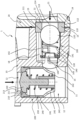
- the figure shows a section through a housing 10 of a first pump and a housing 20 of a second pump arranged thereon.
- the housing 10 forms an outlet channel 12 and a fluid channel 15.
- the outlet channel 12 extends from a delivery chamber (not shown) of the first pump to an outlet 11, with which the outlet channel 12 opens onto the outside of the housing 10.
- a delivery element is arranged in the delivery chamber of the first pump, which is rotated relative to the housing 10 during delivery operation and thereby delivers fluid, in particular oil, via the outlet channel 12 to the outlet 11.
- the fluid channel 15 merges with the outlet channel 12, or opens into the outlet channel 12, in the example shown between a valve 200 arranged in the outlet channel 12 and the outlet 11. As a result, the fluid flows are conveyed through the outlet channel 12 and the fluid channel 15 to the outlet 11.
- a second pump is arranged on the first pump.
- the first pump can serve as the main pump, for example, while the second pump can serve as an auxiliary or additional pump.
- the second pump has a housing 20 which is attached to the housing 10 of the first pump. arranged, for example, attached thereto.
- the second pump, in particular the housing 20, has a fluid channel 21 which opens into the fluid channel 15 of the housing 10. This causes fluid delivered by the second pump to be delivered through the fluid channel 21 and the fluid channel 15 to the outlet 11.
- the second pump can have a delivery chamber (not shown) in which a rotatable delivery element is arranged. The delivery element rotates during operation and delivers fluid, in particular oil, via the fluid channel 21 into the fluid channel 15.
- the first pump or the first housing 10 comprises a valve arrangement 100 which is adapted to allow a fluid flow in a first direction (see arrow direction) and to block it in a second direction opposite to the first direction.
- the valve arrangement 100 therefore does not allow a fluid flow from the second pump to the outlet 11 and from the outlet 11 to the second pump.
- the valve arrangement 100 comprises a valve seat 111, which is formed by an annular valve seat body 110, and a closing body 120, which is spherical in this example and is arranged in the fluid channel 15.
- the valve arrangement 100 further comprises a spring element 130, which is designed as a spiral spring or helical spring and acts as a compression spring.
- the preferably prestressed spring element 130 is supported with one end on the closing body 120 and with the other end on an end wall 143 of a closing body holder 140.
- the end of the spring can, for example, be supported directly on a structure of the fluid channel 15 or the housing 10.
- the pre-tensioned spring 130 presses the closing body 120 against the valve seat 111.
- the closing body 120 forms a sealing gap with the valve seat 111.
- the valve seat 111 is a surface that is complementary to the outer surface of the closing body 120.
- the valve seat body 110 forms a passage 113 through which the fluid to be conveyed can flow.
- the closing body holder 140 surrounds a receiving space on the circumference in which the closing body 120 and the spring element 130 are arranged.
- the closing body holder 140 has an end wall 143, which forms the end of the closing body holder 140 pointing in the first direction and serves as a support for the spring element 130.
- the Closing body 120 is guided by a side enclosure 141, which encloses or surrounds the receiving space, so that the closing body 120 can essentially only be moved in translation between the end wall 143 and the valve seat body 110.
- the lateral enclosure 141 of the closing body holder 140 has at least one opening 142, which opens into a recess 18 of the fluid channel 15 in order to enable the fluid to be conveyed to exit the closing body holder 140 via the at least one opening 142, in particular radially, and via the at least one recess 18 is to be conveyed past the end of the closing body holder 140 pointing in the first flow direction into a section of the fluid channel 15, which lies on the side of the closing body holder 140 pointing in the first direction.
- the fluid channel 15 in the area of the closing body holder 140 can have the at least one recess 18, into which the at least one side opening 142 opens and which extends past the end wall 143 of the closing body holder 140 and again opens into a section of the fluid channel 15 which opens onto the side of the end wall 143 pointing in the first direction.
- the end wall 143 can have an opening 144 through which fluid can be conveyed from the receiving space into the section of the fluid channel that lies on the side of the end wall 143 pointing in the first direction.
- the opening 144 can, for example, be surrounded by the spring element 130.
- the spring element 130 can be supported in a region of the end wall 143 that lies between the opening 144 and the lateral enclosure 142.
- the closing body holder 140 can be attached to the valve seat body 110 in an at least axially displaceable manner. Alternatively, the closing body holder 140 and the valve seat body 110 can be displaceable relative to one another, for example translationally.
- the valve seat body 110 is held by an inner circumference of the fluid channel 15, in particular a valve seat body receptacle 13.
- the valve seat body 110 is held on its outer circumference 112 by the inner circumference of the fluid channel 15 or the valve seat body receptacle 13, in this example held in an overcomeable frictional engagement.
- the valve seat body 110 can be held in an overcomeable form-fitting and/or overcomeable material-fitting manner.
- the valve seat body 110 is arranged in a first holding position. Between the end face 114 of the valve seat body 110 pointing in the second direction and an axial stop 22, A gap 23 with a gap width is formed between the housing 20, in particular an axial stop surface.
- the valve seat body 110 can assume the first holding position during assembly of the valve arrangement 100.
- the valve seat body 110 can be held on the inner wall of the valve seat body receptacle 13 from the first holding position, in which it is held on the inner wall of the valve seat body receptacle 13 in a surmountably friction-locking and/or surmountably positive-fitting manner and/or surmountably in a materially-fitting manner, in the second direction, i.e. H. counter to the direction of the arrow, into a second holding position in which movement of the valve seat body 110 in the second direction is blocked.
- the valve seat body 110 can be displaced in the second direction by the gap width of the gap 23.
- the end face 114 abuts or lies against the axial stop 22 of the housing 20.
- the valve seat body is thus held in a form-fitting manner in the second holding position by the housing 20, which is separate from the inner wall of the fluid channel 15 or the housing 10. A further displacement of the valve seat body 110 in the second direction is then no longer possible.
- the valve seat body 110 which is separate from the housing 10, can therefore be designed such that it only needs to be arranged in the valve seat body receptacle 13 with a force that prevents the valve seat body 110 from falling out, for example in a state in which the housing 20 is not yet arranged on the housing 10. If the housing 20 is arranged or fastened to the housing 10, forces can act on the valve seat body 110 during operation, for example, which can move it from the first holding position to the second holding position. During assembly, it is therefore only necessary to ensure that the valve seat body 110 remains on the housing 10 in the valve seat body receptacle 13 during transport to the final assembly, during which the housing 20 is arranged on the housing 10. During assembly, i.e.
- valve seat body 110 when inserting the valve seat body 110 into the valve seat body receptacle 13, it is therefore not necessary to ensure that the valve seat body 110 is arranged in a positionally secure manner for all operating states.
- the valve seat body 110 can be pressed in, glued in, soldered or arranged firmly in the valve seat body receptacle 13 in a form-fitting and/or friction-fitting manner.
- valve seat body 110 for all operating states is only achieved in the final assembled state, i.e. H. when the housing 20 is attached to the housing 10.
- a particularly reliable arrangement of the valve seat body 110 can be realized, since a valve seat body 110 that is supposedly pressed in in a secure position for all operating states can also move, in particular due to different thermal expansion coefficients of the valve seat body and the housing 10.
- the section has an outer circumference 112, in particular an outer circumferential surface 112.
- the housing 20 (or another component, such as a cover or generally a pump) is centered on the portion of the valve seat body 110 protruding from the housing 10.
- the housing 20 has an inner circumference 24, in particular inner circumferential surface 24, which surrounds the outer circumference of the valve seat body 110 and is centered thereon.
- the outer peripheral surface 112 and the inner peripheral surface 24 abut one another.
- the section of the valve seat body 110 protruding from the housing 10 projects into the housing 20, which has a recess with the inner peripheral surface 24 and the axial stop 22 for this purpose.
- the axial stop 22 is formed by an end wall of the recess. The end wall surrounds the outlet of the fluid channel 21 facing the valve arrangement 100, in particular in an annular manner.
- valve seat body 110 protrudes from the valve seat body receptacle 13 or the housing 10, it can also serve as a positioning or centering element for the housing 20, whereby the housing 20 can be centered or positioned on or by the valve seat body 110.
- an additional centering element such as a centering sleeve, can be omitted.
- a sealing element (not shown), such as. B. a sealing disk or a sealing ring, which surrounds the valve seat body 110.
- a sealing element such as. B. a sealing disk or a sealing ring, which surrounds the valve seat body 110.
- a sealing element (not shown), such as. B. a sealing disk or a sealing ring, which surrounds the outlet 11 and the transition of the channel 12 into a channel which is arranged in accordance with the outlet channel 12 or the outlet 11 and is formed by the exemplary gear housing, to the outside seals.
- a valve 200 in particular a check valve, is arranged in the outlet channel 12.
- the check valve 200 has a valve seat body 210, which forms a valve seat 211 for a closing body 220.
- the valve seat body 210 is ring-shaped and has a passage 213.
- a closing body holder 240 is arranged on the valve seat body 210 and is axially fixed to the valve seat body 210.
- the closing body holder 240 has a side element 241, which laterally encloses a receiving space for the closing body 220.
- the closing body holder 240 has a support section 243, which simultaneously forms the end of the valve 200 pointing in the second direction.
- the closing body holder 240 has at least one opening 242, which connects the receiving space of the closing body holder 240 in a fluid-communicating manner with the section of the outlet channel 12 located between the outlet 11 and the valve 200.
- the valve 200 has a spring element 230, in particular a spring that is designed as a helical spring and acts as a compression spring.
- the spring element 230 is supported with one end on the closing body 220 and with its other end on the support section 243 and presses the closing body 220 against the valve seat 211.
- the closing body 220 is rotationally symmetrical in the example shown and comprises a shaft which is axially or is translationally displaceable (see direction of arrow). If the fluid pressure in the section of the outlet channel located between the valve 200 and the delivery chamber of the first pump is greater than in the section of the outlet channel 12 located between the outlet 11 and the valve 200 and in particular is so great that the force acting on the closing body 220 overcomes the prestressing force of the spring element 230, the closing body 220 lifts off the valve seat 211, whereby fluid can be conveyed from the delivery chamber of the first pump through the valve 200 and the outlet channel 12 to the outlet 11.
- the spring element 230 presses the closing body 220 against the valve seat 211, thereby preventing a backflow of fluid in the second direction, ie towards the delivery chamber of the first pump.
- the arrangement shown in the figure makes it possible to deliver fluid either from the first pump to the outlet 11 or from the second pump to the outlet 11 or from both the first pump and the second pump (simultaneously) to the outlet 11.
Landscapes
- Engineering & Computer Science (AREA)
- General Engineering & Computer Science (AREA)
- Mechanical Engineering (AREA)
- Physics & Mathematics (AREA)
- Fluid Mechanics (AREA)
- Transportation (AREA)
- Check Valves (AREA)
- Details Of Reciprocating Pumps (AREA)
- Valve Housings (AREA)
Description
- Die Erfindung betrifft eine Vorrichtung mit einer Ventilanordnung, welche angepasst ist, eine Fluidströmung zuzulassen bzw. zu blockieren. Insbesondere kann die Ventilanordnung angepasst sein, eine Fluidströmung in eine erste Richtung, insbesondere Fließrichtung, zuzulassen, und in eine zweite, der ersten Richtung entgegensetzte Richtung, insbesondere Fließrichtung, zu blockieren. Die Ventilanordnung kann als Rückschlagventil ausgebildet sein oder zumindest als Rückschlagventil wirken. Die Ventilanordnung kann für die Verwendung oder den Einbau in eine Förderpumpe angepasst sein. Mithin betrifft die Erfindung auch eine Vorrichtung mit einer Pumpe oder Förderpumpe, welche eine solche Ventilanordnung umfasst. Die Pumpe kann beispielsweise eine Öl- oder Kraftstoffpumpe sein. Die Pumpe kann beispielsweise einen Hydromotor oder ein Getriebe, wie z. B. ein Fahrzeuggetriebe oder ein Getriebe eines Kraftfahrzeugs, mit Fluid versorgen, insbesondere zur Schmierung und/oder Kühlung und/oder Betätigung von Komponenten des Getriebes. Sie kann beispielsweise mit dem Getriebe eine Getriebeeinheit bilden oder an einem Getriebe befestigt sein oder zumindest strömungstechnisch, insbesondere fluidkommunizierend, mit dem Getriebe verbunden sein. Grundsätzlich kann mit der Pumpe ein Verbrennungsmotor, insbesondere ein Verbrennungsmotor eines Kraftfahrzeugs, mit Fluid versorgt werden, insbesondere zur Schmierung und/oder Kühlung. Die Pumpe kann Teil einer Pumpe-Motor-Einheit sein. Die Pumpe-Motor-Einheit kann beispielsweise einen Elektromotor zum Antrieb der Pumpe umfassen. Alternativ kann die Pumpe durch einen anderen Motor als einen Elektromotor, wie z. B. einen Verbrennungsmotor, insbesondere eines Fahrzeugs oder Kraftfahrzeugs, antreibbar sein. Die Pumpe kann hierzu mechanisch mit dem Verbrennungsmotor gekoppelt sein, wie z. B. über eine Kette oder einen Riemen, über die oder den eine Drehung einer Kurbelwelle auf die Pumpe übertragbar ist. Im Fall einer Pumpe-Motor-Einheit mit einem Elektromotor können die Pumpe und der Elektromotor zusammen eine Einheit bilden, die als Einheit handhabbar und/oder an weiteren Komponenten, wie z. B. an dem genannten Getriebe, befestigt sein kann.
- An der Pumpe kann beispielsweise eine weitere Pumpe, insbesondere eine Hilfspumpe angeordnet oder befestigt sein, so dass die Vorrichtung die Pumpe und die Hilfspumpe aufweisen kann. Diese Einheit aus zwei Pumpen kann beispielsweise mit dem Getriebe eine Getriebeeinheit bilden oder an dem Getriebe befestigt sein oder zumindest strömungstechnisch, insbesondere fluidkommunizierend, mit dem Getriebe verbunden sein. Die Vorrichtung kann daher das Getriebe und die Pumpe oder Pumpen aufweisen.
- Die
US 3,373,695 A undUS 5 171 136 A beschreiben Hochdruckpumpen, die als Kolbenpumpe ausgeführt sind. Fluid strömt über ein Einlassventil in eine Kammer und wird über ein Auslassventil ausgestoßen. DieDE 10 2015 016 299 A1 beschreibt ein Strömungssteuerventil, das als Druckeinstellventil zum Aufrechterhalten eines Drucks in einem Kraftstofftank ausgebildet ist. DieFR 3 050 780 A1 - Der vorliegenden Erfindung liegt die Aufgabe zugrunde, eine Vorrichtung mit einer Ventilanordnung, welche einfach herzustellen und zu montieren ist, zu schaffen.
- Die Aufgabe wird mit den Merkmalen des Anspruchs 1 gelöst. Vorteilhafte Weiterbildungen ergeben sich aus den abhängigen Ansprüchen, der Beschreibung und der Figur.
- Die Erfindung geht von einer Ventilanordnung, insbesondere einer Vorrichtung mit einer solchen Ventilanordnung, aus. Die Ventilanordnung kann beispielsweise ein Rückschlagventil, ein Bypassventil oder ein Überdruckventil sein. Sie ist angepasst, eine Fluidströmung durch die Ventilanordnung oder durch einen Fluidkanal in einem Ventilzustand, insbesondere wenn ein Schließkörper von einem Ventilsitz abgehoben ist, zuzulassen und in einem anderen Ventilzustand, insbesondere wenn der Schließkörper an dem Ventilsitz anliegt, nicht zuzulassen, d.h. zu blockieren. Beispielsweise kann die Ventilanordnung angepasst sein, eine Fluidströmung durch die Ventilanordnung oder durch den Fluidkanal in eine erste Richtung, insbesondere Fließrichtung, zuzulassen und in eine zweite, der ersten Richtung entgegengesetzte Richtung, insbesondere Fließrichtung, zu blockieren. Die erste Richtung kann beispielsweise von einer Pumpen- oder Förderkammer (Druckseite) einer Förderpumpe zu einem Verbraucher oder einer Saugseite (Pumpeingang oder Fluidreservoir) der Förderpumpe weisen. Die zweite Richtung kann beispielsweise von einem Verbraucher oder einer anderen Pumpe, beispielsweise in einem System, welches eine Haupt- und Zusatzpumpe oder Hilfspumpe aufweist, oder von einer Saugseite (Pumpeingang oder Fluidreservoir) einer Pumpe zu der Pumpenkammer weisen.
- Beispielsweise kann während des Betriebs der Pumpe Fluid von der Pumpenkammer über den Fluidkanal in die erste Richtung abgefördert werden oder abfließen. Die Ventilanordnung lässt eine Fluidströmung in die erste Richtung zu und in die zweite Richtung nicht zu, um ein Zurückfließen von Fluid in die Pumpenkammer zu verhindern. Durch die Ventilanordnung lässt sich die Pumpe abschalten, wobei der Fluiddruck, der mitunter relativ hohe Werte annehmen kann, in dem Fluidsystem, welches in der ersten Richtung nach der Ventilanordnung angeordnet ist, gehalten wird. Durch die Ventilanordnung kann ein Überdruck vermieden werden, eine Fördermenge bzw. ein Förderdruck begrenzt oder ein (Rück-)Strömen des Fluids zur Druckseite der Pumpe verhindert werden.
- Die Ventilanordnung umfasst einen Fluidkanal, einen Ventilsitz und einen in dem Fluidkanal angeordneten, beispielsweise rotationssymmetrischen oder kugelförmigen, Schließkörper. Beispielsweise kann der Schließkörper mit einer translatorischen Bewegung entlang der durch die Ventilanordnung vorgesehenen Fluidströmungsrichtung von dem Ventilsitz abgehoben und/oder gegen den Ventilsitz bewegt werden. Die Ventilanordnung ist konfiguriert, eine Fluidströmung, insbesondere in die zweite Richtung und in die erste Richtung, zu verhindern, wenn der Schließkörper an dem Ventilsitz anliegt, und eine Fluidströmung, insbesondere in die erste Richtung, zuzulassen, wenn der Schließkörper vom Ventilsitz abgehoben ist. Der Schließkörper kann im Betrieb an dem Ventilsitz anliegen und eine Strömung in die zweite Richtung und in die erste Richtung blockieren, wenn eine in die zweite Richtung auf den Schließkörper wirkende Kraft, die sich insbesondere aus dem Druck auf der in die erste Richtung weisenden Seite des Schließkörpers und/oder einer auf den Schließkörper wirkenden Federkraft ergibt, größer ist als eine in die erste Richtung auf den Schließkörper wirkende Kraft, die sich insbesondere aus dem Druck auf der in die zweite Richtung weisenden Seite des Schließkörpers und/oder einer auf den Schließkörper wirkenden Federkraft ergibt. Der Schließkörper kann von dem Ventilsitz, insbesondere mit einer translatorischen Bewegung entlang der Fluidströmungsrichtung, abheben und eine Strömung in die erste Richtung zulassen, wenn die, insbesondere durch den Fluiddruck auf der zweiten Seite des Schließkörpers, in die erste Richtung auf den Schließkörper wirkende Kraft, insbesondere der Druck auf der in die zweite Richtung weisenden Seite des Schließkörpers, größer ist als die, insbesondere durch den Fluiddruck auf der ersten Seite des Schließkörpers, in die zweite Richtung auf den Schließkörper wirkende Kraft, insbesondere der Druck auf der in die erste Richtung weisenden Seite des Schließkörpers, zuzüglich der mit dem Druck auf der in die erste Richtung weisenden Seite des Schließkörpers wirkenden Federkraft, falls eine solche Feder vorhanden ist.
- Die Ventilanordnung kann konfiguriert sein, dass, wenn der Schließkörper federbeaufschlagt ist, d. h. mit einer Federkraft gegen den Ventilsitz gespannt wird, der Schließkörper von seinem Ventilsitz erst dann abhebt, wenn der Druckunterschied zwischen den Fluiddrücken auf der ersten und zweiten Seite des Schließkörpers so groß ist, dass die Feder komprimiert wird. D.h. beispielsweise, dass die Ventilanordnung konfiguriert sein kann, dass der Schließkörper von seinem Ventilsitz erst dann abhebt, wenn die durch die Fluiddrücke auf der ersten Seite und der zweiten Seite des Schließkörpers auf den Schließkörper wirkende resultierende Kraft die Vorspannkraft, mit der die Feder den Schließkörper gegen den Ventilsitz drückt, übersteigt. Der Ventilsitz ist von einem in oder an dem Fluidkanal angeordneten, insbesondere separaten Körper, d.h. Ventilsitzkörper, gebildet. Der Körper kann beispielsweise ringförmig sein. Beispielsweise kann der den Ventilsitz bildende Körper an seinem Außenumfang, insbesondere Außenumfangsfläche, von einem Innenumfang, insbesondere Innenumfangsfläche, des Fluidkanals, beispielsweise einer Ventilsitzkörperaufnahme, gehalten werden. Der Körper kann einen sich von seinem ersten Ende zu seinem zweiten Ende erstreckenden Durchgang aufweisen, durch den Fluid durch den Körper hindurch strömen kann.
- Der Fluidkanal ist von einem Pumpengehäuse einer ersten Pumpe oder Hauptpumpe, gebildet. Insbesondere kann der Innenumfang des Fluidkanals von dem Gehäuse dieser Pumpe gebildet werden. Der Ventilsitzkörper ist separat zum Gehäuse gebildet. Grundsätzlich ist es aber auch denkbar, dass der Ventilsitzkörper einteilig mit dem Gehäuse oder durch das Gehäuse gebildet ist.
- Erfindungsgemäß ragt der den Ventilsitz bildende Körper aus dem Gehäuse und insbesondere dem Fluidkanal, der ersten Pumpe, insbesondere kann er teilweise aus dem Gehäuse und/oder dem Fluidkanal vorstehen. Ein Abschnitt des Körpers kann in dem Gehäuse und/oder dem Fluidkanal angeordnet sein, während ein anderer Abschnitt über das Gehäuse und/oder aus dem Fluidkanal hervorsteht oder aus dem Gehäuse und/oder dem Fluidkanal ragt. Hierdurch lässt sich der Ventilsitz vorteilhaft dazu verwenden, ein Bauteil, welches an dem Gehäuse angeordnet oder befestigt werden soll, an dem oder mittels dem den Ventilsitz bildenden Körper zu zentrieren. Erfindungsgemäß weist die Vorrichtung ein Bauteil auf, welches an dem Gehäuse der ersten Pumpe insbesondere der Hauptpumpe, angeordnet, insbesondere befestigt, ist. Erfindungsgemäß ragt in das Bauteil ein Abschnitt des Körpers, insbesondere der über das Gehäuse und/oder aus dem Fluidkanal ragende Abschnitt, und/oder ist das Bauteil an dem Körper oder mittels des Köpers, insbesondere dem über das Gehäuse und/oder aus dem Fluidkanal ragenden Abschnitt des Körpers, zentriert. Das Bauteil kann beispielsweise ein Deckel der Pumpe oder eine Zwischenplatte oder -gehäuse der Pumpe oder eine zweite Pumpe, insbesondere Hilfs- oder Zusatzpumpe, oder ein zweites Gehäuse, insbesondere ein Gehäuse einer zweiten Pumpe, Hilfspumpe oder Zusatzpumpe, sein.
- Insbesondere kann das Bauteil einen Innenumfang, insbesondere eine Innenumfangsfläche, aufweisen, welcher einen Außenumfang, insbesondere eine Außenumfangsfläche, des Körpers umgibt und insbesondere daran zentriert ist. Der Innenumfang des Bauteils kann somit an dem Außenumfang des Körpers anliegen. Optional können der Innenumfang und der Außenumfang Durchmesser aufweisen, die insbesondere in etwa gleich sind oder so aufeinander abgestimmt sind, dass sie ein Passungssystem oder eine Passung, insbesondere Spiel-, Übergangs- oder Presspassung, bilden.
- Die Verwendung des den Ventilsitz bildenden Körpers für die Zentrierung des an dem Gehäuse anzubringenden Bauteils bewirkt vorteilhaft die Einsparung eines von dem Körper, welcher den Ventilsitz bildet, separaten Zentrierelements, beispielsweise eines Zentrierstifts oder einer Zentrierhülse, zur lagerichtigen Anordnung des Bauteils an dem Gehäuse.
- In Weiterbildungen kann der Außenumfang des Körpers zylindrisch, insbesondere kreiszylindrisch sein. Beispielsweise können der in dem Fluidkanal angeordnete oder gehaltene Abschnitt des Bauteils und der für die Zentrierung des Bauteils vorgesehene Abschnitt des Körpers zylindrisch, insbesondere kreiszylindrisch, sein. Die beiden Abschnitte können den gleichen oder voneinander verschiedene Außendurchmesser aufweisen.
- Zusätzlich kann nach einem weiteren Aspekt der Erfindung der Körper reibschlüssig und/oder formschlüssig und/oder stoffschlüssig an dem Innenumfang des Fluidkanals gehalten sein. Vorteilhaft ist es, wenn der Körper in dem Fluidkanal mit einer überwindbaren Haltekraft, die aus einem Reibschluss und/oder Formschluss und/oder Stoffschluss resultiert, gehalten wird. Die reibschlüssige und/oder formschlüssige und/oder stoffschlüssige Verbindung zwischen Körper und Innenumfang des Fluidkanals kann so ausgebildet sein, dass der Körper überwindbar reibschlüssig oder überwindbar formschlüssig oder überwindbar stoffschlüssig an dem Innenumfang des Fluidkanals gehalten ist. Überwindbar heißt insbesondere, dass die Haltekraft der reib-, form- oder stoffschlüssigen Verbindung von einer im Betrieb der Pumpe, insbesondere Haupt- oder Hilfs- oder Zusatzpumpe, auf den Ventilsitzkörper, insbesondere direkt oder indirekt (beispielsweise über den Schließkörper), wirkenden, von dem Fluiddruck in dem Fluidkanal und/oder der Feder bei einem federbeaufschlagten Schließkörper verursachten Kraft, überwunden werden kann, um die formschlüssige oder die reibschlüssige oder die stoffschlüssige Verbindung zu lösen und den Ventilsitzkörper zu verschieben.
- Der Ventilsitzkörper kann beispielsweise reibschlüssig oder formschlüssig oder stoffschlüssig so fest an dem Innenumfang gehalten sein, dass er zumindest aufgrund der auf ihn während des Betriebs wirkenden Kräfte relativ zu dem Innenumfang nicht verschiebbar ist. Bevorzugt ist jedoch, dass der Ventilsitzkörper überwindbar reibschlüssig oder überwindbar formschlüssig oder überwindbar stoffschlüssig so fest an dem Innenumfang des Fluidkanals bzw. der Ventilsitzkörperaufnahme gehalten wird, dass er insbesondere durch die während des Betriebs auf den Ventilsitzkörper wirkende Kraft relativ zu dem Innenumfang in die zweite Richtung verschiebbar ist oder verschiebbar sein kann. Das heißt, dass der Ventilsitzkörper in einer Position, in der er an dem Innenumfang, insbesondere reibschlüssig und/oder formschlüssig und/oder stoffschlüssig, gehalten ist, insbesondere translatorisch, in die zweite Richtung verschiebbar ist. Allgemein ist bevorzugt, dass der Ventilsitzkörper relativ zu dem Fluidkanal bewegbar, insbesondere translatorisch verschiebbar ist.
- Alternativ oder zusätzlich kann der Ventilsitzkörper aus einer ersten Halteposition, in der er überwindbar reibschlüssig und/oder überwindbar formschlüssig und/oder überwindbar stoffschlüssig an dem Innenumfang des Fluidkanals bzw. der Ventilsitzkörperaufnahme gehalten ist, in die zweite Richtung oder aus der Ventilsitzkörperaufnahme heraus in eine zweite Halteposition, in der eine Bewegung des Ventilsitzkörpers in die zweite Richtung oder aus der Ventilsitzkörperaufnahme heraus blockiert ist, verschiebbar sein. Beispielsweise kann, wenn der Ventilsitzkörper in seiner ersten Halteposition ist, eine Bewegung des Ventilsitzkörpers in die erste Richtung oder in die Ventilsitzkörperaufnahme hinein durch die reibschlüssige oder überwindbar formschlüssige Verbindung zwischen dem Ventilsitzkörper und dem Innenumfang und/oder durch eine nicht-überwindbare formschlüssige Verbindung zwischen Ventilsitzkörper und Fluidkanal, insbesondere dadurch, dass der Fluidkanal eine Anschlag- oder Axialanschlagfläche aufweist, an welcher der Schließkörperhalter in seiner ersten Halteposition anliegt oder anliegen kann, verhindert werden. In der zweiten Halteposition kann der Ventilsitzkörper beispielsweise formschlüssig, insbesondere nicht-überwindbar formschlüssig, an einer Bewegung in die zweite Richtung blockiert sein. Insbesondere kann der Ventilsitzkörper in der zweiten Halteposition reibschlüssig an dem Innenumfang des Fluidkanals und/oder formschlüssig an dem Innenumfang des Fluidkanals oder einem von dem Innenumfang des Fluidkanals separaten Bauteils, beispielsweise von einem Bauteil, an dem sich der Körper in die zweite Richtung abstützt, gehalten werden. Beispielsweise kann der Ventilsitzkörper oder ein Anschlag des Ventilsitzkörpers in der zweiten Halteposition an einem separaten Bauteil oder einem (Translations-)Anschlag des Bauteils, insbesondere axial, anliegen, welches separat von dem Bauteil, insbesondere dem Pumpengehäuse, ist, welches den Fluidkanal bzw. die Ventilsitzkörperaufnahme bildet. Wenn der Ventilsitzkörper aus der ersten Halteposition in die zweite Halteposition verschoben wird, stoppt das Bauteil, insbesondere dessen (Translations-)Anschlag die Bewegung des Ventilsitzkörpers in der zweiten Halteposition.
- Das separate Bauteil, insbesondere ein Deckel der Pumpe oder eine Zwischenplatte oder - gehäuse der Pumpe oder eine zweite Pumpe oder ein zweites Gehäuse, beispielsweise ein Gehäuse der zweiten Pumpe, kann an dem Pumpengehäuse, welches in Ausführungsformen den Fluidkanal bilden kann, oder der ersten Pumpe befestigt sein. Insbesondere kann dadurch, dass der Ventilsitzkörper in der zweiten Halteposition an dem separaten Bauteil anliegt, eine weitere Verschiebung des Ventilsitzkörpers in die zweite Richtung verhindert werden, auch dann, wenn sich beispielsweise aufgrund von sich ändernden Betriebstemperaturen der Förderpumpe oder des zu fördernden Fluids der Ventilsitzkörper und die Ventilsitzkörperaufnahme unterschiedlich stark ausdehnen, beispielsweise dann, wenn sie aus unterschiedlichen Materialien gebildet sind oder unterschiedliche Wärmeausdehnungskoeffizienten aufweisen.
- Alternativ oder zusätzlich kann das separate Bauteil ein an dem Pumpengehäuse befestigtes Bauteil sein, welches separat von dem Pumpengehäuse und dem Ventilsitzkörper ist. Optional kann das Bauteil in dem Fluidkanal angeordnet und/oder an dem Fluidkanal, beispielsweise an einer Innenumfangswand des Fluidkanals, befestigt sein.
- Eine überwindbar formschlüssige Verbindung kann beispielsweise dadurch gebildet werden, dass die Innenumfangswand eine Vertiefung und der Ventilsitzkörper einen Vorsprung, welcher in die Vertiefung eingreift, oder die Innenumfangswand einen Vorsprung und der Ventilsitzkörper eine Vertiefung, in welche der Vorsprung eingreift, aufweisen, wobei der Vorsprung durch Ausüben einer, insbesondere durch den Fluiddruck oder die Fluidströmung verursachten, Axialkraft auf den Ventilsitzkörper aus der Vertiefung herausgedrückt wird, beispielsweise indem sich der Vorsprung elastisch oder plastisch verformt oder der Vorsprung elastisch oder federnd angeordnet ist.
- Eine überwindbare stoffschlüssige Verbindung kann beispielsweise dadurch gebildet werden, dass sich zwischen dem Ventilsitzkörper und der Innenwand ein Zusatzstoff, wie zum Beispiel ein Klebstoff, Fett oder Lot, befindet. Mithin kann die Verbindung eine Klebe- oder Lötverbindung sein, die so konfiguriert ist, dass sie durch die während des Betriebs auf den Schließkörper oder Ventilsitzkörper wirkende Axialkraft gelöst wird. Hierdurch kann der Ventilsitzkörper aus der ersten Halteposition in die zweite Halteposition verschoben werden.
- Der Ventilsitzkörper kann in der zweiten Halteposition reibschlüssig an dem Innenumfang des Fluidkanals und/oder formschlüssig an dem Innenumfang des Fluidkanals oder dem von dem Innenumfang des Fluidkanals separaten Bauteils, beispielsweise von dem Bauteil, an dem sich der Ventilsitzkörper in die zweite Richtung abstützt, gehalten sein oder werden.
- In Ausführungen kann ein Abschnitt des Ventilsitzkörpers aus dem Fluidkanal oder dem Pumpengehäuse herausragen, wenn der Ventilsitzkörper in der Ventilsitzkörperaufnahme angeordnet ist, insbesondere wenn sich der Ventilsitzkörper in seiner ersten Halteposition und/oder zweiten Halteposition befindet. Beispielsweise kann der Ventilsitzkörper in der zweiten Halteposition, optional auch in der ersten Halteposition teilweise in das Bauteil, welches an dem Gehäuse angeordnet oder befestigt ist, ragen.
- In der zweiten Halteposition kann der Ventilsitzkörper zusätzlich reibschlüssig oder formschlüssig, beispielsweise an dem Innenumfang des Fluidkanals oder dem Innenumfang der Ventilsitzkörperaufnahme gehalten sein, um eine, insbesondere translatorische, Bewegung des Ventilsitzkörpers relativ zu dem Innenumfang in die zweite Richtung zu verhindern.
- In Ausführungen kann der Ventilsitzkörper aus Kunststoff gebildet, insbesondere ein Spritzgussteil sein. Hierdurch kann der Ventilsitzkörper einfach und kostengünstig hergestellt werden und die an ihn gestellten konstruktiven funktionalen Anforderungen erfüllen.
- Der Vorteil einer Anordnung, bei der der Ventilsitzkörper, insbesondere translatorisch, verschiebbar ist, ist, dass die Einpresskraft des Ventilsitzkörpers lediglich für den Transport der Vorrichtung, insbesondere der Förderpumpe, ausgelegt zu sein braucht, d.h. dass die Haltekraft nur für den Transport ausreichend zu sein braucht. Dadurch kann der Ventilsitzkörper u. U. ohne Hilfsmittel per Hand in den Fluidkanal eingesetzt werden. Vorzugsweise sind dadurch bei der Montage des Ventilsitzkörpers keine besonderen Maßnahmen erforderlich, um für jeden erdenklichen Betriebszustand (Druckverhältnisse, Temperaturen, Materialausdehnungen, Vibrationen, Erschütterungen etc.) eine positionssichere Verbindung herzustellen oder zu gewährleisten. Vorzugsweise stellt sich eine positionssichere Verbindung spätestens in der zweiten Halteposition des Ventilsitzkörpers ein. Eine positionssichere Verbindung wird vorteilhaft durch die zweite Halteposition gewährleistet oder sichergestellt.
- Für die Montage wird der Schließkörper in den Fluidkanal eingelegt und anschließend wird der Ventilsitzkörper in den Fluidkanal, insbesondere in die Ventilsitzkörperaufnahme zur Bildung eines, insbesondere überwindbaren, Reibschlusses oder eines, insbesondere überwindbaren, Formschlusses oder eines, insbesondere überwindbaren, Stoffschlusses mit dem Innenumfang eingesetzt. Ein Herausfallen des Ventilsitzkörpers und des Schließkörpers wird durch den überwindbaren Reibschluss oder den überwindbaren Formschluss oder den überwindbaren Stoffschluss zwischen dem Innenumfang und dem Ventilsitzkörper verhindert. Somit lässt sich die Vorrichtung, insbesondere die Förderpumpe, einfach transportieren, auch dann, wenn an dem Gehäuse der Förderpumpe das separate Bauteil noch nicht angebracht oder befestigt ist. Andererseits lässt sich der Ventilsitzkörper einfach herstellen, da an ihn, was die Befestigung im Fluidkanal betrifft, nur geringe Maßhaltigkeitsanforderungen gestellt werden. Zudem lässt sich der Ventilsitzkörper einfach an dem Fluidkanal montieren, da er nicht einzurasten oder nicht unlösbar einzurasten braucht. Dadurch ist der Fluidkanal einfacher zu fertigen, da er keine Hinterschneidungen für eine Verrastung oder gar eine unlösbare Verrastung aufzuweisen braucht.
- Beispielsweise kann das an dem Gehäuse oder Pumpengehäuse angebrachte, insbesondere befestigte Bauteil einen Anschlag, insbesondere Axial- oder Translationsanschlag, für den Ventilsitzkörper bilden. Der Ventilsitzkörper kann an dem separaten Bauteil, insbesondere axial oder mit einer Stirnfläche, anliegen, oder eine Position einnehmen, in welcher der Körper an dem Bauteil anliegt.
- Beispielsweise kann zwischen dem Ventilsitzkörper und dem Bauteil ein Spalt gebildet sein, wenn der Ventilsitzkörper in seiner ersten Halteposition ist. Der Ventilsitzkörper kann um die Breite des Spalts aus der ersten Halteposition in die zweite Halteposition verschoben werden oder verschiebbar sein, und dann an dem Bauteil anschlagen.
- Wie bereits erwähnt, kann das separate Bauteil ein Deckel der Pumpe oder eine Zwischenplatte oder -gehäuse der Pumpe oder eine zweite Pumpe oder ein zweites Gehäuse, beispielsweise ein Gehäuse einer zweiten Pumpe sein. Alternativ oder zusätzlich kann der Fluidkanal von einem Pumpengehäuse der ersten Pumpe oder der Hauptpumpe gebildet sein.
- Dementsprechend kann an dem Pumpengehäuse, insbesondere der ersten Pumpe oder Hauptpumpe, eine zweite Pumpe, insbesondere Zusatzpumpe oder Hilfspumpe, angeordnet sein, welche einen Fluidkanal aufweist, der fluidkommunizierend mit dem Fluidkanal der ersten Pumpe derart verbunden ist, dass Fluid von der zweiten Pumpe durch die Ventilanordnung und den Fluidkanal des Pumpengehäuses der ersten Pumpe förderbar ist. Durch die Ventilanordnung kann somit bewirkt werden, dass Fluid von der zweiten Pumpe durch den Fluidkanal der ersten Pumpe förderbar ist, insbesondere zu einem Auslass hin, wobei eine Fluidströmung in die zweite Pumpe durch die Ventilanordnung verhindert werden kann.
- In Weiterbildungen kann die erste Pumpe angepasst sein, Fluid über eine Förderkammer und einen die Förderkammer und einen Auslass verbindenden Auslasskanal zu dem Auslass zu fördern. Der Fluidkanal und der Auslasskanal können sich vereinigen, so dass Fluid von der Förderkammer über den Auslasskanal und/oder über den Fluidkanal der Ventilanordnung zu dem Auslass förderbar ist. Beispielsweise kann mit der zweiten Pumpe Fluid zu dem Auslass gefördert werden, wenn die erste Pumpe kein oder nicht ausreichend Fluid zum Auslass fördert. Wenn die erste Pumpe ausreichend Fluid zum Auslass fördert, kann die zweite Pumpe außer Betrieb gesetzt werden oder ihre Fördermenge verringert werden.
- In Weiterbildungen kann zwischen der Förderkammer der ersten Pumpe und dem Auslass der ersten Pumpe ein Ventil, insbesondere ein Rückschlagventil, angeordnet sein, welches angepasst ist, eine Fluidströmung von der Förderkammer der ersten Pumpe zum Auslass der ersten Pumpe zuzulassen und in die entgegengesetzte Richtung zu blockieren. Der Fluidkanal und der Auslasskanal vereinigen sich idealerweise zwischen dem im Auslasskanal angeordneten Ventil und dem Auslass der ersten Pumpe.
- Der Auslass der ersten Pumpe ist angepasst, fluidkommunizierend mit einem Fluidverbraucher, insbesondere einem der hierin genannten Fluidverbraucher, wie z. B. dem Verbrennungsmotor oder einem Getriebe, verbunden zu werden. Alternativ kann der Auslass mit dem Fluidverbraucher verbunden sein. Die erste Pumpe, insbesondere auch eine Kombination oder Einheit aus erster Pumpe und zweiter Pumpe, kann an einem Gehäuse des Fluidverbrauchers angeordnet, insbesondere befestigt, oder befestigbar sein. Beispielsweise kann zwischen dem Gehäuse des Fluidverbrauchers und dem Gehäuse der ersten Pumpe ein Dichtelement, wie z. B. ein Dichtring, angeordnet sein, welches den Auslass umfangsseitig umgibt und die Fluidverbindung zwischen dem Auslass der ersten Pumpe und dem Einlass des Fluidverbrauchers nach außen hin abdichtet.
- Beispielsweise kann zwischen dem Bauteil, in welchem die Ventilanordnung angeordnet ist, und dem daran angeordneten Bauteil, in welches der Ventilsitzkörper ragt oder an welchem der Ventilsitzkörper anschlägt oder axial anliegt oder an welchem das Bauteil zentriert ist, ein Dichtelement, wie z. B. ein Dichtring, angeordnet sein, welches den Ventilsitzkörper umfangsseitig umgibt und die Fluidverbindung zwischen den beiden Bauteilen, insbesondere der ersten Pumpe bzw. deren Gehäuse und der zweiten Pumpe bzw. deren Gehäuse nach außen hin abdichtet.
- In Weiterbildungen der Ventilanordnung kann diese ein, vorzugsweise vorgespanntes, Federelement, insbesondere eine mechanische Feder, insbesondere eine Wendel- oder Schraubenfeder, aufweisen, welches auf den Schließkörper wirkt, sich insbesondere an dem Schließkörper abstützt, und ihn gegen den Ventilsitz drückt.
- Das Federelement kann sich beispielsweise mit einem Ende, insbesondere dem Ende, welches dem Ende entgegengesetzt ist, welches sich an dem Schließkörper abstützt, an dem Gehäuse abstützen. Alternativ kann sich das Federelement, beispielsweise mit einem Ende, insbesondere dem Ende, welches dem Ende entgegengesetzt ist, welches sich an dem Schließkörper abstützt, an einer Stirnwand eines Schließkörperhalters abstützen. Der Schließkörperhalter kann als separates Teil in den Fluidkanal eingesetzt sein oder werden.
- Beispielsweise kann der Schließkörperhalter an dem Ventilsitzkörper befestigt sein und/oder der Ventilsitzkörper und der Schließkörperhalter können als Einheit verschiebbar sein. Alternativ kann der Schließkörperhalter an dem Ventilsitzkörper nicht befestigt sein und/oder der Ventilsitzkörper kann relativ zu dem Schließkörperhalter verschiebbar sein.
- Die Stirnwand des Schließkörperhalters, an dem sich das Federelement abstützt, kann das Ende des Schließkörperhalters bilden, welches dem Ventilsitzkörper abgewandt ist.
- Die Ventilanordnung kann beispielsweise einen Schließkörperhalter aufweisen, der den Schließkörper seitlich und/oder stirnseitig einfasst, und mindestens eine Öffnung aufweisen, welche so ausgebildet ist, dass sie von dem durch den Fluidkanal strömenden Fluid durchströmbar ist. Beispielsweise kann die seitliche Einfassung des Schließkörpers mindestens eine Öffnung, vorzugsweise mehrere Öffnungen bilden. Alternativ oder zusätzlich kann die Stirnseite, insbesondere die Stirnwand, an der sich das Federelement abstützt, mindestens eine Öffnung aufweisen. Der Schließkörper kann beispielsweise zwischen der Stirnwand und dem Ventilsitzkörper axial eingefasst sein, wobei er gegen die Kraft der optional vorhandenen Feder hin und her bewegbar sein kann. Bei einer Ventilanordnung, die federlos ist, kann der Schließkörper zwischen dem Ventilsitz und der Stirnwand frei oder im Wesentlichen frei hin- und herbewegt werden.
- Der Schließkörperhalter kann den Schließkörper seitlich einfassen, insbesondere so führen, dass er im Wesentlichen translatorisch zwischen dem Ventilsitz und der Stirnwand bewegbar ist.
- In bevorzugten Ausführungen kann der Fluidkanal, insbesondere die Innenwand des Fluidkanals, im Bereich des Schließkörperhalters mindestens eine Ausnehmung aufweisen, in welche die mindestens eine seitliche Öffnung des Schließkörperhalters mündet. Beispielsweise kann für die Öffnung eine Ausnehmung oder für mehrere Öffnungen eine Ausnehmung oder für mehrere Ausnehmungen eine Öffnung vorgesehen sein. Die mindestens eine Ausnehmung kann sich an der Stirnwand des Schließkörperhalters, welche das in der ersten Richtung weisende Ende des Schließkörperhalters bildet und/oder an der sich das Federelement abstützt, vorbeierstrecken und in einen Abschnitt des Fluidkanals, der auf der in die erste Richtung weisenden Seite der Stirnwand liegt, münden. Somit kann das beispielsweise von der zweiten Pumpe geförderte Fluid durch den Schließkörperhalter, insbesondere seine seitliche Öffnung in die Ausnehmung des Fluidkanals fließen und von dort an dem Schließkörperhalter vorbei in den Abschnitt des Fluidkanals fließen, der auf der in die erste Richtung weisenden Seite des Endes bzw. der Stirnwand des Schließkörperhalters liegt.
- Der Schließkörper kann rotationssymmetrisch, wie z. B. kegel- oder kegelstumpfförmig, ausgebildet sein oder zumindest einen für die Anlage an dem Ventilsitz vorgesehenen Abschnitt bilden, dessen Außenfläche einen Teil einer Mantelfläche bildet. In einer vorteilhaften Ausführungsform ist der Schließkörper eine Kugel oder bildet zumindest einen für die Anlage an dem Ventilsitz vorgesehenen Abschnitt, dessen Außenfläche einen Teil einer Kugeloberfläche bildet.
- Die Erfindung wurde anhand mehrerer bevorzugten Ausführungen und Beispiele beschrieben. Im Folgenden wird eine Ausführungsform der Erfindung anhand einer Figur beschrieben. Die dabei offenbarten Merkmale bilden je einzeln und in jeglicher Merkmalskombination den Gegenstand der Ansprüche vorteilhaft weiter.
- Die Figur zeigt einen Schnitt durch ein Gehäuse 10 einer ersten Pumpe und ein daran angeordnetes Gehäuse 20 einer zweiten Pumpe.
- Das Gehäuse 10 bildet einen Auslasskanal 12 und einen Fluidkanal 15. Der Auslasskanal 12 erstreckt sich von einer Förderkammer (nicht gezeigt) der ersten Pumpe bis zu einem Auslass 11, mit dem der Auslasskanal 12 an die Außenseite des Gehäuses 10 mündet. In der Förderkammer der ersten Pumpe ist ein Förderelement angeordnet, welches im Förderbetrieb relativ zu dem Gehäuse 10 gedreht wird und dadurch Fluid, insbesondere Öl, über den Auslasskanal 12 zu dem Auslass 11 fördert.
- Der Fluidkanal 15 vereinigt sich mit dem Auslasskanal 12, bzw. mündet in den Auslasskanal 12, in dem gezeigten Beispiel zwischen einem im Auslasskanal 12 angeordneten Ventil 200 und dem Auslass 11. Dadurch werden die Fluidströme durch den Auslasskanal 12 und den Fluidkanal 15 zu dem Auslass 11 gefördert.
- An der ersten Pumpe ist eine zweite Pumpe angeordnet. Die erste Pumpe kann beispielsweise als Hauptpumpe dienen, wobei die zweite Pumpe als Hilfs- oder Zusatzpumpe dienen kann. Die zweite Pumpe weist ein Gehäuse 20 auf, welches an dem Gehäuse 10 der ersten Pumpe angeordnet, beispielsweise daran befestigt ist. Die zweite Pumpe, insbesondere das Gehäuse 20, weist einen Fluidkanal 21 auf, der in den Fluidkanal 15 des Gehäuses 10 mündet. Dadurch wird bewirkt, dass von der zweiten Pumpe gefördertes Fluid durch den Fluidkanal 21 und den Fluidkanal 15 zu dem Auslass 11 gefördert wird. Die zweite Pumpe kann eine Förderkammer (nicht gezeigt) aufweisen, in der ein drehbares Förderelement angeordnet ist. Das Förderelement dreht sich im Betrieb und fördert Fluid, insbesondere Öl, über den Fluidkanal 21 in den Fluidkanal 15.
- Die erste Pumpe bzw. das erste Gehäuse 10 umfasst eine Ventilanordnung 100, welche angepasst ist, eine Fluidströmung in eine erste Richtung (siehe Pfeilrichtung) zuzulassen und in eine zweite, der ersten Richtung entgegengesetzte Richtung zu blockieren. Mithin lässt die Ventilanordnung 100 eine Fluidströmung von der zweiten Pumpe zum Auslass 11 hin zu und vom Auslass 11 zur zweiten Pumpe hin nicht zu.
- Die Ventilanordnung 100 umfasst neben dem Fluidkanal 15 einen Ventilsitz 111, der von einem ringförmigen Ventilsitzkörper 110 gebildet ist, und einen in dem Fluidkanal 15 angeordneten, in diesem Beispiel kugelförmigen, Schließkörper 120. Die Ventilanordnung 100 umfasst in dem gezeigten Beispiel ferner ein Federelement 130, welches als Wendelfeder bzw. Schraubenfeder ausgestaltet ist und als Druckfeder wirkt. Das vorzugsweise vorgespannte Federelement 130 stützt sich mit einem Ende an dem Schließkörper 120 und mit dem anderen Ende an einer Stirnwand 143 eines Schließkörperhalters 140 ab. In Ausführungsformen ohne Schließkörperhalter 140 kann sich das Ende der Feder beispielsweise direkt an einer Struktur des Fluidkanals 15 oder dem Gehäuse 10 abstützen.
- Die vorgespannte Feder 130 drückt den Schließkörper 120 gegen den Ventilsitz 111. Der Schließkörper 120 bildet mit dem Ventilsitz 111 einen Dichtspalt. Der Ventilsitz 111 ist eine Fläche, die komplementär zu der Außenfläche des Schließkörpers 120 ausgebildet ist. Der Ventilsitzkörper 110 bildet einen Durchgang 113, der von dem zu fördernden Fluid durchströmbar ist.
- Der Schließkörperhalter 140 fasst umfangsseitig einen Aufnahmeraum ein, in dem der Schließkörper 120 und das Federelement 130 angeordnet sind. Der Schließkörperhalter 140 weist eine Stirnwand 143 auf, welche das in die erste Richtung weisende Ende des Schließkörperhalters 140 bildet und als Abstützung für das Federelement 130 dient. Der Schließkörper 120 wird von einer seitlichen Einfassung 141, welche den Aufnahmeraum einfasst oder umgibt, geführt, so dass der Schließkörper 120 im Wesentlichen nur translatorisch zwischen der Stirnwand 143 und dem Ventilsitzkörper 110 bewegbar ist. Die seitliche Einfassung 141 des Schließkörperhalters 140 weist mindestens eine Öffnung 142 auf, welche in eine Ausnehmung 18 des Fluidkanals 15 mündet, um dem zu fördernden Fluid zu ermöglichen, über die mindestens eine Öffnung 142, insbesondere radial, aus dem Schließkörperhalter 140 auszutreten und über die mindestens eine Ausnehmung 18 an dem in die erste Fließrichtung weisenden Ende des Schließkörperhalters 140 vorbei in einen Abschnitt des Fluidkanals 15, der auf der in die erste Richtung weisenden Seite des Schließkörperhalters 140 liegt, gefördert zu werden. Dementsprechend kann der Fluidkanal 15 im Bereich des Schließkörperhalters 140 die mindestens eine Ausnehmung 18 aufweisen, in welche die mindestens eine seitliche Öffnung 142 mündet und welche sich an der Stirnwand 143 des Schließkörperhalters 140 vorbei erstreckt und wieder in einen Abschnitt des Fluidkanals 15 mündet, der auf der in die erste Richtung weisenden Seite der Stirnwand 143 liegt.
- Alternativ oder zusätzlich kann die Stirnwand 143 eine Öffnung 144 aufweisen, durch welche Fluid aus dem Aufnahmeraum in den Abschnitt des Fluidkanals gefördert werden kann, der auf der in die erste Richtung weisenden Seite der Stirnwand 143 liegt. Die Öffnung 144 kann beispielsweise von dem Federelement 130 umgeben sein. Insbesondere kann sich das Federelement 130 in einem Bereich der Stirnwand 143 abstützen, der zwischen der Öffnung 144 und der seitlichen Einfassung 142 liegt.
- Der Schließkörperhalter 140 kann an dem Ventilsitzkörper 110 zumindest axial verschiebefest befestigt sein. Alternativ können der Schließkörperhalter 140 und der Ventilsitzkörper 110 relativ zueinander, beispielsweise translatorisch, verschiebbar sein.
- Der Ventilsitzkörper 110 wird von einem Innenumfang des Fluidkanals 15, insbesondere einer Ventilsitzkörperaufnahme 13, gehalten. Der Ventilsitzkörper 110 wird an seinem Außenumfang 112 von dem Innenumfang des Fluidkanals 15 bzw. der Ventilsitzkörperaufnahme 13 gehalten, in diesem Beispiel überwindbar reibschlüssig gehalten. Alternativ oder zusätzlich kann der Ventilsitzkörper 110 überwindbar formschlüssig und/oder überwindbar stoffschlüssig gehalten werden. In der in der Figur gezeigten Position ist der Ventilsitzkörper 110 in einer ersten Halteposition angeordnet. Zwischen der in die zweite Richtung weisenden Stirnfläche 114 des Ventilsitzkörpers 110 und einem Axialanschlag 22, insbesondere einer Axialanschlagfläche, des Gehäuses 20 ist ein Spalt 23 mit einer Spaltbreite gebildet. Die erste Halteposition kann der Ventilsitzkörper 110 bei der Montage der Ventilanordnung 100 einnehmen.
- Der Ventilsitzkörper 110 kann aus der ersten Halteposition, in der er überwindbar reibschlüssig und/oder überwindbar formschlüssig und/oder überwindbar stoffschlüssig an der Innenwand der Ventilsitzkörperaufnahme 13 gehalten wird, in die zweite Richtung, d. h. entgegen der Pfeilrichtung, in eine zweite Halteposition, in der eine Bewegung des Ventilsitzkörpers 110 in die zweite Richtung blockiert ist, verschoben werden. Insbesondere ist der Ventilsitzkörper 110 um die Spaltbreite des Spalts 23 in die zweite Richtung verschiebbar. In der zweiten Halteposition schlägt oder liegt die Stirnfläche 114 an dem Axialanschlag 22 des Gehäuses 20 an. Somit wird der Ventilsitzkörper in der zweiten Halteposition formschlüssig von dem Gehäuse 20, welches separat von der Innenwand des Fluidkanals 15 bzw. des Gehäuses 10 ist, gehalten. Eine weitere Verschiebung des Ventilsitzkörpers 110 in die zweite Richtung ist dann nicht mehr möglich.
- Der von dem Gehäuse 10 separate Ventilsitzkörper 110 kann daher so ausgebildet sein, dass er lediglich mit einer Kraft in der Ventilsitzkörperaufnahme 13 angeordnet zu werden braucht, die das Herausfallen des Ventilsitzkörpers 110 beispielsweise in einem Zustand, in dem das Gehäuse 20 noch nicht an dem Gehäuse 10 angeordnet ist, verhindert. Wenn das Gehäuse 20 an dem Gehäuse 10 angeordnet oder befestigt ist, können beispielsweise während des Betriebs Kräfte auf den Ventilsitzkörper 110 wirken, die ihn aus der ersten Halteposition in die zweite Halteposition verschieben können. Bei der Montage muss daher nur darauf geachtet werden, dass der Ventilsitzkörper 110 während des Transports zur Endmontage, bei der das Gehäuse 20 an dem Gehäuse 10 angeordnet wird, am Gehäuse 10 in der Ventilsitzkörperaufnahme 13 verbleibt. Bei der Montage, d. h. beim Einbringen des Ventilsitzkörpers 110 in die Ventilsitzkörperaufnahme 13 braucht daher nicht darauf geachtet zu werden, dass der Ventilsitzkörper 110 für alle Betriebszustände positionssicher angeordnet ist. Alternativ zu einer solchen überwindbar formschlüssigen und/oder überwindbar reibschlüssigen und/oder überwindbaren stoffschlüssigen Anordnung des Ventilsitzkörpers 110 in der Ventilsitzkörperaufnahme 13 kann der Ventilsitzkörper 110 eingepresst, eingeklebt, gelötet oder form- und/oder reibschlüssig fest in der Ventilsitzkörperaufnahme 13 angeordnet werden.
- Die für alle Betriebszustände positionssichere Anordnung des Ventilsitzkörpers 110 wird erst im endmontierten Zustand, d. h. wenn das Gehäuse 20 an dem Gehäuse 10 befestigt ist, erreicht. Durch den Axialanschlag 22 für den Ventilsitzkörper 110 kann eine besonders zuverlässige Anordnung des Ventilsitzkörpers 110 realisiert werden, da auch ein vermeintlich für alle Betriebszustände positionssicher eingepresster Ventilsitzkörper 110, insbesondere durch unterschiedliche Wärmeausdehnungskoeffizienten des Ventilsitzkörpers und des Gehäuses 10, sich verschieben kann.
- Wie die Figur ferner zeigt, ragt der in der Ventilsitzkörperaufnahme 13 angeordnete Ventilsitzkörper 110 mit einem Abschnitt aus dem Gehäuse 10. Der Abschnitt weist einen Außenumfang 112, insbesondere eine Außenumfangsfläche 112, auf. Das Gehäuse 20 (oder ein anderes Bauteil, wie z. B. ein Deckel oder allgemein eine Pumpe) ist an dem aus dem Gehäuse 10 ragenden Abschnitt des Ventilsitzkörpers 110 zentriert. Das Gehäuse 20 weist einen Innenumfang 24, insbesondere Innenumfangsfläche 24, auf, welche den Außenumfang des Ventilsitzkörpers 110 umgibt und daran zentriert ist. Insbesondere liegen die Außenumfangsfläche 112 und die Innenumfangsfläche 24 aneinander an. Der aus dem Gehäuse 10 ragende Abschnitt des Ventilsitzkörpers 110 ragt in das Gehäuse 20 hinein, welches hierfür eine Ausnehmung mit der Innenumfangsfläche 24 und dem Axialanschlag 22 aufweist. Der Axialanschlag 22 wird durch eine Stirnwand der Ausnehmung gebildet. Die Stirnwand umgibt den zur Ventilanordnung 100 weisenden Auslass des Fluidkanals 21, insbesondere ringförmig.
- Dadurch, dass der Ventilsitzkörper 110 aus der Ventilsitzkörperaufnahme 13 bzw. dem Gehäuse 10 herausragt, kann er zusätzlich als Positionier- oder Zentrierelement für das Gehäuse 20 dienen, wodurch das Gehäuse 20 an dem oder durch den Ventilsitzkörper 110 zentriert oder positioniert werden kann. Der Vorteil hierdurch ist, dass dadurch ein zusätzliches Zentrierelement, wie z. B. eine Zentrierhülse, entfallen kann.
- Der technische Vorteil der in der Figur dargestellten Ausführung kann zusammengefasst wie folgt angegeben werden:
- lediglich transportsichere Anordnung des Ventilsitzkörpers 110 in der Ventilsitzkörperaufnahme 13;
- Anschlag 22 für den Ventilsitzkörper 110 in dem vom Gehäuse 10 separaten Gehäuse 20;
- der Ventilsitzkörper 110 ragt aus der Ventilsitzkörperaufnahme 13 heraus, um ein Positionier- oder Zentrierelement für ein separates Bauteil, wie z. B. das Gehäuse 20 zu bilden.
- Zwischen dem Gehäuse 10 und dem Gehäuse 20 kann ein Dichtelement (nicht gezeigt), wie z. B. eine Dichtscheibe oder ein Dichtring, angeordnet sein, welcher den Ventilsitzkörper 110 umgibt. Dadurch wird der Übergang von dem Fluidkanal 21 in den Fluidkanal 15 nach außen hin abgedichtet.
- Zwischen dem Gehäuse 10 und einem Bauteil, an dem das Gehäuse 10 befestigt ist, wie z. B. einem Getriebegehäuse (nicht gezeigt), kann ein Dichtelement (nicht gezeigt), wie z. B. eine Dichtscheibe oder ein Dichtring, angeordnet sein, welches den Auslass 11 umgibt und den Übergang des Kanals 12 in einen Kanal, der in Übereinstimmung mit dem Auslasskanal 12 oder dem Auslass 11 angeordnet ist und von dem beispielhaften Getriebegehäuse gebildet wird, nach außen hin abdichtet.
- In dem Auslasskanal 12 ist ein Ventil 200, insbesondere Rückschlagventil, angeordnet. Das Rückschlagventil 200 weist einen Ventilsitzkörper 210 auf, der einen Ventilsitz 211 für einen Schließkörper 220 bildet. Der Ventilsitzkörper 210 ist ringförmig und weist einen Durchgang 213 auf. An dem Ventilsitzkörper 210 ist ein Schließkörperhalter 240 angeordnet, der axialfest mit dem Ventilsitzkörper 210 gefügt ist. Der Schließkörperhalter 240 weist ein Seitenelement 241 auf, welches einen Aufnahmeraum für den Schließkörper 220 seitlich einfasst. Ferner weist der Schließkörperhalter 240 einen Abstützabschnitt 243 auf, der gleichzeitig das in die zweite Richtung weisende Ende des Ventils 200 bildet. Der Schließkörperhalter 240 weist mindestens eine Öffnung 242 auf, welche den Aufnahmeraum des Schließkörperhalters 240 fluidkommunizierend mit dem zwischen dem Auslass 11 und dem Ventil 200 liegenden Abschnitt des Auslasskanals 12 verbindet. Das Ventil 200 weist ein Federelement 230, insbesondere eine Feder, die als Wendelfeder ausgestaltet und als Druckfeder wirkt, auf. Das Federelement 230 stützt sich mit einem Ende an dem Schließkörper 220 und mit seinem anderen Ende an dem Abstützabschnitt 243 ab und drückt den Schließkörper 220 gegen den Ventilsitz 211.
- Der Schließkörper 220 ist in dem gezeigten Beispiel rotationssymmetrisch und umfasst einen Schaft, der in einer Führung, welche von dem Schließkörperhalter 240 gebildet wird, axial oder translatorisch verschiebbar ist (siehe Pfeilrichtung). Wenn der Fluiddruck in dem zwischen dem Ventil 200 und der Förderkammer der ersten Pumpe befindlichen Abschnitt des Auslasskanals größer ist als in dem zwischen dem Auslass 11 und dem Ventil 200 liegenden Abschnitt des Auslasskanals 12 und insbesondere so groß ist, dass die auf den Schließkörper 220 wirkende Kraft die Vorspannkraft des Federelements 230 überwindet, hebt der Schließkörper 220 von dem Ventilsitz 211 ab, wodurch Fluid von der Förderkammer der ersten Pumpe durch das Ventil 200 und den Auslasskanal 12 zu dem Auslass 11 gefördert werden kann. Fällt der Druck in dem zwischen Förderkammer und Schließkörper 220 liegenden Abschnitt des Auslasskanals 12 ab, so dass die auf den Schließkörper 220 wirkende Kraft geringer ist als die Vorspannkraft des Federelements 230, drückt das Federelement 230 den Schließkörper 220 gegen den Ventilsitz 211, wodurch ein Rückfluss von Fluid in die zweite Richtung, d. h. zu der Förderkammer der ersten Pumpe hin verhindert wird.
- Durch die in der Figur gezeigte Anordnung ist es möglich, Fluid entweder von der ersten Pumpe zum Auslass 11 oder von der zweiten Pumpe zum Auslass 11 oder sowohl von der ersten Pumpe als auch von der zweiten Pumpe (gleichzeitig) zum Auslass 11 zu fördern.
-
- 1
- Pumpenanordnung
- 10
- Gehäuse der ersten Pumpe
- 11
- Auslass
- 12
- Auslasskanal
- 13
- Ventilsitzkörperaufnahme
- 15
- Fluidkanal
- 18
- Ausnehmung
- 20
- Gehäuse der zweiten Pumpe
- 21
- Fluidkanal
- 22
- Axialanschlag
- 23
- Spalt
- 24
- Innenumfang / Innenumfangsfläche
- 100
- Ventilanordnung
- 110
- Körper / Ventilsitzkörper
- 111
- Ventilsitz
- 112
- Außenumfang / Außenumfangsfläche
- 113
- Durchgang
- 114
- Stirnfläche
- 120
- Schließkörper
- 130
- Federelement
- 140
- Schließkörperhalter
- 141
- seitliche Einfassung
- 142
- Öffnung der seitlichen Einfassung
- 143
- Stirnwand
- 144
- Öffnung der Stirnwand
- 200
- Ventil
- 210
- Ventilsitzkörper
- 211
- Ventilsitz
- 213
- Durchgang
- 220
- Schließkörper
- 230
- Feder
- 240
- Halter
- 241
- Seitenelement
- 242
- Öffnung
- 243
- Abstützabschnitt
Claims (13)
- Vorrichtung, umfassend eine erste Pumpe und eine Ventilanordnung (100), welche angepasst ist, eine Fluidströmung zuzulassen und zu blockieren, wobei die Ventilanordnung (100) umfasst:- einen von einem Pumpengehäuse (10) der ersten Pumpe gebildeten Fluidkanal (15),- einen Ventilsitz (111) und- einen in dem Fluidkanal (15) angeordneten Schließkörper (120), wobei die Ventilanordnung (100) konfiguriert ist, wenn der Schließkörper (120), von dem Ventilsitz (111) abgehoben ist, eine Fluidströmung zuzulassen, und, wenn der Schließkörper (120) an dem Ventilsitz (111) anliegt, eine Fluidströmung zu verhindern,- wobei der Ventilsitz (111) von einem in oder an dem Fluidkanal (15) angeordneten Ventilsitzkörper (110) gebildet ist,
dadurch gekennzeichnet, dass- die Vorrichtung eine zweite Pumpe, die an dem Pumpengehäuse (10) der ersten Pumpe angeordnet ist, und ein Bauteil (20), das an dem Pumpengehäuse (10) angeordnet ist, umfasst und- die zweite Pumpe einen Fluidkanal (21) aufweist, der fluidkommunizierend mit dem Fluidkanal (15) der ersten Pumpe derart verbunden ist, dass Fluid von der zweiten Pumpe durch die Ventilanordnung (100) förderbar ist, und der Ventilsitzkörper (110) aus dem Pumpengehäuse (10) ragt, wobei ein Abschnitt des Ventilsitzkörpers (110) in das Bauteil (20) ragt und/oder das Bauteil (20) an dem oder durch den Ventilsitzkörper (110) zentriert ist. - Vorrichtung nach dem vorhergehenden Anspruch, dadurch gekennzeichnet, dass das Bauteil (20) ein Gehäuse der zweiten Pumpe ist.
- Vorrichtung nach einem der vorhergehenden Ansprüche, dadurch gekennzeichnet, dass das Bauteil (20) eine Innenumfangswand aufweist, welche einen Außenumfang (112) des Ventilsitzkörpers (110) umgibt und insbesondere daran zentriert ist.
- Vorrichtung nach einem der vorhergehenden Ansprüche, dadurch gekennzeichnet, dass der Ventilsitzkörper (110), insbesondere überwindbar, reibschlüssig und/oder, insbesondere überwindbar, formschlüssig und/oder, insbesondere überwindbar, stoffschlüssig an einem Innenumfang des Fluidkanals (15) gehalten ist.
- Vorrichtung nach einem der vorhergehenden Ansprüche, dadurch gekennzeichnet, dass der Ventilsitzkörper (110) relativ zu dem Fluidkanal (15) bewegbar, insbesondere translatorisch, verschiebbar, ist.
- Vorrichtung nach einem der vorhergehenden Ansprüche, dadurch gekennzeichnet, dass der Ventilsitzkörper (110) aus einer ersten Halteposition, in der er überwindbar reibschlüssig oder überwindbar formschlüssig an dem Innenumfang des Fluidkanals (15) gehalten ist, in die zweite Richtung in eine zweite Halteposition, in der eine Bewegung des Ventilsitzkörpers (110) in die zweite Richtung blockiert ist, verschiebbar ist.
- Vorrichtung nach dem vorhergehenden Anspruch, dadurch gekennzeichnet, dass der Ventilsitzkörper (110) in der zweiten Halteposition reibschlüssig an dem Innenumfang des Fluidkanals (15) und/oder formschlüssig an dem Innenumfang des Fluidkanals (15) oder dem von der Innenumfangswand des Fluidkanals (15) separaten Bauteil, beispielsweise von dem Bauteil (20), an dem sich der Ventilsitzkörper (110) in die zweite Richtung abstützt, gehalten wird.
- Vorrichtung nach einem der vorhergehenden Ansprüche, dadurch gekennzeichnet, dass der Ventilsitzkörper (110) an dem separaten Bauteil (20) anliegt oder eine Position einnehmen kann, in welcher der Ventilsitzkörper (110) an dem Bauteil (20) anliegt.
- Vorrichtung nach einem der vorhergehenden Ansprüche, dadurch gekennzeichnet, dass die erste Pumpe angepasst ist, Fluid über eine Förderkammer und einen die Förderkammer und einen Auslass (11) verbindenden Auslasskanal (12) zu dem Auslass (11) zu fördern, wobei der Fluidkanal (15) und der Auslasskanal (12) sich vereinigen, so dass Fluid von der Förderkammer über den Auslasskanal (12) und/oder den Fluidkanal (15) der Ventilanordnung (100) zu dem Auslass (11) förderbar ist.
- Vorrichtung nach dem vorhergehenden Anspruch, dadurch gekennzeichnet, dass zwischen der Förderkammer und dem Auslass (11) ein Ventil (200) angeordnet ist, welches angepasst ist, eine Fluidströmung von der Förderkammer zum Auslass (11) zuzulassen und in die entgegengesetzte Richtung zu blockieren, wobei der Fluidkanal (15) und der Auslasskanal (12) sich zwischen dem Ventil (200) und dem Auslass (11) vereinigen.
- Vorrichtung nach einem der vorhergehenden Ansprüche, dadurch gekennzeichnet, dass ein Auslass (11) der ersten Pumpe fluidkommunizierend mit einem Fluidverbraucher, insbesondere einem Getriebe, verbunden ist, wobei bevorzugt ist, dass die erste Pumpe an einem Gehäuse des Fluidverbrauchers angeordnet oder befestigbar oder befestigt ist.
- Vorrichtung nach einem der vorhergehenden Ansprüche, dadurch gekennzeichnet, dass der Schließkörper (120) rotationssymmetrisch oder kugelförmig ist.
- Vorrichtung nach einem der vorhergehenden Ansprüche, dadurch gekennzeichnet, dass der Ventilsitzkörper (110) ringförmig ist.
Applications Claiming Priority (1)
| Application Number | Priority Date | Filing Date | Title |
|---|---|---|---|
| DE102020114107.6A DE102020114107A1 (de) | 2020-05-26 | 2020-05-26 | Separater Ventilsitz |
Publications (2)
| Publication Number | Publication Date |
|---|---|
| EP3916277A1 EP3916277A1 (de) | 2021-12-01 |
| EP3916277B1 true EP3916277B1 (de) | 2024-04-03 |
Family
ID=75977651
Family Applications (1)
| Application Number | Title | Priority Date | Filing Date |
|---|---|---|---|
| EP21174340.6A Active EP3916277B1 (de) | 2020-05-26 | 2021-05-18 | Separater ventilsitz |
Country Status (4)
| Country | Link |
|---|---|
| US (1) | US11739846B2 (de) |
| EP (1) | EP3916277B1 (de) |
| CN (1) | CN113719448B (de) |
| DE (1) | DE102020114107A1 (de) |
Families Citing this family (2)
| Publication number | Priority date | Publication date | Assignee | Title |
|---|---|---|---|---|
| MX2019006590A (es) * | 2018-06-07 | 2019-12-09 | The Bentley Group Ltd | Valvula de control de flujo. |
| US11434900B1 (en) * | 2022-04-25 | 2022-09-06 | Vulcan Industrial Holdings, LLC | Spring controlling valve |
Family Cites Families (22)
| Publication number | Priority date | Publication date | Assignee | Title |
|---|---|---|---|---|
| US3279558A (en) * | 1962-09-17 | 1966-10-18 | Fawick Corp | Flow divider and flow-dividing hydraulic system |
| US3185175A (en) * | 1962-12-03 | 1965-05-25 | Allis Chalmers Mfg Co | Directional hydraulic control valve |
| US3373695A (en) * | 1966-04-28 | 1968-03-19 | Union Pump Co | Reciprocating piston pump |
| US3427988A (en) * | 1967-03-21 | 1969-02-18 | United States Steel Corp | Fluid end construction for plunger pumps |
| US3834666A (en) * | 1972-10-02 | 1974-09-10 | Masoneilan Int Inc | Control valve with elastically loaded cage trim |
| US3870439A (en) * | 1973-01-08 | 1975-03-11 | American Aero Ind | High pressure pump fluid end |
| US3801234A (en) * | 1973-05-14 | 1974-04-02 | Exxon Production Research Co | Fluid end for a plunger pump |
| US3870071A (en) * | 1974-01-16 | 1975-03-11 | Valve Syst Int Inc | Swing check seal assembly |
| US4277229A (en) * | 1977-11-21 | 1981-07-07 | Partek Corporation Of Houston | High pressure fluid delivery system |
| US4467703A (en) * | 1982-08-26 | 1984-08-28 | United States Steel Corporation | Reciprocable pump |
| SE9002044L (sv) | 1990-06-07 | 1992-01-07 | Astra Tech Ab | Fluidventilanordning och foertraengningspump |
| US5171136A (en) * | 1991-01-28 | 1992-12-15 | Butterworth Jetting Systems, Inc. | Fluid flow control device |
| US5362215A (en) * | 1993-05-10 | 1994-11-08 | Halliburton Company | Modular pump cylinder-head having integral over-pressure protection |
| US5807081A (en) | 1997-01-06 | 1998-09-15 | Carrier Corporation | Combination valve for screw compressors |
| DE19744577A1 (de) * | 1997-10-09 | 1999-04-22 | Bosch Gmbh Robert | Radialkolbenpumpe zur Kraftstoffhochdruckversorgung |
| US7341435B2 (en) * | 2002-06-19 | 2008-03-11 | Gardner Denver, Inc. | Fluid end |
| DE102009054501A1 (de) | 2009-12-10 | 2011-06-16 | Robert Bosch Gmbh | Kolbenpumpe |
| KR101115508B1 (ko) * | 2010-02-24 | 2012-02-27 | 한국지질자원연구원 | 해양 구조물 슬러지 흡입장치 |
| US8733733B2 (en) * | 2010-04-30 | 2014-05-27 | Fisher Controls International Llc | Sleeve seal assembly and rotary valve having sleeve seal assembly |
| JP6275634B2 (ja) | 2014-12-25 | 2018-02-07 | 愛三工業株式会社 | 流量制御弁及び蒸発燃料処理装置 |
| WO2017096488A1 (en) * | 2015-12-10 | 2017-06-15 | A.H.M.S., Inc. | Fluid end assembly of a reciprocating pump |
| FR3050780B1 (fr) * | 2016-04-29 | 2018-04-20 | Poclain Hydraulics Industrie | Systeme de filtration d'un circuit hydraulique comprenant une valve anti-retour filtrante |
-
2020
- 2020-05-26 DE DE102020114107.6A patent/DE102020114107A1/de not_active Withdrawn
-
2021
- 2021-05-18 EP EP21174340.6A patent/EP3916277B1/de active Active
- 2021-05-25 US US17/329,848 patent/US11739846B2/en active Active
- 2021-05-26 CN CN202110575917.4A patent/CN113719448B/zh active Active
Also Published As
| Publication number | Publication date |
|---|---|
| CN113719448A (zh) | 2021-11-30 |
| US11739846B2 (en) | 2023-08-29 |
| DE102020114107A1 (de) | 2021-12-02 |
| EP3916277A1 (de) | 2021-12-01 |
| CN113719448B (zh) | 2023-10-13 |
| US20210372529A1 (en) | 2021-12-02 |
Similar Documents
| Publication | Publication Date | Title |
|---|---|---|
| DE102004063075B4 (de) | Kraftstoff-Hochdruckpumpe für eine Brennkraftmaschine mit einem Stufenkolben und einem Mengensteuerventil | |
| EP0734494B2 (de) | Kolbenpumpe zum fördern von hydraulikflüssigkeit | |
| EP4234931B1 (de) | Pumpe | |
| DE112011105490B4 (de) | Kraftstoffpumpe | |
| DE102004044439B4 (de) | Abblaseventil für einen Turbolader | |
| WO2009071069A1 (de) | Hubkolben-membranpumpe | |
| EP2035700A2 (de) | Kolbenpumpe | |
| EP2072103B1 (de) | Filterpatrone und Ölfilter eines Verbrennungsmotors | |
| EP2313656B1 (de) | Pumpeneinheit | |
| DE19712872A1 (de) | Pumpe, insbesonder Hochdruckpumpe für eine Kraftstoffeinspritzvorrichtung eines Verbrennungsmotors | |
| EP3916277A1 (de) | Separater ventilsitz | |
| EP2143935B1 (de) | Pumpeneinheit zur Förderung eines Fluids | |
| EP3532728A1 (de) | Drehkolbenpumpe mit sperrkammerdichtung | |
| DE102019132729A1 (de) | Sickendichtung | |
| EP2406488A1 (de) | Saugventil für eine kraftstoffhochdruckpumpe | |
| EP3903006A1 (de) | Rotationspumpe mit axialer kompensation, auslassdichtung für eine pumpe sowie vormontierte pumpeneinheit | |
| WO2013110514A1 (de) | Kraftstoffhochdruckpumpe eines einspritzsystems | |
| DE10311207B4 (de) | Ausrücklager | |
| EP2493589B1 (de) | Saugrücklauffilter mit zweifachfunktionsventil | |
| DE102008026125C5 (de) | Federgespannter Kolbenspeicher mit Rastierfunktion | |
| EP3204630A1 (de) | Elektromagnetisch betätigbares proportionalventil sowie kraftstoffhochdruckpumpe mit einem solchen proportionalventil | |
| EP3848620B1 (de) | Ventilanordnung, insbesondere rückschlagventil mit eingepresstem kugelhalter | |
| DE102019210653B4 (de) | Ventilvorrichtung für ein Kraftstoffversorgungssystem einer Brennkraftmaschine | |
| DE102025100536B3 (de) | Schienenfahrzeuggetriebe | |
| EP0985093B1 (de) | Radialkolbenpumpe |
Legal Events
| Date | Code | Title | Description |
|---|---|---|---|
| PUAI | Public reference made under article 153(3) epc to a published international application that has entered the european phase |
Free format text: ORIGINAL CODE: 0009012 |
|
| STAA | Information on the status of an ep patent application or granted ep patent |
Free format text: STATUS: THE APPLICATION HAS BEEN PUBLISHED |
|
| AK | Designated contracting states |
Kind code of ref document: A1 Designated state(s): AL AT BE BG CH CY CZ DE DK EE ES FI FR GB GR HR HU IE IS IT LI LT LU LV MC MK MT NL NO PL PT RO RS SE SI SK SM TR |
|
| B565 | Issuance of search results under rule 164(2) epc |
Effective date: 20211014 |
|
| STAA | Information on the status of an ep patent application or granted ep patent |
Free format text: STATUS: REQUEST FOR EXAMINATION WAS MADE |
|
| 17P | Request for examination filed |
Effective date: 20220513 |
|
| RBV | Designated contracting states (corrected) |
Designated state(s): AL AT BE BG CH CY CZ DE DK EE ES FI FR GB GR HR HU IE IS IT LI LT LU LV MC MK MT NL NO PL PT RO RS SE SI SK SM TR |
|
| STAA | Information on the status of an ep patent application or granted ep patent |
Free format text: STATUS: EXAMINATION IS IN PROGRESS |
|
| REG | Reference to a national code |
Ref country code: DE Ref legal event code: R079 Free format text: PREVIOUS MAIN CLASS: F16K0015020000 Ipc: F04B0053100000 Ref country code: DE Ref legal event code: R079 Ref document number: 502021003163 Country of ref document: DE Free format text: PREVIOUS MAIN CLASS: F16K0015020000 Ipc: F04B0053100000 |
|
| 17Q | First examination report despatched |
Effective date: 20230914 |
|
| GRAP | Despatch of communication of intention to grant a patent |
Free format text: ORIGINAL CODE: EPIDOSNIGR1 |
|
| STAA | Information on the status of an ep patent application or granted ep patent |
Free format text: STATUS: GRANT OF PATENT IS INTENDED |
|
| RIC1 | Information provided on ipc code assigned before grant |
Ipc: B60T 8/40 20060101ALI20231012BHEP Ipc: F16K 27/02 20060101ALI20231012BHEP Ipc: F16K 15/06 20060101ALI20231012BHEP Ipc: F16K 15/04 20060101ALI20231012BHEP Ipc: F04B 53/16 20060101ALI20231012BHEP Ipc: F04B 53/10 20060101AFI20231012BHEP |
|
| INTG | Intention to grant announced |
Effective date: 20231031 |
|
| GRAS | Grant fee paid |
Free format text: ORIGINAL CODE: EPIDOSNIGR3 |
|
| GRAA | (expected) grant |
Free format text: ORIGINAL CODE: 0009210 |
|
| STAA | Information on the status of an ep patent application or granted ep patent |
Free format text: STATUS: THE PATENT HAS BEEN GRANTED |
|
| AK | Designated contracting states |
Kind code of ref document: B1 Designated state(s): AL AT BE BG CH CY CZ DE DK EE ES FI FR GB GR HR HU IE IS IT LI LT LU LV MC MK MT NL NO PL PT RO RS SE SI SK SM TR |
|
| REG | Reference to a national code |
Ref country code: CH Ref legal event code: EP |
|
| P01 | Opt-out of the competence of the unified patent court (upc) registered |
Effective date: 20240308 |
|
| REG | Reference to a national code |
Ref country code: IE Ref legal event code: FG4D Free format text: LANGUAGE OF EP DOCUMENT: GERMAN |
|
| REG | Reference to a national code |
Ref country code: DE Ref legal event code: R096 Ref document number: 502021003163 Country of ref document: DE |
|
| REG | Reference to a national code |
Ref country code: LT Ref legal event code: MG9D |
|
| REG | Reference to a national code |
Ref country code: NL Ref legal event code: MP Effective date: 20240403 |
|
| PG25 | Lapsed in a contracting state [announced via postgrant information from national office to epo] |
Ref country code: NL Free format text: LAPSE BECAUSE OF FAILURE TO SUBMIT A TRANSLATION OF THE DESCRIPTION OR TO PAY THE FEE WITHIN THE PRESCRIBED TIME-LIMIT Effective date: 20240403 |
|
| PG25 | Lapsed in a contracting state [announced via postgrant information from national office to epo] |
Ref country code: NL Free format text: LAPSE BECAUSE OF FAILURE TO SUBMIT A TRANSLATION OF THE DESCRIPTION OR TO PAY THE FEE WITHIN THE PRESCRIBED TIME-LIMIT Effective date: 20240403 |
|
| PG25 | Lapsed in a contracting state [announced via postgrant information from national office to epo] |
Ref country code: IS Free format text: LAPSE BECAUSE OF FAILURE TO SUBMIT A TRANSLATION OF THE DESCRIPTION OR TO PAY THE FEE WITHIN THE PRESCRIBED TIME-LIMIT Effective date: 20240803 |
|
| PG25 | Lapsed in a contracting state [announced via postgrant information from national office to epo] |
Ref country code: BG Free format text: LAPSE BECAUSE OF FAILURE TO SUBMIT A TRANSLATION OF THE DESCRIPTION OR TO PAY THE FEE WITHIN THE PRESCRIBED TIME-LIMIT Effective date: 20240403 |
|
| PG25 | Lapsed in a contracting state [announced via postgrant information from national office to epo] |
Ref country code: FI Free format text: LAPSE BECAUSE OF FAILURE TO SUBMIT A TRANSLATION OF THE DESCRIPTION OR TO PAY THE FEE WITHIN THE PRESCRIBED TIME-LIMIT Effective date: 20240403 Ref country code: HR Free format text: LAPSE BECAUSE OF FAILURE TO SUBMIT A TRANSLATION OF THE DESCRIPTION OR TO PAY THE FEE WITHIN THE PRESCRIBED TIME-LIMIT Effective date: 20240403 |
|
| PG25 | Lapsed in a contracting state [announced via postgrant information from national office to epo] |
Ref country code: GR Free format text: LAPSE BECAUSE OF FAILURE TO SUBMIT A TRANSLATION OF THE DESCRIPTION OR TO PAY THE FEE WITHIN THE PRESCRIBED TIME-LIMIT Effective date: 20240704 |
|
| PG25 | Lapsed in a contracting state [announced via postgrant information from national office to epo] |
Ref country code: PT Free format text: LAPSE BECAUSE OF FAILURE TO SUBMIT A TRANSLATION OF THE DESCRIPTION OR TO PAY THE FEE WITHIN THE PRESCRIBED TIME-LIMIT Effective date: 20240805 |
|
| PG25 | Lapsed in a contracting state [announced via postgrant information from national office to epo] |
Ref country code: ES Free format text: LAPSE BECAUSE OF FAILURE TO SUBMIT A TRANSLATION OF THE DESCRIPTION OR TO PAY THE FEE WITHIN THE PRESCRIBED TIME-LIMIT Effective date: 20240403 |
|
| PG25 | Lapsed in a contracting state [announced via postgrant information from national office to epo] |
Ref country code: CZ Free format text: LAPSE BECAUSE OF FAILURE TO SUBMIT A TRANSLATION OF THE DESCRIPTION OR TO PAY THE FEE WITHIN THE PRESCRIBED TIME-LIMIT Effective date: 20240403 |
|
| PG25 | Lapsed in a contracting state [announced via postgrant information from national office to epo] |
Ref country code: PL Free format text: LAPSE BECAUSE OF FAILURE TO SUBMIT A TRANSLATION OF THE DESCRIPTION OR TO PAY THE FEE WITHIN THE PRESCRIBED TIME-LIMIT Effective date: 20240403 |
|
| PG25 | Lapsed in a contracting state [announced via postgrant information from national office to epo] |
Ref country code: LV Free format text: LAPSE BECAUSE OF FAILURE TO SUBMIT A TRANSLATION OF THE DESCRIPTION OR TO PAY THE FEE WITHIN THE PRESCRIBED TIME-LIMIT Effective date: 20240403 |
|
| PG25 | Lapsed in a contracting state [announced via postgrant information from national office to epo] |
Ref country code: PT Free format text: LAPSE BECAUSE OF FAILURE TO SUBMIT A TRANSLATION OF THE DESCRIPTION OR TO PAY THE FEE WITHIN THE PRESCRIBED TIME-LIMIT Effective date: 20240805 Ref country code: PL Free format text: LAPSE BECAUSE OF FAILURE TO SUBMIT A TRANSLATION OF THE DESCRIPTION OR TO PAY THE FEE WITHIN THE PRESCRIBED TIME-LIMIT Effective date: 20240403 Ref country code: NO Free format text: LAPSE BECAUSE OF FAILURE TO SUBMIT A TRANSLATION OF THE DESCRIPTION OR TO PAY THE FEE WITHIN THE PRESCRIBED TIME-LIMIT Effective date: 20240703 Ref country code: LV Free format text: LAPSE BECAUSE OF FAILURE TO SUBMIT A TRANSLATION OF THE DESCRIPTION OR TO PAY THE FEE WITHIN THE PRESCRIBED TIME-LIMIT Effective date: 20240403 Ref country code: IS Free format text: LAPSE BECAUSE OF FAILURE TO SUBMIT A TRANSLATION OF THE DESCRIPTION OR TO PAY THE FEE WITHIN THE PRESCRIBED TIME-LIMIT Effective date: 20240803 Ref country code: HR Free format text: LAPSE BECAUSE OF FAILURE TO SUBMIT A TRANSLATION OF THE DESCRIPTION OR TO PAY THE FEE WITHIN THE PRESCRIBED TIME-LIMIT Effective date: 20240403 Ref country code: GR Free format text: LAPSE BECAUSE OF FAILURE TO SUBMIT A TRANSLATION OF THE DESCRIPTION OR TO PAY THE FEE WITHIN THE PRESCRIBED TIME-LIMIT Effective date: 20240704 Ref country code: FI Free format text: LAPSE BECAUSE OF FAILURE TO SUBMIT A TRANSLATION OF THE DESCRIPTION OR TO PAY THE FEE WITHIN THE PRESCRIBED TIME-LIMIT Effective date: 20240403 Ref country code: ES Free format text: LAPSE BECAUSE OF FAILURE TO SUBMIT A TRANSLATION OF THE DESCRIPTION OR TO PAY THE FEE WITHIN THE PRESCRIBED TIME-LIMIT Effective date: 20240403 Ref country code: CZ Free format text: LAPSE BECAUSE OF FAILURE TO SUBMIT A TRANSLATION OF THE DESCRIPTION OR TO PAY THE FEE WITHIN THE PRESCRIBED TIME-LIMIT Effective date: 20240403 Ref country code: BG Free format text: LAPSE BECAUSE OF FAILURE TO SUBMIT A TRANSLATION OF THE DESCRIPTION OR TO PAY THE FEE WITHIN THE PRESCRIBED TIME-LIMIT Effective date: 20240403 Ref country code: RS Free format text: LAPSE BECAUSE OF FAILURE TO SUBMIT A TRANSLATION OF THE DESCRIPTION OR TO PAY THE FEE WITHIN THE PRESCRIBED TIME-LIMIT Effective date: 20240703 |
|
| REG | Reference to a national code |
Ref country code: CH Ref legal event code: PL |
|
| REG | Reference to a national code |
Ref country code: DE Ref legal event code: R097 Ref document number: 502021003163 Country of ref document: DE |
|
| PG25 | Lapsed in a contracting state [announced via postgrant information from national office to epo] |
Ref country code: DK Free format text: LAPSE BECAUSE OF FAILURE TO SUBMIT A TRANSLATION OF THE DESCRIPTION OR TO PAY THE FEE WITHIN THE PRESCRIBED TIME-LIMIT Effective date: 20240403 |
|
| PG25 | Lapsed in a contracting state [announced via postgrant information from national office to epo] |
Ref country code: LU Free format text: LAPSE BECAUSE OF NON-PAYMENT OF DUE FEES Effective date: 20240518 |
|
| PG25 | Lapsed in a contracting state [announced via postgrant information from national office to epo] |
Ref country code: EE Free format text: LAPSE BECAUSE OF FAILURE TO SUBMIT A TRANSLATION OF THE DESCRIPTION OR TO PAY THE FEE WITHIN THE PRESCRIBED TIME-LIMIT Effective date: 20240403 |
|
| PG25 | Lapsed in a contracting state [announced via postgrant information from national office to epo] |
Ref country code: SK Free format text: LAPSE BECAUSE OF FAILURE TO SUBMIT A TRANSLATION OF THE DESCRIPTION OR TO PAY THE FEE WITHIN THE PRESCRIBED TIME-LIMIT Effective date: 20240403 Ref country code: RO Free format text: LAPSE BECAUSE OF FAILURE TO SUBMIT A TRANSLATION OF THE DESCRIPTION OR TO PAY THE FEE WITHIN THE PRESCRIBED TIME-LIMIT Effective date: 20240403 |
|
| PG25 | Lapsed in a contracting state [announced via postgrant information from national office to epo] |
Ref country code: SM Free format text: LAPSE BECAUSE OF FAILURE TO SUBMIT A TRANSLATION OF THE DESCRIPTION OR TO PAY THE FEE WITHIN THE PRESCRIBED TIME-LIMIT Effective date: 20240403 |
|
| PG25 | Lapsed in a contracting state [announced via postgrant information from national office to epo] |
Ref country code: SM Free format text: LAPSE BECAUSE OF FAILURE TO SUBMIT A TRANSLATION OF THE DESCRIPTION OR TO PAY THE FEE WITHIN THE PRESCRIBED TIME-LIMIT Effective date: 20240403 Ref country code: SK Free format text: LAPSE BECAUSE OF FAILURE TO SUBMIT A TRANSLATION OF THE DESCRIPTION OR TO PAY THE FEE WITHIN THE PRESCRIBED TIME-LIMIT Effective date: 20240403 Ref country code: RO Free format text: LAPSE BECAUSE OF FAILURE TO SUBMIT A TRANSLATION OF THE DESCRIPTION OR TO PAY THE FEE WITHIN THE PRESCRIBED TIME-LIMIT Effective date: 20240403 Ref country code: LU Free format text: LAPSE BECAUSE OF NON-PAYMENT OF DUE FEES Effective date: 20240518 Ref country code: EE Free format text: LAPSE BECAUSE OF FAILURE TO SUBMIT A TRANSLATION OF THE DESCRIPTION OR TO PAY THE FEE WITHIN THE PRESCRIBED TIME-LIMIT Effective date: 20240403 Ref country code: DK Free format text: LAPSE BECAUSE OF FAILURE TO SUBMIT A TRANSLATION OF THE DESCRIPTION OR TO PAY THE FEE WITHIN THE PRESCRIBED TIME-LIMIT Effective date: 20240403 Ref country code: CH Free format text: LAPSE BECAUSE OF NON-PAYMENT OF DUE FEES Effective date: 20240531 Ref country code: MC Free format text: LAPSE BECAUSE OF FAILURE TO SUBMIT A TRANSLATION OF THE DESCRIPTION OR TO PAY THE FEE WITHIN THE PRESCRIBED TIME-LIMIT Effective date: 20240403 |
|
| PLBE | No opposition filed within time limit |
Free format text: ORIGINAL CODE: 0009261 |
|
| STAA | Information on the status of an ep patent application or granted ep patent |
Free format text: STATUS: NO OPPOSITION FILED WITHIN TIME LIMIT |
|
| REG | Reference to a national code |
Ref country code: BE Ref legal event code: MM Effective date: 20240531 |
|
| 26N | No opposition filed |
Effective date: 20250106 |
|
| PG25 | Lapsed in a contracting state [announced via postgrant information from national office to epo] |
Ref country code: IE Free format text: LAPSE BECAUSE OF NON-PAYMENT OF DUE FEES Effective date: 20240518 |
|
| PG25 | Lapsed in a contracting state [announced via postgrant information from national office to epo] |
Ref country code: BE Free format text: LAPSE BECAUSE OF NON-PAYMENT OF DUE FEES Effective date: 20240531 Ref country code: SI Free format text: LAPSE BECAUSE OF FAILURE TO SUBMIT A TRANSLATION OF THE DESCRIPTION OR TO PAY THE FEE WITHIN THE PRESCRIBED TIME-LIMIT Effective date: 20240403 |
|
| PG25 | Lapsed in a contracting state [announced via postgrant information from national office to epo] |
Ref country code: FR Free format text: LAPSE BECAUSE OF NON-PAYMENT OF DUE FEES Effective date: 20240603 |
|
| PGFP | Annual fee paid to national office [announced via postgrant information from national office to epo] |
Ref country code: DE Payment date: 20250521 Year of fee payment: 5 |
|
| PGFP | Annual fee paid to national office [announced via postgrant information from national office to epo] |
Ref country code: AT Payment date: 20250721 Year of fee payment: 5 |
|
| PG25 | Lapsed in a contracting state [announced via postgrant information from national office to epo] |
Ref country code: CY Free format text: LAPSE BECAUSE OF FAILURE TO SUBMIT A TRANSLATION OF THE DESCRIPTION OR TO PAY THE FEE WITHIN THE PRESCRIBED TIME-LIMIT; INVALID AB INITIO Effective date: 20210518 |
|
| PG25 | Lapsed in a contracting state [announced via postgrant information from national office to epo] |
Ref country code: HU Free format text: LAPSE BECAUSE OF FAILURE TO SUBMIT A TRANSLATION OF THE DESCRIPTION OR TO PAY THE FEE WITHIN THE PRESCRIBED TIME-LIMIT; INVALID AB INITIO Effective date: 20210518 |
|
| PG25 | Lapsed in a contracting state [announced via postgrant information from national office to epo] |
Ref country code: SE Free format text: LAPSE BECAUSE OF FAILURE TO SUBMIT A TRANSLATION OF THE DESCRIPTION OR TO PAY THE FEE WITHIN THE PRESCRIBED TIME-LIMIT Effective date: 20240403 |
|
| GBPC | Gb: european patent ceased through non-payment of renewal fee |
Effective date: 20250518 |
|
| PG25 | Lapsed in a contracting state [announced via postgrant information from national office to epo] |
Ref country code: IT Free format text: LAPSE BECAUSE OF FAILURE TO SUBMIT A TRANSLATION OF THE DESCRIPTION OR TO PAY THE FEE WITHIN THE PRESCRIBED TIME-LIMIT Effective date: 20240403 |
|
| PG25 | Lapsed in a contracting state [announced via postgrant information from national office to epo] |
Ref country code: GB Free format text: LAPSE BECAUSE OF NON-PAYMENT OF DUE FEES Effective date: 20250518 |