EP3915225B1 - Verfahren und vorrichtungen zur datenkommunikation zwischen endgerät und anwendungsserver - Google Patents
Verfahren und vorrichtungen zur datenkommunikation zwischen endgerät und anwendungsserver Download PDFInfo
- Publication number
- EP3915225B1 EP3915225B1 EP20745503.1A EP20745503A EP3915225B1 EP 3915225 B1 EP3915225 B1 EP 3915225B1 EP 20745503 A EP20745503 A EP 20745503A EP 3915225 B1 EP3915225 B1 EP 3915225B1
- Authority
- EP
- European Patent Office
- Prior art keywords
- data
- application server
- terminal device
- information
- network
- Prior art date
- Legal status (The legal status is an assumption and is not a legal conclusion. Google has not performed a legal analysis and makes no representation as to the accuracy of the status listed.)
- Active
Links
Images



Classifications
-
- H—ELECTRICITY
- H04—ELECTRIC COMMUNICATION TECHNIQUE
- H04L—TRANSMISSION OF DIGITAL INFORMATION, e.g. TELEGRAPHIC COMMUNICATION
- H04L41/00—Arrangements for maintenance, administration or management of data switching networks, e.g. of packet switching networks
- H04L41/08—Configuration management of networks or network elements
- H04L41/0803—Configuration setting
- H04L41/0806—Configuration setting for initial configuration or provisioning, e.g. plug-and-play
-
- H—ELECTRICITY
- H04—ELECTRIC COMMUNICATION TECHNIQUE
- H04W—WIRELESS COMMUNICATION NETWORKS
- H04W4/00—Services specially adapted for wireless communication networks; Facilities therefor
- H04W4/70—Services for machine-to-machine communication [M2M] or machine type communication [MTC]
-
- H—ELECTRICITY
- H04—ELECTRIC COMMUNICATION TECHNIQUE
- H04W—WIRELESS COMMUNICATION NETWORKS
- H04W4/00—Services specially adapted for wireless communication networks; Facilities therefor
- H04W4/90—Services for handling of emergency or hazardous situations, e.g. earthquake and tsunami warning systems [ETWS]
-
- H—ELECTRICITY
- H04—ELECTRIC COMMUNICATION TECHNIQUE
- H04W—WIRELESS COMMUNICATION NETWORKS
- H04W76/00—Connection management
- H04W76/10—Connection setup
- H04W76/11—Allocation or use of connection identifiers
Definitions
- Embodiments of the disclosure generally relate to communication, and, more particularly, to methods and apparatuses for data communication between terminal device and application server.
- SCEF Service capability exposure function
- NEF network exposure function
- 3GPP 3rd generation partnership project
- SCEF or NEF provides small data delivery or network Internet of things (IoT) message function (especially non-Internet protocol (non-IP) data delivery) from user equipment (UE) to application server (AS).
- IoT Internet of things
- non-IP non-Internet protocol
- One of the objects of the disclosure is to provide an improved solution for data communication between terminal device and application server.
- a method implemented at a network exposure node comprises receiving, from a first application server in operator trust domain, configuration information that can be used for data delivery for a terminal device.
- the method further comprises receiving data from one of the terminal device and the first application server.
- the method further comprises forwarding the data to the other of the terminal device and the first application server based on the configuration information.
- the first application server may be deployed in operator mobile edge.
- the configuration information may comprise identity (ID) information of the terminal device, network address information of the first application server and an access point name (APN).
- ID identity
- API access point name
- the data may be received from the terminal device and forwarded to the first application server based on the network address information of the first application server corresponding to the ID information of the terminal device and the APN.
- the configuration information may comprise ID information of the terminal device, ID information of the first application server and an APN.
- the method may further comprise obtaining, from a packet gateway node, the ID information and corresponding current network address information of the first application server.
- the data may be received from the terminal device and forwarded to the first application server based on the current address information of the first application server corresponding to the ID information of the terminal device and the APN.
- the configuration information may comprise network address or ID information of at least one additional destination to which data is to be delivered from the terminal device.
- the method may further comprise forwarding the data received from the terminal device to the at least one additional destination based on the configuration information.
- one of the at least one additional destination may be a second application server in Internet domain.
- the data is received from the terminal device in a form of Internet protocol (IP) data or non-IP data.
- IP Internet protocol
- the IP data may be forwarded through a same interface as that used for the non-IP data.
- the data may be received from the first application server in a form of non-IP data or IP data.
- the IP data may be received from the first application server through a same interface as that used for the non-IP data.
- the network exposure node may be an SCEF or NEF
- the same interface is T8 non-IP data delivery (NIDD) interface.
- NIDD non-IP data delivery
- the ID information may be an external ID or a mobile subscriber international integrated service digital network (ISDN) number (MSISDN) and the network address information may be a uniform resource identifier (URI).
- ISDN mobile subscriber international integrated service digital network
- URI uniform resource identifier
- a method implemented at an application server in operator trust domain comprises sending, to a network exposure node, configuration information that can be used for data delivery for a terminal device.
- the method comprises receiving data from the terminal device via the network exposure node or sending data to the terminal device via the network exposure node.
- the application server may be deployed in operator mobile edge.
- the configuration information may comprise network address or ID information of the application server and at least one additional destination to which data is to be delivered from the terminal device via the network exposure node.
- the data is received via the network exposure node in a form of IP data or non-IP data.
- the IP data is received through a same interface of the network exposure node as that used for the non-IP data.
- the data may be sent via the network exposure node in a form of IP data or non-IP data.
- the IP data may be sent through a same interface of the network exposure node as that used for the non-IP data.
- the network exposure node may be an SCEF or NEF and the same interface is T8 NIDD interface.
- the network exposure node may comprise at least one processor and at least one memory.
- the at least one memory may contain instructions executable by the at least one processor, whereby the network exposure node may be operative to receive, from a first application server in operator trust domain, configuration information that can be used for data delivery for a terminal device.
- the network exposure node may be further operative to receive data from one of the terminal device and the first application server.
- the network exposure node may be further operative to forward the data to the other of the terminal device and the first application server based on the configuration information.
- the network exposure node may be operative to perform the method according to the above first aspect.
- an application server in operator trust domain may comprise at least one processor and at least one memory.
- the at least one memory may contain instructions executable by the at least one processor, whereby the application server may be operative to send, to a network exposure node, configuration information that can be used for data delivery for a terminal device.
- the application server may be further operative to receive data from the terminal device via the network exposure node or send data to the terminal device via the network exposure node.
- the application server may be operative to perform the method according to the above second aspect.
- the data communication between a terminal device and an application server in operator trust domain can be facilitated.
- Cities can measure many parameters as part of an environmental monitoring deployment that utilizes connected IoT sensors, including air and water quality, weather, noise, smoke and other attributes that may affect quality of life in a city including those related to disaster management, such as the earthquake and flood sensors.
- GSM global system for mobile communications
- GSMA General Monitoring: A Guide to Ensuring a Successful Mobile IoT Deployment
- the following table shows an example CIoT SCEF or NEF technology as the mobile data delivery for network IoT message function in environment monitoring business scenario to bridge among UEs, application sever on mobile edge and application server on the cloud.
- Node name Function in Environment Monitoring Main Functions description UE Non-IP or IP of Child UE
- Cellular IoT sensor for Environment Monitoring Collect input e.g. Gaseous emissions (CO, SO 2 ,O 3 ), Particulate matter (PM2.5, PM10).
- Application Server on Mobile Edge (Parent UE) Environment Monitoring Local or District Station Environmental monitoring local or district stations to collect higher quality environment measure and aggregate the small sensors data from the managed areas to obtain a good picture of a whole area.
- AS on Mobile Edge This is known as data fusion and allows data from many low accuracy devices to be combined to create higher accuracy results, and as the AS Mobile Edge to send the data to AS on the cloud.
- AS on Mobile Edge is located in operator trust domain, AS on the Mobile Edge communicates with UE via the mobile network connection.
- Application Sever on the Cloud Environment Monitoring and Management System Aggregate many different data sources are available to the city from a range of sources e.g. the collected data of the environment monitoring from Application Server on Mobile Edge. When these different data sources are integrated, valuable insight can become clear.
- the data from UE could be combined with weather, traffic and other data to provide an analysis of the environment across a city and how issues may be caused, allowing remedial actions to be taken, for example an early warning system to automatically alert emergency services to dangers as they arise, and set-off pre-planning response plan.
- AS on the Cloud is located in internet domain that is non operator trust domain, AS on the Cloud communicates with UE via the internet connection.
- SCEF or NEF Service Capability Exposure Function or Network Exposure Function As Network Capability Exposure Function node include Network IoT Message delivery function support to route IoT device data from UE to AS
- FIG. 1 is a diagram showing an existing communication system for environment monitoring use case.
- the communication system comprises an operator trust domain and an Internet domain.
- the operator trust domain there are UEs (e.g. IoT sensors) supporting non-IP data delivery (NIDD), UEs (e.g. IoT sensors) supporting IP data delivery (IPDD), an application server on mobile edge (e.g. an environment monitoring local station), radio access networks (RANs), a home subscriber server (HSS), a mobility management entity (MME), a packet data network (PDN) gateway (PGW), and a network exposure function (NEF)/service capability exposure function (SCEF).
- NIDD non-IP data delivery
- IPDD IP data delivery
- an application server on mobile edge e.g. an environment monitoring local station
- RANs radio access networks
- HSS home subscriber server
- MME mobility management entity
- PGW packet data network gateway
- NEF network exposure function
- SCEF service capability exposure function
- SCEF service capability exposure function
- Small data communication includes infrequent and frequent small data transmission aiming to support efficient small data transmissions for CIoT, e.g. tracking devices for both mobile originated (MO) and mobile terminated (MT) use cases. It is expected that the number of such devices can increase exponentially, but the data size per device will remain small.
- UE will always communicate with the application server first (especially the application server on the cloud) via the internet connection outside the operator trust domain before communicating with other UEs.
- the application server on the cloud is the main routing node for UEs' communications and all UEs communicate with the application server on the cloud. This is not efficient when massive UEs need to communicate with the application server on mobile edge which may be considered as a parent UE.
- CIoT UE normally will go for sleep mode and thus need network IoT message function in the operator trust domain.
- the present disclosure proposes improved solutions for data communication between terminal device and application server.
- the solutions will be described in detail with reference to FIGs. 2-14 .
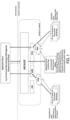
- FIG. 2 is a diagram showing an exemplary communication system according to an embodiment of the disclosure.
- the SCEF or NEF is used to play as network IoT message function for routing UE to UE communication within the operator trust domain in this embodiment.
- a child UE can send data to the application server on mobile edge via non-IP PDN.
- the child UE's non-IP data can be routed to the application server on mobile edge via the NEF/SCEF.
- a child UE can send data to the application server on mobile edge via IP PDN.
- the child UE's IP data can be routed to the application server on mobile edge via the NEF/SCEF.
- the application server on mobile edge can send child UEs' aggregate data to the application server on the cloud.
- the HSS may be replaced by a unified data management (UDM)
- the MME may be replaced by an access and mobility management function (AMF)
- the PGW may be replaced by a user plane function (UPF). That is, the principle of the present disclosure may be reused for data delivery in both 5G and 4G networks.
- the term UE may also be referred to as, for example, terminal device, access terminal, mobile station, mobile unit, subscriber station, or the like. It may refer to any end device that can access a wireless communication network and receive services therefrom.
- the UE may include a portable computer, an image capture terminal device such as a digital camera, a gaming terminal device, a music storage and playback appliance, a mobile phone, a cellular phone, a smart phone, a tablet, a wearable device, a personal digital assistant (PDA), or the like.
- PDA personal digital assistant
- a UE may represent a machine or other device that performs monitoring and/or measurements, and transmits the results of such monitoring and/or measurements to another UE and/or a network equipment.
- the UE may be a machine-to-machine (M2M) device, which may, in a 3GPP context, be referred to as a machine-type communication (MTC) device.
- M2M machine-to-machine
- MTC machine-type communication
- machines or devices may include sensors, metering devices such as power meters, industrial machineries, bikes, vehicles, or home or personal appliances, e.g. refrigerators, televisions, personal wearables such as watches, and so on.
- FIG. 3 is a flowchart illustrating a method implemented at a network exposure node according to an embodiment of the disclosure.
- the network exposure node may take the form of an SCEF, an NEF, or any other entity having similar functionality.
- the network exposure node receives, from a first application server in operator trust domain, configuration information that can be used for data delivery for a terminal device.
- the first application server may be deployed on operator mobile edge. In environment monitoring use case, it may act as an environment monitoring local station.
- the configuration information may be received in an NIDD configuration request message.
- the configuration information may be received in an IPDD configuration request message.
- NIDD configuration interface e.g. API
- the network exposure node is an SCEF or NEF
- NIDD configuration interface such as that defined in 3GPP TS 29.122 may be reused for IPDD configuration.
- the first application server has a static or dynamic IP address and the direction of data delivery between the terminal device and the first application server.
- the first application server has a static IP address and data is delivered from the terminal device to the first application server.
- the first application server has a dynamic IP address and data is delivered from the terminal device to the first application server.
- the first application server has a static or dynamic IP address and data is delivered from the first application server to the terminal device.
- block 302 may implemented as block 402 in the first option, as block 502 in the second option, and as block 602 in the third option, which will be described later.
- the network exposure node receives data from one of the terminal device and the first application server.
- block 304 may implemented as block 404 in the first option, as block 504 in the second option, and as block 604 in the third option, which will be described later.
- the network exposure node forwards the data to the other of the terminal device and the first application server based on the configuration information.
- block 306 may be implemented as block 406 in the first option, as block 506 in the second option, and as block 606 in the third option, which will be described later. In this way, since the network exposure node instead of the application server on the cloud is used as the routing node, a more easy way can be provided to route the communication between the terminal device and the application server within the operator trust domain.
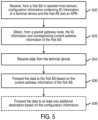
- FIG. 4 is a flowchart illustrating a method implemented at a network exposure node according to another embodiment of the disclosure.
- the method corresponds to the first option described above.
- the network exposure node receives, from a first application server in operator trust domain, configuration information that contains identity (ID) information of the terminal device, network address information of the first application server and an APN. Since the first application server has a static IP address in this option, the configuration information contains the network address information of the first application server. For example, this network address information may be a URI of the first application server, which may be translated to a corresponding IP address.
- the ID information of the terminal device may be an external ID or an MSISDN of the terminal device.
- the APN refers to an access point name via which the network address information of the first application server is reachable.
- the network exposure node receives data from the terminal device.
- the data may be received through NIDD procedure such as that defined in 3GPP TS 23.682.
- the data may be received via a packet gateway node such as a PGW.
- the network exposure node forwards the data to the first application server based on the network address information of the first application server corresponding to the ID information of the terminal device and the APN. For example, due to the reception of the data from the terminal device, the ID information of the terminal device and the APN may be known by the network exposure node.
- the network address information of the first application server corresponding to this combination may be determined from the configuration information received at block 402. Then, the determined network address information may be used for forwarding the data to the first application server.
- the data For the terminal device supporting NIDD, the data may be forwarded through T8 NIDD interface such as that defined in 3GPP TS 29.122.
- the T8 NIDD interface may be reused for forwarding the data.
- the configuration information received at block 402 may further contain network address information of at least one additional destination to which data is to be delivered from the terminal device. Accordingly, optionally, at block 408, the network exposure node may forward the data to the at least one additional destination based on the configuration information.
- one of the at least one additional destination may be a second application server in Internet domain.
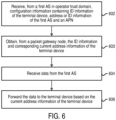
- FIG. 5 is a flowchart illustrating a method implemented at a network exposure node according to another embodiment of the disclosure. The method corresponds to the second option described above.
- the network exposure node receives, from a first application server in operator trust domain, configuration information that contains ID information of the terminal device, ID information of the first application server and an APN. Since the first application server has a dynamic IP address in this option, the configuration information contains ID information instead of network address information of the first application server.
- the ID information of the first application server may be an external ID or an MSISDN of the first application server which may also be considered as a parent UE.
- the network exposure node obtains, from a packet gateway node, the ID information and corresponding current network address information of the first application server.
- the packet gateway node may be a PGW or any other entity having similar functionality.
- the packet gateway node may send the information actively or the network exposure node may inquire the packet gateway node about the information.
- the network exposure node receives data from the terminal device.
- Block 504 may be the same as block 404 and its details are omitted here.
- the network exposure node forwards the data to the first application server based on the current address information of the first application server corresponding to the ID information of the terminal device and the APN.
- the ID information of the terminal device and the APN may be known by the network exposure node.
- the ID information of the first application server corresponding to this combination may be determined from the configuration information received at block 502.
- the current network address information of the first application server corresponding to its ID information may be determined from the information obtained at block 503.
- the determined current network address information may be used for forwarding the data to the first application server.
- the configuration information received at block 502 may further contain ID information of at least one additional destination to which data is to be delivered from the terminal device.
- the network exposure node may forward the data to the at least one additional destination based at least on the configuration information.
- the current network address information of the at least one additional destination may be determined in a way similar to blocks 503 and 506. Then, the data may be forwarded based on the determined current network address information.
- the network exposure node receives data from the first application server.
- the data may be received in the form of non-IP data or IP data.
- the non-IP data it may be received through T8 NIDD interface such as that defined in 3GPP TS 29.122.
- the T8 NIDD interface may be reused for receiving the data.
- the network exposure node forwards the data to the terminal device based on the current network address information of the terminal device corresponding to the ID information of the terminal device. For example, due to the reception of the data from the terminal device, the ID information of the terminal device and the APN may be known by the network exposure node.
- the current network address information of the terminal device corresponding to its ID information may be determined from the information obtained at block 603. Then, the determined network address information may be used for forwarding the data to the terminal device.
- the non-IP data it may be forwarded through T8 NIDD procedure such as that defined in 3GPP TS 23.682.
- the IP data it may be forwarded via a packet gateway node such as a PGW.
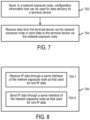
- FIG. 7 is a flowchart illustrating a method implemented at an application server in operator trust domain according to an embodiment of the disclosure.
- the application server may be deployed in operator mobile edge.
- the application server sends, to a network exposure node, configuration information that can be used for data delivery for a terminal device.
- Block 702 may correspond to block 402, 502 or 602 and its details are omitted here.
- the configuration information may contain network address or ID information of the application server and at least one additional destination to which data is to be delivered from the terminal device via the network exposure node.
- the application server receives data from the terminal device via the network exposure node or sends data to the terminal device via the network exposure node.
- the data may be received via the network exposure node in the form of IP data or non-IP data.
- the IP data may be received through a same interface of the network exposure node as that used for the non-IP data, as shown in block 704-1.
- the data may be sent via the network exposure node in a form of IP data or non-IP data.
- the IP data may be sent through a same interface of the network exposure node as that used for the non-IP data, as shown in block 704-2.
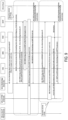
- the AS on mobile edge attaches the network and requests packet data network (PDN) connection, thereby getting an static IP address. For example, details of this block may be obtained from 3GPP TS 23.401, chapter 5.3.2.1.
- the AS on cloud provisions UE onboarding information (e.g. child UE external ID, etc.) to the AS on mobile edge via an interface defined between the application servers.
- the AS on mobile edge sends a request to the SCEF for NIDD Configuration.
- the request includes External ID/MSISDN of Non-IP UE, AS on mobile edge Destination IP and APN.
- the request may be sent via an interface such that defined in 3GPP T8 TS 29.122.
- the SCEF sends the NIDD configuration to the HSS in terms of TS 23.682, chapter 5.13.2.
- the child Non-IP UE sends NIDD Mobile Originated data to the SCEF in terms of TS 23.682, chapter 5.13.4.
- the SCEF sends NIDD MO data to the AS on mobile edge via 3GPP T8 TS 29.122 NIDD API.
- the SCEF duplicates the child UE's data payload and sends it to the AS on the cloud.
- the AS on the cloud address used for sending the data is defined in block 903 for NIDD Configuration. Blocks 902 to 907 may be repeated for all child Non-IP UEs.
- the AS on mobile edge sends IP Data Delivery Configuration Request (including External ID/MISDIN of UE IP, AS on mobile edge Destination IP, APN) via 3GPP T8 extension.
- IP Data Delivery Configuration Request including External ID/MISDIN of UE IP, AS on mobile edge Destination IP, APN
- the NIDD Configuration API (such as that defined in 3GPP TS 29.122) can be reused for IP Data Delivery Configuration.
- the above 'notificationUEDestination' indicating multiple notification destinations may be used for the UE communication routing address.
- the IPDD configuration may also be sent from the SCEF to the HSS.
- the process of FIG. 10 is about small data delivery from UE to mobile edge and the parent UE has dynamic IP allocation.
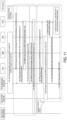
- the AS on mobile edge attaches the network and requests PDN connection, thereby getting a dynamic IP address. For example, details of this block may be obtained from 3GPP TS 23.401, chapter 5.3.2.1 and 5.10.2.
- the PGW sends IMSI, UE IP and APN to the SCEF via Radius or other pre-defined interface between the SCEF and the PGW. Alternatively, the SCEF may inquire the PGW about IMSI, UE IP and APN via Radius or other pre-defined interface.
- the AS on cloud provisions the UE onboarding information (e.g. child UE external ID, etc.) to the AS on mobile edge , which interface define by Application Server.
- the AS on mobile edge sends NIDD Configuration Request to the SCEF (including External ID/MISDIN of Non-IP UE, AS on mobile edge Destination such as Parent UE External ID, APN) via 3GPP T8 API such as that defined in 3GPP TS 29.122.
- SCEF including External ID/MISDIN of Non-IP UE, AS on mobile edge Destination such as Parent UE External ID, APN
- the following attribute may be added in the definition of type 'NiddConfiguration' for UE communication route address, instead of the 3GPP defined 'notificationDestination' that is URI.
- this NIDD Configuration may also reuse block 903 for changing the cardinality of 'notificationDestination' from 1 to 1..N in order to support the multiple notification destination.
- the SCEF sends NIDD Configuration to the HSS in terms of TS 23.682, chapter 5.13.2.
- the Non-IP Child UE sends NIDD Mobile Originated data to the SCEF. The details of this block may be obtained from TS 23.682, chapter 5.13.4.
- the SCEF uses NIDD configuration 'notificationUEdestination' to get the AS on mobile edge IP address, and send NIDD MO data to the AS on mobile edge via 3GPP T8 (see, for example, TS 29.122).
- the SCEF duplicates the child UE's data payload and sends it to the AS on the cloud.
- the AS on the cloud address used for sending the data is defined in block 1004 for NIDD Configuration. Blocks 1003 to 1008 may be repeated for all Child Non-IP UEs.
- the AS on mobile edge sends IP Data Delivery Configuration Request (External ID/MISDIN of UE IP, AS on mobile edge Destination such as Parent UE External ID, APN) via 3GPP T8 extension.
- IP Data Delivery Configuration Request External ID/MISDIN of UE IP, AS on mobile edge Destination such as Parent UE External ID, APN
- NIDD Configuration API such as that defined in 3GPP TS 29.122 can be reused for IP Data Delivery Configuration.
- this IPDD Configuration may also reuse block 903 for changing the cardinality of 'notificationDestination' from 1 to 1..N in order to support the multiple notification destination.
- the SCEF sends MO data to the AS on mobile edge (based on the AS address mapped with the UE ID and APN) via 3GPP T8 extension.
- the SCEF duplicates the child UE's data payload and sends it to the AS on the cloud.
- the AS on the cloud address used for sending the data is defined in 'notificationDestination' in the definition of 'NiddConfiguration' API in 3GPP TS 29.122 T8 APIs (see, for example, chapter 5.6.2.1.2).
- Blocks 1009 to 1014 may be repeated for all Child IP UEs.
- the AS on the cloud sends data to the AS on mobile edge.
- the AS on mobile edge sends NIDD MT data to the SCEF via 3GPP T8 (see, for example, TS 29.122).
- the NIDD MT data is sent from the SCEF to the Non-IP Child UE (see, for example, TS 23.682, chapter 5.13.3). Blocks 1102 to 1107 may be repeated for all Non-IP Child UEs.
- the AS on mobile edge sends MT data to the Child UE ID via SCEF 3GPP T8 API.
- NIDD API of the SCEF may be reused for IP Data Delivery which is small data delivery typically based on UDP protocol.
- the SCEF maps UE ID to UE IP, creates UDP packet and sends it to the Child UE via PGW SGi Interface.
- the UE on IP PDN gets data from the SCEF via PGW. Blocks 1108 to 1112 may be repeated for all IP Child UEs. It should be noted that two blocks shown in succession in the above figures may, in fact, be executed substantially concurrently, or the blocks may sometimes be executed in the reverse order, depending upon the functionality involved.
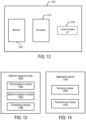
- the memory 1220 may be of any type suitable to the local technical environment and may be implemented using any suitable data storage technology, such as semiconductor based memory devices, flash memories, magnetic memory devices and systems, optical memory devices and systems, fixed memories and removable memories.
- the processor 1210 may be of any type suitable to the local technical environment, and may include one or more of general purpose computers, special purpose computers, microprocessors, digital signal processors (DSPs) and processors based on multi-core processor architectures, as non-limiting examples.
- FIG. 13 is a block diagram showing a network exposure node according to an embodiment of the disclosure.
- the network exposure node 1300 comprises a first reception module 1302, a second reception module 1304 and a forwarding module 1306.
- the first reception module 1302 may be configured to receive, from a first application server in operator trust domain, configuration information that can be used for data delivery for a terminal device, as described above with respect to block 302.
- the second reception module 1304 may be configured to receive data from one of the terminal device and the first application server, as described above with respect to block 304.
- the forwarding module 1306 may be configured to forward the data to the other of the terminal device and the first application server based on the configuration information, as described above with respect to block 306.
- the various exemplary embodiments may be implemented in hardware or special purpose circuits, software, logic or any combination thereof.
- some aspects may be implemented in hardware, while other aspects may be implemented in firmware or software which may be executed by a controller, microprocessor or other computing device, although the disclosure is not limited thereto.
- firmware or software which may be executed by a controller, microprocessor or other computing device, although the disclosure is not limited thereto.
- While various aspects of the exemplary embodiments of this disclosure may be illustrated and described as block diagrams, flow charts, or using some other pictorial representation, it is well understood that these blocks, apparatus, systems, techniques or methods described herein may be implemented in, as non-limiting examples, hardware, software, firmware, special purpose circuits or logic, general purpose hardware or controller or other computing devices, or some combination thereof.
- exemplary embodiments of the disclosure may be embodied in computer-executable instructions, such as in one or more program modules, executed by one or more computers or other devices.
- program modules include routines, programs, objects, components, data structures, etc. that perform particular tasks or implement particular abstract data types when executed by a processor in a computer or other device.
- the computer executable instructions may be stored on a computer readable medium such as a hard disk, optical disk, removable storage media, solid state memory, RAM, etc.
- the function of the program modules may be combined or distributed as desired in various embodiments.
- the function may be embodied in whole or in part in firmware or hardware equivalents such as integrated circuits, field programmable gate arrays (FPGA), and the like.
Landscapes
- Engineering & Computer Science (AREA)
- Computer Networks & Wireless Communication (AREA)
- Signal Processing (AREA)
- Mobile Radio Communication Systems (AREA)
- Telephonic Communication Services (AREA)
Claims (12)
- Verfahren, das an einem Netzwerkexpositionsknoten implementiert wird, wobei der Netzwerkexpositionsknoten eine Dienstfähigkeitsexpositionsfunktion, SCEF, oder eine Netzwerkexpositionsfunktion, NEF, ist, wobei das Verfahren umfasst:Empfangen (302) von Konfigurationsinformationen von einem ersten Anwendungsserver in einer Betreibervertrauensdomäne, die für die Datenübermittlung für ein Endgerät verwendet werden können;Empfangen (304) von Daten von einem der Endgeräte oder dem ersten Anwendungsserver; undWeiterleiten (306) der Daten an das andere Endgerät oder den ersten Anwendungsserver basierend auf den Konfigurationsinformationen;wobei das Verfahren dadurch gekennzeichnet ist, dass die vom Endgerät empfangenen Daten in Form von Internetprotokolldaten, IP-Daten, oder Nicht-IP-Daten vorliegen; undwobei die IP-Daten über dieselbe Schnittstelle weitergeleitet werden, die für die Nicht-IP-Daten verwendet wird;und wobei es sich bei derselben Schnittstelle um die T8-Schnittstelle für Nicht-IP-Datenübermittlung, NIDD, handelt.
- Verfahren nach Anspruch 1, wobei die Konfigurationsinformationen Identitätsinformationen, ID-Informationen, des Endgeräts, Netzwerkadressinformationen des ersten Anwendungsservers und einen Zugriffspunktnamen, APN, umfassen; und
wobei die Daten vom Endgerät empfangen (404) und basierend auf den Netzwerkadressinformationen des ersten Anwendungsservers, die den ID-Informationen des Endgeräts und dem APN entsprechen, an den ersten Anwendungsserver weitergeleitet (406) werden. - Verfahren nach Anspruch 1, wobei die Konfigurationsinformationen ID-Informationen des Endgeräts, ID-Informationen des ersten Anwendungsservers und einen APN umfassen;wobei das Verfahren ferner umfasst: Erhalten (503) von einem Paket-Gateway-Knoten der ID-Informationen und der entsprechenden aktuellen Netzwerkadressinformationen des ersten Anwendungsservers; undwobei die Daten vom Endgerät empfangen (504) und basierend auf den aktuellen Adressinformationen des ersten Anwendungsservers, die den ID-Informationen des Endgeräts und dem APN entsprechen, an den ersten Anwendungsserver weitergeleitet (506) werden.
- Verfahren nach einem der Ansprüche 1 bis 3, wobei die Konfigurationsinformationen Netzwerkadressen- oder ID-Informationen von mindestens einem zusätzlichen Ziel umfassen, an das Daten vom Endgerät zu übermitteln sind; undwobei das Verfahren ferner umfasst: Weiterleiten (408, 508) der vom Endgerät empfangenen Daten an das mindestens eine zusätzliche Ziel basierend auf den Konfigurationsinformationen;und, optional:
wobei eines des mindestens einen zusätzlichen Ziels ein zweiter Anwendungsserver in der Internetdomäne ist. - Verfahren nach Anspruch 1, wobei die Daten vom ersten Anwendungsserver in Form von Nicht-IP-Daten oder IP-Daten empfangen werden; undwobei die IP-Daten vom ersten Anwendungsserver über dieselbe Schnittstelle empfangen werden, die für die Nicht-IP-Daten verwendet wird;und, optional:wobei die Konfigurationsinformationen ID-Informationen des Endgeräts, Netzwerkadressinformationen oder ID-Informationen des ersten Anwendungsservers und einen APN umfassen;wobei die Daten vom ersten Anwendungsserver in Form von IP-Daten empfangen werden, und das Verfahren ferner umfasst: Erhalten (603) der ID-Informationen und der entsprechenden aktuellen Netzwerkadressinformationen des Endgeräts von einem Paket-Gateway-Knoten; undwobei die IP-Daten auf der Grundlage der aktuellen Netzwerkadressinformationen des Endgeräts, die den ID-Informationen des Endgeräts entsprechen, an das Endgerät weitergeleitet (606) werden.
- Verfahren nach einem der Ansprüche 2 bis 5, wobei die ID-Informationen eine externe ID- oder eine internationale ISDN-Nummer eines mobilen Teilnehmers, MSISDN, sind und die Netzwerkadressinformationen ein Uniform Resource Identifier, URI, sind.
- Verfahren, das auf einem Anwendungsserver in einer Betreibervertrauensdomäne implementiert wird, umfassend:Senden (702) von Konfigurationsinformationen, die zur Datenübermittlung für ein Endgerät verwendet werden können, an einen Netzwerkexpositionsknoten, wobei der Netzwerkexpositionsknoten eine Dienstfähigkeitsexpositionsfunktion, SCEF, oder eine Netzwerkexpositionsfunktion, NEF, ist; undEmpfangen (704) von Daten vom Endgerät über den Netzwerkexpositionsknoten oder Senden von Daten an das Endgerät über den Netzwerkexpositionsknoten;wobei das Verfahren dadurch gekennzeichnet ist, dass die Daten über den Netzwerkexpositionsknoten in Form von Internetprotokolldaten, IP-Daten, oder Nicht-IP-Daten empfangen werden; undwobei die IP-Daten über dieselbe Schnittstelle des Netzwerkexpositionsknotens empfangen werden (704-1), die auch für die Nicht-IP-Daten verwendet wird, undwobei es sich bei derselben Schnittstelle um die T8-Schnittstelle für Nicht-IP-Datenübermittlung, NIDD, handelt.
- Verfahren nach Anspruch 7, wobei der Anwendungsserver im Mobile Edge des Betreibers eingesetzt wird.
- Verfahren nach Anspruch 7 oder 8, wobei die Konfigurationsinformationen Netzwerkadressinformationen oder Identitätsinformationen, ID-Informationen, des Anwendungsservers und mindestens ein zusätzliches Ziel umfassen, an das Daten vom Endgerät über den Netzwerkexpositionsknoten übermittelt werden sollen.
- Verfahren nach Anspruch 7 oder 8, wobei die Daten über den Netzwerkexpositionsknoten in Form von IP-Daten oder Nicht-IP-Daten gesendet werden; und
wobei die IP-Daten über dieselbe Schnittstelle des Netzwerkexpositionsknotens gesendet (704-2) werden, die für die Nicht-IP-Daten verwendet wird. - Netzwerkexpositionsknoten (1200), umfassend:mindestens einen Prozessor (1210); undmindestens einen Speicher (1220), wobei der mindestens eine Speicher (1220) Anweisungen enthält, die durch den mindestens einen Prozessor (1210) ausführbar sind, wodurch der Netzwerkexpositionsknoten (1200) betriebsfähig ist, um das Verfahren nach einem der Ansprüche 1 bis 6 durchzuführen.
- Anwendungsserver (1200) in einer Betreibervertrauensdomäne, wobei der Anwendungsserver (1200) umfasst:mindestens einen Prozessor (1210); undmindestens einen Speicher (1220), wobei der mindestens eine Speicher (1220) Anweisungen enthält, die durch den mindestens einen Prozessor (1210) ausführbar sind, wodurch der Netzwerkexpositionsknoten (1200) betriebsfähig ist, um das Verfahren nach einem der Ansprüche 7 bis 10 durchzuführen.
Applications Claiming Priority (2)
| Application Number | Priority Date | Filing Date | Title |
|---|---|---|---|
| CN2019073221 | 2019-01-25 | ||
| PCT/CN2020/073263 WO2020151668A1 (en) | 2019-01-25 | 2020-01-20 | Methods and apparatuses for data communication between terminal device and application server |
Publications (3)
| Publication Number | Publication Date |
|---|---|
| EP3915225A1 EP3915225A1 (de) | 2021-12-01 |
| EP3915225A4 EP3915225A4 (de) | 2022-08-24 |
| EP3915225B1 true EP3915225B1 (de) | 2025-04-16 |
Family
ID=71736047
Family Applications (1)
| Application Number | Title | Priority Date | Filing Date |
|---|---|---|---|
| EP20745503.1A Active EP3915225B1 (de) | 2019-01-25 | 2020-01-20 | Verfahren und vorrichtungen zur datenkommunikation zwischen endgerät und anwendungsserver |
Country Status (3)
| Country | Link |
|---|---|
| US (1) | US12052776B2 (de) |
| EP (1) | EP3915225B1 (de) |
| WO (1) | WO2020151668A1 (de) |
Families Citing this family (8)
| Publication number | Priority date | Publication date | Assignee | Title |
|---|---|---|---|---|
| US20230328628A1 (en) * | 2018-08-23 | 2023-10-12 | Verizon Patent And Licensing Inc. | System and method for using t8 api to deliver data over an ip path |
| US11477635B2 (en) * | 2019-02-12 | 2022-10-18 | Jio Platforms Limited | Method and system for sensor data type identification in a NB-IoT network |
| WO2022128100A1 (en) | 2020-12-17 | 2022-06-23 | Nokia Technologies Oy | Efficient receiving of sensor measurements |
| JP7537341B2 (ja) * | 2021-03-30 | 2024-08-21 | 株式会社デンソー | 車両用通信システム、中継サーバ、車両用通信機 |
| KR102895058B1 (ko) * | 2021-07-19 | 2025-12-02 | 삼성전자주식회사 | 무선 통신 시스템에서 단말에 대한 네트워크 기능 개방 서비스를 지원하는 장치 및 방법 |
| CN113923707B (zh) * | 2021-12-10 | 2022-04-05 | 中移(上海)信息通信科技有限公司 | 一种终端监测方法、装置、网络设备、控制系统和终端 |
| CN117408576B (zh) * | 2023-12-14 | 2024-03-26 | 鲁信科技股份有限公司 | 一种基于工业互联网的产品质量分析方法、设备及介质 |
| US20250240702A1 (en) * | 2024-01-18 | 2025-07-24 | Verizon Patent And Licensing Inc. | Systems and methods for using external identifiers for routing |
Family Cites Families (14)
| Publication number | Priority date | Publication date | Assignee | Title |
|---|---|---|---|---|
| WO2014127515A1 (zh) | 2013-02-21 | 2014-08-28 | 华为技术有限公司 | 业务提供系统、方法、移动边缘应用服务器及支持节点 |
| WO2015144196A1 (en) * | 2014-03-24 | 2015-10-01 | Nokia Solutions And Networks Oy | Solution for critical communication security based on mbms security |
| DE112016004943T5 (de) * | 2015-10-28 | 2018-08-02 | Intel Corporation | Dienstgütebereitstellungs-Framework für eine SDN-basierte Mobilfunknetzarchitektur |
| US11589208B2 (en) * | 2015-11-06 | 2023-02-21 | Samsung Electronics Co., Ltd. | Method for transmitting data in CIoT system and device therefor |
| WO2017113287A1 (zh) * | 2015-12-31 | 2017-07-06 | 华为技术有限公司 | 数据传输的方法、基站、终端和网关 |
| EP3386220B1 (de) | 2016-01-18 | 2021-08-11 | Samsung Electronics Co., Ltd. | Verfahren und vorrichtung zur kommunikation in einem mobilkommunikationssystem |
| US11444850B2 (en) * | 2016-05-02 | 2022-09-13 | Huawei Technologies Co., Ltd. | Method and apparatus for communication network quality of service capability exposure |
| CN107438290B (zh) | 2016-05-25 | 2021-07-20 | 中兴通讯股份有限公司 | 一种小数据传输的连接建立方法、scef实体、mme |
| US11297660B2 (en) * | 2016-10-06 | 2022-04-05 | Convida Wireless, Llc | Session management with relaying and charging for indirect connection for internet of things applications in 3GPP network |
| CN108123783B (zh) | 2016-11-29 | 2020-12-04 | 华为技术有限公司 | 数据传输方法、装置及系统 |
| US20220007158A1 (en) | 2017-03-15 | 2022-01-06 | Nokia Technologies Oy | NEW GRANULARITY FOR IoT DATA TRANSFER FOR ANALYTICS |
| WO2018206101A1 (en) | 2017-05-10 | 2018-11-15 | Nokia Solutions And Networks Oy | Selection criteria for (non-ip) data destinations |
| US10728739B2 (en) * | 2017-09-18 | 2020-07-28 | Qualcomm Incorporated | Control plane based small data service |
| US10805401B2 (en) * | 2018-11-29 | 2020-10-13 | Cisco Technology, Inc. | Method and apparatus for zero-touch bulk identity assignment, provisioning and network slice orchestration for massive IOT (MIOT) deployments |
-
2020
- 2020-01-20 EP EP20745503.1A patent/EP3915225B1/de active Active
- 2020-01-20 US US17/419,882 patent/US12052776B2/en active Active
- 2020-01-20 WO PCT/CN2020/073263 patent/WO2020151668A1/en not_active Ceased
Also Published As
| Publication number | Publication date |
|---|---|
| US12052776B2 (en) | 2024-07-30 |
| EP3915225A1 (de) | 2021-12-01 |
| EP3915225A4 (de) | 2022-08-24 |
| WO2020151668A1 (en) | 2020-07-30 |
| US20220117014A1 (en) | 2022-04-14 |
Similar Documents
| Publication | Publication Date | Title |
|---|---|---|
| US12052776B2 (en) | Methods and apparatuses for data communication between terminal device and application server | |
| EP3841812B1 (de) | Verfahren und vorrichtungen zur dienstentdeckung | |
| US20230076644A1 (en) | Method and a wireless device for collecting sensor data from a remote device having a limited range wireless communication capability | |
| US11297660B2 (en) | Session management with relaying and charging for indirect connection for internet of things applications in 3GPP network | |
| JP7677467B2 (ja) | Amf、ユーザ装置、amfの方法およびユーザ装置の方法 | |
| US20240283848A1 (en) | Network data analytic function node, network function node, and control method therefor | |
| WO2021017689A1 (zh) | 一种用户面数据的获取方法、装置及存储介质 | |
| CN116367091A (zh) | 一种通信方法、装置及系统 | |
| WO2020103662A1 (en) | Method and apparatus for event monitoring | |
| US12556900B2 (en) | Methods and apparatuses for event monitoring | |
| CN110366112A (zh) | 一种定位方法及相关设备 | |
| JP7704972B2 (ja) | 通信方法、通信装置、および通信システム | |
| CN116347356A (zh) | 一种通信方法、装置及系统 | |
| WO2020199827A1 (en) | Methods and apparatuses for communication between lwm2m client and server | |
| CN119676854A (zh) | 一种通信方法及装置 | |
| US11930424B2 (en) | Method and apparatus for location based group message delivery | |
| KR102388547B1 (ko) | 셀룰러 네트워크들에서 효율적인 ue 위치 보고 | |
| US20210345090A1 (en) | Methods and Apparatuses for Exposure of Monitoring Event | |
| CN118972790A (zh) | 一种通信方法及装置 | |
| WO2020073199A1 (en) | Methods and apparatuses for device triggering | |
| JP6651239B2 (ja) | ワイヤレスローカルエリアネットワークのアクセスポイントに関する情報を収集するための方法、装置、およびシステム | |
| CN119155635A (zh) | 一种通信方法及装置 |
Legal Events
| Date | Code | Title | Description |
|---|---|---|---|
| STAA | Information on the status of an ep patent application or granted ep patent |
Free format text: STATUS: THE INTERNATIONAL PUBLICATION HAS BEEN MADE |
|
| PUAI | Public reference made under article 153(3) epc to a published international application that has entered the european phase |
Free format text: ORIGINAL CODE: 0009012 |
|
| STAA | Information on the status of an ep patent application or granted ep patent |
Free format text: STATUS: REQUEST FOR EXAMINATION WAS MADE |
|
| 17P | Request for examination filed |
Effective date: 20210825 |
|
| AK | Designated contracting states |
Kind code of ref document: A1 Designated state(s): AL AT BE BG CH CY CZ DE DK EE ES FI FR GB GR HR HU IE IS IT LI LT LU LV MC MK MT NL NO PL PT RO RS SE SI SK SM TR |
|
| DAV | Request for validation of the european patent (deleted) | ||
| DAX | Request for extension of the european patent (deleted) | ||
| REG | Reference to a national code |
Ref country code: DE Ref legal event code: R079 Free format text: PREVIOUS MAIN CLASS: H04L0012240000 Ipc: H04L0041080000 Ref document number: 602020049549 Country of ref document: DE |
|
| A4 | Supplementary search report drawn up and despatched |
Effective date: 20220721 |
|
| RIC1 | Information provided on ipc code assigned before grant |
Ipc: H04L 41/08 20220101AFI20220715BHEP |
|
| GRAP | Despatch of communication of intention to grant a patent |
Free format text: ORIGINAL CODE: EPIDOSNIGR1 |
|
| STAA | Information on the status of an ep patent application or granted ep patent |
Free format text: STATUS: GRANT OF PATENT IS INTENDED |
|
| INTG | Intention to grant announced |
Effective date: 20241021 |
|
| GRAS | Grant fee paid |
Free format text: ORIGINAL CODE: EPIDOSNIGR3 |
|
| GRAA | (expected) grant |
Free format text: ORIGINAL CODE: 0009210 |
|
| STAA | Information on the status of an ep patent application or granted ep patent |
Free format text: STATUS: THE PATENT HAS BEEN GRANTED |
|
| AK | Designated contracting states |
Kind code of ref document: B1 Designated state(s): AL AT BE BG CH CY CZ DE DK EE ES FI FR GB GR HR HU IE IS IT LI LT LU LV MC MK MT NL NO PL PT RO RS SE SI SK SM TR |
|
| REG | Reference to a national code |
Ref country code: GB Ref legal event code: FG4D |
|
| REG | Reference to a national code |
Ref country code: CH Ref legal event code: EP Ref country code: DE Ref legal event code: R096 Ref document number: 602020049549 Country of ref document: DE |
|
| REG | Reference to a national code |
Ref country code: IE Ref legal event code: FG4D |
|
| REG | Reference to a national code |
Ref country code: NL Ref legal event code: MP Effective date: 20250416 |
|
| PG25 | Lapsed in a contracting state [announced via postgrant information from national office to epo] |
Ref country code: NL Free format text: LAPSE BECAUSE OF FAILURE TO SUBMIT A TRANSLATION OF THE DESCRIPTION OR TO PAY THE FEE WITHIN THE PRESCRIBED TIME-LIMIT Effective date: 20250416 |
|
| REG | Reference to a national code |
Ref country code: AT Ref legal event code: MK05 Ref document number: 1786605 Country of ref document: AT Kind code of ref document: T Effective date: 20250416 |
|
| PG25 | Lapsed in a contracting state [announced via postgrant information from national office to epo] |
Ref country code: FI Free format text: LAPSE BECAUSE OF FAILURE TO SUBMIT A TRANSLATION OF THE DESCRIPTION OR TO PAY THE FEE WITHIN THE PRESCRIBED TIME-LIMIT Effective date: 20250416 Ref country code: ES Free format text: LAPSE BECAUSE OF FAILURE TO SUBMIT A TRANSLATION OF THE DESCRIPTION OR TO PAY THE FEE WITHIN THE PRESCRIBED TIME-LIMIT Effective date: 20250416 Ref country code: PT Free format text: LAPSE BECAUSE OF FAILURE TO SUBMIT A TRANSLATION OF THE DESCRIPTION OR TO PAY THE FEE WITHIN THE PRESCRIBED TIME-LIMIT Effective date: 20250818 |
|
| REG | Reference to a national code |
Ref country code: LT Ref legal event code: MG9D |
|
| PG25 | Lapsed in a contracting state [announced via postgrant information from national office to epo] |
Ref country code: NO Free format text: LAPSE BECAUSE OF FAILURE TO SUBMIT A TRANSLATION OF THE DESCRIPTION OR TO PAY THE FEE WITHIN THE PRESCRIBED TIME-LIMIT Effective date: 20250716 Ref country code: GR Free format text: LAPSE BECAUSE OF FAILURE TO SUBMIT A TRANSLATION OF THE DESCRIPTION OR TO PAY THE FEE WITHIN THE PRESCRIBED TIME-LIMIT Effective date: 20250717 |
|
| PG25 | Lapsed in a contracting state [announced via postgrant information from national office to epo] |
Ref country code: PL Free format text: LAPSE BECAUSE OF FAILURE TO SUBMIT A TRANSLATION OF THE DESCRIPTION OR TO PAY THE FEE WITHIN THE PRESCRIBED TIME-LIMIT Effective date: 20250416 |
|
| PG25 | Lapsed in a contracting state [announced via postgrant information from national office to epo] |
Ref country code: BG Free format text: LAPSE BECAUSE OF FAILURE TO SUBMIT A TRANSLATION OF THE DESCRIPTION OR TO PAY THE FEE WITHIN THE PRESCRIBED TIME-LIMIT Effective date: 20250416 |
|
| PG25 | Lapsed in a contracting state [announced via postgrant information from national office to epo] |
Ref country code: HR Free format text: LAPSE BECAUSE OF FAILURE TO SUBMIT A TRANSLATION OF THE DESCRIPTION OR TO PAY THE FEE WITHIN THE PRESCRIBED TIME-LIMIT Effective date: 20250416 |
|
| PG25 | Lapsed in a contracting state [announced via postgrant information from national office to epo] |
Ref country code: AT Free format text: LAPSE BECAUSE OF FAILURE TO SUBMIT A TRANSLATION OF THE DESCRIPTION OR TO PAY THE FEE WITHIN THE PRESCRIBED TIME-LIMIT Effective date: 20250416 |
|
| PG25 | Lapsed in a contracting state [announced via postgrant information from national office to epo] |
Ref country code: RS Free format text: LAPSE BECAUSE OF FAILURE TO SUBMIT A TRANSLATION OF THE DESCRIPTION OR TO PAY THE FEE WITHIN THE PRESCRIBED TIME-LIMIT Effective date: 20250716 |
|
| PG25 | Lapsed in a contracting state [announced via postgrant information from national office to epo] |
Ref country code: IS Free format text: LAPSE BECAUSE OF FAILURE TO SUBMIT A TRANSLATION OF THE DESCRIPTION OR TO PAY THE FEE WITHIN THE PRESCRIBED TIME-LIMIT Effective date: 20250816 |
|
| PG25 | Lapsed in a contracting state [announced via postgrant information from national office to epo] |
Ref country code: LV Free format text: LAPSE BECAUSE OF FAILURE TO SUBMIT A TRANSLATION OF THE DESCRIPTION OR TO PAY THE FEE WITHIN THE PRESCRIBED TIME-LIMIT Effective date: 20250416 |
|
| PG25 | Lapsed in a contracting state [announced via postgrant information from national office to epo] |
Ref country code: SM Free format text: LAPSE BECAUSE OF FAILURE TO SUBMIT A TRANSLATION OF THE DESCRIPTION OR TO PAY THE FEE WITHIN THE PRESCRIBED TIME-LIMIT Effective date: 20250416 Ref country code: DK Free format text: LAPSE BECAUSE OF FAILURE TO SUBMIT A TRANSLATION OF THE DESCRIPTION OR TO PAY THE FEE WITHIN THE PRESCRIBED TIME-LIMIT Effective date: 20250416 |
|
| REG | Reference to a national code |
Ref country code: DE Ref legal event code: R097 Ref document number: 602020049549 Country of ref document: DE |
|
| PG25 | Lapsed in a contracting state [announced via postgrant information from national office to epo] |
Ref country code: CZ Free format text: LAPSE BECAUSE OF FAILURE TO SUBMIT A TRANSLATION OF THE DESCRIPTION OR TO PAY THE FEE WITHIN THE PRESCRIBED TIME-LIMIT Effective date: 20250416 |
|
| PG25 | Lapsed in a contracting state [announced via postgrant information from national office to epo] |
Ref country code: EE Free format text: LAPSE BECAUSE OF FAILURE TO SUBMIT A TRANSLATION OF THE DESCRIPTION OR TO PAY THE FEE WITHIN THE PRESCRIBED TIME-LIMIT Effective date: 20250416 |
|
| PG25 | Lapsed in a contracting state [announced via postgrant information from national office to epo] |
Ref country code: SK Free format text: LAPSE BECAUSE OF FAILURE TO SUBMIT A TRANSLATION OF THE DESCRIPTION OR TO PAY THE FEE WITHIN THE PRESCRIBED TIME-LIMIT Effective date: 20250416 Ref country code: RO Free format text: LAPSE BECAUSE OF FAILURE TO SUBMIT A TRANSLATION OF THE DESCRIPTION OR TO PAY THE FEE WITHIN THE PRESCRIBED TIME-LIMIT Effective date: 20250416 |
|
| PG25 | Lapsed in a contracting state [announced via postgrant information from national office to epo] |
Ref country code: IT Free format text: LAPSE BECAUSE OF FAILURE TO SUBMIT A TRANSLATION OF THE DESCRIPTION OR TO PAY THE FEE WITHIN THE PRESCRIBED TIME-LIMIT Effective date: 20250416 |
|
| PLBE | No opposition filed within time limit |
Free format text: ORIGINAL CODE: 0009261 |
|
| STAA | Information on the status of an ep patent application or granted ep patent |
Free format text: STATUS: NO OPPOSITION FILED WITHIN TIME LIMIT |
|
| REG | Reference to a national code |
Ref country code: CH Ref legal event code: L10 Free format text: ST27 STATUS EVENT CODE: U-0-0-L10-L00 (AS PROVIDED BY THE NATIONAL OFFICE) Effective date: 20260225 |
|
| 26N | No opposition filed |
Effective date: 20260119 |
|
| PGFP | Annual fee paid to national office [announced via postgrant information from national office to epo] |
Ref country code: GB Payment date: 20260127 Year of fee payment: 7 |
|
| PGFP | Annual fee paid to national office [announced via postgrant information from national office to epo] |
Ref country code: DE Payment date: 20260128 Year of fee payment: 7 |