EP3913010B1 - Vereinfachte methode zur kontrolle der polyurethan-synthese durch den einsatz von fluoreszenzsonden - Google Patents
Vereinfachte methode zur kontrolle der polyurethan-synthese durch den einsatz von fluoreszenzsonden Download PDFInfo
- Publication number
- EP3913010B1 EP3913010B1 EP21175421.3A EP21175421A EP3913010B1 EP 3913010 B1 EP3913010 B1 EP 3913010B1 EP 21175421 A EP21175421 A EP 21175421A EP 3913010 B1 EP3913010 B1 EP 3913010B1
- Authority
- EP
- European Patent Office
- Prior art keywords
- polymerization
- polymerization process
- process according
- photodiode
- reaction
- Prior art date
- Legal status (The legal status is an assumption and is not a legal conclusion. Google has not performed a legal analysis and makes no representation as to the accuracy of the status listed.)
- Active
Links
Images



Classifications
-
- C—CHEMISTRY; METALLURGY
- C08—ORGANIC MACROMOLECULAR COMPOUNDS; THEIR PREPARATION OR CHEMICAL WORKING-UP; COMPOSITIONS BASED THEREON
- C08G—MACROMOLECULAR COMPOUNDS OBTAINED OTHERWISE THAN BY REACTIONS ONLY INVOLVING UNSATURATED CARBON-TO-CARBON BONDS
- C08G18/00—Polymeric products of isocyanates or isothiocyanates
- C08G18/06—Polymeric products of isocyanates or isothiocyanates with compounds having active hydrogen
- C08G18/70—Polymeric products of isocyanates or isothiocyanates with compounds having active hydrogen characterised by the isocyanates or isothiocyanates used
- C08G18/72—Polyisocyanates or polyisothiocyanates
- C08G18/74—Polyisocyanates or polyisothiocyanates cyclic
- C08G18/76—Polyisocyanates or polyisothiocyanates cyclic aromatic
- C08G18/7657—Polyisocyanates or polyisothiocyanates cyclic aromatic containing two or more aromatic rings
- C08G18/7664—Polyisocyanates or polyisothiocyanates cyclic aromatic containing two or more aromatic rings containing alkylene polyphenyl groups
- C08G18/7671—Polyisocyanates or polyisothiocyanates cyclic aromatic containing two or more aromatic rings containing alkylene polyphenyl groups containing only one alkylene bisphenyl group
-
- C—CHEMISTRY; METALLURGY
- C08—ORGANIC MACROMOLECULAR COMPOUNDS; THEIR PREPARATION OR CHEMICAL WORKING-UP; COMPOSITIONS BASED THEREON
- C08G—MACROMOLECULAR COMPOUNDS OBTAINED OTHERWISE THAN BY REACTIONS ONLY INVOLVING UNSATURATED CARBON-TO-CARBON BONDS
- C08G18/00—Polymeric products of isocyanates or isothiocyanates
- C08G18/06—Polymeric products of isocyanates or isothiocyanates with compounds having active hydrogen
- C08G18/28—Polymeric products of isocyanates or isothiocyanates with compounds having active hydrogen characterised by the compounds used containing active hydrogen
- C08G18/40—High-molecular-weight compounds
- C08G18/48—Polyethers
- C08G18/4833—Polyethers containing oxyethylene units
-
- C—CHEMISTRY; METALLURGY
- C09—DYES; PAINTS; POLISHES; NATURAL RESINS; ADHESIVES; COMPOSITIONS NOT OTHERWISE PROVIDED FOR; APPLICATIONS OF MATERIALS NOT OTHERWISE PROVIDED FOR
- C09K—MATERIALS FOR MISCELLANEOUS APPLICATIONS, NOT PROVIDED FOR ELSEWHERE
- C09K11/00—Luminescent materials, e.g. electroluminescent or chemiluminescent
- C09K11/06—Luminescent materials, e.g. electroluminescent or chemiluminescent containing organic luminescent materials
-
- C—CHEMISTRY; METALLURGY
- C09—DYES; PAINTS; POLISHES; NATURAL RESINS; ADHESIVES; COMPOSITIONS NOT OTHERWISE PROVIDED FOR; APPLICATIONS OF MATERIALS NOT OTHERWISE PROVIDED FOR
- C09K—MATERIALS FOR MISCELLANEOUS APPLICATIONS, NOT PROVIDED FOR ELSEWHERE
- C09K2211/00—Chemical nature of organic luminescent or tenebrescent compounds
- C09K2211/10—Non-macromolecular compounds
- C09K2211/1003—Carbocyclic compounds
- C09K2211/1007—Non-condensed systems
-
- C—CHEMISTRY; METALLURGY
- C09—DYES; PAINTS; POLISHES; NATURAL RESINS; ADHESIVES; COMPOSITIONS NOT OTHERWISE PROVIDED FOR; APPLICATIONS OF MATERIALS NOT OTHERWISE PROVIDED FOR
- C09K—MATERIALS FOR MISCELLANEOUS APPLICATIONS, NOT PROVIDED FOR ELSEWHERE
- C09K2211/00—Chemical nature of organic luminescent or tenebrescent compounds
- C09K2211/10—Non-macromolecular compounds
- C09K2211/1003—Carbocyclic compounds
- C09K2211/1014—Carbocyclic compounds bridged by heteroatoms, e.g. N, P, Si or B
-
- C—CHEMISTRY; METALLURGY
- C09—DYES; PAINTS; POLISHES; NATURAL RESINS; ADHESIVES; COMPOSITIONS NOT OTHERWISE PROVIDED FOR; APPLICATIONS OF MATERIALS NOT OTHERWISE PROVIDED FOR
- C09K—MATERIALS FOR MISCELLANEOUS APPLICATIONS, NOT PROVIDED FOR ELSEWHERE
- C09K2211/00—Chemical nature of organic luminescent or tenebrescent compounds
- C09K2211/10—Non-macromolecular compounds
- C09K2211/1018—Heterocyclic compounds
- C09K2211/1025—Heterocyclic compounds characterised by ligands
- C09K2211/1029—Heterocyclic compounds characterised by ligands containing one nitrogen atom as the heteroatom
Definitions
- the present invention relates to a simplified method for controlling the synthesis of polyurethanes based on the use of fluorescent probes. More specifically, the invention relates to a process for monitoring the progress of a solution polymerization reaction through a fluorescent probe sensitive to variations in viscosity dissolved in the reaction mixture.
- the probe has a behavior of the AIE type (aggregation-induced emission), and the viscosity trend in the system is quantified by monitoring the electric potential and without resorting to spectrofluorimeters.
- the synthesis occurs according to the following scheme:
- the characteristics of the polyurethanes obtained can vary greatly, resulting in completely different materials.
- foaming different materials are obtained depending on whether the so-called foaming or the synthesis in reactors is carried out.
- these are single-stage processes, in which the two starting monomers (one of which premixed with the other auxiliary components) are reacted in the presence of a blowing agent, generally a hydrocarbon, CO 2 or other mixtures.
- a blowing agent generally a hydrocarbon, CO 2 or other mixtures.
- These processes make it possible to obtain all those products classified in general as "foams", which have very different characteristics and qualities.
- the latter range from the softness of flexible low-density foams for cushions and mattresses to the extraordinary resistance to bending and sliding stresses of compact foam systems for shoe soles, or the excellent thermal insulation properties of rigid foams for panels and building coatings and insulation.
- the processes are generally more or less complex, and are carried out in two or more stages, which involve the preliminary production of intermediates (prepolymers) of polyaddition of the isocyanates with a first polyhydroxy compound.
- Synthesis in reactors is used for producing all polyurethane products that are not foams, including elastomers, paints, adhesives and fibers.
- the control of a polymerization process is based on the monitoring of some physical and chemical parameters of the reaction mixture, such as for example the temperature and pressure inside the reactor, and the extent of reaction.
- the progress of the polymerization of both thermoplastic and thermosetting materials, including polyurethanes can be followed by various methods and devices, which allow monitoring with good precision some control parameters of the reaction.
- viscosity, light diffusion and infrared spectroscopy detectors are used, which measure parameters correlated with the extent of the polymerization reaction.
- both the viscosity of the reagent medium and the diffusion of light are quantities directly correlated to the size of the macromolecular chain growing during the reaction ( ⁇ atal-Giz H. et al., J. Appl.
- In-line measuring devices based on NIR spectroscopy generally comprise a measuring probe, connected by optical fibers to a light source, and a spectrophotometer.
- the probe is housed in the reactor, with the measuring head immersed in the polymerization mixture.
- the measuring head comprises a cavity, inside which the polymerization mixture undergoing the analysis flows.
- the probe irradiates the polymerization mixture through a window transparent to IR radiation (sampling window) present in the measuring cavity.
- the light irradiated by the light source has a wavelength in the near infrared (incident radiation).
- the light source collects the light radiation dispersed by the reaction mixture (originated by the effect of irradiation with the incident radiation) by conveying it to a spectrophotometer.
- FT-NIR probes Frier transform
- spectroscopic analysis of the incoming and outgoing currents is described in the published international patent application. WO2019/191078 (The Dow Chemical Company) for the polymerization of olefins.
- the fluorescent probes used are of a type which initially forms complexes with itself or with other components of the system and subsequently chemically reacts with the resin, and whose intensity of fluorescence varies according to the degree of reaction with the resin.
- the document includes, among the fluorescent probes that meet these requirements, fluorescein and its derivatives, acridine and its derivatives and polycyclic aromatic compounds.
- the quantity of fluorescence emitted by the polymerization system is measured, and this measurement can be carried out by means of an optical fiber probe inserted in the reaction mixture, which can be coupled to appropriate devices for measuring the emissions fluorescence, such as a conventional fluorometer.
- aggregation-induced emission is an emission of fluorescence, or more generally of luminescence, which is activated only when the viscosity of the system in which the fluorophore is dispersed increases.
- AIE aggregation-induced emission
- the molecules exhibiting an AIE behavior can be construed, generally, as consisting of a central conjugate system, mostly aromatic, having the function of electron-attractor or electron-donor, which is defined “stator”, to which molecular groups, called “rotors", are covalently linked.
- Said "rotors” belong to the category of fluorophores having an emission induced by the aggregation or by the increase in viscosity of the medium.
- Such rotors can be, for example, chemical derivatives of tetraphenylethylene (2), julolidine (3) or triphenylamine (4).
- the following figure shows examples of structures that make up a luminescent probe with AIE behavior typically reported in the state of the art.
- the exemplary structures shown in the previous figure give rise to compounds whose emission in the range of the visible region is highly dependent on the viscosity or state of aggregation of the medium in which the probe is dissolved.
- conjugated aromatic systems containing fluorescent molecular rotors and belonging to the category of fluorophores having emission induced by the aggregation or by the increase in viscosity of the medium are able to abruptly increase their own fluorescence in solution when the viscosity of the medium increases, i.e. precisely during a polymerization process, and can therefore be exploited for monitoring the extent of reaction of RAFT polymerization reactions in solution, has already been evidenced by literature studies ( Liu S. et al., Angew. Chem. Int. Ed., 2018, 57, 6274-6278 ).
- the present invention proposes to make use of the AIE type emissive probes to realize a system for monitoring a polymerization reaction in solution which, while ensuring an accurate and immediate control of the reaction itself, allows to do without expensive and cumbersome instrumentation such as spectrophotometers for reading luminescence data.
- probes of the AIE type are capable of monitoring the viscosity variation of the reagent medium during the progress of a solution polymerization reaction by showing an evident variation in the intensity of the light emitted.
- spectrofluorimeters the study of polymerization can be carried out continuously online, simply by using an exciting light source, such as for example a lamp emitting in the near UV or in the visible range, and a photodiode (or a set of photodiodes connected in series, or a photodiode connected to an amplifier).
- an exciting light source such as for example a lamp emitting in the near UV or in the visible range
- a photodiode or a set of photodiodes connected in series, or a photodiode connected to an amplifier.
- a photodiode is a semiconductor device which converts light into electric current, i.e. it is a particular type of diode capable of recognizing a certain wavelength of the incident electromagnetic wave and transforming this event into an electric signal, if a suitable electric potential is applied to its ends.
- this photodiode can be connected directly to a simple multimeter (tester) for quantifying the variation of the electric potential generated as a result of the light received by the probe.
- the photodiode may be connected to an electronic board for signal amplification and transfer of the data to a computer for recording. Both solutions allow to read the change in fluorescence emitted by the fluorescent or phosphorescent probe dispersed in the polymerization medium during the reaction.
- the luminescent probes used in the monitoring method object of the present invention must be chemically inert with respect to the polymerization process, so as not to influence the process parameters and the optoelectronic characteristics of the probe itself.
- Photodiodes selected for the proposed method include photodiodes based on silicon, those based on germanium and those based on indium and gallium arsenide, i.e. photodiodes capable of having an active detection window between 190 and 2600 nm wavelength, and preferably those having a detection window between 400 and 800 nm.
- the variation in viscosity over time caused by polymerization, and consequently the extent of the polymerization reaction are followed in a continuous and accurate way through the variation of the electrical signal coming from the photodiode.
- the present invention specifically provides a solution polymerization process between a first and a second monomer, both in solution in an organic solvent compatible with the reaction system, or in a mixture of compatible solvents, one of the two monomers being added previously, optionally, with other auxiliary components, wherein the extent of the polymerization reaction is monitored, which process is characterized in that it comprises the following operations:
- the photodiodes that can be used in the process according to the invention can be selected from silicon photodiodes, having an active detection window between 190 and 1100 nm, germanium photodiodes, having an active detection window between 400 and 1700 nm, and indium gallium arsenide photodiodes, having an active window between 800 and 2600 nm.
- the position and width of the active detection window are appropriately chosen, according to the invention, based on the emission wavelength of the fluorescent probe chosen.
- the AIE type fluorescent probe is removed from the polymerization environment at the end of the reaction, by isolating it from the polymer formed.
- the second one of said two monomers is a polyether polyol or a polyester polyol.
- the stoichiometric ratio at which said two monomers are mixed together is, preferably but not exclusively, 1:1 in moles.
- the organic solvent compatible with the reaction system in which each of the two monomers is dissolved is preferably selected from dimethyl sulfoxide (DMSO), and dimethylacetamide (DMAc).
- the polymerization reaction in this case, can have as starting reagents, for example, a derivative containing two isocyanate groups, such as 4,4'-methylene-diphenyldiisocyanate (MDI) or toluene diisocyanate (TDI) and a diol, a glycol or a polyethylene glycol (PEG) of different molecular weight.
- a derivative containing two isocyanate groups such as 4,4'-methylene-diphenyldiisocyanate (MDI) or toluene diisocyanate (TDI) and a diol, a glycol or a polyethylene glycol (PEG) of different molecular weight.
- the PEG can be selected in a range of from 100 to 1000 of average molecular weight (in daltons), and preferably from 400 to 600.
- step a) preferably consists in adding to the second solution of monomer in an organic solvent a concentration of from 10 -6 to 10 -3 M of an AIE type fluorescent probe having a structure composed of a stator based on a central conjugate system having an electron-attractor or electron-donor function and functionalized with molecular rotor groups based on chemical derivatives of tetra-phenylethylene, julolidine, silacyclopentadienes or, more generally, molecular groups belonging to the category of fluorophores having emission induced by aggregation or increase in viscosity of the medium.
- said fluorescent probe can be the one called TPETPAFN (2,3-bis(4-(phenyl(4-(1,2,2-triphenylvinyl)phenyl)amino)phenyl)fumaronitrile))
- TPETPAFN has a structure composed of a portion having an electron-withdrawing function (fumaronitrile) and an electron-donor (triphenylamine).
- TPETPAFN has a wide electronic conjugation, high quantum yield of solid-state fluorescence (52.5%) and intense red-orange light emission, peaking at 625 nm.
- said fluorescent probe with AIE behavior can be the fluorescent probe called dicyanovinyl-julolidine, DCVJ, having the following structural formula:
- this fluorescent probe has a quantum yield of solid state fluorescence of about 20%, and a green light emission, with a peak at 510 nm.
- the fluorescent probe with AIE behavior selected can be the tetraphenylethylene derivative known as TPE-Py (tetrafenylene-pyridinium).
- the probe has a quantum yield of solid-state fluorescence of approximately 45%, and a yellow-red light emission peaking at 600 nm.
- the light source used to irradiate the reaction environment according to the above operation c) can consist, in particular, in one or more lamps with excitation wavelengths in the range from 290 to 550 nm, and preferably in the range from 360 to 450 nm.
- one or more photodetectors connected in series may be used, or photodetector(s) with variable shape and/or surface, adaptable to the vessel or reaction system, in order to collect the maximum amount of radiation emitted from the probe.
- the aforementioned means for recording the variation of the electrical potential collected by the photodetector can consist of a simple multimeter.
- said means for recording the variation of the electrical signal collected by said photodetector may consist of an electronic card for the amplification of said electrical signal the transfer thereof to a computer.
- TPETPAFN fluorescent probe with AIE behavior
- the attached Figure 1 shows a schematic representation of an experimental apparatus corresponding to the solution polymerization process monitored according to the present invention, represented starting from step b) of mixing the two monomer solutions including the fluorescent probe.
- the reaction vessel (1) equipped with stirrer (2) is illuminated, during the polymerization reaction, by the lamp (3), in the case of the reported experiment a LED light source emitting in the violet range (405 nm, Edmund Optics).
- the radiation emitted during the polymerization reaction by the fluorescent probe dissolved in the system is collected by the photodiode (4), in this specific case a Silonex SLSD-71N6 planar silicon photodiode.
- the photodiode has a sensitivity range between 400 and 1100 nm with an area of 109.1 mm 2 , and transforms the emitted fluorescence into electric current, and transmits it to the multimeter (5) for quantification.
- the fluorescence intensity of the TPETPAFN luminescent probe was also monitored at its maximum emission peak (625 nm) as a function of the polymerization time by means of an optical fiber connected to a spectrofluorometer.
- the results show a trend increasing over time until a plateau is reached, i.e. until the viscosity value is reached which completely blocks the molecular motions of the AIE probe, maximizing its fluorescence.
- This phenomenon is in fact more marked by using a PEG with a higher molecular weight (600 instead of 400), as shown in Figure 3 .
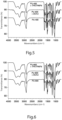
- the polyurethane was recovered by precipitation in water and analyzed according to common characterization techniques (FTIR spectrophotometry, proton nuclear magnetic resonance and size exclusion chromatography), confirming in all cases the successful synthesis of the polyurethane.
- Weight average molecular weights of about 15,000 g/mol were recorded, with a polydispersity index of about 3.5.
- the polymerization was carried out in a solution of dimethylacetamide (DMAc) with 4,4'-methylene-diphenyldiisocyanate (MDI) and polyethylene glycol (PEG) of different molecular weight, in a ratio of 1:1 in moles.
- DMAc dimethylacetamide
- MDI 4,4'-methylene-diphenyldiisocyanate
- PEG polyethylene glycol
- the MDI was then added to the PEG, the viscometer rotor was inserted and the viscosity of the solution was recorded at regular intervals for 90 min.
- the polymerization was carried out at room temperature.
- the product obtained was then purified by precipitation in 3 L of water under strong stirring.
- the precipitate was then filtered on the buchner filter under the vacuum of a membrane pump, washed with water and then transferred to a Petri dish and dried in a crystallizer under the vacuum of the mechanical pump to eliminate residual water.
- the excitation wavelength was set equal to the maximum of the absorption spectrum of each dye (430 nm for DCVJ and 500 nm for TPETPAFN, respectively) and the emission wavelength equal to maximum of its emission spectrum (510 nm for DCVJ and 625 nm for TPETPAFN, respectively).
- the slits were set at 2 nm.
- DCVJ as a fluorescent probe : 3.19 g of PEG 400 (8 ⁇ 10 -3 mol) were weighed separately and mixed with 0.6 mL of stock solution 10 -3 M of DCVJ in DMAc. They were placed under the vacuum of the mechanical pump and under magnetic stirring at 45 °C for 2 hours to eliminate the solvent contained in the stock solution. 2 mL of DMAc and the MDI solution were then added to the PEG containing the dye. Everything was placed under a dark room connected to the optical fiber of the instrument. Fluorescence values were taken for 120 min at 1 second intervals.
- TPETPAFN as a fluorescent probe : the experiment was repeated using 1.2 mL of a 5 ⁇ 10 -4 M stock solution of TPETPAFN in DMAc. Half of the solvent (1 mL) was used to make the AIE effect more visible.
- the sample was prepared with the same procedure used for the fluorescence measurements and the potential difference values were taken at regular intervals for 90 min.
- the photodiode was fixed inside the black box in contact with the container in which the polymerization reaction was carried out, in a perpendicular position with respect to the direction of the light beam.
- the slits were set at 10 nm to have a greater intensity of the light source.
- the photodiode was connected to the multimeter to obtain the potential difference measurements as a function of time.
- the present invention provides to replace, for the monitoring of a polymerization reaction in solution, the use of a photodiode which allows to read the fluorescence variation emitted during the polymerization through a classic multimeter or an electronic board to be connected to a computer.
- the polymerization progress monitoring procedure frees itself from the use of complex spectrofluorometers to the advantage of a simple, reproducible and low-cost method.
Landscapes
- Chemical & Material Sciences (AREA)
- Organic Chemistry (AREA)
- Health & Medical Sciences (AREA)
- Chemical Kinetics & Catalysis (AREA)
- Medicinal Chemistry (AREA)
- Polymers & Plastics (AREA)
- Engineering & Computer Science (AREA)
- Materials Engineering (AREA)
- Investigating, Analyzing Materials By Fluorescence Or Luminescence (AREA)
Claims (12)
- Verfahren zur Lösungspolymerisation zwischen einem ersten Monomer und einem zweiten Monomer, beide in Lösung in einem mit dem Reaktionssystem kompatiblen organischen Lösungsmittel oder in einem Gemisch kompatibler Lösungsmittel, wobei eines der beiden Monomere zuvor, gegebenenfalls mit anderen Hilfskomponenten, zugegeben wird, wobei das Ausmaß der Polymerisationsreaktion überwacht wird, wobei das Verfahren dadurch gekennzeichnet ist, dass es die folgenden Schritte umfasst:a) Zugabe einer Fluoreszenzsonde vom Typ AIE (aggregationsinduzierte Emission), die gegenüber der Polymerisationsreaktion chemisch inert ist, zu einer der beiden Lösungen vor dem Mischen in einer Menge, die einer Konzentration zwischen 10-6 M und 10-3 M entspricht, wobei die Fluoreszenzsonde eine Quantenausbeute zwischen 5 und 100% und eine Lichtemission bei einer Wellenlänge zwischen 350 und 1600 nm, vorzugsweise zwischen 400 und 800 nm, aufweist;b) mischen der ersten und der zweiten Lösung miteinander in einem vorgegebenen stöchiometrischen Verhältnis, um die Polymerisationsreaktion auszuführen;c) beleuchten der Reaktionsumgebung während der Reaktion mit einer Anregungslichtquelle mit einer Wellenlänge im sichtbaren oder im nahen ultravioletten Bereich; undd) gleichzeitiges Erfassen der von der Fluoreszenzsonde des AIE-Typs emittierten Strahlung mittels eines Photodetektors, der aus einer Photodiode oder einem Satz von in Reihe geschalteten Photodioden besteht, wobei die Photodiode oder der Satz von Photodioden mit einer Einrichtung zum Aufzeichnen der Veränderung des erfassten elektrischen Potentials, wie z.B. einem Multimeter, oder einer elektronischen Karte zur Signalverstärkung und Übertragung der relativen Daten an einen Computer verbunden ist,wobei der zeitliche Verlauf des gesammelten elektrischen Signals ein Maß für das Ausmaß der Polymerisationsreaktion darstellt,und wobei das erste Monomer ein Diisocyanat oder ein Polyisocyanat ist, und das zweite Monomer ein Polyol ist, wobei das resultierende Polymer ein Polyurethan ist.
- Polymerisationsverfahren nach Anspruch 1, wobei die Photodiode oder der Photodiodensatz ein aktives Detektionsfenster im Bereich zwischen 190 nm und 2600 nm Wellenlänge aufweist und eine Silizium- oder Germanium- oder Indium-Gallium-Arsenid-Photodiode oder ein Satz von Photodioden ist.
- Polymerisationsverfahren nach Anspruch 2, wobei das aktive Detektionsfenster im Bereich zwischen 400 nm und 800 nm, vorzugsweise zwischen 500 nm und 700 nm, liegt und die Photodiode oder der Photodiodensatz eine Silizium-Photodiode ist.
- Polymerisationsverfahren nach einem der vorhergehenden Ansprüche, wobei die Fluoreszenzsonde vom Typ AIE am Ende der Polymerisation aus der Reaktionsumgebung entfernt wird, indem sie von dem gebildeten Polymer isoliert wird.
- Polymerisationsverfahren nach einem der vorangehenden Ansprüche, wobei das zweite Monomer ein Polyetherpolyol oder ein Polyesterpolyol ist.
- Polymerisationsverfahren nach Anspruch 5, wobei das erste Monomer 4,4'-Methylendiisocyanat (MDI), 2,4-Toluoldiisocanat oder 2,6-Toluoldiisocanat (TDI) ist, das zweite Monomer Polyethylenglykol (PEG) ist, vorzugsweise mit einem Molekulargewicht zwischen 100 und 1000, besonders bevorzugt zwischen 400 und 600, und das Molverhältnis zwischen dem ersten Monomer und dem zweiten Monomer im Mischvorgang b) 1:1 beträgt.
- Polymerisationsverfahren nach einem der vorhergehenden Ansprüche, wobei die fluoreszierende Sonde vom AIE-Typ des Vorgangs a) ausgewählt ist aus TPETPAFN (2,3-bis-(4-(phenyl(4-(1,2,2-triphenylvinyl)phenyl)amino)phenyl)fu-maronitril), DCVJ (Dicyanovinyljulolidin) und TPE-Py (Tetraphenilenpyridinium).
- Polymerisationsverfahren nach Anspruch 6, wobei die Konzentration der Fluoreszenzsonde vom AIE-Typ des Verfahrens a) zwischen 10-4 und 10-3 M liegt.
- Polymerisationsverfahren nach einem der vorhergehenden Ansprüche, wobei die Lichtquelle der Operation c) aus einer oder mehreren Lampen mit Anregungswellenlängen im Bereich von 290 nm bis 550 nm besteht.
- Polymerisationsverfahren nach Anspruch 9, wobei die Anregungswellenlängen im Bereich von 360 nm bis 450 nm liegen.
- Polymerisationsverfahren nach einem der vorhergehenden Ansprüche, wobei die Mittel zur Aufzeichnung der Veränderung des elektrischen Potentials, das von dem Photodetektor erfasst wird, aus einem Multimeter bestehen.
- Polymerisationsverfahren nach einem der Ansprüche 1-11, dadurch gekennzeichnet, dass die Mittel zur Aufzeichnung der Veränderung des von dem Photodetektor erfassten elektrischen Signals in einer elektronischen Karte zur Verstärkung des elektrischen Signals und dessen Übertragung an einen Computer bestehen.
Applications Claiming Priority (1)
| Application Number | Priority Date | Filing Date | Title |
|---|---|---|---|
| IT102020000011911A IT202000011911A1 (it) | 2020-05-21 | 2020-05-21 | Metodo semplificato per il controllo della sintesi di poliuretani basato sull’uso di sonde fluorescenti |
Publications (3)
| Publication Number | Publication Date |
|---|---|
| EP3913010A1 EP3913010A1 (de) | 2021-11-24 |
| EP3913010C0 EP3913010C0 (de) | 2024-06-19 |
| EP3913010B1 true EP3913010B1 (de) | 2024-06-19 |
Family
ID=72086971
Family Applications (1)
| Application Number | Title | Priority Date | Filing Date |
|---|---|---|---|
| EP21175421.3A Active EP3913010B1 (de) | 2020-05-21 | 2021-05-21 | Vereinfachte methode zur kontrolle der polyurethan-synthese durch den einsatz von fluoreszenzsonden |
Country Status (2)
| Country | Link |
|---|---|
| EP (1) | EP3913010B1 (de) |
| IT (1) | IT202000011911A1 (de) |
Families Citing this family (10)
| Publication number | Priority date | Publication date | Assignee | Title |
|---|---|---|---|---|
| CN114920904B (zh) * | 2022-05-31 | 2024-01-30 | 郑州大学 | 一种无色透明高强度聚氨酯防伪材料的制备方法及其应用 |
| CN115109079B (zh) * | 2022-06-21 | 2023-07-04 | 南京工业大学 | 聚氨酯降解酶特异性荧光探针、其制备方法及应用 |
| CN115505146B (zh) * | 2022-10-19 | 2024-05-14 | 江西省科学院微生物研究所(江西省流域生态研究所) | 一种基于荧光共振能量转移的聚集诱导发光荧光微球及其制备方法和应用 |
| CN115855902B (zh) * | 2022-11-30 | 2025-10-03 | 西南交通大学 | 水体中磷酸三甲苯酯浓度的检测方法和检测材料 |
| CN116085972B (zh) * | 2023-01-18 | 2025-06-17 | 珠海格力电器股份有限公司 | 风速控制方法、装置、空气净化器、电子设备及存储介质 |
| CN116478088B (zh) * | 2023-04-29 | 2025-09-26 | 北京化工大学 | 一种粘度响应型发光探针及用于聚合过程分析 |
| CN117464788B (zh) * | 2023-09-21 | 2025-07-25 | 湖南大学 | 一种荧光透明木制材料及制备方法 |
| CN117778528A (zh) * | 2023-11-27 | 2024-03-29 | 深圳市儿童医院 | 一种用于检测新型冠状病毒的组合物及其应用与试剂盒 |
| CN118930540A (zh) * | 2024-07-23 | 2024-11-12 | 南京林业大学 | 一种d-a型具有aie效应粘度荧光探针的制备及其应用 |
| CN121699110B (zh) * | 2026-02-10 | 2026-05-05 | 华大化学集团有限公司 | 一种可逆压致变色热塑性聚氨酯弹性体及其制备方法 |
Family Cites Families (3)
| Publication number | Priority date | Publication date | Assignee | Title |
|---|---|---|---|---|
| US5100802A (en) | 1989-12-05 | 1992-03-31 | The Dow Chemical Company | Fluorescent monitoring method for polymerization reactions |
| CN107936945B (zh) * | 2016-10-13 | 2020-06-09 | 香港科技大学 | 一种具有聚集诱导发光特性的荧光粘度探针 |
| KR102729489B1 (ko) | 2018-03-28 | 2024-11-15 | 다우 글로벌 테크놀로지스 엘엘씨 | 중합체의 중합을 모니터링하고 제어하는 방법 |
-
2020
- 2020-05-21 IT IT102020000011911A patent/IT202000011911A1/it unknown
-
2021
- 2021-05-21 EP EP21175421.3A patent/EP3913010B1/de active Active
Also Published As
| Publication number | Publication date |
|---|---|
| IT202000011911A1 (it) | 2021-11-21 |
| EP3913010A1 (de) | 2021-11-24 |
| EP3913010C0 (de) | 2024-06-19 |
Similar Documents
| Publication | Publication Date | Title |
|---|---|---|
| EP3913010A1 (de) | Vereinfachte methode zur kontrolle der polyurethan-synthese durch den einsatz von fluoreszenzsonden | |
| Traeger et al. | Folded perylene diimide loops as mechanoresponsive motifs | |
| Staudinger et al. | Fast and stable optical pH sensor materials for oceanographic applications | |
| EP0455730B1 (de) | Material und verfahren zur sauerstoffabtastung | |
| EP0746757A1 (de) | Eine radiometrische fluoreszenzmethode zur sauerstoffbestimmung | |
| Micheletti et al. | Blending or bonding? Mechanochromism of an aggregachromic mechanophore in a thermoplastic elastomer | |
| Biewend et al. | Detection of stress in polymers: mechanochemical activation of CuAAC click reactions in poly (urethane) networks | |
| Li et al. | Copper-based ionic liquid-catalyzed click polymerization of diazides and diynes toward functional polytriazoles for sensing applications | |
| Chen et al. | Metallacycle-crosslinked supramolecular polymers constructed by amino–YNE click reaction with enhanced mechanical properties | |
| Hu et al. | Synthesis of novel fluorescent cellulose derivatives and their applications in detection of nitroaromatic compounds | |
| Wang et al. | Waterborne polyurethanes prepared from benzophenone derivatives with delayed fluorescence and room-temperature phosphorescence | |
| CN118914165B (zh) | 一种聚氨酯反应进程在线监测方法和系统 | |
| Karthikeyan et al. | Probing strain in thermoplastic elastomers using fluorescence resonance energy transfer | |
| Micheletti et al. | Mechanochromic polyolefin elastomers | |
| Sogawa et al. | Polyurethanes containing platinum in the main chain: synthesis, structure and mechanofluorochromism | |
| Bojinov et al. | Novel functionalized 2-(2-hydroxyphenyl)-benzotriazole–benzo [de] isoquinoline-1, 3-dione fluorescent UV absorbers: synthesis and photostabilizing efficiency | |
| Mallakpour et al. | Synthesis and characterization of new self-colored thermally stable poly (amide-ether-urethane) s based on an azo dye and different diisocyanates | |
| Ma et al. | Fluorescent and thermal properties of siloxane-polyurethanes based on 1, 8-naphthalimide | |
| De Clercq et al. | Monitoring of the polymerization of norbornene by in-line fiber-optic near IR-FT Raman | |
| Hu et al. | Application of heterocyclic polymers in the ratiometric spectrophotometric determination of fluoride | |
| Chen et al. | Thiol–ene chemistry incorporates a new spiropyran-containing polyurethane ionogel with photochromic, photomechanical and photoconductive properties | |
| Mallakpour et al. | Synthesis of aliphatic polyamides containing 4‐phenylurazole linkages | |
| Li et al. | Novel fluorescent hyperbranched aliphatic polyestertriazole as efficient probe for detecting Hg2+ in water | |
| Zhou et al. | Developing luminescent ratiometric thermometers based on copolymers containing Platinum (II) isocyanide complex | |
| Kosyanchuk et al. | The dynamic characteristics of polyurethane matrix of dye laser solid-state active elements |
Legal Events
| Date | Code | Title | Description |
|---|---|---|---|
| PUAI | Public reference made under article 153(3) epc to a published international application that has entered the european phase |
Free format text: ORIGINAL CODE: 0009012 |
|
| STAA | Information on the status of an ep patent application or granted ep patent |
Free format text: STATUS: THE APPLICATION HAS BEEN PUBLISHED |
|
| AK | Designated contracting states |
Kind code of ref document: A1 Designated state(s): AL AT BE BG CH CY CZ DE DK EE ES FI FR GB GR HR HU IE IS IT LI LT LU LV MC MK MT NL NO PL PT RO RS SE SI SK SM TR |
|
| B565 | Issuance of search results under rule 164(2) epc |
Effective date: 20211014 |
|
| STAA | Information on the status of an ep patent application or granted ep patent |
Free format text: STATUS: REQUEST FOR EXAMINATION WAS MADE |
|
| 17P | Request for examination filed |
Effective date: 20220524 |
|
| RBV | Designated contracting states (corrected) |
Designated state(s): AL AT BE BG CH CY CZ DE DK EE ES FI FR GB GR HR HU IE IS IT LI LT LU LV MC MK MT NL NO PL PT RO RS SE SI SK SM TR |
|
| GRAP | Despatch of communication of intention to grant a patent |
Free format text: ORIGINAL CODE: EPIDOSNIGR1 |
|
| STAA | Information on the status of an ep patent application or granted ep patent |
Free format text: STATUS: GRANT OF PATENT IS INTENDED |
|
| RIC1 | Information provided on ipc code assigned before grant |
Ipc: C09K 11/06 20060101ALI20240213BHEP Ipc: C08G 18/48 20060101ALI20240213BHEP Ipc: C08G 18/76 20060101AFI20240213BHEP |
|
| INTG | Intention to grant announced |
Effective date: 20240229 |
|
| RAP3 | Party data changed (applicant data changed or rights of an application transferred) |
Owner name: UNIVERSITA DI PISA |
|
| GRAS | Grant fee paid |
Free format text: ORIGINAL CODE: EPIDOSNIGR3 |
|
| GRAA | (expected) grant |
Free format text: ORIGINAL CODE: 0009210 |
|
| STAA | Information on the status of an ep patent application or granted ep patent |
Free format text: STATUS: THE PATENT HAS BEEN GRANTED |
|
| AK | Designated contracting states |
Kind code of ref document: B1 Designated state(s): AL AT BE BG CH CY CZ DE DK EE ES FI FR GB GR HR HU IE IS IT LI LT LU LV MC MK MT NL NO PL PT RO RS SE SI SK SM TR |
|
| REG | Reference to a national code |
Ref country code: GB Ref legal event code: FG4D |
|
| REG | Reference to a national code |
Ref country code: CH Ref legal event code: EP |
|
| REG | Reference to a national code |
Ref country code: DE Ref legal event code: R096 Ref document number: 602021014515 Country of ref document: DE |
|
| U01 | Request for unitary effect filed |
Effective date: 20240701 |
|
| U07 | Unitary effect registered |
Designated state(s): AT BE BG DE DK EE FI FR IT LT LU LV MT NL PT RO SE SI Effective date: 20240902 |
|
| PG25 | Lapsed in a contracting state [announced via postgrant information from national office to epo] |
Ref country code: HR Free format text: LAPSE BECAUSE OF FAILURE TO SUBMIT A TRANSLATION OF THE DESCRIPTION OR TO PAY THE FEE WITHIN THE PRESCRIBED TIME-LIMIT Effective date: 20240619 |
|
| PG25 | Lapsed in a contracting state [announced via postgrant information from national office to epo] |
Ref country code: GR Free format text: LAPSE BECAUSE OF FAILURE TO SUBMIT A TRANSLATION OF THE DESCRIPTION OR TO PAY THE FEE WITHIN THE PRESCRIBED TIME-LIMIT Effective date: 20240920 |
|
| PG25 | Lapsed in a contracting state [announced via postgrant information from national office to epo] |
Ref country code: NO Free format text: LAPSE BECAUSE OF FAILURE TO SUBMIT A TRANSLATION OF THE DESCRIPTION OR TO PAY THE FEE WITHIN THE PRESCRIBED TIME-LIMIT Effective date: 20240919 Ref country code: HR Free format text: LAPSE BECAUSE OF FAILURE TO SUBMIT A TRANSLATION OF THE DESCRIPTION OR TO PAY THE FEE WITHIN THE PRESCRIBED TIME-LIMIT Effective date: 20240619 Ref country code: GR Free format text: LAPSE BECAUSE OF FAILURE TO SUBMIT A TRANSLATION OF THE DESCRIPTION OR TO PAY THE FEE WITHIN THE PRESCRIBED TIME-LIMIT Effective date: 20240920 Ref country code: RS Free format text: LAPSE BECAUSE OF FAILURE TO SUBMIT A TRANSLATION OF THE DESCRIPTION OR TO PAY THE FEE WITHIN THE PRESCRIBED TIME-LIMIT Effective date: 20240919 |
|
| PG25 | Lapsed in a contracting state [announced via postgrant information from national office to epo] |
Ref country code: PL Free format text: LAPSE BECAUSE OF FAILURE TO SUBMIT A TRANSLATION OF THE DESCRIPTION OR TO PAY THE FEE WITHIN THE PRESCRIBED TIME-LIMIT Effective date: 20240619 |
|
| PG25 | Lapsed in a contracting state [announced via postgrant information from national office to epo] |
Ref country code: IS Free format text: LAPSE BECAUSE OF FAILURE TO SUBMIT A TRANSLATION OF THE DESCRIPTION OR TO PAY THE FEE WITHIN THE PRESCRIBED TIME-LIMIT Effective date: 20241019 |
|
| PG25 | Lapsed in a contracting state [announced via postgrant information from national office to epo] |
Ref country code: CZ Free format text: LAPSE BECAUSE OF FAILURE TO SUBMIT A TRANSLATION OF THE DESCRIPTION OR TO PAY THE FEE WITHIN THE PRESCRIBED TIME-LIMIT Effective date: 20240619 |
|
| PG25 | Lapsed in a contracting state [announced via postgrant information from national office to epo] |
Ref country code: SK Free format text: LAPSE BECAUSE OF FAILURE TO SUBMIT A TRANSLATION OF THE DESCRIPTION OR TO PAY THE FEE WITHIN THE PRESCRIBED TIME-LIMIT Effective date: 20240619 |
|
| PG25 | Lapsed in a contracting state [announced via postgrant information from national office to epo] |
Ref country code: ES Free format text: LAPSE BECAUSE OF FAILURE TO SUBMIT A TRANSLATION OF THE DESCRIPTION OR TO PAY THE FEE WITHIN THE PRESCRIBED TIME-LIMIT Effective date: 20240619 Ref country code: SM Free format text: LAPSE BECAUSE OF FAILURE TO SUBMIT A TRANSLATION OF THE DESCRIPTION OR TO PAY THE FEE WITHIN THE PRESCRIBED TIME-LIMIT Effective date: 20240619 |
|
| PG25 | Lapsed in a contracting state [announced via postgrant information from national office to epo] |
Ref country code: SM Free format text: LAPSE BECAUSE OF FAILURE TO SUBMIT A TRANSLATION OF THE DESCRIPTION OR TO PAY THE FEE WITHIN THE PRESCRIBED TIME-LIMIT Effective date: 20240619 Ref country code: SK Free format text: LAPSE BECAUSE OF FAILURE TO SUBMIT A TRANSLATION OF THE DESCRIPTION OR TO PAY THE FEE WITHIN THE PRESCRIBED TIME-LIMIT Effective date: 20240619 Ref country code: PL Free format text: LAPSE BECAUSE OF FAILURE TO SUBMIT A TRANSLATION OF THE DESCRIPTION OR TO PAY THE FEE WITHIN THE PRESCRIBED TIME-LIMIT Effective date: 20240619 Ref country code: IS Free format text: LAPSE BECAUSE OF FAILURE TO SUBMIT A TRANSLATION OF THE DESCRIPTION OR TO PAY THE FEE WITHIN THE PRESCRIBED TIME-LIMIT Effective date: 20241019 Ref country code: ES Free format text: LAPSE BECAUSE OF FAILURE TO SUBMIT A TRANSLATION OF THE DESCRIPTION OR TO PAY THE FEE WITHIN THE PRESCRIBED TIME-LIMIT Effective date: 20240619 Ref country code: CZ Free format text: LAPSE BECAUSE OF FAILURE TO SUBMIT A TRANSLATION OF THE DESCRIPTION OR TO PAY THE FEE WITHIN THE PRESCRIBED TIME-LIMIT Effective date: 20240619 |
|
| PLBE | No opposition filed within time limit |
Free format text: ORIGINAL CODE: 0009261 |
|
| STAA | Information on the status of an ep patent application or granted ep patent |
Free format text: STATUS: NO OPPOSITION FILED WITHIN TIME LIMIT |
|
| 26N | No opposition filed |
Effective date: 20250320 |
|
| U20 | Renewal fee for the european patent with unitary effect paid |
Year of fee payment: 5 Effective date: 20250513 |
|
| REG | Reference to a national code |
Ref country code: CH Ref legal event code: H13 Free format text: ST27 STATUS EVENT CODE: U-0-0-H10-H13 (AS PROVIDED BY THE NATIONAL OFFICE) Effective date: 20251223 |
|
| PG25 | Lapsed in a contracting state [announced via postgrant information from national office to epo] |
Ref country code: CH Free format text: LAPSE BECAUSE OF NON-PAYMENT OF DUE FEES Effective date: 20250531 |
|
| GBPC | Gb: european patent ceased through non-payment of renewal fee |
Effective date: 20250521 |
|
| PG25 | Lapsed in a contracting state [announced via postgrant information from national office to epo] |
Ref country code: MC Free format text: LAPSE BECAUSE OF FAILURE TO SUBMIT A TRANSLATION OF THE DESCRIPTION OR TO PAY THE FEE WITHIN THE PRESCRIBED TIME-LIMIT Effective date: 20240619 |
|
| PG25 | Lapsed in a contracting state [announced via postgrant information from national office to epo] |
Ref country code: GB Free format text: LAPSE BECAUSE OF NON-PAYMENT OF DUE FEES Effective date: 20250521 |
|
| PG25 | Lapsed in a contracting state [announced via postgrant information from national office to epo] |
Ref country code: IE Free format text: LAPSE BECAUSE OF NON-PAYMENT OF DUE FEES Effective date: 20250521 |
|
| U20 | Renewal fee for the european patent with unitary effect paid |
Year of fee payment: 6 Effective date: 20260312 |