EP3912449B1 - Mower fleet management system and method - Google Patents
Mower fleet management system and method Download PDFInfo
- Publication number
- EP3912449B1 EP3912449B1 EP21175407.2A EP21175407A EP3912449B1 EP 3912449 B1 EP3912449 B1 EP 3912449B1 EP 21175407 A EP21175407 A EP 21175407A EP 3912449 B1 EP3912449 B1 EP 3912449B1
- Authority
- EP
- European Patent Office
- Prior art keywords
- working
- mower
- mowers
- land
- map
- Prior art date
- Legal status (The legal status is an assumption and is not a legal conclusion. Google has not performed a legal analysis and makes no representation as to the accuracy of the status listed.)
- Active
Links
Images


Classifications
-
- G—PHYSICS
- G06—COMPUTING OR CALCULATING; COUNTING
- G06Q—INFORMATION AND COMMUNICATION TECHNOLOGY [ICT] SPECIALLY ADAPTED FOR ADMINISTRATIVE, COMMERCIAL, FINANCIAL, MANAGERIAL OR SUPERVISORY PURPOSES; SYSTEMS OR METHODS SPECIALLY ADAPTED FOR ADMINISTRATIVE, COMMERCIAL, FINANCIAL, MANAGERIAL OR SUPERVISORY PURPOSES, NOT OTHERWISE PROVIDED FOR
- G06Q10/00—Administration; Management
- G06Q10/06—Resources, workflows, human or project management; Enterprise or organisation planning; Enterprise or organisation modelling
- G06Q10/063—Operations research, analysis or management
- G06Q10/0631—Resource planning, allocation, distributing or scheduling for enterprises or organisations
- G06Q10/06311—Scheduling, planning or task assignment for a person or group
-
- G—PHYSICS
- G05—CONTROLLING; REGULATING
- G05D—SYSTEMS FOR CONTROLLING OR REGULATING NON-ELECTRIC VARIABLES
- G05D1/00—Control of position, course, altitude or attitude of land, water, air or space vehicles, e.g. using automatic pilots
- G05D1/60—Intended control result
- G05D1/69—Coordinated control of the position or course of two or more vehicles
- G05D1/693—Coordinated control of the position or course of two or more vehicles for avoiding collisions between vehicles
-
- A—HUMAN NECESSITIES
- A01—AGRICULTURE; FORESTRY; ANIMAL HUSBANDRY; HUNTING; TRAPPING; FISHING
- A01D—HARVESTING; MOWING
- A01D34/00—Mowers; Mowing apparatus of harvesters
- A01D34/006—Control or measuring arrangements
- A01D34/008—Control or measuring arrangements for automated or remotely controlled operation
-
- G—PHYSICS
- G01—MEASURING; TESTING
- G01C—MEASURING DISTANCES, LEVELS OR BEARINGS; SURVEYING; NAVIGATION; GYROSCOPIC INSTRUMENTS; PHOTOGRAMMETRY OR VIDEOGRAMMETRY
- G01C21/00—Navigation; Navigational instruments not provided for in groups G01C1/00 - G01C19/00
- G01C21/38—Electronic maps specially adapted for navigation; Updating thereof
- G01C21/3804—Creation or updating of map data
- G01C21/3807—Creation or updating of map data characterised by the type of data
- G01C21/3826—Terrain data
-
- G—PHYSICS
- G05—CONTROLLING; REGULATING
- G05D—SYSTEMS FOR CONTROLLING OR REGULATING NON-ELECTRIC VARIABLES
- G05D1/00—Control of position, course, altitude or attitude of land, water, air or space vehicles, e.g. using automatic pilots
- G05D1/0011—Control of position, course, altitude or attitude of land, water, air or space vehicles, e.g. using automatic pilots associated with a remote control arrangement
- G05D1/0022—Control of position, course, altitude or attitude of land, water, air or space vehicles, e.g. using automatic pilots associated with a remote control arrangement characterised by the communication link
-
- G—PHYSICS
- G05—CONTROLLING; REGULATING
- G05D—SYSTEMS FOR CONTROLLING OR REGULATING NON-ELECTRIC VARIABLES
- G05D1/00—Control of position, course, altitude or attitude of land, water, air or space vehicles, e.g. using automatic pilots
- G05D1/0011—Control of position, course, altitude or attitude of land, water, air or space vehicles, e.g. using automatic pilots associated with a remote control arrangement
- G05D1/0027—Control of position, course, altitude or attitude of land, water, air or space vehicles, e.g. using automatic pilots associated with a remote control arrangement involving a plurality of vehicles, e.g. fleet or convoy travelling
-
- G—PHYSICS
- G05—CONTROLLING; REGULATING
- G05D—SYSTEMS FOR CONTROLLING OR REGULATING NON-ELECTRIC VARIABLES
- G05D1/00—Control of position, course, altitude or attitude of land, water, air or space vehicles, e.g. using automatic pilots
- G05D1/02—Control of position or course in two dimensions
- G05D1/021—Control of position or course in two dimensions specially adapted to land vehicles
- G05D1/0231—Control of position or course in two dimensions specially adapted to land vehicles using optical position detecting means
- G05D1/0246—Control of position or course in two dimensions specially adapted to land vehicles using optical position detecting means using a video camera in combination with image processing means
-
- G—PHYSICS
- G05—CONTROLLING; REGULATING
- G05D—SYSTEMS FOR CONTROLLING OR REGULATING NON-ELECTRIC VARIABLES
- G05D1/00—Control of position, course, altitude or attitude of land, water, air or space vehicles, e.g. using automatic pilots
- G05D1/02—Control of position or course in two dimensions
- G05D1/021—Control of position or course in two dimensions specially adapted to land vehicles
- G05D1/0255—Control of position or course in two dimensions specially adapted to land vehicles using acoustic signals, e.g. ultra-sonic singals
-
- G—PHYSICS
- G05—CONTROLLING; REGULATING
- G05D—SYSTEMS FOR CONTROLLING OR REGULATING NON-ELECTRIC VARIABLES
- G05D1/00—Control of position, course, altitude or attitude of land, water, air or space vehicles, e.g. using automatic pilots
- G05D1/02—Control of position or course in two dimensions
- G05D1/021—Control of position or course in two dimensions specially adapted to land vehicles
- G05D1/0257—Control of position or course in two dimensions specially adapted to land vehicles using a radar
-
- G—PHYSICS
- G05—CONTROLLING; REGULATING
- G05D—SYSTEMS FOR CONTROLLING OR REGULATING NON-ELECTRIC VARIABLES
- G05D1/00—Control of position, course, altitude or attitude of land, water, air or space vehicles, e.g. using automatic pilots
- G05D1/02—Control of position or course in two dimensions
- G05D1/021—Control of position or course in two dimensions specially adapted to land vehicles
- G05D1/0268—Control of position or course in two dimensions specially adapted to land vehicles using internal positioning means
- G05D1/0274—Control of position or course in two dimensions specially adapted to land vehicles using internal positioning means using mapping information stored in a memory device
-
- G—PHYSICS
- G05—CONTROLLING; REGULATING
- G05D—SYSTEMS FOR CONTROLLING OR REGULATING NON-ELECTRIC VARIABLES
- G05D1/00—Control of position, course, altitude or attitude of land, water, air or space vehicles, e.g. using automatic pilots
- G05D1/02—Control of position or course in two dimensions
- G05D1/021—Control of position or course in two dimensions specially adapted to land vehicles
- G05D1/0287—Control of position or course in two dimensions specially adapted to land vehicles involving a plurality of land vehicles, e.g. fleet or convoy travelling
- G05D1/0289—Control of position or course in two dimensions specially adapted to land vehicles involving a plurality of land vehicles, e.g. fleet or convoy travelling with means for avoiding collisions between vehicles
-
- G—PHYSICS
- G05—CONTROLLING; REGULATING
- G05D—SYSTEMS FOR CONTROLLING OR REGULATING NON-ELECTRIC VARIABLES
- G05D1/00—Control of position, course, altitude or attitude of land, water, air or space vehicles, e.g. using automatic pilots
- G05D1/02—Control of position or course in two dimensions
- G05D1/021—Control of position or course in two dimensions specially adapted to land vehicles
- G05D1/0287—Control of position or course in two dimensions specially adapted to land vehicles involving a plurality of land vehicles, e.g. fleet or convoy travelling
- G05D1/0291—Fleet control
-
- G—PHYSICS
- G05—CONTROLLING; REGULATING
- G05D—SYSTEMS FOR CONTROLLING OR REGULATING NON-ELECTRIC VARIABLES
- G05D1/00—Control of position, course, altitude or attitude of land, water, air or space vehicles, e.g. using automatic pilots
- G05D1/20—Control system inputs
- G05D1/22—Command input arrangements
- G05D1/221—Remote-control arrangements
- G05D1/226—Communication links with the remote-control arrangements
-
- G—PHYSICS
- G05—CONTROLLING; REGULATING
- G05D—SYSTEMS FOR CONTROLLING OR REGULATING NON-ELECTRIC VARIABLES
- G05D1/00—Control of position, course, altitude or attitude of land, water, air or space vehicles, e.g. using automatic pilots
- G05D1/60—Intended control result
- G05D1/69—Coordinated control of the position or course of two or more vehicles
- G05D1/692—Coordinated control of the position or course of two or more vehicles involving a plurality of disparate vehicles
-
- G—PHYSICS
- G06—COMPUTING OR CALCULATING; COUNTING
- G06Q—INFORMATION AND COMMUNICATION TECHNOLOGY [ICT] SPECIALLY ADAPTED FOR ADMINISTRATIVE, COMMERCIAL, FINANCIAL, MANAGERIAL OR SUPERVISORY PURPOSES; SYSTEMS OR METHODS SPECIALLY ADAPTED FOR ADMINISTRATIVE, COMMERCIAL, FINANCIAL, MANAGERIAL OR SUPERVISORY PURPOSES, NOT OTHERWISE PROVIDED FOR
- G06Q50/00—Information and communication technology [ICT] specially adapted for implementation of business processes of specific business sectors, e.g. utilities or tourism
- G06Q50/02—Agriculture; Fishing; Forestry; Mining
Definitions
- the present invention relates to a mower fleet management system and a mower fleet management method.
- a mower is a gardening tool used for mowing lawns, vegetation, and the like, and generally includes a walking system, a cutter system, and a power source.
- the power source may be a gasoline engine, a battery, or the like.
- a battery-powered mower is popular to users because of low noise and zero pollution.
- the battery carried on the mower has a very limited charge amount, resulting in a relatively small working area of the mower in each operation.
- a user requires a plurality of batteries for replacement to achieve uninterrupted work. Nevertheless, a user still needs to spend a very long time to complete lawn mowing. If a plurality of mowers is simultaneously used, a plurality of operators will be simultaneously required. As a result, labor costs will increase.
- US 2015/348418 discloses a method for wirelessly controlling a plurality of agricultural machines. Status updates are received from the plurality of agricultural machines and responsive to the status updates, the agricultural machines coordinated to work together on the same task.
- a mower fleet management device is required to resolve the above problems.
- the present disclosure provides a mower fleet management system comprising a mower fleet comprising a plurality of mowers and a mower fleet management device, wherein the mower fleet management device is configured to control the plurality of mowers to work in collaboration.
- Each of the mowers includes an on-board communication module and an on-board positioning and navigation module.
- the mower fleet management device includes: a map loading module configured to acquire a map of a working land parcel for use by the on-board positioning and navigation modules; a control terminal communication module configured to wirelessly communicate with the on-board communication modules to acquire status information of the mowers and transmit a control command to the mowers, where the status information includes charge amounts of battery packs, speeds, and mowing widths of the mowers; a working region assigning module configured to assign a working region to each of the mowers according to the status information and the map.
- the working region assigning module comprises a working area estimation unit and a path generation unit, wherein the working area estimation unit is configured to estimate the working area of each of the mowers according to the status information, and the path generation unit is configured to generate a working path according to the estimated working area and the map of the working land.
- the on-board positioning and navigation module of each of the mowers is configured to guide the mower to work in the corresponding working region according to the assigned working region.
- the working region assigning module is configured to transmit a prompt message when the sum of the estimated working areas of all of the mowers is less than the area of the working land.
- the present disclosure further provides a mower fleet management method for controlling a plurality of mowers to work in collaboration, including the following steps: acquiring a map of a working land parcel and status information of the mowers, where the status information includes charge amounts of battery packs, speeds, and mowing widths of the mowers; assigning a working region to each of the mowers according to the status information and the map and guiding each of the mowers to work in the corresponding working region; estimating a working area of each of the plurality of mowers according to the status information of each of the plurality of mowers; generating a working path of each of the plurality of mowers according to the estimated working area of each of the plurality of mowers and the map of the working land; and determining whether a sum of the estimated working areas of all of the plurality of mowers is not less than an area of the working land; and if so, generating a working path of each of the plurality of mowers according to the estimated working area of each of the plurality of mowers and the map of the working land; or
- the present invention has the following beneficial effects: the mower fleet management device of the present invention can control a plurality of unmanned mowers to work in collaboration, thereby effectively improving working efficiency and reducing labor costs.
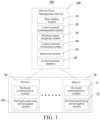
- the present disclosure provides a mower fleet management device 100 configured to control a plurality of mowers 70 to work in collaboration to mow lawn quickly.
- Each of the plurality of mowers 70 includes an on-board communication module 71 and an on-board positioning and navigation module 72.
- the mower fleet management device 100 includes a map loading module 10, a control terminal communication module 20, a working region assigning module 30, a control terminal monitoring module 40, an interaction module 50, and a control terminal database 60.
- the map loading module 10 is configured to acquire a map of a working land for use by the on-board positioning and navigation modules 72.
- the map loading module 10 includes a position collection unit 11 and a map generation unit 12.
- the position collection unit 11 is configured to collect coordinate information of the working land.
- the coordinate information of the working land includes coordinate information of a boundary of the working land and coordinate information of a boundary of an obstacle located in the working land.
- the map generation unit 12 is configured to generate a boundary curve of the working land according to the coordinate information and determine whether the boundary curve is a closed curve. If the boundary curve is a closed curve, the map generation unit 12 fits the boundary curve to generates the map of the working land. If the boundary curve is not a closed curve, the map generation unit transmits a prompt message to remind a worker to complete collection of position information of the working land.
- the prompt message may be a prompt voice emitted by the mower fleet management device 100, a prompt lamplight, or a prompt text, graphics, or the like displayed on the interaction module 50.
- the control terminal communication module 20 wirelessly communicates with the on-board communication module 71 to acquire status information of the mowers 70 or transmit a control command to the mowers 70.
- the control terminal communication module 20 and the on-board communication module 71 each may be a 3G communication module, a 4G communication module, a 5G communication module, a WIFI module, a Bluetooth module, a WiMAX module, a Zigbee module, or the like.
- the status information includes charge amount of battery, speed, mowing widths, and the like of the mowers.
- the working region assigning module 30 assigns a working region to each of the mowers 70 according to the status information and the map.
- the on-board positioning and navigation module 72 of each of the mowers 70 guides the mower 70 to work in the corresponding working region according to the assigned working region.
- the working region assigning module 30 includes a working area estimation unit 31 and a path generation unit 32.
- the working area estimation unit 31 is configured to estimate the working area of each of the mowers 70 according to the status information.
- S imax B i *SOC i *K i , where S imax is an estimated working area of an i th mower, SOC i is a full charge of a battery of the i th mower, B i is a current charge percentage of the battery of the i th mower, and K i is a ratio of a mowing area to power consumption of the i th mower.
- S imax an estimated working area of an i th mower
- SOC i is a full charge of a battery of the i th mower
- B i is a current charge percentage of the battery of the i th mower
- K i is a ratio of a mowing area to power consumption of the i th mower.
- a user may set a minimum battery percentage B imin for the battery of the i th mower through the interaction module 50.
- the mower fleet management device 100 may determine a "back battery percentage" B iback according to a distance between the position of the mower when the work is completed and the starting point.
- the user may set a re-mowing rate F i for the i th mower through the interaction module 50.
- the area of the working region may also be estimated by other methods.
- T imin S /[ V 1 * D 1 * (1 - F 1 ) + V 2 * D 2 * (1 - F 2 ) +...+ V n * D n * (1 - F n )] (referred to as Equation 3 below).
- Equation 3 V 1 * D 1 * (1 - F 1 ) + V 2 * D 2 * (1 - F 2 ) +...+ V n * D n * (1 - F n )]
- the working region assigning module 30 transmits a prompt message, to remind the user that the mowers in the current fleet cannot complete the mowing work on the working land.
- the prompt message may be a prompt voice emitted by the mower fleet management device 100, a prompt lamplight, or a prompt text, graphics, or the like displayed on the interaction module 10.
- a user controls, through the interaction module 50, the control terminal communication module 20 to establish a communicative connection to an on-board communication module 71 of a mower outside a fleet to add the mower to the fleet.
- the mower fleet management device 100 controls the mower fleet to work in the preferential region of the working land parcel.
- Table 1 Working area estimation of a mower fleet composed of mowers 1, 2, and 3 Mower 1 Mower 2 Mower 3 Current battery percentage B i 80% 70% 90% Minimum battery percentage B imin 5% 10% 15% Full charge amount SOC i (kwh) 8 10 15 Mowing area K i (m 2 /kwh) affordable by a charge amount unit 1200 1400 1500 Equation 1 (80%-5%)*8*120 0 (70%-10%)*10*1400 (90%-15%)*15*1500 Estimated area S imax (m 2 ) of working region 7200 8400 16875 Mowing width D i (m) 0.8 0.9 1 Travelling speed V i (m/s) 4 3.5 4.5 Re-mowing rate F i 10% 20% 15% Equation 2 7200/(0.8*4*(1-1 0%)) 8400/(0.9*3.5*(1-20%) ) 16875/(1*4.5*(1-15%)
- the path generation unit 32 generates a working path corresponding to each of the mowers according to the estimated working area and the map of the working land.
- the user may further set a working mode through the interaction module 50.
- the working mode includes an independent working mode and a follow-up working mode.
- FIG. 3 is a schematic diagram of a working path of an independent working mode. Solid lines represent a working path of a first mower, and dashed lines represent a working path of a second mower. In the independent working mode, a working region of the first mower and a working region of the second mower are independent of each other.
- FIG. 4 is a schematic diagram of a working path of a follow-up working mode.
- Solid lines represent a working path of a first mower
- dashed lines represent a working path of a second mower.
- a working region of the first mower and a working region of the second mower are separated from each other.
- numbers of mowers in the independent working mode and the follow-up working mode may be changed as needed.
- a mowing range of the first mower partially overlaps a mowing range of the second mower.
- the first mower and the second mower are caused to operate with a distance between them, that is, the first mower and the second mower work one after the other according to a preset working path.
- the mower fleet management device 100 controls a rear mower to stop operation to prevent the rear mower from colliding with the front mower.
- a safety distance is set between the first mower and the second mower, that is, the first mower and the second mower operate at an interval of the safety distance.
- the front mower malfunctions and stops operation the rear mower is capable of decelerating and stopping within the safety distance to avoid a collision as a result of the two being too close.
- the value of the safety distance is proportional to a walking speed of the mowers.
- the control terminal monitoring module 40 is configured to monitor operation information of each of the mowers 70 and control the mower 70 to perform an operation corresponding to the operation information.
- the operation information may be malfunction information of the mower or charge amount information of the battery.
- the mower fleet management device 100 controls the mower 70 to stop working and transmits a prompt message.
- the mower fleet management device 100 guides the mower 70 back to work in the corresponding working region.
- the interaction module 50 includes an input unit 51 configured to input a user instruction, and a display unit 52 configured to display the prompt message.
- the input unit 51 may be an input key, a voice control module, or the like.
- the display unit 52 may be a display screen. In this embodiment, the input unit 51 and the display unit 52 are separately disposed. However, in other embodiments, the input unit 51 and the display unit 52 may also be integrated as a whole, such as a touch screen.
- the control terminal database 60 is configured to store mower historical work information 61, working land map information 62, mower status information 63, and the like, to be viewed by a user or used by the mower fleet management device 100.
- the map loading module 10 preferably loads the working land map information 62. If the working land map information 62 has a map of a land currently to be worked on, the map loading module 10 directly loads the map from the working land map information 62. If the working land map information 62 does not have the map of the land currently to be worked on, the map loading module 10 collects coordinate information of the working parcel and generates a map through fitting.
- the mower fleet management device 100 may be a fixed console, a mobile console, or a cloud console.
- the mower fleet management device 100 may also be a mobile phone, a tablet computer, or the like.
- the mower fleet management device 100 directly communicates with the mower 70.
- the mower fleet management device 100 may also indirectly communicate with the mower 70.
- the mower fleet management device 100 includes a cloud control center 101 and a handheld terminal 102.
- the handheld terminal 102 may be a mobile phone, a tablet computer, or the like.
- a user transmits an instruction to the cloud control center 101 through the handheld terminal 102, and then the cloud control center 101 processes the instruction, the mower status information, the working land map, and the like to generate control information and transmits the control information to the mower 70.
- Such a configuration can effectively utilize powerful data processing capabilities of cloud computing and supercomputers, so that the data processing capability required of the handheld terminal 102 is reduced, thereby miniaturizing the handheld terminal 102. In this way, the handheld terminal 102 is reduced in size, making it convenient for the user to carry, and has lower production costs without degrading user experience.
- such a configuration can further enable a plurality of mower fleet management devices to share one cloud control center 101, thereby reducing overall operation costs.
- the mower fleet management device 100 of the present invention can control a plurality of unmanned mowers to work in collaboration, thereby effectively improving working efficiency and reducing labor costs.
- the map loading module 10 and the working region assigning module 30 are disposed on the mower fleet management device 100.
- the map loading module 10 and the working region assigning module 30 may also be disposed on the mower 70.
- the mower 70 includes an on-board communication module 71, an on-board positioning and navigation module 72, an on-board control module 73, a working region assigning module 74, a map loading module 75, an on-board database 76, an environment sensing module 77, and an interaction module 78.
- the on-board communication module 71 is configured to communicate with the control terminal communication module 20.
- the on-board positioning and navigation module 72 is configured to guide the mower 70 to work on a corresponding working land.
- the on-board control module 73 includes a self-propelling control unit 731 configured to control a vehicle to automatically propel, a mower status monitoring unit 732 configured to monitor a status of the mower, and a power supply management unit 733.
- Functions of the working region assigning module 74, the map loading module 75, the on-board database 76, and the interaction module 78 are the same as those of the working region assigning module 30, the map loading module 10, the control terminal database 60, and the interaction module 50. Details are not described here again.
- the environment sensing module 77 is configured to gather environment information around the mower 70, such as terrain information, obstacle information, and the like.
- the environment sensing module 77 may be a lidar, vision camera, ultrasonic wave radar, millimeter wave radar, or the like.
- the present invention further discloses a mower fleet management method for controlling a plurality of mowers to work in collaboration.
- the mower fleet management method includes the following steps:
- step S1 also includes the following steps:
- step S11 further includes the following steps:
- step S2 also includes the following steps:
- Step S21 further includes the following steps:
- the present disclosure further provides a mower fleet management system 200, including a mower fleet 201 and the mower fleet management device 100.
- the mower fleet 201 comprises a plurality of mowers 70, wherein each of the plurality of mowers 70 includes the on-board communication module 71 and the on-board positioning and navigation module 72.
- the mower fleet management device 100 of the present disclosure can remotely control a plurality of unmanned mowers to work in collaboration, thereby effectively improving working efficiency and reducing labor costs.
Landscapes
- Engineering & Computer Science (AREA)
- Remote Sensing (AREA)
- Radar, Positioning & Navigation (AREA)
- Physics & Mathematics (AREA)
- General Physics & Mathematics (AREA)
- Automation & Control Theory (AREA)
- Aviation & Aerospace Engineering (AREA)
- Business, Economics & Management (AREA)
- Human Resources & Organizations (AREA)
- Life Sciences & Earth Sciences (AREA)
- Environmental Sciences (AREA)
- Strategic Management (AREA)
- Economics (AREA)
- General Business, Economics & Management (AREA)
- Tourism & Hospitality (AREA)
- Theoretical Computer Science (AREA)
- Entrepreneurship & Innovation (AREA)
- Marketing (AREA)
- General Health & Medical Sciences (AREA)
- Primary Health Care (AREA)
- Health & Medical Sciences (AREA)
- Mining & Mineral Resources (AREA)
- Marine Sciences & Fisheries (AREA)
- Animal Husbandry (AREA)
- Acoustics & Sound (AREA)
- Computer Vision & Pattern Recognition (AREA)
- Multimedia (AREA)
- Electromagnetism (AREA)
- Development Economics (AREA)
- Educational Administration (AREA)
- Agronomy & Crop Science (AREA)
- Game Theory and Decision Science (AREA)
- Operations Research (AREA)
- Quality & Reliability (AREA)
- Harvester Elements (AREA)
Description
- The present invention relates to a mower fleet management system and a mower fleet management method.
- A mower is a gardening tool used for mowing lawns, vegetation, and the like, and generally includes a walking system, a cutter system, and a power source. The power source may be a gasoline engine, a battery, or the like. A battery-powered mower is popular to users because of low noise and zero pollution. However, due to constraints of battery energy density, battery production costs, and other factors, the battery carried on the mower has a very limited charge amount, resulting in a relatively small working area of the mower in each operation. In case of a relatively large lawn area, a user requires a plurality of batteries for replacement to achieve uninterrupted work. Nevertheless, a user still needs to spend a very long time to complete lawn mowing. If a plurality of mowers is simultaneously used, a plurality of operators will be simultaneously required. As a result, labor costs will increase.
-
US 2015/348418 discloses a method for wirelessly controlling a plurality of agricultural machines. Status updates are received from the plurality of agricultural machines and responsive to the status updates, the agricultural machines coordinated to work together on the same task. - In view of the above problems, a mower fleet management device is required to resolve the above problems.
- The present disclosure provides a mower fleet management system comprising a mower fleet comprising a plurality of mowers and a mower fleet management device, wherein the mower fleet management device is configured to control the plurality of mowers to work in collaboration. Each of the mowers includes an on-board communication module and an on-board positioning and navigation module. The mower fleet management device includes: a map loading module configured to acquire a map of a working land parcel for use by the on-board positioning and navigation modules; a control terminal communication module configured to wirelessly communicate with the on-board communication modules to acquire status information of the mowers and transmit a control command to the mowers, where the status information includes charge amounts of battery packs, speeds, and mowing widths of the mowers; a working region assigning module configured to assign a working region to each of the mowers according to the status information and the map. The working region assigning module comprises a working area estimation unit and a path generation unit, wherein the working area estimation unit is configured to estimate the working area of each of the mowers according to the status information, and the path generation unit is configured to generate a working path according to the estimated working area and the map of the working land. The on-board positioning and navigation module of each of the mowers is configured to guide the mower to work in the corresponding working region according to the assigned working region. The working region assigning module is configured to transmit a prompt message when the sum of the estimated working areas of all of the mowers is less than the area of the working land.
- The present disclosure further provides a mower fleet management method for controlling a plurality of mowers to work in collaboration, including the following steps: acquiring a map of a working land parcel and status information of the mowers, where the status information includes charge amounts of battery packs, speeds, and mowing widths of the mowers; assigning a working region to each of the mowers according to the status information and the map and guiding each of the mowers to work in the corresponding working region; estimating a working area of each of the plurality of mowers according to the status information of each of the plurality of mowers; generating a working path of each of the plurality of mowers according to the estimated working area of each of the plurality of mowers and the map of the working land; and determining whether a sum of the estimated working areas of all of the plurality of mowers is not less than an area of the working land; and if so, generating a working path of each of the plurality of mowers according to the estimated working area of each of the plurality of mowers and the map of the working land; or determining whether a mower outside the fleet is needed to be added; and if so, adding the mower outside the fleet to a current fleet and estimating the working area of each of the plurality of mowers according to the status information of each of the plurality of mowers .
- The present invention has the following beneficial effects: the mower fleet management device of the present invention can control a plurality of unmanned mowers to work in collaboration, thereby effectively improving working efficiency and reducing labor costs.
-
-
FIG. 1 is a schematic diagram of modules of a mower fleet management system according to an embodiment of the present invention. -
FIG. 2 is a schematic diagram of modules of a mower fleet management device according to an embodiment of the present invention. -
FIG. 3 is a schematic diagram of a working path of an independent working mode. -
FIG. 4 is a schematic diagram of a working path of a follow-up working mode. -
FIG. 5 is a schematic diagram of another embodiment of a mower fleet management system according to the present invention. -
FIG. 6 is a schematic diagram of modules of a mower according to an embodiment of the present invention. -
FIG. 7 is a flowchart showing various steps of a mower fleet management method according to an embodiment of the present invention. - To make the objectives, technical solutions and advantages of the present invention more clearly, the present invention is further described in detail below with reference to the accompanying drawings and specific embodiments.
- Referring to
FIG. 1 , the present disclosure provides a mowerfleet management device 100 configured to control a plurality ofmowers 70 to work in collaboration to mow lawn quickly. Each of the plurality ofmowers 70 includes an on-board communication module 71 and an on-board positioning andnavigation module 72. - Referring to
FIG. 1 , the mowerfleet management device 100 includes amap loading module 10, a controlterminal communication module 20, a workingregion assigning module 30, a controlterminal monitoring module 40, aninteraction module 50, and acontrol terminal database 60. Themap loading module 10 is configured to acquire a map of a working land for use by the on-board positioning andnavigation modules 72. Referring toFIG. 2 , themap loading module 10 includes aposition collection unit 11 and amap generation unit 12. Theposition collection unit 11 is configured to collect coordinate information of the working land. Preferably, the coordinate information of the working land includes coordinate information of a boundary of the working land and coordinate information of a boundary of an obstacle located in the working land. Themap generation unit 12 is configured to generate a boundary curve of the working land according to the coordinate information and determine whether the boundary curve is a closed curve. If the boundary curve is a closed curve, themap generation unit 12 fits the boundary curve to generates the map of the working land. If the boundary curve is not a closed curve, the map generation unit transmits a prompt message to remind a worker to complete collection of position information of the working land. The prompt message may be a prompt voice emitted by the mowerfleet management device 100, a prompt lamplight, or a prompt text, graphics, or the like displayed on theinteraction module 50. - Referring to
FIG. 1 , the controlterminal communication module 20 wirelessly communicates with the on-board communication module 71 to acquire status information of themowers 70 or transmit a control command to themowers 70. The controlterminal communication module 20 and the on-board communication module 71 each may be a 3G communication module, a 4G communication module, a 5G communication module, a WIFI module, a Bluetooth module, a WiMAX module, a Zigbee module, or the like. The status information includes charge amount of battery, speed, mowing widths, and the like of the mowers. - Referring to
FIG. 2 , the workingregion assigning module 30 assigns a working region to each of themowers 70 according to the status information and the map. The on-board positioning andnavigation module 72 of each of themowers 70 guides themower 70 to work in the corresponding working region according to the assigned working region. The workingregion assigning module 30 includes a workingarea estimation unit 31 and apath generation unit 32. The workingarea estimation unit 31 is configured to estimate the working area of each of themowers 70 according to the status information. An estimation equation for the working area is: Simax=Bi*SOCi*Ki, where Simax is an estimated working area of an ith mower, SOCi is a full charge of a battery of the ith mower, Bi is a current charge percentage of the battery of the ith mower, and Ki is a ratio of a mowing area to power consumption of the ith mower. In order to protect the battery and prevent the battery from being damaged as a result of over discharged; a user may set a minimum battery percentage Bimin for the battery of the ith mower through theinteraction module 50. In this case, the estimation equation for the working area may be changed to Simax=(Bi - Bimin)*SOCi*Ki (referred to as Equation 1 below). However, since the mower is working while moving forward, when the mower completes work in a corresponding region, the mower may have been far away from a starting point such as a charging station, a mower shed, or the like. In order to cause the mower to automatically return to the starting point after completion of the work, the mowerfleet management device 100 may determine a "back battery percentage" Biback according to a distance between the position of the mower when the work is completed and the starting point. In this case, the estimation equation for working area may be changed to Simax=(Bi - Bimin-Biback)*SOCi*Ki. In addition, in order to fully mow the lawn, mowing widths corresponding to adjacent mowing tracks need to be partially overlapped. Therefore, preferably, the user may set a re-mowing rate Fi for the ith mower through theinteraction module 50. In this case, the estimation equation for the area of the working region may be updated to Simax=(Bi - Bimin-Biback)*SOCi*Ki*(1-Fi). Certainly, the area of the working region may also be estimated by other methods. For example, the estimation equation for the working area may also be Simax =Ti * Vi * Di * (1 - Fi) (referred to as Equation 4 below), where Ti is a working time of the ith mower, Vi is a travelling speed of the ith mower during working, and Di is a mowing width of the ith mower. An evaluation formula for a longest mowing time of the mower under a current power level is Timax=Simax/[Vi * Di * (1 - Fi)] (referred to asEquation 2 below). An estimation formula for a shortest working time (regardless of a charge amount) for a mower fleet composed of n mowers to complete a mowing area S is Timin = S /[ V1 * D1 * (1 - F1) + V2 * D2 * (1 - F2) +...+ Vn * Dn * (1 - Fn)] (referred to as Equation 3 below). For example, whenmowers 1, 2, and 3 listed in Table 1 are used to form a mower fleet, an estimated shortest mowing time and an estimated mowing area of each of the mowers are shown in Table 1. When a sum of the estimated working areas of all of the mowers is less than the area of the working land, the workingregion assigning module 30 transmits a prompt message, to remind the user that the mowers in the current fleet cannot complete the mowing work on the working land. The prompt message may be a prompt voice emitted by the mowerfleet management device 100, a prompt lamplight, or a prompt text, graphics, or the like displayed on theinteraction module 10. When the sum of the estimated working areas of all of themowers 70 is less than the area of the working land, a user controls, through theinteraction module 50, the controlterminal communication module 20 to establish a communicative connection to an on-board communication module 71 of a mower outside a fleet to add the mower to the fleet. Then it is determined whether the sum of the estimated working areas of all of themowers 70 in the current fleet is less than the area of the working land. If the sum of the estimated working areas of all of themowers 70 in the current fleet is still less than the area of the working land, the user is again reminded to add a new mower to the fleet. The process is repeated until the sum of the estimated working areas of all of themowers 70 in the current fleet is greater than the area of the working land. In addition, when the sum of the estimated working areas of all of the mowers is less than the area of the working land and no new mower is added to the fleet, a user may select, from the map of the working land through theinteraction module 50, a preferential region of the working land. The mowerfleet management device 100 controls the mower fleet to work in the preferential region of the working land parcel.Table 1: Working area estimation of a mower fleet composed of mowers 1, 2, and 3 Mower 1 Mower 2 Mower 3 Current battery percentage Bi 80% 70% 90% Minimum battery percentage Bimin 5% 10% 15% Full charge amount SOCi(kwh) 8 10 15 Mowing area Ki(m2/kwh) affordable by a charge amount unit 1200 1400 1500 Equation 1 (80%-5%)*8*120 0 (70%-10%)*10*1400 (90%-15%)*15*1500 Estimated area Simax(m2) of working region 7200 8400 16875 Mowing width Di(m) 0.8 0.9 1 Travelling speed Vi(m/s) 4 3.5 4.5 Re-mowing rate Fi 10% 20% 15% Equation 2 7200/(0.8*4*(1-1 0%)) 8400/(0.9*3.5*(1-20%) ) 16875/(1*4.5*(1-15%) ) Longest mowing time Timax(s) affordable by a current charge amount 2500 3333 4412 Total mowing area Stotal 28000 Equation 3 28000/(0.8*4*(1-10%)+0.9*3.5*(1-20%)+1*4.5*(1-15%)) Shortest time Tmin (regardless of a charge amount) for completing a mowing area Stotal 3035 Condition determination T1max<Tmin<T2max<T3max If so, recalculate Sremaining Sremaining=Stotal-S1max=28000-7200=20800 Equation 4 20800/(0.9*3.5*(1-20%)+1*4.5*(1-15%)) Calculate Tremaining min of a fleet composed of mowers 2 and 3 3278 Condition determination: Tremaining min<T2max<T3max If so, Tremaning min is a shortest time of the fleet 3278 Substitute equation 4 to calculate a mowing area Si of each mower 7200 3278*0.9*3.5*(1-20%) 3278*1*4.5*(1-15%) Mowing area Si of each mower 7200 8261 12539 - Referring to
FIG. 2 , thepath generation unit 32 generates a working path corresponding to each of the mowers according to the estimated working area and the map of the working land. Preferably, the user may further set a working mode through theinteraction module 50. The working mode includes an independent working mode and a follow-up working mode.FIG. 3 is a schematic diagram of a working path of an independent working mode. Solid lines represent a working path of a first mower, and dashed lines represent a working path of a second mower. In the independent working mode, a working region of the first mower and a working region of the second mower are independent of each other.FIG. 4 is a schematic diagram of a working path of a follow-up working mode. Solid lines represent a working path of a first mower, and dashed lines represent a working path of a second mower. In the follow-up working mode, a working region of the first mower and a working region of the second mower are separated from each other. Although there are only two mowers in the independent working mode shown inFIG. 3 and the follow-up working mode shown inFIG. 4 , in practical applications, numbers of mowers in the independent working mode and the follow-up working mode may be changed as needed. In the follow-up working mode, in order to fully mow the lawn, a mowing range of the first mower partially overlaps a mowing range of the second mower. In order to avoid mutual influence between the first mower and the second mower, preferably, the first mower and the second mower are caused to operate with a distance between them, that is, the first mower and the second mower work one after the other according to a preset working path. When a front mower malfunctions and stops operation, the mowerfleet management device 100 controls a rear mower to stop operation to prevent the rear mower from colliding with the front mower. Preferably, a safety distance is set between the first mower and the second mower, that is, the first mower and the second mower operate at an interval of the safety distance. When the front mower malfunctions and stops operation, the rear mower is capable of decelerating and stopping within the safety distance to avoid a collision as a result of the two being too close. Preferably, the value of the safety distance is proportional to a walking speed of the mowers. - Referring to
FIG. 1 andFIG. 2 , the controlterminal monitoring module 40 is configured to monitor operation information of each of themowers 70 and control themower 70 to perform an operation corresponding to the operation information. The operation information may be malfunction information of the mower or charge amount information of the battery. When the controlterminal monitoring module 40 monitors that themower 70 malfunctions, the mowerfleet management device 100 controls themower 70 to stop working and transmits a prompt message. When a malfunction of the malfunctioned mower is resolved, the mowerfleet management device 100 guides themower 70 back to work in the corresponding working region. Referring toFIG. 2 , theinteraction module 50 includes aninput unit 51 configured to input a user instruction, and adisplay unit 52 configured to display the prompt message. Theinput unit 51 may be an input key, a voice control module, or the like. Thedisplay unit 52 may be a display screen. In this embodiment, theinput unit 51 and thedisplay unit 52 are separately disposed. However, in other embodiments, theinput unit 51 and thedisplay unit 52 may also be integrated as a whole, such as a touch screen. - Referring to
FIG. 2 , thecontrol terminal database 60 is configured to store mowerhistorical work information 61, workingland map information 62,mower status information 63, and the like, to be viewed by a user or used by the mowerfleet management device 100. Preferably, when the mowerfleet management device 100 is used, themap loading module 10 preferably loads the workingland map information 62. If the workingland map information 62 has a map of a land currently to be worked on, themap loading module 10 directly loads the map from the workingland map information 62. If the workingland map information 62 does not have the map of the land currently to be worked on, themap loading module 10 collects coordinate information of the working parcel and generates a map through fitting. - The mower
fleet management device 100 may be a fixed console, a mobile console, or a cloud console. The mowerfleet management device 100 may also be a mobile phone, a tablet computer, or the like. In this embodiment, the mowerfleet management device 100 directly communicates with themower 70. However, in other embodiments, the mowerfleet management device 100 may also indirectly communicate with themower 70. For example, referring toFIG. 5 , the mowerfleet management device 100 includes a cloud control center 101 and a handheld terminal 102. The handheld terminal 102 may be a mobile phone, a tablet computer, or the like. A user transmits an instruction to the cloud control center 101 through the handheld terminal 102, and then the cloud control center 101 processes the instruction, the mower status information, the working land map, and the like to generate control information and transmits the control information to themower 70. Such a configuration can effectively utilize powerful data processing capabilities of cloud computing and supercomputers, so that the data processing capability required of the handheld terminal 102 is reduced, thereby miniaturizing the handheld terminal 102. In this way, the handheld terminal 102 is reduced in size, making it convenient for the user to carry, and has lower production costs without degrading user experience. Moreover, such a configuration can further enable a plurality of mower fleet management devices to share one cloud control center 101, thereby reducing overall operation costs. - Compared with the prior art, the mower
fleet management device 100 of the present invention can control a plurality of unmanned mowers to work in collaboration, thereby effectively improving working efficiency and reducing labor costs. - In this embodiment, the
map loading module 10 and the workingregion assigning module 30 are disposed on the mowerfleet management device 100. However, in other embodiments, themap loading module 10 and the workingregion assigning module 30 may also be disposed on themower 70. For example, referring toFIG. 6 , themower 70 includes an on-board communication module 71, an on-board positioning andnavigation module 72, an on-board control module 73, a workingregion assigning module 74, amap loading module 75, an on-board database 76, anenvironment sensing module 77, and aninteraction module 78. The on-board communication module 71 is configured to communicate with the controlterminal communication module 20. The on-board positioning andnavigation module 72 is configured to guide themower 70 to work on a corresponding working land. The on-board control module 73 includes a self-propellingcontrol unit 731 configured to control a vehicle to automatically propel, a mowerstatus monitoring unit 732 configured to monitor a status of the mower, and a powersupply management unit 733. Functions of the workingregion assigning module 74, themap loading module 75, the on-board database 76, and theinteraction module 78 are the same as those of the workingregion assigning module 30, themap loading module 10, thecontrol terminal database 60, and theinteraction module 50. Details are not described here again. Theenvironment sensing module 77 is configured to gather environment information around themower 70, such as terrain information, obstacle information, and the like. Theenvironment sensing module 77 may be a lidar, vision camera, ultrasonic wave radar, millimeter wave radar, or the like. - Referring to
FIG. 7 , the present invention further discloses a mower fleet management method for controlling a plurality of mowers to work in collaboration. The mower fleet management method includes the following steps: - S1: Acquiring a map of a working land and status information of the plurality of mowers, wherein the status information includes charge amount of battery, speed and mowing widths of the plurality of mowers.
- S2: Assigning a working region to each of the plurality of mowers according to the status information and the map and guiding each of the plurality of mowers to work in the corresponding working region.
- S3: Monitoring operation information of each of the plurality of mowers and controlling the mower to perform an operation corresponding to the operation information. The operation information may be malfunction information or charge amount information of the battery. When the mower malfunctions, the mower is controlled to stop working and transmit a prompt message. When any of the mowers in the fleet completes work in its corresponding working region and the mower still has remaining battery power, the mower is guided to work in the working region corresponding to the malfunctioned mower. When the battery of the mower has insufficient power and the mower has not completed work or the mower has completed work, the mower is guided to a preset position for charging or replacement of the battery. Such a configuration can effectively avoid a requirement of manpower to retrieve the mower for charging or replacement of the battery, thereby reducing labor required of the user and improving user experience.
- Specifically, step S1 also includes the following steps:
- S10: Determining whether the map corresponding to the working land is present; and if so, performing step S2.
- S11: Acquiring coordinate information of the working land.
- S12: Generating a boundary curve of the working land according to the coordinate information. Preferably, it is determined whether the boundary curve is a closed curve; and if so, step S13 is performed; if not, step S11 is performed.
- S13: Fitting the boundary curve to generate the map of the working land.
- In order to acquire detailed map information of the working land, preferably, step S11 further includes the following steps:
- S111: Acquiring coordinate information of a boundary of the working land.
- S112: Acquiring coordinate information of a boundary of an obstacle in the working land.
- Specifically, step S2 also includes the following steps:
- S21: Estimating the working area of each of the plurality of mowers according to the status information of each of the plurality of mowers.
- S22: Generating a working path of each of the mowers according to the estimated working area of each of the mowers and the map of the working land.
- Step S21 further includes the following steps:
- S211: Estimating the working area of each of the mowers.
- S212: Determining whether the sum of the estimated working areas of all of the mowers is not less than the area of the working land; and if so, performing step S22.
- S213: Determine whether a mower outside the fleet is needed to be added. if so, adding the mower outside the fleet to the current fleet and performing step S211.
- S214: Selecting a preferential region of the working land from the map of the working land.
- Referring to
FIG. 1 , the present disclosure further provides a mowerfleet management system 200, including amower fleet 201 and the mowerfleet management device 100. Themower fleet 201 comprises a plurality ofmowers 70, wherein each of the plurality ofmowers 70 includes the on-board communication module 71 and the on-board positioning andnavigation module 72. - In conclusion, the mower
fleet management device 100 of the present disclosure can remotely control a plurality of unmanned mowers to work in collaboration, thereby effectively improving working efficiency and reducing labor costs. - While particular elements, embodiments, and applications of the present invention have been shown and described, it is understood that the invention is not limited thereto because modifications may be made by those skilled in the art, particularly in light of the foregoing teaching and thus only limited by the appended claims.
Claims (10)
- A mower fleet management system comprising a mower fleet (201) comprising a plurality of mowers (70) and a mower fleet management device (100), wherein the mower fleet management device (100) is configured to control the plurality of mowers (70) to work in collaboration, wherein each of the plurality of mowers (70) comprises an on-board communication module (71), and an on-board positioning and navigation module (72), and wherein the mower fleet management device (100) further comprises:a map loading module (10) configured to acquire a map of a working land for use by the on-board positioning and navigation modules (72);a control terminal communication module (20) configured to wirelessly communicate with the on-board communication modules (71) to acquire status information of the plurality of mowers (70) and to transmit a control command to the plurality of mowers (70), wherein the status information comprises at least one of charge amount of battery, speed and mowing widths of the plurality of mowers (70); anda working region assigning module (30) configured to assign a working region to each of the plurality of mowers (70) according to the status information and the map, and comprises a working area estimation unit (31) and a path generation unit (32), wherein the working area estimation unit (31) is configured to estimate the working area of each of the mowers (70) according to the status information, and the path generation unit (32) is configured to generate a working path according to the estimated working area and the map of the working land.; whereinthe on-board positioning and navigation module (72) of each of the plurality of mowers (70) is configured to guide the mower (70) to work in the corresponding working region according to the assigned working region characterized in that the working region assigning module (30) is configured to transmit a prompt message when the sum of the estimated working areas of all of the mowers (70) is less than the area of the working land.
- The mower fleet management system according to claim 1, wherein the map loading module (10) comprises a position collection unit (11) and a map generation unit (12), wherein the position collection unit (11) is configured to collect coordinate information of the working land, and the map generation unit (12) is configured to generate a boundary curve of the working land according to the coordinate information and fit the boundary curve to generate the map of the working land.
- The mower fleet management system according to claim 2, wherein the coordinate information of the working land comprises coordinate information of a boundary of the working land and coordinate information of a boundary of an obstacle located in the working land.
- The mower fleet management system according to claim 1, further comprising an interaction module (50), wherein when the sum of the estimated working areas of all of the mowers is less than the area of the working land, according to a user's input to the interaction module (50), the control terminal communication module (20) is controlled to establish communication with an on-board communication module (71) of a mower (70) outside the fleet to add the mower (70) outside the fleet to the fleet (201).
- The mower fleet management system according to claim 1, further comprising an interaction module (50), wherein when the sum of the estimated working areas of all of the mowers is less than the area of the working land, from the map of the working land through the interaction module (50), a preferential region of the working land is selected, and the mower fleet management device (100) controls a mower fleet (201) to work in the preferential region of the working land.
- A mower fleet management method for controlling a plurality of mowers (70) to work in collaboration, the method comprising:acquiring (S1) a map of a working land and status information of the plurality of mowers (70), wherein the status information comprises at least one of charge amount of battery, speed and mowing widths of the plurality of mowers (70);assigning (S2) a working region to each of the mowers (70) according to the status information and the map and guiding each of the mowers (70) to work in the corresponding working region,estimating a working area of each of the plurality of mowers (70) according to the status information of each of the plurality of mowers (70);generating a working path of each of the plurality of mowers (70) according to the estimated working area of each of the plurality of mowers (70) and the map of the working land,characterized bydetermining whether a sum of the estimated working areas of all of the plurality of mowers (70) is not less than an area of the working land; and if so, generating a working path of each of the plurality of mowers (70) according to the estimated working area of each of the plurality of mowers (70) and the map of the working land; ordetermining whether a mower (70) outside the fleet is needed to be added; and if so, adding the mower (70) outside the fleet to a current fleet and estimating the working area of each of the plurality of mowers (70) according to the status information of each of the plurality of mowers (70).
- The mower fleet management method according to claim 6, the method further comprising:acquiring coordinate information of the working land;generating a boundary curve of the working land according to the coordinate information; andfitting the boundary curve to generate the map of the working land.
- The mower fleet management method according to claim 7, the method further comprising:acquiring coordinate information of a boundary of the working land; andacquiring coordinate information of a boundary of an obstacle in the working land.
- The mower fleet management method according to claim 6, wherein the method further comprises:
selecting, by a user, a preferential region of the working land parcel from the map of the working land parcel. - The mower fleet management method according to claim 6,wherein when any of the mowers (70) in the fleet (201) completes work in the corresponding working region and the mower (70) still has remaining battery power, the mower (70) is guided to work in the working region corresponding to the malfunctioned mower (70),wherein the operation information includes malfunction information; and when the mower (70) malfunctions, the mower (70) stops working and transmits a prompt message.
Applications Claiming Priority (1)
| Application Number | Priority Date | Filing Date | Title |
|---|---|---|---|
| CN202010439031.2A CN111612342B (en) | 2020-05-22 | 2020-05-22 | Lawn mower fleet management device, management method and management system |
Publications (3)
| Publication Number | Publication Date |
|---|---|
| EP3912449A1 EP3912449A1 (en) | 2021-11-24 |
| EP3912449B1 true EP3912449B1 (en) | 2024-11-13 |
| EP3912449C0 EP3912449C0 (en) | 2024-11-13 |
Family
ID=72205154
Family Applications (1)
| Application Number | Title | Priority Date | Filing Date |
|---|---|---|---|
| EP21175407.2A Active EP3912449B1 (en) | 2020-05-22 | 2021-05-21 | Mower fleet management system and method |
Country Status (4)
| Country | Link |
|---|---|
| US (2) | US11940813B2 (en) |
| EP (1) | EP3912449B1 (en) |
| CN (1) | CN111612342B (en) |
| AU (1) | AU2021203303A1 (en) |
Families Citing this family (24)
| Publication number | Priority date | Publication date | Assignee | Title |
|---|---|---|---|---|
| CN112286183A (en) * | 2020-09-28 | 2021-01-29 | 深圳拓邦股份有限公司 | Method for detecting lawn environment parameters by mowing robot and mowing robot |
| CN112641380B (en) * | 2020-12-22 | 2022-05-10 | 珠海一微半导体股份有限公司 | Cleaning robot operation method and device, cleaning robot and chip |
| CN112612278A (en) * | 2020-12-24 | 2021-04-06 | 格力博(江苏)股份有限公司 | Method for collecting position information, position collecting device and mower |
| US12296694B2 (en) | 2021-03-10 | 2025-05-13 | Techtronic Cordless Gp | Lawnmowers |
| US12405616B2 (en) * | 2021-03-12 | 2025-09-02 | Honda Motor Co., Ltd. | Server device |
| US12443180B2 (en) | 2021-11-10 | 2025-10-14 | Techtronic Cordless Gp | Robotic lawn mowers |
| CN114885664B (en) * | 2022-04-28 | 2023-06-02 | 格力博(江苏)股份有限公司 | Mower control method, mower system and mower |
| CN114342640B (en) * | 2022-01-06 | 2023-03-24 | 未岚大陆(北京)科技有限公司 | Data processing method, device, automatic gardening equipment and computer storage medium |
| AU2023200381A1 (en) | 2022-01-31 | 2023-08-17 | Techtronic Cordless Gp | Robotic garden tool |
| CN116803240B (en) * | 2022-03-25 | 2026-03-17 | 南京泉峰科技有限公司 | Smart lawn mowing systems and self-moving devices |
| EP4270138A1 (en) | 2022-04-28 | 2023-11-01 | Techtronic Cordless GP | Creation of a virtual boundary for a robotic garden tool |
| US12472611B2 (en) | 2022-05-31 | 2025-11-18 | Techtronic Cordless Gp | Peg driver |
| CN115024079A (en) * | 2022-06-07 | 2022-09-09 | 河森堡(深圳)科技有限公司 | Method, system, equipment and medium for realizing cooperation of multiple mowers |
| EP4310621B1 (en) | 2022-07-19 | 2025-02-12 | Techtronic Cordless GP | Display for controlling robotic tool |
| AU2023206123A1 (en) | 2022-07-29 | 2024-02-15 | Techtronic Cordless Gp | Generation of a cryptography key for a robotic garden tool |
| CN115237144A (en) * | 2022-08-23 | 2022-10-25 | 未岚大陆(北京)科技有限公司 | Mower path planning method and device and electronic equipment |
| JP7833995B2 (en) * | 2022-08-30 | 2026-03-23 | 株式会社クボタ | electric work vehicle |
| CN115553125A (en) * | 2022-09-21 | 2023-01-03 | 常州汇邦电子有限公司 | A linkage mowing unit and linkage mowing method |
| CN115576235B (en) * | 2022-09-28 | 2023-05-23 | 宁波翠科机械有限公司 | Mower control method, mower control system and storage medium |
| US12332655B2 (en) * | 2022-09-29 | 2025-06-17 | Honda Motor Co., Ltd. | Work management device and work management method |
| US12429875B2 (en) * | 2023-04-25 | 2025-09-30 | Textron Innovations Inc. | Providing autonomous mower control via geofencing |
| JP2025044628A (en) * | 2023-09-20 | 2025-04-02 | 本田技研工業株式会社 | Work region setting device, work region setting system, work region setting method, and program |
| CN117561869B (en) * | 2023-11-20 | 2024-05-14 | 宁波翠科机械有限公司 | A lawn mower charging method, system, storage medium and intelligent terminal |
| WO2025129620A1 (en) * | 2023-12-22 | 2025-06-26 | Greenworks (Jiangsu) Co., Ltd. | Methods, network entities and control units for handling lawn mowers with abnormal behavior |
Family Cites Families (22)
| Publication number | Priority date | Publication date | Assignee | Title |
|---|---|---|---|---|
| DE102006015204A1 (en) * | 2006-03-30 | 2007-10-18 | Claas Selbstfahrende Erntemaschinen Gmbh | Method for creating a route plan for agricultural machine systems |
| US8046103B2 (en) * | 2006-09-29 | 2011-10-25 | F Robotics Acquisitions Ltd. | System and method for determining the location of a machine |
| JP6240384B2 (en) * | 2012-11-29 | 2017-11-29 | ヤンマー株式会社 | Autonomous traveling work system |
| WO2014105930A1 (en) * | 2012-12-28 | 2014-07-03 | Agco Corporation | Assigning planned cooperatively cover area paths to multiple machines |
| KR102117984B1 (en) * | 2013-11-27 | 2020-06-02 | 한국전자통신연구원 | Method and control apparatus for cooperative cleaning with multi-robot |
| JP5973608B1 (en) * | 2015-03-27 | 2016-08-23 | 本田技研工業株式会社 | Control equipment for unmanned work vehicles |
| JP6532279B2 (en) * | 2015-04-28 | 2019-06-19 | パナソニック インテレクチュアル プロパティ コーポレーション オブ アメリカPanasonic Intellectual Property Corporation of America | Movement control method and movement control device |
| CN107343421B (en) | 2016-05-05 | 2022-07-29 | 卓斐(东营)农业科技研究院有限公司 | Electric harvester and working method thereof |
| EP3489784B1 (en) * | 2016-07-19 | 2022-04-27 | Positec Power Tools (Suzhou) Co., Ltd | Self-moving gardening robot and system thereof |
| CN108073164B (en) * | 2016-11-11 | 2019-11-26 | 苏州宝时得电动工具有限公司 | Automatic mower and its traveling method |
| KR102348041B1 (en) * | 2017-03-28 | 2022-01-05 | 엘지전자 주식회사 | Control method of robot system including a plurality of moving robots |
| US20180364739A1 (en) * | 2017-06-19 | 2018-12-20 | Cnh Industrial America Llc | Choreographer system for autonomous off-road vehicles |
| EP3698618B1 (en) * | 2017-11-16 | 2022-01-05 | Nanjing Chervon Industry Co., Ltd. | Smart lawn mowing system |
| KR20190073140A (en) * | 2017-12-18 | 2019-06-26 | 엘지전자 주식회사 | A plurality of robot cleaner and A controlling method for the same |
| CN108628314B (en) * | 2018-06-13 | 2021-06-29 | 西安交通大学 | A multi-machine cooperative lawn mowing robot system and method |
| CN108965803A (en) * | 2018-07-06 | 2018-12-07 | 江西洪都航空工业集团有限责任公司 | A kind of mobile monitoring method of unmanned grass-cutting vehicle |
| SE544056C2 (en) * | 2018-08-09 | 2021-11-23 | Husqvarna Ab | Finding of a break in a wire of a robotic working tool system |
| TWI676090B (en) * | 2018-10-19 | 2019-11-01 | 廣達電腦股份有限公司 | Movement control methods for multiple robots and systems thereof |
| WO2020110247A1 (en) * | 2018-11-29 | 2020-06-04 | 本田技研工業株式会社 | Control system, control device, autonomous working machine, method for operating control device, method for controlling autonomous working machine, and program |
| EP3683643B1 (en) * | 2019-01-15 | 2022-06-15 | Honda Research Institute Europe GmbH | System comprising an autonomous mobile device and a base station communicating via a boundary wire |
| KR102234641B1 (en) * | 2019-01-17 | 2021-03-31 | 엘지전자 주식회사 | Moving robot and Controlling method for the same |
| CN110989578B (en) * | 2019-11-15 | 2023-08-01 | 苏州博迷科技有限公司 | Wireless-control dual-core four-wheel-drive UWB positioning mowing robot and control method thereof |
-
2020
- 2020-05-22 CN CN202010439031.2A patent/CN111612342B/en active Active
-
2021
- 2021-05-20 US US17/326,308 patent/US11940813B2/en active Active
- 2021-05-21 EP EP21175407.2A patent/EP3912449B1/en active Active
- 2021-05-21 AU AU2021203303A patent/AU2021203303A1/en active Pending
-
2024
- 2024-02-27 US US18/589,369 patent/US20240201692A1/en active Pending
Also Published As
| Publication number | Publication date |
|---|---|
| CN111612342B (en) | 2024-03-15 |
| US11940813B2 (en) | 2024-03-26 |
| US20210365044A1 (en) | 2021-11-25 |
| AU2021203303A1 (en) | 2021-12-09 |
| US20240201692A1 (en) | 2024-06-20 |
| CN111612342A (en) | 2020-09-01 |
| EP3912449A1 (en) | 2021-11-24 |
| EP3912449C0 (en) | 2024-11-13 |
Similar Documents
| Publication | Publication Date | Title |
|---|---|---|
| EP3912449B1 (en) | Mower fleet management system and method | |
| CN109840462B (en) | Worksite surveillance systems and methods | |
| EP2885684B1 (en) | Mower with object detection system | |
| WO2021139685A1 (en) | Automatic operation system | |
| US20210316713A1 (en) | System and method for runtime planning of an electric battery powered work vehicle | |
| US20180204161A1 (en) | Worksite energy management system and method | |
| CN109005863A (en) | Cultivating system with multiple charging stations | |
| CN110537412A (en) | path planning method of intelligent mower | |
| US20220374017A1 (en) | Working robot system | |
| JP7460502B2 (en) | Route setting device, route setting method, storage medium and program | |
| CN115413471A (en) | Method and system for guiding mower to preset position and mower | |
| CN119721377A (en) | A dual flywheel system, intelligent mine system and method | |
| US20260017614A1 (en) | Management system and management method of garden tool | |
| US20230244245A1 (en) | Information processing apparatus, information processing method, and non-transitory storage medium | |
| WO2023116993A1 (en) | Automated intralogistic system | |
| CN119200621B (en) | Operation method, system and device for unmanned operation equipment | |
| CN108934400A (en) | A kind of electrical system control method based on unmanned mowing vehicle | |
| EP4560422A1 (en) | Autonomous working apparatus and system, and control method | |
| KR20220074697A (en) | Working machine | |
| EP4372511A1 (en) | System and method for controlling multiple robotic mowers | |
| CN118648433A (en) | A fully automatic mowing device based on RTK positioning and navigation | |
| CN218072454U (en) | Unmanned system of crawler-type lawn mower and lawn mower | |
| JP2022061394A (en) | Autonomous traveling system, autonomous traveling method, and autonomous traveling program | |
| CN114679951B (en) | Self-driven equipment system | |
| CN120677448A (en) | Function device, self-mobile equipment system and image building equipment |
Legal Events
| Date | Code | Title | Description |
|---|---|---|---|
| PUAI | Public reference made under article 153(3) epc to a published international application that has entered the european phase |
Free format text: ORIGINAL CODE: 0009012 |
|
| STAA | Information on the status of an ep patent application or granted ep patent |
Free format text: STATUS: THE APPLICATION HAS BEEN PUBLISHED |
|
| AK | Designated contracting states |
Kind code of ref document: A1 Designated state(s): AL AT BE BG CH CY CZ DE DK EE ES FI FR GB GR HR HU IE IS IT LI LT LU LV MC MK MT NL NO PL PT RO RS SE SI SK SM TR |
|
| B565 | Issuance of search results under rule 164(2) epc |
Effective date: 20211020 |
|
| STAA | Information on the status of an ep patent application or granted ep patent |
Free format text: STATUS: REQUEST FOR EXAMINATION WAS MADE |
|
| 17P | Request for examination filed |
Effective date: 20220523 |
|
| RBV | Designated contracting states (corrected) |
Designated state(s): AL AT BE BG CH CY CZ DE DK EE ES FI FR GB GR HR HU IE IS IT LI LT LU LV MC MK MT NL NO PL PT RO RS SE SI SK SM TR |
|
| GRAP | Despatch of communication of intention to grant a patent |
Free format text: ORIGINAL CODE: EPIDOSNIGR1 |
|
| STAA | Information on the status of an ep patent application or granted ep patent |
Free format text: STATUS: GRANT OF PATENT IS INTENDED |
|
| RIC1 | Information provided on ipc code assigned before grant |
Ipc: G05D 1/00 20060101ALI20240529BHEP Ipc: A01D 34/00 20060101AFI20240529BHEP |
|
| INTG | Intention to grant announced |
Effective date: 20240613 |
|
| GRAS | Grant fee paid |
Free format text: ORIGINAL CODE: EPIDOSNIGR3 |
|
| GRAA | (expected) grant |
Free format text: ORIGINAL CODE: 0009210 |
|
| STAA | Information on the status of an ep patent application or granted ep patent |
Free format text: STATUS: THE PATENT HAS BEEN GRANTED |
|
| AK | Designated contracting states |
Kind code of ref document: B1 Designated state(s): AL AT BE BG CH CY CZ DE DK EE ES FI FR GB GR HR HU IE IS IT LI LT LU LV MC MK MT NL NO PL PT RO RS SE SI SK SM TR |
|
| REG | Reference to a national code |
Ref country code: GB Ref legal event code: FG4D |
|
| REG | Reference to a national code |
Ref country code: CH Ref legal event code: EP |
|
| REG | Reference to a national code |
Ref country code: IE Ref legal event code: FG4D |
|
| REG | Reference to a national code |
Ref country code: DE Ref legal event code: R096 Ref document number: 602021021679 Country of ref document: DE |
|
| U01 | Request for unitary effect filed |
Effective date: 20241113 |
|
| U07 | Unitary effect registered |
Designated state(s): AT BE BG DE DK EE FI FR IT LT LU LV MT NL PT RO SE SI Effective date: 20241118 |
|
| PG25 | Lapsed in a contracting state [announced via postgrant information from national office to epo] |
Ref country code: IS Free format text: LAPSE BECAUSE OF FAILURE TO SUBMIT A TRANSLATION OF THE DESCRIPTION OR TO PAY THE FEE WITHIN THE PRESCRIBED TIME-LIMIT Effective date: 20250313 Ref country code: HR Free format text: LAPSE BECAUSE OF FAILURE TO SUBMIT A TRANSLATION OF THE DESCRIPTION OR TO PAY THE FEE WITHIN THE PRESCRIBED TIME-LIMIT Effective date: 20241113 |
|
| PG25 | Lapsed in a contracting state [announced via postgrant information from national office to epo] |
Ref country code: ES Free format text: LAPSE BECAUSE OF FAILURE TO SUBMIT A TRANSLATION OF THE DESCRIPTION OR TO PAY THE FEE WITHIN THE PRESCRIBED TIME-LIMIT Effective date: 20241113 |
|
| PG25 | Lapsed in a contracting state [announced via postgrant information from national office to epo] |
Ref country code: NO Free format text: LAPSE BECAUSE OF FAILURE TO SUBMIT A TRANSLATION OF THE DESCRIPTION OR TO PAY THE FEE WITHIN THE PRESCRIBED TIME-LIMIT Effective date: 20250213 |
|
| PG25 | Lapsed in a contracting state [announced via postgrant information from national office to epo] |
Ref country code: GR Free format text: LAPSE BECAUSE OF FAILURE TO SUBMIT A TRANSLATION OF THE DESCRIPTION OR TO PAY THE FEE WITHIN THE PRESCRIBED TIME-LIMIT Effective date: 20250214 |
|
| PG25 | Lapsed in a contracting state [announced via postgrant information from national office to epo] |
Ref country code: PL Free format text: LAPSE BECAUSE OF FAILURE TO SUBMIT A TRANSLATION OF THE DESCRIPTION OR TO PAY THE FEE WITHIN THE PRESCRIBED TIME-LIMIT Effective date: 20241113 |
|
| PG25 | Lapsed in a contracting state [announced via postgrant information from national office to epo] |
Ref country code: RS Free format text: LAPSE BECAUSE OF FAILURE TO SUBMIT A TRANSLATION OF THE DESCRIPTION OR TO PAY THE FEE WITHIN THE PRESCRIBED TIME-LIMIT Effective date: 20250213 |
|
| U20 | Renewal fee for the european patent with unitary effect paid |
Year of fee payment: 5 Effective date: 20250516 |
|
| PG25 | Lapsed in a contracting state [announced via postgrant information from national office to epo] |
Ref country code: SM Free format text: LAPSE BECAUSE OF FAILURE TO SUBMIT A TRANSLATION OF THE DESCRIPTION OR TO PAY THE FEE WITHIN THE PRESCRIBED TIME-LIMIT Effective date: 20241113 |
|
| PG25 | Lapsed in a contracting state [announced via postgrant information from national office to epo] |
Ref country code: SK Free format text: LAPSE BECAUSE OF FAILURE TO SUBMIT A TRANSLATION OF THE DESCRIPTION OR TO PAY THE FEE WITHIN THE PRESCRIBED TIME-LIMIT Effective date: 20241113 |
|
| PG25 | Lapsed in a contracting state [announced via postgrant information from national office to epo] |
Ref country code: CZ Free format text: LAPSE BECAUSE OF FAILURE TO SUBMIT A TRANSLATION OF THE DESCRIPTION OR TO PAY THE FEE WITHIN THE PRESCRIBED TIME-LIMIT Effective date: 20241113 |
|
| PLBE | No opposition filed within time limit |
Free format text: ORIGINAL CODE: 0009261 |
|
| STAA | Information on the status of an ep patent application or granted ep patent |
Free format text: STATUS: NO OPPOSITION FILED WITHIN TIME LIMIT |
|
| 26N | No opposition filed |
Effective date: 20250814 |
|
| REG | Reference to a national code |
Ref country code: CH Ref legal event code: H13 Free format text: ST27 STATUS EVENT CODE: U-0-0-H10-H13 (AS PROVIDED BY THE NATIONAL OFFICE) Effective date: 20251223 |
|
| PG25 | Lapsed in a contracting state [announced via postgrant information from national office to epo] |
Ref country code: CH Free format text: LAPSE BECAUSE OF NON-PAYMENT OF DUE FEES Effective date: 20250531 |
|
| GBPC | Gb: european patent ceased through non-payment of renewal fee |
Effective date: 20250521 |
|
| PG25 | Lapsed in a contracting state [announced via postgrant information from national office to epo] |
Ref country code: MC Free format text: LAPSE BECAUSE OF FAILURE TO SUBMIT A TRANSLATION OF THE DESCRIPTION OR TO PAY THE FEE WITHIN THE PRESCRIBED TIME-LIMIT Effective date: 20241113 |
|
| PG25 | Lapsed in a contracting state [announced via postgrant information from national office to epo] |
Ref country code: GB Free format text: LAPSE BECAUSE OF NON-PAYMENT OF DUE FEES Effective date: 20250521 |
|
| PG25 | Lapsed in a contracting state [announced via postgrant information from national office to epo] |
Ref country code: IE Free format text: LAPSE BECAUSE OF NON-PAYMENT OF DUE FEES Effective date: 20250521 |